Stay informed and up-to-date with the latest news from around the world. Our comprehensive news coverage brings you the most relevant and impactful stories in politics, business, technology, entertainment, and more.
In 1974, Muhammad Yunus began experimenting with an initiative to give small loans to impoverished rural women to foster a sense of empowerment through entrepreneurial start-ups – an initiative that was institutionalised through the famous Grameen Bank. In just a couple of years, this initiative had snowballed into the United Nations declaring 2005 the International Year of Microcredit, with Yunus winning the Nobel Peace Prize for economic development.
In an age of international globalisation and neoliberal theories, microcredit seemed to be the solution to the ills of the developing world. Economists, development theorists, and journalists began to discuss the multiple success stories from the Grameen Bank and the vast impact small loans were having on people.
But a much darker reality came to take place. Although Yunus said that credit is a human right, he failed to address the fact that debt follows. Stories like Razia’s became far too frequent.
The Feminisation of Debt: Razia’s Story
Razia had taken out an initial microcredit loan of around $50 from Grameen Bank to put food on the table and pay for her children’s education; to her, this money was a lifeline to meet her family’s immediate needs. She was offered an interest rate of 20%, which she did not initially realise due to her limited fiscal literacy, and she could not pay.
Loan sharks targeted her family with violent threats when they were unable to meet payment deadlines; she had to sell her heirloom jewellery, her belongings, and eventually her home to make the payment – and even now, she continues to face threats from the loan sharks.
Razia’s story is not uncommon and illustrates how a linear model of microcredit has led to the feminisation of debt: women took out these loans to cover basic needs and fulfil their societal roles as caretakers, only to be uniquely burdened and targeted because they were unable to meet deadlines. This led women to be prone to economic vulnerability, social shame due to the procurement of debt, and violence from debt collectors.
Questioning the Efficacy of Microfinance
In addition to Razia’s story, the reality of the Grameen Bank’s efficacy is also up for debate. More and more economists became wary of the narrative that microfinance helps start income-generating enterprises, and recognised that this led many to feed their families or afford education. Another fundamental assumption was that microfinance would empower the poor, especially women, through microenterprises, given their financial bargaining power within the community. The neoliberal social policies used to model microenterprises for poor rural women to sell their labour or to ‘sub-contract’ their services were broadly not adopted, and forced women into disempowering roles in the informal sector.
Dr. Lamia Karim conducted research on the particular claims on gender empowerment by microcredit programmes and ended up creating a ‘local economy of shame’; repayment of these loans was tied to a woman’s standing and honour within the community, and these norms created environments of disempowerment, subjugation, and stress to repay the loans.
Theoretical Frameworks: From WID to GAD
Yunus’s microcredit initiative followed the theoretical prescriptions of Women in Development (WID), which sought to address gender-based economic disparities and integrate women into existing economic systems. The Grameen Bank was able to meet these goals; however, the linear model of empowerment used and the integration of women within the neoliberal economic market failed to meet the overall goals of empowerment.
As organisations, advocates, and economists saw the initial model struggling to meet the holistic goals of empowerment, they integrated theoretical prescriptions from Gender and Development (GAD), which sought to confront the root causes of gender inequality and to meet both the practical and strategic needs of women. This empowers women not only to meet economic goals to ensure survival, but also to develop collective action skills to confront power structures that lead to their subjugation.
Proshika: A New Model for Empowerment
Proshika was formed in 1979 under the WID model and focused on targeting rural communities, but realigned its goals with a GAD model in 2009. Their mission statement was revised to reflect the integration of collective-action training into their microcredit initiatives. As an organisation, they planned to “develop their capacity, so they can claim their due rights from the government” and “ensure life security” – a revolutionary shift within the broader conversation about microcredit.
Proshika had a model very similar to the Grameen Bank microcredit programmes; however, they added organisational spaces for women to meet and discuss community issues, embedding collective action within the programme. When a woman signed up for a loan, she was connected with other women in her community and asked to discuss pressing issues. Proshika organised a total of 42,809 groups; these various groups looked into important societal issues, such as the prevention of child marriage, the prevention of violence against women, and the abolition of dowry practices.
These trainings connected women with existing government systems and taught them how to access the judicial system, enabling them to pursue institutional avenues of change.
Building Social Capital and Political Agency
These spaces within the community allow women to build social credit, serving as places where information flows and as essential spaces for building trust and relationships. They increase social awareness, social interaction outside of one’s family unit, and increase domestic power and civic participation.
Dr Paromita Sanyal studies the role of microfinance agencies in Bangladesh, and credits NGOs such as Proshika for building both vertical and horizontal lines of social credit. Vertical social credit enables women to build essential connections within their own communities, and horizontal social credit allows them to connect with NGOs, politicians, and governing bodies. This axis of power builds political agency within communities and empowers women to challenge restrictive gender norms.
Proshika operates in 8,784 villages, 1,639 unions, 266 sub-districts, 42 districts, and 7 divisions within Bangladesh – they have organised 33,982 female groups across the nation. Through their collective action programmes, they were able to see a statistically significant decrease in child marriages, dowries, and gender-based violence within rural villages.
Towards True Empowerment
Proshika’s microfinance initiative not only enabled income-generating activities in rural villages but also empowered women to make a difference in their communities. Proshika’s success story should serve as a model for reforming existing microfinance institutions and incorporating collective action mechanisms into programmes.
Unlike the Grameen Bank, which focused solely on women’s practical needs, Proshika made an effort to address women’s and community members’ strategic needs. This led to statistically significant decreases in domestic violence and child marriages, as well as increased awareness of government systems and the justice system as a whole, with civic engagement opening accessible avenues for change.
Dr. Andrea Cornwall’s critical feminist analysis of women’s empowerment suggests that true empowerment is about changing asymmetrical power relations and requires building critical consciousness to help people recognise fundamental inequalities. Empowerment is relational and involves the interplay between personal and political to create a process, rather than focusing on an outcome.
Unlike the Grameen Bank, Proshika focused more on the various aspects of empowerment, without adopting a linear view of tangible results. This led to successful grassroots movements that brought attention to women’s structural needs and raised awareness of women’s value to community spaces.
Empowerment comes from changing power relations within the community, and Proshika met both women’s practical and strategic needs. It is essential to address the extreme poverty that women face, but also to build avenues for them to challenge the institutions they participate in.
At the inaugural “Shield of the Americas” summit in South Florida, United States President Donald Trump announced the creation of what he calls the Americas Counter-Cartel Coalition: a group of a dozen politically aligned countries committed to fighting drug trafficking.
But as he signed a declaration to cement that commitment, Trump signalled that it came with the expectation that cartels would not be confronted with law enforcement action, but instead military might.
Recommended Stories
list of 3 itemsend of list
“ The only way to defeat these enemies is by unleashing the power of our military. So we have to use our military. You have to use your military,” Trump told the audience of Latin American leaders.
“You have some great police, but they threaten your police. They scare your police. You’re going to use your military.”
Saturday’s summit was the latest step in a larger foreign policy pivot under Trump.
Since taking office for a second term, Trump has distanced himself from some of the US’s traditional allies in Europe, instead forging tighter partnerships with right-wing governments around the world.
The attendance at the Shield of the Americas summit reflected that shift. Right-wing leaders, including Argentina’s Javier Milei, El Salvador’s Nayib Bukele and Ecuador’s Daniel Noboa, were among the guest list.
But notably absent was top-level leadership from Mexico, the US’s biggest trading partner, and Brazil, the largest country in the region by economy and population.
Both Mexico and Brazil are led by left-wing presidents who have resisted some of Trump’s more hardline policies.
The growing rift between the US and some of its longtime partners was a feature in the brief remarks delivered by US Secretary of State Marco Rubio, who praised attendees for their cooperation.
“They’re more than allies. They’re friends,” Rubio said of the leaders present.
“At a time when we have learned that oftentimes an ally, when you need them, maybe may not be there for you, these are countries that have been there for us.”
Secretary of Defense Pete Hegseth, meanwhile, reiterated his view that criminal networks and cartels pose an existential crisis for the entire Western Hemisphere, which he described as sharing the same cultural and religious roots.
“ We share a hemisphere and geography. We share cultures, Western Christian civilisation. We share these things together. We have to have the courage to defend it,” Hegseth said.
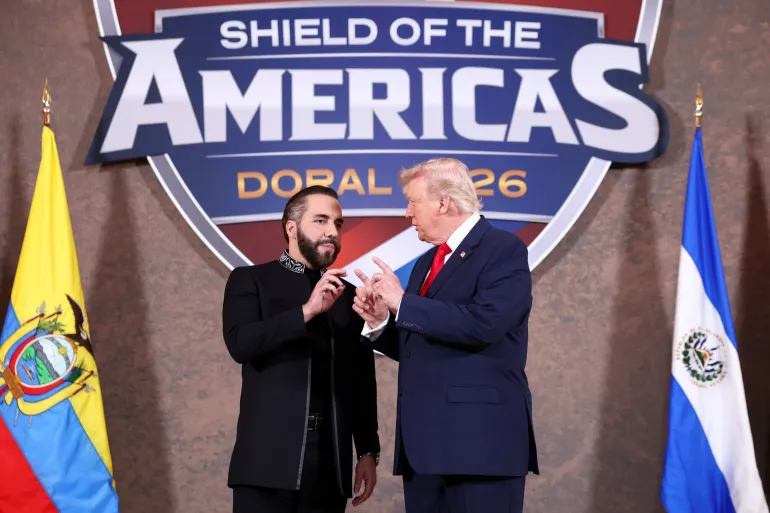
Donald Trump meets with El Salvador’s President Nayib Bukele as they attend the ‘Shield of the Americas’ summit on March 7 [Kevin Lamarque/Reuters]
A military-first approach
Latin America is one of several areas where Trump has launched military operations since returning to office in January 2025.
His rationale for authorising deadly operations in the region has centred primarily on the illicit drug trade.
Trump has repeatedly argued that Latin American criminal networks pose an imminent threat to national security, through the trafficking of people and drugs across US borders.
Experts in international law have pointed out that drug trafficking is considered a criminal offence — and it is not accepted as justification for acts of military aggression.
But the Trump administration has nevertheless launched lethal military strikes against alleged drug traffickers in Latin America.
Since September, for instance, the Trump administration has conducted at least 44 aerial strikes on maritime vessels in the Caribbean Sea and eastern Pacific Ocean, killing nearly 150 people.
The victims’ identities have never been publicly confirmed, nor has evidence been publicly released to justify the deadly strikes.
Some families in Colombia and Trinidad and Tobago have stepped forward to claim the dead as their loved ones, out on a fishing expedition or travelling between islands for informal work.
In Saturday’s remarks, Trump justified the attacks by arguing that cartels and other criminal networks had grown more powerful than local militaries — and therefore necessitated a lethal response.
“Many of the cartels have developed sophisticated military operations. Highly sophisticated, in some cases. They say they’re more powerful than the military in the country,” Trump said.
“Can’t have that. These brutal criminal organisations pose an unacceptable threat to national security. And they provide a dangerous gateway for foreign adversaries in our region.”
He then compared cartels to a disease: “They’re cancer, and we don’t want it spreading.”
US President Donald Trump signs a proclamation at the ‘Shield of the Americas’ summit in Doral, Florida [AFP]
A ‘nasty’ operation in Venezuela
In late December and early January, Trump also initiated attacks on Venezuelan soil, again defending his actions as necessary to stop drug traffickers.
The first attack targeted a port Trump linked to the gang Tren de Aragua. The second, on January 3, was a broader offensive that culminated in the abduction and imprisonment of Venezuela’s then-leader, President Nicolas Maduro.
On Saturday, Trump reflected on that military operation, which he characterised as an unmitigated success.
Maduro is currently awaiting trial on drug-trafficking charges in New York, though a declassified intelligence report last May cast doubt on Trump’s allegations that the Venezuelan leader directed drug-trafficking operations through groups like Tren de Aragua.
“America’s armed forces also ended the reign of one of the biggest cartel kingpins of all, with Operation Absolute Resolve to bring outlaw dictator Nicolas Maduro to justice in a precision raid,” Trump told Saturday’s summit.
He then described the military operation as “nasty”, though he underscored that no US lives were lost.
The early-morning raid, however, killed at least 80 people in Venezuela, including 32 Cuban military officers, dozens of Venezuelan security forces, and several civilians.
“We went right into the heart. We took them out, and it was nasty. It was about 18 minutes of pure violence, and we took them out,” Trump said of the operation.
Trump has since held up Venezuela as a model for regime change around the world, particularly as it leads a war with Israel against Iran.
Maduro’s successor, interim President Delcy Rodriguez, has so far complied with many of Trump’s demands, including for reforms to the country’s nationalised oil and mining sectors.
Just this week, the two countries re-established diplomatic relations for the first time since 2019, under Trump’s first term as president.
In Saturday’s remarks, however, Trump reiterated that his positive relationship with Rodriguez hinged on her cooperation with his priorities.
“She’s doing a great job because she’s working with us. If she wasn’t working with us, I would not say she’s doing a great job,” he said.
“In fact, if she wasn’t working with us, I’d say she’s doing a very poor job. Unacceptable.”
US Secretary of Defense Pete Hegseth speaks at the summit of Latin American leaders on March 7 [Kevin Lamarque/Reuters]
‘We’ll use missiles’
Trump did, however, express consternation with other presidents in the Latin American region, accusing them of allowing cartels to run amok.
“Leaders in this region have allowed large swaths of territory, the Western Hemisphere, to come under the direct control” of the cartels, Trump said.
“Transnational gangs have taken over, and they’ve run areas of your country. We’re not going to let that happen.”
He even delivered an ominous warning to the summit’s attendees: “Some of you are in danger. I mean, you’re actually in danger. It’s hard to believe.”
Many of the leaders in attendance, including El Salvador’s Bukele, have launched their own harsh crackdowns on gangs in their countries, employing “mano dura” or “iron fist” tactics.
Those campaigns, however, have elicited concerns from human rights groups, who have noted that presidents like Bukele used emergency declarations to suspend civil liberties and imprison hundreds of people, often without a fair trial.
Still, Trump dismissed alternative approaches in Saturday’s speech. Though he did not mention Colombia by name, he was critical of efforts to negotiate for the disarmament of cartels and rebel groups, as Colombian President Gustavo Petro has sought to do.
Instead, he offered to deploy military might throughout the region.
“We’ll use missiles. If you want us to use a missile, they’re extremely accurate — pew! — right into the living room, and that’s the end of that cartel person,” Trump said.
“A lot of countries don’t want to do that. They say, ‘Oh, sure. I’d rather not have that. I’d rather not have it. I believe they could be spoken to.’ I don’t think so.”
Leaders gather for a group photo at the ‘Shield of the Americas’ summit on March 7 [Kevin Lamarque/Reuters]
A call to ‘eradicate’ Mexico’s cartels
One country he did single out, though, was Mexico. Trump suggested that it had fallen behind other countries in the region in its efforts to combat crime.
“We must recognise the epicentre of cartel violence is Mexico,” he said.
“The Mexican cartels are fueling and orchestrating much of the bloodshed and chaos in this hemisphere, and the United States government will do whatever’s necessary to defend our national security.”
Since the start of his second term, Trump has pressured Mexico to step up its security efforts, threatening tariffs and even the possibility of military action if it does not comply.
Mexican President Claudia Sheinbaum has responded by increasing military deployments throughout the country.
In February 2025, for instance, she announced 10,000 soldiers would be sent to the US-Mexico border. For the upcoming FIFA World Cup, her officials have said nearly 100,000 security personnel will be patrolling the streets.
Just last month, her government also launched a military operation in Jalisco to capture and kill the cartel leader Nemesio Oseguera Cervantes, nicknamed “El Mencho”. She has also facilitated the transfer of cartel suspects to the US for trial.
But Trump reemphasised on Saturday his belief that Sheinbaum had not gone far enough, though he called her a “very good person” and a “beautiful woman” with a “beautiful voice”.
“I said, ‘Let me eradicate the cartels,’” Trump said, relaying one of his conversations with Sheinbaum.
“We have to eradicate them. We have to knock the hell out of them because they’re getting worse. They’re taking over their country. The cartels are running Mexico. We can’t have that. Too close to us, too close to you.”
Secretary of State Marco Rubio, centre, delivers remarks at a working lunch at Trump National Doral Miami in Florida [Rebecca Blackwell/AP Photo]
‘Last moments of life’ in Cuba
Trump also used his podium to continue his threats against Cuba’s communist government.
Since the January 3 attack on Venezuela, Trump has increased his “maximum pressure” campaign against the Caribbean island, which has been under a full US trade embargo since the 1960s.
His administration severed the flow of oil and funds from Venezuela to Cuba, and in late January, Trump announced he would impose steep economic penalties on any country that provides the island with oil, a critical resource for the country’s electrical grid.
Already, the country has been struck with widespread blackouts, and the United Nations has warned Cuba is inching closer to humanitarian “collapse”.
But Trump framed the circumstances as progress towards the ultimate goal of regime change in Cuba.
“As we achieve a historic transformation in Venezuela, we’re also looking forward to the great change that will soon be coming to Cuba,” he told Saturday’s summit.
“Cuba’s at the end of the line. They’re very much at the end of the line. They have no money, they have no oil. They have a bad philosophy. They have a bad regime that’s been bad for a long time.”
He added that he thinks changing Cuba’s government will be “easy” and that a deal could be struck for the transition of power.
“Cuba’s in its last moments of life as it was. It’ll have a great new life, but it’s in its last moments of life the way it is,” Trump said.
But while Trump’s remarks largely focused on governments not represented at the summit, he warned that there could be consequences even for the right-wing leaders in attendance.
Trump’s “Shield of the Americas” coalition comes as he seeks to bring the whole of Latin America in line with US priorities. It’s a policy he has dubbed the “Donroe Doctrine”, a riff on the 19th-century Monroe Doctrine, which claimed the Western Hemisphere as the US’s sphere of influence.
To Trump, that means ousting rival powers like China as they seek to forge relationships and economic ties with Latin America. Trump has even mused about retaking the Panama Canal, based on his allegation that the Chinese have too much control in the area.
“As these situations in Venezuela and Cuba should make clear, under our new doctrine — and this is a doctrine — we will not allow hostile foreign influence to gain a foothold in this hemisphere,” Trump said.
He then made a pointed remark to Panama’s president, Jose Raul Mulino, who was in the audience.
“That includes the Panama Canal, which we talked about. We’re not going to allow it.”
Two children he found while fleeing the Ngoshe attack clung to his hands, struggling to keep up as they stumbled across the uneven ground. Behind them, armed terrorists pursued, closing in.
From the distance, smoke rises, and shouts echo. The children stumbled again. Solomon Ali Talake pulled them and kept running. He could not run at full speed, and yet the terrorists would kill him if they caught up. So, he made a quick decision.
“Run that way,” he told the children, pointing toward the bush, while he turned in the opposite direction. He was spotted, however. He darted behind a tree, his chest pounding.
For a moment, he froze there, whispering a prayer under his breath.
Some hours before, Solomon could not have imagined that his life would change so completely. He is a primary school teacher in Ngoshe, a community in Borno, northeastern Nigeria, where he spends his days teaching pupils to read and write. On the evening of March 3, his routine unfolded like it always had. He returned home from school, sat with his family in the compound, and had dinner.
Then the gunfire began.
Terrorists stormed Ngoshe that evening, attacking a military base before spreading through the town, setting houses ablaze. Reports say the attackers killed over 100 and abducted over 300 more, but survivors said the casualty is too many to count. They said the assault, which lasted for several hours, forced thousands to flee the community that had been resettled only a few years ago as part of the government’s post-conflict programme.
“They attacked around 6:25 p.m.,” Solomon recalled.
His house sits close to the military base, so the first sounds came from there. The attackers, he said, struck the base before moving toward the community.
The military returned fire, according to Maina Bukar, another resident of Ngoshe who is now displaced in Maiduguri. “But they were overpowered, so they withdrew.”
When residents saw soldiers pulling back from the base, panic spread through the village. Families ran in every direction, but the terrorists followed. They caught up with some people and opened fire. Others were cut down as they tried to escape.
Solomon ran towards the bush, along the path leading to Pulka. The terrorists pursued and almost caught up. He hid behind a tree, three houses away from home. The terrorists spotted him but got distracted by movements in a nearby house. They rushed in to search.
Solomon seized the moment. “I climbed the tree and hid among the branches,” he recalled. “I remained there throughout the night.” The sound of the chaos echoed through the night.
Hours earlier, the village had been filled with children returning from school, farmers preparing their evening meals, and Muslim families preparing to break their fast.
The sounds of the attack did not remain confined to Ngoshe. Residents in Pulka, about ten kilometres away, also heard the gunfire.
“We heard it as soon as it happened,” said Muhammad Tela, a resident of Pulka.
Pulka sits close to Ngoshe, separated largely by a stretch of land and the hills of the Mandara Mountains. Both communities are towns in the Gwoza Local Government Area of Borno State.
“Ngoshe to Pulka is about a 25-minute drive because of the condition of the road,” Maina explained.
The two communities are closely connected. Every Tuesday and Friday, traders from Ngoshe travel to Pulka for trade under military escort, Maina said.
On the night of March 3, however, the market routes fell silent.
Get our in-depth, creative coverage of conflict and development delivered to you every weekend.
Subscribe now to our newsletter!
For Solomon’s family, returning to Ngoshe once felt like the beginning of a new chapter.
In October 2020, the Borno State government resettled displaced people in the town after rebuilding homes, schools, clinics, and other public facilities destroyed by Boko Haram insurgents in their violent and prolonged effort to topple democracy and establish what they believe to be an Islamic state. The activities of the terror group has killed over 35,000 people and displaced millions.
The Borno State government’s move was presented as part of a broader transition into what officials described as a post-conflict recovery phase. Solomon’s father, Ali Talake, believed in that promise.
Years earlier, when the insurgents first overran Ngoshe and neighbouring communities, he had fled across the border into Cameroon. From there, he eventually made his way to Maiduguri, where he lived inside the Federal Government College, volunteering as a security guard.
But his thoughts rarely left Ngoshe.
“My father was a farmer and a livestock rearer,” Solomon said.
When news spread that the government had begun resettling displaced residents, Ali Talake decided it was time to return. “We returned to Ngoshe on October 15, 2020,” Solomon said. Like many others, the family began rebuilding their lives there.
For six years, Ngoshe once again stood as home.
The community had access to basic facilities. “There is a clinic,” Maina said. “There are doctors and drugs.” The town also had clean water and schools.
Security presence was also significant. Residents say the formation consisted of personnel from the military and volunteer outfits like the Civilian Joint Task Force (CJTF), Nigeria Forest Security Services (NFSS), and surrendered terrorists, popularly called “the hybrid.” Solomon said there were about 300 soldiers stationed in Ngoshe. Maina corroborated this. In addition, “there are about 400 personnel of the CJTF, NFSS, and vigilantes,” he said. Before the attack, Maina estimated, about 10,000 people lived in the community.
“They patrol the town at night,” he said of the security operatives. “They would start patrolling by 6 p.m. until 6 a.m. the next morning.”
Despite that, residents said they did not always feel safe.
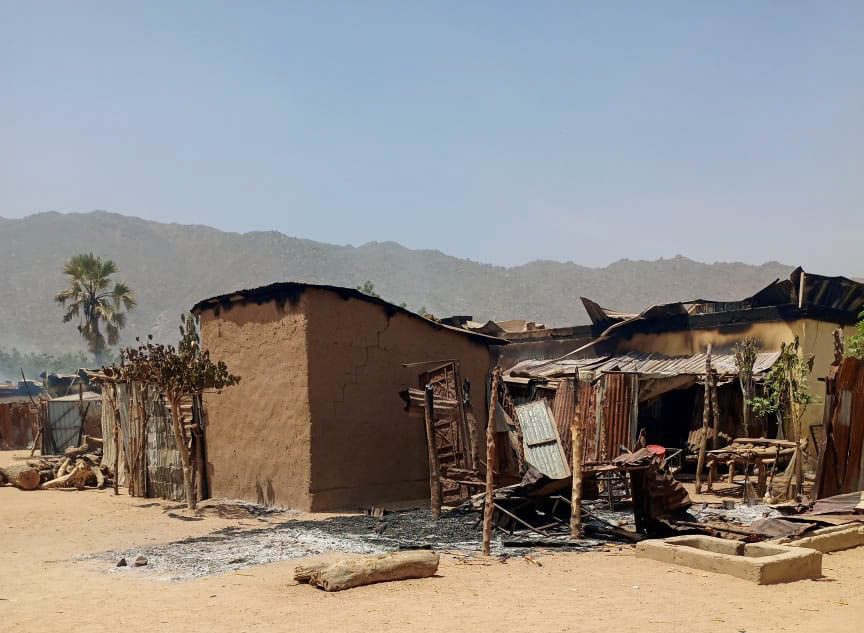
Photo of a burnt residence during the March 3 attack in Ngoshe. Credit: Survivors of the incident.
The town had faced insecurity before. “A similar major one [attack] happened on June 21, 2025,” Solomon recalled. Like in the recent attack, the community was overrun. “They did not kill anyone or burn buildings during that attack,” Solomon said.
Security later improved, and the town gradually returned to normal. But residents, especially farmers, could rarely venture beyond one kilometre from the town, Maina said. “Those who go beyond that are often abducted or killed by terrorists.”
For large-scale cultivation, people often travelled to Monguno and communities on the outskirts of Maiduguri, the state capital, such as Jakana. Adamu Zakariya, a resident of Ngoshe who had returned to Maiduguri months earlier to harvest his crops, agreed. “After harvest, we would return with the crops to Ngoshe,” he said. But this time, he decided to remain in Maiduguri because of a security job he recently got, while his family stayed in Ngoshe.
“Two weeks ago, they abducted some girls who had gone behind the mountains to gather firewood,” Maina said. “No ransom was demanded, and they were never returned. We later heard they had been married off, including a 12-year-old.”
Young boys were also at risk. “They would kill young boys who go out of town,” Maina said.
Before the recent Ngoshe attack, some residents had heard rumours. “Although we don’t know the authenticity, there were rumours that the terrorists would come to break their fast with us,” Solomon recalled. Such rumours circulated within the community and even reached security personnel. Some residents relocated. Others stayed.
The night of the violence
From the top of the tree Solomon climbed, he could see the village below. “They burnt all our houses, including my own room. I saw them,” he said. The attackers moved through the settlement, setting homes ablaze and pursuing residents who tried to escape.
At one point, several terrorists gathered beneath the tree where Solomon was hiding. “They were arguing,” he said. He held his breath and prayed. “I asked God to cause confusion so they would not look up.”
One of the fighters suggested firing at the tree. “Let me have this gun and scatter this tree,” Solomon remembered him saying. Another replied, “No, just leave it.” A third asked for a torch to check the branches. Again, someone stopped him. The men eventually moved away.
From his hiding place, Solomon said he saw about 27 attackers moving through the area. Some carried cutlasses and knives, others held guns. He recognised rifles such as AK-47s, although some weapons were unfamiliar to him.
Maina and his family also fled towards Pulka when the attack began.
“They came on motorcycles,” Maina said of the attackers. “Bullets were flying everywhere. The whole place was lit with gunfire.”
He arrived Pulka around 1 a.m., barefoot.
Media reports of March 6 state that a yet-to-be-identified terror group has claimed responsibility for the attack. However, testimonies from survivors revealed that the attack is suspected to have involved terrorists from both the Islamic State West Africa Province (ISWAP) and Jama’atu Ahlussunnah Lidda’awati Wal Jihad (JAS).
“Those who attacked the military base left immediately after taking vehicles and weapons,” Solomon said. They withdrew toward the direction of Pulka but veered into the bush before reaching the town.
“It was those on the mountain who attacked the community,” Solomon said, referring to JAS fighters based in the Mandara Mountains. “Afterwards, they climbed back up.”
For the JAS terrorists, residents believe the attack may have been retaliation. On Dec. 19, 2025, the Nigerian Army announced that troops of Operation Hadin Kai had killed a terrorist commander and several fighters in the Mandara Mountains the previous day. Maina said the commander was later beheaded by members of the CJTF.
“They cut the heads of some of them,” Solomon said of the soldiers killed during the recent attack. “I was told they killed about ten soldiers.”
Adamu said some former JAS members who had previously surrendered were living in Ngoshe with their families. “When those members of JAS from Ngoshe attacked the town with their colleagues, they took away some of their family members,” he said. “Especially young men and women of reproductive age.”
He added that the attackers also killed some who had previously defected from the group. Tracking and killing defectors has been a recurring tactic among the JAS terror group. In November 2025, HumAngle reported cases of former terrorists being tracked and assassinated across Borno.
“The terrorists took what they could carry from the military armoury and set what they could not carry ablaze,” Maina said.
“It was said the soldiers from Pulka drove into buried mines on the way to Ngoshe,” he said. “Two of the soldiers were my friends. One died, and the other was injured.”
The road between the towns has long been dangerous. “The terrorists dig holes along the road and bury mines inside them,” Maina said.
The use of roadside explosives has become increasingly common in recent months. In April 2025, Improvised Explosive Devices (IEDs) planted along the Maiduguri-Damboa road killed at least seven passengers and injured several others.
Muhammad said soldiers from Pulka remained near the border and helped injured survivors reach the hospital in Pulka.
On March 6, Nigeria’s President, Bola Tinubu, condemned the attack, describing it as a “heartless assault on helpless citizens.” The president then charged “the military and other security agencies to work urgently to rescue those kidnapped by the terrorists.” As well as “intensify their efforts to protect civilians nationwide and prevent attacks on military installations in the North East.”
At dawn, Solomon saw the attackers switch on a generator and begin the call to prayer. He realised it might be his chance to escape.
“I climbed down at 5:10 a.m. and ran,” he said. “When I heard them saying they would check trees and uncompleted buildings after burning the houses, I knew I had to leave when I got the chance.”
He hid again until about 6 a.m.
The morning after
Fleeing residents of Ngoshe on the outskirts of Pulka on March 4th waiting for aid. Credit: Survivors of the incident.
By 7:10 a.m., he had reached Pulka, where many survivors had gathered.
“Most people came barefoot,” Muhammad Tela said. “Others carried the elderly on push carts. Some even brought the corpses of loved ones.”
Many arrived carrying whatever they could salvage: bags of clothes, goats, and small belongings gathered in haste. Others fled further: toward Maiduguri, Cameroon, and Abuja.
Media reports later suggested that about 100 people were killed and more than 300 abducted. Survivors say the numbers are difficult to confirm.
“They cannot be quantified,” Maina said. “But the people I reached Pulka with and those we met at the entrance, including women, children and the elderly, were about 2,000 from my estimation.”
Solomon saw two children being abducted while they were fleeing.
Two of Solomon’s nephews were also taken during the attack. One is 14 years old and the other is 11.
Fleeing residents of Ngoshe on the outskirts of Pulka on March 4, waiting for aid. Credit: Survivors of the incident.
Later, when soldiers briefly returned to Ngoshe, Solomon returned as well. His father had been killed. “He was 68,” he said. From his father’s body, Solomon collected two small items: a cap and a wallet.
“They are something to remember him with,” he said. Victims like Solomon’s father were buried two days later in a mass burial.
The new fear
Recent months have seen a wave of attacks by ISWAP fighters across Borno, particularly targeting security formations.
A member of the Nigerian Forest Security Service (NFSS) said terrorists attacked a military base in Konduga on March 5 and burned several buildings. The base, located near an area known as “High Bridge,” lies close to Malari.
According to him, the terrorists killed several soldiers and took away vehicles and weapons.
Earlier, on Feb. 14, terrorists attacked a military base in Pulka. Two days later, troops launched a counter-operation that reportedly killed a commander and recovered ₦37 million. On Feb. 5, terrorists attacked a military base in Auno, a community close to Maiduguri along the Maiduguri-Damaturu road, according to a military source who asked not to be named. On Jan. 26, terrorists attacked a military base in Damasak, killing seven soldiers and capturing 13 others, including their commanding officer. Eleven managed to escape.
Earlier, on Nov. 14, 2025, terrorists ambushed a military convoy along the Damboa-Biu road. Two soldiers and two CJTF members were killed. Brigadier General M. Uba, the Brigade Commander of the 25 Task Force Brigade, was abducted and later killed. On Nov. 20 of the same year, they attacked a CJTF base in Warabe, killing eight people and leaving three others missing. And on Dec. 25, a suicide bomber detonated at a mosque in the Gamboru Market area of Maiduguri. Five people were killed, and 35 others were injured.
Terrorists have also targeted reconstruction projects.
On Jan. 28, about 30 construction workers were killed in Sabon Gari, Damboa. Earlier, on Nov. 17, 2025, workers fled after terrorists stormed a construction site in Mayanti, Bama.
Resettled communities have also come under repeated attack. On Sept. 5, 2025, fighters attacked Darajama in Bama, killing at least 63 people, including five soldiers, and burning about 24 houses. Many residents fled again.
Umara Ibrahim, a professor of International Relations and Strategic Studies at the University of Maiduguri, said the attacks may be intended to undermine government resettlement efforts.
“Because their movements are observed and monitored, and perhaps challenged, it is not in their interest for resettlement to proliferate,” he told HumAngle in a February interview.
He added that such violence may also serve a political purpose. “It may be a way to counter government efforts by shaping public perception that the authorities cannot be trusted on security,” he said.
Pulka itself had once been abandoned when insurgents seized the town. After the military retook it in 2017, residents gradually returned. More recently, the government resettled refugees from Cameroon there. On Jan. 28, the government resettled about 300 Nigerian refugees from Cameroon. On Feb. 8, it resettled 680 more.
But the Ngoshe attack has revived old fears. “People don’t feel secure,” Muhammad said. “They think the community could be displaced again. Everyone is thinking about where to go.”
Communication also became difficult. For several days, residents said, there was no network across Gwoza, leaving families struggling to confirm whether relatives were alive.
Photo of a burnt resident during the March 3 attack in Ngoshe. Credit: Survivors of the incident.
Adamu’s brothers later travelled from Maiduguri to Pulka to retrieve their displaced relatives. Maina did not remain in Pulk as his parents urged him to leave immediately for Maiduguri. Still, he worries about those left behind. He believes the community needs stronger security.
In the days that followed, Solomon also travelled to Maiduguri. Though he is the seventh child in his family, he is now the only available adult son able to organise their next steps. His stepmother and siblings remain displaced.
“I am looking for a house to rent so I can bring them here,” he said. Looking back, Solomon says he had always worried about returning to Ngoshe.
“We had no neighbouring villages,” he said. “We were surrounded by bushes and mountains.” Sometimes, he warned his family. “One day these people might take over,” he recalled telling them. Now the village has emptied again.
And Solomon, a teacher who once spent his days in a quiet classroom, is searching for shelter in a distant city while carrying the memory of a night he survived by hiding in a tree.
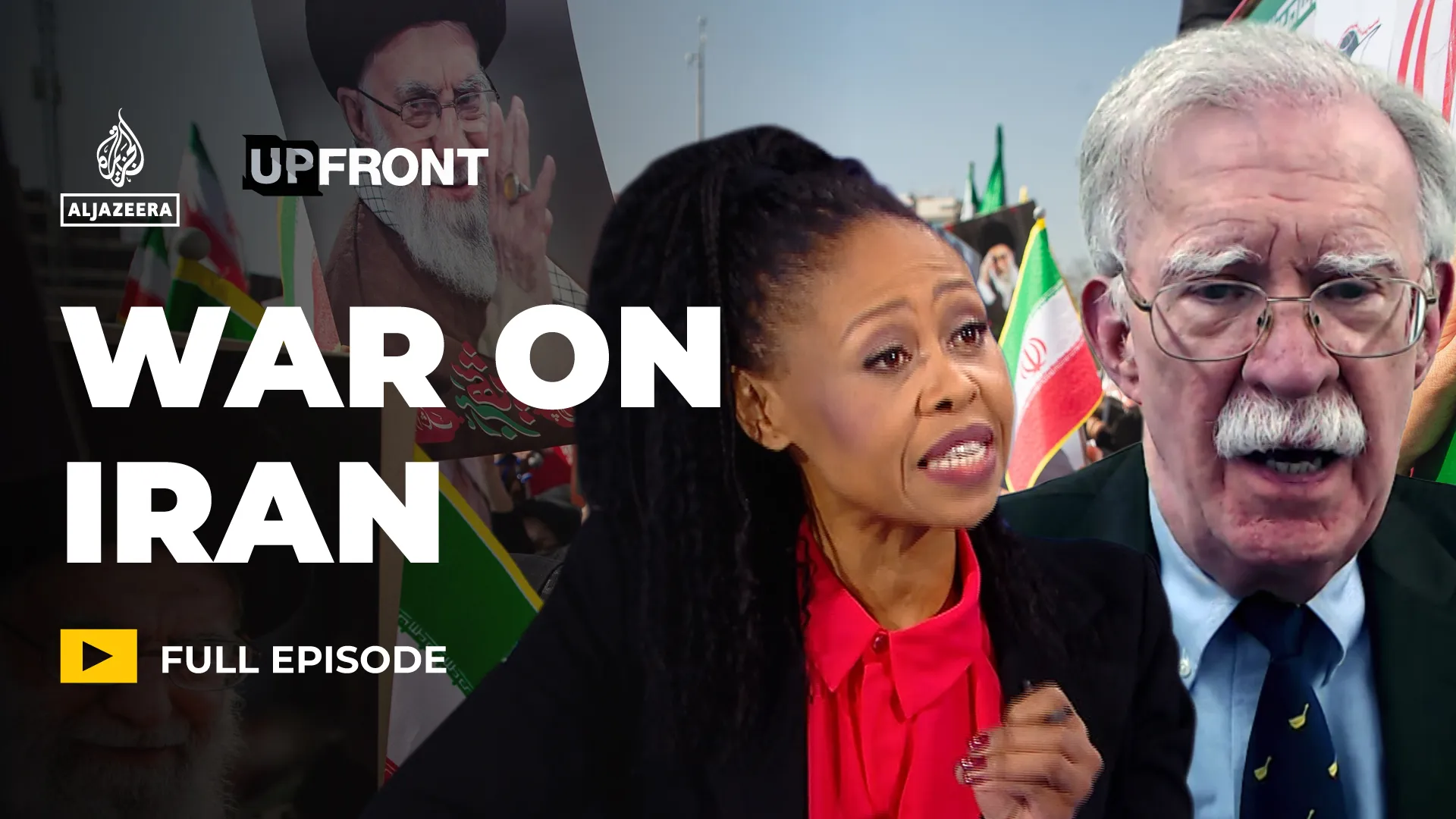
Redi Tlhabi challenges former US Ambassador to the UN John Bolton on why he supports war and regime change in Iran.
This past week, the United States and Israel launched a war on Iran under the banner of regime change. But as the war escalates and with Iran firing missiles at US bases across the region and at Israel – questions are mounting over how far this conflict could spiral.
This week on UpFront Redi Tlhabi challenges former National Security Adviser and former US Ambassador to the United Nations John Bolton on why he believes that a diplomatic end to the war would be a mistake, and we speak to Joe Cirincione, author of, Nuclear Nightmares: Securing the World Before it is Too Late, about the risk of nuclear proliferation.
A father and his daughter have been killed in an Israeli drone attack in central Khan Younis, southern Gaza, as Palestinians continue to suffer amid worldwide attention on the United States-Israeli war on Iran.
The two were killed early on Saturday. In a separate attack later in the day in Khan Younis, another person was killed and a young girl wounded, according to Al Jazeera correspondents on the ground.
Recommended Stories
list of 4 itemsend of list
Israeli forces continue carrying out air strikes, artillery shelling, and naval bombardment on Gaza on a daily basis, despite an October 11 “ceasefire” as Israel continues its ongoing genocide.
Suffering in Gaza and the occupied West Bank remains acute as the world focuses on the US-Israeli bombardment of Iran.
In the past 48 hours, two additional people have been wounded, the Palestinian Ministry of Health said.
Israeli army-affiliated militias, meanwhile, have advanced east of Gaza City, with heavy gunfire reported in the area. Initial reports also stated a member of the Palestinian police was abducted.
Israeli warplanes also struck several locations east of the Tuffah neighbourhood, near Gaza City, while the Israeli navy fired heavy machineguns and shells towards the coast of Gaza City, Palestinian news agency Wafa reported.
The Rafah border crossing, meanwhile, remains closed. Israel had shut it amid its attacks on Iran.
The Rafah crossing, located on Gaza’s southern border, had reopened only last month allowing a limited number of Palestinians to leave for the first time in months, including patients in urgent need of medical care. Thousands remain blocked from travelling for treatment.
The Karem Abu Salem crossing, also known to Israelis as Kerem Shalom, is partially open for the entry of humanitarian aid only, under strict restrictions.
Nearly all of Gaza’s population of more than two million people was displaced during Israel’s war on the territory, and the enclave remains heavily dependent on humanitarian assistance.
In a February report, Human Rights Watch said Israeli restrictions had contributed to shortages of medicine, reconstruction materials, food and water inside the Strip.
Since the ceasefire in Gaza, 640 Palestinians have been killed and at least 1,700 wounded, according to the Health Ministry. At least 72,123 Palestinians have been killed since October 2023, while 171,805 people have been injured.
Meanwhile, in the occupied West Bank, the Palestinian Red Crescent Society reported its teams in Hebron are treating a Palestinian injured by live fire near the illegal Karmei Tzur settlement, built on Palestinian land north of Hebron.
Three Palestinians were also injured on Saturday after being physically assaulted by Israeli settlers in the Ras al-Ahmar area, south of Tubas, Wafa reported. Medical sources at the Palestinian Red Crescent Society said their teams responded to three people with injuries.
Israeli forces also conducted raids in the towns of Qaffin and Kafr al-Labad, north of Tulkarem, early on Saturday, Wafa said.
A Palestinian man was also injured after being assaulted by Israeli soldiers near the village of Azmut, east of the occupied West Bank city of Nablus.
Palestinians have faced a wave of intensified Israeli military and settler violence across the West Bank since the war on Gaza began in October 2023.
At least 1,094 Palestinians have been killed by Israeli troops and settlers in the West Bank since October 2023, according to the latest United Nations figures.
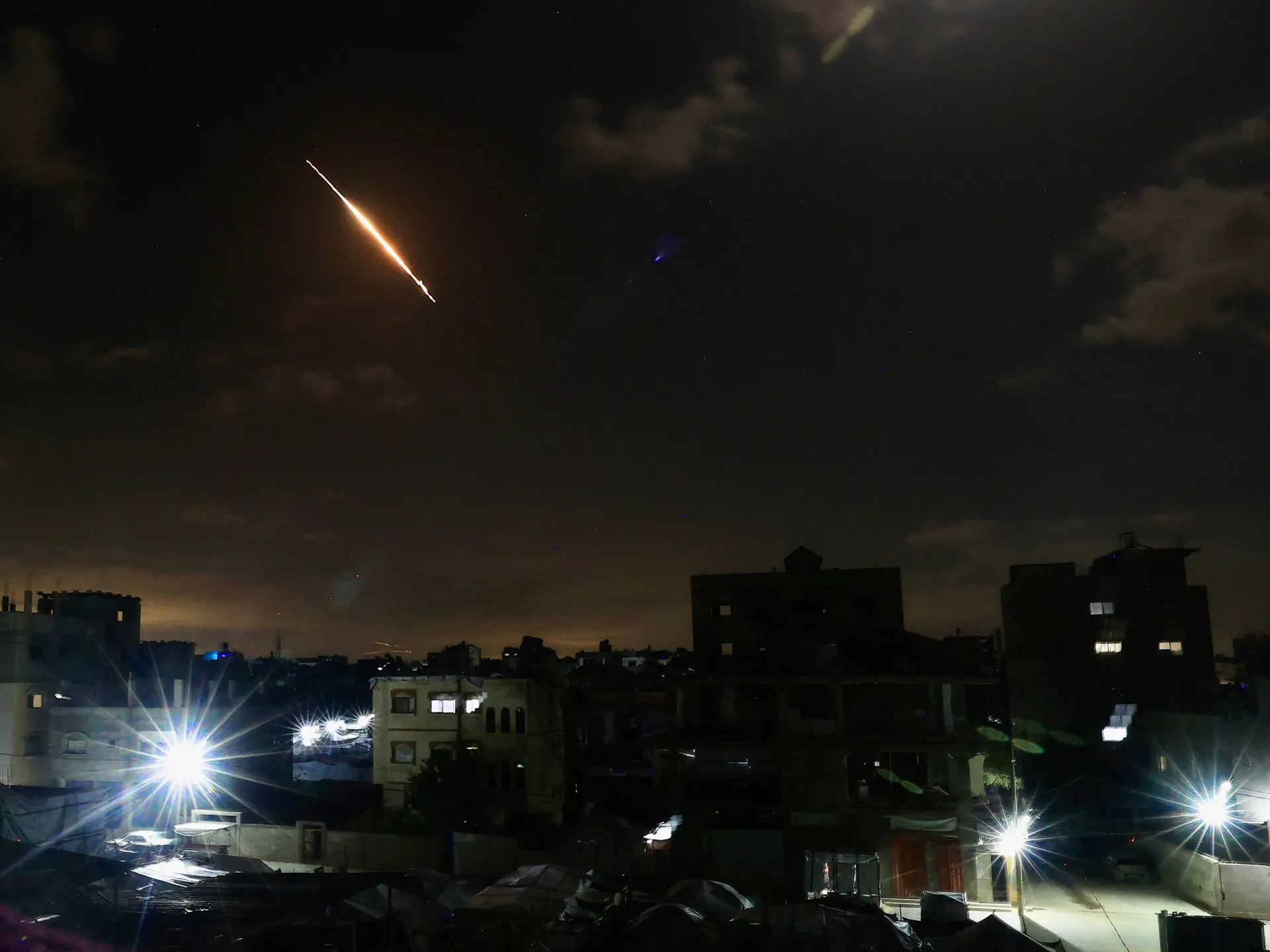
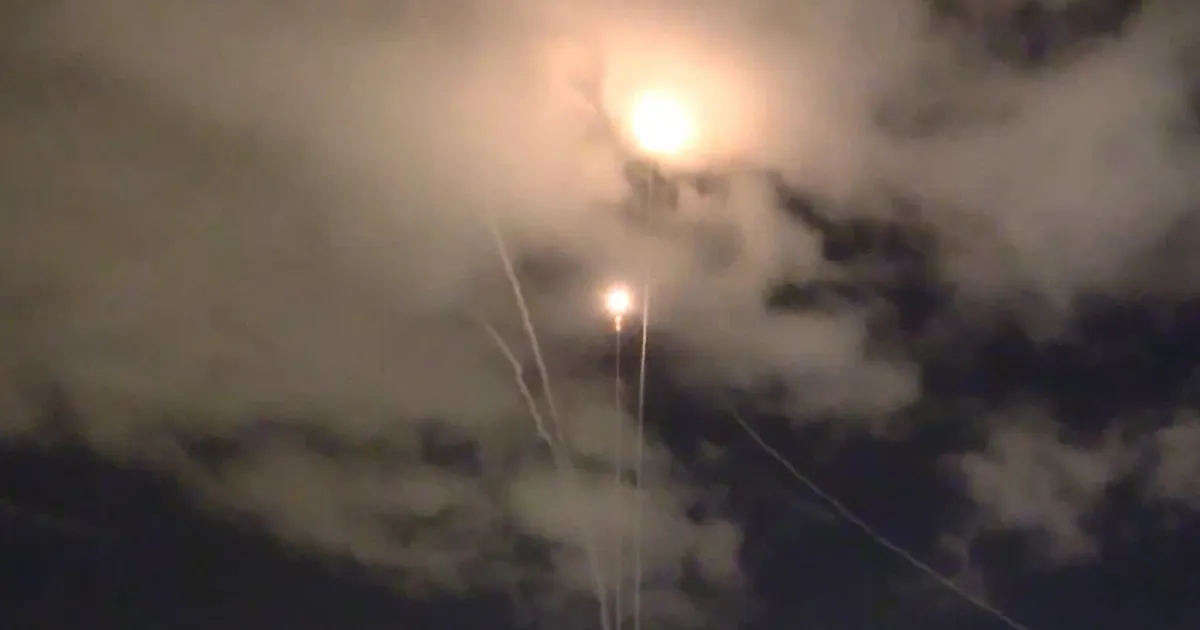
Air raid sirens blared across occupied East Jerusalem on Saturday after missiles were reportedly fired by Iran, with explosions heard and interception trails visible in the sky.
Pentagon asserts US forces are tracking Russian-Iranian operations amid escalating conflict in the region.
Published On 7 Mar 20267 Mar 2026
Share
Washington has downplayed reports that Russia is sharing intelligence with Iran about United States targets across the Middle East amid the burgeoning US-Israel war on Iran, first reported by The Washington Post.
Defense Secretary Pete Hegseth, in a CBS 60 Minutes interview on Friday, said the US is “tracking everything” and factoring it into battle plans when asked about the reports Moscow was aiding Tehran.
Recommended Stories
list of 4 itemsend of list
Since the war began on February 28, Russia has passed Iran the locations of US military assets, including warships and aircraft, three officials, who spoke on the condition of anonymity, told The Washington Post.
“It does seem like it’s a pretty comprehensive effort,” one of the sources told the newspaper.
Meanwhile, anonymous officials told The Associated Press news agency that US intelligence has not uncovered that Russia is directing Iran on what to do with the information, as the US and Israel continue their bombardment and Iran fires retaliatory salvoes at US assets and allies in the Gulf.
Hegseth said the United States is “not concerned” about the reports, also downplaying the possibility that Russia’s assistance could be putting US citizens in harm’s way.
“The American people can rest assured their commander-in-chief is well aware of who’s talking to who,” Hegseth said.
“And anything that shouldn’t be happening, whether it’s in public or back-channelled, is being confronted and confronted strongly.”
He continued: “We’re putting the other guys in danger, and that’s our job. So we’re not concerned about that. But the only ones that need to be worried right now are Iranians that think they’re gonna live.”
White House Press Secretary Karoline Leavitt on Friday also claimed to reporters that “[the report] clearly is not making any difference with respect to the military operations in Iran because we are completely decimating them.”
Leavitt declined to say if Trump had spoken to Russian President Vladimir Putin about the reported intelligence sharing or whether he believed Russia should face repercussions, saying she would let the president speak to that himself.
First signs of Moscow’s involvement
Trump, for his part, on Friday evening berated a reporter for raising the matter of the report when he opened the floor to questions from the media at the end of a White House meeting about how paying student-athletes has recalibrated college sports.
“I have a lot of respect for you, you’ve always been very nice to me,” the US president said to Peter Doocy, the Fox News reporter.
“What a stupid question that is to be asking at this time. We’re talking about something else.”
The intelligence is the first indication that Moscow has sought to get involved in the war that the US and Israel launched on Iran a week ago.
Asked whether Russia would go beyond political support and offer military assistance to Iran, Kremlin spokesman Dmitry Peskov said there has been no such request from Tehran.
“We are in dialogue with the Iranian side, with representatives of the Iranian leadership, and will certainly continue this dialogue,” he said on Friday.
Pushed on whether Moscow has provided any military or intelligence assistance to Tehran since the Iran war’s start, he refrained from comment.
Russia has tightened its relationship with Iran as it looked for badly needed missiles and drones to use in its four-year war against Ukraine. But the pair have long maintained friendly relations, even while Tehran has faced years of isolation from the West over its nuclear programme and its support of proxy groups in the Middle East.
Berger, who has not won on the PGA Tour since 2021, put himself on course for the £3m top prize thanks to a clean run on the back nine which included three birdies.
“I actually feel like I played better [today] – the course was a little tougher,” he said.
“I’m looking forward to the next couple of days and seeing the challenge they bring.”
Americans Sahith Theegala and Collin Morikawa and Sweden’s Ludvig Aberg are tied for third on seven under, with American Ricky Fowler one shot further back.
McIlroy, who birdied four of the first seven holes on the back nine, said: “I played the last 10 holes really, really well.
“Overall I am really pleased. I played a very sort of controlled, patient round of golf, which you need to do around here.”
American world number one Scottie Scheffler bogeyed the 18th in a round of 71 that left him three under.
England’s Tommy Fleetwood, who was four over after the first round, shot three birdies on the back nine in a second-round 69 to make the cut on one over.
Explosions shake Tehran as US-Israel attacks intensify, marking eight days of conflict and retaliation from Iran.
Published On 7 Mar 20267 Mar 2026
Share
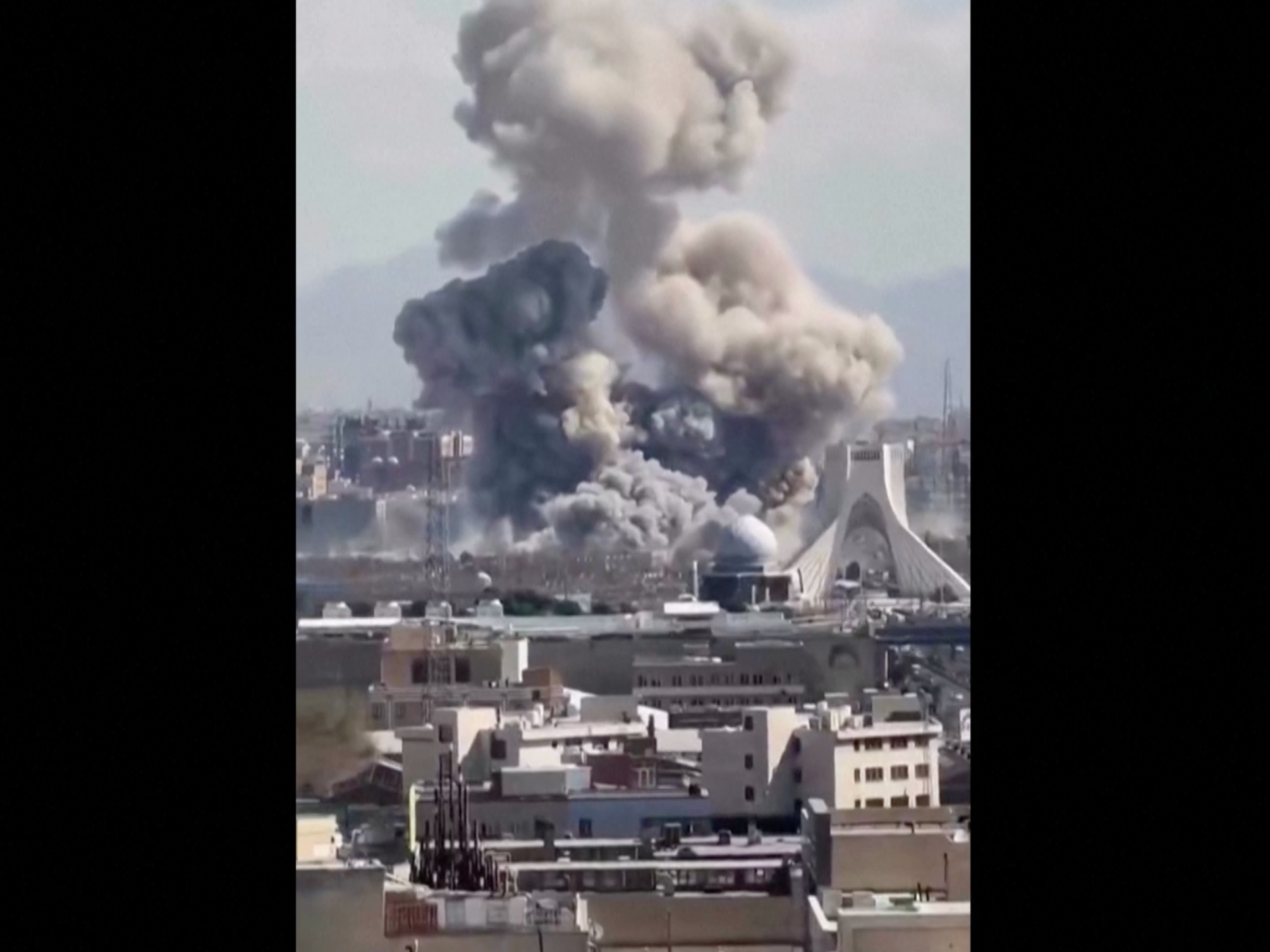
Huge explosions have hit several locations across Iran, including the capital, Tehran, as the war that has ignited the Middle East entered its eighth day.
The United States-Israeli attacks sent up clouds of dark smoke in the Iranian capital early on Saturday, and Tehran retaliated by firing missiles at Israel.
Recommended Stories
list of 4 itemsend of list
The US has warned of a forthcoming bombing campaign that officials said would be the most intense yet in the weeklong conflict, which has already killed at least 1,230 people and is set to cause further casualties daily.
Israel’s military said early on Saturday it had started a “broad-scale wave of strikes” on targets in Tehran.
“Iranians are now waking to day eight since the initiation of the US-Israeli air strikes targeting different facilities and places across the Iranian capital and elsewhere in the country,” said Al Jazeera’s Tohid Asadi, reporting from Tehran.
Continuous attacks have been occurring since midnight, he said.
“According to the latest reports, Mehrabad, which is one of the two main airports in the Iranian capital, was targeted. The nearby area was said to be affected, as well,” said Asadi.
Meanwhile, attacks have been taking place in other cities across the country – targeting not just military areas or political centres, but also residential areas, schools and hospitals, he added.
Amir-Saeid Iravani, Iran’s ambassador to the United Nations, told the UN Security Council on Friday that the US and Israel are bombing civilian areas in his country, stating: “These acts constitute clear war crimes and crimes against humanity.”
The continued fighting comes as US President Donald Trump’s administration approved a new $151m arms sale to Israel after Trump said he would not negotiate with Iran without its “unconditional surrender”.
Iran’s UN ambassador said the country would “take all necessary measures” to defend itself.
Iran’s strategy to ‘keep Israelis in shelters’
Meanwhile, Iran has continued to strike back at Israel.
The Israeli military said early on Saturday that it had detected another round of Iranian missile fire headed towards Israel, and a series of explosions were heard in Tel Aviv following the launches from Iran.
Missiles were also detected heading towards other parts of the country, including southern Israel.
“Since midnight, the Israelis have detected at least five ballistic missile launches coming into Israel from Iran,” said Al Jazeera’s Nida Ibrahim, reporting from Ramallah in the occupied West Bank.
“They have led millions of Israelis into shelters throughout the night, which is something that Israeli analysts say the Iranians are intending to do to put more pressure on the Israeli government – by keeping Israelis in shelters and by keeping these missiles launching coming at different times.”
Weekly insights and analysis on the latest developments in military technology, strategy, and foreign policy.
Welcome to Bunker Talk. This is a weekend open discussion post for the best commenting crew on the net, in which we can chat about all the stuff that went on this week that we didn’t cover. We can also talk about the stuff we did or whatever else grabs your interest. In other words, it’s an off-topic thread.
This week’s second caption reads:
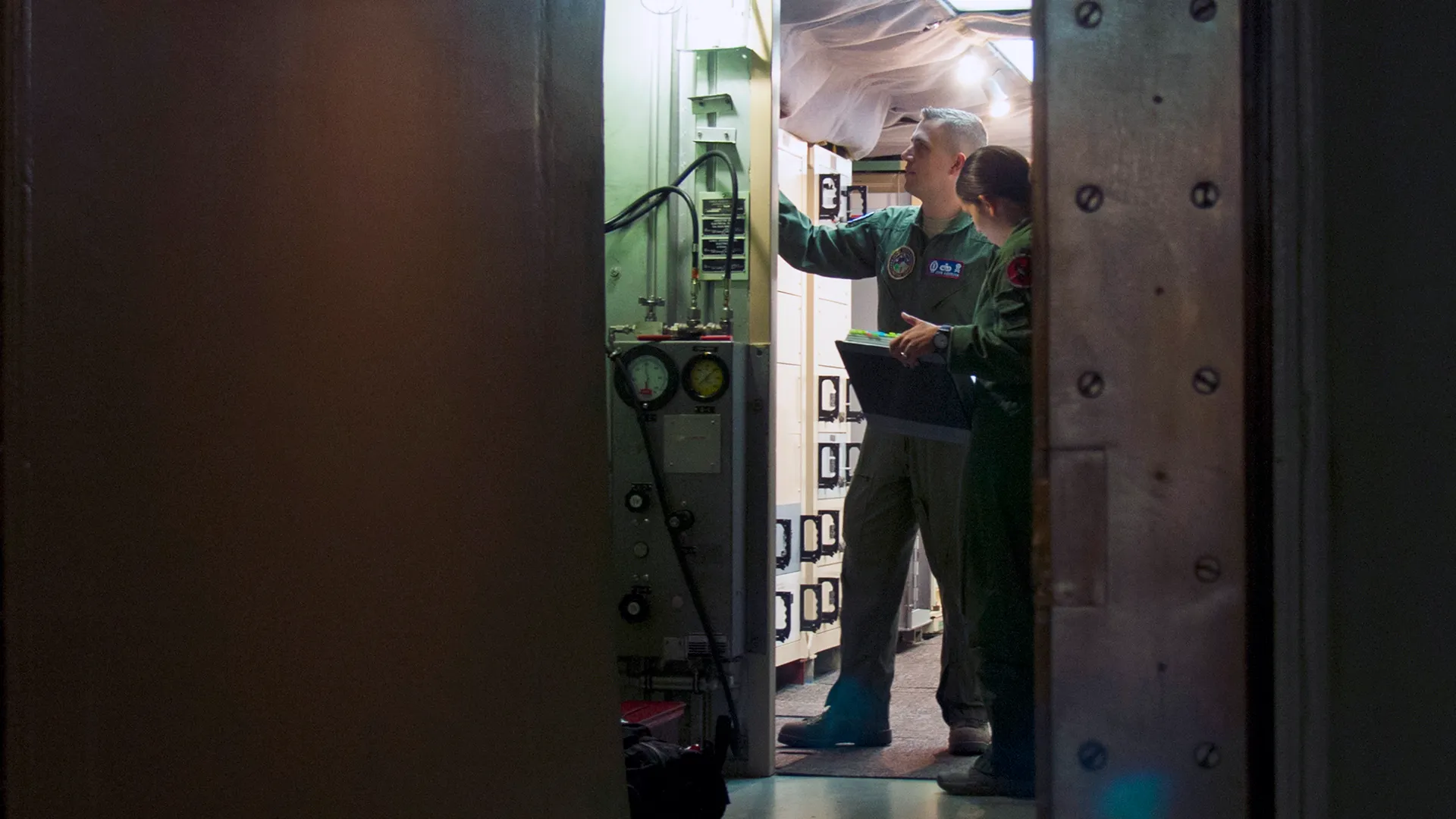
First Lt. Pamela Blanco-Coca, 319th Missile Squadron missile combat crew commander, and 2nd Lt. John Anderson, 319th MS deputy missile combat crew commander, conduct pre-operational checks at a launch control center in the F.E. Warren Air Force Base, Wyo., missile complex Feb. 9, 2016. The missileers worked heavily in conjunction with missile maintainers to conduct a test of Minuteman III weapon system components in a test known as the Simulated Electronic Launch-Minuteman. (U.S. Air Force photo by Senior Airman Jason Wiese)
Also, a reminder:
Prime Directives!
If you want to talk politics, do so respectfully and know that there’s always somebody that isn’t going to agree with you.
If you have political differences, hash it out respectfully, stick to the facts, and no childish name-calling or personal attacks of any kind. If you can’t handle yourself in that manner, then please, discuss virtually anything else.
No drive-by garbage political memes. No conspiracy theory rants. Links to crackpot sites will be axed, too. Trolling and shitposting will not be tolerated. No obsessive behavior about other users. Just don’t interact with folks you don’t like.
Do not be a sucker and feed trolls! That’s as much on you as on them. Use the mute button if you don’t like what you see.
So unless you have something of quality to say, know how to treat people with respect, understand that everyone isn’t going to subscribe to your exact same worldview, and have come to terms with the reality that there is no perfect solution when it comes to moderation of a community like this, it’s probably best to just move on.
Finally, as always, report offenders, please. This doesn’t mean reporting people who don’t share your political views, but we really need your help in this regard.
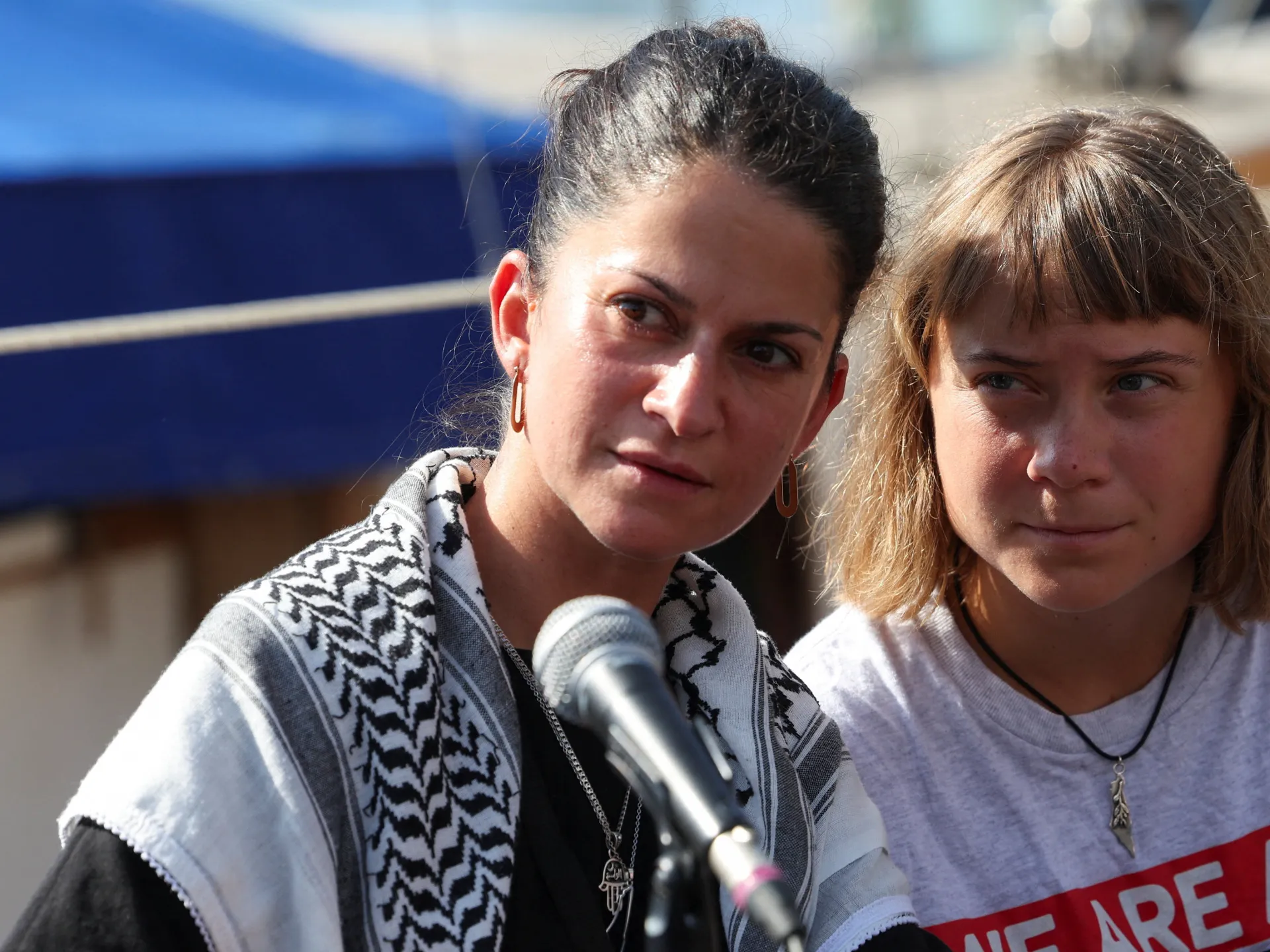
Pro-Palestinian German activist Yasemin Acar told Al Jazeera about what she says was harassment at a Berlin airport where she recorded a border guard asking about her destination because of concerns over “hostility towards Israel”.
Christie Garba is a 38-year-old mother of seven who lives in Billiri, Gombe State, in Nigeria’s North East. She lived in Yobe State with her family before the Boko Haram insurgency hit the region. At that time, attacks had happened in nearby places, and they had not reached her community directly.
Christie and her family had stayed about four months after the attacks started, but as the violence escalated, the soldiers warned residents that the situation had become too dangerous to remain. The curfews that followed made everyday life almost impossible.
In this episode of VOV, we tell the story of how Christie and her family moved to Gombe State and how she survived starting a new business.
Reported and scripted by Sabiqah Bello
Voice acting by Rukayya Saeed
Multimedia editor is Anthony Asemota
Executive producer is Ahmad Salkida
Christie Garba, a 38-year-old mother of seven, relocated from Yobe State to Billiri, Gombe State in Nigeria due to the Boko Haram insurgency. Initially, her community was indirectly impacted, but the increasing violence and subsequent military curfews forced her family to move to ensure their safety.
Despite the challenges, Christie successfully established a new business in Gombe State, showing resilience and adaptability in the face of adversity.
Her story highlights the impact of regional conflict and the determination required to rebuild and sustain a livelihood in new environments.
Witness videos captured Iranian projectiles soaring over Tel Aviv as sirens blared and Israeli interceptors launched. Residents could be heard shouting as one of the missiles appeared to break apart into dozens of smaller projectiles.
As the United States and Israel’s war on Iran unfolds over the coming days and weeks, the scale of the fallout for the global economy will be measured at the petrol pump.
The biggest threat the conflict poses to global economic health lies in rising energy prices.
For a global economy already rattled by US President Donald Trump’s tariffs and what many see as his unravelling of the post-World War II order, much now depends on how long the disruption lasts.
A sustained surge in energy prices would drive up the cost of everyday goods.
Central banks would then likely raise borrowing costs to curb inflation, dampening consumer spending and dragging down economic growth.
“It’s really a question on how long the disruption of flows through the Strait of Hormuz lasts and whether there will be destruction of physical assets,” said Anne-Sophie Corbeau, an analyst at Columbia University’s Center on Global Energy Policy.
“For the moment, the market is pricing a short disruption and no destruction. But that may change in the future. We simply do not know right now how this whole crisis ends.”
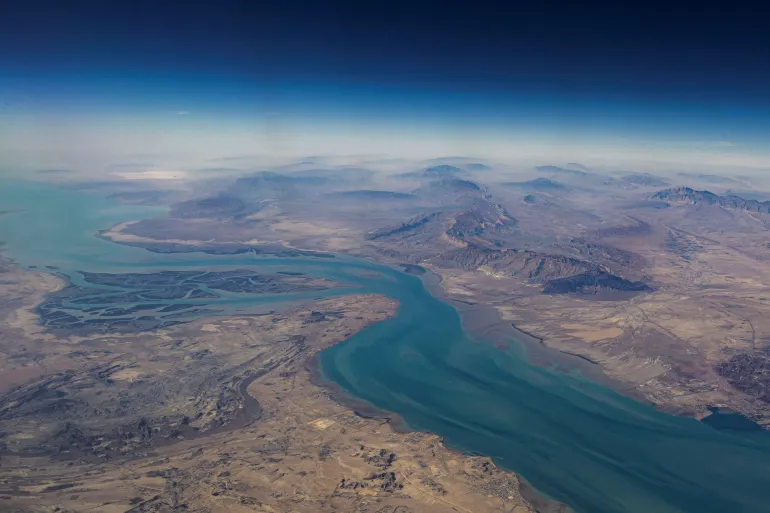
An aerial view of the island of Qeshm, separated from the Iranian mainland by Clarence Strait, in the Strait of Hormuz, on December 10, 2023 [Reuters]
While Iran’s threats to shipping have halted traffic through the Strait of Hormuz, the conduit for one-fifth of the world’s oil, crude prices have seen relatively modest gains so far.
Brent crude hovered about $84 a barrel on Friday morning, US time, up about 15 percent compared with pre-conflict prices.
That gain pales in comparison with past crises.
During the 1973-74 oil embargo led by OPEC’s Arab members, prices quadrupled in just three months.
Since then, the world’s dependence on Middle Eastern oil has declined substantially.
Today, the US is the biggest producer globally, producing some 13 million barrels a day, more than Iran, Iraq and the UAE combined, according to the US Energy Information Administration.
But if supply disruptions extend beyond a few weeks, oil prices could rise precipitously.
Storage capacity constraints
The seven oil-producing Gulf nations – Bahrain, Kuwait, Oman, Qatar, Saudi Arabia and the UAE – are likely to run out of crude oil storage capacity in less than a month if the Strait of Hormuz remains closed, according to an analysis by JPMorgan Chase.
With storage capacity depleted, producers would be forced to cut production.
“While there will be some capacities elsewhere, and some options to use pipelines rather than shipping, it is incredibly difficult to replace the sheer volume as we are talking about an average of 20 million barrels of oil per day that usually cross the Strait of Hormuz,” said Sarah Schiffling, a supply chains expert at the Hanken School of Economics in Helsinki.
“This important maritime chokepoint provides very significant leverage in the global economy.”
This week, Goldman Sachs analysts estimated that global oil prices will likely hit $100 a barrel – a threshold not seen since Russia’s 2022 invasion of Ukraine – if shipping through the waterway stays at the current reduced levels for five weeks.
In an interview published by The Financial Times on Friday, Qatar’s energy minister Saad al-Kaabi warned that producers in the region could halt production within days and that oil could soar as high as $150 a barrel.
Such increases would reverberate through the global economy.
The International Monetary Fund has estimated that global economic growth is reduced by 0.15 percent for every 10 percent rise in oil prices.
The pain would not be spread evenly.
About 80 percent of the oil shipped through the strait goes to Asia.
India, Japan, South Korea and the Philippines, which are all highly dependent on foreign energy imports, would be among the economies most vulnerable to spikes in the cost of necessities such as food and fuel.
“The effect would be felt in Asia and Europe in particular,” said Lutz Kilian, an economist at the Federal Reserve Bank of Dallas.
“Some countries, such as China, have ample oil reserves to help weather a temporary outage, while others do not.”
Liquefied natural gas (LNG), which is also shipped through the strait and has fewer alternative suppliers outside the region than crude oil, has already seen much steeper price rises.
European prices of LNG surged by as much as 50 percent on Monday after state-run QatarEnergy, which ships about one-fifth of global supply through the waterway, announced a halt to production following drone attacks blamed on Iran.
“Gas will be more impacted because the market was still relatively tight and stocks are low in Europe as we are at the end of winter; also, there is no replacement for the LNG lost,” Corbeau said.
The sun sets behind an oil pump in the desert oil fields of Sakhir, Bahrain, on September 29, 2016 [Hasan Jamali/AP]
Prolonged uncertainty
With US President Donald Trump signalling that he intends to continue the assault on Iran for at least several more weeks, the extent to which Tehran is willing – or able – to keep the strait closed will be critical to the global economy.
At least nine commercial vessels have been targeted in attacks in or near the strait since the start of the conflict, prompting multiple insurance firms to cancel coverage for vessels in the Gulf.
While traffic through the strait has not halted, it is down about 90 percent compared with normal levels, according to ship tracker MarineTraffic.
“The uncertainty itself is probably the most dangerous part. Supply chains hate uncertainty,” Schiffling said.
“It is possible to plan for almost anything, but not knowing what will happen makes it really challenging to adapt operations.”
On Wednesday, Trump said he had ordered the US International Development Finance Corporation to start insuring shipping lines in the region in order to keep trade flowing.
Trump also said the US Navy could begin escorting vessels through the strait if necessary.
“As long as Israel and the US are able to suppress Iranian drone and missile attacks in the strait to the point that the bulk of the oil tankers gets through, and as long as the United States provides back-up insurance for shippers and their cargo, the global economy may make it through this war without a recession,” Kilian said.
“On the other hand, if there is a severe disruption of oil traffic, the economic costs will grow the longer the disruption lasts.”
The government in Havana has claimed that the 10 people on board the speedboat had planned to unleash terrorism in Cuba.
Published On 7 Mar 20267 Mar 2026
Share
The government of Cuba has announced that a fifth person died as a consequence of a fatal shootout last month involving a Florida-flagged speedboat that allegedly opened fire on soldiers off the island nation’s north coast.
The island’s Ministry of Interior said late on Thursday in a statement that Roberto Alvarez Avila died on March 4 as a result of his injuries.
Recommended Stories
list of 3 itemsend of list
It added that the remaining injured detainees “continue to receive specialised medical care according to their health status”.
On February 26, authorities in Cuba said that Cuban soldiers confronted a speedboat carrying 10 people as the vessel approached the island and opened fire on the troops.
They said the passengers were armed Cubans living in the United States who were trying to infiltrate the island and “unleash terrorism”. Cuba said its soldiers killed four people and wounded six others.
“The statements made by the detainees themselves, together with a series of investigative procedures, reinforce the evidence against them,” the Cuban Interior Ministry said in its statement.
It added that “new elements are being obtained that establish the involvement of other individuals based in the US”.
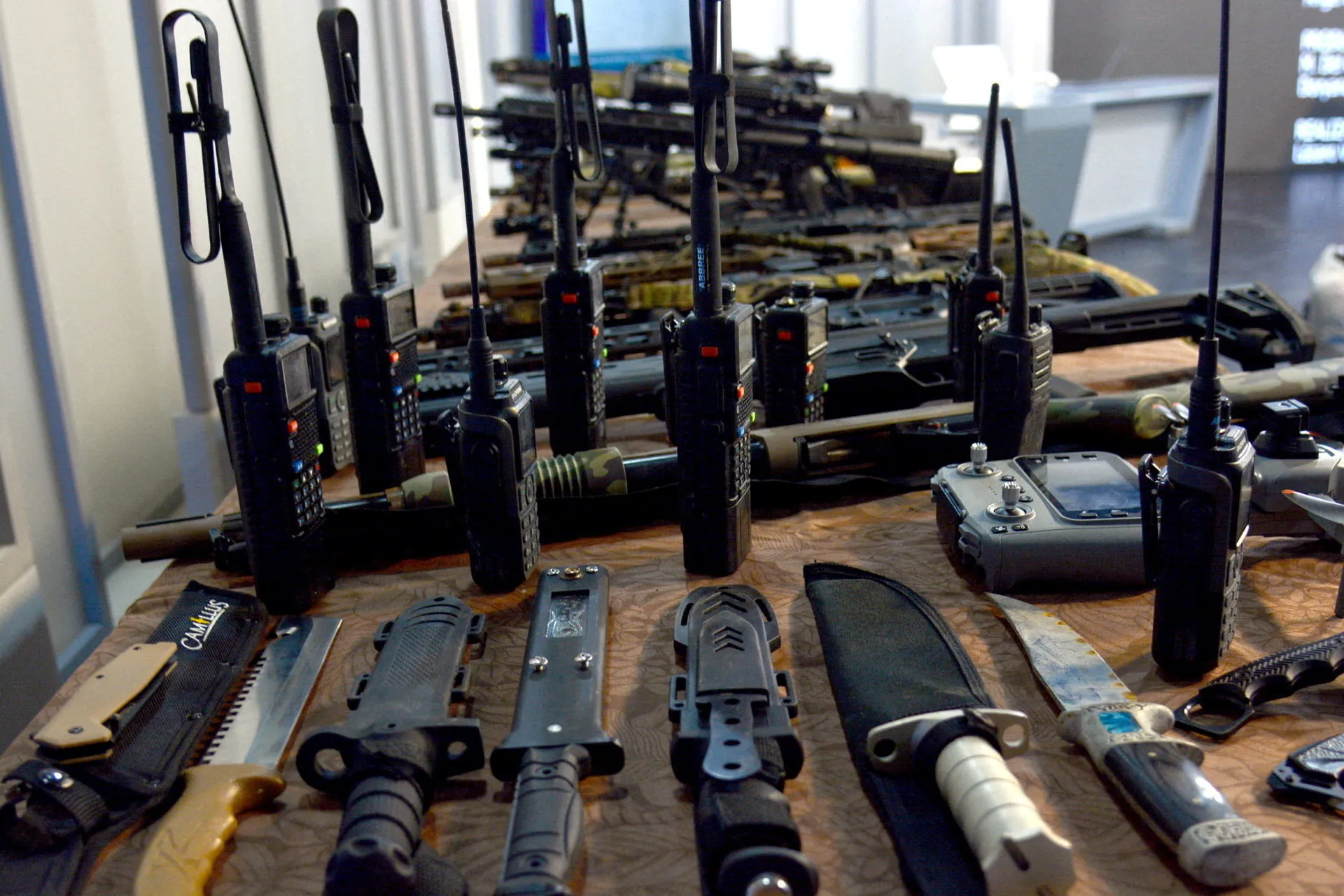
Earlier this week, Cuba said it had filed terrorism charges against six suspects who were on the speedboat. The government also unveiled items it claimed to have found on the boat, including a dozen high-powered weapons, more than 12,800 pieces of ammunition and 11 pistols.
Cuban authorities have provided few details about the shooting, but they said the boat was roughly 1.6 kilometres (1 mile) northeast of Cayo Falcones, off the country’s north coast.
They also provided the boat’s registration number, but The Associated Press news agency was unable to readily verify the details because boat registrations are not public in the state of Florida.
The shooting threatened to increase tensions between US President Donald Trump and Cuban authorities.
The island’s economy was, until recently, largely kept economically afloat by Venezuela’s oil, which is now in doubt after a US military operation abducted and deposed former Venezuelan President Nicolas Maduro.
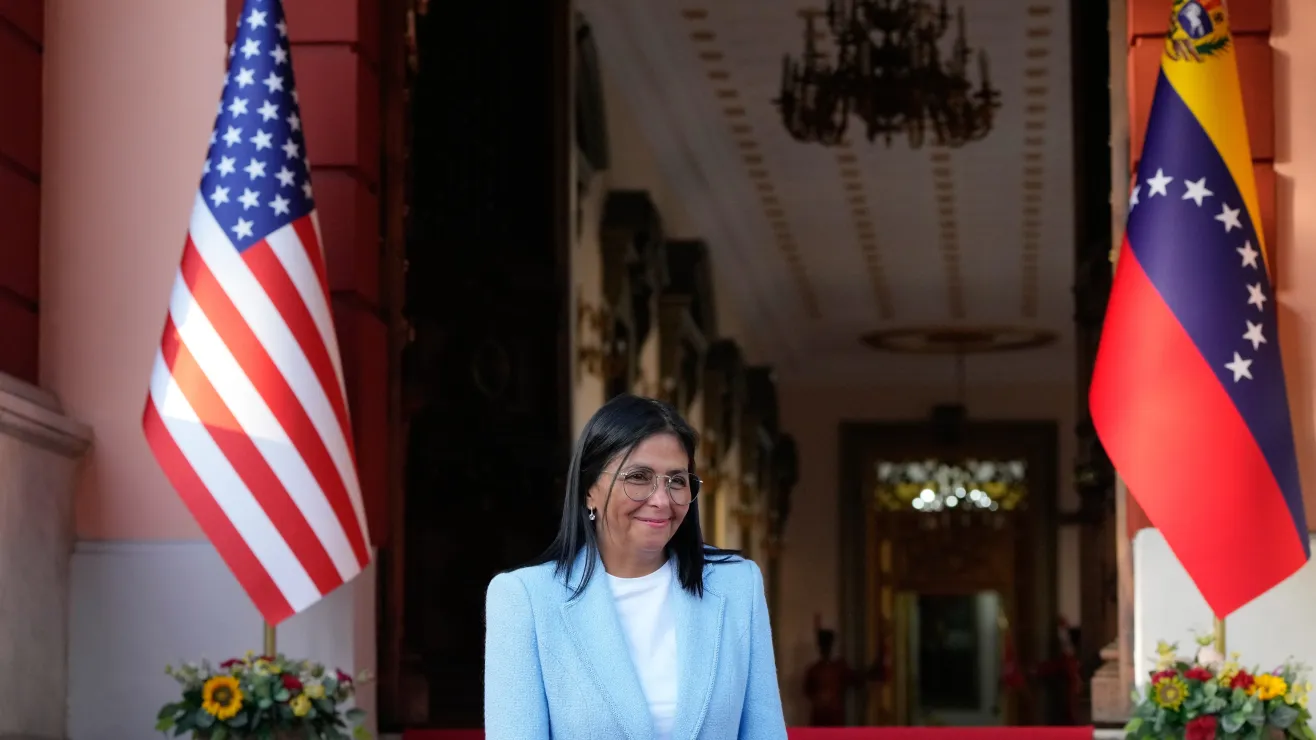
Acting President Delcy Rodríguez has defended diplomatic engagement with Washington. (AP)
Caracas, March 6, 2026 (venezuelanalysis.com) – The Venezuelan and US governments announced the restoration of diplomatic relations after a seven-year hiatus.
Caracas and Washington issued near-simultaneous press releases on Thursday night, though they did not specify a date for the reopening of the respective embassies and consulates.
In its statement, the Venezuelan government headed by Acting President Delcy Rodríguez expressed “trust” that the renewed ties would lead to a “mutually beneficial” relationship.
“The Bolivarian government reaffirms its disposition to advance to a new stage of constructive dialogue, based on mutual respect and cooperation,” the communiqué read.
For its part, the US State Department declared that the diplomatic reengagement would “facilitate our joint efforts to promote stability, support economic recovery, and advance political reconciliation in Venezuela.”
“Our engagement is focused on helping the Venezuelan people move forward through a phased process that creates the conditions for a peaceful transition to a democratically elected government,” the statement read.
The US and Venezuela engaged in a fast diplomatic rapprochement following the January 3 US military strikes and kidnapping of President Nicolás Maduro and First Lady Cilia Flores. Maduro and Flores have pleaded not guilty to charges including drug trafficking conspiracy, and their next hearing is scheduled for March 26. Despite repeated “narcoterrorism” accusations, US officials have not presented evidence of the involvement of Venezuelan high-ranking officials in narcotics activities, while specialized reports have consistently found the Caribbean nation to play a marginal role in global drug trafficking.
In the past two months, several senior White House officials have been hosted by Acting President Rodríguez, including CIA Director John Ratcliffe, Energy Secretary Chris Wright, and most recently Interior Secretary Doug Burgum. US Southern Command chief Francis Donovan likewise met with Venezuelan leaders, while Chargé d’Affaires Laura Dogu has been in the country since early February.
Dogu has been slated to take over as ambassador, while Félix Plasencia is set to become Venezuela’s top diplomat in the US.
Despite the January 3 bombings and presidential kidnapping, Rodríguez and other officials have defended the diplomatic engagement with Washington. The rapprochement has also seen Venezuelan authorities vow to “adapt legislation” to attract US corporate investment.
The National Assembly enacted a pro-business overhaul of the Hydrocarbon Law in late January, with the US Treasury subsequently issuing licenses allowing an expanded presence from Western energy conglomerates while imposing control over export revenues.
The Maduro government severed ties with Washington in 2019 after the first Trump administration recognized the self-proclaimed “interim government” led by Juan Guaidó as the country’s legitimate authority.
The recognition saw Guaidó and other opposition leaders take control of Venezuelan assets abroad, including US-based refiner CITGO, with their management facing accusations of widespread malfeasance and corruption.
After Guaidó was driven out by other US-backed factions in January 2023, the Biden administration transferred the recognition to the former opposition-majority National Assembly whose term had run out in 2021. Despite being abroad and exercising no activity, the former deputies have continued to collect salaries drawn from frozen Venezuelan state assets.
US authorities have not clarified whether the Venezuelan government will regain access to US-based bank accounts and other assets, since several state entities, including oil company PDVSA and the Central Bank, remain under Treasury sanctions.
The formal recognition of the acting Rodríguez administration is expected to pave the way for debt renegotiation. With sanctions barring the country from maintaining its debt service, liabilities ballooned to an estimated US $170 billion.
Weekly insights and analysis on the latest developments in military technology, strategy, and foreign policy.
Civilian onlookers out in the street filming the air-to-air engagement rapidly unfolding in the bright blue sky above them, a trail of smoke, and the low rumble of fighter jet engines. This is the latest video to have emerged from the extraordinary incident earlier this week in which a Kuwaiti Air Force F/A-18 Hornet was responsible for shooting down three U.S. Air Force F-15E Strike Eagles.
As in the previous videos of the incident and its aftermath, the usual caveats apply as to the nature of its authenticity, which remains unconfirmed. However, everything points to this being genuine, and it clearly indicates a within-visual-range air-to-air engagement, likely involving a heat-seeking AIM-9 Sidewinder series air-to-air missile.
Check the video out here:
New footage shows a Kuwaiti F/A-18C downing a U.S. Air Force F-15E at close range with what appears to be an AIM-9 Sidewinder air-to-air missile on March 2. pic.twitter.com/OZ1vIuOtzq
It was initially rumored that a ground-based air defense system, such as the Patriot, which is present in Kuwait, took the F-15Es out. However, the earlier video footage of one of the jets spiraling to the ground suggested it was an air-to-air engagement, based on the damage to the aircraft.
At 11:03 p.m. ET, March 1, three U.S. F-15E Strike Eagles flying in support of Operation Epic Fury went down over Kuwait due to an apparent friendly fire incident.
The new video is also in line with our original assessment of the likely cause of the shootdowns, namely, tail-aspect missile shots made by smaller-yield weapons. As we noted at the time, under certain circumstances, if the Hornet employed passive heat-seeking missiles (AIM-9), the F-15E pilots may not have known they were being engaged until the weapon detonated.
Footage of an F-15 falling out of the sky this morning over Kuwait, in an apparent “friendly fire” incident involving the U.S. Air Force. pic.twitter.com/GQvryfJ4C4
The video clearly shows one of the F-15Es after being hit, with part of its rear portion burning brightly, and the same aircraft in a flat spin toward the ground. You can also see the two crew members ejecting. The F/A-18 is also seen, toward the top of the frame.
For at least part of the engagement, the F/A-18 and F-15E are clearly in the same frame and are in close proximity.
An experienced former F/A-18 pilot TWZ talked to about the event and the new video concluded that the incident is, altogether, “very strange.”
“I have genuinely no idea how someone could make this mistake,” the ex-Hornet driver continued. “Unless it’s something procedural and GCI [ground-control intercept] has messed up, talked him on, and he’s seen what he wanted to see … but even that’s bordering on implausible.”
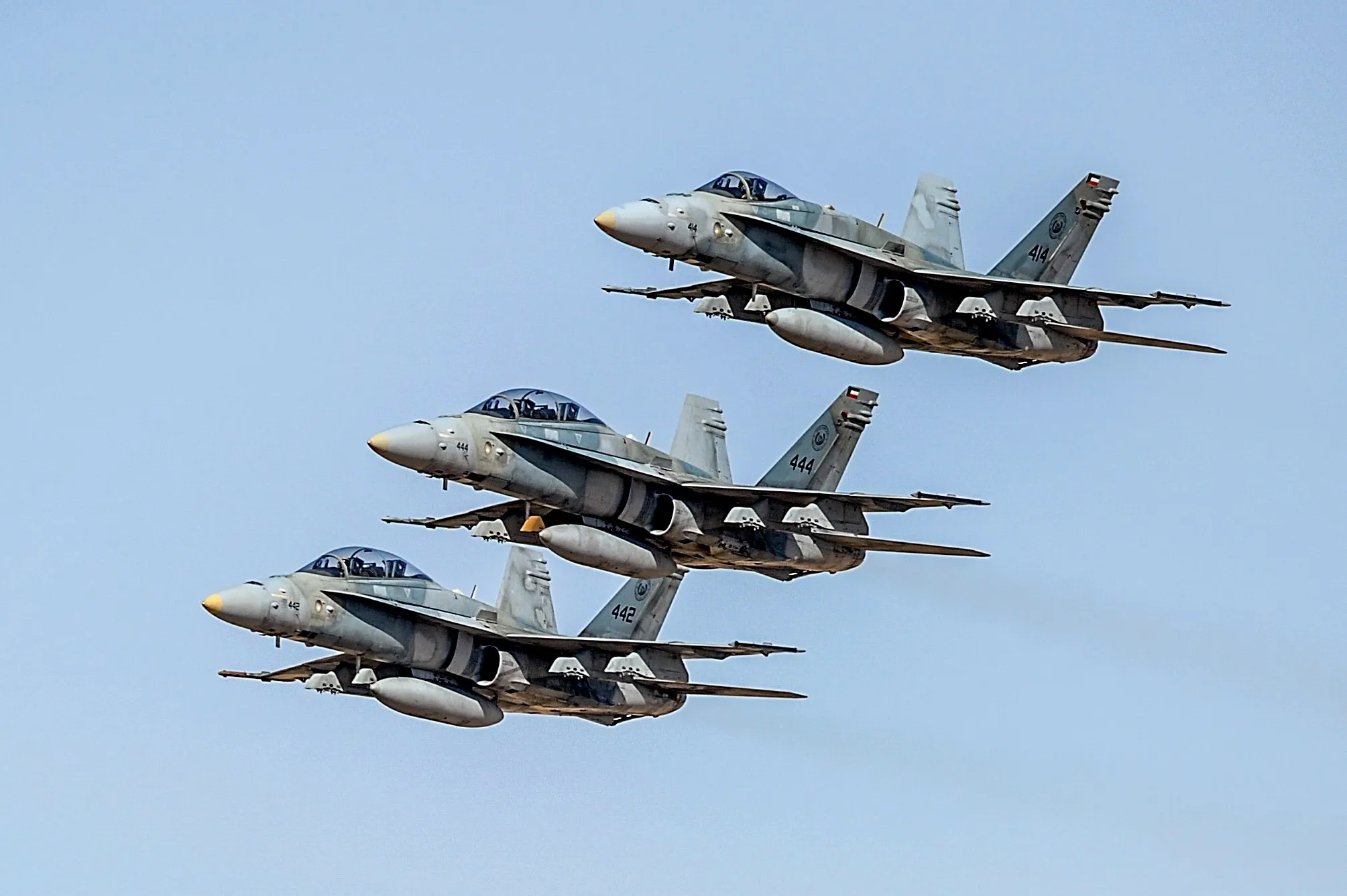
Three Kuwait Air Force F/A-18C/D Hornets during Exercise Storm of 2017 in Jahra, Kuwait on January 17, 2017. Photo by Jaber Abdulkhaleg/Anadolu Agency/Getty Images Anadolu
Undoubtedly, the challenge of deconfliction of friend from foe in a very complex war zone is a significant one, as we outlined previously. At the same time, the threat from Iranian aircraft was, at the time, real. Also this week, a Qatar Emiri Air Force F-15QA shot down a pair of Iranian Su-24 Fencer strike aircraft that were inbound to attack the sprawling air base at Al Udeid.
While the cause of the friendly-fire incident remains unclear, the chance to see such an aerial engagement is remarkable in itself, especially the very rare sight of a modern fighter firing one of its air-to-air missiles in an operational context.
A video shows a U.S. Air Force F-15C Eagle fighter jet destroying a towed target at very close range with one of its Sidewinder air-to-air missiles, during a live-fire exercise over the Atlantic Ocean on December 8, 2020:
F-15 Firing Training Sidewinder NATM-9M At Drone
The same former Hornet driver also explained exactly how a short-range AIM-9 Sidewinder missile would be fired from the jet in a WVR scenario:
“You’d be in air-to-air master mode and bring up the weapon using HOTAS [‘hands on throttle and stick’ controls]. You rock a castle switch that puts you in Sidewinder mode. From there, you can select your radar scan mode, again using HOTAS. Now you have a weapon looking for an infrared signature and a radar looking for a target. In a combat mode, the radar will latch/form a track almost immediately. The weapon system then cues the Sidewinder to the radar track, and so long as it’s within the weapon’s kinematic capabilities, you’ll get a SHOOT cue. The weapon then leaves on trigger press.”
“You can also just point and shoot with a Sidewinder, but then your radar isn’t giving you any info, so you risk a shot that can’t make it.”
In such a scenario, it is conceivable that the F/A-18 pilot might have accidentally launched a missile that then found its target, the same pilot agreed, but that would not explain the three friendly-fire kills.
“Once, yes. Twice, no way. Thrice?”
It is worth bearing in mind that there have been previous incidents of friendly-fire shootdowns, even when a visual ID had been conducted. This happened in 1994, when two U.S. Air Force F-15 Eagle fighters shot down two U.S. Army UH-60 Black Hawk helicopters over Iraq, killing 26. Perhaps the Kuwaiti pilot thought they had encountered Iranian MiG-29 Fulcrum fighters, but, again, to make the same mistake three times over seems highly improbable, especially at close range.
U.S. military personnel inspect the wreckage of a Black Hawk helicopter in the Northern Iraq No-Fly Zone during Operation Provide Comfort, on April 15 or 16, 1994. U.S. Air Force
Another fighter pilot’s analysis, seen in video below, questions whether the Kuwaiti pilot might even have gone rogue against an ally. That actually seems possible based on the evidence, but it is hard to believe.
Accident or Crime? A Kuwaiti F/A-18 Hornet Shot Down Three U.S. F-15E Strike Eagles?
Ultimately, based on the latest video and the limited reports so far, it’s still far from clear how this costly incident happened. A friendly-fire kill involving a longer-range weapon would be more believable, but the within-visual-range nature of this engagement is bizarre, to say the least.
Lionel Messi has been criticised for meeting US President Donald Trump and applauding his latest brief on the Iran war at a White House event honouring the Argentinian superstar and his Inter Miami team.
A video has been released showing huge explosions near Tehran’s Azadi Tower. The US and Israel are continuing to target locations across Iran as the war enters its seventh day.