EU Trade Commissioner Maroš Šefčovič will visit Manila next week to finalise a trade agreement with the Philippines, the European Commission confirmed to Euronews on Monday.
ADVERTISEMENT
ADVERTISEMENT
The agreement is nearing conclusion as Brussels has increasingly looked to the Asia-Pacific over the past year to diversify its trade ties.
Since the return to power of US President Donald Trump, the global trade order has been shifting, with the EU seeking new markets for its exports.
The latest round of EU-Philippines trade talks took place in May, with access to public procurement emerging as the final sticking point. An agreement would mark a shift for the Philippines, which has so far kept public contracts closed to foreign bidders.
The Commission told MEPs earlier this month that the rest of the agreement was ready. The aim is to lift trade barriers between both partners in most sectors.
An official from the EU executive also told MEPs that sanitary and phytosanitary rules for food products were “ambitious”, alongside automotive standards that would improve EU manufacturers’ access to the Philippine market. The official added that the EU and the Philippines were “complementary” in both industrial goods and agriculture.
The deal is an important one for Manila, which has been hit by US tariffs in 2025 and by the war in Iran, which heavily impacted energy prices in the country.
However, the Philippines also reached “upper-middle-income country” status in August, granted by the World Bank, which makes it a promising market — “One of the most dynamic economies in the East Asia Pacific region since 2010,” the World Bank said.
Bilateral trade in goods between the EU and the Philippines amounted to €16.8 billion in 2024. That same year, the EU was the Philippines’ fourth-largest trading partner, accounting for 7% of the country’s total trade in goods, while the Philippines was the EU’s 39th-largest trading partner, accounting for 0.3% of the EU’s total trade in goods.
After the Philippines, the Commission aims to conclude talks with Thailand, making 2026 a strong year for EU trade deals across Asia and the Pacific, with agreements already reached with Australia and India.
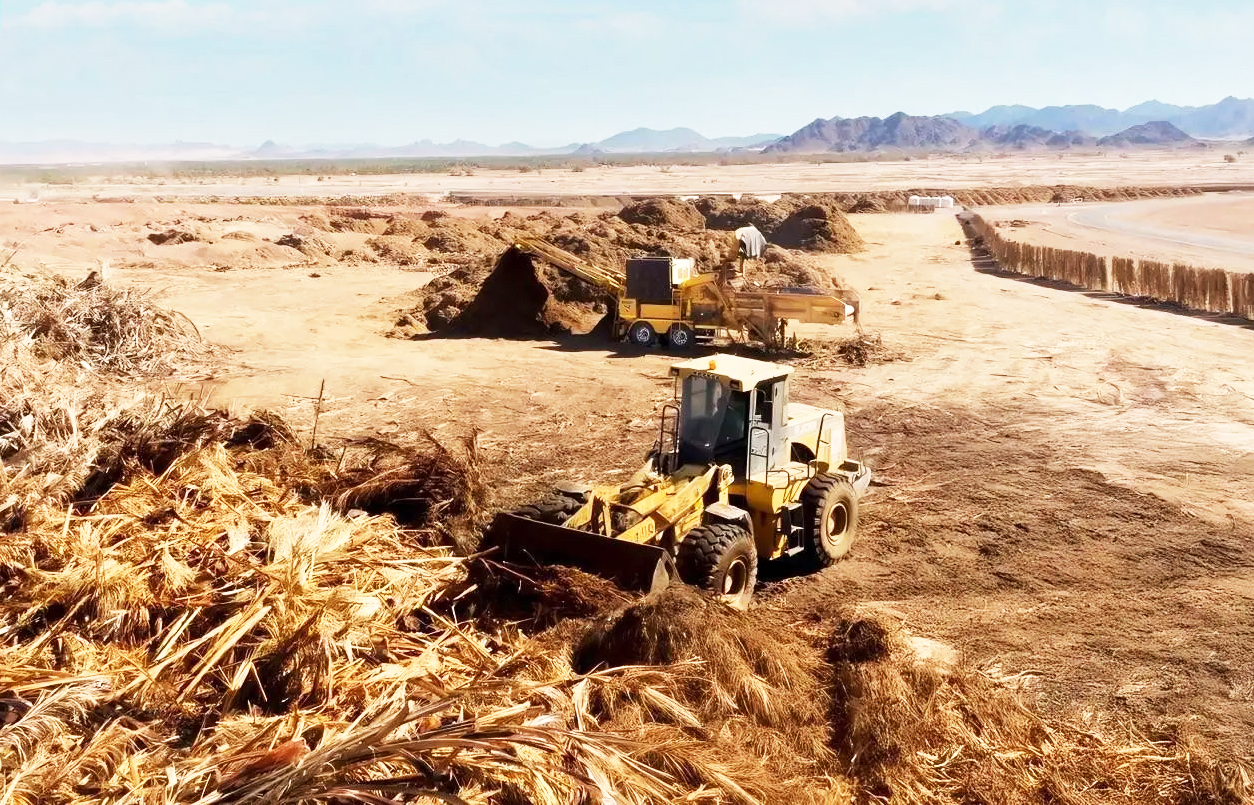
RIYADH: Madinah region has strong potential to turn date palm waste into value-added products, leveraging its competitive advantage in the palm and date sector to create investment opportunities in the circular economy.
According to Al-Madinah Al-Munawarah Chamber’s economic bulletin, the region has about 26,000 farms and approximately 8.1 million date palms, representing nearly 21 percent of Saudi Arabia’s total.
Each palm generates between 20 and 23 kg of waste annually, bringing the region’s estimated annual total to between 162,000 and 186,000 tonnes, the Saudi Press Agency reported.
Products made from date palm waste include wood and composite boards, organic fertilizer, biochar, charcoal briquettes, biofuel pellets, natural fibers, insulation materials, date seed oil, wooden products and handicrafts.
These industries could create new production chains, from waste collection, sorting and processing to manufacturing and marketing. This would open investment opportunities, diversify the palm sector’s products and improve resource-use efficiency.
The world is creating more wealth than ever before but protecting and growing it has become increasingly challenging.
To put this into perspective, BCG’s Global Wealth Report 20261 found that global financial wealth increased by 10.7% in 2025 to US$333 trillion, its highest rate of growth since 2021. The Gulf Cooperation Council (GCC) is also becoming more prominent within this evolving landscape. The region’s total wealth reached an estimated US$8.6 trillion in 2024, while EY’s GCC Wealth Management Industry Report 20252 estimated that more than 200,000 individuals across the region qualify as ‘high net worth’ (HNW).
Amid this trend, around half of the private wealth in the GCC remains tied to real estate, highlighting an opportunity for greater diversification across assets and markets.
We see this among QNB’s private banking and wealth management clients, with a move beyond traditional equity and fixed income allocations towards broader diversification strategies. For example, interest is growing in alternative investments, international opportunities and actively managed solutions that can respond to changing market conditions.
The GCC’s Growing Role in Global Wealth
The GCC’s emergence as an international wealth hub reflects the broader transformation taking place across its economies. Investment in technology, infrastructure, financial services, tourism and advanced industries is widening the range of opportunities available to investors and strengthening the region’s connections with markets across Asia, Africa and Europe.
The development of financial centres, deeper capital markets and national economic transformation programmes is also creating a more sophisticated regional investment ecosystem. These initiatives are strengthening the region’s position not only as a source of capital, but also as a destination for private wealth and a platform through which investors can access international markets.
From Portfolio Allocation to Active Stewardship
As the investment universe expands, diversification is no longer limited to simply holding a mixture of listed equities and fixed income instruments. Investors increasingly require portfolios diversified across geographies, currencies, sectors, asset classes and investment horizons.
This is driving demand for alternative investments as investors look for new sources of return and greater portfolio resilience.
According to EY’s GCC Wealth Management Industry Report 20253, 69% of wealthy clients in the Middle East hold alternative investments. This supports what we are seeing among QNB’s clients, with growing interest in private markets, structured solutions and thematic opportunities that can enhance diversification and provide attractive risk-adjusted returns.
These investments can provide access to opportunities that are not always available through public markets. However, they can also introduce liquidity constraints, longer investment horizons, valuation complexity and varying levels of transparency. Access alone is therefore not enough.
Each allocation also requires rigorous due diligence and a clear understanding of how it contributes to the objectives, liquidity requirements and risk profile of the overall portfolio.
For HNW individuals and family offices, their objectives often extend beyond investment performance. These may include capital preservation, liquidity planning, succession, or the responsible stewardship of family assets.
Such priorities are becoming more pronounced. EY estimates that approximately 500,000 older individuals across the GCC could transfer around US$438 billion to their heirs by 2030, increasing the importance of multigenerational wealth planning.
Combining Global Access with Regional Expertise
To meet the evolving needs of HNW individuals, global reach provides access to a wider universe of investments, specialist expertise and institutional relationships. At the same time, regional knowledge allows advisers to understand local market structures, emerging opportunities and individual client priorities.
Together, these capabilities support portfolio strategies that are globally diversified while remaining relevant to each client’s circumstances.
QNB Group is well positioned at the intersection of these dynamics. As a leading financial institution in the Middle East and Africa, with a presence in over 28 countries across Asia, Europe and Africa, the Group combines international market access with deep regional knowledge. This enables QNB to provide tailored wealth-management solutions informed by a strong understanding of market opportunities and client needs.
However, scale and access are only part of effective wealth management. Clients increasingly expect advice that reflects their individual circumstances, risk appetite and ambitions. This requires bespoke portfolio strategies, data-driven market insights and robust governance, supported by relationships built on trust and discretion.
A More Active Approach to Long-term Wealth
The next phase of wealth management will be more globally diversified, actively managed and advisory-led.
This degree of monitoring is essential; while investors will continue to seek wider access to international and alternative opportunities, they will also require greater discipline in how those opportunities are evaluated and integrated into their portfolios.
The GCC is well placed to play a growing role in this evolution. Its expanding wealth base, economic transformation, financial capacity and international connectivity are strengthening its position as both a destination for capital and a centre for long-term wealth creation.
Ultimately, successful wealth management depends on the ability to combine global access with regional understanding and investment opportunity with disciplined stewardship. Institutions that combine these capabilities will play an increasingly important role in helping clients preserve their wealth, navigate complexity and create enduring value across generations.
Read more about QNB Group’s wealth management capabilities and solutionshere.
For all the hysterical outrage that accompanied the announcement of the UK’s measures against illegal Israeli settlements last Tuesday, the world did not end. The reality is that these steps were merely bringing Britain into line with its legal obligation to act against an unlawful occupation and narrow the gaping chasm between the reality on the ground in Palestine and the rhetoric deployed in Westminster.
The reaction of those who support the Israeli settlements — war crimes under the Rome Statute — was frenzied. Anti-Palestinian bodies bellowed outrage. The chief rabbi declared this would be a “dark day for British Jews,” as if somehow they were the target of the measures or the victims of what has been happening. His comments were dangerous as he, along with “establishment” UK Jewish groups like the Board of Deputies of British Jews, blurred the distinction between the actions of the state of Israel and British Jews. This deliberately conflates antisemitism with anti-Israel sentiment.
Others also claimed, with no evidence, that the measures would make British Jews unsafe. The deplorable increase in antisemitic attacks in the UK and elsewhere has never been motivated by British actions against Israel, not least as there has hardly ever been any such action.
In fact, a sizable segment of the British Jewish community welcomed the settlement trade ban or at least accepted it as a reasonable response to the unprecedented building of settlements and frenzy of state-backed Israeli settler violence.
The reaction of those who support the Israeli settlements — war crimes under the Rome Statute — was frenzied
Chris Doyle
The mainstream media coverage was frequently dire. Many columnists depicted British Jews as a victim of the settlement ban. Very few outlets dared suggest that the actions were designed to help Palestinians under threat of ethnic cleansing, forced dispossession and settler pogroms. Once again, the victims were erased from the story.
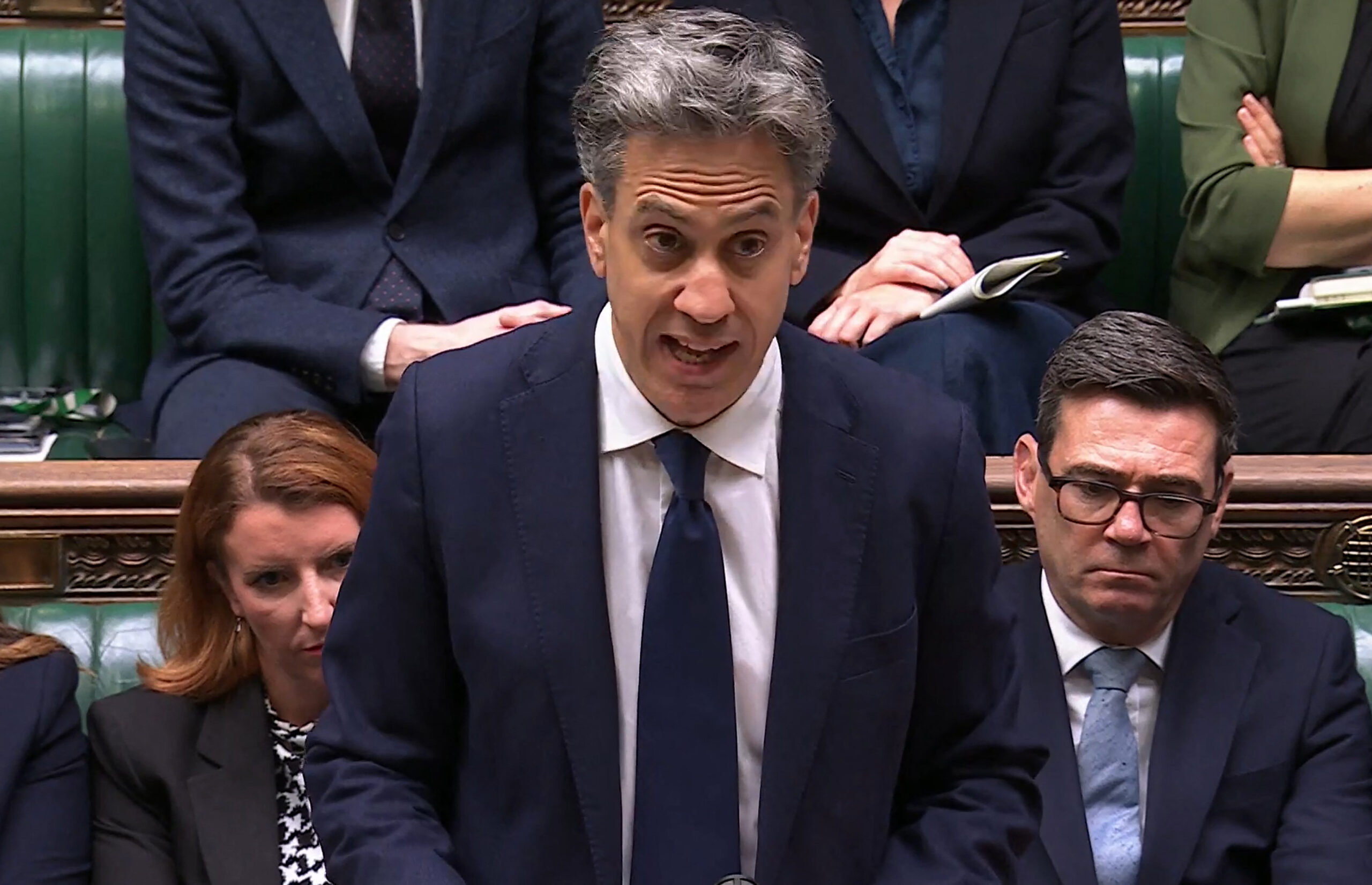
The other claim was that the US would retaliate against London. This was triggered in large part by the knee-jerk reactions of US Ambassador to Israel Mike Huckabee, who posted: “The Brits have lost it. The Jew hate of their government knows no boundaries and knows no facts.” He denies it but he probably did not know Ed Miliband, the foreign secretary, is a British Jew whose parents were refugees from Nazi-occupied Europe. But Huckabee is an extremist maverick, an ardent Zionist who believes in a “Greater Israel.”
Far from retaliating, the US State Department made clear Huckabee’s comments were not authorized. He had been freelancing again. One official said Washington was “staying out of it.” Secretary of State Marco Rubio was far more measured in his comments. He did not even condemn the British actions. President Donald Trump, who is rarely shy of airing any disagreement, has said nothing. In short, the US has taken zero steps. Trump looks increasingly disenchanted with Israeli Prime Minister Benjamin Netanyahu, not Andy Burnham or Miliband. The president has yet to declare support for Netanyahu ahead of next month’s Israeli elections, as the beleaguered leader hopes.
The settlement lobbies were almost certainly shocked by the 11 countries that joined the UK in confirming they were or would be adopting similar measures. This included France and Canada, meaning three of the G7 states are acting.
Those states yet to adopt the ban have at least condemned the settlements and are not opposing London’s actions
Chris Doyle
Britain was far from isolated, quashing yet another criticism. Those states that have yet to adopt the ban have at least condemned the settlements and are not opposing London’s actions.
In contrast, it is Israel and the US that find themselves once again in a crowd of two. These two states, as they were with the foolhardy war on Iran, align themselves against international law and accountability.
The retaliatory Israeli measures will also hardly dent the British interest. Foreign Minister Gideon Sa’ar announced the closure of the British Consulate in Jerusalem, the ejection of the British participants in the International Gaza Support Center that oversees aid flows into Gaza and the termination of the British support team that is helping to train the Palestinian Authority.
Note that all these measures hit Palestinians far more than the UK, which is of course the Israeli priority. It means fewer states overseeing aid into Gaza, less support to the PA and, by closing diplomatic premises linked to the Palestinians in Jerusalem, further severs the remaining Palestinian ties to the city.
Expect a raft of settlement announcements shortly. This will be the primary Israeli response to the actions of these dozen states.
Will these measures have an impact? Are they sufficient? Almost certainly not. And the Netanyahu coalition, in election season, will just press the accelerator on the aggression and violence. Other Israeli politicians may get the message: The patience of international actors has finally worn out, albeit decades too late.
These steps should not be belittled. The 12 states have shifted from a declaratory poise to a position of action. For once, the Israeli government is going to have to bear a cost for the occupation that has hitherto not existed.
The message is clear. If Israel behaves like a pariah state, it will start to be treated like a pariah state.
Chris Doyle is director of the London-based Council for Arab-British Understanding (CAABU). He has worked with the council since 1993 after graduating with a first class honors degree in Arabic and Islamic Studies at Exeter University. He has organized and accompanied numerous British parliamentary delegations to Arab countries. Twitter: @Doylech
France will push back against a European Commission plan to fast-track ratification of trade agreements by circulating only English-language versions during talks with EU governments and lawmakers, skipping translation into the bloc’s 24 official languages, according to several sources.
ADVERTISEMENT
ADVERTISEMENT
The slow ratification of the contentious EU–Mercosur trade deal has frustrated the Commission, which wants to accelerate negotiations and bring deals into force more quickly as it seeks new markets amid rising geopolitical tensions.
Translating the agreements into every official EU language can take months due to the legal scrubbing required before the ratification process begins.
The EU executive has confirmed to Euronews that trade chief Maroš Šefčovič told EU trade ministers in February that the trade deal with India concludedon 27 January could serve as a test case for using English as the main language during ratification.
“We lost almost €300 billion by not having the Mercosur agreement in place since 2021, if it comes to the GDP, and more than €200 billion in export opportunities,” Šefčovič told journalists after meeting ministers on 20 February, adding that once negotiations end it can take up to 2.5 years before businesses can operate in partner countries.
“In today’s world, we cannot simply lose the time,” he said.
Šefčovič said the Commission would ensure the agreements are translated into all 24 official EU languages once published in the Official Journal, i.e. after ratification. He added the proposal was backed by at least seven member states at the meeting, though not all countries had time to speak.
French sources who spoke to Euronews were insistent that Paris would vigorously oppose the move to English-only agreements if necessary.
“As a matter of principle, we defend the use of all the languages of the Union, and in particular French, which is one of the EU’s working languages,” one official told Euronews.
‘Transparency, precision and understanding’
Language policy in the bloc’s institutions remains politically sensitive for countries such as France, whose language has declined sharply over the past decades as English massively dominates daily work in the European Union institutions – despite French, German and English being the three official working languages.
“Switching entirely to English raises a legal and democratic issue, and the Commission is well aware of it,” another French official told Euronews.
On its website, the European Commission says linguistic diversity is essential and that the EU promotes multilingualism in its institutional work.
The bloc once even had a commissioner dedicated to multilingualism, though the portfolio was gradually merged with others and eventually disappeared.
“I have the impression that in some cases the Commission seizes the opportunity to push the idea that English has a superior status, and that the other official languages are translation languages that can come later,” Michele Gazzola, expert in language policy, said.
He added that relying only on English during ratification could pose problems for members of the European Parliament, and even more so if national parliaments are involved.
“It’s a matter of transparency, precision and understanding.”
The oil market spent Monday morning pricing in a weekend of bad news from the Gulf.
ADVERTISEMENT
ADVERTISEMENT
Brent for October and November deliveries gained over 3% and crossed $108 a barrel, while the US benchmark WTI for October rose 2.3% to around $102, both extending last week’s advance after each reclaimed the $100 threshold.
Prices moved following Saudi Arabia’s announcement that its East-West pipeline is temporarily closed after drone attacks.
The line carries crude across the kingdom to Red Sea ports, allowing oil to reach export terminals without passing through the Strait of Hormuz, so its loss removes the main alternative at the moment the strait itself is most dangerous.
That danger was also demonstrated on Sunday, when a merchant vessel was hit in the strait, killing one person and injuring three others, according to Iranian authorities.
Passage through the waterway now works very differently from before the war.
Vessels must obtain Iranian permission to transit, and Tehran is weighing a mechanism to charge service fees. Ships that fail to comply are routinely targeted, while US forces periodically bomb the Iranian coastline to contest Tehran’s claim to control the strait.
Diplomatic efforts have stalled too.
Oman has postponed planned talks between Iran and Gulf states on the future of the waterway, which carries a large share of the world’s seaborne oil trade.
Record fuel prices and finger-pointing
The consequences are extremely visible at American pumps.
The US national average price of diesel crossed $6 a gallon on Friday for the first time in history, up from around $5.85 a week earlier and roughly 60% above the $3.71 drivers paid a year ago.
Petrol is also averaging $4.22 after setting records over the Labor Day weekend.
US President Donald Trump has pointed the finger elsewhere.
Speaking to reporters in Ireland on Sunday, where he was attending the Irish Open at his Doonbeg golf resort, Trump stated Ukrainian President Volodymyr Zelenskyy “has to stop knocking out diesel fuel in Russia.”
“Let him go after targets, but not diesel fuel, because he’s causing a shortage of diesel fuel,” Trump added.
Ukraine has struck more than 20 Russian refinery targets this summer, prompting Moscow to ban diesel exports.
On the flight back from his state visit to Ireland this weekend, Trump reiterated the claim.
However, the supply arithmetic suggests otherwise.
Analysts attribute roughly 800,000 barrels a day of lost diesel supply to Russia’s export ban, against about 1.2 million from disruption around the Strait of Hormuz, according to Lipow Oil Associates.
The wider picture is more lopsided still as crude flows through the strait have fallen from around 20 million barrels a day before the war to about 7 million.
Between them, the two wars have also shut refineries representing around 5 million barrels a day of capacity.
DUBAI: For the first time, Gaelic football has been added to the extensive lineup of sports at this year’s Emirates Dubai 7s, a decision which “made sense,” according to Festival Director Mathew Tait.
The Middle East’s hugely popular three-day festival returns to The Sevens Stadium from Nov. 27 to 29, marking the start of rugby’s HSBC SVNS 2027 season, ahead of tournaments in Cape Town, Singapore, Perth, Vancouver and New York.
Those events are followed by the HSBC SVNS World Championship 2027 during April and May in Hong Kong, Valladolid and Bordeaux.
In addition to the HSBC SVNS, the Emirates Dubai 7s provides a platform for athletes of varied abilities to compete in rugby, netball, cricket, padel and fitness competitions, with Gaelic football now bolstering what was already a huge sports offering.
Tait told Arab News recently: “It’s been something we’ve been considering, and as part of our review every year, we assess whether there’s opportunities with other sports.
“We don’t just introduce them for introducing’s sake. It needs to be impactful to the event in terms of what people can view and spectate, but also in terms of that particular community and what they bring to the overall event.
“Gaelic football is something we’ve been considering for a little while. There’s an established Irish community here and it just made sense this year.”
The sport itself undoubtedly makes for fantastic viewing from a spectator perspective: fast-paced, physical and action-packed.
Delivered in collaboration with the Middle East GAA (Gaelic Athletic Association), and in keeping with the sevens format, traditional 15-a-side Gaelic football will adopt a new structure for the festival, with seven players per side and matches played across two seven-minute halves.
“It will be good fun,” Tait said in response to a question on what fans can expect.
“It’s a very skillful game. I think it’s an opportunity for people that potentially aren’t familiar with the sport to observe and ultimately take part should it be of interest to them.
“We have the Kerry Middle East GAA guys based down at The Sevens Stadium now too, which is great for us to do as part of a broader engagement with the community.”
As an event, Emirates Dubai 7s continues to grow, evolving from a rugby tournament into a fully-fledged music and entertainment festival, attracting over 85,000 attendees from the UAE and across the globe.
While Tait has not ruled out further additions over the coming years, he insists the main focus is on ensuring those attending and competing want to keep coming back.
“Never say never,” he said in response to a question on possible further additions.
“The task I always set the sports operational team is that we need to make sure we’re the world’s best at delivering the sports that we do have, rather than just doing half-baked jobs and introducing sports for the sake of it.
“So, in terms of additional introductions in the short term, probably not, because I think we just need to make sure that we’re nailing the experience for those core sports that we have already.
“Padel will go from strength to strength, netball is full this year, cricket’s full and rugby at a local level is going to be very busy again.
“We want to be the best in the world at giving competitors an experience they won’t forget. We want them to go home and tell people about it, so we have more teams coming back. Recommendations are the best form of praise.”
And for those wishing to take part in the Gaelic football tournaments, which include both elite and open categories for both men and women, registration is simple.
“Head to emiratesdubai7s.com, select the drop-down for sports, click on Gaelic football. There you will see the option to register yourself for the tournament and join us for what will be another fantastic event,” said Tait.
China and South Korea are driving the surge, but regional growth is slowing.
This article appears in the September 2026 issue of Global Finance Magazine.
Global goods trade surged to US$13.7 trillion in the first half of this year, up 12.5% year over year, with Asia-Pacific leading the charge. The figures reflect an ongoing reconfiguration of global trade balances, as China’s goods trade surplus expanded further in the first quarter and the U.S. goods trade deficit continued to narrow.
But the trade figures only tell half the story, as growth is slowing across the Asia-Pacific region.
According to UNCTAD’s Global Trade Update, East Asia recorded the strongest trade growth in the first quarter. Both developed and developing economies in the region expanded at rates well above the global average, but developing economies drove most of the growth. While trade by developing economies globally, as well as South-South trade, recorded double-digit gains over the 12 months to the first quarter of 2026 when East Asia is included, they registered an overall contraction when East Asia is excluded, driven largely by reduced imports and exports from the Middle East and South Asia.
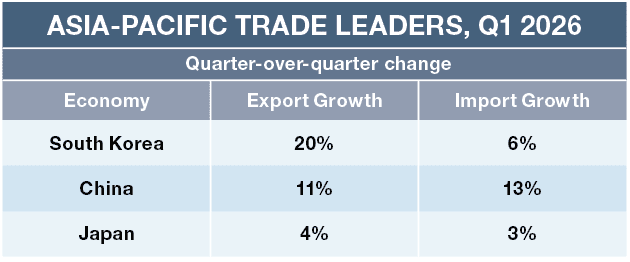
South Korea recorded the region’s strongest export growth, up 20% quarter over quarter, followed by China at 11% and Japan at 4%. South Korea also posted the strongest growth in services exports, at 9%. China led in imports at 13%, with South Korea next at 6% and Japan at 3%.
Asia-Pacific’s strength in automotive manufacturing and AI innovation is fueling trade growth in both industries. According to Allianz Trade, global exports of AI-enabling goods surged 280% between 2014 and 2025 to $3.8 trillion.
“Asia dominates the supply side, accounting for 65% of global AI-related exports and seven of the top 10 exporters, led by China (18% of AI-related exports), Taiwan (12%), and Hong Kong (11%),” the report states.
New Alliances
Major geoeconomic shifts continue to reshape trade patterns.
Canada’s trade dependence on China is rising—up 0.9% from the fourth quarter of 2025 to the first quarter of this year—while the trade relationship between the U.S. and China is weakening. But East Asian economies, including Thailand and Vietnam, are becoming more dependent on both China and the U.S.
Much of the reported trade growth reflects higher prices rather than higher volumes, UNCTAD noted, as escalating costs in energy, transport, logistics, and manufacturing fuel trade inflation. And trade strength does not equal broad-based economic strength; UNCTAD’s own forecasts point to a slowdown ahead in GDP.
The organization’s Trade and Development Foresights 2026 report projects that economic growth in East Asia will slow to 3.7% for the remainder of the year, largely due to the region’s heavy reliance on energy imports from the Middle East. China’s growth is expected to ease to 4.6%, within its newly adjusted target range of 4.5% to 5%. Economic activity in Southeast Asia is expected to hold broadly steady at 4.3%. While South Asia remains the fastest-growing subregion, GDP growth there is forecast to slow from 6.3% in 2025 to 5.5%, with rising fossil fuel prices threatening to stoke inflation and financing pressures.
Deborah Ritchie is a contributing writer based in the U.K.
Los Angeles: The brightest stars in television are set to walk the red carpet Monday at the Emmy Awards, with horror-comedy series “Widow’s Bay” and gritty hospital drama “The Pitt” expected to win big.
Apple TV’s “Widow’s Bay,” which stars Matthew Rhys as the leader of an isolated New England island that appears to be haunted, has emerged as one of the most talked-about debut series of the year.
“People just love that show,” Christopher Rosen, deputy editor of Hollywood news outlet The Ankler, told AFP.
It scooped up eight awards in the pre-gala ceremonies, and is in position to become the most awarded comedy series in a single year, surpassing the 13 trophies won last year by Seth Rogen’s Hollywood satire “The Studio.”
Rosen said he believes that Rhys — a winner for best drama actor for “The Americans” in 2018 — could now earn his first comedy Emmy.
A strong night for “Widow’s Bay” does not bode well for “Hacks,” the tale of a stand-up comedian trying to revive her career and the dysfunctional millennial assistant who helps her.
Its one solid bet left in the running – and maybe its only statuette, says Rosen – is a best actress prize for Jean Smart.
“That’s a great way to honor the final season,” Rosen told AFP. “She’s never lost from playing this part. I don’t see why she would lose for the final season.”
Smart, who turned 75 on Sunday, has won four Emmys for the show so far.
A win on Monday would give her eight acting Emmys, tying her with Julia Louis-Dreyfus and Cloris Leachman for the most ever by a performer. Allison Janney is also vying for her eighth Emmy, for “The Diplomat.”
’The Pitt’ expected to repeat as best drama
“The Pitt,” last year’s winner for best drama, follows the stressed-out workers in a Pittsburgh emergency room, with each episode unfolding in real time.
Tackling everything from abortion rights to immigration crackdowns to mass shootings, the show is the odds-on favorite to sweep several drama prizes including best series.
“If ‘The Pitt’ doesn’t win, it would be a tremendous shock,” Rosen said.
It led all shows with 25 nominations, and already won four awards in the early ceremonies, including best casting for a drama series.
Star Noah Wyle, who has racked up awards over the past year including an Emmy, is expected to triumph again. Seven of his co-stars are hopefuls in the supporting acting categories.
For best drama actress, Rosen says it will be a race between “Pluribus” star Rhea Seehorn and Keri Russell for political soap opera “The Diplomat.”
In the limited series categories, HBO Max’s “DTF St Louis” – the tale of a middle-aged love triangle gone wrong – is a top contender.
The show has scooped up six prizes so far, including two for actors David Harbour and Linda Cardellini.
Dolly tribute
The 78th Emmy Awards gala will be hosted by “Law and Order: SVU” star Mariska Hargitay, who won two Emmys for her documentary “My Mom Jayne.”
It will feature a tribute to late country music icon Dolly Parton, who was also an Emmy winner, and a performance from Noah Kahan, who will sing “Bridge Over Troubled Water” during the broadcast’s In Memoriam segment.
The gala also will deliver some TV nostalgia, with “Buffy the Vampire Slayer” stars Sarah Michelle Gellar and David Boreanaz among the presenters, along with “Charlie’s Angels” stars Kate Jackson, Cheryl Ladd, and Jaclyn Smith.
Zendaya, a past winner and current nominee for best drama actress for “Euphoria,” is on the list of presenters, guaranteeing at least one bona fide red carpet moment.
The Emmys ceremony begins at 5:00 pm Monday (0000 GMT Tuesday).
DAMASCUS: Syria’s civil aviation sector is moving beyond the restoration of suspended international routes toward a broader rebuilding of its air transport network, with foreign airlines returning, regional airports reopening and projects underway to expand capacity and connectivity.
After years of disruption and limited international services, Arab, regional and European carriers have gradually restored flights to Syria, initially through Damascus and Aleppo international airports. The recovery has since extended eastward, with Deir Ezzor International Airport returning to service and Qamishli International Airport nearing reopening.
Air traffic through Syrian airspace has also increased sharply, while airport expansion projects and new aviation ventures point to a wider revival of the sector.
International airlines return
One of the early signs of recovery came in March 2025, when Aleppo International Airport reopened after rehabilitation work. Royal Jordanian operated a test flight to the airport on March 23 to assess security and safety ahead of resuming regular services following a 14-year interruption.
European carriers followed. Romania’s Dan Air resumed flights to Syria on June 15, while Air Mediterranean operated a flight to Damascus from Austria and Greece on June 30.
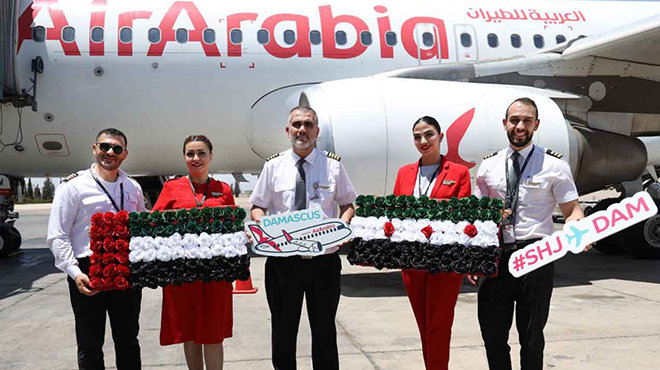
Gulf carriers also restored connections. Air Arabia returned to Damascus from Sharjah on July 10, followed six days later by Emirates, which resumed flights after a 13-year interruption.
Air Arabia became the first of Gulf carriers that had restored connections to Syria on July 10. Emirates resumed flights six days later. (SANA)
The first Emirates flight carried 286 passengers, including UAE Minister of Sports Ahmad Belhoul Al Falasi. The carrier announced three weekly Damascus-Dubai services, restoring a route that had carried nearly 2.5 million passengers between its launch in 1988 and suspension in 2012.
The expansion accelerated in 2026. AJet restored Istanbul-Aleppo flights in April, followed by Pegasus Airlines in June. Etihad Airways began scheduled Abu Dhabi-Damascus flights on June 14, while Jazeera Airways launched Kuwait-Aleppo service later that month.
Traffic through Syrian airspace surges
The recovery has been reflected in air traffic over Syria.
The General Authority of Civil Aviation and Air Transport said the number of aircraft transiting Syrian airspace rose from 32 in March, after the airspace was closed amid regional tensions, to 2,523 in April.
The increase coincided with the resumption of operations by 12 international airlines through Damascus and Aleppo airports.
Authorities have also focused on restoring direct air links with Europe through coordination with international aviation organizations on safety and operational requirements.
On July 2, the first Syrian Airlines flight from Amsterdam arrived at Damascus International Airport, launching a service three times a week. The airline said the route was the first in a series of international destinations planned for the carrier.
Air Arabia restored daily Sharjah-Aleppo flights on July 4 after an interruption of about 12 years, while Flydubai announced daily services to Aleppo beginning July 20.
Kuwait Airways also returned to Damascus in July.
The first LEAV Aviation flight from Düsseldorf, Germany, arrived at Damascus International Airport on July 29.
On July 29, the first LEAV Aviation flight from Düsseldorf arrived at Damascus International Airport, opening the first regular air service between Syria and Germany in 14 years.
The flight followed a final air transport agreement signed by the Syrian and German governments on July 16. The agreement includes services from four German airports operated by two German airlines.
Aleppo prepares for major expansion
Aleppo International Airport reached another milestone Aug. 1 when it received inaugural flights from three international airlines in a single day: Türkiye’s SunExpress, Germany’s LEAV Aviation and Saudi Arabia’s Flynas.
The development underscored the accelerating recovery of Syrian civil aviation and growing confidence among international carriers.
Authorities are also preparing to expand the airport’s capacity. Development work at the existing Aleppo airport is scheduled to begin in early 2027, with annual passenger capacity expected to exceed 2 million.
The project aims to improve operational efficiency, technical capabilities and passenger services while preparations continue for a new Aleppo International Airport.
On August 1, 2026, Aleppo International Airport received the inaugural flights of three international airlines in a single day: Türkiye’s SunExpress, Germany’s LEAV Aviation and Saudi Arabia’s Flynas. (SANA)
The plans followed talks in Jeddah from Sept. 7 to 10 between a Syrian civil aviation delegation and Saudi Arabia’s Elaf Investment Fund, led by Bin Dawood Investment Group.
The agreement covers development and operation of the existing airport and construction of a new international facility. The new airport is planned in stages, with initial capacity of about 6 million passengers annually eventually rising to 12 million.
The project also includes financing for an integrated navigation radar system covering Syrian airspace.
Aviation recovery extends eastward
The expansion is no longer limited to Damascus and Aleppo.
Deir Ezzor International Airport returned to service Aug. 5 after rehabilitation work and years of suspension. Syrian Airlines resumed flights from Damascus, while Jazeera Airways launched regular direct Kuwait-Deir Ezzor service Aug. 8. A World Food Programme flight arrived two days later as humanitarian air operations resumed.
Three days after Deir Ezzor International Airport returned to service on August 5, it welcomed Syrian Airlines flights from Damascus, while Jazeera Airways launched regular direct Kuwait-Deir Ezzor service. (SANA)
On Sept. 1, German carrier LEAV Aviation operated its first direct flight from Cologne to Deir Ezzor, becoming the first European carrier to provide scheduled service to the airport.
Authorities said three additional regional destinations were being prepared, with technical teams expected to inspect airport equipment, infrastructure and safety and security procedures.
Qamishli International Airport is also nearing reopening as rehabilitation work enters its final stages. The project, which began Feb. 25, is expected to help reconnect Hasakah province and the wider eastern region with Syria’s national air transport network.
New aviation ventures
New aviation projects are emerging alongside the restoration of existing routes.
During a visit to Riyadh on Sept. 7, Syrian aviation officials met Flynas CEO Bandar Almohanna to review implementation of an agreement establishing “flynas Syria” and discuss expanding aviation cooperation between Syria and Saudi Arabia.
The meeting followed talks between Syrian and Saudi aviation authorities on boosting air traffic and coordination.
In February, the two sides signed an agreement to establish “nas Syria” as a new low-cost airline as part of a broader package of Syrian-Saudi commercial agreements.
During a visit to Riyadh on September 7, the head of Syria civil aviation authority met Flynas CEO Bandar Almohanna to review implementation of an agreement to establish “flynas Syria”. (SANA)
Authorities are also planning to convert Mezzeh Airport in Damascus from a military facility into an airport for limited civilian operations, mainly serving private and executive aviation.
Preliminary work includes rubble removal and upgrades to air navigation infrastructure, while technical, operational, environmental and regulatory studies are underway. The airport is expected to complement Damascus International Airport.
Reconnecting Syrians and supporting the economy
The restoration of air routes is facilitating family reunification after years of separation and reducing reliance on costly indirect flights and transit connections for Syrians living in Europe and the Gulf.
The expanding network is also expected to strengthen links between expatriates and their homeland and facilitate the return of skilled professionals.
Economically, improved air connectivity could support trade, investment and tourism while strengthening Damascus and Aleppo as regional economic centers. Plans for Aleppo airport also envisage increased passenger and cargo traffic and greater support for industrial and commercial activity in northern Syria.
The revival has coincided with closer aviation cooperation with Arab and European countries, including the air transport agreement with Germany and expanding coordination with Saudi Arabia.
From restoring routes to rebuilding a network
From only a handful of flights in early 2025 to more than a dozen international airlines operating through Damascus and Aleppo by mid-2026, Syria’s aviation network has undergone a marked transformation.
Routes now connect Syria with Türkiye, Germany, the United Arab Emirates, Kuwait, Saudi Arabia, the Netherlands, Austria and Romania.
At the same time, Aleppo is preparing for major capacity expansion, Deir Ezzor has returned to domestic and international service, Qamishli is nearing reopening, Mezzeh is being considered for limited civilian operations and a new low-cost airline venture is under development.
What began as the restoration of routes suspended for years is developing into a broader rebuilding of Syria’s aviation network, reconnecting its provinces, linking Syrians abroad with their homeland and expanding the country’s connections to regional and international air transport networks.
The Food and Drug Administration approved Telix Pharmaceuticals’ (TLX) Pixclara, a radioactive imaging drug used to help evaluate patients with glioma, the company said Sunday.
Pixclara, also known as floretyrosine F 18, is approved for use with positron emission tomography to help
MOGADISHU, Somalia: Somalia’s business community is seeking alternative shipping routes due to disruptions and security concerns around the Bab Al-Mandab Strait and the Strait of Hormuz after Iran-backed Houthis captured a key port city and an island, sending thousands of Yemenis fleeing to neighboring Djibouti.
Companies have traditionally imported goods from Asia through Gulf countries, such as the United Arab Emirates, Oman, and Saudi Arabia. Now, some are trying a more direct approach.
“The latest tensions in the Bab Al-Mandab Strait, as well as those in the Strait of Hormuz, have negatively impacted us,” said Mohamed Ali Nur, director of Mogadishu Seaport. “But we have also taken measures to avoid that disruption.”
Nur said his port has worked with exporters to find alternative routes.
“For the first time, we brought a ship carrying sugar directly from Sri Lanka,” Nur said. “This could be a strategy we developed because of these tensions.”
Yemen’s internationally recognized government and Saudi Arabia have been battling the Houthis for 12 years.
The recent escalation has ended a ceasefire that had largely stopped civil war across Yemen since 2022.
Now the number of people from Yemen fleeing the fighting is soaring.
On Sunday, the International Organization for Migration said over 85,000 people have been displaced since the beginning of the month. More than 2,000 people have reached Djibouti, which neighbors Somalia, the agency said.
At Mogadishu’s busy seaport, cargo ships continue to unload food and other commodities. Somalia is particularly dependent on maritime trade for many of the goods its people use every day.
For ordinary Somali consumers, changes in shipping routes can eventually be felt in the markets, where imported food and other goods are sold. Longer or more complicated journeys can mean higher transportation costs and delays in getting products onto store shelves.
Capt Ali Jemdi, who is originally from Syria and ships cargoes of sugar, said uncertainty in the region is already creating concerns for ships operating along the routes.
“There is some trouble over there because of the war,” he told The Associated Press, referring to the Arabian Gulf and surrounding waters. “The Bab al-Mandab may also have some issues for the vessel.”
He said the instability could make maritime transportation and trade more difficult.
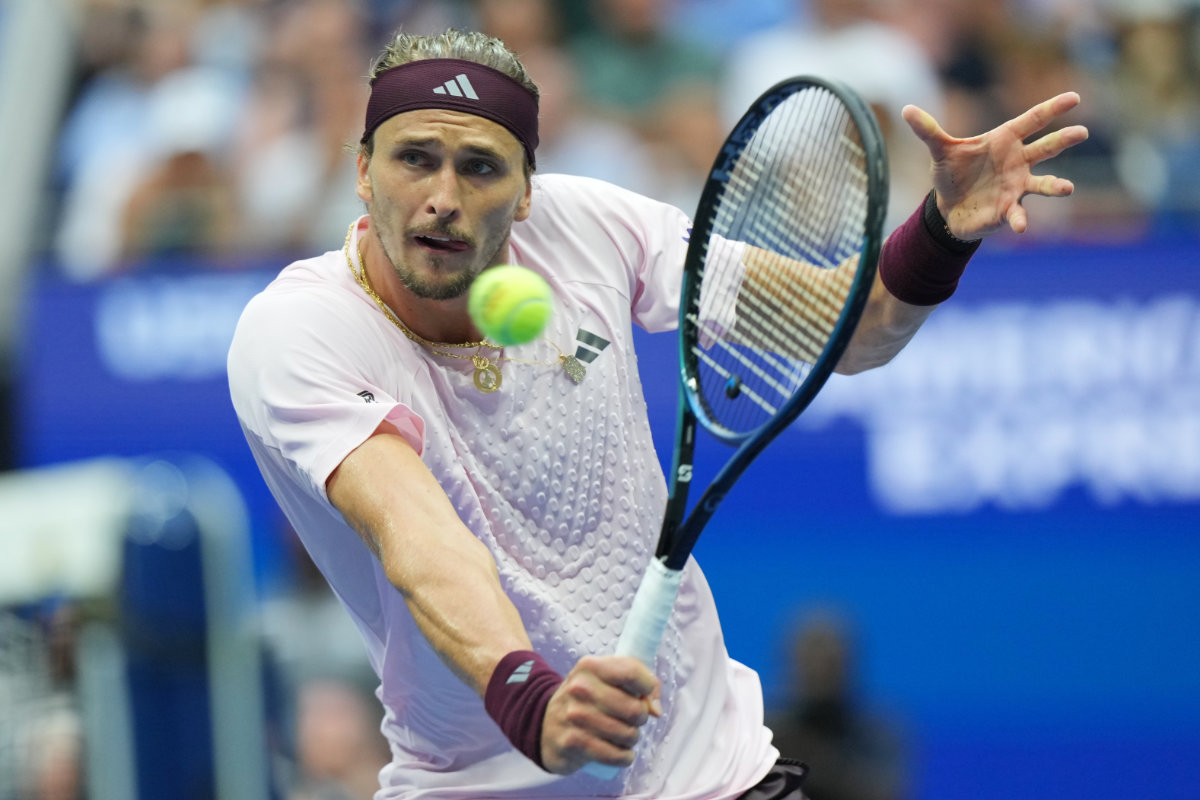
NEW YORK: Alexander Zverev won his second major championship and kept American men without a Grand Slam title since 2003, beating Ben Shelton 6-3, 7-6 (2), 5-7, 6-2 on Sunday in the US Open final.
Zverev finally broke through in the majors by winning this year’s French Open and followed up by finally adding the title in New York that he so painfully let slip away in 2020.
The No. 1 seed in a Grand Slam for the first time, he capitalized on Shelton’s shaky start in his first major final, played a nearly flawless tiebreaker on serve and then turned back Shelton’s comeback attempt in front of a crowd that desperately cheered him on.
Shelton was trying to win the first title by an American man since Andy Roddick won in Flushing Meadows in 2003, as well as the first by a Black man since Arthur Ashe in 1968.
But Zverev was too good in majors this year and apparently didn’t even know how good he was. He finished the match on his serve but didn’t seem to realize it, dropping back behind the baseline as if set to return. Only a few moments later did he figure out he had won, raising his arms in celebration.
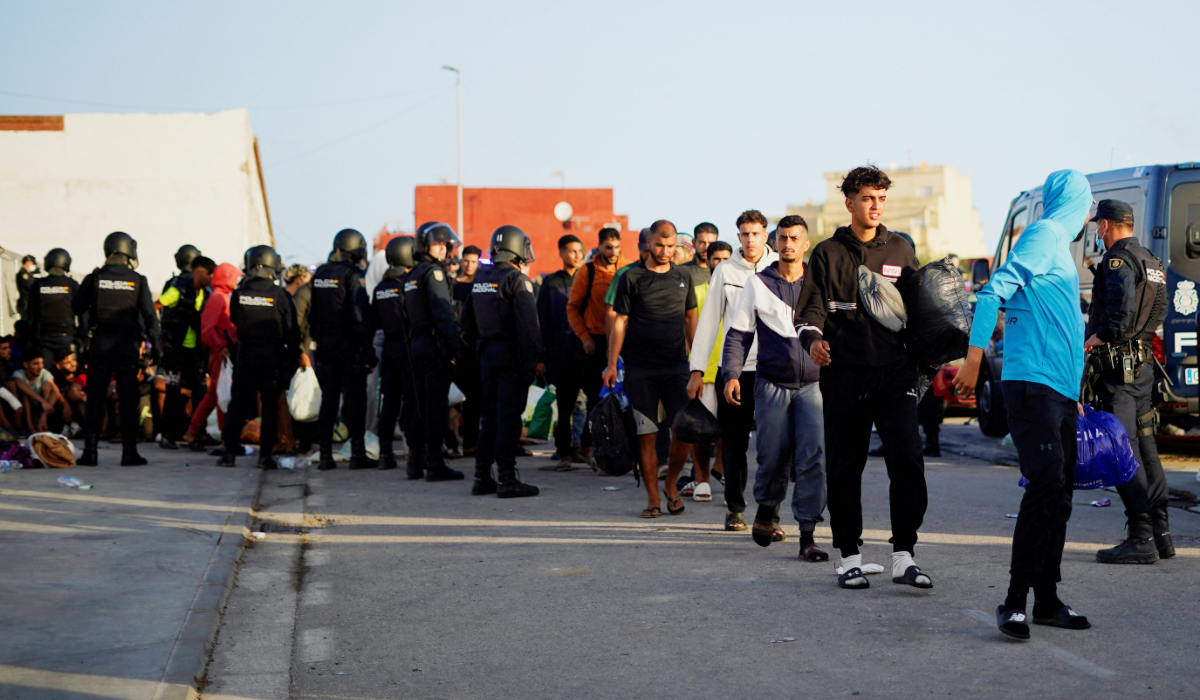
MADRID: The Spanish government on Sunday said more than 5,300 of the migrants who remained in Ceuta after July’s influx had returned to Morocco in a month, as it faces pressure to restore normality to the increasingly tense city.
The new figures come as criticism over the speed at which the migrants are being returned from the Spanish north African territory damages Socialist Prime Minister Pedro Sanchez before next year’s election.
More than 70,000 migrants entered Ceuta on July 30 and 31 in an unprecedented and deadly rush, with most returning to Morocco in the following hours.
The government has had to identify the thousands of migrants who have remained for weeks to check if they are entitled to asylum, while unaccompanied children cannot be summarily deported.
Angel Victor Torres, the minister tasked with leading the government’s response, said in a video posted to social media that 5,321 people had “voluntarily returned” to Morocco since August 10.
Ninety people had “given up” their request for international protection and “almost 1,000 people are being registered with the aim of being able to complete their return proceedings,” Torres added.
The minister did not say how many migrants remained in Ceuta after those returns, a figure that has consistently sparked controversy between the leftist government and the conservative-run city.
On Friday, Ceuta’s leader Juan Jesus Vivas, of the main opposition right-wing Popular Party, put their number at 13,000, but the government’s estimations have been significantly lower.
Locals have protested regularly as the migrants continue to camp on beaches and sleep in the streets, accusing the government of abandoning the overwhelmed city amid a humanitarian crisis.
The migration ministry announced on Sunday the creation of another 864 places in temporary migrant shelters, taking the total to around 4,300 and with a view to reaching 6,000 “in the near future.”
Doubts about what the government knew beforehand and the possible role of Morocco, with which Madrid has spent years trying to improve relations, have also increased the political fallout for Sanchez.
KYIV: Poland and Ukraine on Sunday denounced Russian strikes close to the Polish border, including on a Warsaw-bound train and near a frontier checkpoint — as an “escalation” in the war.
Ukraine’s rail operator said former British prime minister Boris Johnson and ex-US CIA director David Petraeus were at a border train station nearby around the time the train was hit.
But the strikes came as US President Donald Trump called on Ukraine’s President Volodymyr Zelensky to halt attacks on Russian refineries, saying it was causing a shortage of diesel fuel and “there are plenty of other targets”.
Ukraine has increasingly targeted Russian oil refineries in a bid to hurt Russia’s war effort.
Russia attacked western Ukraine with drones Sunday, just days after US envoys visited Kyiv and Moscow in a bid to revive talks to end Europe’s worst conflict since World War II. European nations are meanwhile worried by what they say is increased Russian-orchestrated sabotage acts on their soil.
Poland and Ukraine said a Kyiv-Warsaw passenger train was struck just two kilometers (1.2 miles) from the Polish border, but reported no casualties.
“Shortly before the locomotive was hit at the Ukrainian-Polish border, a diplomatic train was at Yagodyn station. There were, among others, security advisers from several EU member states and former European leaders on board, including former UK Prime Minister Boris Johnson,” said the Ukrzaliznytsia rail operator.
“In another train that was at Yagodyn station at the very moment of the attack was former CIA Director David Petraeus,” it added. The operator did not say how far the officials were from the train attacked.
Zelensky said Moscow had “deliberately” struck the locomotive.
“It is precisely to prevent these strikes from spreading further into Europe that Ukrainian men and women fight every day, give their lives, and do not allow the aggression to expand,” Zelensky said.
– Poland warns of possible more attacks –
Poland has been one of Ukraine’s main allies and, with Ukrainian airspace closed, trains to Poland have been one of the main routes out of the war-torn country, used by refugees.
Poland’s Prime Minister Donald Tusk chaired an emergency meeting in Warsaw following the strikes, warning he expected Russia to escalate the war “in the coming weeks”. He added: “We cannot exclude that the escalation will also affect our territory… I hope not.”
Russia said it had hit “railway infrastructure used to transport military cargo” from European countries.
– Russia ‘knocking at Europe’s door’ –
Speaking in Kyiv, Poland’s foreign minister Radoslaw Sikorski said the “escalation” should lead to allies to “double” their support for Ukraine.
“This was just a few hundred meters from the Polish border; this affects the safety of my countrymen,” Sikorski said.
“I understand that nobody died this morning in that particular attack, but it could easily have happened.”
Ukraine’s Foreign Minister Andriy Sybiga said President Vladimir Putin considered Russia was “de facto” at war with Europe.
“Europe may consider, or reassure itself, that it is not at war with Russia, but Russia does not see it that way. De facto, it is already at war with the Euro-Atlantic space, carrying out various hostile actions,” Sybiga said.
“Putin’s terror is literally knocking at the door of the European Union and NATO.”
Russian attacks killed at least two people on Sunday in the frontline city of Kramatorsk.
Twenty people, including two children, were also wounded in a second day of attacks on the southern port city of Odesa, Ukrainian officials said.
– Three-way talks –
The Kremlin, meanwhile, said negotiations with Ukraine and the United States on the war could take place in October.
“We do not rule out such a possibility; we are talking about the foreseeable future,” Kremlin spokesman Dmitry Peskov told journalists, cited by Russia’s Ria and Tass news agencies.
Several rounds of negotiations have failed, while US-led efforts stalled during the Middle East war.
In an interview released on Saturday, Zelensky said he would be willing to meet Putin at the G20 summit in Miami in December.
But Peskov said that was “impossible”, speaking to AFP in New Delhi on Saturday, repeating Moscow’s demand that a meeting could only take place in the Russian capital.
AL-MUKALLA: Yemen’s government forces are better prepared, more experienced and better armed to defend the central city of Marib against any renewed Houthi offensive, a senior military official said, amid reports that the Iran-backed group is massing forces around the province.
Brig. Yahya Al-Hatemi, director of the Yemeni army’s military media, told Arab News that government forces had gained significant battlefield experience during more than a decade of fighting and were ready to repel any attempt by the Houthis to advance on Marib.
“The armed forces have generally become more organized, powerful and effective,” Al-Hatemi said.
“Over the past decade, they have gained combat experience that enabled them to overcome adversity, master military tactics and identify the enemy’s strengths and weaknesses.”
Marib has become one of the most strategically important government-held areas in Yemen since the war escalated in 2015.
It is home to more than 2 million displaced people, major army bases, oil and gas fields and a key power station. The Houthis have repeatedly attempted to seize the city, but previous offensives have failed.
Over the weekend, Yemeni media reported that the Houthis had sent large numbers of fighters and military equipment to areas of Marib province under their control, raising fears of preparations for another offensive.
The reported buildup followed major Houthi gains along Yemen’s western coast, including the seizure of the Red Sea port city of Mokha and advances toward the Bab Al-Mandab area.
Al-Hatemi said the army was aware that Marib could become the Houthis’ next major target.
“We know that the new pressure will be directed at Marib,” he said.
“However, Marib has significant military strength and divine protection. Moreover, the Houthis lack a popular support base there. Quite the opposite: The local environment is hostile to them.”
The Houthis launched a major offensive to capture Marib in early 2021, with fighting continuing into early 2022 and leaving hundreds of civilians and combatants dead or wounded.
The campaign largely subsided following the UN-brokered truce in April 2022, although the Houthis continued launching missile and drone attacks and mobilizing forces around government-held parts of the province.
Military commanders say the situation is different today.
Government forces are operating under a more unified command and have accumulated years of experience fighting the Houthis across multiple fronts.
For the first time in more than a decade, Yemen’s military has also reactivated its air force, which has recently carried out strikes against Houthi positions.
“The armed forces were supplied with military equipment they had previously lacked, while the army and navy were restructured,” Al-Hatemi said.
“In addition, the air force, which had been absent for 11 years, was reactivated.”
Presidential Leadership Council member and Marib Gov. Sultan Al-Aradah expressed similar confidence, saying government forces were capable not only of defending the province but eventually of taking the initiative and launching a broader campaign against Houthi-held territory.
“There is no doubt that Marib is part of the broader battlefields across the country,” Al-Aradah told Saba TV.
“From the beginning, the Marib front has focused solely on victory, supporting the people and supporting all fronts across Yemen. The objective of the forces in Marib and elsewhere is to restore the capital, Sanaa.”
Al-Aradah urged families in Houthi-controlled areas not to send their children to fight alongside the group.
“I hope they do not send their misled children into death traps … horrific slaughterhouses that make one shudder with shame,” he said.
“It is deeply regrettable to witness, right before our eyes, these scenes where hundreds, even thousands, of misled individuals are sent off — unaware of where they are going or whom they are fighting.”
Al-Aradah accused the Houthis of reigniting the war through their latest military escalation and blamed Iran for encouraging the group to reject peace efforts.
He also praised Saudi Arabia for its support for Yemen’s internationally recognized government.
“Our Arab brothers, foremost among them Saudi Arabia, provide great support to the Yemeni people in all fields,” he said.
“They stand by Yemen’s constitutional legitimacy and support the Yemeni people in addressing their economic and humanitarian hardships. They also stand by us in our efforts to achieve stability and prosperity under a legitimate state.”
The renewed attention on Marib comes as the battlefield has widened following Houthi advances in western Yemen.
The militia’s gains around Mokha and Bab Al-Mandab have increased pressure on government forces and raised questions over where the Houthis will seek to concentrate their next major offensive.
For government commanders, however, the stated objective now extends beyond simply defending Marib.
“The priority now is to restore the Yemeni state and rid Yemen of terrorist organizations, foremost among them the Houthis, regardless of their form or nature,” Al-Aradah said.
“This is an irreversible commitment tied to the will of the people. There will be no turning back until the state is restored, whatever it takes.”
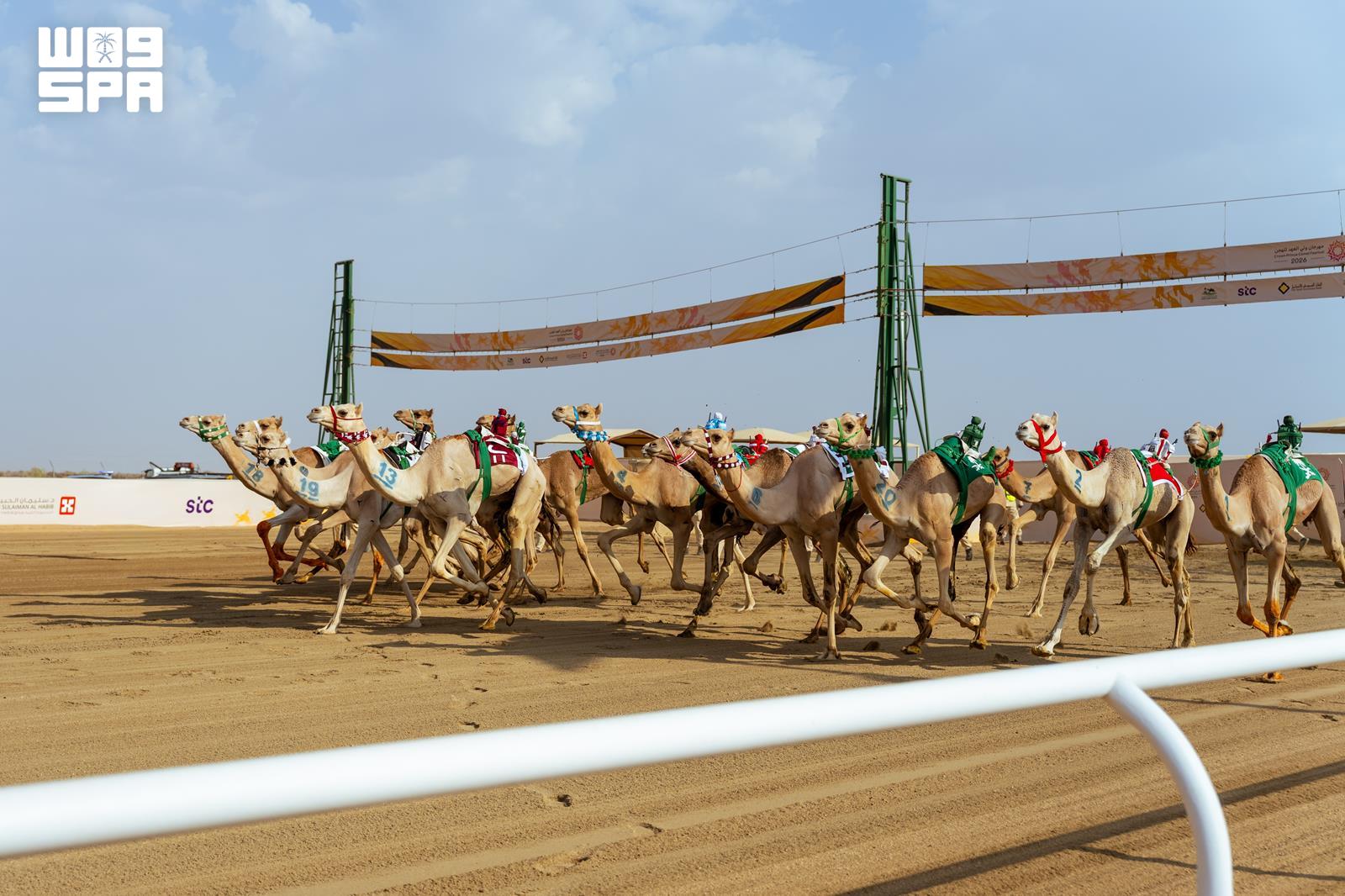
RIYADH: A total of 114 racing camels worth an estimated SR270 million to SR492 million ($72 million to $131 million) entered to compete in the four final rounds of the Crown Prince Camel Festival in Taif, the Saudi Press Agency reported.
The festival’s closing program featured four championship races, with 35 camels entered in the first round, 13 in the second, 46 in the third, and 20 in the fourth.
The event, organized by the Saudi Camel Federation under the patronage of Crown Prince Mohammed bin Salman, offered SR50 million in prize money and attracted leading owners and competitors from across Saudi Arabia and the Gulf.
The festival’s most prestigious trophies, Al-Saif (Sword) and Al-Bunduq (Rifle), are awarded in the elite Hiyl (female camel) and Zumoul (male camel) championship races. Winning either title significantly enhances a camel’s prestige, breeding value, and market price.
Camel owner and racing specialist Abdullah Al-Sharif said the market value of a single camel competing in the Hiyl category typically ranges from SR3 million to SR6 million.
In the Zumoul category, camels are valued at between SR1.5 million and SR2 million.
Some elite camels command prices ranging from SR7 million to SR8 million, depending on their racing record, results, and bloodlines.
Qualifying for the closing championship trophy rounds can significantly increase a camel’s value, with previous achievements, breeding potential, lineage, prize money, and the level of competition all influencing market prices, Al-Sharif added.
Saudi Camel Sports spokesperson Murdhi Al-Khamaali said the festival has helped promote authentic Arab culture globally by bringing together traditions from Saudi Arabia, the Gulf, and the wider Arab world.
He said the event has grown beyond a sporting competition to become an economic, social, and cultural movement, while also helping revive Taif’s historical and cultural heritage.
Al-Khamaali added that bearing the name of the crown prince has transformed the festival into a cultural and economic destination for camel owners from across the Kingdom and the Gulf.
He said the festival’s rapid growth reflects its expanding importance as a platform for preserving heritage and supporting economic activity. Since its launch in 2018, the event has attracted more than 100,000 camels and earned multiple Guinness World Records titles.
The seventh edition in 2025 marked a major milestone, with participation surpassing 100,000 camels, building on the nearly 99,000 camels recorded across earlier editions.
The festival was recognized by Guinness World Records in 2024 for hosting the world’s largest camel race, with 21,637 camels participating. Held during the Kingdom’s “Year of the Camel,” the event highlighted the animal’s enduring cultural significance across the Arabian Peninsula.
The festival has also received several major accolades, including four Guinness World Records titles and the Makkah Economic Excellence Award in 2023, recognizing its contribution to cultural preservation, economic development, and the promotion of Saudi heritage.
In a separate update issued ahead of the finale, festival results showed Saudi-owned camels leading the standings with victories in 131 heats during the eighth edition.
Saudi-owned camels recorded 47 wins in the Al-Haqayiq category, 21 in Al-Laqaya, 15 in Al-Jadha’a, and nine in Al-Thnaya, for a combined total of 92 victories. They also secured 35 wins in the Intaj Al-Saudiyya races and four in the Sibaq Al-Hajjanah category, bringing their overall tally to 131 wins.
Emirati-owned camels ranked second with 35 victories, followed by Qatar with 27. Kuwaiti and Omani owners recorded three wins each, while Bahrain registered one victory.
DUBAI: French actress Melanie Laurent made a dramatic red-carpet statement in an Elie Saab Haute Couture Fall/Winter 2025–26 gown at the Venice Film Festival.
The sculptural black creation from the Lebanese couturier hugged her silhouette before cascading into a floor-skimming skirt, while intricate silver embellishments illuminated the bodice and skirt with a liquid-metal effect.
Meanwhile, the Venice Film Festival awarded its top prize on Saturday to a drama directed by Danish-Egyptian filmmaker May El-Toukhy about a woman trying to hide a wartime relationship with a Nazi — the only feature film with a female director in the competition.
“Woman Unknown” was a major talking point at the festival because of its subject matter, which has rarely been explored in film, and because El-Toukhy was one of only two female directors in the event.
Only one other woman — Israel’s Rachel Szor, co-director of the chilling documentary “NAZA” about Israel’s war on Gaza — was behind the 21 films vying for prizes at the star-studded closing ceremony in Venice.
“‘Woman Unknown’ is about the female body as a battleground and a public matter. And at the same time, the film tells the tale of women who are invisible, unseen and voiceless,” El-Toukhy, who grew up in Denmark with a Danish mother and Egyptian father, told the ceremony.
The head of this year’s jury, American actor-director Maggie Gyllenhaal, had questioned the dearth of women-directed films on the opening day, but she declined to discuss the issue further at a final press conference.
“I think I’m tired of talking about this same subject over and over,” she said. “I just want to celebrate a brilliantly made movie that I felt was like a laser beam.”
The second-place Silver Lion went to “Possible Love,” a poignant relationship study by South Korean auteur Lee Chang-dong that was one of the most highly praised movies of the festival.
The best director prize went to Russian-born Ilya Khrzhanovsky for his vast, riotous and experimental cinema project “DAU,” which chronicles the life of the troubled father of the Soviet nuclear program, Lev Landau.
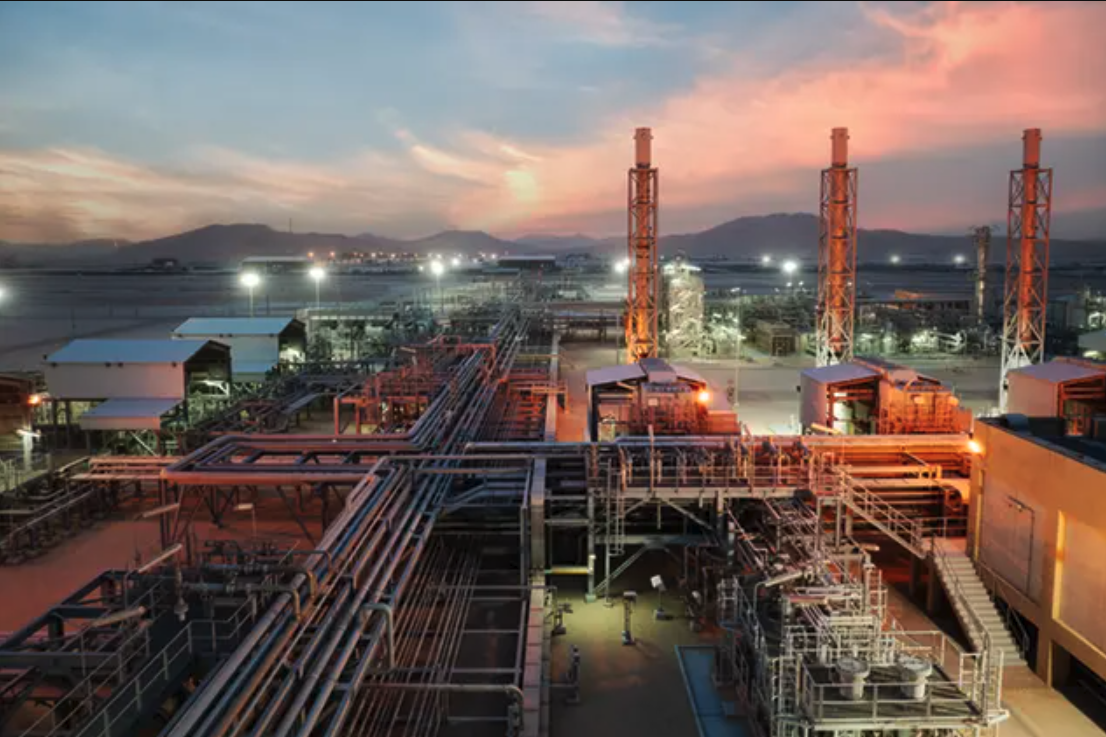
JEDDAH: Oman’s refinery output fell 3.7 percent year on year to about 129.1 million barrels through July, with diesel production declining 6.8 percent, according to preliminary data from the National Centre for Statistics and Information.
The latest figures showed that total motor-fuel production declined 1.4 percent through July, Oman News Agency reported, citing NCSI data.
Diesel production fell to 43.31 million barrels from 46.48 million barrels a year earlier. Domestic sales declined 8.3 percent to 11.11 million barrels, while exports fell 11.8 percent to 33.33 million barrels.
The decline in refinery output comes as Oman continues to develop its downstream energy and petrochemical industries as part of its economic diversification strategy. Invest Oman describes the petrochemical sector as a key pillar of Oman Vision 2040, with major projects including the Duqm Refinery and Liwa Plastics supporting the production of higher-value products from the country’s hydrocarbon resources.
Production of regular gasoline, or 91-octane petrol, fell 4.5 percent to 9.63 million barrels through July, compared with 10.09 million barrels during the same period in 2025. Sales declined 4.6 percent to 10.04 million barrels, while exports rose 9.8 percent to 1.98 million barrels.
“By contrast, production of premium gasoline, or 95, rose 2.6 percent through the end of July 2026 to 8.32 million barrels, compared with 8.11 million barrels during the same period in 2025,” ONA reported.
It added that M95 sales, however, fell 10.6 percent to 8.86 million barrels, from 9.90 million barrels, while exports dropped 33.9 percent to 362,900 barrels, compared with 549,100 barrels a year earlier.
The figures extend a trend seen earlier in the year. Through June, Oman’s total refinery output had fallen 5.1 percent to 108.85 million barrels, with diesel and regular petrol production declining while jet fuel and naphtha output increased.
Jet fuel, naphtha rise
Jet fuel production increased 12 percent to 16.79 million barrels through July, from 14.99 million barrels a year earlier. Sales fell 9.2 percent to 2.57 million barrels, while exports rose 27.4 percent to 14.52 million barrels.
Naphtha production increased 4.5 percent to 22.61 million barrels, while sales rose 3.2 percent to 8.33 million barrels and exports increased 2.6 percent to 14.66 million barrels.
LPG and other refinery products
Liquefied petroleum gas production declined 3.3 percent through the end of July to 6.46 million barrels, compared with 6.68 million barrels during the same period in 2025.
“Its sales also fell 22 percent to 1.76 million barrels, compared with 2.26 million barrels. By contrast, its exports increased 3.9 percent to 2.06 million barrels, compared with 1.98 million barrels,” ONA stated.
Production of other refinery products fell 15.9 percent to 21.97 million barrels, compared with 26.12 million barrels a year earlier, with sales of those products declining 21.7 percent to 18.32 million barrels and exports falling 3.1 percent to 5.62 million barrels.
Petrochemical production
In the petrochemical sector, benzene production increased 7.3 percent to 109,900 tonnes through July, compared with 102,400 tonnes during the same period of 2025, while exports of the aromatic chemical rose 11.3 percent to 108,000 tonnes, according to the statistics.
Paraxylene production increased 9.6 percent to 370,500 tonnes, compared with 338,000 tonnes a year earlier, with exports rising 1.7 percent to 372,400 tonnes.
Polypropylene production, meanwhile, fell 25.4 percent to 149,900 tonnes from 200,800 tonnes during the same period last year.
Despite the decline in output, sales of the key plastic material rose 32.1 percent to 23,500 tonnes, while exports fell 17.9 percent to 122,300 tonnes, compared with 148,900 tonnes.
RIYADH: Saudi Arabia’s first automotive company and original equipment manufacturer, Ceer, will unveil its first flagship electric vehicles, a sedan and an SUV, on Sept. 21, marking a major milestone in the Kingdom’s efforts to establish a domestic automotive industry.
The reveal comes as Saudi Arabia accelerates its push to develop advanced manufacturing capabilities and build an electric-vehicle ecosystem under Vision 2030, supporting economic diversification and strengthening the Kingdom’s position in the global automotive industry.
Established in 2022, Ceer is moving from vehicle development to the unveiling of its first models as Saudi Arabia seeks to establish itself as a regional hub for electric-vehicle manufacturing.
James DeLuca, CEO of Ceer, said: “At the beginning of this year, we said that 2026 is the year of Ceer. I am happy to announce that we’ve set the date for the reveal of our first flagship vehicles.”
He added: “The world is about to witness a historic moment, the result of an incredible journey from initial design and intensive engineering to the buildup of one of the most advanced manufacturing facilities in the world, in record time.”
Saudi Arabia’s EV push
The Public Investment Fund is driving the Kingdom’s electric vehicle ambitions through investments in companies including Ceer and Lucid, while supporting a broader ecosystem covering manufacturing, infrastructure, technology and supply chains.
Ceer was established as a joint venture between PIF and Foxconn to develop Saudi Arabia’s automotive industry. The company designs, engineers, sources, validates and manufactures vehicles, with plans to sell and service them in the near future.
Workforce and local impact
Since its establishment, Ceer has expanded its workforce from 20 to 2,300 employees, bringing together Saudi talent and global automotive experts.
The company has secured partnerships with international companies including BMW, Hyundai Transys and Rimac, as well as Siemens, Sabelt, Isoclima, ANDRITZ Schuler, Durr and XYG.
These partnerships support Ceer’s target of achieving 45 percent local content by 2034. The company is also developing an advanced manufacturing complex and vehicles tailored to the needs of Saudi Arabia and the wider region.
Ceer is expected to contribute around SR30 billion ($8 billion) to Saudi Arabia’s gross domestic product, improve the trade balance by SR80 billion and create about 30,000 jobs, with Saudis accounting for 80 percent of direct employment.
The company also supports the Saudi Green Initiative’s target of achieving net-zero emissions in the Kingdom by 2060.
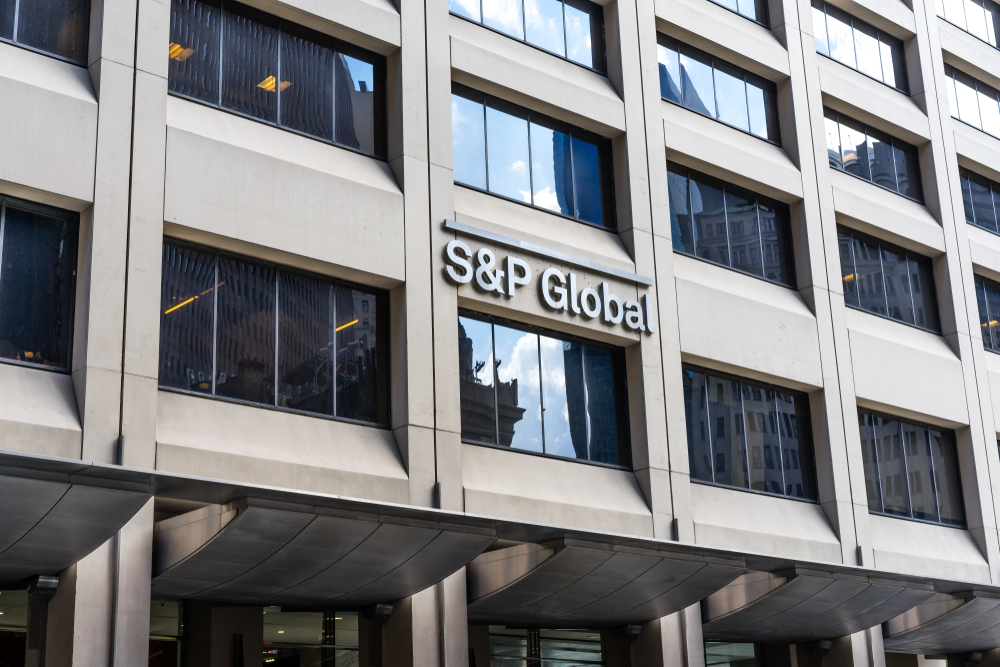
RIYADH: S&P Global Ratings affirmed Saudi Arabia’s long- and short-term sovereign credit ratings at A+/A-1, with a stable outlook, saying the Kingdom’s diversified energy infrastructure and fiscal buffers will help it withstand pressures from the ongoing Middle East conflict.
The stable outlook reflects S&P’s assessment that Saudi Arabia can absorb the impact of regional disruptions while maintaining non-oil growth and fiscal flexibility. The agency highlighted the Kingdom’s ability to redirect crude exports to the Red Sea through the East-West oil pipeline, as well as its substantial oil storage and refining capacity at home and abroad.
S&P expects real gross domestic product to contract 0.9 percent in 2026, before rebounding 8.2 percent in 2027 on higher oil production. Growth is then forecast to average 3.3 percent in 2028 and 2029. The sharp swing reflects the impact of the current disruption on oil activity and the expected increase in production next year.
“The authorities and the country’s sovereign wealth fund are recalibrating the pace of project implementation under Vision 2030, which should help contain fiscal deficits and the pace of general government debt accumulation,” S&P said.
The agency noted that non-oil activities have remained resilient despite regional tensions, supported by continued consumer spending, with the non-oil sector, including government activities, now accounting for around 70 percent of GDP, up from 65 percent in 2018.
The affirmation follows Fitch Ratings’ July decision to maintain Saudi Arabia’s “A+” rating with a stable outlook, citing strong fiscal buffers. The International Monetary Fund also upgraded its 2027 growth forecast for the Kingdom to 5.5 percent from 4.5 percent in April, citing its diversified export infrastructure.
Fiscal picture
S&P forecasts a fiscal deficit of 5.8 percent of GDP in 2026, narrowing to an average of 3.4 percent of GDP in 2027-29. The agency also identified Saudi Arabia’s substantial net general government asset position as a key credit strength and said foreign-exchange reserves had reached their highest level since early 2020.
Daniel Al Banna, financial market analyst and wealth management specialist at Hewar Group, told Arab News the affirmation is a strong recognition of the Kingdom’s economic resilience and strategic strength.
He noted that Saudi Arabia had demonstrated strong strategic thinking, flexibility and the ability to protect the continuity of its economic activity without becoming directly involved in the conflict.
Al Banna said: “The rating reinforces Saudi Arabia’s position as one of the strongest sovereign credit stories in the region,” describing current geopolitical pressures as “primarily short-term factors” that have not altered the Kingdom’s broader economic trajectory.