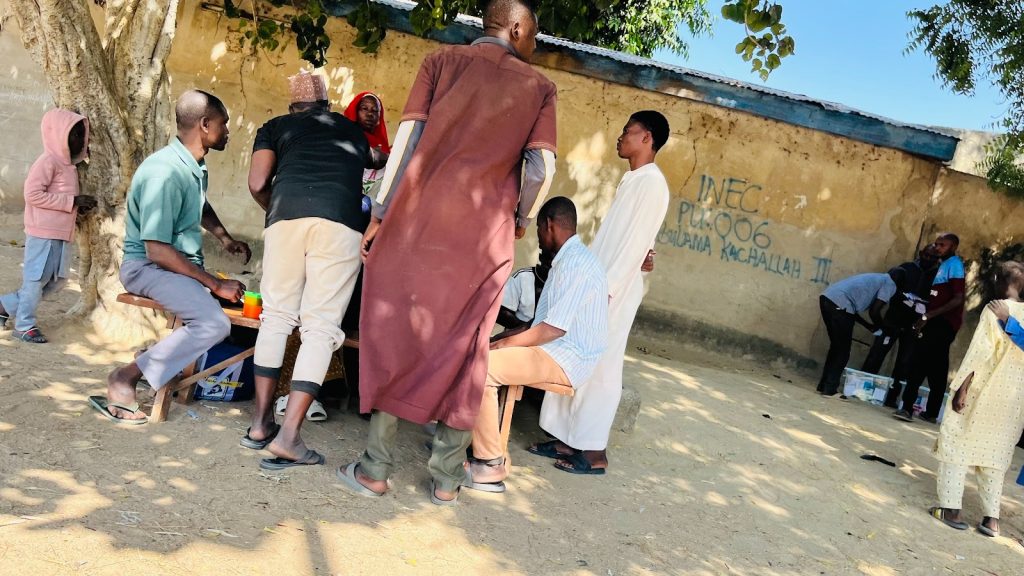
Saturday, Dec. 13, 2025, was meant to be a pivotal civic exercise across Borno State, northeastern Nigeria, as residents were expected to elect chairpersons and councillors responsible for local development, basic services, and community representation. Instead, what unfolded across parts of the state bore little resemblance to a functioning democratic process.
Umar Ali, a resident of Gamboru in Maiduguri, stepped out that morning expecting to vote, but could not locate any polling unit nearby. “We thought it was just a delay, but there was no election activity at all,” he said.
His experience was replicated across the city and other neighbouring council wards. HumAngle observed that many polling units listed by the Borno State Independent Electoral Commission (BOSIEC) were deserted, with neither officials nor voters in sight. In locations where officials were present, there was only a handful of voters, often confined to near-empty compounds.
An exception was Ajari II polling unit in Mafa Ward, where Borno State Governor Babagana Zulum cast his vote, which recorded a higher turnout than most other locations observed.
In several neighbourhoods, residents watched the day pass from outside their homes or went about their chores. Conversations revealed frustration, distrust, and a widespread perception that the outcome had already been predetermined.
“This is not an election. It is a selection,” said Musa Ali, who declined to approach the polling unit closest to his house. He accused the government of determining the results in advance. “They already know what they are doing,” he argued.
For many residents, the only indication that an election was taking place was the restriction of movement imposed across the state. “If not for the ban, you would not even know voting is going on,” said 22-year-old Fatima Alai.
On some of the empty streets, children and even young adults turned it into football fields.
Borno State has over 2.5 million registered voters, with about 2.4 million Permanent Voter Cards collected, as of February 2023. Yet participation in local government elections remains low. It is unclear how many people voted in the Dec. 13 elections. However, this trend is not unique to Borno or even to the current election cycle.
Across Nigeria, turnout in local government elections is consistently lower than in national polls. Analysts and residents alike attribute this to weak service delivery at the council level, the routine imposition of candidates by political parties, and the limited credibility of state-run electoral commissions. For many citizens, local elections appear disconnected from accountability or tangible improvements in daily life.
Malpractice in plain sight
Beyond voter apathy, HumAngle observed troubling procedural violations at multiple polling units. At a polling unit in Bulama Kachallah II, in Maiduguri, HumAngle observed electoral officials stamping ballot papers and depositing them into the ballot box in the absence of voters. This continued between 9:00 a.m. and 1:00 p.m., when we left the unit.
A similar scene played out at another polling unit in nearby Bulama Kachallah I. BOSIEC officials wearing identification tags, alongside unidentified individuals, openly filled out ballot papers and inserted them into the boxes.
When approached, a party agent who was present at the scene told HumAngle, “Ba ruwan ka,” meaning, “It is none of your business.”

Despite these irregularities, BOSIEC Chairperson Tahiru Shettima maintained that the process met democratic standards. “I think the commission has done its best and the election was free, fair, inclusive, and transparent,” he said.
Two days after the exercise, BOSIEC announced that the ruling APC won all 27 chairpersonship seats in the state. The election was contested by six political parties, including the New Nigeria People’s Party, Social Democratic Party, Labour Party, and People’s Redemption Party.
Notably absent was the Peoples’ Democratic Party (PDP), the state’s leading opposition force. In the days leading up to the election, the PDP formally boycotted the process, citing concerns about the legitimacy and fairness of the electoral process, the high costs associated with the expression-of-interest and nomination forms, and a lack of trust in BOSIEC’s capacity to conduct credible elections.
The African Democratic Congress (ADC), a national opposition coalition, was also missing from the ballot. A member of the party, who asked not to be named, claimed that “the state government had been a big challenge”. He said that when the party attempted to launch its Borno State chapter in November, security operatives disrupted the event, alleging that the government had not been notified. According to him, this interference contributed to the ADC’s absence from the December local council election.
The electoral commission rejected these criticisms. Shettima said BOSIEC had consulted with stakeholders, including political parties, on logistics and nomination fees, and insisted that participation was voluntary. “We cannot force any political party to take part in the election,” he told journalists.
Public reactions on social media, meanwhile, suggested a contrasting reality to official claims. Tanko Wabba, a Facebook user, wrote: “We didn’t see the election [ballot] box in our street,” reflecting frustration over missing polling units and highlighting a gap between official claims and citizens’ experiences.
Weakened local governance
For more than a decade, local council elections were not held in Borno State due to the Boko Haram insurgency. During that period, councils were administered by caretaker committees appointed by the state government. Elections resumed in 2020, with another round held in January 2024.
While those elections were described by the media as largely peaceful, turnout was characterised as average at best. Analysts cited voter fatigue, lingering security concerns, and persistent doubts about the relevance and autonomy of local councils.
Under Nigeria’s Constitution, local governments constitute the third tier of government, operating under the state’s supervision. Democratically elected councils are mandated to manage basic services such as roads, markets, sanitation, health clinics, business and vehicle licensing, local fees, education, and support for agriculture and health in coordination with the state.
Executive authority at the local level rests with the chairperson and vice chairperson, who implement council policies through supervisory councillors and the civil service. In practice, however, councils often have limited autonomy. State governments frequently override their authority by appointing caretaker committees—often ruling party loyalists—and retaining control of local government finances through joint state–local government accounts.
Autonomy debates and unresolved tensions
In July 2024, Nigeria’s Supreme Court ordered that allocations from the federation account meant for local governments must be disbursed to them directly, rather than the joint account created by the state government. The court restrained governors from collecting, withholding, or tampering with these funds, declaring such actions unconstitutional, null, and void.
The Minister of State for Defence, Bello Mohammed Matawalle, welcomed the ruling, saying it would allow local governments to manage their own finances, strengthen accountability to voters, and improve service delivery and development.
However, the Nigerian Governors’ Forum opposed the decision. The governors argued that full local government autonomy does not align with Nigeria’s federal structure and said the ruling failed to address longstanding issues of weak administration and executive excesses at the council level.
“The desire for decentralisation must be backed by a commitment to delegate resources, power, and tasks to local-level governance structures that are democratic and largely independent of central government,” said Victor Adetula, a Professor of Political Science at the University of Jos.
Against this backdrop of contested authority and fragile credibility, the conduct of Borno’s local government elections raises deeper questions—not just about electoral integrity, but about whether local democracy in the state can meaningfully deliver the governance and development it promises.