WASHINGTON — Eight sailors attempted suicide while deployed with the USS Abraham Lincoln aircraft carrier strike group, which spent a record-setting uninterrupted time at sea supporting the Iran war, the Navy’s top civilian leader said this week.
Acting Navy Secretary Hung Cao provided the information to Sen. Kirsten Gillibrand in a letter dated Tuesday after the New York Democrat inquired last month about the strike group’s crew of thousands. The Lincoln’s extended deployment drew the nation’s attention following reports of crew stress and poor mental health, as well as supply shortages, including food and hygiene products.
Gillibrand asked Cao specifically if there were any suicides.
“There have been no suicides on board during this deployment,” Cao wrote in the letter, which was obtained by the Associated Press and reported earlier by CNN. “Since the beginning of LINCOLN’S deployment, there have been a total of eight suicide attempts across the strike group — this number includes the LINCOLN crew and Sailors from the carrier wing, strike group and destroyer squadron staff, escorting destroyers, and all embarked aviation squadrons.”
President Trump had downplayed reports about conditions on the Lincoln, which left its homeport in San Diego in November, arrived in the Middle East in January in support of Iran operations, and spent a record-setting uninterrupted time at sea of more than 260 days.
The carrier and some of its supporting ships stopped in Thailand in early September on their way back home to California. The Lincoln’s commanding officer, Capt. Dan Keeler, said then that the ship will be heading home soon but may make further supply stops. He declined to comment on the exact date the strike group is expected back in the U.S.
Last month, Trump called the nearly nine months at sea that the sailors endured a “good period of time” but added that “over the years, we’ve had them out there much longer.”
Trump told reporters in August that he spoke with a retired admiral who recounted being on ships for “much longer.” Trump said the admiral assured him that the Lincoln is “beautifully maintained and beautifully taken care of.” Trump did not name the admiral.
Defense Secretary Pete Hegseth also had said that conditions about the Lincoln were “completely misrepresented.”
Gillibrand took aim at both in a statement released this week in response to Cao’s letter.
“What Trump and Secretary Hegseth dismissed as ‘fake news’ turned out to be serious and deteriorating conditions for our service members,” she stated.
“Our troops and their families make immense sacrifices every single day, yet the president dismissed them with open disrespect,” Gillibrand said. “That this administration can find endless taxpayer dollars for bombs, ballrooms, and billionaires, but cannot take care of our service members, is completely unacceptable.”
Extended deployments of carriers wear on service members who are away from home for long periods and increase strain on the ship and its equipment. The Navy is continuing to enforce a blockade on Iranian ports in the Strait of Hormuz, and the Trump administration has offered no clarity on how it intends to wind down the war.
In California’s Sacramento Valley, a grower was cited for multiple pesticide safety violations in a stone fruit orchard.
In the sweeping farmlands near the Central Coast, a seed supplier that cultivates peppers, vegetables and fruit was hit with more than two dozen pesticide safety violations, some of them serious offenses that caused health or environmental hazards.
And in the San Joaquin Valley, an agricultural retailer with a history of pesticide safety violations was cited for failing to provide protective equipment for workers and post emergency medical information in the fields.
In all, nearly 18,000 regulatory actions were taken by county pesticide safety inspectors across California from the start of 2020 through June 2025. Fewer than 30% resulted in fines, though, according to state enforcement records.
When regulators did levy penalties, they were often as low as $50 to $250, and they varied widely from county to county for the same violations, according to an analysis of more than 40,000 state enforcement records obtained through public records requests.
The regulatory system designed to protect farmworkers from pesticides is enforced haphazardly across California. Even in cases where regulators found that companies endangered workers or committed multiple violations, few were penalized for all their citations. Instead, they received warnings or notices to correct problems for cases in which they were not penalized, an investigation by Capital & Main has found.
In interviews, dozens of farmworkers reported suffering from nausea, burning eyes or irritated throats due to chemical-laced fields. Most said they didn’t report the problems because they feared retaliation or lacked confidence in the regulatory system.
“Yes, there are laws,” said Jesus, his face wrinkled from years of harvesting garlic, pruning grape vines and picking blackberries in the sun-baked San Joaquin Valley.
“But unfortunately, at times the law favors the powerful — it sides with the wealthy,” he added, asking that his last name not be used for fear of reprisal from his bosses.
Autonomous tractors, which are used to apply pesticides, line a field in Fresno County. The machines are operated remotely and spray crops including pistachio and almond trees.A scarecrow overlooks a field of corn at La Huerta de Cantua Creek.
Labor and community activists who track pesticide safety issues contend that lenient penalties, as well as warning letters and written notices, fail to deter violators, especially repeat offenders and larger businesses that can absorb the costs of fines.
State records show that warning letters and written notices were issued more than twice as often as penalties, “[raising] serious questions about accountability and deterrence,” said Bianca Lopez, co-founder and project director at Valley Improvement Projects, which monitors pesticide safety in the northern San Joaquin Valley.
The findings come as state officials are proposing to overhaul decades-old pesticide regulations to toughen enforcement and standardize penalties. Those proposals are strongly opposed by groups representing growers, retailers and providers of agricultural services.
Current regulations are enforced by county agricultural commissioners, who police pesticides in their jurisdictions and also promote California’s $61-billion agricultural industry.
In a statement, the California Department of Pesticide Regulation acknowledged the need to improve regulation and ensure it is applied consistently in every county.
Department spokesperson Amy MacPherson said officials are also proposing new regulations that would increase fines for violations that affect people’s health. This can include cases in which toxic chemicals drift into neighboring fields or communities and sicken people.
MacPherson said county agricultural commissioners have discretion in deciding which enforcement tools — warning letters, written notices, fines — to use in a given situation, depending on the “nature and severity of the violation.”
Paola Lopez, who has harvested raisins in the central San Joaquin Valley, supports stronger regulations.
On a Saturday in late September 2025, the 40-year-old mother of four was loading crates of grapes onto a forklift in a Fresno County field. A tractor pulling a pesticide sprayer passed by on a street just a few yards away. She remembers a loud blast — then a toxic spray covered her face and arms.
“It was a little hard for me to breathe, and my eyes started burning a lot,” she said in Spanish, recounting the incident to a reporter. “I could hardly see.”
Disoriented, she called local activist Nayamin Martinez, executive director of the Central California Environmental Justice Network. Lopez had received pesticide safety training from the organization.
Martinez told Lopez to go to a hospital and said she would file a complaint with the Fresno County agricultural commissioner’s office.
“She started vomiting and became dizzy,” the local activist wrote of Lopez in the complaint.
Paola Lopez, 40, harvests raisins in the San Joaquin Valley and cares for her four children when she is not working in the fields. In September 2025, she was exposed to toxic pesticides and required emergency medical treatment. The county agricultural commissioner investigated the incident and found multiple state pesticide safety violations. Above, Lopez at home with two of her children on April 4.
A reporter reviewed copies of safety notices required by federal law that detail the hazardous chemicals that were mixed into the pesticide load that sprayed Lopez.
“Harmful if inhaled,” one notice says. “Causes skin irritation.”
“Danger … Causes serious eye irritation,” a second document adds.
“May cause cancer,” it warns.
California, unlike other states, has a split system of pesticide oversight. The Department of Pesticide Regulation is charged with statewide enforcement and provides guidance and training for 55 county agricultural commissioners, who police their jurisdictions.
State officials do not supervise the agricultural commissioners, who are appointed by and report to their elected boards of supervisors.
In interviews, commissioners lauded California’s enforcement system, saying they think it’s important to have discretion when applying regulations because crops, growing seasons and pesticide use vary from county to county. They said their work has improved safety in the fields.
The flexibility “gives us the ability to closely work with growers and … keep our communities safe,” said Juan Hidalgo, agricultural commissioner for Monterey County, one of the top farming counties in the nation with a gross agricultural production value of $4.8 billion in 2025.
Last year, a Capital & Main investigation found that companies with violations in multiple counties across California were not fined for hundreds of those offenses — many involving worker safety.
In 2023, a federal audit flagged serious pesticide incidents in half a dozen counties and uncovered patchwork oversight by agricultural commissioners. The county regulators interpret pesticide safety laws differently, are not required to justify fines and are not mandated to check a company’s statewide compliance history, the audit found.
The Department of Pesticide Regulation in late 2025 unveiled searchable county and statewide data breakdowns for regulatory actions taken by agricultural commissioners from the start of 2020 through the end of June 2025.
During that period, commissioners took 17,742 regulatory actions for pesticide violations of all types, but only 4,885 resulted in fines or referrals to district attorneys for possible prosecution, according to the data.
The treatment of violators, including repeat offenders and companies cited for serious infractions, varied depending on the county, according to the analysis by Capital & Main, which examined 40,150 state enforcement records detailing investigations, violations and civil penalties from 2018 through early 2024.
In one county, for instance, an agricultural commissioner fined a farmer $2,000 for failing to provide safety training for workers who applied pesticides in fields. In another county, a grower was fined $200 for the same violation.
1
2
1.A farmworker, 43, who is not identified for her safety, picks grapes that will be sold as raisins in southwest Fresno County on Sept. 3. She works from 6 a.m. to 3 p.m. and is paid 36 cents for each paper sheet she fills.2.A grape farm in Fresno County.
Failure to provide pesticide safety training for workers who handle pesticides is one of the most common violations in California, according to state regulators. Such training is crucial for all field workers because pesticides have different safety requirements and can pose serious health risks.
Many farmworkers who were interviewed, including Lopez, who was sprayed in the raisin field, said employers did not provide pesticide safety training.
According to the analysis, more than 240 businesses were cited for at least 1,268 violations in multiple counties across California, but they paid no fines for nearly half of these citations — many involving worker safety.
Labor advocates who have studied pesticide regulation say the oversight gaps and failures to impose stiffer fines underscore the need for more vigilant enforcement. They note that rural and predominantly Latino communities are disproportionately affected.
“We need much stronger and more consistent enforcement to protect workers and communities,” said Anne Katten, director of the Pesticide & Work Health & Safety Project for the California Rural Legal Assistance Foundation.
In June, the Department of Pesticide Regulation unveiled proposed changes to state pesticide regulations. The approval process will take months and has involved public comment; revised rules are expected to be adopted next year, officials said.
To address uneven enforcement, the new rules would require agricultural commissioners to check whether companies were cited for violations in other counties, officials said. Commissioners would also have increased reporting requirements when they don’t impose fines. Minimum levels for penalties would be raised and stiffer fines would be imposed for repeat offenders.
But individual farmers as well as more than a dozen associations that represent growers, agricultural retailers and firms that spray pesticides have voiced opposition to the changes. They argue that current regulations are effective, that agricultural commissioners need flexibility to investigate violations and that more training is needed to help growers understand the rules, according to written comments obtained through California Public Records Act requests.
“A one-size-fits-all enforcement approach fails to account for California’s agricultural diversity,” said a letter sent to state officials in December that was signed by groups such as the California Strawberry Commission and California Agricultural Aircraft Assn.
“Maintaining county-level discretion,” the letter says, “ensures that enforcement decisions reflect on-the-ground realities and local expertise.”
Some supporting the overhaul say it doesn’t go far enough to protect workers and communities.
Violations of reporting requirements, including those involving pesticide spraying near schools, would trigger only minor, optional fines, said Yanely Martinez, an organizer with Safe Ag Safe Schools, which monitors pesticide safety in the Salinas and Pajaro valleys.
In early June, the investigation into the pesticide exposure case involving Paola Lopez was closed.
Officials found five violations, including failure to have an emergency medical plan for workers, failure to protect people and wildlife from pesticide drift and failure to have pesticide safety records on file, according to a copy of the investigative report obtained through a public records request.
The agricultural commissioner’s office referred the case in June to the Fresno County District Attorney’s Office for possible criminal prosecution. As of mid-September, the case was still under review and there was no timeline for a decision regarding potential criminal charges, said Taylor P. Long, spokesperson for the district attorney.
1
2
3
1.Crates stacked at a grape farm in Fresno County.2.Crates of raisins dry in the sun in Caruthers in Fresno County.3.Sweet Harvest Church is surrounded by agricultural fields in an area of Fresno where many low-income families live and work.
If prosecutors reject the case, it would go back to the agricultural commissioner’s office, which would determine the severity of the violations and how much the fines would be, said Mario Reeves, Fresno County’s assistant agricultural commissioner.
Lopez was at her apartment in the prosperous farmland known as the “Raisin Capital of the World” when a reporter told her about the investigation’s findings and the timeframe for penalties.
She expressed frustration that months would pass before anyone is held accountable.
“How many more people will be exposed? … How many more people will get injured?” she said.
Lopez’s medical bills are covered by workers’ compensation insurance, but her health has worsened and her doctor has referred her to specialists who deal with respiratory and nervous system disorders, she said.
She had gone back to the raisin fields days after she was exposed, even though her throat was sore and she was coughing, because she needed the money. “We cannot afford the luxury of just walking away from a job,” she said.
She lasted less than two days before becoming too sick to work. She has not returned.
Lopez is an independent journalist and fellow at the McGraw Center for Business Journalism. Data journalist Cherry Salazar analyzed state pesticide records for this report.
A federal judge issued a temporary restraining order Thursday that removes President Trump’s ban on three news outlets from White House grounds, a rebuke of the administraton’s most severe attack yet on the Washington press corps.
U.S. District Judge Timothy Kelly said in his ruling that the administration’s ban is likely unconstitutional and that the outlets affected — CNN, MS NOW and Politico — were not given due process before the action was taken. Kelly also rejected the White House’s court argument that the ban was motivated by national security concerns. The restraining order will be in effect for 14-days as the litigation proceeds.
Kelly, appointed by Trump during his first term, made a similar ruling in 2018 after the White House tried to ban journalist Jim Acosta, then working for CNN. Acosta’s credentials were restored.
The three outlets jointly filed a lawsuit Monday alleging that the ban violates the 1st Amendment by retaliating against protected newsgathering as punishment for unfavorable coverage, amounting to viewpoint discrimination.
Trump announced the ban Friday in a Truth Social post, describing CNN, MS NOW and Politico as “fake news.” He claimed the outlets have long been unfair to him and that their negative coverage was a danger to the country.
Journalists from the three organizations were barred from White House grounds on Saturday, the day after Trump announced the ban in a Truth Social post.
CNN, MS NOW and Politico all reported Thursday that their access has not been restored despite the judge’s ruling. Politico reported that one of its journalists had a credential confiscated by Secret Service.
Whether the confiscation was a security snafu or a defiance of the court order remains to be seen.
In a emergency court hearing Wednesday, the White House shifted away from Trump’s initial stated reasons for the ban and argued that the three outlets engaged in reporting that threatened national security.
The administration went on to detail letters sent to each outlet that provided examples of such reporting. One was a background briefing set up by the White House, where an official briefed reporters on condition of anonymity under ground rules set by the White House itself.
In response to the ban, ABC, CBS, NBC and Fox News, suspended pool coverage of President Trump this week as he traveled to New York for the General Assembly at the United Nations.
The four networks along with CNN rotate the coverage which is shared with other news organizations. While the networks that aren’t banned have sent reporters to cover President Trump’s activities, they are not shooting video.
Some right wing outlets sympathetic to Trump such as One America News have been providing video coverage, but they lacked the technical capabilities of the larger networks. Another outlet, Real America’s Voice, posted video that showed President Trump’s detail traveling through New York City.
Keven Tripp, the Los Angeles correspondent for NBC News Radio posted on X that the “Press is NEVER supposed to reveal operational aspects of security detail,” calling the move by Real America’s Voice “stupid and unprofessional.”
Mayor Karen Bass called the training that LAPD officers receive for handling mental health calls “woefully inadequate” and ordered an outside review of the department’s policies Thursday, saying recent shootings highlight continued shortcomings in how police deal with people in crisis.
Bass is particularly concerned by the relative lack of specialized intervention training for patrol officers who respond to the vast majority of service calls. While the SWAT team and other units receive such training, it is not standard across the Los Angeles Police Department.
“After the academy, they have spot training that is essentially videos that are played at roll calls,” Bass said in an interview week with The Times.
The mayor’s directive comes as she’s locked in a reelection fight with progressive challenger Nithya Raman, who, like Bass, has criticized the LAPD over shootings of mentally ill people.
“The ability of the city to respond to someone’s pleas for help is incredibly important in ensuring that we maintain the trust of the public,” Raman recently told The Times. “And right now, there is no alternative system besides LAPD to respond to many of the calls that are coming into 911 besides, of course, Fire Department calls.”
Polling by the UC Berkeley Institute of Governmental Studies, co-sponsored by The Times, shows Raman is favored by 39% of likely L.A. voters, compared to 28% support for Bass — with 33% still undecided.
LAPD officers have fired their weapons at people 16 times this year — down from 34 shootings in 2025, but recent incidents have highlighted how officers continue to turn to their guns when confronting individuals with mental illnesses. In years past, department statistics showed at least a third of all police shootings involved someone with obvious signs of emotional distress.
Bass was particularly disturbed by a July 29 incident in the Olympic patrol area in which police fatally shot a man who approached them with an aluminum bat.
Body-camera video captured officers approaching 33-year-old Alejandro Garcia as he was walking through traffic on Normandie Avenue underneath the 10 Freeway overpass. Officers ordered him to drop the bat, although it’s unclear whether he heard them. While Garcia could be seen holding the bat with both hands, the footage appeared to contradict an early LAPD account suggesting he swung at them.
The shooting could have been avoided if “the officers were trained differently or better,” Bass said, noting that one of the officers had been on the job for roughly five months.
The LAPD has yet to identify the officer or officers who opened fire.
Bass said it would have been appropriate for the department to deploy a unit that sends a social worker out with officers when responding to calls involving a person in crisis.
“You knew before that he had a bat and he was going around smashing cars,” she said.
About a week later, two officers shot and killed Canas Zimran, 44, in Boyle Heights after, department officials say, he approached officers with what was later determined to be a tree trimmer.
The shootings occurred despite policies that prioritize deescalation techniques and the use of “less-lethal” alternatives, such as bean bag rounds meant to subdue people without resorting to firearms.
Bass said the killings reflect, in part, a broader failure of the mental health system to get people the care they need. Also of concern, the mayor said, was the lack of training for officers on how to distinguish between symptoms caused by mental illness, physical and cognitive disabilities and drugs such as phencyclidine, or PCP, which seems to be having a resurgence on city streets.
Bass said her review would be a top-down evaluation that also scrutinizes the roles of dispatchers, supervisors and others involved in responding to reports of people behaving erratically.
She said the audit will examine calls from the last five years involving people with “with known histories of mental or behavioral health conditions” in which police officers avoided using force. The goal, Bass said, is to “identify common themes or best practices that successfully de-escalated the incident or allowed officers to gain compliance.”
Bass added that it’s also important to consider the needs of LAPD officers and ensure they “receive appropriate assistance” to cope with stress. She was struck by the willingness of younger officers to openly talk about the mental toll of the job, recalling a recent visit to a roll call in which an officer described feeling a lack of support after being involved in an on-duty shooting.
LAPD officials have said the department has made numerous changes in recent years to curb police shootings, including adopting deescalation training focused on slowing down volatile situations, particularly those involving people who may be mentally ill. Still, the agency’s critics pack police commission meetings each week to argue for removing police from such calls, saying that officers are too quick to fire on people — particularly those wielding knives.
Although the city has experimented with programs that send specialists to help deescalate such encounters, LAPD policy still requires armed patrol officers to clear a scene of any potential threats beforehand.
Bass said she always has been a proponent of approaches that don’t involve police, some of which are employed by her Office of Community Safety. But she said stabbings and other incidents that pose an immediate danger to the public still require a police response.
Beyond looking at how to avoid police shootings, Bass’ directive calls for further assessment of the department’s training for handling people who’ve been booked into jails and detention facilities, including how they are restrained and transferred to medical facilities.
Bass wanted to ensure the review was done by an outside body, hinting at her frustration with the inaction of department leaders and the police commission on addressing the issue.
SACRAMENTO — As Californians prepare to elect a new governor in November, the concern they want to be his top priority is reducing the state’s entrenched high cost of living, according to a poll by the UC Berkeley Institute of Governmental Studies and co-sponsored by the Los Angeles Times.
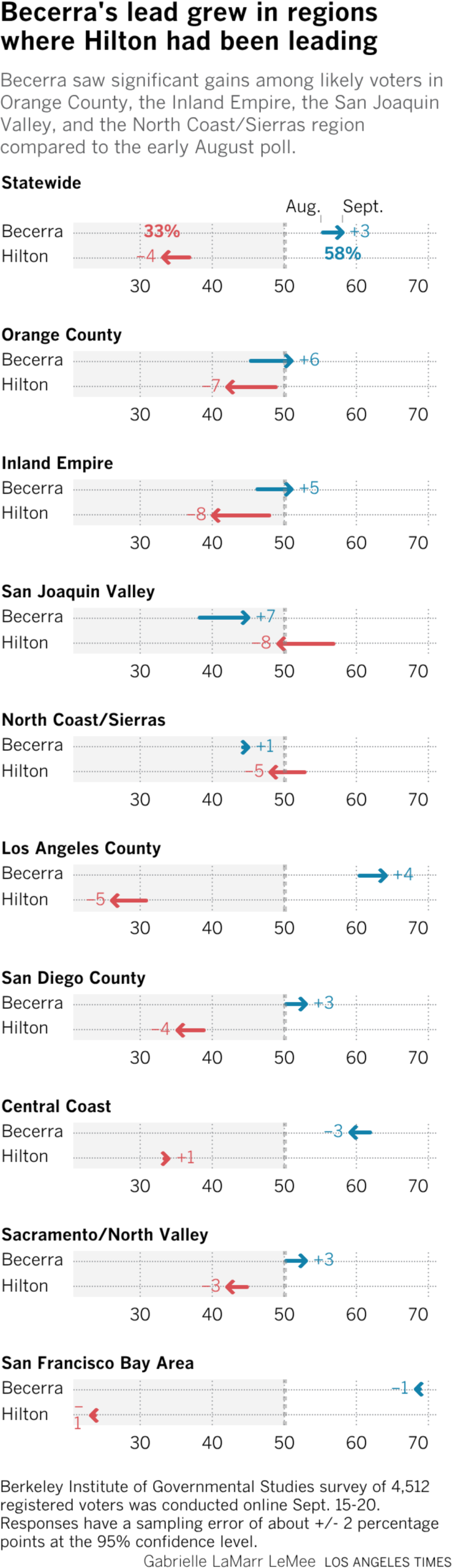
Not too far behind that is strong voter support for fighting the policies of the Trump administration. That may be among the many reasons 58% of likely voters surveyed support Democrat Xavier Becerra in the governor’s race compared to the 33% who back Republican Steve Hilton, whom the president endorsed.
“These results suggest that Becerra is in a commanding position heading to November,” said IGS co-director Eric Schickler. “With 2026 shaping up to be a strong Democratic year nationally, the headwinds facing Hilton in Democratic-leaning California are even stronger than usual.”
The poll found that Becerra’s lead over Hilton had increased slightly since an August IGS poll, and the Democrat now holds a 25-percentage-point advantage.
Despite an effort to reach out to Democrats and independent voters and making California’s high housing costs, top-in-the-nation gasoline prices and other increasing daily living expenses a central focus of his campaign, Hilton is struggling to gain ground in the race to replace Gov. Gavin Newsom, the poll found.
“The difficult thing is that Steve Hilton’s a Republican in California,” said Tim Rosales, a Republican strategist who previously advised GOP gubernatorial candidate John Cox in the 2018 race against Newsom. “On the scale of what’s more important to voters, the cost of living certainly is there, but those Democrats really aren’t willing to cast a vote or cross party lines to vote for a Republican.”
Asked to name one or two of their top concerns heading into the Nov. 3 election, 44% of likely voters cited the cost of living, 37% said it was important to push back against policies from the Trump administration and 30% said they wanted to help their political party win or maintain control of Congress.
“The November elections are being held at a time when the economic backdrop is worsening not only in California but across the nation, as prices are rising on most major household purchases, including groceries, gasoline, electricity and healthcare,” said IGS poll director Mark DiCamillo. “Pocketbook issues have traditionally played a big role in election politics and this year is no exception.”
“Independent voters are a little bit different. They aren’t partisan but they are ideological and there is some opportunity there.” But Hilton would “need a whole lot of them in California in order to have a chance on a statewide level,” he said.
More than half of likely voters not registered with either the Democratic or Republican parties — most of whom declare themselves as “no party preference” — said they supported Becerra in the governor’s race, while 30% favored Hilton. The remaining 14% were undecided.
Hilton has made a slew of campaign promises to lower the cost of living, including $3 gasoline, no taxes on income below $150,000 and lowering energy bills by slashing climate-friendly regulations imposed by Democrats.
Both Rosales and DiCamillo agreed that while voters list affordability as a top issue, Democrats in particular are more motivated by the opportunity to push back on President Trump in the midterm elections.
“When you look at the Becerra voters on the issues or concerns that are important to them, it’s really framed by fighting Trump administration policies. I think that’s an indication of what’s happening in this election cycle,” DiCamillo said. “You’re seeing it across the country as well.”
The poll showed that 59% of Becerra supporters said fighting the Trump administration was a top priority, while 62% of Hilton supporters said reducing taxes was their main concern. More than 60% of undecided voters listed the cost of living as a top item.
Trump, who remains extremely unpopular among most Californians, endorsed Hilton for governor in April. Though the president’s backing helped the former Fox News host consolidate enough Republican support to finish second in the June primary, allowing him to advance to the November election, it may hurt his chance in the general election. A recent Public Policy Institute of California poll showed Trump with a 27% approval rating in the state, a record low across both of his terms.
Hilton has tried to court voters, especially Latinos and independents, who dislike Trump but are also dissatisfied with California’s Democratic leadership and its failure to alleviate some of California’s most incessant problems. The British-born Republican has also declined to criticize the president on issues including immigration enforcement or the Iran war.
Becerra’s wide lead is also boosted by his favorability rating — 48% of likely voters have a favorable opinion of him while 40% view him unfavorably and 11% have no opinion. Hilton’s rating is underwater; 51% of likely voters have an unfavorable opinion compared to 35% favorable and 13% with no opinion.
The Republican has criticized his opponent for doing few public events since the primary election and challenged Becerra to accept debate invitations from roughly a half-dozen news outlets around the state.
The poll was conducted online in English and Spanish from Sept. 15 to 20. Responses for the governor’s race poll came from a weighted sample of 4,512 respondents considered likely to vote in the November election, from a larger group of 6,989 registered voters throughout California. It has a margin of error of 2 percentage points in either direction.
President Trump might not look smaller, but he is.
At home and abroad, among a significant majority of Americans that includes increasing numbers of Republicans, as well as in the eyes of foreign leaders, the president of the United States is shrinking by the day into a hapless peacock, a cartoon figure posting comic word balloons at all hours on the falsely labeled Truth Social network or bloviating for the (fewer and fewer) cameras by day.
Consider Trump’s losses and humiliations just over the past week:
But for the U.S. and Israeli delegations, formerly deferential diplomats at the United Nations mostly sat on their hands for Trump’s boastful and bullying annual address on Tuesday; at one apparent applause line, he seemed to pause for claps that didn’t come. The Federal Reserve raised interest rates over his objections (its hand forced by the inflation Trump’s tariffs and war have caused). The usually compliant Supreme Court killed his rule against mail ballots for the midterm elections. A federal judge blocked Trump (again) from putting his name on the Kennedy Center. Daily it seems, news stories quote once-supportive truckers and farmers breaking with him over the cost of fuel.
There’s more: A long-loyal Florida Republican, Rep. María Elvira Salazar, aired a campaign ad telling Trump that his immigration policies have gone too far and Latino supporters “feel betrayed.” Republican Senate candidates in Iowa and Michigan demanded that Trump end his stalemated war against Iran. The Republican chairman of the Senate Armed Services Committee berated Trump on the Senate floor for kowtowing to China’s President Xi Jinping with this week’s state visit. And a Republican senator from Nebraska urged an investigation of Donald Trump Jr. over his business dealings and his recent wedding that a Russian oligarch bankrolled.
Sure, Trump still has unprecedented control over his party; he only recently ended several Republican officeholders’ careers by endorsing their foes in party primaries. But the primaries are over. More Republicans by the day are trying to distance themselves from a president who’s setting records for unpopularity with just about each new poll. CNN’s latest, conducted last week, found that two-thirds of Americans disapprove of Trump’s job performance and believe, contrary to Trump’s claims, that the United States is losing the war against Iran. In another poll, from Fox News, two-thirds of voters said Trump had made the economy worse.
On the foreign stage, as evidenced by Trump’s failed applause lines at the U.N., leaders no longer compete for ways to play to his vanity. Instead, some are forming workarounds to achieve their policy ends without the conspicuously absent United States — on defense, trade, climate change and more. They’ve learned to discount his empty hyperbole, which is why there wasn’t a collective eruption at the U.N. on Tuesday when Trump suggested he might “annihilate” Iran.
To be sure, many don’t doubt he’s capable of that war crime. In fact, in the same address, Trump included among a number of false boasts one that’s all too real: about U.S. military strikes against small boats in the Caribbean and eastern Pacific that have killed numerous people — 234 to date — whom the administration claims, without evidence, to be drug-runners. These are illegal extrajudicial killings — actual war crimes.
Alas, as president, Trump might be a smaller man, but he retains a “crazy” amount of power, as he gushed himself last Thursday to an audience in the Mar-a-Lago’d Rose Garden. Why, he could even ban fishing and put Bass Pro Shops out of business, he told the billionaire founder of the chain.
That’s not true, but the wannabe autocrat has done plenty that the Constitution and federal law don’t allow a president to do, besides the Caribbean killings — like starting a war without Congress, wiping out entire federal programs authorized by law, demolishing a whole wing of the White House and banning specific news organizations because he doesn’t like their coverage.
Also, any inclination to relish Trump’s self-diminishment should be offset by the fact that he’s simultaneously diminishing the country’s stature and leadership in the world, in ways that could well outlast him. Longtime allies in Canada, Europe, Australia and Asia, in a break from the 80-year-old postwar order that the United States built, are forging new ties among themselves, separate from the newly unreliable United States and a president who is often hostile to allied leaders and openly enamored of dictators in China, Russia and elsewhere.
“To the victor belong the spoils,” Trump crowed to the U.N., in bragging about the United States’ confiscation of Venezuela’s oil and oil revenue since taking over the country in January. The U.S. president thus embraced, before a global audience, the very approach that his country and its postwar allies had rejected in building a new world order that included the U.N.
This week in celebrating China, which along with Russia provides assistance to Iran against the United States, Trump continues his abasement of himself and the nation.
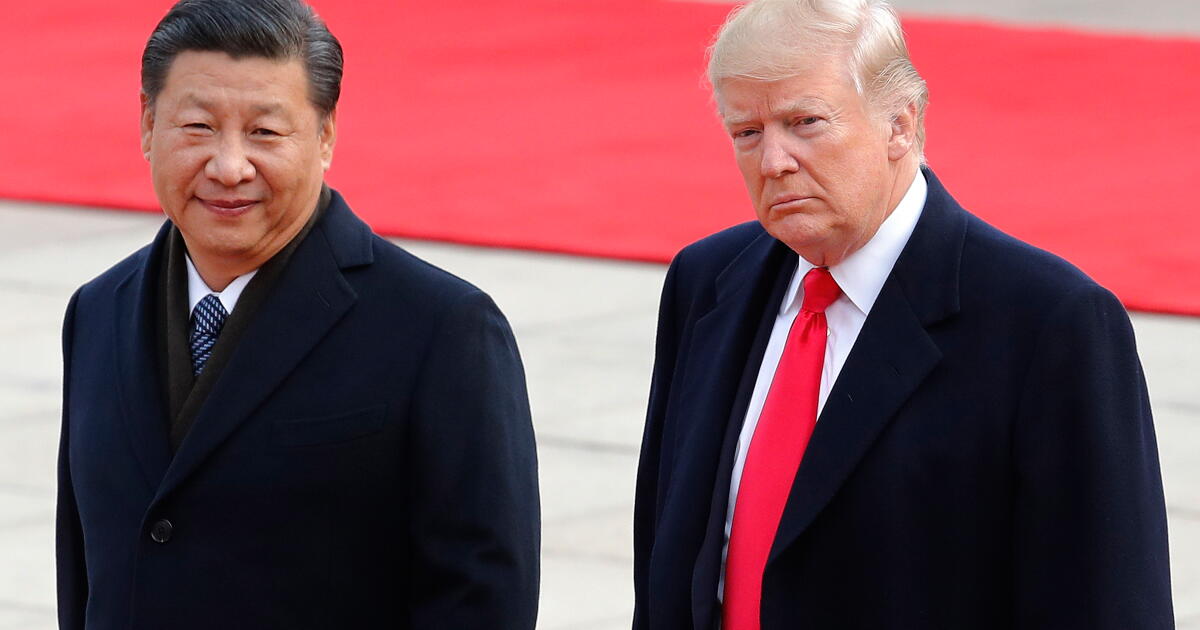
After he’d visited Beijing in May, Trump actually declared China a co-superpower with the United States. “It’s the two great countries. I call it the G-2,” he told Sean Hannity on Fox News. Imagine Hannity’s conniption, and Republicans’, had Presidents Biden or Obama so forfeited America’s singular standing as the world’s superpower. And now, Trump is giddy about hosting Xi for a state visit with all the trappings. Rather than wait for Xi at the White House, as he typically greets visiting leaders, on Wednesday the eager Trump insisted on meeting Xi’s plane at Joint Base Andrews in Maryland for a red-carpet welcome.
In May, China’s Communist Party-controlled newspaper said Trump arrived in China as a “giant with a limp,” crippled by an Iran war then in its third, indecisive month.
Four months later, that war drags on, depleting U.S. stockpiles and defenses, including against an expansionist China. And Xi meets a man who’s no longer looking like a giant.
On the same day Delcy Rodríguez was in New York meeting Donald Trump and representing Venezuela at the United Nations, María Corina Machado was trying, unsuccessfully, to get closer to her own country.
It was her third attempt in barely 24 hours. First came a planned maritime departure from Panama, which was canceled after the company operating the vessel reported mechanical problems. Then came an attempted flight to Aruba, from where Machado intended to continue by sea. Finally, there was another flight plan, this time for Curaçao. That trip did not happen either. Her team now says she has attempted to return to Venezuela seven times since she left in December 2025 to get her Nobel Prize in Oslo.
The exact responsibility for the latest failures remains unclear. But what happened during previous attempts is better documented. Axios reported in July that the Trump administration’s position was that third countries should not help Machado enter Venezuela. When Deputy Secretary of State Chris Landau appeared to tell the Dutch government otherwise, officials in Washington corrected the message. Curaçao withdrew permission for Machado’s plane to land while she was already in the air. According to the same account, Secretary of State Marco Rubio subsequently reiterated the policy to Machado personally.
This sits awkwardly beside Washington’s public position. Rubio said this month that Machado, as a Venezuelan citizen, has every right to return “whenever she wants.” A State Department official told Congress in July that the US would not obstruct her return. Trump himself has denied telling her to stay away.
After World War II, keeping Emperor Hirohito in power did not mean preserving his capacity to decide who could participate in Japanese politics.
All of those statements may be technically true. The US does not issue Venezuelan visas and cannot legally forbid a Venezuelan citizen from entering Venezuela. But Machado cannot teleport into Caracas. Getting home requires aircraft, airports, territorial waters, neighboring governments and, increasingly, governments that want to know Washington’s position before helping her. There is a meaningful difference between saying that the US will not prohibit her return and telling American partners that facilitating it is not US policy.
This would already be an odd arrangement for any opposition leader. It is stranger still in Machado’s case. She is hardly a geopolitical threat to Washington. She has gone out of her way to present a democratic Venezuela as a close strategic partner of the US. In December, she said explicitly that America would be Venezuela’s “main ally.” She has spoken about opening the country to Western investment, rebuilding the energy sector with foreign capital and transforming Venezuela from a security liability into a partner for the US. After Maduro’s removal, she publicly thanked Trump and Rubio and described the outcome as a potential “win-win” for both countries.
Yet Reuters reported last week that US officials remain wary of her return because they fear her presence could disrupt the transition Washington is supporting around Rodríguez. Machado’s movement is not part of the current US-backed negotiating mechanism, while Delcy’s government has become Washington’s main Venezuelan interlocutor.
That raises a question that goes beyond Machado.
The postwar parallel
The Trump administration has repeatedly defended its approach as a matter of sequencing. Venezuela needs stability first, then economic recovery and reconciliation, and “ultimately democratic transition.” The White House argues that rebuilding the economy is a precondition for elections rather than a substitute for them.
There is a serious argument behind that position. Venezuela inherited a devastated public administration, a crippled oil industry, enormous external debt and institutions hollowed out by years of authoritarian rule. Abruptly dismantling the bureaucracy, military hierarchy or State-owned companies could reproduce some of the worst mistakes made in other post-authoritarian or post-conflict transitions. A functioning State matters.
But preserving the State is not the historical equivalent of preserving the regime.
After World War II, the United States repeatedly confronted versions of this distinction. In Japan, the occupation retained Emperor Hirohito partly because American planners believed institutional continuity could make the transition less destabilizing. But keeping the emperor did not mean preserving the emperor’s capacity to decide who could participate in Japanese politics. On October 4, 1945, General Douglas MacArthur ordered the Japanese government to remove restrictions on political and civil liberties and release political prisoners. Among those released were prominent Japanese Communists who had been imprisoned by the old order. American officials later acknowledged that the resulting political opening was so broad that some Japanese mistakenly concluded that the occupation itself favored the Communist Party.
When it comes to the geopolitical role of the US, the Trump administration depicts itself as the decisive actor reshaping Venezuela. When questions turn to the lack of institutional reforms, Venezuela’s sovereignty becomes a much more convenient explanation for the limits of American responsibility.
Something similar happened in Italy. The Allies initially worked through King Vittorio Emanuele III and Marshal Pietro Badoglio because they needed an Italian government capable of administering the country during the war. At the same time, political exiles were allowed to come home and anti-Fascist parties returned to public life. The contrast is particularly striking in the case of Palmiro Togliatti, the leader of the Italian Communist Party and a former senior official of the Communist International. When Togliatti sought to return from Moscow in 1944, the US State Department explicitly said it had “no objection.” He returned and soon participated in the new political order.
Neither Japan nor Italy offer a blueprint for Venezuela. The historical circumstances were radically different, and American occupation policy was hardly politically neutral. But the underlying distinction is useful. Administrative continuity did not require preserving the old regime’s monopoly over politics. The State could survive while the political system opened around it.
That is precisely where Washington’s current Venezuelan policy becomes harder to understand.
The art of deflecting
Keeping experienced civil servants at their desks is State continuity. Avoiding a wholesale purge of the armed forces may be State continuity. Keeping PDVSA pumping oil while new rules are negotiated is State continuity. None of those choices inherently require preventing opposition politicians from returning, organizing, or campaigning.
And Venezuela’s political opening remains incomplete. A UN Fact-Finding mission reported this month that, despite prisoner releases and some liberalization, the structures responsible for years of repression remain largely intact. Officials linked to previous abuses remain in important positions, restrictive laws survive and arbitrary detention and mistreatment have not disappeared.
This makes the widening gap between economic opening and political opening particularly important. Washington is moving rapidly on the former. Rodríguez traveled to New York accompanied by officials discussing oil, mining, debt restructuring and access to international financial institutions. American companies are negotiating their return to Venezuela’s energy sector. Trump has made the oil agreement one of the centerpieces of his foreign-policy narrative.
At the United Nations this week, Trump went further. After celebrating Maduro’s capture, the release of prisoners and Washington’s relationship with Venezuela’s current leaders, he described the new oil arrangement in unmistakably triumphalist terms. “It was a war,” he said, before invoking the old expression: “to the victor belong the spoils.” He then presented Venezuela as proof that the US would once again impose its power against threats in the Western Hemisphere.
If Machado returns, travels freely, organizes her movement, holds rallies and begins preparing for an eventual presidential campaign, Delcy’s continued presence can still be understood as part of an administrative transition.
The rhetoric creates an uncomfortable asymmetry. When discussing oil, geopolitical alignment or American power, the administration depicts itself as the decisive actor reshaping Venezuela. When questions turn to the remaining coercive apparatus, restrictions on political competition or the continued exclusion of important opposition actors, Venezuela’s sovereignty becomes a much more convenient explanation for the limits of American responsibility.
Washington cannot have unlimited responsibility for everything that happens inside Venezuela. Delcy Rodríguez still controls a government, a bureaucracy and a security apparatus of its own. But the US plainly possesses enormous leverage over the political and economic environment in which that government operates. The history of Machado’s attempts to return suggests that this influence may extend even to whether neighboring governments are prepared to help a Venezuelan opposition leader reach her country.
That is why Machado’s return matters beyond Machado herself.
If she returns, travels freely, organizes her movement, holds rallies and begins preparing for an eventual presidential campaign, Delcy’s continued presence can still be understood as part of an administrative transition: an imperfect bridge between the regime that existed under Maduro and a genuinely competitive political order.
If her return continues to be regarded as destabilizing, however, the logic starts to invert. Political competition itself becomes a threat to stability. The government is no longer merely being preserved so that the State can function while politics reopens; political reopening is being limited because it might endanger the government being preserved.
Venezuela does not need another collapse of the State. But avoiding State collapse and protecting the political equilibrium inherited from chavismo are two different objectives.
The distinction between them may ultimately define this transition.
WASHINGTON — A federal judge early Thursday temporarily blocked President Trump’s move to ban three news outlets from the White House grounds and said CNN, MS NOW and Politico must have their access restored.
It’s the latest development in an escalating showdown between Trump and media outlets whose coverage he dislikes. The president announced he was banning the outlets Sept. 18, assailing what he called “fake news.” More recently, Trump has said negative coverage is dangerous for the country.
The outlets argued that they were singled out because of the content of their coverage — in other words, viewpoint discrimination — and called the ban a “blatant violation” of the 1st Amendment.
In an order posted shortly after midnight Eastern time, U.S. District Judge Timothy Kelly said the media outlets had met the legal thresholds needed to obtain a temporary restraining order, which include the likelihood of succeeding on the merits of the case and of suffering irreparable harm without an order.
“This is a high bar, but Plaintiffs have met it,” he wrote.
Kelly — whom Trump nominated in 2017 and who ordered a CNN journalist’s access restored in a similar case in 2018 — heard arguments Wednesday and ended the hearing without ruling.
On Thursday, he issued the temporary restraining order, which will be in effect for 14 days. Such orders are typically designed to preserve the status quo pending a closer review of the case by the court.
During the hearing, Kelly questioned whether the administration had met its legal responsibilities and provided CNN, MS NOW and Politico with adequate due process before banning them.
The rulings in two prior cases over press access, including one that went to the U.S. Supreme Court, made it clear that journalists are entitled to an opportunity to be heard before they have their press passes revoked.
Justice Department attorney Michael Velchik argued that the rulings in the earlier cases were wrong.
The judge noted that his decision would be guided by prior rulings in comparable 1st Amendment cases, even if the government disagrees with them.
Since the beginning of the republic, there has been a dynamic tension between constantly expanding diversity driven by immigration and the relentless homogenizing force of common American culture. And there’s nothing like a long drive on an interstate highway to remind a person of that reality.
On Monday, I traveled 600 miles on I-5 cutting through the center of California, from Redding to Los Angeles. The force of homogenization was apparent at every major exit and interchange. I was hungry, but I was hoping to find something beyond McDonald’s, Burger King, Subway, Wendy’s, Arby’s or Taco Bell. That was not an easy task.
As anyone who has driven an interstate anywhere in this great nation knows, the America one sees from the freeway lanes is the same from coast to coast. The fast-food restaurant choices are the same. The slower food choices are the same – Olive Garden, Denny’s, Pizza Hut and their equivalents. The stores are the same – Target, Best Buy, Starbucks, Wal-Mart.
There is comfort in this level of reliability. A traveler can always find a familiar vendor to buy the thing that did not make it into the suitcase or a hamburger that tastes exactly like the one at the last stop. Still, it can be dispiriting, as well. I remember driving down a highway in rural Indiana marveling that not a single shop or restaurant was unique to that place. It was franchised, homogenized America at its most appalling.
The happy surprise was to discover that, within a minute or two of turning off that Indiana highway, I was rolling through pristine farmland where Amish families riding in horse-drawn buggies sustained a unique culture. And that is still true in most places. I drive to Montana a couple of times a year, and I know once I exit the freeway and bypass the fast-food emporiums, I will find a little cafe filled with ranchers and farmers lunching on homemade soup and sandwiches and talking about the weather, their cows and the upcoming potluck at the VFW hall.
On Monday’s run down I-5, though, I was in a rush and had no time to find the unique places in the countryside that I know must be there. I had to seek diversity from another source: the radio.
Just out of Redding, Christian preachers hung out at the high end of the dial while country music stations predominated in the stronger frequencies. Those stations played song after song extolling the virtues of small towns, back-country roads and girls in tank tops and tight jeans eager to park down by the river and get frisky on the tailgate of a pickup truck.
Approaching Sacramento, the country songs faded and a political talk show took over. The host was part of the legion of small-time Rush Limbaughs across the country. This particular pundit was going off on guns and immigration, sometimes making sense, other times spouting hunches that veered seriously from verifiable facts.
I also began finding more unusual stations broadcasting from the Bay Area. On one, a man with a very earnest voice described how the Earth is actually a prison where all the psychotics from other planets are sent by the overlords of intergalactic civilization. That’s news you don’t hear just anywhere. Another station was nonstop hip-hop. Like the country music, there were reliable themes: wearing gold chains and gold watches, having sex, partying in the crib, having sex, hanging with the homies, having sex, voluptuous female bodies and having sex.
The college stations kicked in at various points. Some offered BBC reports from Jamaica, Mali, the Netherlands, Brazil and other locales most Americans cannot find on a map. Others played music by undiscovered alternative musicians who should probably stay undiscovered. The bad music was, at least, distinctive. On the pop stations, homogenization was really in evidence. Interchangeable divas – was that Beyonce or Mariah Carey? – sang interchangeable songs with bland “I want you, baby, I need you, baby” lyrics.
Strangely, on the Christian music station in the Central Valley, the music was essentially the same as on the secular stations, the main difference being that Jesus was substituted for the usual love interest in the songs. Somehow, making Christ sound like a really neat boyfriend seems vaguely sacrilegious.
The closer I drew to L.A. the more the Spanish-language stations took over. I suppose this is a clear example of diversity. On the other hand, most of the music sounded as formulaic as the pop and country tunes. (Does every Mexican song contain the word corazon?). One hombre stood out, however. Like them all, he was singing with a mariachi band blaring in the traditional three-beats-to-a-measure rhythm, but his voice sounded as if he had just rolled out of bed on the third day of a tequila binge. That was distinctive.
As night fell, I entered the swirl of L.A. traffic. National Public Radio was reporting that immigration reform is suddenly a popular item in Congress. That sounded good to me. We need the different sounds, tastes, talents and ideas that are brought to our shores from all over the world to be integrated, co-opted and fused onto old forms to create something distinctively American. After all, our national motto is E pluribus unum – one from many.
So, sure, secure the borders, but let’s not lock the doors. And please, let’s build some sushi bars at a few exits on the interstate.
May we assume that Rep. Bob Livingston was an adulterer two weeks ago? Did he think then that he was unfit to lead? His stepping down (Dec. 19) leads me to believe that a private adulterer suffers no loss of ability to lead; but that inability only comes with public knowledge of the “sin.”
I call this gratuitous grandstanding. I call this hypocrisy.
MARIAN L. GOLDBERG
Marina del Rey
*
First we hear that Rep. Henry Hyde admits to “youthful indiscretions” and now Livingston admits to previous affairs (Dec. 18). Our major newspapers tend to treat such matters rather gingerly and relegate them to one of the back pages. We continue to hear that our president’s crime was not about sex but lying under oath. But one cannot help wondering how these highly respected gents would have behaved at the time had they been subjected to the machinations of a Tripp-Starr duo.
WARREN PAINTER
Granada Hills
*
After reading about Livingston’s admission to having an affair and the House’s response of a standing ovation, I have finally figured out the real difference between Republicans and Democrats. Democrats view cheating on their spouses as unacceptable behavior and try to keep it secret. The Republicans view cheating on their spouses as acceptable as long as they admit they did it.
And these people have the nerve to talk to me about the president’s moral authority? Maybe we should throw out the entire legislature and start all over.
JIM PRIETTO
Laguna Niguel
*
Do the Republicans truly believe that their children will understand the difference between Clinton’s perjury and the lies of Hyde and Livingston?
JESSE ALBERT
Los Angeles
*
Any effort by the liberal media to compare Livingston’s admission of adulterous indiscretions with Bill Clinton’s sexual scandal is an effort to deceive the American people. You don’t have to be a rocket scientist to know they are not the same. Clinton lied under oath and tried to obstruct justice.
ART AMASAKI
Torrance
*
The cost to expose sexual misconduct by a major politician: federal government–$40 million; Larry Flynt–$1 million. The Republicans might say, “Chalk another one up for the private sector!”
DUAINE OSBORNE
La Mirada
*
It’s as ironic as it was inevitable that the furies unleashed by Kenneth Starr’s overzealous investigations would turn on the Republicans and begin to consume them.
JERRY BUCK
Sherman Oaks
*
During the Joseph McCarthy days the most frequent question asked by the Congress was, “Are you now or have you ever been a member of the Communist Party?” Today’s question asked by Congress can be characterized as, “Are you now or have you ever been guilty of infidelity?”
SAMUEL M. ROSEN
Newbury Park
*
Character does matter, especially if you happen to be a Democrat.
PORTLAND, Maine — Maine Democrats on Wednesday assailed U.S. Sen. Susan Collins over a news report that the FBI investigated how much she knew about illegal campaign contributions that sent one of her donors to prison.
The ProPublica report, published Tuesday, states that the FBI in 2024 planned to launch an investigation into Collins’ dealings with Navatek, a Hawaii defense contractor and donor to her campaign. The investigation, which focused on an alleged pay-to-play scheme, failed to commence after President Trump took office after winning the election, according to ProPublica.
The report arrived six weeks before an election in which Collins is seeking a sixth term against Democrat Troy Jackson. Democrats have targeted the seat, in a state that Trump lost in 2024, as the party tries to win control of the Senate, making it one of the most competitive races on the November ballot.
Collins on Tuesday called the entire story “absolutely outrageous” and said it is frustrating and unfair to have such claims made against her so close to the election. Her campaign manager, Steve Abbott, also said Wednesday that the allegation that “we charge people to have meetings” is categorically false and Collins accepting campaign cash for contracts “did not happen.”
Jackson called the allegation “corruption of the highest order.” He was not present Wednesday when a group of Maine Democrats held a news conference near Collins’ Portland office, calling the allegations a betrayal of trust.
“I cannot stress enough here today the seriousness of these allegations. Maine people deserve clear and real answers from Susan Collins right now,” Maine Democratic Party Executive Director Devon Murphy-Anderson said.
FBI says allegations were already investigated
The ProPublica report stated that the head of a Collins super PAC met with executives from defense contractor Navatek in 2019 and asked them for a $500,000 campaign donation. The company’s chief executive, Martin Kao, sent an initial $150,000 donation using a shell company, the report stated. ProPublica reported that it reviewed an internal company email from Kao in which the CEO later told Navatek executives that Collins committed to getting the company $32 million in Navy contracts.
Kao and two other Navatek executives were later indicted on charges of funneling illegal donations to Collins. Kao sought to reduce his prison sentence by revealing to the FBI the full scope of illegal contributions to Collins, ProPublica reported.
Collins said Kao is “a liar” whose story is untrustworthy.
“He has been twice convicted in separate federal court cases. He’s been convicted of money laundering. He’s been convicted of bank fraud. He has been convicted of false submissions to the FEC. He’s being convicted of a lot of crimes,” she said.
An FBI spokesperson said in a statement that the allegations “had already been investigated by the FBI years ago and ultimately found nothing implicating Senator Collins or Senator Collins’ campaign. Any suggestion otherwise is totally false.”
The ProPublica article also states that Trump’s return to the White House left the Justice Department unable to perform the investigation.
Corruption investigations have decreased in Trump’s second term
The number of FBI agents and Justice Department prosecutors specializing in corruption investigations plummeted in the first months of the Trump administration. The Justice Department, for instance, decimated its elite Public Integrity Section in early 2025 and the FBI disbanded a white-collar fraud and public corruption squad based out of its Washington field office.
The administration has also fired numerous law enforcement officials who participated in investigations into Trump, including over his efforts to undo the 2020 presidential election he lost and his retention of classified records at his Mar-a-Lago estate in Palm Beach, Fla.
An email seeking comment was sent to the Justice Department on Wednesday.
Collins said she first learned of the company through the University of Maine because of the research the Navy found to be valuable, which had to do with 3D printing for production.
She said the Justice Department has already reviewed the matter.
“I’m telling you this is completely false,” Collins said.
Senate Majority Leader John Thune dismissed the idea that Collins would be implicated in a pay-to-play scheme, calling the allegations “a political hit job.”
Whittle and Mascaro write for the Associated Press. Mascaro reported from Washington. AP writers Mary Clare Jalonick and Eric Tucker in Washington and Kimberlee Kruesi in Providence, R.I., contributed to this report.
A two-part docuseries about Melania Trump arrives later this year, the first lady revealed Wednesday. The new project follows the January release of director Brett Ratner’s documentary, which made $16.7 million worldwide at the box office and was universally panned by critics.
“It will come out this year, and it will be very different what is in the movie,” Trump told “Fox & Friends” ahead of her appearance to ring the New York Stock Exchange opening bell. “It’s more [like a] conversation one on one with me.”
Trump indicated that the docuseries will cover new ground.
“So when I was traveling and doing all of the filming, the director was asking me questions, and there’s some private questions that I will answer that people never heard before,” she said.
The Times has reached out to Amazon Studios for more information on the project, which does not appear in press materials, though Ratner teased the new “chapters” in an Aug. 11 Instagram post.
“Here we go again….” the director wrote. “The saga continues …. can’t wait to share with everyone around the world the next two chapters of MELANIA, THE DOCU SERIES!”
Ratner’s film followed the first lady in the 20 days leading up to President Trump’s 2025 inauguration, promising “exclusive footage capturing critical meetings, private conversations, and never-before-seen environments” as Melania “orchestrates inauguration plans, navigates the complexities of the White House transition, and moves her family back to the Nation’s Capital.”
Critics, however, found the cinematic experience lacking.
“I’m hesitant to call ‘Melania’ propaganda because I can’t imagine anyone watching this movie and thinking that Melania Trump comes off well,” Times film critic Amy Nicholson wrote in a February review. “If this vapid, airless, mindless time-waster had subversive designs of being a satire about the first lady of the United States, there’s not much it would have changed. Yet somehow, ‘Melania’ is exactly the film that the first lady wanted to make — her company was paid $40 million for the rights to this self-greenlit production — and no one around her warned that it was a very expensive bad idea.”
“Melania” was Ratner’s first film since six women accused him of sexual assault in 2017. In February 2026, The Times reported that the “Rush Hour” filmmaker appeared in the unsealed Epstein files in photos with unidentified women and the financier, who died by suicide in 2019 while awaiting trial on sex trafficking charges.
In addition to the initial $40 million Amazon MGM Studios paid to license the project, the marketing and promotion budget was reportedly another $35 million.
DES MOINES, Iowa — A judge on Wednesday dismissed President Trump’s lawsuit accusing the Des Moines Register and its former pollster of misrepresenting the state of the 2024 presidential race, rejecting the president’s claim that the newspaper’s poll coverage violated Iowa’s consumer fraud law.
Calling the case extraordinary, Iowa District Judge Scott J. Beattie said that allowing the lawsuit and its “faulty” claims to proceed could have a chilling effect that “can discourage others from reporting on and debating public affairs.” He sided with pollster J. Ann Selzer and the newspaper, which described the lawsuit as a conspiracy theory and an affront to free speech protections.
The ruling Wednesday came hours after a judge heard arguments but did not rule from the bench in a case on Trump’s ban of CNN, MS NOW and Politico from White House grounds. Trump banned the three outlets beginning Friday, assailing what he called “fake news.”
Trump filed the lawsuit against Selzer, the Des Moines Register and the newspaper’s parent company in December 2024, accusing them of fraudulently publishing inaccurate poll results to damage him and help Democrats, saying coverage of polls is not protected speech.
Trump and his team have filed several lawsuits against media organizations accusing them of bias, calling into question the boundaries of free speech protections, particularly for press. Some of those lawsuits have ended in settlements.
In dismissing the case in Iowa state court, Beattie wrote that Trump’s suit sought to “stretch both Iowa statutory and common law beyond their current bounds, turning speech that enjoys the highest category of First Amendment protection into a liability.” After hearing the arguments, the judge concluded the constitutional protection “is too great and the reach is too far. The case must therefore be dismissed.”
Beattie said the case would have to be dismissed even if, solely for the purpose of deciding the motions, he accepted the Trump team’s allegations that the poll was intentionally skewed and its results fabricated.
“Even with this assumption, each of the three counts still fails,” the judge wrote, because the lawsuit did not meet the legal requirements for fraud or consumer deception. He made clear that the poll and coverage of it are constitutionally protected political speech and not a commercial product.
The White House referred questions to the president’s personal lawyers, who did not immediately respond to messages.
U.S. Rep. Mariannette Miller-Meeks and former Iowa state Sen. Brad Zaun, both Republicans, joined the lawsuit. Selzer and her co-defendants wanted the case moved to federal court but, after a year of legal proceedings, the first hearing took place this year in state court.
The poll, conducted by Selzer’s company in the final days of October and released just days before election day in 2024, showed then-Vice President Kamala Harris, the Democrats’ presidential nominee, capturing 47% of Iowa likely voters, to Trump’s 44%.
Trump ultimately won the support of 56% of the nearly 2 million Iowans who voted.
Trump, Miller-Meeks and Zaun alleged the misleading coverage diminished their reputations, valuable time in the final days of the campaign, and campaign funds and resources.
Selzer’s case was taken up by the free speech advocacy group Foundation for Individual Rights and Expression. In separate filings, the Iowa pollster and the Register, with its parent company, Gannett Co., argued that courts never have considered polls or newspapers covering them to be commercial speech even though they may be sold for a profit.
They said the poll coverage, whether right or wrong in capturing the state of the race, was constitutionally protected political speech.
They also disputed the consumer fraud claim, emphasizing the poll and coverage of it were not connected to transactions between the companies and Trump, Miller-Meeks or Zaun.
WASHINGTON — A federal judge in Rhode Island struck down a Trump administration directive that would have barred some immigrants from accessing certain federal programs, including Head Start preschools, community health clinics and adult education initiatives.
U.S. District Judge Mary McElroy, who was appointed by President Trump in 2019, temporarily barred his administration from moving forward with the rule last year, so it never was implemented. On Monday, she made the injunction permanent.
Officials from the Republican administration had said the directive would stop “illegal aliens” from accessing federal benefits by reclassifying broad swaths of social services programs under a Clinton-era law, the Personal Responsibility and Work Opportunity Reconciliation Act.
But the rule also would have swept up many immigrants in the U.S. legally, including work and student visa holders. It also would have barred services from Temporary Protected Status holders, who are granted work permits if the U.S. government determines conditions in their home country are too dangerous to return, along with recipients of Deferred Action for Childhood Arrivals, who were brought to the country illegally as children and receive temporary protection from deportation and work authorization.
Those groups, which are considered “nonqualified aliens” under the law, already are unable to access full Medicaid benefits and federally funded food aid and cash assistance.
The Trump administration issued its directive in July 2025. Democratic attorneys general from 20 states and the District of Columbia sued.
They said the change upended three decades of policy allowing people to access community health clinics, domestic violence shelters and Head Start centers without proving their immigration status. They warned the harms could spread, deterring any immigrant from seeking services and throwing up barriers even for U.S. citizens unable to document their legal status. The new rules also would have put administrative burdens on underfunded social service agencies, including Head Start operators, which might have been forced to close if they were unable to comply with the directive’s new requirements, the lawsuit said.
In her ruling, McElroy declared the directive “unlawful” and said the Trump administration did not follow the proper avenues to rewrite the rules. She called the administration’s actions “procedurally invalid.” She added that the administration still could pursue rule changes through the federal notice-and-comment process, which officials bypassed when they issued the directive last year.
Requests for comment were sent to the departments named as defendants in the wide-ranging lawsuit. The Administration for Children and Families, a division of the Department of Health and Human Services that oversees Head Start, said it does not comment on ongoing litigation. The Labor Department referred inquiries to the Justice Department, which did not immediately respond to a request for comment.
In a statement, New York Atty. Gen. Letitia James, who was among those who sued, hailed the judge’s ruling.
“From cancer screenings to food banks to early childhood education, the federal government’s attempts to decimate the social safety net would have been catastrophic for working families,” James said.
Gov. Gavin Newsom has vetoed a bill aimed at deprioritizing commercial logging in a unique state forest system, arguing the measure would jeopardize the ability to test best management practices.
At issue are the state’s 14 demonstration forests — managed by the California Department of Forestry and Fire Protection, or Cal Fire — which are billed as “living laboratories” for forest management practices. Under existing law, they’re directed to produce as much timber as can be sustained over time, while considering factors like recreation and wildlife.
Assembly Bill 2494 would have eliminated what’s often characterized as a logging mandate in favor of prioritizing values such as carbon storage, wildfire resilience and biodiversity conservation. It also would have directed state officials to seek agreements with Native American tribes to integrate their traditional knowledge into managing the land.
In Newsom’s veto message, he said the forests “produce cutting-edge strategies that inform forest management on public and private lands across California,” which is key for fighting climate change and improving wildfire resilience.
“By narrowing the management of these forests to a limited set of public benefits, this bill risks the state’s ability to fully demonstrate the best science-based practices,” he wrote Friday. “At a time when California is racing to keep pace with a rapidly changing climate, we cannot afford to lose the flexibility needed to safeguard our forests for future generations.”
The move deals a blow to a grassroots coalition that included tribes, environmentalists and mountain bikers, some of whom have fought for decades to rein in logging at Jackson Demonstration State Forest in Mendocino County. In recent years, activists have staged protests and tree sits, harkening back to the “timber wars” of the 1980s and ‘90s.
The bill grew in part out of discussions with constituents who wanted to see the forest run differently, according to its author, Assemblymember Chris Rogers (D-Santa Rosa).
Rogers, who represents the North Coast, called Newsom’s veto message “nonsensical” and said it didn’t reflect the language of the bill.
“Current law says that the guiding principle for the management of the forests is maximum sustained production of high-quality wood products,” he told The Times. “That’s much more narrow as a directive on how to manage those lands than by expanding it to include biodiversity, carbon sequestration, research, recreation.”
Polly Girvin, who pushed for changes at Jackson along with her late partner and tribal leader Priscilla Hunter, said the fight will continue under California’s next governor. She wants to see Native Americans take an even stronger leadership role going forward, pointing to rights afforded to them by state law.
“Our local tribal voice is not pro-logging; it’s really to keep the world in balance, to honor the cries of the ancestors, to try to save the trees from commercial logging,” said Girvin, a retired attorney focused on Native American law.
Leaders in Mendocino and Humboldt counties backed the measure. Humboldt County Supervisor Steve Madrone saw it as codifying practices that could help rebuild trust in the community, which he said Cal Fire had lost.
“It was not going to restrict it from being able to do all kinds of things,” he said. “Frankly, it was going to be better than just letting them kind of focus on board feet.”
Cal Fire’s Kevin Conway, who oversees the state’s demonstration forests, said he could not comment on the measure.
The bill was opposed by the Rural County Representatives of California, an advocacy group representing 40 counties, along with many in the timber and agriculture industries.
Staci Heaton, senior policy advocate for RCRC, echoed Newsom’s concerns that the legislation would have limited what could be done in the forests to achieve resilience, such as the ability to harvest trees of different sizes and types. She said they also had concerns about the funding structure and what she described as vague definitions in the bill, which could invite litigation.
“We appreciate the governor signaling that we’re going to continue to use sound forest management in California,” Heaton said.
Asked about the disagreement among some counties, she said there tends to be “more of a split in what people think good forest management looks like” when it comes to coastal redwood forests.
“We maintain that a lot of our forests really aren’t healthy in their current condition, and there’s too many straws in the ground, and there does need to be, in some areas, more aggressive management,” she said.
SALT LAKE CITY — A U.S. Postal Service letter carrier in Utah threw out more than 300 mail ballots that were being sent to voters for the state’s June primary, the Justice Department said Tuesday.
Acting Deputy Atty. Gen. Trent McCotter said during a news conference that Damon Matai Seei was arrested Tuesday and appeared in federal court in Salt Lake City to be arraigned.
The 34-year-old from Payson, Utah, pleaded not guilty to a felony charge of destruction or delay of mail. If convicted, he could face up to five years in federal prison. A message seeking comment was sent to his attorney.
Seei was delivering mail in Eagle Mountain, a conservative suburb of Provo, when he threw the ballots and other mail into a dumpster in a church parking lot not long after his shift started, McCotter said.
Melissa Holyoak, the U.S. attorney for Utah, said Seei indicated to authorities that he had no political agenda and did not intend to discard the ballots. He told investigators in an interview that he acted out of “laziness,” throwing away mail to “lighten his workload,” according to court documents.
In a written statement quoted in court filings, Seei said he felt overwhelmed that day by the quantity of mail, and he decided to toss out advertisements so he could focus on other deliveries.
He told law enforcement he had set aside the ballots at the beginning of his shift, prosecutors said, arguing it was implausible that Seei didn’t know they were in the discard pile.
Most voters in Utah cast ballots by mail or deposit them in drop boxes. Nationwide, nearly a third of voters use mail-in ballots.
All active registered voters in Utah are automatically sent ballots by mail, though that system is set to end in 2029 under a new state law requiring voters to opt in.
Several Eagle Mountain residents complained to Utah County Clerk Aaron Davidson that they never received their ballots, leading him to investigate. He determined that the rate of voter participation in the community was unusually low and learned through outreach that the number of voters who did not receive ballots was in the hundreds, according to court documents.
Seei is no longer employed by the Postal Service. The investigation remains ongoing, officials said.
Earlier this month, the U.S. Supreme Court rejected President Trump’s attempts to impose new Postal Service rules that would have restricted mail voting for the midterm elections.
Catalini and Schoenbaum write for the Associated Press.
WASHINGTON — President Trump’s AI-fueled vision for a drone port he intends to install atop the new White House ballroom includes missile-bearing unmanned aerial vehicles and gun-toting troops, ostensibly to protect the 18-acre complex and the nation’s capital.
A few hundred feet away, a drone port, run by the U.S. Secret Service and not the military, is already quietly operational. Equipped with cameras and sensors to scope out potential threats from a bird’s-eye view, the small UAVs stand on alert in four gray weatherproof boxes until deployed at officers’ commands.
The agency is using a model known as “drone as first responder,” deploying speedy unarmed drones from outdoor stations to serve as flying cameras. That model has been adopted by hundreds of police agencies across the U.S., often powered by AI software to help dodge obstacles or track targets.
The existence of the surveillance drones on a Treasury Department building adjacent to the White House complex has not been previously reported, and could undercut Trump’s legal claims that the ballroom construction is necessary “to protect the White House and surrounding region from aerial attacks.” The need for the drone port underpinned Trump’s national security defense for the construction project — a justification he is now citing for the construction of a massive arch outside the gates of Arlington National Cemetery.
The installation is thus far markedly less imposing than the vision outlined by Trump, with its rows of futuristic attack drones, apparently modeled after those used in U.S. military strikes, that drone experts describe as outlandish.
“To be honest, if a drone was so close to the White House that it needed interdiction, it’s already gotten too far,” said Matt Sloane, co-founder of SkyfireAI, which makes software for drones used by public safety agencies.
It would be more realistic for the White House to build something akin to what the Secret Service is using next door, Sloane said: “The drone takes off and does some type of perimeter sweep or whatever, and then puts itself back in the box.”
The White House did not comment for the story. The Secret Service declined to comment on the specifics of its drone operations but said the new docks are separate from Trump’s ballroom drone port.
The details of Trump’s ballroom drone port remain murky
Security of the president and the White House complex is generally the domain of the Secret Service, which works in close concert with the White House Military Office and other military elements when needed.
Trump has said the drone port came at the request of U.S. military officials. Speaking to reporters in May, he said the building’s plans were expanded to meet the request: “They wanted more drone capacity,” he said. On social media, he boasted that the drone port might end up being the “most sophisticated” in the world.
What Trump is ultimately aiming to build, and how far it goes beyond what has already been installed, remains unclear. Beyond Trump’s AI images, some of which he filed in his appeal to the U.S. Supreme Court to lift lower courts’ blocks on the construction, the White House has not disclosed what kinds of drones will be used or for what tactical purpose.
The Secret Service is using smaller surveillance drones that are a fraction of the size of the attack drones depicted in Trump’s AI images. The U.S. Air Force bought similar drones from Skydio in April to protect bases across the Middle East. The company also supplied drones to help protect World Cup matches this year.
The Secret Service has been building out its drone- and counter-drone programs for years. But work has accelerated since the 2024 attempted assassination of Trump at a campaign rally in Butler, Pa., when the agency failed both to take action against a drone used by the shooter to scout out the attack and to fly one of its own to provide overwatch of the event.
In the weeks that followed, tethered and untethered surveillance drones became commonplace at campaign rallies and large events at the White House complex.
In an online video released by the agency highlighting their deployment, the Secret Service said the Skydio drones are used to provide “real-time situational awareness” and “aerial overwatch.”
“It allows you to see the threat before it becomes an issue, and to task assets accordingly,” Dustin Talbott, of the Secret Service’s Aviation and Airspace Security Division, said in the video. “We no longer wait for the threat to reveal itself. We find it first.”
Skydio did not provide comment for this story.
Trump’s drone port vision would face logistical hurdles
Trump has made it a priority to build a stronger drone presence around the White House, responding to an increase in political violence and the evolution of drone warfare.
Paul Eckloff, a former supervisor of the Secret Service’s presidential protection division, said the Russia-Ukraine war has highlighted the risks posed by drones, even off-the-shelf models that can cause massive damage. Drones now represent one of the largest emerging threats the White House must defend against, he said.
During Trump’s first term, conversations about drones often centered on their use in places like Iraq and Syria, said Javed Ali, who served on the National Security Council during at that time and now teaches national security at the University of Michigan. Since then, it has become a matter of domestic security, he said.
Yet there would be major logistical hurdles involved in putting a busy drone port on top of the White House, he said. “There’s a whole host of questions, like who is responsible for overseeing it, and how would there be any de-confliction with commercial airspace?” he said.
Complexities around federal oversight were laid bare this year when the U.S. military used a laser to shoot down a drone near El Paso, Texas, only to find it belonged to Customs and Border Protection. The mishap briefly led the FAA to close nearby airspace.
A drone hub at the White House would navigate crowded and complex airspace around Washington, not far from Reagan Washington National Airport and flight paths shared by other military aircraft.
Opponents say the White House is becoming a fortress
Trump started talking about the drone port in May, weeks after a federal judge halted ballroom construction but allowed work on security components to continue. Trump later went on to refer to the ballroom as a “military complex,” leaning on that security role as a legal justification.
The Supreme Court in August cleared Trump to continue construction as the legal challenge moves ahead.
Opponents say the president is going too far in his hardening of the White House, turning it into something closer to a fortress. Edward Lengel, a former chief historian for the White House Historical Assn., said Trump has militarized the White House at a scale that’s at odds with its legacy as “the people’s house.”
“It turns it into a big giant porcupine that has its spines pointing out against the people and against the world,” Lengel said.
Trump has argued that the White House was in “very bad condition” when he returned to office, saying it had become vulnerable to modern threats.
At times, he has expressed concerns about his own safety and the risks posed by drones and other air threats. Speaking at a Rose Garden dinner for law enforcement officials in May, Trump quickly glanced up from the lectern as a low bird flew overhead.
“I thought that was a drone,” Trump said, bringing laughs from the crowd. “They make them in all different sizes nowadays — they can be very destructive, as you’ve probably heard.”
WASHINGTON — When Chinese President Xi Jinping arrives in Washington on Wednesday, he’s expected to get a rare greeting from President Trump, who will be on the tarmac to welcome his counterpart instead of waiting for him to drive up to the White House.
Trump’s decision to greet Xi at Joint Base Andrews just outside Washington rather than receiving him at the executive residence shows how far the U.S. president is going to honor China’s leader as he makes his first state visit in more than a decade.
First lady Melania Trump said her husband decided to personally greet Xi when he arrives in the Washington region because “they have a great relationship.”
“He’s coming on our soil, and we need to welcome them with the most respect,” she said of Xi and his wife, Peng Liyuan, during an interview Wednesday on Fox News Channel’s ”Fox & Friends.”
The White House has not released many details about Wednesday’s greeting, but Trump is expected to participate in an arrival ceremony at the base with Xi and his wife. The salutation will kick off a three-day visit that’s expected to be saturated with pomp, even by White House standards. The state visit, complete with a formal state dinner at the White House on Thursday, is supposed to reciprocate for the ceremonial grandeur that marked Trump’s May visit to China.
But it also is a showy patina at a time when tensions between the two geopolitical rivals are high over trade, artificial intelligence, Trump’s war with Iran and China’s designs on Taiwan.
Beyond using the visit to try to keep “strategic stability” between the two countries, Trump seems to be pulling out all the diplomatic stops to show off for Xi. Trump has lavished praise on Xi as a “great leader” and described a warm relationship with the man he has called a friend. That is all while he has given Xi a pass on many issues.
Sen. Roger Wicker, chairman of the Senate Armed Services Committee, criticized the “lavish welcome.” Wicker, R-Miss., said during a speech Tuesday in the Senate that Trump should not have invited the Chinese leader “based on all of the troubling issues we have with President Xi and the Chinese Communist Party.”
Wicker archly suggested a list of topics that Trump could discuss with Xi at the state dinner, such as “the purposes of China’s massive military buildup, or about China’s clear support for Iran,” saying that “during every minute of dialogue” Trump should keep in mind that “his guest is a brutal, unelected and oppressive dictator who seeks to dominate his neighbors and whose massive military arsenal is aimed directly at the United States of America.”
Secretary of State Marco Rubio said the U.S. and China must interact at the highest levels because the countries are “the two largest economies in the world” and “probably the two most powerful militaries in the world.”
“The idea that we would not interact with them at the highest levels is irresponsible. It’s outrageous. We have to,” Rubio told reporters Wednesday while he was in New York.
Trump has made it clear he wants to wow Xi, telling reporters in recent weeks that he was delighted his new “work of art” helicopter landing pad would be ready for the visit while bemoaning that his massive White House ballroom would not.
On Wednesday, Trump is expected to try to match the pageantry he was met with in China earlier this year. Xi was not at the airport to meet Trump — Chinese Vice President Han Zheng was there instead. But there a red carpet was rolled out to meet Air Force One in Beijing. A military honor guard, a military band and about 300 Chinese youths waving Chinese and American flags and chanting, “Welcome, welcome! Warm welcome!” also were present. The children wore white and light blue uniforms that mirrored the traditional paint colors of the presidential plane.
Trump’s airport ceremony for Xi will be followed on Thursday by more formalities, including an arrival ceremony at the White House and a review of troops. Before the black-tie dinner, which will feature tech industry leaders like Nvidia’s Jensen Huang and SpaceX’s Elon Musk, the two leaders are expected to dive into the weighty issues behind closed doors, even as expectations are low that the trip will produce any major breakthroughs in the relationship.
On Friday, Xi and Peng will be back at the White House for a private tea with the Trumps before joining them on a tour of the National Archives in Washington. The White House has said they will view historic documents underscoring the relationship between the two countries.
Price writes for the Associated Press. AP writers Mary Clare Jalonick and Didi Tang contributed to this report.
Billy Bush, the veteran on-air host whose career was derailed by a crude off-camera conversation he had with President Trump in 2005, has signed on as a contributor to Fox News.
Bush will comment on cultural issues across Fox News Media platforms. He made his first appearance Tuesday on Fox News Channel’s “Jesse Watters Primetime.”
“I’m excited to join Fox News Media and its loyal audience to share my perspective on the people, ideas and moments shaping today’s culture as well as the ones trying to undo it!” Bush, 54, said Tuesday in a statement.
The longtime media personality is the nephew of former President George H.W. Bush and cousin to the 43rd president George W. Bush. He made his own mark on political history when audio of a 2005 conversation he had with Trump, then host of the NBC reality series “The Apprentice,” surfaced during the 2016 presidential campaign.
In the tape, made while Bush was co-host of NBC’s syndicated entertainment news show “Access Hollywood,” Trump boasted about his ability to kiss women and grope their genitals with impunity because he is a celebrity. Bush is heard chuckling and encouraging Trump’s coarse chatter as the future president crudely talked about how he tried to have sex with Nancy O’Dell, then a co-host on “Access.”
Bush is also seen on camera telling “Days of Our Lives” soap opera actress Arianne Zucker to embrace Trump just after the exchange.
Trump’s presidential campaign survived the scandal as he went on to defeat Hillary Clinton that November. Bush did not fare as well.
Bush’s career was on the ascent at the time that the tape made news, having been named co-host of the third hour of NBC’s “Today” in August 2016. He was part of the network’s coverage of the 2016 Summer Olympics coverage in Rio and Prince William’s wedding to Kate Middleton.
But the tape drew outrage from Bush’s female colleagues at NBC News. He apologized for his role in the conversation, saying he “was younger, less mature, and acted foolishly in playing along.” He was suspended from “Today” in October 2016 and did not return to the program as the network chose to pay out his contract.
Bush landed at the syndicated show “Extra” in 2019 and hosted for five seasons. He currently hosts a digital show, “Hot Mics with Billy Bush,” that covers sports, politics, entertainment, tech and pop culture.
VICTORIA, British Columbia — A Canadian provincial premier called a snap election Tuesday, saying President Trump’s attacks on Canada are threatening jobs, businesses and the country’s ability to determine its own future.
The provincial election comes after U.S.-Canada trade talks broke down, deepening a dispute that has brought steep tariffs. British Columbia Premier David Eby effectively put Trump on the ballot, arguing the election offers British Columbians a choice between his government’s efforts to resist U.S. economic pressure and opponents he accused of embracing “MAGA-style politics.”
“Join us saying hell no to Trump and to his politics,” Eby said in announcing the Oct. 24 election.
Eby said Trump’s trade war and threats against Canada have changed conditions in British Columbia enough to justify an election two years early.
“Donald Trump is attacking our workers, he’s targeting our businesses, and he is threatening our sovereignty,” Eby said. “He’s threatening our ability to make decisions for ourselves.”
The left-leaning New Democratic Party leader said British Columbia needs to build a “firebreak” against Trump’s economic policies by protecting workers and businesses, reducing its dependence on the United States and finding new markets for Canadian products.
“This isn’t just a trade dispute,” Eby said. “It’s about the life that you and your family are building.”
Eby said British Columbia’s exports to the United States have fallen 4% while exports to other markets have risen 16%.
He also vowed to keep American alcohol off provincial shelves, saying “not one drop of Jack Daniels” would return until Canada gets a fair deal with the United States.
The New Democrats won a narrow majority in the 2024 provincial election, giving Eby enough seats to govern without relying on another party, and he was not required to call another election until 2028.
The election call also comes amid turmoil among the opposition British Columbia Conservatives. Kerry-Lynne Findlay resigned as party leader Sunday following a wave of defections and expulsions from her caucus. Lorne Doerkson was named interim leader.
WASHINGTON — Republicans are growing increasingly grim about their chances in November, with aligned groups pumping money into reliably GOP states and candidates scrambling to distance themselves from unpopular White House policies.
From Texas to Ohio and Alaska to Iowa, campaigns are grappling with a fed-up electorate that is sour on the president and angry over soaring fuel prices driven by an unpopular war. While Republicans are flush with unprecedented cash that could move the needle in some races, overall the mood is glum heading into the election’s final stretch as campaigns try to counter palpable Democratic enthusiasm to maintain their narrow lead in the House and Senate this November.
“Everybody is tired. You see the poll numbers. Everybody is cranky about gas prices,” said Jeanette Hoffman, a Republican strategist from New Jersey. “The party in power is playing defense. This is a referendum on the incumbents.”
Trump is trying to protect Republicans with cash
After mounting pressure from endangered candidates in battleground states, groups affiliated with President Trump finally began unleashing their stockpile of campaign cash earlier this month, joining with Republican committees that have amassed a record fortune that dramatically eclipses their Democratic counterparts.
“Republicans have air superiority. House Democrats are scrambling to catch up with the very limited resources they have,” said Mike Marinella, a spokesperson for the National Republican Congressional Committee.
But the spending underscores the extent to which Republicans are playing defense.
Three Trump-aligned groups — MAGA Inc., No Going Back PAC and Safety and Affordability PAC — have spent more than $163 million on advertising and air time since Sept. 1. Nearly 40% of that money — more than $63 million — has been spent in states and districts where Trump won by 10 percentage points or more in the 2024 election, according to an Associated Press analysis of data from AdImpact, which tracks media spending and ad buys.
That includes 12 House districts and three states with major Senate races.
In Texas, Republicans have spent nearly $107 million on ads and reservations since the beginning of the month trying to bolster scandal-plagued attorney general Ken Paxton in his Texas Senate race against Democratic state Rep. James Talarico. The spending, which is for ads through Election Day, is nearly four times as much as Democrats in a state Trump won by nearly 14 points.
Further north in Ohio, Republican spending to defend Sen. Jon Husted has exceeded $152 million, compared with $90 million on behalf of Democratic nominee Sherrod Brown, according to AdImpact.
Terry Casey, an Ohio Republican strategist, said both Republicans and Democrats are “kind of sitting on pins and needles because of the national and economic circumstances.” The outcome, he said, would depend on whether Democrats can turn out voters.
Democrats are competing in Republican stronholds
States that Trump won by wide margins — like Texas, Iowa, Ohio and Alaska — have become some of the most competitive battlegrounds in the midterms.
The White House is even investing time in states that haven’t been considered competitive for years. Vice President JD Vance recently traveled to Kansas to campaign for Sen. Roger Marshall, who is facing a challenge from Democratic nominee Adam Hamilton.
The founder of the nation’s largest United Methodist church, Hamilton received a rousing welcome from scores of people who crammed into a Topeka coffee shop to see him Tuesday.
“In all my 50, 60 years in politics, I’ve never seen a candidate that quite has the momentum going,” said Jim Ploger, an 82-year-old longtime Democratic activist from Topeka who believes Hamilton gives the party “the best chance we’ve ever had” to win a Senate seat.
Vance has also been to Iowa, Ohio, Maine and North Carolina to bolster Republican candidates, while Trump is also hitting the road. The week after the party’s unusual midterm convention in Dallas, he traveled to North Carolina to hold a rally with Michael Whatley, his former national party chairman. Republicans are increasingly concerned that he could fall short in his Senate race against Democratic former Gov. Roy Cooper.
There are more concerns about Georgia, where Rep. Mike Collins is trying to unseat Democratic Sen. Jon Ossoff. Although Ossoff began the cycle as Republicans’ top target, Collins has endured weeks of negative headlines about a House ethics investigation and his son-in-law’s white nationalist views.
“I don’t think anyone’s expecting Collins to win,” said Tim Waters, chairman of the Peach County Republican Party. “Do I like that? No, I don’t like that. But it’s just the facts.”
In Texas, officials are hoping a huge influx of last-minute cash will help save Paxton. Sen. John Cornyn, who lost his primary to Paxton after Trump turned on him earlier this year, isn’t so confident.
“I think it’s going to be very rough, lots of headwinds,” he said. “Even in places like Texas, which are pretty red, we’ve got flawed candidates who I think are going to have a hard time.”
Republican National Committee spokesperson Natalie Baldassarre said the party is focused on turnout and is well aware of the historic trend in which the party in control typically loses seats in the midterm.
“We have money to spend and we’re not taking anything for granted this cycle,” she said. “This is very high stakes, and it’s unfortunate that other people feel glum and down. But we’re doing everything we can to protect and expand our majorities so we’re full steam ahead.”
Party officials are more bullish on races in Maine and New Hampshire, where Democrat Kamala Harris won in 2024, and remain optimistic about Michigan, where Trump won by less than two points and where former Rep. Mike Rogers faces progressive Democrat Abdul El-Sayed.
Some Republicans call for an end to the war
Some Republicans are taking steps to distance themselves from Trump even as he urges his supporters to vote like he is on the ballot.
Rep. Tom Tiffany and Rep. John James, the party’s nominees for governor in Wisconsin and Michigan, both joined calls for an end to the war in Iran.
“War is terrible, and no one likes war,” James told reporters.
Mike Rogers, the Republican Senate nominee in Michigan, released an ad in which he also called for ending the war. Standing in a grocery store, he bemoaned high prices and said the government should suspend gas taxes and stop diesel exports.
“The war with Iran needs to end and end quickly,” Rogers said. ”Michigan families can’t afford to wait.”
In Iowa, where Republicans are trying to hold onto the Senate seat being vacated by retiring Sen. Joni Ernst, Rep. Ashley Hinson, who is locked in a tight race against Democrat Josh Turek, voiced the same frustrations.
“Iowans are being squeezed and shouldn’t have to foot the bill at the pump or the checkout line for the war in Iran” she wrote on social media. “These actions to lower costs are needed ASAP, and the war needs to be brought to a successful and immediate end.”
Hinson, however, did not join two fellow Iowa Republicans in battleground districts — U.S. Reps. Zach Nunn and Mariannette Miller-Meeks — in voting with Democrats on a resolution intended to halt Trump’s ability to continue military action without lawmakers’ approval.
Perhaps the most dramatic break with Trump came from Rep. Maria Elvira Salazar, a Republican defending her seat in a competitive, majority Hispanic South Florida district. Last week, she released an ad filmed in front of the White House as she criticized the president for going “too far” on immigration policy.
Others have continued to scrub references to Trump from their websites. The latest was Republican Byron Donalds, who is running for governor in Florida, who recently revamped his site so that it no longer includes a number of prominent references to Trump and his endorsement, the Miami Herald first reported.
‘It’s a very competitive environment out there’
White House spokesperson Davis Ingle said Trump “is the unequivocal leader, best messenger, and unmatched motivator for the Republican Party” and that “the choice has never been more clear: doubling down on President Trump’s winning, commonsense agenda or the Democrats’ extreme liberal policies and obstruction.”
Some Republicans are acknowledging that voters aren’t satisfied.
“We shouldn’t say, ‘Hey everything’s perfect,’ because it’s not,” said Sen. Bernie Moreno of Ohio. “But look what we’ve done in 18 months, and we need two more years to finish the job.”
Sen. John Kennedy of Louisiana, who has traveled across the country campaigning for his colleagues, said Democrats appeared to have enthusiasm on their side in the midterms, and he said his party needed to level with the country.
“You can’t look the American people in the eye and say, ‘Don’t believe your lying checkbooks,’” he said. “The cost of living increase is real.”
He also said that voters are “confused about the war” and “they don’t understand how we’re going to get out.”
Senate Majority Leader John Thune, R-S.D., was measured in his assessment on Tuesday.
“Well, I’m hopeful, obviously, but also realistic,” he said. “It’s a very competitive environment out there.”
Colvin and Kessler write for the Associated Press. Colvin reported from New York. AP writers Mike Catalini in Morrisville, Pa., Bill Barrow in Atlanta, Thomas Beaumont in Des Moines, Iowa, John Hanna in Topeka, Kan., and Lisa Mascaro, Mary Clare Jalonick, Steven Sloan and Joey Cappelletti in Washington contributed to this report.
Washington — Two leading progressive lawmakers, Sen. Bernie Sanders and Rep. Greg Casar, are unveiling legislation Wednesday that would ban artificial superintelligence and create a federal agency to oversee advanced AI as some of the industry’s own leaders urge Congress to impose guardrails on the advancing technology.
The bill, provided first to the Associated Press, would also pause advanced AI development until guidelines are implemented while creating the Department of Artificial Intelligence. Multiple employees at leading AI companies are endorsing the bill.
“It doesn’t take a genius to say, ‘slow it down,’” Sanders, I-Vt., said in an interview with AP. “Do we really want to develop a super intelligence that when it becomes smarter than human beings could act independently of human control? I don’t think we do.”
Congress has so far done little to rein in the AI industry even as some of its most prominent leaders warn about potentially catastrophic risks. President Trump has resisted recent calls for greater government oversight, putting him at odds with tech leaders including Anthropic’s Dario Amodei, OpenAI’s Sam Altman and xAI’s Elon Musk.
The bill aims to dramatically slow down AI development
The legislation would permanently prohibit artificial superintelligence, which it defines as a system that exceeds human cognitive ability or has sufficient capabilities to plan and execute the destruction or disempowerment of humanity.
It would temporarily pause development of the most advanced AI systems until new federal safety rules are established by a new Department of Artificial Intelligence. Advanced AI systems would then need federal approval before they could be deployed. Violations could carry significant penalties, including up to 20 years in prison in some cases.
A number of current employees at AI companies and experts signed on in support of the bill, according to a statement shared with AP.
Juan Felipe Cerón Uribe, a researcher in OpenAI’s Safety Systems, said in a statement supporting the bill that “superintelligence could either go extremely right or extremely wrong” and that “we shouldn’t be playing such games.”
Swante Scholz, a software engineer at Google DeepMind who said he was not speaking on behalf of his employer, said on the current path of development, the “most likely outcome is an existential catastrophe for humanity.”
“A ban on superintelligence development would be a positive change for the foreseeable future,” Scholz said in a statement.
The bill faces long odds but draws a line in a growing fight
The bill from Sanders and Casar faces long odds in the Republican-controlled Congress, where lawmakers have struggled to coalesce around even less sweeping AI regulations.
But it offers a window into how the progressive wing of the Democratic Party is approaching AI regulation ahead of November’s midterms and a 2028 presidential campaign in which the technology is expected to be an increasingly prominent issue. Casar, a Democrat from Texas, is the chair of the Congressional Progressive Caucus.
Potential 2028 presidential candidates have rushed in recent weeks to release proposals showing they’re taking the issue seriously. Maryland Democratic Gov. Wes Moore announced a plan to regulate AI on Tuesday, while California Democratic Gov. Gavin Newsom signed an executive order to accelerate implementation of a California law that calls for independent oversight of AI companies last week.
Sanders, a two-time presidential candidate who is now 85, has especially focused on the issue in recent months. In June, he introduced legislation to create a sovereign wealth fund financed through a one-time tax on the stock of the largest AI companies. Last week, he hosted colleagues for a briefing with experts and also attended a conference focused on the issue alongside Republicans, including former White House adviser Steve Bannon.
The debate over AI regulations has scrambled political alliances both in Washington and for voters across the country.
The survey data say about half, 53%, of Americans are “extremely” or “very” concerned about artificial intelligence’s environmental impacts. That is up from 41% last year. Democrats are driving much of the increase in environmental concern, but the poll also reveals broader worries about the local impact of data centers, which power AI and cloud computing.
Trump has shown little interest in curbing AI risks
While some industry leaders have called for new safeguards, Trump has pushed in the opposite direction. On Tuesday, Trump told the United Nations General Assembly that artificial intelligence will be renamed “super intelligence.”
“I think Trump has very little understanding of what this issue is about,” Sanders said. “I think he’s mainly concerned about the economic implications of a slowdown.”
AI safety is expected to be a central part of talks between Trump and China’s Xi Jinping at the White House this week as the countries compete for dominance in the sector. The prospect of slowing development in the United States while China continues on has also been one of the central arguments against sweeping restrictions.
Sanders argued that avoiding the most dangerous forms of AI would ultimately require cooperation between the two countries, comparing the challenge to nuclear arms control during the Cold War.
“Ronald Reagan, arch-conservative, was smart enough to understand that he had to sit down with Gorbachev, a communist, and work out a nuclear treaty that protected humanity,” Sanders said. “I think we can do that again now.”