Politics Desk

Israel believes Iran war could last months, testing U.S. resolve

U.S. and Israeli officials are privately casting doubt on projections from the Trump administration that the war with Iran could end within a matter of weeks — instead warning that a months-long campaign may be required to destroy the country’s ballistic missile capabilities and install a pliant government, multiple sources told The Times.

The prospect of extended combat creates new political risks and uncertainties for President Trump, whose penchant for dramatic, short-term military operations has suddenly given way to a full-scale assault on the Islamic Republic, shocking a MAGA base that for years supported his calls to end forever wars in the Middle East.

One Israeli official told The Times — despite internal guidance among Israeli officials to adhere to the U.S. president’s stated time frame — that the war “definitely could be longer” than the four-week window that Trump repeatedly offered to reporters.

A U.S. official said that in private conversations, top administration officials presume the campaign will require a longer runway now that remnants of Iran’s government have chosen to resist rather than acquiesce to Washington.

Protracted war was always a possibility. Trump was presented with U.S. intelligence assessments gaming out the potential conflict that emphasized how highly unpredictable the results of an attack would be — an analysis the intelligence community believes has borne out on the ground in the chaotic early days of the conflict.

A longer conflict could create diplomatic space between Trump and Israel’s prime minister, Benjamin Netanyahu, who has advocated for the overthrow of the Islamic Republic for over 30 years.

The Israeli leader has succeeded in convincing Trump to take military actions in Iran that American presidents have rejected for decades, from bombing its nuclear facilities to assassinating its leadership, including Ayatollah Ali Khamenei, who was killed in an opening strike over the weekend.

Goal of regime change fades

Yet, mere days into the war, White House officials have all but ceased references to a democratic spring that could sweep Iran’s government aside.

A set of four U.S. goals for the mission no longer calls for changing the regime itself. Still, Netanyahu’s government remains keen on replacing the government, and the nation’s longest-serving premier sees the current war as his best opportunity to do so, one official said.

Speaking with reporters Tuesday, Trump rejected reports that the Israelis had convinced him to launch the attack.

“No, I might have forced their hand,” Trump said. “Based on the way the negotiations were going, I think they were going to attack first, and I didn’t want that to happen. So if anything, I might have forced Israel’s hand, but Israel was ready, and we were ready, and we’ve had a very, very powerful impact because virtually everything they have had been knocked out.”

In a series of interviews this week, Trump said he had been given projections of a four- or five-week war, while noting he is prepared to go longer if necessary.

Michael Rubin, a former Pentagon official who is Iran expert at the American Enterprise Institute, said that projecting a deadline to the conflict at its start would be a strategic mistake for the Trump administration, as it would in effect give Iran’s remaining leadership an end date to wait out the fighting.

“Successive presidents have shown that America has strategic attention deficit disorder,” Rubin said. “If that was the case in Iraq and Afghanistan, it’s especially true under Trump. He imposed a ceasefire on Gaza that let Hamas survive to fight another day; they still haven’t disarmed.”

The duration of the war will depend, in part, on Iran’s ability to resist and defend its remaining capabilities — but also on the president’s willingness to accept an outcome that leaves the Islamic Republic in place.

That decision has not yet been made by Trump, who has vacillated between calls for a democratic uprising across Iran — and U.S. military options to support resistance groups inside the country — as opposed to a shorter campaign that cripples Iran’s political leadership and Islamic Revolutionary Guard Corps.

“I can go long and take over the whole thing, or end it in two or three days and tell the Iranians, ‘See you again in a few years if you start rebuilding,” Trump told Axios.

One of Israel’s primary goals is to effectively eliminate the country’s ballistic missile program, and progress on that score is ahead of schedule, another source familiar with the operation said. “Things are going very well at the moment,” the source added. “Great pace.”

An Israeli military source noted to The Times that the stated goal of the mission is to significantly degrade, but not necessarily destroy, Iran’s ballistic missile capabilities, a goal the source said could be accomplished within Trump’s preferred time frame.

“Israel was quite unhappy Trump ordered the [June 2025] 12-day war ended when it did,” said Patrick Clawson, director of the Iran program at the Washington Institute for Near East Policy. He said he expected the current war would “take time” to comprehensively set back Iran’s ballistic missile capabilities, after a series of Israeli missions in 2024 against the missile program failed to set them back by more than a matter of months.

“Some Israelis think before the recent strikes, Iranian production was fully restored,” Clawson said. “So a really comprehensive attack on Iranian missiles is an important Israeli objective.”

The Maduro model

But no one inside the Islamic Republic system has emerged so far to serve in a supplicant role to Trump in the way that Delcy Rodríguez has stepped in as acting president of Venezuela, after U.S. forces captured that country’s strongman president, Nicolás Maduro, in an audacious overnight raid in January.

Since then, the Stars and Stripes have flown alongside the Venezuelan tricolor at government buildings in Caracas, where senior Trump administration officials have been welcomed to discuss lucrative opportunities in Venezuela’s oil industry.

Trump is now looking for an Iranian counterpart to Rodríguez, he said Tuesday, suggesting he is willing to keep the Islamic Republic in place despite encouraging its citizens to rise up against their government.

“Most of the people we had in mind are dead,” Trump said in the Oval Office. “We had some in mind from that group that is dead. And now we have another group. They may be dead also. Pretty soon we’re not gonna know anybody.”

“I mean, Venezuela was so incredible because we did the attack and we kept the government totally intact,” he added.

Dennis Ross, a veteran diplomat on the Israeli-Palestinian conflict who served in the George H.W. Bush, Clinton and Obama administrations, expressed doubt that Trump would be willing to proceed with a months-long campaign, regardless of Israel’s aspirational objectives.

“I believe President Trump doesn’t define clear objectives so he can decide to end the war at a time of his choosing, and declare the objective at that point, announcing we have achieved what we sought to do,” said Ross, noting that finding a figurehead in Iran as he did in Venezuela was always “a long shot.”

“Unilaterally, he could declare we made the regime pay a price for killing its citizens, and we have weakened Iran to the point that it is not any longer a threat to its neighbors,” Ross added. “He could then say, if Iran continues the war, we will hit them even harder.”

Source link

Is Venezuela Getting Ready for Post-Maduro Elections?

Even if we aren’t yet in a place where we can say that a democratic transition has begun, election talk is back, and with it, the activity of political parties, as many political prisoners are being released and some being granted full freedom. The old reflexes of electoral politics, that constitute the backbone of all political forces in Venezuela, are kindling again after the long, hard night of brutal repression that came with the steal of the July 2024 presidential election. The unsaid assumption is that Edmundo González Urrutia already did his historical role, and that fresh elections with a new CNE and a new TSJ must come to effectively start a democratic transition and put in place an essential component that has been missing for years, and is still missing after January 3: the people’s will.

A recent poll by Gold Glove Consulting, based on 1,000 in-person interviews on the ground, found that María Corina Machado would capture 67% of the vote against Delcy Rodríguez in a hypothetical head-to-head, although the latter’s tenure in office isn’t met with complete rejection by many respondents. The idea of that matchup remains a cherished possibility among Machado’s staunch supporters, who would love to see her being allowed to run in a presidential election against PSUV for the first time. But with the opposition leader still in Washington DC, and a domestic political ban still in place, others have emerged from the opposition dugout to stir up the yearning for change that the 2024 electoral campaign awakened.

People have seen how presidential pre-candidate Delsa Solórzano and Primero Justicia leader Juan Pablo Guanipa, visible members of Machado’s campaign entourage in 2024, have come back to give press conferences and even stir the pot, challenging the newly enacted amnesty law and demanding more releases (which initially earned Guanipa a few days in house arrest). In a new effort to embody a non-aligned or centrist lane, former presidential candidate Enrique Márquez showed up at the US Congress in a seemingly staged TV moment meant to let Trump boast about the success of his Venezuela operation. There has been speculation about whether Márquez was being considered as the White House’s favorite for a transition, and the Zuliano politician started to speak like a man with a mission, even if he got only a tiny fraction of the vote in 2024 (minor runners including Márquez, Antonio Ecarri, and the faux AD candidate Luis Eduardo el Burro Martínez together garnered 2%).

The most coherent voice in the Trump administration, Secretary Marco Rubio, said last week during a summit in St. Kitts and Nevis that “ultimately, in order for them [us Venezuelans] to take the next step to truly develop that country and to truly benefit from that country’s riches for the benefit of their people, they will need the legitimacy of fair, democratic elections.” Other US officials had mentioned that the US expects to see elections taking place in Venezuela around 2027. They know that a legitimate government—and Delcy Rodríguez’s local management is not one—would not only give more confidence to foreign investors, especially if such a government is not burdened with a history of expropriations as chavismo is. It would be free of sanctions and have access to multilateral organizations, financial aid, international arbitrage, commercial treaties, and diplomatic and commercial relations with everyone. Machado’s message last weekend, announcing plans to return to Venezuela in the coming weeks, revitalized electoral spirits in parts of the country and gave opposition parties fodder to build suspense on social media.

Could Vente be Venezuela’s largest movement? Potentially. Machado remains undisputed as the country’s dominant political leader.

As calls for the release of political prisoners evolve into a broader push for a true democratic transition, the country’s political heat map is beginning to warm up. Let’s examine how party movements are re-emerging: who the opposition is coalescing around, the numbers that might back each group, and which players are positioned to exert influence.

Vente Venezuela

Machado’s party was founded in 2012, and after a decade being a marginal group in the anti-Maduro coalition, it managed to exploit María Corina’s 2023-2024 electoral marathon by catching a wave of new recruits, which is not uncommon when a party with a suddenly popular leader takes the reins of the opposition. But this transformation is not just a product of public disaffection with the mainstream G4 parties (the interim government of Guaidó being the latest, crucial example). The Machado phenomenon and her connection with deprived Venezuelans produced the country’s most formidable electoral force since Hugo Chávez, and its performance in 2024 can put Vente among the strongest parties in the country. Except for a minor detail: the CNE has never allowed it to register as a political party—if elections were held in Venezuela tomorrow, its candidates would need to use the MUD slot to run (unless the likes of Capriles and Rosales also decided to support them).

Could Vente be Venezuela’s largest movement? Potentially. Machado remains undisputed as the country’s dominant political leader (with a 52% approval rating according to the Gold Glove Consulting survey) and her party saw significant growth two years ago. Of course, these organizations don’t disclose their actual membership numbers, and if they did so (even before an internal audience) they would almost certainly inflate the figures. Whatever the scale of the actual growth, Machado is faced with two realities. Number one: Vente’s human capital is unable to cover the country’s 30 thousand polling stations, and as in 2024, it would need help from other experienced parties and regional platforms to attempt a repeat of the 28J feat. And number two: Venezuelan politics is waking up from a calamitous hangover lasting from the last presidential vote to the US intervention on January 3rd, a period where Machado’s party bore the brunt of State terror.

Around 150 members were arrested soon after the CNE declared Maduro the elected president, while Machado had to hide and her top aides were besieged in the Argentinean Embassy in Caracas. Since Delcy took power, however, Vente Venezuela and other parties have turned the release of political prisoners into a public celebration, which is both a challenge to the security apparatus still in place, and a recognition for much-needed activists (and their families) after months of despair, where it was natural for many of them to question whether being in politics was worth the risk. Reassured by the level of American surveillance on the interim post-Maduro management, Vente activists have started to meet again, and you can see how they are summoning small groups in places like Margarita municipality Antolin del Campo, Guama in Yaracuy or Monay in Trujillo. In Portuguesa, María Oropeza, the local leader who became famous when she broadcasted her detention in Acarigua, has openly spoken about how to rebuild a true democracy. In Mérida, they gathered an even larger crowd, while Machado summoned party supporters in the US for a meeting in Washington DC. She has insisted she is ready to lead a genuine transition, offering her own timeframe and reform goals to challenge other stakeholders in the current political process. On February 5, she told Politico that elections could be organized within nine to ten months, not with the existing electronic machines, but by shifting to a manual voting system that for over a decade she has claimed would make domestic elections more effective and transparent.

Acción Democrática, Primero Justicia & Voluntad Popular

Acción Democrática is a historical party in a permanent state of survival-through-maneuvering; the other two (Primero Justicia and Voluntrad Popular) were once led by charismatic young figures meant to be a new generation of politicians that would lead the country into a new era and failed because dictatorship. Today, they all seem to be placing their cadres at the service of a Machado-led democratic transition. Two days ago in Valencia, AD’s Henry Ramos Allup said in front of his national leadership board that the party would endorse Machado in a presidential election—“with a dedicated and generous campaign”—if that’s what it took to get rid of the Delcy Rodríguez regime. Party Vice President Édgar Zambrano didn’t look too happy and didn’t applaud, but Ramos Allup is the boss, one that knows very well that AD could again fall to irrelevance if Maria Corina gave him the Capriles treatment (bear in mind that Acción Democratica was the last mainstream party that decided to boycott the May 2025 regional vote, where Capriles and Un Nuevo Tiempo formed an ephemeral alliance that could not win a single governorship while Machado called for abstention, something she later labelled an outright victory).

It’s no wonder that Primero Justicia members are relieved to know they have a national leader that has the charisma to be a presidential contender at some point.

The other two parties were also hit hard during the post-election crackdown, with leaders from recent years like María Beatriz Martínez and Paola Bautista from PJ still in hiding or exiled, or Freddy Superlano as an emblematic victim of forced disappearance and abuse. But these organizations will benefit from having Juan Pablo Guanipa and now Superlano roaming the streets again. In the case of Guanipa, who María Corina considers a dear friend (not just an ally), he has the potential to be more than a supporting actor in a democratic transition. Many opposition supporters see him as a brave, honorable figure that never bent the knee before chavismo, with tons of energy to address crowds and journalists whenever he has a chance, even instants after setting foot outside El Helicoide for the first time in eight months.

The re-arrest episode a few weeks ago only showed he’s still a man eager to talk truth to power sin medias tintas, like demanding the release of all political prisoners and the return of fellow politicians in exile. It’s no wonder that PJ members are relieved to know they have a national leader that has the charisma to be a presidential contender at some point—somewhere Julio Borges couldn’t get to, and a position a now-ostracized Henrique Capriles couldn’t cement—but we’ll see where that leaves him as long as María Corina tries to land in Miraflores. Machado will require the organizational structures these leaders command once an electoral process begins to unfold. In turn, these leaders recognize that Machado represents their best chance to be part of (or at least influence) a democratic national government that would allow them to capitalize on decades of anti-chavista struggle and serve as core components of a new era’s party system.

Bancada Libertad: the Capriles-UNT faction

Capriles and Tomás Guanipa finally broke away from Primero Justicia last year, having negotiated with the regime to lift their individual political bans. This allowed them to run in the parliamentary elections and secure an official CNE slot for their fledgling platform, Unión y Cambio. The former PJ figures are not the loudest voices in the National Assembly presided over by Jorge Rodríguez; that role has been assumed by their Un Nuevo Tiempo partners—Stalin González, Nora Bracho, and Luis Florido—alongside occasional interjections from former presidential candidate Antonio Ecarri, whom Rodríguez silences from time to time.

In terms of numbers, none of these figures know their true vote count from 2025. While CNE Rector Carlos Quintero claimed they got 5% of the total (roughly 300,000 votes), they did not demand the physical tally sheets as the Edmundo González coalition had done in 2024 (which both Capriles and Stalin were part of). That silence has to do with the fact that Jorge Rodríguez granted them approximately ten more seats than a correct application of the seat-allocation method would have yielded, but that’s that.

Delcy fares better in terms of popularity than security chiefs like Cabello and Vladimir Padrino, or even Capriles.

Are Capriles et al a significant political force? Not in the slightest. Their relevance is derived from being the only non-chavista group currently permitted to participate in elections, opposite to Vente Venezuela and others. They serve as a useful ‘legitimate’ counterpart for Delcy Rodríguez when sanctioning laws or naming new public officials, like we just saw with the appointment of Larry Devoe as Chief Prosecutor and the passage of the amnesty law (the latter featured a poor simulation of a debate with the Libertad fraction, while the critical fine print was being negotiated exclusively among chavistas who control the National Assembly). María Corina Machado views this group as irrelevant to any effort to influence the Rodríguez siblings’ agenda. However, political calculus shifts when elections appear on the horizon. A pivotal reform to the Organic Law of Electoral Processes, now in preliminary stages, may be enough to set old political gears back in motion.

Delcy Rodríguez and the chavista amalgam

The unpopular Diosdado Cabello continues to represent the eternal revolution (even if his characteristic aggressiveness has toned down after the capture of his boss), taking part in PSUV events or attempting to lead a lacking PSUV youth. The Rodríguez tribe might be looking for an electoral rebrand that creates some distance between a discredited PSUV and the technocratic style they want to project.

They know that their status is being reassessed by an electorate that wants quick economic reforms and sees compliance with the United States as favorable. As both the Gold Glove Consulting poll and a February study from Latam Pulse show, Delcy fares better in terms of popularity than security chiefs like Cabello and Vladimir Padrino, or even Capriles. The obvious strategy for the Rodríguez siblings is to capitalize on their time in power by tethering their image to potential improvements in the economy and quality of life, pressing concerns that (they hope) would cushion demands for democratic elections. In other words, they would reasonably try to rule long enough for the public to associate them to a limited recovery, and not the horrors they were part of, eventually running in future elections under banners no longer synonymous with devastation. Delcy may have some of that infrastructure: eight years ago, she founded a progressive political party under the revolutionary umbrella, Movimiento Somos Venezuela, and the Héctor Rodríguez-led Movimiento Futuro (the Chávez-era golden boy, unrelated to Delcy and Jorge) waits in the wings to finally break through with a sanitized version of chavismo claiming to foster youth sports and cultural activities within the framework of the Communal State.

We might see old-school, Siberia-based chavistas like Miguel Rodríguez Torres joining this camp. Old supporters of the former interior minister and political prisoner (2018-2023) are already promoting him as a reasonable acquisition for the Delcy cabinet. And he seems to have a tailwind compared to folks like Cabello, who look condemned, with no place in the future. Tensions that became evident during the amnesty bill’s saga might be early signs: the alliance we have known as the Gran Polo Patriótico could split, sooner or later.


Source link

L.A. County pushes new jail safety measures amid deaths

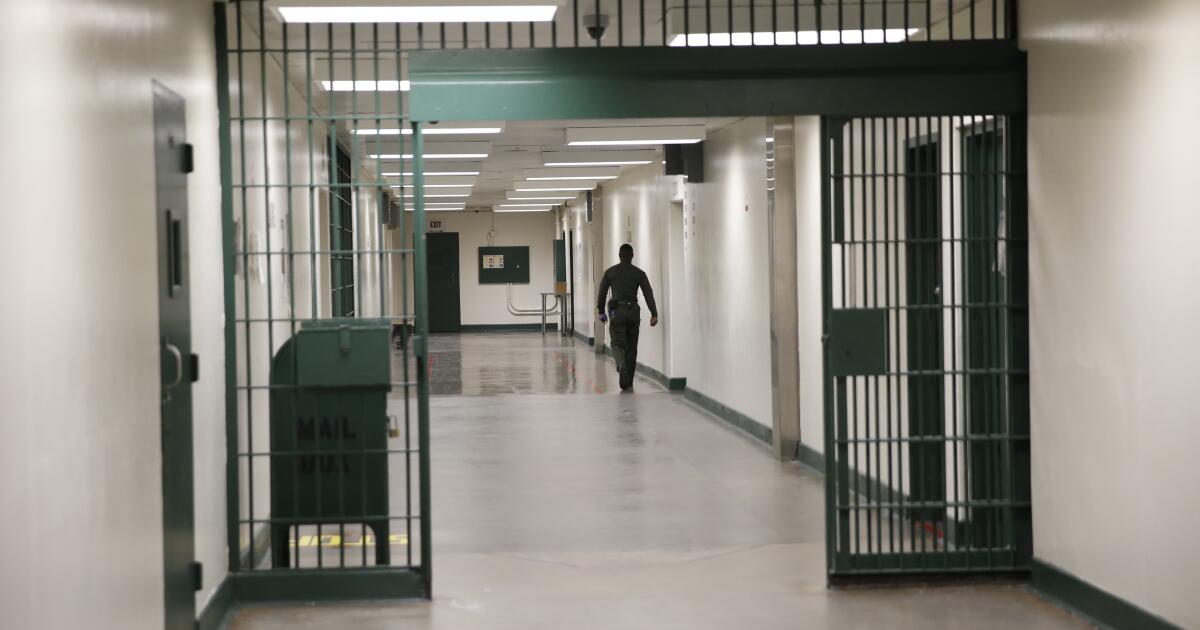
Los Angeles County leaders are demanding the Sheriff’s Department ramp up safety measures within the jail system as inmate deaths continue to mount.

Ten people died inside L.A. County jails in the first two months of this year, putting the county on track for another record-setting year of in-custody deaths. Autopsies to determine causes for all the deaths are still pending.

County supervisors voted 4 to 0 on Tuesday on a motion, crafted by Supervisor Janice Hahn, requiring the Sheriff Department take a series of steps to reduce inmate deaths, including increasing access to the overdose reversal drug Naloxone, more closely monitoring cameras and beefing up safety checks.

“If we don’t address this now, we will see another record year of deaths in the County jails — a record we do not want to repeat,” the motion stated.

The death rate has eclipsed the pace of 2025, which saw nine deaths by the end of February. The year ended with 46 in-custody deaths, a jump from the 32 reported deaths in 2024.

Supervisor Kathryn Barger abstained from the vote, arguing the county could not address the death rate without building a new facility.

“We must be honest about the limitations of facilities that were never designed to house today’s population,” she said in a statement. “I have consistently called for a modern replacement facility focused on treatment and rehabilitation because that is where the real solution lies.”

Sheriff Robert Luna conceded this month that 2026 was “not off to a good start.” He framed the challenge as due partially to the fact that the county was booking people who were older and sicker than prior populations and needed more intensive care than could be offered by the jail system. Four in 5 people face a mental or physical health issue, the department said.

“Every time I get notified that someone in my care has passed away, it’s like a kick in the groin,” Luna said.

The department said in a statement that it has “taken aggressive action to prevent overdoses and violence,” but believes “no jail system can eliminate all risks when people enter custody already critically ill.”

The supervisors voted more than four years ago to shut down Men’s Central Jail, a downtown facility notorious for dangerous and deteriorating conditions, without building a replacement. Since then, inspectors continued to find a litany of problems inside the jail, including mildew and lack of food.

“The fact is that we need to close down Men’s Central,” said Peggy Lee Kennedy, one of several callers to the board meeting who urged the county to speed up the closure. “Why are all these people living there with major mental health issues instead of getting the help they really truly need?”

The county continues to face intense scrutiny from the state over the conditions inside the jail. California Atty. Gen. Rob Bonta sued the Sheriff’s Department in September alleging that inmates “are forced to live in filthy cells with broken and overflowing toilets, infestations of rats and roaches, and no clean water for drinking or bathing.”

Bonta alleged inmates were barred from mental and medical care, leading to a “shocking rate of deaths inside the jails, many of which are caused by preventable circumstances, such as overdoses, suicides, or violence among incarcerated persons.”

Times staff writer Salvador Hernandez contributed reporting.

Source link

Hiltzik: TMTG racks up huge losses

So much Trump-related news has appeared lately on the airwaves and in web pixels — what with Iran and Epstein and Minnesota and so on — that inevitably a nugget will fall between the cracks.

That seems to have been the fate of the most recent annual financial report of Trump Media and Technology Group, which covered calendar year 2025 and was issued Friday.

Trump Media, which is 52% owned by Donald Trump and trades on Nasdaq with a ticker symbol based on his initials (DJT), is the holding company for Trump’s social media platform, Truth Social.

The value of TMTG’s brand may diminish if the popularity of President Donald J. Trump were to suffer.

— A risk factor disclosed by Trump Media

The annual financial disclosure has garnered minimal press coverage. That’s a pity, because it makes fascinating reading, though not in a good way.

Here are the top and bottom lines from the 10-k annual report: Trump Media lost $712.1 million last year on revenue of about $3.7 million. That’s quite a bit worse than its performance in 2024, when it lost $409 million on revenue of about $3.6 million. The company attributed most of the flood of red ink to “loss from investments,” of which more in a moment.

Get the latest from Michael Hiltzik

Truth Social isn’t an especially strong keystone of this operation. The platform is chiefly an outlet for Trump’s social media ramblings and the occasional official White House statements. But no one has to sign in to Truth Social to see them — they’re almost invariably picked up by the news media or reposted by users on other platforms such as X.

That might explain Truth Social’s relatively scrawny user base. The platform is estimated to have about 2 million active users, according to the analytical firm Search Logistics. By comparison, X has about 450 million monthly active users and Facebook has more than 2.9 billion.

It’s no mystery, then, why TMTG disdains “traditional performance metrics like average revenue per user, ad impressions and pricing, or active user accounts, including monthly and daily active users,” according to its annual report.

Relying on those metrics, which are used to judge TMTG’s social media rivals, “might not align with the best interests of TMTG or its stockholders, as it could lead to short-term decision-making at the expense of long-term innovation and value creation.”

Instead, the company says it should be evaluated based on “its commitment to a robust business plan that includes introducing innovative features, new products, new technologies.” But it also acknowledges that, at its heart, TMTG is a proxy for “the reputation and popularity of President Donald J. Trump.” The company warns that “the value of TMTG’s brand may diminish if the popularity of President Donald J. Trump were to suffer.”

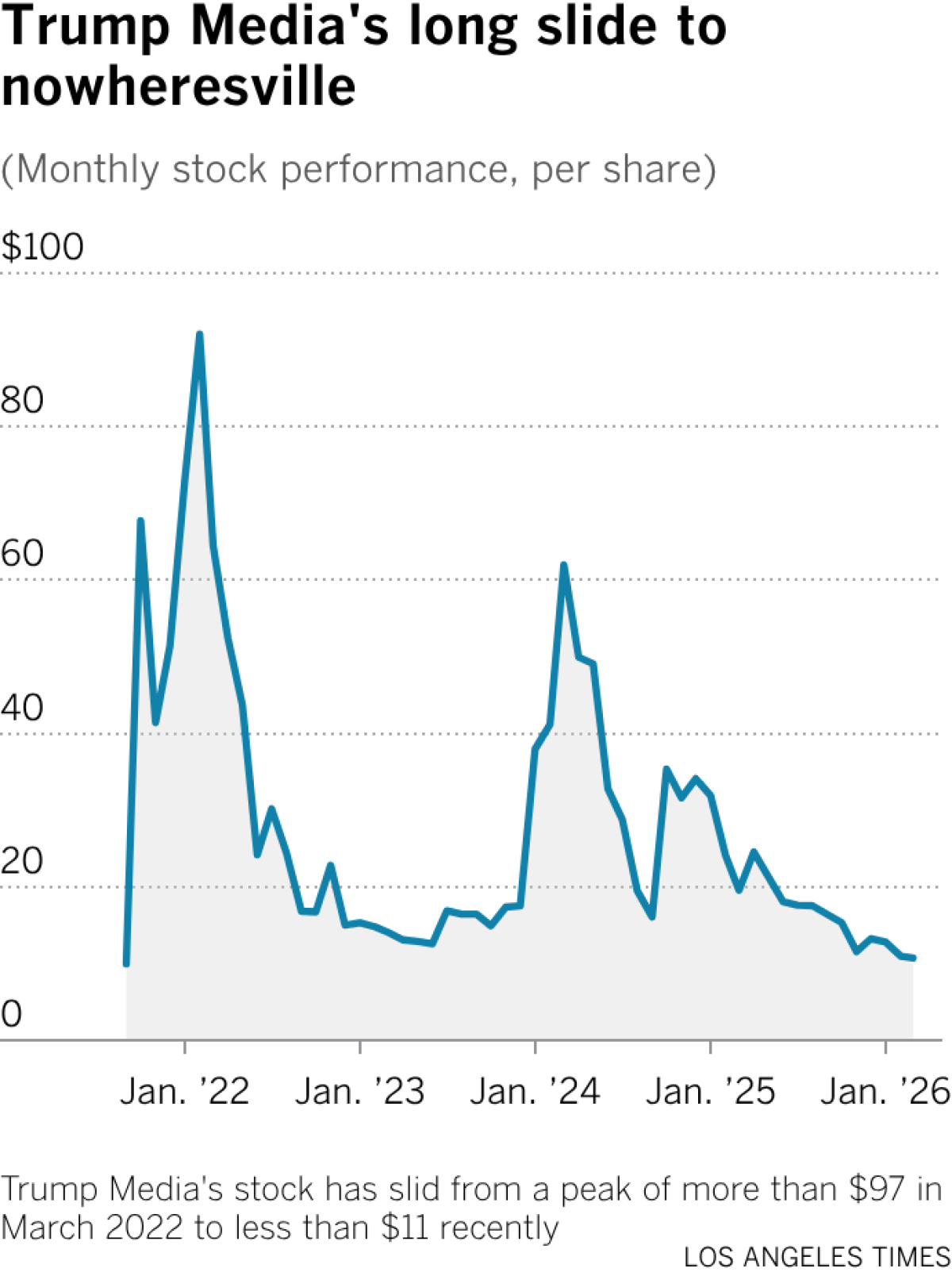
How has that played out in real time? Trump Media notched its highest closing price as a public company, $66.22, on March 27, 2024, the day after its initial public offering. In midday trading Monday, the shares were quoted at $11.08, for a loss of 83% since the IPO.

One can’t quibble with stock market price quotes; nor can one finagle annual profit and loss statements, at least not without receiving questions, and perhaps lawsuit complaints, from attentive investors and the Securities and Exchange Commission.

In recent months, TMTG has engaged in a number of baroque financial transactions.

In May, the company announced that it was planning to raise $3.5 billion from institutions to invest in bitcoin, with the money to come from issues of common and preferred shares. The goal was to climb onto the cryptocurrency train, which Trump himself was fueling by, among other things, issuing an executive order promoting the expansion of crypto in the U.S. and denigrating enforcement efforts by the Biden administration as reflecting a “war on cryptocurrency.”

Under Trump, federal regulators have dropped numerous investigations related to cryptocurrencies. Trump has also talked about creating a government crypto strategic reserve, which would entail large government purchases of bitcoin and other cryptocurrencies; a March 3 announcement on that subject briefly sent bitcoin prices soaring by nearly 20%, though they promptly fell back.

Then there’s TMTG’s relationship with Crypto.com, a Singapore-based crypto “service provider” best known to Angelenos unfamiliar with the crypto world as the firm with naming rights to the Los Angeles arena that hosts the NBA Lakers and Clippers, WNBA Sparks and NHL Kings.

In August, Crypto.com and TMTG announced a deal in which TMTG would pursue a crypto treasury strategy consisting mostly of Cronos tokens, a cryptocurrency sponsored by Crypto.com. The initial infusion would consist of 6.4 billion Cronos valued at $1 billion, or about 15.8 cents per Cronos.

As of Dec. 31, TMTG said in its 10-K, it owned 756.1 million Cronos, acquired at a cost of about $114 million, or 15 cents each. By year’s end, they were worth only about nine cents each, for a paper loss of about $46 million. In trading this week, Cronos was quoted at about 7.6 cents, producing a paper loss for TMTG of about $56.5 million, or roughly half the investment.

The financial maneuvering involved in this trade is a little dizzying. The initial transaction was a 50% stock, 50% cash trade in which Crypto.com bought $50 million in TMTG stock and TMTG bought $105 million in Cronos. Who gained in this deal? It’s almost impossible to say.

Crypto.com did gain, if not purely in cash, then arguably through the Trump administration’s good graces.

On March 27, the SEC formally closed an investigation of the company that it had launched during the Biden administration, when the agency was headed by a known crypto skeptic, Gary Gensler. Trump appointed a crypto-friendly regulator, Paul Atkins, as Gensler’s successor.

It’s reasonable to note that as a business model, crypto treasuries have been in vogue over the last year or so, allowing investors to play the crypto market without all the complexities of actually buying and holding the digital assets by buying shares in treasury companies.

I asked Crypto.com whether the steady decline in Cronos’ price suggested that the hookup with TMTG wasn’t bearing fruit. “The fluctuation in value during this time period is consistent with the entire crypto market, which is typical in a bear market,” company spokeswoman Victoria Davis told me by email.

Davis also asserted that the SEC’s investigation of the company had been closed by Gensler, “not the current administration” (i.e., Trump). That’s misleading, at best. Gensler put the investigation on hold after the 2024 election, when it became clear that Trump was going to be in charge.

Crypto.com’s March 27 announcement of the formal end of the case attributed the action to “the current SEC leadership” and blamed the case on “the previous administration.” I asked Davis to explain the discrepancy but got no reply.

TMTG, like Crypto.com, attributed the decline in Cronos’ value to the secular bear market raging in the entire cryptocurrency space, a reflection of “temporary price swings across the crypto market,” said TMTG spokeswoman Shannon Devine. She said the price decline “will not diminish our enthusiasm for the enormous potential of the [CRONOS] ecosystem.”

Trump’s coziness with crypto companies hasn’t gone unnoticed by Democrats on the House Judiciary Committee, who issued a scathing report on the topic in November. (The White House scoffed at the report, saying in response to the report that Trump “only acts in the best interests of the American public.”)

In mid-December, TMTG launched yet another remaking — this time, plunging into the business of fusion power. The instrument is TAE Technologies, a Foothill Ranch-based company working to develop the technology of nuclear fusion as a clean energy source. According to a Dec. 18 announcement, TMTG and TAE will merge, creating what they say is a $6-billion company.

According to the announcement, TMTG will contribute $200 million to the merged company when the deal closes in mid-2026, and an additional $100 million subsequently. Following the merger, TMTG said last month, it will consider spinning off Truth Social into a new publicly traded company.

These arrangements are murky. TAE is privately held and the value of Truth Social is conjectural at best, so TMTG shareholders could be hard-pressed to assess their gains or losses from the merger and spin-off.

What makes them even murkier is the speculative nature of fusion as an electrical power source. Although numerous companies have leaped into the field — and TAE, which has been backed by Alphabet, the parent of Google, is among the oldest — none has shown the capability of generating electrical power at commercial scale with the elusive technology.

Although some researchers say that fusion could become a technically and economically feasible power source within 10 years, only in 2022 did fusion researchers (at Lawrence Livermore National Laboratory) achieve the goal of using fusion to produce more energy than is required to sustain a reaction. They were able to do so only for less than a billionth of a second.

Others working on the technology have expressed doubts that fusion could become a viable power source before the 2040s. The technical challenges, including how to convert the energy produced by a fusion reactor into electricity, remain daunting.

All this points to the fundamental question of what TMTG is supposed to be. TMTG’s original mission, according to its own publicity statements, was to build Truth Social into an alternative social media platform “to end Big Tech’s assault on free speech by opening up the Internet.”

Spinning off Truth Social would place that goal on the side. TMTG is on its way too becoming a hodgepodge of crypto, fusion and other investments selected without regard to whether they fit together or are even achievable. The only constant is Trump himself.

If you want to invest in him, TMTG may be the best way to do it. But judging from its latest financial disclosure, that’s not the same as being a good way to do it.

Source link

California Democratic leader urges weak gubernatorial hopefuls to bow out

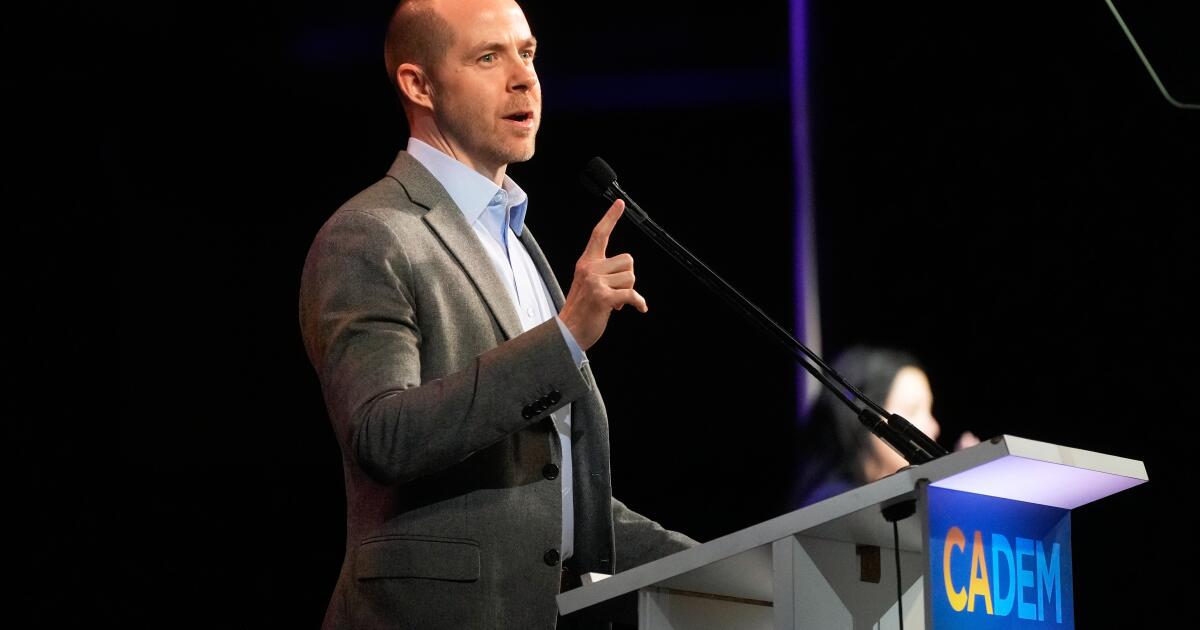
Fearing the prospect of a Republican winning California’s gubernatorial race, state Democratic Party Chair Rusty Hicks on Tuesday urged his party’s candidates who lack a viable path to victory to drop out.

“It is imperative that every candidate honestly assess the viability of their candidacy and campaign,” Hicks wrote in an open letter to the politicians vying to replace termed-out Gov. Gavin Newsom. “I recognize my suggestions are hard for many to contemplate and may be even viewed as overly harsh by some.”

Hicks did not name the Democrats he wants out of the race.

But, even though the odds are relatively low, California cannot risk having a Republican elected as the next governor at a time when President Trump is in the White House, he said.

“[S]o much is at stake in our Nation and so many are counting on the leadership of California Democrats to stand up and speak out at this historic moment,” Hicks wrote. “California’s leadership on the world stage is significantly harder if a Democrat is not elected as our next Governor.”

Hicks urged Democrats languishing at the bottom of the field of candidates to drop out before the Friday deadline to officially file to run for governor — to ensure their names do not appear on the June primary ballot.

Under California’s top-two primary system, the two candidates who receive the most votes in the June primary advance to the November general election, regardless of party.

With nine top Democrats running, the fear is that the candidates will splinter their party’s vote and allow the top two Republicans in the race to finish in first and second place. This is despite Democratic registered voters outnumbering Republicans in the state by almost 2 to 1, and no GOP candidate winning a statewide election since 2006.

Having two Republicans competing in the November election would be devastating to Democratic voter turnout and could hurt party candidates in pivotal down-ballot races.

“The result would present a real risk to winning the congressional seats required and imperil Democrats’ chances to retake the House, cut Donald Trump’s term in half, and spare our Nation from the pain many have endured since January 2025,” Hicks said in his letter. “We simply can’t let that happen.”

A recent poll by the Public Policy Institute of California found that five candidates lead the contest — former Rep. Katie Porter, Rep. Eric Swalwell and hedge fund founder Tom Steyer among Democrats and conservative commentator Steve Hilton and Riverside County Sheriff Chad Bianco, both Republicans. Hilton and Bianco have led all candidates in other polls over the last few months.

Discussions about the need for some Democrats to exit the race took place at last weekend’s California Democratic Party convention as well as when the powerful California Federation of Labor Unions began its endorsement process last week.

But a politically thorny issue is that nearly all of the Democrats lagging in the polls are people of color, as former U.S. Health and Human Services Secretary Xavier Becerra noted at a candidate forum Monday evening.

“By the way, there are people who are calling for candidates to get out of the race,” he said at a gathering hosted by Equality California and the Los Angeles LGBT Center at the Renberg Theatre in Hollywood. “Isn’t it interesting that the candidates they are asking get out of the race are the candidates of color? So don’t take me there.”

Hicks, asked about the effect on candidates of color, lauded the field’s accomplishments.

“We have a number of strong candidates. They have incredible stories, and they are reflective of the diversity of our party. That being said, there are some political realities of where we are at at this particular moment,” he said in an interview. “I’m not calling on any specific candidates to move in one direction or the other. I’m just calling on them to assess their campaign and determine if they have a viable [path] and if they don’t, to not file.”

During Monday evening’s gubernatorial forum, Porter said she is concerned about the prospect of two Republicans making the top two.

“I hear people say to me, it could never happen, but everybody said that about Trump too,” she said at the forum. “And I look at how much harm we’re suffering, and I think about all the political risks that people are facing every day, the risk of an immigrant to leave their home and walk on our streets, the risk of a kid who’s trans to try to play sports even in this state. And I just don’t think we can take any more political risks.”

Times staff writer Phil Willon contributed to this report.

Source link

News Analysis: Toppling Iraq’s Hussein unleashed chaos. Why Iran war poses similar risks

A shock-and-awe campaign laying down a tsunami of bombs. An enemy succumbing rapidly under overwhelming firepower. And a triumphant U.S. president trumpeting a quick and easy campaign.

In 2003, President George W. Bush strode confidently on the deck of an aircraft carrier less than five weeks after he ordered the invasion of Iraq and declared the “end of major combat operations” under a banner proclaiming “Mission Accomplished.”

It proved anything but.

The invasion became a meat grinder, leaving thousands of Americans and possibly more than a million Iraqis dead. It unleashed forces whose effects are felt in the region and beyond to this day.

More than two decades later, another U.S. president attacked another Persian Gulf nation, promising rapid success in yet another Middle East adventure that he says will remake the region.

President Trump and his staff have vehemently rejected any comparison between “Operation Epic Fury,” launched Saturday, and “Operation Iraqi Freedom.” On Monday, Defense Secretary Pete Hegseth gave a pugnacious news conference, insisting, “This is not Iraq. This is not endless.”

Yet the assault on Iran — almost four times larger than Iraq with more than double its population — presents no lack of challenges, ones that could spread chaos far beyond Iran’s borders and become a defining feature of Trump’s presidency.

In many ways, analysts say, toppling Iran’s leadership represents a much more complex task than Iraq ever did. Iraq was a state with deep sectarian divisions that was largely dominated by a single dictator: Saddam Hussein.

The Iran that emerged after the 1978-79 Islamic Revolution had a supreme leader, but Iran also developed an elaborate system of governance. That includes a president, a parliament and varying governmental, military and religious hierarchies, noted Paul Salem, senior fellow at the Middle East Institute.

“Unlike Saddam’s Iraq, the Iranian state is multi-institutional and hence much more resilient — and, yes, not as vulnerable,” Salem said. “And hostility to the United States and Israel is at the heart of the Islamic Revolution — baked into the state.”

Here are some of the ways the Iran attacks could develop into the very scenarios Trump once derided in his days as the antiwar candidate:

Boots on the ground

For now, the U.S. and Israel have wielded air power to pound Tehran into submission. In the first minutes of the joint operation, a 200-plane fleet — Israel’s largest — struck more than 500 targets in Iran, according to the Israeli military. One such strike killed Supreme Leader Ayatollah Ali Khamenei.

Iran is still fighting back, lobbing missiles at Israel, Persian Gulf nations, Jordan and other areas with U.S. bases in the region. The U.S. has the qualitative and quantitative edge of materiel to eventually prevail, but Iran’s capabilities will not make it easy, as the losses in service members and planes have demonstrated in the last two days.

And wars have never been won with air power alone. Rather than relying on boots on the ground, Trump expects ordinary Iranians to finish the job for him.

“When we are finished, take over your government. It will be yours to take,” he said in a video address on the first day of the campaign.

During the Arab Spring of 2011, protesters throughout the Middle East took to the streets to demand change. But those efforts mostly did not lead to significant reforms and, in some countries, prompted further repression.

In Iran, it’s true many people would welcome the Islamic Republic’s demise — as many Iraqis rejoiced at Hussein’s fall. But it’s unlikely that mostly unarmed protesters will triumph in a confrontation against enforcers from the Islamic Revolutionary Guard Corps or its volunteer wing, the Basij.

It’s also difficult to gauge how many of Iran’s 93 million people despise the government enough to rise up against it.

Meanwhile, Trump has left the door open for dispatching U.S. troops, but the math of such a deployment raises doubts.

According to the U.S. Army, counterinsurgency doctrine dictates 20 to 25 troops for every 1,000 inhabitants to achieve stability. In the case of Iran that would entail deploying 1.9 million people — almost all the U.S. military’s active duty, reserve and National Guard personnel.

New leadership unclear

At this point, it’s not clear that decapitation of much of Iran’s leadership class will produce any real change in government, much less a successor inclined to bend to U.S. wishes. The top echelons of the Islamic Republic boast a deep bench of mostly hard-liners — not surprising, perhaps, for a nation that has braced for attack for years, if not decades.

Whatever new leadership that does emerge could rally around the “martyrdom” of Khamenei. Not especially popular in life, he appears to have become, in death, a rallying cry for defiance. And martyrs are exalted in Shiite Islam, Iran’s prevalent faith.

“He was the religious leader of the Shiites, so it’s sort of like killing the pope,” Salem said. “And he’s more popular dying as a martyr, than, say, of a heart attack. … He went out in style, no doubt about it.”

When the U.S. occupied Iraq, the expectation was that whatever came next would be a fervent U.S. ally, an idea perhaps best captured in the notion in Washington that a grateful Iraqi populace would shower U.S. troops with flowers. That didn’t happen. And in the Darwin-esque culling of leaders that followed, the ones that emerged victorious had little love for the U.S.

One of them was Nouri Al-Maliki, a Shiite supremacist whose policies were blamed for fueling years of sectarian bloodletting, and whose loyalties often seemed more aligned with Tehran than Washington.

Meanwhile, Tehran, playing on its proximity and deep ties to the new Iraqi ruling class, was able to steer Iraq — a majority Shiite country — deeper into its orbit.

After the Iraqi government — with the help of a U. S.-led coalition — pushed Islamic State out of Iraq in 2017, Iran was able to embed allied militias into Iraq’s armed services. That created the paradoxical situation of Tehran-aligned fighters wielding U.S.-supplied materiel.

Iraq has yet to emerge from Iran’s shadow. After Iraq’s most recent elections, Maliki seems poised to become prime minister once more, prompting Trump to write on Truth Social, “Because of his insane policies and ideologies, if elected, the United States of America will no longer help Iraq.”

A fragmented opposition

Iran’s population is diverse; an estimated two-thirds of Iranians are Persian, while minorities include Kurds, Baloch, Arabs and Azeris.

Those minorities have long-standing grievances against the ruling majority. It’s possible that Trump’s campaign and the resulting disorder could fuel separatist tensions.

Just last month, Iranian Kurdish factions joined together in a coalition that they said would seek the overthrow of the Islamic Republic “to achieve the Kurdish people’s right to self-determination, and to establish a national and democratic entity based on the political will of the Kurdish nation in Iranian Kurdistan.”

An experienced insurgency

Over the decades, the Islamic Republic created a network that at its peak stretched from Pakistan to Lebanon.

It was a fearsome constellation of paramilitary factions and amenable governments that became known as the Axis of Resistance. It included Hezbollah in Lebanon, Hamas in Palestinian lands, Yemen’s Houthis, and militias in Iraq, Afghanistan and Pakistan.

After Hamas’ Oct. 7, 2023, attacks, Israel — and, eventually, the United States — launched offensive campaigns to defang the groups.

Although weakened, the factions still survive, and could form a powerful, transnational and motivated insurgency when the time comes to fight whatever emerges if the Islamic Republic falls.

Bulos reported from Khartoum, Sudan, and McDonnell from Mexico City.

Source link

Vulnerable Republicans in California’s redrawn congressional districts back war in Iran

California Republicans facing tough reelection fights in this year’s midterm elections have lined up in support of President Trump’s war on Iran, which polling suggests is not popular.

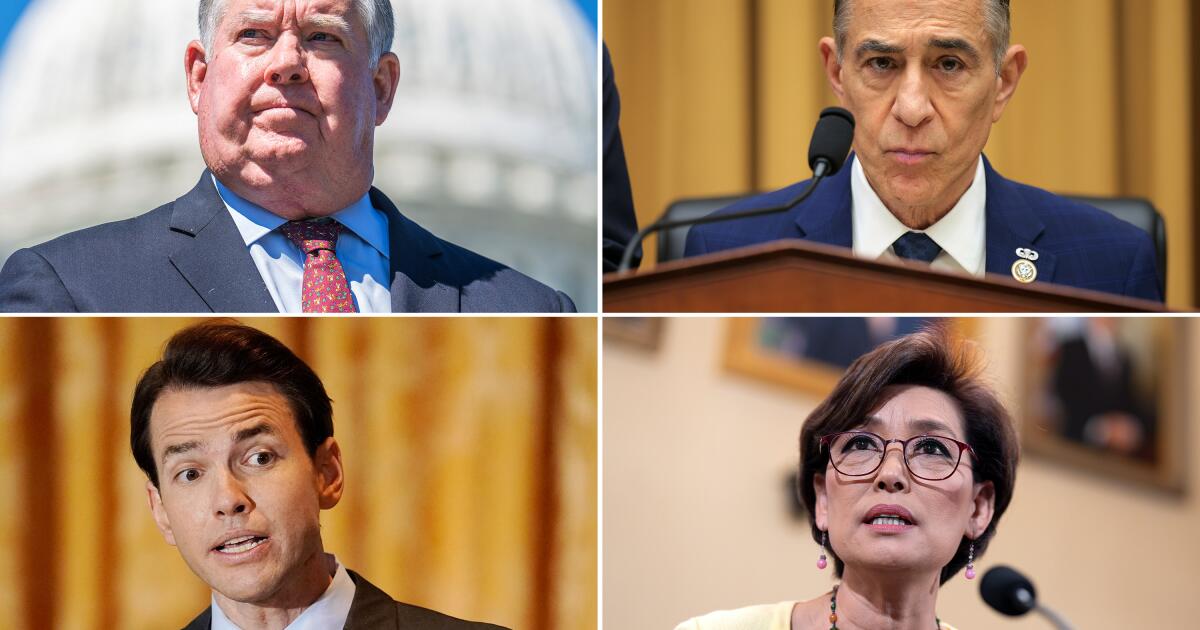
They include Republicans whose chances of reelection were already diminished by the passage by voters in November of Proposition 50, which gave Democrats in Sacramento the authority to redraw the state’s congressional districts in favor of Democratic candidates.

Rep. Darrell Issa (R-Bonsall), who sits on the House Foreign Affairs Committee and has long criticized Iran, has defended the latest attacks as overdue and legal under existing authority the White House has for combating terrorism — which he said Iran is deeply involved in.

Asked Sunday by ABC News about Trump’s promises not to start new foreign wars during the 2024 campaign, and the attacks on Iran conflicting with that, Issa said the belief that Trump owes immediate answers about his intentions was “folly,” that the attacks on Iran’s nuclear facilities last summer had made people around the world “happy,” and that the latest attacks were a continuation of that effort.

He said Iran has funded terrorism for decades, expanding extremism around the region, and asking whether the Trump administration had a specific reason to attack now was the wrong question.

“The real question is, after nearly half a century, do we need a specific trigger, or do we at any time say enough is enough, we’re going to take the claws and the teeth out of this tiger, and then see if in fact it’s willing to drink milk rather than blood,” Issa said.

Issa’s district is one of five that Democrats reshaped to better favor a Democrat under Proposition 50. The measure was championed by Gov. Gavin Newsom and others as a response to similar mid-decade redistricting efforts that Republicans undertook, at Trump’s urging, to win favor in states such as Texas.

Whether the Republican candidates’ backing of Trump in Iran will make them even more vulnerable is unclear. Some in California — including among the Iranian diaspora in Los Angeles — have been pleased with Trump’s actions and the death of Supreme Leader Ayatollah Ali Khamenei, a conservative cleric who ruled the country with brutal force for decades.

However, several recent polls suggest the war is not popular.

According to a Reuters/Ipsos poll that closed Sunday, only 1 in 4 Americans approved of the U.S. strikes on Iran, while about half — including 1 in 4 Republicans — said they believed Trump is too willing to use military force. Overall, 43% of respondents said they disapproved of the strikes, 27% said they approved, and 29% said they were not sure.

A text poll by SSRS for CNN on Saturday and Sunday found nearly 6 in 10 Americans said they opposed the decision to take military action against Iran. A separate text poll by SSRS for the Washington Post found 52% of Americans opposed the strikes, and 39% supported them.

Rep. Ken Calvert (R-Corona) — who has long been hawkish on Iran, and accused the Biden administration of maintaining a weak policy on the Middle East nation — is another Republican in a redrawn district who has come out strongly in favor of the war effort.

“President Trump’s decision to launch Operation Epic Fury will protect America and our allies by eliminating the Iranian regime’s ability to wage terror and threaten its enemies. It will also provide the Iranian people with a historic opportunity to shape their own future free from oppression,” said Calvert, chair of the Defense Appropriations Committee, wrote on X Saturday.

Another member of the House Foreign Affairs Committee facing reelection in a redrawn district, Rep. Young Kim (R-Anaheim Hills), shared on Saturday a committee post on X that quoted Trump’s announcement that Khamenei was dead and committee chair Rep. Brian Mast (R-Fla.) stating that although President Biden had given Iran funding, “President Trump gave him death.”

On Monday, she reposted video of a demonstration in favor of the attacks by Iranian Americans and others in Los Angeles, writing, “So grateful for our President’s decisive action & for our vibrant Iranian American community. From Southern California to Tehran, let freedom ring!”

Also facing redrawn districts and backing the war were Rep. David Valadao (R-Hanford) and Rep. Kevin Kiley (R-Rocklin).

Valadao wrote Saturday on X that Iran had for years “ruled through fear at home and terror abroad,” and that as “the world’s leading state sponsor of terrorism, it continues to arm violent proxies, threaten our allies, and destabilize the region.”

“I commend President Trump for taking decisive action and pray for our brave men and women throughout the region working to keep us all safe,” Valadao wrote.

Kiley, in an X post Sunday, wrote, “It is the longstanding policy of the United States that one of the most evil regimes in history cannot get its hands on the most powerful weapon in history. The decapitation of the Iranian regime and the destruction of its instruments of terror and death hold the potential for a safer America and a more peaceful world.”

Kiley wrote that he looked forward “to being briefed soon on the scale of operations, the strategy going forward, and any risks to American lives and interests that need to be met with urgency,” and that Congress “must be centrally involved in defining and pursuing U.S. objectives going forward.”

Leading Democrats in California condemned the attacks — saying that although the Iranian government under Khamenei was corrupt and guilty of terrorism and violence, there was no evidence that it presented an “imminent threat” to the U.S. and no congressional authorization for Trump to commit the nation to war there unilaterally.

Many of the Democrats running in the state’s redrawn congressional districts staked out a similar position.

“I’m deeply disturbed that President Trump is moving us toward another regime-change war without congressional authorization, public support, or a clearly defined mission,” said San Diego Councilwoman Marni von Wilpert, a Democrat challenging Issa. “The Iranian regime is brutal and must never obtain a nuclear weapon — but the Constitution is clear: only Congress can declare war, and it must reconvene and exercise that authority now.”

Esther Kim Varet, an art dealer and one of several Democrats challenging both Calvert and Kim in the state’s new 40th District, in Orange County and the Inland Empire, wrote on X that “America and the world are safer without Khamenei” but that “Congress alone has the power to commit the U.S. military to wage war, or to amass its forces in foreign territory, unless in response to a clear and present danger.”

Source link

Asylum approvals plummet as fearful immigrants skip hearings

A year into the Trump administration’s ratcheted-up mass deportation effort, approval rates for asylum seekers have plummeted as immigrants are too afraid to show up for court hearings.

Fewer than 3% of asylum cases decided in January were approved — a record low, according to Mobile Pathways, a San Francisco nonprofit that analyzes federal immigration data. That’s compared with an 18% approval rate in January 2025.

Nationally, 20% of immigrants seeking asylum missed their hearings in January, compared with half that rate a year earlier. Asylum seekers with pending applications are in the country legally, but under federal law, failing to appear for a hearing can result in a deportation order.

In Los Angeles County immigration courts — among the largest in the country — the trend is substantially starker: no-shows made up 56% of the asylum hearings in January, compared with 14% a year earlier.

“That’s not fluctuation,” said Bartlomiej Skorupa, chief operating officer of Mobile Pathways. “That’s collapse.”

A Justice Department spokesperson said the Trump administration is restoring integrity to immigration courts.

As of December, nearly 3.4 million cases were pending in immigration courts, with more than 2.3 million of them asylum cases, according to TRAC, a data research organization.

The rise in the number of people avoiding asylum hearings helps explain another trend in the immigration court system. Over the last year, the number of asylum cases marked “abandoned” has doubled.

Immigration attorneys say cases can be classified as abandoned for various reasons: An applicant missed a deadline, filled out a form incorrectly, or just decided to leave the U.S.

But the Executive Office for Immigration Review, the agency that administers immigration courts, can label a case abandoned if the applicant fails to show up for a hearing. Nationwide, the number of cases considered abandoned doubled over the last year to make up about 41% of those decided in January.

It takes an average of four years for immigrants to receive an asylum hearing, though a final decision can take longer with appeals, according to the Migration Policy Institute, a nonpartisan think tank.

During the Biden administration, most asylum claims were not issued decisions by an immigration judge; instead, many were administratively closed, or paused and taken off judges’ dockets. While the case is inactive, the person can remain in the U.S., work legally and pursue other avenues of relief.

But such a policy is vulnerable to being reversed by a subsequent administration, Migration Policy Institute experts wrote in a November report.

Lindsay Toczylowski, co-founder of the Immigrant Defenders Law Center in Los Angeles, said the increase in no-shows is in part because the Trump administration began reopening asylum cases that had been administratively closed for many years.

Many of those people are no longer in contact with their attorney, if they had one, and would be difficult to notify of a new hearing.

A decade ago, a significant portion of asylum seekers came from El Salvador, Guatemala or Honduras, many of whom settled in Southern California.

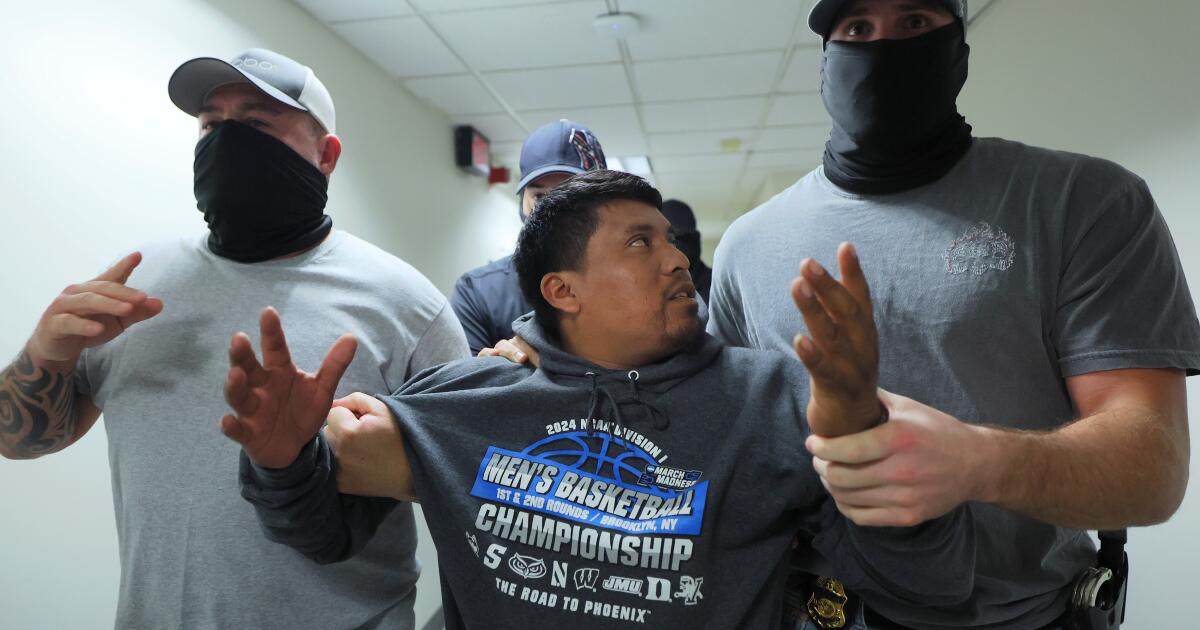
Since President Trump returned to the White House, Los Angeles was one of the earliest cities where federal agents began arresting immigrants at courthouses. Immigrants have become afraid to engage with any law enforcement authorities, Toczylowski said.

The government’s goal, she said, “is not due process or pursuing justice for people in immigration courts — it’s deportation orders. If people don’t show up in court, that’s a way for them to meet their metrics.”

Immigration courts are housed within the Department of Justice and judges have long complained that they lack full independence from executive branch overreach. The department disputes that, saying judges are independent adjudicators who decide cases individually.

More than 100 immigration judges have been fired since Trump took office and about the same number have resigned or retired, according to the union representing immigration judges. That’s down from 735 judges in last fiscal year.

Last summer, the Pentagon authorized up to 600 military lawyers to work for the Department of Justice after removing the requirement for temporary immigration judges to have immigration law experience.

Jeremiah Johnson, a former immigration judge who was fired last year from the San Francisco Immigration Court, said the 3% asylum grant rate in January is shockingly low.

Johnson, who was vice president of the National Assn. of Immigration Judges, said decisions by the Board of Immigration Appeals throughout the last several months have limited asylum law. Immigration judges must abide by the precedent set in those cases.

One such case, for example, reverses prior interpretations to now limit gender-based asylum, finding that persecution claims based solely on gender, or gender combined with nationality, don’t generally don’t meet the definition of a “particular social group” — one of the five categories under U.S. asylum law.

Another factor contributing to lowered asylum approvals, he said, is that the federal government has started seeking to dismiss asylum cases by forcing migrants to start over in a “safe third country.”

These requests stem from the increasing number of so-called asylum cooperative agreements, which allow federal officials to send certain migrants to other countries — including less stable places such as Honduras, Uganda and Ecuador — instead of continuing to seek asylum in the U.S.

“It has really been a restriction in the availability for asylum and other related protection,” he said.

Kathleen Bush-Joseph, one of the authors of the Migration Policy Institute report, pointed to a post last month on X by White House Deputy Chief of Staff Stephen Miller, who said that asylum “is limited to individuals fleeing extremely narrow categories of state persecution.”

“None of the groups illegally crossing the border fit that criteria,” Miller wrote. “No one in Mexico or Ecuador or Honduras etc live in nations where there is any state persecution of any protected class.”

But Bush-Joseph cautioned that it’s not yet clear whether the Trump administration’s asylum changes are legal.

“Even though there are executive actions in place that are restricting access to asylum, those are being challenged in court and I don’t think that we know how all of this will turn out,” she said. “A lot of people are being deported in the meantime and they may not get the chance to come back.”

Source link

Rep. Kevin Kiley opts against challenging fellow Republican Tom McClintock

Northern California Rep. Kevin Kiley (R-Rocklin), whose congressional district was carved up in the redistricting ballot measures approved by voters last year, announced Monday that he would not challenge fellow Republican Rep. Tom McClintock of Elk Grove. Instead, he plans to run in the Democratic-leaning district where he resides.

“It’s true that I was fully prepared to run in [McClintock’s district], having tested the waters and with polls showing a favorable outlook in a ‘safe’ district. But doing what’s easy and what’s right are often not the same,” Kiley posted on the social media site X. “And at the end of the day, as much as I love the communities in [that] District that I represent now – and as excited as I was about the new ones – seeking office in a district that doesn’t include my hometown didn’t feel right.”

Kiley, 41, currently represents a congressional district that spans Lake Tahoe to Sacramento. He did not respond to requests for comment.

But after California voters in November passed Proposition 50 — a ballot measure to redraw the state’s congressional districts in an effort to counter Trump’s moves to increase the numbers of Republicans in Congress — Kiley’s district was sliced up into other districts.

As the filing deadline approaches, Kiley pondered his path forward in a decision that was compared by political insiders to the reality television show “The Bachelor.” Who would receive the final rose? McClintock’s new sprawling congressional district includes swaths of gold country, the Central Valley and Death Valley. The district Kiley opted to run in includes the city of Sacramento and the suburbs of Roseville and Rocklin in Placer County.

Kiley was facing headwinds because of the Republican institutional support that lined up behind McClintock, 69, who has been in Congress since 2009 and served in the state Legislature for 26 years previously. President Trump, the California Republican Party and the Club for Growth’s political action committee are among the people and groups who have endorsed McClintock.

Conservative strategist Jon Fleischman, a former executive director of the state GOP, said he was thrilled by Kiley’s decision, which avoids a divisive intraparty battle.

“If you open up the dictionary and look for the word conservative, it’s a photo of Tom McClintock. He is the ideological leader of conservatives, not only in California but in Congress for many, many years,” Fleischman said, adding that the endorsements for McClintock purposefully came because Kiley was considering challenging him.

Kiley, who grew up near Sacramento, attended Harvard University and Yale Law School. A former Teach for America member, he served in the state Assembly for six years before being elected to Congress in 2022 with Trump’s backing. But he has bucked the president, notably on tariffs. He also unsuccessfully ran to replace Gov. Gavin Newsom during the 2021 recall, and has been a constant critic of the governor.

Kiley is now running in a Sacramento-area district represented by Rep. Ami Bera (D-Elk Grove). Democrats in the newly drawn district had a nearly 9-point voter registration edge in 2024. Bera is now running in the new version of Kiley’s district.

In Kiley’s new race, his top rival is Dr. Richard Pan of Sacramento, a former state senator and staunch supporter of vaccinations.

“Kevin Kiley can try to rebrand himself, but voters know his extreme record,” Pan said in a statement. “He has stood with Donald Trump 98% of the time and was named a ‘MAGA Champion.’ The people of this district deserve better than political opportunism disguised as moderation. This race is about who will actually fight for healthcare, public health, and working families. I’ve done that my entire career. Kevin Kiley has not.”

Source link

Supreme Court: California parents may be told about their transgender child at school

The Supreme Court revived a San Diego judge’s order Monday and said parents have a right to know about their child’s gender identity at school.

The decision came in a 6-3 order granting an emergency appeal from lawyers for Chicago-based Thomas More Society.

They said the student privacy policy enforced in California infringes parents’ rights and the free exercise of religion.

“The parents object that these policies prevent schools from telling them about their children’s efforts to engage in gender transitioning at school unless the children consent to parental notification,” the court said. “The parents also take issue with California’s requirement that schools use children’s preferred names and pronouns regardless of their parents’ wishes.”

The judge’s injunction “does not provide relief for all the parents of California public school students, but only for those parents who object to the challenged policies or seek religious exemptions,” the justices added.

The six conservatives were in the majority, while the three liberals dissented.

Religious liberty advocates hailed the decision.

“Parents’ fundamental right to raise their children according to their faith doesn’t stop at the schoolhouse door,” said Mark Rienzi, president of the Becket Fund for Religious Liberty. “California tried cutting parents out of their children’s lives while forcing teachers to hide the school’s behavior from parents. We’re glad the Court stepped in to block this anti-family, anti-American policy.”

The 9th Circuit Court of Appeals had put on hold a late December ruling by U.S. District Judge Roger Benitez, who held that the student privacy rules enforced by California school officials were unconstitutional.

“Parents and guardians have a federal constitutional right to be informed if their public school student child expresses gender incongruence,” Benitez wrote. “Teachers and school staff have a federal constitutional right to accurately inform the parent or guardian of their student when the student expresses gender incongruence.”

Escondido public schoolteachers Elizabeth Mirabelli and Lori Ann West, who described themselves as “devout Catholics,” sued in 2023, and they were later joined by parents in Pasadena and Clovis.

The Supreme Court’s ruling refers only to the parents.

The parents who brought the case “have sincere religious beliefs about sex and gender, and they feel a religious obligation to raise their children in accordance with those beliefs,” the court said.

The court added: “Gender dysphoria is a condition that has an important bearing on a child’s mental health, but when a child exhibits symptoms of gender dysphoria at school, California’s policies conceal that information from parents and facilitate a degree of gender transitioning during school hours.”

“This is a watershed moment for parental rights in America,” said Paul M. Jonna, special counsel at Thomas More Society. “The Supreme Court has told California and every state in the nation in no uncertain terms: you cannot secretly transition a child behind a parent’s back.”

The 9th Circuit had agreed with the state’s attorneys who said the judge had misstated California law.

“The state does not categorically forbid disclosure of information about students’ gender identities to parents without student consent,” they said in a 3-0 decision.

“For example, guidance from the California Attorney General expressly states that schools can ‘allow disclosure where a student does not consent where there is a compelling need to do so to protect the student’s wellbeing,’ and California Education Code allows disclosure to avert a clear danger to the well-being of a child.”

In their parents’ rights appeal to the Supreme Court, attorneys said school employees are secretly encouraging gender transitions.

“California is requiring public schools to hide children’s expressed transgender status at school from their own parents — including religious parents — and to actively facilitate those children’s social transitions over their parents’ express objection,” they told the court.

“Right now, California’s parental deception scheme is keeping families in the dark and causing irreparable harm. That’s why we’re asking the U.S. Supreme Court to intervene immediately,” Jonna wrote in his appeal. “Every day these gender secrecy policies stay in effect, children suffer and parents are left in the dark.”

California state attorneys had urged the court to put the case on hold while it is under appeal.

They said the judge’s order “appears to categorically bar schools across the State from ever respecting a student’s desire for privacy about their gender identity or expression — or respecting a student’s request to be addressed by a particular name or pronouns—over a parent’s objection.”

They said the order “would allow no exceptions, even for extreme cases where students or teachers reasonably fear that the student will suffer physical or mental abuse.”

Source link

Umbral: an Open-Source Platform to Measure Venezuela’s Transition

Venezuela has been going through an unprecedented political transformation(?) since the extraction of Nicolás Maduro. All political stakeholders will try to pitch the possible outcome  according to their respective interest: the Trump administration will say that it’s going fantastic; the Rodriguez regime will try to appear independent and in control; Team Machado will push for the full restoration of political rights; smaller actors like Enrique Marquez will try to conquer their own space; and the people will need to have proper tool, amid a sea of misinformation, to try to navigate between confusion and uncertainty.  

Media outlets like Caracas Chronicles are doing our best to reduce such uncertainty, but there are new initiatives sprouting everywhere, such as the one that friend of the blog Pablo Hernández Borges is leading with a team of researchers and technologists. Umbral (umbral.watch), defined as “a free, open-source analytical platform for monitoring and documenting Venezuela’s regime transformation in real time,” allows anyone with an internet connection to contribute, as follows: 

  • Scenario Analysis with Citizen Participation. Five evidence-based trajectories for Venezuela’s political future, from full autocratization to complete democratic consolidation. Any person can rate the probability of each scenario on a 1 (least likely) to 5 (most likely) Likert scale. Results are disaggregated by profile and aggregated in real time, visible to all on the platform’s landing page.
  • Citizen News Evaluation. Every article in the news feed can be voted on by users, who link it to whichever of the five scenarios they believe it signals. 
  • Historical Trajectory. A V-Dem-style democracy index spanning 1900–2024, mapping four major regime transformation episodes in Venezuela’s history (like Pablo did in this piece).
  • Political Prisoners Tracker. Arbitrary detention statistics with demographic breakdowns, sourced from leading Venezuelan human rights organizations.
  • Internet Connectivity Monitor. Real-time IODA (Georgia Tech) data on BGP, Active Probing, and Network Telescope signals, both nationally and across all 25 Venezuelan states, visualized through a choropleth map and horizon heatmap.
  • GDELT Media Signals. Daily-archived instability index, media tone, and article volume from the Global Database of Events, Language, and Tone, annotated with key political events.
  • Fact-Checking Feed. Curated posts from three Venezuelan fact-checking accounts: @cazamosfakenews, @cotejoinfo, and @Factchequeado.
  • Interactive Timeline. Democratic Episodes Event Dataset (DEED) with bilingual (Spanish/English) events.
  • Reading Room. A curated archive of books, academic articles, investigative journalism, and reports on Venezuela.
  • Prediction Markets. A Polymarket contract dashboard tracking Venezuela-related markets.

It’s Rotten Tomatoes for political junkies hooked on the Venezuela stuff.

To develop Umbral, Pablo, who is a data scientist with a PhD in Political Science from Texas Tech University, got the support of NGOs Ciudadanía Sin Límites and Code for Venezuela. The platform is fully bilingual (Spanish and English) and its source code is publicly available on GitHub, ensuring complete methodological transparency. Its analytical architecture is grounded in the Episodes of Regime Transformation (ERT) methodology by the V-Dem Institute, which frames the inherent uncertainty of authoritarian transitions through concrete, evidence-based scenarios. 

Umbral is not just an observatory—it is a space for active civic participation. The goal is for community-generated data to complement—and ultimately calibrate—the academic models underpinning the platform.

Check it out: https://umbral.watch

Source link

Trump says U.S. military operations in Iran likely to last at least a month

President Trump on Monday refused to box himself in on how long U.S. military operations will last in Iran, saying the conflict in the Middle East could stretch from a month to potentially “far longer” as he frames the mission as one that is necessary to eliminate a “colossal threat” to American interests.

“Whatever the time is, it’s OK. Whatever it takes,” Trump said at a White House event. “Right from the beginning, we projected four to five weeks, but we have the capability to go far longer than that. We’ll do it.”

Hours earlier, Defense Secretary Pete Hegseth said the duration of the military operation remains fluid, and that Trump has “all the latitude in the world” to determine how long the war in Iran will go on.

“Four weeks, two weeks, six weeks. It could move up. It could move back,” Hegseth told reporters at a Pentagon news conference.

The Trump administration’s shifting time frames and open-ended objectives in Iran have deepened uncertainty around an expanding conflict in the Middle East, particularly as American troops have already been killed in action and officials warn of more U.S. casualties.

Gen. Dan Caine, the chairman of the Joint Chiefs of Staff, said Monday that additional U.S. military forces are already moving into the region, and warned that the conflict will not be a “single, overnight operation” and that he expects “additional losses.”

A fourth U.S. fatality

The development came as military officials confirmed a fourth American service member had been killed by Iranian counterattacks and that three American jets were mistakenly shot down in Kuwait in an “apparent friendly fire incident” — and as airstrikes continued to fall across the Middle East, where missile defense systems were unable to intercept every attack and deaths mounted into the hundreds.

As the U.S. and Israel continued to hammer Tehran and other targets across Iran and in Lebanon, retaliatory strikes by Iran and its allies, including Hezbollah in Lebanon, were reported in Israel as well as at U.S. facilities and other targets inside Bahrain, Cyprus, Iraq, Kuwait, Oman, Qatar, Saudi Arabia, Syria and the United Arab Emirates, according to the Associated Press.

Meanwhile, to Iran’s east, Pakistan and Afghanistan were engaged in their own battles, further destabilizing the region.

In addition to hundreds of people dead, including Iranian schoolchildren, other civilians and migrant workers in the Gulf, the fighting has impacted the world’s production of oil and natural gas — disrupting tanker traffic through the Strait of Hormuz at the southern end of the Persian Gulf and causing oil prices to shoot up.

Saudi Arabia said it intercepted Iranian drones attacking an oil refinery near Dammam, with the refinery shutting down as a precaution, the AP reported. Iran denied targeting the facility.

Air travel disrupted

The war also disrupted air traffic globally, as major airports in the Gulf, including in Dubai, halted or radically scaled back flights. The travel interruptions rippled around the world, and airline stocks tumbled.

Israel had implemented nationwide restrictions on activities as it fended off attacks from Iran and residents hid in bomb shelters. Iran reported strikes at multiple schools in the country had left young students dead.

As the conflict unfolds in real time, Trump and Hegseth have refused to rule out sending American troops into Iran, and the president has signaled that the “big wave” of military attacks is yet to come.

“I don’t have the yips with respect to boots on the ground. Like every president says, ‘There will be no boots on the ground.’ I don’t say it,” Trump told the New York Post on Monday. ”I say, ‘probably don’t need them,’ [or] ‘if they were necessary.’”

When asked by a reporter whether U.S. troops were currently on the ground, Hegseth told reporters they were not, but then bristled at further questions about potential future deployments.

“Why in the world would we tell you, the enemy or anybody, what we will do or will not do in pursuit of an objective?” Hegseth said.

The Trump administration’s objectives in the war have been equally hard to pinpoint. Trump said Saturday that the operation is aimed at razing Iran’s military and nuclear capability and dismantling Iran’s theocratic regime, but on Monday said the goal is to eliminate the threats posed by the “sick and sinister regime” but not the government itself.

Hegseth said the attacks in Iran are not part of a “so-called regime change war, but the regime sure did change and the world is better off for it today.” The U.S. and Israel attack on Saturday killed Iranian Supreme Leader Ayatollah Ali Khamenei.

‘Second or third place is dead’

In an interview with ABC News on Sunday evening, Trump suggested his administration had considered some figures to replace Khamenei, but said those people are now dead.

“The attack was so successful it knocked out most of the candidates,” Trump said. “It’s not going to be anybody that we were thinking of because they are all dead. Second or third place is dead.”

The Trump administration’s messaging, meanwhile, was consistent in its vengeful rhetoric.

Hegseth and Trump both warned that any threat to Americans would be met with force.

“If you kill Americans, if you threaten Americans anywhere on Earth, we will hunt you down without apology and without hesitation, we will kill you,” Hegseth said.

Kevan Harris, an associate professor of sociology who teaches courses on Iran and Middle East politics at the UCLA International Institute, said a long misconception in “the way the U.S. reads Iran” is the belief that Khamenei ruled the country alone, and that taking him out would create a massive leadership vacuum or a sharp shift in the nation’s policies.

But while Khamenei was certainly an “intransigent” force in Iran, killing him won’t “lead to a major shift inside the country,” Harris said.

Benjamin Radd, a political scientist and senior fellow at the UCLA Burkle Center for International Relations, said whether the U.S. can get out of Iran on a relatively short timeline depends on whether those in power in Iran now are willing to negotiate terms that Khamenei and other leaders who have been killed rejected.

“If the remnants of the regime are ideologically committed to what they were under Khamenei,” Radd said he “can’t see Trump backing down” and would expect the war to rage on.

Other leaders in Iran are fundamentalist and aligned with Khamenei, but given the U.S. has shown a willingness and ability to capture and assassinate foreign leaders, they might back down out of self-preservation.

“In the short term, there should be a wait-and-see approach as to what this reconstituted regime looks like,” he said.

Source link

Trump is rewriting the ‘you break it, you own it’ rule in Iran war

When President Trump announced that he was taking the United States to war against Iran, he offered a long list of ambitious goals.

He said the operation aimed not only to prevent Iran from obtaining a nuclear weapon, but also to destroy Iran’s ballistic missiles and defang its proxy forces in the Middle East.

Then he added the most audacious objective of all: regime change.

“To the great, proud people of Iran … the hour of your freedom is at hand,” he said. “Take over your government. It will be yours to take.”

That was a striking turnabout for Trump, who campaigned for president in 2016 promising: “We’re going to stop the reckless and costly policy of regime change.”

But it’s far from clear that the president has a coherent plan for replacing Iran’s radical Islamist autocracy with a friendlier regime. Nor is it clear that he’s fully committed to the goal.

On Monday, at a White House event, Trump reiterated the military goals of the operation, but did not mention regime change — suggesting he may be having second thoughts. However, he did describe the current Iranian regime as “sick and sinister.”

Military experts and Iran scholars are virtually unanimous that airstrikes alone, no matter how destructive, are unlikely to transform the Islamic republic into a peaceable, democratic country.

“Air power rarely produces friendly regime change,” said Robert A. Pape of the University of Chicago, a prominent scholar of air power. “Bombing can destroy targets. It does not reliably reshape politics.”

A more likely outcome is that Iran’s militant Islamic security force, the Iranian Revolutionary Guard Corps, will seize power, experts said. The Washington Post has reported that the CIA also made that assessment before the war began.

A takeover by the Revolutionary Guard would change the names of the people in charge, but it would fall far short of a genuine regime change.

Trump has said he doesn’t believe ground troops will be necessary, although he hasn’t ruled them out. He hasn’t offered a plan for pushing Iran’s theocratic rulers out of power beyond continuing the airstrikes. The outcome on the ground, he said Sunday, is up to ordinary Iranians.

“Be brave, be bold, be heroic and take back your country,” he said in a video message on Sunday. “America is with you. I made a promise to you, and I fulfilled that promise. The rest will be up to you, but we’ll be there to help.”

In an interview with the New York Times, he said he hopes the Revolutionary Guard will simply “surrender” to the opposition forces it was brutalizing only a month ago.

In effect, he is abandoning the so-called Pottery Barn rule — “You break it, you own it” — that was popularized by then-Secretary of State Colin L. Powell before the Iraq war in 2003. Trump’s message to Iranians looks like: “I’ll break it, you own it.”

Iran’s democratic opposition is fragmented

The central problem with Trump’s apparent theory of regime change, scholars say, is that the Revolutionary Guard and other security services are well-organized and well-equipped, but the country’s democratic opposition is fragmented.

“Even if the clerical regime were to fall, the security forces are best positioned to take its place,” warned Richard N. Haass, a former top State Department official in the George W. Bush administration.

Meanwhile, he added, “the political opposition is not united or functioning as a government-in-waiting. It is not in a position to accept defections [from the regime], much less provide security.”

Some experts argue that there is more the administration could be doing to improve the prospects for regime change, without putting troops on the ground.

Haass faulted the Trump administration for failing to work more closely with the Iranian opposition to prepare it for a role in a potential future government.

Others said the United States should now make it clear that it would provide substantial economic aid to a new Iranian regime, but only if its behavior is benign. Iran’s economic crisis, its worst in recent history, helped spark the popular uprising in January that the regime suppressed at the cost of thousands in lives.

“There are more steps the administration could be taking now to help the democratic opposition,” said Kelly Shannon, a visiting scholar at George Washington University. “Close coordination with dissidents on the ground. Protection from the security forces if they open fire. Money, including support for a general strike fund. Assistance with ensuring internet access for all Iranians. And ensure that airstrikes don’t hit Evin Prison or other prisons where dissidents are being held; a lot of potential opposition leaders are in there.”

Scenarios for the future

If the Revolutionary Guard remains intact, Iran experts have described several different scenarios for the regime that may emerge.

One might be called the Venezuela scenario: an Iran ruled by officers from the current regime who have agreed to cooperate to some extent with the United States. This would resemble the situation in Venezuela, where the United States captured President Nicolás Maduro but left the rest of his regime in power.

Trump has already endorsed that quick-fix scenario and said he’s willing to open talks with the newly named successors to Ayatollah Ali Khamenei, who was killed by an Israeli airstrike. “What we did in Venezuela, I think, is the perfect, the perfect scenario,” he told the New York Times.

Another option might be called the Hamas scenario: a battered and weakened Islamic Republic could stay in power but remain hostile to the United States, even after losing much of its military infrastructure.

A third possibility would be the Libya scenario: an Iran in which the regime has been toppled, and several factions battle for power. That’s what happened in Libya after the United States and other countries used air power to help overthrow longtime dictator Moammar Kadafi.

But none of those scenarios would be the transition to democracy that many Iranians hope for — the more positive version of regime change.

Trump’s search for offramps

Trump, meanwhile, sounds as if he is already looking for an opportunity to declare victory and withdraw.

In an interview with Axios on Saturday, he said he believes he has several “offramps” from the war.

“I can go long and take over the whole thing — or end it in two or three days and tell the Iranians, ‘See you again in a few years.’”

“He seems to be looking for an offramp,” Haass said. “He may say ‘It’s up to the Iranian people’ and leave the opposition to its fate…. He might claim a victory in terms of obliterating — or, I guess, ‘re-obliterating’ — Iran’s nuclear program and downgrading its ballistic missiles.”

“But he would still face a danger in that scenario. If it comes down to a physical confrontation [between the regime and the opposition], the opposition could be killed in even larger numbers before. … After offering regime change as one of the reasons for the war, we may not only fail to produce regime change; we could see a second massacre.”

Source link

Supreme Court questions denying gun rights to marijuana users in test of the 2nd Amendment

The Trump administration on Monday urged the Supreme Court to limit the reach of the 2nd Amendment and deny gun rights to “habitual” users of drugs, including marijuana.

But most of the justices sounded skeptical. They questioned whether marijuana users are so dangerous they should not have firearms.

They noted too that President Trump signed a recent executive order to reclassify marijuana as lesser controlled substance.

“Why is this a test case?,” asked Justice Neil M. Gorsuch.

Federal laws on “controlled substances” and the 2nd Amendment created a conflict between gun rights and illegal drugs, but Gorsuch said marijuana users are not seen as a particular danger to the public.

“This is an odd case to have chosen” to resolve this legal dispute, he said.

Most of the justices said they were wary of ruling broadly to decide the legal status of other addictive drugs.

At issue was a provision of the Gun Control Act of 1968, which forbids gun possession by any person who “is an unlawful user of or addicted to any controlled substance.”

The Justice Department says about 300 people per year are charged with a crime under this provision. They include Hunter Biden, the former president’s son, who was charged and convicted of lying about his drug addiction when he applied for a handgun permit.

The case brought together civil libertarians and gun rights advocates, who said millions of Americans could face criminal charges if the government’s view is upheld.

Deputy Solicitor Gen. Sarah Harris, representing the administration, said the court should uphold the law to deny guns to habitual users of unlawful drugs.

“Congress decided it is dangerous to mix firearms with controlled substances,” she said.

But Erin Murphy, a Washington attorney, said gun owners have not been notice that having a handgun at home could lead to a criminal prosecution if they sometimes use marijuana.

She said the court should hand down a “narrow” decision that spares her client.

Ali Hemani, a Texas man, was investigated by the FBI in 2020 for his family’s suspected ties to the Iranian Revolutionary Guard Corps, a designated terrorist group.

When the FBI obtained a warrant to search his home, agents found a Glock pistol and 60 grams of marijuana as well as 4.7 grams of cocaine in his mother’s room. Hemani said he used marijuana about every other day.

He was charged with illegal gun possession because he was an unlawful drug user.

But citing the 2nd Amendment, a federal judge and the 5th Circuit Court of Appeals dismissed the charges on the grounds that he was not under the influence of drugs at the time of his arrest.

Appealing, the Trump administration said the Supreme Court should uphold the 1968 law and deny guns to those who are “habitual users” of illegal drugs.

Solicitor Gen. D. John Sauer said this prosecution “falls well within Congress’s authority to temporarily disarm categories of dangerous persons — here, habitual drug users.”

From the nation’s founding, “habitual drunkards” could be prohibited from having guns and that historic principle supports denying guns to habitual drug users.

The American Civil Liberties Union defended Hemani said the government’s view threatens to broadly extend the reach of the criminal law.

“Like tens of millions of Americans, Ali Hemani owned a handgun for self-defense, keeping it safely secured at home. Like many of those same Americans, he also consumed marijuana a few days a week,” they said in their brief.

“According to the government, those two facts alone sufficed to make him an ‘unlawful user’ of a controlled substance who could face criminal penalties.”

Source link

Column: Scary time for California Democrats

The race for California governor couldn’t be much closer. And that’s scary for Democrats.

Only the top two vote-getters in the June 2 primary — regardless of their party — will advance to the November election. And although still unlikely, it’s increasingly conceivable that both could be Republicans.

“Scare tactics,” claim naysaying Democrats of such speculation.

But Democrats should have heeded scary rumblings 10 years ago when long shot Donald Trump was first running for president — and not buried their heads in the sand again two years ago when Joe Biden was feebly seeking reelection.

You’re reading the L.A. Times Politics newsletter

George Skelton and Michael Wilner cover the insights, legislation, players and politics you need to know in 2024. In your inbox Monday and Thursday mornings.

By continuing, you agree to our Terms of Service and our Privacy Policy.

They ignored the warning signs and paid the price.

Now, the latest independent poll of likely voters shows that Republican candidates are running in two of the top three places for governor — meaning it’s possible both could qualify for the November ballot, guaranteeing the first election of a GOP chief executive in 20 years.

The best odds are on one Democrat and one Republican finishing in the top two — virtually assuring a Democratic victory in November.

California is too solidly Democrat — and President Trump too despised here — to envision a Republican beating a Democrat to replace termed-out Gov. Gavin Newsom.

But Democrats could beat themselves if the current field of candidates remains intact. There essentially are eight Democrats and only two Republicans competing in the primary.

If the combined Democratic vote is splintered among the eight Democratic contestants, the two Republicans could end up finishing first and second.

“It’s hard to come up with the math that makes that work,” asserts Mark Baldassare, polling director for the nonpartisan Public Policy Institute of California. He just completed a survey in which “a lot of things show that a Democrat and Republican [top-two finish] is the likely outcome,” he says.

But political data guru Paul Mitchell has been running primary election simulations and after Baldassare’s latest poll, he calculated the chances of an all-Republican finish at 18%.

That seems like the danger zone.

The solution is for some Democratic candidates who have little hope of winning to drop out of the race — very soon, in fact. They shouldn’t even file their official candidacy papers that are due by Friday. After that deadline, it’s impossible to remove their names from the ballot even if they’re no longer really running.

The PPIC poll, released last week, showed a statistical tie between the top five contenders — three Democrats and two Republicans, all within 4 percentage points of each other.

The breakdown:

Republican former Fox News commentator Steve Hilton, 14%; Democratic former Rep. Katie Porter, 13%; Republican Riverside County Sheriff Chad Bianco, 12%; Democratic Rep. Eric Swalwell, 11%; Democratic hedge fund founder Tom Steyer, 10%.

Then came five Democratic stragglers.

Former U.S. Health Secretary Xavier Becerra, former Los Angeles Mayor Antonio Villaraigosa and former state Controller Betty Yee each had 5%. Trailing them were San José Mayor Matt Mahan with 3% and state Supt. of Public Instruction Tony Thurmond at 2%.

Mahan’s a centrist wild card who jumped into the race while the polling was underway. So, there’s a valid excuse for his poor showing.

Swalwell and Steyer entered late last year and apparently took votes away from Porter and Becerra.

Porter and Yee are the only prominent female candidates, but they aren’t particularly being helped by female voters, the poll showed.

There was good news in the survey for Democrats hoping to pick up more congressional seats in California and help the party seize control of the House of Representatives from Republicans.

Asked whether they’d vote for a Democrat or Republican for Congress, 62% replied Democrat and only 36% Republican. That’s not surprising, since Democrats already hold 43 of California’s 52 seats.

Newsom and the Democratic-controlled Legislature last year gerrymandered California’s House districts with the goal of gaining at least five more seats. Voters approved that move by passing Proposition 50.

The especially bright news in the poll for Democrats was that in the five new House districts considered the most competitive, Democrats had a slight edge in voter preference. That was also true in districts held by Republicans.

Additionally, Democrats are much more enthusiastic than Republicans about voting in the congressional contests.

In the competitive districts, nearly two-thirds of voters disapprove of tactics by Immigration and Customs Enforcement in corralling undocumented immigrants. And 57% disapprove of Trump.

Anti-Trump sentiment is extremely high among all voters — 30% approval and 70% disapproval.

One head-scratcher in the poll was the voters’ denial about their political polarization. They were asked what qualification they considered most important in choosing a governor. Only 6% said it was the candidate’s political party. Rubbage.

“There are very few people who are voting outside their party,” Baldassare notes.

Two-thirds of voters answered that a candidate’s stand on issues is the most important consideration for them. Voters of both parties, plus independents, rated a candidate’s position on “affordability” as “very” important — and it topped their list of concerns.

A majority of voters said California is “going in the wrong direction.” This is a gloomy finding for Democrats who have been ruling state government — and most large cities — for many years.

But a much larger majority believe the country also is headed in the wrong direction. Back at ya, Republicans. It’s the GOP that’s in total control of the federal government.

Both parties in California have reasons to run scared this year.

What else you should be reading

The must-read: California Democrats unite against Trump, differ on vision for state’s future
Salud: Retired 100-year-old fighter pilot from Escondido receives Medal of Honor
The L.A. Times Special: Gavin Newsom and Kamala Harris have traveled parallel paths. Will they collide in 2028?

Until next week,
George Skelton


Was this newsletter forwarded to you? Sign up here to get it in your inbox.

Source link

Persistent Champion of Choice : Women: Nineteen years after Roe v. Wade, attorney Sarah Weddington is speaking out about her role in the case and her own abortion.

The lobby walls of the Driskill Hotel are hung with the portraits of figures of Texas political lore, men like Sam Houston and William B. Travis of Alamo fame. But on a rainy evening, a rather demure-looking woman in a conservative black suit and tidy tucked hairdo is the center of attention.

First, Texas Democratic Party chairman Bob Slagle comes up to hug and say hello. They chat briefly about how well things are going in the presidential campaign.

Then two young women walk by, one whispering to the other, “Is that Sarah Weddington?” They turn back and stop to introduce themselves. As the two say goodby, one adds: “Of course, it goes without saying how much I admire you.”

Weddington is used to this by now. The 46-year-old lawyer gained fame from her first case, Roe v. Wade, the landmark 1972 Supreme Court decision.

Since then, Weddington has spent almost two decades advocating abortion rights. Today, she has been in her adopted hometown of Austin signing copies of her new book, “A Question of Choice: The Lawyer Who Won Roe v. Wade,” for a parade of admirers. Longtime friends presented many of the almost 500 copies she signs; young women like the two who paused to thank her offered others.

Weddington stood for more than five hours at a podium, first at a university bookstore and later in the hotel ballroom, signing in a consistently elegant hand. Everyone is greeted with a smile, some with hugs. An aura of restraint surrounds her, an almost Victorian quality in a woman some see as a sort of virago, a demon of the left who has led the charge for legalized abortion.

Some friends describe her as “ladylike”; almost all say she is very private.

And yet her book begins with a revelation that she had kept a very personal secret. In 1967, while a young, unmarried law student at the University of Texas, this daughter of a minister and graduate of a small Methodist college, traveled to “a dirty Mexican border town to have an abortion, fleeing the law that made abortion illegal in Texas.”

She was accompanied by her then-boyfriend and later husband, fellow law student Ron Weddington. Divorced amicably in 1974, they kept the secret until the publication of the book. “I am a very private person and would never have talked about this if I hadn’t felt that I wanted to do everything I could to help win it again. That I can’t win it in the courts, nobody can. That’s where we have to win is at the ballot box. And it was like I had to give it everything I had and it was the one thing I had never given. . . .

“My own thoughts about it are that if I had to write a caption it would be ‘giving up privacy in order to save it.’ I feel like I’m giving something very precious up and that is the ability to live my life in privacy. . . . We always had an agreement not to talk about this without talking to the other, and he (her former husband) always observed it.”

Journalist Linda Ellerbee, a friend and fellow Texan, suggested that Weddington humanize her book to make it more accessible to readers. The first draft, Weddington acknowledges, was long and perhaps too legalistic: “First, I wanted to write the perfect book, and I couldn’t write that book. Then someone said, ‘Why don’t you practice writing the book,’ and I could do that because I was freeing myself.”

Weddington admits that a more likely publication date would have been 1993, the 20th anniversary of Roe v. Wade. But in the last few years, it became increasingly obvious to her that the landmark decision was in jeopardy: “In the book, I say if anybody had said to me in 1969 or 1973, ‘You will still be talking about this in 1992,’ I would have thought they were crazy.”

As president of the National Abortion Rights Action League, she had witnessed the first skirmishes of what she calls a war of attrition during the early years of the Reagan presidency. But at that point, she says, “We still had the trump card, the Supreme Court.”

Reagan, who she notes signed California’s liberal 1967 abortion law, then began to make conservative appointments to the high court. And at that point, Weddington says, “I began to say I was for mandatory life support systems for older justices.”

The 1989, Webster v. Reproductive Health Services decision was the real turning point, she says, and now she sees the battle lines on three fronts: the Supreme Court, the Congress, which is considering the Freedom of Choice Bill, and state legislatures.

Her book’s publication, just two months before the fall election, is no accident. President Bush, she says, made “a pact with the radical right” in 1988, and abortion-rights advocates cannot risk more of his court appointments: “The sands of time ran out when Clarence Thomas was confirmed.”

Weddington says Bill Clinton would sign the Freedom of Choice Act. But even a Clinton victory will not persuade her to sit back and say the fight is over. The Arkansas governor has supported some restrictions, as Weddington describes them, particularly regarding abortions for minors. “We are trying to educate him; it’s not a natural,” she says. “I don’t think you can elect Clinton and say, ‘Well, let’s forget about that.’ ”

For this activist lawyer, who drew her strength from the women’s movement in the late ‘60s and early ‘70s, the fight is not over on other fronts, either. She sees a need to engage the younger generation and to remind Americans why Roe was so important.

“Intellectually, they believe that choice should be available, but emotionally, they have never known what it was like for it not to be,” Weddington says of younger Americans. “You can’t expect them to have the same emotional memories and commitments, and yet I don’t think you can preach to them.”

The book’s final section is a call to arms, a detailed plan for action that gives Roe defenders a game plan. Weddington expects the fight to continue well into the next century and plans to continue the battle.

“I think this issue is so basic you can’t desert it, and while it’s in trouble, you’ve got to keep plugging,” she says. “I see a new group of people who haven’t been as active, but I think they will be more comfortable with a broader focus.” That focus, she says, should include family issues and support for birth control programs.

*

In one sense, Weddington admits, her career peaked at age 27 when she stood before the U.S. Supreme Court and argued her case for a woman’s right to choose. But the legal fight that began at a garage sale fund-raiser in 1969 and culminated in Roe–and her subsequent service as a special assistant on women’s issues in the Carter White House–was heady stuff for a young woman from Abilene.

She also served as one of the first women in the Texas House of Representatives (1973-1977) and was frequently mentioned as a candidate for statewide office, long before Ann Richards, her former legislative aide, won the governor’s race. Privately, a few friends admit that the stellar political career has passed Weddington by.

Elective office is not likely at this point. “I have a question whether the price is worth it,” she says. “There’s no money, and everybody is in a sour mood. When I ran, I ran to do something, and right now I don’t see that you can do that much. . . .”

For her beliefs, Weddington has paid a high personal price. She is dogged by activists opposed to abortion. At the Austin bookstore signing, several security guards were on hand.

But Roe v. Wade has also given Weddington opportunities to spread her message. For several years, she and Phyllis Schafly toured on a sort of abortion cross-fire show. Apart from not sharing the same views, they never even shared the same car. “We once tried to find something to talk about, and the only thing we agreed on was airplane coffee was usually bad,” Weddington says.

Now, Weddington plans to continue to teach part time at the University of Texas, speak around the country and ready herself for the barrage of publicity next year on the 20th anniversary of Roe. Should Clinton be elected, she would not mind serving as an adviser, but she would not want to have a full-time position in Washington. And she would like to write another book or two.

Not the least of her contributions is the impact Weddington has had on young people, particularly women. Time after time, during her Austin book signing, women in their 20s approach her, say that they had heard her speak before and tell her that she has changed their lives.

And at the last minute, three young women dash in from the rain and ask Weddington to sign their books. All three are recent graduates of the University of Texas law school and all three are Texas Supreme Court clerks. When Weddington asks how many women are in their law class, they say about 150.

Weddington smiles and says there were five when she graduated 24 years ago.

Source link

Voter ID appears headed for California’s November ballot. What you should know

A proposed initiative to require Californians to show identification every time they vote, and election officials to verify registered voters are U.S. citizens, appears to have enough support to qualify for the November ballot.

Proponents say they have collected more than 1.3 million voter signatures on petitions supporting the ballot measure, far more than required under California law, and plan to submit them to county elections officials Monday for verification.

The Republican-led push for the voter ID initiative comes at a time of growing distrust in the integrity of the electoral process nationwide, a wariness intensified by President Trump’s baseless claims that the 2020 election was stolen from him and false assertions that droves of undocumented immigrants are swaying elections with illegal votes.

Proponents of voter ID contend that such laws prevent election fraud and, along with proof of citizenship mandates, prevent noncitizens from voting. Opponents say ID mandates threaten the fundamental constitutional rights of Americans who do not have the mandated documentation readily available, and that the restrictions are unnecessary given that voting by noncitizens is rare and already outlawed in the U.S.

The partisan divide over whether voters must provide proof of U.S. citizenship when registering to vote, one of Trump’s top priorities, continues to consume Washington. House Republicans passed the mandate in early February but the legislation — known as the SAVE Act — has bogged down in the Senate.

Democrats say that under the SAVE Act, many state driver’s licenses would not be adequate documentation to prove U.S. citizenship, forcing people to produce a passport or birth certificate — which many voters do not have. According to a 2023 survey by the Brennan Center for Justice and others, 9% of U.S. adult citizens do not have proof of their citizenship that’s readily available. The survey found that 11% of adult citizens of color were unable to readily access those documents, compared with 8% for white American adults. They accused Republicans of trying to prevent millions of Americans from voting in the next election in order to keep Congress under GOP control.

UC Berkeley Law School Dean Erwin Chemerinsky said that both the SAVE Act and proposed ballot measure in California are not only unnecessary, but harmful to democracy.

“Both are aimed at solving problems that don’t exist,” Chemerinsky said. “There is no evidence of a problem of non-citizens voting. Nor is there evidence of significant fraud with voters casting votes under false names. But both would limit who can vote. As for the SAVE Act, many people don’t have a birth certificate or passport.”

 U.S. House Speaker Mike Johnson (R-La.) speaks during a news conference.

U.S. House Speaker Mike Johnson (R-La.) speaks during a news conference on Feb. 11 at the U.S. Capitol. Johnson was joined by Republicans to speak about the passage of the SAVE America Act, an election bill backed by President Donald Trump that would require proof of citizenship to register to vote and require photo identification at the ballot box.

(Michael M. Santiago / Getty Images)

Rep. Ken Calvert (R-Corona), who supports and voted for the SAVE Act, said it is a simple way to restore voter confidence in elections. But he said the bill’s fate appears grim.

“I don’t think they have the votes,” Calvert said Friday.

Which is why, Calvert says, California must join other states and enact commonsense voter ID and citizenship requirements that can attract bipartisan support. The longtime Republican congressman said he does not believe there has been widespread voter fraud in the U.S., or a that a flood of noncitizens has been voting, but that does not mean those have not happened to some degree and would sway both tightly contested local elections and congressional races.

“I’ve always said it’s probably a small amount, but it’s enough to change an outcome of elections, and could change the numbers we have in Congress,” Calvert said.

The California ballot measure

The petitions being submitted for the California Voter ID Initiative will be reviewed by county election officials, who must verify that the people who signed are registered voters in the state and that the proponents collected at least the 874,641 valid signatures required to qualify for the November ballot.

The ballot measure will make significant changes to how Californians vote, and enact new mandates on county elections officials. Among the top changes being proposed:

  • Every time a voter casts a ballot in person in any election in California, they must present government-issued identification.
  • Californians voting by mail will be required to list on the ballot envelope the last four digits of a “unique identifying number from a government issued identification” — essentially a pin number like people use at an ATM — that matches the one the voter designated when they registered to vote.
  • The California secretary of state and county election officials will be required to verify that registered voters are U.S. citizens by “using government data,” which according to supporters could include information in the federal Social Security Administration database, jury summons information and other government records.
  • The secretary of state and county election officials must maintain accurate voter registration lists.
  • If requested, the state would be required to a provide eligible voters with free voter identification cards for use during elections.

“We’re creating the legal obligation that in California, when we do voting, we want our election officers to actually give a damn about whether someone’s a citizen,” said Assemblymember Carl DeMaio (R-San Diego), one of the main forces behind the proposed ballot measure. “That’s what we’re asking. That’s why voters support this, because it’s not a burden on the voter. It really is a burden on the election officers to do their job.”

Republican Assemblymember Carl DeMaio speaks at a press conference.

Republican Assemblymember Carl DeMaio of San Diego speaks at a press conference in July to announce a campaign to require voter identification in California.

(Tran Nguyen / Associated Press)

But Jenny Farrell, executive director of the League of Women Voters of California, called the proposed ballot measure an underhanded attempt by Trump and Republicans to make it even harder for people in the state to vote — which they see as a political advantage. The Californians who will suffer the most are “communities of color, people with disabilities, elderly folks, folks who move around a lot, folks who have recently experienced a name change.”

“California elections are already secure. This initiative isn’t really about election integrity. It’s part of this broader national playbook from President Trump and the current federal administration to make voting harder and to create doubts in the minds of the public and to really sow chaos on election day,” Farrell said. “The measure would create new strict barriers for eligible voters. It could wrongfully flag naturalized citizens, and it will create new ways to challenge results.”

Noncitizens who vote in California risk being charged with a felony and deported, she said.

Farrell’s organization has joined with the ACLU of Northern and Southern California, Common Cause, Disability Rights California and other groups to oppose the proposed measure.

The nonpartisan Legislative Analysts Office estimates the new requirements under the proposed ballot measure could potentially cost state and local governments “tens of millions of dollars to the low hundreds of millions of dollars” annually.

What’s the law now in California?

Currently, 36 states require or request that voters provide identification at the time they cast a ballot, and 10 states have strict laws requiring people to produce government-issued photo IDs, according to the National Conference of State Legislatures.

Under current law, Californians are not required to show or provide identification when casting a ballot in person or by mail. They are required to provide identification when registering to vote, and must swear under penalty of perjury, a felony, that they are eligible to vote and a U.S. citizen.

To register to vote, Californians must provide their driver’s license number or state identification card number and the last four digits of their Social Security number, along with other information. The state is required to validate the information using relevant databases, including records at the state Department of Motor Vehicles and Social Security Administration.

Along with a driver’s license, U.S. passport or state identification card, acceptable identification also can include photo identification cards issued by a school, a credit card company, a gym, an insurance company, an employer or a public housing agency. Californians have the option of providing certain other documents, as long as they contain the person’s name and address, including: utility bills, bank statements, government checks, rental statements or government-issued bus passes.

First-time voters who did not present identification when they registered to vote must present ID the first time they cast a ballot in a federal election.

When ballots are sent by mail, election officials are required to verify a voter’s signature on the ballot by comparing it with the signature on the official voter registration records on file.

Source link

UC president defends diplomacy, calling it the ‘better course’ amid Trump attacks

University of California President James B. Milliken, in his first extensive interview since taking the helm of the nation’s premier public higher education system, defended UC’s diplomatic approach to President Trump’s fusillade of actions against the institution — contrasting it with the more aggressive fight Harvard is waging with the government.

UC has not repeatedly sued the federal government or publicly criticized Trump, while Harvard battles the administration in and outside court amid billions in White House funding freezes.

  • Share via

“We could have said, ‘We’re going to sue tomorrow.’ We saw that movie with Harvard,” Milliken said of his first seven months on the job dominated by federal attacks. “Harvard is still in negotiations to settle the federal government’s actions, but they have had a series of devastating enforcement actions taken … Given our responsibility to the university and to the state of California, the better course for us was to engage.”

Yet days after the interview, the U.S. Department of Justice leveled another strike against UC in a lawsuit alleging UCLA “routinely ignored” and “failed to report” employee complaints of antisemitism since 2023.

In a statement after the interview, Milliken said UC has already committed to combating anti-Jewish hatred without court interference.

“Antisemitism has no place at UC and we have taken important actions to protect our Jewish students, faculty and staff … We will always have work to do, and our commitment to our community is unwavering,” the statement said. “In light of this — and our oft-cited willingness to work with the government in good faith — the new lawsuit is unfortunate and, in our view, unnecessary.”

In a wide-ranging interview at UC Berkeley’s Grimes Engineering Center, Milliken, 68, offered his assessment of Trump’s actions to overhaul higher education and declined to say whether UC would pay an amount smaller than the $1.2-billion proposed fine over UCLA’s alleged campus antisemitism.

On federal talks, Milliken said UC would “never compromise” on its independence, governance, values and academic freedom.

James B. Milliken.

James B. Milliken.

(Christina House / Los Angeles Times)

He touted UC’s accomplishments despite the challenges: Four faculty members received Nobel prizes last year — the largest ever number from one institution — and UC secured more patents for inventions last year than any university in the world.

Aside from Trump, UC faces internal pressures: multiple campuses, including UCLA, are in deficit. Labor unions are demanding better job conditions. Members of the UAW 4811 academic workers union have authorized a potential strike.

Milliken spoke in favor of diversity, celebrated immigrants and said he wanted to expand student access to the university. He said UC should lead on artificial intelligence.

Milliken started in August after more than six years as chancellor of the University of Texas system. He previously held top roles at the City University of New York, the University of Nebraska and the University of North Carolina. A news and history buff and former Wall Street lawyer who prefers reading paper over pixels, he often cites his study of “The Gold and the Blue,” a two-volume chronicle of UC’s ascent in the 1950s and struggles during the political turmoil of 1960s written by former UC Berkeley Chancellor turned UC President Clark Kerr.

He said his job is “to do everything we can to demonstrate the value that’s delivered by these amazing places … I don’t want to underestimate the difficulty in the current political environment,” but, he added, universities have been a national boon “over generations.”

Trump and higher education

Adjusting to the possibility of further retrenchment of Washington’s university research funding is among Milliken’s top concerns.

UC relies on $17.5 billion annually in federal monies, including research grants, Pell grants and hospital payments for Medicare and Medicaid. Last year, the government suspended $584 million in UCLA federal medical, science and energy research grants before a UC faculty-led lawsuit restored the money. But roughly $170 million in grants is still on hold systemwide.

Another independent faculty- and union-led federal suit has temporarily halted the $1.2-billion UCLA settlement demand seeking rightward ideological change on campus. But UC remains open to talks to quash federal probes on its own terms.

James B. Milliken.

James B. Milliken.

(Christina House / Los Angeles Times)

Milliken was vague on the status of negotiations and whether UC would pay a fine — such as the $200 million Columbia University signed off on last year — to settle federal investigations.

“It would be foolhardy of me to speculate on what ultimately might be proposed to the University of California or what we might find acceptable,” he said.

He declined to specify how he would uphold his promises to protect UC’s independence, governance, values and academic freedom.

“I’m not going to go into detail on those because it gets pretty close to the line of what could be a discussion with the federal government,” Milliken said.

Educational access

Milliken was more verbose on the role of higher education and his big-picture visions for UC.

College “helps make sure that we have an educated citizenry that is prepared to actively participate in a democracy that understands our civic traditions, that understands our political system, that understands how our economic system works,” Milliken said.

“Talent is universal,” he said, “but opportunity often isn’t.” Universities “match this talent with the opportunity.”

But federal moves have threatened to change access to education. The Trump administration has sued California’s public universities and community colleges for allowing undocumented immigrants to pay in-state tuition. A Trump travel ban on dozens of countries has stalled student and faculty applications from Asian, African and South American nations, while a $100,000 fee for new H-1B visas for highly skilled foreign hires could hurt university and hospital recruitment.

  • Share via

Milliken pledged to protect immigrants.

“I think we need to take a step back and recognize how fundamental the country’s embrace of people from around the world has been,” Milliken said. “It has been an enormous boon in terms of talent and culture and the kinds of things that make this country what it is today. I know people are worried, they’re anxious. In some cases, they’re afraid … One of the things that our university presidents and chancellors think about every day is keeping these communities safe.”

Lifelong learning

UC — home to several of the most selective and prestigious campuses in the nation — continues to grow in size and popularity. The system set a record enrollment of about 301,000 students in 2025. And 252,000 high school and transfer students have submitted applications for the coming fall, another record high. Yet, vast numbers of academically qualified students do not get in, especially to UCLA and UC Berkeley.

Campuses, including UCLA, have upped professional certificate programs and extension school offerings in recent years. Milliken said universities should further embrace learning programs outside of the undergraduate experience. UCLA is developing a plan called “UCLA for Life” to reimagine the Westwood campus’ role for professionals.

“A four-year baccalaureate experience is not enough to prepare you for 40 years or 50 years of a career. You’re going to need to retool, going to need to re-skill. And I look at universities. Students ought to turn to their alma maters. There’s a relationship that you ought to have for life,” Milliken said.

The university’s future and evolution

Milliken wants UC to take on a lead role in AI.

“The continued adaptation of AI is inevitable, and there are good things and not so good things about that. But UC is the most important, impactful university in the world, and it should not be following others in developing what is the ethical and responsible,” Milliken said. “… We’re in a place where I think leadership, whether we wanted it or not, is a responsibility.”

  • Share via

More Californians should take stock of UC’s role outside of undergraduate education, he said.

“Two-thirds of our students are undergraduates. It’s a hugely important thing. But so is the research we do. So is the healthcare that we do across the state. So is the work we do at national laboratories which support incredible innovation and national security,” he said.

Milliken said he hoped the cuts to university research were a short-term “aberration.”

New research funding state bond bill

UC has put its weight behind a $23-billion bond proposal that will be on the November ballot to create a California Foundation for Science and Health Research, which would fund university and private institutions in ways similar to the National Institutes of Health.

If voters pass it, Milliken said the measure would “go an enormous way” toward making up for federal losses but that it was “impossible to speculate” on the extent as federal research funding, priorities and procedures fluctuate.

“I hope we never get to the question of whether California can replace federal funding,” he said. “Would I like to see it supplement, ensure that disruptions — even if shorter term — don’t derail the important science that’s going on here and the preparation of the next generation of scientists? Yes, I think that’s an incredibly worthwhile endeavor for the state.”

More from The Times’ interview with Milliken:

  • Share via

Source link

Chávez’s Communal State is a Failure. Mérida Shows Why

After the fraudulent election of July 28, 2024, Nicolás Maduro announced he would deepen the “Communal State” as a model of popular participation. In his words, it was necessary to “accelerate the construction of popular power” and “transfer more powers to the communes.” The implicit promise: more communes, more consultations, and more participation should equal more solutions.

I put that promise to the test with data from Mérida, a state where public services (especially water and electricity) fail every day. In mid-2024, power outages were almost four hours a day, enough to ruin an entire family.

In May of that year, a professor at the University of the Andes, Israel José Ramirez, died in the building where I lived with my family. That day, the power went out as well. The professor was inside an elevator that became trapped between the first and second floors. When he forced the mechanical lock on the door to try to get out, he found himself facing a void: the elevator car wasn’t at the floor’s level. He tried to jump but couldn’t reach. He fell to the bottom of the elevator shaft, about three stories high. He died on impact.

Electricity in that part of the city usually took four to eight hours to return. That day, it only took half an hour. The desperation of a prolonged power outage led Professor Ramírez to open the elevator doors, and his life ended there. This tragedy was a partial motivation for conducting this research.

Between August and July 2025, I did an internship at the National Institute of Statistics. There, I was able to review the records of 198 projects from the Concrete Action Agendas (ACA in Spanish) in 64 communes in the state of Mérida. The ACAs are the central mechanism of the chavista Communal State for participatory planning: consultations in which the communes identify their priority problems (called “critical nodes”) and vote on the projects they want the State to implement. These 64 communes represented 82% of the 78 registered in the state. The remaining 14 were excluded from the analysis because the officials responsible for transcribing the community assessments into the databases made so many errors that the information was unusable.

The communes understand the workings of the State better than many public officials.

Official reports stated: “Project in progress” or “Project completed.” But something didn’t add up. Local communities kept voting on the same service problems year after year. Someone was lying.

I needed to separate the propaganda from reality. I did something simple: I took each problem that a commune voted on in 2022 and tracked it for four years. If it stopped appearing in subsequent consultations, the government could claim it had been resolved. If it continued to appear year after year, it meant that people had been shouting the same thing for four years. And if it disappeared without explanation (neither resolved nor voted on again), nobody knew what had happened. The State simply ignored it.

Using this detector, I audited 198 projects. The results are summarized in the following graphs:

These charts reveal three dimensions of failure.

First of all, who decides: of the 198 projects, 51.5% (102) were assigned to ministries and the national government for implementation, while another 25.8% (51) fell to the Mérida governorship. The communes diagnose the needs, but Caracas decides whether to open or close the tap of resources. Only 19.2% (38 projects) remained under municipal or communal control.

Second, what happened to them: almost half of the projects were not even considered. Only a quarter (50 projects, 25.3%) were completed after years of consultations. The State received the diagnosis, knew exactly what the people needed, and decided to do nothing. Third, participation wasn’t the problem: 76.8% of the communes (152 projects) participated in all four national consultations, from the first in 2022 to the last in 2025. The core chavista voter base mobilized, filled out forms, and voted. The system didn’t fail due to a lack of participation. The problem isn’t that the communities don’t know how to organize themselves. The problem is that when they do organize, the system ignores them.

Now, what problems are the communes identifying? These are summarized in the following chart:

This chart’s revelation is devastating: two out of every three communes in Mérida (43 out of 64, or 67%) identified water as their priority problem. This isn’t an isolated issue affecting just one or two communes. It’s a systemic crisis impacting the entire state. Four problems (water, roads, housing, and electricity) account for 60% of all project requests in Mérida.

Now, we can see how the ACA projects are distributed in Mérida in the following chart:

Of the 198 projects analyzed, 54 are related to water. More than a quarter (27%) of all projects. The first four categories (water, roads, housing, and electricity) account for 62.63% of all projects. The Pareto principle applied to poverty: 20% of the causes explain 80% of the problems. And how many of those 54 water projects were actually implemented?

Behind these figures are real families, of course. Take the example of the Doña Simona commune in Lagunillas, Mérida, which has a serious drinking water problem. In 2022, they voted for water in the first referendum. In 2023, they voted for water again. In 2024, the same. And in 2025, four years later, they were still voting for water. Four referendums. The same problem. Why? In a conversation with the Mérida’s INE office, where I did a summer internship, they revealed the number that explains everything: $10,000. That’s the budget per project. Always. It doesn’t matter if the community asks for an aqueduct or paint for a school.

With $10,000 you can’t build an aqueduct. It’s barely enough for 200 meters of pipe. You can’t dredge a river. You can’t pave a road. You can’t solve a water crisis that affects 43 of the state’s 64 communes. The communes learned this lesson. If you need water but it costs $50,000, you’re better off asking for paint. At least that’s something they will greenlight.

Four years of voting for water. And in the end, paint for the walls of a run-down public school.

So, what happened in Doña Simona? In the third and fourth consultations, the community changed its vote. They no longer asked for the aqueduct they needed. They voted for something “realistic”: participating in the Bricomiles, the program where soldiers paint school facades and repair sports field roofs. It’s not that the people of Doña Simona are unaware of what’s happening in their community, but rather that they’ve learned to play the system: the State only funds projects that cost less than $10,000. “Citizen participation” then revealed itself not as empowerment, but as an exercise in adjusting real needs to the ridiculously small budget the government is willing to provide. Four years of voting for water. And in the end, paint for the walls of a run-down public school.

However, one thing is certain: the communes of Mérida are always right. When the problem is electricity, they assign it to Corpoelec. When it’s water, to Aguas de Mérida. When it’s housing, to the Ministry of Housing. I reviewed 198 projects and didn’t find a single exception. The communes understand the workings of the State better than many public officials.

This accuracy remained consistent across all 64 communes, throughout the four consultations, and in all 198 projects. Then I thought: if the diagnosis is so precise, if the communes are doing their job, the system should be producing results. Water flowing through pipes. Paved streets. Stable electricity. I measured the relationship between the quality of the diagnosis and the effective resolution of problems. This graph shows the main conclusion of this research, which I call the Great Disconnect.

The dark blue cells confirm what we already saw: the communes diagnose with surgical precision. The system works like clockwork in the diagnostic phase. So I asked the obvious question: if the communities diagnose perfectly, does the State provide solutions?

The answer was once again devastating. There is no correlation. None. The gray cells say it all: a commune correctly identifying its problem predicts absolutely nothing about whether that problem will be solved. Neither the accuracy of the diagnosis, nor the urgency of the problem, nor how many times people have voted for the same thing matters. None of that matters.

The factors that determine whether a project is implemented operate completely outside the formal Commune Action Board (CAB) system. They are external, opaque, probably related to circumstantial political will, erratic budgets, or the constant turnover of officials.

This is the Great Disconnect: a system that diagnoses with surgical precision and does nothing.

My data shows what that means: more people shouting in empty rooms. The communes are just an authoritarian excuse to overrepresent their political power.

The success or failure of a project doesn’t depend on whether the commune identified its need, whether the responsible institution was selected correctly, how urgent the problem is, or how many times people have voted for the same thing. What determines whether a project is implemented operates entirely outside the formal CAB system. These are external, opaque factors, probably related to short-term political will, erratic budgets, or the constant turnover of officials. The communities do their part. The Venezuelan State does not.

The problem with the Communal State in Mérida isn’t one of scale, it’s structural. There’s no shortage of communes: 64 are already functioning. There’s no lack of participation: 76.8% of the communes participated in the four consultations. The system works exactly as it was designed, mobilizing the chavista base to diagnose problems, making them believe they are participating, and then systematically ignoring their demands. It’s not a failure. It’s the design.

My data shows what that means: more people shouting in empty rooms. The communes are just an authoritarian excuse to overrepresent their political power. The reality is that the wife of Professor Israel Ramírez found him dead in the elevator shaft because there was no electricity in the building that day. In some neighborhoods of Mérida, people probably voted for electricity in 2022, 2023, 2024, and 2025. And in 2026, if this policy continues, they will continue to vote for it.

Source link

California pro-Trump protests, rallies have surged since 2016

Despite its reputation as a leader of resistance, California saw more pro-Trump crowds than any other state during the president’s term in office.

That’s according to the Crowd Counting Consortium, a project from the University of Connecticut and Harvard University that documents political gatherings of all kinds. By combing news reports and social media, the group has cataloged some 4,500 pro-Trump gatherings nationwide since he took office in 2017. Of those, 417 events were in California. Florida was a distant second, with 253 events.

California is one of bluest states, but it’s also the most populous — 17.5 million people voted in the 2020 election. Though Joe Biden won the election here by a 2-1 margin, Trump claimed around 6 million votes, a higher raw total than in any other state.

After adjusting for size, California doesn’t look so exceptional in terms of Trump gatherings: It ranks 20th out of the 50 states and Washington, D.C., in protests per Trump voter. Washington was at the top, with 108 pro-Trump events in the past four years, despite having fewer than 19,000 people voting for the president.

The protests in California haven’t been limited to the red parts of the state. The top three counties are in Southern California: Los Angeles, San Diego and Orange counties combined had 174 events, about 40% of the pro-Trump protests in the state. Of the top 10 counties, the only one that went to Trump in the election was Kern, home of Bakersfield and a center of the oil and gas industry.

The researchers study the crowds and classify the political causes that motivate people to show up for each gathering. Many events provided only general support for the president, protesting officials who spoke against him or rallying in support of his campaign promises. Some protests were more specific, such as events opposing public health regulations related to the pandemic, supporting policing efforts or opposing the Black Lives Matter movement.

The data show a spike in pro-Trump protests after the 2020 election. After Biden was named the winner, there were a wave of protests supporting Trump’s disproved claims that the election had been stolen. On Jan. 6, the day the U.S. Capitol was raided, there were 15 protests of the election results in California, more than in any other state.

The number of gatherings in support of the president have been dwarfed by those opposing him. Over the last four years, there were nearly 38,000 anti-Trump events tracked by the consortium, eight times more than the number of pro-Trump gatherings. Again, California led the nation, hosting more anti-Trump rallies than any other state.

Source link

In recordings, Trump’s sister says he ‘has no principles’

PresidentTrump’s older sister, a former federal judge, is heard sharply criticizing her brother in a series of recordings released Saturday, at one point saying of the president, “He has no principles.”

Maryanne Trump Barry was secretly recorded by her niece, Mary Trump, who recently released a book denouncing the president, “Too Much and Never Enough: How My Family Created the World’s Most Dangerous Man.” Mary Trump said Saturday she made the recordings in 2018 and 2019.

In one recording, Barry, 83, says she had heard a 2018 interview with her brother on Fox News in which he suggested that he would put her on the border to oversee cases of immigrant children separated from their parents.

“His base, I mean my God, if you were a religious person, you want to help people. Not do this,” Barry says.

At another point she says: “His goddamned tweet and lying, oh my God.” She adds: “I’m talking too freely, but you know. The change of stories. The lack of preparation. The lying. Holy — .”

Barry can also be heard saying that she guesses that her brother has never read her opinions on immigration cases.

“What has he read?” Mary Trump asks her aunt.

Barry responds: “No. He doesn’t read.”

The recordings were first reported by the Washington Post. The Associated Press then obtained the recordings.

The recordings came to light just a day after the late Robert Trump, brother to Maryanne and the president, was memorialized in a service at the White House. Later, the president was dismissive of the recordings.

“Every day it’s something else, who cares. I miss my brother, and I’ll continue to work hard for the American people,” Trump said in a statement. “Not everyone agrees, but the results are obvious. Our country will soon be stronger than ever before.”

In the weeks since the release of Mary Trump’s tell-all book about her uncle, she has been questioned about the source of some of its information. Nowhere in the book does she say that she recorded conversations with her aunt. On Saturday, Mary Trump revealed that she had covertly taped 15 hours of face-to-face conversations with Barry.

“Mary realized members of her family had lied in prior depositions,” said Chris Bastardi, a spokesman for Mary Trump. He added: “Anticipating litigation, she felt it prudent to tape conversations in order to protect herself.”

The president has frequently spoken highly of his sister; the recordings are the first time a family member, outside of Mary Trump, has been critical of him.

The recordings appear to illuminate tension between the president and his sister. At one point Barry says to her niece: “It’s the phoniness of it all. It’s the phoniness and this cruelty. Donald is cruel.”

Mary Trump’s book was filled with attacks on her uncle, including the assertion — he denied it — that he paid someone to take the SATs for him as he sought to transfer into the University of Pennsylvania.

In one recording, Barry says that a Joe Shapiro took the test for Trump. The president was friends with a person at Penn named Joe Shapiro, who is deceased. Shapiro’s widow and sister told have said he never took a test for anybody.

Bastardi said of Mary Trump: “She never expected to learn much of what she heard, including the president’s sister, federal Judge Maryanne Trump Barry, state that Donald Trump had paid someone to take an SAT exam for him.”

Source link

Trump says Fed pick and AI will deliver boom. Economists have doubts

President Trump, his Treasury secretary and his choice to lead the Federal Reserve believe they can coax the U.S. economy back to a boom reminiscent of the 1990s.

They are putting their faith in artificial intelligence to duplicate what happened when another technology arrived during the Clinton era: the internet. Back then, the American economy surged as businesses became more productive, unemployment tumbled and inflation remained in check.

Trump expresses confidence that his nominee to become Fed chair, Kevin Warsh, can unleash an economic bonanza by jettisoning what the president sees as the central bank’s hidebound reluctance to slash interest rates.

Many economists are skeptical.

The world looks a lot different today than it did when the Spice Girls ruled radio and “Titanic’’ dominated the box office. And the story the Trump team is telling — that a visionary Fed chair, Alan Greenspan, fueled the 1990s boom by keeping interest rates low — is incomplete at best.

“The administration is offering a rather distorted version of what actually happened in the 1990s,’’ economist Dario Perkins of TS Lombard said in a commentary.

Nonetheless, the Trump administration believes history can repeat itself. All that’s been missing, Trump says, is a Fed chair with Greenspan’s foresightedness.

AI’s influence over interest rates

Trump has repeatedly attacked current Fed chief Jerome H. Powell, whose term as chair ends in May, for his caution in lowering rates while inflation hovers above the central bank’s 2% target. Treasury Secretary Scott Bessent said on social media in January that the president sought to replace Powell with someone with “an open, Greenspan-like mind.”

“Our nation can see productivity boom like we did in the ’90s when we are not encumbered by a Federal Reserve which throws the brakes on,’’ Bessent wrote.

On Jan. 30, Trump said he was picking Warsh.

In speeches and writings, Warsh has argued that AI-driven improvements in productivity could justify lower interest rates.

These views align with Trump’s desires for Fed rate cuts but mark a break with Warsh’s past as an inflation hawk.

In the aftermath of the 2007-09 Great Recession, Warsh — then a Fed governor — objected to some of the central bank’s efforts to help the struggling economy by pushing down rates even though unemployment exceeded 9%. He warned then, wrongly, that inflation would soon accelerate.

At issue now are gains in productivity and the possibility that AI will make them bigger — much bigger.

To economists, productivity improvements are almost magical. When companies roll out new machines or technology, their workers can become more efficient and produce more stuff per hour. That enables firms to earn more and to raise employees’ pay without raising prices. In short: Surging productivity can drive economic growth without spurring inflation.

Greenspan and the internet

In the mid-1990s, Greenspan was contending with a strange set of economic circumstances: Wages were rising but inflation wasn’t heating up.

Big productivity gains might have explained things, but government data showed no sign of them. Other Fed policymakers worried that surging wages and tame inflation couldn’t coexist and that higher prices were coming. They wanted to raise interest rates.

But Greenspan suspected that the official productivity numbers were missing something. For one thing, they didn’t jibe with the amazing tales of efficiency improvements the Fed was hearing from companies investing in computers and turning to the internet.

So he ordered his lieutenants to dig through decades of productivity numbers. The official statistics they assembled told an implausible story: Services firms — including retailers and legal practices — had supposedly seen productivity fall over the years, despite intense competitive pressure and massive investments in technology.

Greenspan didn’t believe it. He persuaded his Fed colleagues that the government’s numbers were wrong and were understating productivity. They agreed in September 1996 to hold off on raising rates.

The economy took flight.

Tardily, productivity advances began to show up in the official data. Overall, American economic growth surpassed 4% every year from 1997 through 2000, something it would do again only once in the next quarter century. The unemployment rate plunged to 3.8% in April 2000, the lowest in three decades. Inflation stayed in its cage, coming in below 2% — later the Fed’s official target — for 17 straight months in 1997-99.

History repeats itself … maybe?

American productivity looked strong in the second and third quarters of 2025, and some economists attribute the improvements to the early adoption of AI; they see bigger gains and stronger economic growth ahead.

Others aren’t so sure.

Joe Brusuelas, chief economist at consulting firm RSM, wrote that the 2025 productivity improvements “are not because of artificial intelligence’’ but reflect investments in automation that companies made when they couldn’t find enough workers during the COVID-19 pandemic. “Those investments are starting to pay off,’’ Brusuelas wrote.

Economist Martin Baily, senior fellow emeritus at the Brookings Institution, believes it will take time for AI to have a big effect on the way companies do business and on the nation’s productivity.

“Companies don’t change that fast,” said Baily, chair of President Clinton’s Council of Economic Advisors during the boom era. “It’s expensive to change. It’s risky to change. The managers don’t necessarily understand the new technology that well. So they have to learn how to use it. They have to train their staff. All that stuff takes a long time.’’

A productivity boom can raise the economy’s speed limit — how fast it can grow without pushing prices higher. But it might not justify lower interest rates, Fed Gov. Michael Barr said in a speech last month.

Businesses will borrow to invest in AI, putting upward pressure on interest rates. Likewise, American workers and their families probably would save less and borrow more in anticipation of higher wages, the payoff for being more productive; that would put still more pressure on rates to rise.

Bottom line, Barr said: “The AI boom is unlikely to be a reason for lowering policy rates.’’

Even Greenspan’s Fed eventually came to the same conclusion, reversing course and starting to raise its benchmark rate in mid-1999, taking it from 4.75% to 6.5% in less than a year. (The rate Trump complains about now is around 3.6%.)

“Warsh and Bessent talk only about the dovish 1995/96 version of Greenspan; they overlook the hawkish 1999/2000 variant,’’ Perkins wrote.

Then and now

Many of Warsh’s potential future colleagues on the Fed’s interest-rate setting committee see the late-1990s experience differently than he does, setting up what could be a clash at the central bank if the Senate confirms Warsh as chair.

Austan Goolsbee, president of the Federal Reserve Bank of Chicago, said last week that “the analogy to the late ‘90s is a little harder for me to understand.” Greenspan’s insight was that productivity gains meant the Fed could hold off on raising rates, not that it should slash them, Goolsbee noted.

“It wasn’t, ‘Should we cut rates because productivity growth is higher?’” he said.

The economic backdrop that awaits Warsh is also far less friendly than the one Greenspan enjoyed.

Greenspan was avoiding rate hikes at a time when the usually profligate U.S. government was running rare budget surpluses and didn’t need to borrow so desperately. Now, after a series of spending hikes and tax cuts, deficits are piling up year after year, and the Congressional Budget Office expects federal debt to hit a historic high of 120% of America’s gross domestic product by 2035.

Nor was productivity the only thing controlling inflation in the 1990s. Countries were lowering tariffs and dismantling trade barriers. Immigration was surging.

Now, due largely to Trump’s policies, notably his sweeping taxes on imports and his crackdown on immigration, the world is much different. “Trade barriers are going up,’’ Perkins wrote. “Globalization has given way to de-globalization.’’

“That benign era is clearly behind us,’’ said Michael Pearce, chief U.S. economist at Oxford Economics.

Wiseman writes for the Associated Press. AP writer Christopher Rugaber contributed to this report.

Source link