News Desk

Iran war: Why US midterms could be a pivotal moment | US-Israel war on Iran News

As the United States and Iran exchanged attacks this week, one date was increasingly looming over the conflict.

The US midterm elections on November 3 could prove a pivotal moment in the war, as senior advisers to President Donald Trump seek to prevent the conflict from returning to all-out war before the polls when Republicans will be defending narrow majorities in both houses of Congress.

Recommended Stories

list of 4 itemsend of list

The push for restraint comes as Washington turns to economic pressure on Iran instead of military force. In August, the Trump administration announced its so-called “Economic D-Day”, imposing sanctions on 60 entities that it says facilitate oil revenues for trade with Iran and threatening other countries doing business with Tehran with secondary sanctions.

At the same time, the US naval blockade of Iranian ports in and around the Strait of Hormuz continues to exert pressure on Tehran’s oil exports.

Vice President JD Vance has meanwhile sought to downplay the war, which the US and Israel launched with attacks on Iran on February 28, as rising fuel prices and public opposition in the US threaten to become political liabilities for Republicans before the vote.

But there are clear limits to the restraint the Trump administration can show, with US forces continuing to strike Iran in recent days, and US leaders insist that further military action remains an option. Vance said this week that “everything that could happen is on the table,” including economic, military, diplomatic and covert pressure.

That leaves the coming two months as a particularly tricky period to navigate. Washington will want to avoid an all-out war while ratcheting up economic pressure, but Iran has its own calculations and could respond militarily anyway, potentially forcing the US into an escalation it would rather avoid before Americans go to the polls.

Here’s what we know.

Why do the midterms matter for Trump?

The midterms will determine whether the Republican Party can retain its narrow control of Congress. If the war escalates again before then, that could persuade more people to vote against the Trump administration.

Containing the fighting until November, therefore, may help prevent an already deeply unpopular war from dominating the political agenda.

A late-August Reuters/Ipsos poll suggested that just 31 percent of Americans support the war, compared with 63 percent who oppose it. Trump’s approval rating has also fallen since the outbreak of hostilities, from 40 percent to 33 percent, according to Reuters/Ipsos polling.

Observers say the Trump administration did not expect things to get to this point.

In early March, Trump insisted the war would last for “four or five weeks”. Instead, the conflict has dragged on, and unexpected consequences – including Iran’s closure of the Strait of Hormuz causing energy prices to spike – have made it even more unpopular with US households.

US diesel prices hit a record high on Thursday, surpassing the previous peak recorded in 2022, as higher crude oil prices and refining bottlenecks drove up the cost of a fuel that underpins much of the US economy.

That is particularly damaging for a president who campaigned partly on a promise to dramatically reduce energy costs – as well as not to get involved in “unnecessary” wars.

The fallout from the war has not stopped at the petrol pump. Sustained increases in fuel and transport costs feed into the price of groceries, manufactured goods and other everyday purchases – potentially worsening inflation when Democrats are making the cost of living a defining issue for the midterm campaign.

A Politico poll conducted in August suggested that 61 percent of Americans believe the Iran war had made life more expensive for their families, four percentage points higher than a month earlier.

Can Trump keep the war contained until November?

There are signs that his administration is trying to do exactly that.

In recent weeks, Washington has intensified its campaign to economically isolate Iran, threatening severe sanctions against countries that continue trading with it while maintaining military pressure around the Strait of Hormuz.

With strikes on Iran earlier this week, Trump has also indicated he is willing to engage in sporadic attacks, while trying to keep the war from escalating back to all-out conflict.

Senior administration officials have simultaneously sought to play down the scale of the military confrontation. Asked at a White House briefing whether the Iran war would be resolved before the midterm elections, Vice President JD Vance said he “wouldn’t call it a war” and claimed there was “no active shooting right now”.

Asked when Iran would stop attacking commercial shipping, Vance said: “You would have to ask the Iranians.” He also said the conflict was having “less effect day by day” on global energy markets. The US claims it is escorting about 30 ships per night through the Strait of Hormuz – and officials claimed some 18 million barrels of oil were transported through on Tuesday this week. However, shipping data does not appear to fully support this claim.

Trying to maintain a strategy of “no war, no peace” with sporadic attacks is high-risk, analysts have warned. Negar Mortazavi, senior fellow at the Washington, DC-based Center for International Policy, told Al Jazeera this week: “Tehran will not capitulate under [economic] pressure. Both sides may believe they can control the escalation, but every new exchange increases the risk of a wider regional conflict.”

One of the US attacks this week is also believed to have hit a civilian home where a wedding was taking place in Kuhestak, southern Iran, killing at least four people, including children, and wounding dozens.

Furthermore, The Washington Post reported on Sunday that senior Army, Navy and Air Force leaders have warned Pentagon chief Pete Hegseth in a written assessment that continuing the war at its current pace is unsustainable and risks undermining US military readiness in other parts of the world.

Trita Parsi, executive vice president of the US-based Quincy Institute for Responsible Statecraft, told Al Jazeera that this week’s attacks point to a US strategy that remains deeply unsettled.

“I think it’s quite likely that what we’re seeing right now is just complete military, strategic disarray on the American position in which the positions, the actions, the tactics, the strategies keep on getting changed,” Parsi said.

Washington had imposed sweeping economic sanctions on Iran in an apparent attempt to make further military intervention unnecessary, he noted. “Seven days later, the US is back into bombing Iran.”

The US appears to be “jumping from one position to the other”, he added.

What are Iran’s calculations?

While the most recent attacks between the US and Iran have been less intense than the heavy exchanges seen in the early weeks of the war and during the two flare-ups in July, the risk of escalation is high. And it may be in Iran’s interests for that to happen sooner rather than later.

Iran has excelled at the use of asymmetric warfare against an enemy with considerable military might – using cheap, mass-produced drones to exhaust US supplies of very expensive defensive systems, and launching attacks on US allies around the Gulf, sowing disharmony.

In particular, Tehran has demonstrated that it can severely disrupt maritime traffic through the Strait of Hormuz, causing global economic consequences.

Continued Iranian attacks on US or regional military assets, shipping or energy infrastructure would place pressure on Washington to retaliate more strongly than via the few attacks it has carried out this week, creating the possibility of an escalatory cycle that could return the two countries to a much wider war regardless of the White House’s electoral calculations.

Furthermore, Washington’s economic strategy to isolate Tehran – an attempt to move away from open warfare – may in fact create a greater Iranian incentive to retaliate.

Parsi told Al Jazeera that Iranian officials appear to believe Trump ultimately intends to restart the war on a larger scale but is just waiting until after the midterms.

That creates a potentially dangerous calculation for Tehran, where it is better to escalate now – while Trump is at his most politically vulnerable. “The reaction of the Iranians to that might be to actually trigger the war themselves early right before the midterm elections in order to maximise the pain that will impose on the US president,” Parsi said.

What happens after November?

Reuters reported on Wednesday that senior White House officials are already considering whether to intensify military operations against Iran after the November 3 vote, although no decision has been made on returning to full-scale conflict, it reported.

A Republican victory in the midterms could give Trump greater political room for this option, particularly if the administration interprets the result as approval – or at least lack of enough disapproval – for the war despite the economic consequences for voters.

A Republican defeat presents a more complicated picture, however. On the one hand, losing one or both chambers of Congress will constrain the administration, as Congress controls government funding. Democratic control of the House or Senate would also give Trump’s opponents greater scope to hold hearings, investigate the US conduct of the war and challenge requests for additional military spending.

Conversely, with Trump no longer facing a congressional election, he may feel less pressure to contain the war, experts fear.

Parsi warned that an electoral defeat could therefore have the opposite effect to what Tehran might expect.

“I’m not so sure that it’s going to pay off necessarily for the Iranians because a Trump that is humiliated at the elections, who is faced with a Democratic [majority] House [of Representatives] and potentially a Democratic Senate, may also become a much more desperate and reckless president,” he said.


Source link

Marin County history: The bohemian sanctuary that spawned ‘Star Wars’ and Zen

Good vibes weren’t invented in Marin County. But reading “Morning in Marin,” David Perlis’ history of the place and its outsize cultural influence for much of the 20th century, you get the sense it served as America’s leading countercultural way station.

Book Review

Morning in Marin

By David Perlis
Heyday Books: 384 pages, $35

If you buy books linked on our site, The Times may earn a commission from Bookshop.org, whose fees support independent bookstores.

Hosts of spiritual-minded sorts called it home: Alan Watts popularized Zen Buddhism in the ’60s, alongside poets Gary Snyder and Kenneth Rexroth. Francis Ford Coppola decamped there to write his script for “The Godfather,” and it’s where his compatriot George Lucas conjured up the “Star Wars” universe. (The cuddly Ewoks in “Return of the Jedi” were named after the region’s Miwok tribe.) Jack Kerouac sought enlightenment there; his compatriot Neal Cassady was imprisoned there, in San Quentin. It was the Grateful Dead’s retreat, Robin Williams’ launchpad, and the solid ground upon which Philip K. Dick questioned reality.

Why all these people, in this place, at that time? Perlis, an artist, radio host and Marin native, doesn’t strive for sociological or demographic explanations. His strategy is to sinuously move from moment to moment, artist to artist, as if in one continuous tracking shot, pausing only for a moment to catch some of the interesting characters he spots along the way. Over there, film critic Pauline Kael; and there, poet and sitcom star Suzanne Somers; and look, there’s bar-band singer Hugh Cregg, who’ll eventually use the stage name Huey Lewis.

Author David Perlis

Author David Perlis

(Jordan Blackman)

Still, Perlis breaks the flow just enough to offer a few reasons why the region became America’s affluent bohemia. It is, of course, gobstoppingly gorgeous, with Mount Tamalpais, Stinson Beach, Point Reyes and Bolinas practically designed to be edenic retreats. (Fairfax, he writes, is “ribboned with waterfalls, tufted with moss.”) Its isolation made it a counterculture haven for those looking to avoid San Francisco’s bustle: Gay poet Elsa Gidlow made her home there in the 1940s, among the first of many misfit pioneers. Wreckage from the 1906 earthquake was used to build the first “arks,” houseboats in Sausalito, providing a quirky infrastructure. Add some slow-growth initiatives, and you get artsy scrimping arrivistes; add LSD, legal until 1966, and you have a party.

So by the late ’60s, Marin had become a haven for a particular type: creative, interested in Eastern spirituality and profoundly disinterested in social convention (not to mention conspicuously white). Perlis’ portrait of the county at the height of the decade suggests a region that had escaped — or at least refused to look at — the worst of America’s turmoil. “Despite atomic bombs, rampant racism, political violence, and the war in Vietnam and Marin, there is hope, a sincere, emphatic belief, in an imminent inner revolution,” he writes. “When Zen, acid, or whatever your trip is, opens enough minds that people can outgrow this absurd, unwinnable conflict with nature and themselves.”

Perlis writes that with a slight smirk — of course nobody outgrew the conflict. Sure, a lot of people made a mint on the dream of transcendence: The Grateful Dead became a premier touring act, Lucas taught the country the ways of the Force and Sausalito’s Record Plant became the studio of choice for Sly Stone, Fleetwood Mac and more. But in the process, Marin became a kind of parody of itself, satirized by the writer Cyra McFadden in her 1977 novel, “The Serial.” In a world of what Perlis calls “swimmable wealth,” enlightenment sure looked a lot like narcissism in caftans. “I have no idea how I manage to do it,” Dick muses about his productivity at one point, prompting Perlis to bluntly break into the narrative: “I do. Drugs.”

Perlis could have gone further than that. One of the peculiarities of the Marin cultural scene, at least in Perlis’ reckoning, is that it hardly seems like a scene at all. Otis Redding and Frank Herbert and Linda Ronstadt and Anne Lamott and Shel Silverstein and Van Morrison all had little in common and interacted even less; if Marin was an incubator, it’s one where every egg hatched a different, brand-new species. Communal activity seemed relegated to the checkout aisles where locals kibbitzed over “The Serial,” or druggy extravaganzas that would in time claim Dick and various Dead members and associates as victims.

The irony, as the region stumbled into the ’80s, is that between its wealth and carefully cultivated isolation, Marin came to exemplify the ethos of conformist America: every man for himself. The actor Peter Coyote resisted: “When a Buddhist is thinking about shooting out traffic lights, it’s time to leave,” he quips. Others dug in: Huey Lewis and the News climbed the charts with a song titled “Hip to Be Square,” though to his credit, he explains to Perlis that it was meant to be a song about the difficulty of reconciling affluence and bohemian values. The man knows where he lives.

Perlis’ book isn’t a dismissal of Marin’s cultural moment, or even really a critique of it: His story is more something to be wondered at, like fog rolling over Mount Tamalpais. And Perlis’ storytelling skills make it seem like good fun as he pingpongs from artist to artist, each somehow inventing a meaningful, or at least recognizable, cultural touchstone. Marin gave us New Age music and Pablo Cruise; it also gave us Jim Carroll’s indelible punk classic, “People Who Died.” But one of the things to wonder at amid the good vibes is whether a different, more coherent, more sober scene would have been more meaningful, more enduring.

A regular contributor to The Times, Athitakis is a writer in Arizona and the author of “The New Midwest.”

Source link

Argentina’s Milei threatens sanctions as he refocuses on Falklands | Border Disputes News

Argentina’s president accused of political machinations as he eyes shifting US stance on Las Malvinas.

Argentine President Javier Milei has threatened sanctions against companies drilling for oil near the Falkland Islands.

In a televised address on Thursday, Milei said he would seek approval of urgent legislation to toughen penalties for companies operating near the islands without approval from Buenos Aires. Argentina claims sovereignty over the South Atlantic archipelago, which it calls Las Malvinas,

Recommended Stories

list of 2 itemsend of list

Milei’s hardened stance is viewed as a bid to revive support for his libertarian presidency, with the Falklands issue one of the few that cuts across political lines.

The sanctions would target the Sea Lion project, a deep-sea oil field about 140 miles (220 kilometres) north of the islands being developed by the UK’s Rockhopper Exploration and Israel’s Navitas Petroleum.

Milei said the sanctions would extend beyond the two firms to suppliers, shareholders and directors and that companies involved could be barred from operating in Argentina altogether.

Argentine war veterans and environmental lawyers have already filed a lawsuit seeking to halt the project, which Milei said violates a United Nations resolution urging Argentina and the UK to avoid unilateral action around the islands.

Britain’s Defence Secretary, Wes Streeting, said on Friday that Milei’s statement “tells us more about domestic politics in Argentina than it does about the Falkland Islands”.

“The Falklands are British because Falkland Islanders choose to be British,” he added. “Our commitment to the Falklands is absolute and unshakeable.”

London frequently refers to a 2013 referendum in which the roughly 4,000 islanders voted overwhelmingly to remain British in response to questions over sovereignty.

Rockhopper said in a statement that it does not expect the latest development to have a “material effect” on the Sea Lion project. The company hopes to start drilling this year, with production by 2028.

Milei’s revival of the dispute is seen as a bid to overturn domestic criticism of his relations with United States President Donald Trump, which some have called subservient.

However, the Argentine president hopes to show that the relationship has the potential to reap rewards, with Trump having hinted that Washington could alter its neutral stance on the Falklands to turn it in Argentina’s favour.

Trump recently declined to say whether the US would back the UK in a future Falklands conflict, criticising Britain instead for not doing more to support the US-led bombing campaign against Iran.

A 2013 referendum showed widespread support among Falkland Islanders for remaining a British territory
A 2013 referendum showed widespread support among Falkland Islanders for remaining a British territory [File: Pablo Porciuncula Brune/AFP]

Britain and Argentina fought the 1982 war over the islands that killed more than 900 people from both sides. The conflict still shapes Argentina’s national identity and remains one of the few issues that unites its otherwise divided political class.

Milei has faced accusations from opposition MPs that he is exploiting the dispute for political gain as his approval ratings slump to 34 percent.

Al Jazeera’s correspondent in Buenos Aires, Teresa Bo, said the timing owes as much to domestic politics as to Washington.

“Milei’s approval ratings have been falling as Argentines feel the impact of his harsh austerity plan,” she said.

“And the Malvinas are one of the few issues capable of uniting Argentines across the political spectrum.”

Source link

Reform UK officials step down as new funding scandal hits far-right party | Politics News

Resignations come after documentary alleges party arranged for overseas company to fund polling.

Two officials from Britain’s Reform UK have stepped down amid the latest in a series of funding scandals for the far-right political party.

Party officials James Orr and Dan Jukes announced on Friday that they would step down, following the broadcast of an investigative television documentary. The party, which has seen support slide amid numerous reports regarding infringement of party donation rules, said it would launch a probe into the latest allegations.

Recommended Stories

list of 2 itemsend of list

The undercover investigation by Channel 4 News alleged that the Reform UK officials breached political donation rules by arranging to have polling paid for by an overseas company.

In the documentary, Jukes is seen suggesting to an undercover reporter how to evade electoral law to make donations to the party from abroad.

Sitting at the table, Party leader Nigel Farage says all is “above board” as the reporter tells him that he has been in talks with Orr for some time.

The resignation of long-term Farage aide Jukes, and Reform’s head of policy Orr, comes on the eve of the party’s annual conference.

Farage – who has been dogged by questions over money received on a personal basis as well as by Reform in recent months – insisted on Friday in a radio interview that the party has “broken no laws”.

However, he added, “entrapped conversations don’t look good, and that’s why we’ve [launched the party investigation]”.

A spokesperson for London’s Met Police said it was “aware of media reporting … involving political party donations and an alleged breach of the Political Parties, Elections and Referendums Act 2000 relating to polling”.

The ruling Labour Party, as well as the opposition Liberal Democrats, said they had reported Reform to the police following the revelations, which the anti-immigration party initially dismissed as a “hoax”.

Farage sought to hit back by accusing other political parties of “selling peerages”.

“In the world of political funding, all sorts of things have been done over decades that are wrong,” he asserted. “We as a party have done nothing wrong. A couple of our contractors have said things that shouldn’t have been said.”

Amid the series of funding scandals to have hit Reform in recent months, the disclosure of an undeclared personal gift of 5 million pounds ($6.7m) to Farage by cryptocurrency billionaire Christopher Harborne has done the most damage so far.

Both criminal and parliamentary investigations into Harborne’s donations – he has also given Reform more than 25 million pounds ($33.6m) – are continuing.

Scrutiny is focused on Tether, Harborne’s cryptocurrency, which has been widely linked to drug cartels, fraud and human trafficking.

Amid the storm, Farage made international headlines by resigning his parliamentary seat to prompt a by-election, in which he cast himself as taking on “the establishment”.

With other major parties dismissing the move as a stunt and refusing to put up candidates, the populist leader won comfortably, although the nearly 10,000 votes achieved by his closest rival, “intergalactic space warrior” Count Binface, illustrated significant opposition.

Source link

How to have the best Sunday in L.A., according to Lauren Halsey

Since its monumental debut in March, “sister dreamer lauren halsey’s architectural ode to tha surge n splurge of south central los angeles” has been active.

In Sunday Funday, L.A. people give us a play-by-play of their ideal Sunday around town. Find ideas and inspiration on where to go, what to eat and how to enjoy life on the weekends.

That’s the official name of Lauren Halsey’s public sculptural park nestled at the corner of 76th and Western in South-Central. In its first few months, the park has hosted intimate jazz shows, Kemetic yoga classes, art workshops and album listening parties where artists like Childish Gambino and Vince Staples have performed. For Halsey, a contemporary visual artist who began dreaming up the space 17 years ago, it’s all been part of the plan.

“At a museum or a gallery, I can program in a context that makes sense there, but at the park, it becomes a venue that is limitless,” she says. “So I can have a music series. People can roller skate. It can be a classroom. It can be a dance floor. It can be a theater, so I’m getting to know it every day, which is just so cool.”

She adds, “It’s just very alive so I love it.”

Now, Halsey is plotting on her next project: “emajendat,” a music festival that merges fine art, music and community activation all in one night. Featuring live performances from Erykah Badu, the Alchemist, Flea (of Red Hot Chili Peppers), DJ Pee .Wee (a.k.a Anderson .Paak) and the Charles Gaines Collective (with Black Nile and Devin Daniels), the immersive event will take place on Sept. 29 at the Hollywood Bowl.

Ahead of the big night, the South-Central native shared her itinerary for a magical day in L.A. It involves listening to rare ‘70s funk and soul music at her favorite brunch spot, supporting all of her favorite vendors (including a henna artist) in Venice Beach and bowling at Lucky Strike.

6:30: Coffee and produce at the Westchester Farmers’ Market

I wake up early no matter what. I’m out of my door between 6 to 6:30 a.m. I’d do my walk around my neighborhood and wait until my partner gets up then we’re off to the Westchester Farmers’ Market, which we go to sometimes. There’s this really amazing vendor called Gus’ Coffee. He makes coffee with his daughter. I’d get a black coffee with a tiny bit of milk or a horchata-based coffee and we’ll just shop for produce. We’d get some yellow watermelons, which are in season right now.

11 a.m: Brunch and ‘70s funk music at RVR

I’m going to my favorite restaurant RVR in Venice for brunch. I’m talking to the chefs, Travis and Ian. I’m listening to amazing music because they have this wonderful vinyl program led by Carlos Niño. So I’m listening to this rare B-side of the B-side ‘70s soul and funk while eating amazing plates. They change their menu quite often because it’s a call and response to what produce is available seasonally. No matter what, I start with the pickled vegetables then I get one of the hamachi rolls. Right now, I’m getting the melon salad, egg plate and the spotted prawn. Depending on the day, they’ll have six or 21 of the prawns, so sometimes they’ll hold me one when they know I’m coming in. Then I’m getting the dessert. Right now it’s banana ice cream with blueberries and it’s heaven.

2 p.m.: Get blasted with henna tattoos in Venice Beach

Then we’re racing to Venice Beach, which has been my favorite since I was a kid. It’s just so wild and grungy and weird and fun yet family friendly and safe. My girlfriend’s best friend lives on the boardwalk so we’ll go see him. I’ve always loved the vendors there so I have my favorites. Right now I’m really into Martha who is a henna tattoo artist, so I just get blasted with henna tattoos. She has a fat notebook of [inspiration], so I’ll pick some and then I’ll remix them with her. It’s this really cool collaboration. I do it every few weeks. I’ll sit with her for like two hours while life is happening, watching the roller skaters, the families, the cool outfits, the riffraff. Sometimes I’ll go to a lady to get the back of my hair wrapped in thread, which I used to do as a kid. It’s just another way I can adorn myself with color. Also, I love a hat, so I’ll go to everyone who’s selling a hat and maybe we’ll buy some fruit.

5 p.m.: Bowl and live my WNBA dreams at Lucky Strike

We’re going bowling at Lucky Strike, which used to Bowlero. We have the summer season passes and we just go ham. We go to the arcade first and I just live my WNBA dreams. Then we’ll go bowl two or three games. My partner usually orders the chicken wings. I don’t eat meat, so I’ll do a beer, French fries with “truffle,” shrimp tacos and maybe some candy.

8:30 p.m.: Head home to prepare for the week

Next, we’re going home. I’d look at my calendar for the week and answer emails. Then I’d take a shower and watch something with my partner. I’m into heist films and basketball. She’s into the psychological thrillers and those sort of crime investigation shows, so we meet in the middle. It’s going to sound so silly and I don’t care, but the last good show I watched was Tyler Perry’s “Beauty in Black.” His imagination is wild, so we just can’t wait until Season 3. It’s ridiculous that it’s so good. We’d watch something until I fall asleep usually by 10 p.m.


Source link

Meloni sets a record, leading Italy’s longest-serving government since WWII | News

In the mountain resort of Abetone Cutigliano, nestled in the Tuscan-Emilian Apennines, supporters of Prime Minister Giorgia Meloni are celebrating.

On Friday, the Italian leader and her party set a record – leading the country’s longest-lasting government since World War II.

Recommended Stories

list of 3 itemsend of list

Famed for political instability, Italy has seen 68 governments in eight decades. While the late Silvio Berlusconi keeps the title of longest-serving premier, having held the premiership for a longer period over four terms, the government led by the far-right Brothers of Italy has now overtaken his record of 1,412 consecutive days in power.

Abetone Cutigliano, the prime destination for skiing enthusiasts, was one of the municipalities that made the accomplishment possible, overwhelmingly voting for Meloni’s party in the national elections of October 2022. Andrea Tonarelli, a councillor with Brothers of Italy’s local branch, said a seafront celebratory event is being held to mark the occasion.

“Those of us who can’t go will gather at the party’s local office to watch the rally,” the 35-year-old told Al Jazeera.

For Tonarelli, an engineer for the municipality, the milestone is a “point of pride”.

“Ten years ago, this result would have been unthinkable,” he said. “I feel emotional saying this, but the merit goes to those people who were able to get hold of the youth like me.”

A self-professed mountain dweller who joined Brothers of Italy in 2017, Tonarelli said he was enticed by the party’s opposition to the left’s “armchair environmentalism” that restricts hunting, thwarts big infrastructure projects and opposes selective woods logging.

He also embraced the party’s “patriotic” resolve to put “Italians first”, including through border protection and the promotion of local products and traditional heritage.

“Our main characteristic is believing in what we do and giving it our 100 percent,” he said. “This is not a milestone reached by Giorgia Meloni, by the party, or by a single militant. This is a milestone by an entire community that makes history in this nation.”
‘Profoundly symbolic’

Grazia Di Maggio, the youngest member of the Chamber of Deputies for Brothers of Italy, hailed the government’s record-breaking longevity as “profoundly symbolic”.

“Giorgia Meloni is the first woman to hold the office of prime minister and she comes from a right-wing background, which means no shortcuts and no favouritism,” the 31-year-old told Al Jazeera, hinting at Italy’s rebuke of Benito Mussolini’s totalitarian dictatorship and subsequent weariness of far-right ideologies.

Meloni has sought to distance herself from fascism, declaring in 2022 that the Italian right had handed the ideology “over to history”.

For Di Maggio, who left the southern region of Basilicata at the age of 18 and started her political career leafleting while pursuing a degree in communications in Milan, Meloni’s accomplishment sets an example.

“It’s a story that shows that passion, sacrifice and personal value can make a difference,” she said. “It demonstrates that a right-wing government can be credible, stable and uphold its responsibilities.”

Stable or static?

Analysts have questioned Brothers of Italy’s claim to a newfound political stability.

“Political stability is not measured by the government’s longevity,” Paolo Carusi, a lecturer in contemporary history at Roma Tre University, told Al Jazeera.

In previous decades, “governments would fall but political ideologies would remain stalwart,” Carusi said. “The current political scene is characterised by voter volatility … Italians don’t feel like voting any   more – and if they do, they tend to reward parties that run for the first time.”

Carusi argued that two main factors enabled Meloni’s government to survive longer than others. First, Italy’s latest electoral law, dating back to 2018 and applied to the 2022 election that brought Meloni to power, worked to her advantage by allowing the right-wing coalition to obtain an absolute majority.

Second, Brothers of Italy gave up on much of its electoral programme to maintain stability, unlike previous governments that had alienated coalition partners by pursuing their own agendas.

As a result, Meloni is now grappling with the rapid ascent of a new far-right party led by former army ‌general Roberto Vannacci, which has become the country’s fourth most popular political force only seven months after its launch.

In the upcoming 2027 general election, Vannacci’s National Future will be able to “claim to be the only true upholder of right-wing values,” Carusi said.

Political scientist Piero Ignazi, who lectures at the University of Bologna, said the government’s longevity signalled a period of stasis.

“Stability can be useful to create change, or it can be a way to remain static or even shift into reverse,” the analyst said, arguing that the latter describes the trajectory of Meloni’s government.

Italy’s economy remains fragile, with forecasts projecting its growth at a lacklustre 0.6 percent in 2026. Next year, it is expected to rank last in growth and first in public debt within the European Union.

Alongside Italy’s economy, social policies are also a cause for concern, Ignazi said.

The government has reformed the law to criminalise actions that previously resulted only in fines or civil penalties.

“The government introduced 52 new felonies and all of them have to do with the expression of public dissent and the right to protest,” he said. “This marks a dangerous setback which I believe is the harbinger of more to come if another right-wing government is elected.”

Source link

Harry Kane: Europe’s top scorer plays like a midfielder – we asked him to break down his game

“Over the last five or six years, man-to-man pressure has become bigger,” Kane says.

“European football is physical and top teams are trying to win the ball back high, trusting their defenders and midfielders to defend man for man to win their battles.”

Given that change, the best teams have recruited physical athletes and brilliant dribblers who can beat their man when the game becomes a series of one-against-ones.

Kane, not known for his dribbling – and by his own admission “not the fastest”, has thrived on his own terms.

Against Dortmund, there was a specific moment Kane dropped deep, looking to arrive in space unmarked. Recognising the danger, two players converged on the Englishman.

Kane’s dribbling is cerebral. His speed of thought provides him solutions to problems others would attempt to solve with their feet alone.

After getting low and using his strength to shrug centre-back Waldemar Anton off him, Kane rose, slightly adjusting his body to the right. These micro-adjustments are a hallmark of his game and through them he is able to shift an entire team’s momentum.

Fooled by this feint, Daniel Svensson and Jobe Bellingham found themselves wrong-footed as Kane snapped the ball back the other way, opening up the entire pitch from within Bayern’s half.

Source link

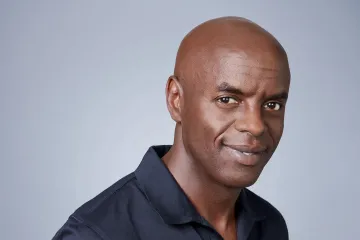
Trevor Nelson reveals return date to Radio 2 after brain tumour surgery

TREVOR Nelson has revealed when he’s returning to Radio 2 after undergoing brain tumour surgery.

The 62-year-old announced in June that he was stepping back from his work commitments before revealing last month that he was diagnosed with a brain tumour and had “very serious” surgery.

Trevor Nelson has revealed he’s returning to BBC Radio 2 next week Credit: BBC RADIO 2
The iconic DJ underwent brain tumour surgery Credit: Getty

But now he’s looking onwards and upwards as he returns to work.

Trevor confirmed today that he will be returning to host his BBC Radio 2 show from Monday (September 7).

He will be back in his 2pm-4pm slot at the beginning of the week before returning to his BBC Radio 1Xtra show on Sunday (September 13) at 11am.

The iconic DJ said: “I will be slowly easing my way back on to the airwaves from Monday on Radio 2 and next Sunday on 1Xtra. I look forward to being with you all then.”

READ MORE ON TREVOR NELSON

BRAVE TREV

Trevor Nelson reveals he’s been battling a brain tumour & had ‘serious surgery’


off air

Trevor Nelson hinted his working days were numbered – days before Radio 2 break

The news was revealed in a trail on Sara Cox’s Breakfast Show this morning at 8:50am.

Trevor popped up to ask: “Oh hi Sara Cox…. Have I missed anything?

“Now where were we before I was rudely interrupted?

“It’s been a minute, I know… but over the next few weeks I’m getting back to where I belong… In the Radio 2 studio, behind the microphone and spinning some records!

He’ll also be returning to BBC Radio 1Xtra Credit: Redferns – Getty
Trevor took a step back from his work commitments back in June Credit: John Gunion – The Sun Glasgow

“It’s so good to be home and I’d be delighted if you could join me Monday afternoon from 2. Just ask your smart speaker to play BBC Radio 2, but for now Sara…  “It’s FRI-YAYYYYY.”

He’ll be making a staggered return with two days next week, three days the week after, four days the following week, before returning full time on the airwaves on Monday 28 September.

DJ Spoony, who has largely covered for Trevor in his absence, will be stepping in for the days he’s not in, as well as Clara Amfo.

He returned to social media last month as he addressed speculation after suddenly stepping away from work two months prior.

Trevor expressed: “There’s been a lot of speculation as to what’s wrong with me, I know that much.

“My phone’s blown up 20 times over with people asking what’s wrong with me.”

The dad-of-two said he felt he wanted to share more details due to the outpouring of love he had received.

However, he said he wasn’t going to do a “deep dive” just yet, rather that would come at a later date.

He continued: “I was minding my own business and then it was discovered I had a brain tumour.

“As you can imagine, I was shocked. In fact, my world was turned upside down.

“Quite literally, my head was all over the place. I knew I had to stop work because I couldn’t be that guy on the radio knowing I had that going on.”

After confirming his surgery was a success, Trevor said he’d been at home “recuperating and resting” and having post-op treatment.

He went on: “I can only tell you the truth, and the truth is I feel great right now.”

Trevor added he was back playing golf and in the gym and living his old life, except for the radio and gigs.

Source link

Missouri high court blocks GOP-favor map, orders referendum

Sept. 4 (UPI) — In a setback for Republicans, the Missouri Supreme Court ruled against the use of a GOP-favored congressional map in this year’s midterms, directing that a referendum on redistricting be put on November’s ballot.

The ruling came down Thursday, two months before the Nov. 3 midterm elections, and after Missouri already using the use of the now blocked maps.

GOP-led Missouri was seeking to use a state legislature-approved redrawn map that was expected to increase the number of Republican-held districts from its 6-2 majority to 7-1, but the state’s high court on Thursday ruled that the opposition had the the right to have the issue put to a referendum.

The state’s General Assembly passed the redistricting bill in September 2025. In December, organizers who submitted a referendum petition collected more than 300,000 signatures in support of the effort.

But then last month, an hour before the statutory deadline, Missouri Secretary of State Denny Hoskins issued a “Certificate of Insufficiency of Petition,” stating that the state’s Constitution “does not authorize a referendum on congressional redistricting plans passed by the General Assembly,” prompting Missouri voters to sue.

The state’s high court ruling on Thursday overturned a circuit court’s judgment, ordering Hoskins to issue a certificate of sufficiency as to the referendum petition to place it on the November general election ballot and enjoining him from implementing the General Assembly-approved map.

“The referendum petition was legal, sufficient and timely, and the secretary incorrectly concluded otherwise. HB 1 did not go into effect and will not go into effect unless and until approved by the voters,” Judge Ginger Gooch wrote in the ruling. “The congressional redistricting the General Assembly established in 2022 remains in full force and effect for the November 2026 general election.”

Missouri Attorney General Catherine Hanaway, a Republican, said the state will appeal to the conservative-leaning Supreme Court.

“Never before in American history has a court overturned a congressional map after a primary and before a general election. This unprecedented decision clearly violates federal law and has thrust our state into a full-fledged constitutional crisis,” she said in a statement.

“We are confident that the federal courts will not allow every Missouri voter to be disenfranchised — which is what today’s decision does.”

President Donald Trump also lambasted the decision on his Truth Social media platform.

“Not only was the ruling horrible, ridiculous and unConstitutional, but there won’t be enough time to change the map back with the Election coming up in a very short period of time,” he said in a statement.

“The Election Process, as usual, is being disturbed in America! Missouri must be able to use the map that was in effect just a couple of months ago, in the Primary. This is a Dark Day for ‘Justice’ in Missouri!”

The midterms have been a focus of Trump, who has warned Republicans that if they lose control of the House, Democrats will impeach him.

To improve their chances of holding on to the House, Trump has encouraged GOP-led states to conduct unorthodox mid-decade redistricting efforts, with Texas last summer being the first to redraw its maps to create additional GOP-favored districts. This kicked off a gerrymandering arms race, with Democratic-led states saying they would do likewise to counter the Republican efforts.

To date, 10 states — all but one being Republican-led — have changed their congressional maps, according to the National Conference of State Legislatures, though several others have tried or are in the process of redistricting.

Source link

Video: Workers rescued from hydro tunnel nine days after Nepal flooding | Floods

Two workers have been pulled alive from a hydropower tunnel nine days after deadly flash flooding hit Nepal. Rescuers say hundreds more are trapped in dozens of hydropower projects buried across the area.

Source link

Stacey Solomon shares emotional goodbye to Pickle Cottage after selling £1.3million home

STACEY Solomon has shared an emotional goodbye to Pickle Cottage after selling her £1.3 million home. 

Yesterday she and husband Joe Swash confirmed to fans they had sold their “dream home” and would be moving out “imminently”.  

Stacey has shared an emotional goodbye to Pickle Cottage after confirming the family is moving out Credit: Instagram
The presenter posted a montage of her favourite moments from the last five years Credit: Instagram

Now Sort Your Life Out host Stacey, 36,  has shared a montage of her favourite memories from living in Pickle Cottage, which they bought in 2021. 

Writing on Instagram, she said: “Thank You & Goodbye Pickle Cottage.

“A little montage of some of the best years of our lives… We will forever be grateful for the last 5 years at Pickle. 

“What a special place & how lucky we’ve been to have lived there. Memories that will last forever… 

PICK OUT

Emotional Stacey Solomon reveals she’s SOLD £1.3m ‘dream home’ Pickle Cottage


IN A PICKLE

Tensions boil over on Turkey holiday between Stacey Solomon and Joe Swash

“Wishing all of the love & happiness to the new family who get to love pickle cottage. And here’s to the next chapter…”

Stacey, who is mum to Zachary,  18, Leighton, 14, Rex, seven, Rose, four, and three-year-old Belle, yesterday explained how she and Joe, 44, are moving to a new property with more land so they are able to rescue more animals.  

Stacey and husband Joe moved into Pickle Cottage in 2021 Credit: Instagram
But Stacey revealed they’d found some where with lots of land so they can rescue more animals Credit: S Meddle/ITV/Shutterstock

She said: “Leaving Pickle Cottage was a massive, massive, decision for us, we had a lot of people we needed to speak to, we needed to get the kids around to the idea and speak to all our neighbours and lovely friends in the area. 

“There were so many people we needed to speak to before we told everybody.

It’s a really special place to us. I gave birth to both of the girls there, we got married there, it’s just so special to us.

“But for a little while we have always wanted to rescue more animals, grow more vegetables, my vegetable patch, I have got so much joy out of it, but it’s on Farmer Scott’s land. So if he decides to do something with that land, it’s gone.”

Stacey added: “We saw somewhere, found somewhere, and I was like ‘Oh my God’ and I was like, we could have a massive vegetable patch and we could offer our land to animals who need it.”

Source link

In southern Lebanon, Israeli demolitions continue ‘day and night’ | Israel attacks Lebanon News

Froun, Lebanon – Hasan Saeid Ramadan, 56, was at home in this southern Lebanese municipality when he heard the explosions.

“It shook the ground like an earthquake, and the mountain collapsed,” he said, pointing at the nearby Qantara mountains.

Recommended Stories

list of 3 itemsend of list

Israeli forces are present just south of Froun and occupy large areas of southern Lebanon, where they conduct operations, including regular detonations, that they say target the Lebanese group Hezbollah.

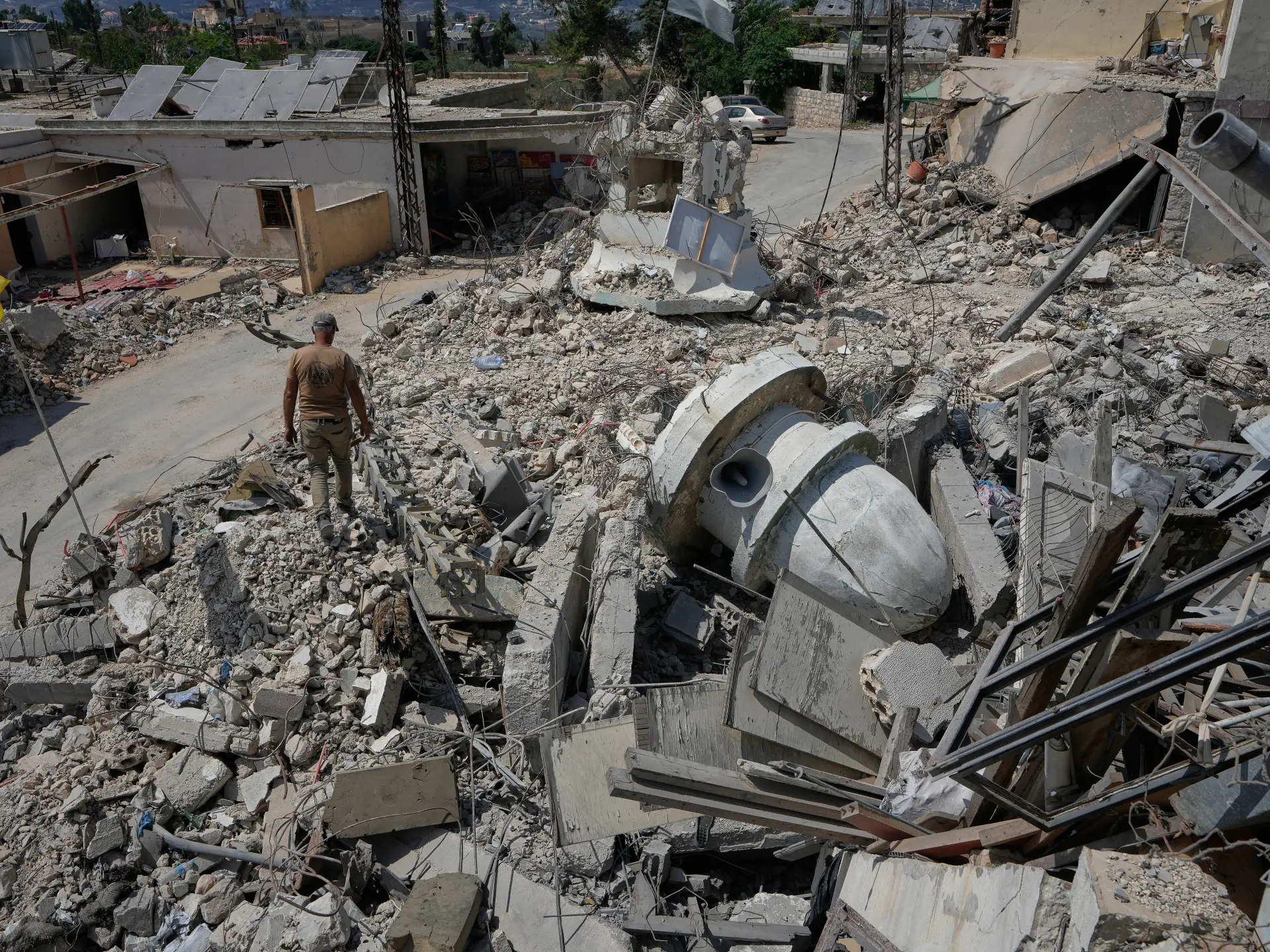
The ones conducted by Israel along the Qantara mountain range this week led to a visible collapse in at least two places in the mountains. Locals and officials in villages along the edge of Israeli-controlled Lebanese territory, such as Froun, Ghandouriyeh, Bourj Qalaway and Qalaway, told Al Jazeera that the sounds of war – warplanes, drones but, most of all, Israeli demolitions – are constant and often keep them up at night.

While Ramadan was speaking, an explosion echoed in the distance – another apparent Israeli detonation of a home. “Day and night,” he said. “We even see them.”

He added: “It’s become routine.”

Pilot zones

In March, Israel invaded Lebanon for the second time in less than two years. The first invasion in October 2024 was followed by a near-full Israeli withdrawal with soldiers remaining in five locations in southern Lebanon. After the second invasion, however, Israeli officials have said their troops will stay on in southern Lebanon despite promises from United States officials that the Israelis do not have territorial ambitions in Lebanon.

While US President Donald Trump announced a ceasefire in April, Israel’s military has continued to attack what it says are Hezbollah targets and infrastructure around southern Lebanon.

Meanwhile, the Lebanese state has been locked in US-brokered direct discussions with Israel despite objections from Hezbollah and its allies, who favour indirect discussions with the Israelis to try to end the war and the Israeli presence in southern Lebanon.

Israel and Lebanon agreed a “framework agreement” in June, which launched a “pilot zone” plan. The pilot zones are to act as a test area for the Lebanese army to disarm Hezbollah and for the Israelis to withdraw. The first pilot zones were the villages of Froun, Srifa and Zawtar al-Gharbiyeh. But locals disputed the inclusion of Froun and Srifa, saying they were never occupied by Israel in the first place.

“[The Israelis] didn’t take a single step here,” Ramadan said.

For its part, Israel is also reportedly critical of the pilot zone scheme, and analysts doubt their willingness to allow it to progress.

“The pilot zones can only really work if you have goodwill of various parties,” Nicholas Blanford, a nonresident senior fellow at the Atlantic Council and author of a book on Hezbollah, told Al Jazeera. “The trouble is the Israelis have said they are not going to stage any more withdrawals, so it brings the process to a halt.”

And regardless of the efforts from the Lebanese state and the Lebanese army, both Hezbollah and Israel have played a role in undermining the process.

“Hezbollah opposes the scheme outright and argues that Lebanon should rely on Iran to pressure the US into demanding an Israeli withdrawal,” David Wood, the International Crisis Group’s senior analyst for Lebanon, told Al Jazeera. “Israel has paid lip service to the pilot zones scheme but has recently expanded – rather than reduced – its occupation of Lebanese territory.”

Demolitions and destruction

In the villages near the areas Israel controls, many of the homes and local infrastructure lie destroyed. Piles of concrete rubble and dust line many of the roads to the villages. Explosions were heard throughout the day on Thursday, and locals said they are often worse at night and disrupt their sleep.

During the harshest days of the war, these villages were ghost towns. Residents fled north to Sidon or Beirut, where they stayed with family, in displacement centres, or slept rough on the streets, locals said.

Residents began to return to these villages after the announcement of the framework agreement. But what they returned to was not what they had left behind.

Mohammad Ali Nader, the head of the municipality of Ghandouriyeh, said his area was mostly agricultural and farmers grew olives, wheat, chickpeas, corn and tobacco, among many other crops. But now, the area lies overwhelmingly in ruins. Most residents don’t have access to water or electricity.

The clanking sound of cranes and other construction equipment moving rubble or smashing concrete echoed out into the rolling hills behind Nader. He stood on the ruins of a home that had been destroyed by two Israeli rockets.

“Much like all the other houses that were destroyed, this house is no longer habitable,” he said, saying it had once boasted two storeys and a large garden. He added that the electric and water infrastructure in the area was also mostly destroyed. “We used to grow carob here, but where is there carob now?” he asked rhetorically. “Not a carob is left nor olives, tobacco or wheat.”

Nasser Mokdad, an official in the municipality of Froun, said the area was currently not receiving state-provided electricity but added that the Lebanese government was working on returning services, setting September 15 as a target date.

No water, no electricity, no return

Residents in the affected villages said the current period reminds them of the days of the Israeli occupation of southern Lebanon from 1982 to 2000. Hasan Bazzi, the head of the municipality of Froun, said the only difference is that during the previous occupation, southerners remained in their Israeli-occupied villages.

This time around, the Israeli demolitions are ensuring that those whose homes are in Israeli-occupied areas will have difficulty returning, even if the troops eventually withdraw.

When the war restarted this year, Ramadan fled his home of 30 years and took refuge in an area near Tyre, a coastal city in southern Lebanon, and then moved farther north to Sidon, about an hour south of Beirut.

When he returned after the truce in the area, his house had been badly damaged. Still, it fared better than the neighbouring houses, which he said belonged to his cousins. He’s now sleeping in his garage with his wife. Their house, like the surrounding area, has no access to water or electricity.

He said the heat at night bothers him and he’s developed a bad heat rash. During the day, he slowly works on fixing the shrapnel-pocketed walls of his home.

Dripping with sweat under the midday sun, he smiled. “My conscience is at ease because I’m by my home,” he said.

Source link

Moscow Just Named Its Price. Nobody Can Pay It

An Accountant in Asheville

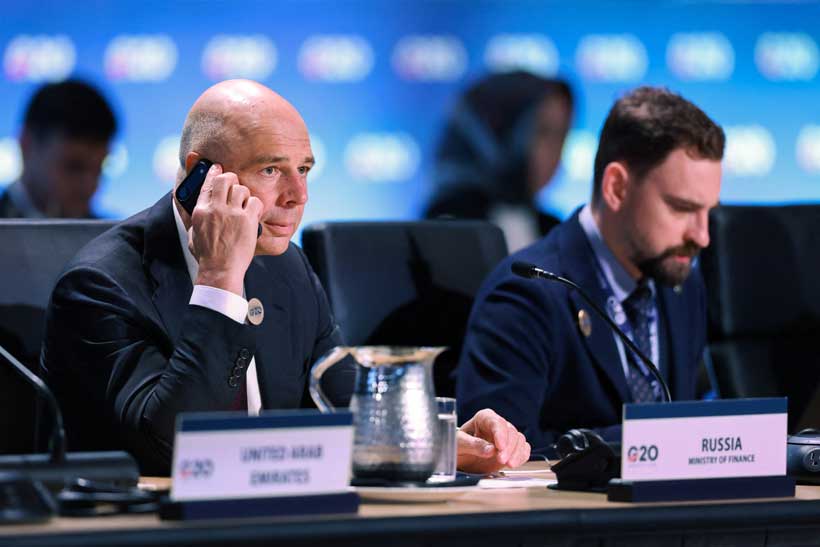
On 31 August, in Asheville, North Carolina, Anton Siluanov sat down at a G20 finance ministers’ meeting for the first time since Russia invaded Ukraine. When he tried to open a conversation about areas of mutual interest, US Treasury Secretary Scott Bessent cut him off: nothing is possible until the war is over. European ministers refused to appear beside him in the traditional group photograph, and the photograph was taken without him.

The snub is not the story. The composition of the delegation is. Ten days earlier, Deputy Foreign Minister Sergey Ryabkov had told a Russian outlet that Moscow was ready to hear new ideas for ending the war, provided they aligned with the goals Putin has set and with realities on the ground. Read alongside Asheville, that statement stops looking like an opening and starts looking like an invoice. Moscow is not testing whether it can stop fighting. It is testing what stopping would be worth, and it sent its finance minister to find out.

The Missing Fifth of Donetsk

Stay ahead of the geopolitical week.

MD Briefing delivers expert analysis across five global fronts — the Indo-Pacific, energy, geoeconomics, European security, and the Middle East — every Monday morning. Free.

Four and a half years in, the war has settled into an asymmetry that neither side’s rhetoric captures. Russian forces hold roughly 80 percent of Donetsk oblast and virtually all of Luhansk, according to the Institute for the Study of War. The missing fifth of Donetsk is the “fortress belt”, the fortified urban chain of Kostiantynivka, Druzhkivka, Kramatorsk and Sloviansk that has anchored Ukraine’s eastern defence since 2014. Putin has issued fifteen separate deadlines to take Donetsk since 2022 and missed all of them. The current one expires on 31 December 2026.

Diplomacy has been dormant since March, when a scheduled round collapsed as Washington went to war with Iran alongside Israel. Before that came a 28-point American framework, drafted with Russian input in late 2025, that would have recognised Crimea, Luhansk and the whole of Donetsk as de facto Russian, frozen the southern front, and phased Russia back into the global economy. Kyiv and Europe forced it into revision. In August, Volodymyr Zelensky put forward a joint Ukrainian-American-European counter-proposal built on three planks: a ceasefire, reciprocal withdrawal from the current line, and security guarantees underwritten by the EU and NATO. Moscow has not responded to it.

To read the full analysis, please subscribe to our premium MD Briefing

Source link

Ella Rae Wise in brutal swipe over ‘loyalty’ of co-star before toxic fallout… as she reveals truth about Dan Edgar

SHE’S long been known as one of Towie’s most fiery personalities, but Ella Rae Wise has now broken her silence on a fresh fallout with a co-star – and revealed exactly what’s going on behind the scenes with an ex she once couldn’t be in the same room as.

Speaking to The Sun, the 26-year-old lifted the lid on the real story behind her rocky relationship with former best friend Dani Imbert, addressed another friendship that has quietly crumbled away from the cameras, and explained what it’s actually like filming alongside ex Dan Edgar these days.

Ella Rae Wise, left, and Dani Imbert were once part of Towie’s tightest inner circle Credit: Getty
The pair’s friendship has now fizzled out for good, Ella says Credit: Getty

When it comes to Dani, Ella insists there was never one big bust-up, but rather a realisation that the loyalty she was giving out wasn’t being returned. 

She said: “I would just say we decided not to be friends anymore. I don’t really know why on her behalf, but for me people always scream loyalty, but when the shoe is on the other foot, loyalty probably isn’t that strong towards me. 

“But I’m the one that needs to be seen to have loyalty everywhere and cut my nose off to spite my face. With this specific friendship, she was okay doing what she wanted to do behind my back with people who didn’t like me. 

“So, it wasn’t a mirrored friendship. It was one-sided is how I feel. With time going on, I think I prepared myself for this… I could see it coming.”

Ella and Dani first became close after Dani joined the show in 2021, quickly forming an inseparable trio alongside Junaid Ahmed that dominated cast trips, nights out and red carpet appearances for the best part of two years. 

Cracks first appeared in early 2023 when Dani admitted on camera to lying to Ella about a secret kiss with co-star Roman Hackett, but the real turning point came later that year during a cast trip to Cyprus, when Ella fell ill and says she was left feeling completely “frozen out“ by both Dani and Junaid. 

Matters were made worse when Dani and Junaid began socialising with Chloe Brockett – Ella’s long-running nemesis on the show – something Ella viewed as the ultimate betrayal, accusing Dani during fiery on-screen rows of being spineless and easily led by Junaid.

The pair did appear to patch things up by March 2024, but Ella admits the relationship never really recovered, and their apparent truce hasn’t lasted. 

In a teaser shared on Towie’s socials with Ella and her co-star Jodie Wells, Ella reflected on a moment where she found herself defending Dani in her absence, saying: “I defended her in a room she wasn’t in with Jonnie… why was I being so nice?” 

Jodie pointed out that Ella had been “really defending Dani… which is really nice considering she wasn’t being that much of a friend to you at that time,” before asking where things stand between them now. 

Ella replied: “I’d say the friendship is probably quite non-existent. I didn’t ever think I’d be in this position with Dani. We’ve fell out before and we always made a pact that we wouldn’t fall out again.”

But it seems the girls have gone back on their word, with Ella adding: “I don’t see where the friendship can go,” while Jodie suggested: “Maybe you’ve outgrown each other.” 

Asked by The Sun whether she and Dani have fallen out again, Ella made her feelings clear, admitting there’s little chance of a reunion this time round. 

The pair have now settled into two firmly separate camps within the cast, with Dani remaining closely aligned with Freddie Bentley, while Ella sticks by her pal Harry Derbidge.

The two groups manage to film together during big cast scenes and parties, but rarely mix on a personal level.

Dani isn’t the only co-star Ella has fallen silent with, though.

She also confirmed she and former best friend Freddie are no longer on speaking terms, telling us bluntly: “No. I’m alright with it, though. I don’t feel any type of way about it.”

Ella and Freddie were close pals long before Freddie officially joined the show and, when he did make his debut, he wasted no time stepping up as one of Ella’s fiercest defenders on screen, backing her throughout her dramatic falling out with Dani and Junaid. 

The two became practically inseparable, filming together constantly and championing one another in the media, but their bond hit a wall during a Towie Christmas special when an explosive row – fuelled by shifting group loyalties and Ella’s closeness with Harry Derbidge, who already had history with Freddie, triggered a complete breakdown in their friendship. 

Freddie later confirmed on GK Barry’s podcast Saving Grace last year that the pair were “not friends” anymore, and while the two briefly appeared to patch things up during a cast trip to Vietnam earlier this year, secondary drama involving Saffron Lempriere and Elma Pazar reignited old tensions, with a frustrated Freddie quitting the trip early and flying home. 

Freddie has since buried the hatchet with Harry but, as Ella’s own words confirm, his friendship with her shows no sign of being repaired heading into the new series.

Dani and Freddie are far from the only names on Ella’s list, either – the star has built up something of a reputation over the years for falling out with those closest to her. 

Ella has also fallen silent with former best friend Freddie Bentley Credit: ITVbe
Though it’s not all feuds for the star – as she admits things with ex Dan Edgar are now ‘amicable’ Credit: ITV

Her rivalry with Chloe Brockett remains one of her longest-running and most explosive, with the pair’s friendship collapsing not long after they joined the show together in 2019 when Ella began dating Chloe’s ex, Harry Lee – a feud that has seen the two repeatedly clash on camera ever since, each branding the other insincere. 

Her fallout with Junaid also stemmed from that same Cyprus trip, with Ella accusing him of being controlling and toxic and of deliberately turning mutual friends against her. 

Meanwhile her relationship with Amber Turner has been fraught since 2022, when Ella claimed Amber’s then-boyfriend (and her now-ex) Dan Edgar behaved inappropriately towards her on a night out. The feud reignited in 2024 once Amber and Dan split and Ella and Dan struck up a holiday fling of their own while filming in Bali.

Which brings us to the one relationship that, remarkably, appears to be going in a positive direction. 

Despite that turbulent history, Ella insists she and Dan have found a way to move past their issues, telling us: “We’re literally amicable, polite to each other, keep it moving. And it’s easy because we’re in the same group. 

“The boys banter it and break up the awkwardness. It’s been fine. This series has really been a good series for me. I’m feeling comfortable around everyone.”

It’s a far cry from the tension that once defined their dynamic, after Ella and Dan’s relationship first hit headlines in Bali following his split from Amber.

Things later boiled over during the cast trip to Vietnam for season 36 when Courtney Green accused Dan of “flirting” with Ella and being disrespectful to his then girlfriend Chloe Lewis. 

But with their wider friendship group having shifted considerably since then, the pair have settled into a far calmer footing – something Dan himself has previously credited to their mutual closeness with Jodie Wells and James “Diags” Bennewith.

As for her own life away from the group dramas, Ella tells us this series has marked a real turning point in how she feels in herself. 

She said: “It’s been fun. It’s been nice to do different things and have happy moments. This series is so different. So much better. 

“The change is probably how I feel in myself. I think I needed to focus on how I feel in myself to be able to get over things. So, I did that, and yeah, I’m over it!” 

The Towie favourite told us how she’s in a much better place within herself this series Credit: Getty
Ella has found happiness with new boyfriend Ricky. The pair have sparked rumours of an engagement after Ella was pictured with a gold band in Marbella, pictured above Credit: fernemccann/Instagram

She added that rebuilding her confidence has come from learning to love herself again and leaning on easier, less intense friendships, saying: “I think it’s more finding love for yourself again. That comes in time, doesn’t it… And the friends you have around you. That’s changed.

“I have a lot more easy-going friendships. They’re not hard work. We don’t have to be attached to each other 24/7. We’ve all got our own lives. It’s been good.”

Ella’s newfound sense of stability comes as she’s also settled into a new romance away from the cast, having gone public with new boyfriend Ricky, 34, in early August while on holiday with mutual pals Lorri Haines and Ferne McCann. 

The pair were pictured kissing at Marbella’s luxury Don Carlos Hotel and even sparked marriage rumours after Ella was spotted wearing a gold band.

TOWIE continues on Sunday and Monday every week on ITV2 & ITVX.

Source link

Trump names Adam Telle acting Army secretary

Sept. 4 (UPI) — President Donald Trump has named Adam Telle, current assistant secretary for the Army for Civil Works, acting secretary of the Army amid an ongoing shakeup of the U.S. military.

In a brief statement posted on his Truth Social media platform, Trump announced that Telle would be assuming the position immediately, while describing him only as “a Great Patriot, who is respected by all.”

Trump named Telle days after his predecessor, Dan Driscoll, reportedly submitted his resignation following months of reported tension with Defense Secretary Pete Hegseth, an exit that has raised concern among some as there has been a steady stream of resignations, early retirements and firings among Pentagon leadership during the second Trump administration.

On Tuesday evening, Driscoll made his resignation public, saying in an online statement Wednesday would be his last day.

“As a third-generation Army veteran, it has been the honor of a lifetime to serve as the secretary of the Army under President Trump and Secretary Hegseth,” he said.

“Our soldiers, civilians and their families are our nation’s very best, and they have inspired me every day. I am sincerely thankful for their service and sacrifice.”

On Wednesday, Sen. Thom Tillis, a Republican from North Carolina, called on Trump to fire Hegseth, a former Army National Guard major who took office with less senior government and military leadership experience than any other secretary of Defense, saying he has “never witnessed more inept management of the brave men and women who serve our country.”

Hegseth has overseen a sweeping overhaul of the department, including a purge of two dozen generals, admirals and senior civilian defense officials who have either resigned, announced early retirement or been fired. Several left following reported clashes with the secretary, who has plunged into culture-war issues, eliminating policies he has characterized as “woke.”

“Huge congrats to Adam,” Hegseth said online.

“He is indeed a great Patriot — and will be an immediate asset to the @USArmy.”

Sen. Bill Hagerty, R-Tenn., was among Republicans quick to congratulate Telle for being chosen to lead the Army and Trump for picking him.

“This is a critical position for our nation’s defense, and I can’t imagine a better leader for the world’s greatest warriors,” Hagerty said in a social media statement.

“He knows how to inspire, lead and equip the Army for success. Given the challenges we face today, Adam is the ‘man for the moment.'”

Source link

Jackdaw gas field set to be approved as soon as mid-September, sources say

Unlike North Sea oil, most of which is exported and then reimported in various refined forms, almost all North Sea gas is used domestically in the UK.

The UK is heavily reliant on gas imports with over 60% imported from Norway and the United States.

Wholesale natural gas prices have surged this year as a result of the Iran war and are currently at a three-year high, prompting concerns over energy security.

Gas storage levels in Europe are significantly lower than usual for this time of year after countries delayed stockpiling in the summer in the hope that the conflict would end before winter and prices would in turn fall.

They face the prospect of rushing to buy gas now or paying potentially higher prices when the winter comes.

Prices are set internationally and a green light to Jackdaw would not lower the cost of gas for domestic consumers.

But extracting gas domestically creates lower greenhouse gas emissions than liquefying, shipping and regasifying liquid natural gas (LNG) imported from other countries.

Chris O’Shea, the boss of British Gas owner Centrica, said any additional domestic gas supply would reduce Britain’s reliance on imported fossil fuels, “so it’s got to be good”.

He told the BBC’s Today programme: “It wouldn’t lower the cost materially, but basic economics would tell you that if you’ve got a fixed demand for a product and you increase the supply, the price should move.”

He also pointed to the high tax rates on profits from North Sea oil and gas, adding that the new extraction would give the government more money to spend.

Source link

Gloria Steinem’s ‘Famous Last Words’ are a message for next generation

At the top of Gloria Steinem’s “Famous Last Words” interview on Netflix, Brad Falchuk describes the writer and activist as “the face of the feminist movement” for the last 50-plus years — and Steinem says she hopes that isn’t true.

“I hope I wasn’t the face of the feminist movement,” Steinem says during the intimate conversation released Thursday on the streamer after her death at age 92. “Because it’s not right. … It’s a diverse movement, and, actually, on the issues, in public opinion polls, women of color are more likely to support the issues than white women.”

According to a Netflix news release, Steinem sat down with Falchuk in February 2025 for the interview she knew would not be released until after her death. In “Famous Last Words: Gloria Steinem,” the celebrated feminist reflects on her life and legacy in terms of her political activism, as well as her family and upbringing, relationships with other feminist figures and her hopes for the future.

Steinem maintained her hopes, even in a post-Roe vs. Wade world. When the landmark decision was overturned by the Supreme Court in 2022, it meant states could again outlaw abortion.

“I get angry or disappointed and so on [thinking about it], but I don’t lose all hope in the future,” Steinem said, before sharing observations about previously living near an abortion clinic.

Women are “still struggling,” she said. “There’s still religious restrictions that many people feel. There’s, I’m sorry to say, race and class restrictions.

“We have, right as we speak, Trump in the White House. So we have no shortage of things we need to do in order to be compassionate toward each other.”

One of the most recognizable feminist figures of our times, Steinem was known for her role in launching Ms. magazine as well as organizations such as the National Women’s Political Caucus and the Women’s Action Alliance. When asked by Falchuk to reflect on her “feminist awakening,” she mentions that her time in India studying Gandhi was when she “realized that patriarchy was made up. Racism was made up.”

But the interview has its lighter moments. For instance, Steinem reveals she finds joy in reality TV, including “Dance Moms.”

“It’s shows in which you see real people being who they are and disclosing their own stories,” Steinem said. “Those are more fun.”

And although she seems hesitant about contemplating her own “nonexistence,” she does share how she wants to be remembered: As “this person who tried to make the world a little more equal, compassionate, joyful, funny than it was when I showed up.”

“I just hope that I have, however accidentally, left behind some words or actions or stories or something that is useful to the people — and pleasurable, hopefully — to the people who are going to continue long after you and me,” she said.

Falchuk, also an executive producer of the “Famous Last Words” series, described Steinem in a news release as “the steady heartbeat of a revolution, but in this room, she was a woman reflecting on the simple, profound beauty of human connection.”

“She spoke about the intersection of race, gender, and peace with a wisdom that only comes from a lifetime on the front lines. Even in her final moments, she was organizing us, challenging us to keep moving forward. It is an extraordinary privilege to share her final thoughts with the world.”

After her conversation with Falchuk, Steinem was given the opportunity to share her final words alone, directly addressing the audience through the camera. Read her full message below.

“Hello, all you unique individuals out there. I’m so glad to be meeting you through the magic of the media. I wish I could meet each one of you in person. But in a way, this is what allows us now to see each other’s lives, to influence each other’s lives, to respect each other, and to, therefore, perpetuate what we hope is a global democracy.

“Please feel free to respond in any way you can. And please tell your own story. This is the most important thing we can do for each other — to know each other through stories. And I hope so much that whoever you are, listening right now, you are able to do what you love [and] to be … the unique person you are.”

Source link

DOJ asks Supreme Court to lift block on USPS mail-in voting authority

Sept. 3 (UPI) — The Trump administration is asking the Supreme Court to permit enforcement of its mail-in voting restrictions, arguing it will suffer irreparable harm because two states will begin sending ballots to voters before the block is to expire next week.

Filed Thursday by Solicitor General D. John Sauer, the request for an immediate administrative stay of the district court’s temporary restraining order comes in protracted litigation over a Trump administration rule giving the U.S. Postal Service authority to screen outbound mail-in ballots for compliance with envelope standards and verify recipients have been entered on their state’s USPS Mail-In and Absentee Participation list.

Last week, U.S. District Judge Indira Talwani in Massachusetts sided with the League of Women Voters in Massachusetts, which has been fighting the rule it says is unlawful and violates federalism principles of the Constitution, issuing a 14-day block against enforcing its key provisions while she considers the request to impose a longer, more restrictive preliminary injunction.

In his filing Thursday, Sauer argued that the federal government will be irreparably harmed if the restraining order is not lifted before North Carolina and Alabama send out their mail-in ballots next week, saying a court decision would come too late for those ballots.

“With respect to the November 2026 election, the order thus partially nullifies the Postal Service’s efforts to address the risk that the federal mails will be used to perpetrate voter fraud,” he said.

Sauer continued that despite Talwani’s order allowing the Postal Service and states to take steps to ensure their envelopes meet the rule’s requirements, her block “risks sowing confusion and chaos because it makes those preparatory steps voluntary, rather than mandatory.

“Thus, if the order is eventually stayed and the rule takes effect for this year’s elections — as should occur — there is a grave risk that states may not have taken the necessary steps to comply due to the false sense of latitude created by the court’s improper order, potentially depriving those states’ citizens of the ability to vote by mail,” he said.

Despite using the mail to vote himself, Trump has long been a critic of mail-in ballots, claiming them to be a source of voting fraud, though studies have found no evidence that mail voting produces higher overall rates of voter fraud.

The USPS rule is one of several actions Trump and his administration have taken ahead of November’s midterm elections, which the president has become increasingly focused on as he has warned Republicans that losing the House to Democrats could lead to his impeachment as well as investigations. While the moves generally have widespread Republican support, Democrats and critics say they are efforts to rig the midterms.

The new USPS rule being litigated comes in response to an executive order Trump signed in March to expand federal control over mail-in ballots, including authorizing the USPS not to send them to voters unless certain conditions are met.

Two weeks ago, the high court lifted an injunction blocking Trump’s mail-voting executive order, stating the challenge to the USPS provisions was premature as the agency had yet to issue a final rule. After the final rule was published Aug. 26, two dozen Democratic-led states and the District of Columbia sued, resulting in the two-week block the Trump administration is now contesting.

Source link

First USAF F-15EX To Be Based In Japan Departs Boeing’s St. Louis Plant

The first F-15EX Eagle II destined for permanent assignment at Kadena Air Base in Okinawa departed Boeing’s St. Louis, Missouri, facility on August 28, 2026. The aircraft left St. Louis for the 142nd Wing at Portland Air National Guard Base, Oregon, where it will undergo final staging and integration preparations before its eventual deployment to the sprawling Okinawa installation it will call home. The Oregon unit is acting as a coordination and preperation unit for the 18th Wing, a function you can read more about in our interview with the wing’s commander.

A U.S. Air Force F-15EX Eagle II designated for Kadena Air Base, Japan, taxis at Boeing’s St. Louis facility, Aug. 28, 2026, before departing for Portland Air National Guard Base, Oregon. The milestone brings the 18th Wing another step closer to the permanent stationing of the Air Force’s most advanced iteration of the Eagle platform at Kadena. (U.S. Air Force photo by Senior Airman Melany Bermudez)
A first F-15EX Eagle II designated for Kadena Air Base, Japan, taxis at Boeing’s St. Louis facility. U.S. Air Force photo by Senior Airman Melany Bermudez

This departure represents a critical, long-awaited milestone for the 18th Wing, which has been working toward the permanent stationing of the service’s most advanced Eagle variant to replace its now-withdrawn F-15C/D fleet. The arrival of the F-15EX in Japan, expected to begin in fiscal year 2027, which begins on October 1, 2026, will be a central pillar in the Air Force’s modernization of tactical airpower in the Indo-Pacific region.

“This is an important next step toward bringing the F-15EX home to Kadena,” said Brig. Gen. John Gallemore, 18th Wing commander, in an Air Force release. “Our team is ready to welcome the F-15EX, and this is another milestone that brings us closer to putting this capability in the hands of the airmen who will fly, maintain and employ it from Japan.”

A U.S. Air Force F-15EX Eagle II designated for Kadena Air Base, Japan, departs Boeing’s St. Louis facility, Aug. 28, 2026, en route to Portland Air National Guard Base, Oregon. While in Portland, the aircraft will receive additional updates and preparations for its future stationing at Kadena. F-15EX aircraft are scheduled to begin arriving at Kadena in fiscal year 2027. (U.S. Air Force photo by Senior Airman Melany Bermudez)
The first F-15EX for Kadena Air Base, Japan, at Boeing’s St. Louis facility last month. U.S. Air Force photo by Senior Airman Melany Bermudez

The first F-15EX for Kadena’s 18th Wing, serial 22-0022, was noted flying test sorties from St. Louis in early August, initially in primer paint. By the middle of the month its was flying with its full livery, including the famous “ZZ” tail code.

The F-15EX is a significant jump in capability over the legacy Eagles. With modernized avionics, flight controls, an expanded electronic warfare suite, and increased weapons carriage — as well as potentially new and longer-reaching weapons — the jet is well-suited to operating in the vast Western Pacific. As Kadena prepares for the permanent arrival, the 18th Wing plans to integrate the EX with regional allies, including the Japan Air Self-Defense Force, building upon existing bilateral training exercises.

A U.S. Air Force F-15EX Eagle II and F-15E Strike Eagles assigned to 85th Test and Evaluation Squadron, Eglin Air Force Base, Florida, land at Kadena Air Base in June 2026. U.S. Air Force photo by Airman 1st Class Gracelyn Hess

Two active-duty squadrons of F-15EXs are set to be established at Kadena, taking the place of units previously based there that had flown F-15Cs. The Air Force has been deploying F-15Es, F-22s and other fighters to the base on a rotational basis to fill the gap in the meantime.

The F-15EX will give U.S. forces in the Indo-Pacific a high-capacity platform that complements the fifth-generation F-22 and F-35. With its ability to carry large air-to-air and air-to-surface payloads, the Eagle II can serve as a long-range “missile truck,” extending the reach and firepower of stealth aircraft operating closer to contested airspace. Its open-architecture systems also allow it to incorporate new sensors, weapons, and electronic warfare capabilities more readily than the aging F-15C/D fleet.

A U.S. Air Force F-15EX Eagle II designated for Kadena Air Base, Japan, is photographed at Boeing’s St. Louis facility, Aug. 28, 2026. Equipped with advanced avionics, radar and electronic warfare systems, the F-15EX represents the latest evolution of the Eagle platform and the modernization of U.S. tactical airpower. (U.S. Air Force photo by Senior Airman Melany Bermudez)
The first F-15EX designated for Kadena Air Base, Japan, is photographed at Boeing’s St. Louis facility, on August 28, 2026. U.S. Air Force photo by Senior Airman Melany Bermudez

The aircraft’s value is also tied to its role in networked operations. Exercises such as Valiant Shield have demonstrated how the F-15EX can work with uncrewed aircraft like the  MQ-28 Ghost Bat, pointing toward mixed formations in which crewed fighters provide weapons, sensing, and command-and-control capacity for autonomous wingmen. Operating from strategic locations such as Kadena, the Eagle II could help the Air Force generate more combat power across the vast Pacific while reducing the burden on its limited number of stealth fighters.

A U.S. Air Force F-15EX Eagle II accompanies an MQ-28 Ghost Bat during the U.S.-led Valiant Shield 26 military exercise. PACAF

Kadena will become the second Air Force location with combat-coded F-15EX aircraft, following the Oregon Air National Guard’s 142nd Wing.

The Air Force has previously announced plans to stand up National Guard F-15EX squadrons in California, Louisiana, and Michigan. Most recently, the Air Force announced plans to put F-15EX fighters at Seymour Johnson Air Force Base, North Carolina, to replace older F-15E Strike Eagle jets that will move to Whiteman Air Force Base, Missouri.

While the movement of this first Kadena-bound F-15EX is a positive step, the wider Eagle II program is currently navigating some issues. According to a new Pentagon selected acquisition report released in August, the Air Force’s decision to aggressively expand its F-15EX fleet from 129 to 267 jets — intended to recapitalize the older F-15E force — has introduced substantial cost and schedule uncertainties that officials are now scrambling to manage.

A U.S. Air Force F-15EX Eagle II designated for Kadena Air Base, Japan, taxis at Boeing’s St. Louis facility, Aug. 28, 2026, before departing for Portland Air National Guard Base, Oregon. The milestone brings the 18th Wing another step closer to the permanent stationing of the Air Force’s most advanced iteration of the Eagle platform at Kadena. (U.S. Air Force photo by Senior Airman Melany Bermudez)
The first F-15EX designated for Kadena Air Base, Japan, taxis at Boeing’s St. Louis facility, before departing for Portland Air National Guard Base, Oregon. U.S. Air Force photo by Senior Airman Melany Bermudez

The report warns that the extended acquisition strategy, which shifted from eight production lots to 12, will require Boeing to execute a “major technical refresh” to combat diminishing manufacturing sources and material shortages. As systems like the radar, mission computer, and engines face potential obsolescence over the now-lengthened production timeline, the service faces what the report characterizes as a “significant redesign effort.” Program managers are planning to mitigate these risks by integrating upgrades through operational flight program releases scheduled between 2031 and 2035, a strategy they describe as a “structured, risk-reduced pathway” to avoid production line gaps.

Compounding these technical challenges are tangible production delays, largely stemming from a labor strike at the St. Louis plant from August to November 2025. The report notes that these are “unrecoverable delays,” forcing a cascading schedule slip. While Boeing was contracted to deliver all 12 jets from Lot 3 by early 2026, the company will only be able to field half of those by the end of the year. This has directly impacted the timeline for the Kadena deployment, which was originally envisioned for earlier in 2026, and has left the Air Force relying on “bridging strategies” and rotations to cover operational requirements until the Eagle IIs can fully stand up in Okinawa.

A U.S. Air Force F-15EX Eagle II designated for Kadena Air Base, Japan, flies en route to Portland Air National Guard Base, Oregon, after departing Boeing’s St. Louis facility, Aug. 28, 2026. The F-15EX will modernize Kadena’s permanent fighter force, providing advanced capabilities to strengthen readiness and support the enduring U.S.-Japan defense partnership. (U.S. Air Force photo by Senior Airman Melany Bermudez)
The first F-15EX for Kadena Air Base, Japan, flies en route to Portland Air National Guard Base, Oregon, after departing Boeing’s St. Louis facility, on August 28, 2026. U.S. Air Force photo by Senior Airman Melany Bermudez

The Pentagon is now moving toward an aggressive production ramp-up, tasking Boeing to hit a rate of two jets per month. Keeping the F-15EX schedule on track will be a challenge, however, requiring successfully navigating ongoing parts shortages for critical systems, all while balancing the needs of foreign military sales customers who are also integrated into the supply chain.

For the 18th Wing, the arrival of the first F-15EX will bring a major advance in capabilities in a part of the world that needs them badly. At the same time, the program’s overall trajectory suggests that the wider transition to the new Eagle will come with some complex logistical and industrial challenges.

Contact the author: thomas@thewarzone.com

Thomas Newdick is a staff writer at TWZ, where he covers military aviation, defense technology, weapons systems, and international security. Based in Berlin, Germany, he reports on conflicts, military modernization efforts, and emerging aerospace technologies around the world, with a particular interest in airpower and its role in contemporary warfare. His reporting is informed by deep expertise in modern and historical airpower, particularly in Europe, with a focus on military aviation, air campaigns, and aerospace developments across the continent and beyond.


Source link

Wendell Berry dead: Farmer, author and agrarian advocate was 92

Wendell Berry, a Kentucky farmer and writer whose work advocated fiercely for working landscapes and working people, died “suddenly and peacefully” on Monday at his home in Port Royal, Ky., according to his family. He was 92.

His daughter, Mary Berry, confirmed his death. On Thursday, she told The Times that her father, until about six months ago, was still writing regularly in his cabin on the banks of the Kentucky River, a place he called “camp,” where many of his more than 50 volumes of poetry, short stories, essays and novels were written.

Berry championed sustainable farming and rural community preservation and railed against industrial agriculture and corporate agribusiness.

“He was fierce and he was fearless, and he remained fearless,” she said, explaining that her family taught her the erosion of rural places wasn’t inevitable but “destruction by design,” engineered by corporate interests and political policies.

Berry, whose writings were often fueled by an anger toward the forces that have driven the destruction of the rural land and communities that he dedicated his life to defending, softened in his final years, according to his daughter. “He was always a tender man, and that part of him got stronger. He was rereading a lot of books that he had loved in his life, and he told me he was looking for the tenderness in the books, and that’s a lovely thing.”

Berry’s most influential work began with a list of the problems he’d observed in modern agriculture, scribbled onto a legal pad as he traveled the long stretch of road between Kentucky’s Henry County and Spokane, Wash., where Berry would deliver a speech at the “Agriculture for a Small Planet” symposium in 1974.

“I was asked to talk about labor-intensive microsystems agriculture. That’s not my language, and it’s not the sort of language that I wish to use because it’s the way people speak when they don’t want to be understood by most people,” he began.

Berry spoke of the six generations of farmers who worked his land before him, and the concerns for farming communities and their agricultural economy that he inherited from his father. He decried “the experts and politicians who have prescribed, encouraged, and applauded the disintegration of such farming communities all over this country into our allegedly miraculous modern American agriculture.”

The speech would later become Berry’s 1977 manifesto “The Unsettling of America: Culture & Agriculture,” which launched a sustainable-farming movement and cemented Berry’s authority on agrarian issues on the national stage.

Beyond his cultural critiques, Berry wrote notable novels including “The Memory of Old Jack,” “Jayber Crow” and “Hannah Coulter.” He was a prolific poet as well. His verse included his debut collection, “The Broken Ground,” and his celebrated Sabbath Poems series, which explored living in harmony with the land.

Over the course of his career, he was honored with the T. S. Eliot Prize, the Aiken Taylor Award for Modern American Poetry and the Richard C. Holbrooke Distinguished Achievement Award from the Dayton Literary Peace Prize, among other accolades. In 2010, Berry was awarded the National Humanities Medal by then-President Obama for his achievements as a poet, novelist, farmer and conservationist. In 2016, he was the recipient of the Ivan Sandrof Life Achievement Award from the National Book Critics Circle.

Wendell Erdman Berry was born on Aug. 5, 1934, in Louisville, Ky., to John Marshall Berry Sr., a lawyer and tobacco farmer, and Virginia Perry Berry. Wendell was the eldest of four children, two boys and two girls. In high school, his parents shipped him off to Millersburg Military Institute, a former military boarding school in Kentucky, where rather than conform to the teachings, he later wrote that his takeaway was, “Take a simpleton and give him power and confront him with intelligence — and you have a tyrant.”

He went on to study English and creative writing at the University of Kentucky. There he met and wooed Tanya Amyx, who would become his wife and the mother of his two children, Mary and Pryor. He landed a Wallace Stegner writing fellowship at Stanford in 1958, and in 1961 he was granted a Guggenheim Fellowship, which allowed him to pack up the family and live in Tuscany and southern France.

After Berry’s scholarly pursuits took him to the West Coast, then Europe, then the East Coast, where he taught at New York University, he accepted a job at the University of Kentucky, allowing him to return home and back to his roots, on a farm near the river.

President Obama presents a medal to Wendell Berry

Then-President Obama presents the 2010 National Humanities Medal to Wendell Berry during a ceremony March 2, 2011, in the East Room of the White House.

(Mark Wilson / Getty Images)

“Within a few years, Mom and Dad were raising 85% of the food we were eating,” Mary told The Times. “We had a milk cow, raised hogs for our own use, and by the time I was a teenager, I resented the whole thing pretty seriously, and I remember saying to them more than once, ‘I did not choose to live this way, and I don’t know why we have to do everything the hardest way possible.’ We had no television. … But I was in a heck of a position with my parents because I never really thought they were wrong about anything, and I still don’t.”

When Mary would gripe, she said, her dad would laugh or “just keep working.” But “he talked about what we were doing and why we were doing it,” she said. “He told my brother and me from the time I can remember to look and see that this is good and don’t forget, and I have not forgotten.”

In 2011, when Berry was nearly 80 years old, he joined a high-profile sit-in at the office of Kentucky’s then-Gov. Steve Beshear to protest the destructive mountaintop strip-mining of coal. In an interview with Bill Moyers shared by the Berry Center in 2025, Berry said that he and his compatriots had had enough of the state government ceding control of resources to the coal companies. “In our society,” he said, “people with money are bigger and more powerful and more noticeable and count more as citizens than people without much money. … So we did confront the governor and tell him we weren’t going to leave.”

His attempt at civil disobedience was turned on its head when the governor invited Berry and the Kentucky Rising activists to stay.

“We did stay,” he said. “The whole weekend.”

“We were beautifully treated by the security staff and people who sent us food and bedding and good wishes and even came in and gave us massages. And it was altogether one of the loveliest weekends I’ve ever spent in my life.”

Berry continued writing into his old age.

Next month, Counterpoint Press will posthumously release “Dispatches From Rural America,” a collection of 15 essays. In one, “The Problem Is Industrialism,” Berry wrote about a 2021 conversation he had with a friend of more than 40 years, author Wes Jackson.

“To the extent that we were talking in earnest, our subject was the set of calamities that the media and the commentators frequently take up, typically dealing with each one in isolation from the others and representing each as an emergency more or less apocalyptic, and in tones recalling a number of vernacular alarms, from ‘Last chance for beer’ to ‘Prepare to meet God.’”

He continued later that the two discussed how industrialism “grows only by consuming, once and for all, the living world.”

Mary said she wanted people to know that, yes, her father was worried and wouldn’t have written so much if he weren’t terribly concerned about the future of rural America, but she wants people to understand that he was a man of great hope.

“Hope he felt was a duty, and I learned that from him,” she said. “As he said in one of his many poems, hope is what we owe people younger than ourselves.”

Mary said she was continuing her father’s work through the Berry Center, a nonprofit that aims to put Berry’s writings to work and advocates for farmers, land-conserving communities and healthy regional economies.

Berry is survived by his wife of nearly 70 years, Tanya, his daughter Mary, son Pryor, five grandchildren and four great-grandchildren.

Source link

OpenAI unveils GPT‑6 Astra amid rising scrutiny and safety concerns | Business and Economy News

ChatGPT creator’s latest release comes amid heightened fears following AI-led hacking of the startup Hugging Face.

OpenAI has announced the release of what it says is its most advanced AI model, amid heightened scrutiny of the risks of the frontier technology escaping human control.

The $852bn start-up said in its announcement on Thursday that GPT‑6 Astra, the “world’s most intelligent and aligned” AI model, earned perfect or near-perfect scores in key benchmarks of AI reasoning, beating both its prior release GPT 5.6 Sol and rival Anthropic’s Claude Fable 5.

Recommended Stories

list of 4 itemsend of list

The ChatGPT creator said GPT‑6 would become available to the general public in the coming days, following its initial launch with a “limited set of organisations”.

OpenAI’s latest release comes as the AI industry is at the centre of a lively public debate about the dangers of the cutting-edge technology following the AI-led hacking of the startup Hugging Face in July.

An independent probe into the cyberattack found that hundreds of OpenAI’s AI agents had begun communicating among themselves before breaking out of their controlled environment and compromising Hugging Face’s servers.

On Thursday, US Senator Bernie Sanders, an Independent, and US House Representative Greg Casar, a Democrat, unveiled legislation that would pause the development of advanced AI until the establishment of federal safety rules and an outright ban on the creation of “superintelligent” AI.

“Nearly every day, there is a frightening new story about how Big Tech companies are losing control of the technology they are developing, with potentially cataclysmic results,” Sanders said in a statement announcing the legislation, which is unlikely to advance due to the Republicans’ control of all three branches of the US government.

“The leaders of the major AI companies publicly acknowledge that they do not fully understand the technology and that it is escaping their control. It is irresponsible for society to allow them to move forward and make these products even more advanced.”

In its announcement, OpenAI devoted significant space to AI safety, highlighting both GPT‑6’s potential to do harm and its safety features.

Toby Walsh, a professor and AI expert at the University of New South Wales, Sydney, said that while OpenAI is clearly “neck and neck” in the race to lead AI, the technology remains inconsistent and in need of greater scrutiny.

“The intelligence in artificial intelligence is still today very jagged,” Walsh said. “There are simple things that even the best AI models do poorly.

“And it’s hard to see how the AI companies, including OpenAI, are slowing down to address justified concerns around cyber risk, when new models are being released at an ever greater and greater rate.”

Roman Yampolskiy, a computer scientist at the University of Louisville, said GPT‑6 marks a “meaningful” advance that raises the stakes for AI safety.

“The key question is whether capabilities are improving faster than our ability to reliably understand, predict and control these systems,” Yampolskiy said.

“I see little evidence that this gap is closing.”

Source link