For the first time since World War II, a far-right party is within reach of power at state level in Germany, after coming first in Saxony-Anhalt on Sunday.
The Alternative for Germany (AfD) won 44 percent of the vote, stopping short of an overall majority but making clear its wide political significance.
Recommended Stories
list of 3 itemsend of list
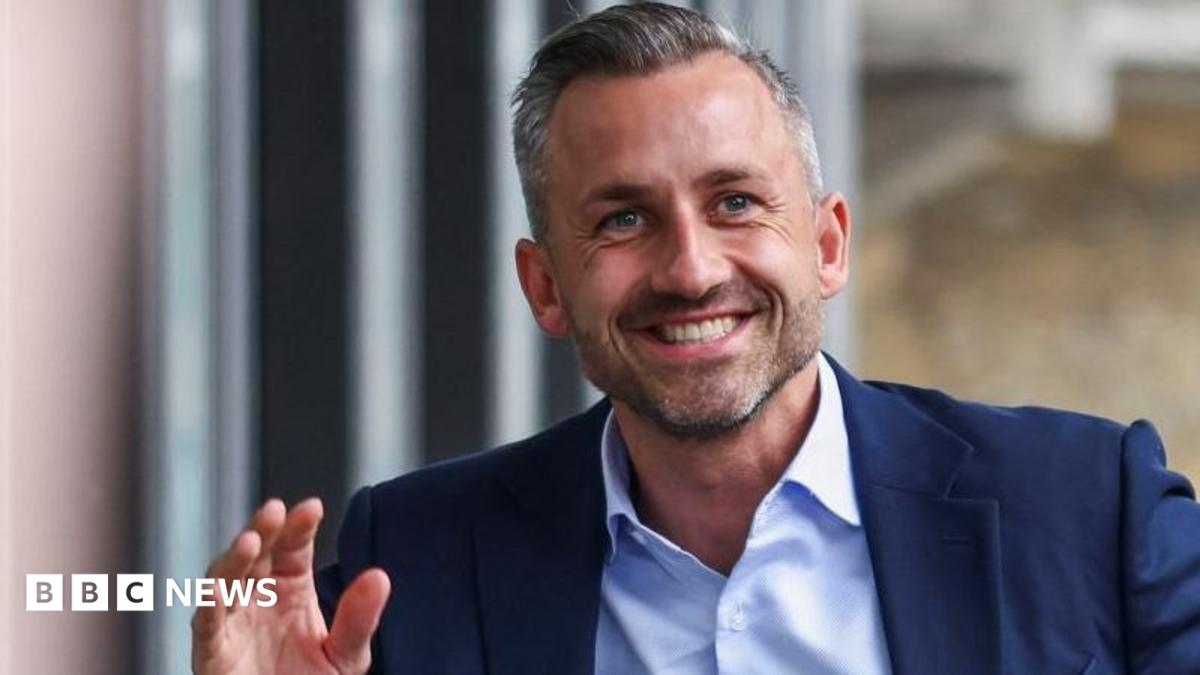
On election night, AfD’s leader in the state called on other political groups to cooperate. “As a democrat, I will reach out to all those who wish to work with us to bring about a fundamental political turnaround,” Ulrich Siegmund said.
Yet, forming a government will prove difficult. The AfD has been classified as “far-right extremist” by the domestic intelligence agency and other political groups remain wary of striking an alliance.
The AfD has dismissed accusations of extremism and mainstream parties have been unable to halt its surge in the polls over recent months. Latest polling indicates the party, which stands for strong restrictions on immigration, restoring ties with Russia, cutting support to Ukraine and quitting the euro, is Germany’s most popular at national level.
The Saxony-Anhalt election could be a harbinger of a historic return of the far-right in the 2029 national election, when forecasts say the AfD stands a realistic chance of finishing first.
What happened in Saxony-Anhalt?
Siegmund, the charismatic 35-year-old who attracted thousands to his campaign rallies, said AfD “made history”.
“The people have made it absolutely clear that they finally want political change and, above all, they have shown that they want it with us,” he told supporters.
The AfD achieved its best-ever election result in Saxony-Anhalt with 44 percent of the vote, leaving all other parties far behind. The incumbent centre-right Christian Democrats (CDU), led by Chancellor Friedrich Merz, scored less than half of that share with 17 percent.
The AfD is projected to gain 39 of the 83 seats in the state parliament in Magdeburg, leaving it three short of the 42 needed for an absolute majority.
That means the party must find allies, but all other mainstream parties refuse to work with the far-right, a strategy of non-cooperation known as the “firewall”. The AfD has so far never participated in a governing coalition in Germany’s 16 states nor in its federal government.
While he now appears willing to strike deals with other parties to come to power, previously Siegmund signalled unwillingness to find middle ground with other political groups. Leading up to the vote, he stated that he was only interested in governing alone to bring about fundamental political change in Germany.
How did AfD fare in recent elections?
The election takes the AfD one step closer to advancing its agenda, while also reflecting the growing unpopularity of Germany’s ruling coalition.
In Saxony-Anhalt, the party more than doubled its vote share — from 21 percent in the last election. By contrast, the CDU’s vote halved from 37 percent to 17 percent, its worst result ever in the east-central German state.
Federal elections last year similarly resulted in a landmark performance by the AfD, which emerged as the largest opposition faction in the Bundestag, the German federal parliament in Berlin. The party came second with 21 percent of the vote, securing its highest-ever showing.
In state elections in Baden-Wurttemberg and Rhineland-Palatinate earlier this year too, the AfD more than doubled its seats — though it still finished third. In 2024, the AfD emerged victorious in the Thuringia state election and second in the Brandenburg state election — both were firsts for the party.
The AfD’s electoral gains in Saxony-Anhalt mirror growing dissatisfaction among voters — especially in the former East Germany — about the stagnant economy, high unemployment and domestic security, which the party largely pins on immigration.
What challenges lie ahead for AfD?
Since its formation in 2013, the AfD has been embroiled in various scandals and has faced major controversies, including alleged foreign espionage links, secret deportation plans and internal nepotism.
The party went from a fringe Eurosceptic group to the country’s most powerful opposition force in little more than a decade, becoming too extreme even for the European Parliament’s far-right Identity & Democracy group. It kicked the party out in May 2024 after lead AfD candidate Maximilian Krah stated that not everyone in the SS – Adolf Hitler’s infamous Nazi paramilitary organisation – was a criminal.
Krah has also been under investigation by German prosecutors for alleged illegal payments, bribery and money laundering linked to China and Russia. The German parliament last year decided to lift the far-right legislator’s immunity to help investigators.
AfD politicians have also come under fire for employing family members, including in Saxony-Anhalt, where several parliamentarians are reported to have employed relatives.
Bundestag President, Julia Klockner, banned seven AfD employees from entering the German parliament over security concerns, after they failed internal background reliability checks due to their ties to right-wing extremist networks and past criminal convictions.
Senior AfD figures also faced a backlash for attending a secretive meeting to discuss mass deportation plans for people with a migration background.
What are the AfD’s prospects for the national election in 2029?
Pollsters are unanimous in forecasting the AfD as the largest party in Germany in the next national election in 2029, with around 28 percent of the vote.
That would mark a major transformation in the German political landscape from 2025, when the CDU and its ally the Christian Social Union together won 28.5 percent of the vote.
Yet even that outcome would not necessarily give AfD the ability to govern. If other parties maintain a “firewall” policy, that could prevent the far-right party from forming a coalition government.
Still, the Saxony-Anhalt election has been received by some politicians as a call for change. “Politics begins with considering reality,” Cem Ozdemir, head of government in the southwestern state of Baden-Wurttemberg and a member of the Green Party, wrote on X.
“That means the AfD is the election winner in Saxony-Anhalt. And that must mean for all democratic forces that nothing can remain as it is, and we must fundamentally reconsider our politics and our political style.”
“Pravac Potocari” or “Direction Potocari” were the words used by former Bosnian Serb general Ratko Mladic as he entered Srebrenica on July 11, 1995.
Mladic was referring to the nearby village of Potocari, which hosted a United Nations peacekeeping base and was the initial gathering point for Bosniak refugees during the war in Bosnia. Under Mladic’s command, Bosnian Serb forces committed a genocide against thousands of Bosniak men and boys in the days that followed.
“Pravac Potocari” was also the slogan the fans of the Serbian football team Red Star chose on Sunday to honour the so-called “butcher of Bosnia”, who died in The Hague, the Netherlands, on August 27, while serving a life sentence for genocide, war crimes and crimes against humanity. During a match against city rivals Partizan in the Serbian capital, the supporters also unveiled a giant image of Mladic and observed a minute of silence in his memory.
The tribute came days after European football governing body UEFA fined Red Star a total of 98,250 euros, or $114,100, over a banner -“General, eternal glory and thanks” – dedicated to Mladic that was unveiled by the club’s ultras during a Europa League playoff away leg in Plzen, in the Czech Republic.
The penalty included a ban on Red Star supporters travelling to the club’s next two European away fixtures, in Lugano, Switzerland on October 15 and Ghent, Belgium on November 26.
It was not the first time Red Star supporters had expressed support for Mladic during a European match. Nine years earlier, fans displayed similar messages during a Europa League tie against Belarusian club BATE Borisov.
‘Most shameful event this stadium has seen’
For Slobodan Georgiev, a news director at TV Nova S in Serbia, the minute of silence at Belgrade’s Marakana stadium marked a qualitative shift rather than a repeat performance.
“Glorifying a convicted war criminal is nothing new, but officially paying tribute to him with a minute of silence is new – and it’s the most shameful event this stadium has witnessed,” Georgiev said. “Displaying the shameful slogan ‘Pravac Potocari’ cannot be justified, though in the coming days we’ll surely see attempts to do so.”
He placed the display in a much longer lineage. “Since the breakup of Yugoslavia, the terraces have served as a recruitment centre for paramilitary formations, and in various forms that haven’t changed to this day,” he said. “The worst messages have always travelled through the terraces – everything the authorities didn’t dare say themselves, they most often said through the stands, as they did … at the Red Star–Partizan match.”
But what made Sunday’s so-called “eternal derby” notable was not only the Red Star display.
Partizan’s own hardcore supporters, the Grobari, had raised their own banner in tribute to Mladic – reading “General, thank you” – just a week earlier, on August 31, during a Serbian Super Liga match against OFK Beograd, with Mladic’s flag flying over the north stand for the full 90 minutes.
For Georgiev, the fan groups are not an autonomous phenomenon, but an instrument. “The state, through its secret services and through criminal groups, has always managed these groups and used them for the worst tasks: Mobilisation in war, crime in peacetime, and delivering the ugliest political messages,” he said. “A stand that boasts it was founded by Zeljko Raznatovic Arkan, and that sings in praise of Ratko Mladic without facing any legal consequence for it, speaks for itself.”
Georgiev was referring to Arkan, the Serbian paramilitary leader whose unit committed atrocities during the Yugoslav wars and who, before his assassination in Belgrade in 2000, was closely associated with Red Star’s hardcore fan base, the Delije – a group he is widely reported to have helped organise.
‘Clearest indication issue deeply ingrained’
Sasa Djordevic, a senior analyst at the Global Initiative Against Transnational Organized Crime (GI-TOC), sees the same continuity Georgiev described, tracing it back further still. “The connection between football hooliganism, nationalism and politics in Serbia dates to the late 1980s and became particularly evident during and after the breakup of former Yugoslavia,” he said. “Certain elements of the hooligan scene have since been exploited as a political ‘rent-a-mob,’ and some group leaders have reaped benefits from political protection or business opportunities.”
What worries him most now is not the display itself, but how unremarkable it risks becoming. “Incidents like those that occurred at Marakana last night risk being perceived as routine rather than serious manifestations of hate speech,” he said. “Public debate has nearly vanished, and society seems increasingly desensitised to violence and hate speech in stadiums. When such behaviour starts to feel normal, it may be the clearest indication that the issue has become deeply ingrained.”
Ivana Jeremic, an editor at the Balkan Insight publication, pointed to why sports venues serve that function so well. “Stadiums have long ceased to be merely sporting arenas – they are fertile ground for sending messages that can’t be spoken publicly, or that come wrapped in a softer form,” she said. “Matches involving Partizan, Red Star, and the national team stand out in particular for this.”
The political ties, she argued, are an open secret. “The political connections between the fans leading the stands and those in power are something of a public secret, with a number of documented examples of direct influence. What we hear or see on the terraces could hardly happen without some form of ‘permission’ from the authorities,” Jeremic said. “When it comes to Mladic, we’ve seen a rise in such messages in recent days. Red Star’s fans, as well as the club itself, are currently perceived as a mouthpiece of the government.”
On Thursday, a Serbian government plane carried Mladic’s body from The Hague to Belgrade for burial, where it was received with military honours.
Red Star fans wave a flag showing Ratko Mladic during the match against Partizan [Darko Vojinovic/AP Photo]
From the terraces to paramilitary structures
Djordevic traced the mechanism behind this convergence to the same period cited by Georgiev. “During the breakup of Yugoslavia, football stadiums became spaces for nationalist mobilisation, and for some young men the step from organised football violence to paramilitary structures was short,” he said. “Hooligan groups since then cultivate loyalty, hierarchy, readiness to use violence and rapid mobilisation to achieve their extremist views that go beyond strictly football supporter beliefs.”
That structure is not unique to Serbia, but it is particularly acute there. GI-TOC’s regional research examined 122 fan groups, identifying 78 as ultras – and found 21 groups combining violent hooliganism with links to extreme politics. “The most problematic situation was in Serbia, followed by Bosnia and Herzegovina,” Djordevic said, while cautioning against overreach. “The term ‘terrorism’ should be used cautiously: The evidence points to particular groups or individuals linked to violent extremism and paramilitary structures, not supporter groups as a whole.”
UEFA’s disciplinary decision detailed the layers of the punishment: A 50,000-euro ($58,000) fine for transmitting a message unfit for a sporting event, an 8,250-euro ($9,580) fine for team misconduct, and the activation of a suspended sanction originally imposed in April 2025 over racist conduct by Red Star fans – a suspended stadium ban now converted into a one-match travelling ban, conditionally extended for a further two years.
But fines on paper, Djordevic said, rarely reach the people who are actually liable. “The problem is that fines imposed on clubs do not necessarily affect those responsible for the incidents,” he said. “If hooligans remain untouched, financial penalties can become simply another cost of doing business rather than a tool for changing behaviour. That does not mean clubs do not care. They respond when sanctions are certain, substantial, and consistently enforced, as seen more clearly in basketball games than in football.”
The gap, he argued, is not a lack of rules. “Serbia already has a solid legal framework,” he said. “The real issue is enforcement. Sanctions need to be applied quickly, consistently and without exceptions, both to clubs and to individuals responsible for violence and hate speech.”
NEW YORK: Defending champion Carlos Alcaraz will be under the microscope again on Sunday taking on 20th-seeded American Tommy Paul for a place in the US Open quarter-finals.
The Spaniard, playing his first tournament since a four-month absence with a wrist injury, acknowledges he has yet to play his best but says he’s “getting there” with both the sharpness of his shots and his on-court decision making.
He headlines a day that also features women’s two-time defending champion Aryna Sabalenka and third-ranked American Jessica Pegula — just one of the players with a chance to supplant Sabalenka atop the world rankings in New York.
Surprise Wimbledon champion Linda Noskova will try to continue her progress toward another Grand Slam against dangerous Ukrainian Marta Kostyuk while US hope Frances Tiafoe faces the always tricky former champion Daniil Medvedev.
AFP Sport looks at three matches to watch on Day 8 of the US Open:
Tommy Paul (USA x20) v Carlos Alcaraz (ESP x2)
Alcaraz leads head to head 6-2
— Although Alcaraz has dominated their meetings — Paul’s last win over the Spaniard was back in 2023 — the defending champion said the American is “really dangerous for everyone on the tour.
“The way he plays, the way he hits the ball, it’s really complicated to dominate the ball, dominate the points,” said Alcaraz, who won their last meeting in the Australian open quarter-finals on the way to the title that made him the youngest man to claim a career Grand Slam.
Alcaraz said he was looking forward to another great battle — and having some fun.
“We pull off great points, great shots,” he said. “It’s going to be really fun to watch, fun to play, as well.”
Ben Shelton (USA X8) v Stefanos Tsitsipas (GRE)
Tsitsipas leads head to head 1-0
— A resurgent Tsitsipas has Shelton’s attention. The former top-five player from Greece upset red-hot Arthur Fils in the first round and ousted 18th-seeded Jiri Lehecka in the third and is deeper into a Grand Slam than he’s been in more than two years.
Playing pain free after back problems derailed his 2025 campaign, the two-time Grand Slam finalist is also working with a new coach, having replaced his father Apostolos in that role.
“I have been watching his matches,” Shelton said. “I think he’s playing great. I think that his style of tennis can be very, very effective on all surfaces, all-court game, great athlete.”
Shelton said his three four-set wins in the first three rounds — against Tallon Griekspoor, Hubert Hurkacz and Denis Shapovalov — had him well prepared for anything Tsitsipas might throw at him.
“I think this is a great way to start the tournament in terms of variety. I have dealt with a lefty, dealt with a big hitter, dealt with a feel guy, dealt with a massive server, dealt with a spot server, serve and volleyer.”
Aryna Sabalenka (BLR x1) v Taylor Townsend (USA)
First meeting
— Sabalenka knows she’ll be in hostile territory when she takes on 96th-ranked American Townsend on Arthur Ashe Stadium.
“I think I’m ready for the crowd situation,” Sabalenka said. “She’s, I’d say, tricky player, because she brings the variety — comes to the net, really make you think during the game.”
Townsend is in the fourth round for a second straight year, but it has been anything but a straightforward 12 months for the 30-year-old, who says she has “been through a lot over this past year.” It hasn’t dimmed her desire to win, and Townsend said she was “pumped” to take on Sabalenka in a quest for a first Grand Slam singles quarter-final.
“I’m built for these moments,” Townsend, a three-time Grand Slam doubles winner, said. “I’m ready to take it. I’m ready to go.”
The far-right Alternative for Germany (AfD) is “very, very close” to taking power, its deputy parliamentary leader has told the BBC, after a historic victory in elections for the eastern state of Saxony-Anhalt.
Sunday’s preliminary results show it fell three seats short of an outright majority, with 43.8% of the vote. It is now seeking support from other parties or individuals in order to govern.
While most German political parties refuse to work with the AfD, Beatrix von Storch called for its opponents to enter talks and said: “You cannot say I do not accept the vote of the people”.
Germany’s Chancellor Friedrich Merz said he was “deeply shocked” by the result, describing it as “seismic… not just in the country but also in my own political party and I take that very seriously”.
His party, the conservative CDU, saw its share of the vote almost halved to 17.2% in the state’s preliminary results.
Merz said it was not possible to return to “business as usual”, adding that the country needed “profound reforms” and the CDU needed to “reach people at an emotional level.
“This election result is a seismic result not just in the country but also in my own political party and I take that very seriously,” he said.
No far-right party has controlled a German state since World War Two, and governing at state level would mean powers over policing and local education.
Von Storch said the state’s results “were on the table and now democrats have to talk to [one] another. This is what democracy demands”.
She added that if parties refused to work with the AfD, “then we might end up in severe chaos and maybe we have a new election”.
Her comments were echoed by AfD’s leader in Saxony-Anhalt, Ulrich Siegmund, who told a news conference on Monday that the party had won a “clear mandate to govern”.
The state’s defeated premier, the CDU’s Sven Schulze, also said the mandate to govern Saxony-Anhalt “now lies with the AfD”.
Saxony-Anhalt has a small population of 2.1 million and the AfD in the state is assessed by domestic intelligence as “right-wing extremist”, a classification rejected by Siegmund, 35.
The party’s plans for Saxony-Anhalt, which include segregating child refugees into special classes and setting up a task-force to help detain and deport migrants who no longer have the right to be in the state, are highly controversial within Germany.
Siegmund said discussions with other parties were initiated on Sunday night and could potentially take days or weeks to conclude.
“We reach out to everybody first, we will have consultations and then we’ll see whether [there are] individual parliamentary groups or MPs who would be willing to help us,” he added.
The AfD is currently heading for 39 seats in the 83-seat state parliament instead of the 42 needed for an outright majority, although the result has not yet been finalised.
Von Storch told the BBC the AfD was talking to individuals within the CDU group – the largest party in both the state’s outgoing coalition and Germany’s government – because they were “very, very unhappy with their own party”.
Inside the Universalist Unitarian Church of Riverside, a line of masked people filed into the red-lighted chapel, one by one, to take part in the rite of confession.
The private booth was framed in flowers, and rather than a priest listening inside, it was a microphone recording their confessions, to be played at an upcoming art exhibition. The brick triangle-roofed church that held the booth has stood since opening in 1892; that night, it was the site of a masquerade, or as Riverside artist Perry Picasshoe called it, the “Masqueerade.”
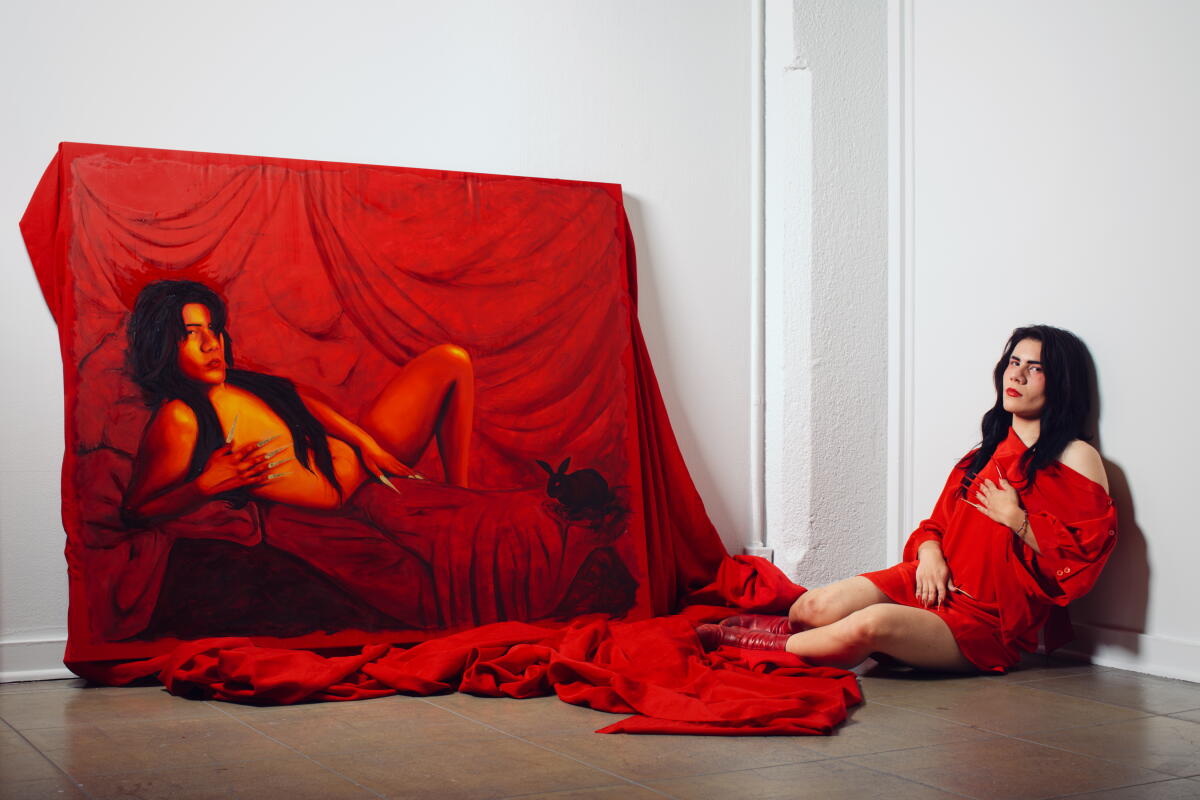
Picasshoe, whose real name is Neveah Marquez, hosted the event, which had an entirely LGBTQ+ guest list and one requirement: Bring a mask, whatever that looks like to you.
Marquez, a 26-year-old transgender woman robed entirely in red, stood at the pews and danced to the experimental electronic DJ sets and drag performances as guests entered in masks that ranged from papier-mâché deer antlers to collaged photos of eyes and lips.
The event came as a celebration ahead of the Riverside native’s first solo exhibition, “SagradX,” which will open Saturday at Riverside Art Museum and remain through Jan. 31.
The recorded confessions, layered over one another until they become an unintelligible cacophony, represent just one piece of the 25 paintings, photographs and interactive displays in the exhibition. The show explores the meaning of “sacred” as Marquez documents her most private places and experiences, and asks viewers to consider what they hold sacred.
The exhibition, she says, began with heartbreak.
Neveah Marquez (Perry Picasshoe), 26, sits inside the Riverside Art Museum.
(Carlin Stiehl / For De Los)
“The first time I started thinking about sacredness … was when my ex-partner brought somebody into our bed,” said Marquez.
“I was crying, distraught, and drove over to these hills over Lake Mathews [in Riverside] and I realized: The bedroom was sacred to me. That’s why it hurt so much. And I started thinking, if it wasn’t sacred to them, how do we decide what is sacred to each of us?”
The very headboard of that bed sits in the exhibition; on it, Marquez painted fairy-tale creatures representing the lovers gallivanting across the woods.
While Marquez’s experience with betrayal sparked the idea, the exhibition explores sanctity in many different scenarios: In one, the artist plays with the concept of the digital safe space by inviting guests to look through her phone as she is tied on a handmade iron-wrought cross. Inside the exhibition space, she uses a small painter’s brush to slowly paint the white walls red over the course of the show.
In curating the exhibition, Marquez began to look inward, painting and photographing herself in ways she never had before: through the lens of femininity. She lived the previous 26 years of her life as a man, growing up religious to the point that she once considered becoming a priest. The paintings serve as portals into a part of her that she long held inside.
“I describe it like having blurry vision your whole life and not realizing how clearly you can see, until you put glasses on,” Marquez said. “That’s how painting myself as a woman felt.”
Neveah Marquez (Perry Picasshoe) considers what is sacred.
(Carlin Stiehl / For De Los)
Though she initially identified with her male birth name, the more she painted herself in Venus-like, feminine poses and with longer hair, her understanding of her identity shifted. Illuminated by her signature scarlet red clothing and tastefully shrouded in sheets, the soft expression on her face was inspired by Raphael’s “La Fornarina.”
“I wasn’t thinking much of it in the moment, but as I kept painting these portraits, I was thinking a lot about myself and thinking about gender and my identity,” Marquez said. “Through my art process, I realized: ‘Maybe I would be a pretty woman.’ That’s what scared me the most from transitioning, was not feeling like I would be beautiful enough.”
In “SagradX,” Marquez’s body is documented vulnerably; easing into her own identity becoming a painfully honest artistic process, which the audience is now invited to watch.
“I feel like I don’t paint very often because when I do, it’s just so emotionally intense. Like when Olivia Rodrigo wrote that she’s scared of her guitar because she couldn’t lie to it, that’s how I feel about painting,” Marquez said. “I can’t lie to my painting.”
Neveah Marquez (Perry Picasshoe) wears long, flowing red clothes.
(Carlin Stiehl / For De Los)
Aside from her self-portraits, Marquez includes photographs of her ice blocks project, in which she placed 25-pound blocks where immigration enforcement raids took place in the Inland Empire last year. These were once safe places that she says have been “desecrated with fear.”
Marquez’s personal journal, which documented her inner joys and struggles over the last year, is also open on a table in the exhibition for guests to read through, draw over, or tear. For Marquez, “SagradX” was the catalyst to “let everything out.”
“If the show is about vulnerability, I need to practice that for myself as well. Otherwise, you would see in the work that there’s a blockage, you can sense when artists aren’t fully honest,” Marquez said. “I want people to question, ‘What is sacred to you?’ If I give you access to something sacred to me, what will you do with that?”
The funeral of convicted war criminal Ratko Mladic has been held in Serbia’s capital with state honours, and attended by thousands. The former Bosnian Serb commander was found guilty of genocide against Bosniak Muslims in the 1990s. He died serving a life sentence at the ICC in The Hague.
Video captured the moment an Amazon Prime plane overran a runway in Miami and crash landed, skidding into a carpark at the airport. At least five people were killed.
Stars including Kate and Rio Ferdinand as well as Venezuela Fury and new husband Noah have flown into Vancouver for the new series, of I’m A Celebrity: Wild Frontier, it has been reported
13:26, 07 Sep 2026Updated 13:51, 07 Sep 2026
I’m A Celebrity… Get Me Out Of Here! The Wild Frontier revealed in trailer
A trailer for I’m A Celebrity’s new Canadian spin-off show has been released as Ant and Dec embrace the outback.
I’m A Celebrity…The Wild Frontier will be hitting our screens in 2027 with filming said to be starting soon. But in a unique twist on the Australian version, the new programme will feature celebrities competing in pairs.
ITV say we will see they will undertake gruelling trials and take on action-packed challenges to win food, all aiming to become the last pair standing. After weeks of shocks and survival in the Canadian wilderness, viewers will have the power to decide which duo is crowned the overall winners.
Viewers will be able to have their say and cast the final vote in a live grand final broadcast direct from London. Kate and Rio Ferdinand and Venezuela Fury and new husband Noah have already flown into Vancouver, it has been reported.
Brian McFadden and Keith Duffy have also been linked with the show, as has ice-skating stars Christopher Dean and Karen Barber.
Eternal singer Louise Redknapp will join the series, alongside her brother, Joe Nurding – with influences Paul Olima and Jeremy Lynch also set to fly out, reports state.
Ant said: “This brand new series is I’m A Celebrity… like you’ve never seen before. It’s a brand new format with lots of twists and surprises”.
His co-star Dec added: “We’re also making sure to retain some of the elements that we know viewers love from the Australian series. Buckle up, it’s going to be brilliant.”
Set in the untamed wilderness of Canada, the series will feature celebrities competing as pairs alongside relatives, loved ones or even fellow celebrities. So for example it could be two celebrities together, a celebrity and a family member, or a celebrity and their best friend.
Katie Rawcliffe, Director of Entertainment, Reality & Daytime ITV said: “I’m A Celebrity…The Wild Frontier is a brand new series from the award-winning I’m A Celebrity… team. The format takes duos to the most spectacular locations in Canada. The duos enter as a pair, play as a pair and leave as a pair.
“With all the brilliant DNA of I’m A Celebrity…, brand new gameplay and the dynamics of living and playing with your spouse, best mate or sibling, it promises to be a treat for audiences in 2027.”
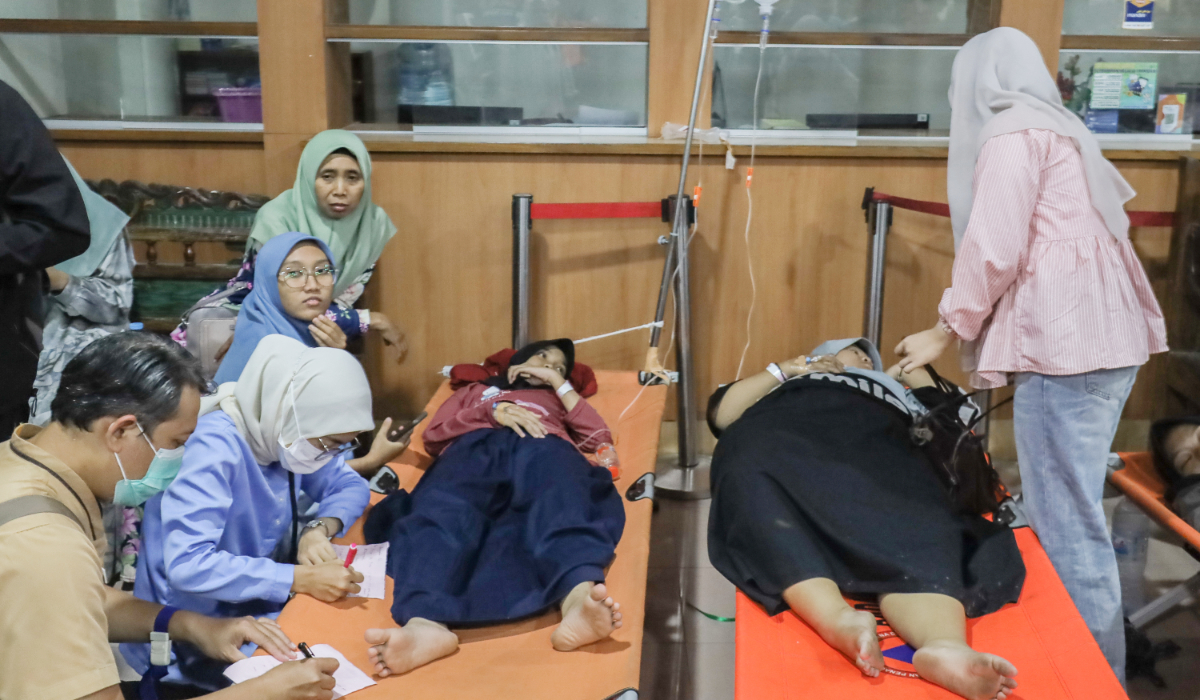
JAKARTA, Indonesia: Nearly 2,000 people, most of them students, fell ill in suspected food poisoning outbreaks linked to President Prabowo Subianto ‘s flagship Free Nutritious Meals program this week, raising fresh concerns about food safety as the government rapidly expands the multibillion-dollar initiative nationwide, officials said Saturday.
The incidents, reported between Tuesday and Thursday in East Java, Central Java, West Sumatra, Aceh and South Sulawesi, affected about 1,950 students, teachers and Islamic boarding school pupils who became sick after consuming meals distributed under the government program, known by its Indonesian acronym MBG.
The outbreaks are the latest setback for Prabowo’s signature free meals program, which has been rolled out across the archipelago despite repeated food poisoning incidents and corruption allegations.
The largest outbreak was reported in Central Java’s Rembang regency, where 752 students and 25 teachers at State Senior High School 1 Lasem, suffered diarrhea, nausea, vomiting and stomach pain after eating meals provided through the program, according to Rembang Health Office head Ali Syofi’i.
In Sidoarjo, East Java, 730 people, most of them students at the Manbaul Hikam Islamic boarding school, were affected in another suspected food poisoning incident linked to the program. Sidoarjo health office chief Lakhsmie Herawati Yuwantina said 706 victims had been discharged and were recovering at home.
Authorities also reported 276 suspected cases involving students and teachers in Agam regency, West Sumatra, where food distribution from the local nutrition service center was suspended pending an investigation. In Aceh’s Bener Meriah regency, 15 elementary school students and a school principal were treated after experiencing dizziness, nausea and other symptoms following a school meal.
Another 152 students from two junior high schools in Tana Toraja, South Sulawesi, were treated at three hospitals after developing symptoms consistent with food poisoning. Regent Zadrak Tombeq ordered hospitals and health centers to prioritize treatment for the victims.
No deaths have been reported, and authorities are investigating the causes of the outbreaks.
The latest incidents add to a growing number of food poisoning cases linked to the program since its launch in January 2025. According to Health Ministry surveillance data as of Sept. 2, food poisoning incidents associated with MBG have affected 50,059 people in 560 cases across 245 districts and cities in 36 provinces.
In a hearing with the House’s Commission IX overseeing health issues, National Nutrition Agency chief Sudaryono said internal reviews found that roughly 80 percent to 90 percent of previous food poisoning incidents were linked to failures to follow food safety procedures, including rules governing food storage, receipt of ingredients, temperature control and consumption deadlines.
“The recent incidents in Sidoarjo, Agam, Rembang and other areas have been a major blow for us,” said Sudaryono, who like many Indonesians uses a single name.
He said the agency was tightening oversight of meal providers and reviewing about 27,000 meal distribution centers nationwide. Inspectors have found hundreds of allegedly fictitious facilities, while at least 833 kitchens have been shut down for failing to meet hygiene and sanitation standards.
The free meals program aims to combat malnutrition and reduce childhood stunting by providing meals to nearly 90 million students, toddlers and pregnant women. The initiative, expected to cost about $28 billion through 2029, is a cornerstone of Prabowo’s administration and one of his key campaign promises.
Dambrauskas says he had known since the age of 12 he would not make it as a player, but coaching would keep him close to football.
He arrived in London in August 2002 aged 25 on a student visa with limited English.
What followed would be eight years of hard work where he would coach for community projects, at a semi-professional club, within professional youth programmes – and hold down multiple jobs while raising two children.
In 2004 he enrolled on a course in sports science and coaching at London Metropolitan University, the first real step in his career.
Then he started out coaching by volunteering with the Access to Sports Project for deprived children in Finsbury Park.
He went on to work with London Tigers, a charitable community organisation which runs teams from junior level right through to semi-professional.
Starting out as a volunteer, across five years he progressed to manage the first team in non-league football in the Spartan South Midlands League, FA Cup and FA Vase.
Dambrauskas became the first Lithuanian to achieve a Uefa coaching licence through the London Football Association.
“I went on every possible course, every possible conference, London Football Coaches Association meetings,” Dambrauskas said.
“Everywhere I could go just to gain some information, some knowledge, some extra diploma, extra course.
“That was very important for me and I took my chances.”
He got his first break at a professional club when Manchester United Soccer Schools took a chance on him in 2004.
Dambrauskas spent five years coaching on residential courses in the UK and in Europe.
“That was the best thing that could happen in my life,” Dambrauskas said.
“I went through three or four interviews. I will be forever grateful to [Foundation chief executive] John Shiels, the way he gave me this chance, because I didn’t have experience.
“I’d never been in a place with so many great personalities as I got in the Manchester United Soccer Schools.”
After a short spell with Fulham, Dambrauskas moved to Brentford. He credits academy director Ose Aibangee as one of the biggest influences on his career, pushing his limits.
All the while he was juggling home life and working multiple jobs to make ends meet.
“I was a gardener, a handyman, doing newspaper rounds at the beginning, also polishing floors in a pub,” Dambrauskas said.
“So many jobs. Working in retail, and then as a sports development officer, then a sports development manager, and the central YMCA.
“I was doing two, three, sometimes four jobs.”
As well as the trip to Manchester United this week, Sabah will complete their Champions League group games at Arsenal in January.
This also feels like fate for Dambrauskas – one of the buildings at London Metropolitan University on Holloway Road overlooked Emirates Stadium.
When asked about his time in England, Dambrauskas’ face lights up.
“When I hear this word ‘England’, it for me sounds like opportunities,” Dambrauskas said.
“It was really amazing. England gave me all this and I’ll forever be grateful.”
It was 1963 and up-and-coming freelance journalist Gloria Steinem had been a working writer in New York City for roughly three years when Show magazine sent her on an undercover assignment that she was uniquely qualified for: to infiltrate Manhattan’s “greatest new showbiz gimmick,” the Playboy Club. She already had the beauty and brains, all she’d need was an alias, a leotard and a notebook. The assignment would change the course of her career, but not in the way that she’d hoped.
“GIRLS:
Do Playboy Club Bunnies Really
Have Glamorous Jobs,
Meet Celebrities, And
Make Top Money?
Yes, it’s true! Attractive young girls can now earn $200-$300 a week at the fabulous New York Playboy Club, enjoy the glamorous and exciting aura of show business, and have the opportunity to travel to other Playboy Clubs throughout the world.”
Armed with the above ad and welcomed by a grinning private guard calling, “Here bunny, bunny, bunny!” Steinem set out to expose the working conditions and interior lives of the bunnies slinging booze to the playboys who patronized the club. She subjected herself to the wardrobe fittings, which included getting her bunny suit stuffed to boost her breast size; she was poked and prodded during an invasive physical exam; she strutted through the club near-naked with sore feet and a suit so tight, she had to wrap gauze around her midsection where her skin had been rubbed raw; and various other indignities she underwent for the sake of journalism.
Documenting a lunch shift at the club, Steinem wrote, “Somehow, the usual tail pullings and propositions and pinching and ogling seemed all the more depressing when, outside this windowless room of perpetual night, the sun was shining.”
Steinem’s article accomplished what it set out to do, and not only were the working conditions at the club exposed, but some were subsequently improved because of her work. In her essay collection “Outrageous Acts and Everyday Rebellions,” Steinem wrote that in response to the story, Hugh Hefner wrote her a letter saying that her “beef about the physical given [to] the girls before they start work at the club prompted my eliminating it.”
Also as a result of her piece, she was slapped with a $1-million libel suit, subpoenaed as a witness in a liquor laws case against the Playboy Club, and received “obscene and threatening” calls.
Most notable, of the short-term results of the story, was the immediate impact it had on her career. Sure, in a lot of ways it had put her on the map, but she struggled to land serious journalistic assignments because, as she put it, “I had now become a Bunny — and it didn’t matter why.”
Steinem, a feminist icon and one of the most widely recognized leaders of the second-wave women’s movement, died on Wednesday at 92. Since she shed the bunny suit after her 11-day stint on the job at the Playboy Club, she went on to cofound New York Magazine and Ms. Magazine, which changed the course of the abortion rights movement with its “We Have Had Abortions” petition in which high-profile women admitted to having illegal abortions, Steinem among them. She played a pivotal role in spearheading some of the most influential and successful women’s rights efforts. And in 2013, she was awarded the Presidential Medal of Freedom for her lifetime of work as a journalist and activist.
Still, with all the aforementioned accomplishments, and decades later, Steinem said that her naysayers used her bunny work in an attempt to discredit her. For decades she considered the story a “professional error of gigantic proportions.” But later, she changed her tune.
“I’m not sorry I did it,” she told Ronan Farrow in 2020, when she was 86 years old. “But it is true that as old as I am, when anybody wants to put me down, they say, ‘Well, she was once a bunny.’ ”
In Steinem’s “Famous Last Words” interview, released on Netflix following her death, she closed the segment by addressing the audience. “Please tell your own story,” she said. “This is the most important thing we can do for each other: is to know each other through stories.”
I was hesitant to tell this story, and stewed over the potential risks I would be taking by telling it, but then I thought of the risk Steinem took. She dealt with fallout and she grappled with the ways the article may have hurt her career more than helped. But of the ample wisdom she imparted, its the power of women’s stories to shift culture, change policy and empower other women that feels most resonant.
I didn’t discover Steinem’s “I Was a Playboy Bunny” exposé until I was in college. I was in my late twenties at the time because I’d taken a few detours after I left high school, most of them dead ends.
One such detour led me through the massive hedge-lined gates of the Playboy Mansion. I was 18, and the E! reality series “The Girls Next Door” sparked renewed interest in Playboy bunnies. I wish I could say that I’d arrived at the mansion on an undercover magazine assignment, but the reality was different. I’d been watching a rerun of the E! show from a bedbug-ridden townhome in downtown Los Angeles, and earlier that day I grappled with whether I should pay my parking debt or buy a burrito.
I watched as the girls bounced around the mansion, appearing carefree, bedbug-free and parking ticket-free. Their lives, produced and edited as they were, appeared to be stable and glamorous, and I thought, “Hmm, maybe I should do that.” If Hefner was good at anything, it was creating a facade.
Like Steinem found, applying to be a Playboy bunny was surprisingly simple. I emailed a photo of myself in a swimsuit and shortly afterward, an invitation to a casting call at the mansion arrived.
At the casting call, I was handed a satin robe and pointed toward a small tent where I could change and a large tent with the photo crew inside. Steinem had likened wearing the bunny suit to feeling like meat on a hook. I, too, couldn’t shake the thought of a meat factory and almost instantly, realized I wanted off the conveyor belt.
My trip to the mansion and endeavor to become a bunny was short-lived. I’d driven there feeling like a femme fatale, and left feeling naive and out of my depth. Worse, it was just another humiliating misadventure that I’d carry around for years with shame.
Steinem said that she was pigeonholed because of the story. She struggled afterward to be taken seriously and that may be true, but I’d argue an opposite point. Because Steinem was ultimately held in such high regard as a journalist and activist, and because she was an undercover bunny along the way, she helped the bunnies of the world to take themselves a little more seriously, to see that beyond the bunny suit, there is a world of possibilities waiting for them.
In the collection, originally published in 1983 and reprinted several times, Steinem wrote that after a town-hall meeting in New Bedford, Mass., a little girl of 6 or 7 gave her a crayon drawing of her in the bunny costume copied from a photo that had circulated online. “ ‘Even if a girl looks silly,’ she said, ‘boys should know that’s she’s smart.’ ”
“This story may outlast me,” she wrote. “but it’s not going to outlast or outsmart that little girl.”
In the book, Steinem wrote that one longer-term result of the article was “realizing that all women are Bunnies. After feminism arrived in my life, I stopped regretting that I had written the article.”
The line “All women are Bunnies” stands out. But what I imagine she meant is, bunnies are just women.
An Israeli air attack on Kfar Reman in southern Lebanon has killed at least 10 people, including an infant, with at least two others missing.
The attack early on Monday on the town in the Nabatieh district comes a day after at least seven people were killed and 20 others were wounded in Israeli air raids on the nearby town of Arab Salim.
Recommended Stories
list of 4 itemsend of list
The Israeli military also struck a residential area in the town of Deir al-Zahrani in southern Lebanon overnight after it issued a forced evacuation order. The army says it targeted a building near a Hezbollah facility, which it claims was used to launch an explosive drone.
Attacks continued despite a United States-brokered ceasefire agreement between Israel and Lebanon in June.
Reporting from Kfar Reman on Monday after overnight strikes, Al Jazeera’s Zeina Khodr said “uncertainty and fear” are the prevailing feelings in southern Lebanon. “Among the dead are children, including a two-month-old infant,” she said.
“People just do not know what is next. There’s been a wave of Israeli attacks over the past 48 hours. Civilians are being killed. Residential homes are being destroyed,” she said, adding, “Recovery efforts by civil defence workers are continuing. They’ve been here throughout the night.”
Rescue teams work to locate survivors after New Delhi building collapse.
Published On 7 Sep 20267 Sep 2026
A multistorey building in the Indian capital, New Delhi, has collapsed, killing at least six people and trapping dozens of others.
Rescue teams are searching the rubble of the collapsed building, which housed mostly students, near a Delhi University campus in Satya Niketan on Sunday.
The All India Institute of Medical Sciences (AIIMS) said it treated several victims after the incident.
“Out of the 10 patients, five were brought dead, while one patient who was in critical condition later succumbed to his injuries,” AIIMS said in a statement.
Crews from India’s disaster response agency, police and firefighters cleared debris with earthmovers and used detection dogs to search for those trapped inside. A nearby building was evacuated over concerns that it could also collapse.
Up to 40 people remain trapped under the rubble, according to fire officer Abhilash Malik. The number of survivors and the cause of the accident were not immediately clear.
A video filmed by a man trapped under the rubble as onlookers called for rescuers to help him has circulated online. Additional footage showed residents attempting to rescue survivors before disaster response teams arrived.
Security personnel stand guard as rescuers conduct a search operation at the site following a building collapse in the Satya Niketan area in New Delhi on September 6, 2026. [AFP]
“The most important thing for us is to save the lives of these students. Rescue operations will carry on,” Delhi Chief Minister Rekha Gupta told local news outlets.
“I assure you we won’t spare the guilty,” she said.
“Condolences to those who lost their loved ones. Praying for the speedy recovery of the injured. Authorities are working at the site and assisting those affected in the mishap,” Indian Prime Minister Narendra Modi’s office said on X.
Building collapses are frequent in parts of India during the rainy season from June to September. A similar incident occurred on Saturday after a three-storey building collapsed in northern India following heavy rain. No casualties were reported.
In 2025, at least 11 people were killed after a residential building collapsed in the northeastern district of New Delhi.
TELLURIDE, Colo. — The Telluride Film Festival has always enjoyed keeping a secret. Tucked away in the Colorado mountains with nary a red carpet or paparazzo in sight, the low-key film festival doesn’t announce its lineup until the day before opening and surprise additions have long been a fixture of the event.
But even by Telluride standards, organizers went to unusual lengths this year to keep their biggest surprise under wraps. They had carved out a prime Sunday evening slot for a world premiere that, fingers crossed, would remain unknown until the audience was seated inside the theater. Festival director Julie Huntsinger offered only a few clues beforehand. The film involved some “very known names,” she told The Times. “Do not miss it. Your jaw will be on the ground for the entire length of the film.”
For three days, trying to crack the mystery became Telluride’s unofficial parlor game. Was it Aaron Sorkin’s “The Social Reckoning”? Denis Villeneuve’s “Dune: Part Three”? Alex Gibney’s Elon Musk documentary “Musk”? By Sunday, the mounting speculation had become fodder for jokes: Introducing his new movie “Club Kid” earlier in the day, writer-director-star Jordan Firstman announced that the evening’s TBA would be a newly restored print of Jerry Seinfeld’s 2007 animated film “Bee Movie.” “Just kidding,” he added. “I love Jerry.”
The festival kept the suspense going right up to showtime. Before entering the Werner Herzog Theatre on Sunday evening, hundreds of moviegoers were required to lock their phones in pouches to prevent spreading the word. Inside, they were warned that security guards equipped with night-vision goggles would be watching for anyone who managed to keep a phone accessible.
Taking the stage, Huntsinger made one last plea for secrecy. “What happens in Telluride stays in Telluride,” she told the crowd, before bringing out Nathan Fielder, the deadpan comic mind behind the reality-bending television shows “Nathan for You,” “The Rehearsal” and “The Curse.”
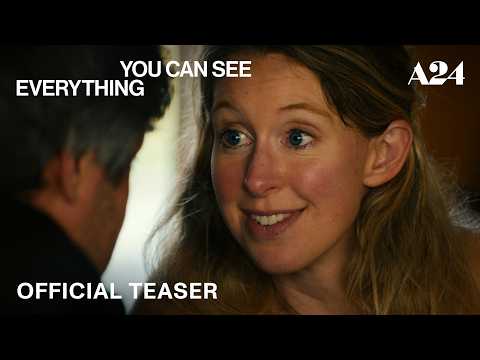
What Telluride had been guarding so carefully was “You Can See Everything,” a nearly three-hour documentary about convicted Theranos founder Elizabeth Holmes, co-directed by Fielder and documentary filmmaker Lance Oppenheim. The film, which A24 will release theatrically in October, had been made largely in secret over three years.
“For those of you who don’t know who we are and are disappointed, I apologize,” Fielder, joined onstage by Oppenheim, told the crowd to laughs. “But hopefully by the end of the film, you’ll be slightly less disappointed.”
The movie begins 34 days before Holmes is due to report to federal prison, with Fielder, Oppenheim and a small crew given extraordinary access to her life with her partner, Billy Evans, and their young children. Holmes and Evans embrace what they call “radical transparency,” opening their home to the cameras in hopes of convincing the filmmakers — and eventually the world — that the public has fundamentally misunderstood her.
But as anyone familiar with Fielder’s reenactment-heavy work can imagine, “You Can See Everything” quickly becomes something far stranger than a conventional documentary. Fielder finds himself drawn from behind the camera into the story, struggling to determine whether Holmes and Evans are being candid with him or manipulating him. From there, the movie takes a series of increasingly surreal turns, including elaborate reenactments involving a Hollywood actress (her arrival is too good to spoil) that further scramble the line between reality and performance.
During a post-screening Q&A moderated by Emma Stone, who co-starred with Fielder in the darkly comic A24 series “The Curse,” Fielder said that his own inability to get a firm grip on what he was witnessing became one of the forces driving the project.
“We’re all smart and we’re really working at the top of our intelligence,” he recalled thinking as he and the crew tried to make sense of their time with Holmes and Evans. “Why can’t we make sense of what’s happening in this house?”
The project began, appropriately enough, with a magic trick.
Oppenheim said he and Fielder were at the Magic Castle in Los Angeles several years ago when a magician asked the audience to name a celebrity. Someone called out Elizabeth Holmes. Afterward, Oppenheim told Fielder he had heard through a friend of a friend that Holmes was looking for someone to document her life.
Fielder had read John Carreyrou’s “Bad Blood,” the bestselling 2018 account of Theranos’ rise and collapse and initially saw little reason to make another documentary about Holmes.
“I thought the story was really fully told,” he told the Telluride crowd. Holmes, however, had largely disappeared from public view, and Fielder was curious about what she might have to say for herself.
Meeting her only deepened that curiosity. Sitting across from Holmes, Fielder said, he found her “sort of honest and charming,” even as his brain was warning him, “No, don’t trust.” That disconnect — between what he knew about Holmes and what he felt in her presence — became central to the movie.
A24 gave Fielder and Oppenheim unusual freedom to pursue the project without any deadline or obligation to turn what they captured into a finished film. If nothing came of it, Fielder recalled being told, “you can just throw everything away.”
Holmes founded Theranos in 2003 and became one of Silicon Valley’s most celebrated young entrepreneurs by claiming the company could perform a wide range of medical tests using only a few drops of blood. The company collapsed after investigations exposed serious problems with its technology and business practices. In 2022, Holmes was convicted on four counts related to defrauding investors and later sentenced to more than 11 years in federal prison.
As shown in “You Can See Everything,” once Holmes reports to federal prison, the filmmakers’ access to her changes dramatically, with Evans — who takes over Holmes’ Twitter feed and assumes power of attorney over her decisions — becoming their main conduit. Fielder said the relationship grew strained as Evans tried to exert greater control over the project. Neither Holmes nor Evans has seen the finished movie.
Fielder is hoping to keep the film’s biggest surprises under wraps. During the Q&A, he told the Telluride audience he hoped future viewers could experience the film without knowing where it was headed. Stone seconded the request.
“You won’t be upsetting me,” Fielder joked. “You’ll be upsetting Oscar-winning actress Emma Stone.”
Fielder said that even after three years immersed in her world, he still doesn’t know quite what to make of Holmes — or how much of what she says can be believed.
“I really am struggling to this day to understand exactly what I experienced in this,” he said. “I don’t quite know what I went through.”
As the crowd filed out of the Herzog, one reaction seemed to recur more than any other: “That was wild.”
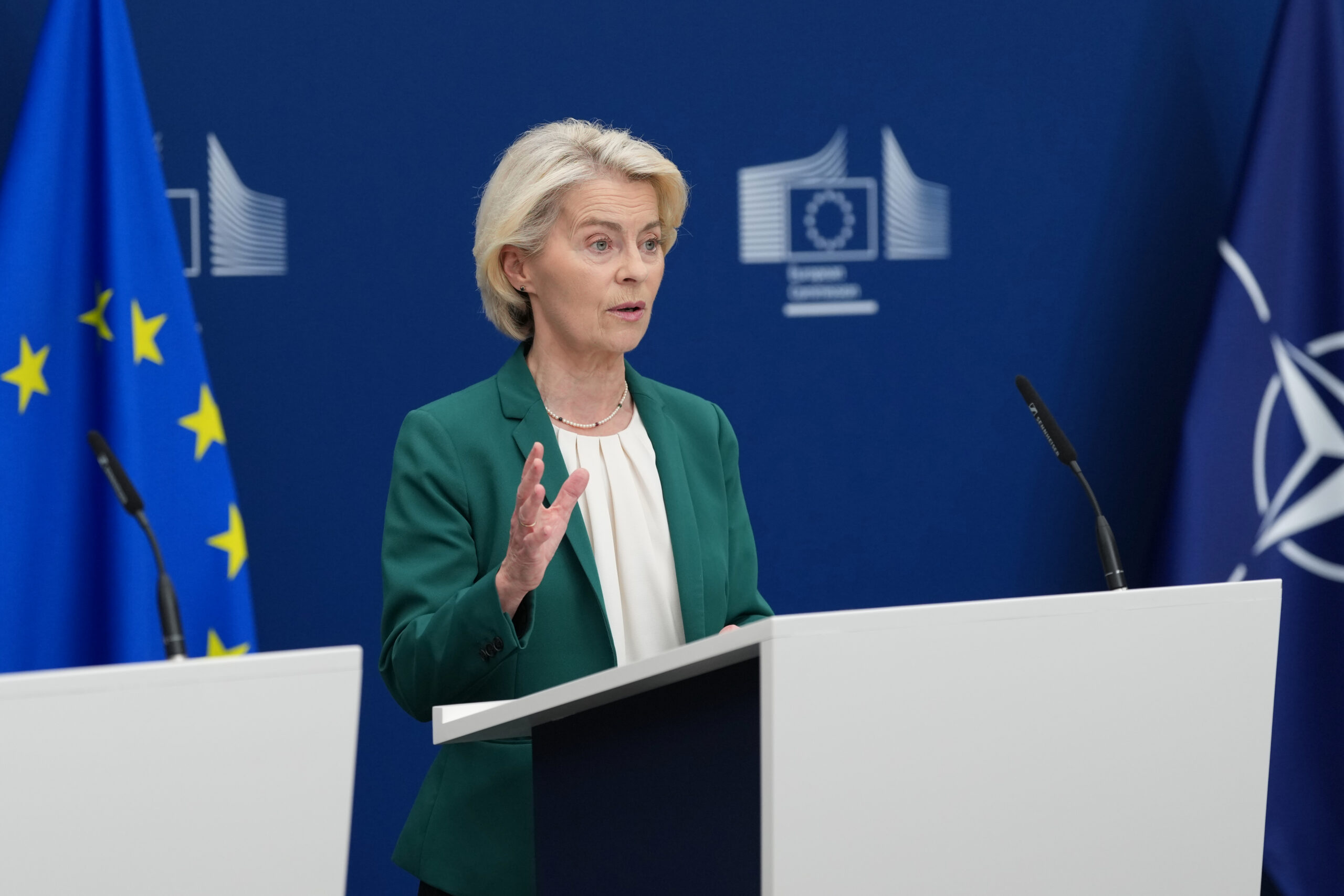
COPENHAGEN: EU chief Ursula von der Leyen heads to Greenland on Sunday for a two-day visit aimed at reaffirming the bloc’s support for the Danish autonomous territory coveted by US President Donald Trump.
On Monday, she is due to sign a joint declaration between the European Union and Greenland.
“Greenland is becoming increasingly important to the EU as a gateway to the Arctic and because of its geopolitical location, critical raw materials and role in Arctic security,” Marc Jacobsen, a researcher at the Royal Danish Defence College, told AFP.
Trump was adamant earlier this year about Washington’s need to control the vast Arctic island for reasons of national security, though he ultimately ruled out annexing it by force.
A Danish-Greenlandic-US working group has since met regularly to find an agreement on cooperation going forward.
Following Trump’s threats, European countries broadly backed Denmark and Greenland, and in January von der Leyen vowed “massive” EU investment in Greenland to step up security in the Arctic.
Greenland is not a member of the bloc though Denmark is.
Brussels has also proposed doubling direct EU aid to Greenland to 530 million euros ($616 million) under the bloc’s next budget for the 2028-2034 period.
According to the Financial Times, von der Leyen is expected to propose an additional 200 million euros in support during her visit on Sunday and Monday.
Her visit coincides with the start of NATO’s Arctic Shield military exercise, bringing together soldiers from 10 countries.
Mikaa Blugeon-Mered, a geopolitics researcher at the University of Quebec, called the timing a “not insignificant coincidence”.
The Trump administration has repeatedly accused Denmark of neglecting Greenland and Arctic security.
Copenhagen has since reinvested in the region, as has NATO, which launched its Arctic Sentry mission at the start of the year.
“The EU cannot provide Greenland with a military security guarantee in the way NATO can, but it can provide something politically important: a clear signal that Greenland is not standing alone,” Jacobsen said.
Pressure
The message is all the more important as the US has kept up pressure on Greenland — though Trump has been less vocal since a May visit by his special envoy Jeff Landry.
“We’ve been getting ‘postcards’ from Trump or those close to him about Greenland every month, showing that they haven’t forgotten,” noted Blugeon-Mered.
One such image Trump posted on Truth Social in May showed him peering over the island, with the headline “Hello, Greenland!”.
In August, media reports of an American oil company’s preparatory operations in a remote region of eastern Greenland rekindled concerns on the island.
The project, run by a Texas-based company with licenses granted before a 2021 moratorium on oil and gas exploration and extraction, has left locals and authorities uneasy.
Authorities have yet to grant the company approval for exploratory drilling, citing procedural reasons.
Greenland is also struggling to develop its mining industry, which could help it fund its independence from Denmark.
In this area, Greenlandic and European interests are “highly complementary”, Jacobsen said.
“Greenland needs investment, infrastructure and markets if it is to realise its mining ambitions, while the EU is looking for more secure and diversified access to critical raw materials,” he said.
But turning Greenland’s geological potential into reality is proving more difficult than expected.
Some 135 mining permits are held by more than 60 companies, but only two mines are currently in operation.
“The question is whether the current geopolitical momentum will ultimately be a game-changer,” Jacobsen said.
Blugeon-Mered said von der Leyen’s visit to Greenland — her second in two years — was a strong signal that European investment is long-term.
The EU chief is scheduled to hold talks during her visit with Greenland Prime Minister Jens-Frederik Nielsen, Danish Prime Minister Mette Frederiksen, and the head of government of Denmark’s other self-governing territory, the Faroe Islands.
Venezuelanalysis editor Ricardo Vaz joined Clash Point editor Isaac Eshetu to take stock of Venezuela and its present relationship with the United States. The discussion covers the kidnapping of Venezuelan President Nicolás Maduro and the political fallout in Caracas, US control over Venezuela’s all-important oil industry, and a marked foreign policy shift in recent months.
(Note: the interview was recorded on August 14, before the US and Venezuelan governments announced a “historic” oil deal)
EXCLUSIVE: There were arguments aplenty and several walkouts – but Jackie Bassett and Peter Davies say they’d still do it all over again, given the choice
00:09, 07 Sep 2026Updated 07:30, 07 Sep 2026
The final emotional episodes go back over the lives of all of the contributors, since 1964(Image: Nick Wall)
In 1964, 14 children aged seven were plucked from obscurity to take part in the TV experiment Seven Up!, which would follow them every seven years to see how their different starts in life would affect them.
The nation has long been fascinated by these kids, who have now (mostly) reached the grand age of 70. Two of them have died, along with the show’s long-term director Michael Apted, who went on to have a career making films in Hollywood.
Two of the most outspoken were Jackie Bassett and Peter Davies – and both say that, despite everything they didn’t like over the decades, they’d do it all again.
Left-wing Peter, from Liverpool, was working as a teacher at a comprehensive in 1984 when 28 Up aired. He was vilified by the right-wing press for calling the Thatcher government “the most incompetent, uncaring bloody shower we’ve ever had” and pulled out for many years after that, not returning until 56 Up, when he realised it was a good way to promote the music he was releasing.
“I think for a long time I felt cynical about the programme and the way in which individual stories were shaped,” he says now. “I’m thinking particularly back to when I did 28 Up – I think one of the headlines was, ‘Would you let this man teach your children?’
“At the time I was quite shocked because I’d never experienced anything like that – the sheer level of vitriol involved in some of the comments. I was quite taken aback.”
He held Michael partly responsible for the way in which he was portrayed. “I actually spoke to Michael and said, ‘You know, you’ve really condensed me there almost to a caricature – the angry young man from the North of England.’”
But “on balance” he’d still do it all again, because of how it turned out. “It’s not a decision I’d have taken lightly because there has been a downside as well.” This downside, in turns out, is the fame that the show has inevitably brought the participants. “I’ve found that intrusion difficult at times,” he admits.
Jackie has now left Scotland, where she brought up her three sons, and moved to the Norfolk coast. “I love my children, I love my grandchildren, but it was time for me to have a life and that’s what I’m doing now,” she declares. “It only took me 65 years to get there, but I’m finally pleasing myself.” She agrees that sometimes the public’s reaction to the show can feel a bit much. “The thing is, they see you for 15 minutes on that screen and suddenly believe they know everything about you. And that’s ridiculous, as most normal people would understand.”
Peter feels the show’s aim of showing the class system evolved into “something much bigger” but still didn’t explore certain areas enough. “I think something they missed was the emergence of a new lower middle class perhaps – people like myself whose parents were working class, but who were able, by virtue of a properly resourced welfare state and state education system, to move out of that background, go to university, change our lives.”
Prior to film-maker Michael’s death in 2021, Jackie enjoyed sometimes putting him in his place, famously challenging him on camera in 2005 for asking the women about marriage and children rather than anything else.
Later, she would point blank refuse to speak about certain topics. “He never saw us, never had contact with us. So he’d come back from America to do a film with me, or Peter, or whoever, and he just sat down and started throwing questions at you. And sometimes he didn’t like the fact that we didn’t want to answer them. I was not going to talk about something that would affect my family, my children – so I basically just told him no. He didn’t like it, but there wasn’t much he could do about it.”
That said, she also had warm feelings for him, and knew he gave her opportunities she wouldn’t otherwise have had. “I probably would do it all over again yes,” she confesses. “Because Michael opened up a whole different world to me with the screenings of his films and things like that. Obviously there’s points on the programme that I’ve not enjoyed, usually because I sort of opened my mouth without engaging my brain, but I think I would do it.”
She thinks it was outrageous to only have four girls alongside ten boys – comprised of herself and two friends Lynn and Sue, all from the same primary school in working class East London, along with solo upper-class Suzy, who liked ballet and thought she’d probably hire a nanny one day.
“The quote wasn’t ‘show me the boy and I’ll give you the man,’ it just says ‘give me the child at seven’,” Jackie points out. “I think it was partly because at that time women were mostly at home looking after children. Women didn’t have careers – you may have had one or two, but they were few and far between. It was just, ‘well, we’ll keep it to a minimum because they’re not going to go very far and they’re not going to do very much.’ But they knew they made a mistake. They really did.”
Peter says Michael actually admitted he’d got that wrong. “It was outrageously sexist, but this was the early 60s and people behaved in outrageously sexist ways all the time.”
They have not yet seen the final films and know that watching themselves for a final time is going to feel emotional. “I’ve been told to take plenty of tissues. I have no idea what to expect, and it’s probably going to feel strange,” Jackie says. Peter believes it will be “momentous”, reasoning: “It’s just the culmination of so much, isn’t it?”
The pair of them enormously enjoyed making the double-bill 70Up finale, with new director Asif Kapadia. “I think it had become a little formulaic,” Peter says. “So having someone new on board was going to shake things up a bit. And I think he did. Some of the questions he asked were difficult to answer, but they were interesting and made me work a bit harder.”
Jackie concurs. “I’ll second that. I think it had got very staid and in its box, and Asif came in like a breath of fresh air. It was far more relaxed, nowhere near as formal. I think it actually should have worked pretty well, fingers crossed.”
They feel that now is the right time to pull the plug. “The last thing we want is us all walking in with Zimmer frames or in wheelchairs or whatever age does to us. I think it’s very appropriate to end on 70,” Jackie says., laughing: “I have no idea why it fascinates people, not really.”
“It can’t go on forever,” Peter agrees. “Two of the cast members have gone, Michael’s gone. So yeah, this feels like the right time to end it.”
Seven Up! launched in 1964 with 14 participants – 10 boys and four girls – picked to represent different elements of the UK’s class structure. They are:
Andrew Brackfield – Upper class schoolboy who read the Financial Times aged 7, went to Oxford and became a solicitor
Bruce Balden – Schoolteacher who attended a prestigious boarding school and wanted to be a missionary
Charles Furneaux – Kensington prep school boy who became a documentary producer and left after 21 Up, returns this time – but only in audio
Jackie Bassett – Working class schoolgirl from East London who moved to Scotland and had three sons
John Brisby – Upper class schoolboy whose father died when he was nine, he became a barrister and is angry over his portrayal
Lynn Johnson – Jackie and Sue’s friend Lynn died from a brain condition in 2013. She thought she would work in Woolworths but was a children’s librarian
Nick Hitchon – Yorkshire farm boy who became a nuclear scientist and moved to the US in 1982. He is featured despite his death, from throat cancer, in 2023
Paul Kligerman – A carehome resident who moved to Australia and settled in to family life
Peter Davies – A middle-class lawyer and musician from Liverpool who dropped out after 28 Up but returned for 56 Up
Neil Hughes – Peter’s classmate, wanted to be an astronaut but became a local politician and preacher and has experienced homelessness
Sue Davis – Jackie’s schoolfriend who was a single mum in 42 Up and became a university administrator who has remarried
Suzy Lusk– Upper class schoolgirl who dropped out of education at 16 and later became a bereavement counsellor
Symon Basterfield – Brought up in a Barnardo’s children’s home, he has fostered more than 120 children.
Tony Walker – Working class “cheeky chappie” from Essex who dreamed of being a jockey but became a London cabbie.
– 70 Up: The Final Chapter, 15 & 22 September, 9pm, ITV and ITVX
Jakarta: Indonesia halted operations at its main international airport outside Jakarta on Sunday after ash spewed from the Anak Krakatoa volcano more than 150 kilometres away, impacting thousands of passengers. Mount Anak Krakatoa erupted on Saturday, producing a fountain of lava and booming sounds that could be heard up to 700 kilometres (435 miles) away, the geology agency said in a statement. Two new eruptions were recorded on Sunday, the volcanology agency warned.
Ash from the volcano was detected in the airspace surrounding Soekarno-Hatta International Airport, prompting authorities to suspend operations from 01:30 am Sunday (Saturday 1830 GMT). “The latest paper test…showed positive results indicating the spread of volcanic ash in the Soekarno-Hatta International Airport area, consequently the airport closure was extended until Sunday at 09:30 am (0230 GMT),” the transport ministry said in a statement Sunday.
The suspension was later extended by four hours “due to increased eruptive activity”, the airport said on social media. More than 22,000 passengers have been impacted by the suspension, the transportation ministry said, adding that 209 flights were affected, in particular to and from Singapore. Other affected international routes included Doha, Sydney, and Kuala Lumpur. At least 16 domestic flights to Bali were also cancelled, local airport authorities said.
Anak Krakatoa, which means Child of Krakatoa, sits in a strait that separates the islands of Java and Sumatra. Ships passing through the strait should increase vigilance for possible disruption to navigation safety due to volcanic activities and are prohibited to approach within the exclusion zone of a 3-kilometre radius from the volcano, local port authorities said in a statement. The volcano has been sporadically active since it emerged from the sea at the beginning of last century in the caldera formed after the 1883 eruption of Mount Krakatoa. That disaster was one of the deadliest and most destructive in history, with an estimated 35,000 people killed.
Extended Closure and Heightened Alert
Jakarta’s main airport and three others have extended their closures to 6:00 pm on Monday, affecting tens of thousands of passengers. Eight airports halted operations over the weekend, disrupting hundreds of flights and leaving more than 170,000 passengers stranded, the transport ministry reported. Soekarno-Hatta International Airport, in particular, extended its closure from Monday morning to 6:00 pm (1100 GMT), according to airport operator Angkasa Pura.
“In connection with the increasing eruption activity of Mount Anak Krakatau, flight operations at several airports have been suspended; passengers are advised to regularly monitor their flight status with the respective airlines,” the operator stated. The probability of an eruption remains high until Monday morning, the country’s geology agency noted, highlighting threats from incandescent rocks and heavy ashfall, while lava flows present potential hazards if the eruptions persist.
A 2018 tsunami triggered by a collapse of parts of Anak Krakatoa resulted in 429 fatalities and thousands displaced. Indonesia, a Southeast Asian archipelago nation, sits on the Pacific Ring of Fire, where the meeting of continental plates causes high volcanic and seismic activity.
At least 10 people were killed and around 60 wounded in central Mexico when fireworks detonated during a religious festival. Residents had been honouring the patron saint of Temascalcingo, a municipality in central Mexico, when tragedy struck.
REBEKAH Vardy is to swap the dolce vita of Italy for Burnley FC after hubby Jamie joined the Clarets yesterday.
The Wag, 44, will have to pack up her glam dresses to make the move from their £2million villa in Salò, Lake Garda, where former England striker Jamie played for Cremonese last season.
Rebekah Vardy is swapping the dolce vita of Italy for Burnley FCCredit: InstagramThe Vardys will be leaving their £2million villa in Salò, Lake Garda, picturedCredit: Alamy
It means he is likely to relocate to the Lancashire town — 137 miles north of the family home in Grantham, Lincs.
Sign up for the Showbiz newsletter
Thank you!
It is hoped he will revive the Clarets after a bad start to the season.
Jamie, 39, said: “This club has a proper footballing history and passionate fans who deserve a team that represents them and their town. I can’t wait to get going on the pitch and help the team move in the right direction.”
Jamie has signed for Burnley FCCredit: AlamyBecky is a regular at his games and previously spoke about getting more nervous than hubby Jamie does during matchesCredit: Instagram
Rather than move full-time to Burnley, it is expected Becky will remain at their Grantham home near to where their children, Sofia and Ella, go to school.
She faces a two-and-a-half-hour drive to Turf Moor to see Jamie in action.
Becky is a regular at his games and previously spoke about getting more nervous than he does during matches.
She said: “Jamie is so laid back about football, he doesn’t get nervous.
Vardy on pitch for CremoneseCredit: Getty
“The only time I get nervous is when he has to take a penalty.
“It’s anxiety-inducing and I’m always so relieved when he hits the back of the net.”
Becky faced a public backlash after losing her 2022 “Wagatha Christie” High Court libel case with Coleen Rooney, over leaked Instagram stories.
Iran’s security chief Mohsen Rezaei says Tehran will announce a restricted zone around the Strait of Hormuz and parts of the Gulf, with ships entering the zone to be placed on a sanctions list.















![Security personnel stand guard as rescue personnel conduct a search operation at the site following a building collapse in the Satya Niketan area in New Delhi on September 6, 2026. [AFP]](https://i0.wp.com/www.aljazeera.com/wp-content/uploads/2026/09/afp_6a9e45c8ab0e-1788757448.jpg?w=640&ssl=1)