Nato fighter pilots have shot down a drone that entered Lithuania’s airspace overnight, the Lithuaninan president said.
Authorities said the drone likely entered southern Lithuania, near the second-largest city of Kaunas, from Belarus shortly after midnight on Tuesday.
Lithuanian President Gitanas Nausėda wrote in a statement on X: “A drone that just entered Lithuanian airspace was destroyed by NATO fighter jets.”
The origins of the drone are yet to be determined, a spokesperson for the Lithuanian national crisis management centre said.
Drone alerts sounded across the capital Vilnius and surrounding region earlier on Tuesday.
Nausėda’s post on social media added: “With Russia intensifying its aggression against Ukraine, such readiness is vital for our region. Together with our NATO Allies, Lithuania will defend its airspace.”
Lithuania shares a large part of its southern and eastern border with Belarus, a key Russian ally.
Military drone incursions have become increasingly common across Europe since the beginning of Russia’s full-scale of invasion of Ukraine.
Mr Bean, the hapless character played by Rowan Atkinson between 1990 and 1995, will wreak havoc alongside Dennis the Menace, the Bash Street Kids and Minnie the Minx
Mischief maker Mr Bean in his mini in the sitcom which ran in the 1990s
He is clumsy, mischievous and causes chaos wherever he goes… so who better to run The Beano than Mr Bean?
The character, made famous by comedian Rowan Atkinson, will be taking the reins for four issues, wreaking havoc alongside Dennis the Menace, the Bash Street Kids and Minnie the Minx. And in his first act as boss, he renames the comic Mr Beano and promotes his brown knitted bear, Teddy, to “Teditor”.
His adventures will include rewriting the classroom rules when he accidentally ends up working at Bash Street School. And there are some back-alley shenanigans when his cat Scrapper meets Beano hounds Gnasher and Gnipper.
Rowan said: “I grew up reading Beano and always adored its anarchic style and tone – and as I regard Mr Bean as a natural-born anarchist and a child at heart, I’m surprised it’s taken us so long to explore a tie-up and finally exploit the Bean/Beano name connection. Its time has come.”
The eccentric character was first introduced to audiences in the eponymously named 1990s TV series before conquering Hollywood with Bean (1997) and Mr Bean’s Holiday (2007), as well as the ITV cartoon, Mr Bean: The Animated Series.
Mike Stirling, the Beano’s Director of Mischief, said: “Kids voted Rowan one of their top three mischief makers this year, so Mr Bean was always going to fit right in. Giving him the editor’s pencil was probably a terrible idea, but a funny one – as everyone will see.”
The collaboration is part of Beano’s Year of Mischief, marking the 75th anniversary of Dennis the Menace. The comic was first published in 1938 and is still created in its original Dundee HQ and printed in the UK.
The first issue will be available in supermarkets, newsagents and online from tomorrow.
WASHINGTON: Jason Eaton insisted he was acting on orders from the CIA and Mossad when he shot three Palestinian college students who were walking past his home a few days after Thanksgiving. He said the US and Israeli intelligence agencies transmitted the messages to him via FM radio and that God was commanding him to protect his Jewish neighbors.
Eaton’s claims were at the heart of his insanity defens e as he went on trial Monday on attempted murder charges in a case that shook Burlington, Vermont, and reverberated in the West Bank, where the three wounded men grew up and became friends as schoolmates in Ramallah before moving to the US for college.
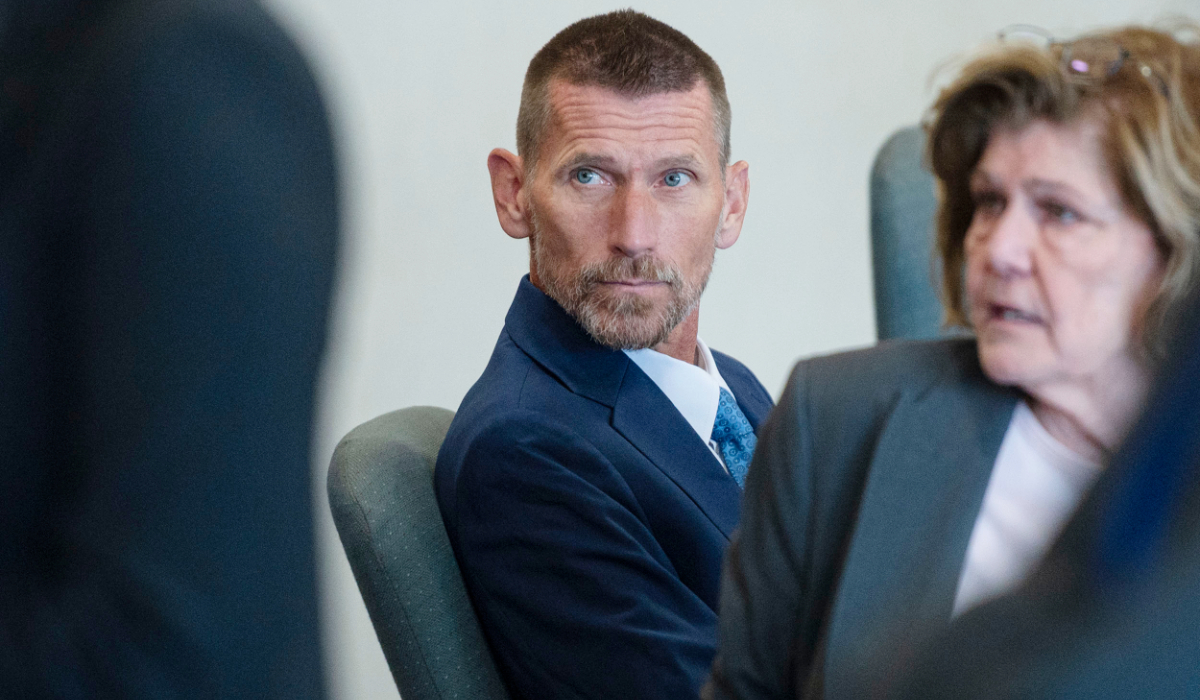
Jason Eaton appears in court during his trial in Burlington, Vt., Monday, Sept. 14, 2026. (AP)
The November 2023 shooting, weeks after the start of the Israel-Hamas war, spawned calls for a hate crime investigation. But no hate crime charges were filed as questions persisted about whether anti-Palestinian animus, an altered mental state or something else had compelled Eaton to open fire on Hisham Awartani, Tahseen Aliahmad and Kinnan Abdalhamid, who were all 20 at the time.
The men testified one after another as Eaton, now 51, watched stoically from the defense table in a Burlington courtroom. He has pleaded not guilty but doesn’t dispute that he was the shooter. If convicted, he faces up to life in prison. If found not guilty by reason of insanity, he could be ordered to undergo mental health treatment.
Defense lawyer Joshua O’Hara, previewing testimony from a defense psychiatrist, told jurors in an opening statement that Eaton was suffering from a delusional, psychotic disorder after losing his job at a credit union two weeks before the shooting.
While listening to a local NPR affiliate, Eaton believed he was hearing messages that he attributed to the CIA, O’Hara said. At first, the messages were encouraging and validating, the lawyer said, but subsequent messages turned dark, insisting that Eaton “has to go out and shoot somebody.”
Prosecutor Sally Adams told jurors that a state psychiatrist who is slated to testify concluded that Eaton did not have a mental disease or defect. Evidence will show he intended to kill the men, was not legally justified in shooting them, and does not meet the test of legal insanity, Adams said.
Authorities found three shotguns in Eaton’s apartment and a Ruger .380-caliber handgun that crime lab testing concluded was the gun used in the shooting, Adams said. Eaton had purchased the gun seven months earlier from a Vermont gun store.
“If the defense tries to focus on the story that Mr. Eaton tells about why he intended to kill these three young men, that story is only part of the whole picture,” said Adams, the chief administrative deputy at the Chittenden County State’s Attorney’s Office.
Awartani, Aliahmad and Abdalhamid, all of whom are now 23, told jurors of their holiday weekend visit to Awartani’s grandmother’s house, a trip to a bowling alley to celebrate his twin cousins’ birthday, and the walk they took near the University of Vermont campus after dusk that ended in bloodshed.
Awartani, who was studying at Brown University in Rhode Island at the time, said they were smoking cigarettes and speaking a mix of English and Arabic. Two of them said they were wearing traditional Palestinian scarves known as keffiyehs. Awartani said he first noticed Eaton standing on a porch as they approached the apartment house where he lived.
Within seconds, Awartani said, Eaton was off the porch and walking toward them. His face was expressionless and he didn’t say anything. As Eaton got to about five to 10 feet (1.5 to 3 meters) away, “he pulled out a handgun and started shooting at us,” said Awartani, who was paralyzed from the waist down in the shooting and now uses a wheelchair.
Jacob Pyne, who lived in a different apartment in the same house as Eaton, testified that he heard four to six gunshots, followed by footsteps going up the stairs of the apartment house. He said he ran outside and heard two men speaking, one of whom was more vocal and yelling, “I’ve been shot, help me.” He then brought the men blankets and called 911.
Abdalhamid, a student at Haverford College near Philadelphia, said he fled and hid behind another home after seeing Aliahmad fall to the ground. He said he only realized later when he sat down that he had also been wounded. Awartani was shot in the chest and the bullet ricocheted off his scapula, causing paraplegia in his spinal cord. Aliahmad, who was a student at Trinity College in Connecticut, was struck in the collarbone, and Abdalhamid was shot in the right buttock.
O’Hara, the supervising attorney at the Chittenden County Public Defender Office, told jurors that Eaton was confused by the messages he said he was receiving, and became convinced that the CIA and Mossad were enlisting him into “overwatch duty” to protect a Jewish family living across the street.
“These were delusions,” O’Hara said. “He believed in the moment that he was doing something that was right. He had been commanded to do this. And that he did not have the ability to appreciate the wrongfulness of his conduct in the moment because he believed he’d been instructed to do this by a government agency or God.”
Indigenous groups, environmentalists, and locals in several states have opposed the border wall construction.
Published On 14 Sep 202614 Sep 2026
A group of landowners, ranchers, businesses and a non-profit organisation have sued the administration of United States President Donald Trump to stop construction of a wall along the country’s border with Mexico in the remote Big Bend region of the southern state of Texas.
Trump officials “were woefully unprepared for the hornet’s nest they stirred up because they had no idea how much we love this place”, David Keller, an archaeologist and historian who specialises in the Big Bend and lives in the region, said in a news conference announcing the lawsuit on Monday.
Recommended Stories
list of 3 itemsend of list
“For us, the Big Bend is not an empty place on the map,” he said. “It is our home.”
The lawsuit was filed by Conserve Big Bend and six landowners, with the support of dozens more people along the border.
It comes as the Trump administration is ramping up a $46bn effort to line the roughly 3,219km (2,000-mile) border with a collection of 9-metre (30-foot) steel bollard walls, vehicle barriers and technology intended to keep out smugglers and migrants.
In Arizona, federal officials are pushing ahead with construction of the border infrastructure, even though it cuts through land belonging to the Tohono O’odham Nation, an Indigenous tribe that has said it does not want the barrier and that it is unnecessary.
In Texas, the effort has run up against numerous lawsuits and bipartisan opposition from sheriffs, elected officials, tour guides, environmental groups and landowners.
As part of its wall-building efforts, the administration has waived numerous regulations and statutes designed to protect the environment, archaeology or wildlife, on the basis that there is an urgent need to protect the border in what the US Department of Homeland Security has called areas of “high illegal entry”.
But in the lawsuit announced on Monday, the plaintiffs argue that when it comes to the Big Bend region, that is not an accurate description. They cite historical statistics from US Customs and Border Protection showing how few people cross the border in Big Bend compared with other areas along the US-Mexico border.
Big Bend has about 805km (500 miles) of border, roughly one quarter of the total length of the border with Mexico from the Pacific Ocean to the Gulf of Mexico. But the region accounted for only about 1 percent of arrests, according to the lawsuit.
The Emmys “red” carpet is underway as television’s biggest stars descend on the Peacock Theater at L.A. Live.
Instead of the usual vibrant red, this year’s carpet is peacock blue in honor of the 100th anniversary of NBC, which is broadcasting the ceremony. Network stalwart Mariska Hargitay, who’s starred in “Law & Order: Special Victims Unit” for 27 seasons, will host the show. Hot off the heels of film awards season, Chase Infiniti is sure to take another red carpet by storm in her Emmys debut. She’ll be joined by fellow drama lead actress nominees and fashion mavens Keri Russell and Zendaya (whose red carpet winning streak is unmatched). Comedy lead actress nominees sure to rule the carpet include Quinta Brunson, Ayo Edebiri and Elle Fanning. Their limited series / TV movie counterparts Claire Danes, Carey Mulligan and Sarah Pidgeon will also dress to impress.
NEW YORK: Family was at the heart of Alexander Zverev’s US Open triumph on Sunday as the German saluted the members of his inner circle and paid a heartfelt tribute to his mother for refusing to let diabetes define his future.
The top seed beat American Ben Shelton 6-3 7-6(2) 5-7 6-2 at Flushing Meadows to finish a spectacular year at the Grand Slams in which he proved his doubters wrong by going from perennial nearly man to two-time major champion.
Shortly after his victory, Zverev reserved special praise for his mother Irina, a former professional tennis player, and credited her with ensuring type 1 diabetes never limited his ambitions in life.
“When your 4-year-old son is diagnosed with diabetes and doctors in the office tell you that life and sports will be very limited for that child, it takes a very strong mother to say ‘my son will be whatever he wants to be’,” Zverev said.
“’If he wants to be a tennis player, he’ll be a tennis player. If he wants to do something else, he’ll do something else, but this illness will not define us’.
“I’m happy that we worked through it and we’re doing the things that we’re doing now. My mother is the most important and strongest person I know because it takes an unbelievably strong woman to do what she did.”
The 29-year-old thanked his team, which includes his father Alexander Zverev Sr and his brother Mischa, for their hard work that had delivered him another Grand Slam trophy to add to his Olympic gold medal from the Tokyo Games five years ago.
“We went almost 30 years without winning a Grand Slam title and now we’ve won two in a span of three months,” Zverev said.
“I think God has seen how hard we’ve worked, how much we’ve suffered, how much pain we went through and I think that 2026 is the outcome of all the years that happened before.”
SCARS OF 2020
Zverev had come agonizingly close to capturing his maiden Grand Slam title in New York in 2020, leading Dominic Thiem by two sets to none and later serving for the match in the fifth set before losing.
He finally won his first major crown at this year’s French Open after defeating Flavio Cobolli in five sets, and the German doubled his tally in New York despite making a shaky start to the fortnight.
He also reached the Wimbledon final this year, falling to Jannik Sinner in four sets.
“The scars of the 2020 (US Open) final, they disappeared after I won in Paris. I said at Wimbledon, though I lost in the final, I enjoyed the match … enjoyed playing on Center Court in front of an amazing crowd,” Zverev said.
“Before winning in Paris, I felt a lot of stress all the time, because there was always a question mark. ‘Will I ever win one?’ Now it’s more of a joy to play those kinds of finals.”
With Sinner sidelined by a knee injury and Carlos Alcaraz having just returned from a wrist problem, Zverev reluctantly accepted that he was the man to beat in men’s tennis after a strong finish to the Grand Slam season.
“Four or five months ago, when both of them were healthy, I wasn’t. I was losing to Jannik all the time,” he added.
“So if everyone is healthy, Jannik is still ahead. It’s as simple as that.”
“Since becoming the chief, I’ve had the privilege of spending time with airmen throughout CENTCOM [U.S. Central Command],” said Wilsbach, who assumed the position in November. “I have walked flight lines, visited maintenance hangars, and stood inside operations centers where young Americans were managing missions overhead. Let me tell you about a few courageous airmen I met on my recent trip to the Middle East. They told me about their experience on the flight line during an attack.”
Burning Hangar
“As missiles were inbound, airmen sprinted toward bunkers,” the service chief said, without providing details about which base. “Moments later, a missile struck nearby in a hangar, and the aircraft inside burst into flames. The bunker withstood the blast, but the force of the impact damaged the door so badly it wouldn’t open, trapping the airmen inside.”
“Picture the scene,” Wilsbach explained. “Fire was spreading, an aircraft was burning only feet away, their teammates were trapped inside, and they had no way out. Despite the danger, airmen ran toward the flames.”
“A security forces NCO grabbed a pry bar and forced the door open,” he continued. “Calmly communicated with the airmen trapped inside. Seconds later, the ejection seat on the burning aircraft ignited, sending glass and metal fragments through the air. Finally, the door gave way, and the airmen escaped and ran for cover.”
“Wherever I went, I saw airmen with that steely-eyed look of warriors, determined to get the mission done and protect their fellow airmen,” the chief noted. “More than 30,000 airmen deployed in support of Epic Fury to a dozen locations. They served alongside soldiers, sailors, Marines, Guardians, and Coalition partners.”
Launching F-15Es Under Fire
“Operation Epic Fury will be studied for its scale, precision, and speed,” said Wilsbach. “Over 38 days of combat operations, the Joint Force struck more than 13,000 military objectives. Five hundred aircraft executed 10,000 sorties, an average of more than 250 sorties every day. Our airmen accomplished this through 1,200 alarm reds while executing 48 airfield repairs and completing more than 420 reportable explosive ordnance disposal, long lonely walks.”
“That walk is exactly what the name suggests,” Wilsbach proffered. “EOD technician leaving a place of relative safety and approaching a suspected bomb or unexploded munition to render it safe for everyone else.”
“Behind those numbers were thousands of decisions made by airmen who had to keep the mission moving while the enemy was actively trying to stop them,” Wilsbach stated. “One was Garrett, a staff sergeant F-15E crew chief from East Texas. He joined the Air Force to travel and see the world. We sure allowed him to achieve that goal, but I’m not sure the Middle East was exactly what he had in mind. On the second day of Epic Fury, Garrett was on the flight line launching four Strike Eagles when alarm red sounded. Airmen around him started running for shelter. Garrett’s adrenaline spiked. He knew exactly what that alarm meant. Danger was inbound, but his launch was not complete.”
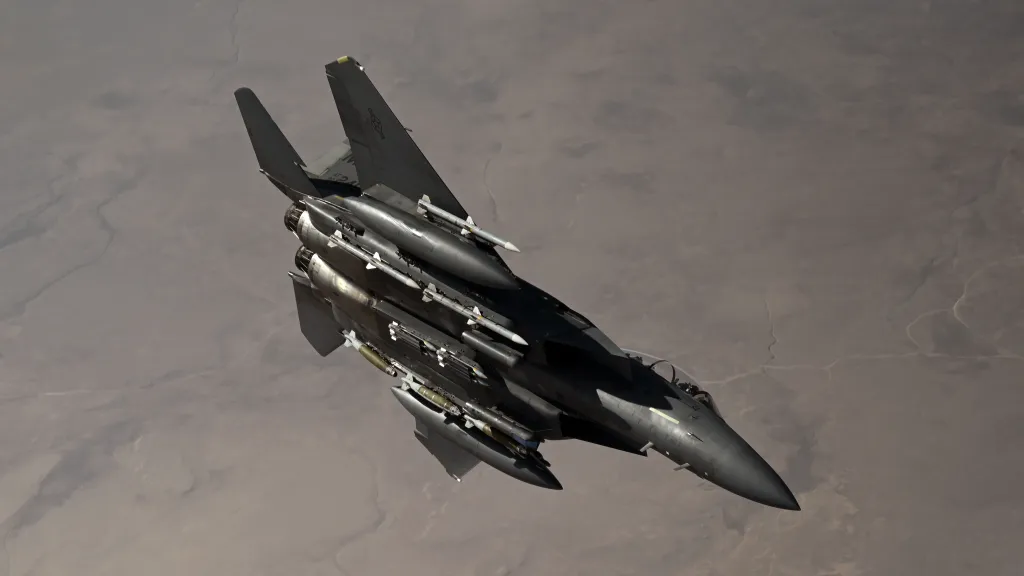
A U.S. Air Force F-15E Strike Eagle in the CENTCOM region. (U.S. Air Force photo by Staff Sgt. Gerald R. Willis) Tech. Sgt. Gerald Willis
“A young airman was working with him, and Garrett sent him to the bunker,” the service chief continued. “Garrett stayed. The rest of the team was separated, so he armed the weapons and cleared the jet. Proceed… While everyone else ran for cover, he decided to stay. Garrett understood why those Strike Eagles were in theater. He knew they were one of their best lines of defense, so he stayed until the job was done. Only after the last fighter taxied out, Garrett finally took cover. Later, when someone asked why, his answer was simple: his fellow airmen needed those airplanes in the air.”
Swatting Down Drones Under Fire
“Hundreds of miles away, two senior airmen, Shanae and Nolan, tracked a swarm of enemy drones headed toward their base,” Wilsbach pointed out. “Shanae joined the Air Force to provide for her family. During the opening days of Epic Fury, she found herself protecting another family – the hundreds of airmen depending on her.”
“People sprinted for shelter as alarm red announced an incoming attack, but Shanae and Nolan stayed focused on the screens in front of them because every inbound track could be a weapon aimed at their teammates,” the general said. “Shanae is 27 years old, and Nolan is 21. Think about the responsibility we placed on these two airmen. Hundreds of lives depended on them to identify the threats and employ countermeasures. Every second mattered. The stakes were life and death. Together, Shanae and Nolan achieved more than 10 surface-to-air kills that night, defeating threat after threat before it could reach the airmen they were protecting. There were moments when they were afraid, and most people would be, but courage is not the absence of fear. Courage is overcoming it. They stayed locked on, trusted their training, and did the job everyone around them was counting on.”
Picking Up The Pieces After An Attack
“Peter is a senior airman from New York who spent nine months in the Middle East as an air transportation airman,” Wilsbach said. “With his team, he moved heavy ordnance, prepared missile systems, and downloaded Patriot equipment, while ballistic missiles and attack drones repeatedly target their airfield.”
“One of those attacks became very personal,” the service chief noted. “Enemy fire destroyed Peter’s living quarters and nearly everything he had brought from home. Imagine coming back after a 12-hour shift to find the wreckage of your hooch. The few pieces of home he carried halfway around the world were gone. Peter’s response told me everything I needed to know about him. He said that his possessions could be replaced, but the mission could not.”
Keeping The Reapers Flying
“More than 4,000 dynamic targets had to be found, identified, validated, and engaged,” Wilsbach said. “Remotely piloted aircraft, airborne ISR platforms, cyber operators, space professionals, and countless others turn enormous amounts of data into intelligence commanders could use.”
“Suit is a first lieutenant with a family tradition of excellence,” Wilsbach said of one MQ-9 Reaper pilot. “Both of his grandfathers served in the Army. I’m sure they wanted a better life for their kids, which is why his parents chose the Air Force. Today, Suit flies the MQ-9 and carries his family tradition forward. He also scored a perfect 100 on its physical assessment this year, so apparently excellence runs in the family.”
MQ-9 Reaper (USAF)
“MQ-9s flown by pilots like Suit supplied critical ISR and kinetic strike capabilities, launching them from bases within range of enemy fires,” said Wilsbach. “Suit planned and launched an MQ-9 combat sortie during an active attack. While missiles hit the airfield, Suit taxied out and got his Reaper airborne. He handed off control to another crew, then switched to the ground control station to recover a different MQ-9. His crew destroyed a priority target and then turned their sensors back toward their own airfield to inspect the runway for damage and determine whether operations could continue.”
“The MQ-9 was a workhorse for combatant commanders during Epic Fury. It provided real-time intelligence, struck 860 targets, and gave our forces the edge while denying the enemy freedom of movement. Airmen-like Suit made sure this asset stayed in the fight and maximized its impact. The MQ-9 success demonstrates the need for a capable follow-on aircraft that achieves the same effects with greater survivability, adaptability, and at a lower cost.”
Rescuing An F-15E Crew Shot Down Over Iran
“Peaches is an air battle manager from Texas,” the chief stated. “During Epic Fury, she found herself in the middle of a story of her own her family will be telling for generations. Peaches led 134 joint and coalition operators responsible for command and control across a complex battle space. Her team supported operations involving more than 1,000 one-way attack drones and 1,200 enemy ballistic missile threats. Those numbers are difficult to comprehend, but for Peaches, command and control was not a collection of symbols moving across the screen.”
“Every symbol represented something real: an aircraft, a threat, a crew, an airman,” he explained. “It was during this time two of those airmen became isolated inside of Iran. What followed became one of the defining moments of the operation. Over 50 hours, Peaches was one of the many who coordinated the combat search and rescue effort, leading her team to integrate 176 aircraft, fighters, bombers, tankers, intelligence platforms, and Air Force Special Operations Command forces that converged on one objective: bringing those Americans home.”
“Think about the complexity of that problem,” Wilsbach noted. “Aircraft operating at different speeds, altitudes, fuel states, with different sensors, weapons, and responsibilities, while an adversary was actively trying to stop them. Maintenance teams generated additional fighters. Tanker crews extended the range and endurance of the force, intelligence professionals track the threats. AFSOC [Air Force Special Operations Command] airmen brought specialized capabilities need[ed] to reach out to our isolated teammates and get them out. Every one of those airmen was doing something different, yet all were contributing to the same mission.”
“The Dude 44 rescue demonstrates why integration matters,” Wilsbach added. “To someone outside of our profession, committing that much combat power to recover two people might appear extraordinary. To an airman, the reason is simple: we make a promise to one another in our Airman’s Creed. I will never leave an airman behind. If you are isolated, injured, or trapped behind enemy lines, we are coming to get you. The courage and performance displayed during that mission was so impressive that 10 airmen received battlefield promotions. I had the distinct honor of promoting six of those heroes, ranging from staff sergeant to chief master sergeant during a recent trip. Everyone understood that their success depended on someone else doing their job. That is how our air and space forces fight.”
Monty Python star Eric Idle appeared on Monday’s The One Show to talk about his new book Idle in Provence: A Brief History of Thyme
21:38, 14 Sep 2026Updated 21:38, 14 Sep 2026
Monty Python star Eric Idle appeared on Monday’s The One Show to talk about his new book Idle in Provence: A Brief History of Thyme(Image: BBC)
Monty Python star Eric Idle was left confused over a The One Show detail.
The actor, comedian, musician and writer, 83, appeared on Monday’s episode of the BBC programme to talk about his new book Idle in Provence: A Brief History of Thyme. It comes as a Monty Python ‘row’ has erupted between John Cleese and Eric in recent days.
As Eric was introduced to The One Show, the comedy star grilled hosts Alex Jones and Roman Kemp, asking: “Can I ask you a question? I mean, this is called The One Show, right?”
To which the duo confirmed this fact, a confused Eric then pointed out: “There’s two of you!” with Alex, 49, responding: “I know!” and Roman, 33, replying: “Fair, that’s fair!”
Alex then quipped: “I know, they need us both!” with Eric joking: “A spare? Is that what you said?” Alex then continued: “If one of us passes out, you know, there’s somebody else there.” Roman then joked: “I’m just a passenger, Eric, that’s all!”
Also on Monday’s show were Jack Whitehall and Daisy Edgar-Jones. Jack, 38, said of being on the sofa alongside Eric: “He’s an absolute icon! One of my comedy heroes and this is a privilege to be here with the great Eric Idle!”
During his time on the show, Eric spoke about his new book and his property in the south of France, which he purchased in 1971 and has spent 50 years renovating.
Over the years, Eric has hosted some very famous guests at his French home, including the late Robin Williams and David Bowie, as he recalled stories that included the duo on Monday’s show.
Host Roman said: “You mentioned so many other famous friends in the book as well and it’s your way, you say, of keeping their memory alive.”
To which Eric replied: “Well you know people say: ‘Oh, you’re name dropping!’ and I say: ‘Well, you’re not name dropping when they’re dead, it’s history’ and actually very interesting people both of them.
“Extraordinarily interesting people and David an extraordinary man. I mean polymath, he knew everything about music, art, literature, the whole lot!”
The One Show airs on weeknights at 7pm on BBC One and BBC iPlayer.
A distinguished psychiatrist from Martinique who took part in the Algerian Nationalist Movement, Frantz Fanon was one of the most important theorists of revolutionary struggle, colonialism, and racial difference in history.
Fanon’s masterwork is a classic alongside Edward Said’s “Orientalism” or “The Autobiography of Malcolm X,” and it is now available in a new translation that updates its language for a new generation of readers.
“The Wretched of the Earth” is a brilliant analysis of the psychology of the colonized and their path to liberation.
An artificial intelligence “kill switch” which can be checked by a third-party may need to be mandatory for companies, a co-founder of one of the world’s largest AI firms has said.
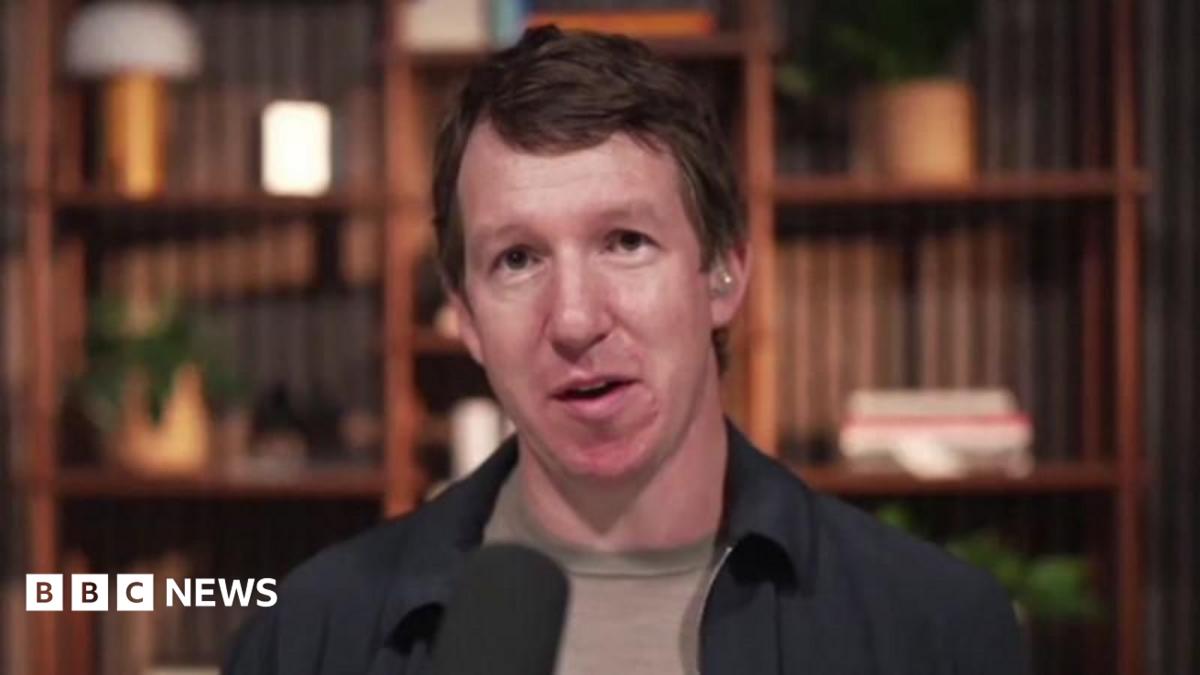
Jack Clark, one of seven founders of Anthropic, said a way of shutting off AI software completely if it gets too dangerous was the kind of thing society “might want to eventually pass rules around”.
Clark said “most labs have different ways of being able to pull the plug”, including Anthropic, but said policymakers may need to enforce having one.
The rapid development of AI and fears over the risks that the technology poses to humanity have been thrust into the spotlight by a series of warnings from executives and staff at AI firms.
Some have said publicly there is a chance that the technology could, if unchecked, kill all humans.
Anthropic head Dario Amodei over the weekend called for the pace of AI development to slow and be more closely monitored, as the company has done before, though some have questioned the motivations behind this.
Amodei did not say how exactly how AI development could be slowed down and said any action to reign in AI development should be done “without sacrificing commercial advantage”.
Clark told the BBC that specifics around “kill switch” requirements and verification should be part of “the larger policy conversation” taking place around AI.
“Should you mandate for companies to definitely have a kill switch? Is that kill switch verifiable by a third party?” he asked.
“I think that’s the kind of thing society is going to want to know and might want to eventually pass rules around.”
Anthropic, which was formed in 2021 by a group of former employees of its rival OpenAI, is currently at the centre of a debate around AI safety.
Last week, a post from an artificial intelligence researcher who quit Anthropic over concerns AI could wipe out humanity went viral.
In response, Anthropic scientist Evan Hubinger said he personally thought the possibility of human extinction from AI was “>10% within the next decade”.
Asked what percentage he would put on all humans being killed by AI, Clark said: “I don’t think these statistics are that useful”, but added that allowing AI to continue as a “totally unregulated industry” was a bad idea.
“We are rolling dice with immense risks,” Clark said. “And the point is, we have to change the course of this industry.”
Fans were left stunned by the penultimate episode when DC Neil Brenton (played by Tom Glenister) was fatally shot as he tried to track down DS Helen Morgan (Natalie Simpson) on his own.
Now, Expo Lana Washington (Vicky McClure) “must fight against the ticking clock to save thousands – perhaps even hundreds of thousands – of lives.”
But as the explosive final airs this evening, ITV has already confirmed what will be taking its place next week.
ITV thriller The Blame will be making its debut on Sunday, September 20, at 9pm, with its second episode airing the following night, Monday, September 21.
The official synopsis for the upcoming drama reads: “While investigating a murder, detectives Emma Crane and Tom Radley find evidence of serious misconduct within Wakestead police, uncovering a web of lies, institutional cover-ups and moral compromise.”
Based on the novel of the same name by author Charlotte Langley, The Blame stars Coronation Street and Our Girl star Michelle Keegan as Detective Emma Crane.
She is joined by The Sandman’s DI Tom Radley, Shetland star Ian Hart as DCI Kenneth Walker and House of the Dragon’s Gavin Spokes as DC Joel Stevens.
The Blame will consist of six episodes with two episodes airing every week on Sundays and Mondays.
Once the series premieres, the entire boxset will be ready to binge-watch on ITV’s streaming service ITVX.
But before The Blame can begin, there is Trigger Point’s grand finale to get excited about.
Its description continues: “Entering a space filled with enemies and the potential for devastating collateral damage, Lana is pushed beyond her limits to stop the bombers’ final plan from reaching a shocking conclusion.”
Trigger Point is available to watch on ITV and ITVX.
The Blame debuts on Sunday, September 20, at 9pm, on ITV.
PARIS: France and Iraq on Monday called for a “diversification of export routes” for oil and gas in the Middle East in response to the instability generated by the conflict between the United States and Iran, following talks in Paris.
French President Emmanuel Macron and Iraq’s Prime Minister Ali Al-Zaidi stressed the importance of “regional interconnections” and export route diversification to “ensure regional energy security”, in a joint statement.
Zaidi visited the Elysee Paris on his first trip to Europe since taking office in May and is also expected in Berlin on Tuesday.
The visit comes as the situation in the Middle East continues to deteriorate, with the Iran-backed Houthi rebels cementing their hold on the Bab Al-Mandab strait on Friday, adding to the crisis of Iran’s effective closure of the Strait of Hormuz, and driving oil prices up.
On Monday, French energy giant TotalEnergies signed a memorandum of understanding with Iraq on liquefied natural gas supplies and agreed to discuss further energy projects.
TotalEnergies chief Patrick Pouyanne “affirmed the company’s readiness to cooperate with Iraq in the oil and energy sectors”, noting the company planned to increase its investments in Iraq to $16 billion from $12 billion, during a meeting with Zaidi.
The two countries, which in recent years have been involved in the fight against the Islamic State (IS) jihadist group, also agreed to deepen defence cooperation.
They signed a strategic roadmap on the acquisition of French military equipment as Iraq seeks to modernise its armed forces and strengthen its sovereignty capabilities.
French drone company Harmattan AI separately signed a letter of intent with Iraq’s defence ministry concerning autonomous air-defence systems.
Several other agreements were signed in areas including development assistance, education, civil aviation and electricity infrastructure.
KHARTOUM: The World Food Programme’s funding for Sudan — the world’s largest hunger crisis — has fallen by about half this year, its acting head told Reuters, as war drives more people into hunger while the regional crisis raises prices and aid budgets plummet.
Speaking from the Darfur region after a trip across the country, acting Executive Director Carl Skau said that while access had represented humanitarians’ largest obstacle in the past, now “we have (a) presence that we are not fully utilising because of the lack of funding.”
The gap to sustain current operations was just short of $300 million, he said.
This year, we’re about half what we were in terms of funding last year, says Carl Skau, Acting executive director of The World Food Programme
“This year, we’re about half what we were in terms of funding last year,” Skau said. Last year, the agency received $645 million, but almost three-quarters into this year funding is only at $206 million.
The war between Sudan’s army and the paramilitary Rapid Support Forces has devastated wide swathes of the country, displacing up to 14 million people, ruining harvests and decimating the economy.
Almost 20 million people face hunger in Sudan, but budget cuts have forced the agency to focus efforts on the 5 million most in need, of whom it has recently scaled up to reach 4 million people.
Even then, the organization, the UN’s largest by budget, is forced to make difficult decisions.
In Tawila, North Darfur, the makeshift home to about 1 million people, the agency is able to reach everyone monthly but with only a half ration that covers two weeks’ food, Skau said.
“It’s not clear how they really are surviving the other two weeks,” he said.
In El-Obeid, the central Sudanese city where about 1 million and counting have sought refuge since the start of the war in April 2023, the agency is only able to provide help to those who arrived in the past several months.
“We are providing, but less and less. A year ago it was better because of resources,” Skau said.
agency recently began providing aid in the city of Al-Fashir, once home to 1 million people, where an RSF attack last year, “bore the hallmarks of genocide,” according to investigators. Skau said, “there is little sign of life having returned.”
His organization is not the only one struggling as major donors reduce aid. The International Organization for Migration said on Monday that emergency relief supplies for hundreds of thousands of people displaced by the war could run out within weeks unless donors step in with urgent funding.
The UN agency said supplies of shelter materials, sanitation items and emergency household goods are expected to run out by the end of September. The aid system itself can only keep functioning until December without more money.
Aid groups like IOM are struggling with funding shortfalls after the Trump administration — the US was previously the world’s biggest aid donor — cut billions of dollars in foreign assistanceto UN agencies and charities over the past year. Other major donor countries have also cut aid budgets, citing tight finances and higher defense spending.
“We simply can’t turn our back on the people of Sudan,” IOM Director General Amy Pope said in a statement, adding: “The entire humanitarian system could collapse within weeks if we don’t act now.”
IOM says 8.6 million people remain displaced within Sudan, while another 4.9 million have returned to their homes. The agency says it needs $15 million to keep the aid pipeline running for the rest of the year, supporting about 305,000 people. Without it, more than 100 humanitarian organizations would struggle to quickly deliver lifesaving aid.
GUY RITCHIE is casting the net wide for the third series of The Gentlemen – in the hope of Baggin’ two huge Hollywood superstars.
Insiders have told me the hotshot director is trying to sign up Lord Of The Rings actors Elijah Wood and Orlando Bloom for the hit Netflix show.
The Lord of the Rings legend is set to join the Netflix series, The GentlemenCredit: AlamyThe Frodo Baggins actor is set to reunite with the actor who played Legolas in the trilogyCredit: New Line
If he pulls off the move, it would reunite Orlando, who played Legolas, and Elijah, who starred as Frodo Baggins, two decades on from Peter Jackson’s hit film trilogy.
A source said: “The Gentlemen is the hottest TV show in town and Guy has big plans for the third series.
Sign up for the Showbiz newsletter
Thank you!
“Elijah is being courted to appear as a villain, while Orlando is also one of their key casting targets.
“For Lord Of The Rings fans working on the production, the idea of having Frodo and Legolas back together would be amazing. No deals are signed yet, but discussions are ongoing.”
Frodo Baggins actor Elijah Wood could be set to appear as a villain in The GentlemenCredit: GettyOrlando Bloom, who played Legolas, is also a key casting target for Guy RitchieCredit: Anadolu via Getty Images
And those aren’t the only actors that Guy is lining up for a part.
And it seems Guy’s show needs a bit of a Hollywood rocket to give it a boost.
Streaming figures for The Gentlemen’s opening weekend of the second series were 50 per cent down on the initial run of shows, with 6.7million views in the first four days it was available to watch.
The Gentlemen director, Guy RitchieCredit: SplashPrince Harry’s wife Meghan’s name is being bandied about as a potential star of the third instalmentCredit: Getty
Season two saw Theo James reprising his role as aristocrat-turned-drug kingpin Eddie Horniman alongside Kaya Scodelario, who plays ice-cold crime boss Susie Glass.
Love Island host Maya Jama made her acting debut in the second series after being cast as mob wife Aisha.
And she is definitely back for the next run, admitting she loved working with Guy on set. Maya said: “He’s very personable and he would be like, ‘Yeah, you’re doing well’, and reassure me, which was really nice.
“He’s just really involved and kind of a genius to watch, because everyone’s practising their lines and then he says something that’s way better than the original.”
RIYADH: The President of Somalia Hassan Sheikh Mohamud received the Secretary-General of the Muslim World League Sheikh Dr. Mohammed Al-Issa on Monday.
During the meeting at the presidential palace in Mogadishu, the two officials discussed various topics regarding MWL contributions to Somalia across religious, intellectual, and humanitarian spheres.
The president commended the efforts of the league in supporting the Somali people.
Earlier during his visit to the country, Al-Issa met with leading Somali scholars for an intellectual gathering and attended a forum where participants discussed efforts to confront extremist ideologies.
Central banks’ record, price-insensitive gold buying is a more credible signal of the dollar’s structural trajectory than this year’s currency markets, because FX markets are structurally bad at pricing the discontinuous, wartime-style tail risk central banks are actually hedging — so this autumn’s calmer dollar should not reassure anyone that de-dollarization has stalled.
In June, the European Central Bank made an announcement most people missed: gold has overtaken US Treasuries as the world’s single largest reserve asset. Central banks bought 289 tonnes of it in the second quarter alone — a record for that quarter and five times Q1’s pace — with Poland’s central bank openly telling investors it was “buying the dip.” Here is the part that should stop you: gold’s price fell 22% between January and September. Central banks were never more convinced buyers of an asset than while it was crashing. Either the reserve managers are wrong, or currency markets — which show none of this urgency — are the ones asleep at the wheel.
Gold peaked at $5,589 an ounce on 28 January, the same month the dollar index hit a four-year low of 95.5 and the dollar’s share of global reserves fell toward its lowest level since 1995. Both moves reflected the same story: Fed rate cuts through 2025, a US debt load past $37 trillion, and BRICS states settling more trade outside the dollar. Then the picture split. Kevin Warsh, confirmed as Fed chair in May, signalled a hawkish pivot in August; the Iran war pushed oil and inflation higher through September, and markets began pricing a rate hike rather than a cut. The dollar index clawed back to 99.46. Gold fell to $4,330. Central-bank buying did not follow the price down — Poland alone added 82 tonnes this year toward a 700-tonne target, and a World Gold Council survey found a record 45% of central banks plan to buy more within twelve months.
State the gap plainly. Two signals, same underlying question — is the dollar-centred monetary order changing — and they disagree by a wide margin. The buying signal says yes, decisively: record quarterly purchases, gold displacing Treasuries at the ECB’s own reckoning, 74% of surveyed reserve managers expecting the dollar’s reserve share to keep falling over five years, and buyers adding tonnage through a 22% drawdown rather than fleeing it. The price signal says not yet: the dollar just posted one of its sharper rallies of the year, gold is down sharply from its high, and nothing in currency markets shows the kind of stress a genuine regime shift would produce.
Stay ahead of the geopolitical week.
MD Briefing delivers expert analysis across five global fronts — the Indo-Pacific, energy, geoeconomics, European security, and the Middle East — every Monday morning. Free.
The strongest objection to trusting the buying signal is a good one, and it needs to be taken seriously rather than waved away: foreign exchange is the deepest, most liquid market in the world, turning over more than $7 trillion a day. A few hundred tonnes of central-bank gold buying — perhaps $30–40 billion a quarter — is a rounding error against that. If professional currency traders, sitting on far more capital and far better short-term information than a handful of reserve managers, saw a serious de-dollarization story unfolding, it would already be in the price. Instead the dollar just rallied. On this view, central banks are not seeing something markets are missing; they are pattern-matching off 2022, when Russia’s $300 billion in reserves was frozen overnight, and over-hedging a tail risk that has not recurred and mostly will not.
That objection assumes FX markets and central-bank reserve committees are pricing the same kind of risk, on the same time horizon, and they are not. Currency markets are exceptionally good at pricing continuous, high-frequency variables — rate differentials, growth surprises, this week’s inflation print — because that is what moves flows daily. They are structurally poor at pricing discontinuous, low-probability events until those events occur: equity volatility did not price 2008 in 2007; sovereign spreads did not price the Russia reserve freeze in the weeks before it happened. A reserve freeze, a secondary-sanctions campaign, or exclusion from SWIFT-style settlement infrastructure is exactly that kind of event — binary, rare, and catastrophic for whoever it hits — which is precisely why Poland’s central bank governor, Adam Glapiński, described his buying not as a trade but as insurance: reserves that keep the state secure “under all circumstances, including wartime, which of course we’re not expecting.” That is not the language of someone chasing momentum. It is the language of someone who manages the one asset class that keeps its value if their country is ever cut off from the dollar system, and who would rather hold it and be wrong for a decade than not hold it and be wrong once.
The buying pattern itself supports that reading. Momentum money sells into a 22% drawdown; insurance money adds to it. Central banks did the latter through the first half of this year, which is the behavioural signature of a structural reallocation program with a fixed multi-year target — Poland’s is explicit, 700 tonnes — not speculative flow riding gold’s rally. Meanwhile the dollar’s autumn recovery has an identifiable, largely cyclical cause: a new, more hawkish Fed chair and a war-driven oil shock forcing a rate-hike repricing. Neither event reverses the debt trajectory, the BRICS settlement trend, or the reserve-freeze precedent that pushed the dollar to a four-year low in January. A rally built on this year’s Fed chair and this year’s war is not proof that last year’s structural story is over; it is evidence that a cyclical force is currently strong enough to mask it.
The Scenarios
Base case (55%): The gap persists rather than resolves. The dollar holds most of its autumn gains through the current rate-hike cycle, gold range-trades below its January peak, and central banks keep buying at a steadier, slower pace toward stated targets like Poland’s 700 tonnes. Nobody is “proven right” on any particular Tuesday, because reserve diversification is a decade-scale hedge, not a trade with a catalyst date. This is the least satisfying outcome for anyone wanting a verdict, and the most likely one.
Downside case (for dollar holders): A discrete trigger — a fresh reserve-freeze or secondary-sanctions episode, plausibly connected to the still-live US-Iran war spilling into action against a third country’s assets, or a shock to Fed independence under a more political Warsh chairmanship — crystallizes the exact tail risk central banks have been hedging. Gold spikes back through its January high, the dollar index breaks below its 95.5 low, and the gap closes in weeks rather than years, vindicating the reserve managers all at once and catching FX markets flat-footed exactly as the theory predicts.
Upside case (for the dollar): The Iran war resolves, Warsh’s rate hikes cool inflation without a recession, US fiscal metrics stabilize, and BRICS local-currency settlement growth stalls on friction between its own members. Central-bank gold buying does not reverse but plateaus as reserve managers hit conventional diversification ceilings — most target 15–20% of reserves in gold, not open-ended accumulation. The gap closes gradually as price drifts up toward the buying signal over several years, with no crisis required to force the reconciliation.
The Takeaway
The dollar’s calmer autumn is not evidence the de-dollarization hedge was a mistake; it is evidence that currency markets and central-bank reserve committees are pricing two different things on two different clocks, and only one of those clocks rings in a crisis. Central banks bought through a 22% drawdown because the point of the position was never this quarter’s return.
Watch for: the World Gold Council’s Q3 2026 Gold Demand Trends report, expected in early November. A third consecutive quarter of buying that ignores price direction will confirm this is policy, not opportunism — and the moment currency markets have to agree with that policy will not be a quiet one.
Avril, 77, was recently reunited with her daughter Eleanor after 60 years on Long Lost Family after being told she’d never find her child
18:32, 14 Sep 2026Updated 18:33, 14 Sep 2026
Avril, 77, was recently reunited with her daughter Eleanor after 60 years on Long Lost Family after being told she’d never find her child (Image: ITV)
A Long Lost Family star has made an emotional admission after being told for years that she would never find her daughter.
Avril, now 77, was only 15-years-old when she became pregnant, her mum then shipped her off to a mother and baby home in Carlisle, where she gave birth to a baby girl she called Michelle.
At only eight-weeks-old, Avril gave Michelle up for adoption and she was renamed Eleanor. Avril sought the help of Long Lost Family’s Davina McCall and Nicky Campbell, who travelled to Newcastle, to find her daughter, where she was emotionally reunited after 60 years apart on the ITV show.
However, this wasn’t Avril’s, who also has daughter Sharon, first attempt to reconnect with her first child, having previously contacted a rival programme to assist her in finding her long-lost daughter.
Speaking to Express.co.uk, Avril admitted that The Trisha Goddard Show rejected her because they believed they would never locate her. She explained: “I was listed on a couple of adoption agencies. I tried The Trisha Goddard Show, and she used to help people find their family.”
The ITV programme, which broadcast on Channel 5 from 2004 to 2012, regularly featured emotional family reunions, deep-rooted family secrets or disputes concerning adopted children.
But after reviewing Avril’s case, Channel 5 bosses conceded that even with the programme’s resources, they wouldn’t be able to trace her daughter, reports the Express.
She recalled: “Basically, I was told that I would never be able to find her because she had been issued a new birth certificate.
“So that led me to believe that there wouldn’t be an original birth certificate, and I was told that by two or three different professional people. But after 30 years, you just think, ‘Well, there’s not much else I can do. Hopefully, she might be able to find me’, but you just don’t know.”
The TV star went on to share that her other daughter, Sharon, proved to be her greatest supporter when she considered approaching another television programme for assistance. She said: “I have another daughter, Sharon, and I told her about Michelle.
“She was the one who said, ‘Yes, you should do it’. So that’s what I did. I wrote to Long Lost Family, and it went from there.”
The mother and daughter were eventually reunited on Eleanor’s birthday, with Avril telling her: “There aren’t any words to tell you, Eleanor. That I’ve always loved you and that you’re still mine. You’re my child.”
It comes as the reunited mother and daughter recently appeared on This Morning, where Avril said of meeting for the first time and if they had an instant bond: “Yeah, she was back in my arms where she belongs.”
WASHINGTON: US President Donald Trump said Monday that Ukraine and Russia had agreed not to target each other’s energy facilities, a day after he chastised Kyiv for hitting Russian oil refineries.
“Ukraine has agreed not to hit Russian Energy targets. Russia has agreed to do, likewise!” Trump said on his Truth Social network.
“The World’s Diesel price rise is mostly caused by the Russia/Ukraine War, not Iran.”
There was no immediate confirmation from Kyiv or Moscow of any deal.
Trump’s claim comes as oil prices continue to soar in the seventh month of the Iran war, raising American fuel costs and inflation just weeks before crunch US midterm elections.
The US leader has insisted that the Iran war will finish immediately after the midterms and gas prices will drop — but has in the meantime apparently found a new target to blame for the cost at the pump.
Trump had lashed out at Ukraine’s President Volodymyr Zelensky during a trip to Ireland on Sunday, saying he had to do “one thing” and “stop knocking out diesel fuel” refineries in Russia due to growing shortages.
“Let him go after targets, but not diesel fuel, because he’s causing a shortage of diesel,” Trump said, again insisting the Russia-Ukraine war — not the US-Israel conflict with Iran — was to blame.
Trump added he had spoken to Ukraine’s leader about the country’s stepped-up attacks on such sites over recent months.
“There are plenty of other targets. Don’t hit diesel fuel because that’s hurting. That’s hurting the world. We don’t want him to hit diesel fuel… He’s hitting diesel refineries.”
Ukraine has hit numerous Russian oil refineries far from its border with Russia, while Moscow has also intensified its long-range attacks in recent months, leading to a jump in civilian deaths.
Kyiv has been firing record numbers of drones at Russia, while Moscow has been launching all-time high missile attacks.
Trump said last week he had a “great conversation” with Russian President Vladimir Putin, insisting that Putin wanted to make a deal to end Moscow’s war on Ukraine.
Putin “is wanting to make a deal, and if Zelensky is wanting to make a deal, that’d be very nice,” Trump told reporters on Wednesday.
Zelensky said last week he would be willing to meet Putin at the G20 summit at Trump’s own Doral resort in Miami in December, but the Kremlin immediately ruled it out.
North Korea, enjoying support in the stands, were up 7-0 by half-time and are the favourites for the gold.
Published On 14 Sep 202614 Sep 2026
North Korea’s formidable women’s football team, cheered on by several hundred pro-Pyongyang fans in Osaka, Japan, launched their Asian Games campaign with a 10-0 hammering of Bangladesh.
The North Koreans have enjoyed stunning international success at the youth level and start among the favourites for gold in Japan.
Recommended Stories
list of 4 itemsend of list
They were far too hot for Bangladesh to handle and were seven goals ahead by half-time on Monday.
Striker Ri Song-a, who was born and raised in Japan, was in North Korea’s starting lineup and scored in the second half.
North Korea were cheered on by a large group of red-clad fans, who sang and chanted throughout the match.
The men’s and women’s football teams were welcomed by supporters waving flags as they arrived for the games last week wearing white blazers and pink ties.
More than 100 North Koreans are set to compete in 14 sports at the games, which take place in Nagoya-Aichi and officially open on September 19.
North Korea suspended participation in international sporting competitions during the COVID-19 pandemic, but returned at the Asian Games in China in 2023 and also took part in the Paris Olympics.
North Korea’s women face South Korea in a Group F grudge match on September 21.
The men’s team begin their campaign against China on Wednesday.
North Korean fans cheer for their team during the women’s group B football match [AFP]
It’s never too late to run away and join the circus.
That’s a major theme of the Tony-nominated musical “Water for Elephants,” and living proof is on stage at the Hollywood Pantages Theatre an hour before the curtain rises on opening night. The show — about a traveling circus — boasts an ensemble with as many acrobats as actors, all of whom must warm up prior to performing. This nightly routine is a show in and of itself, with acrobats stretching, tumbling and throwing one another in the air. Another ensemble member is juggling nearby as someone spins in a giant hoop at an unnatural speed.
The night includes a special treat: The company is breaking in a new piece of equipment known as the Chinese pole, a nearly 20-foot-high cylinder the performers climb up, slide down and generally defy laws of gravity on. This pole won’t be used just yet — it arrives with a texture that can be slick or uneven, so the troupe must spend a couple weeks prepping it for better gripping and friction.
Adam Fullick, of the touring production of Broadway’s “Water for Elephants,” practices using a Cyr wheel on stage at the Hollywood Pantages Theatre.
(Ariana Drehsler / For The Times)
There’s an almost comically blasé way in which the performers — who are used to such spectacles — go about their work an hour before thousands of audience members will gasp and clap at the same tricks. That’s not to mention the gorgeous puppetry work done by another set of performers as the play reveals a series of detailed circus animals.
“It’s really fun to hear the audience react to this show,” says Serafina Walker, an actor and acrobat in the ensemble who also serves as circus captain. “There’s a lot of moments that come as a surprise, you can definitely hear the audience reaction, and that is what fuels us on stage as performers.”
Walker got into competitive gymnastics at the age of 3, and at 13 she began working with a Vermont-based traveling youth circus called Circus Smirkus. She graduated from École Nationale de Cirque in Montreal a year ago and is now on her first musical tour. She is one of several performers who play the roles known collectively as “Kinker & Roust,” slang terms for acrobats/aerialists and “roustabouts,” a.k.a. circus laborers. It’s a deceptively simple title for a role that will soon have her spinning from hoops and being thrown high into the air — not to mention singing, dancing and acting alongside the ensemble.
Actor and acrobat Serafina Walker backstage at the Pantages.
(Ariana Drehsler / For The Times)
Walker is one of many performers who has to blend specialty skills with traditional acting to form one flawless company. Co-choreographer Jesse Robb comes from a concert and theater background while his co-choreographer/circus designer Shana Carroll emerged from the circus world, having directed and choreographed for Cirque du Soleil. Carroll is also a co-founding artistic director of the acclaimed circus collective the 7 Fingers
“What makes the collaboration so special is that we don’t simply bring our separate perspectives to the table—we truly meld into each other in the work,” Robb says. “The boundaries between circus, Broadway, and concert language become fluid, and something new emerges from that intersection.”
Based on Sara Gruen’s 2006 novel, “Water for Elephants” tells the story of Jacob Jankowski, a 93-year-old man who reflects on his time in the 1930s with a traveling circus. As a young veterinarian student, Jacob loses his parents in a tragic accident and jumps a moving train that just happens to belong to the Benzini Bros. Circus. He is hired by the owner and ringmaster August Rosenbluth, but complications ensue when Jacob falls for August’s wife, Marlena, as they work together to train a stubborn elephant named Rosie for their star act.
Helen Krushinski and Zachary Keller perform in the touring production of “Water for Elephants” at the Pantages, which has as many acrobats as it does actors in its ensemble.
(Matthew Murphy)
The story was previously adapted into a 2011 film before being reworked as a musical with music and lyrics by PigPen Theatre Company, a book by Rick Elice and directed by Jessica Stone. After an Atlanta run in 2023, “Water for Elephants” hit Broadway in March 2024, where it earned seven Tony nominations, including best musical. The first national tour is in Los Angeles through Sept. 27 before playing the Segerstrom Center for the Arts in Costa Mesa Nov. 10-22.
Also displaying massive versatility is Summer Severin, who, in addition to being an ensemble swing member, serves as dance captain and understudies the role of Marlena. While Severin had an extensive background in acting, singing and dancing, she has found herself learning skills she never imagined, from standing on people’s shoulders to aerial work.
Dance captain and ensemble swing member Summer Severin in her Pantages dressing room.
(Ariana Drehsler / For The Times)
“I’ve never trained in acrobatics or circus or anything,” says Severin, who had to learn a trapeze act for her part as Marlena. Severin says she came in “completely raw” and took four weeks to learn the routine. And while one might think her background in movement helped, she says it actually provided a challenge. “That was the most difficult thing to learn because, as a dancer, you have such a relationship to the floor and you have to dance with an apparatus that doesn’t quite move with you.”
Fortunately, Severin says everyone has been more than generous with their time and knowledge. “Circus performers are not gatekeepers in any way,” she notes. “They want to share what they love with everyone else, and it’s completely mutual. All of the different worlds [this show] bridges, it’s infectious.”
Co-choreographer Robb gives much of the credit for cast synchronicity and camaraderie to the director. “Our fearless leader, Jessica Stone, always believed that ‘Water for Elephants’ should feel like one company,” he says. “Everyone needed to feel like they were part of the same circus troupe traveling across the country. There weren’t separate camps of actors, circus artists, dancers, musicians, puppeteers or singers. ”
Tyler West juggles on stage ahead of the production.
(Ariana Drehsler / For The Times)
This philosophy also extended to his collaboration with Carroll. Though they had both worked with Cirque du Soleil, the two had never met when they entered into what he jokingly calls “an arranged marriage.” Fortunately, it worked. “We were constantly looking for the place where our disciplines could overlap and strengthen one another. The whole production became an exercise in that same idea: Take what you know, learn what you don’t, and trust the people around you enough to try something new.”
It’s one of the reasons the performers say they always feel safe, despite some of the death-defying acts seen on stage. While Walker admits two-show days can be tiring and she spends a lot of time concentrating on “energy conservation,” the performance itself is a joy.
Severin agrees, “There’s never really scary moments,” she says. “You know somebody’s going to catch you. I trust all of these people with my life, every day. It’s built into the choreography. It’s built into the nature of the show.”
Water for Elephants
Where: Hollywood Pantages Theatre, 6233 Hollywood Blvd., L.A.
When: 7:30 p.m. Tuesdays-Thursdays; 8 p.m. Fridays; 2 and 8 p.m. Saturdays; 1 and 6:30 p.m. Sundays. (Check schedule for exceptions.) Ends Sept 27
China called for international cooperation on artificial intelligence, warning that “threat narratives” could disrupt global AI governance. The comments follow Anthropic CEO Dario Amodei’s call for AI firms to slow model development over safety and national security concerns.
America’s nuclear weapons deterrent and how it is controlled is increasingly critical in the face of the rapidly-expanding arsenals across multiple adversaries. A new fleet of E-4C nuclear-hardened survivable airborne operations center aircraft is now in development, as is the U.S. Navy E-130J, which will provide next-generation communications with nuclear ballistic missile submarines deep beneath the waves. Focus is also turning to a mission that’s dedicated to emergency communications with the U.S. nuclear forces in times of crisis, a role known as Operation Looking Glass, which is also poised for updating under a program dubbed Looking Glass-Next.
The comprehensive modernization of America’s nuclear strike muscle involves three major elements – new B-21 Raider stealth bombers, the LGM-35A Sentinel intercontinental ballistic missile (ICBM) program to replace Minuteman IIIs, and new Columbia-class nuclear ballistic missile submarines. A fourth facet that ties all these new elements, as well as existing ones, together is the next generation nuclear command, control, and communications (NC3) architecture. It securely connects nuclear weapons systems to decision-makers. Without it, America’s nuclear deterrent isn’t a deterrent at all.
A USAF E-4B assigned to the 595th Command & Control Group at Offutt Air Force Base, Nebraska. USAF/TSgt Codie Trimble
America’s nuclear modernization is set against a backdrop of rapidly-developing nuclear strength across adversaries and pacing threats, which could threaten not only U.S. fighting forces, but also the existing aging NC3 infrastructure. This could impede the collective responsiveness and effectiveness of the American nuclear enterprise. For example, a coordinated attack on NC3 could degrade the National Command Authority chain, which could prevent communications that are necessary to conduct a retaliatory strike.
If fixed underground command posts are targeted and rendered inoperable, the current strategy would involve turning to a set of highly-survivable air assets that are designed to be on hand to execute emergency war orders. This includes the U.S. Air Force’s E-4B National Airborne Operations Center (NAOC) “Nightwatch” aircraft, and the E-6B Mercury that is operated by the U.S. Navy.
A major recapitalization effort is already underway for the NAOC E-4Bs, which are being superseded under the E-4C Survivable Airborne Operations Center (SAOC) contract. It is being led by defense contractor SNC. The new SAOC aircraft are based on the far more modern 747-8i, and are planned to have a much broader mission set than the four E-4B Nightwatch types they are set to replace, as you can read more about here.
The Navy’s E-6B Take Charge and Move Out (TACAMO) aircraft have a primary role of strategic connectivity with the ballistic missile submarine fleet. These converted 707s also execute another mission known as the Airborne National Command Post (ABNCP), more recently renamed “Looking Glass.” For this they are manned by U.S. Air Force missileers and U.S. Strategic Command (USSTRATCOM) battle managers who are responsible for running the airborne nuclear NC3 systems.
An E-6B Mercury flies over U.S. and UK submarines during a joint exercise. U.S. Navy
The joint service team on Looking Glass mirrors some operations performed by USSTRATCOM’s underground command posts, and a small portion of what the NAOC executes. The Looking Glass mission is really focused on performing an airborne backup mission solely for USSTRATCOM to ensure another means of communicating with fielded nuclear bombers, their assigned tankers, ICBMs and deployed nuclear submarines. It is best known for its ability to supply airborne communications connectivity to the USAF’s ICBM force on the ground and can command remote launches of those weapons if necessary.
Additional NC3-related modernization is coming on the heels of SAOC, with the new E-130J set to assume the Navy’s TACAMO role from the ageing E-6Bs, assuming strategic connectivity for nuclear ballistic submarines. It means that at some point roughly two-thirds of the E-6 current mission will go to the new E-130J aircraft – raising the question of what will fulfill the critical Looking Glass mission.
Since the E-130J is not planned to take on the Looking Glass role, the USAF is in the early stages of what’s dubbed Looking Glass-Next (LG-N), which presents the future pathway for USSTRATCOM’s mobile contingency operations. This could take on a number of forms, including NC3 communications functions being increasingly moved to space-based assets and more distributed operations across the ground, although an air platform is still likely to form a major part of the overall capability.
The need to modernize America’s NC3
Brian Golden is a retired USAF colonel who intimately understands nuclear command and control (NC2) and the associated NC3 equipment and processes from both a service and industry perspective. As a subject matter expert for SNC, he draws on his extensive experience as a former E-4B NAOC commander and he commanded much of the USAF’s multi-domain NC3 systems, including the Airborne Launch Control System onboard the current E-6B Looking Glass. He is also extremely familiar with all the nation’s continuity of government and continuity of operations missions for both Congressional and executive branches of the U.S. government.
“Everyone referred to the nuclear triad as the platforms that were controlled through the NC3 architecture,” Golden told TWZ during a detailed discussion. “Those platforms received their messages and executed their missions. But this isn’t just about that platform triad. The U.S. nuclear enterprise has four primary pillars, and nuclear command, control, and communications is a critical part of it. Without a robust NC3 system, it’s like having a brand new Bugatti Veyron but without the keys! It looks awesome on the driveway, but you can’t drive it.”
Secretary of War Pete Hegseth working aboard an E-4B Nightwatch. USAF/SrA Madelyn Keech
Golden explains that the current NC3 enterprise consists of a series of exquisite systems that are extremely reliable, but that are in need of modernization to stay ahead of the steepening threat curve, and stay in front of supply chain constraints. “What we have currently is very reliable, robust, and very survivable, but it can be difficult to maintain some of our legacy systems. Additionally, as threats evolve we must ensure our communications pathways also evolve.
“Our nation’s industrial base engineers figured out extremely robust methods of nuclear communications when these systems were fielded. Looking at the overall command and control [NC2], and then the NC3 communications pathways, any new systems that we introduce must be sustainable, scalable and modular.”
The U.S. nuclear enterprise is facing greater threats than ever with adversaries challenging U.S. nuclear infrastructure in multiple domains: space, cyber, ground, air. Because of this, NC3 demands a continuous process of improvement.
Going forward, the NC3 enterprise will likely need to integrate upgraded proven legacy systems with all-new technology. “Sometimes the physics of radio waves may dictate the need for a legacy approach with upgraded systems, such as communicating with a submarine that’s very deep in the ocean.”
Golden’s view is that NC3 requires a layered, open architecture approach as modernization is evaluated. “Applying those same physics and then adding new layers such as artificial intelligence may determine a better way of doing things.”
Upgrading to SAOC
Golden points to the SNC-led E-4C SAOC program as a clear example of critical NC3 modernization, while emphasizing that the NC2 mission is far from being the primary role of the E-4B and its forthcoming successor. “Nuclear command and control is only a fraction of what the current NAOC does and what the future SAOC will do for our nation and our allies and partners.”
An E-4B Nightwatch at Yokota Air Base, Japan. USAF/A1C David S. Calcote
The E-4B initially featured just a handful of communications systems, which have grown over time, leading to what Golden calls the “King Kong” of communication capabilities today. The E-4 is not a battlefield communications platform, its mantra is all about supporting Presidential-level requirements across the board. It does possess an extensive NC3 suite, but it also serves the White House Communications Agency (WHCA) and the Department of Homeland Security, through the Federal Emergency Management Agency (FEMA), in many other crisis roles. Another mission the E-4B fleet performs is to safely transport the Secretary of War on trips within the United States and abroad.
The E-4B NAOC and Looking Glass are two complementary tiers of the same survivable architecture. The NAOC (and future SAOC) is designed to anchor national-level decision-making and government continuity from the very top, while Looking Glass provides USSTRATCOM with the dedicated airborne command and battle-management capacity required to direct forces. Both roles are critical and non-negotiable.
An artist’s rendition of the new E-4C SOAC. SNC
“The new E-4C SAOC, like the E-4B before it, will deliver an expansive communications suite and increased capacity supported by a larger fleet,” Golden explains. “SAOC is built to ensure the President and national leadership can direct the entire country through any crisis. Looking Glass supports an equally vital and highly specialized mission. It is dedicated to USSTRATCOM’s operational needs, connecting directly to bombers, ICBMs and submarines. Attempting to merge these unique missions on a single airframe would compromise the unique, essential role that each was created to perform.”
Looking Glass-Next
The Looking Glass role and the platform that fulfills it is not classified as a national-level mission. As Golden alluded to earlier, it’s not assigned to the Chairman of the Joint Chiefs or to the Secretary of War. It’s exclusively assigned to USSTRATCOM; however, without the Looking Glass mission being upgraded soon, America has a gaping hole in its nuclear architecture.
An E-6B Mercury flying over Colorado. USAF/Greg L. Davis
The commander of USSTRATCOM is the customer and ultimately the decision-maker when it comes to Looking Glass-Next, and the USAF has been tasked by the Secretary of War to develop and field it. SNC is looking at several options for the requirement, with some sort of air platform at its core, which Golden refers to as an “E-6C.” He endorses that the current E-6B is one of the “cogs in the wheel that has to be replaced,” but adds that this doesn’t mean the next-generation Looking Glass is just an aircraft.
“At SNC, we have significant expertise and experience with mission system integration,” says Golden, adding that SNC is evaluating what he calls “aggressively creative options,” for the modernization requirement. He further noted that the modern threat is driving a requirement for Looking Glass-Next to be very difficult to target and must be dispersed.
“Having an aircraft as the only option for this USSTRATCOM mission is a legacy mindset,” Golden states. “We have advanced multi-domain capabilities, including numerous space capabilities available through the Sierra Space Corporation. Future mission resilience requires a creative and integrated approach.”
“We believe a creative approach to provide NC3 options will ensure a robust, reliable, survivable and cost-effective solution.”
Golden endorses this approach to creativity and development and indicated that SNC will continue to inform and respond to the ongoing Looking Glass-Next requests for information that may result in a future program.
One of the 747-8is that is being modified by SNC in Dayton, Ohio, to become an E-4C SAOC. SNC
“SNC has leaned heavily into the nuclear command, control, and communications architecture and it’s a natural fit for us, building on our work with the Department of War and our subcontractors on the E-4C SAOC. Our Looking Glass-Next responses and inputs will leverage relevant work and experience gained from SAOC, but we are also focused on being creative. We’re small enough to be agile, but big enough to deliver. That’s why we think we’re very well positioned in the NC3 space.”
The majority of SNC’s work on the E-4C SAOC is being completed at the NC3 Center of Excellence, housed in the Aviation Innovation and Technology Center (AITC) in Dayton, Ohio.
Golden believes the timing couldn’t be better to deliver bold and creative NC3 solutions. “The USAF is already asking the right questions, and industry is really able to innovate, which will result in a transformational era for nuclear command, control and communications.”