LONDON — Ireland will boycott the Eurovision Song Contest for a second year over Israel’s participation, the country’s national broadcaster said Thursday.
RTÉ said it will not send an act to the 2027 competition in Bulgaria and will not broadcast the show because of the “appalling and ongoing loss of lives in Gaza and the humanitarian crisis there which continues to put the lives of so many civilians at risk.”
Ireland was one of five countries — along with the Netherlands, Iceland, Slovenia and Spain — to skip Eurovision this year to protest Israel’s inclusion in the pan-continental music contest.
Eurovision Director Martin Green said organizers regretted RTÉ’s decision but “fully respect” it.
“All broadcasters decide on an annual basis to participate in the following year’s contest. We will remain in dialogue with RTÉ and hope to welcome them back to the contest in the future,” Green said.
Dutch broadcaster AVROTROS announced last month it will also boycott next year, calling Eurovision a “platform for division.”
“AVROTROS will not participate in the Eurovision Song Contest in 2027 because the event can no longer be considered neutral, with a participating country still involved in a large-scale military conflict,” it said.
Next year’s competition is due to take place in Bulgaria’s Black Sea resort of Burgas in May, after Bulgarian singer Dara won the 2026 event with her infectious party anthem “Bangaranga.”
The contest was founded in 1956, in part to help unite a shattered continent after World War II. It pits acts from dozens of countries against one another for the continent’s musical crown.
Israel has taken part in Eurovision since 1973, one of a few non-European countries to compete. But calls for Israel to be kicked out have swelled over the conduct of Prime Minister Benjamin Netanyahu’s government in the Hamas-Israel war in Gaza.
The 2024 Eurovision contest in Malmo, Sweden, the 2025 in Basel, Switzerland and this year’s contest in Vienna saw pro-Palestinian protests and heightened security.
British monarch highlights AI’s potential darker capacities, urging safety and humanity-focused development.
Published On 17 Sep 202617 Sep 2026
The United Kingdom’s King Charles has warned Artificial Intelligence (AI) industry leaders of the “existential dangers” posed by the technology if it falls into the wrong hands.
The monarch’s comments on Thursday add to a global debate over whether, and how to regulate the industry.
Recommended Stories
list of 3 itemsend of list
Charles hosted AI giants, including the cofounders of Nvidia and Google DeepMind, along with leaders from OpenAI and Anthropic at a summit at his Dumfries House estate in Scotland, to address safety concerns before it was “too late” to rein it in.
“There seems urgency in adequately considering the existential dangers of such technologies falling into the wrong hands, and being used in potentially catastrophic ways,” Charles told guests at the opening of the conference.
“Those in our world who value our humanity and its vital moral component are anxiously seeking your reassurance that we will not lose control of our destiny,” he told the industry leaders.
“Those who have created these technologies are now increasingly warning that AI risks developing darker capacities, perhaps even to take life,” or be used in “potentially catastrophic ways”, the king also said.
In recent weeks, global figures have weighed in on whether the industry should regulate itself or allow governments to produce guidelines on how the rapidly evolving technology develops.
In May, Pope Leo XIV said ”the world does not need an artificial intelligence that diminishes humanity” and must be “disarmed”.
Meanwhile, US President Donald Trump has dismissed concerns about the technology as a “hoax”.
Slow the pace of AI development
Last week, two Anthropic researchers warned that the rapidly advancing technology could lead to human extinction in the not-too-distant future.
Anthropic Chief Executive Dario Amodei has also called for companies to slow the pace of AI development.
However, that has prompted an international debate about whether some executives were trying to get ahead of a possible government backlash and set the rules to keep the lead of particular companies.
“The development of AI – its substance and its pace – are both intriguing and deeply concerning in equal measure,” the British monarch said.
He urged industry leaders to harness it “with safety at its heart” and “to ensure that it remains firmly in the service of humanity, community and the natural world”.
The summit in Scotland is not expected to produce any binding agreements.
The mission also said Iranian authorities committed crimes against humanity during their crackdown on protests in late 2025 and early this year.
The United States likely committed “war crimes” in Iran when it launched a pair of air strikes that killed at least 178 civilians, including women and children, a United Nations fact-finding mission has found.
The report by the UN Independent International Fact-Finding Mission on Iran on Thursday also accused Iran of human rights violations and crimes against humanity during protests last year and in early 2026.
The mission also referred to the US air strike on a “clearly identifiable” sports complex and residential area in Lamerd the same day, where precision strike missiles dispersed clouds of tungsten pellets, killing 22 civilian men and women.
The findings, to be submitted to the UN Human Rights Council in Geneva, examined the US’s conduct during the Iran war and the Iranian government’s response to nationwide unrest that began in late December.
US air strikes against civilians
The attack on the school in Minab was conducted with the use of Tomahawk missiles.
“The Mission concluded that when identifying and directing its attack against the primary school in Minab, whose civilian nature is apparent, the US failed in its obligation to do everything feasible to verify that it was a military objective,” the report stated.
The report’s authors said that photographs and videos depicting the school before and after the strike showed “readily identifiable features” that it was associated with an educational facility for young children.
“These included child-oriented murals painted on exterior walls, school signage, and playground areas,” said the UN report.
“According to public reporting, satellite imagery of the school before the strike also appears to show human figures, readily identifiable as children, gathered in its courtyard.”
Following the strike, state-affiliated media showed widespread destruction at the site, including parents holding the body parts of their children, and bloodied backpacks and schoolbooks.
“Several families lost more than one child, reflecting the devastating impact of the attack on families and the wider community,” the report said.
In June, US President Donald Trump said that “nobody” purposefully attacked a girls’ school in Iran in February, citing an investigation into the incident, for which the Pentagon has not yet published any findings.
Regarding the strike in Lamerd, the mission similarly found that the sports centre attacked was “visibly separate” from an adjacent compound belonging to Iran’s Islamic Revolutionary Guard Corps (IRGC).
The US Central Command said in a statement in March that US forces did not launch any strikes into the city of Lamerd on that day.
Iran protests
The UN mission additionally accused Iran of repressing demonstrators during the country’s 2025-2026 protests through an internet shutdown, unlawful killings, torture, arbitrary detention, enforced disappearances and severe restrictions on freedom of expression.
It also stated that the number of deaths and injuries by state forces is much higher than the government’s reported toll – which says 3,038 people were killed and 25,000 people injured – but could not verify exact numbers.
Tehran claims the majority of deaths occurred due to “rioters” during the protests backed by exiled opponents and the US and Israel.
The UN fact-finding mission urged Iran and the US to immediately end hostilities, provide reparations to victims, and seek permanent peace through diplomatic means.
Moments after the final rapid-fire rhythm of Anthrax’s opening number “Caught in a Mosh” fades from the open air of the Sports Illustrated Stadium in Harrison, N.J., shaggy-headed vocalist Joey Belladonna addresses the audience. “I gotta ask everybody out there right now. Who’s never seen Anthrax before?” Around half of the 6,000-or-so crowd members who showed up by 6 p.m. for the three-band bill, headlined by heavy metal legends Iron Maiden, raise their hands. “Ah, yeah! We got a lot of new friends here today. Thank you for being here.”
Some bands with a four-decade career would be disappointed by the turnout, or by the realization that many fans not wearing Maiden shirts are dressed in Megadeth merch. But for Anthrax, preaching to the unconverted is an opportunity to expand their fan base beyond the somewhat insular community of thrash metal, a style of music that took the aggression of bands like Iron Maiden and turbocharged it with the speed and fury of hardcore punk. As much as Anthrax cherish being one of the “Big Four” — Metallica, Megadeth, Slayer and Anthrax — playing a 35-minute set well before dark is a great way to reach new listeners.
“We have a strong base of fans that are deeply into this band, but we know there are also people that have never listened to this type of music before,” says bald-headed, gray-bearded rhythm guitarist and lyricist Scott Ian from his home office outside of L.A. a week before the show. “They’ve heard band names, but maybe they haven’t dipped their toe in the water. So, it would be great to reach them and give them something they didn’t even know they wanted and then they’ll fall in love with it.”
A full 10 years have passed since Anthrax released their last studio album, “For All Kings,” which helps explain why they’re not as well-known as some metal veterans. Instead of rushing out an album after the pandemic, Anthrax took their time writing and fine-tuning new songs before entering Dave Grohl’s Studio 606 in L.A. in 2022. Then, they wrote more songs and massaged those for another two years before finishing the recording and sending the album to be mixed in 2025.
“I nitpicked over every detail of these songs before I even sent the demos to the other guys to put their two cents in,” says drummer and main songwriter Charlie Benante, clad in a black T-shirt and blue jean shorts, and sporting cropped black hair and a slanted mustache. “I wanted them to be as good as they could possibly be. Being good enough wasn’t OK.”
The 11 tracks on “Cursum Perficio” (Latin for “I complete my journey”) encapsulate the finessed brutality, incisive melodies and experimental flourishes from Anthrax’s years with Belladonna (from 1984-1992 and 2005 to the present), during which the band wrote its fastest, most aggressive songs. As much as Anthrax were driven this time by the desire to attract new fans, they were also motivated by many popular new metal albums — and not in a good way.
Anthrax’s meticulously crafted album was recorded at Studio 606, using Iron Maiden support slots to court new listeners beyond the thrash faithful.
(Travis Shinn)
“I hear bands with new records out, and they’re horrible,” Benante says, squinting his eyes and grimacing. “The genre has gotten stagnant to the point where you see a social media post by some band mentioning they have new music coming out, and you can tell exactly how it’s going to sound just by the way they look.”
While “Cursum Perficio” may be a bit heavy for some metal fans, it’s neither dull nor predictable. The album is loaded with Anthrax trademarks — serrated, crunchy riffs, soaring lead vocals, bludgeoning beats, and scorching guitar — but there are also galactic noise effects, angular song structures and atypical chord configurations. The most striking number, “The Edge of Perfection,” starts with chiming ethereal guitars and gently tapped cymbals, then detonates in a conflagration of feral blast beats, minor-key tremolo guitar picking (redolent of black metal), and chanted tribal vocals before climaxing in a slithering riff and ebullient chorus.
“After 30 years as a band, I can honestly say that’s the best song we’ve ever done,” says Ian, the most voluble member. “I feel like it’s genre-defying and can appeal to fans of atmospheric stuff and extreme metal, and anyone who likes aggressive music or even just guitar rock.”
For such a bruising cut, the lyrics of “The Edge of Perfection” are surprisingly optimistic. “It’s about striving for perfection, which, of course, is impossible. But that doesn’t mean you can’t reach for it,” says Ian. “To me, true perfection is happiness and health, and that comes from love, and it isn’t a given. I work hard at being an empathetic person and I only do things out of love and wanting to make everybody around me feel good as well.”
Lest Ian’s Zen-like proclamation color him a romantic, the guitarist stresses that much of the energy and anger of “Cursum Perficio” stems from the political, social and economic turmoil of the last decade. The problems, he stresses, are cutthroat capitalism, rampant partisanship and mankind’s seemingly innate instinct to destroy.
“Humans are really good at one thing and that’s murder, and we’ve excelled at it over the centuries,” Ian says, shattering the good vibes that flowed like a clean mountain spring just a minute ago. “Every year, we get better at treating each other terribly, which I can’t understand. I mean, there are people on this planet who, if they wanted to, could end world hunger. But I guess there’s no money in that. They would rather make the world a s— place by draining the resources. I swear to God, it’s just like [the 1971 Dr. Seuss book] ‘The Lorax.’”
While Ian purposely scrapped any early lyrics he wrote about politics in the age of Trump (“that would have been boring”), on “Everyone’s Got a Plan” he addresses the partisan strategy of “divide and conquer,” and in the first single, “It’s for the Kids,” he writes about the ubiquity of school shootings. Neither song has stopped naysayers from characterizing Anthrax as left-wing.
“I’m not a liberal,” he plainly states. “I’m a centrist. I like skeet shooting and I enjoy going to a range and shooting at targets. But I believe in common sense. And no matter what your political leanings, I think everybody can agree that nobody wants to see an 8-year-old shot in the face, which happens all too often.”
“I love this country,” interjects Benante. “But that doesn’t mean I don’t have some problems with it…. The way we go about things in this country is just wrong, and it makes me frustrated to the point where I’m like, ‘F— it. I’ll just put my head down and write a song.’”
“Cursum Perficio” delivers classic Anthrax crunch with experimental flourishes, anchored by genre-defying centerpiece “The Edge of Perfection.”
(Travis Shinn)
Much of “Cursum Perficio” caters to neither the left nor the right. “NYC 93” is about the celebratory chaos of band life in the early ’90s, “The Long Goodbye” addresses the horrors of dementia, and the title track is about closure, whether positive or problematic. The Latin translation of the phrase, along with Benante’s past comments that he can’t imagine writing another full Anthrax album anytime soon, have led to speculation that the band is nearing the end of the line; the theory is seemingly supported by lines like, “The journey’s over/ The threads that hold it all together.” But while there are no plans now to write any new songs, and four of the members are in their 60s (lead guitarist Jonathan Donais is the baby at 47), growing too old to headbang isn’t even a notion.
“I truly believe that going out and playing shows keeps us young,” concludes Benante. “We get in a zone, and the music takes over and the energy going through our bodies is the same as it was when we were 20. Why would we ever want to give that up?”
Wiederhorn is the co-author of Scott Ian’s 2014 autobiography, “I’m the Man: The Story of That Guy From Anthrax.”
Chelsea announce that Clearlake will acquire the stakes of Todd Boehly and director Mark Walter.
Published On 17 Sep 202617 Sep 2026
Xabi Alonso said Chelsea’s ambition was “very clear” after Clearlake Capital took full control of the Premier League club, ending Todd Boehly’s chairmanship.
Chelsea announced late on Wednesday that Clearlake, led by co-founders Behdad Eghbali and Jose E Feliciano, would acquire the stakes of Boehly and director Mark Walter.
US billionaires Boehly and Walter partnered with Clearlake to buy the London club from Roman Abramovich in May 2022 in a sale mandated by the British government.
Prior to the new deal, private equity company Clearlake had owned 61.5 percent of the club, with Boehly and Walter carving up the remaining shares with another investor, Swiss billionaire Hansjorg Wyss.
Chelsea said Wyss would “remain an important stakeholder and partner in the ownership group”.
Boehly and Walter are among the co-owners of the Los Angeles Dodgers baseball team, while Walter recently sold the Los Angeles Lakers basketball franchise for $12.5bn.
The Financial Times reported that the pair were set to receive 950 million pounds ($1.27bn) for their combined stakes in Chelsea, in a deal that values the club at about five billion pounds, including debt.
In a new statement on Thursday, Chelsea said: “Our ambition is clear: to compete at the highest level, to win major trophies, and to build sustained success”.
Blues boss Alonso, who started at Chelsea on July 1 , told reporters that the change was “an important day for the club”.
“Thanks to the former owners for what they’ve done. I was not here, but I know they played an important role,” he said on the eve of Chelsea’s Premier League match at Brentford on Friday.
“And now that Behdad is taking more control, almost full control, I think it’s good that the main one is clear.
“I have very good relations with Behdad. He was the one that came to Madrid to explain to me the project, to convince me and we are working well together.”
“We know where we want to be, we know that everything takes time, but the ambition for that is very clear,” the Spaniard added.
Since the takeover in 2022, Chelsea’s highest Premier League finish is fourth in 2024/25, when the club won the UEFA Conference League and FIFA Club World Cup.
Former Real Madrid and Bayer Leverkusen coach Alonso has a brief to revitalise the underachieving Chelsea squad, which finished a dismal 10th in the Premier League last season.
The Blues have made a mixed start to the new campaign, taking seven points from their four Premier League games to sit sixth in the table.
Boehly and Walter have also sold their stakes in Chelsea’s partner club, French Ligue 1 side Strasbourg, giving full control to Clearlake.
Intensifying attacks between Saudi Arabia and Yemen’s Houthis have reportedly killed at least five people in total, including three children.
At least one person – a Yemeni resident in Saudi Arabia – was killed, and two others were injured after a Houthi drone was intercepted in Saudi Arabia’s southwestern governorate of Taif on Thursday, according to the kingdom’s civil defence agency.
It is the first death announced in Saudi Arabia this month since Yemen’s Iran-allied Houthis intensified their attacks.
In Yemen on Thursday, the Houthis said “Saudi enemy warplanes targeted three telecommunications towers” in Taiz province.
One civilian was killed in Taiz and another injured in strikes on the town of Abs, Yemen, said Houthi-linked Almasirah television.
Houthi-backed media later reported that “three children were killed and several Yemeni nationals were injured in strikes by the Saudi-backed mercenaries”, a reference to the country’s internationally recognised government forces.
Houthis reject claim they attacked Mecca
The escalation comes as Saudi Arabia said a drone was launched by the Houthis towards Mecca before being intercepted and destroyed.
“It’s a heinous lie,” Houthi leader Abdel-Malik al-Houthi said in a live televised address on Thursday, calling Saudi claims that his group would target Islam’s holiest city “a great propaganda”.
“The sanctity of Mecca is particularly important to the people of Yemen,” he said while accusing Saudi Arabia of “weaponising lies” to serve its war objectives against the Houthis.
Reporting from the Yemeni capital Sanaa, Al Jazeera’s Yousef Mawry said: “Al-Houthi’s speech is not just directed towards the Yemeni people; it is directed to the world to set the record straight that the Houthis did not target the holy city of Mecca, as the Saudis claim.”
In his address, al-Houthi also said Saudi Arabia had initiated the latest round of conflict in Yemen and that Houthi forces are acting defensively.
Meanwhile, Rashad al-Alimi, the head of Yemen’s Saudi-backed Presidential Leadership Council, said that Houthi forces are suffering heavy blows on the fronts in Taiz, Marib, Lahj, al-Jawf, Hajjah, al-Bayda al-Dhale.
In a meeting with the French ambassador to Yemen, al-Alimi said that gains made by the Houthis along the Red Sea coast are temporary, the state-run Saba news agency reported.
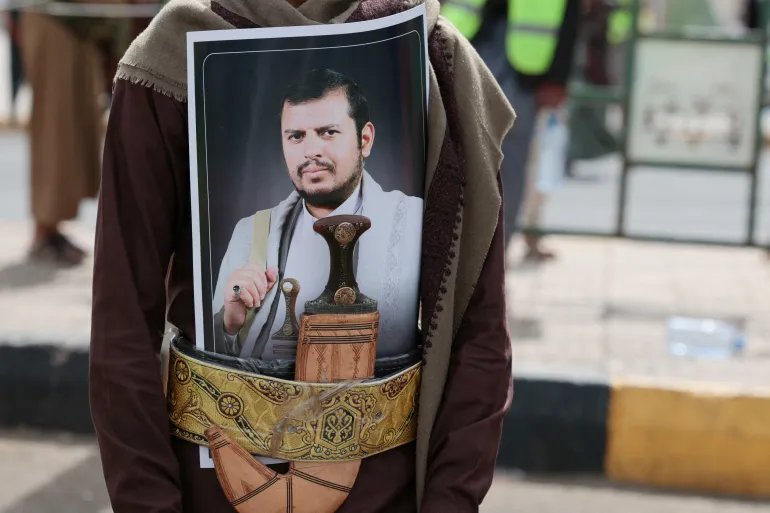
A Houthi supporter sports a poster of the group’s leader, Abdel-Malik al-Houthi, in his dagger’s belt, during a rally against the Saudi-led coalition [File: Khaled Abdullah/Reuters]
Aggression against Mecca ‘a condemned act’
Esmaeil Baghaei, Iran’s Ministry of Foreign Affairs spokesperson, said in a statement on X on Thursday that any aggression against Islamic holy sites, particularly Mecca, “is a condemned act”.
But he added that “a mere claim” of intercepting a drone “en route to Mecca” is not enough to accuse the Houthis of the act.
“Nor should we forget that our region has witnessed numerous instances of ‘false flag’ operations, particularly in recent months,” Baghaei said while pointing at Israel.
Meanwhile, China has privately asked Iranian officials to help rein in the Houthis after Saudi Arabia appealed to Beijing following recent Houthi attacks, anonymous sources in Iran told the Reuters news agency.
Beijing publicly called for restraint, dialogue and the restoration of safe navigation, but its private message went further than that, Reuters reported.
The escalation is also threatening to draw in other regional actors – specifically Saudi defence partners Pakistan and Turkiye, which signed a joint defence agreement with the kingdom last month.
Pakistan’s Defence Minister Khawaja Asif said the time has come to implement the Mecca agreement with Saudi Arabia and Turkiye due to recent Houthi attacks.
Asif’s comments to Pakistani media on Thursday were made as Iran’s Foreign Minister Abbas Araghchi said he’d held a phone conversation with Pakistan’s army chief Asim Munir to discuss “regional developments”.
Coleen and Wayne as you’ve never seen them before, as they star in their new Disney+ reality series The Real Rooneys
17:16, 17 Sep 2026Updated 17:18, 17 Sep 2026
Coleen and Wayne Rooney are keeping things real in their latest show
It’s a Premier League makeover for Wayne Rooney, who is embracing his latest position of reality TV star.
Together with wife Coleen and their four boys, Wayne lets the cameras in to the family’s £20million Cheshire mansion to witness the highs and lows of their chaotic family life. “This is a side of us you’ve never seen before,” promises Coleen. Mrs Rooney appears to be spot on. The former number 10 is seen quaffing champagne in a snowsuit, cuddling up to Mickey Mouse and trying to keep up with his growing sons playing football in the garden.
But it’s not all fizz and frolics, Wayne is also filmed being given the hairdryer treatment by Coleen in scenes that could make Sir Alex Ferguson wince. Coleen tells her husband that he’s ruined a family holiday and storms out of shot as the cameras follow them on a beach, leaving Wayne alone and subdued on a sun-lounger contemplating his actions. “The dog house manual? I’m on the third book,” Wazza quips, safely out of Coleen’s ear.
When he’s not receiving instructions on the shopping list or juggling the school run, Wayne is also seen embracing a career pivot to the BBC Sport punditry team. The former England star was a surprise hit at this year’s FIFA World Cup. His no-nonsense commentary and blunt put-downs were a winner with viewers, especially after branding the multi-million pound half-time show ‘crap.’ “I’ll do my job, entertaining the country,” Wayne smirks to the camera, turning on the charm in one of his first TV confessionals.
A summer at the BBC may have signalled a new showbizzy Wayne, but in his new reality series he dives right in.
In the new Disney+ series, Wayne, 40, shares the spotlight with Coleen, 40, and sons Kai, 16, Klay, 13, Kit, 10, and Cass, eight.
Reflecting on their incredible turn of fortunes, after meeting as teenagers on a council estate in Liverpool, Coleen says: “This house is everything I’ve dreamed of, the only problem is we’ve got to share it with our four boys.”
Klay is seen being interviewed by an off-camera producer who asks: “Who’s more famous, mum or dad?” He replies: “My dad. My mum is only known because of my dad.” Wayne also confirms the couple will not have any more children, saying: “No chance, I’ll have the snip.” Coleen references her court case against fellow WAG Rebekah Vardy and her appearance on I’m A Celebrity… Get Me Out Of Here! as she works on developing a collection with Primark and filming a TV advert alongside actor Danny Dyer. She says: “Since the court case and then the jungle, it’s opened up a lot of doors.” Wayne is also seen in his natural habitat, revelling in having a kick around with eldest son Kai, who is a forward for Manchester United’s youth academy.
Later in the trailer, Wayne holds Coleen up in his arms as they recreate the Dirty Dancing lift.
“It feels like we’re on the edge of a new life,” the mum says in a voiceover.
Wayne also appears to be fully in the grips of a new look. The footballer appears to have undergone a glossy glow-up to match his new on-screen ‘fun dad’ persona.
Ditching his beard for some rugged manscaping, the ex England captain appears noticeably more primped and preened for the small screen. Growing out his salt and pepper hair, Wayne is happy to show off his locks after his many famous hair transplants over the years.
He underwent his first back in 2011, “I was going bald at 25 why not. I’m delighted with the result,” he previously said.
This year Wayne also revealed he had gone under the knife to have nose surgery to correct long-term breathing difficulties from breaking his nose twice during his playing career
Ready for his close-ups, the former striker is also smiling a little more brightly – sporting some straighter white teeth.
They are the latest footballing family to join the race to become Britain’s next reality star. They follow The Vardys on ITV and the Owens after Michael and his family also let the cameras in for Prime Video with Peter Crouch and Abbey Clancy set to follow suit in the new year.
The Real Rooneys will launch on September 24 on Disney+.
Public broadcaster RTE says the country’s participation cannot be justified amid ‘appalling and ongoing loss of lives in Gaza’.
Published On 17 Sep 202617 Sep 2026
Ireland has become the second country, after the Netherlands, to announce a boycott of next year’s Eurovision Song Contest over Israel’s participation.
Irish public broadcaster RTE said in a statement on Thursday that the country’s participation could not be justified “given the appalling and ongoing loss of lives in Gaza” and that the humanitarian crisis in the enclave “continues to put the lives of so many civilians at risk”.
Recommended Stories
list of 3 itemsend of list
RTE, which manages Ireland’s selection and participation in Eurovision, added that it remained “deeply concerned by the continued denial of independent access [for] international journalists to the territory”.
The decision marks the second consecutive year that Ireland will neither participate in nor broadcast the competition, which is the world’s most popular television music show.
Earlier this month, Eurovision organisers said they were excluding any country involved in an armed conflict from hosting the competition.
However, the Dutch public broadcaster Avrotros said the exclusion of countries in conflict was not “sufficient”.
Avrotros announced last month that it was withdrawing from the 2027 competition.
It said Eurovision could “no longer be considered neutral” given Israel’s participation in “a large-scale military conflict” in Gaza.
Both Ireland and the Netherlands were among five countries that withdrew from Eurovision 2026 in Vienna earlier this year. Spain, Slovenia and Iceland also decided not to participate.
Eurovision Director Martin Green said on Thurday that organisers “fully respect” Ireland’s decision and that they “will be missed”.
“The Eurovision Song Contest is at its best when broadcasters and their artists from different countries come together to share music, celebrate creativity and create connections between audiences,” Green said.
“That power to bring people together is at the heart of what makes the Contest so special, and is even more important now in an increasingly difficult and divided world.”
The 2026 show, which Bulgaria won, attracted 132 million viewers, 34 million fewer than its 2025 edition.
Thousands of protesters gathered outside the venue in the Austrian capital during the final in mid-May to oppose Israel’s participation.
The European Broadcasting Union organises the annual music competition. It has faced accusations of applying a double standard for refusing to exclude Israel, despite banning Russia following its invasion of Ukraine in 2022.
Senior U.S. Air Force leaders in Europe say NATO allies are increasingly looking to participate in the development and employment of collaborative combat aircraft (CCAs), even as several of those same countries pursue their own indigenous fighter and drone programs. American commanders say they are looking forward to CCAs expanding the alliance’s overall capacity, and are already pushing for such systems to work together from the outset.
Speaking yesterday at the Air & Space Forces Air, Space and Cyber Symposium that TWZ is attending, Lt. Gen. Jason T. Hinds, commander of U.S. Air Forces in Europe, U.S. Air Forces Africa, and NATO’s Allied Air Command, and Chief Master Sgt. Joshua J. Wiener, USAFE-AFAFRICA’s command chief, discussed how the command is preparing for an eventual European role in the U.S. Air Force’s planned fleet of hundreds of CCAs.
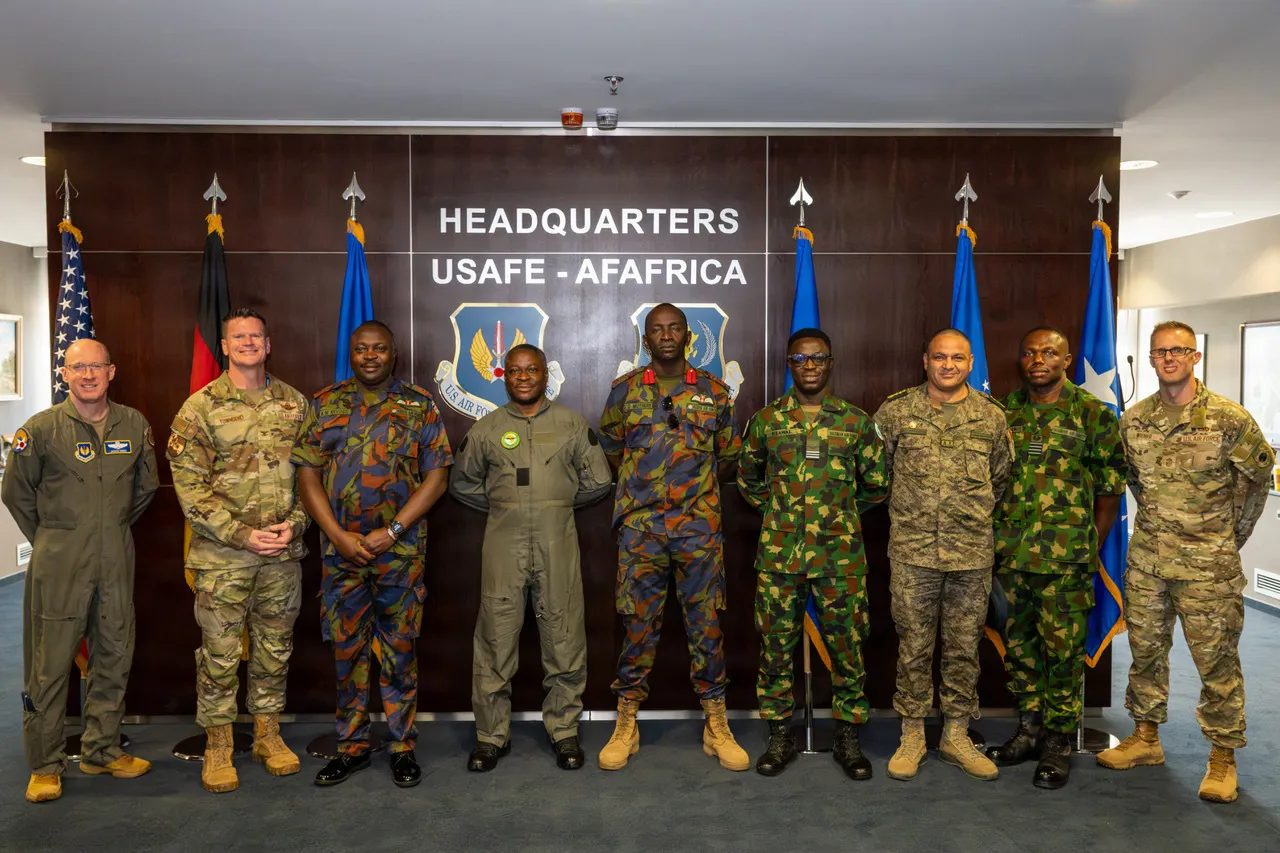
U.S. Air Force Lt. Gen. Jason T. Hinds, U.S. Air Forces in Europe – Air Forces Africa commander (far left), and U.S. Air Force Chief Master Sgt. Joshua J. Wiener, USAFE-AFAFRICA command chief (second from left), pose for a group photo with the Association of African Air Forces representatives from Kenya, Nigeria, and Tunisia at Ramstein Air Base, Germany, earlier this month.
The issue is particularly significant for USAFE, which operates a fraction of the fighter force it maintained in Europe during the Cold War, even as many of its NATO allies contend with shrinking fleets of crewed combat aircraft. This comes against a backdrop of deepening tensions with Russia and the emergence of new kinds of threats. Autonomous aircraft that can augment crewed fighters could provide the alliance with additional combat mass without requiring a corresponding increase in the number of crewed aircraft and personnel permanently based in Europe.
“I’m excited about what CCAs have in store for the Air Force,” Hinds said, pointing to recent comments from the Secretary of the Air Force Troy Meink, including the aim of having at least 500 CCAs in service by 2032.
He added that European interest in these kinds of platforms is already growing.
“I think you’re going to see a lot more interest from other nations inside Europe about what is America doing with CCAs and how they can join this party, if you will,” Hinds said.
Germany is “heavily involved,” he said, while Scandinavian countries and the Netherlands are also showing interest.
In the case of Germany, we have previously explored how that country is looking to procure CCAs by 2029. Sweden, too, recently unveiled a concept for a high-end, stealthy CCA-type drone, while the Dutch are looking to become more closely alligned with U.S. Air Force CCA efforts.
Saab has produced a full-scale concept model of a future uncrewed combat air system, known as aircraft A3. Saab
USAFE is currently using two broad operational scenarios to explain to allies how CCAs could fit into NATO’s force structure.
The first is defensive. A CCA could operate as part of an integrated air and missile defense network, potentially engaging one-way attack drones or cruise missiles without the need for expensive crewed fighters.
The second is offensive. In that scenario, autonomous aircraft could help suppress or destroy integrated air defense systems and potentially attack fielded forces during an effort to repel a hostile incursion into NATO territory.
Allies are interested in both missions, Hinds said, and want the ability to incorporate CCAs into their own force designs. Interestingly, only yesterday, Anduril shared photos of its YFQ-44A Fury configured with air-to-ground weapons, underscoring the fact that the CCA could take on an air-to-ground role in the future in addition to its current air-to-air focus.
A YFQ-44A carrying pods for 2.75-inch rockets and 500-pound Joint Direct Attack Munitions (JDAM) under the wings. Anduril
That kind of interest has already prompted work at the NATO level. Hinds pointed to a study by the Joint Air Power Competence Center, the alliance’s airpower think tank based in Kalkar, Germany, examining how NATO members could employ CCAs in a modular fashion, including issues such as sustainment, training, and exercises.
“It was a pretty long paper, but the nations wanted it,” Hinds said.
Initial experimentation is expected to take place in the United States, but European experimentation could follow, including by Sweden and potentially other NATO members.
At the same time, European countries are not simply waiting for an American CCA to arrive.
The United Kingdom has launched its own Storm Fighter CCA program. Germany is pursuing a separate loyal-wingman effort, while the United Kingdom, Italy, and Japan are meanwhile jointly embarked on the Global Combat Air Program, or GCAP, which is intended to produce the Tempest next-generation crewed fighter and associated uncrewed systems.
A rendering of a CCA concept released at the launch of the U.K. Royal Air Force Storm Fighter program, earlier this year. BAE Systems
The proliferation of national programs raises an obvious question: How does NATO prevent a growing fleet of autonomous aircraft from becoming a collection of incompatible national systems?
Hinds said the answer starts with commonality.
“The first and foremost thing is we want to strive for commonality,” he said. “Commonality means we don’t even have to worry about interoperability.”
Where common equipment is not possible, however, USAFE wants interoperability built into national systems from the beginning.
“Interoperability by design” is the preferred approach, Hinds said, with NATO data standards and other requirements incorporated before a system enters service rather than retrofitted later.
The good news for USAFE is that NATO already has extensive experience establishing common standards for interoperability, covering everything from tactics and procedures to communications, datalinks, weapons employment, and other technologies. That existing framework gives the alliance a foundation for integrating increasingly diverse national systems without requiring every member to field identical equipment.
F-35A from the U.S. Air Force’s 48th Fighter Wing and the Royal Norwegian Air Force fly tandem after a formation flight near Lofoten, Norway, March 10, 2026. The formation flight was intended to symbolize the partnership and degree of interoperability displayed between participating NATO militaries during Exercise Cold Response 26. U.S. Marine Corps photo by Cpl. Mya Seymour Cpl. Mya Seymour
Hinds did warn that some countries have previously acquired equipment that was not compatible with NATO systems, leaving them with the choice of paying to modify their own equipment or forcing the alliance to adapt its systems around it.
That problem becomes particularly important as autonomous aircraft are connected to increasingly complex sensor and weapons networks. Even more important is the requirement for a baseline command-and-control network for CCAs themselves, allowing different platforms to manage them seamlessly.
The ability to share and control CCAs across a complex battlespace is already emerging as both a major opportunity and a significant integration challenge. The U.S. Air Force and Navy, for example, have made clear that their respective CCAs are being developed with the ability to be controlled seamlessly across services, pointing toward a future in which autonomous aircraft need not remain tied to the service or platform that launched them.
In such an architecture, the aircraft, sensor, command-and-control network, and weapon do not necessarily have to belong to the same country.
As an example, Dutch F-35s, operating in Europe, have used a data-exchange system to transmit targeting coordinates to Israeli-made PULS (Precise and Universal Launch System) rocket artillery. The system, developed by Lockheed Martin is known as Keystone, and you can read more about it here.
A Dutch F-35A brandishing its AIM-120 AMRAAM missiles during a NATO air policing drill. Bartek Bera
USAFE is making “significant advances” in areas including cross-servicing, cross-loading, and cross-flying allied aircraft, Hinds said, all of which are intended to make multinational operations more seamless.
A U.S. Air Force F-35 crew chief conducts post-flight checks at Pirkkala Air Base, Finland, during the tactical exercise, Ramstein Flag 26. U.S. Air Force photo by 2nd Lt. Sarah Hedgman
The same philosophy applies to weapons.
“We want to have all the fires, right? Whether it’s U.S. built or built inside European nations,” Hinds said.
That could prove increasingly important as European countries expand domestic production of missiles, drones, and other weapons alongside their aircraft programs.
The growth of GCAP and other European defense programs comes amid broader debate over how much Europe should depend on U.S. military equipment.
But Hinds rejected the idea that allies developing indigenous aircraft and autonomous systems necessarily signals a move away from American equipment.
“No, I don’t,” he said when asked whether allies were moving away from U.S. systems.
Instead, Hinds characterized the trend as an expansion of the transatlantic defense-industrial base.
Sweden was one example he cited. The country, which recently joined NATO, continues to produce new military equipment, including Gripen fighters, while those aircraft are already being operated by NATO members.
Swedish Gripens are currently leased to Hungary, and other countries are considering the aircraft, Hinds said.
A Hungarian Air Force JAS 39C Gripen participating in NATO Exercise Ramstein Flag 24 flies over the west coast of Greece, in 2024. U.S. Air Force photo by Tech. Sgt. Emili Koonce
The broader trend toward co-manufacturing and co-production is also something he welcomed.
“I’m seeing a lot of discussions about co-manufacturing and co-production, and I welcome those discussions as well,” Hinds said.
That approach could become increasingly important as NATO tries to expand its available combat power without relying exclusively on additional U.S.-built platforms.
For USAFE, the objective is to ensure that whatever aircraft NATO countries develop or purchase can plug into a common architecture, sharing data, receiving targeting information, drawing on common logistics networks, and contributing weapons effects across national boundaries.
For a U.S. Air Force command that has spent decades trying to cover Europe with far fewer fighters than it once had, hundreds of autonomous wingmen, whether American-built or allied, could provide a significant way to generate additional combat mass.
Senior U.S. Air Force officials are now working to ensure that the networking, weapons integration, logistics, and command-and-control architecture will be in place once those aircraft start to come online.
KATIE Price has revealed why she’s still wearing her engagement ring from conman ex-husband Lee Andrews despite their split – and if she’s spoken to him since her bombshell Good Morning Britain appearance this week.
Katie revealed she’s still wearing her engagement ring but on the other handCredit: YouTube/The Katie Price ShowThis week Lee insisted ‘there’s been no wool pulled over anyone’s eyes’ despite all of his liesCredit: mistraesthetics/Instagram
On the latest episode of her podcast The Katie Price Show, Katie held up her hand to sister Sophie, 36, and said: “I’m still wearing my ring but on the other hand because I love the ring.
“I’ve taken Lee out of [my Instagram] bio now. Enough is enough now, it gets to a point where you can tolerate so much…
Sign up for the Showbiz newsletter
Thank you!
“I did what I had to do. It doesn’t matter what people say about whoever I’m with. I have to do what I need to do.
“If there are things that I question, that’s for me to find out myself to make my decision. Things haven’t added up and I’m not happy about them. He is still in prison and I haven’t spoken to him.”
This week Katie rolled her eyes as a voice note from Lee was played on Good Morning BritainCredit: UnknownBut Katie confessed she still loves Lee and believes he loves her tooCredit: Unknown
“I love the man I met. I can’t take it. I was stupid to fall for him. It’s really sad.”
Katie also admitted she believes her ex loves her too, saying: “I do believe he did.
“I think he’s got himself in such a situation… where he copy and pastes what he says to women… I do believe he’s fallen for me.”
Katie then revealed the signs that finally made her open her eyes.
She said: “For example, one of the rings he bought me he said was worth £72,000. So I thought I’d better get it insured.
“So I took it into a shop and got it cleaned to get it insured. When they gave it back to me I said, ‘How nice are the diamonds?’
“They said, ‘They’re really good lab diamonds. They were grown in a lab. The ring is probably only worth about five grand’. Do you know how embarrassed I was?”
Iran’s missiles and drones have downed dozens of US aircraft, damaged or destroyed hundreds of the United States’ buildings at its bases in the Middle East, and drained its inventories of military equipment worth billions of dollars, the Pentagon conceded earlier this week.
On Wednesday, Tehran unleashed another unlikely weapon in its war against the US: a maths equation.
Recommended Stories
list of 4 itemsend of list
Iranian Parliament Speaker Mohammad Bagher Ghalibaf, who has also been a lead negotiator during talks between Tehran and Washington at different stages during the past six months, typed out a version of the Taylor equation, a formula used by central banks to determine interest rates, in a post on X loaded with a wartime message.
“Let’s see if a hike could open SOH or produce a single barrel,” he wrote, referring to interest rate hikes and the Strait of Hormuz, a crucial waterway Iran has effectively blocked for global shipping.
“You can’t 25bp [basis points] a chokepoint,” he added, seemingly again referring to the strait. “It’s SOH risk premium, and We set it.”
Hours after Ghalibaf’s post, the US Federal Reserve did raise the benchmark interest rate by 25 basis points.
Early in the war, which was launched by the US and Israel against Iran on February 28, Ghalibaf frequently used financial arguments to mock how the conflict was being conducted by the administration of US President Donald Trump, to point to Iran’s ability to hurt Washington economically unless it changed its approach.
Now he’s turned to maths.
“This is a spectacular bit of agitprop from Iran, a country which, if nothing else in 2026, has demonstrated an impressive ability to needle its US opponent,” Chris Beauchamp, chief market analyst at IG Group, told Al Jazeera.
But what exactly is Ghalibaf trying to say? What is the Taylor equation, has the Iran war influenced the US interest rate, and does Tehran “set it”, as the parliament speaker has suggested?
What is the Taylor equation that Ghalibaf cited?
The rule is a formula economists use to estimate where a central bank should set interest rates based on inflation and the strength of the economy.
Developed by economist John Taylor in the early 1990s, the rule links the US federal funds rate to inflation and the “output gap” – the difference between actual economic output and its potential.
This means the recommended interest rate rises when inflation moves above the 2 percent target or when economic output exceeds its potential. It falls when inflation weakens or the economy operates below potential.
However, the equation is a benchmark, not a set rule that is strictly followed. Policymakers at the US Federal Reserve weigh other economic factors when setting interest rates.
Is the Iran war a factor in the US interest rate hike?
Trump’s tariffs, the energy shock following the US-Israeli war with Iran, and heavy investment associated with the artificial intelligence boom, taken together, have kept inflationary pressures strong, experts say.
On Wednesday, when the US Federal Reserve raised interest rates by 25bp, it was the first increase in three years.
Fed Chairman Kevin Warsh, in his speech following the rate hike, said renewed fighting between the US and Iran, which has pushed up petrol prices, helped convince Fed officials to support higher rates.
“There’s no hiding from hot spots around the world,” Warsh said.
IG Group’s Beauchamp said, “The Iran war, indirectly, is a huge driver of last night’s hike, though no one wants to admit it.”
“The energy spike has combined with the rise in yields to drive the Fed into a corner with no way out,” he said.
Susannah Streeter, chief investment strategist at the Wealth Club, said there is “no denying” that Iran’s retaliatory action against the US and its allies across the Gulf region has “intensified concerns about energy supplies and led to hotter inflation forecasts”.
“The ongoing geopolitical turmoil and elevated crude prices certainly were key issues behind the Fed’s decision to hike rates,” she said.
Is Iran ‘setting’ the US interest rate?
In short, no.
Wealth Club’s Streeter cautioned that while the war in the Middle East and rising oil prices were certainly an element in the Fed’s decision, they weren’t the “only factors at play”.
“The spending might of AI hyperscalers has also pulsed through the veins of the economy, with strong capital investment and resilient domestic demand adding to inflationary pressures, so policymakers will have been looking at the whole picture,” she noted.
“So, while Tehran has arguably had an influence on some of the forces feeding into US monetary policy, particularly through the impact of the conflict on oil supplies and prices, it is not ‘setting’ US interest rates.”
Streeter said the US Federal Reserve was responding to a much broader set of economic conditions.
“Iran’s actions have affected the inflation outlook, but the decision on where to set interest rates ultimately rests with the Federal Reserve, and there are plenty of other data points policymakers use,” she noted.
What’s behind Ghalibaf’s maths mocking?
In March, Iran’s parliamentary speaker had repeatedly used social media to comment on markets and energy prices, including mocking efforts by the Trump administration to influence oil futures and arguing that financial manoeuvring could not create “actual fuel” at petrol stations.
Last month, Ghalibaf posted a graphic bearing the phrase “Make America Hungry Again” – a play on Trump’s slogan “Make America Great Again” – together with statistics on food insecurity and hunger in the US.
“You can’t cover up defeats with false claims,” he said.
The U.S. Air Force has been taking a new look at the feasibility of restarting production of the C-17 Globemaster III cargo plane as part of its still-evolving next-generation airlift plans. The service also continues to explore a wide range of next-generation aerial refueling concepts, including new stealthy and/or uncrewed tankers, but a firm vision for the way forward there has yet to emerge.
Air Force Lt. Gen. Daniel Tulley, head of Air Mobility Command (AMC), shared new details about future airlift and aerial refueling efforts, with TWZ and other outlets at a roundtable at the Air & Space Forces Association’s (AFA) 2026 Air, Space & Cyber Conference.
On the airlift side, the Air Force’s stated plan to date is to replace both the C-17A and C-5M Galaxy with a single Next-Generation Airlift (NGAL) platform, starting in the mid-2040s. Separately, the service is pursuing what could be a family of future aerial refueling capabilities under what is now called the Advanced Tanker Systems (ATS) program. Very broadly speaking, ATS presents a path toward what might come after the retirement of the aging KC-135 tanker fleet, though those aircraft are still expected to keep flying for years to come. The Air Force is also moving to further expand its fleet of newer KC-46A tankers in the interim, but persistent technical and other issues with that design continue to present hurdles.
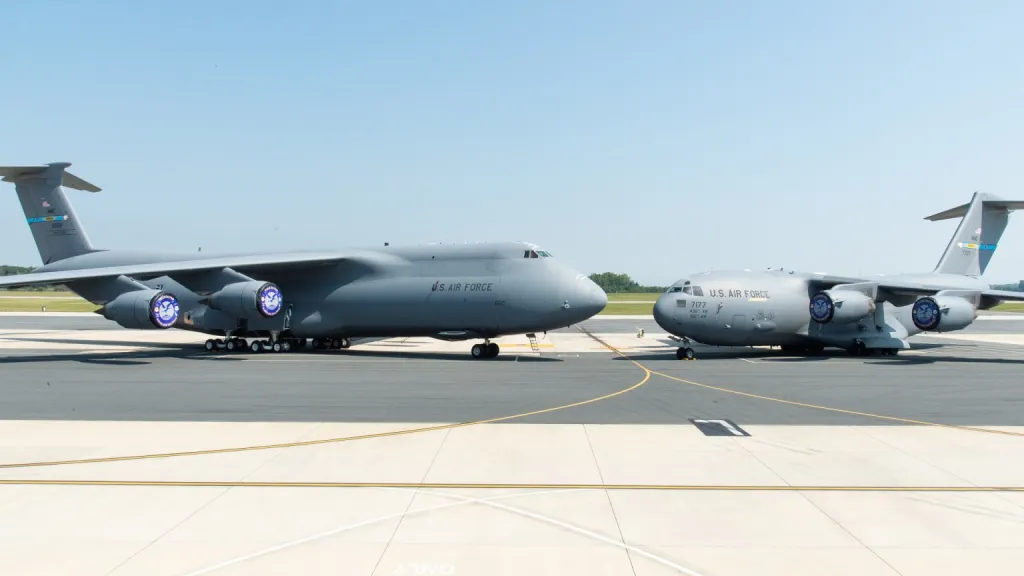
A US Air Force C-5, at left, together with one of the sevice’s C-17s, at right. USAFA KC-135, at right, prepares to link with a KC-46, at left, during a test. USAF
At the roundtable today, Lt. Gen. Tulley was asked explicitly about restarting C-17 production. The manufacturer of those aircraft, Boeing, shuttered that line in 2015. The company also just marked the 35th anniversary of the design’s first flight yesterday.
“Heck yeah, but with a caveat, right?” Tulley said in response. “So we were just asking this question over the course of last week, and it’s in the context of next-generation airlift. So we are about to embark on the Analysis of Alternatives to replace the C-17 and replace the C-5. All options are on the table.”
“There’s always the option to service life extend the C-17, but the [production restart] question came up,” he continued. “I’ve heard this my entire career. Once we terminate an assembly line, can we ever bring it back? Does somebody store all the machinery and the dies and whatnot, and can you bring that out? So we’re asking that question.”
“But then whatever that answer is from the vendors, what will be the price tag associated with that?” he added. “You have to ask yourself, okay, is rebuilding a C-17 even if you make improvements – and there’s a loose analogy with the C-130J, [a] much more modern, capable variant of the C-130E [author’s note: the C-130J evolved more directly from the C-130H variant] I first learned to fly – if you do that with the C-17, is that the best move? Or are there new technologies that we can incorporate into it so that it can defend itself, so that it’s connected, it’s networked, it does all the things that maybe the current C-17 doesn’t do?”
“We’re looking into it as part of the Analysis of Alternatives. I’m hopeful that we’ll get to answer that question.”
In June, the House Armed Services Committee also directed the U.S. Air Force to prepare a formal briefing on the matter of new C-17 production in a report accompanying a draft of the annual defense policy bill, or National Defense Authorization Act (NDAA), for Fiscal Year 2027.
Boeing Pieces Together the Last C-17 on the Line
The RAND Corporation did conduct a detailed, independent analysis more than a decade ago that assessed the costs and complexities that could come from Boeing building more C-17As, as well as other variants and derivatives of the design. RAND’s conclusion was that any of the courses of action would require billions of dollars of new investment and entail risks, as you can read more about in more detail here.
Foreign participation in a new C-17 production run could help at least defray costs. Australia, Canada, India, Kuwait, Qatar, the United Arab Emirates, and the United Kingdom all currently fly Globemaster IIIs. The Strategic Airlift Capability (SAC) initiative, a multinational arrangement with several European members, as well as the United States, also operates three of these aircraft.
Boeing told TWZ directly in June that unnamed C-17 operators had been reaching out about the prospect of restarting the production line, and that the company was “encouraged” by those discussions.
As Lt. Gen. Tulley stressed, there are significant questions about whether buying new-production C-17s, even with substantial improvements, is not only feasible, but a good use of resources. The Air Force’s Globemaster III fleet today continues to prove itself to be critical to the U.S. military’s ability to project power globally, and is in very high demand right now, especially amid the ongoing conflict with Iran.
The Air Force’s desire to replace both the C-17 and C-5, which are very different aircraft in form and function, could still easily lead the service down a different route. Boeing is not the only one looking at future NGAL opportunities. Another company, Radia, has been very actively pitching a clean-sheet design that is physically bigger than either the C-17 and the C-5, and that is geared toward greater operational flexibility, at the Air Force. Radia is targeting a first flight of its aircraft, called Windrunner, by the end of the decade, but it is still in a very aspirational stage at present.
A rendering of Radia’s Windrunner design. Radia
Many questions also still remain about how the Air Force will ultimately proceed on the next-generation aerial refueling front.
“So thinking beyond the current KC-46 buy and the program extension, whatever that next tanker looks like, our Advanced Tanker System, it’s got to be connected. It’s got to be able to defend itself,” Lt. Gen. Tulley said at the roundtable. “But it begs the question: does it need to be manned? Could it be optionally manned? Could it be autonomous? Or is there a family of solutions maybe that would answer that question? So I do not believe that it has to be manned.”
“I think you’re seeing that with the MQ-25 and the Navy’s work, but then, how do we, the U.S. Air Force, bring that to bear in scope, scale, and range?” Tulley continued. “An optionally manned or an unmanned tanker, at range, the ranges we need to operate at, it’s a very large aircraft. And we’re not yet to where we’re employing fully autonomous large aircraft, but the technology, I would say, is there and rapidly getting there if it’s not.”
A rendering of a larger, land-based derivative of the MQ-25, depicted refueling from a KC-46 tanker. BoeingOne of the advanced tanker concepts Lockheed Martin’s Skunk Works has shared publicly in recent years. Lockheed Martin Skunk Works
“We will be going after how to make the tanker survive,” William Bailey, the Air Force official currently performing the duties of the Assistant Secretary of the Air Force for Acquisition, Technology and Logistics, had also told TWZ and other outlets at a separate roundtable at the Air, Space & Cyber Conference yesterday. Bailey was responding to a direct question about whether the service was moving away from the idea of a stealthy tanker as part of the ATS plan.
“So, lots of work around what do we do in the future for our tankers, and we spent a pretty dedicated effort to go through and look at what do we think those design solutions could look like,” Bailey also said. “We looked internally. We went out to industry, had those guys come back with their thoughts on how to provide a more survivable aircraft.”
“The stuff that was coming in for me might have been an incremental improvement, but [it was] not clear that that represented the next step, the next phase,” he added. “What you’ll see is we’ll take our efforts, and we’ll look at, hey, if the real question is tanker access, then let’s not constrain ourselves to just the aircraft itself and trying to make a stealthy tanker. We need a tanker to have access, so we’ll talk about all those systems that it would take to protect that tanker.”
Bailey said the question of operational “access” applied to next-generation discussions, as well.
This ex-French Air Force KC-135FR tanker, now operated by private contractor Metrea, is an example of the outside aerial refueling capacity the U.S. military has been increasingly leveraging in recent years. Metrea
Greater connectivity “can be a game changer, and it has been a game changer in Operation Epic Fury [against Iran],” Lt. Gen. Tulley said at today’s roundtable. “The ability for air crews to communicate, to coordinate tanker orbits and rendezvous, to pass threat information, to save lives and save aircraft has been everything we expected it to be and more.”
“We have MAF NEXUS that we’re pursuing. The goal is to have this on all mobility aircraft, whether they’re future-built and it’s incorporated, or it’s an add-on capability to existing aircraft,” he continued. “It brings edge compute, the ability to then employ AI [artificial intelligence] and much more computing core power forward on the aircraft, and it does network with the rest of the joint force and the Air Force’s battle management system.”
A picture of a US Air Force KC-135 tanker spotted earlier this year with a new large satellite communications antenna (further highlighted in the inset), underscoring work underway now to improve the network connectivity of those aircraft. Alessandro Ledda
When it comes to new options for protecting existing tankers, “nothing’s off the table,” the AMC boss added. “Whether it’s [in the] electromagnetic spectrum, whether it’s kinetic self-defense, a layered approach, we’re looking at everything to come up with what might be the best system. But it’s got to be a system that we can afford, and it’s got to be one that we can put on all the aircraft we have and the ones we’re about to build.”
The Air Force is otherwise still clearly continuing to shape its future airlift and aerial fueling visions. As part of that work, the service is now at least considering the possibility of rebooting C-17 production.
Jodie Marsh has shared an email allegedly from her ex-boyfriend giving insight into their romanceIn the email, Lukas spoke fondly of the couple’s sex lifeCredit: Instagram / @jodiemarshtv
This morning, she shared the lengthy email on social media platform X in which Lukas revealed the moment he fell in love with her.
He also shared his regret at a fallout the pair had during which they stopped speaking, before musing that it might have led to the relationship they went on to have.
Sign up for the Showbiz newsletter
Thank you!
There is a sweet reference to Jodie’s snoring and a declaration they would be together forever.
He went on to describe how they were well-matched in the bedroom and enjoyed a passionate love life.
Jodie now runs an animal sanctuary after years spent posing for lads’ magsCredit: GettyJodie said the split has left her the most heartbroken she’s ever been
Days ago, Jodie, who now runs the animal sanctuary Fripps Farm, said she ended the relationship when a mystery woman allegedly repeatedly called Lukas’ phone.
She said he had been unable to give her an explanation and it had left her embarrassed and “mugged off”.
Addressing the split, she said: “I loved him with all my heart. I’d never felt a love so deep. I’d have taken a bullet for him.
“There have been many red flags recently between us and I kept choosing to ignore them. Last night I reached the end of my tolerance.”
She added: “I don’t care what happened or is happening between them. I feel like I need peace of mind for my own sanity. I know that’s probably mad but my brain can’t cope with the lies.”
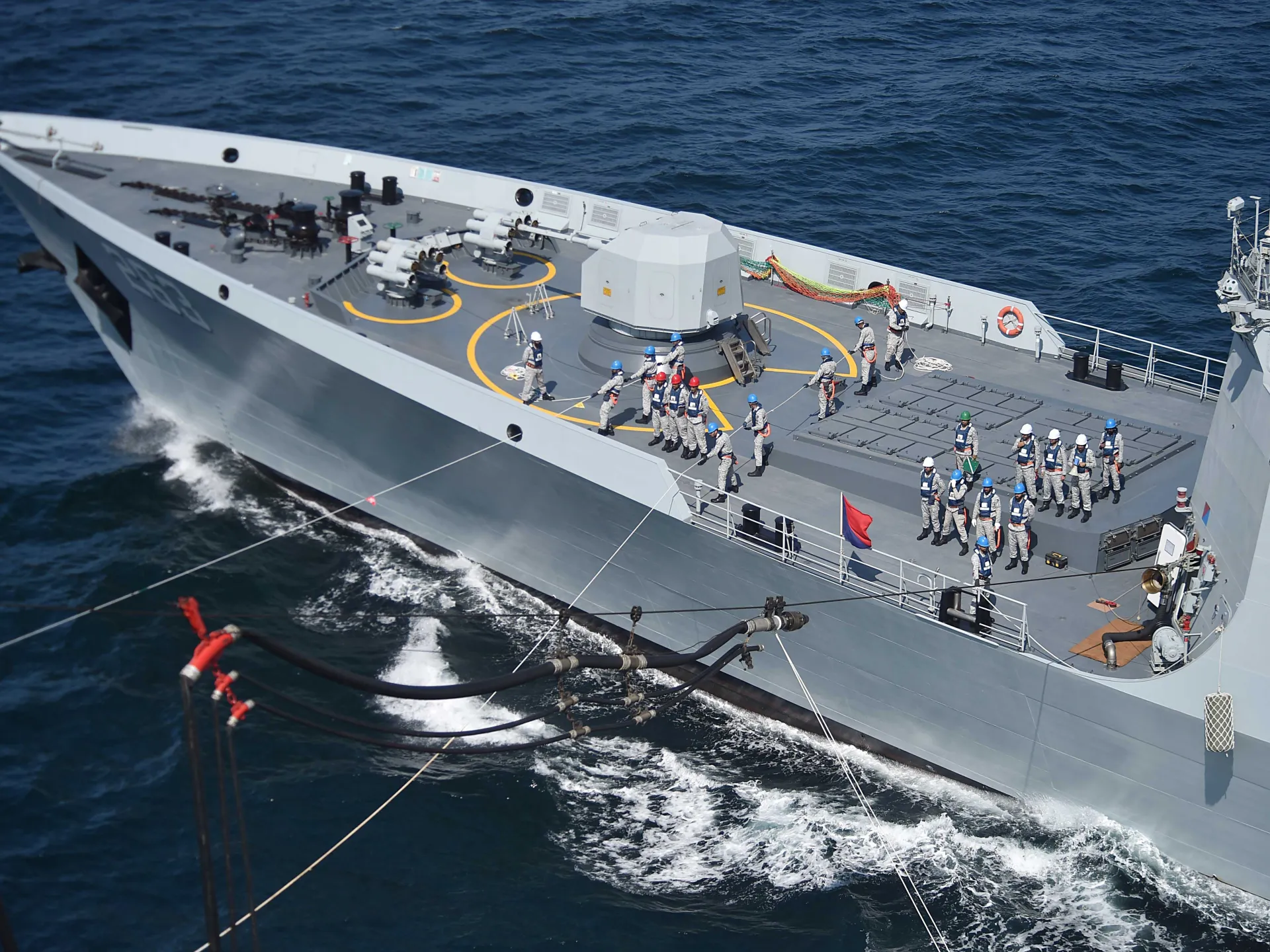
Islamabad, Pakistan — More than 16 months after India and Pakistan fought a four-day air war, firing missiles and drones at each other, the South Asian neighbours came the closest since then to a military face-off — this time in the Arabian Sea.
Indian and Pakistani naval vessels collided on Tuesday, setting off tit-for-tat accusations. Pakistan’s government summoned India’s top diplomat in Islamabad on Wednesday, mirroring action New Delhi had taken hours earlier when it summoned Pakistan’s charge d’affaires and lodged a protest of its own over the incident.
Recommended Stories
list of 4 itemsend of list
The collision is the first direct military encounter between the nuclear-armed neighbours since their four-day conflict in May 2025, when Indian air strikes and Pakistani retaliation brought both countries closer to full-scale war than at any point in decades.
So far, details of what happened remain disputed. Neither government has released video, track data or an independent account – and each statement places the blame on the other’s vessel.
But analysts say it underscored the risks of unintended incidents in the seas that could potentially escalate into broader crises, when India and Pakistan have few military and diplomatic mechanisms left in place to defuse tensions.
Two accounts
According to Pakistan’s Foreign Office statement issued on Wednesday evening, the navy has been conducting its biennial SEASPARK-26 exercise inside its exclusive economic zone since September 1 .
A country’s EEZ extends 200 nautical miles (370km) from its coast. Its territorial waters are only 12 nautical miles (22km) from the coast, with the rest of the EEZ in international waters. While vessels from other countries can pass through a nation’s EEZ in international waters unencumbered, they cannot exploit the waters economically: that right belongs only to the country whose EEZ it is.
Pakistan said that an Indian vessel, identified as the guided-missile destroyer INS Kolkata, had “repeatedly” tried to enter the exercise area since September 7 .
On September 15 , it said, Kolkata made a “dangerous” change of course that brought it into contact with a Pakistani vessel identified in local media as PNS Hunain, an offshore patrol vessel.
“Pakistan strongly rejects this belligerent Indian action,” the Pakistani Foreign Office said, calling it a violation of a 1991 bilateral agreement requiring warships to stay at least three nautical miles (5.5km, 3.4 miles) apart in international waters.
India’s Ministry of External Affairs said the warship was on “routine surveillance” in international waters when a Pakistani vessel approached at high speed and manoeuvred unsafely.
Neither government has named the vessels in its own on-record statement, and India has not confirmed or denied the Kolkata identification.
The two navies last collided in June 2011, when Pakistani frigate PNS Babur brushed against Indian frigate INS Godavari in the Gulf of Aden, while escorting a merchant vessel freed from Somali pirates.
Each side blamed the other then too. That row faded within weeks.
The risks
Retired Vice Admiral Ahmad Saeed of the Pakistan Navy said the pattern — two ships pressing close without a clear intent to collide — was familiar from Cold War-era “bumping” incidents between Soviet and US ships in the Black Sea.
But he argued that India and Pakistan are worse placed to manage similar encounters.
“There’s no bilateral Incidents at Sea agreement, the kind the US and USSR signed in 1972, and no navy-to-navy hotline,” Saeed told Al Jazeera. “Article 10 sets a distance, but it gives no manoeuvring rules and no procedure for investigating an incident afterwards. That gap is exactly why each side can just accuse the other.”
Article 10 of the 1991 confidence-building agreement between the two nations requires warships to stay at least three nautical miles (5.6km, 3.5 miles) apart in international waters.
Saeed said the greater risk was what might follow the collision: sharper tactics such as fire-control radar lock-ons or helicopter overflights and eventually “a contact with actual casualties.”
Muhammad Shareh Qazi, a Lahore-based security and maritime analyst, however, pointed to the same 1991 agreement, which he said requires 30 days’ written notice before a military exercise, as well as international collision regulations that apply to both countries as signatories to the UN maritime convention.
“If this collision really had the potential to escalate militarily, you’d have noticed by now,” Qazi said. “There’s a tool for that, called chaff, fired just above the bow or stern purely to signal you could escalate if needed. Nothing like that happened here.”
Both navies also have their own internal accountability channels, he added, with a captain found to have acted without authorisation facing a court martial process separate from any diplomatic protest.
On fishermen routinely detained for straying across the Sir Creek boundary, which is not demarcated between India and Pakistan further south, Qazi said the link to incidents further out at sea was indirect but real.
“Clear demarcation could help close those ambiguities over time, by reducing the ambiguity around where and how these interactions are expected to occur,” he added.
Saeed was more cautious about how contained an incident like this would remain.
“This hasn’t stayed quiet. Both governments went public with protests within a day of each other,” he said, adding that what made the moment riskier than 2011 was that “both publics are primed after last year’s conflict, which was not the case in 2011.”
Similar close-quarters confrontations have become more frequent between China and the Philippines in the South China Sea.
In the most recent flare-up, on July 24 , Philippine officials said a Chinese vessel came within about seven metres (23 feet) of a Philippine fisheries boat near Scarborough Shoal, the Philippine-claimed reef that China has controlled since 2012, and that Chinese coast guard ships fired water cannon at Philippine vessels.
Whether this week’s collision follows that pattern or fades like the 2011 incident depends less on the ships than on what comes next diplomatically, Qazi said.
“If, in the next 24 to 48 hours, an official statement suggests there was a genuine cause to manufacture an incident for the purpose of escalation, then yes, there may be a real possibility of this happening again,” he added.
A new drone collaboration by Cessna owner Textron and autonomy provider Merlin Labs aims to offer the U.S. military a hot production line and a familiar platform for uncrewed aerial logistics, including in contested environments.
The product is SkyCourier UX, a drone version of the Cessna 408 SkyCourier that has flown for FedEx, foreign special operations forces and small remote commercial airlines during its six years of active service. TWZ previously covered how the SkyCourier would likely end up taking on military applications when it was first announced, which you can read here.
Introducing SkyCourier UX
A partial full-size model on the show floor at the Air & Space Forces Association’s Air, Space & Cyber Conference in Washington, D.C., this week showed a nose that opened with hydraulics to a cargo bay in lieu of a cockpit. We have seen this same front door conversion concept for uncrewed cargo-carrying helicopters as of late. This allows for easy loading of outsized cargoes without specialized equipment, according to the company, though it does not increase the payload. Like the original SkyCourier, it’s good for about 6,000 pounds, or three standard containers.
(Hope Hodge Seck)
The form factor of the uncrewed SkyCourier variant is otherwise identical to its crewed counterpart, with twin turboprops, a high-wing configuration and an aluminum body.
As with the base SkyCourier, a major advantage of the aircraft is its optimization for loading and carrying standard pallets. This means that cargoes don’t necessarily have to be downloaded, broken up and repackaged for movement to forward positions. This is a big logistical advantage and can speed the flow of critical supplies to where they are needed most.
The aircraft’s range is about 900 nautical miles, which the makers say suits it well for Pacific island-hopping, allowing for refueling stops on austere runways. It can take off on runways as short as 3,300 feet and land in just 2,500 feet, according to a spec sheet.
SkyCourier can hold three standard LD3 pallets. (Textron)
The Textron/Merlin collaboration aims to differentiate itself with proven capability in the missions it intends to fulfill, along with the ability to roll out a new drone variant fast and one it can sustain consistently. Bob Gibbs, Textron’s vice president of special missions sales, told reporters in a Monday briefing that the conventional SkyCourier was now fulfilling new orders, not previously announced, to deliver modified aircraft to foreign nations for medical evacuation, casualty evacuation and environmental protection.
“The aircraft’s being operated literally from the Arctic to the Amazon,” Gibbs said. “There are three different island nations in the Pacific that have airline fleets of them. We support our aircraft in 170 countries around the world. So, just like a Cessna Caravan or a Beechcraft King Air, they’re ubiquitous. You find them anywhere, and we support them anywhere in the world.”
The $7 Million Flying Box: Inside the Cessna SkyCourier
While the 900-mile range can’t take the loaded-up aircraft the nearly 2,000-mile stretch between the first and second island chains, Merlin and Textron executives said they don’t need to accomplish that to make it effective.
“This is the ability to disperse the forces among the second island chain … to do the island-hopping to be able to get to, whether it’s Palau, Tinian, Saipan, pick your various islands there,” Kyle Kremer, a retired Air Force major general who now advises Merlin, said. “With the range that it has, it has the ability to agilely move through there” and connect logistics pipelines.
SkyCouriers are flying all over the world, including in some very harsh environments. (Textron)
The autonomy package, Merlin Pilot, is already in use under a $105 million U.S. Special Operations Command contract to develop autonomy for the C-130J Super Hercules transport aircraft. It’s been flown aboard four different single and multi-engine airframes, the company says. A promotional web page for Merlin Pilot shows tanker-class and commercial cargo applications with developing and future capabilities.
Merlin has also teamed with the Air Force to develop an AI copilot for KC-135 tankers that can decrease crew workload and even possibly fly the aircraft on its own in the future. TWZ reported on planned tests for these autonomy-enabled tankers in 2024, with the flights set to begin the following year.
However, the Air Force has not confirmed the completion of any flight tests for the effort since. And on Wednesday, Lt. Gen. Daniel Tulley, commander of Air Force Mobility Command, appeared to confirm that the tests had never taken place.
“There’s some companies out there who have offered to develop things where they can bring a carry-on kit onto old KC-135s and other aircraft, but we haven’t seen them test those successfully,” he said.
He added that autonomy technology may lack the maturity needed for tanker missions.
“An optionally manned or an unmanned tanker at range, [at] the ranges we needed to operate at. It’s a very large aircraft, and we’re not yet to where we’re employing fully autonomous large aircraft. But the technology, I would say, is there and rapidly getting there,” he said.
Tulley did stress that the Air Force saw a need for unmanned aircraft in the last-tactical-leg delivery.
“I’m wrestling with that as we develop an AMC strategy,” he said. “There is absolutely room for some sort of autonomous or other small light lift capability, and that’s just one domain in the air, right? This could be by sea, could be by land, but there is absolutely some requirement for distribution from those major points of debarkation.”
In addition to autonomous takeoff, landing and navigation, and protection of the flight envelope, Merlin Pilot, the company says, has digital copilot human-machine teaming characteristics that include pilot health monitoring, gaze tracking and fatigue detection; pilot incapacitation and contingency response; and flight monitoring and assistance.
A military variant concept of the SkyCourier. (Textron)
Some of Textron’s new features are making light steps toward autonomy already. Gibbs pointed out that the company’s Cessna Citation Gen3 business jets now include standard Garmin auto-land technology.
“Obviously, it’s a different scale than what Merlin’s doing as far as automation,” he said. “But … as we develop new products, we try to future-proof them, and so that’s where you get this nice transition between us.”
The SkyCourier can cost up to $8.5 million, depending on modifications, and while the SkyCourier UX sports GPS-denied navigation and the ability to seek different flight paths to avoid danger, it doesn’t have other built-in defenses. For contested logistics missions, it’s not clear how much risk the services are willing to tolerate for a relatively small logistics payload capability. Kremer maintained, though, that a drone of this size could be a mission-saving capability when dispatched to austere locations. And, in a Pacific conflict, it may reduce demand on already-stretched C-130 transports, now the smallest platform capable of carrying standard containers and long overtasked.
A U.S. Military C-130 prepares for takeoff at Pohakuloa Training Grounds, Hawaii, Oct 28, 2022. (U.S. Army photo by Pfc. Wyatt Moore / 28th Public Affairs Detachment) Spc. Wyatt Moore
“If you can’t get the spare tire, if you can’t get the component, that small thing where you need it in these dispersed operations, they don’t keep the big logistic supply chain built up in these locations,” Kremer said. “You have to be able to get it where you need it, when you need it, and that’s what this provides.”
Nonetheless, the Air Force has a clear appetite for a capability like this. Last year, it signed a $17.5 million contract to put a Reliable Robotics autonomy package on a Cessna 208B Caravan.
On Monday, Air Force Chief of Staff Gen. Ken Wilsbach reiterated the Air Force’s interest in unmanned aerial logistics platforms.
“We’re doing testing on them,” he said in response to an audience question. “We believe that there’s some value in that as well. It certainly could be valuable in the Pacific with the ranges that we’re talking about, and so we’re looking at several different options and evaluating them. But I would say nothing, no program of records just yet, but [we’re] certainly taking a look at some demonstrators and the like to see what’s available to us.”
Notably, China has made significant advancements in developing logistic drone capabilities, with reported successful flight tests of massive heavy-lift uncrewed aircraft, including a 7-ton cargo plane that’s currently the world’s largest uncrewed freighter to take flight. Among them is China’s CH-YH1000, a medium-altitude cargo drone developed by the China Academy of Aerospace Aerodynamics that boasts, like SkyCourier UX, a hatch in lieu of a cockpit for ease of flat-pallet loading up to a weight of 1.2 tons. These are just some of an increasing number of similar systems being developed in China that aim to take the crew out of lower-end logistical missions over short, medium and long distances.
China’s big CY-8 uncrewed logistics aircraft undergoing testing. (Chinese Internet)
Though Textron and Merlin have yet to build a SkyCourier UX prototype, Merlin CEO Matt George emphasized that the company had chosen to partner with Textron because they could start delivering aircraft fast.
“You’ll see over the course of the show a lot of concept aircraft. You’ll see a lot of renders. You’ll see a lot of people who have big empty factories all around the country,” he said. “But I also want to be very clear about the fact that none of this matters without production … There’s 14,000 Americans working in Wichita, Kansas, on a production line where these aircraft, at least in the crewed configuration, are coming off the production line. So when we talk about capability, we’re talking about that capability and bringing that capability to bear soon, rather than in the future.”
Next in the development process, executives say, will be an optionally piloted version of SkyCourier that will allow users to develop comfort with the platform and open the door to further iteration.
The Textron/Merlin team is also leaving its options open in terms of which U.S. military customer might find its platform most useful.
“I hope [the Army and Air Force] fight over it,” Gibbs said.
Among novelist Mona Awad’s prized possessions is a handmade rabbit brooch with delicate hanging daggers. It’s a gift from a reader. The present was inspired by Awad’s goth-tinged comic novel “Bunny,” which has garnered a cult following on social platforms like BookTok over the last several years with readers who call themselves “bunnies.” Driven largely by these devoted fans, the book’s sequel “We Love You, Bunny” hits shelves this month in paperback, while Awad hops across the U.S. on her latest book tour.
The bunnies are so enamored with Awad’s horror-adjacent satires centered on academia and female friendships (and often compared to “Heathers” and “Mean Girls”), they have created their own online — and offline — aesthetic universe.
Their videos and artwork, spanning Pinterest, YouTube, Instagram and TikTok, bring the novels’ surreal, “creepy-cute” aesthetic to life. The fan art features moody Ivy League backdrops with bunny ears, heavy tomes, blood-red candles and saccharine doll-like fashion. It’s a style ripped straight from the book’s antagonists — one of whom wears a pink dress patterned with beheaded girls. Some bunnies cosplay lace-adorned, ax-wielding characters and post the images on social media, or illustrate them.
Sara Ah Sing, a 30-year-old multidisciplinary artist in San Diego who considers herself a bunny, is one such illustrator. She discovered Awad’s fiction when she went down a BookTube dark academia genre-themed rabbit hole. “I was taken aback by how intense and vivid the descriptions were, and not only detailed, but very viscerally described … Mona Awad is not a generic prose writer,” Ah Sing says.
Author Mona Awad writes and dreams up her fiction in La Jolla, where she has a second home.
(Ariana Drehsler / For The Times)
She recalls a protagonist called Cupcake. “She’s described as a person who looks like a cupcake … something like ‘The Children of the Corn’ going to prom. And, it’s like, OK, what does that mean? For an artist it begs for interpretation — and I just have to illustrate it.”
Her imagination has been reignited with the sequel, “We Love You, Bunny.” Ah Sing illustrated its tortured central character, Aerius, as a muscled romance book cover star — with a twist. “Instantly when we meet him in the new book, he’s described with all these delicious descriptions. He’s got all these very specific tattoos that are in very specific places on his body,” Ah Sing says. “He’s wearing pearls and has auburn hair that covers one eye — it’s like a playground for your brain reading that kind of stuff.”
Awad’s vivid descriptions have led to all kinds of fan-led creations. Los Angeles-area Bookstagrammer Michelle Grondine, 40, is inked with five “Bunny”-inspired tattoos. “I have one on my inner ankle, one on my forearm, one on my collarbone, one on my lower back of a cat reading ‘Bunny’ and one on my thigh,” Grondine says. Each of the tattoos varies in style, not unlike the distinct personalities in the book’s fictional MFA cohort.
Grondine plans to attend Awad’s upcoming event at Skylight Books in Los Angeles on Sept. 21 with her best friend, Valentina Feldstedt, who lives in Northridge. The two met online after Grondine spotted Feldstedt’s “Bunny” social posts, and they quickly bonded over their shared obsession. They have collected various editions of the series (including the Barnes & Noble-released “We Love You, Bunny,” which features a bonus chapter), gone to see Awad live several times and crafted Taylor Swift Eras tour-style friendship bracelets for fellow fans and Awad (whom they call “our alpha bunny.”)
“Bunny” author Mona Awad’s spread of her fan art and gifts in her home in La Jolla.(Ariana Drehsler / For The Times)
Feldstedt, 30, has her own “Bunny” tattoo, which she says doubles as an excuse to pitch the novel to strangers. “It’s weird, but if you get it, you get it,” Feldstedt says. “And if you don’t, you’re not a bunny — and that’s fine.”
Awad says her sequel, in part, owes to bunnies like Ah Sing, Grondine and Feldstedt. “When readers started finding it online and creating and expanding the universe of it, it gave me permission to go back to it,” Awad reflects.
She walks around her Boston home and plucks up a fan-made crocheted rabbit toting an ax. Another fan, a nail artist, crafted spooky bespoke black and purple press-ons decorated with intricate white hares. Awad says there’s a song written about the book by an indie band from western Massachusetts called the Greys, and you can buy fan-crafted “Bunny” merch on Etsy.
A poster signed by fans at Mona Awad’s book signing for “We Love You, Bunny” at the Center for Yoga in Los Angeles.
(Ariana Drehsler / For The Times)
But “Bunny” didn’t always have such a rabid fan group. In fact, when the first book was published in 2019, it received critical acclaim, but Awad was disappointed it wasn’t selling as well as her previous novel, “13 Ways of Looking at a Fat Girl.”
“I was like, well, maybe it’s just a weird book,” she recalls on a Zoom call in her literature-lined home. A few years later, during the height of the COVID-19 pandemic, Awad got a call from her publisher. The book was selling, and they couldn’t figure out why. “It was beginning to sell more than 1,000 copies a week, which is crazy two years after publication,” she says. Around that time, BookTok and BookTube had discovered her novel. Next came the bunny ears.
“More and more readers were tagging me on Instagram, and they were dressed in bunny ears, or they had a bunny tattoo, or they were sharing visual art that they had made, envisioning the characters — paintings, ink drawings, cartoons, comics, so many different iterations of this — and then all of these reels and collages that were just so incredible to see,” she says, pausing to emphasize her amazement. “I was really startled by it. It just kind of came in this wave, and then it just grew from there.”
Jane Friedman, a books industry veteran who tracks publishing news, trends and the intersection with technology in her newsletter “The Bottom Line,” says that intense literary fandoms aren’t entirely new. “Apart from BookTok, there have always been these really obsessive fan communities,” Friedman says. “The internet and social media just made it easier for them to come together, making them far more powerful.”
Friedman emphasizes that some critics are concerned that a so-called BookTok phenomenon pushes literature toward consumerism and waters down literary quality. “You can sometimes see authors chasing a trend rather than writing what they would ordinarily write, hoping their book will go viral,” Friedman says. “But I don’t think that’s the case here. It’s probably a mix of timing, serendipity, literary quality and, you know, the stars aligning.”
Awad was born in Montreal to a French Canadian mother and an Egyptian father. She grew up in a French-speaking family, and when her mother enrolled her in an English-speaking school, she recalls feeling like a complete outsider. It was an experience that would happen again and again — like later when her family moved to a Toronto suburb (where, of course, she had a few goth years), and again in her 30s during grad school when she earned her MFA at Brown University.
1
2
3
4
5
1.Superfan Valentina Bunny lives in Northridge.(Valentina Feldstedt)2.Madelyn Bunny hails from Kentucky.(Madelyn Chimento)3.L.A.’s Michelle Bunny has five rabbit tattoos with plans for more.(Michelle Grondine)4.Valentina Bunny, left, and Michelle Bunny with author Mona Awad.(Michelle Grondine)5.Chloe Bunny lives in Australia.(Chloe Bunnie)
“It was kind of my first taste of New England, which was very, very mythical to anybody who doesn’t come from there … It was disorienting in ways that I suppose were productive in retrospect, but it was hard. It was my first taste of being critiqued. It was my first experience of sharing work with others and having them talk about it with me, and it wasn’t easy,” she says. “I mean, the whole world of the MFA felt like fodder for horror.”
Being an outsider looking in remains a central theme across her novels, including her other critically acclaimed works, and it resonates deeply with readers. The wildly imaginative “Bunny,” often described on TikTok as a “fever dream,” has been translated into 17 different languages. Awad notes that she has an especially huge readership in war-plagued Ukraine, where the book is a breakout bestseller. “It’s so moving to me,” she says. “What they say is that it’s a very anti-fascist book, and it’s a very anti-establishment kind of book. It is about resisting the pull of the clique, finding your own ground, standing on your own ground, and being authentically yourself and embracing that.”
It’s a theme she will continue in the third Bunny book. “The minute I turned in ‘We Love You, Bunny,’ I missed the characters and the world,” Awad reflects. She knew there would be another one. Although Awad has deep roots on the East Coast where she’s taught university-level creative writing courses — her students perhaps not so unlike some of the MFA characters in her “Bunny”-verse — nearly all of her books were written in Southern California, where she has a second home and plans to write her next novel. She notes that a short story she wrote in 2025 for the New Yorker was set in the San Diego area, as was her novel “Rogue.” “It’s been such a generative place for me,” she says. “I’ve become sort of superstitious about it.”
Her next book is taking shape as she works and dreams near the ocean. Meanwhile, her existing work is set to make waves in Hollywood. “Bunny” is slated to be adapted into a film by J.J. Abrams’ production company, Bad Robot, and was recently acquired by a major streaming service — although Awad can’t disclose which one yet. She says she’s been deeply involved. “I feel like my vision of the book is being honored, which is really meaningful. Part of the reason that’s so important to me is because I want to honor my readers’ connection to it.”
That deep bond is something Awad witnesses firsthand nearly every night on the road, where her digital fandom materializes into physical rooms filled with devoted readers (often donning rabbit ears). “The thing that moved me the most about going on tour for the hardback — and it’s happening as I’m on tour for the paperback too — is seeing just how many people bond over the book,” Awad reflects. “Not only the art that has been generated by ‘Bunny,’ but so much community and friendship has been formed. You see this kindred spirit through reading, and it’s the most beautiful thing.”
Mona Awad presents “We Love You, Bunny” at Skylight Books on Sept. 21. 1818 N. Vermont Ave., L.A.
In address to European parliament, Canadian Prime Minister Mark Carney listed areas where he wants to boost cooperation.
Published On 17 Sep 202617 Sep 2026
Canadian Prime Minister Mark Carney has welcomed the prospect of his country becoming the European Union’s first associate member, saying such an alliance is aimed to be a “beacon for democracies” and not to “dominate others”.
Speaking in the European Parliament in Strasbourg, Carney said Canada “welcomes” von der Leyen’s ambition to make the country an associate member.
Recommended Stories
list of 3 itemsend of list
“We are not fair-weather allies. We do not pursue zero-sum deals. We hold common values for which we have always fought, and in whose defence we must always remain vigilant,” Carney said to applause from European lawmakers.
“Canada and Europe are each strong. Europe and Canada are stronger together.”
“I am not proposing a third bloc in order to become a great-power rival – only with better manners,” he continued. “We do not seek power to dominate others. On the contrary, we are pursuing resilience so that no one can control our open markets, impair our sovereignty, threaten our territorial integrity, or undermine our freedoms, our democracies, our rule of law.”
Carney listed a slew of areas where he wanted to ramp up cooperation.
“Canada and Europe should secure our strategic autonomy through deep cooperation in the full range of strategic capabilities, including critical minerals, defence industrial capacity, AI and compute, energy security, space and payments.”
He also said the EU and Canada should move towards “seamless digital trade” and allow young people from both sides to work and study on either side of the Atlantic.
The EU and Canada have been facing stiff rivalry and pressure from Trump’s administration on trade, among other matters, and from an increasingly assertive China.
Trump threatened late on Wednesday to take action against the EU if it moves forward with von der Leyen’s proposal of associate membership for Canada.
“If they do that, if I think it’s at all a hostile act, I will put very serious tariffs or stop trading with Europe on many things,” Trump told reporters, calling the proposal “laughable”.
“If it’s a good intention, that’s fine. If it’s a bad intention, we’ll put very heavy tariffs on Europe,” he added.
The European Commission (EC) said von der Leyen’s proposal – which is yet to be fleshed out and will need to be approved by EU member states to go forward – was not a hostile act.
“As our President (von der Leyen) made clear yesterday, the proposed strengthening of our partnership with Canada is not against anyone else, but for our common strength,” said Olof Gill, an EC spokesperson.
The family of Nicholas Brandram have insisted he was not the so-called “Putney pusher” and have blamed the Metropolitan Police for his death.
The 44-year-old was under suspicion of being the jogger who pushed a woman into the path of a bus during a run on Putney Bridge in west London in 2017.
Brandram’s family said he “took his own life after months of immense pressure caused by a Metropolitan Police investigation” and there was no forensic evidence linking the banker to the incident.
The Met has been asked for comment.
In a statement, the family said there was “no evidence placing him on Putney Bridge at that time, and no credible evidence that he was the man shown in the footage”.
“In fact, the evidence proved the opposite.”
Brandram was arrested in June this year on suspicion of attempted grievous bodily harm. Last week, the Met confirmed he had been released under investigation.
The banker was found dead in his home on Tuesday evening. The force said his death was being treated as “unexpected, but is not believed to be suspicious”.
THERE was an on-stage mystery last night as Nicole Scherzinger ‘went missing’ from a Pussycat Dolls song on their tour.
Her bandmates even failed to cover her lyrics when Nicole was nowhere to be seen on the stage in Poland on September 16.
Nicole Scherzinger ‘went missing’ from half of a hit song on The Pussycat Dolls’ tourCredit: Tiktok/@luke.witekShe emerged halfway through the numberCredit: Tiktok/@luke.witek
The Pussycat Dolls Kimberly Wyatt, Nicole Scherzinger and Ashley Roberts are currently on their reunion tourCredit: GettyThe original noughties lineup is not touring, with only three members currently on the roadCredit: Getty
Nicole, who carries pretty much the entire vocal on the 2006 hit, was missing for nearly two minutes before joining the second half of the song.
Fans were quick to react to the rather awkward moment during the concert.
One person said on TikTok: “Could the other girls not just fill in a sing her part.”
“This feel proper awks,” penned a second.
“Why didn’t they just sing her part?” asked a third.
“That was so awkward,” added a fourth.
While a fifth said: “I would ask for a refund haha.”
And a sixth added: “She was missing for half of the song and was visibly p***ed as hell after she came out.”
The PCD Forever Tour marks 20 years since the group’s debut album was released.
The string of gigs feature just three of the group’s original members after most US dates were cancelled due to poor ticket sales.
British fans will see the group take to the stage in Birmingham later this month.
There are also further UK dates including London’s O2 weeks later in October.
The Aichi-Nagoya Asian Games get under way this weekend under the shadow of a housing crisis that has organisers scrambling to placate athletes and officials from participating nations.
The tournament has been mired in complaints over housing options for athletes travelling to Japan, after the host nation decided not to build a dedicated Games village for the 17,000 competitors and officials.
Recommended Stories
list of 3 itemsend of list
To cut costs this year, organisers are relying on a cruise ship, temporary wooden cabins and hotels, but this temporary accommodation has met with criticism in the days leading up to the continental competition.
On Monday, South Korean officials slammed beds in shipping container-style huts as the “worst-ever”, as the South Korean basketball chief said the beds were too short to stretch out in.
Here’s everything we know:
Why are the Asian Games facing an accommodation crisis?
The official housing committee said the issue arose because they expected 15,000 athletes and officials, but numbers increased as new sports were added.
This year’s Games will feature several newcomers, including mixed martial arts, padel and surfing, as well as virtual taekwondo and teqball, which combines aspects of football and table tennis.
Ahead of the Games’ opening, chief organiser Hideaki Omura said efforts are being made to ensure athletes are comfortable.
“If there are different opinions, then we will respond to them appropriately,” Omura, who also serves as governor of Aichi prefecture, told the AFP news agency.
“At this point, while we are responding to individual opinions, we have been improving everything as issues arise, and we will continue to respond that way.”
He added that a committee of former athletes, including Olympians, gave a favourable assessment of the plans for the huts built this year.
“We explained everything to them and had them take a look around, and they said it looked functional and good,” he said.
Temporary wooden container huts being used to house athletes [David Gray/AFP]
Where will the Asian Games athletes stay?
Alternative housing options range from a cruise liner and wooden containers to hotel rooms.
On Tuesday, the Italian cruise ship, Costa Serena, which will host 4,000 athletes and officials, arrived in Nagoya.
The shipping container-style huts in the dock area of Japan’s biggest port will host 2,000 other athletes and officials.
On Thursday, Japan’s deputy Chef de Mission Hisashi Mizutori told a news conference that athletes have been going through entry procedures since the cruise ship village opened a day earlier.
“There have been cases where coaches, team officials and athletes have been assigned to the same room. There are also situations where room assignments were made purely based on the numbers, such as assigning five twin rooms for a group of five men and five women,” Mizutori said.
“While the numbers match on paper, practically it creates challenging situations such as men and women being assigned together, coaches being assigned with athletes, or trainers who need to accommodate a lot of medical equipment being assigned together.”
He added that the Japanese Olympic Committee (JOC) had also anticipated accommodation “challenges” and secured hotels in the city as a backup.
“We are currently working to coordinate and negotiate adjustments wherever possible. For cases where that proves too difficult, we are considering using the backup accommodations that Team Japan prepared in advance as alternatives.”
Why are participating nations and athletes complaining about the accommodation?
“Athletes who are over two metres tall cannot even stretch their legs out on the beds. It’s unreasonable.”
Jung also accused the organisers of failing to respond to South Korea’s concerns about the housing options.
“The organisers have still not said anything,” he said, adding: “We are very concerned and discussing extensively with the Korean Sport and Olympic Committee what to do about this.”
Player Byeon Jun-hyeong, from the basketball team, posted a video on social media showing a leaking sink and a soaked floor in his hut.
“Please help us,” he posted.
Philippine Olympic Committee president Abraham Tolentino also said that while all his athletes had been given a room, “some officials, like coaches, were moved to different hotels and Airbnb”.
The Costa Serena, a 290-metre-long cruise ship that will be used as an accommodation facility for athletes and officials during the 2026 Asian Games, is docked at the Port of Nagoya [Fred Mery/AFP]
Why will cricketers get the best accommodation at the Asian Games?
According to Miyaji, the cricket tournament is being run by the Asian Games organising committee in collaboration with the Asian Cricket Council.
He said that the two bodies had been discussing accommodation options “for a long time”.
“The participating teams in cricket are being offered hotel accommodation,” Miyaji said.
“Many other sports are being accommodated in much more limited facilities, such as a cruise ship or container hotels.”
What other issues have hit the Asian Games?
While the opening ceremony has yet to take place, several events such as basketball, football, cricket, hockey and modern pentathlon have already begun.
On Thursday, Tropical Storm Dujuan was located off Japan’s Pacific coast as of 03:00 GMT and heading northwest towards central Japan, where Nagoya is located.
Kosei Inoue, Japan’s chef de mission for the Games and a senior executive board member of the JOC, said at a news conference on Thursday that some competitions have already experienced “delays or postponements, and there is also a possibility that a typhoon could approach on September 21”.
“Under these circumstances, we are holding thorough meetings within the JOC to ensure that we are fully prepared and capable of responding appropriately to these situations.”
For the last few weeks, Indonesia has been struggling to contain the land and forest fires on its territory. The disaster leads to a cross-border haze crisis affecting neighboring countries, including Malaysia, Singapore, Brunei Darussalam, and the Philippines. Indonesian President Prabowo Subianto’s approaches to the environmental issue arouse uncertainties about his commitment toward ASEAN cooperation and good relations with surrounding states. Prabowo’s inaction on Malaysia’s and Brunei’s plan to take the matter to the ASEAN meeting is also questionable, considering his image as a “foreign policy president.”
Recurring regional environmental crisis
The transboundary smoke caused by peatland fires mostly originates from Indonesia, specifically the islands of Sumatra and Borneo. The slash-and-burn method used to clear land is a main factor contributing to the widespread fires, with El Niño season worsening the situation. To mitigate seasonal disasters, the Indonesian government has attempted to strengthen domestic regulations, yet the problem persists. The haze is not simply an environmental issue, as it has a cross-boundary impact in various aspects of Southeast Asia. Wildlife is at risk, schools are forced to move online, people are experiencing respiratory issues, and other public activities are severely disturbed.
ASEAN member states have understood that this problem should be solved regionally for quite a long time. They have maintained coordination under the ASEAN Agreement on Transboundary Haze Pollution (AATHP), which was fully ratified by all members in 2015, with Indonesia ironically being the last to ratify. However, the agreement lacks strong implementation, as the willingness of the party to act is a significant part of the treaty. This may reflect the ASEAN Way’s value of highly respecting the sovereignty of other member states.
Stay ahead of the geopolitical week.
MD Briefing delivers expert analysis across five global fronts — the Indo-Pacific, energy, geoeconomics, European security, and the Middle East — every Monday morning. Free.
Indonesia’s officials stated that they are committed to the AATHP. They emphasize their own actions of reporting daily updates to the ASEAN Coordinating Centre for Transboundary Haze Pollution Control (ACC THPC). They also openly accept assistance from foreign countries to put out the fires. Nevertheless, President Prabowo’s reaction to seeing this issue as a regional problem is nowhere to be found. He indeed made some meaningful gestures in response to the forest fires, yet he mostly saw it from a purely domestic lens. For instance, Prabowo visited several hotspots in Riau, Sumatera, and provinces in Borneo. At a recent high-level government meeting, he also instructed the chief of the Indonesian police to enforce the laws against perpetrators of forest fires, including several corporations, and to conduct further investigations.
Is Prabowo really committed to ASEAN?
As the impact of the smoke has reached neighboring countries, an official statement or public apology from Prabowo is urgently needed. This political gesture will reassure ASEAN citizens that Indonesia is responsible for this matter and willing to cooperate with other member states. For instance, during the 2015 and 2019 Southeast Asian haze disasters, President Joko Widodo showed that he publicly regretted that the fires affected Malaysia and Singapore, and he even felt embarrassed as Indonesia was the primary source of the smoke.
Furthermore, making a formal apology is not always a sign of weakness, as it demonstrates a deep respect for the other party. Prabowo himself apologized to Vladimir Putin for not being present at the ASEAN-Russia Commemorative Summit, which he openly stated during a visit a few days ago. He may also do the same to ASEAN leaders to calm relations amid the crisis.
Despite reports that the Ministry of Foreign Affairs of Indonesia and relevant institutions are actively communicating with other ASEAN states, a clear statement from Prabowo is still required.
A lack of response on regional coordination may leave observers wondering, as Prabowo is known as a foreign policy president and a “de facto foreign minister.” Since the first day of his administration, he actively engaged with global leaders through overseas trips. As of June 2026, Prabowo has visited 29 countries and engaged in over 50 international engagements. This number reflects his strong interest in connecting with foreign counterparts. He also reached out to various powers and blocs, including participation at the Board of Peace (BoP) and a recent official trip to Russia.
However, Prabowo seems to ignore the reality of the current regional crisis caused by fires originating in his country. He remained silent on Brunei and Malaysia’s intention to discuss the issue at the ASEAN level. Even when the foreign public went into uproar through demonstrations at the Indonesian Embassy in Kuala Lumpur and heavy criticism on social media. His choice to focus more on the domestic side of the environmental crisis raises questions about his priority to work with ASEAN.
In the long run, Prabowo’s lack of enthusiasm for ASEAN collaboration will damage Indonesia’s long-standing image in the region and challenge the basis of the country’s foreign policy. Since 1967, Indonesia has always been taking a dominant role in the organization. No wonder the country is associated with the terms “ASEAN de facto leader” and “natural leader.” Indonesia, along with other member states, helps ASEAN to grow as one of the leading regional organizations, and conversely, the bloc strengthens Jakarta’s bebas aktif foreign policy principle. ASEAN has become a platform for Southeast Asian small and middle powers to articulate their foreign policies when engaging with external actors in the middle of great-power competition.
Despite many criticisms of ASEAN’s consensus mechanism, Prabowo still needs to maintain the commitment toward the regional bloc. To date, ASEAN continues to be relevant for Indonesia, especially during the ongoing haze crisis, as stated in Law 38 of 2008 that ASEAN is a cornerstone of Jakarta’s foreign policy.
On Thursday’s episode, the show hears from Jake, 36, who lives in Australia but was born and grew up in the UK in a single parent family. Jake always knew that he was the result of an extra marital affair. His mother had been a nurse and had met his married father when he was a doctor at the same hospital.
Jake recalled that when he was a newborn, his father occasionally visited, bringing his two children Katie and Tom, who were aged five and three at the time. One of Jake’s most precious keepsakes are two photographs of his brother and sister holding him as a baby.
However, sadly, his mother’s relationship with their father did not last, and Jake never saw his siblings again. When he was 14, Jake and his mum emigrated to Australia.
Despite not seeing his siblings since he was a child, Jake has been desperate to find them and contacted Long Lost Family for help, emotionally saying: “I feel like I always missed out. I missed out on something, that, you know, was really a connection that I craved really. I’ve always somewhat felt a little bit alone. And I just need that connection.”
Sadly, Jake was unable to successfully meet his father after attempting to track him down and therefore unable to learn any more about his siblings. Jake had also tried multiple other avenues to find his siblings, but Katie and Tom appeared to have vanished off the face of the earth.
Even Long Lost Family struggled locating the siblings through their conventional searches. However, the team soon discovered in the series’ files something surprising after receiving thousands of applications.
Months before Jake had applied to the show, Long Lost Family received an application from a woman in Canada called Katie, who was looking for a birth father – with the same surname as Jake’s father. Following a DNA test, it confirmed that Katie was Jake’s half-sister, in an incredible discovery.
Katie is a lawyer who now lives in Toronto and she had no idea that she even had a younger brother. The duo’s brother, Tom, supports Katie’s decision but has chosen not to be involved in any filming at this time.
In an exclusive clip obtained by the Mirror of Thursday’s episode, it sees host Davina share the news with Jake, who breaks down in tears over the discovery.
Asking where his siblings live, Davina explains: “So… Katie, her mum met her stepdad. They moved to… Australia!” Jake is left floored by this discovery as he too moved from the UK to Australia. The guest exclaims: “No way, you’re kidding! No way!” before wiping away tears.
Jake adds: “So they weren’t even that far away. I can’t believe it!” Davina then adds that Katie is a lawyer and she has since moved to Toronto.
The guest then asks: “Did they enjoy Australia? Were they happy?” with Davina responding: “They’ve had good lives, I think the family situation, it’s been difficult for all of you, I think, in different ways.
“I think it’ll be really nice for you to be able to speak together about it. Weirdly, we found her because… she applied to Long Lost Family to find your dad.” This piece of information leaves Jake in tears as he exclaims: “Wow!”
Viewers will have to tune into Thursday’s episode to see the two siblings have an emotional reunion.
Long Lost Family continues on Thursday 17th September at 9pm on ITV and ITVX