Israeli politicians reacted to sanctions by states including the United Kingdom, France, and Canada on the country’s illegal settlements in the occupied West Bank with self-righteous anger. But what is the latest example of Israel’s international isolation brought on by its treatment of the Palestinian people has not been influential in swaying the electorate in the run-up to October’s elections, analysts tell Al Jazeera.
Responding to the UK Foreign Minister Ed Miliband’s accusation that Israelis were ethnically cleansing the occupied West Bank, Israel’s Gideon Saar accused his counterpart of spreading “outrageous lies” and attempting to interfere in the election through foreign pressure.
Recommended Stories
list of 4 itemsend of list
Israeli President Isaac Herzog also condemned the measures, branding them a “gross interference in the democratic elections” of Israel.
But, in reality, the majority of Jewish Israelis have supported their country’s genocidal war in Gaza and the occupation of the West Bank.
A poll from August, published as the death toll for Palestinians killed in the West Bank had already reached 76 this year, showed that more than half of Jewish Israelis supported retaining the illegal settlements as part of any future agreement on a Palestinian state, while nearly 40 percent supported annexing the territory in defiance of international law.
“People just don’t care that settlements are illegal,” Israeli political analyst Ori Goldberg said.
”Ed Miliband expressed a number of laudable sentiments when announcing the measures,” Goldberg said, referencing the UK foreign secretary’s references to his own Jewish heritage when announcing the cessation of trade with Israel’s illegal outposts. “But we’re at the stage where Israelis aren’t even interested in the truth so much as they are the sentiment.”
Little political impact
Israeli Prime Minister Benjamin Netanyahu goes into the elections at serious risk of losing, with many polls predicting that a coalition of parties opposed to him could win the majority in Israel’s parliament.
But it will not be issues like the settlement-related sanctions that will lose him votes, analysts said.
Public backing for the “government and opposition blocs are pretty hardened, and nobody is going to switch from one side to the other over sanctions arising from [the settlements],” Michael Koplow, chief policy officer at the Israeli Policy Forum, said. He added that the sanctions were unlikely to weigh as heavily with the electorate as “this government’s record and the related feelings people have about Netanyahu”.
“When people were asked what would determine their vote, security came first,” Israeli sociologist Yehouda Shenhav-Shahrabani said.
“I think there are several mechanisms operating simultaneously,” he added.
First, he said, is the normalisation of the settlements. In Israeli public discourse, the occupied West Bank is increasingly referred to by the biblical name “Judea and Samaria” – a shift he said was becoming institutionalised.
“Second, external sanctions don’t necessarily translate into domestic political costs,” Shenhav-Shahrabani said. “And perhaps most importantly, politically foreign pressure can be absorbed into an existing Israeli narrative [of anti-Semitism] rather than [changing how the issue itself is understood].”
No criticism of the voters
None of Israel’s most prominent politicians has criticised the government for its support of the settlements in defiance of international condemnation. Yair Lapid, a former prime minister and one of Netanyahu’s leading opponents, has, instead, focused his ire on the countries condemning Israel. “Imposing boycotts and sanctions on Israel is a grave mistake,” he said. “This is a wrong and dangerous policy, at the wrong time and for the wrong reasons.”
Another of Netanyahu’s principal rivals, Gadi Eisenkot – whose Yashar Party manifesto does not mention either the West Bank or Gaza – has declined to speak on the sanctions directly. Netanyahu has also yet to comment on the sanctions publicly, despite his Likud party having championed settlement expansion for decades.
“The sanctions haven’t particularly hurt Netanyahu, at least not as far as we can see in terms of direct influence on … polling,” said Dahlia Scheindlin, a pollster and public opinion researcher based in Tel Aviv.
Instead, the focus has been on other elements of an eventful electoral cycle, including the emergence of new challengers to Netanyahu on the right.
“We aren’t seeing any real backlash from the sanctions,” Scheindlin said. “Instead, it’s just getting filtered through what people already think of him – his critics dislike him even more, and his supporters basically say, ‘Well, the world hates us no matter what.’”
Millie Bobby Brown and her husband Jake Bongiovi have shared the first picture of their new babyCredit: GettyFans went wild for the first look at their latest adopted babyCredit: milliebobbybrown/Instagram
Now, Millie Bobby Brown has thrilled fans by sharing the first picture of her son .
The TV star, who adopted her first child in August last year, shared a picture of her hands placed over her new baby’s.
Sign up for the Showbiz newsletter
Thank you!
Posting the snap on Instagram, the mum-of-two wrote: “Hi little guy!”
Sanaa, Yemen – Ahmed Yahya, 28, fills his taxi with 10 litres of petrol as he begins his workday early in the morning.
“I feed my taxi with fuel first so that it can help feed my family,” Yahya, a taxi driver, said as he wiped the dust from his front window at a petrol station on the outskirts of Sanaa.
Recommended Stories
list of 3 itemsend of list
Up until earlier this week, Yahya used to pay 4,750 Yemeni riyals, the equivalent of roughly $8.90 in Houthi-controlled areas of Yemen. The price had remained unchanged for about four years in territory under the rebel group’s control – including the capital Sanaa.
But then, on Monday, the Houthis announced a roughly 10 percent increase in the price of petrol, up to 5,250 Yemeni Riyals ($9.80). After years of economic misery, Yahya described the price hike as another “painful surprise to an already devastated people”.
The Houthi-run Yemen Petroleum Company said the diesel and petrol price increase was the result of a “global increase in fuel prices”, and promised that it would be temporary. The increase in global oil prices this year comes off the back of the impact of the United States-Israel war on Iran. But, more recently, the Houthis’ own capture of Yemen’s southern Red Sea coast from government forces last week, and attacks on Saudi Arabia, have played a major role in increasing prices.
“When I heard the announcement of the new fuel price, I was shocked and frustrated. We’re hardly surviving, and this price increase will make survival even harder,” said Yahya, as he lamented another burden in a country where 18 million already face acute food insecurity – a lack of reliable access to enough food.
‘Rent or food?’
Yahya, a father of three, has been working as a taxi driver for five years. Although the job helps make ends meet, he feels financially insecure, especially with the ongoing changes in food and fuel prices.
“My family spend about 75,000 Yemeni riyals [$140] a month on food expenses such as flour, rice and cooking oil. With the fuel price rise, we will need at least 85,000 Yemeni riyals [$159] a month for the same food items,” said Yahya.
The resumption of fighting in Yemen in the past few months, after a four-year period of relative calm in the country’s war, has contributed to the price rises. But for Yahya, relatively safe in Sanaa, it’s the increased expenses that are the more troubling development.
“When prices rise, they affect what we eat, drink, and how we live,” he said. “Let me give you an example: I pay 25,000 Yemeni riyals [$47] in rent every month. With the increase in food prices, putting money aside to pay the rent has become more challenging. What is the priority? Rent or food?”
An April report by the International Monetary Fund (IMF) said that Yemen’s internal conflict has led to significant macroeconomic vulnerabilities and a marked decrease in income per capita, leaving more than half of the population in urgent need of humanitarian assistance.
“It [the conflict] has caused widespread food insecurity, disease outbreaks, mass family displacement, and limited access to clean water,” the report said.
Risky and costly transportation
One of the links between the renewed fighting and the increase in prices is the longer distances needed to transport products across the country, as truckers avoid roads near the front lines.
“A truck carrying goods from the south to the north or vice versa now takes up to a week to reach its final destination. Before the renewed fighting, a similar journey would have taken three days or less,” explained Saleh Abdullah, a shopkeeper in Sanaa.
The increased transportation costs, including the higher fuel prices, are passed on to the consumer.
“This means no family is immune to this trouble,” Abdullah said. “Whether it is the flour, the baby milk, the fruits, the vegetables, or anything else, families will feel the pain of price increases.”
“Some customers become angry at us when we sell products at a higher price,” he added. “We didn’t impose prices. We just react and adapt to the changes in the country or the region.”
Ibrahim Abdu, an employee at the Nehm customs checkpoint in Sanaa governorate, said the number of trucks arriving in the capital has declined over the past few weeks.
“Fighting has cut off many roads, and merchants have avoided risking their products and drivers,” he told Al Jazeera.
‘A hunger multiplier’
Years of war have taken a heavy toll on Yemen’s economy, disrupted businesses, and pushed millions of people into poverty and food insecurity. Against this bleak backdrop, the country’s humanitarian tragedy has been worsening.
Ahmed Mohammed, a former humanitarian worker in Hodeidah, describes the fuel price rise as a “hunger multiplier” in war-torn Yemen.
“If a breadwinner struggles to buy a family three meals a day, he may be able to afford only two given the rising price of food commodities. This will deepen hunger among families,” said Mohammed.
He added: “War is ugly, and one of its ugliest aspects is seeing a family unable to afford a kilogramme of flour, sugar or rice.”
The UN Refugee Agency (UNHCR) warned this week that the violence threatens to trigger a humanitarian crisis as more people are displaced, pressuring communities with limited resources.
A multi-faceted impact
Wafiq Saleh, an economic researcher and executive director of the Taiz Centre for Yemeni-Gulf Studies, said the 10 percent hike in fuel prices in Houthi-controlled areas deals a blow to Yemeni consumers.
“Its impact will manifest as a major inflationary wave, placing a heavy burden on the most vulnerable and income-deprived segments of society,” Saleh told Al Jazeera.
While this price increase may appear modest in percentage terms, its effects extend far beyond the petrol station, rippling through various goods and services and creating new hardships, according to Saleh.
“Petroleum products serve as intermediate inputs for a wide range of goods and services. Consequently, a 10 percent rise in fuel prices does not merely increase people’s expenses by 10 percent; it triggers a cascading effect on prices,” he said.
“The most severely affected sectors include agriculture – which relies on diesel for crop irrigation – and the transport and services sectors, where rising costs immediately drive up passenger fares and food prices.”
He added that the increase would also affect water and electricity services, many of which rely on diesel-powered generators, further increasing the cost of basic services.
Small- and medium-sized enterprises are similarly affected.
“Small enterprises are operating on narrow profit margins, and they may be forced to either cease operations or pass the increased costs on to the final consumer,” Saleh said.
In the memoir, Earl Spencer writes of his sister’s troubled marriage – claiming a friend of Diana’s had told him that on the eve of their wedding in July 1981, Prince Charles had told her he was “very happy to marry her, but… not actually in love with her”.
Things became “very difficult indeed” in the marriage early on, Earl Spencer writes, adding that he is “sure that both spouses despaired of the other at times”.
He now believes his sister had attention deficit hyperactivity disorder, external (ADHD), and as part of her condition suffered from Rejection Sensitive Dysphoria – describing the latter as an “intense emotional pain in the face of others’ rejection or criticism”.
In her later years, he writes, Princess Diana considered taking her own life on more than one occasion but love for her sons “stopped her from going further”.
The former press secretary to Queen Elizabeth II described the latest claims serialised in the Daily Mail of Charles sounding “giddily elated” as “hogwash”.
Dickie Arbiter, who was press secretary to the late Queen at the time of Princess Diana’s death and funeral, told BBC Newsnight that Charles was “devastated at the time” and that “it’s not in his character”.
“There’s no way he could have ever said anything like that. Charles Spencer is just talking hogwash,” he added.
Royal commentator Jennie Bond meanwhile said Earl Spencer’s “vindictive account” was “extraordinary”.
“I have no reason to disbelieve this is his memory of what happened, but there are usually two sides to a conversation and a story,” she told BBC Breakfast.
Amid the royal drama, Prince Harry, the Duke of Sussex, attended the inaugural Invictus Spirit Awards in Greenwich on Thursday evening.
In his first public appearance since moving back to the UK, Prince Harry posed for photographs for the press and selfies with veterans, before delivering a speech.
The Federal Communications Commission on Thursday granted Paramount Skydance’s request to allow Middle Eastern royal families to hold a substantial stake in a merged Paramount-Warner Bros. Discovery.
The sovereign wealth funds of Saudi Arabia, Qatar and Abu Dhabi are slated to indirectly own nearly 50% of the equity in David Ellison’s proposed mega-studio, Paramount-Warner Bros. That will give them a hefty stake in CBS, CNN, Comedy Central, HBO and two historic Hollywood film studios.
As part of the Communications Act of 1934, Congress placed restrictions on foreign ownership of broadcast outlets because of concerns about national security. Current rules prevent foreign investors from owning more than 25% of a company that holds a U.S. broadcast license — unless the FCC determines that foreign ownership would serve a public interest.
CBS owns more than two dozen TV stations with FCC licenses, including KCBS-TV Channel 2 and KCAL-TV Channel 9 in Los Angeles.
“Upon review of [Paramount’s] Petition and consideration of the record of this proceeding, we find that the public interest would be served by granting the Petition,” FCC said in its ruling, noting that Paramount has said the proposed ownership changes would “not result in a transfer of control of Paramount.”
Instead, “Ellison family will retain a majority of the voting interests and control of Paramount,” the FCC said.
FCC Chairman Brendan Carr, an appointee of President Trump, has been supportive of Paramount’s takeover of Warner Bros. Trump and his lieutenants, including Defense Secretary Pete Hegseth, have been cheering for Ellison to control CNN, a Warner property.
Anna M. Gomez, the lone Democratic FCC commissioner, slammed the agency’s decision, saying it “just let some of the most repressive governments in the world indirectly control nearly all of a combined Paramount-Warner Bros.”
“An investment this large in one of America’s biggest media companies doesn’t just buy equity, it secures influence over what gets said and what gets made,” Gomez said. “That’s why I called for this new and novel issue to go to a full commission vote given what’s at stake. Instead, the FCC snuck this ruling out as a staff-level decision, with no public vote and no accountability for a call of this magnitude.”
Ellison’s billionaire father, Oracle co-founder Larry Ellison, in February agreed to personally guarantee the $47 billion in equity needed to buy out Warner Bros. Discovery’s existing shareholders for $81 billion. Ellison and longtime Skydance investor, RedBird Capital Partners, then entered into agreements to assign some of their purchase rights to the sovereign wealth funds.
The funds plan to invest $24 billion in the Paramount-Warner deal. Saudi Arabia’s Public Investment Fund is set to contribute $10 billion while the Qatar Investment Authority and Abu Dhabi’s L’imad Holding Co. will separately add $7 billion.
Paramount has separately lined up debt financiers to help pull off the leveraged buyout of Warner Bros. Discovery — Hollywood’s biggest merger in decades. The deal has been stalled by an antitrust challenge brought by California Atty. Gen. Rob Bonta and 11 other Democratic attorneys general, representing such states as New York, New Jersey, Colorado, Nevada and Oregon.
The foreign ownership rule was adopted nearly a century ago because members of Congress wanted to make sure that hostile foreign players were barred from using U.S. airwaves to spread propaganda, particularly in times of war.
“We appreciate the FCC’s careful review and are pleased that it has granted Paramount’s petition,” Paramount said in a statement, adding the Trump administration’s Committee for the Assessment of Foreign Participation in the United States Telecommunications Services Sector had separately recommended approval of the deal, subject to several conditions to protect the data of the company’s U.S. based consumers.
Paramount said that, once the deal closes, the Ellison family and RedBird would “collectively hold the largest equity stake in the combined company and 100% of the voting shares, with no other equity participant having any governance rights.”
Paramount has two classes of stock — an ownership structure that will be replicated in a merged Paramount-Warner Bros.
The Ellison family owns 77.5% of Paramount’s voting Class A common stock. RedBird indirectly holds the remaining 22.5% of the Class A shares. The Ellison family separately has 40% of the non-voting Class B shares.
“At a time when the media industry faces unprecedented competitive pressure from dominant big tech companies, a combined Paramount-WBD will have the scale and resources necessary to compete, invest, innovate, and deliver premium content to audiences worldwide,” Paramount said in its statement.
Russians head to the polls from Friday to Sunday to elect members of the State Duma, the lower house of Russia’s parliament, in the first parliamentary election to be held since the country launched its full-scale invasion of Ukraine in 2022.
The vote comes as Russians face a slowing economy as well as Ukrainian drone strikes on refineries and warehouses far from the front line.
United Russia, the governing party that backs President Vladimir Putin, is expected to keep its dominant position.
The authorities are presenting the election as a chance for voters to have their say. Critics argue that with no genuine opposition on the ballot, the result is largely settled in advance.
So why are the elections worth watching? Here is what you need to know:
How do Russia’s elections work?
Starting Friday and lasting through Sunday, Russians will elect members of the lower house, the State Duma.
They will also cast ballots in local elections.
Voters in 11 regions will elect their governors, and 39 regions will elect members of regional legislatures.
Voting is spread over three days to boost turnout among the 111 million eligible voters and includes areas Russia occupies in Ukraine. Electronic voting is allowed.
Half of the Duma’s 450 seats are filled by party lists and the other half are contested in single-ballot races.
Election officials hang a list of political parties at a polling station before the parliamentary elections in Podolsk, Moscow region [Ramil Sitdikov/Reuters]
What is United Russia?
Russia’s governing party, formed in 2001 from a merger of pro-Kremlin parties, has backed Putin and dominated the parliament ever since.
United Russia won more than two-thirds of the Duma’s seats in the 2021 election. It is again poised to dominate the body.
The party’s list is led by political heavyweights: Foreign Minister Sergey Lavrov, Russia’s top diplomat for 22 years, and Sergei Sobyanin, Moscow’s powerful mayor.
In an apparent bid to add fresh faces to what is widely seen as a party of bureaucrats, its third-highest-ranking official is war correspondent Yevgeny Poddubny, who was badly wounded by a Ukrainian drone.
Members of United Russia have pledged to back the war effort and Putin’s maximalist goals in what the Kremlin calls the “special military operation” in Ukraine.
Deputy Chairman of the Russian Security Council and leader of the United Russia political party Dmitry Medvedev [Ekaterina Shtukina/Sputnik/Government press office/EPA]
Who else is running in Russia’s elections?
Alongside United Russia, other “systemic opposition” parties that vote in sync with the government on key issues are also expected to remain.
The liberal Yabloko Party, the only registered political party that opposes the war, was initially on the ballot, but the Supreme Court ordered it removed in August.
It cited, among other reasons, that the antiwar stance was akin to seeking the violation of Russia’s territorial integrity. Yabloko now runs only single-ballot races.
The Communist Party has been a leading force in the Federal Assembly since the 1990s, led for more than three decades by 82-year-old Gennady Zyuganov, a former Soviet official.
Throughout Putin’s rule of more than a quarter-century, the Communists have criticised some aspects of government policy but carefully avoided any criticism of him. They steadfastly support the war in Ukraine.
Alexander Bratersky, a political analyst and independent journalist, told Al Jazeera that the race for second place is worth watching.
If the Communist Party nab second, it would “suggest voters are angry about economic hardship and falling living standards”.
Russian Communist Party leader Gennady Zyuganov, centre, and Deputy Chairman Dmitry Novikov, second right, take part at the ‘Reds in the City’ all-Russian patriotic rally [Maxim Shipenkov/EPA]
The Liberal Democratic Party, an ultranationalist force that has been a significant presence in the legislature since the early 1990s, will also likely retain some influence in the Duma.
Like the Communists, it staunchly supports the war and boasts of having multiple veterans as members.
Other smaller parties round out the ballot.
The party known as A Just Russia has been on Russia’s political scene for 20 years. A social-democratic party, it competes with the Communists for older and middle-aged voters nostalgic for the Soviet past, and it supports the war in Ukraine.
The New People Party was founded shortly before the last parliamentary election in 2021, seeking to position itself as a liberal voice representing younger voters and technocrats. It won just more than 5 percent of the vote, allowing it to form a small faction.
Bratersky described the party as “a liberal-leaning party backed by some Kremlin people who are more technocratic and more pro-peace”.
He said it appeals to the “middle-class audience”, and after the Kremlin banned Yabloko, it has been viewed as its substitute.
“So, if they come third with a good number of votes, this is a sign that those who are antiwar used them as their legal avatar,” he said.
Other parties seeking seats include Communists of Russia, a small rival of the main Communist Party; the Party of Pensioners; the Green Party; the Party of Direct Democracy; and the Motherland Party.
A candidate for Russia’s liberal Yabloko party running in a single-mandate constituency in the upcoming parliamentary election, hands out flyers to passers-by on a street in Moscow, Russia [File: Yulia Morozova/Reuters]
Why do the elections matter to the Kremlin?
While these elections may seem routine, the fact that they are the first since Russia’s full-scale invasion of Ukraine is what makes them important, Bratersky told Al Jazeera.
He said that Putin has linked the elections to support for the war: Endorsing United Russia at its party congress in August, Putin said the party’s duty was “to do everything for victory” in the war in Ukraine.
“This shows that the Kremlin is a bit worried since the elections are the only legal way to show disrespect for the Kremlin,” Bratersky said. “Even Putin’s core fans hate United Russia as a corrupt force.”
How have past elections gone?
Since Putin first came to power in 2000, United Russia has won every Duma election, usually by a wide margin.
The results have repeatedly been disputed.
In 2011, allegations of vote-rigging set off the largest street protests of Putin’s rule.
After the 2021 vote, independent monitors and statisticians said the party’s real support was far lower than the official count.
The authorities have rejected claims of widespread fraud. Opposition parties and critics of the war have increasingly been kept off the ballot.
South Korea will continue efforts to facilitate talks between Washington and Pyongyang.
Published On 18 Sep 202618 Sep 2026
South Korean President Lee Jae Myung said on Friday that United States President Donald Trump wants dialogue with Pyongyang and confirmed Seoul will not be deploying troops to intervene militarily in the Iran war.
“Trump clearly wants dialogue with North Korea,” Lee said on Friday.
Recommended Stories
list of 3 itemsend of list
He added that while such talks are uncertain, they are not impossible.
South Korea was continuing “preliminary coordination efforts” to facilitate dialogue between North Korea and the US.
“The resumption of North Korea-US dialogue would be far easier than resuming inter-Korean dialogue,” he said, according to South Korean news agency Yonhap.
Trump, seeking to revive the bond he claims to have forged with North Korean leader Kim Jong Un in his first term, said he plans to meet Kim later this year.
The US president said it was important to “get along” with Kim, adding that Pyongyang now had 57 “very powerful” nuclear weapons.
Seoul has assessed that Pyongyang has about 80-120 nuclear warheads.
North Korea, which has secured critical backing from Russia in recent years, did not clearly respond to Trump.
Inter-Korean relations reached a high in 2018 but deteriorated after talks between Kim and Trump collapsed in February 2019.
On Thursday, a court in Seoul ordered North Korea to pay roughly $32.5m for blowing up the Inter-Korean Liaison Office building in 2020. The office was intended to improve relations on the peninsula but was destroyed amid rising tensions between the neighbours.
South Korea is working to strengthen relations with other regional partners. The first-ever presidential summit between Seoul and five Central Asian states was held on Wednesday, aiming to establish deeper economic engagement with the Russian-allied countries.
South Korea will not dispatch troops
Despite growing pressure from the US, Lee reiterated three times that South Korea will not deploy troops to the Strait of Hormuz.
“Let it be clear. There will be no dispatch of troops that will lead to involvement in a conflict. There will be no engagement or involvement in war,” Lee said.
The South Korean government found itself at odds with large parts of Korean society as protests broke out in recent weeks opposing a potential deployment of South Korean military assets to the Strait of Hormuz.
Lee added that South Korea will “carry out the minimum necessary activities” to protect its own merchant ships and oil shipping routes.
EXCLUSIVE Coronation Street actress Sair Khan, who plays Alya Nazir on the ITV soap, has teased drama with the Barlows, and told viewers to watch out for Idris Nazir
There could be trouble in paradise for Coronation Street couple Alya Nazir and Adam Barlow very soon(Image: ITV)
There could be trouble in paradise for Coronation Street couple Alya Nazir and Adam Barlow very soon.
Sair Khan teased drama with the Barlows, an “uneasy journey” for Adam and Alya, and Sair also teased we should watch out for Alya’s villainous relative Idris Nazir. Sair spoke exclusively to the Mirror while promoting This Girl Can’s recent campaign, Move for 10.
The campaign aims to empower women – particularly those from underrepresented groups or communities – to reconnect with their bodies and find joy through movement. Sair spilled all about what was ahead on the cobbles, and whether she thinks her character Alya’s romance with Adam will last.
She said: “I think for Alya and Adam, there’s definitely not going to be an easy journey. As much as I want to see them committed, it’s not going to be the easiest journey for that to happen. So keep watching just for that. There might be a few obstacles in the way.”
Hoping to revisit the past, she added: “Don’t forget Tracy Barlow was actually responsible for Alya’s father’s death. I guess somewhere that’s not forgotten, even though time has passed.
“So, there is a lot of history there, and a lot of untapped potential either way, whether that’s them repairing and being unlikely friends, or there being a fallout.” Teasing Barlow drama on the way, Sair said she hoped Alya and Adam will make it through.
She said: “I really like the idea of them as a power couple, they’re both serious about their work, they’re kind of a modern day version of what we’ve seen before. I love working with Sam [Robertson] as well, and I really hope it does continue.
“Who knows, their relationship might get more serious in terms of the drama, which you can’t avoid if you’re in a soap opera! I know that Alya is going to be getting in between some of the Barlow drama, but, they’ve been so great with me and really welcomed me into that family, so I’m here for it. I’m here for the drama.”
As for Idris, Sair said she hopes Alya catches him out and holds him to account over his recent manipulation tactics. She said: “I think everyone would be wise to proceed with caution when it comes to Idris!
“As much as he’s family, he’s also a businessman, and he wants to look out for himself, and he’s not come from money and he’s come into it. I think he’s got the taste for success and he won’t necessarily let anyone or anything stand in his way.
“I would like to see him go further, and I would like to see Alya realise the way that she was gently manipulated into giving over her shares of Speed Daal, because at the moment, I think maybe it’s been a bit glossed over, or he’s made her think it’s her idea, whereas is that what she really wants? But there’s always time. Maybe she’ll get it back one day.”
Sair also spoke to us about her reason for taking on the Move for 10 challenge, revealing the positive impacted it has had on her. She told us: “I’ve always admired the This Girl Can campaigns that they’ve run since 2015.
“I just think it’s such a positive and encouraging message that they always send. I think this particular campaign really hit me in a different way. I’m in such a different stage of life than I was when I first started on Corrie.
“I think the campaign really resonated with me because it’s just so easy to do. I think that’s what I need at the moment, to just be able to slot something in into my life without too much fuss.”
She went on: “It’s just difficult because it’s all about balancing, with work and family life, but I almost think that that’s a bit of a myth these days, because sometimes you can do it all, and other weeks work is really busy, or someone at home is sick, and there is no balance to be seen. And I think in those times, you just have to be realistic with your expectations of what you can achieve and just do what you can.
“That’s why the Move for 10 really appealed to me, because it was something realistic, which meant I could still prioritise my own well-being, and still manage to do what I needed to do for my family and what I needed to do for work. I think that’s so important.”
Sair features in This Girl Can’s recent campaign – Move for 10 – which encourages women to move for 10 minutes, 10 times a month. Empowering women to reconnect with their bodies and find joy through movement, unlocking the powerful benefits that small but regular sessions can offer. To find out more search,This Girl Can Move for 10.
A Russian strike hit a shopping centre in Zaporizhzhia, southeastern Ukraine, sparking a major fire. Peace talks between Ukraine and Russia remain stalled, even as the US broker a pause in the fighting.
Bank of Japan raises benchmark interest rate from 1 to 1.25 percent, pledging to help counter inflation risks.
Published On 18 Sep 202618 Sep 2026
The Bank of Japan (BoJ) has raised interest rates by 0.25 to 1.25 percent, pushing borrowing costs to their highest level in 31 years, amid rising inflation and wages, and pressure from Washington.
The move on Friday marked the first hike since June, and takes interest rates closer to levels the BoJ deems neutral to the economy, marking another step away from decades of ultra-low rates that cemented the yen’s status as a cheap global funding currency.
Japan is grappling to contain inflation, which is being driven by factors including rising energy prices, global supply pressures and domestic inflation exceeding the 2 percent target.
Core consumer inflation held steady near the target in August, data showed on Friday, as companies continued to pass on rising costs for a wide range of food and grocery items.
The country also faced a “slow-moving demographic shock” with a shrinking labour pool lifting wages, a structural factor that cannot be dismissed as temporary, BoJ Executive Director Koji Nakamura said on Monday.
The Federal Reserve’s rate hike on Wednesday, and the prospect of another one later this year, have added pressure on the BoJ to keep pace.
Further widening of the United States-Japan rate gap risks weakening the yen and lifting inflation through higher import costs, analysts told the Reuters news agency.
Its policy rate also remains lower than the European Central Bank, which raised its key rate to 2.5 percent last week.
Such pressure could affect the tone of BoJ Governor Kazuo Ueda’s post-meeting briefing, which will be closely watched by markets for clues on the timing and pace of further increases.
Rosalind Ashford, the soprano behind hits from Martha and the Vandellas including “Dancing in the Street” and “Heat Wave,” has died. She was 83.
The singer died of natural causes on Tuesday in the Michigan suburb of Redford Township, per the Detroit Free Press.
Ashford was an original member of the Motown girl group Martha and the Vandellas, best known for their timeless soul pop songs. She sang on more than 20 of the group’s top 40 singles on Billboard’s R&B chart, including “Heat Wave,” which hit No. 1, and “Dancing in the Street,” which peaked at No. 2 on the U.S. Billboard Hot 100 chart.
“I am deeply saddened to hear about the passing of Rosalind Ashford,” Martha Reeves said in a statement. “Rosalind played an important part in the early days of Martha and the Vandellas. Her voice will forever be with us through our great recordings together, and she will be missed, but never forgotten. Our Motown Family has just gotten a little smaller. My heart is heavy.”
In 1995, Martha and the Vandellas were inducted into the Rock & Roll Hall of Fame, becoming the second all-female group to land the acclaim.
Born on Sept. 2, 1943, to John and Mary Ashford, the budding soprano developed her chops singing in the church choir and then in the glee club at Wilbur Wright High School in Detroit. In 1957, the musically inclined teen landed an audition at the Detroit YMCA, and it was there that she, Annette Beard and Gloria Williams linked up with local music manager Edward “Pops” Larkins, and formed the girl group the Del-Phis.
According to the Motown Museum, the Del-Phis invited Reeves — then a secretary to William “Mickey” Stevenson, Motown’s Artists and Repertoire director — to join their girl group. Together, they took on gigs as backup singers, including on Marvin Gaye’s early songs “Hitch Hike” and “Pride and Joy.”
The Del-Phis became Martha and the Vandellas when “My Guy” singer Mary Wells missed a fortuitous recording session. Reeves, with the Del-Phis singing backup, filled in for Wells, and Motown was so impressed, the label signed the group to the Gordy label in 1962, sans Williams, who left the group around this time.
The trio’s breakout hit, “Come and Get These Memories,” was released in 1963 and performed well on the Billboard charts, reaching No. 6 on the R&B singles chart. “(Love Is Like a) “Heat Wave” dropped the same year and topped the charts, followed by “Quicksand,” which also became a top-10 hit. The 1967 song “Jimmy Mack” went to No. 1 on the Billboard R&B singles chart and was the final top-10 hit in the U.S. for the group.
“Heat Wave” scored the group a Grammy nomination for best R&B recording for 1964 and made the trio the first Grammy-nominated Motown group.
Ashford left the group and the music business behind in 1969, and worked at the Michigan Bell Telephone Co., though she would occasionally reunite with former Vandellas members for reunion performances.
Classic Motown posted a tribute to the singer on Thursday, writing that her harmonies served as the soundtrack to a generation. “The Motown family mourns the passing of a true icon, Rosalind Ashford,” read the statement. “As an original founding member of Martha and the Vandellas, Rosalind’s vocal talent helped define the golden era of the Motown sound.
“Rosalind’s contribution to American music and Motown history will never be forgotten. Rest in power, Rosalind. Thank you for the music.”
Leopardus tilcayo is the first new living cat species named and described in more than a century.
Published On 18 Sep 202618 Sep 2026
A tiny wild cat that lives in Bolivia’s lush cloud forests has been identified as a previously unknown species, marking the first time in more than a century that a new living feline species has been formally named and described.
Called “tilcayo” by local communities, the cat is part of a group called tiger cats, which are found across much of South America.
Recommended Stories
list of 2 itemsend of list
It was discovered in the Yungas forest, a mountainous region where forests are often covered by clouds and surrounded by high humidity, according to the researchers.
Given the scientific name Leopardus tilcayo, the cat measures 46cm (18 inches) long and weighs about 1.4kg (3 pounds), making it smaller than an average domestic cat.
“Its fur is light brown … with irregularly shaped rosettes across its body,” according to Paola Nogales-Ascarrunz, a National Geographic Explorer and one of the authors of the study describing the newly identified species published on Thursday in the journal Current Biology.
Little is known about the cat’s biology and lifestyle. Remains of small rodents in scat samples suggest they may form part of its diet, while camera-trap evidence indicates it could be more active at night, Nogales-Ascarrunz said.
Tiger cats are so-called cryptic species, meaning they cannot easily be distinguished merely by appearance, evolutionary biologist and study co-lead author Jonas Lescroart of the University of Antwerp in Belgium said.
National Geographic Explorer Paola Nogales Ascarrunz, who led the research that identified Leopardus tilcayo as a new species, observes the cat at the Senda Verde animal refuge in the Yungas region, in Bolivia, September 1, 2026 [Handout/Fernando Faciole/Reuters]
Observing the Bolivian cat drew interest because “its characteristics did not match the descriptions, most of them based on Brazilian cats”, Nogales-Ascarrunz said. “This made us wonder, what tiger cat do we actually have in Bolivia?”
The team analysed DNA from 38 cats sampled across several South American countries, including eight museum specimens. The study found that tiger cats are in fact five genetically distinct species.
“We never expected this Bolivian tiger cat to be a separate species, and no one had ever proposed it as a different animal, subspecies or otherwise,” Jonas Lescroart said.
Genetic analysis suggested that the tilcayo lineage separated from other tiger cats about 1.4 million years ago.
The research team also described a new tiger cat subspecies in Peru’s Yungas, naming it Leopardus tigrinus antisuyo, after Antisuyu, the region of the old Inca Empire that included the area it inhabits.
The 31st Marine Expeditionary Unit’s (31st MEU) recent deployment to the Middle East marked the first time the United States Marine Corps (USMC) used its Expeditionary Advanced Base Operations (EABO) concept in a combat setting, the service confirmed to TWZ on Thursday. At its core, EABO involves relatively small groups of Marines quickly establishing bases of operation in forward areas, often within the enemy’s weapons range. During operations in the fight against Iran, Marines refueled and rearmed their own aircraft, as well as those from the joint force, at these austere locales. They also set up remote sensing locations, among other actions from the EABO playbook.
This employment of EABO for Epic Fury is a highly significant development. After years of progressively evolving the EABO playbook, it was no longer an experimental exercise. This meant that Marines were forward deployed in a contested area in a region where established bases were taking heavy fire from Iranian missile and drone barrages. Troops were killed in some of these attacks and U.S. aircraft, buildings and equipment were damaged and destroyed across the Middle East. Pushing aircraft from the MEU, as well as the joint force, to FARPs (forward arming and refueling point) would have been a relevant asset preservation tactic as well as one that would help accelerate combat operations, and it’s exactly what EABO is meant to do.
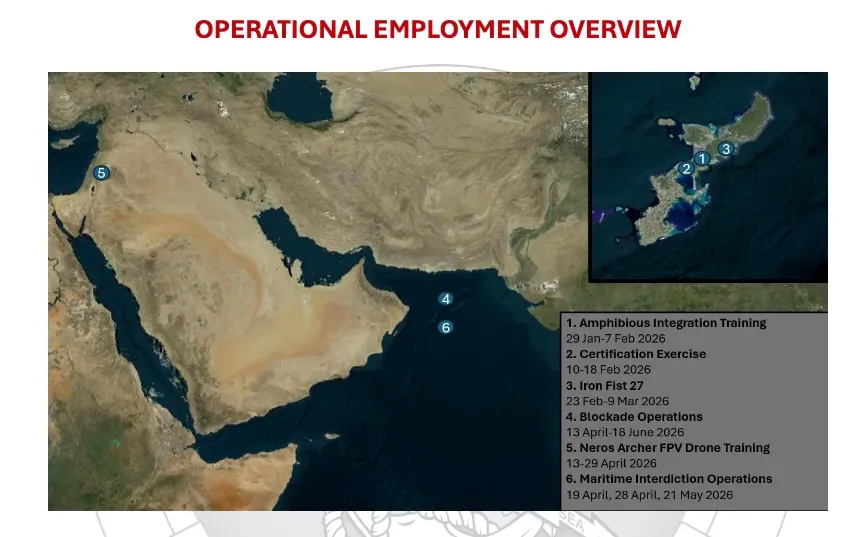
The 31st MEU’s six-month deployment began in January in the Pacific, before the unit was ordered to the Middle East in March, returning to Okinawa, Japan, in July. That’s where it is stationed as the USMC’s only continuously forward-based MEU.
A map of the 31st MEU’s deployment. (31st MEU)
“This was the first time we were able to implement EABO in combat operations since the concept was created for the force,” Capt. Steven J. Keenan, a USMC spokesperson, told us. “We have practiced it many times, but this was a first for supporting a Joint Force named operation with forward FARPs and forward bases that supported joint ops and combat power sustainment.”
EABO was first introduced in 2020 by then-Commandant Gen. David Berger in his Force Design 2030 plan for the future of the Corps. It was created with a fight against China in mind, especially utilizing small Pacific islands. The idea is to have highly mobile, low-signature forces deployed forward in austere, contested or potentially contested maritime locations. The mission is to “support sea control operation, conduct sea denial operations within the littorals, contribute to maritime domain awareness, provide forward command, control, communications, computers, combat systems, intelligence, surveillance, reconnaissance, targeting, and counter-targeting capability and forward sustainment,” according to the Marines.
A Marine holding a Stinger missile launcher stands in front of a Combat Rubber Raiding Craft on Ukibaru Island off the coast of Okinawa during Exercise Hagatna Fury 21. (USMC) A Marine holding a Stinger missile launcher stands in front of a Combat Rubber Raiding Craft on Ukibaru Island off the coast of Okinawa during Exercise Hagatna Fury 21. USMC
The news of the first activation of the EABO concept in combat came Wednesday during a media roundtable with Col. Chris P. Niedziocha, who commanded the 31st MEU during its deployment to the Middle East in support of Operation Epic Fury. Now director of the USMC Expeditionary Warfare School, Niedziocha discussed EABO and a range of other operations during that deployment, including boarding vessels during the blockade of Iranian ports.
The 31st MEU was embarked aboard the Tripoli Amphibious Ready Group (ARG), which consisted of the America class amphibious assault ship USS Tripoli, San Antonio class amphibious transport dock ship USS New Orleans, and Whidbey Island class dock landing ship USS Rushmore. You can read more about the ARG/MEU and its assets in our initial story about the deployment to the Middle East here.
USS Tripoli. (Staff Sgt. Samuel Ruiz)
“You’re starting to see this has been validated,” the colonel said of the EABO concept during the roundtable TWZ attended virtually. “It’s still nascent, but we actually, for the first time, demonstrated what we thought we were able to do, which I think is pretty exciting. And then things like forward arming and refueling to extend the operational reach of aircraft and expeditionary reloading, and then the ever-present logistic challenge of doing something like that. So that’s pretty significant.”
“We successfully implemented critical Expeditionary Advanced Base Operations (EABO), establishing sensor expeditionary advanced bases and forward arming and refueling points (FARPs) where none existed,” the colonel added. “Through our forward logistic elements, we proved that an agile Marine Air-Ground Task Force can sustain itself and generate ready, lethal power in contested maritime environments, directly setting the theater for follow-on joint forces.”
“There was all manner of tankers all the time, but the FARP is to extend the operational reach, and if you can do it, you reduce the load on that,” Niedziocha noted. “Because there’s some aircraft that are basically for expeditionary austere operations, especially the F-35B,” the Marine Corps’ variant of the aircraft designed for short take off and vertical landing.
“There are some trade-offs associated with the Bravo,” Niedziocha pointed out, using a slang for the jets. “There’s less internal fuel, but you have the lift [system], which gives you the option to do these kinds of things. So, the goal there was to walk that fine line between providing the full sortie over wherever you needed it, and keeping the ships far enough away to make them as survivable as possible.”
An F-35B Lightning II aircraft taxis to a forward arming and refueling point in the U.S. Central Command area of responsibility, May 26, 2026. (U.S. Marine Corps photo by Cpl. Maksim Masloboev) Cpl. Maksim Masloboev
In addition to the F-35Bs and other aircraft organic to the 31st MEU, the FARPs were also used by Army helicopters, Keenan told us. Imagery posted on the Pentagon’s image distribution site also showed U.S. Army Gray Eagle drones and Marine MV-22B Osprey tiltrotor aircraft were included.
A Gray Eagle drone lands at a forward arming and refueling point in the U.S. Central Command area of responsibility, May 26, 2026. (U.S. Marine Corps photo by Cpl. Maksim Masloboev) Cpl. Maksim MasloboevU.S. Marines with the 31st Marine Expeditionary Unit transport AIM-120 AMRAAMs to a forward arming and refueling point in the U.S. Central Command area of responsibility, May 26, 2026. (U.S. Marine Corps photo by Cpl. Maksim Masloboev) Cpl. Maksim Masloboev
Niedziocha did not provide details about where the FARPs were set up, but a U.S. defense official told us they were “disaggregated throughout the Middle East.” The official declined to provide further information, citing operational security concerns since they are still being used.
“Throughout the deployment, the Tripoli ARG and 31st MEU successfully conducted over 1,600 mishap-free flight hours of combat aviation missions, including precision strikes, transporting 800,000 pounds of cargo, and moving 5,000 personnel,” a 31st MEU overview of the deployment explained. “The units also provided sustained combat support to joint force operations by delivering critical intelligence and refueling over 300 aircraft ashore and underway.”
The colonel also didn’t provide details about the sensor expeditionary advanced bases. According to the Marines, “a sensing expeditionary advanced base (SEAB) brings together coastal surveillance radars, electronic sensors, and Marines ashore to extend maritime domain awareness, complementing the radars and sensors already at work aboard naval ships off the coast.”
“When SEAB systems identify surface vessels in nearby sea lanes, small unmanned aircraft system (sUAS) operators launch their platforms to visually identify and track the contacts,” the Marines added. “Sensor data and imagery are transmitted in real time across the blue-green command network to decision-makers.”
U.S. Marines with 12th Marine Regiment, 3rd Marine Division, prepare to set up a Ground/Air Task Oriented Radar (G/ATOR) system during a routine unit level training exercise on Iejima, Okinawa, Japan, July 15, 2023. (U.S. Marine Corps photo by Staff Sgt. Manuel A. Serrano) Gunnery Sgt. Manuel Serrano
This capability could have been used to track Iran’s remaining fleet of small boats that it has used to harass shipping and mine the Strait of Hormuz, as well as larger vessels trying to transport oil. Other sensors, like radars and counter-drone systems, could also help identify incoming threats and provide general situational awareness. The EABO concept was employed as part of the 31st MEU’s larger role in supporting the blockade and mine clearance efforts.
The 31st MEU interdicted four vessels during the deployment, three of which led to boardings. On April 19, Marines boarded the MV Touska; on April 28, the MV Blue Star III; and on May 19, the MT Celestial Sea.
The Touska was boarded after USS Spruance fired multiple 5-inch rounds, targeting the engine room and disabling the vessel’s propulsion. The crew of the vessel was retained for about two weeks before being repatriated.
Niedziocha told us that none of the crews offered any resistance.
“At two in the morning, when 30 Force Reconnaissance Marines fast rope onto your vessel, [you are] just compliant with a capital C. They did exactly what they were directed to do. The overmatch that you put onto that vessel is pretty surprising. And then there’s overwatch provided by UAS and manned aircraft, so you create this bubble around the vessel. So yeah, they complied.”
You can see the Touska being boarded in the following video.
The U.S. just released a video of its forces boarding and seizing the Iranian container ship M/V Touska near the Hormuz Strait after it tried to break the U.S. naval blockade pic.twitter.com/FpB2obb3jY
Two years ago, as the EABO concept was maturing, TWZ was invited to get an exclusive look at how an advanced EABO concept would be put into action, including how squadrons operated the F-35B out of an austere combat environment while generating combat sorties. It was an unprecedented and exclusive peek into the EABO playbook and what a real fight in the Pacific with the USMC’s most advanced fighter aircraft could actually look like. You can read about that in our story here. It appears the operations in the Middle East mirrored this exercise closely.
James Deboer
Now back in Japan, the ARG/MEU is getting ready for a new deployment, said the colonel.
“We got back to Okinawa, I think July 22nd, and they had already begun their workup cycle in earnest to be on the water in early January to go out and do another Iron Fist [training exercise] with the Japanese, and then long periods of a crisis response,” said Niedziocha, who relinquished command in August before moving on to his new role. “Just being there, present in the First Island Chain to partner with your allies, demonstrates the resolve and commitment to deter whatever needs deterring.”
As noted earlier in this story, the EABO concept was designed with a Pacific fight in mind. Its first combat employment in the Middle East clearly offers lessons that can now be adapted to enhance EABO operations globally.
Coronation Street fans think they know what Lucy Parkinson has planned for poor Sally Metcalfe, who appears to be a target of the troubled teen amid some dark behaviour
Coronation Street fans think they know what Lucy Parkinson has planned for poor Sally Metcalfe(Image: ITV)
Fans of Coronation Street think Lucy Parkinson’s plans for Sally Metcalfe could get very sinister.
While Lucy has been lashing out at Sally, who has been caring for her since her mother Rachel’s murder, and her dad Richie’s imprisonment for the crime, she also appears to be setting her up. Things are set to continue when next week, Sally is alarmed by a picture Lucy has drawn.
Sally is soon confiding in her husband Tim Metcalfe about Lucy lashing out, and the drama with the picture. But with Sally not sure she can keep looking after Lucy, there could be worrying twists ahead.
Some fans now think they know what Lucy’s plan is, and where this might lead. With Lucy also targeting the kids Sally and Tim have fostered, will Lucy have them taken away from them?
One fan predicted: “After watching tonight’s episode, I’m sure Lucy’s plan is that Tim and Sally lose custody of Joanie, Shanice and herself.” Another fan said: “I am really worried for Sally, she’s either going to get hurt or Lucy is going to get her reported to the care worker which will have consequences for the other kids.”
A third viewer said: “Tim and Sally will be lucky to get out of this alive and still together.” A fourth fan commented: “She really seems to have it out for Sally and manipulates Tim.”
Another theory saw fans wonder if Sally would be attacked. One said: “I strongly suspect this is all building up to Lucy losing it and attacking Sally.” Another said: “There’s going to be a potential stabbing for Sally.”
Another fan wondered if Lucy had targeted someone else before Sally. They said: “After seeing Lucy had obviously given herself the mark and blamed sally, do we think this isn’t the first time she’s done this?
“What if she’s hurt herself before, and blamed her mum, so her dad killed her out of anger?” It comes as some fans speculated over who attacks Eva Price next week, after spoilers teased someone hurts her.
It’s not yet clear if Eva falls down the stairs or is pushed. One theory is that Lucy attacks her after drama airing next week. Other names thrown into the mix as possible attackers are Jodie Ramsey and Ross Wilkes.
Italy’s defence minister warns of severe economic fallout if Bab al-Mandeb becomes impassable, bypassing EU delays.
Published On 18 Sep 202618 Sep 2026
Italy will deploy warships to ensure safe passage for its commercial vessels through the Bab al-Mandeb strait, Defence Minister Guido Crosetto said, adding that Rome would not wait for a joint decision from the European Union.
“We have the capabilities to protect the passage,” Crosetto said, warning that if the waterway became impassable, the economic consequences would be severe.
Recommended Stories
list of 3 itemsend of list
The Italian defence minister said that Rome “must not allow bureaucratic delays in decision-making to exacerbate an already complex situation”.
Bab al-Mandeb links the Red Sea to the Gulf of Aden, forming one of the world’s busiest shipping corridors between Europe and Asia and a critical route for oil, gas and container traffic heading to and from the Suez Canal.
Roughly 12 to 15 percent of global trade has historically passed through the narrow waterway, which separates Yemen from Djibouti and Eritrea on the African side and is only about 30km (19 miles) wide at its narrowest point.
The strait’s importance has grown sharply since Iran effectively seized control of the Strait of Hormuz earlier this year amid its war with the United States and Israel, choking off the world’s most important oil chokepoint and pushing much of the Gulf’s crude exports towards alternative routes.
Saudi Arabia, in particular, has increasingly relied on pipelines and Red Sea shipping to bypass Hormuz altogether, making the Bab al-Mandeb strait one of the last major arteries still open to Gulf oil reaching global markets.
Control of the strait has been contested for years, as Yemen’s government, Houthi rebels and, at times, forces in the region have held stretches of its coastline at different points since the war in Yemen began in 2015.
The significance of the strait has been hit dramatically in the past few weeks, when the Iran-backed Houthi movement launched a rapid offensive that brought the entirety of Yemen’s western Red Sea coast under its control, including several strategically located islands.
The advance has given the Houthis effectively unrestricted access to the waterway, a development seen as a major setback for international shipping, given the group’s history of attacking vessels it associates with the US or its allies in the region.
The US and the European Union have already carried out military operations aimed at better protecting merchant ships from Houthi attacks in the area, though those efforts have struggled to fully secure the route as fighting in Yemen has escalated.
Venezuela has opened its energy and mining sectors to US interests. (PDVSA)
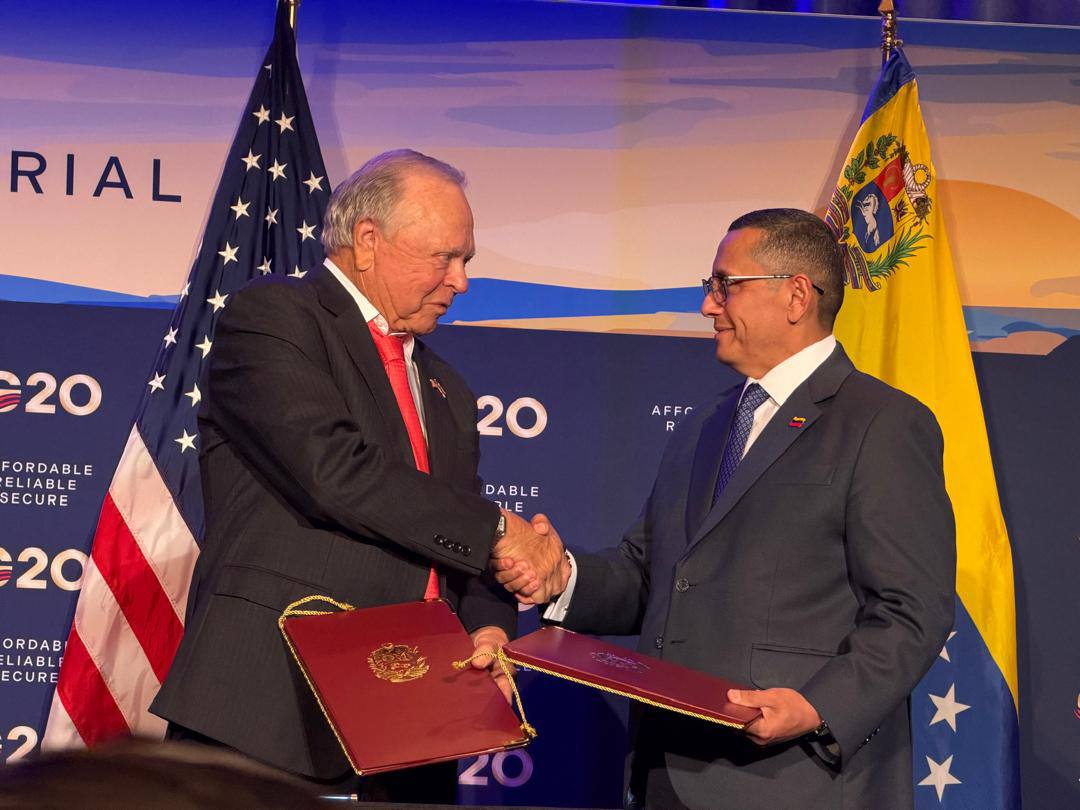
Lisbon, Portugal, September 17, 2026 (venezuelanalysis.com) – Continental Resources, a firm owned by billionaire and Trump donor Harold Hamm, struck a deal on Wednesday to exploit one of Venezuela’s largest oilfields.
Under the agreement with Venezuelan state oil company PDVSA, Continental will receive a long-term concession with “100 percent working interest” for the 500 square-kilometer Ayacucho 2 block in Venezuela’s Orinoco Oil Belt. The block contains an estimated 30 billion barrels of extra-heavy crude.
“Continental was built to recognize great resource opportunities and have the conviction to pursue them,” Hamm told Fox News, vowing that the deal would take his company to an “entirely new level.”
For her part, Venezuelan Acting President Delcy Rodríguez claimed that the agreement would “strengthen [Venezuelan] oil production” and “create opportunities for economic growth.”
Hamm and PDVSA Vice President Jovanny Martinez signed the contract in Houston on the sidelines of the G20 energy summit. Martínez and Oil Minister Paula Henao attended the conference to pitch investment opportunities in Venezuela’s oil and gas sector.
PDVSA had previously assigned the Ayacucho 2 block to Chinese private firm Anhui Guangda in 2025. However, no information on investments or output were publicly disclosed, while Venezuelan authorities have not justified rescinding the contract with Anhui.
US government-controlled corporation NABEP, which recently received long-term concessions to 17 major Venezuelan oilfields containing 65 billion barrels in reserves, will also take over projects formerly run by Chinese enterprises, including state-owned CNPC. Beijing has called for its investments and interests in Venezuela to be respected.
Hamm was one of the corporate executives present at the White House on January 9, when Trump announced that Washington would control Venezuela’s oil industry and called on Western majors to invest. Since the January 3 US attacks and kidnapping of President Nicolás Maduro, the White House has managed the South American country’s crude export revenues.
The White House has also backed Venezuelan authorities’ pro-business overhaul of the energy sector while issuing sanctions exemptions to select US-aligned corporations. Chevron, Shell, and Eni are among the companies that have signed new contracts or renegotiated existing ones in recent months.
According to Bloomberg, ExxonMobil is in advanced talks to return to the Caribbean country after a litigious past. The energy giant is negotiating rights to four major oilfields in the Orinoco Oil Belt, two of which it previously owned before they were nationalized by former President Hugo Chávez.
In the 2000s, the Texas-based corporation refused to comply with reforms implemented to assert state sovereignty over the oil industry. ExxonMobil refused compensation offers and pursued international arbitration after its assets were nationalized. The company received an arbitration award significantly below its demands.
ExxonMobil was additionally denounced repeatedly by Caracas after it spearheaded offshore drilling projects in the territorial waters of the disputed Essequibo Strip.
On Wednesday, Venezuelan authorities likewise inked a 20-year agreement with Florida-based Denarius Holding Group, controlled by Turkish energy group Çan2 Termik. Denarius is taking over the Petrokariña project in Anzoátegui state, which contains 10 oilfields producing a variety of crude types.
Heeney Capital receives gold mine concession
In parallel to its oil opening, Venezuelan authorities have also fast-tracked reforms opening the country’s mining sector to multinational corporations.
On Wednesday, New York-based Heeney Capital and commodities trader Mercuria Energy received a 30-year concession to operate the Chocó 10 mine in Bolívar State. The project holds considerable gold deposits and was run by Rusoro Mining in the 2000s before being nationalized by the Chávez government.
Heeney and Mercuria pledged US $1 billion in initial investment in the Chocó project. The two firms had struck a previous agreement with Caracas to purchase and trade Venezuelan minerals and other commodities.
One of Heeney’s co-founders, Sean Pi, signed the deal at the presidential palace in May and praised Trump’s “leadership” in defending US access to mining resources abroad. Pi has endorsed legislative initiatives deregulating and streamlining mining projects to bolster the US supply of critical minerals.
Under the trading agreement, Heeney and Mercuria are reportedly preparing to ship 15,000 metric tons of Venezuelan aluminum to the US. The corporate partners are likewise seeking to take over VENALUM, Venezuela’s biggest aluminum smelter. Glencore, an Anglo-Swiss mining and trading multinational, is also interested in VENALUM, according to reports.
Venezuelan authorities have not commented on the negotiations for the aluminum smelter. In April, Rodríguez appointed a commission to evaluate privatization of “non-strategic” state assets.
The Trump administration has identified securing access to Venezuelan mineral riches as a key national interest and is reportedly preparing an executive order to boost US corporate participation in Venezuelan mining projects.
Chris Brown is speaking out after lawmakers honored him during his concert in Arlington, Texas, then apologized for the honor.
On Sept. 12, U.S. Rep. Jasmine Crockett (D-Texas) and Democratic Texas Rep. Venton Jones appeared at AT&T Stadium for Brown and Usher’s R&B Tour, where they honored both singers for their contributions to music. The politicians presented them with a Congressional Record recognition and state proclamation.
“Right now, we are experiencing Black joy to the highest level,” Crockett said on stage. “And I wanted to make sure we document that in the Congressional Record.”
Usher was not on stage when either honor was presented.
The incident sparked public backlash because of Brown’s history of domestic violence. In June 2009, the “Forever” singer pleaded guilty to one count of felony assault for physically attacking Rihanna.
On Monday, the 37-year-old singer and dancer took to social media to apologize to Crockett for the criticism she received following the recognition, uploading a photo of the two to his Instagram story with text that read: “I apologize for any backlash you have to deal with for awarding for me. I’m not political but I move off of frequency and energy and I’m so grateful. Once again, thank you.”
But by Tuesday, Jones released a statement apologizing to his constituents for his role in presenting Brown with a state resolution.
“Over the past few days, I have listened closely to the conversations, concerns, and heartfelt feedback shared across our community following my presentation honoring Chris Brown with a state resolution,” Jones said.
Jones, who first assumed his role in 2023, said that the presentation was an attempt to reach voters ahead of the Nov. 3 midterm election.
“First and foremost, I want to acknowledge the women, the Black women, whom my actions have hurt. In moments like these, I think it’s important to be specific and just as loud with an apology as our original actions were,” Jones added in his statement. “I apologize.”
After Jones’ statement, Brown called out the representative.
“I didn’t ask to be honored because I knew some s— like this would happen and [Venton Jones] immediately started tap dancing and apologizing because he didn’t wanna lose voters and support,” Brown wrote on Sept. 15 on his Instagram. “I have a great idea.. how about [y’all] leave me the f— alone and let me focus on the fans that spent their money to actually see and support me.”
Outside of the most widely recognized incident involving Rihanna — which occurred hours before the couple was set to appear at the 2009 Grammy Awards — there have been multiple domestic violence allegations against Brown, including by his ex-girlfriend Karrueche Tran. She was granted a restraining order against the singer in 2017.
Brown has been accused in several other cases of violence against women from 2018 to 2022, either dismissed, settled out of court, or the investigation dropped.
This summer, the singer pleaded guilty to beating up a man in a London nightclub with a glass bottle in 2023. There is an active $50-million suit against Brown and members of his entourage by four male concertgoers who allege they faced a “brutal, violent assault” backstage following a Fort Worth, Texas, show in 2024.
The ex-Oklahoma state trooper’s nomination had stalled in the Senate as ICE faced growing scrutiny over its operations.
By Reuters and The Associated Press
Published On 18 Sep 202618 Sep 2026
The White House has withdrawn the nomination of former Oklahoma state trooper Lance Schroyer to lead United States Immigration and Customs Enforcement (ICE), without giving a reason for the decision.
The withdrawal was announced on Thursday. Schroyer, a senior adviser to Homeland Security Secretary Markwayne Mullin, was nominated by President Donald Trump in June but had yet to receive a hearing before the Senate Homeland Security and Governmental Affairs Committee.
Recommended Stories
list of 1 itemend of list
Republican Senator Rand Paul of Kentucky, who chairs the committee, had refused to hold a hearing until the Department of Homeland Security (DHS) provided information he had requested about civilian deaths during ICE enforcement operations.
“I don’t have a concern with who the nominee was. I had asked them to give me an update on the internal investigation into civilian deaths,” Paul told The Associated Press news agency.
Paul said he had intended to hold a hearing on Schroyer’s nomination but learned that it had been withdrawn when the White House made the decision public.
ICE remains under scrutiny
Schroyer had little experience in immigration and had not previously worked at ICE or led a major law enforcement agency. Two US officials told the Reuters news agency when he was nominated that he had been a surprise choice for the position.
When announcing Schroyer’s nomination in June, Trump said on Truth Social that he had “firsthand experience getting Illegal Aliens OFF our streets” and called on the Senate to confirm him “IMMEDIATELY”.
The withdrawal comes as ICE remains under scrutiny over its enforcement operations as the Trump administration carries out its immigration crackdown.
Critics have raised questions about how the agency has recruited and trained officers as it rapidly expanded its workforce. Federal immigration officers have also shot and killed multiple people during enforcement operations, including two US citizens in Minneapolis earlier this year.
ICE arrests have continued to increase, reaching nearly 51,000 in August, the highest monthly total of Trump’s second administration.
ICE has not had a Senate-confirmed director since 2017. David Venturella is serving as acting director after Todd Lyons resigned earlier this year.
The White House has not indicated when it might announce another nominee to lead the agency.
Former Syrian official sentenced to 60 years in US prison for torturing prisoners under al-Assad’s regime.
A former Syrian military official convicted of torturing prisoners during the rule of former President Bashar al-Assad has been sentenced to 60 years in a United States prison.
A federal judge in Los Angeles sentenced Samir Ousman Alsheikh on Thursday. A jury found him guilty in March of one count of conspiracy to commit torture and three counts of torture while in charge of Syria‘s infamous Adra Prison from roughly 2005 to 2008.
Recommended Stories
list of 3 itemsend of list
“The conduct was heinous, unimaginably cruel, and almost unspeakably violent and brutal,” the judge said before announcing the sentence.
Human rights groups and the United Nations have accused the Syrian government officials of widespread abuses in detention facilities, including torture and arbitrary detention of thousands of people, in many cases without informing their families.
US prosecutors said Alsheikh, seeking to quash political dissent, sent certain prisoners to a wing of Adra where they were held in small isolation cells and tortured.
At the two-week trial, three victims recounted beatings while suspended from pipes on the ceiling for hours or days and the use of a device that folded their bodies in half at the waist, according to a press release from the US Department of Justice. One person testified that Alsheikh stomped on the device with his foot, according to the department.
“Defendant knew that what he was doing was wrong,” Justice Department prosecutors said in a sentencing memo filed this month. “Nonetheless, he ordered and participated in the torture of his victims because he had the power to do so and because he thought he would never be held accountable.”
The memo included statements from several victims, one of whom, Nidal Shikhani, said he can “still hear the screams of others begging for mercy, repeating, ‘Leave me, leave me.’”
The prosecutors asked US District Judge Hernan D Vera for a minimum sentence of 80 years. Alsheikh’s lawyers, Nina Marino and Collin Cate, called for a five-year sentence, noting that he is 74 years old and has “significant medical and cognitive conditions”. They also said he was willing to be deported to Syria, where a new government has sought to hold Assad-era security officials accountable.
“Whatever moral weight this case carries in the broader arc of history — however much the world, or the victims, or the public might wish the sentence to ‘send a message’ — that desire cannot be the foundation of a just sentence,” Marino and Cate wrote in their September 3 memo.
Alsheikh came to the US in 2020 and applied for citizenship, but the Justice Department said he lied about his past. Federal authorities arrested him at Los Angeles international airport in July 2024.
Jurors also convicted him in March of lying to US immigration authorities and fraudulently obtaining a green card and attempting to naturalise as a US citizen.
“The acts Alsheikh ordered and directly participated in are gruesome and disturbing. We would like to offer our gratitude to the brave victims who testified leading to today’s sentencing,” Heith Janke, assistant director of the FBI’s criminal division, said in a press release Thursday.
Al-Assad was ousted in a lightning rebel offensive in December 2024, bringing a 14-year civil war to an end, but the country has continued to suffer from sporadic outbreaks of violence.
In March 2025, armed groups aligned with al-Assad ambushed the new government’s security forces on Syria’s coast. A government counteroffensive then spiralled into sectarian revenge attacks and the massacre of hundreds of civilians from the Alawite religious minority, to which al-Assad belongs.
On Thursday, three people were sentenced in the Syrian city of Aleppo in connection with the violence. One member of the pro-Assad groups was sentenced to death and another to life in prison, while a member of the government security forces who took part in the revenge attacks was convicted of murder and sentenced to 20 years in prison.
All Creatures Great and Small fans were quick to share their thoughts on the first episode of the new Channel 5 series.
22:41, 17 Sep 2026Updated 22:41, 17 Sep 2026
Channel 5 viewers were quick to comment on the romance plot in series 7(Image: CHANNEL 5)
Beloved Channel 5 period drama All Creatures Great and Small has returned.
On Thursday (September 17), fans were thrilled when a brand new series kicked off as the residents of Darrowby were now settling into a post-war existence. The episode kicked off with James in London, as Channel 5 viewers got to see Helen’s (Rachel Shenton) sister Jenny (Imogen Clawson) as a nurse in the city.
However, when the couple returned to Darrowby, trouble arose as a new vet arrived in the village, which didn’t sit well with Siegfried (Samuel West), who accused him of trying to poach his clients from Skeldale House.
Fans also saw the return of Dorothy (Maimie McCoy), who made a comeback during the festive special last year and has since sparked a romance with Siegfried.
Although during the episode, it seems as though the pair are including Mrs Hall (Anna Madeley) on their dates, as they spoke about going to see a film at the cinema later that night.
Elsewhere, Helen and Mrs Hall spoke about her return as Helen mentioned her being back had ‘made a difference’. Mrs Hall agreed as she said: “In more ways than one.”
Despite Helen joking that it meant she was keeping Siegfried out of their hair, Mrs Hall remarked: “No, she’s exactly what he needs. I had a feeling she would be if he gave her another chance.
Helen replied: “He doesn’t know how lucky he is to have you, do you know that?” As it seemed as though she was suggesting there was more to their friendship than is said, Mrs Hall didn’t notice.
As Dorothy later suggested, the three of them saw another film, Mrs Hall told her she didn’t mind if they wanted to spend time just the two of them, as she told her: “I’d hate to feel like I was getting in the way.”
Her friend replied: “If anyone is getting in the way, it’s me. You’re working, and here I am getting under your feet.” Mrs Hall added: “If you were in my way, I’d tell you.”
Later on, Siegfried was frazzled over the new arrival as Dorothy assured him he had no reason to worry over it, although Mrs Hall didn’t seem too convinced as she stayed quiet on the matter.
The interactions between the three characters didn’t go unnoticed with viewers, as many were quick to comment on the episode as they noticed the only link between Siegfried and Dorothy is Mrs Hall.
On X, one person said: “Both Dorothy and Siegfried are basically dating Audrey because she is the only common interest they have. brilliant.” Someone else added, “Audrey is the glue between Siegfried and Dorothy. These two do not have much in common, which became obvious. D doesn’t know Siegfried needs truth, not flattery, and Siegfried doesn’t even want her opinion.”
Another person added: “Wait. Why is Dorothy so hesitant to spend time alone with Siegfried, without Audrey there as well? Are things not going well? ill-matched?” While someone agreed: “So the cracks are already visible? Just what my predictive analysis hinted at. We would see stuff already, but things are going south just yet.”
All Creatures Great and Small continues Thursdays on Channel 5 from 9pm
Recurring floods disrupt daily life in Tunis, raising questions about drainage, transport and flood preparedness.
Published On 18 Sep 202618 Sep 2026
Tunis, Tunisia – Heavy rain brought parts of Tunisia’s capital to a standstill on Thursday, flooding roads and homes, trapping people in cars and disrupting electricity and internet services.
Home to nearly three million people, the Greater Tunis region has faced repeated flooding in recent years. Thursday’s flooding came only months after severe January rains caused widespread disruption across the capital and other parts of the country, leaving several people dead and causing significant damage.
Weather warnings had been issued in advance, but the decision to suspend classes in Tunis was announced only shortly before it took effect. Parents rushed to schools to collect their children as the rain intensified and traffic backed up across the capital.
Videos shared online showed flooded streets, cars stranded in rising water and what appeared to be power lines catching fire. Residents also reported power and internet cuts and water entering homes.
‘The road became almost unrecognisable’
Fatma, a 35-year-old employee in Tunis, said the situation deteriorated quickly as she struggled to get home safely.
“At about 4pm, the road became almost unrecognisable. The tunnel leading to Bab Saadoun was completely closed because of the rain,” she told Al Jazeera.
“Most people were stranded by the roadside for hours, waiting for public transport that never came. I saw three cars that filled with water and broke down, and people carrying their children on their shoulders.”
“Every season, the same thing happens. Roads close and traffic comes to a complete standstill. All the drains start overflowing with waste,” she said.
The National Institute of Meteorology had warned of locally heavy thunderstorms on Thursday, including heavy rain over short periods that could cause flooding, disrupt traffic and overwhelm drainage networks. It also warned of potential power cuts.
Residents question flood preparedness
“Tunisia has become used to these disasters. Every year, we end up flooded even when there is little rain,” said Intissar, 33, from the Lafayette area of Tunis.
She blamed local authorities for failing to carry out preventive work before the rainy season.
“This is work that should have been done during the summer,” she said.
But she also acknowledged the role of residents.
“We cannot deny the responsibility of citizens who dump waste that blocks drainage channels,” she said.
At a government meeting in August, officials called for drainage networks and waterways to be cleaned and flood-protection work to be accelerated. The government said 29 flood-protection projects were under way across the country.
The flooding comes as Tunisia prepares for a national march in Tunis on Saturday, with organisers calling for the release of four activists detained in connection with the Al-Soumoud Flotilla. The march is scheduled for 5pm, as rain is forecast to continue through Saturday.
A struggle to get home
Fatma said the lack of reliable public transport, combined with repeated flooding, was making it increasingly difficult for people to manage without cars.
“The problem makes people look for their own solutions. That is why most people are trying to find a way to buy a car, because it has become difficult to live without one with these recurring problems,” she said.
The flooding also came as students returned to schools and universities this week, adding pressure to roads and public transport.
For Fatma, the disruption is becoming a familiar pattern.
“This shows that the state has no vision. It is caught off-guard just like citizens are,” she said.
Tehran gives Swedish official 48 hours to leave as Iran says Stockholm is bowing down to outside pressure.
Published On 18 Sep 202618 Sep 2026
Iran has ordered a Swedish diplomat to leave the country one day after Sweden expelled an Iranian embassy official in Stockholm.
Sweden’s action was described by Iran’s Ministry of Foreign Affairs as “unjustified” on Thursday.
Recommended Stories
list of 3 itemsend of list
“Without doubt, this action by the Swedish government is the result of the influence of the Zionist regime and an effort to disrupt the normal activities of the Islamic Republic of Iran’s Embassy in Stockholm,” the Foreign Ministry said in a statement, Iran’s IRNA news agency reported.
Iran’s Foreign Ministry said its director general for Western Europe, Alireza Yousefi, summoned the Swedish ambassador in Tehran on Thursday. Yousefi protested Sweden’s policies, including its “hosting of anti-Iranian terrorist elements and groups”.
The ministry said Iran would take necessary measures to safeguard its national rights and interests, including through reciprocal action.
IRNA reports that in response to Sweden’s actions, the ambassador was informed in the meeting that a Swedish diplomat in Tehran had been given 48 hours to leave Iran.
Sweden expels Iranian official
Sweden’s Ministry for Foreign Affairs announced on Wednesday that the Iranian official was asked to leave the country due to activity incompatible with the Vienna Convention on Diplomatic Relations.
The Vienna Convention defines the rules of diplomatic missions.
The Iranian Foreign Ministry also referenced Sweden’s obligations under international law, including the 1961 Vienna Convention on Diplomatic Relations, warning that disruption of the Iranian embassy’s duties would entail Sweden’s international responsibility, reported IRNA.
Swedish Foreign Minister Maria Malmer Stenergard said the decision to expel the Iranian official was taken to protect Swedish citizens and interests.
Swedish Justice Minister Gunnar Strommer told state television that the decision involved Iran’s alleged activities against “Jewish and Israeli interests”.
“We know that Iran, over a long period of time, has conducted activities that threaten security in and against Sweden,” Strommer said, adding that Iran was “making use of criminal networks” to achieve its objectives.
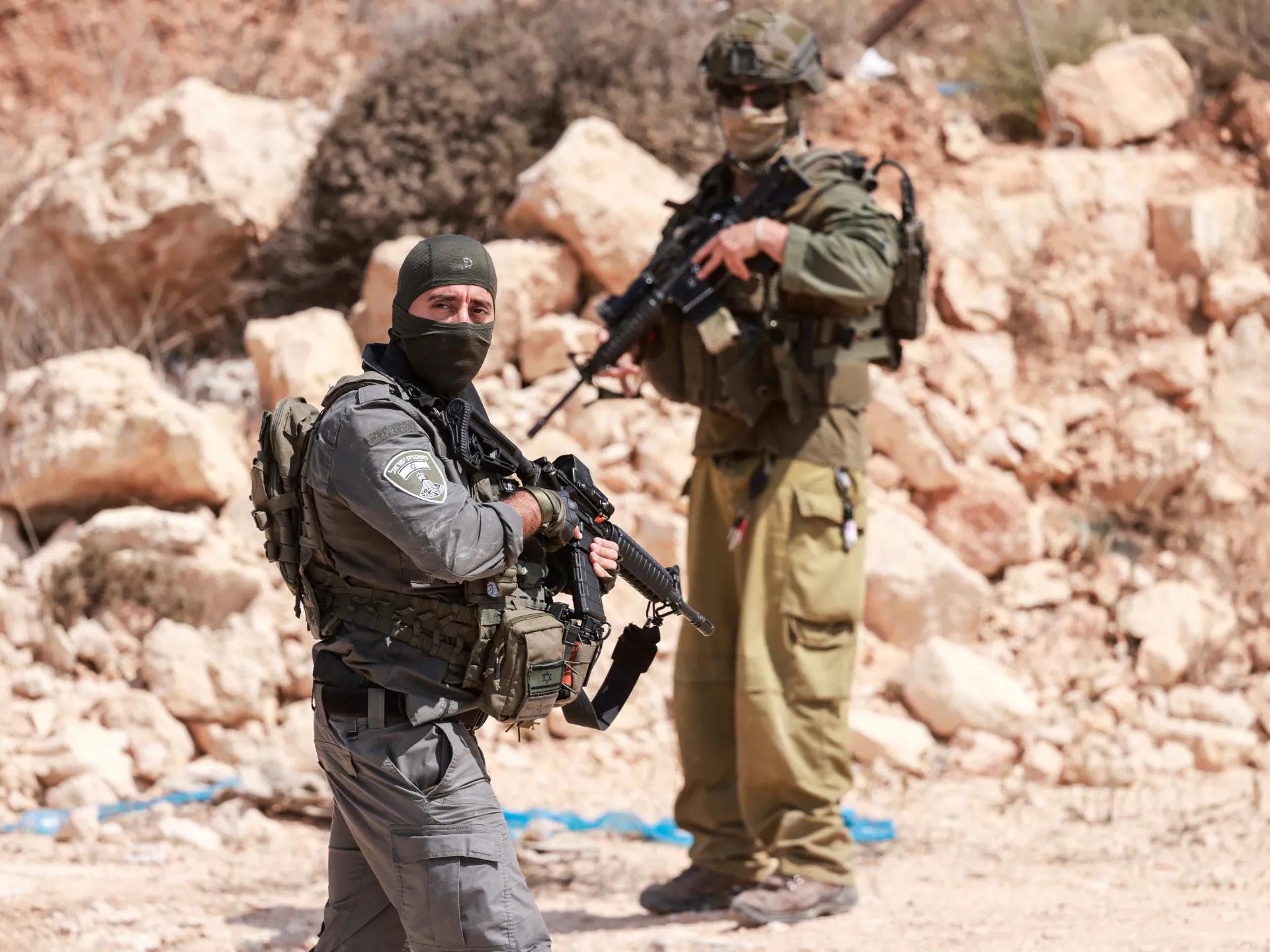



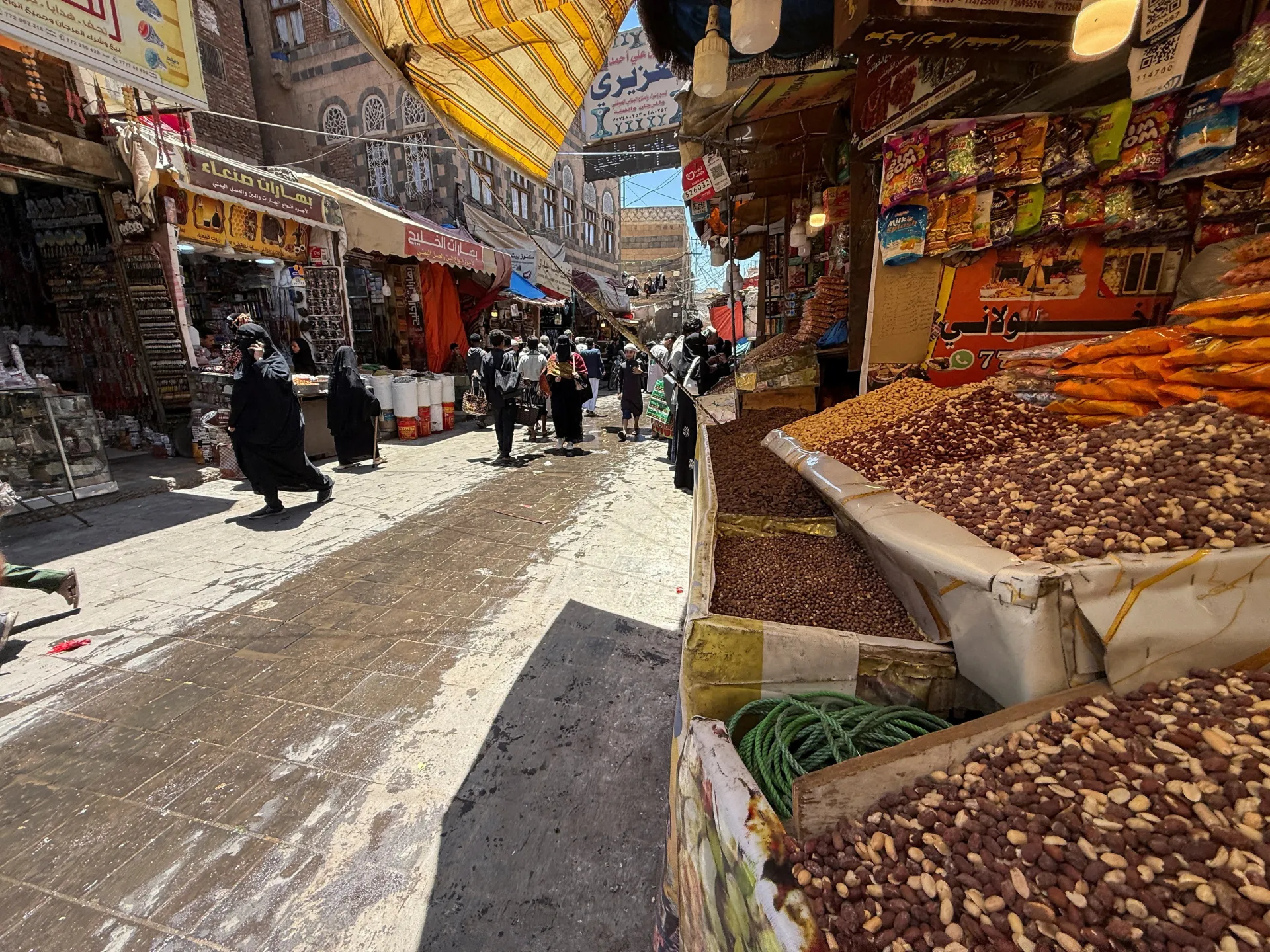
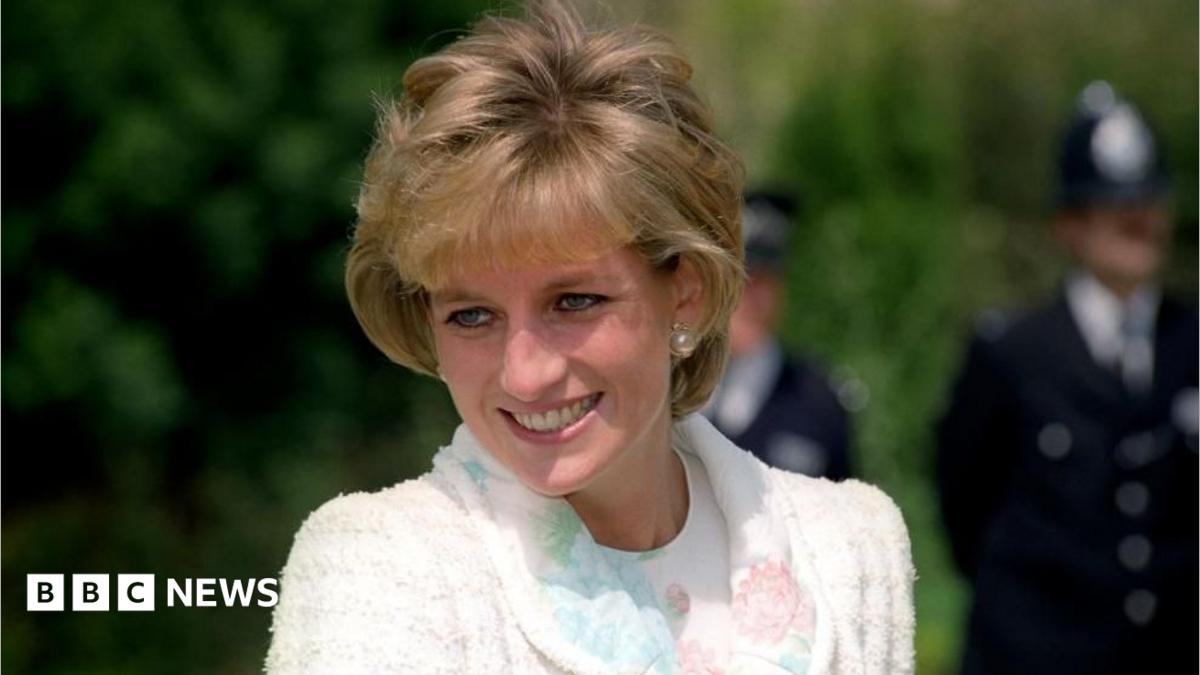
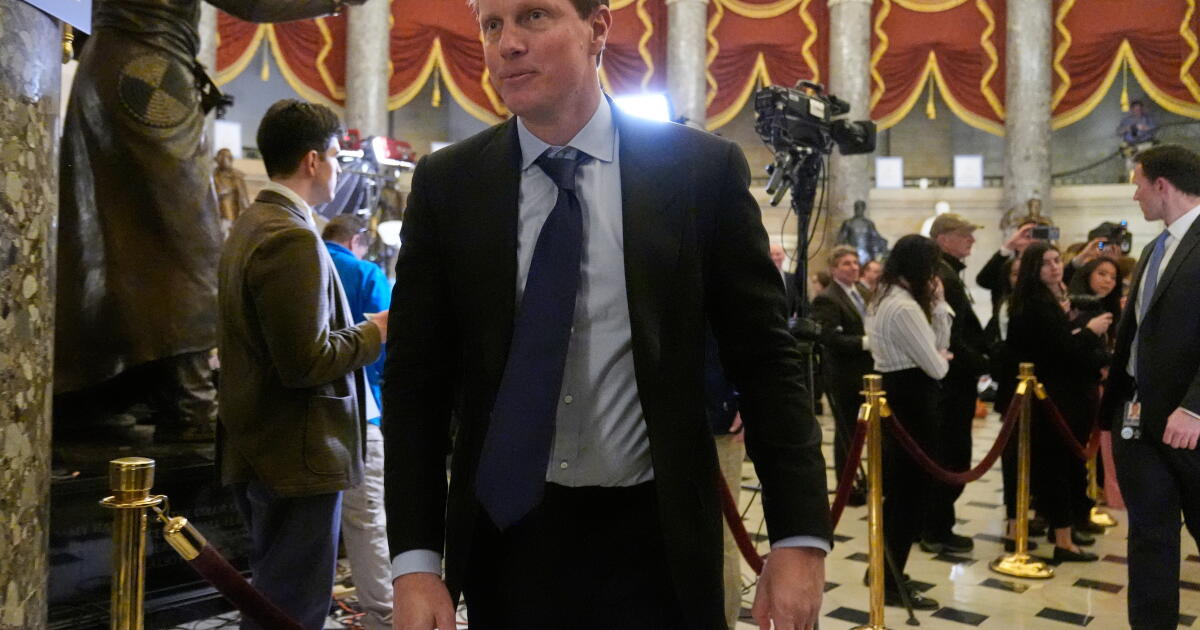



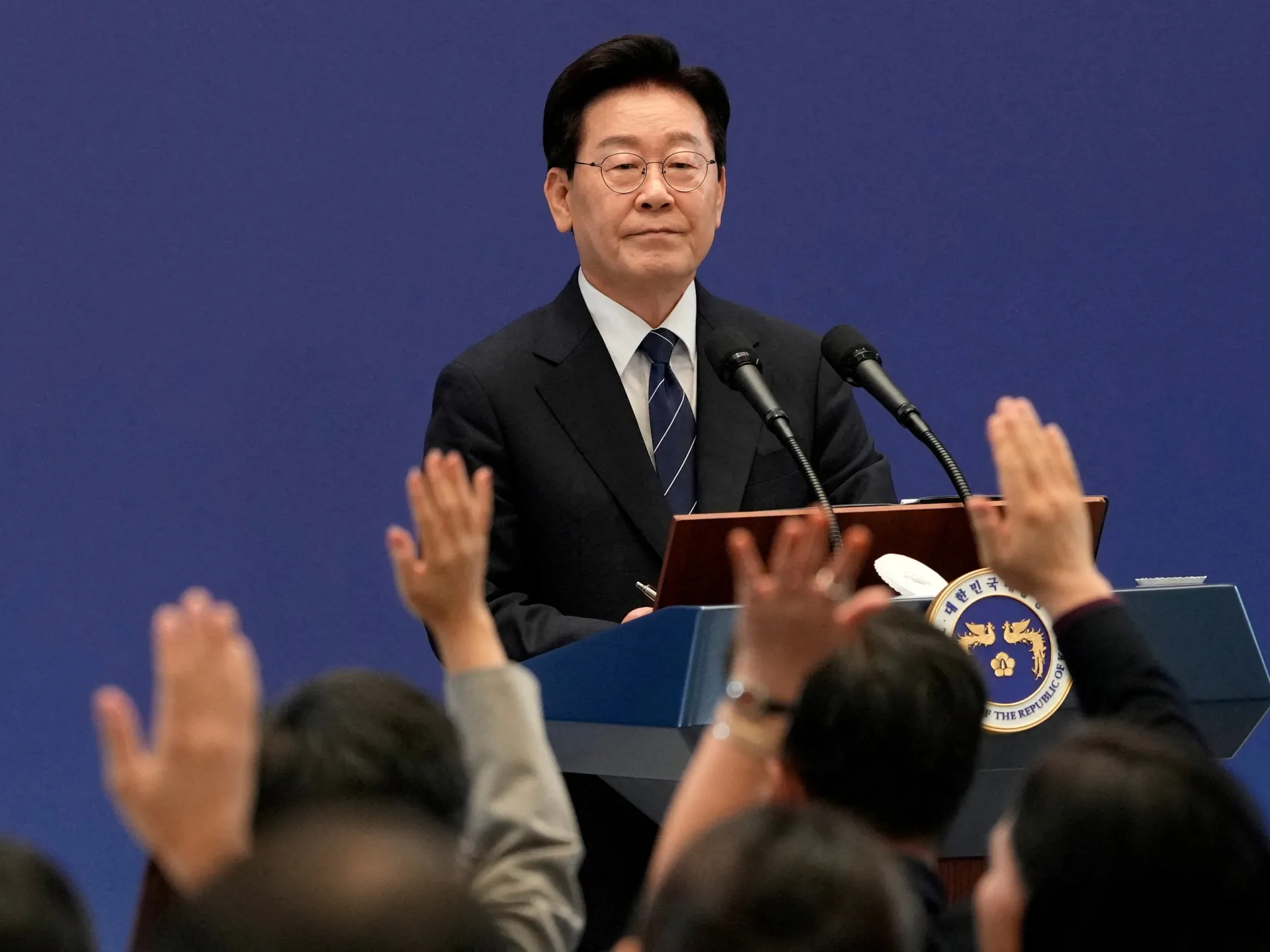


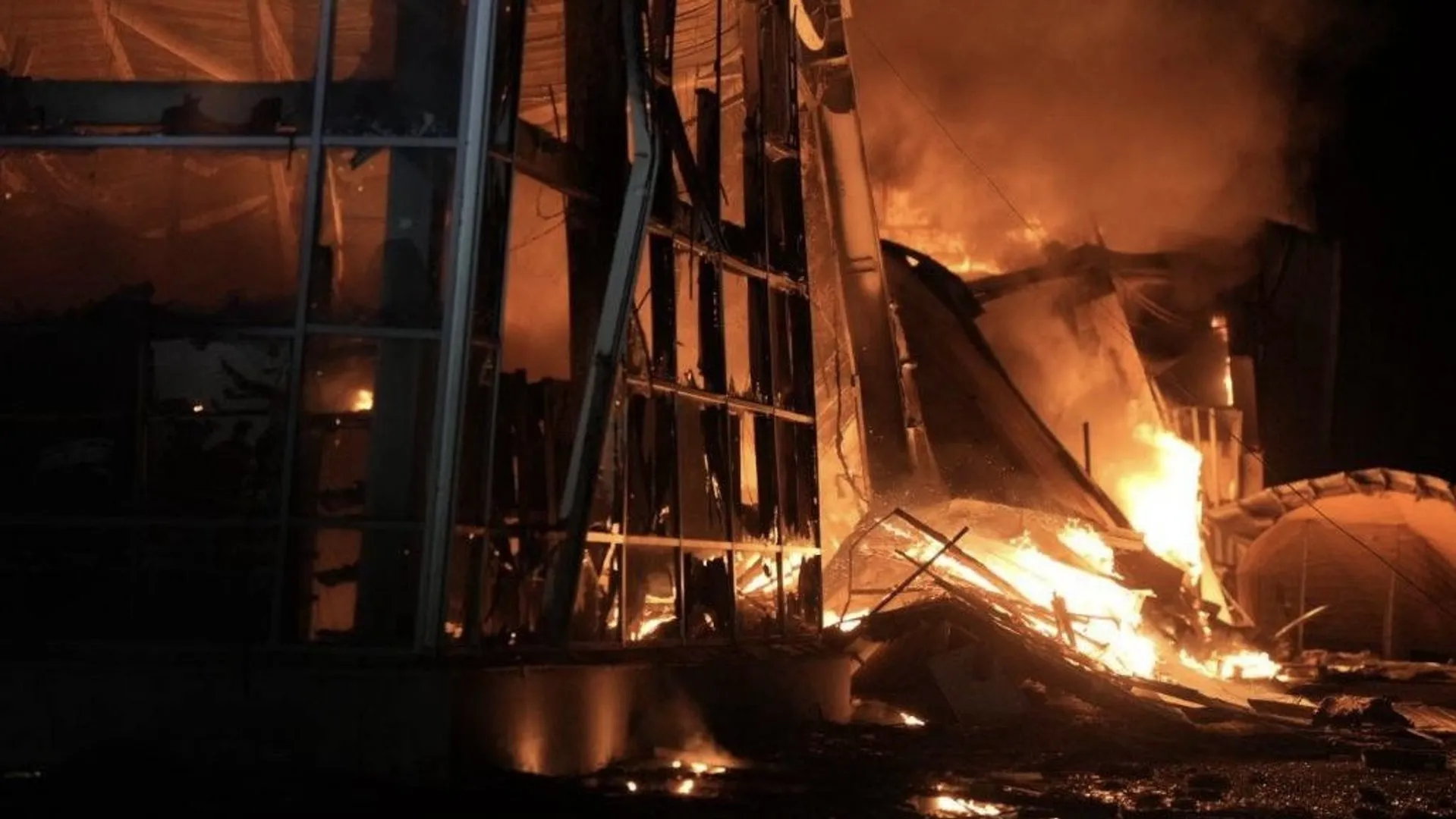



![National Geographic Explorer Paola Nogales Ascarrunz, who led the research that identified Leopardus tilcayo as a new species, observes the cat at the Senda Verde animal refuge in the Yungas region, in Bolivia, September 1, 2026 [Fernando Faciole/Handout via Reuters]](https://i0.wp.com/occasionaldigest.com/wp-content/uploads/2026/09/2026-09-17T154150Z_381273466_RC2N9NAU7NUJ_RTRMADP_3_SCIENCE-CAT-1789702964.jpg?w=640&ssl=1)