The occupied West Bank has seen sustained and rising violence amid ongoing conflict between Israelis and Palestinians. Israeli forces conduct frequent raids in Palestinian areas, saying they are targeting militants and preventing attacks, while Palestinians and rights groups accuse the military of using excessive force and say settlement expansion is a major driver of instability. Israeli settlements in the territory are widely considered illegal under international law by the United Nations and most countries, though Israel disputes this and views the West Bank as disputed land with historical and security significance. In recent months, tensions have further escalated with increased restrictions on Palestinian movement near settlements, alongside a rise in attacks by both Palestinians against Israelis and by settlers against Palestinians, contributing to a cycle of violence that continues to claim lives on both sides.
Fatal Shooting Near Beit Ummar
The incident took place near the town of Beit Ummar in the southern West Bank.
Palestinian news agency WAFA identified the victims as teenagers aged 15 and 19. A relative confirmed their ages to Reuters.
Israeli Military’s Account
The Israeli military said its forces confronted three individuals who were throwing fire bombs and burning tyres near the settlement of Karmei Tzur.
According to the military, soldiers opened fire, killing two of the individuals and wounding a third.
Reuters could not independently verify the military’s account.
Third Teenager Hospitalized
WAFA reported that the third person involved in the incident was hospitalized in stable condition.
The Palestinian Red Crescent Society said the wounded individual is 15 years old.
Tensions Remain High in the West Bank
Israeli forces regularly conduct raids across the occupied West Bank and have tightened movement restrictions around Palestinian communities located near Israeli settlements in recent months.
The territory has experienced heightened tensions amid ongoing violence involving Israeli security forces, settlers and Palestinians.
Dispute Over Settlements
The international community, including the United Nations and most countries, considers Israeli settlements in the West Bank illegal under international law and a major obstacle to the creation of a Palestinian state.
Israel rejects that position, describing the territory as disputed and citing historical Jewish ties to the area.
Rising Violence
According to United Nations data, at least 57 Palestinians have been killed this year in incidents involving Israeli settlers and security forces.
At the same time, Palestinians have carried out attacks against Israeli soldiers and settlers in the West Bank, including at least one fatal attack in 2026, according to Israel’s Shin Bet domestic security service.
What’s Next
The Israeli military is expected to continue reviewing the circumstances of the shooting, including whether the individuals posed an immediate threat and how the confrontation unfolded near the settlement.
Palestinian officials are likely to pursue diplomatic and legal avenues, as similar incidents in the West Bank are often raised with international bodies, including the United Nations, amid ongoing disputes over the use of force by Israeli troops.
On the ground, the incident is likely to add to already high tensions in the West Bank, where Israeli raids, settlement activity, and Palestinian attacks have contributed to a cycle of violence in recent months.
Further clashes cannot be ruled out, particularly in areas close to settlements where movement restrictions and security operations have intensified.
International attention on West Bank violence is also likely to continue, especially as reported fatalities involving Palestinians and Israelis have remained elevated this year, keeping pressure on both sides amid an already fragile security situation.
Netflix’s brand new romantic comedy has one of the streamer’s best needle drops for a minute, but who features in the soundtrack?
Netflix Voicemails for Isabelle’s full soundtrack
Jill and Isabelle’s favourite song is an absolute pop banger.
Voicemails for Isabelle is currently Netflix’s number one film in the UK as fans flock to the streamer’s latest romantic comedy.
Starring Zoey Deutch and Nick Robinson, this rom-com features a devastating twist that pulls at the heartstrings as much as it will make you laugh and swoon.
In fact, plenty of viewers have admitted they were left emotionally wrecked by the new release.
This is partly thanks to a pitch perfect soundtrack that features enough upbeat tunes to get fans dancing in their living rooms, as well as some poignant ballads that have them reaching for the tissues.
As Voicemails for Isabelle is poised to become one of Netflix’s biggest hits of 2026, let’s take a look at all the iconic songs featured in the soundtrack.
Voicemails for Isabelle’s full soundtrack
The new Netflix film depicts an inspiring romance between aspiring chef Jill (played by Zoey Deutch) and estate agent Wes (Nick Robinson), who becomes her secret admirer.
When Jill’s sister Isabelle (Ciara Bravo) tragically dies, she continues to call her number to leave her voicemails. However, she doesn’t realise that her new crush Wes was reassigned Isabelle’s number and has been listening in. Will his secret tear their relationship apart?
Such a gripping premise certainly deserves a soundtrack for the ages and Voicemails for Isabelle delivers in spades. Here’s the track list in full:
Dancing On My Own – Robyn
Almost Happy – LACES and Butch Walker
To Build A Home – The Cinematic Orchestra and Patrick Watson
JOYRIDE. – Ke$ha
Walking at a Downtown Pace – Parquet Courts
Hey Daddy (Daddy’s Home) – USHER
El Cielo Azul – Mirna Orozco & Francisco Cendejas
Electric Love – BØRNS
Boys Wanna Be Her – Peaches
marjorie – Taylor Swift
De Primeras Veces (De la Banda Sonora de la Obra “Compost de primeras veces”, de Katia Mora) – Ceshia Ubau
something like this – Cil
San Francisco Blues (Remastered) – Peggy Lee
(I Left My Heart) In San Francisco – Tony Bennett
Cherish You – Mikky Ekko
Waking up Slow (Piano Version) – Gabrielle Aplin
And I See You Now – Matthew Szlachetka
Beige – Yoke Lore
Ride the Storm – GoldFord
Show Me Love (Radio Version) – Robyn
New Year’s Day (Taylor Swift)
Beautiful Things – Benson Boone
New Touch – Caveboy
I’m Waiting Now – New Constellations
Music supervisor Season Kent revealed to Tudum how the film’s most prominent track, Robyn’s Dancing On My Own, is not only an uplifting tune that will get viewers dancing, but it also perfectly serves the narrative as a tribute to Jill’s sister Isabelle.
“The song becomes completely through Izzy’s point of view — watching Jill ‘from across the room’,” she explained.
“It’s heartbreaking and beautiful. It has the full package of a timeless song that you can feel in your soul.”
The film also features an original score by Este Haim and Amanda Yamate, who used an incredible blend of piano, guitar, synth, and even their own voices to craft Voicemails for Isabelle’s unique sound.
These tracks are called:
If You’re A Bird I’m A Bird
Chef Bastien Groupies
Talk About Boundaries
Intercut Dates
Hair In The Tart
Wes Laughs At Voicemail
Midnight Scroll
This Party Sucks Without You
Good Thing I Wasn’t A Boyscout
Chicken Pot Pie
Wes’s Speech
Wes Caught
Phone Reset
Jill & Izzy’s
No Customers
Zella To The Rescue
Lonely Christmas Wes
Lightbulb Moment
Wes Trades His Holy Grail
Wes Runs
Last Voicemails
Credits 1
Credits 2
Lights (Donna Missal Cover)
Voicemails for Isabelle is available to stream on Netflix.
China has added 10 United States-based companies to its export control list and barred government procurement from nearly 50 US companies two weeks after the Pentagon blacklisted some of China’s best-known companies for their alleged ties to the Chinese military.
China’s Ministry of Commerce announced the export order on Monday, barring Chinese companies from exporting “dual-use” items that can be used for civilian or military purposes to the US firms.
Recommended Stories
list of 4 itemsend of list
The list of companies includes rare-earth mine operator MP Materials Corp, rare-earth magnet maker USA Rare Earths, and US defence contractors specialising in fields such as aerospace, drones, synthetic-aperture radar, and shipbuilding and repairs.
Under the order, “foreign institutions and individuals worldwide are also prohibited from transferring or providing Chinese dual-use goods to them” while ongoing export transactions must be suspended immediately.
The Commerce Ministry said the export ban had been issued to “safeguard national security and interests and fulfil international obligations such as non-proliferation”.
China’s Ministry of Finance on Monday separately barred Chinese government procurement from 46 companies, including subsidiaries of major US defence contractors like Lockheed Martin, Boeing, General Atomics and General Dynamics. US-funded, locally registered companies, however, have been given an exemption by the ministry.
Experts described Beijing’s orders as a retaliation, albeit a largely symbolic one, against the US after the Pentagon in early June added about 80 Chinese companies and their subsidiaries to its list of “Entities Identified as Chinese Military Companies Operating in the United States”.
The designation means the Pentagon either believes the companies are owned or controlled by the Chinese military or they are “military-civil fusion contributors”, a term for commercial companies that contribute to China’s military development despite their civilian status.
The updated list includes Chinese e-commerce giant Alibaba Holdings, search engine giant Baidu and electric automaker BYD, some of China’s largest and best-known companies.
While the order does not bar US companies from doing business with them, it does impact US defence contractors and their future supply chains.
“We can interpret this as a tit-for-tat response, and that fits into China’s playbook any time we’ve seen escalation from the US side in terms of trade and investment tools,” said Nick Marro, global trade lead analyst at the Economist Intelligence Unit.
China-based supply chain consultant Cameron Johnson said the Commerce Ministry’s order mirrors US semiconductor export controls designed to keep the most advanced chips out of Chinese hands.
“They basically say it doesn’t matter where or who you are, you are bound by this regardless of circumstance,” said Johnson, who is also a senior partner at the Shanghai consultancy Tidal Wave Solutions. “Organisations or individuals in any country or region are prohibited from transferring dual-use materials that originated in China.”
He said Beijing’s orders in practice may be hard to enforce and many of the companies named in those orders have already moved their supply chains out of China or begun to “de-risk” their operations there.
Johnson said the wide scope of companies included in Washington’s and Beijing’s directives could be a sign of more to come and may signal a new front in the US-China trade war.
“This is probably just the beginning of the back and forth,” he said. Last year, after returning to the White House for a second term, US President Donald Trump reignited the US-China trade war, leading Washington and Beijing to impose escalating rounds of tariffs on each other.
Trump and Chinese President Xi Jinping agreed to a trade truce in October, which was extended during a summit between the two leaders in Beijing in May.
Despite promises to “enhance economic cooperation” during the meeting, observers like Singapore-based geopolitical analyst Steve Okun predicted the goodwill may be short-lived.
“The US’s recent closure of chip export loopholes and China’s continuing addition to its export bans show the national security lane remains active in both capitals regardless of the diplomatic niceties at the recent Trump-Xi summit,” Okun told Al Jazeera.
“There is no ‘truce’ in the US-China trade war. Expect further actions from both sides as well on export controls and investment restrictions,” he said.
When the gates opened at St. John’s Episcopal Church in San Bernardino on Good Friday, the music coming from inside wasn’t that of angel-faced choristers or pipe organs; it was the collective scream of electric guitars.
As the sky darkened over the white stucco church framed in palm trees and the dry peaks of the San Bernardino Mountains, fringed teenagers made their way inside, shaking their limbs and chattering in excitement. Fluorescent lights shone overhead in a room that, by day, hosted Bible studies and food pantries — that night, it would be the site of Spinkick Dance Hall, a regular underground music series where noses are bound to bleed and limbs to flail along to ear-splitting riffs.
It’s just one of many shows taking place from Pomona to Palm Desert, heralding a Latino-led youth revival where the freewheeling movement of mosh pits meets the raw power of punk rock: Inland Empire hardcore.
Teenagers congregate in front of St. John’s Episcopal Church in San Bernardino before the start of the night’s hardcore shows on April 3, 2026.
(Katerina Portela / Los Angeles Times)
As the fast-paced and anti-establishment genre known as punk went mainstream in the ’80s, a harder and more unhinged variant emerged in the States; bands like Bad Brains, Minor Threat and Black Flag pushed the limits of vocalization and instrumentation into dissonant new sounds that would make up the subgenre known as hardcore punk.
“As a teenager pre-social media, the music scene was the release for teen angst,” said music photojournalist Zach Cordner. “It was a convergence of nationwide bands that would come to play at [the now shuttered Riverside venue] Showcase Theater, and through word of mouth people got inspired to make cassettes and zines.”
Cordner and his friend Ken Crawford grew up in Riverside in the ’80s and ’90s, photographing the initial wave of hardcore punk taking shape in the Inland Empire. They turned these photographs into a sprawling exhibition held at the Riverside Art Museum earlier this year, “60 Miles East.”
“The scene looks a lot different today than it did in the ’90s,” Crawford said. “It’s browner, it’s queer, and that’s a good thing, to see how it’s become way more diverse.”
Inside the church, the frontman of all-Latino hardcore band Barrio Slam emitted rough growls as the crowd broke into a bustling mosh pit. Teenagers did pinwheel kicks, wrapped Mexican flags over their shoulders and filled the air with chants of “F— ICE.”
Lead vocalist Victor Campos’ family moved from Guadalajara, Mexico, to Pomona, where he says he discovered hardcore through friends. Then, at age 14, Campos attended his first rock show.
“That was the first time that I saw hardcore and metal and the heavier side of music for what it was, and the violence and culture of the shows just sucked me in and I’ve been in it ever since,” Campos said. “It felt like freedom.”
Angela, 19, was in the mosh pit during Load Tha Nine’s performance when she was accidentally struck in the nose by another concertgoer on April 3, 2026, in St. John’s Episcopal Church in San Bernardino. Hardcore shows are characterized by intense music and rough dancing where bloody accidents are not an uncommon sight.
(Katerina Portela / Los Angeles Times)
Jose Ruelas and his Barrio Slam bandmates headbang as they perform on April 3, 2026, in St. John’s Episcopal Church in San Bernardino.
(Katerina Portela / Los Angeles Times)
Campos credits local Latino-led bands like Xibalba and Harsh Reality as inspirations to dive into making music and embrace his identity in the genre.
“In the I.E., it’s really the norm. We’re singing in Spanish, we’re proud. But when we tour, we see it’s not like that everywhere,” Campos said. “Some people still consider punk ‘not for us.’ My own family members will say, ‘You’re listening to white people music.’”
The show at St. John’s is just the tip of the Inland Empire’s DIY venue iceberg. Living rooms, restaurant dining rooms, tattoo shops and record stores have transformed into hardcore venues across the region as established locales closed down.
San Bernardino four-piece “beatdown” group Big Ass Truck is one band that found success beyond the I.E. scene. They signed to Nuclear Blast Records, and at the time of our interview, they had just returned from a tour of Europe.
“With the I.E. especially, we lose a venue like every week. If we have a venue, it’s not staying around for long. I’ve personally seen like three or four venues [in the last few years] just call it,” said Big Ass Truck vocalist Abel Abarca. “So we do get scrappy, and I think that’s what sets the I.E. apart from places like L.A. and O.C.”
San Bernardino hardcore band Big Ass Truck performs a surprise concert at Creator Fest on May 2, 2026, at Creator Tattoo in Pomona.
(Katerina Portela / Los Angeles Times)
Izzy Leyva, 17, describes being met with an immediate “sense of welcoming” at her first DIY hardcore show.
“It’s nice finding people my age to talk about life with. You can start conversations so easily,” Leyva said. “Especially after moshing with someone in the crowd. If you’re struggling to make friends in school, you’ll be able to find someone here.”
She enters the mosh pit fearlessly, dodging flailing arms to two-step — a synchronized dance move that requires punching and running in place — unleashing her energy in the punk sanctum.
“I never feel like an outsider here,” Leyva added.
1
2
3
4
5
1.Mauricio Rivera performs with his band Barrio Slam on April 3, 2026, in St. John’s Episcopal Church in San Bernardino. (Katerina Portela / Los Angeles Times)2.Toni Feliz shows her “IE” tattoo, a nod to her hometown, at Creator Fest on May 2, 2026, at Creator Tattoo in Pomona. (Katerina Portela / Los Angeles Times)3.Izzy Levya, 17, two-steps during Marked for Death’s performance on April 3, 2026, in St. John’s Episcopal Church in San Bernardino. (Katerina Portela / Los Angeles Times)4.Fans dance and “two-step” during Barrio Slam’s performance on April 3, 2026, in St. John’s Episcopal Church in San Bernardino.(Katerina Portela / Los Angeles Times)5.Andres Rodriguez, 18, moshes during Marked for Death’s performance on April 3, 2026, in St. John’s Episcopal Church in San Bernardino. (Katerina Portela / Los Angeles Times)
As 25-year-old Guatemalan American vocalist Jorge Cruz entered the show, he embraced his friends and bandmates. Cruz, who fronts the voracious hardcore band KnuckleSandwich, says he sees TikTok as a major platform for hardcore fans to find one another.
“I saw shows online and was hooked … I used to be so nervous to be in the mosh pit, I’d throw up outside. But when I got in there for the first time, I feel like it changed me into someone who was more comfortable in myself,” Cruz said. “It was like a baptism.”
His music, ranging from songs like “Melting ICE” and corrido-hardcore fusion “El Corrido del Maton,” is inspired by his immigrant household upbringing and interest in Chicano studies.
“Especially with this growing anti-intellectualism going on, and conservatives in our government, writing about Chicano identity and the issues in America feels important,” Cruz said. “There’s no one out there to speak up for us than us.”
A day after attending the show, Garrett Boyer and Kenny Sylvia, longtime friends with nearly matching tattoo sleeves and baseball caps, stood talking in Creator Tattoo Parlor in Pomona.
The pair helps to run Division One, a local booking company that books anywhere from Corona storefront DBZ Books N’ Records to their very own tattoo parlor.
A few weeks prior, Boyer got a call from his sister: His niece was diagnosed with an aggressive childhood cancer called neuroblastoma that had spread through her body, causing his sister to tackle insurance and medical costs. Boyer said he reached out to the hardcore community for help and was “overwhelmed” by the response.
“The community really, really, really came together. A lot of people reached out and really quickly we threw this benefit show that raised thousands of dollars,” Boyer said. “That’s the core of what hardcore music should be and is. It’s community.”
A few months before that, they had united with local bands to throw a benefit show, raising money for immigrant coalition groups after increased ICE raids.
“We thought, ‘How could we not help?’ I’m second generation from El Paso. So many of my neighbors and even my partner’s family were directly affected,” Boyer said. “So many shows are not just about music but they can [impact] people’s lives.”
Brett Rock, bassist of San Bernardino hardcore band Big Ass Truck, performs during Creator Fest on May 2, 2026, at Creator Tattoo in Pomona.
(Katerina Portela / Los Angeles Times)
In Creator’s graffitied back lot area on May 2, bands Load Tha Nine, ’92 and Auditory Anguish opened up a DIY festival called Creator Fest, where 22-year-old Cynthia Garcia came out to “let off steam.”
Garcia, who fronts local band Exutoire, said discovering the local alternative scene “changed everything.”
“In high school, it was very much like nothing was happening. We’re all bored. We’re all depressed. We’re writing, and finally, we get to put the writing to use,” Garcia said. “We meet people that are like-minded and trying to get out of that boredom, and then [the music scene] just exploded.”
At Garcia’s shows, she says she constantly meets concertgoers from L.A., or even from San Diego, who drive hours into the I.E. to be part of its blossoming scene.
At Creator Fest, Abarca commanded the stage, building up the energy of the crowd until hair whipped in frenzies. Abarca says he sees I.E. hardcore continuing to evolve, fusing new genres and making the Inland Empire a place to watch as alternative music booms in the “scrappy” venues of San Bernardino, Corona, Pomona and Riverside.
“Latinos in the Inland Empire have always been hardcore,” Abarca said. “People just know it now because we make them hear us.”
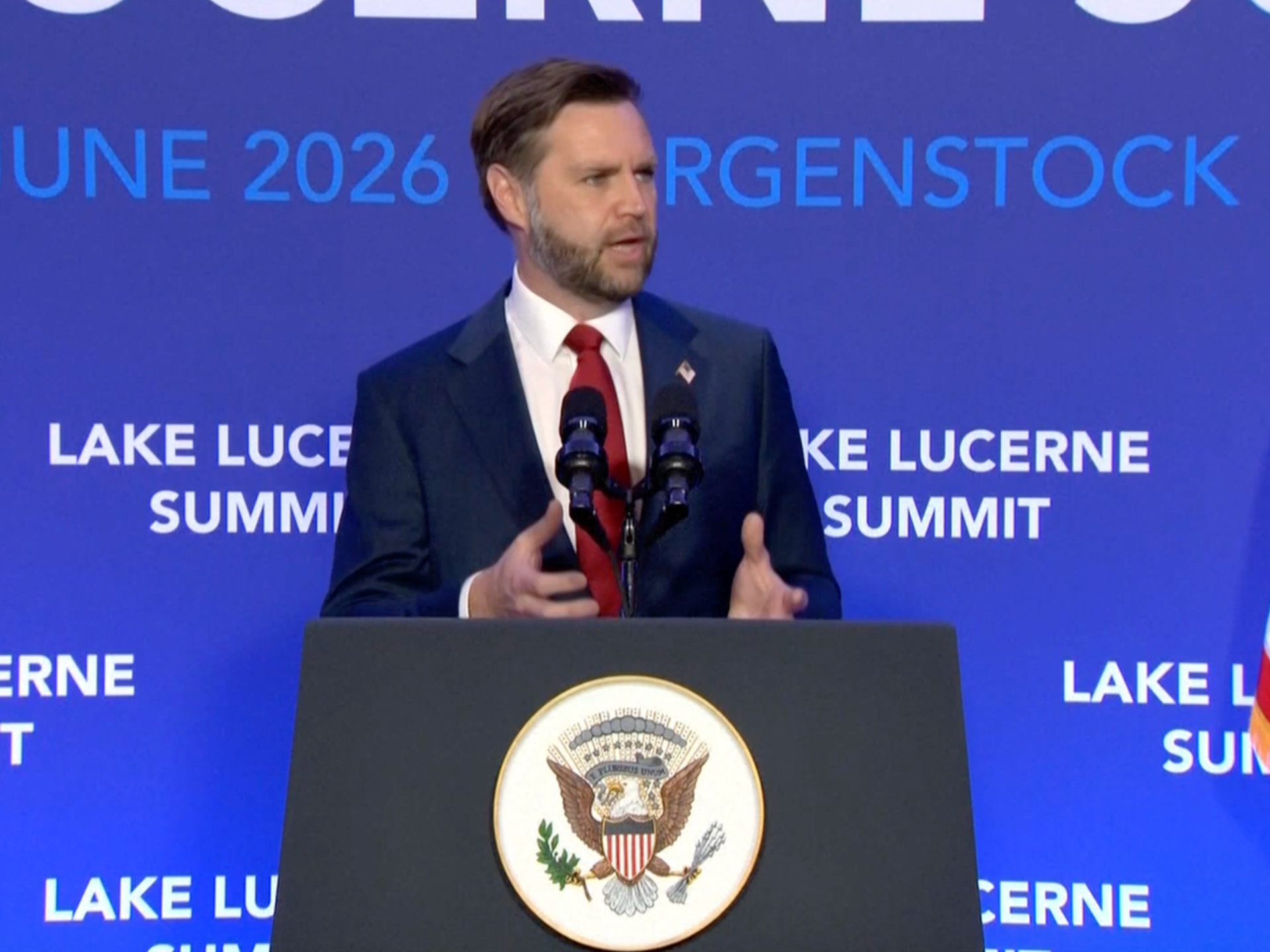
US Vice President JD Vance has touted significant progress in talks with Iran over its nuclear programme and Israel’s war on Lebanon, while refusing to commit to an Israeli withdrawal from Lebanese territory. He said Trump is trying to bring ‘permanent peace’ to a region that’s been ‘a basket case for a long time’.
U.S. President Donald Trump has said he is exploring ways to ensure Americans benefit directly from the rapid growth of artificial intelligence, raising the possibility of the government acquiring stakes in leading AI companies. The idea comes as firms such as OpenAI and Anthropic pursue valuations that could make them among the most valuable companies in the world, fueling debate over whether the public should share in the wealth generated by AI technologies.
Why the Idea Is Gaining Attention
The AI boom is expected to create enormous wealth for technology companies, investors and founders. Policymakers and advocates argue that because AI development relies heavily on public infrastructure, government research and vast amounts of publicly generated data, ordinary citizens should receive some of the financial benefits.
The debate has intensified as major AI developers seek billions of dollars to build data centers, chip infrastructure and advanced computing systems.
Option One: Taxing AI Companies Through Equity
One proposal would require AI companies to pay part of their taxes in shares rather than cash.
Under this approach, the government would gradually accumulate ownership stakes in AI firms without directly investing taxpayer money. Supporters argue that it would allow the public to benefit from future growth while avoiding large government expenditures.
Some advocates have gone further, proposing substantial government ownership stakes and board representation to give the public a direct voice in how AI companies operate.
Option Two: Equity in Exchange for Government Support
Another model would involve the government receiving equity stakes in return for financial assistance or incentives.
This approach mirrors previous arrangements in strategic industries where federal funding was provided in exchange for ownership interests. Given the enormous capital requirements of AI infrastructure, government funding could potentially become a source of financing for companies building advanced computing facilities, semiconductor plants and other critical projects.
Supporters argue this would allow taxpayers to benefit if publicly supported companies become highly profitable.
Critics contend that such arrangements could blur the line between regulation and investment, potentially creating conflicts between public policy goals and financial interests.
Option Three: Public Wealth Funds and Citizen Dividends
A third proposal focuses less on government ownership and more on distributing AI-generated wealth directly to citizens.
Under this model, revenue generated through AI-related taxes or investments would flow into a public wealth fund, which would then distribute dividends to Americans.
The concept resembles Alaska’s Permanent Fund, which uses energy revenues to provide annual payments to residents. Advocates argue a similar system could ensure that AI-driven economic gains are shared more broadly across society rather than concentrated among a small number of technology firms and investors.
Some AI companies have expressed interest in versions of this idea, including proposals for digital dividends funded by taxes on the sector.
Why AI Companies Matter
The debate carries major financial implications because leading AI developers are becoming increasingly valuable.
OpenAI and Anthropic have both reportedly taken steps toward potential public listings, while companies across the sector are raising unprecedented sums to fund AI expansion. Some analysts believe the industry could generate trillions of dollars in economic value over the coming decade.
As a result, even relatively small government stakes could potentially produce significant long-term returns.
Challenges and Obstacles
Any effort to give the government ownership in AI companies would face significant legal, political and economic hurdles.
Questions remain over:
How ownership stakes would be valued
Whether companies would voluntarily participate
The impact on private investment
Potential conflicts of interest for regulators
How revenues would be distributed to citizens
There is also likely to be strong opposition from free-market advocates who argue that government ownership could discourage innovation and distort competition.
What Happens Next
Trump has not outlined a specific mechanism for acquiring stakes in AI companies, and no formal proposal has been introduced.
However, the discussion highlights a growing debate over who should benefit from the AI revolution and whether existing economic structures are sufficient to distribute the gains from one of the most transformative technologies in modern history.
Analysis
The significance of Trump’s proposal lies less in whether the government ultimately acquires stakes in AI firms and more in what it signals about the future political debate surrounding artificial intelligence. As AI companies approach trillion-dollar valuations, pressure is likely to grow for policymakers to ensure that the economic gains extend beyond investors and technology executives.
The discussion mirrors earlier debates over natural resources, where governments sought ways to ensure that public assets generated public benefits. In this case, supporters argue that AI is built on public research, public infrastructure and publicly generated data, creating a rationale for broader wealth sharing.
At the same time, the proposal raises fundamental questions about the relationship between government and the private sector. Direct ownership stakes could provide taxpayers with financial upside, but they could also create tensions between the government’s role as regulator and its role as investor.
The debate is likely to become more prominent as AI companies grow larger, seek additional funding and exert greater influence over economic growth, employment and national competitiveness. Whether through equity ownership, taxation or public wealth funds, the central political question is increasingly becoming not whether AI will generate enormous wealth, but who will ultimately receive it.
There are few things a Los Angeles local is less likely to do than take a Hollywood sightseeing tour on a big, garish bus. Only rush-hour traffic and $20 tacos inspire the same level of dread.
Yet nearly everyone aboard the open-air bus for a Tuesday night production of “California Gothic: A Bus Tour” was an L.A. resident. The show, which is produced by the aggressively hip New Theater Hollywood, recently wrapped its third “season” after debuting in February and returning for an April encore. Set on a moving bus, the 1.5-hour-long experience is part esoteric Tinseltown history lesson, part immersive theater. The narrative conjures meaning from the Los Angeles cityscape by fusing a hodgepodge of textbook theories about the sprawling metropolis onto the gritty reality of daily life.
“We originally organized this thinking there would be more people coming who aren’t from here,” said Oliver Misraje, the show’s writer and primary tour guide, as the bus pulled away from the curb at Santa Monica and Wilcox. “But this just goes to show how much people love the city and are from here, contrary to popular belief.”
In lieu of celebrity-hungry tourists, “California Gothic” has been packing its bus twice a night with rowdy young scenesters and in-the-know locals eager to absorb its heady mix of California history, public intellectualism and performance artistry.
While the show wrapped its latest run in mid-June, it will reopen its automated doors during the last week of October for a special “ghost tour” edition co-written by Misraje and New York it girl Ruby McCollister.
The bus arrives for New Theater Hollywood’s “California Gothic: A Bus Tour.”
My tour was far less steeped in irony than I feared. As the bus wound its way through the streets of Hollywood, starting at the New Theater’s doorstep before eventually circling the Hollywood Walk of Fame, Misraje led the audience through his take on the death of the “California dream” and the rotting carcasses of empty buildings and broken promises left in its wake. Along the way, we encountered a haunted-eyed Marilyn Monroe impersonator (Brooks Ginnan), a masked Hollywood legend known as the Duchess of Argyle (Shauna Frente) and a singing, swaggering “Rat Czar” with a lot to say about real estate developers (Loren Kramar).
Yes, it’s whimsical, and yes, it references Mike Davis’ “City of Quartz” more than any of the TMZ-type excursions it gently parodies, but it’s still, at its heart, a bus tour.
In a nod to classic Hollywood tour advertisements, the show’s winkingly all-caps poster declares, “You Will See: The Hollywood Sign, Marilyn Monroe, the Schizo City State.” There is also a stash of BuzzBallz ready-to-drink cocktails for trivia winners, but Misraje and his cast do not deliver their performances with smirks or smarm. They commit full-throatedly to playing out Misraje’s vision of a Hollywood haunted by the dreamers it’s wronged and the secrets it’s plastered over.
“Ultimately, we are trying to pay homage to the bus tour format, which is intrinsically ‘carny,’” Misraje said, likening himself to a carnival barker espousing aesthetic philosophy aboard an ever-changing “Ship of Theseus.”
Before the performers infiltrate the ship, “I’m trying to intentionally set up audience expectations to think they’re going to get this run-of-the-mill Hollywood death tour,” he explained. “I consider myself a kind of impish person, but still fundamentally sincere.”
1
2
3
1.Tour guide Oliver Misraje begins the show.2.Rat Czar, portrayed by Loren Kramar, performs during the bus tour.3.Guests board the bus.
Given the show’s monologue-heavy format and bevy of literary references, it’s no surprise that the concept began as an essay. Misraje, a 27-year-old writer and self-described “Hollywood hustler” raised primarily in the Inland Empire, was inspired after the 2025 Palisades and Eaton fires to stage a piece he had written bridging his love of Gothic literature with his “welfare class” upbringing in a family of seven raised by a single mother, which he considered gothic in its own right.
“We were in the Inland Empire and it was the 2008 financial crisis,” he said. “There was all this imagery of things famously California-coded, like the suburban house, the pool, the strip mall, and when we were there, it was just, like, destroyed. There were abandoned housing subdivisions rotting in the sun.”
The perfect setting, he explained, for the kind of “literature that emerges after the failure of a historical project.”
After reaching out to New Theater co-owner Calla Henkel and conceiving the project, Misraje and his producers elected to turn the funhouse mirror onto Hollywood, framing the neighborhood with historical context and Freudian theory but ultimately letting it speak for itself.
The bus passes the TCL Chinese Theatre.
The highly mutable nature of street life and the participatory character of the show means its tone can shift drastically from tour to tour, even within the same night. Sometimes, the streets appear glittering; other times, seedy and dangerous. Once, there was a showdown with another tour bus — one presumably not carrying theatergoers. At a different show, a drunk pedestrian tried to board the bus during faux-Monroe’s speech. One particularly harrowing night, someone circled the bus on an electric scooter, shouting homophobic slurs at the all-queer cast.
“It’s almost like surfing,” Misraje said. “There’s so much chaos you’re confronting, and you have to find a way to ride it and let it be a part of the show.”
The show’s high production costs make bringing in a profit difficult, but Misraje said he and the New Theater Hollywood team plan to revive it periodically, with an evolving story and cast of characters.
On my tour, no performer better represented the blurred line between theater and street life than the Duchess of Argyle, a.k.a. the Mysterious Masked Lady of Hollywoodland, a.k.a. Shauna Frente, a busty Blanche DuBois figure in an eyeless flapper mask and gartered stockings. Just three days before, she had been evicted from a home on Argyle Avenue that once allegedly belonged to Cecil B. DeMille. This happened after a lengthy legal battle, during which the show helped raise money for temporary housing.
As the Duchess spilled neighborhood secrets, our bus repeatedly passed an Extra Space Storage facility painted with images of old Hollywood behemoths: Lucille Ball, Groucho Marx and the like. The intermingling smells of sizzling hot dogs, urine and marijuana wafted through the open windows.
Hollywood may be ghostly, the Duchess told us, but it was hers to haunt.
Duchess of Argyle (Shauna Frente) tells Hollywood stories during the tour.
British Prime Minister Keir Starmer outside No. 10 Downing Street on Monday as he announces his resignation, pending the selection of a replacement. That will take between three and 10 weeks depending on whether there is more than one candidate. Photo by Neil Hall/EPA
June 22 (UPI) — Keir Starmer announced Monday that he was standing down as British Prime Minister, saying he had heard the message from his own party that he wasn’t the right person to lead them into the next general election.
“I will resign as leader of the Labour Party. I have spoken to His Majesty the King this morning to inform him of my decision,” he said in a televised address outside No. 10 Downing Street in London shortly after 9 a.m. local time.
Starmer said he had instructed the Labour Party National Executive to draw up a timetable to select his replacement with a 7-day nomination period starting on July 9 — which, provided there is more than one challenger — fires the starting gun on a race that would see a new leader and prime minister in place by Sept. 1 at the latest.
It could be much sooner if the party throws its support behind a single candidate.
Starmer said he would stay on as prime minister until the process was complete and vowed to do everything he could to “ensure an orderly hand-over of power.”
The move came hours before Andy Burnham, the politician tipped to replace him, was due to be sworn as a Member of Parliament on Monday afternoon after a decisive win in a by-election last week.
Burnham confirmed he would run to replace Starmer, pledging in a post on X there would be no interruption to the business of governing and vowing to deliver on “economic growth, cost of living, public services, housing and opportunities for the next generation,” if he became prime minister.
If the nomination period comes to a close with him as the lone candidate he could be handed the keys to Downing Street as early as July 17 — in a revolving door of leaders that would see him become the country’s seventh prime minister in a decade.
Two of them — Conservatives Liz Truss and Rishi Sunak — never had a mandate from the electorate having been appointed by the Conservative Party in the middle of parliamentary terms, which normally run five years maximum.
The opposition Conservative Party did not immediately comment on Starmer’s resignation but Nigel Farage’s Reform UK said a general election should be called.
“If Labour thinks it can shove another professional politician into No. 10, it has another thing coming. Reform demands an election, and we are ready to deliver radical change,” he wrote in a post on X.
The end came swiftly for Starmer following Manchester Mayor Burnham’s very strong showing in Thursday’s by-election for the parliamentary seat for the Greater Manchester constituency of Makerfield.
Until this morning Starmer, publicly, had vowed to fight any challenge — and as the incumbent gets an automatic bye to stand in any contest — but over the weekend senior figures in his administration persuaded him it was in the interest of the country, and in particular the party, to avoid a messy and potentially damaging fight.
However, Starmer’s problems can be traced back to within months of the landslide election victory he won in July 2024.
Rumblings within the party began after a poor showing in local elections in May 2025, losing a by-election in the “safe” Labour seat of Runcorn and Helsby and declining approval ratings in the polls.
Rebellions by his own MPs forcing policy U-turns, the Peter Mandelson debacle, and more losses at the ballot box, culminating in a disastrous defeat to Reform UK in “mid-term” local elections in May, saw growing numbers of MPs call for him to quit and defections from his cabinet.
Coca-Cola and the Internal Revenue Service (IRS) of the United States will face off in a Florida court this week in the latest episode of a decades-long legal battle over the beverage giant’s tax liability on overseas profits.
The Atlanta, Georgia-based company and the US tax service will begin oral arguments on Thursday in a dispute that centres on transfer pricing – the practice of setting prices for transactions carried out between a company’s own affiliates – and could result in Coca-Cola facing a tax bill of about $20bn.
Recommended Stories
list of 4 itemsend of list
The case is being closely watched in corporate circles because the outcome will have implications for the amount of tax US-based multinational corporations must pay on income generated through their foreign subsidiaries.
What is the case about?
Coca-Cola is appealing a 2020 US Tax Court ruling that upheld the IRS’s finding that the soft drink giant underreported profits from transactions between its foreign subsidiaries.
In 2015, the IRS notified Coca-Cola that it owed billions in back taxes after concluding that the company had undercharged its units in Ireland, Brazil, Chile, Mexico, Costa Rica, Egypt and Eswatini, formerly known as Swaziland.
US multinationals often charge low licensing fees for their overseas units to minimise their reportable income in the US, which has a higher corporate tax rate than many of its peers.
“The IRS audited Coca-Cola because the company was earning astronomical profits in Ireland and a few other countries,” Alex Martin, an expert in transfer pricing at the tax consulting firm KBKG, told Al Jazeera.
The IRS first took Coca-Cola to court in 2015, but the origins of the dispute date back to 1996 when the two sides settled a tax audit for liabilities from 1987 to 1995.
Under the pricing formula agreed in that settlement, Coca-Cola’s foreign affiliates were allowed to retain a profit equal to 10 percent of their gross sales with the remaining income split evenly between the US headquarters and the overseas unit.
Coca-Cola argues that it should be able to continue to use this formula from 1996 while the IRS contends the terms of that settlement should have no bearing on the soft drink giant’s tax liabilities arising from audits in 2007, 2008 and 2009.
“The amount of potential exposure is about $20bn, so it is significant,” Reuven Avi-Yonah, an expert in taxation law at the University of Michigan Law School, told Al Jazeera.
Coca-Cola agreed to pay the IRS $6bn in back taxes and interest in 2024 while preparing its appeal but could be liable to pay up to $14bn more if the US Court of Appeals for the Eleventh Circuit sides with the government.
Coca-Cola argues that the IRS “misinterpreted and misapplied the applicable regulations” and has expressed its confidence that it will be successful in its appeal.
Why does the case have implications beyond Coca-Cola?
The case is important because it could serve as a template for the US government to raise more tax revenue from large multinational companies that generate huge profits overseas.
“The IRS designated this case for litigation because this litigation can provide a template for the IRS to audit other US companies with highly profitable subsidiaries,” Martin said.
Under the administration of former US President Joe Biden, the IRS ramped up its tax collection efforts against companies benefitting from transfer pricing arrangements.
In one of the most high-profile transfer pricing cases in recent years, the IRS announced in 2023 that Microsoft owed $28.9bn in back taxes, plus penalties and interest, on income derived from the distribution of software through its subsidiaries in Puerto Rico, Ireland and Singapore.
Microsoft said it disagreed with the IRS’s reasoning and would appeal to the tax service and, if that failed, go to court.
In 2024, the IRS announced that the short-term rental platform Airbnb and Newell Brands, a consumer products manufacturer, had underpaid their taxes to the tune of $1.33bn and $90m, respectively.
Airbnb and Newell Brands have both challenged the IRS’s determinations in the US Tax Court.
The Coca-Cola case is particularly significant because the IRS has historically fared poorly in litigating transfer pricing complaints, losing a string of cases against major corporations through the decades, including Bausch & Lomb, US Steel Corp and Hospital Corp of America.
“It is important because it is the first clear victory of the IRS in this kind of case involving profit shifting out of the US in many decades, so if it is upheld on appeal, more companies may be inclined to settle rather than litigate,” Avi-Yonah said.
For my 50th birthday, I bought a Toyota Corolla. Wait. Is my midlife crisis car really a Corolla, the best selling and most boring model of all time?
Well, yes. And no.
I have “modded” it, or in layman’s terms, modified the stock components and tuned the engine. This is not your aunt’s Corolla. When I hit the gas, the car pulls hard and the engine buzzes as if it’s powered by a hive of killer bees.
I get thumbs-ups from Mustang drivers and cool head nods from Challenger owners. My favorite is when kids at red lights ask me to rev the engine like I’m F1 driver Lewis Hamilton.
Probably a lot of my drive-by admirers are fans of the movie “The Fast and the Furious,” which was released 25 years ago this month. Fans of modified Japanese import cars, like me, have a love-hate relationship with the $7 billion “Fast and Furious” franchise. On one hand, the movies helped popularize modified Japanese cars. People all over the world fell in love with them and the import car culture they publicized.
On the other hand, the movies left out so, so much of the story.
In Southern California in the mid-1990s and early 2000s, people lived, for the most part, phone-free. The internet was nascent — a repository for flyers and ’zines — and most websites looked like Tetris.
The fashion was baggy everything for guys and short shorts, midriffs and little backpacks for girls. The hair was outrageous. And the cars, especially Japanese import cars, had reached the pinnacle of automotive engineering.
During this era, I was in college at UCLA. I saved up and bought a red 1989 Honda CRX Si. It also had a slick five-speed manual transmission, peppy engine and nimble steering. That car got me to work and through college, and from the mountains of California to the border of Oregon. It probably helped me get girlfriends. It consoled me through breakups. It helped me move to the San Francisco Bay Area for my first grown-up job.
And then, stupidly, I sold it, and all the precious memories it carried.
Now when I hit a loopy freeway interchange at night and my GR Corolla carves through the turns, it’s 1996 and I’m cruising in my CRX, getting pho in San Gabriel or rushing to a flyer party at Naga in Long Beach. That’s the magic of certain cars. A regular car takes you from place to place. A special car takes you back in time.
To be completely honest, I bought the CRX to fit in.
The ’90s import car scene was as diverse as Southern California. But there’s no doubt it started with Asian Americans (specifically Japanese Americans in the South Bay city of Gardena) who were influenced by modified car culture in Japan. Soon, Asian American kids all over the region were taking their inexpensive, underpowered four-cylinder, front-wheel-drive Honda Civics (our parents preferred Japanese reliability over American muscle) and turning them into street rockets.
Not only were they building race cars from scratch, they were also building one of my first experiences with a collective Asian American identity: one that wasn’t overtly about politics and activism, or immigration and assimilation. It was about Asian American joy. It was Chinese, Japanese, Korean, Filipino and Vietnamese Americans building cool-looking, fast cars. It was kids stereotyped as nerds going to parties where the awful stereotype of Long Duk Dong from “Sixteen Candles” was shredded into rubber and obliterated by exhaust blasts.
At the time, the Asian Americans we saw in the mainstream media were negligible or offensive, especially for Vietnamese Americans like me. But in import car culture, I saw, for maybe the first time, Asian guys and Asian girls in a centered and even glamorous light.
We made our own cars and our own car shows. We raced each other and then got fast (with turbos, superchargers and nitrous oxide) and raced others. And we won. We published our own magazines, built our own automotive businesses and, for good and bad, promoted our own outlaw street racer image and our own beauty standard. In those 1990s clubs and car shows, you could see and feel that Asian Americans weren’t assimilating culture. We were creating it.
“The Fast and the Furious” picked up on that. Based on a 1998 Vibe magazine article about street racing import cars in New York, the film was transplanted to Southern California. But it got so many details glaringly wrong. Its street races looked like street raves on major, four-wide roads packed with pedestrians. The races of our scene were clandestine, underground events in industrial, under-policed areas, where cars faced off two at a time.
But the most egregious and inexcusable Hollywood crime to me is that “The Fast and the Furious” whitewashed Asian Americans, the creators of this world, out of starring roles. The Korean American actor Rick Yune appears in the movie, sure — but he plays the villain, Johnny Tran, a guy who hates Vin Diesel’s Dominic Toretto for a crime deal gone bad (understandable) and for sleeping with his sister (ditto). Of course, in a tradition that goes back to “Madame Butterfly” and “Miss Saigon,” Tran dies at the end, shot dead by the blond-haired, blue-eyed hero, Paul Walker’s Brian O’Conner.
A few months ago, seeking a mechanic to mod my Corolla, I was referred to an auto shop in Garden Grove aka Little Saigon. The guy who sent me asked me, “Do you even know who’s working on your car?”
“No,” I replied.
He told me the name, and I Googled it.
Apparently, back in the ’90s, this Vietnamese American mechanic from Orange County had one of the fastest Honda Civics in the world. A true OG of the import car scene modified my car with his own hands. What an honor, and what a connection to the past.
This import car story ends in a full poetic justice circle. As a pioneer and legend of the real-life import car scene, my mechanic wasn’t the villain. He was the hero. He was the fastest, and his car was the most furious.
That’s the heart of my GR Corolla journey. Asian Americans created import car culture. We all deserve to be the hero of our own story.
Former Justice Minister Park Sung-jae appears for his trial on charges of playing a key role in former President Yoon Suk Yeol’s martial law bid at the Seoul Central District Court on Monday. Photo by Yonhap
Former Justice Minister Park Sung-jae was sentenced to 25 years in prison Monday after a district court found him guilty of playing a key role in an insurrection through his involvement in former President Yoon Suk Yeol’s martial law bid.
The Seoul Central District Court handed down the heavy punishment for Park, which surpassed the 20-year prison term sought by special counsel Cho Eun-suk’s team. The court immediately placed Park under custody, citing concerns that he may destroy evidence.
Cho’s team earlier indicted Park on charges of playing a key role in an insurrection and abusing his power by calling a meeting of senior ministry officials following Yoon’s declaration of martial law on Dec. 3, 2024.
The court convicted Park on both charges, recognizing the special counsel team’s argument that Park had called the meeting to review dispatching prosecutors to a martial law-supporting body, check the capacity of correctional facilities, allegedly to hold politicians and key figures expected to be arrested under the martial law, and order ministry officials in charge of imposing travel bans to report for work.
“The defendant ultimately turned his back on his duty of upholding the Constitution at the idea that the insurrection could succeed, choosing to instead take part in it,” the court said.
Park joins other members of Yoon’s Cabinet who have been convicted of playing a key role in an insurrection, including former Prime Minister Han Duck-soo and former Defense Minister Kim Yong-hyun.
In February, Yoon was sentenced to life imprisonment for leading an insurrection through his short-lived imposition of martial law. He has appealed the ruling.
Meanwhile, the court dismissed additional charges against Park for violating the anti-graft law, ruling that it did not fall under the special counsel’s investigation mandate.
The special counsel team had also indicted Park on charges of giving inappropriate orders to his subordinates in line with a request from Yoon’s wife, Kim Keon Hee, in May 2024, to check certain details of the prosecution’s investigation into her corruption allegations.
Copyright (c) Yonhap News Agency prohibits its content from being redistributed or reprinted without consent, and forbids the content from being learned and used by artificial intelligence systems.
Fans have been gripped by the latest dramatic season of Clarkson’s Farm, but where is Diddly Squat actually located?
Clarkson’s Farm location and how to get there(Image: GETTY)
Fans should definitely pay a visit to The Farmer’s Dog.
Clarkson’s Farm fans want to know exactly where the iconic Diddly Squat Farm location actually is.
Former Top Gear presenter Jeremy Clarkson returned to Prime Video this year with another gripping instalment of the documentary series, which sees him taking on numerous farming challenges to highlight the insurmountable tasks facing modern British farmers.
However, Jeremy faced even more hardship in Season 5 as it kicked off with his emergency heart surgery in October 2024 and concluded with the announcement that he had been diagnosed with prostate cancer.
Thankfully, his cancer is now in remission and Diddly Squat is back in business for Season 6, which is expected to arrive on screens next summer.
Now filming is once again underway, let’s take a look at the precise location of Clarkson’s Farm.
Where is Clarkson’s Farm?
Jeremy’s Diddly Squat Farm is located in the Cotswolds Area of Outstanding Natural Beauty in West Oxfordshire, England.
It’s just a short drive from the market town of Chipping Norton to the north, while to the south is the village of Chadlington.
Diddly Squat’s nearest major city is Oxford, which is about a 50 minute drive away.
The farm is also drivable from London in around two hours.
For visitors who want to reach the farm by public transport, the easiest route from London is the Great Western Railway from Paddington station to Charlbury.
From there, it’s just a 20 minute bus ride on the X9, which runs past the Diddly Squat Farm Shop managed by Jeremy’s partner Lisa Hogan.
If you’re travelling from Birmingham, it’s the Cross Country train to Worcestershire Parkway you want before getting the GWR to Charlbury and taking the same X9 bus. This can take around two and a half hours.
In addition to the farm itself, Jeremy also owns the iconic pub The Farmer’s Dog, which serves Diddly Squat’s very own Hawkstone lager.
Get 30 days of Prime Video totally free
This article contains affiliate links, we will receive a commission on any sales we generate from it. Learn more
TV lovers can get 30 days’ free access to binge great shows like Clarkson’s Farm by signing up to Amazon Prime. Just remember to cancel at the end and you won’t be charged.
The pub is just a half-hour’s drive away from the farm by the Asthall Barrow roundabout on the A40, a few miles from the town of Burford.
While it’s definitely possible to visit both the farm and The Farmer’s Dog in the same day, those using public transport will find the journey a little trickier.
From the shop, you can take the X9 bus back past Charlbury and down to the town of Witney. This takes about 40 minutes.
Visitors can then take the shorter 234 bus to Burford and it’s then just a few minutes’ walk to the pub. All in all the journey should take just over an hour.
Clarkson’s Farm is available to stream on Prime Video.
This photo, taken Monday, shows the trading room of Hana Bank in Seoul as South Korean stocks closed above the 9,100-point mark on a semiconductor rally and optimism over a U.S.-Iran deal. Photo by Yonhap
South Korean stocks finished at an all-time high Monday on a continued rally in semiconductor shares amid signs of progress in U.S.-Iran talks to end their monthslong war in the Middle East. The local currency lost against the U.S. dollar.
After opening 1.08 percent lower, the benchmark Korea Composite Stock Price Index (KOSPI) added 62.13 points, or 0.69 percent, to 9,114.55 after rising as high as 9,253.00.
Trade volume was moderate at 377.2 million shares worth 41.4 trillion won (US$26.9 billion) with losers outnumbering winners 739 to 148.
Retail investors and institutions were net buyers, purchasing 2.15 trillion won and 308.4 billion won, respectively, while foreign investors sold a net 2.55 trillion won.
On Sunday, Washington and Tehran wrapped up their first talks and agreed on a road map to reach a final deal within 60 days, according to a statement issued by the mediating countries of Qatar and Pakistan.
The negotiations had been at risk of breakdown as Tehran said it had closed the Strait of Hormuz and U.S. President Donald Trump had repeated his threats to resume attacks on Iran.
“Negotiations went smoothly in general despite some aggressive messages, which were considered short-lived noises,” said Kang Jin-hyeok, an analyst from Shinhan Securities.
Semiconductor shares ended in positive territory.
Chip giant SK hynix jumped 5.61 percent to 2.92 million won, surpassing Samsung Electronics in terms of market capitalization for the first time.
SK Square, the parent of SK hynix, surged 10.67 percent to 1.97 million won, and Hanmi Semiconductor, a leading chip manufacturing equipment provider, increased 2.2 percent to 301,500 won.
Defense giant Hanwha Aerospace advanced 0.27 percent to 1.13 million won, and Korea Aerospace Industries (KAI) climbed 1.43 percent to 148,600 won.
However, Samsung Electronics dropped 0.14 percent to 353,500 won, and Samsung Electro-Mechanics, an electronic components manufacturing affiliate of Samsung Electronics, lost 1.85 percent to 2.23 million won.
Top carmaker Hyundai Motor decreased 5.22 percent to 581,000 won, and leading battery maker LG Energy Solution dipped 4.7 percent to 385,500 won.
Samsung Life Insurance slid 9.36 percent to 450,500 won, and pharmaceutical giant Samsung Biologics retreated 5.75 percent to 1.3 million won.
The Korean won was quoted at 1,537 won against the U.S. dollar, down 10 won from the previous session.
Bond prices, which move inversely to yields, closed lower. The yield on three-year Treasurys rose 2.6 basis points to 3.810 percent, and the return on the benchmark five-year government bonds added 3.9 basis points to 4.044 percent.
Copyright (c) Yonhap News Agency prohibits its content from being redistributed or reprinted without consent, and forbids the content from being learned and used by artificial intelligence systems.
Nigeria’s security crisis is not only unfolding in forests, highways, villages and cities. It is unfolding inside the institutions responsible for confronting it.
The Nigeria Police Force faces a threat that receives far less attention than inadequate funding, obsolete equipment or personnel shortages: the gradual erosion of merit as the basis for advancement.
Every institution reveals its values through what it rewards. When competence, courage, and sacrifice are rewarded, then professionalism grows. But when proximity to power is rewarded, a different culture emerges.
Across Nigeria, police officers are risking their lives daily against insurgents, terrorists, organised armed groups, kidnappers, and violent criminals. Yet many are watching a different reality unfold. They see colleagues whose careers were built around powerful politicians, governors, ministers, and other influential figures rise rapidly through the ranks, often ahead of officers who spent years in dangerous operational theatres.
Some officers remain Superintendents of Police (SPs) while coursemates have risen to Assistant Commissioners of Police (ACPs). Similarly, some officers are Deputy Superintendents of Police (DSPs) while their contemporaries have become Chief Superintendents of Police (CSPs), largely as a result of special promotions granted at different times. Due to these irregularities, an Assistant Commissioner of Police who has spent years on the frontlines can find themselves taking orders from a coursemate who has advanced higher than them, largely because of political connections and privileged appointments rather than demonstrated operational excellence.
Promotions signal to young officers and the outside world what behaviour the institution values. If political visibility matters more than operational excellence, ambitious officers will pursue access instead of experience. Dangerous assignments become career risks rather than opportunities for leadership. No security institution can survive such incentives.
This is not the time for a leadership pipeline shaped by patronage, but a time for leaders tested under pressure and promoted because they have demonstrated competence.
The Police Service Commission exists to protect the integrity of promotions and shield them from political influence. That responsibility has never been more important. The Commission has tried to tie promotion to examination, but has not been able to completely resist the pressure to award “special promotions”. Consequently, officers have questioned promotion outcomes that appear disconnected from performance, operational achievements and professional record. Whether every complaint is justified is not the point. Confidence in the system is eroding.
As thousands of police officers converge in Abuja for promotion examinations, this conversation must be a wake-up call for the institution. The credibility of the process matters as much as the process itself.
The consequences extend beyond morale. A police force that ceases to reward merit eventually ceases to attract and retain its best leaders. When this happens, strategic thinking suffers, professional standards decline, operational effectiveness weakens, and public trust erodes.
These concerns are compounded by longstanding allegations of corruption, extortion, abuse of authority and weak accountability. The EndSARS protests reflected years of public anger over police brutality and impunity. Although reforms were promised, many Nigerians remain unconvinced that accountability has become deeply embedded within the institution.
Merit is not only about promoting the best. It is about ensuring that leadership positions are occupied by individuals whose conduct strengthens public trust. Officers who demonstrate integrity, discipline, and excellence must see those qualities rewarded. Officers whose records are tainted by corruption, abuse, or chronic underperformance should not continue advancing without scrutiny.
Citizens are also noticing a troubling pattern. Some officers attached to powerful political figures are increasingly perceived as beneficiaries of privileges unavailable to most of their colleagues.
The reforms required are straightforward. Promotion criteria should be transparent and publicly accessible. Exceptional promotions should remain exceptional and be clearly justified. Service in high-risk operational environments should carry significant weight. Promotion records should face greater scrutiny. The Police Service Commission must demonstrate visible independence from political pressure.
Nigeria is moving steadily toward state police. If we do not fix the obvious gaps in the federal police before 36 states establish their own police services, the consequences could be chaotic. State policing requires a strong, disciplined, and professional federal police capable of setting standards, enforcing accountability and preventing abuse. A weak federal police cannot effectively keep state police in check.
The future leadership of the Nigeria Police Force is being determined today. Every promotion creates tomorrow’s commanders, investigators, and strategists.
A system built on merit produces leaders. A system built on influence produces loyalists. Nigeria cannot afford a police force where political proximity outranks professional excellence. The country is already paying too high a price for failure.
The editorial highlights a critical issue within the Nigeria Police Force: the diminishing role of merit in promotions, overshadowed by political connections.
It contends that rewarding political proximity over operational excellence weakens the institution’s integrity and deters talented officers, ultimately endangering public trust and operational effectiveness.
To restore credibility, the editorial advocates for transparent and merit-based promotion criteria, emphasizing the importance of recognizing officers who demonstrate integrity and competence. It warns of the dire consequences if the federal police fail to address these issues before state police services are established, as current leadership decisions shape future command and strategic capabilities.
Get our in-depth, creative coverage of conflict and development delivered to you every weekend.
Subscribe now to our newsletter!
LOVE Island fans have been left terrified by “lying” Samraj’s behaviour as he continued to string along Priya.
The 25-year-old has been juggling both Mica and Priya over the last week but fans have noticed the Islander isn’t being honest about his feelings.
Sign up for the Showbiz newsletter
Thank you!
Samraj was seen comforting Priya in the kitchen as he insisted his chat with Mica didn’t mean they were ‘getting back together’Samraj told Mica that she was his number one and his feeling for her ‘haven’t gone away’
He told Mica, 21, a few episodes ago that business development manager Priya was “giving him the ick,” and she was his first choice.
But, he hasn’t let Priya privy to that information as he continued to act as if they’re relationship is flourishing.
During last night’s instalment of the famous ITV2 dating show, Samraj left fans taken aback by his “unfair” treatment of Priya, 25.
After returning from a chat on the terrace with Mica, Priya asked him if they were getting back together – which he denied.
Samraj told viewers he doesn’t want ‘to spend lots of time’ with PriyaCredit: ITVSamraj has been slammed by fans for stringing Priya alongCredit: ITV
Priya hugged him saying: “I actually quite missed you, I wanted to speak to you…
“I feel like you hate me today.”
Samraj replied: “No, I don’t hate you. My mind is just in a really weird place, I swear.”
“You’re head,” Priya questioned.
He continued: “Not about us it’s just about like I think Sam going was just like the icing on the thing but I really do appreciate you being so concerned about me.”
Priya then tried to get Samraj to open up on his cheeky terrace rendezvous.
However he quickly shut it down, saying: “No we were just speaking because we were downstairs we got, not by you, but interrupted twice before and I was upstairs and Mica was like ‘Oh lets finish our conversation.’”
Poor Priya explained she was asking because things change so quickly in the villa and it was clear she didn’t want to waste her time if the feelings weren’t reciprocated.
Love Island fans were left fuming as Samraj lied to face her face repeatedly and strung her along.
One fan wrote: “Samraj is the reason why I don’t trust men #LoveIsland”
“Samraj, tell Priya you don’t like her This is not fair at all,” added a second fan.
Another viewer penned: “Samraj, why you lying?”
Meanwhile, a fourth fan said: “Why is Samraj lying like this HAAAAAA men can lie I’m so scared????”
Later on Samraj carried on his ruse, telling Priya he fancies her more and “wouldn’t be sharing a bed with her otherwise.”
But, during the previous episode fans watched on as Samraj told Mica he hasn’t said anything because Priya “will be mad.”
Speaking to the camera in the beach hut, Samraj confessed: “I can’t knock Priya because she’s given me everything I wanted and asked for. I feel like if I sit here and say ‘Everything is going swimmingly, it’s amazing… I’d be lying.’
“I don’t want to spend loads of time with her.”
Love Island continues tonight at 9:00pm on ITV2 and ITVX.
Keir Starmer is under intense pressure from his own Labour party to announce plans to step down as Prime Minister.
By AFP, Reuters and The Associated Press
Published On 22 Jun 202622 Jun 2026
Prime Minister Keir Starmer could shortly announce a plan to step down, according to UK media reports, as his likely successor Andy Burnham is expected to be sworn in as a member of parliament.
Government ministers said the Labour leader was reflecting on his political future over the weekend.
Recommended Stories
list of 4 itemsend of list
Starmer could set out an exit timetable on Monday, conceding to pressure from his Labour Party to hand over the reins of power.
The threat to the British leader, which has been building for months, increased sharply on Friday when Burnham, the Greater Manchester mayor, decisively won a parliamentary election to return to Westminster, beating a candidate from Nigel Farage’s Reform UK party, which has led national opinion polls for more than a year.
That victory gave hope to Labour lawmakers that Burnham, a career politician known for his communication skills, could transform the fortunes of a party that has lost support under Starmer, whose popularity ratings have sunk.
If Starmer does announce his exit, he will be the sixth prime minister in a decade to stand outside 10 Downing Street and announce a premature departure.
The beleaguered leader “is expected to announce on Monday that he will step down as prime minister after overwhelming pressure from Labour MPs to make way for Andy Burnham”, The Guardian said.
The BBC said “signs are growing” that Starmer could set out a plan to resign on Monday, while newspapers splashed with headlines like “Game Over”.
But the widely expected change of leader is not without risk.
Beyond saying that the country needs fundamental change and to bring down the cost of living, Burnham has yet to make clear his approach to foreign affairs, the economy and defence.
Like Starmer, he could find he has little room to manoeuvre, hemmed in by bond market investors opposed to any additional government borrowing, and confronted by an angry electorate who believe the country is not working properly.
Starmer had pledged to fight
Starmer had said on Friday he would stand in any formal Labour leadership contest that sought to replace him.
While Starmer’s team believes his landslide national election win in 2024 gives him the mandate to stay in post until 2029, business minister Peter Kyle said on Sunday the prime minister was reflecting on “the political challenges that he faces in this moment”.
If Starmer does step aside, it is unclear whether Burnham would face a coronation or a challenge. Wes Streeting, who resigned as health secretary last month to protest against Starmer’s leadership, has said that he will run in a contest if there is one.
Burnham, if he succeeds, would become Britain’s seventh prime minister since the Brexit vote to leave the European Union, which took place 10 years ago this week.
That level of turnover – the highest in Britain in nearly two centuries – underlines the struggle of maintaining the support of voters angry at successive failures to improve living standards, public services and tackle undocumented immigration.
The first round of talks between high-level officials from Iran and the United States in Switzerland has ended, mediators say, with the two sides agreeing on a roadmap towards a final deal to end their more than 100-day war.
Iran and the US agreed to set up communication lines to keep the vital Strait of Hormuz open and end fighting in Lebanon at the marathon talks that ended on Monday, according to mediators.
Recommended Stories
list of 4 itemsend of list
The teams, led by US Vice President JD Vance and Iranian parliament Speaker Mohammad Bagher Ghalibaf, opened talks on Sunday as part of a two-month negotiating period set out under a preliminary deal agreed last week.
Mediators Pakistan and Qatar said the negotiators reached agreement on a “roadmap towards reaching a final deal within 60 days” with technical talks to continue for the rest of the week at the Swiss resort of Burgenstock.
“Encouraging progress has been made, including the creation of a mechanism for further technical talks,” they said, detailing a contact channel set up to “avoid incidents and miscommunication” over the Strait of Hormuz.
A “deconfliction cell” between the parties and authorities in Lebanon has also been agreed to prevent fighting from erupting there again, they said.
Al Jazeera’s Osama Bin Javaid, reporting from Lucerne, Switzerland, said mediators hailed the constructive engagement, adding that the working groups formed by the negotiators are to begin work immediately.
“A lot of work still remains to be done, and it is not yet clear how these groups will be formulated, in which capacity they will work or what format any future meeting will take,” he said.
Tehran essentially had blocked the Strait of Hormuz in retaliation against the joint attacks by Israel and the US on February 28 that touched off the war.
Lebanon was pitched into the conflict as Iran-aligned Hezbollah attacked Israel in response to the US-Israeli attacks on Iran, prompting Israel to launch a wide-scale bombing campaign and ground invasion of southern Lebanon.
After a series of false starts, Washington and Tehran last week finally signed a memorandum of understanding aimed at ending the war, which included a provision to end fighting in Lebanon between Israel and Hezbollah.
But there have been repeated clashes and Israeli attacks in Lebanon since, which prompted Iran to say days after it had reopened the Strait of Hormuz that it would again close the waterway, through which about a fifth of global oil and liquefied natural gas supplies transited before the war.
“Tireless Pakistani and Qatari mediation has delivered major progress to end Lebanon War,” Iranian Foreign Minister Abbas Araghchi wrote on X after the talks in Switzerland.
“Oil and petrochem exports are waived, blockade lifted, some frozen assets released, and major reconstruction & development plan launched for Iran. 1st real test: Lebanon deconfliction cell,” he wrote.
Al Jazeera’s Resul Serdar Atas, reporting from Tehran, said Iran achieved most of what it wanted in the talks in Switzerland because it had conditions for starting the technical talks.
“They were saying that the memorandum of understanding – particularly Articles 1, 10 and 11 – had to be initiated and implemented for the technical talks to move forward,” he said, referring to the sections on ending fighting on all fronts, including Lebanon; waiving US sanctions on Iranian energy exports; and releasing frozen Iranian assets.
“So now that they have decided that technical talks in Switzerland are going to continue throughout the whole week, we see that there is progress,” he added.
Trump’s threats
The roadmap was agreed after a shaky start to the negotiations. Iran’s delegation walked out in response to US President Donald Trump’s threats on Sunday to attack Iran over its support for Hezbollah.
“Iran must immediately stop their highly paid PROXIES in Lebanon from causing trouble,” Trump wrote on social media, apparently referring to Hezbollah. “If they don’t, we’ll hit Iran very hard again, just like we did last week, only harder!!!”
Iran hit back with a warning of its own.
“They would do better to be careful with their statements; our armed forces are ready to respond to them in a different manner. No matter what they say, we are the ones who act,” Iran’s chief negotiator, Ghalibaf, said.
Israeli Prime Minister Benjamin Netanyahu, meanwhile, said Israeli troops would remain in southern Lebanon “as long as necessary” and promised that he would “not allow Iran to acquire nuclear weapons”.
By Sunday evening, there had been no reports of Israeli attacks or continued fighting as some residents of southern Lebanon cautiously returned to their homes.
The fighting between Israel and Hezbollah has repeatedly threatened to derail peace efforts.
On Friday, planned US-Iranian talks were postponed after Israel launched deadly attacks in Lebanon following the deaths of four of its soldiers in combat.
Israel’s military chief visited troops on Sunday in southern Lebanon, where he said Hezbollah was in a “very difficult position”.
“Hezbollah has suffered a severe and significant blow, and we are committed to remaining prepared to continue operating and prevent its rebuilding,” Lieutenant General Eyal Zamir said.
The overall death toll from the fighting in Lebanon has surpassed 4,100 since it escalated on March 2, the Ministry of Public Health said.
‘Historic meeting’
Vance had earlier hailed “a historic meeting” in Switzerland.
Even as Trump was threatening Iran, Vance told reporters the US president had “asked us to turn over a new leaf to transform our relationship with the people of Iran”.
Flanked by US negotiators Jared Kushner and Steve Witkoff, Vance added: “The question before us now is how much more can we accomplish together?
“Can we turn over a new leaf? Can we change relations in the Middle East permanently?
“Or do we go back to doing things the old way, which is not our preference, but it’s certainly very much something that can happen.”
Lebanon aside, there has been no indication that Iran’s support for armed groups across the region, which has long drawn the ire of the US and Israel, would be addressed in the negotiations.
Speaking on Sunday, Iranian President Masoud Pezeshkian stressed that Tehran would not relinquish its right to enrich uranium although he repeated Iran’s denial that it seeks nuclear weapons.
“We can also state in writing that we have no intention of building a bomb,” he said.
Vick Hope has shared a rare glimpse inside her and Calvin Harris’ sprawling Ibiza home they spend their summers inCredit: GettyIn a sweet Father’s Day video, Calvin can be seen on the floor of the beautiful villa serenading their young son MicaCredit: Instagram
In a Father’s Day post for Calvin shared on Sunday, Vick shared a video of the musician serenading Mica in a sweet moment.
The clip sees Calvin sitting on the floor of their Ibiza home – which is neutrally decorated with a beige couch and textured nude rug – and playing a ukulele.
His son can be seen adorably dancing along to the tune, bobbing up and down in between his dad’s legs.
The family spend all summer on the White Isle as Calvin carries out his residency at Ushuaïa IbizaCredit: InstagramThe farm, which Calvin bought in 2022, is where Vick welcomed their son and where Calvin is thought to have proposedCredit: vickhope/InstagramThe couple have been married since 2023Credit: GettyWhen back in the UK, the couple have a manor house in the CotswoldsCredit: vickhope/Instagram
In the clip, Calvin and Vick’s sprawling farm backdrop can be seen – with a large window showing the beautiful views and collection of trees.
Vick wrote alongside the video: “Happy first Father’s Day, love from the person you make dance the most”.
A number of celebrities took to the comment section on the post, with Davina McCall writing: “Awwwwwww xxxx my heart”.
“Awwwwwwww ❤️,” said Carol Vorderman.
The clip is a rare glimpse into Calvin and Vick’s life in Spain during the summers, with the couple – who married in 2023 – famously private about their personal lives.
The residence holds special memories for the couple, with Calvin reportedly popping the question to Vick underneath a grand tree there, as well as welcoming their son there.
Calvin bought the Ibiza property after selling his two multi-million pound mansions in Los Angeles.
It can produce veg, eggs, wine and farm-to-table meals, and also hosts special events such as weddings.
At the time, a source told The Sun: “Calvin employs an expert team including farmers and chefs.
“But that hasn’t stopped him getting involved and he regularly gets his hands dirty, helping to plant seeds and everything else involved in running a farm.
“He is really passionate about what he and the team are doing.”
When the couple aren’t spending their summers in Ibiza for Calvin’s residency, they reside in a countryside home in the Cotswolds.
Thomas Warrick, a nonresident senior fellow at the Atlantic Council, says the 60-day US-Iran talks face hurdles with regards to nuclear issues and sanctions, and will require time, willingness, and patience to achieve lasting results.
Gas sales in Russian-controlled Crimea have halted after Ukrainian drone strikes on the peninsula’s supply route. Drivers are now looking for other modes of transport.