Paris and other European cities are experiencing temperatures above 40C (104F), reaching levels normally seen across the Middle East.
A blistering heatwave has gripped much of Europe, prompting the highest-level red alerts in parts of the United Kingdom, France, Spain and Italy.
Authorities have warned of health risks, wildfires and travel disruptions as extreme temperatures persist.
Recommended Stories
list of 3 itemsend of list
With temperatures approaching record highs, officials have taken emergency measures, including a localised alcohol ban in parts of France under red alert, nationwide heat warnings in Germany and the cancellation of a World Cup fan zone screening in Madrid, where temperatures hit 39C (102F).
Why is it so hot in Europe?
A persistent area of high pressure, known as a heat dome, has trapped hot air over Western Europe, bringing clear skies, weak winds and prolonged sunshine. Hot air moving north from North Africa has added to the extreme temperatures.
(Al Jazeera)
Unusually warm seas around the UK, Ireland, France and the western Mediterranean have also helped keep coastal areas hot, especially at night. Coastal waters around Spain have reached record warm levels, according to Spain’s port authority.
In the worst-affected areas – western France, England and Wales – daily average temperatures have soared more than 12C above the 1991-2020 baseline, according to Copernicus data.
(Al Jazeera)
Scientists say the early-season heatwave is part of a broader warming trend. Europe is the world’s fastest-warming continent, with temperatures rising by approximately 0.56C per decade since the mid-1990s, more than double the global average.
Climate change is making heatwaves more frequent, more intense and likely to occur earlier and later in the year.
How hot are European cities today?
To contextualise the temperatures Europe is dealing with, Al Jazeera looked at the maximum temperatures in five European capitals on June 24 and compared them with cities across the Middle East, North Africa and Asia, where high temperatures are more typically experienced.
Europe is particularly vulnerable – much of its housing and infrastructure was not built for prolonged extreme heat, and only about 20 percent of European homes have air conditioning.
The graphic below shows how European cities’ maximum temperatures today compare with some other cities around the world:
(Al Jazeera)
How is temperature measured?
The temperature you see on the news or the weather app on your phone relies on a network of weather stations positioned around the globe.
To ensure accurate readings, weather stations typically use specialist platinum resistance thermometers placed inside shaded instruments known as a Stevenson screen.
Measurements are taken at a standard height of 1.25-2 metres (4-6.5 feet) above the ground. This provides a reading that reflects the air temperature that people actually feel.
(Al Jazeera)
There are two well-known scales used to measure temperature: Celsius and Fahrenheit.
Only a few countries, including the United States, use Fahrenheit as their official scale. Most of the world uses the Celsius scale, named after Swedish astronomer Anders Celsius, who invented the 0-100 degree freezing and boiling point scale, although originally inverted, in 1742.
Why does the temperature feel hotter than the forecast says?
Air temperature alone often doesn’t match how hot it feels to your body. That is why forecasts report a “feels like” temperature, which adjusts air temperature based on factors like humidity, wind speed and sun exposure.
(Al Jazeera)
Humidity
Humidity measures how much water vapour is in the air. This moisture slows the evaporation of sweat, so your body can’t cool itself as effectively.
Wind speed
In hot weather, a light breeze can help evaporate sweat, making it feel cooler.
Sun exposure
Even if the thermometer reads the same, direct sunlight adds extra warmth, which is why shaded areas feel cooler.
Remaining group schedule, teams, as well as the best third-round group fixtures at the tournament in North America.
After 48 matches in North America, it’s time for the final round of games in the group stage at World Cup 2026.
Sixteen teams will be eliminated after these fixtures, with 32 nations heading through to the knockout stages.
Recommended Stories
list of 4 itemsend of list
The top two teams from each of the 12 groups – along with the eight best third-placed teams – will proceed to the next phase.
Here are the top five “must-watch” matches in the second round of fixtures from June 24 until June 27.
Neymar could return for Brazil against Scotland [Reuters]
⚽️ Scotland vs Brazil
Miami Stadium – Wednesday, 6pm (22:00 GMT)
These two sides will meet at the World Cup for the fifth time and there’s plenty to play for in an intriguing encounter in Miami.
Brazil are looking to secure their place in the knockout stages as group winners and are currently tied with Morocco on four points at the top of Group C.
Scotland are aiming to escape the group for the first time at a major international tournament and know that a point will almost certainly guarantee a spot in the round of 32.
Expect Group C to change a lot during these final fixtures, with Morocco taking on Haiti at the same time.
If that isn’t enough, Brazil’s Neymar is also set to make his first appearance at this World Cup.
Sweden have been unpredictable at this tournament [Raquel Cunha/Reuters]
⚽️ Japan vs Sweden
Dallas Stadium – Thursday, 6pm (23:00 GMT)
It’s difficult to predict which Sweden will turn up in Dallas on Thursday.
Graham Potter’s side beat Tunisia 5-1 in their opening match of the World Cup, before losing by the same score to the Netherlands.
Japan have been entertaining to watch at this tournament and were in fine form during their 4-0 win over Tunisia at the weekend.
Expect plenty of goals in this match and plenty of drama. The winner will secure a top-two finish in Group F, so there is a lot to play for.
France’s Kylian Mbappe has scored four goals so far [Kyle Ross/Reuters]
⚽️ Norway vs France
Boston Stadium – Friday, 3pm (19:00 GMT)
Norway and France are already through to the knockout stages, but this game looks set to be a blockbuster affair with both sides looking to top Group I.
Erling Haaland and Kylian Mbappe have both scored four goals so far and they’ll be desperate to add to their tally as they chase down Lionel Messi.
France are one of the favourites to lift the World Cup next month and are looking to end the group stage with three wins from three.
But Norway have the opportunity to prove that they truly are dark horses in this tournament and can compete with elite international sides.
Buckle in for a big one in Boston.
Spain’s Lamine Yamal, Nico Williams and Victor Munoz celebrate after the match against Saudi Arabia [Claudia Greco/Reuters]
⚽️ Uruguay vs Spain
Seattle Stadium – Friday, 6pm (00:00 GMT on Saturday)
Group H has been a tight affair following some surprise results in the opening round of fixtures.
Uruguay drew with Saudi Arabia, while Cape Verde shocked the world with a goalless draw against Spain.
La Roja bounced back by thrashing Saudi Arabia and they go into their final game as group leaders, with Uruguay two points behind in second.
Spain will secure top spot with a win in Seattle, ensuring that they avoid Argentina in the round of 32.
Egypt are looking to reach the knockout stages at the World Cup for the first time [Anne-Marie Sorvin/Reuters]
⚽️ Egypt vs Iran
Seattle Stadium – Friday, 8pm (04:00 GMT on Saturday)
Neither of these sides have ever made it out of the group at a World Cup, but on Friday, at least one of them will achieve that feat.
Group G is closely bunched after a number of drawn matches and it sets things up nicely for an intriguing final round of fixtures.
Victory for either Egypt or Iran will guarantee them a spot in the knockout phase, so expect both sides to be up for this one.
Iran have faced numerous challenges at this World Cup, with restrictions on travel and visa issues before the tournament even began.
If Iran progress, there’s also still a chance that they will face the US in the knockout stages.
World Cup 2026: Remaining group-stage full schedule
Wednesday, June 24
Switzerland vs Canada at 12pm PT (19:00 GMT) – BC Place, Vancouver, Canada
Bosnia vs Qatar at 12pm PT (19:00 GMT) – Seattle Stadium, Seattle, US
Scotland vs Brazil at 6pm ET (22:00 GMT) – Miami Stadium, Miami, US
Morocco vs Haiti at 6pm ET (22:00 GMT) – Atlanta Stadium, Atlanta, US
Czechia vs Mexico at 7pm CST (01:00 GMT on Thursday) – Mexico City Stadium, Mexico City, Mexico
South Africa vs South Korea at 7pm CST (01:00 GMT on Thursday) – Estadio Monterrey, Guadalupe, Mexico
Thursday, June 25
Ecuador vs Germany at 4pm ET (20:00 GMT) – New York New Jersey Stadium, New Jersey, US
Curacao vs Ivory Coast at 4pm ET (20:00 GMT) – Philadelphia Stadium, Philadelphia, US
Japan vs Sweden at 6pm CDT (23:00 GMT) – Dallas Stadium, Dallas, US
Tunisia vs Netherlands at 6pm CDT (23:00 GMT) – Kansas City Stadium, Kansas City, US,
Turkiye vs USA at 7pm PT (02:00 GMT on Friday) – Los Angeles Stadium, Los Angeles, US
Paraguay vs Australia at 7pm PT (02:00 GMT on Friday) – San Francisco Bay Area Stadium, San Francisco, US
Friday, June 26
Norway vs France at 3pm ET (19:00 GMT) – Boston Stadium, Boston, US
Senegal vs Iraq at 3pm ET (19:00 GMT) – Toronto Stadium, Toronto, Canada
Cape Verde vs Saudi Arabia at 7pm CDT (00:00 GMT on Saturday) – Houston Stadium, Houston, US
Uruguay vs Spain at 6pm CST (00:00 GMT on Saturday) – Estadio Guadalajara, Zapopan, Mexico
Egypt vs Iran at 8pm PT (03:00 GMT on Saturday) – Seattle Stadium, Seattle, US
New Zealand vs Belgium at 8pm PT (03:00 GMT on Saturday) – BC Place, Vancouver, Canada
Saturday, June 27
Panama vs England at 5pm ET (21:00 GMT) – New York New Jersey Stadium, New Jersey, US
Croatia vs Ghana at 5pm ET (21:00 GMT) – Philadelphia Stadium, Philadelphia, US
Colombia vs Portugal at 7:30pm ET (23:30 GMT) – Miami Stadium, Miami, US
DRC vs Uzbekistan at 7:30pm ET (23:30 GMT) – Atlanta Stadium, Atlanta, US
Algeria vs Austria at 9pm CDT (02:00 GMT on Sunday) – Kansas City Stadium, Kansas City, US
Jordan vs Argentina at 9pm CDT (02:00 GMT on Sunday) – Dallas Stadium, Dallas, US
The race for the Golden Boot at World Cup 2026 is shaping up to be one for the history books.
After just two games, Argentina talisman Lionel Messi leads the way with five goals, followed by France’s Kylian Mbappe and Erling Haaland of Norway with four goals each.
Recommended Stories
list of 4 itemsend of list
Germany’s Deniz Undav has three with Jonathan David of Canada on the same mark after a hat-trick against Qatar.
A further 20 players have scored twice in their opening two games, including 2018 Golden Boot winner Harry Kane of England, Cristiano Ronaldo of Portugal, Vinicius Jr of Brazil and Mikel Oyarzabal of Spain.
The stars are all shining and, given the rate of scoring so far, it seems possible double figures might be needed to win the Golden Boot, something done only three times in history – by Hungary’s Sandor Kocsis in 1954, Just Fontaine of France four years later and Gerd Muller of Germany in 1970.
Fontaine holds the record of 13 goals in one World Cup in just six matches in Sweden, but the expanded 48-team format in 2026 means the nations qualifying for the semifinals in July will play an unprecedented eight games in this edition.
At the 2006 World Cup in Germany and in South Africa four years later, only five goals were needed to claim the Golden Boot while nobody has scored more than eight in the past 13 editions, a feat achieved only by Brazil’s Ronaldo in 2002 and Mbappe four years ago in Qatar.
Kylian Mbappe followed his double against Senegal with another against Iraq in this year’s World Cup [Siphiwe Sibeko/Reuters]
Why have so many goals been scored at World Cup 2026?
It took just 33 matches for a century of goals to be racked up in this edition, second only to 1954 in terms of pace.
After Portugal’s 5-0 win over Uzbekistan on Tuesday, 139 goals had been scored across the first 45 games – the most in the group stages of a single edition of the finals, overtaking the 136 scored in 2014 in three fewer matches.
The record number of goals in one edition came in Qatar 2022 with 172 from 64 games. With an extra 40 matches in the new expanded format that went into effect this year, it was always likely to be broken, but the rate of scoring suggests the old mark will be obliterated.
The Adidas Trionda ball used in World Cup 2026 [Simon Fearn/Imagn Images]
One reason for the increase in goals might be the Adidas Trionda ball, which FIFA commissioned for this World Cup.
Before the tournament, FIFA said it boasts several key performance innovations, including intentionally deep seams designed to produce optimal in-flight stability by ensuring sufficient and evenly distributed drag as the ball travels through the air – in short, it flies through the air – while the surface of the ball is designed to increase grip when striking or dribbling in wet or humid conditions, which we have seen plenty of in the opening matches.
Austria head coach Ralf Rangnick said: “This ball is as fast as a cannonball. If you kick the ball in the right position, it’s extremely difficult to save.”
The controversial addition of hydration breaks to each half may also mean players are performing at their peak for longer, leading to the glut of late goals so far. Of course, the fact that 48 teams are taking part, drawn from the world’s leading 85 teams in the rankings, means there are some mismatches in the first phase.
Colombia coach Nestor Lorenzo also said attackers are more protected by officials than they used to be, which may contribute to the increased scoring, adding: “They didn’t have this protection some 20, 30 years ago when they were hit a lot more, when rough play was a lot more common.
“Today, any team that defends well and uses counterattacks and tries to play can manage to do well.”
Erling Haaland has scored two goals in each of his first two World Cup appearances. [John Sibley/Reuters]
Who is likely to win the Golden Boot?
Much will depend on fitness and, of course, how deep a country goes in the tournament, but Messi has to be considered the favourite to win his first accolade.
The 38-year-old scored seven goals at the last World Cup and has now scored in six straight tournament matches, having netted in every knockout round in Qatar and the first two games of this edition. He even missed a penalty against Austria, which would have made it back-to-back hat-tricks.
Argentina’s final group game on Sunday is against already eliminated Jordan although Messi’s inclusion from the start in that one is by no means a given as his side have already secured the top spot in Group J.
They look set for favourable knockout fixtures, though, with the potential for Uruguay or Cape Verde in the last 32, potentially Australia or Iran in the round of 16 and the possibility of Croatia or Colombia in the quarterfinals, should they make it.
Only in the semifinal might they come up against a powerhouse nation, likely in the form of England or Brazil or dark horses Japan, Norway or Mexico.
Mbappe also looks likely to have a favourable run and is likely to feature against Norway on Friday in the group finale, which will decide the top spot in Group I.
Winning the group could mean a round of 32 meeting with Sweden, Germany the potential opponents in the last 16 and the Netherlands or Morocco awaiting in the last eight.
Whoever finishes second out of France and Norway could face a tricky task against the Ivory Coast in the last 32 with Brazil or Japan awaiting the winners and the possibility of England lurking in the quarterfinals, which might put a ceiling on Haaland’s prospects, despite having scored 59 goals in 52 international games for Norway.
Kane will seek to enter the conversation with England facing a must-win Group L finale on Sunday against Panama with the prospect of a last-32 meeting with Cape Verde to follow and Mexico likely lying in wait in the Azteca (known during the World Cup as Mexico City Stadium) in the round of 16.
Cristiano Ronaldo may have left it too late to begin a real quest, given Portugal face Colombia on Sunday in their final Group K game and could face resolute Ghana in the last 32 with Spain potential opponents in the last 16.
But Vinicius Jr could add to his two goals when Brazil face Scotland on Thursday in their final Group C game although the knockout rounds would appear a stiffer test.
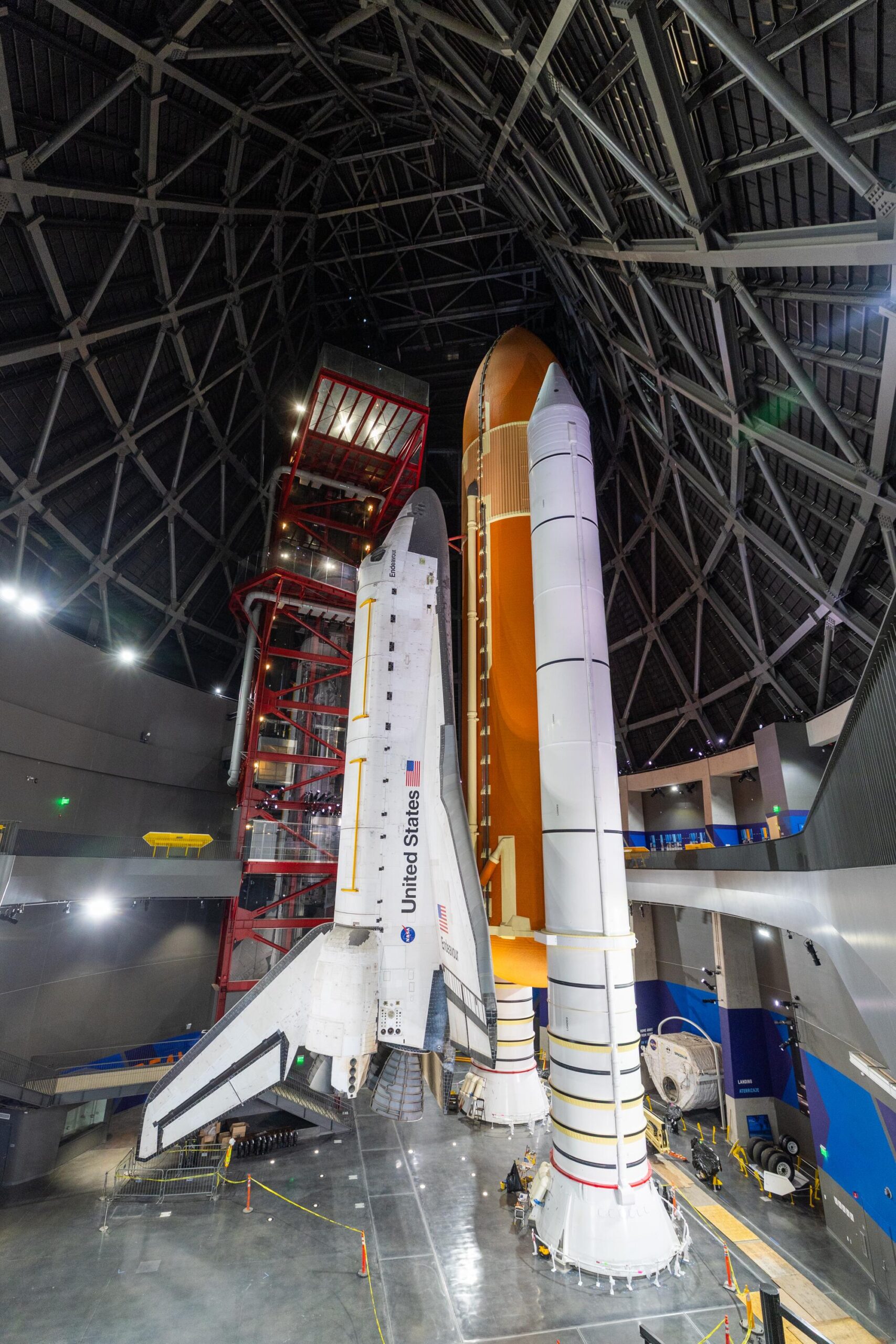
The Space Shuttle Endeavour is approaching its final mission. But this time, it won’t be blasting into a different atmosphere.
The California Science Center on Wednesday announced its Samuel Oschin Air and Space Center will open to the public on Nov. 13. The $450-million, 200,000-square-foot addition will permanently house the Korean Air Aviation Gallery and the Kent Kresa Space Gallery. But its centerpiece will be the Samuel Oschin Shuttle Gallery, where the Space Shuttle Endeavour will be on permanent display in its vertical “ready-to-launch” position.
When it debuts, the gallery will be the only place in the world with a complete shuttle stack, including orbiter, solid rocket boosters and an external tank.
“I’ve been here a long time. We’ve done a lot of great stuff, but this just keeps getting better. Everybody on our team was so proud of it,” said Jeffrey Rudolph, the Science Center’s president and chief executive. “We are incredibly excited, and we actually think people are gonna come from all over the world to see this thing.”
The Samuel Oschin Air and Space Center will open to the public on Nov. 13. The $450-million, 200,000-square-foot space includes the Samuel Oschin Shuttle Gallery, where the Space Shuttle Endeavour will be on permanent display in launch position.
(Allen J. Schaben / Los Angeles Times)
The Air and Space Center opening will mark the completion of the master plan adapted by the Science Center in 1993. One of three surviving space shuttles, the Endeavour made 25 successful missions into space between 1992 and 2011. In 2012, the shuttle arrived at LAX atop a modified Boeing 747 before being taken on a procession through the streets of Los Angeles to reach Exposition Park. Construction on the Samuel Oschin Air and Space Center, a sleek, 20-story building designed by ZGF Architects, finished in April.
“This shuttle really represents everything that my husband loved,” said Lynda Oschin, the widow of Samuel Oschin. “He was very involved in relativity, exploration, inspiration, children, math, science.”
Dennis R. Jenkins, project director at the California Science Center, estimated that at the height of construction, the team averaged about 400 construction workers a day. For Jenkins, who spent 30 years of his career as a NASA contractor working on space shuttles, seeing the Endeavour in its vertical position is “particularly special.”
“I walk in there 50 times a day, and 50 times a day it takes my breath away,” Jenkins said. “Especially when we have the theatrical lights on instead of the work lights, it is just so stunning to me. I’ve been around space shuttles for exactly 50 years now, and it still takes my breath away.”
Retired astronaut Barbara Morgan, who flew aboard Endeavour in 2007, said the shuttle will inspire space enthusiasts.
“This takes me back! I am right there again, strapped in, excited to launch,” Morgan said in a statement. “But this is even better, because here now is Endeavour for our future generations. She will launch big dreams.”
Jeff Rudolph, president and CEO of the California Science Center, gets a close-up view of the aft section and main engines of the Space Shuttle Endeavour, displayed in a vertical, launch-ready configuration at the new Samuel Oschin Air and Space Center at the California Science Center.
(Allen J. Schaben / Los Angeles Times)
The gallery will open with a video of the shuttle’s history, produced by J.J. Abrams’ company, Bad Robot. The video ends with a simulated launch of the shuttle — complete with fog machines — before the walls retract, letting visitors take in the Endeavour in all its massive glory.
The Endeavour is visible from several angles. Visitors walking around the bend of the center’s second-floor gallery can peek inside the payload bay, which was used to transport cargo like satellites into space. Step downstairs, and viewers can walk underneath the shuttle’s massive engines. To catch a bird’s-eye perspective of the Endeavour, guests can take a glass elevator to the 20th story to look at the shuttle through a glass floor.
“You go up slowly, [the elevator] stops at different levels. You see inside where the payload is, and at every stop you see something else, and when you get to the top and you look down,” Oschin said, the view is just unbelievable. It’s breathtaking. I don’t know what other word I could use.”
Despite the grandeur of the Endeavour, the Science Center didn’t want to glorify it either. Rudolph explained that the tiles on the shuttle’s wings, which were part of its thermal protection system, show the damage on each launch. The shuttle reflects the physical toll space took on the vessel.
“This thing went 25 missions into space, and you can see,” Rudolph said. “When we first got [the Endeavour] at LAX and had it in the United hangar a couple of weeks before we moved it through the street, the United guy said, ‘Do you want us to paint it?’ and we said ‘No! We wouldn’t think of it.’”
Jeff Rudolph, president and CEO of the California Science Center, walks through a doorway toward the Space Shuttle Endeavour during a tour and preview of the new Samuel Oschin Air and Space Center at the California Science Center.
(Allen J. Schaben / Los Angeles Times)
The center’s goal is to present the shuttle as close to mission-ready as possible. Rudolph explained that the exhibit’s hardware, including its bolts and nuts, are unique and extremely specialized. Since the space shuttle program concluded in 2011, many of Endeavour’s missing pieces are no longer produced. Jenkins spent years sourcing pieces of equipment.
However, the largest artifact of the exhibit was the most challenging to source. ET-94 — the exhibit’s ginormous, bright orange external fuel tank— was particularly difficult to get a hold of because it shouldn’t still exist.
“External tanks were only used once. … We jettisoned them on the way to orbit, and it burned up in the atmosphere before it hit Earth,” Jenkins said.
Jenkins explained that the ET-94 was built for a future Columbia Space Shuttle mission, but after the Columbia was destroyed, the fuel tank was used for research. To complete the Endeavour’s full shuttle stack, Jenkins persuaded NASA to donate the $65 million to the Science Center.
The Endeavour will not be alone in the gallery. Plans are in the works for a variety of unique, ancillary creations including a 15-second slide that mimics the path of reentry as a space shuttle descends back into Earth’s atmosphere. Visitors will start inside a dark slide that gives way to an orange glow followed by a double sonic boom. The slide finishes with an S turn, which the Endeavour executed to burn energy.
For Rudolph, the effort represents a giant leap toward the Science Center’s goal of making space exciting for “the next generation of scientists, engineers and explorers.”
“I just can’t wait to stand there and watch people come in, and kids especially. There are going to be a lot of tears looking at this, that I can tell you, happy tears,” Oschin said. “It’s something for children. Children are our future and our hopes for the future. This is going to be very inspiring for them and extremely exciting for them to see.”
The number of babies born in South Korea shot up 18 percent in April, reaching a seven-year high, government data showed Wednesday. This file photo, taken April 22, shows newborns at a hospital in Goyang. File Photo by Yonhap
The number of babies born in South Korea shot up 18 percent in April from a year earlier, reaching the highest level in seven years, government data showed Wednesday.
A total of 24,521 babies were born in April, up from 20,787 a year earlier, according to data from the Ministry of Data and Statistics. It marked the highest figure for any April since 26,104 babies were recorded in 2019.
Over the January-April period, the total number of births came to 99,534, also the highest in seven years, up a sharp 15.5 percent from a year earlier.
The number of births grew at a record rate for both April and the January-April period.
The country’s total fertility rate, the average number of children a woman is expected to have in her lifetime, rose by 0.13 from a year earlier to 0.93 in April.
The number of newborns has been on an upward trend since July 2024.
Experts attribute the recent growth to an increase in the number of marriages, along with a more positive perception of childbirth.
The rate still remains well below the 2.1 births per woman needed to maintain a stable population without immigration.
The number of marriages in April rose 9 percent from a year earlier to 20,622. It was also the highest figure since 22,844 was recorded in April 2016.
The number of divorces, meanwhile, rose 7.3 percent from a year earlier to 7,829.
The data showed the number of deaths fell 1.3 percent from a year earlier to 28,405, resulting in a natural population decline of 3,884.
Copyright (c) Yonhap News Agency prohibits its content from being redistributed or reprinted without consent, and forbids the content from being learned and used by artificial intelligence systems.
The United States Senate has voted in favour of invoking its war powers to force President Donald Trump to halt his military campaign against Iran or seek congressional approval before any further action is taken.
Here is a closer look at Tuesday’s vote – the 10th attempt Congress has made to rein in the US-Israel war on Iran – and what this means for the US government.
Why did this vote take place?
A similar measure had already been approved in the House of Representatives on June 3 by a vote of 215 to 208, and on Tuesday, the Senate passed it in a 50-48 vote. Trump’s Republican Party has slim majorities in both chambers.
Speaking on the Senate floor before the vote, top Democrat Chuck Schumer advocated for the war powers resolution as he criticised Trump’s military campaign against Iran.
“For years, Trump promised to put maximum pressure on Iran, but he ended up delivering maximum confusion, maximum chaos, maximum cost to the American people with his disastrous war,” Schumer said.
“Time after time, the vast majority of Senate Republicans sided with Trump and his war instead of the American people. The American people have paid the price for Trump’s historic blunder in Iran. It’ll go down in the history books as one of the worst foreign policy forays America has ever made.”
The war against Iran has proved highly unpopular in the US. A poll released on Tuesday by the news agency Reuters and the research firm Ipsos found that 24 percent of respondents felt the war had been worth the cost.
Four Republican senators crossed party lines to vote for the resolution, and all but one of the chamber’s Democrats also voted in favour.
Tuesday’s breakaway Republicans were Bill Cassidy of Louisiana, Lisa Murkowski of Alaska, Susan Collins of Maine and Rand Paul of Kentucky. A further two Republicans did not vote: Mitch McConnell of Kentucky and Dave McCormick of Pennsylvania.
The lone Democrat to vote against the measure was Pennsylvania’s John Fetterman.
What does the resolution say?
The war powers resolution “directs the President to remove United States Armed Forces from hostilities against the Islamic Republic of Iran”.
Only if “explicitly authorised by a declaration of war or a specific congressional authorisation” would Trump be allowed to use further military force against Iran, it says.
The resolution, however, does allow for a limited military presence to remain in the Middle East to prevent any “imminent attack” against the US or its allies.
What is the significance of the vote?
The vote reflects growing unease even among some of Trump’s Republican supporters about the unpopular conflict, which began with US-Israeli air strikes on Tehran on February 28.
This is the first time both chambers of Congress have passed a resolution directing a president to remove US armed forces from a warzone under the War Powers Act although it was not immediately clear how the votes might affect the conflict.
Technically, the Trump administration should now seek explicit congressional approval for further strikes on Iran. However, previous administrations have found routes around this by securing more limited authorisations for the use of military force (AUMFs) instead.
For example, in the wake of the 9/11 attacks in 2001, Congress passed an AUMF that gave then-President George W Bush broad powers to conduct what would become the global “war on terror”.
And one year later, it passed another AUMF, allowing the use of the military against the government of Saddam Hussein in Iraq, which became the basis of the 2003 invasion.
The two authorisations remain in place, and presidents continue to rely on them to carry out strikes without first seeking congressional approval. The assassination of top Iranian General Qassem Soleimani in 2020 in Baghdad was authorised by Trump under the 2003 AUMF.
In addition, a resolution does not have the force of law. Experts said, therefore, that while the Senate vote is viewed as a rebuke to Trump, it is largely symbolic.
What effect will this have on US-Iran talks in Switzerland?
Before the vote on Tuesday, some Republican senators had warned that the war powers resolution would weaken Trump’s standing in the Switzerland negotiations.
“If this passes, the Iranians are going to simply stand up and walk away from negotiations,” Senator James Risch of Idaho told the Senate on Tuesday.
“They’re going to say: This thing’s over. The Congress has told the president of the United States, ‘Leave us alone. We can do whatever we want to do,’ and they will walk away.”
How will the Trump administration respond?
Risch also argued that the resolution is essentially useless, given its symbolic nature. “It’s going to have no effect. The president isn’t going to pay any attention to it,” he said.
The US Constitution gives Congress the sole power to declare war, but that division of power has eroded over the past 75 years as successive presidents alone have committed US forces to overseas conflicts.
Trump has pointed to that precedent to argue that he does not need congressional authorisation at all.
In an appearance on The Axios Show last week, Trump denied learning any “lesson” about the limits of his executive powers during the Iran war. “There are no limits,” he said.
The last time Congress voted to go to war was during World War II although it has passed AUMFs in the decades since, which allow for limited military engagement without congressional approval for all-out war.
During Trump’s first term, there were concerns that he could use the 2001 AUMF to strike Iran under the unfounded claim that Tehran supports al-Qaeda.
Some critics pointed out that Republicans may be more willing to confront Trump over the issue of congressional authorisation now as they defend their seats before November’s midterm elections.
Sam Thompson was snapped crying on Pete Wicks’ shoulder in an emotional moment after the TRIC Awards show last night, just after snagging the award for Best Podcast
12:39, 24 Jun 2026Updated 12:40, 24 Jun 2026
Sam Thompson got emotional at the TRIC awards(Image: JAMES CURLEY AND MAGICMOMENTSUK)
Sam Thompson could not hold back the tears as he was snapped hugging his best friend Pete Wicks‘ and seeming rather emotional. The pair were in town for the TRIC (Television and Radio Industries Club) Awards with a host of other celebs.
Sam, 33, and Pete, 37, won Best Podcast for Staying Relevant. After cinching the award, Pete and Sam stepped outside with Pete holding onto a cigarette as Sam could be seen having an emotional conversation. During the chat Sam was gesticulating wildly and then wrapped Pete in an embrace, resting his head on his best friend’s shoulder.
Sam’s face was red and slightly puffy, suggesting he’d been rather moved by emotion during the awards ceremony.
A representative for Sam told The Mirror after the awards: “Sam and Pete were absolutely thrilled and very emotional to have won Best Podcast Award at the TRICS for the second year running.
“Staying Relevant is such a passion project for them so to receive such a special accolade twice felt all the more special. Happy tears were flowing from the whole team.”
After winning the awards, the Made in Chelsea star sent a chair flying as he jumped around in excitement and bounced around the table. Accepting the prize, he said: “That’s mad! Wahey!” He then accidentally swore as he said: “No! I just didn’t wanna say the word f***, oop!”
He then clapped his hand over his mouth as Pete brushed off the moment, saying: “Don’t do that!”
The duo shared the moment they won on Instagram in a hilarious video captioned: “SECOND YEAR IN A ROW BABY. Thank you Relevanters for every single vote, we wouldn’t be here without you. As Sam would say, we are a community (sorry @p_wicks01 ) See you next year @tricawardsuk.”
This isn’t the first time Sam has been snapped crying on Pete’s shoulder during at the TRIC Awards, but previously the star wasn’t shedding tears of joy.
Pete was snapped comforting Sam in 2024 as Sam visibly shed tears while in the smoking area after the awards. Addressing his tears, Sam later revealed on his podcast that he had heard some bad news. “Firstly, there’s no way of getting around it, I had actually received some bad news, so I actually was really sad, I’m not going to lie about it, but I was.”
“I wasn’t crying though, I wasn’t actually crying. I just want to let everyone know that now,” he added. “There was a paparazzi shot which said ‘Sam Thompson crying after THAT argument with girlfriend Zara’, after the Soccer Aid thing. They linked both of them together.”
Sam continued: “There’s a few things here, I was really sad, and Pete being my best mate, he took me outside and the beauty of it was that Pete said we can’t go out the front because there were a lot of paps there. So, we went through the back. I let it go, I let it all out. I’m literally head-butting Pete’s shoulder – I’m literally caressed into his armpit.
“He’s being such a good mate and saying he’s always there for me and I’m feeling really sorry for myself. I thought, ‘at least nobody is going to see this’, but little did I know that later that day the pictures were everywhere.”
It’s unclear why Sam was emotional on this occasion, but it could have been tears of happiness after clearly being full of joy during the event. Sam is also now dating model and DJ Talitha Balinska, 25, with the pair frequently posting about one another on social media.
France has confirmed its first Ebola case in the country during the current outbreak, as a doctor returning from a humanitarian mission in the Democratic Republic of the Congo tested positive, French health authorities said.
In a statement on Wednesday, the French Health Ministry said the healthcare worker was operating in one of the areas where the virus was circulating.
Recommended Stories
list of 3 itemsend of list
“The patient is being treated at a leading healthcare facility, following strict biosafety protocols,” the ministry said. “All precautionary measures, including the patient’s isolation, were implemented upon arrival in France, with transfer to the hospital under secure conditions to prevent any risk of contamination,” it said.
An epidemiological investigation is under way to identify individuals who may have been in contact with the patient. They will be contacted by health authorities to self-isolate for 21 days, the statement added.
Since May, the northeastern Ituri province of the DRC has been the epicentre of an Ebola outbreak, which has killed more than 260 people and infected more than a thousand so far in the central African country. Cases have also been reported in neighbouring Uganda.
On May 17, the World Health Organization (WHO) declared the outbreak a “public health emergency of international concern”.
Most previous Ebola outbreaks in DRC were caused by a virus called Ebola Zaire, but this outbreak is caused by a different strain called Bundibugyo, for which there are currently no approved vaccines or treatments.
The first places to be investigated in a national independent inquiry into grooming gangs will be Oldham, Bradford and Keighley, and London.
The Statutory Independent Inquiry into Grooming Gangs, which will be chaired by Baroness Anne Longfield CBE, will compel individuals and institutions to explain what they “did or did not do to protect children from being sexually abused”, the organisation said.
The review will also examine if changes have been made in places where there have been past reviews, such as Oxford and Rotherham.
Abuse survivor Fiona Goddard, who resigned from the inquiry in October 2025, said it had been “a long fight”.
“Bradford has evaded inquiries for many, many years and it’s time that the full truth about what happened comes out,” she said.
Goodard left the panel over concerns that two of the shortlisted chairs had backgrounds in policing and social services.
Keighley and Ilkley MP Robbie Moore, who called on the government to include Bradford in the inquiry, said it marked “a significant turning point”.
“This inquiry must seek the truth – however horrific it may be. And bring about justice to those who have been failed for far too long,” he said.
If you buy books linked on our site, The Times may earn a commission from Bookshop.org, whose fees support independent bookstores.
Before her death in 1993, Mabel McKay — one of the last living dreamers of the Pomo Indian people — shared a prophecy while driving through the Sonoma hills. One day, this paradise would burn.
“Everything is going to go dry. Everything will burn. That’s my latest vision,” she said, gesturing to the idyllic landscape.
Startled, writer Greg Sarris asked what could be done to stop it.
“You live the best way you know how,” McKay replied.
Since her passing, Sonoma County experienced the most destructive wildfires in California history in 2017, only for another, more destructive fire to surpass it a year later. “She always used to say, ‘Whether you believe it or not, it’s true,’” Sarris recalls.
McKay and her visions are the inspiration behind Sarris’ latest work. His first novel in 28 years, “The Last Human Bear,” is loosely based on the spiritual leader McKay, whose wisdom and companionship served as a refuge to Sarris during a tumultuous childhood in Sonoma County.
A reluctant casino mogul
On a Monday morning in California, Sarris sits in his sleek office at the Federated Indians of Graton Rancheria in Rohnert Park. Sarris, 74, has served as chairman of the Federated Indians of Graton Rancheria for more than 30 years. In his office, diplomas and academic certificates crowd the walls. A framed poster for the 2023 film “Joan Baez: I Am a Noise” hangs nearby — she’s a close friend. Behind him, an American flag ripples in the distance outside the window, blurred by the summer heat.
Just up the road sits a multibillion-dollar tribe-owned casino, Graton Resort & Casino — a project the writer oversees. “I had never been in a casino. I have a PhD in modern thought and literature from Stanford,” says Sarris.
How does an accomplished author find himself at the helm of a multibillion-dollar casino enterprise? It’s a question that still puzzles Sarris. “I told them if we can raise our people and become a platform for social justice and environmental stewardship to benefit Indian and non-Indian alike, I’ll do it.”
Before his stint as a reluctant casino mogul, Sarris was a prolific author and university professor at UCLA and Sonoma State. In 2023, he was appointed a regent of the University of California by Gavin Newsom. Over the course of his career, he published six books, and his novel “Grand Avenue” became an HBO original film in 1996.
California’s Native history: revisited
From early in his career, Sarris wanted to depict Indians as he knew them, rather than as Hollywood depicted them. “We’ve been erased by Hollywood, because the idea of Indians has always been Plains Indians or Southwest,” Sarris explains. “It’s easier for Americans to access Buffalo Bill.”
Greg Sarris’ new novel “The Last Human Bear.”
(Josh Edelson / For The Times)
“California Indians have always been left out of the picture,” says Sarris.
“The Last Human Bear” is Sarris’ latest attempt to revive the legacy of California’s Native history. The novel follows Mary Hatcher, a Pomo Indian in Sonoma County, from Prohibition through the 21st century. It’s told in the first person through Hatcher’s compelling voice as she narrates the horror and heartbreak of her lifetime over the course of a century, echoing William Faulkner’s literary style, which influenced Sarris.
‘California Indians have always been left out of the picture,’ says Sarris.
“I’m curious why you want to know about me,” reads the first line. The novel unfolds like an oral storytelling tradition, driven by a voice that Sarris painstakingly crafted, evoking his conversation with McKay. “The voice comes. I have to call it, almost like a spirit,” says Sarris. “I wanted it to feel like an oral story.”
Hatcher — a Pomo shape-shifter who dodges prejudice by passing as Mexican in the novel — is a thorny protagonist, often cunning, scheming and unforgiving. “An American Indian woman is as richly complicated as anybody else. I wanted to show this rich and complicated character who’s negotiated a history that she’s showing you,” says Sarris.
Acclaimed Northern California writer and activist Rebecca Solnit, who has authored 17 books and is a friend of Sarris’, says that she was fascinated by his ability to evoke so many aspects of female life in “The Last Human Bear.” Solnit was especially moved by Sarris’ rendering of California’s tragic history. “It’s shocking, given how rich California’s Indigenous cultures were — 99 different language groups, mythologies, belief systems and linguistic traditions. Every North American Indigenous language family is represented in California. It’s weird how this history has been erased, and how horrific what happened was.”
Climate change and ongoing ecological disasters have made Indigenous perspectives more vital than ever, the author argues. “I think Indigenous people have been hugely influential in giving us a point of view in which we were never separate from nature,” she says. According to Solnit, Sarris’ novels are part of a broader resurgence of interest in Native culture.
In the early chapters of the “The Last Human Bear,” the protagonist gets a job on a ranch by posing as Mexican, since Indians were forbidden from working as housekeepers. What follows is a tale of tension, deception and a forbidden love that sours, reminiscent of Brontë novels.
Sarris hopes that the novel illuminates an uncomfortable history of Sonoma County that remains largely invisible, looming beneath the soil of wine country. The novel offers “a history of this county that a lot of people haven’t seen,” says Sarris.
“There were more Indian people right where we’re sitting per capita than anywhere else in the entire New World outside Mexico City, which was the Aztec capital,” says Sarris. “The genocide was so horrendous.”
Identity, revenge and a search for home are themes that arise throughout the novel — subjects Sarris knows well in his own life.
Greg Sarris feeds chickens at an organic farm across the street from Graton Resort & Casino, which he heads, in Rhonert Park.
(Josh Edelson / For The Times)
Uncovering a hidden Native heritage
In 1952, Sarris’ teenage mother gave him up for adoption, her family hoping to evade the embarrassment of their Jewish daughter becoming pregnant by a Native American Filipino man. Sarris grew up in a white family in Santa Rosa alongside three siblings. His adopted father, George Sarris, became abusive, causing Greg to flee the house with his adopted mother’s blessing. “God bless her. She let me go out and live on ranches and run with other people to get away from him.”
It was in these formative years that Greg became acquainted with Native American people in Santa Rosa, always feeling a mysterious pull toward them. It was these years that also shaped his sensibility as a writer. “I was a lost kid on the streets, so I was always paying attention to everyone, listening, and people would tell me stories.”
Native Americans lived on the fringe of town, often practicing healing ceremonies that were frowned upon by white Catholic families in the suburbs Sarris explains. “When I was 15, I met Mabel McKay, who I wrote the book about. I knew she did some of those strange things that I heard about, but I liked her,” he says. “I had no idea that I was related to these people. I thought I was a mixed-blood Mexican or Spanish.”
At age 30, Sarris uncovered the identities of his birth parents and learned of his Native heritage. He learned his birth mother was buried in a pauper’s grave at the Calvary Catholic Cemetery in Santa Rosa, with “nothing to mark her grave but an upside-down horseshoe that has her name in it.” In the opening pages of the novel, a dedication to her: Bunny Hartman.
Excitedly, Sarris presented proof of his Indian heritage to McKay, his trusted confidant. “I thought it was a big deal that I had Indian blood,” says Sarris. He showed McKay a photo of his father, which she met with indifference. Naturally, Sarris was disappointed. “She told me something later: ‘You’re never any more Indian than your experience.’”
A lifelong outsider
Questions surrounding the legitimacy of Sarris’ heritage haunted him for decades and ultimately informed the novel. Being adopted by a white family, only to be shunned by the Native community, perpetuated his lifelong feeling of being an outsider. “I keep thinking maybe I just got in with this group of people and my Indian relatives so that I would feel rejected again,” he says. “We gravitate towards what we know as home emotionally.”
“I didn’t grow up on a reservation. I’m fair-skinned,” he says. “Being adopted, it feeds into that feeling of not being good enough,” he says, adding: “Illegitimacy is a medicine in the end.”
In the Native American literary community, Sarris has often felt excluded from discourse. When in doubt, he reminds himself of his involvement with the tribe. “Who among them have done this much for their people?” he asks. “Who among them has given this much time and sacrificed a writing career for their people?”
Jane Fonda, the two-time Academy Award-winning actress and activist, struck up a friendship with Sarris through a shared cause. “We met during the campaign to secure health and safety setbacks that would finally prevent oil wells from being drilled within 3,200 feet of a community. Greg and the federated tribes helped us win that fight against Big Oil,” Fonda explained in an email.
“I can tell from his books and my time with him that he embodies indigenous wisdom and beliefs,” Fonda says. “I see Greg Sarris as a man who embodies the best of two worlds — the mercantile culture of Western civilization and the indigenous world that knows we are part of nature and interdependent with it. It’s a rare and valuable combination.”
Greg Sarris, who holds a PhD in literature from Stanford, inside the casino he works for to help fund his tribe’s future.
(Josh Edelson / For The Times)
Inside the polarizing casino kingdom
The Graton Resort & Casino, launched by Sarris over 12 years ago, now plays a vital role in supporting the Pomo Indian community. “I promised early on: roof over everyone’s head, an insurance policy in every pocket and a college degree paid for,” he says. “We give $2.5 million a year in perpetuity to the University of California, so that all California Indians can go to the University of California tuition-free.” The casino has funded theater programs, youth writing intensives and revenue sharing with neighboring tribes.
On the car ride to the casino, Sarris is riffing on his friendship with Grateful Dead member Mickey Hart, who bought Sarris a quarter horse as a gift. In the casino, Sarris eagerly greets his employees with a friendliness that betrays his repeated insistence that he’s a reclusive writer. He points out blown-glass flower sculptures, an embellishment he once saw at the Four Seasons in Paris. He walks past the baccarat room, where he hosts high rollers from Beijing, whom he boasts, “play $100,000 in a hand.”
Early on, news of the casino’s construction caused waves of controversy across Sonoma County — some of which resulted in death threats against Sarris’ life. Concerns that a casino would invite debauchery into the county circulated, which Sarris points out is ironic for a community predicated on wine: “Beyond whether gambling is right or wrong, what is implicit is their privilege and elitism,” says Sarris. “People were getting scared because these brown people, who were the poorest in Sonoma County, are suddenly going to have power.”
Admittedly, Sarris says their newfound wealth has not been without repercussions in the tribe. “People who have been traumatized with generational poverty are the most vulnerable to the lure of materialism,” he says.
When time catches up
In the final chapters of “The Human Bear,” the protagonist, at the end of her life, recalls: “Human Bears often like to even the score before they die.” Revenge is futile, she concludes. “If I was going to avenge our people, I would have to poison nearabout all of history.”
Sarris recalls a similar epiphany he had speaking with McKay. He explains Pomo Indians believed that each action had a consequence. “Ethnographers always said we’re a culture predicated on black magic and fear. No, we were cultures predicated on profound respect for the complexity of all life,” says Sarris.
Then, white men came and seemingly bent the laws of natural order. “The Kashaya Pomo word for white people was ‘miracles’, because they came in and killed everything and did all these things. Nothing could come back to them,” says Sarris.
He explained to McKay that he thought of the white man’s fate differently. “Look, there’s no water. There’s no air. Everything’s poison,” he says, gesturing around him to this vast, broken world. “It’s all come back. It just took time.”
Connors is a culture journalist from Sonoma County. She covers books, food, entertainment and offbeat Los Angeles. She’s currently at work on a book of essays about tourism in all its forms.
North Korea has revealed its largest-ever warship that leader Kim Jong Un says can carry nuclear-capable missiles. The 5,000-metric-ton destroyer is part of the country’s growing navy, which is set to expand sharply over the next five years.
Here’s a look at the viral moments and on-field controversies as well as the biggest players, best performances, goals and more.
Published On 24 Jun 202624 Jun 2026
Cristiano Ronaldo joined the party, Lionel Messi set a new record, Iran once again displayed their fighting spirit and Turkiye were shown the door.
The second round of the 2026 World Cup group stage had a fair amount of drama.
Recommended Stories
list of 4 itemsend of list
Al Jazeera breaks down the key moments:
Better late than never: Ronaldo strikes for Portugal
Unlike other high-profile strikers at the tournament who came out all guns blazing from the get-go, Ronaldo needed some time to open his account. But his two goals in Portugal’s 5-0 thrashing of Uzbekistan on Tuesday were enough to silence the critics as the 41-year-old became the first player in history to score in six World Cups.
Messi is saving his best for last
Age is just a number for Messi, who is celebrating his 39th birthday on Wednesday. His apparent last dance is bringing out the best in him as the Argentinian has set a new record for the most World Cup goals at 18 – a figure that is sure to increase with La Albiceleste now the number one favourites to add back-to-back World Cups to their trophy cabinet.
Is Messi “Mr Argentina”? It’s hard to argue otherwise with all five of the team’s goals scored by him. That also makes him the leading Golden Boot contender with one goal more than France’s Kylian Mbappe.
At this point in the tournament, Messi is the 2026 World Cup’s Golden Boot leader [Kai Pfaffenbach/Reuters]
Triple treat: Messi, Mbappe, Haaland score on same day, again
FIFA has come under criticism for a series of issues this tournament, but one thing it’s got spot on is the scheduling of Argentina, France and Norway games on the same day. For the second time in a row, fans were treated to back-to-back goals galore on Monday as Messi started the party with a brace before Mbappe did the same, and Erling Haaland topped it off with another double.
Norway’s ‘Viking row’ goes viral
Back at the World Cup after 28 years, Norway celebrated their round of 32 qualification in typical fashion: bringing out the famous “Viking row”. With the squad sitting in rows resembling those of a Viking longboat, captain Martin Odegaard began beating the drum to a joyous climax as thousands of Norwegians in the stadium also joined the fun.
Salah, Egypt celebrate on streets of Vancouver
It took Egypt an incredible 92 years to register their first World Cup win, so it wasn’t a surprise that they celebrated in style. Shortly after beating New Zealand 3-1 on Sunday, the Egypt squad was pictured on the streets of Vancouver with fans, singing and dancing to music blaring from a huge speaker. Mohamed Salah, nicknamed the “Egyptian King”, was the centre of attention yet again, held up on the shoulders of a teammate, as he grooved to the tunes.
Japan are Asia’s best hope at the tournament
While Asian teams enjoyed a great run during the first round of the group games, only one team – Japan – built on the momentum. After a 2-2 draw with the Netherlands in the first match, Japan thrashed Tunisia 4-0 in the next fixture on Saturday, collecting four points – the highest by an Asian team so far. According to Opta’s supercomputer, Japan have a 20.8 percent chance of reaching the quarterfinals and 9.41 percent probability of making the semifinals.
Persistent Iran fight hard to stay in contention
Despite travel restrictions imposed on them by the United States for their first two World Cup games, Iran have remained unbeaten with two draws. That keeps them alive in the knockout race, and with the squad now allowed to fly into the US from Mexico two days before their next match instead of one as was the case earlier, Iran can better prepare for their final group game on Saturday against Egypt in Seattle. A win would see them through while a draw might also suffice, depending on other results.
Turkiye’s talented team disappoints
From Arda Guler and Kenan Yildiz to Hakan Calhanoglu and Merih Demiral, Turkiye is filled with talent across all departments. But none of them could turn around Turkiye’s fortunes as they crashed out of the tournament after losing to Paraguay on Saturday. The early exit crushed the hopes of millions of Turkish fans, who waited 24 years to see their team return to the World Cup.
Turkiye’s Can Uzun and Kenan Yildiz look dejected after they were knocked out of the World Cup [Luisa Gonzalez/Reuters]
No Pulisic, no problem for USA
For years, Christian Pulisic has been the poster boy of the USA team, but the cohost nation proved that they can get the job done even in the influential winger’s absence. With Pulisic ruled out with a calf injury, Alex Freeman scored one, and the USA benefitted from a Cameron Burgess own goal as they sailed into the knockouts with a 2-0 victory on Friday against Australia.
Red-carded Almiron to go down in history
Paraguay midfielder Miguel Almiron made history, albeit for the wrong reasons, when he became the first player to be sent off at the 2026 World Cup for covering his mouth. Almiron – also handed a one-match ban – covered his mouth during a confrontation with Turkiye’s Mert Muldur. The straight red handed to him follows a new rule under which players are not allowed to cover their mouths to disguise what they are saying during confrontations with infringements leading to instant dismissals.
Brooklyn Beckham has shared a gushing post about his wife NicolaCredit: Instagram Brooklyn BeckhamHis post comes after David and Victoria left Brooklyn fuming with their posts on Father’s DayCredit: Getty
The famous family have been feuding for more than a year, with Brooklyn even issuing a brutal social media rant where he said he has no wish to reconcile with his parents.
But Brooklyn is in his own bubble with wife Nicola Peltz, and has now gushed how he “gets to do life” with her in yet another backhanded swipe directed at his family.
Taking to Instagram to mark a milestone with his wife, Brooklyn shared a smiley black and white photo of them and wrote a heartfelt caption.
“6 years ago I asked my best friend to marry me,” he began.
“You are my girl, my beautiful wife, and my whole heart.
“Every day with you feels like the best adventure, and I still can’t believe I get to do life with you.
“You make everything brighter, funnier, sweeter, and more magical just by being you.
David honoured his son Brooklyn on Father’s Day – a move that is said to have enraged himCredit: InstagramBrooklyn is in his own bubble with NicolaCredit: instagram/nicolaannepeltzbeckham
“I can’t wait to keep laughing, dreaming, and staying young with you forever.
“I love you more than words, Nicola,” he concluded.
Nicola commented on the post swiftly, writing: “I couldn’t possibly love you more. You’re my world, my rock and my soulmate.
“I love you a million times over and I love being your wife. Thank you for loving me so perfectly. My forever.”
Flocking to the comments, many fans were supportive of the pair.
One person wrote: “Awwww Happy Anniversary beautiful soulmates.”
While another penned: “Well done for putting your wife first, no one knows what goes on behind closed doors. Glad you are making each other happy.”
But others appeared to slam Brooklyn while supporting his mum and dad amid the rumbling family feud.
“Is that all you do all day, talk about how much you love your wife? We’ve all heard it by now,” said one.
“Team Posh all the way. Respect your parents,” penned a second.
This comes after both David and Victoria both marked Father’s Day by sharing snaps of all of their children – including Brooklyn.
But Brooklyn was left disgruntled by the posts which included him.
An insider told The Sun: “He’s fuming about it.
“He’s asked them to leave him alone and they just keep posting him.
“It just brings the whole thing up all over again. He wishes they’d leave it and leave him alone.”
The feud is rumbling on despite it being five months since Brooklyn unleashed his nuclear attack on his parents via an Instagram statement.
In a scathing statement, Brooklyn told how he grew up with “overwhelming anxiety” having been “controlled” by his parents most of his life.
His initial statement read: “I have been silent for years and made every effort to keep these matters private.
“Unfortunately my parents and their team have continued to go to the press, leaving me with no choice but to speak for myself and tell the truth about only some of the lies that have been printed.
“I do not want to reconcile with my family. I’m not being controlled, I’m standing up for myself for the first time in my life.”
June 24 (UPI) — The United States has sanctioned five Cuban state companies and the wife of Raul Castro‘s son, as the Trump administration continues to apply economic pressure on the Caribbean nation.
Three of the companies blacklisted by the State Department on Tuesday are associated with Grupo de Administracion Empresarial, which the United States initially sanctioned during the first Trump administration on accusations of being a Cuban military-controlled umbrella enterprise with interests sprawling throughout the island nation’s economy.
The two other entities hit are accused of operating in Cuba’s mining sector with foreign investment from Australia as well as working in collaboration with Russia.
Annalie Lilliam Rueda Cadero was sanctioned for being the wife of Alejandro Castro Espin, the son of Raul Castro, Cuba’s former head of state. Alejandro Castro was sanctioned by the Trump administration earlier this month.
Secretary of State Marco Rubio said in a social media statement that he was sanctioning GAESA network entities for diverting Cuba’s money and assets and the two other companies for exploiting its mineral and metal reserves.
“The situation in Cuba is devolving as the island’s corrupt, brutal and anti-American Communist regime continues to prioritize its own total control over the freedom, opportunity and basic well-being of the Cuban people,” he said.
Sanctions generally freeze U.S.-based property or interests in property under the control of those designated while threatening foreign businesses with secondary sanctions for doing business with them.
The United States has long imposed a blockade and sanctions on Cuba, but the economic punitive measures have starkly increased during the second Trump administration, exasperating the power and energy shortages in the country, causing blackouts. The supply shortages have forced more than 100,000 people, including 11,000 children, to wait for surgeries, according to the United Nations.
Tuesday’s designations come under an executive order Trump signed in May permitting the sanctioning of those operating in Cuba’s energy, defense, mining and financial services sectors, as well as those complicit in human rights abuses or corruption related to Cuba working or for providing services to the Havana government.
Trump has been increasing the political and economic pressure on Cuba since ousting Venezuela’s authoritarian leader in January, declaring a national emergency with respect to the island nation early this year.
Since signing the sanctions-related executive order in May, he has used it at least five times to designate Cuba-related entities and individuals.
Cuba’s foreign minister, Bruno Rodriguez, accused the Trump administration on Tuesday of increasing its sanctions regime against Havana, because Havana continues to prove it is “stronger, more capable and efficient than it expected.”
He accused the Trump administration of collectively punishing the Cuban people.
Ernesto Soberon, Cuba’s United Nations ambassador, accused the United States of lying about employing sanctions due to human rights abuses by Havana.
“No government, no person with even a shred of common sense — and certainly not the people of #Cuba, who are suffering the humanitarian impact of the U.S. economic war — can believe that the tightening of the blockade, the energy siege and the newly announced sanctions are intended to support the Cuban people,” he said on social media.
“Anyone who has doubts should ask the parents of the more than 12,000 children currently awaiting surgery in Cuba as a result of the U.S. government’s genocidal policy.”
Iran and the US clash over nuclear inspections and Hormuz as negotiators push for a final deal within 60 days.
Published On 24 Jun 202624 Jun 2026
Iran and the United States have offered conflicting accounts of key issues as negotiators work towards a final agreement within a 60-day window. Differences remain over nuclear oversight and the implementation of any deal, underscoring the challenges facing both sides.
US Secretary of State Marco Rubio said Iran would not be allowed to charge tolls in the Strait of Hormuz under a final agreement, stressing that the strategic waterway must remain open to international shipping.
Meanwhile, Iran rejected US claims that it had agreed to allow nuclear inspectors back into the country after President Donald Trump said Tehran had accepted the “highest level” of monitoring. The conflicting statements highlight the gaps that negotiators are still trying to bridge.
Here is what has happened:
In Iran
Iran’s military shifts to ‘offensive doctrine’: General Ahmad Reza Pourdastan, head of Iran’s Army Strategic Studies and Research Center, said Tehran has moved away from a purely defensive posture and now includes preemptive operations in its military strategy. Quoted by the semi-official Fars news agency, Pourdastan said Iran could “severely surprise the enemy” if national interests required it and added that much of the country’s military capability has yet to be used.
Iran says no IAEA inspections planned: Tohid Asadi, reporting from the Strait of Hormuz, says the Iranian Foreign Ministry spokesperson Esmaeil Baghaei has denied reports of a meeting with International Atomic Energy Agency (IAEA) chief Rafael Grossi and said there are currently no plans for visits or inspections by the UN nuclear watchdog. Baghaei said Iran’s dealings with the IAEA would be governed by existing procedures, its safeguards obligations, parliamentary legislation and decisions by the Supreme National Security Council. Iran suspended cooperation with the IAEA after US and Israeli strikes on its nuclear facilities in June 2025, and while diplomacy continues under a 60-day framework, Tehran says it has not granted permission for inspectors to return.
War diplomacy:
‘No way’ US and Iran can finalise deal in 60 days, analyst says: Charles Kupchan, a senior fellow at the Council on Foreign Relations, told Al Jazeera there is “no way” Washington and Tehran can complete a final agreement within the 60-day timeframe repeatedly cited by President Donald Trump. “I think we’re talking about at least into the next calendar year,” he said, adding that he would not be surprised if both sides simply “run out the clock” by continuing negotiations and keeping the Strait of Hormuz open without reaching a final deal before the end of Trump’s presidency.
Qatar says LNG production could return to normal within weeks: Prime Minister Sheikh Mohammed bin Abdulrahman bin Jassim Al Thani told the Financial Times that Qatar is preparing to restore normal liquefied natural gas (LNG) production after the interim US-Iran deal. Qatar, the world’s second-largest LNG producer, halted output in March following an Iranian drone attack on the Ras Laffan facility. Sheikh Mohammed said most production could resume within weeks, except at the damaged site, adding that QatarEnergy would only lift its force majeure declaration once it is satisfied that all safety and operational concerns have been addressed.
In the Gulf:
Rubio ‘trying to sell the deal’ with Iran on Gulf tour: Alan Fisher, reporting from Washington, DC, said US Secretary of State Marco Rubio is visiting the United Arab Emirates, Kuwait and Bahrain, three Gulf countries seen as having been among the most affected by the war with Iran. Rubio, who also serves as Trump’s national security adviser, is expected to reassure regional allies that US security commitments remain intact. He will also address the Gulf Cooperation Council in Bahrain, where he is “really trying to sell the deal”, amid concerns over Washington’s response to Iranian attacks.
In the US
US Senate approves resolution to curb Trump’s war powers on Iran: The Senate voted 50-48 to pass a measure requiring congressional approval for further US military action against Iran, marking the first time a war powers resolution on the conflict has cleared both chambers of Congress. Four Republicans – Bill Cassidy, Lisa Murkowski, Susan Collins and Rand Paul – joined nearly all Democrats in backing the measure, while Pennsylvania Democrat John Fetterman voted against it. The resolution is expected to face a veto from President Trump.
In Israel
US ‘very naive’ on Iran, Ben-Gvir says: Israeli National Security Minister Itamar Ben-Gvir said the US would be “very naive” if it believed Iran would abandon its nuclear programme, and hinted that Israel may act independently against Tehran. “It is Israel’s responsibility to confront this Iranian threat and act against it alone,” he told Israel’s Channel 7, adding that “no circumstances” could force Israel to act “according to the dictates of a friend, even if that friend is truly great”. His remarks come amid reported tensions between Washington and Tel Aviv over Israel’s attacks on Lebanon and ongoing US-Iran negotiations. Last week, US Vice President JD Vance publicly criticised Israeli cabinet ministers for “attacking” Washington, calling the US Israel’s “only powerful ally” left in the world.
In Lebanon
UN says ceasefire ‘largely holding’ in southern Lebanon: The United Nations said the ceasefire in southern Lebanon appears to be “largely holding”, although peacekeepers continue to observe Israeli military ground and air activity. UN spokesperson Stephane Dujarric said UNIFIL troops witnessed “heavy” machine-gun fire and three tank rounds fired by Israeli forces near Biyyada on Monday, while drones were also seen “apparently to monitor UNIFIL peacekeepers”. The incident came a day after peacekeepers reported the first day without exchanges of fire since fighting escalated on March 2. The UN urged all sides to “adhere fully to the ceasefire and refrain from any escalation, particularly during this delicate period of ongoing negotiations”.
HARRY Styles has some tricky steps to negotiate in his £30million mansion project — restoring a rotten staircase.
The former One Direction singer is paying experts to return the 300-year-old feature to its former glory as he turns three properties into one huge home.
Harry Styles has some tricky steps to negotiate in his £30million mansion project — restoring a rotten staircaseCredit: ErotemeThe former 1D singer is dating US actress Zoe KravitzCredit: Getty
The staircase revamp could delay the renovation project, which is slated for completion by October 2027.
A source said: “Harry doesn’t do anything by halves.
“This is a very ambitious project so there are bound to be stumbling blocks.
“The staircase is the latest snag but it’s a lovely period feature and he’s going to get the very best craftsmen to make it as good as new.
“It will take a while because it has to be taken apart piece by piece, restored and then put back in place, so it could well affect the deadline.”
In planning documents, Harry’s team say the condition of the 1734 staircase has deteriorated and it had some “poor-quality repairs” over the years.
He has appointed heritage carpentry experts to assess the best way to restore the feature.
Loved-up Harry and Zoe strolling in New York togetherCredit: GettyHarry is merging Georgian and 18th-century properties in Hampstead, North LondonCredit: Getty
In the early hours of another day of Israel’s genocidal war on Gaza, 20-year-old Hamza al-Ghazali, who lives in the Zeitoun neighborhood south of Gaza City, set out once again in search of an insulin pen.
It was not the first time he had moved between pharmacies and medical centres, looking for a dose. The effort has become a recurring part of his life since the outbreak of war in October 2023 and the tightening Israeli restrictions on the entry of medicines and medical supplies into the Gaza Strip.
Recommended Stories
list of 3 itemsend of list
Hamza knows that delaying an insulin dose is potentially life-threatening. Type 1 diabetes requires strict daily treatment and continuous monitoring. However, under war and blockade conditions, managing the disease has turned into a daily, high-risk struggle.
A Palestinian pharmacist handles medicine as medical supplies run critically low, according to the World Health Organization, at Al-Ahli Arab Hospital in Gaza City, March 8, 2026 [Dawoud Abu Alkas/Reuters]
Hamza recalls how his health condition was more stable before the war. He used to obtain insulin from pharmacies at prices ranging between 25 and 35 shekels ($8.5 and $12) per pen, sometimes even less.
“I started to know all the pharmacies, and they also knew me, because I was always buying insulin pens,” Hamza says.
But this changed drastically with the war and the tightening of restrictions on the entry of medical supplies. The price of a single insulin pen rose to between 75 and 100 shekels ($25 and $34), and, as Hamza needs six to seven pens per month, he was forced to try to extend the use of each pen for as long as possible.
Insulin injections used in the treatment of Type 1 diabetes, essential for regulating blood glucose levels [Lina Ghassan Abu Zayed/Al Jazeera]
Fight for survival
The suffering of diabetes patients in Gaza extends to restrictions on the entry of medicines through border crossings, measures that have led to a severe shortage of insulin, glucose metres, and test strips.
Hamza notes that this shortage has created an unstable medical reality, where, in some cases, medicines that may have been stored for long periods or in improper conditions appear on the market, raising concerns about reduced effectiveness or uncertain quality due to the lack of alternatives.
A year ago, when an Israeli blockade on the entry of food led to a famine in northern Gaza, Hamza was forced to eat anything he could find.
But for Hamza, it wasn’t just about securing enough nutrition for his body, but also about finding the right balance between the insulin he had access to and the food he could find.
If he ate more without sufficient insulin doses, then he could have dangerously high blood sugar levels. If he reduced his food intake out of fear of running out of insulin, then that could result in severe and potentially fatal hypoglycemia (low blood sugar).
“I was afraid for myself during the shelling in northern Gaza,” said Hamza. “We were under siege. If the house was bombed, I might survive under the rubble, but die from low blood sugar. And if I ate without insulin, my sugar could rise dangerously. I was living between two fears all the time.”
He adds that the fear was not only about losing insulin, but also about losing glucose metres and test strips, which he relies on daily to monitor his condition. Every time he was forced to evacuate, the first thing he would carry was his “diabetes bag”.
Hamza al-Ghazali often struggles to find insulin in Gaza [Lina Ghassan Abu Zayed/Al Jazeera]
Equipment shortages
Glucose test strips have been in short supply, limiting Hamza’s ability to monitor his blood sugar levels on a daily basis and forcing him to rely on judging his physical symptoms.
Hamza notes that the cost of a glucose metre ranges between 250 and 300 shekels ($85 and $120), but the real problem lies in the availability of test strips.
Without them, the device becomes useless, forcing some patients to repeatedly buy new devices. Hamza estimates that more than 80 percent of diabetes patients in some areas are unable to test their blood sugar regularly, which he describes as a “medical disaster”, as it turns treatment into daily guesswork.
According to data from the Palestinian Ministry of Health in Gaza, between 70,000 and 80,000 diabetes patients in the Palestinian enclave are at risk due to the severe shortage of insulin and test strips, in addition to the collapse of medical follow-up services and poor nutrition.
Medicine shelves at Al-Ahli Arab Hospital as medical supplies run critically low [Dawoud Abu Alkas/Reuters]
Endocrinology and diabetes specialist Dr Adli al-Ghouti notes that about 2,500 children in Gaza are living with Type 1 diabetes, and are in a highly critical health condition.
As a result of insulin shortages, a lack of proper storage conditions, and power outages, a real crisis is unfolding.
Al-Ghouti warns that the deterioration of insulin quality, the expiration of the stock available in Gaza, and improper storage can all reduce effectiveness, creating a false sense of security while blood sugar levels remain uncontrolled, potentially resulting in severe complications such as diabetic ketoacidosis, a life-threatening emergency condition.
“Taking an expired dose of insulin may cause significant harm inside the body, while giving a temporary impression of improvement,” Dr al-Ghouti said.
Diabetes is therefore no longer a condition that can be managed easily in Gaza. Between the shortage of insulin, a lack of testing tools, rising prices, and deteriorating nutrition, even the simplest aspects of treatment turn into a daily struggle for survival.
Myanmar’s president Min Aung Hlaing is currently on a 5-day state visit to India on the invitation of Indian prime minister Narendra Modi. This is his first foreign visit after the recent election where he was elected as the new president of Myanmar. However, the elections that brought him to power were not democratic in nature. Therefore, “Min Aung Hlaing is not Myanmar’s legitimate president,” as noted by Mercy Chriesty Barends, a member of the Indonesian Parliament and chairperson of the ASEAN Parliamentarian on Human Rights. He oversaw a campaign of widespread crimes against his own people after masterminding a bloody coup that toppled a democratically elected government. As a result, APHR has asked India to condemn Min Aung’s government as undemocratic and illegal. Thus, the question of why India, which claims to be the largest democracy in the world, is dealing with an undemocratic administration that is accused of violating its own citizens’ human rights emerges.
The idea of democracy and human right violation had been India’s central position during the 1988 military coup in Myanmar. The Indian government had cut ties with the then military junta. India’s idealistic position had sidetracked India-Myanmar relations and led China to occupy the strategic sphere in India’s immediate neighborhood. Chinese investment and trade with Myanmar grew exponentially with the junta purchasing military hardware worth $1 billion from Beijing in 1989 one of the largest weapons deals in Myanmar’s history. This had led China to exert its influence on Myanmar. For Beijing the geo-strategic location of Myanmar having access to the Indian Ocean was of strategic interest. Enhancement of Chinese influence in Myanmar had a security implication for India as China used Myanmar to train major northeastern Indian insurgent groups like NSCN, ULFA etc. Thus, India’s rupturing of relationship with Myanmar after 1989 on idealistic grounds led China to exploit major gain at India’s immediate neighborhood.
This had led India to recalibrate its strategy towards Myanmar post the 2021 coup when India took a more pragmatic stand. The Indian ministry of external affairs had categorically pointed that any development in Myanmar has implications for India so India’s policy must serve its strategic interest. Therefore, we have seen India engaging both the military junta and the ethnic armed groups trying to balance its ties with both the parties. Since the coup India has been providing steady military assistant to the junta in form of military hardware and spares. It has also engaged the various ethnic armed groups by sending officials across the border and by inviting some of the groups to New Delhi for a conference. This makes it very evident that rather than maintaining the moral superiority of democracy, India is striving to further its strategic interests. The support to the rebel groups like the Arakan Army (AA) which controls a major part of strategic Rakhine state. After seizing control of majority of the state the Arakan Army pushed the initiative to have dialogue with the military junta. The AA had always held the ambition of having greater strategic autonomy in the Rakhine state. Thus, India’s engagement with the AA by sending government officials over to Myanmar signals that it wants to have strategic relation with the AA as that would enhance its influence and uphold India’s economic and trade ambitions.
For India, the geographical location of Myanmar holds a great strategic significance. It shares a 1,693 kms of border and is seen as India’s gateway to the ASEAN. This had led India to invest heavily on major infrastructure projects in Myanmar. The Kaladan Multimodal Transit Corridor and Sittwe Port are two of India’s largest projects in Rakhine and Chin state of Myanmar. This project is seen to give India’s landlocked northeastern states access to Myanmar’s Sittwe port. This project is also seen as a counter to China’s Kyaukphyu Port at the Rakhine state. This has made the relation with Arakan Army of geo-strategic importance. The other major project that India is working on is to physically connect itself ASEAN via the India-Myanmar-Thailand trilateral highway. This project would give India land access to the two ASEAN states which can further be expanded to other nations like Vietnam. Although the projects are currently stalled due to the civil war, India is working with both the ethnic armed groups and the government to safeguard and fast-track the projects.
Thus, the recent visit of Min Aung Hlaing to India shows that India has chosen pragmatism over idealism. New Delhi has kept itself away from the nature of democracy in Myanmar and is trying to engage based on strategic interest. During the press briefing the Indian foreign sectary had pointed that India’s engagement with Myanmar is not based on Myanmar’s internal political arrangement. India does not want to disengage based on internal political dynamics as history has shown that other powers which has no interest in democracy would eventually take the advantage. This statement although has not mentioned China but was directed towards it. Therefore, the visit led to the signing of various agreements and MOUs between both the states. Myanmar has also reiterated that it won’t allow its territory to be used against anti-India activities. The recent advancement by the Myanmar Army is further leading it to consolidate its power and capture grounds. With the new conscript law, it can funnel additional troops to keep its advancement. Further being supported by Russia, China and India the firepower of the junta is superior to the rebel forces. This has also led India to recalibrate its Myanmar policy by engaging the current powerful junta and strategic rebel forces like the AA in Rakhine state.
Therefore, it can be argued that the growing India-China competition has made India move its Myanmar strategy towards pragmatism from idealism. Unlike in 1988 when India lost its strategic foothold to China in Myanmar due to its idealistic stand, the situation has now altered as the competition grows. But as a democracy, India must tread carefully on this fine line and bring up important issues of human rights and democracy in Myanmar.
Bio: Aung Kyaw is a recent graduate from Lingnan University majoring in Global Development and Sustainability and minor in Sociology. His research interests are politics of southeast asia, peace and conflict studies, social development, social issues in southeast asia. kyawkyawaung@ln.hk
JOEL CORRY is on the brink of his biggest collaboration yet, after striking up a bond with Jennifer Lopez.
He’s worked with, and remixed songs from, some of the biggest names on the planet, including Charli XCX, Raye and Sir Elton John.
Sign up for the Showbiz newsletter
Thank you!
Joel Corry is on the brink of his biggest collaboration yet, after striking up a bond with Jennifer LopezCredit: GettyJoel caught J-Lo’s attention after remixing her 2005 single Get Right, before he remixed her David Guetta collaboration Save Me Tonight in MarchCredit: Bryce Hall
But Joel caught J-Lo’s attention in December after remixing her 2005 single Get Right, before he remixed her David Guetta collaboration Save Me Tonight in March.
And after flying Bizarre’s Jack out to Ibiza to join him for a mad 24 hours on the party island, Joel says he’s working on getting a studio date with her.
“I’m still in touch with J-Lo and her team, and we’re trying to work on new music together,” Joel says.
“She loves dance music and doing a remix for Get Right for her last year was an honour.
“It was amazing to meet her and build that friendship.
“I look forward to her doing more of that.”
Of his close friend David, Joel adds: “I talk to him all the time.
“I am playing with him in a few weeks at Ushuaïa.
“He books me back every year to support him at Ushuaïa.
“He’s the best.
“He’s the King of Ibiza.”
Before he nails down his time with J-Lo, Joel has another project up his sleeve — and we did not see it coming.
He has recorded a track with Aleksandr Orlov, the animated aristocratic Russian meerkat who has been fronting ads with his “simples” catchphrase for Compare the Market since 2009.
Together they’re launching a bid for No1 with Simples featuring Scrufizzer [Joel Corry Remix].
Joel says with a laugh: “Listen, you know I’m the king of the summer bangers.
Joel says he’s working on getting a studio date with J-LoCredit: GettyJoel flew Bizarre’s Jack Hardwick out to Ibiza to join him for a mad 24 hours on the party islandCredit: Supplied
“And for Aleksandr the meerkat, it’s always been his dream to have a summer banger.
“So I’m just helping him out.
“Aleksandr for No1.”
Joel has big ambitions for his animated pal too, and is hoping ITV calls him up for a performance in the Love Island villa, three years after he played there with Becky Hill.
“I’ve done Love Island but we need to get the meerkat on Love Island,” Joel says.
“He would clean up in the villa, wouldn’t he?
“I’d love to go back and, this time, we’ll bring Aleksandr.”
During Jack’s whirlwind trip to Ibiza, he joined Joel in the DJ booth for his set at Wayne Lineker’s infamous O Beach, where he premiered Simples live.
He was accompanied by his girlfriend Coco Lodge, who found fame on series eight of Love Island, the same year he performed.
While he kept tight-lipped as to whether a proposal is on the cards, Joel has his heart set on Ibiza for the big day.
He says: “I’ve always said if I was ever gonna get married, Ibiza would be the place to do it.
“It has a special place in my heart.
“The first time I came here was when I was in my early twenties, and I’ve been back every year since.
“I’ve had residencies here for the last few years, and this is definitely my happy place.
“I think it’d be a perfect place to get married.”
While I’m sure Joel’s brother will be his best man, I wouldn’t put it past Aleksandr to wangle himself a role as ring bearer if all goes well with their track.
June 24 (UPI) — Senate lawmakers have approved a war powers resolution directing President Donald Trump to halt U.S. hostilities with Iran or seek congressional authorization.
The Senate voted 50-48 on Tuesday, with four Republicans — Sens. Bill Cassidy of Louisiana, Susan Collins of Maine, Lisa Murkowski of Alaska and Rand Paul of Kentucky — joining their Democratic colleagues in passing H.Con.Res. 86. Sen. John Fetterman, D-Pa., was the only Democrat to vote against the measure.
The measure’s legal force was disputed. Though concurrent resolutions are non-binding, Democrats argue H.Con.Res. 86 is binding because it was adopted under the War Powers Resolution.
Either way, the measure shows the deepening fissure in support among Trump’s Republican Party for the war his administration unilaterally launched in late February.
Democrats have been forcing repeated war powers resolution votes for months, most of which have been stonewalled by Republicans. But GOP support for the war has waned as it has dragged on, culminating Tuesday when the Senate approved the measure that the House narrowly passed 215-208 earlier this month.
“Both chambers have now made clear that the president cannot continue this war of choice and must cease all hostilities against Iran,” Rep. Gregory Meeks, the resolution’s sponsor and ranking member of the House Foreign Affairs Committee, said Tuesday after the vote.
“Regardless of what President Trump says, this measure is binding under the War Powers Resolution, and I will explore all legal avenues to ensure the Executive complies with the will of Congress.”
Democrats argue that the U.S. war with Iran — as well as other military actions taken by Trump, including attacks on suspected drug-trafficking boats in international waters — is illegal as Congress has not authorized war, a power the Constitution gives to Congress.
Trump has responded that he does not need authorization, and any war powers resolution is moot due to the fragile U.S.-Iran cease-fire that went into effect in early April.
Amid the cease-fire, Trump has been seeking an agreement to end the war, and his administration was actively negotiating terms with Iran when the vote was held Tuesday.
In a social media statement, Trump lambasted Congress over the vote, saying it was informing Iran that the United States does not support him while hee has “Iran on the ‘ropes,’ ready to go down for the fall.”
“Four Republican Losers voted with the Dumocrats,” he said, while calling the measure “poorly timed and meaningless.”
“These Senators have just made my job more difficult, but I will get it done, one way or the other, because I always get it done.”
Weekly insights and analysis on the latest developments in military technology, strategy, and foreign policy.
The U.S. military has released new details about the massive Fightertown Recapitalization (FTR) Program at Joint Base Elmendorf-Richardson (JBER), in Anchorage, southeastern Alaska. This is a huge effort valued at approximately $7 billion that would effectively create an entirely new fighter hub to support future Air Force operations in the strategically important Arctic and Pacific regions.
The details emerged in a special notice announcing an upcoming virtual industry day, where government officials plan to brief contractors on the scope of the program and gather feedback on construction risks, industry capabilities, and acquisition strategies before moving toward a formal procurement process.
A U.S. Air Force F-22 Raptor from Joint Base Elmendorf-Richardson flies over the Joint Pacific Alaska Range Complex. U.S. Air Force photo by Staff Sgt. James Richardson
While the notice, from the U.S. Army Corps of Engineers, is intended primarily as market research, it offers one of the clearest looks yet at the scale and ambition of the Fightertown recapitalization effort.
According to the notice, existing airfield facilities cannot support the program’s requirements, prompting the selection of a new site to expand the current airfield infrastructure. Rather than a collection of isolated projects, the government describes the effort as a “complete campus approach” intended to synchronize facility construction with aircraft procurement, personnel movements, and logistical requirements.
The envisioned campus would include aircraft hangars, squadron operations facilities, corrosion control facilities, maintenance shops, and other aviation support infrastructure. Extensive airfield improvements are also planned, including new taxiways, aprons, shoulders, and specialized aircraft operating surfaces.
A picture of a so-called “elephant walk” readiness exercise at Joint Base Elmendorf-Richardson showing 24 of the resident 3rd Wing’s F-22s, as well as a C-17 and an E-3. U.S. Air Force
Highly likely to be included in the recapitalization efforts will be measures to help reduce vulnerability and ensure critical operations could continue in wartime. After all, in a potential fight against China or Russia, JBER would be high on the list of priority targets in the opening phases of a large-scale conflict. As we have repeatedly outlined in the past, aircraft shelters with varying degrees of hardening are suddenly very much back on the agenda in response to growing drone and missile threats.
Beyond flight-line infrastructure, the project encompasses a substantial support ecosystem. Plans call for a munitions complex, petroleum operations facilities, warehousing and supply functions, dining facilities, visitor control infrastructure, firefighting facilities, training centers, simulators, and housing for unaccompanied airmen.
The government also notes that the campus design remains flexible and could ultimately involve modifications to, or demolition of, existing facilities as planning progresses.
Rather than relying solely on traditional military construction contracting approaches, the Army Corps of Engineers says the program intends to leverage authorities provided in the Fiscal Year 2026 National Defense Authorization Act. Those authorities could allow the use of Other Transaction Authority (OTA), Progressive Design-Build (PDB), and other alternative execution methods.
The sprawling Joint Base Elmendorf-Richardson (JBER), in Anchorage, southeastern Alaska, as seen in a satellite image from May of this year. Google Earth
The notice explicitly states that the government intends to capitalize on private-sector innovation while avoiding what it describes as costly and time-consuming federal contracting burdens. It also emphasizes that the execution strategy will encourage industry partners to propose novel technical and construction solutions.
The scale of the investment underscores Alaska’s growing importance as a hub for U.S. airpower. JBER already serves as one of the Air Force’s premier fighter installations and occupies a critical geographic position between North America, the Arctic, a part of the world that has only grown in strategic significance in recent years, and the Indo-Pacific theater, where strategic planning is highly focused on a potential future conflict with China.
Joint Base Elmendorf-Richardson hosts the headquarters of the 11th Air Force, the service’s top command in Alaska, and its 3rd Wing, which operates a mix of F-22 Raptor stealth fighters, E-3 Sentry Airborne Warning Control System (AWACS) radar planes, C-17 Globemaster III airlifters, and C-12 light utility aircraft. It is also home to the Alaska Air National Guard’s 176th Wing, which has additional C-17s, as well as HC-130 Combat King rescue aircraft and HH-60 rescue helicopters.
HH-60W Jolly Green II helicopter aircrew assigned to the 210th Rescue Squadron, 176th Wing, Alaska Air National Guard, hoist a simulated downed pilot during a full mission profile training exercise at Malemute Drop Zone, Joint Base Elmendorf-Richardson, Alaska, March 31, 2026. Alaska National Guard photo by Alejandro Peña
In addition, in 2023, the Air Force announced the creation of the 55th Operations Group, Detachment 1 at the base, as a detachment of the 55th Wing at Offutt Air Force Base in Nebraska.
“The new detachment will… serve as a strategic launch and recovery point for RC-135V/W Rivet Joint operations and exercises in the region,” according to the Air Force.
The move reflected increased demand for RC-135V/W Rivet Joint spy plane sorties in the Pacific, with JBER being well-positioned for these aircraft to gather intelligence on areas of interest in the northern end of the Pacific and the increasingly strategic Arctic region.
The arrival of the Rivet Joint prompted a previous reconstruction effort at JBER. In what the Air Force described as a “mega-project,” one of the two runways there was extended to help it better support operations involving larger aircraft like these.
In the future, the strategic location of JBER, as well as its current status as one of the few F-22 bases, suggests that it could eventually host the F-47 sixth-generation stealth fighter, the first of which is expected to make its first flight sometime in 2028. The F-47 could therefore well end up as the centerpiece of the Alaskan Fightertown, in keeping with the vision for the jet serving as a critical force multiplier that can bring together other crewed and uncrewed assets. With that in mind, at least some of the Fightertown Recapitalization Program may be specifically tailored to the requirements of the F-47.
Importantly, JBER also serves as the focal point for the Red Flag-Alaska and Northern Edge exercises.
The Red Flag-Alaska exercises can take place up to four times a year and mirror those flown over the Nellis Range Complex in Nevada, with some differences. Namely, the ranges in Alaska, many of which are instrumented, are enormous, and can include a more varied array of assets.
A U.S. Air Force E-3 Sentry takes off during exercise Red Flag Alaska 26-1 at Joint Base Elmendorf-Richardson, Alaska, April 29, 2026. U.S. Air Force photo by Tech. Sgt. Joseph Miller
From JBER and other bases in the region, Red Flag-Alaska participants have access to the Joint Pacific Alaska Range Complex (JPARC). Covering an area of more than 67,000 square miles and providing 77,000 square miles of airspace above, JPARC is the “largest instrumented air, ground and electronic combat training range in the world,” according to the Air Force. It is regularly used to provide a realistic training environment for full-spectrum engagements, ranging from individual skills to large-scale joint engagements.
Meanwhile, Northern Edge also occurs in and around Alaska every two years, with these large-scale events being used to test and evaluate new systems and capabilities from across the U.S. military.
One of the Air Force’s tiny force of semi-retired F-117 Nighthawk stealth jets, now used for test and evaluation purposes, at Elmendorf during Northern Edge 2023. U.S. Air Force
In the past, the Air Force has described Northern Edge as a demonstration of “the U.S. commitment to the region by building interoperability, advancing common interests and a commitment to our allies and partners in ensuring a free and open Indo-Pacific,” as well as showcasing U.S. ability to defend the homeland from and throughout Alaska.
As planning advances, we will learn more about what this new Alaskan Fightertown will look like. What is already clear is that the Air Force and the Pentagon are preparing for a long-term expansion and modernization effort on a scale rarely seen at an operational fighter base.
More details could emerge during the industry day scheduled for June 30, when government officials will provide a comprehensive update on the program and solicit feedback from industry partners on how to execute one of the Air Force’s biggest military infrastructure projects.
Update: 3:45 PM ET –
“We are deliberately investing in Pacific Air Force’s critical infrastructure by replacing and upgrading operations and maintenance facilities in addition to making repairs to existing buildings and funding mission-ready materiel, storage, and sustainment necessary for homeland defense and Agile Combat Employment operations,” a U.S. Air Force official has now told us in response to our queries for more information about the Fightertown plan. “We are also extending the runway and building a Joint Integrated Test and Training Center at JBER.”
“We are in the design stage now and will have a better idea of timelines once we receive an appropriation,” they added.