It was a big night for the cast of Clarkson’s Farm as they won big at the TRIC Awards, beating competition from Strictly Come Dancing and I’m A Celeb
Clarkson’s Farm won big at the TRIC Awards(Image: PRIME VIDEO)
The red carpet at the TRIC Awards was absolutely awash with chatter as TV and radio stars descended on London’s Grosvenor House hotel. While the trophies were a huge focus, it was clear the conversation was just as lively off-stage as it was on it.
With the World Cup in full swing, football fever had clearly followed the celebrities inside, with plenty of excitement ahead of England’s big match against Ghana.
Among those soaking up the atmosphere was Coronation Street star Gareth Pierce, who couldn’t resist teasing upcoming drama on the cobbles.
He hinted that things are about to take a very dark turn for Todd Grimshaw as he discovers the truth about Theo’s killer and promised fans that the storyline will “change everything”.
Elsewhere on the carpet, TRIC President Dan Walker was in high spirits as he reflected on both the awards and the wider political mood of the moment.
Speaking candidly, he said: “I think Sir Keir Starmer is a decent man, I’ve interviewed him over the years, but that doesn’t automatically make you a brilliant prime minister. It’s a really hard job.”
The comment sparked plenty of conversation among guests, many of whom admitted the current political climate is never far from industry talk.
Actress Kellie Shirley also weighed in on the day’s sporting focus, revealing that England fever has taken over at home. “It’s such an exciting time,” she said. “Everyone’s talking about the game, and we’ll definitely all be watching together. You can’t escape it at the moment – the World Cup is everywhere!”
The mix of sport, politics and soap drama set the tone for a typically lively TRIC atmosphere, but the biggest focus remained on the winners: LadBaby taking Content Creator (sponsored by Rayo), The Celebrity Traitors winning Game Show of the Year, and Clare Balding crowned Sports Presenter of the Year.
In entertainment, Clarkson’s Farm continued its winning momentum, taking top honours beating I’m A Celebrity… Get Me Out of Here!, Strictly Come Dancing and Michael McIntyre’s Big Show in a category packed with long-running audience favourites.
Drama proved equally competitive, with Adolescence emerging as one of the key winners after trumping Call the Midwife, Death in Paradise and Slow Horses, highlighting another strong year for British scripted television.
Daytime programming also saw familiar names rewarded, with A Place in the Sun being recognised for its enduring appeal.
Factual honours went to 24 Hours in Police Custody, while food programming show Come Dine with Me took the gong.
The combination of sporting fever, political chat, soap spoilers and star-studded celebration ensured another unpredictable TRIC atmosphere – proving once again that when Britain’s broadcasters come together, the conversation off-stage is every bit as compelling as the awards themselves.
June 23 (UPI) — Mamdani-backed progressives scored big wins Tuesday night in New York state’s Democratic primary, as voters cast ballots across the Empire State, Maryland, Utah and South Carolina.
New York State
Of the four states holding primaries, New York state’s was being closely watched to gauge the influence of New York City Mayor Zohran Mamdani, who had endorsed three progressive candidates in competitive Democratic races — all of whom appeared poised late Tuesday to win their races.
Brad Lander, a former city comptroller, was running against Goldman in New York District 10 with the endorsements of other big-name progressives, including Sen. Bernie Sanders, I-Vt., and Rep. Alexandria Ocasio-Cortez, D-N.Y.
Lander said he was drawn to challenge Goldman because Goldman had called for increasing U.S. support for Israel. Their differing views on support for Israel have been a key issue in the race. Goldman and Lander are both Jewish.
Preliminary results showed Lander with an overwhelming 65.3% vote share, compared to Goldman’s 33.7%, with all 417 districts reporting.
Lander claimed victory Tuesday night.
After being introduced by Mamdani, Lander told supporters that he believes he and Goldman have more in common than they have differences. And to Goldman’s supporters, he said he knows that they want to “rescue our country back from Trumpism,” renew U.S. democracy and find a humane path for the country on the world stage.
“Solidarity is the force that we need to vanquish Trump’s fascism, to abolish ICE and to stand up to the billionaires who are rigging our economy against us,” he said.
“This campaign here was born out of solidarity.”
In New York District 7, Mamdani-endorsed Claire Valdez appeared poised to succeed outgoing Rep. Nydia Velazquez, who backed Brooklyn Borough President Antonio Reynoso.
With all 393 election districts reporting, preliminary election results showed Valdez had secured 55.5% of the vote to Reynoso’s 35.4%.
And in New York District 13, Mamdani endorsed Darializa Avila Chevalier, who late Tuesday appeared to be edging out incumbent Rep. Adriano Espaillat.
Chevalier, who was a field organizer for Mamdani, had secured 48.59% of the vote to Espaillat’s 45.2%, according to preliminary results.
Mamdani did not endorse a candidate in District 12 in a stacked field that consisted of state lawmakers Alex Bores and Micah Lasher, Lincoln Project co-founder George Conway, President John F. Kennedy‘s grandson Jack Schlossberg, attorney Laura Dunn and health researcher Nina Schwalbe.
Former House Speaker Nancy Pelosi had endorsed Schlossberg and former New York City Mayor Michael Bloomberg had endorsed Lasher.
Artificial intelligence has been a central topic in the District 12 race. The Leading the Future super PAC, funded by the heads of OpenAI and venture capital firms supporting the AI industry, funneled more than $10 million to a super PAC opposing Bores’ campaign. Bores has been supportive of establishing regulations on AI.
With all 410 precincts reporting, Lasher had secured nearly 39% of the vote, followed by Bores with 34.82% and Schlossberg with 10.7%.
South Carolina
The big race in South Carolina was the GOP gubernatorial runoff between notable candidates, South Carolina Lt. Gov. Pamela Evette and state Attorney General Alan Wilson.
Preliminary results indicate Wilson stormed his way to the nomination and likely the South Carolina governor’s mansion.
With all counties reporting, Wilson netted 68.5% of the vote to Evette’s 31.44%.
Wilson has claimed victory, and Evette has conceded defeat.
The runoff followed a dramatic turnaround by President Donald Trump, who had initially endorsed Evette, before rescinding his support.
Trump gave his “Complete and Total Endorsement” to Evette ahead of the state’s primary earlier this month. But after it was determined to be a runoff between Evette and Wilson, Trump, rather than continue his support for Evette, told voters that they “can’t go wrong” with either candidate.
Evette finished less than two percentage points ahead of Wilson in the Republican primary but neither candidate cracked 30% of the vote, let alone 50%. While Trump endorsed Evette, the other candidates who ran in the primary — Reps. Ralph Norman and Nancy Mace — have endorsed Wilson. Sen. Tim Scott, R-S.C., also gave Wilson his endorsement on Friday.
“I’ve proudly stood with President Trump from the very beginning, defended him when others would not, and fought alongside him against the radical left,” Wilson said in a news release after Trump posted his support on social media. “I am deeply honored to have his support because he understands I am focused on making South Carolina more affordable for families and profitable for businesses.”
Wilson will face Democratic state Rep. Jermaine Johnson in November.
Maryland
In Maryland, Adrian Boafo was poised to succeed Rep. Steny Hoyer in the Democratic primary for District 5.
From among the two dozen candidates in the running, Boafo, Hoyer’s former field director, had nearly 32% of the vote, according to preliminary results, far exceeding healthcare CEO Quincy Bareebe, who was sitting second with 18% and former police officer Harry Dunn in third with 13.4%.
Dunn was among those defending the U.S. Capitol from attacks by pro-Trump rioters on Jan. 6, 2021. He is also a co-plaintiff in a lawsuit seeking to stop the Trump administration from establishing an “anti-weaponization fund” to pay rioters for being “targeted” by the Department of Justice.
Boafo had received Hoyer’s endorsement.
Utah
Former Rep. Ben McAdams appeared poised Tuesday night to win the Democratic nomination for Utah’s new District 1, created under Utah’s new congressional map.
Largely made up of Salt Lake City, the district went to Vice President Kamala Harris in the 2024 presidential election.
Preliminary results show McAdams with 60.2% of the vote, state Sen. Nate Blouin with 24.04% and Utah Democratic convention winner Liban Mohamed with nearly 12%.
President Donald Trump presents a Medal of Honor to Tom Ripley on behalf of his father, John W. Ripley, during a Medal of Honor award ceremony in the East Room of the White House on Thursday. Photo by Aaron Schwartz/UPI | License Photo
China’s LineShine overtakes US-based El Capitan as most powerful supercomputer, according to the TOP500 list.
Published On 24 Jun 202624 Jun 2026
China has displaced the United States on an influential ranking of the world’s fastest supercomputers, underscoring Beijing’s growing capability to compete with the world’s leading superpower in cutting-edge technology.
China’s LineShine is the most powerful system on the planet, overtaking the US-based El Capitan, according to the biannual ranking announced in Hamburg, Germany, on Tuesday.
Recommended Stories
list of 4 itemsend of list
LineShine, located at the National Supercomputing Centre in Shenzhen, achieved a performance of 2.198 exaflops, carrying out more than 2 quintillion calculations per second – a 20 percent lead over El Capitan, according to the latest TOP500 list.
LineShine’s position marks the first time a Chinese system has topped the list since Sunway TaihuLight did so in 2017.
El Capitan, based at Lawrence Livermore National Laboratory in California, had ranked as the top-performing system since November 2024.
Frontier, hosted by the Oak Ridge National Laboratory in Tennessee, ranked third, followed by Aurora at the Argonne National Laboratory in Illinois and Jupiter at the Jülich Supercomputing Centre in Germany.
Other countries represented in the top 20 include the UK, Japan, South Korea, Italy, the Netherlands, and Switzerland.
Unlike other supercomputers, LineShine runs entirely on general-purpose central processing units (CPUs), which have fewer processing cores and are slower at performing complex tasks than the graphics processing units (GPUs) indispensable to running AI models, such as ChatGPT and Claude.
LineShine is the first and only system to achieve more than 2 exaflops in performance using a CPU-only design, according to the TOP500 list.
The TOP500 list has been published twice yearly since 1993, when computer scientists Erich Strohmaier and Hans Meuer first compiled statistics on supercomputers around the world in preparation for a conference on the topic.
The list ranks supercomputers’ performance using the LINPACK Benchmark, which measures the amount of time it takes to solve a dense system of linear equations.
While the TOP500 list has been influential for decades, experts consider the ranking to have become less relevant since the advent of AI.
While corporate tech giants such as Microsoft and Amazon are at the forefront of today’s advances in AI, the list is largely made up of government and academic initiatives that volunteered their participation.
In a 2015 paper, researchers at Cornell University estimated that El Capitan achieved only 22 percent of the computational performance of xAI’s Colossus supercomputing facility in Memphis, Tennessee.
China and the US are locked in a fierce battle for global supremacy in leading technologies such as AI, with Washington and Beijing rolling out a slew of tit-for-tat sanctions and export controls to blunt each other’s advances.
The 2026 AI Index Report, released in April by Stanford University, found that China had “effectively closed” the AI model performance gap with the US.
While the US produces more top-of-the-line AI models, China holds the advantage in rolling out patents and industrial robot installations, the report said.
TWO years after hanging up his football boots to pursue a career in modelling, a major curve ball has seen Romeo Beckham land his first acting role.
The 23-year-old will make his big-screen debut this November in movie Forty Love, which centres on a same-sex romance involving two rising tennis stars.
Romeo Beckham will be making his big-screen debut after hanging up his football bootsCredit: Instagram/@romeobeckhamRomeo in film Forty Love which centres on a same-sex romanceCredit: Studio Canal
Insiders say Romeo — the middle son of David and Victoria Beckham — honed his skills during secret acting lessons last year.
A source revealed: “Romeo has long been in demand for film and TV roles, but he made sure to do the work before putting his name to anything.
“Forty Love’s script and the team behind it resonated with Romeo, plus he has first-hand experience of being a professional sportsperson and knew he could bring that knowledge and experience to the role.
“It’s a French film and is currently only slated for release over there, although there will be plans for a wider rollout.
“Romeo had a handful of lessons with acting specialists early last year before they started filming. He has put his heart and soul into this role.”
Forty Love is described as a “sensual, romantic and deeply moving fable and coming-of-age story.”
Most of the movie will be in French, but Romeo plays an English-speaking character, using his native language in his scenes.
It is a far cry from the football pitch or runways across the globe where he has modelled for Saint Laurent, Balenciaga and Burberry.
His fans have applauded his new career, with many comparing Forty Love to HBO Max series Heated Rivalry, in which two professional male ice-hockey players have a secret romance.
But Romeo himself is aware of being branded a nepo baby as he expands his showbiz CV, just like his ex-footballer dad David and former Spice Girl mum Victoria did before him.
And he is not the first famous youngster to move into acting. Maya Hawke — daughter of Hollywood actors Ethan Hawke and Uma Thurman — is now a screen star following her breakout role in Netflix’s Stranger Things.
Romeo turned down a new contract with Brentwood FC’s B-team in 2024Credit: GettyRomeo with girlfriend Kim TurnballCredit: Getty
A source said: “Romeo knows there will be a lot of eyes on him, but his work will speak for itself.
“This film will show people what Romeo can do. He is an impressive actor and this is a great starting point for him.
“He is still working as a model and he has just launched his clothing range Intra, which is a project he has been working hard on in the background.
“Romeo is a grafter.”
Forty Love will be the directorial debut for fashion photographer Pierre-Ange Carlotti, who has cast French actor Paul Kircher alongside Romeo.
Paul plays the leading role of Sacha Gallo, a tennis superstar who is vying to win a major trophy in Paris under the guid- ance of his coach and father.
Romeo will play his rival — and his love interest. The film’s synopsis says of Sacha: “For the first time, he faces an opponent of an entirely different nature — love.
“A force as exhilarating as it is destabilising — and far more dangerous than anything he has encountered on the court.”
News of Romeo’s acting debut had been kept a closely guarded secretCredit: Instagram/@romeobeckhamRomeo and the family donning his new sportswear line, Intra, to mark the launchCredit: Instagram
Renowned French actress Catherine Deneuve has also been cast in the film, which will be released on November 25. Those close to Romeo say he is being quietly championed behind the scenes by David and Victoria, who are “beyond proud” of his new venture.
A source added: “David and Victoria have always supported all of their children. And seeing Romeo taking on his first big film is a huge moment for them. They couldn’t be more proud of him and what he has achieved.”
News of Romeo’s acting debut had been kept a closely guarded secret.
Work poured in for the youngster, who made his modelling debut for Burberry in 2012, aged ten.
In the months after his decision to step away from football, he walked on runways for Balenciaga, Burberry and Versace, before he was put forward for the role in Forty Love. Production started on the film last summer and wrapped late last year.
“Romeo didn’t want any fanfare around his new role, so he kept it very quiet,” an insider explained. “He wanted to get his head down and get his teeth into the character and focus on that as best he could.
“Romeo is used to playing a character on the catwalk — it’s why modelling is such a stepping stone for acting jobs because you are playing a role.
David Beckham had a cameo in Guy Ritchie’s King Arthur: Legend Of The SwordCredit: AlamyVictoria, here in 1997 film Spice World, was the first Beckham to hit the big screenCredit: Alamy
“His acting lessons made sure he felt confident and then he got to work.
“By all accounts, he loved the experience and it’s likely there will be more roles to come after Forty Love comes out.” Romeo will be following in his mum’s footsteps with his jump to the big screen.
Fashion designer Victoria was the first in the family to hit the big time in the Spice Girls film, Spice World, in 1997.
To date, it is the highest-grossing film of all time by a musical group, and in the US it broke the record for the highest-ever weekend debut for a Super Bowl weekend, with box office sales of more than £8million. Twenty years later, David followed suit with a small speaking role in Guy Ritchie’s King Arthur: Legend Of The Sword.
He said of breaking into films: “I am very aware that many sportsmen and other celebrities have turned their hand to acting and failed. I know it is a tough profession, where you need a huge amount of skill and discipline. I wouldn’t want to push myself forward too soon, without learning more about it and doing a lot more practice. But what I have done so far, I have loved.
“I can deal with most things. I am a well-known person, so I have gotten used to criticism. It was nerve-racking delivering the lines, but it actually went really well.
“The thing about sport is that it gets the heart beating faster.
“You focus the mind in order to deliver. Acting has a similar feel.”
Brooklyn, the eldest of the Beckham clan, demanded in January that his family only contact him through lawyersCredit: Getty
Romeo’s sister-in-law, Nicola Peltz, who is married to his estranged brother Brooklyn, works as an actress, too. But she has failed to make her mark on the industry.
Her directorial debut Lola, which she also starred in, came out to much fanfare two years ago. But it was savaged by critics and took just £480 at the box office.
Nicola was blasted for creating a film inspired by “poverty porn”, which a commentator said was “filled to the brim with underbaked, oftentimes harmful tropes”.
Undeterred by the failure, Nicola has spent the past few months filming Prima, which is a debut from famed photographers The Morelli Brothers.
The indie film will see Nicola playing a ballerina who is raised and coached by her grandmother, played by Faye Dunaway. Prima is expected to be released later this year, although no official date has been confirmed. Romeo, alongside the wider Beckham family, has had no meaningful contact with Brooklyn since he cut himself off last year.
Insiders joked Romeo was rivalling Nicola by entering the acting sphere, but conceded: “It’s hardly a competition.
“Romeo is carving out his own lane, just as he has done his entire career.”
Brooklyn, the eldest of the Beckham clan, demanded in January that his family only contact him through lawyers.
He later issued a blistering statement insisting he no longer wanted to be a part of the family.
His decision to cut himself off was hugely painful for the Beckhams, including his younger brother Cruz, 21, and his little sister Harper, 14, who was seen delivering a letter to the home he shares with Nicola in Los Angeles earlier this month.
A source said: “Brooklyn has made his position clear and the family have respected that.
“It’s painful for everyone involved.”
Romeo will be supported by family at the release of Forty Love, with promotional screenings being drawn up beforehand.
A source said: “David and Victoria are both so incredibly proud of Romeo.
“They know how hardworking he is and have supported him throughout this project.
“Romeo knows what he wants in life and will work hard to get it.”
June 23 (UPI) — Lawmakers in the U.S. House of Representatives on Tuesday overwhelmingly approved a sweeping bipartisan housing package that seeks to lower housing costs and expand homeownership access, sending the legislation to President Donald Trump to be signed into law.
On Monday, the Senate passed the bill in a similarly overwhelming 85-5 outcome.
“This bill speaks to the real change that our constituents have been demanding, where everyone can afford a dignified place to call home, where tenants are protected and where working Americans can finally get ahead,” Rep. Maxine Waters, D-Calif., ranking member of the House Committee on Financial Services, said from the House floor on Tuesday.
The vote follows months of haggling over the bill’s content by the House and Senate and Democrats and Republicans. In the end, the sweeping bill includes more than 60 pieces of legislation, 36 of which were sponsored by bipartisan lawmakers, according to the Bipartisan Policy Center.
The bill aims to increase housing supply while lowering costs, limiting corporate and institutional ownership for rental purposes and expanding financing for lower-income individuals.
Provisions target bureaucracy to hasten development while seeking to modernize federal housing programs and banking regulations to expand local lending and offer incentives to local governments that prioritize more housing.
Habitat for Humanity, the global nonprofit aimed at helping families build homes, applauded the legislation’s passage on Tuesday, saying it “will bring homeownership within reach for more Americans by tackling longstanding barriers in the housing system.”
“With the passage of this major legislative package, Congress has demonstrated strong, bipartisan leadership by coming to an agreement and taking a critical step in addressing the nation’s housing affordability challenge,” Jonathan Reckford, chief executive officer at Habitat for Humanity International, said in a statement.
The steeply divided Congress came together to pass legislation as the United States faces what some have called a housing affordability crisis.
The United States is facing a housing shortage that is disproportionately affecting lower-income individuals.
According to theNational Low Income Housing Coalition, the United States is experiencing a shortage of 7.2 million affordable units for low-income renters, with only 35 such rental homes in existence for every 100 low-income renter households.
The nonprofit said extremely low-income renters face the shortage in every state.
House Speaker Mike Johnson, R-La., described the 21st Century ROAD to Housing Act as “transformational legislation” that will “help the housing affordability problem, reduce regulations so builders can build, limit institutional investing in the housing market and bring the American Dream back into reach for millions of young and working families.”
“Congress is paving a path back to homeownership for American families who have been locked out for far too long,” he said in a social media statement Tuesday night.
Retirees have protested outside CANTV headquarters throughout the country. (Ronaldo Díaz)
Caracas, June 23, 2026 (venezuelanalysis.com) – Thousands of retired workers from Venezuelan state telecommunications company CANTV have staged protests in recent days to demand the restoration of a monthly “income complement” payment.
On Thursday, CANTV suspended the US $200 monthly payment with no prior notice. The measure prompted emergency rallies outside the firm’s headquarters in Caracas, Barquisimeto, Valencia, and several other Venezuelan cities on Friday.
Active workers received the bonus as scheduled, though many joined the protests in solidarity.
The cutback reportedly affected around 10,000 retirees for whom the bonus represents over 70 percent of their monthly income. Many told reporters that the unjustified cutback placed an immediate strain on day-to-day survival, especially for those suffering from chronic illnesses.
The swift grassroots response prompted the company to backtrack and pay the retired workers $150 over the weekend. The CANTV retired workers’ plight also drew support from the World Federation of Trade Unions.
“The company thought that we would be the weakest link in their bid to cut costs at the workforce’s expense,” retiree Arturo Morgado told Venezuelanalysis. “But the protests all over the country told a different story.”
Monday saw around 300 workers demonstrate again outside CANTV headquarters in Caracas. A commission from FETRAJUTEL, a trade union representing the firm’s retired workforce, met with the CANTV board but received no commitment that the remaining $50 will also be paid.
The announcement led protesters to temporarily block Libertador Avenue in central Caracas, vowing to maintain the pressure until the full bonus is restored.
“We are going to continue fighting, for the entire bonus and for other rights established in our collective bargaining agreement, including financial support for medical expenses and incomes that cover the cost-of-living,” Morgado added. “The company put these commitments in writing in a meeting with unions in late 2023.”
The former CANTV technician highlighted the “moral strength and honesty” of the retired workforce and warned that the present bonus-over-wage government policies leave workers vulnerable to discretionary cuts. Morgado’s social security pension is worth 570 bolívars per month, less than $1 at the present exchange rate.
With the Venezuelan economy heavily sanctioned by the US, the Nicolás Maduro government increasingly turned to non-wage bonuses while letting the minimum wage continuously devalue. Trade unions have criticized the policy for cheapening labor costs for employers and contravening the existing labor law.
Since taking over in January, after the US kidnapping of Maduro, Acting President Delcy Rodríguez has maintained the policy. On May 1, she increased the minimum monthly income for public sector workers to the official bolívar-equivalent of $240 a month, while pensioners received $70. Public sector retirees are entitled to $170 monthly, but in certain cases, like CANTV, they have secured improvements in direct negotiations with the company.
The labor dispute comes amid a controversial effort by the Rodríguez administration to “reengineer and restructure” the Venezuelan state, including public companies such as CANTV. The state telecoms provider was privatized in 1991 under the terms of IMF-imposed structural adjustment and partially acquired by a consortium headed by GTE, today Verizon. CANTV was re-nationalized by the Hugo Chávez government in 2007 and is currently under the purview of the Ministry of Science and Technology.
Education Minister Héctor Rodríguez, tasked by Miraflores with leading the state reform commission, recently sought to allay fears of massive public sector layoffs. He instead suggested that workers might be “strategically relocated and retrained” in order to improve the public sector efficiency.
The acting administration has likewise launched a process to determine the “strategic” value of state-owned assets. A commission, featuring government officials and private sector representatives, will recommend whether the state should retain ownership of firms, land estates, and other assets or open them for privatization.
Financial advisory group Orinoco Research identified CANTV as a prime candidate for privatization, while libertarian think tank CEDICE Libertad called the prior sale of the telecom company a “model to replicate.” The 1991 privatization was followed by a process of asset stripping that dismantled the firm’s regionally advanced technical base and institutionalized outsourcing and arbitrary firings.
Bailey Zimmerman is apologizing after a warrant for the country singer’s arrest was issued following an incident at a New Mexico hotel.
Last week, an arrest warrant was issued in Bernalillo County for Zimmerman, who’s facing a felony charge of criminal damage to property and a misdemeanor charge of falsely obtaining services after the “Holy Smokes” singer allegedly caused more than $16,000 worth of damage to a room at the Sandia Resort and Casino in Albuquerque.
The 26-year-old country singer was scheduled to perform at the resort May 27 and 30 but abruptly canceled the show the day of the performance.
“I have not been feeling well and have tried to power through, but I’m not able to give you all the show you deserve,” Zimmerman wrote on Instagram at the time.
According to an affidavit reviewed by People, hours before the singer was slated to perform, he appeared inebriated and volatile during a sound check.
The document alleged Zimmerman stumbled onto the stage around 4:30 p.m., smashed a guitar on the ground, threw cymbals, kicked a drum set, pushed a guitarist and threw a microphone before he stormed offstage. At one point, he tripped and fell backward.
The affidavit further alleged that the country singer “spit toward a Sandia security officer standing nearby.”
A representative for Zimmerman emailed The Times a statement on Tuesday.
“First things first, I want to apologize to the Pueblo of Sandia and to everyone at Sandia Resort & Casino. I never meant for any of this to come across as disrespectful. I am deeply sorry for my actions that transpired. I respect your community and the hospitality and appreciate the opportunity that was given to me to perform on Native Land. I take full accountability for everything that happened and I am sorry to anyone who feels hurt or disrespected,” the statement read.
“To my fans who bought tickets and showed up expecting a performance, I am so sorry, you deserved better from me,” the statement continued. “I understand that being a musician comes with big responsibilities, both on and off stage, and I know that I fell short that day. I am reflecting on the disappointment and concern that I caused.”
Zimmerman wrote that he was taking the legal matter seriously and was committed to doing the “work necessary to learn and grow.”
“Thank you to my fans for holding me accountable and for understanding that I am human. I do not take your support for granted,” the statement added.
Croatia are third in Group L, with England and Ghana on four points each, heading into the last round of matches.
Published On 24 Jun 202624 Jun 2026
Half-time substitute Ante Budimir scored in the 54th minute as Croatia eliminated Panama from World Cup contention with a tightly fought 1-0 victory at Toronto Stadium.
The Group L clash on Tuesday saw 34-year-old Budimir score his first World Cup goal and fifth in a competitive fixture for his country.
Recommended Stories
list of 4 itemsend of list
Croatia remain third in the group with three points heading into the final match day, but they can guarantee a top-two finish with a victory over Ghana in their final match on Saturday in Philadelphia.
Panama are still seeking their first point, five matches into their World Cup history, having also lost 1-0 to Ghana in their 2026 opener in Toronto last week.
However, despite playing the first two matches without injured talisman Adalberto Carrasquilla, Los Canaleros have a goal difference six better than at this stage in their first World Cup appearance in 2018.
Budimir put Croatia in front on what was easily their best attack of the match to that point on Tuesday.
Croatia’s Ante Budimir celebrates scoring their first goal [Kevin Sousa/Reuters]
Josip Stanisic combined with Marco Pasalic to get down the right, and then struck a well-weighted cross to the top of the 6-yard box.
Panama goalkeeper Orlando Mosquera dived to try and intercept the service but couldn’t reach it, and Budimir showed up at the back post to guide in a composed finish into an open goal.
With that, the match erupted for about 15 minutes.
Three minutes after the goal, Croatia captain Luka Modric played Pasalic in alone on goal from his own half. Mosquera sized up Pasalic and charged from his line at the right time to smother the initial attempt, and Pasalic fired wide from a poor angle on the rebound.
Panama responded to force Dominik Livakovic into three stops inside of a minute. The third was probably the best, as Livakovic leapt to deny Carlos Harvey’s header from a corner lofted to the back post.
The second-half hydration break followed that sequence, and perhaps disrupted Panama’s momentum, with Livakovic unthreatened in the final stages.
The Central Americans will now look to play spoilers against England in their finale on Saturday in East Rutherford, New Jersey.
Earlier on Tuesday, England and Ghana settled for a 0-0 draw, with both having four points.
Residents in Damascus rejected US President Donald Trump’s suggestion that Syria should confront Hezbollah in Lebanon. They say Syria should avoid being drawn into new regional conflicts. In a rare critique, Trump told Israel to let Syria take on Hezbollah.
ROCK legend Jack White is heading for divorce court after wife Olivia Jean made explosive claims about their whirlwind marriage in newly filed legal documents.
Singer-songwriter Olivia accused her rocker husband of “inappropriate marital conduct” in the shocking divorce filing.
Sign up for the Showbiz newsletter
Thank you!
Jack White and wife Olivia Jean pictured at SNL 50 on Sunday, February 16, 2025Credit: GettyJack White and Olivia Jean in the front row at Celine Mens Fall 2023 on February 10, 2023 in Paris, FranceCredit: Getty
The docs were submitted on June 3, with Olivia marking that same date as the couple’s official split after three years of marriage, TMZ first reported.
In the petition, she claimed Jack’s alleged behavior made “further cohabitation unsafe and improper,” though no additional details were outlined.
Olivia is also seeking spousal support, saying she relies on Jack financially to cover her bills, and has asked that she remain on his life insurance policy as the divorce moves forward.
The breakup marks the end of a wild relationship that played out as dramatically as it began.
Jack, 50, and Olivia, 36, infamously got engaged and married onstage in April 2022 during one of his concerts at Detroit’s Masonic Temple – in front of a stunned and confused crowd.
The spontaneous ceremony came after the pair performed The White Stripes hit Hotel Yorba together, with Jack dropping to one knee mid-show before a minister walked onstage moments later.
Their relationship had a long history far before the wedding bells rang.
Olivia, who signed to Jack’s Third Man Records in 2009, first met him through the music industry.
Most read in Entertainment
Jack White at the SNL50: The Anniversary Special event on February 16, 2025 in New York CityCredit: GettyJack White performs onstage during the 55th Annual GRAMMY Awards at STAPLES Center on February 10, 2013 in Los Angeles, CaliforniaCredit: Getty
She fronted gothic garage-rock band The Black Belles and later built a solo career while remaining close to Jack professionally.
The pair kept much of their romance under wraps, with Olivia later revealing they were friends for years before becoming a couple.
As for Jack’s personal life, the split adds another chapter to his famously complicated romantic history.
The rocker was first married to Meg White from 1996 to 2000 – and famously took her last name, which he still uses professionally.
The White Stripes members, Jack White and Meg White, pictured in Belgium in 2001Credit: GettyThe White Stripes perform on stage on day four of the Bonnaroo Music & Arts Festival on June 17, 2007 in Manchester, TennesseeCredit: Getty – Contributor
Even after divorcing, the pair continued performing together in The White Stripes and publicly maintained for years that they were siblings rather than ex-spouses.
He later married model and singer Karen Elson in 2005.
Their split in 2011 appeared amicable – so much so they threw a “divorce party” to celebrate the end of their marriage.
The exes share two children together: Scarlett and Henry.
Known for fiercely guarding his private life, the typically recluse Jack has rarely spoken publicly about his relationships, often insisting his music should speak louder than his personal drama.
Jack has not yet spoken out about Olivia’s claims but if his past is any indicator, he may once again let the music do the talking.
An infographic compares Nongshim and Samyang Foods’ first-quarter sales and operating profits in the United States, China and Japan, highlighting the companies’ differing overseas growth strategies. Data from Financial Supervisory Service and the companies. Infographic by Asia Today and translated by UPI
June 23 (Asia Today) — South Korea’s two leading instant-noodle makers posted sharply different results across major overseas markets during the first quarter, with Samyang Foods growing rapidly in the United States and Nongshim generating steadier profits in China and Japan.
Samyang Foods recorded U.S. sales of 185.3 billion won ($120.3 million) during the first three months of the year, up 37% from the same period in 2025, according to industry data released Tuesday.
Its U.S. operating profit jumped 325% to 22 billion won ($14.3 million).
Nongshim posted U.S. sales of 141.3 billion won ($91.8 million) and an operating profit of 12.3 billion won ($8 million) during the same period.
Samyang’s growth was driven primarily by the continued popularity of its spicy Buldak brand and the expansion of its distribution network.
The company has increased the number of its products sold through Walmart, Costco and other major U.S. retailers. Sales of products tailored to local preferences, including Buldak Mac and Cheese and Buldak Ramen Habanero Lime, have also increased.
“The distinctive flavor and concept of the Buldak brand are giving us a competitive advantage in the U.S. market,” a Samyang Foods representative said.
The company plans to expand its presence in North America by strengthening the brand and increasing distribution through large retailers, the representative said.
Nongshim is also seeking a larger share of the North American market through Shin Ramyun and its expanding line of stir-fried noodles.
The company has improved its production and logistics efficiency by raising operating rates at its factories near Los Angeles. Its products also continue to generate steady sales through Walmart, Costco and other major retailers.
The competitive picture was different in China, where Nongshim recorded more stable profitability despite generating considerably less revenue than Samyang.
Nongshim’s Chinese operations reported first-quarter sales of 52.7 billion won ($34.2 million), up 16% from a year earlier. Operating profit rose 20% to 7.2 billion won ($4.7 million).
The results were supported by continued demand for Shin Ramyun, Chapagetti and Neoguri.
Samyang generated much higher sales in China but experienced a steep decline in profit.
Its first-quarter Chinese sales rose 36% to 171.3 billion won ($111.2 million), while operating profit fell 77% to 1.3 billion won ($844,000).
Industry analysts attributed the decline to Samyang’s reorganization of its distribution partners and inventory remaining after weaker-than-expected sales during China’s Singles’ Day shopping festival last year.
Samyang said it remains committed to long-term growth in China.
The company plans to strengthen Buldak’s brand position while expanding beyond instant noodles into products such as sauces and air-dried noodles.
Samyang is also constructing a factory in Jiaxing, Zhejiang province. It recently expanded the planned number of production lines at the plant from six to eight.
The Jiaxing factory is scheduled to begin operating in 2027. Samyang expects local production to improve manufacturing and distribution efficiency in China.
Nongshim also delivered stronger profitability in Japan.
Its Japanese subsidiary recorded first-quarter sales of 33.9 billion won ($22 million), up 20% from a year earlier. Operating profit increased 75% to 1.66 billion won ($1.1 million).
The company’s performance was supported by growing recognition of Shin Ramyun and improved bargaining power in price negotiations with retailers.
Samyang’s Japanese business recorded sales of 9.9 billion won ($6.4 million), an increase of 34%, but operating profit fell 31% to 240 million won ($156,000).
Marketing expenses and initial investments associated with expansion into convenience stores, Don Quijote and Costco weighed on profitability, according to industry analysts.
The results suggest that the rivalry between the two companies is developing differently in each region.
Samyang is using the global recognition of Buldak to drive rapid growth in North America, while Nongshim is building a more stable earnings base in China and Japan through established products led by Shin Ramyun.
Both companies are expanding production capacity as global demand for Korean instant noodles continues to grow.
In addition to Samyang’s Jiaxing factory, Nongshim is constructing an export-only plant at the Noksan National Industrial Complex in Busan.
Nongshim plans to complete the factory and begin production during the second half of the year. The facility is expected to become a major base for expanding the company’s global supply capacity.
“Success in overseas food markets depends not only on brand strength but also on production capacity, distribution networks and a stable supply system,” a retail industry official said.
“Samyang is currently showing strong growth in North America, but Nongshim is also expanding production and strengthening its localization strategy,” the official said. “Competition in the global market will become more intense.”
Gabby Logan hosted the BBC’s live coverage of England’s second World Cup group match
22:28, 23 Jun 2026Updated 22:31, 23 Jun 2026
Gabby Logan led the BBC’s coverage(Image: BBC)
BBC viewers weren’t impressed as they tuned in to watch England play.
Gabby Logan returned to screens on Tuesday (June 23) to present coverage of England’s Group L match against Ghana at Boston Stadium in the USA, as both teams played their second game of the group stage.
This is just the second time that these sides have ever met and the first time they’ve faced each other in a competitive fixture. The last time was back in March 2011, when former Sunderland striker Asamoah Gyan scored an injury-time equaliser to salvage a 1-1 draw at Wembley Stadium.
Gabby was joined in the Salford studio by Joe Hart, Wayne Rooney and Micah Richards, with match commentary coming from Guy Mowbray and Alan Shearer.
However, BBC viewers were quick to issue the same complaints about the broadcaster’s coverage. Many fans weren’t impressed with the “buffering” coverage on iPlayer, as well as a live interview with British rapper Stormzy.
“England v Ghana on BBC iPlayer is buffering like crazy. It’s not just iPlayer, games buffer on ITVX too. Happens on the big fixtures, obvs,” one person wrote on X (formerly Twitter), with another adding: “@BBCiPlayer not fit for purpose. Give me @itvx every time.”
A third wrote: “@BBC what’s going on,” alongside a screenshot of the app not loading.
Referring to Stormzy’s interview ahead of the match, a fourth viewer said: “Dear BBC Sport. Football. Fans. Don’t. Care. About. Celebrities. At. The. World. Cup. Stop it,” with another adding: “@BBCSport wasting licence payers cash yet again with a pointless interview with #Stormzy! Pathetic & nothing to do with football!”
More complaints were issued, with someone else writing: “BBC World Cup coverage is poor. S***,” while another shared: “Their coverage of this #worldcup has been beyond woeful.”
Another commented: “Congrats to ITV and the BBC for making the World Cup unwatchable.”
Meanwhile, other viewers praised the BBC’s World Cup coverage, particularly lead hosts Gabby and Kelly Cates.
“BBC coverage soo much better. Great female presenters with Gabby and Kelly. Miles better than ITV,” one person wrote, with another agreeing: “Yeah the female presenters are excellent.”
The Three Lions will be hoping to make it through to the knockout stages for the third consecutive World Cup. They have only been knocked out at the group stage once in their last seven appearances in the finals.
Tonight’s viewer complaints come after several disruptions to the BBC’s coverage of the football tournament.
Gabby Logan notably made a politics announcement during Monday’s (June 22) live broadcast, just hours before coverage was pulled off air due to France and Iraq’s match being delayed.
FIFA issued a statement after warnings of a “severe thunderstorm approaching” the Philadelphia stadium.
Coverage of the FIFA World Cup 2026 is available to stream on BBC iPlayer and ITVX
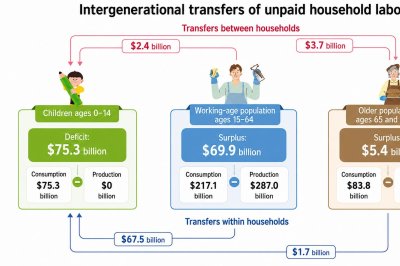
A chart illustrates how the estimated value of unpaid household labor is transferred among children, working-age adults and older people in South Korea. Information from Ministry of Data and Statistics. Infographic by Asia Today and translated by UPI
June 23 (Asia Today) — The estimated value of unpaid household services consumed by South Korean children totaled 116.6 trillion won ($75.3 billion) in 2024, with parents and grandparents providing much of the work, government data showed Tuesday.
The Ministry of Data and Statistics published the findings in South Korea’s 2024 National Time Transfer Accounts, which measure how unpaid household work is produced, consumed and transferred among age groups.
The account covers services that are generally excluded from gross domestic product, including cooking, cleaning, household management, caregiving and volunteer work.
The figure does not represent money that families paid for child care. It estimates the market value of unpaid services by using the time spent on household work, population figures and the wages that would be required to hire someone to perform similar tasks.
Children ages 14 and younger recorded a household-work lifecycle deficit of 116.6 trillion won because they consumed unpaid services but did not produce them.
A lifecycle deficit occurs when the value of household services consumed by an age group exceeds the value it produces.
About 107.3 trillion won ($69.3 billion), or 92% of the children’s deficit, was covered through transfers within the same household. This category largely represents time and labor provided by parents and other family members living with the children.
An additional 9.4 trillion won ($6.1 billion) came through transfers between households, which can include care provided by relatives living separately.
Working-age people between 15 and 64 produced unpaid household services valued at 444.4 trillion won ($287 billion) and consumed services worth 336.1 trillion won ($217 billion).
That left the group with a surplus of 108.3 trillion won ($69.9 billion).
The working-age population transferred a net 104.6 trillion won ($67.5 billion) in unpaid services to other members of the same households, primarily children.
The data show that people in their 30s and 40s, who are often raising young or school-age children, were at the center of the transfer system.
On a per-person basis, the household-work surplus reached its highest level at age 39, at 10.35 million won ($6,700).
Older South Koreans also made a net contribution.
People ages 65 and older produced household services valued at 138 trillion won ($89.1 billion) while consuming 129.7 trillion won ($83.8 billion), leaving a surplus of 8.3 trillion won ($5.4 billion).
They transferred a net 5.7 trillion won ($3.7 billion) in services between households. The ministry said the pattern reflects contributions such as grandparents caring for grandchildren who live in separate households.
Per-person household production peaked at age 40, declined and then increased again after retirement, producing what the ministry described as an M-shaped pattern.
Unpaid housework and care for grandchildren contributed to the later increase.
The lifecycle deficit was highest at birth, reaching 37 million won ($23,900) per person.
The balance shifted into a surplus at age 28, reached its peak at age 39 and returned to a deficit at age 82.
Those ages do not indicate when income begins to exceed personal spending. They show when the estimated value of unpaid household services a person produces becomes greater or smaller than the value of services the person consumes.
Household-service consumption was highest at birth and lowest at age 19, forming an L-shaped pattern.
Compared with 2019, the total deficit for children declined by 7.5 trillion won ($4.8 billion). Surpluses among working-age and older people also decreased.
The results provide a broader measure of the economic contributions made inside families, including work performed by parents and grandparents that does not appear in conventional income or production statistics.
In contrast to heat pumps, continuing record sales of electric cars indicate they are all but set to replace their petrol and diesel counterparts in the coming years on UK roads.
Emma Pinchbeck, CEO of the Climate Change Committee, praised the improvement in greener transport.
“We’ve made big progress on things like electric vehicles, where one in four cars being bought in the UK today is now an EV.”
She said the growth had been accelerated by the Iran fuel crisis, which has seen significant increases in petrol and diesel prices at the pump pushing people to seek out other options.
“We can see in the numbers what people want – cheap cars and cars that will save them money, particularly as fossil fuels are volatile,” she said.
But the industry body, Society of Motor Manufacturers (SMMT), said most of this demand had been brought about by huge discounts offered by car manufacturers.
“This has cost the industry more than £10 billion since 2024 – an unsustainable amount when that money should be going into R&D, manufacturing and the workforce,” said Mike Hawes, CEO of SMMT.
It supported the government’s plan to weaken its Zero Emission Vehicles (ZEV) mandate – which sets a target for number of EVs manufacturers produce and a penalty for failing to meet that target.
The UKCCC disagreed and urged the government to keep the policy.
DJ Fat Tony has shared that he believes Brooklyn WILL reconcile with his familyCredit: GettyThe DJ is a friend of Brooklyn and Nicola, and also did his best to reframe what happened when Victoria danced at Brooklyn’s wedding ‘inappropriately’Credit: Shutterstock Editorial
The tell-all statement took the internet by storm, calling out David and Victoria for their ‘performative’ and ‘controlling’ behaviour.
But Brooklyn’s pal DJ Fat Tony (real name Tony Marnoch) believes that an olive branch is still yet to come, and has faith that all will be well with the Beckham clan again.
Speaking to Closer magazine, Tony shared: “I hope that they do sort it out, I really do, for all of their sakes.
“I think they will – of course they will. Like all family feuds, there comes a point where you think, ‘Well, what is this about?’
Brooklyn has been feuding with his family for over a year nowCredit: PAHe called his parents out for their ‘controlling’ and ‘performative’ behaviour earlier this yearCredit: GettyBrooklyn was left feeling furious after his parent dismissed his request to not post photos of him online or tag him on social mediaCredit: GettyBrooklyn shared at the end of his bombshell statement that he just wants a ‘peaceful’ life with his wifeCredit: Getty
“But it’s not for me to say, ‘She was wrong, he was right.’ It’s not my business.”
Tony also shared how he tried to correct the misinterpretation of what happened at Brooklyn and Nicola Peltz‘s wedding.
But Tony said: “Brooklyn is a friend of mine, and so is Nicola. I went on This Morning to change the narrative.
“The word ‘inappropriate’ was misused. Everyone thought that Victoria was slut-dropping – there was no slut-dropping.
“I wasn’t on there to take down the Beckhams. No one needs to do that. It’s a family and it’s a really sad situation.”
His comments come amid Brooklyn’s fresh frustrations with his parents after they posted photos of him in commemoration of Father’s Day.
Brooklyn has previously instructed his parents not to post photos of him anymore or to tag him in pictures.
But this request has been broken multiple times, leading to Brooklyn blocking his family online.
He found out about the Father’s Day snaps through friends and the media.
His wife Nicola also appeared to take a swipe back, sharing a cryptic quote to her Instagram story that read: “I am in love with this sentence: “Forgive yourself for not knowing earlier what only time could teach.””
South Korean soldiers escort a group of Korean War veterans from Commonwealth nations during a ceremony marking the 73rd anniversary of the Battle of Kapyong, in Gapyeong County, northeast of Seoul, South Korea. The Battle of Kapyong, from 22 to 27 April 1951, was fought between United Nations Command forces composed mainly of Canadian, Australian, and New Zealand troops, and invading Chinese forces along the Gapyeong (Kapyong) River valley. Photo by YONHAP / EPA
June 23 (Asia Today) — South Korean power equipment maker LS Electric is strengthening its ties with communities in Utah by honoring Korean War veterans and investing in local education as it expands in the fast-growing North American power market.
Demand for power equipment has surged as artificial intelligence companies build more data centers across North America. Against that backdrop, LS Electric Chairman and Chief Executive Officer Ja-Kyun Koo has emphasized what the company describes as a management strategy based on long-term trust with local communities.
LS Electric said Koo has pursued the strategy through LS Electric Utah, formerly MCM Engineering II, in Cedar City. The South Korean company acquired the operation in 2022 and has since directed an expansion of its production facilities.
Koo has highlighted a Korean War engagement involving soldiers from southern Utah as a historical link between the state and South Korea.
On May 26, 1951, 240 members of the Utah National Guard’s 213th Armored Field Artillery Battalion encountered a Chinese force of more than 4,000 troops near Gapyeong in Gyeonggi Province.
The engagement became known in Utah as the “Miracle at Kapyong.” Accounts maintained by the Utah National Guard say the soldiers fought off the advancing force without losing a member of the unit in the battle.
Families and descendants of the veterans remain part of the community around Cedar City, where LS Electric Utah is based.
Koo said the soldiers’ service in an unfamiliar country demonstrated the kind of courage and commitment that a Korean company operating in Utah should recognize.
LS Electric this year sponsored a Southern Utah University program supporting Korean War veterans. The company also paid the travel expenses of surviving veterans who visited South Korea in May for a ceremony marking the 75th anniversary of the Utah unit’s action near Gapyeong.
The company has also supported the development of science, technology, engineering and mathematics education facilities at Southern Utah University as part of its efforts to train workers for the region’s future industries.
LS Electric joined a separate initiative led by the Korea Chamber of Commerce and Industry to connect Korean companies operating in the United States with veterans who previously served with U.S. Forces Korea.
The company said the program could help Korean businesses recruit workers who already have experience with South Korea and its culture.
LS Electric’s community engagement has accompanied a sharp increase in orders for equipment used in North American data centers.
Korea Investment & Securities said LS Electric secured two North American data center equipment projects during the second quarter with a combined value of 489.3 billion won, or about $318 million.
The brokerage expects the company’s North American data center orders to increase by more than 50% from a year earlier and surpass 1.5 trillion won, or about $974 million, in 2026.
“Today, our firm footing in the U.S. market rests on the noble sacrifice of Utah veterans who fought for freedom and peace,” Koo said.
“Remembering and honoring the heroes who created the Miracle at Kapyong is a responsibility that companies should fulfill,” he said.
Koo said businesses built on strong relationships with their communities would be better positioned to achieve stable, long-term growth.
Weekly insights and analysis on the latest developments in military technology, strategy, and foreign policy.
One of Russia’s biggest advantages in the war against Ukraine is its ability to launch tactical airstrikes from bases largely out of reach of kinetic responses. While we have frequently reported about Ukrainian attacks on these bases, they aren’t sustained enough to stop Russia from generating devastating sorties.
Now Ukraine and NATO are looking to the private sector for ways of changing that equation through what is being called the Airfield Denial Challenge. It offers a 250,000 Euro award to companies or individuals who come up with workable ideas to prevent Russia from being able to use its air bases.
🚀The NATO-Ukraine Joint Analysis, Training and Education Centre (JATEC) and NATO Allied Command Transformation (ACT) have announced the Persistent Airfield Denial Innovation Challenge to find a solution to block enemy airfields. (1/5) ⬇️ pic.twitter.com/8uKWWEI5pQ
“The Armed Forces of Ukraine (AFU) operational experience has firmly established that the ability of the adversary to project air power from secure rear-area airfields remains one of the most consequential asymmetries in the current conflict,” according to NATO’s Headquarters Supreme Allied Commander Transformation (SACT). “Enemy tactical aviation, operating from bases beyond the reach of conventional Ukrainian strike assets, continues to conduct strikes using guided aerial bombs, cruise missiles, and stand-off munitions against friendly forces, critical infrastructure, and civilian population centers.”
Objective control footage shows the aftermath of a FAB-250/500 airstrike carried out by a Russian Aerospace Forces (VKS) Su-34M fighter-bomber on a warehouse in Kharkiv used to store UAVs and their components. pic.twitter.com/vnynslqFiO
“Each sortie originates from an airfield. Every airfield is a node of vulnerability: if it can be persistently denied, the adversary’s air campaign is fundamentally disrupted at source,” SACT suggested.
You can see video from one of the Ukrainian attacks on Russian tactical aviation bases below.
Russia’s Morozovsk Airbase is currently under Ukrainian drone attack, with several explosions seen in the vicinity of the airfield.
Ukraine’s ongoing efforts to halt these attacks are insufficient, SACT posited.
“Current workarounds: manned strike aviation, ground-based long-range fires (MLRS, ballistic missiles), and conventional single-unit loitering munitions have demonstrated limited effectiveness against defended airfield targets,” SACT argued. “They lack the mass-effect, persistence, and EW (Electronic Warfare)-resilience required to simultaneously suppress airfield infrastructure across multiple aim points in a contested environment.”
Ukraine has carried out many strikes on airfields, including one on the Morozovsk airbase in Russia. (Google Earth) Google Earth
The “battlefield logic is clear,” the NATO subcommand added. “Point-defense and reactive interception of individual weapons must be complemented by persistent denial at the source.”
“We must find technologies that will help to permanently limit the enemy’s use of aviation infrastructure: aircraft, runways, fuel and ammunition storage facilities, and ground support infrastructure,” the Ukrainian Defense Ministry (MoD) explained. “Ukrainian miltech companies, startups, and engineering teams are invited to participate.”
SACT said the challenge is technically agnostic and that it is looking for ideas that include, but not are not limited to, the following:
• Uncrewed aerial systems of any configuration or range class
• Autonomous or semi-autonomous munitions and loitering systems
• Swarming and mass-effect approaches
• Alternative delivery mechanisms beyond conventional aerial platforms
Regardless of what type of solution is presented, it “must be capable of operating in GPS-denied and EW-contested environments, across all weather conditions and seasons, and must demonstrate a credible path to rapid fielding.”
In addition, SACT is looking for systems that can conduct sustained strikes deep into contested airspace, operate without “continuous human control,” be fully autonomous and deliver “sufficient mass and precision to suppress multiple aim points across an airfield simultaneously.”
SACT also wants systems that require minimal training, and have AI-assisted target acquisition that “reduces reliance on expert judgment.”
The solicitation comes with the understanding that whatever solutions are presented won’t be proven, but should be at least in the mid-to-upper tier of the military technology readiness level (TRL) scale. It includes systems ranging from those having “high fidelity” laboratory integration of components to those with prototypes “near, or at, planned operational systems.”
U.S. Army
Meanwhile, any solution that will take more than a year to be fielded won’t be considered.
The deadline for submissions is July 20. Ten finalists will be selected on August 11 and will be invited to a “pitch day” on Sept. 3, tentatively in Poland, to showcase their designs.
Whether this ambitious program will actually lead to the fielding of any systems that can persistently deny Russia the ability to launch aircraft is very much in question.
As we have frequently reported, Ukraine has one of the world’s most innovative defense technology infrastructures that has created drones, missiles and other weapons designed, tested and fielded under intense wartime conditions. However, it has still been unable to achieve the goals being sought by this challenge.
One of the big issues Kyiv faces is the limited amount of funds to pursue some of these advances and what the Atlantic Council has described as “Ukraine’s inability to mass produce sophisticated weapons or sustain stable military supply chains.”
Getting an idea into the hands of NATO, which has developed a half-billion dollar fund to develop weapons for Ukraine, could ultimately help turn an idea into a workable weapon to keep Russian tactical aviation at bay. Even if that happens, though, the time it would take to develop these weapons at a scale large enough to make a real difference would be a formidable endeavor.
Madonna is just a material girl, living in a material world.
The “Vogue” hitmaker graced the cover of Interview magazine for the Summer 2026 issue and in the accompanying chat, the singer revealed the reason the ultra-hyped biopic with “Ozark” star Julia Garner was scrapped: not enough cold hard cash.
Turns out, Universal Studios was not Madonna’s Mr. Right. According to the pop star, the studio didn’t share her vision for a budget for the film.
“I worked on my script for two years and spent two years at Universal Studios with the line producers doing budgeting and casting,” she told the magazine. “We had a falling out, me and Universal, regarding budget because I needed — I’ve had an extraordinary life. I’ve had a huge life, so I needed a big budget. You know what I mean?”
The film had been in the works for years, and in 2021 Universal Pictures won a multi-studio auction to helm the biopic. According to Variety, the script followed Madonna from her upbringing in the suburbs of Detroit, her artistic awakening in 1980s New York City, and concluded around the 1998 release of “Ray of Light.”
“I found a way to make it for less money in Serbia, but I don’t think they were into the idea of — I don’t know,” she said. “Maybe they just didn’t believe in me.”
Madonna said the studio couldn’t wrap its head around what she was suggesting and countered that she wouldn’t “stay in Serbia more than four days.”
“I said, ‘Did you read the script?’ My whole life has been survival. I’m not going there for a holiday.’”
Madonna said that she was in “limbo” when the movie plans fell apart, and she considered telling her life story through a Netflix series when the streamer came knocking. But she wouldn’t be able to use the script she had penned for Universal without buying it from the studio for “an extortionist’s price,” even though she wrote it.
“That’s just the way it goes,” she continued. “I started trying to understand how making a series would work. It’s a very, very different process. You have to meet a lot of writers and find the right showrunner, and I couldn’t find one. This went on for another eight or nine months. I was like, ‘Good thing I have another job because I need to work, I need to create. I need to do what I was put on this earth to do.’”
Representatives for Universal Pictures, Netflix and Garner did not immediately respond to The Times’ request for comment.
Through the process of writing the script, Madonna was bitten by the memoir bug, but she channeled that confessional energy into her forthcoming album, “Confessions on a Dance Floor: Part II,” which drops July 3. A 13-minute music video weaving together six tracks from the new album was released earlier this month and featured A-list cameos by Sabrina Carpenter, Kate Moss, Lourdes Leon, Benedict Cumberbatch and more.
While the biopic and buzz around Garner’s portrayal of the “Like a Virgin” star had fans of the two blondes chomping at the bit, all is not lost: Art captures life. Garner and Madonna were spotted filming scenes in Venice two weeks ago for the second season of “The Studio,” in which Madonna plays herself struggling to get her biopic made.
June 23 (UPI) — Federal air marshals have seized more than 300 drones during World Cup events in the United States, the Transportation Security Administration said Tuesday.
The TSA said the air marshals, working with state and federal officials, confiscated the devices, though the agency didn’t specify how many from each of the 11 U.S. World Cup venue cities.
“Flying a drone in a restricted zone is a federal crime and can result in fines up to $100,000, prison time and drone confiscation,” the TSA said in a post on X.
World Cup events are being held in 16 North American cities — two in Canada, three in Mexico and 11 in the United States. Among the U.S. cities hosting events are Atlanta, Boston, Dallas, Houston, Kansas City, Los Angeles, Miami, New York City, New Jersey, Philadelphia, San Francisco and Seattle.
Fans of Team USA shows their support before the start of the FIFA World Cup match between USA and Paraguay at SoFi Stadium in Los Angeles on June 12, 2026. Photo by Christian Brunskill/UPI | License Photo
Israel deliberately targeted Palestinian children in Gaza, resulting in genocide, crimes against humanity and war crimes, according to a new UN inquiry. The report says more than 20,000 children were killed between October 2023 and October 2025. Israel rejected the findings.
The critically acclaimed Australian crime drama is perfect for fans looking for a new binge-watch
Jennie Buzaglo Showbiz & TV Reporter and Angie Quinn Screen Time Reporter
23:03, 23 Jun 2026
Scott Ryan stars as hitman-for-hire Ray Shoesmith(Image: FX)
Crime drama fans hunting for their next must-watch should look no further than this critically acclaimed Australian series that has cultivated a loyal fanbase across the globe.
Created by and starring Scott Ryan, Mr. Inbetween is a dark comedy-crime drama that chronicles Ray Shoesmith, a contract killer who tries to juggle his perilous criminal existence with the mundane demands of fatherhood, relationships, and friendships.
Over three seasons, audiences follow Ray as he’s compelled to handle everything from underworld conflicts and domestic challenges to personal tragedy.
Mr. Inbetween originally broadcast on Fox Showcase from 2018 to 2021 and garnered widespread praise for its writing and acting.
The series also features Justin Rosniak, Brooke Satchwell, Nicholas Cassim, and Damon Herriman.
Despite spanning only across 26 episodes, Mr. Inbetween has established itself as one of the finest crime dramas in recent memory and has received praise from viewers.
One enthusiast wrote on Reddit: “Mr Inbetween is one of the greatest shows ever made. Believe me when I say this show really is a masterpiece”, reports the Express.
“The camera work is beautiful, so many brilliant shots which feel organic and clear, you are never confused at what you are looking at and it stays consistent since it is the same director every episode.”
They complimented the pacing as “fantastic”, adding: “The action is honestly one of the best showcases of special and practical effects on TV in terms of gun scenes.”
They continued: “The characters are what truly makes the show, every character is acted so well you really believe them and see them like a real person. They all have struggles and motivations that make you care for all of them.
“The dialogue is so well written, so many amazing jokes and threatening, gritty quotes which are extremely effective. One plot thread leads to another all while feeling like a day in the life story.”
The enthusiast concluded: “I can confidently say that this show is far better than any Australian movie or show ever made and can stand up to some of the greatest shows ever made. I implore you to please give this show the love it deserves.”
Another echoed their sentiment: “This show is truly a masterpiece. The acting is sublime, everything about it is unbelievably good and the use of some of Nick Cave’s music so perfectly placed that I think it’s the best show to come out of Australia.”
A third chimed in: “When I finished watching all 26 episodes I thought the same thing. Best show ever made.”
Another concurred: “Absolutely loved it. Best show I have seen since season 1 of true detective. The ending…THE ENDING! ! Magnificent.”
All three series of Mr Inbetween are available to stream now on Disney+.