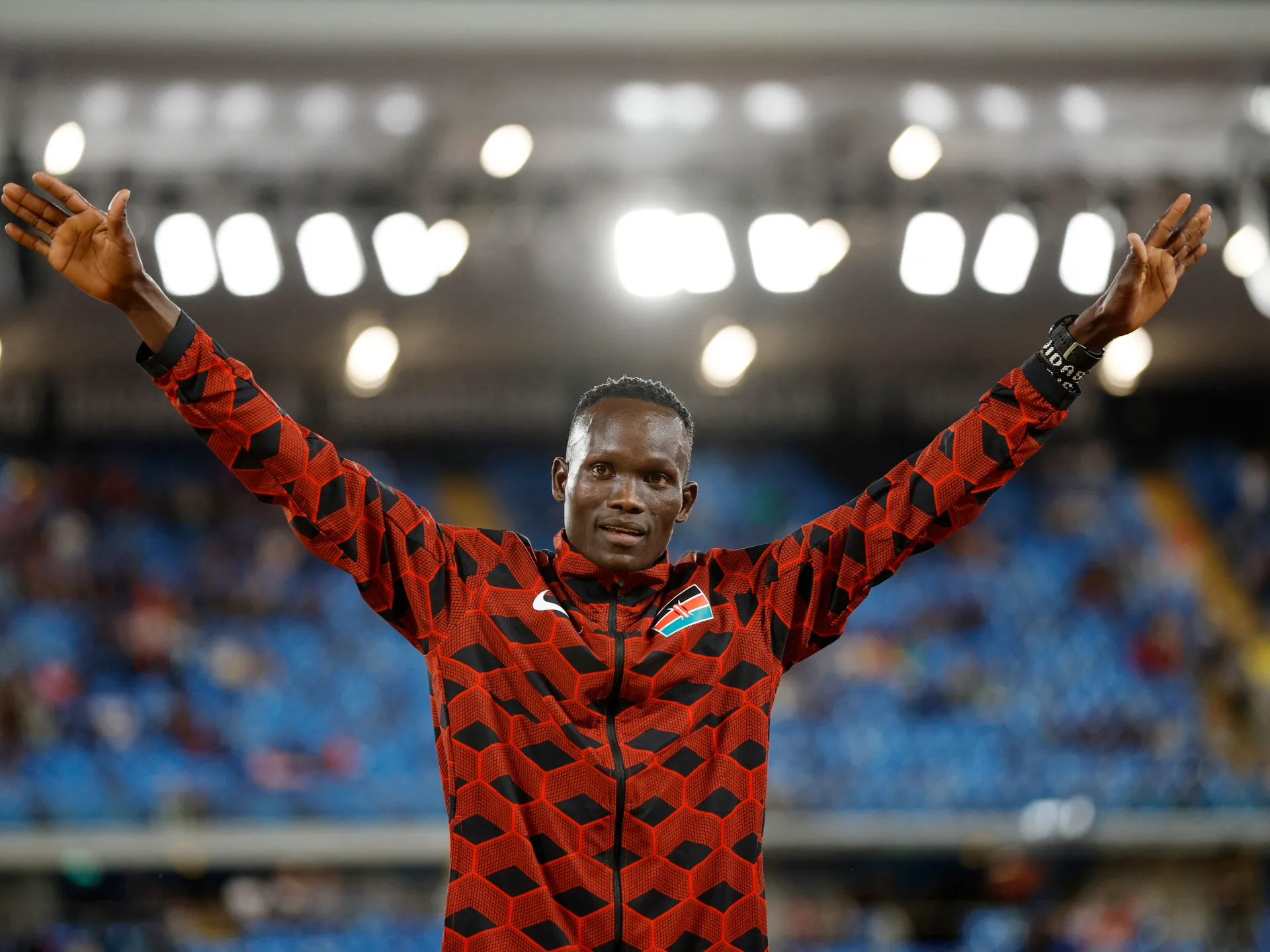
Kibiwott Kandie initially faced an eight-year ban split evenly across two violations, but received a one-year reduction.
Published On 25 Jun 202625 Jun 2026
Former half-marathon world-record holder Kibiwott Kandie has been banned for seven years by the Athletics Integrity Unit (AIU) for two anti-doping violations, the body has said.
The 30-year-old Kenyan, a 2022 Commonwealth Games bronze medallist, was provisionally suspended in March 2025 for refusing to provide a sample and was later charged with an additional violation of tampering or attempted tampering with doping control.
Recommended Stories
list of 4 itemsend of list
“This case serves as a reminder that no athlete is above the rules in the sport of athletics. If an athlete refuses a test, it places the integrity of the sport at risk,” AIU head Brett Clothier said in a statement on Thursday
“The AIU has a strong forensic capability and will thoroughly investigate such cases to ensure the truth comes out,” he added.
Kandie, who initially faced an eight-year ban split evenly across the two violations, received a one-year reduction after accepting the sanctions early.
His ban is backdated to March 14, 2025, the date of his provisional suspension, and will run until March 13, 2032, when he will be 36.
On March 1, 2025, Kandie delayed and ultimately refused an out-of-competition test at his home in Kenya, citing an urgent payment before leaving despite being warned of the consequences.
AIU analysis of his phone and financial records showed multiple calls and payments linked to a nurse, with 11 transfers identified in the 12 months prior to the test, after coordination with the Anti-Doping Agency of Kenya.
Kandie’s initial explanations for refusing to provide a sample were later found to be false, while Kenyan authorities confirmed that documents he submitted were fake.
Kandie, a three-time Valencia Half Marathon champion, set a then-world record of 57:32 in 2020 and remains the third-fastest man in history over the distance, with two of the six quickest performances of all time.
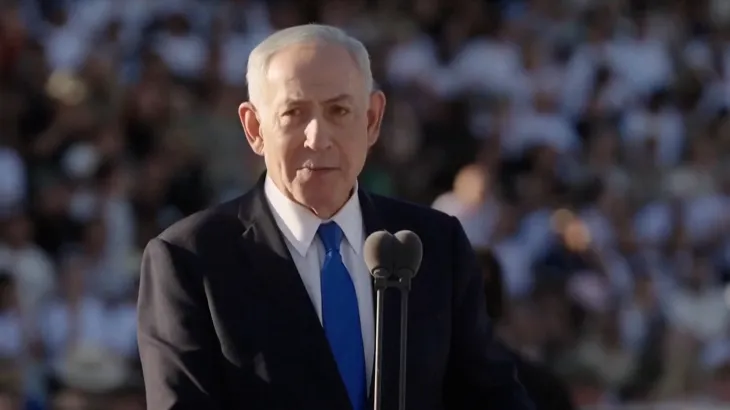
Israeli Prime Minister Benjamin Netanyahu stated that Israeli forces will maintain a presence in southern Lebanon, Syria, and Gaza for “as long as required” at a graduation for combat officers in southern Israel.
At only 24, Samuel Kim Arredondo, better known as Samuel, has lived through nearly every iteration possible in a K-pop idol’s career.
As a child growing up in L.A.’s Koreatown, he attended Wilshire Park Elementary School — but by the fifth grade he had moved to South Korea with his mother, Kyung-ju, with dreams of K-pop stardom. There, he became a trainee under Pledis Entertainment.
Now a subsidiary label of Hybe — parent company of K-pop superstars BTS — Pledis was forming what became one of the most successful “third generation” K-pop groups of all time: Seventeen. Samuel, who was in the running to debut with the group, is even captured in early footage from their “Seventeen TV” variety show.
Though he didn’t make the cut, he remained close with the members and helped write lyrics for their 10-year anniversary album. Just last week, he filmed a dance challenge with singer-MC Mingyu for the reggaeton-infused pop number “Zigi Zigi Zigi” — the lead single off of his new EP, “Samuelito,” which dropped June 8.
After leaving Pledis, Samuel — who is fluent in both English and Korean — signed to a new agency, Brave Entertainment, then formed one half of a short-lived hip-hop duo, 1Punch. (He was Punch, the other kid was One.)
In 2017 he competed on the second season of Produce 101, a globally popular Korean competition franchise, where he made it to the penultimate episode before the debut of the group Wanna One. That same year, he released his first solo album, “Sixteen,” fully showcasing his outstanding dance ability, youthful swagger and velvety tenor.
Yet before he could finally make headway, he suffered a devastating loss.
Samuel’s father, José Arredondo, who came to the U.S. from Michoacán as a child, died tragically in a 2019 case that made national and local headlines. After having spent years apart from his father while living in Korea, Samuel spent quality time with him shortly before his death.
José was a pillar of his community; he rose from washing cars to owning his own car dealership, alongside other businesses in Bakersfield. A precocious young Samuel can still be found showing off his dance and Spanish skills in an old commercial for the dealership. (“Volkswagen me hace bailar,” he says before busting a move.)
The loss of his father was made more harrowing when the news went public, Samuel recalls over a Zoom interview from Seoul, where he is promoting his new album.
“The articles went out first,” he explains. “It was everywhere before I even wanted to talk about it, so I had no choice to keep it private … of course it’s definitely hard for me.”
In the aftermath, Samuel went under the radar — but after a year or two, he started to pave a way forward. After getting out of the contract with his former label, and with the support of his mother, he launched his own company, Samuel Music Group.
“If I kept on staying in the past, I think no one would like it — even my dad wouldn’t like it,” he says. “I learned a lot through that emotion as well. Always be grateful, always be thankful every time, and try to say ‘thank you’ always, especially to parents.”
Composed of three songs and one interlude, “Samuelito” takes its name from the childhood moniker some know him by today. As the follow-up to his 2024 EP, “Now,” it is his second record release since he became independent. It’s also his first record sung predominantly in Spanish — along with the occasional sprinkle of English and Korean. (Take the onomatopoeic “Ddook Ddak,” which is Korean slang for “just like that.”)
Singing in Spanish for the first time, he tells me, to music he created himself, made his “heart race.”
“Samuelito” is not so much an exploration of Mexican musical traditions, but of Latin-influenced rhythms and sounds filtered through his uniquely multicultural lens. In the future, he dreams of working with genre-spanning Latino pop artists who crossed over culturally, like Selena Gomez, Camila Cabello and Rauw Alejandro.
In an Instagram reel from earlier this year he described his efforts as “K-tone” — a Latin and reggaeton fusion, powered by K-pop discipline. The comments below were peppered with encouraging responses from fans in multiple languages.
Wrote Liz Zeledon, from Oceanside: “As a Korean-Nicaraguan who grew up with exposure to both cultures, I love hearing Latin influences in K-pop… Korean Latines are so underrepresented in the Korean music industry.”
Reached by phone, Zeledon is a K-pop fan who has kept tabs on Samuel since his Seventeen trainee days; she is also a child of immigrant parents.”Representation is so important, because existence and visibility are not the same thing,” she says.
In the lead-up to the album’s release, Samuel posted photos and videos of himself as a young child. In one, his dad holds him up as a baby, dressed in all-white with a tam hat. Though Samuel says the EP is not an on-the-nose tribute to the elder Arredondo, his spirit resonates through the lyrics of the poignant downtempo track, “Never Say Goodbye.”
“Gritos que yo sé/Que llegan hasta El Cielo/Gotitas en el suelo/Y se me cae el mundo entero,” he sings. (“Cries that I know/Reach all the way to Heaven/Little drops on the ground/And my whole world comes crashing down.”)
“I used to listen to a lot of Spanish music while I was growing up … I used to eat a lot of Mexican food too,” he says. “While I was in the studio last year, I had [this] big vision: [‘What if] I bring back my roots and just be the true me and call this album “Samuelito?”’ It just felt fresh.”
Samuel started songwriting and producing for himself in the making of “Now.” On his new album, only three writers are credited, including himself — which is somewhat of a rarity these days in K-pop. One of them is Canadian Mexican singer-songwriter Andrea Rocha.
From her new home in L.A., Rocha said the main goal was to seamlessly blend two distinct musical cultures. Although Samuel came to the studio with the structure for his songs already in place, they worked on melodies and writing in Spanish together, since this was his first time penning lyrics in the language.
Rocha says she was taken aback by Samuel’s professionalism. “I’d be like, ‘Oh, what about this melody?’ And then he would sing it perfectly,” she says. “I did ask him about his K-pop training, because it sounds really intense. I think it shows how hard he’s worked in those years because he’s got all the star qualities. Compared to a lot of newer artists that I work with, I’m like, ‘Ooh, they’ve [done] a lot of work to get to that level.’”
These days, Samuel splits his time between Seoul and Los Angeles — once again calling Koreatown his permanent home. He also continues to spend time with his dad’s side of the family in Bakersfield.
“I think the biggest thing that I am happy about is getting back to my roots, where I started,” says Samuel.
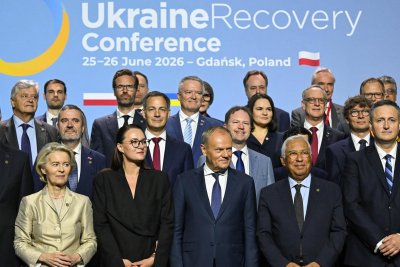
Polish Prime Minister Donald Tusk, center, European Commission President Ursula von der Leyen, left, European Council President Antonio Costa, second from right, and Ukrainian Prime Minister Yulia Svyrydenko, second from left, pose for a group photo at the opening session of the Ukraine Recovery Conference 2026 at the European Solidarity Centre in Gdansk, Poland, Thursday. Photo by Adam Warzawa/EPA
June 25 (UPI) — The European Union released $3.6 billion in funds of the Ukraine Support Loan for budget and defense needs, the bloc said Thursday.
The funds were released at the Ukraine Recovery Conference, where European Commission President Ursula Von der Leyen announced the funding, which is the first instalment of the new macro-financial assistance. The MFA is a segment of the Ukraine Support Loan, under which $102 billion will be offered to Ukraine in 2026 and 2027.
“As a country at war, Ukraine’s capaicty to defend its territory depends on the rapid availability of critical products in the required quantities and within very short timeframes,” a press release said. “The first instalment of the [$6.8] billion defense package to support drone procurement will be disbursed in the coming days.”
“This is indeed solidarity in action,” Von der Leyen said. “It shows Europe’s support for Ukraine is here to stay.”
The original plan in December was to use Russia’s frozen assets to fund the loan, but the Russian Central Bank sued a Belgian bank over the plan, so the EU had to find a new way to finance the loan.
Instead, they agreed to create the loan through joint debt. Hungary, Slovakia and the Czech Republic negotiated an exemption.
The payments are conditional on Kyiv’s reforms. If Ukraine reverses its ongoing fight against corruption, the EU could suspend the funds, Euro News reported.
The loan also requires Ukraine to buy weapons and ammunition made in Europe, with some exceptions depending on availability.
“Ukraine has the opportunity to analyze the situation on the battlefield and identify the range of products that they need, and then they have to inform us in the form of product schedules,” a Commission spokesperson told Euro News. “The priority remains to make purchases within the EU and Ukraine.”
“We continue to call on all our partners to maintain their support, because a strong and independent Ukraine is in all our interests,” Von der Leyen said Thursday. “Our ambition is not only to help Ukraine endure, it is also to help Ukraine grow and prosper as a free and European country.”
The United States is not expected to contribute funds to the loan.
Demonstrators mark the second anniversary of a 2024 protest where 60 people were killed by security forces.
Published On 25 Jun 202625 Jun 2026
Kenyan police have dispersed protesters in the capital and detained others who took to the streets in memory of the demonstrators who were killed in anti-government rallies against tax rises two years ago.
Interior Minister Kipchumba Murkomen said on Thursday that a total of 355 people were arrested in various parts of the country. He called those detained “criminals” and apologised for the use of barricades and other security measures aimed at containing the protests.
Recommended Stories
list of 3 itemsend of list
“We regret the inconveniences occasioned by these measures, and at the same time appreciate their effectiveness in securing the city and other parts of the country,” Murkomen told reporters.
A correspondent for the Reuters news agency also saw police fire tear gas to disperse people who were gathering peacefully outside of Nairobi’s police station after forces detained six people outside parliament, where they had laid flowers.
According to the Kenya National Commission on Human Rights, organisers had planned to mark the second anniversary of the demonstrations that had left at least 60 people dead after protesters had breached parliament grounds in 2024.
But in Nairobi, shops and restaurants in the central business district remained closed as police set up roadblocks with water-cannon trucks.
Reporting from Nairobi, Al Jazeera’s Malcom Webb explained that the heavy police response to the protest was due to the government’s desire to avoid a repeat of the events two years ago.
“This comes following a series of different protests in recent weeks, some led by [President William] Ruto’s political opponents, others by transport unions over increases in fuel prices and a state of simmering discontent that hasn’t really recovered since that day two years ago when dozens of people were killed,” he said.
Opposition leaders joined the victims of alleged police brutality and families of protesters who were killed in the crackdown before they headed to parliament.
“As parents, we sought permission just to come here … to mourn and lay flowers for our children. But when we arrived, we were shocked because the police blocked us,” said Edith Wanjiku, whose 19-year-old son Ibrahim Kamau was killed in 2024.
“That is very shameful,” she continued.
“And one thing I would ask of President Ruto: those police officers who killed the children – because they are known – I am only asking for justice for those children and also compensation,” she added.
Protest organisers have said that they want a credible investigation into past police conduct and guarantees against the use of excessive force.
While Ruto has acknowledged what he called “instances of excessive and extrajudicial actions by members of the security services” and said last week that two billion Kenyan shillings ($15.5 million) had been set aside for victims of protest-related abuses, some activists have said it was not enough.
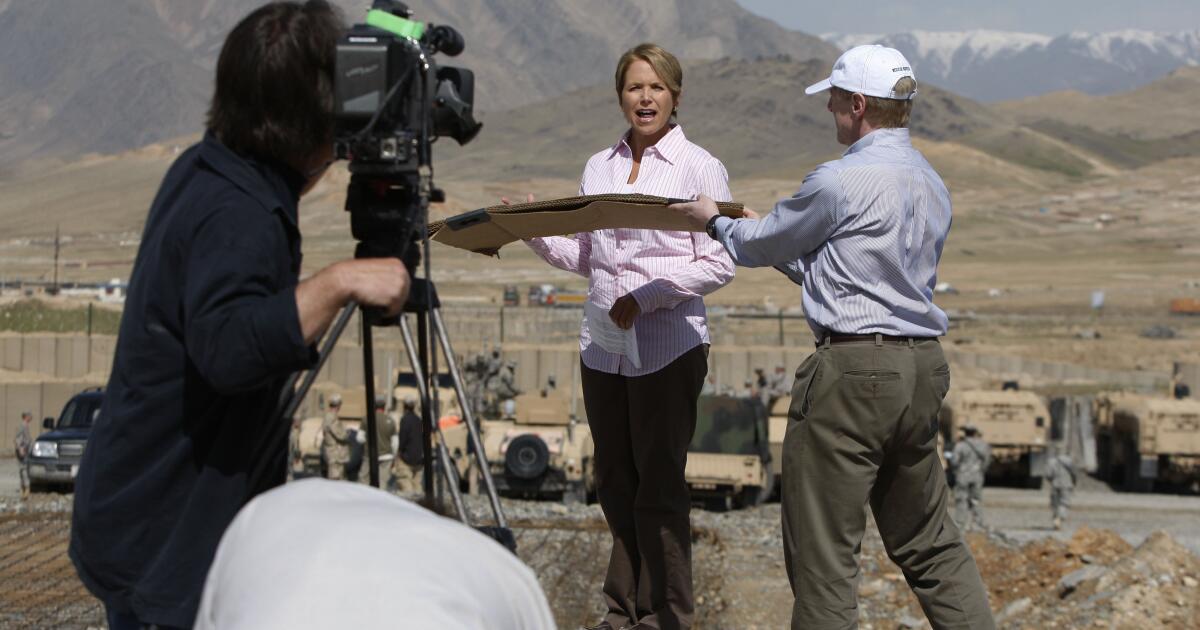
Veteran broadcast journalist Katie Couric has leveled sharp criticism at CBS’ “60 Minutes,” detailing a culture of systemic sexism and marginalization she says she experienced during her tenure at the prestigious newsmagazine.
On this week’s episode of the “Call Her Daddy” podcast, Couric, 69, described incidents during her time at “60 Minutes” when her story ideas were reassigned to her male counterparts. She described the circumstances as “really tough situations.”
The Emmy-winning journalist said she suspected early on that Jeff Fager, the “60 Minutes” executive producer at the time, didn’t take a liking to her.
“I think maybe because he wasn’t really consulted about bringing me over,” said Couric. “I was sort of seen as somebody from a different network coming in and sort of muddying the waters. I hadn’t come up in the CBS system. So I don’t know, he just didn’t like me.”
Couric started her run at the newsmagazine as a correspondent and as an anchor at CBS News in 2006, after spending 15 years co-hosting NBC’s “Today” show. Her role at CBS made her the first female solo anchor of a national weeknight news broadcast. She stayed with the network for five years before taking on a new role as special correspondent for ABC News.
Fager remained at “60 Minutes” from 2004 to 2018. He also served as the chairman of CBS News. He was eventually fired for allegedly sending a “harsh” message to a CBS reporter. At the time, he was also facing accusations of ignoring inappropriate behavior at “60 Minutes.” He previously denied the claims. CBS could not be reached for comment.
Trouble first came to a head when Couric pitched a profile of the rising pop star Lady Gaga. Fager had initially turned down the idea until he decided to pursue the story a year later, as Gaga had gained more notoriety.
Couric said she had proposed a fresh angle on Gaga’s Catholic school upbringing, but when she arrived for the interview, she discovered her name had been replaced with Anderson Cooper’s. His interview with Gaga aired in February 2011.
“It made me crazy,” Couric said.
A similar situation occurred once again when Couric was set to interview then–Secretary of State Hillary Clinton. The confusion began when the State Department reached out to Couric, wondering why fellow correspondent Scott Pelley’s team was inquiring about Clinton.
“So I go to Jeff Fager, and I say, ‘I thought you wanted me to do Hillary. You told me explicitly that you wanted to assign that story to me,’” Couric said. “And he said, ‘Yeah, we decided to change things up.’”
Couric said she was frustrated with Fager, for repeatedly going “behind [her] back.”
“Like, without even the decency to call me and say, ‘Guess what? We decided to reassign the story, and this is why,’” she said. “Talk about getting gaslit. I mean to me, that is the definition of it.”
Couric isn’t the only former “60 Minutes” to call out sexism at the newsmagazine. Meredith Vieira, who worked as a correspondent in the late 1980s and early 1990s, said in 2018, that she’d experienced sexism at CBS.
In the last few months, “60 Minutes” has undergone a massive upheaval. Under CBS News editor-in-chief, Bari Weiss, several correspondents, including Scott Pelley, and the program’s top producers were fired. Anderson Cooper also recently resigned from his post at the newsmagazine. With the upcoming season slated to begin in September, the program is currently under pressure to replenish its ranks.
Six countries – Saudi Arabia, the United Arab Emirates (UAE), Qatar, Kuwait, Bahrain and Oman – form the Gulf Cooperation Council (GCC), which was created in 1981 following fears of the perceived expansionist ambitions of the new Iranian government.
Recommended Stories
list of 4 itemsend of list
Since the 1979 Islamic revolution, Israel has attempted to isolate Iran and its wide network of regional proxy groups. But in a twist of irony, Israeli aggression in this pursuit has pushed some Gulf states closer to Tehran.
When Israel and the US launched strikes on Iran on February 28 – and Tehran responded by attacking Gulf states – they were again forced to reassess their relationship with their neighbour.
Gulf relations with Iran, at present, appear more shaped by realism than reconciliation, but this approach could help them navigate the uncertain road ahead.
“The ongoing conflict … compelled the Gulf states to pursue a more pragmatic relationship with Tehran, one that will include enhanced dialogue to deter conflict,” Farah al-Qawasmi, a researcher at the Gulf Studies Center at Qatar University, told Al Jazeera.
Embracing de-escalation – not Iran
All six GCC member states have welcomed a memorandum of understanding (MoU) signed by Iran and the US last week. But this is shaped more by the Gulf states wanting the war to end rather than a newfound trust of Iran.
“An agreement between the two parties is being [highly] advocated by the Gulf states in [an] attempt to prevent and contain regional conflicts,” al-Qawasmi said.
Shortly after the US and Iran agreed in 2015 to the Joint Comprehensive Plan of Action (JCPOA) – putting guardrails on Tehran’s nuclear programme – Gulf states remained sceptical about their neighbour.
The current war has only heightened these suspicions, but it has also seen regional states seek diplomacy with Tehran rather than military confrontation, despite Iran directly attacking Gulf cities.
“The Gulf states still feel like diplomacy is better than using force to get a deal … to change Iran’s behaviour and to insulate them from Iran’s destabilising actions,” Rob Geist Pinfold, a lecturer on security studies at King’s College London, told Al Jazeera.
Pinfold points out that Iran closed the Strait of Hormuz via drones and missiles, not nuclear weapons, making dealing with that threat a priority for Gulf states rather than Tehran’s nuclear programme.
Gulf states will want a more comprehensive agreement between Iran and the US, rather than the nuclear-focused JCPOA, said Pinfold.
“If you talk to people in Gulf capitals, they will tell you that the nuclear programme is a tomorrow problem for them,” he said.
“The today problem is Iran’s use of drones and proxies to destabilise and undermine the sovereignty of Gulf states, but also states throughout the region.”
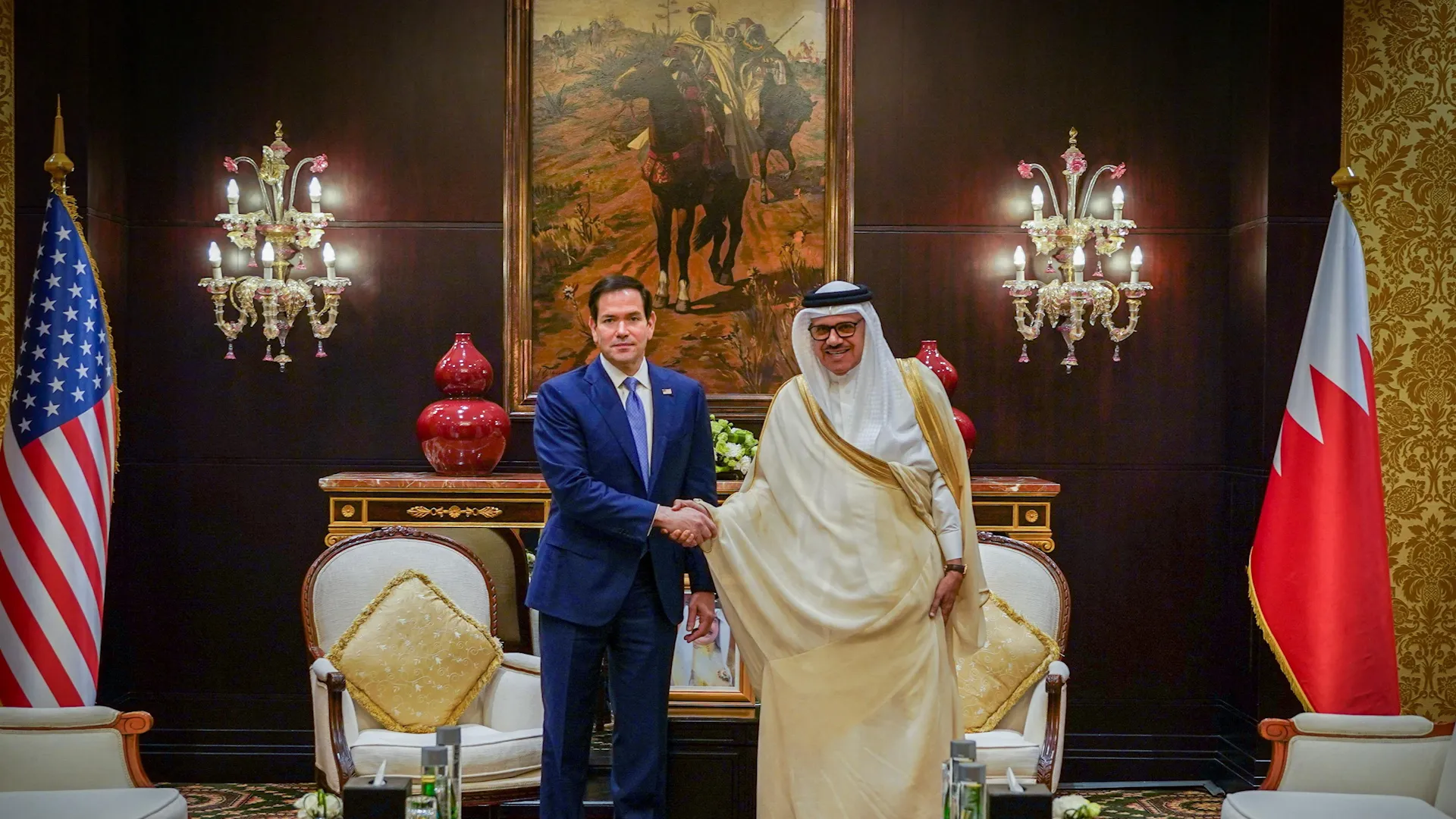
US Secretary of State Marco Rubio’s three-day tour of the Gulf, which ends Thursday, is seen as a way of allaying these fears and assuring the GCC that Tehran will not be strengthened by the agreement.
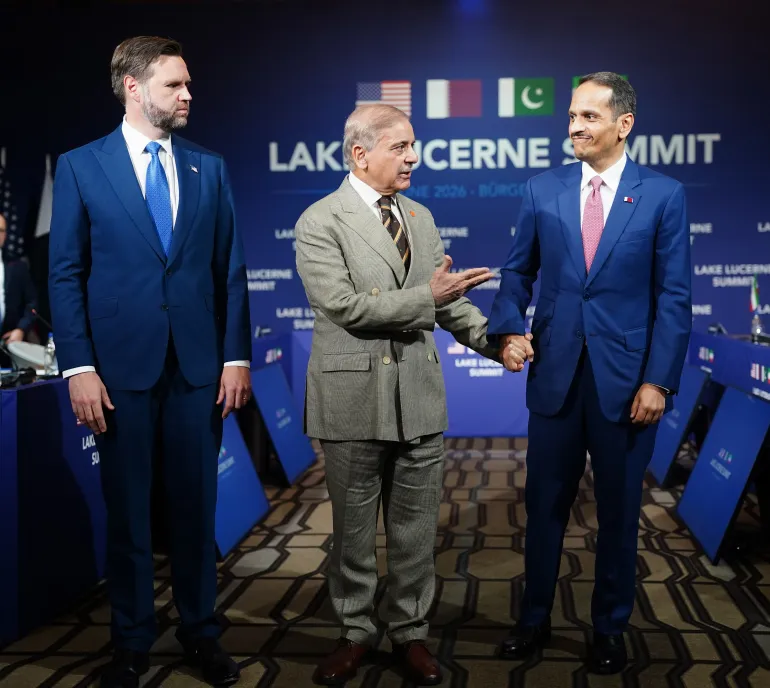
US Vice President JD Vance, left, looks on as Pakistan’s Prime Minister Shehbaz Sharif, centre, speaks and gestures towards Qatar’s Prime Minister and Minister of Foreign Affairs Sheikh Mohammed bin Abdulrahman bin Jassim Al Thani, right, at the start of a quadrilateral meeting between the US, Iran, Pakistan and Qatar [File: Nathan Howard/Pool via Getty Images]
Seat at the table
Mehran Haghirian, the director of research and programmes at the Bourse & Bazaar Foundation, believes Gulf states are in a better position to guide the outcome of the current US-Iran talks than in 2015.
“They are at the heart of the negotiations,” Haghirian said regarding the Gulf states’ role in the current talks.
In its role as a co-mediator, Qatar is essentially representing the GCC and their interests during the talks, while articles five and six of the Iran-US MoU place Gulf states at the centre of the agreement.
Among the biggest concerns for the GCC are the future of the Strait of Hormuz, with Tehran demanding tolls on shipping, and calls for the creation of a regional investment fund for Iran.
“There really cannot be any new Hormuz authority by Iran that would not include other GCC countries,” Haghirian told Al Jazeera.
US Vice President JD Vance claimed last week that the investment fund would be financed by the Gulf coalition, but Rubio said this week that regional allies would not be asked to contribute to any reconstruction fund for Iran.
Qatar’s Prime Minister Sheikh Mohammed bin Abdulrahman bin Jassim Al Thani has described the reported $300bn figure as “aspirational” in an interview with the Financial Times, while no Gulf state has yet said if it will contribute to the fund.
‘Maximum pressure era’
The analysts stress that the GCC is not a monolith – with Gulf states having contrasting and changing approaches towards Iran.
Oman, Qatar and Kuwait were broadly supportive of the JCPOA. Saudi Arabia, the UAE and Bahrain were more sceptical, but even these states publicly backed the agreement, said Haghirian.
When Trump pulled the US out of the JCPOA in 2018, Saudi Arabia, the UAE and Bahrain believed they had “found a partner in DC”.
That led to a “maximum pressure era” that brought a period of brinkmanship in the region, said Haghirian.
Suspected Iran-linked attacks on Saudi Arabia’s Abqaiq-Khurais oil facilities and vessels off the coast of Fujairah in 2019 were “the initial reaction by the Iranians to that maximum pressure” campaign, he added, but paradoxically, this also triggered a recalibration of relations.
“That was enough of a reason for Saudi Arabia [and] the UAE, particularly, to basically restructure their approach towards Iran,” Haghirian said.
The war and accelerated pragmatic rapprochement
While Israel has used war to attempt to increase its presence in the Gulf region – reportedly sending an Iron Dome battery to the UAE – other Gulf states view both Iran and Israel as unsettling forces in the region.
“Israel started the war, which was a destabilising act, and then Iran escalated by targeting the Gulf states, which was in turn a destabilising act,” Pinfold said.
Despite this, the Gulf states targeted by Iran still demonstrated patience and pragmatism in dealing with their neighbour.
Qatar, for example, has played a leading role in mediating between the US and Iran, even after being on the receiving end of Iranian drone and missile attacks.
“All six got attacked, and that’s really a level of foreign policy decision-making that is very difficult for any state to be able to really undertake, considering the fact that it was a military attack,” Haghirian said.
“But again, this pragmatism came out within this context to engage Iran and to actually speak for themselves at these negotiations. This war has really initiated a complete rebalancing of the entire region.”
FIFA’s inaugural U-15 World Cup in October has been opened to all of its member associates, paving way for Russia’s return.
Published On 25 Jun 202625 Jun 2026
A Russian team may be allowed to participate in a FIFA event for the first time since Moscow’s 2022 invasion of Ukraine after football’s global authority said its inaugural U-15 World Cup and Festival, set to be held in Azerbaijan in October, is open to all FIFA member associations.
FIFA banned Russia from international competition in February 2022 after it invaded Ukraine, but it lifted the suspension from the country’s U-17 boys’ and girls’ teams the next year.
Recommended Stories
list of 4 itemsend of list
However, Russian teams have remained absent from U-17 tournaments organised by FIFA and UEFA as several European countries, including Ukraine and England, continue to boycott Russia over its ongoing invasion of its neighbour.
“The first edition will be open to boys’ teams from all FIFA member associations, the second instalment in 2027 will feature girls’ teams only,” FIFA said on Wednesday about the U-15 World Cup and Festival.
“From 2028 onwards, all member associations will be invited to participate with both their boys’ and girls’ U-15 teams in two separate competitions.”
The U-15 event will kick off on October 22 and conclude nine days later.
They welcomed guests Kate Humble, Ben Fogle and Martin Clunes to the show, before it was thrown into chaos.
The Doc Martin star had been talking about the US version of the beloved programme emerging, starring Josh Charles in the leading role.
As a preview clip of it aired, Martin was asked about Josh’s spin on playing the grumpy doctor.
He replied: “He’s completely done his own thing, much nicer than me, less awkward and abrasive… he’s warm and better-looking.”
Martin then responded to a moment he just saw from the preview, adding: “I was just looking at that bit… they wouldn’t let me call the dog the son of a b***h, which I thought was funny.”
As the studio erupted into laughter, Roman rushed to apologise, saying: “I have to apologise quickly.”
Alex jokingly chastised Martin, adding: “You’ve been on a hundred times!”
Martin then turned to Ben, arguing: “He’s a vet… it’s a female dog!”
Continuing about the programme, Martin went on to address the future of the show, saying: “They’re going again, they’re doing another series.”
The Good Wife actor Josh will be starring in Best Medicine, with Sky previously teasing: “A US remake of UK television favourite Doc Martin, Best Medicine is a heartwarming new comedy-drama about a physician who moves to a small coastal town in the hopes of a quiet life.
“Dr Martin Best packs up his surgical career in Boston, Massachusetts and heads to start a new life as a physician in the coastal fishing town of Port Wenn in Maine. His aunt, a local lobster merchant, is nearby, and his new private practice is perfect for a simple life. Or so he thinks.
“Soon he’s introduced to Port Wenn’s community, filled with quirky but loving characters with no end of ailments for him to figure out and diagnose. However, as someone who is quite introverted and likes to keep himself to himself, he struggles with the adjustment.
“He’s also got a huge blood phobia – which doesn’t help his abilities as a doctor who may need to tend to wounds from time to time.
“But behind his brusque attitude and no-nonsense approach to a bedside manner, Dr Martin hides his own personal pain that he is hiding from the world which explains why he is the way he is. Will this little town bring him out of his shell?”
The One Show airs weeknights from 7pm on BBC One and iPlayer.
June 25 (UPI) — New York prosecutors will not retry disgraced film producer and convicted sex offender Harvey Weinstein on an unresolved rape charge related to actress Jessica Mann.
Prosecutors dropped the charges Thursday, more than six years after Mann, 40, first testified that Weinstein, 74, raped her in a Manhattan hotel room in 2013. Weinstein’s initial conviction for the charge was overturned in 2024, followed by two mistrials.
The D.A.’s office said Mann did not wish to go through a fourth trial.
“To be clear, we believe Ms. Mann’s account and her credibility as a witness,” Manhattan D.A. Alvin Bragg said in a statement. “This has been an extraordinarily taxing ordeal for her, and she has never wavered while testifying in front of two grand juries and three trial juries over the course of eight years. We thank her for her honesty and her tremendous bravery.”
In a statement to the court, Mann said it became clear to her during the latest trial, held this spring, that she “could no longer endure going through this any longer.”
“In my fight to see justice, it has nearly stolen a decade of my life and put me through more harm than good,” she added. “Justice now has moved away from the courts, solely into the hands of God.”
Weinstein is still awaiting sentencing after being convicted in 2025 of sexually assaulting former Project Runway production assistant Miriam Haley.
He has served less than half of his 16-year sentence in California for separate charges of rape and sexual assault. More than 100 women have accused Weinstein of sexual misconduct since 2017.
The United States Supreme Court has sided with the maker of Roundup weedkiller in a ruling expected to block thousands of lawsuits alleging it failed to warn people the product could cause cancer.
The ruling on Thursday was tied to a case that came before the justices after a tidal wave of litigation that included some multibillion-dollar verdicts against the global agrochemical manufacturer Bayer, a Germany-based company that acquired Roundup when it bought its original producer Monsanto in 2018.
Recommended Stories
list of 4 itemsend of list
The decision is a victory for US President Donald Trump’s administration, but one that could be tricky politically since allies in the “Make America Healthy Again” movement want to rein in pesticide use.
The high court, in a 7-2 ruling, found that the company cannot face failure-to-warn lawsuits in state courts because federal regulations have found a cancer link unlikely and do not require a warning label.
The justices overturned a jury verdict in Missouri awarding $1.25m to a man named John Durnell who said he was diagnosed with non-Hodgkin lymphoma after years of exposure to glyphosate in Roundup. The Supreme Court agreed with Bayer that a US law that governs pesticides precludes failure-to-warn claims that are brought under state law from moving forward in court.
Bayer shares jumped nearly 18 percent following the ruling.
Trump’s administration had backed Bayer in the case.
Conservative Justice Brett Kavanaugh, who authored the ruling, said the US Environmental Protection Agency, or EPA, has concluded glyphosate does not cause cancer and has not required a cancer warning on Roundup.
The law preempts Durnell’s claim because it “would require Monsanto to add a cancer warning to Roundup’s label even though federal law requires Monsanto to use the EPA-approved label without a cancer warning”, Kavanaugh wrote.
Liberal Justice Ketanji Brown Jackson, in a dissent joined by conservative Justice Neil Gorsuch, said that Durnell’s claim would impose equivalent labelling requirements on Monsanto that the federal law requires and so should not be preempted.
Jackson called the ruling “remarkable and regrettable, for it unjustifiably closes the courthouse doors to state tort plaintiffs like Durnell”.
Bayer acquired Roundup as part of its $63bn purchase of agrochemical company Monsanto in 2018. More than 100,000 plaintiffs have filed cases in US state and federal courts alleging a cancer link, and the German drugmaking and crop science company had said that the lawsuits could threaten its ability to supply the herbicide to farmers.
The torrent of litigation already prompted Bayer to remove glyphosate from its consumer version of Roundup. Bayer said before the Supreme Court ruled that a decision in its favour could largely end the Roundup litigation.
“The US Supreme Court decision is good for science, farmers, and industries that depend on regulatory clarity for innovation. It should help significantly contain the Roundup litigation after nearly a decade of legal battles. The ruling should result in the dismissal of current warning-based claims and bar future failure-to-warn claims,” Bayer spokesperson Tino Andresen said in a statement.
The company emphasised throughout the litigation that the EPA repeatedly found that glyphosate does not cause cancer and approved its product labels without a warning.
Facing billions of dollars in potential liability, Bayer announced in February a proposed $7.25bn settlement to resolve tens of thousands of current and future lawsuits. The settlement would not affect claims that stem from pending appeals or that fall outside the deal, according to the company. Those amount to nearly $1bn, it said.
‘Disaster for public health’
Environmental activists and others criticised the court’s ruling on Thursday.
“Once again, the Supreme Court has sided with big business over people and the environment. Today’s ruling is a disaster for public health,” said Tarah Heinzen, legal director at the advocacy group Food and Water Watch.
“The harm from this decision will perpetuate our cancer, infertility and general chronic disease epidemic for generations to come,” said Kelly Ryerson, co-executive director of advocacy group American Regeneration and a Make America Healthy Again activist who posts on social media under the moniker “The Glyphosate Girl”.
The sprawling dispute centres on a US law called the Federal Insecticide, Fungicide and Rodenticide Act, or FIFRA, that governs the sale and labelling of pesticides and bars states from imposing differing or additional requirements.
The measure prohibits pesticides that are “misbranded” with labels that lack an adequate warning to protect health and the environment.
Bayer has argued that Durnell’s claims are preempted by this law. The EPA has repeatedly approved labels without such a cancer warning, demonstrating that these products are not misbranded, the company said, adding that labels cannot be substantially changed without the agency’s approval.
Durnell’s lawyers said that despite the EPA’s registration of Roundup, the label may still be challenged as misbranded. They also said Durnell’s claims are not preempted because Missouri state law that requires products to adequately warn of dangers imposes the same requirements as FIFRA’s prohibition on misbranding.
‘A new era’
Union Investment fund manager Markus Manns called Thursday’s ruling a significant milestone for Bayer, adding that a decade after the Monsanto acquisition, the company is “entering a new era”.
“While future lawsuits are not entirely off the table, they will become considerably more difficult. A final breakthrough would come if the settlement is accepted by the plaintiffs and approved by the competent court in July. This would bring Bayer’s glyphosate litigation chapter to a definitive close, allowing management to fully refocus on operational and strategic matters,” Manns said.
Durnell sued Monsanto in Missouri state court in 2019, claiming it failed to warn users of the dangers associated with Roundup and glyphosate.
He was diagnosed with a rare and often aggressive form of non-Hodgkin lymphoma, a cancer that starts in the white blood cells, and attributed the disease to his exposure to Roundup starting in 1996. For about 20 years, he was the “spray guy” for a neighborhood association in St Louis, killing weeds at local parks without protective equipment, according to court papers.
A jury sided with Durnell in 2023, and in 2025, a state appeals court upheld that verdict.
AN ICONIC music festival will host its final line-up this summer – after more than 18 years of hosting performers.
This marks a blow for residents as the county’s biggest festival comes to an end.
Sign up for the Showbiz newsletter
Thank you!
Busted have been one of the big-name acts that have performed at the festivalCredit: WireImageThe summer staple regularly drew in crowds of up to 25,000Credit: Alamy
Nottingham’s Splendour festival will run for a final weekend next month, as the festival is set to be closed permanently.
The decision comes after organisers said they faced challenges within the current festival market, and have struggled to manage “the cost of staging events”.
Launched in 2008, Nottinghamshire’s biggest festival hosted a number of well-known performers throughout its run, including the likes of Noel Gallagher and Calvin Harris.
It regularly drew in crowds of up to 25,000, and had expanded into a two-day event in 2022.
Now, the final show will take place from July 18 to 19 in Wollaton Park, with The Wombats, Primal Scream and Snow Patrol performing as headline acts.
George Akins, DHP Family managing director, said: “Like many independent festivals, Splendour has had to navigate a very different landscape in recent years, with the cost of staging events rising sharply at the same time as household budgets have come under pressure and the festival market has become much more crowded.
“After a lot of careful thought, we feel the right thing to do is to make this year a proper celebration of everything Splendour has meant to Nottingham and give it the send-off it deserves.”
Local artists, including Nottingham act Jake Bugg, had often used Splendour as a springboard for their careers.
To mark the final edition, organisers launched a two-for-one ticket offer on general admission day tickets.
Akins added: “Thanks to everyone for your loyalty and support over the years, we couldn’t have done it without you.”
US Secretary of State Marco Rubio said all Gulf countries oppose a toll in the Strait of Hormuz during a tour of the region following US-Iran talks. Rubio added, “There isn’t a nation on Earth that supports having to pay money to go through the straits”.
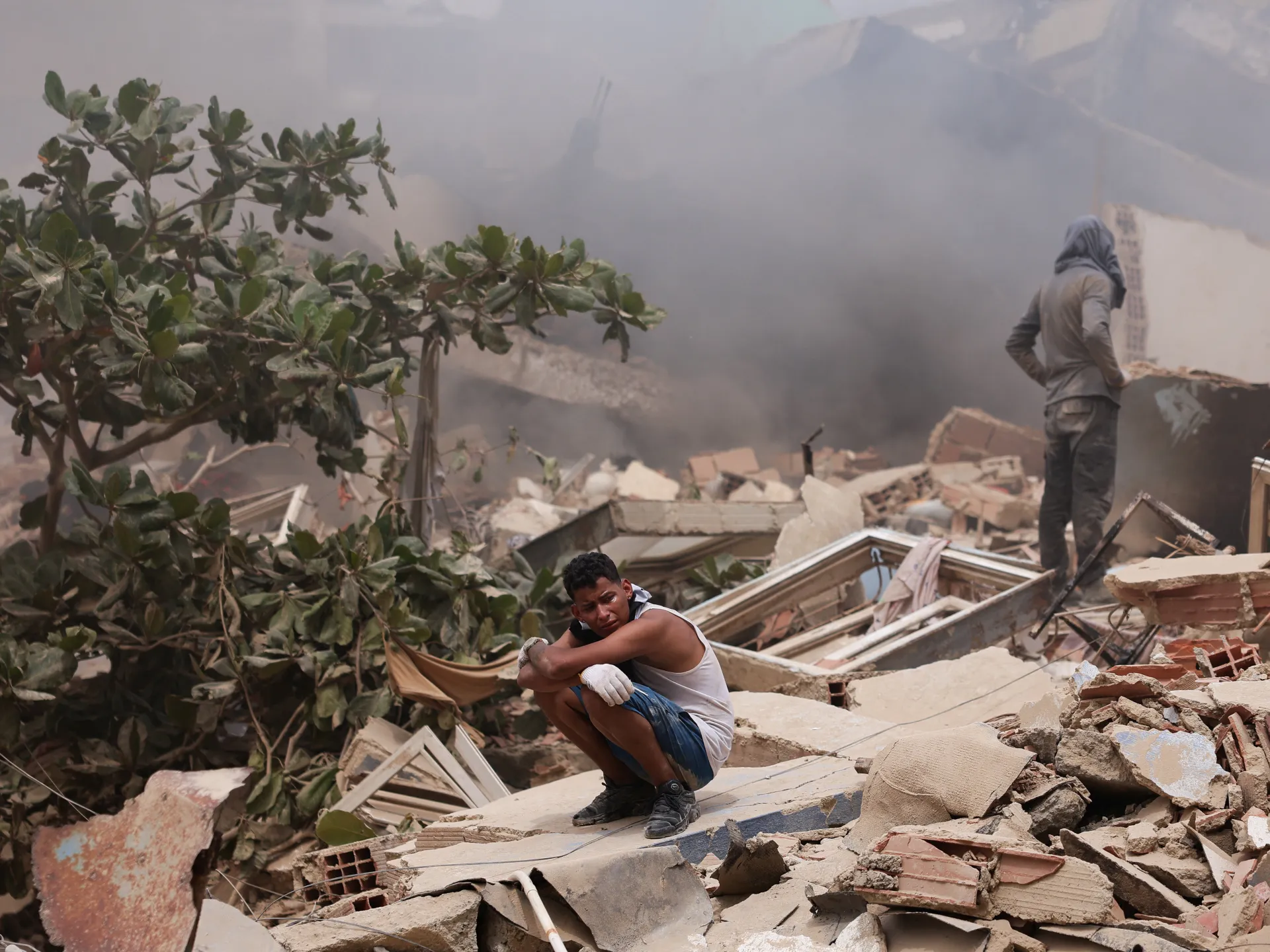
Reporting from Caracas for Al Jazeera, Noris Soto says authorities appear to lack a clear response plan in the aftermath of two powerful earthquakes. The recovery is being hampered by severe damage to communication systems, as displaced residents are housed in hotels.
LIONEL Richie has been reportedly taken to hospital after he took a funny turn on stage and was forced to end the concert.
The 77-year-old was performing at the Grand Casino Arena in Minnesota when his ill spell happened and had to take a moment to sit down.
Sign up for the Showbiz newsletter
Thank you!
Lionel is touring his Sing A Song All Night Long show throughout the summer (pictured in May)Credit: GettyThe Commodores frontman was performing in Minnesota when he had to cut the gig early due to a dizzy spell (pictured back in April)Credit: Getty
TMZ reports that the star halted his gig and was attended to paramedics backstage where he was subsequently sent packing to hospital.
Sources told the publication that the hospital trip was part of a precautionary measure.
The Sun has contacted representatives for Richie for comment.
In a video from the gig shared online, the music icon is seen attempting to finish performing his hit Dancing On The Ceiling while sat on the steps leading up to the live band.
Lionel had to sit down while singing hit song Dancing on the CeilingCredit: GettyThe 77-year-old was subsequently taken to hospital in an ambulance after the funny turnCredit: Getty
While he got back to his feet to carry on, he was forced to sit down again amid a second dizzy spell.
He is seen in the footage catching his breath, perched on the edge of the stage, while trying to continue with the song.
As explained in the post shared to X, Lionel managed to perform one more song, sat at the piano.
After departing the stage, Lionel’s saxophonist Dino Soldo told the crowd that the hitmaker wasn’t feeling well and wouldn’t be returning to the stage, ending the show.
Lionel was appearing with Earth, Wind & Fire as part of their joint tour hitting 26 venues across the States.
The Easy musician is next expected to appear for a gig in Chicago on Friday night.
Lebanon’s state-run National News Agency reports three people have been killed in an Israeli attack on a car in Nabatieh.
Published On 25 Jun 202625 Jun 2026
Israeli attacks on Lebanon have continued despite a ceasefire, with three people killed during a strike on a car in the south of the country, as senior Israeli and Lebanese officials meet for a final day of talks in Washington.
According to Lebanon’s state-run National News Agency (NNA), three people were killed on Thursday, and one was wounded after the Israeli attack hit a car on the road between Zawtar and Mayfadoun in Nabatieh Governorate.
Recommended Stories
list of 3 itemsend of list
NNA also reported that Israeli forces burned a number of houses in the town of Ain Arab, after issuing warnings forcing residents to evacuate the town before 5pm on Wednesday.
According to Lebanon’s Ministry of Public Health, since the conflict began on March 2, 4,230 people have been killed and 12,179 others have been wounded.
Reporting from Nabatieh, southern Lebanon, Al Jazeera’s Zeina Khodr said the ceasefire between Israel and Hezbollah remains “fragile” as the Israeli army continues to target “anyone or anything in front-line villages”.
“[These are ] villages on the outskirts [of the] city of Nabatieh, which lie along the area which is under Israel’s occupation,” Khodr explained. “So the message is they don’t want people to approach that area, there’ve been drone strikes, they’ve dropped stun grenades … people killed.
“Those villages, the Israeli army was not able to occupy them during weeks of fighting and it wants to still be able to control them by fire because the more territory you control, the more leverage you have in negotiations,” she said, adding that officials from Lebanon and Israel are discussing the possible and gradual handover of territory.
Ceasefire talks
Israel and Lebanon have been discussing a United States-backed proposal for the past three days, with the talks wrapping up in Washington, DC, on Thursday. The negotiations have been focused on Israeli forces handing over some of the territory they occupied during the fighting with Hezbollah to Lebanon’s military.
A US State Department official told the Reuters news agency that Israel had taken a “concrete step” towards the proposal, which had been part of the latest round of talks, by pulling back from a part of a buffer zone in southern Lebanon.
However, a senior Israeli defence official denied that there had been any pullback, adding that Israel would not be withdrawing from its buffer zone.
Moreover, a senior Lebanese military official also told Reuters that developments on the ground in recent days had shown the “opposite of a pullback”.
Still, US Secretary of State Marco Rubio said on Thursday that Israel and Lebanon were making good progress towards a “commitment of intent”.
“I think we are very close in our hopes of getting a commitment of intent between the two countries,” Rubio told reporters during a visit to Bahrain.
“It’ll be a process, it’ll take some time, it’ll take a lot of work, but I can tell you that for the first time in 30 years, the sovereign government of Lebanon is speaking to the government of Israel directly.”
Under US pressure, Lebanese officials began direct talks in April with Israel in Washington.
Hezbollah, however, has condemned the Lebanon-Israel talks, demanding the full withdrawal of Israeli forces from Lebanon first.
Weekly insights and analysis on the latest developments in military technology, strategy, and foreign policy.
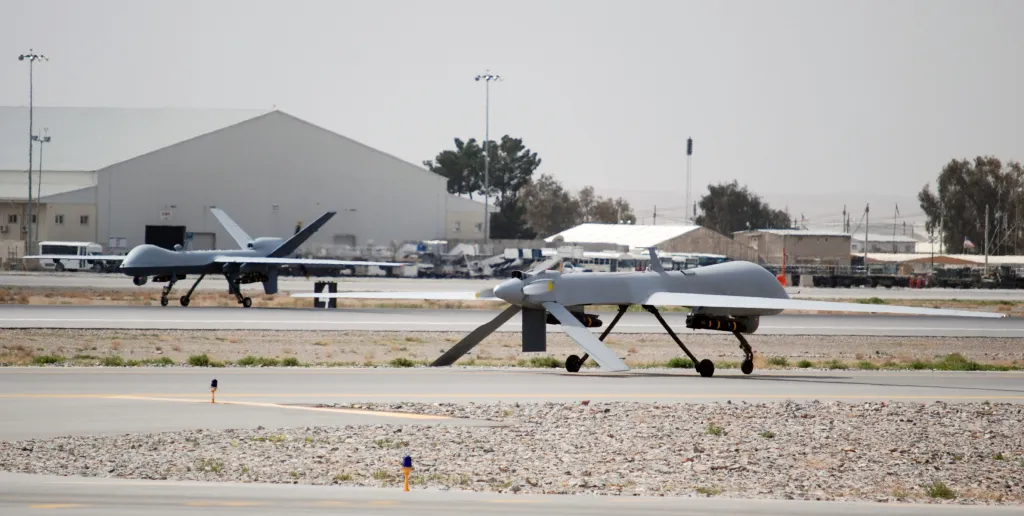
The U.S. Navy continues to make use of MQ-1 Predators as test and training assets, eight years after the U.S. Air Force retired the iconic drones. TWZ was first to report that the Air Force was looking at transferring some of its remaining Predators to the Navy back in 2019, but it was unclear what came of those discussions in the end. Now we know.
The Air Force officially retired the MQ-1 in 2018. At that time, the service still had dozens of these drones in its inventory. More than 50 Predators were heavily cannibalized for parts they shared with their newer cousin, the MQ-9 Reaper. A number of demilitarized examples were also put on display. Today, 15 MQ-1s remain in storage at the boneyard at Davis-Monthan Air Force Base in Arizona, and are technically the property of the National Museum of the U.S. Air Force. Then there’s the matter of the MQ-1s that went to the Navy.
A US Air Force MQ-1 Predator, at right, and an MQ-9 Reaper, at left, seen taxiing at Kandahar Airfield in Afghanistan in 2014. USAF
“In 2019, Naval Air Warfare Center Weapons Division (NAWCWD) received 20 MQ-1 aircraft from the U.S. Air Force,” a spokesperson for NAWCWD, part of the Navy’s Naval Air Systems Command (NAVAIR), confirmed to TWZ. “These aircraft were redesignated as NMQ-1Bs to support our mission.”
The new nomenclature here is notable. In the U.S. military’s joint service designation system for aircraft and missiles, the prefix “N” refers to platforms that have been modified in some way, typically for testing purposes, that are not readily reversible. One of the better-known examples of this is the Air Force’s secretive NT-43A radar cross-section measurement platform, a heavily modified Boeing 737-200 with a completely new and enlarged nose, as well as a huge radome extending from the tail. Other “N” aircraft that various branches of the U.S. military have operated over the years have had far less dramatic modifications. How exactly the NMQ-1B configuration differs from a typical MQ-1B is unclear.
A stock picture of an MQ-1 Predator in US Air Force service. USAF
“NAWCWD is an RDT&E [research, development, test and evaluation] command and the platforms were acquired to support our targets department,” they added when asked for more information. “The NMQ-1B platform is being used for test and training. We have nothing further to provide at this time.”
TWZ had reached out to the Navy for more details after the Air Force had also confirmed the transfer of the MQ-1s. We had asked the Air Force about the status of any Predators still in its inventory after U.S. Central Command (CENTCOM) confirmed the loss of an “MQ-1” to Iranian fire at the end of May. By all indications, what Iran shot down was actually a U.S. Army MQ-1C Gray Eagle, a design that evolved from the Predator, but that is distinctly different.
When the Air Force retired the MQ-1, the service still had dozens of airworthy examples. TWZ pointed out at the time that at least a portion of them could end up as targets for air-to-air and surface-to-air weapons, as well as sensor testing and other weapons testing. The fact that NAWCWD says it is still using the drones today would seem to point more to the latter than the former, though anti-air missile testing does not necessarily have to entail the destruction of the target.
For instance, certain kinds of testing of some missile seekers can be done without it ever leaving a rail on an aircraft or a launcher on the ground. The Navy and Air Force test communities also use specialized podded systems to support the development and evaluation of new and improved seekers for anti-air missiles, something we have explored in detail in the past. Even live fire tests do not always result in the target being destroyed if that is not the intended outcome. Just by removing the warhead, missiles will still pass within lethal distance with their proximity fuzes being triggered to confirm a simulated kill. The missile will fly on, and the target will survive to live another day.
As noted, at least based on the NMQ-1B designation, the Navy’s Predators have been altered in some significant way. One possibility is that they have been modified to be able to mimic an array of different radar, infrared, and/or other signatures. In this way, a Predator could offer a lower-cost and long-endurance flying asset capable of replicating a variety of aerial threats to support testing and training requirements. The U.S. military already uses smaller crewed aircraft as surrogates for cruise missiles and long-range kamikaze drones, as can be seen in the TWZ video below. This is in addition to target drones specifically built for this purpose.
These aircraft masquerade as enemy Shahed-136 drones during U.S. military war games
The NMQ-1Bs could also be modified in a variety of other ways to support more specific NAWCWD requirements, or to make them more adaptable to meet changing demands. The standard MQ-1B variant also features two underwing hardpoints that could be used to carry various stores, such as countermeasures and small munitions. This would further expand the Predator’s flexibility as a test and training asset from one sortie to the next. Being able to more readily modify or swap out the drone’s internal systems, as well as the software running them, would also be a boon for its current role.
Despite being housed within NAWCWD’s targets department, depending on their current configuration, the NMQ-1Bs could also help monitor missile and other test activities, or even act as signal relays. Before armed MQ-1 versions arrived, RQ-1 Predators were already flying surveillance and reconnaissance missions using infrared and electro-optical full-motion video cameras in turrets under their noses. The drones could also be fitted with small radars with synthetic aperture modes capable of capturing still imagery, even through cloud cover, smoke, and dust, and at night.
An early variant of the Predator drone flies near the U.S. Navy’s Nimitz class aircraft carrier USS Carl Vinson during a test in 1995. U.S. military
Around their retirement, there were rumors that the remaining MQ-1 fleet could be used to test cooperative swarming capabilities, including hardware, software, and communications networks. There is no hard proof that this occurred, but it seems quite plausible considering the timing and how well-known and adaptable the Predator was at the time.
Using surrogate drones in the development of autonomy agents, teaming architectures, and swarming capabilities is now a very well-established practice. The big question is that if these Predators are still flying, or at least have been since their retirement, how is it that we have not caught a glimpse of them? One answer would be that this work was done at clandestine test facilities like Area 51 or even less secretive but still somewhat remote locales. If this is the case, these aircraft likely have historic significance, paving the way to the autonomous air combat revolution currently underway.
Overall, how much longer the Navy might continue to make use of the NMQ-1Bs remains to be seen. The service’s test community has already given the iconic Predator nearly a decade of extra life.
Passing “Go” has become especially lucrative for mobile game publisher Scopely.
The Culver City-based Scopely launched “Monopoly Go!” in 2023, betting fans of the classic board game would flock to a mobile version aimed at casual gamers.
By 2025, “Monopoly Go!” had accrued $6 billion in lifetime in-app purchase revenue, becoming the fastest free mobile game to do so, according to app analytics firm Sensor Tower.
This summer, the app is expected to reach $8 billion in lifetime revenue, the company says, solidifying “Monopoly Go!” as Scopely’s biggest game and far surpassing the company’s popular “Pokémon Go.” The company declined to disclose its total profits.
Scopely Co-Chief Executive Javier Ferreira.
As overall downloads in the mobile game market have stagnated and in-app purchases and retention become the main drivers of growth, Scopely has hit on an age-old Hollywood strategy — using known franchises and intellectual property to bring out fans.
“These are incredibly durable and long-lasting games that have really passionate communities and fandom around them,” said Javier Ferreira, co-chief executive of Scopely. “We’re in the business of building people’s favorite thing, and that’s a difficult thing to do. The power of [intellectual property] is that, in some cases, that is already their favorite thing.”
The company’s journey toward “Monopoly Go!” began in 2014, when Scopely formed a partnership with Rhode Island-based toymaker Hasbro. Its first collaboration was a Yahtzee mobile dice game that ultimately drew millions of players worldwide (though it was especially popular in the U.S.) and generated more than $1 billion in lifetime revenue.
After that, Scopely approached Hasbro about taking on the “crown jewel” of its board game empire — Monopoly.
Monopoly’s massive global popularity was an obvious draw. But adapting an hours-long real estate transaction game for a casual, mobile audience proved challenging.
Development of what would become “Monopoly Go!” ultimately took seven years, two of which were spent trying to make movement around the board more fun. In that time, the company scrapped two versions of the game; one deemed too competitive, and one that was too complex, Ferreira said.
Developers wanted to capture the “roller coaster feel” of the board game’s highs and lows, while also having simple rules and ensuring a strong social element, he said.
“We couldn’t just copy,” Ferreira said. “We had to reinvent it and re-imagine it, and that’s a complicated, creative endeavor.”
Today, “Monopoly Go!” brings in more than $2 billion in annual revenue and has been downloaded across the globe more than 300 million times.
Now with “Pokémon Go,” which the company owns after acquiring maker Niantic’s game business last year, “Scopely has gone from a successful publisher to one of the defining companies in mobile gaming,” Randy Nelson, head of insights at Appfigures, a mobile app analytics firm.
“The company cracked the code on licensed games years ago,” he wrote in an email. “Its biggest hits work because they’re great games first and recognizable brands second.”
Though the company’s overall game downloads have slowed, its gross revenue has largely increased every year since 2020, according to Appfigures data.
Shortly after Scopely released “Monopoly Go!,” the company was acquired by Savvy Games Group, which is owned by the Saudi Public Investment Fund, for $4.9 billion.
In a statement about the deal, Savvy Games Group Chief Executive Brian Ward touted the success of “Monopoly Go!” as “indicative of Scopely’s ongoing position at the forefront of the global games sector.”
Representatives of the Saudi investment fund are part of Savvy Game Group’s board and do sometimes give some feedback on company initiatives, though Ferreira said the company has remained “very independent.”
The proposed acquisition of gaming giant Electronic Arts by the Saudi Public Investment Fund is not expected to affect Scopely since EA largely focuses on high-budget console and computer games, he said.
As Scopely, now 3,000 employees strong, looks to the future, it has embarked on a number of entertainment partnerships with studios to add franchises such as “The Simpsons,” “Hello Kitty” and Marvel to its mobile game ecosystem.
“They give us access to these universes that millions of people love and are really invested in,” Ferreira said. “We see this as a very strategic part of our business.”
Iran’s Islamic Revolutionary Guard Corps (IRGC) has warned commercial vessels to only use routes through the Strait of Hormuz approved by Tehran, reopening a point of friction in fragile negotiations between the United States and Iran over the future of the strategic waterway.
The warning came after Oman announced a new shipping transit route through the strait on Wednesday, saying it had coordinated the route with the International Maritime Organization (IMO) as maritime traffic slowly resumes following weeks of disruption.
Recommended Stories
list of 4 itemsend of list
The dispute remains one of the unresolved issues after a memorandum of understanding (MoU) was signed by the United States and Iran last week, which largely halted hostilities in the four-month US-Israel war on Iran and which launched a 60-day negotiation process aimed at reaching a broader peace agreement.
The MoU, which includes the reopening of the strait, followed months of severe disruption to shipping after Iran effectively closed it, and the US imposed a corresponding naval blockade on Iranian ports.
Both Washington and Tehran have declared the strait open to commercial shipping, but questions remain over whether Iran will seek greater control over vessel movements, whether it will impose transit or service fees on ships using the strait following the 60-day negotiating period, and whether disagreements over the waterway could derail efforts to reach a permanent agreement altogether.
Why is the Strait of Hormuz so important?
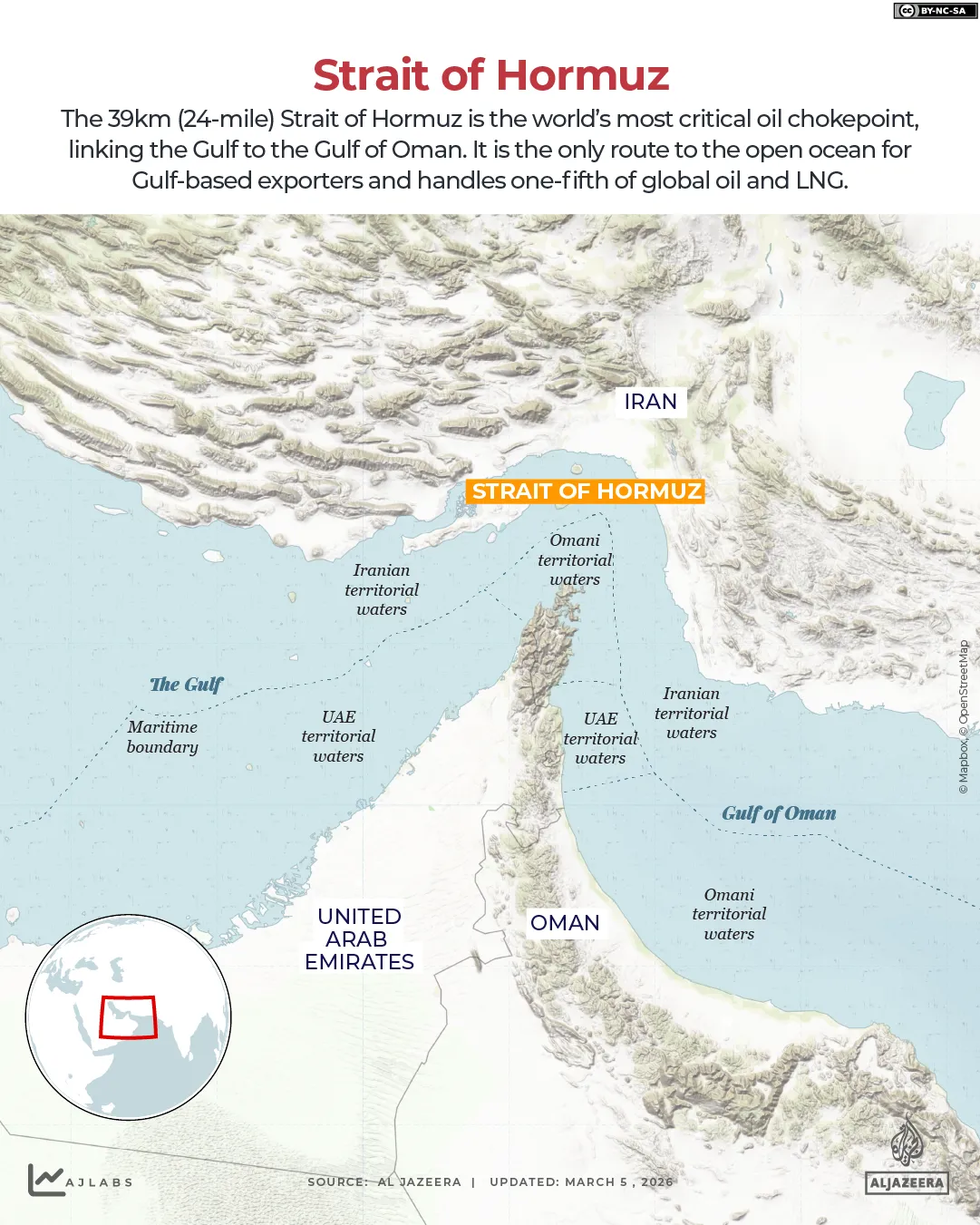
The Strait of Hormuz is one of the world’s most strategically significant waterways, with around one-fifth of global oil and liquefied natural gas (LNG) supplies normally being shipped through the narrow passage linking the Gulf to the Arabian Sea.
Bordered by Iran to the north and Oman and the United Arab Emirates (UAE) to the south, the strait is only about 50km (31 miles) wide at its entrance and exit, narrowing to about 33km (21 miles) at its tightest point. Despite its width, it is deep enough to accommodate the world’s largest oil tankers.
According to the US Energy Information Administration, about 20 million barrels of oil and petroleum products transited the strait each day in 2025, representing hundreds of billions of dollars in annual energy trade.
The route is used not only by Iran but also by Iraq, Kuwait, Qatar, Saudi Arabia and the UAE. It is also vital for global fertiliser exports, with roughly one-third of international fertiliser trade normally passing through the strait.
Because disruptions to shipping there rapidly push up global energy prices and destabilise US markets, control of the waterway has become one of Iran’s strongest sources of strategic leverage in its conflict with the US.
(Al Jazeera)
Why is Iran objecting to Oman’s new route?
The IRGC says Oman and the IMO announced the new shipping corridor without consulting Tehran. “Certain authorities have announced a new shipping route through the Strait of Hormuz without prior notification to or coordination with the Islamic Republic of Iran. The proposed route is unacceptable and poses serious safety risks,” the force said.
“The only authorised transit routes through the Strait of Hormuz are those designated by the Islamic Republic of Iran,” it said, adding that ships must maintain contact with the IRGC Navy while transiting the waterway.
Iran first issued its own map of acceptable routes through the strait in April, showing that ships should pass much closer to the Iranian coast than they had previously.
(Al Jazeera)
The IRGC’s warning came after a Liberian oil tanker passed through the strait on Thursday using a route much closer to Oman’s coastline.
Al Jazeera’s Resul Serdar, reporting from Tehran, said the IRGC appeared frustrated because the Omani route partially bypasses Iran’s direct control over shipping.
“The control of the Strait of Hormuz has been a huge leverage for Iran to put pressure on its adversaries and the global economy since the beginning of the war,” Serdar said.
Oman defended the corridor route it had announced, saying it was intended to restore safe navigation while complying with international law. Foreign Minister Badr Albusaidi said Oman remained committed to ensuring freedom of navigation through the waterway and stressed that “future arrangements related to the strait do not involve imposing any transit fees”.
What does the US-Iran agreement say about the strait?
In the MoU signed last week, Iran agreed that it would “make arrangements using its best efforts for the safe passage of commercial vessels with no charge, for 60 days only, from the Persian Gulf to the Sea of Oman and vice versa”.
While the agreement states that “the traffic of commercial vessels will immediately start”, it also acknowledges that demining operations will be required before normal shipping routes can fully resume, stating that “demining by the Islamic Republic of Iran will be instated within 30 days”. It also provides for discussions between Iran, Oman and other Gulf states on future arrangements for managing the waterway.
However, the memorandum does not specify what will happen after the initial 60-day period. Ali Vaez, Iran project director at the International Crisis Group, said the temporary rerouting of vessels had always been expected because of the mine-clearing operations outlined in the agreement.
“We always knew that if there was a deal, there would be several weeks of mine-clearing operations in the international shipping lane running through the middle of the Strait of Hormuz,” he said.
“During that period, vessels would have to transit through Iranian and Omani territorial waters instead.”
However, Vaez said the latest announcement by Iran was unexpected. “The important thing now is that the Iranians do not start taking fees or other tolls,” he said, “because that is not provided for in the memorandum of understanding.”
Asked whether the IRGC’s position differed from that of Iran’s government, Vaez said: “There is no distinction between the IRGC and the state. They are effectively one and the same. The IRGC is calling the shots.”
Can Iran charge ships fees?
International law generally protects the right of transit through international straits, including Hormuz, making it difficult for coastal states to impose unilateral transit fees on vessels simply passing through international shipping lanes, even where they are within territorial waters.
Last week, Iran announced it would waive planned fees through the strait for 60 days while talks with the US continue in Switzerland, suggesting charges may be introduced once the negotiating period expires.
Iran’s chief negotiator, Mohammad Bagher Ghalibaf, has signalled that Tehran views the post-war arrangement as fundamentally different from the status quo that existed before the conflict.
“Hormuz will never return” to its prewar status, Ghalibaf said.
The suggestion that Iran could charge fees was dismissed by US Secretary of State Marco Rubio this week. Speaking at the start of a regional tour in the United Arab Emirates, he said: “It’s an international waterway. No country is allowed to charge tolls or fees on an international waterway.”
Rubio added that he believed “all the countries in this region would agree”.
Speaking in Manama, Bahrain, after meeting with the Gulf Cooperation Council (GCC) – a bloc comprising Bahrain, Kuwait, Oman, Qatar, Saudi Arabia and the UAE – on Thursday, Rubio also told reporters: “Iranians are saying one thing, but then something else is actually happening.
“It’s now obvious to us that … the Iranian system is going to produce all sorts of maximalist rhetoric. What we’re interested in is not their press conferences. What we’re interested in is whether or not ships are moving. If ships are moving as they should be moving, then that’s what we’re going to judge.
“If, on the other hand, this rhetoric is backed up by actual ships being threatened and ships are not moving, then that’s a violation of the agreement, and we’re going to have a problem with it.”
Rubio claimed there is no regional support for Iranian transit fees, saying, “There is zero support among Gulf countries for any sort of toll or fees charged for the use of international waters … that isn’t going to happen.”
His comments came after UAE presidential adviser Anwar Gargash said that new “geopolitical facts” could not be imposed on the Arab Gulf states as a result of what he described as the “treacherous aggression against them”.
Are ships returning – and which route are they taking?
Some commercial shipping through the strait has resumed, although traffic remains well below normal levels. Before the conflict, between 120 and 140 vessels typically transited the strait each day.
According to shipping analytics company Kpler, confirmed crossings rose to 70 vessels on Wednesday as demining progressed and more operators began using the Omani route.
“The US-Iran MoU framework and apparent lifting of the US blockade appear to have supported a short-term confidence boost, although IRGC warnings against use of the Omani route could create a new source of contention,” Kpler reported.
The company added that incomplete demining, continued “dark” routing by some vessels – when ships limit or switch off their tracking transponders – and unresolved questions over inspections, sanctions and future governance meant shipping had not yet returned to prewar conditions.
This comes as oil prices drop to the lowest level since before the Iran war, with Brent crude, the global benchmark, falling to a low of $72.24 a barrel on Thursday. This remains above the prewar price of $66, however.
The chart below shows how shipping through the strait before the war compares to its status in recent weeks:
Is a peace deal achievable?
The future administration of the Strait of Hormuz is only one of several issues still to be resolved before negotiators hope to reach a comprehensive agreement within 60 days, with another major sticking point being Iran’s nuclear programme.
International Atomic Energy Agency (IAEA) Director-General Rafael Grossi has said the agreement explicitly provides for international monitoring of Iran’s nuclear activities.
However, Kazem Gharibabadi, Iran’s deputy foreign minister for legal and international affairs, has said inspectors’ access to nuclear sites damaged during the conflict will only be considered as part of a final agreement.
Questions also remain over the fate of Iran’s enriched uranium stockpile, the sequencing of sanctions relief and the release of frozen Iranian assets, while regional tensions continue to pose additional risks.
Israeli forces remain deployed in parts of southern Lebanon occupied during the conflict, according to a Lebanese military source, while Israeli strikes have continued, despite the MoU explicitly calling for “a permanent end to the war on all fronts, including Lebanon”.
Vaez said visible progress would be essential if negotiations are to survive, noting, “Both sides have to see progress, whether that’s greater access for UN nuclear inspectors, sanctions relief, or resolving the issue of Iran’s uranium stockpile.”
He cautioned against viewing the interim agreement as a series of smaller deals. “Nothing is agreed until everything is agreed,” Vaez said.
“They [the Iranians] are determined to reach a comprehensive agreement within 60 days. That’s a very ambitious timetable, but there has to be visible momentum or the process risks falling apart.”
However, Vaez said both Washington and Tehran have strong economic incentives to bring about a lasting peace. “The situation in the Strait had become one of mutually assured economic destruction,” he said.
“The United States was facing rising energy and oil prices ahead of the midterm elections … At the same time, Iran was already in a deep economic hole before this conflict began. The war only made that worse.
“It became a lose-lose dynamic, and both sides needed a way out.”
The jury heard he had been expelled from school for disruptive behaviour and truancy hours before Aria’s death, and that his mother had taken away his phone as a punishment.
He said that without his phone, he was unable to call 999.
Aria was found face down on the floor of her home shortly after 18:00 GMT by Ollie Sheppard, who was temporarily lodging at the house.
Sheppard described the house as being “silent” and “very eerie” when he arrived. ”At first I thought she was messing around” he told the court, before he realised Aria’s school shirt was covered in blood.
Emergency services stopped trying to resuscitate the nine-year-old at 18:58.
Aria’s mother, Victoria Hull, said the last time she had seen her daughter alive she had been eating mini-pizzas in front of the TV in the living room.
“Aria seemed bubbly and happy because she had a good dance class,” Hull said.
The girl’s mother then headed out to work, where she was doing evening shifts to earn extra money for Christmas.
Hull said the last words which passed between them were “see you after work mummy”, to which she replied: “See you after work, love you.”
A giant eight-metre dragon swept around the Tower of London in a dramatic display. The mythical beast was marking a spin-off from popular show Game of Thrones
Dragon soars over the Tower of London
A giant eight-metre dragon soared above the Tower of London to mark the launch of the third series of Game of Thrones spin-off House of the Dragon on HBO Max. An eight‑metre model of Syrax was brought to life using production scans from the hit show.
Built by German aeronautics firm Airstage, the dragon features 23 moving parts and moved using impellers built into its legs to create lifelike motion. The model weighs 13kg and took three months to build by a 14‑strong team using foam, carbon fibre and aluminium. The dragon was crafted from vacuum-formed Depron foam around a carbon fibre and aluminium frame.
The model was finished with detailed airbrushing for a lifelike look and took the team nearly 3,000 hours to complete.
A special evening reception following the flight was hosted by Harriet Rose and attended by stars of the show Kieran Bew, Tom Bennett, Clinton Liberty, who play Dragonseeds Hugh Hammer, Ulf White and Addam Of Hull, recruited as Dragon Riders by Rhaenyra (Emma D’Arcy) in the series, and Abubakar Salim, who plays Alyn of Hull.
Nils Schlenther, chief operating officer at Airstage, said: “This is one of the most intricate flying models we have ever created.
“After months of R&D and complex construction, the team studied the movement of Syrax and underwent over seven test flights to ensure her flight was as close as what we see in the show as possible.
“We have been constantly refining and getting the motion as realistic as possible and so the crowd’s reaction was amazing to see as we know we got it right for the fans.”
The event celebrated the return of House of the Dragon after nearly a two-year wait.
The show is based on George R.R. Martin’s Fire & Blood and is set 200 years before the events of the hit show Game of Thrones, telling the story of House Targaryen.
The eight-episode season will air new episodes weekly on HBO Max, leading up to the season finale landing on screens Sunday 9th August.
Anna Kimber OBE, deputy governor of the Tower of London, said: “The Tower of London has stood at the heart of some of the most dramatic chapters in our history for nearly 1,000 years.
“While dragons may belong to the world of fantasy, the themes at the heart of House of the Dragon – power, ambition and the struggle for the throne – have strong echoes in the stories that played out within these walls.
“We’re delighted to welcome this spectacular stunt to the Tower, where history and fantasy will meet for an unforgettable moment.”
June 25 (UPI) — The U.S. Postal Service plans to refuse delivery of mail-in ballots in states that don’t turn over their voter lists to the federal government, the postmaster general told Congress.
Postmaster General David Steiner told the Homeland Security and Governmental Affairs Committee about the proposed rule on Wednesday.
“Yes or no — if a state refuses to turn their absentee voter list over to the federal government, will the Postal Service still mail their ballots under this proposed rule?” Sen. Gary Peters, D-Mich., asked Steiner.
“Under our proposed regulation, no. We would tell the state that we need the manifest,” Steiner said.
Steiner argued the policy is to make sure ballots are delivered “securely, efficiently, and accurately.” But President Donald Trump has repeatedly demanded states’ voter lists over the past year and has been suing states to get them.
The proposed rule says that states would have to give the Postal Service the names, addresses and ballot barcode numbers for the people who are to get ballots in the mail. The proposal follows Trump’s executive order from March 31 that requires the federal government to compile state citizenship lists and for the Postal Service to refuse to mail ballots to those the federal government has determined are ineligible to vote.
The proposed rule is posted on the Federal Register, and the public can comment until July 2.
Democrats have pushed back, arguing the rule shows that Trump is trying to federalize elections and said the Postal Service doesn’t have the authority to enforce that rule. The Constitution says states are responsible for running elections.
“Just because President Trump wants to do this does not make it law, doesn’t make it right, doesn’t make it constitutional. There is certainly a massive difference between general mail requirements and regulating elections,” Peters said.
Steiner admitted that his agency doesn’t have the authority to enforce elections but said the rule is a precaution to be sure that only eligible voters will get ballots.
“I would think that states would want the information to ensure that the ballots that they think they’re sending out are the ballots that are actually getting sent out,” Steiner said.
Sen. Elissa Slotkin, D-Mich., said the rule is part of a broader strategy.
“The U.S. Postal Service is now part of this bigger story of this president desperate to federalize our elections. He has tried every which way to say that if he and his party don’t win in these November elections, they were rigged.”
Slotkin asked Steiner directly to stop the plan.
“Please push back on being a pawn in this authoritarian playbook,” she said. “The Postal Service is one of the most important institutions in our country. Don’t taint it with the obsession of this one man.”
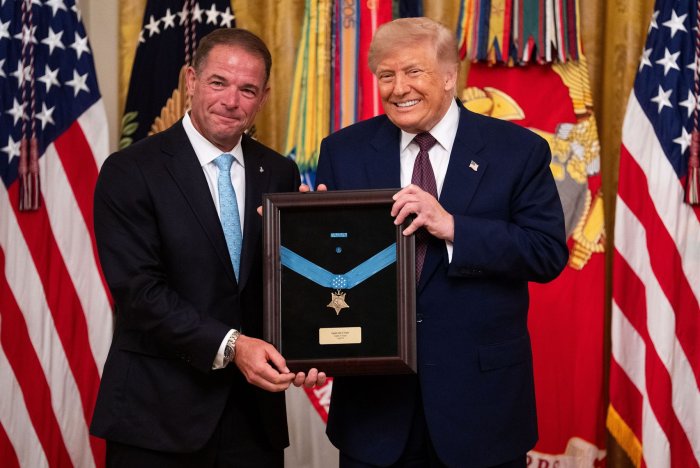
President Donald Trump presents a Medal of Honor to Tom Ripley on behalf of his father, John W. Ripley, during a Medal of Honor award ceremony in the East Room of the White House on Thursday. Photo by Aaron Schwartz/UPI | License Photo