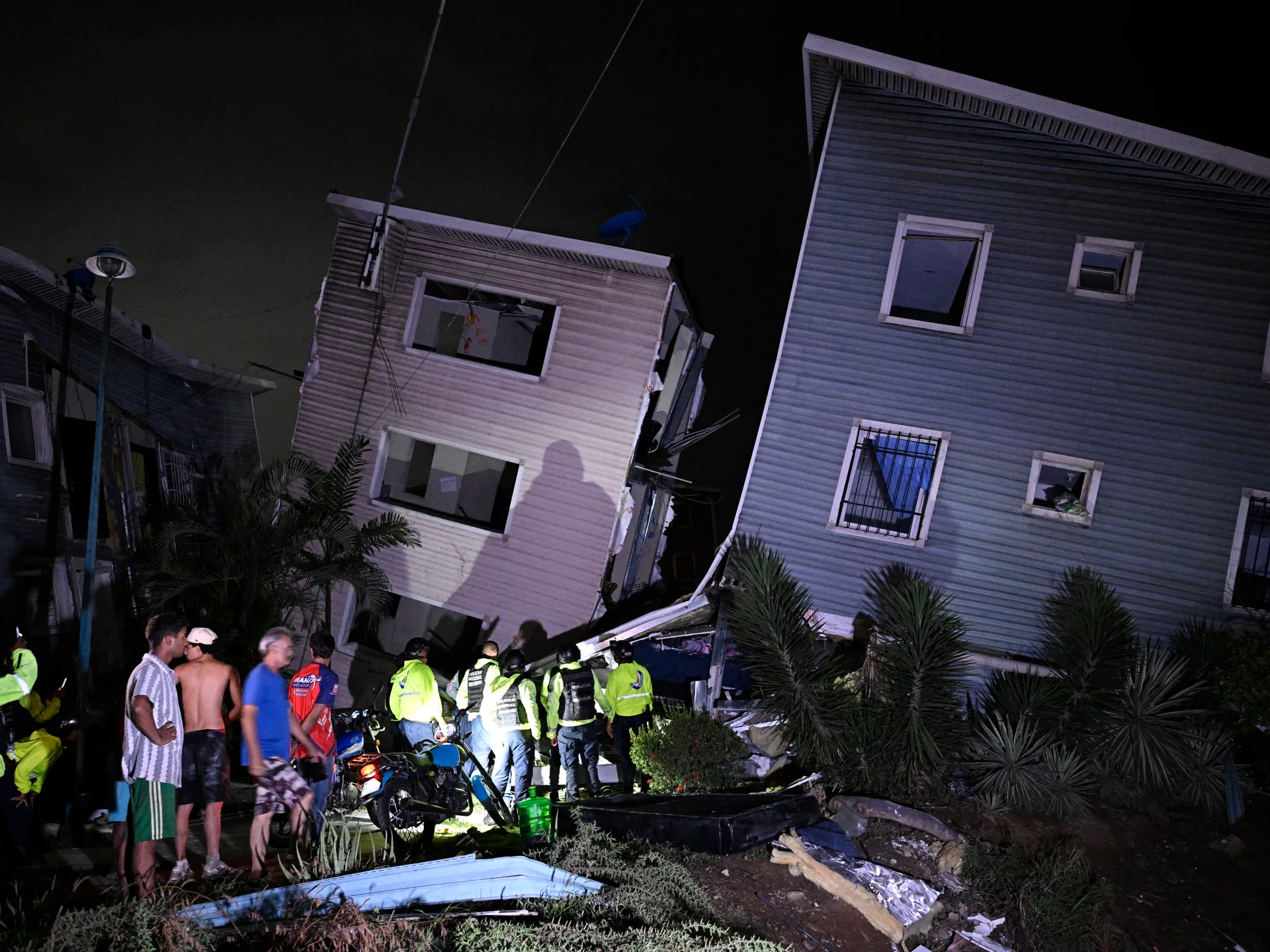
Coastal La Guaira state showed widespread infrastructure damage. (Reuters)
Caracas, June 25, 2026 (venezuelanalysis.com) – Venezuela suffered two successive major earthquakes on Thursday afternoon that caused devastating damage.
Authorities reported that 7.2 and 7.5 magnitude earthquakes struck 39 seconds apart just after 6 pm. The epicenters were close to San Felipe, Yaracuy State, some 120 kilometers west of Caracas.
The tremors strongly shook central and northern Venezuela and were felt as far as Brazil and Colombia. Geological services registered 20 aftershocks in the following hours.
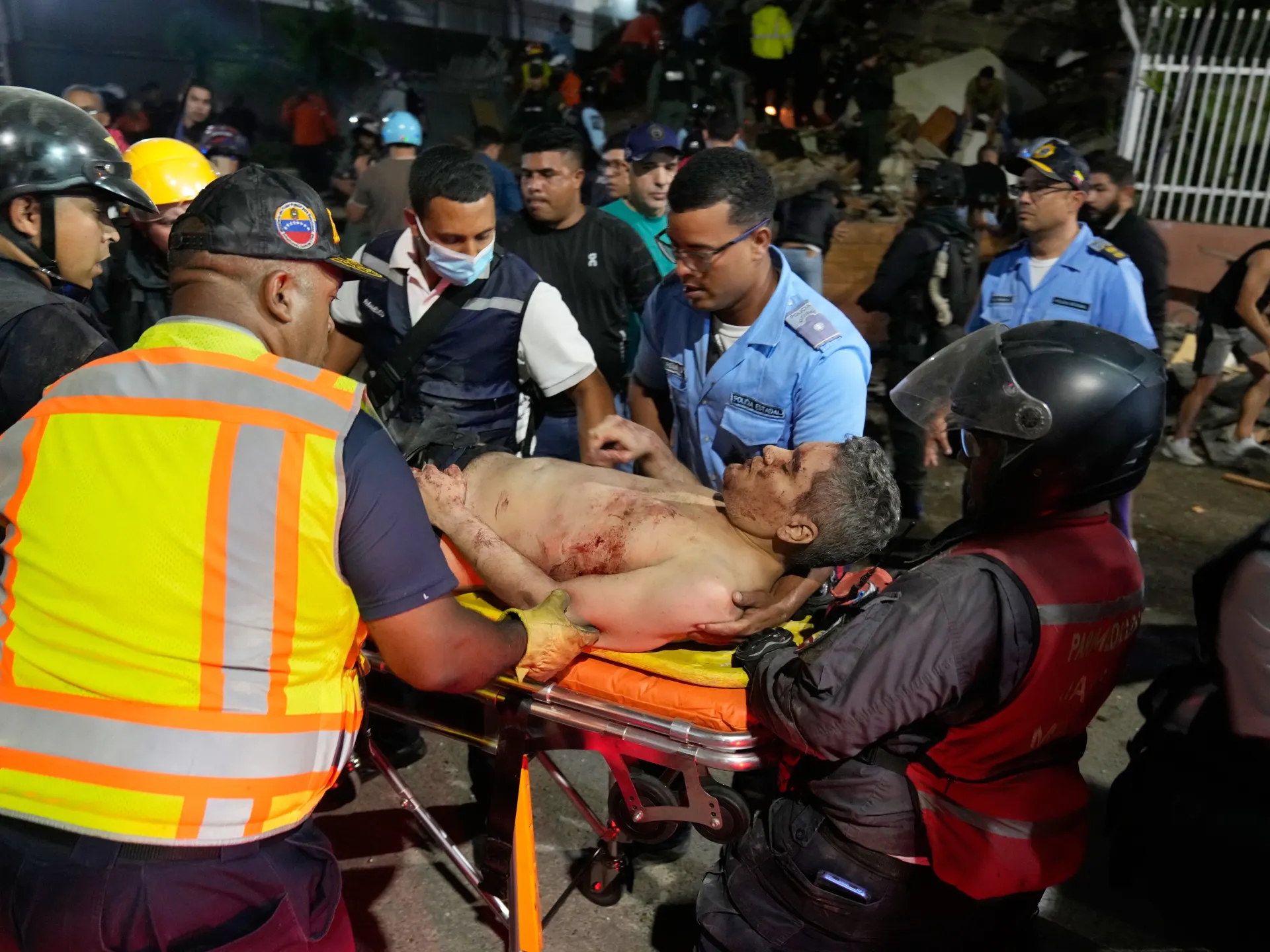
Emergency services, firefighters, and civil protection brigades were immediately deployed. Videos circulated on social media showed collapsed infrastructure in parts of the capital and nearby towns and rescue teams removing rubble to reach survivors.
Reports from the coastal of La Guaira showed completely devastated areas with rows of destroyed buildings.
Acting President Delcy Rodríguez addressed the nation on Thursday night and again in the early hours of Friday, calling for calm and unity in the wake of the natural disaster and declaring a state of emergency.
Rodríguez decreed a suspension of educational and “non-essential” activities, as well as the Caracas metro and suburban trains. The Simón Bolívar airport in nearby Maiquetía was likewise temporarily shut down.
“The priority right now is to save lives,” the acting president told press. “Later we will address the material reconstruction.” Rodríguez gave a preliminary figure of 32 dead and over 700 injured.
The acting president called the situation in La Guaira “a real tragedy” and a “disaster zone” with dozens of collapsed buildings. She expressed condolences to relatives of victims and urged Venezuelans to report missing people or damaged infrastructure via a dedicated phone app.
Rodríguez went on to call on people to evacuate buildings with visible structural damage and urged medical personnel to report to their stations as soon as possible.
During her press conference, Rodríguez thanked multiple countries for expressing solidarity and offering support, and announced the imminent arrival of rescue teams from the US, the Dominican Republic, El Salvador, and Qatar.
US Secretary of State Marco Rubio stated on social media that Washington is “immediately deploying search and rescue teams, medical resources, and humanitarian assistance to Venezuela.”
Caracas additionally received support from Bolivia, Brazil, Cuba, and a host of other nations. Mexican President Claudia Sheinbaum reported that specialized rescue teams are being prepared and that her government is in contact with Venezuelan counterparts.
Some areas of the capital and nearby states remained without electricity hours after the earthquakes. Authorities temporarily disconnected the direct supply of cooking gas to avoid secondary fires.
“That’s how I attracted her, which I think is illegal now,” he told The Times.
They have been married for nearly 30 yearsCredit: Mike LawnGemma first met Gary at a fan eventCredit: Shutterstock
The star continued: “I rang her up and said, ‘Hello, it’s me,’ and she put the phone down – she thought it was somebody playing a cruel trick.”
He called again and was made to prove his identity.
Numan invited her along for a drive for a radio interview – where they had their first date.
He said: “I took her to a Little Chef because I’m very down to earth.
Icon Gary first took his future wife to a Little ChefCredit: GettyThe pair with their offspring back in 2019Credit: Getty
“I don’t do all that flash, rich man, pop star stuff.”
Gary and Gemmadidn’t start their relationship until she was in her twenties.
In 1997, Gary married superfan Gemma from Sidcup and they share three daughters; Raven, 23, Persia, 21, and 19-year-old Echo.
His daughter Persia also added vocals to his song My Name Is Ruin.
Numan revealed that Gemma once told a career advisor: “I won’t need a job. I’m going to marry Gary Numan.”
Gary previously said of their relationship: “This is going to sound corny, given that it’s 30 years and four days since our first date, but I miss her even when she’s in a different part of the house.
“She’s everything I am not – which is most things, really.”
The singer, songwriter – who has an estimated net worth of around £5.5 million – toured last year to celebrate the 45th anniversary of his seminal album Telekon.
Sadly, he suffered the traumatic loss of his beloved younger brother John just after his show in Leeds – which he called the ‘worst news of my life’.
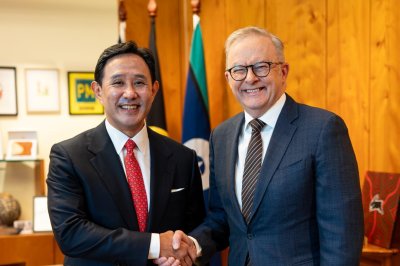
Korea Zinc Chairman Yun B. Choi (L) shakes hands with Australia’s Prime Minister Anthony Albanese at the latter’s office in Canberra on Wednesday. Photo by Korea Zinc
June 25 (UPI) — Korea Zinc said Thursday that Chairman Yun B. Choi visited Australia this week to meet with the country’s Prime Minister Anthony Albanese to discuss ways to strengthen collaboration on critical minerals.
During the bilateral meeting in Canberra on Wednesday, Albanese described U.S. Project Crucible as a valuable model, which the Australian government could benchmark, according to Korea Zinc.
The $7.4 billion initiative involves the construction of an integrated smelter in Clarksville, Tenn. Groundbreaking is scheduled for next year, with commercial production expected to begin in 2029. Toward that end, Korea Zinc cooperates with the U.S. government.
Once operational, the facility will produce base metals such as zinc and lead, along with strategic minerals including germanium and gallium, which are crucial for the semiconductor, defense, and other high-tech industries.
The prime minister also said that Korea Zinc’s business model closely aligns with the Australian government’s resource and energy policy objectives, particularly its efforts to beef up critical industries.
In response, Choi stated that Korea Zinc will keep trying to build a win-win partnership with the Australian government. The world’s largest non-ferrous metals manufacturer operates an Australian affiliate, Sun Metals Corporation.
“Over the past 30 years, we have been a partner that has contributed to Australia’s industries and local communities while expanding beyond smelting into renewable energy and green hydrogen,” he said.
“The synergy between Australia’s abundant resources and our technological prowess and diverse business portfolio will continue to bear fruit in the future,” he added.
The share price of Korea Zinc rose 1.09% on the Seoul bourse on Thursday, while the benchmark KOSPI gained 5.42%.
When the first three people fell sick on Thursday, June 11, residents of Doron Baga were unsure what was happening. The symptoms – vomiting, diarrhoea, and weakness – were familiar enough in a rural community where access to healthcare is limited, and illnesses are often treated at home or by local patent medicine vendors. However, as more people began showing the same signs, and deaths followed within days, concern spread across the community.
Ahmadu Haruna watched the disease move rapidly through his household. He is the community leader of Randa, an area within Doron Baga, a fishing and farming community on the shores of Lake Chad, less than three kilometres from Baga town in Kukawa Local Government Area (LGA) of Borno State, northeastern Nigeria.
He lives in a large compound that houses nearly 150 people, including his four brothers, their wives, children, and grandchildren. Within seven days, he said, at least 20 people living in his compound became ill. Seven died. “It started with three people,” Ahmadu recalled. “One of my brother’s children and another brother’s wife were the first to be infected.”
As cases multiplied, residents began drawing connections to reports they had been hearing from Maiduguri, the state capital, where a cholera outbreak had already overwhelmed health facilities and infected thousands. “We knew it was cholera because the symptoms matched what we heard on [the radio] about the outbreak in Maiduguri,” said Bashir Suleiman, a resident. “The people there were vomiting and having diarrhoea, and that was exactly what we were seeing here.”
The outbreak has unsettled Doron Baga, a community that has spent the last six years rebuilding after it was displaced by the Boko Haram insurgency. Residents were officially resettled in September 2020 by the state government. Many residents say that returning home symbolised the beginning of recovery. Families rebuilt their houses, fishermen returned to the lake, and farmers reclaimed their fields. Gradually, life appeared to be returning to normal. The cholera outbreak, however, has revealed how incomplete that recovery remains.
Cholera, according to the World Health Organisation (WHO), is “an acute diarrhoeal infection caused by consuming food or water contaminated with the bacterium Vibrio cholerae”.WHO), is “an acute diarrhoeal infection caused by consuming food or water contaminated with the bacterium Vibrio cholerae”.
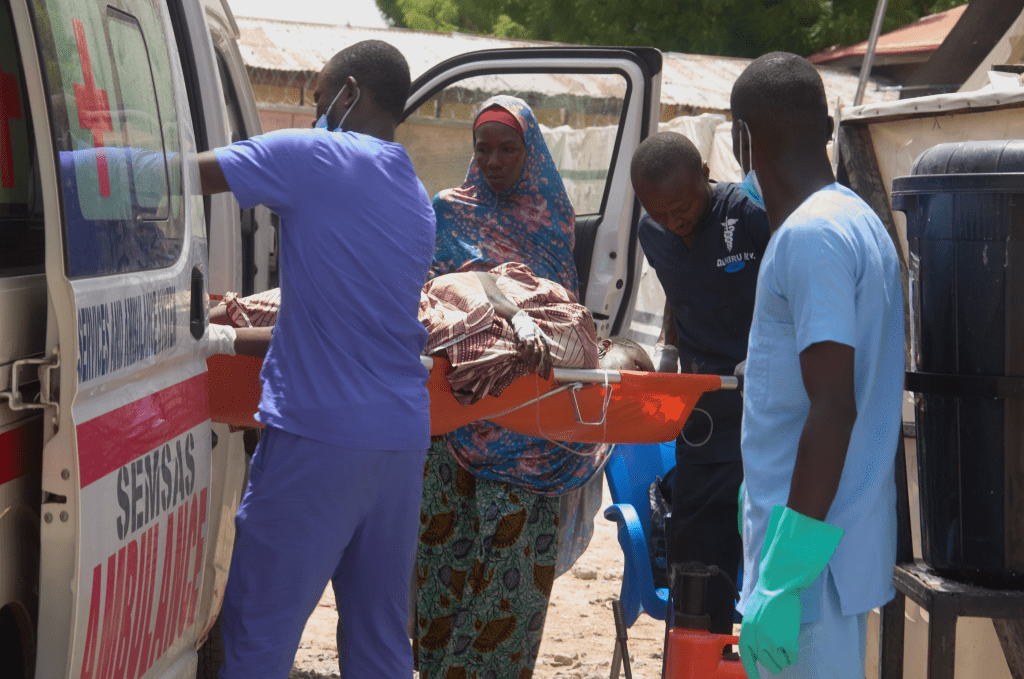
A cholera patient is being carried into a waiting ambulance at an MSF facility by health workers in Maiduguri on Monday, June 8. Photo: Jude Mike/AP.
The disease is not new to communities along the Lake Chad shoreline. In 2018, the Borno State Ministry of Health recorded 502 cases and one death across Baga, Doro, and Kukawa wards. Doro accounted for the highest burden, with 254 reported cases. Response efforts at the time involved the Ministry of Health, WHO, and the Alliance for International Medical Action (ALIMA). Six years later, residents of Doron Baga say many of the conditions that enable cholera transmission remain unresolved.
Access to healthcare remains limited, many households depend on self-built water sources, and sanitation challenges persist in parts of the community.
Unlike many urban households, Ahmadu’s home is a large family compound that functions almost like a small settlement. At its centre is a manually operated hand pump, and near the entrance sits an open well. Built by the family years ago, the two sources continue to supply most of the household’s water needs. “Our main source of drinking water is the hand pump and the open well,” Ahmadu told HumAngle.
The compound also relies on pit latrines. Each household maintains its own facility, while another serves as a communal latrine for residents and visitors.
The source of the infection has not been established. But in a compound where dozens of people share water sources and common spaces, many residents may have been exposed to the same source of contamination. The outbreak also comes during the rainy season, a period when cholera cases often increase as flooding and runoff can contaminate drinking-water sources.
From Maiduguri to Lake Chad
The outbreak that has now reached Doron Baga began hundreds of kilometres away in Maiduguri, where it was first detected in early May. Health authorities had reported more than 2,700 suspected cases and 39 deaths across eight LGAs by mid-May, with Maiduguri Metropolitan Council recording the highest burden.
The spread, according to the international medical humanitarian organisation Médecins Sans Frontières (MSF), overwhelmed treatment facilities, prompting an emergency response from the state government and humanitarian organisations.
As the days went by, the numbers continued to climb. By June 7, Borno had recorded 7,850 suspected cases and 74 deaths across 14 local government areas, according to figures cited by MSF and state health authorities. MSF alone said it had treated 7,439 patients between May 1 and June 7.
To contain the outbreak, the Borno State Ministry of Health and Human Services said it is implementing emergency health measures, improving sanitation, and increasing public awareness. In addition, humanitarian organisations such as MSF and Save the Children have activated emergency responses that include cholera treatment centres, oral rehydration points, surveillance, hygiene promotion campaigns, and water, sanitation, and hygiene interventions. MSF expanded treatment capacity in Maiduguri and opened additional cholera treatment units as admissions surged.
At the height of the outbreak, between June 5 and 7, MSF reported treating as many as 500 patients in a single day. Another organisation, Save the Children, said it was responding to more than 7,000 suspected cases reported across the state. The Nigerian Red Cross also supported awareness campaigns, case management, community sensitisation, and emergency response activities.
For weeks, the outbreak appeared largely concentrated in and around Maiduguri and other major population centres. Then it reached Doron Baga.
An MSF nurse carrying a patient with suspected cholera out of a facility in Maiduguri. Photo: Merel van de Geyn/MSF.
The unfinished work of recovery
As cases spread through Doron Baga, residents and health workers say longstanding challenges in healthcare, water access, sanitation, and public infrastructure have complicated efforts to contain it.
Many residents did not consider the local health facility a realistic option. When HumAngle asked why his family did not immediately seek treatment at the hospital, Ahmadu laughed. “Hospital?” he asked. “Do you expect us to take our sick relatives to a hospital without doctors and drugs?”
Residents say the Doron Baga Primary Healthcare Centre suffers from chronic shortages of personnel and medicines. “There are no staff, too,” Bashir said. “Those coming from Baga don’t spend more than an hour.” As a result, many families depend on patent medicine stores as their first source of treatment.
Get our in-depth, creative coverage of conflict and development delivered to you every weekend.
Subscribe now to our newsletter!
The nearest alternative is Baga town, but the cost of transportation, combined with the expense of purchasing prescribed medicines, often places formal healthcare beyond the reach of many households. “We usually take sick relatives to Baga,” Ahmadu said. “However, we did not take these ones there because it is expensive.”
Residents’ complaints come despite years of government investments aimed at improving healthcare services in the area. During a visit to Baga in July 2023, Borno State Governor Babagana Zulum ordered the rehabilitation of the Baga General Hospital and Doro Primary Healthcare Centre. Residents confirmed that the rehabilitation was carried out.
More recently, in May, Kukawa Local Government Chairperson, Mustapha Kukawa, distributed drugs to healthcare facilities across the LGA and warned against the diversion or mismanagement of medical supplies. At the state level, the Executive Secretary of the Borno State Contributory Healthcare Management Agency (BOSCHMA), Saleh Abba, said on June 4 that the agency had disbursed more than ₦400 million to 171 primary healthcare centres and nine secondary health facilities providing free treatment to vulnerable persons across Borno.
Yet residents of Doron Baga say shortages of staff and medicines persist, raising questions about the extent to which investments in infrastructure, medical supplies, and healthcare financing are translating into accessible services in some resettled communities.
Their concerns reflect a broader pattern documented across conflict-affected communities in Borno. In 2023, HumAngle reported that residents of Kirawa, a resettled border town in Gwoza LGA, frequently crossed into neighbouring Cameroon to access healthcare services. In 2024, residents of Baga and Dalori, another resettled community in the Konduga LGA, similarly complained about inadequate drug supplies and limited healthcare services. That same year, a Premium Times investigation found that despite significant investments in rehabilitating primary healthcare facilities across rural Borno, many communities continued to struggle with staffing shortages and inadequate medicines.
Together, these accounts suggest that while reconstruction has improved physical infrastructure in many communities, ensuring consistent access to healthcare workers, medicines, and essential services remains a challenge in parts of the state.
The primary healthcare centre in Doro was reconstructed two years ago, but the residents say the facility lacks adequate medicine and staff. Photo: Umar Ahmad.
Faced with these realities, many residents turn to informal healthcare providers. One of them is Kasim Muhammad Auwal, a patent medicine vendor and community health worker who has operated in Doron Baga since the community was resettled.
“I have recorded 40 cases so far,” Kasim said. “Most have recovered. Four have died.”
Kasim holds a diploma in community health from the College of Health Technology in Maiduguri and believes that sanitation may also be contributing to the outbreak. “One major thing I have observed is increasing open defecation in the community,” he said. “This, I suspect, is the leading cause.”
According to him, the practice is particularly common among children, residents living on the outskirts of the settlement, and visiting fishermen from neighbouring communities.
Public health research supports concerns about the relationship between water, sanitation, and cholera transmission. The WHO identifies contaminated drinking water and inadequate sanitation as major drivers of cholera outbreaks, while studies have linked unprotected wells and poor sanitation practices to increased infection risks.
Like Ahmadu’s household, many residents rely on self-built infrastructure, including open wells and manually operated pumps, to meet their daily water needs. Although these sources may serve communities for years, they can become significant public health risks during disease outbreaks. Studies consistently show that communities dependent on untreated water and limited sanitation infrastructure face a higher risk of waterborne diseases.
Children fetch water at a manually operated pump in the Randa area of Doron Baga. Photo: Umar Ahmad.
As cases spread through the community, humanitarian organisations also began carrying out preventive measures. Residents said volunteers from the Nigerian Red Cross and other organisations had conducted sensitisation campaigns, educating households about cholera symptoms, hygiene practices, and ways to reduce transmission.
A Red Cross volunteer in Kukawa confirmed that awareness activities were ongoing in the community but declined to comment officially, saying he was not authorised to speak on behalf of the organisation.
As of June 23, residents said new suspected cases were still being recorded in the community and that additional deaths had occurred in recent days, indicating that the outbreak had not yet been fully contained. They also said at least 11 patients were receiving treatment at the Doro Primary Healthcare Centre. HumAngle could not independently verify a community-wide death toll.
Residents say most of the staff at Doro Primary Healthcare Centre come from Baga, a town three kilometres away. They leave by 3 p.m. and the burden of catering for the sick falls on volunteers and patent medicine vendors. Photo: Umar Ahmad.
For many residents, the persistence of new cases points to challenges that extend beyond emergency response efforts. Community leaders like Ahmadu say the conditions facing Doron Baga are rooted in a longer history of conflict, displacement, and uneven recovery.
The community was among several settlements around Lake Chad that were emptied by years of insurgency before residents gradually returned under the state’s resettlement programme. Yet rebuilding communities after conflict involves more than restoring security. Across Borno State, reconstruction projects have frequently been disrupted by insecurity, while healthcare, water, and sanitation infrastructure have not recovered at the same pace as population returns.
Studies of recurrent cholera outbreaks in northeastern Nigeria have identified weak water infrastructure, sanitation gaps, poverty, displacement, and fragile health systems as recurring risk factors. Researchers argue that outbreaks often reveal deficiencies that remain hidden until disease transmission occurs.
In Doron Baga, the current outbreak has done exactly that.
An ITV show starring GK Barry and Reverend Richard Coles has reportedly been dropped by the network after the duo filmed the pilot episode for the series
GK Barry and Reverend Richard were set to star in their own series(Image: ITV/REX/Shutterstock)
During their time in the Australian jungle, GK, who found fame online, and Church of England vicar Richard instantly struck up a bond and became inseparable, and a fan-favourite duo.
Last year, GK confirmed that the project was in the works and revealed that the pilot episode had already been filmed. But ITV has decided not to go ahead with the full series.
“There were high hopes for the project because producers were excited by the dynamic between GK and Richard, not least because it seemed to amuse viewers,” a source said.
They added to The Sun: “They enjoyed the idea of the wise older man interacting with the streetwise millennial as they explored some pretty deep subjects.
“But after provisional filming took place, it was decided not to proceed with it as a series, much to the disappointment of everyone involved.”
Speaking last year, GK hinted that she would even rope her footballer girlfriend, Ella Rutherford, into the show. She told Attitude Magazine : “We are exploring walks of life from two different generations — one from a gay godly man and a gay ungodly woman.
“There are some depressing bits in there, but one thing about me is that I will make a joke about it.” She went on to add: “We’ve filmed the pilot, so if we film the full series, then I will force this girl into it.”
Richard went on to say: “Me and GK struck up the best of friendships and I’m happy to say we’ve taken that with us out of the jungle into the wider world.” But he later joked that viewers could see something “surprising with coffins.”
And GK even said on social media that it had been “a dream” working with Reverend Richard on the show. On Instagram, the influencer said: “Working with you has opened my eyes to worlds I’d never heard of or dreamt of before.
“Some of them have been nightmares, but some of them have been dreams — and today has been a dream.” Sadly, it remains unclear why ITV bosses decided to pull the show after shooting the pilot episode.
During her stint in the jungle, GK opened up about her experience and said that she hadn’t expected to become close with Richard before they became friends. Speaking in the Bush Telegraph, she said: “I came into this jungle maybe not knowing who I would gel with or who I would be close with in here, and never in a million years if you told me that I would be getting on best with a reverend would I have believed you.
“But, he is honestly… I think he might be my favourite person in here.” Meanwhile, Richard said of their bond: “We got on so well and it was such an unlikely friendship and people seemed to enjoy it.
“I like visiting her world and trying to figure out what’s going on and I think she quite likes visiting my world, so maybe a little trip together would be fun to do. I love the TV reality format because you always have a ‘bromance’, but I’ve never had a bromance with a 25-year-old lesbian before, and that’s great.”
A Komoto official tests the company’s solar-powered smart flow control system in Kazakhstan. Photo by Komoto
SEOUL, June 25 (UPI) — South Korea’s industrial valve maker Komoto said Thursday that it is seeking to expand into the Kazakh market after wrapping up a field demonstration project in the Central Asian country.
The company said that it completed the installation and operational tests of its solar-powered smart flow control and SCADA system at a demonstration site in Kazakhstan.
Short for supervisory control and data acquisition, SCADA is an industrial automation system that enables operators to monitor, control, and collect real-time data from infrastructure remotely.
Following the successful trial, the system received final field performance certification from Kazvodkhoz, Kazakhstan’s state-owned water resources agency, according to Komoto.
The firm noted that the project confirmed the applicability of its technology to remote agricultural waterways and irrigation facilities not only in Kazakhstan but also across Central Asia.
Komoto CEO Ryan MK Ko said that the company plans to expand its presence in overseas water industry markets, particularly in Central Asia.
“Our biggest competitive edge is that our system allows for the stable operation of water management facilities even in remote areas with limited access to commercial power and communication infrastructure, while significantly reducing costs compared with conventional options,” Ko said in a statement.
“Based on the technology and operational data accumulated through pilot projects both at home and abroad, we will further advance our automated control and intelligent water management features,” he added.
Komoto is not publicly listed. It was founded in 1988 with technology and capital support from Motoyama, one of Japan’s leading manufacturers of industrial equipment, including valves.
Problems with after-death care came to light after the parents of Harriet Hawkins, who was stillborn at NUH in 2016, discovered her body had been allowed to decompose so badly that it had to be triple-bagged for her funeral.
A subsequent investigation found 17 areas of concern and prompted an examination by the independent maternity review into the after-death care provided to 16 other babies and one mother.
They found that one early gestation baby had been disposed of as clinical waste, the wrong baby had been passed to funeral directors and a mother who died had deteriorated so badly that her family were advised not to see her prior to her funeral.
“The Review found evidence of recurring examples of failure to protect the dignity of the deceased… including inadequate arrangements for undertaking paediatric post-mortems,” Ockenden said in her report.
The problems prompted the Human Tissue Authority (HTA), which regulates mortuary care in England, Wales and Northern Ireland, to examine the trust’s services.
In an unannounced inspection, external, which was carried out in March 2026 but only published this week, it found three critical, six major and one minor shortfalls against its standards at the two hospitals run by the trust, the QMC and City Hospital.
The HTA found lack of freezer space at both Nottingham hospitals meant some bodies had been put in a refrigerated area instead.
Eight of the bodies were showing “advanced deterioration” because they had not been transferred to a freezer in time.
Instead of being conducted in a post-mortem suite, some baby post-mortem examinations were carried out in a lab that was inadequately ventilated, with support staff who had not been trained in mortuary care, the HTA found.
An accompanying audit found just more than half of the 145 recorded incidents that should have been escalated to the regulator were not.
As the destructive Bobcat fire sent plumes of smoke billowing from the Angeles National Forest in 2020, Ryan Huling recalled that at the time news reports claimed the blaze caused “no injuries” and that no homes had been destroyed.
That irked the Sierra Madre writer, who watched from his cabin as flames incinerated the home of bears, coyotes, pumas and squirrels. He believes countless critters were killed or maimed by flames, and points to accounts of mountain lions emerging with singed paws and bears scrambling into communities.
“Anonymity has done them no favors, in the sense that people don’t know where they live, they don’t know what landmarks are important to them, they don’t know what areas carry special significance to bears and other animals,” Huling said.
Yet through his research he discovered that rapidly advancing technology — including artificial intelligence, GPS tracking and crowdsourcing — is revealing more about animal “societies” than ever before. The revelation launched him on a worldwide tour of non-human communities, culminating in his debut book, “The Hidden Nations of Animals.”
The cover of Ryan Huling’s first book, published in June.
(Penguin Random House)
Published this month, the book’s first chapter takes readers to North America’s “beaver belt,” roughly 1,100 miles in northern Canada that are jam-packed with beaver dams. According to Huling, the sheer density of those dams only became apparent thanks to technology that allows researchers to analyze high-resolution satellite imagery and identify them from space. One analysis found 2,700 dams surrounding a town of only about 1,000 people.
Another stop took him to Zambia, where African mole-rats dig complex tunnel systems that include designated nurseries, pantries and bathrooms. Just before Huling arrived, a researcher had used radio trackers to determine that the subterranean animals operate on a biological clock that has them alternate between a few hours of activity and a few hours of napping — not a bad work schedule!
Some of Huling’s other adventures include exploring a tornado of Mexican free-tailed bats outside of San Antonio and red-crowned cranes that have found refuge in the Korean Demilitarized Zone.
But uncovering these hidden worlds isn’t just left to the experts anymore. While the expense or difficulty of tracking wild animals has resulted in knowledge voids in the past, crowdsourcing is helping to fill in the gaps.
Today, any smartphone-toting nature lover can snap a photo of a great horned owl or a ground squirrel and upload it to a citizen science app such as iNaturalist. Some platforms are specialized, for example Merlin for birds and Happywhale for marine mammals. All that data is a rich playground for scientists. According to an article published last year in BioScience, iNaturalist data in peer-reviewed research grew tenfold in the previous five years.
Now, AI is making it so humans don’t have to necessarily look at the raw material. Instead, AI can mine images, videos or sound clips for the appearance of an animal of interest — or even catalogue individual critters. Happywhale has an AI feature that identifies particular humpbacks by unique patterns and shapes on their tails.
Technology is advancing so fast that Huling said it was hard to stay current. In his prologue, he mentions a researcher showing him a prototype of a teeny solar-powered radio tag for monarch butterflies. By the time the book hit the shelves, the concept was already live — harnessed, in one instance, to study how the brilliant orange insects use overwintering groves along the California coast. Just this week on Instagram, the California Department of Fish and Wildlife highlighted a study in which rare bumblebees are tagged with minute QR codes that can be read by remote cameras.
After about a half-year of travel, Huling returned home with a heightened awareness of what he calls “inconspicuous abundance” — that the world is teeming with more life than meets the eye. He puts this new lens to the test by venturing to the storm-battered shores of San Miguel Island off the coast of Santa Barbara. Considered “uninhabited” in the traditional sense, he finds that the rarely visited corner of Channel Islands National Park is a haven for lumpy seals, glimmering fish and squawking seabirds. Sharks lurk beneath the waves.
“For them, as now for me, this distinctive island remains anything but deserted,” he writes.
On San Miguel Island, Huling saw and heard hundreds of sunbathing seals and sea lions.
(Oliver Uberti / Penguin Random House)
In other animal news
Earlier this month, in Big Bear Lake, a memorial service was held for Sandy Steers, the late conservationist who was best known for turning two bald eagles into an international phenomenon by livestreaming their nest. It was a touching gathering, where Steers’ friends and colleagues got personal about a woman who they said was willing to go to the mat for her beloved raptors.
An illustration for “Hidden Nations” depicts author Huling at home, surrounded by the natural environment — including a black bear.
(Oliver Uberti / Penguin Random House)
For decades, Steers battled a planned development near the nest of famed eagle couple Jackie and Shadow, and helped to negotiate an agreement in which a land trust could buy the site for $10 million. The nonprofit she led is now racing to raise the money by July 31 so it can be bought and conserved.
In the desperately needed good-news department, endangered steelhead trout that scientists feared had perished in last year’s Palisades fire unexpectedly survived — and even had babies. It’s a big deal: they represent the last known population of steelhead in the Santa Monica Mountains.
A civil grand jury has found that the L.A. Zoo needs new leadership, citing deterioration of its facilities and rapidly declining membership. In less than a year, membership dropped 23% and exhibits for lions, bears, sea lions and pelicans have closed because they need major renovations.
Last summer, researchers made an astonishing discovery off the Sonoma County coast — 18 sunflower sea stars, a species decimated by disease and all but gone from California waters. SF Gate writes that the finding was only just announced, with scientists now racing to learn all they can about the survivors. As previously reported, the stars with up to 24 arms could hold the key to restoring the state’s ravaged kelp forests.
And news about the environment
This is the latest edition of Boiling Point, a newsletter about climate change and the environment in the American West. Sign up here to get it in your inbox. And listen to our Boiling Point podcast here.
The price of Brent crude has reached its lowest since February 27, before the war started.
Published On 25 Jun 202625 Jun 2026
Oil prices have extended their decline to levels last seen before the start of the Iran war, as expectations of rising supply from the Middle East outweighed demand concerns.
Prompt-month Brent crude futures for August delivery fell $1.06 (1.44 percent) to $72.68 a barrel by 06:39 GMT, while US West Texas Intermediate (WTI) lost 76 cents (1.08 percent) to $69.58 a barrel.
Recommended Stories
list of 4 itemsend of list
Both contracts hit their lowest since February 27.
August Brent was trading lower than September, which was priced at $73.59, signalling ample short-term supply.
Brent had fallen by more than $3 on Wednesday as supply concerns eased, while WTI settled down nearly $3.
US Energy Secretary Chris Wright told a forum that flows through the Strait of Hormuz were close to those before the start of the Iran war, with at least 20 million barrels having exited the strait in the past 24 hours.
A return to complete normality would take a few weeks, however, because the strait needs to be cleared of mines, he added.
Rising Middle East supply, together with Iran set to boost sales after a temporary reprieve from US sanctions, drove down prices of physical crude oil cargoes around the world.
New routes
An initial accord last week to end the US-Israeli war with Iran, which began on February 28, has allowed the resumption of traffic through the strait.
The accord set up a 60-day period of negotiations to tackle tougher issues, such as Iran’s nuclear programme.
Wright said oil would continue to flow through the strait even if the deal did not hold, and that Iran would not be able to close it again.
Tehran has said it plans to impose what it calls maritime service fees, as opposed to tolls, while the United States argues it is an international waterway and therefore should not be charged.
Oman opened temporary routes on Wednesday to ease tanker departures from the strait, with the International Maritime Organization and Omani authorities coordinating movements.
On Thursday, Iran’s Revolutionary Guards warned against any crossings of the Strait of Hormuz without authorisation, saying vessels not complying “will be dealt with” and condemning the new routes.
Weekly insights and analysis on the latest developments in military technology, strategy, and foreign policy.
Oman and the U.N. International Maritime Organization (IMO) are sharpening up their plan to evacuate hundreds of ships still stuck in the Persian Gulf since Iran closed the Strait of Hormuz after being attacked by the U.S. and Israel on Feb. 28. The move comes as shipping traffic in this strategic chokepoint is increasing amid tense ongoing peace negotiations between the U.S. and Iran. However, there is still a very long way to go and many challenges, including the possible presence of mines, to overcome before transits reach pre-war levels.
“The Sultanate of Oman based on its responsibilities toward the Strait of Hormuz, and its importance to the global economy, and in accordance to its continued commitment to the international law and the law of the sea to ensure freedom of navigation in the strait without imposing any tolls, in line with the outcomes and efforts reached by the United States and Islamic Republic of Iran…has worked in coordination with the International Maritime Organization (IMO) to provide vessels with the option of a temporary maritime corridor defined by the coordinates announced by IMO and Omani authorities. Ships willing to transit must coordinate with IMO,” Oman’s Maritime Security Center stated Wednesday on X.
“This large-scale operation will be carried out in close cooperation with Iran, Oman, all other coastal States in the region, the United States and the maritime industry,” according to the IMO.
The Sultanate of Oman, in coordination with IMO is providing a shipping transit corridor in the Strait of Hormuz. pic.twitter.com/6MVVLmVjRN
— مركز الأمن البحري| MARITIME SECURITY CENTRE (@OMAN_MSC) June 24, 2026
IMO on Wednesday issued additional guidance to what it is calling an “evacuation” plan and noted that there are two routes for ships transiting the Strait. The northern route, close to the Iranian shoreline, is controlled by the Islamic Republic of Iran while the southern route, along the Oman coastline, is coordinated with U.S. authorities.
Regardless of which route ships prefer, IMO is cautioning them to “remain in their current position and await further instructions.”
Vessels have to wait to “allow safe sequencing, avoid congestion, and mitigate risks related to mines and degraded navigation conditions,” IMO added. “Movements will only begin once vessels are contacted through the coordinated mechanism involving IMO, UKMTO, and MICA Center, followed by coastal State coordination.”
As for current mine clearance operations, CENTCOM would not offer details about how they are being carried out.
“I won’t go into specifics for operational security reasons,” Navy Capt. Tim Hawkins, CENTCOM’s spokesman, told us Wednesday morning. “We’ve been at this for a number of weeks and we’re making progress, as demonstrated by the safe passage currently available to commercial vessels and enabling traffic flow to pick up.”
All this comes after tensions surrounding the Strait erupted again last week, with the Islamic Revolutionary Guard Corps saying it was being closed again after Israeli attacks on Lebanon and CENTCOM maintaining it was open.
Trump on Wednesday took to Truth Social to dispel what he claims are inaccurate media accounts about the Strait.
“Iran has informed the U.S. that, despite troublemaking Fake News reporting to the contrary, there are ‘NO TOLLS, NO INSURANCE COSTS, & NO OTHER CHARGES OF ANY KIND BEING SOUGHT OR RECEIVED BY IRAN ON SHIPS TRAVELING THE STRAIT OF HORMUZ,’” Trump proclaimed. “If this is false information, negotiations would end, immediately!”
Trump: Iran has informed the U.S. that, despite troublemaking Fake News reporting to the contrary, there are “NO TOLLS, NO INSURANCE COSTS, & NO OTHER CHARGES OF ANY KIND BEING SOUGHT OR RECEIVED BY IRAN ON SHIPS TRAVELING THE STRAIT OF HORMUZ.” If this is false information,… pic.twitter.com/3bYur1t71o
TWZ cannot independently confirm any of these statements; however, ship tracking organizations on Wednesday say commercial vessels have been transiting the Strait at increasing rates, though far from what they were before the war.
“Vessel activity through the Strait of Hormuz has rebounded sharply across two consecutive weekends, pointing to a clear shift in traffic patterns through one of the world’s most critical maritime chokepoints,” the MarineTraffic website stated on X Wednesday. “According to #MarineTraffic data and Kpler data, confirmed crossings rose from 32 vessels between 12–14 June to 93 vessels between 19–21 June, an increase of 61 crossings week-on-week.”
The biggest change came on Saturday, MarineTraffic noted, “when crossings jumped from 3 to 42 compared with the previous weekend. The recovery has been supported by recent diplomatic developments and a temporary OFAC general license, which has helped ease immediate compliance uncertainty around approved Hormuz transits until 21 August.”
When it comes to oil, at least 20 tankers carrying 35 million barrels have exited the Persian Gulf through the Strait of Hormuz since the U.S. and Iran agreed to open the sea lane, according to data provided by Kpler.
Strait of Hormuz traffic remains active, but recovery stays cautious
Confirmed vessel activity through the Strait of Hormuz remained steady on 23 June, with 31 verified crossings recorded across commercial and energy-linked vessels. According to #MarineTraffic data, west-to-east… pic.twitter.com/dz3o9OWRJx
Still, two major shipping companies we spoke with remain cautious about transiting the Strait.
Maersk referred us to a statement they gave TWZ last week saying that the announcement about the U.S.-Iran Memorandum of Understanding “is a welcome and positive development, but publicly available details are still limited, and it is too early to assess how it will impact logistics and maritime operations in the Middle East. At this stage, there are no changes to our operations in the region.”
On Wednesday, a company spokesman told us Maersk still has five ships stuck in the Persian Gulf.
Hapag-Lloyd is also taking a wait-and-see attitude.
“Our vessels are ready for a transit, but we will only sail through the Strait of Hormuz when it is safe to do so,” a company spokesperson told us, declining to say how many ships it still has in the Gulf.
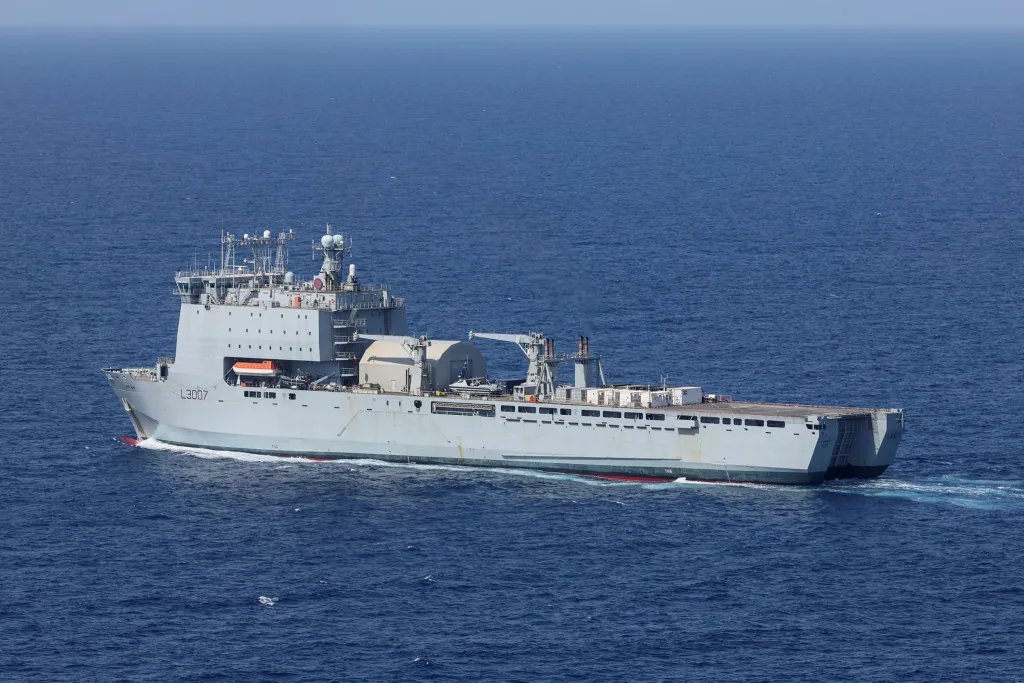
Meanwhile, the Royal Navy’s RFA Lyme Bay and two German warships have transited the Red Sea in case they are needed to help remove mines from the Strait of Hormuz. The Lyme Bay, “now configured as an Afloat Forward Support Base for mine countermeasures, transited the Suez Canal on 19th June and then passed south through the Red Sea,” the Royal Navy (RN) noted.
Royal Navy
The ship carries uncrewed surface vessels (USVs) with towed sonar arrays and AI automatic target recognition that can “filter and refine vast amounts of data allowing operators to speed up the process of classifying and neutralizing mines,” according to the RN.
Lyme Bay also has “Video Ray Defender-Viper portable mine disposal submersibles, capable of locating, identifying and destroying mines.”
There are also mine warfare, diving and explosive ordnance disposal specialists on board to assist the mine clearance mission.
Royal Navy Ariadne uncrewed surface vessels (USV). (Royal Navy)
Lyme Bay was accompanied by the German command and support ship FGS Mosel and minehunter FGS Fulda.
However, those vessels “detached from the task group on 23 June to head for Djibouti for resupply and further preparation,” according to Navy Lookout, an independent publication focusing on the Royal Navy. “They currently operate under the European Union mission Operation Aspides, which has the sole aim of defending merchant shipping against Houthi attacks in the Red Sea.”
We have reached out to the German Bundeswehr and Aspides for additional insights.
Amid the renewed flow of traffic through the Strait, oil prices have plummeted in recent days. As of Wednesday morning, Brent Crude was trading at just under $74 a barrel, according to OilPrice.com. That’s down from a high of more than $114 per barrel at the height of U.S.-Iran tensions in early May.
U.S. crude oil inventories fell by 6.1 million barrels last week, pushing stockpiles to 412.1 million barrels—7% below the five-year average. Despite the bullish draw, oil prices fell sharply as traders focused on easing Middle East supply risks. #Oil#CrudeOil#EIA…
How long oil prices continue to fall is an open question as the U.S. and Iran continue to express disagreements over the terms of a final Iran-U.S. peace deal following the MoU signed last week.
In addition to the aforementioned confusion over the status of the Strait, there is ongoing discord over whether Iran has agreed to allow inspection of its nuclear facilities. Trump and the International Atomic Energy Agency (IAEA) both say Iran has agreed to let inspectors in while the Iranians say that isn’t the case.
President Trump said Iran agreed that it will “never have a nuclear weapon” during his visit to a Pennsylvania’s Mack Truck facility on Tuesday. He also said “19 million barrels of oil flowed out of the Strait of Hormuz” on Monday, which he said is “the most oil in the history of… pic.twitter.com/ycsILtZRpq
Meanwhile, both sides have issued bellicose threats against the other as the often acrimonious negotiations for what is essentially an extension of the ceasefire continue.
As we have noted in the past, there is tremendous global and domestic pressure on Trump not to resume the war. The world economy is only beginning to recover from rising oil prices while Trump’s Republican party faces a midterm election in November made challenging by the unpopularity of this conflict. In addition, forces have now been deployed for many months and will have to be rotated out in the coming weeks.
Regardless, while getting vessels finally out of the Persian Gulf is still a priority, when robust two-way transits will return is still unclear, which will be critical to stabilizing the situation economically and geopolitically.
Diego Cano-Lasso had been looking for an architectural project when he found two hillside lots with spectacular views for sale in Mt. Washington. With work scarce in 2012, the SCI-Arc graduate persuaded his family to invest in the property, and together they bought the two plots for $95,000.
“We are not developers,” he says, “but sometimes you have to jump.”
He didn’t realize the Mt. Washington project would take 12 years to complete, including a shutdown during the COVID-19 pandemic, or that he, his family and friends would end up doing much of the work themselves.
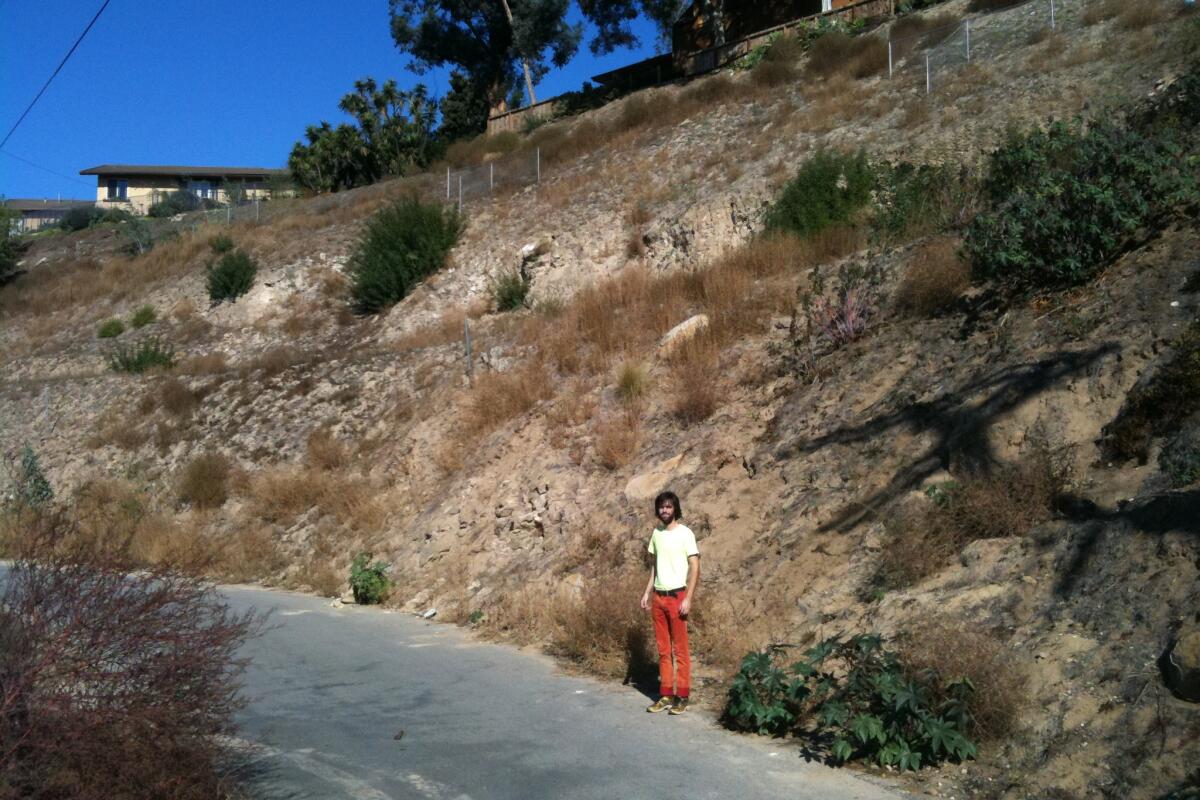
Diego Cano-Lasso stands in front of the hillside lots in 2012. (Hassan Ismail)The lots today.(Myung J. Chun / Los Angeles Times)
As a fan of Los Angeles’ Midcentury Modern architecture, he imagined designing and building a post-and-beam dream home next-door to a similar home by his aunt Lucia Cano and her husband, José Selgas, of the Madrid architecture firm SelgasCano, stretching over the hillside and connecting to the city below.
“It’s why I moved here,” Cano-Lasso says. “Midcentury design was like a dream to me, because it’s not just an architectural style; it’s a lifestyle.”
But his dream quickly hit a snag when the geotechnical engineer arrived in Mt. Washington to assess the site.
“He said the plots were unbuildable,” Cano-Lasso recalls. “He told me, ‘It is impossible. We cannot even do the soils report, because a big machine can’t fit up here on these narrow streets.’”
Eventually, Cano-Lasso found someone who visited the site and said, “No problem.”
La Canaria House by José Selgas and Lucia Cano features canary yellow aluminum tubes.
Cano-Lasso and his wife, Belén Rodero, in the open kitchen and living area of La Canaria House.
Then the city told him that he didn’t have the right to build on the property. To get permission, Cano-Lasso and his family would need to widen the narrow street, put in a sewer system and add a power pole.
Permits were just as difficult. According to Cano-Lasso, neighbors complained about the project, and the city bureaucracy dragged out the process for three years.
Eventually, he and his crew began digging into the hillside and moved more than 120 truckloads of soil through the steep, narrow streets of Mt. Washington. Without a general contractor, they managed construction themselves and hired different crews for each job.
When COVID-19 hit, construction on the project stopped, and Cano-Lasso returned to Spain. Construction did not restart until 2022, by which time the construction industry had changed and the project felt even more challenging to complete.
“Everything cost more, and there weren’t enough skilled workers,” Cano-Lasso says. As a result, Juan de Santiago, the master builder Cano-Lasso hired and calls “paramount to the project,” was too busy to finish the houses, which had windows and drywall but still needed finishing.
“The only way we could do it was by doing most of the work ourselves and with friends,” Cano-Lasso says.
With help from his brother Alejandro Cano, who is also known as Cato, and his wife, Belén Rodero, they handled everything from carpentry and metal work to lighting, wall finishes, flooring, painting, furniture, custom garage doors and landscaping.
“What I didn’t realize at the time — not even when hundreds of boxes of Moroccan tiles showed up at our door in Madrid — was that I was signing up for both a crash course and a career in tiling,” Cato says of designing murals for three of the Cano Home’s four walls. “I wasn’t expecting to lay a single tile, let alone take on the filing, sanding, rearrangement and all the care and attention required when most tiles come in odd sizes.”
Seven years and plenty of mishaps later, including the time a truck got stuck on the narrow, winding streets of Mt. Washington hauling 42-foot wooden beams, Cano-Lasso finally has a finished home that feels peaceful and warm.
With eye-catching details everywhere, the 2,250-square-foot homes feel relaxed and reflect the style of a Spanish designer inspired by Frank Lloyd Wright and Rudolph Schindler. (Cano-Lasso once lived in Schindler’s Sachs apartment in Silver Lake.) The open floor plan, designed by his father, Spanish architect Diego Cano Pintos, features warm oak floors, inexpensive radiata pine walls and ribbed wood ceilings.
“I am enjoying witnessing the house being lived in,” Cano-Lasso says of renting his house to music producer Jennifer Jimenez and interior designer Hanna Li, pictured right.
The rooms of the Cano House are filled with colorful art, accessories and custom furniture by Andrew Riiska and Cato. “Although we were working toward a deadline on a project that had already been under construction for several years, most pieces of furniture were designed and fabricated on site, with the conviction that we were building something special,” Cato says of setting up a furniture workshop in the garage.
Ceramic rain gutters from Ceramiques Est in Spain have been repurposed as wall-mounted light fixtures for indoor use. Door handles are made from stones found on the beach, and glass light fixtures by Luz Mixtura in Spain echo Robert Irwin’s disc installations. Large boulders from the excavation were brought inside to serve as furniture. Built-ins were made in Spain and shipped to Los Angeles in three containers. Outside, the house is covered in shou sugi ban charred-wood siding, which they installed themselves.
Both homes have similar structures and layouts with four bedrooms and four bathrooms, but La Canaria House features canary yellow powder-coated aluminum tubes inspired by California sunsets, while the Cano House is minimal and warm. “The homes are all about the beams,” Cano-Lasso says, which makes them look like they are floating above the city.
The neutral rooms feel warm and simple, with striking pops of yellow that reflect Southern California’s sunshine and decks that allow a smooth flow from indoors to outdoors.
Li, left, and Jimenez in their music room. The custom DJ workstation, designed by Li, is clad in ceramic tiles designed to look like plywood.
Behind the Cano House, Cano-Lasso created a narrow outdoor space with built-in banquette seating, a raised-bed herb garden and a water fountain. Now the house opens up to the outdoors, making it easy to entertain. “The garden is the coolest feature,” he says. “It really makes the house feel special.”
In some ways, the modern design has revived the midcentury ideal by using post-and-beam construction, an open floor plan, simple materials and easy indoor-outdoor access, all with Cano Lasso’s artistic touch.
But finishing the project also left Cano-Lasso with the large debt he took on — he estimates the project cost about $1 million, although he saved around 40% by acting as his own contractor.
Cano-Lasso and his wife divide their time between La Canaria House and a project in Venice, so he is renting out his dream house to interior designer Hannah Li and music producer Jennifer Jimenez, who grew up together in Pasadena.
Li descends the spiral staircase to the music room on the first floor.
Renting such a personal project might seem overwhelming for the tenants, since the rental included some of Cano-Lasso’s custom furnishings, but the two have made the house their own. They added a striking listening room on the first floor, with a turntable lined with ceramic tiles designed by Li to resemble plywood.
“We’re all artists in this house,” Jimenez says. “We’re always creating here, and other music producers often come over to make music and jam with us. It’s such an inspiring, creative space.”
“It’s a very comfortable house,” adds Li, who enjoys practicing archery on the terrace deck.
The friends’ rental is filled with treasures from their travels, along with pieces Li designed specifically for the home. Li turned one of the first-floor bedrooms into a cozy study by paneling the walls with wood and adding textiles she collected on her trips.
Recently, they hosted a birthday party with art-making stations, candle-making and even goats and they invited their landlord. “Mt. Washington has so many artists, so it’s wonderful to bring everyone together,” Li says.
Cano-Lasso, greets Jimenez, center, and Li on their side-by-side terraces.
When asked if he might consider tackling another hillside project, Cano-Lasso laughs.
“When I finished, I said, ‘I will never do that again,’” he says. “Now I’m starting to think there’s a plot of land for sale nearby. We installed a sewer line, so why not take advantage of it?”
Despite his debt, he isn’t planning to sell the house. “In a way, the project doesn’t finish with construction; I am enjoying witnessing the house being lived in,” he says. Even if he’s not the one living in it.
Condolences and offers of help have been pouring in from countries around the world following back-to-back powerful earthquakes in Venezuela that have killed at least 32 people.
The United States Geological Survey (USGS) said on Thursday that the first earthquake, measuring magnitude 7.2, struck west of Moron, about 168km (104 miles) west of Caracas. A second tremor of magnitude 7.5 hit near the same area just a minute later. The USGS warned that “high casualties and extensive damage are probable” and that the “disaster is likely widespread”.
Recommended Stories
list of 3 itemsend of list
Acting President Delcy Rodriguez declared a state of emergency and said the Simon Bolivar International Airport in Caracas is closed due to damage.
Here’s how countries have reacted:
Argentina
The presidency issued a statement expressing “its deepest solidarity” with the Venezuelan people. It said President Javier Milei “extends his hand in solidarity” amid the natural disaster, “despite any differences that may exist between our governments”.
Bolivia
President Rodrigo Paz said that the people’s “hearts go out to the affected families” in Venezuela, and that the country “remains vigilant and ready to provide any necessary support”.
Brazil
President Luiz Inacio Lula da Silva said he has instructed the Foreign Ministry and the embassy in Caracas to evaluate what assistance Brazil can provide.
Colombia
The country’s District Institute of Risk Management and Climate Change says it has activated its emergency response team and reached out to Venezuelan authorities to “coordinate the necessary technical and operational support”.
“The goal is to provide all necessary assistance and make our teams available to support this situation,” the disaster response agency said in a post on X.
“We also want to reassure the residents of Bogota: following the earthquake felt in the capital, no damage or structural damage has been reported. The city is operating normally.”
Cuba
Foreign Minister Bruno Rodriguez says Cuban health workers in Venezuela “are fully mobilised and providing medical services to the affected population”.
In a post on X, Rodriguez expressed his “deepest condolences and solidarity to the government and brotherly people of the Bolivarian Republic of Venezuela for the loss of life and damage caused by the earthquake”.
Ecuador
President Daniel Noboa has announced Ecuador is rapidly deploying humanitarian assistance to Caracas.
“I have arranged for the immediate sending of humanitarian aid to address this emergency,” he posted on X. “Ecuador will respond with the speed and commitment that this moment demands because, despite the enormous differences, humanity must always guide the actions of a leader.”
El Salvador
President Nayib Bukele has said his country has offered Venezuela assistance through its Foreign Ministry.
“300 rescuers and paramedics, along with 50 tonnes of equipment, medicines, and essential supplies, are ready to depart for Caracas,” Bukele said in a post on X.
Italy
Prime Minister Giorgia Meloni wrote on X that she is following the situation with “deep concern” and working to “promptly activate every channel of humanitarian aid and assistance to our compatriots”.
Mexico
The Foreign Ministry has extended its sympathies to the Venezuelan people and expressed its regret at the “damages and impacts caused”.
Panama
President Jose Raul Mulino is the latest foreign leader to respond to the crisis in Venezuela.
In a post on X, Mulino conveyed Panama’s “deepest solidarity and support” to Venezuela, while offering to send humanitarian aid.
Pakistan
Prime Minister Shehbaz Sharif said he was “deeply saddened by the devastation and loss of life caused by the earthquakes in Venezuela”.
“On behalf of the people of Pakistan, I convey our heartfelt condolences to the Government and people of Venezuela, especially the families of the victims. We pray for the injured and stand in solidarity with all those affected during this difficult and challenging time,” he said on X.
Spain
The prime minister and foreign minister expressed solidarity with Venezuela and offered help.
“All my support, and that of Spain, to the Venezuelan people following the devastating earthquakes of this evening,” Prime Minister Pedro Sanchez wrote on X.
“Our thoughts are with the victims and their families.”
Jose Manuel Albares, the foreign minister, said the Spanish Agency for International Development Cooperation “is prepared to provide all necessary emergency assistance”.
“My full solidarity with the brotherly people of Venezuela,” he wrote.
Uruguay
Uruguay’s president, Yamandu Orsi, expressed solidarity with Venezuelan authorities and citizens. He said Uruguay is ready “to collaborate in any way the Venezuelan government deems necessary”.
United States
President Donald Trump posted a message on his Truth Social account, expressing concern over the disaster in Venezuela.
Trump said the earthquakes were “massive in scale and have left a devastating number of deaths”. The US “stands ready, willing, and able to help,” and US government agencies have been instructed “to get ready to move quickly,” he said.
Secretary of State Marco Rubio wrote on X that the US was “immediately deploying” search and rescue teams, medical resources and humanitarian assistance.
Two powerful earthquakes have struck northern Venezuela, killing dozens of people, injuring hundreds and destroying homes and infrastructure. These images show the damage, rescue efforts and grief in the affected communities.
ADULT content star Lily Phillips has had her say on the ‘degrading’ moment where she was shooed away by Phil Foden’s girlfriend.
The controversial OnlyFans star addressed the viral video which saw her being swatted away by Foden’s partner and left Lily feeling ‘like s**t on a shoe’.
Sign up for the Showbiz newsletter
Thank you!
Lily Phillips has hit back at the viral video being shooed away by Phil Foden’s girlfriendCredit: TikTok/@lily_phillipssLily was brutally snubbed at the Fury vs Hall fightCredit: tiktok/@phillipshq1
“I didn’t know if he had a missus or a girlfriend in all honesty, I didn’t even know she was with him.
“When you’re at the boxing, you’re just sat next to random people most of the time.
The porn star uploaded a video to OnlyFans in which she had sex with 101 men in 2024Credit: Instagram/@lilyphillip_sLily’s video has left some fans fuming – while others are backing her versionCredit: Getty
“Usually when you go up to a celebrity to ask for a photo, you ask them, not the people around them. That’s just from my experience.
“And before I could even finish my sentence, I was shooed away.
“See, I think it’s your prerogative if you don’t want to get a photo with me, that is so fine.”
Lily continued: “I think there are definitely different ways to go about communicating it.
The star is a huge hit on OnlyFansCredit: instagram/lilyphillip_sShe boasts millions of followers on social media due to her X-rated contentCredit: instagram/lilyphillip_s
“And acting like I’m a piece of s**t on your shoe because of the industry I’m in is a little degrading I may say.
“I will say, a simple ‘no thank you, not today’ probably would have just sufficed.
“That’s just my opinion and opinions are subjective.”
Rebecca shares three kids with the footballer and has been with him since they were at school.
Followers were divided as they commented on her video.
One user stated: “She [Rebecca] was taking care of business.”
“The only thing that is surprising here, is that you’re surprised,” noted a second.
“She didn’t shoo you away at all, she’s protecting her family,” wrote a third.
Others backed Lily and supported: “Well said. No need to be disrespectful to people.”
“Seriously just a photo. Why did she do this?????” asked a second.
“There is no issue with someone asking for a photo. I watched the video – she did seem a tad aggressive, like you were going to ask something sinister,” observed another.
Lily, who is famous for several outrageous NSFW stunts, was seen working her way around the arena on the night of the Fury vs Hall fight.
She was spotted stopping and getting pictures with various celebrities attending the event.
This photo, taken Thursday, shows the trading room of Hana Bank in Seoul as South Korean stocks soared by more than five percent on a tech rally driven by Micron’s earnings report. Photo by Yonhap
South Korean stocks soared by more than 5 percent Thursday, briefly topping the 9,000-point level again, driven by a tech rally ignited by U.S. chip giant Micron Technology’s expectation-beating earnings report. The Korean won fell against the U.S. dollar.
The benchmark Korea Composite Stock Price Index (KOSPI) gained 459.28 points, or 5.42 percent, to close at 8,930.30, following a 3.26 percent gain the previous day.
The index briefly topped the 9,000-point threshold, rising as high as 9,044.04.
Finishing at an all-time high of 9,114.55 on Monday, the KOSPI has remained in the 8,000-point range since it dived 9.99 percent Tuesday.
The index pulled off a strong start, with a buy-side sidecar issued shortly after the market opened, as Micron, the world’s No. 3 memory chipmaker, released its stronger-than-expected quarterly earnings, brushing off lingering concerns about the sustainability of an artificial intelligence (AI) rally.
Micron is a major beneficiary of the AI infrastructure spending boom along with Samsung Electronics and SK hynix thanks to rising demand for memory chips and high-bandwidth memory (HBM).
Trade volume was heavy at 449.3 million shares worth 50.4 trillion won (US$32.7 billion), with losers beating winners 588 to 289.
Institutions purchased a net 3.3 trillion won worth of stocks, while foreigners and individuals dumped a net 819.7 billion won and 2.5 trillion won, respectively.
“Micron’s strong financial report pushed up semiconductor shares here,” Kim Seok-hwan, an analyst at Mirae Asset Securities, said. “Airline shares also rose as the Strait of Hormuz seemed to reopen and global oil prices dropped.”
Samsung Electronics, the world’s largest memory chipmaker, jumped 5.29 percent to 358,500 won, and No. 2 SK hynix surged 13.06 percent to 2.9 million won.
SK Square, the parent of SK hynix, advanced 5.56 percent to 1.9 million won, and Samsung C&T, which holds a stake in Samsung Electronics, soared 7.79 percent to 519,000 won.
Flag air carrier Korean Air vaulted 6.4 percent to 29,100 won, and Asiana Airlines mounted 6.2 percent to 7,710 won.
Brokerages were also strong as Samsung Securities rose 3.07 percent to 110,800 won, and Kiwoom Securities gained 7.48 percent to 337,500 won.
The Korean won was quoted at 1,542.7 won per U.S. dollar as of 3:30 p.m., down 0.9 won from the previous session.
Bond prices, which move inversely to yields, closed higher. The yield on three-year Treasurys fell 1.5 basis points to 3.757 percent, and the return on the benchmark five-year government bonds declined 2.2 basis points to 3.992 percent.
Copyright (c) Yonhap News Agency prohibits its content from being redistributed or reprinted without consent, and forbids the content from being learned and used by artificial intelligence systems.
South Africa’s team has celebrated reaching the World Cup knockout stage for the first time after defeating South Korea 1-0 at Monterrey Stadium in Mexico. A video showed players dancing and chanting in the dressing room.
“This has been an incredible journey that began with a visit to Knoxville, Tennessee. Leanne Morgan is the whole package. A comedic genius, a warm, loving human being, and an absolute joy to work with.”
Kristen Johnston, Celia Weston, Blake Clark, Ryan Stiles, Jayma Mays, Tim Daly, Graham Rogers, Hannah Pilkes, and Andrea Anders are all set to reprise their roles for the second season. Fresh faces are also joining Season 2 and here’s everything you need to know about the new series.
When is Leanne Season 2 out?
Leanne is making its Netflix comeback for a second season on August 27, with the sitcom’s latest run consisting of 10 episodes.
Fortunately for devotees, all 10 instalments will arrive simultaneously, allowing them to binge-watch to their hearts’ desire.
The second run is considerably more compact than the first, which featured 16 episodes, and it remains inspired by Leanne’s stand-up performances.
The sitcom chronicles Leanne’s journey as her world gets flipped upside down when her husband of 33 years unexpectedly walks out on her for another woman.
Throughout the series, “Leanne learns to embrace the chaos and finds strength, laughter, and hope in the most unexpected places”.
Who is joining the cast of Leanne Season 2?
Fresh faces include country music sensation and Yellowstone star Lainey Wilson.
The 34 year old country artist from Louisiana made her television debut in Yellowstone in 2022, taking on the role of Abbey.
She also has her own Netflix documentary chronicling her career, and made her big-screen debut in the film adaptation of Colleen Hoover’s novel Reminders of Him.
Actress and model Jaime Pressly is also joining the cast, best recognised for her portrayal of Joy Turner in the NBC sitcom My Name Is Earl.
Actor and comedian Billy Gardell, famous for Mike & Molly, has similarly signed up for the series, alongside accomplished film and theatre actress Tyne Daly.
The recent opinion article by senior Ethiopian officials Redwan Hussein and Getachew Reda, published on Al Jazeera English’s website, attempts to portray Ethiopia as an innocent victim being reluctantly “dragged” into conflict by external actors. In doing so, the piece seeks to absolve the ruling Prosperity Party of responsibility for Ethiopia’s mounting domestic crises.
More dangerously, this narrative serves as a diplomatic smoke screen designed to normalise the unprovoked hostility, state-sponsored inflammatory rhetoric and aggressive military mobilisations that the Ethiopian government has directed towards Eritrea since late 2023.
By trying to reframe contemporary internal tensions as the direct product of external overreach or unresolved past grievances, the current Ethiopian security discourse represents a profound and dangerous inversion of reality. It distorts the true drivers of instability in the region to shield the federal authorities from international scrutiny.
The catastrophic war that engulfed northern Ethiopia for two years, from the initial outbreak of hostilities on November 4, 2020, until the signing of the cessation of hostilities agreement on November 2, 2022, did not arise from regional external manipulation or cross-border instigation. It was the product of Ethiopia’s long-standing internal ethnic cleavages and institutionalised political polarisation, rather than any external machinations.
The historical record confirms that Eritrea did not instigate this conflict, nor did it harbour expansionist designs on sovereign Ethiopian territory. Instead, Eritrea was reluctantly drawn into an imposed war at the explicit request and formal invitation of the Ethiopian federal government and for cogent reasons of self-defence.
Indeed, the broader objectives of the war agenda explicitly included and targeted the sovereignty and territorial integrity of Eritrea from its very inception. This reality is not a matter of speculative interpretation; it is an unalterable component of the public record.
Getachew’s own extensive public statements and numerous real-time posts under his official X handle during those tragic years easily validate that the targeting of Eritrea was a deliberate, premeditated strategy by regional forces rather than an accidental byproduct of a domestic policing action.
Following the formal cessation of hostilities, the political and military leadership of the Prosperity Party, extending from Prime Minister Abiy Ahmed downward, profusely and publicly expressed their profound gratitude to Eritrea. These acknowledgements were made through official statements, parliamentary discussions, state media and remarks by senior military officials. For Redwan and senior Prosperity Party officials to now retroactively frame Eritrea as an inherent antagonist or a constant spoiler of domestic peace runs completely counter to these explicit, recorded admissions.
This tendency towards revisionism is further illustrated by the highly romanticised anecdotes propagated by Getachew and Redwan regarding the tense environment during the Pretoria peace talks. Both officials have concocted a heavily theatrical and entirely fictitious story concerning the alleged consternation of their South African hosts, who supposedly feared that “the negotiating teams from the two warring Ethiopian parties might get into a fistfight in the middle of the conference hall if not continuously shepherded to steer clear of one another”.
According to this manufactured narrative, the hosts were then stunned to witness a “cordial tone”. This narrative of sudden, miraculous reconciliation between bitter enemies serves a specific propaganda purpose: it portrays the Pretoria Agreement as a spontaneous triumph of domestic unity over external division.
However, this narrative ignores the reality that months before the formal talks in South Africa, confidential contacts had already taken place in Djibouti and the Seychelles under the sponsorship of external mediators. As later acknowledged by Getachew himself, the warring parties had already established channels of communication while the war was still raging.
Under the deliberate prodding of elements within the Prosperity Party, the two teams explored options to join forces and redirect their combined military capacities towards a war of aggression against Eritrea. In their contorted views, a sovereign and stable Eritrea constituted the ultimate threat to their respective political futures.
When the Permanent Cessation of Hostilities Agreement was finally signed, it was fundamentally understood as a peace pact between internal warring sides within Ethiopia. It is, and remains, an Ethiopian affair, purely and exclusively. Its provisions concerned domestic constitutional arrangements, the disarmament of armed groups, and the restoration of federal authority.
Eritrea’s position regarding Pretoria has remained consistent and principled. It supports any genuine effort that promotes peace, stability, and predictability in Ethiopia and the wider region. A peaceful, stable, and united Ethiopia that respects the sovereignty of its neighbours is in the strategic interest of every state in the Horn of Africa. Eritrea possesses neither the political appetite nor the strategic interest to scuttle an agreement between competing Ethiopian political forces. A peaceful, unified, and stable Ethiopia that respects its neighbours is in the vital national security interest of every state in the region.
Against this backdrop, the current propaganda campaigns and transparent disinformation efforts, as epitomised by the recent opinion article, are systematically designed to re-package an unprovoked agenda of conflict and hostility that Addis Ababa has unleashed against Eritrea since December 2023.
During this period, the Prosperity Party abruptly shifted its state rhetoric, launching a manufactured campaign centred on what it termed “sovereign access to the sea”. To build legitimacy for this legally untenable and historically flawed narrative, the ruling party has systematically mobilised a vast, state-backed apparatus. Instructors, researchers, media figures, cultural icons and academic lecturers, both Ethiopian nationals and co-opted foreign commentators, have been aggressively deployed across international forums, television networks and digital platforms to push this warped sovereign access narrative.
This coordinated campaign seeks to normalise the idea that colonial boundaries in the Horn of Africa are negotiable in order to attempt to challenge inviolable principles of sovereignty and territorial integrity that have long underpinned regional stability.
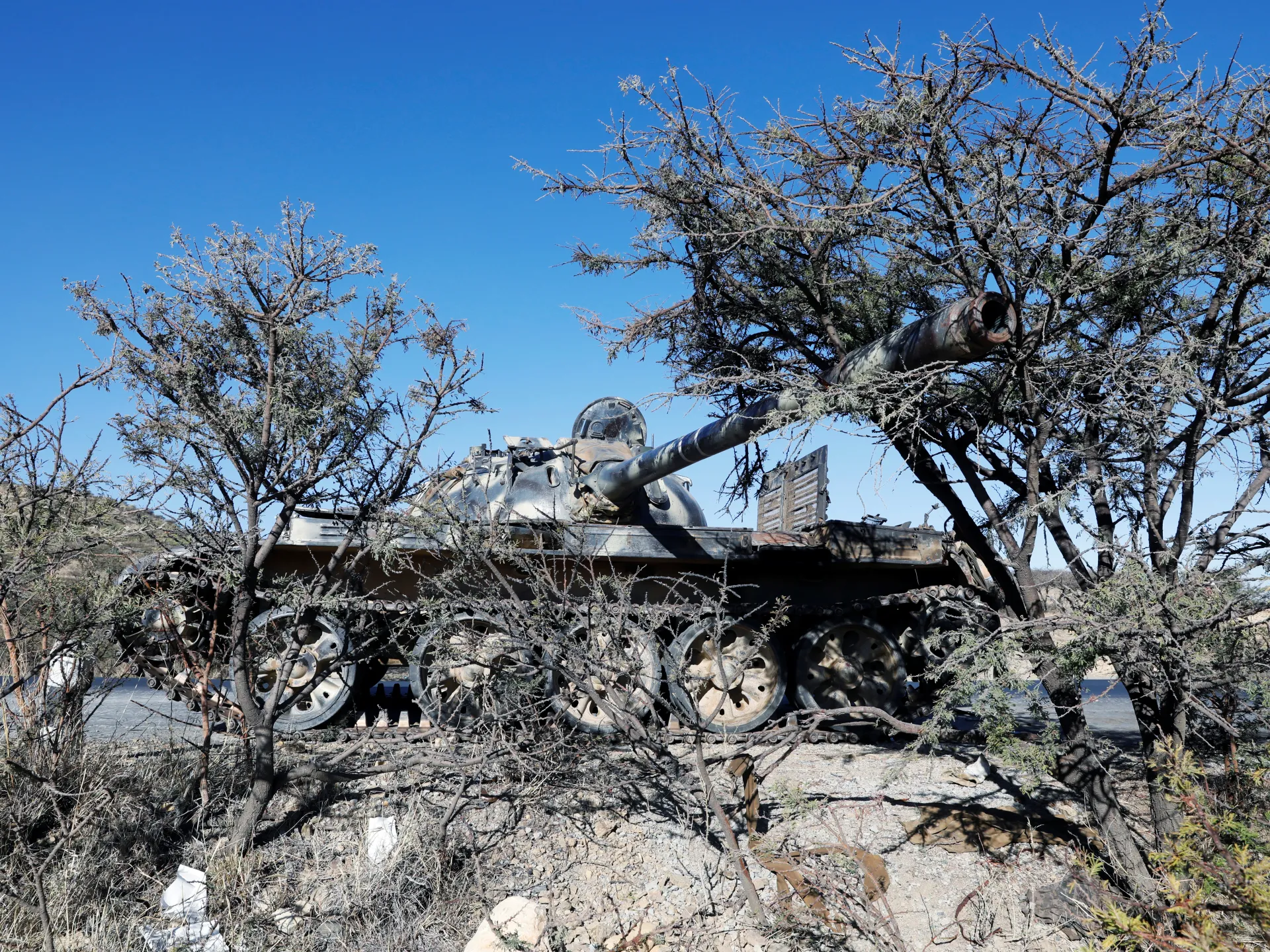
This aggressive rhetoric has not been confined to speeches and opinion pieces. In a direct attempt to pull Eritrea into a militarised conflict, the ruling party has massed substantial military formations, heavy artillery, and mechanised divisions in close proximity to the Eritrean border.
This pattern of behaviour is directly mirrored along the northern frontier, where provocative pronouncements are accompanied by unremitting sabre-rattling regarding the acquisition of Assab and other Eritrean coastal lands through negotiations if possible, and by force if necessary.
The broader pattern extends beyond Eritrea. Ethiopia’s recent foreign policy conduct has increasingly generated tensions with several neighbouring states. The Memorandum of Understanding signed with Somaliland, which sought access to coastal territory without the consent of Somalia’s central government, triggered a major diplomatic crisis and raised serious questions regarding respect for established principles of sovereignty and territorial integrity.
Similarly, Ethiopia has repeatedly pursued interventionist policies in neighbouring conflicts in the quest for short-term geopolitical objectives. Whether in Somalia, Sudan or elsewhere, Addis Ababa’s reckless regional agenda of expansionism has contributed significantly to regional mistrust and destabilisation.
Thus, the narrative that Ethiopia is an involuntary victim being dragged back into war by external forces ignores the reality of the ruling party actively moving military assets, signing illegal treaties and threatening the borders of sovereign states. This explicitly coercive stance directly undermines the foundational principles of peaceful coexistence and good neighbourliness that are essential for the Horn’s stability.
Ultimately, peace in the Horn of Africa cannot be bargained away to appease the shifting calculations of a restless neighbour. The path forward demands an immediate end to the reckless sabre-rattling in pursuit of illicit “sovereign maritime access”, the unconditional cessation of cross-border proxy alignments, and a return to the foundational principles of non-interference and territorial integrity.
Until the international community confronts the true internal drivers of Addis Ababa’s aggressive posture rather than entertaining its manufactured grievances, the region will remain perilously vulnerable to dangerous miscalculation. Eritrea stands firm in its resolve, anchored in legal permanence and historical facts. Those who look to externalise their domestic ruin through regional destabilisation will find that Eritrea’s sovereignty is neither negotiable nor penetrable, and that lasting security can only be achieved when boundaries are respected and international law is upheld without exception.
The views expressed in this article are the author’s own and do not necessarily reflect Al Jazeera’s editorial policy.
Two years after deadly Gen Z protests forced Kenya’s government to withdraw a tax bill, lawmakers have approved another controversial package of financial measures. President William Ruto’s administration says it is needed to raise $770 million ahead of the 2027 elections.
Al Jazeera’s Reem Takieddine has more.
MADONNA oozed youthful glam in a see-through mini dress as she made a striking appearance at Paris Fashion Week.
The Vogue songstress, 67, looked half her age in the cobalt blue frock, opting to go braless in the sheer attire as she headed to an evening bash in the French capital.
Sign up for the Showbiz newsletter
Thank you!
Madonna oozed glam in a blue mini dress as she stepped out in ParisCredit: BackGridShe finished off her look with a pair of futuristic silver bootsCredit: Splash
She finished off her stylish look with thigh-high silver boots, nude fishnet tights and matching jewellery.
Madge pulled on a pair of sunglasses and threw a metallic jacket over her arm as she exited the French venue, with her blonde hair styled in heat curls flowing over her shoulders.
The American chart star – who recently showcased her huge video which launched her comeback – kept a serious expression as she walked out of The Ritz flanked by bodyguards.
Yet she did flash a pout as she took a brief glance over her shoulder.
The Like A Prayer hitmaker, 67, flashed her toned figure in her striking frockCredit: BackGridShe kept a serious expression as she left The RitzCredit: SplashShe was flanked by bodyguards as she exitedCredit: SplashMadonna has been pulling out all the stops at a variety of Paris Fashion Week eventsCredit: Splash
Hundreds of migrants in Paris are left exposed as a heatwave sweeps Europe. Some have taken to unsafe swimming to cope with the record-breaking temperatures.
BBC Sport will continue to broadcast Wimbledon until 2033 after signing a new deal with the All England Club.
The agreement means the Grand Slam tournament will remain free to air for audiences in the UK across BBC television, radio and digital platforms.
Next year’s tournament will mark 100 years since the BBC first broadcast Wimbledon in 1927.
Under the new deal, audiences will continue to enjoy comprehensive live coverage of the Championships across BBC TV, BBC iPlayer, BBC Radio 5 Live, BBC Sounds, and the BBC Sport website and app, as well as across BBC Sport’s extensive social channels.
The 2026 tournament gets under way on Monday with champions Jannik Sinner and Iga Swiatek defending their singles titles.
This year’s Wimbledon coverage will usher in a fresh new editorial and creative approach from BBC Sport, featuring new voices and personalities, deeper storytelling, enhanced analysis, and technology across TV, radio, online and social platforms – all designed to bring audiences closer to the Championships than ever before.
The announcement follows record-breaking digital audiences for Wimbledon on BBC platforms last summer.
In 2025, the tournament generated 69.3 million online requests across BBC iPlayer, the BBC Sport website and app – the highest digital engagement for the Championships ever recorded.
That figure surpassed the previous record of 54.3 million set in 2023 and marked a significant increase on the 50.1 million online requests recorded in 2024.