Weekly insights and analysis on the latest developments in military technology, strategy, and foreign policy.
The Turkish Air Force looks set to receive a major boost to its fighter fleet, with the delivery of dozens of F110 engines required to power the homegrown TF Kaan combat jet. This would be one of the most significant positive developments in U.S.-Turkish defense relations since Turkey was ejected from the F-35 program in 2019, and may even pave the way for Ankara to rejoin that effort.
Citing four sources familiar with the matter, Reuters reports that President Donald Trump’s administration plans to go ahead with the engine sale, said to be worth more than $700 million, despite some resistance from Congress.
Reporter: Türkiye wants the F-110 jet engines, and they want their F-35 fighter jets. Are you going to Türkiye with a big gift bag?
Trump: I think so. He’s a member of NATO. Some people don’t consider himself, but he really is.
Ahead of his July trip to a NATO summit in Turkey, Trump was asked by a reporter whether Turkish President Tayyip Erdogan would be provided with a “big gift” in the form of F110 engines and potentially F-35 fighter jets.
“He’s a member of NATO,” Trump replied. “He really is a strong member of NATO. Yeah, I’m going to probably do something that’s going to make him very happy.”
Speaking alongside Trump, Vice President JD Vance said a review was underway to see if Turkey could receive the F-35.
JD Vance on Türkiye’s F-35 jets:
Pete and the entire team are reviewing this right now, because there are certain things that we have to certify have happened — that have happened in order to comply with American law. The president has asked us to do that.
“Pete and the entire team are reviewing this right now, because there are certain things that we have to certify have happened … in order to comply with American law,” Vance said, referring to Secretary of Defense Pete Hegseth.
The question of whether Turkey might receive F-35s has long been a fraught one, with Ankara kicked out of the program back in 2019, a development we will return to later.
For now, however, Turkey’s priority seems to be securing F110 engines.
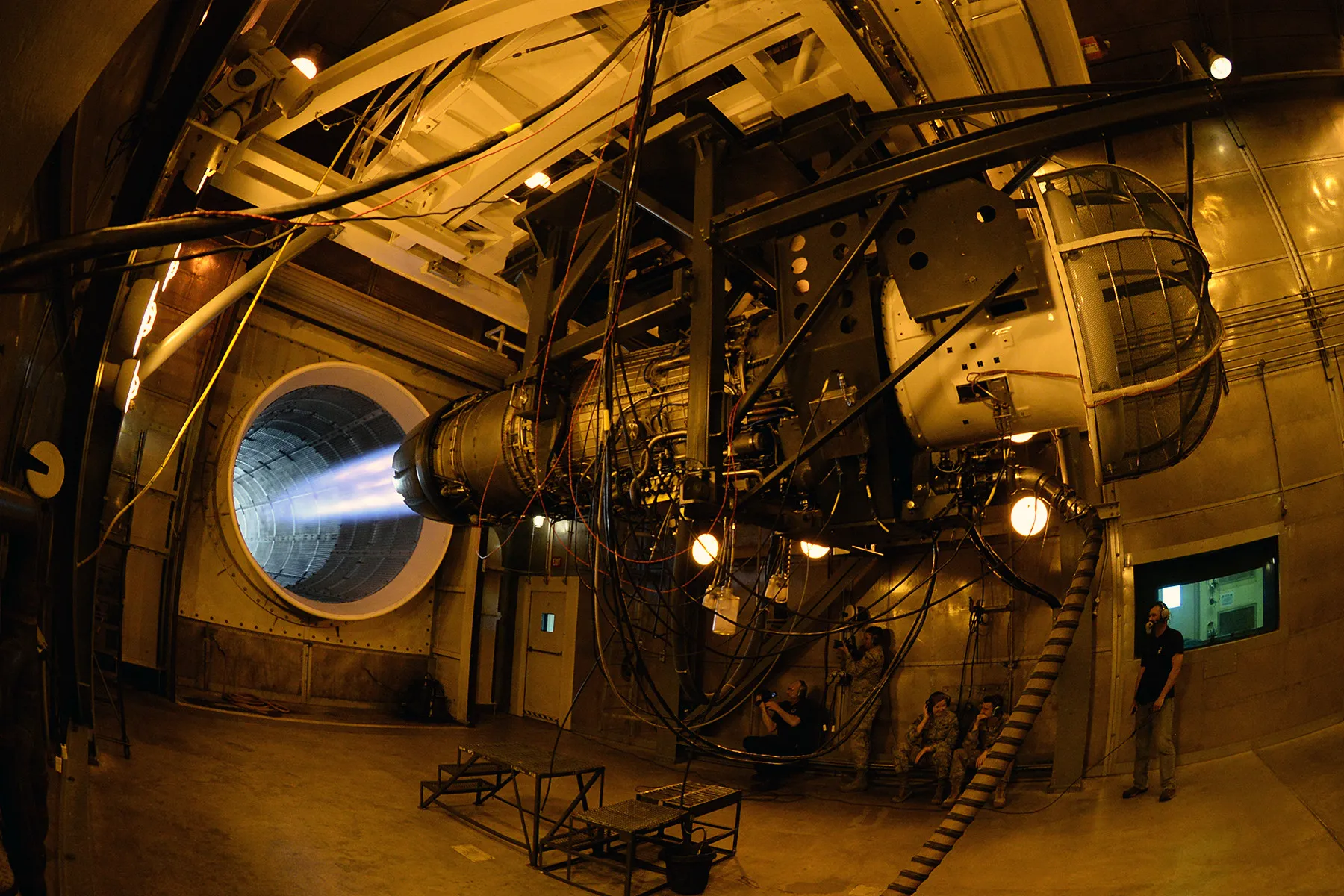
The F110 engine for an F-16 at max power during a test in the hush house engine facility at Hill Air Force Base, Utah. U.S. Air Force photo by Alex R. Lloyd
Turkey’s TF Kaan next-generation fighter is a flagship program of the country’s burgeoning aerospace industry. The program was launched in 2010, and the first prototype took to the air in early 2024.
Reportedly, Turkey plans to complete three pre-production prototypes, to be followed by 250 series-production aircraft, incorporating various refinements.
Last month, a contract was reportedly signed for 20 examples of the initial Block 10 versions of the Kaan.
The twin-engine Kaan was developed with a reduced radar signature in mind, as well as a high level of performance and modern avionics and other systems. As a result, it doesn’t offer the same level of low observability as the F-35, while its sensor fusion, electronic warfare capabilities, and other ‘fifth-generation’ features lag behind the U.S.-designed jet.
One of the F-35s that was completed for Turkey before its ejection from the program. Lockheed Martin
Critically, the Kaan is powered by U.S.-supplied General Electric F110 turbofans.
F110s are assembled under license in Turkey by TUSAS Engine Industries (TEI) but are still governed by U.S. export restrictions. These engines are already used in significant numbers by the Turkish Air Force F-16 fleet, the third-largest in the world. Outside of the F-16, the F110 is also used in the F-15E Strike Eagle and F-15EX Eagle II, among other F-15 variants. An F110 comes with a typical flyaway unit cost of $10 to $15 million.
The Kaan program has long been overshadowed by the question of whether Washington will make available in larger numbers the F110 turbofans used in the prototype. Reportedly, an initial batch of 80 engines is required.
While Turkish officials have expressed hope of ultimately switching to a domestically produced engine type for the Kaan, TEI’s TF35000, it’s unclear how realistic this is, at least in the near term. Turkey has also looked at acquiring alternative engines, too, including those from Russia or Rolls-Royce in the United Kingdom.
In the meantime, the importance of the Kaan to the Turkish Air Force increased significantly in 2019, when it became clear that Ankara would be kicked out of the F-35 program, in which it had a considerable industrial stake, and a plan to buy around 100 of the fighters. Washington took that decision after Turkey refused to abandon its purchase of Russian-made S-400 long-range air defense systems.
A Russian Ilyushin Il-76, carrying the first batch of equipment for the Turkish S-400 missile defense system, arrives at Murted Air Base in Ankara on July 12, 2019. Photo by Turkish National Defense Ministry / Handout/Anadolu Agency/Getty Images
As well as the S-400, U.S. lawmakers were unhappy with Turkey’s worsening relations with Greece, its other connections with Russia and Azerbaijan (which included the deployment of F-16s to the latter country), its conduct in the Syrian civil war, and human rights abuses. Turkey’s opposition to Sweden joining NATO also proved to be a significant hurdle.
In the wake of all this, the chances of Turkey receiving F110 engines were dramatically reduced. At the same time, Turkey’s request to buy additional F-16 fighters was also turned down. Turkey reportedly also began stockpiling spare parts for its F-16 back in 2019, fearing the effects of U.S. sanctions.
Turkish Air Force F-16 fighters at Balikesir, Turkey, in May 2022. Photo by Ali Atmaca/Anadolu Agency via Getty Images
Toward the end of the Biden administration, U.S.-Turkish relations began to improve, and Washington moved to push through sales of new F-16s and upgrade kits for older jets to Turkey. There also began to be suggestions that the F-35 was potentially back on the table for Turkey.
Under the Trump administration, Washington’s relationship with Ankara has become closer, with Erdogan frequently praised by the U.S. leader.
At the same time, the issue surrounding the S-400 and the sanctions that followed that acquisition remains.
As it stands, U.S. law does not permit Turkey to operate or possess the S-400 system if it wishes to rejoin the F-35 program, as a result of security concerns around the Russian-made system.
The first F-35 for Turkey was rolled out during a ceremony at the Lockheed Martin plant in Fort Worth, Texas, on June 21, 2018. Photo by Atilgan Ozdil/Anadolu Agency/Getty Images
During a visit to Turkey in early 2024, the U.S. Acting Deputy Secretary of State Victoria Nuland reportedly suggested that the United States might be willing to offer Patriot air defense systems if it were to give up its S-400s, which could also clear the way to re-entering the F-35 program.
“Frankly, if we can resolve this S-400 issue, which we want to do, the United States would be pleased to welcome Turkey back into the F-35 family,” Nuland said. “But we must solve this other issue first, and while we solve it, we must also ensure that Turkey has a strong air defense.”
The apparent decision to clear the F110 sale certainly represents a further softening of Washington’s stance, and it could be a stepping-stone to Ankara eventually being readmitted to the F-35 program.
Turkey’s desire for F-35s has only been intensified by the fact that Greece, its major strategic rival, has been approved for a purchase of the jets. You can read all about how tensions between Greece and Turkey are reflected in the countries’ respective air forces in this previous feature.
Presentation ceremony of the Kaan on May 1, 2023, in Ankara. Photo by Yavuz Ozden/ dia images via Getty Images
Even regarding the F110 transfer, some opposition to defense sales to Turkey remains in Washington.
In particular, Representative Gregory Meeks of New York, the leading Democrat on the House of Representatives Foreign Affairs Committee, has reportedly stood in the way of the engine sale during an informal review process.
However, according to the four sources who spoke to Reuters, the F110 deal should be “finalized in the coming days, followed by a formal notification from the State Department to Congress.”
While lawmakers can use the congressional review process to raise their concerns over big-ticket defense exports, the administration can override these.
According to the Wall Street Journal, the Trump administration is expected to override Meeks’ effort to block the engine deal.
For the Kaan program, the F110 is vital.
Denied the F-35 and with F-16 deals moving forward only slowly, Turkey has been forced to look elsewhere to meet its short-term fighter needs. Most significantly, it signed a deal for 20 Eurofighter Typhoon jets last October.
U.K. Prime Minister Keir Starmer and Turkish President Tayyip Erdogan sign the Typhoon deal in Ankara in October 2025. Eurofighter
Turkey has also been investing heavily in drones, including the ANKA-3, a low-observable flying wing uncrewed combat air vehicle (UCAV), and the fighter-like Bayraktar Kizilelma. Still, these are viewed as adjuncts to advanced crewed fighters, like the Kaan.
Whether securing the F110 engines means the Kaan meets its target of service entry around the 2030 timeframe remains questionable.
However, it is a major step in that direction.
As well as being fielded by the Turkish Air Force, the Kaan could have significant potential for export, although sales would be governed by U.S. restrictions on its engines. It is one of a number of medium-weight fighters that feature low-observable characteristics and advanced avionics. These include China’s FC-31 and South Korea’s KF-21.
The Chinese Shenyang FC-31 fighter prototype. via Chinese internet
Perhaps most importantly, the F110 deal would get back on track what is very much the flagship of Turkey’s military aerospace industry. At the same time, a U.S. decision to provide Ankara with these engines will also be welcomed by those in Turkey who still wish for a way back into the F-35 program.
It’s at once a practical and existential question that plagues the two lead chefs in FX’s “The Bear.” He was the emotionally tortured and volatile chef who left behind a rising career in Michelin-starred restaurants to return to Chicago, his hometown, to run his recently deceased brother’s floundering sandwich joint. She was a Culinary Institute of America-trained chef with potential and a steady demeanor seeking mentorship and an opportunity to work with a prodigy. Together, Carmen “Carmy” Berzatto and Sydney “Syd” Adamu — played by Jeremy Allen White and Ayo Edebiri, respectively — transformed the Original Beef of Chicagoland from a hole-in-the-wall into the titular fine-dining establishment.
But now their partnership in the kitchen has come to an end.
Created by Christopher Storer, “The Bear’s” fifth and final season picks up the morning after Syd, Richie (Ebon Moss-Bachrach) and Nat (Abby Elliott) learn Carmy is quitting the food industry and leaving the restaurant in their hands at a make-or-break moment. And the pressure mounts for Syd to decide if she’ll jump ship to pursue another opportunity. The eight-episode season, now streaming in full on Hulu, largely stretches across one day as the restaurant’s debts accumulate, suppliers cut them off and an unrelenting storm floods the kitchen and threatens to upend a night of service the chefs desperately need to have one last shot at survival and one last performance as a team to deliver an improbable turnaround.
In some ways, it’s a journey that mirrors the actors’ own trajectories. Before “The Bear” became a runaway hit, White was best known for his role on Showtime’s long-running dark comedy “Shameless,” while Edebiri primarily worked as a stand-up comedian and writer. Just as their characters have evolved and gained electric momentum in their careers, so have the actors. Both garnered Emmy Awards for their performances on “The Bear,” and they have added a multitude of film and TV credits to their résumés since. Edebiri is currently starring opposite Don Cheadle in the revival of “Proof,” her Broadway debut, while White will be starring this fall as an investigative reporter in Aaron Sorkin’s “The Social Reckoning,” a companion piece to “The Social Network” that chronicles Facebook’s whistleblower scandal.
Over separate video calls from New York, Edebiri and White reflected on “The Bear’s” conclusion and what it means to leave the characters that supercharged their careers behind. Here are edited excerpts from the conversations.
Ayo Edebiri as Sydney Adamu and Jeremy Allen White as Carmen “Carmy” Berzatto in a scene from Season 5 of “The Bear.”
(FX)
After living inside these characters’ skins for so many years, what’s it like to be done playing them?
Edebiri: They keep saying that we’re done, so I guess that really is the thing of it. Obviously I know that it’s over, but even when we were finishing our first seasons, it didn’t matter how much critical acclaim we got because we’re on a show that’s a part of a network that has a deal with the streaming service — there’s all these things that are continually in flux or that you know that you have no control over. As an actor, you’re used to this state of limbo or not totally knowing or being prepared for an ending, so I think I’m not overwhelmed by it, if that makes sense.
White: I don’t know yet. We were very lucky to understand for a long time when the show was going to end and, to a degree, how the show was going to end. It was difficult to see the direction it went — I have strong feelings about Carmy and where he ends up and how his story might continue on. So much of this season, for Carmy, is about a surrender or acceptance of his place in the world and his place in the kitchen, and it’s the first time he’s really been able to get very honest with himself since we’ve met him. And, in doing so, he chooses to leave, and that was hard for me, for Jeremy. Maybe there’s a world in which he tries this and he comes back. I think I had a different understanding for a while of Carmy’s future. I want him to be happy and healed, but it felt like … I don’t know — imagining him outside of a kitchen was hard for me.
I want to unpack that a little bit more. He wants to be happy. But it was interesting to see him wrestle with how his work hinders that — is it the crutch or the salvation? Did you find yourself having an existential moment as Jeremy taking in what Carmy was wrestling with, or have you reckoned with it before?
White: He threw himself into this work, into this world, pretty young in life. And he was really good at it. But a big part of him burying himself has so much to do with his brother, with his family. I was finishing something too. And, yes, of course, I was thinking of goodbyes, and I was thinking of moving on, and new pursuits and all of these things. I was checking in with myself and what it might feel like to just make such a hard turn in life. I thought a lot about what you get back from your work, but I think ultimately, what Carmy and I don’t share is he was causing so much chaos in his work life; it wasn’t just himself that he was punishing at times. It came down to this surrender to an easier way, a softer way, which was to turn it over to Syd, to turn it over to Richie, to turn it over to Tina in the kitchen — that part, I had an easier time understanding.
“The most beautiful thing about their relationship is their true unconditional belief in one another,” says Allen about Sydney and Carmy in “The Bear.”
(David Urbanke / For The Times)
Syd was facing a crossroads: a shiny new job that could take her to the next level or sticking with this seemingly sinking ship that has taken her to the next level, but where she’s felt unappreciated or stifled at times. Ayo, what did you think of the choice she made?
Edebiri: We’re really fortunate to have such amazing writers who thought about her and her journey. [There’s] an awareness of Sydney’s womanhood and Blackness and youth, but I think [they treated] her with the full dignity of just being a human being and getting able to be a complex character in this show and giving her the dignity of being just as flawed as the other characters. [The choice she made] just made sense to me. It made sense in the architecture of the show. It was gratifying to get to build to that with everybody.
The bulk of this final season has the team dealing with this massive storm that’s created a slew of setbacks at a make–or–break moment for the restaurant. It leads to one final symphony in the kitchen together.
White: Those days were beautiful. So much of our show is shot so quickly, but then we really get to slow down with these choreographed pieces of kitchen ballet, and that’s also when we feel really strong as a group of performers, where we’re incredibly reliant on one another, not just for the emotional beats of a scene, but in this very technical aspect as well. I remember going back to Season 1 and filming Episode 7, “The Review,” which was the single-take episode, and just how much camaraderie came from that, and how much respect came from that for everyone — that feeling of real success that we could do this. It’s a really nice thing that happens sometimes on sets, where there is such a nice mirror of what’s going on with the characters and what’s going on with the cast. In this last push, and this team effort, we want these things as the characters, and we want these things as the cast. We want these people to have what they want, what they deserve, so it was really exciting shooting that last episode or two where all those things are coming into place.
Edebiri: That’s Chris’ thing — it’s like a classical piece of music or something; there’s different movements. His own challenge that he puts on himself, and that, in turn, puts on us, is that we’re still in the same piece of music, but everything just has a different feeling. He’d been talking about it since, low-key, Season 3, but definitely started talking about it a little bit more concertedly when we were filming [Season] 4. It was really starting to take shape in his brain. This challenge of having it be in this one day, and how each episode can feel different, was really exciting to him, so in turn, it became exciting to us.
Were you hoping for more runway to chart what the characters were facing?
Edebiri: No, I think it was cool. I was just like, “Yeah, let’s see what it is.” That’s kind of what everything has been with this show. Part of her emotional journey for the last season, what was on a slower track, in a way, there was something also really fun in having the pressure cooker of one day, and everything getting to ramp up and be quite immediate, which I think has been reminiscent of Seasons 1 and 2 in a fun way.
Tina (Liza Colón-Zayas), left, Sydney (Ayo Edebiri), Richie (Ebon Moss-Bachrach) and Carmy (Jeremy Allen White) in “The Bear.” The restaurant faces multiple setbacks, including a storm that causes damage and dwindling supplies.
(FX)
Carmy and Sydney’s dynamic has been so fundamental to the series. These are two people who see something in each other that the other doesn’t. What do you admire about their relationship as friends and as co–workers?
White: The most beautiful thing about their relationship is their true unconditional belief in one another. They see the beautiful things in one another that the other one is not able to witness in themselves. Even though trust has been tested and trust has been broken at times, there is such a loyalty to the best in themselves. They know that they can rely on one another. In a lot of ways, they saved each other. That piece in the opening episode of Season 3, where Carmy gets the call about Mikey and serves the scallop to Syd without ever having met her — there is this invisible tether that was not witnessed by either of them, but it inspired Syd, and whether Carmy knew it or not, this thing was loved and enjoyed by someone that was birthed from this very traumatic moment. There’s just this beautiful, invisible tether that has always existed and will always exist between the two of them.
Edebiri: What I admire about it is the fact that they are able to bring out — through a lot of miscommunication and hard work, but ultimately, I think, with good intentions — the best in each other. They want to see each other be the best versions of themselves.
How is that reflected in your dynamic? Jeremy, who is Ayo as a scene partner and what has she brought out in you as a performer, and vice versa?
White: I was really so lucky to kind of witness Ayo in real time — everybody else had to wait some months to see her on the show. I remember genuinely being struck by her presence, her groundedness. It felt like, if this makes sense, wrong because she was doing it so well. She’s incredibly smart, she’s a wonderful writer, and she’s very skilled improvisationally, and so, in acting with her, there’s something that always makes you feel very in the moment. You can never like relax, in the best way. It’s like you always have to surrender yourself to each moment.
Edebiri: When we first started, I was coming from the comedy world, and he was coming from a much more dramatic world. Our approaches were so different. He has such amazing presence of being and a quiet focus and has such care for the work. He’s a really great leader. There are ideas in society of men in power, and what power held by men has to look like and feel like, and he’s very gentle — especially in the show, which can live so much in the space of chaos and anxiety, having a gentle spirit really helps with filming. He’s so good at making that very clear and helping teach me that as well … I’ve definitely learned from him, without realizing it, ways to protect yourself and protect your peace, and protect also the peace of your co-workers — you get the work done, you be serious about it, but it doesn’t have to be torture.
Edebiri on working with White: “When we first started, I was coming from the comedy world, and he was coming from a much more dramatic world. Our approaches were so different. He has such amazing presence of being and a quiet focus and has such care for the work.”(David Urbanke / For The Times)
What was it like to see them get this thing they’ve been after — not one, but two Michelin stars?
White: Reading that moment —there’s been so much pain and heartache … for years and years and years, and I was just so relieved to see this joyous moment on the page. It felt so, so close to the surface of me already. And we — Jeremy and Ayo — have shared so many insane, joyous moments in our lives since the show. So it felt familiar in the best way. I’m so glad for that moment for both of them — for Carmy and Syd.
Edebiri: We’re shooting it so fast. You always wish you just had more time, and that was one of the last scenes — I think it was the last thing that he and I shot. There’s obviously a bit of a preciousness and emotionality that you’re feeling in that moment, while also tapping into what’s happening to the characters. It’s this thing that, in the brain of myself, we’ve been building to this over five seasons. There’s obviously a somewhat meta reflection of what we’ve gone through — this is just such a crazy journey. But I think at the end of it, especially because of what we know is going to change in their relationship, that in their working proximity, that they are not going to be close, but they know that they were able to do this thing and build this thing together, I think [is] what felt very special, and felt very cool. I hope it’s something that people who have loved the show also feel.
Fans have intense feelings about their relationship, as I’m sure you know. Has it surprised you how strongly people feel about their dynamic?
White: I know that exists. I don’t have too much knowledge on how that all works. It’s funny, I’m very aware of it now because it’s become part of a conversation around the show, but it was nonexistent in our approach to the work. It wasn’t even a thought for either of us. It didn’t occur to us. But I understand it. There is an intimacy, of course, with these two characters. And there is this trust. They lean on each other and they admire each other so much. I’m not like — nobody’s crazy to feel that. There is love there, it’s just not a romantic partnership.
Edebiri: It surprised me the first two [seasons] because I don’t think that that’s what we were doing. Anytime that you say otherwise, I’ve learned [not to]. It’s been hard when doing press, it feels like we get asked specific questions to try to give a specific answer, but the point of art is we make it and we give it. If people are having a response, that’s great, and if I don’t agree with you, I don’t think I’m shutting it down or anything. We made something, then you’re picking something up — that’s the exchange.
White says he knows fans have intense feelings about the relationship between Carmy and Syd. “It’s funny, I’m very aware of it now because it’s become part of a conversation around the show, but it was nonexistent in our approach to the work. It wasn’t even a thought for either of us.”(David Urbanke / For The Times)
Carmy has a few heartfelt conversations this season, but one that really stands out is the one with his mom, played by Jamie Lee Curtis, while revisiting the family home he’s stayed away from for years. He cooks for her. She’s remorseful. Jeremy, what did you think of that moment for Carmy?
White: There’s resistance in it. People like Carmy, you can give them the answer, you can give them the sorry, you can give them the opportunity, and a lot of the times they don’t know what to do with it, or they push it away, or they push it down. What that scene was about, for Carm, was becoming available to even listen. That was the conflict of the scene and the moment. But he was able to eventually get to that acceptance to release some of the resentment, to release some of the anger. Then he is able to show up for her, which was what has been absent. He was able to take it and give her something. It’s been years, if ever, that he’s really been able to do that, to get out of his own way, and be of service in that way to his mother.
Ayo, it was really touching to see Syd naming Tina her chef de cuisine. How did you feel about what that sets up for where Syd and the Bear might be headed with these women as partners in the kitchen?
Edebiri: I loved it. I love getting to work with Liza [Colón-Zayas]. I’ve been so privileged to also be able to direct her — she’s just phenomenal. I think about these two characters, where they started Day 1; Tina was pretending not even to speak English just to stay away from the girl. It was rough from the get-go, but I think both for Liza and I, as two women of color as well, we felt so invested in their relationship and the community they built with each other. There’s something very moving about that to me. Part of the thing for Sydney, she doesn’t know — I think Carmy can see it — that one of her strengths is that they’re different types of leaders. Part of what I think makes Sydney a great leader is that she’s able to delegate and actually remove herself when she knows that she might not be the best in a situation, it might be somebody else.
I haven’t actually seen it. I can’t watch the episodes, but I know when we were filming it, it was both very sweet and very funny. I don’t know if they kept any of the improv from Liza.
You can’t watch because you’re emotional about it or because you just don’t have access?
Edebiri: No, I don’t want to. We were doing all this press and everybody was, “You were so emotional; you wanted to cry, right?” And I’m like, “No, I just don’t want to watch.” I’ll watch it later. The only season that I watched before [it aired], frankly, was 3 and 4 because I had episodes that I made in it. I love the show and I know the show is good. I don’t enjoy watching myself.
I do love that Syd’s ethos in the kitchen is borrowed from “Ratatouille.”
Edebiri: Yes, f—ing rat. It tracks for Sydney.
“I love getting to work with Liza [Colón-Zayas],” says Edebiri about her co-star, whose character is named chef de cuisine. “I’ve been so privileged to also be able to direct her — she’s just phenomenal.”
(FX)
Jeremy, what was your reaction when you read Carmy is in a suit interviewing for an internship at an architectural firm? And what he expresses there?
White: I understand and I’m proud of the courage that it takes [to do a life pivot], but also I tried to play that scene in a way where I didn’t want it to be entirely clear [what happens next]. I wanted the question to be like, “Is this guy still so f— up in the head that he’s trapped regardless of his place in this world, or place of work? Is it a romance that he’s saying goodbye to? Is it a love that he still has, and he’s not quite over yet?” Then I was like, “Do we snap out of that scene and we’re back on the clock?” What is this? I think the goal of the scene is it shouldn’t be all too clear and wrapped up.
What do you think?
White: I could see there’s obviously so much love. There’s love for the people he works with, and there’s love for the paces he’s gone through, but I didn’t know. … I didn’t know if it was a goodbye or an admittance. I think I was trying to find something between him coming clean and being like, you know what, I don’t belong anywhere else or I’m so in love with this thing, but it’s not good for me, and I think it exists somewhere in between that.
Ayo, what was your reaction to Carmy interviewing at the firm?
Edebiri: I was like, “Yeah, that makes sense. This boy’s a noodle.” He’s a fool, he’s ridiculous. It makes sense.
Where do you think he goes from here? Have you thought about it? Do you think he will ever find his way back to the kitchen?
White: I haven’t thought about it too much. I do think there’s something really honest about that direction that Carmy was moving into, but I would hope there’ll always be room for him somewhere in a kitchen.
Edebiri: Syd is like, “You can’t do anything else, brother. Like, what’s the plan?” I don’t know if he takes a break, if he comes back to help her, if he does his own thing.
What do you think happens to the Bear?
Edebiri: I think they do well. It’s not just her; it’s her and Sugar and Richie and Marcus and Tina. She got in it for Carmy, but I think she ended up finding her own voice. I think they keep going, at least for a few more years. I really do.
White: I have to believe that all the pain and suffering and trauma — not only that Carmy has gone through, but that everybody has gone through — is for some greater good. That there is a payoff. My hope is that it would be successful. They’ll have the endurance and the motivation to make it.
People visit the SK Telecom pavilion during the World IT Show 2025 at the COEX convention center in southern Seoul. File Photo by Jeon Heon-Kyun/EPA
June 26 (UPI) — South Korea’s leading mobile operator SK Telecom said Thursday that it would invest $481 million in a U.S. subsidiary of SK hynix as part of the group’s efforts to concentrate on the artificial intelligence strategy.
SK Telecom said that it agreed to purchase a 0.9% stake in SK hynix NAND Product Solutions, a company geared toward investing in innovative AI enterprises in North America.
“To secure synergies with our AI business, we are pursuing the acquisition of an equity stake in SK hynix NAND Product Solutions,” SK Telecom said in a regulatory filing.
This is not the first time that SK Group affiliates channel fresh funds into the U.S. unit. In March, SK Corp. and SK Innovation injected capital amounting to $250 million and $380 million, respectively.
In 2021, SK hynix spent around $9 billion to take over Intel’s NAND flash business and subsequently formed SK hynix NAND Product Solutions, which is now being restructured into an AI-focused investment company.
Earlier this January, SK hynix said that it would commit $10 billion to the company, with the funds to be deployed on a capital-call basis.
“The planned establishment of the AI company is aimed at securing opportunities in the emerging AI era,” SK hynix said in a statement at the time. “The company will continue to work closely with global partners while proactively creating value for customers.”
The share price of SK Telecom edged down 0.88% on the Seoul bourse on Friday, while that of SK hynix plunged 8.36%. The benchmark KOSPI declined 5.81%.
The extreme June temperatures would have been ‘virtually impossible’ 50 years ago, says the World Weather Attribution group.
Published On 26 Jun 202626 Jun 2026
The historic heatwave gripping Europe is part of a dangerous weather trend that can only be explained by human-caused climate change, scientists have said.
The extreme temperatures sweeping across much of Europe mark the region’s “most severe” heatwave ever tracked for the month, and would have been “virtually impossible” half a century ago, the World Weather Attribution group of scientists said in a report released on Friday.
Recommended Stories
list of 3 itemsend of list
Millions in France, Italy, Spain, the United Kingdom and elsewhere in Europe have been experiencing blazing heat this week, with daytime temperatures topping 40 degrees Celsius (104 Fahrenheit) in many places.
The heatwave was reported on Friday to be moving eastwards, threatening Germany and central Europe with similar conditions to those which killed dozens in the western reaches of the continent, strained medical services and stressed the economy.
The World Weather Attribution estimated that a heatwave with similar characteristics occurring in the climate of June 1976 – when Europe was also hit by persistently high temperatures – would have been about 3.5 degrees Celsius cooler.
During another episode in 2003, temperatures would have been about 2 degrees Celsius cooler, the research suggests.
The analysis shows that intense heat is increasing rapidly, even within living memory, “with such events tens to hundreds of times more likely since only 2003 and virtually impossible just 50 years ago,” the study says.
“This event would not have been possible in June without climate change,” the study’s lead author, Theodore Keeping from Imperial College London, told reporters.
Phasing out fossil fuels ‘critical’
The planet has warmed about 1.4C above pre-industrial times, driven by the burning of coal, oil and gas.
Scientists agree this is making extreme weather events like heatwaves more frequent and intense, and that limiting warming is vital to avoid the worst impacts of climate change.
Of the nearly 850 cities the World Weather Attribution’s study analysed in Europe, some 45 percent had broken – or were expected to break – their all-time heat stress records in June.
“The weather pattern itself is not particularly unusual, but the temperatures are – or at least they used to be without human-induced climate change,” said Friederike Otto, the cofounder of World Weather Attribution.
The June heatwave in Europe is the second such episode this year. An early-season period of heat in May brought temperatures more typical of high summer to central and western parts of the continent.
World Weather Attribution said the rapid phase-out of fossil fuels is “critical if we are to avoid even higher temperatures and their consequences in the future”.
Millie Bobby Brown looked stunning on Thursday night as she donned a nude two-piece for the Enola Holmes premiere afterpartyCredit: GettyThe star was celebrating the soon-to-be-launched third season of the Netflix show, in which she plays the titular characterCredit: Getty
Flashing her toned stomach in an embroidered sheer crop top with a matching satin and mesh skirt, Millie posed for snaps at the TV bash.
In the series, which began in 2020, the Stranger Things star plays the teenage sister of Sherlock Holmes – with Enola on a search for her mother.
It comes weeks after Millie defended her husband Jake from cruel dad-shamersCredit: SplashThe couple announced last summer that they had adopted a baby girlCredit: Splash
Millie and Jake, who wed in 2024, announced last August that they had adopted a baby daughter together.
And earlier this year, images of the couple went viral as Millie was seen laden with her daughter’s car seat and two bags, as another saw her pushing a suitcase at the same time as her daughter’s pram.
Many fans were confused as to why Jake wasn’t helping her carry anything despite being there too.
Earlier this month, Millie addressed the backlash during an appearance on Kylie Kelce’s Not Gonna Lie podcast.
On the show, she said: “Hi, I’m Millie Bobbie Brown and I’m not gonna lie, when did women become incapable of holding their own bags, car seats and stuff?…
“This stems from me holding all of my suitcases and bags and my kid and people are like, ‘Your husband doesn’t hold a single thing.’ And I’m like, ‘Because I’m three miles ahead. I have been planning this all night’….
“We’re all about empowering girls and, ‘You got it’ and ‘You don’t need a man’. But then when I’m like, ‘OK, I can carry my own things,’ people are like, ‘Where’s your husband?”
She added: “Nobody knows my husband. My husband is the most polite, sweet, will-do-anything-for-me. But he also knows I’m capable”.
Millie also shared that she hopes to one day have a biological child, but adoption was always something she wanted to do.
Unification Minister Chung Dong-young delivers a keynote speech during the Korean Peninsula Symposium 2026 in Seoul on Friday. Photo by Yonhap
Unification Minister Chung Dong-young called Friday for shifting away from an approach that sticks to denuclearization as the sole solution to the North Korean nuclear issue, saying such a precondition has been one of the reasons for stalled diplomacy with Pyongyang.
Chung made the remarks in a keynote speech at a forum, co-hosted by Yonhap News Agency, pointing out that the lack of progress in nuclear diplomacy has only helped the North bolster its nuclear and weapons capabilities for the past three decades.
“As the past 30 years have shown, whenever peace talks were halted by the denuclearization hurdle, North Korea used that time to further advance its nuclear capabilities,” Chung said at the Korean Peninsula Symposium.
“We must move away from the old notion that a peace regime can only be discussed after the North Korean nuclear issue is resolved … We need to pursue a phased and pragmatic solution. It is time for a paradigm shift,” he said.
Recalling major breakthroughs in nuclear diplomacy with Pyongyang in the past, Chung stressed the path toward peace opened up when relevant countries, including South Korea and the United States, sought to actively engage Pyongyang for dialogue.
Chung went on to highlight the need for a phased approach — halting and scaling down the North’s nuclear program before denuclearizing — as a solution to the nuclear issue.
“A step-by-step process toward peaceful coexistence and denuclearization should proceed in three stages — freeze, reduction and denuclearization,” he said. “China, too, has expressed support for this pragmatic approach.”
Chung said this phased approach must begin with dialogue between the U.S. and North Korea.
“As agreed in the 2018 Singapore summit between North Korea and the U.S., both sides should immediately resume talks to end mutual hostility and establish a new relationship,” he said.
“The resumption of U.S.-North Korea dialogue will serve as a powerful catalyst for opening four-party talks among the U.S., China and the two Koreas, who are the key stakeholders in achieving lasting peace on the Korean Peninsula,” Chung added.
Copyright (c) Yonhap News Agency prohibits its content from being redistributed or reprinted without consent, and forbids the content from being learned and used by artificial intelligence systems.
The reopening of the Strait of Hormuz has restored the flow of oil and natural gas after more than 100 days of disruption, but the crisis has already left a lasting mark on global energy markets. The prolonged closure exposed the vulnerability of the world’s energy supply chain and has prompted governments to reconsider how they secure fuel supplies.
Analysts say the crisis mirrors the impact of the 1973 Arab oil embargo, which transformed global energy policy by encouraging conservation, diversification, and strategic stockpiling. While today’s energy system proved more resilient, the Hormuz disruption may accelerate a broader shift away from fossil fuels.
What Happened?
The Strait of Hormuz, through which nearly 20 percent of global oil and liquefied natural gas supplies normally pass, remained effectively closed for more than three months during the US Israeli conflict with Iran.
Despite the disruption, global markets avoided a severe supply crisis through rapid rerouting of cargoes, the release of strategic reserves, reduced Chinese imports, and shifting demand patterns.
However, analysts say these emergency measures were only temporary. Energy inventories fell sharply during the crisis, and markets were approaching a critical point before shipping resumed.
Why the Crisis Matters
The Hormuz disruption demonstrated that even today’s highly interconnected global energy system remains vulnerable to geopolitical conflict.
Unlike previous crises, the world avoided a complete energy collapse because governments, traders, and shipping companies quickly adapted. Nevertheless, the episode exposed the limits of those emergency responses and reinforced concerns about overreliance on a single strategic chokepoint.
The crisis is expected to influence long term energy investment decisions far beyond the Middle East.
Lessons From the 1973 Oil Embargo
The 1973 Arab oil embargo fundamentally changed global energy policy after oil producing nations restricted exports to countries supporting Israel during the Yom Kippur War.
The embargo caused oil prices to surge, triggering inflation and prompting governments to adopt fuel efficiency standards, develop domestic oil production, establish strategic petroleum reserves, and create the International Energy Agency.
Rather than ending fossil fuel use, the crisis encouraged countries to consume energy more efficiently while reducing dependence on imported oil.
A New Energy Strategy Emerges
The Hormuz crisis appears to be driving another major strategic shift, particularly across Asia.
Countries heavily dependent on Middle Eastern oil and gas are increasingly prioritizing energy security over low fuel costs. Governments are expected to expand strategic petroleum reserves while accelerating investment in domestic renewable energy, nuclear power, and alternative fuel sources.
India, Pakistan, Japan, and South Korea are among the countries reviewing long term strategies aimed at reducing exposure to overseas energy disruptions.
Europe Continues Its Energy Transition
Europe entered the Hormuz crisis after already reshaping its energy system following Russia’s invasion of Ukraine in 2022.
The loss of Russian energy supplies forced European countries to cut gas consumption, diversify imports, and rapidly expand renewable energy capacity.
The latest Middle East disruption is expected to reinforce that trend by encouraging further investment in clean energy and energy efficiency while reducing dependence on imported fossil fuels.
Investment Trends Support the Shift
Global investment patterns already suggest that energy markets are evolving.
According to the International Energy Agency, worldwide energy investment is projected to reach 3.4 trillion dollars this year, with much of the growth directed toward renewable energy, electricity infrastructure, battery storage, and grid resilience rather than new oil production.
Electric vehicle sales continue to rise rapidly across Europe, Latin America, and Asia Pacific, while Chinese solar panel exports have surged across Africa and Southeast Asia.
Governments are also increasing spending on energy efficiency, with around 20 countries introducing new conservation measures directly in response to the Hormuz crisis.
Why It Matters
The Hormuz crisis has reinforced that energy security is becoming just as important as energy affordability.
Rather than relying solely on global oil markets, governments are increasingly pursuing diversified energy systems that combine fossil fuels with renewables, nuclear power, strategic reserves, and domestic production.
This transition is expected to influence investment, industrial policy, and international trade for years to come.
Future Outlook
Oil and natural gas are expected to remain central to the global economy for decades, particularly in transportation, manufacturing, aviation, and power generation.
However, future growth in fossil fuel demand may become significantly slower as governments invest more heavily in renewable energy, electric vehicles, battery storage, and efficiency improvements.
The Hormuz crisis may ultimately be remembered not as the event that ended the oil era, but as the moment many countries accelerated preparations for a more diversified energy future.
Implications
The Hormuz crisis is likely to have consequences that extend far beyond the immediate recovery in oil and gas flows. Governments that experienced supply disruptions are expected to place greater emphasis on energy security, even if it comes at a higher economic cost. This could accelerate the expansion of strategic petroleum reserves, diversify import sources, and increase investment in domestic energy production, including renewables, nuclear power, and critical energy infrastructure.
For oil exporters in the Gulf, the crisis may strengthen the case for developing alternative export routes that bypass the Strait of Hormuz, reducing dependence on a single maritime chokepoint. Import dependent economies, particularly across Asia, are also likely to rethink long term procurement strategies by securing more flexible supply contracts and expanding storage capacity.
Financial markets are also expected to assign a higher geopolitical risk premium to energy prices. Even after shipping has resumed, investors may continue to price in the possibility of future disruptions, increasing volatility across oil, gas, shipping, and insurance markets. The crisis could also accelerate capital flows into technologies that reduce dependence on imported fossil fuels, including electric vehicles, battery storage, hydrogen, and energy efficiency.
Analysis
The Hormuz crisis may ultimately prove more significant for what it revealed than for the physical disruption it caused. Although global energy markets demonstrated remarkable resilience, that resilience depended on temporary measures such as drawing down inventories, rerouting cargoes, reducing consumption, and relying on spare production capacity. These mechanisms bought time rather than solving the underlying vulnerability of the global energy system.
Unlike the 1973 Arab oil embargo, which primarily forced consuming nations to improve efficiency while expanding fossil fuel production elsewhere, today’s crisis occurred at a time when commercially competitive alternatives to oil and gas already exist. Renewable energy, electric vehicles, battery storage, and advanced power grids have matured into viable strategic assets rather than purely environmental investments. As a result, governments are increasingly viewing clean energy not only as a climate policy but also as a national security priority.
Another important distinction is the shift in investment behavior. Historically, supply disruptions often encouraged greater investment in oil exploration and production. Following the Hormuz crisis, however, a growing share of capital is moving toward energy diversification instead of simply increasing fossil fuel output. This suggests policymakers increasingly see reducing oil dependence as a more sustainable way to improve resilience than expanding strategic reserves alone.
The crisis also exposed a structural imbalance in global energy markets. While production remains concentrated in politically sensitive regions, demand growth is increasingly centered in Asia, leaving major importers highly exposed to geopolitical instability. Countries such as India, Pakistan, Japan, and South Korea may therefore pursue parallel strategies of securing diversified hydrocarbon supplies while rapidly expanding domestic renewable generation, nuclear power, and energy storage.
Perhaps the most important takeaway is that energy security has overtaken cost as the dominant driver of policy decisions. For decades, governments largely optimized their energy systems for affordability and efficiency. The Hormuz disruption demonstrated that the cheapest energy source can quickly become the most expensive if geopolitical events interrupt supply. That realization is likely to reshape government policy, corporate investment, and global energy trade for years to come.
The crisis does not signal the immediate end of the oil era. Oil and natural gas will remain indispensable for transportation, petrochemicals, aviation, heavy industry, and electricity generation in many regions. However, it may represent an inflection point where the trajectory of fossil fuel demand begins to flatten as countries systematically reduce their strategic dependence on imported hydrocarbons. In that sense, the Hormuz crisis could be remembered less as an energy supply shock and more as the catalyst that accelerated the next phase of the global energy transition.
KELLY Osbourne has signed up to star in a new reality show documenting her life and personal struggles after the death of her father.
The daughter of belated icon Ozzy Osbourne, 41, used to feature in the much-loved show The Osbournes alongside her family.
Sign up for the Showbiz newsletter
Thank you!
Kelly Osbourne is set to star in a new reality TV showCredit: GettyThe show will follow her life as a single mother to son SidCredit: Instagram / Kelly Osbourne
But this time around Kelly will be taking centre stage in a show focusing on her reinvention as a single mother to son Sid, 3.
Kelly and her fiance Sid Wilson called time on their romance earlier this yearCredit: instagramThe show will also lift the lid on Kelly’s grief following the death of her father OzzyCredit: InstagramOzzy adored his grandsonCredit: InstagramThe famous family previously starred in their own show together called The Osbournes, and it reached huge successCredit: Handout – Getty
Speaking about the show’s contract, a friend said: “The deal is done, and the production company is finalising which broadcaster this will go with; most likely Disney.
“It will focus on how she is stepping back into life after the trauma of Ozzy dying last year and after breaking up with Sid. It’s about her rebuilding.”
Kelly lost her father in July last year after he suffered a heart attack in his home in Buckinghamshire.
The Black Sabbath star, 76, had only finished his farewell tour Back To The Beginning a matter of weeks before passing away.
Despite suffering a heart attack, Ozzy struggled with numerous other health conditions including Parkinson’s and complication of a quad bike accident from 2003.
Kelly and her family have since been grieving and doing their best to stay strong.
In December, marking the first Christmas without her father, an emotional Kelly shared online: “Christmas will never be the same.
“I will never be the same. The person I was before he died does not exist any more.
“It changes you. He was magical. There is no one like him.”
The Osbournes premiered its first episode in 2002 on MTV, with its first season being cited as the most-viewed series to ever hit MTV.
A TV screen shows a live broadcast of former first lady Kim Keon Hee’s bribery trial at Seoul Station on Friday. Kim was sentenced to seven years in prison. Photo by Yonhap
A Seoul court on Friday sentenced former first lady Kim Keon Hee to seven years in prison for taking expensive gifts in return for job appointments and business favors.
The Seoul Central District Court handed down the sentence to Kim, the wife of ousted former President Yoon Suk Yeol, after she was indicted on charges of accepting bribes for mediation, including over 100 million won (US$64,750) worth of jewelry in exchange for a government job for a son-in-law of a construction company chairman.
In total, she was charged with taking approximately 300 million won worth of gifts, and the court found her guilty on all counts.
“The defendant disregarded the social responsibilities associated with the position of first lady and used it merely as a means to pursue her private interests,” presiding judge Cho Sun-pyo said during the hearing, which was televised live.
Kim was indicted in December on charges of receiving a Van Cleef & Arpels necklace and other jewelry from the construction company chairman between March and May 2022; a golden turtle ornament in April 2022 from Lee Bae-yong, former head of the National Education Commission, in exchange for her appointment; a Dior bag worth 5.4 million won from a pastor the same year; and a Vacheron Constantin watch from another businessperson in September 2022.
In February 2023, she was accused of receiving a painting by renowned artist Lee Ufan from a former prosecutor in return for her help in securing him a nomination for an election.
The exchanges mostly took place during the period her husband was in office from May 2022 until his ouster in April 2025.
The judge said Kim sought to evade responsibility for her crimes by returning some of the gifts once an investigation got under way or arguing she had purchased them herself.
“This shows that she was fully aware of the illegality of her actions but tried to conceal it,” he said.
Special counsel Min Joong-ki’s team, which had demanded a 7 1/2-year prison term, welcomed the ruling. Kim’s lawyers said they would appeal.
The court also sentenced the construction company chairman to a one-year prison term, suspended for two years, the businessperson who gifted the watch to a 10-month prison term, suspended for two years, and the pastor to a fine of 8 million won.
The former first lady has already been sentenced by an appeals court to four years in prison in a separate corruption case.
She is also set to stand trial over her alleged involvement in a case where members of the Unification Church were reportedly forced to join the now main opposition People Power Party ahead of the 2022 presidential election in an attempt to influence the outcome of the party primary to pick its presidential candidate, which her husband Yoon won.
Copyright (c) Yonhap News Agency prohibits its content from being redistributed or reprinted without consent, and forbids the content from being learned and used by artificial intelligence systems.
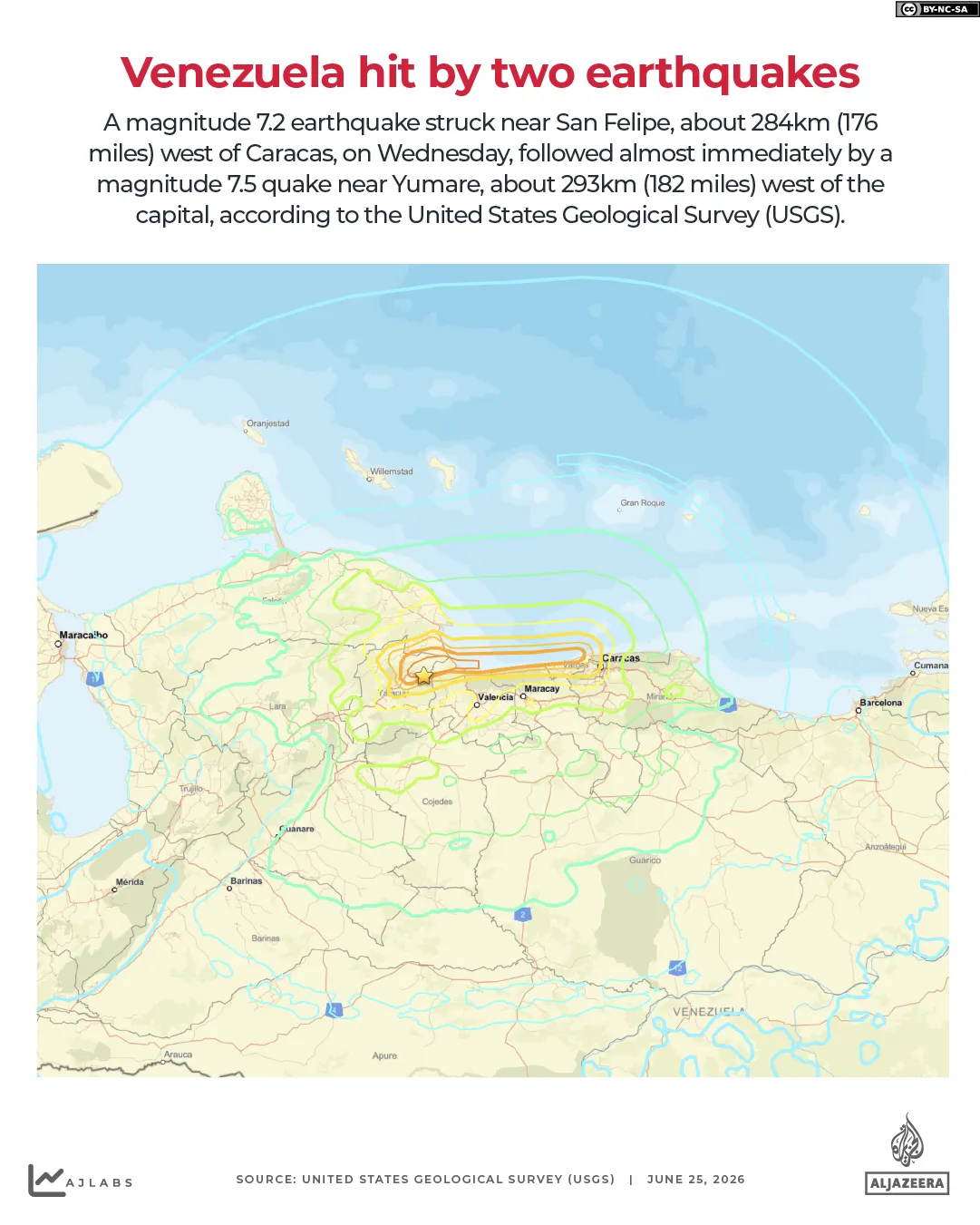
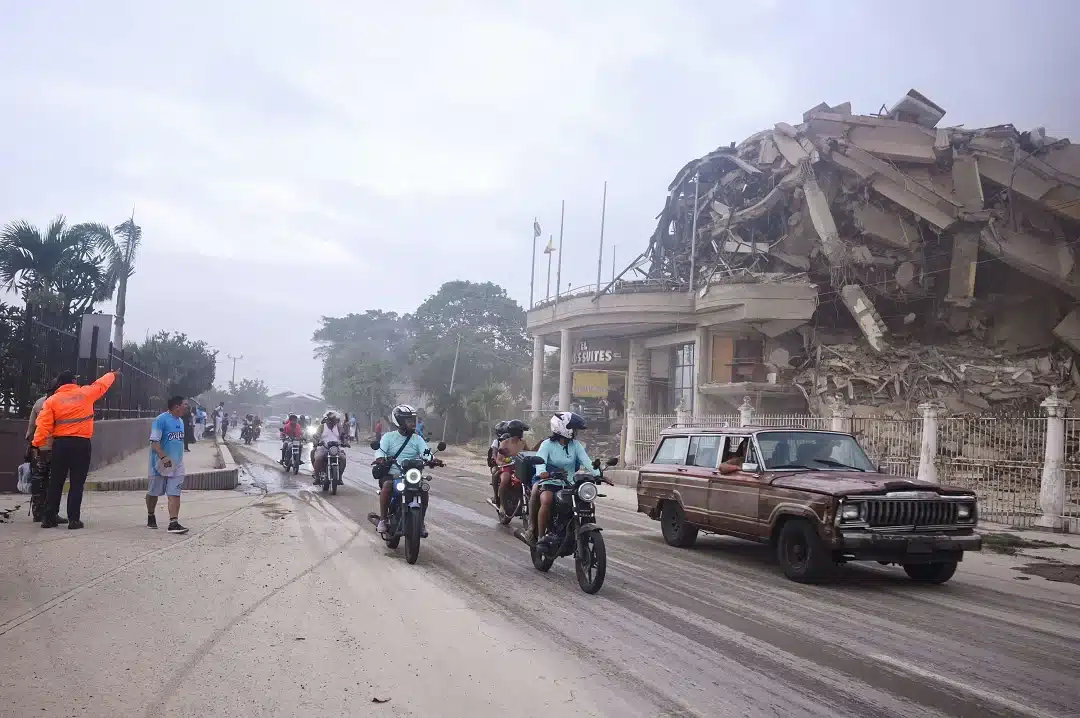
As two powerful earthquakes hit Venezuela, west of Caracas, in quick succession on Wednesday, the country’s capital sustained extensive damage.
Authorities were continuing to search for people under the rubble of collapsed buildings on Friday as 235 people were confirmed to have been killed, with 4,300 more injured.
Here is more about why Caracas has sustained so much damage.
How badly damaged is Caracas?
A magnitude 7.2 earthquake struck about 160km (100 miles) west of Caracas, followed less than a minute later by a magnitude 7.5 tremor, the strongest since 1900, according to the US Geological Survey (USGS).
Jorge Rodriguez, head of Venezuela’s national assembly and brother of interim President Delcy Rodriguez, said earlier in the day that 200 people had been trapped, with 250 buildings damaged or destroyed nationwide.
In Caracas and nearby coastal areas, at least eight hospitals, the headquarters of the Venezuelan Red Cross and the French embassy were among buildings reported to have been badly damaged.
Initial assessments released on Thursday put the estimated economic damage at between 1 and 7 percent of Venezuela’s $111bn gross domestic product (GDP). Authorities have not yet provided a separate estimate for losses in the capital.
However, the heaviest damage has been reported in Caracas itself, Al Jazeera’s Teresa Bo, reporting from Bogota in neighbouring Colombia, said on Thursday.
Public infrastructure was also heavily damaged, with acting President Rodriguez reporting power outages in Caracas.
Health Minister Carlos Alvarado said late on Thursday that 235 people had been confirmed dead at medical centres across Venezuela. He also told state media that about 4,300 people had been reported injured so far. Hundreds more are feared trapped or missing under the rubble.
How badly has the city been damaged in previous earthquakes?
This is not the first time Caracas has suffered heavy damage in an earthquake.
In 1812, a powerful earthquake roiled the cities of Merida and Caracas, killing about 30,000 people, according to the USGS. The tremors caused near-total destruction of Caracas’s colonial architecture, flattening homes, churches and public institutions.
In 1967, another earthquake hit the city, causing several high-rise buildings to collapse and killing 240 people.
(Al Jazeera)
Why has Caracas been so hard-hit?
Venezuela has a long history of devastating earthquakes because it is located along the boundary between the Caribbean and South American tectonic plates.
Caracas is also in a deep sedimentary basin, which amplifies the seismic waves from earthquakes, Vashan Wright, a geophysicist at the University of California in San Diego, told Al Jazeera.
Another reason Caracas is so vulnerable to damage from earthquakes is that its buildings and infrastructure are not specifically designed to withstand tremors and are often standing on insecure ground.
Al Jazeera’s Teresa Bo said the heaviest damage in Caracas occurred in the Altamira district, where emergency crews pulled survivors from the rubble of a 22-storey building while relatives searched for missing family members. Officials said they are still assessing the full extent of the destruction.
“For example, in the [hard-hit] area of Altamira in Caracas, many of the buildings that collapsed are built on sediments, and this makes them much more vulnerable to seismic waves,” Bo said.
“Also, there’s lots of informal housing in several areas across the country, and those types of buildings are not prepared to sustain very strong earthquakes,” she added.
Adequate urban planning and building codes, which incorporate seismic activity, require substantial funding, which Venezuela can ill afford as it has long been subject to heavy sanctions from the United States and other Western countries.
While some sanctions have been lifted since the US abducted former President Nicolas Maduro in a military strike on Caracas in January and he was replaced by Rodriguez, Caracas is still grappling with the effects of decades of underinvestment.
Another issue for Caracas is that at about 7.8km, the earthquakes were shallow, which means they were more destructive than deeper quakes of the same magnitude would have been.
In deeper earthquakes, much of the energy dissipates as it moves through layers of rock. By contrast, shallow ones release their energy closer to the ground, producing stronger shaking and greater damage in populated areas.
How many people live in informal housing in Caracas?
People living in informal housing are more at risk than others during earthquakes because low-cost, self-built housing structures, often built on hillsides and other slopes, are not resilient against tremors.
The slums in Caracas are known as barrios and are densely populated, lacking proper infrastructure. They comprise self-constructed housing or structures built with unreinforced cinderblocks or bricks, often without formal foundations or steel reinforcement, mostly on the mountainous hillsides surrounding the capital.
The lack of proper urban planning, coupled with construction on steep slopes, makes the barrios vulnerable to natural disasters.
While there is no official figure for the number of Venezuelans living in informal settlements in Caracas, academic estimates suggest they account for 40 to 50 percent of the city’s nearly five million residents.
According to the latest National Survey of Living Conditions (ENCOVI), about 55 percent of Venezuelans are living in poverty.
Which countries are better prepared for earthquakes?
Many parts of the world have adapted infrastructure with seismic engineering. Many earthquake-prone countries now plan and construct buildings with damage mitigation from tremors in mind.
Japan, one of the most quake-prone nations in the world, has strict building codes, which means many structures survive shaking that would devastate poorly built homes in parts of Indonesia or Central America. In most inland earthquakes, the majority of deaths and injuries are caused when poorly built structures collapse rather than by the shaking itself.
Japan has made enormous public investments in seismic research and has superior access to advanced engineering technologies like base isolation, which involves the installation of massive steel or rubber shock absorbers beneath the foundations of buildings.
This is why global deaths and destruction from earthquakes have reduced in the past decades. For instance, in 1556, the deadliest earthquake in recorded history in China’s Shaanxi killed about 830,000 people. In 2023, an earthquake hit northwestern China near the Shaanxi province, killing 127 people.
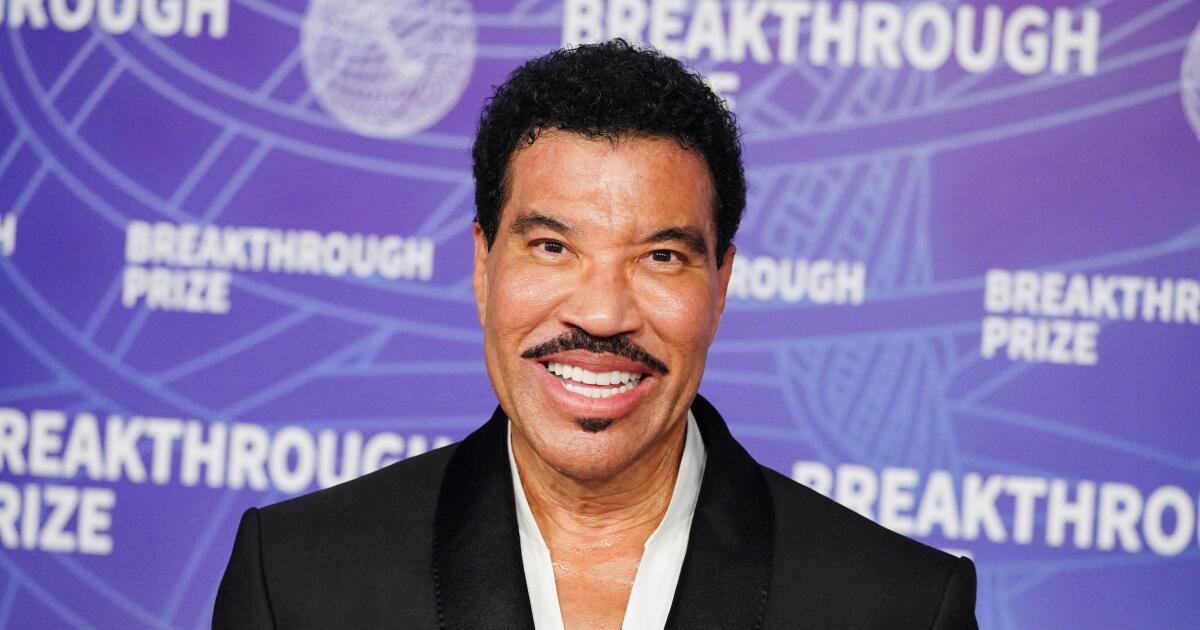
Lionel Richie brought the first stop on his summer tour with Earth, Wind & Fire to an abrupt stop Wednesday evening, citing his health.
The 77-year-old Grammy winner, hitmaker of “Hello” and “Say You, Say Me,” unexpectedly hit pause on the concert at the Grand Casino Arena in St. Paul, Minn., after taking a seat on stage multiple times during his performance of “Dancing on the Ceiling” and telling his audience he felt “dizzy,” according to videos shared on social media.
“What I have learned about my years of being in the business, when you are feeling dizzy, sit your a— down,” he joked, according to a TikTok posted Wednesday evening by user ynaffitmocha. “When you are feeling strange about yourself, sit your a— down.”
Moments later, saxophonist Dino Soldo informed the audience that the singer was “not feeling well” and would not continue the concert. A representative for the singer did not respond to a request for comment, but TMZ reported on Thursday the singer-songwriter was hospitalized after the health scare. Paramedics reportedly met the artist backstage and transported him to a nearby hospital out of precaution.
A spokesperson for the Saint Paul Fire Department did not immediately respond to a request for confirmation on Thursday.
Live Nation announced “American Idol” judge Richie and Earth, Wind & Fire’s joint tour in January, unveiling a 26-city circuit that includes stops in Chicago, Orlando, San Francisco and Los Angeles. Richie and the “September” group are next set to perform at the United Center in Chicago on Friday and again at Schottenstein Center in Columbus, Ohio. It is currently unclear whether Richie will resume performing for those concerts.
Richie and Earth, Wind & Fire are scheduled to play Inglewood’s Intuit Dome on Aug. 9. The tour ends Aug. 14 with a show at the Moody Center in Austin.
June 26 (UPI) — New York City’s rental board has approved Mayor Zohran Mamdani’s two-year rent-freeze proposal for nearly 1 million rent-stabilized apartments, fulfilling a major campaign promise.
New York City’s Rent Guidelines Board voted 7-1 to set a 0% increase for rent-stabilized one-year and two-year leases commencing on or after Oct. 1, and on or before Sept. 30, 2027.
Cheers erupted from the spectators assembled as it was announced that the motion passed.
“This is a historic victory for New York City tenants,” Mamdani said in a statement following the vote.
“After reviewing the data and hearing from New Yorkers across the city, the independent RGB has delivered a freeze on one-year leases, and the first-ever freeze on two-year leases in our city’s history. This is the relief that working people across our city deserve.”
Mamdani, a democratic socialist, campaigned heavily on making life more affordable for the average New Yorker, including by creating new affordable housing and freezing rents where legally permitted.
The mayor said he is grateful for the board members’ “thoughtful consideration of the data” before casting their votes.
“I’ll continue to deliver a more affordable city by building and preserving affordable housing, lowering building operating costs like insurance, and ensuring tenants know their rights,” he said.
According to a New York City housing survey from 2023, there were 996,600 rent-stabilized units, representing about 41% of all rental units across the city. Rent stabilization generally applies to buildings with six or more units built before 1974.
The only vote against the rent freeze came from Arpit Gupta, an associate professor of finance at New York University’s Stern School of Business.
In a statement published online following the vote, Gupta argued that the rent freeze will not solve the housing crisis while possibly making it worse and ultimately driving up rents. He also said the rent freeze could prevent building owners from considering improvements and renovations.
“Residents might continue to enjoy low rents but at the cost of being trapped in units that no longer fit their needs, and with few alternatives and steadily deteriorating conditions,” he said.
“A better option is to undertake the harder reforms needed to make housing more affordable and accessible — that is, build more of it.”
The vote was held following a series of hearings in which nearly 330 people participated and nearly 700 people submitted written, audio or video testimony about their experiences.
New York State Assembly Member Tony Simone said the rent freeze will impact about 2 million New Yorkers and is expected to save renters as much as $6.8 billion over Mamdani’s four-year term.
“This immediate action reflects the urgency needed to prevent more working-class New Yorkers from being priced out of our city,” he said in a statement, while stating that the structural factors that are driving up prices must be addressed.
“To truly address the housing crisis, we need to tackle its root cause: the housing shortage,” he continued.
The US Supreme Court has sided with the Trump administration in its bid to end Temporary Protected Status (TPS) for Haitians and Syrians. The ruling allows the policy to take effect before the courts have reached a final decision on its legality.
Netflix show, Building the Band, was Liam Payne’s last completed project before his heartbreaking death in October 2024 aged 31 when he fell from a hotel balcony
Netflix has decided not to renew Liam Payne’s final television project according to reports(Image: Getty Images for ABA)
Netflix has decided not to renew Liam Payne’s final TV project according to reports. The tragic singer’s series, Building the Band – which was filmed four four months before his death – is said not to have been recommissioned, despite the music competition launching the careers of four new groups.
Liam, who tragically died in 2024 aged 31 after falling from a hotel balcony in Argentina, served as judge on the series alongside Nicole Scherzinger and Kelly Rowland, while AJ McLean hosted the contest.
The winning act, 3quency, received a global platform through Netflix, while several contestants have since secured recording contracts following the show’s release. However, there a reportedly no plans for a second series.
A source told The Sun: “Although there are currently no plans for a second season of Building The Band, bosses at Netflix are really proud of what they achieved. That’s because the show led to the creation of four amazing groups and all of them have since signed record deals.”
The source added: “The finalist groups – 3quency, SZN4, Soulidified and Midnight Til Morning – have all released original music, toured internationally – and attract hundreds of thousands of listeners each month. And Midnight Til Morning are performing at BST Hyde Park at the end of this month.”
Building the Band challenged 50 singers unknown to each other to form new groups, relying on vocal chemistry before progressing through a series of performances.
The winning act received a global platform through Netflix, while several contestants have since secured recording contracts following the show’s release.
The programme had been completed and ready for release before Liam’s death, leaving Netflix to decide whether it should proceed with the series.
After consulting the star’s grieving family, the streaming service chose to air the competition and dedicated it to the late singer.
Liam, who rose to stratospheric fame as a member of One Direction after the group was formed on The X Factor in 2010, appeared on the show mentoring aspiring singers hoping to recreate the success enjoyed by his own chart-topping band.
Since his death, tributes from his former bandmates Harry Styles, Niall Horan, Louis Tomlinson and Zayn Malik have continued to resonate with fans, while discussion around Liam’s legacy has remained a recurring topic across the music industry.
However, although Building the Band attracted significant attention because it featured the star’s final on-screen appearance, it failed to make a major impact with UK audiences, which Netflix will be aware of.
Israeli and Lebanese delegations will continue their talks on Friday.
Published On 26 Jun 202626 Jun 2026
Israel continues to attack southern Lebanon on Friday as Israeli Prime Minister Benjamin Netanyahu pledges that the Israeli military is “not going to withdraw” from occupied areas.
Israel currently occupies about one-fifth of Lebanon.
This comes amid progress on the interim peace accord between the United States and Iran aimed at ending the US-Israel war on Iran, which began on February 28.
Here is what is happening:
In Iran
IAEA chief says inspectors to return to Iran: The interim US-Iran peace accord – also being referred to as the Memorandum of Understanding (MoU) – gives inspectors from the International Atomic Energy Agency (IAEA) access to Iran, the agency’s chief Rafael Grossi said, after Tehran indicated that key sites would remain off-limits until a final deal with Washington is reached and sanctions are lifted.
“There is an agreement and to comply with that agreement, the IAEA will have to have access and inspect,” the UN nuclear watchdog chief Grossi said at a news conference in Japan. “We hope to be there soon.”
UN halts escort of ships through Hormuz: The UN International Maritime Organization (IMO) paused its operation to escort ships through the Strait of Hormuz on Thursday after a vessel reported an attack, reigniting concerns about whether a preliminary deal to end the Iran war will hold. The cargo ship said it was hit close to Oman by a projectile, the British Navy agency UKMTO said.
On Thursday, Iran’s Islamic Revolutionary Guard Corps (IRGC) warned vessels not to attempt to pass the strait without its express permission, despite Oman and the IMO releasing details of a new safe route. In April, the IRGC released its own safe-transit route for approved ships, showing shipping lanes much closer to its own coast.
(Al Jazeera)
In the US
Trump says unfrozen Iranian assets will be used to buy US agricultural products: US President Donald Trump reiterated during an event for US farmers that unfrozen Iranian assets will be spent on buying wheat, soya beans and corn from the US. Iran has not confirmed this.
In Lebanon
Two killed in Israeli raid: Two people were killed and another person was wounded in an Israeli raid on the town of Mayfadoun, in southern Lebanon’s Nabatieh district, the National News Agency reported, citing the country’s Ministry of Public Health.
An Israeli air raid also hit the town of Nabatieh al-Fawqa, according to Al Jazeera Arabic.
Talks to continue: A US State Department official has told Al Jazeera Arabic that Israeli and Lebanese delegations will resume their meetings on Friday.
(Al Jazeera)
Global economy
India ends commercial gas restrictions: India has lifted restrictions on supplies of commercial liquefied petroleum gas (LPG) imposed during the war, when energy supplies were hit by the closure of the Strait of Hormuz, the global energy chokepoint.
Aramco resumes oil loading: Saudi Aramco, the world’s largest oil company, has resumed oil loading at its Ras Tanura terminal in the Gulf after a nearly four-month halt, shipping data showed.
Weekly insights and analysis on the latest developments in military technology, strategy, and foreign policy.
The U.S. Air Force is set to hold a classified meeting with defense contractors to share its requirements for a new air-to-air missile with a maximum range of at least 1,000 nautical miles. This is roughly 10 times the reach afforded today by the latest versions of the AIM-120 Advanced Medium Range Air-to-Air Missile (AMRAAM). An anti-air missile with this kind of extreme range would be especially well-suited for attacks on critical airborne early warning and control planes, as well as tankers and other high-value aerial assets operating in rear areas. The Air Force is also already interested in an air-to-surface version of this new weapon, which it has dubbed the Air Force Long Range Weapon (AFLRW).
The Air Force Life Cycle Management Center’s (AFLCMC) Armament Directorate (EB) issued a notice yesterday regarding the planned AFLRW industry day gathering. The two-day meeting is currently scheduled to take place at the Guided Weapons Evaluation Facility (GWEF) at Eglin Air Force Base in Florida on August 25 and 26. The Air Force says the event will be held at the Secret classification level and that all attendees have to have appropriate security clearances.
“The AFLRW is aimed at addressing the next generation of Air-Launched Standoff Weapon variants in line with Department of War priorities,” according to the industry day notice. “AFLRW may select multiple vendors for both the Air-to-Air (A/A) and Air-to-Surface (A/S) variants with a focus on A/A solutions for Initial Operational Capability.”
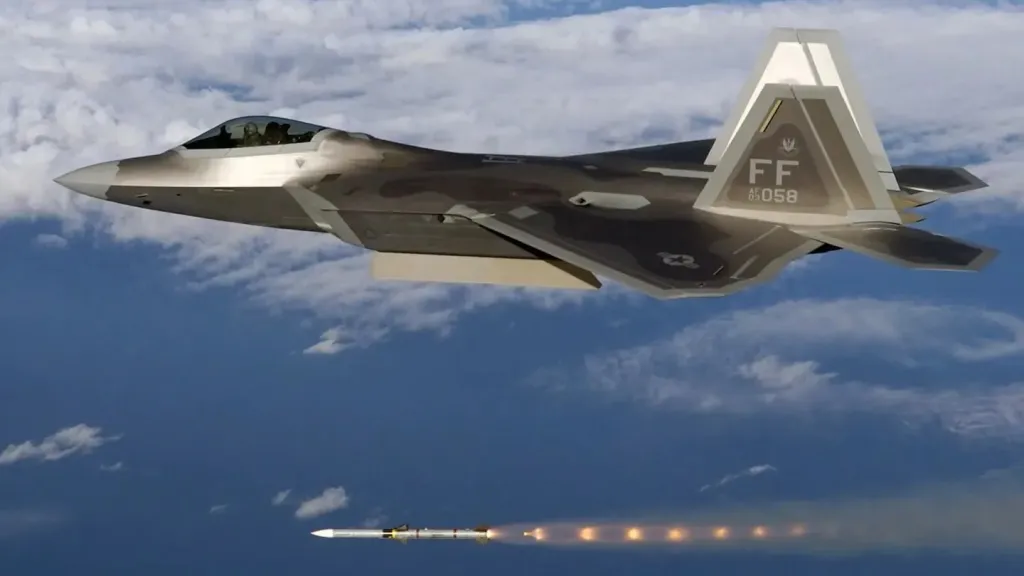
A stock picture of a US Air Force F-22 Raptor firing an AIM-120 AMRAAM. USAF
“Both [AFLRW] variants will have a threshold minimum range of 1,000 NM [nautical miles] and be capable of striking respective A/A and A/S targets in Defense Planning Scenario 2.1 and 7.1 environments in a responsive manner,” the notice adds. It does not elaborate on what those specific scenarios entail.
The notice also puts particular emphasis on modular components and open-architecture systems, and finding a “Master Integrator” to combine the various elements into a complete missile, or all-up-round.
“Industry should expect a quick-turn Whitepaper Request for Information following the event focused on the 2 solution types above for both variants,” per the notice. “AFLCMC is seeking the next generation of Air-Launched Long-Range Weapon variants that expand the United States’ ability to hit priority air, land, and sea targets far and fast!”
Beyond the range threshold, the notice does not include any other details about requirements the Air Force may have now for the AFLRW. That being said, a desire for an anti-air missile able to hit targets at least 1,000 nautical miles away is very notable by itself.
Though the exact figures are classified, the AIM-120D-3 version of the AMRAAM, the latest model in widespread U.S. service, is generally understood to have a maximum reach of around 100 miles (close to 87 nautical miles). There have been hints that it may be able to fly out further than that, at least against targets in certain envelopes. Longer-range versions of the AIM-120 may now be in development. A known key requirement for the new AIM-260A Joint Advanced Tactical Missile (JATM) has also been extended reach over the AMRAAM. Still, even the JATM, which the U.S. Navy and Air Force are developing together, is not expected to have anywhere near the range required for the AFLRW.
An annotated image showing a US Navy F/A-18F Super Hornet carrying an AIM-260. Jonathan Tweedy/ @flightline_visuals
It is worth noting here that the Air Force almost adopted a very long-range, high-speed missile designed to engage both air and surface targets during the Cold War. However, the maximum range of that Advanced Strategic Air-Launched Missile (ASALM) was still only expected to be 300 miles (260 nautical miles).
An artist’s depiction of an ASALM after launch from a B-52 bomber. McDonnell Douglas
Starting in the mid-2000s, the Air Force and the Navy also worked together on a Joint Dual-Role Air Dominance Missile (JDRADM), intended as a single weapon to supplant the AIM-120 and variants of the AGM-88 anti-radiation missile. This evolved into the Next Generation Missile (NGM), which came to a close, at least publicly, in 2013, ostensibly over rising costs. A more secretive Triple Target Terminator (T-3) program, which had initially been conducted in parallel with JDRADM/NGM, continued afterward for at least some period of time. In 2017, a possible successor to T-3, the Long Range Engagement Weapon (LREW), but the fate of that effort is unclear.
In February, the Navy put out its own new call for a long-range anti-radiation missile capable of engaging air and surface targets, dubbed the Advanced Emission Suppression Missile (AESM). However, the service did not say what its desired range for this weapon might be at that time. The Navy has already started fielding an air-launched version of the multi-purpose Standard Missile-6 (SM-6), designated the AIM-174B. TWZ has previously assessed the AIM-174B to likely be in the same range category, broadly speaking, as the Cold War-era ASALM. We have previously explored in detail how the AIM-174B slots into the Navy’s long-range kill chains.
How The Navy’s New Very Long-Range AIM-174 Will Pierce China’s Anti-Access Bubble
Nothing approaching a range of 1,000 nautical miles appears to have ever been discussed, at least openly, in relation to any of these programs. Interestingly, the Air Force did publicly talk about the prospect of anti-air missiles with ranges of up to 1,000 miles in a report to Congress in December 2024. However, the report mentioned them as part of a projected threat ecosystem the service envisions taking shape by 2050.
“Counterair weapons with ranges out to over 1,000 miles and supported by space-based sensors will place aircraft, such as tankers, that have traditionally operated with impunity, at risk,” the Air Force’s 2024 report said. This offers a hint at the kinds of capabilities it is looking to add to its own arsenal through the AFLRW effort.
After the Navy put out its AESM contracting notice, TWZ also highlighted the value of such a missile for targeting vital airborne early warning and control assets. This is often referred to as the ‘AWACS killer’ role, which references the E-3 Sentry Airborne Warning and Control System (AWACS) aircraft. As we previously wrote:
“All that being said, the value of an ‘AWACS killer’ missile is clear-cut. AEW&C are critical surveillance and battle management assets. Shooting them down deprives an opponent of those capabilities, inherently reducing their ability to effectively maneuver air assets and share important information, including with other nodes on the ground or at sea, as well as in the air. Knocking out these flying radar stations, which can be especially well-suited to spotting lower flying threats from their high perches, just hampers an enemy’s overall situational awareness.”
“The issue, of course, is that AEW&C planes typically orbit well behind the front edges of a conflict, creating additional challenges for targeting them. This is where something like AESM could come into play. A weapon of this type could engage other aerial targets by zeroing in on the radiofrequency emissions they pump out. This could include electronic warfare aircraft, and potentially other aerial targets. AESM might be able to take on a more general anti-air role with the addition of an active radar and/or imaging infrared seeker, as well as datalinks allowing for the use of networked targeting data. [The AGM-88E] AARGM and [AGM-88G] AARGM-ER both feature an active millimeter-wave radar seeker to enable them to hit fleeing ground targets, but a similar concept could be adapted for air-to-air use.“
The KJ-500 seen here is just one example of the multitude of different airborne early warning and control aircraft currently in Chinese service. Taiwan Ministry of National Defense
In that piece, we also touched on the potential for the AIM-174B to help meet U.S. military needs for an ‘AWACS killer’ missile. With the ability to hit targets in the air, as well as down below, out to at least 1,000 nautical miles, AFRLW would be a dramatic step above even the AIM-174B in capability.
The Pacific region offers a host of practical examples to give a better sense of what this kind of reach means. The distance between U.S. bases on the Japanese island of Okinawa and Taiwan is roughly 390 nautical miles. The distance between Andersen Air Force Base on Guam and Taiwan is around 1,500 nautical miles. AFLRW-armed aircraft flying over the East China Sea or the northern end of the South China Sea would conceivably be able to engage targets with hundreds of missiles inside the Chinese mainland, as long as suitable targeting data was available. The AFLRW’s range would be relevant on other potential hotspots globally, as well.
AFLRW would give the Air Force a way to pick off airborne early warning and control aircraft, as well as tankers, bombers, other kinds of surveillance and reconnaissance aircraft, and potentially even unsuspecting tactical jets. The missiles would be able to do so without necessarily alerting them to the fact that they are being targeted at all, at least till it’s too late to escape. Having air-to-air missiles that can go after targets at such great ranges means the need to project tactical airpower and support aircraft far forward and deep into harm’s way for the counter-air mission would be less critical, at least during the first opening stages of a conflict. By eliminating key force multiplying aircraft with long-range weaponry, conditions would be better for the survivability of traditional counter-air packages.
A US Air Force B-2 bomber flies over a part of the Pacific Ocean together with a quartet of Japanese F-35A Joint Strike Fighters. USAF
On top of offering a new way to hold higher-value targets in rear areas at risk, AFLRW would give Air Force aircraft added flexibility to engage targets closer to the tactical edge, but not necessarily near where they might be flying at any one time. In the aforementioned Pacific scenario, areas of active combat in the air and on the surface could easily be dotted across a broader zone spanning thousands of square miles.
As mentioned, the Air Force also sees anti-air threats being able to reach further and further out. This means stand-off munitions, in general, will need greater reach to help reduce the risk to launch platforms. The AFLRW’s range recommendation is a tacit admission that the U.S. military will face growing challenges piercing adversary anti-access and area denial (A2/AD) bubbles, especially the ones that China has established and is continuing to expand on. It also highlights the increasing risks to friendly airborne early warning and control aircraft, tankers, and other supporting aerial assets needed for sustained air combat operations. Chinese air-to-air missiles are already outreaching their American counterparts, and the U.S. is working to change that now with AIM-174, AIM-260 and other programs.
There are still questions about what it might take to develop a feasible AFLRW with at least a 1,000 nautical mile range, and what might be able to carry a missile with that kind of reach. It is worth remembering here that the Air Force has openly talked about the possibility of the B-21 Raider bomber taking on a greater role in air-to-air combat in the future, which might include acting as a ‘weapons truck’ loaded with anti-air missiles. The aforementioned ASALM was also intended primarily for employment from bombers. For bombers like the B-21, the AFLRW would also just offer a valuable organic way to address threats in the air and down below, potentially hours ahead of arriving over the target area.
A pre-production B-21 Raider bomber seen during aerial refueling testing. USAF
The AFLRW will also have to cover the very long distances it flies at least relatively quickly, especially to be relevant for attacking time-sensitive or otherwise fleeting targets. This might require a multi-stage or air-launched ballistic missile-like design or even something more exotic.
There is also the question of targeting at such extreme distances. These weapons will not rely on the sensors and targeting information generated by the platforms they are launched from. Above all else, the AFLRW will, by default, have to be tied into a deeply networked ‘kill web’ that brings together tertiary sensors and other supporting elements across vast networking layers. That ‘web’ would be spread across the air, land, sea, space, and even cyberspace domains, and incorporate assets from other branches of the U.S. military beyond the Air Force.
Above all else, the space-based aircraft tracking layer will be very important when it comes to enabling this weapon. The Air Force’s 2024 report on future threats confirmed this. The U.S. military itself is actively working to field new distributed satellite constellations to provide potentially game-changing persistent air and ground moving-target indicator (AMTI/GMTI) capability globally, with exactly these kinds of long-range kill chains in mind, as you can read more about here. Very stealthy aircraft working farther forward that are in line-of-sight of potential targets are another way these weapons can be employed. The USAF also has just such a platform.
Much remains to be learned about the Air Force’s plans for the air-to-air and air-to-surface versions of the AFRLW, and what other requirements the service has for those missiles. The industry day gathering scheduled for August will provide the service with additional information about what options might be available and on what timeframe.
Regardless, the Air Force has now made clear publicly that it wants a solution that can kill planes a thousand miles away from the launch aircraft. This matches all the signals that the Pentagon has been sending indicating it is very concerned about its ability to pierce an enemy’s protective bubble in the years ahead. Above all else, it points to a new era of net-centric warfare where the kill web is truly king.
Hugh Ryan is an absolute superstar of queer history. His first two books, “When Brooklyn Was Queer” and “The Women’s House of Detention: A Queer History of a Forgotten Prison,” were magnets for awards and accolades. After spending recent years immersed in cultural stories, he’s turned his investigative eye on his own coming of age with the rollicking, raw, funny and sharp memoir “My Bad: A Personal History of the Queer Nineties and Beyond.” Pivoting from scholar of history to student of life, Ryan shares lessons learned from beloved but homophobic middle school teachers (“The nicest mother— I knew could accidentally curb-stomp my heart at any moment”) to ones acquired on the dance floor (“Dancing is sex on a communal level: an embodied ecstatic ritual of union”).
Ryan swung through L.A. on his book tour, and what better place to host a paean to the ’90s than the ASU FIDM Museum, where the exhibit “Obsessed: Fashion and Nostalgia in the ’90s” is serving Westwood plaids, Calvin Klein’s minimalist silk parachute sheath and Donatella’s zipper-slashed, leather mourning dress. A fellow survivor of the era, I interviewed Ryan and the evening was introduced by the exhibition’s sparkling curator, Christina Frank, who cheekily shared period photos of the author alongside images from the museum’s ’90s archives, asking: Who wore it best? Whether it was Ryan channeling designer inspo or fashion-snatching looks from the streets, the display — like the book that inspired it — was colorful and daring, inspired and eccentric and wholly unique. At a time when nostalgia for the ’90s is seemingly everywhere, “My Bad” places the decade into context, including its paradoxical freedoms and oppressions, with the intimate, funny rough language of your freakiest, funnest bestie.
Michelle Tea: Your previous books are this amazing, accessible scholarship. In “My Bad,” your language is so different — you’re cussing! The academic gloves are off — which isn’t to say that it’s not brainy. Was this just the voice that the book wanted? It’s like, “Oh, so we’re just like sitting on the curb having a cigarette together.”
Hugh Ryan: I actually wanted to buy a box of clove cigarettes while I was doing the research, but apparently they’re illegal now because they’re deadly and full of fiberglass.
So much of it is about writing it for people today who are younger, who look up to my books and are like, “I’m going to get my PhD and be just like you!,” and I was like, I didn’t do that, I’ve misrepresented myself somehow, and I want to be really real. Also, I had this job for four or five years where I ghost wrote a kids’ books series, and I was eventually fired, because I took a beloved character — who I am not allowed to name — and made her curse, which she had apparently never done in her 100-year history. When I made her say ‘hell’ and ‘damn’ while solving a mystery, the internet went wild, and you can find the Amazon page where I am ruined. So, the ability to curse in my work and have a real voice was something that, from very early on in my career, I was like, “Oh no, I got to be real careful about being too much myself on the page.”
Ryan in ‘90s Calvin Klein; Dave Navarro walks the Anna Sui Spring/Summer 1997 runway.(Hugh Ryan; Michel Arnaud; Gift of Arnaud Associates, 2000; From ASU FIDM Museum Collection)
MT: You needed to break that pattern of self-censoring. What was it like to shift the focus of your intellectual investigation onto yourself?
HR: Excruciating. At first I really enjoyed it, when it was just this idea. I’ve never really told these stories. In the early versions of it, everything I wrote was jokey, silly, overly stylized, not honest. I wasn’t ready to really dig in. I think that I had a lot of layers of defensiveness that I didn’t even understand I had until I had to write things down. My agent kept being, “No, no, this isn’t real, stop with these jokes, it is funny, but you have to get into the serious issues.” There was a large resistance inside me. Asking, “OK, how did my experiences relate to the ’90s as a whole?” actually let me talk about myself and the time period I emerged from. I needed that scaffolding to feel comfortable.
MT: How do you feel about Gen X’s legacy as basically the coolest generation?
HR: I mean, I kind of love it.
MT: We’re having the most sex, even though we’re so old now. And we’re tough, because we’ve survived so much queer trauma. You write in “My Bad” about having Snapple bottles thrown out windows at you.
HR: If you looked queer and you were out in the world, it was just accepted that at some point during the day someone was going to be violent towards you. Verbally, maybe physically. It just was what it was. Though I will say, having now, later in my life, thrown some Snapple bottles really hard just to feel it, it does feel very good. They’re heavy, they’re glass, they explode. If you can get your hands on some classic ’90s Snapple, just throw them, just try it.
MT: We have to have a queer, Gen X ritual of throwing Snapple bottles, like a rage room.
Ryan in the ‘90s. In his new memoir “My Bad,” Ryan looks back on this time with the intimate, funny rough language of your freakiest, funnest bestie.
(Hugh Ryan)
HR: I do think that it’s easy to forget all of that, because I think we all wanted to forget it to a certain degree. We wanted to let go of our pain. Both the people who were hurt and the people who caused those hurts had some amount of evolution. This is something I think about a lot with my family. If you read the book, in the early chapters it’s rough with my folks. They were loving, but also had no idea what to do with me. I was not just gay, I was weird and trans and confused, and always making noise and acting out and being inappropriate. There’s all this tough stuff, and then we try to forgive each other and let it go, but without saying it. Writing the book was this moment of, “Oh no, am I making us talk about all the bad times again?” It took me sitting with that and realizing — that’s the only way to get to the other side. I’ve seen this change in my family, and it felt important to document how shitty it was, so we could see the change.
MT: What sign are you?
HR: Cancer.
MT: You’re Cancer?!
HR: Yeah, tell me about it. I know so little about astrology. It’s the straightest thing about me, how little I know about astrology.
MT: I don’t even know what to say, because I’m getting such Aquarius-Virgo-Gemini from you that Cancer is just blowing my mind.
HR: I do have a shell, I know that about myself. And that was my first two books. Now I’m trying to invite people in.
MT: Will you talk about the club kid scene in New York City in the ’90s?
HR: I just touched up on the edges of it. The club kid movement really stopped after effective retrovirals come in, in 1996. Suddenly club kids saw a future for themselves, and did not all imagine that they were going to die of AIDS imminently. The ones who I’ve interviewed have said, “That’s the moment at which suddenly, dressing for Friday night no longer felt like what you spend two weeks doing.” But when it was happening, it was amazing. There were these free magazines in New York City, HX and Next, little queer rags full of party promotions and photos of half-naked people in clubs, and ads for those awful viatical companies that would buy up your life insurance if you had AIDS. They were very weird, but they’re like style bibles for me. And then you would go to the clubs.
When you went to Limelight, there would be two entrances, one for straight people and one for gay people. The bouncer at the line for the straight entrance was a giant gay guy, who — this was abusive, and probably wrong, but it was very funny — he’d be like, “You two make out if you’re gonna tell me you’re gay, make out or you don’t come in.” You only got access to half the club if you went in the straight entrance — the other half was only for queer people, and so you would have these straight folks trying to get in. It was amazing, and it was a place where I came to really love my body, because up until then the only things I had been told my body were for were sports, and that was never going to be me. There, I could dance all night.
Limelight was the coolest, but I loved Tunnel. Tunnel was 80,000 square feet of nightclub in a former railway terminal. There was a room entirely designed by the artist Kenny Scharf, and it was covered in fake fur — in a club when smoking was still allowed! It was the worst smelling place I’ve ever been in my whole life. I would sneak down there wearing giant Jnco raver pants, and watch everyone. These giant pants had these huge pockets in them, and I would put a big, gallon Ziploc bag with a clean T-shirt and clean socks inside the pant pocket. When the night was done I would go out, get food, change my clothes, and put the dirty clothes inside the Ziploc bag. I still had to have the pants on. I carried like the smell of 1,000 humid homosexuals with me everywhere I went.
The club, Ryan says, “was a place where I came to really love my body, because up until then the only things I had been told my body were for were sports, and that was never going to be me.”
(Hugh Ryan)
MT: Speaking of being grimy — you were also really affected by Burning Man.
HR: I had met this guy, we totally fell in love. He was a high school dropout computer hacker who was the epitome of the bisexual ’90s — longhaired, androgynous, everything I wanted to be. You know, that very queer thing of: Do I want you, do I want to be you, should we go on a road trip or a killing spree? We were in love and I did not want to go back to school. I had had a terrible junior year, and I was looking to make new mistakes. He was like, “I’m gonna go to this thing called Burning Man, do you want to go? It’s out in the desert, there’s all this art, and it’s super cool,” and I was like, “When is it?” And it was the very first week of classes my senior year, and I was like, “Yeah, absolutely.”
It was amazing. We got adopted by these people who called themselves the Church of Mez, or Mezbians. They were extremely rich Microsoft engineers. We were completely unprepared, because we’d f—ing come in on the Greyhound bus. You’re supposed to bring a gallon of water per person per day, just to start with, and we had nothing. We had a tent and a sleeping bag, and these people thought we were somewhere between pets and aphrodisiacs.
It felt like such an amazing thing to get to touch. And I know that all of those people ended up being like fascist tech bros of today, I’m sure, and I worry about the environmental degradation that I did not know anything about. And it was so white, so many white people with dreadlocks and those terrible tribal tattoos. Like many things in the book, I have to write about it tenderly, even though I know there are so many problems. I don’t think I would be who I was if I didn’t show some tenderness towards those spaces that made me, or at least allowed me to see myself.
Michelle Tea is the author of more than 20 books for grown-ups, teenagers and children.
North Korean leader Kim Jong Un oversaw tests of new weapons to bolster firepower along the inter-Korean border, state-run media reported Friday. In this May 2024 photo, Kim views a 240mm multiple rocket launcher system. File Photo by KCNA/EPA-EFE
SEOUL, June 26 (UPI) — North Korean leader Kim Jong Un oversaw tests of a new rocket launcher system and other weapons as part of a plan to bolster firepower along the inter-Korean border, state-run media reported Friday, highlighting Pyongyang’s continued effort to modernize conventional weapons capable of threatening the Seoul metropolitan area.
The new weapons, tested at an undisclosed location Thursday, included an upgraded 240mm 24-tube multiple rocket launcher with an automated guidance system and an extended range of 56 miles, the official Korean Central News Agency reported.
Also tested were shells for a 155mm self-propelled howitzer with an extended range of 40 miles and a special warhead for a tactical ballistic missile. KCNA said the warhead was “aimed at inflicting fatal damage on major targets including airfields, ports and power facilities of the enemy.”
Kim described the launches as a demonstration of the “great technological progress” made in implementing the party’s policy of “bringing about a change in the fire posture on the southern border.”
He added that the policy was intended not only to strengthen defenses but also to build a “deadly and destructive offensive posture to make no enemy dare to confront.”
Seoul, home to more than 10 million people, lies roughly 30 miles from the border, while the surrounding Gyeonggi Province is one of South Korea’s most densely populated and industrialized regions.
The tests come amid an extended push by Pyongyang to harden its military posture toward South Korea. Last month, Kim called for strengthening frontline defenses along the border to create an “impregnable fortress,” and Thursday’s weapons tests appear to represent the firepower component of that broader effort.
North Korea has ramped up fortification work near the Military Demarcation Line inside the DMZ, including the installation of barbed-wire fencing and preparations for mine-laying operations. South Korea’s Defense Ministry on Monday called the activity a violation of the armistice agreement that ended fighting in the 1950-53 Korean War.
Earlier this week, Pyongyang also commissioned its first 5,000-ton destroyer, the Choe Hyon, which Kim said is armed with nuclear-capable missiles. Images released by state media appeared to show missile launchers and radar systems resembling those found on Russian warships, prompting speculation that Pyongyang has received technical assistance from Moscow.
North Korea has deployed troops, artillery and weapons to support Russia’s war in Ukraine and is widely believed to be receiving financial support and advanced military technology in return.
While South Korean President Lee Jae Myung has sought to ease tensions with North Korea since taking office last year, he has also called for strengthening Seoul’s military capabilities in response to Pyongyang’s expanding weapons programs.
On Friday, South Korea’s Defense Ministry unveiled a plan to rapidly expand the military’s drone and counter-drone capabilities, citing lessons from modern conflicts and North Korea’s growing military cooperation with Moscow.
“Since North Korea is currently receiving technology transfer from Russia, we decided that we urgently need to proactively respond to various changes in the war operation environment,” Defense Minister Ahn Gyu-back said at a press briefing.
The plan calls for acquiring 20,000 low-cost reconnaissance and loitering drones by 2030 while accelerating the deployment of homegrown K-Lucas long-range suicide drones. It also includes expanded counter-drone capabilities, including laser weapons, high-power microwave systems and interceptor drones designed to defeat low-cost aerial threats.
As part of the strategy, South Korea aims to train 500,000 “drone warriors” across the army, navy, air force and marines. Ahn said drones should become “a universal means of combat” across the armed forces, with every soldier eventually able to operate them “like a second personal weapon.”
A hospital has launched an investigation after the medical details of a child seriously injured in a crocodile pit were accessed by up to 40 members of staff.
Cambridge University Hospitals (CUH) said it was exploring if there were legitimate reasons for the records to be accessed and it had referred itself to the Information Commissioner’s Office (ICO).
“Where any member of staff is found to have accessed patient records without legitimate clinical or operational reasons we take robust disciplinary action,” it added.
Officers said they were called to the zoo at 13:34 BST on 18 June.
Police said the boy, who was from Cambridgeshire and visiting the zoo with his family, sustained serious injuries “while in the enclosure” and was pulled out by members of staff.
A 30-year-old man from Norfolk was subsequently arrested and bailed on suspicion of attempted murder.
For a long time, the lifestyles and foibles of the modest bourgeoisie were a mainstay of art-house cinema, with urbane, upscale audiences happy to turn out to see versions of their own lives depicted on the screen. But more recently, as ideas about what middle age looks like have shifted, along with the changing demographics of viewers, these films have largely disappeared. Which is what makes the seriocomic “The Invite” feel both fresh and something of a throwback — a movie for those who worry about losing their edge.
Directed by Olivia Wilde, “The Invite” was a clear standout when it premiered at the Sundance Film Festival in January and now arrives in theaters as one of the best dramas of the year so far. It feels daring for how it wants to actually examine the emotional costs of contemporary grown-up life, bringing wincing laughs of recognition.
The film begins with married couple Angela and Joe, played by Wilde and Seth Rogen, checking back in at their home in San Francisco at the end of the day. He has been at the teaching job he resents and she has been frantically preparing for the dinner party she may not have told him about. Their daughter is away at a sleepover for the evening and it seems they no longer fully know how to relate to each other. As they bicker and jab, their quiet dissatisfaction with their lives stops being so quiet.
Angela has invited over their neighbors from the apartment upstairs, who they do not know well and who often have loud sex. That couple, Piña and Hawk, played by Penélope Cruz and Edward Norton, seems more assured, self-possessed and adventurous, the kind of people you can absent-mindedly invent stories about, assuming their lives are much cooler than your own.
Things go in ways both expected and unexpected, the two couples warily feeling each other out as they wait to spring their own private agendas. Over the course of the evening, things will be alternately tense, flirty, vulnerable and revelatory as surprisingly little food is eaten. (Other substances get ingested instead.)
An adaptation of Cesc Gay’s 2020 Spanish film “Sentimental,” the screenplay is credited to Rashida Jones and Will McCormack. In an unusual step, the script was further workshopped and developed with the cast during rehearsals. Rogen came up with some of the biggest laugh lines and Norton wrote the deeply earnest monologue he delivers late in the film. (The popular Belgian psychotherapist Esther Perel is also credited as a consultant.)
This American version expands upon the characters more than Gay’s original film while consistently returning to the disappointment of Angela and Joe’s lives in terms both big and small. Neither of them are the people they once thought they might become. Whether two people who are each unhappy can make it as a couple becomes the overriding theme of the film.
This is Wilde’s third movie as a director and it is, by far, her most cohesive and accomplished, both contained and expansive. Her debut, 2019’s charming end-of-high-school tale “Booksmart,” had a throw-everything-at-the-wall quality, as if she wanted to get out every idea and try every trick in case she never got another chance to direct. Wilde’s follow-up, the 2022 psychodrama “Don’t Worry Darling,” became mired in behind-the-scenes gossip and tabloid speculation that overshadowed what was intended as a stylized portrait of female rage and discontent.
Her latest fulfills and exceeds the promise of those earlier movies. Shot on 35mm film by cinematographer Adam Newport-Berra, the action of “The Invite” is almost entirely confined to Angela and Joe’s apartment, which thanks to a recent renovation has plenty of rooms to explore. All four players are exceptional in their roles, playing smartly off their screen personas while exploring the nuances of the characters and their intersecting dynamics.
Wilde’s Angela is expressive and antic; Rogen’s Joe is sullen and snarky. Cruz is alluring and watchful, while Norton turns out to be the film’s secret weapon. He has a low-key comic energy and helps guide the story through a few of its trickier emotional turns. At one point he simply rises from behind a couch and it plays like a punchline.
Skip the next two paragraphs if you want to hold onto the film’s purest pleasures. Those noises from upstairs have been Piña and Hawk hosting group sex parties and they are now cruising Angela and Joe for some extramarital couples’ fun. Here, the movie pivots from passive-aggressive party conversation into farce, as Angela and Joe try to process the idea anyone else might find them desirable, as they have long since given up on seeing themselves in that way.
Wilde in particular lights up during this section, Angela’s mind racing at possibilities she never considered for herself while fumbling over the practicalities of protocols and just how this would work. Before pushing the film into its final forlorn section, the excitement that something sexy might happen charges the actors. It is very likely that streams of Sade’s seductive “By Your Side” will skyrocket.
But the focus stays very much on the struggles of married life. One of the biggest strengths of “The Invite” is the way it keeps evolving as the night progresses so it never feels claustrophobic or repetitive. There is a sense of visual invention and imagination to the film that continues all the way through, such as a moment when Wilde crouches down to check on a doomed soufflé in the oven and addresses the camera directly, looking up as if talking to Rogen. The viewer is frequently placed in an adjacent POV to the different characters, as if you are there in the room too.
The film has a propulsive rhythm to it, a relentlessness, even as Wilde and editors Yorgos Mavropsaridis and Anthony Boys know when to ease off the throttle and take it easy for a bit. The film breathes in a dynamic way, the last few beats taking a startling turn toward a somber wistfulness. The ending is just enigmatic enough to have audiences talking it through as they make their way out of the theater.
The end credits include a handwritten dedication, “For Diane,” a nod to Diane Keaton. The live-wire wit and idiosyncratic verve that she embodied in “Reds” and “Something’s Gotta Give” are very much on display here. Early in the story, Norton dryly notes, “We love a contentious environment.” Thanks to Wilde’s confident direction and the ensemble’s unpredictable performances, audiences will too.
‘The Invite’
Rated: R, for sexual material, language throughout, and drug use
The Nuri space rocket, carrying 13 satellites, takes off from Naro Space Center in Goheung, South Korea. Photo by YONHAP/ EPA
June 25 (Asia Today) — South Korea is preparing to conduct the fifth launch of its homegrown Nuri rocket in September as the government moves to expand launch infrastructure and accommodate growing commercial demand.
Taeseog Oh, administrator of the Korea AeroSpace Administration, said Wednesday that the agency plans to convene a launch management committee in early August to set the final launch date.
“At this point, we expect the launch to take place in September,” Oh said during a news conference at the agency’s headquarters in Sacheon, about 190 miles southeast of Seoul.
Assembly of the rocket’s individual stages is expected to be completed this week. Full assembly of the three-stage launch vehicle is scheduled to begin next week.
After the fifth launch, the agency plans to begin upgrading the Naro Space Center in Goheung, South Jeolla Province, which has handled South Korea’s major space launches.
“The supplementary work required under the Naro Space Center modernization project is moving forward,” Oh said. “The project is currently undergoing a preliminary feasibility review, and work is expected to begin next year.”
The agency is also planning a second national space center to meet an expected increase in government and commercial launches and support future launch vehicles.
Oh said South Korea plans to begin the second space center project in 2028 and establish infrastructure capable of supporting reusable launch vehicles by the mid-2030s.
“A reusable launch vehicle requires not only a launch site but also a landing site,” Oh said. “By the mid-2030s, we intend to secure future-oriented launch infrastructure capable of operating reusable vehicles.”
The agency began accepting applications Monday from local governments seeking to host the center. A final candidate site is expected to be selected in October.
Oh said some South Korean companies have reported difficulty securing launch slots from U.S. companies such as SpaceX because of rising global demand.
“We will work to establish conditions in which satellites developed domestically can be launched aboard our own launch vehicles,” he said.
The agency also plans to upgrade the existing Naro Space Center while developing the second facility.
The expansion is intended to support more frequent satellite launches, newly developed launch vehicles and the reusable rocket South Korea aims to develop by 2035.
Oh also emphasized the need to increase government investment as the country seeks to shift toward NewSpace, an industry model driven more heavily by private companies.
The government is reviewing the agency’s budget proposal for next year.
“The government recognizes the importance of the aerospace budget, and we will work to expand it,” Oh said.
“In South Korea, even the government-led Old Space model was not sufficiently developed,” he said. “Government investment and private-sector participation must occur simultaneously for an aerospace industry ecosystem to take shape.”
Thousands have been reported missing following the collapse of dozens of buildings in La Guaira. (Archive)
Caracas, June 26, 2026 (venezuelanalysis.com) – Venezuelan casualties from Thursday’s double earthquake continue to rise amid ongoing search and rescue efforts to remove survivors from flattened buildings.
On Thursday night, Venezuelan authorities reported 235 people dead and over 4,300 injured. There are 250 buildings with serious damage or completely collapsed.
The death toll is expected to rise sharply with unofficial missing people databases compiling more than 40,000 unaccounted persons. However, the figure has steadily decreased in recent hours, while organizers have also pledged to remove duplicate filings.
Social media channels have been flooded with reports of missing friends and relatives.
The Caribbean nation was struck by 7.2 and 7.5-magnitude earthquakes in quick succession on Wednesday. The tremors were concentrated in central and northern states, including the capital. Coastal La Guaira State was the worst affected, with government officials reporting over 100 collapsed buildings.
Search and rescue efforts continued on Thursday as civil protection teams and volunteers rushed to locate survivors and remove them from under the rubble. The Venezuelan government called on the private sector to collaborate with heavy machinery. Several areas of La Guaira are also hard to reach.
Venezuelan grassroots organizations also mobilized, organizing the collection of food, clothes and medicines for displaced families and setting up makeshift shelters.
Videos on social media showed the Venezuelan armed forces likewise moving equipment and mobile surgical units to the coastal area. Commercial flights to and from Simón Bolívar International Airport airport in La Guaira, the main air hub serving Caracas, have been temporarily suspended following damage to a major runway and the air traffic control tower.
Acting President Delcy Rodríguez visited the most affected areas on Thursday afternoon and oversaw ongoing efforts to deploy heavy machinery and provide food and shelter for displaced families.
“We express our support and solidarity to all those affected and we hope to find as many survivors as possible,” she told reporters. “We are working around the clock and we have called for international assistance.”
Venezuelan efforts were reinforced on Thursday night with the arrival of emergency teams from Mexico, the Dominican Republic, and El Salvador. Additional brigades are reportedly on the way from Colombia, Brazil, and the US, among others.
Alongside search and rescue teams, the US Department of War announced a deployment of logistical support assets.
In a statement, the US Southern Command (SOUTHCOM) announced the deployment of the amphibious transport ship USS Fort Lauderdale and the littoral combat ship USS Billings alongside Hercules transport aircraft. Marine Corps Major General Kevin J. Jarrard landed on Thursday night and will reportedly oversee the efforts.
The Trump administration is providing $150 million in humanitarian aid to be channeled through “assistance” partners including Catholic Relief Services and multiple UN agencies.
Washington has, however, opted to maintain its punishing economic sanctions regime against the South American country. On Thursday, the US Treasury Department issued General License 60 (GL60) authorizing transactions related to earthquake relief efforts. However, Venezuelan assets abroad, including bank accounts, remain frozen, meaning that aid efforts will still face hurdles or require US approval.
Caracas has also been unable to access around $4.8 billion in gold held by the Bank of England as well as nearly $5 billion in IMF Special Drawing Rights issued during the Covid-19 pandemic.
Since January, the Trump administration has issued multiple sanctions waivers to allow Western corporations to secure favorable energy and mining agreements with the acting Rodríguez government. Transactions between Caracas and its historic allies in China, Russia, Cuba, and Iran continue to be prohibited by the waivers and subject to secondary sanctions. The White House has likewise seized control of Venezuelan export revenues, disbursing a portion back to Caracas at US officials’ discretion.
Edited and with additional reporting by Lucas Koerner in Caracas.