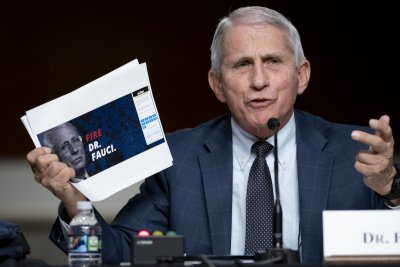
Dr. Anthony Fauci, then-director of the National Institute of Allergy and Infectious Diseases, testifies before a Senate committee hearing in 2022 in Washington, D.C. One of Fauci’s former aides has been charged with concealing emails, the Justice Department said Tuesday. Fauci is not implicated in the case. File Photo by Greg Nash/UPI | License Photo
April 28 (UPI) — A former aide to Anthony Fauci faces charges for allegedly concealing emails that involve the origins of the coronavirus pandemic, the U.S. Justice Department said Tuesday.
David M. Morens, 78, worked with Fauci from 2006 to 2022. Fauci, former director of the National Institute of Allergy and Infectious Diseases and chief medical adviser to the president from 2021 to 2022, is not accused of any wrongdoing in the case. Congressional Republicans have been investigating the U.S. coronavirus response, which started during President Donald Trump‘s first administration.
The indictment charges Morens with conspiracy against the United States and destruction and concealment of records in a federal investigation. Prosecutors say that he purposefully concealed emails he’d exchanged with the president of a nonprofit group. This group had worked with a Chinese lab that’s faced scrutiny over a perceived connection to the coronavirus, the Washington Post reported.
The indictment does not name the president or the group, but previous records have shown the former to be Peter Daszak, former president of EcoHealth Alliance, the Post reported. The group received a grant in 2014 to study bat coronaviruses.
Morens was released on his own recognizance after appearing Monday in federal court in Maryland. He has said he tried to keep some records off his government email in part to keep coronavirus misinformation from spreading and to discourage conspiracy theories.
Controversy over the origins of the virus has existed for as long as it’s been known. While many scientists say it jumped naturally from bats to humans through another animal, Trump and his administration have promoted other theories, including that the virus came from a Chinese lab.
Some Republicans hailed the charges against Morens as validation, including Rep. James Comer, R-Kentucky, chairman of the House Oversight Committee.
“I applaud the Trump Justice Department for taking action to hold his public official accountable for hiding information from the American people,” Comer said Tuesday.
Under Trump’s second administration, the White House’s covid.gov website has been changed to a site that promotes the “lab leak” theory, replacing information about vaccines, testing and health issues related to the virus.
French actor Tahar Rahim revealed how he and his co-star Izuka Hoyle were handcuffed together during filming for four months.
Speaking about the challenges of filming while attached to his co-star, The Serpent actor explained: “Being handcuffed to someone for four months filming could easily be a nightmare, but Izuka is a beautiful soul.
“We got on incredibly well and became real friends. She’s my partner in crime. It was a pleasure.”
The pair star as highly valued prisoner and mafia informant Tibor Stone (Rahim) and prison transport officer Amber Todd (Hoyle) respectively.
Get HBO Max, Netflix and Disney+ free with Sky
This article contains affiliate links, we will receive a commission on any sales we generate from it. Learn more
Sky is giving away free subscriptions to Netflix, Disney+, HBO Max, Hayu and discovery+ to customers on the Ultimate TV bundle. This also includes 135 channels such as Sky Atlantic and Sky One.
After their prison convoy is attacked by the organised crime group that Stone is testifying against, Todd makes the split-second decision to handcuff herself to him and ensure he makes it to court for the trial in four days’ time.
However, Tibor isn’t just any informant; he’s a trained assassin and can take out many of the people sent to eliminate him before he can reveal all.
This required both Rahim and Hoyle to jointly perform stunts while their characters were handcuffed.
Addressing these challenges, the Golden Globe and BAFTA nominee explained: “Being handcuffed during big stunt sequences made things more complex.
“Our stunt team was brilliant and inventive, open to ideas and incredibly collaborative.
“Izuka and I had to constantly adapt and choreograph every movement together.
“Izuka has great instincts and she’s strong, which made everything easier. I decided to just flow with her and to treat it like a dance.
“For me, acting with a partner is a kind of dance: you listen, you feel, you respond.”
Meanwhile, Big Boys and Scottish BAFTA winner Hoyle explained: “Having them on made us realise just how close we were going to be to each other for such a long period of time, and that took some getting used to.
“Tahar is incredible. He’s physically fit, so in terms of us pushing each other, it was great.
“Our competitive streaks would come out… ‘We can go faster than that. We can do better than that. We can push harder than that.’ And we did. Everyone around us would be like, ‘F****g hell’.”
Prisoner will be released on Sky as a boxset on Thursday, April 30
A member of the Bulgarian Falun Dafa association attends a protest in front of the Chinese embassy in Sofia, Bulgaria, in July 2023. The protest marked the 24th anniversary of the start of a massive campaign against Falun Dafa in July 1999, when the Chinese Communist regime began the repression and persecution of Falun Gong and its followers in China. File Photo by Vassil Donev/EPA
WASHINGTON, April 28 (UPI) —Supreme Court justices appeared divided Tuesday morning about whether a U.S. tech company can be held liable for aiding the Chinese government’s alleged torture of a spiritual minority.
The case is centers on whether practitioners in China of the Falun Gong religion — also called Falun Dafa — can sue California-based tech company Cisco Systems for aiding and abetting violations of the 18th-century Alien Tort Statute and the Torture Victim Protection Act, which was enacted in 1992.
Cisco attorney Kannon Shanmugam called for barring aiding and abetting liability. He argued that allowing liability to be implied would harm the government’s separation of power.
Much of Tuesday’s debate hinged on whether the statute’s 200-year-old “law of nations” wording was applicable to the relatively more modern concept of human rights abuses, as well as whether the first Congress meant for the victim protection act to include second liability for aiding and abetting torture.
The case marks the latest attempt to define the scope of the statue, which for over two centuries has allowed foreigners to bring lawsuits in U.S. courts for serious violations of international law.
More than 20 years ago, Cisco developed and sold to the Chinese government a surveillance system, which the government used to find, interrogate and allegedly torture Falun Gong practitioners.
During arguments for Cisco Systems Inc. vs. Doe I, some justices emphasized Cisco’s awareness of their technology’s role in persecution, while others said that including liability for aiding torture in the alien tort statue contradicted with historical precedent and had foreign policy risks.
But no clear majority converged around either position in the conservative majority court.
“We’ve maybe misled Congress into thinking, ‘Oh, we don’t need to do anything about these human rights things, the courts are taking care of it,'” Justice Brett Kavanaugh said.
“I’m concerned at a separation of powers level that we’re not really allowing suits to go forward, but Congress thinks we are because of a lack of clarity in our case law.”
Justices Ketanji Brown Jackson and Sotomayor appeared more supportive of those who brought forward the original lawsuit — several Chinese nationals and one U.S. citizen.
Addressing the wording of the Torture Victim Protection Act, Sotomayor told Shanmugam: “I’m not sure how you get to your position that ‘subjects to’ can’t mean aiding and abetting because command liability doesn’t necessarily require subjecting someone to the torture.”
“It makes someone who’s in a command position who knows of the torture and permits it to happen … aiding and abetting. We’ve defined aiding and abetting as an active step in permitting and encouraging the substantive act.”
The Alien Tort Statute grants federal district courts original jurisdiction over any civil action in which an alien sues for a tort “committed in violation of the law of nations or of a treaty of the United States.”
“What’s the point of previous [Supreme Court] decisions that determined U.S. corporations could be defendants?” said Sophia Cope, senior staff attorney at Electronic Frontier Foundation, who helped write an amicus brief in support of the Falun Gong members.
“Excluding second liability from the ATS would be a huge loophole for companies to sell services which are used for human rights violations.”
By rejecting judicially created aiding and abetting liability, the court would close the last major loophole that the plaintiffs’ lawyers have “exploited” to keep cases with such claims under the ATS and TVPA alive, said Cory Andrews, vice-president of litigation at the Washington Legal Foundation. The foundation submitted a brief in support of Cisco in February.
“It would reaffirm that the ATS is a narrow 1789 statute, not a modern vehicle for global human-rights enforcement,” Andrews said.
The case had its origins 15 years ago. In 2011, the plaintiffs — 13 Chinese nationals and one U.S. citizen — filed the original suit in the District Court for the Northern District of California, claiming they were targeted using Cisco’s technology and then detained and tortured.
The district court dismissed the claims, but it was brought to the Supreme Court after a panel of federal judges on the U.S. Court of Appeals for the Ninth Circuit agreed in 2023 that the plaintiffs had met a legal threshold to continue with the lawsuit.
Mérida, April 28, 2026 (venezuelanalysis.com) – The US government has authorized the use of Venezuelan state assets to cover the legal defense fees of President Nicolás Maduro and First Lady Cilia Flores.
According to reports, the Treasury Department’s Office of Foreign Assets Control (OFAC) issued a waiver to its existing sanctions against the Caribbean country.
The resolution, formalized in an April 24 letter from the US Justice Department to New York District Judge Alvin Hellerstein, removes an early hurdle in the high-profile case against Maduro and Flores. The pair was kidnapped by US Special Forces on January 3 and is facing charges including drug trafficking conspiracy.
The joint letter, signed by US Attorney Jay Clayton and several assistant prosecutors, clarifies that the amended OFAC licenses allow defense counsel to receive payments under strict parameters.
“The amended licenses authorize defense counsel to receive payments from the government of Venezuela with funds made available after March 5, 2026,” the document read. US prosecutors further clarified that the defense cannot be funded with Venezuelan oil revenues that are currently controlled by the US Treasury, as well as Venezuelan state assets that have been frozen for years.
The issue of access to legal funding had previously been a central flashpoint in the case. Barry Pollack, Maduro’s defense attorney, had filed a motion to dismiss the case, arguing that the US government was effectively denying the defendants their constitutional right to a fair trial by blocking their ability to pay for attorneys of their choice.
At the latest hearing on March 26, Judge Hellerstein ruled out dismissing the charges but challenged the US prosecutors’ justifications for blocking Caracas’ ability to fund Maduro and Flores’ defense.
Following the issuance of the OFAC licenses, the defense has reportedly withdrawn its motions to dismiss the case, though it retains the right to refile should similar financial obstacles arise in the future. The Venezuelan government has yet to comment on this latest development in the case.
At present, no date has been scheduled for either a hearing or the commencement of the trial. The parties have submitted a request to the court for a status conference to be scheduled in approximately 60 days. The case has progressed slowly, with the prosecution pointing to the complexity of the discovery process.
At their January 5 arraignment, Maduro and Flores pleaded not guilty to charges. Despite repeated “narcoterrorism” accusations over the years, US officials have not publicly provided evidence tying Venezuelan leaders to narcotics activities. In addition, reports from specialized agencies including the US’ DEA have consistently found Venezuela to play a marginal role in global drug trafficking.
Musgraves announced the surprise collaboration with the Gámez-Cuéllar brothers — Antonio, 18, Caleb, 15, and Joshua, 12 — in a Tuesday morning Instagram post. They will open for the “Space Cowboy” singer at the famed Gruene Hall in New Braunfels, Texas, on May 3, 4 and 5.
The brothers were members of McAllen High School’s prestigious Mariachi Oro band, which is one of the most decorated youth mariachi groups in the country. The band has performed in such illustrious venues as New York’s Carnegie Hall and the U.S. Capitol.
The Gámez-Cuéllar family first made news when the brothers and their parents were detained by ICE on Feb. 25 after a routine immigration check-in. The eldest brother was sent to a detention center in Raymondville, Texas, while the rest of the family was sent to Texas’s notorious Dilley Immigration Processing Center.
Department of Homeland Security officials told the Associated Press at the time of the detainment that only their parents, Emma Guadalupe Cuéllar Lopez and Luis Antonio Gámez Martinez, were meant to go into detention — but that they “chose” to take their children with them. DHS also claimed they had illegally entered the U.S. near Brownsville, Texas, in 2023.
In an interview with the New York Times, the family’s patriarch refuted the DHS claim, maintaining that the family had entered the country legally through an asylum claim.
After the family was detained, Democratic Rep. Joaquin Castro of San Antonio posted a video on Instagram denouncing ICE’s actions.
“Donald Trump said he was going after criminals,” Castro said in the social media clip. “[These kids] were safe enough to tour the White House. And yet, the Trump administration has them sitting in a prison.”
Outrage also came from the other side of the political aisle, with Rep. Monica De La Cruz, a Texas Republican, condemning the family’s situation.
“The Gámez-Cuéllar family’s story breaks my heart. South Texans know better than anyone that we can secure our border and still treat people with dignity — these are not competing values,” De La Cruz said in a statement. “I have repeatedly urged that enforcement target those who actually threaten our communities, not good, law-abiding, talented people who are working through the legal process.”
On March 9, all members of the family were released from detention after the mounting public press campaign.
Following their release, Musgraves — a longtime fan of the manymusicalstylings of Mexico — reposted an article about the brothers being freed with the caption: “Great so come on the road with me.”
Gasoline prices per gallon are displayed at a BP service station on Sunday in Washington, D.C. Average gas prices throughout the United States hit a new high Tuesday, AAA numbers said. Photo by Pat Benic/UPI | License Photo
April 28 (UPI) — Average gas prices in the United States hit $4.18 on Tuesday, their highest level since the Iran conflict started, as peace talks between the country and Iran stalled again over proposals on reopening the Strait of Hormuz.
The price jump of 1.6% over Monday’s price was the highest increase in more than a month, The New York Times reported. AAA numbers show that the average price for a gallon of regular gas marks an increase from $4.11 on Monday and $3.98 a month ago.
The price is the highest since April 2022, soon after the Russia-Ukraine conflict started, and about a 40% increase for drivers since the Iran conflict began. Diesel prices are at $5.46, up about 45% in that time.
Meanwhile, officials from the United States and Iran appear at an impasse over reopening the strait and an Iranian proposal to postpone discussion of that country’s nuclear program, something that President Donald Trump has said he will not agree to, USA Today reported. The conflict, as of midday Tuesday, is in a ceasefire, but both countries continue to limit shipping in the region and face off over the Strait of Hormuz.
Trump on Tuesday posted on Truth Social in an apparent response to German Chancellor Friedrich Merz’s comments Monday criticizing the conflict. Merz said in comments to students that he hopes the conflict ends soon and that United States is being “humiliated” by Iranian leaders, USA Today reported.
“He doesn’t know what he’s talking about!” Trump wrote. “If Iran had a Nuclear Weapon, the whole World would be held hostage. I am doing something with Iran, right now, that other Nations, or Presidents, should have done long ago.”
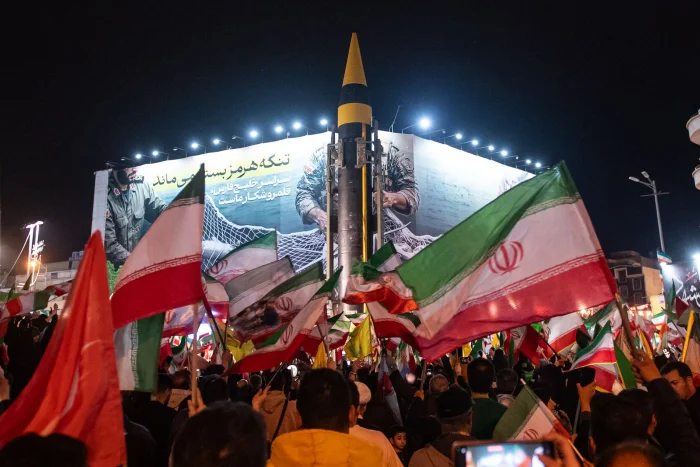
A missile identified as “Khorramshahr-4” was on display during a public rally in Tehran’s Enghelab Square on April 21, 2026. Photo by Behnam Tofighi/UPI | License Photo
Weekly insights and analysis on the latest developments in military technology, strategy, and foreign policy.
Bell has put forward a new concept for a next-generation tiltrotor aircraft armed with anti-ship cruise missiles and other munitions for the U.S. Marine Corps. The design is based on what has been newly named the MV-75A Cheyenne II, which is in development for the U.S. Army. This comes as the Corps has said “everything is on the table” as it starts to formulate a new vision for what will succeed its AH-1Z Viper and UH-1Y Venom helicopters.
A model of the new armed MV-75 concept for the Marines is currently on display at the annual Modern Day Marine conference in Washington, D.C., at which TWZ is in attendance. It is painted in the markings of Marine Light Attack Helicopter Squadron 267 (HMLA-267), a unit currently equipped with AH-1Z and UH-1Y helicopters, which perform attack and armed utility mission sets, respectively.
Another view of Bell’s new MV-75 concept model at this year’s Modern Day Marine. Eric Tegler
The model’s most immediately eye-catching details are its armament. This includes two stub wings, each with a single pylon, mounted on either side of the top of the forward fuselage, situated between the main wing and the cockpit. A Naval Strike Missile (NSM), a stealthy anti-ship cruise missile with secondary land capability, is loaded on the left side. The Marine Corps is already fielding NSM in a ground-launched configuration. The missile is also in U.S. Navy service as a sea-launched weapon, as it was originally designed.
A close-up look at the NSM on the MV-75 model at the 2026 Modern Day Marine exposition, at left, and a full-size model of the NSM on display at a previous trade show. Eric Tegler / Joseph Trevithick
On the right side of the model, there is a pair of missiles, which are intended to reflect the Marine Corps’ forthcoming Precision Attack Strike Munition (PASM) capability. PASM is a version of L3Harris’ Red Wolf, a small, lower-cost cruise missile that you can read more about here.
A close-up look at the missiles on the stub wing on the right side of the model. Phil Hladky
It is interesting to note that the missiles on the model also look similar in broad strokes to Lockheed Martin’s Common Multi-Mission Trucks (CMMT, pronounced ‘comet’). Red Wolf and CMMT are just a few examples of a growing field of missile-shaped ‘air vehicles,’ many of which can be readily reconfigurable to perform a host of different tasks, including acting as a kinetic munition, an expendable electronic warfare system, or a decoy. Designs in this general category increasingly blur the line between uncrewed aerial systems, especially longer-range kamikaze drones, and traditional cruise missiles.
Two additional launchers are attached to the sides of each of the main landing gear sponsons. These are intended to depict launch tubes for the ALTIUS-700M loitering munition or something similar, according to Bell. This is a general category of uncrewed systems now commonly referred to as launched effects. There are also five apertures on either side of the fuselage through which additional munitions or drones could be fired via Common Launch Tube (CLT).
A look at the launchers attached to the right side main landing gear sponson. A row of apertures is also visible on the side of the fuselage. Eric Tegler
“There are some restrictions of [sic] where you can place them [launchers and/or pylons for munitions and other stores], because anything that’s forward firing would need to have the clearance to get past the [rotor] tip path plane and [have] it fit inside the fuselage,” Bill Hendricks, Senior Strategy Manager at Bell, told our Eric Tegler on the show floor at Modern Day Marine. “Our assumption is that, should the Marine Corps pursue something like this, they would want to be able to employ ordnance while in airplane mode with the nacelles forward. So the weapons that we have currently on that conceptual model would be something that you could fire in airplane mode.”
The design also has a three-barrel Gatling-type cannon or machine gun in a turret under the nose. What is depicted is in line with the M197 20mm Gatling-type cannon found on Marine AH-1Zs today. An improved, lightweight evolution of that cannon, the XM915, was also expected to arm the Army’s now-canceled Future Armed Reconnaissance Aircraft (FARA).
The video below shows a live-fire flight test of the XM915 mounted on a UH-60 Black Hawk helicopter.
XM915 20mm firing
The model of MV-75 derivative for the Marines also has a sensor turret in the nose with a pair of large apertures in front, which typically reflect electro-optical and/or infrared video cameras inside. It has a retractable in-flight refueling probe, as well. The Army’s plans for in-flight refueling capability for the Cheyenne II are evolving. This is also a feature expected to be found on a special operations version of the MV-75.
A close-up look at the nose-end of the model showing the gun, in-flight refueling probe, and sensor turret. Phil Hladky
Compared to the AH-1Z and UH-1Y, with this tiltrotor design, “now you have additional range, you have additional speed, more operational flexibility, you can cover more area with one platform,” Bell’s Hendricks highlighted at the Modern Day Marine show.
“If that was something that we were asked to look at, then we can certainly explore that,” he added when asked about the possibility of extra fuel carried externally for even greater reach. “That’s not something that we’ve looked at with that conceptual design, because an MV-75 variant in that configuration with internal fuel would still have a range, after a short takeoff or a running takeoff, in excess of 1,000 nautical miles.”
As a single replacement for the AH-1Z and UH-1Y, an armed MV-75 derivative would come in a larger and more expensive package, which would present additional tradeoffs for the Marines to consider. As an aside, the service is also now in the process of charting a separate course to a replacement for the MV-22 Osprey.
A U.S. Marine Corps AH-1Z Viper attack helicopter, in front, flies together with a UH-1Y Venom armed utility helicopter, at rear. USMC
As noted, the Marine Corps has now begun to lay out a new vision for what will succeed its AH-1Z and UH-1Y helicopters. The service has previously told TWZ that this effort, currently known as Future Attack Strike (FASt), will also help fill certain capability gaps created by the retirement of the AV-8B Harrier jump jet and legacy F/A-18C/D Hornet fighters. The Marines have long said the main replacements for the AV-8Bs and F/A-18C/Ds will be variants of the F-35 Joint Strike Fighter.
“So, right now, for FASt, everything is on the table. Manned, unmanned, optionally-piloted, I think, are good avenues to take a look at. Conventional rotary-wing, tiltrotor. Maybe there’s something else out there,” Col. Scott Shadforth said in response to a question, also from Eric Tegler, while speaking today at Modern Day Marine. “There is no steadfast, solid response to that.”
Shadforth is currently Director of the Expeditionary Maritime Aviation-Advanced Development Team (XMA-ADT) within Naval Air Systems Command (NAVAIR). XMA-ADT focused on rapid prototyping and experimentation to help refine future Marine Corps aviation requirements in cooperation with the Navy.
“So, as we look at unmanned, manned-unmanned teaming, air-launched effects, all the capabilities to help extend the range of various assault support or attack type platforms, all of those are on the table for consideration by the Marine Corps at this time,” he added.
Another view of the MV-75 concept model at Modern Day Marine 2026. Eric Tegler
It is important to note that this is not the first time Bell has shown models and renderings of armed variations of this design, originally branded as the V-280 Valor, that could perform sea control and other maritime mission sets. This has included versions with internal bays, as well as pylons under the wings and ones mounted on the sides of the rear end of the fuselage.
From ‘Hook: Bell showed this seriously armed variant of its MV-75/FLRAA it is offering for the USMC’s AURA, and reminding the Navy of its paid-for engineering for FVL-MS pic.twitter.com/fs9r2m7IxT
Previous navalized concepts have also included folding main wings and rotors, similar in form and function to those features on the V-22 Osprey tiltrotor, to help reduce the aircraft’s physical footprint when operating from ships. Bell has said previously that the ‘stowed’ configuration of the V-280 could be small enough to fit inside the hangars on Arleigh Burke class destroyers, as well as those on larger naval vessels.
A rendering of V-280-based naval tiltrotors on the stern flight deck of an Arleigh Burke class destroyer. Bell
V-280 and V-247-based designs depicted operating from an amphibious assault ship. BellA rendering of a V-247 carrying a pair of Joint Strike Missiles (JSM), a design derived from the NSM. Bell
“I can see conceptually, where the Navy could, if this is what they wanted, adopt like this to [meet] their sea control, or ASW [anti-submarine warfare], or ASuW [anti-surface warfare] mission set [sic], because of the additional range that it gives you,” Bell’s Hendricks said when asked about whether this concept could also be relevant to that service’s needs. “It would outperform the speed and range of an H-60, and so that would give them more operational reach.”
The Marine Corps has made clear that all options are currently on the table, including a tiltrotor like Bell’s MV-75 or a derivative thereof, as the service works to firm up requirements for a replacement for its AH-1Z and UH-1Y helicopters.
Eric Tegler and Phil Hladky contributed to this story.
NICOLA Roberts has revealed she underwent secret surgery at 22 weeks into her pregnancy.
The Girls Aloud singer, 40, is currently expecting her first child with fiancé Mitch Hahn and is set to give birth in the coming months.
Sign up for the Showbiz newsletter
Thank you!
As she counts down to giving birth, Nicola Roberts has revealed she underwent secret surgery 22 weeks into her pregnancyCredit: Instagram/ @nicolarobertsThe mum-to-be revealed that the procedure was done to ‘keep the baby in’ as she shared the news in a postCredit: Getty
In a new post, Nicola shared a myriad of pictures from the last week, and revealed she had actually recovering after undergoing a medical procedure.
Sharing that she had surgery to “keep the baby in” at 22 weeks, Nicola didn’t expand on what had gone on, but did say she was in recovery mode.
The singer wrote to her page: “Some pics I took this week.. Hasn’t it been so nice to really feel spring..
“I’ve been under instruction not to do much since I had the surgery at 22 weeks to help keep baby in.
The Girls Aloud star is set to give birth in the next month and has been winding down ahead of the new chapterCredit: Instagram/ @nicolarobertsShe is expecting the little one with fiancé Mitch HahnCredit: Instagram/lilnicola
“Hitting that 34 week mark was a big relief. I now only have a few weeks left. Safe to say, this last bit is not the easiest is it?!
“In one breath, it will be nice to feel more comfortable again but I will also really miss my bump and having this tiny little thing in there”.
In her carousel of pictures, Nicola snapped a selfie in bed with a hot drink as she displayed her blossoming bump.
Whilst another showed the Moses basket she has prepared ahead of the little one’s arrival, with other snaps giving a glimpse into the pregnant star’s relaxed week at home.
Nicola didn’t reveal which surgery she had undergone or why, but there are several procedures which can be carried out mid-pregnancy to prevent problems further down the line.
Global military spending is up again, according to SIPRI’s latest report showing the 11th consecutive year of growth. But it’s based on open data and not everything makes the list.
Al Jazeera’s Marah Rayan breaks it down.
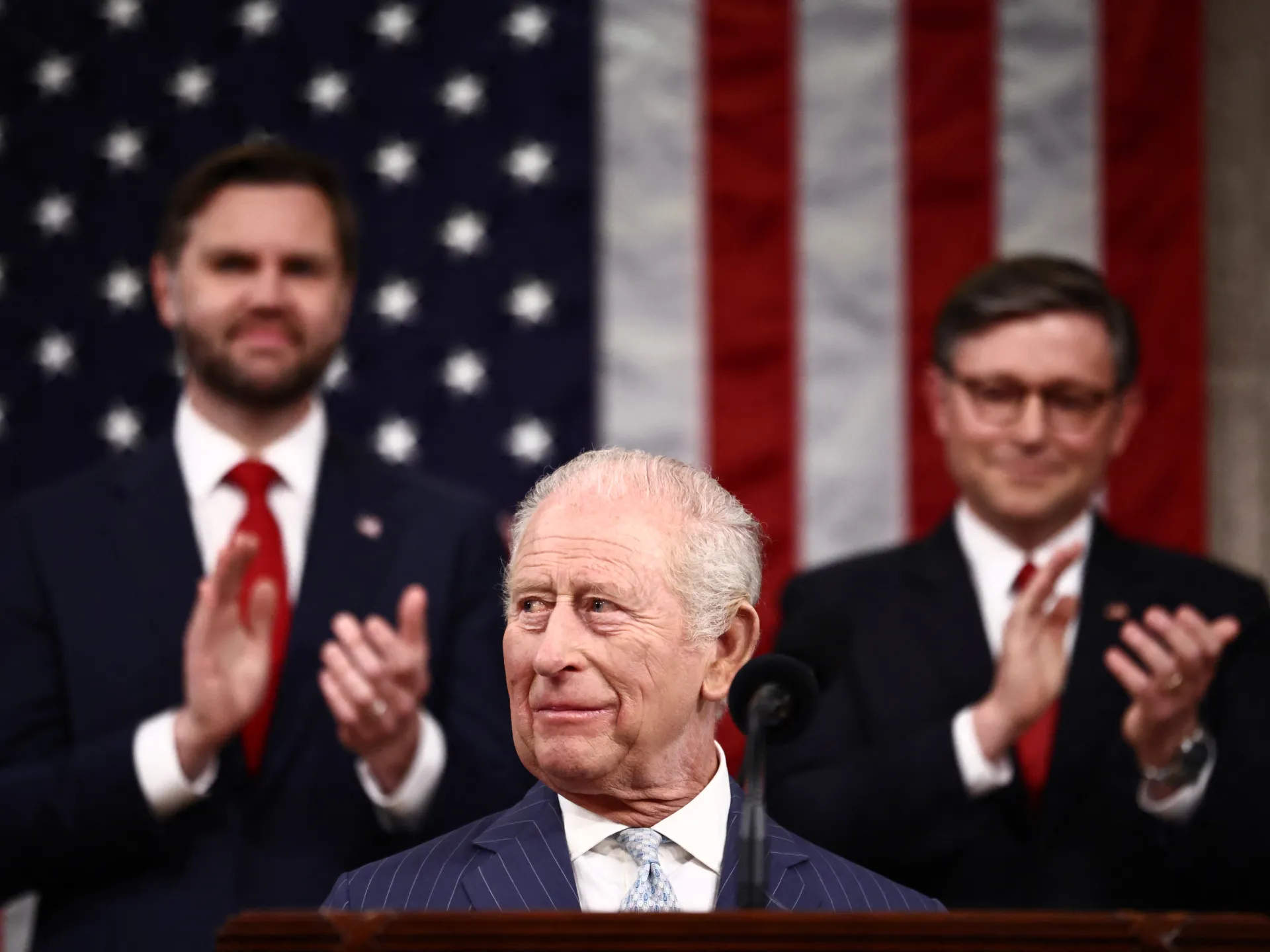
Britain’s King Charles III has used a speech in front of the United States Congress to pledge NATO unity and call for support for Ukraine amid Russia’s ongoing invasion.
The address on Tuesday came during the royal’s four-day visit to the US, with the US-Israel war with Iran, US President Donald Trump’s criticism of NATO, and trade tensions between the longtime allies looming large.
Recommended Stories
list of 3 itemsend of list
But Charles avoided any reference to specific frictions during his speech at the US Capitol, instead striking a light tone in his joke-heavy opening.
He praised what he called the shared history and values of the two countries, quipping at one point that Washington, DC was “a tale of two Georges”, the first US President George Washington and his ancestor, the UK’s King George.
He assured lawmakers, to laughs, he was not in the US “as part of some cunning rearguard action” in a delayed continuation of the Revolutionary War.
“I am here on this great occasion in the life of our nations to express the highest regard and friendship of the British people to the people of the United States,” the sovereign said to repeated standing ovations.
But amid broad themes of unity, more pointed messages lurked.
Charles did not directly address the US-Israel war with Iran or Trump’s outspoken criticism of NATO allies who have rejected joining Washington’s war efforts.
Instead, he praised support for NATO and the alliance’s invocation of its Article 5 collective defence treaty in the wake of the September 11, 2001 attacks.
“We answered the call together, as our people have done so for more than a century, shoulder to shoulder through two world wars, the Cold War, Afghanistan and moments that have defined our shared security,” he said.
He then turned to funding for Ukraine, an increasingly pointed issue in the Republican-controlled US Congress.
“Today, Mr Speaker, that same unyielding resolve is needed for the defence of Ukraine and her most courageous people,” he said, referring to House Speaker Mike Johnson.
In one instance, Charles hailed the “$430 billion in annual trade that continues to grow, the $1.7 trillion in mutual investment that fuels that innovation”.
Last week, Trump threatened to impose a “big tariff” on the UK if it did not drop a digital services tax on US tech companies.
At another point, Charles pointed to global environmental concerns.
“We ignore, at our peril, the fact that these natural systems, in other words, nature’s own economy, provide the foundation for our prosperity and our national security,” he said.
Trump has called climate change a “con job” and withdrew from the landmark Paris Agreement climate accords during his first and second terms. His administration has since pursued deregulation of fossil fuels and pivoted away from green energy, an approach embraced by many members of the president’s Republican party.
Other messages appeared to gently reference political trends in the US, where critics have accused Trump of using the Department of Justice for political retribution and of overturning long-standing norms of presidential authority.
Charles described the “common ideals” of the US and UK: “The rule of law, the certainty of stable and accessible rules, an independent judiciary, resolving disputes and delivering impartial justice”.
He also drew a throughline between the Magna Carta, the 13th-century document that established that the British king was subject to law, and constitutional and legal precedent in the US, calling it “the foundation of the principle that executive power is subject to checks and balances”.
The address came shortly before Trump was set to host Charles and his wife, Queen Camilla, for an official state dinner.
The pair were then set to visit New York and Virginia, before an official farewell ceremony at the White House on Thursday.
Maya Jama wore a slinky black dress to pose at the classical Vatican GardensCredit: InstagramMaya’s Instagram photo dump of a romantic Rome break included her clutching a bunch of keysCredit: Instagram
Maya’s Instagram photo dump of a romantic Rome break included her clutching a bunch of keys and at the Sistine Chapel with Man City star boyfriend Ruben Dias.
And she gushed about the trip to her three million fans, writing: “Can you tell I love it here?”
Maya, who, like Ant and Dec, is a pro at live TV, has now given her verdict on the huge on-air bust-up.
Taking to X/Twitter, the popular presenter, 31, shared a clip of the fallout between Ant and Dec and Jimmy, and penned: “Didn’t watch but from this clip alone (laughing emoji).
“This is why I love live tv so much and hosting the (Love Island) Aftersun show because barely any channels do it anymore out of fear of what can go wrong but people want real reactions and an edited show will never compete to the live experience!”
Showing her support for the I’m A Celebrity hosts, she added: “Ant and Dec I love you forever also.”
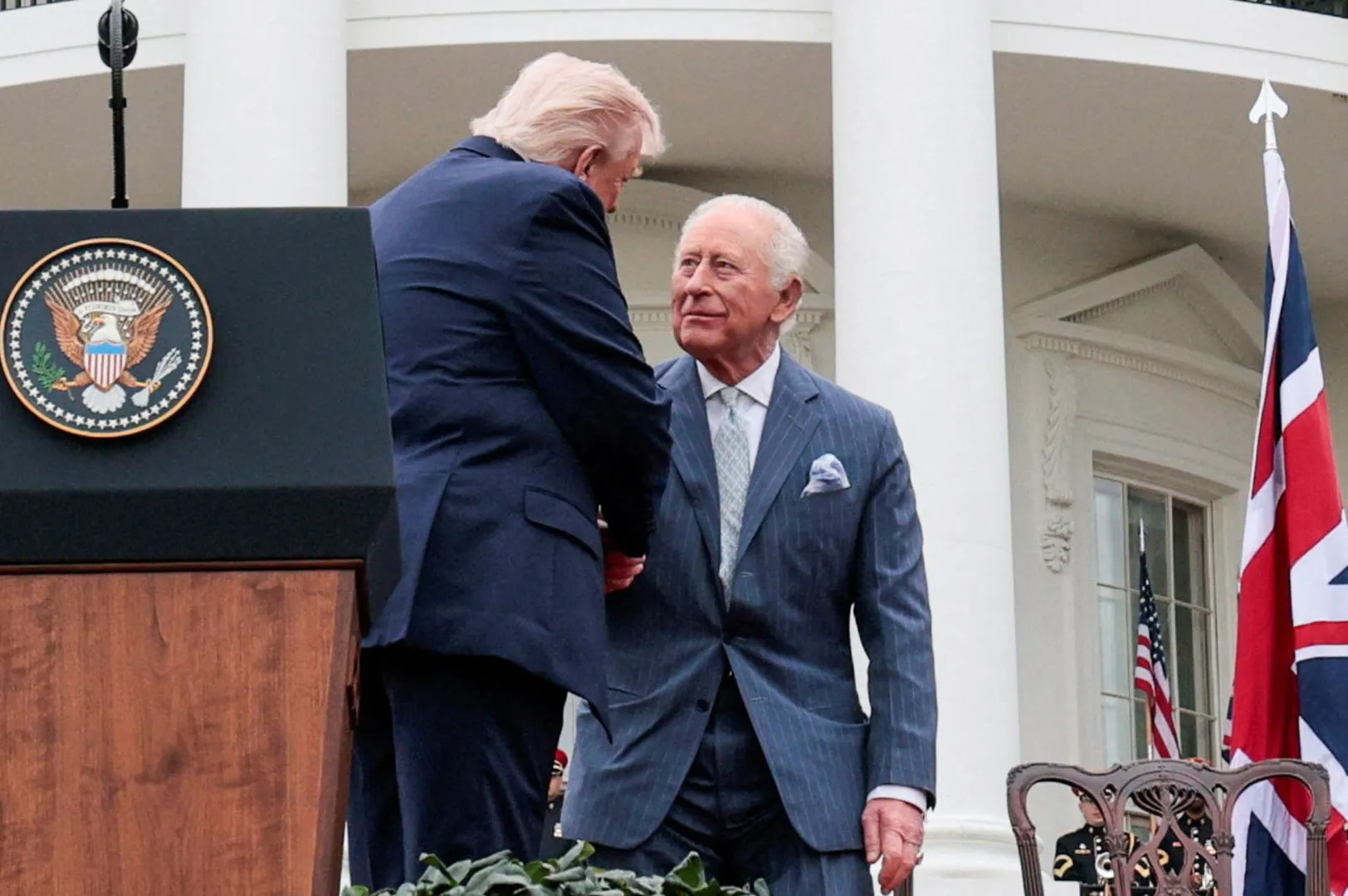
US President Donald Trump hailed the “cherished bond” between the United States and the United Kingdom as he welcomed King Charles III and Queen Camilla to the White House, seeking to mend a rift over issues including the war on Iran.
Weekly insights and analysis on the latest developments in military technology, strategy, and foreign policy.
Northrop Grumman CEO Kathy Warden says she is confident in her company’s ability to deliver next-generation carrier-based fighters to the U.S. Navy if it is picked as the winner of the F/A-XX competition. The U.S. Navy’s top officer said yesterday that the goal was to award the F/A-XX contract by August of this year, but also that one unnamed contractor in the running “really can’t deliver in the timeframe we need it.”
Chief of Naval Operations (CNO) Adm. Daryl Caudle offered his latest comments on F/A-XX yesterday in response to a direct question from TWZ at a roundtable on the sidelines of the Navy League’s Sea-Air-Space 2026 exposition. The Pentagon had tried to put the Navy’s future fighter ambitions on hold last year, arguing that the U.S. industrial base did not have sufficient capacity to support work on two sixth-generation combat jets simultaneously. Boeing won the contract to build what is now called the F-47 for the U.S. Air Force in March 2025. Boeing is the only other company known to be in the running now for F/A-XX. Last year, it was reported that Lockheed Martin had been eliminated from the competition.
Late yesterday, Northrop Grumman also released a new computer-generated F/A-XX promotional video, seen below. You can read our analysis of what is seen therein here.
“We do expect the Department [of the Navy] to make an award selection in the third quarter,” Northrop Grumman’s Warden said during a routine earning call today in response to a direct question about Adm. Caudle’s remarks. “We are confident in our ability to deliver our solution to the Navy.”
She did not explicitly confirm or deny that the CNO had been referring to Northrop Grumman when he mentioned a contractor’s inability to meet the Navy’s schedule needs on F/A-XX.
“We and our suppliers are prepared to bring the workforce and infrastructure that’s needed to execute the program, and our track record on B-21 demonstrates that ability to deliver a complex aircraft on schedule,” Warden added. “Regarding the financials, we’d expect upside to the sales and earnings from our current guidance, if we are entrusted to build the F/A-XX, and it would be a top priority for our company to do so.”
Another F/A-XX rendering Northrop Grumman released last year. Northrop Grumman
It’s also worth remembering that Northrop Grumman withdrew in 2023 from the Air Force competition that would lead to the F-47. The company framed the decision at the time as a voluntary one.
“I’ll just say that, when I noted we have other opportunities we are pursuing, I won’t disclose at this point exactly what those are until a little more information comes out,” Warden, who was also CEO at that time, said when announcing the withdrawal, which was widely seen as a reference to F/A-XX. “You could assume that if we feel we’re well-positioned, and the government is appropriately balancing risk and reward, as I said that that would be a program we would pursue.”
Former top Air Force officials subsequently said that Northrop Grumman’s bid had been on the verge of getting cut.
As mentioned, industrial base capacity questions have swirled around F/A-XX. The Pentagon had tried to effectively shelve the Navy’s next-generation fighter program in its proposed budget for the 2026 Fiscal Year. At the time, a senior U.S. defense official explicitly said that the decision was “due to our belief that the industrial base can only handle going fast on one program at this time, and the presidential priority to go all in on F-47, and get that program right.”
A rendering of the F-47 that the Air Force has previously released. USAF
Congress later intervened to appropriate some $1.69 billion in funding to keep F/A-XX moving ahead in the 2026 Fiscal Year.
“I will tell you, we, Northrop Grumman, are ready to execute F/A-XX,” Tom Jones, President of Northrop Grumman’s Aeronautics Systems sector, had also told TWZ and other outlets in response to a question about industrial base capacity in relation to the program back in December. “We’re looking to try and make sure that the customer community knows that we believe that we’re ready to go and we can execute it.”
Boeing Defense and Space CEO Steve Parker had also pushed back on the assertion that the U.S. industrial base could not support F-47 and F/A-XX at the same time last year. The company’s pitch for the Navy’s program appears to be a navalized adaptation of the F-47.
A rendering of Boeing’s proposed F/A-XX design. Boeing
“The Air Force has got a lot of demand on the system. The Navy’s got a lot of demand,” Adm. Caudle had also said yesterday. “So there was, you know, a check twice, cut once, kind of mentality here on this decision. And now there, I think we’re all on the same page on the reason why the hard look needed to be done. I’m good with it.”
Questions about the overall future of F/A-XX do remain, despite clear support from top Navy leaders like Caudle and Congress. The Navy looks set to request just over $140 million for the program in Fiscal Year 2027. This is a very meager sum, especially for a program of this magnitude. In contrast, the Air Force is seeking $5 billion in additional funding for F-47. Billions of dollars have already been appropriated for the Air Force’s next-generation fighter effort.
The Pentagon and the individual services are rolling out more details about their annual budget proposals today, which could offer more insights into the plans now for F/A-XX in the coming years. Securing the contract to build the Navy’s next-generation fighter is still likely to be an important win for whichever company the service selects in the end.
UPDATE: 4/22/2026 –
The U.S. Navy has issued a statement regarding Adm. Caudle’s comments earlier this week, which is as follows:
“During a question-and-answer session at the Sea-Air-Space Exposition, Chief of Naval Operations Admiral Daryl Caudle was asked about the Navy’s sixth-generation strike fighter program (F/A-XX). Adm. Caudle emphasized that the Navy’s priority is ensuring through due diligence the selected vendor can deliver the required capability on the timeline needed by the fleet while also considering broader industrial base capacity. Any reference to ‘a specific offeror’ was intended as a general anecdotal comment and was not directed at any vendors currently under consideration.”
Sara Cox has landed a new deal after her hit series The Marvellous Miniature Workshop was recomissioned for a bumper new series – with DOUBLE the number of episodes
21:00, 28 Apr 2026Updated 21:08, 28 Apr 2026
Sara Cox’s show is back with a bumper new run of episodes
Presenter Sara Cox has officially cemented her status as the BBC’s golden girl after landing a major new television deal just days after being unveiled as the new host of the Radio 2 Breakfast Show.
In a move that proves the broadcaster is firmly betting on the 51-year-old star, the Beeb has handed Cox a bumper new contract for her hit series, The Marvellous Miniature Workshop.
Insiders say the move is a “huge vote of confidence” in Sara, who is now arguably one of the most in-demand women in British broadcasting. The BBC One show, which Sara hosts, has been recommissioned with more than DOUBLE the number of episodes. It will also be extended from 30 to 45 minutes.
The crafting show is seen as a “new Repair Shop” for the channel and was a big hit when it launched at the end of last year. A BBC insider said: “This is a massive show of faith in Sara who is going down a storm with audiences – and the BBC is backing her all the way.”
The show sees Sara and a team of expert miniaturists recreate cherished buildings and locations tied to contributors’ personal histories. BBC bosses have upped the show from eight to 20 shows.
Sara said: “I’m absolutely over the moon about the new series of Marvellous Miniature Workshop, it’s easily the most heartwarming and wonderful programme I’ve ever been involved with. I can’t wait to hear more stories, help unearth more memories and watch our superb miniaturists breathe life back into places long since gone or neglected.”
The show – which was nominated for a Royal Television Society award earlier this year – is made by EarlyBird, the newly launched production company founded by Dom Bird.
Bird, who is also the executive producer of Gladiators and The Apprentice, said: “I’m delighted Sara’s returning to BBC One for this new run.
Seeing audiences respond so positively to The Marvellous Miniature Workshop has been a real pleasure and I’m thrilled that the BBC has commissioned EarlyBird to deliver this super-sized order.
These extended 45-minute episodes will enable Sara to immerse viewers even further into the extraordinary artistry of our miniaturists, showcasing the programme’s exceptional ability to capture the magic in the minutiae.”
Rachel Platt, commissioning editor for BBC Daytime added: “We’re delighted to be able to bring back this absolute treat of a series with an extended run and run time. Sometimes small things need bigger packages.”
News of the new TV deal comes after Sara was announced as Radio 2’s second female breakfast host, after Zoe Ball. It came after Scott Mills was sacked by the BBC over an investigation into serious sexual offences involving an underage boy.
April 28 (Asia Today) — South Korea has completed deployment of a five-satellite reconnaissance system designed to strengthen its preemptive strike capabilities against North Korea, marking a major milestone in its defense space program.
The project, known as the “425 program,” gives Seoul an independent ability to monitor North Korea with high-resolution imagery at roughly two-hour intervals, officials said.
The system combines one electro-optical and infrared satellite with four synthetic aperture radar satellites, allowing surveillance regardless of weather or time of day. Military officials say the network can track mobile missile launchers and other high-value targets, enhancing the country’s “kill chain” capability – a core element of its three-axis defense system.
The satellites were launched between late 2023 and late 2025, with the final unit successfully placed into orbit in November. U.S. space company SpaceX supported the launches, providing real-time global broadcasts that demonstrated the reliability of South Korea’s space assets.
The deployment marks a shift away from reliance on U.S. intelligence toward what officials describe as “independent surveillance,” enabling South Korea to observe targets at times of its choosing.
Despite the progress, military officials and analysts warn of a critical challenge: delays in real-time intelligence sharing with the United States.
Sources said that during the satellite deployment process, some U.S. intelligence inputs were delayed or limited, raising concerns about coordination between South Korea’s independent assets and allied systems.
The issue has implications for the effectiveness of the kill chain, which relies on rapid detection, identification and strike decisions within a narrow time window.
To address coordination gaps, U.S. Forces Korea has established a new unit known as J10, or Integrated Strategy Division, to support nuclear-conventional integration between the allies.
The unit is intended to act as a control hub linking U.S. nuclear deterrence capabilities with South Korea’s precision strike assets, enabling real-time operational coordination under the bilateral Nuclear Consultative Group framework.
Defense experts say the effort reflects growing complexity in integrating allied systems, particularly as both sides seek to align security protocols and data standards.
“The challenge is not just hardware, but digital synchronization,” one analyst said. “If delays persist, the kill chain could miss its critical response window.”
Another limitation is the system’s revisit rate. With North Korea believed to be able to prepare missile launches within 30 to 40 minutes, a two-hour surveillance cycle leaves potential gaps.
To address this, South Korea is accelerating plans to deploy constellations of small satellites in low Earth orbit, aiming to reduce revisit times to under 30 minutes.
Officials also emphasized the need for artificial intelligence-based analysis platforms capable of processing large volumes of satellite data in seconds to detect early warning signs.
Experts say the long-term success of the program will depend on software capabilities as much as hardware.
“When South Korea can produce intelligence as quickly and accurately as its allies, real-time data sharing will naturally deepen,” a defense expert said.
Weekly insights and analysis on the latest developments in military technology, strategy, and foreign policy.
The U.S. Marine Corps is set to test at least two new autonomous cargo helicopters, as it seeks to field platforms that can rapidly resupply Marines in contested environments. The service recently awarded contracts for two such platforms, one being the R66 Turbinetruck that inserts Sikorsky’s MATRIX autonomy system in the proven Robinson R66 airframe. The second is the Uncrewed 505, a development of the Bell 505 in a program led by Near Earth Autonomy, in collaboration with Bell Textron, Moog Inc., and XP Services.
The R66 Turbinetruck that combines the Robinson R66 airframe with Sikorsky’s MATRIX autonomy system. Robinson Unmanned
Lockheed Martin announced yesterday that its Sikorsky subsidiary and Robinson Unmanned had received a contract for the Turbinetruck from the Marine Corps. This comes under the Marines’ new-look Autonomous Aerial Logistics Program Medium Aerial Resupply Vehicle — Expeditionary Logistics (MARV-EL). The contract is worth $15.5 million and covers Increment 2 of MARV-EL.
“As we expand the MATRIX family, we also extend the reach of uncrewed solutions for both civil and military customers,” said Rich Benton, vice president and general manager of Sikorsky. “The commercially developed R66 Turbinetruck is simple, economical, and re-configurable; ideal for high-risk, hard-to-reach environments, where keeping personnel out of harm’s way is essential.”
“Our partnership with Sikorsky brings the trusted performance and reliability of the R66 platform into the unmanned logistics arena,” added David Smith, president and CEO of Robinson Helicopter Company. “The R66 Turbinetruck represents a significant step forward in expanding proven rotorcraft into scalable, autonomous cargo solutions for demanding operational environments. Together, we are delivering a game‑changing capability that will enhance warfighter readiness and open new opportunities for safe, reliable, and affordable autonomous transport.”
Robinson Unmanned | The Future of Autonomous Rotorcraft is Here
The R66 Turbinetruck puts together the R66 airframe from the Robinson Helicopter Company, a single-turbine engine design that is best known as a five-seat light rotorcraft on the commercial market. The R66 was selected for the Turbinetruck application primarily on account of its reliability, low maintenance demands, and high level of versatility. The aircraft is currently in widespread civilian service as a trainer, passenger, and utility helicopter.
Combining the R66 airframe with Sikorsky’s MATRIX system provides the ability to perform autonomous uncrewed operations. MATRIX has previously been proven in a U.S. Army UH-60M helicopter, giving it a ‘robotic brain,’ and the culmination of a series of tests stretching back years now that have been steadily working on ever-greater pilot-optional capabilities for the Black Hawk family. As we have noted in the past, the same technology could easily find its way onto other aircraft, as evidenced by the Turbinetruck.
Sikorsky and DARPA Autonomous Black Hawk Flies Logistics and Rescue Missions Without Pilots on Board
Lockheed Martin says the Turbinetruck is intended to give the Marines “flexible, affordable and rapid combat sustainment,” with its primary roles including the delivery of ammunition, medical supplies, and other essential equipment directly to the troops that need it. These critical loads need to be supplied “regardless of terrain, weather, or enemy threat,” the company adds.
According to Robinson Helicopter, the Turbinetruck can carry a load of 1,300 pounds internally, or external loads supported via a cargo hook. The internal cargo compartment is accessed via front clamshell doors and a right-hand baggage door. A total useful load of 1,500 pounds can be transported, and the aircraft has a range of more than 325 nautical miles.
The Turbinetruck features two clamshell doors in its nose, allowing a forklift truck to place loads directly in it. Robinson Unmanned
When it comes to MARV-EL, this now stipulates an uncrewed aircraft that can carry a logistic payload of between 1,300 and 2,500 pounds to a combat radius of 100 nautical miles, operating through a common digital handheld device.
In an operational scenario, the mission objectives would be entered into the Turbinetruck using a digital tablet. The system would then automatically create a flight plan, using sensors and algorithms to guide the helicopter safely to the target location.
The Turbinetruck would allow the Marines to conduct critical logistics missions without having to put any additional personnel at risk, as would be the case if crewed rotorcraft were employed at the tactical edge of the battlefield. Crewed rotorcraft also come with increased demands on maintenance and availability. Meanwhile, crew-rest cycles might mean that the aircraft have to stay on the ground during high-tempo operations, while these assets will inevitably be in heavy demand for all kinds of other missions in any kind of high-end fight.
A video outlining the Robinson R66 Army Trainer, a crewed version of the helicopter offered to the U.S. Army schoolhouse:
Robinson R66 Army Trainer Helicopter | Press Conference & Official Reveal | AAAA in Nashville
At the same time, the MARV-EL concept is especially tailored for the Indo-Pacific theater, in which Marines and other U.S. military forces would be expected to fight from and around austere forward operating bases — a concept known as Expeditionary Advanced Base Operations — as well as unimproved landing zones, and from the decks of ships.
In this context, the Turbinetruck, and the MARV-EL program, more generally, hope to fill a notable capability gap between small tactical drones and larger crewed airlifters. This is something that Lockheed Martin describes as a “middleweight” uncrewed logistics platform capable.
Another view of the Turbinetruck with the nose cargo doors open. Robinson Unmanned
Robinson Unmanned will deliver the first R66 Turbinetruck to Sikorsky for integration, test and evaluation, and demonstration. At that point, the aircraft will undertake capability demonstrations to prove out the MATRIX system in the R66 airframe.
Since MATRIX is platform-agnostic and has an open architecture design, it is intended to be easily integrated into various airframes.
As for the rival Uncrewed 505, this takes the Bell 505 Jet Ranger X helicopter and combines it with Near Earth’s Captain autonomous system, and Moog’s Genesys avionics. The 505 is also a single-turbine helicopter that is in use in similar training, passenger, and utility roles as the R66.
A rendering of the Uncrewed 505. Near Earth Autonomy
The MARV-EL Increment 2 program will also see the Uncrewed 505 prototype developed for the Marine Corps. Near Earth says it will spend the next 36 months integrating and flight-testing the autonomous flight system in the Uncrewed 505, before progressing from early demonstrations to full mission capability.
“The program is to develop an uncrewed aerial logistics aircraft for where the risk and need are highest,” said Lyle Chamberlain, CTO of Near Earth. “We are combining our Captain autonomy architecture with a proven Bell 505 platform to move cargo without putting Marines in harm’s way. To be as intuitive as possible, we are designing the aircraft around existing Marine Corps workflows. Operators will be able to request, dispatch, and manage missions through familiar command-and-control pathways, including MAGTAB and MANGL integration. At the same time, cargo can be loaded with standard pallet jacks and forklifts. This approach reduces infrastructure burden and helps make autonomous resupply practical for expeditionary operations.”
A diagram shows the basic operating concept for the Uncrewed 505. Near Earth Autonomy
Near Earth says the Uncrewed 505 is optimized for efficient transportability, with two aircraft fitting inside a C-130 cargo aircraft with minimal disassembly.
Other aircraft have previously emerged out of the MARV-EL program.
These included the Kargo UAV, a rotary-wing drone from the Kaman Corporation, which previously developed an optionally crewed version of its K-Max helicopter.
KARGO UAV | Transforming Expeditionary Logistics
Notably, Kaman partnered with Near Earth Autonomy for the autonomy system for both the Kargo UAV and the optionally crewed K-Max.
Another competitor for MARV-EL was the SeaOnyx from Leidos. In 2023, it was announced that Leidos had won a Marine Corps contract to develop a prototype of this autonomous resupply vehicle under the Medium Unmanned Logistics Systems — Air (MULS-A) program, which later became MARV-EL.
The SeaOnyx from Leidos. Leidos
However, neither of these platforms met Marine Corps requirements, leading to MARV-EL being recompeted. At the same time, the previous requirements (including delivering a logistics payload of 300-600 pounds within a radius of 25 to 100 nautical miles to a combat area) were made more ambitious, increasing cargo payload and range.
A video outlining the Bell 505, as offered for the U.S. Army Flight School Next requirement:
Bell 505: Ideal Trainer
At the same time, the R66 already has a foothold with the U.S. military, with TH-66 Sage used to train U.S. Army and Navy helicopter operators, under contract. The Army is also now looking at both the R66 and the Bell 505 for its Flight School Next training helicopter program.
Whichever design or designs are ultimately selected for the MARV-EL requirement, the Marines can expect a new medium-weight logistics platform that bridges the gap between smaller drones and larger crewed aircraft currently in use. At the same time, it will help reduce risk by keeping more fixed-wing and helicopter crews out of harm’s way.
A BRIT rock star has revealed how he has become a dad for the first time.
Royal Blood’s guitarist Ben Thatcher, 38, also thrilled fans when he announced his newborn son’s unusual name.
Sign up for the Showbiz newsletter
Thank you!
Royal Blood star Ben Thatcher has revealed he has become a dad for the first timeCredit: Roddy ScottThe drummer shared this picture of his babyCredit: Instagram/ @benjitalentBen welcomed his son with his partner BeccaCredit: Instagram/ @benjitalent
The Brit Award-winning musician revealed that he and his longterm partner Becca had welcomed a baby boy named Phoenix.
The star took to Instagram this afternoon to announce the news and also shared a glimpse of his new arrival with his army of followers.
Writing alongside an adorable snap of the newborn baby, which shows the rocker cradling his son, the proud dad wrote: “Introducing my little boy, Phoenix Rue Thatcher.
“He has stolen my heart. @beccamcginty_ thank you for growing this little miracle.
“I love you, you’re already the greatest mum to our wee lad. And thank you to @nhssurreysussex for delivering our little boy safely into the world.”
Ben’s friends and followers including some of his celebrity pals were quick to congratulate him on the news.
Strictly Come Dancing star, and fellow new dad, Joe Sugg was one of the first to send well wishes, penning: “Congrats to you both!”
While Radio 1 host Jack Saunders said: “Congratulations to you both. What a gorgeous boy.”
Brit actress Emma Laird gushed: “Congratulations oh my gosh.”
Ben along with his bandmate Mike Kerr formed Royal Blood back in 2011.
Ben shot to fame as the drummer in Royal BloodCredit: Getty – Contributor
They have since gone on to make history after their first four albums all hit the No. 1 spot in the charts.
They aren’t just famous in the UK, Royal Blood have also achieved global success and played sold out shows and festivals across the world.
They have also performed with fellow rock icons including Muse and Foo Fighters, who both personally invited them to support them on their stadium tours.
Previously speaking to The Sun about performing with these huge bands, Ben told us in 2023: “Muse are a fantastic band for us to open up for because our fans kind of have the same DNA.
“So, for us to go out into those stadiums is like playing to a lot of our fans really, but in places where we wouldn’t be able to play normally.
“Like the Stade de France in Paris, which was amazing.
Only 22 percent of US voters back the president’s performance on the cost of living, Reuters/Ipsos survey suggests.
Published On 28 Apr 202628 Apr 2026
United States President Donald Trump’s approval rating has dropped to its lowest point since he returned to the White House, sinking to 34 percent amid economic uncertainty and the US-Israel war on Iran, a Reuters/Ipsos poll suggests.
The poll, released on Tuesday, also showed that only 22 percent of respondents back Trump’s performance on the cost of living. Affordability has been a top issue for US voters.
Recommended Stories
list of 3 itemsend of list
The Iran war, which saw Tehran block most shipping through the Strait of Hormuz, has sent energy prices soaring across the world and fuelled inflation in the US.
The Reuters poll was conducted April 24-27, and it surveyed 1,014 US adults.
It comes months before the midterm elections in November when Trump’s Republican Party will have to contend with the US president’s abysmal job approval ratings as it tries to retain control of the Senate and House of Representatives.
Trump continues to enjoy near-unanimous support from Republicans in Congress despite growing criticism of the war on Iran by some right-wing commentators and podcasters.
The conflict has also been unpopular with US voters, including a sizeable Republican constituency.
A Marquette Law School survey released last week suggested that only 32 percent of voters approve of Trump’s handling of the war.
The number rose to 65 percent among Republican respondents, but it still showed significant dissent within the party on the issue.
A separate Associated Press-NORC poll last week reported similar findings – Trump’s overall approval rating at 33 percent, support for the war at 32 percent and his handling of the economy at 30 percent.
The US and Iran reached a two-week ceasefire on April 8 that Trump extended indefinitely, but tensions remain high in the region.
Duelling blockades in the Gulf – Iran shutting down the Strait of Hormuz and the US laying a naval siege on Iranian ports – have caused global energy supply issues to persist despite the truce.
In the US, the average price of 1 gallon (3.8 litres) of petrol is currently at $4.17, up from less than $3 before the war.
Still, Trump has suggested that he is comfortable with the status quo, claiming repeatedly that the Iranian economy is crumbling and that time is on his side.
“Iran has just informed us that they are in a ‘State of Collapse,’” the US president wrote in a social media post on Tuesday.
“They want us to ‘Open the Hormuz Strait,’ as soon as possible, as they try to figure out their leadership situation (Which I believe they will be able to do!)”
It’s not clear how or why Iran, which is currently refusing to hold direct negotiations with the US without it lifting the naval blockade, would inform Trump that its own economy is collapsing.
On March 13, 2013, Fakhr al-Din al-Aryan, a judge at Idlib’s Civil Court of Appeal, publicly defected from the Syrian regime – an act that led him to be sentenced to death in absentia.
In December 2024, more than a decade later, Bashar al-Assad’s regime – the very one he had defected from – was overthrown, and al-Aryan was able to finally return to Syria’s judiciary.
Recommended Stories
list of 3 itemsend of list
In the latest step on al-Aryan’s journey from defection to exile to return, he was the presiding judge on Sunday at the opening of the trial of Atef Najib, a cousin of former President al-Assad and the former head of political security in the southern province of Deraa who faces charges of premeditated murder, torture leading to death and crimes against humanity.
Al-Assad and his brother Maher al-Assad, a former top military commander, are also being tried in absentia. Both men fled to Russia after their 2024 overthrow.
Fadel Abdulghany, the founder of the Syrian Network for Human Rights (SNHR), told Al Jazeera that the moment carries deep symbolic weight.
“A judge once sentenced to death by the Assad regime for defending the rule of law has returned to the bench to apply that same law to one of the regime’s most extensively documented perpetrators of violations,” Abdulghany explained. “This reversal of power dynamics reflects the promise of the rule of law so rarely fulfilled in post-authoritarian transitions. The significance of this moment lies not in spectacle but in its adherence to due process.”
Defection and return
Al-Aryan was a judicial adviser during the early years of Syria’s uprising, which began in March 2011, as protests intensified and the state increasingly relied on security-based rule.
By 2013, he decided that he had to break from the Syrian state and defected in a recorded statement that framed his decision as a matter of legal and moral responsibility.
“In light of the responsibility placed on the shoulders of judges, who are the guardians of justice and truth, and as a result of the massacres committed by the regime against civilians, children and women, … I announce my defection from the Ministry of Justice and my joining the Independent Syrian Judicial Council … to be a strong shield for justice and equality,” he said in the video.
After his defection, al-Aryan joined the judicial bodies of the then-Syrian Interim Government and became involved in building what was described as a parallel judicial track in opposition-held areas.
As part of that, he worked on establishing alternative courts, handling legal cases and documenting alleged crimes committed by the now former regime.
In response, the authorities sentenced al-Aryan to death in absentia and confiscated his property, including assets later sold at public auction.
After the fall of al-Assad’s regime, al-Aryan’s name re-emerged in June after a presidential decree reinstating dismissed judges. That process culminated in his appointment as head of the Fourth Criminal Court in Damascus, positioning him at the centre of the country’s first transitional judicial proceedings.
Najib’s links to repression of Syrian revolution
The transformation in al-Aryan’s life mirrors that of the man on trial in his courtroom on Sunday.
The position of the al-Assad family member as a top security official in Deraa in 2011 placed Najib at the centre of some of the first major confrontations between civilians and state security officers. Deraa is called the “cradle of the revolution” after government repression of protesters there inspired al-Assad’s opponents in other areas of the country to rise up.
One specific incident – the arrest and torture of schoolchildren detained after scrawling, “The people want the fall of the regime,” and the killing of one of them, 13-year-old Hamza al-Khateeb – is widely regarded as the spark for the country’s revolution.
Najib’s connection to that incident and the death of Hamza is one of the reasons why his trial is so significant in Syria.
The former official was arrested in January 2025 in the Latakia region, where some former regime loyalists had taken refuge.
Transitional justice
For the Syrian Network for Human Rights, the trial is significant because of how it is being conducted and not just who is being tried.
Abdulghany stressed that “this is neither a revolutionary court nor a victors’ court” but a case that has moved through formal legal stages, including arrest by the Ministry of Interior, investigation, prosecution and referral to a criminal court in Damascus.
The charges include premeditated murder and torture leading to death, classified as crimes against humanity under international law. This framing, Abdulghany said, is deliberate: It places domestic proceedings within the framework of international criminal standards, which is essential for the credibility of any verdict.
Abdulghany also highlighted the institutional message of the trial and in particular the inclusion of the former president and his brother as defendants despite their absence from the proceedings and from Syria.
“Physical absence does not amount to legal immunity,” he said.
Despite this, Abdulghany stressed that the trial was not the end of the transitional justice process in a country where hundreds of thousands of people died and disappeared during the war and the five-decade rule of al-Assad and his father, Hafez. There is still little information in many of the cases of the disappeared and imprisoned. The SNHR has documented at least 177,000 cases of enforced disappearances since 2011 with the vast majority attributed to the former government.
Abdulghany explained that accountability in Syria cannot be reduced to criminal trials alone and instead must include four interconnected pillars: criminal accountability, truth-seeking, reparations and institutional reform.
These, he argued, must function together under a unified structure rather than as separate or sequential processes.
Abdulghany placed particular emphasis on institutional reform, noting that Syria’s judiciary was previously used as a tool of repression rather than justice.
“Without these reforms, transitional justice trials risk being conducted through judicial institutions that have not themselves been transformed,” he said, pointing to the need to dismantle exceptional courts and rebuild judicial independence.
Truth-seeking, he added, is equally essential.
Families of victims have a right to know what happened to their relatives, and this right exists independently of criminal prosecutions, Abdulghany said.
“They deserve answers,” he said, adding that recognition of truth, justice and reparations must be unconditional if any durable reconciliation is to be achieved.
BBC’s new crime drama starring Sheridan Smith has been a hit with viewers
18:29, 28 Apr 2026Updated 18:30, 28 Apr 2026
Sheridan Smith takes centre stage in the gritty new BBC drama (Image: BBC)
BBC viewers are already hooked on the new crime drama starring Sheridan Smith.
The Cage recently made its debut onto our TV screens and a number of fans have already binge-watched all five episodes with many calling for another season.
It comes as no surprise that viewers are gripped on the show. Not only is the cast lead by BAFTA-winner Sheridan but its creator is the BAFTA-winning Tony Schumacher, who created the acclaimed police drama The Responder.
Alongside Sheridan, her co-star Michael Socha also leads the cast of the popular series, which follows two financially struggling Liverpool casino employees who end up confronting dangerous local criminals and the authorities after siphoning money from the casino safe.
Shot in and around Liverpool and Merseyside, the narrative centres on Leanne (Sheridan), a single mother and casino cashier who begins siphoning cash from the safe to rescue her family home.
However, when she discovers that her boss Matty (Muchael), a gambling addict, is engaged in the same activity, both of their lives begin to unravel.
The duo forge an unexpected alliance to conceal their theft, but quickly become entangled with local gangsters and the police.
The synopsis states: “Leanne is the charismatic cashier at an inner-city casino who finds herself threatened with losing the family home and starts skimming cash from the casino safe to secure her family’s future.
“When Leanne discovers her boss Matty is doing the same thing, their lives are set on a collision course; with each other, the local gangster they’re stealing from, and the police.
“As Leanne’s loyalties are pulled in different directions, Matty battles with his inner demons meaning the pair will have to play every hand perfectly.”
Viewers have wasted no time sharing their reaction as one viewer said: “I just finished watching it, so good. I hope they have a season 2.”
Another wrote: “#thecage Just finished binge watching this series and loved it. Great cast especially the performance of Michael Socha.Some great music in there as well.”
A third commented: “Binged The Cage in one sitting, fantastic show! Well done all involved.” Another said: “Binged the whole series tonight. I really enjoyed it, proper good British drama and great cast/performances,”
Meanwhile another added: “Loved it!! It was so good had me on the edge of my seat.” While another called for a second season, writing: “Michael and Sheridan were absolutely phenomenal, can’t wait for series 2?”
The Gulf state is the latest to quit the group, which was created to form a united front on oil pricing.
The United Arab Emirates has announced its withdrawal from OPEC and the wider OPEC+ framework, removing a core pillar of one of the most influential groups in the energy world.
The Gulf country, with a capacity of approximately 4.8 million barrels per day and significant room to increase output, announced on Tuesday that it would quit the organisation to focus on “national interests”.
Here’s a look the at the organisation’s history and role in the global economy:
When was OPEC established and why?
The Organization of the Petroleum Exporting Countries (OPEC) is a permanent, intergovernmental organisation based in Vienna, Austria, that has the objective of coordinating and unifying petroleum policies among member states.
It was originally created at the Baghdad Conference in September 1960 by five oil-producing founding states, Iran, Iraq, Kuwait, Saudi Arabia and Venezuela.
At that time, global oil markets were dominated by a group of powerful Western oil companies, known as the “Seven Sisters,” which controlled production and set prices.
The broader aim of the founding countries was to assert sovereignty over their natural resources and secure fair and stable prices for petroleum producers, as well as regular supplies to consuming nations.
OPEC currently has 12 members, including, aside from the UAE: Algeria, Republic of the Congo, Equatorial Guinea, Gabon, Iran, Iraq, Kuwait, Libya, Nigeria, Saudi Arabia, and Venezuela.
According to a statement issued on Tuesday, the UAE’s withdrawal will be effective on May 1, marking the exit of a member that had contributed to the organisation since 1967.
The organisation pursues price stability by setting agreed production quotas for the membership, which together controls about 30 percent of global supply.
Since 2016, OPEC has also cooperated with Russia, Azerbaijan, Kazakhstan, Bahrain, Brunei, Malaysia, Mexico, Oman, South Sudan, and Sudan through its OPEC+ framework, bringing its output to about 41 percent of global supply.
Why did the UAE leave OPEC and OPEC+?
Alongside Saudi Arabia, the UAE is one of the few OPEC members with meaningful spare capacity, which allows the organisation to respond to supply shocks.
However, nations with spare capacity may decide to cash out their reserves rather than use them to adjust the market.
The UAE’s assertive foreign policy approach has progressively isolated it from fellow OPEC members, especially Saudi Arabia, which disagrees with its positions on Yemen and elsewhere.
Abu Dhabi, meanwhile, has been carving out its own sphere of influence across the Middle East and Africa, and has doubled down on relations with the United States and Israel, with which it opened ties in the 2020 Abraham Accords.
It views relations with Israel as a critical lever for regional influence and a unique channel to Washington, especially after coming under attack during the Iran war.
The UAE is not the first country to leave the organisation. Others to have withdrawn in recent years include Indonesia, Qatar, Ecuador, Angola and Gabon, mainly due to disagreements over output quotas.