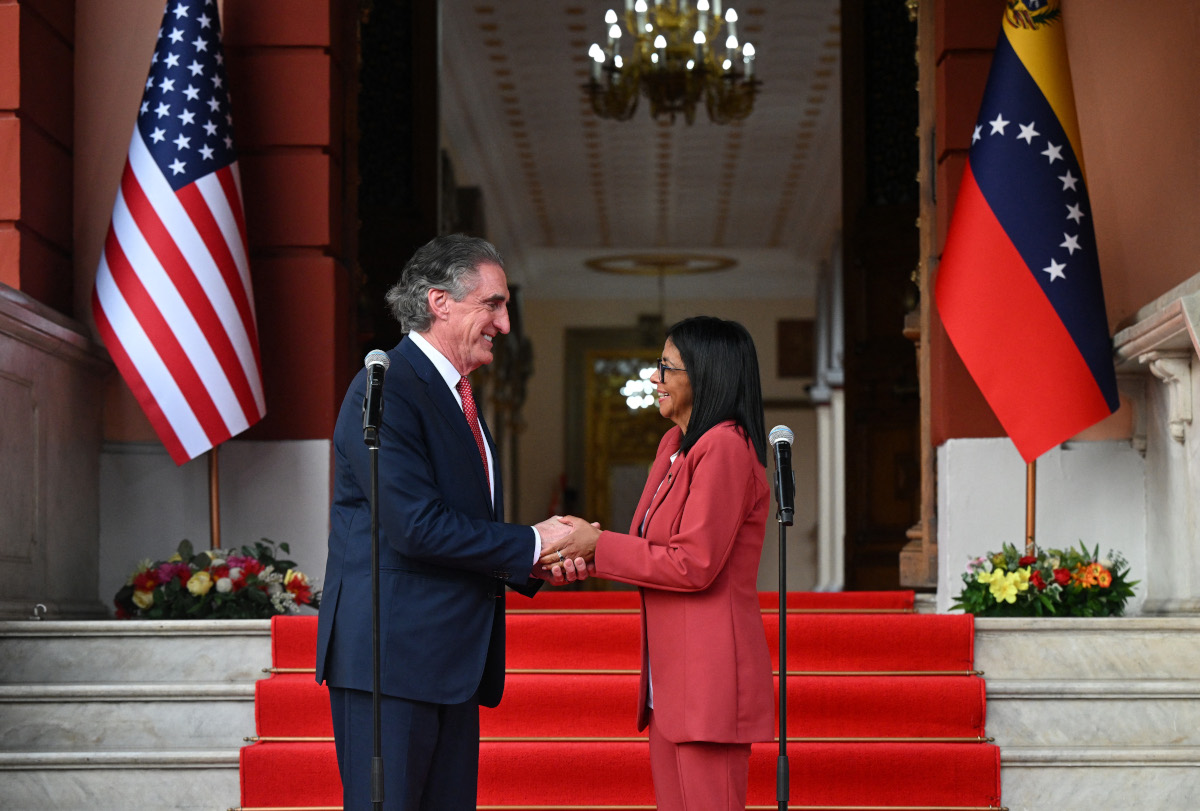
Rodríguez and Burgum gave a joint press conference in Miraflores Palace. (AFP)
Caracas, March 5, 2026 (venezuelanalysis.com) – Venezuelan Acting President Delcy Rodríguez met Wednesday with US Interior Secretary Doug Burgum at the Miraflores Presidential Palace in Caracas to discuss a bilateral agenda focused on energy and mining.
Senior officials from both countries also attended a closed-door meeting, including US Chargé d’Affaires Laura Dogu and Venezuelan Interior Minister Diosdado Cabello. Rodríguez and Burgum later gave a joint press conference.
“We welcomed Burgum to address important aspects related to metallic, non-metallic, strategic and non-strategic minerals,” the acting president told reporters. “We want the Venezuelan people to see the advantage of having good relations with the world and with the United States.”
Rodríguez said that her economic team will soon present a proposal to the National Assembly to “expand” Venezuela’s Mining Law, urging lawmakers to reform it “swiftly” in order to showcase “investment and development opportunities in the mining sector” to both domestic and international business groups.
Venezuela’s current mining legislation was approved in 1999. Rodríguez noted that the government intends to replicate the “win-win formula” of the recent hydrocarbon reform approved on January 29, which introduced wide-reaching benefits for foreign capital in the oil sector.
Under the overhauled legislation, private operators get expanded control over operations, with limited parliamentary oversight and a reduced tax burden.
Rodríguez also thanked US President Donald Trump for a social media post praising the Venezuelan acting president for “doing a great job.” The Venezuelan leader highlighted the US government’s “kind disposition” to work on a “mutually beneficial” cooperation agenda.
For his part, Burgum said that Venezuela is “an extraordinarily rich nation” in oil, gas, and critical minerals, adding that the opportunities for collaboration between the two countries “have no limits.” He serves as chair of the US National Energy Dominance Council as well.
According to the senior White House official, who holds the natural resources portfolio, the potential cooperation could deliver something “truly remarkable” for both the Venezuelan and American people. Burgum’s delegation included representatives from over 20 US and Canadian mining companies, some of them with a past presence in Venezuela.
“These companies are ready to begin,” he said. “I know that [Acting President] Rodríguez, like President Trump, wants to cut bureaucratic red tape so this capital investment can start flowing.”
Among the companies represented in the visit were US firms Peabody Energy—the world’s largest private coal company—Hartree Partners, Orion CMC, Paulson & Co., and Caterpillar Inc., along with Canada’s Lundin Mining Corp and Singapore-based commodities trader Trafigura.
Canadian miner Gold Reserve also announced plans to return to the Caribbean nation and disclosed a 30-day US Treasury license to negotiate with Caracas.
According to Axios, US officials additionally negotiated a multimillion-dollar agreement with Venezuela’s state mining company Minerven to sell up to one metric ton of gold to the US market, currently valued at roughly $165 million.
The deal would require Minerven to supply between 650 and 1,000 kilograms of doré gold bars—a crude alloy of gold and silver with 50 to 90 percent purity—to Trafigura, which would transport the metal to US refineries. The transaction details were not disclosed, including whether Trafigura will deposit payment in US-run accounts in an arrangement similar to the one the Trump administration has imposed for Venezuelan oil exports.
Burgum is the fourth senior US official to visit Venezuela since the January 3 US military strikes and kidnapping of President Nicolás Maduro and his wife, National Assembly deputy Cilia Flores.
Earlier visits included US Southern Command chief Francis Donovan, CIA Director John Ratcliffe, and US Energy Secretary Chris Wright.
Venezuela possesses vast unexplored and proven mineral reserves, including significant gold, iron, bauxite, diamonds, nickel, and copper deposits. Coltan reserves have likewise been touted in recent years.
According to the International Center for Productive Investment (CIIP)—an agency attached to the Venezuelan vice presidency—the country holds the eighth-largest iron reserves in the world, estimated at 14.7 billion metric tons, as well as more than 321 million tons of bauxite, the raw material used to produce aluminum.
Regarding gold, the CIIP estimates that Venezuela may hold between 2,200 and 8,000 metric tons, which would place the country among the largest gold reserves globally.
Analysts have also highlighted the possibility of finding rare earth deposits in the South American country. The 17 elements have diverse applications in cutting-edge technology and advanced weapons systems. Washington is currently highly dependent on rare earth imports from China.
By my count, Philip Glass has written 28 operas, the same number as Verdi. The count is iffy because Glass pushes the boundaries between what we tend to call opera and the fuzzier idea of music theater. His first, “Einstein on the Beach” in 1976 — a collaboration between the composer and the late, innovative theater maker Robert Wilson — is a non-narrative effusion of imagery, movement, music and text, each a brilliantly independent entity that somehow excites a hard-to-pin-down purpose.
His latest (and probably his last, Glass turns 90 this year) is “Circus Days and Nights” — a touching and thrilling opera for a circus and staged at a circus in Mälmo, Sweden, in 2021 — caps a wondrous 45 years of operatic advancement. You would have to go back to Handel’s 42 operas, Mozart’s 22 or Verdi’s oeuvre for operatic equivalence.
Glass’ subject matter varies widely in epochs and ethoses, from ancient Egypt to Walt Disney’s Hollywood. Taken as a whole, these 28 operas reveal how we got to be who we are historically, artistically, spiritually, politically and fancifully, often including more than one of those categories, as in his third opera, “Akhnaten,” which Los Angeles Opera has now remounted at the Dorothy Chandler Pavilion. The instantly recognizable musical style has remained, over the years, consistently abstract and refreshing. It doesn’t tell you how to think, how to feel, even how to understand. It simply grabs your attention; you do the interpreting.
Still, America knows little of Glass’ operatic enormity. The early “portrait” operas — “Einstein,” “Satyagraha” (about Gandhi) and “Akhnaten” (the 14th century BC Egyptian pharaoh) — appear in repertory here and there (meaning mostly in Europe) as do a trio of operas based on Jean Cocteau films. The rest remain little mounted, while several but not all have been recorded. The Metropolitan Opera, for instance, commissioned “The Voyage” in 1992 to celebrate the 500th anniversary of Columbus’ arrival in the Americas, but the epic opera is nowhere to be found in our semisesquicentennial year. It is sadly no longer even thinkable that “Appomattox,” Glass’ revelatory reminder of an America that once honored goodwill negotiation over political self-interest, return to the Kennedy Center, where its final version had its premiere 11 years ago.
L.A. Opera has been better than most American companies in its attention to Glass. It has excellently presented the three portrait operas on its main stage, beginning with “Einstein” in the final and most brilliant revival of the original Wilson staging. The “Satyagraha” and “Akhnaten” revivals have been the designed-to-dazzle inventions of quirky director Phelim McDermott, a co-founder of Impossible, an eccentric British theater company. When new in the last decade, they felt the most arresting productions of these operas since Achim Freyer’s in Stuttgart, Germany, in the early 1980s. Almost every performance at the Dorothy Chandler Pavilion has sold out.
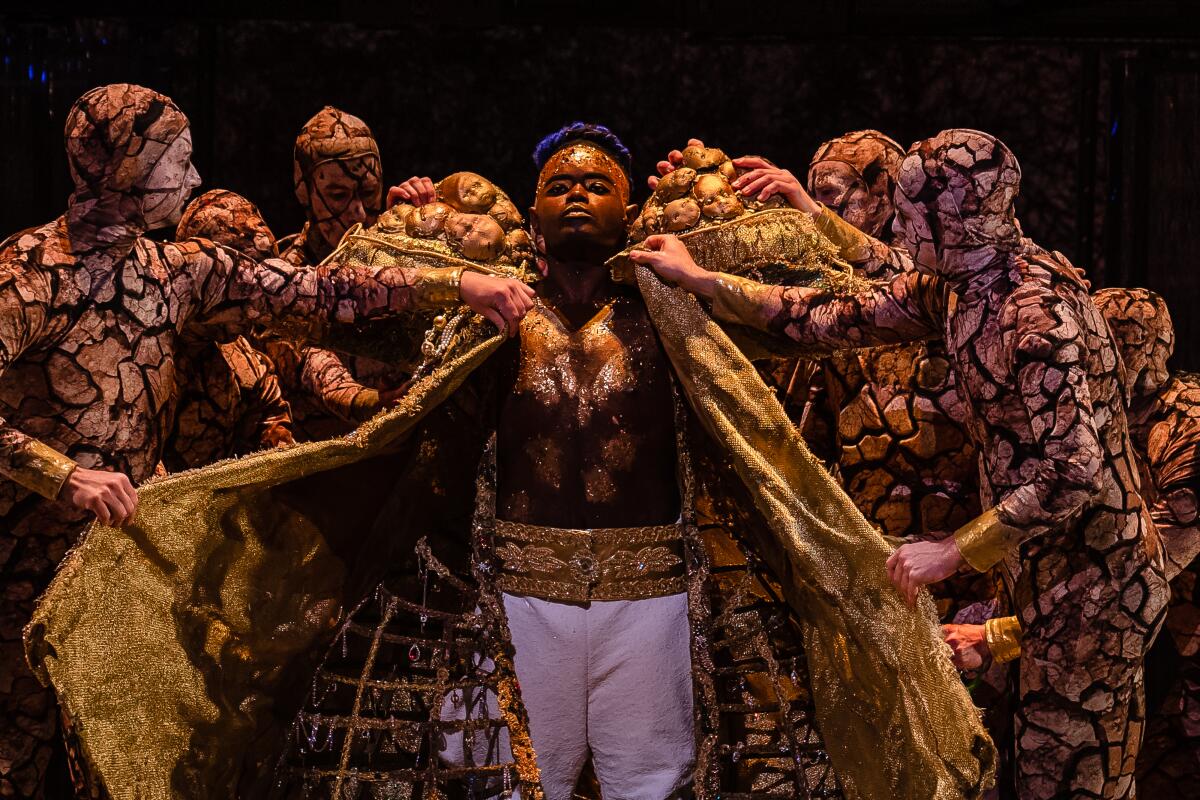
John Holiday as the titular ruler in Philip Glass’ “Akhnaten” at the Dorothy Chandler Pavilion.
(Ariana Drehsler / For The Times)
McDermott’s “Akhnaten” got the most attention thanks to breathtaking jugglers and lavish costumes, along with a touch of full-frontal novelty as Akhnaten gets clothed in his kitschy, glittery getup for his inauguration. Glass had chosen the pharaoh because he is thought to have been the first monotheistic ruler.
Akhnaten is revealed in episodes of his life that are not fleshed out but presented as ritual, including the ravishing love duet with his wife, Nefertiti. The revolutionary pharoah builds a great city and reduces spiritual chaos by focusing on a single-minded form of worship. He looks androgenous in portraits, which led Glass to create the role for countertenor.
The sung texts are in ancient languages, and there are no projected song titles. Instead, a narrator gives a somewhat notion of what’s what in the language of the audience, as is Akhnaten’s great aria, a hymn to Aten (god of the sun).
Ultimately, the pharaoh’s prescient spiritual optimism comes in conflict with the all-powerful establishment priests, who kill Akhnaten and Nefertiti. The opera ends with Akhnaten’s son, presumably Tutankhamun, restoring polytheism, and then, once the staging jumps millennia into the future, it’s rediscovered by modern-day tourists. The currency couldn’t be missed Saturday, the Shia cleric and Iran’s supreme leader Ali Khamenei having just been assassinated along with his wife at the start of America’s and Israel’s Iran war.
Sun-Ly Pierce as Nefertiti and John Holiday as Akhnaten in Philip Glass’ “Akhnaten” at the Dorothy Chandler Pavilion.
(Ariana Drehsler / For The Times)
In the opera, it so happens, the ghosts of Akhnaten, his wife and mother, have the last word in a glorious trio.
When first performed at L.A. Opera a decade ago, the lavish production, co-produced with English National Opera, helped recover a neglected opera. In the meantime, “Akhnaten” has gone practically mainstream. The Metropolitan Opera, which also mounted McDermott’s production, released it on CD and DVD, winning a Grammy for best opera recording.
Since then, the choreographer Lucinda Childs, veteran of “Einstein on the Beach,” has staged a stunningly chic “Akhnaten” in Nice, France, that is available on YouTube. Last year, director Barrie Kosky created a sensation with his staging at Komische Oper Berlin, which starred American countertenor John Holiday.
Holiday happens to be the Akhnaten in the L.A. Opera revival, and he is magnificent. McDermott had built his production around the gracefully emotive Anthony Roth Costanzo, slight and luminous in voice and build and game for nudity. If Costanzo’s disarming enthusiasm for the role has been significant in mainstreaming “Akhnaten,” Holiday, who is a very different presence, may be the next step.
Although he can be a popularly gregarious crossover performer, here he suggests a ruler of profound, unflappable dignity, rather than vulnerability. His hymn to Aten is an exercise in majesty, an ode not just to the sun but to the expanses in which our solar system circulates.
In general, the singers class up the production. Sun-Ly Pierce as Nefertiti and So Young Park as Queen Tye add allure. The large cast of smaller roles and chorus is excellent. Zachary James returns as both Amenhotep III, Akhnaten’s father, and the engaging narrator who occasionally threatens to get carried away. McDermott had perfectly employed James as the droll animatronic Disneyland Lincoln in his animation-friendly, slightly goofy production of “Perfect American” in Madrid, where the opera premiered. Here McDermott’s inspired staging demonstrated that Glass’ forgiving personal portrait of Walt Disney makes it the quintessential Hollywood opera that no one dares bring to squeamish Hollywood.
Zachary James as Amenhotep III in Philip Glass’ “Akhnaten” at the Dorothy Chandler Pavilion.
(Ariana Drehsler / For The Times)
Hollywood, however, is hardly squeamish when it comes to synchronized jugglers. For McDermott, they suggest somber ritual and were, in fact, known in Akhnaten’s Egypt. For the audience, they are a thrill a minute. For Glass, they may take on deeper meaning now that the circus is where he landed 26 operas later.
As for Finnish conductor Dalia Stasevska, making her L.A. opera debut, she keenly keeps score and bounding balls together with cinematic flair. Glass removed violins from the orchestra to achieve a dark, primordial orchestral sound along with pounding percussion. Stasevska finds light, color and action. She conducts for the moment. Picturesque wind instruments suddenly burst forth as if a flock of birds were flying over the pyramids. Solo brass can sound momentous. The percussion pounds like nobody’s business, opening the score up to all the implied emotion and glitter on an over-stuffed stage.
Childs’ exalted use of dance and Kosky’s dazzling theatrical imagination may have moved us into a sleeker, more sophisticated and paradisal Glassian realm, but the sheer passion McDermott and Stasevska bring continues its own attraction.
In the meantime, McDermott has worked with Glass on a theatrical show, “The Tao of Glass,” that has been seen in New York and will run throughout much of the summer in London. In a better world of Glass, it would be running alongside “Akhnaten” at the Ahmanson. But the Labèque sisters will be at Walt Disney Concert Hall at the end of the month with a two-piano program based on Glass’ operatic Cocteau trilogy. Also check out L.A. Opera’s several excellent podcasts on “Ahkhnaten” — the company has quietly become a leader in the medium.
‘Akhnaten’
Where: Dorothy Chandler Pavilion, 135 Grand Ave., L.A.
When: Through March 22
Tickets: $33.50-$415
Running time: About 3 hours, 40 minutes, with 2 intermissions.
SEOUL, March 6 (UPI) — South Korea’s Unification Ministry called Friday for pursuing a declaration formally ending the Korean War, describing it as a step toward restarting dialogue with North Korea and easing tensions on the Korean Peninsula.
The ministry outlined the proposal in a policy report presented to the National Assembly’s foreign affairs and unification committee and shared with reporters, as part of President Lee Jae Myung’s broader effort to stabilize inter-Korean relations after years of heightened tensions.
Seoul “will promote a ‘peace declaration’ reflecting the political will to end the Korean War and initiate discussions on establishing a peace regime, including the signing of a peace treaty,” the report said.
North and South Korea remain technically at war because the 1950-53 Korean War ended with an armistice rather than a peace agreement.
The ministry said the declaration could serve as an initial step toward transforming the armistice system into a lasting peace framework and helping institutionalize what it described as a policy of “peaceful coexistence” between the two Koreas.
The report comes amid mixed signals from North Korea following its recent Workers’ Party congress, where leader Kim Jong Un said there was “no reason” Pyongyang could not improve relations with the United States if Washington abandons what he called its hostile policy.
Kim maintained his dismissive stance toward South Korea, however, calling it “the most hostile entity.” The Lee administration has pursued a series of confidence-building steps aimed at lowering tensions — efforts Kim described as “a clumsy deceptive farce.”
Lee has said South Korea aims to act as a “pacemaker” for renewed diplomacy between Washington and Pyongyang, working with regional partners to create conditions for dialogue between the United States and North Korea.
The ministry’s report noted that U.S. President Donald Trump has expressed willingness to address the unresolved wartime status of the Korean Peninsula and said Washington has reaffirmed its openness to talks with Pyongyang without preconditions.
Seoul said it will also seek the appointment of a U.S. special envoy for North Korea and expand coordination with neighboring countries to encourage the North to return to negotiations.
Despite those efforts, tensions could rise again soon.
South Korea and the United States are scheduled to begin their large-scale springtime military exercise, Freedom Shield, on Monday. Pyongyang routinely condemns the allies’ joint drills as rehearsals for an invasion, and the report noted that North Korea may respond with statements or military provocations.
Lebanon’s Hezbollah group urges Israelis to evacuate border areas as Israel continues to bomb the country.
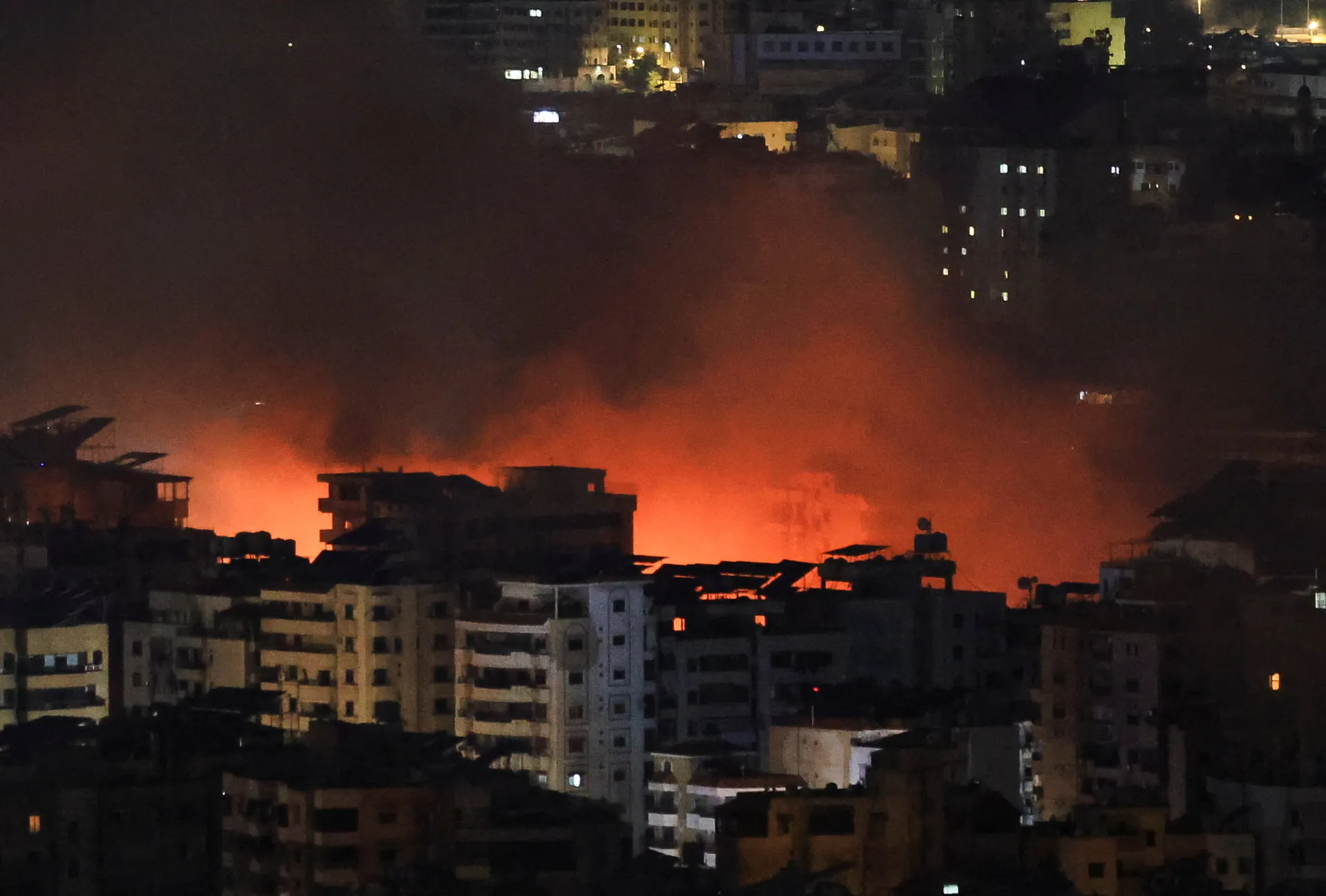
The death toll from Israeli attacks on Lebanon this week has risen to at least 123 people, the Lebanese Ministry of Public Health says, as a new wave of strikes pounded the country and Hezbollah warned Israeli residents to evacuate towns within 5km (3 miles) of their northern border, in one of the fiercest fronts in the wider United States-Israel war on Iran.
“The toll from the Israeli aggression on Monday … increased to 123 martyrs and 683 wounded,” a ministry statement said on Thursday.
Recommended Stories
list of 4 itemsend of list
Lebanese state media said early on Friday that Israel had launched air strikes on several towns in southern Lebanon.
“Enemy warplanes launched nighttime strikes on the towns of Srifa, Aita al-Shaab, Touline, as-Sawana and Majdal Selem,” the official National News Agency (NNA) reported.
Another strike hit the eastern Lebanese town of Douris at dawn, the NNA said.
Hezbollah’s message to evacuate the border areas came less than a day after Israel threatened residents that they should leave Beirut’s southern suburbs, prompting a huge exodus from a swath of the capital’s densely populated area known as Dahiyeh, where some half a million people live.
The Israeli army said it has conducted 26 rounds of attacks in Dahiyeh. It claims to have hit various infrastructure used by Hezbollah, including the headquarters of the group’s Executive Council and a warehouse with drones.
“Your military’s aggression against Lebanese sovereignty and safe citizens, the destruction of civilian infrastructure and the expulsion campaign it is carrying out will not go unchallenged,” Hezbollah said.
Hezbollah claimed responsibility for a wave of attacks early on Friday on Israeli ground forces, including those who have entered Lebanon’s territory in recent days.
In a statement on Telegram, Hezbollah said its fighters had attacked Israeli forces in several areas, including Maroun al-Ras and Kfar Kila, within Lebanese territory.
Hezbollah also attacked Israel’s Yoav military camp in the occupied Golan Heights and a navy base in Israel’s Haifa port, the statement said.
There were no immediate reports of casualties.
Israel has said it will not evacuate its border towns and has sent more soldiers into Lebanon, claiming it was a defensive measure meant to protect its citizens who live nearby.
In contrast, tens of thousands of people in Lebanon have fled their homes after threats from Israel, with a mass exodus from Beirut’s southern suburbs leaving the area “almost empty”, the NNA said.
Hundreds of displaced families were left to seek shelter on a Beirut beach, where they waited despondently – many for the second time, after evacuating during a 2024 war between Israel and Hezbollah.
‘We are not animals’
Zeina Khodr, reporting from Beirut, said the humanitarian crisis is growing rapidly, as people seeking shelter can be seen “on the side of the roads on almost every corner”.
“There aren’t enough schools to shelter the hundreds of thousands of people who were forced to flee their homes after Israel’s forced displacement threat for Beirut’s southern suburbs yesterday,” she said.
“People are telling us: ‘We are not animals; we are human beings, our children are cold.’”
She noted that the Lebanese government has opened a number of shelters and told people to head to the north of the country.
Khodr added: “But many do not have any means of transport. It’s not just Lebanese who live in Beirut’s southern suburbs, but also Syrian refugees and Palestinian refugees.”
Lebanon was pulled into the war in the Middle East on Monday, as Hezbollah opened fire, prompting Israeli air strikes focused on Beirut’s southern suburbs and on southern and eastern Lebanon.
The war has rekindled fighting between Israel and Iran-allied Hezbollah fighters, and Israel launched a series of air raids late on Thursday into Friday in the southern suburbs of Beirut and other areas.
As a child in Newark, N.J., Narciso Rodriguez was often transported back to Cuba by the stories from his family and their friends. He walked the halls of El Encanto, a Havana department store and fashion mecca on the island — one that drew in celebrity clientele and featured haute-couture designs and fragrances from the far-flung fashion capitals of Paris and Milan.
“I don’t know that they could have afforded any of those things when they were in Cuba,” he tells De Los. “But they certainly filled my imagination with beautiful stories and laid the foundation for my work.”
It was the women in his life — the “amazing, powerful, loud, colorful dynamos,” as he describes them — who inspired him to pursue a career in fashion.
“Their stories, their lives, their power, their curves, it all influenced me,” he says. “They’re the reason I wanted to create things.”
Over the last three decades, the renowned designer has earned a reputation for sleek, flattering lines and effortless shapes, most famously seen on the career-launching dress he designed for his friend Carolyn Bessette-Kennedy to wear on her wedding day. The bias-cut silk slip has remained a source of inspiration for generations of brides since, and has been making waves again thanks to the FX series “Love Story: John F. Kennedy Jr. and Carolyn Bessette.”
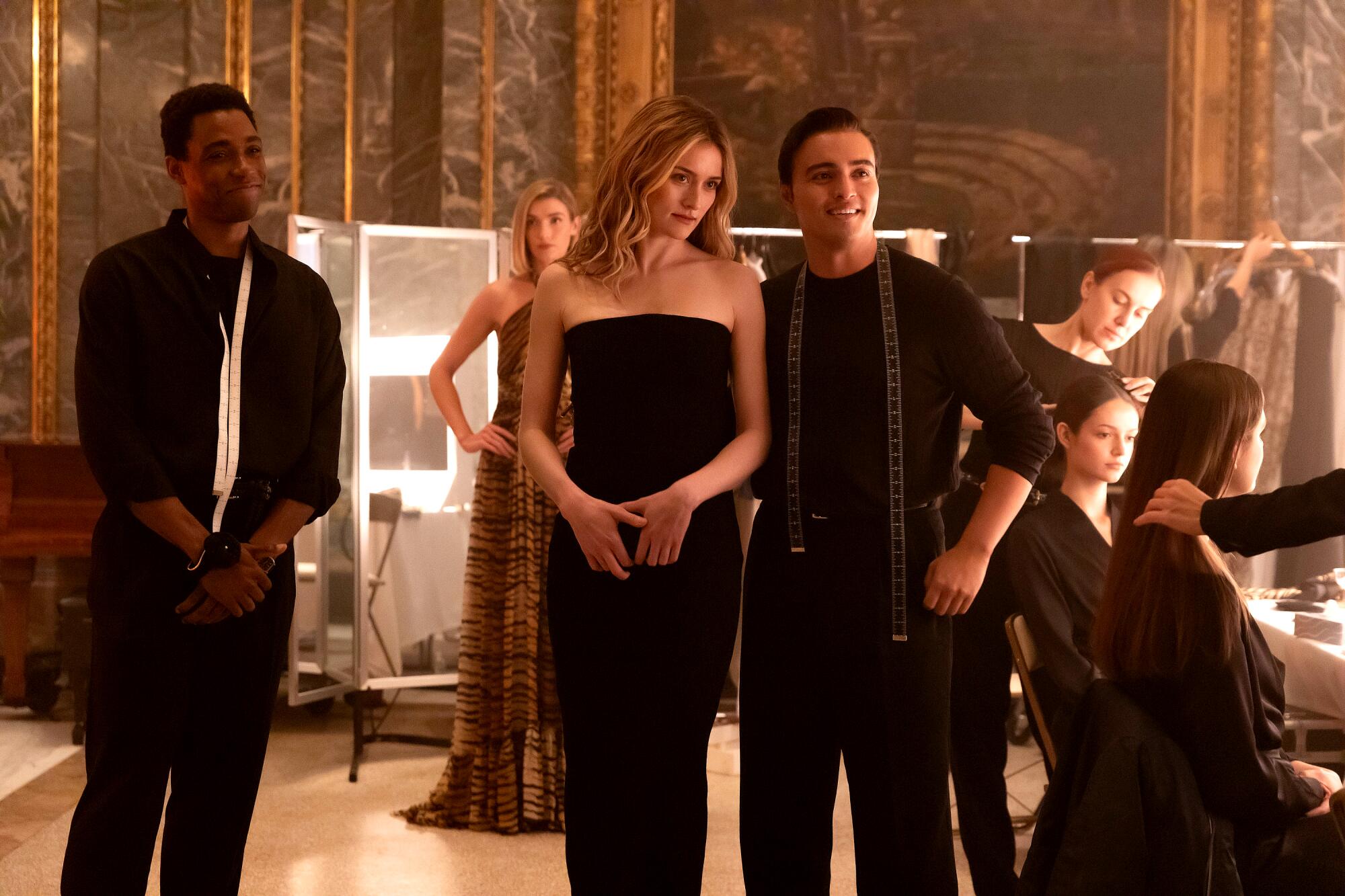
Omari K. Chancellor as Gordon Henderson, from left, Sarah Pidgeon as Carolyn Bessette, Tonatiuh as Narciso Rodriguez in FX’s “Love Story: John F. Kennedy Jr. & Carolyn Bessette”
(Eric Liebowitz / FX)
“Love Story” will follow the couple’s wedding in the latest episode, out March 5. (Rodriguez is portrayed by Tonatiuh on the show.)
After designing Bessette-Kennedy’s dress, Rodriguez launched his own label and a fragrance line, and has continued to create designs that are woven into the fabric of American history — Michelle Obama wore his dress on election night in 2008.
De Los spoke with Rodriguez about his career, upbringing and memories of designing Bessette-Kennedy’s dress.
You’ve spoken about how inspired you were by the women in your life growing up. Are there any “fashion icons” from your family or neighborhood that you could point to from your childhood?
You know, I’m so lucky because I was raised in a very Cuban household in a very culturally rich community in Newark. I mean, it was Italian, Spanish, Cuban, Puerto Rican, Black. It was everything. But I always think back to when I was very, very young, there was a kind of matriarch here in the neighborhood. Her name was Concha and she was kind of this lightning rod. My dad’s sister was married to her son, so when my parents came to the U.S., she gave them a place to stay. She would teach all of the young women how to cook and gave everyone a place to stay until they got on their feet. She was larger than life, she was like “Auntie Mame.” She had these great ‘60s beehive wigs in amazing wig boxes, she made these beautiful Chanel suits for herself, and had all these gold bangles, great lipstick and stilettos. When she came into the room, she just radiated power, joy and style. I always think of her as being my first signpost on the road.
They were all beautiful, you know? My aunts and my mom were the most beautiful, glamorous women. None of them were wearing designer clothes, but they took great pride and great care in how they looked, and that really made an impression on me.
How did that impression translate into a concrete passion? How did you go about actually pursuing a career in fashion?
I loved architecture. I loved building things, so I was always drawing, sketching and sculpting. Then I would see my mom take a piece of fabric and the way she could take something flat and shapeless and turn it into a garment was fascinating. By the time I was 13, I was doing fashion illustration, and I got a job in a tailor shop. Later, I enrolled myself in Saturday courses at Parsons [School of Design], and I kind of had to hide it from my parents at first. I felt like I couldn’t be a fashion designer, you know, because of the whole “macho” idea, but I just kept going. I was lucky that I was someone who always knew what they wanted to do, and that Parsons recognized I had talent for it at a young age.
I was exposed to really great people there, too. Donna Karan was a critic, Calvin Klein was a critic, Oscar de la Renta too. I got to do projects with all of them, and then I was hired after school by Donna Karan while she was still at Anne Klein. It was an amazing experience, and then I got poached by Calvin Klein, which was a very different experience.
How so?
It was incredible, but just very different. Whereas Anne Klein was this melting pot of creativity, Calvin was much more image-driven and precision-driven. He brought in great talents to collaborate with, so on any given day, you’d be working with the most amazing photographers, stylists and art directors. It was a really great finishing school as a young person.
You arrived at Calvin Klein during a period of reinvention for the brand. This was in the era of Kate Moss, and the famous “Marky Mark” print ads. We see a version of it in “Love Story,” but what was it like to actually be there?
When I got there, I think around 1989, it hadn’t really started to change yet. And I thought, “Wow, I made a really big mistake. This is not my aesthetic, not my thing.” But it changed very quickly, and it was very exciting. [Calvin] worked very hard. He was very focused, and he appreciated that I could keep up. Like everybody, there was a rough initiation period, but afterward, he gave me the opportunity to work on some tailored pieces that sold really well at retail, so I was rewarded with more opportunities.
But it was the ‘90s, and it was New York, and it was brilliant. It felt like the whole city was reinventing itself, and Calvin was a leader in that. All the best photographers, the most brilliant artists were there. Jacky Marshall, Zack Carr, Carolyn — the talent was endless. I was really fortunate to experience it and build friendships that were lifelong.
I’m curious if you remember your first impressions of Carolyn. How did you two connect?
We were quite friendly immediately, and then we became the best of friends. We lived in the same building, so the rest was history. You know, she’s an incredible person, and she had great style. She was bigger than life.
Carolyn has been regarded as a fashion icon, and especially now, everyone is trying to re–create her look. There was something more subtle and interesting going on than just “minimalist” fashion, so how would you describe what made her style so special?
Carolyn was so authentic in so many ways, and I think that she was very pragmatic about her choices. She had a great eye. She knew what worked for her, and she knew how to present herself. She never wanted to be uncomfortable. She was very connected to herself. I think so many people have this relationship to fashion and what they think they should look like based on the ideas they see in a magazine or being sold to you by the industry, and Carolyn never fell into that trap.
I have this conversation often with young designers, with people, with journalists. Today, everything that we see is inauthentic. Celebrities are paid to wear designer clothes. They’re styled by a stylist, and nothing is innate. That is the opposite of Carolyn. She was 100% real.
Narciso Rodriguez in 1997.
(Paolo Roversi)
We have to talk about her wedding dress. If you’re a bride, it’s impossible to look for inspiration without coming across her dress. What was it like to have a friend ask you to create something for such a special, important moment?
You know, until my children were born, Carolyn was the love of my life. We were very close, and she asked me, as you said, to make the dress that she would marry the love of her life in. It was very personal for me. It wasn’t a press event, it was a conversation between two people who were very close. I knew what looked good on her, she knew what looked good on her. I knew that she would never want to be bogged down with trains and lace. It wouldn’t be her.
What was the actual design process like?
It was an effortless collaboration. She came to fittings in Paris, we pulled the neckline down a bit lower, and the dress was born. I added the gloves, the veil and the shoe. It was just magical, and exactly the way it should be. It really made her the focus. You know, she was the one who pointed that out to me about my work. She always said, “You create a frame for a woman’s beauty and personality to shine through.” I’ve always thought that was a really beautiful thing that she gave me, because it’s true. I never want my work to be what you see first. I think the success of that dress is that you see her and her happiness and the purity of it all.
Everything about the wedding, including the dress, had to be kept a secret. Was it a challenge to make sure that no one knew what you were working on?
I was working in Paris, and I got approval from the owner of [Cerruti]. He was discreet about it. I worked with one pattern maker. I had a fit model who was lovely. Nobody knew who it was for. They always asked. But because I was working in Paris, they didn’t really connect me to her. I was also quite cautious when the dress was in work, I remember I had become quite friendly with Azzedine Alaïa. I asked, “Can I take this dress over to you and have you check it out to see what I’m doing?” I went over and he looked at the prototype, and said, “Why don’t you move this seam over the bum by a centimeter. I think it’ll be more flattering.” And I did, because he was the master, and he tortured me to know who it was for, but I never told him. Later, when it was all over the press, he would call and pretend he was a fancy lady looking for a wedding dress for her daughter. [Laughs] He tricked me a few times into believing some of his gags, but he was an amazing person.
It was just a magical time in all of our lives. And then I flew to America with the dress and went to the wedding, and it was that simple. You know, I’ve heard all these amazing stories about how the dress didn’t fit, and I had to sew her into it, and that she was hours late because of it, and none of this is true. But I love that people have made up all these stories.
Maybe the dress on her seems so effortless that people want to invent a way to complicate it.
[Laughs] I really have heard so many crazy stories, but when you look at the pictures, it certainly doesn’t look like it didn’t fit. That’s for sure.
As you mentioned, the dress was all over the press later. How did that moment impact your career?
Well, I went from Paris to my best friend’s wedding, and then I flew home to New York to do a pit stop at my apartment. When I arrived, there was a huge crowd outside the building with news trucks. I kind of walked through the crowd and into the building, and I said to the doorman, “What’s all that about?” And he looked at me, and he said, “They’re here to see you.”
Oh, wow.
It was a very big, kind of scary, unexpected change in my life. I remember going up to my apartment and trying to navigate that when Anna Wintour’s office called and said, “Anna would like for you to come to the Princess [Diana] benefit in Washington.” And I said I couldn’t go, I needed to be back in Paris, I didn’t even have a white shirt. And they said, “It’s Princess Di and Anna Wintour. You’re going. We’ll send you a shirt.” So I went, and I met Princess Diana, and it was really strange to be at such a big event and have so many eyes on me, because I didn’t expect that, and everyone was curious. I remember they were shady journalists trying to sit next to me and get information about where [John and Carolyn] went on their honeymoon. Life changed dramatically, but it brought great attention to the work that I was doing in Paris, and I was able to then go off and start my own business and do my own thing.
I’m sure you had an understanding through Carolyn about what it felt like to be hounded or followed by photographers and press, but did that firsthand experience in New York give you another layer of understanding for what she was going through?
It’s so funny because society today will do anything for that. But it was a very different time, and she was a very private person. I was a very private person. It’s very invasive, and I was kind of stuck in the middle, because while I needed to promote my work and my shows, and sort of be in the press, it wasn’t something that I was very comfortable with. I mean, I love doing the work more than I like the things attached to it. It can be debilitating, and it was difficult for me, but I adjusted, because I could hide behind my work, but as a private citizen, it was more difficult for her.
Narciso Rodriguez.
(Sølve Sundsbø)
You’ve been a part of fashion history on numerous occasions. Michelle Obama frequently wore your designs, but most famously, on election night in 2008, and then during her final appearance as first lady. How does it feel to have been a part of those moments?
It’s hard to put into words. You know, you spend so much time in it, and you have these amazing moments, like designing a dress that became legendary for brides, or getting to dress the first lady, and it wasn’t until COVID that I took a step back. I think about my mother and father coming here to give their son a chance to live out his dreams. And to have been able to sit with my friends on election night and watch her appear in my dress on such a historic moment — the first African American elected president of the United States — words fail. [Michelle Obama] is such an incredible human being who I admire so much, and to have been a part of that night, I feel so lucky.
I don’t talk about my work with my children, but the other day, when they were on the bus headed to school, they told one of their friends, “My dad went to the Obama White House.” They were proud of me. My parents’ dreams came true, and now I get to share that with my children. It’s very special.
It’s really powerful to hear you frame it that way — that these moments mean so much because of your experience being the child of immigrants. How does it feel to be in the midst of a revival right now?
It makes me want to create more. It means a lot to me that people remember these pieces, and that they’re still part of the conversation. But it also means a really great deal to me because I think it’s an important story to tell today. I think it’s important that young people hear that this kind of thing can happen to the children of immigrants, especially as I’m watching all of the horrible things happening to immigrants now.
I could never do what my parents did. When I think about it now, my parents were so much more successful than I could ever be, because they left behind their home for a cold climate, in a place where they couldn’t speak the language, and they really struggled for a long time before I was born. And now, the idea that we’re trying to take that opportunity away from people? It just blows my mind.
My parents faced so many hardships, their life wasn’t easy, but I can’t imagine if they had been put through what immigrants are put through today. I am the “American Dream,” right? I got the chance I got to do the work that I love and succeed because of them. I want that for everyone. I want that to be the world we live in.
Delegates attend the opening session of the Fourth Session of China’s 14th National People’s Congress at the Great Hall of the People in Beijing on March 5, 2026, as China sets its 2026 GDP growth target at 4.5% to 5%. Graphic by Asia Today and translated by UPI
March 5 (Asia Today) — China has lowered its economic growth target to between 4.5% and 5% for 2026, marking the lowest level in about 35 years as the country grapples with deflation, weak domestic demand and mounting external pressures.
Chinese Premier Li Qiang announced the target Wednesday in a government work report at the opening of the Fourth Session of the 14th National People’s Congress in Beijing.
The new range represents a modest reduction from the government’s previous goal of growth of “around 5%,” which had been maintained for the past three years. The change signals that Chinese leaders acknowledge mounting economic challenges.
One of the biggest concerns is the prolonged downturn in the country’s real estate sector, which analysts estimate accounts for roughly a quarter of China’s gross domestic product. The continued slump has contributed to weakening consumer spending.
Youth unemployment, U.S. tariffs and technology restrictions and broader global uncertainty have also weighed on the outlook, making even the lower end of the target difficult to achieve.
Despite the slowdown, Beijing signaled plans to support the economy through fiscal stimulus. Authorities plan to issue 1.3 trillion yuan in ultra-long-term special government bonds to finance major infrastructure projects and consumption subsidies.
The government also plans to issue an additional 300 billion yuan in special bonds to strengthen the capital base of state-owned commercial banks.
China’s defense budget will rise 7% this year to 1.9096 trillion yuan, slightly lower than the 7.2% increases recorded annually over the past three years.
The continued growth in military spending underscores Beijing’s commitment to modernizing its armed forces ahead of the centennial of the People’s Liberation Army in 2027.
Li also outlined long-term goals tied to the country’s upcoming 15th Five-Year Plan for 2026-2030, saying China aims to maintain steady economic expansion and double per capita GDP by 2035 compared with 2020 levels.
The premier said China will increase research and development spending by more than 7% annually during the plan period.
In foreign policy remarks, Li said China “firmly opposes hegemony and power politics,” a phrase widely interpreted as criticism of the United States.
However, the tone of the criticism was relatively restrained. Observers in Beijing say the cautious language may reflect efforts to ensure a smooth visit later this month by U.S. President Donald Trump for talks with Chinese President Xi Jinping.
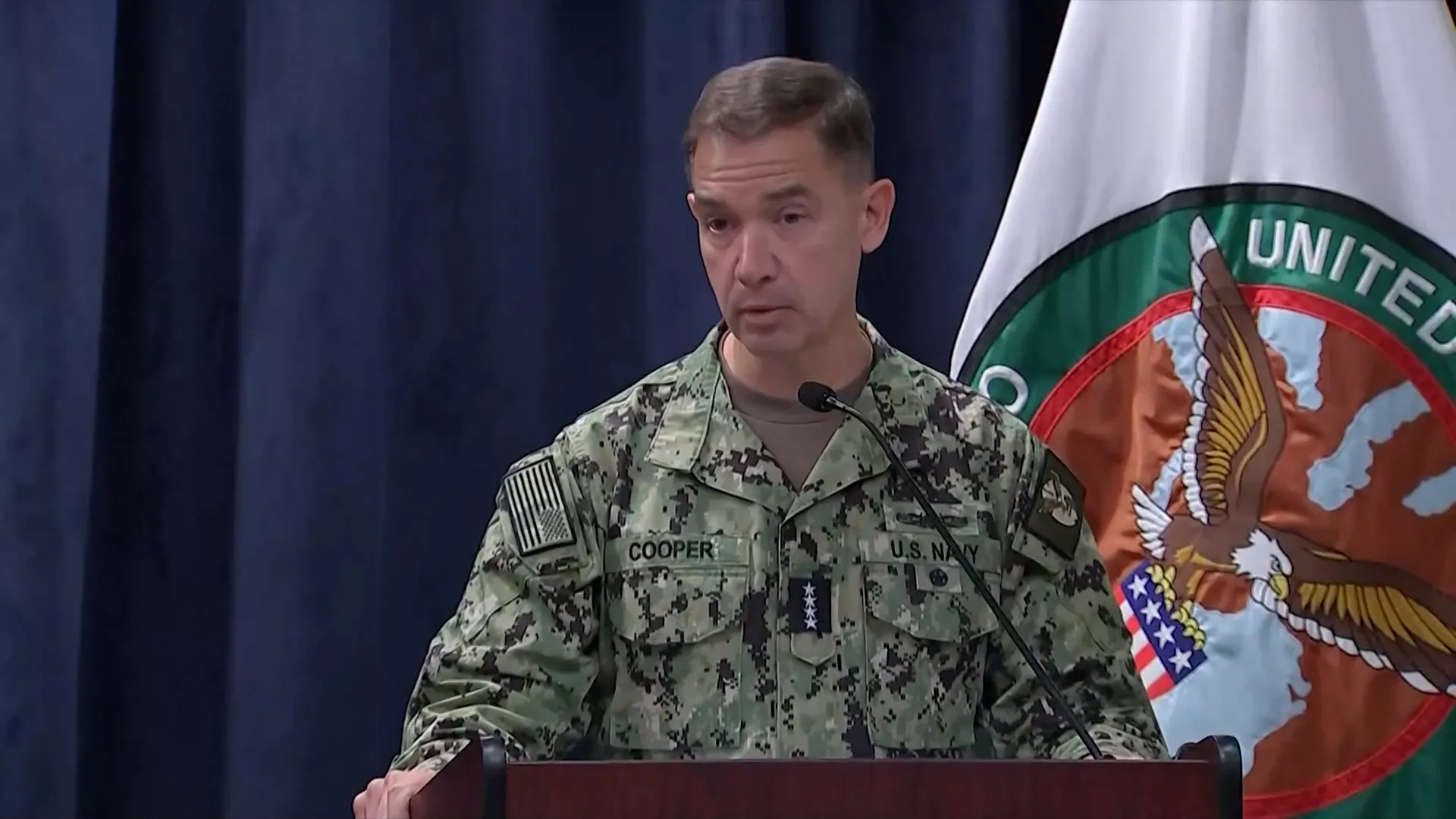
The head of US Central Command says B-2 bombers have dropped dozens of 2,000-pound bombs on buried Iranian ballistic missile launchers, contributing to a 90% drop in missile attacks. The commander added an Iranian “drone carrier ship” is currently on fire after being hit.
Multiple Gulf nations, Arab states, as well as Turkiye and Azerbaijan have been caught in the crosshairs of the war.
Published On 6 Mar 20266 Mar 2026
Share
Iran’s semi-official Fars News Agency has reported that overnight attacks on Bahrain’s capital, Manama, targeted the Financial Harbour Towers commercial complex, the location of the Israeli embassy in the city.
The first week of the United States-Israel war on Iran and Tehran’s retaliatory strikes on nations hosting US forces and assets has engulfed the region and beyond into a broader conflict.
Recommended Stories
list of 3 itemsend of list
The Reuters news agency reported Friday that an Iranian drone was intercepted and destroyed in the vicinity of the complex.
Multiple Gulf nations, Arab states, as well as Turkiye and Azerbaijan have been caught in the crosshairs of the war.
The Saudi Ministry of Defense on Friday said a cruise missile was intercepted and destroyed to the east of the country’s central al-Kharj governorate. The ministry provided no additional information.
The ministry also said later it had intercepted three drones to the east of the Riyadh region.
Additionally, the Qatari Ministry of Defence announced overnight that its air defence forces successfully intercepted a drone attack targeting the Al Udeid Air Base in Doha that hosts US assets.
Earlier, authorities issued an alert warning that the security threat level had been elevated, requiring people to remain indoors and to stay away from windows and other exposed areas.
Several explosions rang out in Doha on Thursday.
European Union leaders expressed support for Arab countries in the Gulf as Iran continues to launch missile and drone attacks on targets across the region, in response to attacks by the US and Israel.
EU foreign policy chief Kaja Kallas and other European leaders held talks with Gulf Cooperation Council (GCC) officials on Thursday in Brussels, denouncing what they described as “Iran’s inexcusable attacks against the GCC countries”.
Elsewhere n Friday, air defences shot down several drones in the Jordanian city of Irb, according to an Al Jazeera correspondent on the ground.
The BBC has come under fire after it emerged that the broadcaster won’t be showing coverage of the royals at the Commonwealth Day service but will air another show instead
Daniel Bird Assistant Celebrity and Entertainment Editor
22:18, 05 Mar 2026Updated 22:20, 05 Mar 2026
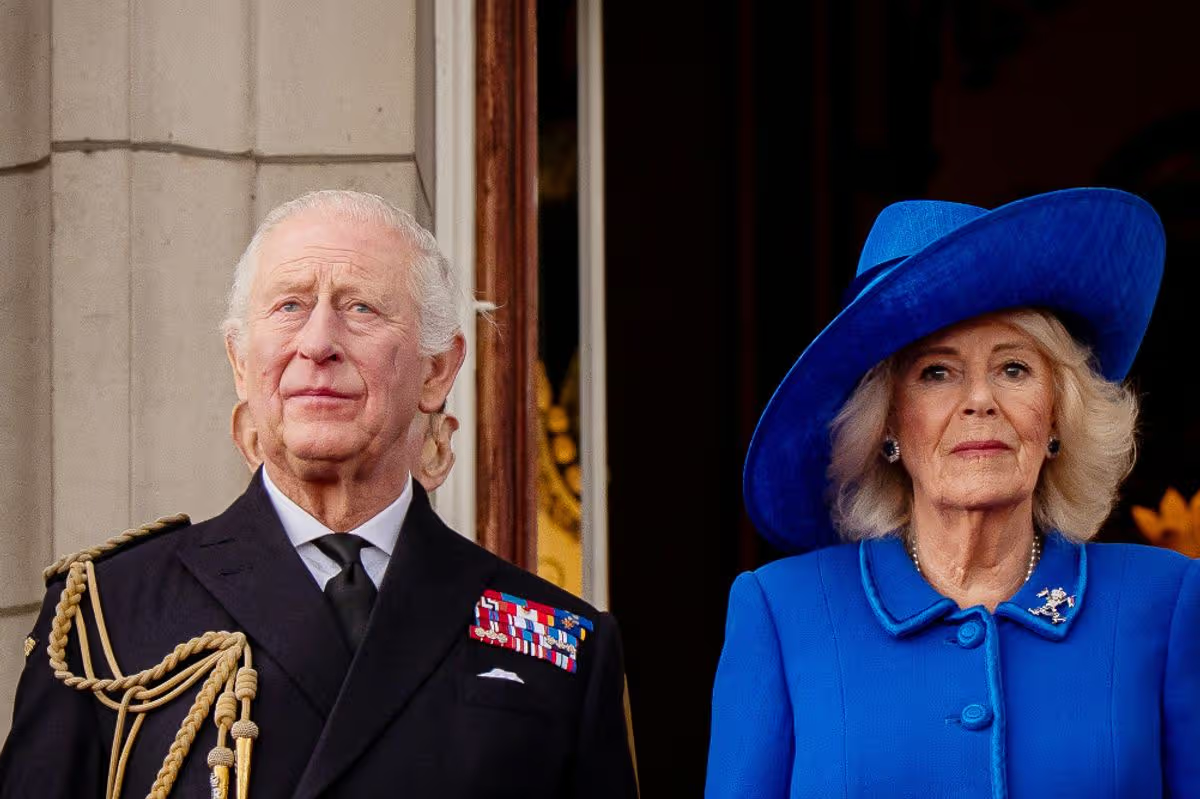
The BBC will not be airing the Commonwealth Day service next week – despite the King and Queen attending(Image: Getty Images)
The service, held at Westminster Abbey since 1972, has been televised by the BBC since 1989, connecting the United Kingdom and the 56 nations of the Commonwealth and its 2.7billion people. Each year, a string of senior royals attend the ceremony, with King Charles, Queen Camilla, Prince William and Princess Kate heading to the Abbey this year.
It’s expected that Spice Girls icon Geri Horner and Strictly Come Dancing’s Oti Mabuse will give readings to the 1,800 people in attendance at the ceremony. But while the BBC usually broadcasts the service, people will see a Canadian couple be shown their dream homes in the Central Lowlands of Scotland.
Ensure our latest headlines always appear at the top of your Google Search by making us a Preferred Source.Click here to activateor add us as your Preferred Source in your Google search settings.
The move by the national broadcaster hasn’t gone down too well, with royal author and editor-in-chief of Majesty Magazine, Ingrid Seward, telling The Sun: “It’s a ridiculous and appalling decision. The BBC has been doing it for years, and it’s the most important date in the diary for celebrating the Commonwealth.
“If even the BBC doesn’t think it’s worthy to cover and celebrate despite its huge cultural significance for member states and the monarchy, then the Commonwealth could fade into irrelevance with every passing year.” However, a spokesperson for the BBC said: “Our decision not to broadcast the Commonwealth Day ceremony in the same way we’ve done in previous years reflects the difficult choices we have to make in light of our funding challenges.
“BBC News plans to cover the service across its platforms, including the BBC One bulletins and rolling news channel.” Among the congregation will be Commonwealth high commissioners, Government representatives, young people and leading voices from the creative community. The service will feature poignant artistic moments, including the world premiere of the Commonwealth Symphony, composed by Rekesh Chauhan.
The annual service will also feature a bespoke dance collaboration between the Royal Ballet School and Sapnay Entertainments, uniting classical ballet and Bollywood in a powerful expression of cross-cultural partnership. Other performers include a Scottish ceilidh band, the Melodians Steel Orchestra and further special reflections and readings from guests.
As head of the Commonwealth, Charles issues an annual message to the 56 member-nations, which will hold their biennial Commonwealth meeting this year during the first week of November in the capital of Antigua and Barbuda.
The service will celebrate collaboration as the defining strength of the modern family of nations, drawing inspiration from the meeting’s theme of accelerating partnerships and investment for a prosperous commonwealth.
The event next week will be Kate’s first outing since she and her husband William celebrated St David’s Day last week with a trip to Wales. The Prince and Princess of Wales travelled to Powys for a string of engagements, where they tore up their official schedule to greet hundreds of people who braved the rain to see them.
They travelled to The Hanging Gardens, a community hub focused on resilience and creativity, in the mid-Wales town of Llanidloes, arriving to cheers from the crowds, many waving Welsh flags and holding daffodils.
William and Kate then headed to Oriel Davies – a public contemporary art gallery in Newtown. They viewed the Hand in Hand art project, a community scheme co-produced by the gallery and Syrian and Afghan families living in Newtown and the surrounding areas.
A graphic shows SK Broadband’s declining pay TV subscribers and rising AI data center revenue, alongside an overview of the planned Ulsan AI data center equipped with about 60,000 GPUs and a first phase of 40 megawatts scheduled for 2027. Graphic by Asia Today and translated by UPI
March 5 (Asia Today) — South Korea’s pay television industry is struggling to maintain growth as streaming services reshape the media landscape, pushing operators to seek new revenue sources such as artificial intelligence data centers.
SK Broadband, one of the country’s largest pay TV providers, lost about 150,000 subscribers last year as consumers increasingly shift to over-the-top streaming platforms.
The company has responded by pursuing a two-track strategy of industry cooperation and expansion into new technology businesses.
Earlier this year SK Broadband joined rivals KT and LG Uplus to establish a 40 billion won ($30 million) IPTV strategy fund as part of the government’s K-content media investment initiative.
The fund will support production of film and television content while helping secure programming for pay TV platforms and boost video-on-demand sales, a key revenue source for operators.
SK Broadband generated 4.53 trillion won ($3.4 billion) in total revenue last year, with pay TV accounting for more than 40% of the total.
However the industry has been hit by accelerating “cord cutting,” a trend in which viewers cancel traditional television services in favor of online streaming platforms.
The company reported 9.45 million pay TV subscribers last year, including 6.72 million IPTV users and 2.73 million cable TV subscribers. That represented a decline of roughly 158,000 customers from the previous year.
Pay TV revenue also fell by about 15 billion won ($11 million).
To strengthen cooperation within the industry, the three telecom companies also plan to launch VOD gift certificates that can be used across platforms regardless of service provider.
The initiative is intended to improve consumer access to pay TV services and expand distribution channels to corporate clients.
SK Broadband has also integrated the artificial intelligence agent A.dot into its IPTV platform B tv to provide personalized content recommendations. The company said the service has recorded more than 100 million uses.
At the same time SK Broadband is expanding its business-to-business services through data centers.
The company operates nine data centers nationwide and generated more than 1.4 trillion won ($1.05 billion) in related B2B revenue last year.
It is also building a large-scale AI data center in Ulsan with its parent company SK Telecom. The first phase is expected to begin operations next year.
By 2030 the company expects AI data centers alone to generate about 1 trillion won ($750 million) in annual revenue.
Last year revenue from AI data center operations rose 35% to 519.9 billion won ($390 million).
SK Broadband and SK Telecom have pledged to invest 3.4 trillion won ($2.55 billion) in AI data centers through 2028.
Industry officials say the company’s push into higher-margin technology businesses could help offset declining pay TV subscriptions.
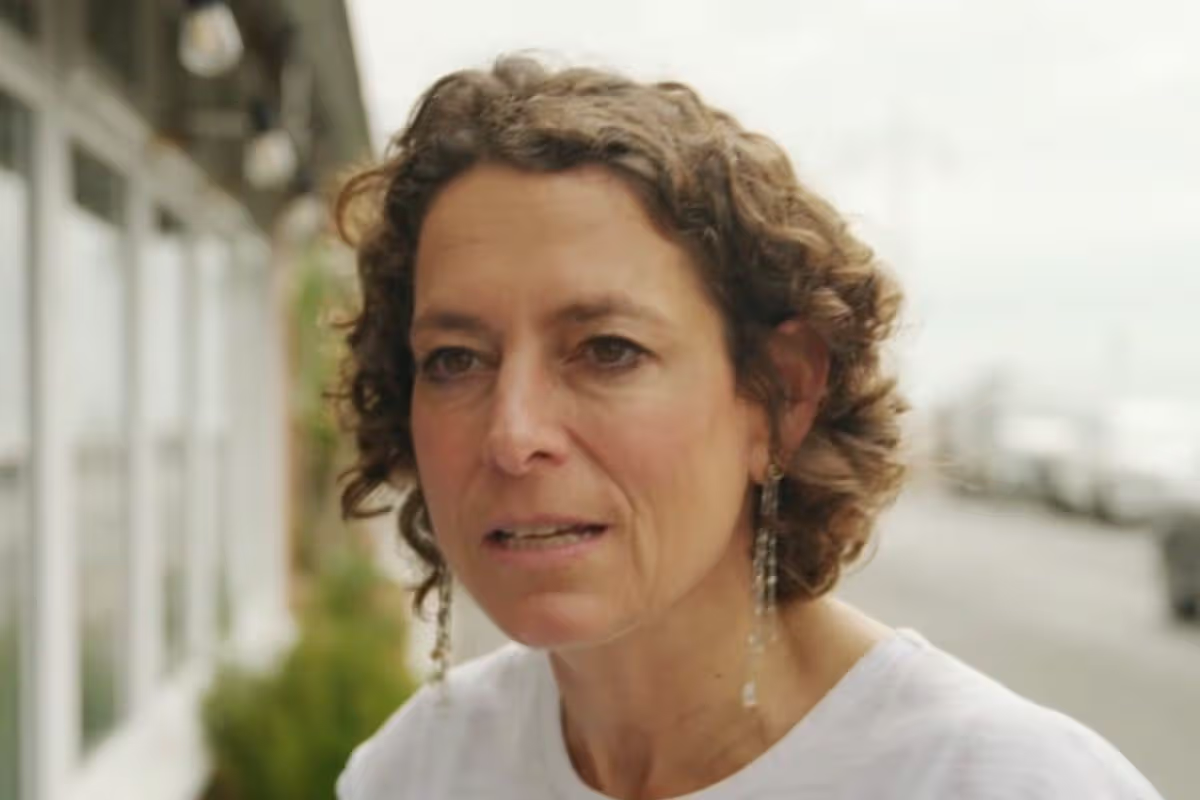
The Hotel Inspector Alex Polizzi was married to her husband several years before their divorce, with Alex admitting she felt “bereft” following their split
Joe Crutchley Screen Time Reporter
22:26, 05 Mar 2026Updated 22:26, 05 Mar 2026
The Hotel Inspector Alex Polizzi’s heartbreaking confession about end of marriage(Image: C5)
The Channel 5 show returned to screens on Thursday evening (March 5) for another instalment and Alex was back at the helm to visit a struggling hotel to try and turn things around for the business.
In the latest instalment, she headed to The Navigator in Sussex, a seafront hotel now fighting for survival and with the owner Kathleen drowning in debt, battling constant leaks and crumbling rooms, things were not looking good.
During the episode though, Alex confided in Kathleen about the struggles of running a hotel, revealing the impact it even had on her marriage to ex-husband Marcus Miller.
“I opened a hotel four years ago. It signalled the end of my marriage, I almost lost my mind and it’s quite hard work” she candidly admitted. Alex went on: “And I’m a professional.”
Alex was previously married to Marcus Miller, a professional baker. The former couple got married in 2007 after a 12-year engagement. She and Marcus are parents to two children, teenagers Olga and Rocco.
In 2025 though Alex revealed she had gotten divorced a year prior, revealing she felt “bereft”.
Talking to Great British Life Alex said:”“I have a 16-year-old daughter and an 11-year-old son and I got divorced last year and I felt so bereft, and that everything was on my shoulders, and yet their father is still alive.”
Meanwhile speaking to The Sun about why she decided to wait to marry Marcus, she confessed in 2017: “I still wanted to f*** around, if I’m honest! Who wants to get married at 22? I’m a much better wife than I was 10 years ago.
“Partly, you really realise that this is the person you’re with for the rest of your life, so there’s no point p****** them off.”
Alex has also spoke candidly over the years about her heartache after suffering several miscarriages. The TV star revealed that after welcoming her first child, Olga, she had three miscarriages, including one that came just over five months into her pregnancy.
“It is just so shocking to find out that one’s body lets them down in this way,” she told MailOnline in 2013. Alex went on: “Once you’ve had a child, it seems unusual that one couldn’t have another one. You’re not expecting it, and it comes as such a wallop.”
**For the latest showbiz, TV, movie and streaming news, go to the new **Everything Gossip** website**
The Hotel Inspector airs every Thursday at 9pm on Channel 5.
The U.S. Department of State announced that the United States and Venezuela are re-establishing diplomatic and consular ties as Venezuela’s acting President Delcy Rodriguez, right, and U.S. Secretary of the Interior Doug Burgum concluded two days of meetings on cooperation in the energy and mining sectors. Photo by Miguel Gutierrez/EPA
March 5 (UPI) — The United States and Venezuela will re-establish diplomatic and consular relations just over two months after former Venezuelan President Nicolas Maduro was deposed from power.
The U.S. Department of State made the announcement on Thursday evening after high-ranking U.S. officials met with their counterparts in Venezuela to negotiate greater access to oil, critical minerals and gold.
“This step will facilitate our joint efforts to promote stability, support economic recovery and advance political reconciliation in Venezuela,” the State Department said in a statement.
“Our engagement is focused on helping the Venezuelan people move forward through a phased process that creates the conditions for a peaceful transition to a democratically elected government,” officials said in the statement.
U.S. Secretary of the Interior Doug Burgum met with interim Venezuelan President Delcy Rodriguez, who was installed as the country’s leader after the U.S. military captured Maduro and brought him to the United States to face charges that include narco-trafficking.
Burgum and Rodriguez were discussing oil and critical mineral opportunities, in addition to finalizing an American-brokered deal with a Singapore-based company to mine and buy $100 million in gold, The New York Times reported.
Rodriguez said after Burgum’s two-day visit that her government has “full willingness to build a joint work agenda based on respect and mutual benefits,” specifically with regard to energy and other business cooperation, Axios reported.
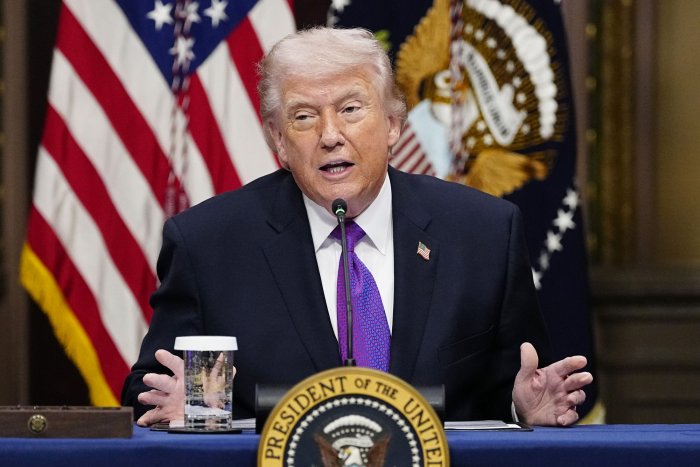
President Donald Trump speaks during a roundtable on the Ratepayer Protection Pledge inside the Indian Treaty Room of the Eisenhower Executive Office Building near the White House on Wednesday. Technology firms that sign the pledge will commit to ensuring artificial intelligence infrastructure does not raise utility bills for households and small businesses. Photo by Bonnie Cash/UPI | License Photo
The US House of Representatives has joined the Senate in killing a war powers resolution that would have forced Donald Trump to end his war on Iran. Although the vote was largely symbolic, Al Jazeera’s Patty Culhane says Democrats are using it to get Republicans on the record.
This article contains spoilers for Season 2, Episode 9 of “The Pitt.”
Midway through Season 2, “The Pitt” has taken on the perils of the digital age and given me a reason to love the show as much as everyone else does.
Don’t get me wrong — I understand perfectly why so many people, including recent Emmy and Golden Globe voters, have lost their minds over the HBO Max medical drama: The propulsive day-in-the-life of a Pittsburgh ER conceit, the dazzling ensemble cast, the writers’ heroic attempts to showcase our perilously broken healthcare system, the healing power of empathy and, of course, the Noah Wyle-ness of it all. His brilliant and gentle-voiced Dr. Michael “Robby” Robinavitch is as aspirational a character on television as we’ve ever seen.
But having recently spent almost six hours passing out and vomiting from pain in the waiting room of my local ER (which was empty except for one other man), while being told there was nothing anyone could do until the next shift arrived, I confess I have watched “The Pitt” with a jaundiced eye. The regular crowd shots of the waiting room too often reduce the afflicted into a zombie-like horde bent on making life more difficult for our beloved medical staff.
Sure it’s tough to work in an ER when you are worried about your mother’s expectations, grieving your dead mentor, struggling with addiction or worrying about your sister, but no doubt many of those in the waiting room are experiencing similar issues while also in terrifying and hideous pain.
I’m just saying.
In this second season, however, “The Pitt” gave me reason to cheer. It chronicles the day before Robby is set to leave on a three-month sabbatical, and in the early hours, we meet his temporary replacement, Dr. Baran Al-Hashimi (Sepideh Moafi). Having already attempted to force those suffering in waiting rooms to create their own “patient portals,” Dr. Al-Hashimi goes on to advocate for an AI-supported system to aid the doctors with pesky paper work.
Robby, of course, does not think any of this is a good idea and since he is always right (and no television writer is going to openly promote AI), her plan backfires almost immediately. First, with a medical notes transcription that gets Very Important words wrong and then after a complete digital blackout.
After a nearby hospital is hacked and ransomed, the higher-ups decide to defend its system by shutting it down, which means business must be conducted in the old-fashioned, paper-and-clipboards way.
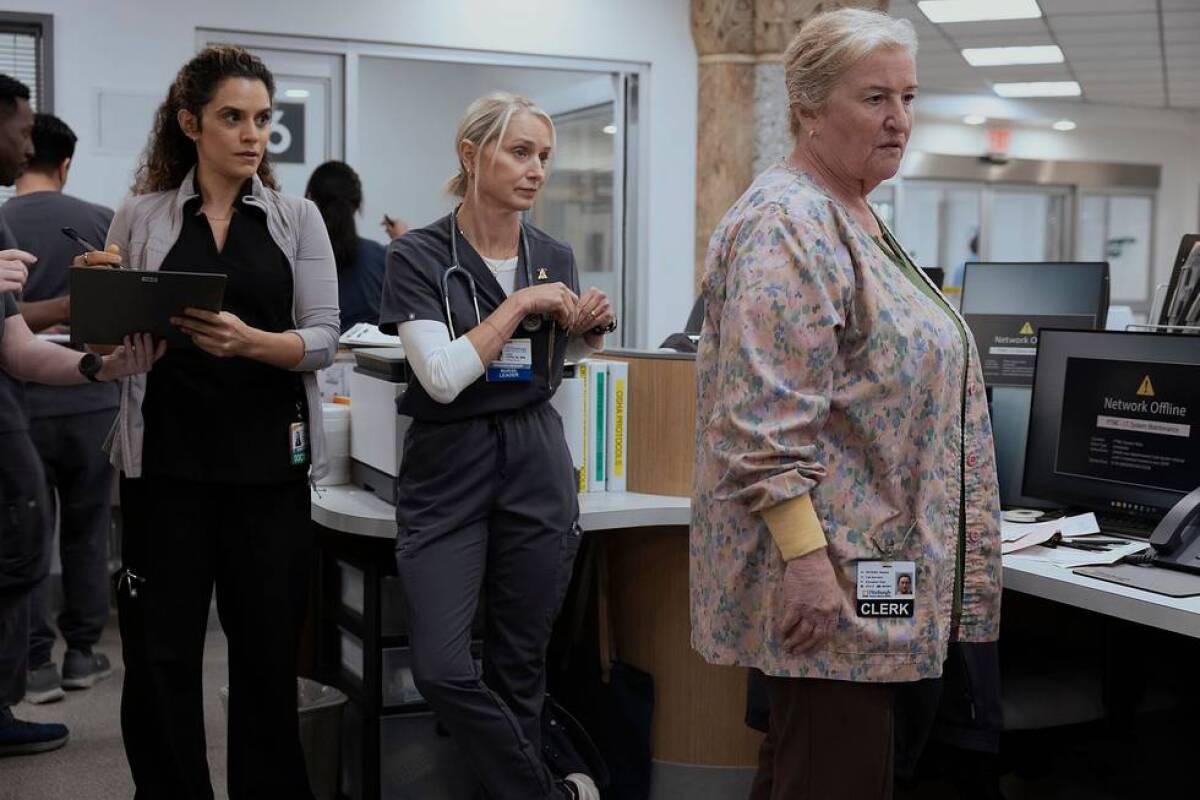
The result is chaos, and a few too many jokes about young people not knowing how to work a fax machine or manage paper. Some of the more seasoned staff, including and especially the indefatigable charge nurse Dana Evans (Katherine LaNasa), remember the days before everyone carried an iPad well enough to keep things moving. Even so, Dana wisely calls upon the services of “retired” clerk Monica Peters (Rusty Schwimmer).
When the computer system at the Pitt is shut down, Dana (Katherine LaNasa), center, calls in Monica (Rusty Schwimmer), far right, who arrives to help.
(Warrick Page / HBO Max)
“Laid off by the digital revolution, not retired,” Monica corrects her. “And how’s all this digital s— working out for you now?”
This is where I cheered. I love the digital world as much as the next person currently typing on a computer to file a story that I have discussed with my editors on Slack and that I will not see in hard copy until it appears in the physical paper. But like pretty much everyone, I have suffered all manner of digital breakdowns and mix-ups, not to mention the inevitably increased workload that comes with the perception that I can do the work of previous multitudes with a few additional strokes of a keypad.
Except, of course, that’s a lie — a keypad is capable of nothing on its own. Neither are fingers, for that matter. They must be manipulated by someone whose brain has to figure out and execute whatever needs to be done. This requires an ability to navigate the ever-changing tech systems that store and distribute information (often in ways that are not at all intuitive) while also understanding the essentials of the actual work being done.
In “The Pitt,” that is the emergency medical treatment of human beings, which requires all manner of physical tasks. As this storyline makes clear, many of the medical staff do not quite understand how to order or handle these tasks without a screen to guide them.
Hence the need for Monica, representative of a large number of support workers who do understand because it was once their job to keep everything moving, to answer all manner of questions, prioritize what needs to be fast-tracked and make sure nothing falls through the cracks while also engaging with all and sundry on a human level.
The shutdown is obviously an attempt to underline the limits of AI but it also serves as a fine and necessary reminder of how readily we have surrendered people like Monica, with their knowledge and experience, to keyboards and touch pads (which, of course, don’t require salaries, benefits or lunch breaks).
But — and this is important — computers are tools not workers. Alas, that has not kept companies in virtually every industry from drastically cutting back on trained and experienced employees and handing large portions of their work (mental if not physical) to people, in this case doctors and nurses, who already have demanding jobs of their own.
But hey, you get a company iPad!
Nurse Dana (Katherine LaNasa), left, and Dr. Baran Al-Hashimi (Sepideh Moafi) have to resort to paper, clipboards and white boards to keep track of patients after the hospital’s systems are shut down.
(Warrick Page / HBO Max)
Often, including with those patient portals, what was once paid labor lands in the lap of the consumers, who in “The Pitt” are people sitting in an emergency room and likely not at the top of their game when it comes to filling out forms about their medical history or coming up with a unique password.
ER dramas, like the “The Pitt,” are inevitably fueled by the tension between the demands for speed and the need for humane care, something that is increasingly true, if not as intrinsically necessary, in all facets of our culture.
With computers in our pockets, we now expect everything to be available instantly. But when something in our online experience goes wrong, we need an actual human to help us fix it. Unfortunately, as the overwhelmed staff of the Pitt discover, those people are increasingly difficult to find because they have been laid off — even nurse Dana can’t do everything!
Dr. Al-Hashimi, like many, believes that patient portals and AI-assisted medical notes will save time, allowing the doctors and nurses to spend more of that precious commodity with their patients. But, as Dr. Robby and Dana repeatedly argue, what they really need is more staff.
There’s no point in saving a few minutes at the admittance window, or on an app, if you are then going to have to spend hours waiting for or trying to find someone who can actually help you when you need it.
That is certainly true in the medical sector, where digital technology has done little to eradicate long wait times for medical appointments or in emergency rooms. Being treated in a hospital hallway by people who can barely stop to talk to you is not an uncommon occurrence for many Americans. The U.S. is facing a critical shortage in hospital staff, with the ranks of registered nurses and other medical personnel having plummeted post-pandemic, often due to burn out.
The amount of time the staff of “The Pitt” spend with each patient, while dramatically satisfying, is almost as aspirational as the wisdom and goodness of Dr. Robby.
None of these problems is going to be solved by AI or any other “time-saving” device. We have not, as far as I know, figured out a way to extend an hour beyond 60 minutes or modified the human body so that it does not require seven to nine hours of sleep each night.
Medical institutions aside, I can’t think of any place I have visited lately that wouldn’t have benefited from more paid and experienced workers, especially those who know how to do things when computers glitch or fail.
The minute Monica sits down and starts barking orders in the ER, everyone feels much better. Here is someone who understands what needs to be done, why, and how to make it happen. Moreover, she has eyes, ears, hands and human experience enough to know that, in the end, people are less interested in saving time than getting the care they need.
A graphic compares shareholder return policies among major South Korean game companies including Krafton, Netmarble, Com2us and Neowiz, highlighting dividend increases and treasury share cancellations as firms seek to boost investor confidence. Graphic by Asia Today and translated by UPI
March 5 (Asia Today) — South Korea’s major game companies are rolling out more aggressive shareholder return plans, raising dividends and canceling shares as they try to strengthen investor confidence amid uncertainty over new title launches.
The gaming sector often sees sharp swings in earnings depending on whether new releases succeed. Analysts say clearer long-term payout policies can help stabilize market expectations and could support higher valuations if performance improves.
Krafton said it will spend more than 1 trillion won ($675 million) on shareholder returns through 2028, about 44% more than its previous three-year plan of 693 billion won ($468 million).
The company also plans to pay cash dividends totaling 300 billion won ($203 million) over three years, or 100 billion won ($68 million) a year. It said the payout will be structured as a capital reduction dividend for small shareholders, which can reduce tax burdens under Korean rules.
Krafton also said it will buy back more than 700 billion won ($473 million) of its own shares and cancel all of them, a move aimed at improving capital efficiency.
Netmarble said it will pay 71.8 billion won ($48.5 million) in cash dividends, or 876 won per share, roughly equal to about 30% of controlling shareholder net profit. It also plans to cancel 4.7% of shares it already holds.
Netmarble set a longer-term target of lifting its shareholder return ratio to about 40% by 2028.
Mid-sized publishers are also stepping up returns. Com2uS canceled 5.1% of shares it held earlier this year and approved a 14.8 billion won ($10.0 million) cash dividend. The company said five executives, including CEO Nam Jae-kwan, also purchased a combined 13,210 shares.
Neowiz said it plans to return 20% of consolidated operating profit to shareholders under a mid- to long-term policy. Based on 2025 results, that would amount to about 12 billion won ($8.1 million), delivered through a mix of share buybacks, share cancellations and dividends.
New Delhi, India — Dressed in a blue Navy uniform and sleek sunglasses, Indian Prime Minister Narendra Modi, in late October, addressed a gathering of the country’s sea warriors.
He listed out the strategic significance of the Indian Ocean — the massive volumes of trade and oil that pass through it. “The Indian Navy is the guardian of the Indian Ocean,” he then said, to loud, proud chants of “Long Live Mother India” from his audience.
Less than five months later, India has been shown up as a “guardian”, unable to protect its own guest.
On Wednesday, the Iranian warship, IRIS Dena, was torpedoed by a US submarine just 44 nautical miles off (81km) southern Sri Lanka, as it was returning home from naval drills hosted by India. During the “Milan” biennial multilateral naval exercise, Indian President Droupadi Murmu had posed with sailors from the Dena.
Yet it took the Indian Navy more than a day after the Iranian warship was struck to respond formally to the attack, which US officials made clear was a sign of how the Donald Trump administration was willing and ready to expand its war against Iran.
“An American submarine sank an Iranian warship that thought it was safe in international waters,” US Defense Secretary Pete Hegseth said at the Pentagon on Wednesday. “Instead, it was sunk by a torpedo. Quiet death.”
Tehran is furious over the attack on its warship hundreds of miles away from home. And Iran made sure to note that the IRIS Dena warship was “a guest of India’s navy”, returning after completing the exercise it joined upon New Delhi’s invitation.
“The US has perpetrated an atrocity at sea, 2,000 miles [3,218km] away from Iran’s shores,” Iran’s foreign minister Abbas Araghchi said, referring to the sinking of the frigate. “Mark my words: The US will come to bitterly regret [the] precedent it has set.”
Now, the IRIS Dena is at the bottom of the Indian Ocean, and more than 80 Iranian sailors, who marched during joint parades and posed for selfies with Indian naval officers during their two-week visit, are dead.
What has also fallen, said retired Indian naval officers and analysts, is India’s self-image as a net security provider in the Indian Ocean. Instead, they said, the US attack on the Dena has exposed the limits of India’s power and influence in its own maritime back yard.
A vessel sails off the Galle coast after a submarine attack on the Iranian military ship, Iris Dena, off Sri Lanka, in Galle, Sri Lanka, March 4, 2026 [Thilina Kaluthotage/Reuters]
‘War reaches India’s backyard’
After participating in the naval exercises, IRIS Dena left Visakhapatnam on India’s eastern coast on February 26. It was hit in international waters, just south of Sri Lanka’s territorial waters, in the early hours of March 4, local time.
In response, Sri Lankan Navy rescuers recovered more than 80 bodies and picked up 32 survivors, reportedly including the commander and some senior officers from the warship. More than 100 men are still missing.
In a tweet welcoming the Dena to the naval drills, the Indian Navy’s Eastern Command had posted: “Her arrival … [reflects] long-standing cultural links between the two nations [Iran and India]”.
Vice Admiral Shekhar Sinha, the former vice chief of India’s naval staff, told Al Jazeera that he attended the Iranian parade at the function.
“I met and really liked them, especially their march for sailors travelling thousands of miles,” Sinha said. “It is always sad to see a ship sinking. But in a war, emotions don’t work. There’s nothing ethical in a war.”
Sinha said that the Indian Ocean — central to the strategic and energy security of the nation with the world’s largest population — was thought to be a fairly safe zone earlier. “But that is not the case, as we are learning now,” he told Al Jazeera.
“The unfolding battle [between the US and Israel on the one hand, and Iran on the other] has reached India’s back yard. New Delhi has to be concerned,” Sinha, who served in the Indian Navy for four decades, added. “The liberty we enjoyed in the Indian Ocean has apparently shrunk.”
Security personnel stand guard as an ambulance enters inside the Galle National Hospital, following a submarine attack on the Iranian military ship, IRIS Dena, off the coast of Sri Lanka, in Galle, Sri Lanka, March 5, 2026 [Thilina Kaluthotage/Reuters]
India’s Catch-22 situation
Only on Thursday evening did the Indian Navy issue any formal statement on the attack — more than 24 hours after the Dena was hit by a torpedo.
The Navy said that it received distress signals from the Iranian ship and had decided on deploying resources to help with rescuing sailors. But by then, it said, the Sri Lankan Navy had already stepped to lead the rescue effort.
Neither New Delhi nor the Navy has criticised — even mildly — the decision by the US to sink the Iranian warship.
Military analysts and former Indian naval officers say India is caught in a classic catch-22: Was India aware of the incoming US attack in the Indian Ocean on an Iranian warship, or was it blindsided by a nuclear-submarine in its backyard?
Admiral Arun Prakash, the former chief of India’s naval staff, told Al Jazeera that if New Delhi was blindsided, “it reflects on the US-India relationship directly.”
“If it is a surprise, then that’s a great concern since we have a so-called strategic partnership with the USA.”
And if India knew about the attacks, it would be seen by many as strategically siding with the US and Israel over their war on Iran.
C Uday Bhaskar, a retired Indian Navy officer and currently the director of the Society for Policy Studies, an independent think tank based in New Delhi, said that the US sinking an Iranian warship in the Indian Ocean muddies the Indian perception of itself as a “net security provider” in the region.
Bhaskar said the incident is a “strategic embarrassment” for India and weakens New Delhi’s credibility in the Indian Ocean, while its moral standing “takes a beating” because of the Indian government’s near-silence.
An injured Iranian sailor is moved on a stretcher at Galle National Hospital, where the sailors are receiving treatment, following a submarine attack on the Iranian military ship, IRIS Dena, off the coast of Sri Lanka, in Galle, Sri Lanka, March 5, 2026 [Thilina Kaluthotage/Reuters]
‘India on aggressor’s side’
In the post-colonial world order, India was a leader of the non-alignment movement, the Cold War-era neutrality posture adopted by several developing nations.
India now no longer calls its approach non-alignment, instead referring to it as “strategic autonomy”. But, in reality, it has inched closer to the United States and its allies, most importantly, Israel.
Merely two days before the US and Israel bombed Iran, Modi was in Israel, addressing the Knesset and warmly hugging Prime Minister Benjamin Netanyahu, who called his Indian counterpart a brother.
But Iran, under the late Supreme Leader Khamenei, was a friend of India as well, with New Delhi making strategic, business, and humanitarian investments in the country.
However, Modi has not said a word in condolence after Khamenei’s assassination. On Thursday, Indian Foreign Secretary Vikram Misri visited the Iranian embassy in New Delhi to sign a memorial book. Indian governments normally deploy ministers — not bureaucrats or diplomats — for such sombre occasions.
It is against that backdrop that India’s response to the attack on the Dena has come under scrutiny.
Because the frigate was hit when it was in international waters, India had “no formal responsibility”, said Srinath Raghavan, an Indian military historian and strategic analyst.
“But the US Navy’s actions underline both the spreading geography of this war and the sharp limits of India’s ability to manage, let alone control, its fallout,” Raghavan told Al Jazeera.
Diplomatically, India has “objectively positioned itself on the side of the aggressors in this war,” he said, by “acts of commission — visit to Israel on the eve of war — and of omission, with not even [an] official condolence, let alone condemnation, of the assassination of the Iranian head of state.” Modi visited Israel on February 25-26.
Mallikarjun Kharge, the president of India’s opposition Congress party, said the Modi government had recklessly abdicated “India’s strategic and national interests”. And the government’s silence “demeans India’s core national interests and destroys our foreign policy, carefully and painstakingly built and followed by successive governments over the years.”
In addition, Raghavan highlighted that Modi has only criticised Iran’s retaliation, which threatens to drag the Gulf region to the brink of war.
“It is difficult not to conclude that India has drastically downgraded its interests in the relationship with Iran,” he said.
“All of this detracts from India’s credibility as a player in the region and will have short and long-term consequences for the equities in West Asia [as the Middle East is referred to in India],” Raghavan told Al Jazeera.
The beloved period drama has been hailed by audiences online and compared to Downton Abbey and Sherlock Holmes
Lead Children trailer from Netflix
Fans of period drama have been met with bittersweet news following the recent confirmation that a cherished series will be making a comeback – but for one final outing only.
The costume drama has previously earned acclaim from one IMDb reviewer who described it as “One of the best”. They highlighted how the lead performer was an “absolute master at facial expressions”.
They continued: “IMHO this series continues to get stronger and is one of the best things produced for network TV. I am hoping this will be as long lived as some of the classic British shows like Vera and Silent Witness [sic].”
Another viewer wrote in their 10/10 assessment: “A wonderful TV detective story that bridges 21 century sensibilities with the horrible conditions of Victorian England, with its pollution, gender and class inequalities, poverty, etc.”
They further commended the programme: “What truly makes this show exceptional are the costumes, the sets, the great chemistry between the two protagonist, and the relationships amongst the other characters that slowly develops throughout the six episodes [sic].”
A third 10/10 review declared: “Fresh look, captivating plot, beautifully portrayed characters, real feel of old atmosphere, close attention to detail.”
The admirer revealed they were “totally hooked” by the production.
A third glowing review, titled “Amazing period piece”, saw the reviewer enthuse: “I joined PBS for this great masterpiece.
“The tension between the lead actors keeps me coming back for more. In this Downton Abbey meets Sherlock Holmes drama, each episode brings a more compelling reason to keep coming back for more.”
Miss Scarlet is set to wrap up after its upcoming seventh season, having first graced our screens in 2020.
The series features Peaky Blinders actress Kate Phillips in the starring role of Eliza Scarlet, the first female detective in Victorian London.
Not only has Miss Scarlet been solving mysteries, but she’s also been shattering the glass ceiling with her work throughout the city.
In a statement obtained by Deadline, the show’s creator Rachael New expressed: “Making Miss Scarlet has been the greatest joy of my professional career.
“Every stage of this beautiful show – from the writing, filming, editing and finally it reaching the screen – it has taken a whole village. A village of exceptionally talented people.
“From the wonderful exec team who first saw the potential in this story, to my brilliant writing partner Ben Edwards, the Belgrade production team, the Dublin post team and not least to our remarkable cast led by the magnificent Kate Philips, it has been a collaborative and beautiful experience.
“I’m very proud of how the final season plays out and the story we tell for Eliza.”
She added: “It’s a wrench to say goodbye to a character that I have lived and breathed for all these years, but Eliza will forever be with me whether on screen or off.”
Meanwhile, leading actress Phillips remarked: “What a journey this has been. Miss Scarlet has been one of the greatest joys of my career, and I will forever be grateful to Rachael New for creating such a witty, sharp, and delightful character in Eliza.
“It’s been a privilege to work on a show crafted with so much love and dedication and as we prepare to say goodbye, I’m so proud of what we’ve achieved and the memories we’ve made.
“Thank you to everyone who has supported us – I can’t wait to share the farewell Miss Scarlet deserves.”
Alongside Phillips, Miss Scarlet – formerly known as Miss Scarlet and the Duke – also features Tom Durant-Pritchard, Paul Bazely, Tim Chipping, Evan McCabe, Felix Scott, Cordelia Bugeja, and Ansu Kabia.
Production is currently underway in Serbia on series seven’s final six episodes of the drama.
Miss Scarlet is available to stream on UKTV’s U.
**For the latest showbiz, TV, movie and streaming news, go to the new **Everything Gossip** website**
Rep. Yoo Yong-won of South Korea’s People Power Party speaks about the performance of the Cheongung-II missile defense system during recent Middle East missile attacks. Photo by Asia Today
March 5 (Asia Today) — A South Korean lawmaker said Wednesday that the country’s Cheongung-II surface-to-air missile system demonstrated high effectiveness in real combat conditions in the Middle East, citing reports of a 96% interception rate during recent missile attacks on the United Arab Emirates.
Rep. Yoo Yong-won of the conservative People Power Party, who serves on the National Assembly’s Defense Committee, said the result showed the strength of South Korea’s defense technology.
“The fact that Cheongung-II achieved an interception rate exceeding 90% in an intense real-world combat environment in the Middle East is a great victory for South Korea’s defense science and technology,” Yoo said.
According to information Yoo said he confirmed with sources familiar with the United Arab Emirates air defense operations, two Cheongung-II missile batteries deployed in the UAE fired more than 60 interceptor missiles during recent attacks.
About 96% of those missiles successfully intercepted their targets, the sources said.
Cheongung-II is a medium-range surface-to-air interceptor missile system developed by South Korea to defend against aircraft and ballistic missile threats.
Yoo said the reported interception rate was notable even compared with leading Western air defense systems.
“A 96% real combat interception rate is a figure that even the U.S. Patriot system would find difficult to achieve,” he said, referring to the Patriot Advanced Capability-3 system widely used in missile defense operations.
The lawmaker said the performance of the Cheongung-II system could strengthen confidence in South Korea’s Korean Air and Missile Defense architecture, which is designed to counter potential missile threats from North Korea.
“The Cheongung-II deployed by the UAE is the same model currently operated by the South Korean military,” Yoo said. “Its success in neutralizing Iranian missile attacks increases the credibility of our missile defense system.”
The remarks come amid escalating tensions in the Middle East following U.S. and Israeli airstrikes on Iran and subsequent missile retaliation across the region.
The United Arab Emirates reportedly used a multi-layered air defense network during the attacks, combining U.S.-made THAAD and Patriot systems with South Korea’s Cheongung-II and Israeli air defense systems including Arrow and Barak-8.
Despite large-scale missile and drone attacks, the UAE is reported to have achieved an overall interception rate exceeding 90%, limiting damage.
Yoo said South Korea’s parliament would support further development and exports of the missile system.
“We will provide strong legislative and policy support so that Cheongung-II, whose performance has been proven in real operations, can expand exports across the Middle East and global defense markets,” he said.
Videos showed a projectile striking near Kuwait’s Ali al-Salem Air Base, which has hosted a substantial number of US forces. Earlier on Thursday, the United States announced it was closing its embassy in the country and is reportedly evacuating its staff.