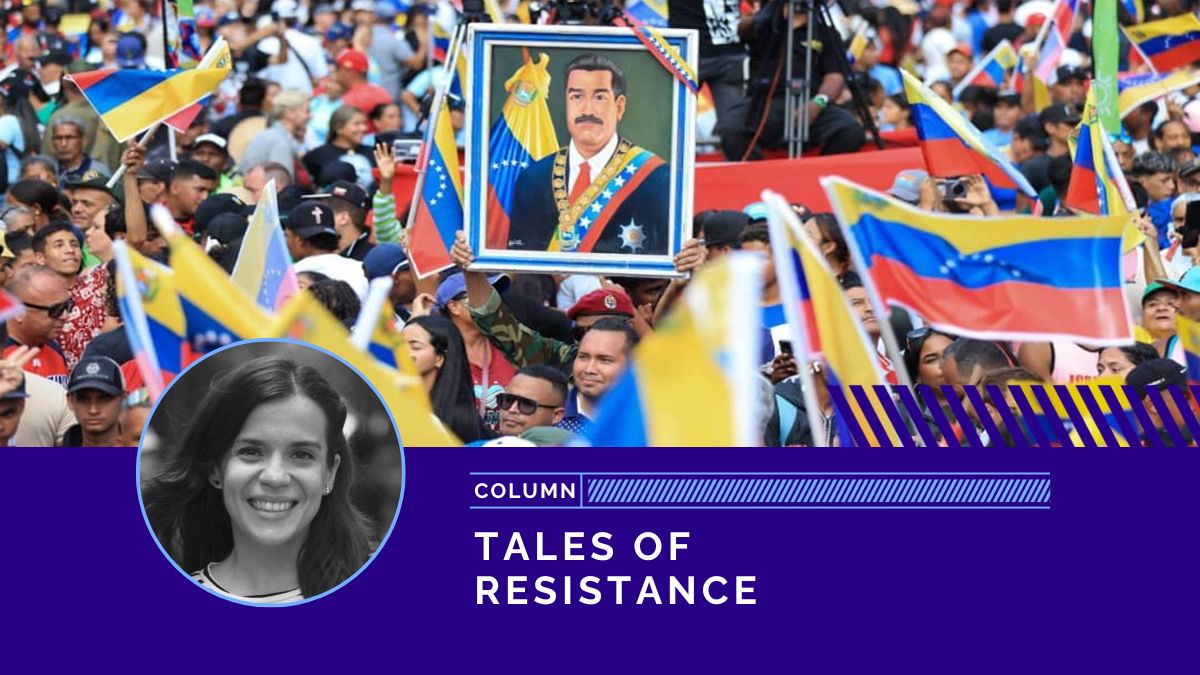
Venezuelans have witnessed a lighting-fast rapprochement with the US despite the kidnapping of Maduro. (Venezuelanalysis)
A couple of weeks ago, US Energy Secretary Chris Wright did not just visit Caracas. He was hosted at the presidential palace with a traditional joropo presentation before being taken on a tour of oilfields like the estate owner who comes to check in on his land and cattle. His statements were clear enough: Washington has sights set on oil, gas, and “critical minerals.”
The spectacle of a Trump administration official getting the red carpet treatment, six weeks after that same administration bombed Caracas and kidnapped the Venezuelan president, was puzzling for many of us, to put it mildly.
We are told that Delcy Rodríguez has a gun to her head, and I totally agree. But she smiles while this gun is cocked and I find it hard to completely ignore what I see and hear.
Days after Wright, it was the Southern Command chief, Francis Donovan, alongside Acting Assistant War Secretary Joseph Humire, to drop in to meet Rodríguez, alongside Interior Minister Diosdado Cabello and Defense Minister Vladimir Padrino. Both US officials were likewise heavily involved in the January 3 attacks that killed over 100 Venezuelans. Donovan promised to return “soon” because he is apparently involved in “stabilizing (Venezuelan) security and transition toward a new era.”
At the time, the Venezuelan government talked about a “cooperation agenda” with the US against drug trafficking and terrorism. Just a few months ago, Venezuelan leaders were denouncing the US as the main source of drug trafficking and terrorism in the hemisphere (and it’s true). Speaking about the meeting days later, the acting president said it wasn’t easy: “I had to sit face to face with those who murdered my father [leftist leader assassinated in 1976 while detained by the Venezuelan state] and with those responsible for killing our January 3 heroes […]. I did it for Venezuela.”
She did it for Venezuela? Are all these things being done for Venezuela? Many are quick to point out the Venezuelan forces’ underwhelming response against the US attack, though we have to wonder what the cost would have been otherwise, assuming it was actually possible to have done more. Maybe the reaction is due to having spent months listening to one leader after another praise the readiness of the defense forces and vowing that such an event would never happen. The armed forces have given no explanation about the January 3 events.
National Assembly President Jorge Rodríguez gave an interview to NewsMax where he talked about implementing a “free market economy” and “adapting legislation” to attract US investment. At the same time, he ruled out elections in the near term, though he left the door open for far-right candidate María Corina Machado to eventually participate. Meanwhile, Machado has been announcing her return to the country for weeks but has faded from the spotlight. She clearly needs Trump’s approval for whatever she wants to do next.
In contrast, Trump surprised everyone by inviting former electoral rector and presidential candidate Enrique Márquez to his State of the Union address, showcasing him as one of the high-profile people recently released from the Helicoide prison. It’s already fueling speculation that the White House might choose to back a figure much more moderate than Machado as part of its announced “three-phase plan” for Venezuela.
Nevertheless, in the same speech, Trump praised his “new partner and friend, Venezuelan,” bragging about his “close relationship” with the acting president while accusing Maduro of being an “outlaw dictator” and honoring Eric Slover, a pilot who was injured in the January 3 operations against Venezuela. For its part, the government has stood by Maduro and First Lady Cilia Flores, but has framed the US attacks as a “stain” in the two countries’ relationship.
On the domestic front, authorities are releasing hundreds and hundreds of people, from opposition politicians to poor saps, whom we never knew why they were arrested in the first place. Some of the spokespeople who today praise the government’s gesture and commitment to peace with the Amnesty Law are the same ones who months ago would rail against anyone who questioned the detention of campesino or trade union activists, of young idiots who made TikTok videos criticizing Maduro, or pointed out the double standards in letting Guaidó and other confessed criminals walk free.
The cabinet has also seen some major changes, including the appointment of a career opposition politician, Oliver Blanco, as vice minister for Europe and North America. At the same time, Alex Saab’s middle name is now “unknown,” because there has been no official update since the rumors of his arrest. Additionally, some media speculated that former Oil Minister Tareck El Aissami was extradited to the US; others denied it, but we’ve only heard of him once since his arrest in early 2023.
Venezuelan foreign policy has changed dramatically as well. Gone are the references to imperialism, even to the highly touted “multipolar world.” It’s not just the express rapprochement with the US, thanking Trump officials for their “respect and courtesy” while they manage our oil revenues. Days ago, when the US and Israel launched the attack against Iran, the Venezuelan Foreign Ministry published an unbelievable statement that even condemned Iran for retaliating against US bases in the region. In fact, the communiqué was taken down after a barrage of criticism.
Meanwhile, familiar problems persist… People are still waiting for the currency to stabilize and for some increase to their incomes, but that has yet to happen. Direct flights to the US are set to resume, and the deportation of Venezuelans also continues apace.
Nicolás Maduro Guerra, a deputy and the president’s son, has assured everyone that he talks to his father regularly and he “agrees with everything.” I find myself asking: does Maduro also agree with the US Treasury blocking the Venezuelan government from funding his legal defense?
Brazil’s Lula da Silva, trapped between his short memory and his desire to be friends with God and the Devil at the same time, says that Maduro’s arrest is a minor issue and that democracy is the main issue. How can you talk about democracy in a country where the president was just kidnapped and 100 people were killed? Colombia’s Gustavo Petro echoes this line, and we’re inevitably reminded of past Colombian treason against Venezuela.
Social media plays a crucial part in all this, hogging attention on everything from Bad Bunny to the “therian phenomenon” or the adorable monkey Punch in a Japanese zoo. Well… what about Trump’s deadly antics? Or the Epstein files? And Palestine? Venezuela suffered an unusual invasion, and the world is too numb to take note.
These two months have felt like five years. At some point we’ll be able to calmly take stock of how the pieces have fallen and think about the next steps. But first we need a chance to breathe. The struggle continues.
Jessica Dos Santos is a Venezuelan university professor, journalist and writer whose work has appeared in outlets such as RT, Épale CCS magazine and Investig’Action. She is the author of the book “Caracas en Alpargatas” (2018). She’s won the Aníbal Nazoa Journalism Prize in 2014 and received honorable mentions in the Simón Bolívar National Journalism prize in 2016 and 2018.
The views expressed in this article are the author’s own and do not necessarily reflect those of the Venezuelanalysis editorial staff.