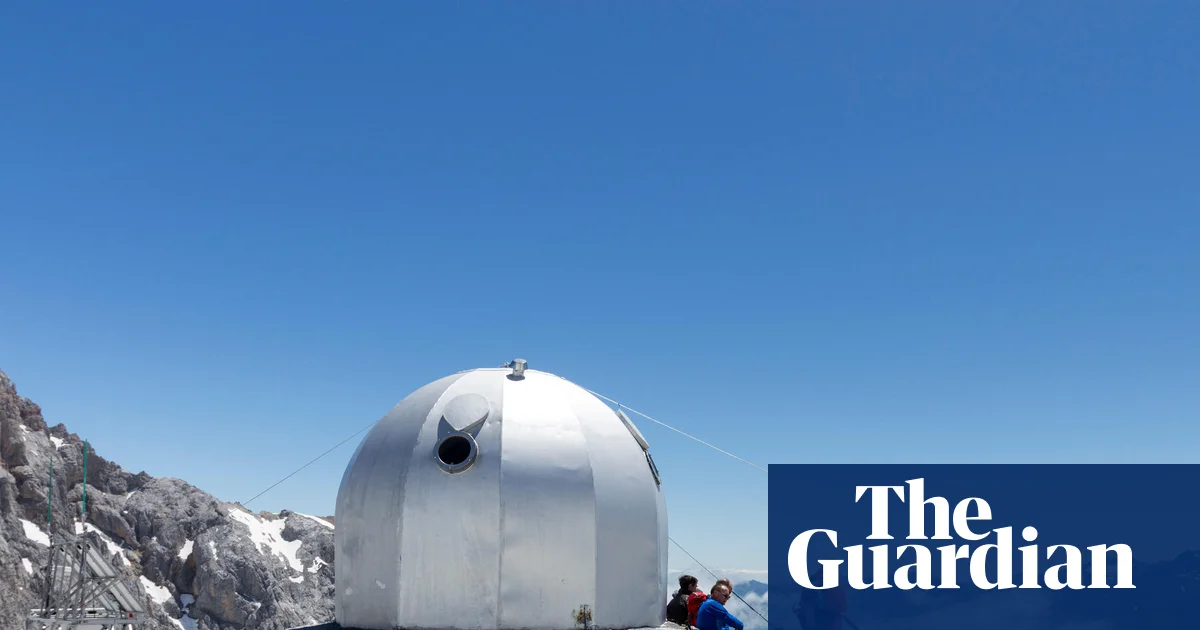
Cabaña Verónica, Spain
A good mountain hut, I reckon, should be small and only accessible on foot after considerable effort. Throw in a bit of historical interest and I’m bound to be happy. In which case, Cabaña Verónica in the Picos de Europa is a fine start to this list. It sleeps six, and at 2,325 metres requires a two-hour trek from the nearest cable car station, never mind road. It has incredible views and a friendly custodian who keeps things in good order. Yet the real attraction is that this place was formerly a gun turret of a US navy battleship that was scrapped in Bilbao in 1960. An enterprising engineer, Conrado Senties, had it carried up on horseback and reassembled on a plug of rock in the middle of nowhere. Don’t ask why, just enjoy the eccentricity.
€15, reservarefugios.com
Låktatjåkko, Sweden
An absolute gem just over 100 miles north of the Arctic Circle and 1,228 metres up a mountain, Låktatjåkko is well placed to deliver that other essential experience of a decent hut: cosy conviviality while surrounded by frequently hostile conditions. When I visited, it was hard to find the hut because it was coated in thick ice and half-buried in snow. The snug timber-clad lounge is the perfect spot to sit in front of the fire and read old accounts of Arctic explorers such as Fridtjof Nansen (there is no phone coverage). The kitchen bangs out endless plates of waffles with cloudberry jam and cream as well as more substantial fare. Be warned, however: in winter the chances of being marooned are quite high and the skiing can be a serious challenge due to extreme cold and fast-changing mountain weather.
From 515 Swedish kronor (£40), laktatjakko.se
Gaustatoppen, Norway
Like many other huts belonging to the wonderful Norwegian Trekking Association, this place is small, well-run and traditional. It’s the route up to it that is astounding. You enter a mountainside, take a thundering old-school funicular railway one kilometre inside the granite, then wander through tunnels of military-grade concrete, before exiting through a blast-proof steel door and climbing down a short way to the hut. All that startling infrastructure is the cold war relic of a Nato communications station now doubling up as a museum and underground route to the hut, which dates back to 1893. This unique means of access gives the hut an advantage: you can stay in winter (weekends only) on the summit of the highest peak in Telemark province, Gaustatoppen, a popular ski resort, and then ski down. When I was there, the view was about 10 metres into thick mist. On a clear day, however, they say you can see one-sixth of Norway.
From 1,550 Norwegian kroner (£122), dnt.no
Chata pod Rysmi, Slovakia
The Tatra mountains have some excellent huts, but this is my pick. Close enough to the summit of Rysy (2,501 metres) for an early start to catch dawn on the top, it is traditional, well-run and basic. The weather here can take a brutal turn at any time of year and, like all the best huts, this is in precisely the right position to be a genuine bolthole. If it looks younger than its 1933 start date, that is because it has been destroyed several times by avalanches and rock falls, which is also why it only opens 1 June to 31 October.
€65, chatapodrysmi.kst.sk
Kredarica on Triglav, Slovenia
This is, in many ways, a standard, old-fashioned mountain refuge, but Kredarica has the great advantage of being the last potential stop en route to the summit of Slovenia’s highest peak, Triglav (2,864 metres). Given that every Slovene feels compelled to visit the summit at least once in their lifetime, this can be a busy place in summer, especially as the views are magnificent. The hardcore, however, savour its spartan winter comforts, when the dormitories are unheated bunkholes for those about to tackle the final, rather tricky ascent to the top (ice axe and crampons essential).
€30 half-board, triglavskidom.si
Le Refuge de Ciottulu di Mori, Corsica
Photograph: Florian Neukirchen/Alamy
One of the attractions of Corsica’s epic GR20 long-distance footpath is its unapologetically old-fashioned mountain huts. No emergency helicopters swooping in when the G&Ts run out: this is gruff, mule-supplied, mountain hospitality. Ciottulu is a good example of the genre: bare bones dining room and a dormitory with communal sleeping benches for 26. Its ambience is more like a bothy set at 2,000 metres in a vast stony panorama with a slightly unpredictable caretaker.
€15, le-gr20.fr
Breiðuvik, Iceland
The east of Iceland is home to a scattering of superb huts like this one. Breiðvik is actually on the coast and has the usual bunk rooms and well-appointed kitchen. The location is the big attraction: a wild, desolate coastline of volcanic sand beaches and abandoned villages. Together with 39 other locations, Brieðvik is part of a useful network run by the Icelandic Touring Association.
11,500 Icelandic kronur (£70), ferdaf.is
Scotland’s mountain bothies
The UK has always remained aloof from the continental urge to build something cosy on a mountain top. We are much happier sitting inside our leaky waterproofs eating soggy sandwiches. The Mountain Bothy Association is doing a little to encourage us away from such Spartanism, but not too much. Most are former cottages for miners or shepherds; many now have a fireplace or even a wood burner. In some, there are a few supplies left on a shelf by previous guests. I have a soft spot for the hard charms of the least comfortable, where you may find only a stone bench and an open doorway. A few have become over-used and afflicted by visitors who don’t understand the ethos of mucking in, sharing out and cleaning up. For that reason, I’m not sure it’s worthwhile picking out any particular bothy (pictured is the Elphin Bothy in the Assynt region of Sutherland), suffice to say that the roster contains some absolute classics. Go and find them.
mountainbothies.org.uk
Rifugio Nuvolau, Italy
The Dolomites are so blessed with exceptional huts and Nuvolau is one of the best. Only accessible on foot, it was originally built in 1883 as a bequest from the Baron Richard von Meerheimb, the man who coined the term “psychodrama”, something he may have dreamed up while watching a Nuvolau sunset. The impeccable location is famous for its stunning shifts in light and colour. Inside is a dining room that serves excellent food, including a three-course dinner; upstairs is a small dormitory.
€51 B&B, rifugionuvolau.it
Rifugio Lagazuoi, Italy
Many huts in the Dolomites have learned that economic survival is via tourists rather than hikers and climbers. Lagazuoi is one of them. Built as a climbers’ refuge, it has expanded over the years and been connected to the road by cable car, which enables coach parties to stay. And yet, it remains magnificent. The south-facing terrace is lovely and there are fantastic walks all around, not least through the tunnels and terraces of the first world war frontline that lie on the cliff face below. Mount Lagazuoi (2,835 metres) was one location where the Austro-Hungarian empire faced off against Italians. Many years later, in 1965, Ugo Pompanin, a local Alpine guide and rock-climbing pioneer, recognised the potential and built the first hut, which, several additions later, is still run in great style by his son Guido.
From €85 with breakfast, rifugiolagazuoi.com