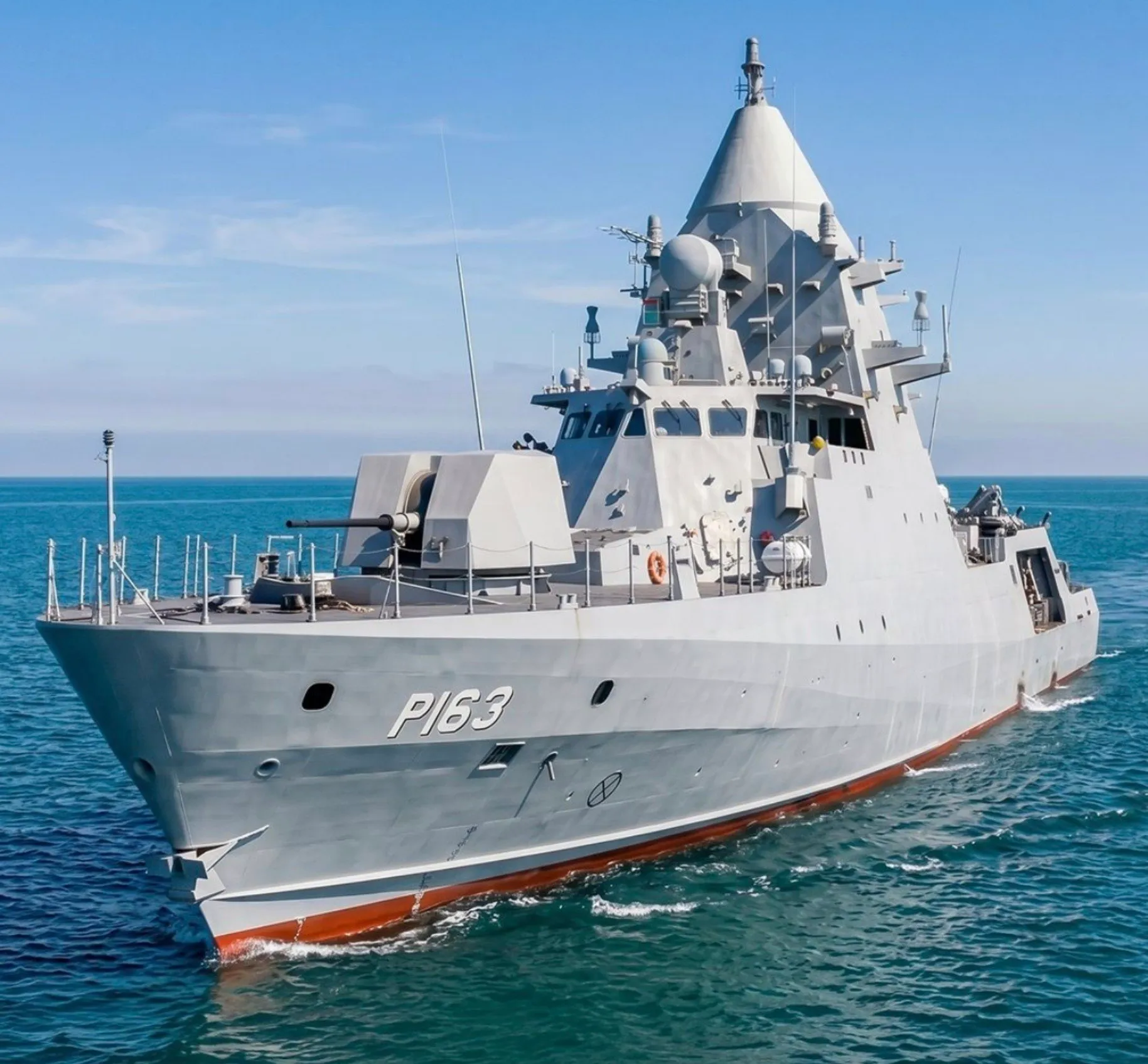
Photos of the United Arab Emirates’ Falaj 3 class patrol boat are a reminder that a vessel doesn’t need to be a corvette or even a frigate to be armed like one. At a little over 200 feet long, the Falaj 3 is officially designated an offshore patrol vessel (OPV), but it boasts a weapons suite that would be impressive on a missile corvette and, in some respects, even a light frigate. In fact, at around 670 tons full load displacement, and a crew of just 39, it may be one of the most heavily armed warships anywhere in the world for its size.

OPVs are generally built for constabulary duties rather than high-end naval combat. Their primary missions include enforcing exclusive economic zones, countering piracy and smuggling, fisheries protection, search and rescue, and humanitarian assistance. As a result, they typically prioritize endurance, seakeeping, and low operating costs over heavy armament. Many Western designs in this category carry little more than a medium-caliber gun and a handful of remotely operated weapon systems, with no dedicated anti-ship missiles or significant air-defense systems.
The Falaj 3 takes a very different approach, as is immediately apparent from these photos.
Forward sits a Leonardo 76mm OTO Super Rapid gun equipped with the STRALES guided ammunition system, giving the ship a weapon capable of engaging everything from surface targets to fast-moving aerial threats. The STRALES system combines the 76mm gun with DART projectiles, which are guided to the target by a radio beam. The projectile is fitted with a proximity fuze, and the result is claimed to be especially effective against manoeuvring supersonic missiles, as well as fast-manoeuvring small boats. The DART ammunition also comes at lower cost than dedicated anti-air missiles, an increasingly important consideration, especially in the Middle East, where costly surface-to-air missile effectors are routinely expended, in significant quantities, against far cheaper incoming threats.

Strales system with DART ammunition
Directly behind the gun is an eight-cell vertical launch system loaded with MBDA VL MICA surface-to-air missiles. This ‘fire and forget’ missile can intercept targets at a range of up to around 12 miles and at altitudes of up to 30,000 feet.

VL MICA (Sea)
Further aft is a 21-cell Raytheon Mk 49 launcher for the RIM-116 Rolling Airframe Missile (RAM), giving the vessel a second, independent layer of point air defense. Most OPVs are fortunate to carry an adapted man-portable air defense system, if they have any dedicated air-defense system at all.

The offensive fit is equally notable. Four MM40 Exocet Block 3C anti-ship missiles provide over-the-horizon strike capability, while two 12-cell Low-cost Guided Imaging Rocket (LOGIR) guided rocket launchers offer an inexpensive way to engage drones, uncrewed surface vessels, and fast attack craft without expending much more costly missiles.
The MM40 Block 3C is the latest iteration of the well-known Exocet sea-skimming missile and has a range of around 150 miles.
The LOGIR, a weapon we have discussed in the past, is part of a growing number of 70mm rockets with an infrared seeker on the market now. A U.S.-South Korean co-production, the LOGIR was developed primarily for coastal defense and other maritime applications. It has a maximum range of around a few miles.
![[밀당] 해상침투 방어 최강자 ··· 대한민국 첨단기술의 정밀유도무기 '비궁' thumbnail](https://i0.wp.com/i.ytimg.com/vi/B1OBi1u-F4k/hqdefault.jpg?w=640&ssl=1)
[밀당] 해상침투 방어 최강자 ··· 대한민국 첨단기술의 정밀유도무기 ‘비궁’
Completing the package are two Electro Optic Systems (EOS) R400-M 30mm remote weapon stations and two 32-barrel Rheinmetall Multi Ammunition Soft-kill System (MASS) decoy launchers, providing close-range firepower and survivability against incoming guided weapons, respectively.
The Falaj 3 class is also well equipped with sensors, including a Leonardo Kronos 3D G-band multifunction radar for air and surface search in the conical radome of the integrated mast. The mast also features the SPYNEL infrared search and track suite.

Combining all of these systems results in a ship with genuine layered air defense, anti-ship strike capability, counter-swarm weapons, modern electronic self-protection, and a sophisticated medium-caliber gun, all crammed into a hull roughly one-third the displacement of many contemporary corvettes.
Instead of sacrificing armament for patrol endurance, the Falaj 3 concentrates an extraordinary amount of firepower into a compact hull. The design is closer to a ‘pocket’ missile corvette optimized for Gulf operations than a conventional OPV.

The Persian Gulf is a relatively confined operating environment where naval combat is more likely to occur at short ranges, with vessels operating under constant threat from anti-ship missiles, drones, helicopters, and swarms of fast attack craft. In that environment, packing as many defensive and offensive systems as possible into a relatively inexpensive platform makes considerable operational sense.
For more demanding missions, including in true blue-water environments, the United Arab Emirates Navy can call upon close to a dozen true missile corvettes, with four different active classes constructed in France, Germany, and Italy. These carry many of the same weapons as found on the Falaj 3, but the largest examples displace close to 3,000 tons, and all can also embark a helicopter.
Based on the Fearless class patrol vessel operated by the Republic of Singapore Navy, the Falaj 3 class is built by the Abu Dhabi Ship Building (ADSB), a subsidiary of the UAE’s Edge Group. The first ship of the class, Altaf, was commissioned in February 2025.

ADSB Launches First Vessel in the FALAJ 3 Programme
The Edge Group is also building eight vessels of the same design for Kuwait, these being known as the Al Dorra class.
The design of the Falaj 3 reflects a broader trend in naval warfare. Advances in radar, combat management systems, vertical launch technology, and compact missile designs increasingly allow capabilities once reserved for frigates or larger vessels to be integrated successfully in much smaller vessels. Rather than relying exclusively on a handful of expensive large combatants, navies that operate heavily in littoral geography have the opportunity to field larger numbers of smaller ships that still possess credible offensive and defensive capabilities.
The Falaj 3 represents perhaps one of the most extreme examples of that philosophy.
Special thanks to X user @D__Mitch for alerting us to this story.
Contact the author: thomas@thewarzone.com