MILAN — Believe in the Quad God.
Ilia Malinin’s clutch free skate that scored 200.03 points gave the United States its second consecutive team figure skating gold medal Sunday at the Milan-Cortina Olympic Games.
After Amber Glenn fought through a shaky free program that finished third and lost the United States its two-point lead, Malinin stepped up as only he could. He executed five quad jumps and won by nearly six points, even if he did not perform his signature quad axel. He even put his hand down after a jump, but the mistake only seemed to fuel him as he finished with a flourish, changing the back-half of his program to earn back extra points.
His U.S. teammates, cheering from the sideline box rose to their feet and pumped their fists after each of Malinin’s jumping passes. When he landed his back flip, skating flawlessly through one foot, the packed crowd at Milano Ice Skating Arena roared.
While Japan’s Shun Sato scored a season’s best to finish the competition, he could not match the technical prowess of Malinin, who is also the favorite to win individual gold this week.
In front of a raucous home crowd, Italy held off Georgia for the bronze medal behind a dazzling free skate from Matteo Rizzo, who dropped to his knees on the ice and cried after his performance had fans chanting “Italia!” before he even finished. He cried into the Italian flag in the kiss-and-cry after his season’s best 179.62 points.
With the first figure skating medal of the Milan-Cortina Games on the line, every skater fought for every fraction of a point. U.S. pairs skater Ellie Kam went deep into a one-legged squat to hold on to the first throw jump. The United States led by five points entering the final day, but still had no room for error as Japan finished first in qualifying in all of Sunday’s disciplines. With the dominance of Japan’s Riku Miura and Ryuichi Kihara in pairs, Kam’s partner Danny O’Shea knew the strategy for the U.S. pair was to simply try to stay as close as possible.

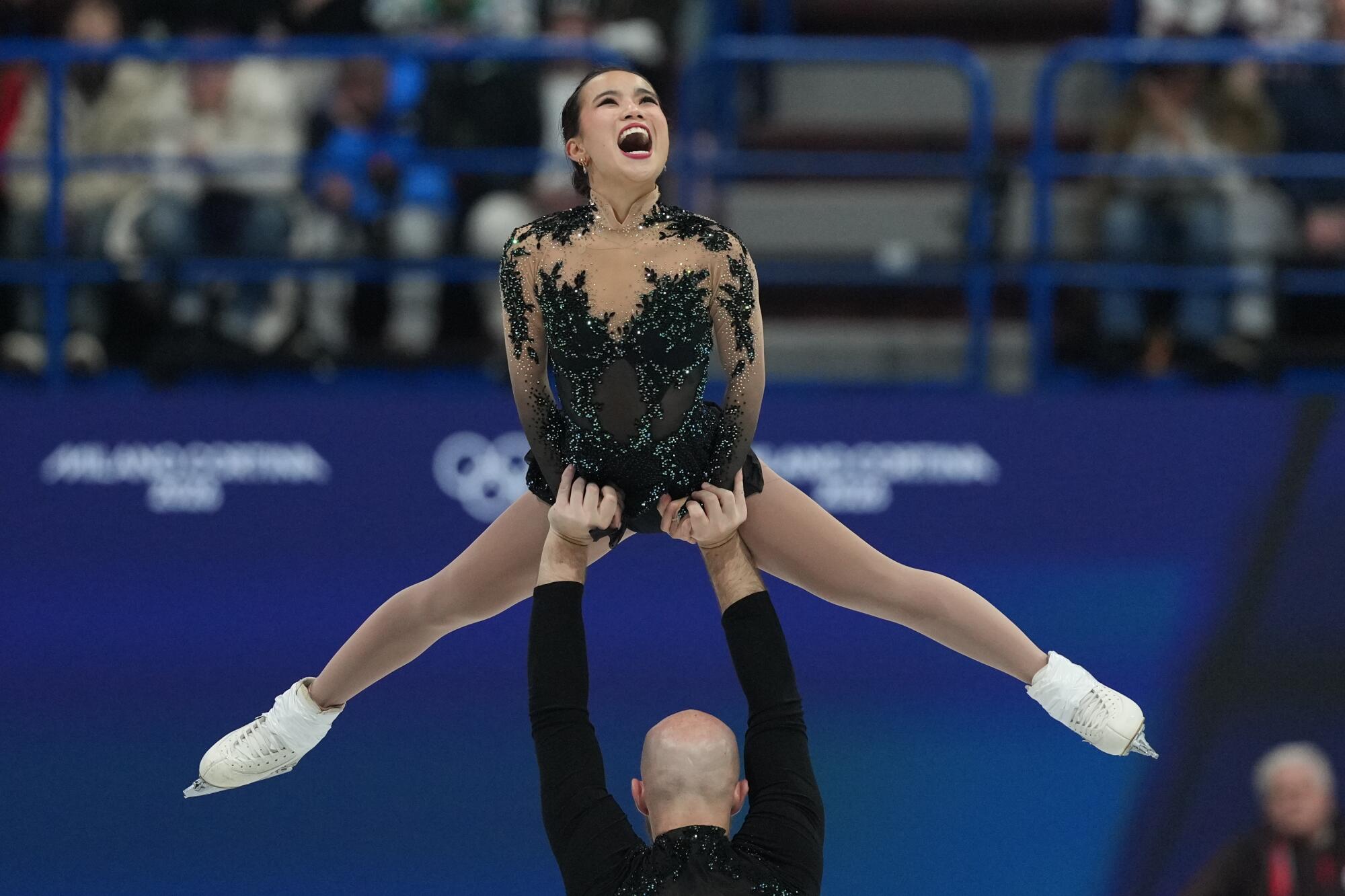
Ellie Kam and Danny O’Shea perform in pairs figure skating during the team competition at the Milan-Cortina Games on Sunday.
(Stephanie Scarbrough / Associated Press)
Kam fought for the landing on a throw loop so hard that she could feel her leg cramping.
“I was like, ‘I’m not going down,’” Kam said, “I got this. We got this.”
They looked at each other before their next element and said “calm.” Their message cut through the energized crowd that cheered louder and louder with each jump. At the end, Kam’s and O’Shea’s celebratory screams simply joined the crowd’s roar. As they saluted the crowd, O’Shea pointed toward Kam to acknowledge her effort.
The pair’s fourth-place finish in the free program was a one-point improvement from their qualifying spot, earning a slim, but vital cushion entering the men’s and women’s free skates.
Instead of sending world champion Alysa Liu back for the free skate after she performed the short program, the U.S. selected the three-time national champion Glenn. The 26-year-old was making her Olympic debut.
On the Olympic stage for the first time, Glenn has tried to embrace the opportunity while treating the competition as if it were any other one. But the larger stage has created additional stress for Glenn after she was asked in a news conference about President Trump’s approach to the LGBTQ+ community in recent years and how it’s affected her personally.

U.S. figure skater Amber Glenn competes during the team competition on Sunday at the Milan-Cortina Games.
(Ashley Landis / Associated Press)
Glenn, who identifies as bisexual and pansexual, encouraged people in the queer community to “stay strong in these hard times” and recognized that it wasn’t the first time the community had to unite to “fight for our human rights.” Glenn then received threats on social media after the news conference and posted on Instagram that she would be taking a break from social platforms to focus on the competition.
But it wasn’t the social media hate that rattled Glenn, she insisted. She was simply tired, sore and disoriented from the unfamiliar Olympic team competition format.
All of Glenn’s other competitors did the short program portion of the competition on Friday. She came in with several good days of training at the venue, but did not get the same kind of opportunity to get used to the stage. Glenn fought through a shaky triple axel to open her program and stepped out of a triple flip that prevented her from completing a planned combination for her second jumping pass.
Waiting in the kiss-and-cry, Glenn bowed her head and stared at the ground. She struggled to muster even a fake smile.
“I’m grateful that the team is so supportive.” said Glenn, who finished behind Japan’s Kaori Sakamoto and Italy’s Lara Naki Gutmann. “But I do feel guilty that I could be the reason that we don’t win the gold, and I don’t know how I will ever apologize for that.”
Glenn clasped her hands in her lap waiting for Sato’s score after the Japanese skater performed a clean program that had his teammates in tears. But his technical score was about five points less than Malinin’s. Glenn was the first skater to hug Malinin in the United States’ team celebration, lifting him off the ground as he extended arms out wide.