Monty Don recently quit Gardener’s World after more than two decades but has now landed something new, teaming up with one of the most famous footwear brands in the country
22:53, 10 Sep 2026Updated 22:53, 10 Sep 2026
Mont Don has landed a new job after quitting Gardeners’ World (Image: ACN / New Balance)
Monty Don has landed a new job just days after quitting Gardener’s World. The TV star,71, is best known for having fronted the BBC agricultural programme, and on air for more than two decades.
“Created as a dedicated space for rest, reflection and connection, the garden brought New Balance’s manufacturing heritage with Burnham’s distinctive creative language and longstanding relationship with the natural world.”
Just days ago, the presenter said the time had come for change and he was ready for his next adventure, but promised his fans that the move does not signal the end of his TV career.
Monty said: “I have decided that the current series of Gardeners’ World is to be my last. I began hosting the programme 23 years ago, first at Berryfields and for the past 16 years here in my own garden, Longmeadow.
“Throughout that time – and around seven hundred programmes – I have had the privilege of sharing my own abiding passion for gardens and gardening with an equally passionate, and often equally knowledgeable audience.
“That connection with millions, not just in Britain but across the world, who share a love of gardens, plants and the natural world is something I have always treasured and which I increasingly believe to be at the heart of a life well lived.
“I have also always relished the craft of programme making and to do so, week in week out, as part of a superlative BBC team has been a deeply rewarding experience. But now is the right time for a change.
“I look forward to continuing to work with and for the BBC on other projects, as well as following new avenues. There are more books to write, more programmes to make. And of course, I will still be gardening, dog by side, here at Longmeadow.”
Born in Germany and raised in England, Monty made his television debut on This Morning in 1989 after his home garden was featured in several publications. After repeat appearances, he got additional TV work on BBC shows Holiday and Tomorrow’s World.
He also began putting his ideas and tips into words, and has published over 25 books since 1990. In 2002, he was recommended by Alan Titchmarsh to replace him as the lead presenter of Gardeners’ World. Monty then became the first self-taught horticulturist presenter in the show’s history.
WASHINGTON — The Trump administration is promising $500 rebate checks to an estimated 1 million Affordable Care Act enrollees across 30 states, who the White House alleged were overcharged by the Biden administration for exchange fees.
The promise comes after Trump pledged Wednesday to send every American adult $5,000 if Republicans retain control of the House and Senate in the midterm elections and as affordability has become a central issue for voters heading into November.
“The relief begins with refunding everyone who was overcharged and the rebates are going out in just a few weeks,” President Trump said in a recorded address released on the White House X account Thursday. Enrollees who can expect refunds are those who do not receive premium assistance.
Critics called the move a “gimmick” that doesn’t represent a plan for addressing soaring healthcare costs.
Trump in his address accused former President Biden’s administration of “gross mismanagement” of ACA funds, without providing evidence, and said that the Biden administration collected user fees from insurance companies that consumers paid through higher premiums.
In a fact sheet, the White House claimed that Biden’s administration “accumulated a significant surplus of funds that were not used to benefit the Americans who paid these higher premiums.” It said the rebates would be sent out beginning next month.
It is unclear whether the $500 rebate represents what each enrollee may have overpaid, where the money for the rebates would come from and whether it requires congressional approval for disbursement.
Trump’s announcement comes as the price of ACA insurance has skyrocketed for many Americans during his own second term. The Trump administration opposed extending COVID-era subsidies that had helped offset the costs of health insurance for most enrollees during Biden’s term.
After the Republican-led Congress allowed the subsidies to expire this year, premiums doubled or tripled for many enrollees, prompting millions to downgrade their plans or exit the program entirely.
Brad Woodhouse, a Democratic strategist and executive director of advocacy group Protect Our Care, called the rebate plan “an absolute joke” in a statement.
“Since Republicans took away tax credits from working families, millions of people have seen their monthly premiums rise by hundreds, if not thousands, of dollars,” Woodhouse said. “At a time when people are scraping by to keep up with the high cost of groceries, rent, and healthcare, this $500 gimmick won’t even begin to dig them out of the hole that Trump and Republicans created.”
Officials at the Centers for Medicare and Medicaid Services did not respond to Associated Press requests for comment, and a White House official referred back to the fact sheet.
Roughly 19 million people receive insurance through the Affordable Care Act exchange.
Hussein and Swenson write for the Associated Press.
WASHINGTON: President Donald Trump said he did not regret going to war against Iran despite the impact the conflict may have on the November US midterm elections.
“I don’t believe in the word ‘regret.’ You can always question yourself a little bit,” Trump said in an interview with Fox News host Laura Ingraham when asked if he regretted the Iran war due to the impact it may have on the elections.
“If I had it do again, I would do exactly as I did,” Trump said in the interview broadcast on Thursday on “The Ingraham Angle” show.
Trump dismissed suggestions that some of his supporters were upset and demoralized about the war.
“I don’t think they’re demoralized. I think they’re very proud of the fact that I’m not letting Iran have a nuclear weapon,” Trump said.
Trump reiterated his thinking that the war will end immediately after the midterm election.
“It ends right after the election,” Trump said in the interview. He made similar comments on Wednesday, alleging Tehran was trying to influence the elections that will determine whether Trump’s Republican Party retains control of Congress.
The rise in oil and gas prices due to the US-Israeli war on Iran has become a major issue for Republicans in the lead-up to the elections.
The US and Israel attacked Iran on February 28 and Iran responded with its own strikes on Israel and Gulf states that host US bases. US-Israeli strikes on Iran and Israeli attacks on Lebanon have killed thousands and displaced millions.
Trump has cited weakening Iran’s nuclear capabilities as one of his war objectives. Iran does not have nuclear weapons and says its uranium enrichment program is for peaceful purposes. The US is nuclear-armed.
NEW YORK: Aryna Sabalenka moved a win away from her third straight US Open title, beating Jessica Pegula 7-5, 6-2 on Thursday night.
Sabalenka blasted her way out of what was a dead-even match for most of the first set, pouncing on Pegula’s second serves and turning the second set into perhaps her most impressive stretch of tennis in the tournament.
“No complaints,” Sabalenka said. “I’m just super happy that I was able to pull out such tennis.”
The No. 1 seed will face No. 2 Elena Rybakina or No. 4 Coco Gauff on Saturday, needing a victory to become the first player to win three in a row in Flushing Meadows since Serena Williams from 2012-14.
Rybakina will replace Sabalenka atop the women’s tennis rankings next week, and Sabalenka said this week she would be fine ceding No. 1 after she held it 99 consecutive weeks if it she was able to win another US Open trophy.
It will be hard to prevent that if she hits the ball Saturday the way she did against Pegula.
Sabalenka pounded 29 winners to Pegula’s 12, turning their third straight meeting at the end of the US Open into a rout, after her victory in the 2024 final and 2025 semifinals were tight most of the way.
“I was so desperate for the win, I wanted it badly,” Sabalenka said.
She has won 19 straight matches at the US Open since losing to Gauff in the 2023 final.
Venezuela’s former first lady, Cilia Flores de Maduro, has asked a judge to release her from federal detention in the United States, citing a worsening heart condition.
In an application for pre-trial release on Wednesday, her legal team asked for the court to allow Flores to await trial under home confinement in Manhattan.
Recommended Stories
list of 3 itemsend of list
It described her declining health since US military operation on January 3 that resulted in her abduction from Caracas and imprisonment in New York, as well as that of her husband, former Venezuelan President Nicolas Maduro.
“Prior to the United States’ military invasion of Venezuela, Ms. Flores de Maduro was physically healthy and took no ongoing medication, other than a monthly injection to help control her mitral valve prolapse,” the legal filing said.
“Now she is prescribed four medications, maintains nitroglycerin by her side in the event of a potential heart attack, and grapples with the continued medical advice suggesting coronary exploration and surgery.”
Flores was a prominent figure in her husband’s government, serving as first lady since his inauguration in 2013.
Prior to Maduro’s first inauguration, she was also a leading member of the United Socialist Party of Venezuela (PSUV), the country’s dominant political movement, leading the National Assembly for more than four years.
But Maduro had long clashed with the administration of US President Donald Trump, who accused Venezuela of sending drug-traffickers into the US. Both Maduro and Flores have also faced allegations of participating in human rights abuses, including the violent suppression of political dissent.
After launching a one-day military operation to abduct Maduro and Flores, the Trump administration charged them both with drug- and weapons-related charges. They are currently awaiting trial in New York City.
But Flores’s health has been in doubt since her forced removal from Venezuela, according to her legal team.
After consulting outside medical experts, Flores’s lawyers said they believe she may have suffered a minor heart attack on July 29 while in US custody.
They also questioned whether she was receiving the appropriate medical care for her mitral valve prolapse, a condition affecting one of the heart’s valves.
Since her imprisonment, her lawyers said Flores has not received the monthly injection she needs to manage the condition.
Instead, she has reportedly been prescribed baby aspirin, a statin, diltiazem and nitroglycerin to use when she experiences chest pain.
Doctors have recommended that she undergo a cardiac procedure, which could result in additional heart operations. If she undergoes such treatment, Flores “will need adequate time to recover from any procedures in a setting conducive to restoring her health”, her lawyers said.
Thursday’s filing acknowledges that Flores does not “dispute that she has received excellent care” from medical professionals. But it argues that “a detention centre lacks the conditions needed for such a recovery”.
Her lawyers proposed moving Flores from the Metropolitan Detention Center in Brooklyn to a residence within the Manhattan federal court district, where she and Maduro are due to go on trial next June.
Under home detention, Flores would be subject to round-the-clock armed monitoring, with visits restricted to people approved by the court and federal prosecutors. Her home would also be monitored by video and her phone calls recorded, according to the filing.
Judge Alvin K Hellerstein has yet to rule on the application.
Flores, 69, and Maduro, 63, have been held in US custody since the January raid on their home in Caracas. Both have pleaded not guilty to the charges of participating in a conspiracy to traffic cocaine into the US.
The Ethiopian calendar is a solar calendar based on the Egyptian and Julian calendars and was brought to Ethiopia by missionaries. The year consists of 12 months of 30 days and a thirteenth month of five or six timekeeping days.
Pagume, the 13th month in the Ethiopian calendar, comes from the Greek word epagomene, which means ‘days forgotten when a year is calculated’. This month has five days or six days in a leap year. According to the Ethiopian calendar, a year has 365 days, six hours, two minutes and 24 seconds. Once every four years, the six hours add up to 24 hours and become the sixth day in a leap year. Once in 600 years, the two minutes and 24 seconds add up to a full day and form a seventh day.
Based on the Julian calendar basis, the Ethiopian calendar is currently seven years and eight months behind the Gregorian calendar used in most of the world.
Enkutatash means the ‘gift of jewels’. It is said to refer to the Queen of Sheba returning from her visit to King Solomon in Jerusalem in 980 BC. On the Queen’s arrival back in Ethiopia, her chiefs welcomed her by filling her treasury with jewels (‘enku’). It may also refer to the countryside, as this time of year coincides with the end of the rainy season meaning the landscape is covered with Adey Abeba, whose bright yellow flowers appear almost in celebration of the impending harvest.
Celebrations for the Ethiopian New Year usually last for a week and are focused on family events. The holiday starts on New Year’s Eve, when each household light wooden torches called “chibo” in Amharic language, that symbolise the coming of the new season of sunshine after the end of the rainy season that has prevailed since June.
A man was arrested this week near Kris Jenner’s home in Calabasas on suspicion of stalking. It wasn’t the reality TV star’s first brush with the alleged stalker.
Officers with the Los Angeles County Sheriff’s Department on Monday arrested the man, identified as 25-year-old Zenwilliam Robson, after he was detained by Jenner’s security in her neighborhood, The Times confirmed.
It was not clear whether Jenner was at home at the time of Robson’s arrest.
Robson was booked Monday evening and charged with one misdemeanor count of trespassing and refusing to leave private property, according to court records.
He is currently jailed at the Twin Towers Correctional Facility in downtown Los Angeles and is set to appear in court on Sept. 22. A representative for Robson could not immediately be reached for comment.
A representative for the “Keeping Up With the Kardashians” star declined to comment. But according to a source familiar with the case who was not authorized to speak publicly, Jenner’s team is aware of Robson and that he tried to contact the 70-year-old reality TV personality and businesswoman in the past.
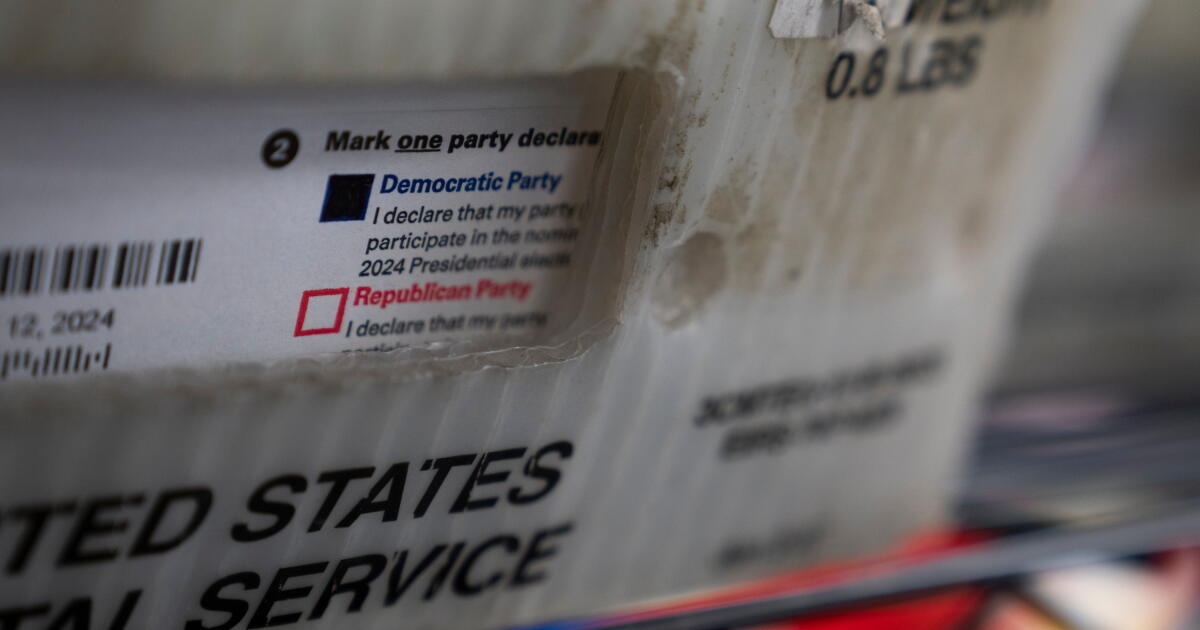
WASHINGTON — An appeals court on Thursday upheld a block on President Trump’s executive order limiting mail voting, a decision that comes as the Supreme Court considers the same case and states have already started sending out ballots for the high-stakes midterm elections.
The three-judge panel refused to lift a preliminary injunction against the order issued last week by U.S. District Judge Indira Talwani. It prohibits the U.S. Postal Service from implementing Trump’s directive. The Postal Service has said it would not deliver ballots from states that did not pre-clear their envelope design with the federal government and submit a list of voters to an online portal, which has yet to be activated.
Election officials warn that it’s impossible to comply with those terms, especially with the first mail ballots already being sent out in Alabama, North Carolina and Wisconsin.
The panel of three judges nominated by former President Biden agreed with the plaintiffs that the president does not have the power to regulate states’ election policy.
“Appellants have not made a strong showing that the district court erred in determining that the Final Rule is likely unlawful,” they wrote, a reference to a rule published by the Postal Service to implement Trump’s order.
The panel wrote that the Trump administration had done little to dispel arguments by many election officials that the changes would bring “chaos and widespread disenfranchisement.”
“Indeed, appellants have not even seriously challenged this aspect of the district court’s ruling, much less demonstrated why it is clearly erroneous,” the order states.
The government also hasn’t shown evidence of past fraud to justify the restrictions, the judges said.
A request for comment from the White House was not immediately returned.
The panel’s decision comes even as the Supreme Court is already considering the same case, which is part of a frenzied legal rush as states are beginning to send out mail ballots for this fall’s midterm elections. Democrats and civil rights groups in a separate lawsuit in Washington, D.C., also are trying to halt the executive order.
The 1st Circuit also had upheld a previous hold Talwani placed on the executive order. But that ruling was lifted by the Supreme Court in a procedural decision that did not determine whether the plan was constitutional.
The plaintiffs swiftly filed new lawsuits after the Postal Service finalized its rule governing mail ballots.
Riccardi and Whitehurst write for the Associated Press.
The college rivals turned teammates on the U.S. national team showed off their growing chemistry in Team USA’s blowout victory against Hungary on Thursday in Berlin. The Americans knocked out their quarterfinal opponents 108-56, notching the team’s 34th consecutive win in World Cup play since 2006.
“We’ve played against each other so many times, so I’m sure we know each other’s game like the back of each other’s hand,” Reesesaid when asked after the game about playing with Clark. “Just easily dishing it off to her. She dishes it off to me. She knows my spots. I got one to her today, maybe two. So it’s fun. We just continue to build chemistry because we know we’re gonna be USA teammates for a while.”
The strength of Clark and Reese’s two-person game was on full display Thursday. Clark assisted on six of Reese’s nine points, and Reese returned the favor during the third quarter. After securing a steal, she hit Clark for an easy transition layup.
Reese ended the game with nine points, six rebounds, three assists and two steals. Clark finished just shy of a double-double with 10 points, nine assists, three rebounds and two steals.
Clark also has complimented Reese as a competitor and teammate during the tournament.
“We’re both fiery, fiery competitors and we want to win and it’s one of the things I really admire about her game,” Clark told the Associated Press in an interview published Wednesday. “She’s competitive and she has a tremendous motor; like, she has one of the best motors in the league. She works just as hard as anybody on the court. So, it’s been fun to to be able to play with her.”
Clark, who set records at Iowa, and Reese, who won an NCAA championship at Louisiana State, have been household names since their college matchups. Thanks to their intensely loyal — and often vocal — fan bases, that rivalry has been carried into their WNBA careers, where every matchup and interaction invites heightened scrutiny, especially online.
Clark told the AP that many of these stories about her and Reese’s relationship are “false takes.”
“No matter what, there’s always going to be people that create those narratives and say whatever they want to say,” Clark said. “There’s definitely no stopping that and they’re always going to be there.”
Reese and Clark are among Team USA’s young core, dubbed the “young and turnt” crew by teammate Paige Bueckers during training camp in December. The World Cup marks the first major international competition for six of those players: Bueckers, Clark, Reese, Aliyah Boston, Sonia Citron and Kiki Iriafen.
Team USA is set to play Spain in the semifinals on Saturday.
BIRMINGHAM, England: Rain prevented England from putting Pakistan in a deeper hole than 52-2 and 268 runs behind on day two of the Edgbaston cricket test on Thursday.
Pakistan walked out after tea 320 runs behind to begin its second innings in gloomy, lights-on conditions perfectly suited for England’s four-man pace attack which has dominated the series.
Pakistan has yet to crack a 200 total, and Ollie Robinson was the man of the moment again.
Robinson got Saim Ayub to nick to the slips off the first ball and became only the fifth bowler in test history to twice take a wicket with the first ball of an innings in a series. The last person was Zaheer Khan for India against Bangladesh in 2007. Bill Voce was the only previous Englishman in 1937 against Australia.
Ayub was playing Twenty20s in the Caribbean 10 days ago but was summoned in mid-series in a panic call by the Pakistan Cricket Board to play his first test in 20 months. He bagged a pair.
Robinson struck again with his fourth ball, nicking off Abdullah Shafique.
That made Pakistan start 0-2 for the sixth time ever in tests and the second time against England. The other was at the same ground in 1982. The bowler was Ian Botham.
From 0-2, Azan Awais and Shan Masood dug out Pakistan to 52-2 in 12 overs. Awais had 29 and Masood 21 after being dropped on 13 by Ben Duckett off the luckless Gus Atkinson.
Wet weather came sooner than forecast and guaranteed Pakistan lived to fight at least one more day in a three-test series already lost. England, up 2-0, should complete the sweep on Saturday with no test going the distance.
Fifties and no hundreds again
England began the day already in front with a lead of 23 at 156-4.
In two sessions, 50 overs, they added 297 runs at a pacy 5.9, its fastest rate on any day all summer. Three more batters scored fifties to add to Emilio Gay’s gritty 60 and Harry Brook’s unbeaten 52 on Wednesday but the effort looked nothing like Bazball.
However, Brook, Dan Lawrence, Jamie Smith and less so Robinson would have thought a century was at their mercy.
The former trio spent more than two hours at the crease, three hours in Brook’s case, but all fell tamely and showed obvious frustration to miss out on a century on a fair pitch against a popgun attack.
Brook ran himself out on 75, Lawrence dragged on on 65, and Smith chipped back to fast bowler Razaullah Khan on 69.
Robinson’s breezy 50 from 47 balls highlighted the merciless contribution from the tailenders of 116 runs and 15 boundaries.
Brook resumed on a restrained 52 and Dan Lawrence on 5, and in sunny conditions they plundered seven runs per over in the first hour.
Brook then mistakenly took on Shan Masood at midwicket and has now been involved in five run outs in tests — only Virat Kohli (6) has been in more. Brook has gone 11 tests without a century but was still averaging more than 40.
Lawrence, filling Ben Stokes’ old spot, had in hand his third fifty in three tests when he chopped on. He gave up an agonizing “No” and Mohammad Imran’s first test wicket.
“Bitterly disappointed to get out in the 60s,” Lawrence said. “Something I’ve prided myself on this season is kicking on. I really wanted a big hundred today.
Pakistan still went to lunch with an air of resignation as Smith collected an unbeaten 47 of the 143 runs in the session.
Smith got his third 50 of the summer straight after lunch by crashing Razaullah through the covers, but Razaullah got him caught and bowled on 69.
No. 9 batter Robinson greeted the new ball by lofting Mohammad Abbas for six over cow corner and got his second 50 of the season from 46 balls. The entertainment was ended by a good catch from Masood in the covers.
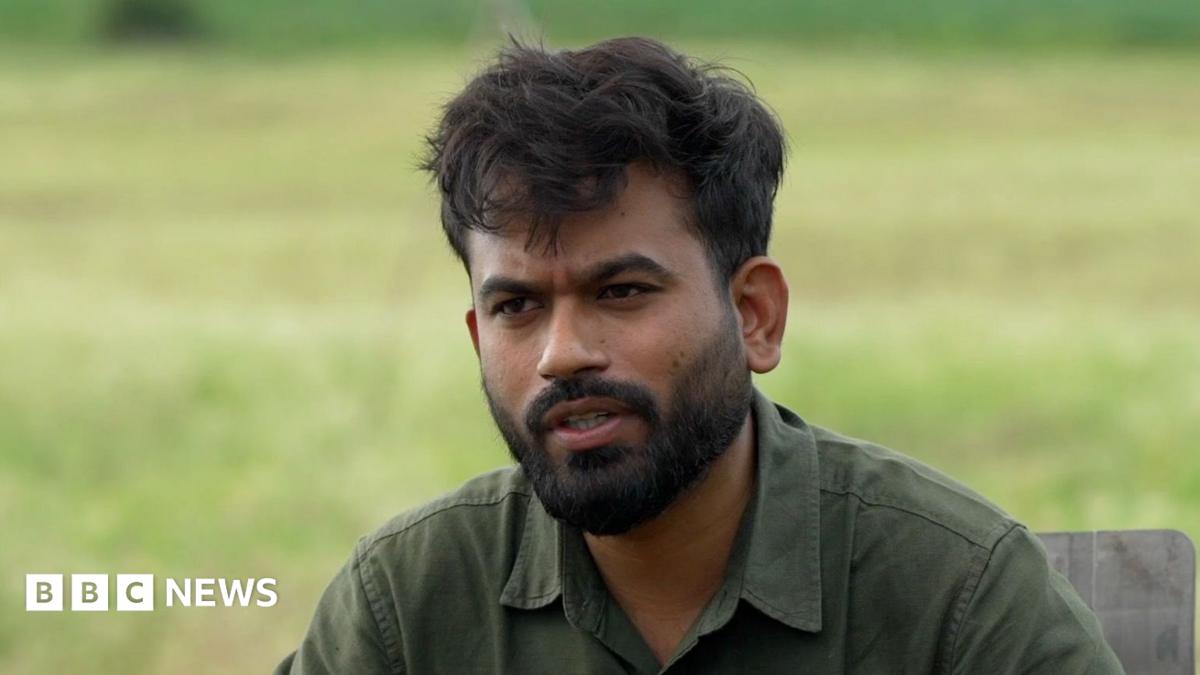
In just under three months, 30-year-old Abhijeet Dipke – the founder and face of India’s Gen Z “cockroach” protests – has acquired the kind of celebrity status normally reserved for a breakout actor or cricketer.
In politics or activism, unless you come from an influential family, such recognition can take years – if it comes at all.
“It’s been a rollercoaster ride. Two-three months ago, nobody knew me. I was just in my room in Boston watching documentaries or attending lectures,” said Dipke, who recently completed a master’s in public relationsat Boston University.
“Now I’m here surrounded by hundreds of people, by cameras. It’s a bit overwhelming.”
In and around his hometown of Chhatrapati Sambhajinagar in the western state of Maharashtra, Dipke is routinely thronged by people wanting to shake his hand or take a photo.
If the attention bothers him, it doesn’t show. Perhaps because politics isn’t entirely new to him: before moving to the US, Dipke had worked with the Aam Aadmi Party (AAP), an opposition party that grew out of an anti-corruption movement, for three years.
Then, on 16 May, Dipke wrote a post on X that would change his life: “What if all cockroaches come together?”
It was a response to a remark by India’s Chief Justice Surya Kant, who had likened jobless youngsters to cockroaches. Kant later said his comments had been misinterpreted and were directed specifically at young people using fake degrees, rather than the country’s youth more broadly.
But the clarification did little to quell the outrage.
Dipke said he wrote his post while playing a video game. “It was totally spontaneous. I had no idea it would become such a big movement,” he said.
Encouraged by tens of thousands of responses, he joined a handful of former colleagues and activists to launch the satirical Cockroach Janta Party (CJP), its name playing on both the chief justice’s remark and that of Prime Minister Narendra Modi’s Bharatiya Janata Party (BJP).
Alongside the support, Dipke and the campaign were fiercely trolled by government supporters. Their website and X account was briefly taken down in India.
Dipke says that when he wrote to X and to India’s Ministry of Electronics and Information Technology asking why the account had been taken down, he received a notice saying it had been withheld under Section 69A of the Information Technology Act which allows the government to block online information ‘in the interest of sovereignty and integrity of India, defence of India, security of the State’.
The ministry did not reply to the BBC’s questions about the issue, but The Indian Express and other media reported government officials as saying the sites had been blocked because of ‘national security concerns’. Dipke says he decided to return to India in response to this.
“I took the decision to come back to India when I was called a national security threat by my own government. That really hurt me. Isn’t my government supposed to stand by me when I’m abroad?” he said.
“I decided I need to go back to my country to show I’m not a national security threat. I love my country, just not in the way that you [the government] want.”
KATIE Piper has called out cruel abuse from online trolls over her National Television Awards look – as celebs rallied with their support.
Taking to Instagram, the writer and presenter shared a video addressing upsetting online comments she’d received.
Katie Piper spoke out after receiving cruel online comments about her appearanceCredit: Instagram / katiepiper_Presenter and writer Katie attended the National Television Awards on Tuesday nightCredit: Getty
She was left with severe facial burns and blindness in one eye after an acid attack in 2008Credit: GettyWhile at the event, Katie posed for photos with her fellow stars of Loose WomenCredit: Getty
Katie noticed notifications popping up on her phone after Woman & Home posted a red carpet interview featuring her.
She continued: “The comments are going mad. I thought, “Oh why?” and it’s just endless.
“Oh, look at her. What happened to her face? Oh, she’s overdone it on the filler.
“Oh my God, why are we talking about the hair, the hair’s not the problem. The face, blah blah.”
“And you’re just like, “I am a normal person, I am a real person”. I’m just out here trying to do my best, trying to live my life.
Katie added she had replied to these commenters, but later felt it wasn’t the right move.
She said: “I started replying to them all saying, “What’s it got to do with you how I look? Why are you policing women’s appearance?
“What if this was even a choice? Why does it matter to you how I look?”
Celebrities soon offered support, as Lisa Snowdon wrote: “You are the most beautiful inside and out Katie- never forget that.”
Morning Live‘s Rav Wilding penned: “Pipes, as your husband knows as your kids know and how all your friends know, you ARE beautiful.”
Matt Goss shared: “This breaks my heart you’re amazing and you have every right to let people know how you feel.
“You are genuinely an inspiration. sending so much love.”
Myleene Klass posted: “Katie. I was with you that night and I was over the moon to be with you.
“Your company, your energy, your funny one liners….and you also happened to look incredibly BEAUTIFUL. They don’t matter. They’re trying to. They just don’t x.”
Dannii Minogue wrote: “Katie – you, your words, your kindness and your digital footprint, you can be proud of. By all means take time for you, but do not let them take your light.”
With high rates here to stay, CFOs rely on internal cash and working capital for stability.
In August, U.S. Treasury yields reached multi-decade highs. Treasury Secretary Scott Bessent responded by doubling the size of buyback operations for 10- to 20-year and 20- to 30-year securities to a floor of $4 billion each, effective Sept. 9 — a stopgap lasting through November 4, when the Treasury releases its next official policy statement.
Yet while Washington intervenes to stabilize government debt, finance chiefs must reckon with higher costs of capital.
“Higher rates have changed the math and, more importantly, reduced the margin for error,” Thomas DeFabrizio, CFO, Americas at Impellam Group, said in an email. “The hurdle rate should move when the cost of capital moves. Otherwise, you are pretending the financing environment has not changed.”
This reality is forcing companies to look inward, turning operational efficiency into a primary source of funding. “Every dollar released from receivables or inventory is a dollar you do not have to borrow at today’s rate,” DeFabrizio said — a meaningful gap when investment-grade credit is yielding around 5.5% and broad high-yield debt is near 7%, with lower-rated credit running considerably higher.
“That makes working capital much more than a finance housekeeping exercise,” DeFabrizio added. “It becomes a capital-allocation decision.”
Era of Cheap Capital Ends
Elevated borrowing costs directly filter down into corporate balance sheets and consumer demand, sparking broader concerns over whether public and private debt issuance has reached a tipping point. Rather than waiting for a rate relief cycle that may never materialize, finance leaders are taking direct defensive action.
Duncan Young, principal at San Francisco-based consulting firm Saorsa Growth Partners, specializes in providing fractional CFO services to companies. Businesses, he told Global Finance via email, are now prioritizing balance sheet durability over aggressive expansion.
To hedge against benchmark rate risks, companies are restructuring their short-term obligations and shifting benchmark exposure.
Duncan Young, Saorsa Growth Partners
“This is likely a function of risk-off bondholders and bank balance sheets, shifting away from Treasuries towards corporates. We’re pricing off SOFR when possible, to avoid the Treasury rate risk,” he said.
Instead of speculating on interest rate cuts, companies with near-term debt maturities are moving quickly to lock in fixed terms to insulate themselves from further upside volatility in yields.
“Our ‘current debt’ revolvers are being paid back [or] termed out to give us more resilience, heading into uncertainty. We aren’t expecting yields to ease,” Young said.
That posture is showing up across the broader CFO community.
Companies Are ‘Stretched Thin’
Middle-market companies, firms that typically generate less than $1 billion in annual revenue, have even less room to maneuver. Nick Araco, CEO of CFO Alliance, hears that many CFOs “are stretched thinner on what their current options are.”
As a result, they’re watching the Federal Reserve more closely, he added. “They don’t have the same flexibility to just refinance on their own timeline.”
“The ones sitting on debt maturing in the next 12 to 24 months are largely not betting on yields easing meaningfully,” Araco said, describing conversations across the group’s roughly 9,000 members.
This conservative stance is fundamentally altering capital allocation strategies. Rather than relying on leverage to fuel aggressive top-line targets, firms are relying on internal cash generation. They’re scaling back capital expenditures and holding cash as a strategic buffer.
“Return on cash gives us some benefit — for example, it softens the opportunity cost of us paying off debt. Terming out on a fixed rate and sitting on the cash so we can stay liquid in the next liquidity crisis is insurance worth paying,” Young added. “Given the AI outlook and the consequences of a bubble pop, we’re prioritizing resilience over growth rate, and this means less leverage and a more liquid balance sheet.”
Preparing for Double Shock
Government debt continues to test the limits of market capacity. An August 30-year Treasury auction drew below-average demand and record dealer absorption as yields hit 5.2% — the highest since 2001. Meanwhile, foreign investors’ share of U.S. debt has slid to about 30% from a 2008 peak of 49%, according to the Committee for a Responsible Federal Budget and the Bipartisan Policy Center.
That combination — elevated base yields sitting alongside historically tight credit spreads — is unsettling CFOs more than the headline numbers suggest.
“Tight spreads feel almost like a false sense of calm,” Araco said. CFOs aren’t treating today’s all-in cost of debt as the new normal, he added. They’re stress-testing what happens if spreads normalize on top of already-elevated base rates.
“It’s less about action today and more about scenario planning,” Araco said, “and making sure that their capital structure isn’t fragile if that spread compression reverses.”
Corporate leaders are taking matters into their own hands. By prioritizing liquidity, extending duration, and managing leverage, CFOs are ensuring their organizations remain resilient regardless of where government bond yields head next.
“If Treasury yields remain elevated and spreads widen at the same time, the all-in borrowing cost can change quickly. I would model that combined shock now,” DeFabrizio warns. “Once you need the capital, your negotiating position has already changed.”
Anthony Noto covers corporate finance and private credit. Contact him at anoto@gfmag.com
California, home to the world’s largest tech companies, is placing more guardrails around social media and artificial intelligence as child safety concerns escalate.
On Thursday, California Gov. Gavin Newsom signed more than 10 bills aimed at keeping young people safe online.
From suicides to sextortion, parents and their children are wrestling with how social media and AI chatbots could be harming people’s mental and physical health. The anxiety comes as technology becomes more powerful, playing a bigger role in classrooms, offices and homes.
California lawmakers have tried to tackle online safety concerns for years and they’ve faced intense lobbying from tech companies with deep pockets. The state’s laws have a disproportionate impact on the global tech industry because so many of the field’s titans are based here.
“We cannot hand children technology engineered by some of the most sophisticated companies in the world, and then place the burden on kids to defend themselves against it,” said California First Partner Jennifer Siebel Newsom in a news conference Thursday in the San Francisco Bay Area.
The California governor, who has tried to strike a balance between safety concerns and supporting innovation, has rejected online safety bills in the past that he thought were too restrictive or premature.
The batch of new legislation includes Senate Bill 1119, which would require companion chatbot operators to assess risks, notify parents in certain cases if their child threatened to harm themselves, and take other safety steps.
Lawmakers named the bill Adam’s Law, after Adam Raine, a California teen who died by suicide in 2025 after conversing with OpenAI’s ChatGPT. The teen’s parents sued OpenAI, alleging in the lawsuit that ChatGPT provided information about suicide methods that the teen used. OpenAI and Pinterest publicly expressed support for the bill on Thursday.
Adam Raine’s mom, Maria, said in the news conference that the new law will help save lives and hopes that other states will enact similar legislation.
“Powerful AI companionship chatbots were unleashed on our kids with vastly inadequate protections. Adam was an early adopter of AI, and so many of us parents did not understand the dangers back then,” said Maria Raine, who came to the event with a photo of her son.
Suicide prevention and crisis counseling resources
If you or someone you know is struggling with suicidal thoughts, seek help from a professional or call 988. The nationwide three-digit mental health crisis hotline will connect callers with trained mental health counselors. Or text “HOME” to 741741 in the U.S. and Canada to reach the Crisis Text Line.
At the event, Democratic and Republican politicians shared their experiences as parents who have seen firsthand how technology affects children.
Assemblyman Josh Lowenthal (D-Long Beach) said parents are seeing anxiety and depression among children who grew up in front of screens.
“That anxiety is because the pace of technology is moving faster than government can put guardrails in, and that’s left families across the state struggling to figure out how to keep their kids safe,” Lowenthal said.
Lowenthal introduced Assembly Bill 1709, which Newsom also signed. It would bar certain online platforms from providing an “addictive feature” such as autoplay and feeds that display recommended content to users under 16 years old.
Tech industry groups opposed the bill, raising concerns that it could cut off access to social media’s benefits, such as people’s ability to connect with family and friends. Tech industry groups such as TechNet say that lawmakers should enforce current laws to strengthen parental controls rather than pass new ones.
NetChoice, which has sued California and other states to block the enforcement of new online safety laws, said in a statement that the group has First Amendment concerns about the new bills Newsom signed.
“The state cannot simply describe speech as addictive and then claim a right to regulate access to it,” said Zach Lilly, Director of Government Affairs at NetChoice. “Whether the governor and legislature choose to respect it, Californians have a right to express themselves, and NetChoice will continue to fight for that right.”
The new safety restrictions come as tech companies, including Meta, Google and others, face more scrutiny over how they design products. The companies have suffered several legal blows in courtrooms in California this year.
Meta, which owns Facebook and Instagram, agreed in August to pay up to $17 billion and make child-safety changes to resolve a multistate lawsuit. The lawsuit accused the tech company of designing and deploying harmful features while misleading the public about them.
As part of the settlement, Meta said it would impose time limits and mute notifications during certain hours for teens. Young people would also have the option to choose to view a non-algorithmic social media feed that isn’t personalized and disable autoplay.
Earlier this year, Meta and YouTube also lost a social media addiction lawsuit in Los Angeles.
While new legislation goes further than the settlements, some countries have passed stricter restrictions on social media. Last year, Australia started banning social media for children under 16, though enforcement has posed a challenge because teens are finding ways to get around the restriction.
Newsom, who pushed for federal regulation, said that he thinks California’s approach to social media is “better” than Australia’s because children are “all figuring out a way to game that system.”
“This is about the features themselves. This is about actually addressing the problem, the scrolling, the algorithms,” he said.
Safety concerns around technology have also heightened as companies double down on advancing artificial intelligence.
This week, a researcher for AI company Anthropic said he left the company over concerns that AI companies, including OpenAI, are “gambling with our lives” as they race ahead to improve AI that could surpass human intelligence.
The researcher, Jacob Coxon, shared a viral social media post that said: “People building AI earnestly believe that it could kill us all by the end of the decade.”
Newsom signaled the work to protect children isn’t over.
“We need to move, but one thing we’re not doing is we’re not sitting back and we’re not letting it rip,” he said.
When it comes to Shohei Ohtani‘s injury management, it’s tempting to dwell on the what-ifs.
What if the Dodgers forced him to give up pitching duties in July, when he needed a lubricant injection to alleviate irritation in his left knee?
It was clear by then that Ohtani was playing through multiple injuries. A right biceps problem popped up for the second time on July 3 — the last time he pitched in a game. The Dodgers said his knee inflammation was only aggravated by pitching and the biceps tightness was tied to hitting. And yet, they were confident that the MLB All-Star break would give Ohtani enough time to bounce back.
If the Dodgers had been more proactive, instead of starting and stopping Ohtani’s throwing program until his injuries forced a shutdown, would he be in the lineup Friday against the Miami Marlins instead of the 15-day injured list?
Maybe.
Or maybe one or both injuries were far enough along by then that they would have affected him down the stretch regardless. Maybe seeing if he could return to the mound was worth the risk.
Maybe not.
“Anyone can do that, and say, ‘What could you have done better or different?’” manager Dave Roberts said earlier this week when asked if he had any regrets about Ohtani’s injury management. “That’s something going forward we’re going to look at, absolutely. But, it’s certainly not a blame-game thing. It’s learning from what happened and getting better.”
Parsing through the alternative outcomes from decisions made months ago could take time. But the fallout from this past week is clearer.
What if instead of resting Ohtani four days, and bringing him back Monday, the Dodgers had put him on the IL right away?
“I think if we look right now, here today, I would love to go back and put him on the IL,” Roberts said. “But at that moment in time, we all felt that giving him four days was sufficient. He was agreeable. Getting him out there on Monday with the hope that he would be able to play [again Wednesday]. But where we’re at right now, sure.”
Two weeks without Ohtani is hard to swallow. As a two-way player, he’s eligible for the 15-day IL instead of the 10-day for position players.
The Dodgers tried to avoid it. But when he returned to the lineup Monday, he “didn’t feel great” on a swing, Roberts revealed.
So now the Dodgers can only backdate Ohtani’s IL stint to Tuesday, rather than Sept. 3. At minimum, Ohtani will be out until the final five games of the regular season.
“The most important thing is him being as healthy as possible, not compromising his swing, and kind of bet on that,” Roberts said.
He acknowledged that Ohtani wouldn’t be back to “100%” even with the two weeks off.
But plenty of players push through injuries in the playoffs. October becomes a test of pain tolerance before addressing ailments in the offseason.
“I want to make sure that when I look back [on] this season,” Ohtani said Monday through interpreter Will Ireton, “that I used this as an experience, a learning experience and make sure that I use that as something to improve upon for next season.”
So, does that mean Ohtani feels like he could be more up-front with the team about his physical well-being, regardless of whether he thinks he can play through aches and pains?
Dodgers star Shohei Ohtani celebrates with teammates after a win over the Reds at Dodger Stadium on Wednesday.
(Robert Gauthier / Los Angeles Times)
“It’s hard to say now with the season still going on,” Ohtani said. “It’s something that I’m going to reflect back on during the offseason. I’m just making sure that I’m focusing on the now and finishing strong.”
The Dodgers, for the first time navigating what was expected to be a full season of two-way play from Ohtani, leaned on his expertise while managing his workload. In retrospect, they might have put too much stock in his self-evaluations.
Baseball has a long tradition of players downplaying injuries, out of a desire to play and a belief in their own perseverance.
“What can I learn?” Roberts said this week. “I think that sometimes, potentially trying to get ahead of managing his workload — it always feels good to run him out there offensively as a DH. Always feels good when you pencil him in as a starter — for me, it’s just really trying to be mindful of the long season.
“And I guess it’s under the thing of, ‘you don’t know until you know,’ and it’s important to learn from experiences. And I think it’s good for all of us to kind of appreciate that he’s not supernatural, as much as we think he might be at times.”
Roberts said he didn’t learn until Tuesday night, after giving Ohtani a day off for the fifth time in six games, that a swing on Monday had bothered him.
So, Ohtani didn’t return to the lineup Wednesday as planned. And the team arranged for No. 1 prospect Josue De Paula to meet the team in Miami, called up straight from double-A for his MLB debut on Friday.
“It was more just really huddling up and saying, ‘Hey, how are you going to feel on Friday? How are you going to feel on Saturday, talking to the doctors and training staff?’” Roberts said. “There was not much certainty that he’d be in a much better place. With that, just taking it off the table seemed like the best course of action.”
De Paula wasn’t otherwise guaranteed to debut this season, although the Dodgers would have needed to eventually put him on the 40-man roster to protect him from the Rule 5 Draft.
The Dodgers see him as a major-league ready hitter, but he still has work to do on the defensive side for the team to feel comfortable playing him in the outfield regularly. An early taste of the big leagues, even with his playing time expected to come mostly in the DH spot, could be beneficial for the 21-year-old’s development.
For Ohtani, the ramp from the IL to postseason play will be short. But his recent offensive struggles emphasized the importance of having a healthier version of him in the lineup come October.
If anyone can make it work, it’s Ohtani. He may not be supernatural, but he also isn’t just any player. And if he performs in the postseason, that will drown out any lingering what-ifs.
Times staff writer Kevin Baxter contributed to this report.
NEW YORK CITY: Saudi Arabia’s ambassador to the UN warned the Security Council on Thursday that “the international community cannot call for de-escalation” in Yemen “while at the same time allowing the continued flow of support that enables this (Houthi) militia to continue its hostile and criminal conduct.”
The warning from Abdulaziz Alwasil came during an emergency council session to discuss Houthi attacks against the Kingdom this week. It was requested by the UK, the penholder on Yemen, and Bahrain.
He said the latest strikes on Saudi cities, which began on Tuesday, were not an isolated episode but “an extension of a systematic, hostile approach pursued by this militia since its coup against the legitimate Yemeni government in 2014,” and part of a pattern that has also targeted commercial shipping and threatened freedom of navigation in the Red Sea and the Bab Al-Mandeb Strait.
He said a press statement by the council on Aug. 7 condemning Houthi missile strikes on the Kingdom since July 13, and attacks against commercial vessels since July 22, had gone unheeded, and the militia had answered the international warnings with further escalation.
Alwasil said Saudi Arabia had backed nearly every major effort to end the Yemen war — including the Gulf Initiative, the transitional period, the National Dialogue Conference, the Geneva, Kuwait and Stockholm talks, a 2021 initiative and the UN-brokered truce in 2022 — but the Houthis had repeatedly met those efforts with renewed violence.
“My country affirms its legitimate right to defend itself, its citizens and residents, and to safeguard our national resources,” he said, adding that Riyadh “will not hesitate to take all measures necessary to deter Houthi attacks and to protect our security, sovereignty and territorial integrity.”
He called on the council to enforce Resolutions 2216, which imposed an arms embargo and sanctions on the Houthis, and 2722, which demanded an immediate halt to Houthi attacks on commercial shipping in the Red Sea, and to send “a clear and firm message” that leaves no room for misinterpretation that attacks on the Kingdom must stop.
Yemen’s ambassador, Abdullah Alsaadi, affirmed Sanaa’s “full solidarity with the Kingdom of Saudi Arabia, its leadership, government and people,” and its “absolute rejection of the use of any part of the Yemeni territory as a platform for launching missiles and drones, or for threatening the security of the Kingdom or any neighboring country.”
He said the attacks amounted to the “hijacking” of Yemen’s own sovereign decisions over war and peace, carried out by a militia that operates outside of state institutions and was “militarily and technically supported by the Iranian terrorist regime.”
Saudi Arabia had shown “a great degree of restraint,” Alsaadi said, and been “the principal partner of the Yemeni people and state” in supporting institutions, salaries and services throughout the war. But he cautioned that “restraint should not be misconstrued as weakness.”
The security of Yemen and of Saudi Arabia “cannot be separated from one another,” he added, as he called for full enforcement of the arms embargo on the Houthis, and accountability for those who finance and arm the group.
Israeli attacks come a week after it said to have established operational control over the strategic ridge.
Published On 10 Sep 202610 Sep 2026
The Israeli military says it has destroyed Hezbollah’s underground infrastructure at a key site in southern Lebanon, with Israeli government officials adding that the operation consolidated its so-called security zone in the area.
In a joint statement, Prime Minister Benjamin Netanyahu and Defence Minister Israel Katz said on Thursday that Israeli forces would remain in the area to prevent the Iran-aligned Hezbollah militant group from re-establishing its presence and rebuilding its capabilities.
Recommended Stories
list of 4 itemsend of list
The Ali al-Taher ridge, about 15 km (10 miles) from the Israeli border, has become one of the most contested areas of the war between Israel and Hezbollah. Katz claimed last Friday that Israeli forces had driven Hezbollah fighters out of what he said was a network of tunnels under the disputed highland.
Reuters reported that Hezbollah is believed to have built an underground command centre and weapons stores there in July, quoting unnamed Lebanese security sources.
Lebanon’s National News Agency said that the Israeli military carried out a powerful blast at the ridge, with tremors and the sound of the explosion felt across Nabatieh and surrounding areas in southern Lebanon.
Hezbollah has yet to respond to the recent Israeli attack.
The Israeli military said its forces had established “operational control” over the ridge, both above and below ground, before dismantling the infrastructure. The network extended for more than 2 km (just over 1 mile) and contained dozens of rockets, missiles and drones, as well as anti-tank missiles, mines and explosive devices, it said.
The military said a central command complex belonging to Hezbollah’s Badr unit was located within the underground infrastructure. The complex contained command centres, weapons storage rooms and living quarters that allowed fighters to remain underground for extended periods, it said.
Iran reportedly warned the United States last month that it would respond forcefully if Israeli attacks on the ridge continued.
Over the last weeks, Israeli strikes and ground operations around the Ali al-Taher ridge continued despite a ceasefire agreed in June, after Israel gained control of nearby Beaufort Castle and part of the higher ground overlooking much of southern Lebanon and northern Israel.
A US-brokered framework agreed after a June ceasefire — between Lebanon and Israel, without negotiating with Hezbollah — called for Israeli forces to gradually withdraw from southern Lebanon while Lebanese troops disarm Hezbollah.
The process has stalled, however, with Hezbollah refusing to give up its weapons and Israel saying it will not withdraw until the group disarms.
Since 2023, Israel has pushed into southern Lebanon and seized several strategic positions, occupying swathes of land, which it now increasingly says it needs to maintain a so-called buffer zone between Israel and Hezbollah positions in Lebanon.
SHE’S in her eighth decade but Chaka Khan has no intention of slowing down.
In fact, the legendary singer, 73, is about to release her 13th studio album, a record she describes as “ageless music”.
Legendary singer Chaka Khan in a photo shoot for her new album ChakzillaCredit: Nick NelsonKhan with Snoop on set for the Boogie’s In My Soul videoCredit: Vincent Nolan
Called Chakzilla, she believes it can connect with “everybody, every age”.
And after 50-plus years of making music, when asked about her proudest achievements, the Grammy-winning star says: “My legacy is that I stayed alive and that I’m still here. That’s a big deal.”
Sign up for the Showbiz newsletter
Thank you!
She is chatting from her home in Georgia where she is resting on her 80-acre farm before she heads back to the UK.
Tomorrow she headlines Radio 2 In The Park in Stirling, a week before the release of her new album, her first in seven years.
“I didn’t plan it, or anything like that,” she says. “It just happened. I was just working — you know, working hard with my band.
“We were doing a lot of gigs, and that’s always fun. Everybody’s happy because they’re getting paid. And in that time, it just so happened that I met Sia.”
Sia is the Australian singer-songwriter behind huge hits such as Titanium and Unstoppable, who Khan met through her sister and manager Tammy McCrary. McCrary is a huge fan of Sia, who became central to the album’s creation.
“I didn’t have to work hard at all,” says Khan. “It was just easy for me and for her. She loves to write poetry and she’s a brilliant lyricist.
Khan and Sia on stage in 2023Credit: GettyChaka Khan is still going strong at 73, with a new album and no plans to slow down after more than five decades in musicCredit: Getty
“I haven’t met anyone like her ever. I’m just happy that she’s my goddaughter now.”
The pair clicked so well creatively, they became family after Sia asked her to be her godmother and Khan agreed.
“I’m just happy that we’re together and that we’re part of each other’s life,” says Khan. “I’m really, really blessed.”
And it was this close relationship that started Chakzilla, with Sia bringing in celebrated producer Greg Kurstin to shape the album’s sound.
Khan says: “Greg did some writing with Sia and when she played these songs to me, it was just the most beautiful thing. I mean, she gets me. She knows me.
“And Tammy and I listened to the album a lot in the car. We keep playing it over and over again. We don’t get tired of it.
“When I am not tired of listening to my own music, that says a great deal because I often get tired quickly. That’s deep. That’s a beautiful thing.
“It’s fun for me to sing. All the songs are so good. My background singers and my band feel the same way. Everybody loves it. We’re feeling really special about this.
Chaka has teamed up with stars including Sia, Snoop Dogg and Lenny Kravitz on her new album ChakzillaCredit: GettyAlexandra Burke stars as Chaka in the hit musical I’m Every Woman — The Chaka Khan MusicalCredit: Getty
“So, I think people are going to feel the same way and they’re going to discover songs they like.
“They’re very sincere songs and very true about me. Heart Of Gold is the sweetest song and Dreamy Stuff is really true about me too. Curious Subject is another good one — because I am. That’s what my family is always saying about me.”
That sense of fun also runs through the album’s title, Chakzilla, inspired by Khan’s lifelong love of monster movies.
“I’ve loved horror and monster films my whole life,” she says. “I’ve been watching Godzilla and Mothra (the giant moth-like creature from the Japanese Godzilla films) since I was a little girl and I never got tired of them.
“I loved the fact there were good monsters and bad ones — the ones that tore things up and the ones that fixed things.
“So, I thought, ‘OK, I could be the Zilla that comes and fixes everything up. A positive monster, because I’m not a curlicue, I’m not a sweetie pie, so it works for me.
“Chakzilla is something I really love.”
The new record is packed with collaborations. The sultry Cool U Down sees Sia guest, while the joyous Boogie’s In My Soul has Snoop Dogg. The funky Bring The Party featuresLenny Kravitz on guitars and vocals.
When not on stage, Chaka is embracing life on her Georgia farm, where she grows her own food and enjoys spending time with her familyCredit: GettyChaka has reunited with stars including Patti LaBelle and Gladys Knight for her Queens tourCredit: Getty
“Sia told me she wanted to write a song called Boogie’s In My Soul and I thought, ‘Oh that sounds horrible’,” Khan says honestly.
“Then I heard what she had in mind and thought, ‘This is brilliant’. She said, ‘All we need is a good rapper’. And I thought, ‘Oh yeah, I know just the guy’.
“I really admire Snoop. He’s so smart and such a great guy, so it was perfect. And the words are brilliant. She says, ‘Show the world your light. Show the world of joy’.
“I thought, ‘Yes, right on, sis’. It’s beautiful. It’s like old school.”
Snoop opens the track with a playful nod to Khan’s 1984 Prince-penned hit I Feel For You, echoing Grandmaster Melle Mel’s famous “Chaka Khan” chant.
Khan says: “Yeah, it sounds great, even though I’m so sick of that song. But it fits. It fits.
“I’m just glad he’s not saying ‘Chaka, Chaka, Chaka, Chaka Khan, Chaka Khan’, like the start of that record.”
Straight-talking with a larger-than-life personality, Khan is refreshingly honest when asked whether it was fun making the video with the rapper.
“No, I worked my ass off. Let me tell you that thing went on until the night.”
Working with old friend Lenny Kravitz on Bring The Party was long overdue, she says, as he is someone who shares much of her outlook on life.
“I’ve known Lenny for many years,” says Khan. “I have friends, but I don’t really have friendships in the way I’d like to because of the life I lead.
“He pulled up some songs from an album he did over 20 years ago. It was some old rock and it was brilliant, and I sang on some of that old stuff with him. I guess he’s going to bring some of it into the future now.
“So, he then played guitar and sang with me on this cut. It was great to bring in some friends that I love and do good work.
“And Lenny lives a lot like I do. If I wanted to go and hang out with him, it would be easy and vice versa. We live in similar ways.
“He’s living on an island (Kravitz, lives part of the year on the Bahamian island of Eleuthera), growing beautiful plants and food, with a great studio in the middle of it all.
“He’s moved, like I am, by being in the real world and loving what God has put here for us.” Around four years ago, Khan left California for Georgia, where her grandma was from and where she lives a very different life.
She says: “I came back to Earth, to the trees and lakes and plants, to real living, with no sirens and craziness around me. It’s brilliant.
“I can look at the sky every morning when I wake up. I look at my lake every day, my animals, and I’m eating right.
“My sister and I are in the middle of opening a plant-based restaurant, and I’m growing my own food. I’ve got greenhouses and I’m learning how to live on the planet and from the planet, rather than having to go to stores and buy crap.”
Georgia has given Khan space, peace and proper time with her family.
“I really am enjoying it,” she tells me. “I’ve never felt so happy to come home off the road before.
“Touring is hard work. It always has been. But now I come home, close the gate and it’s really nice. My family can come and stay for a week or two and we get proper quality time together.
“I just spent a whole month with all my grandchildren and great-grands. They wore me the hell out but I had the best time ever.”
Last year Khan joined soul legends Patti LaBelle, Gladys Knight and Stephanie Mills for the historic Queens tour, which had extra dates in May this year.
“It was an amazing feat that we finished it,” says Khan. “I took it on because I thought, ‘This is a one-time thing — Gladys, Patti, Stephanie and myself. A one-off.
“It was an amazing show. It was tough because we were working like back in the day.
“Stevie Wonder came to the opening night and sang with me, which was lovely.
“We were really cool. Nobody was tripping, there was no drama. It was beautiful. And between the four of us, you could imagine how diverse the audience was. I saw families, I saw men bringing their sons. It was really special.”
Earlier this year, I’m Every Woman — The Chaka Khan Musical opened in London starring Alexandra Burke as Khan.
Did Burke nail the role?
“What could Alexandra do wrong? She’s amazing. She’s really something. I didn’t realise she was already such a big star. She’s no joke.
“I was amazed by her staying power. She and the whole cast had stamina like you’ve never seen.
“Nia Hill, who wrote the book for the show, is an old friend. She knows me inside out. We’ve had very deep conversations, and she’s been there for me through some really hard knocks.
“She would ask me which songs we should use, and I suggested songs that people don’t often get to hear.
“That’s what I’m trying to do now, bring back songs I did years and years ago that I still love.
“I’m going to do a show with that old stuff. Young kids today are so savvy, they know a good song when they hear one.”
Khan’s admiration for younger generations also connects back to her own political awakening.
As a teenager in Chicago, she was involved with the Black Panther Party and says the battles facing young people today feel both familiar and far broader.
She says: “It was crazy then too, but in a different way. With the Panthers, the focus was mostly on fundamental racism. Today, it’s that and so much more that these kids are dealing with. My heart goes out to them because they’re not afraid. They’re fearless, beautiful beings and they get it. They understand what’s right and what’s wrong.
“I’m really happy about young people today. I love that they’re not afraid, because fear will tear it all down.”
With our time up, Khan says how much she is ready to return to the UK this weekend.
“I love Scotland and love the big shows, I can’t wait. I’m going to play the favourites. Absolutely.
“It’s important to keep the music going. I’m still here. Yeah, in every way.
“We lost Prince, and the big stars like Aretha and Whitney.
“There are not a lot of those musicians and artists like that any more. So, I’m enjoying that I’m still making new music and playing shows.
“I’m up for the challenge. Absolutely, that’s how I live. That’s me.
“I love that line, ‘I may be small, but I’ve got this’.
“It doesn’t matter what size you are, it’s what you’ve got.”
Chaka Khan headlines Radio 2 In The Park on Saturday night and the set will be broadcast on BBC iPlayer and Radio 2, and at 10pm on BBC Two. The album Chakzilla is released on September 18.
Chaka’s new album Chakzilla is released on September 18
JEDDAH: While the COVID-19 pandemic forced millions of people around the world to move their lives online, one young Saudi technology entrepreneur was watching more closely.
He was not just looking at how people were adapting to a new digital reality, he was watching what was happening elsewhere — particularly in China, where livestream shopping was rapidly becoming a mainstream way to buy.
For Taher Alblowe, the idea was simple but powerful — and he decided to build a live Saudi social shopping and auction marketplace.
“It is called Rwaj; we built it so a seller can go live, sell at a fixed price or by auction, get paid and ship without leaving the app, and a buyer can purchase or bid knowing their money is protected until the item is in their hands,” he explained to Arab News. “This lets us reach many more sellers and buyers in the region and beyond.”
Before founding Rwaj, Alblowe founded and served as CEO of Geeks Valley, an education and digital fabrication company that grew to more than SAR23 million in cumulative revenue and worked with government entities, leading universities, and international companies.
“Live selling in our region did not need to be invented. It needed to be made safe, and made native,” he said.
He sees Rwaj as being more than another shopping application; it is an attempt to anticipate how commerce could evolve and to build that future.
“When I saw the same model start to take hold in the US and then in Europe, I was convinced the timing was right to build it for the Middle East, from the ground up and in Arabic,” he said.
Today, through Rwaj, Alblowe is focused on building a new generation of commerce for Saudi Arabia and the wider Gulf Cooperation Council, combining livestream shopping, real-time auctions, entertainment, and direct interaction between buyers and sellers into a more engaging and trusted shopping experience.
A technologist at heart, he and his team had to build not only the technology that allows sellers to broadcast live, but also the systems behind every transaction — from seller verification and payments to escrow and logistics.
On Rwaj, sellers must go through a verification process before they can sell, while payments are held in escrow and released only after the buyer receives an item and confirms it is as described. For Alblowe, building that layer of trust from the beginning was part of the promise he wanted to make to users.
Asked what makes Rwaj different from existing e-commerce and social-commerce platforms, he replied: “Three things. First, trust and safety are built into the product, not bolted on — every seller is verified and every purchase, fixed price or auction, runs through escrow. Second, the format itself — a seller can sell instantly at a fixed price and run timed live auctions in the same stream, so buyers get both convenience and the excitement of bidding. Third, it is built for this region — Arabic-first and fully bilingual.”
The journey has gone through many challenges, but he kept going. “Every startup faces challenges, especially in the early days,” he said, pointing to logistics and the complexity of building a reliable trust system before reaching significant scale.
Yet none of those issues changed his conviction that live commerce has a future in Saudi Arabia and the wider region.
Alblowe, who has been recognized by Forbes Middle East, believes Saudi Arabia has many of the ingredients needed for that future — a young and digitally connected population, widespread use of smartphones and social media, fast mobile networks and increasingly sophisticated digital payments.
But perhaps his biggest ambition is to make live selling accessible beyond major brands and influencers.
Rwaj, founded in 2025, recently closed a $1.2 million (SR4.5 million) pre-seed funding round, which the company plans to use to accelerate growth and product development across the region.
For the founder, however, the funding appears to be less an end point and more another step in a much longer journey. He already sees Rwaj beyond Saudi Arabia and the Gulf: “I want Rwaj to be serving the world,” he said.
The ambition may sound big for a company still in its early stages, but it reflects the same mindset that led him to start the business in the first place: looking at where people’s behavior is heading and trying to build for tomorrow rather than today.
His vision is of a future in which livestream selling becomes as normal as walking into a store, where every shopping district could have people whose job is to sell live to customers who may never physically enter.
“Rwaj is building the infrastructure for that: the streaming, the payments, the trust layer, and the logistics,” he said.
Thousands of Salvadoran immigrants nationwide faced uncertainty after the federal government failed to decide by a Wednesday deadline whether to extend or terminate their longtime temporary protections against deportation.
Those protections, known as Temporary Protected Status or TPS, allow immigrants to obtain work permits and by Thursday some Salvadorans had already been fired from their jobs. Others who had been let go were reinstated after the Trump administration clarified that an announcement on TPS for Salvadorans would come “at the appropriate time” and that they would retain work authorization in the meantime.
Employers also expressed uncertainty about whether the statement was enough to legally keep Salvadoran employees on their payroll. Those who lost their jobs worked across the U.S. in construction, at hotels and as janitors.
Some took the announcement that work authorizations remained in place — made late Wednesday by U.S. Citizenship and Immigration Services — as a cause for hope, while others saw it as prolonged mental torture. There are 170,000 Salvadoran TPS holders, including 36,000 living in California.
Asked for further guidance on Thursday, Homeland Security sent a link to the USCIS website.
Advocates with the National TPS Alliance distributed a letter including the administration’s announcement for TPS holders to share with their employers and stating that “any decision to terminate could not take effect for a minimum of 60 days.” The letter seemed to help, as advocates reported that some fired employees had been able to return to work.
Not everyone was reinstated. Jose Ramirez reported to his construction job in Santa Monica for the last time on Wednesday.
The 63-year-old had been legally working in the U.S. since 2001, when TPS was first extended to Salvadoran immigrants.
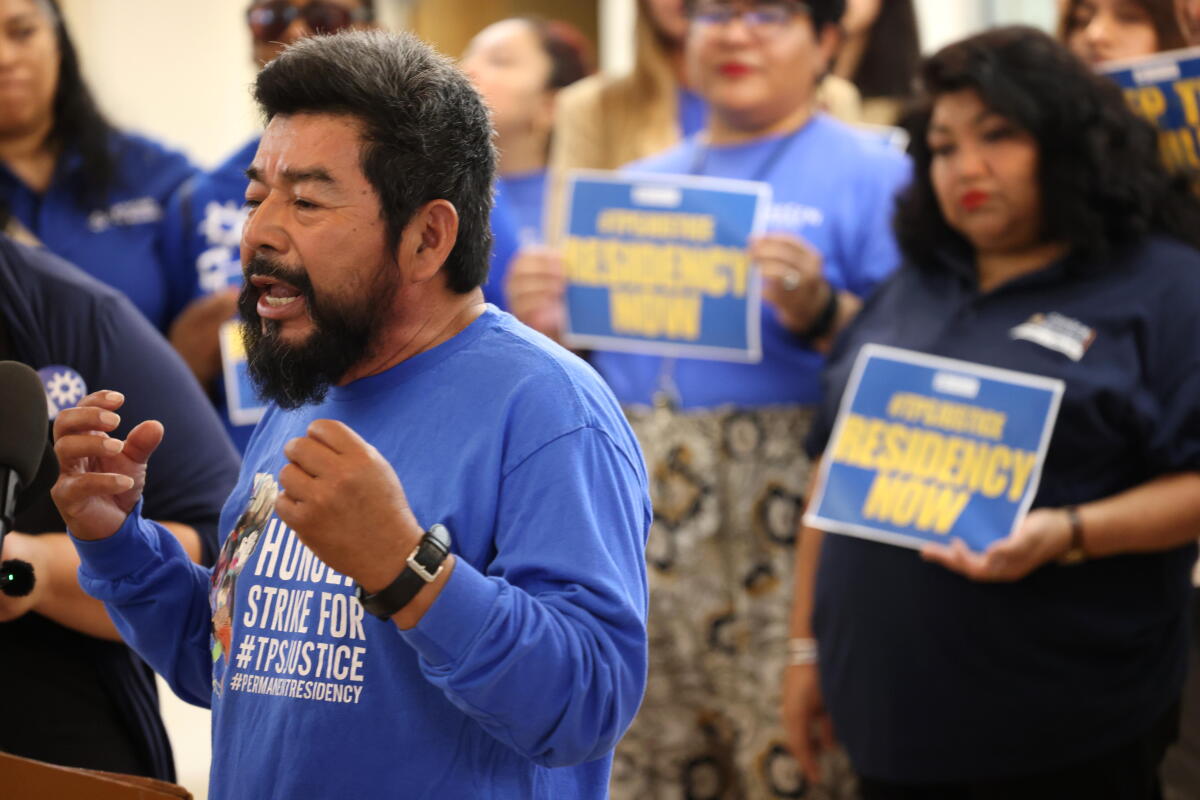
Jose Ramirez, a TPS holder from El Salvador, speaks during a news conference in Los Angeles on Thursday.
(Genaro Molina/Los Angeles Times)
He had been in the country for six years before that, and constantly struggled to find stable work. The work permit was a lifeline. He’d dedicated the last 25 years to construction, during which he fathered three daughters and set roots in Compton.
Still, his boss said Ramirez could no longer present for work Thursday.
“I’ve worked on buildings that reach the skies of Los Angeles,” Ramirez said. “I’ve contributed economically and lent my labor to this great country.”
Ramirez’s boss said his job would be available to him, but he’d need to show proof of an active work permit. A notice or a letter is not enough, Ramirez said.
The USCIS announcement was “a ray of hope that they will give us an extension,” Ramirez said. “But, it’s just not certain. Anything can happen. We’re just praying to God that the government will make it official.”
Signs at a news conference to provide an update on the status of TPS designation for Salvadoran immigrants.
(Genaro Molina/Los Angeles Times)
Ending TPS would be a shock to El Salvador’s economy, where remittances from Salvadorans in the U.S. make up nearly a quarter of the nation’s GDP — nearly $10 billion last year. In 2019, President Nayib Bukele, an ally of President Trump, publicly called on the U.S. to extend TPS for Salvadoran immigrants.
More recently, Bukele has embraced Trump’s deportation agenda, including by accepting controversial deals to house foreign detainees in the country’s mega-prison. The number of people deported to El Salvador nearly doubled in the first three months of 2026.
The decision by the Department of Homeland Security to extend or terminate TPS typically has been made at least 60 days before the designation was set to expire. DHS can extend the program for a six, 12 or 18-month period or decide to cancel the designation.
But the Trump administration has delayed announcements, including some made days after the designation expired. A Supreme Court ruling in June determined that the Homeland Security secretary has final authority over the program and cut down the ability for advocates to sue.
Lauren Truslow, CEO of 3D Enviro, a Virginia company that does identification and abatement of hazardous materials, said the lack of a decision on TPS has been stressful and costly. Three of her 30 employees are TPS holders from El Salvador. Another, who is married to a Salvadoran TPS holder, told her his family plans to leave the country if the program is canceled.
3D Enviro is a federal contractor, and Truslow said that her employees’ driver’s licenses and federal badges expired on Wednesday.
“How do they continue to work for me?” she said. “No one seems to know the answer to that. They can’t get into federal facilities without valid ID. Them showing a memo from USCIS is not going to cut it.”
During a news conference organized on Thursday by the Central American Resource Center of Los Angeles, other immigrant rights groups and local elected officials, speakers urged TPS holders to form a plan for their families and schedule a legal consultation with a trusted lawyer. They also called on the administration to issue a decision on TPS for El Salvador and a pathway to permanent legal status.
“Salvadoran families deserve clear, timely and trustworthy information from the government,” said Martha Arévalo, CARECEN’s executive director. “As we gather this morning, we don’t have an extension for TPS. … What we have is another waiting game and a renewed limbo for families.”
“We are going to fight this,” vowed Los Angeles Mayor Karen Bass.
In a statement, Sen. Alex Padilla (D-Calif.) called the USCIS announcement “clear as mud.”
“Once again, the Trump Administration is punishing immigrants who have followed the rules with chaos, uncertainty, and cruelty,” he wrote.
Also in attendance at the news conference was Carmen Sanchez, 49, who works the night janitorial shift cleaning offices in Los Angeles. She said many of her co-workers who were also protected under TPS were told not to return to work after Wednesday.
Sanchez planned to report to work Thursday evening, but was sure she’d suffer the same fate. She said she has three adult children in El Salvador and is helping two of them pay for college.
“If we lose our work permit, we lose our job. We lose our stability. We lose everything,” Sanchez said. “We’re being kept on this thread of extensions, and we don’t know when that thread is going to break.”
The estranged wife of former Chargers defensive end Marcellus Wiley has been granted a three-year restraining order against the former Los Angeles sports radio personality two months after she accused him of raping her and physically abusing her and their children.
The former Pro Bowl player has denied the allegations that Annemarie, a nurse anesthetist and former cast member of “The Real Housewives of Beverly Hills,” made in a declaration submitted July 6 to the Superior Court of Los Angeles County with her request for a restraining order against her husband of 12 years. She filed for divorce the same day.
Marcellus and Annemarie Wiley both testified in person during a hearing on Wednesday. Evidence presented by both sides included texts and WhatsApp messages, social media posts, court filings and media coverage of the couple.
“The Court finds that Petitioner has met the burden of proof by preponderance of the evidence,” Judge Esther P. Kim wrote in her ruling, which was issued the next day. “Petitioner’s request for a Domestic Violence the minor children are included as protected person in the Restraining Order After Hearing.”
Annemarie Wiley was granted full legal and physical custody of their three children, with a visitation plan detailed for her husband.
“I’m grateful for the court’s decision and welcome the opportunity for our family to finally begin healing after an incredibly difficult and trying time,” Marcellus Wiley said in a statement to The California Post on Thursday. “From the beginning, my fight has been about being present in my children’s lives, loving them, supporting them, and being their father every day.
“I’m thankful I get to return to that role. Annemarie deserves the space to protect her peace, our children deserve the love and presence of both parents, and our family deserves the opportunity to move forward without conflict defining us. My hope now is simple: healing, peace, and getting our family back to a place where love leads the way.”
On July 4, Marcellus Wiley was arrested in Florida after his wife told police he poked her in the face with his finger and threatened to kill her. He was released the next day on $1,000 bond and faced a possible charge of misdemeanor domestic battery. Last month, the state opted not to file charges because of a lack of sufficient evidence.
In the declaration she submitted with her restraining order request, Annemarie Wiley documented numerous alleged incidents that she said demonstrated “a continuing and escalating pattern of physical violence, sexual abuse, verbal and emotional abuse, financial control, and intimidation, much of which our children have witnessed.” She also mentioned four instances in which her husband allegedly raped her, once in 2012 and three times in January.
A temporary restraining order was granted on July 7. On the same day, Marcellus Wiley wrote on X that he has “videos, photographs, text messages, emails, and other evidence that directly contradicts those baseless claims and provides a factual record of our family and the events leading to this unfortunate divorce.”
After lower house approval, the bill to grant tens of thousands of Sahrawis citizenship now goes to the Spanish Senate.
Published On 10 Sep 202610 Sep 2026
Spanish lawmakers have backed legislation that would grant citizenship to tens of thousands of Western Saharans who were born when Spain ran the disputed territory now largely controlled by Morocco.
Spain’s lower house of Parliament on Thursday approved the legislation 168-31, with 145 abstentions.
Recommended Stories
list of 3 itemsend of list
The bill still requires Senate approval before becoming law.
The text grants Spanish nationality to Sahrawis born before September 29, 1977 and to their children through naturalisation, even if they never resided in Spain.
Although the exact number of beneficiaries is unknown, Sahrawi groups estimate that between 70,000 and 120,000 people could benefit from the legislation, which supporters described as addressing a “historical injustice” by colonial Spain in the Western Sahara.
Tensions with Morocco
The vote comes at a particularly sensitive time for Madrid’s historically delicate relations with Rabat due to the migration crisis in Spain’s north African territory of Ceuta, and the mass arrival of at least 70,000 migrants from Morocco in July.
Spain’s leftist government has avoided blaming Morocco – which does not recognise Spanish sovereignty over Ceuta and Spain’s other North African territory of Melilla – but the right accuses Rabat of orchestrating the surge for political motives.
Morocco claims sovereignty over Western Sahara and began asserting control over the territory after Spanish rule ended.
The Algerian-backed Polisario Front independence movement seeks recognition of an independent state called the Sahrawi Arab Democratic Republic.
Many Sahrawis live in refugee camps in Tindouf in western Algeria, or elsewhere abroad, while others remain in Western Sahara.
Against this backdrop, the initiative to grant Spanish nationality to Sahrawis has divided opinion in Morocco but not prompted condemnation from the government.
Moroccan media quoted Ramadan Messaoud, a member of the Royal Advisory Council for Saharan Affairs, as saying in July that Rabat had “no problem” with Sahrawis obtaining Spanish citizenship. Others had done so “over the past few years”, noted Messaoud, who is also president of the Sahrawi Association for Human Rights.
‘Restoring’ identity
Western Sahara was a Spanish colony until 1975, when Spain relinquished its administration under agreements with Morocco and Mauritania.
Spain’s ruling Socialist Party and its junior left-wing partner Sumar, which filed the initiative, were among those who supported the bill, while the opposition conservative People’s Party abstained and far-right Vox voted against it.
“With the adoption of this legislation, we are restoring – and I emphasise, restoring – the Spanish national identity card to those Sahrawis who once held it and from whom this state took it away,” said Tesh Sidi of the leftist Sumar coalition, the first woman of Sahrawi origin to serve in Spain’s Parliament.
The bill will now go to the Senate, where amendments are expected, before returning to the lower house for final approval.