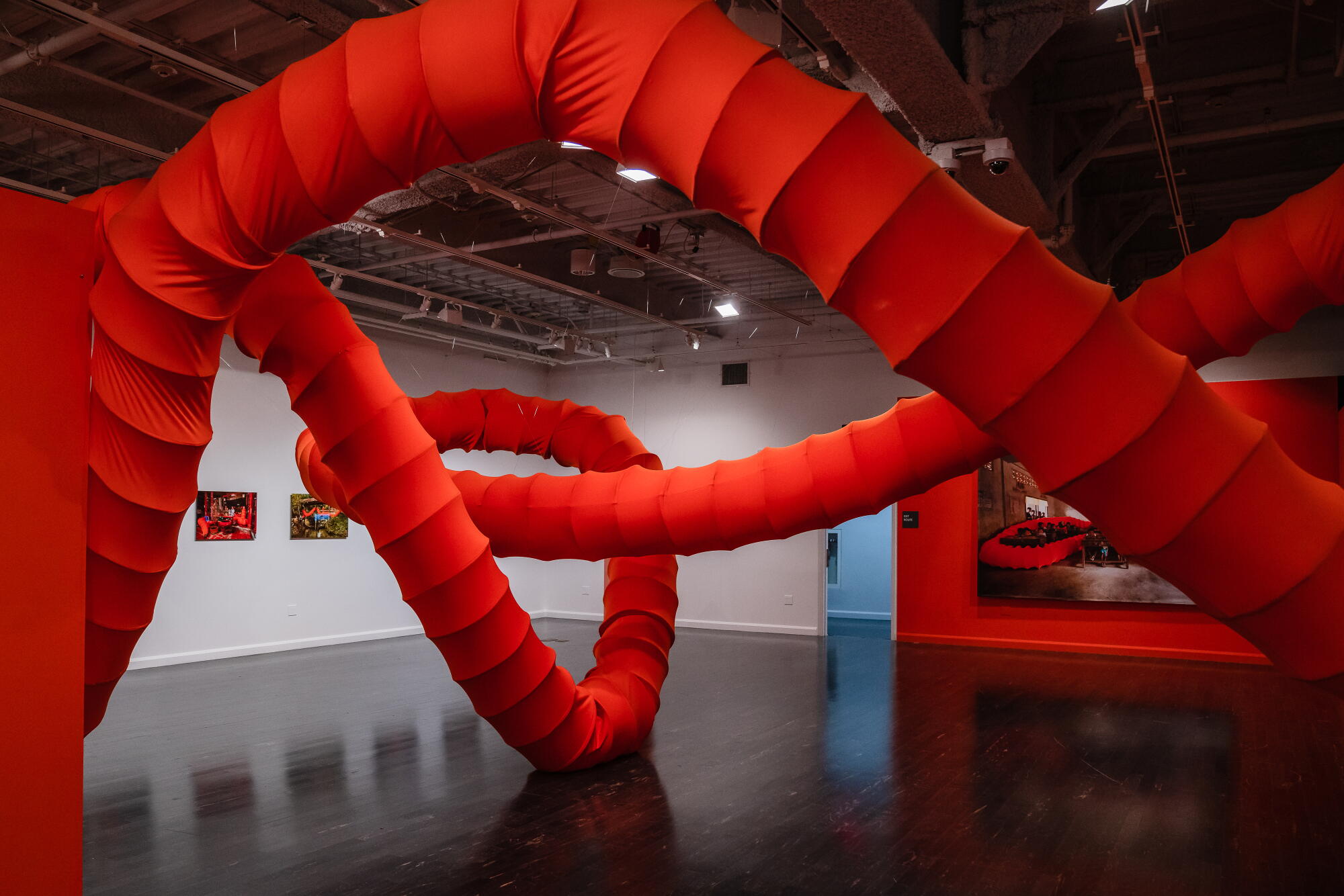
At the opening of “The Buddhist Bug” at the Vincent Price Art Museum on Saturday, guests will see a 328-foot-long orange insect. Its body will coil around the museum’s gallery, lobby and atrium, and poke through the walls. The bug’s head, covered in a hijab, will be in one room, and its feet, which some might be tempted to tickle, will be in another.
The creature is occupied and controlled by Anida Yoeu Ali, a Cambodian-born artist who lives in Tacoma, Wash. Ali’s numerous performance-based exhibits explore her Cambodian-American identity and Buddhist and Muslim religions. The bug is her “totally humorous take on hybridity.”
As the bug, Ali doesn’t speak. She mostly stands or kneels and makes facial expressions in reaction to her surroundings and passersby. But she likes to engage with visitors, who can either touch her elaborate garment, talk to her, take pictures of her or simply observe her.
Artist Anida Yoeu Ali’s exhibit, “Anida Yoeu Ali: The Buddhist Bug,” features a 328-foot-long performance installation at the Vincent Price Art Museum in Monterey Park.
(Ariana Drehsler / For The Times)
“I get a lot of people who ask for a photo or they’ll ask for a hug,” says Ali. “There’s so many stories that get whispered into my ear. A lot happens when you can hold someone’s attention with just your eyes. There’s a vulnerability that happens when you make eye-to-eye contact without any words involved.”
Ali likes to use expansive spaces and incorporate fabrics and textiles, whether it’s a red, sequin-covered chador or a tubular-looking worm made out of polyester, Lycra and spandex. Such things make the petite artist feel “taller and larger than life.”
Ali will appear in the suit for only two hours during the show’s first and last days. But for the rest of the exhibit’s run, the museum will display the bug in its entirety, in addition to sculpture, photographs and video that document how Ali has spent the last 15 years becoming her creature alter ego.
Born in Battambang, Ali, 52, is of mixed Malay, Khmer, Thai and Cham ethnicity, and was raised Muslim in a country that’s 96% Buddhist. She and her family left Cambodia in 1979 to escape the genocide committed by the brutal Khmer Rouge regime and settled in Chicago. Ali studied at the University of Illinois Urbana-Champaign and the Art Institute of Chicago. She’s currently a senior artist-in-residence at the University of Washington Bothell.
Director of the Vincent Price Art Museum Steven Wong and Executive Director Sonia Mak of Asian Arts Initiative.
(Ariana Drehsler / For The Times)
Ali conceived one of her best-known performance-based works, “The Red Chador,” in 2014 after relocating to Cambodia for a few years. She wanted to address the rise of Islamophobia in the wake of major events happening at the time, including France’s ban on facial coverings (the country had already banned the hijab years prior) and the terrorist attacks on the French satirical magazine Charlie Hebdo. Ali also wanted to confront the politicization of Muslim women’s dress and contradict the “imagery of Muslim women as joyless and depressed.”
“It was an opportunity to put on a chador, but one of my choosing and one of my designs,” Ali says. “It was to also honor the Muslim women in my background. My mother, grandmother, aunties and cousins all covered and did so joyfully. That was never an issue for them.”
Ali wore the red sequin chador in 15 cities, including at the Palais de Tokyo in Paris in 2015, where, during a 12-hour performance, she threatened to chop off 99 baguettes. The installation was meant to challenge Muslim stereotypes while making a subversive nod to the bread as a famous French symbol. “The Red Chador” also made a stop earlier this year at the W. Keith and Janet Kellogg University Art Gallery at Cal Poly Pomona.
“The Buddhist Bug” was created in 2011, a few years before “The Red Chador,” and inspired by the pervasiveness of the saffron-colored robes worn by monks in Cambodia. The piece not only drew on the color orange but was also influenced by a collapsible play tunnel she received as a gift after giving birth to her first child.
A photo titled “Into Dreamland, The Buddhist Bug, 2015,” (photographed by Masahiro Sugano), and featured at the Vincent Price Art Museum as part of the exhibit, “Anida Yoeu Ali: The Buddhist Bug.”
(Ariana Drehsler / For The Times)
Ali wears a hijab while in the suit and uses a second person, usually a model or intern, to provide the bug’s feet — though she insists that those are the “bug’s feet.” It’s a fun, childlike interpretation of the complexities of coming from two cultures and religions.
“I wanted to do something that was tapping into my diasporic identity or what I call the ‘diasporic dilemma,’” says Ali. “This notion of going back and forth and constantly feeling like you’re not enough in one country or one culture. The bug is the result of that. You look at it and it’s a big orange creature. But for me it’s more of a tunnel structure that can double as a bridge, an entity that can connect two points or two locations. That’s the poetic part of the project.”
Sonia Mak, who co-curated the exhibit at VPAM with museum director Steve Wong, invited Ali to show in L.A. after catching one of her performances at the Seattle Asian Art Museum in 2024.
Photographs in the installation — some taken by Ali’s husband, Masahiro Sugano — capture Ali dressed as the bug in cities all over the world. Some are placed on a sculpture resembling the Rub el Hizb, an Islamic star shaped like an octagram. The rest are mounted on the walls and show the bug in places like Battambang and the Cambodian capital, Phnom Penh, at a restaurant, in a classroom, on a boat and a bridge.
In one image, Ali rides in a bicycle carriage. In others she stands outside a mosque while kids play with the bug’s feet and sits in an abandoned movie theater, her tail wrapped around the seats. (Angelina Jolie, whose adopted son Maddox is from Cambodia, was recently photographed visiting these cinemas and is reportedly renovating the theaters.)
Ali envisions someday performing as the bug in the desert in the Middle East and maybe building a children’s public playground as a “fun manifestation” of the project.
“I come from a country with an awful, violent history,” she says. “I have a unique set of identities and perspectives that aren’t easily explainable, which is why I make art. I want people to think about how weird and strange the bug looks, but I want them to feel happy looking at the orange. I love it when the grotesque and the beautiful sit side by side. It makes for some magical artistic moments.”
‘Anida Yoeu Ali: The Buddhist Bug’
Where: Vincent Price Art Museum, East Los Angeles College, 1301 Avenida Cesar Chavez, Monterey Park When: Sept. 26 to May 22, see website for times Cost: free Info:vpam.org.
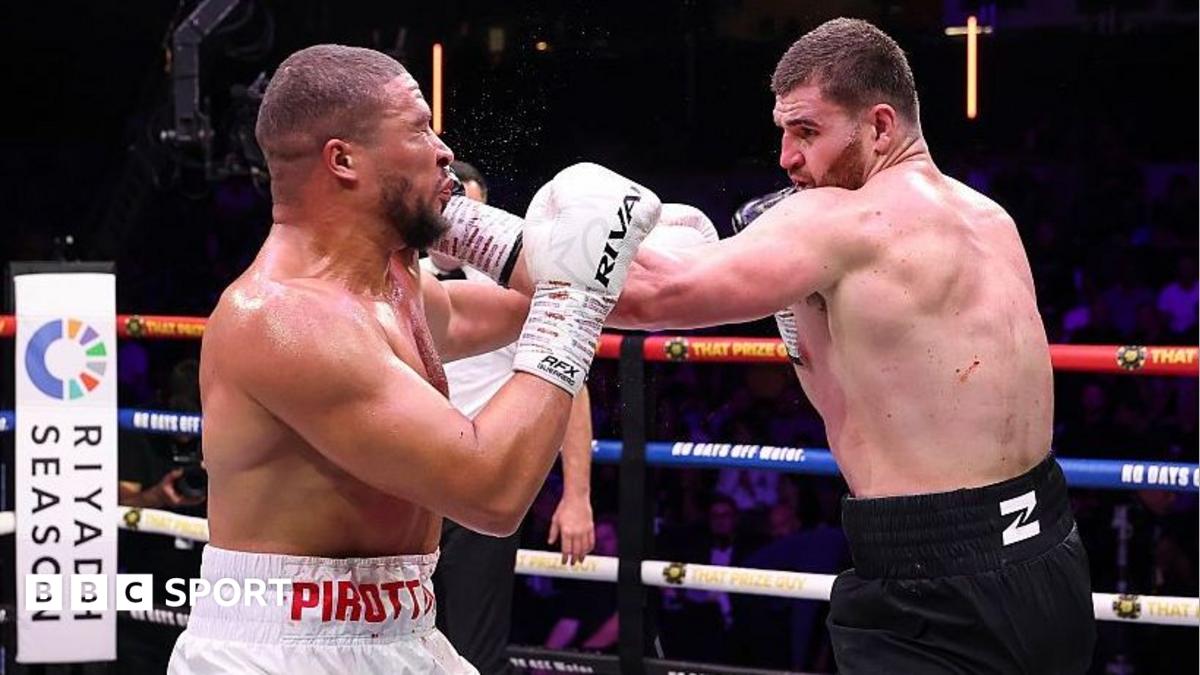
The 7,500-capacity Copper Box was some way short of full, with the upper tier closed and empty seats dotted around the arena.
But Fisher’s “Bosh Army” did their best to fill the gaps with noise, giving the “Romford Bull” a raucous reception.
Alongside his social-media star father “Big John”, Fisher has built a loyal following through an unusually unfiltered glimpse into family life, training camps and the pair’s well-documented enthusiasm for Chinese takeaways.
Fisher started with intent, swinging heavy hooks and reddening Pirotton’s eye in the opening round.
The little-known Belgian was unfazed by the home support or Fisher’s pressure, but his eye was cut by the second.
“I can see, don’t stop the fight,” Pirotton told the referee before a doctor examined him in the fourth.
Allowed to continue, he came out firing, but Fisher responded with a flurry to head and body.
Blood stained Pirotton’s white shorts, yet he rallied in the fifth – his best round – as Fisher began to look tired and static.
Among those in attendance were British fighters Derek Chisora, Conor Benn and Caroline Dubois, alongside WWE stars AJ Styles and LA Knight.
WWE is owned by American sports and entertainment group TKO, which is also behind Zuffa Boxing.
The doctor took another look at Pirotton before the seventh but allowed the bout to continue.
Neither man was offering much by the latter stages until a short right hand from Fisher staggered Pirotton in the 10th.
For a moment, a 13th stoppage victory appeared within reach, but Fisher could not find the finishing burst as Pirotton slipped to his third loss in 15 fights.
Tunis, Tunisia – For nine-year-old Yassar Naouar, visiting his father in prison has become an exercise in staying strong. He tries not to cry in front of Wael, fearing that seeing his son in tears would make an already painful situation harder for him. After leaving the prison, Yassar finds a corner where he can finally let the tears fall.
Hichem Naouar, Yassar’s grandfather, says the boy has changed since his father was detained. He now sleeps beside his mother after waking up screaming at night and his results at school have worsened. When Yassar told his mother that other children kept asking whether his father was a thief, she asked him what he thought.
“Never,” the nine-year-old replied.
Wael’s youngest child, four-year-old Sumud, is too young to understand why her father is in prison. Hichem says he took her to visit him. When she saw her father behind the glass, she leaned forward to embrace him, only to hit her head against the barrier.
Hichem spoke to Al Jazeera on Wednesday outside the Tunis Court of Appeal, where he had gone to follow the latest challenge to Wael’s detention. He repeatedly choked up as he described what he had seen during his most recent visit.
Wael was sitting with his hand against his cheek, his father said, his elbow trembling and his gaze fixed in the distance. He was struggling to see clearly and to keep water down without vomiting. He was dizzy and had difficulty controlling his left leg. Wael later told Hichem that other prisoners had said he sometimes wakes during the night calling out his youngest daughter’s name.
For his father, however, Wael’s story is also about the kind of person he has been. He recalled an incident during the Sumud land convoy in Libya in May, when armed men tried to kidnap another participant. Wael intervened, pulled the man away and helped him escape before returning to the men and telling them they could take him instead.
During the first Sumud flotilla, a female fell into the sea and was close to drowning. Wael immediately jumped in and rescued her.
“Wael’s strength is in the strength of his ideas and in his commitment to his people. Whenever he heard about any injustice against workers or employees, you would always find him at the forefront,” Hichem said.
The case and its wider fallout
Wael, 41, began a hunger strike on August 16 to protest his continued detention and was transferred to hospital as his condition deteriorated. He suspended his strike after 38 days following appeals from his lawyers and supporters, saying the decision did not mean abandoning his demands.
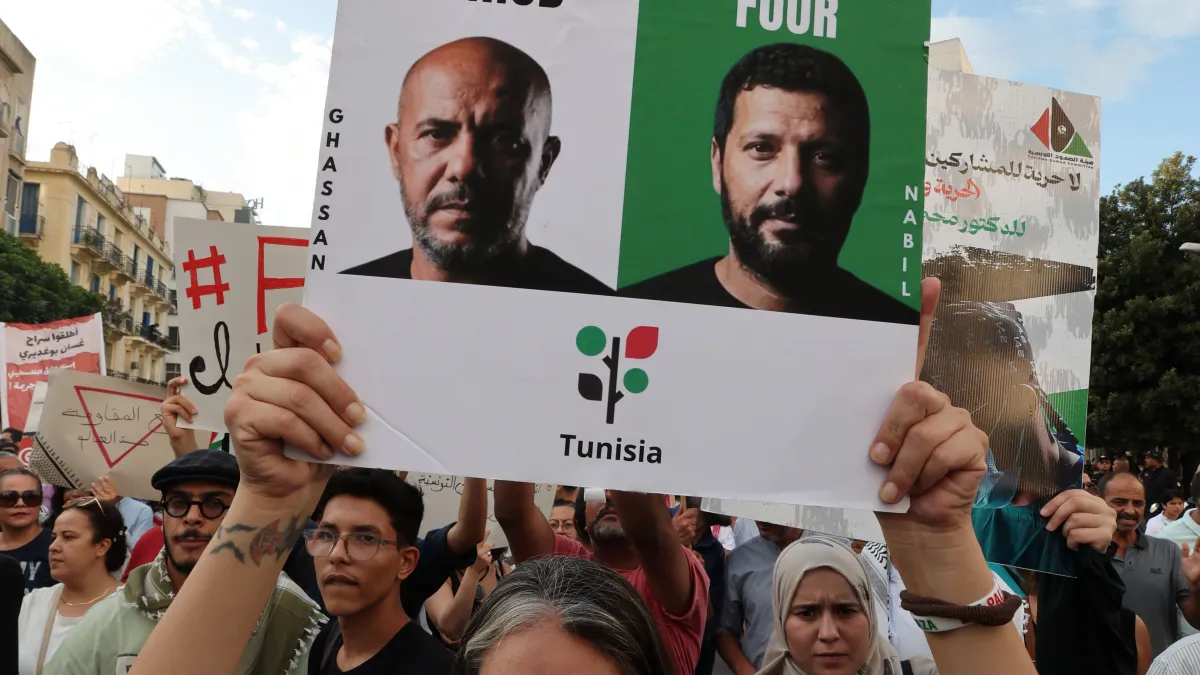
Four activists, Wael Naouar, Ghassan Henchiri, Ghassan Boughdiri and Nabil Channoufi, have been held since March following an investigation by Tunisia’s Economic and Financial Judicial Pole, a specialised body that handles financial and economic crimes. The investigation concerns alleged financial irregularities linked to fundraising for the Global Sumud Flotilla, an international campaign seeking to deliver aid to Gaza and challenge Israel’s blockade of the Palestinian territory.
The state-owned TAP news agency, citing judicial sources, reported that investigators are examining the origin and use of funds collected for the flotilla and whether any were diverted for other purposes. The activists and their defence team have repeatedly denied wrongdoing and maintain their innocence. None of the four has been convicted.
For their lawyers, the issue is also why the men should remain in prison while the investigation continues.
Ghassan Ghribi, a member of the defence committee, described the latest extension of their pretrial detention as an “exception to the exception”, arguing that freedom should be the rule and detention the exception. The four-month extension was ordered on September 11 and the defence challenged the decision before the Court of Appeal in Tunis.
“The investigating judge spent six months on the case without carrying out any investigative work, other than questioning the activists,” Ghribi told Al Jazeera. He said the extension should be based on clear reasons and that the four men were being made to pay the price for what he described as a lack of investigative work.
The Court of Appeal rejected the challenge on Wednesday, leaving the quartet in pretrial detention for another four months while the investigation continues. Henchiri, Boughdiri and Channoufi remain on hunger strike.
Authorities have presented the case as a financial investigation into the handling of funds raised for the flotilla, rather than a prosecution linked to the men’s political or pro-Palestinian activities. The government has rejected accusations that the judiciary is being used to silence opponents, saying the judiciary is independent and that legal proceedings are conducted according to the law.
The fallout has also widened beyond the four men. Fourteen people detained after the September 19 protest calling for their release have since been placed in pretrial detention, lawyer Rafed Rabbeh confirmed to Al Jazeera on Friday. Among them is a 17-year-old who was brought before a juvenile judge. Tunisia’s Child Protection Code says priority should be given to preventive and educational measures and that pretrial detention should be avoided as much as possible for children.
Rabbeh said the detainees face several charges, including participating in a gathering allegedly intended to disturb public order and commit an offence, publicly attributing unlawful acts to a public official without proof, and making public statements deemed to damage the reputation of a person or official body. The charges are based on several provisions of Tunisia’s Penal Code.
The toll on those left behind
Speaking by phone from Gafsa, Ghassan Henchiri’s father, Sebti, said his son remains conscious but is visibly exhausted after being on hunger strike since September 9.
“According to what his sister told me after visiting him, he is still holding up. The fatigue is visible. He is exhausted, but he is still conscious,” Sebti said.
Ghassan has not been taken outside the prison for further medical examination of a head injury sustained during his detention in Israel, Sebti told Al Jazeera. Ghassan and his family have raised the issue with both the prison administration and investigating judge. They were promised that he would receive the necessary medical examinations, but that has not happened, Sebti said.
“It could be a superficial injury, but with the conditions in prison and the high temperatures, it has exhausted him,” he said.
Ghassan also has other health problems, including living with one kidney and suffering from back problems, Sebti said. He has developed a skin rash that keeps him from sleeping, but his request to see a dermatologist was rejected because the prison doctor did not consider it serious, Sebti said.
“I will remain steadfast, I will not give up my right and these malicious accusations are false,” Ghassan told his father.
“He is my son, my brother, my companion, my whole life,” Sebti said. “Ghassan is a man of integrity. I am not saying that because I am his father. Everyone knows that about him.”
Ghassan’s detention has also reshaped family life. He had been working at a high school and was recently engaged, Sebti said.
He described Ghassan’s political commitment as something rooted in the family. He has been involved in student activism and later trade unions since 1978, campaigning for freedom, the right to organise and a better, more dignified life for Tunisians. Ghassan grew up with those principles and was influenced by his father’s activism.
“This is what Ghassan was raised on and what influenced him,” Sebti said.
Human Rights Watch has also raised concerns over the use of financial and money-laundering investigations against civil society actors in Tunisia.
For the Naouar and Henchiri families, the impact of the detentions is being felt at home, in prison visits, anxious phone calls and children asking when their fathers will return.
Yassar still asks about his father and has told his grandfather he is ready to go on hunger strike too.
Asked where her father is, four-year-old Sumud answers: “Palestine. Prison”.
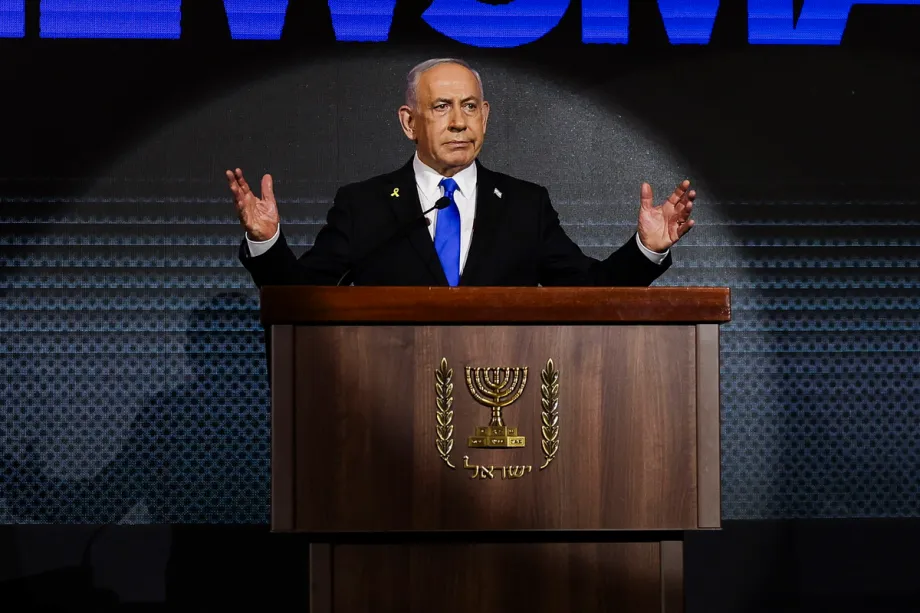
Israeli Prime Minister Benjamin Netanyahu “is doing everything” to prevent the establishment of an official commission of inquiry into the events of Oct. 7, 2023, former military intelligence officer Barak Seri said, Anadolu reports.
In a Saturday post on the US social media company X, Seri said Netanyahu was “warned and alerted” ahead of the attacks, but that “he ignored it all.”
“This is why Netanyahu is personally blocking the establishment of an inquiry commission,” he said.
Earlier Saturday, Israeli newspaper Yedioth Ahronoth reported that Netanyahu received warnings about a possible Hamas attack ahead of Oct. 7, 2023, but did not convene a meeting to discuss them.
Citing unnamed security officials, the outlet said Netanyahu did not share the warnings with the Shin Bet, Mossad or the Military Intelligence Directorate, known as Aman.
Meanwhile, US magazine The Atlantic reported that former Egyptian intelligence chief Abbas Kamel secretly visited Israel 11 days before the Oct. 7 events to alert Tel Aviv about a possible Hamas attack.
There has been no official Egyptian comment on the claim.
Following the Oct. 7 events, Israel launched a brutal offensive on the Gaza Strip, killing nearly 74,000 people, injured around 175,000 others and turned the entire enclave into ruins.
Despite a ceasefire that took effect in October 2025, Israel has continued its daily attacks on Gaza, killing more than 1,400 Palestinians and injuring nearly 5,000 others, according to Gaza’s Health Ministry.
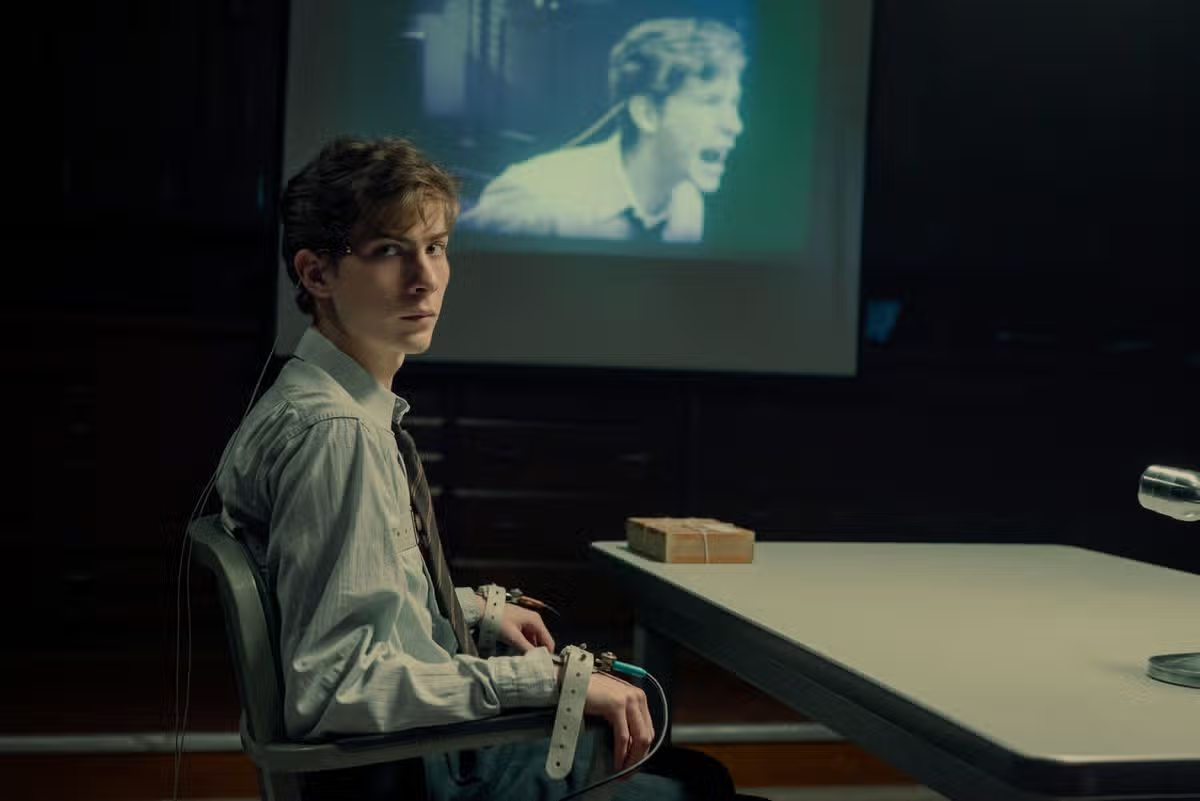
The new Netflix thriller is currently sitting at number one on the streaming platform’s most-watched films
22:33, 26 Sep 2026Updated 22:34, 26 Sep 2026
Netflix viewers have shared their verdicts on the new film (Image: Netflix )
The true-story thriller has been slammed by furious viewers who ‘wasted an hour and a half of their lives’.
Brand new film Unabomber is based on the real story of lone wolf American terrorist Theodore Kaczynski, who carried out a mail bombing campaign that killed 3 people and injured 23 more. Known as the Unabomber, he committed his crimes between 1978 and 1995.
Netflix’s take on the late criminal’s story explores his transformation from a bright Harvard student into the infamous Unabomber. It stars 19-year-old actor Jacob Tremblay as the title character.
The main cast also features Oscar winner Russell Crowe, playing a Harvard professor who gets caught in Theodore’s orbit. While beloved actress Shailene Woodley portrays an FBI agent determined to get to the bottom of the Unabomber’s crimes.
The film has already climbed to Number 1 on Netflix’s most-watched charts after just one day on the streaming platform. But many viewers have urged others to skip the star-studded drama.
Writing on Rotten Tomatoes, one disappointed viewer said: “What an absolute waste of time. As far as movies go this had an okay cast. The story was based on real life so interesting I guess as it did happen. It’s sad it happened though but it did. I watched it and was expecting more than I receive.”
Someone else joined in to add: “A word that comes to mind is HOW. HOW DO THEY GET SO MANY BRILLIANT ACTORS IN 1 MOVIE AND STILL FIGURE OUT HOW TO MAKE THE MOVIE SUCK. I WAS BARLEY ABLE TO FINISH IT. COULD OF USED THESE ACTORS TO MAKE SOMETHING GREAT. LET DOWN.”
Get Netflix free with Sky
This article contains affiliate links, we will receive a commission on any sales we generate from it. Learn more
Sky is giving away a free Netflix subscription with its new Sky Stream TV bundles, including the £15 Essential TV bundle. This lets members watch live and on-demand TV content without a satellite dish or aerial and includes hit shows like Stranger Things and The Last of Us.
Someone else simply wrote on X: ” #unabomber on Netflix is an hour and a half of my life I’m not getting back.” At the time of writing, the thriller has a sour 22% score on Rotten Tomatoes.
But others have rushed to the movie’s defence, with one sharing: “Surprised by the negative reviews. I found the film very well done and with a captivating story, quite well engineered. Acting is brilliant and everything is top notch (costume, music, etc). Great film.”
While a second fan added: “I actually loved this. I was just hooked at the very start. And I’m not easily entertained by movies. First of all I loved the switch from the 50s to the 90s it was refreshing. “
It was nearly a half decade ago now that Lincoln Riley, dressed in a slick blue suit and glossy cardinal tie, stood atop the Coliseum’s rooftop deck, grinning as he gazed out across the field below. He’d just been introduced as USC’s new head coach, and in that moment, anything felt possible for the future of Trojan football. Riley, at the time, was one of the most renowned young coaches in college football. And as he surveyed the scene, he painted the picture of a day when the Trojans were back on top and the Coliseum was hallowed ground once again.
But less than five years later, as final seconds ticked away on a 41-27 loss to Oregon on Saturday, fans trudged towards the exits, and that very same stadium sat in hushed disbelief. The Trojans’ season wasn’t over by any means — not after a single loss to No. 20 Oregon — but in that moment, the future that Riley had envisioned felt as far away as ever.
There would still be chances for Riley and his Trojans to make their statement this season. But the stakes on Saturday had arguably never been higher for USC’s coach, who spent all off-season explaining how this season would be different. There were no more excuses, no more explanations for why USC was still falling short — even he seemed to agree to that. Everything he’d been pointing towards in the distance was now here, culminating all at once.
With a gauntlet of a Big Ten schedule ahead, there was no better time for Riley to prove he had USC moving in the right direction and no better matchup to help catapult the Trojans into College Football Playoff conversation than Oregon, its newest — and still maybe most bitter — rival. The whole college football world was watching, waiting to see if USC’s coach could deliver in the most critical of moments.
Instead, the Trojans found themselves in an all-too-familiar, all-too-painful position, one they’d experienced many times before during Riley’s tenure. Mistakes piled up. Ill-timed penalties, too. And worst of all, USC’s defense still couldn’t get a stop. It gave up 505 yards to Oregon, the third-most it had allowed over the past three seasons.
The Ducks would score on six of their last seven drives, almost all of which featured their backup quarterback at the helm. That was after Oregon star quarterback Dante Moore was knocked out of the game early in the second quarter following a brutal hit by USC linebacker Desman Stephens. The hit started a shoving match between players from both teams.
Stephens, who was seen celebrating after the play, was kicked out of the game, but remained on the sideline in the second half.
Oregon quarterback Dante Moore is taken off the field on a stretcher before being transported to the hospital after taking a hit from USC linebacker Desman Stephens in the second quarter. Stephens was ejected from the game.
(Ronaldo Bolanos / Los Angeles Times)
The play would cast a pall over the whole game, but Raiola managed to throw for 289 yards and two touchdowns against USC’s defense. Jayden Maiava, meanwhile, had 326 yards and two touchdowns, but completed just 23 of 42 passes.
The rushing attack wasn’t much better, as the Trojans averaged a mere 3.6 yards per rush.
The afternoon began on a bitter note for USC. After marching down the field on a 13-play opening drive, a third-down sack forced the Trojans to settle for a field-goal attempt. But Caden Chittenden missed an easy kick wide right. It was just the latest in a string of recent special teams slip-ups for the Trojans.
The defense, however, would hold early. Even after Oregon running back Jordon Davison burst out of the backfield for a 45-yard run on the Ducks’ first play. Oregon finished that drive with a field goal, the only points either high-scoring offense managed in the first quarter.
Unable to get anything going on the ground, the Trojans turned to their stud freshman receiver to pace the offense. Five of Maiava’s first seven completions went to Kayden Dixon-Wyatt, one of which came on a 31-yard strike down the seam to the freshman, who reeled in a touchdown in spite of tight coverage.
USC quarterback Jayden Maiava passes during the first quarter against Oregon on Saturday.
(Ronaldo Bolanos / Los Angeles Times)
Oregon was mounting a response when Moore took off on a quarterback scramble. But as he slid, Stephens decked Moore with a direct hit to his helmet, even after he already gave himself up. Moore spent several minutes on the field before being loaded onto a cart and taken to Los Angeles General Medical Center by ambulance.
Raiola, the backup, would take the reins of Oregon’s offense in Moore’s place, leading the Ducks to the doorstep of the goal line. But once again USC’s defense stood tall in the red zone, holding Oregon to a field goal.
It wouldn’t have as much luck in the second half, as Raiola found a rhythm. He led the Ducks on two consecutive touchdown drives in just 11 total plays.
But USC responded with three straight scoring drives of its own, and even added a stop from its defense in between. The third — an 11-yard strike to Tanook Hines — tied the score 27-27 with less than 13 minutes remaining.
USC looked to have Oregon stopped in its tracks on the ensuing possession. Then, on a third-and-long incompletion, defensive tackle Jide Abasiri was flagged for rushing the passer. The penalty gave Oregon just the opening it needed. The Ducks scored five plays later, as Raiola lofted a prayer to the corner of the end zone that was answered by one of his wideouts, Dakorien Moore.
A failed fourth-down attempt for USC would all but end it, as Maiava’s desperation pass was swatted away, along with the Trojans’ hopes.
Bangkok has officially been declared a disaster zone after relentless rains triggered widespread flooding in the Thai capital. Up to 300 millimetres of rain fell in some areas overwhelming the city’s canals and drainage system.
As the UN General Assembly wraps up with mixed diplomatic outcomes, Al Jazeera’s Mohammad Qasem reports on how US President Donald Trump has rejected Iran’s latest proposal to reopen the Strait of Hormuz. Meanwhile, Russia and Germany have re-established high-level talks, and China has criticized Washington’s approach to the region.
SHOWBIZ star Amanda Holden takes it nice and kneesy in a little black dress — as she plots her own wellness empire.
She has filed papers to trademark her name for future use on beauty products and websites.
Amanda Holden looks glamorous in a black dress as she plans her next career moveShe has filed paperwork to trademark her name for future use on beauty products and websitesCredit: Getty
The Intellectual Property Office application also covers cosmetics and perfumes.
Britain’s Got Talent judge Amanda, 55, is hoping for the same success as Hollywood star Gwyneth Paltrow’s £323million Goop brand.
Sign up for the Showbiz newsletter
Thank you!
She has previously admitted that her beauty regime before her Heart Radio breakfast show is rather rushed.
The mum of two said: “I get up at 5am . . . and get ready in 20 minutes.
The Intellectual Property Office application also covers cosmetics and perfumesBritain’s Got Talent judge Amanda, 55, is hoping for the same success as Hollywood star Gwyneth PaltrowCredit: Getty
“I sleep in my lashes and have all my make-up set out.
“I have my outfit laid out and leave my shoes at the door.”
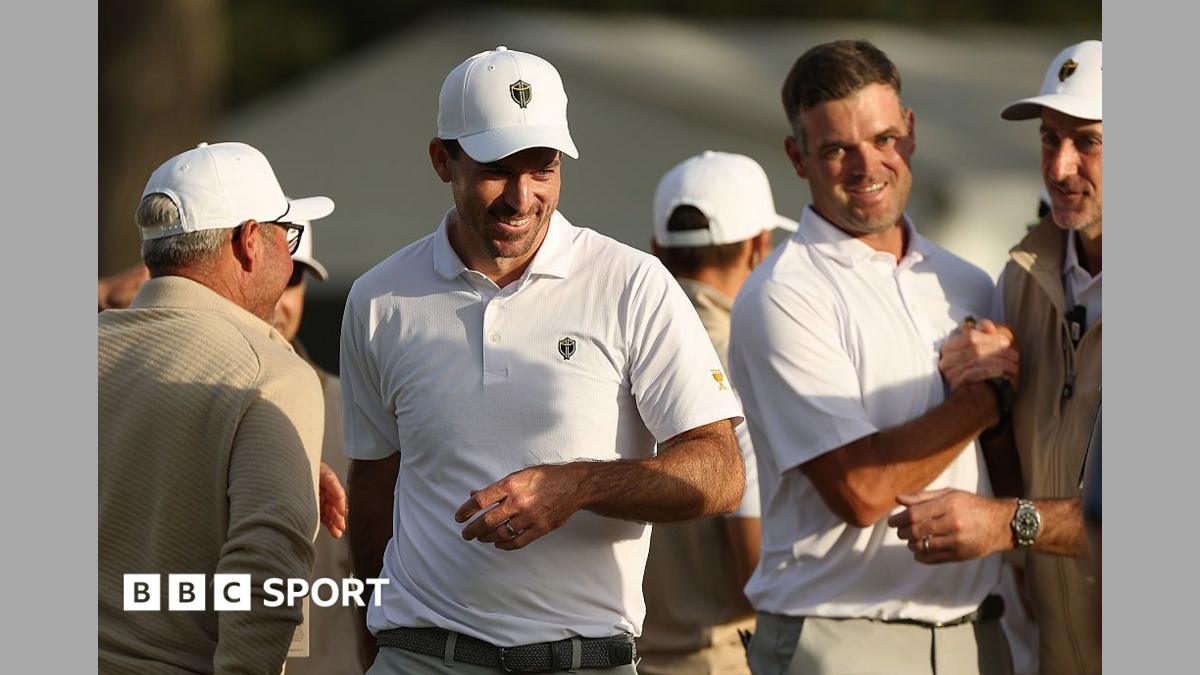
The International team need five points on the final day to secure a first Presidents Cup in 28 years after holding off a United States fightback on day three in Medinah.
The Internationals were behind in every match at one stage but will go into Sunday’s singles holding a 10-5-7.5 lead.
The hosts had the better of the morning session, winning two and tying one of the four-balls.
But the teams split the afternoon foursomes, with Canada’s Corey Conners saving par at the 18th to win the final match on the course and preserve the Internationals’ three-point lead.
The International team have only won the President’s Cup once since its inception in 1994 and never on American soil.
“We were down in every match, and to come back and get one and a half points out of this morning, we felt that was a little victory because we were down everywhere,” said team captain Geoff Ogilvy.
“This afternoon, the same thing happened. Team USA played so well all day. They played some really high-level foursomes, especially this afternoon.
“For the boys to somehow come back and pinch two points out of that and split the session was amazing.”
Sunday sees 12 singles games take place, with each side needing 15.5 points to seal victory.
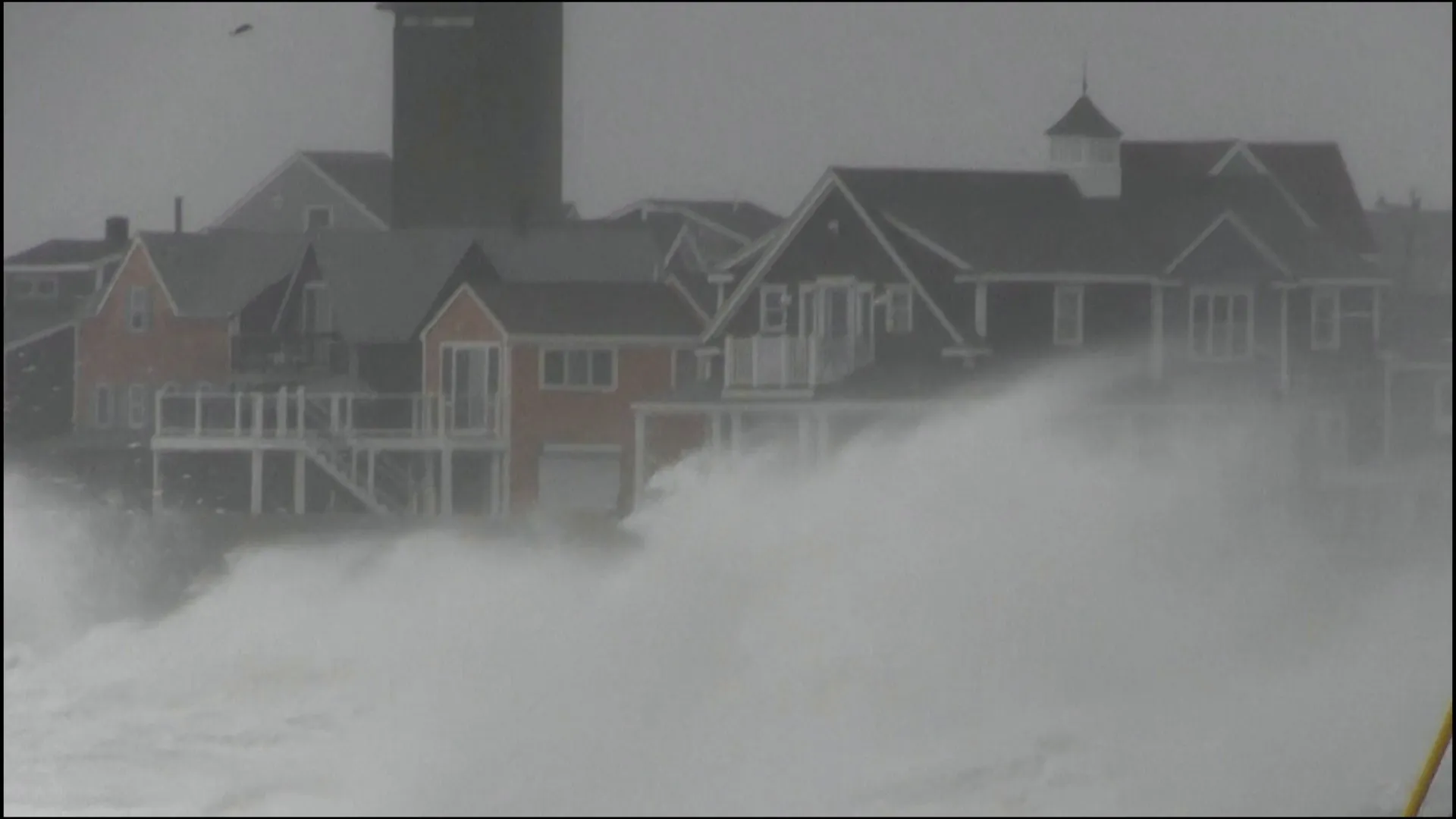
Powerful winds and towering waves are battering the US Northeast, causing flight chaos and blackouts. Flooding has already hit areas like Atlantic City and the Jersey Shore, with officials warning of more rain to come.
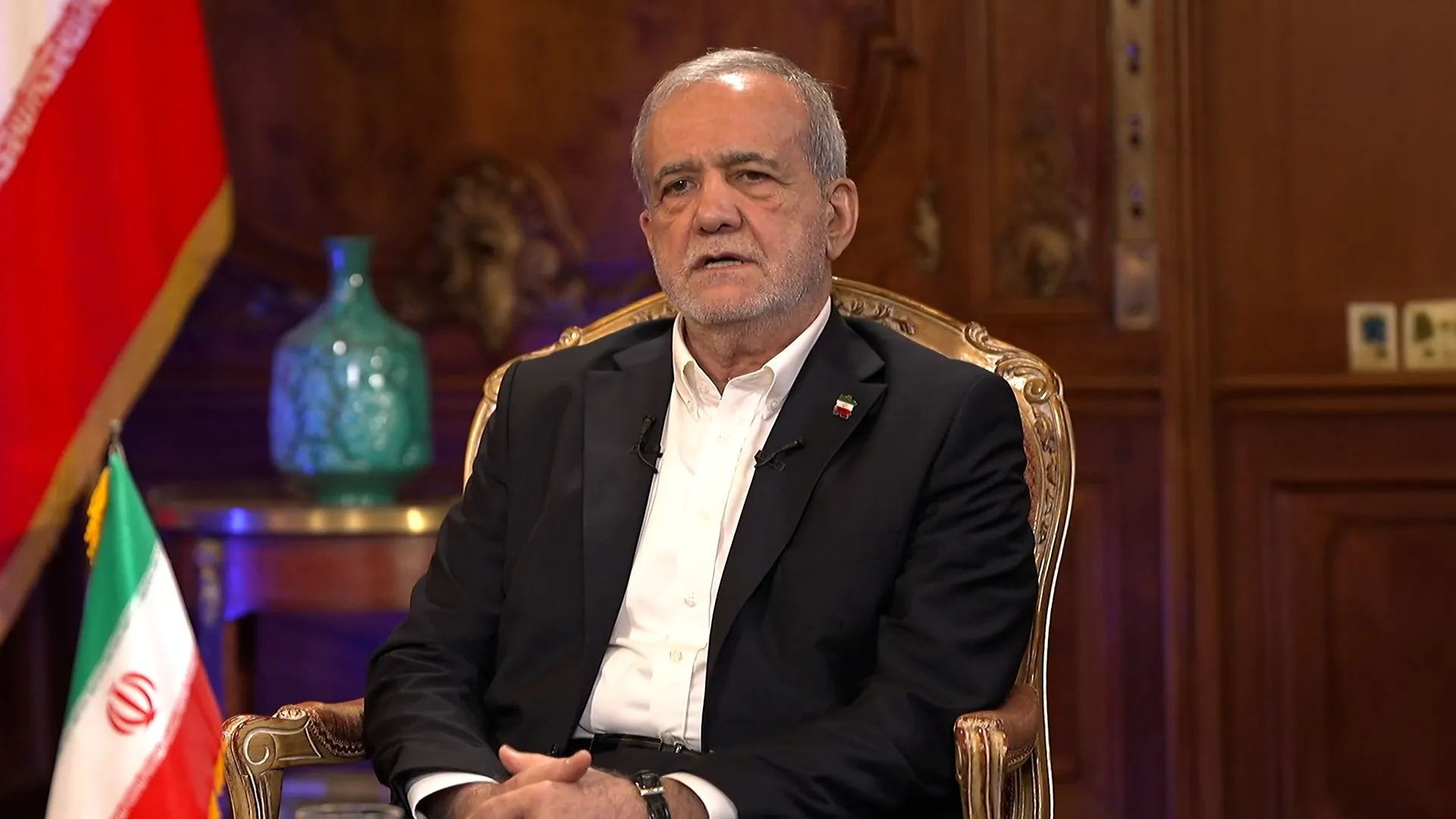
Iran’s President Masoud Pezeshkian told Al Jazeera that Tehran no longer trusts talks with the US after previous negotiations were followed by attacks and sanctions. His comments came shortly before Donald Trump rejected Iran’s proposal to reopen the Strait of Hormuz within seven days.
Hallmark films have mastered the art of escalating low-stakes situations into high-stakes emotional emergency plotlines. They have made a lucrative business out of absurdities.
It’s a proven formula that leans into the ridiculousness of mundane situations but earns its audience every holiday season. Whether it’s watching the movies for comfort or to turn a viewing party into a drinking game, millions of people tune in to laugh or cry watching them.
The Hallmark situations can be predictable, comfortable and wholesome, which can come off as absurd for a film plotline. Their sincerity and humor come from the cast’s commitment to the mundane, said Ron Oliver, writer and director of many Hallmark films.
A scene from “The History of Concrete.”
(Magnolia Pictures)
“Funny is only funny if you don’t think it’s funny,” he said. “We know that’s ridiculous. But at the same time, if the actor commits to it, it makes it seem real, then the audience gets it.”
He likes to think they’re laughing along with the idiosyncratic elements of the movies, and as long as it is creating a communal atmosphere, Oliver is all for it.
“If there’s anything we need these days, it’s a sense that people belong somewhere,” he added.
The formula isn’t what makes a movie a Hallmark movie. The structure has existed since God wore shorts, said Oliver. The channel’s achievement has been its ability to turn the structure into a recognizable brand through its stories.
When filmmaker John Wilson was in between jobs after finishing his HBO show “How To With John Wilson” during the writers’ strike, he attended a seminar on how to write and sell a Hallmark film.
After seeing what makes the Hallmark brand recognizable, Wilson decided to adapt the style into his own genre of making a documentary about concrete titled “The History of Concrete,” hoping the structure would help him finance the film.
John Wilson in “The History of Concrete.”
(Magnolia Pictures)
“But it’s very loose and almost impossible to even identify at points,” he said.
Instead of mocking the genre, Wilson subverts the Hallmark elements into his style of documenting, which finds the filmmaker recording trivial life moments — a person sitting on a pole, for example, or someone ruining a perfectly good jar of peanut butter by dipping their fingers into it — alongside his contextualizing narration.
“I both embrace but betray certain rules,” he said.
The seminar told him to avoid mentioning Christianity in the context of Christmas, so he pivoted to a Buddhist community with an annual tradition of running around a school in New York. The formula prefers to stay away from trauma. Instead, he made the death of one of his subject’s fiancées one of the main plotlines of the film.
“The actual Hallmark of it all fits in a way because that’s the kind of living proof that this rhythmic cyclical way of storytelling is actually soothing and attractive to people over long periods of time, to be able to return to this thing that they can trust and understand,” he added.
A scene from “The History of Concrete.”
(Magnolia Pictures)
In Wilson’s film, the entrance point is concrete, but what begins to unravel is a romance story involving a boy who has a movie idea, needs money to make a movie and tries everything he can to sell it — a signature love trope for most Hallmark movies.
Throughout the film, Wilson goes from pitch meeting to pitch meeting trying to finance his art. In the process, Wilson meets other eccentric characters that share his passion of filmmaking but have their own interests, like clearing gum from a sidewalk, immortalizing a person’s tattoo after they’re dead, and music.
“I’m just finding different ways to court this industry that doesn’t seem ready for this relationship,” Wilson said. “I’m trying to find some consensual way into it, but I eventually just need to perform the romantic gesture of doing what feels right and what comes naturally to me.”
The love story is the kind of theme that sometimes it’s OK to lean into, even though he’s constantly battling whether he should explore it in his films, Wilson added.
A scene from “The History of Concrete.”
(Magnolia Pictures)
Oliver believes that battle is a product of the cynicism that exists in society. Pledging love and respecting someone or a relationship can make people feel so uncomfortable that leaning into these tropes of life can feel humorous, and that’s where the laughs from a Hallmark film come from.
“They’re realizing that they’re being emotional about somebody who can’t find the right Christmas sweater,” he said.
The people in “The History of Concrete” aren’t funny because Wilson makes them out to be ridiculous. He doesn’t emphasize their eccentricities or tell the audience what makes them funny. He simply lets them be themselves. He captures their personality through a curiosity lens.
The humor comes from their passions not seeming worthy of the level of seriousness with which they pursue them. These people love something so much that their devotion mirrors the kind of energy normally reserved for higher stakes.
“There’s no definition of normal that sticks,” Wilson said.
A Christmas celebration isn’t objectively a life-or-death situation, and neither is concrete. But when people care deeply about them, those seemingly mundane things can take on an emotional significance the audience understands.
“Even if it’s something absurd … [the casts] are also committed to the idea of making it real,” Oliver said.
SAN FRANCISCO — The result of Blake Snell’s final pitch Saturday, a fastball that San Francisco Giants third baseman Shay Whitcomb lined into left field, mattered far less than the fact that the left-hander had passed the 75-pitch mark without incident.
Dodgers left fielder Teoscar Hernández threw out Whitcomb at second. And Snell walked off the field to complete a four-inning start in the Dodgers’ 4-3 win.
“Definitely needed to pitch today,” Snell said of his first start in a week and a half. “Definitely showed that. I was trying to go up and in, I was missing up and away. Even the last pitch of the game, I try to go up and in and miss right down the middle. I don’t know the last time I did that. It’s been a while.”
The Dodgers (99-62) entered locked in as a No. 2 seed for the playoffs. So, the stakes of their last two games of the regular season boiled down to health and preparation for the postseason. There was no better example of that give-and-take than Snell’s five-hit, one-run start.
Because Snell left his previous start with tightness in his left groin, the Dodgers planned for a short outing Saturday, prioritizing his health for the postseason.
“We were confident,” Roberts said of Snell’s recovery from the injury. “But it’s still good to see it. And it’s good also that we got it out of the way, that rust off — versus whatever game in the postseason, then he’s rusty, and you’ve got to kind of pick up the pieces in a playoff game. So I thought today it was really best-case scenario.”
The only run Snell gave up was the result of a double, stolen base and sacrifice fly in the third. He had three strikeouts and no walks.
Snell’s changeup was about two miles per hour faster than usual, something he wants to address before his next start. And he wants to hone the release on his curveball. But his slider, the pitch he would be most worried about if his groin injury wasn’t resolved, had promising velocity and shape.
“To throw a 92 [mph] with good horizontal break, and to see the trust I had in the back leg when throwing that, that’s a really good sign,” Snell said.
Dodgers pitcher Blake Snell throws against the San Francisco Giants in the first inning Saturday.
(Jeff Chiu / Associated Press)
Snell said he thinks he’s fully past the injury, and didn’t even think about it during the start.
“Definitely happy about where I’m at,” he said. “Now, it’s a big week for me. Catch has to be great, bullpens have to be great. I’ve really got to focus on getting in my legs, and the consistency of every throw. So to be able to pitch today and learn all of that is bigger than I could ever really express.”
Snell, who missed time because of a late spring training build-up and arthroscopic surgery in May to remove loose bodies from his left elbow, finished the regular season with just 42⅔ innings pitched. But he posted an impressive 1.90 ERA in that time.
The team considered replacing Snell’s start Saturday with a live batting practice session, Roberts said, which would have still given Snell feedback from hitters, but in a more controlled environment.
“We gave him and the training staff every out to do so,” Roberts said. “But there was a lot of confidence that he’s in a great spot.”
Snell’s recent workload was another reason for the Dodgers to be conservative with his workload Saturday. Over the past two weeks, he’s only thrown one inning.
“So there’s a balance between getting your work in, making sure you feel good coming out of it,” Roberts said. “Even for example, I could’ve pushed Tarik [Skubal in his start Friday], given his efficiency. But to me, to what end?”
Snell should be full-go for the playoffs, Roberts said. But count Snell among the Dodgers players who can benefit from the wild-card bye.
“This is still an important one,” Roberts said of Snell’s start Saturday, “to go into it feeling good, to then take that extra six, seven, eight days.”
Six to eight days off would line Snell up to start Game 2 or 3 of the National League Division Series. But Roberts declined to tip his hand on rotation order. The days off give the Dodgers extra flexibility to line up their pitching.
Mookie Betts celebrates after hitting a home run for the Dodgers in the third inning Saturday against the Giants.
(Jeff Chiu / Associated Press)
“You’re looking at, the first series, who could pitch on regular [rest], who needs extra, how potentially the next series lines up,” Roberts said. “How you can … maximize those four guys. And I do think with those four guys, it doesn’t matter the opponent, so that’s not a variable.”
Roberts also said alternating between right- and left-handers was not a variable.
“To be honest with you, you could put them all in a hat, and you could make a case for any order you put them in,” Roberts said.
Right-hander Yoshinobu Yamamoto, the stalwart of the rotation, certainly has performed to the level of a Game 1 starter, both this season and in a heroic World Series run last year.
For Game 2, it would make sense to choose a pitcher who’s comfortable starting on four days rest. Then, thanks to a pair of off days built into the series, both the Game 1 and Game 2 starters could be available to throw in an if-necessary Game 5.
Skubal has pitched on regular rest this season more than any of his rotation mates, making him a strong option to take the ball in the second game.
If the Dodgers do, indeed, go in that direction for Games 1 and 2, Snell would then be the natural choice for Game 3, on eight days’ rest. And right-hander Tyler Glasnow could take an if-necessary Game 4.
The Dodgers, however, don’t need to finalize their pitching decisions just yet.
“I love our starters,” Snell said. “I love the staff, the way we push for each other to be great and support each other. So, I can’t wait. It’s what we’ve all been waiting for, and now it’s time to prove it.”
Iran says it’s still waiting for an official response from the US on its proposal to reopen the Strait of Hormuz within seven days. Iran’s foreign minister Abbas Araghchi made the comments shortly after President Donald Trump said he had rejected the plan.
Turkmenistan is the southernmost state in Central Asia and the second largest.
Throughout its history, the region has been conquered by such notable figures as Cyrus the Great, Alexander the Great and Genghis Khan. The Turkmen people first arrived in the area in about the 10th century, though there is some debate as to where they came from.
Turkmens first came under the gaze of the Russian Empire in the late 18th century, but resistance wasn’t finally broken until the Battle of Gök-Tepe (now Gökdepe) in 1881, after which the area of present-day Turkmenistan incorporated into Russian Turkestan.
After the Russian Revolution, Turkmenistan formed part of the Turkestan Autonomous Soviet Socialist Republic (ASSR) in 1921, becoming a constituent republic of the USSR in 1925.
When the Soviet Union collapsed in 1991, the Turkmen Communist Party supported the failed coup against Soviet leader Mikhail Gorbachev, but declared independence on October 27th 1991.
On October 27th 1991, the Supreme Soviet of the Turkmen Soviet Socialist Republic adopted the Constitutional Law “On Independence and Principles of State Structure of Turkmenistan.” This act formally declared the nation’s sovereignty as the Soviet Union dissolved.
In a statement on Saturday afternoon Archbishop Eamon Martin called for “prayers and support for a peaceful resolution to complex Garvaghy Road situation”.
The Catholic primate said he shared the “sense of shock and disappointment of so many people at recent developments”.
“I also appeal for support for the patient use of solely lawful and democratic processes to resolve this deeply complex and emotive situation.”
Fr Peter Clarke, from St John the Baptist in Portadown, said he was concerned the march would “clash” with parishioners coming and going from the church.
He said he had emailed the commission to express his concerns and stated he “doesn’t know how they came to” their conclusion.
Parishioners at St Patrick’s Church on William Street are also likely to be affected ahead of the 10:00 service, according to the priest.
He added “tensions are high” in the community, and said he will be addressing the situation during Sunday’s service.
The decision to give the go-ahead for the parade came after the five-person Parades Commission, led by Prof Evelyn Collins, held face-to-face talks with the Orange Order earlier this week, and a separate meeting with the residents’ coalition.
Senior police officers were also consulted about the planned parade.
Within the 31-paragraph determination by the Parades Commission, details were revealed of conversations held with the PSNI.
The document stated: “The police made both written and oral submissions, indicating that they, at the time of making them, had no information indicating that the parade would result in disorder or violence.”
The Police Service of Northern Ireland (PSNI) said it had activated “mutual aid arrangements to support contingency planning for a policing operation” in Portadown on Sunday.
It is understood about 200 officers are coming from Scotland.
Kyle MacLachlan is living up to his reputation as the Internet’s Dad.
It’s an especially warm day in August, and the bespectacled actor, best known for his many projects with the late auteur David Lynch, is approaching with a coffee (black, naturally) in one hand and a massive cookie in the other. The snack, it turns out, is meant for us to share.
On the Shelf
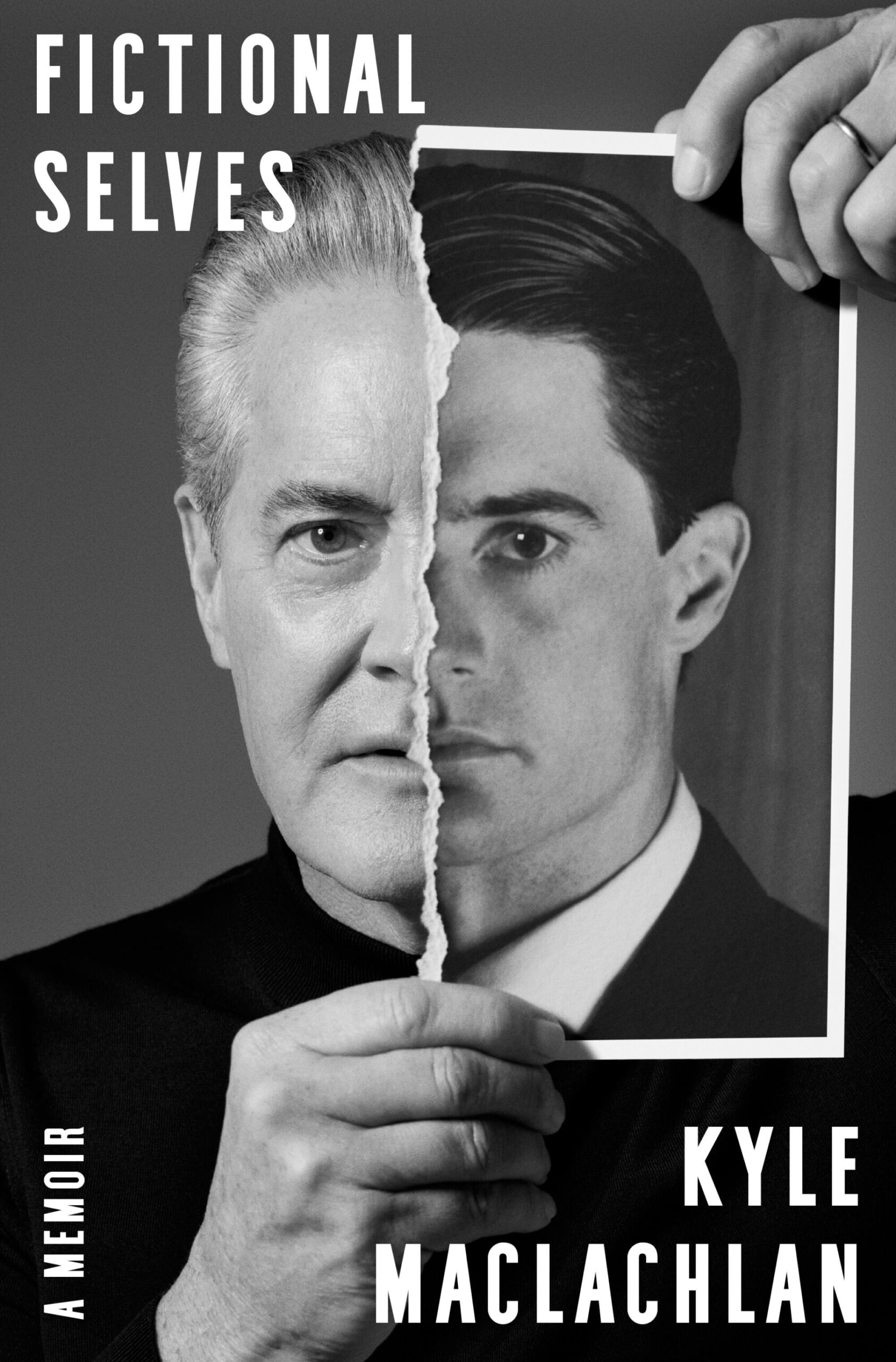
Fictional Selves: A Memoir
By Kyle Maclachlan Crown: 320 pages, $34
If you buy books linked on our site, The Times may earn a commission from Bookshop.org, whose fees support independent bookstores.
“Whatever it is, it’s very healthy,” he says when I ask what sort of confection he chose. “It’s cranberry, oatmeal and gluten-free. Who knows if there’s any sugar in there?”
At 67, MacLachlan isn’t necessarily a health nut. But he is highly amenable and willing to roll with my vegan cafe selection, which is conveniently located near our photo shoot location. “I come from Eastern Washington state — it’s a desert,” he says assuringly when I offer to move us to an indoor seat with air conditioning. Later, as we prepare to leave for the shoot, he clocks my car, a rare station wagon, and dubs it “spec-TAC-u-lar.”
That’s MacLachlan for you — all it takes is one word (he also drops an “Aces!” during our meeting) or enthusiastic gesture (very likely a swooping thumbs up) to channel the type of eccentric and upbeat characters he’s spent the last 40 years playing. Now, with the release of his thoughtful new memoir, “Fictional Selves,” MacLachlan gives us a much closer look at the man behind the chin-jutting grin, and, in doing so, introduces us to his doppelganger, “Other Kyle,” an image-conscious shadow figure constantly trailing behind, questioning his choices.
“There’s definitely another entity, an observer, the ego, the harder self,” MacLachlan says of how he would describe Other Kyle, whom ghostwriter Jon Sternfeld first identified after noticing the way MacLachlan tended to fall into conversation with himself while recounting his life. “[He’s] the kind of person that I’m not comfortable leading within the world. But he’s definitely in there commenting on the things that I do.”
Other Kyle first began to taunt MacLachlan after he saw himself on a gargantuan billboard for “Dune” in Times Square. (In his early 20s, MacLachlan was famously plucked from obscurity to lead David Lynch’s 1984 adaptation of Frank Herbert’s sci-fi epic.)
Well before his alter ego materialized, and well before Hollywood found him, MacLachlan was prone to anxiety and fears of never fitting in. Born in Yakima, Wash., MacLachlan grew up the oldest of three boys; his parents were solidly middle-class, with his father working as a lawyer, and then stockbroker. His mother was a homemaker known in the community for her civic involvement, particularly in local arts programs. In fact, it was MacLachlan’s mother who first encouraged him to try a “Teen Theater” program, drawing him in with the promise that there might also be girls in attendance.
But it took a minute for MacLachlan to genuinely embrace his calling. As a young adult, his father pushed him to study business, while his mother urged him to try PR or communications. His studies at the University of Washington weren’t going well, so he dropped out and worked at a manufacturing plant back in Yakima. It wasn’t until a girlfriend recommended a summer theater program in North Carolina that MacLachlan leaned back into his first real passion, eventually returned to school with a newfound focus, and was accepted into the University of Washington’s professional acting program.
Kyle MacLachlan at the glass and mirror shop LA Mirror Man on La Cienega Boulevard.
(Christopher Patey / For The Times)
Fast-forward 40 years, it’s impossible to imagine that MacLachlan would have anything else for Other Kyle to latch onto. For one, his acting resume is the stuff of thespian fantasy. Sure, “Dune” infamously flopped hard upon arrival, and all planned sequels were immediately canceled. But it wasn’t long before MacLachlan had teamed back up with his mentor, with whom he had developed an almost telepathic bond on “Dune,” to lead Lynch’s much more kindly received 1986 neo-noir arthouse entry, “Blue Velvet.” A few years later, the overwhelming success of the TV mystery series “Twin Peaks” propelled the actor to the upper stratosphere of celebrity.
“When we were working together creating Jeffrey in ‘Blue Velvet’ or [Coop in] ‘Twin Peaks,’ we would sit and talk or not talk, we melded together in some weird way, we were like one person,” MacLachlan says of his bond with Lynch, who died in early 2025 of cardiac arrest due to chronic obstructive pulmonary disease. “It was this very symbiotic kind of thing in front of the camera,” MacLachlan continues. “It was like this weird circular energy. … He’s the only director I share that with.”
And yet, breaking out of what MacLachlan refers to as “The Black Suit,” worn by his unceasingly chipper “Twin Peaks” character, Special Agent Dale Cooper, proved challenging. By the time “Twin Peaks” left the air in 1991, MacLachlan had grown ambivalent about the job that changed his life, partially because he felt Lynch didn’t fight hard enough to keep artistic control of the show’s second season, which saw the network upping its creative involvement and Lynch distancing himself until the final few episodes.
MacLachlan longed to diversify his output — to show that he was capable of being a mainstream Hollywood leading man, one who could interface with a variety of directors. In the book, he writes about jobs he comes so close to booking — roles in Robert Redford’s “A River Runs Through It” and Francis Ford Coppola’s “Dracula” — but losing out at the last minute.
Kyle MacLachlan explores his alter ego “Other Kyle” in his new memoir.
(Christopher Patey / For The Times)
He took these rejections hard at the time. Many decades later, however, he can see how he was the one holding himself back. “I felt like people were only seeing the black suit,” MacLachlan says. “Now, the truth is, they would probably have been more than happy to see me as somebody else, but I was not able to deliver. … I think there was a lot of insecurity,” he continues. “I was like, ‘Maybe it’s not the suit. Maybe it’s me.’”
As the 1990s played out, MacLachlan fought an on-again, off-again existential crisis regarding the type of actor he was really meant to be. His friend and former “Doors” co-star Val Kilmer urged him to accept a lead role in a BBC adaptation of Kafka’s “The Trial,” which didn’t move the cultural needle in the States, but did put him in the same room as enormously pedigreed actors like Anthony Hopkins and Alfred Molina. He snagged a role in a Paul Verhoeven film about topless dancers — a career risk he hoped would pay off but ultimately felt like “walking into a buzz saw,” as he writes in the book.
Despite the cult reappraisal of “Showgirls,” and the lasting popularity of “Sex and the City,” Other Kyle had a few things to say about both of these roles, but the Kyle sitting across from me has a much more measured approach, particularly to “Showgirls.”
“I think it’s fun that it’s still around,” MacLachlan says. “I’ll still argue with anyone that [says] it’s a good movie. It’s not a good movie, but it’s definitely an appreciated movie, and that is kind of where I leave it.”
In the early 2000s, his wife, Full Picture founder and chief executive Desiree Gruber, pushed him to accept a role in HBO’s “Sex and the City,” playing an Upper East Side doctor with erectile issues.
Portraying Trey MacDougal was a mixed bag for MacLachlan. On one hand, he was thrilled to be part of such a cultural juggernaut, and he delighted in the emphasis the show placed on female friendship and sexual agency.
“I want to keep being challenged,” says Kyle MacLachlan, looking ahead to the next chapter of his 40-year career.
(Christopher Patey / For The Times)
At the same time, he had mixed feelings about playing an old-money mama’s boy with a Freudian Madonna-whore complex. Not to mention the sheer ridiculousness of the things the writers would have him do: One scene had him bent over a bathroom sink, masturbating to a pornographic magazine. A passage of “Fictional Selves” also recalls the cringe-inducing moment when Trey gives his wife, Charlotte (Kristin Davis), a cardboard cutout of a baby in an effort to make light of their struggle to conceive.
In the book, MacLachlan recalls being utterly dumbfounded at having been asked to do something so oblivious at best and cruel at worst. Eventually, however, he writes that he realized the writers just needed a way to foist him off the show. (His and Davis’ characters get divorced soon after the cardboard baby incident.)
“Every time I got a script, I’d be like, ‘Oh boy, OK, what’s going to happen here?’” MacLachlan says. “And then it would be, like, whatever they’ve come up with, ‘how can I shape it? What is it that [Trey’s] wrestling with? What are the issues here? Then, you know, realizing that in some cases it was just going to be a sight gag. Like, the Juggs magazine is going to be a sight gag. And as I said in the book, in my mind, I would sort of float away. I would be like, ‘That’s not really me. I don’t know who that is down there doing that.’”
As MacLachlan moved into middle age, he gradually grew more comfortable with the clean-cut oddball characters he’d so often be asked to play: a refined but possibly murderous dentist on “Desperate Housewives,” an idiosyncratic boat obsessive on “How I Met Your Mother,” an over-the-top civic leader on “Portlandia,” and, once again, Special Agent Dale Cooper (plus his doppelgängers) on “Twin Peaks: The Return.”
The 2017 “Twin Peaks” reboot would be the last big project MacLachlan would work on with Lynch, but MacLachlan would frequently visit the director in their shared Hollywood Hills neighborhood. “It’s many things,” MacLachlan says when I ask what he misses most about his friend and mentor. “The voice on the phone — ‘HEY, KALE! Come on up for coffee!’” he continues in a pitch-perfect Lynch imitation. (“Kale” became Lynch’s nickname for MacLachlan, referencing “Dune” producer Dino De Laurentiis’ Italian pronunciation.)
“Towards the end, I would go to visit him, and I would sometimes take my phone and record things. I still have these stories loaded in my iPhone — about ‘Dune,’ or a story about a moment in ‘Blue Velvet,’ or a story about when he met John Huston, or when he got a kiss from Elizabeth Taylor. … I have these little gems, and I savor those.”
Lately, Other Kyle has been replaced by Online Kyle, a goofy, lighthearted version of MacLachlan who primarily lives on TikTok and Instagram — thus the wholesome, Gen Z title of “Internet’s Dad.” And when he’s not playing a father to Ella Purnell on Prime Video’s hit “Fallout,” or interviewing a younger generation of entertainers on his podcast, “What Are We Even Doing,” MacLachlan is also someone’s real dad. One of the most endearing moments in our afternoon happens when his teenage son, Callum, calls looking for something around the house. “Oh, it’s in the fridge in the gym. In a foil. And there’s chicken in the fridge. Love you too,” MacLachlan tells his son.
There’s certainly no doubt that this Kyle doesn’t get in his head — or in his own way — the way earlier versions did. He’s still eager to test his limits as an actor, but he’s comfortable with the thought that there is no plan. “I want to keep working with interesting people,” he says with his trademark buoyancy. “I want to keep doing fun things. I want to keep being challenged. … I don’t really know where I’m going, but something will excite me, and I’d be like, ‘OK, what the hell?’ And I jump in.”
Brodsky is an L.A. culture and music writer. Her biography of Stevie Nicks “Lessons & Lace” is out now.
SAN FRANCISCO — Dodgers reliever Blake Treinen is likely out for the postseason, after injuring his right shoulder warming up in the bullpen Saturday.
“I don’t know if it was a complete blowout, but really unfortunate,” manager Dave Roberts said after the Dodgers’ 4-3 win against the San Francisco Giants.
The Dodgers plan to put Treinen on the injured list Sunday, Roberts said. And he’ll undergo imaging to diagnose the injury.
“It just popped up,” Roberts said.
Treinen, 38, is the longest-tenured Dodgers pitcher on the roster. He spent over two months on the IL earlier this season with inflammation in his right elbow. But in 36 appearances this season, he posted a 3.64 ERA.
Treinen has a history of shoulder injuries and underwent right shoulder labrum and rotator cuff repair surgery after the 2022 season.
Two women reportedly injured in blast in Athens’ historic Plaka district, buildings evacuated.
Published On 26 Sep 202626 Sep 2026
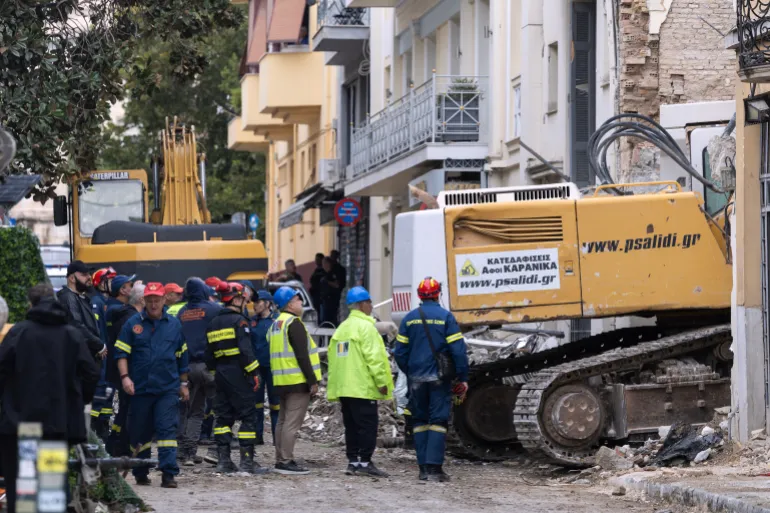
Rescue teams have recovered the bodies of six people killed in a building collapse following a a blast in the historic centre of Athens, Greece, according to local authorities.
Documents and belongings found with four of the victims – two men and two women – on Saturday indicated they were United States citizens, Greek state broadcaster ERT and other local media reported.
Recommended Stories
list of 3 itemsend of list
The other two victims were reportedly an elderly couple, a British man and a Greek woman, who lived on the building’s second floor.
Two women were injured in an adjacent building, according to the fire department.
The blast that brought down the small, two-storey building in the popular tourist district of Plaka on Friday was believed to have been caused by a major gas leak, Athens Mayor Haris Doukas said. Neighbouring buildings were damaged and evacuated, he said.
“The damage extends to the entire street as well as the street behind [the building],” Doukas said. “We are talking about an unimaginable catastrophe.”
Two adjoining buildings severely damaged might have to be demolished, he said.
The Greek daily newspaper Kathimerini reported on Friday that the four tourists, who were due to leave their accommodation at about 11:00am (08:00 GMT), failed to board their flight back to the US.
Rescuers work at the scene on September 26, 2026, one day after a powerful blast hit Athens’ Plaka district [Yorgos Karahalis/AP]
Plaka residents issued warning
A group of Plaka residents had alerted the municipality and the managers of the electricity and gas networks about the risks of short circuits or gas leaks in the area a year ago.
In a letter published by Kathimerini, the group called for the organisation of a security exercise to identify any potential shortcomings in the emergency response system.
The citizen movement “We Remain Active” also stated on social media that a resident of the street where the explosion occurred had reported a smell of gas for several weeks and had warned the authorities.
A Greek police spokeswoman confirmed on ERT that residents had made the report. However, the nature of the substance and its origin have not yet been determined.
Plaka lies at the foot of the Acropolis, Greece’s most visited ancient monument.