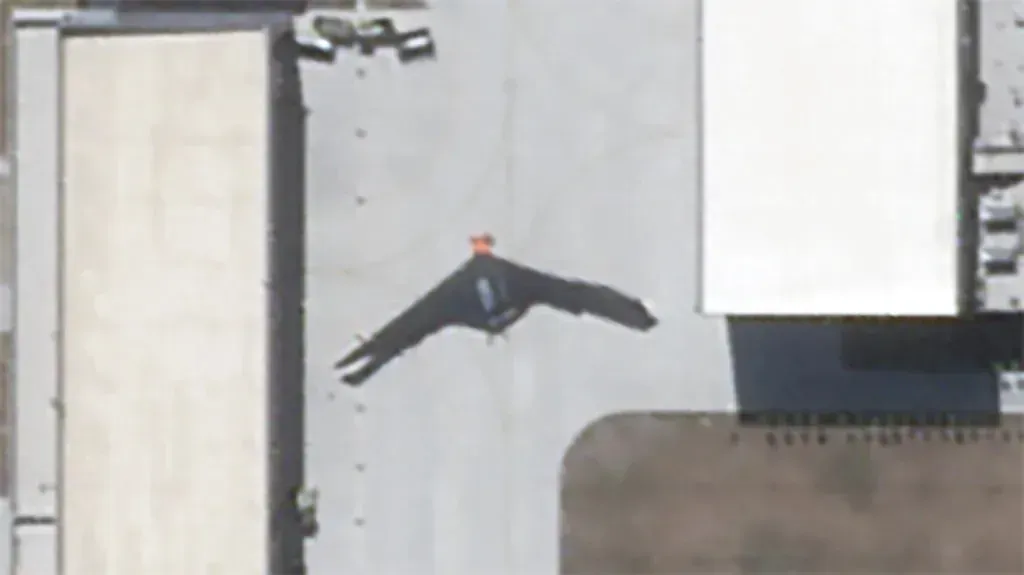
New imagery appearing out of China provides the best look yet at one of the country’s most enigmatic aircraft: the very large, low-observable, flying-wing drone widely referred to as the WZ-X. Seen previously primarily in satellite imagery, TWZ broke the story of the existence of this monster high-altitude, long-endurance drone. The new views that emerged today help clear up one of the most puzzling aspects of the aircraft’s appearance, namely the unusual shape of its enormous wings.
The aircraft was first identified in satellite imagery collected in May 2025 showing the People’s Liberation Army Air Force’s (PLAAF) sprawling test facility at Malan in Xinjiang. At the time, it was difficult to determine whether some of the apparent discontinuities in the wing planform were genuine features, visual countermeasures, or artifacts of the imagery.
The new photograph, seen at the top of the article and below, as well as a new satellite image, shows that the aircraft has a broader-chord inner wing section that transitions into a substantially narrower outer section. Rather than tapering continuously from the center section toward the tips, the wing effectively becomes much more slender over its outer portion in a ‘step down’-like fashion. The resulting planform gives the aircraft an exceptionally long, narrow outer wing. The wing arrangement differs from the B-2 and other stealthy flying wing designs because it has two outer wing sections, in addition to its diamond-like central fuselage, instead of just one.
We still can’t say for sure if this feature is just the way the aircraft’s wing was designed or if it also is due to some other exotic feature, such as wing folding or removable outboard sections. While a more novel explanation is possible, it is somewhat improbable at this point.
Seen from behind, the aircraft has a relatively shallow central fuselage section, with extremely long wings extending outward from it. The landing gear is extended, revealing large main undercarriage doors and substantial landing gear consistent with an aircraft of this size. Split rudders are visible toward the outer wing areas, broadly reminiscent of those used on the B-2.
An earlier view of the WZ-X. via Chinese internet
As in previous imagery, the rear of the center section of the aircraft may also reveal slot-like exhaust openings, supporting the assessment that it is twin-engined.
For an aircraft intended to spend long periods operating at high altitude, a very long overall span combined with a relatively narrow outer wing could be advantageous. Such an arrangement would increase effective aspect ratio and reduce induced drag during efficient cruise, potentially improving endurance and high-altitude performance.
It may also allow the designers to concentrate structural mass and internal volume closer to the center of the aircraft while still achieving a very large span.
There is a potential low-observable tradeoff, however. A significant change in chord introduces additional planform geometry and potential edge-alignment discontinuities that must be reconciled with the requirements of a stealth aircraft. The transition will influence radar reflections depending on its precise shape, orientation, and relationship to the aircraft’s other edges and surfaces. This will also be highly dependent on the aspect the radar is viewing the aircraft from. Modern very low observable designs try to minimize these exact types of features, with large continuous structures being the most advantageous to radar signature. This philosophy can be seen in the design of the B-21’s planform, which was also how the B-2 was supposed to look originally. You can read all about this here.
Regardless, the WZ-X does indeed have a semi-sawtooth trailing edge due to this intriguing feature.
New images of the so-called WZ-X stealthy flying-wing drone. via Chinese internet
The overall scale of the aircraft is also becoming increasingly apparent. Our initial analysis of satellite imagery put its wingspan at approximately 170 feet, roughly comparable to the 172-foot span of the B-2. That would make it considerably larger than other Chinese flying-wing drones identified to date.
Andreas Rupprecht, an analyst specializing in Chinese military aviation and TWZ contributor, assesses that the WZ-X is likely a twin-engined design similar in configuration to the supposed U.S. RQ-180, but considerably larger.
Rupprecht estimates a length of approximately 46 feet. He also assesses the aircraft as having a relatively spacious central fuselage and a dorsal satellite communications antenna. His estimates of a range exceeding 12,000 miles and a normal cruising altitude of somewhere between 59,000 and 66,000 feet remain unconfirmed.
The WZ-X is notably different from China’s smaller flying-wing designs. The CH-7, for example, has a deeper and more curved center section and is substantially smaller. The WZ-X’s broad, relatively flattened center body and enormous span instead appear particularly compatible with high-altitude endurance.
CH-7 stealthy flying-wing drone. via Chinese internet
Its apparent configuration also makes a long-duration surveillance mission plausible. The central body and inner wing section would provide substantial space for fuel, sensors, and communications systems, while the outer wing, combined with its lifting central body, could support highly efficient flight at high altitude.
A low-observable platform of this size could potentially conduct many types of wide-area surveillance and networking assistance while operating in or very near contested airspace where conventional high-altitude UAVs would face greater risks. A strike capability cannot be ruled out, particularly given China’s broader development of combat-capable flying-wing UCAVs, but the aircraft’s proportions appear especially well suited to persistence and reconnaissance.
While the location of the latest imagery is unconfirmed, Malan has developed into a massive center for Chinese drone testing, with satellite imagery showing extensive expansion of its infrastructure in recent years. The facility has been associated with multiple flying-wing designs, including the WZ-X and the similarly mysterious and also very large GJ-X. This substantially different flying-wing aircraft with a cranked-kite planform is also undergoing flight testing. That aircraft is estimated to have a wingspan of around 137 feet, underscoring the breadth of China’s experimentation with large low-observable uncrewed aircraft.
China is pursuing tailless/flying-wing designs across an increasingly wide range of sizes and missions, alongside larger crewed aircraft programs including the J-36 and J-XDS and, eventually, the H-20 stealth bomber.
The WZ-X appears to be part of a much broader effort to develop highly integrated, low-observable aircraft optimized for different combinations of range, endurance, payload, and survivability.
For now, its official designation, manufacturer, propulsion system, performance, and intended mission remain unknown.
However, its configuration appears well suited to the requirements of a very large high-altitude endurance aircraft, although the trade-off between its performance and its stealth characteristics remains equally mysterious.
Graeme Souness is appearing in new ITV show The Box on Saturday night.
The Scottish former professional football player, manager and television pundit, 73, is one of ten celebrity contestants on Gary Lineker’s new game show. Also joining the line-up are Danny Aarons, Ellie Taylor, Joey Essex, JB Gill, Jenny Ryan, John Bercow, Ranvir Singh, Sara Davies and Shakira Khan on the new ITV show.
Away from the ITV show, Graeme has spoken candidly about his health over the years after he was diagnosed with a heart condition aged just 38, which left him asking ‘how can this happen to me’.
Graeme shared his experience with the British Heart Foundation (BHF), revealing what life was like following his diagnosis and treatment for heart disease as a young, physically fit man.
While managing Liverpool in 1991, the Scot was struggling to sleep and experiencing chest pains in bed. With a family history of heart disease, alarm bells were ringing. He underwent an electrocardiogram (ECG) – a straightforward test used to assess the heart’s rhythm and electrical activity.
Following the results, he was referred for an angiogram, a specialised X-ray procedure used to examine blood vessels. Despite displaying no obvious symptoms, Graeme was diagnosed with three blocked arteries and coronary heart disease. Just five days later, he was facing open heart surgery.
Speaking on the British Heart Foundation’s (BHF) podcast, the Ticker Tapes in 2021, he said at the time: “At the time I was training like the professional football players and was only 38-years-old. I kept thinking ‘how can this happen to me?’
“I looked after myself in terms what I ate and drank and had trained from the age of 15 – I trained as vigorously as a professional athlete. I didn’t carry any weight, I never had done. How had this happened to me?
“I didn’t have the obvious symptoms that there was something badly wrong with my heart so I’m so glad I got checked when I did. It’s because of this that I’m here 30 years later.
“If it can happen to me, it can happen to anyone. At that time I was a very fit, young man. If you’re concerned about your family history, go and get checked. You must get yourself checked.”
In 2015, Graeme suffered a heart attack and has since become a British Heart Foundation (BHF) ambassador, throwing himself into numerous campaigns and events, as well as making visits to BHF research laboratories.
Graeme said of the terrifying health scare: “My heart attack was very scary but I’m still here, able to talk about it thank goodness. Fortunately, it hasn’t caused me any lasting problem.
“It’s so important to go to your doctor and get yourself diagnosed if you’re at all concerned. You owe it to yourself and those close to you – your wife, your children and your grandchildren. They want you around as long as possible.”
The Box launches on Saturday 5th September, with Episode 2 airing on Sunday 6th September, on ITV1, ITVX, STV & STV Player.
US Central Command says its forces struck three Iranian crude oil carriers on Saturday, in retaliation for Iranian forces firing ballistic missiles towards two US warships ‘patrolling regional waters’.
Two of US President Donald Trump’s top envoys have arrived in Moscow ahead of a weekend of talks aimed at accelerating efforts to end the war in Ukraine.
Steve Witkoff and Jared Kushner will hold talks in the Russian capital before travelling to Kyiv on Sunday for discussions with Ukraine.
Trump told reporters on Friday that Witkoff and Kushner were “bringing with them a proposal to end the war”. So far, efforts from the US and its allies to broker a peace deal have failed to deliver a breakthrough.
Both Russia and Ukraine have said they will halt strikes on each others’ capital cities for three days while the delegation conducts its visit.
Zelensky said on Saturday that he had spoken to the envoys, who have “already begun working with the Russian side today”.
“The plan for tomorrow’s diplomatic engagements in Kyiv, involving the US team, has been approved. We are waiting for Steve Witkoff and Jared Kushner and are ready for a substantive conversation,” he added.
“From now through the end of Saturday, as well as on Sunday and Monday, Ukraine is ready to refrain from strikes on Moscow, and we expect the Russians to do the same regarding Kyiv.”
Russian state media reported that President Vladimir Putin had ordered a halt to strikes on Kyiv for three days due to the US visit.
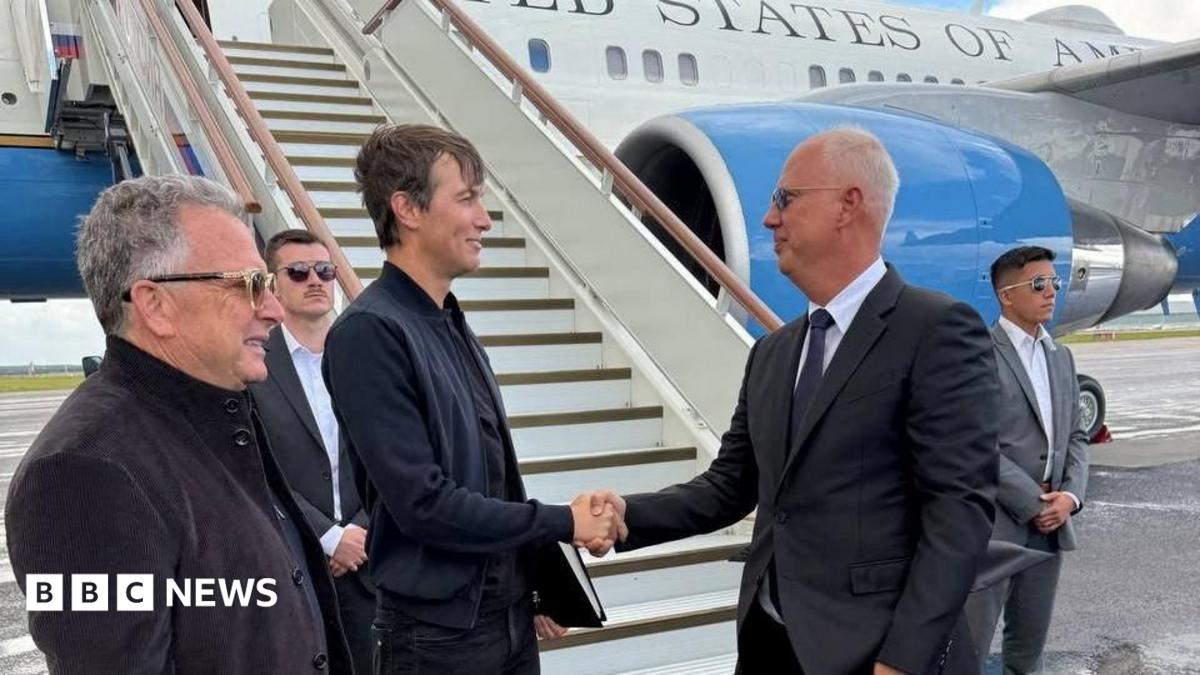
Witkoff and Kushner were pictured being greeted by Russian official Kirill Dmitriev after landing at Moscow’s Vnukovo Airport.
Flight tracking data showed a US government plane had travelled from Helsinki, Finland, where it had flown to from the US earlier in the day.
US news outlet Axios reported that the US envoys would separately meet both Russian President Vladimir Putin and Ukrainian President Volodymyr Zelensky.
Kushner and Witkoff have visited Russia several times but the talks on Sunday would be the first in Ukraine.
“So much has happened that she should have been a part of. My heart is particularly with Marie [Sarah’s mum] today.
Sarah’s cause of death was breast cancerCredit: GettyGirls Aloud formed back in the 2000’s on Popstars: The RivalsCredit: Getty
“Sitting with myself, hormones and sleep deprivation are probably not helping but as I type I’m feeling very sad and transported to this day 5 years ago.
“Such a milestone would have most likely had this impact anyway. Most definitely for all her friends and family.”
Nicola then took a moment to gush about her friend, sharing how proud she still is of her.
She continued: “I’m also feeling proud that Sarah left such a legacy with her charity and that everyone that vowed to help her on that quest is still powering through for that silver lining she was so passionate about.
“She’s saving lives. Wish to everything she didn’t have to lose her own xx”
The Sarah HardingBreast Cancer Appeal was founded in Sarah’s honour to fund research for women experiencing cancer in their 30s.
It has gone on to raise over £1million to date from various events including performances by her bandmates Cheryl Tweedy, Kimberley Walsh, Nadine Coyle, and Nicola, as well as donations.
The healthcare sector (XLV) gained 4.91% in August, outperforming the broader S&P 500 (SPY), which advanced 2.68% during the month. Healthcare stocks benefited from strength in biotechnology and medical technology, while healthcare services, managed care, and selected pharmaceutical stocks
A few months after Mark Walter became the chairman and majority owner of the Dodgers, he was told a fan in one of Dodger Stadium’s upper decks was upset about a mix-up with his tickets.
On most days, that would be an issue for an usher to handle. Not on this day.
Walter and team president Stan Kasten decided to address the problem, climbing the narrow stairwell to the top level where they found the fan and listened to his complaint.
“Obviously the guy was floored just to see me, let alone to see Mark,” Kasten said. “Mark, he’s incredibly comfortable around people. Not just his peers, but average fans. Because he considers himself an average fan.”
The Dodgers’ billionaire owner, hardly an average fan, is under intense scrutiny these days, following the sale of his controlling interest in the Lakers and a federal investigation into his business dealings. The drama has come as a surprise to some who know Walter, who has earned respect for his financial acumen and, despite his purchases of high-profile sports teams, has tended to dodge publicity.
He put together the ownership group that bought the Dodgers in 2012. Since the purchase, the team has played in five World Series, winning three, and finished first in the National League West 12 times in 14 seasons. It’s the greatest sustained run of excellence in baseball in more than a generation.
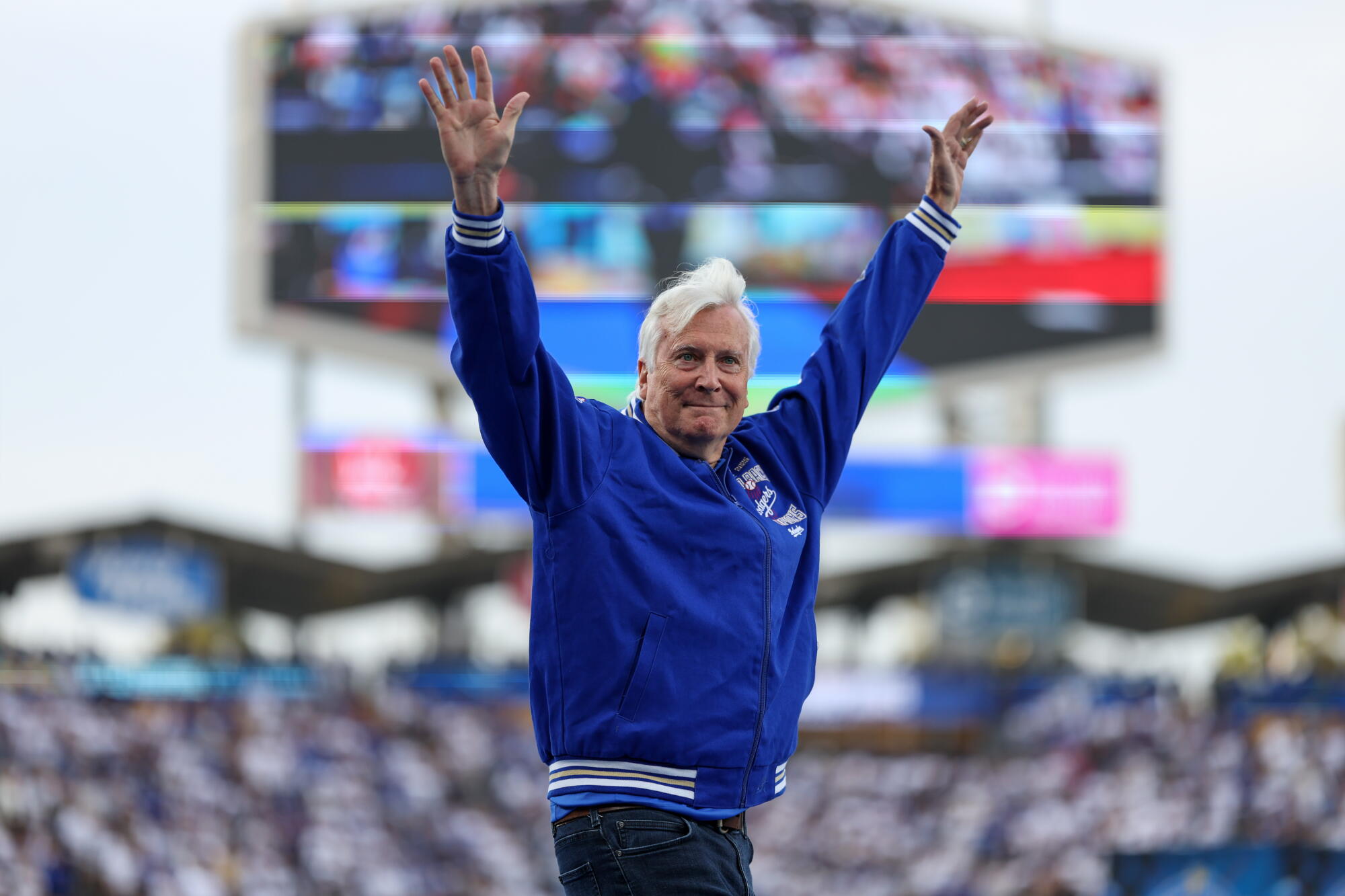
Walter waves to the crowd during the Dodgers’ ring ceremony in March.
(Jessie Alcheh/MLB Photos via Getty Images)
If the Dodgers win a third straight World Series this fall, they will become the first team to three-peat this century. And much of the credit for that would go to Walter, who has funded a front office that consistently has outspent the rest of Major League Baseball, signing seven players to contracts worth more than $2 billion combined in the last six years alone.
Now Walter faces questions about his future owning the Dodgers. Last month, his companies became the focus of two federal inquiries and a Delaware insurance regulatory review.
He is helping pay off some of his companies’ loans and sold the Lakers at a record valuation of $12.5 billion, a deal Walter’s holding company, TWG Global, says was not forced by the inquiries. Still, the sale raised questions about whether he will sell his ownership stakes in other sports properties, including English soccer club Chelsea, the Cadillac Formula One racing team, the WNBA’s Sparks and the Professional Women’s Hockey League.
Walter declined to comment for this article.
Kasten insists Walter has no plans to divest from the Dodgers. “The sports portfolio is going to remain intact,” Kasten said. “It’s important to Mark. I can’t tell you how important the Dodgers are to him.”
Still, Kasten acknowledges the decision to sell the Lakers to former Disney chief executive Bob Iger and venture capitalist Joshua Kushner just 14 months after agreeing to buy the team “was not a planned thing,” either.
Walter hoists the World Series trophy next to MLB Commissioner Rob Manfred last November.
(Rob Tringali/MLB Photos via Getty Images)
Like most of the middle-class kids in the class of 1978 at Jefferson High in Cedar Rapids, Iowa, Walter worked in high school.
“He pumped gas and he played golf,” recalled Cathy Boland Polito, Walter’s date for the senior prom who is now a retired medical technologist living in Oro Valley, Ariz.
Walter hardly stood out in his graduating class of about 350 students. He was athletic but not a stud. He was a good student, especially in math, but not a nerd.
“He was friendly. He was nice,” Polito said. “Everybody sort of knew him.”
Walter talks with Dodgers president Stan Kasten during the playoffs last year. “I can’t tell you how important the Dodgers are to him,” Kasten says.
(Michael Reaves / Getty Images)
Walter went to Creighton University , where he studied accounting and business while playing intramural sports and participating in the philosophy society. Three years later, he earned a law degree from Northwestern.
Walter met his wife, Kimbra, in Chicago, where they raised their daughter, Samantha.
After a decade split between a Chicago law firm and First Chicago Capital Markets, a financial services and securities brokerage, Walter founded an investment firm, Liberty Hampshire Co., in 1996. While there he met J. Todd Morley, who connected him with the Guggenheim family fortune. The introduction quickly led to the formation of Guggenheim Partners, an investment and advisory financial services firm that works with insurance services, among other assets, and one that has a Wall Street reputation for being low-key but aggressive.
Before the COVID-19 pandemic closed Guggenheim’s offices, the lobby of the firm’s Chicago headquarters on the 49th floor of the AT&T Center boasted one of Monet’s “Water Lilies” paintings, which hung behind the receptionist’s desk inside a glass case with an alarm. A Picasso brightened another office upstairs.
Walter with Guggenheim Baseball Management partners Peter Guber, left, Stan Kasten and Magic Johnson at Dodger Stadium in 2012 after the group bought the Dodgers for $2 billion.
(Damian Dovarganes / Associated Press)
A company insider not authorized to speak publicly told The Times in 2012 that Walter was a disciplined, focused and careful investor.
“He is a guy with one of the great financial minds of our time,” the person said.
For Walter, 66, who grew up playing youth baseball about 50 miles from the Iowa cornfield that became Kevin Costner’s “Field of Dreams,” that financial success was all well and good. But the longtime Chicago Cubs season-ticket holder really was a die-hard baseball fan whose dream was to own a sports franchise.
Walter first explored a purchase of the Houston Astros, who eventually were sold to Houston businessman Jim Crane for $615 million ahead of the 2012 season. So Walter pivoted and formed Guggenheim Baseball Management, a group that included Kasten, Lakers Hall of Famer Magic Johnson, movie producer Peter Guber and investors Bobby Patton and Todd Boehly, to buy the Dodgers for $2.15 billion, a record at the time, in March 2012. Part of the money Walter invested in the deal came from the insurers he controlled, although that deal was vetted by state insurance regulators.
MLB engineered the sale of the Dodgers after previous owner Frank McCourt filed for bankruptcy.
“The market drove the price,” Walter told The Times after the sale closed, calling the investment “a multigenerational thing my daughter’s granddaughters will own.” Walter’s daughter, who grew up joining family trips to Los Angeles for Dodgers games, is a marketing manager at TWG Global.
1
2
1.WASHINGTON, DC – JULY 02: U.S. President Joe Biden (C) holds the jersey given to him by Los Angeles Dodgers Chairman Mark Walter during an event with the 2020 World Series champions in the East Room of the White House on July 02, 2021 in Washington, DC. The Dodgers defeated the Tampa Bay Rays to win the championship series at the end of an abbreviated season due to the coronavirus. (Photo by Chip Somodevilla/Getty Images)(Chip Somodevilla / Getty Images)2.WASHINGTON, DC – APRIL 07: (L-R) Los Angeles Dodgers pitcher Clayton Kershaw, U.S. President Donald Trump, and Los Angeles Dodgers Owner and Chairman Mark Walter pose with a jersey presented to Trump as he hosts the 2024 World Series champions in the East Room of the White House on April 07, 2025 in Washington, DC. The Los Angeles Dodgers defeated the New York Yankees with a 7-6 victory in Game 5. (Photo by Kevin Dietsch/Getty Images)(Kevin Dietsch / Getty Images)
Today, the team is the most lucrative in the sport and is on pace to become just the second this century to draw more than 4 million fans in consecutive seasons. The Dodgers could be sold for a valuation of $10 billion to $13 billion — at the higher end, three times as much as the record sale price for a major league team — an industry source told The Times on the condition of anonymity.
Through it all, Walter mostly has shunned attention. The exception is participating in on-field championship celebrations and joining the team for trips to the White House during the Trump and Biden administrations.
His smooth run was interrupted during the Dodgers’ run to the 2024 World Series when Walter suffered a stroke that kept him from the victory celebration. His recovery reportedly was arduous; Walter struggled to speak clearly for months and didn’t return to public view until the Dodgers’ season-opening series in Japan the following spring.
Walter didn’t publicly step down from any roles after the stroke, holding on to control of a vast portfolio. Since buying the Dodgers, he has invested in European soccer, women’s hockey and basketball, squash and auto racing. He also bought several historic buildings in the resort town of Crested Butte, Colo., where he and his philanthropist wife own a home. In 2013, the couple purchased the Wild Oak Plantation, a 17,000-acre wildlife preserve in northeast Florida, where the Walters now spend most of their time.
Kimbra has served on the boards of Chicago’s Lincoln Park Zoo, OneGoal nonprofit and Goodman Theatre and is active in the family’s charitable organization, TWF Causes, which focuses on social impact and conservation work, including owning or supporting several major conservation and private reserve properties in Africa.
The family has a limited political footprint, with Walter donating to the Democratic National Committee and the campaigns of then-presidential candidate Barack Obama and then-Chicago mayoral candidate Rahm Emanuel. The majority of their donations, however, run through their family foundation and the Dodgers Foundation.
“For us, my wife and I, and all of my partners believe that corporations have to be corporate citizens, and individuals who benefit from them, or who have built them, need to give back,” Walter told ESPN soon after buying the Dodgers. “You can’t take it with you, and you ought to do something philanthropic with it.”
But while he’s put money into charitable projects, he’s invested his heart and soul in the Dodgers, Kasten said.
“He cares deeply about it,” the Dodgers president said. “He’s living through every play, every out, every at-bat.”
However much longer Walter remains invested in the Dodgers — financially, at least — could come down to math.
Justice Department prosecutors, the Securities and Exchange Commission and a Delaware insurance regulator are investigating whether Walter funneled as much as $21 billion from the portfolios of two insurance companies he owns into private credit for loans to other companies he also controls while reporting just a fraction of the loans’ value. The Wall Street Journal and the Athletic reported Walter used billions of dollars of those insurance premiums to buy sports teams.
Such “related party transactions” are legal, within limits, but are required to be reported to guard against conflicts of interest and to protect clients.
In Walter’s case, the related-party loans f initially were reported at between $1 billion and $1.4 billion when the true total actually was between $16 billion and $21 billion. The reclassification meant the affiliated investments jumped from 2% of one insurer’s portfolio to about 40%, according to Fitch Ratings.
No formal charges have been filed, and TWG Global, the multinational holding company led by Walter, is cooperating in the investigation. Walter has declined to be interviewed or to respond to written questions about the investigation, but his representatives have strongly denied any improper behavior, describing reports of the probe as “substantial speculation and misinformation” advanced by “unnamed sources and self-serving interests.”
“It does not inspire confidence to know that this kind of wild understatement happened,” said Andrew Granato, a law professor at the University of Texas at Austin who specializes in corporate finance and insurance. “It also doesn’t inspire very much confidence in the system of insurance regulation we have, that there could be this big of a mess that was not caught for years.”
Walter hired veteran Goldman Sachs lawyer David Markowitz to be his chief legal officer and reportedly is exploring the sale of his 12.8% stake in the Chelsea soccer club to Clearlake Capital, a Santa Monica-based private-equity firm whose Puerto Rican-born co-founder, José E. Feliciano, recently bought the San Diego Padres.
A source close to Walter not authorized to discuss it publicly told The Times he has an interest in selling Chelsea if the terms are right but insisted there is no desire to sell the Sparks, the PWHL, his investment in professional squash or, more prominently, his stake in the Dodgers.
While Kasten and TWG Global officials insist the Dodgers aren’t for sale, uncertainty likely will linger at least until all investigations are completed.
Times staff writer Mirjam Swanson contributed to this report.
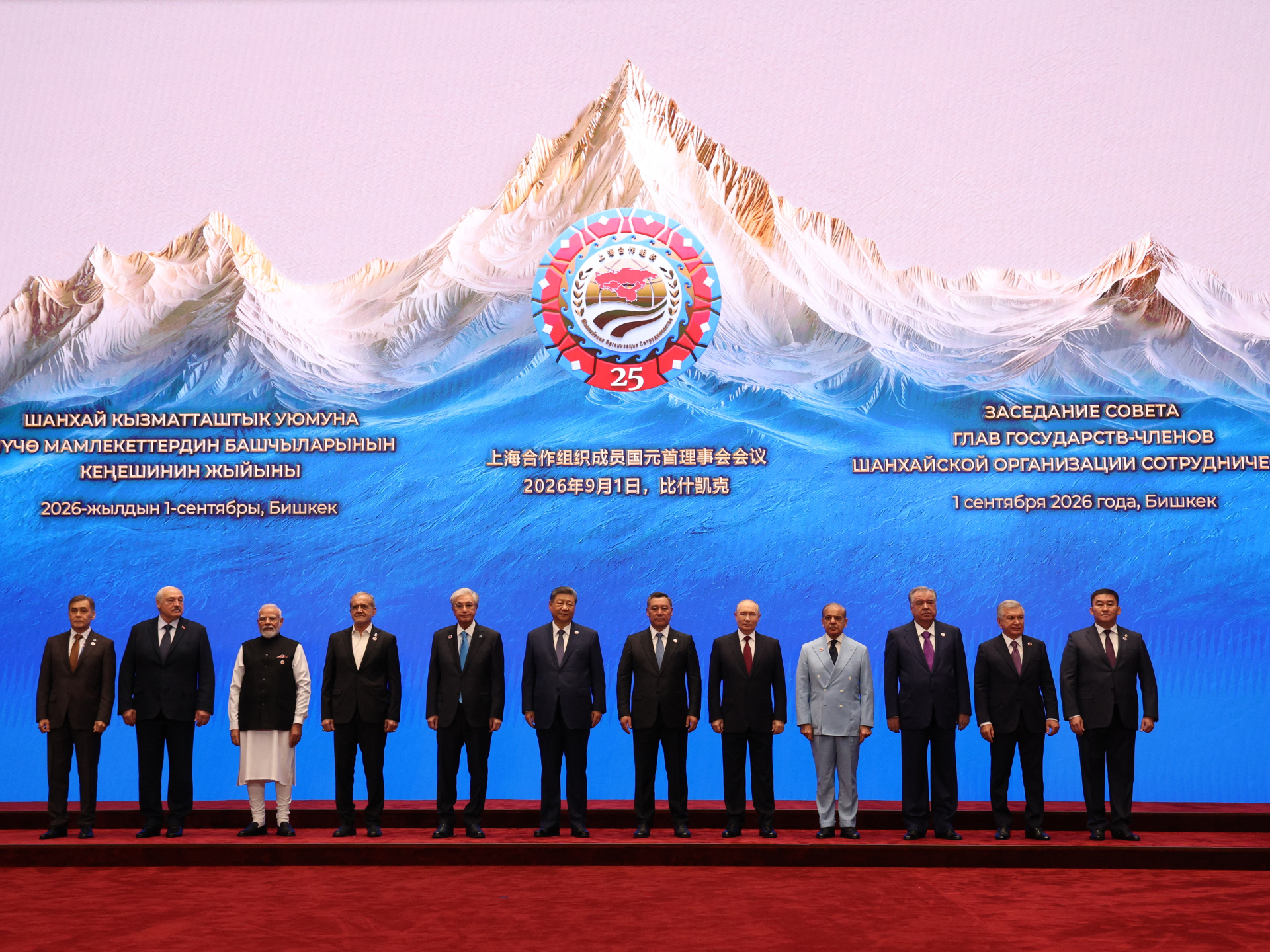
At the Shanghai Cooperation Organisation (SCO) summit in Bishkek this week, Iranian President Masoud Pezeshkian received precisely the kind of political support he had hoped for. The SCO condemned the military attacks against Iran, described them as violations of international law and the UN Charter, reaffirmed Iranian sovereignty and territorial integrity, and called for the conflict to be resolved through political and diplomatic means.
But the organisation did not offer to defend Iran. That distinction between political solidarity and collective defence is important. It tells us something not only about the Iranian experience with the SCO, but about the international order that is emerging around it.
For years, discussions about multipolarity have often suggested that the US-led international system would gradually be challenged by an alternative bloc centred around China, Russia and organisations such as BRICS and the SCO. From the perspective of middle powers, joining both institutions seemed to fit neatly into this transformation. Integration into non-Western organisations was supposed to make them less vulnerable to Western isolation and pressure.
The US-Israeli war on Iran has made clear that none of these alternative relationships can produce a security guarantee comparable to those provided by formal military alliances. The lesson is not that multipolarity has failed middle powers. It is that the emerging multipolar order may work differently from what many expected.
Rather than replacing one alliance system with another, it is producing an increasingly dense network of overlapping partnerships in which states gain diplomatic and economic options without necessarily acquiring new security guarantees.
For middle powers, this may be one of the defining characteristics of the emerging order: more room for manoeuvre, but less certainty about who will stand beside them when their security is threatened.
Turkiye provides a particularly revealing example. It has been a member of NATO for more than seven decades and remains embedded in the Western security architecture. Yet Ankara has increasingly demonstrated that alliance membership does not require automatic political alignment with Washington. Turkiye has maintained relations with Russia despite the war in Ukraine, expanded its engagement with China and participated in the SCO as a dialogue partner. At the same time, its differences with the US and Israel over the future regional order in the Middle East have become increasingly visible.
This does not mean Turkiye is abandoning NATO or moving into a Chinese- or Russian-led bloc. Quite the opposite. Ankara’s strategy depends precisely on avoiding such a binary choice. Its NATO membership provides security benefits that the SCO could not replicate. Its relationships with Russia, China, Iran, the Gulf states and other regional actors, meanwhile, expand its diplomatic and economic options.
Brazil represents another good example. Unlike Turkiye, Brazil is not bound to the US through a formal military alliance. But it has traditionally operated within a US-dominated hemisphere where Washington has expected considerable political alignment from regional governments.
Brazil’s refusal to join the US-led Americas Counter-Cartel Coalition (ACCC), together with its positions on the Iran war and other recent international crises, reflects its reluctance to accept that regional proximity should translate into automatic strategic alignment.
Yet Brazil is not simply switching sides. Its participation in BRICS, its extensive economic relationship with China and its calls for reform of the international system coexist with important political and economic relations with the US and Europe. Brasília’s objective is not to exchange dependence on Washington for dependence on Beijing, but to preserve the ability to cooperate with both, and disagree with either.
This may be one of the most consequential opportunities that multipolarity offers middle powers. The rise of alternative centres of economic and political influence reduces the cost of saying no. For decades, weaker states often confronted a difficult choice when facing pressure from a dominant power: comply, resist and risk isolation, or seek protection from a rival bloc.
The proliferation of partners and institutions complicates that calculation. A government that disagrees with Washington may deepen relations with Beijing without becoming a Chinese ally. A state dependent on China economically may strengthen security ties with the US without fully aligning with Washington. Membership in BRICS does not prevent cooperation with Western institutions, just as membership in a US-led security framework does not necessarily preclude engagement with China or Russia.
India has made this logic almost an organising principle of its foreign policy. New Delhi participates in the Quad with the US, Japan and Australia while simultaneously belonging to both BRICS and the SCO. At Bishkek, India supported the SCO declaration defending Iranian sovereignty while Prime Minister Narendra Modi also stressed to Pezeshkian the importance of preserving freedom of navigation and commerce through the Strait of Hormuz.
The Gulf Cooperation Council member states are pursuing their own version of this diversification. Saudi Arabia, Qatar and the United Arab Emirates, for example, continue to depend heavily on their relationships with the US for security, while simultaneously expanding economic and diplomatic ties with China, India and other Asian powers and participating in new regional and international arrangements.
None appears eager to replace Washington with Beijing. They want relationships with both. This suggests that the most significant consequence of multipolarity for middle and smaller powers may not be the emergence of a new bloc to which they can attach themselves. It may be the declining necessity of attaching themselves exclusively to any bloc at all.
But greater autonomy comes with a cost. The same flexible arrangements that allow states to avoid choosing sides also provide fewer guarantees when crises become existential. BRICS does not have an Article 5. Neither does the SCO, which explicitly defines itself as a non-military organisation.
Strategic partnerships can provide weapons, investment, diplomatic backing and political support without obligating partners to go to war for one another.
The emerging international system is therefore unlikely to resemble a simple transition from a US-led order to a Chinese-led one, or even a confrontation between two clearly defined blocs. The older alliance system is not disappearing.
NATO remains central to European and Turkish security, while US security relationships remain indispensable across much of Asia and the Gulf. What is emerging alongside it is another layer, a more fluid landscape of overlapping institutions, selective partnerships and transactional relationships.
Multipolarity, in other words, may not require states to choose a new camp. That gives middle and smaller powers greater agency. But it also places greater responsibility for their own security upon them. The world they are entering may offer more partners, more bargaining power and more freedom to say no. What it may offer less frequently is certainty about who will say yes when they ask for protection.
The views expressed in this article are the author’s own and do not necessarily reflect Al Jazeera’s editorial stance.
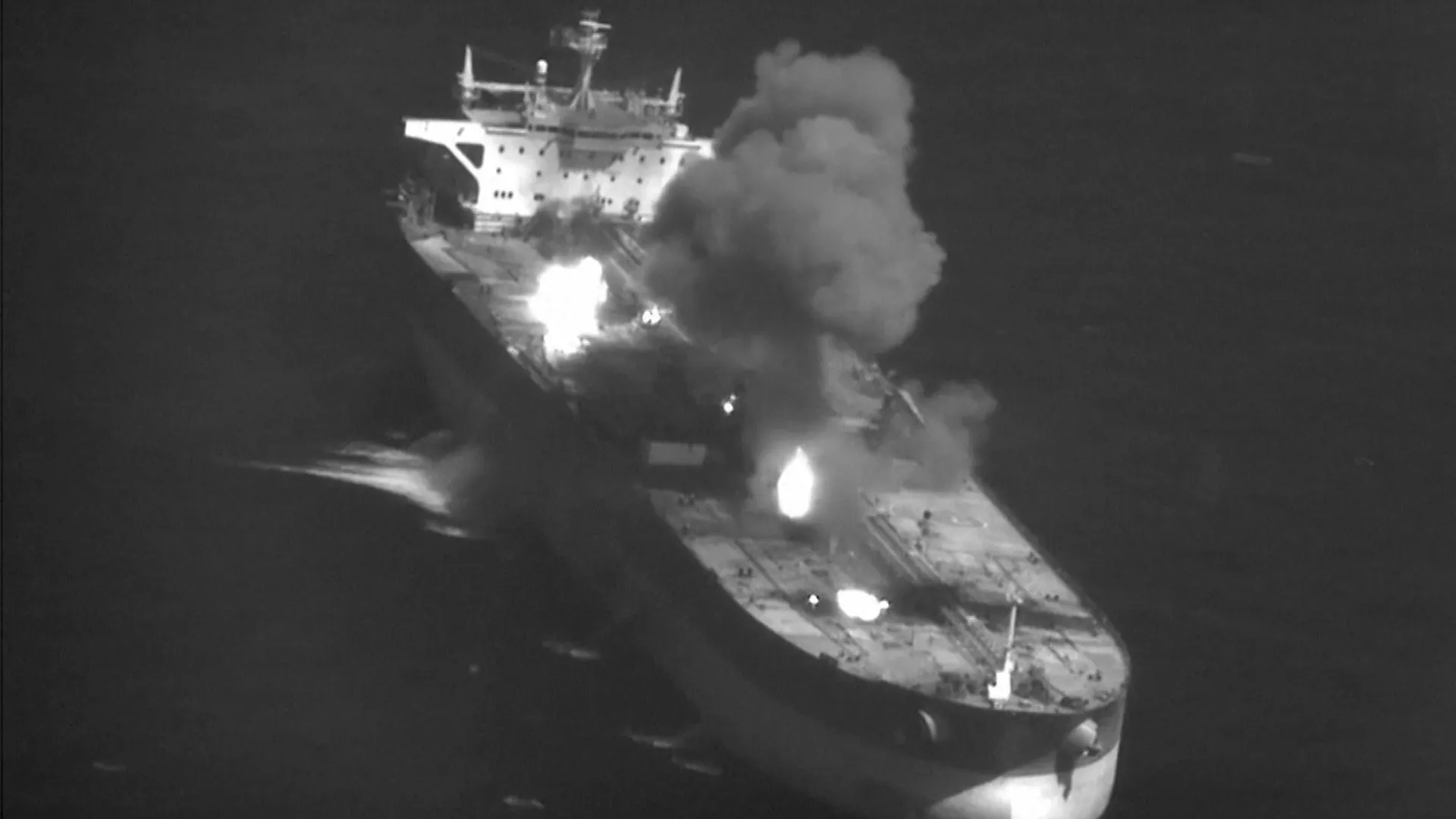
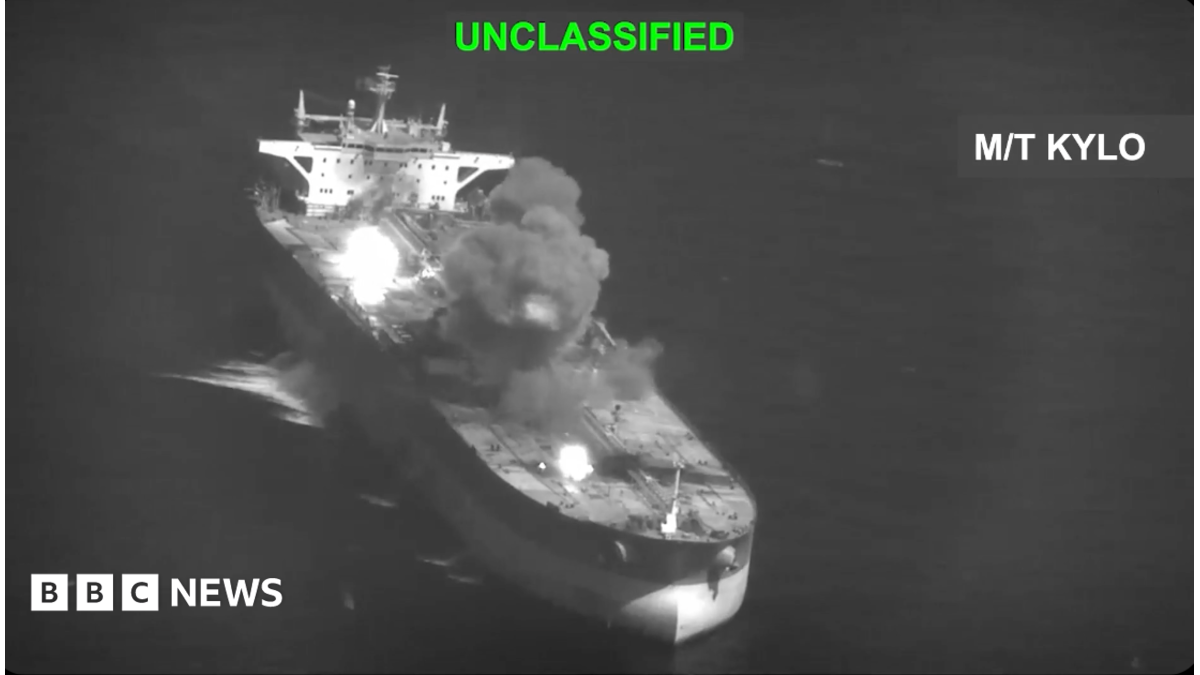
The US military says it has hit three Iran-linked oil tankers after ballistic missiles were launched towards two of its warships in the region.
US Central Command (Centcom) said on Saturday it had “permanently disabled” a tanker near Kharg Island and another near the Strait of Hormuz, and “completely destroyed” a third in the Gulf of Oman.
Centcom said it “successfully evaded” multiple attacks from the Islamic Revolutionary Guard Corps (IRGC) targeting a US aircraft carrier and guided-missile destroyer. No American troops were harmed, it said in a statement.
Iranian state media earlier reported that one of its tankers had been struck off the coast of Kharg Island.
Tehran did not immediately acknowledge attacks on US ships.
Admiral Brad Cooper, Centcom’s commander, said in a statement on Saturday: “Let the message to the IRGC be clear: If you shoot at two of our ships, we will impose an even higher economic cost – taking out three of yours.”
“We will not hesitate to defend American forces, and if necessary, destroy Iran’s limited and exposed oil fleet.”
Centcom, which oversees US military operations in the Middle East, claimed that the three Iranian oil tankers were “part of a multibillion-dollar shadow network that funds the IRGC and its regional proxies”.
The strikes come nearly a week after renewed attacks between the US and Iran, which followed a period of relative calm between the warring sides.
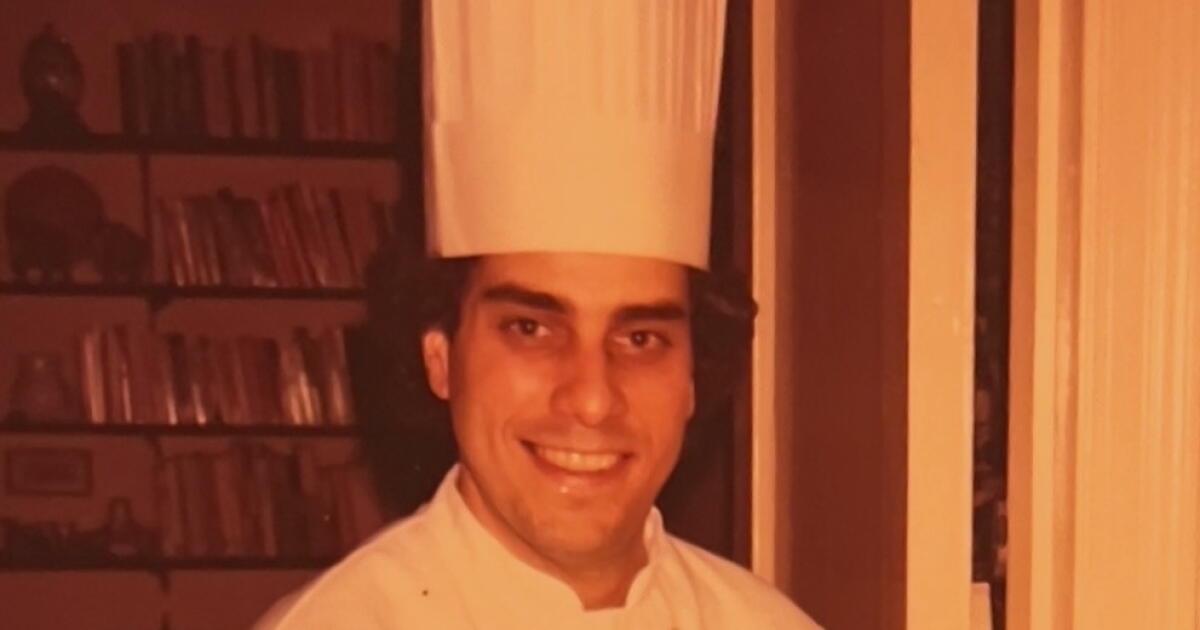
Michael Lomonaco can account for every minute of the morning of Sept. 11, 2001 — including the small decision that saved his life.
Lomonaco, the executive chef who ran Windows on the World on the 106th and 107th floors of the North Tower of the World Trade Center, was on his way up to his office when he stopped at an optometrist shop on the ground level to have his eyeglass frames adjusted.
He was still inside when American Airlines Flight 11 hit the tower above him at 8:46 a.m.
“I felt the buidling shake,” he recalled in the new CNN Films documentary “Top of the World.” “And I thought that can’t be the subway. That’s impossible.”
Lomonaco was evacuated. From the street, he watched employees of his own restaurant wave a white tablecloth from a window more than 100 floors up. Seventy-nine Windows on the World employees and 91 guests died that morning in the gastronomic soul of the Twin Towers — the one part of the complex that belonged to New Yorkers who didn’t work there, and to visitors from everywhere else.
“Top of the World” premieres Monday at 8 p.m. ET/PT on CNN and begins streaming the following day on the network’s subscription streaming platforms. The documentary short arrives on a double anniversary: 25 years since the attacks, and 50 years since Windows on the World opened on April 19, 1976.
It is the work of producer-director team Betsy West and Julie Cohen, who made “RBG,” the Oscar-nominated portrait of the late Supreme Court Justice Ruth Bader Ginsburg. The film is a production of CNN Films, TIME Studios and Tribeca Studios, in association with Montalto Pictures and Storyville Films, and was inspired by Tom Roston’s book “The Most Spectacular Restaurant in the World.” Actor Denis Leary voices the restaurant’s creator, Joe Baum, drawn from decades of archival recordings.
West and Cohen were reluctant to take it on. Both were working in network television news in 2001.
“There’s like a part of you that doesn’t want to go back there,” Cohen said in a recent interview. “But when we read this book and met some of the amazing people who had worked at Windows over its 25-year history, we realized this was actually a really good way into remembering there was a lot of beautiful stuff in the Twin Towers and like we shouldn’t let that disappear just because it ended so painfully.”
What emerges is a history of how a restaurant transformed the reputation of the monolithic Twin Towers, which received little respect from architecture critics and bafflement from a public that wondered why it was built in the 1970s by the Port Authority of New York and New Jersey as the city was fighting off financial collapse.
“This film tells a story of a restaurant that was very special to New York a time when New York was getting kicked in the teeth,” the Brooklyn-born Lomonaco said in a recent interview.
The World Trade Center operators turned to restaurant impresario Joe Baum to create a dining experience that would draw people to the Manhattan neighborhood largely known for its blocks of stores that sold radios and electronic parts. Baum was known for such New York dining landmarks as the Four Seasons and Tavern on the Green, and his new creation became an immediate hit after it opened in 1976, becoming a magnet for tourists and celebrities alike who came for the eye-popping views through the floor-to-ceiling windows.
At the time of the 9/11 attack, the World was the highest-revenue-generating privately owned restaurant in the U.S.
West noted another draw to the story was the stories of the many immigrants who worked at Windows, which proudly called itself “the U.N. of restaurants.” The film’s focus on the contribution of the foreign-born population to the restaurant industry stands in stark contrast to the image of immigrants conveyed by the Trump White House to justify its deportation efforts.
“Immigrants continue to make a contribution to our country and to the economy,” West said. “This was an opportunity to tell that positive story as opposed to what’s going on in our country now.”
Cohen and West scoured the Windows on the World Facebook page to find surviving former employees to help tell the story. Nathalie Tolentino was a hostess whose family came to the U.S. to escape political upheaval in Peru. Sekou Siby was a line cook from the Ivory Coast, who swapped shifts with one of the workers who died during a morning breakfast held in the restaurant on 9/11. Both talk about how the restaurant changed their lives.
Lomonaco is a central character in the “Top of the World,” as his arrival as the executive chef of Windows in 1997 boosted the restaurant’s culinary reputation. A hot chef who oversaw a turnaround at the 21 Club, another legendary New York dining spot, Lomonaco turned Windows into a destination for American cuisine along with the breathtaking views.
Lomonaco arrived after the restaurant was closed for three years following the first terrorist bombing of the World Trade Center in 1993 that killed six people and injured more than 1,000 but left the towers intact.
Once Windows on the World was gone, Lomonaco was offered high-profile restaurant jobs in other parts of the country. But he had unfinished business in New York.
“I didn’t want to abandon my city,” he said.
In the first days after the attacks, Lomonaco said, he read nothing about Windows on the World; coverage centered on the massive loss of life among the first responders and at the financial firms inside the World Trade Center. But over time, he got attention and support for the families of the employees who lost their lives that day.
Lomonaco and the restaurant’s owners formed Windows of Hope, a charitable foundation that raised more than $22 million to pay for healthcare and tuition costs for the children of the victims. “We were giving checks to people to pay their rent before federal funds came through,” he said.
Lomonaco said he still meets patrons who give him a matchbook or coaster from their visit to Windows. “They feel like they have to give me or send me these little artifacts,” he said. “That’s what has touched me the most.”
Two points from three matches is their worst start since the 2007-08 season, when PSG came close to relegation.
Published On 5 Sep 20265 Sep 2026
Paris Saint-Germain have not had as poor a start to a league season for 19 years, with Friday’s home loss to Monaco leaving them winless after three matches in the Ligue 1 season.
Days before they begin the defence of their Champions League title, however, the Parisians have handed coach Luis Enrique a contract extension until 2030.
“There is no reason to be concerned. I say that honestly. How many shots on target did Monaco have? Two. How many goals? Two. We’ll see at the end of the season whether things balance out,” he said after Friday’s 2-1 setback in which they were ahead at halftime but conceded twice after the break.
“What I want to get across is that you shouldn’t look only at the result,” Luis Enrique added.
“We pressed sensationally, much better than in many matches when we did not concede a goal. But luck was not on our side.
“Monaco know that if they play against us like this 10 times, we win eight, there’d be one draw and we’d lose once. This was that one defeat,” Luis Enrique insisted as PSG look ahead to hosting Slovan Bratislava on Wednesday in their first Champions League group game, chasing a third successive European title.
Two points from three matches is their worst start since the 2007-08 season, when PSG came close to relegation, finishing 16th. In that campaign, Paul Le Guen’s side had to wait until their sixth league game to record a victory and ended up only three points above the relegation places.
This time round, the Parisians are already seven points off the pace.
“It is incredible motivation for my players, for the team and for the club. If you want to bet on who will be champions at the end of the season, we can place a bet. Seven points? OK, we will try to make up that deficit as quickly as possible,” the coach added.
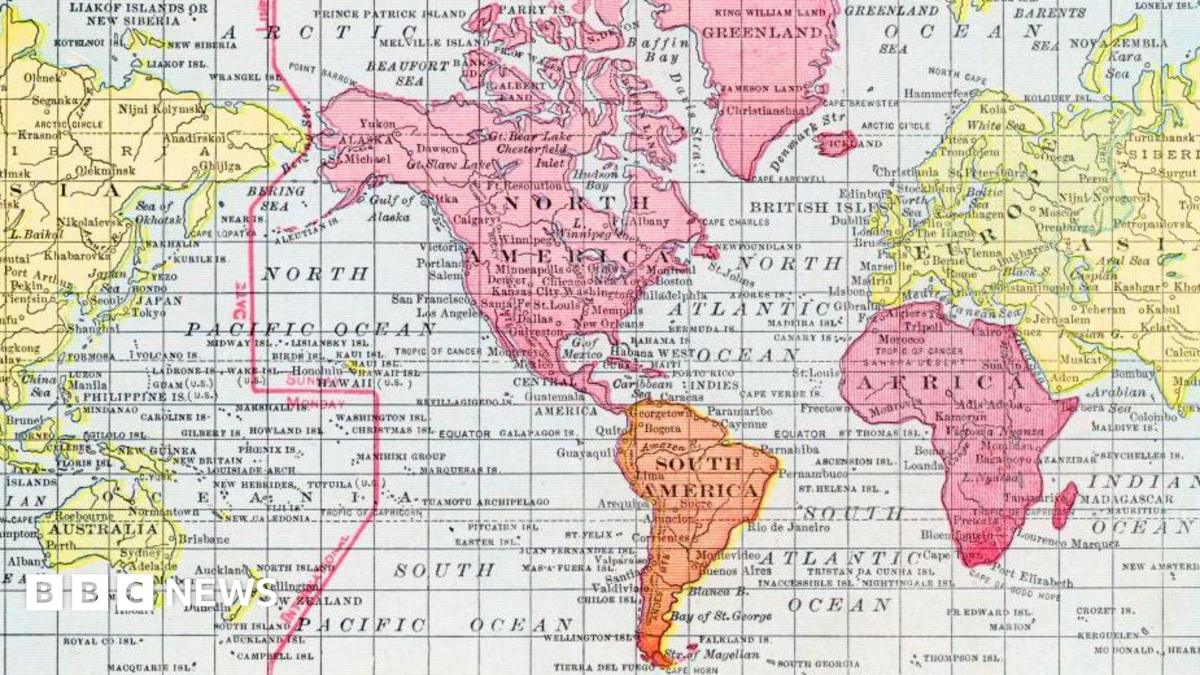
The now widely used Mercator map was created in 1569 by Flemish cartographer Gerardus Mercator.
Its main purpose was to help European sailors navigate the oceans, as cartography Professor James Cheshire at University London College explained.
“He wanted a straight line to be drawn on a map to look like a straight line in reality if you followed a compass bearing,” he told the BBC. “That was what it was intended to do, and that’s what it does brilliantly well.”
To keep those angles correct on a flat map, Mercator had to stretch the grid lines wider as they moved away from the equator toward the poles.
His map accommodates for the curvature of the Earth by making countries near the equator seem much smaller than they are, with countries nearer the poles appearing stretched.
The distortion is a result of it being impossible to accurately represent the surface of a globe on a two-dimensional chart.
More than 450 years on, Mercator’s creation is still the basis for many of the maps we see in classrooms, on TV and online, including Google Maps.
But critics of the Mercator map say there is a psychological effect to viewing some places as smaller than they actually are and others as larger, as we instinctively view bigger things as more important.
For Kenyan geographer Kioko Muendo, this has implicitly downplayed Africa’s vast resources, population and investment opportunities.
“Maps are more than just guides for travellers – they shape how regions are perceived politically and economically,” he told the BBC.
EVER fancied having a massive party on a plane and feeling like you’re on a private jet?
This September and in February next year you can head to an event on a Concorde plane.
You could party on a ConcordeCredit: instagram/@losttrackoftime.ukLost Track of Time is running events at Aerodrome BristolCredit: instagram/@losttrackoftime.uk
Lost Track Of Time runs different nighttime events with DJ sets, across the UK.
The events in September and February will feature a DJ between the jet’s two engines, with stages under the wings of the aircraft.
Sign up for the Travel newsletter
Thank you!
The hangar will have immersive lighting and projections as well as dancers, 360 staging and house and disco music.
The Concorde was the world’s fastest passenger plane, capable of reaching speeds twice the speed of sound.
Penny, the daughter of local copper Jack Branning (Scott Maslen), has since been caught up in a drugs smuggling plot, has caused a dangerous club crush, and enjoyed a brief romance with Harry Mitchell (Elijah Holloway).
Most recently, she found love with local businessman Vinny Panesar (Shiv Jalota), but before the romance could blossom, she found out she was pregnant, and confirmed that Vinny was the father.
In an unexpected twist, a midwife appointment soon revealed her dates didn’t match up, and her unborn baby is biologically Harry’s after they shared one night of passion, casting doubt over her relationship with Vinny.
Penny is yet to reveal the truth about the baby’s paternity as she moves in with Vinny and they set up a loving family home. Will the truth come out as Penny’s due date edges closer?
Away from Albert Square, Penny actress Kitty Castledine leads a much simpler life with her family in London.
She is the daughter of television star Lucy Alexander, who is famed for hosting popular daytime shows such as Homes Under the Hammer and A Place in the Sun.
Kitty’s father is ex-Premier League footballer Stewart Castledine, who played for Wimbledon for over 9 years. He also featured for Wycombe in the second tier.
Stewart has also appeared on television screens, hosting BBC One’s Big Strong Boys and Houses Behaving Badly.
Stewart and Lucy are said to have wed in 2000, during a ceremony in Richmond, London, after meeting through a mutual acquaintance.
They have two children, including Kitty and a son, Leo Castledine, 21, who is also a footballer and currently plays for Middlesbrough.
Who is Leo Castledine?
Leo is a midfielder for the Championship team Middlesbrough after joining the club in January 2026.
Prior to his current move, Leo was on loan at Huddersfield Town from Premier League side Chelsea, where he impressed, scoring 12 goals in 27 games for the Terriers.
“I’m absolutely over the moon to join what is a massive, massive club,” Leo explained about joining his new club. “It’s a really big step for me in my career, and I’m very excited to be here.
“There’s always been trust in young players at this club if they can perform, and I want to perform at my highest level”, reported BBC News.
Leo joined Chelsea as an Under-15 from AFC Wimbledon and worked his way up to make one substitute appearance for the first team, a Carabao Cup semi-final against Boro in January 2024. He has also worn the England shirt for the U19s five times.
EastEnders airs Monday to Thursday on BBC One and iPlayer
Hon Hai Precision Industry (HNHPF), a key server assembly partner for Nvidia (NVDA), reported NT$921.8B ($29.1B) in revenue for August on Saturday, marking its second-best monthly sales with 52% YoY growth, driven by accelerating AI momentum.
Liverpool sporting director Richard Hughes has stepped down and is set to join Saudi Arabian side Al-Hilal.
Hughes had only been at the club since June 2024, after moving from a similar position at Bournemouth, and his exit had been expected with his contract set to expire in June 2027.
In the summer he oversaw transfer spending of about £200m, including the signing of Bradley Barcola from Paris St-Germain.
“I’ll always follow and support the club with great affection, and I wish everyone involved nothing but success for this season and beyond,” said Hughes in a statement released by Liverpool.
Hughes, 47, arrived at Anfield after the departure of long-time manager Jurgen Klopp and was instrumental in the appointment of his successor, Arne Slot, who led Liverpool to a 20th Premier League title in his first season as manager.
Hughes oversaw the £125m record signing of Alexander Isak last summer and the £116m arrival of Florian Wirtz.
But Slot was unable to match his initial success and Liverpool finished fifth last season, prompting the Dutch manager’s departure and his replacement by Andoni Iraola, whom Hughes worked with at Bournemouth.
Mike Gordon, president of the Fenway Sports Group which owns Liverpool, said: “We respect Richard’s life choices and wish him and his family well in their next venture.”
Al-Hilal spent almost £180m signing Premier League players in the summer transfer window.
Al-Hilal, who are managed by former Inter Milan boss Simone Inzaghi, also secured the services of Netherlands midfielder Cyrenscio Summerville from West Ham for £60m.
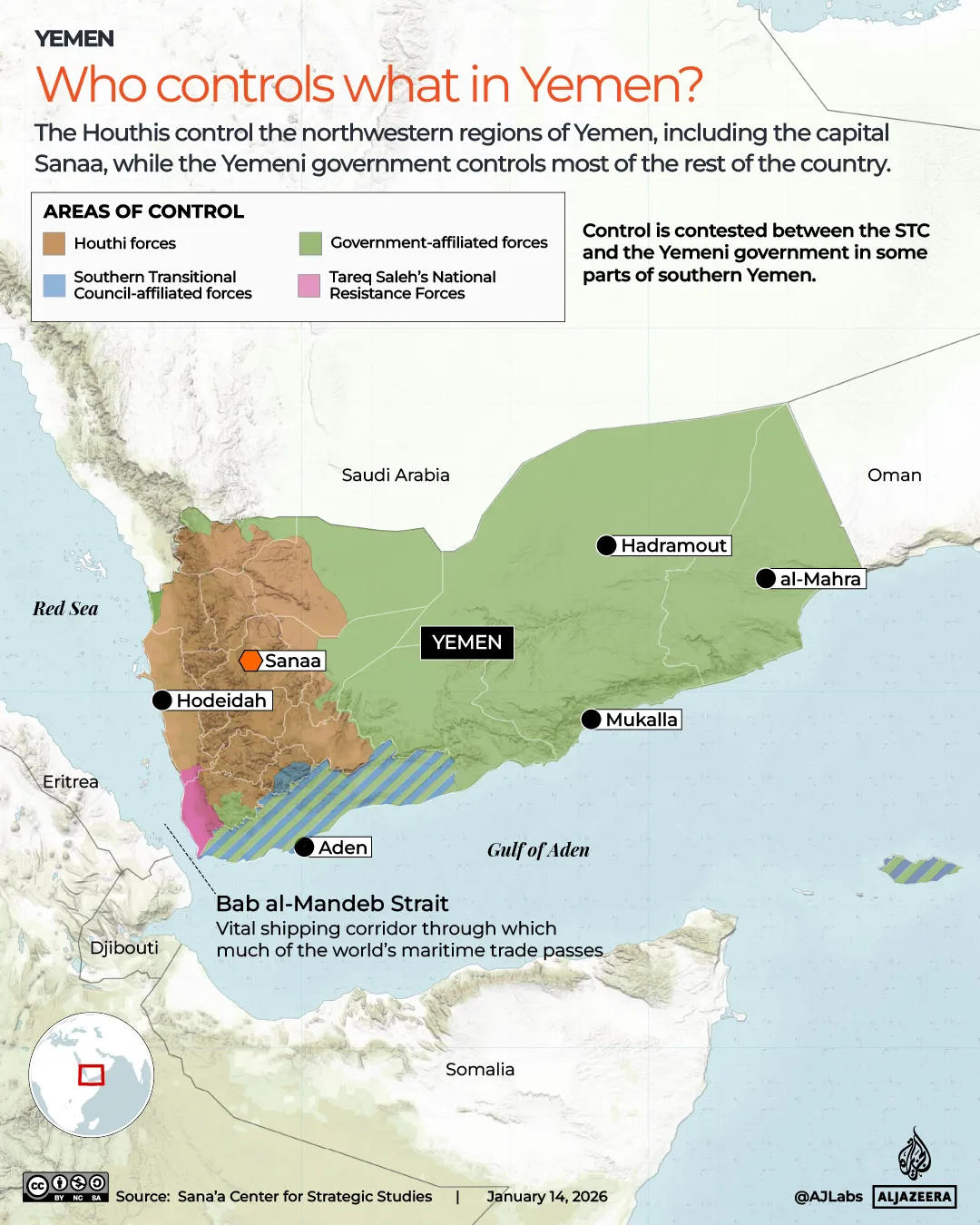
Yemen’s internationally recognised government has launched a series of air attacks against Houthi positions in the country, marking a significant escalation in the conflict, with some of the country’s heaviest fighting since a fragile truce in 2022.
Government warplanes carried out at least 15 strikes on Friday against Houthi positions, gatherings and vehicles in the western provinces of Taiz and Hodeidah, according to the Yemeni military.
Recommended Stories
list of 4 itemsend of list
The air assault against Houthi positions provided support to government forces fighting a major Houthi offensive towards the Red Sea coast and the strategic Bab al-Mandeb Strait, one of the world’s most important shipping routes.
These are not the first air attacks by government aircraft since Yemen’s fragile truce began to unravel in July. On July 25, government aircraft struck Houthi missile and drone launch sites and weapons depots in Marib and al-Jawf, according to Yemeni military officials cited by the Reuters news agency.
And less than two weeks earlier, on July 13, Yemen’s internationally recognised government said its forces had struck the runway at the Houthi-held Sanaa International Airport to prevent an Iranian aircraft from landing.
However, the latest attacks mark a significant step up in the government’s use of its own air power against the Houthis, after Saudi-led coalition aircraft provided much of the aerial firepower supporting anti-Houthi forces during the most intense years of Yemen’s war.
Friday’s air campaign comes as the Iran-backed Houthis, who have been vying for control of Yemen for years, attempt to advance through western Taiz and southern Hodeidah towards al-Makha (Mocha), and territory overlooking the critical Bab al-Mandeb Strait at the opening to the Red Sea.
Control of the area could strengthen the Houthis’ position along the Red Sea, where the group has previously attacked commercial and military vessels, while threatening a key government supply route.
The fighting unfolds against a backdrop of the wider regional conflict, with the Houthis recently declaring a Red Sea maritime blockade against Saudi Arabia, while disruption to shipping through the Strait of Hormuz during the US-Israel war with Iran has raised the strategic importance of alternative routes through the Red Sea. This means any expansion of Houthi influence around Bab al-Mandeb could have consequences for shipping far beyond Yemen.
Here’s what we know.
What has happened?
Fighting erupted on Thursday as Houthi forces launched a major offensive along front lines in western Taiz and southern Hodeidah, using ballistic missiles, drones and artillery as ground forces attempted to advance towards government-held territory along the Red Sea coast.
The fighting has centred on areas west of Taiz and around al-Makha, a government-held port near the Bab al-Mandeb Strait.
A Yemeni official in Aden told the AFP news agency that the Houthis were seeking to capture hills overlooking Bab al-Mandeb and al-Makha before pushing towards the coast.
Al Jazeera’s Yousef Mawry, reporting from Sanaa, said Houthi forces had made gains in western Taiz.
“According to military officials from the internationally recognised government, the Houthis have been able to take some of those territories,” Mawry said. “In western Taiz, they’ve managed to take over a strategic military base, which is settled on top of a strategic mountain and gives the Houthis an overview of the entire area.”
Mawry said there had been particularly heavy fighting around al-Barah and Maqbanah, where a main road is used to resupply government forces stationed in Taiz and al-Makha.
More than 120 fighters have been killed since the Houthi offensive began, according to an AFP tally, making the clashes among Yemen’s deadliest in years.
Several civilians were also reported killed and others injured after a ballistic missile hit a restaurant in the al-Makha area, according to government-run Saba TV.
On Saturday, at least four civilians were killed and nine others injured in a Houthi missile strike on a crowded road in southwestern Yemen, according to Saba news agency.
The attack by the Iran-backed group on Saturday targeted a gathering of civilians along the strategic Heijah al-Abd Road, south of Taiz city, Saba said, citing local and medical sources.
What is behind the latest tensions?
The Houthis seized Yemen’s capital, Sanaa, in September 2014 and subsequently took control of much of northern and western Yemen, prompting a Saudi-led coalition of Arab countries to intervene in support of the internationally recognised government in March 2015.
A United Nations-brokered truce in April 2022 sharply reduced fighting. Although the agreement formally expired six months later, large-scale hostilities between the Houthis and Saudi-backed government forces remained relatively limited and Saudi Arabia pursued negotiations with the group.
No comprehensive peace agreement followed, however, leaving front lines largely frozen rather than ending the conflict.
That fragile status quo came under increasing pressure after the United States and Israel launched their war against Iran on February 28, but tensions escalated further in July with the government air force strike on the Houthi-held Sanaa International Airport, preventing an Iranian aircraft from landing.
(Al Jazeera)
What do we know about Yemen’s air force?
The modern Yemeni Air Force was created after North and South Yemen unified in 1990, bringing together two militaries equipped with both Soviet and Western aircraft.
Its fleet subsequently included MiG-21 and MiG-29 fighters, Su-22 fighter-bombers, US-made F-5 fighters and a range of helicopters and transport aircraft.
But Yemen’s armed forces fractured when the Houthis seized Sanaa and the political crisis descended into war in 2014 and 2015.
When Saudi Arabia intervened soon after, its coalition targeted airbases, air-defence systems and combat aircraft in a bid to prevent the Houthis from making use of Yemen’s air force.
That left the Saudi-led coalition – rather than the Yemeni government’s own depleted air force – providing much of the air power supporting government forces during the subsequent war.
Saudi-led coalition aircraft conducted tens of thousands of air raids between March 2015 and the 2022 truce, striking Houthi military positions and providing air support during major government ground offensives. The campaign also caused extensive civilian casualties and became one of the most controversial aspects of the war.
Between 2014 and 2022, Human Rights Watch documented dozens of apparently unlawful coalition air attacks on homes, markets, hospitals, schools, detention centres and other civilian sites.
In 2024, the US and the United Kingdom launched a new round of air attacks against Houthi positions in Yemen following strikes on Israel-linked shipping in the Red Sea. Earlier this year, the US Pentagon disclosed that US military attacks against Yemen’s Houthis killed 153 civilians in 2025 and wounded another 243. The US had previously denied its attacks had caused civilian deaths.
The conflict in Yemen has caused a huge humanitarian crisis. In 2021, the UN estimated that 377,000 people had died in Yemen since 2014, with 60 percent the result of food shortages and lack of accessible health services.
Why is the Yemeni government using its own air power now?
Previously relying on Saudi-led coalition air force power, the government’s decision to deploy its own warplanes now comes as it tries to blunt a Houthi offensive that initially made gains across several fronts in western Taiz and threatened the main road linking Taiz with the Red Sea port of al-Makha.
Mohammed al-Basha, a Yemeni American analyst and former spokesperson for Yemen’s embassy in Washington, told Al Jazeera that the Houthis had achieved “some initial gains during a surprise, multi-axis offensive across western Taiz” this week, temporarily capturing positions and threatening areas overlooking the Taiz-al-Makha corridor.
But those advances did not produce the wider breakthrough the group appears to have sought, he said.
“The front did not collapse, the Taiz-al-Makha corridor was not severed, and attempts to expand the offensive towards other strategically important positions were stopped,” al-Basha added.
Government and allied forces recovered much of the territory lost during the first day of fighting, according to al-Basha, while Houthi advances on several other axes were contained or repelled.
The government has since sent reinforcements, and the use of aircraft gives those forces another means of attacking Houthi positions and concentrations as they try to retake high ground and prevent the group from cutting the Taiz-al-Makha road.
Why have the Houthis launched this offensive now – and what happens next?
Al-Basha said Jabal Numan, overlooking the Taiz-al-Makha road, is one of the most important remaining contested areas, while a Houthi attempt to capture Jabal Dhu Ba’s, north of Hays, was repelled by National Resistance forces.
Taking such high ground could allow the Houthis to observe and threaten government supply routes, while losing it could make further advances towards al-Makha substantially more difficult.
“The first day therefore ended with a mixed battlefield picture,” he said. “The Houthis gained ground through the initial surprise and speed of their multi-axis assault, but much of that ground was subsequently recovered.”
The arrival of new government-aligned forces, coupled with air support, could make it harder for the Houthis to repeat their initial breakthrough.
“The next phase is likely to be more difficult,” al-Basha said. “Both sides are reinforcing, several positions remain contested, and control of Jabal Numan remains a key immediate objective.
“The coming hours will likely centre on attempts by anti-Houthi forces to recover the mountain, consolidate their lines and prevent another Houthi push towards the Taiz-al-Macha corridor.”
The United Nations General Assembly has voted to back a resolution spearheaded by several African countries to adopt a map that shows the continent as much bigger than it is on conventional world maps.
On Friday, the resolution aimed at “a more accurate representation” of continental landmasses on the globe was supported by 164 countries, while the United States voted against it and six other states abstained.
Recommended Stories
list of 3 itemsend of list
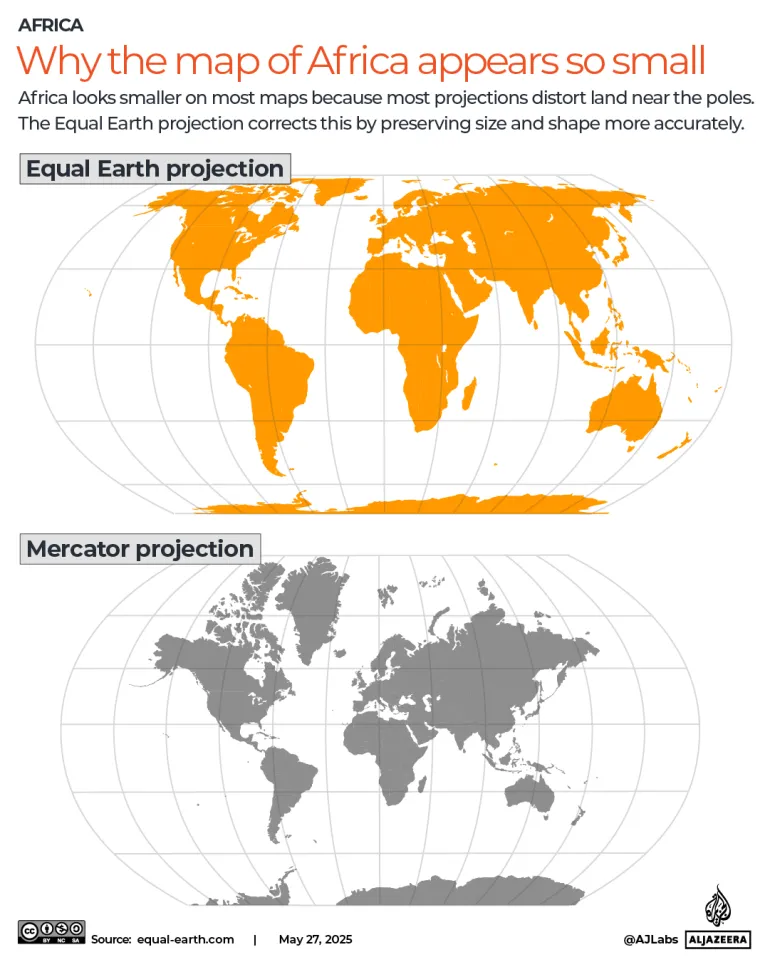
The new map – known as the Equal Earth cartographic projection – “is a relevant option for improving the accuracy of the cartographic representation of the world”, the resolution stated.
Foreign Minister Robert Dussey of Togo, which drove the resolution, said maps “guide education, nourish the imagination, and influence collective perceptions”.
“The resolution adopted today reaffirms African reality,” he added.
But how does the new map differ from the traditional version, and why did the US object?
What has the UN decided?
The UN has urged member states to adopt a new map in place of the centuries-old, traditional Mercator projection, which was designed for maritime navigation by Flemish cartographer Gerardus Mercator in 1569.
That projection focused on accurate depictions of the shapes and angles of land masses, but their relative sizes were often inaccurate – in part because of the challenge of rendering a three-dimensional globe onto a two-dimensional surface.
It inflated northern regions and compressed equatorial ones, making Europe and North America appear much larger, while shrinking Africa and South America.
(Al Jazeera)
How big are Africa, Latin America, South Asia and Oceania?
It does not look like it on the conventional Mercator map, but Africa is a giant among the world’s continents at about 30.3 million square kilometres (11.7 million square miles).
It is large enough to contain the US, China, India and most of Europe, yet on a Mercator map it looks roughly the same size as Greenland, which is actually about 14 times smaller than the continent.
Latin America covers roughly 20 million sq km (7.7 million sq miles), of which South America accounts for 17.8 million sq km (6.9 million sq miles).
Oceania spans about 8.5 million sq km (3.3 million sq miles), almost all of it Australia.
South Asia is the smallest of the four at about 5.1 million sq km (2 million sq miles), though it is home to about a quarter of the world’s population.
Combined, the four cover about 64 million sq km (24.7 million sq miles), more than 40 percent of the world’s land surface.
Europe, by comparison, is 10.2 million sq km (3.9 million sq miles).
What has the response to the change of maps been?
Largely positive.
France, which co-sponsored the resolution in support of the new map, announced on Friday that it would abandon the Mercator projection.
In that map, “the United States, Russia and China take on a disproportionate visual prominence compared to Africa, Latin America or Southeast Asia”, while “Greenland appears almost as big as Africa,” Foreign Minister Jean-Noel Barrot said.
“Changing maps obviously doesn’t change the world,” he added. “But correcting a distorted representation is already an act of truth.”
Only the US voted against it, while six other countries – Serbia, Estonia, Georgia, Lithuania, Moldova and Ukraine – abstained.
US representative Yaryna Ferencevych said before the vote that the resolution is “the reason this institution is losing its credibility”.
“Instead of focusing on genuine problems … this body is debating map projects from the 16th century,” she said.
What is Equal Earth?
Equal Earth was launched in 2018 by three cartographers – Bojan Savric of the Environmental Systems Research Institute, Tom Patterson of the US National Park Service, and Bernhard Jenny of Monash University.
“Equal Earth preserves the relative surface areas of continents and, as much as possible, shows their shapes as they appear on a globe,” Savric told the AFP news agency in 2025.
The UN resolution encourages governments and institutions worldwide to adopt the Equal Earth projection.
Will the world map actually change?
Friday’s resolution is not binding, but is intended to encourage changes to maps used by default around the world.
The UN said in its report that it is not banning the Mercator projection or imposing a replacement, but is merely encouraging the use of the Equal Earth projection.
BRITS jetting off to countries including Spain and France should be aware of new entry rules which are set to be rolled out in full in just a matter of days.
The EU’s new Entry/Exit System (EES), which is an automated border check for non-EU nationals, comes into full force on September 7.
The EU’s new Entry/Exit System (EES), which is an automated border check for non-EU nationals, comes into full force on September 7.Credit: AFP
It involves people from third-party countries such as the UK having their fingerprints registered and photograph taken to enter the Schengen Area, which consists of 29 European countries, mainly in the EU.
It means the rules will be fully enforced with no exceptions, raising fears of even longer queues for British holidaymakers.
Popular holiday destinations including Greece, Spain and France have all used flexibility when needed.
Back in July, countries including Belgium, France, Germany, Greece, Italy, Malta, the Netherlands, Portugal and Switzerland wrote to Home Affairs Commissioner Magnus Brunner asking to keep the congestion EES opt-out, EuroWeekly News reported.
The countries backed a full roll out, but did not want to face a cliff edge before Christmas.
A decision has not yet been made on the extension, so travellers should prepare to use the EES machines on September 7.
It comes as the new system has caused huge problems for those holidaying abroad this summer.
Some Brits reported waiting forup to six hoursin airports and others even missed their flight.
DESPITE their popularity, tattoos are still not fully accepted by those who do not cover their skin with childish drawings. Could it be for these obvious reasons?
They’re inherently frightening
A skull, even with flowers dotted around it, is still a human head stripped of flesh and a universal symbol of death favoured by organisations such as the SS. You have chosen to put one on your body permanently. Expect to be shunned.
Your tattoo jars with your job
Tattoos are popular in careers such as the Army. However jobs like nurse, accountant or fancy cake baker do not need the same macho, comrades-in-arms ethos. Did you drag that slice of red velvet cake out of a burning Humvee under enemy fire?
They makes you unemployable in a meta way
A potential employer won’t see your neck tats and think: ‘By Jove, he looks like a ruffian and a ne’er-do-well!’ because they’ve seen plenty. But they will think: ‘Did this guy not consider his future applications for professional roles when he had those done? No second interview for you, Machine Gun Kelly.’
They’re frequently clichéd
Maori-style ‘tribal’ designs, skeletons in top hats and roaring lions: all groaningly unoriginal. How were you this oblivious to trends when you had them done? Did you not realise they should each have a best-before date underneath?
Face and hand tattoos are loved by nutters
Equally popular with aggressive beggars off their heads, prison inmates and young chaps with poor impulse control and electronic tags. Your tats may be quite arty and cost £850, but you can’t expect people to switch off reasonable associations.
They’re notoriously chavvy
It is no secret that the body art of the lower classes is lavishly mocked. Expect sneering reactions to your tramp stamp and the names of your children in cursive script, especially if those names are Darcy-Rae and Jaxxon.
Tattooists can’t draw
A lot of stencils are involved, but questionable images get inked nonetheless. When others look askance at your dragon with a dislocated pelvis or are genuinely struggling to tell if that is a Minion or Bart Simpson, the problem lies with the artist.