AFTER more than a decade, a huge new museum which is more like the ultimate attraction for Star Wars and Indiana Jones fans is set to open.
The Lucas Museum of Narrative Art, created by filmmaker George Lucas, is set to open on September 22 in Los Angeles, America.
George Lucas has created a new museum in Los AngelesCredit: GettyThe museum – which looks more like a spaceship – will open on September 22Credit: Getty
Inside the new 28,000sqm museum, visitors will be able to explore items that Lucas has collected over the past five decades, including art, costumes, movie props and memorabilia.
In fact, the museum will be home to more than 1,300 objects in 30 galleries across five floors.
Sign up for the Travel newsletter
Thank you!
Of course, there will be plenty for Star Wars fans in the museum including sculptures of Yoda and Grogu as well as vehicles from the films.
Visitors can head to two cinematic theatres as well.
Away from Lucas’ own creations, there will be art by Frida Kahlo as well as rare comics by Frank Miller and Cowboy Bebop anime.
There are some early sketches by Van Gogh and Picasso too
And Banksy has contributed artwork to the museum as well.
Visitors will also be able to catch an insight into Lucas’ early life too, with his student films on show.
Inside visitors will be able to see Star Wars propsCredit: ReutersAs well as work by famous artists like BanksyCredit: GettyThe museum has taken more than 16 years to buildCredit: AFP
The museum itself also looks like a spaceship, with curved white walls.
Outside the museum, there are large green open spaces, with more than 200 trees and a waterfall-like fountain.
If you get hungry, there’s the Skywalker Grill as well, offering all-day dining including seafood, grilled dishes, pasta and desserts.
The museum will be open from 10am to 5pm on Mondays, Wednesdays and Thursdays, 10am to 9pm on Fridays, 9am to 9pm on Saturdays, 9am to 5pm on Sundays and is closed on Tuesdays.
Adult tickets cost $25 (£18.50) per person and children’s tickets (up to 17-years-old) are free.
For the first time since World War II, a far-right party is within reach of power at state level in Germany, after coming first in Saxony-Anhalt on Sunday.
The Alternative for Germany (AfD) won 44 percent of the vote, stopping short of an overall majority but making clear its wide political significance.
Recommended Stories
list of 3 itemsend of list
On election night, AfD’s leader in the state called on other political groups to cooperate. “As a democrat, I will reach out to all those who wish to work with us to bring about a fundamental political turnaround,” Ulrich Siegmund said.
Yet, forming a government will prove difficult. The AfD has been classified as “far-right extremist” by the domestic intelligence agency and other political groups remain wary of striking an alliance.
The AfD has dismissed accusations of extremism and mainstream parties have been unable to halt its surge in the polls over recent months. Latest polling indicates the party, which stands for strong restrictions on immigration, restoring ties with Russia, cutting support to Ukraine and quitting the euro, is Germany’s most popular at national level.
The Saxony-Anhalt election could be a harbinger of a historic return of the far-right in the 2029 national election, when forecasts say the AfD stands a realistic chance of finishing first.
What happened in Saxony-Anhalt?
Siegmund, the charismatic 35-year-old who attracted thousands to his campaign rallies, said AfD “made history”.
“The people have made it absolutely clear that they finally want political change and, above all, they have shown that they want it with us,” he told supporters.
The AfD achieved its best-ever election result in Saxony-Anhalt with 44 percent of the vote, leaving all other parties far behind. The incumbent centre-right Christian Democrats (CDU), led by Chancellor Friedrich Merz, scored less than half of that share with 17 percent.
The AfD is projected to gain 39 of the 83 seats in the state parliament in Magdeburg, leaving it three short of the 42 needed for an absolute majority.
That means the party must find allies, but all other mainstream parties refuse to work with the far-right, a strategy of non-cooperation known as the “firewall”. The AfD has so far never participated in a governing coalition in Germany’s 16 states nor in its federal government.
While he now appears willing to strike deals with other parties to come to power, previously Siegmund signalled unwillingness to find middle ground with other political groups. Leading up to the vote, he stated that he was only interested in governing alone to bring about fundamental political change in Germany.
How did AfD fare in recent elections?
The election takes the AfD one step closer to advancing its agenda, while also reflecting the growing unpopularity of Germany’s ruling coalition.
In Saxony-Anhalt, the party more than doubled its vote share — from 21 percent in the last election. By contrast, the CDU’s vote halved from 37 percent to 17 percent, its worst result ever in the east-central German state.
Federal elections last year similarly resulted in a landmark performance by the AfD, which emerged as the largest opposition faction in the Bundestag, the German federal parliament in Berlin. The party came second with 21 percent of the vote, securing its highest-ever showing.
In state elections in Baden-Wurttemberg and Rhineland-Palatinate earlier this year too, the AfD more than doubled its seats — though it still finished third. In 2024, the AfD emerged victorious in the Thuringia state election and second in the Brandenburg state election — both were firsts for the party.
The AfD’s electoral gains in Saxony-Anhalt mirror growing dissatisfaction among voters — especially in the former East Germany — about the stagnant economy, high unemployment and domestic security, which the party largely pins on immigration.
What challenges lie ahead for AfD?
Since its formation in 2013, the AfD has been embroiled in various scandals and has faced major controversies, including alleged foreign espionage links, secret deportation plans and internal nepotism.
The party went from a fringe Eurosceptic group to the country’s most powerful opposition force in little more than a decade, becoming too extreme even for the European Parliament’s far-right Identity & Democracy group. It kicked the party out in May 2024 after lead AfD candidate Maximilian Krah stated that not everyone in the SS – Adolf Hitler’s infamous Nazi paramilitary organisation – was a criminal.
Krah has also been under investigation by German prosecutors for alleged illegal payments, bribery and money laundering linked to China and Russia. The German parliament last year decided to lift the far-right legislator’s immunity to help investigators.
AfD politicians have also come under fire for employing family members, including in Saxony-Anhalt, where several parliamentarians are reported to have employed relatives.
Bundestag President, Julia Klockner, banned seven AfD employees from entering the German parliament over security concerns, after they failed internal background reliability checks due to their ties to right-wing extremist networks and past criminal convictions.
Senior AfD figures also faced a backlash for attending a secretive meeting to discuss mass deportation plans for people with a migration background.
What are the AfD’s prospects for the national election in 2029?
Pollsters are unanimous in forecasting the AfD as the largest party in Germany in the next national election in 2029, with around 28 percent of the vote.
That would mark a major transformation in the German political landscape from 2025, when the CDU and its ally the Christian Social Union together won 28.5 percent of the vote.
Yet even that outcome would not necessarily give AfD the ability to govern. If other parties maintain a “firewall” policy, that could prevent the far-right party from forming a coalition government.
Still, the Saxony-Anhalt election has been received by some politicians as a call for change. “Politics begins with considering reality,” Cem Ozdemir, head of government in the southwestern state of Baden-Wurttemberg and a member of the Green Party, wrote on X.
“That means the AfD is the election winner in Saxony-Anhalt. And that must mean for all democratic forces that nothing can remain as it is, and we must fundamentally reconsider our politics and our political style.”
“Pravac Potocari” or “Direction Potocari” were the words used by former Bosnian Serb general Ratko Mladic as he entered Srebrenica on July 11, 1995.
Mladic was referring to the nearby village of Potocari, which hosted a United Nations peacekeeping base and was the initial gathering point for Bosniak refugees during the war in Bosnia. Under Mladic’s command, Bosnian Serb forces committed a genocide against thousands of Bosniak men and boys in the days that followed.
“Pravac Potocari” was also the slogan the fans of the Serbian football team Red Star chose on Sunday to honour the so-called “butcher of Bosnia”, who died in The Hague, the Netherlands, on August 27, while serving a life sentence for genocide, war crimes and crimes against humanity. During a match against city rivals Partizan in the Serbian capital, the supporters also unveiled a giant image of Mladic and observed a minute of silence in his memory.
The tribute came days after European football governing body UEFA fined Red Star a total of 98,250 euros, or $114,100, over a banner -“General, eternal glory and thanks” – dedicated to Mladic that was unveiled by the club’s ultras during a Europa League playoff away leg in Plzen, in the Czech Republic.
The penalty included a ban on Red Star supporters travelling to the club’s next two European away fixtures, in Lugano, Switzerland on October 15 and Ghent, Belgium on November 26.
It was not the first time Red Star supporters had expressed support for Mladic during a European match. Nine years earlier, fans displayed similar messages during a Europa League tie against Belarusian club BATE Borisov.
‘Most shameful event this stadium has seen’
For Slobodan Georgiev, a news director at TV Nova S in Serbia, the minute of silence at Belgrade’s Marakana stadium marked a qualitative shift rather than a repeat performance.
“Glorifying a convicted war criminal is nothing new, but officially paying tribute to him with a minute of silence is new – and it’s the most shameful event this stadium has witnessed,” Georgiev said. “Displaying the shameful slogan ‘Pravac Potocari’ cannot be justified, though in the coming days we’ll surely see attempts to do so.”
He placed the display in a much longer lineage. “Since the breakup of Yugoslavia, the terraces have served as a recruitment centre for paramilitary formations, and in various forms that haven’t changed to this day,” he said. “The worst messages have always travelled through the terraces – everything the authorities didn’t dare say themselves, they most often said through the stands, as they did … at the Red Star–Partizan match.”
But what made Sunday’s so-called “eternal derby” notable was not only the Red Star display.
Partizan’s own hardcore supporters, the Grobari, had raised their own banner in tribute to Mladic – reading “General, thank you” – just a week earlier, on August 31, during a Serbian Super Liga match against OFK Beograd, with Mladic’s flag flying over the north stand for the full 90 minutes.
For Georgiev, the fan groups are not an autonomous phenomenon, but an instrument. “The state, through its secret services and through criminal groups, has always managed these groups and used them for the worst tasks: Mobilisation in war, crime in peacetime, and delivering the ugliest political messages,” he said. “A stand that boasts it was founded by Zeljko Raznatovic Arkan, and that sings in praise of Ratko Mladic without facing any legal consequence for it, speaks for itself.”
Georgiev was referring to Arkan, the Serbian paramilitary leader whose unit committed atrocities during the Yugoslav wars and who, before his assassination in Belgrade in 2000, was closely associated with Red Star’s hardcore fan base, the Delije – a group he is widely reported to have helped organise.
‘Clearest indication issue deeply ingrained’
Sasa Djordevic, a senior analyst at the Global Initiative Against Transnational Organized Crime (GI-TOC), sees the same continuity Georgiev described, tracing it back further still. “The connection between football hooliganism, nationalism and politics in Serbia dates to the late 1980s and became particularly evident during and after the breakup of former Yugoslavia,” he said. “Certain elements of the hooligan scene have since been exploited as a political ‘rent-a-mob,’ and some group leaders have reaped benefits from political protection or business opportunities.”
What worries him most now is not the display itself, but how unremarkable it risks becoming. “Incidents like those that occurred at Marakana last night risk being perceived as routine rather than serious manifestations of hate speech,” he said. “Public debate has nearly vanished, and society seems increasingly desensitised to violence and hate speech in stadiums. When such behaviour starts to feel normal, it may be the clearest indication that the issue has become deeply ingrained.”
Ivana Jeremic, an editor at the Balkan Insight publication, pointed to why sports venues serve that function so well. “Stadiums have long ceased to be merely sporting arenas – they are fertile ground for sending messages that can’t be spoken publicly, or that come wrapped in a softer form,” she said. “Matches involving Partizan, Red Star, and the national team stand out in particular for this.”
The political ties, she argued, are an open secret. “The political connections between the fans leading the stands and those in power are something of a public secret, with a number of documented examples of direct influence. What we hear or see on the terraces could hardly happen without some form of ‘permission’ from the authorities,” Jeremic said. “When it comes to Mladic, we’ve seen a rise in such messages in recent days. Red Star’s fans, as well as the club itself, are currently perceived as a mouthpiece of the government.”
On Thursday, a Serbian government plane carried Mladic’s body from The Hague to Belgrade for burial, where it was received with military honours.
Red Star fans wave a flag showing Ratko Mladic during the match against Partizan [Darko Vojinovic/AP Photo]
From the terraces to paramilitary structures
Djordevic traced the mechanism behind this convergence to the same period cited by Georgiev. “During the breakup of Yugoslavia, football stadiums became spaces for nationalist mobilisation, and for some young men the step from organised football violence to paramilitary structures was short,” he said. “Hooligan groups since then cultivate loyalty, hierarchy, readiness to use violence and rapid mobilisation to achieve their extremist views that go beyond strictly football supporter beliefs.”
That structure is not unique to Serbia, but it is particularly acute there. GI-TOC’s regional research examined 122 fan groups, identifying 78 as ultras – and found 21 groups combining violent hooliganism with links to extreme politics. “The most problematic situation was in Serbia, followed by Bosnia and Herzegovina,” Djordevic said, while cautioning against overreach. “The term ‘terrorism’ should be used cautiously: The evidence points to particular groups or individuals linked to violent extremism and paramilitary structures, not supporter groups as a whole.”
UEFA’s disciplinary decision detailed the layers of the punishment: A 50,000-euro ($58,000) fine for transmitting a message unfit for a sporting event, an 8,250-euro ($9,580) fine for team misconduct, and the activation of a suspended sanction originally imposed in April 2025 over racist conduct by Red Star fans – a suspended stadium ban now converted into a one-match travelling ban, conditionally extended for a further two years.
But fines on paper, Djordevic said, rarely reach the people who are actually liable. “The problem is that fines imposed on clubs do not necessarily affect those responsible for the incidents,” he said. “If hooligans remain untouched, financial penalties can become simply another cost of doing business rather than a tool for changing behaviour. That does not mean clubs do not care. They respond when sanctions are certain, substantial, and consistently enforced, as seen more clearly in basketball games than in football.”
The gap, he argued, is not a lack of rules. “Serbia already has a solid legal framework,” he said. “The real issue is enforcement. Sanctions need to be applied quickly, consistently and without exceptions, both to clubs and to individuals responsible for violence and hate speech.”
THERE is nothing worse than a delayed or cancelled flight – and one airline is now making passengers pay extra if they want help quicker.
Wizz Air has launched a new add-on called ‘Disruption Assistance’, which it claims is ‘added protection’.
Wizz Air has introduced a new service called ‘Disruption Assistance’Credit: Alamy
According to the airline, passengers will “get extra support if your flight is disrupted on the day of travel”.
The new add-on means that travellers will get notifications for disruptions over two hours, for any reason including severe weather, issues at airports or even strikes.
Sign up for the Travel newsletter
Thank you!
Another part of the add-on is that you will get rebooked quickly when time matters, even if this means needing to travel with another airline.
You will also be able to request a full refund if the alternatives offered to you don’t work.
The final part of the add-on is that you will get “access [to] easy self-service tools or speak to an agent”.
You can add Disruption Assistance during the booking process or in Manage My Booking on the airline’s website or app.
In addition, if your flight is impacted on your day of travel, you will be sent an email to the Disruption Portal where you will be able to rebook via one of the options given or offered a refund.
According to EX-YU Aviation, the add-on costs between €9.90 (£8.51) and €14.90 (£12.80) per person.
Passengers will pay for the add-on which will prioritise booking them onto a new flight if theirs is delayed or cancelled by more than two hoursCredit: Getty
Legally, the airline must rebook you under EU/UK Regulation 261/2004, if your flight is cancelled or delayed by more than five hours.
Airlines will usually try to rebook you on their own airline’s next available flight.
However, if they are unable to get you to your destination on the same day or next day, they must legally book you onto a rival airline and reimburse you.
Essentially, the Disruption Assistance add-on means you don’t have to battle with the airline’s customer service for a new flight or refund.
Flight compensation rules
A look at your rights if a flight is delayed or cancelled, when your entitled to compensation and if your travel insurance can cover the costs.
What are my rights if my flight is cancelled or delayed?
Under UK law, airlines have to provide compensation if your flight arrives at its destination more than three hours late.
If you’re flying to or from the UK, your airline must let you choose a refund or an alternative flight.
You will be able to get your money back for the part of your ticket that you haven’t used yet.
So if you booked a return flight and the outbound leg is cancelled, you can get the full cost of the return ticket refunded.
But if travelling is essential, then your airline has to find you an alternative flight. This could even be with another airline.
When am I not entitled to compensation?
The airline doesn’t have to give you a refund if the flight was cancelled due to reasons beyond their control, such as extreme weather.
Disruptions caused by things like extreme weather, airport or air traffic control employee strikes or other ‘extraordinary circumstances’ are not eligible for compensation.
Some airlines may stretch the definition of “extraordinary circumstances” but you can challenge them through the aviation regulator the Civil Aviation Authority (CAA).
Will my insurance cover me if my flight is cancelled?
If you can’t claim compensation directly through the airline, your travel insurance may refund you.
Policies vary so you should check the small print, but a delay of eight to 12 hours will normally mean you qualify for some money from your insurer.
Remember to get written confirmation of your delay from the airport as your insurer will need proof.
If your flight is cancelled entirely, you’re unlikely to be covered by your insurance.
WASHINGTON — A sporadic global trade war led by President Trump is fueling inflation across the U.S. economy, elevating prices on everyday goods, as the war with Iran sends the price of gas on a roller coaster.
Aggressive tax cuts have pushed the national debt past $40 trillion, driving a growing crisis in the bond market. And an unprecedented immigration crackdown is disrupting the labor supply in agriculture, construction, hospitality and food processing, raising prices even further.
Approaching the halfway point of Trump’s second term, a president who won reelection based on a promise to turn the economy around now faces a reckoning in the midterm elections centered largely on his economic record.
Trump’s economic agenda has emerged as an increasingly awkward liability for Republicans heading into the November elections, leaving lawmakers to defend policies that have delivered political pain at home, even as the White House argues they will pay off in the long run.
Polling on Trump’s handling of the economy has remained in precariously low territory throughout the summer, entering Labor Day weekend with less than a third of Americans supporting his job performance on their most pressing concerns. One recent poll, from the University of Massachusetts Amherst, found that only 22% perceive the economy in a good or fair state.
Shoppers at Lincoln Heights Certified Farmers Market in Los Angeles on Wednesday.
(Jason Armond / Los Angeles Times)
And Americans’ confidence in the economy is unlikely to improve much ahead of election day, Nov. 3, in part because bad economic news has shown to sink confidence fast. Good news takes much longer to win people back, experts said.
“Voters’ opinion of the economy has mostly hardened,” said Aaron Klein, chair of economic studies at the Brookings Institution. “People vote the economy of the spring and summer, not November.”
Good news has been harder to come by.
Heading into the holiday weekend, Trump dismissed communities opposed to data-center construction as “backwards and poor.” A rapidly escalating trade dispute with Canada threatens Republican gains in battlegrounds along the northern border that could determine control of the Senate.
Sean Zabriskie, center, helps his son Connor, 7, try on hockey pants at The Ice Box Hockey shop in Harbor City. The trade war between the U.S. and Canada is affecting products like hockey gear, most of which is made in Canada and imported to the U.S.
(Genaro Molina / Los Angeles Times)
And fresh polling found that more than 90% of Americans believe corruption is rampant in Trump’s government, even as the president spends hundreds of millions of dollars on vanity projects across the capital.
Susan Collins, the incumbent Republican senator from Maine seeking another term in a strategically critical race, chastised the Trump administration for its latest trade spat with Ottawa as “making the job harder” of securing reelection.
“There’s just nothing good you can say about them,” Collins said of the tariffs.
Trump has pushed back on criticisms of his record, declaring the country has “the greatest economy we’ve ever had” and touting what he calls a manufacturing boom, all while distancing himself from potential midterm losses.
“I’m not affected by the election,” Trump told reporters last week. “I’m not running. But my party’s running, and I’m going to help my party.”
But Rep. Mike Johnson, a Louisiana Republican and speaker of the House, said last week that the midterms would serve as a referendum on Trump’s presidency.
Rep. Aisha Wahab (D-Hayward) and Speaker of the House Mike Johnson (R-La. ) arrive for a ceremonial swearing-in at the Capitol in Washington, D.C., on Sept. 2.
(Andrew Harnik / Getty Images)
“Even though his name isn’t in the midterm, his legacy is,” Johnson said. “The America First priorities and principles are. His administration is.”
Several embattled incumbents fear that’s the case and are distancing themselves from the president. Several Republican lawmakers — including Reps. Tom Barrett of Michigan and Zach Nunn of Iowa — plan on skipping a midterm GOP convention called by Trump for this week in Texas.
Joanne Hsu, director of the University of Michigan’s Survey of Consumers, said that gas prices were a chief frustration among Americans, and found that consumer sentiment soured rapidly once it became clear the conflict in Iran would not be short-lived.
“Consumers are absolutely not feeling great about the economy right now, and the factors that are underpinning their frustrations with the economy at this time are factors that are pretty tough to turn around on short notice,” Hsu said.
Even if the Iran conflict reached a resolution, confidence in the economy is likely to change only when the prices are reflected at the gas station, she said.
“When it comes to the views of the economy, it’s really about what’s happening to my wallet,” Hsu said.
During a White House press media briefing on Thursday,Vice President JD Vance acknowledged the Iran war has led gas prices to rise and that he does not know when Americans can expect those prices to go down.
Vice President JD Vance talks to reporters during a news briefing at the White House on Sept. 3.
(Chip Somodevilla / Getty Images)
“The reason gas prices are so high now is because the Iranians are shooting at commercial shipping,” Vance said. “Gas, frankly, could have been much, much higher were it not for our efforts. But I am not going to make a promise about when it is going to return to $3.”
The day after Vance spoke, diesel hit a record all-time high of $5.85 a gallon. In California, it sold for as much as $7.71.
Yet Trump has tried to downplay the economic pressure the war in Iran is placing on Americans, in particular as the Strait of Hormuz — a vital shipping corridor for oil and gas — remains under threat by Iranian troops.
Diesel prices over $7 a gallon are displayed at a gas station in Los Angeles on Aug. 21.
(Justin Sullivan / Getty Images)
“We have the Strait of Hormuz in extremely good shape,” Trump said, adding that the U.S. Navy has escorted ships through the channel. “A lot of oil is coming out. That’s why you haven’t seen the price of oil going the way they thought it might have to go.”
Trump on Monday also touted an agreement with the Venezuelan government to develop a vast amount of the South American country’s oil reserves. Asked how he sees the deal affecting American consumers, Trump said: “Ultimately prices are going to come down.”
One of the Arts of War statues, newly covered in gold leaf, is visible at Arlington Memorial Bridge near the Lincoln Memorial in Washington, D.C.
(Andrew Harnik / Getty Images)
“Now, will it happen before the election? I can’t tell you that. But I think people are very smart,” he said.
For some Americans, the economic pressures are a key driver ahead of the midterm elections.
Monica Escalante, a home care provider who is a member of the United Domestic Workers union, said she started feeling the pinch on her wallet after Trump imposed sweeping tariffs on a number of products she buys at the grocery store. Gas, she noticed, became harder to cover after the Iran war started.
Escalante, who lives in Bakersfield, said she also has to drive her client to the grocery store, and that mileage reimbursements are not enough to cover her costs.
“It’s really hard when I don’t have the money for gas, and she doesn’t have the money for gas. Then it is like: What do we do?” she said. “It is either she’s borrowing or I’m trying to figure out how I can get gas in my tank.”
Pakistan have begun an inquiry into “discipline and conduct” in the latest twist on a turbulent tour of England.
Already 2-0 down in the three-match Test series, Pakistan last week sent seven players home, called up seven more and replaced head coach Sarfaraz Ahmed with New Zealander Mike Hesson.
During the second Test at Lord’s, the tourists also threatened to cancel the remainder of the match and the tour over an interview broadcast by Sky with the imprisoned former Pakistan prime minister and captain Imran Khan.
In a statement released on Monday morning, the Pakistan Cricket Board (PCB) said: “The Pakistan Cricket Board has initiated an internal disciplinary inquiry following media reports concerning discipline and conduct, which are currently being reviewed internally.
“The PCB handles such matters in accordance with its standard procedures. The process is being conducted under PCB regulations, ensuring that all concerned individuals are given due consideration.”
The statement refers to “speculative reports” from “hostile external sources”.
Last week, Hesson responded to reports Salman Ali Agha – one of the seven dropped players – refused to attend a meeting with King Charles at Clarence House.
Hesson also refuted suggestions that Mohammad Imran and Mohammad Imran Jr were both called up as replacements because the PCB was confused by their names.
The statement continued: “At this stage, any speculative reports or unverified claims circulating on certain platforms, particularly those originating from hostile external sources, should not be regarded as credible.
“The PCB will not comment further at this time. The Board advises stakeholders and the public to rely on official PCB communications.”
NEW YORK: Defending champion Carlos Alcaraz will be under the microscope again on Sunday taking on 20th-seeded American Tommy Paul for a place in the US Open quarter-finals.
The Spaniard, playing his first tournament since a four-month absence with a wrist injury, acknowledges he has yet to play his best but says he’s “getting there” with both the sharpness of his shots and his on-court decision making.
He headlines a day that also features women’s two-time defending champion Aryna Sabalenka and third-ranked American Jessica Pegula — just one of the players with a chance to supplant Sabalenka atop the world rankings in New York.
Surprise Wimbledon champion Linda Noskova will try to continue her progress toward another Grand Slam against dangerous Ukrainian Marta Kostyuk while US hope Frances Tiafoe faces the always tricky former champion Daniil Medvedev.
AFP Sport looks at three matches to watch on Day 8 of the US Open:
Tommy Paul (USA x20) v Carlos Alcaraz (ESP x2)
Alcaraz leads head to head 6-2
— Although Alcaraz has dominated their meetings — Paul’s last win over the Spaniard was back in 2023 — the defending champion said the American is “really dangerous for everyone on the tour.
“The way he plays, the way he hits the ball, it’s really complicated to dominate the ball, dominate the points,” said Alcaraz, who won their last meeting in the Australian open quarter-finals on the way to the title that made him the youngest man to claim a career Grand Slam.
Alcaraz said he was looking forward to another great battle — and having some fun.
“We pull off great points, great shots,” he said. “It’s going to be really fun to watch, fun to play, as well.”
Ben Shelton (USA X8) v Stefanos Tsitsipas (GRE)
Tsitsipas leads head to head 1-0
— A resurgent Tsitsipas has Shelton’s attention. The former top-five player from Greece upset red-hot Arthur Fils in the first round and ousted 18th-seeded Jiri Lehecka in the third and is deeper into a Grand Slam than he’s been in more than two years.
Playing pain free after back problems derailed his 2025 campaign, the two-time Grand Slam finalist is also working with a new coach, having replaced his father Apostolos in that role.
“I have been watching his matches,” Shelton said. “I think he’s playing great. I think that his style of tennis can be very, very effective on all surfaces, all-court game, great athlete.”
Shelton said his three four-set wins in the first three rounds — against Tallon Griekspoor, Hubert Hurkacz and Denis Shapovalov — had him well prepared for anything Tsitsipas might throw at him.
“I think this is a great way to start the tournament in terms of variety. I have dealt with a lefty, dealt with a big hitter, dealt with a feel guy, dealt with a massive server, dealt with a spot server, serve and volleyer.”
Aryna Sabalenka (BLR x1) v Taylor Townsend (USA)
First meeting
— Sabalenka knows she’ll be in hostile territory when she takes on 96th-ranked American Townsend on Arthur Ashe Stadium.
“I think I’m ready for the crowd situation,” Sabalenka said. “She’s, I’d say, tricky player, because she brings the variety — comes to the net, really make you think during the game.”
Townsend is in the fourth round for a second straight year, but it has been anything but a straightforward 12 months for the 30-year-old, who says she has “been through a lot over this past year.” It hasn’t dimmed her desire to win, and Townsend said she was “pumped” to take on Sabalenka in a quest for a first Grand Slam singles quarter-final.
“I’m built for these moments,” Townsend, a three-time Grand Slam doubles winner, said. “I’m ready to take it. I’m ready to go.”
The far-right Alternative for Germany (AfD) is “very, very close” to taking power, its deputy parliamentary leader has told the BBC, after a historic victory in elections for the eastern state of Saxony-Anhalt.
Sunday’s preliminary results show it fell three seats short of an outright majority, with 43.8% of the vote. It is now seeking support from other parties or individuals in order to govern.
While most German political parties refuse to work with the AfD, Beatrix von Storch called for its opponents to enter talks and said: “You cannot say I do not accept the vote of the people”.
Germany’s Chancellor Friedrich Merz said he was “deeply shocked” by the result, describing it as “seismic… not just in the country but also in my own political party and I take that very seriously”.
His party, the conservative CDU, saw its share of the vote almost halved to 17.2% in the state’s preliminary results.
Merz said it was not possible to return to “business as usual”, adding that the country needed “profound reforms” and the CDU needed to “reach people at an emotional level.
“This election result is a seismic result not just in the country but also in my own political party and I take that very seriously,” he said.
No far-right party has controlled a German state since World War Two, and governing at state level would mean powers over policing and local education.
Von Storch said the state’s results “were on the table and now democrats have to talk to [one] another. This is what democracy demands”.
She added that if parties refused to work with the AfD, “then we might end up in severe chaos and maybe we have a new election”.
Her comments were echoed by AfD’s leader in Saxony-Anhalt, Ulrich Siegmund, who told a news conference on Monday that the party had won a “clear mandate to govern”.
The state’s defeated premier, the CDU’s Sven Schulze, also said the mandate to govern Saxony-Anhalt “now lies with the AfD”.
Saxony-Anhalt has a small population of 2.1 million and the AfD in the state is assessed by domestic intelligence as “right-wing extremist”, a classification rejected by Siegmund, 35.
The party’s plans for Saxony-Anhalt, which include segregating child refugees into special classes and setting up a task-force to help detain and deport migrants who no longer have the right to be in the state, are highly controversial within Germany.
Siegmund said discussions with other parties were initiated on Sunday night and could potentially take days or weeks to conclude.
“We reach out to everybody first, we will have consultations and then we’ll see whether [there are] individual parliamentary groups or MPs who would be willing to help us,” he added.
The AfD is currently heading for 39 seats in the 83-seat state parliament instead of the 42 needed for an outright majority, although the result has not yet been finalised.
Von Storch told the BBC the AfD was talking to individuals within the CDU group – the largest party in both the state’s outgoing coalition and Germany’s government – because they were “very, very unhappy with their own party”.
Inside the Universalist Unitarian Church of Riverside, a line of masked people filed into the red-lighted chapel, one by one, to take part in the rite of confession.
The private booth was framed in flowers, and rather than a priest listening inside, it was a microphone recording their confessions, to be played at an upcoming art exhibition. The brick triangle-roofed church that held the booth has stood since opening in 1892; that night, it was the site of a masquerade, or as Riverside artist Perry Picasshoe called it, the “Masqueerade.”
Picasshoe, whose real name is Neveah Marquez, hosted the event, which had an entirely LGBTQ+ guest list and one requirement: Bring a mask, whatever that looks like to you.
Marquez, a 26-year-old transgender woman robed entirely in red, stood at the pews and danced to the experimental electronic DJ sets and drag performances as guests entered in masks that ranged from papier-mâché deer antlers to collaged photos of eyes and lips.
The event came as a celebration ahead of the Riverside native’s first solo exhibition, “SagradX,” which will open Saturday at Riverside Art Museum and remain through Jan. 31.
The recorded confessions, layered over one another until they become an unintelligible cacophony, represent just one piece of the 25 paintings, photographs and interactive displays in the exhibition. The show explores the meaning of “sacred” as Marquez documents her most private places and experiences, and asks viewers to consider what they hold sacred.
The exhibition, she says, began with heartbreak.
Neveah Marquez (Perry Picasshoe), 26, sits inside the Riverside Art Museum.
(Carlin Stiehl / For De Los)
“The first time I started thinking about sacredness … was when my ex-partner brought somebody into our bed,” said Marquez.
“I was crying, distraught, and drove over to these hills over Lake Mathews [in Riverside] and I realized: The bedroom was sacred to me. That’s why it hurt so much. And I started thinking, if it wasn’t sacred to them, how do we decide what is sacred to each of us?”
The very headboard of that bed sits in the exhibition; on it, Marquez painted fairy-tale creatures representing the lovers gallivanting across the woods.
While Marquez’s experience with betrayal sparked the idea, the exhibition explores sanctity in many different scenarios: In one, the artist plays with the concept of the digital safe space by inviting guests to look through her phone as she is tied on a handmade iron-wrought cross. Inside the exhibition space, she uses a small painter’s brush to slowly paint the white walls red over the course of the show.
In curating the exhibition, Marquez began to look inward, painting and photographing herself in ways she never had before: through the lens of femininity. She lived the previous 26 years of her life as a man, growing up religious to the point that she once considered becoming a priest. The paintings serve as portals into a part of her that she long held inside.
“I describe it like having blurry vision your whole life and not realizing how clearly you can see, until you put glasses on,” Marquez said. “That’s how painting myself as a woman felt.”
Neveah Marquez (Perry Picasshoe) considers what is sacred.
(Carlin Stiehl / For De Los)
Though she initially identified with her male birth name, the more she painted herself in Venus-like, feminine poses and with longer hair, her understanding of her identity shifted. Illuminated by her signature scarlet red clothing and tastefully shrouded in sheets, the soft expression on her face was inspired by Raphael’s “La Fornarina.”
“I wasn’t thinking much of it in the moment, but as I kept painting these portraits, I was thinking a lot about myself and thinking about gender and my identity,” Marquez said. “Through my art process, I realized: ‘Maybe I would be a pretty woman.’ That’s what scared me the most from transitioning, was not feeling like I would be beautiful enough.”
In “SagradX,” Marquez’s body is documented vulnerably; easing into her own identity becoming a painfully honest artistic process, which the audience is now invited to watch.
“I feel like I don’t paint very often because when I do, it’s just so emotionally intense. Like when Olivia Rodrigo wrote that she’s scared of her guitar because she couldn’t lie to it, that’s how I feel about painting,” Marquez said. “I can’t lie to my painting.”
Neveah Marquez (Perry Picasshoe) wears long, flowing red clothes.
(Carlin Stiehl / For De Los)
Aside from her self-portraits, Marquez includes photographs of her ice blocks project, in which she placed 25-pound blocks where immigration enforcement raids took place in the Inland Empire last year. These were once safe places that she says have been “desecrated with fear.”
Marquez’s personal journal, which documented her inner joys and struggles over the last year, is also open on a table in the exhibition for guests to read through, draw over, or tear. For Marquez, “SagradX” was the catalyst to “let everything out.”
“If the show is about vulnerability, I need to practice that for myself as well. Otherwise, you would see in the work that there’s a blockage, you can sense when artists aren’t fully honest,” Marquez said. “I want people to question, ‘What is sacred to you?’ If I give you access to something sacred to me, what will you do with that?”
Audi is turning to a smaller electric vehicle to regain momentum in Europe, unveiling the A2 e-tron as competition intensifies from lower-cost Chinese automakers.
The new model, presented in Paris on Monday, brings back the A2 badge used by Audi in the
WASHINGTON — President Trump has locked in a deal to develop Venezuela’s vast oil resources, an arrangement the White House says will bring a country battered by years of economic collapse to a “place where elections are possible.”
But the agreement — backed by acting President Delcy Rodríguez, a holdover from the Nicolás Maduro government that Washington deems “illegitimate” — is raising new uncertainty about how entrenched the unelected government may become.
In January, when the U.S. military captured Maduro, Trump did not say how long a democratic transition would take but said Rodríguez was “gracious” and “essentially willing to do what we think is necessary.”
Asked by The Times on Wednesday what was stopping him from demanding Venezuela set a firm election date, Trump was blunt: “I just don’t think they are ready yet.”
“It’s very new. We took them out of a dictatorship and we’re getting along great with the government,” Trump said. But he said an election would happen “soon.”
U.S. Secretary of Energy Chris Wright walks alongside Venezuela’s interim president, Delcy Rodríguez, after a news conference on the deal to develop 17 oil fields in the country.
(Jesus Vargas / Getty Images)
Under the deal, the U.S. government is partnering with an oil producer to create a new company, North American Blue Energy Partners, to develop 17 fields with a proven potential of 65 billion barrels. NABEP will have rights to the fields for 100 years.
For many Venezuelans, the lack of urgency around elections — set against a deal that gives the United States majority control over roughly a third of the country’s oil reserves — is starting to feel like a broken promise.
“They tell us we have to wait two years, maybe more, while in the meantime they do business with a government that wasn’t elected, that was imposed on us, and that we don’t want,” Carlos Pérez, a 23-year-old automotive mechanics student, told The Times.
Antonio Marchetti, a 45-year-old plumber and electrician, said that while he sees the removal of Maduro as a “good thing,” the oil deal makes it seem as though Trump’s plans were those of a “cowboy, the invader John Wayne,” all along.
“We were expecting elections,” Marchetti said. “This pact with Trump entrenched the dictatorship that he himself declared war on. But to get rid of Maduro, he left the rest and did business with them. It disgusts me.”
A man holds a sign that reads in Spanish, “Yankee out, murderers” during a protest in Caracas on Aug. 29 against President Trump’s deal giving the United States a stake in Venezuela’s oil reserves.
(Pedro Mattey / Associated Press)
The frustrations go beyond Venezuela. In Washington, Republican lawmakers have praised the oil deal, while calling Rodríguez an “interim dictator” who cannot be trusted.
María Corina Machado, the exiled leader of the Venezuelan opposition and a recipient of the Nobel Peace Prize, on Thursday raised her own worries about what the oil deal means for the future of Venezuela.
In a video message, Machado stopped short of criticizing Trump’s oil deal, but acknowledged concerns about a pact negotiated with an “illegitimate” government.
“Venezuelans know that there can be no development without strong institutions and a government elected by popular vote,” she said. “That is the only real guarantee of success and stability for any large-scale investment.”
A plan in the works
Trump administration officials have characterized the deal as an economic lifeline that will eventually stabilize a country and prepare it for free and fair elections.
Secretary of State Marco Rubio said last week that the United States is facilitating talks between Venezuela’s interim government and Dinorah Figuera, an opposition figure leading Venezuela’s 2015 National Assembly, the last democratically elected legislature recognized by the United States.
Machado has been left out of those talks. They are expected to resume in mid-September.
Rubio says that for any election to be “credible,” the voting system will require an overhaul and political parties will need time to organize. Steps also must be taken to ensure the country has a free press.
Echoing Rubio’s comments, the White House said Friday that Trump wants elections held at the “right time,” but that his top priority is to bring Venezuela “back from the dead and rebuild the country after it was incompetently ruled by a nasty dictatorship.”
U.S. Energy Secretary Chris Wright meets with Venezuelan acting President Delcy Rodríguez at Miraflores presidential palace in Caracas on Sept. 2.
(Pedro Mattey / Ap Photo/pedro Mattey)
On Wednesday, while Energy Secretary Chris Wright visited Caracas, Rodríguez declined to set a firm date for an election, but added, “I have worked tirelessly to ensure that Venezuela is ready and prepared when the time comes for its electoral process, which will take place — have no doubt about that: There will be an electoral process.”
The open-ended approach to holding an election, however, has drawn criticism from former Trump administration officials, who argue the lack of a timeline essentially lets Rodríguez govern indefinitely.
“Here’s my fear: It makes us Delcy’s partner, and gives the president a reason to want her to remain in power,” Elliott Abrams, who served as U.S. special envoy to Venezuela during Trump’s first term, told The Times.
He contended that the White House so far appears to prefer a pliant interlocutor, and Rodríguez, he says, will do “whatever Trump tells her to do.”
If an election is to take place in Venezuela, a nine-month runway for preparation is likely to be expected, Abrams said.
People shop for produce at a market in Maracaibo, the heart of Venezuela’s oil industry. .
(Ariana Cubillos / Associated Press)
In Washington, some Republican lawmakers have continued to call for elections in Venezuela, arguing that Rodríguez cannot be trusted.
“The only way we will have a prosperous Venezuela is with the end of the murderous regime and the return of democracy,” Rep. Carlos A. Gimenez (R-Fla.) wrote on social media. He also called Rodríguez an “interim dictator.”
In an interview with NBC News’ “Meet the Press,” Sen. Ted Cruz (R-Texas) said he does not necessarily think elections should happen before the oil agreement is finalized, but he said they “need to proceed rapidly.”
“I believe they should proceed no later than midway through next year,” he said.
Sen. Rick Scott (R-Fla.) said he is working with Trump and Rubio to ensure “free, fair and transparent elections as soon as possible.” He did not, however, say what would constitute “soon.”
Mixed views on economic hope
In the Lake Maracaibo region, an area that would see renewed investments under the oil agreement, Junior Araujo — a 47-year-old oil worker — sees a “wonderful opportunity to be reborn.”
Araujo, the father of three, is in desperate need of a better economic outlook. He works 120 hours a week and earns only $20. For his family, food alone usually costs about $150 a week.
“We have to get creative and find new ways to make ends meet through side jobs like selling clothes and making yogurt,” he said. “That’s our real financial situation.”
Venezuelans watch oil tankers anchored in Lake Maracaibo on Sept. 4. Much of the country’s oil industry is centered in the Maracaibo region.
(Humberto Matheus/Sipa USA via Associated Press)
For Araujo, the hope for a better economy does not take away his frustrations with the government.
“We’re neither happy nor dancing here, all our benefits have been taken away from us,” he said. “Our main problem is the current government; we need to restore our institutions.”
Nazareth Lezama, a 35-year-old teacher, also sees the oil deal as an economic opportunity but remains concerned that the current government may not have negotiated the best price or conditions for Venezuela. She added this has happened in the past.
“We must be clear that this regime destroyed the oil industry,” she said, adding that Venezuelans “need elections to choose leaders based on merit.”
Marchetti, the plumber from Caracas, says the oil deal is a “100-year chain” on Venezuelans imposed by Trump. He said it has become the “last straw” for him, and he has decided to leave Venezuela and emigrate to Europe.
“With all the pain in my heart, I will leave everything behind. I have a European passport; it won’t be easy to start a life from scratch, but there is no hope left here,” he said.
He does not know where he will land yet. But he knows he needs to leave Venezuela.
“This ship is sinking,” he said.
Times staff writer Ceballos reported from Washington. Special correspondent Mogollón reported from Caracas.
Hi, and welcome to another edition of Prep Rally. I’m Eric Sondheimer. The high school football season is rolling along with some very good games this week. Let’s take a look.
Get our high school sports newsletter
Prep Rally is devoted to the SoCal high school sports experience, bringing you scores, stories and a behind-the-scenes look at what makes prep sports so popular.
By continuing, you agree to our Terms of Service, which include arbitration and a class action waiver. You agree that we and our third-party vendors may collect and use your information, including through cookies, pixels and similar technologies, for the purposes set forth in our Privacy Policy such as personalizing your experience and ads.
Big games
Week three in high school football has so many intriguing games that fans will have lots of choices this week. Let’s look.
Thursday
3 games of special teams film 🎥⚡️
Currently ranked #4 in the nation in Punt Return Yards Per Attempt and #11 in Total Return Yards on @MaxPreps.
It takes 11 every single play, and I give all the credit to my teammates for making this possible. Special teams is a big part of… pic.twitter.com/ZmcdDWYLA8
Corona del Mar (3-0) at Newport Harbor (2-1). The annual Battle of the Bay brings out the fans and pumps up the players so much you never can trust who’s the favorite. Corona del Mar has the favorite’s role after knocking off Edison last week. Corona del Mar has three standout athletes in tight end Jake Haley, receiver Tucker Murray and linebacker Nolan Scott. The pick: Corona del Mar.
Laguna Beach (1-2) at Westlake (3-0). The Breakers wanted tougher nonleague opponents, which has led to a slow start in the win column, but beware if quarterback Jack Hurst can get the passing game going. Westlake had a scare in its opening, beating Newbury Park in three overtimes, then routed two outmanned opponents. This opponent has some very good athletes to challenge the Warriors. The pick: Westlake.
Friday
Corona Centennial (1-1) vs. Mater Dei (3-0) at Santa Ana College. The Monarchs were not happy Centennial beat them twice last season. They’re coming in very motivated. Mater Dei has a strong defense and an offense that continues to use three quarterbacks — senior Cameron Pooley, junior Russell Sekona and freshman Paytyn Guess. It’s clear that running the ball successfully will be the key to victory to both teams. Centennial has had blocking issues because of injuries, but the dynamic duo of quarterback Jaden Jefferson and receiver Quentin Hale will give fans a reason to watch. The pick: Corona Centennial.
San Pedro (3-0) at Bell (3-0). This is an important game for City Section playoff seeding purposes and also provides more evidence which of these teams will compete for a league title. San Pedro has relied on the passing of Seth Solorio, who set a school record last week with seven touchdown passes against Westchester. Bell has been running the ball with Jordan Medrano and Christopher Luna. The pick: San Pedro.
University (2-1) at Crenshaw (3-0). Brothers Bryan and Jason Robinson grew up playing youth football for Crenshaw. Now they’re the head coach and defensive coordinator at University, and their father, former Locke coach EC Robinson, is a consultant. EC gave former Crenshaw coach Robert Garrett his first job. The brothers always get pumped up for this game. It’s a great matchup between two of the City Section’s best linebackers, De’Andre Kirkpatrick of Crenshaw and D’Elliott Jones of University. It’s the battle of the apostrophes. The pick: Crenshaw.
Orange Lutheran (2-1) at Gardena Serra (2-1). This is Orange Lutheran’s final tuneup before an epic game next week against unbeaten Sierra Canyon. The Lancers have the kind of balance on offense that gives Serra trouble. But Serra has running back AJ McBean, who can help his team chew up time on the clock. The pick: Orange Lutheran.
Rancho Cucamonga (2-1) at Chaparral (1-2). Chaparral has been without its standout quarterback, Dane Weber, because a thumb injury, so it has been a big adjustment for a team loaded with outstanding receivers. Rancho Cucamonga was upset by Oak Hills last week. Expect lots of points in this one. The pick: Chaparral.
La Cañada at South Pasadena (2-1). For those who like neighborhood teams, this is a good matchup. The Spartans have been relying on quarterback Joe Bell and his best friends from the baseball team. Evan Hyun has scored five touchdowns for South Pasadena. The pick: La Cañada.
The battle of the South Bay between Carson and Palos Verdes was played before a standing-room only crowd at Carson. Fans were treated to a game that lived up to expectations when it came to the play at quarterback.
Orange Lutheran has one of the toughest nonleague schedules and knocked off nationally ranked Basha from Chandler, Ariz. Here’s the report.
TOP 5 Winningest Active Football Coaches in Calif. 318 Jim Benkert (Simi Valley) 308 Matt Logan (Corona Centennial) 295 Roger Canepa (Central Catholic) 288 Don Morrow (Mira Costa) 286 Kevin Macy (Moraga Campolindo) All according to our own exclusive coaching state records.
Corona del Mar is 3-0 going into its rivalry game against Newport Harbor this week and proved this could be a special season with a big win over Edison. Here’s the report.
Northern California received a boost with Folsom defeating Mission Viejo 35-21. Corona Centennial travels to play De La Salle at Memorial Stadium later this month.
Mater Dei is 3-0 using three quarterbacks after a 38-22 win over Valor Christian from Colorado. The Monarchs are still strong along the offensive line and have a defense performing well under new co-defensive coordinator Ivan Stephenson, who came over from Gardena Serra.
The best individual performance of the week might have been the school-record rushing total of 306 yards from junior Rocky Martinez of Redondo Union in a win Culver City. Culver City quarterback Nick Hoang passed for 436 yards and four touchdowns.
Despite a loss to Moorpark, Birmingham made major improvement in its second game. Freshman quarterback Exavier Johnson passed for 171 yards and two touchdowns. As he gains experience, the Patriots’ chances in the City Section will grow stronger.
Crenshaw came away with a 34-13 win over Hamilton. The Cougars are looking like the No. 2 team in the City Section behind Carson.
Quarterback Joe Bell (left) and his sophomore brother, Jake, a linebacker, are two of seven baseball players on La Canada football team.
(Yary Photography)
There’s seven high school baseball players playing on the La Cañada football team this season, and the happiest of all is quarterback Joe Bell and star left-handed pitcher.
He loves to tell people how playing multiple sports has helped him in his main sport, baseball.
Moorpark’s Davis Benson is a multisport athlete, competing in football as well as multiple track and field events.
(Steve Galluzzo / For The Times)
Davis Benson is a terrific receiver at Moorpark. He’s also a decathlete who won Southern Section championships last spring in the long jump and 110 hurdles while finishing second in the high jump.
Not since the days of NFL receiver Drake London has Moorpark had such a talented athlete.
Sierra Canyon might be No. 1 in California, but Mater Dei is not far behind. The Monarchs won the Dave Mohs tournament, defeating Marymount in the final 25-11, 25-21.
Mater Dei also defeated Mira Costa earlier in the week. Mater Dei is unbeaten has has matches against San Diego powers Cathedral Catholic and Torrey Pines this week.
Sierra Canyon is 13-0 and opens Mission League play Tuesday at Marymount.
Sherman Oaks Notre Dame is hosting Harvard-Westlake on Saturday night at 7 in a unique outdoor volleyball match on the school’s baseball diamond, helped by Nike, which is flying in a custom-made volleyball court. There will be food trucks, a DJ and a party atmosphere celebrating volleyball and women’s sports.
MaxPreps is sponsoring a tournament Friday and Saturday in Chula Vista. No. 1 JSerra is among the schools participating.
St. Joseph in Lakewood continues to quietly keep winning at 9-0.
In the City Section, it still looks like the Open Division champion will come from the Northern League. Wilson is 4-0, Eagle Rock 3-1 and Franklin 9-2.
Cross country
The unofficial start of cross-country season happens with the first big invitational of the year, and that will be held Friday and Saturday with the Woodbridge Classic at the Great Park in Irvine. Saturday’s top competition will happen at night, always a fun and interesting experience.
Redondo Union’s boys team won the Saddleback Cup over Trabuco Hills. Mario Montoya of Redondo won the two-mile race in 8:59.5. Santa Margarita took the girls competition.
Water polo
JSerra and Oaks Christian had an intense early season match, with the Lions prevailing 8-7. The Lions face 3-0 Mira Costa on Tuesday.
Loyola has started off 3-0 in the Mission League and lost to Cathedral Catholic in a nonleague match. Harvard-Westlake is 4-0 and has matches coming up against Mira Costa and Corona del Mar.
Newport Harbor suffered a rare 12-10 defeat to Cathedral Catholic.
Santa Margarita is 2-0 and faces Mater Dei on Sept. 23 in a Trinity League showdown.
Notes . . .
Brad Wright, the 6-foot-11 former UCLA basketball player, announced his resignation from El Camino Real’s Board of Directors on Sunday.
(Eric Sondheimer / Los Angeles Times)
Brad Wright announced Sunday that he is resigning from El Camino Real’s board of directors after weeks of growing pressure after the placement of three coaches on administrative live. Here’s the report….
Junior shortstop Lennex Minor of St. Bernard has committed to UCLA baseball….
Pitcher Sam Principe from Orange Lutheran has committed to Cal State Northridge….
The court case filed against the CIF challenging transfer and NIL rules has been “terminated,” according to court documents. It was Calhoun vs. CIF. Now the CIF can move forward with discussions on policy changes, though the plaintiff can still appeal to a higher court….
Former UCLA basketball player Bobby Webb, who was a successful boys and girls basketball coach at Montclair Prep, has died, his good friend and former Montclair Prep player KJ Johnson announced….
Standout junior softball player Destinee Herrera from Oxnard announced she has committed to UCLA.
From the archives: Jeff Cirillo
Jeff Cirillo in 2013 at Providence High School.
(DAN WATSON/Dan Watson / The Burbank Leader)
One of the best hitters produced from the San Fernando Valley came from tiny Providence High in Burbank. Jeff Cirillo made it the major leagues and played for 14 years, the longest with the Milwaukee Brewers from 1994-1999. He also played baseball at USC and has been a pro baseball scout.
I don’t think people realize how good an athlete Davis Benson of Moorpark is. He’s a decathlete in the making and also a star receiver. Remember who the last great athlete from Moorpark was? His name: Drake London.
Simi Valley football coach Jim Benkert is still the winningest active coach with 318 career wins and counting, according to CalHiSports. Matt Logan of Corona Centennial is No. 2 among active coaches. No. 1 overall is the retired Bob Ladouceur with 399.
UCLA RHP Wylan Moss was recruited to a carnival by a content creator… and future MLB Draft pick won a prize in every game he played LOL pic.twitter.com/7ShJuBCoMd
High school sports is filled with jealous people on and off the playing field. It’s natural. This isn’t the Little League world where everyone gets to hit. Someone really is better than another. Someone really does get more attention. Getting mad is not the correct response.…
Three weeks into the high school football season I’d say No. 1 in Southern California is wide open. Lots of good teams have flaws and we’ll see who fixes them by end of the season.
Trouble for revamped Moore League in football. Long Beach Poly is 1-2; LB Milikan 0-3; LB Wilson 0-3; LB Jordan 0-3; Lakewood 1-2. The good news is they are playing better nonleague opponents, which should prepare them for league.
The first ramifications of UCLA’s impressive win on Saturday night involves recruiting. Keith Miller, the father of Ohio State commit Austin Miller, said of Bob Chesney, “From the first moment I met him, I thought UCLA was on the way back. He’s a CEO. He was so personable.…
Have a question, comment or something you’d like to see in a future Prep Rally newsletter? Email me at eric.sondheimer@latimes.com, and follow me on Twitter at @latsondheimer.
Did you get this newsletter forwarded to you? To sign up and get it in your inbox, click here.
The funeral of convicted war criminal Ratko Mladic has been held in Serbia’s capital with state honours, and attended by thousands. The former Bosnian Serb commander was found guilty of genocide against Bosniak Muslims in the 1990s. He died serving a life sentence at the ICC in The Hague.
LOVEHOLIDAYS have tens of thousands of last minute breaks up for grabs, and they’re going for fabulously cheap prices.
We found sunny, week-long holidays in places like Spain, the Canary Islands, Tunisia and Morocco for less than £500pp.
Stay at the glamorous, all inclusive Servatur Riosol in Puerto Rico, Gran Canaria for £499ppCredit: Trip Advisor/Servatur Riosol ManagementBag an all inclusive week away on Spain’s sunny Costa Brava from £299ppCredit: Getty
Click here to browse all Loveholidays last minute hols.
We’ve hunted down the best all inclusive deals from this mega list, where you can whisk the entire family away on a package holiday from only £289pp – here’s our top picks.
Sign up for the Travel newsletter
Thank you!
Costa Brava, Spain – £299pp
If you’re after a super affordable, all inclusive fly and flop holiday, look no further than the Ibersol Sorra d’Or hotel.
Here you’ve got everything you need in a sunny Spanish holiday, from a kids club, pool games and live music to keep the family entertained.
Make use of the pretty yellow loungers surrounding the outdoor swimming pool, or step outside the front door and cross the promenade to reach a stretch of golden sand.
Head out into Malgrat de Mar to dip into dozens of local tapas bars, British-style pubs, souvenir shops, and the town’s weekly street market.
Book a 7 night all inclusive Spain holiday from £299pp (or click here to browse all Costa Brava holidays)
Tunisia – £369pp
Stay at El Mouradi Palace in Port el Kantaoui, Tunisia on an all inclusive basis from £369ppCredit: Trip Advisor/El Mouradi Palace Management
The five-star El Mouradi Palace is a grand resort sitting directly on the white sands of Port el Kantaoui, Tunisia.
The hotel boasts a massive, 900-square-metre outdoor pool that feels like a lagoon, complete with a separate children’s section.
If you prefer the sea, you can step straight out onto a private stretch of white sand equipped with free sun loungers, beach umbrellas, and a beach bar. There’s also a heated indoor pool for cooler months.
Dining centres around the massive main buffet restaurant whic serves up everything from traditional Tunisian specialties and grilled meats to fresh sushi.
Book a 7 night all inclusive Tunisia holiday from £369pp (or click here to browse all Tunisia holidays)
Fuerteventura – £489pp
SBH Maxorata Resort is a sprawling beachfront resort in Jandia, FuerteventuraCredit: Trip Advisor/SBH Maxorata Resort Management
The SBH Maxorata Resort is a massive, four-star family hotel perched on the sun-drenched southern tip of Fuerteventura.
If you’re looking for that Caribbean-style white sand and turquoise water – without the long-haul flight or premium price tag, Jandia is exactly where you want to be.
With four pools, a splash park, a spa, evening music and cabaret, a massive buffet restaurant, pool and snack bars plus two a la carte restaurants – can you ask for much more from an all inclusive?
Rooms have had a recent refurb, with modern designs, huge TVs and private balconies – plus there’s family rooms with a separate bedroom and living area.
Book a 7 night all inclusive Fuerteventura holiday from £489pp (or click here to browse all Fuerteventura holidays)
Agadir, Morocco – £289pp
Book an all inclusive holiday to Agadir from as little as £289pp with LoveholidaysCredit: Carribean Hotel
The Caribbean Village Agador is a sprawling, action-packed resort that feels like its own mini town.
Designed like a traditional Moorish village with low-rise buildings and winding pathways, here you’ll weave through lush gardens to find four pools, tennis courts and even an open-air amphitheatre.
By night, the resort comes alive with dance, comedy, and live music shows, plus there’s plenty of poolside bars and outdoor lounge areas to enjoy those all inclusive drinks.
This hotel is just a short walk from Agadir’s lively beachfront promenade packed with cafes and bars, plus you’re only a quick taxi ride away from the Souk El Had – a massive market stocked with spices and souvenirs.
Book a 7 night all inclusive Agadir holiday from £289pp (or click here to browse all Morocco holidays)
Tenerife – £379pp
Be Live Adults Only Tenerife is in the vibrant, party-led resort of Puerto de la CruzCredit: Trip Advisor/Be Live Adults Only Tenerife Management
If you’re looking for an adults-only option, Be Live Adults Only Tenerife is a sleek, four-star spot sitting right in the heart of Puerto de la Cruz.
This chic getaway trades busy splash parks for chilled-out pool days and sweeping views of the Atlantic and Mount Teide.
After a day of sunbathing, sit down to dinner in the buffet restaurant with show cooking displays and plenty of cuisines to pick from, before winding down by watching the sunset with an all inclusive cocktail.
When you want to head out, you’re only minutes away from the volcanic sands of Playa Jardin and the massive Lago Martianez saltwater pool complex.
Book a 7 night all inclusive Tenerife holiday from £379pp (or click here to browse all Tenerife holidays)
Gran Canaria – £499pp
Sit by the infinity pool at Servatur Riosol, or take the funicular lift down to Puerto Rico beachCredit: Trip Advisor/Servatur Riosol Management
Servatur Riosol is a brilliant, budget-friendly base in Gran Canaria‘s sunny Puerto Rico.
Built into the cliffside, this scenic resort offers to swimming pools with sweeping views over the sea. There’s also a kids splash area, plus an adults-only zone with underwater loungers and a private bar.
Rooms here come with kitchenettes stocked with microwaves, hobs and toasters – but the most you’ll need to use is the kettle for the odd cup of tea with your all inclusive package.
There is a funicular lift to take you down to Puerto Rico beach, and the bustling souvenir shops of the Europa Shopping Centre are a short walk away.
Book a 7 night all inclusive Gran Canaria holiday from £499pp (or click here to browse all Gran Canaria holidays)
ONE of the most famous attractions in the UK is slashing its ticket prices by more than half.
Kew Gardens is known for its incredible botanicals, exhibitions, seasonal events – and in a few days you’ll be able to explore it all for a tenner.
Kew Gardens is slashing ticket prices from £25 to £10Credit: AlamyAdults will be able to see the entire attraction for less than half the price until the New YearCredit: Getty
Every Tuesday between September 8 to December 29, adult tickets to Kew Gardens will cost just £10 – rather than its usual £25.
The attraction is open every day of the week between 10am and 7pm.
Sign up for the Travel newsletter
Thank you!
Kew Gardens is a one-of-a-kind attraction filled with more than 50,000 plants with some of the most diverse collections on earth.
It’s frequently named as one of the best attractions to visit in the country and in the world.
It was named as one of the world’s best botanical gardens by Conde Nast Traveller in 2023.
As for what you can find now, there are plants aplenty.
For seeing autumn at its best, head up to the Treetop Walkway for a high-up view of the attraction looking down at its orange-leaf trees.
It looks over the Arboretum which has over 11,000 trees – some of them dating back to when the gardens were founded back in 1759.
If you’re going as a family, check out the children’s garden which has its own playground designed for two to 12 year olds.
There are tunnels, climbing frames and water play too.
The Palm House will close for five years 2027 – so it’s a great chance to see it
For a moment of calm, there’s Japanese Landscape, a tranquil Asian-inspired garden with a traditional tea garden and waterfalls.
Inside the Palm House is a tropical rainforest environment – this is where you’ll find the oldest pot plant in the world.
It’s one of your last chances to see it for a while as there’s a planned renovation in 2027 which will last for five years.
Other areas to explore include King William’s Temple, The Hive installation and Temperate House which is the world’s largest Victorian glasshouse.
The Henry Moore exhibition will be at Kew Gardens until 2027Credit: Alamy Live News.In autumn one of the best views is from the Treetop WalkwayCredit: Kew Gardens
In October half-term there will be a Hey Duggee trail for kids with interactive challenges and a stamp trail.
The £10 tickets also coincide with the Henry Moore: Monumental Nature exhibition which has as many as 30 impressive sculptures on display.
The £10 tickets can be booked online or bought at the gate.
Travel Reporter Cyann Fielding reveals her favourite part of Kew Gardens…
If you want to find out how to spend a day at Kew Gardens, Travel Reporter Cyann Fielding has done all the work for you…
“Whatever season you choose to visit Kew Gardens, there is something different to see.
“When I visited, the orange, red, yellow and brown leaves of autumn were in full swing making the entire destination look like a painting.
“Of course, pretty much all of the things to do at Kew Gardens are suitable for adults.
“A personal favourite of mine was the Princess of Wales Conservatory which features 10 temperature-controlled climate zones.
“In each area, there is something to explore that is fascinating – it essentially feels like walking through the jungle. You’ll see Venus flytraps, orchids and giant cheese plants.
“There is the Temperate House, which is the world’s largest Victorian glasshouse and is home to rare and threatened plants.
“Also make sure to head to Palm House, especially before it closes and undergoes refurbishment in 2027.
“Inside you will find an indoor rainforest, with tropical plants including the oldest pot plant in the world.
“Reopening in spring 2026 is also Kew Palace, which is the oldest building within the gardens.
“The pretty red house was the summer home of King George III in the 18th century and features 10 rooms spread across three floors, including the royal’s living quarters.
“At the opposite end of the estate is Queen Charlotte’s Cottage, which is currently open to the public.”
All roads may lead to Rome, but not all rivers lead to the ocean.
This is the longest river in Europe(Image: Getty)
You might have heard the phrase ‘all rivers flow to the sea’ – often used to mean that different paths will all lead to the same end at some point, While it’s a pleasing idiom, it’s not geographically true. In fact, one of the longest rivers in the world never reaches the sea at all.
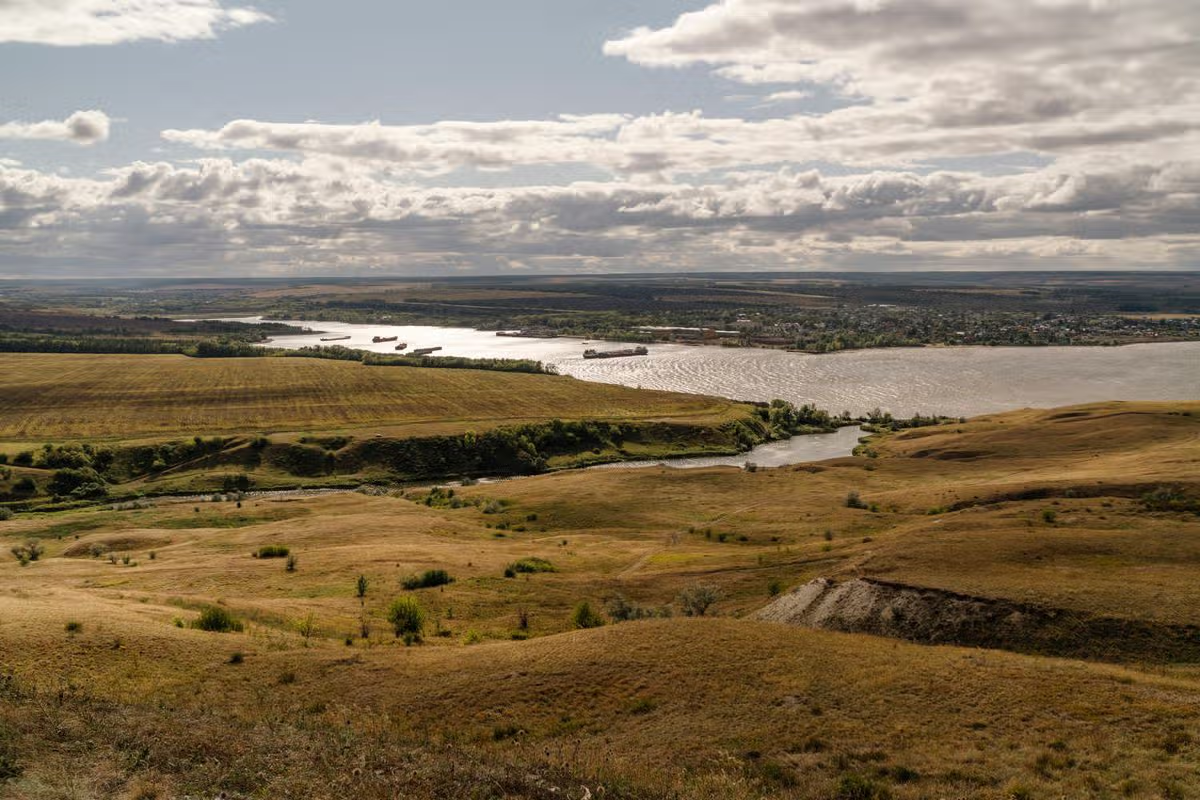
The Volga is the longest river in Europe, flowing through central and southern Russia. Its basin sprawls across two-fifths of the European part of Russia.
The river begins in the Valdai Hills as a tiny trickling spring, before turning into the Volga.
It winds for a whopping 3,531 kilometres through forests and steppes before emptying into the Caspian Sea which, rather misleadingly, is not a Sea at all, but a colossal lake.
The river is connected to five different seas via an intricate network of manmade canals which were built over the centuries, although the Caspian is its main and natural mouth.
The canal system allows ships to travel from the Volga to the Black Sea, the Sea of Azov, the Baltic Sea and the White Sea.
The sprawling Volga Delta, where the river splits into more than 500 channels, is also a world-famous wildlife sanctuary.,
It is a spawning ground for the Beluga sturgeon, which means that the lower stretches of the Volga are the epicentre of wild black caviar – one of the most sought after and expensive delicacies in the world.
The river was also a lifeline during World War II, providing a lifeline for Russian troops during the Battle of Stalingrad.
The Soviet Army was pinned against its west bank, so all supplies had to be ferried across the mile-wide stretch of water under constant barrage from the German artillery.
As winter set in and the river began to freeze, it became too icy for boats to cross but not yet thick enough for trucks to drive on.
Russian forces were nearly starved of ammunition until it froze solid.
However, as the German army focused all its energy on fighting across the riverbank, the Soviets snuck across the eastern side of the river to launch a surprise attack and completely surrounded the German forces.
Video captured the moment an Amazon Prime plane overran a runway in Miami and crash landed, skidding into a carpark at the airport. At least five people were killed.
Stars including Kate and Rio Ferdinand as well as Venezuela Fury and new husband Noah have flown into Vancouver for the new series, of I’m A Celebrity: Wild Frontier, it has been reported
13:26, 07 Sep 2026Updated 13:51, 07 Sep 2026
I’m A Celebrity… Get Me Out Of Here! The Wild Frontier revealed in trailer
A trailer for I’m A Celebrity’s new Canadian spin-off show has been released as Ant and Dec embrace the outback.
I’m A Celebrity…The Wild Frontier will be hitting our screens in 2027 with filming said to be starting soon. But in a unique twist on the Australian version, the new programme will feature celebrities competing in pairs.
ITV say we will see they will undertake gruelling trials and take on action-packed challenges to win food, all aiming to become the last pair standing. After weeks of shocks and survival in the Canadian wilderness, viewers will have the power to decide which duo is crowned the overall winners.
Viewers will be able to have their say and cast the final vote in a live grand final broadcast direct from London. Kate and Rio Ferdinand and Venezuela Fury and new husband Noah have already flown into Vancouver, it has been reported.
Brian McFadden and Keith Duffy have also been linked with the show, as has ice-skating stars Christopher Dean and Karen Barber.
Eternal singer Louise Redknapp will join the series, alongside her brother, Joe Nurding – with influences Paul Olima and Jeremy Lynch also set to fly out, reports state.
Ant said: “This brand new series is I’m A Celebrity… like you’ve never seen before. It’s a brand new format with lots of twists and surprises”.
His co-star Dec added: “We’re also making sure to retain some of the elements that we know viewers love from the Australian series. Buckle up, it’s going to be brilliant.”
Set in the untamed wilderness of Canada, the series will feature celebrities competing as pairs alongside relatives, loved ones or even fellow celebrities. So for example it could be two celebrities together, a celebrity and a family member, or a celebrity and their best friend.
Katie Rawcliffe, Director of Entertainment, Reality & Daytime ITV said: “I’m A Celebrity…The Wild Frontier is a brand new series from the award-winning I’m A Celebrity… team. The format takes duos to the most spectacular locations in Canada. The duos enter as a pair, play as a pair and leave as a pair.
“With all the brilliant DNA of I’m A Celebrity…, brand new gameplay and the dynamics of living and playing with your spouse, best mate or sibling, it promises to be a treat for audiences in 2027.”
The Chinese finance ministry is advancing a 360 billion yuan (€46.1bn) package to businesses, announced on Sunday through statements from the companies involved and reported by state news agency Xinhua, making it one of the larger interventions in China’s financial system this year as growth slows.
The Chinese banks take the bulk of it, roughly 290 billion yuan (€37.2bn), intended to preserve their capacity to keep lending as Beijing presses them to increase support for economic activity.
Xinhua reported the injection would strengthen the institutions’ “sound operating capabilities, risk resistance capabilities and ability to serve the real economy.”
The Agricultural Bank of China is pursuing a private placement of A-shares worth up to 160 billion yuan (€20.5bn) and the Industrial and Commercial Bank of China up to 100 billion yuan (€12.8bn), with the finance ministry among the investors.
Unusually, so is the China National Tobacco Corporation, which operates the state tobacco monopoly and the Export-Import Bank of China which will receive 30 billion yuan (€3.85bn).
Insurers account for the remaining 70 billion yuan (€9bn).
China Life Insurance Group, the country’s largest life insurer, gets 35 billion yuan (€4.5bn) and China Taiping Insurance Group 7 billion yuan (€900mn).
The People’s Insurance Company of China plans to raise up to 15 billion yuan (€1.9bn) through a private placement to the ministry, China Export and Credit Insurance Corporation receives 10 billion yuan (€1.28bn), and China Reinsurance Group is raising 3 billion yuan (€385mn).
Insurers have been squeezed from two directions as years of low interest rates have eroded investment returns, while the government has directed them to put money into Chinese equities.
The currency has been moving in the same direction.
The Chinese yuan reached its strongest level against the US dollar since January 2023 on Monday, trading at around $0.149, a firmer exchange rate that also happens to blunt a long-standing American complaint about Chinese currency management, weeks before talks in Washington.
Beijing’s busy month
The capital injection is not the only move Beijing is making this month.
Chinese President Xi Jinping is reportedly preparing to bring a large delegation of business executives to his Washington visit on 24 September, according to sources cited by news agencies.
It would be a notable departure from customary practice.
Xi rarely travels with corporate leaders, many of whom lost standing after the regulatory crackdowns on technology, education and property that began in 2020, and the last comparable delegation accompanied him to the US more than a decade ago, in 2015.
Washington’s response has also been curious.
“The White House is not tracking a Chinese CEO delegation,” a US official said, without explaining what tracking meant in this context, leaving the statement short of either confirmation or denial.
The gesture would be reciprocal in any case.
When US President Donald Trump visited Beijing in May, he brought a roster of American CEOs including Elon Musk, Tim Cook and Jensen Huang. Bringing Chinese counterparts to Washington would signal a willingness to invest and trade with the US, while handing the White House potential economic wins before November’s midterm elections.
Expectations for the summit itself remain modest, with the two sides still divided over which products should count as non-sensitive under trade arrangements.
US Treasury Secretary Scott Bessent, US Trade Representative Jamieson Greer and Chinese Vice Premier He Lifeng are due to meet in early September to work on deliverables.
SACRAMENTO — It was unprecedented and stunning: California’s governor and top two legislative leaders negotiated a compromise on a big bill — and one house rebelled, refusing to bring it to a vote.
The issue: who gets hit the hardest financially when a for-profit utility’s electrical equipment ignites a blaze. The utility’s investors? Its ratepayers? The insurers? Their premium payers?
At stake, depending on who you talk to, is whether the electricity providers can afford to stay in business and keep our lights on. Will some utility — Southern California Edison, Pacific Gas & Electric or San Diego Gas & Election — be forced into bankruptcy when the next powerline-caused wildfire explodes?
Alternatively, there’s another unacceptable potential outcome: Property insurance companies completely stop issuing policies — not just in obvious fire-prone areas, but in tree-lined urban neighborhoods — and basically pull out of California. Or their premiums become flat-out unaffordable.
You’re reading the L.A. Times Politics newsletter
George Skelton and other analysts cover the insights, legislation, players and politics you need to know. In your inbox Monday and Thursday mornings.
By continuing, you agree to our Terms of Service, which include arbitration and a class action waiver. You agree that we and our third-party vendors may collect and use your information, including through cookies, pixels and similar technologies, for the purposes set forth in our Privacy Policy such as personalizing your experience and ads.
Politically, the wildfire legislation’s flameout called into question Gov. Gavin Newsom’s seeming weakness as a lame duck chief executive who will be termed-out of office in January.
Newsom stuck out his neck and took it on the chin from fellow Democrats — showing that even with lopsided one-party rule, unity and success aren’t always guaranteed.
But the episode also raised doubts about Assembly Speaker Robert Rivas’ leadership capability. The Hollister Democrat signed off on the deal with Newsom and Senate President Pro Tem Monique Limon (D-Santa Barbara), but reneged at the last minute under pressure from the Assembly Democratic Caucus. They killed the bill without a floor vote.
I’m in my seventh decade of covering California governors and legislatures and never have seen — or heard of — anything like this: a legislative leader backing out of a deal agreed to with the governor and the other house’s leader.
But in truth, Newsom didn’t really like the agreement much anyway. He was on the utilities’ side, and they were out-lobbied by the insurers and ratepayers.
“I know we all hate utilities, so no one wants to defend a utility. But you’ve got to deal with reality. This thing’s not going to get better on its own,” Newsom told reporters at the Capitol on the night before the deal collapsed, referring to the utilities’ worsening financial liability.
Personally, I think it’s an overreach to conclude that Newsom’s power has been severely weakened — or that Rivas necessarily showed lack of leadership. One can question their reasons for doing what they did, but that doesn’t mean it was because of political debility.
“Newsom’s still a powerful lame duck because he could be a presidential nominee,” Republican consultant Rob Stutzman says.
“One of the better things he has done all year is taking on this issue. It would have been very easy for him to just pass it on to the next governor.”
Leaving aside whether this governor could become a president, there are hundreds of bills piling up on his desk that he must sign or veto by Sept. 30. That gives him tremendous clout. It’s good politics — and human nature — for a governor to lean more favorably toward a measure if it’s authored by a legislator who has voted with him.
Plus, one of the Legislature’s last acts last week was to send Newsom a bloated supplemental budget bill containing more than $3 billion in spending, including countless stacks of pork sought by lawmakers for their districts. Newsom easily and gleefully could discard any or all of it.
So Newsom has awesome power, lame duck or not.
But he’s vulnerable to criticism for his style. He has had an annoying habit of waiting until the very end of a legislative session to spring a hefty proposal on the lawmakers. It’s called “jamming.”
In the past, this pressure tactic mostly worked, although it ticked off lawmakers. This time Assembly members rebelled.
It’s not clear whether his jamming is mainly strategy, or just lack of focus and a tendency to push too many projects at once. Or is he preoccupied with positioning himself to run for president in 2028? Probably all of the above.
“If we had more time, we could have had a different outcome,” Rivas told me.
With only a few days remaining in the legislative session, Newsom initially proposed an ambitious plan that would have shifted more cost for utility-sparked wildfires to property insurers, sharply raising premiums across California. Utilities would have gotten some relief.
It became a titanic fight between two powerful special interests. And insurers — teamed with consumer advocates — triumphed, forcing Newsom to back down.
After hard bargaining, the governor and legislative leaders finally agreed on a post-midnight deal to help wildfire victims receive compensation more quickly — a so-called fast-pay program — and to step up fire preventative efforts.
But utilities’ financial risks weren’t significantly reduced, and they quickly mounted an opposition campaign. That resulted in Assembly Democrats scuttling all of it on the session’s last day.
“It’s unfortunate that [bill] was not given a vote,” Limon said, adding that the Senate was prepared to pass it.
“I don’t want us to do the easy stuff and call it a day,” Rivas told me. “I wanted to see real utility accountability. This bill did not go nearly far enough.”
It went a fair distance, however, in helping future fire victims get their insurance payouts faster. And it probably should have been passed.
Half a loaf. Bird in hand. Incremental change. Next year more incrementalism. Ultimately it can add to massive reform.
Some problems are just too tough to resolve in one sitting.
This river was thought to be the stuff of legends – but it is very real
The river is a tributary in the Amazon rainforest(Image: Getty)
In a remote part of the Amazonian rainforest, there is a river so mired in myth that many thought it didn’t exist. However, thanks to the research and work of a celebrated geothermal scientist, the existence of the river has now been proven – and he’s fighting to protect it.
The Shanay-timpishka, commonly known as the ‘Boiling River of the Amazon’ is a tributary of the Pachitea River which flows towards the Amazon River. The river has been known to indigenous Peruvians who live in the Amazon, and it has been used for spiritual and healing rituals for centuries. They called it ‘Shanay-timpishka’ which translates to ‘boiled by the heat of the sun’.
The local Asháninka and Shipibo peoples believe the river is birthed by Yacumama, a gigantic mythical serpent thought to live in the Amazon. “a mythical enormous serpent believed to inhabit the Amazon Rainforest.”
Local shamans teach that Yacumama is the “Mother of the Waters”
Geothermal scientist Adrés Ruzo first heard of the scalding river from his grandfather who told him a legend about the Spanish conquistadors who ventured into the jungle and came back with tales of a river which boiled.
He was the first scientist permitted by the local shamans to map, study and legally help to protect the river. He travelled through the jungle in 2011, guided by his aunt and confirmed the existence of the river.
Ruzo worked to study the river, and also helped the local indigenous people secure their rights to it. The area is in massive danger from deforestation which destroys the forest and surrounding ecosystems.
Ruzo became an advocate for the ancestral people living in the region, and helped secure the legal titles to the land. He also founded the Boiling River Project – a non-profit organisation which advocates for the permanent protection of the river.
Content cannot be displayed without consent
One of the most fascinating things about this river is that it is an anomaly.
Usually, geothermal rivers and springs are heated by volcanic currents but in the case of Shanay-timpishka, the closest volcano is 700 kilometres away. Instead, the water is heated by the core of the Earth.
Rainwater seeps into the earth’s crust through fault lines where it is heated to boiling and then pushed back up into the river. At its hottest points, the river can reach close to 100°C, and boils anything which is unfortunate enough to fall in.
The river is littered with animal bones and bodies which have been cooked inside.
Tragically, it’s not only animals which have been killed by the boiling water. A Toronto woman died in 2025 after she fell into the river whilst meditating on a rock nearby.
Although Maya Moreno managed to escape from the water alive, she tragically died later in hospital after suffering burns to 70% of her body.
According to a GoFundMe for Maya, she had travelled to the river as part of a spiritual journey, and fainted beside the river which caused her to fall in.