Fans are keen to watch the rest of Yellowstone creator Taylor Sheridan’s espionage action thriller Lioness.
08:16, 03 Aug 2026Updated 08:16, 03 Aug 2026
The Lioness series three teased in Paramount+ trailer
Lioness fans have been left on the edge of their seats after the season three premiere.
Many viewers are now champing at the bit for the next instalment of the drama led by Oscar-winning Zoe Saldaña.
WARNING: Spoilers below from Lioness season 3, episode 1
The opening instalment of season three debuted recently. Titled The Spider and The Fly, the episode saw Joe McNamara (played by Saldaña) thrown into fresh danger after she was abducted close to her home as she set out to work.
Joe was in a new nine-to-five role; however, she was kidnapped while on the phone with her boss, Kaitlyn Meade (Nicole Kidman).
There was then a flashback six months earlier and a mission in Ukraine, where she was inserted into a team to capture Aleksi Yurimov, the head of Putin’s hybrid warfare Special Services Department.
Creator Taylor Sheridan also made a cameo in the episode as soldier Cody, who headed up the precious mission.
The season three opener ended on quite a note as it looked like Joe’s cover was blown, leaving fans desperate for the rest of the outing.
How many episodes are in Lioness season 3?
There are eight episodes in Lioness season three, just like the previous two runs.
Episodes will air weekly on Sundays on the streaming platform Paramount+.
Season three premiered on Sunday, August 2 and will wrap up on Sunday, September 30.
Here’s the Lioness season 3 release schedule:
Episode 1 – August 2
Episode 2 – August 9
Episode 3 – August 16
Episode 4 – August 23
Episode 5 – August 30
Episode 6 – September 6
Episode 7 – September 13
Episode 8 – September 20
Following the season three premiere, many showered the opener in praise on social media.
One person posted on X (formerly Twitter): “Lioness is back for season 3 and that 1st episode was amazing from start to finish. I love Zoe Saldana #Lioness.”
A second wrote: “This is how you start a new season #Lioness episode 1 was so good!”
A third fan said: “Well I’ll be damned Joe! That’s how u feeling this season. U couldn’t ease us into things?! I need the whole season NOW! #Lioness#LionessSeason3.”
Get Paramount+ free for a week
This article contains affiliate links, we will receive a commission on any sales we generate from it. Learn more
Telly fans can get seven days of free access to Paramount+ shows like Tulsa King and Dexter: Original Sin by signing up for a free trial via Amazon Prime’s Paramount+ channel.
Yet another person wanted more than just one episode: “Now I’m irritated cause they could have released the first 3 episodes of lioness this might be their best season premiere thus far. Incredible! #lioness.”
Paramount+’s synopsis for the new series states: “In Season Three, from creator and writer Taylor Sheridan, hidden networks, foreign operatives, and personal betrayals collide.
“Joe (Zoe Saldaña) walks the line between duty and home as unseen forces circle her world. Patterns appear where they shouldn’t, names vanish, and paths rearrange.
“Guided by Kaitlyn (Nicole Kidman) and Westfield (Michael Kelly), Joe confronts enemies operating in the shadows, leaving her to reckon with a war that now reaches into every part of her life.”
“I heard that it was pretty much done,” Roberts recounted Sunday afternoon. “But there’s obviously things that have to go on with medical, so it wasn’t actually even finalized. I just heard that it was pretty much close.”
Friedman, however, wasn’t ready to exhale until he got final word from the Tigers during the game.
“I had no idea and was trying to emotionally hedge,” he said. “I wasn’t getting too high or too low on it until we actually found out.”
There was, it turned out, no need to stress. On Saturday, the Dodgers agreed to trade three prospects — outfielder Zyhir Hope (No. 25 on MLB Pipeline’s top 100), right-handed pitcher River Ryan (No. 68) and right-hander Brady Smith — to the Tigers for one of the best starters in baseball.
Even as the Dodgers signaled a potentially low-key trade deadline in the lead-up — “we try to do everything we can to avoid not having to do something,” Friedman said last week — many rival executives and scouts had come to see the Dodgers landing Skubal as practically inevitable.
Of course, the World Series favorites didn’t need to acquire Skubal. But if they wanted him, they’d get him.
And they did.
“Friday it started picking up a little bit,” Friedman said. “But [Saturday] it was much more aggressive back and forth and a lot of different conversations. Obviously being on our side, you didn’t really know how long the process was gonna go, whether it was gonna go into Sunday, into Monday. But obviously we were of the mind to be aggressive and try to get a deal done.
“We were of the mind to be aggressive for one player this deadline, and fortunately we were able to line up.”
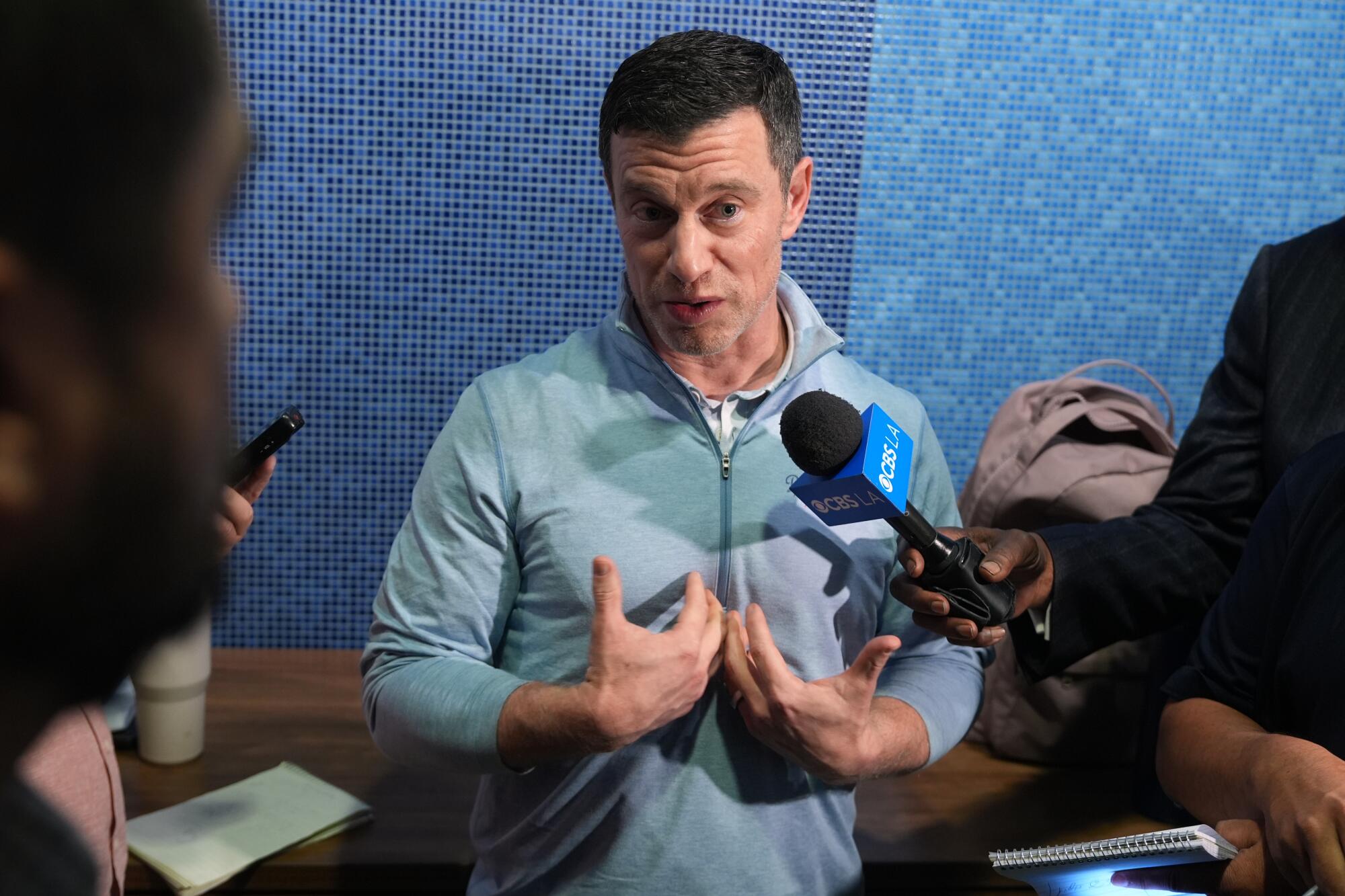
Andrew Friedman, Dodgers president of baseball operations, speaks to reporters on Jan. 21.
(Damian Dovarganes / Associated Press)
Two aspects of the trade did, however, take the industry by surprise: the timing and the return.
The Dodgers pulled off the trade without disrupting their major-league squad. Ryan, who made four major-league starts in 2024, has the stuff to compete in the majors, but health has kept him from another call-up.
“Obviously they felt good going through it,” Friedman said. “We gave up a lot of talent. Those guys are really good, and have a chance to be really good major-league players. But with where our core is, this moment in time, it was something that we felt like, erring on the side of aggressive made the most sense right now.”
“I think it’s arguably the best rotation of all time — as if it wasn’t before as well,” catcher Dalton Rushing said. “Hope he’s ready to win a ring.”
“Whenever there’s a star-level player that is available, that can really shift championship odds, those are the moments that we’ll be more aggressive.”
Dodgers’ President of Baseball Operations Andrew Friedman speaks to the media on the #Dodgers acquiring Tarik Skubal via trade… pic.twitter.com/CzJZYModUb
Said veteran utility player Miguel Rojas: “It’s a statement from this organization to the rest of the league and the world that they’re not just satisfied with what happened the last couple years. … It’s kind of like a pressed button for us to kind of continue to go and not let the rest of the league catch up to our standards.”
Of course, health is never guaranteed. Skubal and Snell have undergone surgeries to remove loose bodies from their pitching elbows. Skubal has made nine appearances since, and Snell is scheduled to make one more rehab start before being activated off the injured list.
Glasnow, on the verge of a rehab assignment, has been sidelined for nearly three months with back spasms, an injury the Dodgers initially hoped wouldn’t even need an IL stint.
Ohtani’s nagging knee problem creates the most uncertainty. Ohtani hasn’t pitched in nearly a month, despite receiving an Orthovisc injection to lubricate the joint. He could restart playing catch this week in Chicago, Roberts said.
“We’re as confident as we can be that he’s going to be back and he’s going to start throwing soon and building back up,” Friedman said. “You can never perfectly predict the future but if you said, ‘Hey, place a bet on it,’ I would be very confident placing it that he would be back pitching.”
Pitcher Tarik Skubal is congratulated by teammates after playing in his final game with the Detroit Tigers on Wednesday against the Baltimore Orioles.
(Paul Sancya / Associated Press)
With this much time off, however, Ohtani will need to build back up to a starter’s workload without the benefit of a rehab assignment, similar to what he did last season. The timing of his return to the mound will dictate how long the build-up will be.
“We have a plan to build him up slowly, methodically,” Roberts said. “And that would have happened if this trade would have happened or not.”
In the meantime, the Dodgers are filling his spot in the rotation with the best possible option. Skubal is scheduled to make his Dodgers debut Tuesday against the Cubs in Chicago.
And the Dodgers aren’t necessarily done dealing. As of Sunday afternoon, they still were engaged on “a number of different conversations on a number of different fronts,” Friedman said.
When asked if the Dodgers could still add to the major-league roster, however, Friedman said that was “less likely.”
“Never say never,” he said. “Fortunately, we don’t have that acute need that we have to do this or our team is in real danger.”
He did, however, mention the Dodgers’ lack of an acute need before acquiring Skubal too.
The US president says Gulf allies and Tehran urged him to delay planned strikes.
By Al Jazeera Staff, AFP and Reuters
Published On 2 Aug 20262 Aug 2026
United States President Donald Trump has said that negotiations with Tehran are set to begin on Monday after he decided to hold off on new strikes on Iran in pursuit of a deal.
Trump said on Sunday that a plan was in place for the US to launch “the biggest attack since World War II” against Iran but that he halted it to give diplomacy a chance.
Recommended Stories
list of 3 itemsend of list
“Obviously, they don’t want to be attacked. They knew the extent of the attack because they saw it forming,” Trump told reporters on board Air Force One on Sunday.
“Now what we’re doing is talking to them in the form of a negotiation. It begins tomorrow afternoon.”
He gave no details about the venue or participants in the talks.
Trump pulled back from threats of an attack on Saturday after saying the “perimeter” of a deal was in place.
In his latest comments, Trump said Iran and US partners Saudi Arabia, the United Arab Emirates and Qatar had urged him to hold off on the strikes.
“When the allies asked to call it off, you’ve got to sort of say, ‘Well, let’s see.’ And the reason they ask is they think there’s a deal,” he said.
“There’s a deal on [the Strait of] Hormuz, and then there will be a deal on the nuclear, or you might call it the denuclearisation of Iran.”
He said Saudi Arabia’s Crown Prince Mohammed bin Salman had also urged against the strikes, warning of possible unintended consequences.
“I mean, will they be flooded with people pouring into their country and disaster? A lot of bad things can happen,” Trump said.
Regional diplomacy intensifies
Trump’s announcement came hours after Iranian Minister of Foreign Affairs Abbas Araghchi held a second phone call with Saudi Foreign Minister Prince Faisal bin Farhan Al Saud, joined by Pakistani Army Commander Asim Munir, to discuss recent diplomatic efforts.
The officials exchanged views on the current situation and on “initiatives aimed at maintaining and strengthening security and stability” in West Asia, Araghchi said in a Telegram post. They also stressed the need to use regional cooperation and political solutions, he added.
Earlier on Sunday, Iran’s official news agency IRNA reported that negotiations between Tehran and Oman over the Strait of Hormuz were in their final stages, citing Araghchi.
Iranian Ministry of Foreign Affairs spokesperson Esmaeil Baghaei said the negotiations focused on agreeing to a new route through the strait, adding that this had “no link to the Strait of Hormuz being opened or closed. That is a separate discussion”.
The war began on February 28, when the US and Israel launched surprise strikes against Iran, although months of on-and-off diplomacy have led to periods of relative calm.
A previous ceasefire deal, which included the reopening of the Strait of Hormuz, a vital conduit for global energy supplies, fell through. Iran has since tightened its control over the waterway as the two countries resumed attacks against each other in recent weeks.
Oil prices fall as escalation fears ease
Oil prices dropped sharply in early trading after Trump abandoned plans for a new military operation against Iran, easing fears of further disruption to Gulf energy supplies.
Brent futures were down $4.08, or 4.64 percent, at $83.85 a barrel on Sunday. West Texas Intermediate lost $4.01, or 4.74 percent, to trade at $80.66, according to the Reuters news agency.
The decline reversed part of last month’s surge, when both benchmarks gained more than 20 percent as renewed US-Iran fighting and attacks on commercial vessels near Oman intensified concerns over shipping through the region.
Hungary’s corporate landscape is undergoing its most significant transformation in decades as businesses that flourished under former Prime Minister Viktor Orban adjust to a new political order led by Prime Minister Péter Magyar. Companies that once benefited from close ties to the previous government are now restructuring their operations, while investors and foreign firms are watching for signs of a more competitive business environment.
The shift follows Magyar’s decisive election victory in April, ending Orban’s 16 year rule and ushering in an administration that has pledged to curb political favoritism, increase transparency in public procurement, and align Hungary more closely with European Union governance standards.
Construction Giants Shift Strategy
One of the clearest signs of the changing business climate comes from Market Építő, one of Hungary’s largest construction firms, which has historically secured major government backed infrastructure projects, including football stadiums.
Chief Executive Sandor Scheer said the company is preparing for a future less dependent on large public contracts.
Stay ahead of the geopolitical week.
MD Briefing delivers expert analysis across five global fronts — the Indo-Pacific, energy, geoeconomics, European security, and the Middle East — every Monday morning. Free.
“We are preparing for a shift where, instead of large scale projects, we will have a higher volume of smaller scale projects, and housing and infrastructure construction will become dominant,” Scheer told Reuters.
The company, which has been linked to Orban ally Istvan Garancsi, generated roughly one quarter of its revenue from public contracts during the previous administration.
End of the Crony Capitalism Model?
For years, Orban’s political allies built powerful business empires through access to state spending, public tenders, and favorable regulations across sectors including construction, banking, telecommunications, and real estate.
Analysts believe companies that relied heavily on government infrastructure spending now face the greatest risks.
Daniel Hegedus, Deputy Director of Berlin’s Institute for European Politics, said construction and road building companies closely tied to Orban’s political network could struggle to survive as contracts become more competitive.
Some firms, analysts warn, may disappear entirely if they fail to adapt to a marketplace where political connections carry less influence.
Government Pushes Transparency Reforms
Prime Minister Magyar has moved quickly to introduce anti corruption legislation designed to satisfy long standing European Union concerns over Hungary’s procurement system.
A 2024 OECD survey found Hungary had an unusually high number of single bidder public procurement contracts, while research by Hungarian anti corruption think tank CRCB concluded there was clear evidence of political favoritism in state tenders during the Orban era.
The reforms are also intended to unlock billions of euros in suspended European Union funding that has been tied to improvements in governance and transparency.
Markets React to Political Transition
Investors have already responded to the changing political landscape.
Several companies widely viewed as benefiting from their proximity to the previous government have experienced significant share price declines since Magyar’s election.
Among those affected are construction and energy group Opus Global, real estate developer Appeninn, telecommunications company 4iG, and MBH Bank.
The declines contrast with a broader rally in Hungary’s stock market, reflecting optimism that a more transparent business environment could attract greater international investment.
Companies Defend Their Business Models
Despite the uncertainty, businesses linked to the previous administration reject suggestions that their success depended solely on political connections.
Market Építő says its financial strength and diversified operations provide long term stability regardless of political change.
Road construction giant Duna Aszfalt, whose owner became one of Hungary’s wealthiest businessmen during Orban’s tenure, also expressed confidence in its future.
The company stated that it had successfully competed against international firms even before Hungary’s democratic transition in 1990 and remained prepared for a more competitive marketplace.
Meanwhile, telecommunications firm 4iG denied benefiting from political favoritism, while MBH Bank said its procurement practices fully complied with both Hungarian and European Union regulations.
Review of Previous Government Contracts
The Magyar administration has also begun reviewing spending commitments approved under the previous government.
One early decision was to suspend an extension of a southern Hungarian highway and request that Duna Aszfalt repay funds received before the election for the project.
The move signals a broader willingness to scrutinize public contracts awarded during Orban’s administration and reassess government spending priorities.
Foreign Investors Could Benefit
Political analysts believe the reforms could reshape Hungary’s investment climate by creating more opportunities for international firms that previously struggled to compete with politically connected domestic companies.
Greater transparency in public procurement, combined with stronger oversight, may improve investor confidence and encourage new foreign investment into sectors previously dominated by companies with close government ties.
However, the transition is also expected to produce significant disruption as businesses adapt to a competitive environment driven more by market forces than political relationships.
What Comes Next
Hungary is entering a new phase in which political change is reshaping corporate power as much as government itself. Companies built around privileged access to state contracts now face growing pressure to compete in a more transparent marketplace, while new reforms seek to restore confidence among investors and European partners.
Whether these changes produce lasting economic modernization or simply redistribute political influence will depend on the implementation of Magyar’s reform agenda. For Hungary’s business elite, however, the era of relying on political proximity for commercial success appears to be drawing to a close.
TRAVELLERS are being warned about taking a popular everyday item on board flights.
Earlier this week, a Swiss International Air Lines flight was diverted to Bangor in Maine, America, due to smoke in the cabin.
A plane was forced to divert earlier this week when a headphone charging case overheatedCredit: Swiss International Air Lines
The smoke came from a damaged headphone charging case, which had fallen between the seats and become stuck, causing it to overheat.
The plane had come from Zurich in Switzerland and was heading for JFK Airport in New York.
Sign up for the Travel newsletter
Thank you!
According to the UK Civil Aviation Authority (CAA) incidents involving lithium batteries – which are found in headphone charging cases, as well as power banks – are on the rise.
Any items with lithium batteries have to go in hand luggage.
The CAA has warned that if any of these cause an issue during a flight, such as overheating or starting to smoke, you should notify a member of the cabin crew as quickly as possible.
If these items aren’t packed correctly, such as in your hold luggage and not your hand luggage, there could be flight delays or cancellations as a result.
Headphone charging cases contain lithium batteries, which are increasingly causing issues on flightsCredit: Getty
Back in May, an easyJet flight had to divert when a passenger informed crew during the flight that the portable charger was in the hold of the aircraft.
The flight was then forced to land in Rome, Italy, instead of reaching its destination, London Luton.
The CAA previously commented: “Passenger awareness remains low – over a third (36 per cent) of travellers are unaware of the dangers of packing batteries in checked baggage, even though 92 per cent fly with a mobile phone, 55 per cent with a laptop and 49 per cent with a power bank – suggesting hundreds of batteries could be incorrectly packed on a typical flight.”
According to the CAA, there are around two lithium battery incidents every week – and often, these incidents cause delays as well as diversions.
HBO’s emergency medical drama “The Pitt” was the top nominee, with a total of 25. The premium cable network’s intergenerational comedy comeback story “Hacks,” meanwhile, earned 24 nominations. Other top nominees include Apple TV’s freshman offerings “Widow’s Bay” and “Pluribus,” which nabbed 19 and 18 nods a piece, respectively.
With its 24 nominations, “Hacks” set a new record for most nominations in a year by a comedy series. The previous record of 23 nods was set by “The Bear” in 2024 and matched by “The Studio” in 2025.
“[The nominees’] creativity and talent remind us why television remains one of our most powerful art forms,” Television Academy chair Cris Abrego said in his introductory remarks Wednesday morning. “While these nominations recognize individual achievement, they also celebrate the collaborative spirit that defines our industry. Every nomination today is a result of countless people coming together to create work that moves us, entertains us and, above all, inspires us.”
Previous Emmy winners Liza Colón-Zayas, known for her role as no-nonsense chef Tina on FX’s culinary dramedy “The Bear,” and Jeff Hiller, the “Widow’s Bay” actor who also portrayed sweet and lovable best friend Joel on HBO’s tender comfort-watch “Somebody, Somewhere,” were on hand at the Television Academy’s Wolf Theatre to joke about their nerves — and height difference — while presenting the nominations.
The nominees for variety series and reality competition program were announced before the main nominations ceremony on NBC’s “Today” show.
The 78th Emmy Awards will be held Sept. 14 at 5 p.m. at the Peacock Theater in downtown Los Angeles. Hosted by “Law & Order: SVU” star Mariska Hargitay, the live telecast will air on NBC and stream on Peacock. The Creative Arts Emmy Awards, which honor artistic and technical achievements as well as some performance categories, will be held on Sept. 5 and 6.
Taylor Dearden, “The Pitt” Fiona Dourif, “The Pitt” Allison Janney, “The Diplomat” Katherine LaNasa, “The Pitt” Sepideh Moafi, “The Pitt” Julianne Nicholson, “Paradise” Karolina Wydra, “Pluribus”
Drama supporting actor
Patrick Ball, “The Pitt” Billy Crudup, “The Morning Show” Shawn Hatosy, “The Pitt” Gerran Howell, “The Pitt” Jack Lowden, “Slow Horses” Tom Pelphrey, “Task” Carlos-Manuel Vesga, “Pluribus”
Colman Domingo, “The Four Seasons” Paul W. Downs, “Hacks” Harrison Ford, “Shrinking” Nick Offerman, “Margo’s Got Money Troubles” Stephen Root, “Widow’s Bay” Michael Urie, “Shrinking” Tyler James Williams, “Abbott Elementary”
“Heads of State” “Miss You, Love You” “People We Meet on Vacation” “Remarkably Bright Creatures” “Jack Ryan: Ghost War”
Limited series / TV movie lead actress
Claire Danes, “The Beast in Me” Sally Field, “Remarkably Bright Creatures” Carey Mulligan, “Beef” Sarah Pidgeon, “Love Story” Sarah Snook, “All Her Fault”
Limited series / TV movie lead actor
Riz Ahmed, “Bait” Jason Bateman, “Black Rabbit” Charlie Hunnam, “Monster: The Ed Gein Story” Oscar Isaac, “Beef” Matthew Rhys, “The Beast in Me”
Limited series / TV movie supporting actress
Linda Cardellini, “DTF St. Louis” Dakota Fanning, “All Her Fault” Laurie Metcalf, “Monster: The Ed Gein Story” Joy Sunday, “DTF St. Louis” Yuh-Jung Youn, “Beef” Constance Zimmer, “Love Story”
Limited series / TV movie supporting actor
Jason Bateman, “DTF St. Louis” Richard Gadd, “Half Man” David Harbour, “DTF St. Louis” Richard Jenkins, “DTF St. Louis” Charles Melton, “Beef” Nick Offerman, “Death by Lightning”
Variety series
“The Daily Show” “Jimmy Kimmel Live!” “Last Week Tonight With John Oliver” “The Late Show With Stephen Colbert” “Saturday Night Live”
Reality competition program
“Dancing With the Stars” “RuPaul’s Drag Race” “Survivor” “Top Chef” “The Traitors”
People are frantically trying to get in shape for their summer holidays – but it could be a lot more effective
08:14, 03 Aug 2026Updated 10:29, 03 Aug 2026
There are better ways to improve your abs than sit-ups, an expert said(Image: Getty)
It’s the time of year when people are looking at their waistbands and thinking they’d like to make one last push to get it all a bit flatter. Many will be crashing out sit-ups like mad – however one expert has suggested that this exercise might not be the best way.
Dr Lee Brown, senior lecturer in strength and conditioning at the University of East London, has said that people might be making a mistake. He told the Guardian “It’s embedded in the archaic practices of boxing coaches and therefore everyone seems to follow it. But they’re far from the best exercise for training your core.”
Sit-ups are a classic bodyweight core exercise designed to strengthen the abdominal muscles, hip flexors, and chest. They involve lifting the upper body from a flat, lying position up toward the knees.
“If you’re doing too many sit-ups, it can cause problems with the lower back. Overworking the hip flexors can make them hypertonic [stiff and tight]. Your torso leans forward because you have overly toned and tight hip flexors, creating an imbalance and a dumping ground for shearing forces in your lower back.”
Brown recommends moves such as planks, side planks, farmer’s carries (walking while holding a heavy weight in each hand), suitcase carries (walking with a weight in one hand to challenge stability) and bird dogs (lifting the opposite arm and leg from all fours). Pilates and yoga can also help build core strength.
“I worked with a sprinter who’d had a back injury and had been doing sit-ups forever,” Brown says. “I asked him how long he could hold a plank for. He said less than 30 seconds. Six weeks later, he could hold one for seven minutes and his back pain had gone.”
A study published last year in the Journal of Clinical Medicine looked at 117 people with and without back pain to find out whether core strength was implicated. Participants were asked to perform the plank, one of the most popular trunk muscle stabilisation exercises prescribed to enhance neuromuscular control and spinal support. Researchers from Daemen University in New York were surprised to find that back pain sufferers were able to hold a plank for “significantly longer” than those without, suggesting they had better levels of abdominal strength.
Wales have become the first nation to publicly withdraw backing for Gianni Infantino’s bid to continue his leadership of Fifa.
It follows the loss of confidence in the Fifa president following his scrapped plans to sell stakes in its competitions to private investment firms.
The Football Association of Wales (FAW) has confirmed “its withdrawal of support for the candidature of Mr Gianni Infantino for re-election as Fifa president for the 2027-2031 term”.
Infantino’s lucrative plan sparked a global outcry, with European football’s governing body Uefa threatening to boycott all Fifa competitions, including the World Cup.
Uefa and Concacaf – which oversees football in North, Central America and the Caribbean – both released statements on Saturday criticising the leadership of the world governing body following Infantino’s decision to withdraw the plan.
The FAW added: “The recent failures in good governance, processes, leadership, values, stakeholder management, communications and sound judgement have led us to a position where Mr Infantino has lost the confidence of the FAW to remain at the helm of world football.
“Failing to put the best interests of football first is a failure we cannot accept.”
The coastal spot has been ranked the worst seaside town in the UK by Which? magazine for the second year in a row – but one YouTuber made the 250-mile trip to see if the verdict was really justified
James Burton visited Bognor Regis after it was voted the UK’s worst seaside town(Image: YOUTUBE/BY THE CURB)
A popular coastal spot has made headlines once more – and not in a positive light. Which? Magazine has just ranked Bognor Regis bottom of its yearly list of Britain’s best and worst coastal spots for the second consecutive year.
The magazine polled more than 5,300 individuals about their experiences visiting UK coastal destinations over the past year, canvassing their opinions across a range of factors including beach quality, scenery, food and drink, accommodation, tourist attractions, shopping and value for money.
The Mirror’s own Levi Winchester, who grew up in the town, has witnessed its gradual decline over the years. “I remember many happy summers playing down the beach in Bognor Regis. At low tide, you could see sand for miles, as the smell of fish and chips wafted through the air,” Levi recalled when asked for her thoughts on a town that once served as a home to George V for three months.
“The town was always buzzing with families enjoying their trip to Butlin’s-and while the seaside resort still attracts large crowds every year, the town itself has lost its heart. The promenade lacks love and is in need of a serious revamp.
“Even under the lights of the pier, it still just feels grey and miserable. Like many other UK high streets, the main town centre is empty now with hardly any shops left. I barely recognised it when I last visited.”
One YouTuber decided to visit the spot last year after its first dismal ranking to see if it truly matches up to the title of being the UK’s worst. James Burton documented his trip on By The Curb channel and kicked it off by paying a visit to Butlin’s.
Butlin’s Bognor Regis Resort is one of the UK’s most iconic holiday destinations and one of only three remaining Butlin’s resorts, alongside Minehead and Skegness.
Over the years, it has undergone significant redevelopment, transforming from a traditional chalet-style camp into a modern family resort while retaining its much-loved heritage.
And after visiting, James believed it showed Bognor has a lot to offer. “Worst seaside town in the UK?” before continuing: “Absolute waffle. It’s lovely. I’m not going to say it’s the best. But it is nice. Yet again, I’ve proved them all wrong, I just come here, walked around and proved them wrong.”
James then enjoyed a beer, remarking: “It was just £4.90, which is not bad value really with that spectacular view.”
Butlin’s Resort Bognor Regis still welcomes over 385,000 visitors each year, with 300,000 staying as overnight guests and 85,000 popping in for a day visit.
James turned up just in time to catch one of the company’s iconic redcoats leading a crowd of delighted youngsters through an energetic rendition of “Heads, Shoulders, Knees and Toes,” and declared: “I’d have loved this as an eight-year-old.”
Living “life on the edge,” James also ventured into one of the resort’s numerous restaurants: “To be honest it looked a nice restaurant.
“I’ve never seen so many chicken nuggets though, they must go through thousands of chicken nuggets.”
Despite struggling to find his way out of the resort, James left with a positive impression: “I liked it. It looked good.
“I’m going to bring my daughter to a Butlin’s…it’s gone up in my estimation.”
Overall, James concluded that Bognor didn’t deserve its poor reputation: “It’s tidy. The people are friendly.
“It’s got a lovely beach. I know it’s a pebbly beach, but that don’t matter. You’ve got Butlin’s. Butlin’s was great.”
Japan and the United States have confirmed a rare, coordinated yen-buying intervention to halt the Japanese currency’s slide to 40-year lows, with Tokyo signalling it is willing to take further action if needed.
The Japanese Ministry of Finance confirmed the joint intervention after a statement by US President Donald Trump on Sunday announced that Washington was helping to prop up the yen as a sign of friendship and to support the global economy.
“They have a weakening yen, and they wanted a little bit of help. And we’re always there for Japan,” Trump said in response to a reporter’s query about why the US is helping to support the currency.
The yen leapt after the announcement, leaving traders on high alert for further intervention from authorities. The Japanese currency gained as much as 1.4 percent to hit a nearly three-month high of 155.20 per US dollar, compounding a 3.8 percent surge over the previous two sessions. The yen also advanced broadly against other major currencies, including the euro and sterling.
The latest bout of aggressive yen-buying heavily pressured the US dollar. In early Asian trading on Monday, the euro climbed to a 1.5-month high of $1.1559, while sterling hovered near a two-week top at $1.3476.
However, the rapid appreciation of the currency immediately weighed on the equity market. The Nikkei share average tumbled, reversing course from the one-week high it had achieved in the previous session.
Analysts say the intervention underscores both countries’ resolve to prevent global spillovers from a sell-off in the yen and Japanese government bonds, including by adding pressure on already rising US Treasury yields.
Japan has been struggling to curb a relentless drop in its currency that has pushed up import prices and stoked broader inflation, hitting household wallets and Prime Minister Sanae Takaichi’s approval ratings.
In its statement, Japan’s Finance Ministry said Friday’s yen-buying intervention with the US Treasury Department “countered excessive volatility and disorderly movements in the Japanese yen in recent months”.
“The Japanese Ministry of Finance remains attentive and in close communication with our counterparts at the U.S. Treasury,” it added. “We will not hesitate to conduct further joint intervention.”
The joint intervention is the first since a 2011 coordinated action to weaken the yen after the devastating earthquake in eastern Japan.
Tokyo may have sold as much as $58.97bn to buy yen when it intervened in New York markets on Thursday, Bank of Japan data indicated, before Friday’s confirmed joint intervention with Washington.
US Treasury Secretary Scott Bessent also confirmed Friday’s effort, noting on Sunday that Washington “will not hesitate to participate in further joint intervention”.
“We strongly support Japan’s decisive market and monetary steps to correct the substantial undervaluation of the yen,” Bessent said in a separate statement on X, repeating his calls for further interest rate hikes by the Bank of Japan.
In line with Bessent’s repeated calls for higher Japanese interest rates, the Bank of Japan on Friday offered its most explicit signal to date of an early rate hike, even as it kept monetary policy steady.
In a sign of broader policy coordination, South Korea also stepped in to buy its won currency on Thursday.
Japan intervened in April and May, buying yen, but the move triggered only a brief rebound. The Bank of Japan’s June rate hike to a 31-year high of 1 percent also gave the struggling currency little lasting boost.
Semenyo joined City from Bournemouth for £65m in the January transfer window, with Guardiola fighting off competition from rivals Manchester United, Liverpool, Tottenham and Chelsea for his signature.
The player says interest first came in early December with “a lot of talks” taking place, before he made the decision the following month that he wanted to join City.
“I owe them everything to be honest,” Semenyo said of former club Bournemouth. “They helped my Premier League career flourish and obviously the management, the staff behind the scenes, they were all amazing, they made everything so smooth.”
Semenyo scored a total of 21 goals for club and country last season, netting the winning goal in the FA Cup final win over Chelsea which he called a “dream come true”, as well as lifting the Carabao Cup.
Speaking at Ahmad Tea’s Preparation is Everything event in Hong Kong, he added: “I think for me, I just wanted the next step to be the big one and Manchester City was the option. Pep spoke to me beforehand and he said, ‘look, when you come, I am going to make you a better player’.
“You want to get better, you want to improve every season and he definitely helped me with that in the first five months, but obviously sad for him to leave.”
A wartime detective drama series based on real-life historical events has viewers declaring they’ve ‘never seen a better show on television’ — streaming free on ITVX
Viewers can’t stop raving about the ‘authentic’ detective war drama(Image: TV Grab)
A wartime drama based on real events during and after the Second World War has completely enamoured audiences, with fans of the ITV series giving it ‘maximum stars’.
Describing the detective war drama as ‘mesmerising’, viewers are saying they’ve ‘never seen a better show on television’.
Foyle’s War — available to stream free on ITVX — is a historical wartime detective drama series created by author Anthony Horowitz who was the screenwriter of the acclaimed Midsomer Murders.
The series stars the talented Michael Kitchen in the lead as DCS Christopher Foyle. Honeysuckle Weeks, Anthony Howell, Julian Ovenden, and Ellie Haddington join Kitchen to round out an altogether stellar cast, all of whom, especially Weeks, have been praised for their performances on the show.
Foyle’s War first premiered on television in October 2002 and saw an eight-season run till 2015. The series was cancelled in 2007 and revived in 2010 owing to encouraging audience numbers for the last series that premiered on telly.
The series was nominated for three BAFTA Television Awards, of which it bagged one, and has gone on to become a highly acclaimed wartime drama for both audiences and critics.
One reviewer said of the wartime series: “This is quality, smart stuff — plot points hinge on citizenship classifications, ration coupons, the location of safe houses. It requires that viewers watch carefully, and pay attention to details.”
While another critic said: “Foyle’s War… returns to Mystery!… with the admirable Michael Kitchen in his usual top form.”
A third critic shared: “You don’t have to pay close attention to Foyle’s War, but it’s worth it for the detail-rich historical context of Anthony Horowitz’s plots, especially now the series has arrived in the murky moral fog of post-war London.”
Audiences can’t stop praising the war drama, with one viewer writing on Rotten Tomatoes: “On our second watching of the entire series. It’s so well-acted and thoughtful, and you learn a bit of history with each episode. Michael Kitchen and Honeysuckle Weeks are so engaging, such a delight to watch, it’s mesmerizing.”
A IMDB user review of the series says: “One of the best! My wife and I became obsessed with the British crime series Midsomer Murders. We’ve seen all the episodes available. Then my wife latched onto Foyle’s War and we’ve become big, big fans of this series also.
“We agree with everyone about Michael Kitchen’s performances and the historical background against which the story unfolds. Everything about this show looks authentic, feels authentic and sounds authentic. Not having lived through that time we are learning so much about the period.”
While one fan of the show said: “Maximum Stars. I’ve never seen a better show on television. “Foyle’s War” is deep, thoughtful television art. Great premise. Acting is tremendous. Only the bad guys overact. To see the characters is to love them. Sets and details have been discussed at length and it’s all just gorgeous.”
Another user review reads: “Outstanding! One of the very best series of all time! This is what great TV is. An outstanding series, taking place from the start of WW2 to the start of the Cold War, but told with the perspective of those ‘back home’ whom the Wars impacted.
“A remarkable achievement. The cast, first and foremost Michael Kitchen as Foyle, are remarkable. TV, or filmed entertainment just does not get any better than this.”
Foyle’s War is available to stream for free on ITVX.
The price for a barrel of Brent crude oil for October delivery lost 5.16% to $83.39 a barrel, while US crude, or WTI, futures for September delivery declined nearly 6% to $79.66 per barrel.
ADVERTISEMENT
ADVERTISEMENT
Crude declined after US President Donald Trump said fresh talks with Iran would begin later in the day, easing concerns over potential supply disruptions. Additional downward pressure came after Saudi Arabia, Russia and five other key members of OPEC+ agreed in an online meeting on Sunday to boost oil production by 188,000 barrels a day from September, against a backdrop of disruption caused by the Middle East conflict.
“The seven participating countries decided to implement a production adjustment of 188 thousand barrels per day,” they said in a joint statement.
The increase, decided by the key countries in the enlarged Organisation of the Petroleum Exporting Countries, was widely expected by analysts.
“OPEC+ has finished unwinding its voluntary cuts. The next challenge is managing the surplus that could emerge as export flows normalise,” Jorge Leon, analyst at Rystad Energy, said.
He warned, however, that the decision “changes little in the near term because (the Strait of) Hormuz remains constrained. The real market impact will come when normal export flows resume.”
The Gulf countries have struggled to increase exports due to the near-paralysis of the Strait of Hormuz orchestrated by Iran during the war in the Middle East – despite a brief upswing in shipping traffic after a US-Iran memorandum of understanding was signed in June.
Many OPEC+ members cannot produce as much oil as their official targets allow due to a “decline in production capacity”, so increasing targets has become less meaningful, Giovanni Staunovo, an analyst at UBS, said.
Future pause foreseen
The September increase, agreed by OPEC+ countries Saudi Arabia, Russia, Iraq, Kuwait, Kazakhstan, Algeria, and Oman, completes the unwinding of the second of the three production-cut packages introduced by organisation.
“Having completed the restoration campaign, OPEC+ has little incentive to rush into further supply changes. Our base case is a fourth-quarter pause while the group prepares for the 2027 quota negotiations,” Rystad Energy’s Leon said.
“For now, geopolitics is masking the scale of the supply increase. That will become much clearer once export flows normalise,” he added.
It remains unclear when the group will actually be able to increase its oil volumes. Some member countries, such as Iraq, have expressed a desire to significantly boost production.
Russia, though, is confronted with repeated Ukrainian drone attacks on its oil infrastructure that have crimped production, currently hovering around nine million barrels per day – compared with a target of 9.8 million barrels per day.
OPEC+ “faces potentially difficult talks over new production quotas” starting next year following the September increase, according to analysts at DNB Carnegie.
Between late 2022 and 2023, OPEC+ became concerned that oil prices were falling, and agreed to cut oil production in three separate rounds, reducing total output by nearly six million barrels per day.
But Saudi Arabia, Russia, Iraq, Kuwait, Kazakhstan, Algeria, Oman and the United Arab Emirates – before the latter’s exit from the group on May 1 – then changed their strategy by gradually upping production starting in 2025.
“I don’t think cohesion is at risk at this very moment,” Leon said, warning, however, that the UAE’s withdrawal from the group in May has highlighted a weakness in this area.
The Dodgers were swept for just the second time this season after the red-hot Boston Red Sox hit four home runs, including three off embattled starter Emmet Sheehan, to take an 8-4 win on Sunday night at Dodger Stadium.
Boston hit three home runs in four at-bats in the third inning, with Sheehan giving up blasts to Ceddanne Rafaela, Wilyer Abreu and Masataka Yoshida as the Dodgers suffered their second three-game sweep at home in less than a month.
“It was bad execution,” Sheehan said. “I just missed my spots.”
Boston got to Sheehan early with a pair of RBI singles from Yoshida and Caleb Durbin in the first inning.
The Dodgers (69-43) responded with three runs in the second as Eliézer Alfonzo collected an RBI with a groundout against Red Sox starter Jake Bennett. Andy Pages then drove in two more runs on a single to right. He also hit an RBI double in the seventh for the Dodgers’ final run.
Sheehan (4-8), who has a 6.39 ERA over his past seven starts, gave up six hits and five runs over just 2⅔ innings.
Reliever Wyatt Mills also struggled, giving up two runs over two innings.
Dodgers pitcher Emmet Sheehan walks off the field during the third inning against the Red Sox on Sunday.
(Eric Thayer / Los Angeles Times)
“I don’t know,” Sheehan said about his rough stretch. “If I knew, I would fix it, but I’m going to keep trying to fix it. … The only thing I can do is try to get better. There’s no other option.”
Added Dodgers manager Dave Roberts: “I just don’t think [Sheehan] was sharp today at all. … They took a lot of comfortable swings [and] aggressive swings. There were some strikeouts and some swing-miss. But the end of the day, it’s about limiting runs, and if you can’t keep the ball in the ballpark, then it’s hard to win.”
Bennett (7-4), settled in after his rough second inning and threw 5⅔ innings as Boston won for the 27th time in 32 games after outscoring the Dodgers 20-10 in the three-game series.
Jarren Duran, a Cypress native, added to Boston’s lead with a 420-foot solo homer to center field off reliever Kyle Hurt in the sixth. It was Duran’s first homer since July 5 against the Angels.
Boston (60-51) closed out the scoring in the eighth, with Durbin scoring on a wild pitch from Mills and Andruw Monasterio scoring on a ball that got past Alfonzo.
“I think that if you look at it, unemotionally, they outplayed us,” Roberts said about Boston’s sweep. “They were hungrier. You’ve got a lot of players over there that are under control. They’re fighting a higher seed in the postseason. They’re playing good baseball, and they outplayed us.
“It’s not an excuse. I don’t feel good about it, but that’s kind of what I saw.”
Skubal arrives
Newly acquired Dodgers pitcher Tarik Skubal greets center fielder Andy Pages in the eighth inning of an 8-4 loss to the Boston Red Sox on Sunday.
(Eric Thayer / Los Angeles Times)
Starting pitcher Tarik Skubal, acquired by the Dodgers in a trade with the Detroit Tigers on Saturday, was in the Dodgers’ dugout during the game, exchanging pleasantries with his new teammates and coaches.
The team also shared a video of Skubal settling in on social media.
“We got better,” said Dodgers closer Edwin Díaz. “That’s the only thing I can say. We got … one of the best pitchers in the league, and now we have him as a teammate. So that’s a really good plus for us.”
Injury updates
Miguel Rojas (ankle) was available off the bench despite exiting Saturday’s game after fouling a ball off his foot.
“I felt better today, able to put some weight on it,” Rojas said, adding that his X-rays were negative. “The good thing is no break. So, I’m fine. If Doc needs me and the situation presents itself … I need to be available every single day.”
Dalton Rushing was scratched with minor right arm irritation; Alfonzo started in his place.
“Dalton had some arm irritation when he was playing catch before the game, which is very uncommon,” Roberts said, adding that X-rays were negative. “I didn’t want to take a chance and kind of push him anymore, so that’s why I decided to scratch him.
“He got treated today, and my expectation is he’s going to be with us on the plane, and then kind of day to day.”
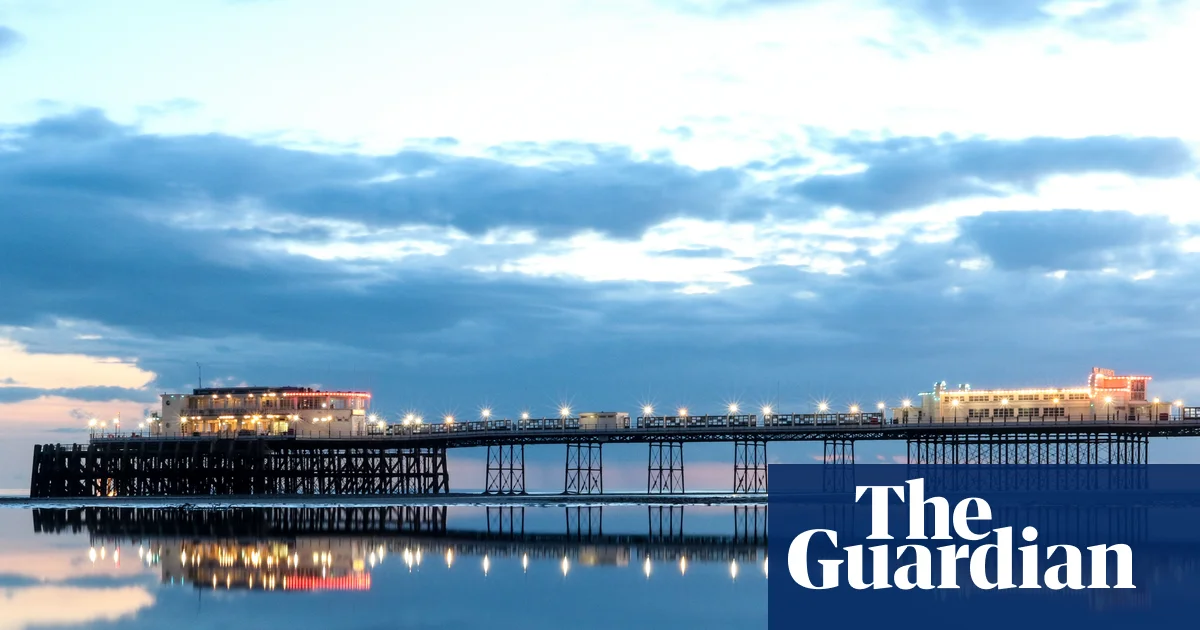
Perched in our glass-fronted eyrie, 300 metres out to sea, we watch a murmuration of starlings rise and fall and swoop around us. When the show is over, we turn our attention to the food. I have a bespoke vegan menu based on the best early summer ingredients: jersey royals, asparagus, strawberries. My boyfriend orders off the weekly changing à la carte: slow-cooked beef dumplings followed by butter-poached halibut.
We are at Ebb, a restaurant at the end of the pier in Worthing, West Sussex, which opened in May. Its art-deco design and fine-dining dishes are a far cry from the fish-and-chip shops and ice-cream parlours more commonly found on seaside piers. But traditionalists need not despair: downstairs at Perch on the Pier, fish and chips – as well as tofish (tofu) and chips – are always on the menu, with a knickerbocker glory to round things off in fine retro style.
Worthing pier, which opened in 1862, is one of Britain’s surviving 19th-century pleasure piers. “The seaside piers around the coast of Britain stand as a powerful reminder of the achievements of Victorian engineers and entrepreneurs,” says the National Piers Society website. “However, of the 100 piers that once graced our coastline, only half survive, and several of these face an uncertain future.” The society campaigns to preserve the piers for everyone’s enjoyment, and has saved several that were at risk of demolition.
Worthing may well be the foodiest pier in the UK, but they all have their charms. Here are 10 well worth a stroll out to sea.
Best for overnight stays: Garth pier, Bangor, Gwynedd
The Pier Master’s House at Garth Pier, to the right, is now a holiday let. Photograph: Maciej Olszewski/Alamy
Bangor’s 458-metre (1,500ft) pier stretches out halfway across the Menai Strait, backdropped by the Eryri mountain range (Snowdonia). To coincide with its 130th anniversary this year, the Pier Master’s House at the entrance has been turned into a holiday let (from £140 a night, sleeps six). The pavilion at the far end is now a cafe, and the smaller Victorian kiosks dotted along the pier house independent businesses selling gifts, artworks and local food. There is a programme of weekend events over the summer, from busking and children’s fun days to a dog parade.
The world’s first pier-to-shore zip wire . Photograph: PA Images/Alamy Live News
Bournemouth pier (first opened 1856, current structure 1880) boasts the world’s first pier-to-shore zip wire, a 250-metre dual line starting from the end-of-the-pier tower. As well as the PierZip, it has RockReef, an indoor climbing centre with 28 climbing walls, an aerial obstacle course, a vertical slide, a “leap of faith” and caving tunnels. The pier is the best place to watch Bournemouth’s Friday fireworks (10pm, until 28 August), and there is regular live music at its Key West restaurant (until 28 August). The town’s other pier, Boscombe (opened 1889), is next to free bouldering obstacles and slacklines, and near the beach volleyball courts.
Best for traditional seaside fun: Britannia pier, Great Yarmouth
Photograph: Eye35.pix/Alamy
Britannia pier won the coveted 2026 Pier of the Year award, taking over from last year’s winner Llandudno, and beating runners-up Herne Bay and Swanage. The 250-metre pier was built in 1858, but as with many of the original Victorian piers, it has been damaged, demolished, rebuilt (in 1901), burned down and reconstructed over the years. The current owners bought it in 2022 and have spent £2.2m restoring and upgrading it. Its attractions include a theatre, fun fair, arcades, fish and chip shop, pub and nightclub. Holidaymakers can also visit the town’s Wellington pier, further south along the seafront, which opened in 1853 and has a bowling alley, arcade and ice-cream parlour.
While Penarth pier dates back to 1894, as a landing jetty for the steamships in the Bristol Channel, its art-deco pavilion wasn’t built until 1929. This former dancehall has recently been restored and is now a cinema and arts centre, with year-round film screenings, art exhibitions, live music, workshops and talks. Coming up this month is a jazz brunch, a drawing workshop, and a knitting and crocheting social, alongside summer blockbusters The Odyssey and Minions & Monsters. There is a cafe in the pavilion, and a coffee shop, ice-cream parlour and chippy elsewhere on the pier.
Roker pier is distinctive for its red-and-white striped granite lighthouse, completed in 1903. After extensive restoration, and closures due to storm damage, pier and lighthouse are now open for guided tours (£14 adults/£10 children, to 27 August). Visitors walk the length of an underground tunnel to reach the lighthouse – the route the keeper used in bad weather – then climb to the top to take in the views. For post-tour refreshments, the pier’s former toilet block is now a gin bar, Tin of Sardines, with brunch and tapas menus served on the terrace in the summer.
England’s only Grade I-listed pier opened in 1869 to receive paddle steamer passengers from Devon and Wales. It is made from discarded wrought iron railway lines shaped into eight arches, nearly 15 metres high. In 1980, during a campaign to save it from demolition, the then poet laureate John Betjeman described it as “the most beautiful pier in England”. “Clevedon without its pier would be like a diamond with a flaw,” he said. The pier was duly saved, and now its Victorian pagoda is a cafe, its toll house is a museum and gift shop, and there is a modern restaurant, the Glass Box. The sea view from the porthole room is streamed live 24/7.
The oldest pier in Wales (1865) was designed by Eugenius Birch, a renowned seaside architect best-known for Brighton’s now-ruined West pier. Today, Royal pier is billed as “the number one destination for competitive socialising in Aberystwyth”, with three bars and a nightclub. There is a host of activities in the Billiard Bar, including shuffleboard, augmented-reality darts, footpool and interactive mini golf; the Upstairs Bar has seven pool tables; and the Inn on the Pier is a restored Victorian boozer, with stained glass and custom tiles. DJs play chill-out tunes in the pier garden over the summer, and the Pressure Nightclub is open until 4am on Fridays and Saturdays.
Best for variety: Blackpool
Photograph: Christopher Furlong/Getty Images
Blackpool is the proud home of three piers: Blackpool North (1863), Blackpool Central (1868) and Blackpool South (1893). The Grade II-listed north pier is the oldest surviving Birch pier, and has an art-deco theatre, a two-tier carousel, bars and an arcade. It was sold in June and is open until at least the end of the year before a promised £10m refurbishment. The central pier has Blackpool’s Big Wheel, a funfair and a show bar with live performances. The south pier has a more high-octane funfair, with a rollercoaster, a freefalling swing and a reverse bungee ride, and is next to Blackpool’s Pleasure Beach for more adrenaline-fuelled fun. Its many food and drink options include the Gin House and a loaded jacket potato stand.
Photograph: Ian Goodrick/Alamy
Gravesend’s pier opened on the Thames in 1834, and is the oldest surviving cast-iron pier in the world. It was once a hub for steam packets to London – more than 3 million passengers used it between 1835 and 1842 – and today there are still occasional summer sailings to the capital with Uber Boat by Thames Clippers. Just by the entrance to the pier is the ancient Three Daws pub, which was licensed in 1565 as the Three Cornish Choughs and renamed in 1745. This old smugglers’ haunt, which has three underground tunnels, now hosts a summer beer and music festival (7-9 August) and an Oktoberfest (18 September).
The Isle of Wight once had an incredible 11 piers, and four still survive: Ryde (the second-longest in the UK, after Southend-on-Sea in Essex), Sandown, Totland (for sale) and Yarmouth. Sandown (1879) is a particular paradise for families, whatever the weather. There is the Aztec-themed Lost World indoor crazy golf, with lighting and sound effects; the Magic Island indoor adventure play area; and Superbowl 10-pin bowling. The end of the pier has rides such as dodgems and teacups (Easter to September only); there is a cafe, ice-cream kiosk and burger bar; and Scruffy Jacks bar shows live sport.
It’s easy to assume you’re getting a good deal(Image: tupungato via Getty Images)
People who shop at duty free in airports are being told to think twice by an expert.
Holidaymakers could end up paying 10 times more than they need to for perfume if they buy it at the airport instead of planning ahead, according to an expert. While many travellers still assume airport duty-free offers the best deals, UK fragrance research site ScentVerdict said the departure lounge was one of the worst places to buy perfume because shoppers are rushed into making expensive decisions.
The biggest example is Tom Ford’s Lost Cherry. A 100ml bottle typically retails for around £300, but analysis by ScentVerdict found 14 UK dupe brands selling their own interpretation for a median price of just £30 – around one tenth of the cost.
He added: “The departure lounge is the worst place on Earth to buy perfume, because it is the one place where you are shopping against the clock. The ‘duty-free’ label does the persuading; you have not smelled the thing properly, and your flight is boarding.
“Decide before you fly, not at the gate. Take Tom Ford’s Lost Cherry as an example.
“It is around £300 at retail for 100ml; 14 different UK dupe houses sell their own version of it and the typical price is about £30 for the same 100ml, roughly a tenth.
“It will not be identical and you are not buying Tom Ford. But if what you want is that cherry-and-almond hit rather than the box it comes in, the maths is hard to argue with.”
The findings suggest dupe fragrances tend to sell for broadly the same price regardless of how expensive the original designer bottle is. Across 10 of Britain’s most popular fragrances, originals ranged from £89 to £310, while equivalent dupes typically sold for around £30.
The most extreme example remains Creed Aventus, one of the UK’s best-known men’s fragrances. A 100ml bottle retails for £310, while the median price of a comparable dupe is just £29.
Even fragrances with much lower retail prices show a similar pattern. Montblanc Explorer sells for around £89, while a typical dupe costs £25, suggesting dupe brands price according to what shoppers expect to pay rather than matching the original fragrance. Grimes said many people assume dupes simply undercut luxury brands by a percentage, but the figures suggest otherwise.
He continued: “That flat £30 is the story. The dupe houses aren’t pricing against the original at all. They charge what someone will pay for a dupe, and it barely shifts whether they’re copying an £89 Montblanc or a £310 Creed.
“The saving isn’t really a discount. It just tracks whatever the designer decided to charge.”
He added that shoppers should still compare prices before deciding, as some designer fragrances are regularly discounted outside airports, narrowing the gap between the original and a dupe.
Retail prices for the designer fragrances were checked at John Lewis, Boots and The Perfume Shop on July 17, 2026, while dupe prices represent the median price charged across brands selling equivalent fragrances at each bottle size.
Cuba’s electricity system has deteriorated amid shortages of fuel and replacement parts.
By Al Jazeera and news agencies
Published On 3 Aug 20263 Aug 2026
Cuba’s national electricity grid has collapsed, plunging the island into a widespread blackout.
The state-run Electric Union, known as UNE, announced the collapse on X late on Sunday but did not immediately identify its cause, the extent of the disruption or when electricity would be restored.
Before the nationwide failure, Havana’s electricity company had reported outages caused by damaged transformers, circuit failures, and planned cuts linked to insufficient generating capacity.
Recommended Stories
list of 4 itemsend of list
Early on Sunday, it recorded dozens of unresolved complaints across various municipalities, including Guanabacoa, Habana del Este, La Lisa, and Marianao, according to the Reuters news agency.
Authorities typically attempt to recover from a total collapse by creating small, isolated power networks to supply hospitals, water systems and food facilities before gradually reconnecting larger generating plants.
Series of nationwide blackouts
Sunday’s failure is the latest in a series of nationwide blackouts this year. The grid collapsed three times within nine days in July, including two island-wide failures in the same week. One of those outages left about 10 million people without electricity, while authorities struggled to restore power because the country could not generate enough electricity to meet demand even after the network was reconnected.
Cuba’s electricity system has deteriorated amid shortages of fuel and replacement parts, as well as repeated breakdowns at ageing thermoelectric plants. Some generating facilities are more than 30 years old and have received limited maintenance.
The Cuban government blames Washington, which has severely restricted oil supplies to the island and access to financing and equipment.
Cuba lost a key source of fuel after United States President Donald Trump imposed an oil blockade on the island following the US’s January 3 abduction of Venezuelan President Nicolas Maduro.
Venezuela had long been Cuba’s primary oil supplier, and imports from Mexico have also been halted amid increased pressure from Washington.
Others, meanwhile, cite decades of underinvestment and mismanagement in the energy sector.
Extended outages have disrupted transport, water supplies, communications and medical services. They have also left households struggling to preserve food, cook meals or sleep during the summer heat.
SLUMPED in a chair in his hotel room, eyes blood-shot and his mood low, comedian Mo Gilligan is a shadow of his normal self.
His mission — to eat only fried chicken for 28 days in a bid to discover what it does to our bodies — had at first sounded like a fast-food dream come true.
Mo Gilligan went on a mission to eat only fried chicken for 28 daysCredit: GettyMo wanted to learn what too much fried food would do to his bodyCredit: Netflix
But the challenge quickly took its toll, piling weight on the happy-go-lucky entertainer, sending him into a depression, increasing his chances of developing diabetes and leaving him barely able to recognise himself in the mirror.
Addressing the camera in his dimly lit room, a visibly broken Mo says: “I’m eating this food and I don’t feel like myself.
Sign up for the Showbiz newsletter
Thank you!
“I look in the mirror and I don’t look like myself. I feel so low.”
Mo, 38, has teamed up with Netflix for a new special, Big Chicken: A Fast Food Conspiracy, which echoes Morgan Spurlock’s 2004 documentary Super Size Me, in which he munched only McDonald’s grub for a month.
In one harrowing scene from Mo’s documentary, he breaks down in tears as he struggles with the physical and emotional effects of his diet.
During the show, he travels to visit so-called food deserts where grub is limited and pop-up takeaways are the only option.
Chicken is often seen as a healthier alternative to a burger. But in reality, more and more natural and artificial flavourings and preservatives are being added to fried poultry, which can lead to dire health consequences.
Some has even been found to contain dimethylpolysiloxane — an ingredient used in kids’ silly putty and the manufacturing of condoms. Mo tells the film: “I’ve met a lot of experts over the last couple of days.
“You know, one of the ingredients, they also put it in condoms for lubrication. Who knew that went into a burger? So many things go into it that are artificially engineered to give you a better experience and get you to come back for more.”
Speaking exclusively to The Sun ahead of the show’s release on Wednesday, Mo said he felt it was crucial for viewers to see how far the TV experiment pushed him — even when he desperately wanted to switch the cameras off.
He explained: “Being paid to eat fried chicken sounds like the dream. In my head I was like, ‘Well, I like eating fried chicken, I want to know more about it’.
“But it quickly turned into a nightmare.”
Gilligan munches on a chunk of fried chicken for the Netflix TV experimentCredit: NetflixThe overwhelmed star struggles with the emotional and physical impact of his dietCredit: Netflix
Mo — who is a judge on ITV’s The Masked Singer with regulars Maya Jama, Jonathan Ross and Davina McCall — continued: “Look, I do a job that’s very front-facing and in the public eye. I’d be lying if I said I don’t care about my image, especially if I’m eating fried chicken every day.
“Eating the food was something that I was a bit self-conscious of, but also knowing that in the space of a few days, I went from a large in my T-shirt size to an extra large because of what I’m eating.”
Mo underwent a medical assessment before and after the TV experiment.
Over the 28 days, he gained 1½in around his stomach, felt his mood skydive and saw his chances of developing diabetes increase. But despite no longer fitting into some of his clothes, Mo insists he will not use fat jabs as a quick slimming fix.
The comedian had health checks before and after the challenge, which made him gain weight and feel lowCredit: NetflixMo with his fiancée Taia Tulher at awards bash last yearCredit: Getty
Shockingly, one spicy chicken sandwich from US chain Popeyes, which came to the UK in 2021, contains a massive 142 ingredients.
Health Professor Laura Schmidt said: “These companies are doing everything they can to make it cheap, make it convenient and to make it taste irresistible. If you see 45 ingredients and they are chemicals you don’t recognise, it is probably ultra-processed.”
She added: “Natural and artificial flavours. That’s the question mark, as it’s a bunch of chemicals they don’t have to list and those chemicals may not be regulated as there is a loophole in the federal regulation in the US. Even in Europe, when they go to regulate a chemical additive, they ask the company to prove it’s safe. In the US they don’t. The companies decide what is safe. These foods promote chronic disease. This is the big concern for our health.”
Mo, who has been touring America, insists that if anything, doing the documentary has made him more committed to his fitness.
But the comic — who played football when he was younger and now enjoys running — stressed that, regardless of your diet, nobody needs to go to extremes to benefit their health.
He reveals: “I do love my fitness, man. I love it, especially because I travel a lot on tour.
“All I need is a gym, some equipment and some gym shoes. I think when it comes to exercise, people think you must be doing a 5k. But you don’t have to be totally extreme to lose weight. As I learned, a ten-minute walk can burn calories.”
Sales of fried chicken have exploded since the 1960s.
In the UK, we spend an incredible £12million on it every day.
Britain now boasts more than 6,000 fried chicken shops, with London Road in South London having some 20.
In comparison, Tesco has 3,010 stores and Sainsbury’s has 1,485. In the doc, Mo says: “I only remember one chicken shop growing up.
“Now, one road alone has more than 20.
Morgan Spurlock’s original 2004 documentary Super Size Me, in which he munched only McDonald’s grub for a monthCredit: RexMo, with fellow Masked Singer judges Davina, Maya and Jonathan, is usually happy-go-luckyCredit: Refer to source
“In central London, you have your more gourmet ones, something from the US. Then the further you go out, they don’t even have names any more.
“DFC, MFC, we know the FC is fried chicken, but what is the M?
“PFC. What is that? Perfect Fried Chicken? . . . I have no idea.
“This bird is big business.”
Big Chicken: A Fast Food Conspiracy has been created by documentary maker Louis Theroux’s team.
And Mo is proud of showing his emotions on film.
He said: “I think men do need to be more comfortable speaking about how we feel in the moment as well with our other friends, other guys.
“It will definitely break the silence. As men, we need to speak up and be like, ‘I feel low in myself’ or, ‘I don’t look how I want to look’ or, ‘I don’t feel how I want to feel’.
“It’s really important for me to be my authentic self on camera.”
And he insists he is not making a concerted effort to crack America.
He says: “When I think of America, I always say they are great at exporting entertainment and fast food. I’m quite fortunate that I’ve had three Netflix specials and they go all around the world.
“So if it lands me in America, I’m here for that. But if it takes me to Australia or Africa, it’s equally good for me.
“I’m really fortunate I’ve been able to tick off doing all the things I wanted to do and some of the things I never thought I would be able to do as well.
“Now, being in this space and making hopefully an impactful documentary . . .
“I really enjoy this subject and seeing where it goes and telling it to the rest of the world.”
Candidates for the ruling Democratic Party’s leadership race, (L-R) Kim Min-seok, Chung Cheong-rae and Song Young-gil, hold their hands up together to greet the crowd at a joint speech for the preliminary elections for party leader and Supreme Council members at CJB Media Center in Cheongju, North Chungcheong Province, South Korea, 01 August 2026. Photo by YONHAP / EPA
Aug. 2 (Asia Today) — Chung Cheong-rae rebounded in the South Korean ruling Democratic Party’s leadership race Sunday, defeating Kim Min-seok in the southeastern region after narrowly losing the opening contest in central South Korea.
Chung and Kim have each won one of the first two regional rounds ahead of the party’s Aug. 17 national convention, leaving the race for party leader virtually even.
Chung received 25,189 votes, or 46.65%, from eligible party members in Busan, Ulsan and South Gyeongsang Province.
Kim finished second with 23,675 votes, or 43.84%, leaving Chung ahead by 1,514 votes, or 2.81 percentage points.
Former party leader Song Young-gil received 5,129 votes, or 9.49%. The officially reported percentages were rounded to 46.65% for Chung, 43.85% for Kim and 9.5% for Song.
Kim had narrowly won Saturday’s opening round in the Chungcheong region, which includes Daejeon, Sejong and North and South Chungcheong provinces.
Kim received 45.05%, compared with Chung’s 44.61%, a margin of 303 votes, or 0.44 percentage points. Song received 10.34%.
After the first two rounds, Chung held a narrow cumulative lead with about 45.5%, compared with Kim’s 44.5%.
The results announced during the regional contests represent only the first-choice votes of eligible party members. Delegate votes and the results of a public opinion survey will be announced at the national convention in Daejeon.
One-person, one-vote system raises importance of members
The Democratic Party finalized an electoral roll last week containing 17,667 delegates and more than 1.52 million dues-paying party members.
The leadership election is the first to apply a one-person, one-vote principle equally to delegates and eligible members, replacing a system in which individual delegate votes carried substantially more weight.
Combined votes from delegates and eligible party members will account for 70% of the final result, while a public opinion survey will make up the remaining 30%.
The large number of party members means their preferences are expected to play a decisive role.
The Chungcheong and southeastern electorates together represent less than 20% of the total party electorate, however, making it too early to predict the final outcome.
Chung told reporters after Sunday’s results that he had regained the lead.
“I have come from behind,” Chung said.
He compared his campaign with former President Roh Moo-hyun’s victory over Lee In-je during the 2002 presidential nomination race.
Chung said Roh defeated an opponent supported by an established political organization and numerous lawmakers despite having little comparable institutional backing.
“Just as Roh Moo-hyun defeated Lee In-je, who lined up organizations and lawmakers behind him, Chung Cheong-rae will defeat Kim Min-seok,” he said.
Chung also told party members during a speech at the BEXCO convention center in Busan that “organization cannot defeat a political wind.”
Candidates exchange accusations of factional betrayal
The close race has intensified a broader conflict over factions within the ruling party.
During a joint campaign speech in Ulsan, Kim called for an end to what he described as a damaging confrontation between factions aligned with President Lee Jae-myung and Chung.
“We must end the vicious cycle of the Lee-Chung conflict,” Kim said.
He said he would refer people responsible for improper factional activity during the campaign to the party’s ethics committee.
Chung responded by invoking Kim’s conduct during the 2002 presidential election.
Kim left Roh’s then-ruling party after joining lawmakers who pushed for Roh to form a unified presidential ticket with independent candidate Chung Mong-joon.
The group was widely criticized by Roh’s supporters as having abandoned the party’s presidential nominee.
“A person who betrays once will betray again,” Chung said, directing the remark at Kim.
The renewed dispute over the episode reflects the extent to which events from the 2002 presidential campaign continue to influence relationships and perceptions inside South Korea’s progressive political camp.
Song also criticized Chung’s attempt to return as party leader.
“The Democratic Party does not permit consecutive terms,” Song said. “Is there really a need to seek another term?”
Ranked-choice votes could determine winner
The Democratic Party is using a preferential voting system in the three-candidate leadership contest.
Voters rank the candidates by preference. Should no candidate receive a majority of first-choice votes, the candidate finishing last will be eliminated and that candidate’s second-choice votes will be redistributed to the remaining two contenders.
The redistribution process will continue until one candidate secures a majority.
The regional percentages released so far include only first-choice votes and do not show how Song’s supporters ranked Chung and Kim as their second choices.
With Chung and Kim each receiving less than 50%, Song’s redistributed votes could determine the winner if the close three-way pattern continues through the remaining regional contests.
The regional campaign will continue Saturday in Jeju and Incheon, followed by Gangwon Province, Daegu and North Gyeongsang Province on Aug. 9.
Voting in the Honam region, covering Gwangju and North and South Jeolla provinces, is scheduled for Aug. 15. The final regional events will take place in Gyeonggi Province and Seoul on Aug. 16.
A 5% strategic-region bonus will apply in the traditionally conservative Yeongnam and Gangwon regions.
The party leader candidates are also scheduled to participate in televised debates on KBS on Wednesday and SBS on Aug. 12.
The final result will be announced at the Democratic Party’s national convention in Daejeon on Aug. 17.
Weekly insights and analysis on the latest developments in military technology, strategy, and foreign policy.
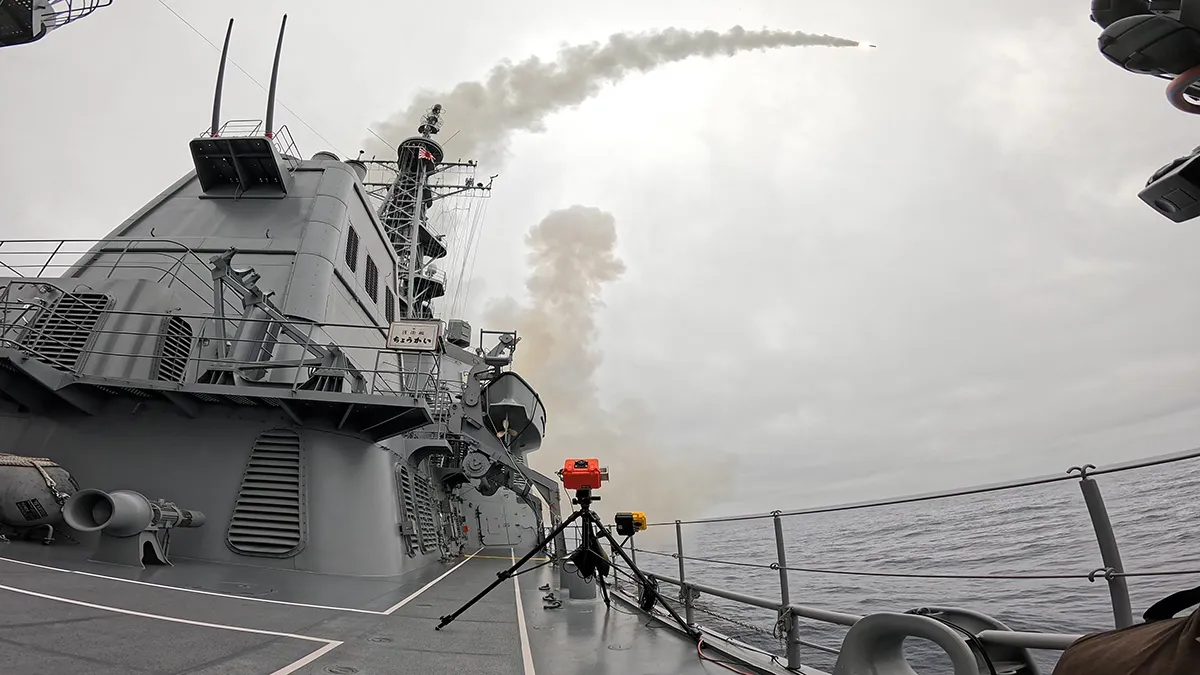
The Japan Maritime Self-Defense Force (JMSDF) has fired a Tomahawk land-attack cruise missile from one of its warships for the first time, marking a significant development in Tokyo’s efforts to field a long-range conventional strike capability at sea. The launch, conducted by the Kongō class Aegis destroyer Chōkai in the Pacific Ocean with support from the U.S. Navy, is the result of years of work to integrate the U.S.-made cruise missile into Japan’s surface fleet and significantly expands the country’s standoff attack options.
Japan becomes the third country outside the United States to fire a Tomahawk from a surface combatant, with Australia and the Netherlands having previously done so. The other operator of the missile, the United Kingdom, has only fired Tomahawks from submarines.
Launch of the first Tomahawk missile from Chōkai at an undisclosed location in the Pacific. Japan Ministry of Defense
Japan’s Ministry of Defense announced that Chōkai, which has been deployed to the United States since late last year for modifications and crew training, carried out the live-fire event on July 29 Japan Standard Time (July 28 Pacific Daylight Time). According to the ministry, the test confirmed not only the ship’s ability to launch the missile but also the proficiency of its crew in operating the weapon, clearing another major hurdle toward operational service.
The firing represents the culmination of a process that began in October 2025, when Chōkai arrived in the United States. In March, Japan announced that the destroyer had successfully completed the structural upgrades, software integration, and crew instruction required to employ the Tomahawk, making it the first Japanese warship capable of launching the missile. At the time, officials said a live-fire demonstration would follow before the capability entered operational service.
The destroyer Chōkai arrives at Naval Base San Diego, October 15, 2025. U.S. Navy photo by Gunner’s Mate 2nd Class Timothy Weber Petty Officer 2nd Class Timothy Weber
“This live-fire test demonstrates steady progress in the Tomahawk project, and the Ministry of Defense will continue to work towards the early establishment of stand-off defense capabilities,” the ministry said in a statement.
Chōkaiis expected to return to Japan around September 2026.
For decades, Japan’s Aegis destroyers have been optimized almost exclusively for fleet air defense and ballistic missile defense missions. Integrating the Tomahawk fundamentally changes this by giving the ships the ability to strike fixed targets hundreds of miles inland, and potentially other ships at sea over great distances, extending the reach of the JMSDF far beyond traditional maritime operations.
The destroyer Chōkai steams during the Rim of the Pacific 2016 exercise. U.S. Navy Combat Camera photo by Mass Communication Specialist 1st Class Ace Rheaume/Released Senior Chief Petty Officer Ace Rheaume
The Tomahawk acquisition forms part of Japan’s broader effort to build what Tokyo describes as “standoff defense capabilities” in response to an increasingly challenging regional security environment. Under Japan’s revised National Security Strategy, the country has embraced a limited counterstrike capability intended to hold hostile missile launchers, command nodes, and other military targets at risk if Japan comes under attack. Officials have repeatedly stressed that these weapons remain consistent with Japan’s exclusively defense-oriented security policy and are intended to strengthen deterrence rather than enable offensive military operations.
Japan is purchasing up to 400 Tomahawk missiles from the United States, including both Block IV and newer Block V variants, at a cost of around $1 billion. The Block IV Tomahawk can hit targets nearly 1,000 miles away with a 1,000-pound unitary warhead. It is capable of rerouting mid-flight and can loiter over an area to hit targets as they emerge, featuring an imaging infrared seeker capability. The Block V variant is an improved version with survivability upgrades that can be used to also hit moving targets, especially in the long-range anti-ship missile role.
A Block V Tomahawk seen with its distinctive ‘chined’ nose cone. U.S. Navy
Tomahawk is seen as a bridge capability while indigenous long-range weapons — including Upgraded Type 12 anti-ship missiles and other domestically developed standoff systems — enter service. Tomahawk deliveries have already begun, and additional Aegis destroyers are expected to receive the modifications needed to employ the weapon over the coming years.
Japan’s four Kongō class destroyers already feature the Mk 41 vertical launching system (VLS) and an Aegis combat system closely aligned with U.S. Navy architecture, requiring modifications rather than wholesale redesign to operate Tomahawk. Future installations are expected across the remainder of Japan’s Aegis destroyer fleet, including the two Atago and two Maya class ships.
Tokyo has already allocated funds of close to $700 million for the appropriate modifications to four more Aegis destroyers: Kirishima, Haguro, Myoko, and Atago.
The Kongō class destroyer Kirishima underway in the Philippine Sea. Tomahawk modification work on Kirishima began during fiscal year 2025. U.S. Navy/Photo by Juahn Gaskins Military Sealift Command Far Eas
Japan’s future Tomahawk fleet is likely to extend beyond its existing destroyers.
Japan is also getting the highly- lexible Joint Strike Missile, which is air-launched and can hit land targets and vessels, as well, albeit over far shorter ranges than Tomahawk. The longer-range JASSM has also been cleared for sale to Japan, but that has not moved forward as far as we know. Beyond that, however, Japan plans to rely on domestically developed long-range missiles to ensure its standoff strike capability. As well as the aforementioned Upgraded Type 12 anti-ship missile, which adds a new land-attack capability, Japan is working on a ground-based Hyper Velocity Gliding Projectile (HVGP), a combination of ballistic missile and hypersonic glide vehicle, a project which you can read more about here.
The successful Tomahawk launch also underscores the deepening operational integration between the U.S. Navy and the JMSDF. Beyond the missile sale itself, the United States has supported the ship’s modernization, crew certification, and now its first live firing, highlighting the increasingly close cooperation between the two allies as they seek to deter their regional opponents, primarily China and North Korea.
With the successful test now complete, Japan has taken another important step in establishing its new-look defense posture, transforming the JMSDF’s premier Aegis destroyers from platforms focused primarily on air and missile defense into warships capable of delivering precision strikes against land targets far beyond the horizon.