The true crime documentary has everyone talking as it is available to stream now
The Cult of NatureBoy has been dubbed a ‘bizarre’ watch(Image: ABC/Hulu)
True crime fans cannot stop talking about a “bizarre” documentary that left their jaws on the floor.
The Cult of NatureBoy is a four part documentary series that plunges viewers into the rise and fall of YouTuber Eligio Bishop, also known as ‘Nature Boy’.
Giving fans an unprecedented insight into the cult, viewers are transported back to 2016 when Eligio used social media to lure unsuspecting followers to a real-life ‘utopia’ he had founded. However, the alternative lifestyle soon turned into a cult plagued by coercion, violence and abuse.
Having first been released earlier this year on Disney Plus, the four part series follows his life and eventual trial as viewers have branded it one of the “most bizarre” documentaries they’ve ever seen.
An official synopsis reads: “The Cult of NatureBoy traces the rise of Eligio Bishop, aka NatureBoy, leader of Carbon Nation. Beginning in 2016, he used social media to attract people to a self-described Black Utopia. What began as an alternative lifestyle in the tropics became a sex cult of violence, manipulation, and coercion, ending with his 2024 trial and life sentence.”
Streaming on Disney Plus now, it comes with a strong viewer warning however, as more fans are only just discovering the relatively new watch.
Taking to TikTok this week, one true crime fan shared a video captioned: “One of the most bizarre documentaries I’ve watched.”
Content cannot be displayed without consent
They said: “What on earth have I just watched? If you’ve not seen it yet, Disney Plus have brought out a four part documentary and it’s called The Cult of NatureBoy. I’m telling you now right, this is one of the most bizarre documentaries I’ve watched.”
They later added: “I’m sorry what? It baffles me that people stayed with him, it baffles me even more that people sent him money.”
However, they went on to say: “I need to warn you because some of the things you see on it….It’s one of the maddest things I’ve watched.”
One person commented: “I watched this yesterday it’s so crazy!” Another replied: “I’ve just finished it now and my jaw is still on the b***** floor.”
A third penned: “It was mind blowing how the h**l could people let them treat them like that.” Over on X, viewers previously shared their disbelief as one person said: “#TheCultOfNatureBoy is too damn bizarre.”
Another added: “What’s absolutely terrifying are there are SO many men on this earth with the same mindset as Eligio and the most heartbreaking this is there are people who’s mindsets and upbringing will always make them the perfect victims to these monsters.”
A third commented: “Watch #TheCultOfNatureBoy if u wanna be p***** off from episode one until finale.” A fourth fumed: “This man was a walking red flag and was obviously spewing nonsense.”
The Cult of NatureBoy can be streamed on Disney Plus in the UK
The island of 5,000 is reached by hopping on a two and a half hour ferry from Funchal on the bigger island. The waves may get a little choppy, but it’s well worth taking on the journey
This article contains affiliate links, we will receive a commission on any sales we generate from it. Learn more
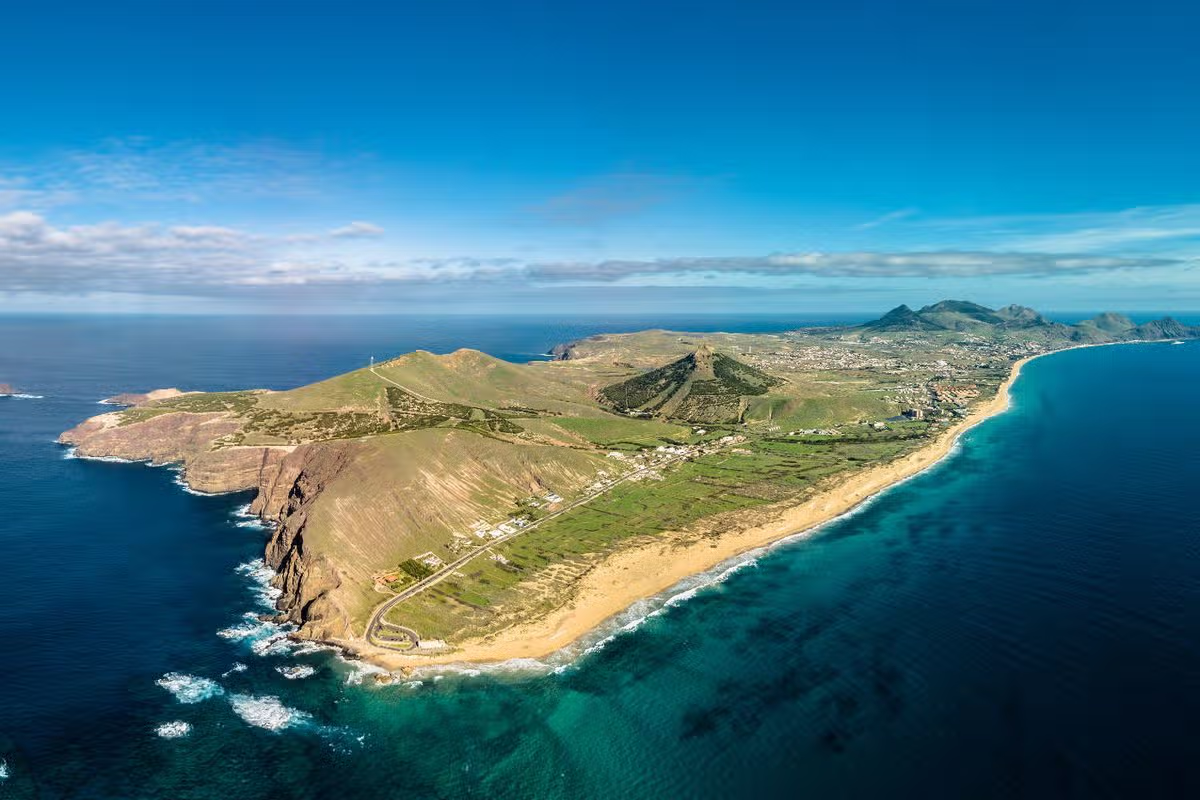
The island is a lot quiet than its bigger sibling (Image: Getty Images)
A European island with stunning beaches is one of this summer’s hottest spots.
Porto Santo is Madeira’s much quieter, sandier sibling island. Its main draw is exactly what Madeira and the Canary Islands can’t deliver: a bit of peace and quiet. While Madeira welcomes 2.2 million and Tenerife seven million visitors a year, only around 50,000 make it to Porto Santo.
The island of 5,000 is reached by hopping on a two and a half hour ferry from Funchal on the bigger island. The waves may get a little choppy, but it’s well worth taking on the journey.
Porto Santo’s headline feature is its single, near-uninterrupted 5.5-mile golden sand beach that runs almost the entire length of the island’s south coast. This is a big deal because Madeira proper barely has any sand beaches; they’re mostly volcanic pebble or rock. So Porto Santo is the go-to for a classic beach holiday in the archipelago.
The beach sand is locally famous for supposed therapeutic properties, particularly for joint and skin conditions, and people travel specifically to bury themselves in it or take mud/sand treatments. Whether or not it actually works, digging yourself down into the ground like a baby turtle sounds like a nice way to spend an afternoon.
Once you’ve cured yourself, a quick dip to get the residue sand off will likely be in order. The island’s clear, calm turquoise waters are great for swimming, unlike much of Madeira’s rockier coastline, and decent for watersports like windsurfing, kitesurfing, and diving.
Porto Santo delivers golden sand, reliable warmth and a slower pace made for switching off. It’s gaining momentum this year as travellers move beyond Europe’s classic beach staples in search of calmer, more relaxed stays.
The island was named in Expedia’s Island Hot List, having seen a 85% spike in interest over the past year.
Expedia’s 2026 Island Hot List
1. St. Lucia (+125%) – Best for Romantic Escapes
Why it’s Next Wave: As travellers move beyond crowded Caribbean hotspots, this destination stands out for couples with its secluded resorts, dramatic scenery, and soft adventure tailored for romance.
2. Porto Santo, Madeira, Portugal (+85%) – Best for Wellness & Relaxation Why it’s Next Wave: A quieter alternative to Funchal and mainland Europe’s busiest beach destinations, known for its golden sands and relaxed pace.
3. Praslin, Seychelles (+80%) – Best for Nature Lovers
Why it’s Next Wave: No longer a launchpad for Seychelles island hopping, Praslin’s protected landscapes, rare wildlife, and untouched beaches are drawing travellers seeking immersive natural beauty.
4. Syros, Greece (+60%) – Best for Cuisine & Charm
Why it’s Next Wave: An alternative Greek island offering culture, food, and fewer crowds than the region’s better-known islands, Santorini and Mykonos.
5. Lofoten Islands, Norway (+50%) – Best for Arctic Adventures
Why it’s Next Wave: A spectacular archipelago in Northern Norway known for dramatic peaks and crystal-clear fjords. Here travellers find the Midnight Sun in summer and an alternative for Northern Lights spotting from September to April.
6. Palawan, Philippines (+40%) – Best for Natural Wonders Why it’s Next Wave: As travellers seek more dramatic, discovery-driven escapes, this destination is gaining traction for its iconic limestone landscapes and pristine ecosystems.
7. Culebra, Puerto Rico (+35%) – Best for Water Adventures Why it’s Next Wave: It offers a quieter escape for its world-class snorkelling, diving, and tidal pools.
8. Sanibel Island, Florida, USA (+25%) – Best for Family Escapes
Why it’s Next Wave: Re-emerging on travellers’ radars, it combines effortless access with rising global interest from families for its simple, uncrowded beach escapes.
9. Phu Quoc, Vietnam (+25%) – Best for Affordable Luxury
Why it’s Next Wave: Rapidly emerging as Southeast Asia’s affordable luxury island hub as it trends up social (mentions +235% YoY) for its strong value appeal at accessible pricing.
10. Fiji (+15%) – Best for Multi-Generational Value
Why it’s Next Wave: Evolving as a destination for all generations, it’s leading the conversation as the most mentioned island on social in 2026, combining family-friendly resorts, cultural depth, and strong overall value.
SACRAMENTO — California has spent millions of dollars to combat sex trafficking, and yet it can still be found in every city and town, hiding in plain sight.
Whether it’s online, on places such as Figueroa Street in L.A. or Stockton Boulevard in Sacramento, or even in the hotel rooms where our World Cup guests stayed, there are thousands of women and girls being sexually exploited in California right now, despite all that money and all the resources it has purchased.
“The reality is that few threats to a woman’s safety are as brutal or as overlooked as sex trafficking,” First Partner Jennifer Siebel Newsom said Monday, sitting with her husband, the governor, in a tiny second-floor dance studio built for survivors of trafficking.
Siebel Newsom was there to watch Newsom sign an executive order that was driven by her work as an advocate for survivors of trafficking. On its surface, the order may not sound like much and isn’t likely to make the news. It calls for most of the major state agencies to come up with a plan within 60 days to work together to curb trafficking and help survivors.
Hardly an earth-shattering demand. But believe it or not, one of the biggest barriers that our state faces, in this great age of technology and always-on connection, is that there is little collaboration between the folks fighting traffickers.
Yes, we have about 35 task forces statewide working on this issue and sometimes they run joint operations. But more often, those fighting trafficking live in their own silos, doing their own work, and often failing or refusing to share even scant details with other jurisdictions.
The same holds true for the many organizations that work with survivors, most of which have come on the scene only in the last few decades as sex trafficking morphed from a crime in which children were viewed as complicit to one in which we understand that they are victims.
Those organizations often do great work, but they too often do it alone. A survivor — or a girl being trafficked and looking for escape — has no easy way to find someone to help her. It’s largely luck, the right outreach person in the right place at the right time, or a cop who has taken the time and care to know what the resources are.
“We are so fragmented,” Sharmin Bock told the governor. She’s a former prosecutor in Alameda County who tried the first sex trafficking case in the U.S. Now, she’s advising the first partner on how California can do a better job fighting the predators — traffickers and buyers alike — who daily trade cash for the use of a human body, willing or not.
Bock points out that while those fighting against trafficking lack collaboration, the opposite is true of the criminals. Up and down the state, they are organized. A trafficker might pick up his victim in one city, only to transport her to another city to meet buyers. Victims are moved often, and even sold or traded to other traffickers.
Once a victim crosses a jurisdictional line, everything that happened on the other side of it too often gets lost in the nowhere land of bureaucracy and red tape. A move from Los Angeles to Riverside, and the girl might as well be in Taiwan, as Bock puts it.
“We need to stop asking whose case is this, and rather ask how do we solve this case together? How do we solve the problem together?” Bock said. “Collaboration recovers children sooner, links investigation, dismantles trafficking organizations and holds traffickers accountable. A trafficker should never escape accountability because critical information was sitting in another agency’s database.”
So while Newsom’s demand for a 60-day plan might not sound like much, it goes to the heart of what ails the system.
“Traffickers collaborate every day,” Bock said. “Traffickers have built networks to exploit children. We must build stronger networks to protect them.”
Newsom drew a parallel to the plague of retail theft that captivated the state not long ago, and which the state has successfully combated. Though careful to draw the obvious line that stealing a tube of toothpaste is a far cry from sexually exploiting a child, he pointed out similarities — online platforms that turned a blind eye, a lack of coordination between agencies, criminals that knew how to exploit not just victims, but systems.
Now he’s looking for that kind of “momentum,” to solve this most stubborn of abuses.
“For the last few years, I thought I could buy my way out of this,” Newsom said with a shocking bit of honesty, pointing to all that budget money that has been invested. But, he said, he’s clear now that it’s not a money problem. It’s a people problem.
“How is that possible? “ the governor wondered. The executive order, he said, is about saying “enough of just good intentions … we’re not delivering fundamental results.”
A report at the end of 60 days isn’t results. But it’s an acknowledgment that California needs to do better, and a road map to get there.
That’s crucial. Like Siebel Newsom and the governor, I’ve got two teenage daughters and I know just how vulnerable girls are, in the best of circumstances.
With all our resources and good intentions, California can’t continue to let predators win simply because they’re more organized.
Sussex have announced that former Kent boss Matt Walker will take over as their new head coach for the 2027 season.
The 52-year-old will take charge on 1 November, succeeding Paul Farbrace, who is switching roles to become Sussex’s new Director of Cricket.
Walker spent eight seasons as head coach at Kent, guiding them to promotion to Division One in 2018, T20 Blast success in 2021 and the One-Day Cup in 2022.
He has also coached in the England men’s set-up and is currently batting coach at Warwickshire and assistant coach with MI London, formerly known as Oval Invincibles, in The Hundred.
Philippine Foreign Secretary Theresa Lazaro said the Association of Southeast Asian Nations (ASEAN) must work together to shield external pressures, as the group holds a summit in Manila.
A fire engulfed a shopping centre in Ukraine’s Sumy after Russian drone strikes hit the building. Ukrainian authorities say emergency crews were forced to suspend their response because drones remained overhead, raising fears of further attacks.
Thirty years ago a teenage boy, traveling abroad and without parents for the first time, came upon a scene of staggering destruction.
At Pompeii, when Tom Hiddleston saw the casts of the bodies killed by the explosion of Mt. Vesuvius in AD 79, he wasn’t just horrified, he was mesmerized, even excited; amid all that death it felt like the past was alive.
“Until that point, it had existed in books in the classroom, but I felt like was going back in time, walking into the past,” he said in a recent video interview about “Pompeii: Out of Time With Tom Hiddleston,” his new series that’s a hybrid of travelogue, documentary and extensive dramatic reenactments (with a meta touch).
“I was knocked sideways by the quality of the preservation,” he recalled of that teenage visit. “You can hear that these buildings carry the echoes of the lives they contained because of the frescoes, the mosaics, the furniture. You feel 2,000 years compress and collapse. It’s like magic.”
Hiddleston knows something about magic and time travel. After studying classics at Cambridge, his acting career led to the Marvel Cinematic Universe and the role of Loki, the god of mischief and “the boundary crosser.” Loki’s movie misdeeds get him “removed from the timeline of history,” and in the “Loki” spinoff TV show, he faces his past while bouncing through time.
One place Loki lands is Pompeii. Hiddleston was actually on a set in Atlanta, but there he was speaking Latin and revisiting his own past. “I felt this extraordinary confluence of my passions.”
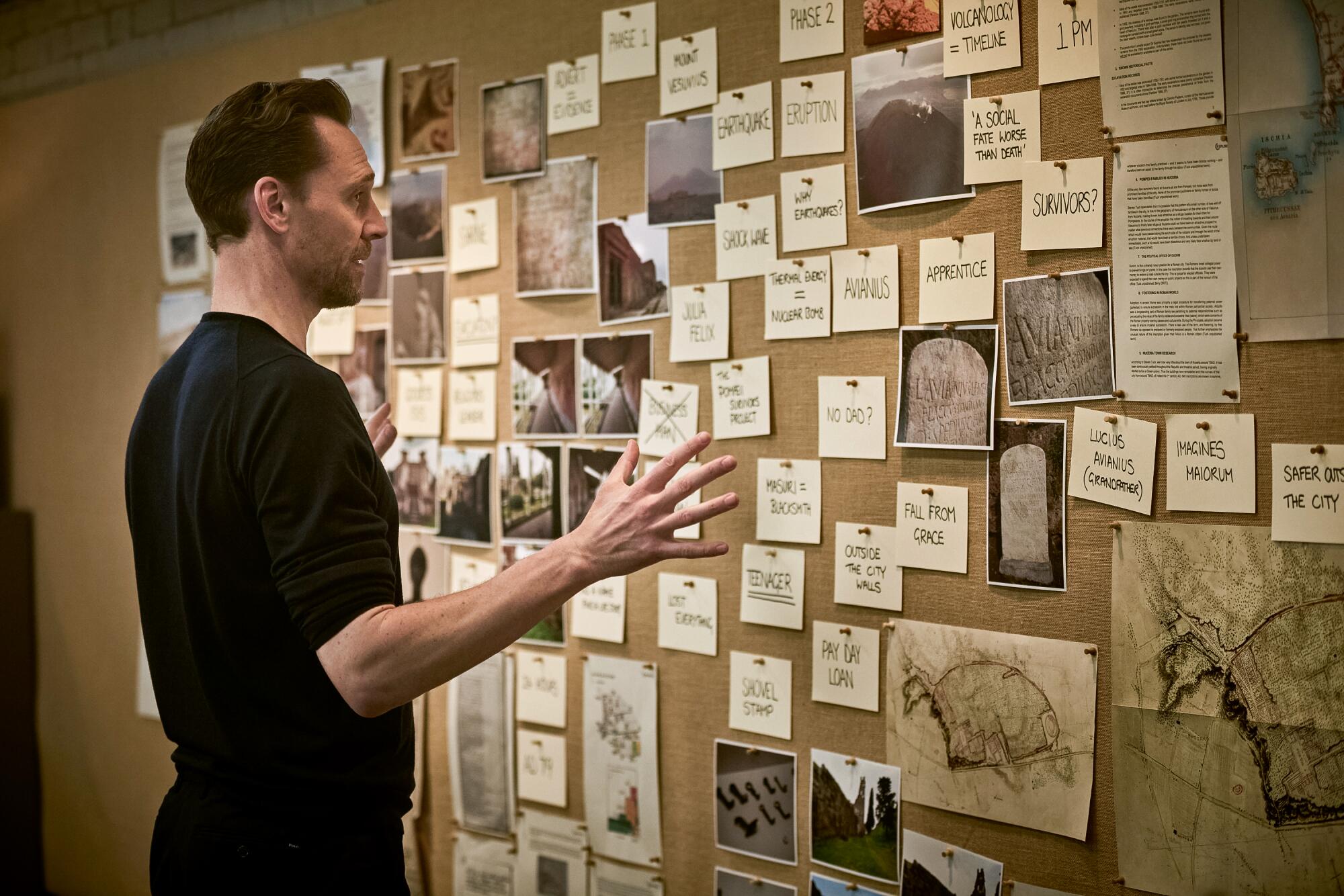
Tom Hiddleston in a scene from the series, where he speaks to experts about Pompeii and how the eruption of Mt. Vesuvius unfolded.
(Christian Black / National Geographic)
Hiddleston had been talking with producer Kevin R. Wright about his fascination with the ancient world, and after seeing Hiddleston in fictional Pompeii, Wright got the ball rolling on “Out of Time,” co-writing and helping to produce the series, which debuts Wednesday on NatGeo and Thursday on Hulu and Disney+.
On the show, Hiddleston travels back to Pompeii and the lip of the volcano, speaking to experts of Pompeii’s history and volcanoes but also one in surviving disasters to help him understand people’s behavior as the sky was falling on them. “It’s about trying to gather as much evidence from different disciplines,” he explained.
Hiddleston’s enthusiasm for the project is evident throughout our interview: Each question earned a five-minute response, all delivered with passion (and incredibly articulate with no verbal fillers or talking in circles) and fascinating digressions — he broke down the Greek and Latin roots of the words “democrat” and “republican,” mentioned the classical references in the architecture of the New York Stock Exchange and British Museum, and tied in the relevance of Christopher Nolan’s “The Odyssey.”
Here, for instance, is a portion of his answer to my first question about whether the driving force of the series was the importance of facts in understanding history, using storytelling and imagination to create empathy for the people of Pompeii, or to show the way our past still has lessons to offer today:
“I wanted a series with an original dynamism, which could be immersive and propulsive and emotional, and bring the story of Pompeii and its people back to life in a way that could be different and innovative. I wanted to evoke for the audience the feeling that I had when I first went to Pompeii.
“At university, I had teachers who taught me to live in the question and that our relationship with the past is a two-way street. One cannot examine the past without acknowledging that we look back from the perspective of where we stand. We tell stories to understand something about ourselves — we need to know who we were to think about who we are now.
Darius Arya, an archeologist and historian, with Hiddleston in the ancient city of Herculaneum. (Paolo Verzone/National Geographic)
Human remains inside of boat sheds, where people took shelter from the eruption of Mt. Vesuvius. (Paolo Verzone/National Geographic)
“The engine of my commitment was centered on empathy, trying to honor the lives of the people of Pompeii. If we could gather enough evidence, enough fragments of truth, they might add up to a picture of history, which would generate great reserves of feeling and compassion so we could see ourselves in their predicament, their instincts, their choices, their capacity to help each other. And that experience of empathy and compassion would connect us to a thread across time to people experiencing a terrifying and traumatic event, and to see that in our world now.
“But we were very careful about the idea that the truth matters. In writing history, there must be intense rigor — evidence is important and if you have evidence that should counteract any bias or hypothesis.
“But the evidence here is incomplete so at some point, you have to take an educated guess, a leap of imagination. The past is a two-way street with the present, but it’s also an eternal mystery and all of our questions will never be answered so there’s that joy of living in the question.”
When the publicist said our time was up, Hiddleston stepped out of time and took one more question. And then another and another, nearly doubling the time allotted, thrilled to be exploring the connections between past and present.
While many people think that the city’s population was wiped out, the vast majority actually escaped and modern research has found the names and details of hundreds of survivors. Hiddleston notes that “one great gift of Pompeii is that the Romans didn’t have paper, so the walls, the columns, the houses, the public buildings are covered in writing: deeds, business contracts, advertisements, gossip, doodles.”
In this behind the scene photo, director of photography Jim Jolliffe runs with a camera, following Frankie Treadaway playing Avianius, a teenage boy whose story is reenacted in the series.
(Darrin Zammit Lupi / National Geographic)
The three episodes track the stories of a teenage boy, a successful businesswoman and a soldier in the nearby town of Herculaneum, with a sprawling cast and special effects bringing those scenes to life. “We thought that in the words of Pliny the Younger, ‘their lives were worthy of our memory.’ ”
While there have been other more traditional Pompeii documentaries, Hiddleston felt he had something distinctive to offer, thanks to his “day job.”
“I take a piece of writing and a character, real or imagined, and research as much as I can, and then imagine it and try and breathe life into a person,” he says. “Even when I’ve played real people, I’ve run out of evidence. That’s when you just have to extend your empathy and compassion, your knowledge of human beings and the breadth and range of human experience, the things we all share and can connect with to find an internal world of variety and depth.”
Hiddleston wanted to extend that to the people of Pompeii. “They were three dimensional people with rich lives,” he says. “We follow the trail of breadcrumbs as far as we can, and then try to bring them to life with empathy and compassion.”
When Sebastian Dollinger and his colleagues first drove into Yosemite National Park, they felt like they were entering the world at its finest — a prehistoric beauty of hulking rocks with every waterfall flowing in the valley.
It reminded Dollinger, who lives in Sweden, of the Swiss Alps in summer.
The moment didn’t last long.
As the group, in the park in early May for a fashion shoot for California luxury brand Robert Talbott, neared Mirror Lake in Yosemite Valley, Dollinger’s party felt like it had been overtaken by a massive swarm of bees as droves of other tourists buzzed around them, he said.
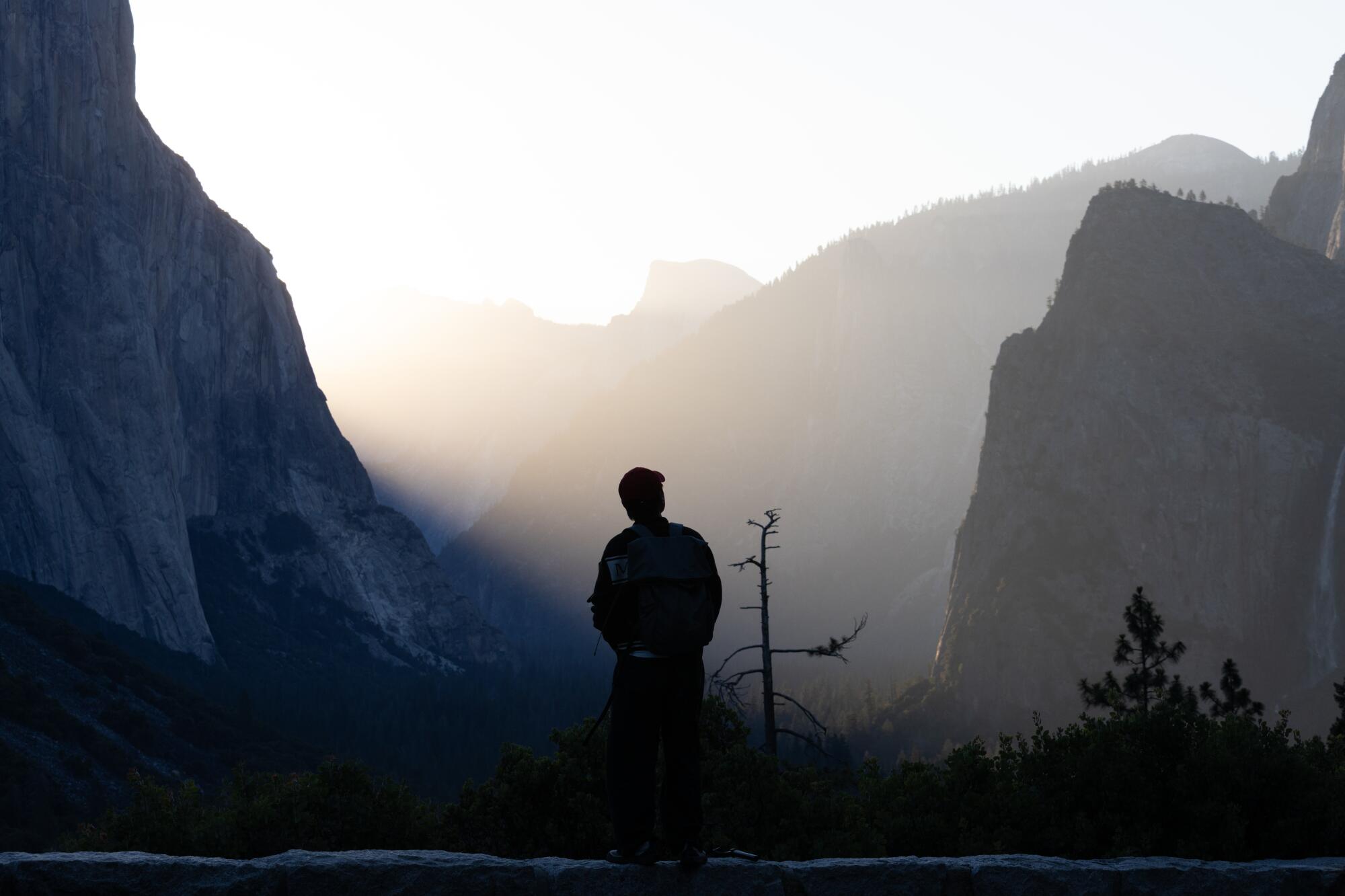
A tourist stands in front of an overlook near Yosemite Valley during a sunrise in mid-June in Yosemite National Park.
Tourists wait at the Yosemite Falls bus stop.
“I could have taken up climbing and gone up El Capitan just to escape the people,” Dollinger said, referencing Yosemite’s famous rock wall, “but I’m just a creative director.”
This summer, Yosemite is seeing a significant uptick in visitation, driven by the park’s internationally known splendor, its popularity on social media and a lack of its politicized reservation system. As droves of tourists flock to Yosemite, it raises the question: Is it still possible to have a fun time there despite the crowds?
Hopefully, yes, but that answer comes with a few heavy asterisks. Park-goers and local business owners say it’s crucial for those venturing into Yosemite this summer to plan their excursions outside peak times to avoid the worst of the crowds, and even then, pack their patience. The best-laid plans can still result in visitors facing significant lines at the park’s gate and restaurants, crowded hiking trails and a relentless search for parking.
By the end of June, Yosemite had seen at least 183,000 more visitors than last year, according to preliminary park visitor data. Just over 2 million people visited the park by the end of June, a 10% increase compared with last year’s visitation data.
Crowds pose for photos on the Mist Trail.
The increase in visitors is, in part, because the National Park Service is not using a timed-entry reservation system this year.
The National Park Service announced in February — after the agency under the Biden administration studiedextensively how to best implement a reservation system — that officials would instead use “targeted management.” This has included sending congestion alerts to visitors’ mobile phones and encouraging visitors to venture outside the valley, as it represents only a fraction of its almost 1,200 square miles of parkland.
When asked how the agency planned to address overcrowding in Yosemite this summer, a National Park Service spokesperson who declined to give their name to The Times said in an emailed statement that temporary traffic delays can occur during peak times but aren’t evidence of “operational failure.”
“They reflect the reality of managing one of the nation’s most visited national parks while keeping visitors safe and protecting park resources,” the spokesperson said. “Claims of widespread ‘overcrowding’ are not an accurate characterization of current park operations. Visitors have benefitted [sic] from expanded access for months now, and we are seeing operational efficiency from managing traffic only when and where necessary, rather than blanketing the park with restrictions for entire seasons.”
Dozens of tourists hike their way up the Mist Trail in mid-June, one of the more popular trails in Yosemite National Park.
Visitors like Dollinger say this new approach is not working.
“After we hiked for about three hours, we met a couple from Japan, and when I talked to them they were almost in tears,” said Dollinger, who has visited other state and national parks in California. “They saved for five years to do this trip, flew to San Francisco from Tokyo, stayed in San Francisco and hired a car, and went to the park for five days, which I can only describe as hell.”
Not every Yosemite visitor that The Times spoke to for this story had as bad of a time as Dollinger, but no one disputed crowds being an issue.
Chidumebi Ajaero, who lives in L.A., said he was “very concerned” when he and his friends left for their trip in mid-April over how crowded the park would be.
It was Ajaero’s first time to visit Yosemite after moving to California about 2½ years ago from Houston. He has been to other national parks and said he knows they can get “quite chaotic” when busy.
Tents set up in Upper Pines Campground on a June weekend in Yosemite National Park.
Ajaero and his friends arrived in Yosemite on a Friday afternoon and were surprised to find there was no line to enter the Big Oak Flat entrance.
They set their campsite up at Upper Pines, a campground in the valley, and headed out early on the Mist Trail, which takes hikers to Vernal and Nevada falls via its large stone steps. There were a considerable amount of people on the trail with them, he said.
“It’s not until you get to the waterfall itself and you have the steps, and everybody is taking pictures,” Ajaero said. “There’s actually a line to move up. You’re just waiting for your turn to step up” to capture the waterfall.
Ajaero said he’s glad he went before Memorial Day, when visitation started to increase more significantly.
But because of how curated Yosemite Valley is, with a grocery store, souvenir shops and restaurants, Ajaero said it felt more like an amusement park than his trips to Joshua Tree National Park, where visitors are far more on their own.
Hikers walk on a boardwalk designed to prevent erosion in sensitive meadows.
“I didn’t love it as much as the other because of the commercialized feeling of it, and just the fact it never felt you were alone in Yosemite,” he said. “I think there’s too much going on.”
How developed Yosemite should be for its visitors has been a debate since the park’s existence.
Michael W. Childers, author of “The Mountains Are Calling: Tourists and the Unmaking of Yosemite National Park” (Nebraska), said people often use the metaphor of not wanting to turn the park into Disneyland, but a more apt comparison is how closely Yosemite resembles a resort.
Concessionaires have been in Yosemite since its beginnings, as the federal government didn’t have the money to construct its own amenities in the 1850s, he said. Yosemite Hospitality, a subsidiary of hospitality giant Aramark, manages much of Yosemite’s lodging, dining and activities (including the park’s Starbucks inside the valley).
Childers, an associate professor of history at Colorado State University, said his concern is that, since the late 1970s, conservative intellectuals have pushed to privatize the park even further.
He said the chaos being created by the Trump administration through cutting park staff and ending the reservation system is “very intentional” in the quest to argue the only way to manage the park is to privatize Yosemite.
“If you privatize the entirety of a national park, that means that your only one measuring stick is profit, and arguably, national parks are not solely designed for profit,” said Childers, an environmental historian of the American West. “They’re for experience. They’re for democracy. They’re for preservation of natural resources.”
Vehicles stop to pay the fee at the El Portal entrance gate.
Vehicles line the road near El Capitan in Yosemite National Park.
One of park officials’ most significant management challenges started when tourists began entering Yosemite by automobile. Since 1913, people could enter in a personal vehicle, but visitation numbers remained reasonable until 1926 when the “All Year Highway,” a segment of the 140 Highway, opened.
This new thoroughfare created an easy and direct route to reach the park by car that avoided steep mountain roads, according to park history. The road’s opening resulted in a near doubling of total cars visiting the park in just one year, park staff said in an Instagram post.
“The summer of 1927 has clearly demonstrated that parking is one of the most urgent, menacing problems of the entire Yosemite Valley,” said Don Tresidder, president of the Yosemite Park & Curry Co., that year, according to the park.
And has thus remained for 100 years.
The first attempt in recent years to get a handle on car traffic was the reservation system, implemented initially to spread guests out during the COVID-19 pandemic in 2020 but rolled out in 2021, 2022 and 2024 as the park service tested how to best employ it to cut down on traffic and help more visitors enjoy the park.
“Over the past decade, many parks have seen significant increases in visitation and crowding in popular areas, especially during peak seasons,” the agency wrote in 2024 as it sought public comments on park management. “In some parks, the level of demand is exceeding the capacity for which infrastructure was designed or is outpacing the National Park Service’s ability to sustainably support visitation.”
The park service planned to use visitor feedback and research to guide how reservations would be rolled out in 2025. Environmental and park advocates argued for the reservation system, saying that it not only protected the wildlife and land, but also that it waspopular among guests.
But when Trump started his second term in office, not only did park management strategy change, so did the way the federal government viewed the park service. Hundreds of park workers were laid off, although some got their jobs back. Others took buyouts, and overall there was a 24% decline in permanent workers, according to the National Parks Conservation Assn.
One of the reservation system’s biggest critics is Rep. Tom McClintock (R-Elk Grove), who said the system was decimating the economies of local gateway communities, the term used for the small mountain towns around Yosemite.
Parking lots are filled to capacity during peak hours, creating traffic congestion in Yosemite National Park.
“This is not to say that crowding in the valley hasn’t been a big problem, but the solution is better management and more capacity, not restricting access,” McClintock said on the House floor in June, noting the park had more parking, rooms and campsites before the 1997 flood destroyed infrastructure that he said wasn’t replaced.
Under the timed-entry system, visitors could still enter the park without a reservation if they arrived early — before 6 a.m. in 2021 and 2022 and 5 a.m. in 2024 — or after 4 p.m., and would be required to pay an entry fee for a three-day pass allowing them to reenter outside of peak hours.
But entering the park early or late in the day still wasn’t doable for everyone, including Ronny Shields, a father of two children from Ventura.
Shields, a lifelong Southern California resident, struggled to book a reservation when Yosemite implemented the system until he finally snagged one in 2024. His family had a great time and was eager to return.
In early June, Shields, his wife and kids, ages 4 and 7, made the trek back to Yosemite, staying outside the park at Tenaya at Yosemite in Fish Camp. Shields had researched and found information online suggesting the nearby southern entrance was less crowded.
His family arrived on a Saturday afternoon and entered the park without a wait. They found the valley was quieter than they’d ever seen it as people left.
Tourists stand in a meadow with a perfect view of Yosemite Falls.
For the rest of their trip, they entered the park before 8 a.m. or after 3 p.m., except for one day when they entered later in the morning and waited 40 minutes to enter. The other times, they found no wait.
Once inside the park before 8 a.m., their first stop was the Bridalveil Fall Trail, a short trek that takes visitors right to the base of the thundering cascade. When Shields and his family left the trail about 9:30 a.m., they noticed other guests couldn’t find parking.
They faced the same problem after they went to get food and then tried to park near the Lower Yosemite Falls trailhead. After 20 minutes, they found a spot — and joined the masses.
The trail “doesn’t feel like a hike — it feels like you’re in a crowded mall, but I think that’s the nature of the beast because it’s very short and very scenic,” Shields said.
Comparing his two visits to Yosemite, Shields said he preferred not having to deal with the reservation system, but that came with some caveats. He noticed far more visitors, although he’d expected even more. He saw more trash, several guests going off trail and trampling plant life, and far fewer park rangers to tell them to stop.
He said he didn’t see any park staff in the outdoor areas, and instead, he and his wife made sure to take their kids into the park’s buildings so they could speak to the rangers.
Tourists swim and play in the Merced River in Yosemite National Park.
“It’s nice for the kids to be able to ask questions and learn from people that love it,” Shields said. “Even I learned something.”
Jennifer Liu, a Moreno Valley resident, was at the park the same time frame as the Shields family and was able to mostly avoid the crowds on her backpacking trip through the park’s backcountry.
Liu meandered through the park using a few different trails, including the Sunrise Lakes route, to reach her ultimate destination: Half Dome on her birthday. She left her backcountry campsite about 4:30 a.m. to reach Half Dome by 6 a.m., catching the sunrise at 8,800-feet elevation from the granite monolith.
“I got lucky — the clouds cleared out and there was a nice sunrise,” she said.
Not in a hurry, Liu stayed at the top for four hours. Her fellow hikers sang her happy birthday, and she witnessed a couple get engaged.
Sunset over the Half Dome lookout in Yosemite National Park.
“By 10, when I headed back down, that’s when the crowd was starting to pick up,” Liu said, adding that she was grateful there was still space to navigate the dome’s cable system without being rushed by others.
As a means of crowd control, the National Park Service has attempted to funnel people out of the valley, where the majority of tourists spend their time and into its less frequented locations.
Park officials have tried to rebrand Hetch Hetchy, a massive reservoir surrounded by glacier-carved rock walls, by claiming that “many have compared Hetch Hetchy’s grandeur to the more well-known Yosemite Valley,” according to a recent update on the park’s website. (Previous versions of the Hetch Hetchy page made no such claim, according to archived versions of the website viewed through the Internet Archive.)
The park service doesn’t cite a source for such claims. California naturalist John Muir compared the two valleys’ beauties, but that was before Hetch Hetchy Valley was transformed by the O’Shaughnessy Dam into a massive reservoir.
“John Muir lost the fight over Hetch Hetchy, and the dam was built. And people who live in San Francisco today drink the water of Hetch Hetchy,” historian William Cronon said in the Ken Burns national parks documentary. “Muir died feeling that he’d been defeated by that, and that was a great tragedy at the end of his life.”
Still, Hetch Hetchy has long been whispered among Yosemite regulars as a place to find a little quiet.
That’s changed too.
An empty road under El Capitan in Yosemite Valley National Park.
“We used to have these secret spots we could tell people about,” said Elisabeth Barton, owner of Yosemite Basecamp in Groveland, which offers lodging, trips by local outfitters, gear and more. “‘Go to Hetch Hetchy,’ you’d say quietly and look over your shoulder. ‘Go to this waterfall’ or ‘Do this hike.’ … One of the things we’re noticing is, very quickly on a weekend, [the park] is sending out that alert that Hetch Hetchy is full or that Hetch Hetchy has ‘extreme visitation.’ It’s weird.”
Barton, whose company runs a visitor center in downtown Groveland, said there’s not much she and her team can recommend for people coming Thursday through Sunday into the park. It will be crowded regardless.
On a recent Saturday, Barton met a hiker who was devastated he couldn’t easily enter the valley without dealing with crowds. Barton let him in on a less popular trip that involved a great swimming hole, fish tacos at Whoa Nellie Deli, an adventure around Mono Lake and a drive through a stunning mountain pass. She recommended that he take a long way to reenter the park, enabling him to see the valley at a time he’d miss the crowds.
He called her a week later and told her to never recommend that to anyone ever again. He’d had a great day until he tried to reenter the park and instead waited four hours at the Tioga Pass in a line that stretched for miles. “You’re right, it was beautiful,” he told her, “but to what end?”
“I just wasn’t prepared for that,” Barton said. “It just broke me.”
Even sacred sites — with signage directing visitors away from the area — have been trampled by crowds.
The American Indian Council of Mariposa County, also known as the Southern Sierra Miwuk Nation, fought for decades to establish Wahhoga Village, which is an ancient village site and the last place that Indigenous people lived in Yosemite Valley before being driven out by the National Park Service.
Today, Wahhoga Village includes a traditional roundhouse, traditional cedar bark houses known as umachas and the only cabin that the park service didn’t burn when it evicted the remaining families from the site in 1969.
Wahhoga is not listed on Yosemite maps and is not intended to be used by those who aren’t either authorized or invited by the council to be there, said Deborah Tucker, a council member whose father advocated for years for Wahhoga.
But, Tucker said, in recent weeks, tourists have been found picnicking in the site. Hikers were tromping right through the middle of the village, led by a user-generated route on a popular outdoors adventure app, she said.
And while there, someone peed all over the village’s grinding stones, which are used for processing acorns into flour, along with other foods, said Tucker, whose father is Paiute and Shoshone and her mother was Choinumni, a branch of Yokut, tribes indigenous to the region.
Tourist beat the heat and float on tubes in a river in Yosemite National Park.
Under the current administration, “it’s a free-for-all,” Tucker said. “You can come up there and do what you want, park where you want and you’re disrupting not just sacred sites but other park sites that the park service has [established],” leading to littering and other pollution, noise that harms the birds and speeding cars that threaten the safety of bears and other wildlife.
Tucker said because the current administration seems fixated on money over conservation, she hopes that when people visit the park this summer, they will at least hold themselves accountable, showing respect for the land and its inhabitants.
“Clean up after yourself, maybe clean up after one another, and don’t take anything home with you that you didn’t bring,” Tucker said when asked what she’d say to the park’s visitors. “Enjoy that experience, and [you’re] welcome to come back again.”
LONDON is getting its very first ‘amazement’ park – and it’s set to be Europe’s largest immersive art experience.
Visitors to its other UK venue have dubbed it ‘dystopian Disney‘.
A new Wake The Tiger experience is coming to LondonCredit: Wake The TigerIn London there will be two floors of instillations and immersive art experiencesCredit: Wake The Tiger
The new indoor attraction will spread over two floors across 80,000sqft.
Sign up for the Travel newsletter
Thank you!
The experience is called Absurd City and will transport visitors to different districts which will be a “surreal, parallel world of imagination, transformation, and otherworldly art”.
Through the experience, visitors will discover secret passageways and see the new installations all in a makeshift cityscape.
In a previous statement, Luke Mitchell, Co-Founder and Chief Creative Officer at Wake The Tiger, said: “This is a culmination of over 20 years of creative world-building, from the ground-breaking Boomtown Fair Festival to a new genre of immersive visitor attractions in Amazement Parks®.
“The space in Westfield London has totally blown our mind. It’s as if it was created for us and we can’t wait to transform it into an alternate dimension.”
Tickets have been released today and can be bought from £27.
On its website, the experience has also teased that ‘After Hours’ adult-only sessions will be held which will be on Thursday and Friday evenings.
It’s not the only one in the UK – the very first Wake The Tiger opened in 2022.
It calls itself the world’s first ‘amazement park’ and previous guests have raved about the attraction, with some comparing it to Disney.
There is another Wake The Tiger in Bristol which opened in 2022Credit: Andre Pattenden
One person who said he used to work at Disney said: “The Imagineers who create the rides would be in awe of this also.”
Another said: “Felt like a dystopian Disney land.”
In the Bristol venue, visitors can explore the world of Meridia which has 27 unique art installations including strobe lighting, hidden portals and doorways, and rooms with moving parts.
Tickets at the Bristol venue start from £16.50 for adults and £13.50 for children.
A FRESH-WATER lido set in the heart of the capital will open this week – and it’s completely free.
The open-water area offers stunning city views and a host of water activities.
The Summer Splash event returns this week to the Royal DocksCredit: Royal Docks LondonA range of water activities, including open-water swimming and paddleboarding, will be availableCredit: Royal Dock London
The Royal Docks lido, in Central London, will open its long-awaited Summer Splash event this Friday (July 24).
Located at Royal Victoria Dock, this urban oasis will return for three weeks this summer, running until August 16.
Sign up for the Travel newsletter
Thank you!
The family-friendly experience features lifeguard-supervised open water swimming, paddleboarding, and wakeboarding, as well as sandpits, deckchairs and areas to relax in.
And for less confident swimmers – children aged 7 to 14 will be able to take part in Swim Safe Water Safety sessions, to learn essential skills in the open water.
So for those looking for a chance to cool off, or simply keep the kids entertained during the school holidays, this could be the perfect spot.
Open from 11am to 5pm daily, the lido also forms part of the At The Docks 2026 programme which continues until September 13.
More than 150 free events, ranging from live music sessions and outdoor art exhibitions to world-class sporting events will be available to families and visitors along East London’s famous waterfront.
Other events include the T100 Triathlon, the Formula E-Prix and the Ensemble Festival – a two-day event packed with circus, theatre and music performances.
Once London’sgateway to world trade, the Royal Docks opened in 1855 to introduce commerce to the capital.
Although the docks closed to commercial traffic more than 120 years later, in 1981, the area has now become a successful example of regeneration.
The deeper he wades into the conversation, the deeper Al Michaels is transported back in time, 35 years doing nothing to dull the memory of that warm Sunday afternoon in Anaheim, where the Angels and Boston Red Sox staged one of the most thrilling and head-spinning 75 minutes of October baseball ever.
“To this day, man, I can still feel everything,” Michaels, now 76, said in a recent phone interview. “That freaking game … I mean, the drama from the top of the ninth inning through the bottom of the 11th was just insane.”
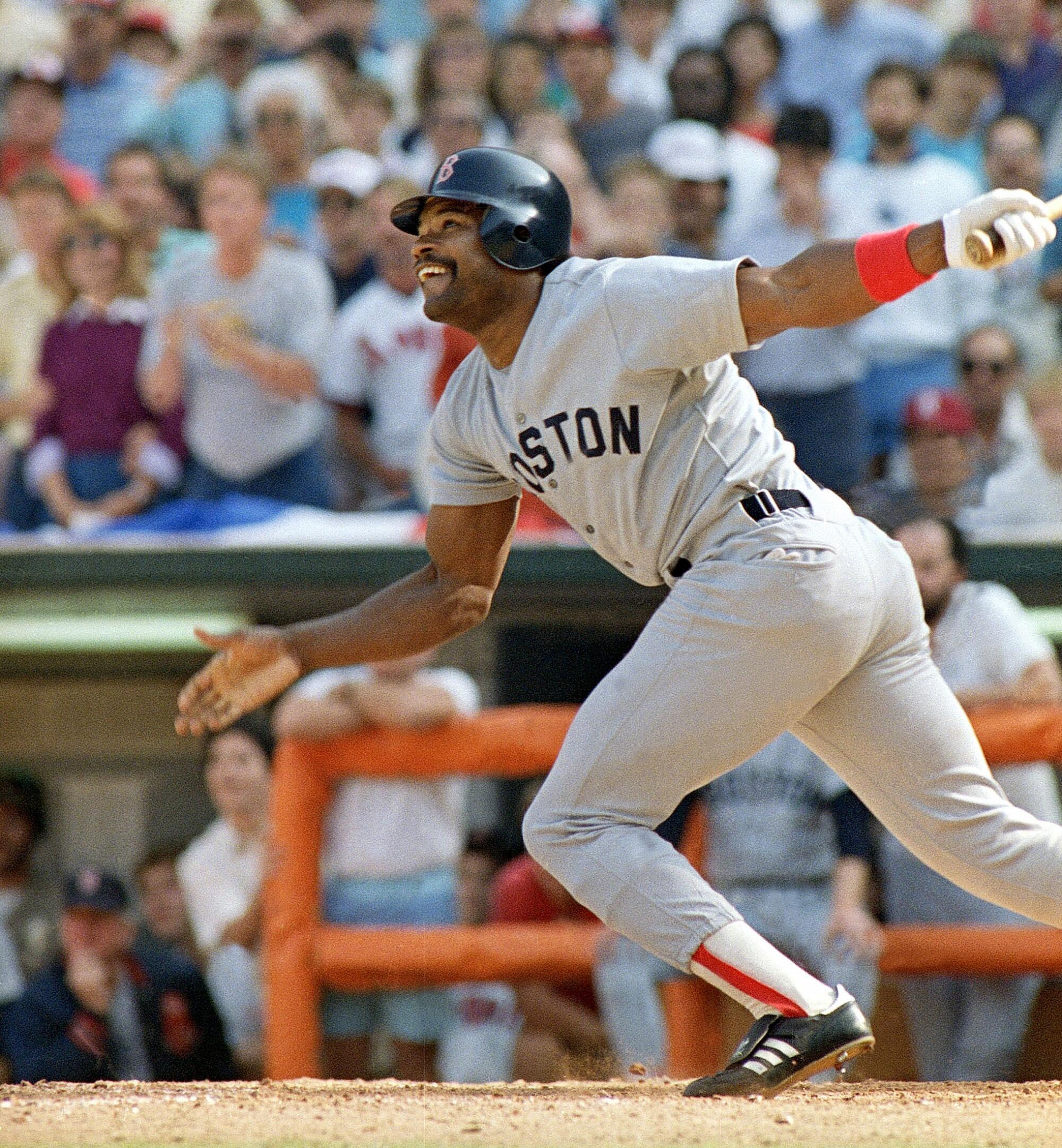
Dave Henderson watches the flight of his ninth-inning homer that put Boston ahead of the Angels, 6-5 in Anaheim, Oct. 12, 1986.
(Jim Gerberich / Associated Press)
The Angels rallied to tie it in the bottom of the ninth and had the bases loaded with one out, needing only a sacrifice fly or well-placed grounder to restore the full-throated roar to an Anaheim Stadium crowd of 64,223. Two of their top hitters, Doug DeCinces and Bobby Grich, failed to bring home the winning run.
Boston left fielder Jim Rice made a game-saving catch of a Gary Pettis drive at the wall to end the 10th inning, and Henderson’s bases-loaded sacrifice fly in the 11th gave the Red Sox a 7-6 comeback victory.
The shellshocked Angels barely put up a fight in Games 6 and 7 losses in Fenway Park. Three-and-a-half decades later, however, it’s Game 5 that still eats at the left-hander who got the final out in the top of the 11th inning but had been bypassed for another southpaw for a key at-bat in the ninth.
“You can’t get any closer,” former Angels pitcher Chuck Finley said. “You almost feel like you can touch it. When you have something in your hands, it’s almost like you were pick-pocketed.”
Tuesday, Oct. 12, marks the 35th anniversary of the most devastating loss in Angels history, 3 hours and 54 minutes of twists and turns that played out like a Shakespearean tragedy.
This is a look back at Game 5 through the eyes of a 23-year-old rookie reliever on that team and a Hall-of-Fame broadcaster who ranks the game just behind the “Miracle on Ice,” the U.S. hockey team’s upset of the Soviet Union in the 1980 Winter Olympics, on his list of greatest sporting events he’s called.
PROLOGUE
The 1986 Angels, managed by 60-year-old Gene Mauch, were an eclectic mix of crusty veterans, eager youngsters and a sprinkling of players in their prime.
Don Sutton (41) was the dean of a rotation that included 25-year-old right-handers Mike Witt and Kirk McCaskill. Terry Forster (34) was the elder in the bullpen. Finley was called up from Class-A Quad Cities in late May and saw a blend of personalities and temperaments that was borderline toxic.
Chuck Finley of the Angels pitches during a game circa 1988 in Anaheim, California.
(Rick Stewart/Getty Images)
“It was almost like a Desperate Housewives for Men the whole year,” said Finley, who lives in Newport Beach and does charity work for the team. “That clubhouse was a mess. Guys were just fighting all the time. There was so much pressure on Gene just to keep that team together.”
Finley recalled the team bus ride in which Moore, angered after being told Mauch had called a workout for an off day, hurled a piece of fruit at the skipper, only to have it splatter on the windshield of the bus. Players could be prickly with the media. And each other.
“It was a mixed bag of nuts,” Finley said. “It was like going to a bar and they give you that bowl. Some are a little sweet, some are a little sour, some are a little salty, but you just keep putting your hands in there and eating it, you know?”
“It was almost like a Desperate Housewives for Men. That clubhouse was a mess.”
— -Chuck Finley
The clubhouse tension, however, did not affect their performance. The Angels went 23-25 in April and May but caught fire in June, going 69-45 over the final four months to finish at 92-70. They sealed the division title with a 21-5 run from Aug. 24 through Sept. 22.
Joyner (.290, 22 homers, 100 RBIs), DeCinces (.256, 26, 96) and Downing (.267, 20, 95) paced the offense. Witt (18-10, 2.84 ERA, 208 strikeouts), McCaskill (17-10, 3.36, 202) and Sutton (15-11, 3.74) led the rotation.
Angels relief pitcher Donnie Moore.
(Charles Bernhardt / Allsport)
Moore fought through shoulder and rib-cage injuries to go 4-5 with a 2.97 ERA and 21 saves in 49 games, and Doug Corbett (4-2, 3.66 ERA in 46 games), Forster (4-1, 3.15 in 41 games) and left-hander Gary Lucas (4-1, 3.15 in 27 games) were reliable in relief.
“Man, once that national anthem was played, it was just true professionalism,” said Finley, who went 3-1 with a 3.30 ERA in 25 games after his summer call-up. “Those guys knew how to win.”
PENNANT FEVER
The Angels closed the season at Texas and flew to Boston to start the ALCS. Two sloppy, half-well-pitched games yielded two lopsided scores. Witt threw a complete game in an 8-1 Game 1 victory, and Red Sox left-hander Bruce Hurst threw one in Boston’s 9-2 Game 2 win.
The series shifted to Anaheim, where the Angels scored three seventh-inning runs in a 5-3 Game 3 victory and rallied in Game 4 for three ninth-inning runs off Roger Clemens, with DeCinces (homer) and Pettis (RBI double) providing the big blows, in a 4-3, 11-inning win.
The Angels were up 3-1 in the series.
A sense of anticipation filled Anaheim Stadium the next day when the teams met at high noon under sunny, 80-degree skies. The Angels started Witt, their best pitcher. Hurst started for the Red Sox on three days’ rest.
But across the 57 Freeway in a St. Joseph’s Hospital bed sat Joyner, the Angels’ rookie-of-the-year candidate who had a staph infection in his right shin and would watch the game on a 19-inch TV. (That was a fairly big size in those days, kids.)
Grich moved from second base to first, and Burleson started at second. The Red Sox took a 2-0 lead when Rich Gedman, their left-handed-hitting catcher, lined a two-run homer just inside the right-field foul pole in the second inning. Boone’s solo shot to left made it 2-1 in the third.
Grich followed DeCinces’ two-out double in the sixth with a drive to deep center, where Henderson, who had replaced injured starter Tony Armas in the fifth, nearly made a leaping catch on the warning track.
But Henderson’s momentum sent him smashing into the fence, and his left arm hit the top of the wall. The ball squirted out of his glove and over the fence for a two-run homer and a 3-2 Angels lead, which Anaheim increased to 5-2 in the seventh on Rob Wilfong’s pinch-hit RBI double and Downing’s sacrifice fly off reliever Bob Stanley.
Witt, meanwhile, was cruising. He took a six-hitter into the ninth with three of the hits — the second-inning homer, a fifth-inning double and seventh-inning single — coming off the bat of Gedman, who was due up fifth in the inning. With that in mind, Mauch had Lucas warming up alongside Moore as the inning began. Lucas had struck out Gedman twice during the season and again the night before.
An interview platform was constructed in the Angels clubhouse. Clear plastic wrapping was draped over each locker to protect against the anticipated fusillade of champagne. Officers on horseback gathered in the bullpen. California Highway Patrol officers manned the dugouts.
In a 1987 story about the game, former Times staff writer Mike Penner wrote that Jackson walked over to congratulate Mauch, who was on the verge of finally shedding his reputation as the best manager to never win a pennant. But Mauch kept staring ahead from the third-base dugout, watching Witt warm up for the ninth.
“It isn’t over yet,” Mauch said quietly.
“It had merely begun,” Penner wrote.
HEARTBREAK HILL
Bill Buckner opened the ninth with a ground-ball single to center, just beyond the reach of a diving Schofield. Dave Stapleton came on to pinch-run. Rice struck out looking.
Up stepped Don Baylor, the former Angels designated hitter who led the team to its first two playoff appearances in 1979 and 1982. Witt thought he struck out Baylor with a 2-and-2 curve on the inside corner, but umpire Rocky Roe called it a ball.
Witt’s full-count offering was another breaking ball, this one down and away, a pitch Witt later said he “would throw him 100 out of 100 times, and I guarantee you he wouldn’t hit a home run.” Baylor yanked it over the left-field fence for a two-run homer to cut the lead to 5-4.
Dwight Evans popped out to third for the second out. Pitching coach Marcel Lachemann went to the mound and raised his left arm to summon Lucas. The crowd groaned. So did a few Angels players.
“When they took Witt out, it was like, ‘Wow,’ ” Finley said. “He was dominating that game. I know Gedman had decent numbers against him, but I thought Witt was on a roll and he’d figure out a way to get through this.”
Lucas had not hit a batter in four seasons. His first pitch rode up and in and hit Gedman on the right hand.
Out came Lachemann again to summon Moore to face Henderson, who hit .196 with one homer and three RBIs in 36 games for Boston after an August trade from Seattle.
Henderson fouled off a pair of 2-and-2 pitches, a split-fingered pitch and fastball. Moore, whose shoulder was so sore he took a cortisone injection after the game, threw another splitter on the outer half, but this one tumbled instead of breaking sharply toward the dirt.
Henderson reached out and swatted a high fly to left. Four steps out of the box, he leaped high into the air. Finley, from the right-field bullpen, had a perfect view of the ball’s flight. He knew from the sound of the bat, the arc of the ball and the atmospheric conditions, this was not good.
“I watched it come off the bat and went, ‘Oh, sh–,’ because it was a day game and the ball flies,” Finley said. “Then I saw [Henderson] jump and went, ‘Uh-oh.’ We’re one strike away from going to the World Series and boom, that ball goes flying out, and that stadium went silent.”
“To this day, man, I can still feel everything,”
— -Al Michaels
Michaels called Henderson’s homer “unbelievable” and “astonishing” on the broadcast. Henderson floated around the bases and was greeted by jubilant teammates in the dugout.
Dave Henderson, left, and Rich Gedman of the Red Sox cheer after Henderson’s ninth-inning homer gave Boston a one-run lead in Game 5 of the 1986 ALCS against the Angels.
(Reed Saxon / Associated Press)
“Anaheim Stadium was a strike away from turning into Fantasyland,” Michaels said on the air, “and now the Red Sox lead 6-5!”
Moore got Ed Romero to fly to right to end the inning. A stoic Mauch stood in the dugout, arms folded across his chest, a blank look on his face.
“He looked frozen in time,” Michaels said.
PUSH BACK
The Angels clawed back in the bottom of the ninth. Boone singled and was replaced by pinch-runner Ruppert Jones and was bunted to second by Pettis.
Red Sox manager John McNamara summoned left-hander Joe Sambito to face Wilfong, who singled sharply to right. Jones beat a one-hop throw from the strong-armed Evans with a head-first slide to the back of the plate to tie the score 6-6 and re-spark pandemonium in the stadium.
Angels baserunner Rupert Jones slides safely into home plate under the eyes of Boston Red Sox catcher Rich Gedman in the ninth inning.
(Lennox McLendon / Associated Press)
Wilfong should have advanced on the throw home but froze at first. Right-hander Steve Crawford replaced Sambito and gave up a single to right to Schofield, moving Wilfong to third. Had Wilfong taken second on the play at the plate, he likely would have scored on Schofield’s hit.
Downing was intentionally walked to load the bases to set up a force play at home. That brought DeCinces to the plate. Crawford, who was making his first appearance of the series, was so nervous he couldn’t produce any saliva to spit.
“If there was a toilet on the mound,” Crawford said after the game, “I would have used it.”
Instead, the Angels flushed an opportunity down the drain. DeCinces swung at a first-pitch fastball and flied to shallow right, Wilfong holding at third. Grich hit a soft liner that Crawford snagged to end the inning.
“I got no place to sleep tonight,” Mauch quipped after the game. “I bet my house that DeCinces would get that run in from third.”
Moore escaped a first-and-third, one-out jam in the 10th by getting Rice to ground into a double play. Crawford walked Jerry Narron with two outs in the bottom of the 10th, and the switch-hitting Pettis, with Narron running on a full-count pitch, drove a pitch to deep left.
Pettis had hit a similar ball over Rice’s head during the big ninth-inning rally the previous night, so Rice took a few steps back for this Pettis at-bat. That allowed him to make a leaping, two-hand catch near the top of the wall to rob Pettis of a game-winning double.
“He had to look in his glove to make sure he caught it,” Michaels said. “Narron was running with the 3-2 pitch, and he scores easily if Rice doesn’t catch it.”
Michaels recalled the stadium becoming “eerily quiet” as the 11th inning started.
“If there was a toilet on the mound, I would have used it.”
— Red Sox reliever Steve Crawford
“I remember saying on the air that the crowd is wrung out,” Michaels said. “They had been screaming for 45 minutes and were just wrung out.”
Moore hit Baylor with a pitch to open the 11th. Evans singled to center. Gedman, the unsung hero of the game, popped up a sacrifice-bunt attempt that fell in front of DeCinces for a single to load the bases with no outs.
Henderson’s sacrifice fly to center scored Baylor to give Boston a 7-6 lead. Downing made a leaping catch of Romero’s drive before slamming face-first into the wall for the second out, saving a run, maybe two. Finley replaced Moore and got Wade Boggs to ground out to second to end the inning.
Red Sox closer Calvin Schiraldi struck out Wilfong and Schofield to open the bottom of the 11th, and Downing lofted a fly ball into foul territory near first.
“Popped up … here comes Stapleton,” Michaels said on the broadcast. “Next plane to Boston!”
POSTSCRIPT
The Angels’ team flight to Boston was funereal. “It was mute,” Finley said. “Everybody was staring out the windows going, ‘What happened?’ ”
Angels pitching coach Marcel Lachemann, right, consoles relief pitcher Donnie Moore in the locker room at Fenway Park on Oct. 15, 1986. The Angels lost to the Boston Red Sox in the final game of the ALCS.
(Bob Child / Associated Press)
Run-scoring doubles by Jackson and DeCinces in the first inning of Game 6 provided some hope, which was dashed when Boston scored twice in the bottom of the first and five runs in the third in an eventual 10-4 win.
The Red Sox steamrolled the Angels 8-1 in Game 7 to reach the World Series, where they suffered their own one-strike-away collapse against the New York Mets, when Mookie Wilson’s 10th-inning grounder in Game 6 famously rolled through Buckner’s legs to allow the winning run to score. The Mets won Game 7 two nights later.
The career of Moore, who had a history of alcohol abuse and domestic violence, spiraled in the wake of Game 5. He struggled in two more injury-marred seasons with the Angels and was released by the Royals in 1989.
In July 1989, Moore had an argument with his wife, Tonya, and shot her three times with a .45 pistol in their Anaheim Hills home. While the couple’s 17-year-old daughter drove Tonya to the hospital — she survived — Moore, with two younger sons in the house, put the gun to his head and committed suicide. He was 35.
“He was a great guy, he just had some demons he couldn’t tame,” Finley said of Moore. “It’s sad the way it ended up and the way Donnie’s life ended.”
Orange County Coroner personnel remove the body of former Angels pitcher Donnie Moore from his home in Anaheim on July 18, 1989. Moore shot his wife several times, critically wounding her before turning the gun on himself.
(Alan Greth / Associated Press)
Finley can’t help but wonder if he could have ended Game 5 in the top of the ninth had he been summoned instead of fellow lefty Lucas.
“I think about it all the time,” Finley said. “I don’t know if I would have gotten Gedman out, but I’d like to have had the chance to try. Gary was kind of thumbing it. He was a finesse guy, and I was throwing pretty hard back then. But Gene wanted to go with veterans, so he made what he thought was the book move.”
Finley went on to have a stellar 17-year career, going 200-173 with a 3.85 ERA in 524 games and making five All-Star teams. But he left the Angels to sign with Cleveland in 2000, hoping for a chance to win a championship, two years before the Angels won their only World Series title in 2002.
Finley made seven playoff appearances for the Indians and St. Louis Cardinals in 2001-02 but never reached the World Series.
The closest he would come, it turned out, was with the Angels in 1986.
“I was 23, up from A-ball and one strike away from the World Series — you think it would happen every year,” Finley said. “Then you have a 17-year drought, you’re retired and you don’t have a ring … man, you get that close, it makes you appreciate how hard it is to win one.”
The personal information of all South Korean diplomats is believed to have been leaked due to a data breach at the Korean National Diplomatic Academy, officials said Tuesday. The academy, in southern Seoul, is seen here Tuesday. Photo by Yonhap
Personal information of all South Korean diplomats was presumed to be leaked due to a data breach at an online education system run by an institution affiliated with the foreign ministry, officials said Tuesday.
The ministry disclosed Monday it had been notified by a relevant government agency in early February about suspicious access to the online education system of the Korea National Diplomatic Academy (KNDA). Upon the notification, the ministry shut down the system, which has remained offline since. An investigation is under way.
The data breach was presumed to affect all ministry personnel, including retirees, an official at the foreign ministry said, noting the system held approximately 10,000 records of personal data.
An unidentified hacker is believed to have gained access to the server sometime between April and May last year, and maintained that access until February.
The compromised server is believed to have stored educational videos and information on trainees, including their names, user IDs, positions, email addresses and encrypted passwords. Officials from other government agencies who had been deployed to South Korea’s overseas missions may also be among those affected, given that they occasionally use the system.
No “sensitive personal data,” such as identification numbers, mobile phone numbers or home addresses, appeared to be affected, the ministry official said, noting that there may be some overlap among the individuals whose information was compromised.
The official said the ministry could not yet confirm whether all the data stored in the system had been compromised, adding that the 10,000 figure represents the maximum possible number of cases affected.
The ministry currently lacks the technical analysis needed to identify the attacker, the official said.
“We do not rule out any possibility, including involvement by overseas hacker groups,” the official added. “We regard this as a situation with implications for national security.”
Copyright (c) Yonhap News Agency prohibits its content from being redistributed or reprinted without consent, and forbids the content from being learned and used by artificial intelligence systems.
Andy Burnham has officially begun his tenure as Britain’s prime minister with something few of his recent predecessors enjoyed: breathing room. After replacing Keir Starmer as Labour leader and becoming the United Kingdom’s seventh prime minister in just a decade, Burnham inherits an economy burdened by weak growth, strained public services and persistent cost-of-living pressures. Yet, unlike the turbulent starts experienced by previous leaders, financial markets have greeted his arrival with surprising calm.
That early confidence may prove one of Burnham’s greatest assets—or one of his greatest tests.
A Different Kind of Labour Leader
Burnham enters Downing Street with a political identity distinct from his predecessor. During his time as Mayor of Greater Manchester, he cultivated an image as a champion of regional development and public investment, earning the nickname “King of the North.”
Unlike Starmer’s cautious approach to fiscal management, Burnham has promised to “rewire Britain” through greater devolution, investment in public services, re-industrialisation and stronger local government.
Stay ahead of the geopolitical week.
MD Briefing delivers expert analysis across five global fronts — the Indo-Pacific, energy, geoeconomics, European security, and the Middle East — every Monday morning. Free.
Such promises normally raise concerns among investors wary of higher public spending. Yet markets have remained remarkably composed.
British government bond yields have stayed close to 5%, while sterling has strengthened against the euro since Burnham emerged as Labour’s preferred successor. Investors appear reassured by his commitment to maintaining Britain’s existing fiscal rules rather than pursuing aggressive borrowing.
Why Markets Are Staying Calm
Several factors explain why investors have not reacted negatively.
First, Burnham has avoided announcing sweeping fiscal changes during his first days in office. Instead, he has focused on politically popular issues such as healthcare, homelessness, defence and regional economic development.
Second, his appointment of former Defence Secretary John Healey as Chancellor suggests continuity rather than confrontation with financial markets.
More importantly, many economists believe economic policy will remain closely directed by Downing Street rather than being driven independently by the Treasury, reducing uncertainty over Britain’s fiscal direction.
This perception matters because markets today are extremely sensitive to fiscal credibility.
The Shadow of Liz Truss
Any discussion of British economic policy inevitably returns to September 2022.
Former Prime Minister Liz Truss’s unfunded tax-cutting budget triggered one of the worst government bond sell-offs in modern British history. Pension funds came under severe pressure, forcing the Bank of England to intervene to stabilise markets.
That episode fundamentally changed how investors assess UK fiscal policy.
The International Monetary Fund recently concluded that the crisis permanently increased the risk premium investors demand for holding British government debt. In other words, markets now react far more aggressively to any sign of fiscal irresponsibility.
Burnham understands this reality.
His repeated commitment to existing borrowing rules appears designed to reassure investors that Labour will not repeat past mistakes.
The Economic Tailwinds
Burnham also benefits from several favourable developments that could buy his government valuable time.
Inflation has moderated compared with previous years, reducing immediate pressure on the Bank of England to tighten monetary policy further.
Energy prices have also eased relative to their crisis peaks, while upcoming regulatory adjustments may further reduce household energy costs.
Another important advantage comes from the fiscal restraint maintained under former Chancellor Rachel Reeves.
Her adherence to strict borrowing limits has substantially reduced planned government debt issuance this year, giving Burnham more flexibility to adjust spending priorities without immediately alarming financial markets.
In effect, Burnham inherits a stronger fiscal starting position than many expected.
The Difficult Choices Ahead
Those advantages, however, are unlikely to last indefinitely.
Britain still faces sluggish productivity, weak investment, deteriorating public infrastructure and mounting demands for higher defence spending.
Burnham has also hinted at broader reforms that could eventually test investor confidence, including:
Greater public control over utilities.
Property tax reform.
Increased defence spending.
Adjustments to frozen income tax thresholds.
Possible changes to National Insurance contributions.
Expanded regional investment programmes.
Each proposal carries fiscal implications.
Delivering meaningful improvements in living standards while maintaining market confidence will require careful balancing.
The Reform UK Factor
Politics may ultimately shape economic policy more than economics itself.
Although Labour has changed leaders, Nigel Farage’s Reform UK continues to perform strongly in opinion polls.
If Burnham adopts an overly cautious approach that fails to improve public services or living standards, Reform could continue gaining political momentum.
That creates a dilemma.
Markets generally favour fiscal discipline, but voters increasingly demand visible economic change.
Burnham must therefore find a middle ground: ambitious enough to convince voters Labour can improve daily life, yet disciplined enough to convince investors Britain’s finances remain under control.
Why It Matters
Burnham’s premiership begins at a pivotal moment for Britain.
Economic growth remains weak, public confidence in government is fragile, and geopolitical uncertainty—from rising defence commitments to global trade disruptions—continues to weigh on the outlook.
Unlike many of his predecessors, Burnham enjoys a brief window of goodwill from financial markets. Whether he can convert that goodwill into lasting economic reform without unsettling investors may determine not only Labour’s electoral fortunes but also Britain’s broader economic trajectory.
Analysis
The first major test will come with Burnham’s autumn budget.
Investors will closely examine whether his government maintains fiscal discipline while introducing the reforms needed to revive growth and address Britain’s long-standing structural problems.
Markets will also monitor whether Labour can improve economic conditions quickly enough to halt the rise of Reform UK. If opinion polls continue shifting toward Nigel Farage’s party, investors may begin pricing in greater political uncertainty, reviving memories of the volatility seen during the Liz Truss government.
For now, Burnham has been handed two valuable gifts: investor patience and fiscal breathing space. Whether those advantages become the foundation of a successful premiership or simply a temporary reprieve will depend on the difficult choices his government makes over the coming months.
MUNICH, Germany — Nicholas Brownlee had just fallen in love with opera and was eager to see if his emerging bass-baritone voice could handle Richard Wagner’s music. It did not go well.
“I kept reading how you have to wait to sing this big repertoire,” Brownlee said. But there was one bit of Wagner — Wolfram’s “Song to the Evening Star” from “Tannhäuser” — that’s “a little bit lighter. I figured it was more appropriate.”
So he brought it to his teacher, Thomas Rowell, at the University of South Alabama and asked what he thought.
“I just laughed at him and told him to go away,” Rowell recalled. “He knew that big voice was there, and he was so eager to try on the clothes, but they didn’t fit for a while. It was still a very young instrument.”
Reminded of that exchange nearly 20 years later, Brownlee smiles. “I was a bit ambitious,” he said. “But this was just me.”
Now that ambition — what he calls “a fire in my belly that burns brighter every day,” — has helped propel Brownlee to the very top of his profession at age 37. And he’s done it by singing a lot of Wagner.
Brownlee recently made his debut as Wotan, embattled king of the gods, in “Die Walküre” at the Bavarian State Opera House, part two of a complete “Ring” cycle directed by Tobias Kratzer. He had previously sung the role in “Das Rheingold,” the opera that opens the cycle.
The critics reached for superlatives. “A heroic baritone straight out of a textbook,” wrote Markus Thiel in Merkur, “with a powerful, resonant voice, a force of nature.” Carlota Moseguí in Platea Magazine praised his voice and said Brownlee “possesses all the qualities to become the definitive Wotan of his generation.”
Next, Brownlee heads to the Wagner shrine in Bayreuth, Germany, where he will star as the title character in “Der Fliegende Holländer” (“The Flying Dutchman.”) And his upcoming season is one Wotan after another.
“It’ll be ‘Siegfried’ time in Munich, then ‘Walküre’ time in Buenos Aires, then ‘Rheingold’ time in Barcelona,” he said. Add to that two of the “Ring” operas in Frankfurt and then two complete cycles next summer back in Munich.
“It’s a once-in-a-lifetime thing to have a student who goes that far, especially from a small regional state university like ours,” said Rowell, who remains close friends with Brownlee and officiated his wedding to mezzo-soprano Jennifer Feinstein. “I have to pinch myself. I’m enjoying it vicariously.”
Does Brownlee worry at all about damaging his voice from so much heavy singing?
“I don’t think you’re supposed to say this, but no, not really,” he replied. “We like to put this big stamp on Wagner and say ‘Be Careful!’” But he said he finds the demands of each opera different enough to help him avoid burnout.
Still, he promises that his roles the following season will be more varied, including a return to one of his favorites — Baron Scarpia in Puccini’s “Tosca.” And down the road are two Verdi roles — the villainous Iago in “Otello” and the comic Falstaff.
Of the latter, he said, “I want to flex a different muscle. I talk fast, I’m a bubbly, fun guy, but what I do on stage is so serious all the time. Boy it would be fun to just be a jolly fat guy!”
Just how did a boy from a working-class family in a small town outside Mobile, Ala., become one of a handful of go-to singers in the world for these demanding roles?
His first success as a vocalist actually came as the youngest grandchild in a large extended family, performing Conway Twitty imitations to grab attention. Classical music had to wait until he fell under the spell of his high school choral director.
When he went to college, he planned to study conducting, but Rowell heard him sing and cajoled him into joining the Mobile Opera chorus.
“I went in the first day and I hated it,” Brownlee recalled. “I said, this is in Italian, who cares? That’s for stuffy elite people, not for us blue-collar fellas.”
Still, his curiosity made him determined to figure out why some people loved the art form. So he sat by the side of the stage one night to watch the emotional final scene of Verdi’s “La Traviata,” when the heroine dies after being reunited with her lover.
“When she said, ‘O, gioia!’ and she fell into his arms, and now she’s dead, Alfredo’s weeping over her, and Germont is feeling half-responsible, I was weeping uncontrollably,” he said. “And I didn’t even know what they were saying.”
That’s when he started taking voice lessons, and from there followed years of study and apprenticeships both in the U.S. and later in Germany. Along the way he competed twice in the Metropolitan Opera’s National Council Auditions.
The first time, still in his early 20s, he made it to the semifinals in New York. “I did not go on to the finals, which was absolutely correct,” he said. “Failure is a great lesson.” (Coincidentally, one of the winners that year was Ryan Speedo Green, who performed Wotan in May at Walt Disney Hall and will bein the Met’s upcoming “Ring” cycle.)
Brownlee returned in 2015, and this time he took home one of the top prizes. Other awards have followed, including in 2025, best male singer at the International Opera Awards and the Richard Tucker Award for most promising American singer.
Yet this American singer is still barely known to most opera audiences in his native country. Brownlee’s career has so far been largely in Germany, where he and Feinstein are raising their two daughters and are currently applying for dual citizenship.
“I can perform anywhere in Europe and be home in two hours to see my girls,” he said. “In America that’s just not something you can do.”
He may be rooted in Europe for now, but major U.S. houses are beckoning with increasing urgency.
When he appeared at Chicago’s Lyric Opera this past spring as the prophet Jochanaan in Richard Strauss’ “Salome,” general director John Mangum called his performance “absolutely thrilling.” He said Brownlee is “definitely going be at the top of our list” as the company charts its future Wagner performances.
And Peter Gelb, the Met’s general manager, who heard him sing a major role for the first time during the Munich run of “Walküre,” said “I was blown away. … We’ll definitely be offering him big roles at the Met in upcoming seasons.”
Airports have warned that kids could be forced to leave the items behind
09:19, 21 Jul 2026Updated 09:19, 21 Jul 2026
Squishy toys could easily raise a red flag at airport security this summer (stock image)(Image: Getty)
Parents are being told to leave certain children’s toys at home. If kids bring them to the airport, they may be taken from them at security. There is a high chance that items like NeeDoh cubes and other popular ‘squishy’ toys could be flagged and confiscated.
Even at airports using advanced scanners, gel-filled toys look highly unusual on security screens. This frequently triggers a manual bag check, causing travel delays, and some staff will not take the risk with these items going any further into the airport.
Travel specialist Kate Donnelly (@Thedonnelllyedit) said: “From my own personal experience, [squishy toys] do tend to come under closer scrutiny when passing through airport security. My top tip for parents this summer, pack these items in your whole luggage.
“There is a high chance that if you put these in your hand luggage, they will get confiscated. There are absolutely no markings on them to let you know exactly how much liquid is contained within them, and therefore, they are very easily removed.
“This means that you have upset children and you will have to pay out for a whole new load of toys when you get to your destination.” She suggested that the best thing to do is to pack toys safely in your main suitcase that gets checked into the hold, as this allows more liquids than hand luggage does, helping you avoid delays and reduce the risk of them being confiscated.
Content cannot be displayed without consent
Posting online, Luton Airport confirms that any squishy toys, including NeeDoh cubes, that contain a gel or liquid must comply with the strict liquid rule when packed in hand luggage. The airport said: “As the quantity of gel contained within these items cannot be accurately verified during the screening process, they are not permitted through security in hand luggage.”
Manchester Airport also said: “Things like squishy toys contain liquid – this includes NeeDohs, which use malt syrup. Smaller versions of the toy are under 100mls, but larger versions are not.
“The problem is that, as they don’t have measurements printed on them, security staff have to estimate their size. Our advice is that all but very small squishy toys should be placed in hold baggage.”
As a result, kids could be forced to bin their favourite toys before going on holiday. The issue is that there is often no way to verify exactly how much ‘liquid’ is inside one of these objects.
Not all UK airports follow the same rules about liquids in 2026 due to a staggered rollout of new high-tech 3D CT security scanners that allow the 100ml rule to be relaxed. Different locations are at different stages of upgrading, with a pause currently in effect this summer to avoid disruption over peak travel times.
Below is a list of what airports are following the new (2000ml) rules. At the airports accepting two litres in hand luggage, the scanners also mean people do not need to empty their bags, as scanners are powerful enough to detect these items, as well as electronics:
Belfast City
Belfast International
Birmingham
Bristol
Edinburgh
London Gatwick
London Heathrow (All terminals)
Teesside International
These airports are still following the original (100ml) rule:
EAST RUTHERFORD, N.J. — The largest, longest and most complex World Cup in history came to a close Sunday, with Spain beating Argentina 1-0 in extra time. But FIFA president Gianni Infantino didn’t bother waiting for the final result before passing judgment on the tournament.
“By all means this World Cup has exceeded all expectations,” he said during a reception at Trump Tower two days before the final kicked off. “This has not just been the greatest FIFA World Cup of all time. It is the greatest human social and cultural event that mankind has ever witnessed.”
No, but it was pretty good, with FIFA emerging as the World Cup’s biggest winner, allowing Infantino to reportedly shore up support within the organization despite a number of norm-shattering decisions during the tournament.
Attendance topped 6.8 million, a World Cup record averaging more than 65,000 fans a game. FIFA estimated the cumulative global TV audience topped 5 billion people across linear television, digital streaming and social platforms while more than 1.8 billion people were expected to watch the final, according to the BusinessStats website, making it the most-viewed sporting event in history.
Argentina goalkeeper Emiliano Martínez reacts as Spain’s Ferran Torres scores during the World Cup final in East Rutherford, N.J., on Sunday.
(Julio Cortez / Ap Photo/julio Cortez)
Exact figures won’t be known for a few days.
Revenue for the four-year World Cup cycle is anticipated to reach $13 billion, making it the first $10-billion sporting event in history — bolstering Infantino’s case for reelection as FIFA’s president next year.
The final was among the most expensive U.S. sporting events of all time, with the get-in asking price for a single ticket on the secondary market peaking at about $7,400 three hours before kickoff and the average purchase price topping $10,800. One seat sold for $32,502, which is either a good thing or a bad thing, depending on whether you’re buying the ticket or selling it.
Inglewood’s SoFi Stadium hosted eight games, including two of the U.S. team’s three group-stage games and Spain’s quarterfinal win over Belgium. The matches had a total attendance of 561,656 people, about 99.6% of capacity — that’s more than each of the first three World Cups drew for the entire tournaments.
U.S. and Paraguay oversized flags are featured on the pitch before a World Cup group stage match at SoFi Stadium on June 12.
(Allen J. Schaben/Los Angeles Times)
Weather disrupted just a handful of matches, not the dozen or more that were feared, and the logistical nightmares of staging the 39-day tournament across three countries for the first time — the U.S. co-hosted the event with Mexico and Canada — never materialized. The expansion to 48 teams and 104 games, meanwhile, made room for a number of surprises that gave the tournament its life and sparkle.
Tiny Cape Verde, the second-smallest country to qualify for a World Cup, made a memorable debut, playing Spain to a scoreless draw in its opener, then taking Argentina to extra time before falling in the cruelest way possible, on an own goal, in the knockout rounds.
Norway, playing in the tournament for the first time this century, made it to the quarterfinals behind its hulking striker Erling Haaland, who quickly became a fan favorite while the team’s supporters saw their synchronized “Viking Row” celebration go viral.
Canada and Egypt both won World Cup games for the first time, advancing to the Round of 16, with Egypt becoming one of nine African teams to make it to the knockout rounds. Of FIFA’s six continental confederations, only UEFA, representing Europe, did better than Africa, sending 13 teams beyond the group stage.
Argentina’s Lionel Messi erased any doubt that he’s the greatest player in World Cup history — if not soccer history — by willing his team to the final and winning the Silver Ball, runner-up for the tournament’s most outstanding player. On Sunday, Messi was thwarted in his attempt to win a second straight World Cup and third Golden Ball, but he walked off the field at MetLife Stadium as only the second man to play in three World Cup finals.
And he finished his record-setting sixth tournament as the all-time leader in games (34), assists (12) and goal contributions (33), more than standing the test of time. Two of the players Spain started against Argentina in the final hadn’t even been born when Messi, 39, made his World Cup debut in 2006.
But if those were the highlights, there were also lowlights.
This was by far the most political World Cup in history and the first in which a host country, the U.S., was actively at war with a participating one, Iran.
Iran defender Ramin Rezaeian celebrates with teammates after scoring during a World Cup match against New Zealand at SoFi Stadium on June 15.
(Allen J. Schaben/Los Angeles Times)
That had all kinds of ramifications, starting with the State Department’s refusal to grant visas to more than a dozen members of Iran’s official delegation. Iran was also forced to move its base camp from Tucson to Tijuana, and though it played all its games in the U.S., it was denied permission to remain in the country after each match, an option granted to every other team.
Despite the harassment, Iran did not lose a game, playing to three draws despite having three goals — any of which would have sent it to the knockout rounds — erased by video reviews.
The State Department also denied entry to Omar Abdulkadir Artan, a decorated Somali referee, turning him away at Miami International Airport in June, citing “vetting concerns.” Artan, named Africa’s top referee last year, had a valid entry visa and was selected by FIFA to work the tournament last April.
Iran wasn’t the only team to have its World Cup ended early by technology. Although the video assistant referee (VAR) system was adopted primarily to alert the head official to potential clear and obvious errors or serious missed incidents, in this tournament it became intrusive, eliminating Croatia on evidence from a NASA-level ball sensor and costing Egypt what would have been a game-winning score for a perceived foul that took place nearly 100 yards from the goal.
Coaches and players are still allowed to make mistakes, but the technology now has referees making calls on things that are imperceptible to the naked eye, something critics say has removed any sense of judgment or nuance, robbing the game of much of its drama.
“Football is an art. That’s why we love it,” said Christina Unkel, a former FIFA referee and a rules of the game analyst for multiple TV networks. “When you do pursue black and white — objectivity is what they’re trying to get to, and I get it; they want to eliminate as much subjectivity as possible — what everyone is hating is this perfection thing.”
Then there was the official’s call that President Trump took credit for overruling from 2,800 miles away.
When striker Folarin Balogun, the U.S. team’s leading scorer, was given a red card in the second half of his team’s Round of 32 win over Bosnia-Herzegovina, he was immediately suspended from the Americans’ next elimination game with Belgium. But Trump admitted he phoned Infantino three times, lobbying for the suspension to be rescinded.
U.S. forward Folarin Balogun stepped on Bosnia-Herzegovina defender Tarik Muharemovic’s foot during a World Cup match and received a red card at Levi’s Stadium on July 1.
(Robert Gauthier/Los Angeles Times)
Less than 30 hours before the Belgium game, the card penalty was suspended and Balogun was placed on one year’s probation by FIFA’s disciplinary committee, marking just the second time in World Cup history that a player who received a red card was allowed to play in his team’s next game. The international uproar that followed overwhelmed the U.S. team, which played its worst game of the tournament against Belgium.
Trump, who was booed as he saluted the national anthem Sunday from a luxury box before the game, was booed again by the crowd of 80,663 when he strode onto the pitch for the awards ceremony afterward.
UEFA, the FIFA confederation in which Belgium plays, protested the decision to let Balogun play, saying it had “crossed a red line.” It was far from the only bright red line Infantino crossed in this tournament. And some of that line crossing could set dangerous precedents.
Allowing the U.S. to turn away the Somali official and limit the Iranian team’s time in the country, for example, could embolden future World Cup hosts to do the same. What’s to stop Morocco, co-host of the 2030 tournament, from banning officials and players from Algeria over the two countries’ territorial dispute in the Western Sahara? And if a red card is handed to a player from Spain, another 2030 co-host, would the Spanish prime minister call Infantino to try to get it rescinded? Despite FIFA’s insistence that the disciplinary committee works independently, many believe Trump’s meddling worked.
But as always with FIFA, money speaks the loudest, so Infantino’s norm-shattering behavior over the last year doesn’t seem to have cost him much support. The Guardian reported last week that as the World Cup neared its successful conclusion, nearly 200 of FIFA’s 211 member associations are endorsing Infantino’s bid for reelection to a fourth term as president next March.
Which is why Spain wasn’t the only winner in this tournament.
Argentina were beaten 1-0 in the final by Spain in what has been rumoured to be Lionel Messi’s final World Cup game.
Published On 21 Jul 202621 Jul 2026
After what may have been his final World Cup match, Lionel Messi was in tears on the field on Sunday in East Rutherford, New Jersey, ruing a missed chance to win a second consecutive title for Argentina.
Messi, without hinting whether his World Cup career was officially through, congratulated Spain, who beat Argentina 1-0 in the final, and said the memories would last, in an Instagram post on Monday evening.
Recommended Stories
list of 4 itemsend of list
“The pain is immense, and this wound will take time to heal,” Messi wrote in his native Spanish alongside a photo of him bearing a silver medal.
“But I also hold onto all the good things… The matches we turned around by giving it our all – moments that will remain in our memories forever – and the support of an entire country which, combined with this group’s hard work and effort, brought us back among the world’s elite once again.
“It is hard to fully appreciate our achievement right now, but this group reached two consecutive World Cup finals.”
Argentina defeated France on penalty kicks following a 3-3 draw in the 2022 final in Qatar, earning the last piece of major hardware Messi had yet to win in his illustrious career.
Argentina were once again one of the best teams in the 2026 tournament in North America. They rallied past England in the semifinal before coming up against a Spanish defence that held them without a shot on goal.
Messi turned 39 during the tournament and will turn 43 during the 2030 World Cup, which will be held in Spain, Portugal and Morocco.
“Thank you from the bottom of my heart for every greeting and message,” Messi wrote. “Once again, we managed to unite as a country and stand together, sharing the immense pride of being Argentine.
“I also want to congratulate Spain on winning the championship.”
Messi broke Miroslav Klose’s record of 16 all-time World Cup goals early in the tournament, and he finished with 21, though he was caught and surpassed by Kylian Mbappe (22).
ESPN reported on Monday that Messi and his national team and club teammate Rodrigo De Paul will not play the next two regular-season matches for Inter Miami, nor participate in the MLS All-Star Game, as they rest and recover from the World Cup.
Weekly insights and analysis on the latest developments in military technology, strategy, and foreign policy.
As renewed hostilities between Iran and the U.S. and its allies enter a 10th day, the Houthi rebels of Yemen say they are imposing an embargo on Saudi oil shipments passing through the Bab el-Mandeb (BAM) Strait. The move threatens to add further pressure on oil exports from the Middle East, already drastically affected by the Iranian closure of the Strait of Hormuz and the resumption of the U.S. blockade on Iranian ports. Saudi Arabia has diverted millions of barrels of oil per day through pipelines to its Yanbu port on the Red Sea in an effort to minimize the energy shortages due to the hostilities in the Persian Gulf. This also raises the specter of the U.S. having to get as involved as it did during the previous Houthi campaign against shipping that ended last September, which could pull resources away from Iranian-focused operations.
BREAKING: Houthis of Yemen announce a a “maritime embargo” against Saudi Arabia, “effective immediately.”
Saudi Arabia has until now exported ~4.5m b/d from Yanbu in the Red Sea, most of it heading South throughout the Bab al-Mandab Strait between Yemen and Djibouti-Eritrea pic.twitter.com/c96Apzh9As
On Monday, Kuwait said it came under Iranian fire again.
“Kuwaiti air defenses are currently engaging hostile missile and drone attacks following the heinous Iranian aggression,” the Kuwaiti Defense Ministry stated on X. “The General Staff of the Army notes that any sounds of explosions heard are a result of air defense systems intercepting hostile attacks. Everyone is urged to adhere to the security and safety instructions issued by the relevant authorities.”
Hours earlier, Bahrain said it too had come under a new wave of Iranian attacks.
“The General Command of the Bahrain Defense Force (BDF) announces that Iran is continuing its systematic hostility approach through its sinister attacks targeting civilians in the Kingdom of Bahrain,” BDF posted on X. “The General Command clarifies that, with strong will and high combat readiness, the air defense systems attacked, intercepted and destroyed a number of treacherous Iranian air strikes today, Monday, July 20, 2026.”
The extent of the damage in either Kuwait or Bahrain is unclear at the moment. These most recent attacks came after U.S. Central Command on Sunday night said it wrapped up a ninth straight day of strikes on Iranian assets, targeting “military command centers, air defense and coastal surveillance sites, maritime capabilities, missile and drone launch sites, and communications networks to further diminish Iran’s ability to attack commercial vessels and civilian mariners transiting the Strait of Hormuz,” the command stated on X.
Amid this kinetic activity, as we noted earlier in this story, the Iranian-backed Houthis say they will no longer permit Saudi Arabian ships passage through from the Red Sea into the Bab el-Mandeb Strait.
“The Yemeni Armed Forces declare a maritime embargo against the criminal Saudi enemy, based on the equation of an ‘eye for an eye,’ effective immediately upon the issuance of this statement,” the Houthis stated on Monday, according to the official Houthi SABA media outlet. The move follows increased tensions between the Houthis and Saudi Arabia as well as a request by Iran “to stand ready to close the Red Sea oil route if the United States strikes Iranian power infrastructure,” Reuters reported last week. “The idea has been discussed within the Islamic Republic’s leadership, and the message has been conveyed to Iran’s Houthi allies.”
⚡️BREAKING: Yemen’s Houthis have announced a Naval Blockade on Saudi Arabia from the Red Sea
This move essentially Cuts OFF Saudi oil exports through the Bab al-Mandeb Strait pic.twitter.com/gqV8E5hfq1
Houthi forces on Monday reportedly began issuing warnings on open maritime frequencies near Yemen that the BAM is closed to Saudi shipping and its vessels are subject to attack.
Houthi forces are reportedly issuing warnings on open maritime frequencies near Yemen that the Bab al-Mandab Strait is closed to Saudi shipping. pic.twitter.com/MD0KhmTmJ5
A Houthi shut down of the Bab el-Mandeb (BAM) Strait, a narrow stretch of water between Yemen and Djibouti, would choke off the flow of oil exports from Saudi Arabia, exacerbating the above-mentioned impingement on the flow of oil from the closed Strait of Hormuz.
Having both straits closed at once is something of a ‘sum of all fears’ scenario for the global energy marketplace.
“The full closure of the BAM would cut global oil supply by 7% as it would leave most Saudi oil exports unable to leave the region,” Reuters noted on Monday. “The disruption would add to the massive cut to global oil flows from the war in the Gulf, which has already reduced shipments by 10% of global supply.”
You can read more about the effects of both straits being closed at once in our story about that here.
The Bab el-Mandeb Strait is a strategic chokepoint where the Houthis declared they have imposed an embargo on Saudi shipping. (Google Earth) The Bab al-Mandab Strait between Yemen and Djibouti has become a dangerous chokepoint of Houthi attacks. (Google Earth image)
Beyond affecting the flow of oil, a Houthi blockade on the BAM threatens to open a new front in this conflict.
The Houthis carried out a campaign against shipping in November 2023 in solidarity with Palestinians over the latest war between Israel and Gaza. However, while it was ostensibly aimed at only Israeli connected ships, numerous commercial vessels with no clear Israeli ties were attacked as were several U.S. and allied warships. The campaign stretched into the summer of 2025, forcing some vessels to avoid the Suez Canal for a far longer route around Africa, boosting shipping costs by nearly $200 billion at the time.
The Houthi attacks also forced the U.S. and allies to deploy many warships, including the Eisenhower and Truman Carrier Strike Groups (CSG) to both defend against Houthi attacks and strike targets in Yemen. These operations resulted in a large expenditure of air defense and strike munitions.
You can see video of some of those encounters below.
WATCH: CENTCOM releases footage as US HAMMERS Iran
The possibility exists that a new wave of Houthi attacks — especially if non-Saudi ships are targeted — could drag in U.S. forces already in heavy use in the Persian Gulf region battling the Iranians. This sets up a major showdown as Saudi oil is a lifeline to Asian supplies hobbled by conflict in the Persian Gulf. We reached out to CENTCOM for comment and will update this story with any pertinent details shared.
Earlier on Monday, the head of the European-led task force providing maritime security in the Red Sea region told us the Houthis remain a threat to navigation despite not having attacked any merchant vessels since September 2025.
“The security situation in the Bab el-Mandeb remains fragile and is highly sensitive to regional escalation,” Rear Admiral Vasileios Gryparis, Commander of EUNAVFOR ASPIDES, told TWZ. “On the rhetorical level, the Houthis’ leadership reiterated several times their alignment with the broader Axis of Resistance.”
Gryparis’s comments, in response to a query from last week about Iran’s outreach to the Houthis, came before the Yemeni group’s embargo declaration.
“From an operational standpoint, we assess that the Houthis pose a threat and are capable of rapidly escalating,” the ASPIDES commander told us. “We maintain a frequent presence at sea, monitor the situation, and adjust our actions when needed. In the event of a resumption of Houthi attacks on merchant vessels, which remains a possibility, we are present and ready to implement our mandate, within our means and capabilities. ASPIDES remains ready, within its defensive mandate, to adapt to evolving operational requirements.”
A French destroyer operating under EUNAVFOR ASPIDES provided support to a commercial vessel transiting the Red Sea region. (ASPIDES)
Being drawn into defending against a new Houthi campaign on shipping in the Red Sea region would exacerbate the strain on U.S. forces already under tremendous pressure from Iran. In addition to defending against ongoing barrages, the U.S. has committed about 20 U.S. warships, along with hundreds of aircraft dispersed across various bases, vessels, and forward arming and refueling points in the Middle East, to maintaining the newly reimposed blockade on Iranian ports. Moving these assets to another prologned shooting match in the Red Sea would degrade those capabilities and the ability to support a war effort should it fully erupt. It’s a capacity issue.
Expanding the fight against Iran is already in discussion by the Trump administration.
“The U.S. is planning for a wider war,” a U.S. official familiar with internal administration discussions told The Washington Post.
But the official cautioned that “the expansion of U.S. operations will be limited by dwindling stockpiles of air defense and long-range munitions and constraints on the ability to surge more troops and aircraft into the area because of battle damage,” the newspaper continued.
“We do not have enough to safely sustain operations, and I don’t think the White House is aware of that,” the Post said the official added.
One notable detail from The Washington Post’s reporting: even as the Pentagon prepares for the possibility of a broader conflict with Iran, one U.S. official warned that the campaign could be constrained by dwindling stocks of air defense interceptors and long-range munitions,… https://t.co/Xo9A6yNFnppic.twitter.com/dKEN3IGNUr
All this comes as there are increasing signs of damage at U.S. facilities in the Middle East from Iranian barrages. Though largely spared in the initial phases of Epic Fury due to robust air defenses, the airfield at Muwaffaq Salti Air Base in Jordan has taken the brunt of recent attacks, while several other installations have been hit as well.
The air base has long been a major regional hub for U.S. operations, and is being very actively utilized in the current conflict. It hosts the greatest concentration of U.S. tactical aircraft in the region, and thus is an extremely important target, where, as we pointed out, even one ballistic missile landing on an apron could destroy multiple prized aircraft and take the lives of U.S. service members or cause injuries.
Satellite imagery has emerged on social media purporting to show the extent of the damage at MSAB. The following shows what is claimed to be before and after views of strikes on aircraft hangars and containerized housing units. The imagery is provided by Iran and, because U.S. satellite firms do not collect over American facilities, we cannot independently confirm what is being depicted.
Before-and-after imagery shows at least two dozen containerized living units housing U.S. troops completely destroyed by Iranian strikes at 31°49′57″N, 36°47′47″E.
Two U.S. service members were killed at this site, while a third remains missing. pic.twitter.com/sqPOxhGTLr
Beyond damage, the number of troops killed and injured in Iranian attacks is rising. On Monday, the Pentagon identified two soldiers killed in action.
“1st Lt. Tyler James Feehan, 25, of Ewa Beach, Hawaii, was killed in action on July 18, 2026, and Pvt. Isabella Gonzales, 19, of Carrollton, Texas, was killed in action on July 17, 2026, during an enemy attack on July 17, 2026, at Muwaffaq Salti Air Base, Jordan,” the Pentagon said in a statement. “The incident is under investigation.”
Both soldiers worked for air defense units. Feehan was assigned to 2nd Battalion, 55th Air Defense Artillery Regiment, 32nd Army Air Missile Defense Command, Fort Bragg, North Carolina. Gonzales was assigned to 1st Battalion, 57th Air Defense Artillery Regiment, 52nd Air Defense Artillery Brigade, 10th Army Air Missile Defense Command, Ansbach, Germany.
BREAKING: The Pentagon has identified the soldiers killed in action from Iranian attacks in Jordan as 19-year-old Pvt. Isabella Gonzales and 25-year-old 1st Lt. Tyler James Feehan.
1st Lt. Feehan was assigned to 2nd Battalion, 55th Air Defense Artillery Regiment, 32nd Army Air… pic.twitter.com/3PFpnMcOVZ
Today’s identifications came after CENTCOM on Saturday reported that two U.S. service members in Jordan were killed in action on July 17. Additionally, the command said one service member was currently missing, but later said unidentified remains were found.
CENTCOM also reported on Sunday that “a U.S. service member in northern Iraq was killed in action July 18 during a controlled detonation of unexploded ordnance from a downed Iranian one-way attack drone. A second service member was wounded and continues to receive medical treatment for a minor injury.”
We have asked CENTCOM and the Army to confirm that Feehan was the soldier killed in Iraq during the controlled detonation or if he was killed in another incident.
It should be noted that in announcing the identities of Feehan and Gonzales, the Pentagon said they died in support of Operation Inherent Resolve (OIR), which is the fight against ISIS in Iraq and Syria. We asked the Pentagon for clarity and they deferred us to CENTCOM, which has yet to respond.
“In the week leading up to the Iranian attack on Friday that killed two U.S. soldiers and left one service member missing in Jordan, Iran carried out three other strikes against U.S. forces in the country,” the paper explained. “Those attacks injured dozens of U.S. service members and damaged several helicopters, according to several U.S. officials, who spoke on the condition of anonymity to discuss operational matters. But the Pentagon did not disclose the earlier strikes, nor the casualties and damage they inflicted.”
The episode “is the latest example during the Iran conflict of the tension between what the Pentagon says is the need for operational security and the government’s obligation to inform the public about the conduct of the war,” the Times proffered.
The Pentagon pushed back on that claim, rejecting it as “baseless and malicious.”
The Department of War rejects these baseless and malicious accusations of hiding injury numbers as outright lies from partisan hacks at the New York Times who are desperate to smear America’s military and its leadership.
Still, despite the increasing violence, both the U.S. and Iran have suggested that further diplomacy to end the fighting is possible. This is even as both sides declared the ceasefire over and Iranians last week said they would no longer negotiate a Memorandum of Understanding on a possible peace deal.
“You can’t have an MOU that’s alive if they’re violating the terms,” U.S. Secretary of State Marco Rubio told reporters. “The U.S. always remains open to a diplomatic solution. We’ve tried multiple times with Iran and we’ll continue to try… but their behavior is what we’re responding to — and their behavior is they’re launching missiles and drones against ships.”
.@SecRubio: “You can’t have an MOU that’s alive if they’re violating the terms… The U.S. always remains open to a diplomatic solution. We’ve tried multiple times with Iran and we’ll continue to try… but their behavior is what we’re responding to — and their behavior is… https://t.co/SIYaJOeAHKpic.twitter.com/qv4THvFqRg
— Rapid Response 47 (@RapidResponse47) July 20, 2026
“Proposals were put forward by the mediators, we were informed of them, and we received them,” Iran’s Foreign Ministry spokesman Esmail Baghaei said during a press conference. “However, let me not go into details right now. The gist of the matter is that the diplomatic mission has been actively working these days, and some ideas from a number of mediators have reached us—yes, this is confirmed.”
FM Spox: Peace is not a luxury item stored away in the vault of int’l relations, waiting to be handed over. Rather, it is something that must be fought for. Peace comes at an exceptionally high price particularly in our region, where war is being normalized and forced upon us. pic.twitter.com/Ulpt2hPfl4
Still, Trump threatened to continue striking Iran should more U.S. forces be killed.
“Every time Iran kills an American Soldier they will pay for that killing many times over!” the president proclaimed on Truth Social. “This directive has been passed on to Secretary of War, Pete Hegseth, Chairman of the Joint Chiefs of Staff, Daniel Caine, and every Leader in the Military.”
There are no new peace talks scheduled and it remains unclear if they will be. Meanwhile, the new Houthi blockade could deeply complicate an already highly-precarious situation in the Middle East.
UPDATE: 4:50 PM EDT –
CENTCOM announced the start of the 10th consecutive day of strikes on Iranian targets.
“Today at 4 p.m. ET, U.S. forces began a new round of strikes against Iran at the Commander in Chief’s direction,” the command stated on X. “The strikes are designed to further degrade Iranian military capabilities used to attack commercial shipping in the Strait of Hormuz.”
Today at 4 p.m. ET, U.S. forces began a new round of strikes against Iran at the Commander in Chief’s direction. The strikes are designed to further degrade Iranian military capabilities used to attack commercial shipping in the Strait of Hormuz.
“U.S. forces struck Iranian military command centers, maritime capabilities, missile and drone launch sites, and air defense systems to degrade Iran’s ability to continue attacking commercial vessels flowing through the Strait of Hormuz,” the command stated on X. “Commercial vessel transits through the vital international maritime corridor continue. Since early May, CENTCOM forces have helped facilitate the transit of approximately 900 commercial vessels and 450 million barrels of crude oil.”
U.S. Central Command (CENTCOM) announced it concluded another round of strikes against Iran at 9:00 p.m. ET on July 20, targeting military command centers, maritime capabilities, missile and drone launch sites, and air defense systems for the tenth consecutive night intending to… https://t.co/e6VYmo3vt6pic.twitter.com/A6b0lMqn4B
Freelance writer and editor Lucy Schiller bumped up against the issues of aging, eldercare and loneliness through her grandmothers. When the family pulled her maternal grandmother, Mary Ann, from assisted living during the pandemic, Schiller became her primary caregiver. Her paternal grandmother, Anita, was less fortunate; she contracted COVID-19 from a home healthcare aide and died in a hospital.
Book Review
Aging Out: An Exploration of Caregiving, Community, and How Americans Grow Old
By Lucy Schiller Flatiron Books: 272 pages, $30
If you buy books linked on our site, The Times may earn a commission from Bookshop.org, whose fees support independent bookstores.
As she relates in “Aging Out,” the shock of Anita’s death was a factor in Schiller’s abrupt relocation from a central New York college town to Pittsburgh, where she knew no one. Schiller calls the move “a half-desperate plan to simply change the background scenery of my life for the millionth time.”
While grieving, scrambling to make a living, taking long walks with her dog and wrestling with her chosen solitude, Schiller embarks on a quest to understand the institutions and attitudes that shape old age in America. “What was the relationship between personal fear of oldness and the ways in which oldness was structured in society?” she asks.
The resulting book, a deliberately meandering account of her Steel City sojourn, weds memoir, travelogue, philosophical rumination and journalistic investigation. Schiller, an MFA graduate of the University of Iowa and now an assistant professor of nonfiction at Texas Tech University, is a fluid writer. But most of what she covers is well-trod ground.
It’s worth asking whom she envisions as her audience. Most older readers know this territory; younger ones have other, more pressing concerns, including how to afford life in the here-and-now.
Perhaps Schiller, a millennial in her 30s, hopes they will identify with her personal struggles. But her loneliness seems largely self-imposed, perhaps compounded by what she describes as “a severe strain” of obsessive-compulsive disorder. “It turns out, laughably, that an interest in privacy, and staying quiet about internal feelings, are hallmarks of this condition,” she writes, offering a partial explanation for her wariness of company.
Pondering the American way of aging, Schiller initially adopts a posture of ignorance and naivete so extreme that it seems like a pose. She puzzles out the distinctions among nursing homes, assisted living facilities and continuing care retirement communities, as well as home healthcare. And she underlines the fact that, when it comes to long-term care in the United States, only the relatively well-off have good choices. This isn’t exactly news.
Another Schiller inquiry involves the familiar complexities of Medicare. She notes that, as a public program for seniors, it is so inadequate that it requires private options, such as Medigap and Medicare Advantage, to paper over coverage gaps. Picking the best plan for one’s needs can be a daunting option, requiring trained help or careful study. Schiller attends an informational seminar by a broker for Medicare Advantage plans and decides, unhelpfully, that they are neither “a solution or a problem.”
Schiller’s reporting methods rely, to some extent, on serendipity. “I tended toward … a kind of diffuse sallying through the world, staying open to the coincidence, digression, and movement,” she writes. She calls the method “antinarrative.”
All that sallying takes her down some unexpected byways. She returns to a western Pennsylvania town called Harmony, where she once had “a horrible, endless date over crepes,” to investigate a strike over pay and working conditions at a troubled nursing home. That leads to a long discussion of the use of restraints on the elderly.
At one point, Schiller finds a company called Papa that employs younger “Pals” to assist older adults. With the backing of health insurance companies, the Pals provide companionship, transportation, housecleaning services and more. Schiller tries something similar as a volunteer for a health insurance company, reaching out to an elderly Black woman by phone. They stumble over time into an unlikely friendship.
One problem with all these efforts to mitigate old-age loneliness, Schiller notes, is that the loneliest generation is actually Gen Z. And the loneliness surveys themselves, she suggests, may be suspect.
Schiller delves, inevitably, into the history of AARP, an organization that even in its earliest days was entangled with the health insurance industry. And consumer advocate Ralph Nader, for whom she does some editing work, tips her to the story of activist Maggie Kuhn, founder of the Gray Panthers.
Kuhn, Schiller writes, understood “the tension between the social so-called nothingness of old age and its vibrant realities.” Which brings Schiller to the intersection of aging and disability, and to Programs for All-Inclusive Care for the Elderly (PACE), which provide community-based care as an alternative to nursing homes.
In the end, Schiller has a go at parsing her own motivations. “I had descended into the strange subterranean structures of aging, almost as a way to avoid the contemporary world … ,” she writes. “Age … was a helpful distancing tool: older people’s vulnerabilities, including those of my own grandparents, helped to distract me from my own present and future. … I still did not know how to seal over the gaping wound of the pandemic, how to move forward.”
For all her verbiage, she can find no easy fix, nor even a complicated one. “It was not possible for me to imagine a solution to the level of fragmentation, pain, and dysfunction I saw,” she writes, leaving readers without much justification for having followed her rambling, idiosyncratic quest.
Klein, a cultural reporter and critic in Philadelphia, has been a three-time finalist for the National Book Critics Circle’s Nona Balakian Citation for Excellence in Reviewing.
The hotel features 22 air-conditioned apartments, with kitchenettes and smart TVs.
Near the hotel, you can head to Mosque-Cathedral of Córdoba or even a Roman Temple just two minutes away.
You’d fly from Bournemouth Airport on July 31 and land at Malaga, and then return on August 5, costing £159 per person.
Rhodes, Greece
Or if you’d prefer to head to Greece, you could stay on Rhodes for less than £230ppCredit: loveholidays
On Rhodes, you could stay at the Kassandra Family Aparthotel & Spa. All rooms at the aparthotel have their own balcony, as well as a kitchenette and dining area.
As for things to do on site, there aren’t one but two outdoor pools, with loungers and there is even a smaller pool for little ones.
Parents needing some R&R can head to the spa too, where they will find a sauna, steam room and hot tub.
There’s also Greek-themed evenings for the family with karaoke and the beach is less than a 10 minute walk away.
You’d fly from Edinburgh Airport to Rhodes on August 10 and return to Glasgow Airport on August 15, for £229 per person.
Madrid, Spain
For a city break, head to Ramada by Wyndham Madrid Tres Cantos in MadridCredit: loveholidays
Ramada by Wyndham Madrid Tres Cantos is a great spot for those wanting to explore the Spanish capital, while staying out of the hustle and bustle.
The centre of Madrid is a 22-minute drive away, so it’s not too far.
But at the accommodation you can enjoy air-conditioned rooms, an on-site restaurant with a continental breakfast each morning and even a coffee shop.
For families seeking some fun, there are a number of sports facilities including tennis, volleyball and mini golf.
You’d fly from London Luton Airport on July 31 and land at Madrid, and then return on August 5, costing £219 per person.
Crete, Greece
For another Greek island, you could visit Valentina Apartments on CreteCredit: loveholidays
If you fancy a Greek island, you could head to Valentina Apartments on Crete, which are surrounded by olive groves. Each room has its own kitchenette as well as balcony or terrace.
You can head to the swimming pool area, where you will also find loungers and a poolside bar.
The hotel also boasts a restaurant and weekly barbeque nights.
And if you fancy a beach day, it takes just 10 minutes to walk there – the same amount of time it takes to walk to the town centre where you’ll find restaurants and bars.
You’d fly from Liverpool Airport to Heraklion on July 31 and return to Manchester Airport on August 5, for £299 per person.
Majorca, Spain
Popular holiday spot Majorca even has some offers still availableCredit: On the Beach
For a trip to Majorca, you could stay at Playa Moreia, which overlooks the sea.
The hotel boasts a large pool, as well as a playground and onsite entertainment.
Rooms have a separate living room area, and most have a balcony as well.
You’d fly from Bournemouth Airport to Palma on July 30 and return on August 4, for £240 per person.
Corfu, Greece
Or in Corfu, you could stay at an aparthotel right by the beachCredit: loveholidays
For another Greek break, you could head to the Oasis Beach Club aparthotel in Corfu. The beach is just a short walk away, ideal for soaking up the sunshine.
As for the accommodation itself, there are 32 rooms as well as an outdoor freshwater pool for a dip and then a poolside bar and even BBQ facilities for when you want a bite and a tipple.
Then for families looking for an activity, there are also table tennis tables and darts at the hotel.
The centre of Kavos is a few minutes away as well, where you’ll find more restaurants, bars and cafes.
You’d fly from Manchester Airport to Corfu on July 31 and return on August 5, for £289 per person.
Tenerife, Spain
Tenerife also still has availability with one spot less than 500 metres from the beachCredit: On the Beach
Or perhaps you want to go to Tenerife? Well, then you could book into Parque Carolina.
The apartment complex boasts its own pool and the beach is less than 500 metres away.
In the surrounding area, you can also head to a waterpark.
You’d fly from Glasgow Prestwick Airport to Tenerife South on August 26 and return on September 2, for £170 per person.
Vaughn Grissom drove in the tying run with a one-out double in the ninth inning and Jo Adell was hit by a pitch with the bases loaded to give the Angels a 3-2 comeback win over the St. Louis Cardinals on Monday night.
Nolan Schanuel, batting .367 since June 21, sparked the late rally with a one-out single off All-Star closer Riley O’Brien, who is tied for the National League lead with 25 saves.
Jorge Soler was hit by a pitch and Grissom sent a line drive off the right-field wall that eluded a leaping Jordan Walker. Pinch-runner Oswald Peraza scored from second base and pinch-runner Jose Siri reached third.
Josh Lowe was walked intentionally to load the bases. Adell, who homered in the third inning, took three straight balls from O’Brien (3-4) before getting plunked by the next pitch to force in the winning run.
Angels reliever José Fermín (3-1) struck out two in a scoreless ninth.
O’Brien’s fifth blown save laid to waste a strong start by St. Louis right-hander Kyle Leahy, who gave up one run and three hits in six innings. He struck out four and walked none.
Angels starter José Soriano threw his best game since early May, giving up two runs and four hits in seven innings while striking out seven and walking one.
The right-hander, who went 3-6 with a 5.15 ERA in his previous 14 starts, retired the side in order five times and became the first Angels starter to get an out in the seventh since June 16.
Walker sparked the Cardinals’ second-inning rally with a leadoff double over Lowe’s head in left field. He went to third on Lars Nootbaar’s single and scored on Nathan Church’s one-out single for a 1-0 lead.
Blaze Jordan followed with a potential inning-ending, double-play grounder to third base, but Denzer Guzman bobbled the ball and his only play was to first as Nootbaar scored for a 2-0 lead.
The Angels cut the deficit to 2-1 in the third when Adell, mired in an 0-for-24 slump that dropped his batting average to .237 entering the game, led off with his 14th homer of the season.
Up next: Cardinals LHP Matthew Liberatore (5-6, 5.00 ERA) faces Angels RHP Walbert Ureña (5-7, 2.88) on Tuesday night.
1 of 3 | On July 21, 1925, the so-called Monkey Trial, which pitted Clarence Darrow against William Jennings Bryan in Dayton, Tenn., in one of the great confrontations in legal history, ended with John Thomas Scopes convicted and fined $100 for teaching evolution in violation of state law. UPI File Photo
July 21 (UPI) — On this date in history:
In 1861, the first major military engagement of the Civil War occurred at Bull Run Creek, Va.
In 1918, a German U-boat fired on the town of Orleans, Mass., on Cape Cod peninsula, damaging a tug boat and sinking four barges, and severely injuring one man. It was the only place in the United States to receive an enemy attack during World War I.
In 1925, the so-called Monkey Trial, which pitted Clarence Darrow against William Jennings Bryan in Dayton, Tenn., in one of the great confrontations in legal history, ended with John Thomas Scopes convicted and fined $100 for teaching evolution in violation of state law.
In 1969, U.S. astronauts Neil Armstrong and Edwin “Buzz” Aldrin, lifted off from the moon in the Apollo 11 lunar module Eagle and docked with the command module Columbia piloted by Michael Collins.
In 1970, after 11 years of construction, the massive Aswan High Dam across the Nile River in Egypt was completed, ending the cycle of flood and drought in the Nile River region but triggering an environmental controversy.
In 2000, a report from special counsel John Danforth cleared U.S. Attorney General Janet Reno and the government of wrongdoing in the April 19, 1993, fire that ended the Branch Davidian siege near Waco, Texas.
In 2011, Greece continued efforts to climb out of a financial chasm with a second bailout pledge from other eurozone countries and the International Monetary Fund worth $157 billion. Earlier, the nation dealt with its debt crisis with the help of a $146 billion loan package.
In 2024, President Joe Biden dropped his re-election bid in the 2024 presidential race, formally endorsing his vice president, Kamala Harris. Former President Donald Trump defeated Harris in November 2024 to win his second term in office.
In 2025, the U.S. Olympic and Paralympic Committee announced that it plans to follow U.S. President Donald Trump’s executive order banning transgender women from women’s sports.