Month: July 2026

I stayed at the Alton Towers Hotel with 2 kids – here’s my honest review

After a day spent walking around Alton Towers, I was happy to be spending the night in their iconic hotel on the resort – here’s my honest review of a stay for our family of four

A day at a theme park is knackering, especially with two kids in tow who can seemingly have the best day of their lives while also complaining every single second. Nothing is worse than getting to the end of a day out and facing the drive home exhausted.

So, if you’ve got a day at a theme park planned, you may be considering staying in one of the park’s onsite hotels. Arguably, Alton Towers has one of the best selections of accommodation out of any UK theme park. It has hotels, woodland lodges, treehouses, and stargazing pods, so there’s all sorts of places to stay, and you’re right on the park’s doorstep so you’ve got somewhere to rest after a long day.

Recently, I stayed with my two kids at the Alton Towers Hotel, a three-star property that’s one of the park’s three hotels. Themed around a fictional Victorian explorer, Sir Algenon, the hotel has a sort of steampunk, historic look, although my kids thought it was pirate-y more than anything, but either way, the detail that has gone into it is impressive.

Stepping into the hotel, there’s a huge atrium with a large ship-shaped stage, and checking in late afternoon there was already entertainment and live music in full-swing. We went back later and the entertainers were playing some fun games with the kids, and it had a really joyful, slightly chaotic atmosphere around the bar.

We stayed in a Moon Voyage room, which had a similar theme to the hotel with lamps that looked like Victorian gaslights, lots of gears and levers, and explorer-themed murals. The room was clean and the beds comfy, and I liked that the kids sleeping area with bunk beds was slightly sectioned off and had their own TV. It meant we could lie in bed and watch some grown up TV while they could watch a bit of CBBC before dinner.

For dinner, we headed to the Splash Landings Hotel to try Flambo’s Jambo, an all-you-can eat buffet that had a bit of everything from peri peri to tacos, roast dinners, and Chinese dishes. The atmosphere was fun, with a giant waterwheel and the sounds of some very lively entertainment going on in the background, and the food was OK, with the kids more excited about the ice cream machine than anything else.

While we slept well and the room was comfortable, I woke up early to find the bathroom door had locked itself from the outside. I had to run down to use the loo in the lobby and find hotel staff, still in my pyjama bottoms and my hair looking even more dishevelled than usual. It did get fixed within an hour, but obviously that kind of thing is a pain when you’re up early with kids.

Breakfast was included and is served buffet style at the Secret Garden Restaurant. It had quite a basic selection of hot food, plus some cereal, pastries, and pancakes, which the kids were happy with. Again, the food wasn’t amazing, but it kept us going on the way home.

If you’re visiting Alton Towers and have a long drive, a stay at the hotel or its other accommodation is worth considering. For us, driving there and back would mean five hours in the car as well as the long day exploring the park, so it was nice to crash overnight and split the journey up.

I’ll admit, the hotel is expensive, and some parts felt more worth the price than the others. Packages include one day at the theme park, 9-hole golf, and breakfast, and there are deals on such as free child entry to the waterpark if you book an adult ticket. The hotel does have an incredibly fun style and is well-maintained, and kids are enchanted by the style.

But other things felt like they needed a little work. The themed rooms feel a little basic, and while they have nice décor it felt a little like they were missing something. I would have liked to have some bottled water in the rooms for example, as there were no refill points in the hotel and at £3 a pop, it’s expensive to rehydrate after a day in the sun. But I think most visitors know to expect theme park prices when they stay somewhere like this, and really, it’s the location that’s the main draw when you’ve spent all day on your feet in the summer.

Rooms start from £106pp for an Explorer Room at the Alton Towers Hotel this summer. You can currently book and take advantage of their Kids Swim Free offer. Find out more and book at altontowers.com.

Have a story you want to share? Email us at webtravel@reachplc.com
Source link

Kelly vs Agyarko: Briton retains title in points win despite comeback from Irishman

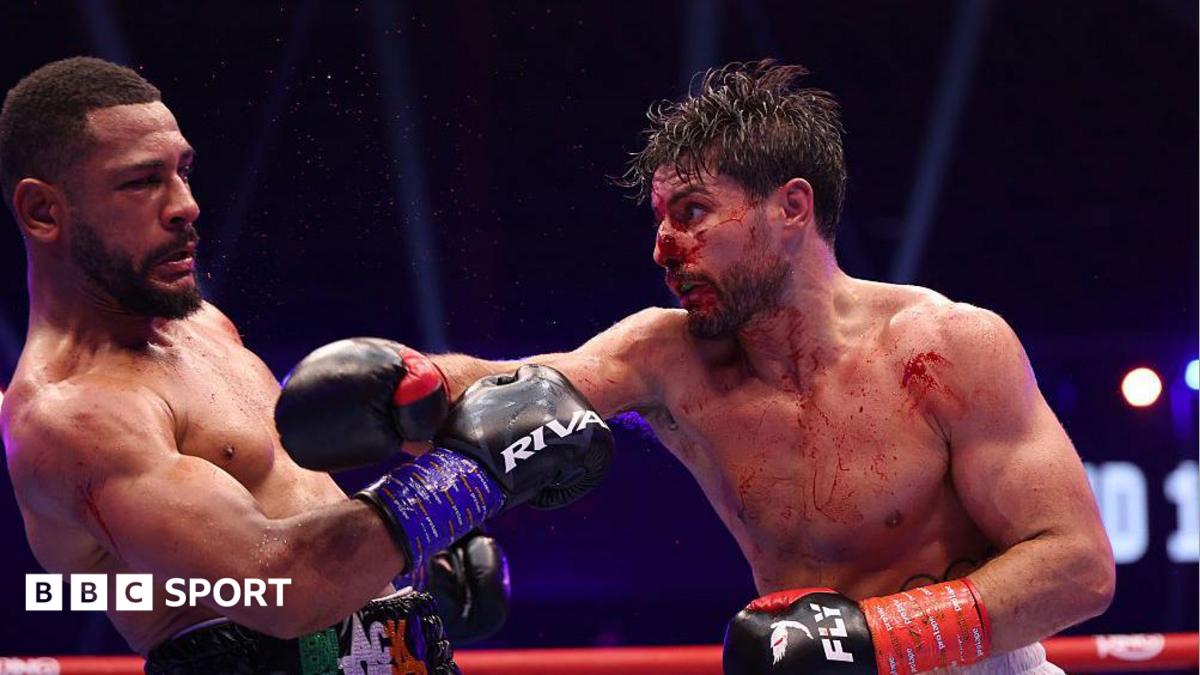
Briton Josh Kelly was forced to dig deep to retain his IBF light-middleweight world title, surviving a spirited late comeback from Belfast’s Caoimhin Agyarko to win a narrow points decision in Jeddah, Saudi Arabia.

Kelly looked in complete control until the complexion of the contest changed when he received a deserved sixth-round point deduction for repeated punches to the back of the head.

The 31-year-old was then bloodied by cuts across his face and a gash on his nose as Agyarko grew in confidence and began to land with increasing success.

But Kelly stood firm through the championship rounds to secure victory, with the judges scoring the contest 114-113, 115-112 and 115-112.

“That was a messy and hard fight. I didn’t get cuts from punches like this, it comes from heads and elbows. This is what it looks like when you’ve got tight skin,” Kelly said.

“I knew he [Agyarko] was go to be tricky and awkward. [He had] a good game plan. He tried to make it a good boxing match. I had to show a different side to me at the end and that is what a champions does.”

Fighting on the undercard of Anthony Joshua’s heavyweight comeback against Kristian Prenga, Sunderland’s Kelly claimed his 21st professional victory.

Agyarko, 29, had hoped to become Ireland’s first black world champion. Instead, despite a brave second-half comeback, he suffered the first defeat of his professional career in his 30th contest.

Also on the card, WBO super-middleweight champion Hamzah Sheeraz laboured to an underwhelming points win over Simon Zachenhuber.

The 27-year-old Briton was far from his best and struggled to find his rhythm but was awarded a majority decision as he extended his record to 24 wins and one defeat.

Source link

Typhoon Noul makes landfall in China, with hundreds of thousands evacuated | Weather News

Noul hit southern Guangdong province and neighbouring Hong Kong, bringing strong winds and heavy rain to the region.

Typhoon Noul has hit southern China, including Hong Kong, bringing strong winds and heavy rain to the region and prompting the evacuation of hundreds of thousands of people in Guangdong province.

China’s national weather centre said Noul made landfall on the coast of Huidong county in Huizhou, southern Guangdong province, at approximately 3:50am local time on Sunday (19:50 GMT on Saturday).

Recommended Stories

list of 3 itemsend of list

China’s official Xinhua News Agency said Noul was the strongest typhoon to make landfall in China so far this year.

Hong Kong’s Observatory said Noul, with maximum sustained winds of 110 kilometres per hour (68 miles per hour) near its centre, was moving Sunday into inland Guangdong and weakening progressively, bringing strong winds and heavy rain to parts of the region.

More than 715,000 people had been relocated for safety by early Sunday in Guangdong province, according to state-owned China National Radio. On Saturday, authorities said some 340,000 people were evacuated.

China’s National Meteorological Centre expected parts of southern Guangdong and southeastern Fujian provinces to experience heavy rain and strong winds over the weekend.

Many trees were seen uprooted in Huilai county, located on the coast of Guangdong province, state broadcaster CCTV reported.

Hong Kong’s airport authority said about 350 flights were cancelled on Sunday. At least nine people were injured across the city during the typhoon period, according to Hong Kong authorities.

As Noul approached Hong Kong, parts of a large scaffolding on a high-rise building collapsed on Saturday afternoon, local police said, although initial reports indicated there were no injuries.

Taiwan’s Central Weather Administration said Noul was bringing rainfall to parts of southern and eastern Taiwan. It was passing over waters south of Taiwan and was moving away from the island Saturday.

Earlier this month, Typhoon Bavi brought strong winds and rain to eastern China, leading to the evacuation of more than two million people. It made landfall on July 11. Another, Maysak, made landfall in southern China on July 3.

Source link

House of Hope: New film follows a Waldorf-inspired school in the West Bank | Israel-Palestine conflict News

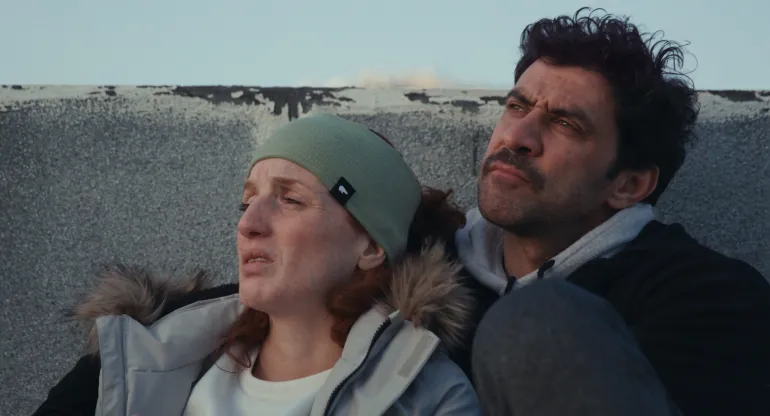
At one point in the documentary, House of Hope, the protagonist, Manar Wahhab, breaks down in a classroom corner in the school she founded with her husband in the occupied West Bank. The cameras keep rolling.

“To step into someone’s life with a camera at the moment when they’re really down, it feels a little bit uncomfortable, but we made the choice together to keep filming during these moments. I wanted the audience to be there with them,” director Marjolein Busstra told Al Jazeera.

Recommended Stories

list of 4 itemsend of list

The film follows Wahhab, a Palestinian woman who established a Waldorf school with her husband, Milad Vosgueritchian, in al-Eizariya in the occupied West Bank.

House of Hope Vision Kindergarten & School teaches the Waldorf philosophy of non-violent resistance and offers children a space to express their emotions and cope with the trauma and difficulty of living under occupation.

“The school protects the children’s dignity in the present moment. It’s more about refusing to let occupation shape their inner world, so that they can actually be children and have agency,” Busstra said. “It’s in Waldorf philosophy that they make space to express the feelings.”

Working with a Palestinian crew, Busstra spent three years with Wahhab, travelling to the occupied West Bank nine times throughout the course of the documentary. She first met Wahhab 18 years ago during a film workshop in the West Bank.

Although the documentary centres around the elementary school, Wahhab is the story’s driving force. The story follows Wahhab and Vosgueritchian, both at the school and at home with their children.

“I started filming the school, but right away, I knew I wanted to do it about Manar’s inner life,” Busstra said. “I think hope is a difficult word at the moment, but I have a deep awe for Manar, who keeps creating and teaching even while carrying so much herself.”

For Wahhab, her respect for Busstra and their existing friendship helped her trust the film crew during vulnerable moments.

“We both believe deeply in education, in children’s creativity and freedom and in seeing the human being as something whole and beautiful in mind, soul and spirit. Those shared values created openness and trust between us and helped shape a film that is not only about events but also about humanity,” Wahhab told Al Jazeera.

The film was produced by Think-Film, the company behind The Voice of Hind Rajab, which tells the story of the five-year-old Hind killed by Israeli forces in 2024. Soldiers fired 335 bullets into the car carrying the girl and six of her family members – a story that became a symbol for the system failure to protect children in Gaza.

Manar Wahhab and her husband, Milad Vosgueritchian, run the House of Hope Vision Kindergarten & School, which follows the Waldorf philosophy [Courtesy of First Hand Films]

Although sometimes difficult, Wahhab said she made an effort to let the crew document multiple facets of her life.

“Over those three years, the crew met many versions of Manar. Sometimes they arrived, and I was fresh, energetic and cooperative. Other times, they found me exhausted, angry, overwhelmed, or ill,” she said. “I understood that I had to be as authentic as possible, because I was representing not only myself, but also my community, hope, peace and the voice of Palestinians.”

Wahhab and Vosgueritchian founded the school out of a desire to offer a different kind of education to Palestinian children and to provide a place where they felt safe and could share their emotions.

“The school was born many years ago when we saw the hardships surrounding our community and wanted to create something different, a space of love, safety, creativity and healing,” Wahhab said. “House of Hope is an idea, a mission and an energy that we carry wherever we go.”

In an increasingly violent Israeli occupation, Wahhab considers the Waldorf philosophy essential.

“I do not see nonviolence as weakness. Actually, I believe the opposite. Violence is easy. Nonviolence requires courage, awareness, patience and inner work. It asks us to see beyond our own pain and ego and to hold on to our humility even when circumstances are trying to pull us away from it,” she said.

“The world absorbs the energy that we create, and right now, there is so much fear, anger and violence in our world. I think we need more peace within ourselves, peace with one another and peace with nature,” Wahhab added.

After Hamas’s incursion into southern Israel on October 7, 2023, came Israel’s brutal military response. Life became increasingly difficult for Wahhab, Vosgueritchian and the children at House of Hope, but the crew continued to document their realities.

“The story I wanted to create with Manar stayed the same, but after October 7, everything became heavier. They were so down for a while. They were like different people, like they lost all hope,” Busstra said. “The school built this safe haven, but the occupation is always rattling at the door.”

Israel’s intensified military actions in the West Bank, including the shooting and killing of children, are a constant spectre. In another scene, Wahhab watches her son leave for school and checks to see if he has a phone charger and spare clothes in case he is held at a checkpoint for hours.

“The energy is so heavy now. I hope people understand that we are not asking for something extraordinary. We are asking for basic human rights, the right to live with dignity and freedom, the right to safety and the right to be fully human beings,” Manar said.

Children at the House of Hope, when asked to draw freely, depict the brutal realities of Israeli occupation [Courtesy of First Hand Films]

Busstra, who closely followed Wahhab for three years, said she wants audiences to go “beyond the framing of us vs them”.

“I hope that this stays with people, not as something distant that happens to others, but something they can locate within their own understanding of what it means to love someone in an unsafe world.”

Wahhab believes the film offers a more nuanced perspective of Palestinians.

“I think that in the West, many people see a very limited picture of Palestine and the Middle East. Sometimes they see us through stereotypes as terrorists, as people who are undeveloped or somehow less than themselves,” she said. “I hope this film helps people look beyond those images. The news does not tell the full reality. It often shows only violence and people killing one another. It doesn’t show the essence of people’s lives. It shows negativity,” she said.

Wahhab encouraged people to consider the documentary through a lens of shared humanity.

House of Hope won the best international feature documentary prize at the Hot Docs Canadian International Documentary Festival in May 2026 and was recently screened at UNESCO in Paris. It will soon be screened at the Jerusalem Arab Film Festival.

“Even though our story is deeply rooted in the West Bank, its message is universal. Our hope is that people everywhere can see our story and take something meaningful from it.”

Source link

BBC Casualty ‘to kill off’ show legend in heartbreaking twist and fans are gutted

Casualty fans are heartbroken as they are convinced the show is killing off a beloved character for the 40th anniversary

Casualty could be killing off a show legend after more than 10 years, and fans are not best pleased about it.

The beloved BAFTA-winning BBC show has been a staple on screens for 40 years. As the world’s longest-running medical drama, Casualty has captivated audiences thanks to its powerful storytelling and characters.

And to celebrate its 40th anniversary later this year, a special double-bill episode will air on Saturday 5th. And as expected, it’s going to be seriously dramatic.

In a trailer that was aired at the end of Saturday’s (July 25) episode, viewers were shown a sneak peek at the episode, in which a high-stakes explosion throws Holby into chaos.

Lives are left hanging in the balance, and the ED team are pushed to their limits in a tense and emotionally charged story. And now, after watching the trailer, fans are convinced that the show is going to kill off Dylan Keogh (William Beck).

“I think the building will explode to kill Dylan! I think that’s his final episode,” mused one person on Casualty’s Facebook page. Someone else agreed: “I thought this as well.” A third chimed in: “Dylan better not go. He’s the best – I just love his character.”

Viewers will know Dylan made his debut on the show back in 2011 when he was introduced as a replacement for fellow emergency medicine doctor Ruth Winters (Georgia Taylor).

And over the years, he has played a part in several big TV moments. What’s more, since the departure of Charlie Fairhead (Derek Thompson) in 2024, Dylan has been the longest-serving character on the show.

Meanwhile in 2024, Dylan actor William spoke about the handful of cast exits at the time including Charlie. He told Digital Spy: “When Derek [Thompson] left, it was surreal. For me, it was just an absolute privilege to be there.

“I said a few words on Derek’s last day, and it was only in saying it, that I really appreciated that for everybody that was there at that time.

“Without Derek, Casualty would never have been the show that it has become and the opportunity to mark that and to celebrate it and to celebrate a unique achievement of being the lead in a continuing drama for that length of time, is a one off. To be there and to be present, and to acknowledge that, was such a privilege that in a sense that I haven’t even had time to miss it yet.

Watch Casualty on BBC One and iPlayer

Source link

‘It’s like bringing the kitchen into the piazza’: seven of the best Italian village food festivals | Italy holidays

I cannot remember a summer when at least one evening hasn’t been spent following signs to a local sagra. Not quite a food market and not quite a village fete, a sagra is like a village moving its kitchen outdoors for a few nights.

When I think back to those nights from childhood, the first image that comes to mind is of a woman’s hand closed into a fist above a pan of hot oil. Through a tight circle formed between her thumb and forefinger, she would squeeze soft lumps of batter, one small ball at a time, into the oil. In a few seconds, each soft mass would become a pittula, a small Salento fritter: swollen, uneven, golden, too hot to eat straight away but too good to wait for.

Illustration: Guardian Graphics

I was born in Salento (Italy’s heel), in the south end of the Puglia region, and grew up in Taviano, a small town south of Lecce. Going away for the summer was something other people did. For my family, as with many local families, summer meant packing the car and moving from our main house in town to a smaller place by the sea, only a few miles away.

That place was Mancaversa, the seaside part of Taviano, where the Sagra tu Furese (mid August, dates to be finalised), which in Salentino dialect means the farmer’s festival, seemed to bring the whole village outdoors for dinner. From a small child’s perspective, it was a forest of legs and voices. I remember trying to pull my parents past the grown-up ritual of stopping every few yards to greet people they seemed to see only in summer, as we made our way towards the stalls near Piazza delle Rose, where men fanned embers with cardboard, sausages hissed on grills, horse-meat stew simmered in tomato sauce and gnummareddi (rolls of lamb offal) tempted the more adventurous.

Music came from a small stage and the village became an open-air sitting room, where people met over food that was ordinary for us, and almost incomprehensible to anyone who came to Salento looking for beaches and white light. No one would have thought to call them experiences. They were simply the proper way to get through summer, and in a country where a meal can quickly become expensive, they still make dinner feel possible for about €15.

Sometimes my parents, my brother and sister and I would go to Cannole. We would drive inland, passing through villages that all seemed to have a festival on. Only later did I understand that those roadside signs were a map of Italian summers, one I would go on to follow beyond Salento. Each led to a village gathered, for a few nights, around a dish of its own.

Cannole itself – a small town of just over 1,500 people – lies on the other side of the province of Lecce, towards Otranto and the Alimini lakes, and since 1985 the local Pro Loco Cerceto volunteer association has organised the Festa della Municeddha (10-14 Aug), dedicated to the small snail that has always been part of home cooking there.

Festa della Municeddha celebrates the small snail that has long been part of home cooking in the Puglia region of Cannole.

The municeddha is eaten in three main ways: in tomato sauce, cooked down with onion and oil, or roasted. But whichever the version, the method for consuming them is the same: you free it from the shell with a toothpick and eat it standing up. The festival today is large, with music, stalls and full tables, and is a far slicker operation than the one I remember.

Around 400 miles up the Adriatic coast, in the Marche, is the small town of Campofilone, on the hills above the Aso valley. Since 1964, its Sagra dei Maccheroncini di Campofilone IGP (7-10 Aug) has taken an extremely thin local pasta (maccheroncini) and transformed it into the centrepiece of a public feast: cut even finer, made with semolina and eggs and cooked in one minute. As soon as it is drained, it is tossed through red mixed-meat ragù on large wooden boards, where these very fine strands, so delicate when dry, become a compact mass, glossy with sauce, ready to be sent out to the tables.

Fusillo is an egg pasta served at the Sagra del Fusillo Felittese in Felitto, south of Naples.

For the Sagra del Fusillo Felittese (13-23 Aug), set aside at least half a day. You leave the Cilento coast in the Campania region and climb inland, up to Felitto and the Gole del Calore (the Calore river gorge). The festival began in 1976 at Remolino, when fusillo (literally, little spindle) was used to bring people to the village. The reason to go is still the pasta: made with fresh eggs, long and hollow, rolled by hand around a thin iron rod. It is served with castrato ragù, traditionally made with goat from a castrated male animal, or with veal ragu.

If you’ve spent any time around Modena or Bologna in northern Italy (I moved to Modena to study at 18 and have lived there since), Castelfranco Emilia is the sort of place you’ll have passed through. At first I thought of it as a drive-through kind of town, but today I’m drawn to such places as they tend to keep their traditions fuss-free.

The tortellino, claimed by both Modena and Bologna, finds a nice compromise in Castelfranco. Legend says it was born here, at Locanda Corona, when an innkeeper glimpsed Venus’s navel through a keyhole and took it as his model. In practice, it is thinly rolled egg pasta, folded by hand around a filling of pork loin, prosciutto di Modena, mortadella di Bologna, parmigiano reggiano, egg and nutmeg. Here it is served in hot capon broth.

skip past newsletter promotion


Local customs are still going strong at Sagra del Tortellino Tradizionale between Modena and Bologna

In September, Castelfranco holds the Sagra del Tortellino Tradizionale in Piazza Bergamini (4-14 Sept). What I remember is the square filling with long tables, people queueing at the cash desks and bowls of hot broth arriving one after another. Later, the parade leaves Corso Martiri like a small Renaissance pageant: women in brocade gowns and veils, men in caps and doublets, banners, music, and the innkeeper and noblewoman at the centre of the navel story that gave the tortellino its shape.

I arrived in Vipiteno, in Alto Adige/South Tyrol, in September, when summer in north Italy was cooling down. The Sagra dei Canederli (13 Sept) takes place during the day, and what I remember most is the strange orderliness of it: a 400-metre table laid with a gingham tablecloth in the historic centre, people finding a place, menus changing from one section to the next, and plates of dumplings arriving. It feels less like a fair than an alpine dining room laid out in the street, with folk music in the square and the mountains close enough to seem part of the meal.

canederlo is a dumpling made from stale bread, eggs and milk – a way of using kitchen leftovers became one of the most recognisable dishes of these valleys. In Vipiteno, they come in broth, with speck, mushrooms, cheese and herbs; or sweet, with apricots or plums.

Giarratana onions at the Sagra della Cipolla onion festival.

Sicily is at the southern end of the sagre map. I came to know Giarratana through the onion that bears the name of this village, in the south-east of the island. In August, those onions fuel an open-air supper and a small seasonal economy, with visitors coming to taste them where they are grown.

The Giarratana onion is large, flat and particularly sweet. It has been recognised by the Slow Food Presidia, and during the Sagra della Cipolla Giarratana (12-14 Aug), traditionally linked to the feast of San Bartolomeo, it fills markets, food stalls and tables along the village streets. It is served raw, finely sliced and dressed with olive oil, salt and cheese; baked whole or stuffed; or inside scaccia, a local speciality similar to a thin, folded focaccia. There are also hot dishes, preserves, local wine and music.

Giarratana is small: it is worth arriving before dark, parking outside the centre and, if accommodation in the village is full, staying in Ragusa, Modica or Chiaramonte Gulfi.

The Italy of sagre is too wide to fit inside a dining room and, for every silver cloche lifted, somewhere else in Italy there is a ticket number being called over a microphone and a dinner being served from a pot larger than anything you’d find in a home kitchen.

Source link

Commonwealth Games: No Glasgow 2026 swimming medals for Scotland on night two in the pool

Shanahan missed the chance for a second chunk of metal in the last race of the night as she competed in the 4x100m mixed relay team who finished fifth, though they did set a new Scottish record.

Part of the team was, surprisingly, poster boy Scott.

He received a hero’s welcome as he returned, racing second after Evan Jones and before Evie Davies, but ultimately the field was too strong.

Earlier in the evening, Sean McCann finished eighth in the men’s 400m freestyle final, Lucy Grieve was seventh in the women’s 50m butterfly final and Matthew Ward broke the men’s 50m backstroke Scottish record on his way to seventh in that final.

Source link

US military disables tanker accused of breaking the Iran blockade | US-Israel war on Iran News

NewsFeed

The US military has released footage it says shows forces boarding one tanker and disabling another accused of attempting to breach its naval blockade of Iran. CENTCOM says 12 commercial vessels have been redirected and two disabled for failing to comply.

Source link

New front in US-Iran war escalates as Houthis fire at Saudi oil facilities | Conflict News

Tehran-backed Houthi forces in Yemen have fired missiles and drones at two of Saudi Arabia’s most strategically important oil facilities on the Red Sea, in a major escalation of the latest simmering regional conflict to be reignited by the war launched by the United States and Israel against Iran.

But the skies over the country at the epicentre of the widening war were quiet for a second successive night, with no new US attacks on Iran reported by Sunday morning.

Recommended Stories

list of 3 itemsend of list

Iran had been pounded by 13 consecutive waves of overnight US air strikes since July 11, after the Islamic Revolutionary Guard Corps (IRGC) attacked tankers trying to transit the Strait of Hormuz. As hostilities escalated, both sides declared that an interim peace agreement signed in June was dead, and a second phase of talks to finalise a comprehensive peace deal appeared doomed.

But there have been no US air strikes since Friday, and tentative signs are emerging that Washington and Tehran are still talking via mediators and might return to more meaningful discussions.

Even if another fragile truce is agreed, however, the cascade of consequences unleashed by the war is still stoking conflict and confrontation elsewhere.

Iran’s attacks on shipping in the Strait of Hormuz have put a stranglehold on exports of oil and raw materials for fertiliser, sending energy prices soaring and raising the risk of a food security crisis in some of the world’s most vulnerable countries.

In March, in response to attacks on Iran, the Tehran-backed Hezbollah movement in Lebanon resumed missile attacks on Israel, which then launched a devastating invasion of southern Lebanon that has displaced 1.2 million people.

Now, another smouldering regional conflict has erupted again, between US-allied Saudi Arabia and the Houthi movement which controls most of northern and western Yemen, including the capital, Sanaa. Saudi Arabia and its regional allies joined a brutal civil war against the Houthis in 2015, until a truce was agreed in 2022.

Risk of global crisis

The truce collapsed this month after an attack on Sanaa airport to stop an Iranian plane landing provoked the Houthis to fire ballistic missiles at Saudi Arabia. Last Monday, the Houthis declared a naval blockade of Saudi Arabia, and late on Friday the Saudis launched air strikes on the Houthi-held city of Hodeidah.

In retaliation, Houthi forces launched Sunday’s attacks on facilities belonging to Saudi state oil giant Aramco in the coastal cities of Jizan and Yanbu, Houthi military spokesman Yahya Saree said.

There has been no comment from Saudi Arabia on the extent of any damage to Aramco’s refinery in Jizan, but a large column of smoke was seen rising after the attack.

In Yanbu, Saudi Arabia’s principal west coast export gateway, two ballistic missiles aimed at oil installations were intercepted by a Patriot battery operated in Saudi Arabia by the Greek military under an agreement ‌with Riyadh.

The escalating conflict has raised fears that the Houthis could block the Bab al-Mandeb Strait, which connects the Red Sea to the Gulf of Aden. If both the Bab al-Mandeb and Hormuz straits were blocked, the resulting supply chain crisis would cause major economic damage across the world.

Entangled wars

Besides spreading to the Red Sea, the US-Iran war has become entangled with the deadliest active conflict in the world – Russia’s attempted conquest of Ukraine.

A long-range strike on an Iranian vessel in the Caspian Sea on Saturday caused an explosion that killed one sailor and wounded another, according to Iran’s Ministry of Foreign Affairs, which blamed the attack on Ukraine and summoned Kyiv’s charge d’affaires in Tehran to convey its condemnation of the “hostile and criminal” act.

Ukrainian President Volodymyr Zelenskyy said in a post on X that Kyiv had achieved “very strong results” with long-range strikes in the Caspian Sea, hitting “vessels used in military cargo shipments involving Iran, as well as a warship”.

Zelenskyy claimed in further comments on X on Saturday that since the start of July, Kyiv had detected “active Russian satellite ⁠surveillance of the Gulf states and US military facilities located there”. He said the satellite images were passed to Tehran to help the IRGC identify targets for ballistic missile and drone attacks.

US President Donald Trump has not given a reason for the sudden cessation in air strikes on Iran, but a senior administration official told the Reuters news agency that Trump “has always been clear that his preference is diplomacy, but he has shown Iran what will happen if they fail to come to the table in a serious way”.

Trump said on Friday that there was still some communication with Iran.

“They are talking to us right now; they’d love to make a deal,” he said. “I don’t think they’re ready to … but I’m willing to listen.”

Al Jazeera’s Resul Serdar, reporting from Tehran, said Iranian officials had confirmed the two sides were exchanging messages.

“There have been proposals conveyed by the mediators, and Tehran is still reviewing them,” Serdar said, adding there was “not much progress yet” due to “fundamental differences” in their positions and deep mistrust.

Source link

Holby City Hospital teed up for explosive Casualty 40th anniversary episode

Holby City Hospital will see an explosive “high-stales major incident” that will have viewers on the edges of their seat as Casualty gear up for the 40th anniversary episode

Casualty has dropped a first look at its explosive 40th anniversary episodes, with Holby City Hospital thrown into chaos after a devastating blast.

The BBC released a teaser trailer ahead of the landmark special, which will air in September, giving fans a glimpse of the high-stakes drama facing the emergency department.

The anniversary story will be told across a two-part special centred on fan favourites including Dr Dylan Keogh and Flynn Byron.

The trailer opens with a huge explosion as emergency medicine consultant Flynn Byron, played by Olly Rix, looks on in shock. As the scenes unfold, a haunting chorus of children singing Happy Birthday Dear Dad plays over the footage while members of the emergency department, including clinical lead Dr Dylan Keogh (William Beck), gather outside the hospital.

Viewers also get a glimpse of familiar faces including paramedic Jan Jenning (Di Botcher) and consultant Stevie Nash (Elinor Lawless).

A map of Holby quickly fills with emergency incident alerts before the hospital is plunged into turmoil. The trailer shows a fight breaking out inside the hospital, while a visibly emotional Dr Keogh is seen in tears.

Elsewhere, ambulances line up outside with blue lights flashing as patients are rushed through the hospital on stretchers. A firefighter is also seen making their way through a room filled with exposed wires as sparks fly around them.

The preview keeps many details under wraps, ending with what appears to be armed police officers approaching Holby City Hospital.

According to the BBC, the anniversary episodes centre on a “high-stakes major incident that throws Holby into chaos”, leaving lives hanging in the balance as the emergency department team are pushed to their limits.

The special will also feature a major rescue operation, while Dr Keogh faces a personal tragedy during what the BBC describes as the team’s “darkest hour”. Stevie Nash and Flynn Byron will also find themselves fighting for survival in a race against time.

The episodes celebrate 40 years of the world’s longest-running medical drama while marking what the BBC has described as an “exciting new chapter” for the series.

First airing in 1986, the BAFTA-winning drama later spawned spin-off series Holby City. Since 2011, Casualty has been filmed at BBC Roath Lock Studios in Cardiff and is expected to move to a new fictional hospital in Wales next year.

The Casualty 40th anniversary episodes air on September 5 on BBC One and BBC iPlayer.

Like this story? For more of the latest showbiz news and gossip, follow Mirror Celebs on TikTok , Snapchat , Instagram , Twitter , Facebook , YouTube and Threads .


Source link

Anthony Joshua v Kristian Prenga: Best pictures from Joshua’s Jeddah win that sets up Tyson Fury fight

Another dramatic and emotional night in Anthony Joshua’s boxing career ultimately ended as just about everyone expected it would – with the countdown under way to a super-fight against Tyson Fury later in the year.

Joshua, 36, improved his record to 30-4, but he was almost on the end of one of the biggest shocks in his sport’s history when he was knocked down twice by little-known Albanian Kristian Prenga inside the first round.

The Briton regrouped in the second round to land a flurry of hard right hands, sending Prenga crashing to the canvas and getting the win he came to Jeddah for.

BBC Sport has selected some of the best pictures from the fight, which came seven months on from the car crash in Nigeria in which Joshua was injured and two of his closest friends died.

Source link

Can Zimbabwe’s mineral ambitions benefit smaller producers? | News

Harare, Zimbabwe – Zimbabwe wants to move beyond being a supplier of raw minerals and build industries that process and manufacture from its own resources. But as the government tightens restrictions on unprocessed mineral exports, smaller miners are asking whether they will share in that transformation or be left behind.

The government has restricted exports of unprocessed strategic minerals, including lithium, as part of a broader drive to increase domestic beneficiation. Authorities argue that Zimbabwe should capture more value from its mineral wealth instead of exporting raw materials and allowing other countries to profit from refining and manufacturing.

The policy has attracted more than $1bn in investment into Zimbabwe’s lithium value chain, according to government officials and industry representatives. But smaller miners warn that the cost of building processing facilities, unreliable electricity supplies and limited access to finance could make it difficult for them to participate in the country’s industrial ambitions.

Speaking during a technical media tour of Prospect Lithium Zimbabwe (PLZ) in Goromonzi, Mashonaland East, on 17 July, Minister of Mines and Mining Development Polite Kambamura said Zimbabwe’s 2022 ban on exports of unbeneficiated lithium ore had encouraged companies to invest in domestic beneficiation.

“The construction of the first lithium sulphate plant in Africa is behind me, and this was done in Zimbabwe,” Kambamura said.

He said Zimbabwe’s ambitions extended beyond lithium sulphate and lithium carbonate production, with a long-term goal of developing industries capable of manufacturing lithium batteries and solar panels locally.

Prospect Lithium Zimbabwe, owned by China’s Zhejiang Huayou Cobalt, said its lithium carbonate plant was about 90 percent complete.

PLZ public relations officer Patience Mushore said Huayou’s investments had generated more than $1.1bn in foreign exchange for Zimbabwe while expanding the country’s lithium value chain.

Policy shift

Supporters of Zimbabwe’s export restrictions argue that the country can no longer remain a supplier of raw minerals while other nations capture greater profits through refining and manufacturing.

Public policy expert Tedious Ncube said Zimbabwe’s lithium sector demonstrated why the government had prioritised beneficiation.

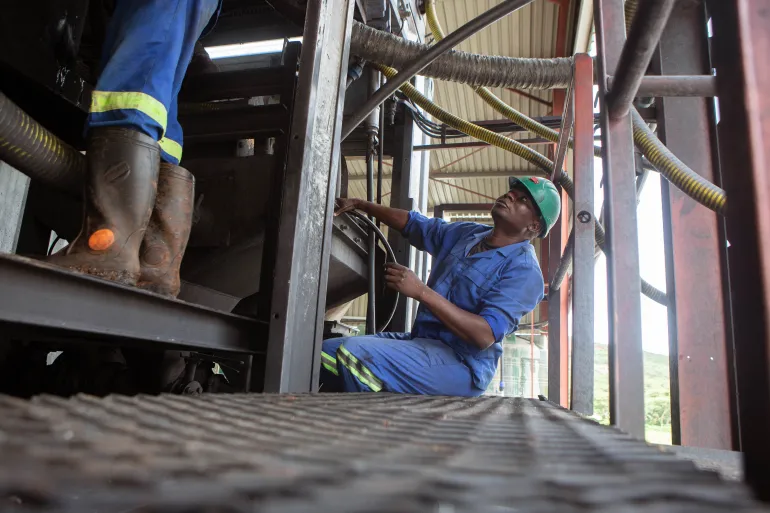
Mechanics work on a machine installed at Arcadia Lithium in Goromonzi, Zimbabwe [Tafadzwa Ufumeli/Getty Images]

He pointed to investments at Arcadia Mine and Bikita Minerals as examples of companies expanding Zimbabwe’s lithium sector.

Ncube said domestic processing could create skilled jobs, strengthen local suppliers and allow Zimbabwe to retain a greater share of the income generated from its mineral resources.

“The success of Zimbabwe’s lithium industry shows that the right policy can attract investment that builds industries, creates jobs and leaves a bigger share of mineral wealth in Zimbabwe,” he said.

Mining concerns

For smaller producers, the debate is not whether Zimbabwe should process its minerals locally, but whether they will have the infrastructure, finance, and market access needed to participate.

Shelton Lucas, business development director at Naivo Mining, said the company operates chrome, antimony and tungsten projects in Mashava, Ngezi and Kadoma but faces challenges accessing affordable processing options.

Lucas said smaller producers were struggling to access processing capacity, particularly in the chrome sector.

“For our raw chrome, we are now forced to sell to local Chinese smelters where they underpay us. For antimony, I have the resources to build the value-addition plant, but for chrome I cannot because the plant is very expensive,” he said.

He said he supported domestic processing but warned that smaller miners could be excluded if new requirements were introduced without support mechanisms.

Lucas proposed a toll-smelting system, where public institutions or industry bodies invest in shared processing facilities that miners can access at transparent rates while retaining ownership of their minerals.

“The challenge is not only building processing plants, but also ensuring smaller producers can access capacity on fair terms,” he said.

Without such measures, he warned that a small number of companies could end up controlling processing capacity and market access.

“If these companies also hold export rights, they could dictate prices to small-scale miners, creating what could become a predatory market that undermines the very people the mining sector is meant to empower,” he said.

Economic constraints

Economists say Zimbabwe’s processing ambitions will depend on whether the country can overcome longstanding challenges affecting mining and manufacturing.

United Kingdom-based Zimbabwean economist Chenayi Mutambasere told Al Jazeera that the policy faced obstacles including power shortages, expensive financing, weak transport infrastructure, foreign exchange constraints and limited access to processing technology.

“The ban should be more than a political slogan; it should be an industrial practical strategy,” she said.

A worker oversees operations at Prospect Lithium Zimbabwe's (PLZ) three-line, single-phase lithium sulphate plant in Goromonzi, Mashonaland East. The facility is part of the company's investment in local mineral beneficiation and Zimbabwe's broader drive to move up the lithium value chain. [Enos Denhere/Al Jazeera]
A worker oversees operations at Prospect Lithium Zimbabwe’s (PLZ) three-line, single-phase lithium sulphate plant in Goromonzi, Mashonaland East [Enos Denhere/Al Jazeera]

Mutambasere said the government needed to support the policy with reliable electricity, investor incentives, skills development and clear implementation timelines.

She warned that restrictions introduced before the necessary support systems were in place could create unintended consequences.

“An abrupt ban where companies have invested in the sector may push the mining sector further underground, which could increase mineral leakage,” she said.

Government vision

Permanent Secretary in the Ministry of Information, Publicity and Broadcasting Services Nick Mangwana told Al Jazeera that the policy was intended to ensure Zimbabwe gains more from its finite mineral resources.

“The government is implementing this beneficiation policy in our minerals for the growth of our economy and to create a lasting legacy that will be witnessed by future generations,” Mangwana said.

He said the policy applied not only to lithium but also to other strategic minerals, including platinum group metals such as palladium, rhodium, ruthenium, iridium and osmium.

Zimbabwe’s push reflects a wider debate among resource-rich countries: whether restricting raw exports can build domestic industries without concentrating opportunities among a few large companies.

For smaller miners, the success of the strategy will depend not only on how much mineral processing takes place inside the country, but whether beneficiation creates broader participation or leaves only the biggest players able to compete.

Lucas said the goal should be to ensure that local processing expands opportunities across the mining sector rather than creating new barriers for smaller producers.

“Beneficiation should not become a barrier to participation. It should be an enabler of inclusive growth, industrial development and sustainable economic transformation,” Lucas said.

Source link

Newspaper headlines: ‘Burnham’s big spree’ and Streeting ‘bid to win back Trump’

The Sunday Times says, external Prime Minister Andy Burnham will give England’s metropolitan mayors a share of income tax to spend in their cities, in devolution plans to be announced next week. It says the policy will be driven from the new Number 10 North office in Manchester.

Writing in the Sunday Mirror, external about his government’s priorities, Burnham says “if I’ve learnt anything from my time in politics, it’s that ‘it can’t be done’ is usually just another way of saying ‘we’ve stopped trying’.” In an article justifying policy decisions that have been taken so far, he adds, “our job will only be done when people aren’t just living, they’re living well.”

The Sunday Telegraph claims, external that the new Defence Secretary, Wes Streeting, has offered in a call with his US counterpart, Pete Hegseth, to collaborate on a global effort to re-open the Strait of Hormuz. The paper says a conference may be held in London to bring together representatives from more than 40 countries to discuss the issue. It describes the efforts as an attempt to “turn the page” on the divergence between the US and UK over the Iran war.

The wildfires raging across Europe feature on the front page of the Observer, external. It carries a stark full page image of a bather walking into the sea, with billowing smoke causing the sky to blacken. The headline reads: “Baptism of Fire.”

The Sun on Sunday reports, external that a group of migrants who arrived in the UK this week may include suspects wanted for questioning in connection with the fatal stabbing of another migrant. The incident is alleged to have happened in the seaside resort of Berck-sur-Mer in northern France on Thursday.

The Sunday Express claims, external that Sarah Ferguson, the former wife of Andrew Mountbatten-Windsor, is close to agreeing to a deal with broadcasters for a documentary series about her life. It says Netflix is one of the broadcasters she has been negotiating with. Those negotiating on behalf of Ferguson have stipulated that her contributions would have to be filmed outside the US because of the risk of being subpoenaed by the Congressional House Oversight Committee, which is investigating the crimes of her former husband’s friend, Jeffrey Epstein.

Source link

‘American Pachuco’ review: Essential profile of Luis Valdez

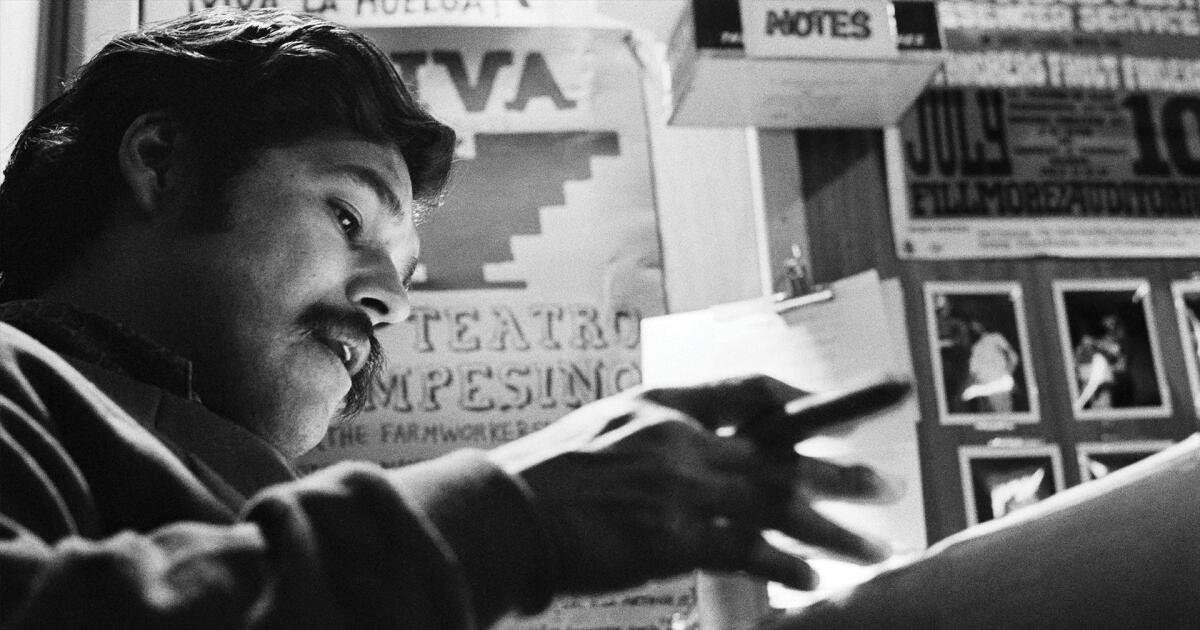
There are many dedicated figures devoted to Chicano empowerment in America. But in the arts, playwright-director-impresario Luis Valdez — the migrant farmworkers’ son behind the defiantly consciousness-raising El Teatro Campesino and the historic hits “Zoot Suit” and “La Bamba” — holds a singular place, achieved with remarkable perseverance. It’s a trajectory that the immensely appealing, rollicking documentary “American Pachuco: The Legend of Luis Valdez” tracks with a vitality and purpose befitting its subject.

Anchored by Valdez himself, now in his 80s and filling the camera frame like a grandfatherly lion, the film supplements his vivid biographical details with rich archival footage and testimonials from family members, collaborators and peers. There’s also the bold but sneakily effective narrator choice in Edward James Olmos, reviving his snarling, star-making El Pachuco growl from “Zoot Suit” to remind us of one of Valdez’s essential contributions to the theatrical canon. (Olmos is also an interviewee, as is Cheech Marin, Taylor Hackford, Lou Diamond Philips and labor leader Dolores Huerta.)

Born in Delano, Calif., and drawn to literature and language as a way to combat racist assumptions about a Mexican American’s destiny, Valdez found his gifts sharpened by puppet shows, school plays and finally, the union movement in his hometown. Valdez saw that pointed, raw satire was not only necessary but a recruitment tool for the fight. We hear the underdog aesthetic term rasquachismo used to describe these early impromptu performances: essentially a colorful funkiness, “so funky that nothing can undermine you,” Valdez says. As if something earthier and stronger had been harvested in the fields with all those valuable grapes.

After the labor battles of the Vietnam War era, Valdez took El Teatro Campesino’s mission nationwide. Excerpts from a televised adaptation of his play “Los Vendidos (The Sellouts)” — about a shop selling automatons representing Chicano stereotypes — underscore the continuing tensions of assimilation, a trap disguised as acceptance. But the piece also reflected feelings Valdez had about his long-estranged brother Frank, an engineer whose alienating efforts to deny his own background and fit in formed a heavy undercurrent in Valdez’s life.

“Zoot Suit,” an ambitious, musicalized, slang-flavored staging of the violent injustice behind L.A.’s notorious 1943 Zoot Suit riots, became a smash in 1978 (its narrow-minded New York reception notwithstanding). The story of how the Ritchie Valens biopic “La Bamba” came to be — a delicate mix of legacy tending and savvy casting — is similarly rousing and illuminating, even if it seems like an omission not to dig into why, after such a big hit, more movies didn’t follow. (Although, since this is Hollywood, we can guess the reasons.)

There’s so much to chew on in David Alvarado’s portrait of life, art and activism that “American Pachuco” plays like a joyful challenge to those searching for their own voice or meaning. As engaging a chronicler of his own life as Valdez is, his lessons in how to be seen and heard — and how to stay that way — feel especially timely. In our demonizing present, the story of such a pioneering truth-teller speaks powerfully to the needs of our blended American future.

‘American Pachuco: The Legend of Luis Valdez’

In English and Spanish, with subtitles

Not rated

Running time: 1 hour, 32 minutes

Playing: Opens Friday, July 24, in limited release

Source link

Jonquel Jones leads Team Spoon to win in WNBA All-Star Game

Jonquel Jones had 22 points, 13 rebounds and eight assists, helping Caitlin Clark and Team Spoon outlast Marina Mabrey and Team Coop 129-122 in the WNBA All-Star Game on Saturday night.

Dominique Malonga had a first-half dunk for Team Coop, but Team Spoon had eight players score in double figures in an All-Star Game that featured 127 three-point attempts and very little defense. Allisha Gray had 19 points for Team Spoon, and Clark finished with 17.

The WNBA celebrated its 30th season by holding its first All-Star Game in Chicago since 2022. This time, the marquee event was played in front of a record crowd of 19,783 at the United Center instead of the smaller Wintrust Arena in downtown Chicago, a sign of how much the league has grown.

Jones, a 32-year-old center for the New York Liberty, was named MVP. Nneka Ogwumike scored 11 points for Team Spoon while passing Maya Moore (119) for the most career points in All-Star Game history.

Kelsey Mitchell had 28 points for Team Coop, and Mabrey scored all of her 23 points during a red-hot first half. Malonga finished with 12 points and 13 rebounds.

WNBA greats Cynthia Cooper and Teresa Weatherspoon drafted the All-Star teams from players that were either voted as starters by fans, media and fellow players or chosen as reserves by the league’s coaches. Las Vegas’ Becky Hammon coached Cooper’s team, and Minnesota’s Cheryl Reeve was in charge of Weatherspoon’s squad.

Clark went 5 for 15 from beyond the arc and had five assists in her return to the All-Star game. The Indiana Fever guard missed last year’s event in Indianapolis because of a groin injury.

The 24-year-old Clark came out firing, connecting from 33 feet and 37 feet on her way to 11 points in the first 2 1/2 minutes. She buried another three early in the second quarter off a slick no-look pass from Minnesota Lynx guard Olivia Miles, the only rookie selected for the game.

Clark and Mabrey each put on an offensive show, but Malonga got the biggest cheer of the night. The 6-foot-6 center from the Seattle Storm ran down the lane, got a pass from Angel Reese and threw down a right-handed jam with 6:24 left in the first half.

Reese jumped up and down as Malonga finished the play, and the two exchanged a mid-air chest bump on their way back down the court.

It was the first dunk in a WNBA All-Star Game since Sylvia Fowles in 2022. Lisa Leslie (2005), Jones (2017), Brittney Griner (2019) also have accomplished the feat.

Leslie was on hand for the festivities, along with South Carolina coach and former WNBA guard Dawn Staley. Former NBA star Dwyane Wade also was courtside.

Cohen writes for the Associated Press.

Source link

Israel arrests nine at Tel Aviv protest against West Bank settler violence | Occupied West Bank News

Protest group says at least 200 demonstrated in Israeli capital a day after major escalation of West Bank violence.

Israeli police have arrested nine people at a Tel Aviv demonstration decrying settler violence in the occupied West Bank, according to media reports and protest organisers.

Hundreds of people gathered on Kaplan Street on Saturday to demonstrate against the settler violence and Israeli military rule in the occupied Palestinian territory, according to Israeli media. The protest was organised by the left-wing Hadash party and its allies.

Recommended Stories

list of 3 itemsend of list

The Mothers Against Violence protest group said more than 200 people took part in the demonstration, and accused police of using force against demonstrators, including the nine they confirmed were arrested.

Israeli police said demonstrations had gone ahead without authorisation and had begun to “disrupt public order and block the roadway”, according to local media.

The protest came a day after Israeli forces shot dead four Palestinians in the town of Tal, near Nablus, during a settler incursion on their land. Two Israelis were also killed in the confrontation.

On Friday, about 30 settlers entered Tal, next to the illegal Israeli settlement of Havat Gilad, and tried to break into two houses on Friday, said Essam Saifi, a local Fatah official. Residents confronted them, and the settlers opened fire.

A video shows a Palestinian man seizing a rifle from a settler and shooting him before soldiers shot him dead. Three others were killed and four wounded.

Ubai al-Aboudi, a rights activist in Ramallah, told Al Jazeera that one week prior, settlers set fire to a home in Tal with the family still inside. “It was a miracle that the residents of Tal were able to get that family out of the house before they were burned alive,” he said.

In retaliation for Friday’s shooting incident, the government of Prime Minister Benjamin Netanyahu ordered a wide-scale military operation across the West Bank, and Israeli forces arrested nearly 50 Palestinians in Tal while raiding about 70 homes.

The Palestinian Prisoner’s Society said at least 80 Palestinians were held across the West Bank the day after the incident, calling it “collective punishment”.

Funerals for the four killed were held before dawn under restrictions on attendance.

Political analyst Ori Goldberg said video of the attack on Tal had made denial impossible for the Israeli public.

“They saw the Jewish terrorist come into the villages and they saw the response … I’m not expecting the public to rise in protest in response, but I do expect this might revivify the last dregs of liberal Zionism in protest,” he told Al Jazeera.

“This may be a threshold moment in what Israelis have previously termed as ‘settler violence’ in an attempt to distance it from themselves,” Goldberg added.

At least 1,182 Palestinians have been killed, 13,000 wounded and nearly 24,000 arrested in the occupied West Bank since Israel’s genocidal war on Gaza began in October 2023, according to official Palestinian figures.

Source link

Flavio Bolsonaro launches Brazil presidential bid with Milei support | Elections News

NewsFeed

Flavio Bolsonaro, son of disgraced former Brazilian President Jair, has launched his bid to unseat President Luiz Inacio Lula da Silva. Flavio is vowing to carry forward his father’s legacy and has won right wing support from Argentina’s President Milei.

Source link

Oskar Eustis and L.A. theaters confront the end of nonprofit movement

He said the quiet part out loud. As the artistic director of New York’s Public Theater and one of the art form’s most prominent leaders, Oskar Eustis is known to do that. And as always, he got the art world talking.

When Eustis, 67, announced Wednesday that he would step down from his role at the Public in 2028 — after 23 years — he said in a New York Times interview that “the American nonprofit theater movement is over.” This has been whispered about and lamented since the COVID-19 pandemic led to temporary theater closures across the country that have since become permanent, but it is rare to hear it expressed so candidly.

Did Eustis, one of the key players in that vaunted movement — the man who helped foster “Hamilton” — really mean what he said? And if so, how does theater move on in the face of obstacles that at times feel as though they are scattered across an increasingly difficult course? In a wide-ranging follow-up interview with the Los Angeles Times, Eustis addressed the path forward.

Lin-Manuel Miranda and Phillipa Soo in "Hamilton."

Lin-Manuel Miranda and Phillipa Soo portray Alexander and Eliza Hamilton in “Hamilton.” The megahit premiered off-Broadway at the Public Theater under Oskar Eustis in 2015.

(Disney+)

It’s not an easy one, but Los Angeles theater leaders working in the trenches, including Tarell Alvin McCraney at Geffen Playhouse, Danny Feldman at Pasadena Playhouse and Snehal Desai at Center Theatre Group, already knew that. They talked with the Los Angeles Times about their plans at the crossroads reached by American theater in light of Eustis’ imminent exit.

Eustis traces the rise of the American nonprofit theater movement to the late 1950s when W. McNeil “Mac” Lowry, director of the arts and humanities program at the Ford Foundation in New York, began organizing existing regional theaters into a national movement.

“What happened during that period was that a consensus emerged,” Eustis said, noting that it was expressed in the form of national endowments, state arts agencies, public policy institutes and corporate philanthropic departments. “An idea of the common good was held throughout the country, and there were many stakeholders. And part of that idea of the common good was a broadly held belief that Americans deserved serious, non-market-driven performing arts.”

With no feudal background, America lacked a capital city like London or Paris designed to showcase the arts, so the idea spread across all 50 states. This led to the proliferation of the regional theater movement, said Eustis, as well as that of symphony orchestras and ballet companies.

“The explosion of the regional theater movement is actually, in retrospect, astonishing,” Eustis said. “From a few scattered theaters in the 1950s, by the early ‘70s, there were over 400 professional nonprofit theaters in every state of the union. Tens of thousands of people were employed. Millions and millions of audience members every year. That’s the field that I walked into in the early ‘70s.”

Fifty years later, those stakeholders have “absolutely zero consensus on whether theater should exist as a nonprofit performing arts field or whether we should exist at all,” Eustis said. “It’s gone.”

“We’ve kind of been living, in a way, off inertia of this old idea,” he added.

The great pandemic pause, along with the racial reckoning in the wake of George Floyd’s murder and the continued fracturing of a shared reality under President Trump, served to reveal how fragile that consensus was, Eustis said, and, “It’s not coming back.”

Where does that leave American theater in 2026?

“We’re faced with the need to prove to the people in our individual communities that we matter enough to them that they should support us,” Eustis said. “Now, that’s not a very bad demand to put on an art form.”

Except, as every theater that has lately dared put on a show created by new, experimental or unknown artists knows, it can feel like an insurmountable task.

A man backstage at a theater.

Danny Feldman, artistic director of Pasadena Playhouse, said that the days of theaters underpaying talent are over.

(Brian van der Brug / Los Angeles Times)

Smaller theaters across the country, including many in L.A., have shuttered with staggering regularity in the last six years, which puts even greater pressure on the city’s most prominent nonprofits to shine a light on a sustainable model moving forward.

Feldman, Pasadena Playhouse’s artistic director, noted that Eustis represents the second generation of leaders of the “first chapter” of the nonprofit regional theater movement. “And that to me is what is now undeniably at the end.”

He said he and Eustis have discussed the subject at length. “We are now in a very different era. And the things that got us to this point are not the things that are going to get us to the next chapter.”

McCraney, Geffen Playhouse’s artistic director, said forging a path forward in nonprofit theater without succumbing to commercial pressure to produce only guaranteed hits requires the delicate balance of surfing.

“And there’s no better place to surf than in L.A.,” McCraney said over the phone from the Public, where he was meeting with Eustis and other theater leaders to share ideas. “I feel very connected to a bunch of folks who recognize that the regional theater model has always had to have radical vision, and that those radical visions need revision, because our most practical job is to make sure that communities have stories.”

A man in a plush chair in front of a velvet curtain.

Tarell Alvin McCraney, artistic director of Geffen Playhouse, compared the balancing act theater leaders must perform to surfing.

(Jay L. Clendenin / Los Angeles Times)

It’s not just the way theater tells — and funds — stories that must evolve. It’s the entire business model, the leaders note.

The beauty and the founding of the original regional movement, said Feldman, was artists saying, “New York is not just where it’s at. We’re going to go to our communities. We’re going to make things with and for them, and really build these ecosystems that are deeply entrenched in these local communities around the country. … And I think the underbelly of that — that maybe has not been discussed as much — was always an element of subsidized labor involved.”

In L.A. and elsewhere that meant a lot of artists in the front and back of the house working for incredibly low wages. The pandemic effectively put an end to that, and as workers demanded fair compensation, the cost of producing shows skyrocketed. Most theater leaders agree that part is as it should be. Eustis points to the recent unionization of the Public’s production department as a case in point.

“For the first time in history, everybody who’s swinging a hammer on our productions has health insurance,” he said. “They have it through the union. That’s a good thing. And it’s put a shock wave through the whole industry, but you know what? We figured out how to pay development directors. We should figure out how to pay carpenters. That’s part of growing up.”

A man smiles in front of a large gray wall.

Center Theatre Group Artistic Director Snehal Desai said Oskar Eustis’ departure from New York’s Public Theater represents a “pass the mantle” moment.

(Etienne Laurent / For The Times)

Desai, CTG’s artistic director, said he views Eustis’ decision to step down as a “pass the mantle moment.”

“Oskar has been a huge mentor to so many of us,” Desai said. “It’s up to us, the next generation of leaders, to figure it out, just as his generation did in the ‘60s, ‘70s and ‘80s when they built these institutions for us.”

At CTG that means exploring a new way of doing things including touring shows, intensive work in various communities and site-specific productions, all of which “can change the financials and the model of how we’re doing business.”

As for Eustis? He plans to leave the Public in the best possible shape for the next generation of artists, and never wavers from its core mission. “This is a theater of democracy that believes that the culture belongs to everybody,” he said.

Source link

Saturday 25 July Revolution Anniversary Holiday in Cuba


This text examines the historical significance of the 26 July revolution anniversary in Cuba, focusing on the early efforts to overthrow Fulgencio Batista. It details how Batista seized power through a military coup in 1952, subsequently stripping citizens of their political freedoms. In response, Fidel Castro orchestrated an armed assault on the Moncada army garrison in 1953 to ignite a national uprising. Although the mission was a tactical failure resulting in numerous deaths and prison sentences, it served as the foundational spark for the successful revolutionary movement. The article concludes by noting how the date became the namesake for Castro’s political organization and remains a pivota … 


Source link

Angels fall behind by nine runs in blowout to Giants

Rafael Devers and Jung Hoo Lee hit three-run homers, Robbie Ray pitched six shutout innings and the San Francisco Giants beat the Angels 9-2 on Saturday.

Devers and Casey Schmitt opened the scoring with RBI singles in the third before Lee lined a sweeper 365 feet into the right-field stands to extend the Giants’ lead to 5-0.

Luis Arraez added a one-run single in the fourth, and Devers extended the lead to 9-0 with his team-leading 22nd homer of the season. The homer was Devers’ third since the All-Star break and second in as many days.

Ray (9-6) struck out five and gave up six hits on just 80 pitches before being lifted. Over his last seven games, the 34-year-old left-hander has thrown 43⅓ innings with a 1.04 ERA and a 4-0 record.

Ryan Johnson (2-5) gave up eight runs on eight hits in 3⅓ innings for the Angels. Catcher Tyler Heineman pitched a hitless inning of relief.

Mike Trout drove in Los Angeles’ first run with a bases-loaded, RBI double play in the seventh. Trout, Zach Neto and Jo Adell were all pulled because of the score. Jose Siri was walked in the ninth inning, capping the scoring.

Up next: Angels’ RHP José Soriano (8-6, 3.43 ERA) faces Giants’ LHP Carson Whisenhunt (2-0, 3.38 ERA) in the series finale Sunday.

Source link

Court rules against Trump administration effort to limit mail-in voting

July 25 (UPI) — A federal appeals court ruled that the Trump administration cannot implement tighter rules for mail-in voting in the mid-term elections this November.

The ruling, handed down by the First U.S. Circuit of Appeals on Saturday, will prevent his administration from creating a list of eligible voters and from requiring the U.S. Postal Service to refuse to deliver ballots to people who are not on the list, The Hill and Bloomberg News reported.

The three-judge panel rejected the administration’s appeal of lower court rulings in late June and early July that an executive order issued in April to expand the federal government’s role in managing elections could not be put into effect.

The April 1 executive order was condemned by critics at the time as an attempt by President Donald Trump and the administration to interfere with the mid-term elections, and led to 23 states and the District of Columbia to file suit to stop it.

The appeals court said in its ruling that the federal government failed to make its case for lifting the federal government’s injunction, which was partially based on the lower court preventing the executive order from going into effect.

“To be sure, the injunction prevents the federal Defendants from enforcing the EO in the Plaintiff states’ upcoming primary and general federal elections in September and November,” the judges wrote.

Trump, who continues to falsely claim that he won the 2020 election, signed the order under the guise of election integrity based on his also false claims of widespread voter fraud.

The fraud allegations center on ineligible people casting mail-in ballots, of which Trump and his administration have not shown happened in significant numbers during the 2020 election.

The order directs the Department of Homeland Security to build a state citizenship list based on federal date, to send the lists to state elections officials to verify mail-in ballots go to eligible voters and for the USPS not to send out absentee or mail-in ballots to people who do not appear on the lists.

White House Press Secretary Karoline Leavitt speaks during a press briefing in the James S. Brady Press Briefing Room at the White House on Thursday. Photo by Samuel Corum/UPI | License Photo

Source link

Yemen’s Houthis target Saudi oil facilities along the Red Sea | Politics

NewsFeed

Yemen’s Houthis say they have targeted oil facilities in Saudi Arabia owned by Aramco, in the latest escalation between the two sides. Saudi authorities say they intercepted the missile and drone attacks. Yousef Mowry has more details from Sanaa.

Source link