Month: July 2026

‘Miracle’: Trapped man rescued eight days after Venezuela earthquakes | Earthquakes News

A man has been rescued from a collapsed building eight days after twin earthquakes devastated Venezuela.

The rescue on Thursday came as attention has begun to shift from finding survivors under the rubble to addressing the humanitarian needs of the thousands of residents displaced.

Recommended Stories

list of 3 itemsend of list

An estimated 60,000 buildings were damaged or destroyed in last week’s earthquakes, which hit magnitudes of 7.2 and 7.5, respectively. An estimated 13,000 people have been left homeless.

In its last official update, Venezuela’s government said that at least 2,295 people have been confirmed killed, with 11,000 injured. The death toll was expected to rise, with about 50,000 people reported missing.

But in a rare ray of hope, rescue workers were able to reach 43-year-old security guard Hernan Gil on Thursday, after days of trying to retrieve him from a collapsed seven-storey building where he worked in the hard-hit coastal area of Catia La Mar.

Gil had been located three days earlier. Rescue teams from seven countries, including Venezuela, Chile, the United States, Portugal, Costa Rica, El Salvador and Mexico, worked to free him.

“This is truly a miracle,” Gil’s wife, Gusbimar Gonzalez, told the news agency AFP.

Cristian Vera, the leader of the Chilean rescue team, told AFP that rescuers eventually were able to dig a three-metre (9.8-foot) tunnel to extract Gil. They had been able to provide him water via a hose and oxygen tube in recent days.

“It wasn’t easy to reach the exact spot where the victim was located,” he said.

Reporting from the state of La Guaira, Al Jazeera correspondent Zein Basravi said that, while Gil’s recovery has given some families hope, countless rescue attempts across the country have ended in tragedy.

Many of the collapsed buildings in La Guaira, located north of Caracas, have already been marked with the letter D for “deceased”, signalling no signs of life could be detected.

“One search-and-rescue expert we spoke to on the ground said the footprint of this disaster is so big, there are 58,000 buildings that have been destroyed or damaged, there’s so much area to search, and so many days into the aftermath of this earthquake, it is less and less likely that anyone can be found alive,” Basravi said.

He added that the emergency response is set to “move away from rescue and recovery into a very different phase of this disaster, which will see more relief work, more humanitarian work needed on the ground”.

Risks of health crisis

Humanitarian workers have warned that the aftermath of the earthquake could lead to a health crisis, as understaffed medical centres are likely to face cases of untreated injuries and infectious disease.

For years, the country’s health system has been strained by shortages of critical medical equipment, highly trained staff and electrical power.

The World Food Programme has appealed for $50m to feed some 500,000 people for three months. The United Nations Development Programme has put the estimated cost for the physical damage at $6.7bn, based on satellite imagery.

Several countries and regional blocs have pledged funding to help with relief efforts.

That has included $300m from the US, according to the Department of State. The administration of US President Donald Trump, who abducted Venezuelan leader Nicolas Maduro earlier this year, has continued to support the country’s interim President Delcy Rodriguez despite criticism over a lack of preparedness.

Reporting for Al Jazeera from Caracas, journalist Noris Soto said that international aid will be “more than necessary” in the months and weeks ahead.

“Venezuela has been struggling with economic hardships for the past two decades. So, if you add this disaster to that economic crisis that Venezuelans were already suffering, they will need help for years to come,” she said.

Source link

Jesy Nelson breaks down in tears at heartbreaking moment she’s told twins have SMA

Former Little Mix star Jesy Nelson was in tears as cameras caught the moment she was given her twin daughters’ devastating SMA diagnosis

Jesy Nelson has candidly shared the devastating moment her twin girls were diagnosed with Spinal Muscular Atrophy (SMA) sobbing: “I don’t know how I’m going to do this.”

The heartbreaking scenes were captured as she filmed for her upcoming documentary, Jesy Nelson: Life Changing. The Amazon Prime Video cameras were on hand to capture the former Little Mix star’s reaction to the awful news as she said she “can’t believe this is happening”.

Doctors revealed the tots’ tests had come back positive. According to the NHS, SMA is “a rare genetic condition that can cause muscle weakness”. The organisation says the condition gets worse over time.

She revealed her whole life has changed, and she was predicted to struggle with the diagnosis. And Jesy is seen with her head in her hands as she says: “I don’t know how I’m going to do this. I feel like I’m going to be heartbroken for the rest of my life.”

But she says she refuses to let anyone else feel her pain and is determined to change laws and regulations surrounding SMA testing. And she has continued to update her followers on her twins’ condition online as the documentary gets ready to air later this month.

In the caption for the trailer, Jesy wrote: “I’m really not sure where to start with this one…All I can say is that I urge everyone to watch this documentary. It’s the most heartbreaking series I’ve ever had to make, but it’s one that needed to be made if we’re ever going to see real change.

“This is only a small glimpse into what my girls have to go through every single day. It’s the reality that so many children born with SMA have to endure and this is only the beginning of their lives.

“I truly hope this helps people understand why the heel prick test and treatment from birth are so incredibly vital. Early diagnosis can change EVERYTHING. I’ll keep saying it until no family has to experience this again: no future babies born with SMA should have lives that look like this.”

She ended with a plea: “Please if you watch one thing, let it be this: “Jesy Nelson: Life Changing” on @primevideouk, streaming from July 17th.”

Last month, Jesy was in Parliament as MPs debated whether to test all newborns for spinal muscular atrophy. She joined forces with the Mirror to highlight her petition which was signed by over 150,000 people demanding all newborns are checked for spinal muscular atrophy.

Scotland introduced screening in March. However, a similar scheme for England will only have a limited roll-out. And Jesy expressed frustration after public health minister Sharon Hodgson defended the staggered launch.

Jesy said: “I cannot believe we are still debating this. You are basically telling me that if you live in a certain postcode, you’re not as important. It’s outrageous.”

The decision, though, was defended by the public health minister, who had said limited testing facilities were preventing a full roll-out of screening for SMA.

The singer highlighted how late diagnosis of her own one-year-old twins meant they began treatment too late after irreversible nerve damage was done. She has since been told they will never walk.

Jesy Nelson: Life Changing will be shown on Prime from July 17

Like this story? For more of the latest showbiz news and gossip, follow Mirror Celebs on TikTok , Snapchat , Instagram , Twitter , Facebook , YouTube and Threads .


Source link

Facing setbacks and resistance, Trump presses bid to reshape elections on multiple fronts

President Trump has spent months waging an unusually aggressive campaign to reshape how states run elections, leveraging federal agencies in ways no previous president has attempted.

He has pushed the Department of Homeland Security to compile a list of citizens in each state to help determine voter eligibility. He is seeking to give the Postal Service a role in deciding who can receive mail ballots. He has threatened to withhold federal funding from states unless they phase out electronic voting machines. And he is pressuring Republican lawmakers to overhaul voting laws, claiming without evidence that elections are being rigged.

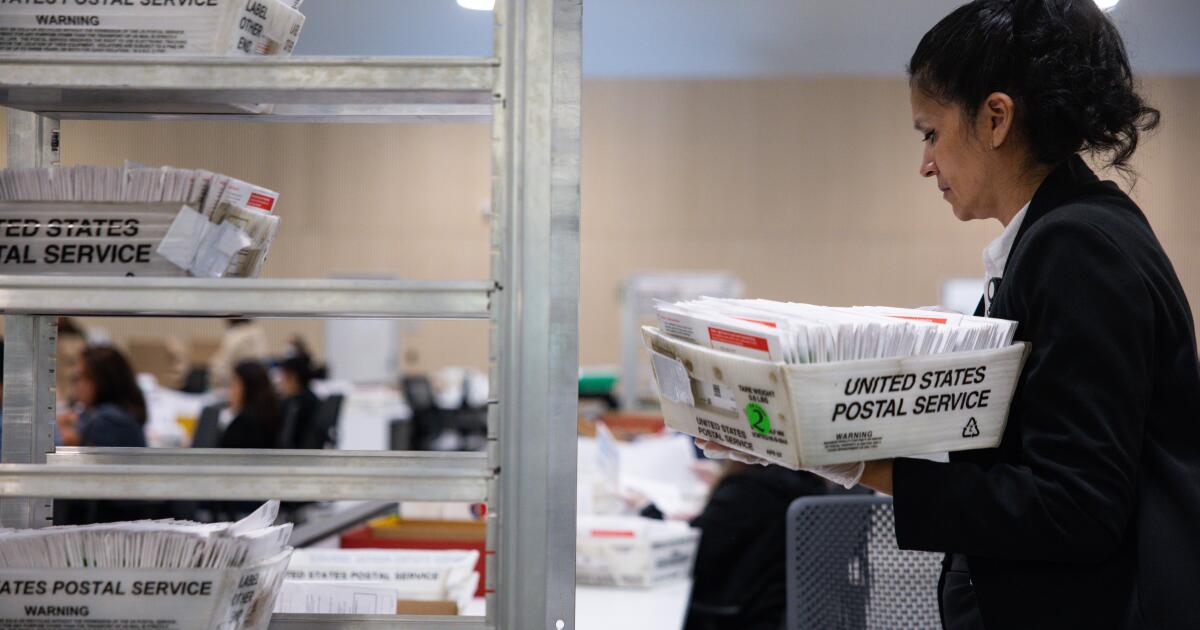
The efforts have run into resistance in court and within his own party. They have also left postal workers and local election officials bracing for an election cycle marked by deepening doubts about election integrity, and uncertainty about how the federal government may challenge the post-election results.

“It’s an unprecedented power grab to reshape how our elections work so that he and his allies can maintain and expand power,” said Eric Kashdan, director of federal advocacy at the Campaign Legal Center, a nonpartisan government ethics organization.

The White House defends the effort as fulfilling a campaign promise, and argues the administration is “lawfully enacting the agenda President Trump was elected to enact.”

One of Trump’s defining efforts to assert some federal control over state elections has been his insistence on passing the SAVE America Act, which would require voters to provide proof of citizenship when they register, require Americans to show identification when casting a ballot and require states to send voter data to the Department of Homeland Security.

His relentless push for the measure has prompted him to derail a bipartisan housing bill and threaten to forgo signing any piece of legislation unless the voting measure is approved. He says he considers the matter a “national emergency.” Despite the pressure campaign, Senate Republican leaders maintain there is not enough support to pass the measure.

The political stakes ahead of the midterms have been laid out more bluntly by House Speaker Mike Johnson (R-La.), whose chamber has approved the SAVE America Act. Last month, Johnson warned conservatives gathered at the Faith & Freedom Coalition that if Democrats win back control of the House, they will “go after the president’s family, the Cabinet, his donors, friends,” and supporters.

“I run the protection program,” Johnson said. “I will take care of you.”

Setbacks in court

The administration’s ambitions have hit numerous snags in court in the last month, with judges reaffirming in many cases that the Constitution gives states — not the federal government — primary authority over elections.

In one case, U.S. District Judge Sparkle L. Sooknanan, who was appointed by President Biden, went further.

She said a federal immigration database the Department of Homeland Security was compiling to determine voter eligibility violated privacy laws. She added that the database has resulted in states actively removing U.S. citizens from voter rolls based on inaccurate information.

“All in all, the federal government has knowingly trampled on the privacy rights of American citizens in a manner that threatens the sacred right to vote,” Sooknanan wrote. “This Court cannot stand idly by while that happens.”

James Percival, the general counsel for Homeland Security, said the ruling was the latest example of “how hard the Left will fight to stop us from solving problems they insist do not exist.”

The Supreme Court’s conservative majority this week also dealt a blow to the GOP and upheld state laws that allow for counting mail ballots that are postmarked by election day but arrive late.

The decision left Trump fuming. He said it was a “a little bit surprising” to see the court’s decision, claiming without evidence that the result will inevitably give “people more time to vote illegally.”

Democrats, in turn, saw the ruling as a necessary check on the Trump administration’s efforts.

“While we continue to see unprecedented efforts to interfere with elections from the Trump administration, it is a relief to see federal courts make clear that these attacks on mail and absentee voting are clearly illegal and unconstitutional,” Sen. Alex Padilla (D-Los Angeles) said in a statement after the ruling.

Trump is still eyeing changes to voting by mail. In March, he issued an executive order that seeks to limit who can receive mail ballots. Under the proposed rule, the Postal Service would not deliver mail ballots to states that don’t turn over sensitive voter data to the federal government, Postmaster General David Steiner told a Senate panel last month.

The admission drew immediate condemnation from Democratic lawmakers. They argued the regulation is an illegal attempt to coerce states into handing over their voter rolls.

“Please push back on being a pawn in this authoritarian playbook,” Sen. Elissa Slotkin (D-Mich.) told Steiner. “The Postal Service is one of the most important institutions in our country. Don’t taint it with the obsession of this one man.”

A day after that back-and-forth, U.S. District Court Judge Indira Talwani, who was nominated by President Obama, blocked those plans — at least for now.

“The Constitution does not grant the President any specific powers over elections,” the judge wrote, while adding that the Postal Service does not have the legal authority to determine who can vote by mail and how.

The White House said Wednesday that the administration remains confident the executive order will be in place by the November election.

Taken together, the administration’s efforts are unprecedented, UCLA law professor Rick Hasen said. That’s because the Constitution puts control over elections in the hands of the states and grants Congress the ability to pass laws, he said.

“The president really only has authority through federal statutes that have already been passed,” Hasen said. “It’s not surprising that many courts have struck down or stopped him from doing things to try to interfere with how elections are being run.”

Postal workers waiting for clarity

The legal setback for the Postal Service proposed rule was welcome news to the union representing postal workers.

“We believe that what we’re being asked to do is in violation of the oath that we took,” said Jonathan Smith, the president of the American Postal Workers Union, which represents more than 200,000 postal workers.

Following the ruling, the union called on the agency to abandon the rule, arguing it “will crush mailers’ trust in the Postal Service” and undermine “one of the most important functions the Postal Service and postal workers perform in service of the United States and its remarkable democracy.”

In several states, the union has run ads promoting mail voting as safe and a needed option for Americans. The ads were planned before Trump signed his executive order in March seeking to limit who can receive mail ballots, Smith said.

Now, the ads are taking a different meaning. Smith argued that “sometimes God works in mysterious ways.”

“The ad was then and is now intended as a piece to educate America about how good vote by mail is, how much it has been working out,” Smith said. “It’s an educational piece, not a response to the White House.”

Ahead of the election, Smith said postal workers are waiting for clarity on how their duties may change. But right now, he says, there isn’t much.

Orange County Registrar Bob Page said his office is monitoring any changes to existing federal and state election laws to ensure any changes, if needed, are implemented without disruptions. But he acknowledged the timing crunch could create some hurdles the closer the election gets.

“In many ways, any change to how California voters cast their ballots made between now and election day would create a challenge and may even be disruptive,” Page said.

He said many counties have ordered outgoing and return ballot envelopes for the election to ensure envelopes for more than 23 million California voters are ready to use by the Oct. 5 mailing deadline. Any change to how ballots should be prepared or mailed could present an issue.

“Our office has received calls from voters asking about potential changes to vote-by-mail procedures usually tied to media coverage about proposed changes,” he said. “We inform these voters that our procedures have not changed because the law has not changed and that we will mail their 2026 General Election ballots by Oct. 5.”

L.A. County prepares for possible voting changes

In Los Angeles County, election officials are also in a battle to bring clarity to the process as the administration ushers in a series of proposed changes to the election.

Dean Logan, the head of the Los Angeles County registrar-recorder/county clerk’s office, said his office is fighting to contain a wave of election misinformation, including some that is amplified by the White House.

“It’s not something that we’ve seen happen before, and certainly not at the level we’ve seen,” Logan said.

Rather than respond to every claim, Logan says his office picks its battles, intervening only when a falsehood appears likely to reach a wide audience. Even then, the office tries to avoid engagement with whoever is spreading it.

If the administration imposes a new rule closer to the election, Logan said his office is ready to follow the law.

“It’s really been about finding this balance of staying alert and prepared for the possibility [of change] but also not getting sucked into the political distraction,” he said.

Last month, Trump claimed without evidence that Democrats have cheated to win California’s primary elections, and boasted about federal prosecutors in Los Angeles investigating the matter.

Trump has also continued to claim Democrats are trying to rig or cheat in the upcoming election, remarks that have faced rebukes from members of his own party.

“I think it is ironic that we control the House, Senate, Supreme Court and the White House and we are yelling election fraud. I mean, we won all the damn elections,” Rep. Thomas Massie (R-Ky.) told reporters last month.

At the national level, Senate Democrats have said they plan to send election observers to polling places on behalf of Congress in reaction to Trump’s efforts.

“We are not waiting for chaos to arrive,” Senate Minority Leader Chuck Schumer (D-N.Y.) said last month. “We are preparing now.”

Times staff writer Justine McDaniel contributed to this report from Washington.

Source link

Thousand Oaks native Claire Liu finally reaches Wimbledon’s third round, will face Coco Gauff

Claire Liu packed her bags and checked out of her London hotel room on Wednesday morning before heading to the All England Club.

It was more pragmatism than pessimism — a reality of a qualifier navigating her Wimbledon journey one day at a time.

But as her boyfriend reminded her while organizing her luggage: “Just because you’re packing doesn’t mean you’re leaving,” Liu recalled with a laugh.

He was right.

The Thousand Oaks native went on to win her second-round match against 51st-ranked Zeynep Sonmez of Turkey 7-5, 6-3, advancing to the third round of a Grand Slam for the first time in her professional career. She had tried 29 previous times at majors, including qualifying rounds, since 2015.

“I was just super relieved to get through that,” said Liu, noting she had blown a set and a break lead in the French Open’s second round last month.

For Liu, who turned 26 in May, returning to the manicured lawns of SW19 brings her tennis journey full circle. Nine years ago, she captured the 2017 Wimbledon girls’ singles title — the first American to do so since Chanda Rubin in 1992 — and was the No. 1 junior in the world. She still holds fond memories of that heady achievement, including chatting with her idol, Roger Federer, at the Wimbledon Champions Ball.

Yet, the transition from teenage phenom to professional mainstay has been anything but a linear ascent. When asked if she expected to be in the third round of a major this late in her career given her junior success, Liu was candid.

“Younger me would have believed it more than now,” she said.

That shift in perspective comes after weathering some brutal setbacks.

Liu climbed as high as No. 52 in early 2023 but then endured a wrist injury and took a months-long mental health hiatus in 2024 that eventually saw her ranking plummet outside the top 400 last year.

Currently sitting at No. 146, she’s been rebuilding her standing by playing a mix of WTA 125 events and ITF tournaments before returning to the main WTA Tour, with 2026 stops in far-flung places from Bahrain to Boca Raton and plenty of places in between.

“My goals haven’t changed, but I think the stress of how I got there really took a toll on me,” said Liu.

To navigate the darkness, Liu leaned heavily into both sports psychology and traditional therapy, including EMDR, a technique that helps people process traumatic experiences. She also started a Substack newsletter called “Finding Claire-ity,” where she openly chronicles her life and struggles on the tour.

The Southern California native, who has trained at the USTA facility in Carson since she was 9 years old and resides in Redondo Beach, also split with her longtime coach last season, a difficult decision, and hired Clemens Wagner.

The switch following the U.S. Open last year is clicking.

“I saw in her someone who fought a lot of battles inside herself,” says Austrian-born Wagner, who has a background in tennis analytics.

Together, they have focused on keeping an “aggressive undertone” on the grass, emphasizing coming to the net and squeezing the most out of her game.

Wagner notes that the 5-foot-7 player’s game isn’t the flashiest, but describes her as a “silent killer” who excels at “redirecting pace, standing close to the baseline, constantly putting pressure on her opponents.”

The reboot is starting to pay significant dividends.

Liu put together her best stretch in years this spring, winning a lower-tier title in Trnava, Slovakia, her first professional title since 2024, and then qualifying for the French Open.

Having again successfully navigated three rounds of qualifying to reach the main draw here, Liu has now won five consecutive matches at Wimbledon. Not surprisingly, she currently has no sponsors, just equipment support from Head Sport and Asics Corp., making her Wimbledon run particularly lucrative. By reaching the third round, Liu achieved her highest career payday: around $250,000. A victory Friday would boost that to nearly $400,000.

First, she faces her biggest test yet: a third-round contest against two-time major champion Coco Gauff on No. 1 Court, which perhaps fittingly is the same show court where Liu won the girls’ title almost a decade ago.

Gauff, 22, noted that she and Liu haven’t crossed paths much since Liu is older, but expects a serious battle. Gauff won both of their previous meetings on hard courts.

“I feel like anytime you’re playing a qualifier, it’s always tough because they have three matches already,” the seventh-seeded American said.

Liu, who didn’t even know she was playing Gauff until a reporter told her after her match, is purposefully keeping her focus narrow.

“I will just take today to be happy for winning, and then tomorrow I’ll think about it,” Liu said. “Obviously she’s one of the best players in the world right now, so that’ll be a good experience.”

Veteran Jessica Pegula, 32, the top-ranked American who also toiled away on the sport’s lower tier before becoming a top-10 mainstay, appreciates Liu’s resolve.

“It’s always nice to see girls that are figuring it out slowly but surely,” the No. 4 seed said. “I think I can relate to that.”

Liu’s accommodations? Fortunately, her mother was able to rebook the same hotel after the match, which eased some of the logistical issues for her unexpectedly extended stay in London.

“It definitely makes me stay in the moment, like, day by day,” Liu smiled of her lodging limbo.

On Wednesday morning, Liu packed her bags expecting she might leave Wimbledon. Instead, she emptied them one more time, with the biggest match of her career still waiting.

Source link

China: Skyscraper crash pilot wrote about ‘ending his life’ in diary

Damage is shown on the facade of Citic Tower, also known as China Zun, in Beijing on June 27. The pilot died in the accident, and authorities said the crash was intentional. Photo by Jessica Lee/EPA

July 2 (UPI) — The pilot of a small plane that crashed into Beijing’s tallest building was a 66-year-old man who was suffering from “chronic insomnia and anxiety” and wrote about “ending his life” in his diary, authorities said Thursday.

The man died in the June 26 crash and wounded 13 others in the 109-story Citic Tower.

The pilot was identified as Liu and was a divorced freelancer who lived alone in Beijing, the Chaoyang district government said in a statement.

“The comprehensive investigation concluded that this was a case of endangering public safety caused by personal reasons,” the statement said.

One of the injured people has been discharged from the hospital, officials said.

Liu had taken off from an airport in the Pinggu district. That day he had flown accompanied and solo flights, the Chaoyang government’s statement said.

“During his solo flight, he deviated from the designated area and lost contact with the airport, subsequently colliding with the high-rise building and dying at the scene,” the statement said.

Liu obtained his sport pilot’s license in 2021 and private pilot’s license in 2024.

The plane was a two-seat, single-engine Aurora SA60L manufactured by Chinese company Sunward Aircraft, according to Flightradar24. It’s designed for touring, aerial photography and recreational aviation.

All references to the crash, video and images were scrubbed from social media in China. The state media, whose headquarters is across the street from the tower, didn’t report anything about the crash until the following day.

Chinese authorities often attribute random acts of violence to people seeking “revenge on society,” offering little information on the exact motive.

If you or someone you know is struggling with suicidal thoughts, help is available 24/7. Call or text the 988 Suicide & Crisis Lifeline for free, confidential support. Globally, the International Association for Suicide Prevention has contact information for crisis centers around the world.

Source link

Where to camp last minute near Los Angeles for Fourth of July weekend

Like many outdoors lovers, I love a last-minute camping trip.

There’s a special kind of magic when the stars align, you snag a reservation and realize you’ll soon be sleeping under the stars in a place you’ve never been.

But given the popularity of California’s campgrounds, is it really possible to book a campsite on short notice? In this edition of The Wild, our weekly outdoors newsletter, I will explain not only how you can but also where you will be more likely to find open spots (even, if lucky, on a holiday weekend).

You are reading The Wild newsletter

Sign up to get expert tips on the best of Southern California’s beaches, trails, parks, deserts, forests and mountains in your inbox every Thursday

L.A. sits within a quick drive to both the San Gabriel and Santa Monica mountains, two expansive ranges that offer multiple opportunities.

But first, I want to share what I learned in my conversation with Mike Lee, owner of Campsite Tonight, a website and app that monitors campgrounds throughout California for cancellations so its users can book sites.

Large boulders and rocks in a high desert like environment with mountain peaks in the distance.

One of the expansive views of the San Gabriel Mountains that can be found at Chilao Campground.

(Jaclyn Cosgrove / Los Angeles Times)

I’ve long been a skeptic of using private websites to book a campsite on public lands. But given Lee is an avid camper, dad and Californian running the site on his own, I wanted to hear him out.

Lee was motivated to take over Campsite Tonight a few years ago after finding himself frequently frustrated with how challenging it was to book campsites at state and national parks in California at times when his busy family could take a vacation.

Campsite Tonight frequently scans several websites throughout California and several other states (including Utah for those dreaming of a trip to Zion National Park). His site checks the popular campgrounds every 12 seconds for cancellations while less popular campgrounds are scanned often but less frequently.

He also offers data for popular campsites too, so users can learn more about when to look. For example, at Yosemite’s Upper Pines Campground, Lee includes that 11 a.m. Pacific is the peak hour when cancellations appear (and about 31% of reservations there are booked within seven days of arrival).

An orange tent among dense trees.

A tent in the evening light at Upper Pines Campground in Yosemite National Park.

(William Hale Irwin / For The Times)

Lee’s app offers limited-but-still-useful features to free users, including some ability to search for open sites, and is $29.99 a month or $59.99 a year for advanced features, including the option to more rapidly book a campsite at a national park by essentially linking your Campsite account with your Recreation.gov account.

Running the website has “taught me, as I’ve looked at the data more and more, that last-minute camping is actually pretty achievable,” Lee said while sitting inside a tent in a campground near Yosemite. “The biggest thing is being flexible. Before, if I didn’t book it in advance or if I didn’t get [a site when I wanted], I would never look again. Now I look more.”

Lee said he’s noticed fewer cancellations on long weekends, although there will still be families that can’t make their trips. After we initially spoke, Lee built a page specifically to scan for campsites available over Fourth of July weekend. I was surprised by just how much remained open.

Grass in the foreground with a coastline in the distance with short cliffs and a stretch of sandy beach.

Leo Carrillo State Beach.

(Mike Cilantro / For The Times)

Scanning the page on Tuesday, I noticed a spot at Leo Carrillo State Park. Although it was for Wednesday night, I was tempted. Multiple campsites remained open in Los Padres National Forest, even over the weekend. A random campground in Sequoia National Forest made me look at just how far of a drive it would be from my apartment. And I noticed there was even a spot free at a Big Sur campground on Sunday evening. “No, you can’t, er, you shouldn’t drive that far for one night of camping,” I told myself. (Should I, though?)

That said, there are several first-come, first-served campgrounds near L.A., especially in Angeles National Forest, for those who’d like to stay closer to home or can’t find something online.

Here is a quick guide to what I recommend trying to snag. Given it’s a holiday weekend, it will still be more challenging, but if you can leave early Friday, I don’t think it’ll be impossible to camp at one of these spots.

For those looking for simple car camping (beginner)

A circular campfire ring with wooden benches around it on sandy soil with tall pine trees nearby

A campsite at Chilao Campground with a large campfire ring.

(Jaclyn Cosgrove / Los Angeles Times)

Each of these campgrounds are in Angeles National Forest, offer piped water and vault toilets, and have sites with picnic tables, parking spots and campfire rings.

  • Chilao Campground: A large campground with 84 sites spread over two loops, Little Pines and Manzanita. Its landscape features large boulders, sweeping views and pine trees (especially the eponymous loop). Piped water is available, although it is at times turned off, so please check the campground website before heading out. The Chilao Visitor Center, open on the weekends, is nearby.
A campsite in Chilao Campground shaded by several pine trees.

A campsite in Chilao Campground shaded by several pine trees.

(Jaclyn Cosgrove / Los Angeles Times)

  • Crystal Lake: A 120-site campground north of Azusa. It sits at 5,539-feet elevation and features great views of nearby peaks, including Mt. Islip and Windy Gap. Visitors can fish in Crystal Lake when it’s deep enough and find a hot meal at Crystal Lake Cafe and General Store.
  • Monte Cristo: A campground with 19 individual drive-in sites, including some with large shady sycamore trees. A small seasonal creek runs through the middle of the campground and has small pools in spring and early summer. (Note: Because of its proximity to L.A., this one can fill up quickly.)

For adventurers willing to plan just a bit, even last minute (intermediate)

Oak trees offer shade in a grassy meadow.

Oak Flat Campground.

(Jaclyn Cosgrove / Los Angeles Times)

These sites offer their own escape, but because they lack potable water (unless otherwise noted) and are farther away from L.A., they require more planning than those on the “beginner” list. Each site has picnic tables and campfire rings. The campgrounds below are in Angeles National Forest unless otherwise noted.

  • Horse Flats: A shaded 26-site campground that offers easy access to nearby trails, including Mt. Hillyer and the Silver Moccasin Trail.
  • Oak Flat: A campground north of Castaic just off the 5 Freeway with 20 sites situated around a nice small meadow shaded by several oak trees.
  • Musch Trail Camp: This small-but-charming backpacking campground in Topanga State Park features flush toilets and sinks and requires only a one-mile hike in, a trek that’s on the easier end of moderate.
  • Sawmill: A rustic eight-site campground whose main challenge, outside of its lack of water, is just reaching it, as campers must take a steep gravel road off Pine Canyon Road (see website for information on road closure).

For experienced trekkers looking for quick escapes (expert)

Valley Forge Trail Camp in Angeles National Forest.

One of a handful of sites at the Valley Forge Trail Camp in Angeles National Forest.

(Jaclyn Cosgrove / Los Angeles Times)

These backpacking sites offer backcountry adventures for those with the time and the right gear.

  • Glenn Camp: A 10-site forested haven next to the West Fork of the San Gabriel River that’s reached via a seven-mile paved road that can be hiked or biked; no restrooms available, so campers will need to follow Leave No Trace principles.
  • Valley Forge: Reachable via 2.4-mile hike along the Gabrielino Trail from Red Box Picnic Area, this six(ish)-site campground has picnic tables, campfire rings, vault toilets and is a sylvan refuge of mighty pines next to the pristine West Fork of the San Gabriel River.
  • Cooper Canyon: A backcountry campground shaded by towering old pine trees with about five sites, offering vault toilets, campfire rings, klamath stoves, large picnic tables and bear-proof boxes. Because of the Angeles Crest Highway closure, you will need to reach the site either by walking the closed road or Pacific Crest Trail.

Regardless of where and when you go, I hope you have a wonderful time enjoying our public lands. Please remember to practice the Leave No Trace principles and, in short, leave it cleaner than you found it!

A wiggly line break

3 things to do

A person holds a hose spraying water onto several containers of little green plants.

A volunteer waters plants in the nursery at North East Trees in Ascot Hills Park in El Sereno.

(William Hallstrom)

1. Restore native plants in Ascot Hills
North East Trees, a climate resiliency nonprofit, needs volunteers from 9 a.m. to noon Saturday at its native plant nursery in Ascot Hills Park (4371 Multnomah St.). Participants will get hands-on experience working with native plants as they help water and restore habitat. Learn more at the group’s Instagram page.

2. Sketch plankton in Playa del Rey
Nature Nexus Institute, an environmental equity nonprofit, will host two beach ecology sketching events: an online option Tuesday from 6:30 to 8 p.m. and then an in-person event on July 12 in Playa del Rey. Learn more at the group’s Instagram page.

3. Check out the birds in Calabasas
Two National Park Service volunteers will host an easy bird walk from 8:30 to 10 a.m. Saturday at King Gillette Ranch in Calabasas. Participants will walk less than a mile at an easy pace, stopping often to observe the birds. Children are welcome. Register at eventbrite.com.

A wiggly line break

The must-read

A person walks along a rope bridge high in the air among thick old trees.

A visitor walks on the Redwood Canopy Trail at Trees of Mystery in Klamath.

(Andrew Cullen / For The Times)

If you’re sitting there, daydreaming over your next adventure, consider this California wildlife factoid: Our state is home to 139,000 acres of protected public lands where nearly half of the world’s remaining old-growth redwood forests live. The allure of walking beneath these giants is what drew writer Edwin Goei to head to Humboldt County. Goei maps out a guide for The Times of how an Angeleno can make the long-but-worthy trip there (including how to snag an $80 round-trip flight). “I learned that Humboldt County — including the cities of Eureka, Arcata and Ferndale — is full of treasures beyond its abundance of the Earth’s tallest trees,” Goei wrote.

Excuse me while I go research flights there.

Happy adventuring,

Jaclyn Cosgrove's signature

P.S.

You have until Monday to snag a free California State Parks Historian Passport. In honor of both Juneteenth and the 250th anniversary of the signing of the Declaration of Independence, the state is offering the pass — which typically costs $50 — to anyone who registers for it through ReserveCalifornia.com, but just for a few more days. The pass will be good through the rest of 2026 and will allow unlimited entry for up to four people to state historic parks and museums that charge a per-person admission fee or a vehicle day-use fee. I was amazed that it took less than 10 seconds once I was logged into my ReserveCalifornia account to secure my pass. Enjoy!

For more insider tips on Southern California’s beaches, trails and parks, check out past editions of The Wild. And to view this newsletter in your browser, click here.


Source link

Deadly blast at Damascus cafe leaves 6 dead, 22 injured | Newsfeed

NewsFeed

At least 6 people were killed and 22 injured after an explosive device detonated in a café in Damascus’ Al-Hijaz area. Emergency crews, civil defence teams and security forces rushed to the site, imposed a security cordon and began investigating the deadly blast.

Source link

BBC Winterwatch replacement confirmed after 14 years on air

The BBC has confirmed that Winterwatch is coming to an end after 14 years on our screens, with the nature show set to be replaced by a new Naturewatch podcast

Winterwatch: Chris Packham presents Watch Out

A beloved BBC programme has been replaced after 14 years on air.

Winterwatch, a spin-off from the massively popular Springwatch, is the latest show to face the axe after the broadcaster recently confirmed that 2,000 members of staff would be losing their jobs.

The series is set to be replaced by a weekly video podcast called Naturewatch, which will run all year round. Springwatch will continue as normal and is due back on our screens in May 2027.

Head of Commissioning, Specialist Factual Jack Bootle said: “Nature never stops – and neither should we. Every week, Naturewatch will give Springwatch fans – and all wildlife lovers – a new way to stay connected to the natural world, whether that’s on TV, iPlayer or Sounds.

“The BBC is committed to celebrating British nature across all our platforms, and we hope this new series will encourage audiences to fall in love with the natural world around them.

“By expanding the Watches brand we are making the BBC’s brilliant Natural History content even more accessible.”

Winterwatch first aired in 2012 as a means of capturing the tenacity of British wildlife as creatures across the UK battled the harsh winter conditions, reports the Daily Star.

The announcement follows news that Escape to the Country’s Jules Hudson was recently forced to pull out of a work engagement due to a family crisis.

He took to social media to tell fans: “It’s with huge regret that owing to a sudden and serious family illness we’ve had to postpone my evening this Friday at the Blake Theatre in Monmouth.

“Your tickets can of course be refunded, but we have agreed a new date, Saturday the 12th September.. It’s hugely disappointing to have to change plans, but I hope you’ll understand on this occasion, and hopefully we can all get together in a few short months.

“With thanks, and apologies once again, Jules.”

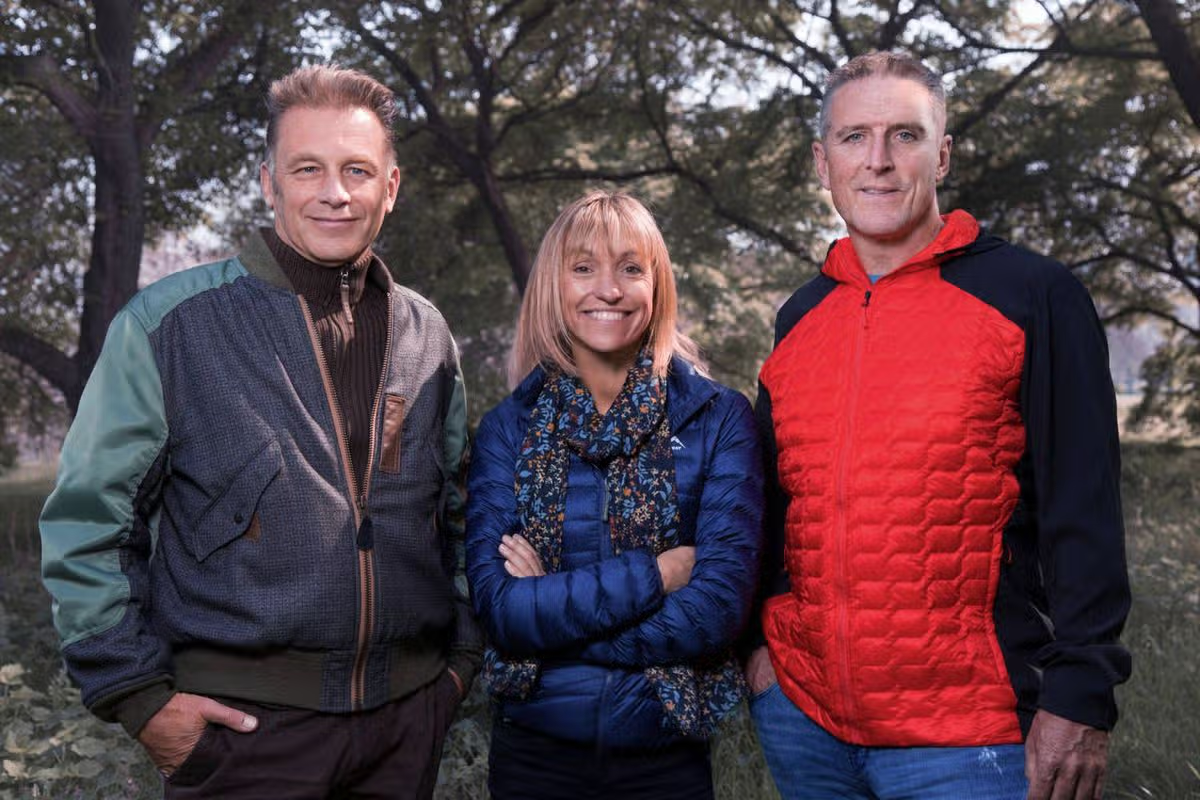
After hearing news regarding the show’s cancellation, some viewers were not happy, with one writing: “Such a shame to lose Winterwatch. I hope Chris Packham, Michaela Strachan and Iolo Williams will still be involved with the new format. BBC confirms end of Winterwatch after 14 years as show to be replaced with new format.”

Source link

3 European countries for a VERY cheap summer trip

IF you’re dreaming of sun-soaked beaches, crystal-clear waters, and glam hotels but your bank account is saying otherwise, you don’t have to cancel your summer plans just yet.

While traditional holiday hotspots like Spain and Greece are reliable, they are becoming increasingly expensive.

Why not try a trip to Sunny Beach in Bulgaria this year? Credit: Alamy
Collage of travel items including a plane, sunscreen, passport, suitcase, and plane tickets, advertising The Sun's travel Instagram account.

Luckily, there’s a handful of stunning European destinations offering amazing holiday vibes for a fraction of the cost.

How about the white sand beaches of Albania, or the affordable resorts of Montenegro

We’ve rounded up three incredible, wallet-friendly European countries where your money stretches further.

This means spectacular package holiday deals starting from just £159pp.

Read more on cheap holidays

COSTA LITTLE

Major budget airline to launch MEGA cheap holiday packages from the UK


TURK NOTE

Turkey urges tourists it’s ‘safe to travel’ with insanely cheap holiday deals

Albania

Albania is an affordable holiday option with white sand beaches and turquoise waters Credit: Alamy

Bathed in sunshine for over 300 days a year, Albania offers stunning natural landscapes, sweeping beaches and cheap hotels that feel ultra-luxurious.

The coastline blends the dramatic, rugged scenery of the Balkans with the sparkling, turquoise waters of the Adriatic and Ionian seas.

Your budget stretches remarkably far here compared to holiday hotspots like the Greece or Italy.

For a mix of golden beaches and historical sites, head to Durres, where you can climb the Venetian Tower or explore Roman ruins for free.

For wallet-friendly restaurants and stunning landscapes, try Sarande, which is home to the Butrint National Park, a UNESCO World Heritage Site with scenic thick forest overlooking the shore.

Or head to Vlore to stroll its pretty old town lined with boutique cafes and shops, hop on a boat trip to visit stunning sea caves and stay in one of its super glam hotels for a very affordable price.

OUR TOP DEAL

The four-star Ames Hotel & Spa in Vlore is a glamorous hotel with its own private beach and spa.

It’s a small, friendly hotel that is perfect for couples, where you can spend your days taking beach walks and unwinding in the sauna and steam bath.

The deal we’ve found is for early October, which would still be nice and warm with temperatures sitting at 24°C.

The five night stay with breakfast at the Ames Hotel & Spa in Vlore, including return flights from London Luton, is for £219pp.

More cheap Albania holidays

Montenegro

Visit Montenegro for stunning natural landscapes and affordable luxurious hotels Credit: Getty – Contributor

More and more Brits are catching on to Montenegro as their next holiday destination, with its other-worldly beaches and affordable package holidays.

Budva is a buzzing coastal spot with a walled medieval Old Town to explore, and even an island you can visit called Sveti Nikola dubbed by locals as ‘Hawaii Island’.

For a spot of sunbathing, head to Mogren Beach, where towering limestone cliffs shelter two sandy coves with turquoise waters.

Similarly, spots like Ulcinj and Bar are great value coastal towns – Ulcinj is home to Velika Plaza, or ‘Long Beach’, an eight-mile stretch of sand with shallow waters to paddle in and activities like kite boarding.

While Bar is home to unique attractions like Red Beach, a cove with a maroon-coloured shore, and King Nikola’s Palace, a castle-turned-museum surrounded by lush green gardens.

Visit Becici for endless golden beaches dotted with loungers, activities like paragliding and paddleboarding, and high-end hotels for cheap.

OUR TOP DEAL

The Eurostars Queen of Montenegro hotel is in Becici, where a pristine stretch of beach is backed by a line of luxurious yet affordable hotels, visited by the likes of Madonna and Angelina Jolie.

The hotel itself has a huge wellness zone with a Turkish bath, tropical shower, saunas and whirlpool – as well as a sprawling outdoor infinity pool.

Rooms alone usually cost between £200 – £250 per night, however we’ve found a very affordable deal.

We found a deal for a five night stay with breakfast at the Eurostars Queen of Montenegro in Becici, including return flights from London Stansted, for £325pp.

More cheap Montenegro holidays

Bulgaria

Nessebar in Bulgaria is just three miles from Sunny Beach, but offers scenic and quieter beaches Credit: Alamy

You might already know about Sunny Beach, but Bulgaria is home to a whole host of affordable coastal resorts that you may never have heard of.

Just south of Sunny Beach, Nessebar is the affordable and arguably more beautiful neighbour.

Both the north and south beach offer soft sands and clear, shallow water – plus a strip of seafront bars and restaurants that feel less chaotic than the party vibes of

This ancient city feels like an open air museum, with and Old Town packed with 20 ancient Byzantine churches and a fascinating ancient fortifications.

Further up the coast you’ll find Golden Sands, a resort that earns its name with a two-mile beach backed by a buy promenade lined with buzzy restaurants and seafront bars.

This family-friendly resort town also has plenty of attractions and activities like Aquapolis Water Park and off-road buggies.

OUR TOP DEAL

Perla Golden Sands is an action-packed, family-friendly hotel backed by the vibrant greenery of a natural park.

The hotel has plenty to do for kids, including an adventure playground, kids club, evening shows and activities like table tennis and horse riding.

And a week-long holiday is an absolute bargain.

We found a deal for a seven night stay with breakfast at the Perla Golden Sands with return flights from London Luton for £209pp.

More cheap Bulgaria holidays

*Prices correct at the time of publication.


Source link

Trump administration’s $46 billion ‘smart wall’ races ahead on the U.S.-Mexico border

For decades, all that separated the U.S. from Mexico was barbed wire.

Now, after a massive infusion of cash from Congress, President Trump’s administration is swiftly building what it has dubbed a “smart wall,” a combination of 30-foot-tall steel fencing and an array of sophisticated technology like sensors, cameras and towers allowing Border Patrol to surveil the territory.

The wall is under heavy scrutiny for the billions of dollars being dedicated to it when border crossings are at their lowest in decades. Critics say the U.S. is militarizing the border as it increasingly deploys sophisticated surveillance technology to the area, impacting local communities.

“We are seeing a massive expansion of surveillance and surveillance technology across the borderlands,” said Ricky Garza, border policy counsel at the Southern Border Communities Coalition, an advocacy group. “The wall in all its forms is harmful to communities.”

Officials say the technology is complementary to the physical wall and frees up agents for other tasks.

“It’s a smart wall. It’s not just a barrier,” Customs and Border Protection Commissioner Rodney Scott said during recent congressional testimony. “It maximizes the use of our most valuable resource, which is our agents.”

Contracts for hundreds of miles of wall already inked

The wall has been a top priority for Trump, a Republican, since he first ran for president.

During the administration of President Joe Biden, a Democrat, the border emerged as a flashpoint, with thousands of people seeking to cross into the country each day. Those numbers started to taper off shortly before Trump returned to office last year and then slowed to a trickle, with his broader immigration crackdown serving as a deterrent for would-be migrants.

Flush with $46 billion to finish the wall after an infusion by Congress for immigration enforcement, CBP is inking tens of billions of dollars in contracts to build the wall and push along the president’s signature project.

Homeland Security Secretary Markwayne Mullin said recently that a preliminary part of the wall will be finished by “this time next year.” Scott said his agency is putting up 6 miles of wall a week.

Hundreds of miles had already been built before Trump returned to office. As of mid-June 2026, CBP has erected another 74 miles and aims to build hundreds more. There is no wall planned for roughly 535 miles of the roughly 2,000-mile-long border, because rugged terrain already serves as a barrier. Ground sensors and towers will be used instead.

CBP is also going back to hundreds of miles of already built wall and adding more technology, lights and roads. Along the long stretches of river in Texas that mark the border with Mexico, they’re deploying 12- to 15-foot-long cylinder-shaped buoys meant to keep migrants or smugglers from crossing the border.

More technology being deployed on the border

Technology is playing a greater role in the Trump administration’s effort to make illegal crossings along the border more difficult, part of a broader transformation of CBP in the years since Sept. 11, 2001, into an intelligence operation with a mass surveillance network whose reach extends far beyond the nation’s frontiers, according to reporting by The Associated Press.

And critics say the border technology poses a threat.

The Southern Border Communities Coalition says surveillance technologies can push migrants into more dangerous routes to avoid being detected.

Garza, the group’s policy counsel, warned that surveillance technology infringes on the privacy rights of border residents and that locals have found ground sensors used to detect smuggler or migrant traffic placed on their property without their consent.

Nayda Alvarez and her relatives own land along the Rio Grande roughly 125 miles inland from the Gulf of Mexico. She has found cameras placed on her family’s land, and just last week she spotted a surveillance tower about a quarter of a mile down the river from her house.

“Are we expecting a war or something?” she said. “It doesn’t make me feel safer.”

Dave Maass, director of investigations for the Electronic Frontier Foundation, a nonprofit that focuses on civil liberties related to digital technology, said the technology has made the border area “a hostile environment” for locals and would-be migrants.

The foundation has published a guide on the various types of surveillance towers in use along the southern border designed to help local residents.

These can range from fixed towers with video, infrared and radar technologies that have a range of roughly 8 miles to remote video surveillance systems that have cameras and a spotlight fixed on top. Some are mounted on the backs of trucks so agents can drive them to different parts of the border.

Increasingly, these towers are autonomous. They can scan an area, analyze what they’re seeing using artificial intelligence and alert Border Patrol agents to something suspicious. Proponents say this helps keep Border Patrol agents out in the field instead of sitting in front of computer screens watching for activity. But it also increases AI decision-making along the border when experts have warned about the technology’s potential for bias or other problems.

The big GOP tax cuts and spending bill passed by Congress last summer requires that CBP buys only the autonomous towers, and the department is deploying an additional 95.

Underground, buried fiberoptic cables can sense movement, capturing data that is also then analyzed by AI.

“We follow the contour of the land. We go through trees. We go down into the river banks. We can go absolutely everywhere,” said Magnus McEwen-King, CEO of Sintela, which has a contract with CBP to install the cables. He spoke at a recent border security expo in Phoenix, where some of the technology was on display.

CBP also uses ground sensors and trail cameras to detect smuggling routes.

Concerns over cost and future plans

The nonpartisan watchdog group Taxpayers for Common Sense has questioned both the huge amounts of money for the wall-building and whether taxpayers are getting their money’s worth.

In 2011, under Democratic President Obama, Homeland Security Secretary Janet Napolitano pulled the plug on a project to build a “virtual wall” of integrated technology like radars, sensors and cameras across the entire border after it ran over budget, faced technological glitches and was behind schedule.

Josh Sewell, director of research and policy at Taxpayers for Common Sense, said the organization would like to see more “robust evaluation” of the technologies being used to avoid similar scenarios. And he criticized the Trump administration for lack of oversight on how the money is being spent, a charge CBP has denied, citing “oversight mechanism.”

In the Big Bend area of southern Texas, opposition to the department’s wall-building plans gathered strong bipartisan support especially in the most sensitive areas that run through a state and national park and a wildlife area.

CBP now says it is not planning to build a 30-foot-high bollard wall in those areas. Its recently announced plans include installing patrol roads and some barriers designed to stop cars and using detection technologies.

Clara Benson, who is one of the founders of the No Big Bend Wall coalition, says bright lights in the area designed to illuminate the border could pollute the skies in an area renowned for having some of the best views of the stars. Even without a 30-foot-tall steel wall running through the land, there is concern about CBP’s plans.

“There’s still a lot of fear and dread that the plan is still going to be quite damaging,” she said.

Santana writes for the Associated Press.

Source link

Pubs allowed to stay open until 5am for England Mexico match

Pubs in England and Wales will now be allowed to stay open until 5am on Monday, allowing football fans to watch the Three Lions’ World Cup clash with Mexico to the final whistle.

The round-of-16 match in Mexico City kicks off at 1am UK time.

The government had initially said it would not relax licensing laws further than they already have been for the World Cup.

But Prime Minister Keir Starmer said on Thursday afternoon that pubs could stay open until the final whistle.

Monday’s match is not expected to finish until after 3am.

The government had initially decided not to extend licencing hours further, but u-turned on Thursday evening.

Prime Minister Keir Starmer that the decision was good news for both supporters and pubs.

“Football might be coming home but we’re making sure fans don’t have to,” he said.

Publicans and businesses welcomed the change. Emma McClarkin, chief executive of the British Beer and Pub Association, said: “We all know the best place to watch the match is down the local.”

Licensing hours had already been extended for the World Cup from 11pm to 1am for games with kick-offs from 5pm up to 9pm and up until 2am for kick-offs after 9pm.

Individual pubs normally have to apply to their local council for extended opening hours, at least five working days in advance.

Source link

‘Collateral damage’: 73 Palestinian children Israel shot in the head | Gaza

NewsFeed

Israel has rejected a UN Commission report that says its army deliberately targets Palestinian children. But there are cases of children being shot by precision weapons, making it difficult to argue they were accidents.
Al Jazeera’s @emmawithrow explains.

Source link

Spain immigration scheme sees 1.2 million apply for legal status | News

Spain’s immigration scheme sees more than a million applications, with Latin Americans leading the numbers at 67 percent.

Almost 1.2 million undocumented migrants have sought legal status in Spain under a scheme that has defied a growing European crackdown on irregular immigration.

The government of Socialist Prime Minister Pedro Sanchez, a standard-bearer of more open immigration policies, launched the vast plan in April while European neighbours toughen measures in response to pressure from ascendant far-right parties.

Recommended Stories

list of 3 itemsend of list

A total of 1,174,978 applications were submitted between mid-April and June 30 when the window closed, with more than 600,000 already being processed, Secretary of State for Migration Pilar Cancela told a news conference in Madrid on Thursday.

Latin America accounted for 67 percent of the submissions, with Colombia alone representing 25.9 percent of the total. African nationalities followed with 22.9 percent.

After Colombia, the most represented countries were Morocco at 13.3 percent, Venezuela with 11.8 percent and Peru at 8.8 percent.

An overwhelming majority of applicants were young, with eight out of 10 younger than 45 years old, while 57 percent of the total were males against 43 percent for females.

The application total does not necessarily indicate how many people will normalise their situation. According to government projections in April, there are about 500,000 potential beneficiaries.

Applicants must prove they have a clean criminal record and spent at least five consecutive months in Spain before January 1.

The authorities have three months to process their paperwork and decide whether to issue a work and residence permit valid only in Spain.

Sanchez has touted the benefits of immigration and the vast regularisation scheme for sectors such as construction that need to boost their workforce.

“Without immigration, Spain would lose 19 percent of its GDP by 2050,” Sanchez said on Tuesday during a presentation on migration. “And what does that mean in business terms? It means, for example, that 90,000 bars would have to close, that 50,000 primary and secondary classrooms would find themselves without students, and that around 220,000 farms would disappear.”

Without immigration, he added, Spain would be “poorer, emptier, weaker and without the resources to fund its welfare state”.

“Spain has never moved forward by building walls,” the prime minister said. “The only decent thing to do is extend a hand, not turn our backs on immigration.”

Spanish business leaders have welcomed the move, but the conservative and far-right opposition are furious about a policy they say will encourage more irregular immigration. Santiago Abascal, the leader of the far-right Vox party, slammed the scheme, calling it an “invasion”.

“More than a million strangers now competing with Spaniards for jobs, housing, daycare places, hospital beds, and social assistance. It’s an invasion. And it’s a betrayal,” Abascal said on X.

Source link

When, unlike our upcoming 250th anniversary, a bicentennial mattered to orchestras

A century and a half ago, Richard Wagner was running out of cash as he was preparing to stage his four momentous nights of opera known as the “Ring Cycle” when he got a message from the Women’s Centennial Executive Committee in Philadelphia. It offered him a princely $5,000 (around $150,000 today) to write a triumphant 12-minute orchestral score to open the Centennial Exposition in Fairmont Park celebrating the 100th anniversary of the Declaration of Independence.

On May 10, 1876, Theodore Thomas, perhaps America’s most famous conductor at the time (he would go on to head the New York Philharmonic and help found the Chicago Symphony), led the premiere of Wagner’s “Grosse Festmarsch” with a 150-member orchestra, its brass and percussion so impressive that the addition of cannon fire Wagner suggested was not needed. The crowd was said to number well over 100,000. President Ulysses S. Grant attended and invited Emperor Dom Pedro II of Brazil to join him along with members of Congress and Supreme Court justices for what remains a unique Declaration of Independence spectacle and debacle.

The “Centennial March,” as it came to be known, turned out to be dreck. Even Wagner, who carelessly tossed it off in a couple of weeks, said the best thing about the score was the fee, which he had demanded to be paid in gold. But what sounds like something AI might come up with if asked to write a pompous march in the style of Wagner began the American obsession with celebrating the Declaration of Independence, the words and deeds of our presidents, our very democracy with the assist of the symphony orchestra and opera.

One hundred years later, the country was awash with federal, state, city and philanthropic funding for a music-happy bicentennial of exceptional ambition. “With millions available in hand and more money to come,” Time Magazine wrote in 1975, “the Bicentennial is the biggest bonanza for the American composer since Hollywood discovered the musical.”

And so it was. The centerpiece was the National Endowment for the Arts Bicentennial Orchestra Commissioning Project. That funded America’s six top orchestras to each commission a major work that all six would play. In addition, the NEA offered further support to 34 American orchestras for dozens more new scores.

Everyone got into the act. The New York State Council of the Arts alone sponsored 68 commissions. Orchestras everywhere came up with striking projects. The Pittsburgh Symphony, for instance, premiered L.A. composer John LaMontaine’s opera/oratorio “Be Glad Then America” that featured the folk singer Odetta as the Muse of Liberty and enlisted ROTC students to reenact the Battle of Lexington overhead the orchestra.

The National Symphony commissioned symphonies from Roy Harris and William Schuman as well as Alan Hovhaness’ “Ode to Freedom,” a lovely short violin concerto written for Yehudi Menuhin. The list goes on.

We are obviously not seeing or hearing much like that in a semiquincentennial year when our government’s green gets the most attention for promoting algae. Even so, the NEA does indeed have an “America250” project (though it does little to publicize it, let alone fund it on the scale of 50 years ago) that is promoting more than 50 artworks. In music, they range from the Montgomery Symphony’s premiere in February of Nkeiru Okoye’s oratorio “A Time for Jubilee,” commemorating the 60th anniversary of the 1965 Selma-to-Montgomery civil rights marches, to a New West Symphony premiere last weekend of Michael Christie’s “A Ronald Reagan Portrait” at the Ronald Reagan Presidential Library and Museum.

The major East Coast orchestras are paying some attention. The New York Philharmonic premiered David Lang’s luminous “the wealth of nations.” The National Symphony got the most attention in its attempt to commission Philip Glass’ “Lincoln” Symphony, which the composer pulled in opposition to an un-Lincoln-like presidential takeover of the Kennedy Center. Glass then gave the rights to the Boston Symphony for a July 5 first performance.

The National Symphony did pull off the premiere of Peter Boyer’s “American Mosaic,” and it was to the Altadena composer that Philadelphia, this time around, entrusted its Declaration of Independence commemoration. Boyer’s multimedia oratorio, “A Hundred Years On,” was given its premiere by the Philadelphia Orchestra last month at the orchestra’s outdoor summer home, the Mann Center.

Upcoming will be a few repeat performances. Next month, “the wealth of nations” lands at the Aspen Festival, as does the “Lincoln” Symphony at the Cabrillo festival (with an L.A. Phil performance next season). “American Mosaic,” of which the Pacific Symphony was a co-commissioner, had its West Coast premiere in Costa Mesa last month and was scheduled to be performed at the Hollywood Bowl by the National Symphony in August, but that has now been replaced by Dvorak’s commonplace “New World Symphony.”

None of this comes close to comparing with the attempted civic zest of 1976. The NEA made it a matter of admirable policy that commissioned new works get multiple performances. Yet despite several of these being substantial works by some of our most noted and venturesome composers, few bicentennial commissions have survived. Even odder is that many of the composers did not necessarily feel compelled to explore nationalist themes. For them, American liberty implied freedom to simply write the kind of music they cared about.

The six works for the six orchestras were David del Tredici’s irresistibly over-the-top “Final Alice” (Chicago Symphony), Elliott Carter’s arrestingly impenetrable-on-first-hearing “Symphony for Three Orchestras” (New York Philharmonic), John Cage’s irrepressibly come-what-may “Renga” (Boston Symphony), Morton Subotnick’s brilliant electronic-landscaped “Before the Butterfly” (Los Angeles Philharmonic), Leslie Bassett’s introspective “Echoes From an Invisible World” and Jacob Druckman’s abstract-modernist “Chiaroscuro” (Cleveland Orchestra).

No orchestra has brought back its commission over the last half century, and only Chicago and New York recorded their commissions. No recording at all exists of L.A.’s, although Subotnick’s inventive uses of electronic music with a standard symphony orchestra went on to have considerable influence. None of these works, it appears, are likely to be heard anywhere in America this year, with one sort-of exception.

An explanation for that may be that, while 1976 was a fraught time for America — the country was recovering from the Vietnam War, we had a president and vice president who were not elected, there was runaway inflation, etc. — the music of the time represented optimism. Many works around the country explored new electronic music technology. It was the year Glass wrote “Einstein on the Beach” and Steve Reich created “Music for 18 Musicians” — the composers’ first masterpieces — demonstrating that Minimalism mattered.

That sense of liberation is clearly behind Del Tredici’s “Final Alice,” an hourlong romp around the ending of “Alice in Wonderland” for superhuman soprano and orchestra. It is so obsessively and addictively wild that its tamest moments sound like Richard Strauss on LSD. It does have a cult following although performances are few and far between.

Cage’s score is an abstract work based on the Japanese form of collective poetry known as renga, in which each poet attempts to write a line that is as distant as possible in meaning from the preceding line. Cage translates that to an independence of instrumental parts. While “Renga” can be performed alone Cage further suggests it be played along with an actual bicentennial work he wrote separately, “Apartment House 1776.” That is what Boston and the other orchestras did.

Indeed, “Apartment House” got the lion’s share of bicentennial attention and ridicule. When Zubin Mehta conducted it at the Dorothy Chandler Pavilion, the L.A. Philharmonic did not take it seriously and many walked out on it.

The work features four vocal soloists who represent Native American, Sephardic, African American and Protestant religious traditions, along with instrumental music based on early American hymn tunes. Everything is cut up and put together through chance operations into what Cage called a Musicircus. Under the circumstances “Renga” was hardly noticed, although two decades later, “Renga” came into its own when Michael Tilson Thomas famously conducted it with the San Francisco Symphony and the surviving members of the Grateful Dead.

Still the idea that “Apartment House” need not stand alone, that our traditions and those of long-ago Japan belong together, represented for Cage a future for America. We need not act like a superpower, he noted, but merely be one nation, no more and no less, among many.

We are obviously not that nation. A half-century later, “Apartment House” tends to exist mainly in its own right. An excellent London new music ensemble calls itself Apartment House. Detroit Opera recently staged it with a 2026 need to give the singers the opportunity to select their own music rather than reflect on our heritage. If American music in 1976 represented a collective, inquisitive, inventive American spirit of discovery, the semiquincentennial in the age of social media has become more about the individual identity.

As a sign of how we think about ourselves, the Los Angeles Philharmonic begins its Hollywood Bowl season five days after the 4th with a program of American music conducted by Thomas Wilkins that opens with Valery Coleman’s “Fanfare for Uncommon Times,” which was written five years ago.

But for now, the work that stands out is Lang’s “the wealth of nations.” It balances harsh thoughts of how the promise of capitalism has failed society and how racism remains with music of stunning beauty and glory, to gently but forcefully show us, in our age of American dissatisfaction, the direction in which we might go to make us proud again. It needs many performances.

Source link

U.S. looks to make more World Cup history in round of 16 vs. Belgium

Mauricio Pochettino’s team continues to do things in this summer’s World Cup that no U.S. team has ever done before.

Its three wins are the most in a single tournament. So are the 10 goals in four games. It has the best goal differential ever and its two shutouts ties a record.

Yet all that means absolutely nothing to the players.

“They’re great milestones,” captain Tim Ream said. “But I don’t think anybody’s even once mentioned the different things that we’re doing. We’re focused on what we’re doing daily on the training ground, because that puts us in the best possible position to to put these performances.

“So yeah, not aware or even worried about records that we’re breaking.”

Well, except for maybe one.

With Wednesday’s gritty 2-0 over Bosnia and Herzegovina, a game the U.S. finished with just 10 men, the Americans won a game in the World Cup knockout stage for just the second time. That sends them on to a round-of-16 meeting with Belgium on Monday in Seattle where a win would be — you guessed it — historic.

“It’s cool and it’s great and it’s an accomplishment,” midfielder Weston McKennie said of the records. “But at the same time, we have high expectations for ourselves. That’s what we expect of ourselves, what we expect of our team.

“We just want to focus on Belgium now and continue to try to make history.”

That chore got a good deal more difficult because of an unwanted team record that was also set Wednesday. When Folarin Balogun scored a goal late in the first half then drew a red card early in the second, he became the first American — and third player ever — to get one of each in the same World Cup knockout game.

“Cool record,” defender Chris Richards said.

But while the goal, Balogun’s third of the tournament, proved to be all the U.S. needed to beat Bosnia, the red card — which cannot be appealed according to U.S. Soccer — means he’s suspended for the game with Belgium.

“It’s just so unfortunate, honestly,” Christian Pulisic said. “Looking back at it, it seems so harsh. I just told him he’s done so much for us, and now we’ve got his back.”

The red card came in the 64th minute with the U.S. protecting a 1-0 lead built on Balogun’s goal just before the intermission. The American striker was battling hulking Bosnia defender Tarik Muharemovic for a loose ball when he inadvertently raked Muharemovic’s right calf with his studs up, then landed on his ankle, twisting it awkwardly.

Brazilian referee Raphael Claus did not flash either card before stopping play at the behest of the video assistant referee. But after consulting a slow-motion reply, Claus gave Balogun a red card for a dangerous challenge.

“For me, never is this a red card,” said Pochettino, now the winningest U.S. coach in World Cup history. “Watching after on TV, never was [it his] intention to step up on the player. That was a normal action in football.”

Maybe. But Claus sent Balogun off just the same, leaving the U.S. to protect a one-goal advantage for the final 30 minutes while playing a man down. It was probably the sternest test the Americans have faced in the tournament.

“It would be easy to have an excuse if they did score,” McKennie said. “But that’s not the type of team we are.”

For Ream, the challenge was actually no challenge at all.

“Would it be weird if I downplayed this and said [I] wasn’t even fazed by it?” he said. “It didn’t feel like we were down a man. We were still able to carve out chances and we were still able to keep hold of the ball. Everybody knew their roles.

“It felt really calm and felt really, really easy and simple for us in that moment.”

And that allowed another hero to shrug off the pain of his own wounds and step up big.

Early in the second half a Bosnian player stomped on Malik Tillman, shredding his boot and cutting his right foot (but not drawing a red card). During the hydration break, Tillman was able to change shoes and in the 82nd minute, his white sock turning red with blood, he found himself standing over a free kick just outside the Bosnian penalty area.

“I’ve been dreaming about this game. I’ve been dreaming about, yeah, maybe taking a free kick and scoring,” said Tillman, who bent the ball off the gloved right hand of Bosnian keeper Nikola Vasilj and into the net for his first World Cup goal. “I trained for this in our practices and then it actually came true.”

So did the team’s dreams of reaching the round of 16, only now they’re arriving without their leading scorer, who will have to watch the Belgium game from the stands. Balogun’s absence, however, creates opportunity for others, with Haji Wright and Ricardo Pepi the most likely candidates to take his place.

And if this U.S. team has proven anything, it’s proven that it loves nothing more than embracing opportunities to prove people wrong.

“We’re going to miss him for the next game but we know that if it’s Pepi or Haji, whoever, is going to step up next and they’re going to do the job just as well as he did,” Richards said of Balogun. “One thing about this team is we’re really a big family and we’re shown it this whole tournament.

“Coming in, there was a lot of question marks about our whole team in general. Game by game we started to put ourselves right. Because we knew we had it the whole time.”

Source link

Northeast braces for dangerous heat wave as holiday approaches

A child eats a snow cone Monday at the Great American State Fair on the National Mall in Washington. As the nation moves into the holiday weekend, a record-setting heat wave has settled over parts of the Northeast, including Washington. Photo by Bonnie Cash/UPI | License Photo


July 2 (UPI) — As the United States heads into a milestone July 4 holiday this weekend, parts of the Northeast are preparing for hazardous levels of heat and humidity, with a heat index of more than 110 possible in some places.

“‘It’s summer, it’s hot,’ ” the National Weather Service posted on social media this week. “We hear ya, but this is no ordinary heat.”

The NWS said the weekend could include “widespread highs within the mid-90s to low-to-mid-100s.”

“Numerous daily temperature records are possible, while warm overnight lows in the 70s and 80s will provide little relief,” the NWS said.

Major to extreme heat risk conditions will prevail across the Midwest — where temperatures soared mid-week — into the East Coast, with the “extreme” zone centered around portions of the Northeast including New York City, Washington and Philadelphia. About 160 million people are in this zone.

“Extreme” heat conditions are defined by the weather service as “rare and/or long-duration heat with little to no overnight relief.”

The heat index, which combines temperature and humidity readings to show how hot it feels out, could reach 110 to 115. High humidity compounds the health risks from high temperatures, as it prevents sweat from evaporating efficiently, CNN reported.

This comes as the United States prepares for milestone 250th anniversary Independence Day celebrations Saturday. The weekend marks one of the busiest travel and outdoor-activity times of the year, but many local officials have urged people to stay inside in air-conditioning and to check on neighbors, The New York Times reported.

Many cities and smaller municipalities are opening cooling centers and adapting holiday plans. The federal Department of Energy declared an emergency and directed the PJM Interconnections electrical grid in the Mid-Atlantic region to “take action” to avoid power outages, ABC News reported.

“It’s really going to strain the grid,” Ramanan Krishnamoorti, vice president of energy and innovation at the University of Houston, said to ABC News. “I think we’re going to see peak demand that is going to be a record across different geographical areas.”

The heat wave originates from a heat dome, an area of high pressure that holds hot air in place. Europe has also been dealing with a record heat wave recently.


Source link

Amanda Holden, 55, flashes her underwear in very daring see-through lace dress

AMANDA Holden flashed her underwear in a very daring see-through lace dress in central London on Thursday.

The Britain’s Got Talent judge, 55, looked incredible in the mint coloured outfit as she left the Global Radio office.

Amanda Holden looked amazing as she stepped out in central London today Credit: Alamy
The telly legend looked amazing in a mint green minidress Credit: Alamy

Amanda dressed to impress for her shift in the stunning outfit which nipped her in the waist perfectly with a bow belt.

She accessorised with a pair of white court shoe heels and a matching tiny handbag.

Amanda accessorised with gold bangles, oversized sunglasses and some rings.

The TV favourite completed the look with some loose waves and a huge smile on her face.

MODEL MATERIAL

Amanda Holden’s model daughter, 20, strips topless in new modelling shoot


red alert

Amanda Holden goes swinging as she wows in red bikini on girls’ day

The star accessorised the outfit with a white handbag and matching heels Credit: Alamy
Amanda had a huge smile on her face as she walked the streets of London Credit: Alamy

It comes after Amanda looked incredible as she flashed her toned figure in a bright red bikini while on a swing.

The star looked relaxed as she swayed in the sunshine.

Amanda rocked the two piece swimwear with oversized sunglasses and a great tan.

She styled her hair into loose waves.

Amanda showed off her toned abs as she wore a red bikini on a swing Credit: Instagram / noholdenback
Amanda is one of the judges on Britain’s Got Talent Credit: Shutterstock Editorial

Over the years, Amanda has appeared in a number of different TV shows, but arguably is most known for starring on Britain’s Got Talent.

The star is a judge alongside Simon Cowell, Alesha Dixon, and KSI.

Recently she’s also starred in Amanda & Alan’s Greek Job and Amanda & Alan’s Spanish Job.

She’s also hosted Cheat: Unfinished Business and The Inner Circle.

Source link

Coastal town boasts hidden beach and shipwreck with short train ride from London

A hiker has shared a video of herself exploring a stunning coastal town which is just over an hour’s train journey from London and offers visitors the luxury of a hidden beach with its own shipwreck

A hiker has highlighted a breathtaking town which boasts a secluded beach complete with its own shipwreck. Zoe Tehrani, who is based in the London, posted footage of herself climbing down a rusty ladder onto the shingle beach before setting off on a winding trail across the cliff face.

“There might also be a creepy tunnel that used to be a smuggling route,” she enthused in a TikTok video. Zoe went on to describe her journey, explaining she boarded the train at London St. Pancras and travelled for 66 minutes.

The town she visited is Dover, which has a railway station located just a 10-minute walk from the coastline. “It’s not the most scenic to get there, but at least there’s a mist tunnel along the way,” Zoe continued.

“I followed signs for the White Cliffs of Dover, passed colourful houses, headed up the chunky hill then at the top the trail levelled out nicely.”

Content cannot be displayed without consent

Zoe then aimed her camera down towards the beach, and headed off once more on another winding trail, making a steady descent. She warned that inside the smugglers’ tunnel there are no lights, which is “a little bit creepy”.

“There’s a few things you need to know about this beach,” she added. “It’s underwater at high tide, so it needs to be out a bit – and you don’t want to sit [directly] below the cliffs because they are crumbling.”

Zoe decided to take a swim in the Channel, which meant carefully picking her way through seaweed to reach the water.

“You definitely want sea shoes for this one,” she suggested. “And it’s much nicer to get in when the tide is a little higher, so I chilled for a bit, had some lunch and then it was perfect.”

The White Cliffs of Dover paths are managed by the National Trust, which advises online: “There is a wheelchair-friendly footpath that leads to a viewing point, ideal if you just want a short route to see the famous cliffs.

“This all-weather path is built with a staggered incline, which allows for a few breathers on the way up. At the top is one of the best views of the cliffs, with the rolling green landscape and sheer chalk edge, dropping to the sea below.”

Venturing further along gives walkers a choice of routes, which are steeper closest to the cliff edge and more gentle further inland.

“These will take you to Fan Bay Deep Shelter and South Foreland Lighthouse,” the National Trust continues. “Beyond the lighthouse, you can continue walking the coast path to St Margaret’s, Kingsdown, or even Walmer or Deal.

“The ground can be uneven and the weather unpredictable, so please wear stout shoes and dress appropriately.”

Responding to Zoe’s clip, one TikTok user commented: “[I] went. Worth it for the views and the challenge but the beach/water is pretty bad. And the ladder was so scary, almost vertical.”

While a second person praised: “Stunning area.”

Source link

‘I ditched UK to start new life abroad – there’s one thing nobody talks about’

One British expat was left completely overwhelmed and exhausted after ditching her life in the UK, and revealed what no one talks about when making such a huge change

Many of us have contemplated what it would be like to ditch the UK and move abroad. One Brit who made it a reality found the move came with surprises and heartbreaking challenges.

Maria Randall, who hails from London, had been on a spontaneous three-day holiday with her husband when they made the brave decision to leave the UK in favour of sun-soaked Croatian rays. Just three weeks later, with their dog in tow, the couple boarded a one-way flight in the summer of 2023, filled with excitement ahead of their new life on the Adriatic coast.

But the reality of the mega move quickly sank in, and Maria found herself overwhelmed and drained.

“I was exhausted,” the 54-year-old told creatorzine.com. “People imagine moving abroad is exciting and glamorous, but I felt strangely numb. Everything had happened so quickly that I had barely had time to process it. I was excited, scared and wondering whether I had completely lost my mind.”

Even Maria’s first solo trip to the supermarket left her in tears as she got lost when Google Maps stopped working and felt deflated on arrival. And sadly, things didn’t get any better.

“I did not recognise any of the products on the shelves,” she recalled. “Something as simple as buying food suddenly felt difficult.”

Feeling overwhelmed and peckish, Maria innocently grabbed a cereal bar as she walked around the shop, only to be met with a furious local. “A man started shouting at me in Croatian, and I burst into tears,” Maria said.

“Later, I realised he worked for the supermarket and probably thought I was trying to steal the cereal bar before paying for it.

“Looking back now, it is funny. At the time, I wanted to get on a plane and go home. Coming from Britain, I was used to quieter and more reserved interactions. I genuinely thought people were arguing all the time. It took me a while to realise that what sounded aggressive to me was often just a normal conversation.”

As the couple began to settle into their new life in Croatia, their beloved dog sadly died shortly after the move. “Everything still felt unfamiliar and unsettled, and suddenly I was dealing with the loss of a much-loved family member as well,” she said.

Tragedy struck again when Maria lost her younger brother and mum, all within an 18-month period. She shared: “Nobody really talks about that side of living abroad. People see the sea, the sunshine and the photographs, but they do not see what it feels like when major family events happen hundreds of miles away.”

In addition to the family losses, Maria, who is severely lactose intolerant, faced her own health battles and was rushed to the hospital following a dairy contamination incident. “Being in an ambulance and then a hospital environment where I struggled to understand what was happening around me was one of the most frightening experiences I have had since moving here”, she revealed.

Despite the challenges and setbacks, things turned a corner. “I began to understand the culture. I started to appreciate the people,” Maria said.

“I made friends, many of them fellow expats who understood exactly what it was like to start again in a new country.” Maria even found herself taking on an unexpected business venture by running her own boat tour company, Island Discovery.

She explained: “It started as a conversation, then somehow I had a boat, then a website, then a skipper, then our first guest.” Maria’s skipper, Pasko, is actually someone she had met on a boat trip soon after arriving in Croatia.

“We stayed in touch, and when I launched Island Discovery, he was the first person I asked to join me”, she said. “Today I joke that he is my Croatian son.”

Maria has now settled into her life in the beautiful seaside town of Podstrana near Split, and is busy running boat tours around the Croatian coastline. Her love for the Adriatic Sea is part of why she stayed through the challenges she faced.

“There is something magical about the Adriatic,” she said. “The colour of the water still amazes me, and some mornings when I am walking my Jack Russell, Sid, along the coastline, I spot dolphins in the distance. Those moments never get old.”

While she misses parts of the UK, including Wagamama and “a proper Chinese takeaway”, Croatia has firmly become their home. “It is where I have built a business, it is where I have made friendships, it is where I walk Sid every morning,” Maria shared.

Today, she believes that many people underestimate the realities of uprooting their lives abroad. She also noted that Croatia has changed significantly in recent years, with higher rents, rising food and restaurant prices, and a “huge amount of development taking place”.

“Everywhere I look, there are new apartment blocks, villas and construction projects appearing, she said. “Personally, I think Croatia has changed significantly since joining the EU and later adopting the euro, although that’s just my observation.”

Despite this, it’s the place where Maria “rediscovered” herself and now calls home. “When I moved here, I thought I knew exactly who I was. What I did not expect was to spend my fifties learning about websites, social media, marketing, accounting, boating and how to build a business from scratch,” she explained.

“I realised I was tougher than I thought. I learned not to let other people dictate my mood. I learned to laugh at myself when things go wrong. Looking back, I do not think Croatia simply changed where I live. I think it changed who I am.”

Looking back, Maria said: “If I could give one piece of advice to the version of myself boarding that Croatia Airlines flight in July 2023, it would simply be, ‘buckle up, it will be one hell of a ride’.”

Do you have a travel story to share? Email webtravel@reachplc.com

Source link

Justice for U.S. star Folarin Balogun, red card for VAR

What do you mean U.S. forward Folarin Balogun got red-carded? For that?

As a nation, we’re pretty new to all this. And this VAR abomination we’ve all now been introduced to? Thanks, we hate it.

Soccer’s video assistant referee system is worse than the NBA’s tedious in-game reviews. Worse than the existential NFL question of whether it is or is not a catch. Dumber than not being able to argue obvious balls and strikes in a pre-ABS baseball world.

Worse than all those things put together.

And now that we witnessed it burn the U.S. men’s soccer team in its rousing 2-0 round of 32 World Cup victory over Bosnia and Herzegovina on Wednesday, all of us newly accredited soccer experts in America are ready to declare war on VAR.

In a physical fixture filled with shoving and shouldering, pushing and pummeling, blood and guts, after 60-plus minutes of letting ’em play, Balogun’s off-balance misstep got him kicked off the pitch.

A match of no-calls — including, initially, this gnarly moment of incidental contact between Balogun and Tarik Muharemovic — and the United States found itself down a man for most of the second half at Levi’s Stadium.

The unfortunate accident will rob Americans — both those on the pitch and those glued to screens at home or at a watch party — of their top scorer (Balogun has three goals in three matches) in a round of 16 showdown with Belgium on Monday in Seattle.

The young man was doing LeBron James’ silencer celebration after scoring a goal one moment and being tagged with soccer’s equivalent of a Flagrant 2 the next — because of how one moment was assessed on tape delay.

Delay being the operative phrase. No one loves late calls, but soccer has some late calls. Examined in super-slow motion. And, as the United States’ Tyler Adams pointed out: “When you slow everything down, it’s only going to look worse.”

And Balogun didn’t mean it! That’s a better defense in some situations than others — including this one. Per letter of the law.

ESPN’s resident refereeing expert, Andy Davies, a former Select Group referee with more 12 seasons on the elite list provided this summary judgment: “With both players challenging for ball, the contact from Balogun on Muharemovic, while it looked bad in slow motion, was purely accidental and an unfortunate result from two players challenging for possession of the ball in a normal football movement.”

Also, Davies: “VAR made their recommendation to the referee based on slow-motion and still replays, which is not aligned with VAR protocols, as these should be used for only point-of-contact purposes in a red card tackle situation.”

Let me tell you something you already knew: FIFA is inconsistent.

Malik Tillman’s exquisitely placed, curving free kick for a goal in the 82nd minute might have been Messi-esque, but the call on Balogun? Not Messi-esque.

In a group play match against Algeria, Lionel Messi, the Argentine superstar, seemed to rake his studs along Aïssa Mandi’s right calf and ankle. That time, a foul was called. VAR had a look. And despite the rules stating that a challenge from behind with studs-on-calf contact and a level of force should be a red card — no card was administered. Can’t have Messi missing games.

The armchair referee system, so far from unassailable, is also unappealable — to U.S. coach Mauricio Pochettino’s dismay.

“For me, never is this red card,” Pochettino said. “Watching after on TV, never was [it] intention[al] to step up on the player. That was a normal action in football that happened by accident.

“That is why for me it’s never a red card.”

But you don’t have to take his word for it.

On Fox, former French footballing legend Thierry Henry said: “You need to adopt some type of common sense. He never went to hurt nobody. He went to get the ball, and where do you land after? You have to land somewhere.”

Commentator Ian Darke weighed in with a post on X: “Reckless and yellow would have covered it.”

Trust your own eyes.

In an attempt to eliminate human error, this great sport has introduced human error. But it feels more egregious than a bad call in the run of play because it’s justice — or injustice — meted out arbitrarily, unevenly and after the fact.

Look, I’m sure the world doesn’t want to hear any of our star-spangled opinions about how to improve the beautiful game — but in this, we’re united.

There’s a universal sentiment: Give VAR the red card.

Source link

Britain makes official apology to women forced to give up their babies

British Prime Minister Keir Starmer formally apologized Thursday to women and their children caught up in a historic forced adoptions scandal in England and Wales over an almost three-decade long period between the 1950s and 1970s. File Photo Betty Laura Zapata/EPA

July 2 (UPI) — Outgoing British Prime Minister Keir Starmer apologized in person Thursday to women and some of their children who were caught up in a historic forced adoptions scandal in England and Wales dating back to the 1950s through the 1970s.

Stamer issued a formal apology on behalf of the British state, calling the taking of an estimated 185,000 babies from unmarried women, railroaded into allowing their children to be put up for adoption, a “stain on our history.”

The shame is not yours. The shame was never yours. The shame is ours,” he said in a statement to the House of Commons after earlier hosting a group of survivors in Downing Street.

“Mothers, many young, vulnerable, and without support were coerced, bullied, or misled into feeling that they had no choice but to have their children taken away from them. What a thing to do,” he said.

Speaking as some of those whose lives were severely impacted watched on from the public gallery, Starmer said that what happened to them and to tens of thousands of mothers, children and families “should never have happened.”

“It is a stain on our history,” he said.

Starmer said the victims had “very powerfully” relayed to him the “gut-wrenching” shame they were made to feel and how it was drummed into them that they were immoral young women whose children would be better off without them.

The experiences stayed with them through their lifetimes, while their children grew up believing they were unwanted, he said.

“We are deeply and profoundly sorry to the mothers who were told they were unfit, who were prevented from caring for the children they desperately wanted to help and to keep, and who have carried this loss for decades,” said Starmer.

Starmer acknowledged that the practice was deliberate and widespread, particularly between 1949 and 1976 when it was, he said, “embedded within systems across local authorities, across voluntary and faith-based institutions, and in health and social care services,” including parts of what is now the National Health Service.

“All institutions that operated with power over people’s lives, yet they did so without compassion, without consent, and without dignity or proper safeguards,” said Starmer.

He said some women, including those placed in Mother and Baby Homes and other institutions, were prevented from seeing their families and partners, denied education and job opportunities and kept in harsh living conditions.

Some of the treatment meted out to the women was tantamount to manipulation and abuse, said Starmer.

Mothers and adoptees campaigned for years for the state to acknowledge wrongdoing but no offer of compensation was forthcoming, although the government has announced a $5.3 million fund to improve access to adoption records and assist family reunions.

Survivor Ann Keen, whose baby son was adopted in 1966 after she was sent to a mother and baby home in Swansea in Wales at the age of 17, told the BBC she had “no say” in the decision.

The former Member of Parliament in the ruling Labour Party, told BBC Radio ahead of Starmer’s statement to lawmakers that she was eagerly anticipating the moment she would finally be “released from my shame.”

Source link