England won the World Cup of Darts for a record-extending sixth time as Luke Littler and Luke Humphries overcame the Netherlands 10-5 in Frankfurt.
The top seeds defeated Wales and Scotland earlier on Sunday to set up a tantalising best-of-19-legs final against second seeds Michael van Gerwen and Gian van Veen.
“I’m absolutely delighted – that’s the best we have played all tournament,” Littler told Sky Sports.
“That’s what we needed to do. We can’t do it every game, its hard. There have been challenges but we got the job done.
“We didn’t do anything wrong last year, we just came up against a better team. This year we had to win together, not on our own.
“I’m proud of us – we won together.”
The world’s top four players produced a tight contest early on that stayed with throw until Littler found double 10 to break just before the first interval.
England held after the break before Humphries took out 87 to break once more and establish a three-leg lead.
From that point on the Premier League champion and runner-up did not look like surrendering their lead – Littler hit tops to extend the advantage to 6-2 as England’s average crept up to 114, though Van Veen hit back with a timely maximum as the Dutch held with a 14-dart leg.
Humphries recovered from a slight wobble – his failed set-up left Littler needing and missing a bullseye to break – to hit double four to put the duo 7-3 up going into the second break.
The Dutch were handed a lifeline when Littler failed to take out 78, affording Van Veen a 64 checkout to cut the deficit before Van Gerwen showed similar composure to stick with throw.
But they knew the game was up when after hitting a remarkable 174, Van Gerwen bust on an attempted eight checkout and England broke.
That led to England needing 41 to win, and Humphries secured the world title – his second and the first of Littler’s career – with nine, 16 and double eight.
“Michael [van Gerwen] was unbelievable tonight – he is back and playing unbelievable darts,” Humphries told Sky Sports.
“We knew we needed to take our chances. You give Holland any hope and they’ll take it away from you.
“We were a bit poor against Wales but we ran with the luck we had in that game.”
Romanian President Nicusor Dan announced Sunday that he is nominating Adrian Vestea as Prime Minister after the resignation of Eugen Tomac. File Photo by Bogdan Cristel/EPA-EFE
June 14 (UPI) — Romanian President Nicusor Dan nominated a new candidate, Adrian Vestea, for prime minister Sunday after the resignation of Eugen Tomac.
Vestea, a former mayor, is a member of the National Liberal Party. A former development minister, he highlighted development as a central focus.
“We are the sixth-largest country in Europe and we need to put a major emphasis on development, which I will do from day one,” Vestea said.
Vestea added that he plans to form a “political government that will undertake real reforms and keep Romania on a pro-Western path.
“Eugen Tomac resigned this morning, and under these circumstances, I am appointing Adrian Vestea as Prime Minister,” Dan posted on social media. “Neither Mr. Tomac nor I have been playing at governing. We moved in this direction following consultations with the political parties. At this point, however, it is clear that a political solution is the right one.”
Romania is facing the highest rate of inflation in the European Union and is operating at a fiscal deficit. Meanwhile it has upped its defense spending in recent years.
The Romanian government collapsed last month after a vote of no-confidence against then-Prime Minister Ilie Bolojan. The Social Democratic Party withdrew from the government coalition in April, joining the call for a motion on a vote of no confidence.
Swiss voters reject a proposed population cap that would cap the country’s population at 10 million. The plan, championed by the right-wing Swiss People’s Party, was supported by 45% of voters.
David Baerwald holds up his most precious possession so that it’s visible on our video conference: a very old violin in a very old, battered case.
Baerwald, an award-winning musician, film composer and songwriter who called Los Angeles home for nearly four decades, doesn’t play the violin. During his years with the Tuesday Music Club (immortalized in the Sheryl Crow album “Tuesday Night Music Club”), he played guitar. But the violin belonged to his grandfather Ernst Baerwald — and it plays an important role in his recently published debut novel, “The Fire Agent.”
Not every successful artist turns to a new medium at age 65 or moves to the opposite coast (Baerwald now lives in Kingston, N.Y.). Then again, not every artist has a family history quite like Baerwald’s, one that includes Germany and Japan, two world wars, a 1920s throuple and Beethoven’s Ninth.
On the Shelf
The Fire Agent
By David Baerwald Spiegel & Grau: 624 pages, $32
If you buy books linked on our site, The Times may earn a commission from Bookshop.org, whose fees support independent bookstores.
The violin in Baerwald’s hands was the one his German-Jewish grandfather played as a Japanese prisoner of war in the Bandō camp at Tokushima during World War I. “It’s a very serviceable violin,” Baerwald notes. “A friend of mine played it for some years in the Long Beach Symphony. When my grandfather was older and wealthy, he bought a better violin, which was lost in a fire. But this is the one that matters.”
It matters because Ernst Baerwald was a founding member of a German POW orchestra that chose Beethoven’s great symphony as their premiere work — a performance so moving that it began a Japanese tradition marking the December holidays that persist to this day. Baerwald’s grandfather not only kept his violin throughout the war in which he fought; when he defected from the Third Reich in 1941, he placed it in an oiled bag and brought it with him via an oceanic escape.
Ernst Baerwald’s odyssey from a cushy childhood in Frankfurt to his final days in a beautiful Berkeley mansion, with a long sojourn in Tokyo along the way, reads like, well, a novel. Sent to an elite boys’ prep school in Germany, then on to a seriously disciplined Milanese dojo where he was trained by a Japanese sensei, Ernst was a prisoner in Japan for four years during World War I.
Those details might have been easy to find, but it wasn’t until David Baerwald went to clear out his parents’ house in Brentwood that he discovered papers showing that his grandfather had not only been the head of the Tokyo office of I.G. Farben, but that he had given a major speech to the nascent Office of Strategic Services (precursor to the Central Intelligence Agency) in 1943 that laid out the plan for the firebombing of Japan.
For the record:
10:56 a.m. June 8, 2026An earlier version of this story said Ernst Baerwald’s 1943 speech to the OSS urged use of the atomic bomb on Japan. It laid out the plan for the firebombing of Japan. It also said Kurt Baerwald joined the CIA. He joined the U.S. Army.
He also urged them not to allow partnerships between large corporations and the military, the way the German scientific community and government did with I.G. Farben and Krupp Armaments and Steel. “Any business that makes peace with Fascism will become Fascist,” he said. “And once Fascism captures economic control, then a Fascist coup will inevitably follow to seize political power. Germany, Italy, Rumania, Japan, Spain the story is the same. We cannot allow it to become the story of America.”
When Baerwald read that, “I was really alarmed, in the moment,” he says, realizing how closely tied his grandfather had been to the bombs dropped on Hiroshima and Nagasaki. “But it gave me a plan.” He wanted to show how deeply his grandfather had become integrated into Japanese culture.
“One of my characters tells Ernst that he has ‘yuyo,’ which might best be described as grace,” says Baerwald. “Its Japanese meaning is closer to the state of a river rock that has been washed over and tumbled thousands of times, so that it’s both distinct, and a meaningful part of its environment.” To some extent, the author understands “yuyo” personally, having lived in Japan and been educated at its International School until age 12, when his family moved back to California, “although I wouldn’t claim it for myself,” he says.
That move, in the early 1970s, may have led to his career in music. “When we got back to the States, I was extremely troubled. Call me a fish out of water, I guess. I went through a period of voluntary mutism — I think they call it selective communication. I didn’t talk to anyone, especially not to my family. My hearing would sort of come and go at will, too.” His mother understood he seemed to like his sister’s acoustic guitar, so she suggested he take some lessons. “At the time, it wasn’t at all a career path, it was a way of reassembling my brain so that I could cope with the reality I was experiencing, finding a way to communicate again.”
Part of what he was experiencing, which he knows a great deal more about now, was feeling “the secrets that were the engine propelling my family.” After Ernst’s long career of service and deception, David Baerwald’s father, Kurt, entered the U.S. Army during WWII and later became a professor of Japanese studies at both in Japan and at UCLA. The effects on their family of five still reverberate. Baerwald’s mother eventually became a clinical psychologist who specializes in trauma. “I had to separate myself completely from my family in order to survive,” he says.
However, what stalled the writing of this first novel were the two decades he initially left out, which included Ernst, Lina and their lover Chizuko being a ménage à trois in a 1923 Tokyo dealing with the aftermath of an earthquake and wildfires.
Although “The Fire Agent” is based on Ernst’s history, not all of the facts are congruent. The wrestling coach at the American school in Tokyo, Ernst’s glamorous courtesan Chizuko, and many of the characters are composites. Speaking of that courtesan, Baerwald says it’s true that his grandfather and grandmother cohabited with a Japanese woman for many years, even after Lina and Ernst had a child together. “I found so many letters between my grandfather and my grandmother and I think they truly loved each other, and I think they truly loved that woman, too.”
That didn’t make it easy for Baerwald to write about that love. “My German grandmother, on whom Lina is partly based, was terrifying,” he says. “It was easier to write about her sex life with my grandfather and their Japanese lover by creating composite characters.”
He didn’t want to leave out their sex life, though, or that of others.
“Every generation of young people thinks they invented sex, right? But nothing is new — and it never gets old. Here’s an example. One of my godfathers, Sam Jameson, was the L.A. Times bureau chief in Tokyo for decades. He was also the doyenne, if you will, of the cross-dressing community in that city. It was this rich world he was a part of that nobody knew anything about. I based the character I call Bünheimer on him.”
Some of the worlds Baerwald has uncovered through his family’s papers are rich and sensual; others, like the POW camp where Ernst was held and the speech he gave to the OSS analysts at the Presidio in the 1940s, are stark and terrible. While he renders all appropriately, he’s aware that his perspective remains that of a white Western man. How did he gain the courage to write about people of other races, cultures and genders? He says it comes from something he did when he was on a swim team in high school. “The psychological trick I would play on myself at each meet was to imagine the water I’d dive into was freezing cold,” he says. “And of course it wasn’t. Which was such a relief and kept me going.”
Like his grandfather’s beloved violin, Baerwald has taken a deep dive into previously unknown waters — and survived. As he works on his second novel, he’s better prepared for airing family secrets and the publishing world. Ever the musician, he likens his first round with it to a Shepard tone, the auditory illusion that can make listeners feel like two notes one octave apart are constantly ascending or descending in pitch (Baerwald has worked with famed composer Hans Zimmer, who used the tone in, for example, “The Dark Knight”).
“A Shepard tone can make you feel like you’re flying. Or sinking,” he says. “At this point in my life and art, I prefer to have my feet firmly on the ground.”
WASHINGTON — President Trump planned to mark his 80th birthday on Sunday with a celebration that once would have seemed unfathomable: a cage-fighting show on the storied South Lawn of the White House.
In the week ahead, some hard realities of the office have threatened to overshadow the ostentatious UFC mixed martial arts extravaganza, where combatants sealed inside a wire-mesh octagon try to punch, kick, chop and pummel each other into submission.
Trump has found himself boxed into an unpopular and costly war he helped start in Iran. An agreement to end the conflict could be close, but the crucial details are still to be negotiated. Meanwhile, about a mile from Trump’s birthday bash, crews pried the president’s name off the John F. Kennedy Center for the Performing Arts facade after a judge ruled that renaming it to include Trump was not allowed.
Regardless, the president will walk out of the White House and be surrounded by Cabinet leaders, top administration officials, Republican lawmakers and 4,000-plus spectators screaming themselves hoarse in a temporary arena under “The Claw,” a spaceship-like metal arch fitted with lighting, sound equipment and large screens. Thousands more will be watching on big screens from the nearby Ellipse.
“This event is a one-of-one event, incredible event. I love it,” said UFC chief Dana White, a close friend of Trump, during a Friday night hype session at the Lincoln Memorial where pairs of fighters shoved and scuffled for the cameras under the stoic gaze of Honest Abe’s marble likeness.
Trump has sought to tie Sunday’s event — which features seven fights running past midnight — to larger, months-long celebrations of the 250th anniversary of the signing of the Declaration of Independence.
But it is much more geared toward feting himself, so much so that the Group of 7 summit for leaders of industrialized nations pushed back their get-together so that the president could attend his cage-match party and then fly straight to France for the meetings.
The weather, though, could put a damper on things. Strong thunderstorms and heavy lightning disrupted Friday’s Lincoln Memorial event, and the forecast for Sunday evening also looked threatening.
“I’m sick and tired of hearing about the weather,” White declared Friday, before conceding that he’d prefer to hold future UFC events inside arenas only.
A very different 80th birthday celebration
When Trump’s predecessor, President Biden, turned 80 in November 2022, he celebrated with a private family brunch at the White House, a reminder of just how much and how quickly things have changed.
Asked about the contrast, White House spokesperson Allison Schuster said that the fight “will be one of the most entertaining nights in American history” and said that the timing was appropriate. “Having this spectacle take place at the people’s house on Flag Day during our nations’ semiquincentennial anniversary is a fitting tribute,” Schuster said in a statement, apparently including a punctuation error in referring to “nation’s.”
When he turned 80, Biden was the oldest president in U.S. history, and was months away from launching a reelection bid that he would ultimately abandon after a disastrous debate against Trump and mutiny among Democrats concerned that voters would perceive him as too old to handle a second term.
Trump has now supplanted Biden as the oldest person to be elected U.S. president. He’s constitutionally barred from running again, yet constantly toys with the notion publicly. That’s despite polls showing rising public skepticism about Trump’s mental and physical health — recalling concerns Biden faced as he turned 80.
A Washington Post/ABC News/Ipsos poll conducted in April found that less than half of U.S. adults think Trump has the mental sharpness or physical health to serve effectively as president.
The White House countered with a lengthy statement from Trump’s former White House physician, Republican Rep. Ronny Jackson of Texas, saying that Trump’s “stamina, focus, and strength are exceptional and on display every day. Claims to the contrary are pure fiction.” Jackson added that polling concerns were “being propagated by the same biased, liberal, Trump-hating press that completely ignored the absolute cognitive and physical disaster that was President Biden.”
Trump has nonetheless undergone four publicly announced physical examinations this term alone, with White House physician Dr. Sean Barbabella recently declaring him in “excellent health.”
‘Bread and circuses’ — Trump-style
The UFC event is an apt metaphor for Trump’s pugilistic political style. He has also long been a practitioner of political misdirection, purposely presenting people with something other than his presidency to focus on when things aren’t going well.
With the war in Iran grinding on despite weeks of assurances from Trump that its end is nigh, gas prices staying high, renewed concerns about inflation and plummeting job approval ratings for Trump — a White House birthday party unlike anything America has ever seen is definitely a diversion.
“This is all distraction,” said Mike Fontaine, a classics professor at Cornell University, who likened it to the gladiatorial games of Imperial Rome, when combatants brutalized each other for public entertainment meant to bolster rulers’ popularity and quell potential unrest.
“This is a classic strategy,” Fontaine said. “In ancient Rome, the phrase would be ‘bread and circuses.’”
Trump says the UFC is paying for the event, and though its full cost hasn’t been divulged, the National Park Service said in a court filing that $60-plus million and tens of thousands of hours of labor have gone into it, while seven government agencies have “allocated significant resources and manpower.”
UFC also announced Friday that it was adding as an official partner for the event World Liberty Financial to create a $250,000 athlete bonus pool for Sunday night’s winners. The cryptocurrency company is co-owned by the Trump family, founded with the president’s special envoy Steve Witkoff and run by the diplomat’s son Zach. The arrangement further blurs lines between the Trump family’s financial interests and the events and construction projects the president has prioritized and used government resources to pull off, which many critics and political analysts have labeled corrupt.
Still, Fontaine said that when it comes to a personal flair for pageantry, Trump’s second-term tendency to lean into “hardcore masculinity and brute fighting” is marrying the UFC’s blood sport with Trump’s distinctive sense of humor and enduring sense of showmanship.
“President Trump has a once-in-a-generation talent for this stuff,” he said.
Dan Perry: The US ‘may pretend’ that Israel can’t attack Hezbollah ‘in order to get this deal done’. Israeli affairs analyst Dan Perry explains how the US, Israel and Iran may react as they get closer to a potential agreement.
To provide the best experiences, we use technologies like cookies to store and/or access device information. Consenting to these technologies will allow us to process data such as browsing behavior or unique IDs on this site. Not consenting or withdrawing consent, may adversely affect certain features and functions.
The technical storage or access is strictly necessary for the legitimate purpose of enabling the use of a specific service explicitly requested by the subscriber or user, or for the sole purpose of carrying out the transmission of a communication over an electronic communications network.
The technical storage or access is necessary for the legitimate purpose of storing preferences that are not requested by the subscriber or user.
The technical storage or access that is used exclusively for statistical purposes. The technical storage or access that is used exclusively for anonymous statistical purposes. Without a subpoena, voluntary compliance on the part of your Internet Service Provider, or additional records from a third party, information stored or retrieved for this purpose alone cannot usually be used to identify you.
The technical storage or access is required to create user profiles to send advertising, or to track the user on a website or across several websites for similar marketing purposes.
If you buy books linked on our site, The Times may earn a commission from Bookshop.org, whose fees support independent bookstores.
What does it mean to lack ambition in a country that worships wealth? It means you are a capitalist wallflower, a laggard with a serious character flaw. No field of endeavor is immune from this attitude, the art world least of all. But artists with a desire for riches and fame must not declare their intentions so brazenly. At a time when the plastic arts are about as marginalized as they ever have been, and media buzz is generated by dead painters whose works sell for enormous sums at auction, creation in and of itself has little value unless it is lashed to something marketable.
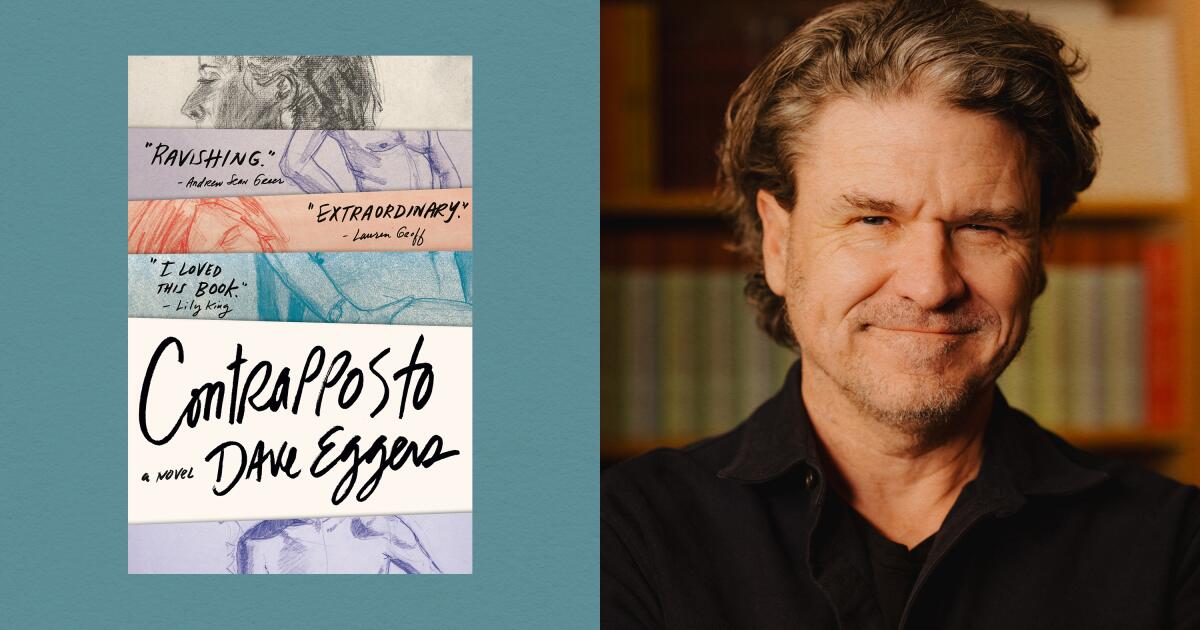
With his new novel “Contrapposto,” Dave Eggers has written a big-hearted, deeply moving story about the choices artists make, or don’t make, to square up their own notions of success and happiness. The book is dual bildungsroman, following two friends across the long span of their lives from adolescence to their 70s, as they fall in and out of each other’s lives, make their way in the world, and fumble around for meaning and purpose in their art.
The protagonist in “Contrapposto” is Rob “Cricket” Dibb, an underclass Midwestern kid, raised by a single mother in a North Indiana suburb that’s about as nowheresville as it gets for budding artists with dreams of glory. Cricket doesn’t dream big. He’s just trying to endure without bodily harm, seeking refuge from his mother’s abusive boyfriend in the basement with his grandfather Silas, who teaches him about jazz and the beauty of a glorious sunset. He draws so he doesn’t have to think. Immersion in art is his escape hatch from the dreariness of his pinched world: “The drawing meant nothing, would never mean anything to anyone, but it was true to how he saw it. His hand had recorded what he saw and felt about this thing. He was an ugly, common creature who could occasionally freeze time. That was enough.”
Cricket’s apprenticeship is decidedly informal. No full scholarship rides to Bard or Pratt for him; instead he saves up to enroll himself in a life drawing class in Chicago, where he discovers the beauty of applying rigor and rules to his work, how to break down pictures into the geometry of circles and squares, planes and angles. “He measured proportions and improved,” writes Eggers. “He grew more confident with each pass on his drawing, and realized … that much of the rightness of the drawing, of any drawing, came through time and diligence and discernment.”
He meets his slightly older schoolmate Olympia, one of Eggers’ most beguiling creations, when she implores him to scrawl scatological bathroom graffiti on a playground structure in Old-English typography. Unlike Cricket, Olympia is earnest and sincere about her art in the way that only a young person untainted by cynicism can be. She claims to inhabit the soul of Albert Camus, and flings around aphorisms about art that fly over Cricket’s head. She is an aesthete, someone who likes to go to the race track just to revel in the colors on display there. She wants to create an art scene in their little world. “You know all the great art movements have friends at their core, right?,” she tells Cricket. “A lot of time they’re jammed together by some critics and the artists reject the name and the association. But think about Patti Smith and Sam Shepard. Did you know they dated for a while?”
Cricket is beguiled by her, and Olympia in turn is taken in by Cricket’s talent. When the local library pulls a few of Cricket’s semi-nude life drawing portraits down for fear of offending their patrons, Olympia becomes his advocate and champion. In contrast to Cricket, who skates along with no end plan, Olympia is a committed careerist, an artist who insists on a captive audience to justify her work. She wants to earn money as an artist; Cricket just wants to be left alone. This push and pull between the two frame Eggers’ novel across the six decades of his narrative.
One of many joys of “Contrapposto” is observing Cricket’s artistic awakening via the mentors who guide him into his artistic consciousness. Marcus Carpenter, a wizened sage in battered work boots (one imagines him as the art world analogue to the late novelist Jim Harrison), is the moral conscience of the novel, fighting the good fight for personal expression and railing against the “new, paradoxical tyranny wherein those without technical skill terrorize those who possess it.” Carpenter plucks Cricket from arts college and its meaningless pontificating to his “atelier in the corn,” a ramshackle Victorian where Cricket learns how to transmute what he sees with color and light. “The talented have talent,” Carpenter tells Cricket during one of his endearing rants. “The untalented have theories.”
From there, Cicket’s life is a crooked line. He doesn’t abandon art, but he can’t summon the urge to sell himself or his work, to graft his joy in making things onto the caprices of the marketplace. As Eggers jumps through time, we find Cricket working as an intern in an art gallery, an arid, lifeless space where nothing inspiring can possibly exist. As a young man he works as a ship-breaker in Turkey; in middle-age, we find him in a coastal town in Cambodia, making replicas of great paintings for tourists. Olympia, his elusive love and sporadic muse, flits in and out of his life as she works her way up the tiers of the art world’s ziggurat. She gently berates him for his timidity: “This is how artists have power. We sell work. You’re implying there’s nobility in powerlessness. That’s been an idiotic trope for too long — that participating in the business side of it taints you. Do you know how dumb that is? That artists have to be these fragile little wood nymphs that are too precious to touch the money?”
As “Contrapposto” arrives at its beautiful, life-affirming conclusion, we are left pondering the significance of artistic endeavor in a world that commodifies everything, including our bodies and brains. At a time when even the greatest achievements are debased in a culture that gives equal weight to meretricious novelty, is it even worth the trouble? Eggers’ brilliant novel has the answer: Follow your bliss. In the final analysis, it is all that matters.
Smriti Mandhana’s 68-run knock and Deepti Sharma’s five-wicket haul helped India secure an impressive 64-run win over Pakistan in Group One of the ICC Women’s T20 World Cup.
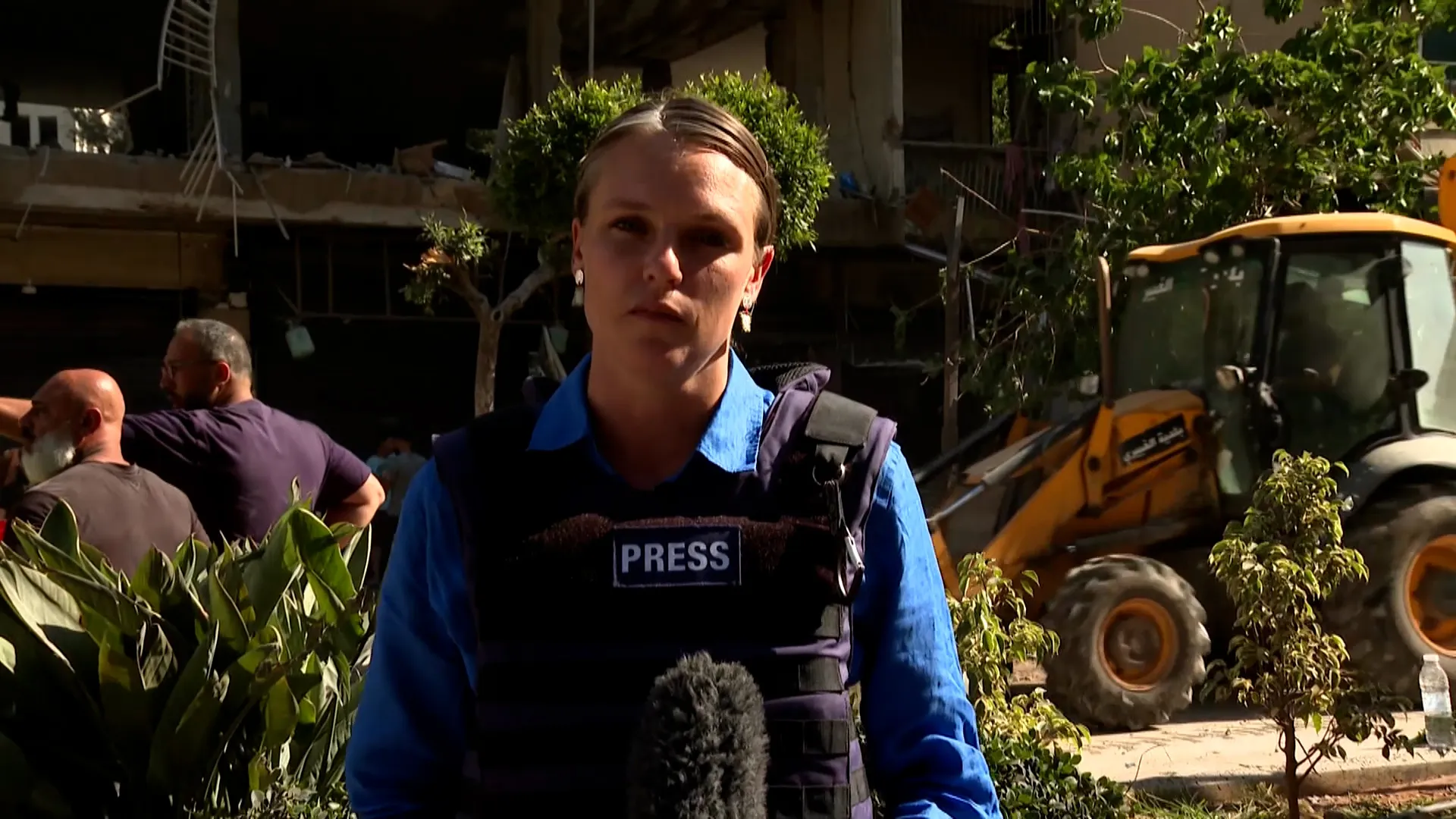
Al Jazeera’s Heidi Pett reports from the site of an Israeli attack on a residential building in southern Beirut, which Israel calls a Hezbollah command centre. The strike came hours before President Trump said a US-Iran deal was meant to be signed.
An award-winning crime drama that boasts a stellar cast including Sherdian Smith and Stephen Graham has been dubbed as ‘one of the best dramas around’
‘Outstanding’ crime series stacked with stars including Tina O’Brien streaming for free(Image: Getty Images)
A gripping and compelling BBC crime series that has been dubbed “one of the best dramas around” is now available to watch online.
Originally airing in 2010, Accused includes 10 individual episodesspread across two series, each following a different character on trial and how they came to be accused.
The first series stars the likes of Christopher Eccleston, Mackenzie Crook, Coronation Street’s Tina O’Brien, Peter Capaldi, and Naomi Harris across six hard-hitting episodes.
It was followed by a second series in 2012, with Sean Bean, Stephen Graham, Olivia Colman, Sheridan Smith, and Anna Maxwell Martin among the stars joining the cast.
Created by Time writer Jimmy McGovern, Accused was a smash hit and bagged a BAFTA TV nomination for Best Drama Series in 2011, with Juliet Stevenson also receiving a nod for her performance in episode three.
Two years later, Olivia Coleman won Best Supporting Actress for her role in series two at the BAFTA TV Awards and also the Royal Television Society Programme Awards, while Sean Bean won Best Actor at the International Emmys.
The gripping anthology series, available to watch on ITVX, also received rave reviews from critics, earning a score of 7.9 out of 10 on IMDb. One viewer praised the show and said, “Blown away. I can’t believe it took me so long to find this series!!!
“This is what happens when top writers and some of Britain’s most impressive actors emotionally involve themselves in making great drama. What a theme! That on paper, through the courts, there is simply a charge and a decision, without the truth behind the whos, whats, whens, and whys. One of the best dramas to date!
Another agreed: “Absolutely outstanding. Can’t recommend this series highly enough. Each episode, bar one, is a separate story, and every one is outstanding, brilliantly acted, and scripted. Stellar cast under brilliant direction- you can’t go wrong. Trust me.”
A third penned: “Very well done. This is a very well-done show and at times difficult to watch because of how real it seems. The performances are incredible, as is the writing.
“You understand these characters in a way that is rare and sometimes disturbing. As I said, this is not easy viewing, but it’s certainly worthwhile.”
NEW YORK — It was bedlam on Broadway as the New York Knicks won their first NBA championship in 53 years on Saturday night, with exuberant celebrations marred by mayhem and violence, including a shooting in Times Square.
Outside Madison Square Garden, a crowd watching on a big screen roared as the Knicks rallied from a 16-point deficit to beat the Spurs in San Antonio in Game 5 of the NBA Finals.
Soon after, tens of thousands of people filled the streets and the rowdiest among them were clashing with police, smashing windshields, scaling scaffolding, light poles and a statue, climbing into and atop school buses in Times Square and trying to hitch a ride on a moving fire truck.
Around 2 a.m., a 17-year-old was shot near 42nd Street and Broadway, police said. Bystander video captured the sound of at least seven shots and showed people crouching and running for cover. Police took the victim to the hospital because an ambulance could not get through the crowds, police said. A gun was recovered and three people were taken into custody.
Four people were stabbed or slashed, and one of the school buses, which was being used for World Cup transportation, was set on fire and engulfed in flames, police said. Other buses and five police cars were also damaged, police said.
In all, 63 people were arrested, with charges including assault on a police officer, criminal possession of a weapon, criminal mischief and disorderly conduct.
Knicks owner James Dolan, speaking in San Antonio after the game, urged fans to stay calm.
“We need to tell everybody in New York that we know that they’re celebrating, we want them to have a great time,” said Dolan, interrupting guard Josh Hart’s news conference. “Please be safe. Don’t get hurt; don’t hurt anybody.”
The city will officially celebrate the Knicks on Thursday with a parade and City Hall ceremony.
As the clock ticked to the final buzzer on Saturday night, anxiety that had dominated the game’s first three quarters gave way to euphoria. An orange-and-blue-tinted fever dream that started with the Knicks’ first playoff game two months ago ended in the third title in their 80-year history.
Fireworks boomed over Brooklyn and Central Park. Fans flocked to Times Square and ran through the streets. Outside the Garden, they sang the team’s anthem: “Go New York, Go New York, Go!”
Police officers and ambulance workers shouted, “Let’s go Knicks!” over loudspeakers in Brooklyn. Strangers shook hands and hugged. In the Lincoln Tunnel, where people were riding buses back from the World Cup at MetLife Stadium in New Jersey, drivers honked their horns in celebration.
“I’m so overwhelmed. I’m so happy,” said Mathieu Ogno of Long Island, who fought back tears as he soaked in the victory at a team-sanctioned watch party at Wollman Rink in Central Park.
Ogno wore the jersey of Knicks captain Jalen Brunson, whose 45 points propelled his team to victory and him to the NBA Finals MVP. Brunson’s gritty determination and chip-on-his-shoulder style have made him a fan favorite, embodying New York’s working-class ethos.
The Knicks’ championship — 19,392 days since their last — capped an extraordinary postseason for a franchise that hadn’t been to the NBA Finals since losing to the Spurs in 1999. Since April 23, the team has won 15 of 16 games, with its lone loss coming Monday in Game 3.
Their last title, in 1973, was also won on the road in a Game 5. Their first, in 1970, was won at home in a Game 7 thriller. Neither was celebrated with a parade.
“I’m happy to see my Knicks finally make it over the hump,” said Shawn Muoneke, 26. “I’ve seen them knock on the door. They were knocking on the door the past few years. But they finally made it over the hump, and I’m so happy to see it and I’m so happy I’m in the city to experience it.”
Muoneke, born a year after the Knicks’ last trip to the NBA Finals, started rooting for them when he was 10. He drove from Maryland to be in the city for Game 5 at the team’s Central Park watch party.
“I saw the ups, the downs and I watched the team come back up, and I was so happy to see them finally reach the highest echelon of stardom as a team,” Muoneke said.
After the Knicks’ win, he said, the vibes in the city “are the highest they’ve ever been.”
President Trump, a longtime Knicks fan who attended Game 3 at the Garden with Dolan, congratulated the team in a post on social media.
“What a year it has been but, even more so, what incredible playoff wins we have all witnessed, especially the last four — Maybe the greatest in the history of basketball,” Trump wrote.
With Brunson’s clutch performance, he added, “a superstar was born.”
After several dozen arrests throughout the playoffs and violence after Games 3 and 4 in New York that left officers injured and a teen in a coma, police girded for unrest as Saturday turned to Sunday.
“As we celebrate, be responsible, look out for one another, stay safe, be smart, and make this a night that reflects the very best of our city,” Mayor Zohran Mamdani said on social media. “Let’s go Knicks.”
Sisak and Lum write for the Associated Press. AP writer Emily Wang Fujiyama contributed to this report.
Activists rally in Geneva to denounce policies of G7 countries ahead of group’s annual meeting this week in France.
Published On 14 Jun 202614 Jun 2026
Thousands of protesters have gathered in Geneva ahead of this week’s Group of Seven (G7) summit, which is set to bring together United States President Donald Trump and other world leaders in nearby France.
The demonstration on Sunday was led by the so-called “No-G7” coalition, which is comprised of more than 60 associations and groups, including Palestinian rights advocates, feminist activists and environmentalists.
Recommended Stories
list of 3 itemsend of list
“We are very afraid of the policy and the politics of Mr Trump and also of the other leaders of the G7, because they are fighting, making war all over the place,” said Francoise Nyffeler, a spokesperson for the coalition.
“The planet is in danger, and we are very scared about it and we want to protest and say that the people of the world are against their policies,” she added.
Swiss and French authorities have deployed thousands of police to provide security for the three-day summit, which begins on Monday in the French resort town of Evian-les-Bains.
Authorities have blocked off roads, banned unauthorised gatherings, and pledged financial support for businesses that could be hit by unrest.
Protesters gather at the ‘No G7’ demonstration in Geneva, Switzerland [Baz Ratner/AP Photo]
Scores of businesses and shops have boarded up their storefronts with wooden panels as a precaution, leery of upheaval that left a trail of damage in Geneva during a similar summit in Evian in 2003.
Reporting from the protest in Geneva on Sunday, Al Jazeera’s Natacha Butler said demonstrators had denounced the G7 as being “all about the rich getting richer and the poor getting poorer”.
“They say the club of wealthy nations doesn’t represent the global population; that their policies and decisions have a negative impact on the world in terms of climate, equal rights and poverty,” Butler said.
Questions about the legitimacy of the G7 – which includes the US, Canada, Japan, France, Germany, Italy and the United Kingdom – are not new.
The group of countries previously accounted for 70 percent of global gross domestic product (GDP) – a figure that has shrunk to just 40 percent – while representing one-tenth of the global population.
In a sign that global power dynamics are shifting dramatically, other global groups also are growing. The BRICS countries – which include India, Russia and China – have doubled their bloc’s number of members from five to 11.
While G7 summits regularly draw protests, this year’s event also comes amid global frustration with Trump’s leadership on issues as diverse as tariffs, the US-Israeli war on Iran, and the climate crisis.
Demonstrators had been gathering for days in advance of Sunday’s march in Geneva.
A flotilla of around 20 boats appeared on Lake Geneva off the coast of Evian on Saturday, displaying anti-G7 and pro-Palestinian banners. Some 20 protesters were detained on Friday evening, according to Swiss media reports.
Weekly insights and analysis on the latest developments in military technology, strategy, and foreign policy.
In a significant development for Europe’s future air combat ambitions, Airbus is trying to restart the program to develop a sixth-generation combat jet, now under German and Spanish leadership. This comes less than a week after the Franco-German-led New Generation Fighter (NGF) effort effectively collapsed in its original form, amid acrimony between Paris and Berlin. The NGF was planned as the crewed centerpiece of the pan-European Future Combat Air System (FCAS), which Airbus, as the leading European aerospace corporation, now hopes to get back on track.
An exciting step for European sovereignty at ILA Berlin: “Team Gen 6”, a group of eight leading German defence and aviation companies signed a strategic positioning paper. The German and French governments have announced a realignment of the European Future Combat Air System… pic.twitter.com/aZcjAaO6dE
Airbus’s Defense and Space unit launched the ‘Team Gen 6’ initiative today with a message on X, declaring that it was “an exciting step for European sovereignty.” So far, eight German defense and aerospace contractors have signed a strategic positioning paper as part of the effort. Those firms are Autoflug, Diehl Defense, Hensoldt, Liebherr, MBDA Germany, MTU Aero Engines, and Rohde and Schwarz.
Reflecting the German-Spanish nature of the new program, those companies are now “closely integrated” with firms from Spain, comprising GMV, Grupo Oesia, Indra, ITP Aero, and Sener.
“While the development of the overarching [FCAS] ‘system of systems’ is progressing as before, the sixth-generation fighter aircraft integrated within it requires a new, agile industrial setup,” Airbus said.
A screencap from an Airbus video showing a notional future fighter working with remote-carrier-type drones. Airbus screencap
“As Team Gen 6, we have the capabilities and the capacities. Now, we are looking for close alignment with policymakers and the air force[s] to drive forward a superior European air combat system for collective security,” the X post stated.
Airbus also presented a video showing a notional concept aircraft flying with multiple uncrewed platforms. While not too much (as in not much at all) should be read into this, the crewed aircraft features canard foreplanes, a chin intake, and an unusual cranked wing.
Speaking just ahead of the announcement, at the ILA Berlin airshow today, where TWZ was in attendance, Jean-Brice Dumont, head of air power at Airbus Defense and Space, said the company remains committed to delivering a sixth-generation combat jet. “There is a need for a bit of a reshaping and reconsidering the reality of today,” Dumont added.
German Federal Chancellor Friedrich Merz (second from left) and Jean-Brice Dumont (second from right), head of air power at Airbus Defense and Space, stand in front of a drone during a tour of the International Aerospace Exhibition (ILA). Photo by Sebastian Gollnow/picture alliance via Getty Images
Dumont explained that the now-abandoned NGF was one of seven separate “pillars” of technology development being worked on under FCAS. As well as the crewed jet, pillars include powerplant, remote carrier vehicles, precision-guided weapons, and data connectivity.
“We have to consider safeguarding areas where it works, and how we reshape,” he added. “At the moment, we are going to seek guidance from our governments [on] what they want us to do. There has to be demonstrated an industrial feasibility of what is being asked — not only technical. That’s probably a lesson now,” Dumont added.
Dumont continued: “The world in 2026 is very different to the world of 2017 when the [FCAS] programme was launched. We have to accept that fact and reshape it — we need another way to get to the same goal, with faster milestones.”
“The problem we had is that we had drawn a line to 2040, and new technologies for everything,” Dumont added, referring to the goal of having the FCAS, including the NGF, in service by that date. “Today, you see demonstrations of connectivity, systems of systems and unmanned vehicles all around the world. The need is there, and in the countries that we are competing with, they are using it already.”
According to Dumont, the company has “put a number of options on the desk of our ministers and ministries of defense,” and is now awaiting further guidance from officials.
As the centerpiece of FCAS, in its original form, the NGF element was the most high-profile and challenging component of the project. However, it had long been dogged by disagreements over industrial workshare and leadership between Airbus and Dassault Aviation, which were the prime contractors for Germany and Spain, and France, respectively.
A 1:1 scale model of the NGF is unveiled at the Paris Airshow in 2019. Dassault Aviation
Dassault had demanded that it play the defining role in NGF, reflecting key requirements for the jet driven by the French Armed Forces. These included the ability to operate from aircraft carriers, and provision to deliver nuclear weapons. Germany or Spain needed neither of these functions.
Despite the disagreements that derailed NGF, Dumont argued that there had still been useful lessons learned from the FCAS program.
“What Phase 1A and 1B [of the program] have given is a very thorough analysis of the repartition of the work between the crewed and uncrewed platforms, and this remains. That kind of shapes what the manned aircraft will have to do.”
As an example of this work, Dumont pointed to ongoing work that will involve trials of a Eurofighter operating as a “command fighter” — a crewed jet that can operate in collaboration with drones, or what Airbus now refers to as uncrewed collaborative combat aircraft (UCCAs). The tests will see a Eurofighter fitted with a Rafael Litening 5 targeting pod modified to serve as the interface between the crewed jet and UCCAs. This should pave the way toward an in-service command fighter capability being introduced to the Eurofighter, something that will be incorporated in the sixth-generation combat jet from the outset.
A German Eurofighter with a Litening laser targeting and reconnaissance pod on the centerline station. Crown Copyright
Initial trials will involve a Learjet test configured as a surrogate command fighter and flying with drones in an “enhanced teaming” mode. Airbus hopes to have the command fighter-configured Eurofighter ready for operational service in 2029.
“The demand from the customers is: be ready early,” Dumont explained. “This is not a contradiction to the Future Combat Air System challenge — it is the need to have our platforms evolved earlier than we had traditionally planned.”
A model of a notional sixth-generation fighter displayed at ILA as part of a command fighter study by the German Aerospace Center (DLR). Thomas Newdick
The termination of NGF and the launch of Team Gen 6 leaves plenty of questions over the future of Europe’s air combat landscape.
TWZ spoke to Douglas Barrie, senior fellow for military aerospace at the International Institute for Strategic Studies (IISS) research institute in London, for his take on what might happen next.
On the matter of Germany and Spain now teaming up under the Airbus umbrella, Barrie said that the relationship makes a lot of sense, but its success is far from certain. On the one hand, the two countries already work together within Airbus, and both Germany and Spain are seeking a replacement for their Eurofighter fleets.
A pair of Spanish Air and Space Force Eurofighters. Spanish Ministry of Defense
“In terms of Team Gen 6, I do wonder if there’s an element of trying to kind of scramble to recover something from the wreckage of NGF, as it were, that the collapse of NGF doesn’t signal the end of Spanish industrial interest in next-gen combat aircraft development,” Barrie said. “But if somebody asked me, do I think between Germany and Spain, they can put together a credible program if nobody else is involved? I think that the numbers would be very difficult to stack up.”
Putting the German and Spanish future fighter requirements together, the two countries might, at best, need to build 300 new combat jets, with a figure of 250 more likely, Barrie contended. Team Gen 6 would then face a real struggle to break even.
This reality will, Barrie believes, force Germany and Spain to look for other partners, which will likely come down to a choice between the British-led Global Combat Air Program (GCAP) and the Swedish next-generation combat aircraft program, led by Saab. Of these, GCAP has the Tempest crewed fighter as its centerpiece, and also involves Italy and Japan. Sweden’s crewed fighter requirements are less clear at this point.
A scale model of a possible Tempest configuration, in Italian Air Force markings. Leonardo
Building a role for Airbus in GCAP would be difficult at this point. With the industrial architecture already in place, bringing not one, but two more partners into that program would be disruptive, particularly in terms of timeline. Already, the Japanese in particular are concerned about the pace of the program, especially since the United Kingdom has not yet fully committed to it in terms of funding.
“My own view is that the United Kingdom remains committed to the program, but there are financial pressures elsewhere,” Barrie noted. “I think that the more likely outcome in all of this is a kind of German, Spanish, Swedish tie-up. The kind of requirements in some ways are aligned a bit better.”
This extends to the size of the aircraft, Barrie observed.
“The kind of aircraft that the Swedes seem to be thinking about, the crewed element is probably more of a bigger Gripen E/F, heading towards Typhoon, in terms of size. This is more in keeping with what the Germans and the Spanish seem to be looking for. Obviously, the United Kingdom and Japan, in particular, need something with longer legs and bigger internal payload, hence GCAP.”
The Saab Gripen E. Saab
“GCAP will be highly capable,” Barrie continued. “That will come with a unit cost to go with it. Maybe what the Swedes, the Germans, and the Spanish might do will be cheaper.”
Provided a German, Spanish, Swedish teaming arrangement could work, the resulting combat jet could still enter a space where it would face competition for important export orders from France, which looks set to continue the development of the Rafale, especially now that NGF has collapsed. Further competition could be provided by South Korea with further developments of its KF-21 and Turkey with the TF Kaan, although these are notably less-ambitious fifth-generation designs.
The Tempest, as currently envisaged, with its very different set of requirements, would not necessarily be a direct competitor to Team Gen 6, Barrie argued, since it would be a closer match to the F-47 in terms of size, capabilities, and cost. While the potential size of this market would be more limited, probably U.S. reluctance to export the F-47 would play in the Tempest’s favor.
An official rendering of the Boeing F-47. U.S. Air Force
As to the possibility of the United States offering a ‘watered-down’ export model of the F-47, Barrie considers this unlikely to generate much interest.
“Yeah, you can have a downgraded version of my super airplane — as a kind of marketing slug that hardly sells, does it?” Barrie continued. “Even if it’s 10 percent less capable, even if it’s 10 percent less expensive, it’s still a likely unit cost of $250 million or more, which is eye-watering.”
This leaves us with the French, and what they might be able to recover from NGF.
If France goes it alone with a sixth-generation combat jet, Dassault will likely be strongly backed by the French government, and the company has traditionally punched well above its weight.
In the medium term, Dassault has a healthy backlog of orders for the Rafale and is very much at the right end of the cost curve. Barrie considers that the Rafale will remain a profitable airplane for the foreseeable future, but at some point, France will need to think about a successor based on an all-new airframe. Industrially, France has the capability to go alone with this, but they would likely look to a partner or partners to come on board. The likelihood of those partners coming from Europe has now been reduced, but other possibilities might be found in the Gulf states.
A pair of Rafales from the Qatar Emiri Air Force. Dassault Aviation www.twz.com
Then there is the question of India, which may still buy more Rafales but which, in the fullness of time, is likely to look for a new-generation fighter, and could be a potential partner for France.
“I don’t see the Indians ever being fully committed to only one country,” Barrie continued. India has already hinted that it might want to try and join the pan-European FCAS or GCAP. Meanwhile, Russia has been a long-term military partner for India, and Barrie thinks that the recent appearance of a two-seat version of the Su-57 Felon may well indicate another effort to sell that fighter to India.
The previously unknown two-seat version of the Sukhoi Su-57 Felon, which appeared earlier this year. UAC UAC
Were India to continue its pattern of buying Russian combat aircraft, that would give any potential European partner serious pause for thought, based on the security implications. Meanwhile, India also remains committed to developing its own next-generation fighter.
What the NGF debacle has demonstrated is that any potential partner with France on its next-generation combat aircraft program will likely have to be happy taking a junior role, with Dassault calling the shots.
The collapse of the New Generation Fighter could well be a pivotal moment for European defense cooperation, but it does not signal the end of Europe’s sixth-generation combat aircraft ambitions.
Airbus’s Team Gen 6 announcement marks the start of a German-Spanish-led industrial approach that its backers hope will be more agile and less contested than its Franco-German-led predecessor. However, significant political, financial, and industrial challenges remain, including the search for a reliable partner, or partners. As with NGF, the success of Team Gen 6 will ultimately depend on whether European governments can align their strategic priorities and industrial interests to deliver a sovereign future air combat capability.
EXCLUSIVE: The Death in Paradise spin-off star opens up about cast changes in Beyond Paradise
16:35, 14 Jun 2026Updated 16:42, 14 Jun 2026
Morning Live: Kris Marshall teases series four of Beyond Paradise
Barbara Flynn thought she had lost her job after one week of filming the Death in Paradise spin-off.
The beloved actress, who portrays Anne Lloyd and has also appeared in Death in Paradise, has offered a glowing tribute to a guest star following their departure from the BBC drama.
The fourth series of Beyond Paradise concluded earlier this year, featuring Anne Lloyd stepping in to prevent Humphrey Goodman (Kris Marshall) from being dismissed from his position. The episode additionally saw Zoe Williams bidding farewell to Shipton Abbott for travels abroad.
New arrival Mr. James Smith (Vincent Franklin) was also exposed by Anne for conducting an affair with a DI from Heston Morley station. Anne, who featured on a repeat broadcast of Love Your Weekend with Alan Titchmarsh today, previously discussed filming alongside Vincent, describing the performer as “funny”.
She told Reach PLC: “We got on incredibly well. He’s a funny man, and we had enormous fun off-screen as well as on. He was a lovely addition and a bit of a mystery, and it’s going to all end in… not tears, but chaos or something.
“And, of course, because Anne decides to get much more involved than that, then there’s a real, there’s a real kind of shift,” reports the Express.
Reflecting on increased collaboration with Kris Marshall’s character, Barbara continued: “Well, they all find it difficult having Anne in the station.
“I mean, Humphrey is as polite as he could be. He was never rude, but he’s so in his head, and so Anne is constantly bemused by him, but at the same time, very fond.”
Kris similarly expressed his appreciation for working with Vincent, who portrayed his adversary, calling him a “genius actor”. During the repeat episode of Love Your Weekend, Anne chatted with Alan about the series and how she finds it “a joy” to go to work.
“It is lovely,” Barbara said, going on to heap praise on the show’s writers, “Tony Jordan and Tim Key are an amazing pair. Death in Paradise has such a huge following around the world, and I think it is just something pleasant.
“I said to Sally (Bretton) once, because most of my scenes are with her, who I absolutely adore, I said, ‘Look, Sal, here we are sitting on a bench on a beach’.
“We are at work, and we were doing yoga on a beach, and it was a complete delight.”
She went on to reveal that she broke her ankle after just one week of filming, which made shooting certain scenes particularly challenging. She added, “The rest of it was filmed of me from wheelchairs and crutches. I thought I’d lost a job after the first week, but they said, ‘No, no Barbara, we will wheel you up and down’.”
Beyond Paradise is available to stream on BBC iPlayer.
Trailfinders held off Gloucester-Hartpury as they beat the reigning champions 29-26 to reach their first Premiership Women’s Rugby (PWR) final.
Hosts Gloucester-Hartpury had won the title for the past three seasons and took the lead at Kingsholm – rebadged as Queensholm for the PWR play-offs – through a Tatyana Heard try.
However, Trailfinders, who only joined the PWR in 2023 and had never finished higher than sixth, responded with four unanswered tries in their first PWR semi-final.
Maya Montiel, Meg Jones, Isla Norman-Bell and Emma Uren each went over the line as the visitors went into half-time with a 24-7 lead.
Gloucester-Hartpury launched a comeback after the break and a Rachel Lund try reduced the deficit to 10 points.
Georgia Brock was next to touch down for the home side as they closed to within three points of their opponents.
But Norman-Bell scored her second try of the match to give Trailfinders a 29-21 lead and some much-needed breathing space.
And, despite Hannah Dallavalle’s try for Gloucester-Hartpury, Trailfinders kept their hosts out to secure a hard-fought victory.
Donald Trump picks Mike Collins over Derek Dooley in race to determine who will face Democrat Jon Ossoff in November midterms.
Published On 14 Jun 202614 Jun 2026
United States President Donald Trump has made a late endorsement in a Republican run-off for a key US Senate race in Georgia ahead of the US midterm elections.
In a post on his Truth Social account, Trump threw his support behind US Representative Mike Collins over former football coach and political newcomer Derek Dooley.
Recommended Stories
list of 3 itemsend of list
Collins and Dooley will face off in a Republican run-off race on Tuesday to determine who will challenge incumbent Senator Jon Ossoff, a Democrat, in the midterm election in November.
In a post on Truth Social, Trump praised Collins for being a staunch supporter of his Make America Great Again (MAGA) movement and a “true friend, fighter, and WARRIOR”.
Ossoff entered office in 2021 as part of a blue wave in Georgia that saw the majority of the state vote for former US President Joe Biden, as well as his fellow Democrat, Senator Raphael Warnock.
Georgia, which had for decades been dominated by Republicans, swung back towards Trump in the 2024 vote. Defeating Ossoff is seen as one of the Republicans’ best chances at claiming a new seat in the 100-member chamber, where they are hoping to hold on to their slim 53-seat majority.
Democrats are hoping to win control of both the House and the Senate in November, which would create a major bulwark against Trump’s agenda during his final two years in office.
Republican divides
Trump’s endorsement pits Collins against Georgia’s Republican Governor Brian Kemp, who has supported Dooley.
Kemp has remained generally supportive of Trump, but has faced off with him on several issues, notably Trump’s evidence-less claims that the 2020 election in Georgia was marred by fraud.
Dooley has said he did not vote in 2016 or 2020 when Trump was on the ballot, and has maintained that the election results in Georgia were legitimate.
Collins carried about 40 percent of the vote during Georgia’s Republican primary on May 19, with Dooley taking about 30 percent. Representative Buddy Carter, who did not advance to the run-off, came in a close third.
It remains unclear how big of an impact Trump’s endorsement will have. He made the announcement after early voting had already ended for the run-off.
Trump’s endorsements have seen mixed results in the primary season.
Trump’s decision to back Texas Attorney General Ken Paxton was seen as aiding in the MAGA loyalist’s defeat of US Senator John Cornyn in Texas’s primary run-off.
Cornyn had widely been viewed as the strongest Republican candidate to take on Democratic challenger James Talarico in the general election.
In Iowa, Trump’s late endorsement of US Representative Randy Feenstra did not give him the bump needed to defeat fellow Republican Zach Lahn in the gubernatorial primary race.
Beyond the run-off in Georgia, Alabama will also hold several primary run-offs on Tuesday. That includes a Republican race for the solidly red seat of US Senator Tommy Tuberville, who is running for governor.
Oklahoma and the federal district of Washington, DC, will also hold primary votes.
British armed forces intercepted an oil tanker believed to be part of Russia’s sanctioned shadow fleet. The oil tanker ‘SMYRTOS’ was taken in an first-ever operation by the British military in the English Channel.
The Beckham family put a united front after hitting back at Brooklyn’s teamCredit: BackGridBrooklyn’s reps claimed Harper’s visit to his LA home was ‘choreographed’Credit: BackGrid
The 14-year-old arrived “unannounced” and “left seconds later without seeing him”, according to claims inPage Six.
A spokesperson for Brooklyn and his wife Nicola Peltz hit out at his famous parents, claiming they organised the whole thing – an allegation dismissed by family source as “clearly nonsense”.
In new photos, David and Victoria, 52, were seen out for dinner at Nobu in Malibu amid the ongoing feud with Brooklyn.
The family appeared tense as they headed into the swanky eatery.
The fashion designer wore a khaki midi dress and black heels with a pair of oversized glasses, while David opted for a white T-shirt and black jeans.
A spokesperson for Brooklyn and his wife Nicola Peltz hit out at his famous parentsCredit: GettyBrooklyn’s teams latest allegation have been dismissed by a family source as ‘clearly nonsense’Credit: BackGridRomeo Beckham was seen standing firmly by his parents amid the falloutCredit: BackGridThe family were seen arriving at swanky restaurant Nobu in MalibuCredit: BackGrid
Victoria and David’s son Romeo, 23, was also present for the dinner, along with his girlfriend Kim Turnbull, 25.
Romeo has stood by his parents throughout the family fallout his brother.
And last night was no different as he attended the meal out, just a day after sister Harper attempted to heal the rift by visiting Brooklyn’s LA home.
Harper was reportedly hand-delivering a letter as she arrived at Brooklyn’s home.
A rep for Brooklyn and Nicola said: “That photographers were in place as the letter was hand delivered says it all – this was choreographed for the cameras.”
But source for the Beckhams hit back today, saying: “This is clearly nonsense and just another untrue and unfair accusation.”
Shortly after news of Harper’s very brief visit, Brooklyn took to social media to reveal that he wasn’t in Los Angeles.
In his jaw-dropping message earlier this year, he made 12 key accusations towards his loved ones including allegations of “bribery” and family members telling Nicola “she’s not family”.
During his bombshell post, Brooklyn claimed: “I grew up with overwhelming anxiety. For the first time in my life, since stepping away from my family, that anxiety has disappeared.
“I wake up every morning grateful for the life I chose, and have found peace and relief.”
He added: “My parents have controlled narratives in the press about our family.
“The performative social media posts, family events and inauthentic relationships have been a fixture of the life I was born into.”
In six blistering posts on his Instagram stories he claimed dad David and mum Victoria have been trying to “endlessly ruin my relationship” with Nicola.
He said: “I do not want to reconcile with my family. I’m not being controlled, I’m standing up for myself for the first time in my life.”
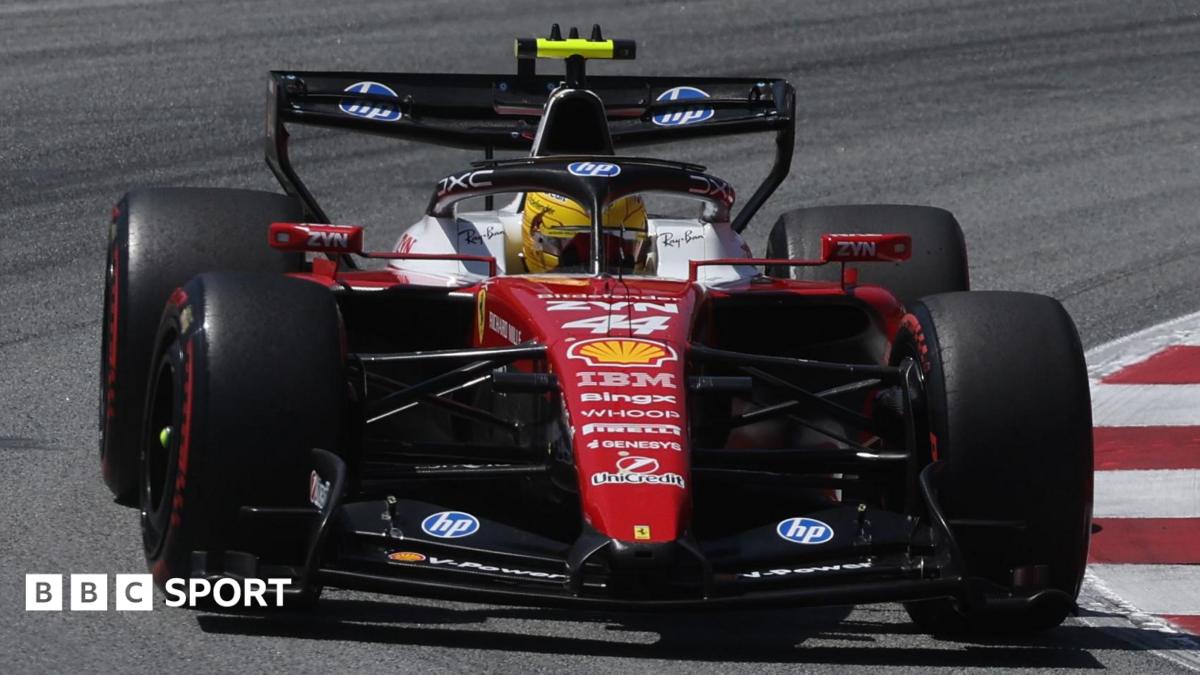
Lewis Hamilton took his first victory for Ferrari in a compelling Barcelona-Catalunya Grand Prix as championship leader Kimi Antonelli retired from second place with four laps to go.
It was a dramatic end to a gripping race that had tension and jeopardy throughout as Hamilton secured his first victory since the 2024 Belgian Grand Prix, when he was still driving for Mercedes.
The win turned on a virtual safety-car period which allowed Hamilton, on a different pit-stop strategy to Mercedes, to pit and retain the lead.
Meanwhile, Antonelli had just passed Russell for second place with five laps to go after a race-long battle when his car ground to a halt with a technical problem.
Russell finished second and McLaren’s Lando Norris was third in the first all-British podium since the 1968 US Grand Prix.
The key stories of a momentous race were:
Confirmation of Hamilton and Ferrari’s return to the front
Antonelli’s first problem of the year providing much-needed luck for Russell
A touch of irony as to the cause of the VSC that turned the race for Hamilton