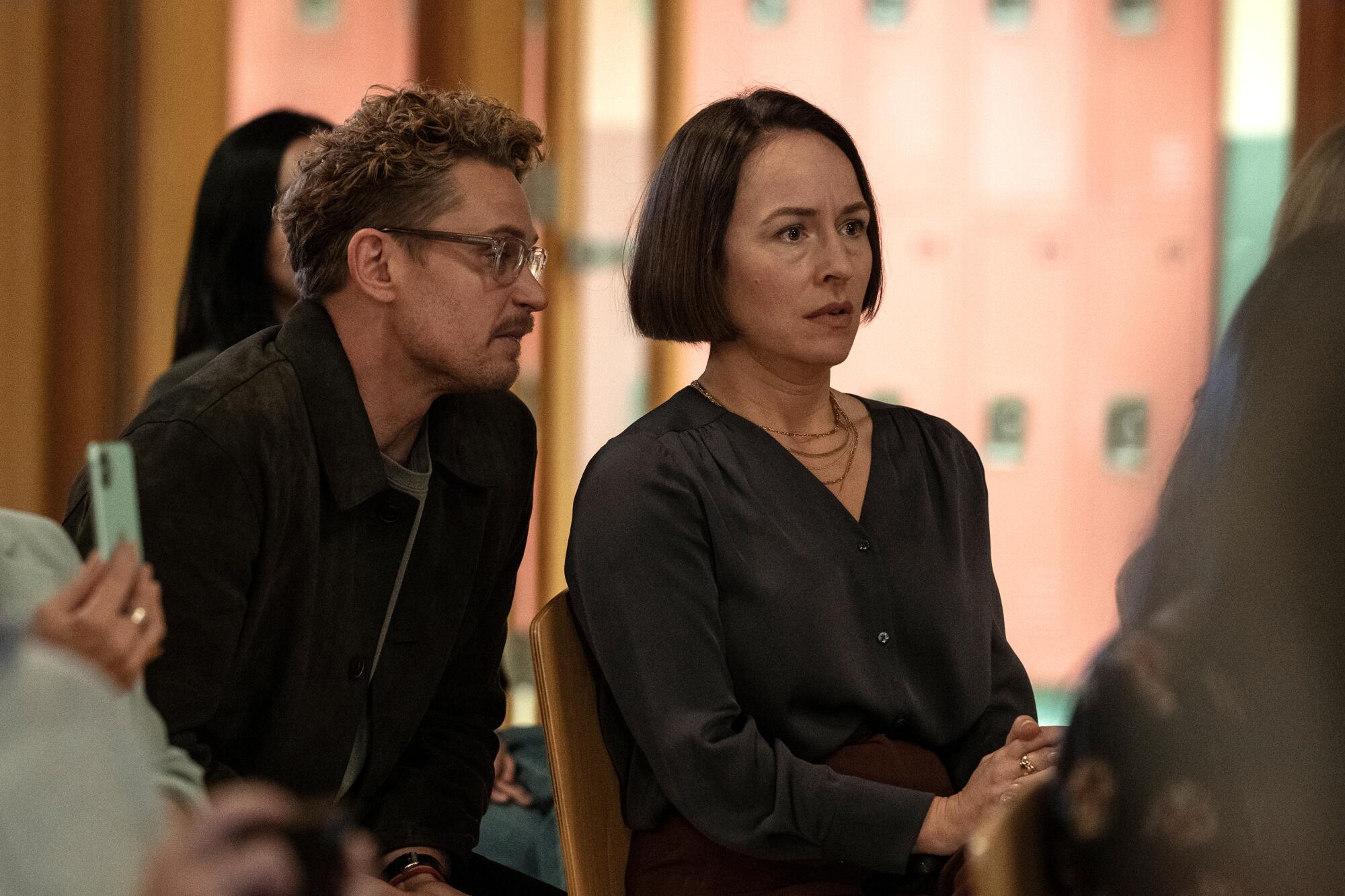
One day, when people say “they don’t make ’em like they used to,” they will be saying it about “Industry.”
First filmed before the pandemic and launched in its throes, a survivor of the era of streaming wars, corporate consolidation and Hollywood strikes, HBO’s addictively dissolute workplace drama remains as ambitious and authoritative as ever. Indeed, despite being divided from predecessors like “Mad Men,” “Succession” and “The Leftovers” by a series of epochal crises, it more closely resembles a vestigial tail of the medium’s past than most of its current counterparts: Out of place and out of time, “Industry” can best be understood as the last great drama of TV’s golden age.
Cast member and “Game of Thrones” alum Kit Harington, resident expert on series that reshaped the medium, agrees that “Industry” is a bit of a throwback in this respect.
“If you scroll back to ‘Game of Thrones’ in the first two seasons, it wasn’t a massive Goliath success, and it exploded after Season 3 with the Red Wedding. I think there’s a similar story going on here,” he says. “So often in TV at the moment, you’re given one season and everyone needs to pack in f— everything to get people hooked. But they’re burning through too much story. Season 2 is then done; the characters haven’t got anywhere to go. I think this is where this show has been successful, is that it was given that time to breathe.”
Earlier this spring, I convened “Industry’s” creators and cast in a conference room at The Times to walk me through its evolution into one of the best shows on television, and what to expect from its impending end.
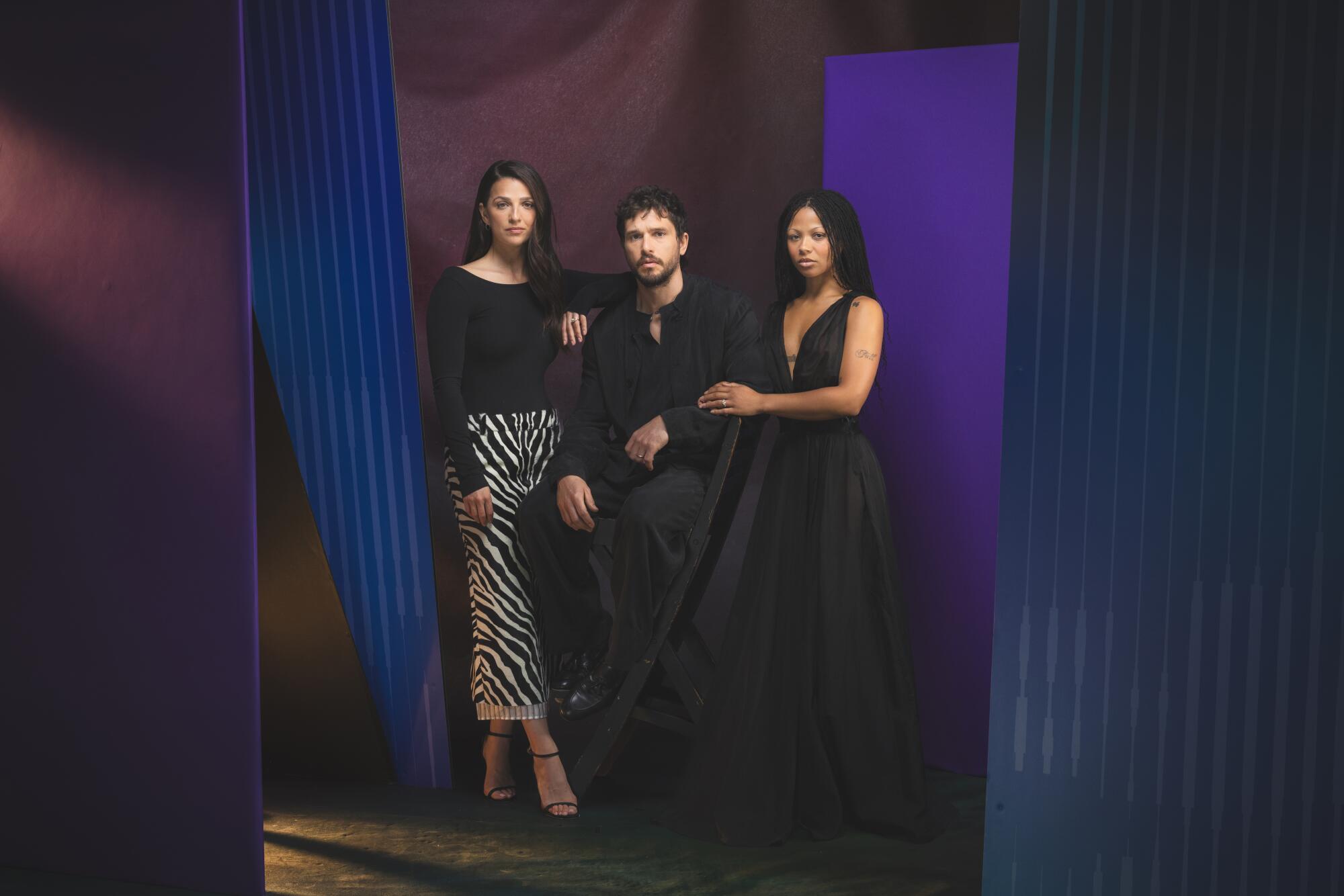
Marisa Abela, left, Kit Harington and Myha’la.
(Jason Armond / Los Angeles Times)
‘What the f— are you thinking, guys?’
Atrading-floor knife fight of hot, young strivers, or “grads,” competing for a permanent place at the fictional Pierpoint investment bank, the first season of “Industry,” filmed in 2019, premiered in the waning months of 2020 as a warped love letter to office culture. But for Konrad Kay and Mickey Down, the emerging writers at the helm, the voice of the series didn’t fully take shape until they’d found their main cast, including Myha’la, as hard-charging American Harper Stern, and Marisa Abela, as privileged publishing heiress Yasmin Kara-Hanani.
Kay: Season 1, me and Mickey were really green.
Down: We actually pitched HBO on the idea that it was going to be eight episodes, it was going to be in different months, and the big-bang dramatics were going to happen between the episodes. A bit like “Boyhood.” Huge things would happen in between episodes, and the episode would be about the reaction to those huge things. And they were like, “What the f— are you thinking, guys?” It was so antidramatic.
Abela: I had a lot of rounds of auditioning for Yasmin. They weren’t sure about me at all. I think part of it was because they were quite hellbent on her being vulnerable, on her being soft, and that was what I was playing in those first two, three episodes. … And what happens in any functional collaboration is you start to see what they really want from you — what it is that they need from your character. And in those moments of conflict, the moments of change, Yasmin has to stand up for herself at some point, otherwise it’s too wet.
Mickey Down.
(Jason Armond / Los Angeles Times)
Down: Yasmin was all vulnerability masked by Prada in script, and then you came in and you were very hard. [Laughs.]
Abela: There is one scene with [Yasmin’s abusive supervisor] Kenny [played by Conor MacNeill] in Season 2 where … Yasmin turns around to him and tells him to f— off, basically: “You don’t have a disease, you’re a narcissist, with a new excuse to lord it over people. You’re weak.” I think that’s the first time that Yasmin became a gangster. I was watching “Real Housewives of New Jersey” at the time, being completely honest. She can go really mob wife really quick.
Myha’la: I had almost the exact opposite experience in terms of finding or deciding who Harper was. When I read the scripts initially, I just thought, “There’s no way in hell that Harper can’t be steely and [on offense], because she’s clearly feeling out of her depth, and as a young woman of color going into a new space like this, you can’t show up like you’re vulnerable. You’re already expected to do poorly.” … On the page, Harper was an anxious person when I first met her in the pilot episode. She was sweaty and clammy and stammering. And I just thought, “Hell no!”
Down: Sometimes when we write the character, we focus on one thing, and then the actor comes in and then that one thing we thought the character was becomes the artifice that they have to play.
Harington: Great TV writers genuinely learn their actors as well as their characters, and they tie those things in as it goes through.
Abela: As much as they know how we speak now, we know how they speak. If Yasmin has a “F— off,” I know what they want with that. If she says “F— off,” it’s very different to “F— you.”
Down: It’s like playing the piano with the foot pedal, blindfolded.
Kay: When you get super-talented actors doing your writing, you sort of fall in love with them doing everything. There’s no story we can’t tell with them.
‘Am I being fired?’
The series’ second season, which opens with Pierpoint’s post-COVID return to office, found the grads established enough to become “active characters,” and the creators confident enough to begin breaking the mold they’d set for themselves in Season 1. From the nail-biting trade sequence with which Harper wins over hedge fund manager Jesse Bloom (Jay Duplass) to her firing from Pierpoint in the Season 2 finale, it marked the arrival of “Industry’s” distinctive, go-for-broke aesthetic.
Kay: [In] Season 2 we were still figuring out what the show was, and we had Jami O’Brien as our co-showrunner, who really professionalized me and Mickey towards the American system, towards how to be producers, curbed some of our more bombastic instincts, made us more professional in terms of some of the style of the writing we were doing, found a cleaner version of the show and a cleaner version of the story.
Konrad Kay.
(Jason Armond / Los Angeles Times)
Down: [The Bloom trade] was one of the first times in the show where we were like, “Wow, we’ve actually created something kind of singular,” in that we were able to create scenes of people trading, [using] financial jargon that no one understands, and make it feel like a car chase. The contrast between the Harper that’s on the trading floor being able to be in command of that with all the people looking at her, and then the Harper that’s in the loo afterwards in floods of tears, that for me was kind of the moment where we thought that we had a completely 3D, rounded character.
Myha’la: If you asked me to do the Jesse Bloom trade scene again, I’d piss myself. Because at least when I did it two seasons ago, I could have anxiety and fear percolating inside me. If I had to do it today, I’d have to do it confidently, and I would have to try really hard because so much of the language is truly blind memorization and being able to juggle particularly the f— phones. … You have to get the choreo[graphy] so good and you have to know the words so well so that you can do the important part, and that’s the subtext — communicating the feelings of the thing, which are not in the words. Which I love. It is so hard.
Harington: When you first read the scripts, you can’t understand a lot of what’s on the page. … You look at it, you go, “This is f— impossible.”
Myha’la.
(Jason Armond / Los Angeles Times)
Myha’la: This is not spoon-feeding the audience. “I’m sorry that you’re hurting because I know last summer your mom died in a car crash.” They don’t do that.
Kay: Do you know who hates that about us? Network executives. [Laughs.]
Down: We had a kind of mantra the first season especially, and then going into the second, that we would never have a scene that didn’t have one of our four main leads in it. And then, just for the necessity of the storytelling, we said, “We have to pop out of that perspective.” I don’t think HBO realized what a big decision that was, because I don’t think they’d actually realized we’d kept this mantra that we were never going to go away from the perspective of the grads.
Kay: It’s also where we broke the rule of, “We’re not going to just tell the bottom-up story; we’re going to go to the top.” When we sold the show, we were like, “This is a bottom-up story,” and then by that point we were like, “Actually, we have these older characters who might have these really rich inner lives that we should also explore.”
Myha’la: We blew the s— up. [Harper’s firing] forced us all outside the bank, which was dangerous and scary for me and really exciting and was how we got to see all the other things that Mickey and Konrad are capable of doing. I think they didn’t tell me before, so I was like, “Am I being fired?” [Laughs.]
Down: We thought we were all being fired. The reason the show evolves so much is because we basically never know whether we’re coming back, so we just blow up everything. We try to leave the audience with a satisfying conclusion. And then we get renewed, and then we have to basically write ourselves out of a corner. So Harper getting fired could have ended the whole show.
‘Oh, poor Henry’
Given time to develop its characters, refine its style and grow its audience, “Industry” returned for Season 3 with all the trappings of a series that had finally arrived: effusive critical acclaim, proliferating fan accounts and buzzy arcs by Sarah Goldberg and Harington, as playboy and erstwhile green–energy executive Henry Muck. Had it premiered just a few years later, “Industry” may have ended up on the chopping block before finding its footing; instead, it was allowed to achieve “terminal velocity.”
Kay: What happened between Seasons 2 and 3 was, we got renewed. We didn’t think we were going to get renewed. We operated from the principle of, “We might never get to do this again.” And that was incredibly freeing for me and Mickey because it was just like, “We’re gonna get eight hours, let’s just do everything we possibly can within that eight hours. Let’s indulge every creative impulse we’ve ever had. Let’s take the stabilizers off the story. Let’s not necessarily keep it within Pierpoint.” What we felt like was a perfect marriage of creative latitude, trust in ourselves and the right point in our arc of writing the show and directing and producing. We reached terminal velocity, where we could actually do all of the stuff that we were pretending we could do in the first two seasons.
Kit Harington.
(Jason Armond / Los Angeles Times)
Harington: When I joined up in Season 3, I had a good handful of friends who watched the show. It may be bigger than you think it was from the inside. It’s been fascinating for me, joining when I did and seeing it grow again … We all want to do stuff that people actually watch. We’d be lying if we said we didn’t. We’ve all done jobs that we really love and no one’s f— seen. When there’s a focus in on something that you know is good and you love, that’s more rare than you think. I started in this job in “Game of Thrones” and just assumed, “That’s, like, how jobs go. You get invited to the Emmys every year and everyone frigging watches it.”
Kay: The softness in Henry was a function of Kit playing the character and us writing to that vulnerability. There’s a totally different version of that character which never unlocks that kind of thinking in me and [Mickey].
Harington: You know that moment where it’s all going to s— with Lumi and he just gets up and he’s like, “None of this is real” and he f— off? For me, that was it. Because it was like, “Wait a minute, he can’t just leave the f— room” — and he does. I think that kind of sums him up. I got a handle of him properly then, and that was quite an early one we shot.
Down: He has a sense of entitlement most of the other characters don’t have.
Myha’la: But you still manage to make me feel bad for you. I’m like, “Oh, poor Henry.” Do you know what I mean? Isn’t that psychotic?
Down: I said it to him in an email recently. Somehow he managed to make an ex-Tory minister who bankrupted his company twice and needed bailouts from the British public — [a] junkie, adulterer — the most vulnerable and probably most empathetic character on the show, in some respects.
Harington: He’s one of the few characters who is actually trying to do good. Even if it’s about him being perceived as doing good. … It’s also very smartly done in how you demarcate addiction and drug-taking. You’ve got most of the characters, who can kind of put it down, but then you’ve got Rishi [a Pierpoint trader played by Sagar Radia] and Henry, who are a different kettle of fish. And also how it creeps up.
Kay: As a sober person playing that stuff, is there a psychic trigger in your brain that sort of feels like it’s happening?
Harington: I was very worried about coming in and doing some of this stuff, but quite quickly realized I was A) sober enough for long enough to go back there safely; and B) it was a sort of muscle memory, a lot of it. I get to exorcise this stuff in my job. How many ex-addicts get to do that? It was a kind of cathartic thing.
Marisa Abela.
(Jason Armond / Los Angeles Times)
Abela: There’s a real freedom that comes with drugs, alcohol, whatever it is, for the character. Those are the moments when you can really open the lid on something.
Myha’la: When you’re f— up, you’re uninhibited, so you can do your own thing, but I think you’re also taking the other person at face value. I feel like it sort of takes the judgment away. It creates a kind of childlike innocence.
Down: If you’re in a situation like that, you can skip like five stages of relationship if there’s a big bag of drugs in front of you. That’s something we try to capture.
‘Where we leave the characters feels so perfect’
Earlier this year, HBO announced that “Industry” had been renewed for a fifth and final season. But it was Season 4 — which finds Harper and Yasmin’s friendship in tatters, Yasmin and Henry’s marriage at an end, and the structure of the show evolving yet again to draw on new characters and genre influences — that led Down and Kay to determine that the series’ time had come.
Kay: We did think to ourselves, “OK, so we’re going to do a Season 4, which means the show is a kind of success in and of itself, which means we can start to think about ending. If you get four seasons, you’re probably going to get five. So we felt that it created latitude there. What we thought to ourselves was, “We meet these two women in the pilot. If you’re going to spend five seasons of TV with them, what is the starkest contrast you can do between how you meet them and where they end up?” … When we started, the show was about not having power. Five seasons in, they have it. Then what do you do with it? The phrase me and Mickey have been talking about is this idea of “arrival fallacy.” You climb and climb, you’re at the top of the mountain. Is there another peak? Do I sit here and enjoy the view?
Down: We’re writing Season 5 right now, and without giving too much away, we’re approaching that season very differently in terms of how information’s parceled out.
Kay: It’s very dense, though, isn’t it? Honestly, it might be the densest season. There’s a lot of theology in it, actually.
Down: We talked about doing a sixth [season], and then quite honestly we thought that was going to be diminishing returns. … We would have been pulling our punches constantly. This has been one of the most creatively fulfilling versions of the show, because we are writing towards a conclusion that we know is the conclusion. We’re thinking of images for the last 10 minutes that we know are going to be what the audience is left with, and that’s really, really thrilling for us as writers. I’ve never once thought, “God, I wish we were doing a sixth one,” as much as I love writing and making the show. Where we leave the characters feels so perfect.
Looking for a staycation spot, pub for Sunday lunch, or just a day out? The VisitEngland Awards for Excellence 2026 have picked some of the best of English hospitality up and down the country – see who won awards near you
11:03, 15 Jun 2026Updated 11:03, 15 Jun 2026
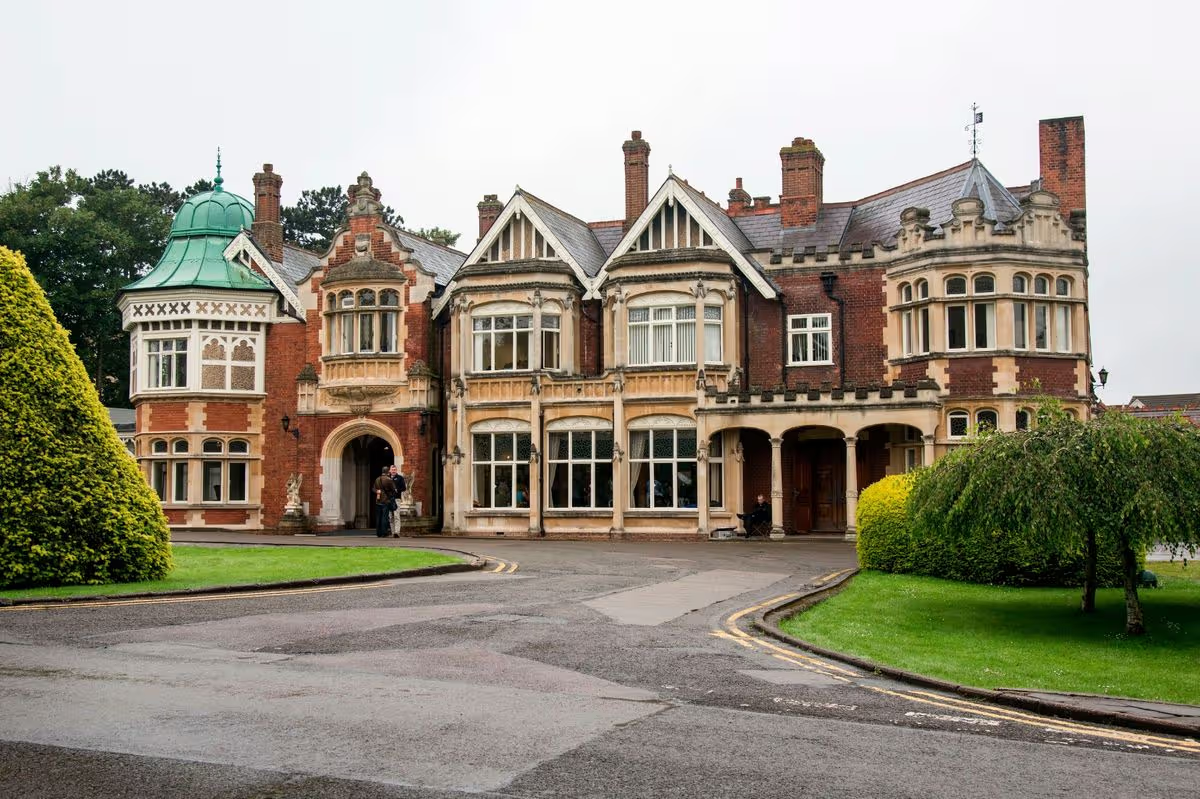
Historic sites such as Bletchly Park picked up awards(Image: Education Images/Universal Images Group via Getty Images)
A new interactive map will let you search for some of England’s best pubs and days out near you – as well as those in different parts of the country and the best hotels in the regions if you’re planning a staycation.
The VisitEngland Awards for Excellence 2026 took place earlier this month, showcasing the best of what England has to offer whether that’s family-friendly attractions, brilliant days out, or even just the best restaurants and pubs not to be missed.
We’ve put together an interactive map showcasing the big winners, so you can discover some of the best of English hospitality on your own doorstep. Simply use the map and zoom in on your local region to find the best of the best.
England’s tourism industry is worth around £127 billion a year, and employs around two million people in a huge variety of jobs. At VisitEngland’s awards, winners included both small and large hotels, B&Bs, glamping operators, tourist attractions, restaurants, and pubs.
Among the winners of the awards were MonkBridge House in York, who scooped Gold in the coveted BandB and Guest House of the Year. This property has just eight individually designed rooms, some with four-poster beds, and is full of historic elegance.
Larger properties that won awards included Bovey Castle in Devon, which is set on 275 acres of countryside including a golf course, spa, and restaurant. While those who enjoy the great outdoors may want to head to nearby Clawford Lakes Resort and Spa which won Gold in the Camping, Glamping and Holiday Park of the Year category.
Visit England’s Large Visitor Attraction of the Year went to Jimmy’s Farm & Wildlife Park in Suffolk. The wildlife park is owned by TV star and conservationist Jimmy Doherty, who has presented programmes on both Channel 4 and the BBC.
Bletchley Park in Buckinghamshire, came in second place, where visitors can learn about the code-breaking geniuses who were instrumental in helping the Allied Forces win WWII.
The Morgan Experience Centre in Worcestershire won Small Visitor Attraction of the Year. Set on the historic site of Morgan Motor Company, you can see the extraordinary skill put into making these classic cars with a factory tour. The Ad Gefrin Anglo-Saxon Museum & Whisky Distillery won Silver in this category, promising an “immersive journey into Northumbria’s Golden Age”. It has a fascinating interactive museum where you can see how the Anglo-Saxons really lived.
Other businesses who won awards include Butlin’s. The holiday park operator, that just celebrated its 90th anniversary, picked up an Outstanding Contribution to Tourism award.
VisitEngland Director Andrew Stokes said: “The awards are a celebration of England’s outstanding tourism industry and an opportunity to highlight the excellence that makes it world leading.
“From a hands-on, traditional blacksmith’s visitor experience in the Midlands and a castle hotel and spa set in one of our national parks to accessible and inclusive holidays, these awards showcase the exceptional quality, unparalleled customer service and innovation that drive our industry.”
Have a story you want to share? Email us at webtravel@reachplc.com
We took Atlantic all the way to the Pacific, traveling from the San Gabriel Valley to Long Beach on foot. On the last morning of May, a group of us set out at 7:45 a.m. from a barren In-N-Out parking lot in Alhambra, where Atlantic Boulevard begins. We kept walking until we reached the water, 12 hours and more than 55,000 steps later.
In all, our group passed eight freeways, two highways, and one river, twice. We walked through a dozen cities: Alhambra, Monterey Park, Commerce, Vernon, Maywood, Bell, Cudahy, South Gate, Lynwood, Compton, Long Beach and, of course, Los Angeles.
We spent only about 1.5 miles, a half-hour, in the city of Los Angeles itself, all in East L.A. We spent more time in Lynwood than Los Angeles. We spent far more time — more than a third of our day — in Long Beach.
Share via
To walk Atlantic was to connect the dots about how our region functions economically, from the port to the factories to the suburbs. It was also to realize just how expansive and multifaceted Long Beach is.
This is the sixth such walk of one lengthy street that, ending at the ocean, we’ve completed across Los Angeles. Our pursuit began in 2022 with Wilshire’s 16 miles, continued in 2023 withSunset’s 25, maxed out in 2024 withWestern’s 28-plus miles, and stepped back in 2025 withPico’s 15.5 miles. Earlier this year, roughly 30 of us strolled all of Santa Monica’s14.5 miles.
This time, we started with a group of 16, ranging in age from 20-something to sexagenarian, and finished with 12. Some walkers left and joined us along the way. Ten, including one Long Beach local, completed the street.
1
2
3
4
1.Pedro Moura, center, gives a pep talk before leading a group on a 25-mile walk the length of Atlantic Boulevard.(Scott Strazzante/For The Times)2.In so-L.A. fashion, a Tesla Cybertruck rolls past a pile of possessions flooding the sidewalk in front of an apartment building.3.Josiah Fields, 15, earns money by cleaning car windshields at the intersection of Atlantic and Alondra Boulevards.4.During the final mile of the their 25 mile walk, Chloe Stepney and Trevor O’Brien lead the way past Louis Burgers III on Atlantic Avenue.(Scott Strazzante/For The Times)
We’ve been playfully calling our annual jaunts the Big Walk. This one, we called the Bigger Walk. I suppose that makes Western the Biggest. We’ve come to believe the ideal distance for an all-day effort is about 20 miles. That seems long enough for it to feel like a real feat and short enough to include more interested folks and ample break time.
After a tranquil time on Santa Monica, I wrote that we expected Atlantic to be the opposite experience — “unwieldy, at times unwelcoming, and excessively industrial.” That was an overstatement at best and factually wrong at worst.
We did visit Vernon, the city that proudly promotes itself as “exclusively industrial.” But by one measure, Atlantic was literally the most welcoming street we’ve done yet. Many more people greeted us. The actual street was at least as pedestrian-friendly as Western or Sunset. At no point did we have to walk on the road or in a minuscule median.
We did, though, have to cross five crosswalks just to continue on Atlantic at one point, at an absurd intersection with Ferguson Drive, Goodrich Boulevard, Telegraph Road and Triggs Street. Railroad tracks and the famed old East L.A. Union Pacific Station stood to our left, and the 5 freeway to our right. Clearly, pedestrian convenience had not been front of mind during the area’s planning.
Oil might be the simplest way to illustrate how Atlantic differs from more famous L.A. streets. On Pico Boulevard, there are oil derricks hidden behind elaborate, towering facades. Along Atlantic, the derricks are just everywhere in plain sight for a while. We did walk atop both the Long Beach Oil Field, a mega giant field, and the Wilmington Oil Field,the third-largest oil field in the contiguous United States.
That’s Atlantic, lacking in pretense, not hiding anything, but exceeding our expectations. We saw more plants native to our region, including Cleveland sage and Sacred datura, than along Santa Monica. And we kept encountering vibrant pockets where we did not know they would be. Monterey Park was the first to impress us, with gorgeous Cascades Park tucked into a lush little valley.
A rose peeks through a fence at St. Rose of Lima Church on Atlantic Boulevard.
Lykayla Melendez poses in her quinceañera dress at Cascades Park along Atlantic Boulevard.
In East L.A., chilaquiles, tamales, tejuino and ribs were all available street-side, and one of our members noticed the newer location of the famed La Azteca Tortilleria in a strip mall near the Metro station. Azteca has been the No. 1 seed in Times columnist Gustavo Arellano’s tortilla tasting tournaments with KCRW; we picked up a couple dozen to go.
Farther south, Bell is best known locally as thehome of brazenly corrupt city officials earlier this century. When we passed through, the shade provided by a pocket park in the city center became a crucial respite for our lunch break. Across the street, a community market was just starting up for the afternoon. We caught a couple songs from a talented mariachi band.
Once we crossed the 105 overpass, we quickly encountered four sizable parks, each no more than two miles from the last. We saw one pump track, two tennis courts and skate parks, several sports fields, and an impressive number of food trucks, including Instagram-famous Kitchen’s Corner BBQ. At least another dozen food vendors seemed to be setting up for evening service as we marched by in the late afternoon.
By the third park we passed, we were in Long Beach, specifically North Long Beach. The fourth, Scherer Park, is a sprawling, 26-acre gem. Soon enough we were in Bixby Knolls, where, for more than a decade now, Long Beach officials have beeninvesting in improving bicycle and pedestrian access. It shows. We had a delightful happy hour on Ambitious Ales’ front patio overlooking Atlantic.
August Fagerstrom and Pedro Moura fist bump a well-wisher on Atlantic Avenue.
Official lists of the longest L.A.-area streets are almost impossible to find. Often, such lists are kept by cities. The longer the street, the less likely that all of it is within one city’s limits.
We can say this: There are not many stretches of a single street with the same name longer than Atlantic in the L.A. Basin. Western Avenue, definitely. Imperial Highway, depending on your perspective on what constitutes a street. Sunset is about the same length. And that’s about it.
Unless you want to be particularly persnickety and disqualify Atlantic on the grounds that it technically has two names. For its northern 10 miles, Atlantic is a boulevard. For its southern 15, it’s an avenue. Where Maywood becomes Bell, it switches. But it’s Atlantic all the same, and that was good enough for us.
At the end of their 25-mile walk, Chris Kirkham celebrates with fellow walkers at Atlantic Avenue and Ocean Boulevard.
Speaking of names: Our Alhambra is named after a Washington Irving book inspired by his visit to the 13th-century Islamic fortress of the same name in what is now Spain. You can walk to the actual Atlantic from that Alhambra in about 150 miles.
This was easier than that, at least. If you’re eager to explore the backbone of Los Angeles, curious for a challenge, you could do worse than attacking Atlantic. I promise you’ll see something new. We saw a street juggler. We saw a live chicken and a dead turkey. We saw a discarded box of Pacifico beer that had been cooking in the sun so long it turned from yellow to white.
Pedro Moura points out Chloe Stepney’s sock tan line as they celebrate the end of their 25-mile walk down Atlantic with a dip in the Pacific Ocean at Alamitos Beach.
After we rinsed our weary feet in the Pacific, some of us waddled back up to Downtown Long Beach and scarfed down Sonoratown burritos and chivichangas before heading home. It was a Sunday well spent.
THE upcoming Eden Project Morecambe has unveiled its biggest attraction yet – a £4.5million immersive experience.
Called ‘The Elder Tree’ it will guide visitors through a unique journey when it opens in 2028.
Sign up for the Travel newsletter
Thank you!
Eden Project Morecambe will have ‘The Elder Tree’ as its focal pointCredit: Eden ProjectThe new Eden Project will consist of two domes in Morecambe BayCredit: Eden Project
The £100million garden attraction set to be built on Morecambe Bay has revealed its centrepiece called ‘The Elder Tree’.
It has been described as “one of the most significant elements” of the attraction.
It’s being built at the cost of £4.5million, which was donated from a charity lottery.
The 65 foot tree will guide visitors on a journey from its roots to the trunk hollows in a one-of-a-kind immersive experience.
It is set to show people how to “reconnect” with and “restore nature”.
The Eden Project in Morecambe will be the newest of its kind in 25 years with the only other attraction being in Cornwall.
Inside the new attraction will be two very different experiences called The Realm of the Sun and The Realm of the Moon.
The Realm of the Sun has been described as “a bright, lush landscape of the near future — a place where humanity has rediscovered how to repair and re-engage with the broken rhythms of the natural world”.
The Realm of the Moon is as an immersive but “darker” space with a hyper-real rockpool which will have sped-up cycles of tides.
Also inside the domes will be 1.5 acres of landscaped gardens, which will open earlier than the other exhibits in 2027.
The garden attraction will have a light and a dark realmCredit: Eden Project
Other details that have been previously mentioned include hanging plants, mini gardens, a multi-sensory area, a waterfall and a ‘Town Square’.
Between the two realms, there is expected to be an area called Metronome, where visitors will buy their entry tickets.
There will be a 750-capacity Tidal Theatre, a 300-capacity restaurant and a shop at the attraction as well.
Once open, Eden Project Morecambe is expected to bring in around £80million to the local area.
Andy Jasper, Eden Project CEO, said: “The funding has specifically secured The Elder Tree – which will sit at the heart of the experience for visitors.
“More than a striking landmark, it will help tell the story of our changing relationship with the natural world and inspire people to imagine what an incredibly positive future could look like.”
Crude prices retreated on Monday as US President Donald Trump confirmed a peace agreement with Iran and both sides announced a lifting of their respective blockades of the Strait of Hormuz.
ADVERTISEMENT
ADVERTISEMENT
At the time of writing, the front month contract on US West Texas Intermediate (WTI) crude was down almost 6% from Friday’s close to roughly $80 per barrel, while Brent crude, the international standard, dropped around 5% to about $83 per barrel.
The specific concessions made by each side are still unclear and there are questions surrounding whether the Prime Minister of Israel will respect the withdrawal of troops from southern Lebanon, which, according to the Prime Minister of Pakistan is included in the deal.
Benjamin Netanyahu has yet to publicly address the US-Iran deal, or the issue of Lebanon, and CNN has reported that the Prime Minister of Israel is seeking an urgent meeting with US President Donald Trump after this week’s G7 summit.
Nonetheless, markets are reacting swiftly to the prospect of the Strait of Hormuz slowly reopening and the potential that the Iran war is closer to ending than reigniting.
The freshly announced peace deal is currently expected to be signed on Friday.
European, Asian and US markets
At the open, European markets also rose on the news that there is meaningful progress in ending the Iran war.
Both the Euro Stoxx 50 and the broader pan-European Stoxx 600 traded over 1% higher at the start of Monday’s session.
The UK’s FTSE 100, Germany’s DAX 30, Italy’s FTSE MIB, Spain’s IBEX 35, the Netherlands’ AEX and Switzerland’s CH20, all traded between 0.5% and 1% higher than their Friday close.
France’s CAC 40 led the pack and rose almost 1.5%.
In the US, S&P500 futures traded over 2% higher and the teach-heavy Nasdaq 100 rose more than 3%.
In other trade dealings on Monday, Asia-Pacific markets jumped overnight with South Korea’s Kospi climbing over 5%, recovering from a 4% drop on Friday, while Japan’s Nikkei 225 also traded roughly 3% higher.
Australia’s S&P/ASX 200 rose 0.8%, while Hong Kong’s Hang Seng Index jumped about 0.5% and Shangai’s SSE climbed over 1.5%.
Armagh will face Kerry and Donegal will travel to Dublin in the third round of the All-Ireland Senior Football Championship.
Kieran McGeeney’s side, who were stunned by Louth in Inniskeen in Round 2A, will travel to the holders as the last two winners of the All-Ireland will go head-to-head in a bid to reach the quarter-finals.
Kerry were in the third round courtesy of their Round 2B win over Kildare.
After their loss to Cork, Jim McGuinness’ Donegal face a difficult third-round tie away to Dublin, who beat Cavan on Sunday.
Monaghan will take on Westmeath and Mayo will host Meath in the other round three matches.
The winners of those ties will reach the quarter-finals and join Tyrone, Cork, Galway and Louth, who have already qualified for the last eight.
There is guaranteed to be an Ulster county in the final of the Tailteann Cup after Down were drawn with Fermanagh in the last four.
The game will take place at Croke Park on Saturday, 20 June, and the winner will face either Offaly or Wicklow in the decider.
All-Ireland round three – ties to be played on 20 and 21 June
Monaghan v Westmeath
Dublin v Donegal
Mayo v Meath
Kerry v Armagh
Tailteann Cup semi-finals – played at Croke Park on Saturday, 20 June
US President Donald Trump and Iranian leaders say a deal has been agreed to end more than 100 days of war that killed thousands.
By Agence France Presse and Reuters
Published On 15 Jun 202615 Jun 2026
United States President Donald Trump and Iran’s Deputy Foreign Minister Kazem Gharibabadi said on Sunday that they had reached an initial deal to end the war and to resume traffic through the Strait of Hormuz.
Trump said the deal allows for toll-free shipping through the Strait of Hormuz, which has been largely closed since the US and Israel launched an assault on Iran on February 28.
“The Deal with the Islamic Republic of Iran is now complete,” Trump wrote on Truth Social on Sunday.
The US and Iran will sign a memorandum of understanding in Switzerland on Friday, said the prime minister of Pakistan, whose country has served as a mediator.
Monday marks 108 days since the war began, with the US and Israel’s attacks on Iran. Here is what’s happening:
What we know about the deal
The content of the agreement, which follows weeks of fraught negotiations and periodic threats from Trump of new hostilities unless Iran reaches a deal, remained unclear.
Strait of Hormuz to reopen: Iran’s semi-official Mehr news agency said the draft deal called for reopening the Strait of Hormuz within 30 days under Iranian arrangements. Trump, who turned 80 on Sunday, said the deal allows for toll-free shipping through the Strait of Hormuz, which has been largely closed since the US and Israel launched an assault on Iran on December 28.
Frozen assets to be released: Iran’s Mehr news agency reported that the US would release $12bn in frozen assets to Iran before the start of negotiations.
Iran’s enriched uranium: In an interview with The New York Times on Sunday, Trump said Washington was still negotiating whether Iran would suspend its enrichment for 20 years. Trump hinted that he might settle for a 15-year suspension, but said he did not want to negotiate via the press.
Israel has not commented: There has been no official comment from Israel about the peace agreement.
In Iran
The secretariat of Iran’s Supreme National Security Council said on Monday that the deal with the US includes the immediate suspension of hostilities on all fronts. “Based on the agreements reached, the war and military operations on all fronts, including Lebanon, will end immediately and permanently as of tonight, and in addition, the naval blockade against Iran will end immediately and completely,” it said in a statement.
In the US
Democrats slam Trump over war: While Democratic lawmakers welcomed the deal, they criticised the Trump administration’s decisions pertaining to the war. Senator Chris Coons of Delaware said that while the deal moves the situation in the “right direction”, several questions remain. He warned that competing interpretations of what was agreed upon could pose risks. Senator Chris Murphy, who serves on the Senate Foreign Relations Committee, said the deal is a “surrender to Iran” but that the US should be “glad about it because every day this insane, illegal war continues, we get weaker”.
In Lebanon
Trump rebukes Israeli attack on Beirut: On Sunday, shortly before the deal was announced by Trump, Israel launched an air attack on Beirut. Trump angrily blamed Israel for delaying the deal’s signing after launching this attack. In an expletive-laden phone interview with US news outlet Axios, Trump fumed about Israeli Prime Minister Benjamin Netanyahu, saying: “I was so pissed off. I let him know.”
Global response
Western leaders praise deal: UK Prime Minister Keir Starmer said he was ready to aid the further technical talks between the US and Iran, adding that he hopes the reopening of the Strait of Hormuz will stabilise energy markets.
French President Emmanuel Macron also praised the deal and said Paris would support the Lebanese government.
European Union chief Antonio Costa welcomed a deal between the US and Iran to end the Middle East war, adding that the bloc was ready to contribute to a strategy for “lasting peace”.
UN Secretary-General Antonio Guterres said it was a “critical step” towards resolving the war in the Middle East.
Global economy
Oil prices drop: Oil prices slipped to their lowest since March on Monday, with global benchmark Brent crude futures falling $4.08, or 4.7 percent, to $83.25 a barrel by 04:15 GMT. US West Texas Intermediate was at $80.53, down $4.35, or 5.1 percent. Both contracts fell to their lowest levels since March 10 on Monday after tumbling more than 3 percent on Friday.
Asian markets soar: Markets in Japan soared, more than 5 percent up; in South Korea, they were up 5.3 percent; in Taiwan, they were up 2.4 percent. In Shanghai, they were up 1.3 percent; and in Hong Kong, they were up half a percent; while in Indonesia, they were up 2.07 percent; and in the Philippines, they were up 5.2 percent.
The US and Iran say they have reached a deal to end fighting on all fronts and open the Strait of Hormuz. Al Jazeera’s Osama Bin Javaid explains how both sides are claiming victory, even as tough negotiations over the details still lie ahead.
Few people do simmering panic as nimbly as Sarah Goldberg.
In her role as Dr. JoAnne Felder, a performance psychologist tending to the mercurial psyches of the billionaire man-children of Silicon Valley on the new AMC satire “The Audacity,” Goldberg careens from serene to slapstick as she tries to keep a lid on her increasingly unruly life.
It is the latest in a string of enviably layered characters for the Vancouver native, including her Emmy-nominated breakout turn as aspiring actor Sally Reed on the HBO contract killer dramedy “Barry” and the coolly calculating portfolio manager Petra Koenig on the network’s drama “Industry.”
“I’m definitely learning some large tech and finance words that I didn’t know,” she says with a laugh about her recent wealth-adjacent roles on a Zoom from London, where she makes her home. “I’m not sure if I’ll retain them.”
Given the accolades, it seems likely Goldberg only needs to memorize her lines and the rest will follow.
While she has given a distinctive performance in each of her roles, one of several threads tying the characters together is a moment when fear, rage, excitement, ambition or all of the above collide but must be contained. While that discipline sometimes devolves into delicious displays of apoplexy — witness Goldberg’s incredible, expletive-littered elevator meltdown in “Barry” — the 40-year-old actor is more often the face of diplomacy while telegraphing cortisol levels in the red beneath her placid exterior.
“As a blond Canadian, I really ran the risk of being the girl next door,” she says of her attempt to dodge typecasting onscreen after cutting her teeth onstage in London and New York in the mid-2010s. “I didn’t want to be the girl next door … maybe the girl next door with bodies in the basement.”
While the only bodies to be found in JoAnne’s basement on “The Audacity” are her eavesdropping son and his friends, the London Academy of Music & Dramatic Art (LAMDA) graduate has accomplished the mission of subverting what might have been a perky ingenue image with the role. (One she will continue, since the series has already gotten a Season 2 order.)
When the ethically challenged therapist starts dabbling in insider trading thanks to info gleaned from her patients — including bold tech names Duncan Park (Billy Magnussen) and Carl Bardolph (Zach Galifianakis) — the slippery slope awaits.
Goldberg with “The Audacity” co-star Billy Magnussen.
(Ed Araquel / AMC)
“I think that she started her career with a desire to help people and somewhere along the line she’s become incredibly jaded and she’s exhausted by being the most intelligent person in the room and yet having no material wealth to show for it,” says Goldberg of her character, whose struggles extend to motherhood of son Orson (Everett Blunck) and marriage to child psychologist Gary (Paul Adelstein).
It does not help that JoAnne is surrounded by people who have no trouble sliding headfirst down the slope as if it were an Aspen trail.
“She’s working with people who have so many houses that if one burns down, it doesn’t matter, and yet she’s struggling to keep the roof over her own head. So somewhere along the line she starts making these little contracts with herself thinking, ‘In this sea of moral bankruptcy, is my tiny little transgression really so bad? Or is it even justified?’ But these little small pacts start to snowball. You can see somebody torn between their better judgment, their core instinct, their humanity, and someone who is so frustrated that they’re stepping toward a kind of nihilism.”
That sense of inner conflict appeals to Goldberg, who says she knew instantly that she had to play JoAnne when she read the script by showrunner Jonathan Glatzer. “It’s rare for me to go out and be like, ‘I have to play this role!’” she says, adding with a laugh, “I can be quite passive. I can be quite Canadian in the American market. I felt like he’d found this incredible line of satire with pathos, which is my favorite kind of style.
“I’m always interested in playing characters on the precipice of losing their moral compass and which way they decide to go,” she continues. “And if JoAnne has anything in common with Sally from ‘Barry,’ because they’re such different characters, it’s that. … I love that Jonathan’s given JoAnne very mundane relatable problems in a world where the scale is so off and there’s a lot that the average person can’t relate to in that bubble.”
Goldberg has also been busy creating her own bubble, writing, producing and starring in the Canadian-Irish series “Sisters” — which just concluded its second season on AMC — with Irish actor Susan Stanley, her best friend since their LAMDA days. The odd couple sibling comedy finds Goldberg playing Sare, a buttoned-down Canadian who goes to Ireland to find her long-lost biological father (Donal Logue) and discovers shambolic half-sister Suze (Stanley).
“I was pretty shocked at how hard it is to get something made,” she says of the series’ six-year journey to screen. “And then to be in a leadership position where you’re inviting everyone to dinner and you’ve got to make sure there are three courses and being responsible for everybody’s well-being — it was wildly challenging, but absolutely thrilling.”
While she prepares to return to JoAnne’s world in Palo Alto — her hometown of Vancouver serving as a double — Goldberg feels very fortunate about where she’s landed.
“I’ve been so lucky at this stage in my career to work on scripts that I feel are really saying something and characters that I feel are morally complex and also to be in the business at a time where female characters are more complicated.”
Los Angeles is often nicknamed “Tehrangeles” – a fact that drew smiles from both player and manager when it was mentioned at the news conference.
Many Iranian-Americans will be heading to SoFi Stadium on Monday where Iran will open their World Cup campaign against New Zealand.
Many will not be there to cheer, but to protest.
Fifa has banned the pre-revolutionary Lion and Sun flag – a powerful symbol for many Iranians living abroad.
The decision has angered parts of the diaspora.
“You don’t come to Los Angeles and tell us we can’t fly the Lion and Sun flag,” said activist Arezo Rashidian, who is helping organise demonstrations outside the stadium.
“This is the largest Iranian community outside Iran. Many of us came here after the revolution. We’re opposing Fifa’s ban and standing in solidarity with the people of Iran.”
Many members of the diaspora are hostile towards Iran’s regime, and some see the squad as an extension of the Islamic Republic.
“It’s unfortunate that the regime turns athletes into mouthpieces.” said Rashidian. “We want athletes to remain athletes.”
Despite that, she and many others still plan to attend the match.
“We understand the pressure they’re under,” she said. “We’ll carry our colours. We’ll cheer for Iran – the country – held captive by the Islamic Republic.”
But while protesters prepare to make their voices heard outside the stadium, Iran’s players say their focus remains on football.
“As players of the national team, we play for every single Iranian, whether in the diaspora or in Iran,” Taremi said.
“In every country people have different opinions. We are here to unite people and bring joy. Everyone is entitled to their opinion. We don’t get involved in politics.”
That may be the ideal.
But for Iran’s team, keeping politics outside the stadium could prove difficult in a tournament where football has often felt like a sideshow for this squad.
“There is no winning for Iran’s team,” investigative football journalist Samindra Kunti said.
“Given the circumstances, the political pressure, the location of the matches and the diaspora in Los Angeles, they’re under enormous pressure.”
“It’s impossible to avoid the politics.
“Everything becomes a reminder of their situation.”
The players face pressure from home, pressure from the host nation and pressure from a diaspora determined to make its voice heard.
South Korea’s Minister of National Defense Ahn Gyu-back walks to deliver his speech during a plenary session of the International Institute for Strategic Studies (IISS) Shangri-la Dialogue Defence Summit in Singapore, 30 May 2026. Photo by HOW HWEE YOUNG/ EPA
June 14 (Asia Today) — South Korean Defense Minister Ahn Gyu-back said Sunday that Seoul and Washington plan to recommend a target year for transferring wartime operational control of South Korean forces by the end of this year.
Ahn said during an appearance on KBS television that the allies would discuss verification of their full operational capability assessment at their annual Security Consultative Meeting in November.
“If we complete the full operational capability verification and make a recommendation to the presidents of both countries at the end of this year, we will be able to determine the target year for restoring wartime operational control,” Ahn said.
The United States has retained wartime operational control of South Korean forces since the 1950-53 Korean War. South Korea exercises control over its military during peacetime.
The allies have agreed that the transfer should be based on three conditions: South Korea’s military capabilities to lead the combined defense, the alliance’s ability to respond comprehensively to North Korean nuclear and missile threats and a regional security environment conducive to a stable transfer.
The first condition includes three stages of evaluating a future South Korea-led Combined Forces Command: initial operational capability, full operational capability and full mission capability.
Ahn said the full operational capability assessment has been completed. Verification expected by the end of the year would allow the allies to begin specifying a timetable for the transfer.
Responding to concerns that the transfer may be premature, Ahn said waiting for every condition to be perfectly satisfied could postpone the process indefinitely.
“New weapons emerge from one day to the next and the nature of the battlefield continues to change,” Ahn said. “If we keep treating the conditions this way, we could wait forever.”
Although warfare is shifting toward drones and other advanced systems, South Korea has sufficient capabilities to lead combined operations, he said.
Asked whether a future combined command led by a South Korean four-star general could impede coordinated operations or the deployment of U.S. strategic assets, Ahn said the issue had not been discussed.
Ahn acknowledged that Seoul and Washington may have different views on the timing of the transfer.
“Even children raised by the same parents can think differently,” he said. “How could two countries have identical views?”
Ahn also discussed the Jangbogo-N project, South Korea’s plan to acquire nuclear-powered submarines, describing it as part of the country’s transition from a tactical state to a strategic state.
“A tactical state operates within a framework designed by major powers,” he said. “A strategic state creates the framework and takes the lead in planning and designing its response during a war or another crisis.”
South Korea is preparing to build the first nuclear-powered submarine in the mid-2030s, Ahn said.
He said the country possesses the necessary conventional submarine construction capabilities, advanced nuclear technology and world-class shipyards but lacks access to nuclear fuel suitable for naval propulsion.
South Korea plans to seek U.S. cooperation in obtaining uranium enriched to less than 20%, he said.
Ahn said Seoul and Washington had not yet agreed on where the submarines would be built.
“Building nuclear-powered submarines in another country would be less efficient in terms of costs and technology,” he said. “The United States is also coming to understand that position.”
Ahn dismissed concerns in some U.S. circles that the project could contribute to nuclear proliferation.
“Low-enriched uranium below 20% cannot be converted easily for use in a nuclear weapon,” he said. “South Korea has been a model member of the Nuclear Non-Proliferation Treaty.”
Hegseth claimed Venezuela “invited” US forces to target Tren de Aragua. (Truth Social)
Caracas, June 14, 2026 (venezuelanalysis.com) – The United States launched a military strike inside Venezuelan territory that reportedly killed Héctor “Niño” Guerrero Flores, an alleged leader of criminal group Tren de Aragua.
US President Donald Trump first announced the “swift and lethal kinetic strike” via social media on Friday evening.
“At my direction, the US Southern Command (SOUTHCOM) delivered a swift and lethal kinetic strike to successfully execute Niño Guerrero, the infamous leader of Tren de Aragua,” he wrote. “Tren de Aragua terrorists no longer have safe haven in Venezuela or anywhere else.”
Trump added that the extrajudicial execution was “coordinated closely with our friends in Venezuela.” An accompanying video showed a house or compound being blown up.
US Secretary of War Pete Hegseth confirmed the operation shortly afterward, adding that it had taken place earlier in the week. He reiterated the “full collaboration with Venezuelan security forces” and claimed that Guerrero was confirmed dead in the strike.
“The operation underscores the shared US and Venezuelan commitment to take the fight to narco-terrorists and deny them any safe haven in our hemisphere,” he stated. SOUTHCOM Commander General Francis Donovan also expressed “gratitude” to Venezuelan security forces for their “support to the successful joint operation.”
In a Sunday interview, Hegseth claimed that US forces were “invited” by Venezuelan authorities and that further operations in Venezuelan territory were to be expected.
The Wall Street Journal, citing an anonymous administration official, reported that the CIA provided intelligence for the strike.
For its part, the Venezuelan government headed by Acting President Delcy Rodríguez issued a Friday evening statement informing of a “joint operation” between US and Venezuelan security forces to dismantle “organized crime structures” in southeast Bolívar state.
“During the operation there were clashes with members of these criminal structures that resulted in ‘Niño Guerrero’ being neutralized,” the communiqué read. Neither Venezuelan nor US officials offered details about the operation, the alleged clashes, or additional casualties from the lethal strike against Guerrero.
Caracas went on to claim that the mission involved “intelligence sharing” between the two countries and reiterated its “commitment to fight organized crime.”
According to the Venezuelan Constitution, the deployment of foreign military missions in the country’s territory requires approval from the National Assembly.
The military procedure coincided with a Venezuelan armed forces deployment to dislodge illegal mining outfits from mineral-rich Bolívar state as Western corporations eye lucrative exploration projects under a new, pro-business mining law. Tren de Aragua was alleged to be one of several criminal groups operating in the area.
The reported execution of Guerrero is the first recorded joint US-Venezuela military operation on Venezuelan soil. Since September 2025, the Trump administration has struck dozens of small boats in the Caribbean and Eastern Pacific, killing over 200 civilians. US authorities have claimed to be targeting drug trafficking operations but have not put forward any evidence.
In 2025, Washington likewise ramped up “narcoterrorism” accusations against the Nicolás Maduro government while setting up a large-scale military deployment near Venezuelan shores. Caracas denounced the charges as a pretext for foreign intervention, pointing to United Nations and DEA reports that repeatedly showed the South American country to play a marginal role in global narcotics trafficking.
On January 3, US forces bombed Caracas and kidnapped Maduro and First Lady Cilia Flores. They are currently facing trial in New York and have pleaded not guilty to charges including drug trafficking conspiracy. Despite recurring accusations in recent years, US officials have not provided any public evidence tying high-ranking Venezuelan officials to narcotics activities.
Since the attack, Acting President Rodríguez has fast-tracked a diplomatic rapprochement with the Trump White House while reforming oil and mining legislation to favor Western investment. Multiple US officials have visited Caracas in recent months, including SOUTHCOM Commander Donovan, CIA Director John Ratcliffe, and Chairman of the Joint Chiefs of Staff Dan Caine.
Dating back to his election campaign, Trump consistently talked up the threat posed by Tren de Aragua in the US as part of his anti-migrant crackdown and alleged that it acted in collaboration with the Maduro government. In February 2025, the State Department designated Tren de Aragua as a foreign terrorist organization (FTO), having previously announced a US $5 million reward for information leading to the capture of Guerrero.
However, despite repeated rumors of crimes attributed to Tren de Aragua, US intelligence agencies found no evidence of the organization having any coordinated activity on US soil or ties to the Venezuelan government. Separate reports have documented that the group runs criminal activities, including human trafficking, in several Latin American countries.
For their part, Venezuelan officials stressed that Tren de Aragua had been dismantled in Venezuela following a 2023 raid on Tocorón prison, from where the gang was believed to run its operations. Nevertheless, Guerrero was reportedly alerted in advance and managed to break out.
The 42-year-old had been in and out of prison several times before being handed a 17-year sentence in 2018 for charges including homicide and drug trafficking. In January, he was charged in New York as a co-conspirator in the case against Maduro.
Oliver Tree, a genre-defying singer-songwriter and Santa Cruz native, was one of six people killed when two helicopters collided Sunday morning in Brazil, according to the Associated Press. He was 32.
Tree, a quirky artist known for his highly theatrical music videos and crisp bowl cut, had been traveling through South America as a part of his world tour. CNN Brazil reported Argentinian YouTuber Gaspar Prim, also known as Gaspi, was among those killed in the crash.
The mid-air collision occurred in Rio de Janeiro, with one of the helicopters landing in the parking lot of a car dealership, the AP reports. Local authorities have launched an investigation into the cause of the crash.
Tree, born Oliver Tree Nickell, broke out in the electronic music world first performing as, simply, Tree. He released an e.p., “Demons,” in 2013, which included a cover of Radiohead’s “Karma Police.” He later attended CalArts north of Los Angeles, and signed to Atlantic Records for his major-label debut e.p. “Alien Boy” in 2018.
To find his distinct look, he told the Santa Cruz Sentinel that “I was making a statement with it. Everybody’s trying to look so beautiful and sexy nowadays. It was my way of rebelling against that. So, I tried to make myself look as silly and ridiculous as possible.”
Tree was an instant hit on the festival circuit for his outlandish stage productions and outsider charisma, performing at Lollapalooza, Coachella and Outside Lands. He collaborated with Skrillex, David Guetta and Zeds Dead, and was fiercely protective of his meticulously weird visual identity and video concepts, telling Rolling Stone that “That’s kind of my signature. The people who do f- with me know me because of my videos..Music is my day job but my real dream is to be making feature films.
He released his major label debut LP, “Ugly Is Beautiful,” in 2020. His hit song “Life Goes On” and collaboration “Miss You” with German DJ Robin Schulz earned him international recognition and climbed onto the Billboard Hot 100. He released four full length albums as Oliver Tree, most recently April’s independent LP “Love You Madly Hate You Badly.”
Tree had performed in Buenos Aires on June 4.
From July to October, he had shows scheduled throughout Europe, Australia and China. This year, he performed at the Coachella Valley Music and Arts Festival this year as a special guest of electronic producer Subtronics. In one of his last social media posts, he made a point to spotlight an upcoming show on Aug. 9 in his hometown at the Quarry Amphitheater at UC Santa Cruz.
“I can’t believe Oliver is gone,” Schulz posted on Instagram. “You were such a lovely soul and a one of a kind character. Working with you on ‘Miss You’ was an honor. My deepest condolences to his family, friends and everyone who loved him.”
Central bank bottlenecks and massive import costs delay the impact of a $4B windfall.
War-torn Libya is pumping oil at its fastest pace in more than a decade, averaging about 1.4 million barrels per day in April, according to National Oil Corp. operating data.
Still, refining capacity, distribution networks, and subsidy-financed imports remain strained by years of institutional division since the 2011 conflict, when production fell sharply from about 1.5 million barrels per day to near-collapse levels during the civil war.
The imbalance reflects Libya’s fragmented downstream system, where crude oil exports continue but refining capacity, distribution networks, and subsidy-financed imports remain strained by years of institutional disruption since the 2011 uprising and the overthrow of longtime dictator Muammar Gaddafi, when production fell sharply.
Tracking Libya’s Hydrocarbon Windfall
The state-owned NOC reported $2.82 billion in gross oil revenue in April, followed by nearly $4 billion in May, the highest monthly intake in over 10 years, according to local energy reports citing official data. Crude flows through Es Sider, Ras Lanuf, and Zawiya terminals into Mediterranean markets, where it is priced against Brent-linked benchmarks.
Translating stronger production and upstream earnings into direct benefits to the state and its people remains challenging, however.
The May surge coincided with a sharp increase in fuel imports; NOC Chairman Masoud Suleman confirmed the contracting of 17 gasoline tankers, the highest monthly fuel import volume in Libya’s history. Even as import activity rose, several cities in western Libya reported fuel shortages and long queues at filling stations, exposing persistent breakdowns in domestic distribution.
The cash conversion of oil earnings is still structurally uneven. In April, only $1.91 billion of $2.82 billion in gross revenue reached the Central Bank of Libya after fuel-import and settlement deductions routed through the Libyan Foreign Bank mechanism. That left roughly $910 million stuck within upstream settlement layers awaiting final transfer into the sovereign liquidity system.
On June 3, the central bank launched a $3.5 billion foreign currency allocation program to cover letters of credit (LOCs), foreign transfers, and retail foreign-currency demand, according to Libyan financial disclosures, amid persistent import financing pressure on food, fuel, and industrial inputs.
Central Bank at the Center of Fiscal Fault Line
The central bank sits at the center of this fiscal roundelay. It is the sole legal recipient of hydrocarbon revenues and converts inflows into domestic liquidity for salaries, imports, and foreign exchange allocations, making it the clearing hub for the national economy.
That role has repeatedly placed it at the center of political escalation. Last August, a dispute over central bank leadership triggered a production shutdown in the eastern half of the country that quickly cut output from nearly 959,000 barrels per day to 591,000, according to NOC data. The United Nations Support Mission in Libya warned that disruption of the central bank’s clearing function would freeze LOCs and salary payments, given that hydrocarbons account for more than 90% of export earnings.
The underlying political structure remains split between the UN-backed Government of National Unity in Tripoli and the Government of National Stability based in Benghazi and Tobruk in the east; UN mediation is ongoing, but national elections remain stalled. A rare shift occurred on April 11, however, when the rival eastern and western legislative bodies signed a landmark agreement to unify public spending, creating Libya’s first consolidated budget framework since 2013.
Foreign Majors Return as Political Risk Persists
Production recovery continues. Libya is targeting 1.6 million barrels per day by the end of 2026, supported by the rehabilitation of mature fields across the Sirte and Murzuq basins and incremental drilling gains.
Investment is also returning at scale.
In February, Libya awarded oil and gas exploration licenses for the first time in 17 years, granting acreage to Chevron, Eni, QatarEnergy, and Repsol, alongside other global operators competing for the Sirte, Murzuq, and offshore Mediterranean blocks. The round followed broader upstream agreements involving TotalEnergies and ConocoPhillips, BP, Shell, and ExxonMobil, signaling renewed international exposure to Libya’s estimated 48.4 billion to 50 billion barrels of proven reserves, the largest in Africa.
Libya’s constraint is now fiscal rather than geological, the analytics firm Geopolitical Desk notes; production has stabilized, but “funding flows remain irregular, procurement cycles constrained, and fiscal authority contested across parallel administrations.”
The result is a landscape where record output, rising revenues, and partial political coordination coexist with fragmented financial execution, ensuring that Libya’s oil recovery is measured in barrels but constrained in how fully it translates into state power.
The Carolina Hurricanes won the NHL’s Stanley Cup for the first time in 20 years after beating the Vegas Golden Knights 3-0 on Sunday in Las Vegas.
The Hurricanes wrapped up the best-of-seven series with a game to spare, winning 4-2 to secure their second crown.
Head coach Rod Brind’Amour, who lifted the Stanley Cup as Carolina’s captain in 2006, led the Hurricanes into the play-offs as the top seed in the Eastern Conference and only lost three matches as they saw off the Ottawa Senators, the Philadelphia Flyers, the Montreal Canadiens and the Golden Knights en route to the title.
“I think it was just our time. We weren’t going to be denied,” Brind’Amour said.
“It’s different, because as a player, I really wanted it for myself. Now, sitting back behind [the bench] watching, I really wanted it for these guys because there’s no harder-working group. It’s just like a proud dad watching his kids go to work.”
Taylor Hall opened the scoring for the Hurricanes after just three minutes and 47 seconds before Jackson Blake doubled their lead midway through the second period.
Nikolaj Ehlers wrapped up the win with 68 seconds remaining on the clock, scoring into an empty net after the Golden Knights had pulled netminder Carter Hart for an extra skater in the final three minutes as they searched for a route back into the match.
The Hurricanes’ rookie goaltender Brandon Bussi made 22 saves in his first career play-off shutout.
Carolina captain Jordan Staal, a two-time Stanley Cup champion after previously winning with the Pittsburgh Penguins in 2009, became the oldest player to win the Conn Smythe Trophy as the most valuable player in the play-offs. The 37-year-old scored eight goals and registered four assists in the Hurricanes’ championship run.
“It’s something I’ve been going after ever since I won the first one. You want to win it again and again and again,” said Staal, whose 17-year gap between titles in the longest in NHL history.
“It’s been such a grind. I just wanted to win so bad.”
The 22-year-old scored two goals against Tunisia but had muted celebrations against the country of his father’s birth.
Published On 15 Jun 202615 Jun 2026
For a 22-year-old making his World Cup debut for Sweden, Yasin Ayari could only have dreamed of a better start to his introduction to the biggest showcase of football.
The fresh-faced midfielder, though, did not revel in the moment as a young World Cup debutant might and instead chose to hold both his hands up before falling onto the ground in sujoud (Muslim act of prostration).
The reason? The deep Tunisian connection that runs in his blood, and one that could have seen him play for the opposition as late as four years ago.
Yasin Ayari did not partake in wild celebrations after scoring his first goal of the match [Julio Cesar Aguilar/AFP]
Ayari is of North African heritage, with a Tunisian father and a Moroccan mother, but was born in Sweden. At 18 years of age, the promising footballer decided to represent the country of his own birth, rather than his parents’, and his father backed the decision.
“I wanted him to play for Sweden,” Azzouz Ayari told Swedish newspaper Aftonbladet, adding: “He should feel like he is giving back to the country that took care of him.”
Azzouz, who migrated to the Scandinavian country, revealed that his son was offered a place on the Tunisian side, but neither father nor son considered it an option.
Ayari went down on the ground to prostrate after scoring his first World Cup goal [Julio Cesar Aguilar/AFP]
Ayari began playing football at age seven on the youth side of his hometown club Rasunda, in Solna, before moving to Scandinavian football giants AIK, where he made his senior team debut in 2020.
The attacking midfielder was signed by English Premier League club Brighton & Hove Albion in 2023, making his Sweden national team debut in the same year.
Explaining his decision to wear the yellow and blue of Sweden instead of the red and white of Tunisia, Ayari said it was “only natural” to continue representing the country he had played for as a child.
When the World Cup 2026 draws were announced in December, the irony of playing against the country of his father’s heritage was not lost on Ayari.
“It was crazy that we ended up with them in our group,” he said.
The young talent was the standout player in Sweden’s thumping win over Tunisia, and he bookended their dominant performance with another scorching individual goal in the 95th minute.
Ayari found the ball at the edge of the Tunisian goal and sent it flying into the far corner to bag his second World Cup goal in his debut game.
This time, though, he did celebrate and soak in the applause of the jubilant Swedish crowd.
Ayari celebrates with Anthony Elanga and Mattias Svanberg after scoring his team’s fifth goal [Dolores Ochoa/AP]
Steven Spielberg’s latest sci-fi thriller, “Disclosure Day,” topped the box office this weekend, an encouraging sign for what could be a big summer for theaters.
The film, which stars Emily Blunt and Josh O’Connor, brought in $44 million in the U.S. and Canada for a worldwide total of $92.9 million, according to studio estimates. The opening weekend totals beat box office analysts’ expectations of about $40 million to $50 million.
“Disclosure Day” is Spielberg’s latest alien-centric movie that charts a desperate race to show the world the truth about extraterrestrials.
The film, which had a production budget of about $115 million, was also scored by legendary composer and longtime Spielberg collaborator John Williams, who is now 94 years old.
Spielberg described the film in April as “way closer to truth than fiction” during a speech at the CinemaCon trade convention in Las Vegas. The veteran director of 1977’s “Close Encounters of the Third Kind,” 1982’s “E.T. the Extra-Terrestrial” and 2005’s “War of the Worlds” said at the time that he’s been curious about “what’s going on in the night” since he was a child and “been very fixated on the possibilities.”
Focus Features’ “Obsession” came in second at the box office with a domestic haul of $19 million, a continuation of the film’s strong run in theaters.
“Scary Movie,” “Backrooms” and “Masters of the Universe” rounded out the top five at the box office.
Recent box office performance — particularly with Gen Z hits “Obsession” and A24’s “Backrooms” — along with a slate of upcoming blockbuster franchise installments has buoyed the hopes of exhibitors and studio executives for a strong summer.
Next week, Walt Disney Co. and Pixar will release “Toy Story 5,” while Warner Bros.’ DC Studios has “Supergirl” landing in late June.
Universal Pictures and Illumination’s “Minions & Monsters,” Disney’s live-action “Moana,” Christopher Nolan’s “The Odyssey” and Sony Pictures’ “Spider-Man: Brand New Day” are all slated for July.
That steady cadence of new and different films is key for a healthy box office and a successful summer, said Daniel Loria, editorial director at the Box Office Co.
“We’re seeing that momentum come back on a weekend-by-weekend basis,” he said. “What we needed to get back to a healthy industry post-pandemic is consistency, and that’s the difference here in 2026.”
The moment came on about day four. A cloud-like mist was drenching our faces, hair and clothes, despite the thick canopy of trees overhead. My six-year-old daughter silently trudged uphill pushing her bike, her mouth set in a grim line. I looked again at the blue blob on Google Maps, which seemed, unfeasibly, to indicate we were on the right path. I thought, again, about the diminishing supply of chocolate in my backpack.
“See! I told you! We’re having an adventure,” I said with forced jollity. She didn’t even look up.
“This is not an adventure,” she said. “This is just pushing your bike up a big hill.”
Adventure. Such an intoxicating word. And so easy to achieve … when you’re young. But with two kids, within the constraints of the summer holiday? Well, that’s more of a challenge.
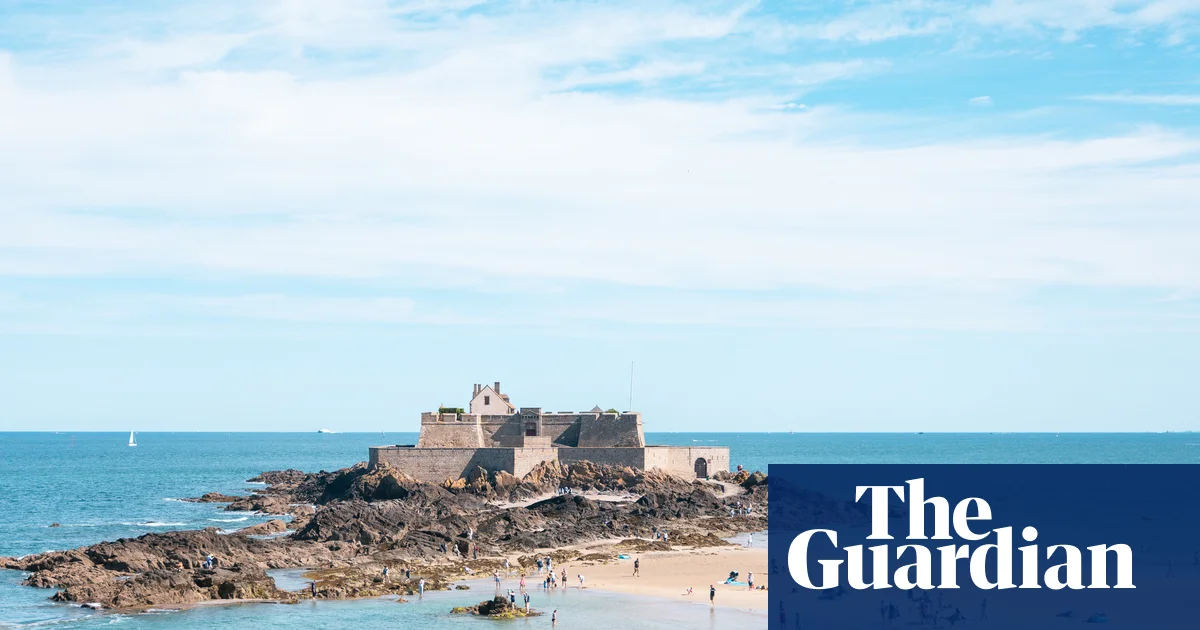
It was with that quest in mind that we found ourselves lost up a lush, densely wooded mountain in the Spanish Basque Country, on a track unsuited to bikes, as part of the first stage of a three-week road trip from Bilbao in northwest Spain to Saint-Malo in Brittany, north-west France.
I’ve always loved a road trip, and was hoping to recreate – in some limited way – a classic that I had done in my 20s. After living in Paris for two years, I and my then-boyfriend meandered across France for a month in my nan’s old Peugeot, camping in different places virtually every night. We stayed in fields where we were the only people for miles and watched eagles swooping as the sky darkened; we begged the manager of a stuffed-to-the-gills campsite to move his car so we could camp on his front lawn.
Bilbao’s Plaza Nueva. Photograph: Peter Eastland/Alamy
This would, of course, be different. My partner is deeply sceptical of camping. The kids still shudder at the memory of the toilets on the first campsite we ever stayed at. So how do you have a somewhat unstructured, kind-of-spontaneous road trip with kids?
We decided on a mixture of home swaps and posh camping, and started with a journey that is an adventure in itself. On board the two-night ferry from Portsmouth to Bilbao on Brittany Ferries’ Galicia, we spent hours watching pods of dolphins, reading our books, and sneaking back to our cabin for naps. It’s worth noting that while entrance to the first-class Commodore lounge isn’t cheap (prices vary by ferry; it’s £79 a person on the Portsmouth to Bilbao crossing), the excellent buffet is endlessly replenished; all drinks, including wine at meal times, are included; and the lounge is a peaceful haven.
Alexandra’s children on a bike ride in the Spanish Basque country. Photograph: Alexandra Topping
We rolled off the ferry, kicking off our escapade in Bilbao on the opening day of Aste Nagusia, the city’s annual nine-day party. After a stroll around the Guggenheim – arguably the best modern art museum in Europe – we headed to the Plaza Nueva in Bilbao’s Casco Viejo, where the pintxo bars were rammed with locals wearing blue and white checked scarves and shouting for more cider. The Spanish know how to live, but the Basques? They know how to party.
Full of anchovies, olives and salt cod, we drove north along winding roads up into the verdant mountains of the province of Gipuzkoa to our first stop, an apartment in the small hamlet of Berastegi, about 25 minutes from San Sebastián – a stay organised through the home swapping website Home Exchange. We are evangelical about home swapping, having saved thousands of pounds since 2022 with brilliant holidays in Spain, France, Denmark and the UK.
You frequently discover fabulous places you might never have heard of too, often on the recommendation of your hosts – such as Casa Julian, in charmingly sleepy Tolosa, where we ate a steak so good as to render all future steaks redundant. A devastating steak, frankly. A meal for four cost €234, and I would happily sell my car to eat there again.
Staying in Berastegi also allowed us to visit the bustling city of Pamplona, a 40-minute drive away, where we drank unctuous hot chocolate in Café Iruña, Hemingway’s old haunt, before learning about the running of the bulls on a grimly fascinating tour.
A view over San Sebastián from Monte Igueldo. Photograph: Sonia Bonet/Alamy
The money saved on accommodation also meant we could afford a night in a hotel in San Sebastián, where we ate, strolled, swam, then ate again. The city’s claim to have the greatest density of Michelin stars in the world is disputed, but when you are drinking a glass of cold txakoli and hollowing out a stuffed txangurro (spider crab) that hardly seems to matter. Kid-friendly trips to the cool aquarium (vital information: it has axolotls) and the 113-year-old Monte Igueldo amusement park were interspersed with a copious €20 menúdel día at Aldaba. Something for them, something for us.
Full, again, we took to the road, driving away from the mountains via the delightful French Basque coastal village of Bidart to our next stop en route to the French Atlantic coast.
Two hours from the traditional timber-framed baserri (farmhouses) of south-western France, the mist-shrouded mountains give way to the open flatlands of western France, long wide roads lined with pine trees and dunes that rise up from the crashing waves of the turbulent ocean.
We stopped in Arcachon at the Huttopia site, one of a family-run chain of nature-immersed campsites. The handsome seaside resort, with its 19th-century Arcachonnaise villas with names such as Esmerelda and Denis Papin, feels like the stately grand dame of the Atlantic coast.
Our luxury “évasion” chalet, with its nice toilet, strong shower and comfortable beds, was not, let’s face it, camping. But, nestled among the pines and deep in the forest, we sat on our deck listening to the soothing throb of crickets and got similar benefits, only without the discomfort. When we climbed the awesome Dune du Pilat, it felt like landing on the moon, and when we held hands and hurtled down it again, like we were taking off into space.
Three days later, the landscape transformed again as we drove to the flat salt plains of the Île de Noirmoutier, about one-and-a-half hours from Nantes, and set up home in a well-stocked Huttopia wood and canvas desert tent, next to the water’s edge and a short walk from the village of tiny white bougainvillaea-draped houses and restaurants. That night, as I sat outside the tent listening to the waves and the wind in the trees, I looked at the stars stretched out across the inky sky – and I remembered those eagles.
Cancale is celebrated as the oyster capital of Brittany. Photograph: Yurii Zym/Getty Images
To complete this family odyssey, we spent four days at another home exchange in the underrated Breton port of Saint-Malo, which has a wealth of charm, great food and delicious cider – as well as the most delightful coastal pool I have ever swum in.
On our last day, we went to Cancale, where I had tasted oysters for the first time, scooping them up from a plastic tray, with a glass of sancerre, on the beach. This time we opted for a restaurant, and while my son learned to slurp oysters, my daughter tried her first mussels. As she used an empty shell to pinch their juicy flesh and pop them into her mouth, I recognised that I get as much pleasure from their discoveries as from my own. And, I thought, maybe the adventure isn’t over after all.
Accommodation at Arcachon and Noirmoutier was provided by Huttopia: Chalet Évasion from €75; Toile & Bois tent from €69. Transport was provided by Brittany Ferries: Portsmouth to Bilbao for a car, four people and an ensuite cabin from £490 one-way; St Malo to Portsmouth from £225 one-way for a car plus four people. Home Exchange membership is £190 a year
CHICAGO — Dodgers left-hander Jack Dreyer rubbed a new baseball between his hands as he walked back to the mound, a sold-out Rate Field coming alive around him.
Fireworks crackled over the center-field scoreboard. Digital pinwheels spun. Dreyer had just surrendered his second home run of the inning, transforming a low-scoring battle into a lopsided White Sox advantage.
The Dodgers’ recent bullpen problems persisted in a 6-4 loss Sunday, overshadowing a bounce-back effort from Emmet Sheehan. The Dodgers tried to come back in the ninth, but fell short.
“We’ve gotten bit by the long ball, obviously in Pittsburgh, and here tonight,” said bench coach Danny Lehmann, filling in Sunday for manager Dave Roberts while he attended his daughter’s college graduation. “But overall, it’s more the strike throwing and just getting ahead of guys and doing what they’re supposed to do.”
The Dodgers dropped the series 2-1, marking their first series loss since May 8-10 against the Braves.
Sheehan was charged with three runs in five-plus innings, a massive turnaround coming off the second-shortest start of his career, only rivaled by a planned one-inning outing at the end of last season.
On Sunday, he didn’t give up a hit until the fourth inning.
“He got strike one and then understood when to leave the zone when he needed to,” catcher Dalton Rushing said. “He did a great job of that. I think a couple of those guys picked up on tendencies, jumped on a pitch. I felt they were good pitches. I thought he did his job today and gave us a chance to win.”
Sheehan’s velocity has been an indicator of how synced up his delivery has been on any given start this season.
Dodgers starting pitcher Emmet Sheehan delivers against the Chicago White Sox in the first inning Sunday.
(Nam Y. Huh / Associated Press)
On Sunday, his 95.1-mph average fastball velocity was 0.7 mph above his season average, according to Statcast — a promising sign. Results followed.
Sheehan retired 11 of the first 12 batters he faced, just a hit batter away from perfection. With two outs in the fourth, he gave up a double to Colson Montgomery, on a low line drive up the first-base line, just out of reach of Freddie Freeman as he made a diving attempt.
Then against Braden Montgomery, Sheehan worked back from a 2-1 count for an inning-ending strikeout.
Out of Sheehan’s hand, the pitch looked like it was going to cross the plate on the inside corner, about belt high. But as Montgomery started his swing, the firm changeup veered away from his bat at a sharp downward angle.
Montgomery swung over the pitch. A fired-up Sheehan buried his fist in his glove and shouted. With that strikeout, he preserved the Dodgers’ one-run lead.
Freeman provided that run with a solo homer in the first inning. And Sheehan gave the Dodgers plenty of time to extend that lead. In the sixth inning, however, the White Sox finally got to him.
“I definitely felt better early,” Sheehan said. “And then more of the same towards the end. Just pretty frustrating.”
Sheehan’s fastball to Sam Antonacci wasn’t in a bad spot. But in an 0-2 count, he could have put it a little higher or farther inside. Antonacci drove it over the right-field fence.
A single, a stolen base and an RBI double later, Sheehan walked off the mound, the Dodgers trailing 2-1.
Just a few weeks ago, turning the ball over to the Dodgers’ bullpen was a promising move. They were still riding a franchise-record streak of 38 consecutive scoreless innings.
Lately, however, it’s been a rocky ride. The bullpen entered Sunday with a 6.71 ERA since ending that scoreless streak on May 25. Only the Giants and Rockies produced a worse mark over that stretch.
None of the Dodgers’ relievers have been dominant in recent games. Tanner Scott has been credited with three saves but also two losses. Kyle Hurt’s ERA has risen from 0.60 to 4.22. Dreyer, who went 10 straight games without giving up a run before landing on the injured list with left shoulder discomfort, has surrendered five home runs in seven appearances since returning on May 31.
Dreyer gave up three runs and three hits. Then Blake Treinen and Jonathan Hernández held the White Sox the rest of the way.
The Dodgers tacked on three more runs, on a sacrifice fly and an RBI double from Alex Freeland, and a solo homer from Mookie Betts. They stranded runners at the corners in the ninth.