Voicemails for Isabelle’s Zoey Deutch is dating a fellow comedy star – here’s what we know about their secretive relationship
Everything we know about Zoey Deutch’s dating history
Zoey Deutch is captivating audiences once more, this time starring opposite Nick Robinson in Netflix’s unmissable romantic comedy Voicemails for Isabelle.
The heartfelt rom-com follows Deutch’s driven young baker Jill, who relocates to San Francisco for an opportunity to work under renowned but tyrannical Chef Bastien (portrayed by Nick Offerman), who transforms her professional life into a waking nightmare.
Meanwhile, her sister Isabelle (Ciara Bravo) has battled cancer throughout most of her existence. Following her sudden death, Jill processes the devastating bereavement by continuously calling her phone number and recording voicemails.
Yet these recordings are actually reaching real estate agent Wes (Robinson) after he acquires a new mobile, and he starts developing feelings for the enigmatic woman on the other end.
With Voicemails for Isabelle poised to become another enormous Netflix success this weekend, here’s what we’ve discovered about Deutch’s romantic life beyond the camera, reports Wales Online.
Who is Zoey Deutch dating?
The 31 year old Deutch is well-versed in romantic comedies, having secured her breakthrough performance alongside Glen Powell in 2018’s Set It Up.
She’s also Hollywood royalty as the daughter of Pretty in Pink director Howard Deutch and Back to the Future actress Lea Thompson.
Watch Netflix hits like Beef season 2 for free
This article contains affiliate links, we will receive a commission on any sales we generate from it. Learn more
Sky is giving away a free Netflix subscription with its new Sky Stream TV bundles, including the £15 Essential TV plan. This lets customers watch live and on-demand TV content without a satellite dish or aerial and includes the new season of Beef.
Deutch has been romantically involved with actor and comedian Jimmy Tatro, 34, since 2021.
Following his breakthrough performance in Netflix’s mockumentary series American Vandal, viewers may spot him from recent productions Theater Camp, You’re Cordially Invited and Scream 7.
In September 2025, the couple revealed they had been secretly engaged for three months through a joint Instagram post.
Posting a charming photograph from the proposal, which took place during a sunny beach getaway, they captioned it: “three months engaged to the love of my life”.
Their engagement appears to remain intact, as Deutch featured images of them together in a carousel posted to her account in April this year, with the caption “one less lonely girl”.
Content cannot be displayed without consent
Prior to her romance with Tatro, Deutch was in a five-year relationship with actor Avan Jogia, whom she met at the 2012 Kids’ Choice Awards.
Although they parted ways in 2017, the former couple went on to appear alongside each other in The Year of Spectacular Men and Zombieland: Double Tap, indicating they maintained an amicable split.
Following her separation from Jogia, Deutch had a brief romance with Dylan Hayes, also an actor.
Details about their relationship remain scarce, although they were photographed attending several public events as a couple.
Voicemails for Isabelle is available to stream on Netflix.
WASHINGTON — Colombian presidential candidate Abelardo de la Espriella has vowed to crush criminal groups and slash government programs. He promises to bomb “narco-terrorist” camps and build sprawling mega prisons if he wins Sunday’s runoff election.
De la Espriella’s views have earned him the vociferous backing of President Trump, who has broken with White House tradition by publicly seeking to tip the scales in foreign elections — particularly in Latin America.
After Trump gave his “complete and total endorsement” to De la Espriella, whom he referred to by his nickname, “El Tigre,” the candidate posted an AI-generated image of a bald eagle and a tiger, with American and Colombian flags waving side by side.
“You have paved the way for the people to defeat the entrenched powers that have long held sway,” he wrote to Trump. “In Colombia, we have now begun to follow the same path.”
De la Espriella, a political newcomer who built his campaign around gym workout videos and vows to “disembowel” the left, is part of a new wave of far-right, MAGA-aligned politicians in Latin America openly borrowing from Trump’s playbook, presenting themselves as outsiders who will trim the government, curtail immigration and militarize law enforcement.
In a region that remains plagued by high crime and inequality after a decades-long period of leftist domination known as the “Pink Tide,” the playbook appears working.
More Latin Americans now identify with the right than at any time over the last two decades, according to polling firm Latinobarómetro. A series of conservatives have won presidential elections in recent years, giving Trump a slate of willing partners as he seeks to expand U.S. power in the region, combat drug cartels and counter growing Chinese influence.
President Trump meets with El Salvador’s president, Nayib Bukele, in the Oval Office of the White House on April 14, 2025.
(Brendan Smialowski / AFP via Getty Images)
Among Trump’s many allies are Argentina’s Javier Milei, a libertarian firebrand whose dramatic cuts to state services were a blueprint for Elon Musk’s so-called Department of Government Efficiency, known as DOGE; and El Salvador’s Nayib Bukele, a mano dura autocrat who housed U.S. deportees in his notorious prisons to assist Trump’s immigration crackdown.
Ecuador’s Daniel Noboa has welcomed U.S. Special Forces, who are attacking drug traffickers in his country, and Chile’s José Antonio Kast has pledged a border wall along his country’s frontier with Peru and Bolivia in his quest to “make Chile great again.”
Trump might soon gain another ideological bedfellow in Peru with the election of Keiko Fujimori, the daughter of late autocrat Alberto Fujimori. With ballots still being counted, Fujimori was on track for a narrow victory
In a sea of nations led by conservatives, the left now retains power in just three key countries: Mexico, Colombia and Brazil.
It faces serious challenges in two of them.
Ahead of October’s presidential election in Brazil, incumbent Luiz Inácio Lula da Silva, a leftist stalwart and one of the last vestiges of the Pink Tide, has been polling even with Flávio Bolsonaro, the son of former President Jair Bolsonaro, a Trump ally convicted of convening a Jan. 6-style insurrection.
Brazil’s President Jair Bolsonaro, right, with President Trump during a dinner at Trump’s Mar-a-Lago estate in Palm Beach, Fla., on March 7, 2020.
(Alan Santos / Associated Press)
And then there’s Colombia, where De la Espriella, a criminal defense attorney, surged ahead in the first round of voting and this weekend faces off against Sen. Iván Cepeda, an ally of leftist President Gustavo Petro.
Petro drew Trump’s ire by denouncing the U.S. military campaign to oust leftist President Nicolás Maduro of Venezuela and a spate of lethal U.S. attacks on alleged drug boats.
Petro slammed Trump’s endorsement of De la Espriella, calling on Colombians to “vote freely and not allow ourselves to become either slaves or anyone’s colony.”
Mexican President Claudia Sheinbaum also accused Trump of electoral interference after the U.S. announced drug trafficking charges against several members of her ruling Morena party and The Times revealed that two more sitting governors are under investigation.
“Is it truly a legitimate interest to combat organized crime?” Sheinbaum asked of the U.S. investigations. “Or are we perhaps witnessing how sectors of the American far right … intend to influence the 2027 election in our country?”
President Trump meets with Argentine President Javier Milei during the United Nations General Assembly on Sept. 23, 2025, in New York.
(Evan Vucci / Associated Press)
The White House has declined to comment on Sheinbaum’s criticism. But Trump earlier this month warned Mexico that his administration is “focused on coming in by land” to deter drug trafficking.
“President Trump has been clear that Mexico must do more to combat the drug cartels running rampant in their country,” a White House official told The Times when asked whether Trump is planning a military operation there.
Trump, who publicly backed Kast and President Nasry Asfura of Honduras, as well as Milei’s political party ahead of Argentina’s midterm elections last fall, has openly mused that he should charge money for endorsement of leaders in foreign countries.
Guillaume Long, who served as foreign minister in Ecuador under leftist President Rafael Correa and who is now a fellow at the Center for Economic and Policy Research, criticized Trump’s “unprecedented, unabashed interventionism in Latin American politics.”
“There are a number of taboos that have been broken,” he said.
Long added that Latin America is mirroring the United States in its political divisions. “I think we’re likely to see in the coming decades a very polarized politics,” he said. “And that doesn’t bode very well for political stability.”
Much of Trump’s activity in the region, including the deposing of Maduro, has been presented as part of a war on drug cartels, which the White House has formally declared terrorist organizations. Long described that rationale as a “pretext” for expanding U.S. political and economic influence in the region.
Nicolás Maduro and his wife, Cilia Flores, are escorted by federal agents as they make their way to an armored car for a trip to a federal courthouse in Manhattan on Jan. 5.
(XNY/Star Max/GC Images)
He said he believed that focus on cartels had pushed some Latin American politicians to the right “because they think being security hawks will make them popular with the Trump administration.”
But James Bosworth, the founder of Hxagon, a company that provides political risk analysis in Latin America, said many leaders in the region have come to tough-on-crime policies on their own.
“I think that some of the hemisphere is willing to play along with it because the hemisphere has issues, including security issues, where the U.S. can be of assistance,” Bosworth said. “Many Latin Americans do want a greater military focus, so there’s certain alignment that’s occurred.”
Conversely, Mexican journalist Alex González Ormerod said he believes Trump has been influenced by Latin American leaders, including Bukele, who suspended civil liberties and began locking up alleged gang members en masse in 2021.
“I think there’s a lot of cross-pollination going on,” he said, crediting groups like the Conservative Political Action Conference, a gathering of right-wing activists and elected officials that has hosted events in Brazil and Argentina.
Many analysts cautioned that Latin America operates on a pendulum, swinging every few years between right and left.
“There’s a lot of evidence that voters are just unhappy and voting for the opposition, and then losing patience very quickly with whoever is in office,” said Benjamin Gedan, director of the Latin America Program at the Stimson Center.
Voters dissatisfied with the status quo so often vote out incumbents there is a phrase for it: voto castigo, or “the punishment vote.”
Ceballos reported from Washington and Linthicum from Mexico City.
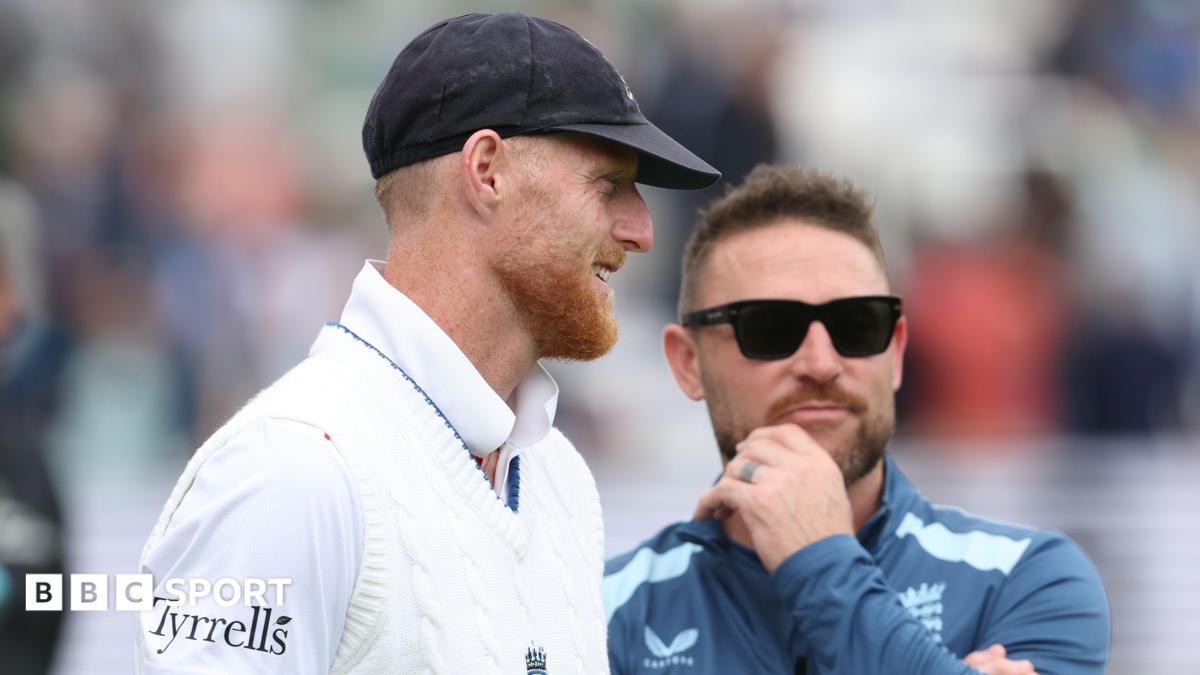
England head coach Brendon McCullum says he is ready to work with Ben Stokes when the captain returns for the third Test against New Zealand at Trent Bridge.
The results of the investigation are still to be confirmed, but McCullum has confirmed Stokes will return as captain, a position he has held since 2022, in Nottingham.
“Ben will be back,” said McCullum. “He’ll be back and he’ll be captain.”
Following a 4-1 Ashes series defeat that was dogged by off-field problems, both Stokes and McCullum denied their relationship had deteriorated in Australia.
Then, following England’s win in the first Test since the Ashes – against New Zealand at Lord’s – Stokes broke the team’s midnight curfew in celebrating the victory.
On his relationship with Stokes, McCullum told BBC Test Match Special: “You’re just trying to make sure you’re very communicative right throughout.
“We all got the same ambition, which is to make English cricket a very good team and to try to achieve results on the field, and that hasn’t changed.”
McCullum said he has spoken to Stokes “every day” since the nightclub incident, which occurred in the early hours of Monday, 8 June.
The New Zealander also confirmed England director of cricket Rob Key has visited Stokes this week.
UK minister says Starmer considering ‘political realities’ after Labour rival Andy Burnham secured decisive by-election win.
British Prime Minister Keir Starmer is weighing whether to resign within days, according to media reports, amid mounting pressure from his own Labour Party following a decisive by-election win by his rival, Andy Burnham.
Expectation is growing that Starmer could announce a resignation timetable as soon as Monday, the same day Burnham is sworn in as a lawmaker after winning Thursday’s vote by a wide margin – a result that has reportedly emboldened Labour figures, including Foreign Secretary Yvette Cooper, to call for Starmer to step aside.
Recommended Stories
list of 4 itemsend of list
A resignation would lead to the United Kingdom’s seventh prime minister in a decade, a rapid rate of churn in the country’s modern history.
Starmer has been under growing pressure to step down after months of declining popularity, policy missteps and scandals.
In February, the premier came under fire when revelations from the Epstein files about Peter Mandelson, whom Starmer appointed as the UK’s ambassador to the US in December 2024, came to light.
Burnham, Greater Manchester mayor since 2017, has made clear he intends to challenge to lead the slumping centre-left party, warning in his by-election victory speech that it had a “final chance to change”.
If successful, he would become prime minister by default, given that the governing Labour has a huge parliamentary majority.
Starmer is deeply unpopular with voters, according to polling.
YouGov, a global public opinion and data analytics firm, reports that only 19 percent of British people have a positive opinion of the prime minister, and he ranks as the ninth most popular Labour politician.
Starmer has insisted he will fight any attempt to oust him.
But the emphatic nature of Burnham’s win in the Makerfield constituency in northwest England, where he nearly doubled Labour’s majority, has increased the internal pressure on Starmer to quit.
Business Secretary Peter Kyle said on Sunday that Starmer was “making time to reflect on the political realities, challenges and opportunities that he finds himself in”.
“He has been engaging in conversations with a wide, wide range of people,” Kyle told the Sky News broadcaster after having what he said was a “frank” conversation with Starmer on Friday.
The Observer newspaper headlined on its cover on Sunday that Starmer was “expected to resign” the following day, while the Sunday Telegraph also reported he was “ready” to go, citing allies of the embattled British leader.
The Observer said Starmer would “set out a timetable for his departure”, noting he had been holding weekend talks at Chequers, the countryside retreat for prime ministers.
Labour’s drubbing in local and regional polls in England, Scotland and Wales last month intensified the pressure on him.
The fallout from the polls saw Makerfield’s previous Labour MP resign to allow Burnham to stand there.
Burnham, a former MP and government minister under ex-prime ministers Tony Blair and Gordon Brown, is due to be sworn back into parliament on Monday.
From the so-called soft-left wing of Labour, he reinforced his reputation as the party’s most popular figure by easily beating the hard-right populist Reform UK party’s candidate in this week’s by-election.
Reform, led by Brexit architect Nigel Farage, had won all of Makerfield’s wards in last month’s local elections.
THAT sickly, ingratiating grin isn’t for everyone. It isn’t for you. It seems to specifically be for women employed to serve him, like these:
Waitresses
Over she comes, asking if you’d like more drinks, and there his face goes. His voice drops an octave, his mouth contorts into a strange shape and his eyes meet hers with full force. He knows you’re sitting there but can’t help simper about how wonderful the Aperol spritz he was just whinging about is. She doesn’t react. She sees this every day.
Flight attendants
Children are less needy for attention than boyfriends on long-haul flights. She’s forced to endure his requests for pillows and flight information and has to remind him to fasten his seatbelt every time because it means she looks at his crotch. He spends eight hours with an insincere smirk screwed to his face, swapping it for a face like a slapped arse the moment he disembarks.
Nurses
Nursing staff are under enough pressure without having to deal with a man with an unnatural beam fixating on them. You can’t visit an elderly relative without him flashing a sordid smile at every one that passes and boasting of his own good health which, given the circumstances, is pretty f**king tasteless.
Police officers
There’s a little back-and-forth going here: his soulless smile is acknowledging her power over him but finding it sexy, while she’d love to club him unconscious but isn’t allowed. You’re the witness to this unsavoury interaction and keep being glanced at as if the nauseating expression on his face is your fault, rather than a borderline sex crime.
Barmaid
The woman pulling pints is the female worker your boyfriend saves his creepiest smile for. Because he’s in a pub, he thinks there’s an extra level of sickly behaviour allowable. Fortunately an in-built resistance to pervy boyfriends is part of the job and she ignores his fixed grim becoming a little more grotesque with each pint. She isn’t paid enough.
A travel journalist who travelled to Italy said they were nearly caught out by a rule introduced in the city of Venice to improve cleanliness
A journalist has talked about what happened when they visited Venice(Image: Emanuele Cremaschi/Getty Images)
A travel journalist who visited Venice said they nearly lost £86 after breaking a rule they didn’t know about. Joey Handler, a travel journalist, spent six days in Italy travelling around the iconic European country, visiting various popular cities en route.
However, in one of their latest pieces, they admitted they had five regrets from their time in Italy which formed part of a two week trip around Europe.
Reflecting on the trip, back in October 2022, the Joey touched on how at one point in Venice they were stopped by the authorities for doing an act they thought was innocuous.
Joey said the incident occurred after she had completed a walking tour and went for some lunch. Eventually, after passing full restaurant after full restaurant she said she cut her losses and bought an ice cream before deciding to sit down.
However, it was the sitting down that was the problem. The Business Insider journalist explained: “I eventually cut my losses and stood in line for gelato before sitting on a shaded step to enjoy it.
“As I was about to take my first bite, the nearby authorities waved their hands up and down at me — a gesture I could only take to mean ‘get up’. And there I was, committing an etiquette violation that, according to the City of Venice, may result in a fine of 100 to 200 euros.”
As well as being informed by the local authorities about the rule, tourists and others can also be informed by the local government website. On this rule, they said: “Do not consume food and drink sitting on the ground, do not sit or lie down on banks and foundations, monuments, bridges, steps, puteals and high-water walkways
“Fine: 100 to 200 euros DASPO – Urban banning order (offenders will be immediately banned from the place where the offence was committed).”
This means that offenders could be fined anywhere between £86.74 and £173.48 if they’re caught. On why such rules, which include not swimming in the canals, dumping rubbish, walking around in a swimsuit, feeding pigeons and seagulls, not cycling, and not bivouacking in public areas, are in place, the local authority say is to preserve the environment.
They explained: “Current regulations enforced by the Venice City Council Municipal Police forbid certain behaviour, in order to preserve urban cleanliness and landscape, and also for reasons of safety and public hygiene.
“The violation of such regulations involves the application of administrative fines – from €25 to €500.”
This isn’t the only charge people can face if they travel to Venice with tourists als facing an entrance fee which was introduced in 2024 by the city. This fee is around €5 (£4.34) and originally applied on peak days between April and July before being expanded.
However, the new mayor of Venice Simone Venturini, has talked about the possibility of increasing this to €50 (£43.37). He told Corrier della Sera: “If today it ranges from €5 to €10, my proposal is to increase it to €30 to €50.”
Whilst move was in part a reaction to the sheer number of tourists, opponents have warned it risks not being true to the city itself. Former mayor Massimo Cacciari went further and called for the scheme to be removed altogether: “There is no other city in Italy or Europe where you have to enter with a ticket, as though it was a museum.
“It is barbarous, uncivilised and, in my opinion, against the constitution. It is simply obscene. I thought that Venturini would be more intelligent than his predecessor and would scrap the fee.”
SWIMMING with sharks in the dark and no cage? Well that is a Jaws-droppingly bold idea.
Just a couple of hours after arriving at the Sun Siyam Iru Veli resort in the Maldives, and being wowed by my over-the-water villa, I’d plunged straight into the aquatic action with an intense but exhilarating experience.
Sign up for the Travel newsletter
Thank you!
Sun Siyam Iru Fushi resort and its over- the-water villasCredit: suppliedDrive a JetCar at Sun Siyam Iru FushiCredit: supplied
My group of five guests would be night swimming by a coral reef with nurse sharks, which are generally docile around humans.
But they are up to 10ft long and have around 75 teeth!
As the sun set over the Indian Ocean, we gathered at the dive centre to get kitted out and be briefed by guides Alex and Ammaday.
I’m an experienced snorkeller, but it took me a while to get the hang of following the group and coping with the current and waves.
I was definitely not hanging back to avoid being first on any shark buffet.
Armed with underwater torches, we spotted colourful fish and corals before several nurse sharks swam towards us, some of which were 8ft in length. Absolutely fin-credible.
It is one of various extra-charge activities (£80pp) at the cosy five-star all-inclusive resort in Dhaalu Atoll, now with Privé Collection status after Maldivian-owned Sun Siyam rebranded to mark its 35th anniversary last year.
And now that the Foreign Office has scrapped its advice against travel to destinations such as Doha, flights to this sun-soaked hotspot will be smooth again.
The bucket-list experiences don’t end with sharks.
Another on offer at this resort is the chance to be “cast away” on a desert island, a couple of miles offshore and only accessible by speedboat.
Just us and a resort host on a 200-yards-long by 30-yards-wide sandbar surrounded by pristine sea that’s perfect for snorkelling.
Like the radio show, your Desert Island Discs-covery comes with a “luxury item” — a Japanese bento box and prosecco lunch under a sunshade to refuel you while you enjoy blissful seclusion (experience costs £158pp).
There are plenty of activities included in the price of a stay, too, including guided daytime snorkel tours of the house reef (I found Nemo) and a trip to neighbouring island Ban’didhoo, where some of the 125-villa Iru Veli’s staff live.
Most of the 600 inhabitants work in the fishing industry and our guide Altho showed us the marina where mackerel, yellowfin and bluefin tuna are landed.
To stop overfishing, only rod and line is legal.
After checking out the 17th-century coral-walled mosque, kids’ parks, outdoor gyms and a football ground financed by Sun Siyam, I nosed around a souvenir shop, a 24/7 convenience store (Maldivian WD-40, who knew?) and the small shipyard by the beach.
Dive with nurse sharks on your holiday to Sun Siyam Iru VeliCredit: GettyRelax in this luxury water villa with poolCredit: Unknown
While there are no resorts on this local island, there is one guest house, the friendly Divhoni, with clean rooms from £55 a night B&B. It’s well worth seeing where Maldivians actually live and work.
As for the other excursions, guests staying at Iru Veli are also entitled to a complimentary sunset cruise to spot dolphins, and £77pp spa credit or scuba, if PADI certified.
All of the swimming and snorkelling requires high energy and the resort’s restaurants can certainly help with that.
Much as I liked the food at the Aqua Orange main buffet, which is included in the price of a stay (the butter chicken curry with ginger pickle was awesome), the most memorable meal was at extra-charge Japanese-themed Teppanyaki, with incredible egg juggling, groan-worthy jokes and stellar chicken, steak, lobster and yellowfin tuna from chef Irvan (set menu £108pp and veggie £71pp). No prizes for guessing where the tuna came from.
One paradise island is never enough, though, and I spent the second half of my week at Sun Siyam’s five-star Iru Fushi resort in the North Male Atoll; like Iru Veli, a 45-minute seaplane transfer from the international airport.
And no sooner had I arrived than I was leaving!
Wild horses couldn’t normally drag me away from a tropical beach, but the throbbing 200 horsepower of a four-seater white “Rolls-Royce” jet car was irresistible.
But you don’t have to be a secret agent facing down metal-mouthed baddie Jaws to bag this showstopper.
Starting at £94 for two, you can take the jet car out (escorted by a guide on a jetski) for a thrilling 45mph blast across the ocean that you’ll be telling your mates about for months.
Add drone videos to smash it on socials.
It’s one of various extra-charge activities at the gorgeous Luxury Collection all- inclusive resort.
Have breakfast in the villa’s poolCredit: supplied
GO: THE MALDIVES
GETTING / STAYING THERE: Seven nights’ all inclusive at Sun Siyam Iru Veli in a beach villa with pool is from £2,699pp (based on two people sharing) including flights from the UK on September 10 and seaplane transfers.
Seven nights’ premium all-inclusive at Sun Siyam Iru Fushi in a deluxe beach villa is from £2,299pp (for a family of four) including flights from the UK on August 13 and seaplane transfers.
Others include an Insta-fave floating breakfast in your villa’s infinity pool (£108 for two with fizz).
But there’s so much already included, you can have a brilliant week without spending more than the cost of your holiday in this archipelago of 1,200 islands.
Top of your list will be the Secret Sundowners pop-up bar (alcoholic and non- alcoholic cocktails at Sun Siyam resorts are terrific), wine tasting, kayaking and SUP, guided reef snorkelling and the excellent Sax On The Beach music session.
Food is also a highlight of any Maldives getaway and Sun Siyam’s inclusive restaurants and buffet are so good, you don’t necessarily need to visit a la carte venues.
However, the prawn thermidor I had at Islander’s Grill was sensational.
As was my accommodation, an over-the-water butler-service villa larger than some flats I’ve lived in and with an infinity pool, spa bath and direct sea access.
Iru Fushi has 221 villas and you will rack up your daily steps count getting around this sizeable resort, be it to the dreamy, award-winning Thalgo spa, Fluid bar and its terrific family pool, the adults’ pool and adjacent beachfront No Mistake bar (an unmissable spot), the highly-rated (and included) curry and pan-Asian restaurants or the water sports and dive centre.
You could just lie on the blissful beaches in the Maldives — or you could also drive on the sea like Bond and swim with sharks in the dark.
Weekly insights and analysis on the latest developments in military technology, strategy, and foreign policy.
Russia’s mysterious Burevestnik (also known to NATO as SSC-X-9 Skyfall) cruise missile likely leaves a trail of radioactive material in its wake, making the weapon even more alarming than was first thought. This is the conclusion of two scientists from the Massachusetts Institute of Technology (MIT), who have recently published a detailed analysis of one of the so-called ‘super weapons’ revealed by Russian President Vladimir Putin back in 2018.
The report, from Jake Hecla, an MIT professor who covers aerospace and nuclear science and engineering, and co-author R. Scott Kemp, provides the most compelling analysis so far on how the Burevestnik is actually powered. Uncertainty around this has led to previous questions about whether Russia’s claims of nuclear propulsion for the weapon even stack up.
A view of the Burevestnik test site at Pankovo, on Yuzhny Island in the Novaya Zemlya archipelago, with a missile launcher in the raised position. via X
First, it’s worth recalling what we know about the Burevestnik program’s development milestones, which appear to have been punctuated by accidents.
It is also worth noting that there have been previous efforts to create nuclear-powered aircraft and missiles.
During the 1950s, both the Soviet Union and the United States tested airborne nuclear reactors aboard strategic bombers, the B-36 Peacemaker and the Tu-95 Bear, respectively. Neither of these trials actually saw the reactors drive the aircraft’s engines.
Under Project Pluto, the United States studied a nuclear-powered cruise missile and got as far as testing a reactor on the ground in 1964, before the idea was abandoned. The Pluto concept of operation was somewhat different to the Burevestnik, with the missile intended to fly at treetop level at Mach 3.5 and dispense nuclear weapons at different points along its flight path by performing “pop-up” maneuvers.
Soon after Putin’s 2018 announcement, the Norwegian-based environmental group Bellona suggested that a radiation spike in the Arctic that same winter may have been caused by a test of the missile.
Later in 2018, a U.S. intelligence report described the loss at sea of a Russian nuclear-powered missile during a 2017 test. The report added that Russia was expected to embark on a search and recovery mission to try to lift the missile’s wreckage from the seabed.
Then, in 2019, an explosion occurred aboard a barge in the White Sea, outside Nenoksa, killing five Rosatom scientists. It also led to a radiation spike in the Russian city of Severodvinsk, as you can read more about here. The explosion has been blamed on a reactor from a Burevestnik recovered from the sea, likely the one that was lost in 2017.
Last October, Russia’s Chief of the General Staff, Valery Gerasimov, announced that a successful test of the Burevestnik had been carried out, high above the Arctic Circle. Gerasimov said that the 15-hour flight “is not the [maximum] limit” for the missile. This appears to have been the first long-endurance test of the missile.
Hecla and Kemp agree that the October 2025 test was a success and that, moreover, it marks the first time a true nuclear-powered aircraft has ever flown for a sustained period.
This leads to the question of how the Burevestnik actually converts energy from its nuclear reactor into propulsive power to keep it in the air.
Hecla and Kemp may well have provided the answer.
Based on data that the researchers gathered, the size, shape, and performance of the Burevestnik indicate a different kind of propulsion system than envisaged for Project Pluto. The U.S. concept involved a ramjet, required to ensure supersonic performance in the atmosphere.
In the 1960s, the U.S. Air Force explored this idea with its Supersonic Low Altitude Missile, or SLAM. This weapon employed a nuclear-powered ramjet along with conventional rocket boosters to kickstart the system. Once at the appropriate speed, the engine would blow air over the reactor, which could have enough fuel to operate for weeks or months on end, and then force it out of an exhaust nozzle to produce thrust.
The Tory II-C nuclear ramjet engine was tested in 1964 and helped inform the abortive Supersonic Low Altitude Missile, or SLAM, program. Public Domain
The Burevestnik is “very obviously a subsonic system,” Hecla told NPR.
By comparing open-source imagery of the Burevestnik, the researchers calculated that the missile is approximately 31 feet (9.5 meters) in overall length, with a wingspan of approximately 18 feet (5.6 meters). It likely flies at a speed of around Mach 0.75.
A size comparison from the report includes the Burevestnik alongside the Russian Kh-101/102 air-launched cruise missiles and the BGM-109A Tomahawk. Modeling the Performance of the Burevestnik Nuclear-Powered Cruise Missile, Jake J. Hecla and R. Scott Kemp.
They conclude that the Burevestnik is “almost certain” to use a direct-cycle air-breathing nuclear propulsion system, which probably drives a turbojet.
In a direct-cycle system, air is drawn from the atmosphere and passes directly through the reactor core. A compressor forces the air through thousands of narrow, tube-like channels surrounding the nuclear fuel, where the heat generated by nuclear fission raises the air’s temperature. As the heated air expands, it exits the rear of the engine to produce thrust.
A grainy screengrab, released in 2018, that may show the nuclear-powered cruise missile during a test flight. via Channel One Russia
This approach differs fundamentally from most nuclear reactors, which use an indirect, closed-loop design. In those systems, a sealed coolant — typically water or another heat-transfer fluid — circulates through the reactor to carry heat away while keeping radioactive materials contained and minimizing radiation exposure.
Comparison of a direct-cycle nuclear turbojet and an indirect-cycle equivalent. Modeling the Performance of the Burevestnik Nuclear-Powered Cruise Missile, Jake J. Hecla and R. Scott Kemp.
While some kind of indirect loop design is not impossible, the researchers consider that it’s highly unlikely, due to the simple fact that these systems are considerably larger, heavier, and more complex and couldn’t be accommodated in what is by no means a huge missile.
This means that the Burevestnik is likely propelled using heated air that is drawn directly through the reactor core.
The resulting powerplant is simpler and more compact, but it comes with a serious drawback: “The direct cycle is very likely to result in a large quantity of radioactive material in the exhaust,” Hecla contends.
Essentially, as clean atmospheric air passes through the tiny tubes in the reactor, it gets irradiated and infused with fission decay products from the nuclear fuel.
The hot air that passes out of the end of the turbojet would be filled with radioactive isotopes of argon, krypton, and carbon, all of which would be scattered in its wake.
A notional Burevestnik concept of operations consists of launch using a kicker, then transitioning to solid rocket booster power. This then allows a slow spool-up to nuclear cruise at high-subsonic speeds. Alternatively, the boosters may be for testing purposes only, and the nuclear engine system may instead use hydrocarbon fuels to slowly taper from conventional power to nuclear power. Modeling the Performance of the Burevestnik Nuclear-Powered Cruise Missile, Jake J. Hecla and R. Scott Kemp.
The longer the missile flies, the more of this harmful waste it would pump into the atmosphere, and onto the surface below.
The researchers highlight another problem, too.
Namely, any kind of prolonged flight is likely to result in corrosion of the reactor core, through a combination of heat and compressed air. This would create yet more radioactive particles.
Based on previous evidence, it seems that Russia might already be battling with the problems inherent in handling, loading, and testing a missile with this kind of propulsion system.
The Russian Ministry of Defense released the video below in 2018, saying that it showed an earlier Burevestnik test launch, as well as examples of the missiles themselves.
Крылатая ракета с ядерным двигателем «Буревестник»
The MIT researchers consider that the fatal 2019 explosion in the White Sea was likely a failed attempt to recover a prototype Burevestnik reactor. The reactor is presumed to have restarted as it was being raised from the seabed, leading to an explosion.
Bearing all this in mind raises the question of why Russia set about developing the Burevestnik, especially when it has so many other ‘novel’ weapons in the works or already fielded.
Ultimately, the major advantage of the Burevestnik is almost unlimited range, something that we have discussed in the past:
“The missile can be launched preemptively and approach its target from any vector long after launch. For example, it could be launched from the Arctic, stay aloft for many hours, and then attack the United States from the south. Once launched, its flight path is entirely unpredictable, and it could exploit holes in defenses and weaker spots in early warning capabilities. It provides another reason why space-based tracking layers, including those that can spot low-flying aircraft, are currently very much on trend.”
Conclusions:
1. Burevestnik is not a strategic game-changer, and does not provide decisive warfighting advantages beyond existing nuclear forces.
2. It is likely a hedge against missile defenses with a niche capability complicating warning, tracking, and defense planning. 3/5 pic.twitter.com/nYzbZquthK
On the other hand, the Burevestnik doesn’t appear to be very fast or difficult to intercept once detected.
There is also its inherent inflexibility, since Russia has said it is only envisaged as being used with a nuclear warhead. While this could change, the size and weight of a conventional warhead would be more limited, and it’s questionable if Russia would risk employing such a complex missile to deliver a relatively modest conventional charge, especially since it would leave a potentially lethal radioactive footprint regardless.
“It leaks radiation, making it easy to track; it’s slow and un-stealthy, making it easy to shoot down; and the inside of the missile degrades during reactor operation, calling into question its ‘unlimited’ range,” William Alberque, a former director of strategy, technology and arms control at the International Institute for Strategic Studies (IISS), told TWZ.
“There are so many reasons everyone abandoned this concept in the Cold War,” Alberque added.
Conclusions (con’t):
5. It is 9.5m long with a reactor core diameter of 50 cm and requires regular boosters for launch and terminal phases.
6. In short, Burevestnik is a costly and hazardous symbol system with the potential to kick off a broader nuclear-propulsion race. 5/5 pic.twitter.com/NOdZ1lz6ZG
Hecla and Kemp assess that Russia’s reason for embarking on the Burevestnik is likely more to do with proving technologies for more ambitious and advanced programs further down the line. These could include nuclear-powered surveillance drones or space-based nuclear systems that would have considerably more military value.
People are asking what’s the purpose of Burevestnik and why develop a system that is very much useless as a weapon. The answer has always been right there, in the 1 March 2018 address. Russian president has always wanted to say these words. The rest doesn’t matter really. pic.twitter.com/0Q7JUGBqo3
Another possibility is that this is a ‘pet project’ of Putin himself, the Russian leader having been wooed by the idea of a missile with near-limitless range, regardless of the practical utility.
On the one hand, the latest analysis does suggest that the test last October means that the Burevestnik is the first aircraft ever built and flown in a sustained manner using nuclear power.
That is a landmark, but it’s one that’s tempered by very significant questions about the safety of anyone in its vicinity, and the environment at large, not to mention its somewhat limited military value.
Juliet Aubrey, who has enjoyed a long and varied acting career, previously recalled her experience working with John Nettles on Midsomer Murders
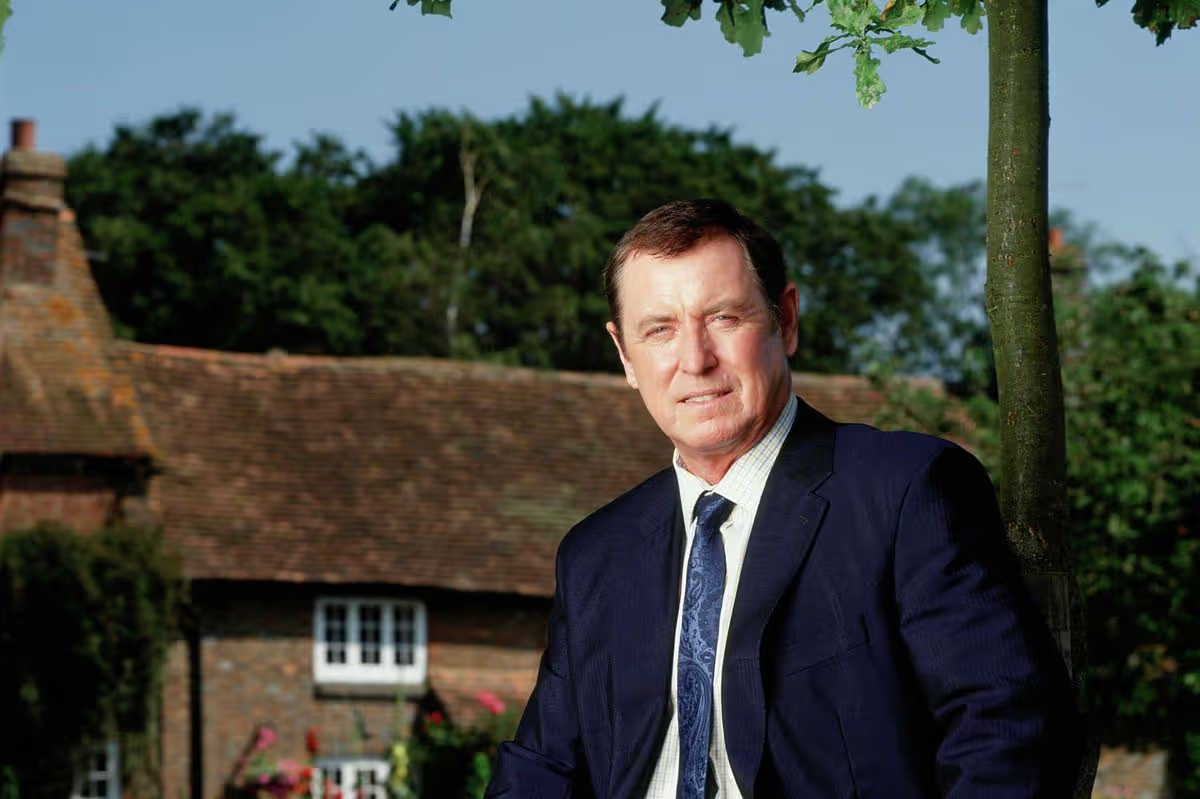
John Nettles starred as DCI Tom Barnaby in Midsomer Murders (Image: Getty Images)
An actress who previously worked alongside John Nettles on Midsomer Murders has used just one word to sum him up.
Juliet Aubrey appeared with the DCI Tom Barnaby star in a 2006 episode, and has reminisced about her experience on the much-loved ITV crime drama.
The screen and stage performer, perhaps best recognised for portraying Dorothea in the BBC’s 1994 adaptation of Middlemarch, which earned her a Bafta, has since appeared in Snatch, Primeval, All Creatures Great and Small and The White Queen.
However, when questioned about one particular role, she had nothing but praise to share.
“That was fun, that was a really fun role because she was quite an extreme character,” Juliet revealed, discussing Midsomer Murders.
She continued: “She’s a horse-riding nymphomaniac basically! [It was] lots of fun doing that.”
Reflecting on her experience with the ensemble, Juliet remarked: “The cast on Midsomer Murders, they were lovely, they were great… John Nettles was wonderful,” reports the Express.
“It’s nice going in and doing a storyline and then coming out and doing something else, rather than being stuck in a series for a long time.”
Despite her extensive catalogue across numerous television programmes, Juliet maintained she doesn’t pick favourites.
She explained: “There are just so many wonderful parts, and at the time you think they’re a favourite and then the next one comes along and you go, this one.
“I mean, there’s so much variety… to be able to asked to play all these very, very different characters, it’s been wonderful, love it.”
Having taken on a variety of screen roles, Juliet has returned to the stage, and is presently appearing in a production of The Marquise.
“I always used to do loads of theatre, that’s my whole background,” she shared.
Discussing the Noel Coward play in which she’s currently performing, she added: “It’s very fast-paced, lots of laughs, and it’s about love and betrayal and lust and hope and new beginnings, all of that, it’s really good fun.”
She continued: “It’s completely different to anything I’ve ever played before. It’s comedy, and it’s really nice to be getting into a really happy place every day, and she’s fantastic.”
SACRAMENTO — Gov. Gavin Newsom vetoed legislation to require proposed data centers to provide estimates of their water usage last year, saying he was “reluctant to impose rigid reporting requirements” without understanding the impact on businesses and consumers.
Opposition to the mammoth tech hubs and their massive thirst of water, power and land has only escalated throughout the state and nation ever since. In just a matter of months, Newsom again could find himself in the political crosshairs.
Several bills to regulate the facilities and increase public transparency on their impacts are progressing in the California Legislature, which could create a conundrum for a governor who has long aligned with the tech industry but also paints himself as an environmental and social justice advocate.
“I think the governor is in a fragile position,” said Megan Mullin, a public policy professor at UCLA. “Tech has been a long backer of his, but at the same time there is this growing national outcry against data centers.”
Data centers have existed for decades but are rapidly expanding due to the worldwide boom in artificial intelligence. The newer centers built to power AI are far larger than their original counterparts and require immense amounts of water and energy.
The facilities also contribute to fossil fuel emissions, with Cornell University researchers estimating last year that AI growth could add 24 to 44 million metric tons of carbon dioxide to the atmosphere annually by 2030. Fossil fuel emissions are drivers of climate change and linked to a range of health conditions, including asthma, various cancers and birth defects.
Environmental Protection Agency Administrator Lee Zeldin announced last week that the Trump administration will not set national environmental requirements or recommendations for the data center industry, leaving it to state lawmakers to determine best policies.
Thad Kousser, a political science professor at UC San Diego, said the nation will likely look to the Golden State for guidance.
“California’s laws will create a national model,” he said. “We’re the home of Silicon Valley and we’re just a massive state — the way we regulate data centers will set the tone.”
The political landscape around data centers has since changed since Newsom’s veto in October, said Dan Schnur, a political science professor who teaches at UC Berkeley and USC.
“No one should assume he will automatically act in the same way,” Schnur said. “Newsom is an incredibly savvy politician so he is clearly aware that voters are a lot more upset or concerned about data centers than they were a year ago.”
A Gallup poll released last month found 7 out of 10 Americans oppose data centers being built in their area.
The facilities can create thousands of jobs for construction workers and generate significant revenue for local governments due to sales and property taxes. The artificial intelligence they power is also — at least temporarily — boosting the stock market, leading to more tax dollars for California.
But residents who live near hyperscale centers have expressed outrage over a range of issues, including health impacts, spiking utility bills, constant noise, dropping water pressure and concerns about potentially losing their land through eminent domain. Meanwhile, community meetings about data centers are growing contentious, with police arresting a farmer in Oklahoma, three women in Wisconsin and a man in California.
“Six months ago, politicians of both parties were falling all over each other to bring data centers into their states,” Schnur said. “Now that the public backlash has erupted, they are working just as hard to distance themselves from these projects.”
With Newsom eyeing a presidential bid in 2028, he might be reluctant to brand himself as a defender of an increasingly unpopular industry.
But Schnur said the governor likely also has concerns about angering one of his biggest backers.
“The tech community is a critical part of Newsom’s donor base, so he has to keep fundraising in mind when he makes these decisions,” Schnur said.
A spokesperson for the governor’s office declined to comment on data centers or pending legislation.
Newsom, during an interview at a Center for American Progress conference in May, said the concern that data centers may drive up electricity costs for Californians is a “legit issue,” but not the main one.
“The tech genie is not going to go back in the bottle,” Newsom said. “Just saying that you should not or cannot build a data center is not going to slow this technology down. What can be, will be. Nature of technology. And so we just have to steer it and not make the mistakes we made with social media.”
Among the measures in the Legislature are two bills from Sen. Steve Padilla (D-San Diego). SB 886 would create a corporate tariff to cover the cost of data center-related grid upgrades. SB 887 would ban data centers from receiving ministerial exemptions from the California Environmental Quality Act, known as CEQA.
Neither bill picked up support from Republicans, but both cleared the Senate and were recently referred to the Assembly Utilities and Energy Committee.
Padilla represents Imperial County, a farming community near the border of Mexico where plans for a 950,000–square–foot data center face fierce opposition from residents. The county exempted the proposal from CEQA, which requires projects to undergo an extensive state environmental review before breaking ground.
The city of Imperial sued the county earlier this year, arguing the project should not have received an exemption. The San Diego Chapter of the Sierra Club joined the lawsuit last month. The county board of supervisors last week approved a 45-day moratorium on all new data centers to allow the county to evaluate proposed data center development.
Two other data center-related bills recently passed the Assembly, each picking up support from a few Republicans. They now await action from the Senate.
AB 2619 from Assemblymember Diane Papan (D-San Mateo) would require data center owners to provide an estimate under penalty of perjury about expected water usage and sources before applying for a business license. AB 1577 from Assemblymember Rebecca Bauer-Kahan (D-Orinda) would require data center owners to submit monthly information to a state commission about water and fuel consumption.
Ben Green, an assistant public policy professor at the University of Michigan who is researching how data centers impact communities, said reporting requirements are a “bare minimum” type of regulation, making it especially noteworthy that Newsom vetoed a similar measure last year.
For comparison, several states are weighing more restrictive bills — New York recently sent legislation to the governor’s desk that would enact a one-year moratorium.
“It seems that there was a ton of lobbying pressure that he was getting,” Green said. “The tech industry doesn’t want to have any restrictions.”
Green said data centers could be a hot topic in upcoming elections, as Americans on both sides of the aisle are expressing valid concerns.
“There’s not an easy fix for getting the public on board with data centers because their critiques are grounded in reality,” he said. “This is not just some sort of reactionary NIMBY-ism or pearl clutching.”
Even during an early start to their offseason, the Clippers got one major win in May.
The Clippers were the quiet winners of the NBA draft lottery, where, with coin-flip odds, they swiped the Indiana Pacers’ first-round pick in a loaded draft class. The No. 5 pick can add an immediate rotation player for the Clippers while also being a potential fulcrum for what experts consider one of the deepest draft classes ever.
The top four prospects are locked. The only question is in what order Brigham Young forward AJ Dybantsa, Kansas guard Darryn Peterson, Duke forward Cameron Boozer and North Carolina forward Caleb Wilson will hear their names called Tuesday night at Brooklyn’s Barclays Center. Washington, which picks first, Utah, Memphis and Chicago have the first shots at those potential franchise-defining players.
The first round then could turn with the Clippers’ pick.
“It puts the Clippers in an interesting spot at five,” ESPN draft analyst Jeremy Woo said on a conference call with reporters. “They’ve got options, including trades.”
After the top tier of primarily wing prospects, four guards are likely to go in the next wave of picks. Louisville’s Mikel Brown Jr. broke former No. 1 overall pick Cooper Flagg’s Atlantic Coast Conference freshman record with 45 points in a game, but did not play in the NCAA tournament because of a back injury after averaging 18.2 points and 4.7 assists for the Cardinals.
Kingston Flemings (16.1 points, 5.2 assists, 1.8 turnovers) became the first freshman at Houston to earn All-America honors, named a consensus second-teamer last year while leading the Cougars to the NCAA tournament’s Sweet 16. But Houston’s bid for consecutive Final Fours ended against Illinois and guard Keaton Wagler.
The 6-foot-6, 180-pound guard averaged 17.9 points, 5.1 rebounds, 4.2 assists and 1.8 turnovers as a freshman. Coming out of high school, Wagler was the lowest-ranked prospect out of the four guards jockeying for draft position between picks five and eight, but he could be the first of the group off the board.
“He has the size, and he has this brain where you see how quickly he’s improved,” Woo said. “And that, to me, is the biggest thing. But I just think people will continue to learn more about him. He’s not someone NBA teams knew about really coming into the year. … It just happened faster than we all expected.”
Arkansas’ Darius Acuff Jr. has the attention of scouts after averaging 23.5 points while shooting 44% from three-point range, but the 6-foot-3, 190-pound guard could create a defensively challenged pairing next to Clippers point guard Darius Garland.
Garland was acquired in a midseason move that signaled a significant pivot in the team’s plans. The Clippers sent 36-year-old James Harden, who was having his highest-scoring season in six years, to Cleveland in exchange for the 26-year-old Garland and a 2028 second-round selection.
Two days later, the Clippers got even younger by sending starting center Ivica Zubac and third-year guard Kobe Brown to Indiana for 23-year-old guard Bennedict Mathurin, backup center Isaiah Jackson, two first-round picks and one second-round pick. One of the first-round picks turned into this year’s selection after the Pacers, who finished with the second-worst record, slipped out of the top four in the draft lottery.
Zubac, 29, was the Clippers’ longest-tenured player and top rebounder. He and Harden were two of their top three scorers.
Houston guard Kingston Flemings goes for a layup during an NCAA tournament game in March.
(Ashley Landis / Associated Press)
“When we traded James and when we traded Zu, those were incredibly hard and difficult situations,” Clippers president of basketball operations Lawrence Frank told reporters after the season.
“But it requires that you must be honest about yourself and honest about where you’re at as a team. Usually teams, when you study team building, if they’re in this contender status, they usually take this huge drop to rebuilding. We’re not going to do that.”
The Clippers have had 15 consecutive winning seasons, the longest active streak. But they have not won a playoff series since their Western Conference finals run in 2021. Last season ended with a play-in game collapse, the Clippers squandering a 13-point, fourth-quarter lead to the Golden State Warriors at home.
The midseason trades helped the Clippers start replenishing their draft capital after the blockbuster move that brought Paul George and Kawhi Leonard to L.A. in 2019 hamstrung their assets. Because of the Cavaliers trade, the Clippers also have the 52nd overall pick in Wednesday’s second round, along with the 36th pick. The moves also helped reset the roster from the oldest in league history to one with six rotation players who are an average of 25.7 years old.
Leonard, who turns 35 the week after the draft, is entering the final year of his contract. The superstar forward averaged a career-best 27.9 points while playing 65 games, just the second time with the Clippers that he appeared in 60 or more in a season.
But the franchise still is waiting for the results of a league investigation into alleged salary cap circumvention involving Leonard and former team sponsor Aspiration. The punishment levied could include multimillion-dollar fines, a loss of future draft picks or voiding Leonard’s contract with the team.
A tarp covers the sign for the Donald J. Trump and The John F. Kennedy Memorial Center for the Performing Arts in Washington, D.C., last week as federal employees complied with a court order to remove Trump’s name from the building. Photo by Aaron Schwartz/UPI | License Photo
June 20 (UPI) — The board of directors at the John F. Kennedy Center for the Performing told a judge this week that the venue has no plans to schedule new programming and will likely remain closed for renovations.
U.S. District Judge Christopher Cooper in May ruled that the Kennedy Center’s board had decided to close the facility in July for two years of renovations and refurbishments without considering its responsibilities as a federal monument, ABC News and The Washington Post reported.
The May 29 ruling also ordered the center to remove President Donald Trump‘s name from the building, which it complied with last Friday, just hours before the court’s deadline to do so.
Trump made a sudden announcement in February that he planned for the center to be shut down for “construction, revitalization and complete rebuilding” over the course of a two-year period.
Matt Floca, executive director of the Center, told Cooper in a filing Friday that the board will be considering three potential paths forward — full closure, partial closure or a set of phased closures — but that public access to parts of the building would be maintained during any work there.
“Given present uncertainty as to future programming, management has deferred affirmative long-term programming or staff adjustments until the board selects a final operational path.
Performances and shows that were scheduled after the July closure date have already been canceled and are not expected to be rescheduled.
The public will continue to have access to various exhibits and smaller gatherings held there, including the John F. Kennedy exhibit — the facility was designed as a living memorial to the former president — during work there.
The Center’s board is expected to consider the three renovation options at a meeting in mid-July.
President Donald Trump presents a Medal of Honor to Tom Ripley on behalf of his father, John W. Ripley, during a Medal of Honor award ceremony in the East Room of the White House on Thursday. Photo by Aaron Schwartz/UPI | License Photo
US and Iranian delegations have arrived for high-level talks at a hotel in Switzerland. JD Vance, Steve Witkoff and Jared Kushner met Pakistani mediators, while Iranian officials including Foreign Minister Abbas Aragchi and chief negotiator Bagher Ghalibaf met their Swiss hosts.
A NOUGHTIES pop star looks unrecognisable 23 years after his controversial hit, as he braved the rain at a UK festival.
This US singer, now 54, shot to fame in a quirky Detroit rock band – but can you guess who he is?
Sign up for the Showbiz newsletter
Thank you!
Can you guess who this noughties star is?Credit: TikTok/ @academymusicgroupThe singer’s band shot to fame over 20 years ago – seen here in the 90sCredit: Getty
The band launched into the spotlight in the early noughties, and were known for their controversial song Gay Bar.
The tune was released in June 2003, and lead singer Dick, who’s real name is Tyler Spencer, has now revealed how he came up with the song.
Speaking in the rain at Download Festival, he told the Academy Music Group: “The real story, I was in a rock and roll bar. Okay, and so there’s ambient noise, there are people talking, there are drinks clinking.
Dick Valentine from Electric Six talked about how he came up with their controversial song, Gay BarCredit: TikTok/ @academymusicgroupElectric Six are back on tour – seen here as they look nowCredit: instagram
“In the background, on the jukebox, right, you’re hearing the song that they’re playing in the jukebox, but you can’t quite make out the lyrics.
“The song on the jukebox was Girl You Want by Devo, where the lyrics are, ‘She’s just a girl, just a girl, girl you want.’
“Those are the lyrics, those are the actual lyrics.”
Continuing with his story, Dick said: “But I thought he was saying, ‘She’s just a girl, just a girl in a gay bar.’
Dick and his band had a huge amount of success in the noughtiesCredit: GettyElectric Six continue to perform live and are currently on a UK tourCredit: Getty
“And so I started singing that, and my friend was like, ‘No, no, no, what are you singing?’
“So then I’ve got this lyric now about a girl in a gay bar, right, I’ve got this, and it hasn’t been used, so now this is mine.
“So that was the genesis of it. It was just a misheard lyric in a pub, and it worked out really well for me!”
When Gay Bar was released over twenty years ago, the track certainly caused a stir.
While the song and music video got a lot of airplay the lyrics mentioning the Iraq war, which was ongoing at the time, were edited because they were perceived to have been offensive at the time.
Meanwhile, Electric Six shot to fame with their first single, Danger! High Voltage, which soared to No. 2 in the UK charts.
Along with Dick, the original line-up included Cory Martin on drums, Anthony Selph on lead guitar, Joe Frezza on rhythm guitar, and Steve Nawara on bass.
Over the years the band has experienced various changes in members, but Dick has always remained at the helm.
Electric Six continue to perform, and are currently on tour right now in the UK.
Electric Six Tour Dates 2026
This is where you can catch Electric Six on tour in the UK this year:
June 21: Portsmouth – The Gaiety
June 23: Preston – 53 Degrees
June 24: Wrexham – The Live Rooms
June 28: London – The 100 Club
Nov 23: Cottingham – The Civic Hall
Nov 24: York – The Crescent
Nov 25: Manchester – Club AcademyNov 27: Belfast – The Limelight
A new commission made up of legislators, public defenders, academics and advocates seeks to push California — one of just two states that don’t pay for basic public defense — to begin providing resources and enforcing minimum standards for county public defender systems.
The California Independent Commission on Public Defense includes three assemblymembers and two senators — among them Jesse Arreguín and Nick Schultz, chairs of the Senate and Assembly Public Safety Committees — as well as chief public defenders from several counties, retired judges, the directors of criminal justice nonprofits, and the heads of organizations representing thousands of defense attorneys in the state.
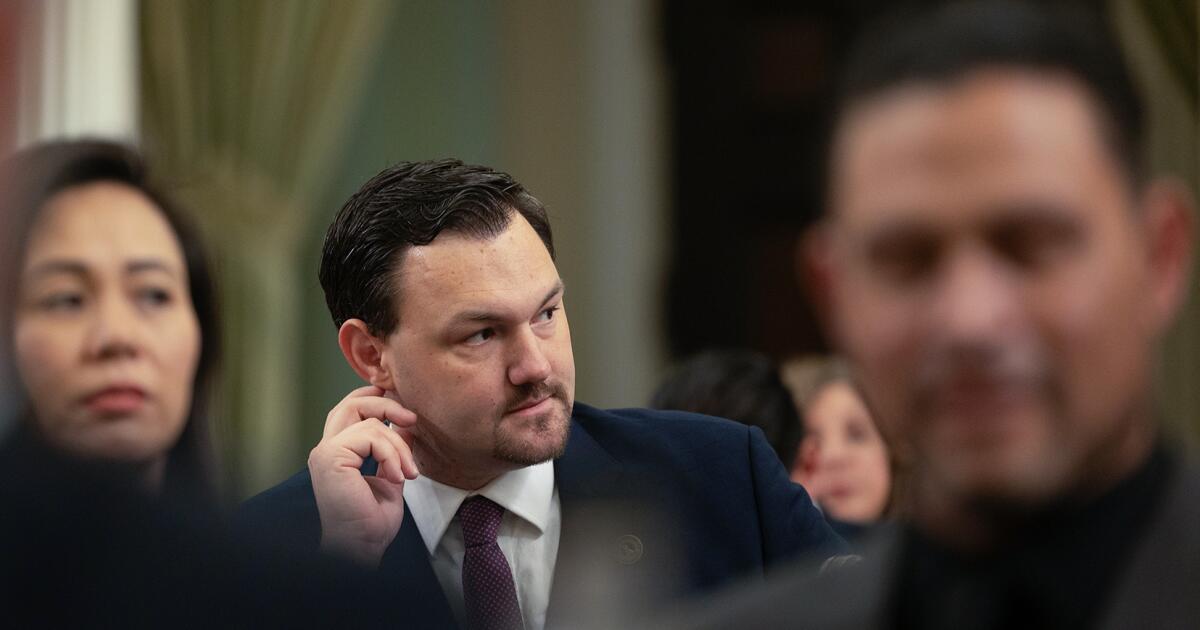
“We have discussed the problem of our public defense system for years,” said Schultz, a Democrat from Burbank and former prosecutor who has sponsored legislation to improve public defense.
The goal is to “move past discussion and study, and come up with an actionable road map of what we need to do to really build out the robust public defense infrastructure that Californians are rightfully entitled to,” he said.
The commissioners plan to develop a five-year plan to phase in state funding, along with enforceable standards like caseload limits and access to defense investigators.
A CalMatters investigation last year found that criminal defendants across the state are routinely convicted without anyone investigating the charges against them, significantly increasing the likelihood of wrongful convictions. Many California counties do not employ a single defense investigator who can interview witnesses, review police reports, visit crime scenes and retrieve video surveillance footage. CalMatters also found that lawyers in some rural counties are handling caseloads that far exceed even the most permissive standards, making them less likely than other defense attorneys to challenge the prosecution’s evidence in legal motions and take their cases to trial.
But the state has resisted stepping in. After a proposed bill that would have created an official state commission to address the issue was abandoned, two advocacy groups, the Wren Collective and UC Berkeley’s Criminal Law and Justice Center, decided to form an independent commission and began assembling participants who could develop and act on reforms. These types of commissions, which have facilitated significant improvements in other states’ public defender systems, are usually established by the governor.
“It became clear that this was an issue that was not a high priority for Sacramento, especially during a budget crisis,” said Chesa Boudin, the Berkeley center’s founding director and a former San Francisco district attorney. It also became clear, Boudin said, that “there was a tremendous gap between what experts understood to be the crisis and the public perception of California government as a kind of progressive leader in the country.”
In the decades since the U.S. Supreme Court established the right to an attorney in state court criminal proceedings, California has saddled its counties with the responsibility of providing lawyers to poor people accused of crimes. Many of those counties have opted for the cheapest path: paying private lawyers and firms a flat fee to represent indigent defendants, regardless of how many cases they handle or how much time they spend on each case.
“You’ve got some offices that have an incredibly high caliber of representation that they can provide, and you have other offices that are doing these flat-fee contracts where the quality has been documented to be pretty bad,” said Eve Brensike Primus, a law professor at the University of Michigan.
Primus is the only member of the new commission from outside of California. She was asked to join because of her extensive research and writing about the structure of indigent defense.
An indigent defense commission in Michigan, which was formed by the legislature in 2013, has led to significant reforms and a substantial influx in state funding.
The California commission’s work, Primus said, can serve “as a catalyst for political actors to do the right thing and start to fund and improve indigent defense delivery, or as fodder for lawsuits that then can try to get the judiciary to push the political actors to do what is necessary to provide for effective representation.”
The commission is scheduled to hold its first in-person meeting, which will be open to the public, in Berkeley in October, with additional meetings planned for Los Angeles, the Central Valley and Northern California over the next 12 months. Commissioners say they will work in subcommittees in between these quarterly sessions to develop a concrete fiscal plan for the state, draft legislative language, and establish minimum standards for how counties should structure their public defender offices, compensate their attorneys, provide access to experts, and report on their work.
The Lakers will seek to use their 25th pick in Tuesday’s first round of the NBA draft on a player who fills a need on a roster that could have up to nine free agents this summer. Yet the Lakers also are aware that picking that late in the round could leave them selecting the best player available.
They probably will be in search of a center who can be a lob threat or an athletic wing who can play defense and knock down three-pointers, two positions the Lakers crave as they try to build a team around star Luka Doncic that fits best with his style of play.
The Lakers spent time in Spain looking at 20-year-old guard Sergio de Larrea, but many NBA scouts see him going later in the first round or even in the second. According to people not authorized to speak publicly, the Lakers were impressed by their workout with Purdue point guard Braden Smith. But he’s on the smaller side (6 feet) and played four years in college, leading scouts to believe his upside is not that high and that he’ll be drafted in the second round.
The Lakers don’t have a pick in Wednesday’s second round.
After the Lakers were swept by a deep and athletic Oklahoma City team in the second round of the playoffs, president of basketball operations Rob Pelinka outlined what it takes when trying to compete in the uber-tough Western Conference against the likes of the Thunder and the San Antonio Spurs, who became the second-youngest team to reach the NBA Finals.
Pelinka looked at how Thunder guard Ajay Mitchell was drafted in the second round and how he flourished in just his second season, especially in the playoffs, in which he averaged 15.1 points and 4.3 assists in 11 games.
“Depth is really important, athleticism and youth. We have a lot of components of that on our roster, but we need to add to it,” Pelinka said last month during his exit interview with the media. “I think those are some of the key North Stars that we need to look at.
“One of the players that they had who played really well, Ajay Mitchell, they got in the second round. So there’s ways to add to your roster if you commit to doing the hard work and commit to the process of adding the right pieces. … We’ll be doing that through the draft and free agency and through trades. We’ve gotta find a way to have a roster that will compete with any team in the NBA. That’s what we do here.”
The Lakers do have three tradable first-round picks — 2026, 2031 and 2033 — but the latter two can’t be moved until after the draft.
Lakers star LeBron James is an unrestricted free agent and is looking for a deal from the Lakers, while Austin Reaves is expected to opt out of his $14.8-million deal so he can sign a contract with them for up to five years and about $241 million.
Still, the Lakers have to proceed with the draft to find a player.
Texas forward Dailyn Swain, left, vies for a loose ball against Purdue guard Braden Smith during an NCAA tournament game in March.
(Godofredo A. Vásquez / Associated Press)
Swain (6-7) and Evans (6-6) are the kind of athletic wings the Lakers could use, but both might be chosen before the Lakers make their pick.
The 6-9 Quaintance could slide to the Lakers because of health concerns. He played in only four games last season at Kentucky because the team was being cautious following knee surgery after he tore an anterior cruciate ligament when he played at Arizona State.
Scouts still view him as mobile, athletic and young enough — he turns 19 next month — to develop. But, Quaintance will need to rehab his knee and probably won’t be ready for the upcoming season. When healthy, scouts said, he can be the lob threat and defender that Doncic yearns to have.
Mona Khalil watches small sea turtles crawling on the sandy beach of al-Mansouri, south of Beirut, in 2003. Khalil, a protector of sea turtle hatching sites, died Saturday after sustaining injuries in an Israeli attack on Lebanon on June 5. File Photo by Nabil Mounzer/EPA
June 20 (UPI) — A Lebanese conservationist and protector of sea turtles died from injuries she suffered when her home was hit by an Israeli strike.
Mona Khalil, 76, died after suffering injuries from an Israeli attack on her home at al-Mounsouri Beach on Lebanon‘s southern coast on June 5. Her assistant was also injured in the attack, according to Green Southerners, a local nonprofit.
The Israeli military told CNN that Khalil “was not a target” of the Israel Defense Forces. “There is no known IDF strike in which she was injured,” the military said in a statement Saturday. “However, strikes were conducted in the area after the IDF issued evacuation warnings.”
Khalil was born in Lagos, Nigeria, and moved to her parents’ homeland Lebanon at age 7. In her 20s, she fled to the Netherlands to escape the Lebanese civil war and became a porcelain restorer. She attained British citizenship because she was born in a British colony.
She returned to Tyre, Lebanon, when she inherited property from her grandmother. There, she spent the rest of her life protecting the nests of loggerhead and green sea turtles.
Both species of turtles are threatened by coastal development, plastic pollution, fishing nets and light pollution. They are at risk of extinction in the eastern Mediterranean.
Khalil helped create the Orange House, an eco-tourism project at al-Mansouri beach. She painted her house orange to symbolize the safety the Netherlands had given her.
“She is a deeply committed environmental defender,” Hisham Younes, founder and president of Green Southerners, told the BBC. “She used to talk about the beach like it was a person. Her bond to the sunset, her bond to the water and the turtles … she was really into conservation, and into the soul, the spirit of conservation.”
In 2006, CNN profiled her, and she said she refused to leave her sea turtles even among fighting between Israel and Hezbollah.
“Me and my animals were all traumatized, and I lost a bit of my hearing. But otherwise I’m still alive and kicking,” Khalil told CNN at the time. “I live every day to the fullest and don’t worry about tomorrow.”
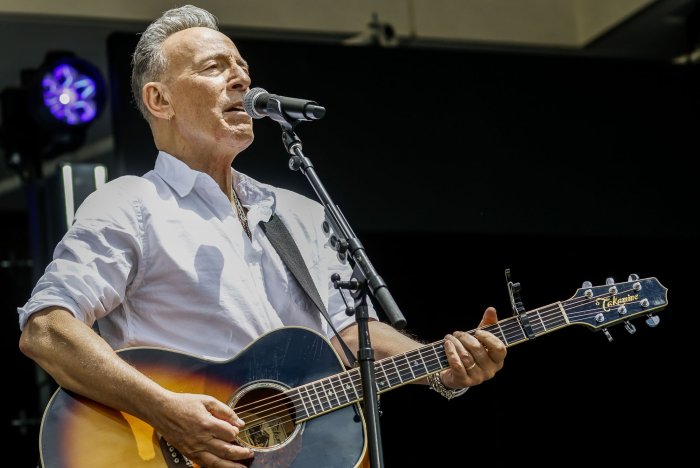
Bruce Springsteen performs at the grand opening for the Obama Presidential Center, in the center’s John Lewis Plaza in Chicago on June 18, 2026. The grounds open to the public on Juneteenth, June 19th. Photo by Tannen Maury/UPI | License Photo
On June 14, the United States and Iran agreed to a framework to end their war. The Strait of Hormuz is to reopen, the bombing of Lebanon is to end and – most importantly – the killing is to stop. After more than 100 days of war that killed thousands, including Iran’s most senior leaders, and pushed the world economy to the brink, even a fragile truce feels like first light.
Let us welcome it, but also let us understand it. To grasp why this war happened, and the string of wars before it, we must name their common cause. That cause is “Greater Israel” – not the country of Israel but an idea of it – a terrible one. The idea of “Greater Israel” has been the cause of wars in Iraq, Gaza, Lebanon, Syria and Iran.
It holds that Israel should stretch over all of historic Palestine – from the Jordan River to the Mediterranean Sea – and to parts of neighbouring countries as well. According to United States Ambassador to Israel Mike Huckabee, a fundamentalist Protestant whose geopolitical compass is set by biblical texts from 500 BC, “Greater Israel” stretches from the Nile to the Euphrates. Last summer, Israeli Prime Minister Benjamin Netanyahu professed to be “very” attached to a vision of “Greater Israel” that, he said, takes in the Palestinian territories and neighbouring Arab lands.
This absurd and dangerous doctrine has two parents. The first are secular hardliners like Netanyahu who say that Israel must control all the land from the river to the sea to be safe, and damn the eight million Palestinians in the way.
The second is the Jewish supremacist creed of Israeli Finance Minister Bezalel Smotrich and National Security Minister Itamar Ben-Gvir that God gave the land to the Jews alone: There is, in Smotrich’s words, “no such thing as a Palestinian”. Asked recently how Israel should answer its collapsing global standing, Smotrich vowed Israel would not relinquish military control of the West Bank, Gaza, Lebanese or Syrian territory: “We won’t commit suicide to make them happy.”
“Greater Israel” is paranoia, megalomania and religious zeal braided into a single programme. The doctrine should have been repudiated on its first airing decades ago. Instead, it has driven Israel’s foreign and military doctrine for three decades – and has survived until today because Netanyahu has taken the US for a ride.
He has done it with two American constituencies: Jewish Zionists who love Israel and will forgive it anything and Christian Zionists who love the prophecy of the End Times and the Second Coming of Christ more than they love any living Palestinian or, for that matter, any living Israeli.
Delusion has led on to delusion, and the road has run from one war to the next. We are 30 years into this fiasco now.
The war on Iran was simply the latest “Greater Israel” fantasy. The government of 90 million people was to be toppled in a single, glorious day. Of course, it did not happen. Israeli and American bombs killed Iran’s leaders on February 28, but that did not deliver the promised collapse. It resulted instead in thousands of dead, a choked Strait of Hormuz and a global oil shock.
We have seen this film before. The Israel-US plan to bring down President Bashar al-Assad in Syria was also meant to be quick, one or two years at the most. Instead came a dozen years of carnage, fed by a covert war armed and financed by the CIA with Israel’s ardent backing. The result was an ancient country reduced to rubble. The promised one-day victories always become decade-long graveyards.
US President Donald Trump has been battered by joining the “Greater Israel” delusion, and he knows it. The new agreement with Iran is his escape valve, a way out of a fatuous war that was never his to win.
That is precisely why Israel’s “Greater Israel” politicians are trying to strangle the new agreement in the cradle, for peace with Iran is a defeat for “Greater Israel”. Even after the deal was sealed, Israel has continued to bomb Lebanon, killing 47 people in a single day on Friday and another 32 on Saturday hours after a Lebanon-Israel ceasefire took effect.
Here is the deeper truth: “Greater Israel” is not saving Israel. It is killing it. The friction now visible between Trump and Netanyahu is only the surface. Beneath it lies the collapse of Israel’s standing throughout the world. According to a recent Pew opinion survey, the world now holds an overwhelmingly unfavourable view of Israel. In the US, Israel’s indispensable patron, six in 10 adults view it unfavourably.
A state that makes itself hated by the world, and by its only protector, is not pursuing security. It is threatening its own survival to feed a delusion.
So the way to peace in West Asia is to stop “Greater Israel”. End the war on Iran, stop the genocide in Gaza and halt the strangulation of the West Bank. Most importantly, do the thing the doctrine forbids, which is to create the State of Palestine as the 194th United Nations member state alongside the State of Israel on the 1967 lines with genuine security for both countries and a regional framework to guarantee it, which should include Israel’s withdrawal from Lebanon and Syria.
The Iran ceasefire makes the case in miniature: It was won not on the battlefield but through mediation. It became possible when Washington decided it wanted peace more than it wanted “Greater Israel’s” war.
Israel can survive, but not as “Greater Israel”, a disastrous idea that has marched it and the US from one war to the next.
The glimmer of hope today is real. Whether it becomes a true dawn depends on whether the US finally lets Palestine be born, and thereby lets Israel live. The Arab world and Iran need to keep insisting to the US that breaking with “Greater Israel” is the only path to lasting peace.
The views expressed in this article are the authors’ own and do not necessarily reflect Al Jazeera’s editorial policy.
VICTORIA Beckham has extended the biggest olive branch to estranged son Brooklyn yet with a touching Father’s Day tribute to David.
The fashion designer, 52, took to social media to share a snap of David, 51, with Brooklyn, 27, Romeo, 23, Cruz, 21, and Harper, 14, in happier times.
Sign up for the Showbiz newsletter
Thank you!
Victoria shared a touching Father’s Day tribute to David which included estranged son BrooklynCredit: UnknownIt comes days after Brooklyn savagely mocked his strained relationship with his dadCredit: Instagram
Brooklyn has made it clear he has no intention of reconciling with his heartbroken parentsCredit: Samir Hussein/WireImageHe now lives in Los Angeles with wife Nicola PelztCredit: Admedia Photo / SplashNews.com
Brooklyn, who now lives in Los Angeles with wife Nicola Peltz, was seen in a clip saying: “You’re probably wondering why I’m watching the FIFAWorld Cup 2026 from home…”
Smirking Brooklyn then laughed: “It’s a long story.”
He went on to throw down his tickets onto the coffee table.
The advert then said: “It’s complicated. More soon.”
WASHINGTON — In congressional races across the country, a new crop of super PACs is taking to the air with millions of dollars worth of advertisements to sway voters.
“President Trump said it best, ‘Celeste Maloy will never let you down,’” says one advertisement supporting the Utah Republican representative in her upcoming primary election.
“Standing up to big pharma, fighting for local jobs, Val Hoyle doesn’t back down,” says an ad backing the Oregon Democratic representative ahead of her primary victory last month.
The super PACs have nondescript names — such as Jobs and Democracy PAC and American Mission — and the text is so generic that it almost seems to have been created by artificial intelligence.
That isn’t so far off the mark. The AI industry has funded the ads.
One network of super PACs is linked to Anthropic, maker of the popular AI tool Claude, and the other to Open AI, maker of ChatGPT.
They have been among the most prolific political spenders so far in the 2026 midterm elections, splashing out more than $37 million to date to influence races across the country and making the groups among the biggest outside spenders so far in congressional races. That number could grow exponentially as campaign season heats up closer to the November election — and as the Silicon Valley giants prepare initial pubic offerings that are poised to raise billions of dollars for the companies and their executives.
The AI political spending boom comes as emerging technology companies have become increasingly “comfortable with using their power to achieve a political goal,” said Adam Kovacevich, a former Google public policy executive and founder of Chamber of Progress, a technology trade group with a progressive orientation.
The leading AI companies have a history.
Anthropic was formed by former OpenAI employees who were concerned that the company was less focused on its original mission to safely harness the power of AI.
The companies are now the leading drivers of the burgeoning AI industry, and their competing views about how the technology should be regulated are playing out in a wide-ranging political ad spending war that has targeted congressional races in big cities and rural areas alike.
Anthropic calls for more stringent regulation and supports efforts by states such as New York and California that have passed more aggressive AI laws.
The groups spending in these races are super PACs, which are able to raise and spend unlimited amounts of money in federal races thanks to the 2010 Citizens United Supreme Court decision.
In some races, the AI-backed political groups have spent more than the candidates they are backing.
“There was no way as a grassroots person that I could compete with that kind of money,” said Al Olszewski, whose opponent in a Montana Republican congressional primary beat him by 30 points after getting a boost from $877,000 in ads from a super PAC backed by OpenAI’s co-founder. “I got crushed.”
The AI behemoths have emphasized that they are independent from the political groups.
One group counts $25 million in support from OpenAI co-founder Greg Brockman and his wife, Anna, alongside $100 million tied to one of Silicon Valley’s biggest venture capital firms, which holds a large stake in OpenAI. The global policy chief for OpenAI was reportedly involved in conceiving the group.
The other side has gotten $20 million from Anthropic and millions more from donors whose identities are not public.
This anonymous political cash is commonly known as dark money, and its prevalence is growing.
(Los Angeles Times photo illustration; source photos courtesy of the Tech Oversight Project)
“This has become very normalized now,” said Brendan Glavin, director of insights at OpenSecrets, which tracks campaign spending. “In 2024, we tracked over $1 billion in dark money.”
The political activity of these AI companies and executives reflects a dramatic shift from how emerging technology companies have historically engaged with politics.
Google, for example, didn’t hire its first in-house Washington lobbyist until after the company had gone public in 2005.
“I think that for a long time, the tech industry lobbying strategy was just ‘leave us alone,’” Kovacevich said.
He sees the spending by these AI-linked super PACs as following the recent playbook developed by the cryptocurrency industry, which has funded the only network of political groups that has spent more on congressional races this year than those linked to OpenAI.
“I think what the crypto industry realized was that there’s no substitute for building up political power,” Kovacevich said.
The political stakes for these technology companies are significant.
“AI policy is far from settled,” said Asad Ramzanali, the former deputy director for strategy in the White House Office of Science and Technology Policy during the Biden administration and the director of artificial intelligence and technology policy at the Vanderbilt Policy Accelerator.
Earlier this month, the Trump administration banned foreign nationals from using the most powerful AI model developed by Anthropic — and even banned the company’s own employees from it — which forced the company to restrict access for all users.
Manhattan matchup
The two super PAC networks have largely shied away from producing ads that mention AI and have mostly chosen to avoid competing against each other in the same races.
There’s one big exception.
In the marquee Manhattan Democratic congressional primary to replace retiring Rep. Jerry Nadler (D-N.Y.), each side has spent millions of dollars.
While the field includes Kennedy scion and social media star Jake Schlossberg and former Republican turned Trump critic George Conway, the target of all the AI-backed spending has been Alex Bores, a former Palantir data scientist who now serves in the New York state Assembly.
New York congressional candidate sponsored a state measure Bores requiring major AI companies to be transparent about their safety protocols and promptly report safety incidents.
(Yuki Iwamura / Associated Press)
That’s because Bores sponsored a state bill, known as the RAISE Act, that requires major AI companies to be transparent about their safety protocols and promptly report safety incidents. The bill was signed into law in December 2025.
The ads sponsored by the group tied to OpenAI, which has spent more than $7.5 million in the race, paint Bores as someone who can’t be trusted.
They cite his support from other tech billionaires, including former crypto mogul and convicted financial fraudster Sam Bankman-Fried, whose super PAC spent $100,000 to support Bores in 2022 when he first ran for New York Assembly.
“Is that really who should be shaping AI safety for our kids?” one ad asks.
An ad sponsored by the Anthropic-backed network, which has also spent more than $7.5 million supporting Bores, makes the case that the bill he sponsored is exactly why he should be elected.
“As a computer engineer, Alex Bores saw how dangerous unregulated AI could be and he wrote New York’s RAISE Act to put real safeguards on A.I. and hold big tech accountable,” the ad says.
The AI ad barrage in New York has even included what might be considered a kumbaya moment in the ad wars — another super PAC created to support Bores is most heavily backed by both an employee of Anthropic and an employee of OpenAI, who both focus on AI safety.
The group, Dream NYC, has spent more than $1.7 million supporting Bores.
Bores and fellow New York State Assemblymember Micah Lasher have been atop the most recent polls in the race ahead of the June 23 primary.
A general view of businesses in St. George, Utah, on Wednesday.
(Ian Maule / For The Times)
Rural Republicans
For voters in many parts of the country, the debate over AI policy has played out locally as a debate over the massive data centers required to power the technology.
In Utah, a proposed data center in Box Elder County, backed by “Shark Tank” television personality Kevin O’Leary, has generated controversy because of questions about its impact on resources in the drought-prone state and its environmental effect on the nearby Great Salt Lake.
In the state’s most competitive Republican congressional primary — the vast, newly drawn 3rd Congressional District — both candidates expressed concerns about how the project has been developed and called for greater transparency in this plan and for future data centers in the state.
Utah congressional candidates Phil Lyman and Celeste Maloy in a debate on June 1. A super PAC backed by Anthropic has spent more than $920,000 to support Maloy.
(Rick Egan / Pool / The Salt Lake Tribune Via Associated Press)
Despite their similar position on the project, a super PAC backed by Anthropic has spent more than $950,000 to support Maloy, who is running in the new district after the boundaries of her old district changed.
“It’s a lot of money to throw at a race,” said her opponent, Phil Lyman, a former conservative Republican state Representative who ran to the right of Utah Republican Gov. Spencer Cox in an unsuccessful primary challenge in 2024.
Lyman insists he is no AI skeptic.
“I’m not anti data centers, I’m pro-transparency,” he said. “I think the future is bright with AI.”
The group said it is backing Maloy because it sees her as “someone who’s worked the issue” of AI regulation and who “has demonstrated leadership” with Republicans in Congress.
Maloy’s campaign didn’t respond to request for comment.
Utah congressional candidate Phil Lyman speaks during a Cottage Meeting at the SunRiver Community Center Ballroom in St. George, Utah, on Wednesday.
(Ian Maule / For The Times)
But Lyman suspects the group’s support for Maloy ahead of their June 23 primary has more to do with old-fashioned politics than any emerging technology.
The 2026 FIFA World Cup is well into the second run of group play, with every team still eager to post wins and most looking to secure a place in the knockout stage.
Here’s everything you need to know about matches being played Sunday, Monday and Tuesday in the 48-team tournament across the U.S., Mexico and Canada (all times Pacific). Tuesday’s matches will conclude the first two games of group play for every team at the World Cup.
Sunday’s Group G matchups:
Belgium vs. Iran
Belgium’s Romelu Lukaku, right, is challenged by Egypt’s Ramy Rabia during a World Cup Group G match on June 15.
(Alex Grimm / Getty Images)
Where: SoFi Stadium Time: noon TV: FS1, Telemundo
The buzz: Iran twice rallied from deficits to draw with New Zealand in its first game, while Belgium, outplayed by Egypt in its opener, was lucky to escape with a point on an own goal early in the second half. Belgium’s aging golden generation of Romelu Lukaku, Kevin De Bruyne, Thibaut Courtois, Thomas Meunier and Axel Witsel is going to need to do much better if they hope to avoid another early World Cup exit.
New Zealand vs. Egypt
New Zealand’s Callan Elliot, left, and Iran’s Mehdi Ghayedi battle for the ball during a World Cup Group G match on June 15.
(Andre Penner / Associated Press)
Where: BC Place, Vancouver Time: 6 p.m. TV: FS1, Telemundo
The buzz: One of these teams could make history since neither has ever won a World Cup game. New Zealand earned its first point in the World Cup since 2010 with a draw against Iran. The winner likely advances to the next round.
Sunday’s Group H matchups:
Spain vs. Saudi Arabia
Spain’s Mikel Oyarzabal, top, challenges for the ball during a draw with Cape Verde on June 15.
(Mattia Ozbot / Getty Images)
Where: Mercedes-Benz Stadium, Atlanta Time: 9 a.m. TV: Fox, Telemundo
The buzz: Both teams opened the World Cup with surprising results. Second-ranked Spain was unable to score in a draw with No. 67 Cape Verde. Saudi Arabia was 10 minutes away from upsetting Uruguay, only to settle for a tie. Spain desperately needs a win to get its World Cup back on track, while another good performance from Saudi Arabia — unbeaten in its last three games — would have the Arabian Falcons in position to reach the knockout stage.
Uruguay vs. Cape Verde
Cape Verde goalkeeper Vozinha holds the nation’s flag after a draw with Spain on June 15.
(Buda Mendes / Getty Images)
Where: Hard Rock Stadium, Miami Gardens, Fla. Time: 3 p.m. TV: FS1, Telemundo
The buzz: With all four teams playing to draws in their openers, the group is wide open. That creates a rare opportunity for tournament debutant Cape Verde, the second-smallest country to qualify for a World Cup. Vozinha, Cape Verde’s goalkeeper, made seven saves to shut out Spain. If he can frustrate Uruguay the same way, Cape Verde could be through to the round of 32.
Monday’s Group J matchups:
Argentina vs. Austria
Argentina’s Lionel Messi reacts after scoring his third goal against Algeria at the World Cup on June 16.
The buzz: Argentina opened its World Cup title defense with a 3-0 win over Algeria on a hat trick from Lionel Messi. The Argentina captain, playing in his record sixth World Cup, is tied with Germany’s Miroslav Klose for the most career World Cup goals (16). Austria, meanwhile, would all but assure itself of a spot in the knockout round with a point.
Jordan vs. Algeria
Algeria’s Zineddine Belaïd kicks the ball during a World Cup loss to Argentina on June 16.
The buzz: Little was expected of Jordan, making its first appearance in the World Cup. And it delivered little in a 3-1 loss to Austria. But Algeria, ranked 28th in the world, entered the tournament with high hopes and one of African soccer’s most potent attacks. However, it had only one shot on goal in its loss to Argentina and needs a big rebound to avoid an early trip home.
Monday’s Group I matches:
France vs. Iraq
France’s Kylian Mbappé celebrates after scoring against Senegal on June 16.
(Adam Hunger / Ap Photo/adam Hunger)
Where: Lincoln Financial Field, Philadelphia Time: 2 p.m. TV: Fox, Telemundo
The buzz: Kylian Mbappé proved his fitness with a brace in France’s opening win over Senegal, giving him 14 World Cup goals, tied for fourth on the all-time list. He has a great chance to pad that total against an Iraq team that gave up four goals to Norway. Iraq still is looking for its first-ever World Cup point.
Norway vs. Senegal
Norway’s Erling Haaland celebrates after scoring against Iraq on June 16.
The buzz: Norway, playing in its first World Cup this century, made up for lost time with a 4-1 win in its opener, getting two goals from Erling Haaland. Norway probably will move on to the next round no matter what happens, but a point would lock down a spot. Senegal and Sadio Mané, on the other hand, desperately need a win.
Tuesday’s Group K matchups:
Portugal vs. Uzbekistan
Portugal’s Cristiano Ronaldo walks on the field during a match against the Democratic Republic of the Congo on June 17.
The buzz: Cristiano Ronaldo entered this World Cup with visions of winning his first title. But he’ll go home early and empty-handed unless fifth-ranked Portugal improves on the listless performance it had in a draw with the Democratic Republic of the Congo. Uzbekistan, playing in its first World Cup, was not intimidated by the big stage, weathering a withering Colombia attack in a 3-1 loss. Expect it to bunker in again against Portugal.
Colombia vs. DR Congo
Yoane Wissa, left, celebrates with teammates after scoring for the Democratic Republic of the Congo against Portugal on June 17.
The buzz: The Democratic Republic of the Congo’s only other World Cup appearance came in 1974, when the country was known as Zaire; it lost all three games and didn’t score a goal. It’s already done better with Yoane Wissa’s score in first-half stoppage time giving the team a point against Portugal. A win here and it’s through to the knockout phase. The same is true of Colombia, which got a 65th-minute goal from Luis Díaz and another from substitute Jáminton Campaz deep in stoppage time to beat stubborn Uzbekistan.
Tuesday’s Group L matchups:
England vs. Ghana
England’s Harry Kane celebrates after scoring against Croatia on June 17.
The buzz: England opened its World Cup with a surprisingly comfortable win over Croatia behind two goals from captain Harry Kane. But the Three Lions are only equal atop the table with Ghana, which got a goal deep in stoppage time from Caleb Yirenkyi to beat Panama. If there’s a winner here, it probably will decide the group. A point likely sends both teams through.
Panama vs. Croatia
Where: BMO Stadium, Toronto Time: 4 p.m. TV: Fox, Telemundo
Panama’s Ismael Díaz attempts a shot against Ghana on June 17.
(Kevin C. Cox / Getty Images)
The buzz: Croatia has played in two straight World Cup semifinals, but that streak is in jeopardy after a 4-2 loss to England. Panama outshot, outpassed and outpossessed Ghana in its first game but came away with nothing after conceding a goal in stoppage time, leaving the Central Americans still looking for their first World Cup win.
Three hikers were found dead in two separate incidents this week along the North Kaibab Trail in Grand Canyon National Park in Arizona, with all three having succumbed to extreme heat by the time emergency services arrived. Photo by U.S. National Parks Service
June 20 (UPI) — The National Parks Service announced that three people died this week in two separate heat-related incidents at Grand Canyon National Park.
Park rangers and emergency medical personnel responded to the two incidents, which occurred on June 12 and June 16, and both of which happened while hikers were on trails in the Inner Canyon, NPS said Friday in a press release.
All three of the people were deceased when officials arrived, and they were transported with aerial support to the Cococino County Medical Examiner’s office.
NPS said that trails in the Inner Canyon region, where all three were found, regularly top 109 degrees Fahrenheit during this time of year.
Earlier this month, an 18-year-old hiker experienced heat-related symptoms while hiking a different part of the park and, although park rangers and a helicopter rescue operations found him, life-saving measures were not successful.
“Hiking Grand Canyon can be a challenge for anyone, especially during the heat of summer,” NPS said in the release.
On June 12, a 72-year-old man was found on the South Kaibab Trail, and four days later, on June 16, a 67-year-old man and 68-year-old woman were found on the North Kaibab Trail.
On its website, NPS recommends that people planning to visit the park be aware that the Inner Canyon area of the park during the summer is “extremely strenuous and potentially dangerous due to intense heat, minimal shade and no water sources.”
As a result, Grand Canyon park officials recommend that hikers avoid trails in the area between 10 a.m and 4 p.m., when it is hottest there.
The agency also noted that because of a range of reasons, rescue efforts may not be immediately available.
In addition to carrying sufficient water, food and first aid supplies — and knowing their own physical limits — NPS also warns the hikers in many Inner Canyon locations be prepared to “self-rescue” and have a plan to do so.
“The recent increase in heat-related incidents comes as summer temperature in the Inner Canyon have reached dangerous levels, creating conditions that can quickly overwhelm hikers during the hottest parts of the day,” the agency said in Friday’s release.
President Donald Trump presents a Medal of Honor to Tom Ripley on behalf of his father, John W. Ripley, during a Medal of Honor award ceremony in the East Room of the White House on Thursday. Photo by Aaron Schwartz/UPI | License Photo