All times BST. Matches and coverage times are subject to late changes. The BBC is not responsible for any changes that may be made. Full radio coverage times to follow when available.
Monday, 29 June
Men’s and women’s singles first round
10:30-19:00 – Live coverage – BBC Two, BBC iPlayer, BBC Sport website and app
14:00-18:00 – Live coverage – BBC One, BBC iPlayer, BBC Sport website and app
19:00-22:00 – Live coverage – BBC One, BBC iPlayer, BBC Sport website and app
23:00-00:05 – Today at Wimbledon – BBC Two, BBC iPlayer, BBC Sport website and app
Tuesday, 30 June
Men’s and women’s singles first round
11:00-19:00 – Live coverage – BBC Two, BBC iPlayer, BBC Sport website and app
14:00-18:00 – Live coverage – BBC One, BBC iPlayer, BBC Sport website and app
19:00-22:00 – Live coverage – BBC One, BBC iPlayer, BBC Sport website and app
23:00-00:05 – Today at Wimbledon – BBC Two, BBC iPlayer, BBC Sport website and app
Wednesday, 1 July
Men’s and women’s singles second round, men’s doubles first round
11:15-13:00 – Live coverage – BBC One, BBC iPlayer, BBC Sport website and app
13:00-19:00 – Live coverage – BBC Two, BBC iPlayer, BBC Sport website and app
14:00-18:00 – Live coverage – BBC One, BBC iPlayer, BBC Sport website and app
19:00-22:00 – Live coverage – BBC One, BBC iPlayer, BBC Sport website and app
23:30-00:30 – Today at Wimbledon – BBC Two, BBC iPlayer, BBC Sport website and app
Thursday, 2 July
Men’s and women’s singles second round, men’s and women’s doubles first round
11:00-19:00 – Live coverage – BBC Two, BBC iPlayer, BBC Sport website and app
14:00-18:00 – Live coverage – BBC One, BBC iPlayer, BBC Sport website and app
19:00-22:00 – Live coverage – BBC One, BBC iPlayer, BBC Sport website and app
23:00-00:00 – Today at Wimbledon – BBC Two, BBC iPlayer, BBC Sport website and app
Friday, 3 July
Men’s and women’s singles third round, men’s doubles second round, women’s doubles first round, mixed doubles first round
11:00-19:00 – Live coverage – BBC Two, BBC iPlayer, BBC Sport website and app
14:00-18:00 – Live coverage – BBC One, BBC iPlayer, BBC Sport website and app
19:00-22:00 – Live coverage – BBC One, BBC iPlayer, BBC Sport website and app
23:00-00:00 – Today at Wimbledon – BBC Two, BBC iPlayer, BBC Sport website and app
Saturday, 4 July
Men’s and women’s singles third round, men’s and women’s doubles second round, mixed doubles first round, boys’ and girls’ singles first round
11:00-21:00 – Live coverage – BBC Two, BBC iPlayer, BBC Sport website and app
12:20-17:15 – Live coverage – BBC One, BBC iPlayer, BBC Sport website and app
17:30-21:00 – Live coverage – BBC One, BBC iPlayer, BBC Sport website and app
00:30-01:30 – Today at Wimbledon – BBC Two, BBC iPlayer, BBC Sport website and app
Sunday, 5 July
Men’s and women’s singles fourth round, men’s doubles third round, women’s doubles second round, mixed doubles second round, boys’ and girls’ singles first round
11:00-19:00 – Live coverage – BBC Two, BBC iPlayer, BBC Sport website and app
12:35-17:35 – Live coverage – BBC One, BBC iPlayer, BBC Sport website and app
23:40-00:40 – Today at Wimbledon – BBC Two, BBC iPlayer, BBC Sport website and app
Monday, 6 July
Men’s and women’s singles fourth round, men’s and women’s doubles third round, mixed doubles quarter-finals, girls’ singles second round, boys’ and girls’ doubles first round
11:00-19:00 – Live coverage – BBC Two, BBC iPlayer, BBC Sport website and app
14:00-18:00 – Live coverage – BBC One, BBC iPlayer, BBC Sport website and app
19:00-22:00 – Live coverage – BBC One, BBC iPlayer, BBC Sport website and app
23:00-00:00 – Today at Wimbledon – BBC Two, BBC iPlayer, BBC Sport website and app
Tuesday, 7 July
Men’s and women’s singles quarter-finals, men’s doubles quarter-finals, women’s doubles third round, mixed doubles semi-finals, boys’ singles second round, girls’ doubles first round
12:30-19:00 – Live coverage – BBC Two, BBC iPlayer, BBC Sport website and app
14:00-18:00 – Live coverage – BBC One, BBC iPlayer, BBC Sport website and app
19:00-22:00 – Live coverage – BBC One, BBC iPlayer, BBC Sport website and app
23:30-00:30 – Today at Wimbledon – BBC Two, BBC iPlayer, BBC Sport website and app
Wednesday, 8 July
Men’s and women’s singles quarter-finals, men’s and women’s doubles quarter-finals, quad singles quarter-finals, men’s and women’s wheelchair doubles quarter-finals, boys’ and girls’ singles third round, boys’ and girls’ doubles second round
12:15-13:00 – Live coverage – BBC One, BBC iPlayer, BBC Sport website and app
13:00-19:00 – Live coverage – BBC Two, BBC iPlayer, BBC Sport website and app
13:45-18:00 – Live coverage – BBC One, BBC iPlayer, BBC Sport website and app
19:00-21:00 – Live coverage – BBC One, BBC iPlayer, BBC Sport website and app
23:00-00:00 – Today at Wimbledon – BBC Two, BBC iPlayer, BBC Sport website and app
Thursday, 9 July
Women’s singles semi-finals, men’s doubles semi-finals, women’s doubles quarter-finals, mixed doubles final, men’s and women’s wheelchair singles quarter-finals, men’s, women’s and quad wheelchair doubles semi-finals, boys’ and girls’ singles quarter-finals, boys’ and girls’ doubles quarter-finals
12:30-19:00 – Live coverage – BBC Two, BBC iPlayer, BBC Sport website and app
14:00-18:00 – Live coverage – BBC One, BBC iPlayer, BBC Sport website and app
19:00-21:00 – Live coverage – BBC One, BBC iPlayer, BBC Sport website and app
23:30-00:30 – Today at Wimbledon – BBC Two, BBC iPlayer, BBC Sport website and app
Friday, 10 July
Men’s singles semi-finals, women’s doubles semi-finals, men’s, women’s and quad wheelchair singles semi-finals, boys’ and girls’ singles semi-finals, boys’ and girls’ doubles semi-finals
12:30-19:30 – Live coverage – BBC Two, BBC iPlayer, BBC Sport website and app
14:00-18:00 – Live coverage – BBC One, BBC iPlayer, BBC Sport website and app
19:30-21:00 – Live coverage – BBC One, BBC iPlayer, BBC Sport website and app
23:00-00:00 – Today at Wimbledon – BBC Two, BBC iPlayer, BBC Sport website and app
Saturday, 11 July
Women’s singles final, men’s doubles final, women’s wheelchair singles final, men and quad wheelchair doubles finals, girls’ singles final, girls’ doubles final, boys’ doubles final
11:30-13:15 – Live coverage – BBC Two, BBC iPlayer, BBC Sport website and app
12:15-19:00 – Live coverage – BBC One, BBC iPlayer, BBC Sport website and app
23:00-00:00 – Today at Wimbledon – BBC Two, BBC iPlayer, BBC Sport website and app
Sunday, 12 July
Men’s singles final, women’s doubles final, men and quad wheelchair singles final, women’s wheelchair doubles final, boys’ singles final
11:30-13:00 – Live coverage – BBC Two, BBC iPlayer, BBC Sport website and app
13:00-20:00 – Live coverage – BBC One, BBC iPlayer, BBC Sport website and app
01:50-02:50 – Today at Wimbledon – BBC Two, BBC iPlayer, BBC Sport website and app
Unification Minister Chung Dong-young delivers a keynote speech during the Korean Peninsula Symposium 2026 in Seoul on Friday. Photo by Yonhap
Unification Minister Chung Dong-young called Friday for shifting away from an approach that sticks to denuclearization as the sole solution to the North Korean nuclear issue, saying such a precondition has been one of the reasons for stalled diplomacy with Pyongyang.
Chung made the remarks in a keynote speech at a forum, co-hosted by Yonhap News Agency, pointing out that the lack of progress in nuclear diplomacy has only helped the North bolster its nuclear and weapons capabilities for the past three decades.
“As the past 30 years have shown, whenever peace talks were halted by the denuclearization hurdle, North Korea used that time to further advance its nuclear capabilities,” Chung said at the Korean Peninsula Symposium.
“We must move away from the old notion that a peace regime can only be discussed after the North Korean nuclear issue is resolved … We need to pursue a phased and pragmatic solution. It is time for a paradigm shift,” he said.
Recalling major breakthroughs in nuclear diplomacy with Pyongyang in the past, Chung stressed the path toward peace opened up when relevant countries, including South Korea and the United States, sought to actively engage Pyongyang for dialogue.
Chung went on to highlight the need for a phased approach — halting and scaling down the North’s nuclear program before denuclearizing — as a solution to the nuclear issue.
“A step-by-step process toward peaceful coexistence and denuclearization should proceed in three stages — freeze, reduction and denuclearization,” he said. “China, too, has expressed support for this pragmatic approach.”
Chung said this phased approach must begin with dialogue between the U.S. and North Korea.
“As agreed in the 2018 Singapore summit between North Korea and the U.S., both sides should immediately resume talks to end mutual hostility and establish a new relationship,” he said.
“The resumption of U.S.-North Korea dialogue will serve as a powerful catalyst for opening four-party talks among the U.S., China and the two Koreas, who are the key stakeholders in achieving lasting peace on the Korean Peninsula,” Chung added.
Copyright (c) Yonhap News Agency prohibits its content from being redistributed or reprinted without consent, and forbids the content from being learned and used by artificial intelligence systems.
The reopening of the Strait of Hormuz has restored the flow of oil and natural gas after more than 100 days of disruption, but the crisis has already left a lasting mark on global energy markets. The prolonged closure exposed the vulnerability of the world’s energy supply chain and has prompted governments to reconsider how they secure fuel supplies.
Analysts say the crisis mirrors the impact of the 1973 Arab oil embargo, which transformed global energy policy by encouraging conservation, diversification, and strategic stockpiling. While today’s energy system proved more resilient, the Hormuz disruption may accelerate a broader shift away from fossil fuels.
What Happened?
The Strait of Hormuz, through which nearly 20 percent of global oil and liquefied natural gas supplies normally pass, remained effectively closed for more than three months during the US Israeli conflict with Iran.
Despite the disruption, global markets avoided a severe supply crisis through rapid rerouting of cargoes, the release of strategic reserves, reduced Chinese imports, and shifting demand patterns.
However, analysts say these emergency measures were only temporary. Energy inventories fell sharply during the crisis, and markets were approaching a critical point before shipping resumed.
Why the Crisis Matters
The Hormuz disruption demonstrated that even today’s highly interconnected global energy system remains vulnerable to geopolitical conflict.
Unlike previous crises, the world avoided a complete energy collapse because governments, traders, and shipping companies quickly adapted. Nevertheless, the episode exposed the limits of those emergency responses and reinforced concerns about overreliance on a single strategic chokepoint.
The crisis is expected to influence long term energy investment decisions far beyond the Middle East.
Lessons From the 1973 Oil Embargo
The 1973 Arab oil embargo fundamentally changed global energy policy after oil producing nations restricted exports to countries supporting Israel during the Yom Kippur War.
The embargo caused oil prices to surge, triggering inflation and prompting governments to adopt fuel efficiency standards, develop domestic oil production, establish strategic petroleum reserves, and create the International Energy Agency.
Rather than ending fossil fuel use, the crisis encouraged countries to consume energy more efficiently while reducing dependence on imported oil.
A New Energy Strategy Emerges
The Hormuz crisis appears to be driving another major strategic shift, particularly across Asia.
Countries heavily dependent on Middle Eastern oil and gas are increasingly prioritizing energy security over low fuel costs. Governments are expected to expand strategic petroleum reserves while accelerating investment in domestic renewable energy, nuclear power, and alternative fuel sources.
India, Pakistan, Japan, and South Korea are among the countries reviewing long term strategies aimed at reducing exposure to overseas energy disruptions.
Europe Continues Its Energy Transition
Europe entered the Hormuz crisis after already reshaping its energy system following Russia’s invasion of Ukraine in 2022.
The loss of Russian energy supplies forced European countries to cut gas consumption, diversify imports, and rapidly expand renewable energy capacity.
The latest Middle East disruption is expected to reinforce that trend by encouraging further investment in clean energy and energy efficiency while reducing dependence on imported fossil fuels.
Investment Trends Support the Shift
Global investment patterns already suggest that energy markets are evolving.
According to the International Energy Agency, worldwide energy investment is projected to reach 3.4 trillion dollars this year, with much of the growth directed toward renewable energy, electricity infrastructure, battery storage, and grid resilience rather than new oil production.
Electric vehicle sales continue to rise rapidly across Europe, Latin America, and Asia Pacific, while Chinese solar panel exports have surged across Africa and Southeast Asia.
Governments are also increasing spending on energy efficiency, with around 20 countries introducing new conservation measures directly in response to the Hormuz crisis.
Why It Matters
The Hormuz crisis has reinforced that energy security is becoming just as important as energy affordability.
Rather than relying solely on global oil markets, governments are increasingly pursuing diversified energy systems that combine fossil fuels with renewables, nuclear power, strategic reserves, and domestic production.
This transition is expected to influence investment, industrial policy, and international trade for years to come.
Future Outlook
Oil and natural gas are expected to remain central to the global economy for decades, particularly in transportation, manufacturing, aviation, and power generation.
However, future growth in fossil fuel demand may become significantly slower as governments invest more heavily in renewable energy, electric vehicles, battery storage, and efficiency improvements.
The Hormuz crisis may ultimately be remembered not as the event that ended the oil era, but as the moment many countries accelerated preparations for a more diversified energy future.
Implications
The Hormuz crisis is likely to have consequences that extend far beyond the immediate recovery in oil and gas flows. Governments that experienced supply disruptions are expected to place greater emphasis on energy security, even if it comes at a higher economic cost. This could accelerate the expansion of strategic petroleum reserves, diversify import sources, and increase investment in domestic energy production, including renewables, nuclear power, and critical energy infrastructure.
For oil exporters in the Gulf, the crisis may strengthen the case for developing alternative export routes that bypass the Strait of Hormuz, reducing dependence on a single maritime chokepoint. Import dependent economies, particularly across Asia, are also likely to rethink long term procurement strategies by securing more flexible supply contracts and expanding storage capacity.
Financial markets are also expected to assign a higher geopolitical risk premium to energy prices. Even after shipping has resumed, investors may continue to price in the possibility of future disruptions, increasing volatility across oil, gas, shipping, and insurance markets. The crisis could also accelerate capital flows into technologies that reduce dependence on imported fossil fuels, including electric vehicles, battery storage, hydrogen, and energy efficiency.
Analysis
The Hormuz crisis may ultimately prove more significant for what it revealed than for the physical disruption it caused. Although global energy markets demonstrated remarkable resilience, that resilience depended on temporary measures such as drawing down inventories, rerouting cargoes, reducing consumption, and relying on spare production capacity. These mechanisms bought time rather than solving the underlying vulnerability of the global energy system.
Unlike the 1973 Arab oil embargo, which primarily forced consuming nations to improve efficiency while expanding fossil fuel production elsewhere, today’s crisis occurred at a time when commercially competitive alternatives to oil and gas already exist. Renewable energy, electric vehicles, battery storage, and advanced power grids have matured into viable strategic assets rather than purely environmental investments. As a result, governments are increasingly viewing clean energy not only as a climate policy but also as a national security priority.
Another important distinction is the shift in investment behavior. Historically, supply disruptions often encouraged greater investment in oil exploration and production. Following the Hormuz crisis, however, a growing share of capital is moving toward energy diversification instead of simply increasing fossil fuel output. This suggests policymakers increasingly see reducing oil dependence as a more sustainable way to improve resilience than expanding strategic reserves alone.
The crisis also exposed a structural imbalance in global energy markets. While production remains concentrated in politically sensitive regions, demand growth is increasingly centered in Asia, leaving major importers highly exposed to geopolitical instability. Countries such as India, Pakistan, Japan, and South Korea may therefore pursue parallel strategies of securing diversified hydrocarbon supplies while rapidly expanding domestic renewable generation, nuclear power, and energy storage.
Perhaps the most important takeaway is that energy security has overtaken cost as the dominant driver of policy decisions. For decades, governments largely optimized their energy systems for affordability and efficiency. The Hormuz disruption demonstrated that the cheapest energy source can quickly become the most expensive if geopolitical events interrupt supply. That realization is likely to reshape government policy, corporate investment, and global energy trade for years to come.
The crisis does not signal the immediate end of the oil era. Oil and natural gas will remain indispensable for transportation, petrochemicals, aviation, heavy industry, and electricity generation in many regions. However, it may represent an inflection point where the trajectory of fossil fuel demand begins to flatten as countries systematically reduce their strategic dependence on imported hydrocarbons. In that sense, the Hormuz crisis could be remembered less as an energy supply shock and more as the catalyst that accelerated the next phase of the global energy transition.
KELLY Osbourne has signed up to star in a new reality show documenting her life and personal struggles after the death of her father.
The daughter of belated icon Ozzy Osbourne, 41, used to feature in the much-loved show The Osbournes alongside her family.
Sign up for the Showbiz newsletter
Thank you!
Kelly Osbourne is set to star in a new reality TV showCredit: GettyThe show will follow her life as a single mother to son SidCredit: Instagram / Kelly Osbourne
But this time around Kelly will be taking centre stage in a show focusing on her reinvention as a single mother to son Sid, 3.
Kelly and her fiance Sid Wilson called time on their romance earlier this yearCredit: instagramThe show will also lift the lid on Kelly’s grief following the death of her father OzzyCredit: InstagramOzzy adored his grandsonCredit: InstagramThe famous family previously starred in their own show together called The Osbournes, and it reached huge successCredit: Handout – Getty
Speaking about the show’s contract, a friend said: “The deal is done, and the production company is finalising which broadcaster this will go with; most likely Disney.
“It will focus on how she is stepping back into life after the trauma of Ozzy dying last year and after breaking up with Sid. It’s about her rebuilding.”
Kelly lost her father in July last year after he suffered a heart attack in his home in Buckinghamshire.
The Black Sabbath star, 76, had only finished his farewell tour Back To The Beginning a matter of weeks before passing away.
Despite suffering a heart attack, Ozzy struggled with numerous other health conditions including Parkinson’s and complication of a quad bike accident from 2003.
Kelly and her family have since been grieving and doing their best to stay strong.
In December, marking the first Christmas without her father, an emotional Kelly shared online: “Christmas will never be the same.
“I will never be the same. The person I was before he died does not exist any more.
“It changes you. He was magical. There is no one like him.”
The Osbournes premiered its first episode in 2002 on MTV, with its first season being cited as the most-viewed series to ever hit MTV.
A FRESH warning has been issued over a major travel item that many of us now use, that actually poses a huge threat when flying.
Over the past couple of years, power banks have caused several issues across a number of flights.
Sign up for the Travel newsletter
Thank you!
A new warning has been made to travellers about heading on a flight with a power bank this summerCredit: Alamy
In response, airlines have introduced new measures that specify the type of power bank you can or cannot take onboard.
As the school summer holidays approach, travellers are now being reminded to carry these items in their hand luggage.
Power banks contain lithium batteries, which according to the Civil Aviation Authority (CAA), pose a huge risk to aircraft, with more and more devices being found in hold luggage over the past year.
The aviation body also said that the average person now takes four different lithium-powered devices on a flight.
However, they are prone to overheating, especially if they are defective and this can cause a fire.
The CAA states: “Passenger awareness remains low – over a third (36 per cent) of travellers are unaware of the dangers of packing batteries in checked baggage, even though 92 per cent fly with a mobile phone, 55 per cent with a laptop and 49 per cent with a power bank – suggesting hundreds of batteries could be incorrectly packed on a typical flight.”
While some airlines have responded to the increased use of lithium batteries by carrying containment bags – such as Virgin Atlantic and Wizz Air – they still pose the biggest risk of fire to flights.
And it’s not just power banks that have lithium batteries though and they aren’t anything new – you’ll also find them in your laptop, mobile and smart watch.
Over the past couple of years, power banks have caused a number of incidents on flightsCredit: Alamy
When an incident regarding a lithium battery occurs in the cabin, cabin crew can handle it more easily.
However, if the issue is in the hold it is a trickier problem to solve.
According to the CAA, there are around two lithium battery incidents every week.
And these incidents can cause delays as well as the plane diverting.
The rules to be aware of include taking items such as your mobile phone, vapes and power banks on board in the cabin.
If you are taking power banks, you are allowed a maximum of two and you cannot charge them during the flight.
Laptops must be switched off if they are in hold bags.
As part of its new campaign ‘Pack right, Safe flight’, the CAA added that travellers should “choose reputable suppliers and brands when buying devices and spare batteries” and that “batteries that show signs of damage, overheating, or swelling should not be used and should never be carried on an aircraft”.
Passengers need to be aware of airlines’ rules on power banksCredit: Getty
Giancarlo Buono, Director of Aviation Safety at the UK Civil Aviation Authority said: “Flying is by far the safest way to travel, and we want to keep it that way.
“Pack right for a safe flight, and that means don’t put your batteries in your checked bag. Take them into the cabin with you.
“This simple tip will make your flight safer for you, and the other passengers you’re flying with.”
Here are the rules on batteries for some of the major airlines:
British Airways
British Airways allows each passenger to carry two power banks with themCredit: Getty
You can take up to 15 battery-operated Personal Electronic Devices (PEDs) that contain lithium batteries such as laptops, tablets, smartphones, cameras, music players, smart baggage tags (e.g. Apple AirTag) onboard.
If in hand luggage, they must be switched off or placed in flight safe mode.
If in checked luggage, they must be completely switched off – not in sleep or hibernation mode.
You can only carry up to two power banks per person and they must be in the cabin in either the seat pocket or in a bag under the seat in front of you and they cannot exceed 100Wh.
Ryanair
All electronic devices must be carried in the cabin on Ryanair flightsCredit: PA
Electronic devices and spare lithium batteries must be carried in the cabin only.
Each passenger can carry up to 15 electronic devices for personal use in the cabin “including but not limited to: smartphones, tablets, laptops, cameras, handheld gaming consoles, headphones”.
Each passenger can only carry up to two power banks and these are included in the overall limit of 20 spare lithium batteries – which cannot exceed 100Wh.
Ryanair adds: “Spare lithium batteries and power banks must be carried on the passenger’s person or in the under-seat cabin bag stowed under the seat in front.
“Power banks and spare lithium batteries must not be placed in cabin baggage stored in the overhead lockers.“
Power banks cannot be recharged when onboard or during the flight.
EasyJet
Power banks cannot be used onboard an easyJet flightCredit: AFP
EasyJet has a limit of 15 electronic devices per passenger, which must be 12V or less and 100Wh or less.
When it comes to power banks, Wh ratings cannot exceed 160Wh for lithium batteries, and only two can be carried per passenger.
EasyJet states: “Power banks are prohibited from use on easyJet aircraft and must not be used to charge other devices.
“Power banks must be carried in carry-on baggage only, and it is recommended that power banks are carried where they can be monitore, d i.e. on your person.”
Virgin Atlantic
Power banks cannot be charged when onboard Virgin Atlantic flightsCredit: Alamy
For Virgin Atlantic, you can travel with up to five spare batteries and/or power banks, depending on their watt-hour (Wh) rating.
All batteries and power banks must be able to fit inside the airline’s onboard Fire Containment Bag, which measures 37×28×10cm.
The airline states: “Please keep them in an accessible place during your flight — not in the overhead locker.
“Power banks cannot be plugged into your seat’s power supply at any time.
“Power banks cannot be used to charge other devices while onboard.
“Batteries and power banks must be under 100Wh.”
Wizz Air
Wizz Air only allows one power bank per passengerCredit: Alamy
For Wizz Air, power banks cannot be used during any phase of the flight, and they are not allowed in checked luggage.
Each traveller is limited to a maximum of 20 spare batteries, including a maximum of one power bank, which cannot exceed 100Wh.
The airline states: “Power banks and e-cigarettes should be carried where they can be monitored, i.e. on the person.”
We’ve all got used to packing tiny shampoos and shower gels into our hand luggage when we fly, but new technology means some major airports are scrapping the 100ml rule making going through security so much easier
Many airports have upgraded their security systems(Image: Getty Images/iStockphoto)
It’s hard to believe that the airline liquid rules have been in place for nearly two decades. Since a terror plot was foiled in 2006, air passengers in the UK have been limited to taking containers of under 100ml on planes, and made to keep them in a clear, resealable 20cm x 20cm plastic bag.
Over the years, technology has improved, meaning restrictions have slowly been eased. In many airports, you no longer need to use a clear plastic bag for your liquids and can simply leave them in your hand luggage. However, in the majority of airports, the 100ml rule still stands all these years later.
A small number of airports have now scrapped the 100ml rule – allowing Brits to fly out with liquids in containers of up to two litres in volume. This means most standard-sized bottles of water, creams, gels, sprays, and aerosols can be taken through as hand luggage.
Whatever the allowed liquid size at your departure airport, holidaymakers should make sure they avoid using metal or double-walled bottles, such as a Thermos flask, when they carry liquids on board, as the scanners cannot penetrate the insulated layers.
Another thing travellers should keep in mind is that the rules at their return airport might be different. The vast majority of European airports still enforce the 100ml rule. So while you may be able to take a big bottle of suncream in your hand luggage going out, you may need to put it in your checked luggage coming back.
The GOV.UK website has a list of items considered liquids. Many travellers still get caught out by the 100ml rule as they don’t realise items such as semi-liquid foods such as soup, jam, honey, or syrups need to be within the restricted size.
Nut butters and soft cheeses also come under the category of liquids. In the USA, the Transportation Security Administration (TSA) use a rule that: if you can spill it, spread it, spray it, pump it, or pour it, it counts as a liquid. While this isn’t an official rule in the UK, it’s a good way to determine whether an item you’re taking onboard is going to need to follow liquid size rules.
Liquid rules at airports can be updated with little notice, so always check your departure airport’s official website before you fly.
Full list of airports still enforcing the 100ml rule
Manchester Airport (MAN)
London Stansted (STN)
London Luton (LTN)
Glasgow Airport (GLA)
Glasgow Prestwick Airport (PIK)
Liverpool John Lennon Airport (LPL)
Newcastle International Airport (NCL)
Leeds Bradford Airport (LBA)
East Midlands Airport (EMA)
London City Airport (LCY)
Aberdeen International Airport (ABZ)
Jersey Airport (JER)
Cardiff International Airport (CWL)
Southampton Airport (SOU)
Inverness Airport (INV)
Cornwall Airport Newquay (NQY)
Full list of airports that have scrapped 100ml rule
London Heathrow (LHR)
London Gatwick (LGW)
Edinburgh Airport (EDI)
Birmingham Airport (BHX)
Bristol Airport (BRS)
Belfast International Airport (BFS)
George Best Belfast City Airport (BHD)
Bournemouth Airport (BOH)
Have a story you want to share? Email us at webtravel@reachplc.com
BEAUTIFUL Britain is packed with postcard towns and villages that look like they’ve been plucked straight from the pages of a storybook.
From chocolate-box cottages tucked away in the Cotswolds to hidden Highland havens and medieval bridges – you don’t need to board a flight to find a little bit of magic.
The charming village of Cockington in Devon is home to pretty thatched cottagesCredit: AlamyThe town of Burford is often referred to as the ‘gateway’ to the CotswoldsCredit: Alamy
Even better, a fairytale escape doesn’t have to come with a royal price tag.
Whether you fancy sipping craft ales by a roaring log fire in Scotland, playing a game of Poohsticks in the Peak District, or exploring a village dedicated to cheese, you can also do it on a budget.
Our travel team has rounded up the most enchanting UK villages to visit this summer – with stays starting from £20 per night.
The Scottish Highlands
Head of Travel, Lisa Minot
Head of Travel Lisa Minot recommends a visit to Carrbridge in the Cairngorms National ParkCredit: Lisa Minot
It’s a little slice of Highland heaven. A picture-perfect scene of a babbling brook and ancient bridge surrounded by pine forests – but it is one with a slightly darker past.
The village of Carrbridge in the Cairngorms National Park is known for its famous Packhorse Bridge.
First built in 1717, it was used to transport coffins across the raging River Dulnain when waters rose.
Over time, what is now the oldest stone bridge in the Highlands has fallen into disrepair but looks all the prettier for its decrepit state.
The village itself, set in the grand, wild majesty of the Cairngorms, has other claims to fame including the Golden Spurtle World Porridge Making Championship.
Every October, chefs from around the world descend on the village hall to battle over oatmeal concoctions.
For travellers looking to refresh after a hike through the surrounding mountains, The Cairn is a lively pub in the heart of the village with a roaring open fire, huge selection of single malt whiskies and craft ale and lots of local game on the menu.
There’s also plenty of artisan treasures to pick up at the Carrbridge Artists Studio.
And keep your eyes peeled when you wander the village and surrounding Ellan Wood.
Massive wooden sculptures of red squirrels, owls and folklore figures abound, created in the annual chainsaw carving championships that are hosted in the village every year.
Stay in Carrbridge
If you click on a link in this box, we will earn affiliate revenue
The Cairn Hotel on the main street of Carrbridge offers budget-friendly stays in a double room from £60 per night.
There are three bridges crossing the river in Ashford in the Water, including Sheepwash BridgeCredit: Alamy
Set in the picturesque Peak District National Park, Ashford in the Water is a pretty village that looks like something from a children’s picture book.
At the heart of the village is Sheepwash Bridge, a medieval stone bridge that stretches over the River Wye. As the name suggests, the river was once used by farmers to wash their sheep before shearing.
Take a stroll over the hump of historic cobbles to watch the ducks drift past. Visit England even named this spot the best place in the country to play a classic game of Poohsticks.
Head further into the village to find charming limestone cottages with manicured gardens, as well as the Holy Trinity Church, which dates back to the 12th century.
The village hosts several unique events throughout the summer, too. The Well Dressing & Flower Festival in June sees the villages’ wells adorned with flower displays, while the Ashford Sheepwash lets you watch the farmers guide their ewes through the river.
Head to the Riverside House Hotel and sit down to a tasty breakfast starting from £8. The hotel dates back to 1620, and its stone exterior is covered with a blanket of climbing ivy.
Five minutes down the road you’ll find the market town of Bakewell, where it would be rude not to try a famous cherry-topped tart.
Stay in Ashford in the Water
If you click on a link in this box, we will earn affiliate revenue
Stays at the Riverside House Hotel start from £180 per room, working out to £90pp per night.
Alternatively, book a stay 20 minutes down the road at the YHA Hartington Hall: a 17th century property with 124 rooms that feels more like a stately home than a hostel.
If you don’t mind sharing a room, you won’t find many hostels more beautiful than this for your money. Dorm rooms start at £20 per night.
Deputy Travel Editor Kara Godfrey recommends strolling down Mermaid Street in RyeCredit: Alamy
When the town’s own main road is called Mermaid Street, it’s no wonder Rye is often compared to the storybooks.
It is steep and cobbled so leave the princess heels at home.
But let down your hair at the aptly named Mermaid Inn, at over 800 years of age, it’s one of the oldest in the UK – even visited by some British queens too.
(Live out your princess dreams up Ypres Tower too, for some of the best port views).
There’s souvenir shopping galore so pick-up some artwork, books, or homeware.
Don’t forget a decadent hot chocolate at Knoops – this was the original shop before its rollout across the UK and worth the price.
Stay in Rye
If you click on a link in this box, we will earn affiliate revenue
You can stay in a bell tent in the woods in Rye, surrounded by local ducks, goats and chickens, from £99 per night.
Visit the jaw-dropping landscapes of Cheddar Gorge on a trip to the village in SomersetCredit: Alamy
A village named after one of Britain’s favourite foods – what could be better?
Cheddar takes its name seriously and the main road that cuts through the village centre, leading up to the famous Cheddar Gorge, is littered with themed pubs, cafes and shops dedicated to the dairy product.
It’s all a little cheesy, but you’ve just got to embrace it.
In need of a new frock? Gorge-ous Boutique is the place to head. Feeling peckish? I’m still dreaming of the cheese rarebit that I devoured at Cafe Gorge a few months back.
Although very little cheddar is actually produced in the village nowadays, you can still get your hands on some local stuff at The Cheddar Gorge Cheese Company – the only place to still sell it.
I’d recommend opting for the cave-aged variety which is left to mature in Gough’s Caves for a year or so, giving it a deep and rich flavour.
Pop into the caves while you’re here, too. It’s pretty cool to be able to take in such an ancient structure – the stalactites in here are a staggering 500,000 years old.
Stay in Cheddar
If you click on a link in this box, we will earn affiliate revenue
Westmill, Hertfordshire
Travel Reporter, Alice Penwill
Travel Reporter Alice Penwill recommends a visit to Westmill in HertfordshireCredit: Alamy
If you didn’t know it was there, you’d miss it. But just next to the larger town of Buntingford is the charming village of Westmill.
To get to it, you’ve got to head down a bumpy track, or walk across rolling fields.
There’s no noisy traffic, in fact, it’s so incredibly quiet you’re likely just to hear the bleating of sheep.
Westmill has thatched-roof cottages, a village green, a charming tea room and a pub loved by locals called The Sword Inn Hand.
In fact, it’s been rated among the Top 100 Restaurants for Outdoor Dining in the UK for 2026 by OpenTable.
And it was also named the ‘Best Pub’ in Hertfordshire by The Telegraph thanks to its “cheerful crackling log fires in winter, a pretty garden with country views in summer, generous portions of good locally sourced food, local ales and superb service”.
Stay in Westmill
If you click on a link in this box, we will earn affiliate revenue
Knaresborough, North Yorkshire
Deputy Travel Editor, Kara Godfrey
The market town of Knaresborough in North Yorkshire has a giant picturesque viaductCredit: Alamy
Knaresborough might technically be a town, but to me it gives big village vibes.
Not only does it feel small, but its postcard-perfect viaduct feels like something from a storybook, especially when a train runs along the top at the same time as errant row boats underneath.
Even its main attraction Mother Shipton’s Cave sounds like it’s make-believe.
One of England’s oldest tourist attractions, it is the “birthplace of a famous prophetess” with magic seemingly woven throughout…
Otherwise the historic market town is perfect for a souvenir or two followed by afternoon tea.
Stay in Knaresborough
If you click on a link in this box, we will earn affiliate revenue
Stay at The Mitre Inn, a cosy pub with rooms by the train station, from £130 per night for a double.
Visit the Rose Cottage tea gardens of Cockington for a delicious and traditional cream teaCredit: Alamy
YOU wouldn’t believe that this stunning, quaint village is just a short walk from the beach and bustling towns on the English Riviera…
Cockington is a small village set back from Torquay seafront, where you will find thatched cottages, open meadows, a manor house and a thatched pub with a sprawling garden.
It is the ideal day out or retreat from the busy seaside.
Head to The Drum Inn for a tipple or if you prefer to keep it Devonshire, make sure to visit The Weavers Cottage Tea Garden for a traditional cream tea including freshly made scones.
At the top end of the village you’ll find Cockington Court, with stables home to a number of independent makers including glassblowers and blacksmiths.
Stay in Cockington
If you click on a link in this box, we will earn affiliate revenue
There’s aren’t many places to stay in the village itself, but nearby Torquay has numerous wallet-friendly spots.
This includes The Charterhouse, a four-star hotel with its own pool, with rooms from £77 a night.
Visit the village of Ballygally in Northern Ireland for a haunted castle backed by rolling green hillsCredit: Alamy
Picture a 17th century castle facing the sea, backed by rolling green hills of farmland – that’s the storybook village of Ballygally in County Antrim.
Right on the castle’s doorstep lies a golden crescent of beach, watching the morning mist roll over the Irish Sea.
Head in the opposite direction of the sea and you’ll find bright green hills dotted with grazing sheep that look, from a distance, like cotton wool balls with legs – the kind you’d draw as as child.
To make your visit all the more magical, venture out by car to Glenariff Forest Park. Here there are waterfall walks and gorges connected by old wooden bridges, where deer and red squirrels wander.
The beachfront castle of Ballygally is now a Hastings Hotel, and is the only 17th century castle in Northern Ireland in which you can stay overnight.
It’s famously haunted by resident ghost Lady Isabella Shaw. Brave guests can even peek inside her untouched ‘Ghost Room’ in one of the castle’s turrets.
If that’s not enough whimsy for you, then you can sit down to a Game of Thrones-themed afternoon tea for £36pp, or explore the property’s enchanting gardens hidden behind its weathered stone walls.
Stay in Ballygally
If you click on a link in this box, we will earn affiliate revenue
You can stay in a double room at Ballygally Castle Hotel from £120 per night.
This also gives you access to attractions such as the Ghost Room, and interactive exhibits like pointing a musket through the castle’s original loopholes.
A visit to the stunning Corfe Castle in dorset comes with plenty of spectacular viewsCredit: Getty
The charming Corfe Castle, named after the old fortress ruins that are tucked away at the edge of the village, has a cutesy, old-world feel to it.
Sat a little way back from the coast in Dorset, this place is filled with artsy tea shops selling homebaked cakes piled high with buttercream and boutiques flogging antiques and second-hand goods.
I visited in peak autumn which made the village come alive with colour – fiery red ivy was dripping from the stone cottages and crunchy leaves were littering the winding paths.
Pop into the wonky Castle Inn for a pint in the cosiest setting. It’s all stone interiors and timber beams smothered in multi-coloured fairy lights.
The castle is a National Trust site and well worth a visit.
Its crumbling ruins are perched high on a hill and great fun for little kids with a wooden pillory for posing in and giant catapult.
For a properly good cuppa and wedge of cake, head to By the Castle.
Stay near Corfe Castle
If you click on a link in this box, we will earn affiliate revenue
If you don’t mind staying in a hostel, you can stay at the YHA Swanage from £31 per night.
The hostel is 250 metres from Swanage’s Blue Flag sandy beach, and 14 minutes’ drive to Corfe Castle.
Visit the village of Burford for old school sweet shops and rows of charming cottagesCredit: Getty
You can’t get much more of a quintessential Cotswolds town than Burford.
The cobbled high street is littered with old school sweet shops and quaint cafes (Huffkins and Hunters are popular with the locals).
At the end of the road is a tiny bridge running over the River Windrush – perfect for taking the kids to feed the ducks.
Its reluctance for any big chains has kept it feeling like stepping back in time, instead the town is mainly taken up with whimsical honeysuckle-lined cottages and churches.
The Prince of Burford is one of the classier hotels, with four poster beds in the pub rooms if you need somewhere to stay.
Make sure to pop into Burford Garden Centre too – it’s one of the fanciest in the country and you might even spot a celeb or two.
Stay in Burford
If you click on a link in this box, we will earn affiliate revenue
For a budget-friendly base to explore Burford, you can stay at the Travelodge Burford Cotswolds from £36 per night.
Totnes Castle in Devon is one of the UK;s best-preserved Norman moat and bailey castlesCredit: Alamy
OVER the years Totnes in Devon has earned many nicknames as the hippy capital of the UK.
But this unique town is like no other I’ve ever visited, with a high street clear of major brands – instead you’ll find independent coffee shops and lots of local artists selling their work.
At the bottom end of the high street, you’ll also find the River Dart, which makes for a nice walk to watch the boats bob up and down.
Half-way up the high street, you can visit Totnes Castle too, which is a motte-and-bailey castle.
Make sure to peruse the bookstores too – there are many of them, each with their own specialism.
Stay in Totnes
If you click on a link in this box, we will earn affiliate revenue
Grantchester, Cambridgeshire
Travel Reporter, Alice Penwill
Stroll through the meadows or enjoy a picnic by the River Cam in GrantchesterCredit: Alamy
Having watched episodes of Grantchester growing up, I was looking forward to visiting and seeing whether it had that charming old England feel to it. And it did.
The village just south of Cambridge is filled with old-fashioned pubs like The Green Man where lots of the residents enjoy a tipple.
I’ve never seen anything like the Orchard Tea Garden which is set literally in an apple orchard surrounded by trees and filled with fold out deckchairs and picnic tables.
If you’re a fan of the countryside like I am, take a stroll through the meadows by the River Cam.
Stay near Grantchester
If you click on a link in this box, we will earn affiliate revenue
For an affordable place to stay, book a room at the Travelodge Cambridge Fourwentways from £31 per night.
Expanding the World Cup to 48 teams always presented one obvious problem – it was an imperfect number for a tournament.
With 32 teams, the maths was simple – eight groups of four teams, with the top two going through to a last 16, then quarter-finals, semi-finals and a final.
By adding another 16 nations, Fifa had to find a way to get to a symmetrical knockout stage. There was no ideal solution – one which preserved the intensity of the previous format.
The original plan was to create 16 groups of three teams. The two top in each would go through to the last 16.
But there was an issue. Three-team groups meant individual fixtures – and those in the final match would know exactly what they needed to do to qualify. Nations could play for specific results to secure their passage to the knockout rounds.
Fifa, after all, knew all about alleged collusion from the scandal at the 1982 World Cup. Back then, with groups of four, teams did not play their final group matches at the same time.
West Germany faced Austria in the standalone last game. A slender win for the Germans would send both teams through at the expense of Algeria. The match finished 1-0 to West Germany. Algeria went out.
Fifa changed the format so all final fixtures would be played simultaneously, but that would not have been possible with three-team groups.
The climax to the group stage in Qatar was so exciting that Fifa had a rethink. It accepted there must be 12 four-team groups and two matches would be played at the same time to determine who would qualify.
Except for one crucial difference – something that removed much of the jeopardy that made the last World Cup so gripping.
Eight of the third-placed teams must go through for there to be 32 teams in the knockout rounds. It became harder to be knocked out than to progress.
And one issue becomes clear with two matches this week.
First up, Australia played Paraguay on Thursday. The teams were second and third in Group D and both on three points.
Four points is almost certain to be enough to take one of the eight third-placed qualifying slots, so it created a situation in which the teams knew that a draw was helpful to both.
Australia are definitely through in second place and celebrated with their supporters at the final whistle. Paraguay played it low key but, barring a very unlikely set of results in the remaining groups, they will go through too.
The next game of interest in this respect is Austria v Algeria in Group J (03:00 BST Sunday).
Again, the two teams are second and third on three points. A point is very likely to send both teams through, while defeat is much more likely to send one home.
Will we see another draw?
After being impacted negatively in 1982, Algeria could be the beneficiaries in 2026.
You could argue a game in Group F on Thursday fell into the same category, with Japan starting the match on four points and Sweden on three.
That match also finished 1-1 to guarantee the Scandinavians would progress, but there was no real risk involved for Japan if they have lost.
It is the same in Group L, too, with Ghana on four points and Croatia on three.
Growing up in suburban Detroit, there was deep-dish square pizza and there was round pizza. The round style was the kind of pizza you’d find at your local bowling alley, roller rink, arcade or neighborhood sports bar. It was thin, super crispy and you could pick it up and eat it with just a napkin.
I wasn’t aware that any of my hometown pizzas were considered trendy until 2016 when Detroit-style pies exploded in NYC and then, during the pandemic, in Los Angeles. But much like the square pizza, the thin, crispy, round pies have an identity as well: Tavern-style pizza has many names (party cut, bar pie, etc.) but it’s the slightly lesser known, thin-crust style of pizza born in the Midwest. And lately, it’s been having a moment in Los Angeles.
“It was the kind of pizza they served you at whatever bar you were at,” says fellow Michigan native Aaron Lindell of Echo Park’s Quarter Sheets. “I wasn’t aware then that it was its own style,” he says.
What makes it a Midwest-style tavern pie exactly? Essentially it’s a lower-moisture, higher-fat dough resulting in a thin, crackery, flaky pizza crust. Typically bar pies go lighter on tomato sauce and caramelize the mozzarella significantly, resulting in a molten matrix of cheese and sauce that takes me back to my childhood with each bite.
Despite its prevalence in Michigan and other parts of the Midwest, tavern-style is most commonly associated with the Chicagoland area, thanks to places like Vito & Nick’s. Lindell developed his own recipe for bar pie in 2023 that combines Midwest tavern style with those of the northeast to bump up business on slower nights. Now, the nights that Quarter Sheets has bar pies on the menu are some of the busiest of the week.
However, Lindell was far from the first to offer a take on tavern-style pizzas here in L.A. Eagle Rock’s Casa Bianca Pizza Pie opened in 1955 with the intention to bring Chicago thin-crust to Los Angeles. Fresh Brothers Pizza opened in 2008 in Manhattan Beach specializing in tavern-style pies and wings and the chain quickly expanded to 20 locations in the SoCal area. In 2013, Rance’s Chicago Pizza opened in Costa Mesa offering both Chicago deep dish and tavern-style (and eventually expanded to Long Beach in 2017). Midwest icon Gino’s East of Chicago even opened in Sherman Oaks in 2019, also offering their take.
And since the pandemic, newer spots have been doing their own versions much like Quarter Sheets.
Here are nine places to try tavern-style pizza around L.A. right now.
SOMETIMES, one day at a theme park just isn’t enough.
So Alton Towers is offering a second ticket free this summer – and there are two ways you can redeem it.
Sign up for the Travel newsletter
Thank you!
Alton Towers is offering two visits for the price of one this summerCredit: Alton TowersYou can check out the new Bluey rollercoaster tooCredit: Alton Towers
This year is a great year to go, with new Bluey rollercoaster opening earlier this year.
Or if you want to go full throttle, hop onto Wicker Man, Nemesis Reborn, the Toxicator and The Smiler – so here is how to claim the deal.
Second Day-Ticket
Let’s start with claiming a second-day ticket with the Twice the Fun offer.
Families who book an Alton Towers Resort theme park ticket between June 25 and July 27 will receive a free second-day ticket.
A TV screen shows a live broadcast of former first lady Kim Keon Hee’s bribery trial at Seoul Station on Friday. Kim was sentenced to seven years in prison. Photo by Yonhap
A Seoul court on Friday sentenced former first lady Kim Keon Hee to seven years in prison for taking expensive gifts in return for job appointments and business favors.
The Seoul Central District Court handed down the sentence to Kim, the wife of ousted former President Yoon Suk Yeol, after she was indicted on charges of accepting bribes for mediation, including over 100 million won (US$64,750) worth of jewelry in exchange for a government job for a son-in-law of a construction company chairman.
In total, she was charged with taking approximately 300 million won worth of gifts, and the court found her guilty on all counts.
“The defendant disregarded the social responsibilities associated with the position of first lady and used it merely as a means to pursue her private interests,” presiding judge Cho Sun-pyo said during the hearing, which was televised live.
Kim was indicted in December on charges of receiving a Van Cleef & Arpels necklace and other jewelry from the construction company chairman between March and May 2022; a golden turtle ornament in April 2022 from Lee Bae-yong, former head of the National Education Commission, in exchange for her appointment; a Dior bag worth 5.4 million won from a pastor the same year; and a Vacheron Constantin watch from another businessperson in September 2022.
In February 2023, she was accused of receiving a painting by renowned artist Lee Ufan from a former prosecutor in return for her help in securing him a nomination for an election.
The exchanges mostly took place during the period her husband was in office from May 2022 until his ouster in April 2025.
The judge said Kim sought to evade responsibility for her crimes by returning some of the gifts once an investigation got under way or arguing she had purchased them herself.
“This shows that she was fully aware of the illegality of her actions but tried to conceal it,” he said.
Special counsel Min Joong-ki’s team, which had demanded a 7 1/2-year prison term, welcomed the ruling. Kim’s lawyers said they would appeal.
The court also sentenced the construction company chairman to a one-year prison term, suspended for two years, the businessperson who gifted the watch to a 10-month prison term, suspended for two years, and the pastor to a fine of 8 million won.
The former first lady has already been sentenced by an appeals court to four years in prison in a separate corruption case.
She is also set to stand trial over her alleged involvement in a case where members of the Unification Church were reportedly forced to join the now main opposition People Power Party ahead of the 2022 presidential election in an attempt to influence the outcome of the party primary to pick its presidential candidate, which her husband Yoon won.
Copyright (c) Yonhap News Agency prohibits its content from being redistributed or reprinted without consent, and forbids the content from being learned and used by artificial intelligence systems.
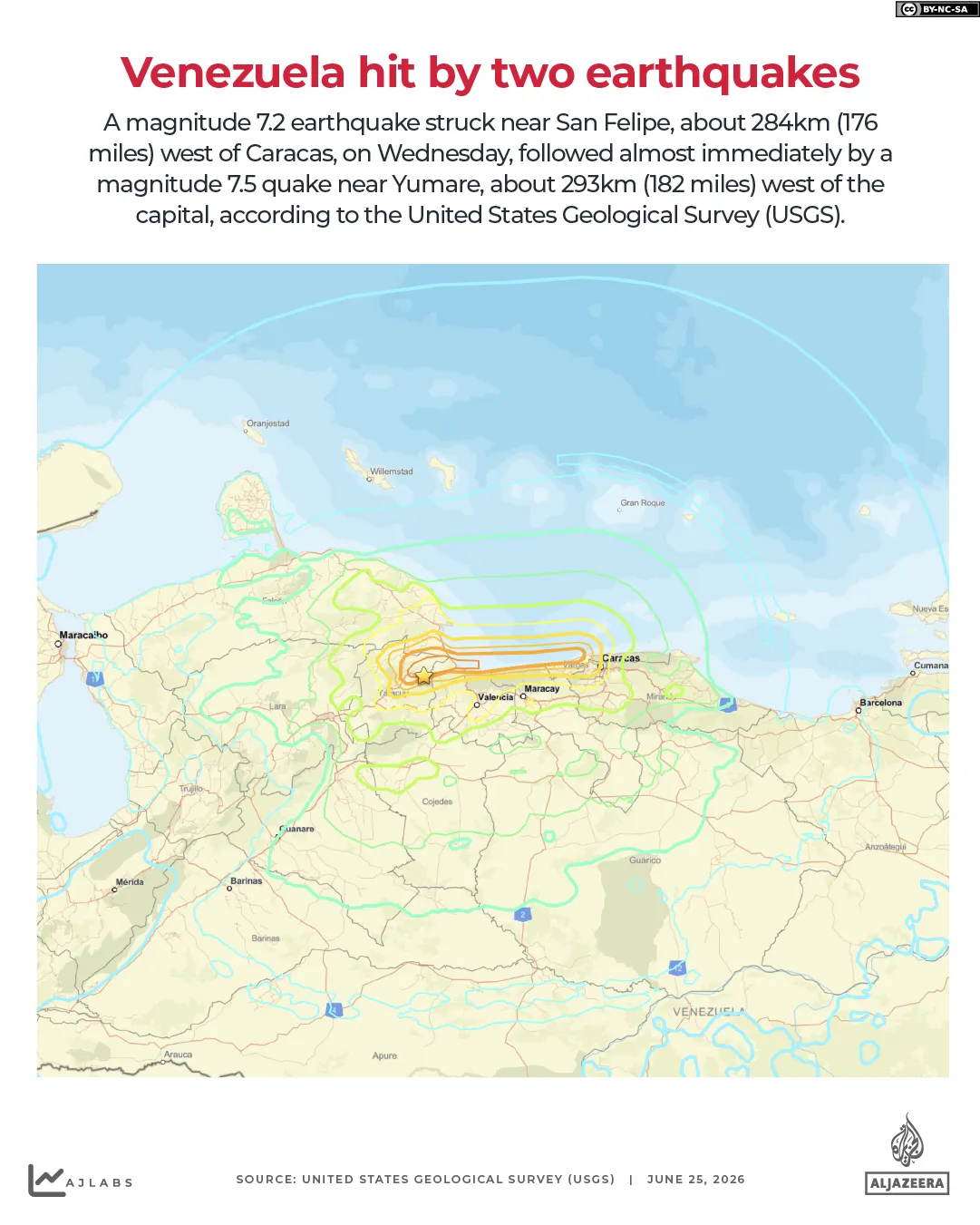
As two powerful earthquakes hit Venezuela, west of Caracas, in quick succession on Wednesday, the country’s capital sustained extensive damage.
Authorities were continuing to search for people under the rubble of collapsed buildings on Friday as 235 people were confirmed to have been killed, with 4,300 more injured.
Here is more about why Caracas has sustained so much damage.
How badly damaged is Caracas?
A magnitude 7.2 earthquake struck about 160km (100 miles) west of Caracas, followed less than a minute later by a magnitude 7.5 tremor, the strongest since 1900, according to the US Geological Survey (USGS).
Jorge Rodriguez, head of Venezuela’s national assembly and brother of interim President Delcy Rodriguez, said earlier in the day that 200 people had been trapped, with 250 buildings damaged or destroyed nationwide.
In Caracas and nearby coastal areas, at least eight hospitals, the headquarters of the Venezuelan Red Cross and the French embassy were among buildings reported to have been badly damaged.
Initial assessments released on Thursday put the estimated economic damage at between 1 and 7 percent of Venezuela’s $111bn gross domestic product (GDP). Authorities have not yet provided a separate estimate for losses in the capital.
However, the heaviest damage has been reported in Caracas itself, Al Jazeera’s Teresa Bo, reporting from Bogota in neighbouring Colombia, said on Thursday.
Public infrastructure was also heavily damaged, with acting President Rodriguez reporting power outages in Caracas.
Health Minister Carlos Alvarado said late on Thursday that 235 people had been confirmed dead at medical centres across Venezuela. He also told state media that about 4,300 people had been reported injured so far. Hundreds more are feared trapped or missing under the rubble.
How badly has the city been damaged in previous earthquakes?
This is not the first time Caracas has suffered heavy damage in an earthquake.
In 1812, a powerful earthquake roiled the cities of Merida and Caracas, killing about 30,000 people, according to the USGS. The tremors caused near-total destruction of Caracas’s colonial architecture, flattening homes, churches and public institutions.
In 1967, another earthquake hit the city, causing several high-rise buildings to collapse and killing 240 people.
(Al Jazeera)
Why has Caracas been so hard-hit?
Venezuela has a long history of devastating earthquakes because it is located along the boundary between the Caribbean and South American tectonic plates.
Caracas is also in a deep sedimentary basin, which amplifies the seismic waves from earthquakes, Vashan Wright, a geophysicist at the University of California in San Diego, told Al Jazeera.
Another reason Caracas is so vulnerable to damage from earthquakes is that its buildings and infrastructure are not specifically designed to withstand tremors and are often standing on insecure ground.
Al Jazeera’s Teresa Bo said the heaviest damage in Caracas occurred in the Altamira district, where emergency crews pulled survivors from the rubble of a 22-storey building while relatives searched for missing family members. Officials said they are still assessing the full extent of the destruction.
“For example, in the [hard-hit] area of Altamira in Caracas, many of the buildings that collapsed are built on sediments, and this makes them much more vulnerable to seismic waves,” Bo said.
“Also, there’s lots of informal housing in several areas across the country, and those types of buildings are not prepared to sustain very strong earthquakes,” she added.
Adequate urban planning and building codes, which incorporate seismic activity, require substantial funding, which Venezuela can ill afford as it has long been subject to heavy sanctions from the United States and other Western countries.
While some sanctions have been lifted since the US abducted former President Nicolas Maduro in a military strike on Caracas in January and he was replaced by Rodriguez, Caracas is still grappling with the effects of decades of underinvestment.
Another issue for Caracas is that at about 7.8km, the earthquakes were shallow, which means they were more destructive than deeper quakes of the same magnitude would have been.
In deeper earthquakes, much of the energy dissipates as it moves through layers of rock. By contrast, shallow ones release their energy closer to the ground, producing stronger shaking and greater damage in populated areas.
How many people live in informal housing in Caracas?
People living in informal housing are more at risk than others during earthquakes because low-cost, self-built housing structures, often built on hillsides and other slopes, are not resilient against tremors.
The slums in Caracas are known as barrios and are densely populated, lacking proper infrastructure. They comprise self-constructed housing or structures built with unreinforced cinderblocks or bricks, often without formal foundations or steel reinforcement, mostly on the mountainous hillsides surrounding the capital.
The lack of proper urban planning, coupled with construction on steep slopes, makes the barrios vulnerable to natural disasters.
While there is no official figure for the number of Venezuelans living in informal settlements in Caracas, academic estimates suggest they account for 40 to 50 percent of the city’s nearly five million residents.
According to the latest National Survey of Living Conditions (ENCOVI), about 55 percent of Venezuelans are living in poverty.
Which countries are better prepared for earthquakes?
Many parts of the world have adapted infrastructure with seismic engineering. Many earthquake-prone countries now plan and construct buildings with damage mitigation from tremors in mind.
Japan, one of the most quake-prone nations in the world, has strict building codes, which means many structures survive shaking that would devastate poorly built homes in parts of Indonesia or Central America. In most inland earthquakes, the majority of deaths and injuries are caused when poorly built structures collapse rather than by the shaking itself.
Japan has made enormous public investments in seismic research and has superior access to advanced engineering technologies like base isolation, which involves the installation of massive steel or rubber shock absorbers beneath the foundations of buildings.
This is why global deaths and destruction from earthquakes have reduced in the past decades. For instance, in 1556, the deadliest earthquake in recorded history in China’s Shaanxi killed about 830,000 people. In 2023, an earthquake hit northwestern China near the Shaanxi province, killing 127 people.
Lionel Richie brought the first stop on his summer tour with Earth, Wind & Fire to an abrupt stop Wednesday evening, citing his health.
The 77-year-old Grammy winner, hitmaker of “Hello” and “Say You, Say Me,” unexpectedly hit pause on the concert at the Grand Casino Arena in St. Paul, Minn., after taking a seat on stage multiple times during his performance of “Dancing on the Ceiling” and telling his audience he felt “dizzy,” according to videos shared on social media.
“What I have learned about my years of being in the business, when you are feeling dizzy, sit your a— down,” he joked, according to a TikTok posted Wednesday evening by user ynaffitmocha. “When you are feeling strange about yourself, sit your a— down.”
Moments later, saxophonist Dino Soldo informed the audience that the singer was “not feeling well” and would not continue the concert. A representative for the singer did not respond to a request for comment, but TMZ reported on Thursday the singer-songwriter was hospitalized after the health scare. Paramedics reportedly met the artist backstage and transported him to a nearby hospital out of precaution.
A spokesperson for the Saint Paul Fire Department did not immediately respond to a request for confirmation on Thursday.
Live Nation announced “American Idol” judge Richie and Earth, Wind & Fire’s joint tour in January, unveiling a 26-city circuit that includes stops in Chicago, Orlando, San Francisco and Los Angeles. Richie and the “September” group are next set to perform at the United Center in Chicago on Friday and again at Schottenstein Center in Columbus, Ohio. It is currently unclear whether Richie will resume performing for those concerts.
Richie and Earth, Wind & Fire are scheduled to play Inglewood’s Intuit Dome on Aug. 9. The tour ends Aug. 14 with a show at the Moody Center in Austin.
LONDON is undoubtedly home to numerous hidden gems, but I bet you didn’t know it has a secret island slap bang in the middle of the Thames.
Oh, and two times a year you can even visit it – including next weekend.
Sign up for the Travel newsletter
Thank you!
From Waterloo, it takes about 20 minutes to reach Twickenham and then the island is a 10 minute walk from the stationCredit: Cyann FieldingEel Pie Island is a hidden island on the River ThamesCredit: AlamyThe island only opens to the public twice a yearCredit: Alamy
Eel Pie Island sits in the middle of the River Thames in Twickenham, around 20 minutes from Waterloo.
The rather exclusive island has a very famous past as well.
The destination used to host live music events with top acts including The Rolling Stones, David Bowie, The Who and Pink Floyd.
In the 19th century, it was even a popular resort with steamboats and the famous Eel Pie Island Hotel, which sadly closed in 1967 after its dancefloor collapsed.
After the hotel’s closure, the island became a hippie commune – and this is where the island’s creative haven that you see today started to emerge.
On the island today, there are over 26 artists across cottages and studios which are littered around the island.
The island used to be home to the famous Eel Pie Island HotelCredit: GettyFamous musicians including David Bowie and The Rolling Stones performed at the hotelCredit: Alamy
Twice a year, the island opens its bridge to visitors, where you can explore the intricate network of paths and venture through what feels like a jungle to discover the different artists’ huts.
The island spans no more than nine acres and you can easily walk around it within an hour.
With small jetties off the end of gardens and plants that look way too tropical to be surviving in the Big Smoke, the island does feel more like Little Venice in Los Angeles than an urban jungle.
Roughly 120 people live on the island across 50 houses and houseboats and as you meander the paths you’ll see quirky enamel signs and American-style post boxes.
The island will open to the public next weekend as well as July 11 to 12Credit: AlamyThe island is now home to more than 26 artistsCredit: Getty
These all just add to the Californian vibe, with different spots on the island named ‘Palm Beach’, ‘Copper Beach’ and ‘Love Shack’.
Several spots across the island also feel like treasure troves of antique junk, from headless mannequins to hanging bird cages.
You can explore the island and workshops for as long as you like on the day you have a ticket for – which are free.
There are even a couple of spots where you can stay on the island.
And you can even stay on the islandCredit: Airbnb
One is a flat in a converted boatyard – it has one bedroom, along with a sofa bed and a living area.
Alternatively, you could stay in a converted boat house.
The Open Studios weekends take place on July 4 to 5 and July 11 to 12 between 11am and 5pm.
Volkswagen AG (VWAGY) is considering deeper cost-cutting measures, including eliminating up to 100,000 jobs and closing several factories, as CEO Oliver Blume seeks to improve the automaker’s competitiveness, Manager Magazin reported Friday, citing people familiar with the matter.
Celtic have announced that Shaun Maloney, Mark Fotheringham and Stephen McManus will continue to work under manager Martin O’Neill next season.
O’Neill’s return on a permanent basis was confirmed on 11 June, with the 75-year-old agreeing a one-year contract with the option for a further year.
Maloney and McManus stepped up from other roles within the club to assist O’Neill during his two interim stints last term, while former Huddersfield Town boss Fotheringham was added to the group.
Coach Gavin Strachan has recently departed for a post at West Bromwich Albion.
Having replaced Brendan Rodgers, then Wilfried Nancy, O’Neill, who first managed the club between 2000-05, steered Celtic to a league and Scottish Cup double.
“Everybody at the club played their part in our achievements last season and we now look ahead as again we strive together to bring our supporters more success,” said O’Neill in a brief statement.
June 26 (UPI) — New York City’s rental board has approved Mayor Zohran Mamdani’s two-year rent-freeze proposal for nearly 1 million rent-stabilized apartments, fulfilling a major campaign promise.
New York City’s Rent Guidelines Board voted 7-1 to set a 0% increase for rent-stabilized one-year and two-year leases commencing on or after Oct. 1, and on or before Sept. 30, 2027.
Cheers erupted from the spectators assembled as it was announced that the motion passed.
“This is a historic victory for New York City tenants,” Mamdani said in a statement following the vote.
“After reviewing the data and hearing from New Yorkers across the city, the independent RGB has delivered a freeze on one-year leases, and the first-ever freeze on two-year leases in our city’s history. This is the relief that working people across our city deserve.”
Mamdani, a democratic socialist, campaigned heavily on making life more affordable for the average New Yorker, including by creating new affordable housing and freezing rents where legally permitted.
The mayor said he is grateful for the board members’ “thoughtful consideration of the data” before casting their votes.
“I’ll continue to deliver a more affordable city by building and preserving affordable housing, lowering building operating costs like insurance, and ensuring tenants know their rights,” he said.
According to a New York City housing survey from 2023, there were 996,600 rent-stabilized units, representing about 41% of all rental units across the city. Rent stabilization generally applies to buildings with six or more units built before 1974.
The only vote against the rent freeze came from Arpit Gupta, an associate professor of finance at New York University’s Stern School of Business.
In a statement published online following the vote, Gupta argued that the rent freeze will not solve the housing crisis while possibly making it worse and ultimately driving up rents. He also said the rent freeze could prevent building owners from considering improvements and renovations.
“Residents might continue to enjoy low rents but at the cost of being trapped in units that no longer fit their needs, and with few alternatives and steadily deteriorating conditions,” he said.
“A better option is to undertake the harder reforms needed to make housing more affordable and accessible — that is, build more of it.”
The vote was held following a series of hearings in which nearly 330 people participated and nearly 700 people submitted written, audio or video testimony about their experiences.
New York State Assembly Member Tony Simone said the rent freeze will impact about 2 million New Yorkers and is expected to save renters as much as $6.8 billion over Mamdani’s four-year term.
“This immediate action reflects the urgency needed to prevent more working-class New Yorkers from being priced out of our city,” he said in a statement, while stating that the structural factors that are driving up prices must be addressed.
“To truly address the housing crisis, we need to tackle its root cause: the housing shortage,” he continued.
The US Supreme Court has sided with the Trump administration in its bid to end Temporary Protected Status (TPS) for Haitians and Syrians. The ruling allows the policy to take effect before the courts have reached a final decision on its legality.
Netflix show, Building the Band, was Liam Payne’s last completed project before his heartbreaking death in October 2024 aged 31 when he fell from a hotel balcony
Netflix has decided not to renew Liam Payne’s final television project according to reports(Image: Getty Images for ABA)
Netflix has decided not to renew Liam Payne’s final TV project according to reports. The tragic singer’s series, Building the Band – which was filmed four four months before his death – is said not to have been recommissioned, despite the music competition launching the careers of four new groups.
Liam, who tragically died in 2024 aged 31 after falling from a hotel balcony in Argentina, served as judge on the series alongside Nicole Scherzinger and Kelly Rowland, while AJ McLean hosted the contest.
The winning act, 3quency, received a global platform through Netflix, while several contestants have since secured recording contracts following the show’s release. However, there a reportedly no plans for a second series.
A source told The Sun: “Although there are currently no plans for a second season of Building The Band, bosses at Netflix are really proud of what they achieved. That’s because the show led to the creation of four amazing groups and all of them have since signed record deals.”
The source added: “The finalist groups – 3quency, SZN4, Soulidified and Midnight Til Morning – have all released original music, toured internationally – and attract hundreds of thousands of listeners each month. And Midnight Til Morning are performing at BST Hyde Park at the end of this month.”
Building the Band challenged 50 singers unknown to each other to form new groups, relying on vocal chemistry before progressing through a series of performances.
The winning act received a global platform through Netflix, while several contestants have since secured recording contracts following the show’s release.
The programme had been completed and ready for release before Liam’s death, leaving Netflix to decide whether it should proceed with the series.
After consulting the star’s grieving family, the streaming service chose to air the competition and dedicated it to the late singer.
Liam, who rose to stratospheric fame as a member of One Direction after the group was formed on The X Factor in 2010, appeared on the show mentoring aspiring singers hoping to recreate the success enjoyed by his own chart-topping band.
Since his death, tributes from his former bandmates Harry Styles, Niall Horan, Louis Tomlinson and Zayn Malik have continued to resonate with fans, while discussion around Liam’s legacy has remained a recurring topic across the music industry.
However, although Building the Band attracted significant attention because it featured the star’s final on-screen appearance, it failed to make a major impact with UK audiences, which Netflix will be aware of.
A LESSER-VISITED airport is about to get a massive upgrade – its biggest in its 96-year history.
Hollywood in Los Angeles, USA, is known for being one of the most famous tourist spots in the world.
Sign up for the Travel newsletter
Thank you!
Hollywood Burbank Airport is opening a new £1billion terminalCredit: CorganThe airport is near one of the most famous tourist destinations in the world – HollywoodCredit: elevatebur.com
And most people will get there via LAX Airport – but don’t realise there is also Hollywood Burbank Airport.
The airport is not only closer to Hollywood, but also closer to Universal Studios Hollywood and Warner Bros. Studio Tour.
This October the airport will be opening its £1billion new terminal – called The Icon – which will replace the former historic terminal which opened back in 1930.
The new terminal will be bigger than the former one and have floor-to-ceiling glass windows, filling the terminal with natural light.
The airport is also close to Universal Studios Hollywood as well as Warner Bros. Studio ToursCredit: CorganThe airport will be themed like ‘old Hollywood’Credit: elevatebur.com
To get to the 14 gates, passengers will head through an eight-lane TSA security area with modern screening technology.
There will be a central food court with restaurants and shops for travellers, with plenty of seating outside each gate.
The airport is often used by celebs due to being close to Hollywood.
Recent celeb sightings include actress Jennifer Garner and actor Neal McDonough.
The airport itself has even appeared on the big screen as a filming location, including in Ocean’s Eleven and The Office.
Visitors will be able to head to a sleek bar with views of the parked planesCredit: Corgan.comThe new terminal will open in OctoberCredit: Corgan
The US Federal Aviation Administration recorded 644 lithium battery fires onboard flights in the past 20 years, with the global figure stretching into the thousands
EasyJet pilot and head of flight operations at the Civil Aviation Authority, Glenn Bradley(Image: Supplied)
A pilot has urged passengers not to pack an electrical item in their luggage, to avoid potentially disastrous consequences.
Eleven days ago, passengers aboard a British Airways Boeing 787-9 Dreamliner flying from London Heathrow Airport to Harry Reid International Airport in Las Vegas noticed an acrid smell.
A blaze had broken out in the cabin, triggered – it would later become clear – by a lithium battery. The fire scorched the inside of the jet before crew could extinguish it. Clark County Fire Department responders rushed to meet the singed plane on the tarmac.
The fire was one of 644 such incidents on planes recorded by the US Federal Aviation Administration in the past 20 years, with the global figure stretching into the thousands.
Other incidents are much scarier.
Do you have a story to share? Email webtravel@reachplc.com
On January 28 last year, 176 passengers were evacuated from Air Busan Flight 391 when a battery blaze completely destroyed the plane as it taxied for take-off at Gimhae International Airport. Three were injured.
Lithium batteries are used six times more now than in 2020, raising the risk of fire with them. They can ignite due to a process called thermal runaway, where a damaged or short-circuited cell rapidly generates heat. This creates a chain reaction that releases extreme heat, and can be triggered by being crushed and overcharged.
Many of us know of the dangers of lithium batteries on flights and that items containing them such as phones, power banks and vapes must only be stored in hand luggage. However, it’s easy to let less obvious gadgets slip into hold luggage, according to easyJet pilot and head of flight operations at the Civil Aviation Authority (CAA), Glenn Bradley.
“The batteries are in everything, including portable fans. Lithium batteries in the hold are the most dangerous thing,” Glenn explained.
While flight attendants are trained to put out cabin fires, accessing luggage in the hold is impossible during a flight, which is why the prospect of a lithium battery fire is taken extremely seriously.
“We all carry about four of these batteries when we fly, so on a plane there could be a thousand. The fact is, they don’t explode on a daily basis, but if they do, we want to be able to manage them,” he added.
If a passenger realises they’ve left a battery-containing item in their hold luggage, they should immediately tell crew.
When that happened on a UK-bound easyJet flight in May, it was diverted to Rome. The captain judged the power bank charging in a passenger’s luggage to be too dangerous to ignore.
Glenn spoke with the Mirror as part of a CAA safety campaign. Passengers are urged to “pack right for a safe flight” by taking their batteries in the cabin with them.
Passengers should:
Take items like mobile phones, vapes and power banks on board with you.
Never charge a power bank on a flight.
Turn off laptops completely if they’re going to be put in check-in bags.
Getting it wrong could lead to your bags being removed from the flight, causing significant delays or, even worse, result in a fire that may be impossible to contain.
Giancarlo Buono, director of aviation safety at the CAA, said: “Flying is by far the safest way to travel and we want to keep it that way. Pack right for a safe flight, and that means don’t put your batteries in your checked bag. Take them into the cabin with you. This simple tip will make your flight safer for you, and the other passengers you’re flying with.”
CAA figures show reports of overheating or malfunctioning passenger devices nearly doubled between 2024 and 2025, following a 98% year-on-year increase. Cases of lithium battery-powered devices being incorrectly packed in checked baggage also rose by 91% in 2025.