A Ryanair passenger claims she was recently told it was “unlikely’ she’d be able to board a plane for an unexpected purpose. Aisling Finlay was left taken aback and has since issued an alert
11:00, 10 Jun 2026Updated 13:05, 10 Jun 2026
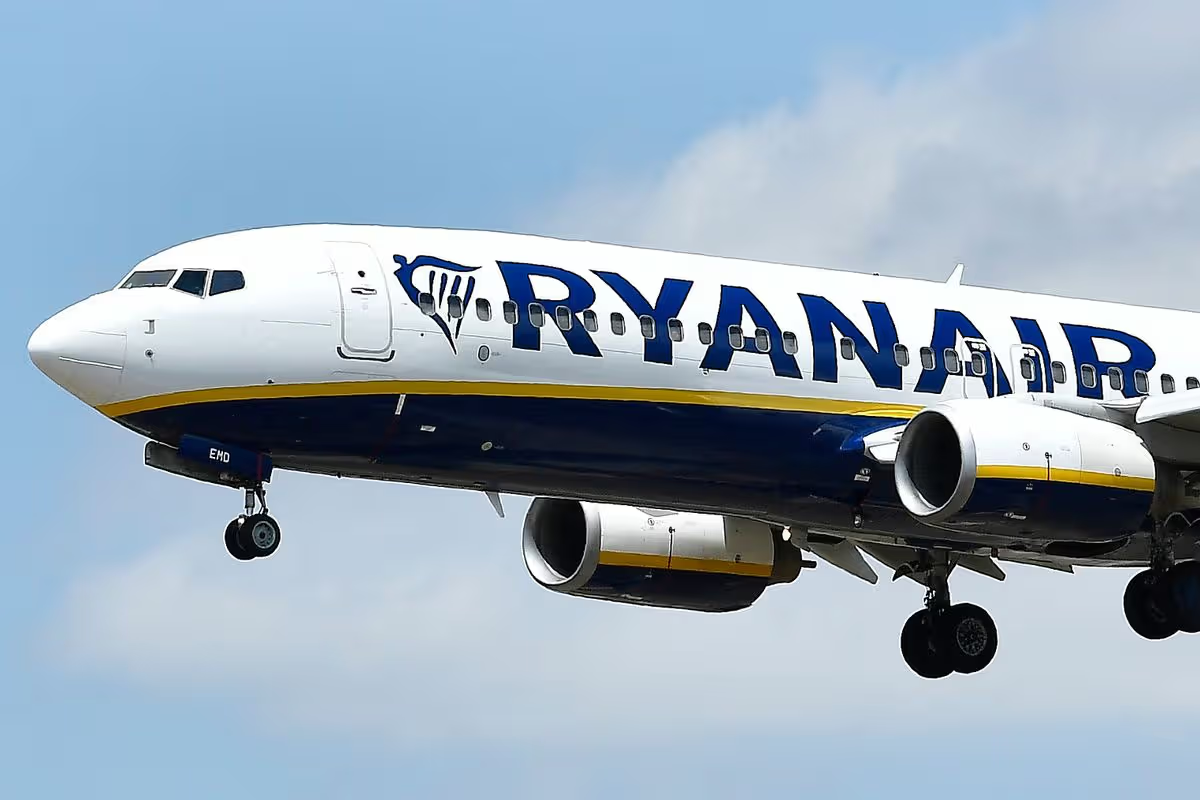
The Ryanair passenger has issued an alert (stock image)(Image: AFP via Getty Images)
A Ryanair passenger was left concerned after she was reportedly told she’d be “unlikely to board a plane”, and it’s not the first time someone has claimed they were denied a seat with the airline. Aisling Finlay recently opened up about her alleged travel issue, as she wanted to alert others to the fact that it could happen.
Aisling recently shared her story on TikTok, where she claimed she didn’t know something like this was possible when travelling with Ryanair. The clip has since gone viral as people couldn’t believe how events unfolded in the unlikely air travel tale that left many taken by surprise.
In the clip, she said: “There’s a high chance we’re not getting on this flight. So, a reminder to everyone to check-in way in advance, as they’re overbooking the planes.
“So, we’re flying to Spain at 11am. So, I checked in last night at about like 10pm, and weren’t able to like reserve a seat or allocate a seat, so I was like ‘strange’.
“And then our boarding card came up saying ‘seat allocated at the gate’, and then we arrived there, and they’re basically like ‘we’ve overbooked the flight by nine seats’.
“We’re number five and six to get on the plane. So she was like ‘it is unlikely you’ll get on the flight’. Brilliant.”
Content cannot be displayed without consent
The video has been viewed over 27,000 times since it was shared, and people were quick to comment too. Hundreds have since offered their thoughts on the matter.
One said: “In all my years travelling bumping has never happened to me, and I’ve never seen it happen. It must be a very new thing with Ryanair.”
Another added: “I had that once. Due to fly from Dublin to Bristol. They couldn’t get me on so they flew me to Birmingham and then paid for a taxi to Bristol, and a few weeks later I got £250 compensation. More than I paid for my whole trip.”
A third replied: “This is becoming so common. Happened two weeks ago. One member of our party didn’t get on, and was lucky to get a seat the next day. Check in as early as possible and book seats to make it safer.”
Meanwhile, a fourth also commented: “Most airlines do this!” One more also noted: “Every airline does this.”
What you need to know
When Ryanair was approached for comment, it stated as a policy the airline does not overbook flights. The airline also claimed the passenger travelled on the flight from Dublin to Palma de Mallorca on June 3.
However, some more information is available on its website. It states: “Ryanair, as a policy, does not overbook its flights. However, in the unlikely event that a seat is not available for a passenger with a confirmed reservation, we will seek volunteers to surrender their seats in exchange for benefits that we and the volunteer may agree upon before involuntarily denying boarding to other passengers.
“If there are insufficient volunteers, and we deny you boarding involuntarily, you are entitled to the rights set out below.” These rights are outlined on the website.
There’s a sense of quiet mystery in tarot. That’s why during my reading last week, it was more peculiar than disruptive when a dancer hopped on a table to lay at a 90-degree angle and jet her feet in the air.
Despite said activity, the tone was contemplative, and moments later, as I was being asked to describe the colors and mood of a Ten of Swords card, I was tapped on the shoulder. After a gesture to follow, I was handed a lantern.
The way I swayed the light would now dictate the performer’s movements. We may not have been dancing, but it was close. Melancholic and intimate, the performer (Haylee Nichele) silently guided me to become comfortable in my discomfort, to sit with the evening’s themes of longing, loss, confusion and impending grief.
Sam Alper’s Bill, foreground, and Haylee Nichele’s Constance in Koryn Wicks’ “You Must Be Here for the Reading,” an immersive tarot show.
(Daniel Kleen)
“You Must Be Here for the Reading,” running through June 20 at North Hollywood’s After Hours Theatre, is part theatrical and dance performance, part tarot reading and part cocktail hour. It’s also personal, led by two actors who encourage the attendees to open up, to complete poems and to generally tune into their vulnerability.
The 60-minute show, partly scripted and partly improvised, comes from the mind of Koryn Wicks. Trained in dance and choreography, Wicks’ day job is in themed entertainment while her personal projects explore the immersive space. They’re theatrical works that experiment with audience interaction. “You Must Be Here for the Reading” is no different.
The setup: Collectively, our group of eight has arrived at a tarot reading, only the famed reader we are there to work with, Constance, performed by Nichele on the night I saw, never arrives for her assigned role. We know her fate, but her partner, Sam Alper’s Bill, who nervously attempts to carry on with the performance in her absence, does not.
From there, “You Must be Here for the Reading” becomes a show heavy on audience participation. There are scripted, story-specific beats, but the cards pulled — and the tales they tell — is, of course, randomized.
Sam Alper as Bill, an unsuspecting tarot card reader in Koryn Wicks’ “You Must Be Here for the Reading.”
(Daniel Kleen)
“I knew that I wanted the audience to be the primary drivers of the tarot reading,” Wicks says. “I knew that I wanted the host to not be a tarot reader and there to be some sort of event that made it so the audience would have to take the reins and read the tarot.”
In turn, “You Must Be Here for the Reading” works for both those who are novices to the space as well as those who are more experienced. During the pre-show, guests can explore tarot books and uncover slips of paper hidden in them that prompt us to answer questions or complete poems — the latter will figure into the performance. A worksheet given to us asks us to interpret some core tenets, as well as to enter the reading with a question we would like to explore.
The show then focuses on how each attendee’s desires, concerns or lived experiences shape the perception of the reading.
“What’s drawn me to tarot is the way it’s built on symbolism and the way that symbolism is embedded in the collective unconscious,” Wicks says. “I think it’s really fascinating that we have this artifact that has this ability to give us insight into a lot of shared experiences. When I’ve read different books about tarot, or had my cards read by different people, there is an openness to interpenetration.
“The assignment I gave myself for this piece,” Wicks continues, “was to create an experience in which you had a group of people coming together and going through the process of defining the symbolism and meaning of the cards in real time.”
And yet the show also pulls from Wicks’ background in dance. While Constance never shows for the reading, her presence is still felt, often hovering or circling around the table with movements designed to interpret the tone of the reading. She’s a ghostly presence, the gracefulness heightening the somber emotions of the night. Though she and Bill never interact directly, much of the dance seeks to explore their unseen bond. At times, Constance may call on various audience members to act as a dance partner.
Koryn Wicks, creator of “You Must Be Here for the Reading,” an immersive tarot performance in which audiences are tasked with deciphering their own cards while a melancholic story unfolds around them.
(Kayla Bartkowski / Los Angeles Times)
“I really believe that one of the most beautiful things art does for us is remind us that we are not alone,” Wicks says.
Immersive art allows for a sense of participation, which Wicks hopes will increase one’s appreciation of dance.
“Dance is an embodied art form,” Wicks says. “There is science that shows that some of the enjoyment from watching dance comes from imagining yourself moving. In North America, a lot of people haven’t had an experience or education with dance, especially not concert dance. Then we ask them to sit in a dark auditorium in a small chair and not move to enjoy it. I found through my research, both practical and academic, there is something to inviting audiences to participate in dance that allows them to derive meaning from it.”
‘You Must Be Here for the Reading’
While there isn’t enough time in the show for everyone to have a one-on-one experience with the dancer, watching an audience and cast member attempt to get in sync with each other underlines the night’s themes of connecting. Ultimately, that’s the space where the show resides. “You Must Be Here for the Reading” uses tarot as a means to bring some structure to our often disconnected lives.
“It stands in contradiction to our current historical moment,” Wicks says of the show. “It’s very anti-AI. It’s asking people to sit with books and to find little seeds and not necessarily pursue solutions or puzzles. It’s asking us to connect, sometimes with strangers.”
I kept my question that I brought to the reading secret, but I found the show provided a hopeful answer. Not because the cards offered a solution. Instead, they provided a community.
WHEN it comes to picking a holiday, the temptation to go abroad can be huge – but the UK has many spots that look and feel like you are in a different country.
If you want to avoid the chaos of long airport queues and delayed flights, we’ve named some of our favourite places across Britain that will transport you to being hundreds of miles away instead.
Sign up for the Travel newsletter
Thank you!
Swap Champagne in France for Balfour
Balfour Winery in Kent is a great alternative to the Champagne region in FranceCredit: Alamy
Balfour Winery has mushroomed in size since it opened as a tiny winery in 2002, in the Kent village of Staplehurst.
You can now enjoy an excellent bottle of wine on their gorgeous verandah, accompanied by exceptional sharing platters or flatbreads and more recently, hot meals, instead of heading all the way to the Champagne region in France.
It even rivals some of Kent’s better-known vineyards, such as Chapel Down.
But it has also kept a nice local touch – they have no problem with guests taking a walk around the vineyard or the neighbouring woods on the estate, in fact it’s encouraged.
They mingle with the fabulously-dressed, down-from-Londoners, there for a full day out in their floor-length dresses.
And if you squint on a sunny summer’s day after a rose or two, the view from the restaurant could quite feasibly be somewhere more exotic on the continent. – Caroline McGuire, Head of Travel (Digital)
Swap New Zealand for North Wales
Hiking in Wales feels like New Zealand and you can even have a go on the world’s fastest ziplineCredit: Visit Wales
New Zealand should be on everyone’s bucket list. But it’s a long and pricey journey from the UK, so how about just pocketing that cash and visiting North Wales instead?
The wild scenery is very similar – trust me, I’ve spent a decent amount of time in both destinations.
Both are known for their rugged, snow-capped mountains; untouched, rural landscape; and vast lakes that are so still they paint a perfect reflection of the skyline.
They are also both big on adventure – craggy hiking trails are in abundance in North Wales and adrenaline junkies will love whizzing along the fastest zip line in the world at Zip World Penrhyn Quarry.
I had buckets of fun white water rafting in Rotorua during my New Zealand trip – and you can do that in North Wales, too.
National White Water Centre has a whole host of options starting from £45. – Sophie Swietochowski, Assistant Travel Editor
Swap the French Riviera for the English Riviera
The English Riviera is formed of three towns – Paignton, Torquay and Brixham – and feels like the French RivieraCredit: Cyann FieldingThe region is known for its palm trees, big beaches and microclimateCredit: Alamy
The English Riviera can be found in Devon and earned its name from feeling like the French Riviera with palm trees, big beaches and its very own microclimate.
The region is made up of three towns – Torquay, Paignton and Brixham – each of which has its own unique character.
In Brixham, you can spot fishing boats bobbing on the water with seals often swimming around them.
In Paignton, you can venture along the pier, testing out the different penny slot machines before heading to one of the many beaches with an ice cream in hand.
And last but not least is the queen of the English Riviera, Torquay.
It has a bustling town centre, picturesque harbour and a large beach ideal for paddleboarding and kayaking. – Cyann Fielding, Travel Reporter
Swap Thailand for Eilean Shona, Scotland
Eilean Shona features white sand beaches that look like ThailandCredit: TripAdvisor
Scotland is home to hundreds of islands and most are vastly different from each other – but there is one tiny tidal island that’s so special because it feels like you’ve stepped foot in Thailand.
Eilean Shona is a tidal island in the Inner Hebrides with pristine beaches and crystal clear waters that can only be reached by boat.
In fact, the island is even more exclusive as you have to stay at the accommodation on the island to visit it.
While the temperature is chillier, the magic of the island makes up for it – having even inspired J.M. Barrie’s Neverland in Peter Pan. – Cyann Fielding, Travel Reporter
Swap the Caribbean for Jersey
Jersey’s coastline feels like the Caribbean even with a palm tree-lined beachCredit: Alamy
If I told you there’s an island an hour’s flight from the UK, with a Caribbean-like coastline, that gets summer quicker than England and you don’t need a passport – you’d think I was pulling your leg.
When my family and I visited, every beach was outstanding, the weather glorious, the food a fantastic hybrid of French and English tastes.
Jersey calls itself “curiously Brit . . . (ish)” and it sums up this island, 14 miles from the coast of France, perfectly.
One of our best (of many best days) on our week away, was on a wildlife RIB trip with Jersey Seafaris.
The company takes you to the stunning Les Minquiers sandbanks and reef, which is often likened to the Maldives.
There was plenty of time for pure relaxation too, St Brelade’s Bay is often billed as a rival to the Caribbean on a sunny day, thanks to its palm tree-lined beach and clear turquoise waters.
From England to France, the Caribbean to the Maldives on one tiny island that takes two hours to drive from top to bottom? That’s one hell of a day out. – Caroline McGuire, Head of Travel (Digital)
Swap Spain for Hove
According to Travel Reporter Alice Penwill, Hove feels like the MediterraneanCredit: Alice PenwillRockwater rooftop bar is a great spot to see the sea viewsCredit: Alamy
It’s not often I go to the English coast and feel like I’m in Europe.
But when I hopped down to Hove for a weekend trip last summer, I did feel like I was on holiday in the Mediterranean.
Given, it was during the July heatwave, so I did have the glorious weather on my side.
But still, on a beautiful summer’s day, I was at Rockwater sipping on an Aperol Spritz by a huge open window staring out at the promenade and glittering water feeling like I was in Italy or Spain.
The food is another thing that has a Mediterranean seaside vibe, especially if you dine on fish dishes like mussels, crab linguine or catch of the day.
But to really make the most of the sun, the crown of Rockwater is the rooftop bar which has sun umbrellas, and it’s enclosed with a glass balcony to lessen the sea breeze. – Alice Penwill, Travel Reporter
Swap Provence for Heacham, Norfolk
In Norfolk, you can head to lavender fields like in Provence, FranceCredit: Alamy
You don’t have to fly all the way to Provence, France, to stroll through rolling fields of bright purple lavender.
Norfolk Lavender in Heacham, north-west Norfolk has 100 acres of fragrant lavender fields that stretch as far as the eye can see.
There’s even an on-site restaurant where you can sip a lavender-infused tea, or sip something a little stronger and watch the sun set over the fields – no passport needed.
A visit to the site also makes for a fantastic family day out – there’s a farm where kids can meet alpacas, chickens and goats, as well as popular soft play barn Farmer Fred‘s.
To make the most of your trip, try a slice of lavender cake in the cafe, or treat yourself to some handmade lavender balms and creams in the gift shop.
As well as the fields, there’s manicured gardens with a bridge over a gentle stream, a peaceful gazebo and the historic Heacham Watermill building – which look like something out of a French countryside estate.– Jenna Stevens, Travel Reporter
Swap Spanish Islands for Margate
In Margate, you can head to the No42 bar witch ocean views, that makes you feel as if you are on a Spanish islandCredit: http://www.cenemagazine.co.uk
An Aperol Spritz, lo-fi music and uninterrupted views of the ocean – you’d think I was on some beautiful Spanish island.
But no, it’s a rooftop bar in Margate that transported me abroad, found on top of No42 by GuestHouse hotel.
When the sun is shining and the music is playing, you’ll forget you’re on the Kent coastline.
The chic interiors rival even some of London’s top bars – just with a golden sand beach just steps away. – Kara Godfrey, Deputy Travel Editor
Swap the Norwegian fjords for Boscastle Harbour
Boscastle in Cornwall features rugged landscapes like the Norwegian fjordsCredit: Alamy
Boscastle, a small and quaint village located on the north coast of Cornwall, can feel a bit more like the Norwegian fjords thanks to its dramatic, rocky landscape.
The town’s harbour sits between a large valley and a number of local shops and even The Museum of Witchcraft and Magic – home to the world’s largest collection of witchcraft items.
The beauty of Boscastle is often forgotten beneath its history, with blue waters and dark, that really do make you feel as if you are in the rugged landscapes of the Norwegian fjords.
I love Boscastle harbour because it is embellished by nothing but the nature that surrounds it, as well as being a quiet and picturesque escape without the hustle and bustle of larger beaches.– Katy Bright, Travel Writer
Plymouth’s Tinside Pool is a great alternative to the Bondi Icebergs Pool in SydneyCredit: Alamy
Swap Bondi Icebergs Pool in Sydney for Tinside Lido, Plymouth
I’ve always been jealous of people who have made it to Australia, chilling on the beach and the famous Bondi Icebergs Pool in Sydney.
But there is one in the UK that I think rivals it – enter Tinside Lido.
The Plymouth pool is one of the most beautiful Art Deco lidos in the UK, jutting out over the ocean where visiting on a hot day and relaxing on the side of the water will make you feel like you are thousands of miles away.
You can even grab a glass of Australian Chardonnay or Shiraz to enjoy after your tanning sesh from the sun terrace. – Kara Godfrey, Deputy Travel Editor
Swap the French Riviera for Salcombe
Salcombe is another great alternative to the French Riviera with seafront restaurants and a great beachCredit: Getty
I instantly felt attached to Salcombe on my first visit. It stirred up a feeling of nostalgia, reminding me of childhood holidays to France and the French Riviera.
Back then, days were spent building sand castles on peaceful shores and wandering through flower-filled villages to gather up a dinnertime feast from the local fishmonger.
And that’s pretty much how my Devon visit went, too.
I’m probably a little too old for sandcastles, now aged 33, but Salcombe’s North Sands beach would be the perfect place to build one.
It has that laissez-faire, village vibe to it, too – positioned a 30-minute walk away from the central hub and with a cute cafe that’s popular with locals.
The setting feels similar to that in southern France, too – old stone houses facing a shimmering sea and a busy town with a delicatessen whose foodie window displays draw you in.
Local catches are dished up in the seafront restaurants, just like they are in the French Riviera.
Swing by The Crab Shed which serves a limited menu of fishy delights – the star dish is its whole cracked crab. – Sophie Swietochowski, Assistant Travel Editor
BRITS heading to Spain need to be aware of a new rule update that could get them banned from entering the country.
Currently, Brits visiting Spain need to show they have a certain amount of money in their bank at the border.
Sign up for the Travel newsletter
Thank you!
Brits could be refused entry to Spain under updated rulesCredit: Alamy
However, an upgrade to this rule means all travellers from non-EU countries must be able to prove they now have at least €1,098.90 (£948.12).
For longer trips, the figure will rise in line with how many days you are in the country for, working out to around an extra €121.10 (£104.48) per day.
For example, if you intend to stay in Spain for 10 days, you will need to prove you have €1,220 (£1,052.79) in funds.
Brits can prove they have the money in several ways including having the cash, presenting debit or credit cards accompanied by bank statements, showing cheques or providing a letter of credit.
However, it is worth noting that screenshots of online bank statements are not accepted.
The money must be shown in euros or the equivalent amount in your own currency, so for Brits, this would be in pounds.
Brits heading to Spain must prove they have sufficient funds for their tripCredit: Alamy
Despite the requirement not being new, the amount tourists need to prove has been updated to be in line with 10 per cent of Spain’s minimum wage, which recently increased.
The rule was first introduced in 2021, at the end of the Brexit transition period.
Brexit meant that Brits became “third-country nationals” and therefore have to follow the rules for entering the EU when travelling to European countries.
Similar proof-of-funds requirements are in place across all Schengen countries.
The amounts do vary though – for example, in France, travellers must be able to prove they have €65 (£56.08) per day, yet in Latvia, the figure drops to €14 (£12.08) per day.
Even though proof-of-funds can be enforced by border officers in Spain, checks are not usually carried out on every traveller entering the country.
If they don’t, border force officers can refuse them entryCredit: PA
But if a border force officer asks you to prove your funds and you do not have the amount needed, then they can refuse you entry into Spain.
Advice from the UK Foreign Office states: “Make sure that you have access to enough money to cover all of your costs when travelling abroad, including unforeseen costs, e.g. medical care.
“To avoid getting into financial difficulties abroad, you should take prepaid travel cards, traveller’s cheques, local currency, credit and bank cards with you.
“Check what you can use in the country you are visiting and ensure you have enough money.
“Make a note of how to stop any credit cards or traveller’s cheques being used if lost or stolen, and of traveller’s cheque numbers.
“[And] get comprehensive travel insurance, ensure it provides you with adequate financial cover for your personal needs, and check for any exclusions.
“If you don’t have adequate travel insurance, you will need to pay any costs you are charged.”
Mum-of-one, Melanie is taking the plunge to leave the UK as she claims she feels stuck in an infinite cycle of ‘rise and repeat’ with the country sucking the soul out of her
A mum is fleeing the UK to travel the world with her son as the country just makes her ‘miserable’ (Image: Kennedy News/meltheastrologer)
A mum is selling all of her possessions in the UK to travel the world with her five-year-old son, as she said the country makes her “miserable”, claiming: “There is something about England energy-wise that is just so off.”
This isn’t the first time Melanie Bentley-Moore, 33, has decided to leave the UK for Asia, as she first left in 2017 with the intention of a brief trip.
“I used to live in Asia for two years so I’m very familiar with that area of the world,” she said. “I was only meant to go for three months but I ended up staying out there for a couple of years travelling around Asia.”
The mum-of-one spent two years in Asia with Vietnam being her main base. But, her long-extended trip came to a halt as she missed a British staple – a local chippy. She added: “My main base was Vietnam, I did some English teaching out there and came back home because, it’s something random, I really wanted chippy and Nando’s.”
She then decided to settle in the UK, after having her son, Antares Moore, in 2023. But the desire to go back has never left Melanie. She says the UK made her miserable and believed that it’s not an isolated feeling.
“The energy just feels heavy, it’s dark – there’s no room to grow, [the] majority of people are miserable because of all the [stuff] that’s going on, the cost of living, everything’s rising,” she said, “I just don’t feel alive here and I think that’s not just a ‘me’ problem either, everyone that I’m speaking to just feels soulless.”
In April 2026, Melanie’s landlord said he was selling her flat, which prompted the mum-of-one to take the same risk she took all those years ago, and leave the UK.
Melanie told her TikTok followers: “Just hearing everyone else complain, that weakens my spirit. Most people are miserable and they’re always complaining, it seeps into everything.”
“It’s like an infinite cycle of ‘rinse and repeat’ complaining. It’s just a feeling, I just don’t feel alive. It sucks the soul out of me.”
Ahead of her relocation, Melanie took her son out of school as she admired the Scandinavian education system which saw children beginning compulsory school between the ages of 6 and 7. In the UK, children start school from the age of 4.
“In Scandinavia there’s a reason why their children are the happiest and more successful because they don’t start school till they’re seven.”
Melanie hoped to show her son ‘real life’ as she preferred the values of life in Asia.
She said: “I’m going to go to Indonesia and then probably back to Vietnam, it just depends on the weather. See where life takes us, I’m very ‘flowy’.
“With the values and stuff, life’s just better over there. It’s slower, it’s sunny, the scenes are beautiful and you realise there is so much more to life than what I’m used to.”
By speaking up, Melanie hoped to inspire others to follow their dreams and see “there’s more to life”.
“I’m here to inspire people to follow their heart, go after what they want and that there’s more to life,” she said, “It’s no good talking, there’s a lot of talkers out there – I ‘do’.”
“I want to show my son real life as well. I’m going to do some charity work and volunteering with him. There is no better learning than real life.”
This photo, taken Wednesday, shows the trading room of Hana Bank in Seoul as South Korean stocks fell more than 4 percent amid escalating Middle East tensions and a tech sell-off. Photo by Yonhap
South Korean stocks plummeted more than 4 percent Wednesday amid escalating tensions between the United States and Iran and a tech slump fueled by concerns over the valuation of stocks related to artificial intelligence (AI). The local currency was trading lower against the U.S. dollar.
The benchmark Korea Composite Stock Price Index (KOSPI) shed 366.11 points, or 4.52 percent, to close at 7,730.82, almost eclipsing most of the over 8 percent surge from the previous day.
At one point, the index fell as low as 7,541.11.
Due to the sharp fall, the Korea Exchange had activated a sell-side sidecar for the index at 1:16 p.m., halting program trading for five minutes.
Trade volume was moderate at 457.5 million shares worth 39 trillion won (US$25.6 billion), with losers outnumbering winners 547 to 343.
Foreigners continued their sell-off for the 23rd consecutive session, dumping a net 2.77 trillion won, while retail investors and institutions purchased local shares worth 4.86 trillion won. Institutions sold 2.27 trillion won.
Market analysts said the KOSPI lost ground as tensions resurfaced in the Middle East after the U.S. struck Iran in response to the shooting down of an American Apache helicopter in the Strait of Hormuz and then Tehran hit back.
The risk-on appetite was also sapped by an overnight tech slide on Wall Street caused by concerns over the valuation of the AI stocks on news that Crusoe Energy Systems, a data center developer, suspended one of its projects upon the request of an unidentified big tech customer.
The tech-heavy Nasdaq composite closed 0.97 percent lower, and the S&P 500 dropped 0.26 percent, while the Dow Jones Industrial Average rose 0.17 percent.
Major tech shares led the market decline, with Broadcom losing 1.12 percent, Apple sliding 3.64 percent, Micron falling 1.4 percent and Nvidia down 0.2 percent.
Investors’ eyes are now on the upcoming release of the U.S. Consumer Price Index (CPI), which could give further clues on the U.S. Federal Reserve’s monetary policy amid bets on a hawkish pivot and the initial public offering of SpaceX later this week.
“The South Korean stock market was weighed down as risk aversion sentiment strengthened ahead of the U.S. CPI and Oracle’s earnings release, once triggering a sell-side sidecar,” Lee Kyoung-min, an analyst at Daishin Securities, said.
Lee said a hot inflation report could further contract the market sentiment, raising concerns over a possible U.S. rate hike.
In Seoul, market top-cap Samsung Electronics slid 6.06 percent to 302,500 won, while its chipmaking rival SK hynix plunged 7.54 percent to 2.05 million won.
AI investment firm SK Square shed 6.78 percent to 1.18 million won, and Samsung Electro-Mechanics shot down 8.38 percent to 1.8 million won.
Samsung Life Insurance dipped 6.36 percent to 368,000 won, and Samsung C&T plummeted 5.01 percent to 407,500 won.
Auto shares were also weak, with Hyundai Motor down 5.79 percent to 602,000 won, and its sister Kia losing 2.8 percent to 159,700 won. Hyundai Mobis dropped 4.2 percent to 570,000 won.
Internet portal operator Naver, which had recently rallied on news on its partnership with Nvidia, nosedived 11.67 percent to 227,000 won. Home appliances maker LG Electronics shot down 9.68 percent to 224,000 won.
Major shipbuilder HD Hyundai Heavy was among the few gainers, jumping 4.74 percent to 641,000 won.
Defense giant Hanwha Aerospace also climbed 1.48 percent to 1.03 million won.
The Korean won was quoted at 1,524.2 won against the U.S. dollar at 3:30 p.m., down 12.1 won from the previous session.
Bond prices, which move inversely to yields, closed mixed. The yield on three-year Treasurys added 2.5 basis points to 3.881 percent, and the return on the benchmark five-year government bonds dropped 3.2 basis points to 4.070 percent.
Copyright (c) Yonhap News Agency prohibits its content from being redistributed or reprinted without consent, and forbids the content from being learned and used by artificial intelligence systems.
Anti-immigration protesters have torched buildings and vehicles in the capital of Northern Ireland, a day after a knife attack was captured in a graphic video.
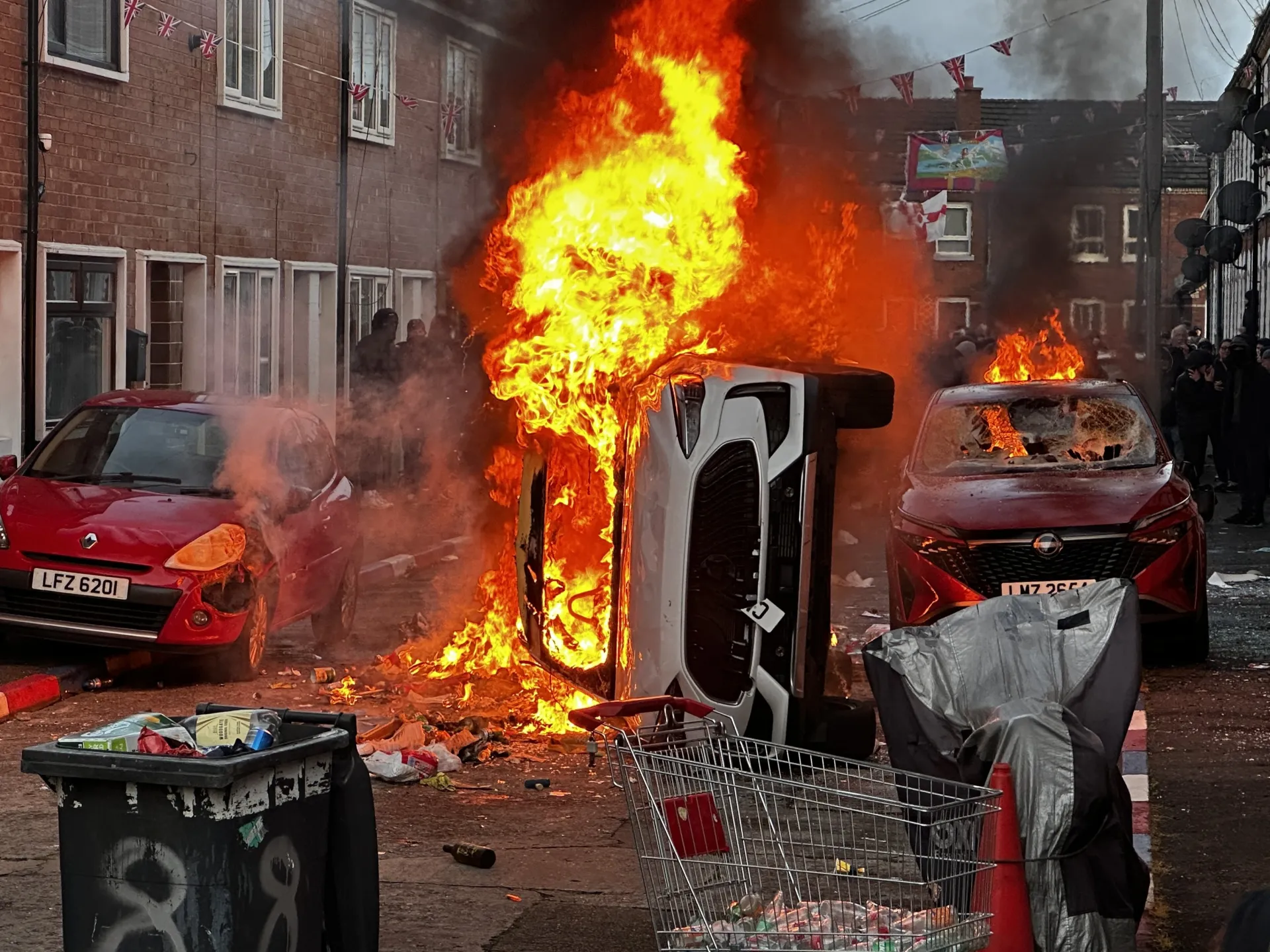
Hundreds of protesters, many of them masked, gathered at several locations across Belfast on Tuesday evening. A bus and several cars were set alight, while a building on the edge of the city centre caught fire and its residents had to be evacuated.
Police helicopters patrolled above the city, and shops closed early.
British Prime Minister Keir Starmer described the initial knife attack, which took place in north Belfast late on Monday evening, as “sickening”.
The attack comes at a time of heightened tensions in the United Kingdom following the murder of a student who was handcuffed by police as he lay dying from stab wounds after his killer falsely alleged a racist attack.
It also follows repeated protests over immigration, with populist parties saying the UK’s asylum policy has allowed dangerous men into the country. There was anti-immigration rioting in Northern Ireland last year amid anger over an alleged sexual assault.
Immigration has become a highly charged political issue and has helped fuel the rise of the hard-right Reform UK and Restore Britain parties in opinion polls.
Northern Ireland’s political leaders and the region’s chief constable have urged people not to incite hate and fear or target particular communities.
HELEN Flanagan has revealed her “dream” to be a foster parent when her kids with ex fiance Scott Sinclair have grown up.
The Coronation Street actress, 35, is a mum-of-three to Matilda, 10, and Delilah, seven, and five-year-old son Charlie.
Sign up for the Showbiz newsletter
Thank you!
Helen Flanagan has revealed her ‘dream’ to be a foster carer when her kids grow upCredit: instagramThe Coronation Street alum shares three kids with ex Scott SinclairCredit: hjgflanagan/Instagram
She is proud parent to Matilda, 10, and Delilah, seven, and five-year-old son CharlieCredit: Instagram/hjgflanaganHelen said she believes fostering would be ‘something lovely to do’ and she has ‘adored kids’Credit: Instagram
“When I’m older, I think fostering could be something lovely to do.
“I’ve always adored kids”.
Foster carers temporarily or permanently welcome children into their homes who cannot live with their biological families, offering a safe and stable place to live.
Helen told how she ‘felt lost’ until becoming a mumCredit: InstagramShe parted ways with her long-term fiancé in 2022Credit: Instagram/Helen Flanagan
She then reinforced her point on ITV daytime show Loose Women and said: “I’m in my element being a mum.
“Before I was a bit lost and now I have got Matilda [eldest daughter] she has really completed me.“
“She just made me so much happier. It gives you so much perspective, I’m besotted with her.”
Helen previously told of her parenting approach and said of her brood: “I love them so much, they are my world.
“Sometimes I shout which makes me feel awful and I always say sorry if I do which I think is important.
“I tell them how much I love them, one thing a day they have done a day that makes me proud.”
She added: “Being a mum is amazing but just really hard. I suppose you can just do your best.”
Helen, who co-parents her brood with Scott, has previously spoken about suffering from mum guilt, and the raw emotional pull she feels while working away.
Speaking to the Sun on behalf of Paddy Power, she said: “I feel mum guilt all the time.
“It’s something I deal with constantly. But I try to remind myself that I’m working for my children, so it’s ultimately for them.
“When they’re with their dad, I also see that as encouraging their relationship, which is important.
“I do still feel guilty, but I try to reframe it and look at the bigger picture.”
Most UK airlines have said that they don’t see any immediate threats to upcoming flights, as many have ‘hedged’ fuel costs, which is paying a set price for a period of time.
However, Ryanair has warned that budget airlines face the biggest struggle, due to the low margins.
Turkish Airlines also said they could cut flightsCredit: Alamy
The budget carrier’s boss Michael O’Leary previously warned: “If pricing stays higher for longer this summer, we think a number of our airline competitors in Europe are going to face real financial difficulties. I think there will be failures.”
And while UK flights might not be cancelled, the cost of flights is expected to only go up.
International Airlines Group (IAG), which also owns Iberia and Aer Lingus, said it will likely pass on extra costs to cover the additional £1.72billion costs of its fuel this year.
Experts have said costs could continue to go up, due to the UK’s reliance on US jet fuel.
This is because US suppliers could divert their fuel inwards due to it being the busy American holiday season, particularly for “driving season” (when domestic holidays boom).
S&P Global’s research director for fuels Eleanor Budds told Telegraph: “Prices could rise again. The UK is replacing a good part of its imports. If the US can’t keep up those volumes, [the UK] is very exposed”.
LAS VEGAS — Jordan Staal scored his second goal of the game while stretched out on his stomach at 6:32 of the third period to put the Carolina Hurricanes ahead for good in their 5-3 victory on Tuesday night over the Vegas Golden Knights and even the Stanley Cup Final after four games.
Game 5 is Thursday night at Carolina, which will potentially have two games on home ice to win its first Cup in two decades. The Golden Knights are searching for their second in four years.
This was the first game not decided by one goal.
A two-goal lead has disappeared in all four games in what has been a remarkable series in which momentum often changes at a moment’s notice. Each team has led by at least that many twice.
Staal became the first player in 44 years to score at least one goal in each of the first four games of the final and the ninth overall. Mike Bossy in 1982 with the New York Islanders against the Vancouver Canucks was the last player to score in the first four games of a final.
Nikolaj Ehlers added an empty-net goal and two assists for the Hurricanes, Jackson Blake had a goal and an assist, and Logan Stankoven scored a goal.
Brandon Bussi started in place of Frederik Andersen in goal and made 18 saves. Hurricanes coach Rod Brind’Amour told ABC that Andersen, who did not dress, needed the rest. Pyotr Kochetkov was the backup goalie with Andersen serving as the emergency goaltender.
“Let [Andersen] rest,” Brind’Amour said. “Give him as many days here as we can.”
Mark Stone, William Karlsson and Brett Howden scored goals for the Golden Knights, and Carter Hart made 23 saves. Karlsson also had an assist.
The Hurricanes outplayed the Golden Knights in the period, outshooting Vegas 14-6. But the Golden Knights, according to Natural Stat Trick, had four high-danger chances to three for Carolina.
The difference was the Hurricanes took advantage of their chances.
Brind’Amour replaced Andersen with Bussi trailing 4-0 after two periods in Game 2 on Saturday, and he saved the first 18 shots he faced as the Hurricanes mounted a furious rally. Bussi failed to save the 19th shot when Shea Theodore knocked the puck off the boards and it bounced off Bussi’s skate for a Golden Knights victory.
Estonia, the smallest of the Baltic states, has experienced some dramatic incidents.
In September, Tallinn said Russian MiG-31 fighter jets entered its airspace for 12 minutes. NATO scrambled Italian F-35s stationed in Estonia as part of the Baltic Air Policing mission. Russia denied violating Estonian airspace.
In March, a stray Ukrainian military drone crashed into Estonia’s Auvere power station.
In April and May, Estonian authorities said drones entered their airspace, grounding flights and prompting warnings issued to citizens.
Estonia’s intelligence services have said that the country does not believe Russia is preparing an imminent military attack on NATO, but that Moscow may be rebuilding its forces for the long term while engaging in hybrid attacks through drones, cyber operations, and sabotage.
Tallinn claims one such hybrid method is the so-called “Narva People’s Republic”, a pro-Russian separatist narrative that casts Estonia’s Russian-speaking border region as a distinct political entity, echoing the Donetsk and Luhansk “people’s republics” used by Moscow as a pretext for intervention in Ukraine.
Estonian authorities say it is part of a disinformation campaign rather than a credible separatist movement.
Its military has, at times, been bellicose in its statements.
In May, Estonia’s Lieutenant General Andrus Merilo argued that Russia is rebuilding its military much faster than many Europeans realise and that Estonia must be ready for a renewed military threat within the next few years, marking 2027 as a critical benchmark for readiness.
In September 2024, in an interview with the Estonian public broadcaster ERR, Estonian General Vahur Karus stated that if Moscow showed signs of preparing for an attack, Estonia could strike the Russians first.
“Our capability to neutralise the enemy on its own territory is crucial,” he said.
However, the government’s rhetoric has been more measured.
In April, Ukrainian President Volodomyr Zelenskyy suggested in an interview that a new wave of Russian mobilisation may be used to launch an attack on the Baltic states.
But Estonian politicians, including the foreign minister, warned that the remarks echoed Moscow’s objective of stoking fears and made cooperation difficult.
“We do not see Russia concentrating its forces or preparing in any way militarily to attack NATO or the Baltic states; rather, it is the opposite. Russia is not in a very strong position on the Ukrainian front, and economically as well,” Estonian Foreign Minister Margus Tsahkna told ERR.
“No one is in the streets panicking,” Tony Lawrence, a research fellow at the International Centre for Defence and Security in Tallinn, told Al Jazeera.
The air incursions have “put people on edge”, but there is a sense that Russian forces are too preoccupied in Ukraine, he said.
To learn more about this campaign, we reached out to one of the soldiers leading this effort from the unit that created it. In an exclusive interview, an Unmanned Systems Department Officer for the First Corps Azov of the National Guard of Ukraine offered us unique insights into how the program began, how it’s going, where it is headed and how AI is helping to identify and hit targets deep behind the lines. It’s a capability we described in great detail — about how it was rapidly gestating and would arrive on the battlefield around now. The officer spoke on condition of anonymity to discuss operational details.
Some of the questions and answers have been edited for clarity.
Azov patrols the border areas around Mariupol.
Ukrainian territory must be free of Russian forces. The surest path to achieving this is pushing the “sanitization zone” for enemy logistics closer to Russia itself and occupied Crimea.
— First Corps Azov of the National Guard of Ukraine (@azov_media) May 25, 2026
Q: Walk me through the genesis of the mid-range strike campaign.
A: I will first of all start with answering the question of why. So the reason why we are currently conducting this campaign is to hunt enemy logistics capabilities, and currently we have a lot of quite cheap assets that can strike enemy targets at quite a deep range. So the overall meaning, the overall sense of this campaign is to strike enemy concentrations of cargo in the places where this concentration is the highest and the protection of those enemy logistical assets is at the lowest level.
So, if we’re talking about enemy logistics very close to the front line, to the line of contact, we are mostly talking about a person with a backpack. Then, if we are moving deeper into the enemy controlled area, further from the front line, then we’re talking about cars. Then even deeper we’re talking about trucks. Even deeper we’re talking about long haulers with trailers, so a higher concentration of cargo. Even deeper into the enemy controlled area, we’re talking about the railroads, the trains that are carrying supplies. So the deeper we go from the line of contact, the higher is the concentration of enemy cargo.
Russian rail logistics are now also the target of Midstrike drones, with lines to Crimea being particularly affected. pic.twitter.com/K1BFd0QVov
The other part of answering this question is basically about how the enemy protects their logistical assets. So the deeper we go from the line of contact, not only is the distance larger, but also the areas that the enemy needs to protect. So just simple mathematical calculations show us that the distance of 50 kilometers deep from the line of contact is usually the most concentrated area the enemy has to defend against our strike assets. But if we go to the depths of 300 kilometers, then the areas that the enemy should protect are much larger, and it’s basically impossible to saturate that area with all the necessary protection assets that the enemy needs to strike down our drones.
The point I would like to make is that we conduct those strike operations at deeper ranges with basically the same assets that we use for the tactical depths, for example, at the depths of 50 kilometers. That means we do not increase the cost of our assets. We just introduced some technical modifications, and we can use the same assets to strike in the deep area.
How Ukraine Uses the US-made Hornet AI Strike Drone To Disrupt And Cut Russian Logistics Lines
Q: What drones are you using to carry out these attacks and how are you increasing the ranges?
A: Basically, we’re using fixed-wing kamikaze drones with some modifications in terms of communication systems. We’ve installed Starlink systems on those drones, and we have also introduced a number of modifications in terms of the engine of the drones – in terms of the overall propelling unit. And this allowed us to increase the range of the assets that we used previously for the range up to 50 kilometers, with some modifications for longer distances.
Q: What kinds of drones are you using?
A: Just the simple fixed-wing chemical drones, such as Hornet systems, such as the Darts systems, and also some other assets that, for now, we prefer not to mention.
Darts
Q: Can you provide additional details about the modifications you have made to these drones and what is their maximum range?
A: Well, I would say that these are quite technical things, and I wouldn’t want to disclose those, because I would want to avoid the situation where the enemy is going to do the same modifications.
Q: Are you reaching as far as 100 kilometers?
A: From what we can say now, we can cover distances of up to 250 kilometers, but as you might understand, with time we will cover longer and longer distances.
Q: Can you describe how these attacks work? Do you operate these as first-person view drones through a video feed? Do they have a terminal seeker?
A: The process is really simple. So, for example, we select a section of the road, or the road as a whole and we distribute that road or the sections among our units. And I would like to mention that this is an all Ukrainian operation. It’s not a task for just one single unit, and basically each unit has its own area of responsibility and its own section of the road.
And then we just send drones there in hunting mode, and I cannot disclose how this works from the standpoint of intelligence, but the overall principle is that the intelligence just gives us the priorities for the targets. For example, they say that you need to target this type of vehicle with these types of cargo.
And in terms of the targeting, I remember that you were also asking the question about how the targets are selected. For this we use both the AI tools and also the operator himself, so we’re using both methods for that.
Q: I want to get back to AI in a bit, but what area of operations do you cover?
A: Our area of interest and area of responsibility is related to all the roads that the enemy is using to bring in supplies to the area of operations of our corps, which is roughly in the area of the town of Dobropillia in eastern Ukraine, and for example, this may be the route from Rostov that goes to Mariupol and then goes to Donetsk, and this could be any other route that the enemy might use to bring military cargo to the area of operations of our corps.
First Corps Azov works in and around the area of Dobropillia in the Donetsk region of Eastern Ukraine. (Google Earth)
Q: What were some of the more successful mid-range drone strike missions you carried out?
A: That’s basically an easy principle. When I said that we are hunting the enemy’s logistics, I mean that this is a daily process. This is a continuous process, and this is not about one standalone mission, when we fly somewhere, when we hit a target and the mission is over.
Last night, Ukraine expanded its mid-range strike campaign to the Sea of Azov, hitting at least 5 vessels carrying Russian cargo.
At least two of the cargo vessels were hit at the occupied ports of Berdyansk and Mariupol, as Ukrainian forces seek to cut off Russian logistics. pic.twitter.com/NoXeAO7Ca6
Q: How are these mid-range strikes on Russian logistics affecting their ability to fight?
A: This is causing shortages of fuel for the enemy. This was already commented on by our media, and also the media resources of the enemy, and now we understand that this is true, not only for Crimea, where there is a severe shortage of fuel now, but also this is true about the other Russian-controlled territories. And basically, when we are striking enemy logistical supplies of fuel, this affects the overall situation, because what is fuel? Fuel is basically the blood of war, which is necessary to fuel the generators that the enemy is using for the FPV operations. The fuel is used for the vehicles that basically bring in those FPVs to the combat zone.
I’d like to add an additional explanation of how this works. If we destroy a car that brings fuel to the line of contact, then we’re talking about destroying like two canisters, so that’s approximately 40 liters of fuel. But if we strike a fuel tank and a tank vehicle, which is bringing fuel to the overall area, so then we can talk about several tons of materials.
Gas stations across Russian-occupied Crimea are facing worsening fuel shortages, with long queues, rationing, and voucher-based distribution reported by residents. Some locals say fuel has become so scarce that it is treated as a luxury, while Moscow insists there is no cause for… pic.twitter.com/0LSYWEqiDH
— Radio Free Europe/Radio Liberty (@RFERL) June 5, 2026
Q: Is this setting the stage for a Ukrainian advance in the east or Zaporizhia?
A: I would say that blocking the logistical supplies to the Zaporizhia Oblast and also to Crimea is a byproduct of our attacks aimed at cutting enemy logistics to our area of operations. Because we’re targeting the roads that go through Mariupol, also to Crimea, to supply the Zaporizhia region, and as well our area of operations. But as for the most strategic aspect of this question of whether this might influence some counter-offensive capabilities of the Ukrainian Defense Forces, I think that is not the question within my scope of responsibility, because I’m an officer responsible for the UAS component of the corps, and I think that this is more of a question that should be directed to the general staff of the Armed Forces of Ukraine.
Ukraine 🇺🇦 continues to launch an important number of mid-range strike, targeting Russian 🇷🇺 logistics in occupied territories
Since early may, more than 270 trucks have been hit, together with multiple fuel depots and trains.
Q: Tell me how you came to use the U.S.-made Hornet drones.
A: I would say that this is also a question that should be directed at one level up from my level. We get those drones, we deploy those drones, but the questions of how we get them and what are the specifics of their supply, this is not a question that I can answer.
A U.S.-made Hornet drone. (U.S. Army photo by Spc. Thomas Dixon) Spc. Thomas Dixon
Q: When did you start getting them?
A: We have been receiving these drones for almost a year.
Q: When you got the Hornet drones, were you given any instructions on what missions to accomplish with them or what targets to pursue?
A: I think that the principle thing to explain here is that the Hornet drone is a tactical level UAV system. It can be used at the maximum range of 50 kilometers – the maximum range of the basic configuration of this drone. The drones we are currently using are the modification of the Hornet drone, but the basic configuration of this drone is only a tactical-level UAV. This is why our mid-strike operations, which have started only recently, are using modified drones.
I think that it is important to add that these modifications are conducted by the units themselves.
The First Corps Azov of the National Guard of Ukraine maintains control over enemy logistics near Donetsk.
Strike UAV pilots are targeting Russian logistics deep in the operational rear. Drone units maintain constant surveillance and fire control over all supply routes around… pic.twitter.com/i4TYOWJBg4
— First Corps Azov of the National Guard of Ukraine (@azov_media) April 16, 2026
Q: When did you begin to make the modifications and was the mid-range strike concept something that Azov developed?
A: Yeah, I would say that basically that was Azov development. So the first tests of these new modifications started in early winter. After approximately a month of testing, we started combat deployment of those drones approximately in January or February of this year. And we use those new modifications to ensure our middle strike operations. In terms of the tactics, I would also like to say that Azov developed new tactics of the deployment of middle strike drones, because the previous tactics they were mostly concentrated on the use of very expensive assets, which are available in limited numbers, so the targeting cycle was different, which is why we needed to develop new tactics and change this targeting cycle.
Q: What systems were you using before that were so expensive?
A: Well I’m not really talking about some specific assets here. I’m mostly talking about the overall tactics and the targeting cycle. So, the tactics of middle strikes were developed for expensive assets that the Corps didn’t have at the moment. So, this is basically why we started developing our own assets that could ensure that we have those middle strike capabilities, and we can also engage targets at the operational level.
Magyar claims a reduction from 3,800 cargo journeys to 1,100 cargo journey (71.05%) along the E-58 Mariupol -Berdiansk – Melitopol – Simferopol highway in the past two weeks
— Ukraine Control Map (@UAControlMap) June 9, 2026
Q: When you added Starlink, did you have to seek permission from SpaceX to use their system for these weapons?
A: The first thing that I would like to say is that we do not use only Starlink. It is just one of the possible communication systems and communication solutions that we’re using. And the second thing that I would like to add is that all the international issues, international cooperation questions, are the issues that should be dealt with at the level of our ministries and at the level of our central government, so once again, this is not a question that I can answer.
Una parte vital de la efectividad de los drones Hornet con los que Ucrania está atacando las rutas logísticas rusas entre 80 y 120km del frente es la recopilacion de datos para que el algoritmo aprenda. Por eso algunos modelos llevan grandes terminales Starlink. https://t.co/yGePjoPo2Kpic.twitter.com/iWu2bLrwq5
Q: Can you tell me what other communications systems you use?
A: No, this information is still secret, because none of those assets have been taken by the enemy, so the enemy doesn’t know yet that we’re using those. But I think that in some time we will be able to go public with those assets and tell more about what we use, apart from Starlink.
Q: Are you using Starlink and the other systems on the Darts drones as well, or just Hornet?
A: Yes, we are using Darts for those middle strike attacks. So, basically, the overall tactics of those mid-strike attacks with small UAV systems, it can use any fixed wing kamikaze drones with modifications which is why we are using Hornets, we are using Darts and also the other types of drones.
While the Ukrainian “Hornet” strike UAV is receiving a lot of attention recently, the “Darts” UAV remains a workhorse for mid-range strike. It, too, has AI terminal targeting and control capabilities to defeat Russian jamming. https://t.co/cNcQytap1Dpic.twitter.com/C8nYJ20Uer
A: Unfortunately, no. The enemy has not yet got hold of those assets, and if one of them will be shot down, or if one of them will be captured by the enemy, then I think that we will be able to go public with those assets.
Q: Can you talk more about how you are using AI for the Hornets and Darts?
A: The AI is used for the so-called last-mile system. I’m talking about the terminal guidance here, and also the AI can also be used to identify the targets, especially when the drone is flying in the autonomous mode. It can recognize the type of the target and it can automatically engage the target. So all of these processes can happen without the involvement of the operator. This allows us to launch several drones at the same time, and this also allows us to ensure a higher level of coordination for those attacks.
I think that one of the examples of these attacks was captured by one of our videos that you might have seen when one fixed-wing drone is observing the target and the other drone is actually hitting it.
1-й корпус НГУ «Азов» контролює ворожу логістику під Донецьком. Знищення російської техніки
Q: Is there a man in the loop or a man on the loop during the terminal phase of the attack or is it fully autonomous?
A: Since we are trying to control the whole process, usually it is the person who takes the final decision and actually makes this decision to strike the target, because we do not want to over rely on the artificial intelligence. If necessary, this whole process can also happen without human involvement, but as I have already mentioned, our policy is that the decision should be made exclusively by the operator.
Q: So this is man in the loop?
A: Yes, so technically men can be out of this loop, but in our case we involve humans in this system, so that’s man in the loop.
Visual look of Hornet UI. Not much new, can mark soldiers individually. Seems aiming is done by either by lock a target (red) or manually aiming by continusly clicking (green) https://t.co/d2LGtV2aON
Q: Have the Russians developed countermeasures for this effort?
A: Since the overall intent was to go to the massive deployment of those drones against the enemy logistics at once, as for now, the enemy has not yet had enough time to adapt to these tactics of ours. And now they’re desperately trying to find some countermeasures to find some ways to react to this.
Images showing unusually painted Russian trucks have appeared on social media channels in recent days with a paint scheme designed to throw off Ukraine’s AI-assisted mid-range strike drones. (Via X) via X
They are putting on anti-drone nets deep into their controlled territory. They are placing people armed with shotguns every 50 meters of their critical roads, but basically, as for now, there is no Russian tactic that would be effective in protecting their logistics. I do not say that they will not come up with this tactic in a month or so, but as for now, they do not have an effective countermeasure for that.
The only thing that I would like to add is that we approximately know the direction in which the enemy is moving to ensure counter measures to this tactic of ours, and we already have countermeasures for their countermeasures.
The current Ukrainian superiority in mid-range drone warfare is a brilliant advantage that comes with an expiration date.
Failing to prepare for the day Russia matches this capability guarantees a catastrophic collapse of front line logistics for Ukraine.
Q: Is the AI enhancement helping to mitigate Russian jamming and electronic warfare measures?
A: Well, I would like to say that EW is not the only way to counter UAVs. So, in addition to EW assets, there are other counter drone methods. Nets can be used. Air observation posts can be used. The drones can be shot down with enemy interceptor drones, and also there are hundreds and hundreds of people armed with shotguns who can also try to shoot the drones down. So the EW systems are just a small part of this overall system of drone countermeasures, and it is a general misconception that all anti-drone efforts are from the EW system. I would say that EW accounts for approximately 10% of overall counter drone efforts.
The main idea of the use of the AI systems is not only to help operators to counter enemy drone countermeasures, but the AI also helps the operator with navigation, with orientation, with the identification of the targets. So this is a complex system that helps the operator with many tasks.
Here: strike by the Ukrainian-American “Hornet” drone on occupier positions. Two Russians confirmed as “gruz 200” (KIA). Interestingly, the Russians call this drone “Martian-2” because its capabilities seem “out of this world” to them.
Q: What are the lessons that the U.S. can learn from your mid-range drone strike campaign, given the importance of logistics everywhere.
A: Well, I would say that the main lesson that the U.S. can learn from our experience is that drones in their basic configuration, right out of the box, is not something that can work, and this is not something that can bring you the best results at once. This is why every unit should have their own drone laboratory that can reconfigure those drones and modify them, and I’m not only talking about reconfiguring tactical level drones to turn them into middle strike capacities. I’m talking about all warfare in general.
U.S. soldier Sgt. Kevin Tran, assigned to 173rd Airborne Brigade, sets up a one-way attack Hornet drone during a demonstration in the 7th Army Training Command’s Grafenwoehr Training Area, Germany, March 25, 2026. The demonstration provided leaders with insight into how AI-enabled one-way attack systems operate alongside Army fires formations. (U.S. Army photo by Spc. Thomas Dixon) Spc. Thomas Dixon
Assets become obsolete very quickly and in three months everything can change, starting from the navigation systems and ending with the control systems. For example, today the GPS signal works, in a month it doesn’t work anymore. Today we use this set of frequency ranges, and in a month all those frequency ranges are jammed by the enemy. So I’m saying this for you to understand that for example, if the U.S. government purchases Hornet drones for their units, then the units are going to have good tactical level drones. But if you want to squeeze all of the possible benefits from those drones, then you will need to modify the structure of your units and include the departments, include the sections that will deal with the modification and reconfiguration of those drones to ensure the most efficient results that can be achieved.
From what I see now, the U.S. is mostly just giving the unit some assets, but they are not thinking about re-configuring or repurposing those drones.
Q: Is there anything I haven’t asked you that you would like to address?
A: I think that we have covered all the topics. The only thing that I would like to add is that I would like your audience to see that Ukraine introduces new innovations that can basically change the battlefield, and this is why trying to forecast the outcome of the war based on the number of tanks or aircraft or bombs that would be incorrect, so the victory will belong to the side capable of adapting faster and not to the side that has more resources.
Nearly 17 years after the King of Pop’s death, Michael Jackson is dominating the box office, television ratings and headlines.
“Michael,” the biopic about the star that hit theaters in April, has surpassed $900 million at box offices globally, according to Deadline, making it the second-highest-grossing film of 2026 behind “The Super Mario Galaxy Movie,” which hit $1 billion. Although “Bohemian Rhapsody” is still the highest-grossing musical biopic, “Michael” is a mere $11 million behind and will likely snag the title in coming weeks.
The film, which stars Jackson’s nephew Jaafar Jackson, follows the “Thriller” hitmaker from his early career leading the Jackson Five to reaching pinnacle star status in the late ’80s. The film’s timeline ends before 1993, when Jackson faced sexual abuse allegations brought by 13-year-old Jordan Chandler.
On Tuesday, “Michael” was released to streaming services, and fans at home can rent or buy on-demand from Amazon Prime Video and other platforms.
Also available for streaming is the Netflix docuseries “Michael Jackson: The Verdict,” which became available on June 3 and dominated the streamer’s charts with nearly 18 million views in its first week. The three-part series examines the pop star’s 2005 molestation trial, in which he was acquitted of all charges, and features key players from the trial, including jurors, eyewitnesses and prosecutors.
The lead prosecutor, Ron Zonen, spoke with TMZ on Tuesday and said that, although he wasn’t sure audiences would view the allegations with a different lens 20 years later, he wanted the documentary to be “as accurate as possible” and feature “the perspective of people who were involved in the trial.”
As far as the response from viewers, Zonen told the outlet that he’d received threats via email. “Well, there are people who are fans, who express their displeasure at the position that we took in this documentary, and express their displeasure very clearly to me,” he said, adding that he’s not bothered by the bad blood with mega-fans, and that the threats were more numerous at the time of the trial.
The first serious legal challenge to the House settlement will come courtesy of a USC freshman linebacker.
Talanoa Ili, a top-100 recruit in the Trojans’ vaunted 2026 class, joins Stanford quarterback Charlie Mirer as one of two lead plaintiffs in a class-action lawsuit that takes aim at the system implemented since the settlement ushered in a new era of direct payment from universities to athletes. The suit, which was filed Tuesday, accuses the NCAA, the Power Four conferences and the enforcement arm they created — the College Sports Commission — of participating in a “conspiracy” by creating a system of policies that have “direct anti-competitive effects, including the suppression of [name, image and likeness] compensation below competitive levels.”
Those policies, their attorneys argue, violate state laws in California that prohibit restrictions on NIL rights, as well as federal antitrust statutes. They’re seeking monetary damages, as well as an injunction that would upend the enforcement structure created to determine whether individual NIL deals over $2,500 meet criteria, including whether they have “a valid business purpose” or fall within a reasonable range of market value.
The clearinghouse, NIL Go, was created with the hope of eliminating an influx of booster-funded NIL deals that were basically direct payments from donors to the program. But since its inception, the system has been more restrictive and worked less efficiently than some schools and athletes might have hoped. As of last month, according to Yahoo Sports, more than $125 million worth of NIL compensation that had been promised to athletes had been rejected by the clearinghouse or was still under review.
In Ili’s case, the complaint states that he received a “substantial multi-year offer” from USC’s House of Victory collective in 2024 that led him to commit to the Trojans, only to have the offer disappear after approval of the House settlement.
“Absent the NIL Restrictions on Direct Pay NIL Compensation, Ili would have received more for his NIL rights than he now receives,” the complaint states. “The Agreement has thus injured Ili.”
Mirer, meanwhile, claims that he has received no NIL compensation from Stanford’s collective or revenue-sharing money from the university since 2024 as a result of the settlement.
Stanford quarterback Charlie Mirer during a game last season.
(Godofredo A. Vásquez / Associated Press)
“The [CSC agreement] has suppressed, deterred, and effectively terminated the economic relationships that had produced his prior NIL compensation,” the lawsuit says.
Even the plaintiffs in the House settlement, which created the CSC, are in the process of challenging the current system. On Wednesday, plaintiff attorney Jeffrey Kessler will argue in a hearing that school-affiliated businesses such as multimedia rights holders or corporate sponsors, should not be subject to the CSC’s rigorous criteria for NIL deals. That decision could also open the floodgates, with schools using those entities to circumvent the cap.
Two U.S. senators are hoping to pass legislation they believe would bring more stability to college athletics and thwart legal challenges. Ted Cruz (R-Texas) and Maria Cantwell (D-Texas) spoke with presidents and chancellors from the Big Ten Conference on Tuesday about a bipartisan bill, the Protect College Sports Act, which would codify some of the CSC’s policies into federal law.
1 of 4 | German officers stand before Oslo’s National Theater in 1940 after taking control of Norway during World War II. On June 10, 1940, Norway surrendered to Germany during World War II, with King Haakon and members of the government fleeing to Britain. File Photo by Willi Ruge/German Federal Archives
On this date in history:
In 1692, Bridget Bishop was found guilty of the practice of witchcraft and hanged in Salem Village in the Massachusetts Bay Colony. She was the first colonist executed during the Salem witch trials.
In 1898, U.S. Marines invaded Cuba in the Spanish-American War.
In 1940, Norway surrendered to Germany during World War II, with King Haakon and members of the government fleeing to Britain. National Unity Party leader Vidkun Quisling led Norwegian fascist forces to assist the Germans, seizing strategic locations.
In 2014, Rep. Eric Cantor, R-Va., the U.S. House Republican leader, was defeated by Tea Party challenger David Brat, a college economics professor, in one of the most stunning primary election upsets in congressional history.
In 2021, the U.S. Senate confirmed Zahid Quraishi to the U.S. District Court in New Jersey, making him the first Muslim federal judge in the United States.
In 2024, Apple introduced its new generative artificial intelligence technology, called Apple Intelligence, at its annual Worldwide Developers Conference in Cupertino, Calif.
Kazakhstan’s Energy Minister Yerlan Akkenzhenov said international partners are urging the country to increase oil exports as concerns grow over disruptions to energy supplies linked to tensions around the Strait of Hormuz.
According to Akkenzhenov, buyers are seeking the maximum possible increase in Kazakh oil shipments due to uncertainty surrounding one of the world’s most important energy transit routes. However, he noted that Kazakhstan faces infrastructure and production constraints that limit how quickly exports can be expanded.
To support higher output, Kazakhstan has postponed planned maintenance work at the Kashagan Oil Field until 2027. The country is also considering increasing crude shipments through the Baku Tbilisi Ceyhan Pipeline, potentially raising volumes from 1.5 million tons to 2.2 million tons annually and beyond.
The development comes as global energy markets remain sensitive to geopolitical tensions involving Iran and the Strait of Hormuz, a key route for international oil and gas exports.
Why It Matters
Kazakhstan’s growing importance highlights how global energy markets are seeking alternative supply sources amid rising geopolitical risks in the Middle East.
Any disruption in the Strait of Hormuz could affect a significant share of global oil shipments, prompting importers to diversify supply chains and reduce dependence on vulnerable routes. Kazakhstan, one of the world’s major oil producers, is increasingly viewed as a reliable alternative supplier.
The decision to delay maintenance at Kashagan signals that Kazakhstan is prioritizing production stability and export capacity at a time when energy security has become a major concern for consuming nations.
The move could also strengthen Kazakhstan’s strategic position in global energy markets, giving it greater influence as countries seek dependable suppliers outside conflict affected regions.
Key Stakeholders
Kazakhstan – Seeking to expand exports while balancing OPEC+ commitments.
Yerlan Akkenzhenov – Overseeing the country’s energy strategy.
Kashagan Oil Field – One of the world’s largest oil fields and a key source of future production growth.
OPEC+ members monitoring compliance with production agreements.
Energy importing countries seeking alternative crude supplies.
Oil traders and global energy markets responding to supply risks.
Countries along the Baku Tbilisi Ceyhan Pipeline route that facilitate exports to international markets.
Future Outlook
Kazakhstan is likely to face increasing pressure from international buyers if instability around the Strait of Hormuz persists. While production constraints may limit immediate gains, the postponement of Kashagan maintenance suggests authorities are positioning the country to maximize output over the coming years.
The expansion of exports through the Baku Tbilisi Ceyhan pipeline could become increasingly important as energy consumers seek routes that bypass geopolitical hotspots. This would further enhance Kazakhstan’s role in global energy diversification efforts.
However, Kazakhstan must also balance market demand with its commitments under the OPEC+ framework. Any significant increase in production could attract scrutiny from fellow producers seeking to maintain supply discipline and price stability.
If Middle East tensions remain elevated, Kazakhstan is likely to emerge as one of the key beneficiaries of the global search for secure and reliable oil supplies.
Perrie Edwards hints Zayn Malik cheated on her after she revealed her ‘hellish’ split and ‘breakdowns’ as she struggled to copeCredit: Instagram/greatcompanypodcastThe pair got together in 2012 and became engaged the next yearCredit: Splash News
The pair became engaged prior to calling time on their relationship, yet things ended badly, with Perrie, 32, claiming thatZayn broke up with her via text.
Rumours were also rife that he cheated on the Black Magic singer and the popstar, who now is a mum of two and set to wed fiance Alex Oxlade-Chamberlain, has again hinted at infidelity and “overlap” in a new chat on podcast Great Company.
She bravely re-visited her “hellish” heartache in the chat with Made in Chelsea alum Jamie Laing and said of her split with Zayn: “When you go through heartbreak, it is hellish.
“It’s the worst thing in the world. You can’t eat. You can’t sleep. You feel horrendous.
They broke up in 2015 and she has now hinted at an ‘overlap’ for the One Direction starCredit: Not known clear with Picture DeskPerrie told of feeling ‘abandoned’ and ‘not good enough’ in the aftermath of their splitCredit: Instagram/greatcompanypodcastZayn went on to date Gigi Hadid in 2015, the year he and Perrie splitCredit: Getty Images – GettyShe was in pop band Little Mix at the time and told of her struggles to copeCredit: Getty
“You feel abandoned and you don’t feel good enough and you feel like you’ve been left for something better or whatever it is.
“And then what makes it even worse is, I felt like the world was then looking at me, laughing at me.
‘Not my fans, my fans were like, ‘we love you, we’ll fight your corner no matter what.’ But I felt embarrassed. I felt horrified. It was awful”.
The Shout Out To My Ex hitmaker then told Jamie she didn’t stay sane in the aftermath of the split and had “serious breakdowns”.
Perrie said she felt ‘ridiculed’ in the aftermathCredit: Refer to SourcePerrie said of Zayn ‘they’ve left me for someone more beautiful than me’Credit: GettyZayn starred with Gigi Hadid in the Pillowtalk music videoCredit: YOUTUBEPerrie said ‘then you have a song that they’ve written about you, but then someone else is in the video’Credit: Refer to Caption
She added: “It wasn’t just the heartbreak I was dealing with.
“I was dealing with everybody looking at me and I felt ridiculed. I just couldn’t cope with it.
“I hated it. I was breaking down in performances, which isn’t like me at all. I was breaking down. I was crying constantly. I think I was depressed.
“And I know it sounds ridiculous, but I think it was this plus, this plus, this and everything on top.
Perrie is now a mum of twoCredit: PERRIE EDWARDS / INSTAGRAMShe is now happily loved up and engaged to Alex Oxlade-Chamberlain, with whom she shares two kidsCredit: Getty
“I had to be there for the girls. I had to be switched on. I had to power through for Little Mix, but I also just wanted to be left the f**k alone. But I also was getting followed every two seconds and asked about it 24/7”.
In the lengthy chat she hinted at an “overlap” between Zayn and another of his lovers and admitted she “needed to be careful” how to phrase it.
She then referenced his music video for his debut solo single Pillowtalk, which featured supermodel Gigi Hadid, who would go on to be his girlfriend and the mother of his child.
Perrie said: “I need to be careful how I say this, but there was, let’s just say there was a bit of a… I’m just going to say it.
“So there was a bit of an overlap.
“I think when you’re moving on with somebody else you always get on better.
“When you’re the one left behind, that’s when it’s hard because it’s like, ‘Oh s**t, they’ve left me for someone more beautiful than me, someone better than me.’
‘Whatever it is, that’s how it felt at the time.
“And then you have a song that they’ve written about you, but then someone else is in the video.”
The Sun has gone to Zayn’s rep for comment.
Thankfully, Perrie’s love life is now firmly on the up.
An Air Canada plane is shown in 2025 at a gate at Montreal-Trudeau International Airport in Montreal, Quebec, Canada. Police said a former Air Canada captain faces fraud charges after flying without the correct license for 17 years. File Photo by Graham Hughes/EPA
June 9 (UPI) — A former pilot and captain for Air Canada faces fraud charges after an investigation showed he flew hundreds of flights over 17 years without a proper license, police said Tuesday.
Wall, who’d started his career with Air Canada in 1998, did not obtain the required airline transport pilot license in 2009 when he was promoted to captain, Deputy Chief Nick Milinovich said at a press conference.
That license requires a series of written exams. Instead, Wall allegedly used fraudulent licenses for Air Canada and Transport Canada (the country’s federal transportation department)and then attempted to conceal that in a false police report, Milinovich said.
“This is very similar to a doctor who that is licensed to practice family medicine but is doing brain surgery in their office,” Milinovich said.
Air Canada said that Wall was immediately removed from duty when the fraud was discovered, The BBC reported. Airline officials said passengers were never at risk and that Wall was completely trained with a valid commercial pilot license, just not the ATPL.
Police said Wall flew several types of airplanes in a total of 900 domestic and international flights. The investigation through Transport Canada started when officials noticed inconsistencies with his license documentation in a routine evaluation. The Peel Regional Police then started a criminal investigation. The charges include fraud, forging documents and possession of counterfeit mark.
Trita Parsi tells Al Jazeera that Iran has abandoned strategic patience for a new doctrine: swift, severe retaliation against any US attack. Parsi added that Iran aims to deny Washington the ability to strike with impunity, viewing immediate escalation as vital to its deterrence.