A damaged mosque is shown Wednesday, a day after an Israeli airstrike hit the village of Maashouk in southern Lebanon. According to the Disaster Management Unit of the Lebanese government, Israeli attacks across Lebanon have killed more than 3,045 people and injured more than 9,310 others since the start of renewed hostilities between Israel and Hezbollah. Photo by Wael Hamzeh/EPA
BEIRUT, Lebanon, May 21 (UPI) — Lebanon took a gamble by engaging in direct negotiations with Israel that opened the door to security and political talks. Yet, that failed to stop the fighting despite a 45-day extension of a cease-fire.
The U.S.-brokered talks emerged as Lebanon’s last resort to end the raging war between Israel and Hezbollah that broke out when the Iran-backed militant group opened a support front for Gaza on Oct. 8, 2023.
A first cease-fire was achieved Nov. 27, 2024, but it failed to restrain Israel, prompting Hezbollah to resume fighting March 2 after 15 months of inactivity as it regrouped from heavy losses.
A second cease-fire, reached April 16, was extended for 45 days Friday during the third round of Lebanon-Israel negotiations in Washington.
The new truce did not take effect on the ground, as Israel and Hezbollah continued to clash, while talks in Washington were set to proceed under fire.
Israel continued to focus largely on southern Lebanon, carrying out airstrikes and expanding its ground operations, while Hezbollah maintained its fighting with new tactics that involved fiber-optic drones and small first-person-view systems.
Riad Kahwaji, a Middle East security analyst, said the extended cease-fire does not cover areas in which Hezbollah is active, especially southern Lebanon, but applies to Beirut and other parts of Lebanon.
“It is obvious that this is being done under the pretext of allowing Israel to retain its right to act against threats from Hezbollah,” Kahwaji said.
The latest casualty count released by the Lebanese Health Ministry on Wednesday showed that 3,073 people have been killed and 9,362 wounded since March 2.
Despite Hezbollah’s rejection of direct negotiations and its insistence on maintaining its anti-Israel resistance, Lebanese President Joseph Aoun remained committed to continuing the Washington talks.
“We are proceeding with this process because there is no other option. We are betting on the U.S. to help more,” a Lebanese official source told UPI.
The source said that the U.S. officials have been showing “understanding” of Lebanon’s position, but it is yet to be seen if “they would force Israel to abide by the cease-fire and withdraw” from southern Lebanon.
Lebanon — while not ready to conclude a peace agreement or normalize ties with Israel — engaged in the negotiations with five demands: consolidate the cease-fire, secure Israel’s withdrawal from occupied Lebanese territories, obtain release of Lebanese prisoners captured during the war, enable return of displaced people to their homes and villages, and initiate reconstruction.
Lebanese and Israeli military delegations are to meet on May 29 at the Pentagon in Washington in a “security track” aimed at, as the U.S. State Department put it, “meaningfully improving communication and coordination” between the two countries under U.S. facilitation.
While Lebanon prepares its military delegation, that meeting is expected to focus on enforcing and maintaining the cease-fire through structured military coordination.
According to Lebanese retired Maj. Gen. Abdul Rahman Chehaitli, the 45-day extension of the truce was a “window of time” for Israel to end or stop its military operations and for Lebanon to build confidence in its capacity to carry out its mission in southern Lebanon.
Supporting and equipping the Lebanese Army will be part of the discussions, aimed at enabling its forces to deploy and take control of southern Lebanon following any eventual Israeli withdrawal.
“All military operations should then stop completely for the Lebanese Army to begin deploying,” Chehaitli told UPI.
In addition to creating conditions for an Israeli withdrawal, the issue of Hezbollah’s disarmament would be on the table.
Kahwaji noted that Israel and Lebanon are heading into the Pentagon meeting with their own expectations and objectives.
“Lebanon wants the army to be strengthened, but there is so far no intention to forcibly disarm Hezbollah,” he said, adding that the United States and Israel expect the Lebanese Army to handle disarmament and security in southern Lebanon once properly equipped.
If an agreement is reached, the disarmament process would not succeed without Hezbollah’s consent and cooperation.
“Hezbollah would have to inform the army of all the locations where its weapons and missiles are hidden. That would require a decision by Hezbollah’s leadership, as these are secret locations not known to many.” Chehaitli said. “If this happens, we could then say that the war in Lebanon is over.”
However, the final word remains with Iran, which has heavily financed and armed Hezbollah since its establishment in the early 1980s.
“The key is in Iran’s hands. Ending the war and Iran’s military investment in Lebanon is the necessary entry point for the negotiations,” Chehaitli said.
While Lebanon seeks to break free from Iran and has opted for U.S.-brokered direct negotiations with Israel, it is working to revive the 1949 Armistice Treaty as a basis for ending hostilities in the upcoming political track expected in early June.
According to the official source, the plan is an “Armistice Treaty Plus” with some modifications — a feasible objective that would end the state of war between the two countries and resolve their border disputes.
“The Armistice Treaty is fully valid but requires some geographical and military amendments, which are easily addressed,” said Chehaitli, who is the author of The Lebanese Land and Maritime Borders: A Historical, Geographical and Political Study.
“It is either the solution or the gateway to a solution and could be sufficient to prevent any future war.”
He said military observers from the United Nations Truce Supervision Organization — placed under the operational command of the U.N. peacekeeping force in southern Lebanon, or UNIFIL, after the 2006 Israel-Hezbollah war — would resume their primary role of observing ceasefires and supervising armistice agreements.
UNIFIL’s mandate is set to expire in January.
Such an agreement to end the war would “keep the door open for a future peace deal that could involve political and economic relations,” Kahwaji argued.
That would largely depend on Israel’s acceptance and on the U.S. acting as guarantor.
“But the U.S. has not always been an honest broker, and will always side with Israel,” Kahwaji said.
Weekly insights and analysis on the latest developments in military technology, strategy, and foreign policy.
The new Tranche 4 Eurofighter for Germany has been unveiled by Airbus Defense & Space. The appearance of the jet comes at a time when the pan-European multirole fighter is enjoying renewed momentum, bolstered by upgrades that include advanced radars and new weapons. At the same time, the Eurofighter’s importance to Germany, especially, is becoming greater as questions grow about the future of the sixth-generation Future Combat Air System (FCAS) program, at the heart of which is supposed to be the crewed New Generation Fighter (NGF).
The initial German Tranche 4 Eurofighter to be shown in public was presented at Airbus Defense & Space’s Manching site near Munich today, as part of the Airbus Defense Summit. The aircraft, a single-seater, has the production number GS0115 and the service registration 34+03. At this point, no German Tranche 4 has flown, but the company says it has already completed several examples at Manching. Flight testing is scheduled to begin in the coming weeks.
The German Tranche 4 Eurofighter at the Airbus Defense Summit in Manching near Munich today. Tony Osborne
Under Project Quadriga, Germany ordered 38 Tranche 4-standard aircraft in November 2020. Originally planned to be delivered between 2025 and 2030, 31 of the aircraft will be single-seaters, and seven will be two-seaters. The total also includes replacements for two Eurofighters lost in accidents.
This is part of a broader push to enhance the capabilities of the Luftwaffe. While the Tranche 4 jets are slated to replace the Luftwaffe’s early Tranche 1 aircraft, which have far more limited capabilities, Berlin also plans on buying another 55 Eurofighters as a partial replacement for the Tornado swing-wing combat jet. As well as these 93 Tranche 4 Eurofighters, Germany has ordered a batch of 20 Tranche 5 Eurofighters, with a contract for these signed late last year.
A Luftwaffe Eurofighter. Bundeswehr/Bicker Ingo Bicker
The German requirement has been made more complex by the need to replace a portion of the Tornados operating in the nuclear strike role. This has led to a decision to purchase 35 F-35As that will be able to carry B61-12 free-fall nuclear bombs. However, the F-35As will also have an important role within Germany’s expanding conventional long-range strike arsenal, including using the Joint Strike Missile (JSM) cruise missile.
Currently, the Luftwaffe has around 138 Eurofighters in service, which includes a mixture of Tranche 1, 2, and 3 variants.
While the Tranche 4 Eurofighter looks much the same as the earlier (Tranche 1 to 3) jets operated by the Luftwaffe, it is a notably different aircraft underneath the skin.
Significantly, the Tranche 4 Eurofighter is fitted with the ECRS active electronically scanned array (AESA) radar, supplied by Hensoldt. The new radar has already been trialled in a specially configured Eurofighter test aircraft, and using a modified Airbus A320 testbed, the so-called Advanced Technology Research Aircraft.
The German Aerospace Center (DLR) A320 testbed fitted with a radome housing the ECRS Mk 1 radar. Hensoldt
HENSOLDT Eurofighter Radar Mk1
An AESA radar was long a glaring absence from the Eurofighter and has been in the works for many years.
The European Common Radar System (ECRS) story is a long and complicated one, involving Leonardo in the United Kingdom and Italy, Indra in Spain, and Hensoldt in Germany. Ultimately, it has spawned three discrete AESA radar versions, based on differing requirements and timelines.
A Eurofighter Common Radar System is seen in a showroom of German defence technology company Hensoldt, in Ulm, southern Germany, on January 16, 2023. Photo by THOMAS KIENZLE/AFP via Getty Images THOMAS KIENZLE
As such, the ECRS Mk 0 is fitted in aircraft for Kuwait and Qatar, and initial Tranche 4 deliveries for Germany. The Mk 1 is the definitive standard for Germany and Spain, while the United Kingdom gets the more advanced Mk 2, which you can read about here.
Despite the differences, all these sensors combine traditional radar functions, such as search and targeting, with electronic warfare tasks, a growing area of interest for Typhoon operators, as well as high-speed communications tasks.
Overall, any kind of AESA radar brings some major advantages to modern combat aircraft. In contrast with traditional mechanically scanned array technology, an AESA can find and track a target at a much greater range, more quickly, and with a greater degree of accuracy. This also applies to smaller threats, including those with limited radar signatures or flying at very low levels, which older radars find much harder to detect. This is especially relevant when tackling drones or cruise missiles.
With their increased power output, AESA radars also typically offer a higher standard of target discrimination and multi-target tracking capabilities, and are more resilient to hostile jamming. They are also considered a lot more reliable, primarily due to having far fewer moving parts than mechanically scanned arrays.
EUROFIGHTER TYPHOON TEST PILOT TALKS CAPABILITY
Longer range means that AESA radars are a significant advantage when employing beyond-visual-range air-to-air missiles, like the Meteor that arms the Eurofighter.
More enhancements for the Tranche 4 jets are expected to be incorporated under the Long-Term Evolution (LTE) program, which focuses on the aircraft’s avionics architecture. The work includes developing a new cockpit featuring a large-area display, as well as new flight-control and mission computers, communications equipment, and armament control systems. However, it’s not clear what Germany will pick from this ‘menu’ of improvements. Different Eurofighter customers choose specific configurations; notably, the Tranche 4 aircraft unveiled today still lacks the PIRATE (Passive InfraRed Airborne Track Equipment). The important forward-looking infrared and infrared search and track sensor was omitted by Germany, originally on budget grounds.
Connected with LTE, work has also been underway for some time on a Large Area Display for the Eurofighter. Measuring 12 x 22 inches, the Large Area Display replaces the previous three 6 x 6-inch multifunction head-down displays (MHDDs) and makes it easier for pilots to handle vast quantities of information better. This is especially useful when working with AESA, or during crewed-uncrewed teaming, for example.
A mockup of the BAE Systems Large Area Display for the Eurofighter Typhoon. BAE Systems
Falling outside the scope of Project Quadriga, but just as important for the Luftwaffe, is the plan to transform 15 existing Eurofighters into electronic warfare aircraft. The resulting Typhoon EK jets will feature an Arexis electronic warfare suite from Saab and be able to employ AGM-88E Advanced Anti-radiation Guided Missiles to suppress and destroy enemy air defenses. The EKs will replace Germany’s Tornado ECR jets that have been serving in this role since the 1990s and will give the Luftwaffe an important capability boost.
A Luftwaffe Tornado ECR during a Red Flag exercise out of Nellis Air Force Base, Nevada. Bundeswehr/Ingo Tesche Ingo Tesche
At one stage, it looked as if the Eurofighter’s central role within the Luftwaffe would start to diminish after around 2040, when the FCAS was expected to come online and replace these combat aircraft with a new ‘system of systems,’ including a crewed fighter, the NGF.
But for a long time now, there have been cracks in the FCAS program, with France and Germany, the two major partners, at loggerheads. German defense officials are apparently unhappy with French demands to have a disproportionate share of the program and are now said to be looking at other options, including how it might separate itself from France in the program.
Whatever happens with FCAS, the chances of a sixth-generation crewed fighter entering service on the given timeline are increasingly unlikely.
Concept artwork of the NGF future fighter. Dassault Aviation
As a result, the Eurofighter is set to be an even more important Luftwaffe asset, and for longer. It will almost certainly be operated in the future alongside ‘loyal wingman’-type drones, which now feature prominently in German military ambitions.
Contenders for this requirement, which calls for capabilities to be fielded around 2030, include the stealthy XQ-58A Valkyrie drone, which Airbus and Kratos are pitching to Germany. At the same time, Airbus has also been working on a stealthy CCA-like concept of its own, known as Wingman. Meanwhile, Boeing Australia has teamed up with Rheinmetall, the largest arms manufacturer in Germany, to offer the MQ-28 Ghost Bat drone to the German military.
Last year also saw the emergence of another possible contender for the Luftwaffe CCA, when German defense startup Helsing unveiled its CA-1 Europa.
CA-1 Europa: Autonomous Air Dominance
More extensive investments in the Luftwaffe reflect a significant shift in priorities for the German military, which is now increasingly orienting itself toward a potential future conflict with Russia.
In response to Russia’s 2022 invasion of Ukraine, the German Armed Forces are undergoing their biggest transformation since the Cold War. There is now a broader effort underway to reconfigure the German military from a low-readiness, expeditionary force to a high-readiness, territorial military focused on operations on NATO’s eastern flank. At the same time, long-range strike capabilities, neglected since the Cold War, are suddenly a major area of concern.
Just as important is investing in new equipment, and the unveiling of the Tranche 4 Eurofighter in Bavaria today is a very visible demonstration of this trend.
UPDATE: 5:00 PM EDT –
The original version of this story stated that the German Tranche 4 jets were receiving the ECRS Mk 1 radar. The initial deliveries, at least, are being provided with the previous Mk 0 standard of radar.
Susanna Reid was joined by Richard Madeley during the latest edition of Good Morning Britain
10:12, 21 May 2026Updated 10:20, 21 May 2026
Susanna Reid announced a break from GMB(Image: ITV)
Good Morning Britain star Susanna Reid will be taking a short break from the programme.
Susanna returned to the ITV studio on Thursday (May 21), alongside Richard Madeley, to deliver the day’s biggest headlines from across the UK and around the world.
At the end of the show, Susanna and Richard interviewed a woman who had saved up to £800 a month as part of a new ITV programme called Rising Bills: How Can You Save Money?.
Wrapping up the interview, Susanna said: “I love it. Thank you both for coming in. You can catch Rising Bills: How Can You Save Money? tonight [at] 7.30pm on ITV1 and ITVX.”
The 55-year-old presenter then confirmed that she wouldn’t be on screen next week, which happens to be the May half term.
“Now, I am off next week, but Good Morning Britain is back tomorrow from 6am. Now, it’s time to join Lorraine. Have a great day,” she said.
It’s not yet known which presenter will stand in for Susanna while she’s away, but it usually tends to be either Kate Garraway, Ranvir Singh, or Charlotte Hawkins. Susanna’s announcement comes over a month after her last break from the show, which took place during the Easter holidays.
Elsewhere during today’s GMB, Susanna and Richard discussed the topical headlines with regular commentators Kwasi Kwarteng and Nels Abbey.
Ranvir also announced breaking news after EasyJet confirmed that summer flight bookings are lower than this time last year due to uncertainty linked to the Middle East conflict.
“However, last minute bookings made in the month that you want to travel have increased compared with a year ago,” Ranvir said.
“The airline also reported a pretax loss of £552 million for the six months ending in March.”
Susanna and Richard also interviewed Race Across the World stars Mark Blythen and Margo Oakley, who are competing in tonight’s grand final.
After racing over 11,000km, the final four teams will face one final test of endurance as they embark on the last leg of their journey. To finish the race, the teams must head north from Kharkhorin to reach the shores of the “Blue Pearl of Mongolia”, Lake Khövsgöl.
As they leave the checkpoint, they will face a crucial decision. They could head directly north, a shorter route but one which requires them to go off-road, or add 500km to their journey with a detour via the capital, Ulaanbaatar. Who will reach the finish line first? We’ll have to wait and see.
Good Morning Britain airs weekdays on ITV1 and ITVX at 6am
At Jimmy Kimmel’s annual monologue to advertisers at Disney’s recent upfront presentation, the ABC late-night host offered sympathy to his ousted CBS cohort Stephen Colbert.
“First, it’s bad enough to lose your job,” Kimmel said. “Imagine getting replaced by the owner of the Weather Channel.”
Byron Allen, the media mogul whose holdings do include the Weather Channel, laughed when the gag was repeated to him during a recent phone conversation. “I like Jimmy Kimmel a lot,” he said.
While it’s a triumph for Allen, 65, it’s also a sign of how the traditional late-night talk show — one of television’s most culturally influential formats — may no longer be sustainable in the era of streaming TV.
CBS said last year it canceled Colbert because it lost $40 million a year as the late-night viewing habit among audiences has eroded in the streaming era. Many in the TV industry are skeptical of the claim, believing Skydance Media wanted to silence the relentless Trump-bashing host in order to clear the government regulatory path for its acquisition of network parent Paramount. (The FCC’s approval of the deal came days after the cancellation was announced.)
Cedric the Entertainer, left, with Byron Allen on the set of “Comics Unleashed.”
(Allen Media Group)
But no one who has worked in late-night television in recent years can dispute how financial challenges are clouding the format’s future. Polished after-hours programs with a live audience, large teams of writers and producers and high-priced hosts are fighting off obsolescence as traditional TV audiences get smaller and ad revenues shrink. While CBS is the first to act, other networks have thought about getting out of the business altogether.
Since 2022, “The Late Show” lost 20% of its audience in the advertiser-coveted 18-to-49 age group, according to Nielsen data. Ad spending on all late-night television shows hit $209 million in 2025, down from $519.7 million in 2017, according to data from Guideline.
“Nothing is forever, especially in television,” said former network executive Ted Harbert, who oversaw the launches of “The Tonight Show Starring Jimmy Fallon,” and “Late Night with Seth Meyers” at NBC. “Digital tech is killing late night.”
The hosts of the programs and their funniest bits are arguably seen by more people than ever before thanks to clips replayed on social media platforms. But the revenue generated by digital viewing doesn’t approach what the networks get for audiences watching live on TV.
Over the last 10 years, late-night shows flocked to YouTube as a way to be a part of the national conversation and bring attention to the shows. Harbert believes the notion that the clips alone — which may feature a funny bit or a snapshot of a conversation with a guest — would help lure viewers to traditional TV was folly.
“The shows cannibalized themselves by making their show available in snack-size clips after the network airing,” he said. “And viewers obviously would rather watch a couple of five-minute clips than a whole show.”
Late-night shows were once among the most profitable programs on TV because of their ability to reach viewers in the 18-to-34 age group that attract premium prices for commercial time. But the same demographic was the first to gravitate to streaming platforms and abandon traditional TV which thrives on appointment viewing.
Daniel Kellison, a former producer for “Jimmy Kimmel Live” and “The Late Show with David Letterman,” noted that Kimmel — who has also been targeted by the Trump administration for his harsh barbs — has seen his TV ratings increase this year.
But the overall trend for the time period is still down. While Kellison believes Colbert’s cancellation is an effort by CBS to appease Trump, he agrees that the genre needs to evolve and adapt to the changing media landscape.
“There’s always going to be an audience for conversation around politics and life and these sort of shows will exist in different formats and I think it’s incumbent upon people to figure out how to present them,” he said.
CBS executives have said they want to develop a new network show in the late-night time period. But for the next year it will lease the slot to Allen. His company Allen Media Group pays CBS for the time, covers the cost of production and sells the advertising. He is also the host. The deal will erase whatever losses the network experienced in that TV block.
“Comics Unleashed” has been running in the 12:35 a.m. hour since CBS canceled “After Midnight” last year. When that show moves to the earlier time slot, it will be replaced by another Allen program, “Funny You Should Ask,” a comic quiz show hosted by John Kelley.
Allen said he has great respect for the late-night TV tradition. His mother was a tour guide at NBC in Burbank and he was able to hang out on the studio lot to watch Johnny Carson tape “Tonight.” Allen would get advice from Carson, whom he calls his hero and mentor, and eventually got a shot at doing stand-up on “Tonight” when he was 18 years old.
Allen even asked CBS to move the start date of “Comics Unleashed” to May 22 because it is the anniversary of Carson’s final show in 1992. But his sentimentality ends when it comes to the economics of programming in that time slot.
“We will be in profit,” Allen said of “Comics Unleashed,” which according to Nielsen has seen its audience grow in the 12:35 a.m. time slot by 26% since October.
Kimmel has accused CBS of dumping Colbert for “Comics Unleashed” because Allen’s show doesn’t partake in political humor that could alienate the White House as Skydance moves to close its next acquisition: Warner Bros. Discovery.
“I feel like CBS is turning 11:35 p.m. into a ‘least’ time slot,” Kimmel said at the Disney presentation. “Least as in least likely to offend the president with the rerun of ‘Comics Unleashed’ from 2007 featuring Paula Poundstone and Andy Dick.”
Poundstone and Dick are not among the 1,000 comedians who have appeared on “Comics Unleashed” over the years, many of whom went on to become stars. But not having the program dabble in political humor is a business decision.
The guests stick to storytelling and slice-of-life material that doesn’t date, which is why the episodes can attract an audience years after being taped. They don’t plug books, movies, concerts or any other elements that would be dated by future airings.
“Twenty years ago when we shot our first episode I said ‘we’re making it ‘I Love Lucy,’” Allen said. “I want these shows to be funny today and 20 years from today.”
Allen said his company will produce 130 new episodes of “Comics Unleashed” for the 2026-27 TV season.
But the reason the current set of late-night hosts leaned into politics so heavily in recent years is because it works.
When Colbert took over “The Late Show” from Letterman in 2015, the program’s ratings sputtered as the audience did not really know Colbert outside of the satirical figure he played on Comedy Central with his show “The Colbert Report.”
The night Trump scored his surprising win in the 2016 presidential race against Hillary Clinton, Kelly Kahl, then an executive vice president of CBS Entertainment, sent a text to Chris Licht, then executive producer of “The Late Show,” telling him it was “the best thing to happen to the show.”
Colbert found his voice on the program, which rose to No. 1 in the ratings and has been there ever since.
IF YOU are trying to pick your next staycation while the temperatures are set to rise, the top five family-friendly campsites across the UK have been named and they have farm animals and scenic views.
New research conducted by Pitchup.com has revealed the best campsites for families across the UK based on ‘child-friendly’ ratings from nearly 200,000 reviews.
Sign up for the Travel newsletter
Thank you!
Pitchup.com has revealed the top five family-friendly campsites across the UKCredit: pitchupThe top spot went to a site in Pembrokeshire and the second spot went to a spot in Hampshire (pictured)Credit: pitchupThe site has a pool as well as a play area, games room, clubhouse and restaurantCredit: pitchup
Follow The Sun’s award-winning travel team on Instagram and Tiktok for top holiday tips and inspiration@thesuntravel.
Dan Yates, founder of Pitchup.com, said: “Camping and glampingholidays continue to be a popular choice for families looking to spend quality time together outdoors, particularly as more people seek flexible and affordable UK breaks.”
Trefach Holiday Park, Pembrokeshire
Scoring 9.3 out of 10 on the child-friendliness scale, Trefach Holiday Park in Pembrokeshire, Wales, has been named the most family-friendly campsite in the UK.
Just a half-an-hour drive from Cardigan boat trips and popular family attraction Folly Farm, the campsite sits in the Preseli Hills and features an outdoor pool, play area, games room, clubhouse and bar-restaurant with entertainment.
Around the site, families can head on a number of scenic walks as well as explore local fishing villages and towns such as Tenby, Haverfordwest, Dinas Cross and Fishguard.
Stays cost from £40 a night.
Jubilee Camping, Hampshire
Jubilee Camping, Hampshire, scored 9.2 for child-friendlinessCredit: pitchupAt the site, guests can even head on tractor ridesCredit: pitchup
Just 15 minutes from the New Forest, Jubilee Camping has heaps of fun for the family with tractor and trailer rides, barbeques, campfires, woodfired pizza and animal experiences.
In the surrounding area there are a lot of things to do as well such as walks in the New Forest National Park and visiting the city of Salisbury.
Bournemouth is only half-an-hour away too in case you want to hit the beach.
Onsite, there is also the Shepherd’s Hut Bar which serves local ales, ciders, Prosecco and G&Ts.
A stay costs from £32 per night.
Panoramic Camping and Glamping, Swansea, scored 8.9 for child-friendlinessCredit: pitchupThe site mainly has safari tents to stay inCredit: pitchup
Panoramic Camping and Glamping, Swansea
In third place with a score of 8.9 out of 10 for child-friendliness was Panoramic Camping and Glamping in Swansea, Wales.
Found five minutes from Pontlliw and off the M4, Panoramic Camping and Glamping is a smaller site with pitches on a hilltop meadow, overlooking the Glamorgan hills.
The site is also a working farm so you can expect to see hens, cattle and Llanwenog sheep while staying.
In the surrounding area you can head to the beaches of the Gower Peninsula as well as head off on a trek in the Brecon Beacons National Park.
A non-electric grass tent or trailer pitch costs from £25 per night and a glamping tent, sleeping up to five people costs from £80 per night.
Little Thornham Holidays in Wiltshire, scored 8.9 for child-friendlinessCredit: pitchupThe site has a number of bell tents, as well as lodges and pitchesCredit: pitchup
Overlooking Salisbury Plain, Little Thornham Holidays can be found on a small farm with friendly hens, goats (named after Harry Potter characters), sheep, pigs and ducks.
The village of Melksham is just a 10-minute drive away in case you want to head to the pub or need to pick up supplies.
However, the farm does sell its own produce on site such as wood, sausages and eggs.
As for other things to do in the area, Longleat Safari Park is just 30 minutes away and if you want to explore a city, you can reach Bath in 40 minutes.
There are three types of accommodation at the site including tent pitches, lodges and bell tents which cost from £120 per night for four people.
Magical Malpas PYO Farm, Cheshire
Magical Malpas PYO Farm, Cheshire, scored 8.8 for child-friendlinessCredit: pitchupAnd the site has a number of animals families can meetCredit: pitchup
And rounding out the top five was Magical Malpas PYO Farm, in Cheshire, scoring 8.8 for child-friendliness.
Not only is Magical Malpas a working dairy farm, but it is also a pick-your-own farm and has views of the Cheshire countryside.
Guests can stay in a small field, where they will also find picnic tables and a children’s play area (though, it is worth noting that there are no showers, electricity or drinking water).
While staying, families will be able to meet Wilma and Betty – two Valais Blacknose sheep, as well as goats and two donkeys.
As for things to do in the surrounding area, you won’t be short for choice with BeWILDerwood – a family adventure park – just 10 minutes away.
Jeff McNeil hit a tying homer in the ninth inning and Tyler Soderstrom had an RBI single in the 10th to rally the Athletics past the Angels 6-5 on Wednesday night.
The Angels loaded the bases with two outs in the bottom of the 10th but left-hander Hogan Harris got Jorge Soler to ground out, sending the Angels to their 23rd loss in 29 games.
A’s reliever Scott Barlow (1-0) threw a scoreless ninth for the win. Angels right-hander Chase Silseth (1-1) took the loss after giving up an unearned run in the 10th.
The teams combined for eight runs in the first two innings, with the Angels taking a 5-3 lead on Soler’s two-run homer in the first and Jo Adell’s solo shot and Josh Lowe’s two-run drive off A’s starter Aaron Civale in the second.
Soderstrom hit a two-run single in the first, and Henry Bolte scored when Lowe misplayed Carlos Cortes’ single to left field in the second.
Angels starter Jack Kochanowicz walked four and hit a batter with a pitch in the first two innings, but the right-hander retired 12 straight batters — six by strikeout — from the third through the sixth before handing the ball to the bullpen.
Mike Trout rounds second during the first inning Wednesday.
(Ronaldo Bolaños / Los Angeles Times)
Angels reliever Ryan Zeferjahn plunked two batters in the seventh, and Sam Bachman gave up an RBI single to Nick Kurtz, trimming the Angels’ lead to 5-4.
Bachman retired the side in order in the eighth, but Kirby Yates couldn’t convert his first save opportunity for the Angels, as McNeil led off the ninth by curling his second homer inside the right-field foul pole, tying the score at 5.
Cortes walked with two outs and Shea Langeliers was hit by a pitch, but Angels left-hander Tayler Saucedo, called up from triple-A earlier Wednesday, got Kurtz to tap back to the mound to end the inning.
DRC’s public sendoff in the capital was also cancelled before their departure for the FIFA World Cup.
Published On 21 May 202621 May 2026
The Democratic Republic of the Congo (DRC) football team have cancelled a three-day World Cup preparation training camp and a planned public farewell to fans in the capital, Kinshasa, because of an Ebola outbreak in the east of the country.
DRC are scheduled to play World Cup warm-up games against Denmark in Liege, Belgium, on June 3, and Chile in southern Spain on June 9. Both matches are going ahead as planned, team spokesman Jerry Kalemo told The Associated Press on Wednesday.
Recommended Stories
list of 4 itemsend of list
“There were three stages of preparation: In Kinshasa to say goodbye to the public, Belgium and Spain with two friendly matches against Denmark in Liege and Chile in Spain, and the third stage from June 11 in Houston, United States. Only one stage was canceled – the one in Kinshasa,” Kalemo said.
The team’s pre-tournament preparations will now take place elsewhere after an outbreak of a rare type of Ebola known as Bundibugyo, which is thought to have killed more than 130 people and caused nearly 600 suspected cases.
All of the DRC players and the team’s French coach, Sebastien Desabre, are based outside of the central African country, with most of them playing in France.
A number of team staff who are based in DRC “are leaving in the next hours”, Kalemo said.
Football’s governing body FIFA issued a statement that “it is aware of and monitoring the situation regarding an Ebola outbreak and is in close communication with the DRC Football Association to ensure that the team are made aware of all medical and security guidance.”
The American Centers for Disease Control and Prevention said this week that the US would ban the entry of all foreign nationals who had been in DRC, Uganda and South Sudan within the past three weeks. The ban lasts for 30 days.
A US official said the Congolese World Cup team would not be affected by the CDC entry ban because they had been training in Europe for the past several weeks. That means team members, coaches and other officials who have not returned to DRC in the past three weeks would not be subject to the entry ban, according to the official who spoke on condition of anonymity because the policy has not been publicly announced.
Those members of the Congolese World Cup delegation who did return to DRC during the 21 days will be subject to the same quarantine requirements as US citizens seeking to return from affected countries, according to the official. That exception will not apply to Congolese fans who want to attend the World Cup, the official said.
The White House World Cup Task Force, housed under the Department of Homeland Security, stressed that it is “coordinating closely” with various agencies on health and security matters and that the government is “closely monitoring” the outbreak.
DRC, who qualified for the World Cup after winning a playoff tournament in Mexico, have been drawn in Group K. They face Portugal in their opening game in Houston on June 17.
The Leopards then face Colombia in Guadalajara on June 23 before playing Uzbekistan in Atlanta for their final group game on June 27.
DRC’s first World Cup qualification since 1974, when the country was called Zaire, led to scenes of jubilation across the nation, which has been battered by decades of conflict.
While the United States backs away from threats to resume bombing Iran if it does not agree to a peace deal, Israel’s political establishment is reportedly itching for war.
Shimon Riklin, an anchor for the right-wing Israeli Channel 14, blurted out apparently confidential plans about a renewed attack on Tehran, which included the location of what he claimed was a uranium storage facility that could be targeted.
Recommended Stories
list of 4 itemsend of list
Members of the Israeli parliament roundly criticised Riklin’s supposed revelations, leading the anchor to say his comments were purely hypothetical.
Still, despite broad agreement that Israel is eager to restart hostilities, it is unlikely to be able to do so without US permission. That does not look like it will be quick in coming. Reports of a call overnight between Israeli Prime Minister Benjamin Netanyahu and US President Donald Trump over Washington’s push for a truce irrespective of Israeli concerns left the Israeli leader reportedly with his “hair on fire”.
This week, Israeli media reported that Netanyahu chaired the second meeting of his security cabinet to discuss renewing the conflict with Iran. Despite billions of dollars in Israeli and US ordnance thrown at Iran, the government in Tehran remains in place.
Iran’s deterrence strategy of striking regional states and the subsequent closure of the Strait of Hormuz has dented the US’s appetite for renewing a costly and perhaps unremitting war against Tehran.
Iranophobia
For Netanyahu, the April 8 ceasefire – agreed with little Israeli involvement – has proven politically costly and, analysts say, unnerved a public conditioned to view Iran as an existential threat.
Opposition leader Yair Lapid and former Prime Minister Naftali Bennett have used the ceasefire as political currency in their attacks on Netanyahu. Lapid described the truce as one of the greatest “political disasters in all of our history”, a view that appears to be in line with that of the Israeli public.
A poll conducted by the Israel Democracy Institute in early May showed that a majority of Israelis believed a premature end to the war ran counter to their country’s security interests, while a similar percentage thought that a resumption of the conflict is likely.
To a public and political class accustomed to viewing Iran as their number one nemesis, it is unclear what solution they want in dealing with Tehran, Haggai Ram of Ben-Gurion University told Al Jazeera.
“Both politicians and public have been inculcated into seeing Iran as their ultimate foe,” said Ram, whose book Iranophobia chronicles Israel’s longstanding fixation on Iran.
Israeli people have been effectively trained for most of their lives to see war as inevitable, Ram said, a situation evident in their approach to bomb shelters when Iranian missiles fell, with Israelis whom Ram met at the time seemingly unfazed by the experience.
“It was perfectly normal to them that they should effectively stop their lives if it prevented Iran from completing its nuclear programme, or, from their perspective, if it helped ‘free the people’,” he said.
The only question for many Israelis, Ram said, is how Netanyahu – regarded in some quarters as a “magician” – would bring Iran to its knees.
A ship anchored near Larak Island, in the Strait of Hormuz, which was effectively closed as a result of the US-Israel war on Iran [File: Majid Saeedi/Getty Images]
Political necromancy
Many in Israel have grown accustomed to seeing Netanyahu defy the laws of political gravity. In 2022, he won an election despite being hounded by multiple corruption charges. He has managed to distance himself from the security failures of the Hamas-led attack on southern Israel on October 7, 2023, and achieved credit – even if he officially denies it – for allegedly manipulating Trump into joining the war on Iran.
The October 2023 attacks and the US-brokered truce with Iran, which Israel had no role in, will be the foremost political concerns on Netanyahu’s mind, Alon Pinkas, a former Israeli ambassador and consul general in New York, told Al Jazeera. He noted that these could serve as an incentive for resuming military operations.
“My guess is there are three interlocking reasons why Netanyahu is looking to restart the war,” Pinkas said. “Firstly, there’s the distance he wants to put between him and October 7 – he needs a big strategic victory and he’s not going to get that in Gaza or Lebanon, so this is it.
“Secondly, the war wasn’t finished. Every taxi driver or second-rate political commentator will tell you: Israel achieved nothing with its war on Iran.
“Thirdly, and you only need to look at the polls to see it, he needs a victory with Iran to take with him into the [election] later this year.”
Iran’s seizure of the Strait of Hormuz, which has thrown global markets into turmoil, as well as Tehran’s strikes on its neighbours, appear to be consequences that Netanyahu never considered when starting the conflict. Israel’s failures in the war on Iran are expected to be key debates in the general election, slated for August.
Netanyahu, right, and Trump have denied that the Israeli leader manipulated the US into attacking Iran, leading to the closure of the Strait of Hormuz and the strikes upon the US allies in the Gulf region [Evelyn Hockstein/Pool via Getty Images]
Geopolitical shizzle
A few weeks after the April 8 ceasefire, Israeli Defence Minister Israel Katz boasted that once the US gave the green light, Israel was ready to bomb them “back to the Stone Ages”, highlighting the government’s eagerness to restart the conflict.
“There are those in Israel who would like to cut their losses and walk away,” former Israeli government adviser Daniel Levy told Al Jazeera.
“And then there are those, like Netanyahu, and much of the Israeli political mainstream, who want to double down and use all that US hardware [assembled off the coast of Iran] in an attempt to seriously degrade Iran.”
Ultimately, despite the broad political support for a renewed war with Israel, there are still limits to what Netanyahu can do. “This stops when the US says it stops,” Levy said.
Or, as Trump said of Netanyahu after their overnight call on Tuesday, he’ll “do whatever I want him to do”.
The two-time Emmy winner is developing a film about the animated icon and will star as the doe-eyed flapper, The Times confirmed on Wednesday. The “Abbott Elementary” star and creator’s production company Fifth Chance Productions will team with cartoonist Max Fleischer’s grandson Mark Fleischer and their Fleischer Studios for the film. Variety first reported the news.
Brunson, in a news release shared with The Times, praised Betty Boop as one of the nation’s “most beloved cartoon characters” and said she realized “there was a much deeper story to tell” after she and Fifth Chance head of creative affairs Erin Wehrenberg met with the younger Fleischer. According to the release, the movie will chronicle the cartoon character’s origin and evolution through Max Fleischer’s perspective and will examine the “relationship between the artist and his creation as he navigates the creative and commercial pressures of building one of the world’s first animated icons, particularly as that icon begins to take on a life of its own.”
Betty Boop, designed by late cartoonist Myron (Grim) Natwick, first appeared in Max and Dave Fleischer‘s 1930 cartoon “Dizzy Dishes” as part of Fleischer Studio’s “Talkartoons” series. The Fleischer brothers asked Natwick to draft up a woman character for the popular song by Helen Kane, “Boop-Boop-A-Doop.” Natwick initially designed Betty as a dog’s head on the curvaceous figure of a woman and modeled her flapper hairdo on Kane’s own coif. As Betty Boop became more popular, Natwick revised his design to swap the character’s floppy dog’s ears for bangle earrings and shrinking her nose. Her curvaceous figure, flapper ‘do and large eyes remained.
Mae Questel, who provided the loopy, child-like voice of cartoon characters Betty Boop and Olive Oyl, poses in 1978 with a poster of Betty Boop.
(Associated Press)
Kane unsuccessfully sued Fleischer Studios and Paramount in 1932, alleging Betty Boop ripped off her voice, likeness and scat-singing. The performing community challenged that notion, tracing the scat-singing and gesticulations to earlier artists including Black jazz performer Baby Esther Jones and cabaret entertainer Florence Mills. The judge who oversaw the legal battle ruled against Kane.
Betty Boop was primarily featured in theatrical cartoons from 1930 to 1939 — voiced by Mae Questel — but her sex symbol status and general fabulousness made her an intergenerational icon. Earlier this year, the preliminary design of Betty Boop featured in “Dizzy Dishes” entered public domain.
“Quinta so embodies Betty’s love of life, intelligence, humor, sassiness and compassion that the relationship between her as Betty and Max burst into life at its mere mention,” Mark Fleischer said in a news release.
Brunson, though best known for the ABC comedy “Abbott Elementary,” first gained popularity in the 2010s for her viral social media comedy clips and her work on Buzzfeed. She appeared on TV series “A Black Lady Sketch Show” and “iZombie” before “Abbott Elementary,” about a group of educators at an underfunded Philadelphia elementary school, became a breakout hit in 2021.
“Abbott Elementary” has collected four Emmy Awards and was renewed in March for its sixth season at ABC.
SpaceX founder Elon Musk announced plans on Wednesday for one of the biggest stock sales ever, by taking a space company public that is currently losing billions of dollars a year.
ADVERTISEMENT
ADVERTISEMENT
A filing shows that SpaceX lost $2.6 billion (€2.24bn) from operations last year on $18.7 billion in revenue, and the losses continued at the start of this year.
The prospectus did not put a dollar figure on the amount Musk hopes to raise, but various reports have estimated it at around $75bn (€64.5bn). An offering of that size would easily surpass the current title holder, Saudi Aramco, the oil giant that went public seven years ago and raised $26bn (€22.4bn).
SpaceX, formally known as Space Exploration Technologies Corp., said the money will help finance projects to put people on the Moon and Mars, as part of its goal to make humans an interplanetary species in the face of existential threats that could wipe out civilisation.
“We do not want humans to have the same fate as dinosaurs,” the filing states.
The prospectus reads, in part, like a Hollywood-style vision of the future, detailing in one section that part of Musk’s compensation will be granted only if he maintains “a permanent human colony on Mars with at least one million inhabitants.”
Short of that, the stock sale alone could make Musk — the founder and a major shareholder of SpaceX — the world’s first trillionaire. Forbes currently estimates his net worth at $839bn (€722bn), roughly equivalent to Poland’s annual GDP.
Losses mount despite strong revenue and Starlink growth
In addition to making reusable rockets to send astronauts into orbit, SpaceX has other businesses, some successful and others struggling, with plenty of question marks.
The document shows that Starlink, the world’s largest satellite communications company, is a major source of cash, generating $4.4bn (€3.8bn) in operating income last year. The business uses 10,000 satellites in low orbit to provide internet service to 10 million people in 150 countries and territories.
Among the struggling businesses are two Musk ventures recently acquired by SpaceX — his social media platform X, formerly Twitter, and his artificial intelligence firm xAI. Those purchases were criticised by some SpaceX investors as bailouts, as both are significant loss-makers.
The prospectus said its AI business lost $6.4bn (€5.5bn) from operations last year.
The original SpaceX business — building rockets and conducting launches — has benefited from major government contracts, raising questions that could come back to affect the company. Given Musk’s close ties to the Trump administration, government ethics lawyers and watchdogs have questioned whether he received preferential treatment in securing taxpayer-funded contracts, and whether that support will continue once Donald Trump leaves office.
SpaceX has won contracts worth $6bn (€5.2bn) from NASA, the Defence Department and other government agencies over the past five years, according to USAspending.gov. The company noted in its filing that one-fifth of its revenue last year came from the federal government.
Musk was the biggest donor to Trump’s presidential campaign and remains a major backer, despite a sometimes rocky relationship following his role in the government cost-cutting effort known as DOGE early last year.
Musk’s pay tied to ambitious targets as he retains firm control
Like many corporate CEOs, Musk’s compensation goes far beyond his annual salary, which was $54,080 (€46,538.5)in 2025 and has remained unchanged since 2019, according to the filing.
The prospectus says stock grants for him will be divided into 15 nearly equal tranches — 67 million shares each — and will vest only as the company reaches preset market capitalisation targets. In addition to the Mars colony milestone, SpaceX’s market value would need to reach $7.5 trillion (€6.45tr) for him to receive the full award.
He would receive additional stock awards if SpaceX succeeds in deploying giant data centres the size of football fields in space.
The document shows Musk will retain significant control over the business.
It states that he and certain other shareholders will receive shares in a special class of stock that gives them 10 votes per share. These shareholders will be able, among other things, to elect a majority of the company’s board of directors.
“This will limit or preclude your ability to influence corporate matters and the election of our directors,” SpaceX said in a warning to prospective investors.
SpaceX will be able to market the offering to investors — in what is known on Wall Street as a “roadshow” — 15 days after making its prospectus public. In this case, that would be 4 June.
Centre James Hume says Ulster’s players are “embracing” the chance to make history in the Challenge Cup final on Friday.
Richie Murphy’s side face Montpellier in Bilbao as they look to end a 20-year trophy drought and also secure their place in next season’s Champions Cup, having missed out through the United Rugby Championship [URC] with a ninth-place finish.
With no URC play-offs to look forward to, Friday represents the final act of Ulster’s season and the opportunity to bring a first trophy back since the 2006 Celtic League success.
There have been some near misses since, with Hume part of the squad that lost out in the 2019-20 Pro 14 final, so the 27-year-old is keen to make up for that disappointment.
“I’m definitely embracing it,” Hume said.
“Richie [Murphy, head coach] said just this morning, ‘you have a chance to write your name in history’.
“I think it’s my eighth season and there’s times where you get really, really close, like the semi-final in 2022 [a last-gasp loss to the Bulls in South Africa]. The Pro 14 final during Covid – stuff just didn’t go as we had planned.
“This is a massive opportunity for us to bring some silverware back home to Belfast, where there hasn’t been since 2006, so we’re buzzing for it.”
After Friday’s disappointment when a late Glasgow try saw the Scottish club claim a dramatic 26-22 win in Belfast, Ulster’s eggs are firmly in Friday’s Challenge Cup final basket if they want to play in next season’s Champions Cup.
With a cup final to look forward to, Hume insists “you can’t let that affect you too much” as they prepare to face the side sitting second in the Top 14.
The three-times capped Ireland international admits away defeats in the league against Scarlets and Ospreys “cost us” but the challenge of European rugby is one in which Ulster have produced some of their best moments this season.
“It seems that when we play in Europe against teams that aren’t in our league [URC], we seem to play better rugby or it’s like more enjoyable to attack against.
“French defences are a bit more erratic and not as organised as what the northern hemisphere rugby usually is within our league, so sometimes that presents different opportunities and maybe suits us a bit more, but we’ll see in the weekend.”
A charming market town in the Cotswolds with a thriving independent scene and a backdrop of honey-coloured cottages, has been named as one of the best in the UK
This beautiful market town was named one of the best in the UK(Image: Getty Images)
A picturesque market town boasting a thriving independent scene has been crowned as one of the finest in Britain.
With rolling hills, cobbled streets, honey-hued cottages and picture-perfect towns that resemble something from a storybook, the Cotswolds are undeniably one of England’s most stunning regions. There’s Bibury, home to the iconic Arlington Row cottages hailed as the ‘most beautiful village in England’, Bourton-on-the-Water with its stone bridges earning it the moniker ‘Venice of the Cotswolds’, Broadway celebrated as the ‘Jewel of the Cotswolds’ with its broad high street, and Burford, famously described as the ‘Gateway to the Cotswolds’.
But among these Cotswold gems, Cirencester outshines the rest as it’s been crowned Gloucestershire’s best market town. It was also ranked as one of the top market towns in the UK by Bullock Coaches, thanks to its long-established markets, antique shops, boutiques, and cafés.
Dubbed the ‘capital of the Cotswolds’, I’ve visited Cirencester on countless occasions, but my most recent trip only reinforced my affection for the bustling town and confirmed its stellar reputation as the best market town.
Home to roughly 19,000 residents, the town’s close-knit community spirit is plain to see after just an afternoon wandering its streets – far from the sleepy charm found elsewhere in the Cotswolds, it boasts a thriving independent scene and celebrated markets. There are even glimpses of its Roman heritage, when it once ranked as the second-largest city after London, which are visible throughout its grand architecture and ancient medieval streets.
I strolled along cobbled high streets flanked by warm, honey-coloured stone buildings, which whisked me away to something straight out of Downton Abbey, while the Parish Church of St John Baptist stands proudly over the market square. This is where I discovered the renowned outdoor Charter Market, one of the oldest in the country, held every Monday and Friday, reports Gloucestershire Live.
The stalls overflow with everything from plants and outdoor furniture to fresh produce and household essentials, and are clearly a major draw for the town as locals peruse the vast array of goods before nipping into a nearby café for a cuppa. I settled on a warming cappuccino in the snug surroundings of Keith’s Coffee Shop, its shelves bursting with tempting treats to take home, from loose-leaf tea to biscuits, jams, chutneys and chocolates – resisting the urge to grab something sweet is no easy feat!
For those in search of a freshly baked treat, KNEAD Cirencester is an independent bakery well worth a visit, offering all the classic pastries — a personal highlight being their pecan and maple danish. The charming Heather’s is another brilliant option for a decent coffee, tucked away down one of the town’s characterful lanes, conveniently close to a handful of delightful independent retailers.
Cirencester’s flourishing independent shopping scene is arguably one of the town’s greatest draws, making it an absolute goldmine for finding unique gifts for family and friends. During a recent day out, a browse through Octavia’s Bookshop turned up a great read, while the gift shop m.a.d.e. and the welcoming Corn Hall Indoor Market also proved well worth exploring.
Open year-round, Sunday to Thursday, the indoor market is packed with warm and friendly traders flogging everything from organic beauty products and jewellery to art, bags, scarves, cards, wood, craft, Persian rugs, and even carpets – a real one-stop shop. Just a stone’s throw away is the Corn Hall Cellars Wine Shop, stocking a fine selection of wines, beers and spirits – ideal for those hosting evenings, along with all the tasty treats needed for a cracking night in with friends.
Beyond the independents, familiar high street names such as White Stuff, Seasalt Cornwall, Barbour, Mountain Warehouse, French Grey and Waterstones are also well represented. While the independent retailers and bustling daily markets were the real standout attractions, Cirencester is undeniably a thriving town in every sense.
Those keen to soak up the delightful character of Cirencester will find it just a 30-minute drive from both Gloucester and Cheltenham, or less than a two-hour train journey from London. Alternatively, you could make it a weekend escape and take in some of the surrounding Cotswolds villages, such as Bibury and Tetbury.
Do you have a travel story to share? Email webtravel@reachplc.com
May 21 (UPI) — President Donald Trump has said he will speak with Taiwanese President Lai Ching-te about a stalled $14 billion arms deal, a call that would be precedent-setting for a sitting U.S. president and likely anger China.
“I’ll speak to him,” Trump said Thursday from the tarmac of Joint Base Andrews in Maryland.
The president was responding to a reporter’s question on whether he planned to call Lai before making a final decision on the Congress-cleared weapons deal, the future of which remains uncertain following Trump’s visit last week to Beijing for meetings with Chinese leader Xi Jinping.
Taiwan has requested the weapons package as it faces an aggressive China, which claims sovereignty over the self-governing island it views as a breakaway province and has said it will take it back by force if necessary.
The weapons deal was pre-approved by Congress in January 2025, and Taiwan’s legislative body earlier this month approved a special defense budget of $25 billion to buy weapons from the United States. The package now requires Trump to sign off on it.
But Trump on Friday told reporters aboard Air Force One while en route back to the United States following his visit with Xi in Beijing that they had “talked a lot about Taiwan” and that he would “make a determination over the next fairly short period” on whether to give the arms deal final approval.
Taiwan was a significant topic during the trip, with Xi warning Trump that the island was “the most important issue” in bilateral ties and that, if mishandled, could trigger “clashes and even conflicts.”
Amid the uncertainty, Lai issued a Facebook post Sunday night stating Taiwan-U.S. security cooperation and arms sales “are key elements in maintaining regional peace and stability” and that the island’s security is the region’s security.
Trump did not say Wednesday when he would speak with Lai or discuss specifics concerning the arms deal.
“We have that situation very well in hand,” he said, adding that he had an “amazing” meeting with Xi.
“We’ll work on that,” he said.
Trump spoke with Taiwan’s then-President Tsai Ing-wen in 2016, when he was the president-elect, but no sitting U.S. president is known to have spoken with the leader of Taiwan since Jan. 1, 1979, when the Carter administration formally severed diplomatic ties with the Republic of China, the official name of Taiwan’s government, and established relations with the People’s Republic of China in Beijing.
Spokeswoman Zhu Fenglian of Beijing’s State Council Taiwan Affairs Office gave reporters a standard answer during a press conference Wednesday, stating: “We firmly oppose the United States conducting any form of official exchanges with China’s Taiwan region, and we firmly oppose the United States selling weapons to China’s Taiwan region.”
“This position is consistent and clear,” she said.
UPI has contacted Taiwan’s Foreign Ministry for comment.
Democrats and some Republicans have urged Trump to approve the arms deal and expressed concern over its future as the president was in Beijing.
The Republic of China, the current government of Taiwan, once governed mainland China but retreated to the island following its defeat by the Chinese Communist Party in the Chinese Civil War in 1949.
The Chinese Communist Party views Taiwan as part of China under its One China principle and seeks reunification with the island — an act Taiwan says would amount to an illegal annexation.
Weekly insights and analysis on the latest developments in military technology, strategy, and foreign policy.
The U.S. Navy sees a future in which uncrewed underwater vehicles (UUV) work together with submersibles loaded with SEALs. The service has already been conducting tests to explore how crewed-uncrewed teaming under the waves might work. UUVs could help extend the operational reach of operators riding in SDVs, as well as help reduce their vulnerability, but there are communications and other challenges still to overcome.
Navy Capt. Mike Linn shared details about the Navy’s plans for teaming UUVs and various types of swimmer delivery vehicles (SDV) with our Howard Altman on the sidelines of the annual SOF Week conference yesterday. Linn currently works within the Naval Special Warfare program office (PMS 340), a division of the Naval Sea Systems Command’s (NAVSEA) Program Executive Office for Unmanned and Small Combatants (PEO USC).
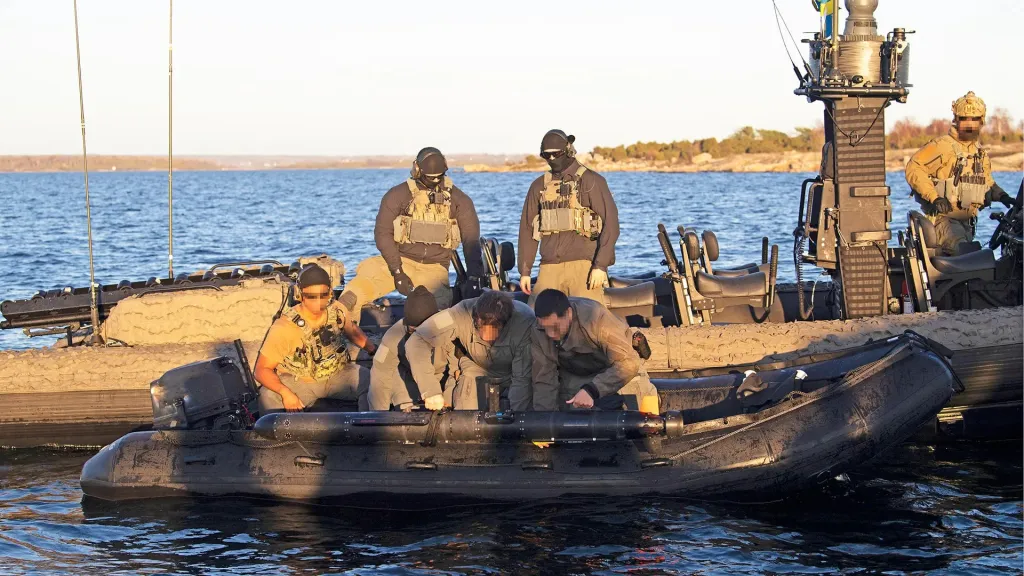
US Navy special operators prepare to launch a UUV from a small boat on the surface during an exercise. USN
“That is the goal,” Linn said when asked about the Navy’s view of teaming UUVs with SDVs, the latter of which the service also refers to as SEAL Delivery Vehicles.
As it stands now, the main workhorse of the Navy’s SDV force is the Mk 11, which is just under 22 and a half feet long. It is operated by a crew of two and can carry six passengers. Also referred to as the Shallow Water Combat Submersible (SWCS), the Mk 11 is what is known as a “wet” submersible design, where the occupants are exposed to water the entire time during their voyage. The Mk 11, like its predecessors, can be launched and recovered from submerged submarines with specialized Dry Deck Shelters (DDS) attached to their hulls.
A Mk 11 Shallow Water Combat Submersible (SWCS). SOCOM
The Navy has also acquired several new Dry Combat Submersibles (DCS) in recent years, which feature a pressurized cabin with space for a crew of two and eight passengers. This means the larger DCSs can operate at greater depths than the SWCSs. They also deliver their occupants to the destination dry and relatively warm, helping to reduce operator fatigue and certain potential health risks. The DCS does have the limitation of being too big to fit inside existing DDSs. At least publicly, this is understood to translate to the need for support from a mothership on the surface.
A picture of one of the Navy’s Dry Combat Submersibles (DCS) out of the water, giving a sense of its size. US Military
There are multiple UUV designs in the Navy’s inventory today, as well. These are largely torpedo-shaped designs intended to be deployed from and retrieved by vessels riding on the surface or submarines. In recent years, the service has been working to expand its ability to launch and recover UUVs from submerged submarines without the need to send out divers to help. Historically, underwater retrieval of UUVs, in particular, has been a largely manual affair, often conducted via DDS.
A UUV seen partially loaded into a torpedo tube on a US Navy submarine ahead of a test. USN
In terms of the potential benefits of UUV-SDV teams, “underwater systems like the SDV and UUVs afford reach underwater,” Capt. Linn explained. “So, if you can get somewhere in an SDV and then launch a UUV to go do something, then that would make you more capable.”
“You could extrapolate, just as you would have an unmanned wingman in an aircraft, or a maritime surface co-pilot, the same can be said for underseas,” he continued. “So, if you have an unmanned system with you underwater, then I suppose you can use your imagination.”
“A good example might be a harbor,” he added. “Technology is in a state where passing through the mouth of a harbor, a choke point, is maybe much more well defended. Or it is a choke point, and they don’t want to pass there with a big manned platform. So if you send a smaller unmanned platform through, then that’s pretty logical.”
“It can be an overall risk-reducer,” he further noted. A key mission set for Navy UUVs is scouting ahead for mines and other potential hazards, and otherwise helping commanders establish a better ‘view’ of the battlespace above and below the waves. This could all be especially valuable for SEALs during high-risk missions, including ones being conducted covertly or clandestinely.
A UUV seen USN/Chief Petty Officer Travis Simmons
Capt. Linn was also candid about the challenges the Navy still has to overcome to make this underwater teaming ability a reality. He described both crewed SDVs and UUVs as being “deaf, dumb, and blind” in terms of their current ability to communicate and coordinate with each other to ensure they are both in the right place at the right time.
“Through-water data transfer is difficult, and so the modality that you choose while remaining survivable is kind of difficult. And, also, in order to do that, you have to have pretty well synchronized systems,” he said. “We’re looking at all ways of transferring data through water. It can be acoustic, [and] there’s light-based transfers.”
There are other questions still be answered around how UUVs teamed with the SDVs would operate, including where the uncrewed companions would be launched from. If the SDVs have to carry them to the launch point themselves, this could present additional challenges.
“You’ve got to consider your volume in the SDV, which is not great,” Capt. Linn noted. “Are you going to strap it to the outside?”
He did confirm that testing is already being conducted to delve deeper into this potential pairing. He said that the Naval Surface Warfare Center Panama City Division (NSWC PCD), headquartered in Panama City, Florida, has been leading the charge.
Navy special operators seen training off the coast of Florida. USN
“I think we’re still years away from having something at the reliability level that they want,” Capt. Linn added. “Again, back to the actual ones and zeros, and the modality of data transmission, [being at the] right time, right place,” and doing all of this “where you have to be survivable, that’s difficult.”
As Capt. Linn has made clear, significant hurdles will need to be cleared before UUV-SDV taming can become a reality. However, there are also real operational benefits that would come from pushing toward this goal.
Netflix is dropping a three-part docuseries that revisits Michael Jackson’s2005 trial in which he was acquitted on charges of child molestation.
“Michael Jackson: The Verdict” drops June 3 and features archival footage and interviews with key players involved in the trial including jurors, figures from both the defense and the prosecution, journalists who were inside the courtroom and other eyewitnesses who saw the events unfold firsthand.
“It has been 20 years since the trial of Michael Jackson in which he was found not guilty. Yet, to this day, controversy still rages,” the filmmakers said. “No cameras were allowed in court, and so the public’s view of the facts at the time were filtered by commentators and presented piecemeal. It was time to take a forensic look at the trial as a whole.
“Anyone interested in the Michael Jackson story should feel this documentary gives them a window into what was largely a closed event and a chance to feel closer to what happened.”
The Santa Barbara Superior Court trial lasted 14 weeks, and the jury, which included eight women and four men, deliberated for more than 30 hours across seven days.
Jackson was acquitted on 10 felony charges: four counts of child molestation, four counts of plying a minor with alcohol in order to molest him, one count of attempted child molestation and one count of conspiracy to hold the boy and his family captive at the Neverland Ranch. He faced more than 20 years in prison.
Produced by Candle True Stories, the production company behind Netflix’s “Untold: The Liver King,” and directed by Nick Green, “Michael Jackson: The Verdict,” comes at a time of renewed interest in the “King of Pop.”
The Jackson-estate-approved biopic “Michael” hit theaters last month, and depicts the origin story of the hitmaker from childhood through his upward trajectory to superstar status in the 1980s. Notably, the movie omitted the slew of allegations that followed Jackson from the ’90s until his death in 2009.
Japan reported a trade surplus of JPY 301.9 billion in April 2026, compared to a deficit of JPY 149.5 billion in April 2025, significantly exceeding expectations for a JPY 29.7 billion deficit.
This surplus is the largest since November, with exports
Oklahoma City Thunder star Shai Gilgeous-Alexander scored a game-high 30 points to inspire his side to a 122-113 victory against the San Antonio Spurs as the reigning NBA champions levelled the Western Conference final at 1-1.
Gilgeous-Alexander – who has won the NBA’s Most Valuable Player award for a second year in a row – also provided nine assists in their second home game of the best-of-seven series.
Spurs star Victor Wembanyama scored 41 points in the opening game but was limited to 21 in the second match.
“The guys brought it tonight, knowing what it would have meant if we lost this one,” said Gilgeous-Alexander.
“We brought the energy from the jump.”
The game was level at 31 apiece after the first quarter before Thunder moved into an 11-point lead at half-time.
The Spurs did level the match midway through the third and got to within two points of their rivals in the fourth quarter but Thunder pulled away each time on the way to victory.
“We got a W, it’s all you can ask for. Now we got to go on the road against a really good team and go get one,” said Gilgeous-Alexander.
Games three and four will take place in San Antonio on Friday and Sunday.
The New York Knicks lead the Cleveland Cavaliers 1-0 in the Eastern Conference final with game two in New York on Thursday.
More than two-thirds of UN member states, 141, voted in favour of the resolution on Wednesday, with eight voting no and 28 abstaining.
Recommended Stories
list of 4 itemsend of list
Ralph Regenvanu, the minister for climate change from Vanuatu, which championed the case, described the vote as a victory for “communities on the frontlines of the climate crisis”.
“Today the international community affirmed that climate change is not only a political and economic challenge, but a matter of law, justice, and human rights,” Regenvanu said in a statement.
“For vulnerable countries like Vanuatu, this resolution is deeply significant because it confirms that no State is above its obligations to protect people, future generations, and our planet.”
The historic ruling from The Hague-based court in July last year found that states have a legal obligation to act on the “existential threat” of climate change.
The case was the biggest ever to be considered by the ICJ’s 15 judges, who reviewed tens of thousands of pages of written submissions and heard two weeks of oral arguments before delivering their verdict.
The case came to the court at the request of the UNGA after a resolution led by Vanuatu was adopted by consensus in March 2023.
Wednesday’s vote, by contrast, attracted a number of objections, with Belarus, Iran, Israel, Liberia, Russia, Saudi Arabia, the United States and Yemen voting no.
“We are strongly urging Vanuatu to immediately withdraw its draft resolution and cease attempting to wield the Court’s Advisory Opinion as a basis for creating an avenue to pursue any misguided claims of international legal obligations,” a copy of the cable seen by Al Jazeera stated.
Wesley Morgan, a fellow with the Climate Council, an Australian nonprofit, said the vote confirmed states had a legal duty to act on climate change.
“This landmark resolution is a massive victory for Vanuatu and the Pacific leaders who have spent decades fighting for survival on the frontlines of the climate crisis and a warning for Australian governments,” Morgan said in a statement.
“For far too long, fossil fuel heavyweights have treated climate action as a political choice, but the UN General Assembly has now confirmed it is a binding legal duty,” he added.
Bolivian President Rodrigo Paz has announced a cabinet reshuffle and other measures as protests demanding his resignation continue. Paz said the government wants to build a collaborative government with broader participation from social and economic groups.
OLIVIA Attwood has shared a slew of snaps from a luxury countryside break, with several fans spotting a very clear sign Pete Wicks was with her.
Last week the lovebirds werespotted at Heathrow airportafter Pete picked up his podcast co-host and rumoured love interest.
Sign up for the Showbiz newsletter
Thank you!
Olivia Attwood and Pete Wicks have each shared snaps from a luxury countryside breakCredit: InstagramPete’s photo (here) showed an identical fireplace to the one shown in Olivia’s snap (above)Credit: Instagram
And lastmonth, Pete and ITV star Olivia flew to St Tropez on a secret holiday after they were spotted publicly snogging in a Soho bar.
The pair have now added fuel to the fire… literally, by sharing near-identical snaps from near-identical getaways.
Taking to Instagram on Wednesday night, Olivia shared a photo dump of a very plush stay at Estelle Manor – the same place Kim Kardashian and Lewis Hamilton headed on a secret date weekend.
Among the photos Liv shared were snaps of her rescue dogs, stunning selfies, gym workout pics, and a close up snap of a rustic fireplace.
Olivia also shared a selection of selfies from her lavish breakCredit: InstagramFans are convinced Pete was on holiday with OliviaCredit: InstagramThe pair are rumoured to have begun dating after the BritsCredit: AlamyThe pair have long been close palsCredit: Getty
Fans were quick to spot how not long before Liv’s dump, Pete had shared a slew of snaps himself, with one of the photos being of the exact same fireplace.
Fans rushed to the comments section to speculate that Olivia and Pete had spent time together at the stunning manor house.
“I love the subtle you & Pete posting pics of the same fire. I love you two xxx,” penned one person.
“Interesting why you would lie on your stories about being there by yourself when it looks like the same fireplace on pete’s post,” added a second.
“@p_wicks01has@olivia_attwoodstolen your dog and your pad and pen??” asked a third.
“We need more @p_wicks01 content on here @olivia_attwood . I live and breathe for this shit on the daily! please give the people what they want,” pleaded a fourth.
“Ahhh Estelle Manor!!! What a place,” offered a fifth, while a sixth said: “If it’s good enough for Kim & Lewis….”
Meanwhile, on Pete’s post, one person wrote: “Waiting for your and livs pictures together………”
The talked-about pair reportedly begun their relationship at the Brit Awards on February 28.
A source close to the pair told us at the time that they were “dating and enjoying their time together.”
Their apparent romance heated up last month as they jetted off to St Tropez for a cosy holiday.
In a blink and you’ll miss it moment from one of Liv’s vlogs, Pete could be seen in the reflection in a mirror, smiling as Olivia celebrated her big day with her nearest and dearest.
She split from husband Bradley Dack back in January following a “breach of trust” on his part.
Olivia moved out of the marital home and into her own apartment in London.
Finance leaders shift from AI experimentation to measurable ROI across corporate operations.
We get it. Artificial intelligence is impressive. But how is it saving CFOs money?
Prithwijit Chaki has a take. As Global Leader for Finance Advisory at Genpact, a global professional services firm, Chaki helps chief financial officers harness AI and data to drive measurable business outcomes. With more than two decades of experience advising companies on finance strategy and large-scale transformation, he has seen firsthand how enterprises are rewiring their finance operations for an AI-first era.
Global Finance asked Chaki how that vision is taking shape and whether the conversation is no longer just about how AI can enhance productivity, but about bottom-line business value.
Prithwijit Chaki, Global Finance Advisory Leader, Genpact
Global Finance: CFOs have spent the last two years experimenting with AI pilots. What’s different in 2026?
Prithwijit Chaki: CFOs are moving from AI experimentation to AI accountability. After years of pilots, the question is no longer whether AI can improve individual productivity, but whether those gains translate into enterprise value across the finance function: faster close cycles, better working capital, lower manual review burden, stronger controls, or measurable business outcomes.
According to a Genpact/HFS Research report, investment in agentic AI is expected to rise 38% over the next year. However, 67% of enterprises still rely on outdated productivity metrics that fail to capture the value of autonomous decision-making. That’s the gap CFOs are trying to close in 2026: cutting through the ‘sea of sameness’ in the AI market to determine which applications can deliver real, achievable value versus which are simply adding to the noise.
GF:How does agentic AI change day-to-day finance operations?
Chaki: Traditional automation follows basic rules, and generative AI can help an individual complete a task faster. Agentic AI goes even further. It operates inside finance workflows — deciding, acting, learning, and orchestrating work across processes with people still in the loop where needed. In practical terms, that could mean moving from someone using a copilot to draft a dunning letter faster to a more integrated workflow that identifies the right action, drafts the communication, routes exceptions, applies policy guardrails, and connects the work back to measurable enterprise value.
GF:What’s one example of cost savings or business impact that CFOs see from implementing agentic AI?
Chaki: A good example is a global supply chain and distribution company processing close to 3.5 million invoices a year. After a major merger, their finance team was dealing with disconnected ERP systems, heavy manual intervention, and slow exception resolution—the kind of last-mile complexity that generic automation can’t solve. Working with Genpact, they deployed our AI-powered Genpact AP Suite combined with our agentic operations model — 21 pretrained, domain-specific AI agents that autonomously route, prioritize, and resolve invoice exceptions, with human experts validating where needed.
GF: What were the results?
Chaki: Significant. Touchless invoice processing went from 7% to 65%. Invoice cycle times were nearly halved — from 18–29 days down to 9–14 days. On-time payment rates jumped from 60% to 95%. Data extraction accuracy improved from 40% to 92%. And the system identified approximately $350 million in duplicate invoices, while early-payment discounts captured grew from $35 million to $44 million — real dollars added to the bottom line.
This isn’t a pilot or a proof of concept. It’s agentic AI operating at scale inside a core finance workflow, delivering measurable cost savings, stronger cash flow, and a fundamentally better supplier experience. That’s the kind of outcome CFOs are looking for.
GF:Which finance function is currently seeing the fastest returnsfrom AI deployment—and why?
Chaki: Accounts payable is one of the clearest areas where finance teams can see tangible value. The process has high volume and repeatable workflows, but it also has a clear ‘last mile’ problem. Invoices, approvals, exceptions, regulatory nuances, and fragmented systems still require heavy manual intervention. Generic AI can automate a large share of structured work. However, the final 20% requires domain-driven AI that understands real-world complexity, from vendor history and regional rules to exception patterns, approval chains, and master data issues. That is where agentic AI can move beyond simple extraction or automation. It can start resolving mismatches, escalating exceptions, improving first-pass yield, reducing manual touchpoints, and shortening cycle times.
GF:Through Genpact’s expanded work with Google Cloud, what are CFOs specifically asking for from hyperscalers right now? Is the conversation more about cost reduction or something else?
Chaki: The CFO conversation with hyperscalers has moved beyond ‘what’s the cheapest cloud?’ or ‘show me another AI demo.’ CFOs want production-ready finance operations that deliver real, measurable business outcomes. That’s what Genpact’s alliance with Google Cloud aims to address. By pairing Google’s AI infrastructure with Genpact’s finance expertise, CFOs can improve forecasting accuracy, strengthen cash flow, and scale AI within their existing cloud environments.
The goal is not just to reduce costs. It’s about boosting process efficiency and accuracy, freeing finance teams from manual work, improving decision-making, and giving CFOs a clearer path from AI investment to strategic value.
GF:Are there any guardrails that must be in place before agentic AI can be trusted within core financial workflows?
Chaki: Think of the guardrails for agentic AI as needing to scale alongside the technology itself. The more finance use cases it touches, the more important it becomes to build controls directly into the workflow. What we’re seeing today is the first wave of “agent-ification.” It operates on a machine-led, human-validated model, combining automation efficiency with expert oversight to ensure quality and compliance. Companies will build tools with that future standard in mind—where the guardrails and technology scale together—will be the ones who truly innovate what finance is capable of.
GF:Are there specific examples you can share of how you see AI augmenting finance teams?
Chaki: We’re already seeing AI reshape how finance teams spend their time. In accounts payable, for example, AI agents are handling invoice extraction, three-way matching, and exception routing. This work used to consume entire teams. In financial planning and analysis, AI is accelerating variance analysis, generating narrative commentary on actuals, and enabling rolling forecasts that would have been extremely time-consuming and practically impractical to run manually. When it comes to record-to-report, it’s compressing close cycles by automating reconciliations and surfacing anomalies before they become audit issues.
GF:Do you expect job cuts?
Chaki: The shift this creates is less about job cuts and more about role evolution. Finance teams won’t shrink overnight, but the composition will change. You’ll see fewer people doing repetitive transactional work and more people in roles that require judgment, such as interpreting AI-generated insights, managing agent workflows, overseeing controls, and partnering with the business on strategic decisions. The finance professional of the future looks more like a combination of business partner and orchestrator than a processor.
Over the next three to five years, as agentic AI matures and enterprise vendors begin offering subscription-based finance capabilities built on entire agentic libraries, the operating model will shift. Finance functions will become leaner, faster, and more insight-driven but the organizations that get there first will be the ones investing now in both technology and the talent to work alongside it.
Dutchman Verhoeven, 37, boasts an impressive kickboxing resume, reigning as Glory’s heavyweight champion for 11 years and making 13 successful defences, but has boxed just once professionally – in 2014.
But Usyk’s CV in boxing is just as eye-catching – if not more so.
After winning gold at the 2012 Olympics, the Ukrainian has established himself as one of the pound-for-pound greats by achieving undisputed status at cruiserweight and, twice, at heavyweight.
Usyk, 39, has brushed aside Anthony Joshua, Tyson Fury and Daniel Dubois – beating each of the Britons on two occasions – and, despite Verhoeven’s lack of boxing experience, is approaching this bout with the same mentality.
“The opponent might be different but my preparations are not different,” Usyk said.
“I work hard, I do a lot of work in sparring, conditioning and cardio.
“I train like I’m fighting Tyson Fury or Daniel Dubois, because for me it’s a serious fight. It’s not fake. For me it’s not a show, it’s a fight.”