A Los Angeles County Superior Court judge has denied Bill Cosby’s request for a new trial after a civil jury recently found he was liable for $19 million in damages in a sexual assault case.
Judge Bradley S. Phillips ruled Friday that Cosby did not prove there was “any irregularity” in the court proceedings that would have prevented him from getting a fair trial and that the damages awarded to his accuser were not “excessive.”
“The Court finds that there was sufficient evidence … to support the jury’s finding that defendant’s conduct caused plaintiff’s damages,” Phillips wrote in Friday’s order.
In March, a jury awarded former waitress Donna Motsinger $19.25 million in damages after she sued Cosby in 2023, alleging that the disgraced comedian drugged and sexually assaulted her in 1972 after escorting her to one of his shows.
Motsinger, now 84, claimed Cosby picked her up at her home and gave her wine and a pill she thought was aspirin on the way to the venue.
“Next thing she knew, she was going in and out of consciousness while two men attending to Mr. Cosby were putting her in the limousine,” the original complaint said. “The last thing Ms. Motsinger recalls were flashes of light,” before waking up in her house in nothing but underwear.
Cosby has denied Motsinger’s allegations, as well as those brought by dozens of other women who said they had been drugged and sexually assaulted by the former actor. Cosby served about three years in a Pennsylvania prison on sexual assault charges before that case was overturned in 2021.
Cosby had filed a motion for a new trial in the Motsinger case in early April. Attorneys for Cosby did not immediately respond to a request for comment about Friday’s ruling.
Times staff writer Fedor Zarkhin contributed to this report.
The man financing Britain’s clean energy future on doubt, policy risk, and the things no CFO can control.
As CFO of one of Britain’s most ambitious clean energy projects, EnergyPathways’ Max Williams has learned that securing capital is only half the job.
Since joining the firm in April 2025, Williams has been overseeing the finances of MESH, an £800 million offshore hub on the Lancashire coast set to combine long-duration energy storage, gas, and green hydrogen production in a single integrated facility.
With MESH still in the pre-FEED stage, the challenge lies not just in raising capital but in keeping government, institutional investors, and industry partners moving in lockstep toward a Final Investment Decision — and ultimately, execution.
A seasoned Chartered Accountant with three decades in energy and natural resources, Williams spoke with Global Finance about financing a first-of-its-kind project, the politics of clean energy, and what keeps him awake at night.
Max Williams, CFO, EnergyPathways
Global Finance: What is your main achievement leading finance at EnergyPathways (EPP)?
Max Williams: EPP is developing a unique solution for energy storage and supply to support Britain’s energy transition. The project, called Marram Energy Storage Hub (MESH), combines long-duration energy storage (LDES) and gas storage, while also growing hydrogen industries using its offshore storage facilities. The ability to drive the project forward has depended in the early stages on reliable and continuing support from equity shareholders who understand and believe in the company’s focus.
The signing of a financing agreement with a global institutional investor was an important step in the company being able to accelerate its pre-FEED (Pre-Front End Engineering Design) work program on both its LDES and gas storage license elements of its project. Our ongoing engagement with government, industry partners and banks will provide further significant funding to progress the project to and beyond the Final Investment Decision (FID). The company designed the full project to minimize government subsidies.
GF: What is the biggest challenge in funding operations for MESH, an £800 million integrated offshore facility in the UK (near the Lancashire coast)? What is the thing you spend most of your time on?
Williams: The Secretary of State for Energy Security and Net Zero designated the MESH Project to be one of national significance. It is designed to meet clean energy goals and provide employment in the region, engaging with Team Barrow [a public-private partnership that aims to revive this port town in northwestern England] and gaining increasing parliamentary support. The biggest challenge is to ensure that all stakeholders, including government, are aligned and supportive, enabling the company to meet key milestones and secure appropriate capital as the development progresses through FEED to FID and first revenues.
GF: How important is it for you to have a good team, and what defines a good team for you?
Williams: With a new concept project such as MESH, success depends on a strong team across all disciplines, not just the finance team but also the teams overseeing EnergyPathways’ technical and commercial operations. Project delivery is going to be a key discipline in arranging project financing. In the energy transition space, a good team functions efficiently and effectively across disciplines with clear communication around objectives and strategies to achieve them. EPP also benefits by having world-class industry partners, including Siemens, Wood Group, and Costain.
GF: How do you see AI affecting your work?
Williams: For a small company with a small team, the use of AI has so far been limited within the accounting function. However, this will develop as the company grows. The company already uses AI to maximize productivity and assist with project design and implementation. An AI energy management system is a key part of our development design, enabling MESH to ensure a reliable and flexible energy supply to Britain’s energy markets.
GF: What advice do you have for aspiring CFOs?
Williams: Being CFO will always put you at the center of reporting, information flow, and decision-making. For EnergyPathways, this means identifying the project’s financing needs and providing suitable, timely solutions to those requirements. In addition, the CFO ensures information transparency for investors and the broader stakeholder community.
GF: What keeps you up at night?
Williams: Matters that are outside the control of the company. For instance, EnergyPathways is developing solutions for energy storage and supply, offering security of supply with a focus on clean energy supply. Development of the MESH project may require changes to government strategy and policy, and macro, global factors may affect policy. The MESH project, though, would benefit the UK’s future energy supply regardless of the polar arguments of clean energy versus exploitation of the North Sea.
WASHINGTON — An upcoming celebration of the nation’s 250th anniversary, “The Great American State Fair,” recently had several musical guests back out, partly over the event’s ties to President Trump. Now, Trump himself is slated to headline the festivities.
“I understand Artists are getting ‘the yips’ having to do with their performance,” Trump posted on his social media platform Saturday. With a boastful and derisive flourish, he adding that he was thinking of bringing “the man who some say is the Greatest President in History (THE GOAT!), DONALD J. TRUMP, to take the place of these highly paid, Third Rate ‘Artists.’”
The group organizing the June fair on Washington’s National Mall, Freedom 250, confirmed the billing in a statement Saturday, writing, “We are excited to announce that President Trump will personally kick off this historic celebration on Wednesday, June 24.”
Danielle Alvarez, a spokesperson for Freedom 250, said the fair that is officially scheduled from June 25 through July 10 will feature exhibits, family friendly attractions, flyovers and musical performances — by those still remaining on the program.
Trump was dismissive of the acts that backed out, insulting them and suggesting in a follow-up post that the solution is to “Cancel it.”
“We should have a giant MAKE AMERICA GREAT AGAIN RALLY, for 250, instead of having overpriced singers, who nobody wants to hear, whose music is boring, and yet who do nothing but complain,” he wrote.
Freedom 250 is billed as nonpartisan, but it was launched last year by Trump and is led by a former State Department appointee from the president’s first term. Several artists, including Bret Michaels, the Commodores and Martina McBride dropped out last week.
Michaels and other artists have said that they were misled about the theme of the shows or were otherwise wary of being caught up in a political fight. McBride, in a statement on Instagram, said she had been “presented with an opportunity to perform at a nonpartisan event but that turned out to be misleading.”
Other artists plan to attend, including Flo Rida, Fab Morvan of Milli Vanilli and Vanilla Ice. The latter’s representative previously said that the “Ice Ice Baby” rapper was “proud to help celebrate America’s 250th Anniversary!”
Bedayn and Binkley write for the Associated Press. AP writer Eric Tucker contributed to this report.
Brooke Mayo was just 4 when she started playing soccer. She was about 4½ when she started fantasizing about participating in the World Cup.
“I just fell in love with the game,” she said. “Like any soccer player, you dream about the World Cup, you know?”
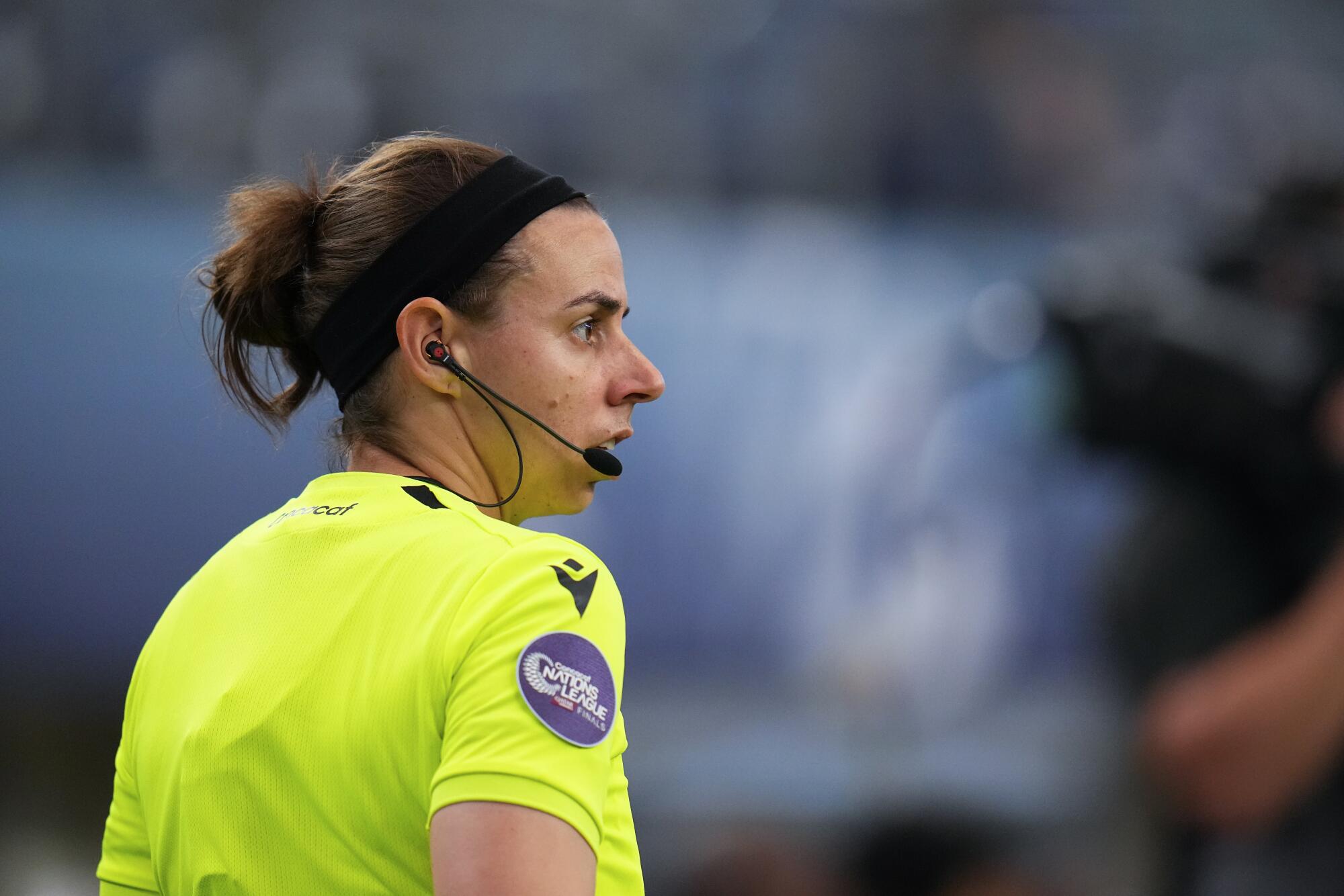
That dream came true three years ago, though not quite in the way Mayo had imagined. Although she took part in four matches at the 2023 Women’s World Cup, she did so as an assistant referee, not a player, running up and down the field with a flag in her hand, not a ball at her feet.
Yet Mayo made history just the same, joining Tori Penso and Kathryn Nesbitt as the first American officials to work a World Cup final as a trio. More importantly, they performed so well they have been invited to officiate in the men’s World Cup this summer, where they will make more history as just the second all-female crew to work a game in the men’s tournament.
And while Mayo appreciates the barrier breaking, for the three women it’s just another day at the office.
“For us, it’s just business as usual,” she said. “I think there’s still a lot of places in the world that need to see this and that’s why it’s still important. But our colleagues are used to seeing women around.”
Mark Geiger, a two-time World Cup referee who is now general manager of the Professional Referee Organization (PRO), which manages officials for MLS, agrees. After decades of seeing U.S. and Canadian referees given little respect by FIFA — nor by international soccer in general — Geiger says the biggest takeaway from this summer’s tournament isn’t the gender of the domestic officials selected, but rather the number, 11, making it the largest contingent to work a World Cup.
In addition to Mayo, Penso and Nesbitt, the list includes Ismail Elfath, Armando Villarreal, Kyle Atkins, Corey Parker and Drew Fischer, who took part in the 2022 men’s tournament. Nesbitt, Elfath, Parker and Atkins all worked the final of that World Cup four years ago, Elfath as the fourth official, Nesbitt as the reserve assistant referee and Parker and Atkins as video assistant referees.
With Mayo’s team working the 2023 women’s final — alongside Villarreal, who was in the video booth — seven MLS officials have worked the last two World Cup finals and at least one PRO official has been assigned to 19 of the 32 knockout games in the most recent men’s and women’s tournaments.
No other league or country in the world is even close to that.
“Over the past few years I think we’ve shown that the quality of football and the quality of the officiating in the United States and Canada is at a really high level,” said Geiger, who made history of his own in 2014 when he became the first American center referee to work a Round-of-16 match in the men’s World Cup.
“We are in the normal conversation of knockout-stage games, we’re in the normal conversation for Tori to do the final. It’s not out of the realm of possibility.”
Another thing that makes this World Cup special for the PRO officials is that with the U.S., Mexico and Canada sharing host duties, the tournament will be played at home. The only other time the men’s World Cup was played in the U.S., in 1994, Arturo Angeles, a Mexican-born naturalized citizen, was the only American referee selected and he supervised just one group-play game.
“Any World Cup game anywhere is going to be special on some level,” said Fischer, a 45-year-old Canadian who has been a FIFA referee for 11 years. “It’s definitely a special feeling when you get to play host. It’s a little bit of welcoming the world into your backyard.
“There’s a certain hometown pride. So I’m definitely looking forward to that aspect of it.”
Joe Dickerson, U.S. Soccer’s reigning male referee of the year, received the FIFA international badge he needed to work major competitions just three years ago. Yet he will be a replay official in this World Cup, the first one he was eligible to work.
“This kind of happened so fast in the last couple of years,” said Dickerson, who became a professional referee in 2013, then began targeting the World Cup when it was awarded to the U.S., Mexico and Canada in 2018. “To work the biggest sporting event in the world in front of friends and family is really cool. And being a part of the celebration of culture happening in your own country and, as much as we can, celebrate our own culture, is really cool.”
It also makes things much easier on family and friends. When Mayo officiated her first group-stage game in the 2023 tournament in New Zealand, her wife, Falon Catalano, flew in for the match.
Referee Brooke Mayo looks on during a CONCACAF Nations League third place match between Jamaica and Panama in March 2024.
(Julio Cortez / Associated Press)
“I told her like hey, it’s our first World Cup. So she came to that and then went home,” said Mayo, 37, who wasn’t sure she’d get another game.
When she was assigned the England-Australia semifinal in Sydney, she called Catalano back.
“I said ‘this might be the biggest appointment in my entire career, in Australia in front of 75,000 fans. You’ve got to come to this,’” she pleaded.
So Catalano came then went before Mayo found out she would be doing the final. That led to another call. “I said, ‘well, you’ve gotta come back.’”
An exhausted and broke Catalano said no to the expense and fatigue of another 38-hour round trip, but after a group of MLS officials passed the hat to buy the ticket, Catalano surprised Mayo by making the match after all.
Making it to the semifinals — much less the final — was far from guaranteed since the World Cup is a meritocracy for officials as well as for the players. In fact, it’s harder to make the final as an official: There will be 170 officials from 50 countries taking part in this summer’s tournament as opposed to 1,248 players — or one referee for every 13 players.
“A lot of people underestimate how difficult it is for us to get there,” said Dickerson.
Referees are graded after every game and those who don’t measure up in their first match don’t work another one. Those who excel, however, continue to advance — as Mayo did in 2023.
“Just like teams try to kind of hit their stride in a tournament setting, that was similar with us. We just went in there focused on only one game in front of us,” she Mayo, who got her FIFA badge in 2018. “Our goal was to earn another game after that, do everything we can to clean up our communication. We’re like micro-managing ‘how could we have done this better?’
“You are just operating in sync. You’re spending every minute together. You’re together at breakfast. You’re together at training. You’re together at lunch. You’re traveling together. By the end, if they even sigh on the field, I know what that means.”
Mayo, like most officials, came to the game as a player — one good enough to play four years at Tennessee Tech. As a teenager she was moonlighting as a referee, raising enough money to fund a trip to South Africa to watch the 2010 World Cup as a fan.
“But I didn’t take reffing seriously,” she said. “Once I finished playing, I missed that competitive edge. When I realized I could do it in reffing, I was like, ‘Oh, this scratches that itch that I miss.”
Taking part in a World Cup remained a dream, however, and she got to scratch that itch three years ago. Now she’s working the tournament at home, where her family, who live in Colorado, will be just a few hours away should there be any frantic last-minute flights to catch.
Having already worked one World Cup final, anything short of the final this summer could feel like a failure.
“It’s a lot of skill, but it’s also a lot of luck. You have to be in the right place at the right time,” Mayo said. “There’s not that much that separates people at the top.
“We’re up against amazing referees. We’re going to fight for every game, one game at a time, knock it out of the park and hope for the best.”
Colombians headed to the polls to choose a new president in a high-stakes election that will determine whether the country continues the left-wing agenda launched by Gustavo Petro or shifts back to the political right.
Weekly insights and analysis on the latest developments in military technology, strategy, and foreign policy.
U.S. Special Operations Command (SOCOM) is about to kick off the search for what it is calling a Flyweight Assault Machine Gun (FAMG). This will be a new 5.56x45mm caliber belt-fed machine gun to succeed the Mk 46, a lightweight special operations-specific cousin of the M249 Squad Automatic Weapon (SAW).
Lt. Col. Alan Wood, SOCOM’s Program Manager for Special Operations Forces (SOF) Lethality, touched on the FAMG briefly in an exclusive interview with TWZ‘s Howard Altman during the annual SOF Week conference last week. Readers can find the bulk of the interview here.
A member of the US Army’s 75th Ranger Regiment provides overwatch with a Mk 46 machine gun in Iraq in 2006. The new FAMG is intended to be a successor to the Mk 46. US Military
There are “three separate machine gun programs within SOCOM: Lightweight Machine Gun-Medium, Light Machine Gun-Assault, and soon to be FAMG, which is the Flyweight Assault Machine Gun,” Wood explained. “The Medium is your .338 [Norma Magnum], the Assault is your 7.62 NATO [7.62x51mm], and then the FAMG is a 5.56[mm]. All belt-fed machine guns.”
We subsequently reached out to SOCOM for more information about the FAMG, an effort that does not appear to have been previously disclosed.
“The Flyweight Assault Machine Gun (FAMG) will be a 5.56mm belt fed weapon that will replace the MK46 Light Machine Gun,” a spokesperson for the command told us. “Details on the requirement will be published on SAM.gov in the near future.”
While we do not know yet what SOCOM is looking for specifically in the FAMG, beyond its caliber, we do know what the command wants to replace. The Mk 46 traces back to the early years of the Global War on Terror. It is based on the M249 SAW, which is itself a version of the Minimi light machine gun from Belgian gunmaker FN (and later its American subsidiaries).
A member of the US Army firing a current-generation version of the full-size M249 SAW. US Army
FN had initially developed what it called the Special Purpose Weapon (SPW), a significantly lightened version of the Minimi with a shortened barrel that also had a thinner profile. The gun, which was marketed heavily toward special operations forces, featured the collapsing stock that had already been used on short-barreled ‘paratrooper’ versions of the Minimi and the M249, as well.
The FN Special Purpose Weapon (SPW) variant of the Minimi. FN
The standard Minimi design also has a secondary magazine well that allows it to fire ammunition from NATO-standard box magazines like the ones used with AR-15/M16-series rifles, as well as belts. This feature was carried over to the M249. It was omitted on the SPW to further cut weight.
The baseline Mk 46 Mod 0 was a direct evolution of the SPW concept. It most notably used the polymer buttstock found on standard Minimi and M249 light machine guns, which is fixed in length, but also lighter than the collapsing paratrooper type. It also came with a new handguard with rails on four sides for optics, laser aiming devices, lights, and other accessories. The handguard design is very tall on the top side to bring it in line with an additional rail on the gun’s top cover.
The Mk 46 Mod 0 machine gun. FN
An improved Mk 46 Mod 1 variant was subsequently developed, which “incorporates improved receiver pins, a feed tray with retention pawls and a vented hand guard with improved heat shield and three MIL-STD-1913 rails,” according to the entry on FN America’s website at the time of writing. “The MK 46 MOD 1’s cold hammer-forged MIL-SPEC barrel has a hard-chromed bore for longer life and improved accuracy, and serves as the mounting point for the carry handle.”
To make a more direct comparison, the Mk 46 Mod 1, with its 16.3-inch barrel, weighs just under 15-and-a-half pounds empty with no accessories, per FN America. The version it shows on its website currently does also has a more traditional handguard configuration. A current-generation M249 with a full-length 20-and-a-half-inch barrel tips the scales at 17 pounds without any ammunition, optics, or other attachments.
A Mk 46 Mod 1 machine gun. FN America
After years of the U.S. military, including SOCOM, increasingly moving away from 5.56x45mm in favor of calibers that offer longer reach, for rifles and machine guns, there is something of a question as to why the command is now pursuing the FAMG. It had already been relatively rare to see variants of the Mk 46 in actual operational use. For decades now, U.S. special operators have also been using a succession of lightweight 7.62x51mm machine guns, as well, including compact versions of the M60 and a derivative of the Minimi/M249 designated the Mk 48. The aforementioned Light Machine Gun-Assault is a replacement for the Mk 48.
The U.S. Army is also moving to replace at least a substantial portion of its standard M249s with new 6.8x51mm caliber M250 machine guns, which might also make their way into service elsewhere across the U.S. military. The 5.56x45mm M27 Infantry Automatic Rifle (IAR) has also largely supplanted the M249 in the U.S. Marine Corps.
All this being said, U.S. special operators routinely conduct missions in close-quarters environments where the added firepower of a belt-fed machine gun can be beneficial, but the added range offered by a heavier design is not necessary. A design that cuts as much weight as possible is very attractive to fast-moving special operations teams that typically use belt-fed machine guns for brief periods of suppressing fire, as well.
SOCOM is now separately pursuing new hypervelocity 5.56x45mm ammunition that could significantly extend the reach of weapons chambered in that caliber as part of an effort called the Hypervelocity Improved Carbine (HICAR).
In addition, there is value in having commonality in ammunition with other existing rifles and machine guns, as well as those in use with allies and partners. The latter point is especially relevant for special operations forces, which are often forward-deployed alongside their foreign counterparts in locales where access to traditional supply chains is not guaranteed. There are training benefits to being able to use more readily available, less specialized, and often less expensive ammunition, as well.
A US special operator, at right, trains together with Panamanian forces in Panama in 2025. USAF
SOCOM’s Lt. Col. Wood highlighted all of this while speaking more generally during his interview with us last week:
“So, HICAR’s got me excited. Back in the late teens, the Army went down this higher velocity [route], and I’m intentionally using the word velocity and not pressure in what they’ve done with the M7 and M8 rifles. They’ve been able to increase the velocity and therefore create a flatter shooting rifle as well as a rifle that has greater energy on target, and that does incredible things for barrier defeat in a lot of situations. Now we’ve had 10 years, almost, for that technology to mature, people have learned things, and the question then becomes, what could we do for special operators in calibers that are not new?”
“The advantage for SOF [special operations forces] operators is I’ve got, say, the Green Berets who do a lot of partnering with foreign SOF operators, but there’s no [6.8mm] ammo running around central Africa, or you know, pick your favorite spot where we like to do partnering operations around the world. But there’s a lot of 5.56mm and other common cartridges of that nature, and so what we want to…achieve is maybe not the same effect as what the Army’s done with the M7 and the M8 and that high-velocity ammunition that they have, but where could we get close to that in 5.56 and potentially other calibers in the future.”
5.56x45mm could turn out to be just the baseline caliber for FAMG, too. SOCOM has long had a fondness for guns with interchangeable calibers, allowing for different cartridges to be used as appropriate for specific missions. As a tangential example, the command just recently confirmed to TWZ‘s sister site Task & Purpose that its new Mid-Range Gas Gun-Assault (MRGG-A) rifles, now also designated the Mk 24, will be able to be configured to fire either 6.5mm Creedmoor or 7.62x51mm.
It is also worth noting that the U.S. Army’s elite 75th Ranger Regiment has already begun using the 5.56x45mm Light Assault Machine Gun (LAMG) from Knights Armament Company (KAC), at least on a limited level in recent years, alongside current-generation versions of the M249. KAC’s website presents a typical LAMG configuration featuring a 15-inch barrel and weighing 11.4 pounds empty, which is more compact and lightweight than the Mk 46.
One of the 75th Ranger Regiment’s KAC LAMGs. US Army
The LAMG also has what is known as a “constant recoil system,” which is designed to significantly reduce felt recoil and, by extension, improve accuracy during sustained autonomous fire. KAC says this makes the gun “more controllable than other similar machine guns that weigh nearly twice as much.”
There are other 5.56x45mm machine guns on the market today, which could be adaptable to meet the FAMG requirements, as well. This includes FN’s own newer EVOLYS design, which is available in 5.56x45mm, as well as a variety of other calibers.
A promotional shot of FN’s EVOLYS machine gun. FN America
As SOCOM has said, more details about its requirements and plans for the FAMG are set to come soon.
Walt Disney Co.’s ABC has filed renewal applications with the Federal Communications Commission “under protest” after an order mandating a years-early review of the network’s eight television station licenses.
The criticism was part of the network’s applications for the FCC review, which were filed ahead of a deadline Thursday. In an objection to the early renewal, Disney’s New York station WABC called the FCC order “unlawful, arbitrary and unconstitutional” and said it was “legally indefensible.”
“The Commission had not demanded early renewal in over five decades,” the station wrote in its filing. “And it has never before demanded simultaneous license renewal applications from a group of stations commonly owned with a network as it has here. The order has no legitimate purpose.”
The licenses for the eight ABC-owned TV stations, including KABC in Los Angeles, were originally scheduled for renewal between 2028 and 2031.
The FCC order came shortly after ABC late-night host Jimmy Kimmel made a joke about First Lady Melania Trump looking like an “expectant widow” days before a gunman tried to breach the White House Correspondents’ Assn. gala last month that President Trump attended.
Trump has frequently threatened to have TV station licenses pulled when he is unhappy with their coverage, but the order is the first time the government has acted on his wishes, sparking anger from free speech advocates. The FCC has said the order is part of an investigation into whether Disney’s diversity and inclusion policies violate federal law and the agency’s rules against “unlawful discrimination.”
In its response, WABC said the “only plausible reason” to issue the order was to “punish the station for speech the government does not like.”
“The ultimate injury here is not to the station or its parent company. It is to the public,” WABC wrote. “When a broadcaster must weigh regulatory retaliation before making editorial decisions, the public loses access to journalism that is free from government influence.”
FCC Chairman Brendan Carr said in a statement Thursday that Disney filed its applications to renew its broadcast licenses only after the company was told its previous answers were “disingenuous, deficient and improper.”
“Contrary to Disney’s claim that the FCC called in their broadcast licenses for early renewal for no reason, the record shows something very different,” Carr said. “Broadcast licensees have a unique obligation to operate in the public interest. The FCC will follow the facts and law wherever they may lead.”
FCC Commissioner Anna M. Gomez, the panel’s only Democrat who has backed Disney in its fight, cheered the Burbank media and entertainment company’s filing, saying in a post on X that she was “glad to see them expose the FCC’s actions as nothing more than naked political retribution and an unlawful assault on free speech and a free press.”
Times staff writer Meg James contributed to this report.
WASHINGTON — David Johnston was a licensed attorney when he illegally entered the U.S. Capitol with a mob of President Trump’s supporters on Jan. 6, 2021. More than five years later, the South Carolina man is offering to help fellow “J6ers” apply for payouts from the Trump administration’s nearly $1.8-billion fund for people claiming to be victims of a “weaponized” government.
He’ll do it for a 10% cut of any award, capped at $5,000 apiece.
“I think the narrative is changing” about how the history of that day is being told, Johnston said in a video he posted to social media. “I think good things are happening for us.”
Hundreds of Trump loyalists pleaded guilty to storming the Capitol, admitting under oath that they broke the law. Some were convicted of sedition, and many attacked police officers while trying to overturn Trump’s election loss. Now pardoned by Trump, many hope to capitalize on their crimes by tapping into the $1.776-billion settlement fund designed to compensate the president’s allies who claim they were politically prosecuted.
A bipartisan backlash to the fund and a legal roadblock have not dimmed the celebratory response from Jan. 6 rioters clamoring for a share of the taxpayer money. Some are staking claims even though the government has not established an application process and a judge has frozen the fund’s formation, at least temporarily.
Seeking payouts
The fund’s critics see it as another vehicle for Trump and his allies to whitewash the events of Jan. 6, retroactively justify the mob’s assault on a pillar of American democracy and reward some of Trump’s most loyal followers.
Jason Riddle, a military veteran from New Hampshire who was sentenced to 90 days behind bars after pleading guilty to riot charges, publicly rejected a pardon from Trump. Likewise, he said it would be “ridiculous” for him or any other Jan. 6 rioter to get government compensation.
“I’d love money, but I can’t accept that. That would bother me for the rest of my life,” he said. “We weren’t innocently persecuted just because of who we are or who we vote for. We were persecuted for committing criminal behavior in the Capitol of the United States.”
Plenty of other “J6ers” do not share Riddle’s reluctance.
A Florida man who posed for photos with then-House Speaker Nancy Pelosi’s stolen lectern argued on social media that he deserves to be compensated for the cost of his infamy. A rioter from New Jersey described by prosecutors as a Nazi sympathizer hailed the fund as “good news not just for J6ers but all victims of weaponization.” A Texas man who received a seven-year prison sentence for storming the Capitol with a metal tomahawk celebrated the fund as “payback” for “victims of Biden’s tyranny,” referring to President Biden.
Oregon resident Pamela Hemphill, sentenced to 60 days in jail for her conviction, rejected a pardon from Trump but has drafted a written claim for compensation from the fund. Unlike scores of rioters who claim to be victims of a government weaponized by Democrats, Hemphill blames Trump for her legal troubles. Her claims letter says she is seeking $5 million in compensation.
“I wouldn’t have been through all of this if Trump hadn’t lied about the election being stolen,” she said during a telephone interview. “It’s a direct result of his lies that I was even there that day.”
Legal and political challenges
It is an open question whether anyone convicted of a Capitol riot-related crime could be eligible for payments from a fund created to resolve Trump’s lawsuit against the IRS over the leak of his tax returns.
Acting Atty. Gen. Todd Blanche has not ruled out that possibility. Blanche said there are no limits on who can apply, but he noted that the fund’s five commissioners — all yet to be named — will decide who deserves to be compensated and why, based on factors such as “what the person did, his sentence, how much time he was in jail.”
“That’s up to the commissioners,” Blanche told the Associated Press on Thursday when asked about his position on whether violent Jan. 6 defendants should be eligible for payments.
“You have to define something and then stick to it. That’s something I’ve been hesitant to try to do, because it’s very fact-intensive,” Blanche said. ”Me sitting here and talking in hypotheticals is something that I don’t think is fair to the process.”
It is unclear whether Congress would block payments to Jan. 6 defendants. Senate Republicans who are angry about the settlement have said they want to place parameters on the fund as part of a Department of Homeland Security spending bill. They abruptly left town this month after a tense meeting with Blanche and will return Monday with the situation unresolved.
A federal judge in Virginia has frozen the fund’s establishment and temporarily blocked any processing or paying of claims. The judge issued that ruling Friday in one of at least three lawsuits challenging the fund.
Brendan Ballou, a former prosecutor who tried several Jan. 6 cases before leaving the Department of Justice last year, sued on behalf of two police officers who helped defend the Capitol from the mob. Ballou views the fund’s creation as part of a broader Trump campaign to undermine democratic institutions and rewrite the history of Jan. 6.
“And if the president is successful in that effort, if he’s able to get people to either forget or condone that day, he knows that he can get people to accept any attack on democracy,” Ballou said.
‘I want vengeance’
Nearly 1,600 people were charged with Capitol riot-related federal crimes. More than 1,200 were convicted and sentenced before Trump issued mass pardons and ordered the dismissal of all pending Jan. 6 cases upon his return to the White House last year. Trump also freed far-right extremist group members who were imprisoned for plotting to attack the Capitol to keep Trump in office after he lost the 2020 presidential election to Biden.
The self-described “J6 community” isn’t the only pro-Trump constituency angling for cuts of the money after being charged with or convicted of crimes.
Meshawn Maddock, who was charged as being a fake elector for Trump in Michigan before a judge dismissed the case last year, said she and her husband, state Rep. Matt Maddock, “absolutely” plan on making a claim. She believes the fund’s use of taxpayer money is justified because it “paid for the prosecution and investigation of the years that I was being hunted down.”
“I want vengeance and I want retribution,” Maddock said.
Trump’s campaign to recast the violence of Jan. 6 as a peaceful protest seems to have emboldened many convicted rioters.
Johnston’s eagerness to help other Capitol rioters with claims contrasts with his remorse he expressed at his sentencing in 2022. He apologized for his “terrible lapse in judgment” before a judge sentenced him to three weeks in jail and three months of home detention. He pleaded guilty to a misdemeanor trespassing charge.
“It was a dumb, dumb thing to do,” Johnston told the judge. “I am 100% responsible for what I did that day.”
Kunzelman writes for the Associated Press. AP writers Jamie Stengle, Mary Claire Jalonick and Joey Cappelletti contributed to this report.
Arsenal are fresh from Champions League final heartbreak but there is no time to wallow.
Sunday’s Premier League title celebrations in north London may have refocused minds on next season’s missions, when they will aim to stay at the top of the English game and go a step further in Europe.
Defeat by Paris St-Germain in Budapest on Saturday night came only on penalties, but Arsenal‘s limitations against opposition of the highest class were evident before the spot-kicks.
The Gunners had less than 25% of possession, and Kai Havertz’s early opening goal was their only shot on target in 120 minutes of football.
After the game, PSG midfielder Joao Neves said Luis Enrique’s side had been “the only one who wanted to play”.
Former Arsenal defender and Premier League winner Matthew Upson told BBC Sport that Havertz’s early goal killed the game in one sense.
“Had it been 0-0 throughout the first half, I think you might have seen a slight difference in Arsenal, but once you get that goal naturally you just slightly slip into protection mode,” Upson said.
“Every team does it and obviously PSG then dominated the ball, but the possession stats are pretty scary really for a final with two teams who are the best around. To have a 75-25% difference in possession is almost unheard of really in a Champions League final.”
Arsenal manager Mikel Arteta described PSG as “the best team in the world”.
He said it was their prowess that dictated Arsenal‘s style.
He also hinted that his side could look to emulate the French side’s style of play in the future.
“What they are able to do with the ball, with individual actions, I haven’t seen it,” Arteta said.
“It’s not the plan to play in certain areas when you don’t have the ball, but they force you to do that.”
So does the Spaniard need to refine his style for next season to push Arsenal to the next level, build up their possession numbers, and keep challengers at bay?
Or will we see more of the same Premier League title-winning formula from the Gunners?
Paris Saint-Germain fans react in Parc des Princes stadium after the team defeated Arsenal in Paris on Saturday. Photo by Valentina Camu/EPA
May 31 (UPI) — Police in France arrested hundreds of people late Saturday after celebrations for the Paris Saint-Germain soccer team turned violent, local authorities said.
Interior Minister Laurent Nuñez said the riots injured 57 police officers in Paris and other cities across the country, The Guardian reported. Some of the soccer fans also set fires, vandalized businesses and attempted to storm a Paris police station.
Police arrested 780 people and deployed tear gas to break up the riots, Politico reported.
“Most of the celebrations took place peacefully, Nuñez said, adding that most of the violent clashes took place near the Parc des Princes stadium where fans had gathered to watch the match between Paris Saint-Germain and Arsenal for the Champions League title.
French leaders took to social media to criticize the rioters and call for peace.
“Only in France does a football club’s victory spark riots,” far-right leader Marine Le Pen wrote in a post on X. “Only in France does everyone feel compelled to lock themselves in their homes on the evening of a victory to avoid being confronted with violence.”
Valérie Pécresse, the head of the Île-de-France region, said those involved in the riots should be punished.
“The brainless thugs who think they can smash everything are tarnishing the image of Paris and France!” Pécresse said in a post on X. “We must be able to celebrate on victory nights peacefully in Paris and the Île-de-France Region!”
Addis Ababa, Ethiopia – Ethiopians vote on Monday in a general election to choose members of parliament, who will in turn select the next prime minister. The National Election Board of Ethiopia (NEBE) said 47 political parties and more than 10,900 candidates are in the race, including 2,198 for the federal parliament, 8,736 for regional and city councils and 73 independents.
More than 50 million voters are registered, with official voter registration figures showing women account for around half of the electorate. Young Ethiopians make up a large share of the population, with a median age of about 19 years, according to United Nations population estimates, giving them a substantial presence in the country’s electorate.
The contest brings together ruling, opposition, regional and independent politicians under Ethiopia’s federal parliamentary system, where the government is formed through a parliamentary majority and MPs select the prime minister.
Here is a closer look at the main political parties, coalitions and independent candidates.
Prosperity Party (PP)
The Prosperity Party is the ruling political party in Ethiopia, led by Prime Minister Abiy Ahmed. It was formed in 2019 following the merger of several regional parties that previously made up the Ethiopian People’s Revolutionary Democratic Front (EPRDF). The party holds a majority in the House of Peoples’ Representatives following the 2021 general election.
According to the Prosperity Party programme and public statements, it emphasises national unity, economic reform and state-led development within Ethiopia’s federal system.
The party is fielding candidates for seats in the House of Peoples’ Representatives and regional councils across almost all federal and regional constituencies under Ethiopia’s parliamentary system.
National Movement of Amhara (NAMA)
The National Movement of Amhara is a regional political party operating mainly in Ethiopia’s Amhara region. It is led by Belete Molla and participates in Ethiopia’s federal parliamentary elections through constituency-based contests.
According to party statements, NAMA focuses on political representation, security concerns and cultural and regional rights of the Amhara population within Ethiopia’s federal system.
The party is fielding candidates primarily within the Amhara region for federal and regional council seats under Ethiopia’s electoral framework.
Ethiopian Citizens for Social Justice (EZEMA)
The Ethiopian Citizens for Social Justice is a national political party led by Berhanu Nega. Formed in 2019, it has participated in national elections since 2021 and operates across multiple regions.
According to party statements and its leadership, EZEMA promotes liberal democratic governance, the rule of law, market-oriented reforms and broader national unity.
For this vote, the party is contesting seats in both the House of Peoples’ Representatives and regional councils across multiple federal and regional constituencies.
Peace for Ethiopia coalition
The Peace for Ethiopia coalition is an alliance of smaller regional parties, including the Agew National Council, Gamo Democratic Party, Gambella Peoples’ Freedom Movement, Kaffa Green Party, and Tigray Democratic Cooperation.
According to coalition statements, the alliance brings together member parties to improve coordination and representation of diverse regional interests within Ethiopia’s federal system.
The coalition coordinates candidate lists across its member parties while allowing each to retain separate regional identities. Members are contesting seats in both federal and regional councils.
Regional and ethnic-based parties
Regional parties contest seats across Ethiopia’s federal system, including in Oromia, Somali, Tigray and southern regions. They operate within their respective states and are registered with NEBE to field candidates in federal and regional constituencies.
According to their public positions, these parties generally focus on regional governance, local autonomy, and development priorities specific to their constituencies.
They participate in the House of Peoples’ Representatives and regional councils under Ethiopia’s parliamentary electoral system.
Independent candidates
A total of 73 independent candidates are registered to contest seats in the 2026 elections.
According to political observers, independent candidates tend to focus on local governance issues and constituency-level concerns rather than formal party platforms or national ideological positions.
They are running for both federal and regional council positions under Ethiopia’s constituency-based parliamentary system.
Electoral stakes
The election will determine the composition of Ethiopia’s federal government and which party or coalition controls parliament. Elected MPs will select the prime minister, who then forms the federal government.
The results will shape the distribution of power between federal and regional authorities under Ethiopia’s constitutional system. The vote is part of the country’s regular parliamentary electoral cycle under the 1995 constitution.
The allocation of seats in the House of Peoples’ Representatives will determine legislative authority at the federal level.
The election is being held under Ethiopia’s federal parliamentary system, in which executive power is derived from a parliamentary majority.
Political environment
The National Election Board of Ethiopia oversees the administration of voting and candidate registration across all regions. Polling arrangements have been established nationwide under Ethiopia’s electoral framework.
Voting will take place in constituencies across urban and rural areas in all federal member states.
Electoral procedures are implemented under national electoral law, which defines the responsibilities of federal and regional election authorities.
NEBE is responsible for coordinating polling operations, voter registration, and ballot administration across constituencies.
Youth and voter engagement
NEBE reports that more than 50 million people are registered to vote in the election.
Young people make up a large share of the population, with a median age of about 19 years, according to UN population estimates.
Registered voters include both first-time and returning voters participating in federal and regional elections across the country.
Voting is conducted under Ethiopia’s legal framework for universal adult suffrage, which grants citizens aged 18 and above the right to vote.
Women voters and participation
According to NEBE voter registration figures, women account for around half of registered voters.
They are eligible to vote and contest seats at both federal and regional levels under Ethiopia’s electoral law, and female candidates are participating across multiple regions.
Both sexes are subject to the same voter registration and candidacy requirements under Ethiopia’s electoral framework.
Female candidates are contesting seats in both federal and regional races across the country.
A pair of nesting bald eagles has been spotted in Los Angeles County, according to a recent Instagram post from the L.A. County Department of Parks and Recreation.
In the video posted Friday, the two eagles are perched on a high tree branch in an undisclosed location. Native nesting birds, like bald eagles, are protected under federal law, and disturbing active nests can “disrupt breeding and impact their success,” the department said in the post.
The department did not immediately respond to a request Sunday for comment about where the eagles took up refuge.
Southern California residents should give nesting birds plenty of space and avoid lingering near nest sites, the post said.
If possible, residents should hold off on tree trimming or vegetation clearing during nesting season. Dogs should also remain leashed and under control around trees and shrubs where birds may be nesting, and residents also should not fly drones near wildlife.
If a nestling is in distress, the department said to contact the San Dimas Raptor Rescue Center for advice at (626) 559-5732.
The man financing Britain’s clean energy future on doubt, policy risk, and the things no CFO can control.
As CFO of one of Britain’s most ambitious clean energy projects, EnergyPathways’ Max Williams has learned that securing capital is only half the job.
Since joining the firm in April 2025, Williams has been overseeing the finances of MESH, an £800 million offshore hub on the Lancashire coast set to combine long-duration energy storage, gas, and green hydrogen production in a single integrated facility.
With MESH still in the pre-FEED stage, the challenge lies not just in raising capital but in keeping government, institutional investors, and industry partners moving in lockstep toward a Final Investment Decision — and ultimately, execution.
A seasoned Chartered Accountant with three decades in energy and natural resources, Williams spoke with Global Finance about financing a first-of-its-kind project, the politics of clean energy, and what keeps him awake at night.
Max Williams, CFO, EnergyPathways
Global Finance: What is your main achievement leading finance at EnergyPathways (EPP)?
Max Williams: EPP is developing a unique solution for energy storage and supply to support Britain’s energy transition. The project, called Marram Energy Storage Hub (MESH), combines long-duration energy storage (LDES) and gas storage, while also growing hydrogen industries using its offshore storage facilities. The ability to drive the project forward has depended in the early stages on reliable and continuing support from equity shareholders who understand and believe in the company’s focus.
The signing of a financing agreement with a global institutional investor was an important step in the company being able to accelerate its pre-FEED (Pre-Front End Engineering Design) work program on both its LDES and gas storage license elements of its project. Our ongoing engagement with government, industry partners and banks will provide further significant funding to progress the project to and beyond the Final Investment Decision (FID). The company designed the full project to minimize government subsidies.
GF: What is the biggest challenge in funding operations for MESH, an £800 million integrated offshore facility in the UK (near the Lancashire coast)? What is the thing you spend most of your time on?
Williams: The Secretary of State for Energy Security and Net Zero designated the MESH Project to be one of national significance. It is designed to meet clean energy goals and provide employment in the region, engaging with Team Barrow [a public-private partnership that aims to revive this port town in northwestern England] and gaining increasing parliamentary support. The biggest challenge is to ensure that all stakeholders, including government, are aligned and supportive, enabling the company to meet key milestones and secure appropriate capital as the development progresses through FEED to FID and first revenues.
GF: How important is it for you to have a good team, and what defines a good team for you?
Williams: With a new concept project such as MESH, success depends on a strong team across all disciplines, not just the finance team but also the teams overseeing EnergyPathways’ technical and commercial operations. Project delivery is going to be a key discipline in arranging project financing. In the energy transition space, a good team functions efficiently and effectively across disciplines with clear communication around objectives and strategies to achieve them. EPP also benefits by having world-class industry partners, including Siemens, Wood Group, and Costain.
GF: How do you see AI affecting your work?
Williams: For a small company with a small team, the use of AI has so far been limited within the accounting function. However, this will develop as the company grows. The company already uses AI to maximize productivity and assist with project design and implementation. An AI energy management system is a key part of our development design, enabling MESH to ensure a reliable and flexible energy supply to Britain’s energy markets.
GF: What advice do you have for aspiring CFOs?
Williams: Being CFO will always put you at the center of reporting, information flow, and decision-making. For EnergyPathways, this means identifying the project’s financing needs and providing suitable, timely solutions to those requirements. In addition, the CFO ensures information transparency for investors and the broader stakeholder community.
GF: What keeps you up at night?
Williams: Matters that are outside the control of the company. For instance, EnergyPathways is developing solutions for energy storage and supply, offering security of supply with a focus on clean energy supply. Development of the MESH project may require changes to government strategy and policy, and macro, global factors may affect policy. The MESH project, though, would benefit the UK’s future energy supply regardless of the polar arguments of clean energy versus exploitation of the North Sea.
In a typical midterm year, Donna Layne casts her ballot long before election day.
But this time around was different for the 75-year-old Democrat. Late-cycle controversies and fear of a “wasted vote” leading to a lockout for Democrats in the race for California governor meant she didn’t make her final decision until Friday.
California Democrats have been wringing their hands for weeks about who would emerge as front-runners in the crowded race to replace termed-out Gov. Gavin Newsom. The sudden departure of high-profile candidate Eric Swalwell amid sexual assault allegations and California’s jungle primary system, which sends the top two vote-getters to the November general election regardless of their party affiliation, added pressure for Democrats to coalesce around candidates who had the best chance of advancing.
“I was concerned,” Layne said as she slid her ballot into a drop box. “I wanted to make my ballot count and I was afraid that there might be two Republicans because they had been polling pretty high, so I wanted to be strategic about it.”
On Friday morning, voters — predominately Democrats like Layne — trickled into the Orange County Registrar of Voters in Santa Ana to turn in their ballots. A few told The Times they frequently wait to vote until the days leading up to the election so they can watch all the debates and get the most up-to-date information about the candidates.
But most said they hung onto their ballots this year for far longer than usual.
As of Friday, 19% of California Republicans had already cast their ballot, compared with roughly 16% by the same time in the 2022 primary cycle, according to data from Political Data Inc.
An election worker separates ballots from vote by mail envelopes to be tallied at the Los Angeles County Registrar-Recorder/County Clerk Ballot Processing Center on Thursday in City of Industry.
(Gary Coronado/For The Times)
Meanwhile, only 14% of the state’s far-more-numerous registered Democrats have returned their ballots, down from 17% at this point in 2022. Only 29% of Democrats age 65 years and older — generally enthusiastic voters — had returned their ballots, down from 33% in 2022, data show.
But that doesn’t mean that Democrats will stay on the sidelines. Data show Democrats have started returning their ballots in earnest over the past several days, a trend that’s likely to continue through election day, said Paul Mitchell, the vice president of Political Data Inc.
“It’s the predominance of this fear that they’ve heard in the media — and that’s largely abated — that a Democrat won’t make it to the runoff,” Mitchell said. “In fact, there’s a growing sense that we could have two Democrats make the runoff, so that fear has — for the political class — gone away, but voters are still clinging to it.”
Democrat Xavier Becerra, the former Health and Human Services secretary, has risen steadily in recent polls, positioning him well to potentially advance to November. He was the leading candidate in a poll released Thursday by UC Berkeley’s Institute of Governmental Studies that was co-sponsored by the Los Angeles Times, garnering support from 25% of likely California voters.
Former U.S. Secretary of Health and Human Services and California Atty. Gen. Xavier Becerra, a front-runner in the race for governor, shares a light moment with supporters at the UFCW Local 1167 Union Hall in Bloomington, on Friday.
(Genaro Molina/Los Angeles Times)
Slightly behind with support from 21% of likely state voters was Republican Steve Hilton, a former Fox News commentator whom President Trump has endorsed. In third place with 19% support was another Democrat: Tom Steyer, a hedge fund founder and environmental activist.
With support increasing for Becerra, Hilton and Steyer since the last Berkeley IGS/Times poll in March, the survey provided the clearest indication yet that those candidates have separated themselves from the rest of the field.
Support for Riverside County Sheriff Chad Bianco, the only other major Republican candidate in the race, dropped 5 percentage points from the March poll to last week’s, putting him in a distant fourth at 11%. Former Democratic Rep. Katie Porter saw her support drop by almost half to 7%. Other prominent Democrats — San José Mayor Matt Mahan, former Los Angeles Mayor Antonio Villaraigosa and state Supt. of Public Instruction Tony Thurmond — were all in the low single digits, the poll found.
Republican candidate Steve Hilton speaks at a news conference outside the CIF State Track Championship in Clovis, where transgender athlete AB Hernandez will be was to compete Friday.
(Tomas Ovalle/For The Times)
Roughly a dozen registered Democrats interviewed by The Times said they cast their ballots last week for the person they thought would have the best chance of making it through the state’s jungle primary, even if it wasn’t their ideal candidate.
“I love Katie Porter,” said Connie Wadsley, 78. “I really do, but I just didn’t see her as being able to pull it off. I just don’t think society is ready for a woman governor as much as that pains me to say.”
In the end, Wadsley and her husband, Victor, cast their ballots for Steyer. Becerra, she said, is too much of a career politician for her liking, but Steyer impressed her with his promise not to take corporate money and his position on social justice issues.
“I think we need to shake things up in this state — in this nation,” she said. “Yeah, [Steyer] is a billionaire and I’m not really excited about that, but he truly seems to be spending his money on things that I feel are important.”
For some voters, the sheer volume of gubernatorial candidates — 61 in all — was off-putting. Some even organized gatherings with politically like-minded friends to discuss the best course of action.
“I think it was really overwhelming for a lot of people, especially when they got their ballot and saw all of those names,” said Linda Verraster, co-president of the Democratic Women of South Orange County. “There was this fear of making a mistake — air quotes — that would lead to two Republicans in the runoff.”
Gov.-elect Arnold Schwarzenegger, left, and Gov. Gray Davis joke with each other as Davis shows Schwarzenegger the governor’s private office at the Capitol in Sacramento on Oct. 23, 2003.
(Rich Pedroncelli / Associated Press )
The race seems somewhat reminiscent of the 2003 recall election when 135 candidates vied to replace then-Gov. Gray Davis amid the state’s energy crisis. Actor Arnold Schwarzenegger, a Republican, won decisively with roughly 48% of the vote.
But this race differs in a few key ways, experts say.
Mainly, while all of the top candidates have impressive resumes, there’s a lack of star power that could help propel someone to the forefront. Instead, Democrats “have an option of like moderate Dem to slightly less-moderate Dem,” said Matt Lesenyie, an assistant professor of political science at Cal State Long Beach.
“There’s a lot of people, but they occupy a very similar lane and I think that’s been a lot of the problem,” he said. “They’re loathe to really critique some of the foundational problems like a real ideological opponent would.”
Verraster put it even more simply: “There’s no unicorn.”
Still, she’ll be happy if either of the two Democratic front-runners — or both — make the ballot.
Pitcher Violet Ascencio struck out 13 to lead Venice High to a 7-2 win over Eagle Rock in the City Section Division I softball championship game on Saturday.
Abilgail Ascencio had two doubles and finished with three hits.
Players held up a photo of the late Angelo Gasca, Venice’s football coach who also helped coach softball.
Division II
Arleta 11, Marshall 0: Naomi Tachin struck out four, walked none and led Arleta to the Division II title. Adriana Vasquez went four for four and Brenda Aguilar hit two doubles and finished with three RBIs.
Division IV
Franklin 17, Huntington Park 5: The Panthers, seeded No. 14, used their bats to become Division IV champions. Kamila Sanchez had three hits and five RBIs, including two doubles and a triple.
Southern Section
Division 4
Oxnard 3, Mission Viejo 1: Rachel Godoy hit a dramatic three-run home run in the fifth inning to lead Oxnard. Destinee Herrera threw a complete game.
Division 5
Irvine Northwood 11, Grace Brethren 1: Freshman Olivia Chen threw a two-hitter for Northwood, which went from missing the playoffs last season to Division 5 champions.
Division 3
Riverside Prep 4, Great Oak 3: Lila Morris threw a complete game, and Riverside Prep took advantage of two errors in the fifth inning to win the Division 3 title. Graclyn Necochea struck out 10 for Great Oak.
Division 8
Arroyo Valley 8, San Bernardino 5: Jaylin Casillas contributed three hits and two RBIs for Arroyo Valley. Aylssa Arredondo had four RBIs for San Bernardino.
Ten years after Colombia’s landmark peace agreement, former president Juan Manuel Santos assesses its legacy. The Nobel Peace Prize laureate discusses renewed violence, political divisions and what Colombia’s experience can teach a world facing growing conflict.
There are some big names that will be on show at London Stadium for Soccer Aid including some famous celebrities and plenty of former international footballers.
England squad in full: Robbie Williams (Manager), Wayne Rooney, Jermain Defoe, Jill Scott, Tom Hiddleston, Danny Dyer, Paddy McGuinness, Olly Murs, Joe Marler (GK), Theo Walcott, Toni Duggan, Steph Houghton, Jordan North, Angry Ginge, GK Barry, Jack Wilshere, Joe Hart, Sam Thompson, Chloe Burrows, Jack Whitehall and Owen Cooper.
World XI squad in full: Usain Bolt (Manager), Edwin van der Sar, Michael Essien, Jordi Alba, Leonardo Bonucci, Dimitar Berbatov, Nemanja Matic, Maisie Adam, Big Zuu, Nabhaan Rizwan, Nitro, Ali Krieger, Jen Beattie, Nicky Byrne, Dermot Kennedy, Chris O’Dowd, Richard Gadd, Nikolaj Coster-Waldau, Tobi Brown and Behzinga.
Tom Hiddleston and Olly Murs will be playing for England XI at Soccer Aid For UNICEF 2026(Image: (Photo by Jo Hale/Getty Images))
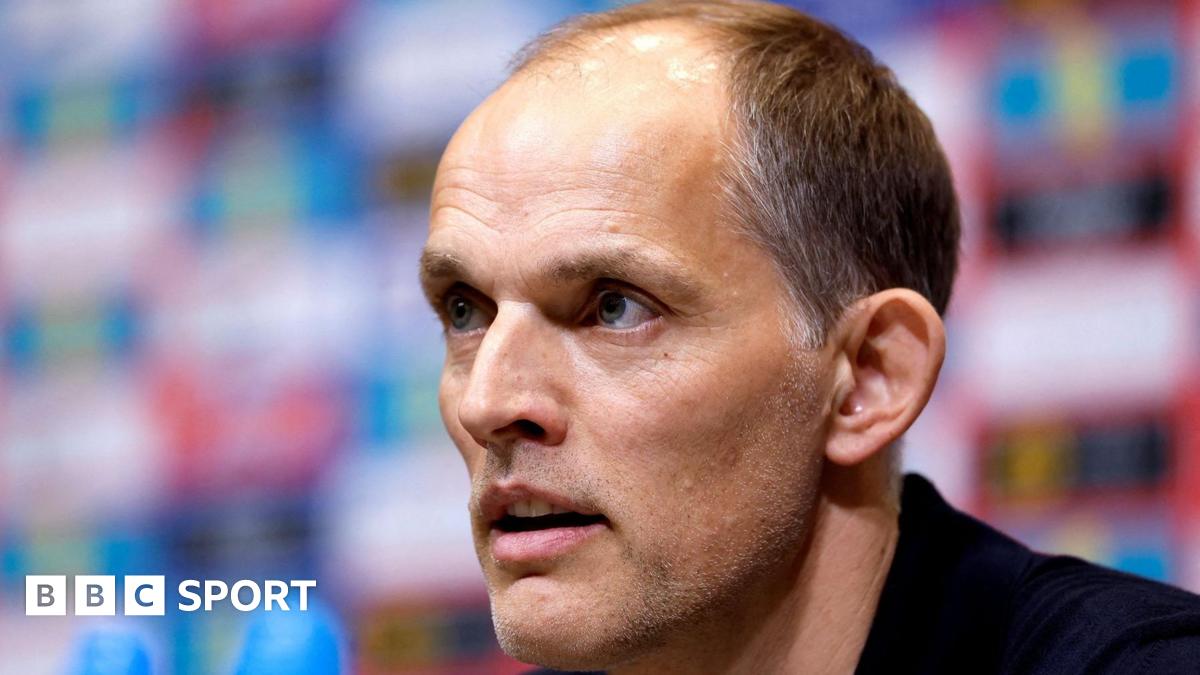
England head coach Thomas Tuchel advised his World Cup players to go on holiday in United States time zones before the tournament, to help the acclimatisation process.
A total of 21 of England’s 26-man squad will arrive in Florida on Monday for their pre-tournament camp, where they will also face New Zealand and Costa Rica in warm-up matches on 6 and 10 June.
Many players are understood to have spent the off-season in the United States or Caribbean at the behest of the England boss.
The weather is sure to play a major factor in the tournament, with studies indicating that nearly a quarter of all World Cup games are likely to be played in temperatures higher than 26C.
Adapting to the US time zones will also be a factor, with England’s tournament training base in Kansas City, Missouri, six hours behind UK time, which is the same as Dallas, where Tuchel’s men face Croatia in their opening group game on 17 June.
The remaining Group L matches against Ghana and Panama, which will be played in Boston and New Jersey respectively, will be played in a time zone five hours behind the UK.
To ensure England can hit the ground running, Tuchel requested players travelled west for their post-season break before joining up with the squad.
Arsenal quartet Declan Rice, Noni Madueke, Eberechi Eze and Bukayo Saka, and Crystal Palace goalkeeper Dean Henderson – who were all involved in European finals this week – will join the rest of the squad at a later date.
Rescuers face heavy rains, equipment failures in search for two people trapped in central Laos cave by flash floods.
Published On 31 May 202631 May 2026
Heavy rains have threatened to delay the search for two people who remain missing in a flooded cave in Laos, after five others were rescued after being trapped underground for more than a week.
Finnish diver Mikko Paasi, one of the first international rescuers to arrive at the site, told The Associated Press news agency that rains on Sunday had filled the cave up to the second chamber, preventing divers from entering until pumps can lower the water level.
Recommended Stories
list of 3 itemsend of list
A drainage pump also broke, making the situation even more difficult, said fellow diver Yoshitaka Isaji of Japan.
Rescue teams from Laos and neighbouring Thailand have been working together over the past week to rescue the trapped villagers, alongside divers from countries including Finland, Malaysia, Japan, Indonesia, France and Australia.
Seven people entered the cave in a remote mountainous area of central Xaysomboun province last week to look for valuable minerals such as gold, before being trapped by a flash flood that blocked their way out, according to local media reports.
One other person escaped and alerted the authorities.
A Laotian rescue group said on Sunday it had received “substantial” information on the cave system from the five men who were rescued earlier this week. “The hope is that today’s mission will locate both remaining victims,” the group wrote on social media.
The rescued men were being treated at a local hospital and were doing well, Malaysian diver Lee Kian Lie, who is taking part in the operation, told AP.
“We interviewed them about how the deeper part of the cave looks like. We will continue to search based on the information we have, and perhaps we will be able to get to the other two,” he said.
Rescuers said they navigated more than 200m (650 feet) into the cave and discovered five chambers in the system. The five people rescued so far were found in the fifth chamber.
Paasi, the Finnish diver, told AP that the survivors reported a narrow crack in the fifth chamber that could be a passage leading to a deeper part of the cave system.
“This was the only place that we haven’t checked in the mine, where the two lost miners could still be,” he said in a video interview.
The five men who were rescued – identified by their first names as Khamla, Mued, Ee, Ing and Laen – were first found last Wednesday.
The first man was safely extracted on Friday, guided through a narrow flooded passage by an expert diver. The remaining four left the cave on Saturday, after the water receded enough for them to walk out on their own, rescuers said.
Videos posted online on Saturday showed emotional moments as the men emerged one by one from the cave. Some collapsed on the ground at the cave’s entrance, and were hugged by a group of workers who cried with joy.
Later moments showed them lying on stretchers, wrapped in foil blankets and fitted with oxygen masks before being transported out.
The government of the Democratic Republic of Congo (DRC) has vowed not to shut down schools in Ituri province, despite the ongoing Ebola outbreak, which has already killed five schoolchildren since the epidemic began. The government announced the decision on Thursday, May 28, during a press briefing by the Minister of Public Health, Roger Kamba.
Roger noted at the press briefing that the government’s focus is on enhancing preventive measures in schools rather than shutting them down.
“We are not going to close schools. Our priority is to implement preventive measures to avoid further hardships for the children,” the Minister insisted. He expressed concern over the five schoolchildren who lost their lives, noting that many of these fatalities were related to self-medication and delays in accessing medical care.
Meanwhile, Congolese health officials had urged families to refrain from treating suspected cases at home and to seek medical help promptly. The officials warned amid heightened health monitoring in Ituri, where local authorities and partners are ramping up awareness campaigns to curb the spread of the virus.
The current outbreak spans three provinces: Ituri, South Kivu, and North Kivu, affecting 13 health zones. As of May 26, Ituri province reported 16 new confirmed cases, bringing the total to 121 confirmed cases and 17 deaths. “We know the outbreak in the DR Congo is more extensive, with over 900 suspected cases and 220 suspected deaths,” stated WHO Director General Tedros Ghebreyesus.
Tedros had earlier warned that the current Ebola epidemic affecting parts of the DRC is attributed to the Bundibugyo strain of the virus, stressing that there is currently no approved vaccine or treatment available. While discussing the troubling elements contributing to the Ebola outbreak in the DRC, Tedros said that, unlike earlier strains such as Zaire Ebola, which have effective medical solutions, the Bundibugyo strain poses a significant challenge due to the absence of preventive vaccines and effective treatments.
The lack of medical options raises serious epidemiological concerns, with the WHO director reporting around 600 suspected cases and 139 fatalities. The numbers are likely to increase, as the virus may have been spreading undetected for some time.
The virus has infiltrated multiple urban areas, and healthcare workers have also been impacted, increasing the risk of transmission nationwide. The situation is further complicated by regional security issues, particularly in Ituri province, which has faced significant violence since late 2025, displacing thousands of people. This area is a resource-rich mining zone with a highly mobile population, contributing to a heightened risk of virus spread.
Given the lack of validated treatments, however, the WHO is investigating potential vaccines and therapeutics for widespread use. Tedros has called upon the international community to take action, stressing that the five identified risk factors, including population movement, transmission within health facilities, and urban expansion, could collectively worsen the epidemic’s impact on public health.
The Democratic Republic of Congo (DRC) government has decided to keep schools open in Ituri province amid an ongoing Ebola outbreak, focusing instead on implementing preventive measures to avoid further hardships for children. Health authorities urge families to seek immediate medical help instead of self-medicating and are enhancing awareness campaigns to contain the virus spread.
The outbreak, affecting the provinces of Ituri, South Kivu, and North Kivu, has resulted in 121 confirmed cases and 17 deaths in Ituri alone. The WHO highlights the difficulty posed by the Bundibugyo Ebola strain, which currently lacks an approved vaccine or treatment. The virus is spreading in urban areas and impacting healthcare workers, compounded by regional violence and population mobility in the resource-rich Ituri, increasing transmission risks.
The WHO stresses the need for international intervention, with ongoing investigations into potential vaccines and therapeutics. The identified risk factors — including population movement, transmission in health facilities, and urban expansion — threaten to exacerbate the epidemic’s public health impact.