Inter Milan win their 21st Scudetto, edging Napoli, with three matches remaining in the Italian football league season.
Published On 4 May 20264 May 2026
Celebrations have erupted across Milan after Inter clinched the Serie A title with a 2-0 victory over Parma, sending thousands of supporters into the streets.
The Piazza del Duomo was filled with fans clad in blue and black on Sunday, moments after the final whistle at the nearby San Siro, as flares and fireworks lit up the night sky.
Marcus Thuram opened the scoring in first-half stoppage time before Henrikh Mkhitaryan sealed the win 10 minutes from time. The winners moved up to 82 points and clinched their 21st Scudetto with three matches remaining in the campaign.
Inter entered the match knowing a point would be enough after second-placed Napoli were held to a 0-0 draw at Como on Saturday, and their own result the next day handed them an unbeatable 12-point lead at the top.
Despite the scarcity of clear-cut chances, Inter controlled much of the first half and established themselves deep in the Parma half.
The hosts came close in the 25th minute when a powerful close-range shot from Nicolo Barella struck the underside of the bar. The rebound then hit Parma goalkeeper Zion Suzuki on the back, but the Japan international reacted quickly to tip the ball away from near the line and out of danger.
Thuram sparked a frenzy among the home supporters in first-half stoppage time, slotting home after being found unmarked by a Piotr Zielinski through ball to put Inter ahead.
Marcus Thuram opened the scoring for Inter [Daniele Mascolo/Reuters]
The second half followed a similar pattern with Inter remaining in control but failing to capitalise on their dominance as supporters inside the stadium grew increasingly focused on the clock ticking to 90 minutes.
Federico Dimarco delivered a near-perfect cross to Denzel Dumfries in the closing stages, but the defender failed to control his first touch, sending the close-range effort high over the bar and missing the chance to seal the match.
Mkhitaryan sealed the victory 10 minutes from time, tapping in a low cross from Lautaro Martinez to secure the points and spark title celebrations among Inter supporters.
For Inter, the triumph offered redemption after the heartbreak of last season when the club lost the Serie A title on the last match day before a 5-0 thrashing by Paris Saint-Germain in the Champions League final.
“We feel so happy now. It was not easy to start again after a season where we lost all the competitions we were in right at the end, but I am very happy today with this achievement,” Martinez said.
“It was a very important objective for us, perhaps many didn’t see us being favourites considering what happened last term, but we worked so hard on and off the field.”
The atmosphere in the Italian metropolis stood in stark contrast to a year ago when supporters faced the combined heartbreak of losing the league title to Napoli on the final day and suffering defeat in the Champions League final.
“I have no words. In spite of everyone who jinxed us from start to finish. Go Inter, always,” Inter fan Fabio said. “Wonderful. Amazing. And compared to how it ended last year, this year we deserve everything.”
Many supporters were seen in tears at the celebrations.
“It was more than deserved. It was a difficult league season at the start because it was always there, neck and neck,” fellow Inter fan Federico said.
The festivities are expected to continue ahead of the Coppa Italia final on May 13 when Lazio stand in the way of a domestic double for Inter.
Fans celebrate at Piazza del Duomo in Milan [Claudia Greco/Reuters]
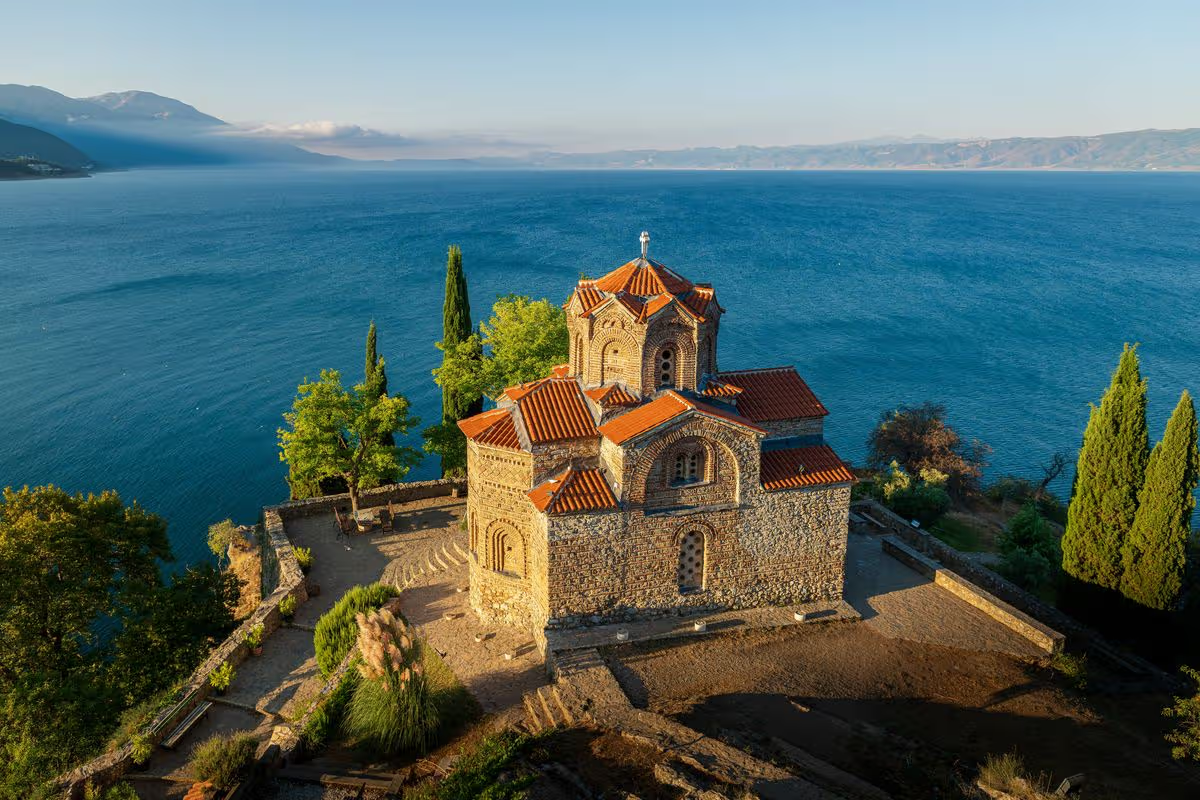
Nestled along the British coastline is a paradise for rock poolers and fossil hunters — and Conde Nast Travel has named it one of the seven wonders of Wales
It’s the local’s favourite spot by the coast(Image: John Myers)
While Rhossili Bay typically steals the limelight with its three-mile stretch of sand in the Gower National Landscape, this cherished bay is what many locals regard as Wales‘ true hidden gem.
Conde Nast Travel recently unveiled what they deem the seven wonders of Wales, compiled by a Welsh-born traveller, and Dunraven Bay secured its place as one of the nation’s essential destinations.
According to the publication, this is where residents head when seeking a peaceful coastal escape. And, with scenery comprising dramatic cliffs, limestone formations and weathered rock faces, it’s easy to understand why.
Tucked away in Southerndown within the Vale of Glamorgan, South Wales, the stunning bay is frequently called Southerndown Beach, adopting the name from its neighbouring village.
It boasts some of the finest rock pools along the Welsh coast and is consequently a favourite location for crabbing and fossil hunting. Young children delight in exploring the shallow pools and discovering treasures, as families flock to the bay for a day on the sand.
Best holiday cottage deals in Wales
This article contains affiliate links, we will receive a commission on any sales we generate from it. Learn more
Wales is renowned for its stunning mountains, picturesque coastline and rich Celtic history. Sykes has a wide and varied collection of holiday cottages, houses and apartments across the country. Prices start from £35 per night with current deals.
One previous visitor shared their experience on TripAdvisor, writing: “We visited Dunraven Bay last Saturday; it was an amazing trip to a beautiful beach. The rock pools are super; we found some very interesting items, including an intact Gryphaea, one of the genera known as ‘devil’s toenails’.
“The beach is very clean, and the sand leading up to the sea is soft. There is a beachside shop that sells hot and cold drinks and ice cream, along with a picnic area for those with their own food.”
Visitors to the beach will find a generously sized, conveniently situated pay-and-display car park, along with toilet facilities. The bay also boasts a charming café and restaurant, perfect for a leisurely lunch or light bite, and rounding off the quintessential seaside experience, there’s an ice-cream kiosk.
A further visitor shared: “Absolutely beautiful. Especially if you’re a tourist hoping to get good photos of a beach. I went alone, and for the most part, I felt completely safe. There are pockets of people and people alone just hoping to enjoy the sun during low tide.”
History and folklore
The bay was once thought to have been an ancient Iron Age hillfort, which subsequently became Dunraven Castle, a structure that has long since disappeared. In its place lie the crumbling ruins of the castle and its former walled garden, tucked away from the shoreline.
The bay is steeped in mysterious legend, notably that of the ‘wreckers of Dunraven’, who were said to have cunningly fastened lanterns to sheep in order to lure passing vessels. They would draw the ships towards Tuskar Rock before swooping in to plunder their cargo.
The most notorious ‘wrecker’ was one Walter Vaughan, who, following tremendous personal loss and financial devastation, turned to ‘wrecking’ out of sheer desperation.
To evade detection, legend suggests that no sailors or boat crew survived the wrecking, as they would routinely kill those onboard once they reached the shore.
Some claim that on the anniversary of his son’s death, Vaughan’s ghost returns to the beach, and those passing by can hear his chilling wails.
My favourite way to enter Rione Sanità is by elevator: descending from a bridge into cobblestoned streets buzzing with mopeds and flanked by opulent but decaying 18th-century palazzi. Through the grand doorways of these once noble palaces are courtyards where bakers, butchers, cobblers and the odd contraband cigarette vendor do business.
La Sanità – to the locals – is a thriving working-class district with a grand history. In the 17th century, the Spanish viceroys took a fancy to the area perched on the hill above the dense and crowded streets of the old town. Its name, which translates as “healthy district”, reflected a cleaner reputation (rainfall ran downhill, depositing debris and waste in the historic centre below). They built vast houses here in the 18th century (see Palazzo dello Spagnolo and Palazzo San Felice), with architects vying for attention as the court passed through to Capodimonte, the royal summer residence above the city. Business flourished until Napoleon arrived in the early 19th century, found the route too slow, and built the overpass that eventually suffocated the area and left it fighting for its life.
Emboldened by one too many fatal gang wars and a blighted reputation, local residents came together several years ago to form associations such as Napoli in Vita, with the aim of opening up the area, supporting local business and creating employment. The result is a neighbourhood renaissance led by the community for the community, which has quickly become an example for the whole city in the midst of mass touristification.
Where to eat and drink
Sophia Loren in the kitchen. Photograph: Shutterstock
Trying the local pizzerias is non-negotiable. It was in La Sanità that Sophia Loren famously kneaded pizza dough in Vittorio De Sica’s film L’oro di Napoli (Gold of Naples); and the award-winning Isabella De Cham runs the city’s first all-female fried pizza spot – her tiny montanare pizzas are loaded with cheese, vegetables and ham.
Pizzeria Oliva da Carla e Salvatore, the locals’ favourite, has a view of the majolica-clad basilica. Concettina ai Tre Santi draws food pilgrims from across the world for head chef Ciro Oliva’s deconstructed pizza and his focus on using the best local producers and ingredients. Wash it down with Vesuvian wine at Antica Cantina Sepe on Via Vergini, a fixture for generations and one of the forces quietly reshaping the neighbourhood by hosting community events and keeping prices affordable and inclusive.
Cultural experiences
Entrance chamber of the catacombs of San Gaudioso. Photograph: Robert Harding/Alamy
There is as much to see below ground in La Sanità as above. In the Hellenistic period, it was a sacred burial ground and beneath the soft tufo stone lies a warren of tunnels and hollowed-out chambers, now home to garages and workshops such as Fonderia Mercogliano, which casts religious objects from metal. The San Gennaro and San Gaudioso catacombs are run by a social cooperative, La Paranza, which employs young people from the neighbourhood and offers a fascinating tour, showing how the ancient populations negotiated death and legacy. The highlight is the Ipogeo dei Cristallini, a Greco-Roman crypt, recently uncovered beneath a 17th-century apartment block, featuring a perfectly intact relief sculpture of Medusa. It’s a marvel.
Where to shop
Fiocco di Neve (snowflake) brioche filled with cream and ricotta at Poppella. Photograph: RealyEasyStar/Pasquale Sorrentino/Alamy
La Sanità is a den of indulgence, but it is the bakeries that set it apart, each with its own speciality. You can find taralli (crunchy savoury biscuits made with fennel seed and black pepper to accompany a beer) at Panificio Coppola Antonio; a perfectly moist rum babà at Pasticceria Mignone; and for La Sanità’s most famous sweet export head to Pasticceria Poppella for fiocchi di neve (snowflakes), small, soft brioche filled with a secret recipe of cream and ricotta.
A large mural in Via Sanità. Photograph: James Talalay/Alamy
Don’t miss
La Sanità has long been home to craftsmen and artists, their workshops tucked into courtyards and up hidden stairways. Omega Guanti has been hand-stitching leather gloves since the Bourbon period for the likes of Dior. Michele Iodice, a celebrated Neapolitan sculptor, works and exhibits from his studio dug into the tufo stone that is in itself a masterpiece. Atelier Alifuoco, a shared studio space, is home to the next generation of the city’s artists.
Where to stay
Casa D’Anna ai Cristallini (doubles from €220) is more sumptuous private home than hotel, where tasteful art lines the walls and photography books are stacked on antique furniture. Down the road, artist Vincenzo Oste and his wife Inès Sellami incorporate art, design and artisan work at their guesthouse Atelier Inès (doubles from €265), inside their newly restored palazzo, set within a leafy courtyard.
Venezuela has gone through many stages in its assertion of ownership over natural resources and relationship with foreign corporations. (Venezuelanalysis / AI-generated image)
Venezuela’s recent Hydrocarbon Law reform has sparked fierce debates about its short- and long-term implications. In this essay, Blas Regnault, an energy policy analyst and researcher, offers an in-depth analysis of the new legislative framework, from the significant changes to the state’s governance over its natural resources to his perspective on a sovereign recovery of the oil industry.
The recent hydrocarbon reform: an overview
It is important to distinguish between two closely connected but analytically separate developments: first, US oversight of Venezuelan oil revenues after Maduro’s kidnapping; and secondly, the new Hydrocarbon Law itself. The first is an externally imposed mechanism that conditions oil sales, revenue collection, transport, and the distribution of oil proceeds to US interests. The second is a domestic legal reform whose constitutionality and political legitimacy have been widely questioned.
It remains unclear whether the new law is fully operative in practice, or whether it is only being applied selectively while its fiscal substance is displaced by the US revenue-control mechanism. But the outcome is largely the same: a loss of fiscal automaticity and a form of fiscal sovereignty under tutelage in relation to Venezuelan oil income.
In other words, the crisis of governance in the Venezuelan oil sector, together with its chronic lack of transparency since 2017, now culminates in a profound loss of sovereign control over all three dimensions of the business: its rentier dimension, belonging to the nation; its fiscal dimension, belonging to the state; and its shareholder dimension, linked to the role of the state oil company PDVSA as principal participant in extraction and commercialisation.
Therefore, the new law is not simply a technical reform. It is not merely about updating contracts, modernising procedures, or making the sector more attractive to investors. The deeper issue is that the reform changes the way the nation is compensated for the use of the subsoil and therefore alters the very governance of the sector. What is at stake is the relationship between sovereignty, ownership of the subsoil, and public income.
It is true that, on paper, the law formally preserves state ownership over the resource. But the business models it opens weaken the practical substance of that ownership. And that is the crucial point. Ownership is not a decorative legal formula. Ownership means that the state, acting on behalf of the nation, has the right to decide whether the resource remains underground or is extracted; and if it is extracted, under what conditions, with what public charge, and for whose benefit. The recent reform softens the link between ownership and the nation’s participation as owner of the subsoil, turning something that was once grounded in a general rule into something negotiable, adjustable, and highly discretionary.
A useful way of understanding the economic and social significance of the reform is to distinguish the different streams of public income historically associated with oil in Venezuela. Under the former hydrocarbon law, the nation participated in the oil business through three distinct channels: as owner, as tax authority, and as shareholder. The first channel, corresponding to ownership, was royalty. The second was taxation, arising from the state’s fiscal authority over the activity. The third was dividends, arising when the state participated through PDVSA and therefore received income in its capacity as stakeholder rather than as landlord or tax authority.
This distinction matters because the oil business has historically involved different claimants competing over the fruits of extraction. In a sector marked by extraordinary profitability and strategic importance, the owner of the rent, the fiscal authority, and the capitalist operator all seek to maximize their share of the value generated. In the Venezuelan framework that prevailed before 2026, those three roles were clearly present: the nation as owner of the subsoil, the state as fiscal authority, and the operator as capitalist actor. The new law alters the balance between them.
Illustration of the different revenue streams in the Venezuelan oil industry. (Venezuelanalysis)
Royalty
The royalty is where the change is most revealing. As already noted, royalty is the clearest expression of ownership. It is paid upfront. It does not depend on profit. It is charged before taxes are assessed and before the remaining income covers the factors of production; that is, wages, interest, profits, and the other claimants on the project. In other words, royalty is not part of the production costs. If the oil price is 100 dollars per barrel and the agreed royalty rate is 30 per cent, the owner receives 30 dollars per barrel straight away. That is the proprietorial logic in its purest form.This has long been a battleground in the global oil industry. The dispute over rent has historically taken place between the operating companies, whether private national oil companies acting as operators, and the owner of the resource, that is, the landlord. Depending on the property-rights regime, that owner may be a private individual, as in parts of Texas, or the state, as in Venezuela and in most oil-exporting countries. Whether in Texas, Alaska, Saudi Arabia, Kuwait, Norway, the United Kingdom, Nigeria, or Venezuela, the property-rights regime has been the principal legal instrument through which the owner secures a share of the rent. It is a legitimate exercise of sovereignty, recognised by all parties involved in the global oil business.

Table 1: Effect of royalty rates on the nation’s per-barrel income using Merey 16 prices, Venezuela, January–March 2026
Month (oil price)
30% royalty
10% royalty
1% royalty
Jan 2026 ($43.21)
$12.96
$4.32
$0.43
Feb 2026 ($52.31)
$15.69
$5.23
$0.52
Mar 2026 ($86.00)
$25.80
$8.60
$0.86
Source: author’s calculations based on OPEC-MOMR January – March 2026 for Merey 16
And yet the new law, in practical terms, empties out that proprietorial logic by turning royalty into a negotiable variable within a range of zero to 30 per cent, something highly unusual in the global oil business. The potential scale of the loss becomes immediately clear once one thinks in terms of export volumes. At an oil price of 86 dollars per barrel, a 1 per cent royalty leaves the nation with less than one dollar per barrel, whereas a 30 per cent royalty yields 25.8 dollars. If Venezuela exports 800,000 barrels per day, that means roughly 688,000 dollars per day under a 1 per cent royalty, compared with 20.64 million dollars per day under a 30 per cent royalty. This is a dramatic compression of the owner’s income. It shows that a high oil price cannot compensate for the hollowing out of the royalty. Put simply, under the new law, higher oil prices will no longer automatically translate into greater income for the nation if royalties are arbitrarily lowered to the benefit of transnational capital. This is not a marginal fiscal concession; it is a radical compression of the nation’s proprietorial income.
Taxes
Turning to taxes, under the previous legal framework, the fiscal regime included not only taxes on profits, but also local and municipal taxes on oil activity, together with other parafiscal charges and special contributions linked to extraordinary profits. These different channels gave the public side several routes through which to capture value from extraction. Under the new law, much of that architecture is displaced and compressed into an integrated tax on gross income that will also be set in a discretionary fashion up to a fixed ceiling. According to supporters of the reform, this new framework is designed to ensure the project’s “economic equilibrium.” But the political significance of that shift is considerable. What was previously structured through several distinct legal claims can now be more easily absorbed into a flexible package, negotiated project by project. In that sense, this is not simply simplification; it is a substantial thinning of the fiscal claim. Once the fiscal architecture becomes thinner, the public claim over oil value becomes weaker, more flexible, and ultimately more negotiable.
Table 2 illustrates the magnitude of the change using the March 16, 2026, marker Merey 16 price. Under the previous regime, taxes and parafiscal charges alone could amount to about $31 per barrel, or 36 percent of the barrel price. Under the post-reform interim scenario, that could fall to about $17.6 per barrel, or 20.5 percent.
Table 2: Tax and parafiscal take per barrel before and after the reform
Fiscal Component
Former Law (reference model)
Post-reform scenario
Difference
Taxes and parafiscal charges per barrel (USD)
$31
$17.6
-$13.4
As share of barrel price (%)
36%
20.5%
-15.5%
Note: Figures are illustrative and based on the March 2026 Merey 16 price of US$86 per barrel, using the reference model for the former regime and the intermediate scenario for the post-reform regime. Source: Authors’ calculations based on the comparative fiscal scenarios and March 2026 Merey 16 price data.
Dividends
Finally, there are dividends arising from state equity participation, and these too must be distinguished from both royalty and taxation. Dividends are not paid because the nation owns the subsoil, nor are they collected because the state exercises fiscal authority over the activity. They arise because the state participates in the business as shareholder and therefore receives part of the profits in its capacity as investor. In other words, dividends represent the state’s participation in the profits of the business itself. But that income is not necessarily available for immediate public use in the same way as royalty or taxation. Part of it may be retained within the company, used for reinvestment, capital expenditure, debt service, or the wider financial needs of the enterprise. So, unlike royalty, which expresses ownership, or tax, which expresses fiscal authority, dividends are tied to the corporate logic of the business. Depending on the ownership structure, this channel of participation may range, illustratively, from zero to 60 per cent of distributable profits.
International jurisdiction of potential oil litigation
There is also an important jurisdictional dimension. By reducing the fiscal share captured by the state and by placing greater weight on contractual flexibility, the reform moves the sector towards a framework that is more exposed to international arbitration. At the same time, the sanctions and licensing regime has become part of a broader architecture of control over the oil business: control over access to the fields, control over marketing channels, and control over financial access to revenues. So, this is not merely a domestic fiscal reform. It is also part of a broader reordering of the legal and financial chain through which Venezuelan oil is governed.
Key takeaways
Supporters of the new law argue that it delivers increased flexibility, greater operability, improved investment prospects, and greater bankability. And that is not a trivial argument. In a country that has experienced production collapse, sanctions, institutional erosion, and a loss of market share, it is understandable that policymakers would seek a framework that appears more attractive to capital. In that sense, the reform may indeed reduce perceived risk and make projects easier to finance. It may also simplify part of the gross take and make negotiations easier. In that sense, the reform should not be caricatured. But it also entails the abandonment of each of the nation’s and the state’s historic roles in the sector, undermining the institutional fabric that once gave the oil economy a degree of stability and rationality.
For that reason, the disadvantages of the reform ultimately outweigh its potential benefits. What is lost is fiscal automaticity. That means the nation is no longer guaranteed a stable share by rule, but must now negotiate it, justify it, or recover it through more uncertain channels. Put differently, the reform replaces payment-by-rule with payment-by-negotiation on a case-by-case basis. In practical terms, each contract will generate its own conditions over each of the principal sources of public income arising from oil activity.
What is also lost is the clarity of a system in which the state charges because it owns the resource, not because the project happens to be commercially convenient. Once royalties become variable and fiscal terms are subordinated to the “economic equilibrium” of the project, the centre of gravity shifts. The guiding principle is no longer the nation as sovereign owner; it becomes the financial viability for the investor/operator. That is a profound political change presented as technical pragmatism.
In summary: the 2026 reform does not abolish formal ownership, but it hollows it out in practice. It replaces a more proprietorial fiscal logic with a more contractualized and discretionary one. That may attract investment, but it also weakens the automatic link between national ownership and national income. Whatever mechanism one chooses to emphasize, the result is much the same:
The nation no longer receives royalty by rule, but under externally conditioned arrangements. What is presented as flexibility is a retreat from ownership.
The state compresses its fiscal participation at every level.
The state oil company weakens its position as an investor.
Once that happens, the central question is no longer simply, “How much is the state collecting?” but rather “Who decides, under what rules, with what traceability, and with what accountability?”
Shell oil wells in Lake Maracaibo, Western Venezuela, in the 1950s. (Archivo Fotografía Urbana)
The historical context of Venezuela’s oil legislation
Venezuela’s oil history is not just a history of contracts or companies; it is a history of how the nation has tried to define its authority over the subsoil. Venezuela did not begin from the same position as many oil-exporting countries in West Asia or North Africa. It was already an independent republic when it developed its mining and hydrocarbons legislation. That matters, because it means Venezuela built a national jurisdictional framework around state ownership of mines and deposits, rather than inheriting a colonial concessionary order imposed from outside. That distinction is central.
From the early twentieth century onwards, successive legal frameworks progressively consolidated the republic’s sovereign claim over oil-bearing land. In other words, Venezuelan oil law was historically moving towards a more explicit assertion of the nation’s right to charge for the extraction of its natural wealth. This is one reason Venezuela mattered so much internationally: not only because it was a major producer, but because it became a reference point for fiscal regimes and sovereign oil governance, including later in the wider OPEC environment. In that sense, Venezuela’s experience was historically complete in a way that few other oil-producing countries were.
Nevertheless, there is a paradox surrounding the 1975-1976 nationalization of the oil industry. On paper, it ought to have marked the culmination of national control, but it did not deepen sovereignty. In practice, it helped produce a shift towards a more internationalized governance structure. The Ministry, as representative of the owner-nation, was gradually displaced by state oil company PDVSA, and PDVSA increasingly operated under a logic of global business rather than one of public sovereign rule. So instead of the owner-state speaking directly, the national oil company became the intermediary, and that had long-term consequences. Put differently, PDVSA, together with international oil capital, gained ground in the long struggle to reduce the landlord’s direct grip over rent.
This is where the historical relationship with Western transnational corporations becomes more nuanced than a simple story of foreign domination versus nationalist resistance. The issue is not merely the presence of Western companies, but the governance structures they operate under. Venezuela moved from a more classic proprietorial regime towards a more cessionary one, and later, especially in the late 1980s and 1990s, towards more liberal or non-proprietorial arrangements. The oil opening (“Apertura Petrolera”) of the 1990s is especially important here, because it reduced the fiscal burden and shifted the framework in a way that centralized the operator’s conditions. That was already a major break.
The Chávez years brought a partial reversal. The restoration of the property right was not merely ideological posturing; it was a restoration of a more classical fiscal logic, in which the sovereign character of the state take was reaffirmed. But that restoration took place amid other contradictions, including the politicization of PDVSA and the accumulation of debt. So even that phase did not resolve the deeper institutional tensions.
The 2026 reform, then, does not emerge from nowhere. It is a new chapter of a long historical movement: from national jurisdiction, to nationalization, to cessionary governance, to the oil opening, to partial reassertion, to crisis and collapse, and now to a new form of contractualization from a position of weakness. Venezuela’s oil history has been a struggle not simply over who owns the oil, but over who governs the terms on which ownership is exercised. The present reform is the latest chapter in that struggle, but it is a particularly radical one because it comes after institutional erosion and under a global order that is far more contractual, litigious, and externally structured than the one Venezuela faced in the mid-twentieth century.
Chevron, Eni, Repsol, and Shell are among the corporations to have struck contracts under the new and improved conditions. (Venezuelanalysis)
Oil in the present geopolitical battle
The current geopolitical context of the US-Israeli aggression against Iran should, in principle, strengthen Venezuela’s bargaining position. When West Asia becomes more unstable, supply security rises as a strategic concern, and oil regains immediate geopolitical urgency, countries with large reserves and an established production history become more valuable.
Venezuela has occupied that position before. Venezuelan oil played an important strategic role for the Allies during the Second World War, for example. Today, renewed disruption around Iran and the Strait of Hormuz has again tightened the market and raised the geopolitical value of accessible barrels.
That is precisely why the current outcome appears so paradoxical. If global conditions improve Venezuela’s leverage, one would expect the country to negotiate from a stronger position and to demand a larger participation. One would expect a legal framework that captures more rent, not less; that uses geopolitical scarcity to reinforce state take, not to dilute it. But the current reform, alongside the sequence of deals with foreign conglomerates, and combined with US control over revenues, seem to move in the opposite direction.
This leads to the second point: the geopolitical issue is not only price or supply. It is also about control. What is emerging is a form of sovereignty under tutelage. Venezuela may formally remain the owner of the resource, but effective control over commercialization, revenue channels, and external validation appears increasingly conditioned from outside. Whether one calls that tutelage, external supervision, or subordinated reintegration, the takeaway is the same: sovereignty over the resource is no longer identical to sovereignty over the business. Recent US licenses illustrate the point very clearly. Washington has opened the door to renewed oil transactions with PDVSA, but under Treasury oversight and with proceeds channelled into US-administered accounts. That is not normal sovereign control over national oil income.
This is where the distinction between the origin and the destination of rent becomes especially useful. Even before we ask what is done with oil income socially or politically, we first need to know how that income is generated: through what pricing, what discounts, what fiscal structure, and through which payment channels. If that first level is opaque, then both the origin and the destination of rent become politically indeterminate. In other words, the problem is not only that the country may receive less revenue. The problem is that the country may not even be able to clearly verify what it is owed, how, and why. That is a much deeper sovereignty problem.
As a result, a geopolitical context that would, in theory, favor Venezuela, sees the country re-entering global markets with weakened sovereignty, under a framework of greater flexibility for operators and less certainty for the nation. That is why the debate is no longer only about production volumes or export flows. The real debate is about the jurisdictional and political order that now governs Venezuelan oil: who authorizes, who commercializes, who arbitrates disputes, who tracks the proceeds, and who answers to the country.
Blas Regnault was a guest on the Venezuelanalysis Podcast.
What does a sovereign recovery look like?
Moving from critique to programme is difficult, and the first honest thing to say is that no one can predict the exact path ahead. Venezuela is emerging from collapse, sanctions, loss of market share, institutional erosion, and a deep social crisis. Any recovery scenario, therefore, is bound to be politically fraught. But one thing is clear: if the country does not rebuild the public intelligibility of oil income, then any so-called recovery may simply reproduce opacity, distrust, inequality, and social tension.
A sovereign recovery does not mean autarky. It does not mean excluding foreign firms, nor does it mean mechanically returning to an earlier model. It means something more precise: restoring the link between ownership, public rule, and accountable income capture. In other words, if the nation owns the resource, then the nation must be able to know, verify, and govern how value is extracted from it. That means transparency over net prices, discounts, taxes, royalties, exemptions, payment channels, and the destination of funds. Without that, there can be no recovery in any meaningful sovereign sense. It would simply be resumed extraction.
A sovereign recovery also requires stripping away some of the ideological confusion that usually surrounds debates on natural resources. As Bernard Mommer argued more than twenty years ago, the governance of natural resources is, in many ways, a more elementary question than the conventional left-right divide suggests. In the case of oil and minerals, the deeper divide is above versus below. It is the tension between those who live and work on the surface (the nation, society, the public realm) and those who make their living from the subsoil.
That is why the question of ownership comes before the question of distribution, that is, before the question of what is done with the income generated by oil activity. Only after establishing the governance over the resource and the rules over its extraction does the familiar left-right question properly arise: how that income is used, whether for social spending, public services, etc., or private accumulation.
The first step, then, is transparency. Not as a slogan, but as an institutional obligation. Who is selling? At what net price? Under what discounts? With what deductions? Paid where? Audited by whom? These are not minor administrative questions. They are the very mechanics of sovereignty in an extractive economy. If the country cannot answer them, then the state is no longer exercising full command over its principal source of income.
The second step is to move away from excessive discretion and back towards intelligible general rules. Contracts will always matter in oil. But there is a difference between contracts operating within a strong public framework and contracts effectively replacing public rule. Once everything becomes negotiable in the name of investment or “economic equilibrium,” the public realm shrinks and the executive realm expands. That is politically dangerous in any country, but especially in one where oil historically underpinned a broader social pact.
The third step is to reconnect oil income with social legitimacy. This is not an abstract issue. It is whether oil wealth translates to salaries, living standards, public services, social protection, and some minimum sense of collective benefit. If the country enters a new extractive cycle in which more oil is produced but public income remains narrow, opaque, or externally conditioned, then social tensions are likely to intensify rather than diminish. That is why a sovereign recovery cannot be measured by production figures alone. It must be judged by whether the nation regains an intelligible and legitimate claim over the income stream.
In simple terms, the average Venezuelan citizen is aware of fluctuations in crude prices because they know they affect the national budget. Oil income is widely and legitimately perceived as income belonging to the nation, and therefore as something that ought to support public services and collective welfare. Even when that income is later misused (through corruption, clientelism, or mismanagement) the underlying perception remains: oil revenue belongs to all Venezuelans.
That is also why the current situation can be described as one of sovereignty under tutelage. The country may still be sovereign in formal terms, yet it operates under external supervision in practical terms. Unless that gap is closed, the language of recovery will remain politically fragile.
Blas Regnault is an oil market analyst and researcher based in The Hague, whose work explores how oil prices move across time and what they tell us about the global economy. Drawing on years of experience in central banking, energy research, and international consulting, he brings together political economy, business cycles, production costs, and petroleum governance in a way that is both rigorous and accessible.
He has spent much of his career studying the deeper forces behind oil price trends and fluctuations, always with an eye on the institutional and geopolitical realities of the global petroleum market. Later this year, he will publish his book, Political Economy of Oil Prices: Trends and Business Cycles in the Global Petroleum Market, with Routledge.
The views expressed in this article are the author’s own and do not necessarily reflect those of the Venezuelanalysis editorial staff.
SAG-AFTRA and the Alliance of Motion Picture and Television Producers have landed on a new tentative contract.
The actors union’s new agreement with the trade group that negotiates with Hollywood unions on behalf of the major studios will reportedly improve AI protections and boost the guild’s pension fund. Similar to the pact the Writers Guild reached with the studios last month, SAG-AFTRA’s contract will last four years instead of the usual three.
SAG-AFTRA confirmed the tentative deal on Saturday. The union said in a statement that “specific details will not be released” until the SAG-AFTRA National Board reviews its terms.
The contract is set to cover workers who are involved in motion pictures, scripted primetime dramatic television, streaming content and new media.
The actors union began negotiations with the studios in February and extended those talks in March, but paused to allow the AMPTP to finish negotiations with the writers union. Negotiations resumed April 27 and ended May 2.
The tentative contract still needs to be voted on by its members — SAG-AFTRA represents more than 160,000 actors, broadcast journalists, dancers, DJs, stunt performers, voice-over artists and other entertainment professionals.
The union’s current contract is set to expire June 30. SAG-AFTRA joins WGA as the latest Hollywood union to strike a deal with the studios.
The Directors Guild of America is the last union that still needs to reach an agreement with the studios. Negotiation sessions with AMPTP will begin on May 11, as its contract is set to expire on June 30.
Crude prices were slightly lower ahead of European markets opening as traders digested comments from US President Donald Trump that Washington would help ships leave the Strait of Hormuz from today. Iran, however, has rejected the plan.
ADVERTISEMENT
ADVERTISEMENT
At the time of writing, the price of a barrel of US benchmark crude (WTI) was down 0.28% to $101.65 a barrel, while Brent crude, the international standard, edged down 0.06% to $108.10 a barrel.
Much hinges now on progress towards ending the war with Iran and unlocking the bottleneck through the Strait of Hormuz.
The oil market “remains the fulcrum, with hundreds of tankers, bulk carriers, and cargo ships still stranded across the Gulf, idling as storage constraints force producers to shut … production simply because there is nowhere left to store it,” Stephen Innes of SPI Asset Management said in a commentary note.
Trump said what he called “Project Freedom” would begin Monday morning in the Middle East. The US Central Command said it would involve guided-missile destroyers, more than 100 aircraft and 15,000 service members, but the Pentagon did not immediately answer questions about how they would be deployed.
Asia-Pacific and US markets
In Asian share trading overnight, Hong Kong’s Hang Seng jumped 1.4% to 26,135.47. Markets in mainland China and Japan were closed for “Golden Week” holidays. In Australia, the S&P/ASX 200 slipped 0.3% to 8,704.70.
Strong buying of tech stocks pushed shares in South Korea sharply higher, as the Kospi gained 3.8%. Taiwan’s Taiex surged 4.2%.
On Friday, the S&P 500 climbed 0.3% to another all-time high of 7,230.12, closing out a fifth straight winning week. The Dow Jones Industrial Average dipped 0.3% to 49,499.27, and the Nasdaq composite added 0.9% to a record close of 25,114.44.
Apple led the way after delivering better profit than expected. Because it’s one of Wall Street’s biggest stocks in terms of overall size, its rally of 3.3% was by far the strongest force lifting the S&P 500.
Stock prices generally follow the path of corporate profits over the long term, and US companies have been exceeding expectations for earnings in the first three months of 2026. That’s even with the war with Iran and high oil prices souring confidence for many US households.
Strong earnings boost S&P 500
A little more than a quarter of the companies in the S&P 500 have reported already, and 84% of them have topped analysts’ estimates, according to FactSet. The index is on track to deliver roughly 15% growth in profit from a year earlier.
The main uncertainty for the global economy is where oil prices are heading because of the Iran war. Oil prices moved higher last week on worries that the war might keep the Strait of Hormuz closed for a long time, trapping oil tankers pent up in the Persian Gulf instead of delivering crude to customers worldwide.
Brent was selling for a little more than $70 per barrel before the war began, and soaring prices helped the two biggest U.S. oil companies report stronger profit for the latest quarter than analysts expected. But stock prices nevertheless fell for both Exxon Mobil, 1%, and Chevron, 1.4%, as oil prices regressed Friday and each reported drops in net income from a year earlier.
In other dealings early Monday, the dollar rose to 157.18 Japanese yen from 156.80 yen. The euro fell to $1.1724 from $1.1746.
GULF SHORES, Ala. — Sally Perez and Maggie Boyd won the clincher as UCLA swept top-seeded Stanford 3-0 on Sunday to win the Bruins’ third NCAA beach volleyball championship.
Perez and Boyd wrapped up the Bruins’ first championship since winning back-to-back titles in 2018-19, beating the Cardinal’s Kelly Belardi and Avery Jackson 21-11, 21-19.
Kaley Mathews and Ensley Alden got third-seeded UCLA (33-6) off and running with a 21-16, 21-11 victory over Brooke Rockwell and Ruby Sorra.
Ava Williamson and Jesse Dueck gave the Bruins a 2-0 lead in the closest match of the day, beating Indigo Clarke and Clara Stowell 21-17, 25-23.
The UCLA tandems of Alexa Fernandez and Harper Cooper as well as Kenzie Brower and Mallory LaBreche were also winning their matches when they became unnecessary.
It was the first championship for UCLA coach Jenny Johnson Jordan, who took the reins in 2023. Stein Metzger led the Bruins to their first two titles. Johnson earned her 100th career win when the Bruins beat No. 2 Texas 3-2 in their semifinal on Saturday.
Stanford (39-4) was aiming for its first championship, advancing to the title match under coach Andrew Fulller with a 3-1 victory over No. 5 Florida State in the semifinals.
UCLA beat No. 2 Texas 3-2 in the other semifinal.
USC has won six of 10 championships since the event began in 2016.
TCU ended a four-year run by the Trojans last season when the Horned Frogs beat Loyola Marymount for the title. The tournament wasn’t played in 2019 because of the COVID-19 pandemic.
Two activists from the Global Sumud Flotilla arrived in the Netherlands after being released from Israeli custody. The flotilla was intercepted in international waters while carrying aid to the Gaza Strip. Two of their fellow activists remain in Israel for questioning.
According to pest control, people should routinely check their luggage for warning signs
Travellers are advised to check their bags and suitcases (stock photo)(Image: Getty)
Many people will be heading home today after a bank holiday weekend getaway. While travellers often take great care when packing, it’s quite common to spend far less time unpacking – simply tipping the contents of your suitcase straight into the wash.
Throwing your clothes in the washing machine as soon as you arrive home is a sensible idea. However, there is another crucial step everyone is urged to take when emptying their luggage. Holidaymakers are advised to check their suitcases carefully for signs of any unwelcome guests, such as bed bugs.
The advice comes from James Rhoades, the founder of ThermoPest, a pest control firm specialising in bed bug treatment and registered with the British Pest Control Association. James says frequent travellers should check their suitcase as part of their routine whenever they return from a holiday.
The tip could help to prevent issues year-round, but it could be especially helpful for travellers to get into the habit now, ahead of the summer holidays. He explained: “During hot weather, bed bugs become more active and need to feed more frequently.
“They get all their hydration from blood, so a warm, humid summer gives them the perfect opportunity to bite. With people wearing lighter sleepwear or using thinner sheets, there’s less of a barrier between the bugs and their food source – us.
“There’s also typically a rise in cases after holiday periods, as bed bugs can easily be brought back hidden in suitcases or laundry. Once inside, they spread quickly, so early detection and prevention are key.”
Fortunately, there are steps people can take to minimise the risk when they arrive at their holiday and when they return home. “Hotels, guest houses, and short-term rentals can become hotspots for bed bugs during peak travel periods. Before unpacking, check the seams of the mattress, headboard, and upholstered furniture for telltale signs such as tiny rust-coloured spots or shed skins.
“Keep luggage elevated on racks rather than placing it directly on the floor to reduce the chance of bed bugs crawling into your belongings. You could also store clothes in sealed bags inside your suitcase for added protection and to make it harder for bugs to hitch a ride home,” says James.
When it is time to return home, it’s recommended that you unpack your clothes straight into the machine and carefully inspect your suitcase. James claims: “Returning home is one of the most common times for bed bugs to be introduced into your living space. As soon as you arrive back, unpack directly into the washing machine and wash everything on a hot cycle.
“Visually inspect your suitcase inside and out, paying close attention to pockets, seams, and linings for any signs of bed bugs such as dark spots, shed skins, or live insects. If you travel frequently, making this a routine step can help you spot potential issues early before they spread.”
US President Donald Trump has announced ‘Project Freedom’, a naval mission to escort stranded ships through the Strait of Hormuz starting Monday, warning any interference will be met “forcefully”. The move comes amid a fragile US-Iran truce, with Tehran warning it would treat US intervention as a breach.
Singer Alex Ligertwood, best known for providing lead vocals for Santana over several decades, has died. He was 79.
Ligertwood’s wife and agent, Shawn Brogan, announced in a Saturday evening Facebook post that the vocalist died at his Santa Monica home.
“It’s with great sadness and heartache to announce the passing of my sweet dear Alex Ligertwood, my husband of 25 years, we knew each other for 36 years,” Brogan wrote. “Alex passed peacefully in his sleep with his doggy Bobo by his side yesterday.”
Ligertwood’s cause of death was not revealed.
Alex Ligertwood, left, and Jorge Santana of the band Santana perform Oct. 9, 1993, at Shoreline Amphitheater in Mountain View, Calif.
(Tim Mosenfelder / Getty Images)
“Alex was loved by so many. If you knew him, you loved him. He touched so many with his extraordinary voice. He was all heart and soul,” Brogan’s statement continued. “His favorite thing in life was to make music, sing and to share his gift with us. He performed his last show just two weeks ago. I’m grateful for that. He did it his way, on his terms, till the end.”
The singer had five separate stints as Santana’s lead vocalist between 1979 and 1994.
He famously served as the group’s singer when it performed at Live Aid in 1985. His voice was notably featured on the tracks “You Know That I Love You,” “Winning,” “All I Ever Wanted” and “Hold On.”
Ligertwood also co-wrote such songs as “Somewhere in Heaven” and “Make Somebody Happy,” among others.
Aside from his contributions to Santana, Ligertwood played alongside guitar legend Jeff Beck as part of the Jeff Beck Group in the early ‘70s. He also played in jazz-rock keyboardist Brian Auger’s band Oblivion Express.
Auger, who has played with Rod Stewart and Jimi Hendrix, paid tribute to Ligertwood in a Facebook post Saturday evening.
“To me, Alex aka ‘Wee Eck’ was simply the best singer to ever do it. In all my years of music, I never heard anyone who possessed that kind of range or that effortless, carefree ability to soar through a melody. He didn’t just sing songs; he lived them,” Auger wrote. “The world feels much quieter today without his voice, and I will miss my friend more than words can say. The big band in the sky just got infinitely better with Alex’s arrival.”
The singer also appeared on records with French jazz group Troc in the 1970s, American rock band the Dregs in the 1980s, and the Grateful Dead spinoff project Go Ahead in the late 1980s.
Ligertwood was born in Glasgow, Scotland, on Dec. 18, 1946.
He grew up in a musical household as his father was an amateur drummer. His earliest musical influences were the swooning Motown singers of the ‘50s and ‘60s, including Otis Redding, Sam Cooke and Marvin Gaye. He first performed as a vocalist as part of his school’s choir and at family events.
Match of the Day pundit Alan Shearer says Michael Carrick “deserves a chance” as Manchester United’s manager next season after securing a Champions League spot.
1 of 3 | Former New York Mayor Rudy Giuliani is interviewed on the floor of the 2024 Republican National Convention at Fiserv Forum in Milwaukee, Wis., on July 16, 2024. Giuliani has been hospitalized in critical condition, his spokesman said Sunday. File Photo by Tannen Maury/UPI | License Photo
May 3 (UPI) — Former New York Mayor Rudy Giuliani has been hospitalized and is in critical condition, his spokesman said Sunday.
Giuliani “is currently in the hospital, where he remains in critical but stable condition,” Ted Goodman said in a statement.
“Mayor Giuliani is a fighter who has faced every challenge in his life with unwavering strength, and he’s fighting with that same strength now. We do ask that you join us in prayer for America’s Mayor Rudy Giuliani.”
Goodman did not say why Giuliani, 81, was hospitalized.
The former mayor’s condition was also noted by President Donald Trump, who wrote on his Truth Social platform, “True Warrior, and the Best Mayor in the History of New York City, BY FAR.”
Trump also took the occasion to praise his political ally and former lawyer, who served as one of the key figures in the president’s baseless campaign attacking the results of his 2020 election loss to Joe Biden as “rigged.”
“They cheated on the Elections, fabricated hundreds of stories, did anything possible to destroy our Nation, and now, look at Rudy. So sad!” Trump wrote.
Trump in November pardoned Giuliani and 76 others tied to his efforts to overturn the 2020 election, including participation in what has become known as the fake electors scheme. The strategy involved the creation of false slates of pro-Trump electors in every battleground state that he lost to Biden, including Georgia.
The former mayor’s championing of Trump’s claims also resulted in his own financial troubles.
In September, he reached a confidential settlement with Dominion Voting Systems, which had filed a $1.3 billion defamation lawsuit against him for his allegations the company rigged the 2020 presidential election.
Giuliani was previously disbarred as a lawyer in New York and Washington, D.C.
“For the good of Iran, the Middle East, and the United States, we have told these Countries that we will guide their Ships safely out of these restricted Waterways, so that they can freely and ably get on with their business,” he said in a post on social media without specifying which countries.
Netflix’s Unchosen has topped the streaming charts, but if you found this cult fantasy series underwhelming, there are four gripping alternatives
Netflix’s Unchosen has topped the streaming charts, but if you found this cult fantasy series underwhelming, these four gripping alternatives(Image: Justin Downing/Netflix)
Unchosen landed on Netflix just over a week ago, with hordes of telly enthusiasts placing it at the top of their lists. Yet, I can’t claim I was particularly impressed by this dull, average cult fantasy.
I hoped to feel unsettled, I hoped to be mystified, but truthfully, this cult drama disappointed. This isn’t a criticism of Asa Butterfield, Molly Windsor and Fra Fre’s acting abilities, but when the script isn’t there to support you, there’s a limit to what can be achieved.
And all of this supposedly unfolding on my doorstep? Blimey, it wouldn’t shock me. I’ll need to keep my eyes peeled next time I head back to Surrey.
Like numerous Netflix smash hits, I’ve noticed the trailer contains more intrigue than the actual programme. Not that Unchosen was dreadful, it simply didn’t quite keep me gripped throughout, reports the Express.
To repeat the text displayed during Unchosen’s opening sequence: “Over 2,000 cults exist in the United Kingdom. Some are closed communities. But many, like this fictional one, live in plain sight.”
While these recommendations may not all centre on genuine cults, they definitely possess a cult-like atmosphere. They’re all wrapped in secrecy, seclusion, and propelled by a mission we ordinary folk won’t entirely grasp.
Here are some of the finest TV programmes, movies and documentaries centred on cults that might capture your attention… and lead you down a deep dive.
Keep Sweet: Pray and Obey (2022)
This four-part documentary series delves into the harsh realities of growing up, living and escaping the polygamous Fundamentalist Church of Jesus Christ of Latter-Day Saints, an offshoot of mainstream Mormonism. Multiple members – and survivors – of the FLDS recount their experiences under the leadership of president Rulon Jeffs, who created the phrase that would become the series’ title, and his son Warren Jeffs.
At present, the younger Jeffs succeeded his father as the church’s leader. However, if this gives any indication about the practices exposed in the series, Jeffs is currently serving a life sentence for child sex offences.
Ex-members reveal the realities of existing under the church’s extreme regulations, and how the Jeffs’ wielded their authority over their congregation. We witness siblings, nieces and nephews forced into marriages with family members, with male church members having numerous wives and children.
Yet that’s not the most disturbing aspect of this documentary. It’s the forced marriage of actual teenagers and children to grown men. A medieval custom that belongs firmly in the past, not in contemporary society.
The series almost appears too far-fetched to be true, but then you recall it’s a documentary. The accusations and examination of child sex offences, human trafficking, child marriage, welfare fraud, and mistreatment of members and ex-members has shaped the outside world‘s perception of the church in recent times.
In a world riddled with double standards, this documentary exposes the shocking levels of moral corruption in people masquerading as followers of God’s teachings.
The Village (2004)
Haunted by mysterious, nameless beings, a tiny, isolated settlement in 19th century Pennsylvania exists in perpetual terror. Following a young resident’s death from sickness, Joaquin Phoenix’s Lucius Hunt seeks the elders’ approval to journey through the nearby forest for medical provisions.
When his plea is rejected, the reasoning given is to prevent further catastrophes. Romance develops between Lucius and the visually-impaired daughter of one of the village’s elders (Ivy, Bryce Dallas Howard), before Lucius sustains severe injuries.
I can’t delve too deeply into the storyline without revealing the conclusion, but Ivy sets out seeking assistance. Yet, appearances prove deceiving.
After all, M. Night Shyamalan is directing. There’s a revelation… there’s always a twist.
This thriller feeds on manipulation and falsehoods, essential tools for strengthening members’ conviction in their version of events. And bear in mind, it’s their version of reality, not ours.
The Wicker Man (1973 & 2006)
While the reimagining of The Wicker Man might not represent Nicolas Cage’s greatest performance, its initial commercial failure transformed into a devoted following over subsequent years. The narrative focuses on a police officer’s journey to a fictional remote island while investigating a disappeared girl.
The island’s residents have turned their backs on Christianity and now follow a type of Celtic paganism, but something far more sinister – naturally – is at play.
Louis Theroux’s My Scientology Movie (2015)
Scientology is one of those movements that’s lurked in the shadows of Hollywood for decades. One of your favourite actors or musicians has probably been linked with the organisation.
There’s nobody better equipped to attempt confronting the Church of Scientology than Louis Theroux, particularly after the church declines to participate in the documentary. In typical Louis Theroux fashion, nothing follows the usual script.
Rather, the documentary seeks to recreate testimonies from ex-members regarding incidents involving the church’s top brass, with assistance from former church official Mark Rathbun. Arguably one of the most striking moments from the documentary occurs when Louis and his team find themselves under surveillance and challenged outside the church’s mysterious Gold Base compound in California.
Intimidation seems to be a recurring pattern that extends beyond the documentary itself. Ex-members of the organisation have, over the years, described their encounters with being confronted while carrying out their daily routines – and voicing criticism of Scientology.
It makes for a deeply strange and maddening viewing experience, as we never truly grasp the extent to which the church is allegedly pulling strings behind the scenes. This film brought Scientology to widespread public attention, and even in an age where information is readily available, there remains so much mystery surrounding L. Ron Hubbard’s doctrines and David Miscavige’s tenure as the church’s second leader.
Match of the Day pundits Alan Shearer and Micah Richards believe Benjamin Sesko’s goal against Liverpool should not have stood after it brushed his fingers, saying under the laws of the game it should have been a handball.
The traveller shared her top hand luggage hacks to avoid having to check in a bag, and it’s inspired other holidaymakers to reveal their favourite airport tips and tricks
She tries to travel with hang luggage only (stock)(Image: Getty Images/Stock Photo)
The holidaymaker, known as @lifeofjazz_ on social media, has revealed her top trick for getting away with hand luggage only, dodging the need to check a bag in at the airport. First and foremost, she makes sure her suitcase meets the required dimensions and weight restrictions to avoid any headaches at check-in. She went on to explain: “I have a few tricks that I do when travelling with only hand luggage.
“Number one, I put a bag inside a bag. You see this bag [referencing her video], there’s another bag inside of it. I usually go to Boots or Duty Free, and get a bag because they are not allowed to touch anything inside something you’ve bought already within the airport.
“I have a crossbody bag, obviously that’s fine, it’s tiny. Then I have my small suitcase, make sure you roll everything within your suitcase so it can fit.”
She also advises getting on the plane early to secure overhead locker space rather than having to cram your bag beneath the seat in front.
Responding to her post, one follower commented: “I do the duty thing too. Get a cheeky meal deal from Boots and ask for the biggest bag.”
Another added: “People also don’t realise you don’t need to use those plastic bags for toiletries, you can use your own see through makeup bag, doesn’t matter how big.”
Content cannot be displayed without consent
A third user said: “But nowadays you can even bring a cabin wheeled bag, just a rucksack. I do the duty free bag but Ryanair told me they have limitations on duty.”
One more user added: “I always bring a pillow case put some clothes in.”
This follows other passengers revealing their tricks to enhance the airport experience overall, with one user saying: “You can’t bring a full water bottle through airport security, but you can bring an empty one.
“Most airports have water bottle fillers installed at drinking fountains after security. Beats paying six dollars for bottled water.”
Adding to the discussion, another traveller recommended speeding up security screenings by taking off bottle lids, thereby demonstrating to officials the bottles are completely empty.
Meanwhile, someone else chimed in with: “You can bring ice in a bottle though as long as it’s not melted. I like to do that and then fill it up inside the airport. I love ice water.”
Another comment advised against using the first water refill station immediately after security – typically congested due to high traffic – suggesting instead to look for the next available one for a swifter top-up.
A different user contributed yet another travel tip, advising travellers to pack compression socks for longer journeys, explaining: “For personal comfort, I find compression socks to really help during longer flights/trips. I also carry an empty water bottle through security, then refill it before boarding in order to have plenty of water for the flight.
“I carry a light sweater or thin-down vest in my bag (too many cold flights). Noise-cancelling headphones. I also carry a small external battery pack. Always plan for the worst (long lines, delays) allow plenty of time and arrive early.”
Normal flows of fossil fuels from the Gulf have effectively been at a standstill since the war broke out and the Strait of Hormuz was blockaded, leading to shortages and flight cancellations
“Aside from the Middle East, the global private jet industry has not been affected by rising fuel costs,” Nick Koscinski, analyst at WINGX Advance aviation data firm, told the Mirror. “In fact, global private jet flights are up 4.7% year-to-date through 19 April.”
In US cities that have been hit by Transportation Security Administration staff shortages amid a pay freeze, there have been much higher usage rises, with a 17% yearly increase in Washington, DC, and Houston.
Normal flows of fossil fuels from the Gulf have effectively been at a standstill since the war broke out and the Strait of Hormuz was blockaded. A fifth of the world’s oil and gas typically flows through the Strait.
Last week, global jet fuel shipments fell to the lowest recorded level. Just under 2.3m tonnes of jet fuel and kerosene were transported on ships in the seven days to 26 April, according to data company Kpler. The figure represents less than half the average weekly volume shipped before the war. Earlier this month, the International Energy Agency warned that Europe could run out of jet fuel in weeks.
WINGX Advance analysis notes that Jet A1 prices have approximately doubled since January, and they represent about 30% of variable operating costs for private jet operators.
“So this cost is significant. Our impression is that the cost increase has largely been passed through to end-users. As flight activity for private jets is up this year vs last year, clearly demand seems to be inelastic at least for now,” analyst Richard Koe added.
Flying in a private jet is one of the most fuel-intensive, emissions-spewing activities a human can engage in.
Overall, private aviation emissions increased by 46% between 2019 and 2023, with industry expectations of continued strong growth, according to a Nature journal Communications Earth & Environment study.
It also found that most of these small planes spew more heat-trapping carbon dioxide in about two hours of flying than the average person does in about a year.
In 2023, roughly a quarter million of the super wealthy, who were worth a total of $31 trillion, emitted 17.2 million tons (15.6 million metric tons) of carbon dioxide flying in private jets. That’s about the same amount as the overall yearly emissions of the 67 million people who live in Tanzania.
Stefan Gössling, a transportation researcher at the business school of Sweden’s Linnaeus University, said the issue wasn’t so much the emissions, which remain a small part of those produced globally, but the lack of fairness.
“The damage is done by those with a lot of money and the cost is borne by those with very little money,” Gössling said. A separate report by Oxfam claimed that billionaires emit more carbon pollution in 90 minutes than the average person does in a lifetime.
May 3 (UPI) — Enforcement actions carried out by masked U.S. immigration agents triggered an hours-long stand-off and angry protest at a New York City hospital late Saturday, resulting in eight arrests, police officials say.
Crowds gathered outside of Wyckoff Heights Medical Center in Brooklyn, N.Y., around 10 p.m. EDT after images spread online of a man arrested earlier that evening by Immigration and Customs Enforcement and brought to the hospital for treatment of injuries, witnesses told WPIX-TV.
Hospital patients reported they had seen a handcuffed Black man surrounded by ICE agents inside the facility, prompting a crowd estimated at around 200 or more people to gather outside the hospital.
Videos showed scenes of chaos as agitated protesters milled about, throwing garbage containers and fighting with New York Police Department officers as pepper spray is dispersed.
Around 2 a.m., ICE agents were seen dragging a man in handcuffs along the street near the entrance to Wyckoff Hospital while carrying a large canister of what appeared to be pepper spray, amNY reported.
The Department of Homeland Security on Sunday issued a statement to media outlets identifying the arrested man as Chidozie Wilson Okeke, a Nigerian immigrant who had allegedly overstayed his visa and had previous arrests for assault and criminal drug possession.
The DHS said Okeke has requested medical treatment after agents had used force during his arrest.
NYPD officials said eight people were arrested during the melee, adding that they did not assist ICE in the arrest, in keeping with New York’s sanctuary city policies, and responded after receiving multiple emergency calls of people blocking entrances to the hospital.
“People tried to stop the vehicles from leaving,” New York City Councilwoman Sandy Nurse told The New York Times. “That’s when the police arrived, and then it was essentially a standoff for five or six hours, because more and more people showed up from the neighborhood to try to keep that individual from being taken.”
Thousands of protesters march in sub-zero temperatures during “ICE Out” day to protest the federal government’s immigration enforcement surge in Minneapolis, Minnesota on Friday. Photo by Craig Lassig/UPI | License Photo
Weekly insights and analysis on the latest developments in military technology, strategy, and foreign policy.
The 60-day clock for President Trump to seek congressional approval for further military actions against Iran was stopped by the April 7 ceasefire, a senior White House official claimed to The War Zone Friday morning. As we previously noted, the president faced a deadline today under the War Powers Resolution of 1973 to obtain permission from Congress to continue fighting.
The White House decision comes as the now-paused war is at a stalemate, with both sides believing they can outlast the other. Meanwhile, Trump is considering options for a new round of strikes while Iranians say they have presented new plans for working toward a peace deal.
“For War Powers Resolution purposes, the hostilities that began on Saturday, February 28 have terminated,” the official told us, speaking on condition of anonymity to discuss the matter. “Both parties agreed to a two-week ceasefire on Tuesday, April 7 that has since been extended. There has been no exchange of fire between U.S. Armed Forces and Iran since Tuesday, April 7.”
The administration’s statement today follows War Secretary Pete Hegseth’s Congressional testimony yesterday that “the 60-day clock pauses or stops in a ceasefire.”
🚨🛑🚨 US Defense Secretary Pete Hegseth says a ceasefire could pause the 60-day war powers deadline, but Senator Tim Kaine argues the law may not allow it. Source::CNN news pic.twitter.com/NfzHb79NEC
Under the War Powers Resolution, the use of armed forces should be terminated within 60 days unless Congress has declared war or voted to approve a 30-day extension. Since Trump formally notified Congress about the Iran war on March 2, that deadline fell today. Even though several other presidents have simply ignored the War Powers Resolution, the Trump administration is now arguing that the measure doesn’t really apply to their operation just yet.
It remains unclear how or if Congress will react. It adjourned yesterday for a week-long recess. On Thursday, the Senate rejected the latest of many resolutions intended to halt the war, The Washington Post noted.
Republican lawmakers appear to be deferring to Trump on the issue of the War Powers Resolution. Senate Majority Leader John Thune, R-S.D., told The Associated Press on Thursday that he doesn’t plan on a vote to authorize force in Iran or otherwise weigh in.
“I’m listening carefully to what the members of our conference are saying, and at this point I don’t see that,” Thune said.
Republican Sen. Kevin Cramer of North Dakota said he’d vote for an authorization of war if Trump asked for it. But he questioned if the War Powers Act, passed during the Vietnam War era as a way for Congress to claw back its power, is even constitutional.
“Our founders created a really strong executive, like it or not like it,” Cramer said.
In a post on X, Republican Sen. Susan Collins of Maine, who joined with nearly all Democrats for the vote, said Trump’s authority as commander in chief is “not without limits.”
The 60-day deadline “is not a suggestion; it is a requirement,” she said, adding that further military action “must have a clear mission, achievable goals, and a defined strategy for bringing the conflict to a close.”
As I have said since these hostilities with Iran began, the President’s authority as Commander-in-Chief is not without limits. The Constitution gives Congress an essential role in decisions of war and peace, and the War Powers Act establishes a clear 60-day deadline for Congress…
Iran says that it has “delivered its latest proposal for negotiations based on efforts to end the war to Pakistan,” the official Iranian IRNA news outlet reported on Friday.
“Iran handed over the text to Pakistan – a mediator for negotiations with the United States – on Thursday evening,” IRNA stated, without providing any details about what it entailed.
Iranian Foreign Ministry Spokesperson Esmaeil Baqaei emphasized in a television interview “that ending the war and establishing a sustainable peace remain Tehran’s main priorities in negotiations with the United States,” according to IRNA.
However, how much the new proposals will move the needle is unclear. Trump’s major demand is that Iran give up its nuclear ambitions. Baqaei’s comments followed those yesterday by Iran’s Supreme Leader, Ayatollah Mojtaba Khamenei, that seem to be in opposition to Trump’s demand. Khamenei said that his country will protect its “nuclear and missile capabilities” as a national asset and that the only place Americans belong in the Persian Gulf is “at the bottom of its waters.”
As we noted yesterday, the injured Iranian supreme leader rarely communicates publicly and Trump claims there is a fracture in Tehran’s government, making negotiations difficult. The schism in Iranian leadership should come as no surprise. This is exactly what we predicted could happen before the war even started.
Pakistan has been serving as an intermediary between the U.S. and Iran. Talks in Islamabad on April 11 concluded without reaching an agreement to end the war.
Iran submitted a revised negotiation proposal to the United States through Pakistani mediators on Thursday, IRNA news agency reported on Friday.
Foreign ministry spokesman Esmail Baghaei earlier said Tehran seeks a durable peace in talks with Washington, even as senior clerics… pic.twitter.com/UwdvXeVDOU
— Iran International English (@IranIntl_En) May 1, 2026
While details of the new plan are unknown, CNN International Diplomatic Editor Nic Robertson said that from talking to sources, it could involve a situation where the U.S. lifts its blockade of Iranian ports at the same time Iran ends its closure of the Strait of Hormuz.
At the 11th hour in Pakistan Iran’s proposal arrives – will it go far enough for the US President – here’s what we know about it pic.twitter.com/j7r4QB5sUB
U.S. Central Command commander Adm. Brad Cooper and Joint Chiefs of Staff Chairman Gen. Dan Caine briefed President Trump Thursday night for 45 minutes “on new operational plans for potential strikes against Iran,” Axios reported on X, citing two senior American officials.
“Short and powerful” waves of strikes on Iran, likely including infrastructure targets.
“Taking over part of the Strait of Hormuz to reopen it to commercial shipping. Such an operation could include ground forces,” one source told the outlet.
A “special forces operation to secure Iran’s stockpile of highly enriched uranium.” As we have reported in the past, such an operation faces tremendous challenges and great risk for a questionable chance of success.
“President Trump has all the cards as negotiations continue, and he always has all options at his disposal to ensure that Iran can never possess a nuclear weapon,” White House deputy press secretary Anna Kelly told us Friday morning in response to our query about the briefing. CENTCOM declined comment and the Joint Chiefs have not responded to our request.
מפקד פיקוד מרכז של צבא ארה”ב האדמירל בראד קופר וראש המטות המשולבים הגנרל דן קיין תדרכו הלילה את הנשיא טראמפ במשך 45 דקות על תכניות מבצעיות חדשות לתקיפות אפשריות נגד איראן, כך לפי שני בכירים אמריקנים https://t.co/p4GOe8rdAf
Addressing one of those options listed by Axios, Iranian MP and member of the negotiation delegation Mahmoud Nabavian warned that if Iranian leaders are assassinated in any attack, leaders of Persian Gulf nations “will be killed and their palaces destroyed.”
Iranian MP and member of the negotiation delegation Mahmoud Nabavian states that if Iranian leaders are assassinated in any attack, all of the complicit despots in the Persian Gulf will be killed and their palaces destroyed. pic.twitter.com/JUioYttQtc
— Seyed Mohammad Marandi (@s_m_marandi) May 1, 2026
While Israel has managed to meet its military objectives against Iran, leaving the Islamic Republic with highly enriched uranium would be a huge mistake, a senior military official told the Israeli Ynet media outlet.
The air force established an “Iran Department,” and the goals that had been set were achieved, the anonymous official told the publication.
“Now we will see whether another ‘clarification’ is needed to make them sit down for negotiations,’” the senior military official told the outlet, adding that “without a solution to the issue of uranium enrichment and the nuclear program, it will be one major failure.”
Israel Air Force chief exits with warning: no nuclear deal with Iran would be ‘a major failure’
An Iranian official claims that last night, “small enemy drones appeared to assess the country’s air defense, and Iran’s air defense responded decisively.”
“The Islamic Republic must respond offensively to the presence of micro-drones so that the enemy does not make such a mistake again,” said Ali Khodarian, Iranian National Security Commission of the Parliament Member. He did not say whose drones flew over Iran.
JUST IN: Iranian National Security Commission of the Parliament Member, Khodarian:
“Last night, small enemy drones appeared to assess the country’s air defense, and Iran’s air defense responded decisively. The Islamic Republic must respond offensively to the presence of… pic.twitter.com/pri0iBauOd
Khodarian’s comments follow video emerging on social media last night showing Iranian air defenses firing over Tehran.
In a major sign of growing cooperation between Israel and Gulf nations spurred by the war, Israel “sent sophisticated weapons systems — including an advanced laser — to the United Arab Emirates to help defend the Gulf monarchy from a ferocious onslaught of Iranian missiles and drones,” Financial Times reported.
Israel sent the UAE a version of its Iron Beam laser defense system, FT stated, citing one person familiar with the deployment and another with knowledge of the preparations to operate the system.
As we have previously explained, Iron Beam is a trailer-mounted weapon using directed-energy to destroy targets, including rockets, mortars, and drones. Reports described the system as firing “an electric 100-150 kW solid-state laser that will be capable of intercepting rockets and missiles.”
It was first deployed by Israel earlier this year to defend against incoming Hezbollah projectiles from Lebanon.
Israel also provided UAE with its lightweight Spectro surveillance system, “which helped the Gulf nation detect incoming drones, especially Shaheds, from as far as 20km away,” the publication stated. The system “integrates a wide range of digital imaging, high-definition optical sensors and advanced lasers, providing simultaneous multi-spectral observation capabilities and enabling ultra-long-range detection,” according to the Israel manufacturer Elbit.
In addition to Iron Dome, #Israel dispatched a version of the Iron Beam laser-based air defense system to the United Arab Emirates during the recent fighting with #Iran to help protect the Gulf nation from missile and drone attacks. https://t.co/AAuUpfxyxK
A satellite image emerging on social media purports to show that Iran is continuing to load oil onto tankers at Kharg Island.
“No sign yet Tehran has run out of storage, despite baseless claims from the White House,” Javiar Blas, energy and commodities columnist at Bloomberg stated on X.
As we previously reported, Trump suggested that Iran’s oil infrastructure could “explode” in about three days because of mechanical and geologic issues exacerbated by the blockade.
Transits of the Strait of Hormuz continue to decline during the ongoing closure by Iran and U.S. blockade of Iranian ports.
As of April 30, “Hormuz crossings reduced to seven transits, split between four commercial and three non-commercial movements, with direction broadly balanced at four west-to-east versus three east-to-west,” the global trade intelligence firm Kpler stated on X. “Only two laden west-to-east crossings were recorded, under Pakistani and Comoros flags carrying [refined petroleum] and dry bulk, while higher-risk tonnage remained limited with just three shadow or sanctioned vessels observed and the rest assessed low-risk.”
No new physical attacks have been recorded since April 22, Kpler added, with permissive passages continuing.
Strait of Hormuz | Daily Vessel Crossings
As of 30 April, Hormuz crossings halved d/d to seven transits, split between four commercial and three non-commercial movements, with direction broadly balanced at four west-to-east versus three east-to-west. Only two laden west-to-east… pic.twitter.com/y5Mc39xarg
The UK Maritime Trade Operations (UKMTO) group says strait transits have fallen by more than 90%, leaving 850 merchant ships and around 20,000 sailors trapped inside the Gulf and unable to leave.
The Royal Navy maritime monitoring team has warned that shipping through the Strait of Hormuz has fallen by more than 90 per cent, with 850 merchant ships and around 20,000 sailors trapped inside the Gulf and unable to leave. Click image for more.https://t.co/XgKDZjSzql
Despite a ceasefire, Israel said it has continued attacking Hezbollah positions in southern Lebanon.
Troops from the Paratroopers Brigade, Givati Brigade, Commando Brigade, and the Fire Brigade (214), under the command of the 98th Division, have operated in recent weeks in the area of the town of Bint Jbeil to clear the area of Hezbollah infrastructure and eliminated its fighters, the IDF said on Telegram.
“During the operations, the troops dismantled more than 900 terrorist infrastructure sites, located hundreds of weapons, and eliminated more than 200 terrorists in close-quarters combat and precise airstrikes.”
“After it was identified as booby-trapped, the Israeli Air Force struck and dismantled the stadium as part of the division’s efforts to locate and dismantle infrastructure used for terrorist purposes,” IDF claimed. “The IDF will continue to operate against threats to the citizens of the State of Israel and IDF forces, in accordance with the directives of the political echelon.”
IDF Division 98 completed a large-scale clearing operation in southern Lebanon. Hundreds of Hezbollah infrastructure sites destroyed, over 200 terrorists eliminated, and massive weapons stockpiles seized.
EXCLUSIVE: American star Hemky Madera has opened up about joining the Emmy-winning HBO series, Euphoria.
Euphoria Season 3 trailer released
Euphoria’s latest season has certainly got audiences talking after featuring a huge time-jump and some new characters.
Now, one of the stars of Euphoria has teased working on the new season and starring opposite singer and lead Zendaya.
In an exclusive interview with Reach Plc, the publishers of the Mirror, Hemky Madera has spoken about his mysterious new character Jimenez and joining the show.
The 49-year-old star, who is best known for Queen of the South, said: “Being part of this cast is amazing, from the crew, for [creator] Sam [Levinson] all the way to Zendaya and all between, so it was a great experience to be part of this show.”
He went on to tease: “I can’t say much about his character but his moral compass is in a certain way.” Adding: “But it’s a fun, whacky character.”
Although not much is known about Madera’s character, he is set to be playing a key role and will be appearing in six out of the eight episodes of season three.
Get HBO Max free with Sky
This article contains affiliate links, we will receive a commission on any sales we generate from it. Learn more
Sky is giving away free subscriptions to HBO Max with its £22 Ultimate TV bundle, which also includes Netflix, Disney+, discovery+, Hayu, and around 135 channels at no extra cost.
He said: “Zendaya’s character Rue and my character through many episodes together, working together. So it’s pretty cool.”
On working with the 29-year-old Spider-Man: Homecoming star, Madera said it was “amazing”.
He elaborated: “She’s such a pro. She was very welcoming and she was on from the emotional to the action to everything in between was pretty cool to work with.”
He went on to tease the third season, saying it was a “more mature flavour” and the characters were now adults and “no longer under the blanket of high school”.
He added: “They’re making their mistakes and learning from them.”
Madera admitted that although he’d been familiar with the series, it wasn’t until he started auditioning for Euphoria that he became a fan and binged the first two seasons.
“I’m very honoured to be a part of the show,” he said.
Madera said about the audition process that it was “tricky” because it was his second in-person audition in eight years. Due to shooting Queen of the South, the actor would have to send off self-tapes.
“It was nerve-wracking in the sense of being back in a room, but at the same time very exciting to be part of the room,” Madera explained.
Along with Euphoria season three, Madera has a long list of upcoming projects, including Star Wars: The Mandalorian and Grogu.
He is also going to be appearing in Victor, The Last Horseman, La Máquina, and El Secreto del Retrato.
Euphoria season 3 airs on HBO Max and NOW in the UK on Mondays
The Lakers understand the daunting challenge they’re about to face against the defending NBA champion Oklahoma City Thunder in the Western Conference semifinals.
Lakers coach JJ Redick referenced the great Chicago Bulls teams that won back-to-back championships in 1996 and ’97 and the Golden State Warriors teams that won titles in 2015 and ’17 when talking about the Thunder after practice Sunday.
“The Thunder is one of the greatest teams ever in NBA history,” Redick said. “It’s just the reality. They’re that good. I think our guys recognize that and respect that, and we know what kind of task we have in front of us.”
The Thunder had the best record in the regular season at 64-18. They were ranked first in defensive field-goal percentage (43.7%), first in defensive rating (106.5), first in net rating (43.7) and second in points given up per game (107.9).
They have the league’s reigning most valuable player in Shai Gilgeous-Alexander, who is the leading candidate to repeat as MVP. He was second in scoring this season (31.1 points per game) and leads the postseason in scoring (33.8).
This season the Thunder beat the Lakers by an average of 29.2 points per game in sweeping the four-game set. So the Lakers are facing long odds to win this series, but they say they aren’t intimidated heading into Game 1 on Tuesday night.
“You can respect the team but you can’t fear them,” forward Jake LaRavia said. “You can’t come into the game fearing the opponent and then you’re just gonna come in and get punked. So, we respect how good this team is, but our goal is to win — win the games and win the series. So, our mindset stays the same.”
The Thunder have a reputation as a stingy defensive team — they were called for the seventh-fewest fouls per game (19) this season.
“They’re top five in every category that’s disruptive-base: steals, blocks, turnovers forced, all that stuff. And they don’t foul,” Redick said. “They somehow do all of that without fouling, which is one of the most remarkable things, I think, in NBA history.”
Gilgeous-Alexander is famous for drawing fouls. He took nine free throws per game this season, third-most in the league.
“Nobody’s been able to stop him all season,” Redick said. “So, you can hope and pray.”
Oklahoma City star Shai Gilgeous-Alexander drives against the Lakers during a Thunder win on April 2.
(Cooper Neill / Getty Images)
The Lakers had their own weapon at the free-throw line, but it’s unclear when Luka Doncic might return from injury. The All-Star point guard hasn’t played since sustaining a Grade 2 left hamstring strain against the Thunder on April 2.
Doncic was coming off a magical month, becoming the only player in history other than Michael Jordan to score 600 points in March.
Redick had no update on Doncic’s status — he remains out indefinitely.
But the Lakers got by the Rockets with LeBron James leading the way. He averaged 23.2 points, 8.3 assists and 7.2 rebounds in the six games. And star guard Austin Reaves, who also was injured in the April 2 game against the Thunder, returned to help beat the Rockets.
Still, few think the Lakers, who advanced past the first round for the first time since 2023, can get by the deep and talented Thunder.
“You could say nobody thought we were going to get past Houston, but everybody in this building believed,” Reaves said. “It’s the same mindset going into this. We obviously know the team that we’re about to face and how good they are and the problems that they can create for 48 minutes. So, we’ll have to lock in every single day, film, whatever it could be, to continue to get better and and pay attention to all the little details like they do.”