April 20 (UPI) — The U.S. military announced late Sunday that it has killed three men in its latest strike targeting a suspected drug-smuggling boat in the Caribbean.
Seventeen people have been killed in six strikes the U.S. Southern Command has carried out in little over a week, marking one of the deadliest publicly announced stretches of the Trump administration’s monthslong anti-drug smuggling operation.
As in previous strike announcements, SOUTHCOM released little information.
The attack occurred Sunday, targeting a boat operated by a designated terrorist organization in the Caribbean, SOUTHCOM said in a statement, without naming the organization or providing evidence.
“Intelligence confirmed the vessel was transiting along known narco-trafficking routes in the Caribbean and was engaged in narco-trafficking operations,” it said.
A 12-second, black-and-white clip of the strike posted to SOUTHCOM’s social media shows a boat moving across the ocean before disappearing in a large fiery explosion.
On April 19, at the direction of #SOUTHCOM commander Gen. Francis L. Donovan, Joint Task Force Southern Spear conducted a lethal kinetic strike on a vessel operated by Designated Terrorist Organizations. Intelligence confirmed the vessel was transiting along known… pic.twitter.com/yMtPhXBdNn— U.S. Southern Command (@Southcom) April 20, 2026
Since the first strike on Sept. 2, the U.S. military has killed at least 180 people, according to UPI’s tally of publicly released data. Fifty-five boats have been destroyed in the more than 50 strikes.
President Donald Trump argues that the use of deadly military force is warranted as the United States is in “armed conflict” with the 10 drug cartels and gangs he has designated as terrorist organizations since returning to the White House in January 2025.
The operation comes as the Trump administration seeks to expand its influence in the Western Hemisphere, including by using its military to dismantle what Trump has called “narco-terrorist networks.”
The strikes have been repeatedly condemned and their legality questioned by Democrats, rights groups, critics and United Nations experts, who accuse the Trump administration of violating international and maritime law over the use of the military to conduct law enforcement drug operations.
Last month, Ben Saul, the United Nations’ special rapporteur on counter-terrorism and human rights, lambasted the Trump administration over “its phony war on so-called narco-terrorism.”
“These serial extrajudicial killings gravely violate the right to life, which applies extraterritorially,” he said on March 13.
“The attacks were not in national self-defense, since the vessels were not engaged in any armed attack on the U.S. Drug trafficking is crime, not war.”
On Wednesday, the same day the U.S. military killed three people in a strike in the eastern Pacific, a group of Democrats, led by Rep. John Larson of Connecticut, filed six articles of impeachment against Defense Secretary Pete Hegseth, with one of the articles accusing him of violating the law of armed conflict over the strikes.
Larson accused Hegseth of abusing his position by ordering “our armed forces to strike boats in the Caribbean,” he said in a statement.
A photo of an Israeli soldier smashing a statue of Jesus Christ with a sledgehammer in southern Lebanon has sparked widespread condemnation. Israeli officials confirmed the image is genuine and ‘promised to investigate’.
PINKPANTHERESS brought out Zara Larsson, KATSEYE and Janelle Monae at the second weekend of Coachelle for her on-stage birthday bash.
The singer, 25, celebrated her big day while performing, with a slew of famous faces joining her for the iconic show.
Sign up for the Showbiz newsletter
Thank you!
PinkPantheress brought out a whole host of famous faces during her Coachella setCredit: Shutterstock EditorialJanelle Monae played guitar on stage with the singerCredit: GettyZara Larsson performed her song Midnight SunCredit: Shutterstock Editorial
Her fellow pop star Zara came out solo during her set to perform her song Midnight Sun to the crowd.
She thanked them and appeared to tease that PinkPantheress will feature on the upcoming deluxe version of her album of the same name.
At one stage, Janelle briefly joined the Boy’s A Liar singer on stage to play the guitar.
Later on, Australian DJ Ninajirachi played during the set, which led to several stars appearing, including actress Chase Infiniti, Manon from KATSEYE and Slayyyter.
During her performance of Illegal with Tyriq Withers, the two spent the entire set dancing around one another.
The actor expressed: “I really had something important to say. I know it’s Coachella, shoutout Coachella, but a birdie told me that it is your birthday.”
He gave her a rose as the back up dancers held up a sign that said “Happy Birthday” which led to a thunderous applause from the audience.
The pair hugged before walking off stage hand in hand.
PinkPantheress wasn’t the only performer to bring out a special guest at this year’s Coachella festival.
Clearly overcome by the special moment, Billie appeared emotional as she enjoyed being serenaded.
Fans took to X to react to the moment as one said: “THE FACT that it wasn’t planned, literally it was Hailey Bieber herself who pushed Billie Eilish to get on stage and be the OLLG.”
A second wrote: “No way that Billie Eilish became one less lonely girl in 2026.”
She’s not the only one to bring out special guests as Justin Bieber serenaded Billie Eilish during his Coachella setCredit: Youtube/Coachella
“This is so cute I love how Billie still stays in her fangirl zone around Justin,” said a third.
“Will go down as one of the most iconic Coachella performances ever,” added a fourth.
During her own set, Sabrina Carpenter stunned revellers by bringing out the icon that is Madonna.
The 67-year-old legend teamed up the Espresso singer for a show-stopping finale – dressed-to-impress in purple lingerie.
Two decades after her own epic headlining slot at the Californian festival, the queen of pop turned heads in a flesh-flashing frilly outfit.
The duo delighted the crowds with classic hits including Vogue, Like A Prayer and I Feel So Free from Madonna’s new album.
Sabrina had been mid-performance when an instrumental tease of Madonna‘s 1990 hit song Vogue weaved in.
Madonna told the cheering audience: “Wow, thank you.
“Sabrina, thank you so much for inviting me on your show.”
Holding hands, she replied: “No thanks needed, Madonna.”
Sabrina Carpenter sang with MadonnaCredit: Supplied
For two thirds of Sunday’s Acura Long Beach Grand Prix, Alex Palou bided his time… waiting for the one break he needed.
It came in the form of a caution on the 58th lap, allowing him to overtake front-runner Felix Rosenqvist exiting pit lane and hold the lead the rest of the way, taking the checkered flag by 3.96 seconds for his third triumph in five IndyCar Series races this season and his first at Long Beach.
Right after being showered with applause and confetti at victory lane, the 29-year-old Spaniard thanked his crew, whose quick work on the last pit stop proved to be the difference.
“Everyone was coming in on that yellow and they did an incredible job,” he said. “We were either going to win it or not win right there.”
Rosenqvist settled for second and Scott Dixon, Palou’s Chip Ganassi Racing teammate, was third.
It was the 11th win over the last 22 races dating back to 2024 for the Barcelona native and the 22nd win of his career, tying him with Tony Bettenhausen and Emerson Fittipaldi. It also vaulted him to the top of the Series standings as he chases his fourth Series championship in a row and fifth overall. Palou won the opener March 1 in St. Petersburg (also a street course) and the fourth race March 29 in Alabama.
Palou led for only 32 of the 90 laps Sunday and acknowledged it would have been difficult to catch Enqvist if not for the stoppage.
“I wasn’t giving up but it would’ve been tough to get him today,” Palou admitted. “He was already three seconds ahead. I was happy with my car but I was struggling more on the soft tires than the hards so I’d say my chances were low. The feeling was great seeing all the open space coming out of pit lane because when you spend 60 laps behind a car it disturbs you. I tried to match him on soft tires but it wasn’t working.”
Alex Palou speeds through a curve of the track.
(Ronaldo Bolaños / Los Angeles Times)
In six starts at Long Beach, Palou has never finished lower than fifth.
There is little room to maneuver on the 1.968-mile course with 11 tight turns, but after starting in the third position next to defending champion Kyle Kirkwood, Palou managed to sneak past Pato O’Ward into second place heading into the first turn on Lap 2.
“Making that move on the straightaway was big because I knew it was one of our only chances to get a pass on Pato,” Palou said. “I got that good run on that last corner and he didn’t expect it.”
This year marked the 51st edition of the longest-running major street race in North America, which started in 1975 as part of the Formula 5000 Series, switched to the CART/Champ Car World Series in 1984 and joined the IndyCar Series in 2009.
The top four qualifiers started on softer, high-grip “alternate” tires to establish position while the rest of the grid started on harder, more durable “primaries” to manage degradation on the 110-degree track surface. Of the 25 starters, 24 completed the 177.12 miles.
“We were going to make the two-stop strategy work but didn’t know if it would be doable or not,” Palou added. “As soon as I saw I couldn’t get Felix it was all about patience, fuel and waiting for the right time. I owe this win to my team. Without that pit stop I probably wouldn’t be sitting here now. It only takes one mistake to go from second to seventh but they’re great under pressure.”
Cars make their way down a straightaway during Long Beach Grand Prix.
(Ronaldo Bolaños / Los Angeles Times)
Past winners Will Power and Josef Newgarden moved into the top two positions after Rosenqvist pitted but the Swede regained the lead when Newgarden pitted for the first time on Lap 37 and dropped back to 14th.
The first 45 laps were caution-free as Rosenqvist, Palou, Kirkwood, David Malukas and O’Ward held the top five spots. Newgarden fell out of contention when a flat spot on his left front tire dropped him back to 14th.
Rosenqvist’s three-second lead was erased when debris on the track exiting the Aquarium Fountain drew the only yellow flag all afternoon and narrowed the gap. Capitalizing on favorable pit position, Palou emerged from the lane just ahead of Rosenqvist.
After earning the pole position with a lap time of 1 minute, 7.4625 seconds in qualifying, the runner-up had mixed emotions after leading for 51 laps with no win to show for it.
“You want to win when you have an opportunity but I’m proud of today,” Rosenqvist said. “We weren’t as good as Alex on the blacks… the last pit cycle was the defining moment. We had to come around 14, he had more of an opening and his crew nailed it. That happens.”
Kirkwood, who was vying for his third win in four years, finished right where he started in fourth.
“I had a good cushion and figured even with a bad stop I’d probably stay ahead but I knew there’d probably be a yellow at some point and there it came,” Rosenqvist lamented. “Considering Alex had primary [tires] also I think we would’ve been able to hold him off. It’s definitely disappointing when you can’t wrap it up.”
Dixon, who started in the position, earned his first podium this season and the 136th of his career.
Fans watch with two laps left in the race.
(Ronaldo Bolaños / Los Angeles Times)
“The race itself was a bit blah — I sat in the same position for most of it,” Dixon said. “Luckily for us we had it easy out of that last stop.”
Al Unser Jr. holds the record for most wins at Long Beach, chalking up six in eight years, including an unmatched four in a row from 1988 to 1991.
Tom Sargent is becoming a fan of street circuits after two wins this weekend. Driving the Porsche 911 Cup for GMG Racing in the Mobil Pro Class, the 22-year-old Australian led from start to finish in Race 1 of the Carrera Cup North America on Saturday. In Race 2 on Sunday morning, he again started from the pole and claimed a 0.965-second victory over Aaron Jeansonne to complete the double.
In his last bid at Long Beach three years ago, he hit the wall on Lap 2 but still finished second.
“Momentum in sports is critical and the past few weeks have been really cool for me,” Sargent said. “I didn’t do any street circuit racing before I came to the States. Maybe it fits my driving style.”
April 19 (UPI) — The Israel Defense Forces confirmed Sunday that a photo showing an Israeli solider smashing the head of a statue of Jesus in southern Lebanon is authentic.
The photo, originally posted on X by Palestinian journalist Younis Tirawi, quickly went viral across social media, drawing condemnation from Christians, Palestinians and others in the war-torn region.
After initially pledging an investigation into the photo, the IDF later announced they had found it to be real and not an artificial intelligence fabrication.
“Following the completion of an initial examination regarding a photograph published earlier today of an IDF soldier harming a Christian symbol, it was determined that the photograph depicts an IDF soldier operating in southern Lebanon,” the military announced.
“The IDF views the incident with great severity and emphasizes that the soldier’s conduct is wholly inconsistent with the values expected of its troops.
“The incident is being investigated by the Northern Command and is currently being addressed through the chain of command. Appropriate measures will be taken against those involved in accordance with the findings.”
The IDF is currently examining the reliability of the photograph.
If this is indeed a real, recent picture, these actions do not align with the IDF’s values and the behavior expected of IDF soldiers.
The Israeli military added it is “working to assist the community in restoring the statue to its place” and vowed it has “no intention of harming civilian infrastructure, including religious buildings or religious symbols,” in its fight against Hezbollah militia forces in southern Lebanon.
The photo stirred up outrage among Christians, Palestinians and others in the Middle East.
Wadie Abunassar, coordinator of the Holy Land Christian Forum, a group of Christian laity advocating for the Christian presence in the region, called for action on the part of Israeli authorities.
“Israel has to inquire this crime, to apologize for it, to bring suspect to justice, & make sure it won’t be repeated!” he wrote in a social media post.
Meanwhile, Ayman Odeh, a Palestinian member of the Israeli parliament, added sarcastically, “We’ll wait to hear the police spokesperson claim that ‘the soldier felt threatened by Jesus.'”
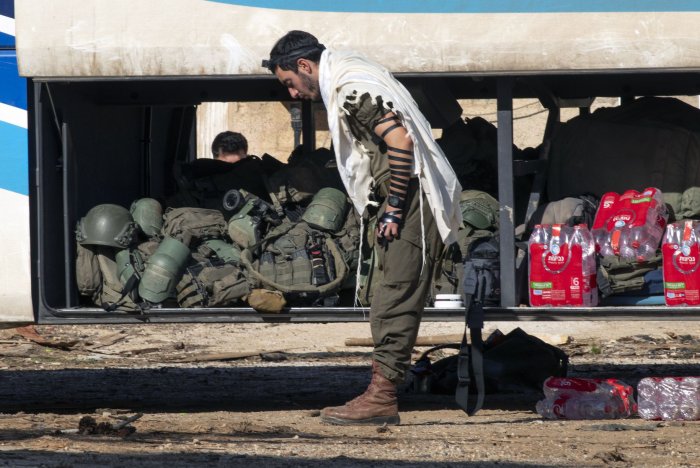
An Israeli infantry soldier says his morning prayers near a bus loaded with combat gear inside northern Israel along the southern Lebanon border on February 18, 2025. Photo by Jim Hollander/UPI | License Photo
Brent crude rises more than 7 percent as Washington and Tehran offer conflicting accounts on ceasefire negotiations.
Published On 20 Apr 202620 Apr 2026
Oil prices have risen sharply following attacks on commercial vessels in the Strait of Hormuz and conflicting messages about the prospect of renewed negotiations between the United States and Iran.
Brent crude futures, the primary benchmark for global prices, jumped more than 7 percent in Asia on Monday as the outlook for peace between Washington and Tehran darkened.
Recommended Stories
list of 4 itemsend of list
Prices eased somewhat later in the morning, with the benchmark at $94.69 a barrel as of 02:05 GMT, up from just under $90.40 on Friday.
The latest price surge came after US President Donald Trump said US forces seized an Iranian-flagged cargo vessel that had attempted to evade the US blockade of Iran’s ports.
Trump’s announcement followed reports by the United Kingdom Maritime Trade Operations (UKMTO) Centre over the weekend that two vessels came under attack while transiting the strait.
Iranian gunboats fired on a tanker, while an “unknown projectile” struck a container ship, according to the UKMTO.
After declaring the strait “completely open” on Friday, Tehran reversed course less than 24 hours later, citing the ongoing US blockade.
Earlier on Sunday, Trump said that a US delegation would travel to Pakistan on Monday to hold a second round of ceasefire talks with Iranian officials.
Iranian state news outlet IRNA later reported that Tehran would not participate in the talks, citing the US blockade and Washington’s “excessive demands” and “unrealistic expectations”.
A two-week ceasefire between Washington and Tehran is set to expire on Wednesday if the sides cannot agree on an extension.
An initial round of talks held in Islamabad earlier this month broke down without any agreement between the sides.
Iran’s effective closure of the strait, which usually carries about one-fifth of global oil and natural gas supplies, has driven a surge in fuel prices worldwide, forcing governments to tap emergency supplies and roll out energy-saving measures.
Nineteen vessels crossed the strait on Saturday, up from 10 the previous day, but far below the historical average of 138 daily transits, according to the UKMTO.
Asia’s main stock markets opened higher on Monday despite the dimming prospects of de-escalation.
Japan’s Nikkei 225 rose more than 1 percent in morning trading, while South Korea’s KOSPI gained about 1.3 percent.
Hong Kong’s Hang Seng Index rose about 0.5 percent, while the SSE Composite Index in Shanghai gained more than 0.4 percent.
The BBC has seemingly pulled episodes of Top of the Pops that featured Scott Mills from iPlayer after the corporation made the decision to dismiss the radio star last month
22:44, 19 Apr 2026Updated 23:04, 19 Apr 2026
The BBC has seemingly pulled episodes of Top of the Pops that featured Scott Mills(Image: David Fisher/Shutterstock)
The BBC has seemingly pulled episodes of Top of the Pops that featured Scott Mills from iPlayer. In yet another scandal for the public broadcaster, Scott Mills, a BBC radio favourite for decades, was axed from his role in March.
The Mirror revealed that the former BBC Radio 1 and 2 DJ was questioned in 2018 over the historical allegations of serious sexual offences, but the investigation – which began in 2016 – was closed in 2019 after the CPS deemed there was insufficient evidence to bring charges.
The programme, which ended in 2006, is still repeated regularly but now the The Sun has reported that the three episodes in which Scott, 53, served as host, have now been wiped from the corporation’s streaming service.
The episodes in question originally aired in 1999 and around that time, he welcomed the likes of Billie Piper, Mariah Carey and Westlife onto the show to perform their latest singles. The Mirror has contacted the BBC for comment.
The Metropolitan Police said a man, who was in his 40s at the time of the interview in 2016, was investigated over allegations reported to have happened between 1997 and 2000. Today, BBC News reported that director general at the time, Tony Hall, was not aware of the allegations.
The investigation was dropped in 2019 after the CPS deemed there was insufficient evidence to bring charges. As first reported by the Mirror, Mills was sacked over allegations relating to his ‘personal conduct’ after the final edition of his breakfast programme aired.
Following his dismissal, Mills issued a statement via lawyers thanking his well-wishers. He said: “I wish to thank from the bottom of my heart all those who have reached out to me with kindness, my former colleagues, and my beloved listeners, who I greatly miss.”
On the police probe, he said: “The recent announcement that I am no longer contracted to the BBC has led to the publication of rumour and speculation. In response to this the Metropolitan Police has made a statement, which I confirm relates to me.
“An allegation was made against me in 2016 of a historic sexual offence, which was the subject of a police investigation in which I fully co-operated and responded to in 2018.”
He added: “Since the investigation related to an allegation that dates back nearly 30 years and the police investigation was closed seven years ago, I hope that the public and the media will understand and respect my wish not to make any further public comment on this matter.”
Ousseni Bouda scored two goals in the second half, ending LAFC goalie Hugo Lloris’ scoreless run to begin the season at 593 minutes, and the San José Earthquakes stunned LAFC 4-1 on Sunday night in an early Western Conference showdown.
San José (7-1-0) moves into a first-place tie with the Vancouver Whitecaps in the Western Conference and Supporters’ Shield races in the Earthquakes’ second season under head coach Bruce Arena.
Daniel De Sousa Britto missed a chance to tie Lloris with a sixth clean sheet on an own goal by Reid Roberts in the 74th minute. He had three saves.
Bouda used assists from newcomer Timo Werner — his third — and Beau Leroux to find the net in the 53rd minute after a scoreless first half.
Werner, sidelined the last two weeks with a lower-body injury, took a pass from Leroux three minutes later and scored his first MLS goal for a 2-0 lead. Leroux’s assists gives him four, matching his total last season in 33 appearances as a rookie.
An own goal on Ryan Porteous in the 59th minute made it 3-0 in a span of six minutes.
Bouda’s fourth goal of the season capped the scoring in the 80th minute. Niko Tsakiris notched his career-high fifth assist.
Lloris finished with two saves in a second straight loss for LAFC (5-2-1), third in the West. Lloris sat out a 2-1 road loss to the Portland Timbers.
San José has won all four of its road matches.
LAFC was 6-0-1 at BMO Stadium in all competitions entering play, outscoring its opponents 17-1.
The United States army announced last month that it would raise the maximum age at which Americans can enlist from 35 to 42 years to expand its pool of eligible candidates amid recruiting challenges in recent years.
An updated version of US Army Regulation 601–210, dated March 20, outlined the changes, including the elimination of rules requiring anyone with a single conviction for marijuana possession or drug paraphernalia to obtain a waiver to enlist.
Recommended Stories
list of 3 itemsend of list
Government data shows that while the US army has met its recruitment goals over the last two years, it fell short in 2022 and 2023 and has consistently failed to meet targets for the Army Reserve, shortcomings that analysts have attributed to several possible factors.
The new age limit was announced during the US-Israel war on Iran, towards which young people have expressed widespread opposition.
Here’s what you need to know about the changes.
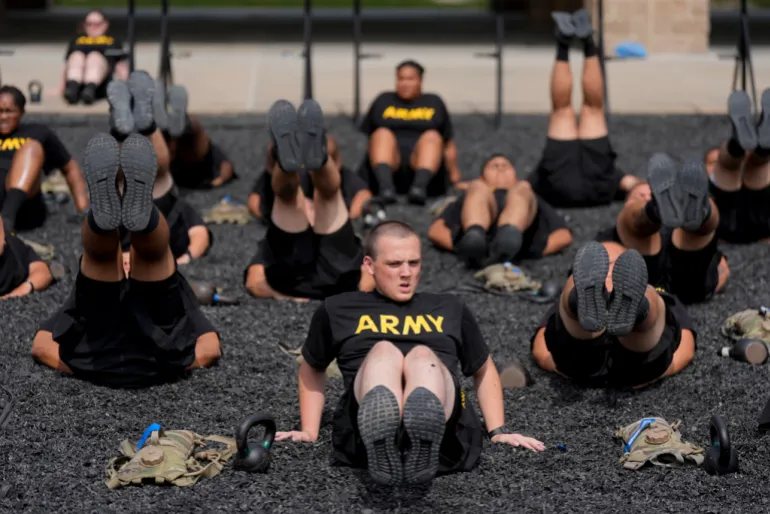
New recruits participate in the Army’s future soldier prep course that gives lower-performing recruits up to 90 days of academic or fitness instruction to help them meet military standards, at Fort Jackson, a US Army Training Center, in Columbia, South Carolina, on September 25, 2024 [File: Chris Carlson/AP Photo]
When does the regulation go into effect?
The updated version of Army Regulation 601–210 officially takes effect on Monday, April 20.
What has the military said about the changes?
The US army announced updated enlistment regulations on March 20, with the changes scheduled to take effect one month later on April 20 and applying to the Regular Army, Army Reserve, and Army National Guard.
The maximum enlistment age is raised from 35 to 42, and previous restrictions requiring anyone with a single conviction for possession of marijuana or drug paraphernalia to obtain a waiver to enlist are done away with.
Do these changes apply to the whole US military?
The changes announced in March are specific to the US army.
The military news outlet Stars and Stripes reported that those changes bring the army into greater alignment with the maximum enlistment age of other branches of the military, such as the Air Force, Navy, Coast Guard, and Space Force, which accept enlistees in their early 40s.
The maximum enlistment age for the US Marines is 28.
What factors explain the change?
While the US army did not comment on the reasons for the increase, data from the US Army Recruiting Command show that the army has struggled with recruitment challenges.
While the army met 100 percent of its recruitment goals in 2025 and 2024, it missed its target by about 23 percent in 2023 and 25 percent in 2022.
That data also shows that the army has fallen short of recruitment targets for the Army Reserve for the last six years in a row.
The average age of army recruits has risen in recent years to 22.7, up from 21.7 in the 2000s and 21.1 in the 2010s, according to the military news outlet Army Times, citing data from a US army spokesperson.
The US Army Recruiting Command has attributed such challenges to issues such as changes in the labour market, limited awareness about military service, and a lack of qualified young people due to issues such as obesity, drug use, and mental health issues.
A 2018 poll listed concerns over possible injury and death, post-traumatic stress disorder (PTSD), separation from family and friends, and other career interests as top reasons offered by young people for not joining the military.
Does the change have to do with the war in Iran?
Analysts have been discussing the possibility of raising the enlistment age for years as a means of addressing recruiting challenges, with a 2023 research report from the RAND Corporation, a US think tank, calling “older youth” a “crucial, largely untapped, yet high-quality pool of potential recruits”.
While the military has not suggested that the change is linked to the US-Israel war on Iran, where US President Donald Trump has previously said he could deploy ground troops, some social media users were quick to note the timing of the announcement.
Some in the online community joked that older supporters of the war would now be available to enlist.
“They raised the enlistment age to 42,” one X user said in response to a video of the conservative commentator Ben Shapiro praising Trump’s decision to attack Iran. “Why are you still here?”
Surveys have found that younger people are more likely to oppose the US war on Iran than those aged 65 and up, and polls in recent years have found that young people are more generally sceptical of US intervention abroad than older generations.
A 2024 Pew Research Center poll found that people between the ages of 18 and 29 were the only age bracket in the US who viewed the military more negatively than positively, with 53 percent saying the military had a negative effect versus 43 percent who said it had a positive effect.
How many people are currently in the US military?
According to the Pew Research Center, the US military has about 1.32 million active members. The US army accounts for the largest share, with nearly 450,000, while the US Navy is second with more than 334,000.
The Air Force has more than 317,000, the Marines more than 168,000, the Coast Guard nearly 42,000, and the Space Force nearly 9,700.
Data from the US Army Recruiting Command shows that about 80 percent of recruits in the Regular Army were men in 2025.
Black and Latino recruits also make up a larger share of army recruits than their percentage of the population, each making up about 27 percent of recruits while comprising 14 percent and 20 percent of the general population, according to data from the 2024 census.
White people made up about 40 percent of US army recruits, while about 57 percent of the general population.
ADDISON Rae surprised music lovers at Coachella weekend two by bringing out Olivia Rodrigo to perform her new single Drop Dead.
The track came out on Friday, marking itself as the lead single off of Olivia’s much-anticipated third album “you look pretty sad for a girl so in love.”
Sign up for the Showbiz newsletter
Thank you!
Addison Rae brought out Olivia Rodrigo as a surprise guest during Coachella weekend twoCredit: Coachella ReplayThey performed Olivia’s new single Drop Dead which came out on FridayCredit: Coachella Replay
The Diet Pepsi singer turned to the crowd and asked them if they had been listening to any new music during the week, before beginning to sing her 2025 single, Headphones On.
However, when Addison sung the lyrics “I compare myself to the new IT girl,” Olivia came out of nowhere and joined in the performance.
The moment was met with enormous cheers from the crowd, as no one expected a special guest to arrive.
But the roaring reception only got louder as the ladies launched into singing Drop Dead.
Olivia announced that she was releasing her third album earlier this month via a post to her Instagram channel.
In the post she shared a photo of the front cover, showing her with her eyes shut on a swing set.
In the caption she revealed the release date as June 12, sharing: “My third album ‘You seem pretty sad for a girl so in love’ is out June 12th.
“I am so proud of this record and I can’t wait for you to hear it.”
Drop Dead is the first new music to arrive from Olivia since September 2023 when she released her Sophomore album, GUTS.
It’s the lead track from Olivia’s upcoming third album, you look pretty sad for a girl so in loveCredit: Coachella Replay
GUTS achieved massive success with hits including Vampire and Bad Idea Right?
It followed the success of her debut album SOUR from 2021, adored for smash-hit Drivers License.
Weekend two of Coachella has been incredibly popular, abundant with A-list celebrities and more surprise guests.
Sabrina Carpenter wowed the audience on Friday night with a long set that told the story of a young girl navigating Hollywood throughout each song.
But just when fans thought the show couldn’t get any better Sabrina brought out Madonna, and they dueted a rendition of Like A Prayer.
Justin Bieber also wowed the crowd and got them in their feelings, bringing a laptop on stage to sing along to his old hits karaoke-style.
But PinkPantheress pulled out all the stops when it came to surprise guests.
The songstress brought out not one but three fellow musicians including Zara Larsson and Janelle Monae.
KATSEYE concluded the trio of surprise singers, and the crowd absolutely loved it.
Coachella festival is held annually at the Empire Polo Club in California.
The crowd roared with applause as the ladies danced around the stage and sangCredit: Coachella ReplayAddison is known for many hits, including Diet PepsiCredit: Getty
Xander Bogaerts and Bryce Johnson delivered two-out RBIs as the San Diego Padres defeated the Angels 2-1 on Sunday.
Bogaerts broke a scoreless tie with an RBI single in the fourth inning, and Johnson added a two-out RBI single in the seventh as San Diego took two of three games in the series. Johnson finished with two of San Diego’s five hits for his multihit game of the season.
Michael King (3-1) gave up one hit over five scoreless innings, striking out six and walking four while working through traffic. He combined with Ron Marinaccio, Kyle Hart, Bradgley Rodriguez and Mason Miller to hold Los Angeles to two hits.
Miller struck out two in a perfect ninth for his eighth save. He is one inning shy of the longest scoreless streak in Padres history, set by Cla Meredith with 33 2/3 innings in 2006.
The Angels mounted a late threat but couldn’t tie it. Oswald Peraza doubled in the seventh and scored on a sacrifice fly by Zach Neto. But the Angels went 0 for 8 with runners in scoring position and struck out 11 times.
Walbert Ureña (0-2) made his first career start for the Angels, striking out eight and giving up two runs over six-plus innings. He became the fourth pitcher in franchise history to record at least eight strikeouts in his debut.
A test-fire of strategic cruise missiles and anti-warship missiles from the destroyer Choe Hyon in North Korea, 12 April 2026 (issued 14 April 2026). File. Photo by KCNA / EPA
April 19 (Asia Today) — North Korea launched multiple ballistic missiles on Saturday, just 11 days after its previous test, in what analysts describe as an effort to expand and demonstrate its nuclear delivery capabilities.
South Korea’s Joint Chiefs of Staff said the missiles were fired around 6:10 a.m. from the Sinpo area on the country’s east coast and flew about 140 kilometers over the East Sea.
The launch site, near a key submarine facility, has raised the possibility that the weapons could be linked to submarine-launched ballistic missile development, though officials said further analysis is needed.
The Joint Chiefs of Staff said it is assessing the missiles’ specifications and whether they were launched from land or underwater.
Sinpo is home to North Korea’s main submarine shipyard, where vessels such as the “Kim Gun-ok Hero” submarine have previously been unveiled.
Recent satellite imagery cited by the North Korea-focused outlet 38 North indicated that another submarine had been moved to dry dock, suggesting possible preparations for additional testing.
Yang Wook, a research fellow at the Asan Institute for Policy Studies, said the relatively short flight distance raises questions about whether a full submarine-based launch was conducted.
“Given the 140-kilometer range, it is unclear whether this was a full SLBM test, but the location suggests it could be part of efforts to verify repeated launch capability,” he said.
If confirmed as an underwater launch, the test would mark North Korea’s latest step in diversifying its nuclear delivery systems, following demonstrations involving land-based missiles and sea-based platforms in recent weeks.
Under its latest defense development plan, North Korea has been expanding a range of strategic capabilities, including short-range ballistic missiles, hypersonic weapons, cruise missiles and solid-fuel intercontinental ballistic missile engines.
Analysts say the timing may also reflect broader geopolitical considerations. With the United States focused on conflict in the Middle East, North Korea could be seeking to exploit a perceived security gap while reinforcing its deterrence posture.
Some experts also suggest the launch may be intended to strengthen Pyongyang’s bargaining position ahead of potential diplomatic engagement tied to an expected visit by President Donald Trump to China next month.
Weekly insights and analysis on the latest developments in military technology, strategy, and foreign policy.
The U.S. Air Force is continuing to expand on the capabilities of the Angry Kitten electronic warfare pod, which just recently made its combat debut on the F-16 fighter in the latest conflict with Iran.
New testing has focused on improving the ability of HC-130J Combat King II combat search and rescue aircraft carrying the pods to receive reprogramming updates in near-real-time via satellite. HC-130Js just recently flew extremely high-risk and high-profile sorties over Iran as part of the effort to rescue the crew of a downed F-15E Strike Eagle. Being able to rapidly refine and optimize Angry Kitten’s capabilities will help the system remain as effective as possible, even in a very quickly evolving threat environment, and could be a stepping stone to more advanced functionality.
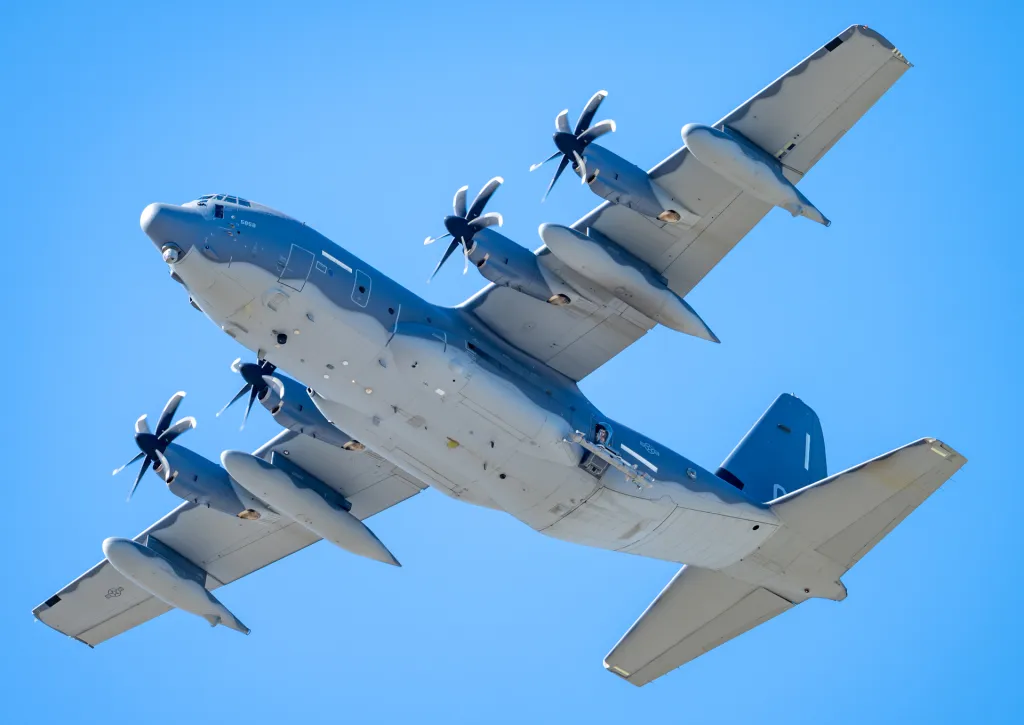
An HC-130J Combat King II assigned to the 129th Rescue Wing seen carrying an Angry Kitten electronic warfare pod while flying in the Point Mugu, California area on September 11, 2025. Fred Taleghani / FreddyB Aviation Photography
The pods have also been test flown on Air Force A-10 Warthog ground attack jets and Navy F/A-18 Super Hornet fighters. As noted, it is now being employed operationally on Air Force F-16s, as well. Angry Kitten was originally developed to replicate hostile electronic warfare threats during testing and training, as part of a cooperative effort between the Air Force and the Navy, and worked so well that it was adapted to operational use. We will come back to this later on.
An F-16C fighter with an Angry Kitten pod on its centerline station, seen flying a sortie in support of Operation Epic Fury against Iran. CENTCOMAn Angry Kitten pod under the wing of a Navy F/A-18E Super Hornet. USN Naval Air Warfare Center Weapons
During Bamboo Eagle, “AATC’s primary evaluation centered on the Angry Kitten electronic warfare pod integrated aboard a HC-130J Combat King II. The force development evaluation built directly on an operational assessment completed the previous year, which found the system potentially effective and suitable on the platform,” according to a press release that the center put out last week. “Testers incorporated recommendations from that assessment while the 130th Rescue Squadron flew the pod against simulated ship-based and ground-based threats during exercise vulnerability periods, evaluating both survivability and the system’s broader electronic attack capability.”
The 130th Rescue Squadron is part of the California Air National Guard’s 129th Rescue Wing.
“Running alongside that effort, AATC continued maturing the Ka/Ku-band communications suite, which enables over-the-horizon communications and near-real-time electronic warfare reprogramming via satellite link,” the release adds. “The suite compresses what was previously a multi-day technique development and distribution process to near-real-time between sorties.”
AATC has previously disclosed that it has been working on this capability, which looks to be unique to the integration of Angry Kitten on the HC-130J, at least currently. The Combat King II has the benefit of a wide-band satellite communication system, which is also found on U.S. special operations C-130 variants and other aircraft. The HC-130J carries the pod using a Special Airborne Mission Installation and Response (SABIR) system installed in place of its left rear paratrooper door.
An HC-130J with an Angry Kitten pod on a SABIR system mounted in place of its left rear paratrooper door. USAFA look inside the HC-130J during testing of the Angry Kitten pod. USAF
“The C-130 testing features innovative real-time updates to electronic warfare techniques,” AATC said in a previous press release in March 2025. “Unlike the F-16 tests, where pre-programmed mission data files were used, the C-130 testing includes development engineers aboard the aircraft who can modify jamming techniques mid-mission based on feedback from range control.”
As can be seen above, to date, AATC has largely framed the benefits of this reprogramming capability within the context of accelerating continuing test and evaluation of Angry Kitten. At that same time, this would also be extremely valuable in an operational context.
In general, electronic warfare systems use built-in threat libraries to accurately detect, categorize, and respond to waveforms. In turn, their effectiveness is inherently determined by the breadth of data in that library. Specialists, often working in purpose-built reprogramming laboratories far from the front lines, have to work tirelessly to keep these systems up to date. Historically, this has been a very lengthy process, and one that has increasingly had trouble keeping pace with the rate at which threats are evolving.
A member of the 16th Electronic Warfare Squadron, another unit with the 350th Spectrum Warfare Wing, analyzes radio frequency signals at the B-1 Lab at Eglin Air Force Base in Florida. (This photo has been altered for security purposes by blurring out portions of monitors). USAF
As noted, Angry Kitten was developed first as a training and testing tool. It is a direct outgrowth of the AN/ALQ-167 electronic warfare pod, variants of which have been used in those contexts for decades to mimic hostile electronic warfare threats. However, Angry Kitten was designed from the start to be more readily updatable and modifiable in order to make it easier to adapt it to new and evolving threats.
“At the core of that technology is Angry Kitten’s Technique Description Language architecture. Georgia Tech designed TDL as a hybrid that pairs dedicated hardware modules for speed and bandwidth with software for complex decision-making,” according to a press release Naval Air Systems Command (NAVAIR) put out last month. “The practical result: government programmers can reprogram the jammer to counter new threats without sending it back to the contractor for expensive, time-consuming code changes. When an adversary adapts its radar tactics, NAWCWD’s team can update the jammer’s response in days instead of waiting months for a contract modification.”
Angry Kitten is also known to make use of advanced Digital Radio Frequency Memory (DRFM) technology. Using DRFM, radio frequency (RF) signals can be detected and ‘captured.’ Those same signals can then be manipulated and retransmitted. As an example of what this means in practice, signals from enemy air defense radars or radar seekers on incoming missiles can be recorded and pumped back in a way that creates false or otherwise confusing tracks. That same data can also be used as part of the reprogramming process to improve the stability capabilities, as well as be further exploited for general intelligence-gathering purposes.
An Angry Kitten pod on a stand during test. USN
This all already contributed to the evolution of Angry Kitten into an operational system.
“We had a jammer called ‘Angry Kitten.’ It was built to be an adversary air jamming tool,” now-retired Air Force Gen. Mark Kelly, then commander of Air Combat Command (ACC), told TWZ and other outlets back in 2022. “And all of a sudden, the blue team said, ‘you know, hey, we kind of need that, can we have that for us?’ And so I see this iterating and testing our way into this.”
When it comes to near-real-time updates for Angry Kitten, even if the communications suite used on the HC-130J won’t fit on smaller tactical jets, it could potentially be ported over into a capability that is readily deployable to forward locations. Another possibility is that an aircraft with a wide-band satellite communications system could then pass updates for Angry Kitten to other aircraft within line of sight using other datalink capabilities.
Another view of the F-16 carrying the Angry Kitten pod during a mission in support of Operation Epic Fury. CENTCOM
The underlying developments have further implications when it comes to developing so-called cognitive electronic warfare capabilities. Cognitive electronic warfare is a broad area of development focused on new technologies to further automate or otherwise accelerate the reprogramming process. The absolute ‘holy grail’ of the overall concept is an electronic warfare system that can adapt autonomously in real time to new threat waveforms, or known ones being modulated in unexpected ways, even right in the middle of a mission. You can read more about all of this here.
Ongoing work to expand and improve Angry Kitten’s capabilities will also now benefit from lessons learned from the employment of the pods in combat sorties over and around Iran.
The multi-day effort to recover the crew of an F-15E Strike Eagle downed in that country earlier this month also highlighted the immense risks involved in combat search and rescue (CSAR) operations, and the importance of adding new self-protection capabilities to the HC-130J, specifically. Air Force Combat King IIs can expect to face far greater threats while conducting CSAR missions during a conflict with a near-peer adversary like China. This has prompted questions about the utility of HC-130Js and other traditional CSAR assets in the context of any future high-end fight.
In the meantime, Angry Kitten continues to evolve in significant ways, including its growing ability to receive key updated data remotely in near-real-time when paired with the HC-130J.
Despite its date being dependent on Easter and it being observed as an Orthodox Christian holiday, the origins of this festival are pagan rather than Christian with its roots based on an ancestor festival.
On Memorial Easter, families go to church and then on to the cemetery. There, the family graves are cleaned and a meal is eaten with some food intentionally let to fall on the ground as an offering to dead relatives.
In pagan times, families would have left eggs on the graves of the dead, symbolising rebirth. When Christianity arrived in the region, rather than suppress the older traditions, the church simply absorbed the rituals into Christian festivals. The egg was an easy one as the date of spring for the ancestor worship festival fell close to Easter and the use of the egg as a symbol of rebirth fitted well with the Easter message of resurrection.
Match of the Day pundit Danny Murphy analyses how Liverpool’s performance “got better” from a “creative” and “footballing aspect” as The Reds secured a 2-1 victory at Everton in the Merseyside Derby.
Gasoline and diesel fuel prices are displayed on a screen inside a gas station in Seoul, South Korea, 19 April 2026. The average gasoline price in the country rose 0.42 won (0.0003 US dollar) from a day earlier to 2,001.93 won per liter on the same day, according to data from Korea National Oil Corp. Photo by YONHAP / EPA
April 18 (Asia Today) — Average gasoline and diesel prices at South Korean gas stations rose for a third straight week, putting both fuels on the verge of topping 2,000 won per liter.
The average nationwide gasoline price for April 12-18 stood at 1,996.3 won per liter, or about $1.36 a liter and $5.15 a gallon. That was up 28.7 won from 1,967.6 won a week earlier. Diesel averaged 1,990.2 won per liter, or about $1.36 a liter and $5.13 a gallon, up 31.1 won from the previous week.
With both fuels nearing the 2,000 won threshold, the government is set to announce its fourth maximum-price notice on Thursday. The current system partially reflects changes in global oil prices while slowing the pace of retail price increases.
By brand, SK Energy had the highest gasoline price at 2,001.8 won per liter, or about $5.16 a gallon, while self-service budget stations were the cheapest at 1,974.7 won. For diesel, SK Energy was also the highest at 1,995.2 won per liter, while budget stations posted the lowest average at 1,966.1 won.
By region, Jeju had the country’s highest average gasoline price this week at 2,029 won per liter, or about $5.23 a gallon. Seoul followed at 2,026.7 won, or about $5.23 a gallon.
International oil prices have recently eased on expectations that the conflict involving the United States and Iran could wind down. Dubai crude, the benchmark for South Korea’s imported oil, stood at $101.8 a barrel on Wednesday, down $4.7 from $106.5 on Sunday. Changes in global oil prices usually reach domestic pump prices with a two- to three-week lag.
Weekly insights and analysis on the latest developments in military technology, strategy, and foreign policy.
The Air National Guard is pushing Congress to boost fighter numbers as it seeks to modernize its aging inventory. With the Air Force at large feeling the effects of years of underinvestment in new fighters, and with China presenting a massive pacing challenge, the move is the latest effort to ensure that the service can keep up in terms of numbers and capability.
According to a report from Air & Space Forces Magazine, Air National Guard adjutants general from more than 20 states sent a letter to Congress last week that requests multiyear funding for the acquisition of between 72 and 100 new fighters each year.
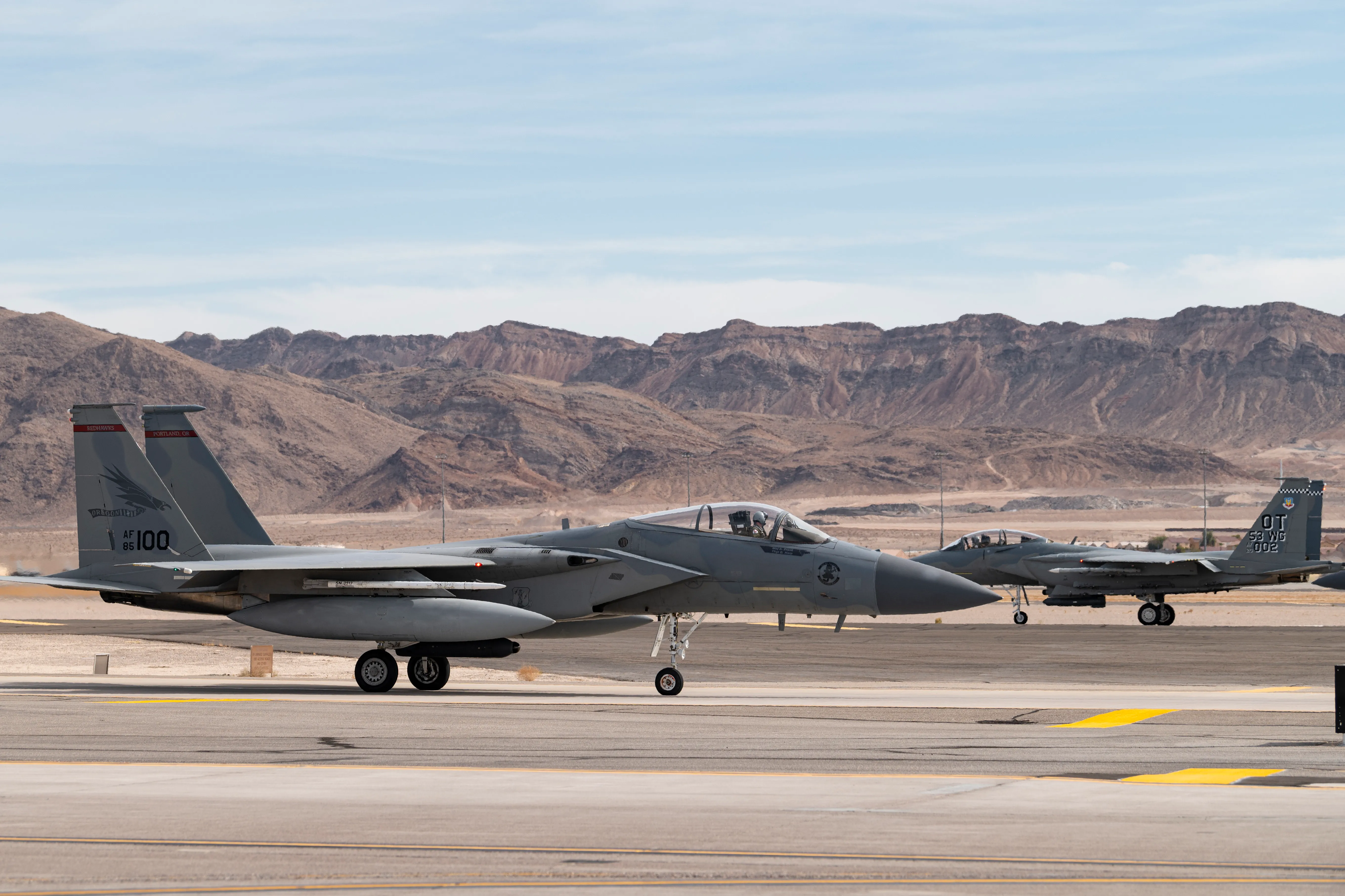
An F-15C assigned to the 123rd Fighter Squadron, Portland Air National Guard Base, Oregon, taxis to the runway at Nellis Air Force Base, Nevada, while an F-15EX assigned to the 85th Test and Evaluation Squadron, Eglin Air Force Base, Florida, prepares to take off. U.S. Air Force photo by William R. Lewis William Lewis
These numbers would be a significant hike compared with recent years: not since 1998 has the Air Force bought more than 72 new fighters in a single year.
“The United States Air Force is the oldest, the smallest, and the least ready in its 78-year history,” the letter states. “We must build a fighting force that will win.”
Specifically, the letter urges the minimum annual purchases of the 48 F-35As and 24 F-15EXs, with a preferred goal of 72 F-35As and 36 F-15EXs.
The 123rd Fighter Squadron was the first operational unit to receive the F-15EX. The first example for the unit is seen arriving at Portland Air National Guard Base on June 5, 2024. Oregon Air National Guard
While the letter was signed by Air National Guard leaders, these totals would be expected to furnish units of the Active, Guard, and Reserve components.
By comparison, the Air Force requested funding for 48 F-35As in Fiscal Year 2024, followed by 42 in 2025, 24 in 2026, and 38 in the proposed 2027 budget.
The Fiscal Year 2027 budget request also includes funding for the purchase of 10 F-35Bs and 37 F-35Cs for the Marine Corps and the Navy, which is already a notable uptick in planned acquisitions. At the same time, the F-35 program has faced worrisome delays in work on a new radar, as well as a host of other critical upgrades.
F-35As assigned to the 115th Fighter Wing, Truax Field, Madison, Wisconsin, receive fuel from a KC-135 Stratotanker assigned to the 128th Air Refueling Wing in Milwaukee. U.S. Air National Guard photo by Staff Sgt. Cameron Lewis Staff Sgt. Cameron Lewis
For the F-15EX, budget documents show the service requested 24 aircraft in 2024, 18 in 2025, 21 in 2026, and 24 in 2027.
A sustained annual buy of even 24 F-15EXs would represent an acceleration over current production plans for the Eagle II, after the Fiscal Year 2026 budget request increased the program of record from 98 to 129 aircraft, including funding for 21 jets in a single year. In its latest budget request, the Air Force provides no details about whether there may be any new changes to the planned total fleet size for the F-15EX.
One of those who signed the letter is Brig. Gen. Shannon Smith, head of the Idaho Air National Guard, who toldAir & Space Forces Magazine that, “We are burning these jets and the airmen over time to support the joint force to accomplish the president’s goals with Epic Fury in this conflict with Iran.”
U.S. Air Force Brig. Gen. Shannon D. Smith, pictured in 2024 when he was commander, District of Columbia Air National Guard. U.S. Air National Guard photo by Staff Sgt. Daira Jackson 113th Wing D.C. Air National Gua
On top of the demands of combat operations, Brig. Gen. Smith warned that the Air National Guard fighter fleet is rapidly aging, meaning that “Most of the money will go to keep them flying. In a few years, they’ll be struggling to be flyable, let alone be relevant.”
While plans are in place to replace A-10s and F-15Cs, even older F-35As will need replacement before too long, Smith added. More urgent is the looming requirement to supersede the more numerous F-16s.
A row of A-10Cs assigned to the 127th Wing, Michigan Air National Guard, under their shelters at Selfridge Air National Guard Base, Michigan. Photo by Terry L. Atwell/U.S. Air Force
In total, the Air National Guard has 24 fighter squadrons, 11 of which have already received new fighters or are planned to. While some Guard F-16 units have transitioned to the F-35, there is no plan in place for the Guard’s remaining 13 Viper squadrons. Taken together, the Guard’s inventory constitutes close to half of all combat-coded F-16s.
In the past, thought has been given to a new light fighter, to balance the more costly and capable F-35 and, now, the F-47, although that would be extremely costly and take years. Another option would be to start buying new F-16 Block 70/72 jets, although the production line is already burdened by multiple export orders.
Even if Congress supports the Air National Guard chiefs’ recommendations and the budget is available, getting new jets on ramps will be far from easy.
As well as boosting capabilities and ‘combat mass,’ new fighters bring other advantages in terms of reduced maintenance demands, easier access to spare parts, longer airframe life, and overall higher availability.
An F-16C fighter assigned to the Arizona Air National Guard’s 162nd Wing. Air National Guard
The issue of spare parts is a critical one. Back in 2024, we looked at how, by the Air Force’s own estimates, hundreds of its aircraft are at risk of being left grounded due to a lack of spares, thanks to a $1.5-billion shortfall in its budget request.
However, meeting the aim of 72 to 100 new fighters each year would demand a significant uptake in production capacity, which is already stretched. With that in mind, the Air National Guard projects it could still take 10 to 15 years to re-equip units now flying older fighters.
One option to re-equip Guard and Reserve units would be to cascade fighters down from the Active component, but Air National Guard chiefs warn against this, too, since it only pushes recapitalization with new fighters further down the line.
What is unclear is how the Air Force’s plans for the F-47 sixth-generation fighter might play into this.
A rendering of the F-47 developed under the Next Generation Air Dominance (NGAD) program. U.S. Air Force graphic Secretary of the Air Force Publi
At this point, however, there are still questions about how exactly the F-47 will fit into the Air Force’s future force structure and how many of the jets the service might actually procure. The jet was originally planned as a replacement for the F-22, but that appears to have changed, or is at least in limbo. It is by no means clear how long the F-22 will be around after the F-47 is introduced, but if the F-47 is delayed, it could come at the end of the F-22’s service life. If the Air Force intends to operate the two at the same time, at least for the earlier part of the F-47’s career, but delays in fielding it occur, this could also open up another gap in the combat mass.
Another factor is the service’s emerging plans for fielding its future fleets of Collaborative Combat Aircraft (CCA) drones, which are being designed from the ground up to work in close concert with current and future crewed jets. In the past, the Air Force has signaled that it wants to buy over 1,000 CCAs. However, this number is understood to cover multiple CCA increments, with Increment 1 being procured in numbers between 100 and 150 units, at least to start with.
Three examples of the YFQ-42A Dark Merlin, developed to meet the Increment 1 CCA requirement. General Atomics
Ultimately, the CCA effort aims to drastically improve the tactical jet fleet combat mass, which could offset the dwindling fighter force, and active-duty F-35 and F-22 units will get them first. Thereafter, they could be quickly rolled out to fourth-generation jets, too. On the other hand, the CCA concept still has much to prove and is not without risk.
In the background to all this are the concerns within the U.S. military leadership at large about the significant advances being made by the Chinese military and, in this case, its air arms. The People’s Liberation Army Air Force is rapidly expanding and modernizing at a scale that threatens to surpass the United States in both numbers and capability. Warning signs of a massive fighter expansion include an apparent new J-35 factory and the many Chinese CCA programs.
An underside view of the new-generation Chinese J-36 combat jet. Chinese internet via X
As long as the U.S. government continues to procure aircraft at comparatively slower rates, China has the opportunity to race ahead and is already producing advanced fighters in large quantities, creating a growing imbalance in the Indo-Pacific region.
Clearly, there are very many factors at play, not least budgetary. However, in making their case to Congress, Air National Guard bosses are once again underscoring the continued demand for crewed combat jets within the service, and at the same time, highlighting some of the challenges in keeping the fighter force at the top of its game.
PUSSYCAT Doll Ashley Roberts has an eye on the Maldives after her time in the South African bush.
The singer, 44, is on a luxury break on the paradise islands and posted snaps in a tropical pink bikini, as well as relaxing on the sand and cooling down after a shower.
Sign up for the Showbiz newsletter
Thank you!
Ashley Roberts has an eye on the Maldives after her time in the South African bushCredit: InstagramAshley is on a luxury break on the paradise islandsCredit: InstagramShe also posted this snap relaxing on the sand and cooling down after a showerCredit: Instagram
Over the years I’m A Celebrity South Africa star Ashley Roberts has made a number of wild sex confessions.
From a steamy dream about romping with Harry Styles, to revealing her turn-ons in the I’m A Celeb Jungle, the Pussycat Dolls star, 44, is known for not holding back.
It’s fair to say Ashley has made a career out of being sexy.
The star oozes sex appeal, thanks to being in the sizzling girlband the Pussycat Dolls.
Match of the Day pundits Wayne Rooney and Danny Murphy discuss how “two top players” in Erling Haaland and Gabriel went head-to-head in Manchester City’s 2-1 victory against Arsenal, with the Norwegian striker reaching “unplayable” levels.
April 19 (UPI) — Citing steep tariffs imposed by U.S. President Donald Trump, Canadian Prime Minister Mark Carney said Sunday his country’s historically close trade and economic ties to the United States have become a “weakness.”
In a video statement posted to YouTube, the Canadian leader asserted the United States has “fundamentally changed its approach to trade, raising its tariffs to levels last seen during the Great Depression.”
This has meant that “many of our former strengths, based on our close ties to America, have become our weaknesses — weaknesses that we must correct.”
Carney’s comments as Trump’s trade war with Canada has disrupted decades of cross border cooperation, triggered in part by a broad 10% tariff slapped by Washington onto all goods not excluded under the Canada-US-Mexico free trade agreement known as CUSMA.
Significantly higher U.S. levies have also been imposed on key strategic sectors, including a 50% tariff on Canadian products that are almost entirely made of steel, aluminum or copper, and a 25% tariff on products that are “largely” made of those metals.
Many types of Canadian heavy equipment also face a 15% tariff upon entry into the United States.
Ottawa says the effect of these measures has been profound, “displacing workers, disrupting supply chains, forcing companies to rethink where they source their materials and products, and causing uncertainty that is curbing investment.”
Although Canada still has the best deal of any U.S. trading partner in an era when Trump has used the threat of tariffs and against both allies and adversaries for strategic and political ends, “we cannot rely on our most important trade relationship as we once did. We must build our strength at home,” Carney said.
“Workers in our industries most affected by U.S. tariffs in autos and steel and lumber are under threat,” he added. “Businesses are holding back investments restrained by the pall of uncertainty that’s hanging over all of us.”
Triggered by the U.S. trade actions and Trump’s oft-repeated desire to annex Canada as the “51st state,” Carney’s Liberal Party government in Januarymade a milestone deal with China to lower some of the tariffs imposed by one another on some of their trade goods.
Under that pact, China lowered its tariffs on Canadian agricultural products, while Canada slashed its tariffs on up to 49,000 electric vehicles that are made in China.
The deal was denounced by Trump, who threatened to impose a 100% tariff on all Canadian goods sent to the United States in response.
“China will eat Canada alive, completely devour it, including the destruction of their businesses, social fabric and general way of life,” the U.S. president asserted.
But Carney on Sunday again defended his expansion of trade away from the United States, saying, “We will attract new investment so we can build more for ourselves, striking new partnerships abroad so we can sell into new markets.
“It’s about taking back control of our security, our borders and our future.”
President Donald Trump meets with Canadian Prime Minister Mark Carney in the Oval Office of the White House in Washington on October 7, 2025. Photo by Shawn Thew/UPI | License Photo