Chelsea head coach Liam Rosenior said his team’s performance was both “indefensible” and “unacceptable” as he faced angry chants from his own supporters for the first time.
The chants began when Chelsea fell 1-0 behind at the Amex Stadium, with the visitors having barely registered an attempt on goal, before they eventually succumbed to a 3-0 defeat on Tuesday night.
It was a worrying display and a further dip in performance given Chelsea did not mount a shot on goal until the 40th minute and were error-prone defensively.
Chelsea extend an unwanted run of five consecutive defeats without scoring, their worst such sequence since 1912.
It played out in front of influential co-owner Behdad Eghbali and the club’s sporting directors on the south coast, where Rosenior began his coaching career.
As a result, questions will grow over whether the Englishman can continue in the dugout in the long term, with a last chance to save the season to come in the FA Cup semi-final at Wembley against Leeds on Sunday.
In response to questioning about delivering such a poor display, Rosenior said: “It was unacceptable in every aspect of the game, unacceptable in our attitude. I keep coming out and defending of the players.
“That’s indefensible, that performance tonight. The manner of the goals we conceded, the amount of duels that we lost, the lack of intensity in the team. Something needs to change drastically right now.
“I think the players as well need to have a look in the mirror for what they put in. You can talk about tactics, tactics come after the basics. Having more courage to play, winning duels, winning headers, tackles, conceding terrible goals. That was an unacceptable performance tonight.”
Seven points behind fifth-placed Liverpool, having played a game more, Chelsea‘s Champions League hopes look in tatters and there are questions about whether the head coach, the players or the fans are on the same page.
Ballot delivery delays and other missteps on election day have contributed to frustration with electoral authorities.
Published On 21 Apr 202621 Apr 2026
The head of Peru’s election authority has resigned from his role amid widespread anger over the country’s chaotic general election earlier this month, with vote counting still under way.
Piero Corvetto said in a social media post on Tuesday that he was stepping down as head of the National Office of Electoral Processes (ONPE), a government body tasked with organising elections in Peru.
Recommended Stories
list of 3 itemsend of list
In a letter to the National Board of Justice (JNJ), Corvetto denied that irregularities had taken place, as some politicians have alleged.
But he explained that he was leaving in a bid to increase public confidence, ahead of an anticipated second round of voting in the presidential race on June 7.
The first round of the election, held on April 12, was marred by logistical issues that led to the extension of voting hours around the capital Lima and elsewhere.
Election observers have acknowledged missteps with the electoral process but cautioned that there is no firm evidence of fraud.
Peru’s National Jury of Elections (JNE) said the voting results will be finalised no later than May 15, with the top two presidential candidates advancing to the final round.
Right-wing candidate Keiko Fujimori leads with about 17 percent of the vote and is likely to advance to the run-off.
But who will face her remains a mystery. Left-wing Congressman Roberto Sanchez and Lima’s former far-right mayor Rafael Lopez Aliaga remain virtually tied, with 12 percent and 11.9 percent respectively.
The hectic first round of voting could deepen dissatisfaction with the country’s political system at a time of protracted instability and sloping trust in government institutions.
Even before the April election, about 68 percent of Peruvians said that they had little to no trust in the country’s election authorities, according to a poll conducted by the Institute for Peruvian Studies (IEP) and the Institute Bartolome de las Casas (IBC).
Some presidential candidates, including Lopez Aliaga, have pushed unconfirmed claims of fraud and have called for the first round of voting to be nullified.
Election authorities have begun to review thousands of contested ballots that were challenged due to inconsistencies, missing details or tally sheet errors.
Hezbollah MP, Hassan Fadlallah said that Hezbollah will eliminate the “yellow line” declared by Israel in southern Lebanon, stressing that “no one will be able to disarm the party.”
In an interview with Agence France-Presse, Fadlallah said: “We will topple this yellow line through resistance, through our insistence on our legitimate right to defend ourselves and our country.”
He added: “The Israeli army’s attempt to establish a buffer zone, under the guise of a front line, a yellow line, and a green line—we will break all these lines. We will not accept any of them, and we will reach our villages on the internationally recognized borders, no matter the sacrifices, no matter the cost.”
“There will be no disarmament of the resistance, and no one in Lebanon or abroad will be able to disarm it”, he added.
He said that “it is in the interest of the President of the Republic to withdraw from the path of direct negotiations with Israel,” adding that Hezbollah wants the ceasefire to continue.
“It is in the interest of Lebanon, the President of the Republic, and the government to withdraw from the path of direct negotiations and return to a national consensus on the best option for Lebanon,” he said, describing the move toward direct negotiations as “a unilateral decision on a fateful matter related to Lebanon’s future.”
He added: “We will reject and confront any attempt to impose political prices on Lebanon through concessions offered to this Israeli enemy.”
Fadlallah added he wants the ceasefire to continue, alongside efforts to ensure the withdrawal of the occupation army, the return of displaced persons to their villages, the release of prisoners, and the launch of a reconstruction program.
Madonna revealed Monday on social media that the purple jacket, corset and dress she wore Friday during a surprise performance with Sabrina Carpenter at Coachella are missing.
“Bringing Confessions II back to where it began was such a thrill,” she wrote. “This full circle moment hit different until I discovered that the vintage pieces that I wore went missing. … These aren’t just clothes, they are part of my history.”
The clothes are archival items that she wore in the early aughts during her “Confessions on a Dance Floor” era. Her upcoming “Confessions on a Dance Floor: Part II,” set to be released July 3, is a sequel to the 2005 album. Madonna played Coachella’s Sahara Tent 20 years ago in a similar purple getup.
Madonna appeared midway through Carpenter’s headlining performance at Weekend 2 of Coachella. The 67-year-old singer rose from beneath the stage as Carpenter sang “Juno.” The pair then transitioned into a rendition of her 1990 hit “Vogue.” Madonna also performed an unreleased song — “Bring Your Love” — followed by 2005’s “Get Together” and 1989’s “Like a Prayer.”
“I’m hoping and praying that some kind soul, will find these items and reach out to my team,” she continued, offering a reward to anyone who could recover the items and providing an email for her representatives.
A spokesperson for the Indio Police Department said in a statement Tuesday that “at this time, there is no evidence to suggest the bags were intentionally stolen.”
A representative for the singer filed a missing property report for items including clothing and jewelry Saturday shortly after 7 p.m., according to the statement. The items were last seen on a golf cart at the Empire Polo Grounds Saturday around 1:30 a.m.
“Preliminary investigation indicates the two bags containing the items may have fallen off a golf cart operated by staff who were on their way to load the bags onto a bus,” the statement read. “Upon arriving at the hotel shortly thereafter, the staff realized the bags were missing.”
If you have seen the bags, contact Indio Police at (760) 391-4057 or Crime Stoppers at (760) 341-STOP to share information anonymously.
WASHINGTON — Amid growing national security concerns, the FBI said Tuesday that it has launched a broad investigation in the deaths or disappearances of at least 10 scientists and staff connected to highly sensitive research, including four from the Los Angeles area.
“The FBI is spearheading the effort to look for connections into the missing and deceased scientists. We are working with the Department of Energy, Department of War, and with our state and state and local law enforcement partners to find answers,” the agency said in a statement.
The FBI’s announcement comes after the House Oversight Committee announced that it would investigate reports of the disappearance and deaths of the scientists, sending letters seeking information from the agencies involved in the federal inquiry as well as NASA, which owns the Jet Propulsion Laboratory in La Cañada Flintridge, where three of the missing or dead scientists worked.
“If the reports are accurate, these deaths and disappearances may represent a grave threat to U.S. national security and to U.S. personnel with access to scientific secrets,” Reps. James Comer (R-Ky.), chairman of the committee, and Eric Burlison (R-Mo.) wrote in the letters.
President Trump told reporters last week that he had been briefed on the missing and dead scientists, which he described as “pretty serious stuff.” He said at the time that he expected answers on whether the deaths were connected “in the next week and a half.”
Michael David Hicks, who studied comets and asteroids at JPL, was the first of the scientists who disappeared or died. He died on July 30, 2023, at the age of 59. No cause of death was disclosed.
A year later, JPL physicist Frank Maiwald died at 61, with no cause of death disclosed.
Two other Los Angeles scientists are part of the string of deaths and disappearances.
On June 22, 2025, Monica Jacinto Reza, a materials scientist at JPL, disappeared while on a hike near Mt. Waterman in the San Gabriel Mountains.
On Feb. 16, Caltech astrophysicist Carl Grillmair was fatally shot on the porch of his Llano home. The Los Angeles County Sheriff’s department arrested Freddy Snyder, 29, in connection with the shooting. Snyder had been arrested in December on suspicion of trespassing on Grillmair’s property.
There is no evidence at this point that the deaths and disappearances, which occurred over a span of four years, are connected.
A spokesperson for NASA, which owns JPL, said in a statement on X that the agency is “coordinating and cooperating with the relevant agencies in relation to the missing scientists.
“At this time, nothing related to NASA indicates a national security threat,” agency spokesperson Bethany Stevens wrote. “The agency is committed to transparency and will provide more information as able.”
Representatives from Caltech did not immediately respond to a request for comment.
Infrastructure damage caused by a fire suspected to have been set by a homeless person at Encino Franklin Fields in January has not been repaired and is still months away from being completed, according to an update from from Councilmember Imelda Padilla.
A tunnel damaged underneath a parking area has created issues with use of the fields and limited parking despite a temporary pedestrian bridge built to let people travel to softball fields used by teams from Harvard-Westlake, Sherman Oaks Notre Dame and Louisville. The teams have resumed using the fields.
Here’s the statement provided to The Times and attributed to Padilla: “Since the fire our office has continued to lead coordination efforts with the Bureau of Engineering, the Mayor’s Office, and the CAO, to move this project forward as quickly as possible. With the design phase complete, we are now actively working to identify and secure the necessary funding to begin construction.
“Once funding is secured, construction is expected to begin within approximately two months, and we are working to ensure the project is funded and underway within the current fiscal year. We are in ongoing communication with Encino Franklin Fields stakeholders to ensure their needs are reflected throughout this process. Student athletes, families, and community members deserve safe, functional facilities, and we are committed to delivering a coordinated and timely solution.”
Harvard-Westlake athletic director Matt LaCour released a statement as well: “We are grateful to the Council Office, Encino Franklin Fields, and all stakeholders for their continued commitment to supporting our student-athletes and broader community. Their leadership and collaboration are critical in ensuring there is a clear path forward to restore these facilities.
“These fields are more than just a place to play — they are a vital resource for students, families, and community members. We appreciate the shared urgency to restore full access for everyone who depends on them.”
More than four in every 10 deaths and disappearances occurred on sea routes to Europe, the UN agency says.
Published On 21 Apr 202621 Apr 2026
Nearly 8,000 people died or disappeared on migration routes last year, with sea routes to Europe the most deadly, according to the United Nations.
The UN’s International Organization for Migration said that many of the victims were lost in “invisible shipwrecks,” as it released new figures in a report on Tuesday.
Recommended Stories
list of 4 itemsend of list
“These figures bear witness to our collective failure to prevent these tragedies,” Maria Moita, who directs the UN agency’s humanitarian and response department, told a news conference.
The figure of 7,904 people that the UN counted as died or missing in 2025 constituted a fall from the all-time high of 9,197 in 2024, the IOM said in its report. However, it added that the drop was partly due to 1,500 suspected cases that went unverified due to aid cuts.
Total deaths since 2014 exceed 82,000, with about 340,000 family members estimated to have been directly affected.
Shifting routes
More than four in every 10 deaths and disappearances occurred on sea routes to Europe, the IOM reports.
“In Europe, overall arrivals declined, but the profile of movements changed, with Bangladeshi nationals becoming the largest group arriving while Syrian arrivals fell following political and policy shifts,” the report reads.
Many cases were so-called “invisible shipwrecks” where entire boats are lost at sea and never found.
The West African route northwards accounted for 1,200 deaths, while Asia reported a record number of deaths, including hundreds of Rohingya refugees fleeing violence in Myanmar or misery in crowded refugee camps in Bangladesh.
The organisation stressed that the data showed migration routes “are shifting rather than easing, with risks remaining high along increasingly dangerous journeys”.
“Routes are shifting in response to conflict, climate pressures and policy changes, but the risks are still very real,” said IOM Director General Amy Pope.
“Behind these numbers are people taking dangerous journeys and families left waiting for news that may never come,” she added.
“Data is critical to understanding these routes and designing interventions that can reduce risks, save lives and promote safer migration pathways.”
Washington, DC – Requests for legal support related to pro-Palestine advocacy remained high in the United States last year, as President Donald Trump threatened activists and universities with penalties.
In an annual report released on Tuesday, Palestine Legal, an organisation that “supports the movement for Palestinian freedom in the US”, said it received 1,131 queries for legal support in 2025.
Recommended Stories
list of 3 itemsend of list
The figure is below the record 2,184 requests the group received in 2024, when pro-Palestine protests swept US campuses — and were regularly met with crackdowns from both school administrators and law enforcement.
Despite universities enacting new restrictions on protests across the country, the figures from 2025 show that pro-Palestine advocacy has persisted, according to Dima Khalidi, the executive director of Palestine Legal.
“Our 2025 year-end report shows that while universities have largely cowered and caved to coercive pressure from the Trump administration and its pro-Israel supporters, student activists for Palestinian and collective freedom remain a model of moral conviction and courage,” Khalidi said.
“Even when facing punitive consequences for speaking out, they are holding the line of dissent against injustice from the US to Palestine, because they understand the cost of surrender for all of us.”
Palestine Legal said that the “overwhelming majority of requests” for legal support came from university students and faculty in 2025, but a growing number, 122, were categorised as “immigration and border-related”.
The group received 851 requests from people or organisations targeted for their Palestine-related advocacy, as well as 280 more asking for legal guidance on conducting advocacy.
Despite the drop from 2024, the rate of complaints last year remained 300 percent higher than in 2022, the year before Israel began its genocidal war in Gaza on October 7, 2023.
Since then, at least 72,560 Palestinians have been killed in Gaza.
Pressure campaigns
In 2024, Trump campaigned for a second term in the White House in part on a pledge to crack down on the pro-Palestinian protest movement, which sought to shine a light on the human rights abuses unfolding during the war.
He has framed such protests as anti-Semitic, and since his inauguration in 2025, he has led a campaign to penalise schools that played host to pro-Palestinian activism.
To date, five universities have struck deals with Trump after he threatened to withhold billions in federal funding. They include Columbia University, where a pro-Palestine encampment and resulting police crackdown drew international attention.
Columbia eventually reached a $200m settlement with the Trump administration and moved to make several policy changes it said were aimed at combatting anti-Semitism.
Rights groups have condemned such policies as conflating pro-Palestine advocacy with anti-Jewish sentiment. They also warn that Trump’s actions risk dampening free speech, a protected right under the First Amendment of the US Constitution.
All told, nearly 80 of the students who took part in Columbia’s protests faced serious academic discipline, including expulsions, suspensions, and degree revocations, as of July 2025.
Meanwhile, the Trump administration used immigration enforcement to target pro-Palestine protesters and advocates, including scholars like Rumeysa Ozturk, Mohsen Mahdawi, Badar Khan Suri and Mahmoud Khalil.
To date, the deportation proceedings against Ozturk, who was in the US on a student visa, and Mahdawi, a US permanent resident detained at his citizenship hearing, have been abandoned.
Ozturk has since voluntarily returned to her native Turkiye after completing her doctoral studies at Tufts University.
The government is still proceeding with deportation efforts against Khan Suri, a Georgetown University researcher, and Mahmoud Khalil, a Columbia University graduate and permanent US resident.
Separately, the Federal Bureau of Investigation (FBI) raided five homes connected to pro-Palestine activists at the University of Michigan in April 2025, sparking outrage. Federal authorities seized properties, but no arrests were made.
Legal victories
Despite the restrictive climate across the country, Palestine Legal hailed a string of legal victories in 2025 that upheld the right to pro-Palestinian protest.
Last August, for instance, a federal court dismissed a complaint that sought to penalise UNRWA USA, a non-profit that supports the United Nations Relief and Works Agency for Palestine Refugees (UNRWA), under the Antiterrorism Act of 1990.
A separate lawsuit launched by Palestine Legal and the Council on American-Islamic Relations (CAIR) charged that the University of Maryland had tread on the free speech rights of students by banning Students for Justice in Palestine (UMD SJP). That case resulted in a $100,000 settlement.
Meanwhile, federal judges have sided with Harvard University and the University of California, Los Angeles (UCLA), in their challenges to the Trump administration’s defunding efforts.
“The fights that Palestine Legal and our partners have waged affirm that the Trump administration, universities, and Israel advocacy groups cannot, without consequence, run roughshod over growing demands to respect and protect Palestinian rights,” Palestine Legal said at the conclusion of its report.
“The developments throughout 2025 made crystal clear that if we allow our right to stand for Palestinian freedom to be trampled, all of our fundamental rights will be in jeopardy in the face of an authoritarian slide.”
Anna Haugh and Grace Dent made their joint MasterChef debut on Tuesday
MasterChef has returned for series 22(Image: BBC)
A fresh series of MasterChef has landed on the BBC with a new hosting duo.
Series 22 sees celebrated chef Anna Haugh and restaurant critic Grace Dent take over from Gregg Wallace and John Torode as judges. The pair will test 48 of the country’s best amateur cooks with an array of spectacular challenges.
The first heat of this year’s competition aired on Tuesday (April 21), with six talented cooks from all walks of life heading into the kitchen to battle it out for a coveted MasterChef apron.
They include digital portfolio manager Rosdip, 33, construction project company director Brendan, 57, tech programme manager Jhané, 29, environmental consultant Sabina, 49, accounts assistant Samantha, 39, and IT manager Matt, 41.
Just moments into the episode, viewers were left divided as Anna and Grace made their joint debut. Some fans were frustrated with the pair’s facial expressions, with one person writing on X (formerly Twitter): “I’m assuming it must be in the contract that judges/presenters on MasterChef must express shocked/surprised faces at every opportunity possible! Gregg and John did it for years and it looks like it’s continuing!”
Another added: “Someone tell Anna that she doesn’t have to replicate Gregg’s surprised face every time a contestant tells her what they are going to be cooking,” while a third said: “I can’t watch #MasterChef any longer. [Anna] and her daft facial expressions.”
A fourth fan echoed the sentiment: “Why do those two presenters keep making such stupid faces?”
Meanwhile, other viewers were delighted with Anna and Grace’s debut, with one person writing: “Loving the two ladies, Grace and Anna running the MasterChef kitchen.”
Another added: “Love Anna and Grace in this series,” while a third said: “Absolutely love Anna.” A fourth fan commented: “Loving Grace and Anna on #MasterChef.”
During the episode, Anna and Grace put their trust in the amateur’s taste buds as they introduced the Signature Dish round, which saw the contestants make their favourite dish from home.
The cooks who made the best two dishes, Rosdip and Jhané, were immediately rewarded with a MasterChef apron, while the other four fought it out for the last two aprons in the Classic Recipe Test.
The amateurs were each given the same recipe for one of Anna’s favourite brunch dishes, which put core cookery skills to the test.
The successful group of cooks, along with their newly-earned aprons, had one more hurdle to jump to secure their quarter-final place.
Anna and Grace invited last year’s final three – champion Harry Maguire and finalists Claire Syrenne and Sophie Sugrue – to sample the food on offer.
They tasted two courses from each of the cooks, before Anna and Grace revealed the three contestants who would be going through to the quarter-finals.
MasterChef season 22 is available to stream on BBC iPlayer
The sharp rise in the cost of jet fuel, driven by escalating tensions in the US-Israel war with Iran, has forced several airlines to hike fares, cut routes and reassess their financial forecasts
Virgin Atlantic is adding fuel charges to fares(Image: NurPhoto via Getty Images)
Multiple airlines are cancelling flights and introducing new charges as a deepening jet fuel crisis sends shockwaves through the global aviation industry.
Prices have surged dramatically in recent weeks, climbing from roughly $85-$90 per barrel to as high as $150-$200, driven by escalating tensions in the US-Israeli war with Iran.
The sharp rise in costs has now forced carriers to hike fares, cut routes and reassess their financial forecasts. The spike has triggered warnings of major disruption, with International Energy chief Fatih Birol cautioning that Europe could have as little as six weeks of jet fuel supply remaining if the Strait of Hormuz stays closed.
There are more than 30 airlines around the world who say they have been forced to cancel flights or add charges:
AirAsia X – Cut around 10% of flights and introduced a fuel surcharge of roughly 20%.
Air France-KLM – Raising long-haul fares, plus cabin fares by 50 euros per round trip, as well as cancelling flights. KLM, the group’s Dutch arm, is set to scrap 160 European services in the coming months.
Air India – Switching to distance-based fuel surcharges, warning current pricing does not cover rising costs, reports the Independent.
Air New Zealand – Reducing flights through May and June, increasing fares and suspending its full-year earnings forecast.
Akasa Air – Introducing fuel surcharges ranging between 199 and 1,300 Indian rupees ($2 to $14) on both domestic and international routes.
Alaska Air – Increasing checked baggage fees by up to $150 on North American routes, as well as for its Hawaiian Airlines unit.
American Airlines – Raising baggage fees by $10 each for the first and second checked bags and by $150 for the third checked bag, while cutting some economy benefits.
Asiana Airlines – Cutting 22 flightsbetween April and July due to fuel costs.
Cathay Pacific – Cancelling a small portion of flights from mid-May until the end of June and increasing fuel surcharges.
China Eastern Airlines – The airline said it would raise fuel surcharges for domestic flights from April 5, with flights of 800km and below hit with a 60 yuan ($9) surcharge and a 120 yuan surcharge for flights over 800km.
Delta Airlines – Delta said it would cut capacity by around 3.5 percentage points from its original plan and raise fees for checked bags.
Easyjet – CEO Kenton Jarvis previously said European consumers should expect higher ticket prices towards the end of summer, when existing fuel hedges come to an end.
Greater Bay Airlines – Said it would raise fuel surcharges on most routes from April 1, while keeping them unchanged on mainland China and Japan routes. Its surcharge for flights between Hong Kong and the Philippines will more than double, the carrier said.
Hong Kong Airlines – The airline said it would raise fuel surcharges by up to 35% from March 12, with the sharpest increase on flights between Hong Kong and the Maldives, Bangladesh and Nepal
Indigo – India’s biggest airline said it would introduce fuel charges on domestic and international flights from March 14.
Jetblue Airways – The US-based low-cost carrier said it was increasing fees for optional services such as checked baggage as it experiences “rising operating costs”. Baggage prices will rise by either $4 or $9, it said.
Lufthansa – Grounding 27 planes early and cutting more aircraft from its fleet.
Norse Atlantic Airways – Axed its London Gatwick to Los Angeles route because of fuel costs.
Pakistan International Airlines – Raising domestic fares by $20 and international fares by up to $100.
SAS – Will cancel 1,000 flights in April after already hiking fares.
Spring Airlines – The airline will raise domestic fuel surcharges from April 5.
Southwest Airlines – Hiking baggage fees to $45 for a first bag and $55 for a second.
SunExpress – The airline will add a temporary 10-euro fuel surcharge on Turkey-Europe routes.
TAP Air Portugal – Said fare rises would soften the blow from higher fuel prices.
Thai Airways – Increasing fares by up to 15%.
United Airlines – United Airlines is scaling back loss-making routes over the next six months. It has also been able to push up fares without seeing a major impact on bookings, chief commercial officer Andrew Nocella said, despite the sharp rise in oil and jet fuel costs.
United is also increasing first and second checked baggage fees by $10 for customers travelling within the US, Mexico, Canada and Latin America, according to Reuters.
VietJet Air – Cut flights on some routes because of fuel shortages.
Vietnam Airlines – plans to cancel 23 domestic flights a week from April. The airline reportedly requested government assistance to remove an environmental tax on jet fuel.
Virgin Atlantic – The airline is adding fuel surcharges to fares and will still struggle to return to profitability this year, its CEO Corneel Koster told the Financial Times.
Volotea – Introduced a pricing policy that could add fuel surcharges of up to 14 euros per passenger.
WestJet – Cutting seats, combining flights and adding a C$60 fuel surcharge on some bookings, according to the Canadian press
WASHINGTON — President Trump’s nominee to chair the Federal Reserve said Tuesday that he never promised the White House that he would cut interest rates, even as the president renewed his calls for the central bank to do so.
“The president never once asked me to commit to any particular interest rate decision, period,” Kevin Warsh, a former top Fed official, said under questioning by the Senate Banking Committee. “Nor would I ever agree to do so if he had. … I will be an independent actor if confirmed as chair of the Federal Reserve.”
Warsh’s comments came just hours after Trump, in an interview on CNBC, was asked if he would be disappointed if Warsh didn’t immediately cut rates and responded, “I would.”
The comments underscore the challenge faced by Warsh, 56, a financier and former member of the Fed’s board of governors whom Trump named in January to replace the current Fed chair, Jerome H. Powell. Democrats on the committee accused Warsh of flip-flopping on interest rates over the years, supporting higher interest rates under Democratic presidents and advocating rate cuts during Trump’s time in office. Investors are watching the hearing closely to see how Warsh balances Trump’s demands with worsening inflation, as the war in Iran pushes up the price of gasoline.
Higher inflation typically leads the Fed to raise rates, or at least keep them unchanged, rather than cut them. When the Fed changes its key rate, it can affect mortgages, auto loans and business borrowing.
Yet Warsh’s account was challenged by Sen. Ruben Gallego, an Arizona Democrat, who said that Wall Street Journal reporting last year found that Trump had urged Warsh to reduce borrowing costs.
“Who’s lying here? Is it you or the president?” Gallego asked.
“I think those reporters need better sources,” Warsh responded.
For all the back and forth, the hearing didn’t appear to advance Warsh’s nomination, which has been delayed by a Justice Department investigation into the Fed and Powell, over brief testimony Powell gave last June before the same panel about a building renovation.
Sen. Thom Tillis, a North Carolina Republican on the committee, reiterated Tuesday he wouldn’t vote for Warsh until the investigation is dropped. With the committee closely divided and all Democrats opposed to his nomination, Tillis’ opposition is enough to bottle it up in committee.
“We have got to get rid of this investigation,” Tillis said, “so I can support your nomination.”
Tillis has previously said that all seven Republicans on the committee have signed a letter stating that Powell did not commit a crime when he testified before the panel last June. Federal prosecutors, led by U.S. Atty. Jeanine Pirro, are investigating his testimony for potential perjury, though a judge said last month they offered no evidence to support the charge when he threw out subpoenas Pirro had issued.
Prosecutors from her office as recently as last week sought access to the Fed’s building project but were turned away, revealing that the Trump administration has not reversed course despite opposition from members of his own party that are essential to Warsh’s confirmation.
In his opening remarks, Warsh told the Senate Banking Committee that one of his top goals would be to fight inflation, which remains elevated at 3.3% annually.
“Congress tasked the Fed with the mission to ensure price stability, without excuse or equivocation, argument or anguish,” Warsh said. “Inflation is a choice, and the Fed must take responsibility for it.”
Warsh would be in a tough spot if confirmed. Inflation is worsening, making it much harder for the Fed to implement the interest rate cuts Trump so desperately seeks. The conflict could also slow the economy, as well as hiring. And if Warsh ultimately becomes chair, he may very well find his predecessor, Powell, still sitting on the Fed’s governing board, an uncomfortable arrangement that hasn’t occurred since the late 1940s.
Warsh said the Fed’s political independence is “essential,” and that the central bank wasn’t threatened when “elected officials — presidents, senators, or members of the House — state their views on interest rates.” Trump has repeatedly urged Powell to cut the Fed’s key rate from its current level of about 3.6% to as low as 1%, a view almost no economist shares.
Sen. Elizabeth Warren, a Massachusetts Democrat, said that Trump has not just stated his opinions on rates, but has sought to fire a Fed governor and is investigating Powell.
“The Senate should not be aiding and abetting Donald Trump’s illegal takeover of the Fed by installing his chosen sock puppet as chair,” she said Tuesday.
Warren also noted that Warsh has not disclosed all of his financial holdings, which include investments in startups and private companies, or the size of those financial stakes. For example, Warsh has said he has holdings in SpaceX and Polymarket, but has not said how large those investments are.
Warren charged that Warsh is not in compliance with ethics requirements. Warsh argued that the Office of Government Ethics has signed off on his plan to sell all his assets within 90 days of his confirmation.
The turmoil could make a potential transition from Powell to Warsh an unusually turbulent one for the world’s most pivotal central bank, which has historically experienced smooth transfers of power. Should the change in leadership prove particularly bumpy, it could unnerve markets and lift longer-term interest rates.
Powell’s term as chair ends May 15. He said last month that he would remain as chair until a successor is named. Powell also is serving a separate term as a member of the Fed’s governing board that lasts until January 2028. Fed chairs typically leave the board when their terms as chair end, but Powell said last month he would remain on the board, even if a new chair is approved, until the investigation is dropped.
Trump said he would fire Powell if he attempted to remain at the Fed. Yet Trump’s previous attempt to remove a Fed governor, Lisa Cook, has been tied up in court. During oral arguments in January, a majority of justices on the Supreme Court appeared to lean toward leaving Cook at the Fed.
Billy Donovan has resigned as head coach of the Chicago Bulls, ending his six-season tenure, after missing out on the play-offs.
The Bulls wanted to retain Donovan’s services despite parting company with vice president of basketball operations Arturas Karnisovas and general manager Marc Eversley on 6 April.
Donovan, 66, held an option in his contract for next season but has decided to step down to allow a new coach to rebuild.
“After a series of thoughtful and extensive discussions with ownership regarding the future of the organisation, I have decided to step away as the head coach of the Chicago Bulls, to allow the search process to unfold,” Donovan said.
“I believe it is in the best interest of the Bulls, to allow the new leader to build out the staff as they see fit.”
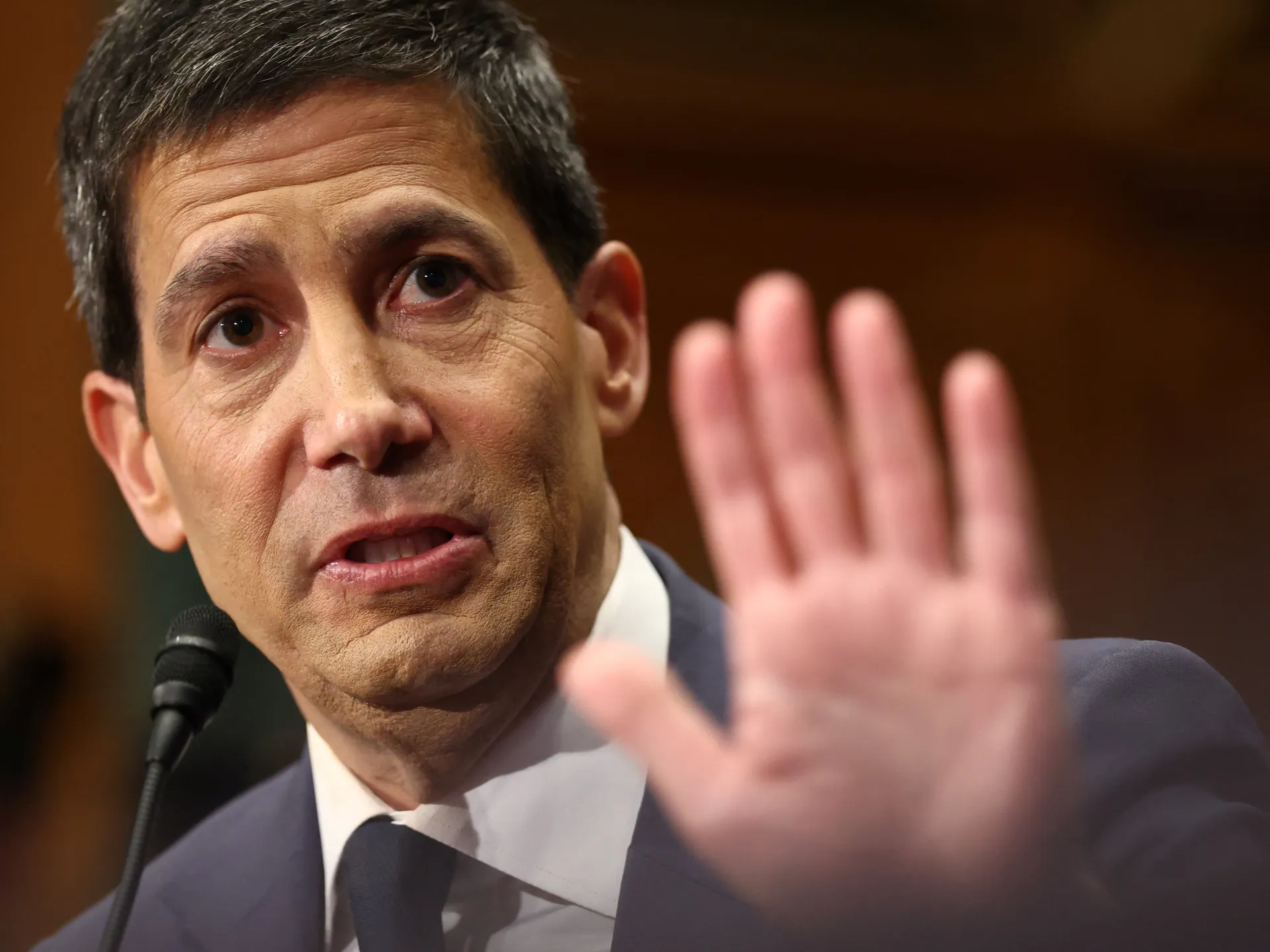
Kevin Warsh, United States President Donald Trump’s pick to lead the Federal Reserve, has addressed concerns about his independence pending his appointment to the bank amid fears that Trump could sway his decisions on monetary policy.
On Tuesday, Warsh — who served on the central bank’s Board of Governors from 2006 to 2011 — faced waves of criticism during a confirmation hearing of the Senate Banking Committee where Democrats voiced concerns about the Fed’s independence should he be appointed to lead the organisation.
Recommended Stories
list of 4 itemsend of list
Senator Elizabeth Warren of Massachusetts, the ranking Democrat on the committee, questioned Warsh’s independence, alleging that he would be a “sock puppet” for Trump, concerns he pushed back against and addressed in his opening testimony.
“I do not believe the operational independence of monetary policy is particularly threatened when elected officials — presidents, senators, or members of the House — state their views on interest rates,” Warsh said.
“Monetary policy independence is essential. Monetary policymakers must act in the nation’s interest . . . their decisions the product of analytic rigour, meaningful deliberation, and unclouded decision-making.”
Warsh, 56, also called for “regime change” at the US central bank, including a new approach for controlling inflation and a communications overhaul that may discourage his colleagues from saying too much about the direction of monetary policy.
Warsh blamed the central bank for an inflation surge after it slashed interest rates to nearly zero in the wake of the COVID-19 pandemic, a move that continues to hurt US households.
Concerned by the implications of artificial intelligence for jobs – expected to increase productivity – and prices, he said he would move quickly to see if new data tools could provide better insight on inflation, and would also discourage policymakers from saying too much about where interest rates might be heading.
“What the Fed needs are reforms to its frameworks and reforms to its communications,” the former Fed governor said. “Too many Fed officials opine about where interest rates should be … That is quite unhelpful.”
Warsh has also long been an advocate for shrinking the Fed’s $6.7 trillion balance sheet. In the Tuesday hearing, he said any such plans would take time and must be publicly discussed well in advance.
Jai Kedia, a research fellow at the Center for Monetary and Financial Alternatives at the libertarian Cato Institute, told Al Jazeera that there were many “encouraging” signs in Warsh’s candidacy.
“Warsh is presenting himself as a regime change candidate at a time when the Fed needs serious reform,” Kedia noted. “Particularly encouraging was his understanding of the negative effects of QE and his focus on reducing the balance sheet. He also correctly criticised mission creep and acknowledged that the Fed did better when it kept its focus on the dual mandate [of keeping inflation at 2 percent and increasing employment].”
Quantitative easing or QE is an unconventional monetary policy under which a central bank lowers interest rates, among other measures, to boost the economy, a step taken by central banks in several developed countries during the pandemic.
Warsh’s private investments, at well over $100m, are also under scrutiny. Among them are two holdings in the Juggernaut Fund LP, apparently part of his work advising for the Duquesne Family Office, the private investment firm of Stanley Druckenmiller.
Warsh’s nearly 70-page financial disclosure also showed that his other holdings include investments in Elon Musk’s SpaceX and the prediction trading platform Polymarket.
“I agreed to divest virtually all of my financial assets, the large majority of which will be divested” before taking office, Warsh said without giving any details.
Warsh noted that selling his holdings comes with challenges. He said that when that process is completed, he would have “virtually no financial assets” and “we’ll be sitting in something like cash”.
Warren, however, questioned him about the divestment plan. “Do we have any way to verify that, in fact, these sales will occur if we have no idea what’s in them?” she asked.
Political hurdles
The hearing quickly turned contentious, and the pace of Warsh’s confirmation process through the Senate remained in doubt.
He would not directly say that Trump lost the 2020 election – a statement of fact that Senator Warren said was a litmus test of Warsh’s independence from the Republican president who nominated him for the top Fed job.
Yet even amidst the focus on independence, Warsh needs 13 votes to clear the 24-member Senate Banking Committee.
North Carolina Senator Thom Tillis said he would vote against Trump’s nominee and join Democrats, which would create a 12–12 split. The committee has 13 Republican members and 11 Democrats.
Tillis said he would not vote for any Trump nominee until an investigation into current Fed Governor Jerome Powell, whose term ends May 15, is either concluded or called off. Last month, federal prosecutors said they found no evidence of wrongdoing. But Jeanine Pirro, the US Attorney for the District of Columbia, has not indicated that the investigation will be dropped.
Tillis said on Tuesday that he would support Warsh’s nomination once the probe into Powell is dropped.
“Today’s confirmation hearing underscored that Warsh is aiming for independence with guardrails,” noted Selma Hepp, chief Economist of Cotality, a market analytics company. “He rejected being a political ‘sock puppet’ and argued the Fed protects its autonomy by ‘staying in its lane.’ He offered no pre-commitment on rates, while emphasising inflation discipline, a large balance sheet, and a desire for clearer Fed communication.”
Noel Dixon, senior macro strategist at State Street, said that with Warsh, the US would have a “dovish-leaning Fed”.
“When a senator asked him if he would lower rates to 1 percent – I guess Trump had indicated that he would like to have rates below 2 percent – Warsh didn’t really say no to that,” Dixon noted. “He didn’t say that it would increase prices. He kind of leaned on it and said there would be a lagged effect, and he was just very noncommittal to that. So it’s almost like – just reading between the lines – he’s giving himself space to maintain possible justification for rate cuts by the end of the year.”
On Tuesday, he said he would be “disappointed” if the Fed did not lower interest rates.
Tuesday’s remarks follow comments in December, when the US president said he would not appoint anyone to lead the central bank unless they agreed with him.
“The public needs to know whether Mr. Warsh will have the courage of his convictions or if he’s willing to compromise his independence and accommodate more Wall Street deregulation,” Graham Steele, an academic fellow at the Rock Center for Corporate Governance at Stanford University, told Al Jazeera in an email.
Warsh has praised the administration for its push for increased bank deregulation. In a November 2025 op-ed for the Wall Street Journal, Warsh claimed that Trump’s “deregulatory agenda” is “the most significant since President Ronald Reagan’s”.
Within a year where big language models write press releases, student papers, and even peer-reviewed articles with a single press of a button, guesswork is not an option that teachers, editors, and grant reviewers can afford. They require valid methods of determining whether they are looking at a page that was designed by a human being or generated by an algorithm. The boundary is more than ever indistinct: text generators of the modern era do not only imitate idiosyncratic diction, they also reference sources and sprinkle their text with rhetorical flourishes, which traditionally were the bane of automation. But there are still prints, prints of fingers, that are revealed by a rigorous check-up.
Why Detection Matters in 2026
The rapid improvements in transformer efficiency have made generative writing infrastructure, rather than a novelty. Bots write corporate knowledge bases, marketing newsletters, and institutional reports, which are then lightly edited by humans. In the case of academia, this automation endangers the standards of originality; in journalism, it may endanger the standards of credibility; in the case of educators, it may bring about a decline in the learning outcomes when the essays are sent to silicon.
European Union legislators and some U.S. states now mandate AI disclosure on projects funded by the government, and large journals are requesting provenance statements in the same vein as conflict-of-interest disclosures. Although this would be achieved through disclosure, enforcement is based on detection. Not checking authorship may open the door to plagiarism lawsuits, damage reputations, or even allow plagiarism or algorithmic fake news to creep into print. Proper screening can therefore safeguard integrity as well as liability, and human merit and machine assistance remain honorably separated.
Key Linguistic Signals Still Holding Up
Long before you open a dedicated detector, close reading can raise red flags. AI prose often exhibits low burstiness, sentence lengths fluctuate within narrow bands, and high lexical predictability, especially in mid-length passages. Repeated use of transitional adverbs such as “moreover,” “furthermore,” and “overall” in rhythmic sequences is another giveaway. Similarly, large models smooth out idiosyncratic contractions, turning informal drafts into formally homogenized copy. When a reviewer suspects such fingerprints, a quick trip to Smodin to check if text is AI generated offers an immediate probability score without exporting the manuscript. Still, numbers alone are insufficient; the linguistic context of the assignment, the native proficiency of the writer, and genre conventions must frame interpretation.
Burstiness versus Perplexity: What the Metrics Really Say
Two metrics dominate current detector dashboards. Perplexity gauges how surprised a language model is by the next token in a sentence; lower perplexity usually signals machine-like predictability. Burstiness, borrowed from information theory, measures variation across consecutive sentences or paragraphs. Human writers inadvertently mix terse observations with longer reflections, creating uneven cadence, whereas AI output remains impressively even. Detectors from OpenAI, Turnitin, and Sapling combine both numbers in a heat-map interface, but analysts should understand their limits. An expert human editor deliberately smoothing tone for readability will lower burstiness and perplexity, triggering false flags. Conversely, a basic paraphrase of AI text can raise both metrics, slipping past simple thresholds. Treat these scores as starting points, not verdicts.
The last year was characterized by market consolidation in the detection market. Rather than dozens of browser extensions that have questionable provenance, five professional platforms have become dominant: Smodin, GPTZero-Pro, Turnitin AI Indicator, Copyleaks, and the free-of-charge DetectGPT-X consortium. They both are based on their own training corpora, and therefore, the agreement between them is convincing. GPTZero-Pro is good at sentence-level labeling and has a classroom API.
Turnitin is LMS-based but is English-centric. Copyleaks can also analyze code snippets or prose, and is used in computer-science classes. Smodin is more concerned with breadth and sub-second throughput, with a thousand-word manuscript taking less than five seconds. Comparative reviews, such as Quillbot vs Grammarly vs Smodin, show that no single tool prevails in every context. Experienced editors therefore run suspect passages through at least two detectors before escalating to human forensic analysis.
Layered Verification Workflow
Professional reviewers in 2026 rarely trust an automated score in isolation. A common three-layer pipeline balances speed and accuracy.
First, bulk ingestion: run every incoming document through a fast detector with a liberal threshold – say, flag anything above 35% probability.
Second, targeted analysis: export only the flagged segments into a slower, sentence-granular model for localized scoring; Copyleaks or Smodin excel here.
Third, manual audit: a subject-matter expert reads the highlighted sentences aloud, listening for tonal monotony and checking citations against primary sources.
The layered approach maximizes reviewer time by spending human effort where algorithmic consensus already signals risk. Crucially, every step is logged, satisfying the audit requirements now mandated by several accreditation bodies.
Beyond Algorithms: Human Tactics That Still Work
Detecting contextual instincts of an experienced reviewer is beyond the capability of even the most advanced detector. Spontaneous oral defense is, in classroom essays, as effective as ever: tell a student to recite a paragraph that he or she allegedly composed, and the discrepancies will be revealed soon. Cross-interviewing quoted sources in journalism frequently shows whether or not the author actually interviewed them or just picked up publicly available transcripts – AI can not create personal anecdotes with the same level of detail when it comes to follow-ups.
Proposers of grants rely on the history of revision: real writers build up untidy drafts, comments, and time-stamped edits, whereas AI-written submissions tend to be a one-clean submission. The other sure path is stylometric comparison with a previously known and verified work of a given author; identity footprints like infrequent collocations or recurrent metaphors are exceptionally constant over time. Notably, all human checks develop explanatory accounts – which probability numbers do not have – to assist institutions in justifying decisions in case they are questioned.
The only sure method that could be used today to distinguish between silicon and soul is the combination of statistical detectors and active human inquiry.
One last note: even the AI detectors change every month. When giving a score, always record the model version and calibration date used, since thresholds change as generators get better. Record raw text you tested, detector output, and Human commentary. This audit trail is future-proof, and it allows your decision to be duplicated, the foundation of transparent scholarship and review, in the classroom, newsroom, and laboratory.
British tourists have been warned that beloved dogs, cats and ferrets could be turned away at the border as new post-Brexit rules make EU passports invalid – here’s what you need to know
A huge change to rules around bringing your pets to the EU comes into force tomorrow (Image: Getty Images)
New EU rules could see beloved pets turned away at the border from tomorrow – and there’ll be big changes to what you need to do before taking four-legged friends on holiday.
Anyone travelling into the European Union with pet dogs, cats and ferrets from England, Scotland or Wales can no longer use EU pet passports under post-Brexit arrangements which come in to force on Wednesday.
Until now, people taking their pets abroad – whether by plane, train, ferry or car – could use an EU Pet Passport, even after Brexit.
But EU Regulation 2016/429, known as the Animal Health Law, comes into force this week after a 10-year transition, and means these pet passports will no longer be valid.
Instead, there’s a different document you’ll need to get sorted before you go on holiday. Here’s what you need to know:
You now need an animal health certificate for every trip
The changes mean that anyone travelling from Great Britain to an EU country with a pet will now need to get an animal health certificate (AHC) before they set off.
Travellers will need to get a vet to issue an AHC within 10 days of their trip. A new certificate will be needed for each trip from Britain to the EU.
The AHC can be used for up to six months for onward travel within the EU and for reentering Britain, as long as rabies vaccinations are still valid.
The GOV.UK website, which says the rules also apply to assistance dogs, states: “If you live in England, Scotland or Wales, from 22 April you cannot use a pet passport (even if it was issued in the EU). If you use a pet passport, your pet may be refused entry into the EU.”
Holiday home owners will not be issued EU pet passports
Pet passports are now only to be issued to people whose main base is in the EU, and not to holiday home owners or seasonal visitors. The Department for Environment, Food and Rural Affairs said individual member states may have specific pet travel requirements and owners should always check the entry details before travelling. British-based travellers can still use EU pet passports for their return journey back home.
Five pet limit and other rules to remember
The switch to the AHC from the EU pet passport means:
Extra paperwork will be needed if the owner is not travelling with their pet.
Whoever is taking the animal abroad must have written permission from the owner.
Up to five days are allowed before the pet and owner must travel abroad.
Travellers are now also only allowed to have a maximum of five pets in a private vehicle.
There may be exceptions given for pets travelling to competitions, events or training.
Holidays with pets ‘still possible’
The Animal and Plant Health Agency (APHA) said “holidays with your pets are still possible” despite the new rules. An APHA spokesman said: “Anyone planning to travel should check guidance on Welcome to GOV.UK , and the entry rules for their destination.
“To avoid delays and ensure a smooth journey, pet owners residing in Great Britain should get an Animal Health Certificate if they are travelling from Great Britain to an EU country.”
A BRIT rock back have been forced to cancel an impending gig after an “unexpected medical situation”.
Enter Shikari were due to play a gig at Dublin Academy in Ireland this evening but have been forced to withdraw.
Sign up for the Showbiz newsletter
Thank you!
Enter Shikari have pulled the plug on their Dublin gigCredit: GettyThe band revealed a medical situation had forced them to axe tonight’s gig plansCredit: Getty
The band kept details sparse but confirmed a “medical reason” was behind their decision to pull the plug on the gig in the Irish capital city.
Issuing a statement, the band revealed they were gutted to be unable to complete the concert as planned.
The band said: “Due to a medical situation both unexpected and beyond our control, we’re sad to have to say we’re having to postpone tonight’s Dublin Academy show.
“If you know anything about us, you know that cancelling/postponing shows is always the absolute last resort once all other options have been exhausted, especially at this short notice.
“We’re very sorry for any inconvenience this causes anyone.
“We’re in conversation with our Irish promoter and will immediately start looking at potential date to reschedule to.
“Thank you in advance for your understanding, and we hope we can see you as soon as possible. ES x.”
Their fans were quick to issue their well-wished amid the uncertain situation.
One penned: “Sending you guys so much love hope you’re all ok.”
Another went on to write: “Hope all is ok – let us know when you’re planning to be back in Ireland!”
A third then said: “Absolutely gutted as flew here solo from Brighton especially *but* sending everyone so much love and hope, and thank you for still being the reason I finally visited Ireland!”
Before a fourth commented: “Sending love as this can’t have been an easy decision, get well soon.”
Whilst a fifth comment read: “Health first always. Hope all is ok. We go again even harder on the rescheduled show to make up for this. Grá mór.”
The band were first formed in 1999 and adopted their current identity in 2003.
Their debut album, Take to the Skies, was eventually released in 2007 and reached number four on the UK Albums Chart.
Their seventh record, released in 2023, became their first chart-topper.
The group’s latest record, surprise released earlier this month, managed to chart at number 16.
The band had been to play in the Irish capitalCredit: Getty
WASHINGTON — Rep. Sheila Cherfilus-McCormick is resigning from Congress rather than be formally disciplined by the House as part of an ethics investigation into her use of campaign funds.
Explaining her decision in an extended social media statement on Tuesday, the Florida Democrat decried the internal investigation process as unfair. She said the House Committee denied her and her new attorney adequate time to prepare a defense.
“Rather than play these political games, I choose to step away,” she wrote.
Members of the House Ethics Committee on Tuesday had been set to weigh what punishment to recommend after they found she committed 25 violations of House rules and ethical standards, including breaking campaign finance laws.
Republicans had already called for the expulsion of Cherfilus-McCormick, who was in her third term and was running for reelection in a southeastern Florida district. She is also facing federal criminal charges accusing her of stealing $5 million in coronavirus disaster relief funds and using the money to buy items such as a 3-carat yellow diamond ring.
Cherfilus-McCormick has pleaded not guilty to the criminal charges and says she is not guilty of ethics violations, either.
The allegations against the congresswoman center on how she received millions of dollars from her family’s healthcare business after Florida mistakenly overpaid the business by roughly $5 million with COVID-19 disaster relief funds. She is accused of using that money to fund her 2022 congressional campaign through a network of businesses and family members.
Cherfilus-McCormick declined to testify during a previous Ethics Committee hearing, citing her Fifth Amendment right against self-incrimination. Her attorney, William Barzee, sparred with some of the lawmakers and argued that they should have allowed a thorough ethics trial, at which he could present witnesses and evidence to counter the conclusions of House investigators.
A group of supporters in Cherfilus-McCormick’s congressional district had weighed in on her behalf with the lawmakers who lead the Ethics Committee, urging committee leaders to proceed with caution.
“Our communities deserve stability. Our voices deserve to be heard. And our right to representation must be protected,” said one of the letters sent to the committee signed by about a dozen local faith leaders, union officials and others.
In all, the panel’s two-year investigation led to the issuance of 59 subpoenas, 28 witness interviews and a review of more than 33,000 pages of documents.
Rep. Greg Steube, a Florida Republican, had said he would move to expel Cherfilus-McCormick once the Ethics Committee made a determination on what punishment it would recommend.
That move could in turn prompt Democrats to seek the expulsion of Rep. Cory Mills, a Florida Republican who is the subject of a wide-ranging investigation by the Ethics Committee that includes whether he violated campaign finance laws, misused congressional resources and engaged in sexual misconduct or dating violence. That investigation is ongoing. Mills has denied any wrongdoing.
The focus on lawmaker wrongdoing comes just one week after two lawmakers resigned during ethics investigations into alleged sexual misconduct. Democratic Rep. Eric Swalwell of California and Republican Rep. Tony Gonzales of Texas headed off possible expulsion votes with their resignations.
House Democratic leaders had declined to condemn Cherfilus-McCormick, saying they wanted to see the ethics process play out. Potential punishments included a reprimand or a censure, which serve as forms of public rebuke. The committee could also have recommended a fine. The most severe form of punishment was expulsion, but the House has historically been reluctant to serve as the final arbiter of a lawmaker’s career, preferring to give that final say to the voters.
Only six members of the House have been expelled. The first three fought for the Confederacy during the Civil War and were expelled for disloyalty. The next two had been convicted of crimes. The final one was George Santos, the scandal-plagued freshman who was the subject of a blistering ethics report on his conduct as well as federal indictment. Santos, a New York Republican, served time in prison for ripping off his campaign donors before President Trump granted him clemency, and he has apologized to his former constituents.
Under the Constitution, at least two-thirds of the House has to vote for expulsion for it to occur, a high threshold that requires enormous bipartisan support.
House Speaker Mike Johnson (R-La.) told reporters last week he believes the House will move to expel Cherfilus-McCormick.
“The facts are indisputable at this point, and so I believe it’ll be the consensus of this body that she should be expelled,” Johnson said.
Freking and Groves write for the Associated Press.
India opener Abhishek Sharma hit the fifth-highest score in Indian Premier League history in Sunrisers Hyderabad’s 47-run win against Delhi Capitals.
The 25-year-old left-hander, who is number one in the men’s T20 batting rankings, batted throughout the innings for 135 not out from 68 balls in the hosts’ 242-2.
He peppered the straight boundaries with powerful drives, hitting 10 sixes and 10 fours, and reached three figures in 47 deliveries.
His score has only been bettered in the IPL by West Indies great Chris Gayle (175 not out), Brendon McCullum (158 not out), Abhishek’s 141 on the same ground last year and Quinton de Kock’s 140 against Kolkata Knight Riders in 2022.
It was also Abhishek’s ninth T20 century, taking him joint fourth on the all-time list.
Delhi made 195-9 in reply with seamer Eshan Malinga taking 4-32.
April 21 (UPI) — Uncertainty over Iran peace talks put Vice President JD Vance’s trip to Pakistan on hold Tuesday, as Iranian officials were silent on whether they intend to take part in the talks at all.
The New York Times reported that talks could, however, restart at any time. Officials in Tehran were divided on whether to take part in negotiations while the United States held firm on its embargo on ports in Iran, Axios reported.
President Donald Trump said earlier in the day that he expects to reach a deal with Iran in negotiations to end the war on Tuesday, but if no deal is made, he is prepared to resume bombing.
The two-week cease-fire Trump agreed to is set to expire on Wednesday, with the Strait of Hormuz remaining a centerpiece to the conflict between the United States and Iran.
“What I think is that we’re going to end up with a great deal,” Trump said in an interview on CNBC on Tuesday. “I think they have no choice. We’ve taken out their navy. We’ve taken out their air force. We’ve taken out their leaders, frankly. It is regime change, no matter what you want to call it. Which is not something I said I was going to do but I’ve done, indirectly maybe, but I’ve done it.”
Trump said the United States’ blockade of the Strait of Hormuz has been a “tremendous success,” adding that “we totally control the strait.”
The president added that he does not want to extend the cease-fire, noting that negotiations will take place near the time the two-week cease-fire ends.
If a deal is not agreed to on Tuesday and Wednesday, Trump said, “I expect to be bombing,” and “we are raring to go.”
“We’re totally loaded up. We have so much of everything; much more powerful than it was four or five weeks ago,” Trump said. “We caught a ship yesterday that had some things on it, which wasn’t very nice. A gift from China perhaps, I don’t know.”
Trump claimed that Iran has executed 42,000 protesters in the last two months, a number that has not been verified, though former Iranian Supreme Leader Ayatollah Ali Khamenei said thousands were killed earlier this year.
On social media, Trump shared a post saying the Islamic Republic is “preparing to hang eight women.” Trump called on Iranian leaders to release the women.
“I would greatly appreciate the release of these women,” Trump wrote. “I am sure that they will respect the fact that you did so. Please do them no harm! Would be a great start to our negotiations!”
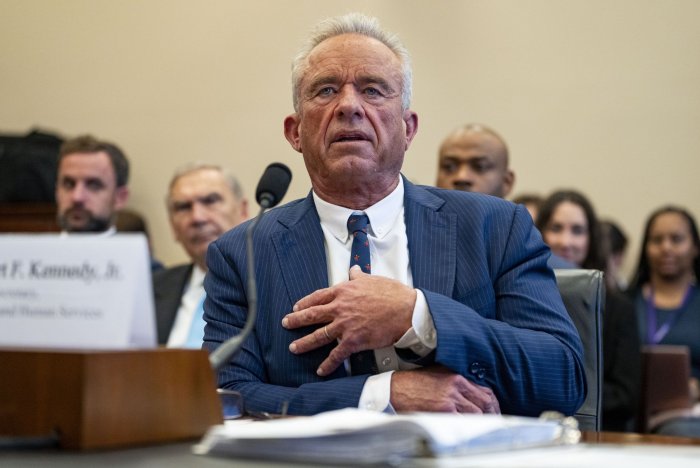
Secretary of Health and Human Services Robert F. Kennedy, Jr. speaks during a House Appropriations Subcommittee on Labor, Health and Human Services, Education, and Related Agencies hearing on the budget for the Department of Health and Human Services in the Rayburn House Office Building near the U.S. Capitol on Thursday. Photo by Bonnie Cash/UPI | License Photo
Raid is part of Moscow’s hardline social conservatism and clampdown on political life.
Published On 21 Apr 202621 Apr 2026
Russian police have raided the country’s top publishing house on suspicion that it has been disseminating “homosexual propaganda”, local media report.
Police reportedly seized thousands of books on Tuesday and took Yevgeny Kapiev, the chief executive of Eksmo, in for questioning. The raid appears to be part of Moscow’s pivot to hardline social conservatism with repressive laws running alongside a clampdown on political life and aggressive foreign policy.
Recommended Stories
list of 4 itemsend of list
Police targeted Kapiev as part of a “criminal case on extremism” over the publication of books “dealing with LGBT themes”, Eksmo communications director Yekaterina Kozhanova told the AFP news agency.
The firm’s finance director, head of distribution and deputy commercial director were also interrogated, Kozhanova said.
Eksmo is suspected of unofficially marketing books, including novels, that promote “gay propaganda” to Russian youth, the broadcaster Ren-TV reported.
An investigation into Eksmo was opened last year when authorities said “LGBT propaganda” had been “detected” in books published by its Popcorn Books subsidiary and they arrested several members of its staff.
Ultraconservative turn
Books showing approval of same-sex relations have been banned in Russia for more than 10 years.
The law has been tightened recently, requiring publishers to remove publications and destroy entire editions if they depict same-sex relationships.
The persecution of LGBTQ individuals, organisations and communities has intensified in the past decade or so as the Kremlin heralds “traditional values”. That drive has included a crackdown on films, books, art and culture, among other areas of social life.
Cultural producers have faced significant pressure even when they focus on giants of Russian culture. Biographies of Mikhail Bulgakov, author of The Master and Margarita, and the poet, actor and singer Vladimir Vysotsky have to be marked with warning labels because they are seen as promoting drug-taking.
The ultraconservative social turn has accelerated since Russia launched its full-scale invasion of Ukraine in February 2022.
The “Viajando Por El Mundo Tropitour” will kick off July 24 at Chicago’s Soldier Field. The “Provenza” artist will then head out to Las Vegas on Aug. 7 before making a stop at SoFi Stadium in Inglewood on Aug. 14. She’ll grace California with one more performance on Aug. 21 at Levi’s Stadium in Santa Clara.
The 35-year-old singer will wrap up the U.S. leg of her tour with a performance in Dallas on Oct. 15 before commencing the international section of the tour in Monterrey, Mexico, on Nov. 6. This string of shows is scheduled to finish exactly a year after commencing, with a July 24, 2027, set in Milan, Italy.
Karol G was the first Latina to headline Coachella in the desert fest’s 27-year history. She was only the second Latin music artist to get top billing at the event, with Bad Bunny being the first to ever do it with his 2023 headlining performances.
“This is for my Latinos that have been struggling in this country lately,” she told her fans during her history-making performance. “We stand for them. I stand for my Latina community. I am very proud because this brings out the best in us: unity, resilience and a strong spirit. We do this because we want everyone to feel welcome to our culture, so I want everyone to feel proud of where you come from.”
During her Coachella shows, which took place across two weekends in April, she brought out a cavalcade of guest performers — including L.A.’s own Becky G, the Colombian reggaeton revivalist J Balvin and Greg Gonzalez from Cigarettes After Sex.
The “Si Antes Te Hubiera Conocido” artist first teased that she’d be embarking on a tour at the end of her set during the second weekend of Coachella. Text reading “Nos Vamos de Tour” (We’re going on tour) was displayed as she played her final song.
Asset-light companies reshape private credit as lenders embrace intellectual property collateral, despite valuation challenges, legal risks, and AI-driven obsolescence concerns.
Asset-light companies are changing the world of private credit.
Unlike businesses that can rely on a heaping basket of assets like inventory, equipment, and real estate as collateral for private direct lending, these companies tend to use some of the most illiquid and difficult-to-value intellectual property (IP) as collateral.
“Capital is increasingly being formed around asset-based finance [ABF] strategies, but it’s still relatively early innings of where ABF will grow to within private credit markets,” says Brian Armstrong, managing director, US Direct Lending at Benefit Street Partners. “We believe ABF has the potential to be one of the fastest-growing asset classes over the next five years.”
Private-credit assets under management are expected to exceed $2 trillion this year, according to Moody’s 2026 Global Private Credit Outlook, published in January, which predicts they will approach $4 trillion by 2030. “Corporate lending still makes up most of the private credit lending, but momentum is shifting towards ABF,” the authors wrote. “While more difficult to track, ABF has the potential to eclipse the size of more traditional corporate lending.”
Pledging IP for collateral is not new; specialty retailer J. Crew used a mix of IP and other assets as security for more than $540 million payment-in-kind notes about a decade ago. The difficulty in using IP as collateral has been obtaining a fair valuation of assets such as data sets, proprietary software platforms, and patent and trademark portfolios.
Approaches to doing so include discounted cash flow analyses of the asset, benchmarking against comparable transactions, and estimating the asset’s replacement or reproduction costs. Often, businesses rely on an independent third-party valuation firm such as Alvarez & Marsal, Holihan Lokey, or Kroll.
One of the greatest concerns of ABF lenders, however, is the transfer of IP out of the basket of pledged assets.
“In many deals, covenants permit the borrowers to certify in their reasonable commercial discretion what the value of a given asset is,” says Jake Mincemoyer, partner and global co-head of Debt Finance at law firm A&O Shearman. “That’s what has gotten lenders very concerned, given a handful of transactions where borrowers have taken advantage of that and taken a crown-jewel asset out of the collateral package and levered it up elsewhere. So, it’s really been how do we make sure that if we’ve lent against it, we keep it?”
A prime example is the aftermath of J. Crew’s 2017 transfer of pledged IP to a new, unrestricted subsidiary, which was excluded from the parent company’s restrictive covenants and debt limitations and enabled it to raise further capital by pledging the same IP. What has become known as the “J. Crew Maneuver” has led to the inclusion of a “J. Crew Blocker” provision in debt covenants that prevents borrowers from transferring material assets into unrestricted subsidiaries.
That safeguard has not stopped borrowers from executing a variation on the theme, however. In February, Xerox moved IP assets pledged to existing debt to a joint venture in which it owns a 49% stake and raised an additional $450 million in funding. That minority stake prevents the joint venture from being considered a subsidiary under its debt documents, according to Ropes & Gray’s Distressed Debt Legal Insight, published in March.
“Borrowers have found more creative ways to operate within their credit documents, which has driven lenders to be more careful and thoughtful around tightening any unintended flexibility,” Benefit Street’s Armstrong says.
Transatlantic Divide
As in real estate, the ease of obtaining ABF while pledging IP as collateral depends on location. North America is approximately five years ahead of Europe due to EU law regarding governance of intellectual property and its use as collateral.
For example, under the European Parliament and Council’s Directive/24/EC, the original software developer, whether an employee or a consultant, owns the copyright to their code, unless their contract states otherwise. But proving the provenance of software code can be difficult, especially if it contains open-sourced content and third-party APIs.
Steffen Schellschmidt, Clifford Chance
“The market is not fully prepared yet to take on the whole financing of software, given the uncertainties around ownership,” says Steffen Schellschmidt, Munich-based partner and private credit specialist at the law firm Clifford Chance. “You have to do a comprehensive and costly due diligence on this.”
This has led most European private lenders to focus more on registered IP like patents and trademarks, whose ownership is easier to determine.
Secondly, and unlike in the US, EU law does not permit the inclusion of software IP in a floating charge, Schellschmidt notes: “So, once security is perfected under European law, assets can still be transferred, but their value is diminished as they remain subject to the existing pledge.” That creates a funding gap for businesses that fall between early-stage startups and large, successful companies in pharmaceuticals and other knowledge-based industries.
“That is why we don’t have a Silicon Valley,” Schellschmidt contends.
The EU is working to eliminate the funding gap. As part of its Strategic Plan 2030, the European Intellectual Property Office (EUIPO) and the European Commission brought together policymakers, IP offices, financial institutions, business leaders, and subject-matter experts in an IP-Backed Finance Steering Group and Technical Working Group on IP Valuation at the end of last year.
The Technical Working Group is mandated to develop an IP Finance Roadmap to “help businesses across Europe, especially startups, scaleups, and SMEs, access finance based on the value of their intellectual property.” The Steering Group will then review the roadmap and shape the EU’s strategic approach to IP valuation and financing, according to EUIPO statements.
AI Speeds IP Obsolescence
AI is affecting ABF, especially at businesses that plan to pledge enterprise software as collateral.
“Whether an asset is tangible or intangible, it will decay over time. Nothing holds all its value forever,” says Mark McMahon, managing director and global practice leader at Alvarez & Marsal Valuation Services. “If it’s a mine, it’s called depletion. If it’s a hard asset, it depreciates. If it’s software or another form of IP, it’s obsolescence.”
Computer code-writing AI engines, such as Anthropic’s Claude Sonnet and Microsoft’s GitHub Copilot, are only shortening the window to obsolescence for existing software stacks and lowering the value of software as collateral as market competition heats up due to lowered barriers to entry.
“The risk associated with a long-term software revenue stream might not necessarily be today what you estimated it to be even half a year ago,” McMahon notes.
However, AI should not be considered the death knell for software’s value as collateral, A&O Shearman’s Mincemoyer says.
“The same way that people figured out how to come up with all kinds of very creative and useful software programs that then they could package as SaaS businesses and really be constructive in the economy, I have to think that AI tools are going to allow even greater advancements and even greater new businesses and new tools as people are using them,” he says. “Does that mean the question is, Will the three or four people running the most powerful AI tools take over everything? There’s a risk of that. Do I think that actually will happen? Probably not.”
That said, the increased speed of software development should lead to more active management of collateral. As Benefit Street’s Armstrong advises: “If your IP collateral could conceivably be directly impacted by AI, you should certainly more frequently review and revalue that collateral to ensure your loan continues to be covered by the value.”
Despite these trends, ABF lenders’ appetite to accept various types of IP as collateral is growing. “Over the last five to 10 years, I have seen a large increase in financing being done where lenders are comfortable lending on nontangible assets,” Mincemoyer says.