From Bill Shaikin: José Soriano leads the major leagues with a 0.24 earned-run average. It’s hard to think of something the Angels could do to make him better.
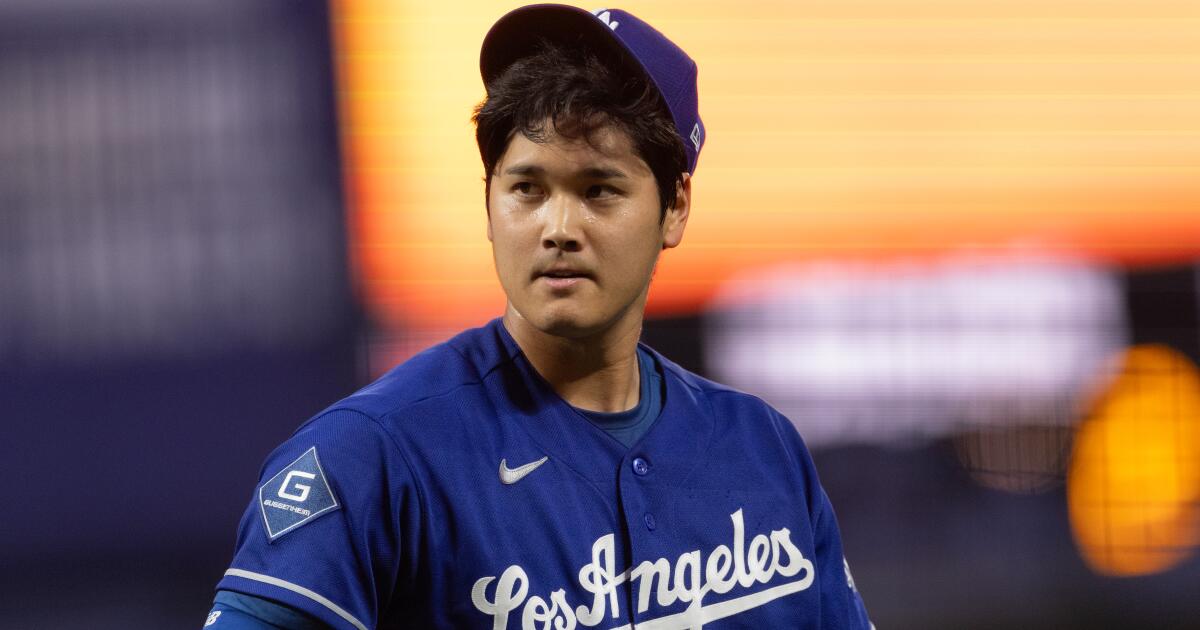
Shohei Ohtani ranks second with a 0.38 ERA. It’s not so hard to think of something the Dodgers could do to make him better.
On Wednesday, however, that might not have turned the Dodgers into winners. The San Francisco Giants won in the unlikeliest of ways: on one swing, a three-run home run from Patrick Bailey, a catcher who opened play batting .145 and had not hit a home run since last season. After Ohtani pitched six shutout innings, Bailey homered off Jack Dreyer in the seventh.
That was not the only unlikely performance: The winning pitcher was Tyler Mahle, who pitched seven shutout innings for his first victory in 10 months. Mahle started the game with an 0-3 record and 7.23 ERA.
That was the ballgame: Giants 3, Dodgers 0, with San Francisco clinching the series and the Dodgers losing for the fourth time in five games. In two games against the Giants, the Dodgers have scored one run.
Get the latest on L.A.’s teams in the daily Sports Report newsletter.
By continuing, you agree to our Terms of Service, which include arbitration and a class action waiver. You agree that we and our third-party vendors may collect and use your information, including through cookies, pixels and similar technologies, for the purposes set forth in our Privacy Policy such as personalizing your experience and ads.
Mike Trout ties a Garret Anderson record
Mike Trout homered, Nolan Schanuel homered and hit a three-run double and Jose Soriano worked five shutout innings as the Angels beat the Toronto Blue Jays 7-3 on Wednesday to avoid a series sweep.
Trout’s eighth homer of the season was a 428-foot solo shot in the bottom of the fifth. That hit tied the 34-year-old Trout with the late Garret Anderson for the Angels’ franchise record of 796 extra-base hits. Anderson died last week of an acute necrotizing pancreatitis at the age of 53.
Soriano, who is 5-0, gave up three hits and struck out five in five innings before leaving with a 3-0 lead. He lowered his ERA to an MLB-leading 0.24. The 27-year-old right-hander is the first MLB pitcher since 1900 to allow no more than one run in the first six starts of a season, and he has the lowest ERA (with a minimum of 30 innings pitched) through a pitcher’s first six starts of a season since 1913, when earned runs became official in both leagues.
Cutter Gauthier broke a tie off a rebound with 4:52 left and the Ducks beat Edmonton 6-4 on Wednesday night in Game 2 to even the first-round series, with Oilers star Connor McDavid slowed by an apparent leg injury.
McDavid appeared to catch an edge early in the second period after getting tangled up with teammate Mattias Ekholm and the Ducks’ Ian Moore. McDavid briefly left the game before returning, playing just over 24 minutes.
Game 3 is Friday night at Honda Center. Edmonton opened the series Monday night with a 4-3 victory.
Gauthier put the Ducks back in front after Josh Samanski — making his playoff debut — tied it at 4 with 6:09 to go. Ryan Poehling put it away with an empty-netter with 1:10 left, his second goal of the game. He scored shorthanded in the second.
at Edmonton 4, Ducks 3 (summary) Ducks 6, at Edmonton 4 (summary) Friday: Edmonton at Ducks, 7 p.m., TNT, truTV, HBO Max) Sunday: Edmonton at Ducks, 6:30 p.m., ESPN Tuesday: Ducks at Edmonton, TBD *Thursday, April 30: Edmonton at Ducks, TBD *Saturday, May 2: Ducks at Edmonton, TBD
*-if necessary
Kings playoffs schedule
All times Pacific
at Colorado 2, Kings 1 (summary) at Colorado 2, Kings 1 (OT) (summary) Thursday: Colorado at Kings, 7 p.m., TNT, truTV, HBO Max Sunday: Colorado at Kings, 1:30 p.m., TNT, truTV, HBO Max *Wed., April 29: Kings at Colorado, TBD *Friday, May 1: Colorado at Kings, TBD *Sunday, May 3: Kings at Colorado, TBD
LeBron James flying down the lane unchecked for a pumping, over-the-shoulder slam.
Marcus Smart diving and scrapping and leading cheers with a scream.
Luke Kennard stepping to the free-throw line and hearing the chant, “MVP! … MVP! … MVP!”
Who knew?
Without their two best players, facing the quicker and more bruising Houston Rockets in the first round of the playoffs, who knew the Lakers would do what they did Tuesday night at a roaring Crypto.com Arena?
They say a series doesn’t start until the home team loses a game, but, believe it, this series is already over.
at Lakers 107, Houston 98 (box score) at Lakers 101, Houston 94 (box score) Friday: Lakers at Houston, 5:30 p.m., Amazon Prime Video Sunday: Lakers at Houston, 6:30 p.m., NBC *Wednesday: Houston at Lakers, TBD *Friday, May 1: Lakers at Houston, TBD *Sunday, May 3: Houston at Lakers, TBD
*-if necessary
LAFC plays to scoreless draw
Zack Steffen finished with two saves and had his second shutout of the season for the Colorado Rapids in a 0-0 tie with LAFC on Wednesday night at BMO Stadium.
The Rapids (4-4-1) had 71% possession.
LAFC (5-2-2), who had lost back-to-back game for the first time in more than a calendar year, are winless in three straight.
Hugo Lloris had two saves and leads MLS with seven shutouts.
Dániel Gazdag and Diego Rossi each scored to help the Columbus Crew beat the Galaxy2-1 on Wednesday night in a game delayed for over two hours because of severe weather.
Columbus (2-4-3) has given up just three goals in its first four home matches of the season.
Gazdag scored in the 41st minute when he redirected Hugo Picard’s cross with the outside of his foot.
From Sam Farmer: This might be the first time in the NFL’s modern era that Pittsburgh has hosted the draft, but the whole format was actually invented here.
In 1935, the league’s founders met at the Fort Pitt Hotel and voted unanimously to put in place a selection process in reverse order of the previous season’s standings. That would promote competitive balance, which has been a hallmark of the NFL ever since.
Ladies and gentlemen, meet the Las Vegas Raiders. The franchise went 21-41 over the past four seasons and its offense scored a league-worst 241 points last season.
Quarterback Fernando Mendoza, who led Indiana to a national championship, won’t be at the draft but almost certainly will hear his name called first. He’s likely to be the only quarterback selected in the opening round.
1950 — The Detroit Red Wings edge the New York Rangers 4-3 in Game 7 to win the Stanley Cup.
1950 — The Minneapolis Lakers become the first team to win back-to-back NBA championships by defeating the Syracuse Nationals 110-95 in Game 6 of the finals. George Mikan leads the Lakers with 40 points in a game marred by three fights, four Minneapolis players fouling out, and Nats coach Al Cervi being ejected for complaining too vociferously about a call.
1954 — The NBA adopts the 24-second shot clock.
1969 — Jerry West scores 53 points to lead the Lakers over Boston 120-118 in the opening game of the NBA finals.
1989 — Kareem Abdul-Jabbar scores 10 points in his last regular-season game as a Laker in a 121-117 win over Seattle.
1993 — The Dallas Mavericks avoid matching the 1972-73 Philadelphia 76ers as the worst team in NBA history, beating Minnesota 103-100 for their 10th triumph of the season.
1993 — Orlando’s Nick Anderson scores 50 points in the Magic’s 119-116 win over the New Jersey Nets at The Meadowlands. Anderson’s feat is overshadowed by Shaquille O’Neal, who rips down the backboard in the first quarter, delaying the game 45 minutes.
2002 — Brent Johnson of the St. Louis Blues ties an NHL record with three straight shutouts in the playoffs. That had not happened in 57 years. Johnson reaches the milestone with a 1-0 victory over the Chicago Blackhawks.
2005 — NFL Draft: University of Utah quarterback Alex Smith first pick by San Francisco 49ers.
2011 — The Portland Trail Blazers rally from 23 points down in the second half, including an 18-point deficit to start the fourth quarter to defeat Dallas 84-82 and tie the first-round series at 2-2. Portland’s Brandon Roy scores 18 in the fourth quarter, including a 4-point play and the go ahead jumper with 39 seconds left. Roy outscores Dallas 18-15 in the quarter.
2017 — Kenyan runner Mary Keitany breaks Paula Radcliffe’s women-only marathon world record with a third victory in London. Keitany completes the 26.2-mile course in 2 hours, 17 minutes and 1 second to shave 41 seconds off Radcliffe’s 12-year-old mark.
2020 — NFL Draft: LSU quarterback Joe Burrow first pick by Cincinnati Bengals.
Compiled by the Associated Press
This day in baseball history
1903 — The New York Highlanders, who later changed their name to the Yankees, won their first game as a major league team, 7-2 over the Washington Senators.
1913 — New York Giants ace Christy Mathewson beat the Phillies 3-1, throwing just 67 pitches.
1939 — Rookie Ted Williams went 4-for-5, including his first major league home run, but the Red Sox lost to Philadelphia 12-8 at Fenway Park.
1946 — Ed Head of the Brooklyn Dodgers no-hit the Boston Braves 5-0 at Ebbets Field. Head was making his first start after a year’s military service.
1952 — Bob Feller of the Cleveland Indians and Bob Cain of the St. Louis Browns matched one-hitters. Cain wound up as the winner, 1-0.
1952 — Hoyt Wilhelm of the Giants hit a home run at the Polo Grounds in his first major league at-bat. He was the winner, too, and pitched 1,070 games in the majors — but never hit another homer.
1954 — Hank Aaron hit the first home run of his major league career. The drive came against Vic Raschi in the Milwaukee Braves’ 7-5 victory over St. Louis.
1962 — After an 0-9 start, the expansion New York Mets won their first game beating the Pittsburgh Pirates 9-1 behind Jay Hook.
1964 — Ken Johnson of the Houston Colt .45s became the first pitcher to lose a nine-inning no-hitter when Pete Rose scored an unearned run to give the Cincinnati Reds a 1-0 victory.
1978 — Joe Morgan of the Cincinnati Reds makes an error at second base, bringing his major league record of 91 consecutive errorless games to an end.
1989 — Nolan Ryan came within two out of his sixth career no-hitter, losing it when Nelson Liriano tripled in the ninth inning as the Texas Rangers beat the Toronto Blue Jays 4-1. Ryan finished with his 10th lifetime one-hitter.
1990 — Steve Lyons of the Chicago White Sox plays all nine positions during an exhibition game against the Chicago Cubs.
1999 — Fernando Tatis of St. Louis became the first in major league history to hit two grand slams in one inning in a 12-5 win over the Dodgers. Tatis also set the record with eight RBIs in one inning.
2008 — The Chicago Cubs won their 10,000th game, joining the Giants as the only franchise to reach that mark with a 7-6 10-inning victory at Colorado.
2009 — Ichiro Suzuki lined James Shields’ second pitch of the game for a home run, the only run of Seattle’s 1-0 victory over the Tampa Bay Rays. It was the 22nd time a leadoff homer was the deciding run in a game, and it was just the second time it happened for the Mariners.
2012 — Ivan Rodriguez, who has caught more games than anyone in big league history, announces his retirement after a 21-year career.
2013 — B.J. Upton and his brother Justin hit back-to-back homers for the first time, leading the Atlanta Braves past the Colorado Rockies 10-2 to complete a doubleheader sweep. It was the 27th time in major league history that brothers homered in the same game, but only the second time they went deep in consecutive at-bats. Lloyd and Paul Waner of the Pittsburgh Pirates also accomplished the feat on Sept. 15, 1938.
2022 — Miguel Cabrera of the Tigers becomes the 33rd member of the 3,000 hit club.
Compiled by the Associated Press
Until next time…
That concludes today’s newsletter. If you have any feedback, ideas for improvement or things you’d like to see, email me at houston.mitchell@latimes.com. To get this newsletter in your inbox, click here.
April 23 (UPI) — Senate Republicans were up all night voting, eventually adopting a budget reconciliation package Thursday morning to prepare to fund the Department of Homeland Security.
The Senate plans to fund the department without Democrats’ help. The resolution was adopted at around 3:30 a.m. EDT Thursday by a vote of 50-48 after about six hours.
The only Republicans to vote against the resolution were Sens. Lisa Murkowski, R-Alaska, and Rand Paul, R-Ky. The bill now goes to the House. If the House adopts the resolution, the final funding bill can be written and voted on by Congress.
They are following a deadline of June 1 set by President Donald Trump.
“We have a multistep process ahead of us, but at the end Republicans will have helped ensure that America’s borders are secure and prevented Democrats from defunding these important agencies,” said Senate Republican Leader John Thune, R-N.D.
Thune told fellow senators to keep the package narrow to ensure speedy passage.
Since the January deaths of Renee Good and Alex Pretti in Minnesota, both shot and killed by DHS officers, Democrats have refused to support funding the department without reforms. The department has been shut down since Feb, 14, though Trump told the department to use emergency funds to pay essential workers.
Republicans are hoping to fund the department through 2029 at a cost of between $70 and $80 billion.
The late-night vote-a-rama included votes about amendments that could be added to the resolution. Two Republican Senators who are vulnerable in the November elections — Sens. Susan Collins, R-Maine, and Dan Sullivan, R-Alaska — broke ranks on some amendments.
Collins and Sullivan voted for amendments to lower health care costs, to reverse last year’s Supplemental Nutrition Assistance Program cuts and to tackle insurance companies that delay or deny medical care. Sen. Josh Hawley, R-Mo., joined with Collins and Sullivan on the latter.
Sen. Bernie Sanders, I-Vt., also sponsored an amendment that would tell the budget committee chair to help cut prescription drug prices by half. Hawley, Collins and Sullivan supported Sanders on it. Sanders said his amendment would codify ensuring that Americans wouldn’t pay more for prescriptions than Canadians or Europeans.
The amendments wouldn’t have the power to force Republicans’ hands, but they would make Republicans go on record about their views of these items.
“This reconciliation, or this budget act, will show who’s on whose side, and clearly if Republicans vote against our amendments, they’re not on the side of the American people,” Democratic Leader Chuck Schumer, D-N.Y., said on the Senate floor.
Homeland Security Secretary Markwayne Mullin told Fox and Friends on Tuesday that the department will run out of money for salaries next month.
“I’ve got one payroll left, and there is no more emergency funds so the president can’t do another executive order because there’s no more money there,” The Hill reported he said.
The resolution does not include the SAVE America Act, the voter security bill that Trump and other Republicans have pushed for. Sen. John Kennedy, R-La., sponsored an amendment to add similar restrictions, but it failed 48-50. Collins, Murkowski, Sen. Thom Tillis, R-S.C., and Sen. Mitch McConnell, R-Ky., voted against it.
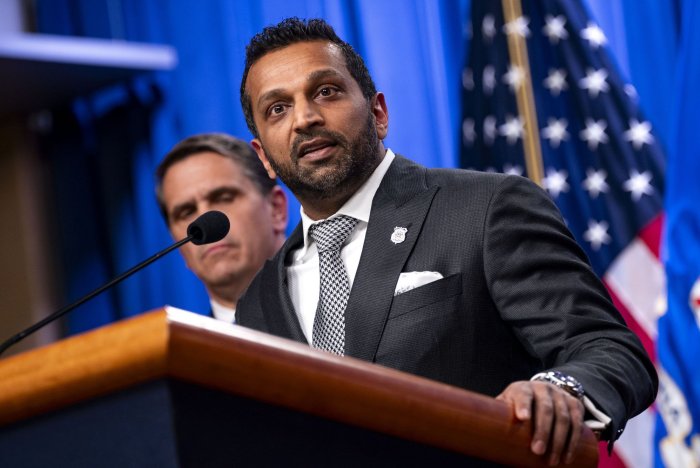
FBI Director Kash Patel speaks during a press conference at Department of Justice Headquarters on Tuesday. The Trump Administration announced charges against the Southern Poverty Law Center, which the government alleges funneled over $3 million toward white supremacist and extremists groups. Photo by Bonnie Cash/UPI | License Photo
THE conflict in the Middle East has had a far-reaching impact on the package holiday market.
Bookings have stalled as holidaymakers delay plans due to the uncertainty and those who are heading away are opting for last-minute trips.
Sign up for the Travel newsletter
Thank you!
I’ve been a travel expert for 30 years – so here are my tips on how to protect your holiday this year (as much as possible, that is)Credit: Dan Charity
There’s been an increase in demand for Western Mediterranean destinations like Spain and Portugal over the Eastern Med.
Ironically, that has led to some fantastic deals available on holidays to Cyprus, Turkey and Egypt – all of which are operating completely normally and where there are absolutely no safety concerns.
All of our main tour operators – including Jet2, TUI and easyJet Holidays – have not expressed any concern about trips in the short to medium term and are planning on running their summer schedules as normal.
But with airlines across the globe beginning to scale back flight schedules – removing unprofitable routes now jet fuel prices have soared – as well as others introducing surcharges there is a stark contrast between the two.
If you are looking to head away this summer and haven’t booked, now is probably the time to do it before prices start to rise.
Tour operators are desperate for us to get booking and you’ll see plenty of decent pricing and incentives.
Heading to Greece, Turkey, Cyprus and Egypt will be a good bet for those wanting to get a bargain – with demand for Western Mediterranean resorts high, prices could soon start to rise.
But what can you do to make sure your holiday is safe this year? While a lot of it is out of your hands, here are some ways to try and protect it as – much as possible.
Go for package holidays
Package holiday regulations do allow tour operators to add a surcharge to the cost of holidays already booked although it is extremely rare for this to happen.
Even then, the maximum they can charge is eight per cent of the holiday price.
Anything over that, and the operator has to offer you a full refund instead.
But what is clear is this is probably not the summer to do a DIY break.
Booking an ATOL-protected package holiday comes with lots of consumer protection you simply don’t get if you book each element independently.
Check your travel insurance
Most standard travel insurance policies exclude coverage for disruption tied to acts of war but it is still essential to take out insurance as soon as you book any trip as it offers vital protection in the run up to your trip such as sudden illness or the death of a close relative.
And of course, it provides essential medical cover should you fall ill or are injured on your trip as well as lost or stolen luggage and possessions.
Travel insurer Staysure revealed recently that the cost of a medical ambulance back from Spain this summer averages £37,853 from the Canary Islands, £22,930 from the Balearics and £25,583 from mainland Spain.
And while travel insurance won’t cover you if your flight is cancelled, under UK/EU law your airline has a legal duty of care to you and must get you to your destination as quickly as possible.
In most scenarios, getting a refund on a cancelled flight would probably be the worst option as the airline then has no legal duty of care to you.
Read up on your rights should flights be cancelled and be prepared to fight for what you are due.
A credit card is a must in case of any last minute expensesCredit: Alamy
Opt for easy-to-get-home-from destinations
Many of us won’t want to give up the chance to soak up some Mediterranean sunshine this summer – and why should we?!
But making savvy choices on destinations could help protect your summer break.
If airlines do begin to trim schedules and cancel certain flights, it makes sense to choose airports where there are lots of daily flights.
Now is probably not the time to be booking a holiday to a destination that has just a single flight a week.
Booking holidays to our closest European neighbours – the likes of Spain, Portugal, France and Italy – also mean there are alternative ways to get home should flights be cancelled.
You can also look at other ways to holiday from the UK this summer without going near an airport.
There are lots of cruises that depart from UK ports including Southampton and London Tilbury that will sail you in style to the Mediterranean, Norwegian Fjords and beyond.
The boss of Brittany Ferries, Christophe Mathieu, has even said: “We make a clear promise to customers.
If you have booked with us, or are considering doing so, we will get you to a beautiful and safe holiday destination this year. Period.
“We will play no part in profiteering. The cost of our holidays rose by inflation earlier this year, and by inflation alone. There will be no further rises in the weeks or months ahead.
“Conflict or other global uncertainty should not be used as the basis for knee-jerk price hikes.”
Be prepared for unexpected expenses
Many travellers were caught short when airlines were forced to cancel flights to or through the Middle East at the start of the war.
For any trip, it always makes sense to have an emergency credit card for any unforeseen expenses that may occur. If possible, apply for one with an interest-free period.
Or look at a currency card like Currensea – this is a card that is linked to your bank account and takes out the payments via direct debit but avoids the high foreign exchange fees and doesn’t need to be pre-loaded like some other currency cards.
An alternative is to look at opening an account with a digital based bank account that you operate through an app on your phone like Revolut or Monzo.
Picking destinations like Spain where there are lots of flight options mean you have more choice if something goes wrongCredit: Getty
This deal from Wowcher means you could be enjoying the magic of Disneyland Paris, with the cost of the ferry and a two-night stay at a hotel close to the park, at under £200 per person
This article contains affiliate links, we will receive a commission on any sales we generate from it. Learn more
This deal lets you visit Disneyland Paris for less than £200(Image: IAN LANGSDON/AFP via Getty Images)
Nothing beats the magic of a day at Disneyland, but it can be a costly choice just for the tickets alone. That’s why it often works out cheaper to book a deal that includes extras such as accommodation.
Wowcher has just launched a 4* Disneyland Paris Break which is now available to book that includes two-nights in a hotel, transport across the channel, and a one-day Disneyland Paris park entry for each guest, with prices that start at £189 per person.
You can check the availability calendar on Wowcher’s website to see the prices for each date. At the moment, the £189 deal is available in the first week of May with a 37% discount available. However, these dates are likely to sell out quickly, so you may need to snap them up soon.
Dates are available later in the year for November and December at around £249, and this can be an excellent time to visit the parks for the festive period. If you’re looking for summer holiday dates, then the last week in August is the cheapest, with dates from £309 per person.
Julie Delahaye
The package includes a stay at the 4* Paxton Hotel Paris MLV, just 10-minutes from the gates of Disneyland by car, which also offers a bus connection to the parks. The price also includes a return ferry crossing for a vehicle, and the drive from Calais to the hotel is just over three hours, mostly on motorways.
The one-day entry pass includes access to all attractions, shows, Character Encounters, parades, and more, so you can pack a lot into your trip.
Since the package has two nights in a hotel, you may also want to enjoy the onsite indoor pool, spa, and hammam, or even head to nearby Bussy-Saint-Georges station to get a train into Paris for some sightseeing. The city centre is about half an hour away by train.
If you’d rather stay onsite at the parks, you can book Disneyland Paris breaks via its official website, which gives you the option to stay in official Disney hotels. Staying in an official Disney property gives you perks such as early access to the parks and a quicker journey home at night, but it is a pricier option.
One night at the Disney Newport Bay Club in early May, with a two-day park pass comes in at £372.45 per person, and considerably more during peak times.
Another way to save money is to look for the deals that Disney offers throughout the year. For example, Walt Disney World in Florida has just relaunched its popular Free Dining offer, as well as offering up to £400 off breaks. This deal can be found on disneypackages.co.uk, and is available during most school holidays. This site also offers packages that include flights, making it easier to plan your trip.
Have a story you want to share? Email us at webtravel@reachplc.com
Before he became a fugitive preacher, during which time security officials learned to mutter his name with a foreboding weight, culminating ultimately in his killing, filmed and circulated across local and international news platforms, Mohammed Yusuf was a boy seated before his father, learning the Qur’an. This is where this story begins.
Not in 2002 or in July 2009, which are often cited as the landmark years. The beginning lay far away from prying eyes, in the ordinary intimacy of religious learning, in a world of fathers and sons, mallams and pupils, recitation and repetition.
Those who knew Yusuf’s early life describe a child shaped in his father’s image. According to one of his sisters, who does not wish to be named, “He learned to recite the Qur’an under Baba. He was our father’s student before he became anyone else’s.” He imbibed that discipline, the rigour and rhythm of recitation, correction, and memorisation.
He went on to study under Goni Bulama, who was reportedly knowledgeable in fiqh (the human interpretation and application of Sharia law). Later, he travelled to Potiskum in Yobe State to continue learning under his uncle, Goni Madu. He stayed there for two or three years, “then he returned home and continued seeking knowledge in several places” as part of the Almajiranci system, his sister recalled.
Among the clerics repeatedly named by people who followed that part of his life is Goni Modu in Lamisula, a suburb in Maiduguri. He occasionally took lessons from the late Sheikh Abba Aji, a well-respected Mufassir (Qur’anic exegete)in Maiduguri. “Yusuf did not emerge from the bubble; he was shaped through the interplay of ideologies,” said Kyari Mustafa, a researcher and one of Yusuf’s former students. One of his childhood friends, who is now a moderate cleric in Maiduguri, described Yusuf as a very curious child, adding that he thinks “that was what made him learn faster than all his peers”.
According to many who encountered Yusuf, he was many things, some of them deeply dangerous, but he was not a man who wandered by accident into religious influence. He read, listened, argued, absorbed, and faltered like many clerics before him and after him. He later recast those ideas into a corrosive, doctrinal political weapon, with devastating consequences that plunged more than five countries bordering Lake Chad into violence, killing and maiming tens of thousands, and uprooting millions from their communities.
Long before he created a movement the world would come to know as Boko Haram, he moved through circles of da’awah and doctrinal activism that were themselves products of a wider shift in Muslim politics. At one stage, he was linked to the Muslim Brothers, a movement of mostly students active in the 1980s and 1990s that promoted political Islam and reform. Some accounts also linked him to circles associated with Sheikh Ibrahim El Zakzaky, the Shia cleric and leader of the Islamic Movement in Nigeria. Those familiar with that era said Yusuf pulled away immediately from what he regarded as Shi’a framing by key figures in the movement, since he was inclined toward Sunni religious beliefs. However, Yusuf was not separated from their struggle; instead, he was separated over the terms, over authority, aqeedah, and over who would define the path ahead.
The claim that Yusuf was a disciple of the late Kano-based Salafi scholar Sheikh Ja’afar Mahmud and his circle does not hold under closer scrutiny. However, those who observed the stint at Muhammad Indimi’s mosque in Maiduguri and the eventual split describe a sharper divergence. “Ja’afar argued that Muslims should engage formal schools and institutions, then reform them from within. Yusuf rejected that path, calling for a boycott. He pushed for parallel systems built on Islamic guidance with zero secular influence,” said Mustafa.
From the beginning, there were overlaps between Yusuf and dozens of clerics in broad questions about jihad and Sharia. Still, Yusuf pushed toward establishing a totalitarian Sharia system on terms others did not share, or not yet. Across the Sahel, a broad clerical ecosystem continues to propagate hardline doctrinal interpretations reminiscent of those once advanced by Mohammed Yusuf. Many remain obscure, not for lack of ideological alignment, but because they have not transitioned into open confrontation with the state. Unlike Yusuf, whose influence escalated when he mobilised disaffected youth into armed resistance, these figures operate below the threshold of insurgency and restrict themselves to preaching.
There was also an organisational history that has been largely buried beneath the violence that came later. “Yusuf was once part of a movement in 1997/1998 identified as ‘Jamatul Tajdid Islami’, which was first created in Kano and headquartered there,” said Malam Mohammad, Yusuf’s former associate now based in Kano. By early 2000, he was back in Maiduguri, beginning or deepening preaching activities across several mosques. He was pushed out from Mohammed Indimi’s Mosque, moved to Al’amin Daggash Mosque, was stopped again, and then continued from his own house, given to him by his father-in-law. He named the sanctuary Ibn Taymiyya Masjid after a 13th-century Islamic scholar.
This was a precursor phase built on a study circle, not an insurgent cell. At the time, young men in white jalabiyas and their wives in black long jalbabs flooded Maiduguri. They were encouraged to bond tightly, abandon schools, and resign from secular institutions. “They shared food amongst themselves. They sold farm produce at subsidised rates from their large farm in Benisheikh. They provided free medical care through two clinics in Maiduguri. They ran a small revolving loan scheme for indigent members,” said Malam (name withheld), one of the movement’s former clerics currently in Maiduguri.
A fighter still active told HumAngle he dropped out as a sophomore at the University of Maiduguri, leaving his parents’ home to move in with a member of the group. “Between 2006 and 2007, I had no skills or a job. I survived on daily meals and food stamps from the Ibn Taymiyyah mosque. I will never forget that support by Malam Mohammed Yusuf,” said the 42-year-old Boko Haram member.
Ideology and a premeditated war
Boko Haram did not erupt because of the high-handedness of security agents, though that high-handedness was real and consequential. It did not begin because Mohammed Yusuf was extrajudicially killed in July 2009. However, that killing transformed him into a martyr in the eyes of his followers and helped harden the foot soldiers in the war that came thereafter. It did not begin because of one helmet law, one police confrontation, or one week of clashes in Biu, Bauchi, Maiduguri, Damaturu, Potiskum, and elsewhere.
Those events merely accelerated the rupture.
The deeper fuse was ideology, and that ideology did not grow in isolation. It travelled with money, with wars fought elsewhere, with transnational religious currents, and with the afterlife of global politics that Nigeria still refuses to examine closely.
In the 1980s, amid oil-fuelled prosperity and the protracted Cold War contest in Afghanistan, a distinct wave of Salafi thought was actively scaled by a Gulf state. It travelled through well-funded clerical networks, charities, publications, scholarships, and layers of international patronage that gave it both reach and structure.
For external backers, the fine details of ideology did not matter. What mattered was shared strategy. As long as this movement in Afghanistan put pressure on the Soviet Union, its beliefs were rarely questioned and were sometimes quietly supported.
In Afghanistan, jihad evolved from a theological concept into something more kinetic, a pathway, a destination, and, for many, a defining personal transformation. Young men from across the Muslim world answered that call. Nigerians were among them. Many of them were strikingly from the southwest region, but when they returned, they did not find the same fertile conditions in their home environment for a project of violent proselytisation. The idea survived, but it did not easily reproduce itself in that terrain.
In the north, these returnee fighters from Afghanistan did not arrive on stable ground. They met a generation of young men with little education and a grim future, a generation that knew the state only through force, neglect, and theft. They met boys raised on the daily humiliation of poverty and poor investment in education by corrupt officials.
That was the combustible field in which Yusuf picked up most of his ideas in the late 90s and began to nurture them into a movement in the early years of 2000. By the time the July 2009 ma’araka occurred, the insurgency had already been imagined, nurtured, and prepared for years. The movement had passed through the stages of learning, da’awah, withdrawal, factional dispute, internal sorting, and ideological hardening.
Get our in-depth, creative coverage of conflict and development delivered to you every weekend.
Subscribe now to our newsletter!
“Operation Flush” and the broader security pressure during that period disrupted a longer period of preparation. When the confrontation came, the group had not yet fully built what they intended to build. If they had been left to prepare longer, and if the rupture had come later rather than in July 2009, Nigeria might have faced a movement with greater organisational maturity and strategic capacity.
In the weeks after the confrontation between Boko Haram members and Operation Flush in Maiduguri, triggered by the enforcement of helmet regulations on motorcycle riders, tensions escalated sharply. Security forces shot around 20 sect members, an incident that hardened positions within the group and deepened mistrust of state authority.
Mohammed Yusuf responded with an open declaration, signalling that the group would confront the state if certain demands were not met. Within the cult-like community, preparations began quietly but deliberately. Members started liquidating personal assets. Cars, motorcycles, and even houses were sold. Women parted with jewellery and household items. Contributions came from across the network, each person offering what they could.
This mobilisation unfolded in earnest in the month leading up to July 2009.
Long before the war, there were also fractures inside the movement that foreshadowed what would come later. One notable example is that of Muhammed Alli, who, after disagreeing with Yusuf, left for Hijra to Kanamma in Yobe State with dozens of youths in 2003. They isolated themselves from normal civil life in a remote location. When the traditional leader in the vicinity noticed a strange group of people in his turf in December 2003, he approached them, and one thing led to another; the group had violent confrontations with the Police that resulted in the loss of lives and properties.
At the height of Yusuf’s sectarian authority between 2006 and 2009, a fracture was already taking shape within his movement. Beneath the surface, a harder, more impatient current was consolidating around Abubakar Shekau, his top lieutenant. “Yusuf believed in sequencing. Build strength first. Recruit deeply. Arm deliberately. Accumulate resources. Then, confront the state from a position of capacity,” said Mustafa.
Shekau, like Muhammad Ali, who led Kanamma, rejected that procedure. They both pushed for immediacy. Strike now and absorb the consequences later. Death itself, whether inflicted or received, was framed as victory through martyrdom, according to those inclined to Shekau’s hardline views.
Malam Hassan (Gandrova), a staff member of the Nigerian Prison Service, who was radicalised during one of Shekau’s brief remands at the Maiduguri Maximum Security Prison, would eventually join the terror group’s bomb-making unit. On Friday, July 24, 2009, he was assembling an IED with two other individuals at his rented apartment in Umarari, ‘Bayan quarters’ in Maiduguri. “Hassan and the two other bomb-making members of the sect were unskilled at the time, and their explosives blew up everyone in the room,” said a former member currently in one of Nigeria’s deradicalisation programmes set up to reintegrate former fighters back to normal civil life in their communities.
The following day, Saturday, July 25, Yusuf’s followers were attacked in Bauchi. On the night of Sunday, July 26, Yusuf faced mounting pressure from his own ranks after the bomb incident and the raids in Bauchi, compounded by a sting operation by the police in Maiduguri, “who falsely tipped Yusuf’s men that security forces would launch an assault against them before dawn,” said a senior police officer familiar with the events of July 2009. Shekau’s more radical supporters within the group demanded action.
On the evening of July 26, 2009, hours before they launched an attack on the Borno State Police headquarters, Yusuf condemned the attacks on his men during an interview with this reporter, who worked for Daily Trust at the time. “What I said previously that we are going to be attacked by the authorities has manifested itself in Bauchi, where about 40 of our brothers were doing what Allah said, arm yourself and your religion in the face of an attack and an attack was imminent. This was what Malam Hassan [bomb victim] was doing when he became a martyr,” he said.
Had Yusuf refused the group’s attack on the Police Force headquarters in Maiduguri, he would not have remained leader after that night, said several senior members of the group interviewed by HumAngle. The movement was already shifting beneath him. At best, he would have been sidelined. At worst, he would have been removed entirely by the very hardline faction he had tried to restrain.
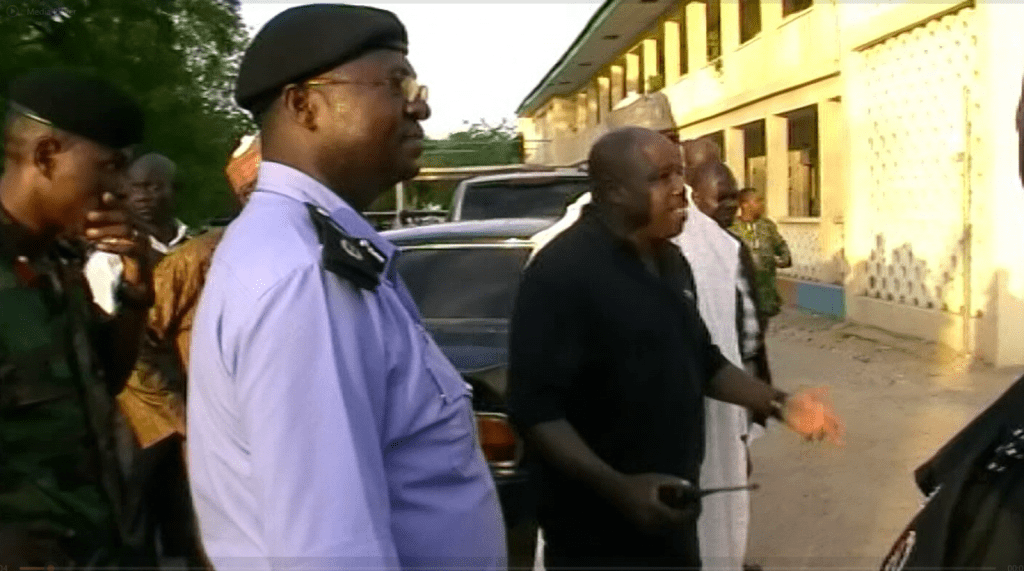
File photo of former Borno State Executive Governor, Ali Modu Sheriff, with the former state Commissioner of Police, Christopher Dega, at the police headquarters in Maiduguri on July 27, 2009.
Blood ties and the machinery of war
To understand how this story has unfolded, one has to see Yusuf as the centre of a household as well.
He had four wives and a large number of children, between 24 and 26, according to the accounts available. His first wife was Aisha, also known as Ya Bintu or Yaya Bintu. Among the children attributed to her are Yusuf, Habib, Ibrahim, Ahmad, Imam Muslim, Abdullahi (also called Abba), Isa, and Abdulazeez.
His second wife was Fatima, also called Ummu Zara. Children linked to her include Zarah, Alhaji Ba (recalled unclearly in one account), Iya Gana, Ummu Kulthu, Aish, Uma, and Abdulwahab.
His third wife was Hajja Gana, also called Ba’ba. Children associated with her include Zainab (often called Ummi), Maryam, Umar, and Khadija (also known as Ya Dija).
The fourth wife was Ummu Tulaf, or Ummuthulab in some accounts. Muazu is consistently named among her children. This is not a perfect register, but a family history carried through oral memory, insurgent secrecy, death, displacement, and the distortions that come when names are repeated across generations. But the uncertainties do not dilute the central point. Yusuf did not leave behind a disembodied ideology. He left behind a house, and that house has remained part of the machinery of war to date.
One relative of Yusuf, based in Kano, who spoke in detail about the family, put it simply: “All of his children are part of the insurgency. Some are dead now. But they are all part of it with no exceptions.”
The first son, Yusuf, married in Hotoro, Kano State, in 2010. The marriage was brief; he died not long after, leaving no children. His death followed the September 7, 2010, prison break in Bauchi, when Boko Haram freed hundreds of their members. Some of the escapees of that prison break were later traced to a hideout in Hotoro, where Yusuf lived. Security forces moved in. In the exchange that followed, Yusuf, the first son of Mohammed Yusuf, was killed.
Habib, the second son, known as Abu Musab, became the most consequential. Family testimony about his domestic life varies in detail, as such testimony often does in clandestine worlds, but the core is clear. He had multiple wives and many children. Zainab is recalled as one wife, Halima as another, Aisha as another. Their children, depending on who recounts the family tree, include Mus’ab, Humaira, Rumaisa, Muhammad, another Muhammad, Shifa’u, Ramla, Zarah, Rufaidah, Kasim, Abdullahi, and Amir. In one account, there is mention of a concubine or enslaved woman who bore him a daughter.
After the July 2009 violent outbreak, most of Mohammed Yusuf’s children, except his first son, were moved out of Nigeria. They were first taken to Kusiri in northern Cameroon, then to N’Djamena in Chad, where they continued their religious education under Sudanese and Chadian tutors. This relocation appears to have taken place within months of Yusuf’s death and was aimed at preserving both their safety and their symbolic value within the movement.
In 2012, after Abubakar Shekau left Rijiyan Zaki in Kano and established himself in the Sambisa forest, he ordered Yusuf’s children to be brought back into the insurgent enclave, which the group had begun to frame as its Daula. This move reflected a deliberate effort to consolidate legitimacy by reabsorbing Yusuf’s lineage into the insurgency’s core.
Among those elevated during this period was Abu Musab al-Barnawi. He was progressively assigned roles that combined religious authority and operational relevance, positioning him as a bridge between doctrinal leadership and battlefield command.
From 2015 to 2016, tensions between Shekau and ISIS leadership intensified. The central issue was Shekau’s expansive use of takfir, particularly Takfir al-‘Umum, which justified violence against broad segments of the Muslim population. ISIS leadership, including Abu Muhammad al-Adnani, engaged in repeated efforts to moderate Shekau’s position. These attempts also addressed concerns over targeting practices, the use of female suicide bombers, and command discipline. All efforts failed.
In August 2016, ISIS formally intervened. Through its Al-Naba publication, it announced the removal of Shekau as leader and the appointment of Abu Musab al-Barnawi as Wali of the Islamic State’s West Africa Province (ISWAP). This marked the formal split between Boko Haram and ISWAP. The decision was externally driven by ISIS central and reflected a strategic shift toward a more controlled and population-focused insurgent model under new leadership.
Abba (aka Abu Umaysa), whose given name is Abdullahi, is also one of Yusuf’s sons. He reportedly had multiple wives and children, including Muhammad, Maryam, Aisha, and at least one other son. Within the insurgent structure, he played a technical and operational role, particularly in communications. Sources indicate he was responsible for managing encrypted messaging platforms that facilitated contact between ISWAP leadership and ISIS-linked actors in the Middle East.
A file photo of the workstation Abba shared with Baban Hassan during their time as senior members of the ISWAP media unit in the Lake Chad basin.
Despite his communications role, Abba was known to participate directly in combat operations, a pattern that reportedly drew disapproval from senior leadership due to the sensitivity of his liaison responsibilities. Internal disputes led to repeated detentions. Abba was imprisoned on four separate occasions by his brother Abu Musab, including periods of detention alongside that of Mamman Nur, a senior figure associated with Mohammed Yusuf’s lifetime.
In one instance, he escaped custody with other fighters and fled to the Niger Republic, but later returned. According to a source, he was subsequently pardoned and allowed to reintegrate without facing the death penalty typically imposed on members accused of attempting to defect.
A senior ISWAP defector, Malam Ibrahim, stated that during one period of detention linked to internal disagreements, ISIS-linked contacts “declined communication with ISWAP as long as they did not hear his voice. He was released immediately to continue his work.”
Abba later died in early 2023 during an engagement with the Multinational Joint Task Force in the Kangarwa forest area.
The other sons, Muslim, Abdulazeez, Isa, and Abdulwahab, are described by one source as married and without children at the time of this report. However, Muslim was arrested in Chad when he was trying to defect from the group to live outside of Nigeria.
Even inside the household of a movement that would later devastate the northeast, family life is still narrated through the intimate vocabulary of births, marriages, hopes, namesakes, and unanswered prayers for children. That is exactly why the story resists easy reduction. The people at the centre of violence remained human in their own domestic worlds. That does not mitigate their responsibility, but it explains how such worlds sustain themselves.
The patriarch’s execution
Yusuf’s rise spiked because of his soft-spoken, unusual, and persuasive verbal skills rather than his scholastic proficiency. He did not need the theatrics many expected from Sahel’s religious authorities. He could name what young men already felt but had not yet organised into doctrine. Corruption. Injustice. Absence. State impunity. The feeling that rulers had abandoned both God and the governed. He took those scattered injuries and gave them a single haunting frame.
Yusuf was carrying a worldview shaped by transnational currents, doctrinal disputes within Nigeria and the broader Sahel Islam, and his own insistence that the Nigerian state was religiously illegitimate.
Then came the extrajudicial killing.
Outside the police headquarters in Maiduguri, Yusuf was captured on camera, alive in custody, seated and handcuffed. Later, he was dead, his body riddled with bullets. The state said he had been shot while trying to escape. The footage with his hands tied, however, invalidated that claim.
What followed was brutal and systematic. Raids spread across northern states, with Maiduguri at the centre. Security forces targeted hospitals and local pharmacies. They forced staff to identify and lead them to patients treated for gunshot wounds or related injuries. Those patients were taken to the State Police headquarters. Some could barely stand. Some were on crutches. Some were executed at close range in the presence of this reporter, as documented here.
File photo of suspected members of Boko Haram in crutches before they were summarily executed at the entrance of the Borno State Police Command Headquarters by security forces.
For followers, the image of Yusuf became proof of everything he had preached about state injustice. This was the moment the war entered the family’s bloodstream. His children, who had already grown up under his teachings, now witnessed his extrajudicial death.
Abu Musab was central to the next phase.
The rise and fall of Abu Musab
Relatives remember him first as a disciplined son who rose through the ranks. He became a Munzir, later Ka’id, fiya, then a Waliy. He read deeply. He gained influence not only because he was Yusuf’s son but because he appeared to embody knowledge and steadiness.
Some accounts describe him as a serious internal voice within the insurgency, especially in doctrinal disputes over takfir and the treatment of ordinary Muslims. At one point, some within the movement argued that any Muslim who refused to migrate to the bush and live under insurgent control was an unbeliever. The practical effect of that doctrine was robbery, extortion, and killing.
Abu Musab is remembered by those close to him as having resisted that direction. “People had reasons they could not leave,” he said in one of his recorded messages. “Not everyone outside the bush was an apostate.” That detail does not make him humane in any broad sense. He remained a leader in a movement that killed, abducted, raped, extorted, and terrorised civilians. But it does place him more accurately within the insurgency’s internal tapestry. He was part of the crop of leaders who believed Shekau had gone too far.
That split would define the next phase of the war.
After Yusuf’s death, Abubakar Shekau turned what remained of the movement into a machine of spectacle and indiscriminate terror. His fighters razed villages, bombed markets, assassinated Muslim clerics, and turned young women and girls into delivery systems for explosives. Entire communities were punished under expansive accusations of unbelief or collaboration. Shekau did not merely fight the Nigerian state. He fought whole populations, including the Muslims his faction claimed to defend.
Inside the movement, dissent built over time. Some of Yusuf’s old followers, including members of his family, believed Shekau had broken from the founder’s original doctrinal line. They still believed in jihad. They still rejected the Nigerian state. But they did not accept his disregard for restraint and counsel.
When the movement pledged allegiance to the Islamic State, those internal disputes widened. That split changed the insurgency’s logic. Shekau’s faction remained rooted in Sambisa and in a politics of fear, punishment, and theatrical violence. ISWAP, under Abu Musab, moved toward an equally brutal but more organised form of insurgent governance around the Lake Chad Basin. It taxed fishermen, farmers, and traders. It built courts, regulated movement, and sought not merely to kill but to rule.
It was still a terrorist organisation. It still abducted, extorted, murdered, raped and coerced. But its method of domination differed from Boko Haram. Where Shekau often destroyed civilian life outright, ISWAP frequently sought to occupy it, supervise it, and harvest from it. Communities brutalised by both insurgents and the military often did not think in abstract moral categories. They thought in terms of survival. To some, ISWAP looked more predictable than Shekau’s men, less erratic, and more likely to tax than to massacre. In this phase, Yusuf’s family became an infrastructure.
Some sons moved into command, others into ideological work. Some daughters married senior figures, tightening bonds between bloodline and leadership. One of Yusuf’s wives, Hajja Gana, later married Abubakar Shekau. The geography of Lake Chad then amplified everything.
Once a vast inland body of water, the lake has, over the decades, become a shifting geography of reeds, channels, islands, marshes, and seasonal passages where state borders blur, and state authority thins into abstraction. A fighter can move from Nigeria into Niger or Chad with less friction than a trader might face at a conventional checkpoint. Armouries can be hidden on islands. Training camps can be relocated across terrains that conceal unfriendly surveillance. Tax routes can be imposed on fishing channels more effectively than the Nigerian state can regulate ordinary commercial life in some border communities.
Yet dynasties do not move cleanly. They fracture from within.
Abu Musab’s rise inside ISWAP did not end in settled power. Internal struggles sharpened. Rivalries widened within the rank-and-file and the shura. Family accounts describe a period of captivity that placed him in real danger. The Boko Haram faction led by one Bakura Doro wanted him dead. Some within ISWAP opposed his return to influence, reflecting deeper internal fractures shaped by ideology, loyalty, and competition for authority. Yet he retained a critical asset: He was a recognised member of the shura within the broader Islamic State network. That status placed him within a transnational decision-making architecture that extends beyond the Lake Chad Basin, linking local commanders to the central leadership historically based in the Levant and later dispersed across multiple theatres.
According to a high-profile source, “a decision was made to extract him, perhaps toward North Africa or the Middle East.” Such a move would align with patterns seen in the Islamic State’s global operations, where experienced figures are sometimes redeployed across provinces. These decisions are often driven by strategic need, internal distrust, or the desire to preserve individuals with institutional memory and ideological legitimacy within the wider ISIS ecosystem.
That plan never reached its destination.
Instead, he moved through Nigeria under concealment. He spent time with one of his wives and their child. He moved through Kano. He surfaced in Kaduna. The high-profile source said, “Kaduna was the location chosen for him to wait for his travel documents to be processed.” HumAngle gathered that he was in the process of obtaining a Niger Republic international passport. At his Kaduna hideout, between April 21 and May 19, 2023, one of his couriers was tracked and security agents followed the trail to the house.
What remains most striking is that they appear not to have known whom they were closing in on. They suspected criminality, but by available accounts, they did not know they were approaching Abu Musab al-Barnawi himself.
Abu Musab heard heavy banging at the gate, mixed with men shouting and the rumble of vehicles. He knew immediately it was security forces. HumAngle gathered through extensive interviews that he was calm, almost detached. He told his young wife, who was holding their young child, to open the gate. As she moved toward it, he slipped into the room’s toilet. Moments later, he detonated the explosive vest strapped to his body.
The blast stunned everyone outside, including his wife. The sound cut through the compound without warning. He chose death over arrest, over public disgrace, over the certainty of spending the rest of his life behind bars.
There was no public announcement after the blast that killed Abu Musab, no official triumph, no clear state recognition that one of the most significant insurgent figures in the region had died in that house. The insurgents, too, remained quiet, neither publicly mourning nor confirming the incident. Instead, the kunya Abu Musab continued to circulate, adopted by others as part of the deception and continuity that sophisticated insurgent networks rely on.
So he died in near silence.
A complex conflict
The temptation in telling this story is to simplify it into a mirror, a dreadful, clean reflective script revealing the ugliness and wretchedness of ruthless power mixed with aloof governance. The state is wholly guilty. The insurgents are evil. The civilians are trapped. All of that is true, and none of it is enough.
Yusuf’s movement drew strength from three elements that must be held up together if the story is to make sense.
The first was ideology. A structured creed, nourished by transnational currents, that delegitimised secular authority and imagined an Islamic order justified by violence.
The second was a grievance about corrupt governance, collapsed services, absent justice, police extortion, and growing poverty and unemployment across northern Nigeria.
The third was impunity: lawlessness by the state, extrajudicial killings, collective punishment, detention without process, and the routine treatment of poor people as disposable.
Some of the young men who heard and looked up to Yusuf died in 2009, before the insurgency fully matured. Some fled and returned. Some crossed into Chad, Niger, Cameroon and Sudan. Some started living normal lives. Some became commanders, teachers, recruiters, executioners, or administrators in the insurgent order. Some of his children, like Abu Musab, moved into leadership. Others remained within family or support structures inside the insurgent ecosystem. Some died. Some vanished. Some married deeper into the insurgency. Some had children in forest camps and island settlements. Those children then formed a third generation.
That third generation may be the hardest part of this story.
Across parts of the Lake Chad Basin, children have grown up under insurgent authority or the culture of violence, with no memory of peace. Their parents’ stories are not about school, court, civic life, or public trust. They are about raids, camps, betrayal, martyrdom, command, and survival.
In Borno, Yobe, and across the Lake Chad region, insurgency is not sustained only by ideology at the top. It is sustained by marriages, kinship, cattle routes, fishing economies, clerical contentions, clans, dialects, borderland trade, and the practical calculations of communities trying to stay alive between insurgent taxation and military suspicion. A woman’s marriage can be an alliance, survival, coercion, and entrapment all at once. A boy’s movement from the city to the forest can be due to indoctrination, family obedience, or a lack of alternatives. A trader may pay insurgents not because he supports them but because the state has left him no other safe route.
That is also why the story cuts beyond Nigeria.
The symmetry is brutal. The state killed the father after capture. The son killed himself to avoid capture. Between those two deaths lies the whole distortion of the northeast conflict. A state too often governed by force rather than law. An insurgency that chose violence over any serious claim to humanity. A population trapped between them, paying in graves, hunger, displacement, and silence.
More than a decade after Yusuf’s death, the conflict he helped set in motion has not collapsed into victory or defeat. Instead, it has settled into a prolonged contest between military containment and insurgent adaptation.
The Nigerian military and the Multinational Joint Task Force have, despite operational limitations, prevented a full territorial takeover by Boko Haram and ISWAP. At multiple points, especially between 2013 and 2015, insurgents controlled significant territory. That phase was rolled back through sustained military pressure.
However, these successes were fundamentally limited. The military has achieved containment, not resolution. This creates a circle where military gains are repeatedly eroded in the absence of credible state presence, turning the conflict into a durable stalemate rather than a solvable war.
The danger now is not only that Nigerians forget Mohammed Yusuf’s actual place in this history. The danger is that the next generation inherits only the myths. On one side, the state myth that terrorism came from nowhere and can be resolved through raids, procurement, press releases, and more force. On the other side, the insurgent myth is that an unbelieving state martyred a “righteous founder” and that his children merely carried forward a sacred duty.
Both myths kill.
The truer version is harder. Yusuf was a product of corrosive ideology, ambition, and grievance. That is why this story still matters.
Nigeria did not invent militant Salafi ideology. It did not write the script of the Afghan jihad. It did not create global takfiri currents. But Nigeria did something unforgivable in its own space. It abandoned millions of citizens to conditions in which men like Mohammed Yusuf could speak with authority. Then, when the blowback came, it answered with the same habits that had already emptied the state of legitimacy in the eyes of many.
There is one final image that remains.
Somewhere in northern Nigeria, perhaps in Lake Chad, perhaps in a displacement camp, perhaps in a community held loosely between one armed authority and another, a child is being taught. The question is not whether that child will learn religion. The question is what will be wrapped around it.
After more than two and a half years of research, planning and construction, Dataland, the world’s first museum of AI arts, will open June 20.
Co-founded by new media artists Refik Anadol and Efsun Erkılıç, the museum anchors the $1-billion Frank Gehry-designed Grand LA complex across the street from Walt Disney Concert Hall in downtown Los Angeles. Its first exhibition, “Machine Dreams: Rainforest,” created by Refik Anadol Studio, was inspired by a trip to the Amazon and uses vast data sets to immerse visitors in a machine-generated sensory experience of the natural world.
The architecture of the space, which Anadol calls “a living museum,” is used to reflect distant rainforest ecosystems, including changing temperature, light, smell and visuals. Anadol refers to these large-scale, shimmering tableaus as “digital sculptures.”
“This is such an important technology, and represents such an important transformation of humanity,” Anadol said in an interview. “And we found it so meaningful and purposeful to be sure that there is a place to talk about it, to create with it.”
The 35,000-square-foot privately funded museum devotes 25,000 square feet to public space, with the remaining 10,000 square feet holding the in-house technology that makes the space run. Dataland contains five immersive galleries and a 30-foot ceiling. An escalator by the entrance will transport guests to the experiences below. The museum declined to say how much Dataland, designed by architecture firm Gensler, cost to build.
An isometric architectural rendering of Dataland. The 25,000-square-foot AI arts museum also contains an additional 10,000 square feet of non-public space that holds its operational technology.
(Refik Anadol Studio for Dataland)
Dataland will collect and preserve artificial intelligence art and is powered by an open-access AI model created by Anadol’s studio called the Large Nature Model. The model, which does not source without permission, culls mountains of data about the natural world from partners including the Smithsonian, London’s Natural History Museum and the Cornell Lab of Ornithology. This data, including up to half a billion images of nature, will form the basis for the creation of a variety of AI artworks, including “Machine Dreams.”
“AI art is a part of digital art, meaning a lineage that uses software, data and computers to create a form of art,” Anadol explained. “I know that many artists don’t want to disclose their technologies, but for me, AI means possibilities. And possibilities come with responsibilities. We have to disclose exactly where our data comes from.”
Sustainability is another responsibility that Anadol takes seriously. For more than a decade, Anadol has devoted much thought to the massive carbon footprint associated with AI models. The Large Nature Model is hosted on Google Cloud servers in Oregon that use 87% carbon-free, renewable energy. Anadol says the energy used to support an individual visit to the museum is equivalent to what it takes to charge a single smartphone.
Anadol believes AI can form a powerful bridge to nature — serving as a means to access and preserve it — and that the swiftly evolving technology can be harnessed to illuminate essential truths about humanity’s relationship to an interconnected planet. During a time of great anxiety about the power of AI to disrupt lives and livelihoods, Anadol maintains it can be a revolutionary tool in service of a never-before-seen form of art.
“The works generate an emergent, living reality, a machine’s dream shaped by continuous streams of environmental and biological data. Within this evolving system, moments of recognition and interpretation emerge across different forms of knowledge,” a news release about the museum explains. “At the same time, the exhibition registers loss as part of this expanded field of perception, most notably in the Infinity Room, where visitors encounter the 1987 recording of the last known Kauaʻi ʻŌʻō, a now-extinct bird whose unanswered call becomes part of the work.”
“It’s very exciting to say that AI art is not image only,” Anadol said. “It’s a very multisensory, multimedium experience — meaning sound, image, video, text, smell, taste and touch. They are all together in conversation.”
Ryanair has criticised a new aviation tax that has been imposed on a European country and urged it to be abandoned as the airline outlined its impact on travel and tourists
Ryanair has slammed a new aviation tax imposed by a European hotspot(Image: Getty Images)
Ryanair has slammed the new aviation tax imposed on a major holiday hotspot and urged it to be ditched in a bid to boost visitor numbers.
The beautiful country of Austria offers a scenic escape, thanks to its dramatic backdrops of snow-capped mountains, mirrored lakes, alpine forests, rolling hills, national parks, and fairy-tale-like villages. Vienna, Salzburg and Hallstatt are among the most popular destinations for Brits.
According to the outspoken people at budget airline Ryanair, a €12 (£10.39) aviation tax imposed by the countries could severely impact airlines and, in turn, travel to the country.
Ryanair claimed the tax will see airlines such as Wizz Air, Level and easyJet “abandon Austria”, although it’s worth noting these other airlines have not issued statements to this effect. Two of Austria’s biggest airlines, AUA and Ryanair, have cut their capacity and closed routes, opting for “lower-cost neighbouring countries” such as Albania, Italy and Slovakia, according to Ryanair. The airline has long been a vocal opponent of many different forms of aviation taxes, despite a post-tax profit of £1.31 billion last year, according to AJ Bell.
Earlier this week, Ryanair called on the Government of Austria to ditch its €12 aviation tax by May 1, over concerns that it could lead to a “decline in airlines, routes and traffic serving Austrian airports”. The airline noted that the €12 tax has made “Austria uncompetitive”, as countries such as Albania, Italy and Slovakia have opted to revoke aviation taxes, lower ATC fees, and introduce growth incentive schemes to help reduce airport costs for airlines.
Ryanair has demanded that the €12 aviation tax is axed by the Austrian government, or else claims that it won’t invest in the country. The airline says it has a $1 billion (£740 million) growth plan, which could include basing 10 new B737 aircraft based in Vienna. If these proposed plans went ahead, Ryanair says the country’s traffic would grow by 70%, to 12 million passengers within the next five years.
As much as Ryanair’s bosses may not like the levy, the aviation industry has long benefitted from generous tax breaks. Even now, no fuel duty is paid on jet fuel, and no VAT is applied. This is in sharp contrast to other modes of transport. When it comes to driving in the UK, petrol is hit with a levy of 52.95 pence per litre, as well as 20% VAT.
“Aviation’s exemption from fuel duty and VAT appears more like an indirect subsidy that allows airfares to be kept artificially low. The absence of tax has helped to fuel passenger growth and the sector’s CO2 emissions have increased 125% since 1990. Over the same period, the UK’s overall emissions decreased by 43%,” writes the Aviation Environment Federation.
In a statement released on April 21, the CEO of Ryanair, Michael O’Leary, said: “Today we call again on Chancellor Stocker and Transport Minister Hanke to abandon their failed high tax policies. Austria has become totally uncompetitive, and is losing aircraft, routes and traffic to lower cost alternatives like Slovakia, Albania and Regional Italy. Even Sweden, the home of Greta Thunberg and flight shaming, has now abolished its aviation tax.
“Meanwhile, Austria has the highest aviation taxes, the highest ATC fees, and Vienna Airport has abandoned its growth incentive schemes, making Austria and Vienna hopelessly uncompetitive at a time when neighbours such as Slovakia have abolished aviation taxes, slashed ATC fees, and have lowered airport charges through growth incentive schemes, which Vienna Airport used to offer, but no longer does.
“The solution to Austria’s aviation crisis is clear. We need leadership and we need action. Abolish Austria’s harmful €12 aviation tax, cut Austria’s expensive ATC fees immediately by 50% to make them competitive with neighbouring Slovakia, and demand that Vienna Airport reinstate the growth incentive schemes, which were such a success when Vienna introduced them 8 years ago.
“Ryanair can and will deliver rapid traffic and tourism growth for Vienna, but only when Austria offers a competitive cost base to that currently offered in Slovakia, Albania and Regional Italy. Until such time as it does, it is inevitable that Austria will continue to lose aircraft, routes, traffic and jobs to lower cost countries, while “Sleepy Stocker” and “Hopeless Hanke” fiddle around with “reform” of the aviation tax, when what it needs, is abolition.
“It’s time for action from the Stocker Govt, and we call on them to abolish this stupid aviation tax on 1 May next, and give Austria an opportunity to recover the traffic, tourism and jobs it has lost as a result of its high tax policy over recent years.”
Do you have a travel story to share? Email webtravel@reachplc.com
Ninety-five years ago next month, Aurelio Manrique Jr. landed a job as a mild-mannered L.A. Times columnist. But the resume this native of the central Mexico state of San Luis Potosí brought to the paper was that of a firebrand.
You’re reading the Essential California newsletter
Sign up to start every day with California’s most important stories.
By continuing, you agree to our Terms of Service, which include arbitration and a class action waiver. You agree that we and our third-party vendors may collect and use your information, including through cookies, pixels and similar technologies, for the purposes set forth in our Privacy Policy such as personalizing your experience and ads.
Medical student turned political prisoner. Fought in the Mexican Revolution. Governor of his home state. Trusted advisor of general-turned-president Álvaro Obregón. Founder of a left-wing political party. Mexican legislator. He even took to the floor of Mexico’s congress to denounce former president Plutarco Elías Calles as a farsante — a phony — and then pull a gun on a rival who took issue with his vitriol.
Tall, with round wire glasses and a shock of black hair that was the inverse of his Moses-like beard, Manrique cut an exciting figure in Latino L.A. when he arrived as a political exile in 1929 after the so-called Escobar rebellion, which was an attempt to overthrow the Mexican government. A Oct. 28, 1929 Times dispatch noted that “it is not uncommon to find among the shabby, shuffling street venders [sic] of Sonoratown” former Mexican bigwigs “offering sweetmeats and trinkets from trays” in an effort to survive.
Finding a home in L.A.
They, like so many other political refugees before and since, made L.A. a home but also a place to fight for the freedom of their homeland.
Manrique, on the other hand, was hailed as the “intellectual head” of his fellow Mexican refugee politicos and an “accomplished linguist” who spoke Spanish, English, French and German.
“He stands in my memory as a pillar of fire because, at all times, he has never been afraid to do or say what he considered to be right, regardless of his own personal or political fate,” an admirer would recall decades later in the Virginia Quarterly Review.
The revolutionary found welcome audiences across the Southland with lectures and Spanish-language radio show appearances to talk about what was going on in his home country. He participated in Mexican Independence Day and Cinco de Mayo festivities and even found work in Hollywood films as everything from a British lord to an Arab sheikh.
But reputation doesn’t pay the bills, so Manrique also offered translation and interpreter services from a small Bunker Hill office. He also held Spanish-language classes twice a week at the L.A. Central Library. Soon after, The Times — a paper that back then loathed leftists of all stripes — hired Manrique as a columnist in May 1931. He was to be in charge of its daily Spanish-language roundup of world and local events, which the paper had regularly published since 1922.
The revolutionary plays a more reserved role
I wish I could say that Manrique used his platform to inveigh against the mass roundups of Mexican Americans that kicked off that year and that would lead to the repatriation of hundreds of thousands of Mexican Americans, citizens and not, during the 1930s. Or that Manrique taught his Times bosses that Latinos were more than domestic help or a societal scourge. Or that he deserves a spot in the pantheon of legendary Times metro columnists like Jack Smith, Ruben Salazar and Steve Lopez.
Alas, it was not to be.
The daily columna was just a roundup of wire stories published in Spanish, part of The Times’ effort to teach the language of Cervantes to those interested. Every Monday, the 40-year-old Manrique also wrote Platicas de Los Lunes [Monday Lessons], a place for the professor to teach new words to readers via translations, poems and sample sentences.
Manrique’s last byline was April 25, 1932. In the hundreds of columnas he wrote for us, I found nothing even remotely hinting at the progressive lion that Mexicans in Southern California knew him as. But in an era in which Latino visibility in Anglo Southern California was nonexistent when it wasn’t heavily stereotyped, Manriquez’s brief tenure at The Times was an important step for future Latino writers at the paper, all of us whom owe a debt to the man.
He returned to Mexico in early 1933 after President Abelardo L. Rodríguez announced amnesty for him and other exiles. The former revolutionary spent the rest of his life working for the Mexican government, most notably as ambassador to Scandinavian countries from 1946 to 1956.
In 1962, the retired Manrique returned to his old L.A. stomping grounds one final time five years before his death for a lecture at the Alexandria Hotel.
“He finds Los Angeles completely changed,” La Opinión reported, “and told us, with a tone of barely concealed sadness, that many of those who knew him had disappeared.”
The fate of all Angelenos, alas.
Today’s top stories
Republican gubernatorial candidate Steve Hilton speaks at a March 7 town hall in Mentone.
(Gina Ferazzi / Los Angeles Times)
A Trump-endorsed Republican could become California’s next governor
A second ticket drop for the Olympics
A second ticket drop is set to open in August and will offer refreshed inventory across all sports at a range of prices.
Those who registered but did not receive a slot in the first ticket drop or did not buy all 12 of their tickets will be enrolled in a lottery for a spot in the second ticket drop.
The parks will serve historically underserved communities with recreation and historic preservation.
What else is going on
Commentary and opinions
This morning’s must-read
Other must-reads
For your downtime
The waffle with maple butter is the drive-across-town dish at celebrity-backed Max & Helen’s, the Larchmont diner opened by Phil Rosenthal and Nancy Silverton.
(Ron De Angelis / For The Times)
Going out
Staying in
A question for you: What’s your favorite California-themed book?
Marya says, “Hard Times in Paradise” by David and Micki Colfax.
Cristina says, “Grapes of Wrath” by John Steinbeck.
On this day 21 years ago, “Me at the zoo” was the first video uploaded to YouTube, opening the door to a new medium of television.
For the 20th anniversary last year, The Times’ Wendy Lee wrote about the video sharing platform and how it changed TV as we know it.
Have a great day, from the Essential California team
Jim Rainey, staff reporter Hugo Martín, assistant editor, fast break desk Kevinisha Walker, multiplatform editor Andrew Campa, weekend writer Karim Doumar, head of newsletters
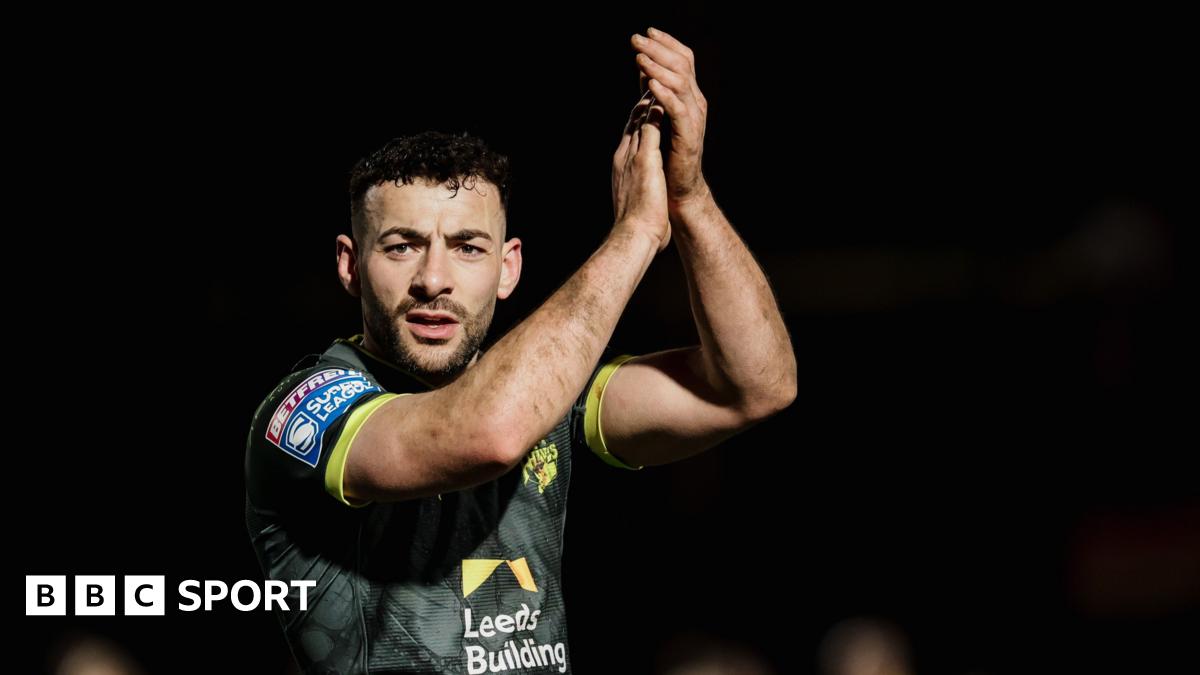
England’s new head coach Brian McDermott has offered Man of Steel Jake Connor a path back into the national squad for this autumn’s Rugby League World Cup.
McDermott, confirmed in the role on Thursday, has described the Leeds Rhinos half-back as a “game-breaker”.
Connor, 31, was controversially left out of Shaun Wane’s squad for last autumn’s Ashes home series against Australia, which England lost 3-0.
At the time, Wane said the decision to omit Connor was “not really difficult” and that he had made it based on the player’s form, adding that: “When picking a squad, the thing you will never hear from me is: ‘He’s won the Man of Steel.’ I don’t pay attention to stuff like that.”
Wane stepped down in January, with former Leeds head coach McDermott taking over until the end of the World Cup, to be staged in Australia, New Zealand and Papua New Guinea this October and November.
McDermott played down questions over Connor’s temperament and said the half-back is part of England’s World Cup plans, saying: “Yeah, he is for sure. Absolutely.
“I think the rhetoric and the narrative around Jake was tremendously unfair.
“I understand where Jake Connor comes from in that he’s liked by some and disliked by others. OK, that comes in the nature of the game.
“We could sit around a table and debate whether he’s a nice person or not.
“I just don’t think that’s a fair narrative to be made public and that was the rhetoric around him.
“What nobody can argue is that he’s a tremendous player. He’s a fantastic player. He’s a game-breaker.”
McDermott won four Super League Grand Finals, two Challenge Cups, the World Club Challenge and the League Leaders’ Shield in eight years as Leeds head coach.
The 56-year-old, currently working as an assistant coach at NRL club Gold Coast Titans, has taken the England role on a part-time basis, in contrast to his full-time predecessor Wane.
“I would be interested in taking the job beyond the World Cup,” McDermott said.
The Yorkshireman was selected by the Rugby Football League from a five-man shortlist, which also included current Leeds head coach Brad Arthur, Warrington’s Sam Burgess, St Helens’ Paul Rowley and former England head coach Steve McNamara.
England’s World Cup campaign in Australia begins against Tonga in Perth on 17 October, with games against France and Papua New Guinea to follow.
Details of how Lebanese journalist Amal Khalil was “pursued” and killed by Israeli forces have been released by the network she worked for. Here’s what happened.
When travelling, it’s important to know what won’t get you in trouble at customs
14:37, 23 Apr 2026Updated 14:39, 23 Apr 2026
People returning from holiday need to know this rule(Image: Miragest via Getty Images)
Travellers could face fines or worse if they overlook an airport ‘rule’ that puts a limit on certain items. It could catch Brits off guard if they end their latest getaway with a last-minute spending spree on various common products or high-end items.
When going to or from the European Union (EU), it is important to understand the regulations regarding the duty-free allowance passengers are permitted. Failing to comply with these restrictions could result in goods being seized, along with potential fines or legal proceedings.
The duty-free allowance applies to both EU and non-EU nationals, including holidaymakers and business travellers. Following Brexit, the UK has been adhering to the regulations for non-EU nationals.
Why is there a duty-free allowance?
Duty-free allowance is the authorised quantity of goods, such as alcohol, tobacco, and gifts, that travellers can bring into a country without incurring customs duty, value-added tax (VAT), or other levies. As a result, people face a strict limit on how much they can observe, or risk being perceived as exploiting the system, reports the Express.
What are the duty-free limits?
Duty-free allowances are split into two categories – restricted and unrestricted goods. Unrestricted goods are those without any special regulations or caps, such as clothing, electronics, or personal belongings, while restricted items are subject to specific limitations, including alcohol, tobacco, and perfume.
The restrictions in place also vary depending on how you’re returning to the UK. Shoppers are often caught out by the deals on offer in airports – but identical rules apply to those travelling by sea.
You’re also unable to pool your allowance with fellow passengers, which means people need to be mindful of their own spending habits. According to ETIAS Visa Europe, Brits returning to the UK via air or sea travel have the following allowances on ‘restricted’ items:
200 cigarettes (or 100 cigarillos or 50 cigars or 250g of tobacco)
Four litres of still wine and 16 litres of beer and one litre of spirits or two litres of fortified or sparkling wine
Other goods up to a value of €430 per person
The thresholds are reduced for non-EU citizens travelling by rail or road. The website explains that travellers should bring no more than:
40 cigarettes (or 20 cigarillos or 10 cigars or 50g of tobacco)
One litre of spirits or two litres of fortified or sparkling wine and four litres of still wine and 16 litres of beer
Other goods up to a value of €300 per person
ETIAS warned that, when goods go beyond the duty-free allowance, customs duty, value-added tax (VAT), and other taxes may be applied on the excess amount. The total of duties and taxes owed depends on various factors, such as the type of goods, their value, and the country of origin.
A spokesperson said: “To avoid overpaying taxes and duties, travellers should be aware of the duty-free allowances for the type of goods they are bringing into the EU. They should accurately declare all goods they are bringing in and their value.
“If unsure about the value of an item, travellers can check online or with customs officials. Additionally, travellers should keep all receipts and documentation to show the value of their goods.”
IT’S fair to say that there is a sense of nervousness when it comes to a holiday abroad this year.
What with warnings of summer holiday cancellations and airlines cancelling thousands of flights – it’s no wonder Brits are booking more staycations than ever.
Sign up for the Travel newsletter
Thank you!
Forget flights – you can still explore Europe and the Caribbean thanks to cruises and trainsCredit: Alamy
But there is still a way to have a foreign holiday without hopping on a flight, thanks to a number of cruises, ferries, trains and car tunnels going from the UK.
Brittany Ferries, who operate a number of sailings across the UK, said that maritime fuels are not being affected, and prices won’t be going up either.
Brittany Ferries boss Christophe Mathieu said: “If you have booked with us, or are considering doing so, we will get you to a beautiful and safe holiday destination this year. Period.
“We will play no part in profiteering or seeking to recover losses from a gamble gone wrong, as some appear to be doing.
“The cost of our holidays rose by inflation earlier this year, and by inflation alone. There will be no further rises in the weeks or months ahead.”
So we’ve done the hard work for you and rounded up some of the best places to go from the UK where you can avoid the having to go to the airport entirely.
Seven nights around Spain and Portugal by cruise
You don’t have to hop on a plane to explore Spain and Lisbon.
Royal Caribbean have week-long sailings from Southampton which stop at Bilbao, Lisbon and Vigo, before returning to Southampton.
Prices start from £743pp.
Eurostar train to Lille and Paris
Why not have a two city break with Eurostar, stopping at both of their French cities.
The closest city to the UK by train is Lille, taking less than two hours to get to.
You could then hope on a train the next day to explore Paris, just one stop over.
Prices from £39pp.
You could do Lille and Paris in one weekend via train, thanks to EurostarCredit: Alamy
Eurostar train to Amsterdam and Rotterdam
In a similar vein of Paris and Lille, Eurostar also have direct trains to Amsterdam and Rotterdam.
They take slightly longer – Rotterdam is around 3hr15 while Amsterdam is just over four hours – but can easily make for a long weekend break.
Prices from £39pp.
Eurotunnel to French seaside towns
The Eurotunnel in Folkestone opens up all of Europe as long as you’re happy to travel by car.
Entering via Calais, why not explore some of France‘s best seaside towns such as Boulogne-sur-Mer and picturesque Wimereux?
Prices from £59pp.
Eurostar runs to a number of cities by train such as Amsterdam as wellCredit: AlamyThe Eurotunnel is perfect for exploring the French seaside towns by carCredit: Alamy
35 days around Caribbean by cruise
If you have the time, you could explore the Caribbean for a month without having to get on a flight.
P&O will take you to St Kitts, Barbados, Grenada, St Lucia, Antigua and Barbuda, while sailing from Southampton – it even includes all your food and tips.
Prices from £2,999pp.
Seven nights around Norwegian Fjords by cruise
Also sailing from Southampton, the Celebrity Cruises trip lets you go around some of the beautiful fjords.
Stops include Haugesund, Ålesund, Nordfjordeid and Zeebrugge.
Travel companies are allowed to incrase the price after you have booked
Travel industry chiefs have warned that holiday prices could go up – even for people who have already booked. There are fears of cancellations, delays and disruptions this summer as oil supplies are restricted by the war in Iran.
And there are concerns that prices of travel will go up to cover the rising cost of fuel. But industry experts have also raised the spectre of the price of existing holiday bookings going up.
That means people who have already booked and paid for their holidays being asked to pay more if they still want to travel. Emma Brennan from travel agent and tour operator trade association ABTA said the legislation allows companies to ask for more money.
Speaking to BBC Money Box Live, she said: “There is something in the package travel regulations which just applies to package holidays, that travel companies could increase the cost of package holidays by what they call a fare charge. However, it very rarely happens, and there have been so many situations of disruption and uncertainty in recent years, and we haven’t seen this happening.
“And even if the travel company did choose to do it, there are quite strict rules around it. So, for example, it would have to have been in their terms and conditions, they can only do it up to the cost of eight per cent after that, and that’s a cost of eight per cent of the whole holiday – after that you would be offered a refund and it can only apply to various cost increases they are facing.”
According to Which? A 14-night package holiday can cost between £1,500 and £2,000 per person – meaning you could be asked to pay an extra £160 – or £640 for a family of four.
Airports Council International, which represents more than 600 airports, wrote recently to European commissioners for energy and transport and tourism, claiming that if the crucial Strait of Hormuz in Iran does not reopen in a “significant and stable way within the next three weeks” then “systemic jet fuel shortage is set to become a reality for the EU”.
Some airlines such as Virgin Atlantic have imposed fuel surcharges on passengers in response to higher oil prices, and others such as KLM have cancelled flights amid concerns about a shortage of fuel.
Susannah Streeter, chief investment strategist at Wealth Club, said: “Consumers are bracing for an energy crunch, and there are fears that just like the credit crunch of 2007-2008, there could be a long tail of repercussions. In the immediate term, there’s the prospect of holiday plans being ruined by a jet fuel crisis which could see thousands of flights cancelled.
“Lufthansa has already scrapped a big chunk of routes, and there are worries tourist destinations could be hit.”
Workers from two regional parties in India have been fighting on election day for West Bengal’s state assembly. Local media reported the fighting broke out as opposition party leaders accused the state ruling party of voter intimidation.
Plucked from a previous life as a working actor, Richard Gadd experienced a disorienting whirlwind less than two years ago. “Baby Reindeer,” his painfully personal 2024 Netflix show, based on the sexual assault he survived, instantly opened the floodgates of fame for him.
“The show came out on Thursday, and by Sunday, I could barely walk anywhere without being recognized, without being stopped,” Gadd says while visiting The Times’ offices earlier this month. “That’s an adjustment because I always thought if anything like that ever happened, it would be a bit more of a gradual process. But it was overnight, so I didn’t have time to adjust.”
Now the winner of three Emmy Awards and a slew of other accolades for that series, which he starred in, wrote and served as showrunner, Gadd, 36, has already helmed a new emotionally ferocious show.
Probing the tropes of rigid masculinity, “Half Man,” premiering Thursday on HBO, chronicles the destructive bond between two men over several decades. Niall and Ruben — whose respective mothers are romantic partners — call themselves brothers but they couldn’t be more dissimilar.
Bullied at school, meek Niall (played by Mitchell Robertson in his youth and Jamie Bell in adulthood) lost his father as a young boy. He dreams of being a writer. Meanwhile, the insolent and hyper-confident Ruben (Stuart Campbell as a teen and Gadd as a grown-up) has been in trouble with the law from a tender age. Facing any conflict, he resorts to brutal violence. When Ruben takes Niall under his wing, the two become inseparable. But as the years and resentments pile on, their cancerous brotherhood threatens to obliterate them both.
“Half Man” follows the destructive bond between Ruben (Richard Gadd), left, and Niall (Jamie Bell) over several decades.
(Anne Binckebanck / HBO)
“Richard’s writing is really unique and really singular,” Bell says on a video call from England, where he’s currently shooting the “Peaky Blinders” sequel series and is sporting a shorter haircut. “He identifies that real gray area of humanity really well and he puts a voice to the most uncomfortable places that we go into or things that we think when we’re alone in the dark, when we think no one’s watching.”
Gadd wrote the first episode of what would become “Half Man” back in 2019, while he still was performing the live version of “Baby Reindeer,” which he turned into the series. At the time, he recalls, society at large was seriously engaging in conversations around toxic masculinity and sexual violence as the #MeToo movement gained strength.
“It wasn’t necessarily that I set out going, ‘Oh, I want to make a show about that,’” Gadd says. “It was more that something must have just drifted into my head thinking, ‘You take two men repressed in their current life, repressed in the modern world. And then you go all the way back to their childhood. You contextualize learned behavior; you contextualize trauma and things they learned that make them these repressed adults. And you bring a bit of context to, I suppose, difficult male behavior in the present.’”
As “Baby Reindeer” launched his career as a creator, Gadd put “Half Man” on ice for four years but couldn’t stop thinking about returning to it. “Even as I was coming to the end of ‘Baby Reindeer,’ I thought, ‘I’m really looking forward to getting back to that project,” he recalls. “The second ‘Baby Reindeer’ finished, I thought, ‘This is what I’m going to do now.’”
Sitting across from the mild-mannered Gadd, the magnitude of his transformation on screen for “Half Man” becomes even more impressive. Gadd comes off as thoughtful and emphatic, while Ruben, his physically imposing character, commands trepidation.
“The second ‘Baby Reindeer’ finished, I thought, ‘This is what I’m going to do now,’” Gadd says about working on “Half Man.”
(Ian Spanier / For The Times)
Watching Gadd as the rage-fueled Ruben, one might be surprised to learn he originally had no intention of acting in “Half Man.” After wearing multiple hats on “Baby Reindeer,” Gadd thought this time around he could get a purely external bird’s-eye view of a project as showrunner and writer of “Half Man.” But eventually people around him suggested he should be in front of the camera once again.
“My initial response was always, ‘That’s just so far away from anything I’ve done before. It’s so far away from me. Are people going to buy it?’” he recalls. “And behind every single fear-based thought was a worry of what people might think, which in my opinion, isn’t a good enough reason to not do something.”
Convinced audiences would struggle to see the guy from “Baby Reindeer” as this “hard man,” a U.K. term for tough and intimidating men, he had to physically morph. To inhabit a new body, Gadd underwent a strict exercise regimen, and most importantly, a new diet.
“I had a chef make these meals in England, fun enough, and send them up to Scotland where I was filming,” he recalls. “I’d eat them at specific times. You go through periods of fasting and through dehydration whenever you had your top off. There was a real science to it.”
And yet, though he at first worried he wouldn’t look big enough, Gadd refused to portray Ruben with a chiseled physique conceived for mere aesthetics.
“I didn’t want him to have a six pack, I wanted him to feel like a real person,” Gadd says. “Sometimes when you see someone on TV and they’re ripped, I almost don’t think that’s real strength. Someone like Ruben, they wear their life in their body, they’re heavy set. It’s not ripped. It’s bulky. It’s natural to him.”
Before he agreed to play the character, Gadd auditioned numerous actors for the part, but with all of them he felt they were too focused on his appearance as an imposing figure and not his inner turmoil. “Ruben is extremely sad as a person. He’s terribly broken and traumatized,” he says.
For the series, Gadd bulked up to become more physically imposing: “Someone like Ruben, they wear their life in their body, they’re heavy set. It’s not ripped. It’s bulky. It’s natural to him.”Richard Gadd in “Half Man.”(Anne Binckebanck / HBO)
When asked if he sees himself as Ruben, Gadd contemplates the question, debating whether it’s his “jetlagged brain” or ambivalence about finding some of Ruben within him.
“Do I see myself in Ruben?” After a pause, he concedes: “All of his behavior is a reaction to a deep traumatic happening in his life. I can relate to finding it extremely difficult to get past big traumatic events and coming to terms with them and coming to terms with yourself even as a result of them.”
With less hesitation, Bell, 40, acknowledges that he finds a certain kinship with his character. As a teenager, Bell flocked to people with a defiant edge. “I grew up without a father in an all-female household and I felt very naked as a child in terms of needing to be protected by someone who was dominant and aggressive,” he says. “I totally understand why Niall seeks solace in someone like him. No one will touch Ruben. There is a safety in that.”
Gadd says he doesn’t think about celebrities when searching for the actors. “I’m quite fame-averse when it comes to casting because I think sometimes it can get in the way,” he explains. “You can have a show, which starts up with all the best intentions, turn into a sort of acting vehicle for someone, or the discussion becomes about the actor doing this role.”
That said, when the casting director on “Half Man” asked him about his “dream cast,” Gadd expressed Bell was the only one who would genuinely excite him. But could that happen? “In my head, I was still in pre-‘Baby Reindeer’ time where I thought, ‘Well, somebody like him is not going to be interested.’ And then I thought, ‘Well, he might be,’” Gadd says.
For his part, Bell found the “nihilism” in Niall, a man desperately running from his true self and living in Ruben’s shadow, an enticing and complex character to play. “[Niall] conceals himself in many different ways, and has a lot of self-loathing, but at the same time has all these ambitions and actually is incredibly egotistical and thinks that his way is the correct way, and that other people don’t understand that he is terminally unique,” Bell explains with a chuckle.
Bell, who plays Niall, says his character “conceals himself in many different ways, and has a lot of self-loathing, but at the same time has all these ambitions and actually is incredibly egotistical …”
(Anne Binckebanck / HBO)
Aside from a tight schedule to produce “Half Man,” the challenge for Bell was adjusting to the dramatic intensity that Gadd was after. “I wasn’t particularly prepared for that, therefore sometimes my reading of certain scenes I’d get wrong. We’d start scenes and Richard was like, ‘You are pitching it at like a six, and this is very much an 11,’” Bell recalls laughing. I was like, ‘Oh, OK.’ That took some modulating.”
In Gadd’s mind, Bell remains an “underrated” artist. A proud Scotsman, Gadd recalls loving Bell in the 2007 romantic dramedy “Hallam Foe,” where the British actor played Scottish. For “Half Man,” Gadd thought Bell could convey the pain that haunts Niall, even as his actions paint him less like Ruben’s victim and more like a vengeful participant in the chaos.
“There’s always something I find so vulnerable about Jamie and I knew that I was going to take Niall in some really big journeys where he was going to almost test the audience’s love for him,” Gadd says. That Niall finds Ruben so alluring is natural to Gadd, who believes the notion of a valiant male figure has been bred into everyone via fables and fairy tales.
Gadd adds that whether or not we like to admit it, we’re drawn to alpha male characters. “Because from an early age, we’ve been told they are always at the top of the social hierarchy. And as a result, we’ve always, as a society, answered to those kinds of people as some sort of leaders.”
And though he says he’s unfamiliar with the “manosphere,” the misogynistic and chauvinistic online community, Gadd doesn’t believe Ruben would fall for the gurus in those circles who claim to have the answers for young guys to become “real men.”
“Ruben carved his own masculinity. To give him credit, if that’s even something you can give him, those spaces wouldn’t hold any weight for him. He’s his own man,” Gad says. “He would never follow anyone on social media. He’s the person to be followed.”
Based on the tone of Gadd’s output thus far, it may come as a surprise that as a young person he dreamed of creating a show along the lines of the U.K.’s “The Office,” which he considers a “perfect piece of art.” The stories he is telling now better reflect his “neuroses” and the experiences he’s endured.
“My life just took a very dramatic turn, and my sensibilities weren’t workplace sitcoms anymore. When I grew up and I was doing comedy I thought, ‘I’ll write a sitcom one day and every character will be sort of funny in it,’” he says. “But my life just took a turn to the point where I needed my writing and my art darkened because what I went through was very dark.”
Humor is not entirely absent from “Half Man,” some of the characters’ reactions to their distressing realities earn a chuckle. Still, Gadd’s funny bone might also find an outlet in other people’s narratives. He was recently announced as part of the cast in Apple TV’s upcoming high-concept series “Husbands,” for which he already shot his scenes. Adapted from a bestselling novel of the same name, it stars Juno Temple as a woman who gets to experience life with a different partner every time she changes the light bulb in her attic.
“I’m very picky with stuff I take on. Because I love writing my own work so much, anything that takes me out on someone else’s show has to be very special. And this was very special,” Gadd says.
“Everything I do doesn’t have to be dark,” he adds with a soft smile.
If you were going to pick a single issue whose treatment exemplifies the forces at work in this midterm election, the best choice would be one over which there’s been relatively little contention — climate change.
That’s not because there is any broad agreement among the candidates on the severity of global warming or human activity’s contribution to it. To the contrary, the question seldom has been discussed in this campaign because views on it have become utterly politicized. Skepticism about human technology’s role in accelerating climate change, and doubt concerning the phenomenon’s very existence, have become, at least on the Republican side, a matter of lock-step partisan orthodoxy.
For example, 19 of the 20 GOP candidates who are in closely contested races and have expressed a position on the issue say they have doubts about the scientific evidence for global warming, despite the overwhelming consensus among scientists. That includes Arizona’s John McCain, who formerly supported legislation to reduce carbon emissions. Mark Kirk of Illinois, who voted for cap-and-trade as a congressman, is the lone Republican holdout. Some of the other senatorial candidates express ambivalence about the science but firmly reject any legislative or regulatory remedy; more agree with Louisiana’s David Vitter, who calls the evidence for climate change “pseudo-science garbage.”
Recent polls show just how deeply partisan the split over global warming has become, and how closely it conforms to the deep fissures that have reshaped this year’s electoral landscape. A survey by the nonpartisan Pew Research Center, for instance, found that over the last four years, the percentage of Americans who believe there’s solid scientific evidence for climate change has declined from 79% to 59%. In 2006, half of us believed that global warming was caused by human activities; today, only 34% do. An Opinion Research Corp. survey found that while 82% of Democrats feel the United States should take a leading role in addressing global warming, only 39% of Republicans now do.
In part, public opinion researchers agree, the rise of the “tea party” movement accounts for both the growing skepticism and the demand, which we now can recognize as characteristic, for ideological conformity. In its survey, for example, Pew found that 70% of self-described tea party sympathizers don’t believe there’s convincing evidence that the Earth is warming. A New York Times/CBS poll found that only 14% of tea party supporters say that “global warming is an environmental problem that is having an effect now.” Opinion Research reported that only 27% of tea party adherents support the idea of America taking a leading role on the problem.
The New York Times also has documented among some tea party adherents a strong streak of religious objection to the reality of climate change. As Norman Dennison, one of the group’s Indiana founders, told the paper, global warming “is a flat-out lie…. I read my Bible. He made this Earth for us to utilize.” Another Indiana tea party member asserted that “being a strong Christian, I cannot help but believe the Lord placed a lot of minerals in our country, and it’s not there to destroy us.”
The fundamentalist delusion, whether about the Constitution or theology, and demands for a purified orthodoxy are defining characteristics of this campaign. When it comes to the politicization of a purely scientific question — climate change — so too is the role of money quietly or covertly dispensed by big business and the self-interested rich. Some of the tea party’s biggest funders, including Americans for Prosperity and FreedomWorks, are creatures of the oil and coal companies. They’ve also supported virtually the entire network of fringe scientists, think tanks and publishers who over the past few years have raised a host of spurious questions and allegations concerning the consensus on climate change among reputable scientists.
They’re the same individuals and companies putting up big money to support Proposition 23, which would gut California’s attempts to reduce carbon emissions. Koch Industries and Murray Energy Corp. already are major givers to the U.S. Senate’s biggest deniers, including James M. Inhofe (R-Okla.), who has called global warming “the biggest hoax ever perpetrated on the American people.”
Think back to the billions Big Tobacco spent on the long guerrilla war to stave off regulation of its death-dealing products and you’ve pretty much got the picture here, though this time around, the corporate manipulators are hoping that they’ve co-opted the climate skeptics in order to fill the oil and coal companies’ coffers for years to come.
As a player, Stoney lifted 12 major trophies – including two league titles and four FA Cups – during her time at Chelsea, Arsenal, Charlton Athletic, Lincoln Ladies and Liverpool.
She won 130 England caps and skippered her country, appearing in three World Cups. She also captained Great Britain in the 2012 London Olympics.
Stoney retired from playing at the age of 35 in February 2018.
“Destined for a career in management, she became the first ever head coach of Manchester United eight years ago, leading the club to promotion to the top flight in her first season in charge before consolidating their position in the league’s upper echelons,” said the WSL.
“Now heading up the Canadian women’s national team after a spell at San Diego Wave, Stoney’s impact on the game – particularly during its formative years – was profound, while her position as a trailblazer managerially has ensured that her name is firmly embedded in the history books.”
Harrop made her WSL debut for Birmingham City in 2011 and won the FA Cup with them in 2012.
She made 135 appearances for her hometown club before joining Tottenham Hotspur in 2020 and retired in 2023.
The WSL said Harrop was “a player who played the entirety of her 12-year career in the Barclays WSL and once held the title of being the division’s record appearance holder … earning legendary status during her time with the Midlands outfit [Birmingham City] and establishing herself as one of the game’s pioneers”.
This photo, released by Iran’s foreign ministry on Thursday, shows South Korea’s special envoy, Chung Byung-ha (L), meeting with Iranian Foreign Minister Abbas Araghchi in Tehran. Photo Courtesy of Ministry of Foreign Affairs of the Islamic Republic of Iran
South Korea’s special envoy to Iran has met with Iranian Foreign Minister Abbas Araghchi in Tehran and called for efforts to ensure safe passage through the Strait of Hormuz and the safety of Korean nationals, Seoul’s foreign ministry said Thursday.
Chung Byung-ha, special envoy for South Korea’s foreign minister, has been in Iran since March 11 as Seoul seeks to secure the safety of its vessels and seafarers stranded in the vital waterway blocked by both Iran and the United States amid the Middle East crisis.
“Special envoy Chung requested Iran’s continued support for the safety of 40 South Korean nationals remaining in Tehran, and 26 Korean vessels and crew on board,” ministry spokesperson Park Il said in a press briefing. The meeting took place late Wednesday (Iran time).
A total of 173 Korean crew members remain aboard the stranded ships.
South Korea has been in talks with Iran and neighboring countries to ensure their safety, sharing details of the vessels and crew with relevant parties, including Iran and the U.S.
Chung expressed hope in his meeting with Araghchi that peace talks between Iran and the United States will resume so as to restore regional peace and stability, the ministry said in a press release.
Chung also noted the importance of developing bilateral relations between Seoul and Tehran.
Echoing Chung’s remark on their ties, Araghchi expressed Iran’s readiness to cooperate in that regard, adding that Tehran will continue to pay attention to Korean nationals staying in the country.
Seoul’s decision to dispatch a special envoy to Iran has sent a positive signal to Tehran in terms of bilateral relations and is seen as contributing to potential future talks with Tehran on the ships and nationals, according to sources familiar with the matter.
South Korea is among a handful of countries that still maintain their embassy operations in Iran. Seoul also recently provided humanitarian aid to the war-hit country through the International Committee of the Red Cross.
Regarding Iran’s blockade of the strait, Araghchi defended the measure as an effort to safeguard its national security and interests, saying that “responsibility for any resulting consequences lies with the parties carrying out the aggression,” Iran’s foreign ministry said on a social media post.
Copyright (c) Yonhap News Agency prohibits its content from being redistributed or reprinted without consent, and forbids the content from being learned and used by artificial intelligence systems.
ONE of the most famous hotels in the world is closing its doors until next year.
The Burj Al Arab in Dubai, which opened back in 1999 and is known for being a rare ‘seven star’ hotel. is to undergo a major renovation.
Sign up for the Travel newsletter
Thank you!
The Burj Al Arab hotel in Dubai is closing for over a year for a major renovationCredit: AlamyThe works follow damage caused by debris after a drone was intercepted nearby in late FebruaryCredit: Handout
Follow The Sun’s award-winning travel team on Instagram and Tiktok for top holiday tips and inspiration @thesuntravel.
The major project comes after the hotel was damaged by a drone being intercepted near the hotel in late February, which caused a minor fire and damage to the façade of the building.
However, the renovation was already planned before this happened.
As part of the refurb works, the hotel will redesign all of its 198 suites.
Some of the hotels key interior designfeatures will be kept, including the large aquarium and marble cladding.
The hotel’s spa will also be upgraded, as well as other guest areas.
The project will be led by French interior architect Tristan Auer, who is mainly known for his projects in France but has also worked on redesigning the interiors of the Royal Scotsman Belmond Train.
In a statement on the hotel’s website, it states: “Jumeirah Burj Al Arab is currently undergoing a carefully phased restoration programme designed to refresh and upgrade the hotel’s iconic décor while preserving its distinctive character.
“The programme has been developed through long-term planning, following more than 25 years of continuous operation.
“We would be pleased to assist with an alternative reservation in one of our Jumeirah properties in town.”
The hotel will be closed from this month and is expected to reopen in late 2027.
When staying at the Burj Al Arab, guests can expect a 24/7 butler service, an adult-only infinity pool and 10,000 square metre terrace.
If that wasn’t luxury enough, the hotel also boasts a Michelin-starred restaurant and an underwater aquarium experience.
Inside, all 198 suites will be redesigned as wellCredit: Alamy
It’s on its own man-made island and inside, some of its interiors even feature 24 carat gold.
Though, this doesn’t come cheap as it usually costs over £1,000 per night to stay at the hotel.
The Burj Al Arab is not the only hotel getting upgraded in Dubai either.
The Armani Hotel Dubai was closed on April 1 for a major refurb and is expected to reopen later this year.
JW Marriott Marquis is also partially closed to redesign all of its 1,608 rooms and suites.
Then, the Park Hyatt Dubai will close for a short period from May 2026 to finish off its renovation works that include upgrading rooms and refreshing the guest areas.
And finally, the St. Regis Dubai The Palm hotel is also currently temporarily closed for improvements.
However, Dubai remains on the do-not-travel list by the UK Foreign Office due to the ongoing Iran war.
In recent years, the United Arab Emirates (UAE) has transformed itself into one of the most attractive destinations for entrepreneurs, startups, and international investors. What used to be primarily known as an oil-driven economy has now evolved into a diversified, innovation-focused business hub with strong global connections.
For anyone considering international expansion, relocation, or asset structuring, the UAE offers a combination of strategic advantages that are difficult to match elsewhere. From tax optimization to ease of doing business, the country continues to attract companies from Europe, Asia, and beyond.
Strategic Location and Global Connectivity
One of the key reasons why the UAE stands out is its geographic position. Located between Europe, Asia, and Africa, it serves as a natural gateway for international trade. Major cities like Dubai and Abu Dhabi are well connected through world-class airports and seaports, making logistics and operations significantly more efficient.
This strategic positioning allows businesses to operate across multiple markets with minimal friction. Whether you’re running an e-commerce operation, a consulting firm, or a trading company, the UAE provides access to billions of consumers within a few hours’ flight.
Business-Friendly Environment
The UAE government has made significant efforts to create a pro-business environment. Over the past decade, regulations have been simplified, and bureaucratic barriers have been reduced.
Some of the key advantages include:
Fast company registration processes
Minimal reporting requirements compared to many Western jurisdictions
Strong legal framework protecting investors
Access to free zones with tailored business benefits
Entrepreneurs who previously struggled with complex regulatory systems in their home countries often find the UAE refreshingly straightforward.
If you’re exploring international expansion, understanding the process of company formation in uae is one of the first steps to unlocking these advantages.
Tax Efficiency and Financial Benefits
One of the most compelling reasons businesses move to the UAE is its tax structure. While global tax regulations are evolving, the UAE still offers highly competitive conditions:
0% personal income tax
Competitive corporate tax rates
No capital gains tax in many cases
No withholding taxes
For founders and business owners, this translates into significantly higher retained earnings and better capital allocation.
However, it’s important to approach this strategically. Many entrepreneurs make the mistake of focusing only on “zero tax” narratives without understanding compliance requirements, substance rules, and international reporting obligations. Poor structuring can eliminate all the benefits you’re aiming for.
Free Zones vs Mainland: What Actually Matters
A common misconception is that choosing between free zones and mainland structures is just a formality. In reality, this decision has long-term consequences for your operations.
Free zones offer:
100% foreign ownership
Simplified setup
Industry-specific ecosystems
Mainland companies provide:
Access to the local UAE market
Fewer restrictions on business activities
More flexibility in scaling
The right choice depends entirely on your business model. If you’re running a digital business or international service company, a free zone might be sufficient. But if you plan to operate locally or work with government contracts, mainland becomes necessary.
Most founders underestimate this decision and later face restructuring costs. That’s avoidable if the setup is done correctly from the beginning.
Reputation and Credibility
Beyond operational and tax benefits, the UAE also provides a strong reputational advantage. Having a company registered in Dubai or Abu Dhabi often enhances credibility when dealing with international partners.
Clients and investors tend to view UAE-based companies as more stable and globally oriented compared to entities registered in offshore or less regulated jurisdictions.
This matters especially in industries like:
Finance and consulting
E-commerce and trading
IT and digital services
A well-structured UAE company can significantly improve your positioning in competitive markets.
Banking and Financial Infrastructure
Opening a corporate bank account has become more complex globally, and the UAE is no exception. However, compared to many jurisdictions, it still offers relatively accessible banking solutions—if your structure and documentation are prepared correctly.
Key considerations include:
Clear business activity
Transparent ownership structure
Proof of business operations
Compliance with AML requirements
Many entrepreneurs fail at this stage not because the system is broken, but because they approach it unprepared. Proper planning significantly increases approval chances.
Scaling Opportunities
The UAE is not just a place to register a company—it’s a platform for scaling.
The country actively supports:
Startups and innovation hubs
Venture capital and investment funds
Tech and digital transformation initiatives
Dubai, in particular, has become a hotspot for founders building global products. Access to capital, talent, and infrastructure creates an environment where scaling is not just possible—it’s expected.
However, there’s a blind spot many entrepreneurs have: they move to the UAE expecting growth to happen automatically. It doesn’t. The environment amplifies good strategies, but it also exposes weak ones.
If your business model is flawed, the UAE won’t fix it—it will just make the problems more expensive.
Cost Considerations
While the UAE offers numerous advantages, it’s not a “cheap” jurisdiction.
Typical costs include:
Company registration fees
License renewals
Office requirements (depending on structure)
Visa costs
This is where many people miscalculate. They focus on tax savings but ignore operational expenses. The result? A setup that looks good on paper but doesn’t make financial sense.
The correct approach is to evaluate total cost vs. total benefit—not just taxes.
Long-Term Perspective
The biggest mistake entrepreneurs make when entering the UAE is treating it as a short-term hack rather than a long-term strategic move.
If you approach it purely as a tax-saving tool, you’ll likely:
Underinvest in structure
Ignore compliance
Face issues with banks or authorities
But if you treat it as a base for international growth, the UAE becomes one of the most powerful jurisdictions available today.
Final Thought
The UAE isn’t a magic solution—but it’s one of the few places where business, tax efficiency, global access, and infrastructure align at a high level.
Most people either overestimate it (“it solves everything”) or underestimate it (“just another offshore”). Both views are wrong.
The real advantage comes from execution:
Choosing the right structure
Setting up properly from day one
Aligning your business model with the environment
If done correctly, the UAE doesn’t just optimize your business—it changes the trajectory of it.
CRUZ Beckham has sent another olive branch to his estranged brother Brooklyn despite his older sibling blocking him.
The aspiring singer, 21, took to his Instagram stories to share a picture of himself as a baby with both his brothers, Brooklyn, 27, and Romeo, 23.
Sign up for the Showbiz newsletter
Thank you!
Cruz Beckham has shared another olive branch for his brother Brooklyn by posting a photo of them as kidsCredit: InstagramHe previously shared this picture of him and his brothersCredit: cruzbeckham/Instagram
In the snap, the trio are seen sitting in front of one another and wearing matching white shirts.
The adorable photo of them as children saw them beaming from ear to ear as they posed for the happy moment.
This is just one of several olive branches that Cruz has extended to his brother over the last few months.
The Spice Girls star said: “I think that we’ve always—we love our children so much.
“We’ve always tried to be the best parents that we can be. And you know, we’ve been in the public eye for more than 30 years right now, and all we’ve ever tried to do is protect our children and love our children.
“And you know, that’s all I really want to say about it.”
Victoria did not refer to Brooklyn by name when asked about the rift but discussed how she had only ever tried to “protect and love our children”.
Victoria and David are understood to have been left devastated over the fall out and have even recently offered to meet with Brooklyn and his wife Nicola Peltz in the presence of lawyers and therapists in an attempt to rebuild the rift.
But with Brooklyn seemingly standing strong on his statement, the family are still yet to make any movements towards a reconciliation.
Victoria recently broke her silence on BrooklynCredit: Shutterstock Editorial
WASHINGTON — Reporters assigned to travel aboard Air Force Two were told to prepare for an early morning departure on Tuesday for Islamabad until an unexplained delay — followed by a detour by Vice President JD Vance to the White House — revealed clues that something was wrong.
Iranian diplomats had not yet responded to U.S. proposals intended to form the basis of a new round of talks. Some were questioning whether they would attend at all. Had he departed as planned, Vance risked a humiliation, spending hours flying to Pakistan only to be stood up on arrival.
A crisis meeting at the White House led President Trump to announce an indefinite extension to a ceasefire deadline that had been set as a pressure tactic. Now, unable to bring the Iranians to heel, that pressure was suddenly off.
It was an early lesson for Vance in the many ways high-stakes diplomacy can veer off-course.
“There are obvious risks for Vance,” said Chester Crocker, who served as an assistant secretary of State in the Reagan administration, “being associated with failure or with a dubious deal.”
Trump’s aides are clear on the stakes in negotiations with Iran over its nuclear program and an end to the war. Control of the Strait of Hormuz could determine global oil prices for years. Any final deal will shape whether Americans ultimately conclude the fight was worth it — and could sway the outcome of the midterm elections.
But for America’s lead negotiator, the stakes are also personal.
Vance, a diplomatic novice, has found himself at the helm of an effort rife with political risk that has stymied seasoned diplomats ahead of an anticipated run for president.
You’re reading the L.A. Times Politics newsletter
George Skelton and Michael Wilner cover the insights, legislation, players and politics you need to know. In your inbox Monday and Thursday mornings.
By continuing, you agree to our Terms of Service, which include arbitration and a class action waiver. You agree that we and our third-party vendors may collect and use your information, including through cookies, pixels and similar technologies, for the purposes set forth in our Privacy Policy such as personalizing your experience and ads.
The potential payoff is substantial, placing Vance at the center of an international stage with the power to end a historically unpopular war.
But he also may be forced to attach his name to a nuclear deal that provides Tehran access to billions of dollars in sanctions relief, in exchange for limits on its nuclear work that will ultimately expire over time, under conditional monitoring access for international inspectors — an agreement with striking echoes to a 2015 nuclear deal negotiated by a Democratic administration that was disparaged by his party for over a decade.
Vance is negotiating not on his own terms, but on behalf of a mercurial president whose decisions will ultimately determine whether an agreement can be reached. And the Iranians know that Trump’s days in office are numbered, with Vance, a war skeptic, possibly in line to succeed him.
One U.S. official familiar with the negotiations said the vice president is “a pragmatist,” realistic about the prospects of a deal.
“What he has to gain is an image that he can operate effectively on the world stage on a fraught issue. Even if he will give credit to the president, he will be seen as capable of resolving really hard, security-related problems,” said Dennis Ross, a veteran diplomat on the Israeli-Palestinian conflict who served in the George H.W. Bush, Clinton and Obama administrations. “What he has to lose is that he was given the role and did not succeed.”
Failure could raise doubts about his statecraft. But even success at the negotiating table could result in an agreement that turns off Republican voters he may need in a 2028 presidential bid.
“Vance is put in an impossible position,” said Arne Westad, a professor of history at Yale.
“Any deal with the current Iranian regime will be seen as problematic by many Republicans,” Westad said. “If he fails to secure a deal, he will be attacked by those who want an end to the U.S. war — and be seen as ineffective by the president.”
Reputation ‘on the line’
Trump has publicly acknowledged that Vance, a Marine Corps veteran who has consistently opposed U.S. military engagements in the Middle East, had reservations over launching the Iran war in the first place. “He was, I would say, philosophically a little bit different than me,” the president told reporters in March. “I think he was maybe less enthusiastic.”
For that reason, according to Iranian state media reports, Vance was seen by Tehran as their preferred interlocutor in negotiations. Iranian officials expressed gratitude when, during fevered talks ahead of the initial announcement of a ceasefire, they learned that Steve Witkoff, the president’s roving negotiator, had recommended that the vice president be included in the delegation — an exceptional gesture that marked Washington’s highest-level engagement with the Islamic Republic in history.
Republican strategists said Vance’s participation is a demonstration that Trump trusts him, an essential trait for any future Republican presidential nominee and aspiring heir to the MAGA movement.
“It’s rare that a vice president has been put in the position of directly negotiating with a foreign adversary,” said Terry Nelson, a longtime Republican media strategist. “We are engaging a very senior political leader in negotiations with a country that has killed U.S. soldiers and sown chaos in the region. I do think it’s an indication of our resolution and seriousness.”
Whit Ayres, a veteran Republican pollster who has consulted Republican senators and governors for more than three decades, said the vice president’s appointment as lead negotiator “elevates Vance as Trump’s heir-apparent even more than before.”
“Whether that becomes a plus or a minus depends on the outcome of the negotiations,” Ayres added, “and Trump’s ultimate standing with the Republican electorate, both of which are unknowns.”
Talks are currently deadlocked over long-standing demands from Tehran that its leadership has held since the early 2000s, when previously undisclosed nuclear activities first triggered international alarm over Iran’s expanding program.
Iran has periodically accepted temporary limits on its nuclear work — pausing uranium enrichment during talks and, under the 2015 deal, committing to a prolonged cap on enrichment at levels beyond any clear civilian need. But it has always insisted on a “right to enrich” on its own soil, rejecting U.S. attempts to permanently end the program as a foreign attempt to thwart Iran’s scientific progress.
Returning from the first round of ceasefire negotiations, Vance dismissed that position, articulated to him in Islamabad by the speaker of Iran’s Parliament.
“He said, ‘We refuse to give up the right to enrichment,’” Vance said. “And I thought to myself, you know what, my wife has the right to skydive, but she doesn’t jump out of an airplane, because she and I have an agreement that she’s not going to do that, because I don’t want my wife jumping out of an airplane.”
Echoes of a broken deal
The 2015 deal known as the Joint Comprehensive Plan of Action — negotiated by veteran, nonpolitical U.S. diplomats and nuclear scientists over two years of near-constant negotiations — removed roughly 98% of Iran’s nuclear stockpile from the country, while keeping the country’s nuclear infrastructure largely in place, save for the decommissioning of a heavy-water plutonium reactor that could have provided Tehran with a second path to a nuclear bomb.
Under the agreement, Iran consented to limit its use of advanced centrifuges for 10 years, and to restrict uranium enrichment to below weapons-grade levels for 15 years. Inspectors from the U.N.’s International Atomic Energy Agency were granted unprecedented access to monitor the program, though some of these enhanced inspection measures were set to expire after roughly two decades.
In exchange, Iran regained access to tens of billions of dollars of its frozen assets, and settled a long-standing legal dispute with Washington that led the Obama administration to transfer $400 million in cash to Tehran. The episode prompted scandal on the political right, which accused Democrats of fueling terrorism through the funding of Iran’s proxy militias.
Now, after just two weeks of negotiations, the Trump administration is already acknowledging that a final deal with Iran would rely on a familiar formula: temporary caps on Iran’s nuclear work in exchange for substantial sanctions relief. Trump withdrew from the JCPOA in 2018.
Iran comes to the talks with added leverage today, able and willing to disrupt the flow of 20% of the world’s energy through the Strait of Hormuz. And the United States is negotiating alone, without its former partners in the “P5+1” — Russia, China, France, the United Kingdom and Germany — at its side.
Anna Kelly, principal deputy press secretary at the White House, told The Times that “after Democrats like Joe Biden and Barack Hussein Obama weakened our country on the world stage, President Trump has effectively restored American strength with the help of Vice President Vance, who is doing a great job leading the United States in negotiations with Iran.”
“The president and his entire national security team have an incredible track record in making good deals for our country, and the American people can rest assured that the United States will not enter any agreement that does not put our national security interests first,” Kelly said.
Matt Gorman, a longtime Republican strategist and chief communications officer at Targeted Victory, said the JCPOA was viewed particularly critically because it “was negotiated in peacetime.”
“Vance would essentially be ending a war, if successful, and that allows him to make a very different argument,” Gorman said.
The vice president is currently polling as the front-runner for the 2028 Republican presidential nomination, ahead of Marco Rubio, who — despite serving as Trump’s secretary of State and national security advisor — is not directly involved in the Iran talks.
Vance’s role at the negotiating table could help position him as a peacemaker, Crocker noted, distinguishing him from advocates of the war entering the presidential primaries.
But Vance “has been tasked by a president incapable of staying on message, with limited stores of credibility with adversaries as well as allies and a disregard for the complexities of the issues,” said Barbara Bodine, former U.S. ambassador to Yemen. “His task? A credible end to the war without clear objectives.”
“At best, this will be a faux-gilded JCPOA 2.0. Victory will be declared to no applause. On the line is not just Vance’s own reputation, but a demerit in his run for the 2028 presidency,” Bodine added. “The Iran portfolio was no gift.”