HAVANA — Two U.S lawmakers called for a permanent solution to Cuba’s crises after witnessing the effects of a U.S. energy blockade during an official visit to the island.
Democratic Reps. Pramila Jayapal of Washington and Jonathan Jackson of Illinois met with Cuban President Miguel Díaz-Canel, Foreign Minister Bruno Rodríguez and members of Parliament during a five-day trip that ended Sunday.
Díaz-Canel wrote on X Monday that upon meeting with Jayapal and Jackson, he “denounced the criminal damage caused by the #blockade, particularly the consequences of the energy embargo imposed by the current US administration and its threats of even more aggressive actions.”
Díaz-Canel added: “I reiterated our government’s willingness to engage in serious and responsible bilateral dialogue and find solutions to our existing differences.”
Both the U.S. and Cuba have acknowledged recently that talks are ongoing at the highest level, but no details have been disclosed.
Jayapal told reporters she believes that recent steps taken by Cuba, such as opening the economy to certain investments by Cuban Americans living abroad; the recent announcement that more than 2,000 prisoners would be pardoned; and the arrival of an FBI team to collaborate in the investigation of a fatal shooting involving a U.S.-flagged boat, “indicate that the moment is here for us to have a real negotiation between the two countries and to reverse the failed U.S. policy of decades, a Cold War remnant that no longer serves the American people or the Cuban people.”
Cuba’s government has released the pardoned prisoners who were accused of a variety of crimes, although none so far appear to be political prisoners.
In late January, President Trump threatened to impose tariffs on any country that would sell or provide oil to Cuba, although he made an exception for a Russian ship that reached the island last week with 730,000 barrels of crude oil. It was the first petroleum shipment in three months to dock in Cuba, which produces only 40% of the oil it needs.
“This is cruel collective punishment — effectively an economic bombing of the infrastructure of the country — that has produced permanent damage. It must stop immediately,” Jayapal and Jackson said in a statement released Sunday.
Critical oil shipments from Venezuela were halted after the U.S. attacked the South American country in early January and arrested its leader, Nicolas Maduro.
Cubans already suffering from five years of economic crisis have acutely felt the impact of the fuel shortage: national blackouts, gasoline shortages and rationing, lack of public transport, cuts in working hours, paralyzed hospitals and surgeries, and suspension of flights, among other things.
Russia has promised a second delivery of petroleum, although it’s not clear when it might arrive. Experts have said that the first shipment could produce about 180,000 barrels of diesel, enough to feed Cuba’s daily demand for nine or 10 days.
Jayapal said that while such shipments are critical, they are only temporary solutions: “We need a longer, permanent solution for the Cuban people and the American people.”
Meanwhile, Jackson compared the blocking of the Strait of Hormuz off Iran’s coast to the oil blockade in Cuba, adding that the island “is the most sanctioned part of Earth.”
“Our government is fighting to keep the Strait of Hormuz open so there is a free flow of oil around the world. We want, for humanitarian reasons, a free flow of oil, fuel, and energy in our own hemisphere,” he said.
Jackson and Jayapal said they would prepare a report and continue to work on initiatives proposed by fellow members of the U.S. House of Representatives to lift sanctions against Cuba to alleviate the ongoing humanitarian crisis.
Mesquita and Rodríguez write for the Associated Press.
Wales open their campaign against Scotland, who crushed their World Cup hopes last summer in a sobering opening match.
In fact, Wales have not tasted victory over their Celtic rivals in more than three years, but George says Saturday will be far from a grudge match.
“It doesn’t matter who we’re coming up against in the first week, it’s the first game, so we really want to try and put a stamp down,” she said.
“It’s a fresh start, we’ve got new coaches coming in and a different style of playing.
“It’s the same for them, they’ve got new coaches. We don’t really know what they’re going to bring, but we’re concentrating on ourselves as much as we can. Obviously we’ll look a little bit at them, but the onus is on us.”
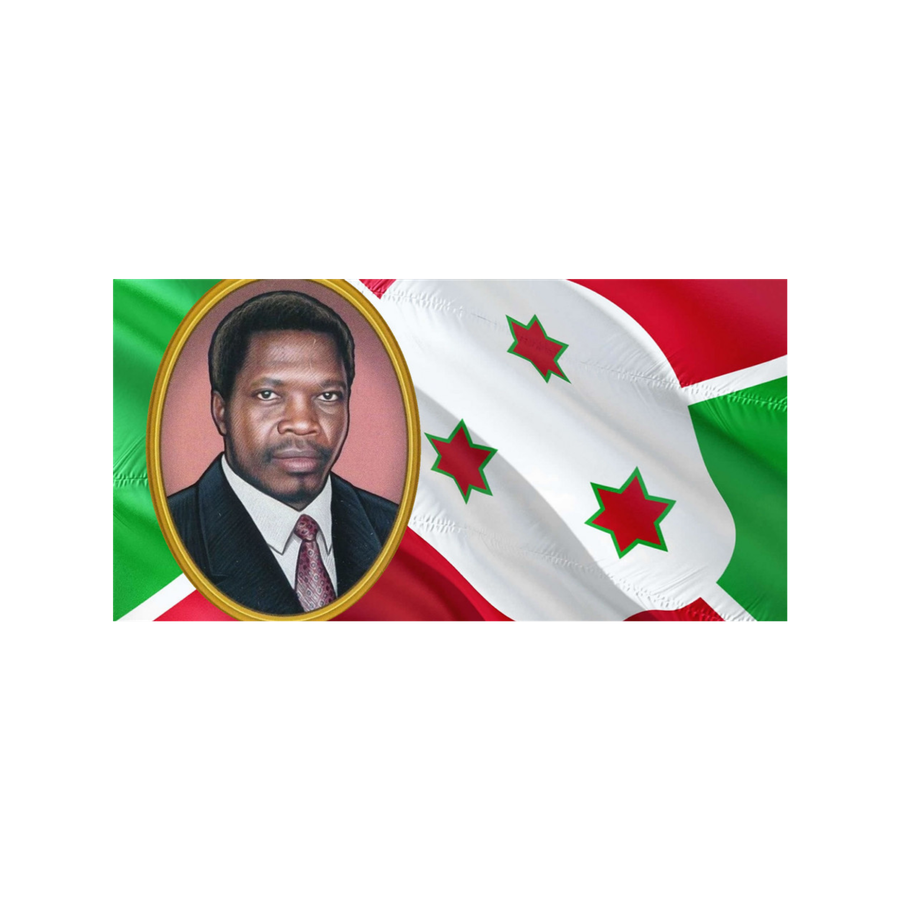
This article from the Occasional Digest commemorates President Ntaryamira Day, a public holiday in Burundi held every April 6th. It details the historical significance of the date, marking the 1994 assassination of President Cyprien Ntaryamira when his aircraft was targeted and destroyed over Rwanda. This tragic event resulted in the deaths of two African leaders and acted as the catalyst for the Rwandan Genocide. Beyond this historical focus, the publication includes updates on modern global conflicts, such as tensions involving Iran and the Strait of Hormuz. Additionally, the source provides current financial data, including internation …
WHO driver Majdi Aslan was killed and a WHO doctor wounded, along with several other Palestinians, medical sources said.
Published On 6 Apr 20266 Apr 2026
A member of staff from the World Health Organization (WHO) has been killed in Gaza and several others injured when the Israeli army fired on their vehicle, according to sources, including an Al Jazeera correspondent.
WHO driver Majdi Aslan, 54, was killed on Monday. A doctor from the international organisation and several other Palestinians were also injured in the incident in eastern Khan Younis, according to sources at the enclave’s Nasser and Al-Aqsa hospitals.
Recommended Stories
list of 4 itemsend of list
As the world’s attention remains fixed on the United States-Israel war on Iran, Israel is continuing its attacks on the Gaza Strip, which has seen near-daily Israeli fire and strikes since a fragile ceasefire was reached in October, with more than 700 Palestinians killed since, according to Gaza’s Health Ministry.
Monday’s incident took place in an area close to the so-called yellow line in eastern Khan Younis, reported Al Jazeera’s Hani Mahmoud.
Israeli forces shot “indiscriminately” at people and vehicles moving along the Salah al-Din Street in the southern Gaza Strip, he said.
A commercial vehicle was transporting civilians between southern and central Gaza. It was followed by a car carrying WHO employees, said Mahmoud.
“The driver was shot in the head, and by the time he was transported to the Al-Aqsa Hospital, he was announced dead,” the correspondent reported from Gaza City. Seven or so others suffered injuries, he added.
Translation: Qamar Majdi Mustafa Aslan (54 years old), a resident of Bureij camp, who ascended after being wounded in a shooting targeting a World Health Organization vehicle on Salah al-Din Street east of Khan Younis city.
WHO did not immediately confirm that the man killed was an employee, but said in a statement emailed to Al Jazeera that “this morning, a critical security incident occurred in Gaza that is under review by relevant authorities”.
“As [a] result of this critical security incident, today’s medical evacuation from Gaza via Rafah to Egypt has been put on hold with immediate effect, until further notice,” the statement added.
WHO has been overseeing coordination between Egypt and Israel since the opening of the Rafah crossing, which has allowed small numbers of injured Palestinians desperate for medical aid to leave to seek treatment abroad.
Israel has, however, continued to limit the entry of humanitarian aid into the besieged territory, also shutting the vital crossing in the early days of the US-Israeli war on Iran.
Elsewhere on Monday in the southern part of Khan Younis, a Palestinian man with special needs was killed after being shot by Israeli soldiers.
To the north, a drone attack in Gaza City killed one person, Mahmoud said.
“The target was an electric bike … moving in the area that was struck by drone missiles. It killed … a 36-year-old individual who was moving … around the displacement camps,” he reported.
A child was also injured in the attack and is now in critical condition in hospital, the correspondent added.
Two Palestinians were also killed in Israeli drone strikes on the Yarmouk and Shujayea neighbourhoods, according to a medical source at al-Shifa Hospital.
Sources at Gaza hospitals have reported the deaths of eight Palestinians in Israeli air strikes outside areas under Israeli control since Sunday.
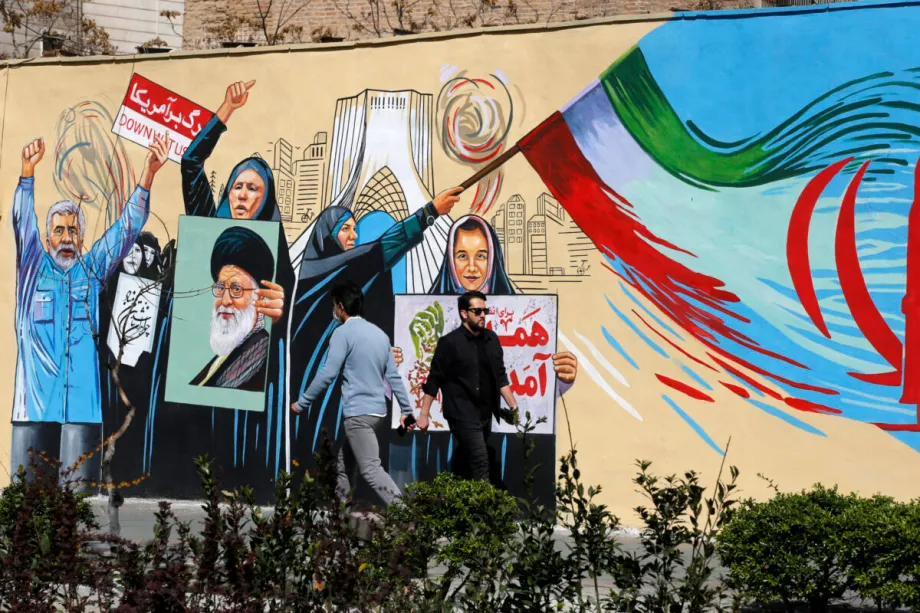
The killing of Ayatollah Ali Khamenei in the opening phase of the US-Israeli war against Iran has generated a striking argument in strategic and theological circles alike: that the killing may have removed not merely a political leader but a normative brake on Iran’s possible march toward nuclear weapons. Reports indicate that Iranian decision-making has since hardened under intense military pressure and an increasingly securitised internal environment.
What gives Khamenei’s death a particular doctrinal significance is that he had, over more than two decades, publicly framed weapons of mass destruction—including nuclear and chemical weapons—as contrary to Islam. If that position represented a genuine religious constraint rather than mere diplomatic rhetoric, then his death may have removed more than a leader: it may have weakened the doctrinal restraint that helped keep Iran a threshold nuclear state.
What gives Khamenei’s death a particular doctrinal significance is that he had, over more than two decades, publicly framed weapons of mass destruction—including nuclear and chemical weapons—as contrary to Islam.
Islamic just war theory places moral constraints on indiscriminate violence, constraints that Khamenei appeared to project onto state policy. With that authority now gone, the central question is whether a moral tradition can discipline a state that increasingly experiences its insecurity as existential. Whether the next supreme leader can impose doctrinal restraint on a system drifting toward hard security logic.
The Islamic just war theory
The Islamic conception of war begins from a premise different from the caricatures often projected onto it. Classical Islamic thought does not treat war as an unbounded field of religious violence. Rather, it regulates warfare through a moral-legal framework derived from the Qur’an, the practice of the Prophet, and the juristic traditions that developed in subsequent centuries. The foundational Qur’anic injunction is taken from verse 2:190: “Fight in the way of God those who fight you, but do not transgress. Indeed, God does not love transgressors.” The verse both permits fighting and limits it: war is accepted as a political reality, but not treated as morally autonomous.
The Islamic conception of war begins from a premise different from the caricatures often projected onto it. Classical Islamic thought does not treat war as an unbounded field of religious violence.
The duality of permission and restraint thus runs through the Islamic just war tradition. War may be legitimate in cases of defence, resistance to aggression, or protection of the community. But even a just cause does not license unlimited means. Islamic jurists emphasised proportionality, legitimate authority, fidelity to agreements, and the protection of non-combatants—including women, children, the elderly, monks, and peasants— developing a norm of discrimination that restricted violence to active combatants.
It is from this perspective that nuclear weapons become especially difficult to reconcile with Islamic ethics. A weapon whose essence is mass, uncontrolled devastation, sits uneasily with any tradition that treats non-combatant immunity as morally central. In Islamic terms, the problem is not simply the scale of destruction, but the very structure of the act: the means themselves are transgressive.
The fatwa: Genuine constraint or strategic cover?
Ayatollah Ruhollah Khomeini’s reputed opposition to chemical weapons during the Iran-Iraq War established an early precedent for this kind of doctrinal restraint. Iraq used chemical agents extensively, and Iran suffered enormously—some 20,000 Iranians were killed and over 100,000 severely injured. Yet the Islamic Republic did not respond in kind on a comparable scale. Whether that restraint was entirely theological or also strategic remains debated. Recent evidence suggests limited Iranian chemical weapons development during the war. Still, the episode reinforced the notion that certain weapons lay beyond the moral threshold that Iran’s clerical leadership was prepared to cross openly.
Khamenei extended this logic to the nuclear realm. He first issued an oral fatwa in October 2003 declaring nuclear weapons as forbidden (haram) in Islam, and repeated this position in an official statement at the emergency meeting of the International Atomic Energy Agency in August 2005. Over subsequent years, Iranian officials repeatedly invoked his religious decree as evidence of the Islamic Republic’s peaceful nuclear intentions.
Khamenei extended this logic to the nuclear realm. He first issued an oral fatwa in October 2003 declaring nuclear weapons as forbidden (haram) in Islam, and repeated this position in an official statement at the emergency meeting of the International Atomic Energy Agency in August 2005.
But the fatwa’s authenticity and legal weight have always been contested. Some have argued that no formal written fatwa was ever issued and that what Iran marketed as a religious ruling was, in origin, merely the closing paragraph of a message to a 2010 nuclear disarmament conference, later retroactively framed by Iranian diplomats as a fatwa. Others have documented that Khamenei’s pronouncements on nuclear weapons were inconsistent: at times he categorically forbade development, stockpiling, and use; at other times he appeared to permit development and stockpiling while forbidding use.
None of this entirely strips the fatwa of significance. In political systems where legitimacy is partly theological, a public prohibition articulated by the supreme jurist, even if ambiguous in its legal form, raises the political and doctrinal cost of reversal. As one scholar observes, such declarations make it costly for the Islamic Republic to overturn the publicly stated position even if they do not constitute binding juridical rulings in the formal sense.
Succession and the question of doctrinal inheritance
The critical question of whether Khamenei’s successor would inherit his political and moral authority looms large. On March 9, 2026, the Assembly of Experts named Mojtaba Khamenei, the 56-year-old son of Ali Khamenei as Iran’s third supreme leader. Whether he would inherit his father’s doctrinal commitments, especially on nuclear weapons, is far from clear. Not known as a jurist of comparable standing to his father, Mojtaba’s authority derives primarily from his revolutionary and security credentials rather than from the depth of his theological learning, a fact noted critically within Iran’s clerical establishment, which has historically resisted father-to-son succession as uncomfortably monarchical.
Khamenei’s nuclear prohibition carried weight because it came from the state’s highest religious authority. Mojtaba’s standing is far more contested, which means that any comparable prohibition would likely carry less doctrinal force—while any tacit relaxation would accelerate the erosion of the barrier his father maintained. The IRGC commanders who manoeuvred his appointment to power have long been among those pressing for a reassessment of Iran’s nuclear posture.
Islamic restraint vs strategic realism
This leads to the final and perhaps hardest question: would Iran, if acting as a pure realist state, pursue nuclear weapons regardless of the Islamic just war tradition? The realist answer is straightforward. States seek survival in an anarchic international system. When a state faces stronger adversaries, recurring coercion, and the credible prospect of regime-change violence, it has every incentive to pursue the ultimate deterrent. From this perspective, the logic of nuclear acquisition is not theological but strategic: a bomb would promise not battlefield utility but regime survival, deterrence, and insulation from future attack.
Khamenei’s nuclear prohibition carried weight because it came from the state’s highest religious authority. Mojtaba’s standing is far more contested, which means that any comparable prohibition would likely carry less doctrinal force—while any tacit relaxation would accelerate the erosion of the barrier his father maintained.
And yet Iran is not a pure realist state in the abstract. It is a political order where ideology, clerical authority, national security, and regime survival have long coexisted in uneasy combination. The more interesting possibility, therefore, is not that realism simply replaces theology, but that realism gradually colonises it. In that scenario, doctrine is not openly discarded; it is reinterpreted and subordinated to necessity, allowing the state to retain Islamic language while moving toward a posture that the older Khamenei publicly resisted.
The greater danger is that the Islamic Republic’s language of restraint may cease to anchor policy and instead begin to trail behind it. If so, Iran’s nuclear future will be decided not only in centrifuge halls or command bunkers, but in the struggle between theological limits and strategic fear.
The views expressed in this article belong to the author and do not necessarily reflect the editorial policy of Middle East Monitor.
BBC star Dilly Carter has been part of Sort Your Life Out since it began back in 2021.
16:03, 06 Apr 2026Updated 16:04, 06 Apr 2026
Dilly Carter with her Sort Your Life Out co-stars
There’s good news for fans of BBC’s Sort Your Life Out as organising expert Dilly Carter has shared an exciting career update.
Sort Your Life Out Unpacked is a podcast based on the show and launches Tuesday, April 7. It will see Dilly speak to a celebrity guest as they bring along three mystery objects from their home.
At the end of each episode, BBC fans will discover if the person wants to keep, donate or recycle their item in true Sort Your Life Out Style.
With promises of tears, laughs and surprises along the way, Dilly teased what people can expect to see and hear in a behind-the-scenes preview.
On Sort Your Life Out’s official Instagram, the BBC star can be seen posing in a studio as she says: “Finally, I can reveal what I’ve been up to!
“I am going to be the host of a brand new podcast called Sort Your Life Out Unpacked. Look at my beautiful set.
Showing a tour of the studio, it had a miniature Sort Your Life Out house, which is often seen in the warehouse of the regular show, alongside a photo of the other team members, including Stacey Solomon, Robert Bent and Iwan Carrington.
Explaining a bit more about the concept of the podcast, she told people that when the celebrity brings in the items, she’ll have no idea what they are beforehand.
Dilly added: “This is going to be the celebrity podcast that teaches you all about celebrities’ homes. It’s the one you don’t want to miss.”
They captioned the post: “We can’t wait for you to listen to the brand new Sort Your Life Out Unpacked podcast with our very own Dilly Carter! Coming tomorrow on @bbciPlayer and tune in on @BBCSounds #SYLO #Podcast #SortYourLifeOut #DillyCarter.”
It wasn’t long before people commented on the clip, with many sharing their excitement at the announcement.
One person said, “Congratulations, lovely lady. Exciting, can’t wait!” Someone else wrote: “OMG I NEEDED THIS!!!!!!!!!!! Dilly, I will be listening to it on repeat.”
Sharing the news on the BBC social media account last week, another person commented: “We can’t wait to listen!” As someone else shared: “So proud of you xx”
A synopsis for the new podcast series reads: “Amongst funny anecdotes and personal revelations, we learn how to organise and sort our own lives out.
“Celebrity guests include Elizabeth Day, Lorraine Kelly, Fatiha El-Ghorri, Kerry Katona, Eddie Kadi, Dr Alex George, Sophie Ellis-Bextor, Sort Your Life Out’s own Stacey Solomon and many more.”
Sort Your Life Out Unpacked launches on BBC Sounds and BBC iPlayer on April 7.
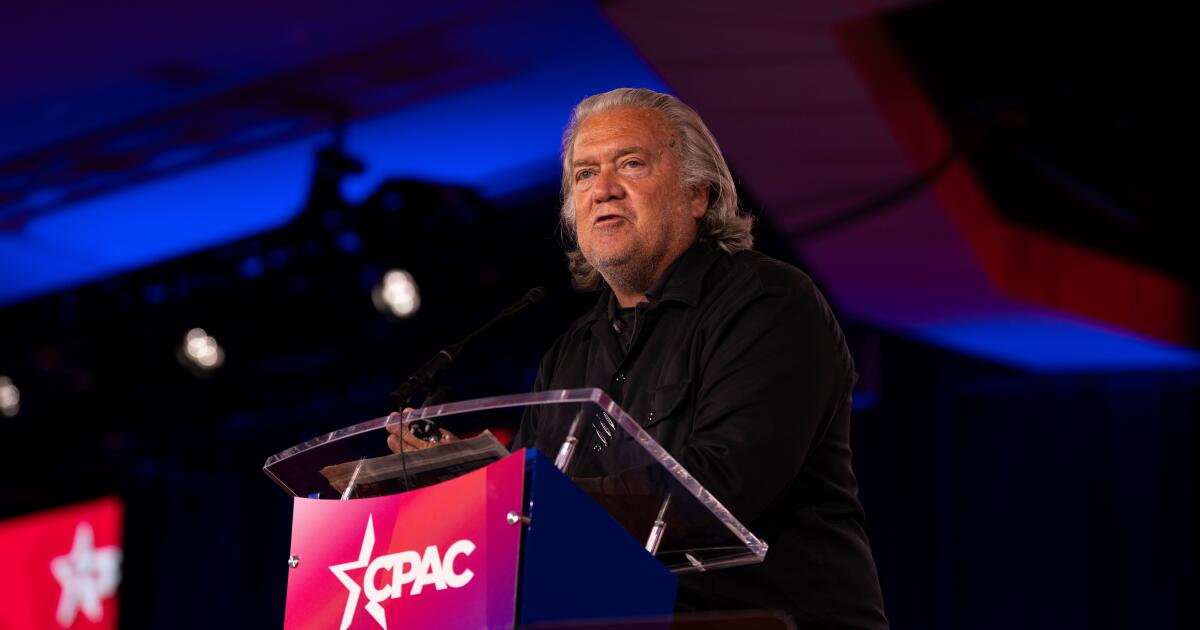
WASHINGTON — Steve Bannon, a longtime ally of President Trump, on Monday won a Supreme Court order that is expected to lead to the dismissal of his criminal conviction for refusing to testify to Congress.
Prodded by the Trump administration, the justices threw out an appellate ruling upholding Bannon’s conviction for defying a subpoena from the House committee that investigated the Jan. 6, 2021, attack by a mob of Trump supporters on the U.S. Capitol.
The move frees a trial judge to act on the Republican administration’s pending request to dismiss Bannon’s conviction and indictment “in the interests of justice.”
The dismissal would be largely symbolic. Bannon served a four-month prison term after a jury convicted him of contempt of Congress in 2022. A federal appeals court in Washington had upheld the conviction.
The justices also issued a similar order in the case of former Cincinnati Councilman P.G. Sittenfeld, who was pardoned by Trump last year.
Sittenfeld had served 16 months in federal prison after a jury convicted him of bribery and attempted extortion in 2022. The high court order allows a lower court to consider dismissing his indictment.
The Justice Department brought the case against Bannon during Democrat Joe Biden’s presidency, but it changed course after Trump took office again last year.
Bannon had initially argued that his testimony was protected by Trump’s claim of executive privilege. But the House panel and the Justice Department contended such a claim was dubious because Trump had fired Bannon from the White House in 2017 and Bannon was thus a private citizen when he was consulting with the then-president in the run-up to the Capitol riot.
Bannon separately has pleaded guilty in a New York state court to defrauding donors to a private effort to build a wall on the U.S. southern border, as part of a plea deal that allowed him to avoid jail time. That conviction is unaffected by the Supreme Court action.
Since 2024, European governing body Uefa has given club coefficients over the latest five-year period an important role via something called “title-holder rebalancing”.
Therefore, should the Champions League winners have also qualified for the league phase via their domestic league position, “the club with the best individual coefficient of all the domestic champions involved in qualifying will enter the league phase directly instead of the original round they had qualified for”.
Ironically, last season’s beneficiaries were Olympiakos, with European champions Paris St-Germain having already qualified as French title winners.
The Piraeus side had finished seven points behind Athens neighbours AEK in the Greek Super League but this season the positions look likely to be reversed.
A 1-0 defeat at home to an AEK side for whom former Hearts left-back James Penrice was back in the starting line-up after a two-game absence leaves Olympiakos five points adrift of the leaders.
Indeed, Jose Luis Mendilibar’s side have slipped to third behind PAOK Salonica, who drew 0-0 at home to Panathinaikos with former Celtic left-back Greg Taylor an unused substitute on the bench.
There are five games left of the title play-offs, during which the top four play one another twice and statisticians suggest Olympiakos only have a 16% chance of securing a 49th domestic title.
Olympiakos are again the club with the most co-efficient points from countries outside the top six in Europe but, if they fail to retain that title, Rangers are next in line for that spot straight into the Champions League’s league phase.
There will be more than a few Rangers supporters monitoring the results when AEK entertain PAOK while Panathinaikos host Olympiakos next on Sunday, 19 April.
Ukraine has increased attacks on Russian energy infrastructure in bid to disrupt financing of its war.
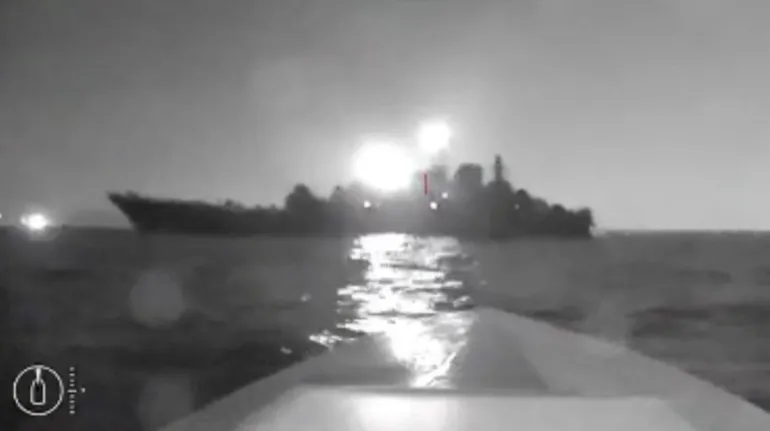
The Ukrainian military reported that it has struck a Russian warship and a drilling rig in the Black Sea.
Kyiv’s drone forces commander Robert Brovdi said on Monday that the attack targeted the Admiral Makarov missile carrier in the port of Novorossiysk, which is Russia’s largest oil exporting outlet on the Black Sea. Ukraine has increased its attacks on Russian energy infrastructure in a bid to disrupt export revenues that feed into Moscow’s war chest.
Recommended Stories
list of 3 itemsend of list
Russian authorities said at least eight people, including two children, were injured in Novorossiysk, without specifying whether the port was struck.
Videos posted on Telegram and verified by Al Jazeera’s verification unit showed a fire at one of the oil port’s docks in the city.
Novorossiysk’s Mayor Andrei Kravchenko said debris from drones had fallen on two locations in the city, including a residential area.
Russia’s military said in the early morning that air defence units had downed 148 Ukrainian drones over a three-hour period. It added that officials said emergency crews were restoring power to nearly half a million households in outages linked to air attacks.
Ukraine has concentrated drone attacks around the port of Novorossiysk throughout the war, but has raised its efforts to halt Russian energy exports recently (File: Reuters)
The area of the port of Novorossiysk is also a location for the Caspian Pipeline Consortium’s (CPC) terminal, which exports oil from Kazakhstan and whose shareholders include US majors such as Chevron and ExxonMobil.
Ukraine has significantly intensified attacks on Russia’s energy facilities, including the largest oil exporting hubs both on the Baltic and Black Seas, as it seeks to reduce Moscow’s revenues from the sales of oil, the lifeblood of its economy.
Kyiv officials complain that Russia will use the additional revenue on new weapons to hit Ukraine harder.
Later on Monday, Russia reported that Ukrainian drones had attacked the CPC terminal. The export facility, which handles 1.5 percent of global oil supply, reported damage to mooring, loading, and storage infrastructure, the Reuters news agency reported.
“The Kyiv regime deliberately attacked facilities of the international oil transportation company Caspian Pipeline Consortium in order to inflict maximum economic damage on its largest shareholders – energy companies from the United States and Kazakhstan,” the defence ministry said in a statement.
Alexander Drozdenko, governor of Russia’s northwestern Leningrad region, said a fuel reservoir in the Primorsk port area leaked when it was hit by shrapnel.
Odesa has been targeted numerous times by Russian strikes (EPA)
In Ukraine, a Russian overnight drone attack on the southern port city of Odesa on Monday killed two women and a toddler, authorities said.
Ukrainian President Volodymyr Zelenskyy said in a post on X that 16 people were wounded, including a pregnant woman and two children.
Russia’s overnight strikes also hit energy infrastructure in the Chernihiv, Sumy, Kharkiv and Dnipro regions, Zelenskyy said.
More than 300,000 households were without electricity in the northern Chernihiv region after distribution facilities were damaged in attacks, according to the regional power utility.
The Ukrainian leader said that over the past week, Russia launched at Ukraine more than 2,800 attack drones, nearly 1,350 powerful glide bombs and more than 40 missiles of various types.
US President Donald Trump has issued a direct ultimatum to Iran: reopen the Strait of Hormuz by 8pm Eastern Time in the United States on Tuesday, April 7 (midnight GMT on April 8), or face the destruction of national power plants and bridges.
This echoes an earlier March 21 ultimatum in which he threatened to attack Iran’s power plants – “the biggest one first” – if the strait was not fully reopened within 48 hours.
President Trump has since extended that deadline several times, citing progress in negotiations he claims the US is having with Iran to end the ongoing war. Iran denies it is holding direct talks with the US.
While Trump has made grand statements such as “they’re going to lose every power plant and every other plant they have in the whole country”, he has not mentioned specific targets.
The US president has also threatened to destroy the country’s bridges. Over the weekend, a US-Israeli strike hit the B1 bridge in the city of Karaj, west of Tehran. The major highway link, described as the tallest bridge in the Middle East, had been scheduled to be inaugurated soon. It sustained significant damage in the strike.
Legal experts say that targeting civilian sites amounts to “collective punishment”, which is prohibited under the laws of war.
Where are Iran’s power plants?
Iran operates hundreds of power plants which, together, form one of the largest electricity systems in the Middle East, supplying energy to 92 million people.
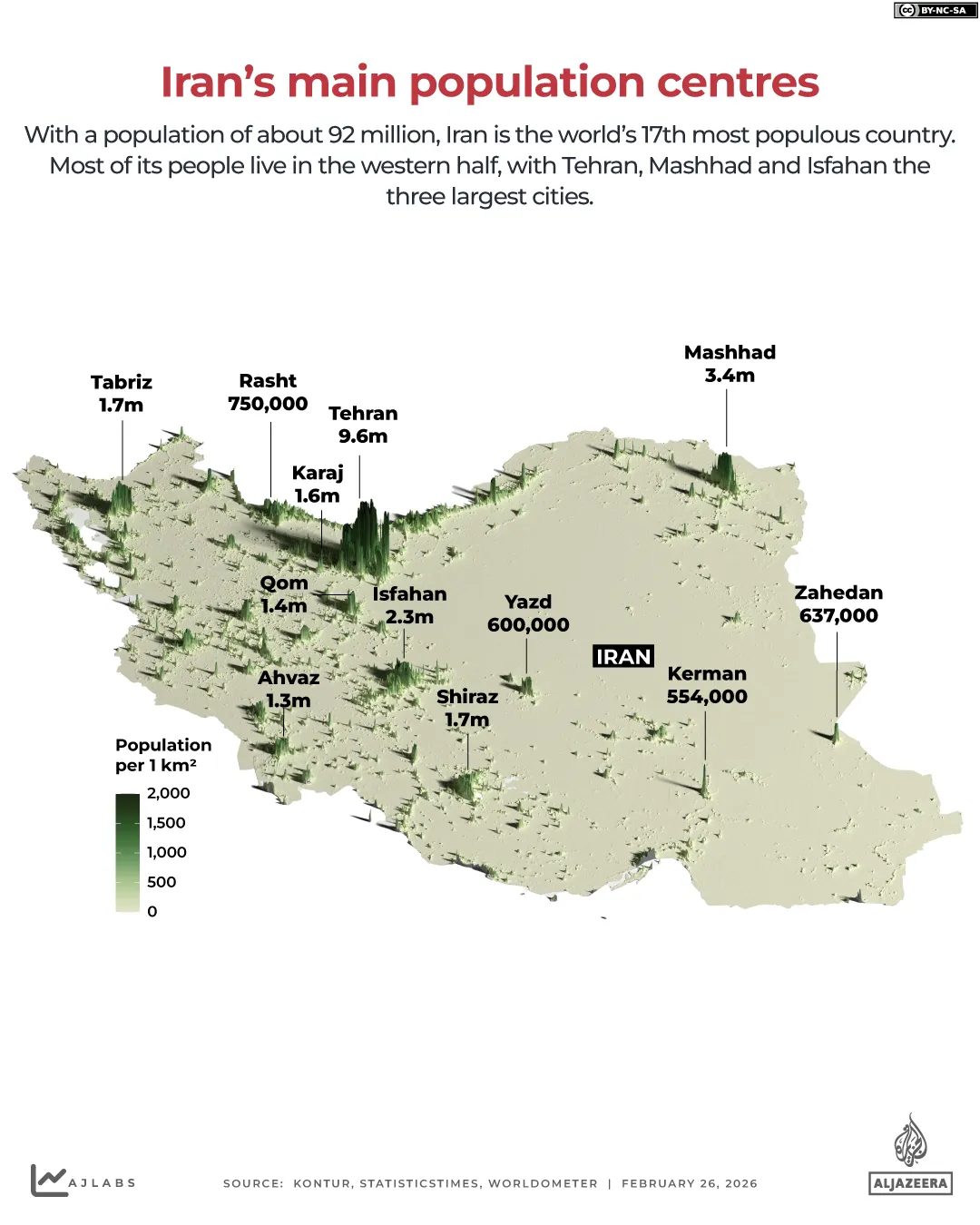
Most of the country’s power plants are close to major population centres and industrial hubs. The majority of Iran’s population lives in the western half of the country, with Tehran, Mashhad and Isfahan the three largest cities.
(Al Jazeera)
Iran has a mixture of gas, coal, hydro, nuclear and oil-fired power plants, but most are gas-fired. In the north and centre of the country, clusters of gas-fired plants supply electricity to the country’s largest population centres, including Tehran, Karaj, Isfahan and Mashhad.
Another major concentration of power plants lies along the Gulf coast. These plants sit close to major gasfields and ports, allowing large thermal stations to run on abundant natural gas.
The coast is also home to the Bushehr Nuclear Power Plant, Iran’s only nuclear power facility, which has a capacity of 1,000MW. The US and Israel have repeatedly hit this nuclear power plant, raising risks of radioactive contamination far beyond Iran’s borders, the state-run Atomic Energy Organisation of Iran (AEOI) has warned.
A satellite image shows new reactors under construction at the Bushehr site in Iran in this handout image dated January 1, 2025 [Maxar Technologies/Handout via Reuters]
Iran also operates a handful of hydropower dams concentrated along the Karun River, the country’s most important source of hydroelectric generation.
Electricity generated from all these plants is fed into a national transmission network operated by Iran Grid Management Company, which distributes power to cities, industries and homes across the country.
The map below shows all of Iran’s power stations with a capacity of 100MW or more.
A 100MW power plant can typically supply electricity to roughly 75,000 to 100,000 homes, depending on consumption patterns.
Iran’s largest power plant by capacity is the Damavand Power Plant located in the Pakdasht area, roughly 50km (31 miles) southeast of Tehran, with a capacity of some 2,900MW, enough to power more than two million homes.
Which are Iran’s most important power plants?
Iran’s largest power plants include:
Damavand (Pakdasht) Power Plant – Near Tehran. Fuel: Natural gas (combined-cycle). Capacity: 2,868MW.
Shahid Salimi Power Plant – Neka, along the Caspian Sea coast. Fuel: Natural gas. Capacity: 2,215MW.
Shahid Rajaee Power Plant – Near Qazvin. Fuel: Natural gas. Capacity: 2,043MW.
Karun-3 Dam – Khuzestan Province. Fuel: Hydropower. Capacity: 2,000MW.
Kerman Power Plant – Kerman. Fuel: Natural gas. Capacity: 1,912MW.
Other smaller but strategically important power plants include:
Ramin Power Plant – Ahvaz, Khuzestan. Fuel: Gas. Capacity: 1,903MW.
Bushehr Nuclear Power Plant – On the Gulf. Fuel: Nuclear. Capacity: 1,000MW.
Bandar Abbas Power Plant – Near the Strait of Hormuz. Fuel: Oil. Capacity: 1,330MW.
How does Iran generate its electricity?
Iran’s electricity system relies heavily on large thermal power plants fuelled by natural gas. The country has one of the world’s largest natural gas reserves, and this fuel forms the backbone of its power system.
In 2025, 86 percent of Iran’s electricity came from natural gas.
Oil-fired plants provide a smaller share, generating roughly seven percent of electricity. Some power stations switch to diesel or fuel oil when natural gas supplies are tight, especially during winter demand peaks.
(Al Jazeera)
Hydropower accounts for about five percent of electricity. Large dams on rivers such as the Karun River generate power by using flowing water to spin turbines.
Nuclear energy contributes around two percent of the country’s electricity, mainly from the Bushehr Nuclear Power Plant, Iran’s only operational nuclear reactor.
Renewables such as solar and wind play a very small role, together accounting for less than one percent of electricity generation.
Overall, more than 90 percent of Iran’s electricity comes from fossil fuels, making it one of the most gas-dependent power systems in the world.
Ashley Roberts returns to the I’m A Celebrity camp 14 years after she finished runner-up on the show Down Under and she will rejoin former stars as she bids to go one better
15:19, 06 Apr 2026Updated 15:19, 06 Apr 2026
Ashley Roberts is returning to I’m A Celeb
Ashley Roberts’ second stint in the I’m A Celebrity jungle is here after she headed to South Africa 2012. The songstress, now 44, finished runner-up in her camp behind EastEnders star Charlie Brooks.
And while she will be reappearing alongside former campmate David Haye, who finished in third, the former Pussycat Dolls star will be hoping to go one better this time around.
The second series of the ITVspin-off, which features some of the show’s most memorable campmates, is set to launch tonight (Monday, April 6) and Ashley labelled her comeback a “no brainer”.
Hosts Ant McPartlinand Declan Donnellywill join the returning stars in the South African jungle for some of the biggest trials in I’m A Celebrity… history. Away from the small screen, Ashley has had a lot of eyes on her for other reasons too…
Ashley Roberts has been linked with a number of high-profile romances over the years. A year after her first I’m A Celebrity experience, the American was rumoured to have been dating the show’s host, Dec.
While the rumours were never concrete, they were spotted together and Roberts admitted to “getting to know” him. Dec has since married talent manager Ali Astall, with the pair tying the knot in 2015.
Ryan Fletcher romance
A year after the Dec rumours, Ashley had moved on to fellow musician, Ryan Fletcher. The bassist for pop-rock band Lawson dated the Pussycat Dolls star in 2014, but their romance was short lived.
The pair were spotted at the time looking affectionate at a Justin Timberlake concert in London. Despite previously claiming to be just friends, the guitarist confirmed their relationship months later. He told us at the time: “Ashley and I are great – I’m loving it at the moment. It doesn’t feel like we’re in the spotlight and we see each other when we can.
“We are both really busy so we make the most of the time we get together. We just don’t think about everyone watching us and just get on with it.” Sadly for the pair, the flame fizzled out and they’re romance ended shortly after.
Giovanni Pernice relationship
The former Strictly star was all loved up with Ashley between 2018 and 2020. The duo met on the popular BBC dance show and quickly became an item.
The grew close in rehearsals, but managed kept their relationship a secret until after the show ended. Ashley was paired with pro Pasha Kovalev on the series, while Giovanni was teamed up with Steps star Faye Tozer.
The Italian announced the shock split in a tweet at the time, writing: “@ImAshleyRoberts and I have made the decision to separate as a couple. We remain friends and wish each other well for the future.”
He had previously gushed: “I never thought anyone would ever make me smile, laugh and steal my heart as fast as you did !! I love you amore.”
Pussycat Dolls feud
Five years after the group’s previous comeback was called off due to the coronavirus pandemic and a brutal feud, Ashley is part of the plans to bring the band back together. However, three members won’t be joining as an ongoing feud ensues.
In 2012, Ashley and Kimberly Wyatt sensationally quit the group, with Kimberly blasting Nicole Scherzinger in a scathing statement. While Kimberly claimed Nicole was “no friend of hers,” Ashley was a bit more tactful with her exit.
She said at the time on her official website: “Yes, I have left the Pussycat Dolls..I love you all sooo much!!! I am so grateful to have the love and support of all of you. It was an amazing ride and I learned so much!
“I am currently have gotten the acting bug and am falling in love with it. I have a few projects in the works and when ready I will announce more details to all of you.”
And it appears her polite exit has helped with the reunion. Nicole, Ashley and Kimberly will all return to the stage, but without Melody Thornton, Jessica Sutta or Carmit Bachar.
Intel (INTC) has been in ongoing discussions with at least two large customers, including Amazon (AMZN) and Google (GOOG) (GOOGL), for its advanced packaging services, Wired reported, citing multiple sources.
Intel’s ambitions for its advanced packaging business depend largely on
Hi, and welcome to another edition of Dodgers Dugout. My name is Houston Mitchell. I hope those of you who participate enjoyed the Easter festivities over the weekend. But why does a rabbit bring eggs? Shouldn’t it be the Easter Chicken?
Are you a true-blue fan?
Get our Dodgers Dugout newsletter for insights, news and much more.
By continuing, you agree to our Terms of Service, which include arbitration and a class action waiver. You agree that we and our third-party vendors may collect and use your information, including through cookies, pixels and similar technologies, for the purposes set forth in our Privacy Policy such as personalizing your experience and ads.
We are only nine games into the season, far too early to reach any conclusions. Yes, the offense struggled for a few games, but the Dodgers are still 7-2. And the offense’s struggles wouldn’t have been noticeable if it had happened for a few games in the middle of the season instead of right at the start.
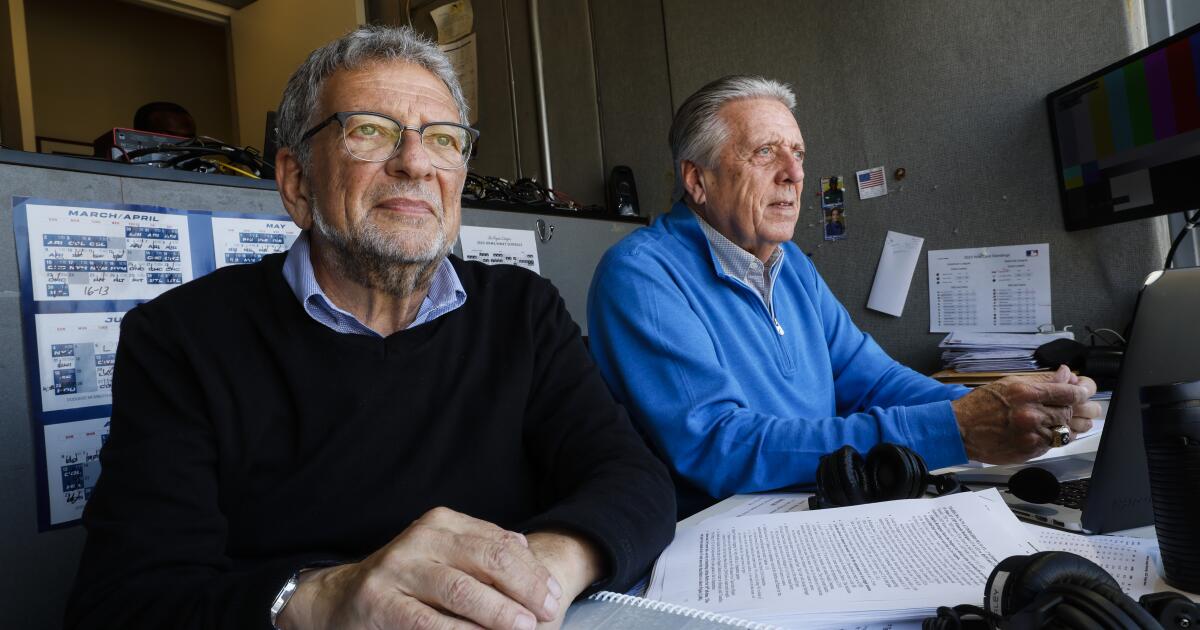
So let’s turn our attention to something else. I get emails every week asking about Charley Steiner. He handled the radio call for the first three innings on opening day, then left and hasn’t been back since. Stephen Nelson put up a picture of Steiner and Rick Mondaythat you can see by clicking here.
In October 2024, Bill Plaschke wrote a column detailing Steiner’s battle with multiple myeloma blood cancer. You can read that column here. Steiner sat out the 2004 season because of it. He called six innings on opening day in 2025 and three innings on opening day this year.
In his column, Plaschke wrote:
—”He endured constant debilitating lower back pain. He lost 50 pounds. He was confined to a wheelchair. He initially moved his bed from the second floor of his Westside home down to the family room because he couldn’t climb the stairs. He enlisted the full-time help of nurses. It wasn’t pretty.”
—“He’s gone through hell,” said his longtime radio partner Rick Monday.
—”An extremely private person, Steiner lived the nightmare without fanfare, without telling anyone outside of his inner circle, the loquacious storyteller keeping his most important words to himself.”
At the time, Steiner’s cancer was in remission, which is why he talked about it. I don’t want to speculate too much about his current health, but the fact he has called only nine innings since then can’t be a great sign. The Dodgers have kept him on the payroll and support him, just as they have done with Andrew Toles. It is one of the great things about the organization.
When Steiner was calling games on the radio full time, I would occasionally criticize him for not mentioning the score and game situation enough. Now that seems rather meaningless.
So, with so much divisiveness and unkindness in the world, here is what I would like you to do. If you remember a particular call of Steiner’s, or a moment he made you laugh, or if you just want to wish him well and let him know Dodgers fans have not forgotten him, send me an email at houston.mitchell@latimes.com, and I will compile them in a future newsletter. I’m sure he will see it, and if we can bring a little sunshine into someone’s day, then we have accomplished a good thing.
A couple of my favorite Steiner moments:
When Steiner was with ESPN, he couldn’t stop laughing after hearing Carl Lewis singing the national anthem. His laughter will make you laugh. You can watch that here.
Steiner talks about growing up a Brooklyn Dodgers fan and how much Vin Scully meant to him. You can watch that here.
Mookie injured
Mookie Betts injured his back while running the bases during Saturday’s victory and was put on the injured list on Sunday because of a strained right oblique. According to WebMD, the oblique muscles are broad, diagonal abdominal muscles located on the sides of the torso (internal and external) that enable trunk rotation, side-bending, and core stability. They assist in breathing and protect the spine, with external obliques running over internal obliques in opposite directions and…. this is why I’m not a doctor.
Injuries are one of the biggest things that could derail the Dodgers this season. Can they survive for four-to-six weeks without Betts? Sure, their offense is build to withstand things such as that. But if multiple hitters start ailing, then there could be a problem. Just look at the Lakers. Cruising toward the playoffs, with some experts saying they could at least reach the conference finals. Then, suddenly Luka Doncic and Austin Reaves are injured, and winning a first-round series now seems problematic.
The Dodgers recalled Hyeseong Kim from Oklahoma City, where he has been crushing the ball. Kim and Miguel Rojas will share time to shortstop.
How much is too much?
On opening day, the Dodgers offered a Shohei Ohtani collectors cup for $75, with free soda all game. Many fans online were outraged by the price. For the second game of the season, the Dodgers dropped the price to $68.99 and said you could get free refills of soda all season long.
And actually, if you go to a few games a season and drink soda, that is quite a bargain, considering sodas at the stadium cost around $11.99. Of course, your ensuing bill for the onset of diabetes will make it less of a bargain.
Survey says
We asked, “Which Dodger closer had the best entrance music?” The results, after 10,941 votes:
Eric Gagne, “Welcome to the Jungle” — 53.9% Edwin Díaz, “Narco” — 30.9% Kenley Jansen, “California Love” — 15.2%
Up next
Monday: Dodgers (*-Justin Wrobleski, 0-0, 6.75 ERA) at Toronto (Max Scherzer, 1-0, 1.50 ERA), 4:05 p.m., Sportsnet LA, FS1, AM 570, KTNQ 1020
Tuesday: Dodgers (Yoshinobu Yamamoto, 1-1, 3.00 ERA) at Toronto (Kevin Gausman, 0-0, 0.75 ERA), 4:05 p.m., Sportsnet LA, TBS, AM 570, KTNQ 1020
Wednesday: Dodgers (Shohei Ohtani, 1-0, 0.00 ERA) at Toronto (Dylan Cease, 0-0, 2.79 ERA), noon, Sportsnet LA, AM 570, KTNQ 1020
Have a comment or something you’d like to see in a future Dodgers newsletter? Email me at houston.mitchell@latimes.com. To get this newsletter in your inbox, click here.
A UK airline has scrapped some flights from mid-April to early June following the US and Israeli attacks on Iran, which has sent the price of aviation fuel soaring
Rising jet fuel costs could be partially passed onto flyers(Image: Getty Images)
A UK airline has cancelled flights due to the impact of the Iran war, while Ryanair is warning that up to 10% of services could be binned.
Aurigny of Guernsey has scrapped some flights from mid-April to early June following the US and Israeli attacks on Iran, which has sent the price of aviation fuel soaring, the Independent reports.
The airline, which links up the Channel Islands with the UK, described the cuts as “proactive measures to address the impact of global instability”, also adding a “temporary fuel adjustment surcharge” of £2 on all new bookings.
Demand for flights has fallen 13% in May, Aurigny has said, leading the airline to cancel some departures to and from Guernsey.
Aurigny’s chief commercial officer, Philip Saunders, told the Independent: “While a small island community, we are not immune from the realities presented by the global travel ecosystem. Current global events are impacting consumer confidence and changing travel behaviours. Furthermore, significant increases in global oil prices are now filtering through to aviation.
“Unfortunately, we have to pass on some of the resulting costs to customers to ensure sustainable air services to and from Guernsey.”
European jet fuel prices hit a record $1,900 per metric ton on Thursday, according to specialized publication Argus. It warned of potential shortfalls in the coming months.
Argus project that Portugal could run out of jet fuel in four months, Hungary in five, Denmark in six, Italy and Germany in seven, and France and Ireland in eight.
Last week, the chief executive of Ryanair warned that the airline may not be able to run its full summer schedule due to the cost of fuel if the Strait of Hormuz remains closed.
Michael O’Leary predicts that European airlines will begin canceling scheduled flights “by the end of April” if the key shipping lane is not opened.
“The Strait of Hormuz has been closed for 30 days. If it remains closed for 60 or 90 days, then we’re all facing an unknown scenario, and we are certainly looking at maybe having to cancel 5%–10% of flights through May, June and July,” he told ITV.
O’Leary explained that airlines won’t be able to choose which routes to cancel as cuts will depend on which airports suffer fuel shortages.
Later speaking to SkyNews, the Ryanair boss added: “Fuel suppliers are constantly looking at the market. We don’t expect any disruption until early May, but if the war continues, we do run the risk of supply disruptions in Europe in May and June, and we hope the war will finish sooner than that and the risk to supply will be eliminated,” he told Sky News.
“We think there is a reasonable risk, some low level, maybe 10% to 25% of our supplies might be at risk through May and June, so like everyone else in this industry, we hope the war ends sooner rather than later.
“If the war finishes by April and the Strait of Hormuz reopens, then there is almost no risk to supply.”
Plus, with the yen’s current weakness compared to the pound, you get a lot for your money when it comes to buying food, souvenirs and attraction tickets.
I set out to explore this bucket list country firsthand, skipping the crowds of Tokyo and other major cities to explore the country’s lesser-visited regions.
These areas are full of affordable gems such as unique theme parks, paradisaical beaches and jaw-dropping temples.
And let me tell you, this destination certainly lives up to the online hype.
I began in Shirahama, a seaside with stunning white sand beaches and natural wonders that I had no idea even existed in Japan.
Shirarahama Beach might be the most idyllic beach I’ve ever laid eyes on.
The sands on Shirahama Beach in Japan were imported all the way from AustraliaCredit: AlamyShirarahama Beach in Japan is sister to Waikiki Beach in Hawaii, USACredit: AlamyShirahama has a stunning, rugged coastline, and is home to Sandanbeki CaveCredit: Jenna Stevens
The resort feels like Pacific Ocean paradise, so its unsurprising that this beach shares a ‘sister beach’ relationship with Waikiki Beach in Hawaii.
Its spectacular sand was shipped over all the way from Australia in the 1990’s, as the original volcanic sands had eroded away.
A 15-minute public bus ride will bring you to Sandanbeki, where there is a hidden cave accessible only by a unique cave elevator.
Having once been a pirate hideout, this cave is now brimming with historical artifacts and a colourful shrine.
It’s said that wishes made in this legendary cave always come true – so I left one in the form of an adorable turtle.
Entry to Sandanbeki Cave costs ¥1,500 (£7.10), not too shabby a price for your dreams to come true.
You can take a unique elevator down into Sandanbeki CaveCredit: Jenna StevensThere is a shrine called Muro Daibenzaiten deep inside the Sandanbeki CaveCredit: Jenna StevensYou can leave a written wish on a cute, colourful card and hang it up beside the shrineCredit: Jenna Stevens
Next I headed along the coast to Katsuura, an area known for its vast blue bay, scenic boat tours…and for auctioning giant tuna.
And what better place to sample some fresh sashimi than at an early morning tuna auction?
Katsuura Port in Wakayama is one of the leading tuna ports in Japan, hauling in the freshest of catches straight from the Pacific Ocean.
Japan’s tuna auctions have surged in popularity, thanks to viral social media clips and baseball superstar Shohei Ohtani, who famously ordered a 180kg tuna for an LA Dodgers team dinner.
In fact, what was once a daily routine for fishermen now draws in such large crowds that fish markets across Japan are adding viewing areas just for visitors.
Hence I found myself at 6:30am heading to Katsuura Market to witness (and taste) it for myself.
Visitors to the tuna auction can see the giant tuna fish up close, many of which weigh hundreds of kilos, and ready to be sold to the highest bidder.
Katsuura Market even has its own tuna museum, where you can learn all about the biggest tuna ever caught in Japan. Spoiler: it weighed a whopping 278kg and sold for ¥333.6 million (£1.5 million!)
Just next door is Nigiwai Market, where you can sample fresh tuna in a variety of forms like sashimi, sushi and hot grilled skewers.
Not keen on tuna for breakfast? Try out the freshly-squeezed juice stand instead – Wakayama is famous for its oranges.
The largest tuna was caught in 2019, weighing 278kg, and it sold for £1.5 millionCredit: Jenna StevensA bowl of delicious tuna sashimi over rice costs ¥1,500 (£7.10) at this Nigiawai Market standCredit: Jenna Stevens
Nachi-Katsuura also makes for a fantastic base for exploring one of Japan’s most beautiful walking trails: the Kumano Kodo.
The UNESCO-listed Kumano Kodo is a set of ancient pilgrimage trails that provide some of the very best natural sights in Japan.
Think huge waterfalls, impressive temples and intricate shrines, backed by tall forests and misty green mountains.
There are 190 miles of trails to choose from, but if you’re like me and just want to see the very best and save your legs, I recommend ticking off the following top sights.
Start by heading to Nachi Falls and Shrine. This breath-taking, brilliant red structure is backed by a giant waterfall – the kind of picture you’d only expect to see in a film or painting.
Then pay a visit to two more shrines, Kumano Hongu Taisha and Kumano Hayatama Taisha, and you’ve completed the three grand shrines of the region. And to prove it, you even get to collect a special stamp at each spot.
Head up further north through the mountains, and you’ll make your way into Nara prefecture.
Nara city is famous for its deer park, a 660 hectare area of the city where the animals have free roam – and they’re super friendly.
In fact, there are even “deer crackers” sold around the park, which you can purchase for around ¥200 (94p) and hand-feed them.
Try out a traditional tea ceremony experience whilst you’re in town, and you’ve ticked off some of the best experiences the region has to offer.
Whether you’re a beginner or seasoned hiker, you can pick a Kumano Kodo route that suits youCredit: Jenna StevensThe bright red Nachi Shrine and Nachi Falls behind are two of Japan’s most impressive sightsCredit: Jenna StevensMeet the locals of Nara deer park, and make sure to thank them with a special deer crackerCredit: Jenna Stevens
And if you really want to immerse yourself, head deep into the mountains of Nara to try out a stay in a Japanese ryokan.
A ryokan is a traditional Japanese inn known for its futon beds, tatami mat floors, and traditional meals – and they are a must-try on a bucket list trip to Japan.
Both dinner and breakfast are typically always included with a ryokan stay. I enjoyed multi-course dinner of crispy tempura vegetables, grilled fish, and plenty of freshly-boiled rice and miso soup.
From its unique interiors to its soul-warming food, you just can’t beat a stay in a ryokan.
Although they can be pricey (around £100 – £200+ a night) so if you’re on a budget, I recommend staying in hostels during your travels to save on accommodation costs. That way, you can treat yourself to a night or two for an unforgettable stay.
Speaking of top experiences, you can learn to throw shurikens and transport yourself back to samurai-era Japan at this lesser-known theme park.
Hidden in the mountains of Mie Prefecture you’ll find one of the world’s most unique theme parks: Ninja Kingdom Ise.
This family-friendly attraction is packed with carnival-style games and activities – all of which are made ten times more fun by ninja outfit rental.
There’s ninja outfits of all sizes, with a choice between red and black. Outfit rental costs ¥500 (£2.36), which is a bargain if you ask me.
Just walking around the attraction itself is an immersive experience.
The park is made up of traditional Japanese buildings that replicate a real 16th-century castle town, backed by dramatic mountains. It truly feels like you’ve stepped back in time.
This theme park even has a giant replica castle to grab pictures with in your rental outfitCredit: Jenna StevensThis ninja theme park is set amidst the misty mountains of Mie Prefecture in the Kii PeninsulaCredit: Jenna Stevens
There’s plenty of fairground-style games here to test your speed, reaction time and accuracy – key skills for any ninja.
I threw darts at a colourful spinning wheel to test my aim before heading to the shuriken-throwing experience, which was tougher than you might think.
I ended my visit by hopping on the free shuttle bus up to the giant replica of Azuchi Castle.
This hilltop slice of history is decorated with bright whites, reds and golds, reflecting 15th century Japan’s Sengoku era .
And if you’re wanting to relax after a long day of ninja activities, this attraction even has its own hot springs: the Azuchi Castle Baths.
Admission tickets to Ninja Kingdom Ise cost ¥1,500 (£7.10) for adults, ¥1,000 (£4.74) for ages 12-17 and ¥800 (£3.79) for ages 7-11.
With shrines, temples, beaches, seafood, ninja theme parks and more under my belt, it boggles me that most stick to the capital and skip these regions on a trip to the world’s most desirable destination.
So if you’re planning that bucket list trip to Japan, head out of the major cities and down into the regions of the Kii Peninsula for those rare, extra-magical experiences you just can’t find on socials.
This visit was supported by theKiiPeninsula. For more information, head tovisit-kii.com.
I tried out a traditional ryokan stay at Kohryokuen Nishisei in Nara prefectureCredit: Jenna StevensExperience a traditional Japanese breakfast at a low table with your ryokan stayCredit: Jenna Stevens
The head office of KB Financial Group in Seoul. Photo courtesy of KB Financial Group
SEOUL, April 6 (UPI) — South Korea’s KB Financial Group said Monday that Jeremy Allaire, founding CEO of U.S. digital currency firm Circle, will visit early next week to meet with its senior executives.
The Seoul-based financial group noted that the meeting would focus on strengthening bilateral collaboration and discussing concrete action plans for innovations in next-generation financial infrastructure.
In the latter part of last year, KB Financial started proof-of-concept tests using Circle Mint, a platform that enables companies to issue and manage stablecoins, primarily Circle’s USD Coin, or USDC.
From the testing, KB Financial said it was able to gain knowledge and capabilities necessary to manage digital assets via such platforms as Circle Mint.
The two firms are exploring joint business opportunities in various areas, including the domestic use of USDC, cross-border transactions and potentially issuing a Korean currency-backed stablecoin.
“The upcoming meeting with Allaire will go beyond a simple one-off event. It will serve as a catalyst to elevate the partnership between the two companies, which have already completed in-depth technical verification,” KB Financial said in a statement.
“Based on the robust cooperation framework established with Circle, we will keep beefing up our leadership in the digital asset markets at home and abroad,” KB said.
Sogang University economics professor Yoon Suk-bin pointed out that competition will intensify sharply in the market, which combines traditional money and digital currency.
“It is a major industry trend for traditional financial institutions to partner with emerging digital asset firms to build integrated platforms,” he told UPI. “Circle CEO’s visit to Seoul can be understood in that context.”
Meanwhile, Dunamu also confirmed that Allaire would meet its executives next week. The digital powerhouse is an operator of South Korea’s leading cryptocurrency exchange, Upbit.
As the US threatens to launch a ground invasion of Iran, many questions remain about its goals and geographical span. Some scenarios suggest a focus on some of the islands in the Gulf, others – joining forces with local insurgent groups.
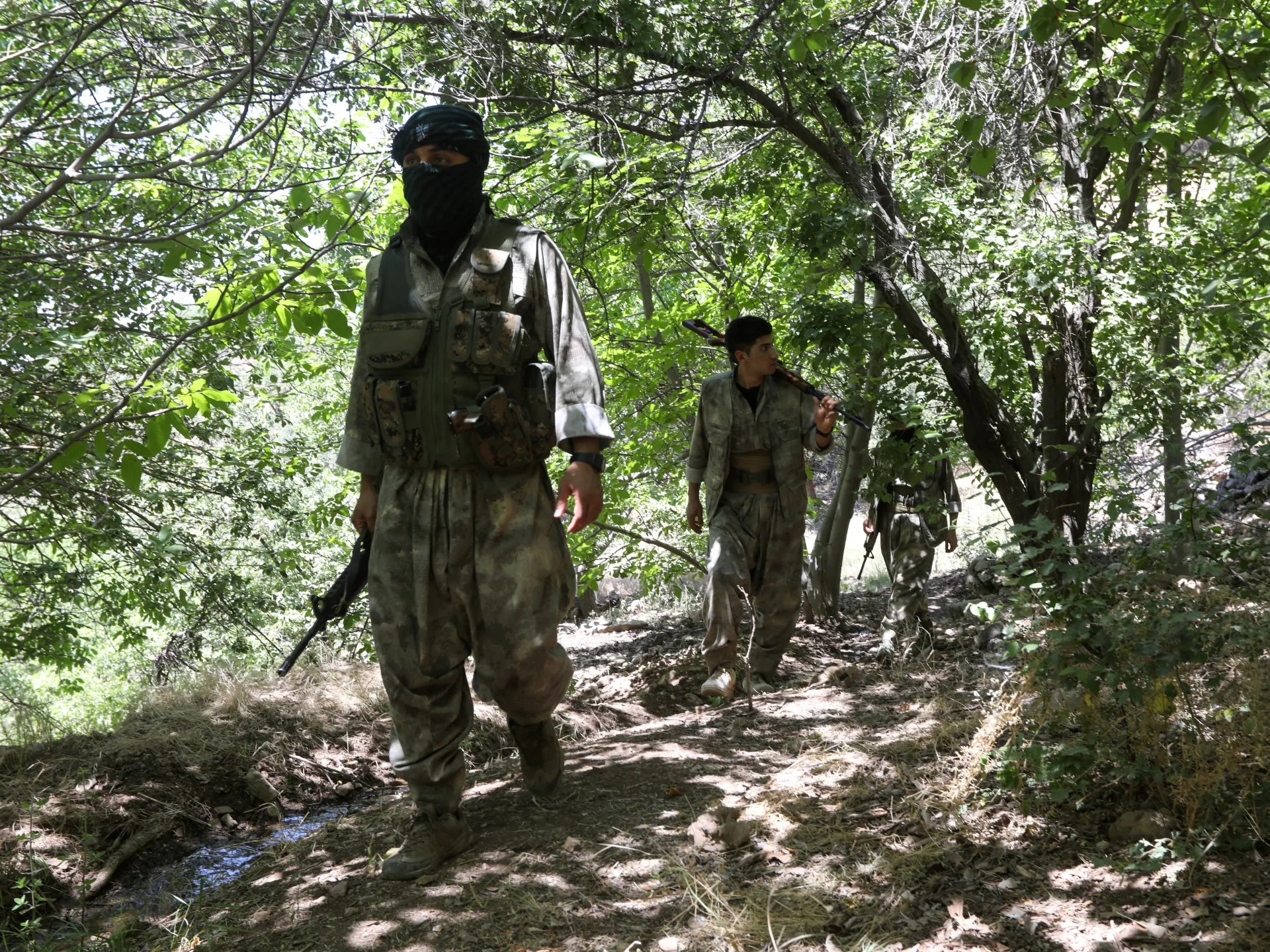
Early on in the war, Washington seemed to toy with the idea of supporting opposition groups from Iran’s large Kurdish minority to launch a war by proxy.
According to reports in the Israeli media, initial efforts by Mossad to encourage attacks by Kurdish groups in Iran’s northwest failed due to “leaks, distrust”. Iran bolstered its defences in the area and put pressure on the authorities in Iraqi Kurdistan, where the Iranian Kurdish groups are based.
Last week, in an interview with Fox News, US President Donald Trump acknowledged that the US provided weapons to the Kurds.
Further action involving either Kurdish or other ethnic opposition groups may still be on the table as his administration seeks to put together an exit strategy from the war. Encouraging local insurgencies to weaken Tehran may seem like a good plan, but would it work?
Iran’s weak spots
Fomenting ethnic or religious tensions in the enemy camp is an old military tactic, which the US itself has used many times in the Middle East. Trump is likely looking for ways to gain leverage over the regime in Tehran and stretch its military capabilities. Iran’s internal fractures may seem to offer some opportunities for that.
In the past three decades, Tehran has failed to address the growing grievances of various minority populations in the country’s periphery. Sunni Arabs, Kurds and Balochis feel marginalised in the Shi’a majority state, while Arab and Kurdish Shia Muslims feel discriminated against by ethnic Persians.
This has led to various anti-government mobilisations, including armed ones over the past three decades.
Kurdish armed groups based in Iraq have operated for decades in northwestern Iran. Kurdish areas have also seen waves of mass protests, the most recent of which was in the autumn of 2022 following the death of a Kurdish woman at the hands of morality police in Tehran.
Other armed groups have also been active. In 2018, an attack on a military parade in the city of Ahvaz killed 29 people; an Arab separatist group claimed responsibility. In 2019, Baluchi rebels of the Jaish Al Adl group attacked a bus carrying members of the IRGC, killing at least 27. A raid by the same group on a police station in 2023 killed 11 security personnel. Then in 2024, the bombing of a mourner’s procession for the late General Qasem Sulaimani killed at least 90 people in the southeastern city of Kerman; ISIL claimed responsibility.
All of these incidents expose weaknesses in Iran’s periphery, which its enemies have long tried to exploit. If Trump decides to go down that path, he should take heed of the experiences of those who have tried to undermine the authorities in Tehran by fomenting ethno-religious insurgencies.
Past failures
Iraq’s president Saddam Hussein was one of them. When he decided to invade Iran in 1980, he saw an opportunity in the ethnic unrest among Kurds and Arabs the Islamic Republic had inherited from the monarchical regime. Saddam Hussein encouraged insurgencies among both minorities.
By the time Iraqi troops stormed onto Iranian territory, the Kurdish Democratic Party of Iran (KDP-I) had already launched a rebellion against the newly formed Islamic Republic in 1979. Iraq eventually provided arms and finances, enabling the KDP-I to take over some territory and hold it for months, but internal fighting and the brutal campaign Tehran launched through its Revolutionary Guards managed to suppress the rebellion by 1982-83.
Saddam also tried to get the Arabs in the south to revolt, some Iranian Arab separatist groups fought alongside Iraqi forces in the battle for the Iranian city of Khorramshahr in 1980. But the Sunni Arab community did not join in large numbers. Shi’a Arabs had no desire to participate in what they saw as a foreign invasion, launched by an Sunni-dominated Iraqi regime. As a result, Saddam never got the mass Arab uprising he wished for.
Twenty years later, US President George W Bush tried to use a similar playbook against Iran. He authorised the CIA and other intelligence outfits to carry out covert operations in Iran and funnel money and equipment to some opposition armed groups.
Like Saddam, Bush also failed to foment rebellions in Iran. This is not just because the Islamic Republic was able to handle security situations swifty and decisively, but also because efforts to incite uprisings never really got enough momentum. The reason for that is that parts of Iran’s minorities are well-integrated into the nation’s core and elite. Ethno-religious identities and socio-economic realities in Iran are too complex to feed into a simple black-and-white narrative about ethnic oppression by the Persian majority.
The likelihood of success today
More than a month into the war on Iran, it is by now clear that US and Israeli efforts to trigger a mass uprising in Iran by decapitating the regime have failed.
At this time, there is nothing to suggest that any efforts to foment ethnic insurgencies would be more successful. US-Israel support for separatist groups is unlikely to get anywhere further than localised acts of sabotage or small skirmishes.
This would not divert important military resources and attention away from the fight with the US and Israel, as Iran is fighting a techno-guerilla war, where its most valuable weapons are missiles and drones – not ground troops.
Furthermore, there is significant regional opposition to US support for separatist groups from major allies, including Pakistan and Turkiye. Islamabad has been dealing its own violent attacks carried out by Baluch separatists in the southwest of the country. Meanwhile, for Ankara, the issue of any support for Kurdish groups is highly sensitive given its own long history of unrest in the Kurdish regions of the country.
Iraq would also be reluctant to support such activities. The government in Baghdad, as well as the Kurdistan Regional Government, would not risk retaliation from Iran by allowing US-Israeli support for the Iranian Kurds to take place on Iraqi territory.
Inciting ethnic insurgencies may seem like a good strategy on paper, but in reality it would be another recipe for disaster for the Trump administration, which is already struggling with enough failures in its war on Iran.
The views expressed in this article are the author’s own and do not necessarily reflect Al Jazeera’s editorial stance.
CNN will host a California gubernatorial primary debate May 5.
The two-hour debate will take place at 6 p.m Pacific time at a venue in the Los Angeles area that is yet to be determined. CNN anchors Elex Michaelson and Kaitlan Collins will serve as moderators.
The debate will air live across CNN, CNN International, CNN en Español and, for viewers without cable, on CNN’s subscription streaming service.
Participating candidates must have at least 3% support among likely primary voters in two state polls or an average of 3% across two polls that meet CNN’s methodology standards. The polls must be released between Feb. 1 and April 27.
The candidates must also have raised, contributed or lent to their campaigns at least $1 million, based on publicly available data from the California secretary of state.
Candidates from both parties are eligible to participate due to California’s “jungle primary” system, in which all candidates appear on the same ballot regardless of political affiliation. The top two finishers advancing to a November runoff, even if they are both from the same party.
The poll showed six Democratic candidates currently qualifying for the debate under CNN’s standards: U.S. Rep. Eric Swalwell, former House Rep. Katie Porter, philanthropist Tom Steyer, former U.S. Secretary of Health and Human Services Xavier Becerra, former state Assembly Speaker Antonio Villaraigosa and San José Mayor Matt Mahan.
CNN typically does not carry debates involving candidates in statewide races, but the network believes that the California contest is significant enough for a national platform.
“One out of approximately every eight Americans lives in the Golden State and it is at the forefront of some of the most complex challenges of our time,” said David Chalian, CNN’s political director and Washington bureau chief. “California’s jungle primary system also allows for the debate to include a wide spectrum of viewpoints and proposals to tackle those challenges that will reverberate across the country in this pivotal election year.”
With European markets reopening after the Easter holidays, investors are set to navigate a mix of geopolitical risks and crucial economic data that may shape sentiment over the coming week.
ADVERTISEMENT
ADVERTISEMENT
Attention will focus on Iran’s response to US President Donald Trump’s deadline to reopen the Strait of Hormuz, a critical chokepoint for global oil supplies. Any escalation or de-escalation could quickly affect energy markets, driving oil prices and inflation expectations.
Beyond geopolitics, inflation data, central bank signals and corporate updates will also draw attention as markets gauge the outlook for the second quarter.
Economic data in focus
The macroeconomic calendar kicks off on Tuesday with the release of eurozone PMI data, a key leading indicator of economic activity. Recent readings have pointed to slowing growth in the bloc, with the composite PMI signalling only marginal expansion amid softening demand and heightened uncertainty.
On Wednesday, investors will examine the latest eurozone retail sales and industrial producer price figures from Eurostat. These will shed light on consumer demand and upstream inflation pressures.
The European data schedule remains relatively light but still significant. Euro area financial accounts will provide additional detail on lending trends, while UK markets stay attuned to labour market and growth signals following recent signs of stagnation.
Focus then shifts to the US, with the release of the Federal Reserve’s latest meeting minutes on Wednesday. These will be scrutinised for hints on policymakers’ views regarding the timing of any potential rate cuts.
Thursday brings key US labour data, including weekly jobless claims, offering further insight into employment conditions.
The week ends with the US consumer price index for March, including the closely watched core CPI reading. A stronger-than-expected figure could dampen hopes for policy easing and spark volatility in global markets, including Europe.
On the corporate side in Europe, activity is limited, although Raiffeisen Bank International’s annual general meeting on Thursday will be watched for any signals on banking sector health and regional credit conditions.
Trump reiterated the fabrication last week when he signed an executive order seeking to place tight federal controls on increasingly popular mail-in voting.
“Mail-in voting means mail-in cheating,” Trump reiterated. “Cheating on mail-in voting is legendary. It’s horrible what’s going on.”
“See you in court,” California Gov. Gavin Newsom replied.
California and several states partnered in filing a lawsuit accusing the president of an illegal power grab. They pointed out that states have a constitutional right to administer elections pretty much as they see fit.
“You know what, because I’m president of the United States,” he told reporters when asked about the vote. “I had a lot of different things” to do. For him, voting by mail was convenient.
As for the rest of us, apparently in Trump’s mind we don’t do anything important enough to warrant handy mail voting.
The reality is that egotistical Trump still can’t admit to himself that he lost the 2020 presidential election to Joe Biden fair and square. Democrats must have cheated, he thinks — or says he does.
The main way Democrats cheat, Trump and his followers assert, is to round up noncitizens and register them to vote — especially immigrants from Latin America.
It’s nonsensical. As if some undocumented immigrant struggling to survive and dodge ICE agents really gives a rat who’s elected governor or senator. Voting fraudulently is a crime — a misdemeanor or a felony, punishable by a steep fine and/or jail time.
And a campaign pro is going to break the law by offering cash or groceries to a noncitizen for her vote? That would be felony stupid.
“We can’t get Latinos who have been here legally for three generations to vote. If you’re going to spend money getting votes, that’s where you’re going to spend it,” says Republican consultant Mike Madrid, who has written a book about Latino political influence.
“The notion that Democratic operatives are going after undocumented immigrants is absurd.”
People who migrated here illegally, Madrid adds, “don’t want to touch the government in any shape or form. They just want to put in a hard day’s work and retreat to the shadows. They couldn’t care less about politics and voting in the United States.”
No hard evidence of significant election fraud in America in recent years has been produced by Trump or anyone else.
The sheriff said he was investigating claims — unsubstantiated — of election fraud. But the project is now on hold. A good place for it.
It was a waste of the sheriff’s resources to collect the ballots and would be an even bigger misuse of personnel and money to sift through all of those documents in a fruitless search for fraud.
I called Assemblywoman Gail Pellerin, a Democrat who was Santa Cruz County’s chief elections official for 27 years. She chairs the Assembly Elections Committee.
In all of those years supervising elections, Pellerin told me, she encountered only one clear case of fraud. A landlord snatched a ballot that had been mailed to a tenant and illegally cast it.
But a voter must sign the envelope containing a mailed ballot and the landlord’s signature didn’t match the intended voter’s as given when she originally registered. Election officials contacted the intended voter, who said she hadn’t received her ballot yet. The landlord was prosecuted and convicted.
Signatures are checked with the use of technology in California. That’s the main method of verifying a mailed ballot’s legality.
Pellerin says her own signature didn’t match up once. “I got sloppy and my signature had changed since I registered 20 years earlier.” She was contacted by an elections official and her ballot ultimately was counted.
In every election, she says, there are cases of a mother signing the ballot for a daughter who’s away at college, or someone signing for an aging parent. The signatures invariably don’t match and the voters are contacted.
But that’s about the extent of so-called cheating, Pellerin says.
“Immigrants are here to make their lives better,” she says. “They’re not going to risk any path to citizenship by trying to participate in an election.”
When voters register, they must answer under penalty of perjury whether they’re a citizen.
Trump’s convoluted intervention in state-operated voting would, among other things, direct the United States Postal Service to design new envelopes with bar codes that verify voter legality. The feds would refuse to send ballots to people deemed ineligible to cast them.
Gosh, what could possibly go wrong under the Trump administration?
Californians have embraced mail-in voting. In the gubernatorial election 40 years ago, only 9% of ballots were cast by mail; 20 years ago, 42% were. In November, it was up to 89%.
But baseless claims by Trump and his grovelers of “cheating” will persist. It fires up the conservative base and raises political money.
It also maligns noncitizens and dedicated elections officials who keep voting fraud-free.
You’re reading the L.A. Times Politics newsletter
George Skelton and Michael Wilner cover the insights, legislation, players and politics you need to know. In your inbox Monday and Thursday mornings.
By continuing, you agree to our Terms of Service, which include arbitration and a class action waiver. You agree that we and our third-party vendors may collect and use your information, including through cookies, pixels and similar technologies, for the purposes set forth in our Privacy Policy such as personalizing your experience and ads.
Arsenal’s Declan Rice and Gabriel have trained before Tuesday’s Champions League quarter-final with Sporting.
Midfielder Rice, 27, left the England squad following a medical assessment during March’s international break and missed Saturday’s FA Cup quarter-final loss to Southampton.
Brazil defender Gabriel, meanwhile, was forced off with a knee issue after taking a knock during the defeat on the south coast.
Both players were involved in first-team training at the club’s London Colney base on Monday before Mikel Arteta’s side travel to Lisbon for the first leg.
Belgian winger Leandro Trossard also returned to training but Bukayo Saka was not involved after he also left the England camp early.