THE world’s best airlines for this year have officially been revealed, and a British airline has made the list.
The World’s Best Airlines for 2026 by Airline Ratings have been announced with the no.1 spot going to Qatar Airways.
Sign up for the Travel newsletter
Thank you!
Qatar Airways has been named the best airline in the worldCredit: Getty
AirlineRatings.com’s awards focus on the inflight product and passenger experience, and airlines are awarded based on the experience onboard, as opposed to public opinion or votes.
Airline Ratings stated: “Qatar Airways has again taken the top spot, driven by a consistently strong onboard offering.
“Generous meals, extensive entertainment and, most importantly, clear value for money set it apart.”
And a major British airline has also featured on the list: Virgin Atlantic featured in 13th position.
The British airline currently flies to 32 locations across five continents, including Cape Town in South Africa and Los Angeles in America.
The airline is also launching two new routes this year from London Heathrow to Seoul in South Korea, with daily flights starting on March 29.
There will also be a new seasonal service to Phuket in Thailand, beginning on October 18.
Which? named Virgin Atlantic as one of the best airlines in the world earlier this year as well, placing them third best.
The airline achieved a 79 per cent overall score for customer satisfaction.
Which? commented: “Virgin Atlantic is your best choice for a transatlantic trip – with five stars for customer service.
“Like Emirates, it won’t automatically cancel your return flight if you miss your outbound flight.
“This makes it one of only two Which? Recommended Providers for long-haul economy airlines.”
British airline Virgin Atlantic was also named in the rankings, placing 13thCredit: Getty
Airline Ratings also ranked the best low-cost carriers in the world, with easyJet ranking 8th, Wizz Air ranking 9th, Ryanair ranking 11th, Jet2 ranking 12th, TUI ranking 13th, and Vueling ranking 19th.
Sharon Petersen, CEO of AirlineRatings.com, said: “It was a tight competition at the top, but Qatar’s value proposition, combined with a superior economy product and award-winning business class, secured that top position once again.
“One of the standout movers this year is Taipei-based STARLUX Airlines.
“With strong cabin service, high-quality catering, and modern interiors, it is rapidly establishing itself as a premium competitor, particularly as it prepares to expand into Europe later this year.”
Full list of world’s best airlines
THESE are the world’s best airlines according to Airline Ratings:
DISNEY is launching another cruise ship next year – with some first time princess appearances.
In 2027, Disney Cruise Line will be launching its ninth ship called the Disney Believe.
Sign up for the Travel newsletter
Thank you!
Disney Cruise Line is launching a new ship next year called Disney BelieveCredit: Disney Cruise Line
The ship will be the fourth ship in the Wish class, joining Disney Wish, Disney Treasure and Disney Destiny.
It will be themed on “dreamers and doers who dare to pursue their own happily ever after”.
On board, stories that will be featured will be from Disney, Pixar, Marvel, and Star Wars.
Each Wish class ship features its own theme, for example Disney Wish is enchantment-themed, Disney Treasure is adventure-themed and the Disney Destiny is heroes and villains-themed.
Disney Believe will be ‘promise and possibilities-themed’.
Disney Cruise Line stated: “Onboard the Disney Believe, powerful tales of characters who believe in themselves and their dreams will come to life in exciting new ways.
“From the mystical worlds of Encanto and Frozen, to the wishing wells of Snow White, to the depths of the sea with Moana and The Little Mermaid, there are endless stories waiting to be discovered and new chapters ready to unfold onboard.”
These characters already feature onboard some of the Wish class ships, with an Arendelle dining experience onboard the Disney Wish.
However, Snow White currently does not feature prominently on any of the current Wish class ships.
The Disney Believe is expected to launch in late 2027.
Disney also announced last month that the Disney Wish ship will be coming to the UK next year.
The ship will sail from Southampton on three to seven-night European sailings.
Entering through the Grand Hall, passengers will meet famous Disney princes and princesses.
Inside each stateroom, passengers will find spacious wardrobes, sprawling beds and a theme specific to a Disney character.
Disney Believe will be promise and possibilities-themedCredit: Disney Cruise
When it comes to food on board the ship, guests won’t be short for choice, with market-style buffet options and immersive dining adventures, such as Arendelle: A Frozen Dining Adventure.
As for other entertainment, passengers can head to West-End style shows including Disney Seas the Adventure, where passengers follow Goofy on a journey sailing the ship.
For a thrilling adventure, head on the Disney AquaMouse ride, which features lighting, special effects and scenes of Mickey and Minnie on different adventures.
And the ultimate night for the whole family is Pirates’ Night, where Captain Jack Sparrow takes a fateful leap from the ship’s funnel.
Parents wanting some time to themselves can check their kids into either the full-service nursery or kids and teens clubs before exploring the ship’s adult-only spaces such as the Senses Spa & Salon.
The cheapest sailing is a three-night Belgium cruise from Southampton, sailing to Zeebrugge (Bruges) in Belgium costing from £1,633 for two people.
In other cruise news, here’s the ultimate family cruise – it has a water roller coaster, a private island and an onboard beach club.
WASHINGTON — The Supreme Court broke new ground this month when it ruled the Constitution forbids school policies in California that prevent parents from being told about their child’s gender transition at school.
But the reach of this new parental right remains unclear.
Does it mean all parents have a right to be informed if their child is using a new name and pronouns at school?
Or is the right limited to parents who inquire and object to being “shut out of participation in decisions involving their children’s mental health,” as the high court said in Mirabelli vs. Bonta.
Both sides in this legal battle accuse the other of creating confusion and uncertainty. And that dispute has not subsided.
UC Davis law professor Aaron Tang says understanding the Supreme Court’s order calls for a close reading of the statewide injunction handed down by U.S. District Judge Roger Benitez in San Diego.
That order prohibits school employees from “misleading” or “lying” to parents. It did not say school officials and teachers had a duty to contact parents whenever they saw that a student changed their appearance or used a new name, he said.
By clearing this order to take effect, the Supreme Court’s decision “means that schools must tell parents the truth about their child’s gender presentation at school if the parents request that information,” Tang said.
“But the initial burden is on the parents. This is not a rule that schools have an affirmative obligation to inform any and all parents if their child is presenting as a different gender,” he said.
The high court’s 6-3 order also indicated the reach of the judge’s injunction was limited.
It “does not provide relief for all the parents of California public school students, but only those parents who object to the challenged policies or seek religious injunctions.”
Religious conservatives who sued say they seek to end “secret transition” policies that encourage students to adopt a new gender identity without their parents knowing about the change.
The lawsuit challenging California’s “parental exclusion” policies was first filed by two teachers in Escondido.
Peter Breen, an attorney for the Thomas More Society, said many of the parents in Escondido “had no clue” their children were undergoing a gender transition at school.
“We need to activate parents,” he said.
Ruling for them, Benitez said the state’s “parental exclusion policies are designed to create a zone of secrecy around a school student who expresses gender incongruity.”
His injunction also said schools must notify their employees that “parents and guardians have a federal constitutional right to be informed if their public school child expresses gender incongruence.”
The Supreme Court’s order cited a dramatic example of nondisclosure.
Two parents who joined the suit had gone to parent-teacher meetings and learned only after their eighth-grade daughter attempted suicide that she had been presenting as a boy at school and suffered from gender dysphoria.
John Bursch, an attorney for Alliance Defending Freedom, argues the Supreme Court’s opinion goes further to empower parents.
“Fairly read, the Mirabelli opinion creates an affirmative obligation on school officials to disclose,” he said. “It’s consistent with the way [the court] describes the parental right: ‘the right not to be shut out of participation in decisions regarding their children’s mental health.’ School officials’ silence (rather than lying) is not notice to and is shutting out parents.”
“All that said, the California attorney general is obviously not getting that message,” Bursch said.
He said the Supreme Court needs to go beyond an emergency order and fully decide a case that squarely presents the issue of parents rights.
“School officials should not be socially transitioning children without parental notice and consent. Period,” he said.
He filed an appeal petition with the Supreme Court in a case from Massachusetts that dissenting Justice Elena Kagan described as a “carbon copy” of the California dispute.
The case is set to be considered again on Friday in the court’s private conference.
Meanwhile, California Atty. Gen. Rob Bonta went back to the 9th Circuit Court of Appeals seeking a clarification to limit the potential sweep of Benitez’s order.
He objected to the part of the judge’s order that said schools must post a notice that “parents and guardians have a federal constitutional right to be informed if their public school student child expresses gender incongruence.”
Bonta said that goes beyond what the Supreme Court approved.
This “could be understood to suggest that public school officials have an affirmative constitutional duty to inform parents whenever they observe a student’s expression of ‘gender incongruence,’ effectively imposing a mandatory ‘see something, say something’ obligation in all circumstances,” he said.
But the 9th Circuit said it would not act until he first presented this request to Benitez.
Meanwhile, transgender rights advocates say the voices and the views of students have been ignored.
“This case has been about states’ and parents’ rights but students have been left out of the conversation. Their voices have not been heard at all,” said Andrew Ortiz, an attorney for the Transgender Law Center. “School should be a place where young people can feel safe and confident they can confide in a teacher.”
“We’re hearing about fear and anxiety,” said Jorge Reyes Salinas, communications director for Equality California, the nation’s largest statewide LGBTQ+ civil rights organization.
“There are students who are unable to speak with their parents. Teachers can encourage them to have a conversation with their parents. But this will weaken the trust they have in their teachers,” he said.
In the past, the court had been wary of reaching into the public schools to decide on education policies and the curriculum, but it took a significant step in that direction last year.
In a Maryland case, the court said religious parents had a right to “opt out” their young children from classes that read “LGBTQ+-inclusive” storybooks.
The 1st Amendment protects the “free exercise of religion” and “government schools … may not place unconstitutional burdens on religious exercise,” wrote Justice Samuel A. Alito, the lone conservative who attended public schools.
The same 6-3 majority cited that precedent to block California school policies that protect the privacy of students and “conceal” information from inquiring parents if the student does not consent.
But the California case went beyond the religious-rights issue in the Maryland “opt out” case because it included a “subclass of parents” who objected without citing religion as the reason.
The justices ruled for them as a matter of parents’ rights.
“Parents — not the state — have primary authority with respect to the upbringing and education of children,” the court said.
That simple assertion touches on a sensitive issue for both the conservative and liberal wings of the court. It rests on the 14th Amendment’s clause that says no state may “deprive any person of life, liberty or property without due process of law.”
In the past, a liberal majority held that the protection for “liberty” included rights to contraceptives, abortion and same-sex marriages.
Conservatives fiercely objected to what was dubbed “substantive due process.”
In the California case, Kagan, speaking for the liberals in dissent, tweaked the conservatives for recognizing a new constitutional right without saying where it came from.
“Anyone remotely familiar with recent debates in constitutional law will understand why: Substantive due process has not been of late in the good graces of this Court — and especially of the Members of today’s majority,” she wrote.
She noted that when the court struck down the right to abortion in the Dobbs case, Justice Clarence Thomas said he would go further and strike down all the rights that rest on “substantive due process.”
In response to Kagan, Justice Amy Coney Barrett filed a concurring opinion that staked out a moderate conservative position.
Since 1997, the court has said it would stand behind rights that were “deeply rooted in the nation’s history and tradition,” she wrote. That includes “a parent’s right to raise her child … and the right to participate in significant decisions about her child’s mental health.”
She said California’s “non-disclosure policy” is unconstitutional and violates the rights of parent because it applies “even if parents expressly ask for information about their child’s gender identification,” she wrote.
Chief Justice John G. Roberts and Justice Brett M. Kavanaugh signed on to her opinion.
While Kagan dissented on procedural grounds, she did not disagree with bottom-line outcome.
“California’s policy, in depriving all parents of information critical to their children’s health and well-being, could have crossed the constitutional line,” she said. “And that would entitle the parents, at the end of the day, to relief.”
Europe’s top leagues have been summoned to a meeting with Uefa in the summer to discuss how video assistant referee (VAR) technology is being used.
The summit of referee chiefs from the Premier League, La Liga, Serie A, the Bundesliga and Ligue 1 will discuss how to reset VAR to its intended interpretation of only intervening in the clearest of errors.
Roberto Rosetti – the head of Uefa’s referees – called the meeting after saying last month the game must not “go in this direction of microscopic VAR interventions”.
Uefa wants to discuss with leagues how they use VAR, and the thresholds applied.
“I believe that we forgot the reason why VAR was introduced,” Rosetti said.
“In objective decisions, it is fantastic. For interpretations, subjective evaluation is more difficult.
“That’s why we started to speak about clear and obvious mistakes – clear evidence.”
VAR is operated very differently across Europe.
The Premier League has the lowest VAR intervention rate this season – 0.275 per game – thought that has not meant less controversy over decisions.
Figures released last month showed the Bundesliga and La Liga come next at 0.38 interventions per game, with Serie A at 0.44 and Ligue 1 at 0.47.
In the Champions League, interventions are at a rate of 0.45 per game.
Rosetti also wants all leagues to speak “only one technical language” after controversy over the inconsistent application of laws such as handball.
It is hoped the meeting could lead to a more universal approach to the laws and with how VAR is used.
March 19 (UPI) — Senate Republicans have blocked a Democrat-led effort to curb President Donald Trump‘s powers to wage war against Iran, as the nearly three-week-old conflict escalates and rattles global energy markets.
The Senate voted 53-47 mostly along party lines Wednesday night to reject a resolution that would withdraw U.S. armed forces from conflict with Iran absent congressional approval.
Sen. Rand Paul of Kentucky was the only Republican to join his Democratic colleagues and vote in favor of the motion, while Democratic Sen. John Fetterman of Pennsylvania was the only member of his caucus to vote against it.
“We do not have a king. We are a democratic republic with a constitution and no one is above the law,” Sen. Cory Booker, D-N.Y., said Wednesday from the Senate floor before the vote.
“This president cannot take us to war without coming through this body. He is not able to do that unless this body supplicates itself before that man and surrenders its responsibilities.”
Senate Democrats forced the vote on the resolution that Booker sponsored as the conflict escalated on Wednesday, with Iran attacking Persian Gulf energy facilities in retaliation for Israel striking its South Pars gas field.
Thirteen American service members have been killed, and another 200 have been wounded so far in the conflict, which is threatening to become a regional war as Iran has retaliated by attacking U.S. bases and its allies in the Middle East.
Democrats of both chambers of Congress have been attempting to rein in Trump’s war powers through resolutions since the war with Iran began late last month. They argue the United States’ ongoing war with Iran violates the Constitution, which mandates that only Congress has the power to declare war.
The conflict has also seen the cost of oil surge. On Thursday, Brent crude reached nearly $110 a barrel, up from an average $71 before the war began on Feb. 28.
Wednesday’s vote is the third time — and the second by the Senate — that the majority Republicans have blocked war powers motions.
From the floor, Senate Minority Leader Chuck Schumersaid, “Enough is enough.”
“To my Republican colleagues: The American people are watching. They oppose this war. They expect us to do our jobs,” he said.
“No more senseless wars in the Middle East. No more gas prices shooting through the roof. No more U.S. service members fighting and dying for in endless wars.”
Though the war has exposed fissures in the Republican Party, its members still mostly stand behind the president, who campaigned on ending conflicts and warning Americans that the Democrats would wage war with Iran if they won the White House.
He said during the prior negotiations the United States offered Iran what he called “a lifetime fuel supply for free” if the Islamic regime agreed to hand over its cache of highly enriched uranium. It is believed that Iran had enriched uranium to 60%, according to a recent International Atomic Energy Agency report, which is below weapons grade enrichment at 90%.
Graham compared the Islamic regime of Iran to Nazi Germany.
“If you do not see this as an imminent threat, then you’re blind from your hatred of Trump,” he said.
“There are people on the left and people in my own party that are more afraid of Trump being successful than the Ayatollah having a nuclear weapon. That’s sick.”
If you buy books linked on our site, The Times may earn a commission from Bookshop.org, whose fees support independent bookstores.
Pierre Choderlos de Laclos, the author of “Dangerous Liaisons,” is often credited with “Revenge is a dish best served cold.” Given our aggrieved times, it’s not surprising how many of this year’s new mysteries explore revenge, but these four recent releases are especially notable.
Author Jose Ando
(Yuka Fujisawa)
Jackson Alone By Jose Ando Soho Press; 160 pages; $29
While English translations of Japanese crime novels have increased in the last 20 years, most still focus on a culturally homogeneous, straight, Japanese society. Now comes Jose Ando’s “Jackson Alone,” published in Japan in 2022 andtranslated into English by Kalau Almony, which centers on a mysterious African Japanese massage therapist whose life is upended after his clients and colleagues at a fictional sports conglomerate discover a violent revenge porn featuring someone who looks like him. Despite having no memory of the incident, Jackson joins three other outraged, queer men like him in switching identities to seek out and confront their abusers, who can’t seem to tell them apart.
As the quartet’s scheme plays out, this slim novel becomes less a revenge thriller and more a satiric unmasking of Japanese racism and homophobia which spurs “the four Jacksons” to claim their right to exist authentically without the judgment and stereotyping of the hetero, “pure Japanese” gaze. This bold debut earned “Jackson Alone” wide praise and Japan’s Bungei Prize, awarded to first-time novelists, and makes Ando, now in his early 30s, a writer to watch. (The author’s answers to the following questions were translated by Almony.)
Why was it important for you to tell the stories of queer African Japanese men in your novel?
The primary reason was that those characters never really showed up in Japanese literature, and even when they did, they’d be reshaped into something that was easily digestible for the majority. Before I became an author, I would get irritated whenever I encountered that sort of representation. I wrote “Jackson Alone” to submit to a competition for new writers. In my head, it felt like Jackson and the other characters were there the whole time hollering, “Hurry up and get us out there!”
While there are some frank sex scenes in the novel, what shocked me was how dehumanizing encounters with many “pure Japanese” were for Jackson and his friends. Why were those scenes important to the story?
Living as a minority, you often get questions along the lines of, “What kind of painful things have you experienced?” Right? When you’re asked something like that, don’t you always want to shoot back, “Before you ask me about my experience, why don’t you tell me what you’ve done?” Victimization doesn’t just happen because a person from a minority group is standing around, there’s almost always a perpetrator. The different kinds of dehumanization I wrote about in this book are based on the sorts of things I experience almost every day.
In terms of novels I’ve read, there’s “Out”by Natsuo Kirino and the works ofMieko Kawakami. My direct inspiration though comes mostly from my own life.
Author Caroline Glenn
(William Morrow)
Cruelty Free By Caroline Glenn William Morrow; 320 pages; $30
In Glenn’s fiction debut, Lila Devlin, once one of the most famous actresses on the planet, returns to Los Angeles 10 years after the kidnapping and death of her daughter, Josie. The kidnapping caused a media frenzy, which precipitated Devlin’s meme-worthy downward spiral and the end of her marriage to a rising young Hollywood actor. After an “Eat Pray Love” retreat from the spotlight, Devlin is back with Glob, a line of ethical skincare products with a higher purpose: “A way for Josie to live on by applying the principles of self-actualization and inner peace that she learned in India. She wanted to help people heal just as she had.”
But Hollywood has a short memory and most of the people who benefited from Devlin’s meteoric rise and the kidnapping can’t be bothered to help her now. After a meeting with one of them goes horribly wrong, Devlin and her publicist Sylvie, another a victim of Hollywood’s censure, find revenge offers a unique albeit gruesome ingredient for Glob’s products. Although the novel’s flashbacks seem to digress at times, it all clicks into place once Lila starts exacting her increasingly unhinged revenge. “Cruelty-Free” is an edgy journey with razor-sharp observations about fame and revenge. Readers will be looking forward to what comes next for this talented creator.
What inspired your novel?
I love Sondheim’s “Sweeney Todd.” So much. And the core of that story, a man falsely imprisoned for a crime he didn’t commit and eventually driving him insane, is unfortunately pretty evergreen. Other inspirations: the Lindbergh baby, how much I hate true crime media, NYC publicist Lizzie Grubman, cash grab celebrity beauty brands, rich white women going on “Eat Pray Love” trips to Asia, the city of Los Angeles (go Dodgers).
Lila Devlin makes a journey from being a grieving mother to being a villain. How do you keep the reader’s sympathies?
I don’t think the reader’s sympathies are supposed to necessarily stay with Lila. The core of this book, stripping away the weird digressions, is about how society makes monsters. Lila’s career, her body, her entire life was consumed by the world until she was left with nothing, and now she’s holding a mirror back up to it. You can understand where she’s coming from, but after a certain point … she’s gonna hit diminishing returns.
In your thinking, is revenge ever justified?
The point isn’t whether or not it’s justified. It’s whether or not it’ll make you feel better. And it can’t, it’s hollow. Nothing will ever undo the original sin, and devoting your life to ruining someone else’s is a loss for both of you.
Author Leodora Darlington
(YellowBelly Photo)
The Exes By Leodora Darlington William Morrow; 384 pages; $29
This UK fiction editor’s debut centers on Natalie, driven into therapy to get to the root of her blackouts and the murderous impulses toward former boyfriends they may be hiding. But then Natalie meets “the one” — James, her boyishly handsome boss at a London start-up — and becomes even more terrified that the monster inside her may strike again.
In carefully interwoven flashbacks and letters to her exes, readers learn why: Natalie’s disastrous dating histories — and the deaths of her abusive boyfriends — are detailed as well as her early relationship with James and the family trauma she and her younger sister suffered at the hands of a father who they saw abuse, and almost kill, their mother.
But, empathy aside, does any amount of family or romantic trauma justify revenge, even murder? By the time Darlington builds her case for and against Natalie, James and the other characters in this tightly drawn circle, readers will be taken through a number of sometimes shocking reveals that suggest that the family ties that bind can also cut off opportunities for forgiveness. Darlington has crafted a dark, edgy thriller whose engaging protagonist and intriguing psychological insights linger in the mind long after the memory of that last, jaw-dropping twist fades away.
What inspired your novel? “The Exes” began with a title that just popped into my head: “To All the Boys I Killed Before.” I adore the romance genre — I’m a huge fan of tropes, from enemies-to-lovers to fake dating. But that love for romance exists alongside a growing frustration with the rollback of women’s rights globally. That convergence of feelings made me wonder: What kind of girl would write letters to former flames, not out of love, but out of despair?
For much of the novel, readers can’t be sure whether Natalie has murdered her exes in a fit of rage or if something else is at play. How did you draw on this uncertainty to build the reader’s sympathies for the character?
What felt important in drawing readers close to Natalie was letting them see through a window into her past and why she is the way she is. Understanding her as a vulnerable child or anxious teen feels crucial to making sure we’re invested in all of the twists that slam through the second half of the novel. I really do think a great twist requires deep character empathy as much as it does clever plotting.
In your thinking, is revenge ever justified? Yes. Ha! Well, in all seriousness, quite a few characters in this story are pursuing their own revenge plots. I do think it is possible to justify revenge to a jury, but never to oneself. Not in a soul-deep way. The pursuit of revenge takes a spiritual tax on a person that can sometimes cost more than they’ve bargained for, and we see the unraveling effects of that in “The Exes.”
Author W. M. Akers
(Gianna Smorto)
To Kill a Cook By W.M. Akers G.P. Putnam’s Sons; 384 pages; $30
After so much revenge, W.M. Akers has just the palate cleanser in “To Kill a Cook”, a homage to 1970s Manhattan and its fine dining temples. Bernice Black, a sharp-tongued restaurant critic for the Sentinel, a struggling newspaper, is meeting chef Laurent Tirel, her culinary mentor and friend, at his restaurant to plan her fiancé’s birthday party. But Tirel, once lauded as “King of the Butter Boys,” is struggling too. Caviar and truffle prices are skyrocketing, forcing Tirel to cut corners while clinging to his restaurant’s former glory. When Bernie finds the restaurant empty and a veal stock reduced to the consistency of “cold blood,” she thinks Tirel is making an aspic for the party. Instead, she finds Tirel’s head in the refrigerator, suspended in the aspic along with the decorative veggies.
Thus begins an intense romp through New York’s finest restaurants when Bernice — who realizes the NYPD doesn’t know their aspics from a hole in the ground — decides to get the scoop of the decade by finding Tirel’s killer herself. Akers nails 1970s New York’s glitz and grime as Bernie interviews an assortment of renowned chefs, fellow critics, criminals as well as Tirel’s business associates and son, Henri, who also happens to be an old flame. But the pièce de résistance of this delectable mystery is Bernice herself — a bold, brash feminist who’s trying to figure out her sexuality while being honest with the ones she loves. Here’s Bernice replying to an NYPD detective’s accusation that she’s not a lady: “I guess that was supposed to hurt my feelings, but I quit trying to be ladylike sometime around the first grade.” “To Kill a Cook” is a decadent treat, with enough loose ends in Bernice Black’s life and career to leave readers hungry for more.
Why did you decide to set your novel in 1970s Manhattan?
1972 was a key turning point in the history of American fine dining. It’s the moment when old-school French — think white tablecloths, heavy sauces and snooty maitre’d’s — faded into the background, allowing nouvelle cuisine and what we now call New American to take its place. It’s also a moment when exceptional, modern cooking would share a menu with “parsleyed ham in aspic” or something else that today’s diners would consider repulsive. That tension between old and new, and the question of what fine dining would become, drives a lot of the conflict in the book.
How did you research the restaurants you describe so well in the book? Did any of those chefs/restaurateurs inspire Laurent Tirel, the murder victim?
I have a big pile of old cookbooks that inspired a lot of the specific dishes in the book, but the best resource was the New York magazine archives, particularly Gael Greene’s old columns. Bernice Black’s name is a little nod to Greene. And Tirel is very much inspired by Henri Soulé, whose Le Pavillon was the definitive New York restaurant for a generation, and whom Greene wrote about beautifully.
Bernice spends a lot of time trying to perfect a Charlotte Russe for her fiancé. Why that particular dish?
The Charlotte Russe is a specialty of my mother, a former caterer who helped run New York’s Hard Rock Café in the ’70s. It’s the kind of lavish, creamy, boozy party dessert that you don’t see often anymore, and it’s involved enough to offer Bernice a challenge. Julia Child’s got a good recipe in “Mastering the Art of French Cooking,” but I relied on my mom’s recipe, whichreaders can find on my Patreon, and which my mom once cooked for Jacques Pépin!
Woods is abook critic, editor and author of several anthologies and crime novels.
Before taking any travel trip, it’s vital that you’re aware of any rules that are in place for the country you’re visiting, as a harmless habit can catch you out and land you a hefty fine
There’s a strict travel rule in this popular European destination (Image: Getty Images)
Jetting off abroad is always exciting, but if you’re visiting a popular European destination, there’s a little-known rule you need to be aware of.
Taking photos while wandering the quaint streets of a European town or capturing snaps of the city’s famed landmarks comes second nature to holidaymakers when exploring somewhere new. And afterwards, many tourists look forward to sharing their snaps on social media, but this harmless habit could land you in trouble, alongside a hefty fine.
Travellers planning a trip to Germany are being warned about the country’s strict rules on taking photos in public and sharing them on social media. While tourists have every right to take photos while visiting Germany, there are regulations on publishing or sharing images of people without their consent, even if the photo was taken in a public place, under the Art Copyright Act (KUG).
Simon Hood, a travel expert and Executive Director of John Mason International, explained: “Taking a photograph of a stranger and publishing or distributing this without their permission is illegal in Germany. Even if a person’s face is not in the picture, if they can be recognised by their tattoos, clothes, or the context of the photo, this is still disallowed.
“The regulations are complicated, for example, posting photos of strangers at public events such as parades, sports events and demonstrations are allowed, as long as they are not specific photos of the crowd. The Federal Court of Justice judge cases individually and ultimately determines what is and isn’t unlawful.”
Fines for sharing an unauthorised image online can range from £850 (€1,000) upwards, Simon added. “With this in mind, it’s best to ask those in-frame before posting a photo that includes them.”
Family Law Attorney Stephen Bardol explained the rule further: “From a family law perspective, this topic is often underestimated, especially when children appear in photos. Many assume that posting a photo of someone else is a harmless act, such as during travel, holidays or at family celebrations. But the fundamental rights of the image and privacy protection in Germany are often highly violated here.
“If a person can clearly be identified in a photo, posting the photo is no longer a decision for the person posting the photo, but rather a consent, privacy and interference with the fundamental rights of others.”
Stephen added that the situation can become much more complex when children are involved. He said: “The fact that a child cannot fully understand what the publication of their photo on the internet implies, eg, where it will be accessible, for what period of time and who will have access to it, and most of all the possibility that the picture will be shared or re-published by other users, means that the protection of children is greater than that of adults.”
He advised: “Tourists who are visiting Germany should be careful when taking photos, especially of families with small children. Posting a photo of a square where the families are only visible in the background is one thing, but posting a photo of a single child or a single family is an entirely different matter.”
Do you have a travel story to share? Email webtravel@reachplc.com
The European Parliament’s trade committee agreed Thursday to cut EU tariffs on US goods to zero, as set out under the EU–US agreement struck in July 2025 after multiple delays over tensions with the Trump administration.
ADVERTISEMENT
ADVERTISEMENT
EU Lawmakers had resisted for weeks implementing the deal signed by EU Commission’s President Ursula von der Leyen and US President Donald Trump last summer, following threats over Greenland and fresh tariffs imposed by Washington on EU goods after a pivotal February ruling by the US Supreme Court ruled illegal the 2025 US tariffs.
On Thursday, the committee adopted a legislation by 29 votes in favour, paving the way to eliminate EU duties on most US industrial goods as agreed in the Turnberry deal.
The lopsided agreement, clinched after weeks of trade tensions triggered by the White House’s nationalist trade agenda, imposes 15% US tariffs on EU goods while the bloc agreed to scrap its own duties and ramp up investment in the US.
Negotiation with capitals
Thursday’s vote opens the door to full approval by the European Parliament. However, adoption may slip to April or May as EU lawmakers still need to negotiate implementing legislation with EU member states.
Amendments introduced by MEPs could complicate talks with capitals, including a “sunset” clause that would reinstate EU tariffs after 18 months if the agreement is not renewed, and a so-called “sunrise clause” making tariff cuts conditional on Washington meeting its commitments.
Lawmakers unfroze the deal on Tuesday following US pressure and calls from the European Commission to move ahead.
They had sought clarity after the White House imposed fresh duties following the ruling of US top judges. New investigations into EU goods launched last week by Washington also raised concerns among MEPs, who called for predictability for European businesses.
US officials, meanwhile, have grown increasingly impatient after repeatedly assuring EU counterparts they would stick to the deal, which also spares sectors such as EU aerospace, if the bloc does the same.
“EU tariffs on US goods haven’t changed,” U.S. ambassador to the EU Andrew Puzder said on X on Tuesday, adding: “We understand that the EU must follow its process. But we’re hopeful that, after 6 and a half months, the time has come – and we’ve respectfully requested that – the EU finalize the deal so we can mutually unlock the potential for positive collaboration – for the betterment of our economies and our joint security.”
SACRAMENTO — During the Los Angeles writers’ strike in 2023, Democratic Rep. Eric Swalwell wanted to reach out to his donors in Hollywood and ask what he could do to help them. But he didn’t have an easy way to find the screenwriters who backed his many campaigns.
So Swalwell and his congressional chief of staff launched an AI technology company that sifts and analyzes campaign fundraising data.
The company has since been used by dozens of political campaigns, including by Sen. Adam Schiff (D-Calif.) and Rep. Jimmy Gomez (D-Los Angeles). Even Swalwell’s current campaign for California governor hired the artificial intelligence company, called Findraiser.
But some details of Swalwell’s private venture remain unclear, including the company’s investors.
Craig Holman, a governmental ethics expert with the nonprofit consumer advocacy organization Public Citizen, said it’s common and legal for candidates to use their own businesses to promote their campaigns or the campaigns of others, as long as all business interactions are charged at market value.
He said Swalwell can talk about his business privately but cannot do so in relation to his role in Congress, to avoid running afoul of ethics rules barring using one’s position for personal monetary gain.
Holman called it “odd and politically unwise” that Swalwell’s business will not publicly disclose all of its investors.
Swalwell, who has represented Northern California in Congress since 2013, is among the top Democrats in the governor’s race, according to a recent poll, but thus far none of the candidates has a breakaway lead.
Findraiser is close to profitability, his onetime chief of staff, current campaign manager and Findraiser CEO Yardena Wolf said in a podcast interview that aired in October.
The company received more than $67,400 from congressional campaigns in the 2025-26 cycle, according to filings with the federal government.
Members of Congress are not barred from owning outside companies or accepting a small outside salary, with exceptions. Swalwell makes no income from the company, according to filings he has made with the state of California, though he could benefit if the company was ever sold.
“Findraiser is a platform like hundreds of other tools in the market that helps Democratic campaigns communicate more efficiently,” a Swalwell spokesperson said. “Congressman Swalwell and the Findraiser team consulted the House Committee on Ethics on the conception and implementation of the tool every step of the way.”
Still, it highlights how mixing public service and private business can raise ethics questions.
Wolf told The Times that none of Findraiser’s investors have business before Congress, but she declined to reveal the names of the backers.
The fair market value of Findraiser is between $100,001 and $1 million, according to campaign finance documents filed with the state this month.
Swalwell stated on the documents that he is a part owner. Besides the Congress member and Wolf, the other member of the company listed with the state is Paul Mandell, who runs an event business.
The company’s website boasts that it provides a “straightforward AI-powered chatbot that supercharges your fundraising database searches. This first-of-its-kind tool sits on top of your political fundraising database, allowing you to ask simple, intuitive questions and receive the results you need instantly.”
The website also contains testimonials, including from former Democratic National Committee Chair Jaime Harrison, who says Findraiser provides the AI technology that makes it “easier than ever for campaigns to connect with the right donors and raise what they need to win.”
The amount of money campaigns are paying to use Findraiser is nominal, federal campaign finance records show. During the 2025-26 cycle, Swalwell’s campaign for Congress reported paying Findraiser $6,630. His campaign for governor paid the company $975.
Wolf, in an interview with The Times, declined to provide details about the company’s staff or how much it charges customers.
In her interview with the political podcast “The Great Battlefield,” she recounted that the writers’ strike was the impetus for Findraiser and said Swalwell came up with the name.
She conceded that it is “pretty unusual” for a member of Congress to start a company with his chief of staff. She also said there was “a lot of ethics back and forth — of lawyers and all of that, to make sure that we were aboveboard and that everything is kosher.”
Among other things, Findraiser has helped Swalwell’s campaigns pull in more money, she said. For example, the campaign could identify donors who gave small amounts to Swalwell but larger checks to other politicians, Wolf said.
“We’ve been able to set up meetings with people like that, and they’ve increased their contributions.”
Aside from Wolf, one other staff member who works for both Swalwell’s campaign and his government office is also being paid via a contract to do digital work for Findraiser, Wolf confirmed.
Michael Beckel, director of money in politics reform at Issue One, a bipartisan advocacy group, said that although there is no prohibition on a member of Congress hiring his own company, voters may perceive an issue.
“Voters may see self-dealing as evidence that a candidate is prioritizing personal enrichment over public service, which damages confidence in elections and governmental institutions,” he said.
“If donors give money knowing it will personally benefit the candidate, that undermines the integrity of the political system.”
Swalwell’s campaign declined to respond to Beckel’s statements.
Wolf in her podcast interview last year said the business was “going really well.”
“We have PACs that use it. We have first-time candidates, as well as 20-year incumbents who are using it. We have congressional races and Senate races,” Wolf said.
Around 2024, the company began offering beta testing, she said.
“Obviously, both Eric’s and my network are people who are in the political space and just in our day to day, as we were talking to people, we had people say, ‘Well, I want to use it,’” Wolf said. “And so we had a group of people who ended up beta testing.”
A spokesperson for Swalwell’s campaign said that “Findraiser spread through word of mouth among campaigns across the country. Any decision by a campaign or candidate to utilize the tool is based on their choice and their organization’s strategic prioritization.”
The Times contacted 16 congressional campaigns that reported using Findraiser in recent federal filings. None would tell The Times how they came to hire the company.
Both Schiff and Gomez have endorsed Swalwell in his campaign for governor.
Schiff’s paid about $2,000 for two months of Findraiser services last year. However, Wolf, in her podcast interview, said Findraiser works with Schiff “a lot.”
Ian Mariani, a spokesperson for Schiff’s campaign, said the company “is one of many campaign vendors used by our team, and it helped us engage with several people.”
HOUSTON — The combination of Luka Doncic and LeBron James was overpowering and enthralling for all to see during the Lakers’ dynamic 124-116 win over the Houston Rockets at Toyota Center on Wednesday.
Doncic was masterful with his near triple-double of 40 points, 10 assists and nine rebounds.
“I thought he definitely put on a clinic down the stretch,” Lakers coach JJ Redick said. “Whether it was in isolation, versus fires in isolations, versus the shock with (Alperen) Segun, he just got us good offense whether for himself or for his teammates every single time down the floor….We moved the basketball, so that kind of got us going and then when Luka came back in he was just fantastic.”
James was a force with 30 points, five rebounds and two assists.
He was super efficient, missing just one of his 14 shots and making both of his three-pointers.
“Look, he was awesome tonight and I think two, part of the evolution of him on this team has been, particularly in this stretch, it’s just been his patience,” Redick said. “His patience, knowing he’s going to get the ball and he’s going to have transition opportunities and he’s going to have plays called for him and he’s going to play off-ball and get a corner three…He was great.”
The tremendous play of Doncic and James is why the Lakers extended their winning streak to seven straight games and helped them take the three-game series over the Rockets, 2-1, winning both games here, one on Monday night.
And because Doncic and James were clutch down the stretch when the Lakers leaned on them to be clutch, they are the third-place team in the rugged Western Conference, holding a 1-½ lead over the Minnesota Timberwolves.
“You know, when you win, everything is easier,” Doncic said. “Winning is fun. So, just the way we play, I think it’s a lot of fun. And that’s what we just do, we win, have a good time.”
Doncic had 10 points and three assists in the fourth quarter.
But the beauty of the night was when Doncic threw a no-look lob pass to James for a dunk and then when Doncic drilled a three-pointer with 58.4 seconds left for a 120-111 Lakers lead.
Doncic yelled at the crowd and ran down court shaking his head. When the Rockets called a time out, the Lakers bench all ran over to Doncic, hugging him, slapping him and James nudging him for a job very well done.
Doncic was asked what the fan said to set him off.
“I don’t know, some guy. Some guy was talking crazy,” Doncic said. “Showed me his… I don’t know. Nevermind.”
Doncic speaks several languages, including English and his native Slovenian.
He was asked what language he spoke when talking to the fan.
“Off the camera, it was in English,” he said. “I made sure he understand.”
Luka Doncic celebrates after making a three-pointer against the Houston Rockets in the first half.
(David J. Phillip / Associated Press)
James had a steal in the first quarter and then threw down a dunk with Alperen Segen chasing him, leading to James to stare at Segun as he ran back down court, drawing cheers from the fans in awe at witnessing the 23-year veteran still making highlight plays at 41.
Early in the second quarter, James gave the fans even more to cheer about, catching a high lob pass from Marcus Smart and throwing down a one-handed dunk to oohs and aahs.
James wasn’t done, taking a pass from Jake LaRavia and throwing down another dunk later in the second quarter that brought the crowd out of its seats. That play gave the Lakers a 13-point lead.
James was at it again with a tip dunk off a Deandre Ayton missed shot late in the second quarter.
By the end of the first half, James had made all eight of his shots and scored 18 points in carrying the Lakers to a 12-point lead after the first 24 minutes of the game.
“Right now, I feel like….” James said after the game. ‘’Right now. But in the game I felt pretty good. Before the game I didn’t feel that great. I mean, I was yawning and tired and telling myself I was literally, just like talking to myself like, ‘Come on, here we go. Let’s figure it out. Let’s get through it.’ But I felt pretty good in the game and like I said I’m happy to make a few plays to help our team win.”
In many ways, it was easy to understand why he felt that way. He had just played in his 1,610th career NBA game, leaving him one shy of the all-time record held by Robert Parish (1,611).
So, James was asked, where did he find the energy to play 34 minutes and six seconds in such a high-level and intense game.
“I mean, if I’m in uniform I got to try to see what I can give,” James said. “And that’s where it stems from.”
While in Australia, members of Iran’s women’s football team found themselves at the centre of an international political storm. As several players choose to return home, difficult questions are being raised about athlete safety, agency and Western intervention. Samantha Johnson looks at how Iran’s women footballers became caught in the middle of something they had nothing to do with, and asks whether they were being used as political pawns.
Hungarian leader sparks EU outrage with veto on $103bn Ukraine aid, citing pipeline dispute amid tense election campaign.
Published On 19 Mar 202619 Mar 2026
European Union leaders, meeting for a summit in Brussels, have piled pressure on Hungarian Prime Minister Viktor Orban, accusing him of hijacking and blocking a vital aid package for Ukraine and undermining EU decision-making as Russia’s war on its neighbour is now in its fifth year, with any peace deal remaining elusive.
The EU’s top diplomat warned on Thursday that it was urgent to show support for Ukraine’s war effort.
Recommended Stories
list of 3 itemsend of list
“It’s really, really time to show our support to Ukraine,” Kaja Kallas told reporters on arrival at EU summit talks where leaders hope to unlock the 90-billion-euro ($103bn) funding, which Hungary had signed up to in December along with the rest of the 27-member bloc.
EU leaders agreed to the $103bn loan in December, but Orban has clashed with Ukrainian President Volodymyr Zelenskyy and blocked its implementation last month, citing a dispute over a war-damaged pipeline.
Orban, Russian President Vladimir Putin’s key ally in an unfriendly bloc, has taken a stance that has angered other EU leaders, as Kyiv could run short of money in weeks if it does not receive new funding. His U-turn has called into question the credibility of the European Council, the EU’s highest decision-making body.
European leaders during a summit at the EU headquarters in Brussels, on March 19, 2026 [AFP]
Several leaders arriving at the summit said Orban, who faces a difficult election next month, had to stick to the December deal and stop blocking the loan.
“He’s using Ukraine as a weapon in his election campaign, and it’s not good,” Finnish Prime Minister Petteri Orpo said, accusing Orban of betraying fellow EU leaders.
Orban, a strident right-wing nationalist admired by United States President Donald Trump, is trailing in opinion polls ahead of elections on April 12.
Part of his election campaign has been to portray Zelenskyy as an existential threat to Hungary.
At the summit, leaders are expected to point to an agreement by Zelenskyy this week to fix the Druzhba pipeline with EU technical help and funding, and to try to convince Orban to drop his opposition to the loan, diplomats say.
The pipeline carried Russian oil through Ukraine to Hungary and Slovakia but was damaged by a Russian attack in January, officials say. Ukraine says it will take some time to repair. Hungary says it is already ready to operate.
THERE could be trouble ahead for those who have booked holidays to far-flung destinations as airlines are warning of even more flight cancellations.
The rising price and shortage of jet fuel caused by the Iran crisis means airlines may be forced to axe longer journeys.
Sign up for the Travel newsletter
Thank you!
Certain airlines have already announced axing of flightsCredit: AlamyScandinavian Airlines System said it would be cancelling 1,000 flightsCredit: Alamy
Following the closure of the Strait of Hormuz, the price of jet fuel has risen sharply from $90 (£67) per barrel to as much as $200 (£150) per barrel – with oil traders now also expecting a shortage of it in the coming weeks.
As a result, there’s a rising risk of airlines cancelling services especially to long-haul destinations.
This is because airlines heading to far-flung places may not have enough fuel for the return journey.
The Times reported that the problem could even go on until summer quoting an industry source that said it could “take up to six months to get back to normal” – which sees us through to August.
The airline will see roughly a five per cent reduction in its services which works out to around 1,100 flights.
Following suit, Scandinavian Airlines System (SAS) announced that it would be cancelling 1,000 flights.
Certain countries, like Vietnam have now warned that flights could be cancelled from April, affecting the Easter break.
Meanwhile, China and Thailand have halted exports of fuel to maintain their own supplies – which in turn will affect airlines operating in other countries.
Closer to home, Brits could be affected as some of its jet fuel is imported from the likes of Kuwait, Saudi Arabia and the UAE.
International Air Transport Association said that “Europe is among the most exposed, with 25–30 per cent of its jet fuel demand originating from the Persian Gulf.”
Meanwhile, Watson Farley & Williams, the energy, infrastructure and transport law firm, said: “If airports and airlines’ stocks of fuel are depleted for any length of time, airlines will cease to be able to fuel their aircraft and will have to reduce their operations.
“This may have far-reaching consequences.”
This implies that there could be a knock-on effect for airlines later on, too.
It added that “further flight cancellations can be expected, even by airlines operating from home bases where there is a reliable supply of fuel.”
Certain UK airlines are less affected for now because they have secured some of their fuel at a fixed price for a certain amount of time.
SACRAMENTO — A new poll shows California voters are sharply divided over two brewing statewide ballot measures stirring up the nation’s partisan and economic divides: a one-time tax on billionaires to pay for mostly healthcare and a voter ID mandate that includes citizenship verification.
Support for the voter ID measure was more evenly split, with 44% of voters in support, 45% opposed and the remainder undecided.
The pair of statewide proposals, which have yet to qualify for California’s November ballot, emanated from opposite sides of California’s political spectrum. Organized labor and progressives are pushing hard for a new wealth tax in response to Republican cuts to federal healthcare programs, and the GOP-led call for additional voter restrictions comes in the wake of President Trump’s baseless claims that the 2020 election was stolen from him.
Poll director Mark DiCamillo said he “was a little surprised” by the results given how much attention each measure has already received.
“Just from reading the press accounts of these initiatives, I thought they would both be well ahead. There’s been a lot of discussion about them and advocates seem to be very confident in their chances of passage, but the polls seem to indicate otherwise,” he said.
The divisions over each measure fell largely along partisan and ideological lines.
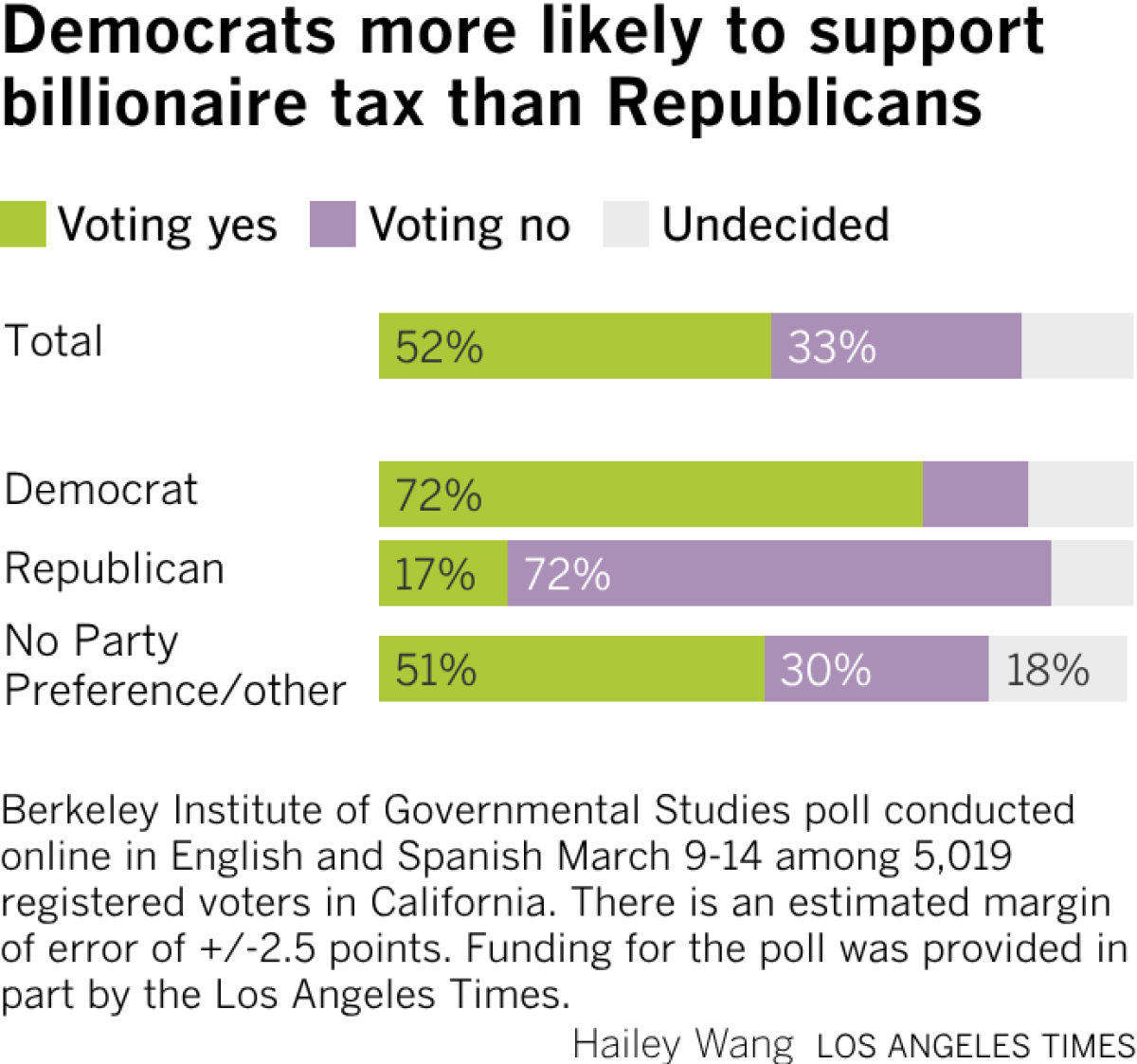
On the billionaire’s tax initiative, 72% of Democratic voters said they would support the measure if the election were held today — and the same percentage of Republicans oppose it. A slim majority — 51% — of voters who are unaffiliated or registered with another party support the wealth tax, while 30% said they oppose it, with the remainder undecided.
Republican voters overwhelmingly support the voter ID initiative, with 91% saying they would vote for it. More than two-thirds of Democratic voters, 68%, said they would oppose the measure. No party preference voters appeared evenly split.
Neither ballot measure has officially qualified for the November ballot thus far, though proponents of the voter ID measure said this month that they turned in 1.3 million voter signatures to elections officials, well above the 875,000 required to qualify. Proponents of the new tax on billionaires have until June 24 to submit signatures to elections officials.
The billionaire tax has generated national news coverage and widespread debate over whether it would benefit low-income Californians or end up hurting the state’s tax base as billionaires move out of the state to avoid paying it.
The proposal is backed by the Service Employees International Union-United Healthcare Workers West, which represents 120,000 workers in California. Union leaders say that the tax would raise $100 billion to backfill steep cuts to federal healthcare programs under a sweeping tax and spending bill approved by the Republican-controlled Congress and signed in the summer by Trump.
The measure would impose a one-time 5% tax on the assets of California residents who are worth $1 billion or more, with options to pay it over multiple years.
According to SEIU-UHW, the new tax would apply to around 200 people in the state, though several wealthy tech leaders have made moves to change their residences and avoid paying the tax should it pass. In recent months, Meta Chief Executive Mark Zuckerberg, Google co-founders Larry Page and Sergey Brin and others have bought up lavish beachfront estates and new commercial office spaces in South Florida.
Some of those billionaires are also ponying up to defeat the measure. Brin, who according to Forbes is the world’s third-richest person, has contributed $45 million to a new ballot measure committee called Building a Better California, which is pushing an alternative statewide ballot measure that could scrap the billionaire’s tax.
Brandon Castillo, a veteran ballot measure campaign strategist who is not working on either of the two measures, said even though it’s currently polling above 50%, the billionaire’s tax is starting out “in a really shaky position.”
“This is not a very strong place to start,” he said. “That’s not to say they can’t keep this thing over 50%, but when you’re starting just barely above 50% and you have a tsunami of money and a huge campaign against you, it’s really hard to keep yourself at that level.”
Though previous public opinion polls at the state and national levels have shown broad support for requiring proof of citizenship to vote in elections, even among Democrats, the new Berkeley poll showed liberal voters are skeptical of the measure.
Proponents of voter ID contend that such laws prevent election fraud and, along with proof of citizenship mandates, prevent noncitizens from voting. Opponents say ID requirements threaten the fundamental constitutional rights of Americans who do not have the documentation readily available, and that the restrictions are unnecessary given that voting by noncitizens is rare and already outlawed in the U.S.
Under current law, Californians are not required to show or provide identification when casting a ballot in person or by mail. They are required to provide identification when registering to vote, and must swear under penalty of perjury, a felony, that they are eligible to vote and a U.S. citizen.
The poll showed that slim majorities of predominantly Spanish-speaking voters, voters who were born in another country and first-generation immigrants support the voter ID measure. A plurality of Latino voters also favor it, with 44% in support and 41% opposed.
But DiCamillo cautioned against reading too much into those numbers, noting that awareness of the measure is still relatively low.
“I’ve always seen in my history of measuring Latino voters’ support that they are relatively late deciders on most ballot measures,” he said. “How they break will be critical. I would say we’ll have to look at how they feel when we do our final preelection poll.”
Voter ID laws are also a top priority of Trump, who has pressured the Senate into taking up the SAVE Act, which would impose nationwide requirements for proof of citizenship to vote and already has passed the House of Representatives.
Castillo said Trump’s support could sway Democratic and liberal-leaning independents to vote against the measure.
Both DiCamillo and Castillo noted that with the November election still seven months away, voters are not paying much attention and those on either side of each ballot measure have not launched major campaigns yet.
“I suspect by the time election day comes around, these awareness numbers on the billionaire’s tax certainly are going to be much higher,” Castillo said. “You’re going to see 80-90% of voters familiar with it, just because they’re going to be inundated with advertising and earned media between now and November.”
The Berkeley IGS/Times poll surveyed 5,019 registered California voters online in English and Spanish from March 9 to 14. The results are estimated to have a margin of error of 2.5 percentage points in either direction in the overall sample, and larger numbers for subgroups.
The decision to strip Senegal of the 2025 Africa Cup of Nations title is “abject” and “we have to denounce it” a senior figure at African football’s governing body has said.
Senegal beat Morocco 1-0 in January’s final but the Confederation of African Football (Caf) overturned the result on Tuesday because Senegal’s players walked off the pitch in protest when hosts Morocco were awarded a stoppage-time penalty.
Play resumed after a 17-minute delay, and Brahim Diaz’s penalty for Morocco was saved and the game went to extra time, where Senegal’s Pape Gueye scored the winner.
Following an appeal by the Moroccan Football Association (FRMF), Caf ruled that by walking off the pitch Senegal had forfeited the match, with the “result being recorded as 3-0 in favour” of Morocco.
Augustin Senghor, a Caf executive committee member and former head of the Senegalese Football Federation, told BBC World Service’s Newsday: “In a situation like this, we have to fight against injustice.
“Football is fair play, football is played is on the field, not in offices.
“What happened with Caf was unacceptable.
“When you see a committee taking such a decision in violation of our rules, in violation of the Fifa laws of the game, to take the trophy and give it to Morocco, I think it is something very abject.
“We have to denounce it.”
The FRMF said in a statement on Wednesday that the Caf verdict “upholds respect for rules that are necessary for the proper functioning of international competition”.
It added: “This decision helps to clarify the framework applicable to similar situations in the future and contributes to the consistency and credibility of international competitions, particularly African football.”
But Senghor believes that the decision was made after pressure from the FRMF.
“Senegal will fight because what happened is happening for the first time in the story of African football, in world football,” he added.
“I am sure that if we [appeal to the Court of Arbitration for Sport] then we will win and the trophy will never leave Senegal. It is clear in my mind.”
South Korea and Japan are facing uncomfortable questions about their mutual defensive obligations as the United States seeks support from its allies in the war on Iran, now nearly three weeks in and escalating by the day.
Earlier this week, US President Donald Trump urged the United Kingdom, China, France, Japan, and South Korea to send warships to the Strait of Hormuz, which has remained de facto closed since Washington launched its war with ally Israel on Tehran on March 28.
Recommended Stories
list of 4 itemsend of list
The president backpedalled on his position on Tuesday – declaring on social media that “we no longer ‘need,’ or desire, the NATO Countries’ assistance – WE NEVER DID! Likewise, Japan, Australia, or South Korea” – but observers say US allies may not yet be out of the hot seat.
Trump is expected to raise the issue of warships when he meets with Japanese Prime Minister Sanae Takaichi at the White House on Thursday, according to Al Jazeera correspondent Jack Barton.
“People do expect him to put pressure on Takaichi again to send warships to the Strait of Hormuz. It makes sense in a way because Japan is so dependent on energy supplies” from the Middle East, Barton said on Thursday from Seoul.
Japan’s Maritime Self-Defence Force is one of the largest and most advanced navies in the world, he said, which makes it an attractive target for the Trump Administration.
Although Japan and the US share a mutual defence, Tokyo’s pacifist constitution places restrictions on when it can deploy its Self-Defense Force. Legal scenarios include when it is attacked or facing a “survival-threatening” scenario, as well as acting in “collective self-defence” of its allies.
Takaichi told legislators this week that her government is considering what can legally be done to protect Japanese ships and interests, according to Japanese public broadcaster NHK World, although deployment is still a hypothetical scenario.
Japan relies heavily on Middle Eastern oil imports, of which 70 percent pass through the Strait of Hormuz, according to Japanese media. Tokyo began releasing oil from its strategic reserve on Monday to make up for the shortfall.
Stephen Nagy, a professor at the International Christian University, Tokyo, told Al Jazeera it was not unexpected that the US – a treaty ally – would call on it for help, but Japan will need to consider what is expected.
“The question is if they are going to be on the front line of the attack from Iran or if they are going to provide some kind of supporting role, such as anti-mining activities, refuelling missions, maritime domain awareness,” he said.
“It’s not so much of a problem going there and being involved in the challenges associated with the Hormuz Strait; what is more important is what exactly they are going to do in that role. I think the Japanese are going to find a way to legally add value to the Trump administration, but don’t expect warships there fighting Iranian proxies,” he continued.
South Korea finds itself in a similar predicament as it is both a US treaty ally and a country that is heavily dependent on Middle Eastern oil and gas exports.
Seoul last week took the extraordinary measure of imposing a price cap on domestic fuel prices for the first time since the 1997 Asian financial crisis, to keep prices from rising too quickly for consumers. Despite their concerns, legislators continue to urge caution from the government in deploying its navy or military assets to the Middle East, according to Al Jazeera’s Barton.
In-Bum Chun, a retired South Korean lieutenant general, told Al Jazeera that it is not immediately clear whether Seoul’s Mutual Defense Treaty with the US applies to the Strait of Hormuz.
Seoul must also weigh helping the US against maintaining a credible deterrence against North Korea. Recent media reports suggest that the US is considering moving some of its Terminal High Altitude Area Defense (THAAD) missiles from South Korea to the Middle East. The missiles were installed to deter North Korea, and their removal, along with naval assets, could make voters nervous.
“Seoul must also consider the persistent threat from North Korea and the fact that a South Korean warship is already deployed to the Middle East,” Chun told Al Jazeera. “At the same time, because about 70 percent of Korea’s oil imports pass through the Strait of Hormuz, freedom of navigation is not an abstract principle but a core national interest. These competing realities must all be weighed before any final decision is reached.”
Air strikes come hours after pro-Iran armed group Kataib Hezbollah announces conditional suspension of US embassy attacks.
Published On 19 Mar 202619 Mar 2026
Air strikes have killed two fighters from the Popular Mobilisation Forces (PMF) in northern Iraq, the paramilitary group says from one of the fronts in the sprawling war engulfing the Middle East.
The two attacks targeted PMF positions early on Thursday in the Nineveh region, where Mosul city is located, and a military airport in Salah al-Din province, according to statements from the PMF, a predominantly Shia group that is part of Iraq’s security apparatus and includes several groups aligned with Iran.
Recommended Stories
list of 3 itemsend of list
The PMF blamed the attack on Israel and the United States. Iraq has been drawn into the US-Israeli war on Iran, now in its third week.
The PMF was formed in 2014 as a volunteer force supporting Iraqi security forces in the fight against ISIL (ISIS).
Strikes have targeted Iran-backed groups, which in turn have claimed near-daily attacks on US interests in Iraq and across the region.
Elsewhere, a fire broke out at a naval base in southern Iraq when it was hit by a drone overnight. An Iraqi security source told Al Jazeera that a drone crashed into a water treatment station at the Umm Qasr naval base near the border with Kuwait.
Footage from the scene circulating on social media and verified by Al Jazeera showed flames and smoke rising from the site.
US embassy attacks to be suspended
Hours before the attacks on PMF fighters, the pro-Iranian armed group Kataib Hezbollah said its secretary-general had “issued orders to suspend operations targeting the US embassy in Baghdad for a period of five days”.
Designated by Washington as a “terrorist organisation”, Iraq’s Kataib Hezbollah listed several conditions of the suspension, including Israel ceasing its bombardment of the southern suburbs of Beirut.
Kataib Hezbollah also demanded “a commitment to refrain from bombing residential areas in Baghdad and other provinces”.
Whenever “the enemy violates” the truce, “the response will be immediate”, the group said, warning of more strikes after the five-day period.
The US embassy has been targeted by drone and rocket attacks several times in recent days. Air defences have intercepted most of the projectiles.
The embassy is in the Green Zone, a heavily fortified district in central Baghdad that houses Iraqi government institutions and embassies.
A US diplomatic and logistics centre at Baghdad International Airport that houses military personnel has also been regularly targeted.
A CLIP of a ‘baby’ Louis Tomlinson on Waterloo Road, long before he was a global superstar, has tickled fans.
The BBC soap dug through the archives to unearth a blink-and-you’ll-miss-it cameo from former One Direction star Louis.
Sign up for the Showbiz newsletter
Thank you!
Louis Tomlinson has re-appeared in an old clip from soap Waterloo RoadCredit: BBCOne Direction star Louis can be seen in the resurfaced footageCredit: BBC
The clip shows a baby-faced Louis playing an extra during the show’s very first series in 2006.
In the footage, a concerned-looking Louis can be seen in the background of the school playground as fan-favourites Janeece Bryant (Chelsee Healey) and Donte Charles (Adam Thomas) get into a heated row.
To help fans catch the four-second appearance, the clip has been given the slow-motion treatment, asking: “Can you spot One Direction’s Louis Tomlinson in Waterloo Road?”
The Sun were the first to reveal at the start of the year that Zara and Louis had begun dating each other just weeks after she split from long-term partner, reality star Sam Thompson.
Singer-songwriter Louis is embarking on a world tourCredit: Getty
I have never managed to score a reservation to Bar Cecil, the restaurant that opened in April 2021 as an homage to Sir Cecil Beaton, the famously flamboyant British photographer, designer, author and all-around Renaissance man who died in 1980. It remains, almost comically after five years in business, the most difficult place to book a table in the Coachella Valley. Long ago I made my peace with lining up before the restaurant opens at 5 p.m. and starting early at the unreserved 12-seat bar, or slipping in between 6:30 p.m. to 7:15 p.m. when the first wave of bar seating turns over. We all show up, whenever we can, for potent drinks and chef and partner Gabriel Woo’s menu, a worldly mix of Continental swagger, global-minded modernism and California realness.
In January, the same team branched out with Beaton’s at Bar Cecil, a posh affair next door that flips the script on the restaurant: more cocktail-centric, mostly snacky food you stretch into a meal. Tufted red velvet cascading from the ceiling drives the louche vibes. The mid-20th-century-era sketches and prints adorning the walls are significant enough that the staff composed a booklet full of descriptions and biographies. (You’ll need a phone light to read through it.) There’s an enclosed terrace where VIPs seeking privacy tend to hang out as the night wears on. Precision-engineered cocktails cover the spectrum of tastes: not-too-sweet Singapore slings, a sharp-tongued Vesper with lemon oil, a retro-chic grasshopper blending Creme de Menthe and pandan for a nightcap. I have always been fascinated that certain Hollywood hangouts serve pigs in a blanket, and here they are, mustardy and easy to down one after another alongside shrimp cocktail, duck-meat bao, oysters, fries and, of course, caviar. Beaton’s also takes reservations but walk-ins, however variable the wait, are welcome. Try your luck. This is absolutely the place to be in Palm Springs right now.
The line at Holbox during the midweek lunch hour has become a cultural sensation, a queue of locals and visitors trailing past the automatic doors and around the parking lot like devotees angling for the latest iPhone series or limited-release sneakers. Believe the lauds, including ours when we named Holbox as The Times’ 2023 Restaurant of the Year. Gilberto Cetina’s command of mariscos is unmatched in Southern California – his ceviches, aguachiles and tostadas revolutionary in their freshness and jigsaw-intricate flavors. The smoked kanpachi taco alone — clinched with queso Chihuahua and finished with salsa cruda, avocado and drizzles of peanut salsa macha — is one of the most sophisticated things to eat in Los Angeles.
Holbox could be considered for the top ranking on its own strength. But in a year when disasters tore at our city, honoring the power of community feels more urgent than ever. Cetina’s seafood counter doesn’t thrive in a vacuum. Holbox resides inside the Mercado La Paloma in South L.A. The mercado is the economic-development arm of the Esperanza Community Housing Corp., a nonprofit organization founded in 1989 that counts affordable housing and equitable healthcare among its core missions. When the mercado was in the incubation stage, Esperanza’s executive director Nancy Ibrahim interviewed would-be restaurateurs about their challenges and hopes in starting a business. Among the candidates was Cetina’s father, Gilberto Sr., who proposed a stall serving his family’s regionally specific dishes from the Yucatán. Their venture, Chichén Itzá, was among the eight startups when the mercado opened in a former garment factory nearly 25 years ago, in February 2001.
Step into the 35,000-square-foot market today, and the smell of corn warms the senses. Fátima Juárez chose masa as her medium when she began working with Cetina at Holbox in 2017. Komal, the venue she opened last year with her husband, Conrado Rivera, is the only molino in L.A. grinding and nixtamalizing heirloom corn varieties daily. Among her deceptively spare menu of mostly quesadillas and tacos, start with the extraordinary quesadilla de flor de calabaza, a creased blue corn tortilla, bound by melted quesillo, arrayed with squash blossoms radiating like sunbeams.
Wander farther, past the communal sea of tiled tables between Holbox and Komal, to find jewels that first-timers or even regular visitors might overlook.
Taqueria Vista Hermosa, run by Raul Morales and his family, is the other remaining original tenant. Order an al pastor taco, or Morales’ specialty of Michoacan-style fish empapelado smothered in vegetables and wrapped in banana leaf. The lush, orange-scented cochinita pibil is the obvious choice next door at still-flourishing Chichén Itzá, but don’t overlook crackling kibi and the brunchy huevos motuleños over ham and black bean puree. The weekends-only tacos de barbacoa de chivo are our favorites at the stand called Oaxacalifornia, though we swing through any time for the piloncillo-sweetened café de olla and a scoop of smoked milk ice cream from its sibling juice and snack bar in the market’s center. Looking for the comfort of noodles? Try the pad see ew at Thai Corner Food Express in the far back.
The everyday and the exquisite; the fast and the formal (just try to score a reservation for Holbox’s twice-a-week tasting menu); a food hall and sanctuary for us all. Mercado La Paloma embodies the Los Angeles we love.