Lauren James finds the top corner with a spectacular curling effor to get Chelsea back into the game against Arsenal in their Women’s Champions League quarter-final.
March 24 (UPI) — NASA on Tuesday announced plans to spend $30 billion on a permanent lunar base and send astronauts to the moon every six months after the Artemis V mission.
Speaking at a so-called “Ignition” event at NASA headquarters in Washington, D.C., Administrator Jared Isaacman discussed plans to accelerate construction of a moon base.
“There will be an evolutionary path to building humanity’s first permanent surface outpost beyond Earth,” he said.
“NASA is committed to achieving the near-impossible once again: to return to the moon before the end of President [Donald] Trump’s term, build a moon base, establish an enduring presence, and do the other things needed to ensure American leadership in space.”
NASA’s plan was initially to focus on what it called the Gateway program — a space station that was going to orbit the moon. Then the agency would build a base on the moon.
Carlos Garcia-Galan, the program executive for NASA’s Moon Base program, said the systems and hardware already established for the Gateway program would be repurposed to build the moon base.
Isaacman said the moon base plan will comprise three phases.
The first phase would include a series of missions to send small robotic landers and vehicles astronauts can drive on the surface to the moon. It would also encompass communications and scientific instruments.
The second phase would involve the construction of a “semi-habitable infrastructure” for astronauts on the lunar surface.
The third phase would start construction of a more permanent structure.
The first two phases would involve an investment of $20 billion over the next seven years and dozens of missions to the moon. The third phase would cost another $10 billion.
“The moon base will not appear overnight,” Isaacman said.
Isaacman said NASA also plans to launch a nuclear-propelled spacecraft to Mars by 2028.
NASA’s launch window for Artemis II is set to open April. The crewed mission is expected to send the Space Launch System and Orion spacecraft to orbit the moon over 10 days and return to Earth. The crew will test whether the spacecraft operates in deep space.
The long-term goal of the Artemis program is to re-establish a human presence on the moon in preparation for the ultimate aim of putting a human on Mars.
NASA’s Space Launch System rocket emerges on Saturday morning from the Vehicle Assembly Building to start its journey to Launch Complex 39B at the Kennedy Space Center in Florida. Photo by Joe Marino/UPI | License Photo
Two pilots were killed and several passengers and crew were injured when an Air Canada plane collided with a fire truck at New York’s LaGuardia airport.
BBC Verify has been using air-traffic-control audio and flight-tracking data to piece together what happened on the runway on 22 March – as Jake Horton explains.
Produced by Aisha Sembhi. Graphics by Mesut Ersoz. Verification by Daniele Palumbo.
MEL Schilling’s “heartbroken” MAFS co-star John Aiken has admitted he is “struggling to breathe”, as he broke his silence on her death.
The Australian relationship expert, 55, revealed his immense grief after Mel tragically died aged 54 following a brave battle with colon cancer.
Sign up for the Showbiz newsletter
Thank you!
MAFS Australia expert John Aiken penned an emotional tribute to Mel Schilling following news of her deathCredit: InstagramJohn said he was ‘struggling to breathe’ following his friend’s passingCredit: InstgramMel and John appeared on the Aussie MAFS together for ten yearsCredit: Nine
Today her MAFS Aus co-star John shared a picture of him with his pal from 2016 and one from the recent series, and penned an emotional message which read: “It’s with great sadness and heavy heart that today I lost my dear friend and fellow MAFS expert Mel Schilling.
“I am heartbroken, devastated and finding it hard to breathe.
“It was a privilege and an honour to sit beside her on the MAFS couch and watch her shine. She was warm, supportive and honest, and she deeply cared about all our participants. I had a front row seat to her remarkable skills and she truly believed in the experiment. At her core she loved love.”
John also talked about their relationship off screen, and the “fun” they would have when the cameras weren’t rolling.
“And when her illness struck she never complained. She kept her challenges to herself and continued to deliver time and time again. She was an inspiration, a fighter, a leader,” the grief stricken star said.
“It’s not fair that my partner in crime is gone. She was one of the good ones. I am unravelling just thinking about it. I wanted to sit on our couch together forever. She knew my rhythms and I knew hers. But it’s simply not to be.
John admitted he was “distraught” that he had to accept she was now gone, and ended the heartfelt message with: “I love you and I miss you gorgeous.. xx”.
Mel and John were incredibly close having worked on MAFS Australia together for ten years, including the latest series which is airing right now on E4.
John said he was ‘heartbroken’ by Mel’s sad deathCredit: Channel 4
Alongside touching pictures of Mel, he said: “Melanie Jane Brisbane-Schilling passed away peacefully today, surrounded by love.
“In her final moments, when I thought cancer had taken away her ability to speak, she ushered me closer and whispered a message for Maddie and me that will sustain me for the rest of my life.
“It took all of her remaining strength, and that gesture summed up our wee Melsie perfectly. Even then, her only thought was for Maddie and me.”
He continued: “This is a woman who became a new mum and a TV star at 42 — and nailed both.
Mel’s husband Gareth Brisbane announced the heartbreaking news today in an emotional Instagram postCredit: Instagram
“This is a woman who, through two years of chemotherapy, when she could barely lift her head from the pillow, never complained and never stopped showing courage, grace, compassion and empathy, and never missed a day of filming.
“To most of you, she was Mel Schilling — matriarch of MAFS and queen of reality TV. To Maddie and me, she was our wee Melsie: an incredible mum, role model, and soulmate.”
Channel 4hailed Mel as a friend who “radiated joy, warmth and optimism”.
Issuing a statement, it said: “Our thoughts and condolences are, first and foremost, with her family and loved ones.
“We’re privileged to be the channel that is home to Mel’s work, which was at the heart of Married At First Sight‘s phenomenal success, both in the UK and Australia.
“It reflected so much about her – her fierce advocacy for other women, her passion for healthy relationships and her mission to unite people in love.
“For many who work for Channel 4, Mel was not just a colleague but a friend, someone who radiated joy, warmth and optimism, who energized every room she walked into, with humour and positivity.
“Everyone who knew her will miss all this about her and much more. We share in the sorrow that we’re sure many viewers will now feel at this terrible loss.”
Mel had been battling colon cancerCredit: Instagram
WASHINGTON — The Trump administration urged the Supreme Court on Tuesday to rule that it may block migrants from applying for asylum at ports of entry along the southern border.
The administration’s lawyers argued that the right to asylum, which arose in response to Nazi Germany and the Holocaust, does not extend to those who are stopped just short of a border post in California, Arizona or Texas.
They pointed to part of the immigration law that says a non-citizen who “arrives in the United States … may apply for asylum.”
“You can’t arrive in the United States while you’re still standing in Mexico. That should be the end of this case,” Vivek Suri, a Justice Department attorney, told the court.
Immigration rights advocates called this claim “perverse” and illogical. They said such a rule would encourage migrants to cross the border illegally rather than present themselves legally at a border post.
The justices sounded divided and a bit uncertain over how to proceed. But the conservative majority is nonetheless likely to uphold the administration’s broad power over immigration enforcement.
Several of the justices noted, however, the Trump administration is not currently enforcing a “remain in Mexico” policy.
Liberal Justices Sonia Sotomayor and Ketanji Brown Jackson questioned why the court would make a major decision on immigration and asylum with no immediate, practical impact.
The case posed a fundamental clash between the government’s need to manage surges at the border and the moral and historic right to offer asylum to those fleeing persecution.
In 1939, more than 900 Jewish refugees who were fleeing Nazi Germany aboard the MS St. Louis were turned away by Cuba and the United States. They were forced to return to Europe and more than 250 of them died in the Holocaust.
The worldwide moral reckoning spurred many nations, including the United States, to adopt new laws which offer protection to those fleeing persecution.
In the Refugee Act of 1980, Congress said that non-citizens either “physically present in the United States” or “at a land border or port of entry” may apply for asylum.
To be eligible for asylum, a non-citizen had to demonstrate a well-founded fear of persecution in their home country due to their race, religion, nationality, membership in a particular social group, or political opinion.
Only a small percentage of applicants win their asylum claims, and only after years of litigation.
But faced with overwhelming surge of migrants, the Obama administration in 2016 adopted a “metering” policy that required people to wait on the Mexican side of the border.
The Trump and Biden administrations maintained such policies for a time.
In a 2-1 decision, the 9th Circuit Court of Appeals agreed in 2024.
“To ‘arrive’ means ‘to reach a destination,’” Judge Michelle Friedland wrote for the appeals court. “A person who presents herself to an official at the border has ‘arrived.’”
The Trump administration appealed.
Solicitor Gen. D. John Sauer said the “ordinary meaning of ‘arrives in’ refers to entering a specific place, not just coming close to it. An alien who is stopped in Mexico does not arrive in the United States.”
On Tuesday, the Justice Department attorney said the court should reverse the 9th Circuit and uphold the government’s broad power to block migrants approaching the border.
“I can’t predict the next border surge,” Suri said.
“For more than 45 years, Congress has guaranteed people arriving at our borders the right to seek asylum, consistent with our international treaty obligations,” said Kelsi Corkran, Supreme Court director of the Institute for Constitutional Advocacy and Protection, who argued the case. “Yet this administration believes that Congress gave it discretion to completely ignore those requirements, and turn back those who are seeking refuge from persecution at its whim.”
“The people turned away at our border are fleeing rape, torture, kidnapping, and death threats. You cannot tell families running for their lives to go back and wait in danger because their suffering is inconvenient,” said Nicole Elizabeth Ramos, border rights project directo at Al Otro Lado which was the plaintiff in the case. “We brought this case because the United States made a legal and moral commitment to protect people fleeing persecution.”
The agency will increase robotic missions to the moon and launch a spacecraft called Space Reactor 1 Freedom.
Published On 24 Mar 202624 Mar 2026
NASA has unveiled a major overhaul of its moon and Mars strategy, scrapping plans for a lunar-orbit space station and instead committing $20bn over the next seven years to build a base on the moon’s surface, while also advancing plans to send a nuclear-powered spacecraft to Mars.
NASA Administrator Jared Isaacman outlined the changes on Tuesday during a meeting in Washington, DC, with partners, contractors and government officials involved in the Artemis programme, saying the agency will increase robotic missions to the moon and lay the groundwork for nuclear power on the lunar surface.
Isaacman, appointed by US President Donald Trump and who took charge in December, said the changes form part of a broader overhaul of NASA’s long-term Moon-to-Mars strategy.
The planned moon base is intended to support long-term human presence on the lunar surface, with robotic missions expected to help prepare the site, test technologies and begin building infrastructure before astronauts return later this decade.
The agency also disclosed plans to launch a spacecraft called Space Reactor 1 Freedom before the end of 2028, a mission designed to demonstrate nuclear electric propulsion in deep space on the way to Mars.
The spacecraft will deliver helicopters on the Red Planet, similar to the Ingenuity robotic test helicopter that flew with NASA’s Perseverance rover, a step the agency said would help move nuclear propulsion technology from laboratory testing to operational space missions.
The Ingenuity helicopter was the first aircraft to achieve powered, controlled flight on another planet. It travelled to Mars attached to NASA’s Perseverance rover and landed in February 2021.
Pausing the Lunar Gateway station
The Lunar Gateway station, a planned space station in lunar orbit being developed with contractors including Northrop Grumman and international partners, was meant to serve as a base where astronauts could live and work before heading to the Moon’s surface.
But NASA now plans to repurpose some Gateway components for use on the surface instead.
Repurposing Lunar Gateway to create a base on the moon’s surface leaves uncertain the future roles of Japan, Canada and the European Space Agency in the Artemis programme, three key NASA partners that had agreed to provide components for the orbital station.
“It should not really surprise anyone that we are pausing Gateway in its current form and focusing on infrastructure that supports sustained operations on the lunar surface,” Isaacman said.
The changes to NASA’s flagship Artemis programme are reshaping billions of dollars’ worth of contracts and come as the United States faces growing competition from China, which is aiming to land astronauts on the moon by 2030.
The Artemis programme, begun in 2017 during Trump’s first term as president, envisions regular lunar missions as NASA’s long-awaited follow-up to its first moon missions in the Apollo programme that ended in 1972.
Holiday makers have been urged to think carefully about what they share online(Image: Getty)
Families have been warned to be careful to avoid a costly mistake when heading away on holiday. The word of warning comes as key changes to the passport system are coming in soon.
Your holiday photos could cost you a lot of money and could invalidate your home insurance. Karishma Darji, from storage group Ready Steady Store, said: “Posting holiday selfies while you’re away might seem harmless, but it tells the world your home is empty. Insurers could view that as poor security.”
She said this mistake could land you a large bill if the worst happens.
Ms Darji said: ” If your property is burgled and investigators find public posts showing you were away, they may argue you didn’t take ‘reasonable care’ to protect your home.”
If your insurance is invalidated due to you posting a holiday snap while you are away from home and you are burgled, you will be responsible for covering the costs of any loss and damages yourself. Ms Darji said this could mean you end up with a four-figure bill to pay.
She explained: “The annual Crime Survey for England and Wales, published by the ONS in April 2025 shows that the average loss from burglary equates to £4,269. The average value of stolen items sits around £2,800, whereas damage from forced entry averages at £1,400.
“However, every house differs based on the value of possessions they own, so the total cost to replace items could be significantly higher.” In light of this danger, her simple word of advice is: “Save the snaps until you’re back to avoid invalidating your claim.”
Passport changes
This update comes as the cost of applying for a passport is soon to increase. Application fees are increasing by 8 per cent, with the new fees coming in from April 8.
The proposed increases, which need to be approved by Parliament, will include the following:
The standard online application submitted from within the UK will rise from £94.50 to £102 for adults
This will go up from £61.50 to £66.50 for children under 16
Postal applications will increase from £107 to £115.50 for adults and £74 to £80 for children under 16
The charge for a Premium Service (one-day) application submitted from within the UK will rise from £222 to £239.50
The charge for a standard online application for a UK adult passport when applying from overseas will rise from £108 to £116.50
This will also increase from £70 to £75.50 for children under 16
Standard paper applications for overseas passports will see a rise from £120.50 to £130 for adults, and from £82.50 to £89 for children under 16.
Salah has played a key role in reviving Liverpool‘s fortunes on the pitch during the past nine years.
He helped the club to two Premier League titles, the Champions League, Fifa Club World Cup, Uefa Super Cup, FA Cup and two EFL Cups, as well as the Community Shield.
Salah’s tally of 255 goals in 435 appearances for the Reds has him third in the pantheon of all-time leading goalscorers for the club, behind Ian Rush (346) and Roger Hunt (285).
He has won the Premier League golden boot on four occasions and been named the Professional Footballers’ Association player of the year three times – in 2018, 2022 and 2025.
Salah also hailed the support he has received from Liverpool fans who “showed me through the best time of my career” and also “stood by me in the toughest times”.
“It’s something I will never forget and something I will take with me always. Leaving is never easy,” he added.
“You gave me the best time of my life, I will be always one of you. The club will always be my home, to me and to my family. Thank you for everything. Because of all of you I will never walk alone.”
Liverpool said that Salah’s time at Anfield had been a “remarkable nine-year chapter” and plans to show their appreciation will come at a later date.
“With plenty still left to play for this season, Salah is firmly focused on trying to achieve the best possible finish to the campaign for Liverpool,” the club added.
“Therefore, the time to fully celebrate his legacy and achievements will follow later in the year when he bids farewell to Anfield.”
VERNON Kay stopped his BBC Radio 2 show to announce the death of his beloved colleague, station chief Ian Deeley.
The radio star paid tribute to his “larger than life” station manager Ian, 45, who passed away unexpectedly.
Sign up for the Showbiz newsletter
Thank you!
Beloved BBC station chief Ian Deeley died unexpectedly aged 45Credit: LinkedinBBC radio star Vernon Kay offered condolences to his colleague’s familyCredit: Alamy
Ian’s cause of death remains unknown, with Vernon saying “the BBC family were devastated to hear that our brilliant studio manager, Ian Deeley.”
Vernon, 51, hailed his colleague’s passion for radio, saying Ian loved his job and had worked on most BBC radio stations.
The presenter went on to say: “Even though he was a relatively young chap, Ian had a long and illustrious career, during which he pretty much worked on every BBC radio station.
“His time at the BBC started with news shifts followed by production work and more recently, Ian was working with our colleagues on the outside broadcast team, or ‘the Broadside Outcasts’ as he jokingly called them.
“With the OB team, Ian worked on all manner of big radio stuff, including pop festivals, BBC Proms and numerous royal events.
“The one that stands out for us and our little team is the one where Ian personally made sure that our show from the beaches of Normandy a few years ago went seamlessly – and it did.
“Ian was our lead engineer on our D-Day [80th] celebrations and he was so dedicated that he went on a [reconnaissance trip] over to France in his own time, just to make sure everything was up to his incredible high standard.”
Vernon added: “Ian loved working with us here at Radio 2 and I know one of his career highlights was working with our friend, Steve Wright, he was thrilled to be able to be a part of the big show and as ‘one of the top operatives’ as Steve called him.
“Steve always said, ‘Ian, keep it cranked’ and he did.”
The radio star would go on to offer condolences to Ian’s mum, partner and brother on behalf of the Radio 2 staff.
Later in the show, Vernon thanked his listeners after they sent in some words of condolence.
Paying tribute to Ian himself Vernon said: “As an engineer, there were few better but there are also so many things we can say about Ian, the person.
“He was an exuberant, larger-than-life character who was always enthusiastic and brought a smile to everyone’s faces.”
He went on to say that he and his colleagues would miss Ian’s “quick wit.”
Hailing the work Ian and other team members do Vernon added: “As you can imagine at Radio 2, it’s not just the names in the Radio Times who do all the work.
“We do very little, we just talk when we put up the fader, I’ll be honest with you, myself and every on-air name included.
“It’s the massive team behind Radio 2 that make this network so successful.”
Vernon offered a personal tribute to the station managerCredit: Getty
WASHINGTON — Minnesota officials sued the Trump administration on Tuesday for access to evidence they say they need to independently investigate three shootings by federal officers, including the killings of Renee Good and Alex Pretti.
The lawsuit claims that the federal government reneged on its promise to cooperate with state investigations after the surge of federal law enforcement in Minneapolis, and are seeking a court order demanding that the Trump administration comply.
“We are prepared to fight for transparency and accountability that the federal government is desperate to avoid,” Hennepin County Atty. Mary Moriarty told reporters.
The lawsuit marks an escalation in the clash between Minnesota leaders and the Trump administration over the investigations into the high-profile shootings by federal officers that sparked public outcry and protests. The Trump administration has suggested that Minnesota officials don’t have jurisdiction to investigate, but state officials insist they need to conduct their own probes because they don’t trust the federal government to investigate itself.
“There has to be an investigation any time a federal agent or a state agent takes the life of a person in our community,” Moriarty said.
The administration sent thousands of officers to the Minneapolis and St. Paul area for the immigration crackdown as part of President Trump’s national deportation campaign. The Department of Homeland Security considered its largest immigration enforcement operation ever a success but was staunchly criticized by Minnesota’s leaders who raised questions over officers’ conduct.
There continues to be fallout from Operation Metro Surge in the form of a Homeland Security shutdown, as Democrats in Congress hold up funding in an effort to secure restraints on Trump’s immigration agenda.
Minnesota’s lawsuit said the federal government is not permitted to “withhold investigative evidence for the purpose of shielding law enforcement officers from scrutiny where a State is investigating serious potential violations of its criminal laws, targeting its citizens, within its borders.”
Moriarty said Tuesday that the federal government “has adopted a policy of categorically withholding evidence,” calling the practice unprecedented and alarming. She said the lawsuit followed formal demands for evidence after the federal government blocked Minnesota investigators from accessing evidence related to the shootings.
In addition to the Pretti and Good cases, the lawsuit demands access to evidence in the case of Julio Cesar Sosa-Celis, who was shot and wounded in his right thigh by a federal agent in January.
Federal officials initially accused Sosa-Celis and another man of beating an Immigration and Customs Enforcement officer with a broom handle and a snow shovel. But federal prosecutors later dropped all charges against the men and authorities opened a criminal investigation into whether two immigration officers lied under oath about the shooting.
Emails seeking comment were sent to DHS and the Justice Department.
The Justice Department in January said it was opening a federal civil rights investigation into Pretti’s killing but has said a similar federal probe was not warranted in the killing of Good. The decision in Good’s case marked a sharp departure from past administrations, which moved quickly to investigate shootings of civilians by law enforcement officials for potential civil rights offenses.
Deputy Atty. Gen. Todd Blanche has said that the department’s Civil Rights Division does not investigate every law enforcement shooting and that there have to be circumstances and facts that “warrant an investigation.”
Moriarty has said a lack of confidence in the federal government’s review of these incidents makes the state’s independent investigations into the shootings, as well as officers’ actions during the immigration enforcement operation altogether, especially important. The county office received over 1,000 tips from the public on the shootings of Good and Pretti via an online portal they opened to collect evidence. Earlier this month, Moriarty initiated a second portal and said her office was investigating a number of incidents of potentially unlawful action by officers over the course of the immigration enforcement operation.
Fingerhut and Richer write for the Associated Press. Fingerhut reported from Des Moines, Iowa.
It had nothing to do with the Masters — not directly anyway.
The 50-year-old golfing legend will be playing competitively for the first time in more than a year as his Jupiter Links team competes against Los Angeles in the second match of the best-of-three TGL finals Tuesday night in Palm Beach Gardens, Fla.
TGL is a high-tech, indoor golf league that uses simulators and real surfaces, founded by Woods, Rory McIlroy and Mike McCarley in 2022. While a TGL match doesn’t present the same physical challenge as a PGA Tour event, the team event could serve as Woods’ first step toward playing at Augusta National on April 9-12.
Woods last played competitively March 4, 2025, in Jupiter’s final TGL match of that season. He missed all of the PGA season last year as he recovered from a 2024 back surgery and surgery in March 2025 for a ruptured Achilles tendon. Last fall, he underwent disk replacement surgery in his lower back.
A five-time Masters winner, most recently in 2019, Woods is listed as a 2026 invitee on the tournament website but has yet to confirm his participation.
Last month at the Genesis Invitational, a reporter asked Woods if the Masters was “off the table” for him this year. Woods answered simply, “No.”
In the opening match of the TGL finals Monday night, Jupiter lost 6-5, with Kevin Kisner narrowly missing a birdie chip from 20 feet that would have won the match. Woods was on hand as a team captain and supporter, roles he has served all season.
After the match, Woods told reporters he felt bad for his players — Tom Kim, Max Homa and Kisner — but expressed optimism that Jupiter could still come back and claim the title. If Jupiter wins Match 2, a third match will take place immediately afterward to determine the TGL champion.
“We have possibly two more matches,” Woods said. “We’re not out of this.”
Woods didn’t mention the possibility of placing himself in the next day’s lineup. After the news conference, however, TGL posted a graphic on X that showed what appears to be Woods’ torso and the words “He’s back,” along with the viewing information for Tuesday’s match.
Moments later, Jupiter Links posted a graphic on X that featured a photo of Woods and the quote, “I’m back.”
Woods will be replacing Kisner in the lineup for at least Match 2. It is unclear if Woods would take part in a possible third match.
Last week, after Jupiter clinched a spot in the finals, Woods told reporters he has been trying to play all season “but it just hasn’t worked out that way.” He added that the players had done well without him and implied that he didn’t foresee any changes ahead of the finals.
“I really don’t want to screw up the lineup,” Woods added. “I just want these guys to keep playing.”
United States President Donald Trump is insistent that “productive” negotiations have taken place with Iran to end the war he launched with Israel’s Prime Minister Benjamin Netanyahu almost a month ago. The major problem with that narrative is that Iran’s top officials have repeatedly denied it.
Amid the fog of war and the propaganda being pushed by all sides, it is hard to know who to believe. But an analysis of what each side has to gain from any negotiations – and a potential end to the conflict – could bring more clarity.
Recommended Stories
list of 3 itemsend of list
Trump’s comments that there were “major points of agreement” after “very good” talks with an unnamed “top” Iranian figure came as stock markets opened in the US for the start of the trading week. The five-day deadline he gave for a positive response from Iran also happens to coincide with the end of the trading week.
Many have cynically noted that timing, especially as it comes after a two-week period in which oil prices have fluctuated in line with events in the Middle East, leading to a high of about $120 a barrel last week.
Trump’s talk of negotiations may also give time for more US troops to arrive in the Middle East, if Washington decides to conduct some form of ground invasion of Iranian territory.
Among those questioning Trump’s motives was the man believed by some to be the senior Iranian official Trump was referencing: the Iranian parliamentary speaker, Mohammad Bagher Ghalibaf.
“No negotiations have been held with the US, and fakenews is used to manipulate the financial and oil markets and escape the quagmire in which the US and Israel are trapped,” Ghalibaf wrote on social media.
The impact on stock markets and oil prices is not just relevant to the US and Trump, but also to Iran. However, for Tehran, the benefit comes in the damage the war is doing to the US and global economies.
The Iranian state wants the US to feel economic pain from the war, as a means of deterrence for any future Israeli or US attack on Iran.
Therefore, as much as it is in the US interest to play up talk of negotiations in order to calm the markets, it is also in Iran’s interest to downplay any talk to do the exact opposite, and not give the Trump administration any breathing space.
US benefits?
Consequently, both sides have their own narratives on negotiations, and public comments will do little to inform us as to whether those negotiations are really taking place, or in what form they may be.
That instead leads us into what each side has to gain from negotiations, and an actual end to the war at the current stage.
Trump appears to have underestimated the consequences of the conflict that he launched with Netanyahu on February 28, and the ability of the Iranian state to withstand the attacks against it without collapsing.
“They weren’t supposed to go after all these other countries in the Middle East … Nobody expected that,” he said last week, adding that even “the greatest experts” didn’t believe that.
Leaving aside that experts – including US intelligence officials – had repeatedly made those warnings, reality has now made Trump aware of the consequences he had previously ignored.
While some allies and supporters may continue to push him to plough on with the conflict, Trump has previously shown himself amenable to cutting deals to extricate himself from difficult situations, and it is not far-fetched to see the benefits of doing so in this instance.
The US president has already ordered his government to issue temporary sanctions waivers on some Iranian oil, in an effort to calm oil prices. This is the first time Iran has lifted sanctions on any Iranian oil since 2019, and it will not be lost on Iran that the waivers have come as a result of their policy to expand the conflict to the wider Gulf and the Strait of Hormuz, a key waterway through which a fifth of the world’s oil and liquified natural gas transits.
The war was already unpopular in the US – and now even more so, as consumers see the impact on petrol prices and potentially other areas of the economy, all in the run-up to congressional elections later this year, in which Trump’s Republicans are likely to do poorly.
Trump, therefore, has the options of extending this war – and suffering the economic and political cost, or ending it – and facing the criticism that he was unable to finish what he termed as a “short-term excursion”.
The Iranian perspective
But whatever Trump wants to do, the decision is not totally in his hands. Iran, attacked for the second time in less than a year, now appears to have less of an incentive to end the war without the establishment of an effective deterrent to another in the future.
Gone are the days of the telegraphed attacks on US assets and the slow climb up the escalation ladder. From the outset of the current war, it was clear that Iran had changed its tactics and was not as interested in restraint.
It is now arguably in the Iranian state’s benefit to drag out the conflict and inflict more suffering on the region, if it wants to ensure its survival.
There may also be a belief that interceptor stocks in Israel are running low, allowing Iran to strike targets more effectively. The thinking – particularly among the hardliners who now appear to be in the ascendancy in Iran – will be that now is not the time to stop, and allow those interceptor stocks to replenish.
And yet, Iran is suffering. More than 1,500 people have been killed across the country, according to the government. Infrastructure has been heavily damaged, and the power grid could be next. Relations with Gulf neighbours have nosedived, and, after repeated Iranian attacks, are unlikely to return to their previous levels after the conflict.
More moderate voices in Iran will look at that and think that things could easily get worse. They can argue that some form of deterrence has been achieved, and that the time is now ripe to talk. And if they can get some concessions – such as a promise of no future attacks, or greater authority in the Strait of Hormuz – they may decide that the time is right to make a deal.
Weekly insights and analysis on the latest developments in military technology, strategy, and foreign policy.
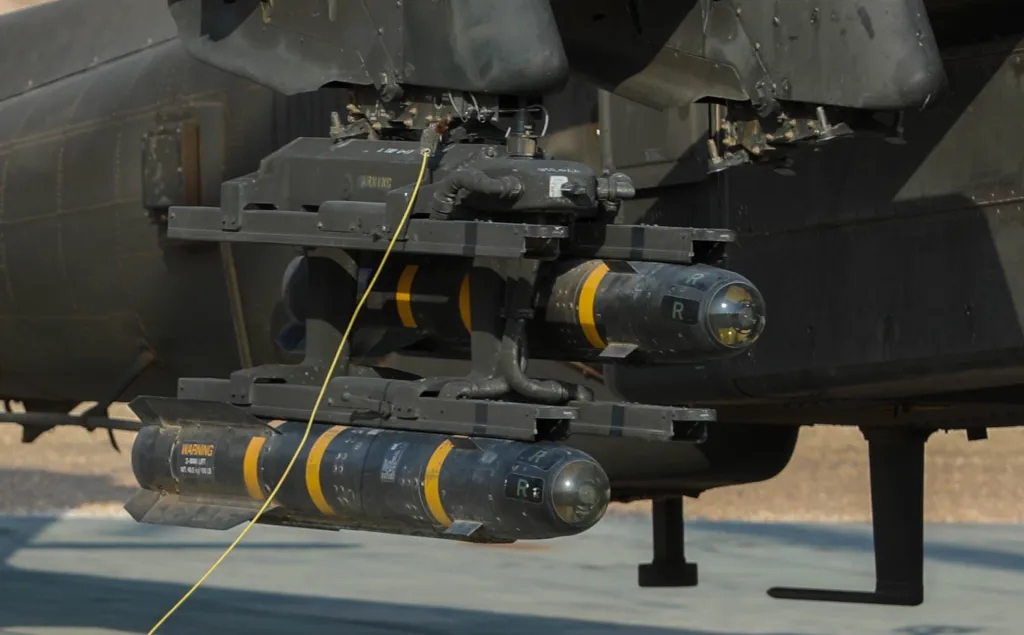
Lockheed Martin has developed a launcher called Grizzly that fires AGM-114 Hellfire missiles from within an otherwise unassuming 10-foot shipping container. Employed alone or in groups networked together, Grizzly presents a flexible and relatively low-cost means of bolstering point defenses against aerial threats, including drones, and targets on the surface. The launchers can also hide in plain sight, intermixed with regular containers, creating targeting dilemmas and uncertainty for opponents.
Grizzly has already successfully completed two live-fire tests, according to a press release Lockheed Martin put out today. The launcher took just six months to build, and makes heavy use of existing and often commercial off-the-shelf components. This includes leveraging the proven M299 four-rail launcher, which is in widespread use globally today, most commonly as a means for launching Hellfires from various types of helicopters.
An M299 launcher seen on the stub wing of a US Army AH-64 Apache attack helicopter. US Army
In “one test we launched missiles vertically,” Chris Murphy, senior manager of Business Development for Integrated Air and Missile Defense Advanced Programs, told TWZ and other outlets during a call yesterday. “In another test, we launched them at an angle to prove out some of the flexibility of the system.”
The container itself has a roof that hinges open for firing. Lockheed Martin says the containerized launcher can be configured to be self-powered or make use of a tertiary power source.
A Hellfire missile is fired vertically from a Grizzly launcher during a test. Lockheed Martin
Broadly speaking, “you might think of a depth of magazine as being a really large magazine,” Murphy explained. “Another way to achieve depth of magazine is to have several launchers. What we’ve tried to do is take a lot of the cost out of those launchers and use containers where possible.”
“The idea is that you can leave these somewhat unattended,” he continued. “Obviously, they would be in proximity to some support, but as opposed to having a full-on launcher sitting out someplace or moving around someplace, you’ll just have some ideas to have some containers available. And they protect the system from weather, but they also then allow rapid access and also rapid reload when the time comes. “
“The idea is to provide these [Grizzly container launchers] in multiple places and to… make the enemy uncertain of what is where,” Murphy added. “By using commercial materials and commercial launchers, it’s not obvious where you have protection capability, and it allows you to spread the protection out geographically. It allows it to be remotely operated.”
In general, containerized launchers are also inherently mobile and readily deployable via truck, as well as by cargo aircraft and ships. They also offer opportunities to be employed from any vessel with sufficient deck space, which we will come back to later on.
A US Army Palletized Load System (PLS) truck seen offloading a standard 20-foot shipping container. US Army
Lockheed Martin’s press release today otherwise says that Grizzly is “command and control and sensor agnostic” and can be utilized to “support any service or mission, anywhere.”
That being said, the fact that the Integrated Air and Missile Defense Advanced Programs division led the development of Grizzly points to a clear surface-to-air application for the launcher. The millimeter-wave radar-guided AGM-114L variant of the Hellfire has a demonstrated anti-air capability against various types of drones, which is a particular pressing threat. Loaded with AGM-114Ls and linked to air search radars and other sensors, the containerized launch system could offer a way to rapidly boost air defenses, especially at forward locations.
The current conflict with Iran provides a number of real-world instances where this could be valuable. In particular, Iranian-backed militias have launched repeated drone attacks on the U.S. Embassy complex in Baghdad, Iraq. In line with the remote operation concept Lockheed Martin’s Murphy outlined, Grizzly launchers could be placed around the outer edge of the larger Green Zone in Baghdad, creating an outer layer of close-in defense.
Footage captures a massive blaze following a kamikaze drone strike by Iran-backed militias on the U.S. State Department’s support facility at Victory Camp within Baghdad International Airport.
A Saab Giraffe 1X SHORAD radar can be seen at the targeted site, indicating that a… pic.twitter.com/SNsnFYriQZ
Grizzly could be used to fire AGM-114Ls, along with laser-guided Hellfire variants, at targets on land or at sea. The picture Lockheed Martin included in its press release today notably shows the launcher firing a laser-guided Hellfire vertically during a test. As an aside, several countries already have or are developing ground-based launch systems for Hellfire that are designed to be employed in the coastal defense role against landing craft and amphibious vehicles. With assistance from the United Kingdom, Ukraine’s armed forces have also fielded a launch system for the Hellfire-derived Brimstone missiles concealed inside civilian-style trucks that has been used for more general surface-to-surface attacks.
The video below includes clips of a Hellfire launcher concealed inside a typical civilian truck now in development in Taiwan for coastal defense applications.
《國防線上-國防自主軍備研製》打造更堅韌有力的防衛力量
As noted, Grizzly has the potential to be employed from ships and locations on land in any role. Purpose-built launchers for the AGM-114L are already integrated onto some of the U.S. Navy’s Freedom and Independence class Littoral Combat Ships (LCS) to provide extra protection against drones and swarms of small boats.
USS Detroit (LCS 7) Successful Missile Test Firing
“The idea behind Grizzly was for it to be a low-cost approach, and we believe that it’s appropriate for multiple customers,” Lockheed Martin’s Murphy said yesterday in response to a question about using the launcher in this domain. “The maritime environment may pose some challenges that you might have to rethink a couple of things, but the general concept is valid.”
Hellfire might not be the only missile Grizzly can fire, either. Murphy said that the launcher was designed to allow for the ready integration of additional functionality, including other missiles, down the line “without having to change much of anything.” One obvious candidate would be the AGM-179A Joint Air-to-Ground Missile (JAGM), which is derived from the AGM-114R and can already be fired from many of the same launchers, including the M299. Conceivably, the overall concept could be expanded to a launch system in a larger container with more total missiles.
An AGM-179A JAGM seen loaded on an M299 launcher during testing. US Army
Containerized systems, in general, present particular benefits for expeditionary or distributed operations. Launchers like Grizzly could be particularly relevant for supporting operations in forward areas across the broad expanses of the Pacific during a future major conflict with China. As mentioned, having the additional benefit of being able to deploy them discreetly presents challenges for opponents.
“I think, again, it aligns to our ability to operate in multiple domains,” U.S. Army Gen. Ronald Clark, head of U.S. Army Pacific (USARPAC), said in response to a general question about containerized launch capabilities at an event last year that the Center for Strategic & International Studies (CSIS) think tank in Washington, D.C. “Our ability to target our adversaries at scale and our ability to be able to be literally ubiquitous with boxes of rockets at different places, that look like boxes of something else, really gives our adversary pause, because it’s in real time providing deterrence.”
Lockheed Martin has also touted Grizzly simply as an example of its ability to rapidly produce a working prototype system, which could then be produced and fielded on at least a limited level without necessarily having to commit to large-scale production.
“There are many instances where you can develop a prototype, such as this Grizzly launcher, and maybe you only need a few of them, but maybe you need a couple 100. Those are still not numbers that you come up with – that you would come up with for a large-scale production line,” Lockheed Martin’s Murphy said. “We’ve got a couple other programs that we’re working through the same approach and are proving to ourselves and proving to our customers that this is a very good intermediate step between one or two prototypes versus dozens, or maybe even hundreds of early capability products, until you get to the point where you think that you’re ready for let’s go ahead and have a full-scale, full-rate production.”
Grizzly, in its current form, certainly offers potential anti-air and other capabilities that could be of interest across the U.S. military, as well as to foreign customers, especially armed forces that already have Hellfire variants in inventory.
Epic Games, the developer of the popular video game “Fortnite,” is laying off more than 1,000 employees and cutting $500 million in costs.
Chief Executive Tim Sweeney announced the cuts Tuesday morning in a message to employees. He said it has nothing to do with AI and instead pointed to what he said was a lack of “Fortnite” engagement last year.
“Despite Fortnite remaining one of the most successful games in the world, we’ve had challenges delivering consistent Fortnite magic with every season,” said Sweeney in a statement.
The company’s flagship game was first released in 2017. Since then, it’s been a key part of internet culture — where character-specific dances became widespread trends and major musicians, like Travis Scott and Ariana Grande, have hosted concerts in the virtual realm.
But Epic has been slow to optimize the computer game for mobile play. A “Fortnite” app was first introduced in 2018, but soon removed due to a legal battle against Apple and Google over app store practices. Sweeney said the company is still in the “early stages of returning to mobile and optimizing Fortnite for the world’s billions of smartphones.”
Many of Epic’s woes also come from industry-wide challenges, like “slower growth, weaker spending, and tougher cost economics,” Sweeney wrote. And Epic isn’t the only one suffering. In recent years, gaming companies like Electronic Arts and Microsoft’s Xbox division have all cut down their workforces.
Epic Games was founded in 1991 and is headquartered in Cary, North Carolina. It has dozens of offices around the world, including in Los Angeles. Beyond “Fortnite,” the company is known as a leader in 3D engine technology and interactive entertainment.
Over the years, Epic Games has steadily built itself into a major Hollywood player. Its 3D creation tool, the Unreal Engine, has been used to produce visual effects and virtual worlds for shows like Walt Disney Co. and Lucasfilm’s “The Mandalorian” and HBO’s “Westworld.”
In 2024, Disney inked a deal with Epic Games to create a games and entertainment universe with the company’s brands, including Star Wars, Marvel and Pixar. Disney invested $1.5 billion in Epic Games for a minority stake in the company. Newly minted Disney Chief Executive Josh D’Amaro managed the collaboration with Epic Games in his previous role as parks chief to create a Disney world within the popular “Fortnite” game.
Looking ahead, Sweeney plans to focus the company on building “awesome Fortnite experiences” with fresh content and continue to accelerate its developer tools like the Unreal Engine.
WASHINGTON — Senators raced Tuesday to clinch an emerging proposal to end the Homeland Security shutdown by funding much of the department, including the Transportation Security Administration airport workers going without pay, but excluding ICE enforcement operations that have been core to the dispute.
The sudden sense of urgency comes as U.S. airports are snarled by long security lines, with travelers being told to arrive hours before their flights in Houston, Atlanta and Baltimore Washington International. Routine Homeland Security funding was halted in mid-February ahead of the busy spring travel season. Nearly 11% of TSA workers — more than 3,200 — missed work Monday, and at least 458 have have quit altogether since the shutdown began, according to Homeland Security.
Democrats are refusing to fund the department without restraints on Trump’s immigration and deportation agenda after agents killed two citizens in Minneapolis.
A potential breakthrough came late Monday, after a group of Republican senators met at the White House with President Trump after his decision to deploy federal immigration officers at some airport security checkpoints — a move some lawmakers warned could lead to heightened tensions.
“All I can say is that the discussions have been very positive and productive, and hopefully headed in the right direction,” said Senate Majority Leader John Thune (R-S.D.) late Monday evening.
Senate Democratic Leader Chuck Schumer sounded a similarly hopeful tone: “Both sides are working in a serious way.”
Hopes high for a quick deal
Next steps in Congress could move quickly, if lawmakers can reach a deal, or sputter out just as fast.
The contours of the deal under consideration would fund most of Homeland Security, but not one main part of ICE — the enforcement and removal operations that are core to Trump’s deportation agenda.
Under the proposal being floated, ICE’s Homeland Security Investigations would be funded as well as Customs and Border Protection. But that would come with guardrails — keeping officers from those divisions in their traditional roles, rather than deploying them in urban immigration roundups.
The plan would also include a number of changes in immigration operations that Democrats have demanded, including mandating that officers wear body cameras and identification. The ICE officers manning airports are already going without face-covering masks, another key demand Democrats want as part of any deal.
Since so much of ICE is already funded through Trump’s big tax breaks bill, and immigration officers are still receiving paychecks despite the shutdown, senators said the new restraints would also be imposed on operations that rely on that funding source, as well.
Republican Sen. Katie Britt of Alabama, a chief negotiator, returned from the White House meeting hopeful they had a solution to “land this plane.”
Both chambers of Congress are controlled by the Republican president’s party, and any deal reached in the Senate would also have to be approved by the House.
Political standoff, long airport lines
Key to the standoff appears to have been the senators’ ability to shift the president’s attention off his plan to link any department funding to his push to pass the so-called SAVE America Act, a strict proof-of-citizenship and voter ID bill that has stalled in the Senate ahead of the midterm elections.
Over the weekend Trump injected his demand for the voting bill as a condition for ending the funding standoff. Some GOP senators have pitched the idea of tackling it in the months ahead as part of a broader legislative package the party could pass on its own, similar to last year’s big tax cuts bill.
Sen. Chris Coons (D-Del.) who was not part of the group at the White House, said his understanding was that there was a “sense of urgency” coming from the talks as the airport disruptions worsen.
Senators are expected to discuss the proposals during their private caucus lunches Tuesday afternoon. “First step is to get the proposal in writing,” said Sen. Angus King, an Independent from Maine. “I want to see exactly what that means.”
Changes at Homeland Security
The deal could provide a political exit from the standoff over the embattled Homeland Security department, which was stood up in the aftermath of the Sept. 11, 2001, attacks but has come to symbolize Trump’s aggressive mass deportation agenda, with its goal of removing 1 million immigrants this year.
Under mounting political pressure, Trump ousted Homeland Security Secretary Kristi Noem amid the public outcry over the immigration operations, and senators late Monday confirmed one of their own, Markwayne Mullin, as the president’s handpicked replacement.
Mullin, an Oklahoma senator who aligns with Trump’s agenda, provides a potentially new face for the department. During his confirmation hearing, Mullin touched on another key demand of Democrats — ensuring a judge has signed off on warrants that immigration officers use to search people’s homes, rather than simply relying on administrative warrants issued by the department.
“This is significant,” Sen. Peter Welch (D-Vt.) said about the progress toward changes. “Noem is gone. That’s a big deal.”
ICE’s budget nearly tripled under last year’s bill, to $75 billion, which has been untouched by the shutdown. Rather its routine annual funding, some $10 billion, would be cut almost in half under the proposal.
After weeks of missed paychecks, many TSA agents have called in sick or even quit their jobs as financial strains pile up. Union leaders representing the workers have pushed Congress to reach a deal.
Mascaro and Cappelletti write for the Associated Press. AP writers Rio Yamat, Wyatte Grantham-Philips, Kevin Freking and Seung Min Kim contributed to this report.
Cardiff boss Corniel van Zyl said: “We are really pleased that Alex has decided to continue his journey at Cardiff, particularly on the back of such an impressive season so far, most recently with Wales in the Six Nations where he put in some big performances.
“He has been brilliant for Cardiff during my time at the club. It is very clear that he really cares about the club, his team-mates and the people we represent.
“On the pitch, he clearly has an all-in mentality. He puts his body on the line, is very versatile and has an all-round game where he can make an impact on both sides of the ball.”
Mann, 24, has been an important part of Steve Tandy’s Wales side, having been selected in all nine of his XVs this season – hooker Dewi Lake is the only other player to match that.
The former Wales Under-20 captain made a statement performance in Wales’ 27-17 defeat by Ireland in Dublin when he set a Six Nations record by making 33 tackles.
His display earned the praise of Wales assistant coach Dan Lydiate, who said: “He is some talent and is a young man with a hell of an engine who reads the game really well on both sides of the ball.”
Mohammad Bagher Zolghadr, ex-IRGC commander, to replace late Ali Larijani as chief of Iran’s Supreme National Security Council.
Published On 24 Mar 202624 Mar 2026
Iran has named Mohammad Bagher Zolghadr, a former commander of Iran’s Islamic Revolutionary Guard Corps (IRGC), as the successor to Ali Larijani, head of the country’s Supreme National Security Council (SNSC), who was killed in a US-Israeli air strike earlier this month.
President Masoud Pezeshkian’s deputy of communications announced the appointment on X on Tuesday.
Recommended Stories
list of 3 itemsend of list
The SNSC, formally chaired by Pezeshkian, coordinates security and foreign policy and includes top military, intelligence and government officials, in addition to representatives of Supreme Leader Mojtaba Khamenei.
Zolghadr, who served in the 1980s war against Saddam Hussein’s Iraq, went on to become head of the IRGC’s joint staff for eight years and then deputy commander-in-chief of the elite force for another eight years.
In 2005, he was named deputy interior minister for security and police in the government of then-President Mahmoud Ahmadinejad, a move that was seen at the time as bolstering the IRGC’s influence in politics.
Since 2023, he has been the secretary of the Expediency Council, a powerful body that plays both an advisory and mediating role between Iran’s various power structures and the supreme leader.
Zolghadr’s new position consolidates the IRGC’s growing clout in Iran amid growing uncertainty regarding decision-making at the top of the system. Mojtaba Khamenei has not been seen in public since he succeeded his assassinated father, Ayatollah Ali Khamenei, in early March.
Larijani, one of the most prominent non-clerical figures in Iranian politics, was killed last Tuesday in a week that saw the war spiralling throughout the region, upending global energy markets and roiling the world economy.
On Tuesday, the war showed no sign of de-escalation after US President Donald Trump’s claim that he was speaking to an unidentified “top person”, as he extended by five days a deadline to hit Iran’s power plants.
Iran’s Parliament Speaker Mohammad Bagher Ghalibaf said “no negotiations” were under way, accusing Trump of seeking “to manipulate the financial and oil markets”.
The real perk of this hotel is that guests can save on pricey airport parking by booking onto a four, eight or 15 day deal that includes parking at the hotel, one night’s stay and a private transfer to the airport the following morning.
What are the rooms like?
Clean and relatively modern rooms come in a variety of sizes and bed set ups to suit all manner of groups or travellers, including standard rooms, family rooms and triple rooms.
The standout of my standard king room was the marshmallow-like pillows that made for an ultra comfortable snooze ahead of an early morning trip.
What is there to eat and drink?
Unless you want to hitch a ride into Crawley, eating at the hotel is your only option due to its isolated location.
Luckily, the American-style grub here is decent – and there’s a cracking cocktail menu that will help you kick off your holiday in proper style.
Loaded burgers make up a large portion of the food menu, but there are salads, pasta dishes, curries and wings too.
Margarita lovers should wash their dinner down with a Big Bite, one of the hotel’s signature cocktails.
A spicy twist on the classic margarita, this one will blow your socks off.
If you have time for brekkie, there is a good selection of hot and cold options.
Everyone here was accommodating and, above all, cheery, gearing visitors up for their holiday.
Even at 4am, the concierge was whipping up coffees with a smile for me and fellow guests ahead of our weary-eyed taxi rides.
How much is the hotel?
Rooms cost from £89 per night. Park and fly packages vary.
Is the Sandman Signature London Gatwick family friendly?
Extremely. Rooms come in lost of convenient sizes including four-person family rooms, with a double, single and trundle bed.
There’s also triple rooms like double and single beds.
Is there access for guests with disabilities?
Yes. There’s a lift up to bedrooms and accessible rooms come with extra space for wheelchair users, lowered features, wet rooms with pullable cords and a lot of well-thought out facilities.
Even at 4am, the concierge was whipping up coffees with a smileCredit: Sandman signatureThe hotel is basic, clean and modernCredit: Sandman signature
Weekly insights and analysis on the latest developments in military technology, strategy, and foreign policy.
F-35Cs from the U.S. Marine Corps are the latest fighters poised to deploy to the Middle East region for Operation Epic Fury. The movement of these aircraft to RAF Lakenheath in England signals what is set to be the first land-based combat deployment for the F-35C, the carrier variant of the Joint Strike Fighter flown by both the Navy and Marine Corps.
Having left MCAS Miramar on March 10, the first 5 of 10 jets from VMFA-311 ‘Tomcats’ finally landed at RAF Lakenheath last night as they head for the F-35C’s first land-based combat deployment. 5 more due today before heading east (USMC stock photo) pic.twitter.com/FAhX8HXFNB
According to open sources, the first five of a planned 10 F-35Cs from Marine Fighter Attack Squadron 311 (VMFA-311), the “Tomcats,” touched down at Lakenheath yesterday. They had been noted departing their home base of Marine Corps Air Station Miramar, California, on March 10.
USMC VMFA-311 F-35C Land in UK FIRST EVER Arrival at RAF Lakenheath
Their final destination, in the U.S. Central Command (CENTCOM) area of responsibility, is unknown, but they will join a significant force of combat aircraft already flying missions in the region. These include land-based U.S. Air Force F-35As and Marine Corps F-35Cs flying from the carrier USS Abraham Lincoln. Marine Corps F-35Bs are also now reported to be headed to the region aboard two amphibious assault ships, the USS Boxer and the USS Tripoli.
Three weeks of Operation Epic Fury.
The Joint Force owns the skies, but Tehran holds the Strait. Additional U.S. fighter aircraft and naval assets arrived in both theaters, and Marine expeditionary forces are en route.
Open-source satellite imagery captured over the Indian Ocean yesterday indicates that the USS Tripoli is now docked at Diego Garcia in the Indian Ocean. Previously, tracking sources had indicated that the Japan-based USS Tripoli was sailing through the South China Sea, moving fast to join U.S. forces amassed in the CENTCOM area of responsibility. You can read more about what capabilities the Tripoli and its Amphibious Ready Group (ARG) could bring to the campaign here.
According to a report from The Wall Street Journal, the USS Tripoli, the amphibious landing dock USS New Orleans, and roughly 2,200 Marines from the 31st Marine Expeditionary Unit are expected to cross into the U.S. Central Command area on Friday — the day President Trump has set as the deadline for Iran to reopen the Strait of Hormuz. It would take another few days to get the ships in closer proximity to the Persian Gulf, where it’s speculated their island objectives are located, if indeed they are commanded to execute a landing operation at all. The F-35Cs now heading to the region would be a critical close air support capability for augmenting the MEU.
The further buildup of U.S. combat in the CENTCOM comes as Iran continues to launch waves of missiles at Israel. At the same time, U.S. President Donald Trump says that Iran wants to make a deal to end the conflict.
The Israel Defense Forces (IDF) confirmed today that Iran launched a barrage of missiles toward its territory, triggering an air raid alert in Tel Aviv.
Israel’s biggest city seems to have been especially heavily hit, with extensive damage seen on at least one multi-story apartment building. The local fire and rescue service said they were searching for civilians trapped in a building in the city.
A 100-kg warhead was used on the Iranian missile that slammed into Tel Aviv early this morning. Significant damage was caused to a residential area. pic.twitter.com/ujkuJpxUVO
🚨Midday into the 25th day of war: Iran fired ~460 missiles towards Israel: of those that made it to Israel, some landed in open areas, and at least 42 penetrated and hit urban areas: 8 unitary warheads + 34 cluster warheads which released hundreds of bomblets that hit 180 locals https://t.co/QFGTNlbxmk
Official Iranian media channels published this video showing the launch of a Sejil ballistic missile, reportedly toward Israel. The Sejil is an advanced two-stage, solid-fuel missile, and one that has apparently been used only rarely in the conflict so far.
IRGC fighter sending off a Sejil missile.
Iran’s Sejil missile is a domestically built, solid-fuel, two-stage ballistic missile with a ~2,000 km range.
As well as bombarding Israel, Iranian officials were on the offensive today, pushing back on Trump’s claim that Washington and Tehran have had “very good and productive conversations regarding a complete and total resolution of our hostilities.”
The Speaker of the Parliament of Iran, Mohammad Baqer Qalibaf, refuted the suggestion that any talks had taken place.
“No negotiations have been held with the U.S., and fake news is used to manipulate the financial and oil markets and escape the quagmire in which the U.S. and Israel are trapped,” he wrote on X.
Iran’s parliament speaker Mohammad Bagher Qalibaf says no talks have taken place with the United States, according to a post on X. pic.twitter.com/TAkA4OCPpx
Meanwhile, the Iranian embassy in South Africa posted an image on X showing a child’s pink steering wheel placed on a car dashboard in front of the passenger seat, mocking Trump’s idea that he could control the Strait of Hormuz alongside Iran’s supreme leader.
Three senior Israeli officials, speaking to the Reuters news agency on condition of anonymity, reportedly consider it highly unlikely that Iran will agree to U.S. demands in any new round of negotiations.
Senior Israeli officials also told Reuters that they expected Israeli Prime Minister Benjamin Netanyahu to convene a meeting of security officials for talks on Trump’s proposal for a deal with Iran.
A Pakistani official has said that direct talks on ending the conflict may be held in Islamabad this week. The official said that the negotiations were likely to involve U.S. Vice President JD Vance, and Trump’s Middle East envoys Jared Kushner and Steve Witkoff.
According to a report from Al Arabiya, citing Israeli newspaper Yedioth Ahronoth, Iranian Foreign Minister Abbas Araghchi has secretly informed U.S. envoy Witkoff that Iranian Supreme Leader Mojtaba Khamenei has approved talks and a potential deal.
#Iran’s Foreign Minister Abbas Araghchi has secretly informed US envoy Steve Witkoff that Supreme Leader Mojtaba Khamenei approved talks and a potential deal, Al Arabiya reports citing Israeli newspaper Yedioth Ahronoth.https://t.co/k0wJ2XpXuU
Pakistan has emerged as a key facilitator in brokering talks between Tehran and Washington.
Pakistan is making a push to mediate talks to end the US-Israeli war against Iran, with its powerful army chief holding calls with Trump to find a resolution to the fighting, people familiar with the matter said https://t.co/xLr5r7OzNC
The White House confirmed that Trump spoke with Asim Munir, the chief of the Pakistan Armed Forces.
An unnamed European official also told Reuters that, while there had been no direct negotiations between the United States and Iran, Egypt, Pakistan, and various Gulf states were all relaying messages.
The Iranian Fars news agency reports that the foreign ministers of Iran and Egypt had a phone conversation, in which Iran’s Araghchi presented an update on the latest talks with regional and international actors aimed at reducing tensions in the region.
The Israeli military has continued to hit targets in Iran, with objectives in Tehran being struck for a second day in a row. Iranian news agency Nournewsreported that air defense systems were activated across the capital and that multiple explosions were heard.
The IDF today said that Israeli Air Force fighters had carried out extensive strikes in central Tehran. Targets in the Iranian capital included key command centers, including facilities associated with the Islamic Revolutionary Guard Corps’ intelligence arm and the Intelligence Ministry, the IDF said.
Overall, the IDF reports that it struck more than 50 other targets overnight, including ballistic missile storage facilities and launch sites.
⭕️ 3,000+ strikes across Iran since the start of Operation Roaring Lion
Yesterday, the IDF targeted IRGC command centers, weapons storage facilities, and aerial defense systems.
Overnight, an additional 50+ targets were struck, including ballistic missile storage and launch…
CBS News reports that U.S. officials have told them there are at least a dozen underwater mines in the vital Strait of Hormuz, according to current American intelligence assessments. The U.S. officials, speaking to CBS News under condition of anonymity, said the mines currently employed by Iran in the strait are the Iranian-manufactured Maham 3 and Maham 7 types.
Another U.S. official said the count was less than a dozen.
A useful primer on the main Iranian sea mines can be found below:
Another new arrival at RAF Lakenheath today was this U.S. Air Force AC-130J Ghostrider gunship. The aircraft arrived at the English base from Keflavik in Iceland.
Air Force Special Operations Command has 31 AC-130Js in inventory, which are the only AC-130 variants now in service. The Ghostrider’s armament package includes a 105mm howitzer, as well as a single-barreled 30mm GAU-23/A Bushmaster II automatic cannon. The gunships can also employ an array of precision-guided missiles and bombs via Common Launch Tubes (CLT) and underwing racks. You can learn more about how the Air Force AC-130s have evolved since the introduction of the original AC-130A version in the 1960s here and in The War Zone video below.
Can The AC-130 Gunship Stay Relevant?
2:20PM EST—
An interesting Iranian missile seems to have appeared in a recent targeting video released by the Israel Defense Forces (IDF). The video is described as showing a recent airstrike on an Iranian ballistic missile launcher in western Iran, apparently primed for an attack on Israel. Based on the imagery, this has been identified as a likely Kheibar Shekan two-stage, solid-propellant, truck-launched medium-range ballistic missile (MRBM) that Iran first unveiled in 2022. A third generation of the Fateh family of ballistic missiles, Iran claims it has a maximum range of 1,450 kilometers (900 miles).
2:10PM EST—
Former U.S. Defense Secretary James Mattis has provided words of warning on what happens next in the conflict.
“Iran right now, if we declared victory, they would now say they own the strait,” Mattis said. “We’re in a tough spot, ladies and gentlemen. I can’t identify a lot of options.”
“Iran right now, if we declared victory, they would now say they own the strait. We’re in a tough spot, ladies and gentlemen, I can’t identify a lot of options.”
-General Mattis, retired four star Marine general and former SecDef for President Trump pic.twitter.com/kyPnqPCRKK
Among the warnings from Mattis was “a tax for every ship that goes through” the Strait of Hormuz, a prospect that now appears to be creeping closer.
According to a report from Bloomberg, Iran has started charging ships up to $2,000,000 for safe passage through the strait. The report describes:
Payments of as much as $2 million per voyage are being sought on an ad hoc basis, effectively creating an informal toll on the waterway, according to people familiar with the matter, who requested anonymity to discuss sensitive dealings. Some vessels have made the payment, though the mechanism wasn’t immediately clear — including the currency used — and it doesn’t appear to be systematic, the people said.
1:30PM EST—
In its latest update on the conflict in the Middle East, the U.K. Ministry of Defense confirms that it has deployed the British Army Stormer air defense system, which joins a growing counter-drone force in Cyprus in the eastern Mediterranean. Armed with the Starstreak High-Velocity Missile (HVM), the Stormer has been in use with the British Army since 1997, combining a tracked armored vehicle with eight ready-to-fire rounds, 12 reloads, and a roof-mounted targeting package including an infrared sensor.
1:20PM EST—
On his Truth Social platform, President Trump has reposted the offer of mediation from the Pakistani Prime Minister Shehbaz Sharif.
A large explosion north of Beirut today was caused by the interception of Iranian ballistic missiles, the official National News Agency in Lebanon reports. The explosion resulted in minor injuries, and there are reports, unconfirmed for now, that the target may have been a U.S. asset in the country. The incident in the Keserwan district appears to be the first time that Iranian projectiles have been intercepted over Lebanon since the conflict began.
Why Iran ballistic missile incident in #Lebanon is dangerous • A first • Target may have been US embassy • Drags Lebanon deeper into war • Deepens divide, anger at Hezbollah, discrimination against displaced • Helps Israel prolong war in South https://t.co/ENjE8zhOzE
More information is emerging about the apparent deployment of elements of the 82nd Airborne Division to the CENTCOM region. Fox News now reports that the commander of the 82nd Airborne, Maj. Gen. Brandon Tegtmeier and his command element have been ordered to deploy to the Middle East. There has already been plenty of speculation that the 82nd Airborne might be used in a possible offensive against Kharg Island.
Fox News has learned that the Commander of the 82nd Airborne Division Maj Gen Brandon Tegtmeier and his “command element,” members of his headquarters staff, have been ordered to deploy to the Middle East as the Pentagon and White House weigh whether to send the 82nd Airborne…
Reports state that British troops downed 14 drones in Iraq overnight, the highest total since the conflict began. These are often fired nearby by Iranian-backed militias, but Iraq has also come under long-range strikes from Iran itself.
🚨 UK troops downed 14 drones in Iraq last night, the busiest night since Iran war started – UK defence officials.
The drones were shot down by laser-guided Martlet missiles from Rapid Sentry launchers (originally procured in secret) and operated by RAF Regiment.
The drones were shot down by laser-guided Martlet missiles fired from Rapid Sentry launchers, which are operated by the Royal Air Force Regiment. You can see a video of the system here, in a non-operational context:
After multiple interceptions in skies of Iraq, Royal Air Force gives us 1st ever video detailing RAPID SENTRY. Born in 2022, it restored some ground to air missile capability to RAF Regiment for 1st time since the early 2000s but previous gov didn’t seek to advertise it at all. pic.twitter.com/yI92VSVMqc
Satellite imagery has emerged showing the aftermath of an Iranian drone strike on Ali Al Salem Air Base in Kuwait, earlier in the conflict. Reportedly, the strike destroyed an Italian Air Force MQ-9 in its hangar, and potentially also part of its ground control system. There have also been unverified claims of damage to one or more Italian Air Force Typhoon fighters that were stationed there. In his analysis, missile and drone expert Fabian Hinz argues that it seems likely that the facility was hit by a stray projectile, although deliberate targeting of the Italian contingent remains a possibility.
Satellite imagery released by Iran shows the strike on an Italian installation at Ali Al Salem Air Base in Kuwait that destroyed an MQ-9 Reaper in its hangar and, potentially, the satellite antenna associated with the system. (29.336° 47.5334°) 1/6 pic.twitter.com/UT52W7A7cr
For the first time in the current conflict, Israel’s defense minister has said that the IDF will occupy southern Lebanon up to the Litani River, marking the first clear statement of intent to seize the territory, according to a report from Reuters.
At a meeting with the military chief of staff, Israeli Defense Minister Israel Katz reportedly said that Israeli forces would “control the remaining bridges and the security zone up to the Litani,” a river that meets the Mediterranean.
Israel will occupy southern Lebanon up to the Litani River to create a “defensive buffer,” Israel Katz said, spelling out for the first time Israel’s intent to seize territory amounting to nearly a tenth of Lebanon. https://t.co/aRVupjf1O6
The Wall Street Journal and Jerusalem Post are both reporting this morning that Saudi Arabia has decided to open up additional military bases for the use of the U.S. military in its operations against Iran. Reportedly, the facilities include King Fahd Air Base in Taif, in western Saudi Arabia.
WSJ and Jerusalem Post this morning confirms @SeanPmathews exclusive that Saudi Arabia had unprecedentedly opened some of its military bases for the use of US military in attacks on Iran.
MEE reported that Saudi Arabia agreed to open King Fahd Air Base in Taif, in Western Saudi…
In other Saudi news, there are growing signs that the Kingdom might enter the conflict, according to a report from the Wall Street Journal.
WSJ: Crown Prince Mohammed bin Salman is now eager to re-establish deterrence and is close to a decision to join the attacks, the people said. It is only a matter of time before the kingdom enters the war, one of the people said.
Seoul is eyeing a gap in the market for lower-cost air defense systems, it has been reported. South Korea has already made significant efforts to expand its customer base, with several significant arms deals secured in Europe. Now, Middle Eastern nations are reportedly showing interest in its homegrown surface-to-air missile, Cheongung, also known as M-SAM, as an alternative to the U.S.-made Patriot system. Such a need is being driven by stocks of Patriot interceptors running low, a huge backlog of orders, and a dire need for additional air defenses.
The conflict in Iran is pushing Middle Eastern countries toward South Korea’s lower-cost air defense systems, opening a new opportunity to expand its arms export footprint beyond Europe. https://t.co/tsGh7g8OeJ
The unverified video below is said to have been filmed in Kuwait and appears to show a U.S. Army M142 High Mobility Artillery Rocket System (HIMARS) launcher firing around a dozen missiles toward Iran. The HIMARS has been used to fire ATACMS, as well as Precision Strike Missile (PrSM) short-range ballistic missiles, during Operation Epic Fury. The conflict has seen the first combat use of PrSM, which brings a major boost in range over ATACMS.
Open-source intelligence sources indicate at least 35 C-17 transport flights to the Middle East since March 12, with more flights on the way. Interestingly, the starting point for six of these flights to Al Udeid in Qatar was Powdiz in Poland, which could indicate that the aircraft were transporting Ukrainian counter-drone specialists and associated equipment.
Bloombergreports that a Chinese-owned fuel tanker passed through the Strait of Hormuz in coordination with Iran recently, demonstrating that there are ways around the Tehran-imposed blockade on the channel. Bloomberg says the Bright Gold left the Gulf on Monday morning via a channel between the Iranian islands of Qeshm and Larak, signaling that it had Chinese ownership.
Two India-flagged gas carriers also used the route this week after New Delhi said it had discussed the safe passage of the ships with Tehran.
Indian Navy personnel with crew of one of the vessels that transited Hormuz & is headed to India. The Indian Navy is escorting the vessel in the Arabian sea. pic.twitter.com/YO2XzmJLg2
A video published by Iran’s Fars agency claims to show a damaged U.S. Army LUCAS one-way attack drone, a type that was heavily inspired by Iran’s own Shahed-136 drone. Iran says the interception brings the total number of drones downed to 131. You can read more about the value of the Low-Cost Uncrewed Combat Attack System (LUCAS) kamikaze drone, which made its combat debut in Epic Fury, here.
A video published by Iran’s Fars News Agency purports to show a damaged US army ‘LUCAS’ one-way attack system, a model similar to Iran’s Shahed drones.
The U.S. Air Force A-10C attack jet has been surviving in operational service somewhat against the odds, but these aircraft continue to target pro-Iranian militias in Iraq, as the footage below confirms. The video was reportedly taken in Mosul, northern Iraq.
US A-10 continues targeting the Iraqi Shia militias positions. Footage shows the fighters attacking a PMF base in Mosul, northern Iraq. pic.twitter.com/PDTaSjLBpo
SYDNEY Sweeney has flaunted her figure in a sheer lace bodysuit during a sexy photoshoot to promote the next release in her lingerie brand, Syrn.
The Euphoria star has been regularly modeling lingerie from her collection since launching Syrn in January.
Sign up for the Showbiz newsletter
Thank you!
Sydney Sweeney showcased her curvy figure in sheer lace lingerie in a new videoCredit: SYRNThe actress modeled the sexy lingerie to promote the next release in her lingerie brand, SyrnCredit: SYRN
The clip showed The Housemaid star wearing the white one-piece suit, labeled The Fantasy Lace Halter Bodysuit on the company’s website, which was completely see-through, exposing her bare breasts.
The middle had a giant cut-out also teasing her cleavage, nearly busting out of the thin fabric, and her flat tummy.
Sydney finished the look with thigh-high sheer white stockings, a full face of makeup, and her long blond hair styled in loose waves.
The video captured The White Lotus star seductively posing and making suggestive gestures at the camera, while looking through gold binoculars.
She was also seen walking in the risqué attire with a massive brown fur coat draped over one shoulder.
“Round two, she’s ready. Seductress Drop 2 now LIVE,” the caption read.
Sydney wore the same bodysuit in a snapshot posted last week on the Syrn Instagram page, which announced that two new colors had been added to the best-seller.
Most read in Entertainment
The bodysuit was previously available in “Pillow Fight” (white) and “Pout” (pink) and is now also offered in “Shipwrecked” (dark blue) and “After Dark” (black).
Syrn prides itself on being inclusive and designed for all body types, with 44 sizes ranging from 30B to 42DDD.
In an interview with Us Weekly earlier this month, Sydney opened up about not feeling confident in her body growing up.
“I grew up with boobs. I was wearing a 32DD in sixth grade, and I never felt confident,” the Nobody but You star told the outlet.
“I never had anything I felt good in, and I just wanted to hide. It wasn’t until [I played] Cassie in Euphoria that I started realizing it’s actually powerful to be confident; our bodies are incredible.
“We should embrace [them] and feel really good in our skin.”
Sydney added that playing Cassie, who generally wore more revealing clothing that highlighted her ample chest, inspired her to launch a brand that catered to all sizes.
“I’d always be like, ‘Oh, this fit doesn’t work. I don’t have the support I want. The straps are digging into my shoulders, or it’s kind of itchy and riding up.’
“I started a whole Pinterest board of thousands of photos of inspiration, and I [thought], ‘I should actually do this.’ And we put it together,” she explained.
“That’s kind of why I wanted to build all these different worlds,” Sydney continued.
“So [fans] could honestly choose what they wanted to be [at] the start of the day or the end of the day.”
Sydney nearly busted out of The Fantasy Bodysuit, which completely exposed her bare breastsCredit: SYRNSydney previously modeled the bodysuit in another snapshot announcing the release of two additional colorsCredit: Planet PhotosIn January, Syndey launched Syrn, which prides itself on its inclusivity and being designed for all body typesCredit: SYRN
Analysts expect continued slow growth this year, with inflation moderating. But the region’s biggest economies present a mixed outlook.
The US operation to capture and oust Venezuelan President Nicolás Maduro from power in January put Latin America back in the spotlight. But the surprise intervention has not yet translated into larger political or economic shifts in the region.
Instead, a familiar, business-as-usual outlook appears to be trending: modest growth; economies linked to external demands for commodities; and persistent structural vulnerabilities tied to public debt, infrastructure, and diminishing but persistent legal and political risk. The silver linings: stabilizing macro indicators and a broad trend toward moderating inflationary pressure. The key question is: Which way will the region head?
Sustainable growth and development remain elusive. Upcoming electoral contests in Brazil, Colombia, and Peru add to the backdrop of geopolitical realignment, along with US tariffs and the evolving roles of the US, China, and Europe in the region. Cautious optimism related to economic indicators and innovation remains overshadowed by structural fragility.
The baseline expectation is continuity rather than acceleration, with growth projections by the International Monetary Fund and the World Bank converging toward a 2.2%-2.3% average, respectively—positive, but not transformative.
Patricia Krause, chief Latin America economist at Coface, a French trade-credit insurance company, expects regional GDP to grow at 2.3% this year. The figure matches forecasts by the UN Economic Commission for Latin America and the Caribbean and is slightly more optimistic than those announced by Goldman Sachs (1.9%) and Fitch Solutions’ BMI (1.7%).
“We see a more challenging economic environment for the region,” says Ash Khayami, senior country-risk analys for Latin America Country Risk at BMI, “although growth is broadly in line with prepandemic run rates, going from 2.1% in 2025 to 1.7% in 2026, mostly driven by weaker growth in Brazil and Mexico.”
Political volatility remains a central theme in Latin America, and BMI expects a shift toward more conservative or right-of-center governments across the region. “We see a broad turn to right-wing governments in most elections we cover,” says Khayami. “More-conservative governments with stronger fiscal discipline should boost investor sentiment domestically.”
According to a recent study by the Eurasia Group political-risk consultancy, while political volatility has long been considered Latin America’s defining risk, the character of that volatility is now increasingly episodic instead of ideologically linked. For financial markets, this is good, since episodic risk can be priced more easily than structural regime changes.
Perhaps the most underappreciated regional trend—and success story—is inflation normalization as major Latin economies are returning to or remaining within target ranges.
Regional commonalities are only part of the story. The economic outlook for major Latin American economies is varied.
Argentina
“Argentina is entering an investment-driven cycle supported by commodity exports and lower taxes, which underpins our positive outlook,” says Khayami. “The country risk is down 500 base points, the lowest since 2018. Still, the growth rate is slowing down from 4.3% to a consensus rate of approximately 3.2% this year.”
The Central Bank of the Argentine Republic’s hard-currency accumulation and narrowing country-risk spreads are major positives, he adds: “The central bank accumulating over $1 billion in January is a strong signal from an external-accounts perspective.”
Brazil
Brazil’s growth should slow slightly this year compared to last, says Krause, mainly due to still-elevated interest rates. The market expects the central bank’s Selic benchmark interest rate to begin declining: It’s still projected to end the year at 12.25%, down from its current 15%. Household consumption is expected to support growth, helped by labor market resilience, lower inflation, and tax relief measures. “Trade tensions with the US had some impact on Brazilian exports after tariff measures,” Krause observes, “but the effect was mitigated by exemptions and diversification toward other export markets, including Argentina, Canada, and India.”
The country remains a slow-growth anchor economy, according to Khayami’s analysis, saddled by fiscal rigidity and a high tax burden. But a contrary trend may be taking hold, where public spending gradually shrinks as a share of GDP through 2028.
Colombia
Colombia is currently the oddball among major Latin economies, according to BMI, with fiscal concerns and inflation being particular issues.
“As we move toward more conservative presidents, we expect stronger fiscal discipline and more probusiness policy stances to boost investor sentiment,” says Khayami. “Political risk—including relations with the US and also election dynamics—is a major macro driver.”
Colombia’s inflation risk is currently driven by domestic policy decisions rather than external factors, Krause argues. “Inflation was above the 3% target at 5.1% in 2025,” she observes. “The expectations worsened following a sharp minimum wage increase of 23% in December. As a result, [the inflation forecast] is revised upwards to 6.4% this year, and the country moved in the opposite direction of its regional peers by raising interest rates.”
Mexico
Mexico’s economy barely grew in 2025—estimated at between 0.2% and 0.6%—but is expected to expand about 1.5% this year. That affects perception across the region, Khayami observes.
“Mexico, because of its relationship with the US, is a pillar of regional foreign direct investment [FDI],” he says, “and there is a lot of uncertainty surrounding that relationship right now. FDI flows into Latin America last year were approximately $160 billion. Mexico captured 25% of that. If Mexico is not doing well, the regional outlook weakens.”
Khayami describes the local business environment as “uncertain due to overlapping risk factors, including trade-framework uncertainty, potential security escalation tied to cartel violence, and possible US intervention scenarios.”
Peru
Peru’s outlook reflects modest macro stability alongside persistent structural weaknesses, according to independent strategic consultant Andrés Castillo. GDP is expected to grow roughly 2.8% in 2026 with inflation near 2% according to a report by BCP banking group, in line with the central bank of Peru’s targets. Fiscal metrics remain comparatively strong, with the deficit projected near 1.8% of GDP and public debt around 36%, according to Trading Economics, low by regional standards.
But macro stability masks deeper structural risks, Castillo cautions. “Peru’s economy is supported by mining, agriculture, and fishing; but coca production and now illegal mining have also become significant economic forces,” he says. “Mining alone accounts for about 8.5% of GDP and nearly 64% of exports, underscoring commodity dependence.”
Venezuela
Venezuela remains Latin America’s elephant in the room.
Maduro’s ouster sparked hopes of regime change and a new economic lifeline for Venezuelans. Most analysts at the time expected Washington to immediately initiate a transition phase, opening the door to major oil and energy investments. But so far, only a trickle of those expectations are being realized. Oil production is expected to increase in the short term only if sanctions ease and investment resumes. Khayami says that the path to a more robust energy sector will be long.
Jorge Jraissati, a Venezuelan expatriate and president of Economy Inclusion Group, points to two possible scenarios for the country. In the bad-case scenario, reforms exist on paper but political uncertainty persists. In this case, oil recovers modestly but non-oil investment remains minimal, locking the economy into a suboptimal equilibrium, which can deteriorate even more after the next presidential cycle in the US.
“In the ‘good’ scenario,” Jraissati says, “US policy sustains pressure for measurable institutional democratization, market opening, and concrete security guarantees that reduce risk pricing. If these conditions are met, foreign capital—especially in energy and infrastructure—will begin to commit rather than speculate.”