













Month: March 2026

Egypt enacts energy saving measures as Iran war affects import costs

March 29 (UPI) — Egypt is ordering stores and malls to close early, asking people to work from home and dimming street lights as energy costs have skyrocketed since since January.

The North African country put energy saving efforts into effect because the U.S. and Israeli war in Iran has sent the cost of importing oil and natural gas — which is how Africa gets the vast majority of its energy supplies — through the roof, The BBC and Anadolu Agency reported.

Many nations globally have seen the cost of fuel and natural gas increase, and several African and Asian nations have enacted efforts similar to Egypt, because Iran has blocked the Strait of Hormuz to attempt to get the two nations to end the airstrikes aimed at regime change there.

Roughly 20% of the world’s oil and natural gas supply moves through the Strait and choking it off has had a significant effect on Egypt.

Egypt imports liquefied natural gas from the United States and Qatar, among others, and recently signed a deal with Israel for gas that will be delivered via a pipeline, the Financial Times reported.

Although Egypt, with Pakistan and Turkey, are involved with talks to end the war, Egyptian Prime Minister Mostafa Madbouly said that because “there is no clarity about the duration of this war,” the energy reduction measures, which go into effect .

“These measures aim to mitigate the effects of energy import costs due to high global oil prices,” Madbouly said during a press conference.

Since January, Madbouly said that natural gas imports tripped from $560 million per month in January to $1.65 billion per month in March and that its petroleum bill more than doubled in the same time period from $1.2 billion per month to $2.5 billion per month.

Among the “exceptional measures” that will go into effect include stores, restaurants, cinemas and gathering places closing by 9:00 p.m. five nights per week; most employees being told to work from one or two days per week; street lighting and street advertisement lighting will be dimmed by 50% and government vehicles will see be required to use 30% less gas.

Despite talks starting to end the war, the price of Brent crude oil on Friday surpassed $111 per barrel as Iran continued to block most ships from passing through the Strait of Hormuz.

Although Iran allowed a handful of oil tankers through the Strait last week, which U.S. President Donald Trump called a show of good faith, global markets have been hit hard, even beyond energy, as a result of limited traffic transiting the passage.,

President Donald Trump stands with U.S. Secretary of Agriculture Brooke Rollins during an event celebrating farmers on the South Lawn of the White House on Friday. Photo by Aaron Schwartz/UPI | License Photo

Source link

How will the Houthis’ involvement shape the war? | US-Israel war on Iran News

The Yemeni group has launched missiles towards Israel in support of Iran.

They have threatened to join the war ever since it started a month ago.

Now, Yemen’s Ansar Allah, also known as the Houthis, have followed up on their threat and launched missiles towards Israel.

This move marks a significant escalation in the US-Israel war on Iran.

There are fears that the Iran-aligned group could attack shipping in the Red Sea, as it has done before.

This would further disrupt global trade, already affected by Iran’s blockade of the Strait of Hormuz.

Will Israel and the US retaliate? And if so, how?

Presenter: James Bays

Guests:

Hisham Al-Omeisy – senior Yemen adviser at the European Institute of Peace

H A Hellyer – senior associate fellow in defence and security studies at the Royal United Services Institute

Michael Mulroy – former US deputy assistant secretary of defence for the Middle East

Source link

In Paris, new Disney chief D’Amaro showcases empire that made him

A 118-foot mountain of ice rose over the suburban Paris countryside this weekend as Disney opened its Arendelle kingdom to the world — Elsa’s palace glowing at the summit, a “Frozen” Nordic fishing village below, and the company’s new chief executive standing before a crowd of celebrities.

World of Frozen, an immersive land themed to the blockbuster animated franchise, opened Sunday as a centerpiece of a $2.2-billion transformation at Disneyland Paris.

The transformation renames one of Disneyland Paris’ two parks from Walt Disney Studios Park to Disney Adventure World. The inauguration drew Penélope Cruz, Naomi Campbell and Teyana Taylor.

It is the largest expansion in the 34-year history of Disneyland Paris, and one node in a roughly $60-billion global build-out of Disney’s parks, resorts and cruise lines.

A new CEO’s first stage

It is also the first major international stage for Josh D’Amaro, who took over as Disney’s CEO on March 18 — 11 days before the French gates opened — after nearly three decades in the company’s theme parks division.

The parks-and-experiences business reportedly generated 57% of the company’s $17.5 billion in segment operating income last year, the force that observers say propelled D’Amaro from parks chief to the corner office.

“The Walt Disney Co. was built on one man’s dream, and for more than 100 years we’ve shared that dream with the world,” D’Amaro told the inauguration crowd.

“Storytelling is fundamental to everything that we do, whether that’s on screen or stage, in our theme parks, on our cruise ships, or even at home.”

He called the opening “a transformational moment” and paid tribute to the creative team behind the attraction, including “Frozen” writer-director Jennifer Lee — who are all now at work on “Frozen 3.”

An Associated Press journalist accompanied D’Amaro on the “Frozen” ride Saturday night.

The carriage splashed through water to childlike cheers from riders and laughter from the new CEO as they glided past Elsa singing in the dark. Some stepped off lightly wet.

The evening’s emotional peak came when Lou, an 11-year-old whose wish was granted through Make-A-Wish France, took the stage to sing a few notes of “Do You Want to Build a Snowman?”

A next-generation robotic Olaf walked out to join her. It was the 25,000th wish fulfilled for a sick child at Disneyland Paris since 1992.

A French reversal

On Friday, D’Amaro had stood alongside Emmanuel Macron at the resort.

The French president used the visit to claim the park as a national economic asset, calling Disneyland Paris “the leading tourist destination in Europe” and describing it as “a genuine ecosystem of success.”

Macron said the latest expansion would create 1,000 additional direct jobs.

“Since the beginning, that’s 13 billion euros invested on this territory,” Macron said, a figure equivalent to about $15 billion.

Disneyland Paris says it has recorded more than 445 million visits since 1992, accounting for 6.1% of France’s national tourism revenue.

Macron’s presence underscored a remarkable reversal.

When the park opened as Euro Disney in 1992, French intellectuals derided it as a “cultural Chernobyl.” The president at the time, Francois Mitterrand, dryly derided the new attraction as “not exactly my cup of tea.”

Now a French president was standing in front of cameras calling it an engine of national prosperity.

European roots

“‘Frozen,’ of course, has its roots in European storytelling,” said Michel den Dulk of Walt Disney Imagineering.

“It’s very loosely based on Hans Christian Andersen. So to have a northern European, charming wooden little village here in Disneyland Paris — it just made sense.”

The new Tangled family ride, too, draws from European folklore — the Brothers Grimm’s Rapunzel.

The land re-creates Arendelle around a lagoon, its timber buildings painted in muted Scandinavian pastels, facades adorned with rosemaling, a traditional Norwegian decorative art.

At the center is Frozen Ever After, a boat ride featuring state-of-the-art animatronics and immersive projection effects.

Guests can meet Anna and Elsa inside Arendelle Castle, have a conversation with a responsive baby troll named Mossy who talks back, and watch a lagoon celebration called the Snow Flower Festival — featuring an original song.

Visitors praised the scale of the mountain and the detail of the village, even after delays and minor glitches.

“Despite the wait, it was well worth it. The attention to detail is incredible, and the perspective of the ice mountain is breathtaking,” said Daniel Weber, 41, an architect from Munich, Germany, after the ride Sunday.

“You forget you’re outside Paris. For a few minutes, it really feels like Arendelle,” said Léa Moreau, 27, a graphic designer from Lille, France.

Beyond World of Frozen, the rebranded park brings a vast new lake called Adventure Bay, a Tangled family ride, 15 new dining locations — including the posh Regal View Restaurant — and a nighttime spectacular called Disney Cascade of Lights featuring more than 380 drones.

A Lion King land, already under construction, will follow.

More than 90% of the second park’s offerings will have been redesigned since it opened in 2002, and Disney says the footprint will roughly double once the full transformation is complete.

Disney’s streaming has swung from deep losses to profitability, but the parks remain the company’s most dependable earnings engine — and D’Amaro is the man who ran them.

“We continue to dream bigger and bring stories to life in brand new ways,” D’Amaro told the crowd.

Pyrotechnics lighted up Arendelle Village.

The ice palace on the mountain turned blue.

And 34 years after Euro Disney became a punchline, a brand-new kingdom opened in the fields east of Paris — for the first time in forever.

Adamson writes for the Associated Press.

Source link

A simple-majority vote would end the madness on passing state budget

Sacramento

Frustrated by his fellow Republicans in the state Senate, Gov. Arnold Schwarzenegger finally is starting to come around — coming around to the recognition that California’s daunting budget hurdle is destructive and dopey.

California is one of only three states — the others being Arkansas and Rhode Island — that require a supermajority legislative vote for passage of a budget. California mandates a two-thirds majority, an inanity given that a 60% vote in elections is considered a landslide.

Republicans — almost always comprising the legislative minority in California — have staunchly defended the two-thirds requirement, contending that it’s what makes them relevant. But too often it makes the entire Legislature look ridiculous.

Every state but California has enacted a budget for the fiscal year that began July 1. California has missed the deadline for 17 of the last 21 years. If the stalemate continues, it “could raise credit concerns,” the bond-rating agency Standard & Poor’s warned Friday.

Because no budget has been passed, some companies that do business with the state are being stiffed. The state has withheld more than $3 billion in payments to vendors, hospitals, nursing homes, hospices, child-care centers, community colleges. . . .

Call it tyranny by the minority in the Legislature.

Schwarzenegger isn’t exactly calling it that, nor calling for the two-thirds vote to be scuttled. But he did take a significant step in that direction last week at a money-strapped adult healthcare center in Santa Maria. There, the governor praised one Republican — local Sen. Abel Maldonado — for being an “extraordinary leader” and breaking party ranks to vote for the budget. Schwarzenegger also tried to generate public pressure on the 14 other GOP senators to follow suit.

The governor was asked why Sacramento can’t ever seem to get its budget work done on time.

“Yes, we have had this mess, as you know, for decades,” Schwarzenegger replied. “I think that everyone now has come to the conclusion — all the leaders — that we must work, as soon as the budget is over, on a system that allows us to have a budget on time.

“If that means we should go and shoot for, as some suggested, a simple majority to pass the budget rather than a two-thirds vote, maybe that’s the solution.”

Schwarzenegger also mentioned an idea that he said former President Clinton gave him. In Arkansas, when Clinton was governor, he and the Legislature agreed on a program priority list. When the state fell short of money, the lowest priority programs automatically were cut.

“It’s all laid out . . . so there’s no fight over it,” Schwarzenegger said.

There would be in California, I suspect. The Legislature is in session much longer, and there are many interest groups with squeaky wheels.

Gubernatorial spokesman Adam Mendelsohn downplayed Schwarzenegger’s seeming tilt toward a simple-majority budget vote.

“He’s just encouraging debate,” Mendelsohn said. “He’s saying everything’s up for debate. . . . It’s frustrating for him to watch the Legislature fail to do its job.”

Actually, the Assembly did pass a $146-billion bipartisan budget with Republican support. It’s only in the Senate that the spending proposal has been blocked by Republicans demanding deeper cuts.

Senate GOP leader Dick Ackerman of Irvine echoes most Republicans in contending that eliminating the two-thirds vote requirement could lead to a taxpayers’ disaster if Democrats controlled both the legislative and executive branches, as they did when Gray Davis was governor.

“Think back,” he says, “if we hadn’t had the two-thirds vote to stop tax increases.”

That typical thinking assumes the two-thirds vote requirement for a tax hike also would be scrubbed. It should be. Lawmakers illogically are allowed to cut taxes with a majority vote but need two-thirds to raise them. The state can go bankrupt just as fast lowering taxes as it can increasing spending, and proved that during the Davis days.

But for the sake of punctual budgets, let’s forget the tax vote. Keep it at two-thirds and merely lower the budget vote.

That gets the support of the Legislature’s most fiscally conservative member, veteran Sen. Tom McClintock (R-Thousand Oaks).

Let the majority party rule and be accountable for the consequences, McClintock says. Give ‘em the rope to hang themselves. And with a two-thirds vote still required for tax hikes, he notes, “spending can’t run away.”

The budget two-thirds vote was enacted in 1933 during the Depression. The idea was to hold down spending. It never really worked.

A decade ago, a bipartisan citizens budget commission found that “the vast majority of states that have simple-majority requirements have weathered their budgetary crises more effectively than California. None of these states have produced deficit spending remotely close to California’s.”

The panel concluded: “There is no evidence [the two-thirds vote] does anything to slow the increase in state spending. Instead, it encourages horse trading [and] pork-barrel legislation. . . . Stories abound of ‘buying’ votes to reach the two-thirds.”

McClintock agrees. Normally, he says, “there are a few morally flexible members of the minority party who are bought off with promises of all sorts of lard for their districts.”

This summer, the Senate GOP has been trying to sell its budget votes for legislation crimping Atty. Gen. Jerry Brown’s ability to block public works projects that don’t control greenhouse gases. This is shaping up as the grand compromise on the budget. Schwarzenegger and McClintock both consider it a good cause, but neither think it should have held up the budget.

“I don’t believe in tying unrelated subjects to any measure,” McClintock says.

But that’s the sort of tawdry horse trading that comes with a nutty two-thirds vote rule — a rule too often abused, as Schwarzenegger is finding.

george.skelton@latimes.com

Source link

Bennedict Mathurin leads surging Clippers to victory over Bucks

Bennedict Mathurin scored 28 points, John Collins had 22 and Kawhi Leonard finished with 20 as the Clippers got past the short-handed Milwaukee Bucks 127-113 on Sunday for their fifth consecutive win.

Darius Garland added 15 points and 11 assists and Derrick Jones Jr. 13 points for the Clippers, who made 45 of 77 shots (58.4%).

Gary Trent Jr. had a season-high 36 points to pace Milwaukee, which had only eight players available. Taurean Prince added 18 points and AJ Green scored 15 for the Bucks, who have lost 10 of their last 12 games.

The Bucks stayed close early, trailing 29-25 after one quarter with Trent scoring 11 points, including sinking three of five from three-point range.

The Clippers began to pull away in the second, holding a 57-46 lead at the half after leading by as many as 16. Leonard had 15 first-half points.

Brook Lopez, a member of the Bucks’ 2021 NBA championship team, was honored with a video tribute in his first visit back to Milwaukee. He was whistled for a technical foul as the teams were headed to the locker room at halftime.

The Clippers outscored Milwaukee 39-28 in the third and extended its lead to as many as 24 points in the fourth before the Bucks pulled within 11 in the late stages.

Sloppy play hurt Milwaukee, which committed 22 turnovers leading to 33 Clippers points.

Giannis Antetokounmpo sat out a seventh consecutive game for Milwaukee with a left knee hyperextension and bone bruise. The two-time MVP has played in a career-low 36 games this season.

The Bucks also were missing Kevin Porter Jr. (right knee), Bobby Portis (left wrist sprain), Kyle Kuzma (Achilles tendinopathy), Ryan Rollins (left hip flexor), Myles Turner (right knee), Gary Harris (personal reasons) and Thanasis Antetokounmpo (left calf).

Green and Ousmane Dieng fouled out in the fourth, leaving the Bucks with six available players to finish the game.

Up next for the Clippers: vs. the Portland Trail Blazers at Intuit Dome on Tuesday.

Source link

Japan to launch Pacific defense office amid China concerns

Japan’s Defense Minister Shinjiro Koizumi speaks with media after meeting with South Korea’s Defense Minister at the headquarters of the Japan Maritime Self-Defense Force Yokosuka District, south of Tokyo, Japan, 30 January 2026. Photo by EUGENE HOSHIKO / EPA

March 29 (Asia Today) — Japan will establish a new Pacific-focused defense unit and expand surveillance and infrastructure in remote island areas as part of efforts to counter China’s growing military presence, officials said.

Japanese Defense Minister Shinjiro Koizumi announced Saturday that the Defense Ministry will create a “Pacific Defense Planning Office” in April, citing what he described as gaps in Japan’s current defense coverage across vast Pacific air and maritime zones.

Speaking after attending a joint U.S.-Japan memorial ceremony on Iwo Jima, Koizumi said strengthening Pacific defenses was an urgent priority.

Japanese media, including the Yomiuri Shimbun, reported that Tokyo plans a comprehensive review of the structure and deployment of the Self-Defense Forces. The initiative will be reflected in planned revisions to key national security documents, including the National Security Strategy, later this year.

The government also plans to expand port facilities and radar networks across the Pacific, particularly in the Ogasawara Islands, which officials view as strategically vulnerable.

About 400 Self-Defense Forces personnel are currently stationed on Iwo Jima, but shallow coastal waters limit the ability of large vessels to dock. Authorities plan to begin feasibility studies next year to upgrade port infrastructure and establish supply systems for fuel and ammunition to support rapid fighter jet deployments. Runway reinforcement and measures to address volcanic risks are also under review.

Japan is also considering establishing an air defense identification zone over the Ogasawara Islands, where no such zone has been formally set since World War II, leaving what officials describe as a surveillance gap. The Defense Ministry plans to deploy mobile radar systems and build a permanent monitoring network in the area.

The moves come amid increased Chinese naval activity in the Pacific. China’s aircraft carrier Liaoning entered the Pacific beyond the so-called second island chain for the first time last year, and there have been instances of simultaneous carrier deployments. Japanese officials have also cited incidents involving Chinese aircraft tracking Japanese military planes near Okinawa.

Koizumi said deepening the U.S.-Japan alliance would be key to maintaining regional stability, adding that the new office would serve as a central hub for reorganizing Japan’s Pacific defense posture.

Iwo Jima, the site of one of the fiercest battles of World War II, remains a strategic location. Nearly 29,000 casualties were recorded there during the 1945 battle between U.S. and Japanese forces. Today, it is being repositioned as a key forward base in Japan’s evolving defense strategy.

— Reported by Asia Today; translated by UPI

© Asia Today. Unauthorized reproduction or redistribution prohibited.

Original Korean report: https://www.asiatoday.co.kr/kn/view.php?key=20260329010008723

Source link

Iran accuses US of plotting ground attack, as Israel steps up bombardment | US-Israel war on Iran News

Iran’s parliament speaker has accused the United States of plotting a ground attack despite publicly pushing for a negotiated deal, as the US deploys thousands of military personnel to the Middle East.

“Our men are waiting for the arrival of the American soldiers on the ground to set them on fire and punish their regional allies once and for all,” Mohammad Bagher Ghalibaf said in a statement on Sunday, carried by the official IRNA news agency, as Iran struggled with power cuts amid escalating Israeli attacks on central and western areas of the country.

Recommended Stories

list of 3 itemsend of list

Iran’s Ministry of Energy reported power outages in the capital, Tehran, its surrounding region and neighbouring Alborz province on Sunday, “following attacks on electricity industry facilities”. The Fars news agency reported later that the outages were being resolved.

It was unclear whether the attacks were related to US President Donald Trump’s threats to strike Iranian power stations and other energy infrastructure if Tehran did not agree to a deal to end the war. Trump extended his deadline by 10 days through April 6 as Washington presented a 15-point plan for peace that critics described as “maximalist”.

Al Jazeera’s Ali Hashem, reporting from Tehran, said that authorities had activated substations to restore power. “This gives an indication of how much they’ve been also preparing for such situations,” he said.

Ghalibaf’s comments on Iran’s readiness for a ground assault came as The Washington Post reported that the Pentagon was preparing for weeks of limited ground operations in Iran, potentially including raids on Kharg Island, a crude export hub, and coastal sites near the Strait of Hormuz shipping chokepoint.

As the US-Israel war on Iran stretches into its fifth week, the Trump administration is also planning to send thousands of soldiers from the army’s 82nd Airborne to the region, following a US Central Command (CENTCOM) announcement Saturday that about 3,500 military personnel had arrived in the Middle East on board the USS Tripoli.

IRGC threatens retaliation after university attacks

The Israeli military said it dropped more than 120 munitions on sites used for research, development, and production of weaponry in Tehran on Sunday.

Iran’s Ministry of Health reported that 2,076 people had been killed since the start of the war, including 216 children.

Among the deaths, six people were killed in a US-Israeli attack on a residential area in the Iranian village of Osmavandan, according to the Mehr news agency, which added that five houses were destroyed and 22 were severely damaged.

A university in Iran’s central city of Isfahan said it was hit by US-Israeli air strikes on Sunday for the second time since the war erupted, leaving four university staff members wounded.

The strike followed an attack the previous day on Iran’s University of Science and Technology. After that attack, Iran’s Revolutionary Guard Corps (IRGC) said it would target two Israeli or US universities in the region in retaliation, according to Iranian state television.

Hossein Sadeghi, head of the Information and Public Relations Center at Iran’s Ministry of Education, told the IRNA news agency that at least 250 students and teachers have been killed amid strikes on 600 educational facilities across Iran since the war began.

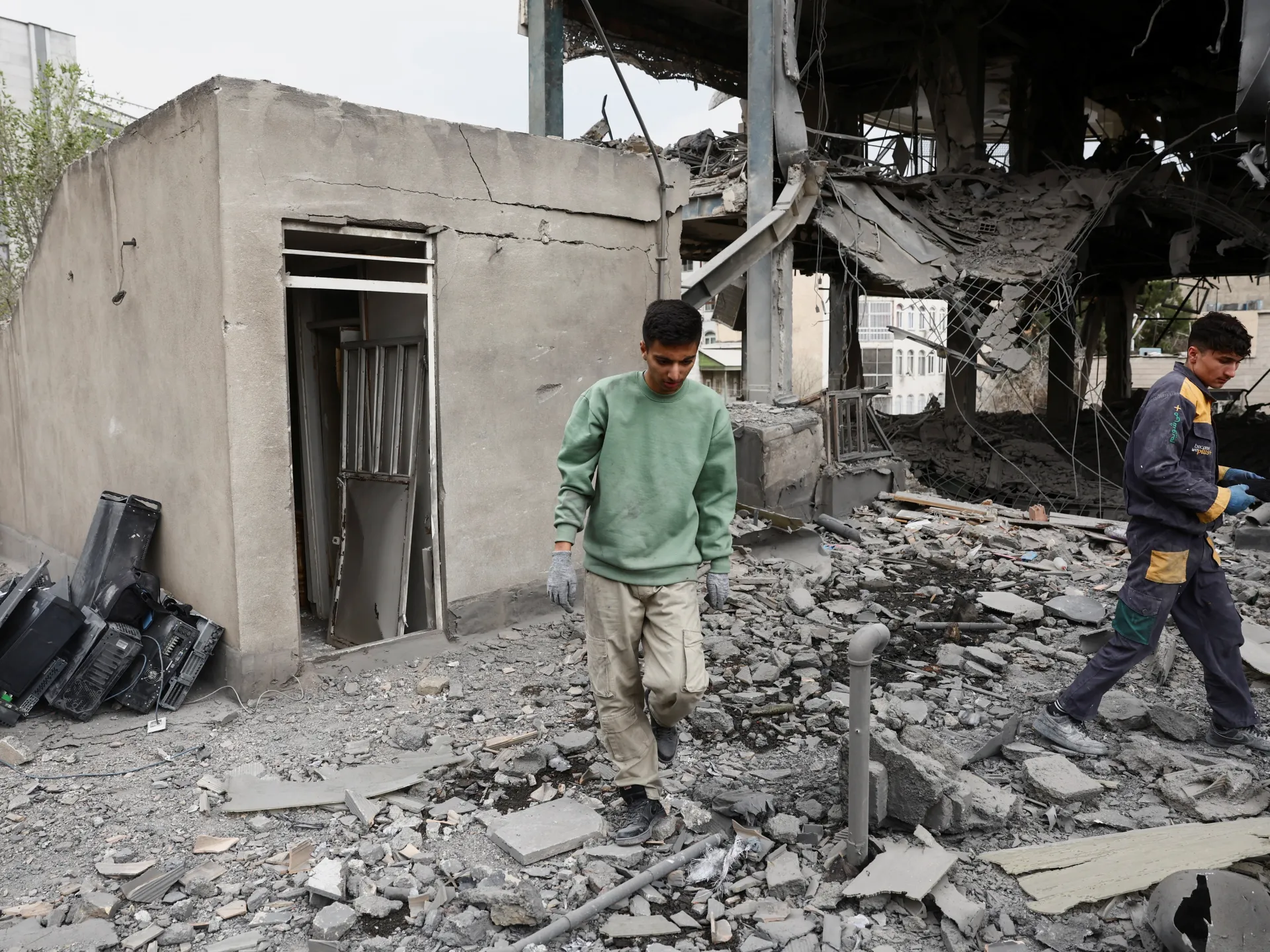
Also on Sunday, a commercial building housing Qatar’s Al-Araby TV in Tehran was hit, with video footage showing walls and windows blown out of the multistorey block. “It was a real miracle we survived,” said Al Araby camera operator Mohammadreza Shademan. “There was no military target here”.

As the civilian cost of the war mounts, Iran is demanding compensation in a five-point plan presented to the US.

That plan also includes a halt to killings of Iranian officials, an end to hostilities, safeguards against the outbreak of more war, and Iran’s “exercise of sovereignty over the Strait of Hormuz”.

Iran, Hezbollah launch attacks

Israel’s military said on Sunday evening that it had detected seven new incoming missile salvoes fired from Iran during the day. These coincided with Hezbollah rocket attacks on northern Israel, with sirens triggered in more than 100 towns.

Israel’s ADAMA, a pesticide maker in the Neot Hovav industrial zone, located 9km (6 miles) south of the city of Beersheba, said its Makhteshim plant was hit either by an Iranian missile or debris ⁠from a missile. No casualties were reported, and no leak of hazardous materials was found.

Reporting from Ramallah in the occupied West Bank, Al Jazeera’s Nour Odeh said it was “an incident that raises a lot of alarms”.

“This industrial zone has about 19 different factories, including a bromide factory and some pharmaceutical factories. But it’s also home to the main hazardous disposal sites in Israel. So a lot is at stake here,” she said.

Another missile hit open ground near homes in Beersheba, injuring 11 people.

Israeli media reported that missile fragments fell on the northern port city of Haifa after missiles launched by Iran and Hezbollah were intercepted.

Houthis enter fray amid talks

As the war raged on, foreign ministers from Pakistan, Turkiye, Egypt and Saudi Arabia met in Islamabad, looking to de-escalate the conflict, which has also ensnarled Gulf nations hosting US military assets.

Across the Gulf, the United Arab Emirates said it had intercepted 16 ballistic missiles and 42 drones launched from Iran, while Saudi Arabia reported downing 10 drones. Sirens sounded in Kuwait and Bahrain.

The Iranian army said it had targeted US forces based in Jordan, launching drones on the living quarters and military equipment sites at the Muwaffaq Salti airbase in Azraq, the ISNA news agency reported.

Meanwhile, readying itself for attacks amid the US military build-up, an Iranian naval commander, cited by state media, said Iran had complete control of waters near the Strait of Hormuz, a vital chokepoint for a fifth of the world’s oil.

He said Iran was waiting for US forces to come within range, warning they could be targeted with coastal missile systems.

As oil prices shoot up and the world’s economy slides, the arrival of Yemen’s Houthis into the conflict, with Saturday’s strikes on Israel, further complicates matters, raising fears that the Yemeni group could block the Bab al-Mandeb Strait.

Houthi attacks on shipping vessels in the Red Sea during Israel’s genocidal war on Gaza upended commercial traffic worth about $1 trillion a year.

Source link

As Europe seeks to increase deportations, some see signs of Trump-like tactics

The European Union is expanding its powers to track, raid and deport migrants to “return hubs” in third countries in Africa and elsewhere, quietly adopting tactics of the Trump administration that have drawn public criticism across the 27-nation bloc.

The EU continues to tighten migration policies after right-wing parties took power in some countries in 2024. European Commission President Ursula von der Leyen, from the center-right European People’s Party coalition, has said that the new measures will prevent a repeat of the 2015 crisis caused by Syria’s civil war, when about 1 million people arrived to seek asylum.

“We have learned the lessons of the past. And today, we are better equipped,” Von der Leyen has said. The new policies, known as the Pact on Migration and Asylum, go into effect June 12.

Far-right parties in Europe have praised the deportation policies of President Trump and called for the EU to adopt a similar approach. Human rights groups warn that authorities are already illegally blocking migrants at EU borders and hollowing out their legal protections.

Italy provides a model

The EU already spends millions of dollars to deter migrants before they reach its shores, and has supported tens of thousands of Africans returning home, voluntarily or by force.

What’s envisioned now is an expansion of what Italy has created under Prime Minister Giorgia Meloni and her “tough on migration” stance. It operates two migrant detention centers for rejected asylum seekers in Albania. One currently holds at least 90 migrants, said lawmaker Rachele Scarpa, who said that she found people confused and scared during a recent visit.

In addition, Meloni’s Cabinet has approved an anti-immigration package that would allow the navy to halt vessels in international waters for up to six months if they are deemed a threat to public order, return intercepted migrants to countries of origin or third countries and speed up the deportation of foreign nationals convicted of crimes.

An “informal group” of EU nations including Germany, Austria, the Netherlands, Denmark and Greece are pursuing deportation center agreements, said Bernd Parusel, a researcher at the Swedish Institute for European Policy Studies.

Kenya is one country they are speaking with, said Tineke Strik, a Dutch member of the European Parliament. Whether consciously or not, the plan is similar to Trump’s deals with nations like El Salvador to take in deported migrants, she said.

Other countries are exploring similar ideas. Sweden’s migration minister has said the conservative ruling coalition approves setting up hubs outside Europe, especially for Afghan and Syrian asylum seekers.

Competing views

During the recent Winter Olympics in Italy, protests erupted over the deployment of U.S. Immigration and Customs Enforcement agents to provide security to the U.S. delegation. But others in Europe have praised ICE’s actions in Trump’s deportation campaign and called for setting up similar deportation-focused police units.

In 2024, Belgium passed a law allowing the EU border service Frontex to operate in the country, stoking fears among activists that it could join in on raids.

But Frontex’s mandate covers only borders, said spokesperson Chris Borowski, and the current role in voluntary or involuntary returns for the service includes “coordinating flights, helping with travel documents and making sure fundamental rights are respected throughout the process.”

The European Commission has declined requests to take a position on U.S. immigration policies.

In Britain, which left the EU several years ago, the center-left Labor Party government has made curbing unauthorized immigration a key focus.

In February, the Home Office said that almost 60,000 people had been deported since the government was elected in July 2024. It said 9,000 arrests were made of people working without permission in 2025, up by more than half from the year before.

Raids, surveillance and ‘pushbacks’

Under the principle of non-refoulement in EU and international law, a person can’t be returned to a country where they would face persecution.

But European immigration enforcement tactics include so-called pushbacks, where people trying to cross into the EU are forced back across a border without access to asylum procedures.

Authorities in Europe carry out an average of 221 pushbacks a day, according to a February report by a group of humanitarian organizations. More than 80,000 pushbacks were recorded in 2025, the report said, mostly in Italy, Poland, Bulgaria and Latvia.

“Men, women and children — including individuals in critical medical condition — are routinely subjected to beatings, attacks by police dogs, forced stripping, forced river crossings and theft of personal belongings,” according to the report.

European agents are brutalizing migrants just like in the U.S., said Flor Didden, migration policy expert at the Belgian human rights group 11.11.11. Some, like in Greece, even wear masks, as ICE agents typically do.

“The images are shocking and the outrage is justified,” he said of the U.S. “But where is that same moral clarity when European border authorities abuse, rob and let people die?”

Weakening of migrant protections seen

The groups also have recorded an expansion of surveillance technology like drones, thermal cameras and satellites to monitor people on the move.

Other human rights groups warn of a weakening of legal protections.

The EU’s new migration regulations allow for more police raids in private homes and public spaces and more use of surveillance and racial profiling, said a letter to EU institutions in February from 88 nonprofit groups including the Brussels-based Platform for International Cooperation on Undocumented Migrants.

“We cannot be outraged by ICE in the United States while also supporting these practices in Europe,” said the platform’s director, Michele LeVoy.

Olivia Sundberg Diez, EU migration advocate for Amnesty International, said Europe retains more protections for vulnerable migrants than the United States does but shares much of the political momentum toward harsher policies.

“There’s a level of institutions’ and courts’ independence and human rights compliance in Europe that you can’t disregard,” she said. “But the fundamental political impulse is the same, and I worry that the human consequences will be the same.”

McNeil and Zampano write for the Associated Press and reported from Brussels and Rome, respectively. AP writers Elena Becatoros in Athens, Jill Lawless in London, Paolo Santalucia in Rome, Claudia Ciobanu in Warsaw and Kirsten Grieshaber in Berlin contributed to this report.

Source link

Football gossip: Kane, Silva, Lacroix, Suarez, Lewandowski, Kolo Muani, Casemiro

Bayern Munich are wary of Saudi Pro League clubs targeting Harry Kane, Bernardo Silva is set to leave Manchester City and Inter Miami start talks with Manchester United‘s Casemiro.

Bayern Munich honorary president Uli Hoeness is wary of the Saudi Pro League trying to tempt England striker Harry Kane as the German club continue talks with the 32-year-old over a new deal beyond summer 2027. (Kicker – in German), external

Portugal midfielder Bernardo Silva, 31, has told Manchester City that he will be leaving the club when his contract runs out in the summer. (Caught Offside), external

Aston Villa, Bayern Munich, Chelsea and Liverpool are monitoring Crystal Palace‘s 25-year-old French defender Maxence Lacroix. (Teamtalk), external

Liverpool and Newcastle United are interested in Portuguese club Sporting’s 28-year-old Colombia striker Luis Suarez. (Correio da Manha – in Portuguese), external

Scotland midfielder Scott McTominay is not talking to Saudi Pro League clubs as the 29-year-old’s focus remains in Italy with Napoli. (Fabrizio Romano), external

Barcelona will offer 37-year-old Poland striker Robert Lewandowski, whose contract at the club runs out in the summer, a new one-year deal which includes a significant pay cut and more performance-related bonuses. (Sport – in Spanish), external

Juventus are looking at the prospect of adding Lewandowski and 27-year-old France forward Randal Kolo Muani, who is on loan at Tottenham from Paris St-Germain, to their ranks. (Gazzetta dello Sport – in Italian), external

Chelsea and France defender Malo Gusto, 22, says Liam Rosenior is a “top manager” despite criticism following their recent poor form. (ESPN), external

Inter Miami have started talks with Brazil midfielder Casemiro’s camp about signing the 34-year-old, who will leave Manchester United in the summer, but the Major League soccer side face competition from other teams in Europe and Saudi Arabia. (Fabrizio Romano), external

Source link

A premature ceasefire risks ‘another round of conflict’ in future | Donald Trump News

Abas Aslani, senior research fellow at the Center for Middle East Strategic Studies, says a premature ceasefire in the US-Israeli war on Iran could spark another round of fighting, pointing to a lack of trust in talks as the US ramps up troop deployments despite calls for de-escalation.

Source link

Israeli police bar priest from Jerusalem’s Holy Sepulchre on Palm Sunday | US-Israel war on Iran

NewsFeed

Christians in Jerusalem and Gaza marked Holy Week under wartime restrictions, with Israeli police blocking the Latin Patriarch from the Holy Sepulchre for the first time in centuries. In Gaza, a small Christian community continued Palm Sunday rites despite ongoing attacks and severe shortages of basic essentials.

Source link

Rich House, Poor House mum in tears over millionaire’s gift ‘it’ll change my life’

A single mum of three received a ‘life-changing’ gift on Rich House, Poor House on Channel 5

A single mum-of-three, drowning in debt, was moved to tears after a millionaire invested £100,000 in her budding restaurant venture and paid off her debt on Rich House, Poor House.

Valerie Mayer, from Portsmouth, who is juggling raising her three children and working as a full-time carer, appeared on the Channel 5 hit show on Sunday (March 29) night alongside mum Cleopatra.

The talented home cook has always had dreams of launching a Zimbabwean restaurant in the UK, however with a weekly budget of just £53 her lifelong passion has been pushed to the side as she battles to make ends meet.

In a heartbreaking moment, she admitted that she has faced threats from debt collectors. She revealed: “My financial situation got so bad that I had bailiffs come in, and I just went into a state of panic. I was looking out of the windows to see if anyone was there. I got scared to leave the house.”

Seeing how the top 1% live, Valerie swapped homes for a week with tech startup millionaire, Steve Bolton, who lives in a plush £1m, six-bedroom property in Bournemouth.

The father of four left school at 16 with no qualifications but built a business from scratch, with his company now boasting a portfolio worth £750m.

Given his hectic life as an entrepreneur, he missed out on quality time with his children, so he decided to invite his eldest daughter, marketing guru, Ella, and his clothes shop owner son, Charlie, to join him on the show.

The family traded their home with two lounges, a dining room for eight, six bedrooms and five bathrooms, for a week-long stay in Val’s council house 60 miles along the coast.

While Steve and his two children had to manage on £51.93 for the week, Valerie and her mum experienced a glimpse of luxury living with a weekly budget of £2,000. Val and Cleopatra indulged in costly seafood, went on shopping trips for clothes, and even treated themselves to a day at the races.

However, Steve and his family found it difficult to adapt in their new environment and things took an emotional turn as Steve visibly moved after finding out about Valerie’s debt.

It was clear that Steve wanted to help Valerie get her life on track as he had a few surprises for her when they finally reunited after their swap.

The millionaire not only committed to investing £100,000 into her restaurant venture, but also cleared all her debts and transformed her garden.

Sitting opposite each other, Steve went on to say: “We’ve been talking a lot about how we might be able to help you guys because that’s obviously a big part of what we want to do and we’ve thought about three things that we can do to help you.”

He continued: “The first one is already done and it’ll be a surprise when you get home, the second one is about your debt situation, so we wanted to get you out of debt and then the third thing is we want to back your vision, your dream, your passion and your talent for business.

“Support you financially, support you with mentoring, support you with anything and everything you need up to a value of £100,000.”

Valerie broke down in tears as she struggled to get her words out: “Oh, wow. I don’t even know…How do you say thank you? Thank you. Wow, this is amazing.”

With tears streaming down her face she said: “I’m feeling really overwhelmed right now. Happy tears. This can change mine in my family’s life. I really wanted this so much and I’m so glad that my family’s also going to be involved in this because it’s going to change everything for the better.”

Rich House, Poor House airs Sunday night from 9pm on Channel 5

Source link

Old Faces, New Places – Los Angeles Times

Term limits were supposed to usher fresh faces and new ideas into California’s Capitol and city halls. That was the promise when voters approved the limits for state officials in 1990 and for city of Los Angeles officeholders in 1993. Lawmakers who had turned elected offices into perpetual sinecures would be forced out and eager citizen-politicians, unbeholden to the special interests, would step in. Well, it’s a decade later and the faces are more recycled than fresh.

Witness the Los Angeles municipal elections that will take place April 10. Mayor Richard Riordan has hit his two-term limit. Four of the six leading mayoral candidates are being forced out of other offices and are looking for a soft landing in City Hall. Kathleen Connell cannot run again for state controller, City Atty. James K. Hahn and Councilman Joel Wachs have hit city term ceilings, and Antonio Villaraigosa maxed out in the state Assembly.

For the record:

12:00 a.m. Feb. 17, 2001 For the Record
Los Angeles Times Saturday February 17, 2001 Home Edition Metro Part B Page 9 Editorial Writers Desk 2 inches; 38 words Type of Material: Correction
Term limits–An editorial Sunday incorrectly said Los Angeles City Councilman Mike Feuer is approaching the two-term limit for city officials. Feuer won a midterm special election to the council in 1995 and won his first full term in 1997. He is allowed a second full term.

The influence of term limits rolls through the municipal ballot. Termed-out Councilman Mike Feuer and Rocky Delgadillo, a Riordan deputy mayor soon to be unemployed like his boss, are vying to be city attorney. Council member Laura Chick is running for controller.

Other termed-out politicos are vying for City Council seats whose current occupants are also termed out. Tom Hayden, whose 18 years in the Assembly and Senate are up, and state Sen. Richard Polanco are trying to parlay their Sacramento expertise into an advantage, arguing that they know how to fight for Los Angeles’ fair share of state money.

In the past, local politicians often moved up the ladder to Sacramento and on to Washington; now they arc back to City Hall as well. It’s a safe bet that this electoral whirl is not what most voters thought they’d get. The professional politicians stay in motion but stay on the public payroll, and when new faces do appear they often come to view public service and its attendant perks as a career rather than an interlude in a career.

The pattern is not new. Yvonne Brathwaite Burke and Mike Antonovich, after stints in Congress and the Legislature, respectively, landed on the county Board of Supervisors, which, with no term limits, is the jackpot for local career pols.

Theoretically, there is an upside to all this churning in that the city could benefit from a politician’s previous experience. Meanwhile, the pool gets shallower in Sacramento. In the mid-1990s the Legislature had its first big term limits-induced exodus. By last year, there had been a complete turnover in the state Senate. The learning curve is now steep on such urgent issues as electricity deregulation, especially for the freshman Assembly members–a third of that house–who are still finding their way to the restroom. In this void, the Assembly speaker and the Senate president pro tem are wielding more power than ever–along with the special-interest lobbyists, permanent players with ample access to expertise and cash.

Ten years after voters approved Proposition 140, the consequences of term limits are still playing out. How much better it would have been to enact campaign finance reform; it was mostly fiscal inequality that kept out new faces. But because incumbent politicians declined to handicap themselves with real reforms, they–and voters–now live instead with a merry-go-round.

Source link

Angels’ pitchers can’t hold on to six-run lead in loss to Astros

Carlos Correa and Isaac Paredes each drove in two runs and sparked an eight-run sixth inning for the Houston Astros in an 11-9 victory over the Angels on Saturday night.

Trailing 6-4, the Astros tied it on a single by Correa and a throwing error by Angels catcher Logan O’Hoppe. Houston took a lead on a single from Christian Walker.

The Astros tagged Angels reliever Walbert Ureña (0-1) for six runs on four hits in one inning.

Houston blew it open off a two-run single by Yainer Diaz and a two-run double off the right field wall from Jake Meyers to make it 11-6. The eight runs is the most scored in the sixth inning by Houston since scoring 10 against the Dodgers on July 4.

An Angels bullpen that had registered 7⅔ innings of scoreless baseball to start the season gave up eight runs between Ureña and Joey Lucchesi in the sixth inning alone.

Houston trailed 6-0 in the fifth, but a two-run double by Paredes chased Angels starter Reid Detmers.

Detmers, who was making his first regular-season start since Sept. 27, 2024, gave up three runs on six hits and struck out nine in 4⅔ innings.

Kai-Wei Teng (1-0) made his Astros debut in the fifth inning. Teng was acquired from the San Francisco Giants in January. He gave up no runs on one hit, struck out two and walked one in 2⅓ innings to register his first win.

Oswald Peraza and Jorge Soler homered in back-to-back innings to make it 3-0. Nolan Schanuel hit a three-run homer in the ninth to make it 11-9. The Angels have eight homers as a team, which tops the majors.

Cristian Javier gave up six runs on four hits, striking out one and walking four in 4⅔ innings.

Source link

IRGC spokesperson says Trump ‘only understands the language of force’ | Donald Trump News

IRGC spokesperson Ebrahim Zolfaghari dismisses threats of US ground operations. He says the US president ‘only understands force’ as the Pentagon prepares plans that could involve thousands of troops on the ground in Iran, according to a report by The Washington Post.

Source link

F-22 Raptor “2.0” Spotted Undergoing Flight Testing

We are getting ever-better views of new stealthy external fuel tanks and underwing infrared sensor pods for the F-22 Raptor. We also now have our best look to date at the U.S. Air Force’s new AGM-181A Long-Range Standoff (LRSO) nuclear-armed cruise missile, spotted under the wing of a B-52H bomber. Both of these developments reflect a larger surge in Air Force flight testing activities as of late, including the sighting of a B-21 doing air-to-air related flight testing for the first time earlier this month. All of this comes as the service pushes ahead with plans to field a host of next-generation capabilities in the coming years.

This past weekend, aviation photographer Jarod Hamilton shared new pictures of the F-22 with the stealthy underwing fuel tanks and sensor pods, as well as the B-52 carrying the LRSOs, taken as they flew over the Mojave Desert. This is an area where flight testing out of Edwards Air Force Base in California commonly occurs.

A B-52H seen carrying a pair of LRSOs, or relevant test articles, under its wing. Jarod Hamilton

The aircraft were seen at separate times linking up with a KC-135 aerial refueling tanker. Hamilton even managed to grab a picture of all three aircraft flying together.

Critical F-22 upgrades

When it comes to the new underwing stores for the F-22, these are capabilities that have been in development for years now. However, the Air Force and prime contractor Lockheed Martin have only recently begun to talk about them openly. The tanks and pods are part of a larger upgrade plan for the Air Force’s F-22 fleet, which Lockheed is also now referring to as “Raptor 2.0.” The complete package also includes a new Infrared Defensive System (IRDS) integrated into the aircraft itself, as well as enhanced radar, electronic warfare, and other capabilities that you can read more about here.

Another picture of the F-22 with the new stealthy external fuel tanks and infrared sensor pod. Jarod Hamilton

The new external fuel tanks and infrared sensor pods are particularly important. As TWZ previously wrote, after a scale model of an F-22 in the Raptor 2.0 configuration was shown at the Air & Space Forces Association’s annual Warfare Symposium earlier this year:

Most obvious on the model are the new stealthy fuel tanks, a critical addition to ensure that the F-22 is able to better cover the vast distances that would be involved in a potential future conflict in the Indo-Pacific. In the past, the Raptor’s notoriously short range has been mitigated by using non-stealthy 600-gallon tanks, but these are not a realistic option when faced by more capable hostile air defenses. They are, however, a regular fit for the Raptors that sit alert in Alaska, which need the wing tanks for their intercept missions that can cover vast distances over long periods.

“So the way that I would describe it is, they are low-drag tanks. So the way you could interpret that is, they wouldn’t necessarily be required to punch [be jettisoned] to be in a combat scenario,” Katie Ciccarino, Vice President of the F-22 Program at Lockheed Martin, also told TWZ directly when asked about this specific detail in an interview on the sidelines of the 2026 Warfare Symposium. “They are [jettisonable] if you needed to be in a scenario where you had to, but the idea would be that you don’t have to, and you can perform any of the same maneuvers that you would on a clean wing with these tanks.”

Furthermore, as we also wrote previously:

While they are also stealthy, adding the IRST pods will nevertheless also have radar signature implications for the F-22. However, the tradeoff is considered acceptable, further evidence of just how critical this feature has become in air combat. In particular, an IRST sensor is useful for detecting stealthy targets, something that is also becoming increasingly relevant in the Pacific region. There is also the option of IRST-equipped Raptors sharing their sensor data with ‘clean’ F-22s, enhancing their situational awareness. You can read more about what the IRST brings to the F-22’s overall capabilities here. At this stage, we don’t know what specific sensor is used in the pods; Lockheed Martin refers to this store as the Advanced Sensor Pod.

The F-22 with the new external stores seen linking up with the KC-135 tanker. Jarod Hamilton

As of 2024, the Air Force hoped to begin deliveries of the stealthy external fuel tanks to F-22 squadrons this month. However, in its annual budget request last year, the service said it was “closing out technical discrepancies under EMD [engineering and manufacturing development phase] contract to integrate [a] fix prior to RAA [required asset available] delivery,” but did not elaborate. At that time, the Air Force said it expected to begin operational testing of the tanks in the fourth quarter of Fiscal Year 2025, which ended on September 30 of last year.

The most recent Air Force budget documents also said that “qualification testing” of the infrared sensor pods was set to run through the third quarter of Fiscal Year 2026, which ends on June 30 of this year.

When either the external fuel tanks or the infrared sensor pods are currently set to enter operational service is unclear.

A new stand-off addition to America’s nuclear arsenal

Flight testing of the AGM-181A Long-Range Standoff (LRSO) cruise missile has also been going on for years, but only limited details about the design have emerged so far. The Air Force only released the first official rendering of the weapon, which is set to replace the existing AGM-86B Air Launched Cruise Missile (ALCM), last June. Four months later, a B-52 was spotted carrying two prototypes or test articles under its wing for the first time. One of them was painted a solid dark gray, while the other also had light gray, black, and orange markings painted on the side. The new pictures from Jarod Hamilton show the same mix of prototypes/test articles, but it is unclear if they are the exact same ones seen during the flight test last year.

Another view of the B-52H with the LRSO prototypes or test articles. Jarod Hamilton

As TWZ previously wrote after the rendering was released last year:

Most notably from this first unclassified render, the LRSO features an inverted tail very similar to the conventionally-armed AGM-158 JASSM stealthy air-launched cruise missile. The AGM-129 featured a similar arrangement, although with a differently shaped vertical tail. The missile looks like it has a trapezoidal fuselage cross-section design with a wedge-like nose. The wing design is also similar to JASSM. We see no air inlet in the concept rendering, which could be for security reasons, considering the inlet design is often a closely guarded feature on stealthy flying machines, or it could be located on the top of the missile. We also can’t say with any certainty how accurate this official rendering is of the actual design, but it is a given that some features will be omitted or even misleading for an initial public release.

The pictures we now have show that the rendering was relatively faithful to the real-world design. We also have a good look now at how the missile’s pop-out main wings look in their stowed configuration before release, as can be seen in the close-up below.

Jarod Hamilton

It is also known that the AGM-181 will carry a W80-4 thermonuclear warhead. These warheads are being created through what is described as a Life Extension Program (LEP) that involves the refurbishment and modernization of older W80-1s. Existing AGM-86Bs are armed with W80-1s, which are so-called dial-a-yield types that reportedly have two settings, either five kilotons or 150 kilotons.

Otherwise, “the W80-4 LEP will… enhance safety, security, and reliability,” the Department of Energy’s National Nuclear Security Administration (NNSA) said in a press release back in 2023. “Key design requirements of the W80-4 include use of the existing insensitive high explosive design, incorporation of modern components and safety features, extensive use of non-nuclear component technology developed for other LEPs, and parallel engineering with the USAF on the warhead-missile interface.”

The B-52 carrying the LRSOs seen linking up with the KC-135 tanker. Jarod Hamilton

The Air Force said previously that it hoped that the AGM-181 would reach initial operational capability in 2030. However, since 2024, the projected timeline for the missile entering service has been categorized as “controlled unclassified information” and withheld from public release. The service has also said that it is looking to start low-rate production of the missiles in Fiscal Year 2027, ahead of a full-rate production decision in Fiscal Year 2029. Currently, the planned launch platforms for the AGM-181 are the B-52H and B-21 Raider bombers.

As noted, the new F-22 and B-52 test flight pictures underscore a larger uptick in such activities as the Air Force moves ahead with several advanced aircraft and other capability development efforts. The service, as a whole, is expecting to receive a host of next-generation platforms and munitions, as well as other systems, in the next 15 to 20 years. This notably includes the B-21, the F-47 sixth-generation fighter, and multiple types of Collaborative Combat Aircraft (CCA) drones. The developments are also being accompanied by new tactics, techniques, and procedures.

We can expect to see more of the F-22 in its “Raptor 2.0” configuration and of the AGM-181, among other things, as flight testing of various new capabilities expands.

Special thanks to Jarod Hamilton for sharing these pictures with us.

Contact the author: joe@twz.com

Joseph has been a member of The War Zone team since early 2017. Prior to that, he was an Associate Editor at War Is Boring, and his byline has appeared in other publications, including Small Arms Review, Small Arms Defense Journal, Reuters, We Are the Mighty, and Task & Purpose.


Howard is a Senior Staff Writer for The War Zone, and a former Senior Managing Editor for Military Times. Prior to this, he covered military affairs for the Tampa Bay Times as a Senior Writer. Howard’s work has appeared in various publications including Yahoo News, RealClearDefense, and Air Force Times.


Source link

Blue Bloods actor & comedian Alex Duong dies aged 42 after septic shock

An image collage containing 1 images, Image 1 shows Comedian Alex Duong performing during a virtual telethon

COMEDIAN and actor Alex Duong has died aged 42 after a year-long battle with cancer.

The funny man was known for his appearances on Jeff Ross Presents Roast Battle and Blue Bloods.

Crazy Woke Asians Stop Asian Hate
Comedian Alex Duong has sadly passed awayCredit: Getty
Laugh Factory Hosts Virtual Telethon To Support Families Of Atlanta Shooting Victims
He spent a year battling cancerCredit: Getty

A close friend who was by his side confirmed to TMZ that Duong passed away 11am Saturday at St. John’s Hospital in Santa Monica, California, surrounded by family and friends.

Duong reportedly went into septic shock Friday night.

He was diagnosed with alveolar rhabdomyosarcoma – a rare and aggressive cancer – last year.

A biopsy found an extremely aggressive tumour after he had experienced headaches behind his eye.

He eventually lost sight in his left eye.

In August, his comedians contemporaries hosted the The Alex Duong Has Cancer In His Eye Comedy Benefit Show in LA.

Ronny Chieng and Atusko Okatsuka were among the comedians involved.

He leaves behind his wife Cristina and daughter Everest, 5.

Most read in Entertainment

Duong grew up in Dallas, Texas as the youngest of six children.

He graduated high school and went on to pursue medicine before finding success in the creative industries.

His writing about the Vietnam War gained him meetings with producers in California, according to IMDB.

Duong left school to pursue a feature development deal with Melody Phan of Zenoost Media.

More to follow… For the latest news on this story keep checking back at The Sun Online.

Thesun.co.uk is your go-to destination for the best celebrity news, real-life stories, jaw-dropping pictures and must-see video.

Like us on Facebook at www.facebook.com/thesun and follow us from our main Twitter account at @sunbizarre.


Source link

Swalwell accuses Trump of trying to influence California governor’s race with old FBI files

Rep. Eric Swalwell, a leading Democratic candidate for governor of California, has accused President Trump of trying to sway the election following reports that FBI Director Kash Patel may release documents from a decade-old investigation into the congressman’s ties to a suspected Chinese spy.

According to a report by the Washington Post, Patel has directed agents in the bureau’s San Francisco office to redact the case files for public release. According to the outlet, it’s highly unusual for the FBI to release case files tied to a probe that did not result in criminal charges.

The investigation centered on Swalwell’s ties to a suspected intelligence operative, Christine Fang, or Fang Fang, who worked as a volunteer raising money for his congressional campaign. Swalwell cut off ties to Fang in 2015, after intelligence officials briefed him and other members of Congress about Chinese efforts to infiltrate the legislative body.

Swalwell was not accused of impropriety.

The FBI did not immediately respond to a request for comment.

“Through great reporting, we now know the outrageous ends the White House will go to target political opponents,” Swalwell said in a prepared statement Saturday, calling the decade-old story “nonsense.”

“Donald Trump is targeting me. He’s trying to influence the election,” Swalwell said in a post on X. “There is only one reason why: he’s scared.”

Swalwell accused Trump of “desperately trying” to stop him, because he’s now the favored candidate for California governor.

“What Trump wants the most is to have a Western White House. An enabler on the opposite coast,” he said. “A lot of people have bent the knee to this administration. But I will not. And neither will the people of California.”

It’s not the first time Swalwell has accused the administration of targeting Trump’s political opponents.

Last year, Swalwell sued Federal Housing Finance Agency Director Bill Pulte, accusing him of criminally misusing government databases to target Trump’s political opponents. Pulte had accused Swalwell of mortgage fraud and referred him to the Justice Department for a potential federal criminal probe. Swalwell dropped that suit this month.

Swalwell, a former prosecutor who ran for president in 2020, announced his bid for California governor in November. Swalwell said his decision was driven by the serious problems facing California and the threats posed to the state and nation with Trump in the White House.

U.S. Sen. Adam Schiff (D-Calif.), who has endorsed Swalwell for governor, shared the Post story on X Saturday, saying, “This abuse of the FBI is as dangerous as it is unlawful.” Schiff served with Swalwell on the House Intelligence Committee, where they riled Republicans by investigating President Trump during his first term.

Schiff served as the lead manager of Trump’s first impeachment and Swalwell as a manager of Trump’s second impeachment.

“Time and again, the President and his appointees have weaponized the Department of Justice against those who dare stand up to Trump,” Schiff wrote. He added that there was no doubt that Trump and Patel “will stop at nothing to try to tell Californians who their next governor should be.”

The Post story unleashed a flood of critiques from California politicians, including Rep. Jimmy Gomez (D-Los Angeles), who sits on the House Intelligence Committee. On X, Gomez accused Patel of “wasting resources” on a “closed, decade-old case where Swalwell cooperated with the FBI and was found innocent of any wrongdoing.”

“Reopening it now, right as he leads in the polls and ballots are about to drop, is a political hit-job!” Gomez said. “Trump and Kash Patel are weaponizing the FBI against people they deem political enemies.”

Rep. Jamie Raskin of Maryland, the top Democrat on the House Judiciary Committee, released a statement accusing Patel of working at “the behest of the White House” and “wasting the resources of the FBI and perhaps violating the Hatch Act by ordering agents to spend hours preparing a political smear file for a personnel vendetta.”

According to the Associated Press, Fang came into contact with Swalwell’s campaign as he was first running for Congress in 2012. She also participated in fundraising for his 2014 campaign and helped place an intern in his office, the report said. Federal investigators alerted Swalwell to their concerns — and briefed Congress — about Fang in 2015, at which point the California Democrat says he cut off contact with her, the AP reported in 2021.

In 2023, the House Ethics Committee closed a two-year investigation into the allegations of his ties to Fang.

In closing the probe, the ethics committee wrote in a letter to Swalwell that it had “previously reviewed allegations of improper influence by foreign agents and in doing so, cautioned that Members should be conscious of the possibility that foreign governments may attempt to secure improper influence through gifts and other interactions.”

Times staff writer Kevin Rector contributed to this report.

Source link