Lakers guard Bronny James blocks a shot by Spurs forward Kelly Olynyk at Crypto.com Arena on Feb. 10.
(Gina Ferazzi / Los Angeles Times)
For the second consecutive game Friday, Lakers coach JJ Redick called the second-year guard’s number for important minutes.
Not to complete garbage time chores. Not as a gimmick to please the King. But because he needed a ball-handler he could trust after the regular rotation got wonky in the second quarter of the Lakers’ 116-99 victory over the Brooklyn Nets at Crypto.com Arena.
For the second consecutive game, Bronny helped buoy the Lakers. In four minutes, he had a deflection and drained a three-pointer that not only keyed a much-needed 9-0 Lakers run but also was the first father-to-son assisted basket in NBA history, coming on a pass from LeBron.
His former teammate sees in Bronny what his current teammates do: A hard worker who needs only to nurture his confidence to be able to contribute in the NBA.
“He’ll be great,” Williams said. “Especially starting off on the defensive end. He can guard one through four, pick up full [court,] have good ball pressure. On the offensive end, he’s a gamer. He can make shots, he can drive the ball. He can get his teammates open. The biggest thing with him is just keeping that confidence.
“When he’s confident and he’s in flow state, in rhythm, he’s a great, great player. … He’s just gotta keep working.”
Bronny’s been working in the G League the last two seasons, bouncing between the big leagues and the developmental circuit, where last season his averages were solid — including 21.9 points, per game — but nowhere near as efficient as they’ve been this season. In 13 games, he’s averaging 14.8 points on 54.7% shooting, including 41.7% from three-point range.
Lakers forward LeBron James greets his son, guard Bronny James, on the court during a game against the Clippers at Crypto.com Arena on Nov. 25.
“He’s always been able to shoot the ball. He shot the ball at a high level pretty much throughout his years of playing ball. So I just think there’s the confidence in the rhythm and just getting the strength back and his wind and everything. Everything is just coming back.”
That’s carried over to the big club; Bronny is shooting 41.9% from three-point range in those instances when Redick has called on him — as he also did in a 137-130 victory over the Indiana Pacers on Wednesday.
In that victory, Bronny had four points, two steals and a block in 13 minutes. Redick credited the 21-year-old with settling the team with a pull-up jumper with 3:55 to go in the game, which was the second this season LeBron and Bronny played together.
The first time it happened, in the season opener in 2024, the prevailing thought was that it wouldn’t happen again for a long time — and if it did, something had probably gone very wrong for the Lakers that game.
But that’s not the case. No, because Bronny has made a convincing case as an NBA player.
“I’ve been wanting to play basketball my whole life,” Bronny said. “It’s a dream come true. I’m so privileged to be able to play basketball for a job and I love every single second of it. My teammates embrace it. I’m best friends with all my teammates and my coaches. I’m just happy to be here.”
He’s become an effective plug-and-play piece — and not on a tanking Nets team that regularly runs out G League-caliber players, but on a playoff-bound Lakers team that has won 14 of its last 16 games.
The No. 55 draft pick in 2024, Bronny has surpassed Dalton Knecht, the 17th pick in that same draft, in the Lakers’ pecking order.
He’s become a player who can be counted on, and he’s especially valuable to a team that happens to badly need youth and athleticism, as the Lakers do.
You want to talk twists? How about whatever happens with LeBron — when, or if, he retires — the Lakers should seriously consider keeping Bronny in the fold. Seriously.
March 28 (UPI) — Law enforcement in Paris arrested one person and is pursuing another after they allegedly tried to detonate an explosive device outside a bank there.
The two suspected attackers attempted to detonate the device near Bank of America’s headquarters in France’s capitol, French officials confirmed on Saturday afternoon.
“Bravo for the swift intervention of a prefecture of of police crew that made it possible to thwart a violent action of a terrorist nature last night in Paris,” France’s minister of the interior, Laurent Nunez, said in a post on X.
“The investigation continues … Vigilance remains more than ever at a high level,” he said.
Around 3:30 a.m. early Saturday morning, officers in the area saw two people carrying a shopping bag, out of which came a container of some type of fuel taped to a tube that the duo attempted to light, the French radio station RTL reported.
The suspect who was caught by police told them he had been recruited online and was paid about $700 for the attempted attack.
Attacks have been committed at synagogues, Jewish schools and facilities, and near businesses associated with the United States and Israel in a handful of countries since the start of the war in Iran.
France, in particular, has ramped up security on the lookout for terrorist attacks.
The Iran-linked group Harakat Ashab al-Yamin al-Islamiyya posted video on Telegram of a bank in France last week which included a push to attack Bank of America in Paris because it “is not just a bank, but a shadowy Zionist force,” The Telegraph reported.
“This bank sends vast investments to Israel, while simultaneously strengthening Jewish economy, culture and politics in France,” the group said in the video. “Through its support for Zionist schools, associations, companies and urban development projects, Bank of America has become a ‘financial and strategic force’ in the European Zionist arena.”
Iranians attend a funeral for a person killed in recent U.S.-Israel airstrikes at Behesht-e Zahra cemetery on the southern outskirts of Tehran in Iran on March 9, 2026. Photo by Hossein Esmaeili/UPI | License Photo
Weekly insights and analysis on the latest developments in military technology, strategy, and foreign policy.
The B-2 Spirit has done what no other asset can do during the war with Iran — flying into dangerous airspace to release heavy weapons capable of penetrating even the most hardened targets. While B-1Bs and B-52Hs have forward deployed to the United Kingdom for their missions over and near Iran, the B-2s have flown smaller numbers of missions from their home at Whiteman Air Force Base in Missouri. At this time, there is no evidence that B-2s are operating out of Diego Garcia or anywhere else for the war effort. Still, they are delivering punishing blows, as represented in art on at least one of their gear doors. Beyond mission markings, some new features that just appeared along the aircraft’s huge leading edges are puzzling to say the least.
U.S. Air Force crew chiefs perform pre-flight checks on a B-2 Spirit stealth bomber during Operation Epic Fury, March 17, 2026. (U.S. Air Force photo) (U.S. Air Force photo)
We spotted these white rectangles with black borders that are sealed onto the B-2’s leading edges in images released today by U.S. Central Command (CENTCOM), showing a pair of the stealth bombers about to launch from Whiteman on another global airpower mission to Iran on March 17, 2026. The rectangles mirror themselves near the upper and lower leading edges and appear to use the typical tape method of sealing to keep the jet’s radar cross-section as low as possible.
The white squares are very loosely reminiscent of test marks the B-2 has worn at different times during its first decade of flying, when it was deep in trials. Why anything like that would be present on a combat mission, and on two separate aircraft, is puzzling. The possibility that they augment and mask the B-2’s radar signature is also worth bringing up, but the aircraft has other ways of doing that and why would B-2s fly missions without their stealth benefit, especially all the way from the United States, when other platforms are forward deployed for those applications? Delivering the Massive Ordnance Penetrator in permissive airspace is one potential reason, but again, why go through all the trouble when the aircraft can just hit its targets in standard configurations? The threat of losing signature data to threat systems is always a possibility, but whether it would drive such a modification is unclear.
(Public Domain) (Northrop Grumman)
It’s also possible that this is some kind of new sensor or electronic warfare installation, and that these are small apertures for whatever lies beneath. Enhancing the B-2’s ability to sense threats in its combat environment and react in real time to them, including by avoiding, attacking or jamming them, would be very important to its survivability over future battlefields. Also, making the Spirit more capable of communicating with assets even while keeping as stealthy as possible would be key. All these kinds of upgrades are important to making sure the B-2 remains relevant for the rest of its service life.
The byproducts of a new coatings upgrade for the Spirit are another possibility. The B-2’s radar-absorbent material (RAM) coatings are absolutely critical to its success, but are also one of the major drivers of its immense operating costs. Improvements to the coating’s materials and processes of applying them have been constant throughout its life as the USAF seeks to increase its availability rate and lower its cost per flight hour. This has changed the appearance of the B-2 over the decades. New technologies from the B-21 Raider program, for instance, are being applied to the B-2 in order to help address these issues.
So, we just don’t know what these new features are for, or if they will remain a staple on B-2s that receive them going forward.
How the B-2’s leading edge normally looks. (U.S. Air National Guard photo by 2nd Lt. Chris Bishop) 2nd Lt. Christopher Bishop
Also of interest is the aforementioned mission markings on one of the B-2’s nose gear doors. It shows 15 bombs. While we cannot say for certain what exactly this represents, it’s more likely that it denotes combat missions rather than individual weapons dropped. That still seems like way too many long-range strike flights from this operation for this aircraft, especially considering the image was taken a week ago, but it probably includes combat missions from last year, as well.
U.S. Air Force crew chiefs perform pre-flight checks on a B-2 Spirit stealth bomber during Operation Epic Fury, March 17, 2026. (U.S. Air Force photo)
Another possibility some may raise is that it could denote how many GBU-57/B Massive Ordnance Penetrators (MOP) this B-2 has dropped, but again, this number seems like far too many. In fact, it is not even clear if any MOPs have been employed in this campaign, and 15 would equal more than the total dropped by all the B-2s involved during Operation Midnight Hammer last June.
Like so many things Spirit, we just don’t know what we are looking at. The aircraft is an American icon and has now entered the backend of its operational career, with its successor and legacy, the B-21 Raider, waiting in the wings. At the same time, much about the B-2 remains a secret and likely will for years after it finally flies its last operational sortie.
This is also something of an abstract indicator of just how far ahead of their time Northrop’s engineers were when they gave birth to the world’s first stealth bomber, an aircraft that is more prized now as a national asset than anytime in its three-decades-long career.
A B-2 Spirit stealth bomber prepares to take off to conduct a mission during Operation Epic Fury, March 17, 2026. (U.S. Air Force photo)
The three part series has recently been added to BBC iPlayer as true crime fans say it is ‘well worth a watch’
19:03, 28 Mar 2026Updated 19:03, 28 Mar 2026
Captive Audience features interviews with Steven’s family including mum Kay Stayner(Image: BBC/Hulu)
A “mind blowing” true crime documentary with a twist fans do not see coming, is now available to stream online for free.
The mini series, titled Captive Audience: A Real American Horror Story, was first released on Disney Plus and Hulu back in 2022 as it follows the real life story of a seven year old boy who suddenly vanishes from his home in California.
Named Steven Stayner, he miraculously returns seven years later, sparking a media sensation, but where had he been? Spanning across three episodes, the documentary is now available to stream on BBCiPlayer as it has been dubbed the perfect watch for fans of true crime.
A BBC synopsis reads: “A story that captivated a nation – and destroyed a family. A boy missing for seven years miraculously returns home, but it wasn’t the Hollywood ending it seemed to be.”
The three-part series plunges viewers back to 1972 when the unusual kidnapping case first came to light. It then explores his return as well as the family being thrust back into media headlines decades later.
Featuring heartbreaking accounts from family members, including Steven’s daughter and mother, fans have also admitted they were not expecting the revelations made in the third episodes.
Viewers may also recognise a TV film titled I Know My Name is Steven, which was released in 1989, also exploring the same case.
The documentary has been branded a must watch for fans of the genre as one person said in a TikTok video: “It’s really good, well worth a watch.”
Another commented: “I watched the three episodes of Captive Audience last night and OMG I never dreamed of what was coming in episode 3.”
A third added: “I was fascinated watching Captive Audience. It was shocking and sad.”
In another video, recommending the documentary, one viewer said: “You will want to watch it because it is a mind blowing story.
“It’s a really fascinating documentary. If you haven’t watched it already, I would definitely recommend it.”
Another commented: “It’s absolutely mad, very sad as well.” A third echoed: “It’s a heartbreaking real life story from beginning to end.”
Over on Facebook, one user said: “A heartbreaking and chilling story about trauma, survival, and the long shadow of tragedy.”
An IMDB reviewer said: “This documentary is heart breaking and captivating. To learn what this kid went through and his own heroic act to save another child, is mind blowing.”
Another added: “I loved this story and the way it was told. It is not often in true crime that we get to see the family and friends and how their lives have been impacted by the crime.”
Captive Audience: A Real American Horror Story can be streamed on BBC iPlayer and Disney Plus.
CORNWALL isn’t short of cracking coastal escapes, but the newly-renovated Pedn Olva is a step above the rest, not just because of its rooms but its excellent pub grub, too,
Here’s everything you need to know.
Sign up for the Travel newsletter
Thank you!
Pedn Olva is a cosy pub with 27 roomsCredit: Pedn OlvaThe hotel sits on a craggy cliff several metres above the choppy St Ives seaCredit: Pedn Olva
Where is Pedn Olva?
Its name translates to Lookout on the Headland in old Cornish – a rather accurate description of its perch, a craggy cliff several metres above the choppy St Ives sea in Cornwall.
Guests can park for free in a nearby car park above the hotel – they will need to collect a slip to display in their car window from the hotel reception.
What’s it like?
Inspired by the windswept patch of coast it sits on, Pedn Olva in Cornwall has buckets of coastal character.
It’s first and foremost a cosy St Austell Brewery pub, but the 27 boutique rooms mean you can hunker down for the night.
Each of them looks as if they have been carved into the rockface, all with views of the ocean and the flickering lights of the town centre a short distance across the water.
What are the rooms like?
Extremely well thought out.
A property can look sleek and stylish but if the basics haven’t been mastered then everything else becomes redundant – that’s certainly not the case here.
There’s every tea imaginable from camomile to berry and decaf, while USB ports have been conveniently placed next to the bed and hooks on the walls make efficient use of the cosy space.
Next time I’ll be bringing my dog who can stay in selected rooms for an extra £15 per night.
The restaurant is a popular dining spot in its own rightCredit: Pedn OlvaClassic by-the-sea dishes star on the menuCredit: Supplied
What is there to eat and drink?
The restaurant is a popular dining spot in its own right.
Classic by-the-sea dishes star on the menu such as golden ale and chilli pickled cockles and grilled buttery scallops, served in their shells.
I jazzed up my classic fish and chips by swapping out the chunky fries for Pedn Olva’s famous crabby fries, which come with hunks of white crab meat and a thermidor sauce.
Wash it down with a local ale and make sure to try the chocolate and stout cheesecake – subtly bitter and indulgently creamy.
What else is there to do?
Superb, friendly service is what takes this place a notch above the rest.
All rooms come with a large and sturdy tote bag that guests can take with them for the day, while an in-room mini telescope meant that I could take advantage of our seafront position and gaze up at the stars.
Most of the rooms sleep just two, but there is a family room that sleeps four.
The hotel’s great locations makes it ideal for a family break and there’s a fair distance between the restaurant area and rooms meaning you’re unlikely to get disturbed at night.
Is there access for guests with disabilities?
Due to Pedn Olva’s cliffside perch, mobility issues are likely to struggle.
The car park is only reachable via a set of stairs and the higgledy piggledy nature of the building means guests may find it challenging getting into and out of some rooms.
Looking for a place to stay? For more hotel inspirationclick here.
Rooms are extremely well thought outCredit: Pedn Olva
Joyce Anderson Valdez, major fund-raiser for Republican politicians including three former presidents and two former California governors who was respected professionally and revered personally for her tenacity and charm, has died. She was 70.
Valdez, who served as state GOP finance director for many years, died Wednesday at her Arcadia home after a long illness.
Pete Wilson, who benefited from Valdez’s expertise in his campaigns for both the U.S. Senate and California governor, considered her a longtime close friend.
“With the exception of Ronald Reagan, Joyce Valdez is probably responsible for more of the successes of the Republican Party in California than anyone else in history,” Wilson said in a statement after her death. “She never had an event that wasn’t a huge success because she simply refused to accept failure.”
He ended his accolade warmly: “She lightened our hearts as she lightened our pockets. Advice to St. Peter: Don’t even try to hang onto your wallet. With Joyce’s energy and charm, you don’t have a chance!”
When major donors reversed the tables and threw a salutary black-tie dinner for Valdez at Jimmy’s in 1985, Interior Department Western representative Carol Hallett telegraphed knowingly: “When Joyce gives the last supper, you can be sure she’ll have a cash bar.”
From the early 1960s to mid-1980s, the effervescent Valdez organized dinners and other events that raised more than $100 million for Republican candidates, among them Presidents Reagan, Gerald Ford and George Bush and Govs. Wilson and George Deukmejian. Many considered her the party’s best fund-raiser not only in California but nationwide.
Not all of her candidates were successful, even with the money she funneled to their campaign coffers. Among those were GOP presidential candidate Bob Dole and Senate candidate Ed Zschau.
Occasionally, Valdez lent her talents to favored Democrats for “nonpartisan” offices such as Los Angeles City Council members John Ferraro and Joan Milke Flores. She also raised campaign money at the local level for the late Los Angeles County Sheriff Sherman Block.
Valdez told The Times in 1982 that she often relied on celebrity guests to attract paying supporters to her fund-raising dinners, cocktail parties or coffees.
“There are so many fund-raising events, and people get so tired of going out night after night,” she said. “A star will draw them out to actually attend the event.”
Frank Sinatra was a favorite, she said, and Wayne Newton, and especially her longtime friend Ronald Reagan.
“The prez looks like a Supreme Court justice all of a sudden–very distinguished,” she said proudly in late 1989 when she booked him as centerpiece for a dinner that netted Wilson $700,000.
When he was governor, Reagan appointed Valdez as a commissioner of the state’s Industrial Welfare Board. She had also helped Block set up his Sheriff’s Youth Foundation and served on its board.
Born in Supreme, Ala., Valdez lived much of her adult life in the Los Angeles area, where she became a nationally top-ranked amateur golfer.
Valdez, widowed by the death of her husband of 48 years, Frank Valdez, is survived by four children, Dennis Valdez, Valinda VanderWerff, Vicky Vangeison and Valerie Iida; a brother, Monte Anderson; three sisters, JoAnn Scott, Vivian Whitaker and Gloria Alerich, and 10 grandchildren.
Services are scheduled at 11 a.m. today at Rose Hills Memorial Park in Whittier.
Interior minister says ‘vigilance at high level’, after police arrest suspect before setting off explosive device outside US bank’s headquarters.
Published On 28 Mar 202628 Mar 2026
French authorities have opened an investigation into a foiled attack targeting Bank of America’s Paris headquarters after police detained one suspect who was allegedly attempting to ignite an explosive device outside the building.
In a social media post on Saturday, Interior Minister Laurent Nunez said the swift intervention by police had “thwarted a violent terrorist attack” in the French capital the previous night.
Recommended Stories
list of 3 itemsend of list
French newspaper Le Parisien cited a police source as saying the suspect was arrested at about 3:25am local time (02:25 GMT) outside the bank’s local headquarters in the city’s 8th arrondissement as he tried to light a device consisting of a five-litre (1.3-gallon) container filled with an unidentified liquid and an explosive charge made up of about 650 grams (23 ounces) of powder.
The suspect was taken into custody, while a second individual who was present fled the scene and remains at large. The device was taken to the Paris police’s forensics lab for full analysis.
The National Terrorism Prosecution Office told the Reuters news agency the suspected offences included attempted destruction by fire or other dangerous means in connection with a “terrorist plot”, as well as the making, possession and transport of an incendiary or explosive device with intent to carry out dangerous damage.
The probe also includes a charge of participation in a “terrorist” criminal association, covering potential links to accomplices or a broader network, it said.
“Vigilance remains at a very high level,” said Nunez on X, thanking “security and intelligence forces, who are fully mobilised under my authority” in what he called the “current international context”, seemingly with reference to the escalating situation in parts of the Middle East amid the US-Israeli war on Iran.
Earlier in the week, Nunez had said that authorities had stepped up the personal protection of some figures from the Iranian opposition and increased security around sites that risked being targeted, including sites linked to US interests and to the Jewish community.
A spokesperson for Bank of America told Reuters the organisation was “aware of the situation” and “communicating with the authorities”.
Demonstrators are hitting the streets of cities across the United States for the first “No Kings” protest since the joint US and Israeli war against Iran began one month ago.
Saturday’s marches and rallies mark the third round of nationwide “No Kings” protests since President Donald Trump took office for a second term.
According to the “No Kings” website, more than 3,300 events are planned across all 50 states, with large crowds expected in cities such as New York, Los Angeles and Washington, DC. Parallel events are happening internationally in cities such as Rome, Paris, and Berlin.
Organisers, however, are aiming to rally voters outside of the US’s major metropolises, in areas that tend to skew conservative. They say that roughly two-thirds of participants are expected to take part in events outside of major city centres.
“The defining story of this Saturday’s mobilisation is not just how many people are protesting, but where they are protesting,” said Leah Greenberg, cofounder of the progressive nonprofit Indivisible, which started the “No Kings” movement last year.
The main event, however, is set to take place in the Minneapolis-St Paul area of Minnesota, known as the Twin Cities.
The midwestern state became a focal point for Trump’s hardline immigration crackdown in December, when he launched Operation Metro Surge.
That operation saw more than 3,000 of federal immigration agents descend on the Twin Cities, where they were accused of using excessive force to conduct deportation raids.
In January, agents shot and killed two US citizens, Alex Pretti and Renee Nicole Good, prompting nationwide outrage and calls for reform. Dozens of lawsuits have been filed as a result of the operation, which was wound down in February.
Saturday’s protest will commemorate those deaths in Minnesota, with speeches, concerts and appearances from activists, labour leaders and politicians.
Progressive Senator Bernie Sanders is expected to address attendees, and rock icon Bruce Springsteen will perform at the event, along with folk singer Joan Baez.
Already, early on Saturday, marchers in Washington, DC, gathered around landmarks such as the Lincoln Memorial and the Washington Monument, holding signs and waving papier-mache effigies of the Trump administration.
The previous two “No Kings” marches took place in June and October and drew millions of people. Trump responded to the October protest by posting an AI-generated video depicting himself dumping faeces on the protesters.
The US is currently in the midst of campaigns for its pivotal midterm elections in November, which will see Trump’s Republican Party seek to defend its majorities in both chambers of Congress.
Clavicular, the social media influencer leading the “looksmaxxing” movement, is out on bond after being arrested in Florida on suspicion of misdemeanor battery.
The manosphere internet celebrity, born Braden Eric Peters, was taken into custody Thursday on a warrant issued by the Osceola County Sheriff’s Office, according to a Fort Lauderdale Police Department spokesperson.
The sheriff’s office asked Fort Lauderdale police for assistance in arresting Peters, 20, who they alleged instigated a fight between his girlfriend, Violet Lentz, 24, and a 19-year-old influencer in February at a Kissimmee short-term rental.
In the video of the altercation, which was broken into clips and cross-posted across social media platforms, Peters and the woman are hanging out when Lentz arrives, upset. The argument escalates into a physical altercation with the women pushing, punching and pulling hair.
Peters is seen in the video standing to the side for much of the brawl, but at one point, he intervenes and holds the 19-year-old’s wrists while separating the women. While the woman’s wrists are being held to her sides, Lentz punches her several times, the video shows.
“Neither Peters nor Lentz came out of the residence to speak to deputies about the incident when they arrived at the house to investigate,” the sheriff’s office said in a statement to NBC Miami. “Detectives from the Osceola Sheriff’s Office completed their investigation after reviewing videos and talking with witnesses.”
Peters did not respond to reporters’ questions about the battery charges as he left Broward County Jail on Friday.
“I just woke up. I’m a little tired. Maybe next time,” he said.
A representative for Peters declined to comment on Friday.
The face of “looksmaxxxing,” a subculture hyperfocused on taking extreme measures to perfect one’s physical appearance, Peters doesn’t just boast a fit lifestyle, he’s admitted in interviews to using drugs from steroids, peptides and testosterone to methamphetamine and has said he chisels his face by smashing his bones with a hammer.
The Florida Fish and Wildlife Conservation Commission has also launched a separate investigation into another of Peters’ videos involving an alligator in the Everglades, according to the agency.
In that video, the influencer appears to come across what is seemingly the carcass of an alligator floating in the water and shoots it repeatedly. Peters has not been charged with any crime in that incident.
“Florida’s wildlife and waterways deserve respect, not content farming,” Lt. Gov. Jay Collins said in a statement on X. “Under my watch, anyone who abuses wildlife in Florida will be held accountable to the fullest extent of the law.”
Peters was previously arrested in February at Casa Amigos nightclub in Scottsdale, Ariz., and charged with forgery and possession of prescription-only pills. But the Maricopa County Attorney’s Office dropped the charges on Feb. 11, citing “no reasonable likelihood of conviction.”
Peters shared the news on X alongside a screenshot of an article with the headline “Men’s facial features may sway criminal sentencing.”
Above the screenshot, he wrote, “You just gotta mog.”
By Friday evening, Peters once again returned to social media, posting a video on TikTok with the caption “I’m back.”
A comment underneath the post read, “Bailmaxxxing.”
WASHINGTON — For several hours Friday, in the stillness before dawn, the Senate appeared to have finally figured out how to fund most of the Department of Homeland Security before it faced the longest partial shutdown in U.S. history.
Senators handed House Speaker Mike Johnson (R-La.) their deal and headed for the airports, seemingly confident of success.
Then it collapsed. Spectacularly.
An incensed Johnson marched out of his office Friday afternoon. He angrily denounced the plan that the Senate had unanimously agreed to as a “joke.”
“I have to protect the House, and I have to protect the American people,” Johnson told reporters.
It was a dramatic denunciation of a deal that his counterpart, Senate Majority Leader John Thune (R-S.D.), had negotiated after weeks of effort, and was the latest abrupt turn in a funding saga that has bedeviled top Republicans for much of the year.
The collapse of the deal leaves Congress, now on a two-week spring break, with no easy way out of the impasse that has put the Homeland Security Department into a shutdown since mid-February. It also has exposed a rare rupture between the two Republican leaders in Congress, testing their alliances as they labor to move another set of President Trump’s priorities into law before the November elections.
Nothing ahead is likely to be easy.
How the deal collapsed
Thune had a deal with Democratic senators after negotiating for weeks on their demands for new restrictions on the department’s immigration enforcement work. Offers were traded several times. The talks moved along at a stop-start pace. Votes failed again and again.
Out of time and patience, senators essentially settled on a draw for the bill: They would not include funding for U.S. Immigration and Customs Enforcement and for U.S. Border Patrol, as Democrats had proposed repeatedly in the last week, but while setting aside all the Democratic demands for new limits on the agencies.
Thune pointed out that Congress had allotted money for immigration enforcement and he told reporters that “we can get at least a lot of the government opened up again and then we’ll go from there.”
Asked if he had cleared the compromise with Johnson, Thune said the two had texted.
“I don’t know what the House will do,” the senator said early Friday as the deal came together.
But as House Republicans woke up to the news, their outrage was swift.
Rep. Nick LaLota (R-N.Y.) said that on a GOP conference call that morning to discuss their path forward, a few dozen members ranging from moderates to hard-line conservatives spoke in opposition to what the Senate had done.
“The Senate chickened out,” he said. “The cowards there, only a few of them in the middle of the night with I think only three to five senators present on the floor, chickened out because they wanted to go home for two weeks. We need to raise the bar.”
What’s next for Republicans?
The bitter split threatens to make the job for Republican leaders more difficult as they try to advance their priorities while they still have guaranteed control of both chambers. Trump has said that legislation to impose strict new proof of citizenship requirements on voting is his top priority, but there is no real path for that plan in the Senate with its 60-vote threshold for advancing legislation.
Some Republicans have pushed instead for a budget package that could potentially put some parts of the voting law in place. Republicans are also contemplating how to pass an expected request from the White House to fund the war with Iran that could total more than $200 billion, among other priorities.
Meanwhile, the flop of the funding deal has given Democrats another chance to pin the partial shutdown on House Republicans.
“They know this is a continuation of the shutdown because the Senate is gone,” said Massachusetts Rep. Katherine Clark, the No. 2 Democratic leader. “So they know fully well what they’re doing.”
It is not clear what the Senate will do next. A quick resumption of talks is unlikely. Negotiations ended acrimoniously on both sides, with each blaming the other as moving the goalposts along the way.
Senate Democratic leader Chuck Schumer of New York said he was proud of his caucus for “holding the line.” But Republican Sen. Susan Collins of Maine, who leads the Senate Appropriations Committee, said Democrats were “intransigent and unreasonable.”
Thune said he believed that Democrats never wanted a deal and would not vote for ICE funding under any circumstances.
“I felt like from the beginning, they just didn’t want to get to ‘yes,’” Thune said after the vote.
The dynamic left senators convinced that the deal was the only way to move past their disagreements and reopen the Homeland Security Department.
But House Republicans on Friday night seemed to revel in the fact they had defied the wishes of the Senate. GOP members said that they work from a perspective that is closer to the will of their constituents.
To Rep. Virginia Foxx (R-N.C.), the Senate’s proposal was “nothing more than unconditional surrender masquerading as a solution.” She said the House ”will not bend itself into submission by acquiescing.”
Those searching for a way out of the shutdown seemed discouraged.
“This takes two chambers to get the job done,” said Pennsylvania Rep. Brian Fitzpatrick, a moderate Republican. “Apparently, there’s not enough communication between those chambers.”
Groves, Jalonick and Cappelletti write for the Associated Press. AP writer Kevin Freking contributed to this report.
PRAGUE — Ilia Malinin is back on the top step of the podium.
Six weeks after a disastrous skate knocked the Olympic gold-medal favorite off the podium, the “quad god” reeled off one huge jump after another, and a backflip for good measure, to retain his world championship title for the third year running.
Malinin shouted and punched the air with relief after finishing a skate that showed he had achieved his desire to “move on” from the Olympics after days tormented by his mistakes.
He praised the crowd’s support, saying: “It was really challenging, really hard but with you guys I was able to make it through.” His aim, he added, had simply been to get through the free skate “in one piece.”
Skating last after leading the short program, just as he did in Milan, Malinin landed five high-scoring quadruple jumps but not his pioneering quad axel, a jump he didn’t attempt at the Olympics.
Malinin scored 218.11 in the free skate for a total 329.40, far ahead of silver medalist Yuma Kagiyama of Japan on 306.67. Another Japanese skater, Shun Sato, was third on 288.54.
Ilia Malinin performs a backflip during his free skate at the World Figure Skating Championships on Saturday in Prague.
(Petr David Josek / Associated Press)
Kagiyama beat his personal-best free skate score but still had to make do with a fourth career world championship silver in a career which includes four Olympic silvers and five total worlds medals, but no gold from either event. He still embraced Malinin after his skate and they jumped together in celebration.
In a showcase of top-level skating, there was no podium spot for France’s Adam Siao Him Fa, who had been in second after the short program but dropped to fifth overall after a fall. Estonia’s Aleksandr Selevko also fell dropped from third to sixth.
Malinin had no rematch with Mikhail Shaidorov, the skater from Kazakhstan who won the Olympic gold, because he opted against competing again this season.
That’s relatively common in figure skating for gold medal winners who face a rush of media and commercial opportunities after a grueling four-year Olympic buildup.
Malinin becomes the first skater to win three consecutive men’s world titles since fellow American Nathan Chen, who achieved the feat in 2018, 2019 and 2021 after the 2020 event was canceled because of the COVID-19 pandemic.
The last competition of the championships is the free dance portion of the ice dance event later Saturday. France’s Laurence Fournier Beaudry and Guillaume Cizeron are in the lead after Friday’s rhythm dance.
Senegal parade AFCON trophy at Stade de France ahead of friendly against Peru, despite being stripped of the title.
Published On 28 Mar 202628 Mar 2026
Senegal, who won the Africa Cup of Nations title in a controversial final against hosts Morocco in January – only to be stripped of their victory weeks later – have paraded the trophy ahead of a friendly against Peru at the Stade de France in Paris.
Senegal captain Kalidou Koulibaly and his teammates came out onto the pitch with the AFCON trophy on Saturday for a lap of honour after a pre-match concert by Senegalese superstar Youssou N’Dour.
Recommended Stories
list of 4 itemsend of list
Koulibaly and goalkeeper Edouard Mendy went up to the stadium’s presidential box to place the trophy there in front of Abdoulaye Fall, the president of the Senegalese Football Federation, among others.
Only hours earlier, Morocco had declared the case for the trophy closed, following the Confederation of African Football (CAF) ruling that Senegal’s 1-0 win in January’s final was to be overturned following the mid-game walk-off by their players.
Senegal’s players parade around the pitch with the trophy [Julien de Rosa/AFP]
Senegal and Morocco set to remain locked in AFCON dispute
Senegal have said they will take their own appeal back to CAF and to the Court of Arbitration for Sport (CAS), which could take a year to rule.
The Senegalese government has called for an independent international inquiry into CAF’s decision, alleging corruption should also be looked into.
Senegal’s players left the field in normal time during the final in protest at a penalty awarded to Morocco, which – upon the Senegalese return after a 14-minute delay – was missed.
The match on the day was settled by Pape Gueye’s strike in extra time. Morocco immediately appealed the result, but were initially rebuffed by CAF.
Edouard Mendy of Senegal lifts the Africa Cup of Nations trophy in the stands [Franco Arland/Getty Images]
Senegal turn Paris into AFCON trophy celebration
A crowd of 70,000 was expected for the match at 16:00 GMT on Saturday. Thousands of Senegalese supporters, sprinkled with Peruvian fans, were already in the Stade de France by the time the players showed off their trophy.
Earlier, nearly 200 Senegal supporters gathered in front of the nearby Basilica of Saint-Denis before making their way to the Stade de France to the sound of traditional drums and percussion.
Bally Bagayoko, the newly elected mayor of Saint-Denis, briefly joined the procession.
“Welcome to Saint-Denis,” said the mayor. “I wanted to thank everyone who organised this wonderful initiative.
“You are the pride of the residents of working-class neighbourhoods. We have often been discriminated against, often looked down upon.
“You are showing that you are capable, at such an important moment, of coming together. Today, Africa is united. Everyone behind Senegal.”
The friendly against Peru was due to be the Lions of Teranga’s first match since the Africa Cup of Nations final.
They are preparing for the World Cup, where they have been pitted in a group with France, Norway and either Bolivia or Iraq.
Their squad on Saturday was almost identical to the one that competed in the Africa Cup of Nations.
Weekly insights and analysis on the latest developments in military technology, strategy, and foreign policy.
Short-range kamikaze drones operated by an Iran-backed militia appear to have successfully targeted a U.S. military Black Hawk helicopter and a critical air defense radar at an American base in Iraq. This is the first known example of a successful attack of this kind on a U.S. military aircraft. It’s also not the first time we have seen evidence of these kinds of drones zipping over the same installation in recent weeks.
The incidents underscore the reality of the threat posed by small drones in the Middle East, where a wide variety of nefarious players have already employed these systems for surveillance and attacks against U.S. forces on multiple occasions, for years now. It is also a preview of what the U.S. could end up facing on its own homefront as it grapples with constant and sometimes highly perplexing drone incursions over sensitive bases and facilities. Even since the war began, there have been very alarming drone incursions over one of America’s most important bases that houses nuclear weapons and B-52 bombers that carry them. You can read all about these developments here.
One of the videos that began circulating yesterday, filmed from a first-person view (FPV) drone, shows a pair of Black Hawk helicopters sitting in a compound, protected only by a low blast wall. The video feed cuts out just before detonation, on or close to the main rotor, but the assumption is that one of these helicopters (at least) was struck.
An Iranian-backed militia carried out a successful FPV drone strike on Camp Victory in Iraq yesterday, successfully hitting multiple targets.
The location has been identified as the Victory Base Complex (VBC), a cluster of U.S. military installations surrounding Baghdad International Airport close to the Iraqi capital.
As for the helicopter, this appears to be a medical evacuation (medevac) configured HH-60M, emphasized by the video editing, in which it seems the prominent identification panels marked with red crosses have been obscured.
Noticing they blurred out a portion of their attack video (green). I think they were trying to hide the fact they attacked a medevac helo. Note white mark circled in orange.
These are actually US Army HH-60M CASEVAC helicopters. Not UH-60s. Assigned to Charlie Company, 2nd Battalion (General Support), 4th Regiment, 4th Infantry Division Combat Aviation Brigade. https://t.co/OIjvcxagz6
Whether the helicopter was damaged or even destroyed by the drone is unclear at this point, but most significant is the fact that such a target was able to be engaged by a relatively simple, low-cost threat. The same goes for the second video, where the extent of the damage is much clearer.
The target in this case is a container-based AN/MPQ-64 Sentinel radar, a system used to alert and cue short-range air defense (SHORAD) weapons, including the National Advanced Surface-to-Air Missile System (NASAMS). The radar is in operating mode, its antenna clearly rotating.
A video showing a U.S. Army AN/MPQ-64 Sentinel radar in action with the 10th Combat Aviation Brigade:
Sentinel Radar
This footage includes the perspective from another drone, which confirms that the radar was hit, after which it is seen burning.
While it’s clear that more than one drone was in the vicinity of the radar during the attack, there have also been unconfirmed reports that the militia used some kind of swarming tactics, or at least multiple kamikaze drones to perpetrate this attack, with some degree of coordination.
Reportedly, the attacks on the Black Hawk and Sentinel radar occurred yesterday. In both cases, it is apparent that there is no degradation in the video feeds as they drop very low over the ground, even behind structures. This might be the result of the drones having been launched very close to their targets, or that they used fiber-optic control links. Both those scenarios are alarming, but a fiber-optic FPV drone would explain why passive sensor systems would not have detected them as they approached the base.
Wow, for the first time, fiber-optic drones have been spotted in use by the Azawad Liberation Front (FLA) in Mali, who are fighting against both the Malian Armed Forces and Russia’s Africa Corps/Wagner Group. The drones and training were likely provided by Ukraine, with previous… pic.twitter.com/OxemaEbWwO
The drone strikes are notable for a number of other reasons.
First, there is no sign of air defenses attempting to engage the incoming drones.
Of course, a response to the drones in the form of electronic warfare and cyber warfare, or other ‘soft-kill’ options, is a possibility. In regards to other counter-drone capabilities, there is no indication that the limited number of directed-energy weapons the U.S. has were deployed to this facility, while surface-to-air interceptors are not generally suitable for engaging such small drones. Other options would include gun-based systems, as well as drone-based systems, like the Coyote, and the laser-rocket-slinging VAMPIRE. On the other hand, we also know there is a chronic scarcity of many of these systems.
Video footage shows Block 2+ Coyote drones engaging drones in an undated demonstration:
Raytheon Missiles & Defense proves counter-UAS effectiveness against enemy drones
It should also be noted that, for all their relative simplicity and low cost, FPV drones are very hard to spot and target, especially when they are moving quickly at very low level. In many cases, they will evade detection by traditional radars, while even microwave radars, tailored for counter-drone work, can provide sporadic coverage at very low altitude.
The apparent vulnerability of the Victory Base Complex is all the more surprising since this is not the first time that the same installation has been targeted by FPV drones.
Earlier this month, videos emerged showing drones purportedly belonging to the Iran-backed Kataib Hezbollah group.
A screenshot from a video released by the Iran-backed Iraqi militia Kataib Hezbollah showing an FPV drone approaching a hardened shelter at the Victory Base Complex earlier this month. via X
There have been suggestions that all of these various videos may have been recorded during the same (complex) attack, although the latest footage appears to come from a separate attack on a different date.
Thirdly, the threat posed by drones of this kind, while proliferating significantly since the start of Russia’s full-scale invasion of Ukraine, has been recognized long before that.
Last year, we reported on how U.S. Defense Secretary Pete Hegseth had created a new task force specifically to counter the growing threats posed by small drones at home and abroad.
“There’s no doubt that the threats we face today from hostile drones grow by the day,” Hegseth stated at the time. “Emerging technologies — we see it in battlefields, in far-flung places, and we see it on our own border in small unmanned aerial systems. [These drones] target and bring harm on all warfighters, our people, our bases, and frankly, the sovereignty of our national airspace.”
Hegseth said the Pentagon “must focus on speed over process” when it came to new counter-drone efforts.
Soldiers from 2-130th Infantry Regiment hone their skills in a counter-drone training exercise at McGregor Range, New Mexico, last year. U.S. Army Staff Sgt. Raquel Birk
While there have been various regulatory barriers that have prevented the fielding of more robust drone defense of key installations and assets in the United States, this is not such a problem in Iraq, and especially in the course of a regional conflict.
It is notable, too, that there have been reports that some type of quadcopter-type drones may have been used for surveillance ahead of the Iranian strike on a U.S. logistics operations center in Kuwait on March 1. That attack led to the deaths of six U.S. service members, and more were wounded.
The incidents also underscore the very real risk faced by military infrastructure in the United States, a point that TWZhas repeatedly raised in the past. In particular, near-field attacks like these pose a huge threat and one that is hard to stop. Compared to a combat theater, something like this could be far more successful at home, where there are fewer defenses and more limited surveillance. As in Iraq, aircraft parked on the ground and radars are highly vulnerable, and the same threat even extends to traditional air defenses.
On June 1, the Security Service of Ukraine carried out a brilliant operation— on enemy territory, targeting only military objectives, specifically the equipment used to strike Ukraine. Russia suffered significant losses.
We have reached out to U.S. Central Command for more information about exactly what happened at the Victory Base Complex, and what kind of defensive measures are in place there.
As we wait for more details to emerge, to paint a fuller picture of these attacks on American assets in Iraq, it is clear that there are still questions to be asked about the resilience of the U.S. military in the face of kamikaze drones and similar threats.
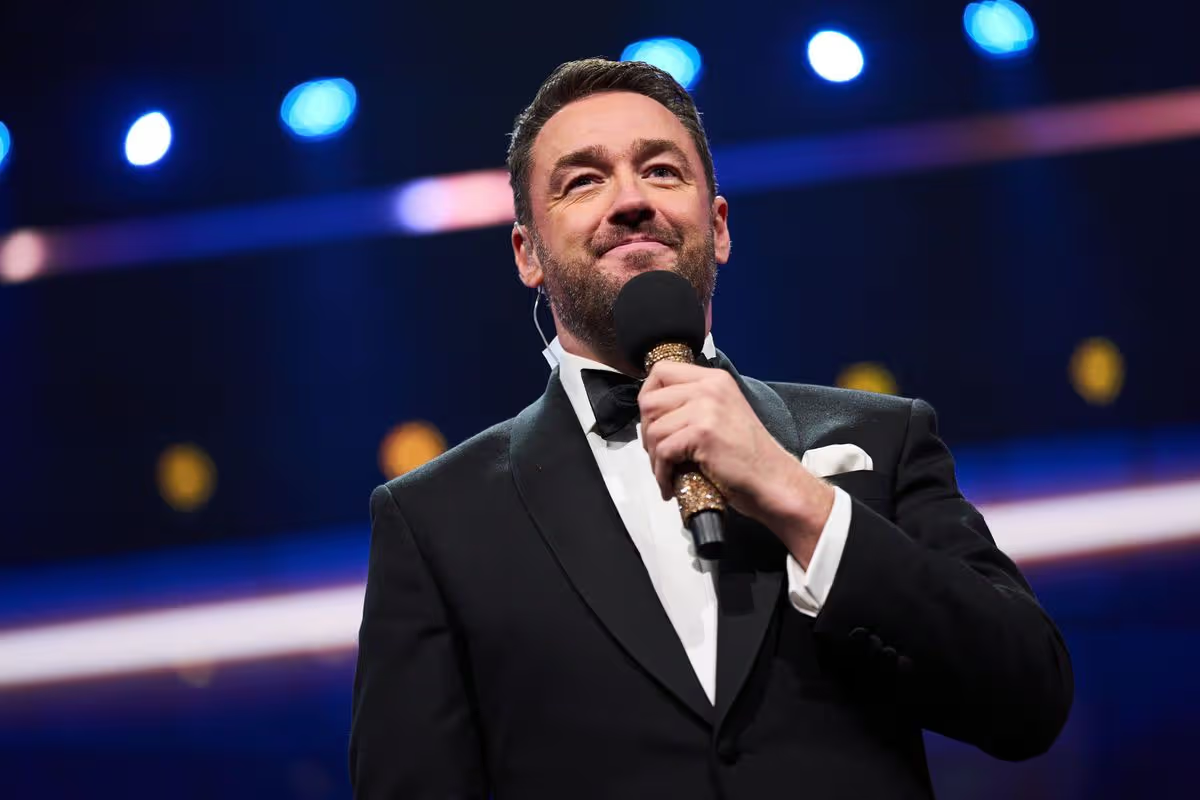
Comedian Jason Manford, who will tonight present the BBC’s Big Night of Musicals is a father to six children from two marriages. While he prefers to keeps his family largely out of the spotlight, the funnyman has offered glimpses of his life behind the scenes
Jason Manford is heading up The Big Night of Musicals (Image: CREDIT LINE:BBC/TBI Media/Scott Garfitt )
Jason Manford might be a household name for his comic prowess, but his personal life is far less well-known. The 41-year-old funnyman, actor and impressive vocalist has been captivating audiences since making his television debut back in 2007 with a minor role in the BBC Three comedy Ideal, and now he’s taking on hosting duties for the BBC Big Night of Musicals by the National Lottery.
He said ahead of the show tonight (28 March) that it was a “real honour” to head up the night of musical performances, but said in his view, “The real talent is in the orchestra and the performers on stage, and I just love being a part of it.” His illustrious career has certainly flourished over the years, with highlights including presenting the prestigious Royal Variety Performance twice and serving as a panellist on ITV’s Starstruck alongside fellow judges Adam Lambert, Beverley Knight and Shania Twain.
Beyond his professional achievements, what else is there to discover about the entertainer’s personal life? Here’s what we’ve uncovered.
The funnyman tied the knot with his first spouse, Catherine, back in October 2007. The couple went on to have twin daughters in 2009, followed by a third daughter in 2010, and then a son in 2012. Their relationship encountered difficulties in 2010 when it emerged he had been messaging female admirers online. The 34-year-old subsequently chose to step down from his presenting duties on The One Show to prioritise his family commitments.
Speaking at the time, he stated: “I have decided after careful consideration to stand back from The One Show to concentrate on my family.” The marriage ultimately ended in 2013. During a frank conversation with the Mirror in 2021, Jason acknowledged he hadn’t devoted sufficient “care and time” to his first marriage.
He reflected: “My first marriage really disintegrated on my theory of, ‘I don’t want my children to have the childhood I had’. So I was out working all the time, and I didn’t put the care and time into that relationship that it deserved and needed. “It’s only now I’m starting to realise, ‘Oh, I’m not giving the children the childhood I had’, which is good in one thing but bad in another. Because I got to spend so much time, and we had laughs with my parents.”
Jason’s second marriage
Jason wed his second wife, Lucy Dyke, in December 2017. The pair exchanged vows in an intimate Manchester ceremony surrounded by loved ones, before celebrating at a local curry house. Lucy, like Jason, works in television as a producer, with an impressive portfolio including Black Mirror, The Split, Ripper Street and numerous other productions. Jason has frequently championed his wife’s professional accomplishments, even encouraging his followers to tune into BBC’s Better, a drama she produced.
Sharing promotional images of the crime series on Instagram, he enthusiastically wrote: “My wife made this excellent show! It’s an absolute smasher and will fill the hole that Happy Valley has left. “BETTER! Starts tonight 9 pm, BBC1. Crime thriller with a twist!”
While largely keeping their domestic life private, he revealed in 2021 that he’d tested Lucy’s tolerance while cultivating sideburns for his theatrical role in Chitty Chitty Bang Bang. Speaking on the Manatomy podcast with Danny Wallace and Phil Hilton, he recalled: “When I was Caractacus Potts in Chitty [Chitty Bang Bang] I grew big sideburns and I got them right down to here, right down to below the lip sort of thing and my wife hated them, like genuinely hated them.
“I guess a lot of fellas do this, once you are married and they can’t leave you for trivial reasons, like having mutton chops. You can do what you like, but if you have dated someone once and they have got mutton chops, you don’t have to have a second date, but once you have got kids, that’s a really trivial reason to go through the process of divorce.
“So I think we as men do things that sort of annoy our wives, but it’s sort of like us testing the boundaries. I knew she hated it, but I still grew them and I was in that show for 18 months.”
Jason’s children
The funnyman is dad to six youngsters in total – four from his initial marriage and two from his current one. Jason shields his offspring from public attention and seldom posts pictures of his clan online.
That said, he does occasionally offer glimpses into family moments on social media. In July 2022 the beaming father shared an uncommon snapshot of his lad observing him perform live.
He wrote beneath the touching Instagram image: “My little boy watching me on stage today at @festunderthestars,” adding a broken heart emoji. During Father’s Day 2020, Jason uploaded an unusual picture showing him embracing all six of his children.
He appeared delighted as the youngsters gathered round for a cuddle while Jason positioned himself before a table displaying a PlayStation Four game and Celebrations chocolates. Within the caption, Jason informed followers: “A lovely Father’s Day. Recording radio show first thing, had pancakes and Nutella!
“Lots of cards and cuddles. Last of Us 2 on PS4 (and a promise of a day off chores this week to actually play it!). A visit to our new house/building site which is finally back up and running and ended the day with a lovely 5k walk which left everybody knackered. Early nights all round. Hope you all had a lovely day, and for those that had a tough one for various reasons, tomorrow is just a Monday and that’ll be easier.”
Big Night of Musicals airs this evening (March 28) from 7:45 pm on BBC One.
SACRAMENTO — Former Assemblyman Tom McClintock, a Ventura County conservative Republican and anti-tax crusader, today will announce plans to run for state controller.
A staunch critic of waste in government spending, McClintock is trying to recapture public office after losing a congressional bid last year to Democratic Rep. Anthony C. Beilenson in a district that encompasses most of Thousand Oaks.
McClintock, 37, a Republican who represented Ventura County in the Legislature for a decade ending in 1992, said Wednesday that he considers the controller’s post the perfect outlet for his vision of government reform.
“The more I looked at the controller’s office, the more it became clear that everything I want to accomplish in public office falls in its purview,” McClintock said. “And that is to identify, expose and eliminate waste throughout the state bureaucracy.”
Up to this point, the outspoken director of the Center for the California Taxpayer had been mentioned in conservative circles as a possible challenger to Gov. Pete Wilson in next June’s Republican primary.
McClintock admitted he was tempted to seek the governor’s seat, but decided the state controller’s office was more winnable.
“I came to the conclusion that Wilson can probably be beaten in the Republican primary and (Democrat Kathleen) Brown can probably be beaten in the general election, but they can’t both be beaten.”
Just as he often assailed fellow state lawmakers during budget debates, McClintock has not been shy about criticizing the governor. In a scalding opinion article published earlier this year, McClintock said Wilson was so tainted by tax increases, deficit spending and state budget shell games that former Democratic Gov. Edmund G. (Jerry) Brown Jr. actually made a better Republican than Wilson.
Sometimes described as strident and unyielding in his views, McClintock is also known for putting forth specific proposals to cut through what he contends is a thicket of government overspending and excessive taxation.
“I have issued very precise warnings of the deterioration of the fiscal condition of the state and proposed literally hundreds of spending reforms totaling billions of dollars of savings,” he said Wednesday. “The controller’s office is the ideal office from which to wage a crusade to eliminate government waste.”
But other lawmakers have at times accused McClintock of using inaccurate data to drive home his points. Two years ago, for example, state Sen. Gary K. Hart (D-Santa Barbara) asked Legislative Analyst Elizabeth Hill to check McClintock’s figures, and she was unable to verify them.
While pursuing the office of California’s chief fiscal watchdog, McClintock said he plans to take a leave of absence next spring from the taxpayer advocacy group he heads in Sacramento. He said he will continue to maintain his Thousand Oaks residence, although he lived and worked in the Sacramento area for the past year.
He is the first prominent Republican to enter the race for state controller, the $90,000-a-year post that accounts for and disburses state money. Democratic State Controller Gray Davis is leaving the job to run for lieutenant governor.
Also running for state controller are Democrats Rusty Areias, an assemblyman from San Jose, and Brad Sherman of Granada Hills, who is chairman of the State Board of Equalization.
Leicester’s early four-try burst laid the foundations for a fourth successive Prem victory as they overcame Gloucester at Villa Park to retain the Slater Cup.
Wing duo Will Wand and Gabriel Hamer-Webb both scored tries before a quickfire double from Jamie Blamire put the rampant Tigers 22-0 up inside the opening quarter.
Matias Alemanno responded for the Cherry and Whites, but Orlando Bailey grabbed a fifth Leicester try to cement their grip just before half-time.
Gloucester improved after the interval and Will Joseph and Dian Bleuler went over to give them hope, but it was not enough and Harry Wells’ late score sealed the Tigers’ win.
They tore Gloucester to shreds during the early exchanges, with Wand taking only two minutes to open the scoring as his swerving run on the left took him clear of two defenders to race over.
Hamer-Webb soon followed suit on the opposite flank, latching onto a perfectly-timed pass from Billy Searle and streaking clear, before Blamire’s double secured his side’s bonus point with only 16 minutes on the clock.
With Ollie Chessum dominating at the lineout, Leicester’s pack swung around for Blamire to crash over the line, and the hooker grabbed his second following a deft one-two with Hamish Watson.
Alemanno finally got Gloucester on the scoresheet from close range after a spell of pressure on the Tigers’ line, but many of their attacks floundered because of untidy passing, and they fell further behind on the stroke of half-time.
The impressive Wand began the move with another darting run and played a key role in its climax, offloading while on the ground for Bailey to dance through a gap in the Gloucester defence and extend the Tigers’ lead to 24 points.
The Cherry and Whites began strongly after the turnaround, building phases and reducing the deficit when Caolan Englefield set up Joseph to force his way over in the corner.
Leicester appeared to ease up and Seb Atkinson made ground to create renewed pressure that resulted in Bleuler, a half-time replacement for Val Rapava-Ruskin, dotting down with eight minutes still to play.
But it made little difference to the outcome and Wells’ converted score late on, which was allowed to stand after initial suspicions of offside, finally ended Gloucester’s hopes.
It means the Slater Cup – contested twice each season in honour of Ed Slater, who captained both clubs and is now living with motor neurone disease – remains in the Tigers’ possession.
Leicester Tigers head coach Geoff Parling told BBC Radio Leicester:
“It was a great start. Somebody told me it was our fastest-ever bonus point, and we were completely on top and playing well.
“We had nearly 70% territory in the first 15 minutes. We were forcing errors and playing off the back of that.
“There was frustration in the second half. At times we probably lost a bit of control around the set-piece and turning the ball over. We couldn’t really get a foothold in the game, when I think one more try would have put them to the sword and they’d have been overplaying.
“But obviously to come away on a big occasion with the five points was the result we wanted. It’s difficult, but the very best teams keep up that intensity for 80 minutes and that’s our challenge now.”
Gloucester head coach George Skivington told BBC Radio Gloucestershire:
“The first 20 minutes was as bad as we could have had. We missed some easy tackles out wide, gave them too easy tries and got pinged off the park in the scrum, which has been an area of strength for us recently.
“If we had a game next week, there are definitely a few lads who wouldn’t be starting for Gloucester after the way they came out of the blocks.
“If I’m honest, I think it was centred around a couple of individual performances in that first 20. A lot of the lads were putting it in and by the end of that first half we’d opened Leicester up a lot.
“Our passing wasn’t accurate enough to take advantage of it. Throughout the whole game there were a lot of dropped balls, a lot of little forward passes, and that was frustrating.”
Kyiv has sought to leverage its expertise in downing Russian drones to help Gulf nations.
Published On 28 Mar 202628 Mar 2026
Qatar and Ukraine have signed a defence agreement seeking joint expertise on countering threats from missiles and drones, according to Qatar’s Ministry of Defence, as Iran continues attacking its Gulf neighbours.
The agreement was made on Saturday during Ukrainian President Volodymyr Zelenskyy’s visit to Doha, following his stop in the UAE earlier in the day.
Recommended Stories
list of 4 itemsend of list
Earlier on Saturday, Zelenskyy said Ukraine and the United Arab Emirates had also agreed to cooperate on defence, a day after signing a deal with Saudi Arabia during his visit to the kingdom on Thursday.
Kyiv has sought to leverage its expertise in downing Russian drones to help Gulf nations and has deployed anti-drone experts to the three countries Zelenskyy visited during his diplomatic tour.
Tehran insists it is targeting only US assets in the Gulf in retaliation for the US-Israeli war on Iran, but the assaults have upset relations as Gulf nations say civilians are being put at risk.
During the Ukrainian leader’s visit to Doha on Saturday, Deputy Prime Minister and Minister of State for Defence Affairs Sheikh Saoud bin Abdulrahman bin Hassan Al Thani met Ukraine’s Secretary of the National Security and Defence Council (NSDC) Rustem Umerov, and Chief of Staff of the Armed Forces of Ukraine Andrii Hnatov.
“The agreement includes collaboration in technological fields, development of joint investments and the exchange of expertise in countering missiles and unmanned aerial systems,” Qatar’s Defence Ministry said in a statement during Zelenskyy’s visit.
The officials discussed the latest security developments. The defence agreement was signed by Qatari Armed Forces Lieutenant General Jassim bin Mohammed Al Mannai, and on the Ukrainian side by Hnatov, in the presence of the other officials.
“Ukraine is offering a cheap way of countering Iranian drones. Ukraine has been doing that for the past three and a half years because Russia has been firing Shahed drones since September 2023 at least, and it’s been downing them nearly every day,” said Al Jazeera’s Dmitry Medvedenko, reporting from Doha.
“The Gulf has been using Patriot and THAAD missiles primarily so far to down Iranian missiles and drones. Each Patriot missile costs almost $4m, while Ukraine is offering its expertise in downing drones for about $2,000 each.”
Decade-long cooperation
Ukraine has become one of the world’s leading producers of sophisticated, battlefield-proven drone interceptors as Russia has been attacking Kyiv with hundreds of thousands of Iranian drones since the start of its full-scale invasion of the neighbouring country in 2022.
On March 18, Zelenskyy said 201 anti-drone experts had been deployed to the Middle East.
Kyiv has proposed swapping its interceptors for the vastly more expensive air-defence missiles that Gulf countries are using to down Iranian drones. Kyiv says it needs more of them to fend off near-daily Russian missile attacks.
“What we can assume is that Ukraine is primarily interested in funding,” said Medvedenko.
He said that the US-Israeli war on Iran is “costing so many Patriot missiles”, which concerns Ukraine as its stocks will decline.
The Patriots are “a much better solution” for countering Russia’s ballistic missiles, he said.
Mendoza Potellá situates the recent oil reform in the historical context of foreign influence over Venezuela’s energy sector. (Venezuelanalysis)
Carlos Mendoza Potellá is an economist and university professor with vast experience and expertise regarding the Venezuelan oil industry. In this exclusive interview with Venezuelanalysis, Mendoza Potellá offers his analysis on the recent reform of the Hydrocarbon Law, the longstanding influence of Western conglomerates over Venezuela’s energy sector, and the struggle for sovereignty.
In late January, the Venezuelan National Assembly approved a reformof the Hydrocarbon Law. What are your views on the new law?
In broad terms, it is the relinquishing of our condition as a sovereign nation, plain and simple. We are not a nation anymore. We are a territory with some delegate administrators implementing decisions made abroad. Who decides? Emperor Trump, who has his proconsul Marco Rubio.
The approved law meets the maximum demands that the Venezuelan right and the oil conglomerates have been making for at least the last 25 years. The 2002 coup against Chávez was to impose something like this, the return to the old concession model. It is the fulfillment of all the dreams of the old “meritocratic” leadership of [state oil company PDVSA], the people who did everything to minimize the fiscal contributions to the country, whether that meant buying 37 refineries abroad or other disasters that wrecked the country.
The reform is a victory for international oil capital, alongside a discourse that hands over the destiny of the industry to major corporations and diminishes national participation as some unproductive “rentierism.”
The Venezuelan oil industry has gone through various stages, with varying degrees of influence from major transnational corporations, whether that is the period prior to the formal nationalization in 1976 or the Oil Liberalization (Apertura Petrolera) of the 1990s. How do we situate the new law within that context?
I believe this is a step backward beyond the apertura or the pre-nationalization period –perhaps it’s a return to 1832! In 1829, Simón Bolívar issued a decree transferring the Spanish crown’s mining rights to Gran Colombia. This, in turn, was based on old medieval law, essentially establishing that mines were the property of the sovereign, the king. In fact, that is where the term “royalty” comes from –as a tribute to the king. And in 1832, when Venezuela separated from Gran Colombia, that decree ratified the nation’s ownership of its mines.
Obviously, oil didn’t emerge until 30 or 40 years later, but by 1866 concessions were already being granted. For a time, people spoke of “material that comes from the subsoil,” even though everyone already knew it was oil.
Our first boom was with asphalt. In 1883, Guzmán Blanco granted the Lago Guanoco concession to his buddy Horacio Hamilton, who later transferred it to the New York & Bermúdez Company, a subsidiary of the US firm General Asphalt. The asphalt boom lasted 50 years, and with it, streets and highways were built all over the United States.
But the example of New York & Bermúdez is significant because when Cipriano Castro came to power in 1899, he found out that the company had not paid taxes and attempted to collect them. What did the corporation do? It financed the so-called Revolución Libertadora led by Manuel Antonio Matos, a banker from La Victoria, which was ultimately defeated after two bloody battles. It was the first instance of foreign hydrocarbon interests seeking to control national politics. And it was always linked to the United States.
In the 1920s, then-dictator Juan Vicente Gómez tasked his minister, Gumersindo Torres, with drafting a hydrocarbons law, but the foreign companies did not like it. And Gómez told them, “Well, then, write the law yourselves!” Later, in 1936, the López Contreras administration drafted a very good law, but since it wasn’t retroactive, the companies did not mind because they already had their concessions granted.
Lake Maracaibo was one of the main hubs of the Venezuelan oil industry in the 20th century. (Archivo Fotografía Urbana)
When do we start seeing the first steps toward Venezuelan oil nationalism?
It was precisely in 1941 that Medina Angarita took office and commissioned a massive dossier on all the concessions in the country, informing the US government that Venezuela was aware of the importance of its oil. This was during World War II, and the oil companies were haunted by the specter of the 1938 Mexican nationalization under the government of Lázaro Cárdenas.
What was [Franklin D.] Roosevelt’s response? He sent a delegation from the State Department, not to intercede on behalf of the oil companies, but to convince them to accept Medina’s reform, because Venezuelan oil was vital to the war effort. The law passed in 1943 was quite progressive. Its first article stated that hydrocarbons are a matter of national public interest, and as such, concessions were granted for a maximum term of 40 years. Eighty percent of the concessions were granted at that time, to expire in 1983.
Venezuelan production grew through the 1970s, but as the end of the concessions approached, the transnational corporations began implementing policies to somewhat ease the hostility toward foreign investment.
Thus, a policy of “Venezuelanization” of the industry’s management was put into effect. That is why, when the so-called nationalization took place (1976), companies such as Shell and Creole, a subsidiary of Standard Oil-Exxon, had Venezuelans serving as president or vice president. These executives later assumed leadership of the newly created national companies. Their passports were Venezuelan, but their hearts belonged to foreign corporations!
Historically, how was the relationship between foreign corporations and Venezuelan authorities? And how did they respond to the 1976 nationalization?
The corporations grew accustomed to the idea of an industry tailored to their interests. I mentioned how they were the ones who drafted the first Hydrocarbons Law. Oversight bodies, such as the Technical Office of Hydrocarbons, were constantly undermined in their efforts to regulate oil activities. And so the companies could extract oil without paying royalties, violate technical standards for field exploitation, or export gasoline instead of fuel oil.
The 1970s were a turbulent time for the oil sector, marked by geopolitical tensions and the 1973 crisis in the Arab countries. In 1973, James Akins, the Nixon administration’s Director of Energy at the State Department, wrote an article in Foreign Affairs titled “The Oil Crisis; This Time the Wolf Is Here.” He argued that Venezuela could be key to reducing dependence on the Middle East, and that in the face of growing oil nationalism, it was necessary to cede some ground and consider other models of participation, while maintaining control over critical areas such as refining and commercialization.
Put differently, it was possible to offer some token concessions to the nationalist aspirations of oil-producing countries like Venezuela. And that rhetoric spread to the transnational corporations. The president of Shell said at the time, “Venezuela is going to have to take action regarding its oil industry,” while the head of Creole spoke of “the Venezuelans’ oil”!
There were growing signs of how the nationalization would take shape and how the transnationals were restructuring. A good example is the Venezuelan Petroleum Corporation (CVP), created in 1960. Juan Pablo Pérez Alfonzo, whom I consider a visionary and a deeply nationalist figure, had conceived it as a company that would develop until the time came for the state to take over production. But the governments did not let it grow; they did not assign concessions it was entitled to, and by the time of nationalization, the CVP was simply one more operator among 13 or 14.
In contrast, [Petróleos de Venezuela, SA] PDVSA, created with the nationalization, did have a very clear vision from the start. I remember hearing senior PDVSA executives talking among themselves, discussing how one came from the “Exxon culture,” which was more vertical, and the other from the “Shell culture,” which was more horizontal. And these were the managers! They were the leaders of the Venezuelan oil industry, which had very little “Venezuelan” about it. What we are seeing now is the reconstitution of all these things.
Mendoza Potellá has long criticized “grandiose” plans surrounding the Orinoco Oil Belt. (El Universal)
Circling back to the current reform, we have seen that sovereignty is a central issue. How is it affected on different fronts?
For me, a fundamental issue is the return of concessions. Because that means going back decades, handing control back to transnational conglomerates. With taxes and royalties, the problem is not whether the rate is 30% or 15%; that flexibility existed in the past. But now it is the transnational corporations that tell the government what their operating costs are and how much goes to the Venezuelan state. There is no oversight body to verify this; instead, the company says, “I need you to lower royalties to this level” for the project to be profitable.
The return of international arbitration is also a brutal setback, because it means that disputes are not settled in Venezuelan courts, but in other bodies that have a history of defending corporate interests. There is no role left for the Public Solicitor’s Office (Procuradoría General), which is essentially the nation’s attorney.
For months we were told we were ready to confront imperialism, but the truth is that everything is being imposed on us. Even the National Assembly is castrating itself. It has enacted a law stating that oil projects no longer require the parliament’s approval; they need only be notified. And on top of all that, there is also the constitutional issue. The reform conflicts with Articles 1, 12, 150, 151, and several others of the Constitution. But this is not merely a constitutional violation; it is a total surrender. A surrender of sovereignty that calls into question our status as a republic.
One of the issues under debate is the distinction between a country that owns oil and a country that produces oil. How should we understand the difference?
Of course, that’s fundamental. A country that owns oil simply collects royalties, and it does so according to its political capabilities. At the moment, Venezuela’s capabilities are limited, because the military cannot confront the enemy, and allies like Russia and China have not shown themselves willing to take any risks. So, there is little room to impose conditions on the US.
But this is a country that has grown used to the multinational corporations having free rein over its oil sector. Unfortunately, there are many people, within the industry itself, who believe that “the foreign conglomerates developed this and therefore have a right to these privileges.” Curiously, that is the same rhetoric Trump uses!
This struggle for sovereignty is fundamental in oil-producing countries. We have seen this with the countries of the Middle East, which try to assert themselves but remain highly dependent on the United States. Obviously, they have the advantage of not being as close as we are. But in my opinion, historically we have lacked nationalism on this issue.
Trump Energy Secretary Chris Wright recently toured Chevron’s facilities in Venezuela alongside Acting President Delcy Rodríguez. (EFE)
One of the arguments in favor of reforming the Hydrocarbon Law was the need to attract investment to so-called “green fields,” on the grounds that when the previous law was passed in 2001, there were many mature fields ready for development and this is no longer the case. However, major corporations have not shown much enthusiasm. What is your reading on this?
Those are fantasies about oilfields that have always been unviable; it is the obsession with the Orinoco Oil Belt. Humberto Calderón Berti, minister of mines in the 1980s and a major proponent of PDVSA’s internationalization, was already talking about green fields back then. By the way, Calderón Berti is now talking about the possibility of fracking in Lake Maracaibo, which would make the lake’s environmental disaster even worse.
The idea that an avalanche of investment is coming is an illusion, and the oil companies themselves know it. Trump talks about investments of $100 billion, but transnational corporations like ExxonMobil use the word “uninvestable.” With market volatility, no one is thinking about investing in oil with extremely high production costs. There is a study that concludes that increasing production to 2.6 million barrels per day based on the Orinoco Belt would require US $90 billion in investments and $122 billion in operating expenses over the next 10 years to drill 13,000 new wells! In other words, it is completely unfeasible.
On top of that, OPEC’s forecasts for oil demand over the coming decades aren’t particularly ambitious. (1)
So who stands to benefit from this new landscape? On the one hand, small “rogue” companies that can take on a well here and there. But above all, the conglomerates that are already here, like Chevron, which know the lay of the land and can expand their operations or make their current operations more profitable. The same goes for Eni and Repsol, which have some crown jewels, like the offshore Perla natural gas field. The corporations that come will be betting mostly on conventional fields, not the Orinoco Belt.
It is very commonplace to hear about US refineries in the Gulf of Mexico that are built to receive Venezuelan crude. That is true, but it is not oil from the Orinoco Belt! It is oil from the Oriente (East) and Occidente (West) oil-producing regions.
Let us stay for a moment on the Orinoco Oil Belt, since that is where the talk of the “largest oil reserves on the planet” centers, as well as the prospects for a massive increase in production. What are the myths and realities surrounding these deposits?
The Orinoco Belt is a geological miracle. Eighty million years ago, 10–15 percent of all life that existed on the planet was fossilized north of the Orinoco River. It is something to cry out to the heavens. But that is not exploitable oil. It is extra-heavy crude, a sticky mess that needs to be upgraded. First it must be converted into liquid petroleum so it can flow through pipelines, and then taken to be refined and turned into gasoline.
In the 1970s, the United States saw the energy crisis coming and asked, “When conventional oil runs out, where can we find oil around the world?” In three places: the Soviet Union, Canada, and Venezuela. And where in Venezuela? In the Orinoco Oil Belt. Pérez Alfonzo spoke of the belt as “something for the future,” but the United States wanted to accelerate exploitation and sent a delegation in 1971 to convince President Rafael Caldera to begin the process. In fact, the name was changed from “Tar Belt” to “Oil Belt” to make it more attractive.
The US Geological Survey estimates that there are 513 billion barrels of “technically recoverable” oil. But that is absurd, because there is no capacity. What makes a reserve recoverable has to do with economic ability, the market, and the available technology. Nevertheless, the Orinoco Belt has been at the center of grandiose projections over the past few decades, alongside the highly lucrative business of certifying reserves.
Former President Hugo Chávez imposed the state’s sovereignty over the oil industry in the 2000s. (Archive)
The oil reform took place in a specific context, following years of economic sanctionsthat have left PDVSA in a very difficult situation. What would be an alternative path? How can the industry recover without surrendering sovereignty?
There are no magic solutions, obviously. We are facing imperialism in the Trump era; we see all its destructive potential. It is a phase where the US, paradoxically, recognizes its weakness and is entrenching itself in its “backyard.” But we must be aware that the industry’s current course is one of total capitulation.
Whether we can recover, whether it is possible or not, we must think about it rigorously, in a sovereign manner. And above all, we must have a serious plan; we cannot be dreaming of 5 or 6 million barrels a day.
There are 17,000 conventional oil wells, with the capacity to produce, abandoned around the country. Of the 35,000 wells in Venezuela, only half are currently producing. The others require investment, though not particularly large ones. And what kind of oil will these wells produce? Crude grades ranging from 20 to 30 degrees. But we need a plan, to examine wells one by one. These are wells that will produce 20, 50, or 100 barrels a day, but it is light and medium crude—the “classic” Venezuelan oil.
So, from a nationalist perspective, what does the future hold for Venezuela’s oil industry?
The future is to build a post-oil Venezuela. This was already being discussed by theorists such as Francisco Mieres and Pérez Alfonzo in the 1970s. Then, in recent years, many began talking about a post-oil or post-rentier country, but mostly to cover up their incompetence and inability to maintain production levels.
There is no magic solution, and the oil industry will have to play an important role. But the current situation is dire. We are in a new phase of absolute political dependence. It’s not just about oil, or that the US controls revenues, imposes concessions, and so on. It is that the country has lost the ability to make its own decisions.
There are also expectations of the people, who to a large extent have become accustomed to the idea that their oil will last forever. That creates the illusion that things can improve very quickly. The path will be slow, but it has to start with regaining sovereignty.
Note
(1) The interview was conducted before the launch of the US-Israeli war against Iran.
Luba Muhstuk has been seen heading to her new job after her brutal axe from Strictly Come Dancing and looked full of confidence as she was spotted in London over the weekend
Luba blew a kiss to the camera (Image: JAMES CURLEY AND MAGICMOMENTSUK)
Luba Muhstuk has been seen heading to her new job after her brutal axe from Strictly Come Dancing. The TV star, 36, has served as a professional on the BBC Saturday night favourite since 2018 but along with Karen Hauer, Michelle Tsiakkas and Nadiya Bychkova, it was recently announced that she will not be part of the competition series going forward.
Just hours after the news broke,. Luba herself broke her silence on the matter. Taking to Instagram, insisting the time had come for her “step away” from the show, she wrote: “With a heart full of gratitude, the time has come for me to step away from Strictly Come Dancing. I am deeply grateful for the past 10 years on this beautiful show! Thank for you for the amazing opportunities and unforgettable memories. It truly has meant the world to me.”
Sharing that she was now looking forward to the future, Luba continued : “Now it’s time for me to follow my dreams beyond the show, and I’m excited for what the future holds. I can’t wait to see you all on the Pro Tour and I’m really looking forward to it one last time.”
Ensure our latest headlines always appear at the top of your Google Search by making us a Preferred Source. Click here to activate or add us as your Preferred Source in your Google search settings.
Over the weekend,, photos emerged of Luba heading to role taking dance classes in central London. Despite the sudden nature of her departure from the series, Luba looked to be in great spirits as she walked to work. This was the first time she had been spotted out in public since news of her axing emerged.
The TV star was suitably dressed for her role at the dance class, opting for comfortable rehearsal wear and let her dark locks flow down her back. She clutched her phone in her hand and threw a series of excitable poses.
Praising Luba – while announcing her exit – the BBC said: “We are incredibly grateful for her dedication to the programme and for always going above and beyond—whether through the care and commitment she showed her celebrity partners or her warmth and kindness behind the scenes. Luba has been, and always will be, a much-loved member of the Strictly family, and we wish her every success in the future.”
Fellow dancers were quick to share supportive messages in the comments section. Among them was Amy Dowden, who simply wrote: “Love you xxx.” Johannes Radebe echoed the sentiment, typing: “Love you darling,” alongside a red love heart emoji. And Nadiya, who met the same fate as Luba in recent days, shared three white love heart emojis.
While she will no longer be part of the dancing on screen team, Nadiya has reportedly been offered a chance to stay on the show in a different role. Speaking to The Sun, a source said: “Nadiya is so recognisable with viewers and bosses felt it would be a real loss to lose her from the Strictly family altogether. After a few conversations, they reportedly offered her a choreography role which she is very open to.
“Obviously, she is sad to no longer be dancing but recognises she will have great scope for more lucrative commercial opportunities now, and can explore exciting new projects.”
The Strictly team has already said goodbye to a number of long-time members of the show in recent weeks. Gorka and Michelle Tsiakkas are also said to have been axed in a bid for bosses to get “fresh faces” in the professional line-up.
And the decision of who will present the show following the exit of Tess Daly and Claudia Winkleman is yet to be made public, too. Recently, Louie Spence told the Mirror: “With Strictly, people say I should go on there and be a judge just because I’m known as a dancer – but it’s a very different dance genre. Ballroom and Latin is very particular. It’s like the difference between hip-hop and classical ballet…”
Suggesting Rylan and Zoe Ball would make good hosts, he concluded: “Rylan would be great fun [as host]. I love Rylan, he’s got a great personality. He’s young enough to keep going if it’s going to keep going for years.
“Zoe Ball, she’s great. Who knows how many more years a show like that will last? Things are moving so quickly now, with the way things are changing. Whoever gets it, I’m sure they’d be fabulous.”
Good morning, and welcome to L.A. on the Record — our City Hall newsletter. It’s Noah Goldberg, with an assist from David Zahniser and Rebecca Ellis, giving you the latest on city and county government.
Adam Miller is running for mayor.
You might not know that, and you might not even know who he is — and his campaign team wouldn’t blame you.
In fact, the Miller team’s own internal poll of 800 likely voters shows the tech entrepreneur with just 6% support, behind incumbent Mayor Karen Bass, City Councilmember Nithya Raman, conservative reality TV star Spencer Pratt and leftist Rae Huang. Only 13% of Angelenos even have an opinion of Miller, with 7% coming down on the positive side and 6% negative.
Miller’s pollster, Jefrey Pollock, admits it’s not often that a campaign brags about a humble 6% backing their candidate.
But during a video conference with reporters, Pollock argued that Miller’s support rises along with his name recognition. When likely voters were given more information about the candidates, he shot up to 20%, according to the poll. When provided with additional positive information about the candidates, Miller finished first, with 27%.
“Adam is the one who jumps up,” said Pollock, who runs Global Strategy Group.
After voters got the first dose of information, 22% supported Bass, down from 26%; 21% went with Pratt, up from 14%; 14% backed Raman, up from 12%; and 8% chose Huang, down from 9%.
In a poll earlier this month by the UC Berkeley Institute of Governmental Studies, co-sponsored by The Times, Miller also came out with 6% support. Bass was supported by 25% of voters, while Raman drew 17% and conservative reality TV star Spencer Pratt came in third at 14%. About a quarter of voters were undecided.
Paul Mitchell, vice president of the bipartisan voter data firm Political Data Inc., said the Miller campaign poll was compelling.
“What I see is a good argument that he can make the runoff,” Mitchell said. “This is a real deal.”
The question for Miller and his team then becomes, how can he introduce himself to more voters before the June 2 primary?
Miller is the former CEO of Cornerstone OnDemand, a global training and development company he built over the course of more than 20 years. The publicly traded company was eventually sold to a private equity firm for $5.2 billion. He is also a co-founder of Better Angels, a nonprofit focused on preventing homelessness and building affordable housing.
Among everyday Angelenos, he’s a no-name.
A television, social media and outdoor billboard advertising campaign launched this week should help change that, Miller’s team said. They said the “omnichannel” blitz cost seven figures but did not provide an exact amount.
The first billboard went up this week at Bundy Drive and Wilshire Boulevard, not far from Miller’s Brentwood home. More are expected next week in the San Fernando Valley.
Miller said he personally loaned his campaign a “majority” of the money for the ad blitz.
How much Miller is willing to spend on his mayoral ambitions?
In 2022, billionaire developer Rick Caruso threw more than $100 million of his own money into his campaign against Bass during the primary and runoff elections. He still lost by more than 10 percentage points.
“Obviously, we have the benefit of hindsight that that strategy did not work,” Miller said of the Caruso campaign. “There’s reasons my candidacy is different.”
For one thing, as opposed to Caruso, who was a Republican before registering as a Democrat to run for mayor, Miller is a lifelong Democrat. (That said, Miller voted for Caruso in 2022, said his spokesperson, Jaime Sarachit).
Miller is a moderate who sees himself as leader who gets things done. He believes the LAPD needs a minimum of 10,000 officers, up from about 8,700. He thinks the city should use anti-encampment laws to move homeless people away from sensitive areas like schools and day cares.
Miller would not directly answer a question about how much of his own money he will spend on his campaign. He has so far loaned it $2 million, “to get it up and running,” Sarachit said.
“That’s a significant sum, obviously,” said longtime L.A. political consultant Bill Carrick. “It’s a lot more efficient to write a check from your personal account than it is to go raise $2 million.”
But Miller said his campaign will largely be “traditionally financed,” meaning he plans to fundraise.
You’re reading the L.A. on the Record newsletter
Sign up to make sense of the often unexplained world of L.A. politics.
By continuing, you agree to our Terms of Service, which include arbitration and a class action waiver. You agree that we and our third-party vendors may collect and use your information, including through cookies, pixels and similar technologies, for the purposes set forth in our Privacy Policy such as personalizing your experience and ads.
State of play
— AO-K’ed: Metro’s board on Thursday unanimously approved a new route for a rail line that would extend from South L.A. into West Hollywood — a milestone deal struck after last-minute negotiations between Bass and local leaders. The K Line northern extension would link with four major rail lines and increase the number of riders to 100,000 a day.
— SOCIALIST SNUB: The Los Angeles chapter of the Democratic Socialists of America will not endorse a candidate for mayor. Last weekend, the group voted on whether to reopen its endorsement process and consider backing Huang or Raman but ultimately decided to stay out of the fray for the June primary.
— GUNNING FOR COUNCIL: Leftist City Council candidate Estuardo Mazariegos was convicted of misdemeanor gun possession in 2009. He thinks the conviction is a strength, not a weakness.
— SMALLER BIGGER: On Tuesday, the City Council adopted a strategy that would delay the effects of SB 79 citywide by upzoning 55 single-family and low-density areas, allowing for buildings of four to 16 units that are up to four stories tall. Under SB 79, buildings adjacent to certain transit stops can be up to nine stories.
— NOT UP FOR DEBATE: USC canceled its Tuesday gubernatorial debate, a stunning about-face after days of fiery criticism that every prominent candidate of color was excluded. Although the university defended the methodology used to determine who was invited, it ended up calling off the event with less than 24 hours’ notice.
— PHANTOM SUIT: A man said he has no idea how he became a plaintiff in the county’s $4-billion payout for sex abuse in juvenile halls and foster homes. His lawsuit, which he says was filed without his consent by Downtown LA Law Group, deepens questions around possible fraud in the nation’s largest sex abuse settlement.
— TAX TAKEAWAY: The proposal from a group of business leaders to repeal the city’s business tax has qualified for the November ballot. Organizers said their success — gathering twice as many signatures as needed — shows that voters “want affordability and fairness to be addressed immediately.” Labor unions have vowed to fight the proposal, which would rip an $800-million hole in the city budget.
— HOUSING HUDDLE: Three of the mayoral candidates — Miller, Huang and Raman — took the stage Monday for a downtown forum. The trio went back and forth on housing, transportation and other issues, particularly the future of Measure ULA, the so-called mansion tax. Bass did not attend, citing a previous engagement in New Orleans, where she held a campaign fundraiser with U.S. Rep. Troy Carter (D-La.) and the city’s mayor, Helena Moreno. Pratt also did not show.
QUICK HITS
Where is Inside Safe? The mayor’s signature program visited Skid Row in Councilmember Ysabel Jurado‘s district, moving 25 people indoors.
On the docket next week: The City Council is on recess next week.
Stay in touch
That’s it for this week! Send your questions, comments and gossip to LAontheRecord@latimes.com. Did a friend forward you this email? Sign up here to get it in your inbox every Saturday morning.