Nine years on, Flynn is anxiously watching on as a fan, having left the world of football for a new job in media and marketing in the Newport office of CDM Media, his city centre base just across the River Usk within spying distance of his old club.
Christian Fuchs’ team are two points above the relegation zone after Saturday’s crucial 1-0 win over Shrewsbury Town and, with six games to go, Flynn hopes there will be no need for a repeat of his final-day rescue act.
“I hope Christian can keep them up because there will be a big after-effect if things go wrong,” said the 45-year-old, who was born in the city and played for County before managing them from 2017 to 2021.
“My son is in the academy at Newport and if we go down… that could go. That would be catastrophic in terms of how we’re going to bring young players through.
“I think football in the city will drop. It would hit hospitality around match days. It’s going to leave a bad aftertaste.
“If they go down, I think it could be a long, long road back.If they get back.”
Flynn, though, is optimistic about their survival hopes. After all, they’re not 11 points adrift of safety as his 2017 side were after he accepted what looked an impossible survival mission by replacing the sacked Graham Westley as boss.
March 29 (UPI) — Amid growing chaos at airports during the 44-day Department of Homeland Security shutdown, Immigration and Custody Enforcement agents have been deployed to airports to help Transportation Security Administration agents — and they may be in for an extended stay.
As Congress has not been able to agree on a bill to fund DHS because of disagreements about ICE unrelated to air travel, TSA agents who have not gotten paid are increasingly calling out of work or quitting their jobs.
White House border czar Tom Homan on Sunday told CNN and CBS News that whether ICE retains a presence at airports will depend when “airports feel like they’re 100% in a posture where they can do normal operations.”
The White House on Monday deployed ICE to airports around the country, where they received training to use TSA equipment and standard operating procedures.
By Wednesday, they could be seen screening travelers, checking documents and assisting TSA agents move lines of people through security, The New York Times reported.
Thursday, Senate Democrats again blocked a bill to fund DHS because it does not include new guardrails for ICE agents carrying out the Trump administration’s immigration crackdown.
As a result, President Donald Trump said that he would pay TSA agents out of funds approved in last year’s One Big Beautiful Bill, in addition to sending ICE to assist at airports.
Over the last 44 days, thousands of TSA agents have called out sick and nearly 500 have quick their jobs during the second shutdown in a year that has prevented them from being paid on time, The Boston Globe reported.
Homan said Sunday that how long and how many ICE agents will continue to work at airports will depend on how many TSA agents come back, and that he is working with TSA to determine what level of staffing they need as time goes on.
“In an increased threat posture, we need to secure those airports,” Homan said. “ICE is there to help our brothers and sisters in TSA. We’ll be there as long as they need us, until they get back to normal operations and feel like those airports are secure.”
After failing to pass a bill funding any part of DHS, Congress left Washington, D.C., for a two-week recess.
President Donald Trump stands with U.S. Secretary of Agriculture Brooke Rollins during an event celebrating farmers on the South Lawn of the White House on Friday. Photo by Aaron Schwartz/UPI | License Photo
The UN’s nuclear watchdog says Iran’s Khondab heavy water production plant is no longer operational after suffering severe damage in an Israeli strike on March 27. The reactor, which contains no declared nuclear material, was hit along with other key infrastructure sites.
“Kim’s Convenience” may not win points for originality, but originality isn’t really the point of an immigrant family drama meant to be instantly, one might say universally, recognizable.
The play, which opened Tuesday at the Ahmanson Theatre, was a runaway hit at the 2011 Toronto Fringe Festival. That success led to a larger production at Toronto’s Soulpepper Theatre that brought more attention to the show, paving the way for runs off-Broadway, in London’s West End and Washington, D.C.
The story is set in Toronto, and the Kim family (owners of the titular convenience store) is of Korean background. But immigrants from Ireland, Italy, Latin America, India and Eastern Europe and their more assimilated children won’t have any problems relating to the generational conflicts at the heart of this gentle comedy.
Author Ins Choi, who once played the role of the prodigal son, has matured into the part of Appa, the patriarch who left Korea with his wife, Umma (Esther Chung), to start a new life in Canada. He opened a 7-Eleven-style shop, which he once considered calling 7-12, and has been living above the store with his family in what has been an all-hands operation.
Appa made sacrifices to give his son and daughter a better life — and he’s more than happy to tick off a list of what everyone owes him. He’s a mostly benevolent tyrant, but his crotchety side can get ugly and he’s not always in control of his temper. His son Jung (Ryan Jinn) ran away at 16, absconding with money from the store safe, after one of Appa’s flare-ups sent him to the hospital.
Janet (Kelly Seo), Appa’s 30-year-old unmarried daughter, bears the brunt of being the adult child who remained at home. She still works at the store, though her true calling is photography. Her father considers this just a hobby, a weekend recreation that shouldn’t interfere with her taking over the store one day. But she has other ideas for her future.
Change is coming whether Appa likes it or not. A Walmart is heading to the area, and with this news comes an unexpected offer for the shop that would allow him to comfortably retire. But selling the store is tantamount to discarding his story.
Brandon McKnight, left, and Kelly Seo in “Kim’s Convenience.”
(Dahlia Katz)
He explains this to Janet, hoping that she’ll continue his legacy. But she’s put her life on hold for too long. Both her parents never let her forget that she still doesn’t have a husband. But how can she get married when her father subjects any man she dates to the third degree?
Alex (Brandon McKnight), the police officer who answers the 911 call Appa had Janet place to report a Japanese car parked illegally by the store (he still hasn’t forgiven Japan for its invasion of Korea), turns out to be a childhood friend of Jung’s — and someone Janet used to have a crush on. The sparks between them are obvious, and Appa, the soul of indiscretion, can’t help meddling in his overbearing way.
Choi isn’t averse to shtick, if the result is an explosion of audience laughter. One comic gimmick involves Appa’s superhuman grip that can subdue even the mightiest of men. A shoplifter (also played by McKnight, who portrays all the customers and passersby) learns the hard way that Appa is not to be underestimated.
Esther Chung, left, and Ins Choi in “Kim’s Convenience” at the Ahmanson.
(Dahlia Katz)
The scene involves an unsavory routine on how to recognize a shoplifter. Janet challenges Appa’s racist assumptions, but father knows best and no one can convince him otherwise. Janet can’t win with him, but don’t count Appa’s daughter out.
Or his son, for that matter. Jung, who had a stint in rehab, hasn’t had an easy path in life, but he’s stayed in touch with his mother and eventually he and his dad will have their dramatically inevitable reckoning. There’s something determinedly hopeful about “Kim’s Convenience,” which like the store it’s named after, wants its patrons to leave satisfied.
The cast members, under the direction of Weyni Mengesha, all deserve high customer ratings. Choi’s Appa is impossible to stay mad at even when he’s said or done something unforgivable. He doesn’t mean to offend, though other people’s feelings are a luxury he has never been able to afford.
Still, his paternal bluntness is not without its infuriating charm, as when he informs his headstrong daughter, “You have to understand, now is desperation time for you. Sudden death, overtime, penalty kick shoot out. Expiration date is over. Take over store is only choice you having.”
Esther Chung and Ryan Jinn in “Kim’s Convenience” at the Ahmanson.
(Dahlia Katz)
Seo’s Janet is as feisty as she is loyal, making it easy to root for her and her quickly budding romance with McKnight’s worthy Alex. Chung’s Umma doesn’t take up a lot of room in the play, but her maternal presence registers sharply nonetheless. Jinn endows Jung with hidden dimensions of pain and regret.
But the most vivid performance might in fact be the convenience store itself, brought to fluorescent, sanitized, colorful life by scenic designer Joanna Yu and lighting designer Wen-Ling Liao. Nicole Eun-Ju Bell’s video and projection designs subtly transpose the setting when, for instance, Umma meets up with her son at church. The production seems right at home at the Ahmanson, a function of both the broad sitcom-friendly style and the warm Korean American reception that was audible at Tuesday’s opening.
“Kim’s Convenience” has an eager-to-please TV sensibility that can seem formulaic at times. But representation, particularly these days, can be a radical act, and there’s something heartening at the sight of the Kim family enjoying their turn in the mainstream spotlight.
‘Kim’s Convenience’
Where: Ahmanson Theatre, 135 N. Grand Ave., L.A.
When: 7:30 p.m. Tuesdays-Thursdays, 8 p.m. Fridays, 2 and 8 p.m. Saturdays, 1 and 7 p.m. Sundays. Ends April 19
After a wearying 24 hours at work in the midst of chaos over last week’s presidential election, an exhausted Florida Secretary of State Katherine Harris took a moment to reflect on her role in the process.
“I feel so historic,” she said. Little did she know.
By ruling Monday that all of Florida’s 67 counties would have to complete their ballot recounts by 5 p.m. EST today–a move backed by the campaign of GOP Texas Gov. George W. Bush–the 43-year-old Republican became an unlikely pivotal player in the closest balloting in America’s history.
Harris contended she had no discretion to extend the deadline, except in the case of a natural disaster. “But a close election, regardless of the identity of the candidate, is not such a circumstance,” she said.
This, from a woman who once told an interviewer that she didn’t like “gamesmanship” in politics. A multimillionaire whose state position is due to be eliminated in 2002, Harris has spent much of her time in office as an influential patron of the arts.
In taking her hard line against time-consuming hand recounts sought by the presidential campaign of Democratic Vice President Al Gore, Harris incurred the icy disdain of former Secretary of State Warren Christopher, who accused her Monday of a “move in the direction of partisan politics.”
Republicans say otherwise. Former Florida Secretary of State Sandra Mortham, who lost to Harris in a recent primary battle, insisted “she’s doing exactly what her constitutional duties require, no more, no less. To me, this isn’t a political issue. This is whether someone is doing her job.”
The job requires oversight of Florida’s arts, libraries, historical sites and international trade, and supervision of corporate registration, business licensing and elections. It has been largely ceremonial–until now.
“It’s an extraordinary responsibility,” Harris said of her mandate to oversee the recount. “I’m very anxious. The process is so important here.”
Harris has won high marks from both Republicans and Democrats for her support of the arts. There has been speculation in political circles here that Harris might win an ambassadorship or arts post in a Bush administration, whose candidacy she supported.
Harris campaigned for Bush in New Hampshire, was a Florida delegate to the Republican National Convention in Philadelphia and was one of eight co-chairs of his Florida campaign.
“She was a diligent member of the Florida Senate and has been a fairly active secretary of state, from both a cultural and arts perspective as well as a foreign trade perspective,” said Florida lobbyist Ron Book, a Democrat, who helped raise money for Harris when she ran for the statewide office.
Harris’ short term has not been without criticism. She has flown around the world to promote Florida trade, but critics note she has spent more money on travel than Florida Gov. Jeb Bush. “I’m not abusing anything,” she said last month. “I’m working my heart out for the state of Florida.”
Harris grew up in Bartow, a small rural Florida town not far from Tampa. Her grandfather was the late Ben Hill Griffin Jr., a citrus and cattle baron who served in the state Senate.
After graduating from Agnes Scott College in Decatur, Ga., and studying art in Spain and philosophy and religion in Switzerland, she went into business as a marketing executive for IBM, then sold commercial real estate in Sarasota. Later, she earned a master’s degree in international trade at Harvard.
After the late Democratic Florida Gov. Lawton Chiles appointed her to the board of trustees of the Ringling Museum of Art, she sought more state money for the institution.
Disgusted with Sarasota politicians who did not have her commitment to cultural issues, she ran for the state Senate in 1994, collecting more than $20,000 in campaign contributions from a Florida insurance company called Riscorp. The firm would later be indicted in federal court for making illegal contributions to 23 candidates for state and federal offices, Harris among them. Harris, who was not charged, said she felt unfairly tainted by the scandal.
“If somebody hands you counterfeit money, how are you supposed to know it’s counterfeit?” she said.
As a state senator, she sponsored a bill that would have required parental notification before girls under 18 could get an abortion. But it was vetoed by Chiles.
Dubbed one of Sarasota’s “most prominent bachelorettes” by the local newspaper, her marriage in December 1996 to businessman Sven Anders Axel Ebbeson made headlines. They married at the Charlotte County government center, where she made her first campaign appearance. Then they flew to Paris.
Harris is worth about $6.5 million, mostly from stock in her family’s agricultural interests–she used $23,000 of her own money to run for secretary of state.
After one term as a state senator, Harris decided to run for statewide office, raising more than $1.5 million.
Harris won the 1988 GOP primary after a hard fight, then defeated her Democratic opponent.
Her first term will be her last. Harris will be Florida’s last elected secretary of state. Voters approved a change in the state Constitution that eliminates the position in 2002.
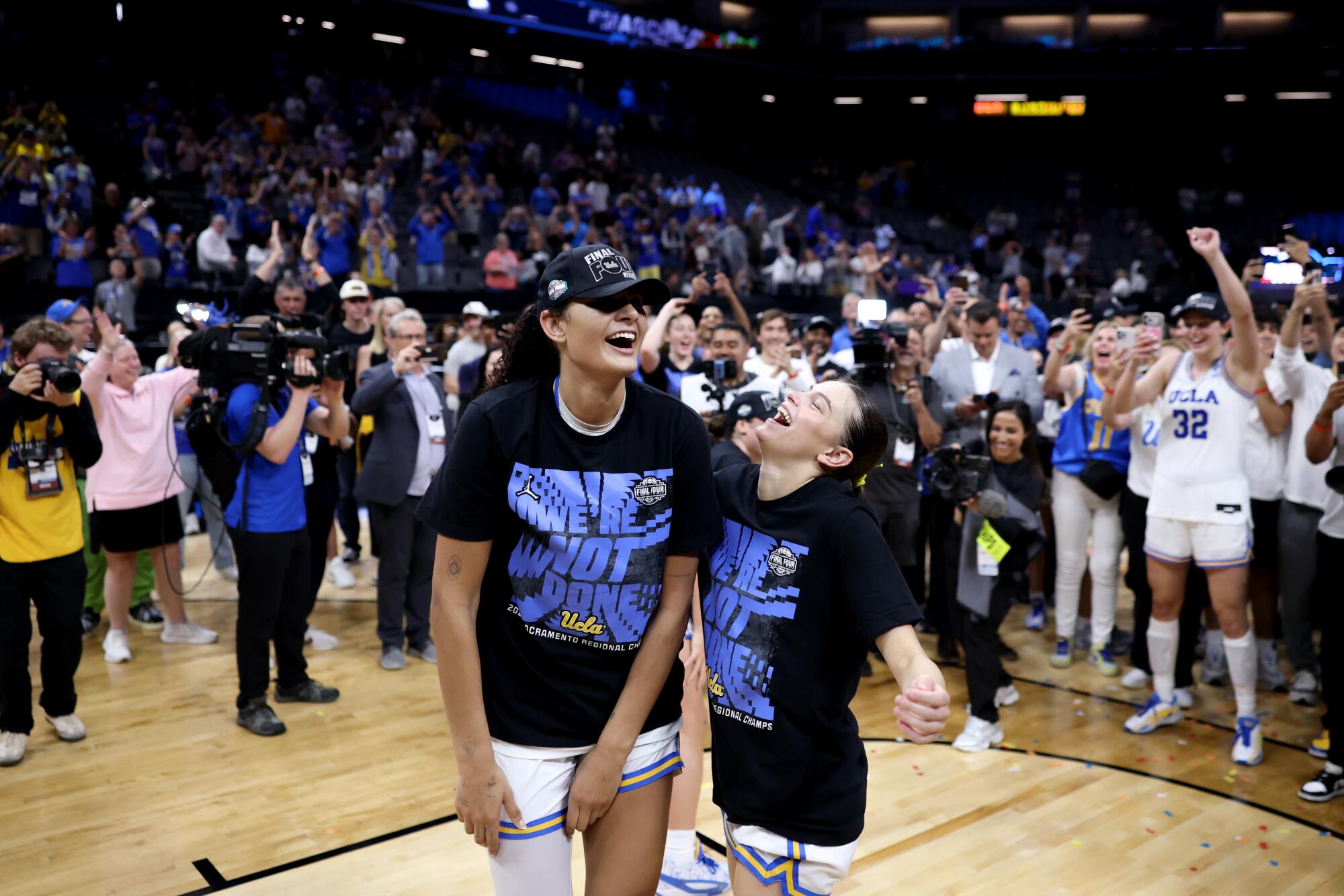
SACRAMENTO — The team that can’t stop dancing won’t stop dancing.
The top-seeded UCLA women’s basketball team beat Duke 70-58 in the Elite Eight. It wasn’t balletic, but beautiful.
Sunday’s game at Golden 1 Center in Sacramento wasn’t a fun, free-flowing joy ride that so many of the Bruins’ wins have been this season.
It was a rattling, teeth-gritting, heart-thumping roller-coaster ride — weeeeee!
The Bruins weren’t having fun, exactly. They were having the time of their lives.
And in the end, they shoved their way to the front of the stage — and back to the Final Four.
Now the TikTok countdown is on before final exams in Phoenix, where redemption and legacy and a rematch await with either winner of the No. 1 Texas vs. No. 2 Michigan tussle in the Fort Worth Regional final.
And any questions — ahem, mine — about how the barely-battled-tested boogie-down Bruins respond to a significant stress test were answered.
The Bruins are built for this.
They’re not just talented. And they’re not just talented dancers (and postgame, Lauren Betts, Charlisse Leger-Walker and Gabriela Jaquez reprised the routine that went viral when they did it with the UCLA Dance Team during halftime of a men’s game this season).
They’re tough. And they’re locked in.
And unlike last season, when their program’s Final Four debut ended in a 85-51 national semifinal blowout loss to eventual champion Connecticut, they’re ready for what comes next.
They let us know in the second half Sunday.
Duke came floating in, still buzzing from Friday’s buzzer-beater in the Sweet 16. That slow-motion-in-real-time three-pointer by Ashlon Jackson that rolled around and around the rim as though the basketball gods needed just a little more time to determine UCLA’s opponent Sunday.
UCLA’s Lauren Betts, left, Gabriela Jaquez celebrate after the Bruins defeated Duke on Sunday to advance to the Final Four.
(Eric Thayer / Los Angeles Times)
It was to be Duke, who proved a dangerous No. 3 seed. The Bruins weren’t prepared for the Blue Devils to be so prepared for them, trailing at the break for just the second time this season. The first time was in November against Texas, when the Bruins — now a program-record 35-1 — suffered their only loss this season.
Still their only loss.
Even a fool could read the determination on the Bruins’ faces as they roared back from a 39-31 halftime deficit; they’d come so far together, but they so badly wanted to go further.
No one was ready to get off the ride, not least the six seniors who played the entirety of the second half, seizing momentum and the moment and hitting the Blue Devils (27-9) with a white-knuckled flurry of activity.
“Compliment them,” Duke coach Kara Lawson said, “for turning up their defensive intensity.”
There were 50-50 balls in name only, because UCLA seemed to be winning 100% of them.
UCLA players were ripping away passes. They were diving all over the floor and were all over the boards. They ratcheted up the intensity so much it spread into the stands, where the largely pro-Bruins crowd of 9,627 cheered deliriously.
Shots started falling. Turnovers stopped cascading. UCLA found its rhythm.
And UCLA’s 6-foot-7 star center Betts did what she does, with 15 points, eight rebounds and two blocks in the second half, of which she played all 20 minutes.
“I was just pretty mad,” she said. “You know, my senior season is on the line, so I kind of got to wake up a little bit.”
Angela Dugalic continued to be the matchup nightmare she has been all March; the 6-4 sixth woman scored 15 timely points to take some pressure off Betts.
UCLA coach Cori Close watches play during the Bruins’ win over Duke on Sunday.
(Eric Thayer/Los Angeles Times)
“I’m just so proud of her,” Betts said. “The confidence and her poise … you could get in your head in moments when we’re down … but she did all the right things and what we needed at the time.”
It was an entertaining Elite Eight clash that was brought to you by two coaches who staged, like up-and-coming chefs, under two of the greatest leaders the sports world has known.
UCLA coach Cori Close and Lawson committed to making sure we won’t lose John Wooden’s and Pat Summitt’s recipes — never mind all the seismic, disorienting shifts happening in college sports.
A former Tennessee star, Lawson brings Summitt’s brand crackling intensity to Duke, a mindset that she’s said calls for supreme confidence, chasing excellence and holding oneself to an all-around standard of success.
UCLA’s bench was uplifted all season by Close’s warm intentionality, learned from years of mentorship from Wooden. The main ingredients, she’ll tell you, requiring a dollop of growth, gratitude, of giving and not taking.
“[Our] team culture is not this nebulous thing or phrases on a wall,” Close said. “It’s a group of people that are willing to be committed to the hard, right behaviors over and over again. I cannot tell you how many times throughout that game we referred to our values, who we are, what our identity was, what we had to get back to.
“… I’m just really humbled and thankful to be a part of a team and staff that cares about things from the inside out. What you saw on the court is a reflection and a byproduct of what’s happened on the inside.”
Israeli Prime Minister Benjamin Netanyahu has ordered the military to expand its invasion in southern Lebanon, pushing deeper to extend what he calls a ‘buffer zone’. As Israeli forces advance towards the Litani River, an explosion at a UN position in southern Lebanon killed a peacekeeper.
A post-doctoral fellow in Tehran has told Al Jazeera there was no warning before US-Israeli strikes hit the Iran University of Science and Technology on March 28. Helyeh Doutaghi says the attack reflects a wider pattern and raises questions about what defines ‘legitimate retaliation’.
Within the first 72 hours of a 26-day game, “Survivor 50,” featuring 24 veteran players, had already delivered feuding, anguish and heartbreak. Legendary rivals Ozzy Lusth and Benjamin “Coach” Wade appeared to bury the hatchet, only for their conflict to reignite soon after. Kyle Fraser was forced out due to injury, and Jenna Lewis-Dougherty, who competed in both the show’s inaugural season and “All-Stars,” was the first person voted out after more than two decades away from the game.
Yet there were also moments of nostalgia, connection and excitement as returning players arrived on the beach, grateful to be part of the show’s landmark 50th season.
This raw display of humanity has kept the show’s torch burning for over 25 years. “‘Survivor’ is built on a timeless idea because human nature doesn’t change,” says Jeff Probst, the host, executive producer and showrunner of the reality competition series. “It’s essentially behavioral psychology in the wild.”
Back in Fiji’s Mamanuca Islands for “Survivor 50: In the Hands of Fans,” the show has added a novel element. Fans were given a say in key decisions, voting online to shape production and game mechanics, from choosing tribe colors to requiring castaways to earn rice and supplies instead of receiving them at the start.
“What a great twist,” says Wade in an interview over Zoom. “‘In the Hands of Fans’ transforms the game. Instead of it being, ‘They are playing,’ it’s ‘We are playing.’”
Though he was disappointed to be deprived of staples upon his arrival, he smiles and says that if he were watching at home rather than competing, he also would have wanted players to start with nothing.
Singer-songwriter and “Survivor” superfan Zac Brown coooked and performed for contestants on the show.(Robert Voets/CBS)
“Survivor” has also leaned into its famous fan base this season, bringing in self-proclaimed superfans, including Grammy-winning singer-songwriter Zac Brown — who appeared in Episode 4 as a reward for a winning tribe for whom he spearfishes, cooks and performs. The show also nods to Billie Eilish via the Billie Eilish Boomerang Idol featured in the season premiere. The game piece was handpicked by the Oscar- and Grammy-winning pop star — whose 2022 song “TV” references “Survivor” — and accompanied by a letter in which she outlined its instructions.
But Mike White, creator of “The White Lotus,” represents the show’s most intertwined cultural crossover. He drew inspiration for his hit HBO series from “Survivor” and cast several former tribemates in cameos. “Survivor 50” also features “The White Lotus” Easter eggs.
Returning to the franchise for the first time since he finished as runner-up in 2018, in the Season 50 premiere he says, tearfully, “There are times in ‘White Lotus’ where I’m so fried … it’s a 129-day shoot, but I look back on my ‘Survivor’ experience, and I’m like, ‘Dude, I did that and I can do this.’” Yet White’s hard-won resilience couldn’t protect him from being voted out in a blindside in Episode 4, proving that fame offers no immunity.
And that is the point. At its core, “Survivor” is about watching people from all walks of life dropped into a remote, unforgiving landscape where they must outwit, outplay and outlast one another for a $1 million prize — hungry, exhausted and sore, roasting in the blazing sun or shivering through rainstorms, and enduring grueling physical competitions. They must cooperate with the very people they’re competing against. And as alliances form and fracture, each day grows more fraught.
Former “Survivor” contestants Mike White, left, and Quintavius “Q” Burdette in Season 50.
(Robert Voets/CBS)
“It’s very simple but very deep,” Probst says. “The goal is not to get voted out, but the strategy in achieving that goal is infinite, so the game’s easy to understand, but it’s impossible to master. That’s why it’s so much fun to watch. You’re constantly asking yourself, ‘What would I do?’”
It’s one thing to ask from the comfort of home, but another to live it out, and on national television to boot, says Wade. Coach “When you step on that beach, the stakes are so much higher,” he explains. “Nobody really thinks about the million dollars. They’re thinking about surviving, not getting voted off.”
“Most people would be able to do it,” he continues. “But what you’d realize is what happens to your character and your facade when you’re deprived of everything — food, comfort, reaching out to your friends and having a support system that you know and trust. When you strip all of that away, this stops being a game, and your character will be forged, revealed or shattered.”
A four-time player, Season 23 runner-up and 2015 Survivor Hall of Fame inductee, Coach is one of the show’s most legendary figures. Known as the Dragon Slayer, he’s often shown meditating, praying, waxing philosophical, and pontificating on nobility, integrity and honor. His grandiose persona rubbed many the wrong way early on, earning him a villain label.
Reflecting on his legacy, Wade partly blames the edit but acknowledges he often took himself too seriously, was arrogant, and tried too hard to be larger than life, yet he stresses his authenticity. “The way I look, dress and talk — I’m polarizing,” he says. “That’s who I am in my real life, so that’s who I am out there.”
Probst affirms that what you see is what you get. “Coach shows up authentically every day,” he says. “He wears his mythology on his sleeve and has it tattooed on his body. When he pulls back his hair into a ponytail and quotes Magellan, that’s Coach: ‘I’m the guy with quotes about war and victory and fearlessness and courage. That’s actually who I am.’”
This season, Wade calls himself “Coach 4.0,” but Probst remains skeptical. “Every time he plays, Coach refers to himself as the new version of Coach,” Probst says. “But the minute he starts talking, everybody thinks the same thing: ‘Coach, you may have some more maturity and life experiences now that you’re married and have kids, but you’re exactly the same.’”
That’s not a critique of Coach. After observing more than 750 players over 25 years, Probst believes, “We are capable of much more than we think we are, and simultaneously, at our core, we generally are who we are. It doesn’t mean you can’t change or become a better version of yourself, but you’re going to have some core instincts.”
Benjamin “Coach” Wade in “Survivor 50.” (Robert Voets/CBS)
Coach in 2011’s “Survivor: South Pacific,” the show’s 23rd season. (Monty Brinton/CBS)
The show’s unflinching exploration of human nature traces back to visionary British television producer Charlie Parsons. He conceived the social experiment based on a combination of his curiosity about people, the influence of “Lord of the Flies” and “Robinson Crusoe,” and his boarding school experience.
“It was an all-boys school and quite a competitive place, so there was an element of survival in that,” Parsons says over Zoom. “It wasn’t a bad experience, but if you’re 13 and you’ve never lived away from home before, it can be quite a wrench to live for a month at a time away from your parents. On one occasion I called my parents and said, ‘Will you rescue me?’ And they didn’t.”
In 1988, Parsons turned his concept into “The Castaways,” a three-part documentary for a magazine-style television program he was showrunning.
Several years later, he was approached by Disney’s Buena Vista Productions to make an American version of a successful British morning show he created. When that didn’t pan out, he pitched what would eventually become “Survivor,” developing it with Buena Vista in hopes of selling it to ABC.
But, he says, the radical concept didn’t fit neatly into existing TV genres, and the network balked. “It’s difficult to imagine, but back in the ‘90s this idea of reality TV basically didn’t exist,” Parsons says. “Television was reasonably siloed … ABC took a long time deciding because they could see that there was something about it, but in the end they passed.”
In 1997, however, the concept found immediate success in Sweden with “Expedition Robinson,” leading to expansion in more Scandinavian countries.
The leap to America required a new alliance. During Parsons’ development process with Buena Vista, he’d met fellow British TV producer Mark Burnett at a party in Los Angeles where he’d told him about the reality competition format he was building. Burnett then called every six months pressing to produce it until Parsons finally agreed to grant him the American licensing rights.
“Mark had an incredible energy and presence, which meant that he could go and sell the s— out of it,” Parsons says. “He could persuade the networks to take a risk on something risky.”
Even so, as Burnett relayed in a comprehensive 2010 Television Academy interview, he faced a difficult pitching process. But after every major network passed, he re-approached CBS, where then-CEO and President Les Moonves was game to try original programming during summertime when reruns caused dwindling viewership. But when Moonves commissioned a pilot, Burnett said a stand-alone episode was too costly and couldn’t capture the show’s slow-burn endgame.
Instead, he proposed a sponsorship model built on integrating products into the game, pitching the value of a castaway using a branded cellphone to call home, or the desperation for a slice of pizza and a beer. After Burnett secured corporate sponsors, Moonves greenlighted “Survivor.”
Though firmly embedded in the culture today, “Survivor” was revolutionary when it debuted May 31, 2000, quickly becoming a cultural phenomenon. The Season 1 finale averaged 51.7 million viewers, surpassing both the Academy Awards and Grammys that year. Time magazine featured Lewis-Dougherty on its late June 2000 cover, and “The Late Show With David Letterman” featured a “Survivor”-themed Top 10 list presented by the show’s 16 castaways.
From its exotic location to the now-iconic buffs, “Survivor” established a world all its own, complete with a unique lexicon of immunity challenges, tribal council and Probst’s signature catchphrase, “The tribe has spoken.” As the enduring face of the show, Probst is central to its legacy, earning four Emmys for his role as host.
But even Probst’s survival wasn’t guaranteed. About 15 years ago, the relentless travel and schedule left him so depleted that he briefly quit the show. A few months of rest, however, allowed him to reevaluate. “It really was, ‘I don’t know if I have anything left in my tank to bring to the game.’ That might be what partly influenced Mark to make me showrunner even faster,” Probst says. “I needed to be more of a storyteller on this show.”
The cast of “Survivor” Season 1, standing from left: Ramona Gray, Dirk Been, Gretchen Cordy, Richard Hatch, Sonja Christopher, Susan Hawk, Kelly Wiglesworth, Sean Kenniff, B.B. Andersen and Rudy Boesch. Seated from left: Gervase Peterson, Jenna Lewis, Joel Klug, Stacey Stillman, Greg Buis and Colleen Haskell.
(Monty Brinton/CBS)
He’s quick to note the show’s collaborative ethos, however. “The term ‘showrunner’ is pretty misleading at this point. We make this as a team,” Probst says. Under his stewardship, “Survivor” is more cinematic, reimagined through the lens of Joseph Campbell’s “The Hero’s Journey,” and family friendly. Probst also notes the necessity of continually evolving game design, creating unexpected twists and advantages to keep players on edge and never knowing whom to trust.
The pandemic brought changes as well. With production shut down amid a world in turmoil, Probst felt “Survivor” needed more levity. When filming resumed, due to the 14-day quarantine requirement, back-to-back seasons were shot and the format was shortened from 39 days to 26. The faster-paced “New Era” that began with Season 41 also coincided with CBS’s 2020 diversity mandate requiring at least 50% of the cast to be nonwhite, and Probst dropped his longtime catchphrase “Come on in, guys” in favor of more inclusive language.
By Season 45, in keeping with Probst’s narrative-driven vision, the previously hourlong episodes expanded to 90 minutes.
Television habits have also changed since viewers once dissected tribal council proceedings at the office the next morning. Streaming breathed new life into “Survivor,” with younger viewers discovering it during the pandemic, while its cross-generational appeal keeps it a broadcast powerhouse. The Season 50 premiere drew 9.1 million viewers across live broadcast and delayed streaming, and in the weeks leading up to the launch, viewers revisited older seasons, boosting streaming numbers ahead of the anniversary.
According to Mitch Graham, CBS executive vice president of alternative programming, “Survivor” ranks No. 1 in the coveted 18 to 49 demographic, and the Season 50 launch generated the biggest social media engagement in the franchise’s history.
Even as the reality TV landscape has grown crowded, Probst remains unfazed. “It’s a show like no other,” he says. “It’s adventure, survival, strategy, interpersonal relationships, social politics. … This multi-layered storytelling gives it durability because any given week you have no idea what you’re going to watch.”
Meanwhile, as Season 50 continues to unfold, no one knows who will be crowned “Sole Survivor” on May 20 in Los Angeles, the show’s first live finale since 2019. But rest assured, by then they’ll have revealed exactly who they are.
Gov. Gavin Newsom’s ascent to the top of California’s political pyramid did not happen overnight. It’s been 23 years since he entered public life as a San Francisco parking and traffic commissioner and more than a decade since first saying he wanted to be governor.
But through an alchemy of hard work, lucky breaks and larger demographic and electoral shifts, Newsom has hit his stride at a unique moment in California. And it is hard to argue with the observation that he is now the most powerful person in California politics.
How long the moment lasts depends on what happens next. Newsom must choose which battles to fight, and which causes to champion. The size of his list seems equal to his enthusiasm.
“The world is waiting on us,” he said after taking the oath, pausing briefly for maximum impact. “The future depends on us. And we will seize this moment.”
That Newsom managed to win the job as the presumptive favorite from wire to wire of the 2018 campaign was, in part, due to his own decision to seize the opportunity four years ago this week. It was then, in the wake of a surprise announcement by Sen. Barbara Boxer that she would not seek reelection, that several prominent Democrats wrestled with whether to jump at the chance that appeared.
For Newsom, that day in 2015 was serendipitous. He had been on a collision course to the gubernatorial election for three years with another political heavyweight, then-state Atty. Gen. Kamala Harris. It wasn’t clear he would win such a showdown. And so four days after Boxer stepped aside, Newsom stepped forward to decline a Senate race and — in effect — announce his intentions to run for governor.
The next day, Harris did just the opposite. Newsom simultaneously encouraged his most powerful rival to switch gears and launched his 2018 campaign — all with a speed that meant his political machine would be fully operational months and years before others decided if they wanted to run.
The move also allowed Newsom to take the job of lieutenant governor and expand it from a nothing-to-do way station into a legitimate role of California governor-in-waiting. In 2015, he dug into the policy debate over legalizing marijuana, helping craft the following year’s successful ballot measure, Proposition 64. He challenged the National Rifle Assn. to fight against Proposition 63 and its requirement of new background checks before buying ammunition for guns — even though it crossed paths with a similar effort by his fellow Democrats in the Legislature.
More recently, Newsom used his de facto role as California’s political heir apparent to ramp up his criticisms of President Trump. And he expanded his base of friends in politics, campaigning last fall for the party’s challengers in battleground congressional and legislative races. Some of those new members of Congress left Washington in the middle of a tense federal government shutdown to celebrate his inauguration.
Only a gubernatorial candidate ahead in the polls and confident of victory would have diverted that much time to other efforts. But Newsom likely knew how helpful it could be in the long run. He can count among his assets a handful of important IOUs on Capitol Hill, ones that could pay off long after House Speaker Nancy Pelosi — a longtime friend — relinquishes her own place of power.
What California’s 40th governor does with his newly expanded influence is one of the new year’s most fascinating questions. History will remind him that there’s a very real chance of overplaying his hand: Former Gov. Gray Davis famously told a newspaper editorial board that legislators must “implement my vision,” and former Gov. Arnold Schwarzenegger lurched so far to the right in his first two years that it took twice as long to regain his political footing.
But in an era of indisputable Democratic dominance — Republicans have failed for three consecutive elections to win a statewide race — Newsom’s prowess seems especially important. No one is better positioned to singularly determine the path forward for major public policies, to play political kingmaker or to go toe-to-toe with the president of the United States.
The kingmaker role could prove especially interesting as California’s early presidential primary next March could feature a number of Newsom’s fellow Democrats in the state — including one-time rival Harris — who hope to challenge Trump. An endorsement from Newsom, now the state party’s nominal leader, could carry real weight in a crowded field.
Less likely, but always possible if Democrats are divided by a wide field of candidates: Newsom could put his own name on the ballot using an old power move called the “favorite son” strategy. There, a home state leader pledges to later throw all of California’s delegates toward one of the hopefuls at the national convention. It would be controversial — but conceivable — if his political power endures.
The presidential machinations might not end there. Legislative Democrats were unable to get Brown to sign a law requiring a presidential candidate to release his or her tax returns before being placed on California’s ballot. The bill was squarely aimed at Trump, who has steadfastly refused to do so. Would Newsom agree to put the squeeze on the president and sign the bill?
Newsom could also take a much more active role in bringing lawsuits against the Republican president and his administration. His predecessor left much of the political rhetoric over California’s four dozen Trump-related lawsuits to state Atty. Gen. Xavier Becerra. Or Newsom could simply ratchet up his critiques of Trump, whom he’s called a “disgrace” with a “limited attention span.”
In his inaugural speech, the new governor singled out a host of bogeymen, including pharmaceutical companies and the pay-day lending industry.
“Here in California, we have the power to stand up to them,” he said. “And we will.”
Waging those kinds of battles could further grow Newsom’s political influence, bringing along with it more television interviews, talk show segments and speaking invitations in Washington and beyond.
Still more significant uses of his newfound political power could be on the horizon. Sen. Dianne Feinstein, who will turn 86 in June, could decide to retire before the end of her newly won six-year term. Newsom would pick her successor, a weighty decision given the Democrats’ lock on statewide races.
Nor is it out of the question that Newsom himself could develop a case of what’s politely been called “Potomac Fever.” The last four governors have all either run for president — Gov. Pete Wilson and Brown — or been talked up as having what it takes to win the White House on the strength of California’s electoral college heft. Depending on what happens in 2020 and whether he’s reelected in 2022, Newsom could use his political muscle to launch a presidential campaign in 2024 at age 57.
Should he choose to remain focused on Sacramento, Newsom will still have enormous political potential. More Democrats than any other time in modern history hold seats in the Legislature, but they all must lobby for the governor’s signature on their bills. Newsom also has line-item veto authority over the state budget. In general, vetoes by the state’s chief executive have become sacrosanct; none has been overturned by lawmakers since 1980.
And if lawmakers don’t bend to his will, Newsom can go around them and take proposals directly to the ballot. The recent record of governors promoting such measures is mixed — Brown won all of his efforts over the last eight years while Schwarzenegger bombed in 2005 only to return with success in 2006 and 2010.
The arrival of each new governor resets the state’s political compass, and some of the resulting dominance — the power of the executive branch — is institutional. But few moments have seemed to find more stars aligned for a single figure to dominate the state than this one.
Braylon Mullins sank a desperation three-pointer with 0.4 seconds left to give Connecticut an astonishing 73-72 victory over top-seeded Duke on Sunday, earning the Huskies a spot in the Final Four after they rallied from a 19-point first-half deficit.
The Blue Devils led by three before UConn’s Silas Demary Jr. made one of two free throws with 10 seconds left. With Duke playing keep-away to prevent the Huskies from fouling, Cayden Boozer’s pass near midcourt was deflected, and after UConn came up with the ball, Demary made a shot from well behind the three-point line.
It’s the second straight season to end in a huge collapse for Duke, which was the top overall seed in this year’s tournament. The Blue Devils led by six with 1:14 remaining before falling to Houston in last year’s national semifinals.
UConn missed 18 of its first 19 attempts from three-point range and finished five for 23. The fifth will be remembered in Connecticut for generations.
llinois will face UConn and Michigan will take on Arizona next Saturday, with the winners squaring off two nights later for the national title.
The Arizona-Michigan game is a matchup of top seeds. UConn is seeded second and will play No. 3 seed Illinois.
Arizona is the early favorite to take the title next Monday night in Indianapolis, listed at 19-10 odds by BetMGM Sportsbook, followed closely by the Wolverines — coming off a 95-62 drubbing of Tennessee on Sunday — at 2-1.
Crude prices continue to climb as world faces its biggest energy crisis in decades.
Published On 30 Mar 202630 Mar 2026
Oil prices have surged to their highest level in nearly two weeks amid escalation on multiple fronts of the US-Israel war on Iran.
Brent crude, the global benchmark, rose more than 3 percent on Monday morning to top $116 a barrel.
Recommended Stories
list of 4 itemsend of list
The latest climb took the global benchmark to its highest point since March 19, when it briefly touched $119 a barrel.
The surge came after Iran said it was prepared for a US ground invasion, with the speaker of the country’s parliament warning that Tehran was waiting for the arrival of US troops to “set them on fire” and “punish” their regional allies.
Tehran’s warning came as the conflict deepened over the weekend, with the Iranian-backed Houthis launching missiles at Israel for the first time in the war, and Israel expanding its invasion of southern Lebanon.
Iran’s effective closure of the Strait of Hormuz in retaliation for the US-Israel war has disrupted about one-fifth of global oil and liquified natural gas (LNG) supplies, plunging the world into its biggest energy crisis in decades.
Oil prices have risen nearly 60 percent since the start of the war, driving up fuel prices worldwide and forcing numerous countries to adopt emergency measures to conserve energy.
Analysts have warned that oil prices are likely to keep rising unless maritime traffic returns to normal levels in the strait.
Greg Newman, the CEO the Onyx Capital Group, which began as an oil derivatives trading house, said that energy markets were only beginning to feel the fallout of the turmoil.
“Physical oil moves around the world in loading cycles , and Europe has taken around three weeks to really start feeling the effects of the oil shortage,” Newman told Al Jazeera.
“Brent is starting to reflect the reality, and we think it’s a steady rise from here towards $120 and beyond.”
Newman said the scale of the disruption had yet to be fully appreciated.
No one in the market has ever seen the outages we are now suffering from – physical premiums are the highest ever. There is still a sense that the macro world is not taking this seriously enough, but it is worse than anything that has come before it,” he said.
“The reality will come out in the economic numbers over the coming months.”
Cops have dropped an investigation into a raid at the home of model and TV star Danielle LloydCredit: Getty ImagesDanielle shared a tour of her new property with fansCredit: InstagramDanielle and husband Michael were out celebrating Halloween when they were alerted to a break-in at their homeCredit: Instagram/Missdlloyd
We told how Danielle, 42, was at a Halloween party with husband Michael O’Neill and her five children when she watched the raid in real time on a security app on her phone.
“They will be aghast to discover police have dropped the probe, as convictions would have brought peace of mind.
“But they have moved home now — and security at their new place is tougher than ever.”
The professional gang took just 90 seconds to smash through the back door of Danielle’s home in October 2023.
They were then in the house for one minute and 26 seconds as they dashed straight to a bedroom and stole a jewellery box and designer handbags worth £100,000.
West Midlands Police said: “We carried out a number of enquiries but weren’t able to identify a suspect.”
It is feared the burglary gang are from South America and have fled the country.
Danielle with Michael and her five childrenCredit: Instagram
Spiritual Baptist is a religion that developed from similar faiths in several Caribbean countries. It combines elements of Protestant Christianity with African customs and rituals.
The Baptist faith in Trinidad is a legacy of the Merikin community. The ‘Merikins’ were African-American refugees of the War of 1812 – freed slaves who fought for the British against the Americans during the war of 1812. Following the end of the war, the Merikins established a community in the south of Trinidad. They brought the Baptist faith, having been part of evangelical sects common in places such as Georgia and Virginia.
In 1917, practising the religion was prohibited under the Shouter Prohibition Ordinance by the British colonial government. The reason given was that the noise created their services was disturbing the peace. The ordinance was introduced by then-attorney general Sir Henry Gollam who described the way members of the faith worshipped as an “unmitigated nuisance.” Another possible reason behind the ban is that the leaders of the other established religions saw the popularity of Spirtual Baptists as a threat.
For the next 34 years, it was against the law to take part in a Shouter Baptist service or use a property for that purpose and the penalty was a fine of $240.
Spiritual Baptists are sometimes referred to as ‘shouters’, as, during services, they shout, clap, sing loudly and ring bells. During the time of the prohibition on their religion, the Spiritual Baptists dropped the name Shouter Baptists in order to gain more respect for their religion.
CONCORD, N.H. — An ad for Republican presidential candidate Patrick J. Buchanan that features a quick image of the exploding Challenger space shuttle will be redone following criticism of its airing in the home state of one of the crew members killed in the disaster.
Buchanan said Thursday the image of the explosion will be deleted “out of sensitivity” for the family of Sharon Christa McAuliffe, a Concord schoolteacher and one of the shuttle crew members killed 10 years ago this month. The ad contains a clip of the explosion, followed by a photo of Buchanan at President Reagan’s side. The ad aimed to emphasize Buchanan’s service in past Republican administrations.
There is little prospect of VAR being removed from the Premier League, or having its remit reduced.
In 2024, 19 out of 20 top-flight clubs voted to keep VAR, with only Wolves voting against, having proposed the poll themselves.
In order for VAR to be scrapped, 14 out of the 20 Premier League clubs would have to vote against it following a new proposal for abolition by a club.
The independent key match incident (KMI) review panel estimates there has been an accuracy rate of 96-97% for refereeing decisions made in Premier League matches since the introduction of VAR, while time delays caused by VAR have dropped by 25% in the past two seasons.
The Premier League said: “VAR delivers more correct decisions.
“In recent seasons, there have been around 100 correct VAR overturns per season – instances where goals would otherwise have been incorrectly awarded or disallowed, or red cards or penalties missed or wrongly given.
“The league applies a high threshold for VAR intervention, with the referee’s call taking precedence. As a result, VAR is less intrusive in the Premier League than in other European leagues, including the Champions League, where VAR intervenes almost twice as often.”
But the FSA believes the results of its survey should be listened to and acted upon.
“Supporters naturally raise their concerns and they fall on deaf ears far too much,” Concannon says.
“That’s really disappointing, especially when all we hear is that the fans are the lifeblood of the game.
“Don’t just ignore what supporters are telling you in great numbers – that the enjoyment of football isn’t there any more in comparison to what it used to be.”
March 29 (UPI) — Egypt is ordering stores and malls to close early, asking people to work from home and dimming street lights as energy costs have skyrocketed since since January.
The North African country put energy saving efforts into effect because the U.S. and Israeli war in Iran has sent the cost of importing oil and natural gas — which is how Africa gets the vast majority of its energy supplies — through the roof, The BBC and Anadolu Agency reported.
Many nations globally have seen the cost of fuel and natural gas increase, and several African and Asian nations have enacted efforts similar to Egypt, because Iran has blocked the Strait of Hormuz to attempt to get the two nations to end the airstrikes aimed at regime change there.
Roughly 20% of the world’s oil and natural gas supply moves through the Strait and choking it off has had a significant effect on Egypt.
Egypt imports liquefied natural gas from the United States and Qatar, among others, and recently signed a deal with Israel for gas that will be delivered via a pipeline, the Financial Times reported.
Although Egypt, with Pakistan and Turkey, are involved with talks to end the war, Egyptian Prime Minister Mostafa Madbouly said that because “there is no clarity about the duration of this war,” the energy reduction measures, which go into effect .
“These measures aim to mitigate the effects of energy import costs due to high global oil prices,” Madbouly said during a press conference.
Since January, Madbouly said that natural gas imports tripped from $560 million per month in January to $1.65 billion per month in March and that its petroleum bill more than doubled in the same time period from $1.2 billion per month to $2.5 billion per month.
Among the “exceptional measures” that will go into effect include stores, restaurants, cinemas and gathering places closing by 9:00 p.m. five nights per week; most employees being told to work from one or two days per week; street lighting and street advertisement lighting will be dimmed by 50% and government vehicles will see be required to use 30% less gas.
Despite talks starting to end the war, the price of Brent crude oil on Friday surpassed $111 per barrel as Iran continued to block most ships from passing through the Strait of Hormuz.
Although Iran allowed a handful of oil tankers through the Strait last week, which U.S. President Donald Trump called a show of good faith, global markets have been hit hard, even beyond energy, as a result of limited traffic transiting the passage.,
President Donald Trump stands with U.S. Secretary of Agriculture Brooke Rollins during an event celebrating farmers on the South Lawn of the White House on Friday. Photo by Aaron Schwartz/UPI | License Photo
CHESSY, France — A 118-foot mountain of ice rose over the suburban Paris countryside this weekend as Disney opened its Arendelle kingdom to the world — Elsa’s palace glowing at the summit, a “Frozen” Nordic fishing village below, and the company’s new chief executive standing before a crowd of celebrities.
World of Frozen, an immersive land themed to the blockbuster animated franchise, opened Sunday as a centerpiece of a $2.2-billion transformation at Disneyland Paris.
The transformation renames one of Disneyland Paris’ two parks from Walt Disney Studios Park to Disney Adventure World. The inauguration drew Penélope Cruz, Naomi Campbell and Teyana Taylor.
It is the largest expansion in the 34-year history of Disneyland Paris, and one node in a roughly $60-billion global build-out of Disney’s parks, resorts and cruise lines.
A new CEO’s first stage
It is also the first major international stage for Josh D’Amaro, who took over as Disney’s CEO on March 18 — 11 days before the French gates opened — after nearly three decades in the company’s theme parks division.
The parks-and-experiences business reportedly generated 57% of the company’s $17.5 billion in segment operating income last year, the force that observers say propelled D’Amaro from parks chief to the corner office.
“The Walt Disney Co. was built on one man’s dream, and for more than 100 years we’ve shared that dream with the world,” D’Amaro told the inauguration crowd.
“Storytelling is fundamental to everything that we do, whether that’s on screen or stage, in our theme parks, on our cruise ships, or even at home.”
He called the opening “a transformational moment” and paid tribute to the creative team behind the attraction, including “Frozen” writer-director Jennifer Lee — who are all now at work on “Frozen 3.”
An Associated Press journalist accompanied D’Amaro on the “Frozen” ride Saturday night.
The carriage splashed through water to childlike cheers from riders and laughter from the new CEO as they glided past Elsa singing in the dark. Some stepped off lightly wet.
The evening’s emotional peak came when Lou, an 11-year-old whose wish was granted through Make-A-Wish France, took the stage to sing a few notes of “Do You Want to Build a Snowman?”
A next-generation robotic Olaf walked out to join her. It was the 25,000th wish fulfilled for a sick child at Disneyland Paris since 1992.
A French reversal
On Friday, D’Amaro had stood alongside Emmanuel Macron at the resort.
The French president used the visit to claim the park as a national economic asset, calling Disneyland Paris “the leading tourist destination in Europe” and describing it as “a genuine ecosystem of success.”
Macron said the latest expansion would create 1,000 additional direct jobs.
“Since the beginning, that’s 13 billion euros invested on this territory,” Macron said, a figure equivalent to about $15 billion.
Disneyland Paris says it has recorded more than 445 million visits since 1992, accounting for 6.1% of France’s national tourism revenue.
Macron’s presence underscored a remarkable reversal.
When the park opened as Euro Disney in 1992, French intellectuals derided it as a “cultural Chernobyl.” The president at the time, Francois Mitterrand, dryly derided the new attraction as “not exactly my cup of tea.”
Now a French president was standing in front of cameras calling it an engine of national prosperity.
European roots
“‘Frozen,’ of course, has its roots in European storytelling,” said Michel den Dulk of Walt Disney Imagineering.
“It’s very loosely based on Hans Christian Andersen. So to have a northern European, charming wooden little village here in Disneyland Paris — it just made sense.”
The new Tangled family ride, too, draws from European folklore — the Brothers Grimm’s Rapunzel.
The land re-creates Arendelle around a lagoon, its timber buildings painted in muted Scandinavian pastels, facades adorned with rosemaling, a traditional Norwegian decorative art.
At the center is Frozen Ever After, a boat ride featuring state-of-the-art animatronics and immersive projection effects.
Guests can meet Anna and Elsa inside Arendelle Castle, have a conversation with a responsive baby troll named Mossy who talks back, and watch a lagoon celebration called the Snow Flower Festival — featuring an original song.
Visitors praised the scale of the mountain and the detail of the village, even after delays and minor glitches.
“Despite the wait, it was well worth it. The attention to detail is incredible, and the perspective of the ice mountain is breathtaking,” said Daniel Weber, 41, an architect from Munich, Germany, after the ride Sunday.
“You forget you’re outside Paris. For a few minutes, it really feels like Arendelle,” said Léa Moreau, 27, a graphic designer from Lille, France.
Beyond World of Frozen, the rebranded park brings a vast new lake called Adventure Bay, a Tangled family ride, 15 new dining locations — including the posh Regal View Restaurant — and a nighttime spectacular called Disney Cascade of Lights featuring more than 380 drones.
A Lion King land, already under construction, will follow.
More than 90% of the second park’s offerings will have been redesigned since it opened in 2002, and Disney says the footprint will roughly double once the full transformation is complete.
Disney’s streaming has swung from deep losses to profitability, but the parks remain the company’s most dependable earnings engine — and D’Amaro is the man who ran them.
“We continue to dream bigger and bring stories to life in brand new ways,” D’Amaro told the crowd.
Pyrotechnics lighted up Arendelle Village.
The ice palace on the mountain turned blue.
And 34 years after Euro Disney became a punchline, a brand-new kingdom opened in the fields east of Paris — for the first time in forever.
Frustrated by his fellow Republicans in the state Senate, Gov. Arnold Schwarzenegger finally is starting to come around — coming around to the recognition that California’s daunting budget hurdle is destructive and dopey.
California is one of only three states — the others being Arkansas and Rhode Island — that require a supermajority legislative vote for passage of a budget. California mandates a two-thirds majority, an inanity given that a 60% vote in elections is considered a landslide.
Republicans — almost always comprising the legislative minority in California — have staunchly defended the two-thirds requirement, contending that it’s what makes them relevant. But too often it makes the entire Legislature look ridiculous.
Every state but California has enacted a budget for the fiscal year that began July 1. California has missed the deadline for 17 of the last 21 years. If the stalemate continues, it “could raise credit concerns,” the bond-rating agency Standard & Poor’s warned Friday.
Because no budget has been passed, some companies that do business with the state are being stiffed. The state has withheld more than $3 billion in payments to vendors, hospitals, nursing homes, hospices, child-care centers, community colleges. . . .
Call it tyranny by the minority in the Legislature.
Schwarzenegger isn’t exactly calling it that, nor calling for the two-thirds vote to be scuttled. But he did take a significant step in that direction last week at a money-strapped adult healthcare center in Santa Maria. There, the governor praised one Republican — local Sen. Abel Maldonado — for being an “extraordinary leader” and breaking party ranks to vote for the budget. Schwarzenegger also tried to generate public pressure on the 14 other GOP senators to follow suit.
The governor was asked why Sacramento can’t ever seem to get its budget work done on time.
“Yes, we have had this mess, as you know, for decades,” Schwarzenegger replied. “I think that everyone now has come to the conclusion — all the leaders — that we must work, as soon as the budget is over, on a system that allows us to have a budget on time.
“If that means we should go and shoot for, as some suggested, a simple majority to pass the budget rather than a two-thirds vote, maybe that’s the solution.”
Schwarzenegger also mentioned an idea that he said former President Clinton gave him. In Arkansas, when Clinton was governor, he and the Legislature agreed on a program priority list. When the state fell short of money, the lowest priority programs automatically were cut.
“It’s all laid out . . . so there’s no fight over it,” Schwarzenegger said.
There would be in California, I suspect. The Legislature is in session much longer, and there are many interest groups with squeaky wheels.
Gubernatorial spokesman Adam Mendelsohn downplayed Schwarzenegger’s seeming tilt toward a simple-majority budget vote.
“He’s just encouraging debate,” Mendelsohn said. “He’s saying everything’s up for debate. . . . It’s frustrating for him to watch the Legislature fail to do its job.”
Actually, the Assembly did pass a $146-billion bipartisan budget with Republican support. It’s only in the Senate that the spending proposal has been blocked by Republicans demanding deeper cuts.
Senate GOP leader Dick Ackerman of Irvine echoes most Republicans in contending that eliminating the two-thirds vote requirement could lead to a taxpayers’ disaster if Democrats controlled both the legislative and executive branches, as they did when Gray Davis was governor.
“Think back,” he says, “if we hadn’t had the two-thirds vote to stop tax increases.”
That typical thinking assumes the two-thirds vote requirement for a tax hike also would be scrubbed. It should be. Lawmakers illogically are allowed to cut taxes with a majority vote but need two-thirds to raise them. The state can go bankrupt just as fast lowering taxes as it can increasing spending, and proved that during the Davis days.
But for the sake of punctual budgets, let’s forget the tax vote. Keep it at two-thirds and merely lower the budget vote.
That gets the support of the Legislature’s most fiscally conservative member, veteran Sen. Tom McClintock (R-Thousand Oaks).
Let the majority party rule and be accountable for the consequences, McClintock says. Give ‘em the rope to hang themselves. And with a two-thirds vote still required for tax hikes, he notes, “spending can’t run away.”
The budget two-thirds vote was enacted in 1933 during the Depression. The idea was to hold down spending. It never really worked.
A decade ago, a bipartisan citizens budget commission found that “the vast majority of states that have simple-majority requirements have weathered their budgetary crises more effectively than California. None of these states have produced deficit spending remotely close to California’s.”
The panel concluded: “There is no evidence [the two-thirds vote] does anything to slow the increase in state spending. Instead, it encourages horse trading [and] pork-barrel legislation. . . . Stories abound of ‘buying’ votes to reach the two-thirds.”
McClintock agrees. Normally, he says, “there are a few morally flexible members of the minority party who are bought off with promises of all sorts of lard for their districts.”
This summer, the Senate GOP has been trying to sell its budget votes for legislation crimping Atty. Gen. Jerry Brown’s ability to block public works projects that don’t control greenhouse gases. This is shaping up as the grand compromise on the budget. Schwarzenegger and McClintock both consider it a good cause, but neither think it should have held up the budget.
“I don’t believe in tying unrelated subjects to any measure,” McClintock says.
But that’s the sort of tawdry horse trading that comes with a nutty two-thirds vote rule — a rule too often abused, as Schwarzenegger is finding.