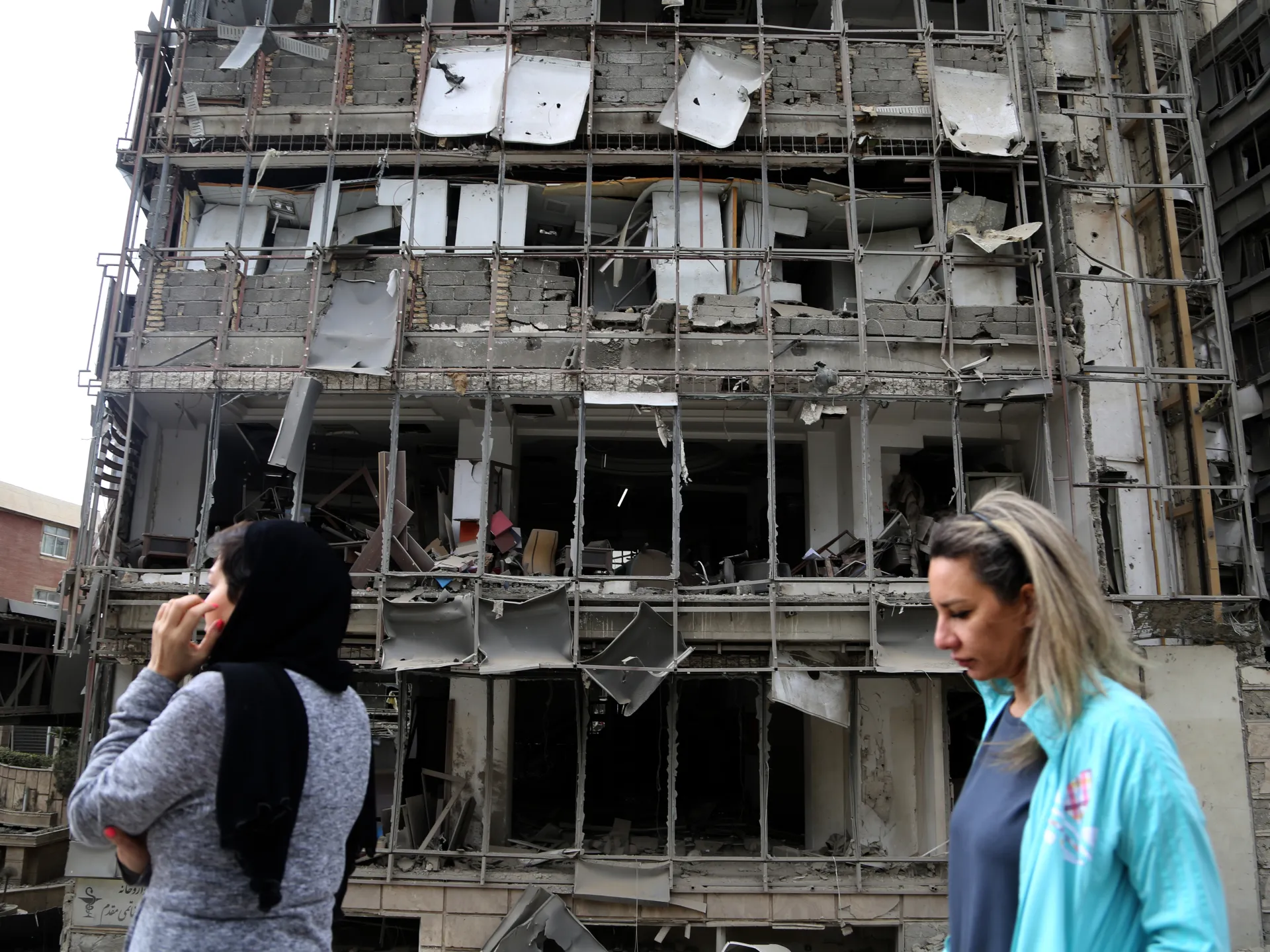
With 100 days to go until the tournament kicks off, appetite for tickets to the 2026 World Cup in the United States, Mexico and Canada is reaching fever pitch despite eye-watering prices that have fans crying foul amid global unrest after the US-Israeli attacks on Iran.
In addition to the war against Iran – a country scheduled to play its World Cup group stage games in the US – the heavy-handed immigration crackdowns in the US and the violence that erupted near host city Guadalajara after the death of Mexico’s most-wanted drug cartel leader are causing concern for fans.
Recommended Stories
list of 4 itemsend of list
“I’m afraid I might not be allowed into the country. I’ve decided to fly to Canada at most but not to the USA,” German football fan Tom Roeder told the Reuters news agency
“I hope that at least the issue of war with Iran does not reach North America, at least not in a way that affects us personally.”
FIFA, which did not immediately respond to a request from Reuters for comment, has said nearly 2 million tickets were sold in the first two sales phases and demand was so intense that World Cup tickets were oversubscribed more than 30 times.
The most expensive tickets for the opening game are going for almost $900 and more than $8,000 for the final while tickets in general cost at least $200 for matches involving leading nations. The cheapest tickets for the final cost $2,000 and the best seats $8,680 – that is before taking into account FIFA’s official resale site, where one category three seat for the game in New Jersey on July 19 was being advertised for an eye-watering $143,750, more than 41 times its original face value of $3,450.
Political and social tensions surrounding host nations are nothing new for the World Cup.
Mexican President Claudia Sheinbaum said there was “no risk” for fans coming to the country, and Adrian Nunez Corte, leader of Unipes, a fan association in Spain, said the situation has not affected willingness to buy tickets.
“Obviously, it is causing concern, but some Spanish fans living in the area have helped to calm things down after the initial hours of alarm,” Corte said.
“There is no alarm regarding US immigration policy, but people are taking preparation of the necessary visas seriously to avoid problems, especially since some fans will be travelling between the US and Mexico due to the match schedule.”
The buzz around the tournament in North America is unprecedented.
“The demand for the 2026 World Cup in the USA, Canada and Mexico is the strongest I’ve ever experienced,” said Michael Edgley, director at Australia’s Green and Gold Army Travel.
“I think FIFA will make record amounts of money. There’s no question.
“This World Cup will be a massive financial success, and the beneficiaries will be the member federations.”
But such popularity comes with a price.
Geography adds another layer of complexity as the tournament spans 16 host cities across three countries, making it more challenging and expensive for fans wanting to follow their teams.
“The price of tickets has been a major drawback, particularly affecting the number of matches each fan will attend, as well as the distances between venues and the costs involved,” Corte said.
Secondary ticket market soars
The sticker shock is even more pronounced this year, especially with a huge resale market in which tickets are sold at above face value, which is legal in the US and Canada.
FIFA defended the ticketing model.
“Unlike the entities behind profit-driven third-party ticket marketplaces, FIFA is a not-for-profit organisation,” a spokesperson said.
“Revenue generated from the FIFA World Cup 2026 ticket sales model is reinvested into the global development of football. … FIFA expects to reinvest more than 90 percent of its budgeted investment for the 2023-2026 cycle back into the game.”
Mehdi Salem, vice president of the French football fans association Les Baroudeurs du Sport, said its members are seeing more than a 200 percent increase on what they were told would be the prices in 2018 by the French federation and FIFA.
The pricing pain is so acute that Salem’s association, which boasts about 400 members, will have only 100 attend the tournament – a dramatic drop that he attributed to ticket prices and the political landscape in the US.
“We feel like this World Cup will not really be a people’s World Cup but rather an elitist World Cup,” Salem added.
JADE Thirlwall has dropped a major clue that a Little Mix reunion if off the table after Jesy Nelson’s recent interview.
The Sweet Melody hitmaker, 33, said there were lots of sweet symbolisms behind the number three when it came to her career.
Sign up for the Showbiz newsletter
Thank you!
Jade Thirlwall dropped a huge hint that full Little Mix reunion is OFF the tableCredit: Capitalbuzz/InstagramJade said there were lots of sweet symbolisms behind the number threeCredit: GettyJesy Nelson made some bombshell claims about the ‘real reason’ behind her Little Mix exitCredit: Instagram
Referring to Leigh-Anne’s album going top three in the charts, Jade said: “And I feel like it’s some weird cosmic energy that we’re all number three and that we’re a three, three, three.
“I feel like it’s quite special, very happy for her.”
Little Mix currently consists of three members – Jade, Leigh-Anne and their fellow bandmate Perrie Edwards.
The group was previously a four-piece before Jesy quit in December 2020.
Jesy, 34, revealed the truth behind her sudden departure.
The singer shocked fans when she revealed hersecret suicide attempt days before quitting the group – suggesting her cry for help was ignored by her bandmates.
The revelation came after Jesy thrilled fans with news their six-year feud was over after thegirls had privately reached out.
While Jesy gave fresh hope about the possibility of reconciling with her bandmates on stage, the girls’ reactions following her comments suggested an entirely different story.
A source told The Sun: “Jesy’s confession has obviously opened up a can of worms for the girls.
“The documentary itself and the backlash that has followed, has brought up a lot of bad feeling from the past.
Jesy (second left) revealed the truth behind her sudden departure in a recent documentaryCredit: Getty
“It’s been upsetting for the girls, but they are focused on their solo careers and the future now.”
While on her tour of That’s Showbiz Baby! in the US, Jade broke down in tears on stage as she sung Natural at Disaster.
The track is said to have been written about her struggling friendship with Jesy, with lyrics including: “It’s hard to love you when you hate yourself. Can’t be there for you without negatively impacting my mental health.”
And seemingly in another swipe at Jesy after Jesy Nelson: Life After Little Mix was released, Jade chose to play Natural At Disaster over her latest Instagram post.
Sharing video footage from behind the scenes at her show in Chicago, JADE wrote: “And all that jazz.”
One fan commented: “The song choice… I hope you’re not shading Jesy. I love you all.”
Jesy’s revelations sent Little Mix’s fanbase into a spin – with some rival supporters clashing online.
Recalling the painful breakdown of Little Mix’s friendship days before her overdose, Jesy said: “I sat everyone down to explain how I was feeling and I remember one of the responses being, ‘Are you done now? Is that it?’
“She [one of the girls] was like, ‘Can I go now?’”
Fighting back tears, Jesy added: “That made me feel really alone. I felt like there was no point. That no one cared.”
Her comments apparently sparked social media rows, with some fans “picking a side”.
However, others insisted: “Jesy sharing her side of the story of what happened shouldn’t be viewed as her trying to villainise them. Me nor you truly don’t know what happened between those girls so trying to sit there and call someone a liar as if you know better than her is very weird.”
Another said: “Both sides have faults and both sides have valid feelings. It’s really not that hard to understand.”
Someone else added: “I’m proud Jade, Leigh-Anne and Perrie reached out to her when Jesy was pregnant because they are good people all three of them. I just hope they can all move forward now and heal.”
Jesy revealed her secret suicide attempt days before quitting the groupCredit: Getty
How to get help
EVERY 90 minutes in the UK a life is lost to suicide
It doesn’t discriminate, touching the lives of people in every corner of society – from the homeless and unemployed to builders and doctors, reality stars and footballers.
It’s the biggest killer of people under the age of 35, more deadly than cancer and car crashes.
And men are three times more likely to take their own life than women.
Yet it’s rarely spoken of, a taboo that threatens to continue its deadly rampage unless we all stop and take notice, now.
If you, or anyone you know, needs help dealing with mental health problems, the following organisations provide support:
While the US pursues fossil fuel dominance, China is looking to lead the way on renewables. Which model of energy security will the rest of the world follow?
Aside from regime change, a central goal of President Donald Trump’s military actions in Venezuela and against Iran has been to reinforce the US as a dominant petroleum producer while curtailing federal support for alternative energy. The war in the Middle East has already injected new uncertainty into global energy markets — with strikes on Iranian infrastructure driving oil prices higher and disrupting flows through the Strait of Hormuz — and may prompt some countries to rethink their dependence on fossil fuels even as short-term demand spikes.
In sharp contrast, China is intent on advancing its lead in renewable technology, even as it meets massive domestic demand for coal and oil. These divergent national approaches set up a fundamental global contest: Will fossil fuel dominance or renewable leadership define the future of energy security?
As these two superpowers intensify their competition for economic and geopolitical dominance, the world’s climate future and investment flows will largely hinge on which energy model—oil or renewables—proves most viable. The global energy landscape risks a clear split: one path leading to enduring fossil-fuel dependence, the other to a renewable-powered world.
As a November report by the Washington, DC-based think tank the Center for Strategic and International Studies put it, “Nearly 10 years after the signing of the Paris Agreement, a new energy investment paradigm is taking shape” that is likely to influence, if not determine, government and industry policy decisions on energy security, affordability, and competitiveness.
Ray Cai, associate fellow and CSIS author
At this point, the CSIS report notes, the paradigm shows fragmentation, volatility, and scarcity, even as state intervention rises. Its author, associate fellow Ray Cai, writes: “A widening bifurcation between hydrocarbon and low-emission value chains—in part accelerated by strategic competition between the US and China—is already reshaping global energy investment flows.”
This bifurcation, as Cai describes, is a world of “two tracks.” One track features economies with secure, affordable access to fossil fuels. Most countries are net importers, while exporters are few. As a result, the US has become a significant oil and LNG producer and exporter. According to Cai, this shift also reinforces the country’s retreat from its postwar role as “facilitator and guarantor of global trade.”
On the other track, he continues, economies are turning to electrification and renewables. Nearly 90% of energy generation capital expenditure in the Global South in 2024 was allocated to low-emission sources, about double the share from 10 years ago. “Driving this shift is China,” says Cai, noting that the nation has led global supply chain and manufacturing investment both at home and abroad.
Much of the globe, including China, is adopting what Martin Pasqualetti, an Arizona State University professor and author of several books on energy geography, calls “an all-of-the-above” approach to energy policy, pursuing all power sources, including oil, natural gas, nuclear, hydroelectric, solar, geothermal, and wind.
Meanwhile, the US under the Trump administration has ended subsidies for electric vehicles and other alternative-fuel applications as it seeks to boost fossil fuel production and exports. Yet this emphasis risks squandering its many competitive advantages across other energy sources, including alternatives, according to a September report by JPMorgan Chase.
“North America has a significant strategic advantage in energy because of the sheer number of energy resources it has a competitive advantage in—fossil fuels, solar, geothermal, and wind,” the authors noted, adding that if the US fully takes advantage of all those energy resources, it will be unrivaled in what they call “the New Energy Security Age.” But they point out, “recent policy shifts from Washington are creating uncertainty for America’s offshore wind ambitions—which can be a key strategic advantage for the US alongside fossil fuels, geothermal, and nuclear.”
Cai agrees that recent US policy shifts are creating uncertainty for investors in alternatives, telling Global Finance in an interview that “policy pullbacks and regulatory obstruction can raise financing costs, slow project timelines, and erode competitiveness for US firms.”
Navigating The Valley Of Death
Pasqualetti says moving from fossil fuels to renewables means passing through a “valley of death,” a period when returns must prove profitable before funding runs out. Sometimes these investments rely on government subsidies until they can become profitable at scale. He notes that the “valley” has narrowed sharply as the prices of renewables have dropped. “We’re not going to make conversion quickly,” he says, “but we’ve been making it faster than expected.”
On the other hand, oil is proving less profitable for producers at its recent price of around $60 a barrel. Experts estimate that the “heavy” oil that characterizes Venezuela’s hefty reserves may cost at least $80 a barrel to extract and process for sale. So Pasqualetti finds the Trump administration’s plans to take over its petroleum industry puzzling. “If you increase our domestic supply, increase production, capture Venezuelan ghost ships and sell the oil on the market,” he asks, “won’t that just drive the price down?”
Cai noted in the interview that while the Trump administration has signaled its clear intent to advance the US fossil fuel and mining industries, “industry stakeholders remain constrained by market fundamentals and capital discipline.” He continued, “Producers and investors alike have shown limited appetite for aggressive expansion due to soft demand expectations and oversupply conditions in global markets.”
Cai doubts the Trump administration will see its stated policy goal materialize quickly, if at all. “Heightened geopolitical risk resulting from further military action may increase volatility and suppress near-term investment,” he said in the interview.
In contrast, China is forging ahead on all fronts, as the JPMorgan report notes: “For the foreseeable future, Beijing will continue to deploy an energy strategy that seeks to dominate … global renewable energy innovation, exports, and markets while still relying on sources like coal at home to power China’s industrial and technological rise.”
If China is hedging its bets, much of the rest of the world is as well. JPMorgan notes that India and Brazil, along with China and others, are forming new energy alliances and setting their own standards based on competitive advantages in natural resources, shifts toward energy self-sufficiency away from fossil fuels, and technological exports. “Strategic energy independence actions are strengthening to reduce geopolitical exposure to former trade partners,” the authors note.
India, the world’s most populous nation, is especially active in pursuing alternatives to fossil fuels. Renewables account for 89% of India’s newly installed power capacity, with the majority being solar.
Despite holding the third-largest oil reserves after Venezuela and Saudi Arabia, Iran aims to get two-thirds of its power from natural gas over the next five to seven years. Pasqualetti says, “They want to move to renewables as fast as they can.” Of course, Tehran’s plans are in question now that it is under attack by the US and Israel. And the regime faced Western sanctions and popular unrest even before war broke out in the region.
Imports Versus Exports
To better understand global energy trends, Richard Bronze, co-founder of Energy Aspects, an energy consultancy based in London, says it’s helpful to distinguish between countries’ domestic and international policies. Bronze describes China’s “pragmatic” energy strategy, for example, as embracing both fossil fuels and alternatives for domestic purposes and exporting large quantities of green technology while resisting international climate agreements. He says this reflects China’s reliance on fossil fuels to power domestic consumption and on green technology to power exports.
Richard Bronze, co-founder of Energy Aspects
Similarly, he says Saudi Arabia is successfully diversifying its economy. Reliance on oil for government revenues has fallen from almost 90% in 2014 to 60% in 2024. While the country aims to be less of a “petro state,” shifting power generation from oil to natural gas and solar, it still sees itself as “the last man standing” in oil exports before the global shift to renewables.
Bronze sees the world as three groups, not just two tracks: One group is pursuing alternatives, including Europe and India. A second “all-of-the-above” group includes China and Saudi Arabia. The third focuses on fossil fuels and nuclear power, as in the US and Russia. While the third group may oppose transitioning to renewable energy, Bronze says this strategy has short-term geostrategic logic for the Trump administration.
In effect, Trump’s policy aims to counter Chinese influence everywhere. This includes discouraging imports of Chinese technology and products, affecting alternative energy and high-tech exports such as rare-earth minerals. This may explain the recent, though apparently abandoned, interest in acquiring Greenland, which has significant reserves.
And of course, the Trump administration is “championing a domestic oil industry,” as Bronze puts it. In sum, by using petroleum to counter China’s exports of alternatives, US policy reflects what he calls “a somewhat coherent political thesis.”
Still, he notes that the transition to renewables is inevitable if you accept the premise that a sustainable environment requires moving away from fossil fuels. “All the science says it’s necessary if we’re going to keep a livable world,” he asserts.
Cai sees energy geopolitics differently. Rather than countering China’s advantage in alternatives, he contends that the central motivation of recent US moves is to reinforce US comparative strengths, particularly in fossil energy, in service of what he terms the administration’s “hemispheric security ambitions,” as outlined in its recent National Security Strategy.
Regardless, Bronze notes that a change in US administrations may be accompanied by a shift in energy policy. “We saw a handbrake turn” away from the Biden administration’s policy by his successor, Bronze observes, suggesting a similar turn is possible, if not likely, in the future.
Alice C. Hill, senior fellow for energy and the environment at the Council on Foreign Relations,
Other observers are skeptical that a U-turn by the US is likely anytime soon. As Alice C. Hill, a senior fellow for energy and the environment at the Council on Foreign Relations, told a roundtable discussion last March, “The US is not going to be a player in the international arena on climate. We’ve got this pendulum that swings back and forth, and so it’s very hard to maintain that sort of true north right down the middle.” In an interview with Global Finance, Hill added that given the Trump administration’s policies, “it will be harder for a new administration to turn back, because there will be that much more to unravel.”
The Reign Of Uncertainty
As a result, the only certainty at this point may be uncertainty. The Trump administration’s actions in Iran and Venezuela could produce what Bronze calls “a spectrum of outcomes,” ranging from chaos to the reintegration of oil exports into the market. And while the latter outcome might indeed bring oil prices down further, he says it would also serve the administration’s goal of lowering inflation. At present, however, with oil prices soaring, that goal is in doubt.
If Trump seems isolated in insisting that global warming is a hoax, that view is increasingly shared, to some degree, among right-wing political parties in Europe, Bronze points out. There’s been a real politicization of the energy transition,” he says.
Cai of CSIS agrees, noting that recent electoral results have contributed to policy diversity. As he sees it, the European Union “is moderating from an aggressive decarbonization drive to rebalance for energy security and industrial competitiveness.” In contrast, he adds, “the US has retreated from climate leadership in favor of fossil fuel abundance and trade protectionism. China, on the other hand, has deepened its commitment to renewables manufacturing and exports while maintaining coal capacity.”
Still, most countries accept that renewable energy must eventually replace fossil fuels. Notwithstanding rising opposition in some European circles, the European Union and China recently pledged an expanded partnership, JPMorgan notes, “even as Brussels drives forward on a campaign to diversify its supply chains away from China.” One of the agreements between Beijing and the EU is to accelerate the deployment of global renewable energy. Pasqualetti contends that US efforts to slow a similar renewable future are misguided. “We’re not going to get out of the oil age because we ran out of oil,” he says.
Cai puts it more even-handedly. “Ultimately, the policy challenge ahead is pragmatic rather than ideological,” he says, noting that it will likely shape global investment flows. “Investors are gravitating toward jurisdictions that can combine strategic clarity with consistent execution.” By that standard, he argues, neither the US nor China fully qualifies. “Most countries will not replicate either model wholesale,” he tells Global Finance.
“The fracturing of the post-World War II global system is reinforcing divergence in energy pathways shaped by political economy and practical constraints.”
As a result, Cai adds, energy investors—and policymakers elsewhere—now face risks under both regimes. “Heightened policy uncertainty in the US has contributed to capital outflows that have, in some cases, even raised concerns about the dollar’s reserve-currency status,” he says.
China, by contrast, presents what he calls “a different trade-off.” Investors increasingly recognize its structural advantages in renewable manufacturing and supply chains, yet remain wary of geopolitical risk and the broader trajectory of decoupling. He points to Canada’s recent electric-vehicle trade deal with Beijing as an example of how widening rifts between the US and its traditional allies may create new opportunities for China.
How durable or profitable those openings prove remains to be seen. But on current trends, the Council on Foreign Relations’ Hill warns, “the US will isolate itself over the long haul.”
California Republicans facing tough reelection fights in this year’s midterm elections have lined up in support of President Trump’s war on Iran, which polling suggests is not popular.
They include Republicans whose chances of reelection were already diminished by the passage by voters in November of Proposition 50, which gave Democrats in Sacramento the authority to redraw the state’s congressional districts in favor of Democratic candidates.
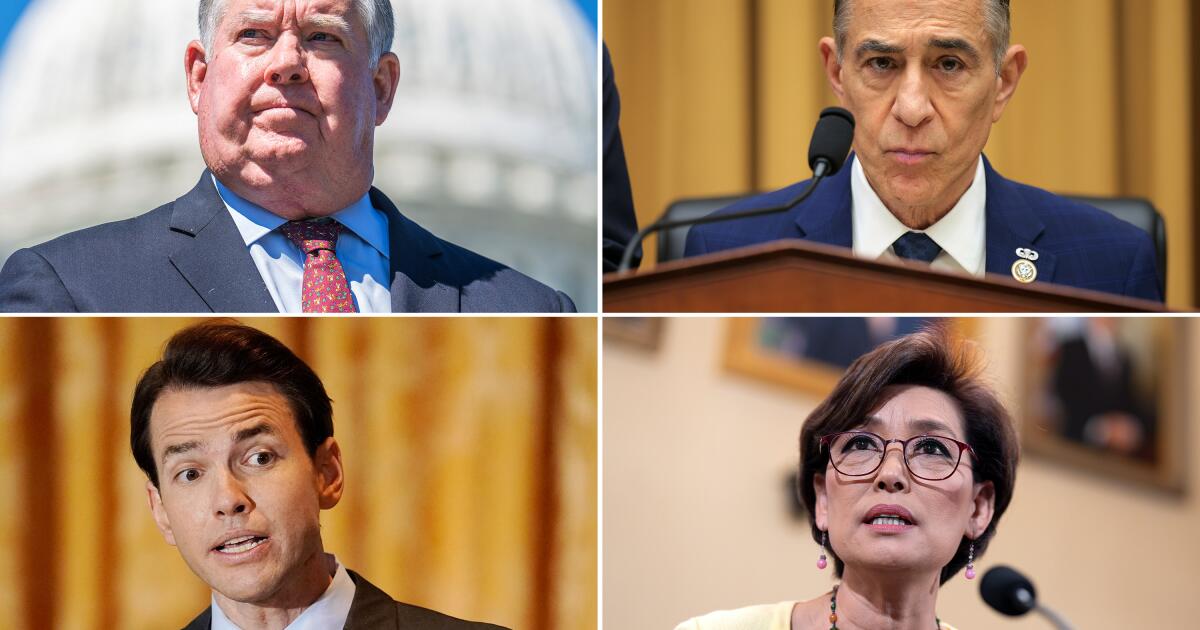
Rep. Darrell Issa (R-Bonsall), who sits on the House Foreign Affairs Committee and has long criticized Iran, has defended the latest attacks as overdue and legal under existing authority the White House has for combating terrorism — which he said Iran is deeply involved in.
Asked Sunday by ABC News about Trump’s promises not to start new foreign wars during the 2024 campaign, and the attacks on Iran conflicting with that, Issa said the belief that Trump owes immediate answers about his intentions was “folly,” that the attacks on Iran’s nuclear facilities last summer had made people around the world “happy,” and that the latest attacks were a continuation of that effort.
He said Iran has funded terrorism for decades, expanding extremism around the region, and asking whether the Trump administration had a specific reason to attack now was the wrong question.
“The real question is, after nearly half a century, do we need a specific trigger, or do we at any time say enough is enough, we’re going to take the claws and the teeth out of this tiger, and then see if in fact it’s willing to drink milk rather than blood,” Issa said.
Issa’s district is one of five that Democrats reshaped to better favor a Democrat under Proposition 50. The measure was championed by Gov. Gavin Newsom and others as a response to similar mid-decade redistricting efforts that Republicans undertook, at Trump’s urging, to win favor in states such as Texas.
Whether the Republican candidates’ backing of Trump in Iran will make them even more vulnerable is unclear. Some in California — including among the Iranian diaspora in Los Angeles — have been pleased with Trump’s actions and the death of Supreme Leader Ayatollah Ali Khamenei, a conservative cleric who ruled the country with brutal force for decades.
However, several recent polls suggest the war is not popular.
According to a Reuters/Ipsos poll that closed Sunday, only 1 in 4 Americans approved of the U.S. strikes on Iran, while about half — including 1 in 4 Republicans — said they believed Trump is too willing to use military force. Overall, 43% of respondents said they disapproved of the strikes, 27% said they approved, and 29% said they were not sure.
Rep. Ken Calvert (R-Corona) — who has long been hawkish on Iran, and accused the Biden administration of maintaining a weak policy on the Middle East nation — is another Republican in a redrawn district who has come out strongly in favor of the war effort.
“President Trump’s decision to launch Operation Epic Fury will protect America and our allies by eliminating the Iranian regime’s ability to wage terror and threaten its enemies. It will also provide the Iranian people with a historic opportunity to shape their own future free from oppression,” said Calvert, chair of the Defense Appropriations Committee, wrote on X Saturday.
Another member of the House Foreign Affairs Committee facing reelection in a redrawn district, Rep. Young Kim (R-Anaheim Hills), shared on Saturday a committee post on X that quoted Trump’s announcement that Khamenei was dead and committee chair Rep. Brian Mast (R-Fla.) stating that although President Biden had given Iran funding, “President Trump gave him death.”
On Monday, she reposted video of a demonstration in favor of the attacks by Iranian Americans and others in Los Angeles, writing, “So grateful for our President’s decisive action & for our vibrant Iranian American community. From Southern California to Tehran, let freedom ring!”
Also facing redrawn districts and backing the war were Rep. David Valadao (R-Hanford) and Rep. Kevin Kiley (R-Rocklin).
Valadao wrote Saturday on X that Iran had for years “ruled through fear at home and terror abroad,” and that as “the world’s leading state sponsor of terrorism, it continues to arm violent proxies, threaten our allies, and destabilize the region.”
“I commend President Trump for taking decisive action and pray for our brave men and women throughout the region working to keep us all safe,” Valadao wrote.
Kiley, in an X post Sunday, wrote, “It is the longstanding policy of the United States that one of the most evil regimes in history cannot get its hands on the most powerful weapon in history. The decapitation of the Iranian regime and the destruction of its instruments of terror and death hold the potential for a safer America and a more peaceful world.”
Kiley wrote that he looked forward “to being briefed soon on the scale of operations, the strategy going forward, and any risks to American lives and interests that need to be met with urgency,” and that Congress “must be centrally involved in defining and pursuing U.S. objectives going forward.”
Leading Democrats in California condemned the attacks — saying that although the Iranian government under Khamenei was corrupt and guilty of terrorism and violence, there was no evidence that it presented an “imminent threat” to the U.S. and no congressional authorization for Trump to commit the nation to war there unilaterally.
Many of the Democrats running in the state’s redrawn congressional districts staked out a similar position.
“I’m deeply disturbed that President Trump is moving us toward another regime-change war without congressional authorization, public support, or a clearly defined mission,” said San Diego Councilwoman Marni von Wilpert, a Democrat challenging Issa. “The Iranian regime is brutal and must never obtain a nuclear weapon — but the Constitution is clear: only Congress can declare war, and it must reconvene and exercise that authority now.”
Esther Kim Varet, an art dealer and one of several Democrats challenging both Calvert and Kim in the state’s new 40th District, in Orange County and the Inland Empire, wrote on X that “America and the world are safer without Khamenei” but that “Congress alone has the power to commit the U.S. military to wage war, or to amass its forces in foreign territory, unless in response to a clear and present danger.”
Jeffrey Feltman, former US Assistant Secretary of State for Near Eastern Affairs, questions the legal basis and endgame of the US-Israel war on Iran, saying he does not believe Iran posed an imminent threat to the United States that would justify war.
The Thames Tunnel was built by Marc Brunel alongside his son Isambard Kingdom Brunel and hundreds of workers.
It was originally a pedestrian tunnel with lots of shops and entertainment, and then it was later converted into a train tunnel, which the Windrush Line now uses.
As part of your visit, you can head 40 feet underground into the Tunnel Shaft.
Tickets need to be booked in advance via the Museum’s website, using the code ‘LOTTERY26’.
English Heritage Bolsover Castle, Bolsover
Bolsover Castle was once an aristocratic retreat during the 17th century.
Inside, there are wall paintings and lavish interiors, and outside you can explore the Fountain Garden, which is designed around a statue of Venus and features lots of flowers.
If you have kids, there is a play area as well and a tearoom.
It’s not required to book in advance, but use the code ‘NLOPENWEEK26’ to gain free entry.
It is part of the National Lottery’s Open WeekCredit: Getty
Free Family Swims at The Lenton Centre, Nottingham
Between 2:30pm and 3:30pm on Mother’s Day, families can go swimming at The Lenton Centre in Nottingham.
It’s a family swim session so you can master your swimming skills or splash and play.
As spaces are limited, booking in advance is recommended and you just need to bring your swimming gear and a towel.
You’ll learn about the ancient craft, whilst also getting hands-on experience.
The workshop is ideal for beginners or even those with some willow weaving experience that want to learn new techniques.
And what’s better is that you get to take home your creation.
All materials and tools are included, and there are two sessions on Mother’s Day – one starting at 10am and another starting at 2pm.
The workshop will take place at Mingle Cafe Bridgewater and is for over 18s.
To get into the attractions, you will need to show proof of purchasing a National Lottery ticket or instant gameCredit: Getty
Abbotsford, The home of Sir Walter Scott, Melrose
Each day between March 7 and 15 from 12pm, you can head on a free tour of Abbotsford House, which was once home to Sir Walter Scott.
While you do have to pay for admission to Abbotsford, which is £16.20 per adult and gives you access to the house and gardens, the guided tour will be free when you present a National Lottery ticket.
English Heritage Housesteads Roman Fort & Hadrian’s Wall, Northumberland
Housesteads is the most complete example of a Roman fort in Britain and can be found midway along Hadrian’s Wall.
The fort was built around AD 122, which is when work on Hadrian’s Wall began.
Over the decades, excavations have revealed major buildings, defences and even a settlement just outside the walls of the fort.
And you will even be able to see the oldest toilets in Britain!
You don’t need to book in advance but you can do online if you want to by using the code ‘NLOPENWEEK26’.
For example, you can head to the most complete example of a Roman fort in BritainCredit: Alamy
Historic Royal Palaces Hampton Court Palace, London
If you don’t mind celebrating Mother’s Day a day early, then you can head to Hampton Court Palace in London.
Whilst not free, you can get 50 per cent off tickets for up to two adults and four children.
You can explore Tudor kitchens, see amazing architecture and wander through 60 acres of gardens.
Booking online in advance is essential, and you will need to enter the code ‘LOTTERY50’ to benefit from the promotion.
Or head to the royal Hampton Court PalaceCredit: Getty
Filmhouse, Edinburgh
Fancy doing something a little out of the ordinary? Well, you can go on a tour of the projection box at the Filmhouse in Edinburgh.
This unique opportunity allows visitors to see how real film projection works and explore the hidden areas of a film house.
Places are limited to 10 per tour and you’ll need to book your space via the Filmhouse website.
Eden Project, Cornwall
From March 7 to 15, you can get free entry to the Eden Project in Cornwall.
What says Mother’s Day more than flowers? Well, exploring thousands of them alongside other tropical plants.
The Eden Project is also home to the world’s largest indoor rainforest, so you can investigate plants from further afield.
You’ll need to book a free day entry ticket on the website, and then show your National Lottery ticket on arrival.
If your mother loves gardening, head to the Eden ProjectCredit: Not known, clear with picture desk
Witley Court and Gardens, Worcestershire
Perfect if you are spending Mother’s Day with children, Witley Court and Gardens boasts exciting woodland trails, sprawling gardens and a wilderness play area.
Witley Court once used to be a Victorian party palace, and inside the audio tour will bring the mansion’s party days to life.
To get free entry, simply show up with a National Lottery ticket or proof of a game.
The provided text details the historical significance of Language Martyrs’ Day, a major public holiday in Bangladesh that honors those who fought for linguistic recognition. After the partition of India, the government of Pakistan attempted to establish Urdu as the sole official language, triggering widespread resistance in the Bengali-speaking eastern region. This tension culminated on February 21, 1952, when police killed several students during a protest at the University of Dhaka. These sacrifices eventually forced the government to grant Bengali official status, serving as a pivotal milestone toward the eventual independence of Bangladesh. Today, the date remains a somber and proud reminder …
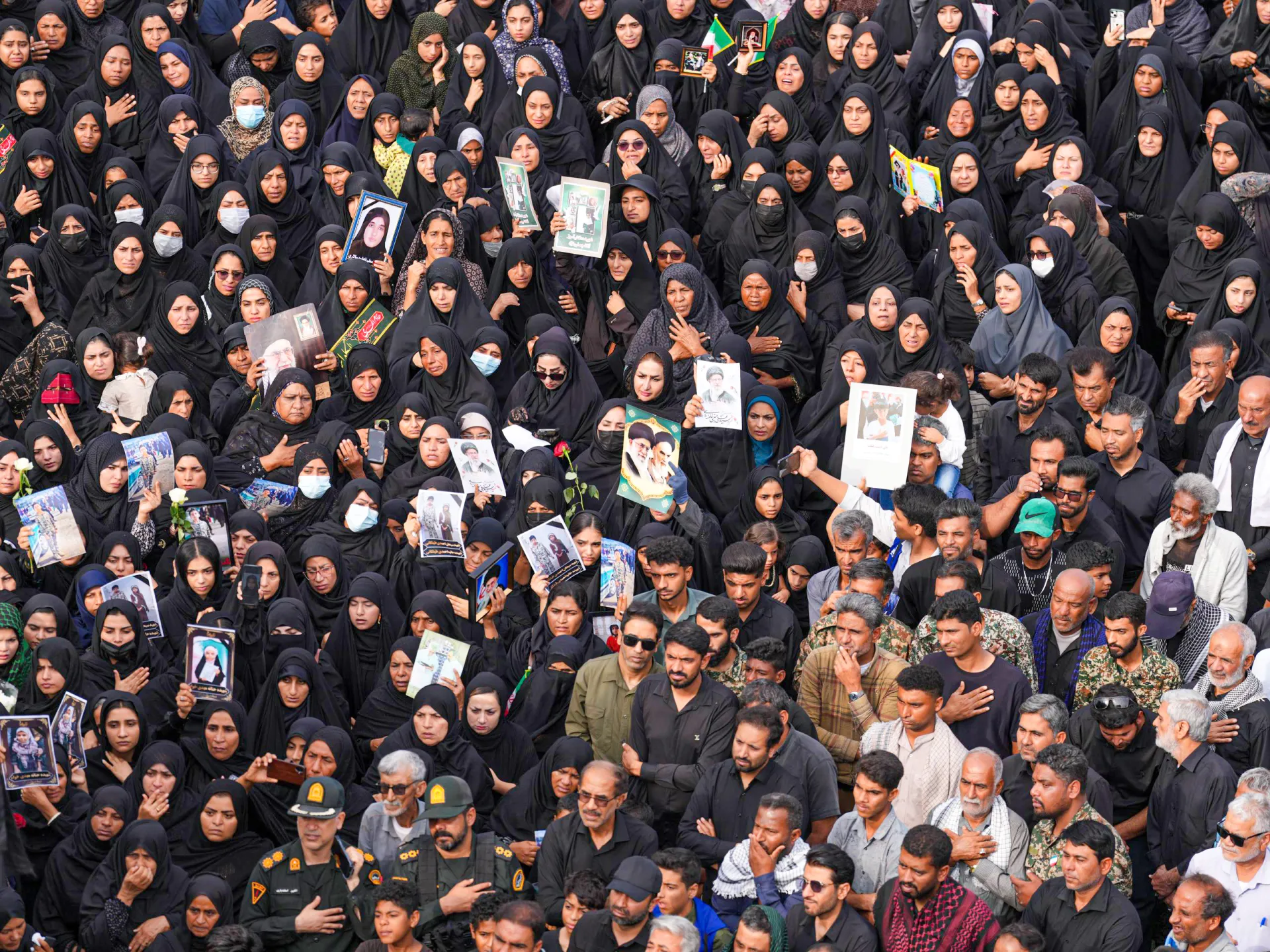
Iran has held a mass funeral for 165 schoolgirls and staff killed in what it has described as a United States-Israeli attack on a girls school in the southern city of Minab.
Saturday’s strike came on the first day of the joint US and Israeli attacks on Iran. It was the deadliest incident in the campaign against Tehran so far.
The Israeli military said it was not aware of any Israeli or US attacks in that area. Throughout its genocidal war on Gaza, however, Israel has repeatedly denied responsibility for deadly attacks on Palestinian civilians, only to later backtrack when evidence emerged, often describing such incidents as “accidental”.
The attack in Minab has been condemned by UNESCO and Nobel Peace Prize-winning education activist Malala Yousafzai.
Deliberately attacking an educational institution, hospital or any other civilian structure is a war crime under international humanitarian law.
On Monday, Iranian Ministry of Foreign Affairs spokesman Esmaeil Baghaei said the two countries “continue to indiscriminately strike residential areas, sparing neither hospitals, schools, Red Crescent facilities, nor cultural monuments”.
If you buy books linked on our site, The Times may earn a commission from Bookshop.org, whose fees support independent bookstores.
Gina Gershon considers herself a storyteller, first and foremost. When we connect via video call, Gershon admits this is the first interview she’s done since submitting the manuscript for her latest book, “AlphaPussy: How I Survived the Valley and Learned to Love My Boobs.”
“I don’t have my spiel yet!” she warns, inquiring for the first of a few times what I thought of it and whether I enjoyed it. Despite the many decades Gershon has been treading the boards, starring in indie films and Hollywood star vehicles, and stalking the stage as a singer-guitarist, she still really cares about what you think, even if it won’t change her own mind. Perhaps that’s the key to her professional longevity.
“AlphaPussy” is neither a memoir nor a guide to self-betterment, but elements of both feed into Gershon’s stories. Each wittily titled chapter plunges readers into Gershon’s freewheeling 1970s childhood, defiant adolescence, burgeoning performance career and collaborations with some of the biggest names in film (including Sharon Stone, Paul Verhoeven and Tom Cruise). Most of the stories take place in the San Fernando Valley, where young Gershon was discovering weed, mushrooms and rock ‘n’ roll. This is not a titillating tell-all, and all the better for it.
“AlphaPussy” by Gina Gershon
(Akashic Books)
“This book realistically started during COVID,” Gershon explains from her New York home. “I’d told my book agent, a friend, some stories one day when we were drunk, and he kept prodding me to write a book. I was hesitant, though. I’m not a tell-all gal, that’s not my MO.”
She adds, “It was during lockdowns, and I think his mother was sick and he was having a hard time, so when he said, ‘Just write me stories to keep me cheered up,’ I started to write stories in no particular order, whatever bubbled up, because otherwise I figured I’d forget them one day.”
At the same time, Gershon had observed that young women weren’t feeling empowered to advocate for themselves in their personal relationships and workplaces.
“I noticed that especially with younger women friends of mine, they’d tell me about things they were going through on set or with their bosses, and I don’t know if it’s a millennial thing, but I said, ‘Why don’t you just look him in the eye and tell him to stop?’ and there was this sense [for me] of ‘Why can’t you do that? Because if you don’t, you’ll always be prey to these guys.’ ”
She clarifies that she means “annoying” men rather than abusive men.
“I’m not that tough,” admits Gershon. “But I’d learned how to maneuver a lot just from growing up in the Valley, and it was a crazy time to be living there. So I thought about the stories that led me to be able to steer myself through toxicity.”
In her new book, Gina Gershon recalls the industry vitriol toward her 1995 erotic film “Showgirls.”
(Evelyn Freja / For The Times)
And also to steer herself through well-intended advice, both personal and professional, to follow her instincts.
“Listen, it’s not like I’ve had the most normal career. I’ve done most of my projects despite warnings from other people and from my agents saying, ‘You can’t do this, you’ll ruin your career.’ I’m like, ‘Why? I like this project!’ ”
One of those projects, most infamously, was “Showgirls,” which gets plenty of mentions in the book.
As Gershon recalled, it was 1994, and an astrologer had predicted her major breakout role would arrive in October that year, testing the young actor and her ability to cope with notoriety. Great, thought Gershon, bring it on.
Months later, Gershon was hanging from the ceiling, dressed in bondage gear, reflecting upon her early acting goals to perform Chekhov, portray Medea and stun audiences into silence.
She was on the set of “Showgirls” (or “Survival of the Titties,” as she nicknames it), dressed in one of the many glittering, spangled, flimsy outfits that her character Cristal Connors parades about wearing as a veteran of Vegas striptease. That role, and the vitriol from within the industry toward the movie (a flop turned cult favorite), still stings.
“I was super excited going into ‘Showgirls.’ As I talk about in one of the chapters, it was just very different when I got there. It was a completely different show than I thought I was going to be doing. … I thought it was gonna be one of [director Paul Verhoeven’s] dark Dutch films.”
Realizing that it was something else, to say the least, Gershon pivoted.
“I learned how to deal with an insane environment while keeping focused on what it is that I was trying to achieve with the part, without getting swallowed up by the insanity, which is a valuable lesson, you know? I mean, it’s a good lesson to learn no matter what you’re doing.”
Last year, Gershon watched the movie for the first time in decades.
“I hadn’t seen it in a zillion years, and when I saw it, I understood it a little bit more. It made me feel tense, but I also thought, ‘Oh, interesting.’ Some scenes that I thought shouldn’t have been there and others that absolutely have to be there. I saw it with a different lens.”
She says, “Weirdly, I feel like I’m not supposed to be talking about ‘Showgirls,’ although I think I have five chapters about ‘Showgirls’ [in the book]. I did the ones that I thought were kind of funny and fun and had some sort of growth in it for me.”
Having recently wrapped filming on “an independent film, a trans love story” in Palm Springs, penned a script and midway through writing another, Gershon doesn’t intend on writing another book anytime soon. Still, “there’s so many stories I left out,” she concedes.
“I could write three more books with things, but I really wanted to stay on point with the themes of manipulation, survival, and moving around and being able to stand on your own two feet and know who you are and to have agency over your life, especially as a woman, especially as an actress, especially in this world.”
“I’m not that tough,” says Gina Gershon. “But I’d learned how to maneuver a lot just from growing up in the Valley, and it was a crazy time to be living there. So I thought about the stories that led me to be able to steer myself through toxicity.”
The US-Israeli military campaign that began on Saturday has already killed Iran’s Supreme Leader Ali Khamenei and senior commanders, triggered retaliatory strikes across the region and raised the spectre of prolonged disruption to global energy flows.
ADVERTISEMENT
ADVERTISEMENT
While diplomats scramble and the UN calls for restraint, certain defence contractors and energy majors have emerged as early market victors.
As the conflict enters its fourth day, demand for advanced weaponry, missile-defence systems and intelligence platforms is projected to surge.
Lockheed Martin’s stock, the world’s largest defence contractor by revenue, hit a new all-time high on Monday, closing at $676.70 after rising over 4%.
Its F-35 fighters, precision munitions and radar systems are central to the air campaign under way over Iran.
The rally extended across the defence sector.
Northrop Grumman shares jumped 6%, lifted by its stealth-bomber and missile-defence technologies.
RTX, formerly Raytheon, gained nearly 5% while L3Harris Technologies and General Dynamics also recorded solid increases.
Palantir Technologies, whose data-analytics tools support intelligence operations, rose almost 6%.
European companies followed the upward trend on a more modest scale. Germany’s Renk and Italy’s Leonardo posted gains as investors eyed possible increases in NATO procurement and export orders.
Analysts note that defence budgets, already earmarked for growth in 2026, now face even fewer hurdles in Washington and European capitals.
With President Trump stating that operations could last “four to five weeks” or “far longer”, and Iran continuing missile and drone barrages, markets are positioning for weeks of high-intensity military activity.
The gains reflect classic geopolitical risk pricing.
Other market outliers
These rises stand in sharp contrast to broader equity weakness, highlighting how narrowly the benefits are concentrated. Beyond the pure-play defence names, energy companies have been the other clear outperformers, riding the oil and gas wave.
Iranian retaliation has already included strikes to energy sites in Saudi Arabia and Qatar, threats to close the Strait of Hormuz, which could choke off roughly 20% of global oil supply and send energy prices soaring.
The international benchmarks for oil, Brent crude (BZ) and West Texas Intermediate (WTI), are trading at over $82.50 and $75.50 respectively, at the time of writing.
Alongside them, integrated oil majors moved swiftly higher.
ExxonMobil shares rose more than 4% recording a new all-time high, while Chevron, Occidental Petroleum and ConocoPhillips posted comparable gains.
In Europe, Shell and TotalEnergies advanced in line with the global pricing surge.
The QatarEnergy LNG production halt announced on Monday, following Iranian drone strikes on Ras Laffan and Mesaieed facilities, sent European benchmark TTF gas prices over 50% higher, reaching €62/MWh by Tuesday.
Markets reacted swiftly as the indefinite shutdown raised immediate fears of rerouted demand and renewed energy inflation risks in Europe.
LNG equities climbed notably since Monday’s open on the news.
Cheniere Energy, the largest LNG exporter in the US, Venture Global and Australia’s Woodside Energy, all saw intraday strength at the start of the week.
However, analysts caution that actual substitution will take time due to shipping and contract constraints, keeping price action geopolitically sensitive.
The European Commission announced it is closely tracking both price and supply developments and will convene an Energy Task Force with Member States, in liaison with the International Energy Agency, for a meeting sometime this week.
WASHINGTON — A year into the Trump administration’s ratcheted-up mass deportation effort, approval rates for asylum seekers have plummeted as immigrants are too afraid to show up for court hearings.
Fewer than 3% of asylum cases decided in January were approved — a record low, according to Mobile Pathways, a San Francisco nonprofit that analyzes federal immigration data. That’s compared with an 18% approval rate in January 2025.
Nationally, 20% of immigrants seeking asylum missed their hearings in January, compared with half that rate a year earlier. Asylum seekers with pending applications are in the country legally, but under federal law, failing to appear for a hearing can result in a deportation order.
In Los Angeles County immigration courts — among the largest in the country — the trend is substantially starker: no-shows made up 56% of the asylum hearings in January, compared with 14% a year earlier.
“That’s not fluctuation,” said Bartlomiej Skorupa, chief operating officer of Mobile Pathways. “That’s collapse.”
A Justice Department spokesperson said the Trump administration is restoring integrity to immigration courts.
As of December, nearly 3.4 million cases were pending in immigration courts, with more than 2.3 million of them asylum cases, according to TRAC, a data research organization.
The rise in the number of people avoiding asylum hearings helps explain another trend in the immigration court system. Over the last year, the number of asylum cases marked “abandoned” has doubled.
Immigration attorneys say cases can be classified as abandoned for various reasons: An applicant missed a deadline, filled out a form incorrectly, or just decided to leave the U.S.
But the Executive Office for Immigration Review, the agency that administers immigration courts, can label a case abandoned if the applicant fails to show up for a hearing. Nationwide, the number of cases considered abandoned doubled over the last year to make up about 41% of those decided in January.
It takes an average of four years for immigrants to receive an asylum hearing, though a final decision can take longer with appeals, according to the Migration Policy Institute, a nonpartisan think tank.
During the Biden administration, most asylum claims were not issued decisions by an immigration judge; instead, many were administratively closed, or paused and taken off judges’ dockets. While the case is inactive, the person can remain in the U.S., work legally and pursue other avenues of relief.
But such a policy is vulnerable to being reversed by a subsequent administration, Migration Policy Institute experts wrote in a November report.
Lindsay Toczylowski, co-founder of the Immigrant Defenders Law Center in Los Angeles, said the increase in no-shows is in part because the Trump administration began reopening asylum cases that had been administratively closed for many years.
Many of those people are no longer in contact with their attorney, if they had one, and would be difficult to notify of a new hearing.
A decade ago, a significant portion of asylum seekers came from El Salvador, Guatemala or Honduras, many of whom settled in Southern California.
Since President Trump returned to the White House, Los Angeles was one of the earliest cities where federal agents began arresting immigrants at courthouses. Immigrants have become afraid to engage with any law enforcement authorities, Toczylowski said.
The government’s goal, she said, “is not due process or pursuing justice for people in immigration courts — it’s deportation orders. If people don’t show up in court, that’s a way for them to meet their metrics.”
Immigration courts are housed within the Department of Justice and judges have long complained that they lack full independence from executive branch overreach. The department disputes that, saying judges are independent adjudicators who decide cases individually.
More than 100 immigration judges have been fired since Trump took office and about the same number have resigned or retired, according to the union representing immigration judges. That’s down from 735 judges in last fiscal year.
Last summer, the Pentagon authorized up to 600 military lawyers to work for the Department of Justice after removing the requirement for temporary immigration judges to have immigration law experience.
Jeremiah Johnson, a former immigration judge who was fired last year from the San Francisco Immigration Court, said the 3% asylum grant rate in January is shockingly low.
Johnson, who was vice president of the National Assn. of Immigration Judges, said decisions by the Board of Immigration Appeals throughout the last several months have limited asylum law. Immigration judges must abide by the precedent set in those cases.
One such case, for example, reverses prior interpretations to now limit gender-based asylum, finding that persecution claims based solely on gender, or gender combined with nationality, don’t generally don’t meet the definition of a “particular social group” — one of the five categories under U.S. asylum law.
Another factor contributing to lowered asylum approvals, he said, is that the federal government has started seeking to dismiss asylum cases by forcing migrants to start over in a “safe third country.”
These requests stem from the increasing number of so-called asylum cooperative agreements, which allow federal officials to send certain migrants to other countries — including less stable places such as Honduras, Uganda and Ecuador — instead of continuing to seek asylum in the U.S.
“It has really been a restriction in the availability for asylum and other related protection,” he said.
Kathleen Bush-Joseph, one of the authors of the Migration Policy Institute report, pointed to a post last month on X by White House Deputy Chief of Staff Stephen Miller, who said that asylum “is limited to individuals fleeing extremely narrow categories of state persecution.”
“None of the groups illegally crossing the border fit that criteria,” Miller wrote. “No one in Mexico or Ecuador or Honduras etc live in nations where there is any state persecution of any protected class.”
But Bush-Joseph cautioned that it’s not yet clear whether the Trump administration’s asylum changes are legal.
“Even though there are executive actions in place that are restricting access to asylum, those are being challenged in court and I don’t think that we know how all of this will turn out,” she said. “A lot of people are being deported in the meantime and they may not get the chance to come back.”
This photo taken on Tuesday shows the trading room of Hana Bank in central Seoul, with the benchmark Korea Composite Stock Price Index down 7 percent to close below the 5,800-point mark. Photo by Yonhap
South Korean stocks plunged more than 7 percent Tuesday to close below the 5,800-point mark as investor sentiment was dampened by escalating geopolitical concerns triggered by the ongoing Middle East conflict. The Korean won lost sharply against the U.S. dollar.
The benchmark Korea Composite Stock Price Index (KOSPI) tumbled 452.22 points, or 7.24 percent, to close at 5,791.91, marking the lowest closing price since Feb. 20, when the index finished at 5,808.53.
It marked the largest-ever daily drop.
The country’s main bourse operator, the Korea Exchange (KRX), issued a sell-side sidecar for 5 minutes around noon, suspending the selling of KOSPI futures.
Trade volume was heavy at 1.2 billion shares worth 52.5 trillion won (US$35.8 billion). Losers sharply outnumbered winners 840 to 73.
Foreign and institutional investors led the daily sell-off, dumping a net 5.1 trillion won and 891.1 billion won, respectively. Retail investors, on the other hand, went bargain hunting and snapped up a net 5.8 trillion won.
Coordinated U.S. and Israeli air strikes on Iran over the weekend roiled global markets from the start of this week, but the Korean market closed on Monday in observation of the March 1 Independence Movement Day holiday.
“The main index experienced expanded volatility as the Middle East risk was realized after a long weekend,” Roh Dong-gil, an analyst at Shinhan Securities, said. “The stock market is expected to be affected by oil prices and interest rates as the situation develops.”
Most shares closed bearish.
Market bellwether Samsung Electronics tumbled 9.88 percent to 195,100 won, and its chipmaking rival SK hynix plummeted 11.5 percent to 939,000 won.
Top automaker Hyundai Motor dived 11.72 percent to 595,000 won, and leading battery maker LG Energy Solution sank 7.96 percent to 393,000 won.
Travel shares were among the biggest losers as flag air carrier Korean Air nosedived 10.32 percent to 25,200 won and major travel agency Hana Tour Service lost 6.65 percent to 44,900 won.
KB Financial Group, a leading banking group, fell 3.46 percent to 153,500 won, and Celltrion, a major pharmaceutical firm, dropped 5.66 percent to 225,000 won.
However, oil refinery and defense shares were bullish.
Leading refinery firm SK Innovation rose 2.51 percent to 130,900 won, and S-Oil, whose largest shareholder is Saudi Aramco, shot up 28.45 percent to 141,300 won.
Defense giant Hanwha Aerospace soared 19.83 percent to 1.43 million won, and LIG Nex1 surged 29.86 percent to 661,000 won.
The Korean won was quoted at 1,466.1 won against the U.S. dollar at 3:30 p.m., down 26.4 won from the previous session’s close. It marked the lowest since Feb. 6, when the won-dollar rate was 1,469.5 won.
Bond prices, which move inversely to yields, closed sharply lower. The yield on three-year Treasurys increased 13.9 basis points to 3.180 percent, and the return on the benchmark five-year government bonds declined 14.6 basis points to 3.424 percent.
Copyright (c) Yonhap News Agency prohibits its content from being redistributed or reprinted without consent, and forbids the content from being learned and used by artificial intelligence systems.
Here’s another quintessential L.A. walk through the Hollywood Hills’ High Tower neighborhood, the Hollywood Bowl and Whitley Terrace inspired by “Walking Los Angeles” Walk 15.
The roughly three-mile route winds through historic neighborhoods with excellent views, incredible century-old homes and (literally) breathtaking climbs along with an intriguing collection of gates and doors. The walk also gives you a chance to admire the Hollywood Bowl without jillions of people milling around (and, if necessary, visit its lovely restrooms without waiting forever in line), but be sure to check the Bowl’s schedule ahead of time. The route won’t be possible when it’s having a concert.
Traffic and parking are always a challenge in this part of L.A. and nearly impossible in the High Tower area. I recommend finding a place to park across Highland Avenue on Milner Road because it’s less traveled (and very lovely). One final note: This route has few sidewalks, and those that exist are uneven, so keep an eye open for traffic and trip hazards, which is tougher than it sounds, because there are plenty of lovely sights to distract.
Here’s how to get there:
1. Start your walk at the corner of Camrose Drive and Highland Avenue, next to the Highland-Camrose Bungalow Village (which we’ll visit later.) Walk straight up Camrosepast Woodland Way to Rockledge Road, where you’ll turn right and continue your climb.
This Hollywood Heights neighborhood has a real Mediterranean feel, with brilliant white villas clinging to the hills. The narrow winding street offers charming views of balconies and towers and the soothing tinkle of running water, so it’s easy to forget the cacophonous traffic and looming billboards nearby. The views get better as you climb until you reach the top of the hill and the end of Rockledge — at least for vehicles.
2. Continue walking to the end of the cul-de-sac, where you’ll find Los Altos Place, a pedestrian-only street. At the start of the walkway is a beautiful mosaic bench, where you can stop to catch your breath and then descend the first set of stairs, just 12 steps down.
3. This narrow walk takes you past many impressive doors and gates until you reach High Tower Drive. You’ll cross this road to stay on Los Altos Place, but as you cross, take a moment to wonder at the tiny garages built into the bottom of the hill and the High Tower elevator built like a freestanding Italian bell tower (a.k.a. campanile) rising 100 feet above. The elevator tower was designed by architect Carl Kay in the 1920s to provide the neighborhood’s tony residents elevator access to their hilltop homes, which are inaccessible by car.
4. Alas, only residents have a key to the elevator, so you must admire from afar and continue your walk along Los Altos Place, which includes a short set of 23 steps, to another pedestrian walkway called Broadview Terrace, where you will turn right and climb 37 steps toward the tower. At the top you’ll see more mostly white houses, bristling with balconies and to your right, a clearing with some gorgeous views of Hollywood.
5. Keep walking on Broadway Terrace, past the back side of the tower, to the next pedestrian walkway, Alta Loma Terrace, where you will turn right. It’s easy to get confused here, because the narrow walkway seems to have many passages that lead to front doors. After you pass the tower and a large, white Streamline Moderne home on your right, look for the street sign to Alta Loma Terrace on your left, partially hidden by shrubs and turn right.
6. This is another narrow, shaded walkway where you will see more interesting gates and fences than actual homes, but at No. 6881, you’ll pass a boarded-up 1921 Craftsman-style home with Japanese influences peppered with graffiti and “keep out” notices. The home once belonged to pioneering Asian American actor Philip Ahn, but it’s mostly famous now for being the home where Kurt Cobain and Courtney Love lived from 1992 to 1993. It’s sometimes known as the “In Utero” house, because Cobain wrote most of Nirvana’s third and final studio album, “In Utero,” there. Now the most notable thing, beyond the warnings, are the squirrels and bees buzzing around the property’s lovely overgrown landscape.
7. Follow Alta Loma Terrace as it slopes downhill and turns to the right. It’s mostly walkway along here, with intermittent series of short steps, but the descent is steep enough that you’ll feel it in your legs. After a short four steps down to No. 6836, where a beautiful pink bougainvillea drapes near a blue gate, the walkway turns left, and the descent feels faster over a series of four 14-step stairs separated by segments of straight walkways until you finally take 10 steps down into a parking lot and turn left.
8. You’ll be walking beside those adorable little garages on your left, barely big enough to hold a small modern sedan, and exit onto Highland Avenue through a black gate (that is locked from the parking lot side, so be sure you’re ready to leave).
9. Now turn left toward the Hollywood Bowl, and you can walk through the parking area, which is shaded by many beautiful trees and much more pleasant than walking alongside Highland Avenue’s unrelenting traffic. Walk up to the main entrance to admire the lovely Art Deco George Stanley fountain created in 1940, then walk over to the Peppertree Lane walkway — yes, lined by pepper trees — to the amphitheater. which is open to visitors who want to admire.
10. You won’t find much else open except for clean restrooms, which we were happy to visit. After gaping at the shell-shaped stage and the venues towering, arched rows capable of seating 18,000, retrace your steps back toward Highland. And near the place where you exited from the Alta Loma Terrace parking lots, step inside the gates to the Highland Camrose Park Pathway, around 2153 Highland Ave. On concert nights, this park is usually full of people eating their picnic dinners before entering the theater, but the park is usually empty and quiet when the Bowl is closed.
11. Follow the path heading east toward Camrose, and take a few minutes to wander through the cobble-stoned Highland-Camrose Bungalow Village of 14 Craftsman homes built between 1900 and 1924, according to an informational sign at the village. The cute houses were designed to be working-class housing for film-industry folks — what a concept! — and today mostly house offices for organizations affiliated with the Hollywood Bowl as well as the Los Angeles County Sheriff’s Department Parks Bureau.
12. Exit onto Camrose and turn left to Highland Avneue, where you’ll cross to the other side, where Camrose becomes Milner Road and start walking uphill into the Whitley Heights Historical Preservation Overlay Zone, created by developer H.W. Whitley and architect A.S. Barnes. The majority of the stately homes were designed between 1918 and 1928 to resemble a Mediterranean village and quickly became the home of Hollywood’s elite, including Rudolph Valentino, Tyrone Power, Gloria Swanson and Marlene Dietrich, according to the Los Angeles City Planning website.
13. Follow Milner Road as it winds and climbs up the lushly landscaped hill. After the road curves left, watch for La Scène Idéal, an adorable yellow 1923 cottage that hugs the next curve. At Watsonia Terrace, bear right to stay on Milner Road and continue walking uphill, past several grand Spanish Colonial Revival-style homes, the neighborhood’s favored design. It’s the details on these homes that really captured my eye — arched doorways and windows (some with stained glass), tile inlays, elaborate garage doors and wrought iron light fixtures.
14. At the end of Milner, turn right onto Whitley Terrace, with some breathtaking views on your right, along with many more lovely homes. The book mentions a short stair just past 6681 Whitley Terrace, before a stretch of low slung freestanding garages, but it’s apparently been removed. A small plaque marks the spot where the Mary Jackson Staircase was rebuilt in 2000, but it no longer exists, so keep walking a short distance more to Grace Avenue and turn left to continue climbing the hill.
15. The higher you go, the more houses seem to become more stately. At the top of the hill, you’ll see Kendra Court to your left, a gated street closed to the public. Follow Grace Avenue as it turns right and heads downhill.
16. Turn right at the next street, which is Whitley Terrace, and follow it down past Bonair Place, where the road starts curving to the right. Follow the curve to the Whitley Terrace Steps, between 6666 and 6670 Whitley Terrace, and your final stairs, a twisting, 159-step descent with various short landings under shady trees, wrought-iron fences and tiled roofs. At step 66, pause to admire a charming yellow gate and then carry on, through a charming wrought iron gate back to Milner Road and wherever you parked your car.
For the handful of skiers gliding across a sun-drenched ridge high in the San Gabriel Mountains, the wide expanse of the Inland Empire stretched to the Pacific Ocean nearly two vertical miles below.
Across sparkling water, the rugged spine of Catalina Island graced the horizon.
The view rivaled anything at the posh, world-renowned ski resorts of Lake Tahoe, but this was humble Mt. Baldy — the familiar local mountain that, for a few precious weeks each year, becomes a downhill skiing destination that holds its own with anything in the American West.
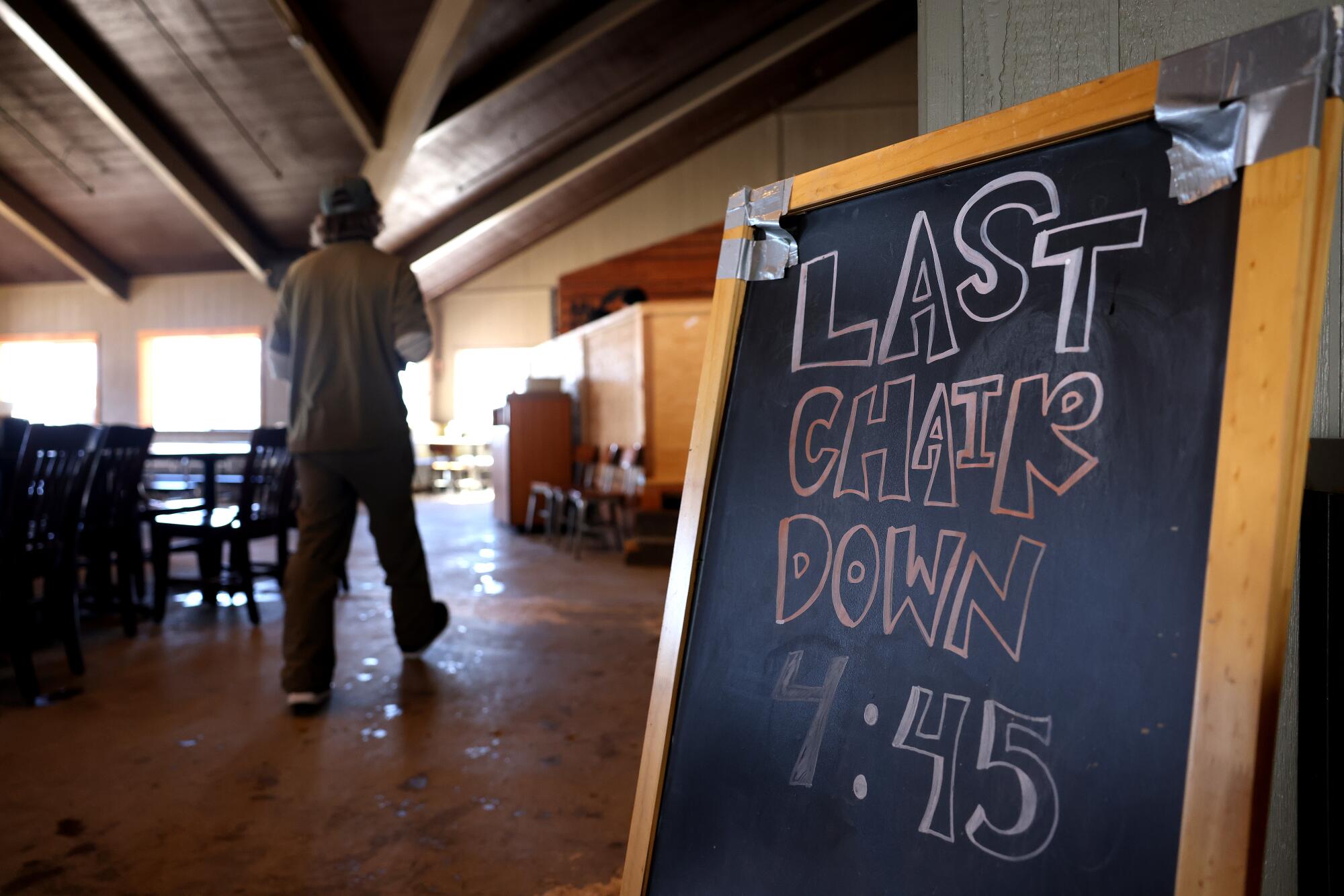
A sign inside Top of the Notch restaurant at Mt. Baldy.
Last week — after the 10,000-foot summit that looms above Los Angeles emerged from storm clouds blanketed in white — was one for the ages.
But in a rapidly warming world, and in an industry dominated by two huge and growing conglomerates that are crushing the competition, every run feels fleeting.
These days, managing a small ski business is like trying to keep a mom-and-pop general store afloat after Walmart comes to town.
By noon last Wednesday on Mt. Baldy — a little more than an hour’s drive from downtown L.A. — it was getting pretty hot, and the snow was melting fast.
Share via
For a skier racing between towering Jeffrey pines and plummeting through soft, slushy piles of forgiving snow, the hardest part was dodging exposed rocks and random tree limbs that appeared underfoot with alarming frequency.
The hardest part for the business is the fact that one of the conglomerates, Alterra Mountain Co., essentially surrounds Mt. Baldy.
Zac Chambers and his daughter Whitney, 6, of Upland, snowboard together at Mt. Baldy.
It owns Big Bear Mountain Resort and Snow Summit in nearby San Bernardino County, and Mammoth Mountain, the closest big resort in California’s High Sierra.
Although a season pass at Mt. Baldy is a relative bargain at about $300, it’s good only when there’s snow.
For about $800, you can get an “Ikon Pass” from Alterra, which offers access to all of its resorts in California and dozens more across the country and around the globe, including South America, Europe and Asia.
All of which makes keeping the lights on and the chairlifts spinning at beloved, but beleaguered, local resorts an exhausting labor of love.
Last week, Robby Ellingson, president and general manager of Mt. Baldy Resort, drove two hours to a rival resort in Big Bear Lake to pick up spare parts for an old chairlift that had broken down. He thanked them with a few cases of beer.
He planned to grab some tools and install the parts himself, with the help of an electrician.
Michael Phelps, left, and Seven Foster, of Riverside, take the chairlift up to Mt. Baldy Resort.
“I climb the lift towers, I drive snowcats, I do pretty much everything,” he said, chuckling at all of the hard, physical labor despite his executive title. “There’s a lot of things I do that none of the other dudes who hold my position would dream of — out of necessity.”
Another Mt. Baldy executive, Ellingson’s brother Tommy, turned up for an interview on the mountain in a camouflage hoodie, clutching an electric hand drill.
“Everybody’s like a Swiss army knife up here,” he quipped. “It’s awesome, it’s organic!”
It’s also very old-school.
While resorts like Mammoth invest millions in state-of-the-art chairlifts that whisk six people at a time up the mountain with astonishing speed, Mt. Baldy relies on slow, creaking two- and three-person lifts reminiscent of the 1980s.
A lot of the ski gear, ski fashion and the skiers themselves seemed proudly rooted in a bygone era too.
A skier carves down the mountain at Mt. Baldy.
Chris Caron, a 65-year-old retiree who lives 20 minutes down the road, stood at the top of the experts chairlift with a beard as white as snow, a black plastic sun shield across his nose and a cold craft beer in hand.
“There’s big conglomerates trying to buy everybody up, and I don’t want that,” he said, shading himself beneath the bill of his Pliny the Elder ball cap. “That’s what I love about here. It’s not so commercialized.”
Caron said he snowboards at Baldy every chance he gets — 20 to 30 days in a good year.
“I grew up here. We used to ride our bicycles and hike these mountains,” he said. “It’s like home.”
Driving back from visiting family in Missouri recently, Caron stopped at Taos Ski Valley in New Mexico, a bucket list destination for people who don’t shy from pricey vacations. He couldn’t help himself, he said — they’d just had a big dump of fresh powder and it wasn’t too far out of his way. But it didn’t feel right.
“It’s pretty posh,” he said with a resigned shrug. “That’s just not me.”
Also enjoying the uncrowded slopes and gloriously short lift lines on Wednesday was Tommaso Ghio, 28, an aspiring filmmaker from Italy who spent much of the afternoon snowboarding shirtless and looking like an extra from a Visit California commercial.
Old skis adorn a light fixture at the Top of the Notch restaurant at Mt. Baldy.
He and his friends drove up through the desert where it was, “like 80 or 90 degrees, and then we just ended up on top of a mountain,” covered in snow, he said, grinning as if he had won the lottery. “You can’t get this anywhere else.”
But the balmy weather that made the afternoon feel so decadent, and otherworldly, also poses a serious threat to Baldy’s on-again, off-again ski season.
It started with a surprise early storm in November — one that had locals dreaming of a record-breaking year — followed by a bone-dry December.
Then at Christmas, an atmospheric river that dumped several feet of snow on Northern California resorts arrived at Mt. Baldy, which tops out at 8,600 feet, as “catastrophic” rain, Ellingson said.
Rain washes away existing snow and destroys the quality of anything left behind.
And since Christmas week crowds generate about 30% of annual revenue at many U.S. ski resorts, the storm soaked Mt. Baldy in more ways than one.
Things stayed grim until last week’s storm, which dropped more than 2 feet of snow at the base of the resort and up to 3 feet at the top.
With limited snow at lower elevations, people make the up-and-down trip from the chairlift at Mt. Baldy.
It took some time to recover from damage done by the howling wind and make sure none of the enormous piles of snow on the upper reaches became life-threatening avalanches. When the resort finally opened, the skiing was as good as any in recent memory.
“I’ve lived in Mt. Baldy almost my entire life,” said Ellingson, who is 50, “and last Friday was one of my top five days ever.”
He’s hoping the storm delivered enough snow to stay open for at least a month, but the heat is not helping.
Ellingson’s family bought the Mt. Baldy Lodge, a restaurant in the village far below, in the late 1970s. They started running the ski hill, which they own a substantial share of, in 2013.
Increasingly fickle winters have forced the resort to branch out in an attempt to boost summer earnings and attract non-skiing customers: hosting moonlight hikes with live music in the restaurant at the base of the lifts, renting “glamping” tents on wooden platforms — with beds and locking doors — to tempt uneasy campers to sleep beneath the stars.
And in what Ellingson called a “swing for the fences” move, the resort recently bought a microbrewery in Upland. After serving beers at the restaurant for decades, it seemed like a natural next step.
Anything to avoid getting trapped in a “desk job,” Ellingson said, like his friends working as middle managers at the big, corporate resorts.
“I hate to throw shade,” he said, but do those guys ever go skiing?
Independence is priceless to Ellingson because, when you’re the boss and the snow is good, nobody can order you to stop throwing tricks in the terrain park and flying off jumps.
“I grew up during the X Games boom. That’s my identity,” he said. “I still get rad every single day.”
Bala Abubakar rises before dawn, fetching water and checking his irrigation canals. He grew up in Gurin, a community in Adamawa State, northeastern Nigeria, where rice cultivation has fed generations. To operate a thriving rice farm, Bala says he needs good seedlings, fertilisers, and perhaps a loan to tide him over.
In 2024, members of the Rice Farmers Association of Nigeria (RIFAN) in the state got subsidy inputs through the Nigeria Incentive-based Risk Sharing System for Agricultural Lending (NIRSAL), a programme designed to de-risk agricultural lending for low-income farmers. Bala went to the nearest cybercafé to register, hoping to benefit from the initiative.
The registration required him to enter his National Identity Number (NIN) before he could access the loan. At the café, he entered his name and the NIN, but the system failed to verify him. The café attendant told him that his record was not found and advised him to try his bank’s verification number (BVN). He tried, but the system still failed him. Disappointed after visiting the cybercafé, Bala trudged back home.
Like Bala, other farmers faced a similar problem. One farmer, Sani Bukar, tried to access the Growth Enhancement Support under the Government Enterprise and Empowerment Programme (GEEP), an initiative designed to improve smallholder farmers’ access to agricultural inputs through an electronic, voucher-based system. He only received a “verification failed” message, despite having a phone number linked to his NIN.
“They have our pictures and fingerprints now,” Bala says, referring to the recent biometric enrollment drive. “But those pictures are in Abuja. Here in my village, what do I have?”
His story reflects a deeper tension in Nigeria’s emerging Digital Public Infrastructure (DPI) ecosystem. Although Nigeria has made progress in several areas of DPI, alignment across them is uneven. The NIN, for instance, is managed by the National Identity Management Commission (NIMC), while the Central Bank of Nigeria (CBN) manages the BVN system to expand financial inclusion. In addition, SIM registration—conducted by mobile network operators—links phone numbers to individuals’ identities.
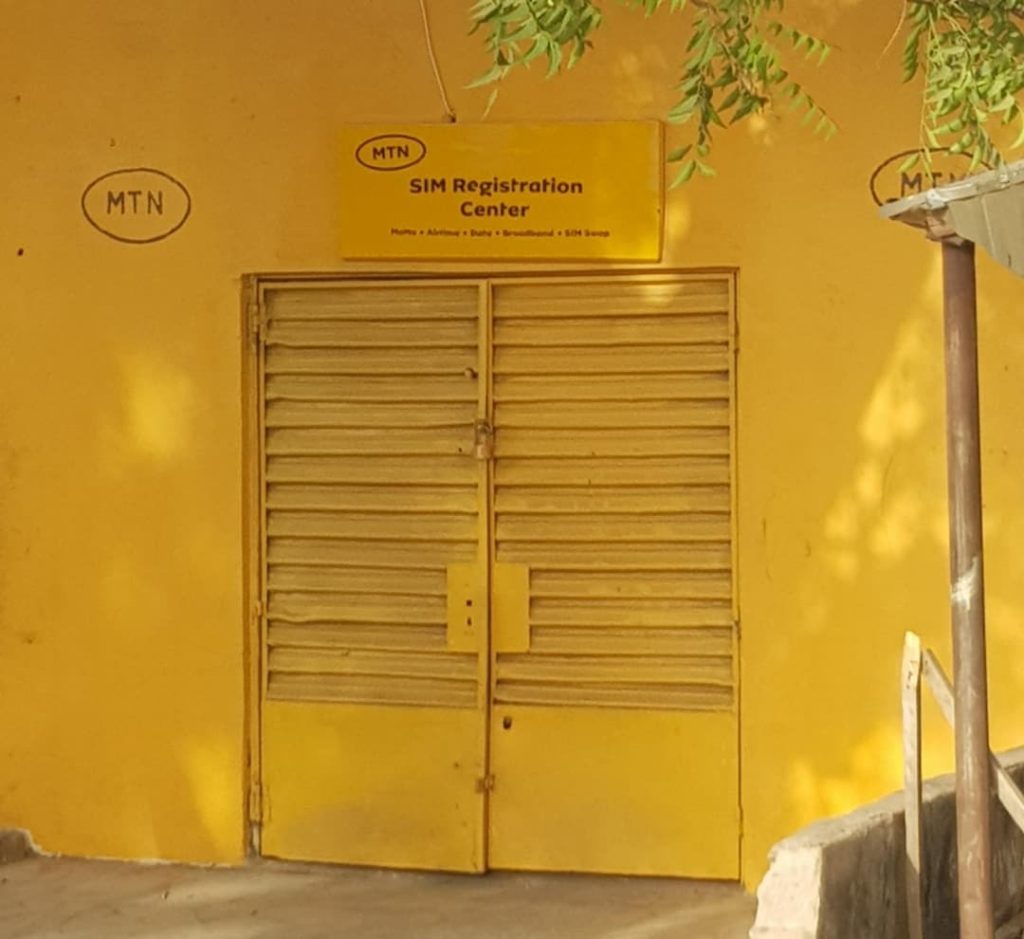
An MTN SIM registration centre in rural Adamawa. Photo: Obidah Habila Albert/HumAngle
On paper, these systems should make agricultural targeting seamless, but in practice, they often operate in silos.
Bala’s dilemma is built on concrete technical barriers. To access most federal or sub-national agricultural interventions today, a farmer must have a valid NIN, a phone number linked to that NIN, a bank account linked to a BVN, and a registration in a state or federal farmer database. If any link in that chain fails, the entire process most often collapses.
A 2025 overview of Nigeria’s connectivity landscape notes that only about 38 per cent of Nigerians were online in 2024, with rural communities significantly lagging behind.
“Without stable internet, many agricultural tools are rendered ineffective,” said Tajudeen Yahaya, an agricultural extension expert. “Even simple SMS or app-based registration frequently fails in rural communities.”
Beyond connectivity, issues with identity and data persist. The NIN registry has enrolled over 120 million people, but reports indicate that many more Nigerians have yet to enrol, particularly those in rural areas. Bala’s village falls within that gap.
The problem spans across multiple government programmes. Different states in Nigeria maintain their own farmer databases that conflict with federal government records. For instance, Agricultural Development Programme (ADP) offices may possess one list, while federal systems could have a different one.
“We tell farmers to get on the portal, but many are not in our state ADP database,” says Victor Anthony, who spoke on behalf of the Chairperson of the ADP programme in Adamawa State. “And even if they are, the federal system says we’re not synced.”
In 2025, the Federal Ministry of Agriculture officially launched a National Digital Farmers Registry. The minister, Abubakar Kyari, announced that it would be anchored and accessed through the NIN. According to Abubakar, the registry would eliminate ghost beneficiaries and ensure targeted delivery of inputs, extension services, credit, and insurance. The goal is a single unified platform that links NINs to farmlands, so that when a farmer applies, the system already “knows” him and his fields.
However, a recent statement from the agriculture ministry noted duplications and inconsistencies in farmers’ records, making it difficult to support them.
Interventions
Many government parastatals and private institutions are working to improve digitalisation for farmers and rural communities. NIMC has expanded the number of enrolment centres under the World Bank–supported programme, aiming to register up to 150 million Nigerians. Mobile NIN vans now travel to rural markets and religious gatherings, reducing distance barriers.
In October 2025, the World Bank approved a $500 million Building Resilient Digital Infrastructure for Growth (BRIDGE) project to lay fibre optics across Nigeria. Over the next five years, 90,000 km of fibre will be added, expanding the national backbone from 35,000 km to 125,000 km. When completed, this network will connect every local government, thousands of schools and clinics, and even remote agricultural research stations.
In local communities, farming cooperatives and technology companies are also contributing. The Extension Africa network has provided training to many local extension agents in digital tools, enabling them to act as “digital ambassadors” in rural areas. Some platforms are testing offline kiosks that permit farmers to download guidance and transaction records whenever they visit town.
The federal government’s renewed Agric Infrastructure Fund and various projects with agencies aim to equip these hubs with basic internet as part of a broader “Digital Village” initiative. However, these fixes are works in progress.
An African challenge?
Nigeria’s struggles are shared across the Global South, and other countries’ experiences offer cautionary lessons. In India, billions of dollars in farmer subsidies are paid directly to bank accounts via Aadhaar ID. The country is now rolling out Agri Stack, a digital initiative that gives each farmer a unique digital ID linked to land records.
Get our in-depth, creative coverage of conflict and development delivered to you every weekend.
Subscribe now to our newsletter!
When the government mandated e-KYC for OTPs in 2023, nearly 5 per cent of beneficiaries were flagged as “ineligible” when verification failed. Many older farmers lacked a working linked phone, had worn fingerprints, or ran into a buggy face-scan app.
With 70 per cent of the population in rural areas, agriculture accounts for 33 per cent of GDP in Kenya, but the country has struggled with piecemeal data. A recent study notes that millions of Kenyan smallholders remain “invisible to formal agricultural programmes”. In 2023, Kenya launched a national digital registry for farmers, but poor connectivity and low smartphone ownership are barriers, as in Nigeria.
On the positive side, Kenya has explored linking its digital ID (Huduma card) to farm cooperatives and training agents in the field. Rwanda goes even further by running the Smart Nkunganire e-voucher system, in which registered farmers receive digital coupons for seeds and fertilisers based on precise plots. These programmes suggest that pairing farmer IDs with geotagged land data can dramatically improve targeting, but only if the data are entered correctly, experts said.
Ethiopia has introduced a National ID requirement for various services. The newly established National Agricultural Finance Implementation Roadmap (NAFIR) incorporates a Fayda ID, which is a 12-digit unique identification number provided by the National ID Programme (NIDP) to residents who meet the necessary criteria set by NIDP. This system is designed for farmers associated with a land registry containing 18 million plots. The World Bank highlights that digital identity could unlock rural finance at scale in Ethiopia, but warns that without addressing its infrastructure gaps, digital solutions risk remaining pilots.
What needs to change
Experts argue that Nigeria must double down on making its digital agriculture ecosystem inclusive and resilient. Frank Akabueze, a Nigerian-based digital identity expert, noted that IDs should be flexible to ensure seamless registration. He said the NIN may be central, but alternative pathways should exist. For instance, cooperative leaders should be allowed to register farmers offline (paper intake by trusted agents) and synchronise later, rather than requiring each individual’s smartphone.”
“Voter card numbers should be made acceptable as interim IDs,” Frank said, noting the importance of equipping extension workers with portable biometric devices so they can register farmers on the spot, as some countries do. In India, the option of offline Aadhaar verification was eventually introduced to help offline farmers.
The digital expert noted that all of Nigeria’s data siloes – NIMC, BVN, SIM records and databases should be harmonised. He stressed that legal frameworks like the new digital ID policy can mandate data sharing between agencies (with privacy safeguards).
“Spelling mismatches and duplicates should be proactively cleaned: one approach is to use biometric deduplication, as India did at scale for Aadhaar,” he added.
He also said the proposed National Digital Farmers Registry should connect to the NIN and verify existing records, such as the national farmers’ census, to minimise errors, such as listing the same farmer in multiple states or with different ages.
This report is produced under the DPI Africa Journalism Fellowship Programme of the Media Foundation for West Africa and Co-Develop.
A FITNESS influencer has confessed to lying about getting caught in an explosion.
Influencer Malibu Fit Maxx has admitted that he lied about the ordeal while serving in the army.
Sign up for the Showbiz newsletter
Thank you!
Malibu Fit Maxx has apologised about telling his followers a lieCredit: InstagramThe influencer, whose real name is Lee Markham, took to social media in the candid videoCredit: malibufitmaxx/Instagram
The fitness influencer, whose real name is Lee Markham, shared a video this week where he revealed that he lied about sustaining an injury from an improvised explosive device while on active duty.
Speaking in his candid video, the influencer said: “I wanted to talk to you directly about the claim that I made, taking an IED blast to the face.”
He then said how he was “deeply proud” to have served in the military between 2005 and 2010.
The internet star explained how he received negative comments online about his appearance, which in turn let to him making a false claim about his time serving in the army.
“I’ve always got comments about my face and appearance.
“Some of them were harsh. And to be honest, I didn’t handle it well,” he began.
“I was new to being in the public eye and I didn’t know how to handle the criticism.”
He went on: “Instead of facing that right away, I made a bad decision and put ‘IED Survivor’ in my bio. That was not true and it was wrong.
“But truly I’m sorry from the bottom of my heart,” he said.
He added: “I have always tried to promote positivity and support for others, especially veterans.
“But I understand that my actions here contradict that. I take full responsibility for it,” he said later in the video.
Keen to regain the trust of his followers and fans, he added: “I know words alone will not fix this.
“Trust is earned. It’s not owed.
“All I can do is be honest with you guys going forward and let my actions speak over time.”
The Influencer Insider – Get all the gossip on all your favourite online stars
Want to know more about the influencer who faked cancer? Read all about Brittany Miller and her sham career here.
We have all the inside gossip about Ladbaby mum’s incredible weight loss here.
And talking of weight loss, we know all about what is going on with B&M queen Becki Jones, which you can read up on here.
If health influencers are your thing, then read this on the man behind Tonic Health and his dubious claims here.
His followers were divided in the comments section.
One person penned: “hanks for keeping it real bro. You’re one of the only accounts on here that brings true happiness to so many people.
“Don’t ever forget that and don’t ever stop going, bro.”
While another said: “This is a great example of taking accountability. You turned that from a disaster into a humble moment that other men can learn from. Respect!”
“Apologised like a man and didnt make excuses or keep lying – still a legend in my eyes,” added a third.
Meanwhile, someone else penned: “Bro only making this video because he got called out publicly. This is not accountability, this is damage control.”
And another slammed: “You ain’t sorry you’re only sorry because you got caught.”
Some fans were divided by his apology videoCredit: malibufitmaxx/Instagram
SAN FRANCISCO — Kawhi Leonard had 23 points, eight rebounds and four assists, and the Clippers erased a 17-point deficit to beat the shorthanded Golden State Warriors 114-101 on Monday night.
Garland had been nursing a toe injury, then he went down with 1:26 left in the second quarter after a collision with the Warriors’ Moses Moody when they both went for a loose ball and Moody’s right shoulder appeared to get Garland in the face. Both players were shaken but stayed in the game.
Garland’s three-pointer with 3:09 left in the third pulled the Clippers within 75-68, then Kris Dunn had a steal and layup to make it a five-point game. The Clippers were within 79-77 going into the final 12 minutes.
Dunn finished with 16 points, seven rebounds and seven assists for the Clippers (29-31), who shot just nine for 31 from three-point range. The Clippers used a 9-4 spurt to start the fourth quarter and go ahead 88-81.
Warriors guard Brandin Podziemski hit eight of his first 12 shots with three three-pointers for his second career 20-point half, but went one for six for two points after the break. Al Horford added 17 points for Golden State, which has lost five of seven and nine of 14.
All-Star guard Stephen Curry was sidelined for an 11th straight game because of a right knee injury, big man Kristaps Porzingis was out for his fifth consecutive contest because of an illness coach Steve Kerr called “mysterious,” and rookie Will Richard was in a walking boot after he sprained his right ankle in Saturday’s blowout home loss to the Lakers. Star forward Jimmy Butler is out for the season with a torn anterior cruciate ligament.
Up next for the Clippers: vs. Indiana at Intuit Dome on Wednesday.
Explosions have rung out across Tehran as the war entered its fourth day with the United States and Israel continuing to pound Iran’s capital and numerous other cities and locations after the assassination of Supreme Leader Ali Khamenei.
Iran continued on Tuesday to retaliate against Israel and throughout the Gulf where nations host US assets.
At least 787 people have been killed in US-Israeli strikes on a minimum of 131 cities across Iran, the Iranian Red Crescent Society said on Tuesday.
Israel’s military said it had “struck and dismantled” the headquarters of Iran’s state radio and television broadcaster, the Islamic Republic of Iran Broadcasting (IRIB), accusing it of “calling for the destruction of the State of Israel and for the use of nuclear weapons”.
In a post on Telegram, IRIB reported explosions near its headquarters in Tehran but said there had been no disruption to its operations.
Tehran’s streets have been largely deserted as people take shelter during the air strikes.
Iranian media also reported explosions in the city of Karaj, just outside Tehran, as well as in the central city of Isfahan.
Iran held a mass funeral on Tuesday for 165 schoolgirls and staff killed on Saturday in what Iran said was a US-Israeli attack on a school in the southern city of Minab.
FLIGHTS are continuing to be cancelled as the travel chaos caused by the Middle East conflict enters a fourth day.
Limited flights were permitted to take off last night, which included an Etihad flight from Abu Dhabi to London.
Sign up for the Travel newsletter
Thank you!
Flights are continuing to be cancelled today across the Middle EastCredit: AFPAirlines are warning passengers not to travel to the airport unless contactedCredit: Reuters
According to data from aviation analytics firm Cirium, around 73 flights are scheduled from the UK to the Middle East, working out to nearly 25,000 passengers affected today.
Emirates, which operates out of Dubai, confirmed that “limited flights” took off yesterday.
However, this was only for passengers with earlier bookings, and only those who are being contacted by Emirates.
They warned: “Please do not go to the airport unless you have been notified.
“All other flights remain suspended until further notice.”
Etihad also operated limited flights yesterday across Asia and Europe, which included a flight to London.
However, most scheduled flights to and from Abu Dhabi are suspended until at least 2pm tomorrow.
In a statement, it confirmed: “Passengers should not travel to the airport unless they have been contacted directly by Etihad Airways and advised to do so.”
Qatar Airways confirmed this morning that flight operations were “still suspended due to the closure of the Qatari airspace”.
It added: “Qatar Airways will resume operations once the Qatar Civil Aviation Authority announces the safe reopening of Qatari airspace.
“A further update will be provided on March 4 by 9am Doha time.”
Virgin Atlantic has cancelled its Dubai to London flight today but has not yet confirmed any cancellations tomorrow.
And British Airways said they have “cancelled a number of our flights to the Middle East”.
Most airlines are allowing passengers to ask for a full refund, or can move their flights to a later date without any additiona charge.
Yesterday, the General Civil Aviation Authority in the UAE – in a very rare move – confirmed that the state would cover all accommodation and hosting costs for stranded passengers.
Most airports remain closed in the UAE and Qatar due to the airspace closuresCredit: Reuters
The Sun’s Head of Travel explains your rights if affected by the cancellations
For passengers meant to be flying in or out of the region, your rights depend on whether you were flying directly in or out of the UK or EU or if you are flying with an UK or EU airline.
Those who are will not get compensation as it is not the fault of the airline but they do have a duty of care to look after impacted passengers – depending on the length of the delay that could include food and drink, a means of communicating and if necessary, overnight accommodation.
Those flying on non-UK or EU carriers may find their rights are slightly different if they are not on a direct flight to the UK as different rules apply and you may not be provided with the same assistance.
They are, however, expected to offer you the right to a refund or another flight in the case of cancellations.
As well as those directly impacted by cancelled flights, the closure of so much of the Middle Eastern airspace will mean even more congestion on alternative routes that could impact flights across the globe.
For those due to travel in the coming days, staying in contact with your airline and checking before travelling to the airport is essential as schedules may change at short notice.
This means anyone still stuck in Dubai or Abu Dhabi will be able to stay at hotels free of charge, as well as not pay for any additional costs like food and drink.