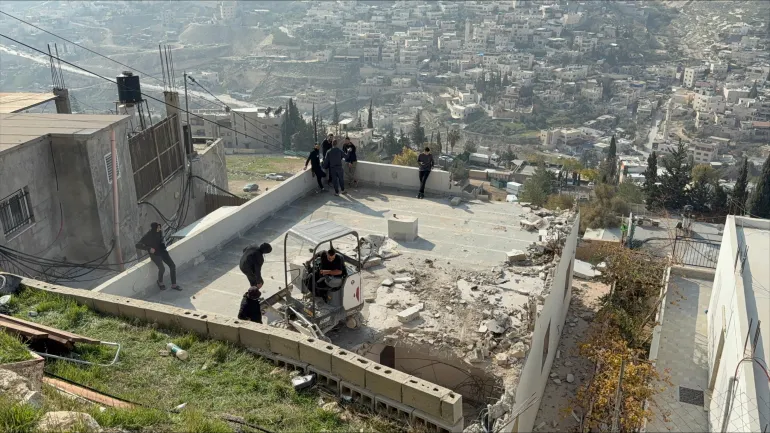
Occupied East Jerusalem – Basema Dabash sheds tears daily for the home she and her husband, Raed, were forced to demolish in Sur Baher, in the south of occupied East Jerusalem.
For years, the couple lived under the spectre of losing their home, ever since the Israeli authorities issued a demolition order in 2014. In January of this year, the eviction notice came. And then, on February 12, the family were forced to demolish their home. If they didn’t, they would have been forced to pay the municipality to carry out the demolition.
Recommended Stories
list of 3 itemsend of list
“We were forced to start demolishing the house ourselves to avoid the municipality’s demolition fees, which can reach 100,000 shekels [$32,000],” Basema, 51, said. “We started by breaking down the inside of the house and sent the municipality photos to confirm that we had begun the demolition, but they demanded that we demolish it from the outside as soon as possible.”
The family soon completed the demolition of the two houses where eight people, including three children, lived. However, this didn’t waive the fine of 45,000 shekels ($14,600), which will continue to be paid in instalments until 2029.
‘Self-demolition’ haunts Palestinians living in East Jerusalem, which has been controlled by Israel since 1967, and illegally merged with West Jerusalem under one Israeli-run administration.
The choice between self-demolition and paying a further fee to the municipality is a simple one – the vast majority of Palestinians can’t afford to pay the exorbitant amount, and resort to demolishing their own homes, despite the immense pain and profound psychological impact it causes.
‘How did we come to this?’
Basema’s troubles started in 2014, when she received a building violation notice from the Israeli municipality in Jerusalem for the building she and her husband shared with their married son, Mohammed, and his family. They appealed at the time to an Israeli court in an attempt to freeze the demolition order.
For more than a decade, the family was forced to pay accumulated fines in an attempt to keep their home. Then, on January 28, they received an eviction notice, giving them a deadline to vacate the house and have it demolished.
The house slated for demolition was 45 square metres (485sq feet), an extension Basema had added to her existing 45-square-metre home. She had also built a similar-sized residence for her married son on top of the extension. The demolition order targeted both the extension and her son’s residence.
The Dabash family tried to obtain a building permit for the house several times, but their requests were rejected by Israel. Despite this, the municipality fines Palestinians and demolishes their homes under the pretext of lacking permits.
“We chose to demolish our own house not only to avoid the fine, but also because the municipal crews show no mercy to anything around the house and deliberately vandalise the entire area under the pretext of demolition, breaking trees and causing extensive damage that we could have done without,” Basema said.
Basema, along with her husband and one of her sons, Abdelaziz, now lives in what remains of their home. Mohammed has also moved in with them, while his wife and children live in her family’s home. The demolition has thus scattered her son’s family, who haven’t yet been able to find a small house to rent due to the high cost of housing.
The family also incurred significant expenses removing the rubble and redesigning the older section of the house to accommodate everyone, not to mention the psychological toll, which has been devastating.
“I stand to wash the dishes and find my tears falling on their own. How did we come to this? Why are we being subjected to this injustice? The house has become cramped and barely fits us. My grandchildren visit us and then cry bitterly when they leave for their grandfather’s house because we have no space,” Basema said sadly.
Increased demolitions
As illegal Israeli settlements continue to expand in East Jerusalem and the occupied West Bank, with building permits easily obtained, Palestinians say the double standards are obvious.
Human Rights Watch has found that Israeli authorities make it “virtually impossible for Palestinians to obtain building permits”, and the Israeli human rights organisation B’Tselem said planning policies in East Jerusalem make it “very difficult for residents to obtain building permits”.
Marouf al-Rifai, spokesperson for the Palestinian Authority’s Jerusalem Governorate, told Al Jazeera that 15 self-demolitions were carried out last February, five in January, and 104 in December.
Demolitions, in general, escalated to unprecedented levels after October 2023, when Israel’s genocidal war on Gaza began. Al-Rifai said that 400 demolitions were carried out in 2025 in East Jerusalem and its surrounding area, either by municipal crews or by homeowners themselves. Prior to that, the number of demolitions had reached a maximum of 180 per year.
The United Nations has reported that demolitions in 2025 displaced 1,500 Palestinians.
“Even the method of carrying out demolitions changed after the war on Gaza,” al-Rifai said. “Previously, demolitions were only carried out after exhausting all legal avenues and giving residents the opportunity to appeal to the courts and freeze the demolitions.”
But Israeli authorities have taken a more punitive position since demolition policy fell under the influence of far-right Israeli National Security Minister Itamar Ben-Gvir, who began pushing for Israeli army bulldozers to carry out demolitions without even notifying the homeowners, al-Rifai said.
In addition, the Palestinian Authority official said, demolition notices for Palestinian homes in Jerusalem increased from 25,000 before the war to 35,000. The town of Silwan alone has received 7,000 demolition notices since 1967.
Fakhri Abu Diab, a member of the Committee for the Defence of al-Bustan Neighborhood in East Jerusalem, told Al Jazeera that self-demolition is a double punishment and pain for the homeowner after the effort and hardship involved in building the house.
“Israel’s goal is to break the morale of the Palestinians and to brainwash them into becoming tools for implementing its plans to demolish homes. When we demolish our own homes, it’s as if we are demolishing a part of our own body,” he explained.
Israel can only demolish a limited number of Palestinian homes annually due to logistical, financial, budgetary, and logistical constraints. Demolition by Palestinians multiplies the number of homes demolished, thus turning the victim into a “demolition contractor”, as he put it.
“I refused to demolish my house myself because of the negative consequences that I and my family would have to live with for the rest of our lives, and the Israeli bulldozers demolished it. If I had done it myself, it would have remained a nightmare that would haunt me.”
Saqr Qunbur says he has already received a total of $26,000 in fines for building his house, and so can’t afford to pay more for Israeli crews to demolish it [Ahmad Jalajel/Al Jazeera]
No alternative
But the cost of a demolition carried out by Israeli municipal crews ranges between 80,000 and 120,000 shekels ($26,000-$39,000).
Saqr Qunbur couldn’t pay that, and was forced instead, on December 26, to demolish his 100-square-metre (1,076sq-foot) house in Jabal al-Mukabber under the pretext of lacking a permit. He had built it in 2013 and was immediately issued a building violation notice.
Saqr told Al Jazeera that he had lived in the house with his wife and four-year-old child. Since building the house, he has received a total of 80,000 shekels ($26,000) in fines that he’s still paying despite his home being demolished.
Saqr had nowhere to live after being forced to demolish his house, so his neighbour gave him a dilapidated room to live in while he found a place to rent.
“My child has been suffering psychologically since we demolished the house. Every day he asks me why I demolished it, and I don’t know what to tell him. I say it’s so I can build him a better house, but deep down I know I won’t even be able to rent a suitable place,” he explained with anguish.
Saqr chose to demolish his house himself after he says an Israeli officer threatened him, saying, “Demolish it, or I’ll demolish it over your head”. He also wanted to avoid the humiliation that accompanies demolitions carried out by Israel, where police sometimes fire live ammunition and tear gas at family members and carry out assaults, as documented by human rights groups.
“I developed diabetes and high blood pressure after my house was demolished. The doctor said it was due to anger and grief. This is an occupation that wants to expel us from our land, and we want to stay,” he concluded.
Kasuwan Daji, once a bustling village, now lies in haunting silence.
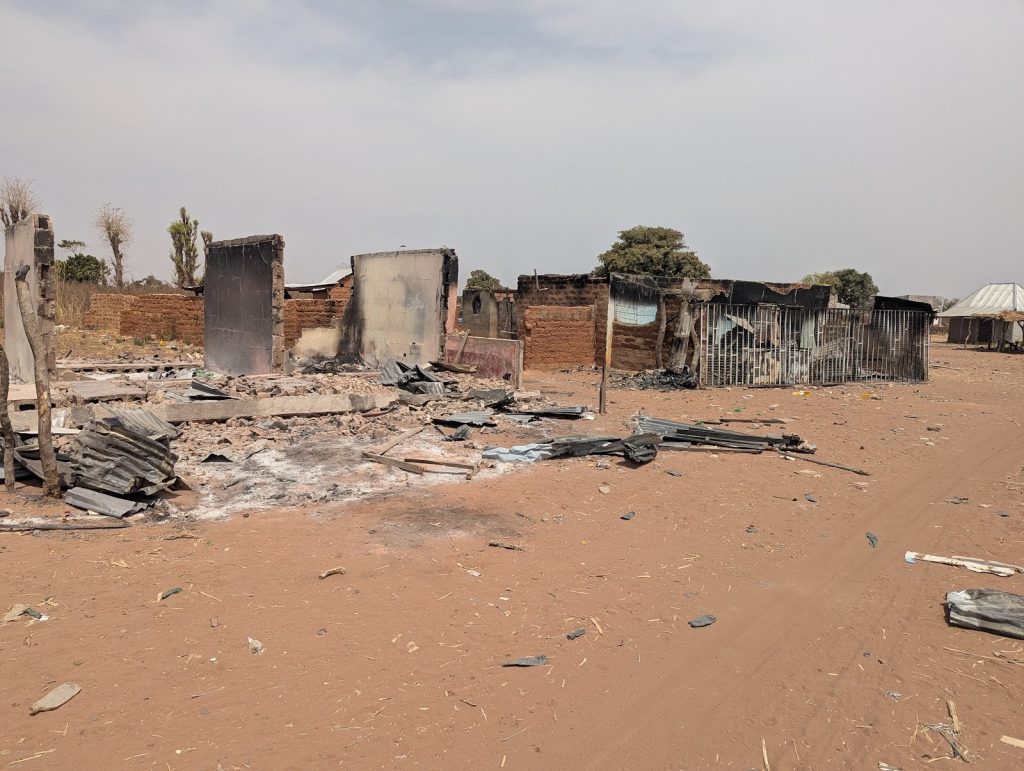
The aftermath of the Jan. 3 terror attack has stripped the community and market of their familiar rhythm, leaving behind charred homes and empty streets.
In the village market, located in the Borgu Local Government Area of Niger State, North Central Nigeria, where voices once mingled in trade and laughter every Wednesday, only the wind now moves through its abandoned, burnt makeshift tents.
When HumAngle visited the community in February, the village felt hollow, its people gone—either displaced, abducted, or buried.
Shops in the market that were burnt down by terrorists who attacked the Kasuwan Daji. Photo: Isah Ismaila/HumAngle.
Amid the ruins, Sule Amadu, an elderly man in his late 60s, moved slowly through the debris of his burnt house, searching for anything that might have survived the flames. He was dressed in the same clothes he wore on the day of the attack.
Sule lost his brother and his house, and nine of his grandchildren were abducted by the same terrorists who attacked his community on Jan. 3. Photo: Isah Ismaila/HumAngle.
His quiet scavenging symbolised both survival and loss.
“I was at the farm when I first heard the roar of their motorcycles heading towards our village,” he recounted. “Moments later, they began shooting sporadically. In panic, I exclaimed, ‘Innalillahi wa inna ilaihi raji’un’ [from God we are and to Him we shall return].”
Sule said the violence was relentless, as the terrorists aimed their bullets directly at people.
“Those who tried to run were chased down by terrorists on motorcycles. Two of them rode together—one driving, the other firing at random. What was our crime?” he added, his voice carrying both grief and bewilderment.
A distant view of some of the burnt houses and food storage facilities in Kasuwan Daji, now sitting in eerie silence. Photo: Isah Ismaila/HumAngle.
State authorities said no fewer than 30 people were killed in the attack. However, eyewitnesses who spoke to HumAngle say 57 people were buried that day, while 49 others were abducted, contradicting the official figures.
Sule narrowly escaped death. His younger brother was killed, and nine of his grandchildren and his son’s wife were abducted that day.
“When the terrorists stormed in, I was trying to bag my millet. One of them chased me while shooting, but by God’s mercy, I escaped the bullets. I ran and jumped into the river to save my life,” he said.
How the attack unfolded
Sule was not alone in witnessing the chaos that engulfed Kasuwan Daji. HumAngle met another resident, Isa Mamman, who said he was among the first to notice the approaching attackers and raise the alarm in the community that day.
Isa, a resident in his 40s, is a living witness to the atrocities committed by the terrorists who stormed his village on Jan. 3, 2026. He vividly remembers the horrifying scenes. Photo: Isah Ismaila/HumAngle.
He recalled how the attack began and how quickly it unfolded.
Isa was alone in a nearby bush around 4 p.m. when he noticed heavy dust rising in the distance and the sound of motorcycles approaching. He immediately ran towards the community to raise the alarm, where he met another villager who was also fleeing. Isa learned from him that the attackers had stormed in from the market axis.
Within minutes, chaos engulfed Kasuwan Daji.
Gunshots echoed across the village as people screamed and scattered. Terrorists on motorcycles fired indiscriminately, chasing down those who tried to escape. Shops and homes were set ablaze, and the once-thriving market became a scene of devastation.
Just like Amadu, Isa narrowly survived, as he was shot at twice as he fled into the bush. From his hiding place, he watched helplessly as villagers were slaughtered and houses reduced to ashes.
Isa narrowly escaped death when the terror struck. Photo: Isah Ismaila/HumAngle.
The violence stretched into the night as Isa remained hidden, fearing an ambush, while the community lay in ruins.
“By dawn, when I came back to the community, lifeless bodies were scattered across the village, food storage facilities were destroyed, and every house and the market were burnt,” he said. That day, I escaped by God’s grace. I ran into the bush to hide, but I could still see what was happening. I saw our people being slaughtered like rams.”
Get our in-depth, creative coverage of conflict and development delivered to you every weekend.
Subscribe now to our newsletter!
The area where people were tied and slaughtered by terrorists. Residents told HumAngle that dead bodies littered this area in pools of blood. Photo: Isah Ismaila/HumAngle.
Isa noted that, “There was no part of the community where we didn’t find dead bodies. Every house in Kasuwan Daji was set ablaze. Our market and storage facilities, where we kept food, were burnt down. We’ve all fled because we are terrified they might attack again.”
A new terror base
Field investigations conducted by HumAngle across the Kasuwan Daji, Wawa, and Babanna areas of the Borgu LGA of Niger State, in February show that terrorist factions are now entrenched in and around the Kainji Lake National Park axis.
Terror groups such as Mahmudawa (Mahmuda faction), Lakurawa, elements of Ansaru, and Jama’atu Ahlis Sunna Lidda’awati wal-Jihad (JAS) led by Sadiku and Umar Taraba, as well as a newly emerged cell affiliated with Jama’at Nusrat al-Islam wal-Muslimin, have turned the Kainji Forest Reserve into a safe haven.
These groups operate in interconnected networks rather than in isolation, exploiting local cover to conceal their movements. They conduct attacks in distant areas before retreating to established hideouts within the park’s surrounding communities.
Kasuwan Daji is situated within this geographic corridor and has become a focal point due to its depth, accessibility, and lack of security presence. It sits about 14 kilometres from the Saint Mary’s Catholic School, where some schoolchildren were abducted in Nov. 2025.
The largely ungoverned terrain provides violent groups with mobility, supply routes, and escape paths across state and national boundaries. This strategic advantage has made the area increasingly attractive to extremist factions seeking to expand their operational reach.
Recent incidents in Niger State and adjoining areas — including coordinated assaults on villages and high-profile abductions — have heightened concerns that extremist networks are embedding themselves beyond the country’s North East, their traditional stronghold. Their spillover into villages such as Kasuwan Daji, Agwara, Babanna, and Kaiama LGA of Kwara State underscores the emergence of a hybrid threat ecosystem in which ideology, criminal enterprise, and local grievances converge to reinforce instability.
This evolving dynamic positions Kainji not only as a local security challenge but also as a critical node in the broader extremist landscape of the North Central region.
Earlier attacks
The Kasuwan Daji attack of Jan. 3 was not the first.
Months before, precisely in September 2025, residents told HumAngle that terrorists had entered the community and abducted several of its most significant figures. Among them was Usman Jatau, the village head, along with five others: Ibrahim Jatau (zone chair of Kambari), Anthony Yakubu Takura (youth leader), Mathew Ibrahim (head of vigilante), David (businessman), and Abu Agwara.
Relics of the Jan. 3 attack. Photo: Isah Ismaila/HumAngleThis rhombus had over 20 stacks of sorghum that were stored by a farmer in Kasuwan Daji, but was razed by terrorists. Photo: Isah Ismaila/HumAngle.
To date, none of them has been heard from, a situation that has left families in anguish and the community without its leadership.
After the abduction, Ajikali Jatau, the brother of the village chief and head of the Kasuwan Daji market, said the same attackers returned with greater brutality.
“This time, their intent seemed clear—to wipe out the community. Villagers were slaughtered mercilessly, some tied with their hands behind their backs before being killed,” Ajikali told HumAngle. He believes the market was deliberately attacked because of its boom and constant business activities.
Ajikali Jatau is burdened by the pain of losing his brother, nephew, and relatives in the terror attack. Photo: Isah Ismaila/HumAngle.The remains of the Kasuwan Daji weekly market burnt by terrorists in the Borgu area of Niger State. Photo: Isah Ismaila/HumAngle.
Ajikali told HumAngle how the market itself had its own history of struggle.
“Before establishing Kasuwan Daji, we used to trade at Sokomba market every Wednesday. But after two young men from our tribe [Kambari] were killed and burnt there in broad daylight, we decided to stop going there.
“One of the victims had tried to escape but was shot dead. The repeated harassment and targeting forced us to request that the market be moved somewhere else, but after several futile efforts, we created our own,” he revealed.
Debris of burnt grains from the storage facilities razed by terrorists in Kasuwan Daji Market. Photo: Isah Ismaila/HumAngle.
For seven years, Kasuwan Daji market thrived, residents say, as they paid revenue to the local government—until it was reduced to ashes in the January attack.
Displacement and human toll
More than 300,000 people have been displaced across 10 LGAs in Niger State, including residents of Kasuwan Daji, according to Governor Umaru Mohammed Bago.
Hajara Shuaibu, a resident of Kasuwan Daji, is one of them. Her husband, Malam Shuaibu, a farmer, had made the village his home, cultivating produce with his family and planning to relocate there permanently. When the terrorists struck, Hajara’s world collapsed. Two of her younger brothers were kidnapped along with her husband’s other wife and daughter, forcing the family to flee to Papiri, a 14-kilometre drive from Borgu to Agwara LGA of Niger State, in search of refuge.
Hajara Shuaibu [in pink] and one of her daughters are now seeking refuge in the Papiri, Agwara Local Government Area of Niger State, after fleeing from Kasuwan Daji in Borgu. Photo: Isah Ismaila/HumAngle.
Before arriving at Papiri, Hajara said she and her children hid in the bush for three days, waiting for the violence to subside.
“Our house was burnt to the ground, along with our belongings and food supplies. About two truckloads of grains and groundnuts that were harvested by my husband were destroyed in the fire, erasing our year-long hard work in a single night,” she said.
Days later, her brother’s wife managed to escape captivity, only to return with devastating news: her husband [Hajara’s brother] and several others who had been abducted had been killed.
The terror was felt even among the youngest.
Suleiman, Hajara’s four-year-old grandson, was among the abducted persons from the attack but was later abandoned in the Gallah area of Agwara LGA, near the house of the village chief.
His cries were said to be so persistent that the attackers eventually dropped him off before leaving with the other captives.
Hajara said that the joy at seeing him [Suleiman] alive was quickly overshadowed by grief, as she remembered her slain brother and relatives still in captivity.
‘We’re not thieves’
In the aftermath of the Jan. 3 attack, the Niger State Governor described Kasuwan Daji as a “market of thieves”, claiming that the community had become notorious for the sale of rustled cattle. He made the remarks during a condolence visit to the Emir of Borgu.
Some of the houses that were burnt by terrorists who stormed the Kasuwan Daji community of the Borgu LGA of Niger State, North Central Nigeria. Photo: Isah Ismaila/HumAngle.
Adding to the despair, he instructed the survivors to leave the Kasuwan Daji village altogether, even though no plans were announced for their relocation or resettlement, leaving families displaced, vulnerable, and uncertain of their future.
However, survivors of the attack strongly refuted the governor’s framing.
Isa Mamman and Sule Amadu are the two people who have refused to leave the community; since they have nowhere to go, they serve as watchdogs watching over the ruins left behind. Photo: Isah Ismaila/HumAngle.
Ajikali, brother of the village chief and leader of the now-destroyed market, told HumAngle, “We are not thieves. We are hard-working people, and the emirate is aware of us and our market. We are farmers—that is our business and what we are known for. We do not deal in the cattle business, so how can we be called thieves?”
Sule also echoes this rejection of the governor’s claim: “I strongly disagree with the governor’s assertion that our market is ‘a market of thieves.’ We do not sell cows in Kasuwan Daji, yet he accuses us of selling rustled cows. He’s been misled by those around him.”
“The only thing I want is to have my grandchildren back. Even if they [terrorists] demand ransom, I have nothing to give except the clothes I am wearing. They burnt everything I owned—my food, my savings, and my animals were stolen,” he noted.
The Niger State Commissioner for Homeland Security, Bello Maurice Magaji, while reaffirming the government’s commitment to tackling insecurity through intelligence gathering and grassroots collaboration, also defended the governor’s branding regarding activities at the market, stressing that it was based on verified intelligence.
“We are adopting an intelligence-gathering strategy to understand the patterns of these crimes and attacks so that we can tackle the situation head-on,” the commissioner told HumAngle. He noted that the government is also engaged in advocacy to help citizens recognise early warning signs that may not have been obvious in the past.
“Also, I believe that whatever information was released by His Excellency is based on facts that were made available. Our government does not simply go out to brand or profile people based on unverifiable information. Our government is too serious to speculate or issue statements without evidence. Therefore, we stand firmly by what the Governor said about the market,” he stated.
Investigation by HumAngle revealed that there are two markets with the same name: Kasuwan Daji. One is situated in Niger State, North-Central, and another in the Kauran Namoda area of Zamfara State, in northwestern Nigeria.
Further checks also indicate that Kasuwar Daji Market in Kaura Namoda local government area of Zamfara State, is a popular hub for cattle rustling. Terrorists, in January, stormed the market and rustled over 500 cattle.
Aminu Garba, Chairman of the Cattle Breeders Association of Nigeria in the state, told journalists that the operation was not an isolated incident noting that similar attacks have occurred in the past, with one recorded about four years ago.
He explained that the terrorists infiltrate the market and nearby villages during the day, monitoring livestock transactions before striking.
It is not impossible that the Niger State government is mistaking one Kasuwan Daji for the other.
For Isa Mamman, another survivor of the attack in Niger State, the governor’s words add insult to injury. He explains that he and Amadu stayed behind in the community because they had nowhere else to go, even as their livestock was rustled and nearly fifty women and children were abducted.
“It has been almost two months since the attack, yet nothing has been done. Neither the state governor nor the district head of Kabe has visited our community. Instead, we were insulted and labelled as thieves. We pay revenue to the government, yet they claim our market is illegal. Now, we have no food, no peace, and countless lives have been lost, and nothing has been done.”
NEW YORK — What makes life worth living? For hard-core “Harry Potter” fans with money to burn, it might be getting Broadway tickets to interact fleetingly with Daniel Radcliffe in “Every Brilliant Thing,” an ingenious and touching solo performance piece written by Duncan Macmillan with Jonny Donahoe on the subject of suicide — or more precisely, on the ordinary joys that militate against such a drastic step.
Radcliffe was breathlessly scampering up and down the aisles of the Hudson Theatre before the show began, enlisting audience members to be participants in the play. Having seen “Every Brilliant Thing” twice before, once at the Edye (the black box at Santa Monica’s BroadStage) starring Donahoe in 2017 and once at the Geffen Playhouse’s intimate Audrey Skirball Kenis Theater starring Daniel K. Isaac in 2023, I knew exactly what he was up to.
The play revolves around a list that the narrator began at the tender age of 7 after his mother first attempted suicide. While she was still in the hospital, he started compiling, as much for her benefit as for his own, sources of everyday happiness.
Ice cream, water fights, kind people who aren’t weird and don’t smell unusual. These items are given a number, and audience members assigned a particular “brilliant thing” are expected to shout out their entry when their number is called.
The list gradually grows in complexity as the narrator gets older. Miss Piggy, spaghetti bolognese and wearing a cape give way to more sophisticated pleasures, such as the way Ray Charles sings the word “You” in the song “Drown in My Own Tears” or the satisfaction in writing about yourself in the second person.
Music plays a prominent role in “Every Brilliant Thing,” which was adapted from a monologue/short story Macmillan wrote called “Sleeve Notes.” The narrator’s terribly British father takes refuge from the emotional storms of his household by listening to jazz records in his office. John Coltrane, Cab Calloway, Bill Evans, Nina Simone are favorite artists, and the narrator can tell his father’s mood simply by the record he’s decided to play.
The production, directed by Jeremy Herrin and Macmillan, involves every level of the Hudson Theatre. I assumed I would be safe, occupying an aisle seat in the murderously expensive prime orchestra during a press performance attended by critics. But I wasn’t flashing a pad as my colleague across the aisle from me was doing to ward off any intrusions. And just before the show was about to start, Radcliffe was suddenly kneeling beside my seat asking if the person I was sitting with was my partner.
I told him that we weren’t a couple, just friends, and that I would be the worst person he could possibly ask to perform anything. But Radcliffe wasn’t so easily put off. “Let’s just say that you’re an older couple who have been together for some time,” he whispered. “And all you have to do is hand me this box of juice and candy bar when I refer to the older couple.”
OK, what harm could there be? Little did I know that “older couple” was to become “old couple,” a term that seemed to be repeated incessantly, at least to my Gen X ears not yet accustomed to scurrilous millennial attacks! I composed myself by pretending that we were in the world of anti-realism. But in truth, I would like to be the kind of person who would offer an anxious kid in a hospital waiting room a juice box and a candy bar, so maybe the casting wasn’t so far-fetched after all.
Daniel Radcliffe in the Broadway production of “Every Brilliant Thing.”
(Matthew Murphy)
A theatergoer was called upon to play the vet who euthanized the narrator’s childhood pet, a dog named Indiana Bones that was symbolized by a coat someone volunteered from the audience. It was the boy’s first experience of death, a difficult concept for a young mind but an important precursor for a boy not given the luxury of existential innocence.
Other audience members, particularly those seated on the stage, played much more elaborate roles. One man, first invited to serve as a stand-in for the narrator’s father, was asked instead to play the boy. He was given one word to say in reply — “Why?” — as his father tries to explain the reason his mother is in the hospital. This same enlisted actor was later called upon to play the dad giving a toast at his son’s wedding, one of the rare occasions when he was able to summon language for the kind of deep feeling he would normally only be able to express through his records.
One kind and patient spectator conscripted to play the school counselor had to remove her shoe to improvise a sock puppet, one of the tools of her empathetic practice. Another audience member sensitively played Sam, the narrator’s love of his life, a relationship that reveals the long-term toll of being raised by a parent suffering from suicidal depression.
Radcliffe’s audience wrangling was as intuitively sharp as his deeply felt performance. He has the comfort of a good retail politician, who’s not afraid of making direct contact with crowds. Two-time Tony winner Donna Murphy, in the house at the reviewed performance, gamely went along when Radcliffe briefly enlisted her luminous services.
Obviously, Radcliffe is the main reason “Every Brilliant Thing” is on Broadway. The show, which began at Britain’s Ludlow Fringe Festival in 2013, is a gossamer piece, a 70-minute curio best experienced in close quarters without the high expectations and ludicrous prices of New York’s turbo-charged commercial theater. The Hudson Theatre lends a mega-church vibe to the proceedings, but the spirits of theatergoers are nonetheless moved.
A scruffy-faced Radcliffe, twinkling accessible geniality in jeans and a sweatshirt, zips up and down the cavernous theater as though waging a one-man campaign against the isolation epidemic. There’s no denying that Harry Potter has matured into an assured stage actor. His Tony-winning performance in “Merrily We Roll Along” should have put to rest any doubts, but the glare of his fame can still obscure his serious chops.
Sincere yet never smarmy, ironic without ever being cynical, well-groomed though far from swank, he’s a more glamorous version of the character than the one originated by Donahoe, the British comedian with an everyman demeanor whose portrayal seemed so genuine at the Edye that I mistakenly thought that the play was his personal story.
Donahoe’s performance was filmed for HBO, but “Every Brilliant Thing” is meant to be experienced in a theater. The whole point of the show is to transform the audience into an impromptu ensemble, a group of strangers emotionally united through the story of one young man’s intimate knowledge of suicide, a subject that Albert Camus called the “one truly serious philosophical problem.”
I’m of two minds about “Every Brilliant Thing.” I was moved once again by the piece, but I’m grateful I didn’t have to wreak havoc on my credit card to pay for my seats. I love the interactive, gentle humanity of the play, but I was also acutely aware of how the work has been commodified. I applaud Radcliffe’s willingness to carve an independent path as an actor, but I might have been more impressed by his adventurousness had he decided to perform in a pocket venue that didn’t have the tiers of pricing I associate with airlines.
Yet launching a conversation around mental health with an audience magnet as powerful as Radcliffe is on balance an excellent thing. And Radcliffe’s compassionate portrayal of a survivor recognizing that he’s not out of the woods just because he made it into adulthood is one of those things that makes a theater lover just a little more appreciative of the humanity at the center of this art form.
YouTuber Wendall flew to the Isles of Scilly off Cornwall and found stunning golden sandy beaches that he compared to the Caribbean, with experts also praising the remote islands as a UK paradise
YouTuber Wendall went to the Isles of Scilly(Image: YouTube/@WendallExplores)
A traveller who journeyed to some of England’s most isolated islands has insisted certain beaches rival those found in the Caribbean.
YouTuber Wendall, who shares content on the video platform through his eponymous channel, travelled to the Isles of Scilly. The Isles of Scilly comprise five inhabited islands including St Mary’s, Tresco, St Martin’s, Bryher, and St Agnes.
The Isles of Scilly are a compact archipelago situated just off the Cornish coast and have been recognised for generations as a location of significant interest and cultural value to the United Kingdom, reports the Express.
Whilst touring the region by boat, Wendall questioned the vessel’s operator about the standard of the beaches. He observed: “I’ve heard St Martin’s has got the nicest beaches.”
The boat operator responded: “It does have nice, golden, sandy beaches, yes. Nice golden sandy beaches.”
Wendall then remarked: “Caribbean-esque.”
Wendall isn’t alone in highlighting the Isles of Scilly’s beaches, with those at Tresco’s Pentle Bay also garnering considerable acclaim.
Specialists from GO Outdoors recently named Pentle Bay among the finest beaches to explore this spring, thanks to temperatures hovering around 10C and approximately 7.2 hours of daily sunshine.
This reputation is echoed in numerous Google Reviews. One visitor described it as “one of the most beautiful beaches I’ve ever seen,” while another called it a “mini paradise” and a “private gem.”
Discussing the subject, Calum Jones, author at GO Outdoors, commented: “As the days get longer and the weather warms up, spring is the perfect time to explore the stunning coastlines across the UK. From Druridge Bay Beach in the North East to Immeridge Bay in the South West, there are breathtaking beaches to discover all around the country.”
Beaches in this region are not the only ones to attract attention; Cornwall’s shores have also earned widespread acclaim, including Kynance Cove.
Located just a short drive from Falmouth, Kynance Cove has drawn comparisons to beaches on the opposite side of the globe in New South Wales, Australia.
Research conducted by Parkdean Resorts found that Kynance Cove boasts the whitest sand in the UK.
They stated: “Topping the list as the UK’s whitest beach is Kynance Cove in Cornwall. This Cornish cove boasts powder-soft sands made primarily of quartz, giving the beach its bright, white appearance. This breathtaking spot gives even Australia’s iconic coastline a run for its money.”
CHICAGO — This was hardly a masterpiece of Big Ten basketball, what with the barrage of bricks and busted possessions. Nor was it the sort of night to convince you of UCLA’s chances as a surefire conference contender.
But amid the mess of its 72-59 win over 14th-seeded Rutgers on Thursday night, UCLA showed the sort of mettle it may need to keep its season kicking this March.
It started with Donovan Dent, whose masterful month continued with his first career triple-double — and the first triple-double in Big Ten tournament history. The senior tallied 12 points, 10 rebounds and 12 assists. He and Tyler Bilodeau, who added a game-high 21 points, were the rare bright spots on offense for the Bruins.
Otherwise, UCLA struggled to find any sort of rhythm. It shot just 38% from the floor, worse than it had in any win this season. And still, the Bruins were in control for most of the game after pulling away early in the second half.
None of that will fly against No. 3 seed Michigan State on Friday at 6 p.m. PDT, which beat UCLA by 23 points the last time they met.
But until Thursday it’d been quite some time since UCLA actually managed to win away from home. Not since Jan. 29 had it won outside of L.A., and only once this season had it won outside of the Pacific time zone.
For a while, it didn’t seem like UCLA intended to win Thursday, either. Even as Rutgers gave it every chance to pull away.
The Bruins did shut down Rutgers’ Tariq Francis, who was fresh off a 29-point performance in a first-round win over Minnesota. Francis didn’t score until the nine-minute mark in the second half. He finished with six points on two-of-11 shooting.
The two teams spent most of the first half trading wasted possessions and taking turns with their respective shooting slumps. Four minutes scoreless for Rutgers. Three scoreless for UCLA. Four scoreless for Rutgers. Then three scoreless for UCLA. Back and forth they went in their futility.
The Bruins had plenty of chances to build a lead early. While Rutgers struggled to find rhythm on offense, settling mostly for contested shots inside the arc, UCLA got its share of open shots all around the floor. It just wasn’t able to hit many of them. Both teams shot a meager 31% before halftime.
Those shots fell more frequently in the second half, as UCLA pushed its lead to 15. The Bruins still struggled to put the Knights away, until Dent took matters into his own hands late, pushing UCLA to victory.
Energy markets remain on tenterhooks as the prospect of prolonged war in the Middle East grows.
Published On 13 Mar 202613 Mar 2026
Share
Oil prices have again risen above $100 per barrel as energy markets see little relief amid the biggest disruption to global energy supplies in a generation.
Brent crude, the international benchmark, surged more than 9 percent on Thursday as traders weighed the prospect of weeks, or even months, of turmoil in energy markets as the United States and Israel wage war on Iran.
Recommended Stories
list of 4 itemsend of list
Brent futures, which are traded outside of regular market hours, were priced at $101.13 as of 03:00 GMT.
Asian stock markets, including exchanges in Tokyo, Seoul and Hong Kong, opened sharply lower on Friday, following steep losses on Wall Street overnight.
The latest surge in oil prices came after Iran’s Supreme Leader Mojtaba Khamenei pledged to maintain the effective closure of the Strait of Hormuz, which normally transports about one-fifth of global oil supplies.
In a statement read out on his behalf on Iranian state television, Khamenei described Tehran’s threats against shipping in the waterway as a “lever” that “must continue to be used”.
US President Donald Trump struck a similarly defiant tone on Thursday, posting on Truth Social that stopping Iran from getting nuclear weapons was of “far greater interest and importance” than rising oil prices.
‘Lack of tangible goals in this war’
Traffic through the strait has effectively ground to a halt due to Iranian threats, with only a handful of vessels passing through each day, many of them claiming links to China, Iran’s key economic partner.
According to the United Kingdom Maritime Trade Operations (UKMTO) centre, no more than five ships have passed through the waterway each day since the US and Israel launched joint strikes on Iran on February 28, compared with an average of 138 daily transits before the war. At least 16 commercial vessels have been attacked in the region since the start of the conflict, according to the UKMTO.
Tehran has claimed responsibility for several of the attacks, including a strike on Wednesday that crippled a Thai-flagged vessel off the coast of Oman.
Efforts to bring calm to the market have so far done little to tame prices, which are up nearly 40 percent compared with before the start of the war.
The International Energy Agency’s (IEA) announcement on Wednesday that member countries would release 400 million barrels of oil from emergency stockpiles drew a tepid response among traders eyeing a daily shortfall in global supplies estimated at 15-20 million barrels.
The US Department of the Treasury’s issuance on Thursday of a temporary licence authorising countries to purchase sanctioned Russian oil that has been stranded at sea also failed to move the market, with Brent crude staying above $100 a barrel after the Treasury announcement.
“The key problem is a lack of tangible goals in this war,” said Adi Imsirovic, an energy security expert at the University of Oxford.
“It makes it hard for oil traders to see the light at the end of the tunnel,” he said.
Trump has repeatedly floated the possibility of using the US Navy to escort commercial shipping through the strait, but the Pentagon has yet to conduct such operations amid concerns about the risks posed by Iranian attacks in the narrow waterway.
In an interview with CNBC on Thursday, US Energy Secretary Chris Wright said that Washington was “not ready” to provide navy escorts but that such operations could begin by the end of the month.
“It’ll happen relatively soon but it can’t happen now,” Wright said.
The Israeli military has dropped charges against five soldiers, whose alleged sexual abuse of a Palestinian detainee was caught on camera. The video caused international outrage but also led to protests in support of the soldiers in Israel.
ISLA Fisher shows she’s a match for any red carpet.
The Australian star, 50, beamed in a crimson dress at the Time Women of the Year Gala.
Sign up for the Showbiz newsletter
Thank you!
Isla Fisher, 50, wows in a crimson dress at the Time Women of the Year GalaCredit: GettyIsla has revealed she is ready to embrace life following her split from Sacha Baron CohenCredit: Getty
The pair’s exchange has become a running in-camp gag in the build-up to England’s final-round meeting with France on Saturday, with Smith, 5ft 11in, 13st 13lb and 15 caps, joking that he and Itoje, 6ft 5in, 18st 8lb, 101 caps, would settle a difference of opinion physically, rather than verbally, next time.
“I thought it was funny,” said Smith. “Me and Maro have been joking about it this week and I told him if he shouts at me like that again, I’m going to punch him!”
Itoje, usually a composed presence on and off the pitch, insisted his raised voice was not a lost temper.
“I didn’t really lose it!” he laughed. “You don’t often see me with a mic. I’m not always mic’d up but maybe I’m portraying a false image.
“Fin is my guy. The way I try to do things is to hear what my key decision-makers think of what is going on, and whoever plays 10 will obviously have an important role in that.
“It’s a good thing that people in the team feel they can express a view, and in sport, if anything, that’s the most kosher of fallouts that the world has ever seen.
“We have had far more blunt conversations between ourselves and other team-mates.”
England have had cause for frank discussions during this Six Nations after three successive defeats left their title aspirations in tatters.
Another against France would mean England finish with a return of one win from a Six Nations campaign for the first time since the tournament expanded in 2000.
England have only lost four games in a single edition of the 143-year-old championship twice previously – in 1972 and 1976.
Smith, who made his first England start in the victory over France last year at the beginning of a 12-match winning streak, is in an unfamiliar position.
ideo from northern Israel captured the moment an Iranian missile impacted in a residential area early Friday morning. The aftermath shows a fire and scattered debris next to damaged vehicles and buildings.
JENNIFER Lopez hails the courage of actress pal Kerry Washington at a charity gala.
The singer and actress, 56, wore a blazer over a lace slip dress at the event in Los Angeles for Women’s Cancer Research Fund.
Sign up for the Showbiz newsletter
Thank you!
J-Lo dressed up in a blazer to celebrate her pal Kerry WashingtonCredit: GettyJenny with Anastasia Soare and Kerry Washington, whom J-Lo was celebratingCredit: GettyThe singer was also joined by Sofia VergaraCredit: Reuters
She presented the Courage Award to Kerry, 49, a cancer advocate after her mum was diagnosed with the disease.
J Lo, who was also joined by Sofia Vergara, 53, at the event, said on stage: “Kerry, you remind us that together, through sciences, support of survivors, and the relentless pursuit of answers, that real change is possible.”
But it was understood at the time to be only a one-album deal and they called it a day following disappointing sales.
A music insider said at the time: “Jennifer is obviously massively successful and talented but it’s been hard for her to find a label who she’s on the same page with.
“After her last album came out, it was decided she wouldn’t continue with BMG as it wasn’t the success she wanted.
“It only went to No 55 in the UK. But her team want to push her forward with this new music.
“She has spent a lot of time in the studio this year.”
This article contains affiliate links, we will receive a commission on any sales we generate from it. Learn more
This is the best beach for spring(Image: Patricia Hamilton via Getty Images)
As temperatures begin to climb, thoughts naturally turn towards seaside escapes. There’s nothing quite like the sound of crashing waves and the sensation of sand between your toes – but with countless stunning locations dotted around the UK, how do you decide where to visit?
For an ideal spring beach getaway, you’ll want maximum sunshine, pleasant temperatures and minimal rainfall – and that’s precisely where the specialists at Go Outdoors come in. They’ve put together a ranking of Britain’s finest beaches based on average spring temperatures, precipitation levels, hours of sunshine and Googlereviews to identify the absolute cream of the crop.
Every beach featured received a rating out of 10 according to its weather conditions, rainfall and visitor feedback.
Taking the top spot is Cuckmere Haven with an impressive score of 9.60. This breathtaking beach sits in East Sussex and boasts a remarkable 7.8 hours of daily spring sunshine alongside just 52mm of monthly rainfall.
Those visiting the beach can first take in spectacular views of the Seven Sisters — England’s famous white cliffs overlooking the channel — before embarking on a picturesque stroll along the Cuckmere River as it winds its way towards the coast. Hear the cries of seagulls circling above, and feel the fresh sea breeze against your skin, reports the Express.
Claiming second position is Southwold Beach with a rating of 8.68 out of 10. This expanse of sand extends from the River Blyth’s mouth, passing Southwold Pier which offers plenty to discover.
There are arcade games and numerous cafés and restaurants where you can pop in for refreshments or a bite to eat. Securing the third spot, and boasting the highest Google review rating amongst all the beaches, is Druridge Bay Beach.
Google reviews rate this beach at a stellar 4.9 out of five, and the Go Outdoors research awarded it an impressive overall score of 8.53 out of 10.
The beach itself extends for seven miles, and the adjacent woodlands are teeming with wildlife such as roe deer and red squirrels.
TORONTO — William Nylander broke a tie on a power play 36 seconds into the third period and the Toronto Maple Leafs beat the Ducks6-4 on Thursday night to end an eight-game losing streak.
The victory was tempered by the loss of captain Auston Matthews on a knee-on-knee hit from Ducks defenseman Radko Gudas with four minutes left in the second period. Matthews stayed down favoring his left leg before being helped to the locker room. Gudas was assessed a major penalty and game misconduct.
Matthews scored earlier to end a 12-game goal drought.
Matias Maccell had a goal and two assists, and John Tavares and Benoit-Olivier Groulx also scored. Matthew Knies had three assists to go along with an empty-net goal, and Nylander added two assists. Joseph Woll made 36 saves.
Cutter Gauthier, Ian Moore, Pavel Mintyukov and Alex Killorn scored for the Pacific Division-leading Ducks. Lukas Dostal stopped 23 shots.
The Maple Leafs are 1-6-2 since the Olympic break to sink any realistic hope of a 10th straight playoff appearance. They won at home for the first time since Jan. 10.
Protesters in Athens have marched to the US Embassy to condemn the US-Israeli attacks on Iran, joining protests held worldwide over the escalating conflict.
A brief mention of the new railgun testing is included in a document highlighting achievements by the Naval Surface Warfare Center, Port Hueneme Division (NSWC PHD) in 2025. NSWC PHD, which is part of Naval Sea Systems Command (NAVSEA), primarily operates from Port Hueneme in California, but it also maintains a detachment at White Sands. The U.S. Army manages the WSMR, which other branches of the U.S. military also use for a wide variety of research and development and test and evaluation activities.
The “WSD [White Sands Detachment] tested a railgun to collect critical information about high-velocity firing during a three-day campaign at White Sands Missile Range (WSMR) in New Mexico,” the year-in-review document says. “The testing in February [2025] was a joint effort between WSD and NSWC Dahlgren Division in Virginia and conducted for Naval Sea Systems Command (NAVSEA)’s Joint Hypersonics Transition Office.”
A picture showing the prototype railgun being fired at WSMR, which was included in the NSWC PHD’s 2025 year-in-review document. USN
The railgun had originally been installed at a land-based test site belonging to NSWC Dahlgren in Virginia. The Navy announced in 2019 that it had moved the weapon to the WSMR. Plans to conduct at-sea testing of the weapon were repeatedly delayed and never materialized.
TWZ has reached out to NAVSEA for more information about the three-day test campaign last year and its objectives, and to ask whether any other live-fire testing of the prototype railgun at WSMR has occurred since 2021. That year, the Navy had announced its intention to close out work on the railgun and effectively put what was left of the program into storage.
“Railgun hardware will be realigned to maximize its sustainability to facilitate potential future use,” the Navy had said at the time. However, there do not appear to have been any disclosures of further testing of the weapon before now.
The video below shows the prototype railgun being fired at the test site in Virginia in 2016.
Electromagnetic Railgun – First shot at Dahlgren’s new Terminal Range
Without more information, it is hard to say what the purpose of the February 2025 tests may have been. That the testing was done in support of the Joint Hypersonics Transition Office (JHTO) could point to the railgun having been used for work unrelated to the weapon itself. Established in 2020, the JHTO is broadly tasked to facilitate the development of new hypersonic technologies and help transition that work into formats that could lead to operational capabilities. As a pure test asset, the railgun might offer an additional way to launch suitably sized payloads at extremely high speeds, but there are other ways available to do that kind of work, and it is not clear that using the weapon in this way makes sense. The U.S. military has been working to expand various aspects of its hypersonic test infrastructure, in general, in recent years amid a surge in new development efforts in that space.
At the same time, as noted, the Trump class “battleship” effort, also known as BBG(X), has also now breathed new life into the prospect of an operational U.S. naval railgun. President Donald Trump rolled out plans for new large surface combatants, which are expected to displace around 35,000 tons and also be armed with a mix of missiles (including hypersonic types), traditional 5-inch guns, and laser directed energy weapons, as you can read more about here.
A rendering depicting a Trump class “battleship” firing various weapons, including a rail in a turret at the bow. USN
General Atomics – Multi-Mission Medium Range Railgun Weapon System [1080p]
Railguns, which use electromagnets rather than chemical propellants to fire their projectiles at very high velocities, have historically presented significant technological challenges. They have significant power and cooling requirements, especially if the intent is to be able to fire multiple shots in relatively rapid succession. This, in turn, has generally meant that railgun installations are physically bulky due to the need for large energy storage batteries and cooling systems. Firing projectiles at very high speeds at any kind of sustained rate also imparts significant wear on the barrel. A worn-out barrel reduces range and accuracy, and creates potential safety hazards.
At the same time, a practical operational electromagnetic railgun offers the promise of a very capable and flexible weapon that can be employed against a wide variety of targets at sea, on land, and even in the air, and do so at considerable range. This includes being able to intercept incoming threats, including ones that may themselves be moving at hypersonic speeds. A railgun also offers magazine depth and cost benefits compared to traditional surface-to-air and surface-to-surface missiles, given the smaller size and unit price of its rounds.
A U.S. Navy briefing slide from the service’s abortive railgun program showing how ships armed with the weapons (as well as conventional guns firing the same ammunition) could potentially engage a wide variety of aerial threats, including cruise missiles, as well as surface targets. USN
As an aside, just in the past year, Japan has announced significant progress with its naval railgun program, including the first known instance of a railgun mounted on a ship being fired at sea at a real target vessel. In 2024, it was reported that Japanese authorities had met with U.S. Navy representatives to discuss leveraging the latter’s previous railgun work, which raised the possibility of further collaboration in the future. Japan’s Acquisition Technology & Logistics Agency (ALTA) also has a formal agreement with the Franco-German Research Institute of Saint-Louis (ISL) to cooperate on the development of railgun-related technologies.
A composite image showing, at top left, a Japanese prototype railgun mounted on a test ship being fired during at-sea testing last year, as well as damage to the target vessel. ATLA
The ATLA video below shows previous live-fire testing of a prototype railgun at a facility on land.
The Chinese naval railgun that emerged in 2018. Chinese internet
Turkish electromagnetic railgun unveiled to experts – Anadolu Agency
If nothing else, the test firing of the Navy’s prototype railgun at the WSMR last year shows that it remains functional, at least to a degree, as the service now looks ahead to fielding an operational weapon of this type on the Trump class.
Special thanks to user @lfx160219 on X for bringing the railgun entry in the NSWC PHD 2025-year-in-review document to our attention.
The Black Crowes singer Chris Robinson is reflecting on his rollercoaster relationship with his younger sibling, guitarist Rich.
Sign up for the Showbiz newsletter
Thank you!
The Black Crowes lead singer Chris Robinson, left, and his guitarist sibling RichCredit: ROSS HALFINThe pair had no set ideas for the record, as they got creative in the studioCredit: ROSS HALFIN
Their explosive chemistry once earned the outfit a fitting accolade — “The Most Rock ’n’ Roll Rock ’n’ Roll Band in the World”.
Chris is first to admit they’ve had their ups and downs since forming in 1984 under their original name, Mr Crowe’s Garden, as schoolkids in Atlanta, Georgia.
“Rich and I, for better or worse, were stubborn and arrogant but always strong believers in the art,” he admits.
“This has always been our path and, no matter what, we have to do it like this.
“Sometimes, you have to take your lumps,” continues Chris, employing that very American phrase for suffering setbacks. “But, right now, we’re in the zone. The chemistry is 100 per cent there.
“The way we feel goes right back to when we started — it’s f*** it, just play it — even if we are more well-mannered.”
But the pandemic slammed on the brakes before the dates finally happened across the US in 2021, uncorking the band’s celebrated freewheeling energy.
Back to the live arena came Jealous Again, Hard To Handle, She Talks To Angels and Twice As Hard, songs that somehow bottled up the band’s influences — Led Zeppelin, the Rolling Stones and Little Feat among them — but still refreshingly their own.
The follow-up, A Pound Of Feathers, comes tearing out of the blocks with the rocket-fuelled, riff-driven Profane Prophecy, setting the tone for another of The Black Crowes’ “love letters to rock and roll”.
The album arrives with some sound advice — “This isn’t a record you play on Sunday morning, this is a f***ing Saturday night burner!”
In a world where smoothly produced pop dominates the airwaves, The Black Crowes are unashamedly sticking two fingers up at it.
“None of what’s going on in that world is relevant to me,” decides Chris, “and rock ’n’ roll is still huge for millions and millions of people.”
He is talking to me via video call from Aspen, Colorado, the premier ski resort in the States, playground of the rich and famous.
“My wife is an avid skier. She’s the Franz Klammer of the family,” he reports with a reference to the Austrian downhill legend.
“I get to do the cooking, the reading and the hanging out.” (And talking to people like me about The Black Crowes). Brother Rich is at home in Nashville and begins his call by apologising for being under the weather.
“I’m going to be coughing randomly,” he says. “I’m in the middle of flu that’s going around.”
After clearing his throat, Rich, the less flamboyant one who lets his guitar wizardry do most of his talking, gamely picks up on Chris’s theme.
“When we got back together, we both agreed we needed to do it properly,” he affirms.
“We knew that bringing back a toxic dynamic wouldn’t be healthy for anyone.
“We couldn’t have the overarching idea that when Chris and Rich get together, it’s a bad thing.
“We’ve always written all the songs, we own the name so coming back with a more mature approach has been very helpful.”
Rich acknowledges that the music landscape for the older, wiser Black Crowes is vastly different from when they started out. “There’s a bunch of people in the industry who like to think rock ’n’ roll is dead,” he says.
“But then there’s a bunch of people trying to keep it alive. Guns N’ Roses, the Rolling Stones, Metallica and Def Leppard are still selling out stadiums.
“Tens of millions of people still want to see bands like them. Rock ’n’ roll is one thing that no one could tame.
“And it’s still like that for us. We can go into a studio with almost nothing and, in a week, make a record.
“There’s a human, organic quality to rock ’n’ roll. We don’t have auto-tune and we don’t have to set our s**t to a grid.”
Looking back at their unfettered past, Chris exclaims: “I have to say I’m so f***ing proud of The Black Crowes, man!
“Rich and I started this band when we were teenagers in Mom and Dad’s house, as a vehicle to write songs.
The Robinson brothers weren’t on speaking terms for five years after their so-called ‘contractual obligations’ tour ended in 2014Credit: GettyThe Black Crowes in 1998Credit: Getty
“And we found our way to being musicians and performers.”
Yet the creation of A Pound Of Feathers has still blown Chris away, most notably because of the stellar contributions from Rich.
The album was made in double-quick time, carried along by the brothers’ spontaneous fusion of riffs and lyrics.
Chris says: “I’ve been on stage and sat in studios my whole life with my brother playing amazing guitar.
“But, with this album, I sat there with my mouth hanging open.
“Granted I’m very close to the flame but everything he did, I was like, ‘Wow, this guy’s taking it to a new place.’”
During the sessions, The Black Crowes were visited by Chris’s friend, Todd Snider, the singer/songwriter who died last November from pneumonia aged just 59.
Chris cherished the chance to hang out with Todd — and to get some memorable feedback from him.
“He was a storyteller, a real poet, and he and I had a great friendship. He also really liked The Black Crowes.
“He asked if he could come and check out the recording. I went, ‘Dude, yeah fine, but you’re going to be the only one here’. So he sat there taking in me and Rich putting music together.
“At the end of the day, he said, ‘Are you f***ing warlocks? Is this some kind of ESP or is it a parlour trick? You don’t say anything yet, 30 minutes later, there’s this massive song blasting out of the speakers’.”
For Rich, the studio is his happy place. “I’ve always loved being in a studio,” he says.
“It’s where you bring to fruition all the things you have in your head.
“With this record, we came in without any concrete ideas. By allowing ourselves just to play in the sandbox, it became fun and exciting.”
Rich gives a shoutout to producer Jay Joyce, who also helmed Happiness Bastards.
He says: “Nine and a half times out of ten, he agrees with us when we’re excited about something.
“He’s there with us, not bogging us down by trying to insert himself when its unnecessary.”
So what of the songs? There’s the aforementioned opener Profane Prophecy which captures the unvarnished sound of The Black Crowes’ live mayhem, yet recorded in the calmer confines of a studio.
You hear Chris nodding to past rock ’n’ roll excesses by hollering, tongue firmly in cheek, “My pedigree in debauchery is my claim to fame.”
He smiles, “Of course I have to embrace that life. That’s why I sing, ‘I eat casino breakfast off the kitchen floor’.”
But he maintains that while giving “a vision of a debauched rock ’n’ roller”, he’s also “confusing fact with fiction”.
The four-minute shindig concludes with the ensemble chant of the phrase that yielded the album title, “a pound of feathers or a pound of lead”.
Chris got the line from In Here The World Begins, a song by long-defunct British electro-pop band Broadcast.
“I loved the phrase and what it could mean because a pound is a pound,” he says. “It doesn’t matter whether it’s lead or feathers. There’s some weird wisdom to it.”
We turn our attention to Cruel Streak, pounding rock underpinned by funky rhythm.
“I’m adjacent to funk at all times,” says Chris. “Growing up in Atlanta, there was this multiracial band called Mother’s Finest who played heavy funk with ‘Baby Jean’ Kennedy as lead singer.
“There’s a lot of Mother’s Finest in The Black Crowes.”
On the R&B-flavoured It’s Like That, which comes with heavy basslines and a hint of reggae, the brothers employed an amphibian guest, which, as Chris explains, fits with their anything goes attitude.
“I was staying in Nashville, and the doors were open. I heard this frog, so I recorded him. That’s my Nashville rasta frog on the solo.”
Rich says: “There are tree frogs all over the South. They were blaring one night and Chris said, ‘Man, I want to use that sound’.
Chris and Rich Robinson reflect on decades of chaos and creativity in the Black CrowesCredit: EL3
“So he took his phone and pressed record. We found the right space for it on the song.” On the loose, laidback country-tinged Pharmacy Chronicles, recalling the vibe of the Rolling Stones’ Exile On Main St., Chris sings “let the demons find you” because, he insists, we mustn’t think everything is “sugar-coated, glossy and gorgeous”.
“Especially something as messy as a 40-year career in rock ’n’ roll,” he adds. “I can’t believe some of the s**t I was doing. Get some surgical gloves and get to it!”
But Chris is not one to dwell on the past, with all its euphoric highs and crashing lows. “I am devoid of nostalgia,” he says.
“I like to think I interact with the world as a poet. I’m always writing — it could be because I overheard a conversation at an airport check-in.
“I’m no Bruce Springsteen,” he confesses. “But I connect with the world through whatever inspires me.”
And, as he puts it, “a lot of the darkness that is the United States right now” informs A Pound Of Feathers.
It explains why final track Doomsday Doggerel with its line “a front row seat to the end of times” is in stark contrast to the closing song on Happiness Bastards.
“On that last record, Kindred Friend was a beautiful pastoral thing with harmonica, about me and Rich, the band and our audience,” says Chris.
“Doomsday Doggerel is much darker. We haven’t remembered lessons from our past and the f***ing racism means we’re operating at a very low frequency.
“I just hope that someone can play this record on a Saturday night, keep out the low frequency and get a better hum going.”
Chris and Rich reunited after having gone their separate ways for years
As Pharmacy Chronicles ebbs to a close, you hear a defiant chorus of “the good times never end”.
As far as Chris and Rich and the rest of The Black Crowes family are concerned, rock ’n’ roll is the perfect antidote to personal and universal turmoil.
“We’re loud, we can be sloppy but we are like an old cartoon of two people fighting on a train,” says Chris.
“The train goes round a bend, leaning all the way over a cliff, but then it comes back up. That’s us.”
THE BLACK CROWES
A Pound Of Feathers
★★★★☆
The Black Crowes’ new album A Pound of Feathers is out in the UK on 13 March 2026
Villa’s decision to go for Emery four years ago was a sign of their ambition to make a mark on the European stage.
While they are still well placed in fourth position in the English top flight, as they aim to secure a Champions League berth next term, success in the Europa League would also deliver the same outcome.
However, on Thursday it was just about recapturing their rhythm and some confidence after a winless run of four games domestically that included defeats to Newcastle, Chelsea and bottom club Wolves.
Speaking to TNT Sports, returning captain John McGinn suggested that the result had provided Villa with a “building block” and the opportunity to “reset” after a difficult few weeks.
“We needed a reset. The past month has not been great,” he said.
“We can’t dwell on it. We can learn from it but what we need to do is build and this is a building block. We know we can do a lot better but it is a good result.
“We showed signs of getting back to our best but there’s still a long way to go. Sunday is a massive game in the league as well [at third-placed Manchester United] so it is a tough run of fixtures, but that was a good start.
Meanwhile, Emery said he used the struggles of their Premier League rivals in the Champions League as a motivational tool before kick-off.
He said: “We respect this competition because we know the difficulties of each match away from home in Europe.
“We know how it is for the English teams, like this week in the Champions League, how they were struggling.”
Israeli Prime Minister Benjamin Netanyahu said several Iranian nuclear scientists were killed in Israeli strikes. He also said a “new path of freedom” for Iran was approaching and told Iranians the country’s future ultimately depends on them.
Many of the papers lead on Iran’s attacks on British troops at airbases in Iraq and accusations Russia is helping Iran. “Hidden hand of Putin”, reads the Guardian’s headline, quoting UK Defence Secretary John Healey and referring to Russia’s President, Vladimir Putin. It writes Iranian drone pilots are “using methods learned on Ukraine battlefield”, while Russia also benefits “from oil price rise to fund war with Kyiv”.
“UK points to Kremlin following attack on base” says the Times, which also leads with Healey’s “hidden hand of Putin” quote. In a separate story on the front page, the paper splashes: “3D printers could provide personalised hospital food.” It writes edible inks – a science in its early stages – could be used “to build foods layer by layer, creating customised shapes, textures and nutritional profiles”.
The i Paper calls the Middle East conflict “the oil war”, as the new Supreme Leader, Mojtaba Khamenei, “vows to make the world pay for Trump’s bombs by blockading shipping”. The UK military “is planning to protect ships in the Strait of Hormuz ‘with major allies'”, with sources telling the paper “Royal Marines have been told they may be deployed at short notice”.
Here’s a hot take: South by Southwest is a Latin music festival.
When the De Los team headed to Austin, Texas, in 2024 to cover the event for the first time, approximately 60 acts that fell under the expansive Latin music genre umbrella had been invited to perform. Two years later, that number has more than doubled, with more than 150 Latin music acts featured at the iconic festival, now in its 40th year.
“Latin music has seen incredible growth at SXSW in recent years, reflecting its rise across the global music industry,” said Evelyn Gómez Rivera, associate programmer for Latin music. “2026 is shaping up to be our biggest year for the genre in over a decade, with several major labels showcasing their newest and most exciting Latin talent here.”
Ahead of the festival, which kicks off Thursday, the De Los team has assembled a list of acts that have caught our attention. And before you blow up our inboxes asking why the big acts (Fuerza Regida and Junior H are also slated to perform) weren’t included, keep in mind that what makes SXSW unique is that it’s a chance for attendees to see the next big thing before they blow up. In that spirit of discovery, our list is made up of acts you might not have heard of.
Big Soto
“Terminé siendo rapero cuando quería ser doctor,” Gustavo Rafael Guerrero Soto, better known as Big Soto, confesses in his pandemic-era collaborative session with Argentine mega-producer Bizarrap. It’s safe to say that he made the right career move. The 29-year-old from Venezuela (he now lives in Mexico) is signed to Rimas Entertainment and has been at the forefront of the Latin trap movement. — Fidel Martinez
Mariangela
Mexican-born singer Mariangela started off as a tender pop darling when she first uploaded covers to her YouTube channel in 2019, drawing inspiration from indie-pop singers like Carla Morrison and Mazzy Star’s Hope Sandoval before releasing her alt-pop debut album “Sensible” under Sony Music Latin in 2024. Now the Texas-based artist is taking her musical stylings in a new direction, drawing from her Monterrey roots with the release of her latest “Cuando Una Mujer,” a cumbia norteña about fierce female empowerment. — Andrea Flores
Esty
First-generation Dominican American singer Esty doesn’t like to be boxed in. From one track to the next, she’ll shift from a mix of dembow and alternative rock to bachata and pop, as seen in her recent single “V3n3n0,” from her upcoming album, “Domi Star.” — Cat Cardenas
Marilina Bertoldi
De Los contributor Ernesto Lechner is 100% responsible for this entry — he included the avant-garde alt rocker from Buenos Aires in his 2025 list of indie artists who deserved to win a Latin Grammy, calling her “the resident hurricane of Argentine rock, blessed with a corrosive sense of the absurd, a knack for pop-punk melodies, and attitude to spare.” How could you not want to see that? — FM
Ruido Selecto
Hailing from Medellín, Colombia, Ruido Selecto drives forward the Caribbean rhythms of cumbia, salsa, electronic dub and Afro-diasporic styles that have been traditionally transmitted through Picós, hand-painted sound systems popular throughout the country’s coast. His hybrid mixes also include elements of sonideros, most audible in tracks like “Lo Que Esconde.” I’m fascinated by his attention to detail in his project “Los 14 Cañonazos Bailables,” where he created experimental and contemporary tropical mixes using archives from Discos Fuentes, a Cartagena record label largely responsible for disseminating 1960s Caribbean sound across the coast of Colombia. — AF
Delilah
The Mexican American singer got her start in mariachi, eventually learning piano, guitar, violin and vihuela. At just 17 years old, her impressive vocals and ability to mix traditional and contemporary Mexican music have already gotten the attention of artists like Becky G and Iván Cornejo. — CC
Danny Felix
Among the biggest feathers in Danny Felix’s hat is being the producer behind the “Soy el Diablo (Remix),” a Natanael Cano track that also doubled as Bad Bunny’s first venture into the world of música mexicana. The Phoenix-based multihyphenate (in addition to producing, he is also a multiinstrumentalist and singer) has played a major role in shaping the current sound of corridos tumbados and will be repping the subgenre in Austin. — FM
60 Juno
Originating from Merced, Calif., this Central Valley post-punk band radiates a hazy, dreamlike sound, so much that one of their most popular tracks is titled “zzz.” While 60 Juno initially began as a solo project led by Jericho Tejeda in his bedroom during the pandemic, it has now expanded to include three additional members from Whittier, Calif. There’s a bit of everything in this band, mellowed surf-rock wading into punk territory that can be heard in songs like the upbeat “Enjoy the Sunset” and their most popular, hypnotic track to date, “J Song.” — AF
RIA
Before she stepped into the spotlight, Ria was writing songs for other artists. Now, she’s combining her knack for emotional lyricism with her soulful voice, recently opening for Tito Double P in Mexico, and breaking out with her recent single, “Pagana.” — CC
Sebaxxss
Sebaxxss is the on-tour DJ for Feid, the pop reggaeton singer and fellow Colombian. I’m interested to see how his set translates into a smaller, more intimate venue. — FM
Diles que no me maten
Diles que no me maten is an experimental, psychedelic rock band from Mexico City named after the famous short story by Mexican author Juan Rulfo about a man who pleads for his life after being captured for killing his neighbor decades earlier. If listeners didn’t know any better, they would think this band started in the late 1980s during the rise of homegrown rock, with its untouched vocals in songs like “Outro.” Tracks like “El Circo” sound like a gentle birth, while “(Radio Sonora Edit)” presents itself as a ghostly acoustic jazz ballad. — AF
Eydrey
Since competing on Netflix’s Latin music competition show, “La Firma,” in 2023, Eydrey has landed a record deal and released a steady stream of R&B, Mexican and reggaeton-infused tracks. Her borderland upbringing in El Paso has also shaped her Spanglish lyrics. — CC
Lena Dardelet
Hailing from Cabarete, Dominican Republic — the same beach resort town is home to the Bachata Academy, the only bachata school in the world — Lena Dardelet fuses pop with various Caribbean genres, including— yep, you guessed it — bachata. — FM
Mosmo
Signed with Rimas Entertainment, Hermosillo singer Mosmo is bringing his own crooning element to the corrido world. The rising singer first came into the spotlight in 2022 on Netflix’s “La Firma,” a competition looking to find the next Latin urban music star. Mosmo’s raw, drawled vocals can be heard in the romantic bélico “Modo B” and the agonizing “Terapia” that implores a past lover for their return. Mosmo also incorporates elements of trap and reggaeton in songs like “Dimensiones,” as well as pop in the bilingual track “Siempre Tú.” — AF
Selines
Inspired by artists like Natalia Lafourcade, singer-songwriter Selines’ guitar-based songs draw on the traditions of boleros, classical music and jazz, bringing a warm nostalgia and romance to her sound. — CC
In this part of India, farming involves Jhumming, which is a system of rotating which fields are used for planting each year. This means that each new growing season brings some heavy-duty jungle clearing, chopping down and burning bamboo and trees to make the ground ready for a new crop.
In the 15th century, a tradition of taking a well-earned break and relaxing for a few days after the clearing work began. In those days, the festival could last for days and in the run-up to the grand finale, the traditions of the festival were established. What was also established was that this is primarily a festival of joy. Though it was never heavily religious, as the state and Mizo people moved away from traditional beliefs to become Christian, the festival fell out of favour. It was revived in the 1960s and 1970s.
Today it has grown to be the biggest of the Mizo festivals – the other two big festivals are also agricultural – Mim Kut and Pawl Kut.
And although the role of alcohol has been reduced in this dry state, the gaiety and fervour of Chapchar Kut still shines through with plenty of dancing and music to keep everyone in good spirits.
Chapchar Kut takes place on the Assam Rifles ground in Lammual and involves around 15,000 performers and most of the spectators also get involved in proceedings – particularly Chai, the last dance of the festival.