Many money saving travel hacks are trotted out year after year, but do they really save money? Travel specialists have weighed in on some of the most common tips that are often repeated
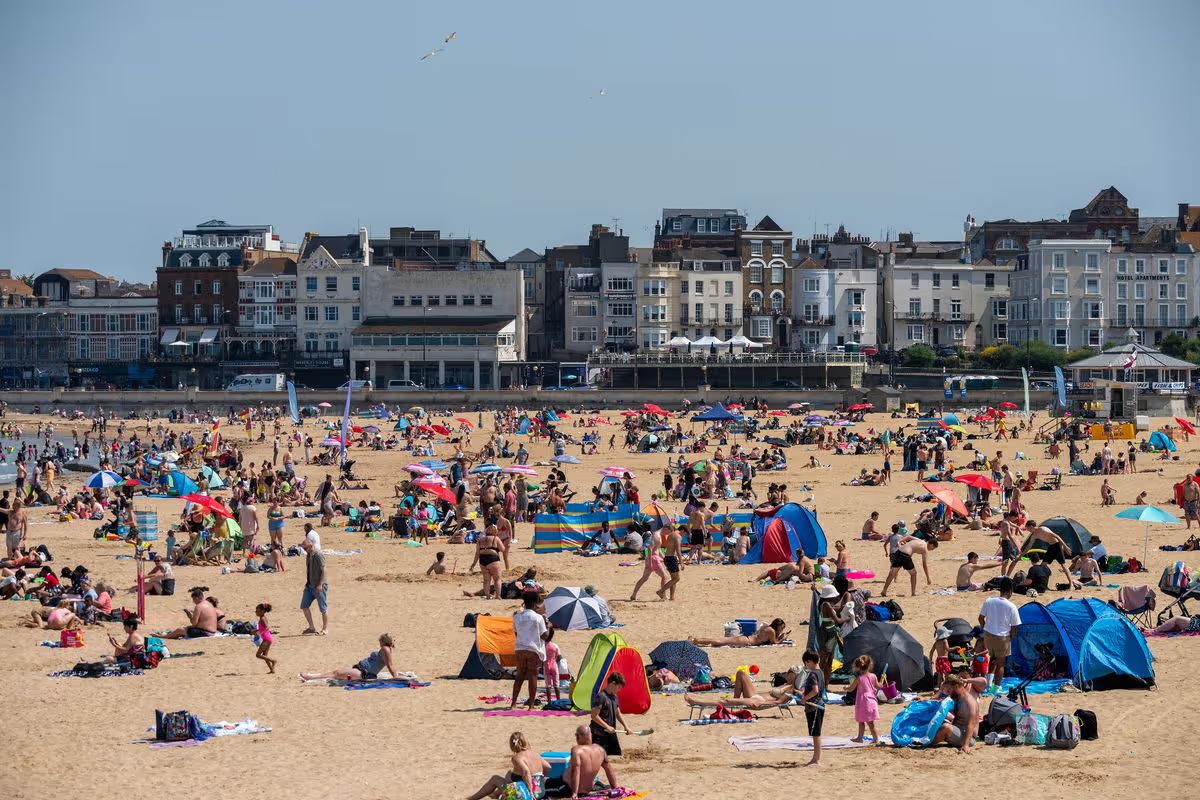
Not all ‘money saving hacks’ are worth your time(Image: Getty Images)
January and February are peak times for booking holidays, and at this time of year you’ll often see lists of travel tips that claim you can save money by following certain ‘hacks’.
But do they really work? The travel insurance team at Tiger.co.uk has shed light on five travel hacks that are shared pretty much every year, but may end up being a waste of your time. Luckily, the team has also revealed some practical tips to save money that can actually help holidaymakers slash their travel costs.
1. Using incognito mode when booking
Some money saving sites will tell you to use incognito mode when you make a booking, claiming this can lead to cheaper fares. This is based on the assumption that if you make repeated searches, the airline or travel provider will take your history into account and raise the fares.
However, Tiger explained that flight pricing algorithms are much more sophisticated than that, and while fare prices do change over time, this is based on demand, availability, and pricing, rather than what’s in your search history. An article in Quartz backs up this theory, citing studies that have shown there’s very little effect on the overall cost.
Many airlines offer different fare classes even within economy, and once one type of fare sells out, it’ll automatically move to the next, higher-priced one. This is more likely to explain why a fare has jumped up in price the second time you search.
2. Booking flights during the night
In the early days of internet travel booking, airlines used to update their fares manually overnight. Savvy travellers could set an alarm for first thing in the morning to save money on their flights.
Nowadays, airline websites are much more sophisticated and update prices 24/7, meaning its unlikely to make a difference whether you book during the day or night. However, this outdated travel hack still gets repeated now and again.
3. Booking last-minute gets you the best deals
Travelling at the last minute used to be a great way to bag bargain holidays. If you’re not fussy about your destination and flexible on dates, there are still cheap package holidays to be found, though they seem to be getting harder to find.
However, Tiger says that if you’re looking for cheap flights, planning ahead is a better option. Fares often increase as the departure date approaches and seats become scarcer. Try using Skyscanner or a similar flight comparison site with a price tracker to alert you when fares to your destination drop.
4. Only looking at budget airlines
Budget airlines often appear the cheapest because they offer impressive headline fares, but once priced up, a budget carrier might not be the best option for saving cash.
Once you’ve added the basics, such as baggage and paid to select your seat, you may find the cost is comparable to standard airlines where these extras are included. Always look at the total cost for a true comparison.
5. Always book a return
In the past, travellers were always advised to book return tickets as it worked out cheaper. But nowadays, with flight comparison tools available, it’s easier than ever to compare return fares on the same airline versus buying two singles with different carriers. Mixing and matching could save you money and often makes it more convenient to book a flight time that suits you.
Have a story you want to share? Email us at webtravel@reachplc.com
WASHINGTON — It took Democrats nearly a year to respond with a unified message to President Trump’s signature policy initiative, harnessing national outrage over the administration’s immigration enforcement tactics in Minnesota this week to leverage government funding and demand change.
Yet divisions persist as the party barrels toward midterm elections and, a year from now, the start of primary season. And Gavin Newsom stands right in the middle of them.
You’re reading the L.A. Times Politics newsletter
George Skelton and Michael Wilner cover the insights, legislation, players and politics you need to know in 2024. In your inbox Monday and Thursday mornings.
A calibrated position by the California governor has placed him to the right of the party’s progressive base that has opposed the very existence of U.S. Immigration and Customs Enforcement for years — well before Republican lawmakers passed legislation doubling the agency’s budget, increasing its presence and visibility in American life.
Newsom has rejected calls for ICE to be abolished since the 2024 campaign, when Democrats saw clear alarms in public polling that showed President Biden and his vice president, Kamala Harris, on the back foot against Trump on immigration. To the contrary, Newsom has highlighted California’s cooperation with the agency, and his efforts to protect that relationship from progressive local lawmakers.
While Trump’s federalization of the California National Guard last summer was prompted, in part, by protests in Los Angeles against ICE raids across the city, the governor’s reaction focused more on the president’s alleged abuses of power than on the ICE raids themselves. To the extent he did comment on them, Newsom characterized their deployment as unnecessary and gratuitous, a political tool used to intimidate the population.
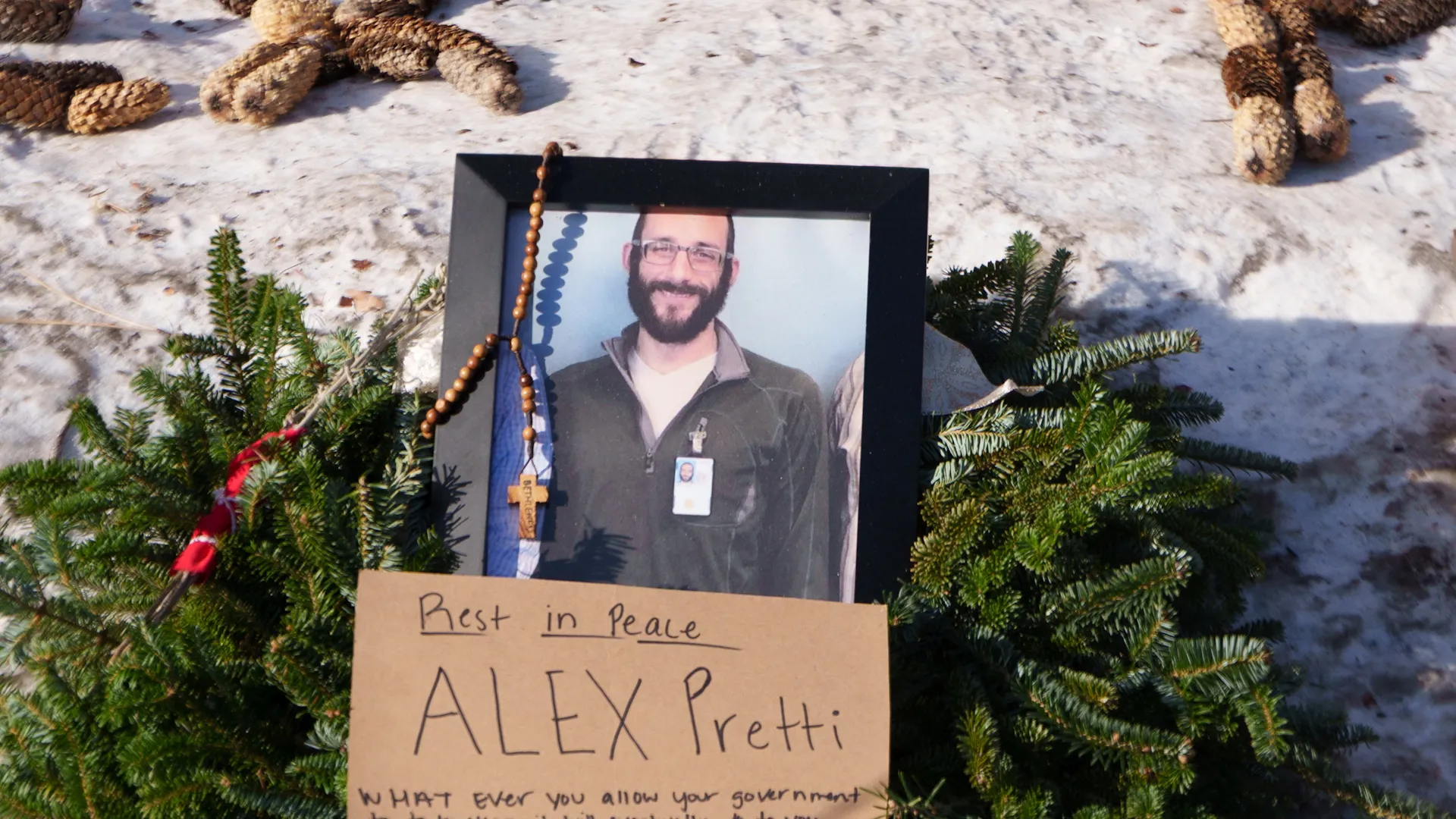
After the killing of U.S. citizen Renee Good, 37, by ICE officers earlier this month, and days before the fatal shooting of Alex Pretti, also 37 and a U.S. citizen, by Border Patrol agents last weekend, Newsom told conservative podcaster Ben Shapiro that his position against abolishing the agency had not changed. And he disassociated himself from a social media post by his office that characterized ICE’s conduct in Minneapolis as “state-sponsored terrorism.”
“California has cooperated with more ICE transfers probably than any other state in the country, and I have vetoed multiple pieces of legislation that have come from my Legislature to stop the ability for the state of California to do that,” Newsom told Shapiro.
The immigration enforcement agency received a massive influx of cash for detention facilities and recruitment last year with the passage of Trump’s One Big Beautiful Bill Act. Republicans now hope to build on that law with even greater appropriations this year, providing ICE with more funding than most foreign militaries, including the armies of Iran, Turkey, Canada and Mexico.
“I disagreed when I think a candidate for president by the name of Harris said that in the last campaign,” Newsom added, of calls to abolish the agency. “I remember being on [MS NOW’s Chris Hayes’ show] hours later saying, ‘I think that’s a mistake.’ So, absolutely.”
A progressive rallying cry
It’s a position in stark contrast with potential 2028 Democratic hopefuls that could pose a challenge to Newsom’s presidential ambitions.
Rep. Alexandria Ocasio-Cortez, a Democratic lawmaker from New York said to be considering a bid, has referred to ICE as “a rogue agency that should not exist.” The agency “doesn’t deserve a dime” of federal dollars, she has said, “until they can prove they are honoring human rights.”
Rep. Ro Khanna (D-Fremont), also rumored to be considering a run for the nomination, has advocated explicitly for ICE to be replaced with a new entity, built from scratch, without the baggage of the Sept. 11–era agency.
“Frankly, we need to tear down the ICE agency and have a new federal agency to enforce immigration law under the Justice Department,” Khanna said this week.
After Pretti’s death, Newsom also called for a pause to any “new funding” for ICE. He did not call for a review of its existing, historic levels of funding.
“Suspend the LAWLESS mass deportation raids nationwide NOW — ICE is no longer just deporting dangerous criminals,” the governor wrote on X. “Send the border patrol back to the border. End the militarization of ICE.”
Showdown on Capitol Hill
Pretti’s death is already complicating efforts to avert another government shutdown in Washington, as Democrats — joined by some Republicans — view the episode as a tipping point in the debate over the Trump administration’s immigration enforcement policies.
Senate Democrats pledged this week to block funding for the Department of Homeland Security unless changes are made to ICE operations in Minnesota. And Democrats in the House are calling for Homeland Security Secretary Kristi Noem’s departure as a condition in shutdown negotiations with the White House. House Minority Leader Hakeem Jeffries (D-N.Y.) threatened to pursue her impeachment if Trump doesn’t fire her first.
Both demands track with Newsom’s latest position. The California governor was harshly critical of Senate Democrats when, during the shutdown late last year, a core bloc voted with Republicans to reopen the government without achieving any meaningful concessions in their weeks-long fight over healthcare tax breaks.
The latest Democratic uproar over ICE tactics threatens a similarly broad spending package that also includes funding for the rest of the government, including the departments of Defense, Education, Health, Labor and Transportation.
“Senate Democrats have made clear we are ready to quickly advance the five appropriations bills separately from the DHS funding bill before the Jan. 30 deadline,” Senate Democratic Leader Chuck Schumer of New York said this week.
“The responsibility to prevent a partial government shutdown,” he added, “is on [Majority Leader John Thune (R-S.D.)] and Senate Republicans.”
Times staff writer Ana Ceballos, in Washington, D.C., contributed to this report.
A note to readers: I will be out on parental leave until April, but fear not, California Politics will be in capable hands. You’ll keep getting the latest each week from my distinguished colleagues.
I’ll see you all soon, Michael Wilner
— Was this newsletter forwarded to you? Sign up here to get it in your inbox.
Ask people who know Steve Holland well how they would describe the former Chelsea and England coach and the same phrase is repeated.
“Football is his life,” a source told BBC Sport.
“Whether it’s Champions League, thoughts on players or something else, he has a hell of a brain when it comes to football detail.”
It explains why, instead of sitting back and reflecting on the success of Manchester United’s 3-2 win at Arsenal, Holland spent the return journey to North West England going through footage of the victory with head coach Michael Carrick and the rest of his backroom team to come up with a plan for Sunday’s home game against Fulham.
On Monday, while the players were given a day off, Holland and company were at United’s Carrington training ground, honing the sessions they hope will lead to a third straight Premier League win.
Attention to detail is a Holland character trait, something he has relied on since joining Crewe in 1992, after concluding he would advance further as a coach than he did as a player if he dedicated himself to the profession at a young age.
Holland, 55, believes only former England boss Graham Taylor was younger than him when he gained what is now known as the Uefa A Licence coaching badge, when he was 21.
Of the rest of United’s new coaching set-up, boss Carrick had not even started secondary school when Holland began his coaching journey. Jonathan Woodgate is slightly older than Carrick. Jonny Evans and Travis Binnion are younger.
It is why Holland’s presence – and, through his England experience, ability to deal with intense pressure – is so vital to Carrick and his coaching team and why he is getting so much credit for the positive start to a tenure that has already delivered victories against Manchester City and Arsenal and taken United up to fourth in the Premier League.
“He won’t be bothered about the scrutiny and pressure at Manchester United,” says former Radio Stoke editor Graham McGarry, who got to know Holland well during his 16-year stint with Crewe.
“He will take it all in his stride and just do his job.
“His training sessions are fantastic. You can already see the Manchester United players are responding to them.”
Not that Holland is likely to be talking about it in public.
A second trait that keeps being noted is that he is a man of few words, someone who is difficult to read. “You never knew whether he was quietly content or silently raging,” said a source who has worked with him.
But that mask can help when it comes to delivering messaging. The less someone speaks, the argument goes, the more likely their audience is to listen when something is being said.
It is far too early to assess Holland’s work. It is just over two weeks since the coaching team were introduced to United’s players as a group for the first time, but several well-placed sources stress the coaching team work as a collective.
It should not be dismissed either that while Darren Fletcher didn’t win his two games in interim charge, he reset the formation following Ruben Amorim’s dismissal on 5 January. The Scot began to lift the mood. He also recalled Kobbie Mainoo. It meant key players Bryan Mbeumo and Amad Diallo returned from the Africa Cup of Nations to a stable environment, which gave Carrick the best chance of success.
Changes to the training programme have been made, according to sources. The days are now shorter, but more intense. There is a different energy about sessions and more focus on individual work with specific players. The matchday routine for home games has been tweaked so players now arrive at Old Trafford slightly closer to kick-off.
Carrick was given the job ahead of Ole Gunnar Solskjaer, in part, because of the work he does ‘on the grass’. But Holland ran the sessions with England, allowing Gareth Southgate to take an overview.
In consultation with Southgate, Holland concluded England’s formation had been ‘too stodgy’ in qualification for the 2018 World Cup, triggering the switch to a back three. “Harry Maguire’s ability on the was ball fundamental,” explained Holland in a half-hour dissection of his work for the Coaches Voice podcast in 2021.
Speaking to Sky Sports before the Manchester City game, Maguire recalled his own dealings with Holland.
“He was magnificent for England,” he said. “We all knew what we were doing.
“I can remember a lot of time working with Steve and he really does drill in tactically how to defend and how to keep the ball out of the back of the net.
“It’s basics but really disciplined basics. I feel he will have a big part to play in making our defensive record a lot better.”
Since leaving his role with England following Euro 2022, Holland has had a short, unsuccessful spell in Japan and undertook some work for the League Managers’ Association.
What he has not done is court media attention.
The Coaches Voice chats and others with the Football Association are rare examples of Holland being interviewed.
“The perfect number two,” as he has been described.
The insight that does exist is revealing.
“With any session the more the players are enjoying their work the more you will get out of them,” he explained in an interview published by the FA.
“It is important to try to find creative ways of delivering repetitive practice to stimulate the players’ interest.
“The key always with practice is the transfer into the game. It is important to try and maximise the possibility of a transfer by not steering too far from the reality of the game.”
He may be new to Manchester United but navigating the fall-out from a departing boss is something Holland has plenty of experience of.
It was then Blues manager Andre Villas-Boas who elevated him from the youth ranks to the senior team at Chelsea. “I was on holiday in Spain,” recalled Holland. “I took the call on day two and returned home on day three. My wife still reminds me of that regularly.”
Villas-Boas was sacked after nine months back in 2012. His successor, Roberto di Matteo, won the Champions League but was dumped after eight.
Behind the scenes, Holland was impressing. He survived the tenures of Rafael Benitez, Jose Mourinho and Guus Hiddink before quitting to concentrate solely on England after Chelsea won the Premier League in Antonio Conte’s first season in charge.
“At a big club, every day is a drama,” Holland told the Coaches Voice. “It is never quite as bad as it is made out to be but your ability to handle these moments are decisive.
“My experience of life at Chelsea has taught me it is about winning. That winning mentality doesn’t include feeling sorry for yourself or making excuses. It means you analyse and push to do better next time.”
They seem like wise words given the intensity of the noise that surrounds Manchester United, who will look to add more weight to claims their revival under Carrick and co is more than a flash in the pan when they host Fulham in the Premier League on Sunday.
From the outside looking in, it seems Holland is already having a significant positive impact at English football’s fallen giants.
The job might be tough, and the demands might be high, but it is fair to assume the Stockport-born ‘football obsessive’ is in his element.
United Kingdom Prime Minister Keir Starmer is on a three-day state visit to China as he seeks to deepen economic and security ties with the world’s second-largest economy after years of acrimonious relations.
This is the first trip by a UK prime minister to China since Theresa May met Chinese President Xi Jinping in 2018.
Recommended Stories
list of 4 itemsend of list
Here’s what you need to know about the trip aimed at mending ties at a time of global uncertainties:
What’s on Starmer’s agenda for China?
The UK PM met Xi and Chinese Premier Li Qiang in Beijing on Thursday. He will next head to Shanghai to meet British and Chinese business leaders, according to his official itinerary.
After their meeting on Thursday, Starmer and Xi called for a “comprehensive strategic partnership” between the two nations.
“China-UK relations experienced setbacks in previous years, which were not in the interests of either country,” Xi said. “In the current complex and ever-changing international situation … China and the UK need to strengthen dialogue and cooperation to maintain world peace and stability.”
In his opening remarks, Starmer told Xi the two nations should “work together on issues like climate change, global stability during challenging times”.
The prime minister is accompanied by a delegation of nearly 60 representatives of businesses and cultural organisations, including banking conglomerate HSBC, pharmaceutical giant GSK, carmaker Jaguar Land Rover and the UK’s National Theatre.
Starmer told Bloomberg there will be “significant opportunities” for UK businesses in China in an interview this week in the run-up to his trip.
His trip is also expected to mark a reset in UK-China relations, which have been strained in recent years. Starmer underlined his intentions during his meeting with Xi on Thursday.
“China is a vital player on the global stage, and it’s vital that we build a more sophisticated relationship where we can identify opportunities to collaborate, but of course, also allow a meaningful dialogue on areas where we disagree,” Starmer told Xi, according to the Reuters news agency.
British Prime Minister Keir Starmer, fourth right, and Chinese President Xi Jinping, fifth left, with their delegations participate in a bilateral meeting in Beijing on Thursday, January 29, 2026. [Carl Court/Pool Photo via AP Photo]
Why does the UK want to reset its relationship with China?
Starmer has framed his trip to China as a pragmatic move despite ongoing concerns back home about Beijing’s human rights record and potential national security threat.
“Like it or not, China matters for the UK,” Starmer said in advance of his trip to Beijing.
“As one of the world’s biggest economic players, a strategic and consistent relationship with them is firmly in our national interest. That does not mean turning a blind eye to the challenges they pose – but engaging even where we disagree,” he said.
China has rejected the allegations of human rights violations in parts of the country.
While few details have been released yet, Jing Gu, a political economist research fellow at the UK’s Institute of Development Studies, said reviving economic ties would require expanded “market access, predictable regulation and fair treatment of UK firms” alongside clear “guardrails”.
“This is not a question of being ‘pro-China’ or ‘anti-China’,” she said in a statement.
China offers a potential economic lifeline to the UK, whose economy has struggled in the decade since it embarked on its departure from the European Union in 2016.
A report by the nonpartisan National Bureau of Economic Research (NBER) in the United States estimated last year that Brexit reduced UK gross domestic product (GDP) by 6 to 8 percent, with the impact accumulating gradually over time. Investment is also down 12 to 18 percent, according to NBER estimates, and employment is down 3 to 4 percent.
The UK’s GDP is estimated to grow 1.4 percent in 2026, according to Goldman Sachs, as it faces new economic challenges from US President Donald Trump’s decisions and announcements.
The UK was not exempt from Trump’s tariff war despite its decades-long “special relationship” with the US. As a NATO member, the UK has also watched with alarm as Trump recently threatened to annex Greenland and impose up to 25 percent tariffs on any country that opposed him.
Starmer is not the only US ally looking to diversify economic ties. His trip to China follows in the footsteps of French President Emmanuel Macron, Australian Prime Minister Anthony Albanese, South Korean President Lee Jae Myung, Finnish Prime Minister Petteri Orpo and Canadian Prime Minister Mark Carney.
What strained the UK’s relationship with China?
The UK has longstanding concerns with China’s human rights record, but its relationship with Beijing took a turn for the worse after mass antigovernment protests swept Hong Kong, a former British colony, in 2019.
The UK was alarmed by the political crackdown that followed the 2019 protests and Beijing’s decision to impose legislation in 2020 that criminalised “secession, subversion, terrorist activities, and collusion with a foreign country or with external elements to endanger national security”.
In the aftermath, the UK opened a special immigration scheme for the citizens of Hong Kong born before the city’s 1997 return to Chinese sovereignty. British officials have continued to criticise Hong Kong’s national security trials, including the prosecution of pro-democracy businessman Jimmy Lai, who is a UK citizen.
Allegations of Chinese spying in the UK and China’s support for Russia in the Ukraine war have also frayed the ties.
Steve Tsang, director of the SOAS China Institute in London, told Al Jazeera that he did not expect any concessions in this area during Starmer’s visit. “Beijing will work to support Starmer to present the visit as a success, but it will not make any concession in areas that matter to China, such as human rights,” he said.
What about security concerns?
Concerns about Chinese spying have been a front-page issue in the UK over the past year, with the head of the domestic intelligence agency MI5 recently saying “Chinese state actors” pose a national security threat “every day”.
Despite these worries, Starmer’s government this month approved Beijing’s plan to open a “mega embassy” in London that critics say could become a hub for espionage in Europe.
The embassy’s approval also follows the collapse of a legal case against two British men charged with spying for China. The decision by prosecutors to withdraw charges at the eleventh hour remains highly controversial in the UK.
China has denied the spying claims, with its Ministry of Foreign Affairs calling them “unfounded” accusations.
Starmer’s trip, however, emphasised areas of potential security cooperation between China and the UK.
Following his meeting with Xi, the Prime Minister’s Office announced that law enforcement would cooperate with Chinese authorities to stem the flow of synthetic opioids into the UK and cut off the supply of small boat engines to criminal gangs.
Engine-powered boats are used to smuggle people across the English Channel, according to Starmer’s office.
The agreement will include “intelligence sharing to identify smugglers’ supply routes and direct engagement with Chinese manufacturers to prevent legitimate businesses being exploited by organised crime”, his office said.
Weekly insights and analysis on the latest developments in military technology, strategy, and foreign policy.
The future USS John F. Kennedy, the second Ford class aircraft carrier for the U.S. Navy, has begun its initial sea trials. The Navy is slated to take delivery of the ship in 2027 after years of delays.
Huntington Ingalls Industries (HII) announced that Kennedy, also known by the hull number CVN-79, had left port in Newport News, Virginia, earlier today to start initial sea trials.
“These trials will test important ship systems and components at sea for the first time,” HII wrote in posts on social media. “This huge milestone is the result of the selfless teamwork and unwavering commitment by our incredible shipbuilders, suppliers and ship’s force crew. We wish them a safe and successful time at sea!”
The future USS John F. Kennedy seen leaving Newport News, Virginia, earlier today. HII
The extent to which Kennedy has been fitted out is unclear, but the carrier is set to be delivered with some notable differences from the first-in-class USS Gerald R. Ford (CVN-78). This most notably includes an AN/SPY-6(V)3 radar, also known as the fixed-face version of Raytheon’s Enterprise Air Surveillance Radar (EASR), in place of Ford‘s Dual Band Radar (DBR). The DBR has proven immensely troublesome over the years, as you can read more about here. Pictures that HII released today show a number of differences between Kennedy‘s island and the one on Ford, due at least in part to the radar change.
A side-by-side comparison for the islands on the future USS John F. Kennedy, at left, and the USS Gerald R. Ford, at right. HII/USNA graphic showing elements of the AN/SPY-6(V)3 radar installation for the Ford class. Raytheon
Ford has suffered from a laundry list of other issues over the years, and HII and the Navy have working to leverage those lessons learned in work on all of the future ships in the class.
The Navy ordered the new Kennedy in 2013, and it was laid down at HII’s Newport News Shipbuilding division in 2015. The ship was launched four years later, at which time the goal was for it to be delivered in 2022. The Navy had originally pursued a dual-phase delivery schedule for the carrier, in which it would arrive initially still lacking certain capabilities. A Congressional demand for the carrier to be able to support F-35C Joint Strike Fighters at the time of delivery contributed to an initial slip in that schedule to 2024. At the time of writing, Ford has yet to set sail on an operational cruise with F-35Cs aboard.
The Navy subsequently shifted the timetable for Kennedy again from 2024 to 2025, ostensibly to complete work that normally would be done during a Post Shakedown Availability (PSA) after delivery. Last year, the service revealed that it pushed the delivery schedule further to the right, to March 2027. The Government Accountability Office (GAO), a Congressional watchdog, separately reported that the Navy might not have the carrier in hand until July 2027.
Another picture of the future USS John F. Kennedy taken today. HII
“The CVN 79 delivery date shifted from July 2025 to March 2027 (preliminary acceptance TBD) to support completion of Advanced Arresting Gear (AAG) certification and continued Advanced Weapons Elevator (AWE) work,” according to the Navy’s Fiscal Year 2026 budget request, which it began releasing in June 2025.
“Construction challenges affected CVN 79 and CVN 80 [the future USS Enterprise] delivery schedules. Continuing delays to Advanced Weapons Elevators construction put CVN 79’s July 2025 delivery at risk, according to program officials,” GAO said in its report, which came out that same month. “They said that, while this construction improved since CVN 78, they may postpone noncritical work like painting until after delivery to avoid delay.”
Problems with the AWEs on Fordbecame a particular cause celebre during President Donald Trump’s first term office, but the Navy said it had effectively mitigated those issues by 2021. The AWEs are critical to the carrier’s operation, being used to move aircraft munitions and other stores between the ship’s magazines and the flight deck.
Watch the Advanced Weapons Elevators on the aircraft carrier Gerald R. Ford
“Program officials attributed this delay [in work on CVN 79 and CVN 80] to construction material availability and persistent shipyard workforce issues that the program is working to mitigate with revised schedules and worker incentives,” GAO’s June 2025 report also noted. “The program reported it has not assessed the carrier industrial base for potential manufacturing risks but officials said that they plan to leverage other industrial base initiatives. This includes those related to submarines and within the Navy’s new Maritime Industrial Base program office.”
It’s not immediately clear how much all of this has added to Kennedy‘s price tag. Back in 2018, the Congressional Research Service (CRS) pegged Kennedy‘s cost at around $11.3 billion. A new CRS report published in December 2025 said the ship’s estimated acquisition cost had grown to $13.196 billion, citing Navy budget documents, but it is unclear if that accounts in any way for inflation. The Navy continues to estimate that future ships in the Ford class will cost even more, with CVN-81, the future USS Doris Miller, still expected to come in at around $15 billion. The Navy expects to acquire six more Ford class carriers, two of which have already been given names, the future USS William J. Clinton (CVN-82) and USS George W. Bush (CVN-83).
Acquiring more Ford class carriers is a critical priority for the Navy, which has been looking to start retiring its aging Nimitz class carriers for years now. If the Navy decommissions the USS Nimitz this year as planned, the total size of the service’s carrier force will drop to 10 hulls until Kennedy arrives. There is a standing legal requirement for the Navy to have no less than 12 carriers in service, which is reflective of the high demand for these ships, especially in times of crisis.
A look at the future USS John F. Kennedy‘s bow end as it departs on its initial sea trials. HII
“I think the Ford, from its capability perspective, would be an invaluable option for any military thing the president wants to do,” Chief of Naval Operations Adm. Daryl Caudle told TWZ and other outlets on the sidelines of the Surface Navy Association’s (SNA) annual symposium. “But if it requires an extension, it’s going to get some pushback from the CNO. And I will see if there is something else I can do.”
“To the financial and readiness aspects, we have maintenance agreements and contracts that have been made with yards that are going to repair the ships that are in that strike group, including the carrier itself,” Caudle noted. “And so when those are tied to a specific time, the yard is expecting it to be there. All that is highly disruptive.”
As an aside, CVN-79 is expected to be the first Ford class carrier homeported on the West Coast. Ford‘s homeport is Norfolk, Virginia, on the East Coast.
The Navy is now at least one step closer to taking delivery of the future USS John F. Kennedy.
A year ago, Colorado firefighters Rick Balentine and Tim Cottrell were driving trucks carrying donations from Aspen to Los Angeles for victims of the Eaton and Palisades fires.
As they headed west, they planned to stop in Las Vegas and, while there, made a spontaneous decision to see the Eagles’ residency at the Sphere. Balentine and Cottrell bought resale tickets on StubHub for around $400 each. Cottrell used his credit card and received a confirmation email. But once they arrived to the venue, they weren’t allowed in. The seller failed to send the tickets.
All Cottrell could find was an email that said his tickets had been canceled, moments before the concert was to start. Other than getting their money back, there was no further explanation.
“We knew they were aftermarket tickets,” Balentine said, “but never in a million years did I think that tickets could get canceled.”
“I was very disappointed. There needs to be more protection out there, both for consumers and for artists, so people aren’t getting ripped off all the time.”
The rising demand for tickets has spurred a growing marketplace for all kinds of high-profile live events, including music tours and sports series like the upcoming World Cup. Whenever fans are unable to secure tickets on the primary market, through sellers like Ticketmaster or AXS, many will turn to the secondary market for resale tickets. Those tickets are typically sold through platforms like StubHub, SeatGeek and Vivid Seats. Customers who bought their passes directly from Ticketmaster can also resell them on that platform.
The majority of secondary-market transactions can be easy, leaving both the reseller and the customer satisfied. But with the rise of speculative or fake tickets, like the ones Balentine and Cottrell bought, securing valid tickets from the resale market has become more challenging.
What are speculative tickets?
Speculative tickets are offered by resellers who list concert passes they don’t yet have in their possession, with the intention that they will ultimately acquire the tickets and deliver them to the buyer. According to 2025 data from Live Nation, one in three Americans has fallen victim to a ticketing scam. But under California’s bill, AB 1349, selling speculative tickets could be banned on all resale platforms in the state. On Monday, the bill passed in an assembly vote and is headed to the state Senate for review.
Thousands of fans enjoy Shakira’s performance at SoFi Stadium in August.
(Jason Armond/Los Angeles Times)
Speculative tickets usually pop up as soon as a major artist announces a tour. Most recently, K-pop boy band BTS announced a world tour that includes four stops at SoFi Stadium. Before the general sale began Jan. 24, some sellers on Vivid Seats had already started listing tickets for over $6,000. Listings like these usually create a greater sense of scarcity, which can drive up ticket prices even more.
If enacted, the proposed legislation in California would require sellers to have event tickets in their possession before offering them for sale. The listing must include the location of the seat and specific refund rights. It prohibits a person from using software that automatically purchases more tickets than the specified limit, and it would raise the maximum civil penalty for each violation from $2,500 to $10,000.
The live music industry is a vital part of the state’s economy, contributing over $51 billion to California’s GDP and supporting over 460,000 jobs, according to the database 50 States of Music.
Ticketing fraud tends to affect more than just the consumer. Whenever an unknowing fan shows up to a venue with a fake ticket, it often falls on the venue and its staff to deal with the situation. Stephen Parker, the executive director of the National Independent Venue Association, said that if speculative tickets are banned in California, venues could save up to $50,000 in staffing expenses.
Los Angeles’ SoFi Stadium, where many concerts and ticketed live events are held.
(Icon Sportswire/Icon Sportswire via Getty Images)
“They have to deal with fans who are crying, who are angry, who are upset because they thought they were going to go see their favorite artists that night, and they paid [over the] ticket’s face value only to not get a ticket that works or to not get a ticket at all,” said Parker.
Fighting ticket fraud and reining in a ticketing giant
There are currently dozens of legislative bills throughout the U.S. focused on event ticketing issues. Some states like Maryland, Minnesota and Maine have already passed restrictions on speculative tickets.
The action comes after both the Department of Justice and the Federal Trade Commission sued Ticketmaster and its parent company, Live Nation Entertainment, in 2024 and 2025. The DOJ’s lawsuit suggests breaking up the company, which it accuses of engaging in monopolistic practices. The complaint also alleges the company forces venues into exclusive ticketing contracts and influences artists to use only its services.
Founded in 1976, Ticketmaster has been the industry’s largest ticket distributor since 1995, with around 80% of live concerts sold through the site. The company merged with Live Nation in 2010.
Ticketmaster has also acquired a growing share of the resale market, under the platform Ticketmaster Resale. The site allows consumers to list, sell or find tickets to live events. The business functions similarly to other resale sites, but Ticketmaster does not allow speculative ticket sales on its platform.
The Federal Trade Commission is currently suing the company on accusations that it engaged in illegal ticket vendor practices for its resale business, like misleading artists and consumers with so-called “bait-and-switch pricing,” where advertised prices are lower than the actual total. Following the FTC’s complaint, the ticket seller made changes to its policies.
Additionally, Ticketmaster is no longer allowing users to have multiple accounts, which made it easier to purchase more tickets than the specified limit, and it is shutting down Trade Desk, the controversial software that helps resellers track and price tickets across several marketplaces.
Hundreds enjoy a performance by Banda Los Lagos during Jalisco Fest at the 2025 Santa Fe Springs Swap Meet.
(Genaro Molina/Los Angeles Times)
“The FTC case against us is very frustrating because we think they’re sort of blaming the victim here. We’re the ones that are dealing with millions and millions of bots attacking us every day,” said Dan Wall, Live Nation’s vice president of corporate and regulatory affairs. “We’re trying to convince the federal government and state governments to get on the same page of recognizing where the problem is, which is overwhelmingly in the resale industry, and trying to do something about it.”
“We’re a much more artist and consumer-focused company, and so we don’t engage in the different kinds of business practices that are sketchy and unfair to the fans. We try to be a much more honest, legitimate outlet for getting resale tickets,” said Wall.
Critics find that the surge of anti-speculative ticketing bills around the country is a way for Ticketmaster to divert attention from its own legal troubles and shift attention onto the resale market. Live Nation is a key supporter of the California bill. Diana Moss, the director of competition policy at the Progressive Policy Institute, called AB 1349 “overkill” when it comes to the provisions and restrictions it places on the secondary market.
Fans cheer Sexyy Red at the Rolling Loud concert at Hollywood Park in March.
(Michael Owen Baker/For The Times)
“A lot of these bills in the states are a vehicle to disable the resale markets and hinder how they operate. Resale markets are important to consumers,” said Moss. “If you disable the resale market, then fans have no place to go — but back to Ticketmaster. That’s the whole game, disable the resale markets with legislation and regulation, and then everybody has to go back and deal with Ticketmaster and pay their monopoly ticket fees.”
Provisions in AB 1349 deem a ticket a license. The question of whether a ticket is a right or a license is an ongoing controversy in the ticketing world. Opponents of the bill are fearful that this change would give more power to Live Nation, as they could impose restrictions on how the ticket can be used, such as whether you’re allowed to sell your ticket on other platforms or if you can transfer it at all. Meghan Callahan, from the Empower Fans Coalition, a group that opposes the bill, equates this licensing change to taking a lease out on the ticket.
“Ticketmaster’s goal is to create less competition. This bill imposes restrictions on everybody else but themselves,” said Callahan. “They are trying to use consumer-friendly concepts and sneak in these other provisions to embolden their monopoly.”
Wall at Ticketmaster said that nothing on the consumers’ end would change if this bill were to pass, adding that tickets are already licenses “from the venue for you to come on the property during the time of the show and sit in that seat.”
“Honesty doesn’t favor one person or another. That’s what this [bill] is about,” said Wall.
Oil prices rose on Thursday after US President Donald Trump warned Iran that “time is running out” and said a “massive armada” was heading towards the region if Tehran failed to agree to a nuclear non-proliferation deal.
In a Truth Social post, Trump said a fleet larger than the one sent to Venezuela was ready to “rapidly fulfil its mission, with speed and violence, if necessary” if Iran refused to negotiate a deal guaranteeing “no nuclear weapons”.
Global benchmark Brent rose by about 2.02%, trading at around $68.73 per barrel, while US crude (WTI) hovered around 2.15% higher, at $64.57 per barrel.
Trump previously threatened to attack Iran if it killed protesters during the ongoing protest movement across the country. Estimates of those killed range from around 6,000 to as many as 30,000, according to various reports.
Oil delivery disruptions
If the US were to escalate militarily, it could disrupt oil flows to countries that still trade with Iran.
Iran’s economy is already under heavy pressure from US secondary financial sanctions on its banking and energy sectors, compounded by the reimposition of JCPOA snapback sanctions.
These measures have severely limited Iran’s access to the Western financial system and constrained its ability to trade openly.
As a result, Iranian exports rely heavily on so-called “dark fleets,” ship-to-ship transfers and intermediary routes designed to obscure cargo origins along major maritime corridors.
Yet despite years of sanctions, Iran has retained access to oil markets, underlining the difficulty of fully enforcing restrictions on a high-value global commodity.
“Iran has a number of markets for its oil, despite the Western sanctions regime,” said Dmitry Grozubinski, a senior advisor on international trade policy at Aurora Macro Strategies.
China at centre of enforcement risk
China remains the largest buyer, with reports suggesting Iranian crude is often rebranded as Malaysian or Gulf-origin oil before entering the country.
“Independent refineries are purchasing it using dark fleet vessels, with transactions conducted through small private banks and in renminbi,” Grozubinski said.
Other destinations for Iranian oil and derivatives include Iraq, the UAE and Turkey, further complicating enforcement.
“It’s extremely difficult to maintain comprehensive sanctions on oil,” Grozubinski said, “especially when it requires policing transactions between Iran and states that don’t fully share Western priorities.”
China currently imports an estimated 1.2 to 1.4 million barrels of Iranian oil per day — around 80 to 90% of Iran’s crude exports.
US escalation could provoke Beijing
That dependence makes Beijing the central variable in any escalation. Analysts say China would be the most likely major economy to resist compliance and retaliate.
“Beijing has already signalled it would respond if Trump follows through,” said Dan Alamariu, chief geopolitical strategist at Alpine Macro, warning of renewed US–China trade friction.
One risk raised by analysts is the potential for China to again restrict exports of rare earths — a tool it has previously used during periods of trade tension — although such a move is considered unlikely in the short term.
“It’s not the base case,” Alamariu said, “but it’s not impossible.”
YOU might think a holiday city break with the entire family would be an expensive staycation – but I’ve found a cheap way to do it.
My family of five stays in a different UK city or town every February half-term for less than £50, thanks to a cheap-as-chips offer from the Youth Hostel Association.
Sign up for the Travel newsletter
Thank you!
Staying in YHA Hostels across the UK can cost as little as £7pppnCredit: Catherine LofthouseThey’re in major cities too like Manchester, Liverpool and LondonCredit: Catherine Lofthouse
What we especially love about our little break away is that we can get a room in a beautiful building in a luxury location for very little money.
Family rooms and cabins are already pretty affordable at this time of year anyway and the annual YHA January Sale discount code takes an extra 20 per cent off, which makes it incredible value for money.
The deal is still running and covers February half-term and the Easter holidays, so you can take a trip to city, countryside or coastal hostels during the school holidays for next to nothing.
We love a city break at this time of year as it’s the perfect way to while away the grey days. Generally there are very few tourists about and we can normally find lots of free stuff to do indoors at museums and the like.
My favourite was when we stayed at YHA Chester Trafford Hall a couple of years ago, as that was the perfect blend of city and countryside.
It was glorious to be greeted by a carpet of snowdrops as we arrived at the hostel, an old Georgian mansion set in lovely grounds.
You can hop on the bus nearby to get into the city centre in less than half an hour and go for a wander through the historic streets, taking in Roman ruins and the Rows, covered wooden walkways that allow access to shops at first-floor and street level, a famous feature of the city since medieval times.
Our family room only cost £29.25 (£5.85pppn) and another great element of a hostel stay is that there’s generally a self-catering kitchen, a restaurant where kids eat for £1 and a games room.
We can choose whether to cook for ourselves or order from the restaurant menu and the boys have somewhere to entertain themselves while waiting for food.
It’s lovely staying somewhere that’s got a bit of character and seeing a historic building given a new lease of life for the 21st century.
And it’s great to chat to other guests using the communal areas and pick up tips for where to visit next.
This February, we’re heading for Canterbury to stay in a cosy log cabin for just £34 a night for the five of us – which works out at £6.80 each.
We can’t wait to check out the sights, including the historic cathedral, and hopefully head to the Kent coast if the weather is okay.
It was a bit of a toss up between Canterbury and staying at the iconic Albert Docks in Liverpool for just £28 for a room for four people.
Some YHA Hostels like Chester is found inside a pretty mansion houseCredit: Refer to SourceThe camping pods in Stratford have a bedroom, kitchenette & shower room with a toiletCredit: Refer to Source
I’ve been visiting this northern powerhouse since I was a child and I love the warm Scouse welcome we always get when we go back.
So if you want to follow in the footsteps of the Beatles or take a ferry across the Mersey, this could be the perfect base for you.
YHA Manchester also has £40 rooms for a family of five and its canalside location is just a 15-minute walk from the city centre.
One year, we took a trip to YHA Bath, another gorgeous Georgian villa a walk or bus ride away from the city centre.
Bath can get pretty crowded once the weather warms up so going in February is perfect if you don’t want too much hustle and bustle. A stay in a family room there is £72 during half-term.
Using a youth hostel as a base can also be a really affordable way to visit the capital over in the holidays. We stayed in a log cabin at YHA Lee Valley one February, which is next to Cheshunt railway station, where trains stop en route to Liverpool Street.
It was slightly surreal waking up in a nature reserve surrounded by birdsong and then being in the heart of the city within half an hour. The best London deal I’ve spotted for this half-term is at YHA Earls Court, where a six-bed family room costs just £48.
If you’re not a fan of city breaks, the January sale discount code also works for lots of the Lake District hostels and other countryside locations, which often have outdoor cabins and glamping options as well as family rooms.
We visit YHA Stratford-upon-Avon most years to stay in the deluxe camping pods behind the main building.
They’ve got a little kitchenette and a built-in shower room with toilet, so the pods are a lovely place to get a bit of peace and quiet, before heading into town to enjoy some of the tourist hotspots before they get busy later in the year.
We’ve stayed for less than £20 a night for all of us before, but this half-term, the pods cost £48 using the sale code.
You really can’t beat a YHA stay if you want to bag a bargain and take the family away for a night in half-term for next to nothing.
Catherine is heading to Canterbury for her next YHA Hotel trip
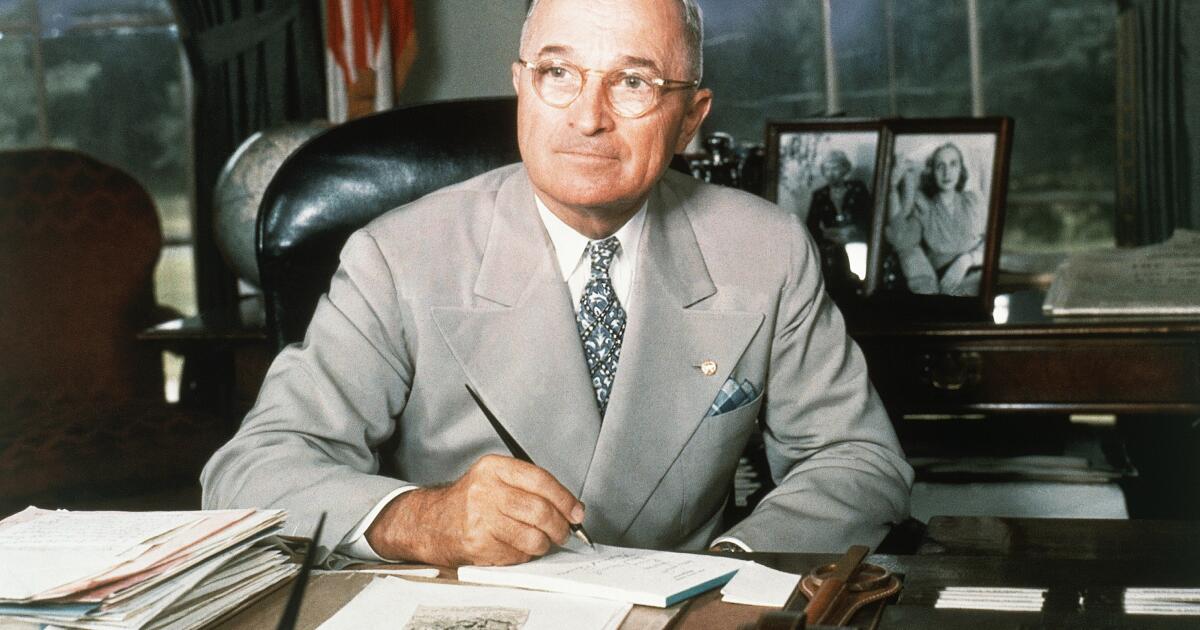
For just $95, the acquisitive President Trump could have a replica of the iconic “The Buck Stops Here” sign that sat atop President Truman’s Oval Office desk, gift-boxed from the Harry S. Truman Presidential Library and Museum Store. But this gewgaw isn’t gold; it’s wood. And yet that’s not the reason it wouldn’t be at home on Trump’s desktop.
Here’s why: As far as Trump is concerned, the buck never stops with him.
That’s never been more evident than this month, in the president’s fly-above-it-all attitude toward his administration’s armed occupation of Minneapolis. Ostensibly a campaign against immigrants who lack legal status, the occupation has (at this writing) killed two U.S. citizens exercising their 1st Amendment rights to protest the anti-constitutional brutality of federal agents.
Trump couldn’t even be bothered to postpone his black-tie White House screening of Amazon’s $75-million gift documentary of his wife, “Melania,” on Saturday, just hours after 37-year-old VA nurse Alex Pretti died and as Minneapolis seethed. When the president did interject, he mostly just escalated tensions. Again.
After the earlier killing of Renee Good, Trump posted to Minnesotans: “The day of reckoning and retribution is coming!” and deployed an additional 1,000 armed, masked agents for a total of 3,000. Further mayhem was widely predicted. And on Saturday, after at least two of those agents pumped 10 shots point-blank at Pretti while he was pinned down, Trump’s first reaction was this escalatory, blame-the-victim post over a photo: “This is the gunman’s gun, loaded (with two additional full magazines!), and ready to go.”
Got that? According to the president, Pretti was the gunman in what I and many other Americans saw as his murder by Trump’s militia. The buck, and the bullets, stopped with Pretti.
Trump continued to blame the victim for days, including on Tuesday in Iowa, by repeatedlycontending (over the angry opposition of his pals in the gun lobby) that Pretti “shouldn’t have been carrying a gun.” It was a holstered handgun that Pretti legally owned and carried, which he never “brandished” as the feds claimed and which was taken from him before he was shot.
Not once in the year since he loosed this militant deportation campaign in U.S. cities has Trump openly questioned the lawless tactics. Since Pretti’s killing, the president hasn’t publicly upbraided his Department of Homeland Security or his most senior advisors — Stephen Miller, the White House architect of Trump’s anti-immigrant policies; Kristi Noem, his puppy-killing Homeland Security secretary; and Gregory Bovino, his cruelly performative (former) Border Patrol commander in Minneapolis (after Los Angeles, Chicago and New Orleans) — for their immediate and repeated slanders of Pretti as a “domestic terrorist” and “an assassin” who aimed to “massacre law enforcement.”
Those were all lies, as the world soon saw thanks to the courageous protesters on the scene documenting the agents’ lawlessness with cellphone cameras. And now, even some (few) Republicans in Congress are assailing Noem, Miller and Bovino, calling for their resignation, firing or, in Noem’s case, impeachment.
Enough, however, with the focus on Noem, Miller, Bovino or others of Trump’s “best.” It’s good that Republicans are finally rousing to object to administration actions. But they should quit cloaking their complaints in language that absolves the boss. These Republicans would have us believe that Trump is faultless, ill-served and misled by his advisors.
Among the foremost modelers of this behavior is Republican Sen. Thom Tillis of North Carolina, who grew a bit of spine in the summer after he announced that he wouldn’t seek reelection. Yet he still blames everyone around Trump, not Trump himself.
What Noem has done in Minnesota “should be disqualifying,” Tillis told reporters Tuesday. “It’s making the president look bad.” Later, he ranted about both Noem and Miller, lamenting that immigration used to be Trump’s and Republicans’ best issue until that duo “destroyed it through their incompetence.” Last week, he blamed Miller for “getting the president in a difficult circumstance” over Greenland, as if it wasn’t Trump himself who insanely demanded that Denmark and NATO allies hand over the island protectorate to the United States — because it’s “psychologically important for me.”
This is Trump’s paramilitary force at Immigration and Customs Enforcement and the Border Patrol. These advisors are his hires at the White House and in the Cabinet. And these are his policies.
The president is consistently the arsonist who attempts to take credit for putting out his own fires (like last week’s conflagration at Davos over Greenland) when they get out of control. Which is to say, when poll after poll confirms both the policies’ and Trump’s growing unpopularity.
Forget that he won’t accept the buck: It still should stop with him.
As Noem insisted in a statement to Axios on Tuesday: “Everything I’ve done, I’ve done at the direction of the president and Stephen [Miller].”
She and Bovino, heretofore so fond of cosplaying in getups that scream “I’m tough,” are now wearing tire tracks. With Trump’s dispatch of border advisor Tom Homan to Minneapolis, they’ve essentially been designated as scapegoats for the tragedies in Minnesota. But not Miller: “The president loves Stephen,” White House Press Secretary Karoline Leavitt told Axios.
Of course he does. Miller is Trump’s Mini-Me. Which brings us back to: Blame Trump.
The imperative to hold Trump accountable is why I’m cool to calls to impeach Noem. Democrats seeking her removal include House Minority Leader Hakeem Jeffries of New York and former Speaker Nancy Pelosi, and they’re joined by a few Republicans. It feels good to say it, and such calls are fine as a message of disgust, especially in a midterm election year. But Congress is Republican-controlled, remember, which is to say Trump-controlled.
For the same reason, Trump himself is insured — for now — against impeachment. But as he’s acknowledged, if Democrats take control after November, that would probably change. Forget that the Senate probably wouldn’t convict him, just as it declined to do twice after his impeachments in his first term. But at least, come 2027, he could be forced to take the buck.
Manchester City’s Kerstin Casparij has been chatting about her life on and off the field – and treating BBC Sport’s ex-England star Alex Scott to her Dutch homeland delicacy oliebollen.
The semiconductor production facilities of Samsung Electronics in the south of Seoul. Photo courtesy of Samsung Electronics
SEOUL, Jan. 29 (UPI) — South Korea’s two semiconductor giants, Samsung Electronics and SK hynix, posted record performances last year, driven by the rising demand for memory chips amid the AI boom.
Samsung Electronics announced Thursday that its fourth-quarter operating profit more than doubled year-on-year to $14 billion on sales of $65.6 billion, up 23.8%. Both were all-time highs.
For the full year 2025, revenue rose 10.9% from a year earlier to $233.4 billion, while operating income climbed 33.2% to $30.5 billion.
The strong showing came a day after SK hynix released its strong earnings.
In the final quarter of 2025, SK hynix posted $23 billion in sales, up 66% from a year before, for an operating profit of $13.4 billion, a 137% surge.
For the full year, its turnover and operating income increased 47% and 101% to $68 billion and $33 billion, respectively.
The 2026 outlook for both companies remains bright amid continued expansion in the AI industry.
“Looking ahead to Q1 2026, the DS Division expects AI and server demand to continue increasing, leading to more opportunities for structural growth. In response, the division will continue to focus on profitability via a strong emphasis on high-performance products,” Samsung said in a statement.
“In 2026 as a whole, the DS Division aims to lead the AI era with product competitiveness amid a rapidly growing demand environment, particularly by expanding the sales of AI-related offerings in both DRAM and NAND,” it added.
Short for device solutions, Samsung’s DS Division deals with semiconductors and components. By contrast, its device experience part handles mobile phones, home appliances and network equipment.
“As the AI market shifts from training to inference while demand for distributed architectures expands, the role of memory will become increasingly critical,” SK hynix said in a statement.
“Accordingly, not only demand for high-performance memory such as HBM is expected to grow continuously, but also for overall memory products including server DRAM and NAND as well,” it said.
Semiconductor super-cycle and DRAM beggars
In line with the upbeat prospect, brokerage houses project that Samsung’s bottom line will near $90 billion this year, while that of SK hynix will surpass $70 billion.
SK Securities even forecasts that Samsung and SK hynix each will rack up more than $100 billion in profits this year.
Soaring semiconductor prices and outstanding earnings of chipmakers have fueled talk of a “semiconductor super-cycle.”
Business tracker TrendForce predicts that DRAM prices will rocket more than 55% in the first three months of 2026 compared to the previous quarter. Those of NAND flash are also expected to climb over 30% over the same period.
SK Securities analyst Han Dong-hee also said that supply shortages are spreading across all product segments, including advanced high-bandwidth memory, which is essential for AI applications, as well as commodity DRAM used in mobile devices or computers.
“For customers, the top priority has become securing stable volumes through long-term agreements, while suppliers are expected to pursue profit maximization and stable growth by optimizing the share of long-term contracts,” Han said in a report.
Sungkyunkwan University semiconductor professor Choi Byoung-deog said that there are “DRAM beggars,” or executives from major global tech companiesm who have been traveling to Korea to beg for chips from Samsung and SK hynix.
“The super-cycle in memory will eventually come to an end. As global tech giants keep pouring massive investments into AI, however, the current upcycle is likely to last two or three years,” Choi told UPI. “That’s why desperate buyers are flying to Korea to plead for memory chip supplies.”
Sungkyunkwan University semiconductor professor Han Tae-hee struck a more cautious tone, though.
“I also expect that the present super-cycle will continue through this summer. But beyond that, any unexpected events could take place to weigh on the semiconductor industry,” Han said in a phone interview.
“Six months ago, we could not predict today’s booming memory chip sales. Likewise, we cannot know for sure what will happen six months later.”
The share price of Samsung Electronics fell 1.05% on the Seoul bourse Thursday, while SK hynix rose 2.38%.
French forward Kylian Mbappe questions team’s desire after damaging defeat sends Real Madrid into playoffs.
Published On 29 Jan 202629 Jan 2026
Share
Real Madrid striker Kylian Mbappe has said his team “deserve” to be in their current situation because they were not consistent enough for a top-eight spot as his side slipped into the Champions League playoff round.
The record 15-time European champions fell to a 4-2 defeat at Jose Mourinho’s Benfica on Wednesday, finishing ninth in the league phase table, meaning they must face their Portuguese conquerors or Bodo/Glimt in February instead of reaching the last 16 directly.
Recommended Stories
list of 4 itemsend of list
After three wins in their previous three matches under new coach Alvaro Arbeloa, Madrid were brought back down to earth by Benfica in Lisbon.
“The problem is we aren’t consistent in our play, we have to fix that, you can’t have one day [playing well] and another not, a champion team does not do that,” Mbappe told reporters.
“We deserve to be in this situation today. Benfica were better. Now we have to play two more playoff games. It hurts to have to play those. We wanted to have the time in February to work on our game.”
Mbappe said he could not put his finger on a clear reason why Madrid played so poorly against Benfica.
“I think it’s a bit of everything. I can’t tell you it’s just a matter of attitude, because if I only say that, you’ll think we came here without any desire,” said the French superstar, who scored twice in the defeat.
“If I tell you it’s a football issue, you’ll think the team is bad. No, I think it’s a broader issue, and in the Champions League, every detail matters if you want to beat your opponent.
“It shows you that if you don’t come in with everything you need to win a Champions League match, the opponent will come and, as they say, make fools of you.”
However, Mbappe called on Madrid’s fans to support the team at the Santiago Bernabeu on Sunday against Rayo Vallecano in La Liga, rather than booing as they did earlier in January.
“Come and support the team – we had a bad game – but we are not knocked out of the Champions League, and in La Liga we’re in a good dynamic now,” pleaded Mbappe.
“If the Bernabeu is with us, we will win on Sunday.”
This article contains spoilers for Part 1 of Season 4 of “Bridgerton.”
Luke Thompson and Yerin Ha are lounging on a blue velvet couch in a swanky green room inside of Netflix’s offices in New York, bracing for the whirlwind that inevitably envelops every pair of actors who become the central couple in a season of the popular romance drama “Bridgerton.” And they’re still settling into the idea of being romantic leads.
“It doesn’t feel real,” Ha says fresh into their first press day in early December. “Because for a very long time, I didn’t think that it was possible for me — maybe I should have dreamed bigger. To keep saying that I’m the lead of a season feels really bizarre.”
“But maybe that’s a way of coping with it,” Thompson says. “I remember in Season 1, I just finished a Zoom call and I just sat in my living room and it was the first time I really touched into the idea that millions of people are watching this thing. Millions of people. And I never did it again.”
“You just did it for me now,” Ha says with a smidgen of dread that launches the pair into laughter. “That’s not really helping.”
Thompson, though, isn’t feeling the pressure of keeping the romance alive and extremely meme-able as they take up the mantle of the Regency-era fairy tale.
“It’s a show that’s proven time and time again that there’s huge appetite for romance,” he says. “It was a genre that might have been, not looked down on, but not really taken very seriously. To be able to incarnate some projection of romance for people, particularly in January and February, when people are feeling a bit miserable, maybe, it’s lovely to be part of that.”
The duo play Benedict and Sophie, affectionately dubbed #Benophie, a couple whose story gives the classic Cinderella tale a bit of steam and is one that readers of Julia Quinn’s “An Offer From a Gentleman,” which inspired this season, know well. Thompson’s Benedict, whom “Bridgerton” viewers have come to know as the artistic, pansexual second-oldest son of the Bridgerton clan, has long shown disinterest in settling down or adhering to societal norms. But then in Part 1 of Season 4, released Thursday, he meets Sophie Baek, a maid in her abusive stepmother’s home, at a masquerade ball hosted by his mother. Viewers eventually learn Sophie’s servitude is forced after her parentage is revealed — she’s the illegitimate daughter of an earl.
Yerin Ha as Sophie Baek and Luke Thompson as Benedict Bridgerton during their masquerade ball meet-cute in Season 4.
(Liam Daniel / Netflix)
Showrunner Jess Brownell says this season, they were is interested in prodding the wish-fulfillment fantasy many of us were introduced to at a young age.
“We learn about them as children from Disney movies,” she says. “For us, though, in interacting with this trope, it was really important to interrogate it a little bit. I think what our interrogation hopefully reveals is that oftentimes it’s the prince figure or the man of a ‘higher station’ who … needs to do some work on himself, to step out of his fantasy life a little bit and step more into reality to be worthy of the love of a Cinderella-type. It’s not to say that the Sophie character doesn’t have her own journey to go on, I think that she absolutely has to let her walls down and has to allow herself to dream of and believe in the possibility of love.”
Over a video call from that cozy couch inside Netflix’s offices, Thompson and Ha discussed navigating the spotlight as the newest “Bridgerton” couple, this season’s very unromantic declaration of love and trying to capture a swoon-worthy meet-cute behind an oversized mask.
The excitement for this season is already in full effect. How are you feeling about Benophie as the couple name? Am I even pronouncing it right?
Thompson: I don’t know!
Ha: I think that is right. I initially said Ben-off-ee like Banoffee pie, but then I realized it wouldn’t make sense because it’s So-fee. So Ben-o-fee would make more sense.
Thompson: There’s been a couple of fun AI pictures.
Ha: I actually just got one yesterday from my mom about our kids, our future kids. [Thompson laughs.] And I was like, “Mom, why are you on the internet looking at these things?” So it’s really out there, and I’m really being fed it out of my own will, but it’s amazing to see people already so excited about it and wanting to create things and future possibilities. It’s quite amazing. And the fans are actually so lovely.
Thompson: I think that’s one of the best things about social media, actually; that whole aspect of people projecting or imagining themselves or creating stuff sometimes. That’s something that we never used to be able to really get a handle on, but to be able to see the amount of energy and thought that people put into it is kind of amazing.
Ha: Also creative artistry. So many fans are drawing, sketching. It’s incredible. The amount of talent that people just share with us, it’s really beautiful.
1
2
3
4
1.The “Bridgerton” couples over the seasons: Simon Basset (Regé-Jean Page) and Daphne Bridgerton (Phoebe Dynevor) in Season 1.2.Kate Sharma (Simone Ashley) and Anthony Bridgerton (Jonathan Bailey) in Season 2.3.Colin Bridgerton (Luke Newton) and Penelope Featherington (Nicola Coughlan) in Season 3.4.Benedict Bridgerton (Luke Thompson) and Sophie Baek (Yerin Ha) in Season 4.(Liam Daniel / Netflix)
Luke, you’ve had three seasons to observe how others have taken on this mantle. Did Jonathan or Luke impart any words of wisdom as you stepped into lead duties? Did you have any observations in watching them navigate the spotlight and the intensity of this?
They were always very, very open to offering advice — Regé[-Jean Page, who led the first season as Simon Bassett, the Duke of Hastings], as well; all three of them. That’s been really, really helpful to know that it’s there. In terms of observing them, that’s why I’ve had a bit of a lucky ride, really, because I got to watch them. I mean this in a positive way — Regé is very serious. There’s something about the nature of the show that could encourage you to be a bit more light about it, but I think he really took it very seriously. Johnny [Jonathan Bailey, who plays Anthony Bridgerton] has this amazing energy that’s extremely contagious. I watched that and how that affects the atmosphere on set. And then Luke [Newton, who plays Colin Bridgerton] is very sensitive and he’s very careful and clued in terms of how and when he expresses himself. I’m so lucky I got to watch all of them do it and admire them and think about them and think also about how it would work for me.
What about you, Yerin? You’re a newcomer to this fictional world being thrown into the deep end. Did you get any useful feedback from Nicola Coughlan or Simone Ashley?
I didn’t have the years of looking at the other leads actually experience it. But Nicola and Simone, from the get-go when I was cast, they offered to give me advice and be like, “We’re here for you if you need it.” But the thing about it is, everyone is so different and unique with what they actually struggle with and what is going to be their challenge. I didn’t really know what I wanted advice about, but it was just always so nice and supportive to know that they were there if I needed them. But also, Luke, who was my main scene partner, was in “Bridgerton” for years, so I was able to also lean on him and also the other fellow castmates if I felt insecure or if I didn’t really know how to go about things.
Luke Thompson on “Bridgerton”: “It’s a show that’s proven time and time again that there’s huge appetite for romance,” he says. “To be able to incarnate some projection of romance for people, particularly in January and February, when people are feeling a bit miserable, maybe, it’s lovely to be part of that.”
(Tyler Twins / For The Times)
This being “Bridgerton,” the chemistry between Benedict and Sophie is so crucial to the magic of their story and how it develops over time. Tell me about the chemistry read. What do you remember about meeting each other?
Thompson: It was like this.
Ha: You’re third wheeling with us.
Thompson: It was on Zoom.
Ha: I was in Korea. It was 11 p.m. and I was trying to manage my nerves the entire day, which was quite stressful. And then I logged on, you [Thompson] were there. You had a striped shirt on, I remember — quite vividly, actually. I said that he looked quite tired. Maybe it was me projecting, thinking that he was having lots of auditions, reading with lots of people by then.
Thompson: I’m trying to think how many; we hadn’t auditioned that many people because it’s a very particular part. What we were asking or looking for was fairly particular. That’s the other thing I thought: How are we going to be able to do a chemistry read on Zoom? With all the awkwardness of doing it on Zoom — having to pretend that you’re turning your back and there’s a lake and having to sort of mime in front of the camera is so, so cheesy — despite all of that, I just remember reading scenes with you and feeling very relaxed. You know it when you see it. As soon as the Zoom call ended, I told you, Tom Verica [an executive producer and a director of the series] was a bit teary, and we were like, “Well, obviously it’s her.”
Ha: Obviously the stakes are so high on my end, because he’s already in the show, so I was so focused on just trying to be present and not trying to force anything. I think that’s when it gets a little bit weird. I just remember looking at you in the screen, and Luke’s such an open person anyways, and so it was quite easy to do the scene, despite that there was lots of interjections in the audition scene that we had to do, but we just pushed through.
What were the scenes that you had to do together that day? The lake scene —
Thompson: The lake scene and the tea scene. Just two.
In Season 4, viewers know Sophie (Yerin Ha) is the lady whom Benedict (Luke Thompson) meets at the masquerade ball, but he hasn’t connected the dots when they meet again later.
(Liam Daniel / Netflix)
In the world of romance, how two characters meet is often as important as how they get together. And the masquerade ball holds a lot of excitement and expectations for fans of the book. How did you feel tackling that scene? Did the masks help alleviate any nerves?
Ha: For me, it was a bit more pressure in the sense that my mask is so big [Thompson laughs], it’s hard to actually be quite expressive when your cheekbones are hidden under this mask. I just remember sometimes Tom would be like, “You got to express more with your eyes and your lips.”
Thompson: It’s basically like you were wearing a paper bag.
Ha: Yes! So, that was a challenge, but also, in a way, sometimes masks make you feel a little bit invincible … Sophie, especially in that night, the mask makes her brave and courageous; when she takes off the physical mask, that’s when the metaphorical mask actually comes into play.
Thompson: You’re right. The mask thing is integral to how they both meet. They even talk about it when they’re on the gazebo, the terrace; they have that whole scene where it is all about asking questions, not answering questions. To Benedict, [with] Sophie you’re constantly like, “Is she in earnest? Does she actually not know how to dance? Is she joking that she doesn’t know how to dance? Is she playing the role of someone?” There’s so many different questions about it — and I think that’s what’s so romantic about it. It’s so recognizable because that’s always what love at first sight is. It’s not that in that moment, two people completely see each other; there’s a game that starts happening. It’s all about what they allow the other to see or not, and sometimes there’s these really nice bits where they keep missing each other. There’s that amazing bit … when she’s spying through the door, and then just as she leaves, Benedict looks. It’s the pattern of their relationship, it’s how it’s always been — and it starts in this amazing little dream.
I imagine there was there a lot of discussions on what these masks should look like?
Ha: Yes. The costume team are incredible; they had, like, five different versions of it. Some of it was just completely covering my face with material. And then they were like, “Maybe not.” Because obviously Benedict sees her later as Sophie, and so why doesn’t he recognize her? They had to play this really fine line. But they are so creative and quick to change and adapt and bring in new designs. It turned out really beautifully.
Thompson: One of my fears actually reading the book was, “Oh, is it going to seem a little silly [that] Benedict doesn’t recognize her?” But actually, it’s so ornate, the mask is such a thing. When I since watched the episodes, I was like, yeah, I buy that he can see and feel something. He just can’t put it together.
Yerin Ha on becoming a leading lady in “Bridgerton”: “It doesn’t feel real,” she says. “Because for a very long time, I didn’t think that it was possible for me — maybe I should have dreamed bigger.”
(Tyler Twins / For The Times)
Yerin, our first glimpse of you as Sophie was as she’s putting on the mask — she’s a mystery to both Benedict and the viewers in that first episode, but we come to learn her story, which has echoes of Cinderella. What excited you about Sophie?
Ha: The thing for me is Sophie’s character and morals; it’s the fact that despite all the obstacles and the challenges, she’s still able to lead and live the world with a really caring heart. She’s still witty and she still has a bit of humor to her. But to be honest with you, the thing for me that I really connected with Sophie was her journey and discovery into self-love and knowing that she’s also deserving of it. That’s something I, at least, talk about a lot with my friends — and what does self-love look like and feel like and mean to me? I learned a lot through Sophie, as well, and knowing that it’s who you decide to bring into your life. Love is not just in someone, it’s about the people in the community that you created.
Benedict’s sexuality, his fluidity, has been something the writers have explored in building his overall arc. How will that be discussed or addressed as his relationship with Sophie develops?
Thompson: It’s a tricky one, right? Benedict is quite striking as a character — I can understand why people see all sorts of identities and words that would apply to him in a modern context. A lot of particularly male sexuality, generally, can be portrayed in quite a box-y, angsty way — where it’s like, “Oh, you’re either gay or you’re straight, or this or that.” What’s nice about a character is that it’s a unique construction. It’s not a representation of any particular experience. It seems like, for him, his sexuality isn’t necessarily a big determiner of his identity; it is a symptom of him wanting to explore. He’s curious and he’s open. I guess what I’m trying to say is, if you’re truly open, that means you can form a connection with anyone. You could argue that it’s a force that has kept him, so far, at least, in a relentless chase for freedom and dodging the falling in love part, and I think I’m more interested in that.
About that — let’s get into his misguided declaration of love at the end of Part I. You read the books, you knew it was coming. It was the moment we‘ve come to expect from this show — until the last line where he asks her to be his mistress. How did you decide to play that moment?
Thompson: It is contextual, historically. There’s that scene in the Gentleman’s Club where, clearly, he can see that there are people who have that arrangement and do love each other. But I also think that’s a cop-out. That’s maybe trying to soften what is essentially Benedict’s main flaw. He’s been shown to be caring in many ways. But I also think the problem with someone like that is, if you’re charming to everyone, how can you develop something specific with one person? All of his front makes it very difficult for him to fall for someone, and to really engage and really commit to someone. Him saying that thing can be seen as him trying to have his cake and eat it — like, I’m going to splice the sort of fantasy I’ve got and the real world, and just mash it together and that will work.
He’s a bit blind. Season 4 is about his blindness, literally, in terms of recognizing her, but also that he can’t see that that wouldn’t be a perfect solution. He is maybe a bit blind about it and doesn’t necessarily consider how that might feel for Sophie. I would also say that he doesn’t have the information he needs from Sophie at that stage about being the lady in silver, which is an interesting tension. It’s fascinating because it’s a really dumb move from a character that you wouldn’t necessarily think would come from a character like that, but actually, to me, it makes complete sense that it would come from him. Benedict’s dad died very early, so he has an image of a loving relationship as something pretty terrifying, so you can understand why he’d want to avoid that, or want to find his way to escape the real commitment … but also have his cake.
Yerin, how did you feel about it?
Ha: I was so disappointed. I remember when we were doing the scene, I did actually feel genuinely angry. Benedict lives more in the fantasy realm, and Sophie definitely lives in more of the reality realm, but in that moment, it’s almost like she’s getting drunk on his words. She’s almost imagining as if there’s going to be a proposal, even though she knows that back in those days, that wouldn’t even really work. But she’s hoping and dreaming. But the minute he says that, she wakes up and she realizes, “Actually, this can never be”; her walls are back up. It almost takes her back to a place of her childhood and how she feels as a kid … It brings a lot of trauma back for her. I just remember doing that scene and feeling like I wanted to slap Benedict.
Thompson: We should have tried it. One take. I think people would have loved that.
At the end of Part 1, Thompson’s and Ha’s characters share a declaration of love gone wrong: “I remember when we were doing the scene, I did actually feel genuinely angry,” Ha says.
(Tyler Twins / For The Times)
Did you work with an intimacy coordinator for that scene? How was it to film that first moment of intimacy between the characters?
Ha: It was really hot on the set — literally, metaphorically. It was hot. It was the candles, and the air traveled up and it was a tiny, narrow set. But Lizzie, our intimacy coordinator, she is the best, she is incredible. There’s different ways that you can kind of go about it, where it’s paint by numbers or a blueprint, and just find your way to like A, B and C, which is more the vibe that we went through. She’s so amazing in the energy and space that she creates. She guides us and listens to each of us and what we need and how to make it maybe look a little bit nicer or rougher or whatever it is. I really lean on her as an intimacy coordinator, and felt very safe in those scenes because it is quite vulnerable and exposing.
Thompson: It was a security blanket, isn’t it? It’s just nice having someone to monitor it, so you’re not just stuck, just you two, or you and the director, who sometimes, in my previous … experience, directors are often quite embarrassed about those scenes, which drives me mad because I’m like, “You’re not the one that has to do this.” It’s all about trust. It’s very important to have that person there to facilitate and to have an outside eye on it because what feels good doesn’t necessarily look good. You need to have them choreographed because the actors can only really relate from the inside out, so they don’t know what stories being told outside.
This season’s story has hints of “Cinderella” in it. Did you channel any classic romance heroes, heroines or stories as you prepped?
Thompson: The masquerade ball made me think about Romeo and Juliet a lot. It’s Romeo and Juliet-coded, the way they meet and just going off somewhere private. I don’t think consciously, I thought about that, but when we were doing it, it really brought that into my head.
Ha: I guess because it’s the constant “Cinderella” nod, I really relied heavily on “Cinderella.” It does veer off from the “Cinderella” story. And I do want to acknowledge that it’s a starting point, not the actual plot line. She was my favorite princess growing up. I had a full dress with a Cinderella icon on it. I would wear that every second day.
Thompson: That’s so sweet.
Ha: I just wanted to meet my prince.
The first half ends with Benedict and Sophie at a crossroads, an impasse.
Thompson: Benedict and Sophie meet in dream scenarios. They meet in the masquerade ball, which is Sophie’s dream. Then they meet in [Benedict’s] cottage, which is sort of Benedict’s dream place. Then in [Episode] 4, they have to go back to the ton and the real world. It’s a struggle that everyone knows very well, when you fall for someone, and there’s the honeymoon period where you’re spinning this story together. Then it’s like, how do you deal with the real world, and how do you deal with getting bored with each other or getting angry with one another? It’ll be interesting to see how they find each other again.
Ha: Even reading the scripts, I was like, how are they going to make this work, especially acknowledging the class difference as well, nobility and her being a servant. Fans will really want to see how it all plays out. When society tells you can’t be with someone, what are you going to do about it? Are you going to surrender to that or are you going to fight for it? That’s going to be the journey for Part 2.
With any fandom, parasocial relationships form. There’s an attachment and shipping of fictional characters, but it can sometimes extend to the actors outside of the characters. How do you navigate that?
Ha: I think we’re just being us. What’s really lovely about Luke is that I have so much love for him as a human being, but I can’t control what people project and I can’t control what people will think and create a narrative and story. But I know my truth, and I know that I respect Luke as a human, as an actor, as a colleague, as a friend. We’re very professional, but we’re also good friends.
Thompson: That’s right. It’s nice to have stuff projected on you — that’s the joy of being an actor. You want people to look at you, want them to get lost in some idea of you. My point of view is always to absolutely welcome that and also say, but I don’t have to set the record straight for anyone. It’s their show. Even when I meet fans in the street, I don’t really think, “Oh, they’re coming for me.” They’re seeing the show. It’s a slightly overused word, but it is just about getting those boundaries straight in your head. You can’t really enjoy the attention that you get from fans because you think it’s coming for you. But actually, if you’ve got that nice boundary, you get to enjoy the attention from the fans.
The Queen of Pop has been visiting the seaside town and raved about its arts scene and favourite Italian restaurant to her 20million Instagram followers.
(Image: SOPA Images/LightRocket via Getty Images)
Madonna has stunned residents in a British seaside town after spending time discovering its attractions. The pop icon typically travels between major cities such as New York, Los Angeles and London.
Margate clearly made an impression on Madonna, as she gushed about the town to her 20 million Instagram followers.
Margate has experienced a revival in recent years due to its thriving arts and culture scene. Growing numbers of visitors have descended on the town to enjoy its sandy beach, vintage fairground and numerous restaurants.
The town has a population of just over 60,000 and sits roughly 80 miles from London. Frequently described as England’s trendiest seaside destination, Margate could see an even bigger surge following Madonna’s seal of approval, reports the Express.
The Hung Up singer praised friend Tracey Emin and her contributions to Margate. Madonna said: “I have known Tracey for over 25 years and I’ve always been a fan of her extremely personal and provocative work.
“But what she has created in this community by the sea is quite remarkable.”
She highlighted Tracey’s artist residency programme, which offers emerging artists from across the globe the opportunity to live and create in Margate for several months.
Content cannot be displayed without consent
Madonna disclosed she has visited Margate “a few times now” and has been impressed by the “commitment and passion” displayed by local artists.
She added: “Not only that, but the whole town seems to be inhabited and energized by creativity. Writers and performance artists, photographers, and painters. This is my idea of heaven.”
The music icon described her personal connection to Margate: “Whenever I go there, I feel like I’ve entered a dream.
“On top of all of that, I get to eat at my favourite Italian restaurant which I’m not giving anyone the name of because then everyone’s going to go there and it only has one table! !”.
An integral part of whale watching, Capt. Rick Podolak explained as we zipped out of North San Diego Bay past Point Loma, is establishing trust.
That and a fast vessel, good timing and luck. All of which we hoped would align during a whale-watching excursion in late December, the month typically inaugurating an annual gray whale migration from the Arctic south to Baja California.
Grays endure an epic roundtrip journey of 10,000 miles or more, and California holds a prime seat through May. Along with being a migratory route for grays and humpbacks, this stretch of Pacific Coast from San Diego to beyond the Bay Area offers seasonal feeding grounds that attract a variety of whale species throughout the year.
“I would go so far as to boast that California has some of the best whale watching in the world,” said Ted Cheeseman, a Santa Cruz whale researcher and co-founder of Happywhale, a photo-based whale identification platform.
Tempering the enthusiasm Cheeseman and other researchers hold around current thriving whale populations are significant concerns about gray whales dying. Grays’ numbers along the Pacific Coast have plunged by half in the last decade, to about 13,000, due to climate change affecting their Arctic food supply.
“Last year was by far the lowest count we’ve ever had, and this year is even lower,” said Alisa Schulman-Janiger, a marine biologist and whale researcher who coordinates an annual gray whale census out of Rancho Palos Verdes.
In December 2025, volunteers spotted 14 whales headed south to calving lagoons in Mexico. In December 2024, they counted 33. In December 2014, by comparison, there were 393.
With numbers like those rattling in my head and the clock ticking as Podolak piloted us north along the coastline, I grew increasingly doubtful about us witnessing the grays’ movement south. We were looking for backs or flukes (tails) breaking the water. Most telling is the spout — the condensed mass of water vapor and mucus that whales force from their blowholes as they surface.
After 90 minutes, we’d spied cormorants and pelicans galore, but little else. It was nearly time to head back.
Then, there it was. A spout, rising clearly against the coastline. Then another, just before the whale dove from sight. The captain identified it as a gray whale, with their distinct white patches of clinging barnacles.
This month, California tour operators have reported several gray sightings. As we watch for them and other cetaceans, this is one instance in which tourists can create positive change. Advocacy organizations outline how to select ethical tour operators and federal agencies are charged with maintaining safe distances (100 yards for most whale species) between vessels and marine mammals. Whale researcher Cheeseman says well-managed whale tourism raises public awareness and financially supports whale science and conservation.
“For some people, seeing a blue whale in the Santa Barbara Channel checks a box — it’s an Instagram post,” he said. “For others, it entirely transforms their view of the natural world.”
Starting in San Diego and moving north, here are some of California’s leading whale-watching spots.
After an enormous storm dumped 3 feet of snow on Mammoth Mountain, rookie ski patroller Claire Murphy and a partner scrambled to help make the resort safe for guests ahead of a very busy — and very lucrative — Presidents Day weekend.
In howling wind and blowing snow, the patrollers labored to clear enormous piles of fresh, unstable powder from a steep, experts-only run, one of a group appropriately named the “Avalanche Chutes.”
Ski patrollers use hand-held explosives, and their own skis, to deliberately trigger small slides in the chutes before the resort opens, to prevent an avalanche from crashing down later in the day on thousands of paying customers gliding happily — and obliviously — along the much gentler slopes below.
Mammoth Mountain ski patrol members Claire Murphy, left, and Cole Murphy (no relation) both died while doing avalanche mitigation on the mountain.
(Courtesy of Lisa Apa; Tracy Murphy)
But something went horribly wrong that day. Instead of remaining safely above the sliding snow, Murphy and her partner got caught in it. He was buried up to his neck but survived. She was trapped beneath the collapsing wall of white and got crushed to death against a towering fir tree. She was 25 years old.
The avalanche that killed the young patroller on Feb. 14, 2025, stunned Mammoth’s tight-knit ski community. Her friends and colleagues were consumed with grief, but most regarded it as a freak accident, something that hadn’t happened before and was unlikely to be repeated.
But then, less than a year later, it happened again.
Share via
In late December — after a “Christmas miracle” storm dumped more than 5 feet of snow on the previously parched resort — 30-year-old ski patroller Cole Murphy (no relation to Claire) and his partner were hurrying to clear the same chutes before the busiest week of the year.
They, too, were caught in a deliberately triggered slide. Cole’s partner suffered a serious leg injury, but he survived.
Signs on top of Lincoln Mountain at Mammoth advise skiers that the runs are for experts only.
Cole was swept away and carried hundreds of feet down the mountain, where he suffocated beneath more than a meter of avalanche debris, according to two sources. Both were involved in the effort to save Cole, but asked not to be identified because they are not authorized to speak to the media.
With the sudden deaths of two young patrollers in such a short span, and in such distressingly similar circumstances — Claire and Cole came to rest within a few hundred yards of each other — questions began to swirl.
Were the resort’s managers pushing too hard to open the mountain after major storms? Had training standards slipped, pushing relatively inexperienced ski patrollers into dangerous situations? Are young ski patrollers afraid to speak up, even when they think they’ve been asked to take unreasonable risks?
Lisa Apa, Claire Murphy’s mother, said she begged mountain officials to take a hard look at their training and safety procedures after her daughter’s death — to figure out what went wrong and make sure it never happened again.
They blew her off, she said.
A small memorial remains at a tree, where an avalanche claimed the life of ski patrol member Claire Murphy.
When she heard about the second death, Apa said she immediately fired off a text to a senior ski patrol manager at Mammoth: “You killed another ski patroller … you’ve learned nothing!”
She told a Times reporter last week, “Claire would be f—ing furious if she knew this happened a second time.”
Mammoth Mountain officials have remained measured in their public response.
In a statement emailed to The Times, Mammoth Mountain President and Chief Operating Officer Eric Clark wrote that, after Claire Murphy’s death, the ski patrol had been empowered to “pursue a slower, phased opening of the mountain on storm days.”
After Cole Murphy’s death 10 months later, Clark wrote that resort managers “immediately instituted” measures to “de-pressurize storm mornings,” giving ski patrol more time to work and more latitude to keep chair lifts closed until the mountain is deemed safe.
In a follow-up interview, Clark insisted the pressure on Mammoth’s managers to open quickly after big storms comes from customers desperate to ski fresh powder, not from corporate executives chasing profits.
Chair 22 takes skiers to the top of Lincoln Mountain at Mammoth, where two ski patrollers have been killed by avalanches in the last year.
“Maybe 10 years ago that was different,” Clark said. But after the most recent accident, the message from the resort’s owners — Alterra Mountain Co., a privately held, multibillion-dollar conglomerate that owns 19 resorts across the U.S. and Canada — was to use caution.
“Make sure you’re taking your time,” Clark said they told him.
Apa, who sobbed talking about her daughter, gasped when she heard that.
Of course senior executives offer reassuring words after a tragedy, she said. But as a former business journalist, who once anchored a show called “Street Smart” on Bloomberg TV, Apa said she spent her career around top corporate officers. Anyone who believes profit motive doesn’t drive such decisions is naive, she said.
“Maybe you’re not getting a phone call, or an email, from the CEO saying, ‘get this mountain open today!’” she said. But any manager who develops a reputation as someone who’s afraid to open after a storm, on the busiest day of the year, “won’t be around very long,” she said.
No doubt, many skiers are desperate to hit the slopes after a storm brings fresh powder.
The sensation of floating down the hill with almost no resistance is dreamlike and addictive. No other conditions compare.
That’s why social media is full of influencers bragging about their epic “pow days,” and why hordes of paying customers start champing at the bit when the mountain is covered in a fresh blanket of white, but the ski patrol won’t let them at it.
A former Mammoth ski patroller recalled years of riding lifts with eager customers complaining that the steepest runs with the deepest powder were still closed for avalanche control.
Mammoth Mountain‘s summit is more than 11,000 feet high and averages nearly 400 inches of annual snowfall.
“I’d point to all of the mountains around Mammoth,” he said. There are dozens of beautiful, towering summits in the surrounding eastern Sierra with absolutely no rules and nobody to stop an adventurous soul from climbing up and skiing down.
But there are no chairlifts, so getting up those mountains is a physically exhausting test of will. And there’s no avalanche control, so you’re on your own when it comes to determining which slopes are safe, which are death traps.
“If you’re such an expert, why aren’t you over there,” the ski patroller said he’d ask, usually ending the conversation.
Within the boundaries of commercial ski resorts, avalanche control takes many forms.
At Mammoth, the steepest slopes near the 11,000-foot-high summit are controlled with a howitzer — an actual cannon. When the resort is closed, crews fire explosive shells across a valley up into the highest, heaviest and most threatening piles of fresh snow. Their aim has to be excellent, since stray shrapnel can do serious damage to ski lifts. But it’s a remarkably efficient way to get enormous quantities of snow sliding down the mountain without putting anyone at risk.
The ski patrol office at the top of Lincoln Mountain.
Another option is called a “Boom Whoosh,” which looks like an industrial chimney and is installed just above spots where dangerous piles of snow frequently accumulate. It works by remote control, igniting a mixture of hydrogen and oxygen — like lighting a gigantic camping stove — to create a shock wave that triggers an avalanche. Mammoth has one at the moment, near the summit above a run called Climax, and officials are hoping to install more.
Then there’s the old-fashioned technique: sending ski patrollers into the steepest, most technical terrain with backpacks full of explosives.
That’s what happens in the Avalanche Chutes — known locally as “the avis” — a handful of natural rock and snow slide paths carved by thousands of years of erosion into the side of a 10,000-foot sub-peak called Lincoln Mountain. Patrollers start early in the morning after a storm and ride a snowcat — like a school bus on tank treads — to a plateau just above the chutes.
Big red signs with black diamonds are everywhere on Lincoln Mountain, indicating its trails are for experts only. The chutes are the steepest trails of all, marked on maps with two black diamonds, the highest rating possible. Casual skiers go weak in the knees at the thought of making a wrong turn onto a vertigo-inducing “double-black.”
After hopping out of the snowcat, patrollers divide into pairs and work their way toward the chutes. Sometimes the wind is so strong it scours nearby boulders free of snow, so they have to take off their skis and climb over the bare rocks in their awkward, plastic boots to get to the edge.
Once in place, one of the patrollers tosses a hand-held explosive — it looks like a cartoon stick of dynamite — down the hill. The patrollers cover their ears, wait for the boom, and hope the explosion has loosened the big stuff and sent it sliding.
Then they ski down in carefully choreographed zigzags, sometimes hopping up as they go, to dislodge any remaining loose slabs beneath their feet.
A view of the Avalanche Chutes at Mammoth, where two ski patrollers have died in the last year.
The key to “ski cutting,” as it’s called, is to make sure your partner is anchored in a secure spot, usually off to the edge of the chute and out of the way of a potential slide, before you start moving.
In normal conditions, it’s just another day at the office. But after a massive “atmospheric river” storm, the risks increase.
This season’s Christmas storm was a monster, and it arrived with the biggest crowds of the year.
To keep the customers happy, Mammoth executives opened the lower part of the mountain on Christmas Day, the portion least exposed to avalanche risk. But there was so much fresh snow, patrollers spent the day digging out people who had simply gotten stuck in huge drifts, even on the relatively flat terrain.
And then, in the early afternoon, Raymond Albert, a 71-year-old regular known to fellow skiers as “every day Ray,” was spotted in a pocket of deep, fresh snow beside a well-traveled run near the bottom of Lincoln Mountain.
He had somehow popped out of his skis, which were behind him, and pitched forward, ending up with his head in the snow and his feet in the air, according to a written report of the incident provided to his family.
Looking down one of the Avalanche Chutes at Mammoth Mountain.
It’s unclear how long he was in that position before bystanders dug him out. When ski patrollers arrived he had no pulse. With so much fresh snow on the ground, the patrollers struggled to find a firm enough surface to lay him on his back and perform CPR. They finally used a bystander’s legs as a makeshift platform, according to the report, but could not revive him.
In a normal week, Albert’s death would have been big news, but it received almost no public attention because early the next morning, Cole Murphy and his colleagues headed up Lincoln Mountain to clear the chutes.
It’s still not publicly known what caused the slide that buried Murphy and his partner, but according to two people involved in the effort to save Murphy’s life, witnesses said that an avalanche triggered by an explosive in a neighboring chute might have “propagated” horizontally to where Murphy and his partner were working — taking them by surprise.
Resort officials declined to answer detailed questions about either Claire or Cole Murphy’s deaths, saying their lawyers advised them not to offer specifics during ongoing investigations by the California Division of Occupational Safety and Health.
As soon as Cole Murphy disappeared in that wall of white, the clock started ticking. More than 90% of avalanche victims survive if they can be freed within 15 minutes, according to the Utah Avalanche Center, but the odds drop “catastrophically” after that.
It took Cole’s desperate colleagues 18 minutes to locate him and dig him out, sources said. When they finally pulled him free, his skin was blue and he wasn’t breathing, the sources said.
He was airlifted to a hospital in Reno and pronounced dead days later.
Tracy Murphy, Cole’s mother, said her son loved Mammoth Lakes and the tight bonds he forged on that “little island” of outdoor enthusiasts, surrounded on all sides by hundreds of miles of mountains and desert.
After Claire’s accident, Tracy Murphy said her son was “shaken to the core.”
Cole’s roommate was the patroller in the chute with Claire that day, she said. Last month, the roommate was among the patrollers frantically trying to dig Cole free.
She’s waiting for OSHA’s report, but for now, Murphy said, “I believe that Mammoth would not have knowingly put any patroller in danger. I feel, in my heart, that this was just an extremely unlucky event.”
Her son had been on the job for a few years before his accident; Claire Murphy had been a ski patroller for only a couple of months before hers.
The wind was howling “like a jet engine” that day, according to accounts Apa received from ski patrollers who were there.
The witnesses told Apa that Claire’s partner triggered the fatal avalanche with his skis, and was quickly swallowed by it. But he survived, at least in part because he was about 6½ feet tall and his head remained above the debris.
It’s still a mystery why Claire was in the path of the slide, but the difficulty of hearing and seeing each other amid the wind and blowing snow probably played a part, Apa said.
Seconds after the slide began, it slammed Claire into the tree. When her colleagues dug her out, she was upright, with her back pinned against the trunk. She was facing uphill, Apa said, looking straight at the wall of snow bearing down on her.
Claire probably had no time to react, Apa said, pausing to steady herself before finishing the thought, but she hoped her daughter didn’t suffer. “It kills me to think of her trapped there, scared,” she said.
After hearing about the accident, Apa raced to Mammoth from the East Coast on a private jet provided by the mountain. She implored doctors to keep Claire’s heart beating until she arrived, she said. “I can’t come to a dead body, you have to keep her alive so I can hold her hand,” she begged.
Lisa Apa, left, with her daughter Claire Murphy.
(Lisa Apa)
Apa arrived in time to spend a few days in a Reno hospital with her unconscious daughter. She washed and braided her hair, read her letters from people wishing her well, and thought about what she wanted to say to the other young women on the ski patrol.
“Don’t get out of the snowcat if you’re scared,” she said she told them at Claire’s memorial service and in private conversations. “Go back down the mountain if you think what they’re doing is wrong. You have to say something, you have to.”
But that’s tough, Apa acknowledged, because there are only so many ski patrol jobs in the country, and most of those women had been dreaming about it since they were little girls.
Becoming persona non grata at either of the two big companies that dominate the U.S. ski industry — Alterra and Vail Resorts — could be a career killer, patrollers fear.
Apa said she is still haunted by the possibility that concern for their jobs prevents patrollers from pushing for safer working conditions, and that what happened to Claire and Cole will soon be forgotten.
On a cold, crisp day last week, beneath an almost impossibly peaceful cobalt sky, a reporter skied the Avalanche Chutes with a group of locals including a former patroller and a professional mountain guide who trains clients on avalanche safety.
There had been no significant fresh snow for weeks, so no one was worried about avalanches. Alone on the broad, steep face, the only sound came from the metal edges of skis biting into the hard surface.
The group pointed their skis toward a stand of tall fir trees hundreds of feet below. Some of them had been snapped in half by previous avalanches, one was still caked on its uphill side with thousands of pounds of snow.
And one, just below it, had a recent boot track around its base. A photographer trained his sharp eye on a faded strand of red cloth, light as gossamer, pinned to the trunk at eye level. Dried rose petals hung around it.
You are a beginning or intermediate skier, allergic to long lift lines, more interested in peace and quiet than après-ski action. Or you have young kids, ripe for introduction to skiing or snowboarding. Or you simply want a rustic mountain getaway, one where you can amble through a woodsy little village with zero Starbucks.
These traits make you a good candidate for June Lake, the eastern Sierra town that lives most of its life in the shadow of bigger, busier Mammoth Lakes.
“It’s way family-friendlier than Mammoth,” said Daniel Jones after a day of June Lake snowboarding with Lorena Alvarado and children Gabriela Gonzales, 7, and Amirah Jones, 2. They had come from Riverside, a first-time visit for the kids.
After a day of snowboarding at June Mountain, Daniel Jones and Lorena Alvarado of Riverside head for the parking lot with children Gabriela Gonzalez, 7, and Amirah Jones, 2.
(Christopher Reynolds / Los Angeles Times)
Like me, they’d arrived in time to savor the sight of the Sierra under all the snow that fell in late December. That storm knocked out power for several days, but led to the opening of all the trails on June Mountain, the town’s ski resort.
The main road to June Lake is the 14-mile June Lake Loop, a.k.a. State Route 158, which branches off from U.S. 395 about 10 miles north of the exit for Mammoth, roughly 320 miles north of Los Angeles.
Once you leave 395, things get rustic quickly. The two-lane loop threads its way among forests and A-frames and cabins, skirting the waters of June Lake and the lake’s village, which is only a few blocks long. Check out the three-foot icicles dripping from the eaves and keep an eye out for the big boulder by the fire station on the right.
After the village, you pass Gull Lake (the tiniest of the four lakes along the loop) and the June Mountain ski area. Then, if you’re driving in summer, the road loops back to 395 by way of Silver Lake and Grant Lake.
The June Lake area in the eastern Sierra includes several bodies of water. Rush Creek, seen here, feeds into Silver Lake a few miles from the village of June Lake.
(Christopher Reynolds / Los Angeles Times)
But in winter, the northern part of that loop is closed to cars, Maybe this is why the village, mountain and environs so often feel like a snowbound secret.
As for the June Mountain ski area, its 1,500 accessible acres make it much smaller than Mammoth Mountain (with whom it shares a corporate parent). And it has a larger share of beginner and intermediate runs — a drag for hotshots, maybe, but a boon for families.
By management’s estimate, June Mountain’s 41 named trails are 15% beginner level and 40% intermediate. (At Mammoth, 59% of 180 named trails are rated difficult, very difficult or extremely difficult.) Leaning into this difference, June Mountain offers free lift tickets to children 12 and under. (Adult lift tickets are typically $119-$179 per day.)
From the chairlifts at June Mountain ski resort, visitors get broad views.
(Christopher Reynolds / Los Angeles Times)
The ski area is served by six chairlifts, and just about everyone begins by riding chair J1 up to the June Meadows Chalet (8,695 feet above sea level). That’s where the cafeteria, rental equipment, lockers and shop are found and lessons begin.
That’s also where you begin to notice the view, especially the 10,908-foot Carson Peak.
“Usually, me and my family go to Big Bear every year, but we wanted to try something different. Less people. And a lot of snow,” said Valeriia Ivanchenko, a 20-year-old snowboarder who was taking a breather outside the chalet.
“No lines and lots of big, wide-open runs,” said Brian Roehl, who had come from Sacramento with his wife.
“The lake views are nice, too,” said Roxie Roehl.
June Lake is a 30-minute drive from Mammoth. Because both operations are owned by Denver-based Alterra Mountain Co., Mammoth lift tickets are generally applicable at June. So it’s easy to combine destinations.
Or you could just focus on June Lake, an unincorporated community with about 600 people, one K-8 public school and one gas station (the Shell station where 158 meets 395).
In summer, when it’s busiest, fishers and boaters head for the lakes and you can reach Yosemite National‘s eastern entrance with a 25-mile drive via the seasonal Tioga Road.
The Tiger Bar has anchored June Lake’s downtown since 1932.
(Christopher Reynolds / Los Angeles Times)
In winter and summer alike, the heart of June Lake‘s village is dominated by the 94-year-old Tiger Bar & Café (which was due to be taken over by new owners in January); Ernie’s Tackle & Ski Shop (which goes back to 1932 and has lower rental prices than those at June Mountain); the June Lake General Store and June Lake Brewing.
At the brewery — JLB to locals — I found Natalie and Chris Garcia of Santa Barbara and their daughter Winnie, 18 months old and eager to chase down a duck on the patio.
“This is her first snow,” Natalie Garcia said, adding that June Lake “just feels more down-home … less of a party scene.”
“We built a snowman,” said Chris Garcia.
Natalie and Chris Garcia of Santa Barbara play with their daughter, Winnie, and a duck at June Lake Brewing.
(Christopher Reynolds / Los Angeles Times)
It’s fun to imagine that rustic, semi-remote places like this never change, but of course they do, for better and worse. The Carson Peak Inn steakhouse, a longtime landmark, is closed indefinitely. Meanwhile, Pino Pies, which offers New Zealand-style meat pies, opened in the village last spring. (I recommend the $13 potato-top pie.)
Pino Pies, open since 2025 in June Lake, offers New Zealand-style meat pies.
(Christopher Reynolds / Los Angeles Times)
Next time I’m in town I hope to try the June Deli (which took over the former Epic Cafe space in the village last year) and the June Pie Pizza Co. (New York-style thin crusts) or the Balanced Rock Grill & Cantina. And I might make a day trip to Mono Lake (about 15 miles north).
I might also repeat the two hikes I did in the snow.
For one, I put crampons on my boots and headed about 3 miles south on U.S. 395 to the Obsidian Dome Trail, a mostly flat route of just under a mile — great for snowshoes or walking dogs.
For the other hike, I headed to the closed portion of June Lake Loop and parked just short of the barricade. Beyond it, a hiker or snowshoer finds several miles of carless, unplowed path, with mountains rising to your left and half-frozen Rush Creek and Silver Lake to the right.
When part of Highway 158 closes to auto traffic in winter, hikers and snowshoers inherit a broad, mostly flat path with views of Silver Lake.
(Christopher Reynolds / Los Angeles Times)
“You get up to the lake and you hear the ice cracking. It’s wonderful,” said Mike Webb, 73, whom I met on the trail with his son, Randy, 46, and Randy’s 10-year-old and 12-year-old.
“This is serenity up here,” said Webb. “If you’re looking for a $102 pizza, go to Mammoth.”
Margate has been described as Madonna’s ‘heaven’Credit: AlamyThe star was recently spotted thereCredit: BizarreLily Allen also visited Margate for a Sky Atlantic showCredit: �Sky UK Limited.
It’s the second time the Vogue singer has been spotted in Margate, having visited back in October after being introduced by artist Tracy Emin, who lives in the town.
Having previously visited the Freedman Gallery and TKE Studios, she was spotted again this week at an Off Season event, a grassroots initiative.
Talking about Margate, she said: “This is my idea of heaven. Whenever I go there, I feel like I’ve entered a dream.”
She also cited the town as being “inhabited and energised by creativity”.
As someone who used to live in the town, it comes as no surprise that Margate continues to attract world-famous stars.
The town was previously used as a filming location for the Sam Mendes film Empire of Light, which saw huge stars including Olivia Colman visit during filming.
Lily Allen filmed her Sky Atlantic series Dreamland in Margate, while Oscar winner Rami Malek was previously spotted with his former girlfriend actor Emma Corrin, set to star in the new Pride and Prejudice remake.
And Pedro Pascal was spotted visiting at an art gallery in recent months.
Most read in Best of British
Margate was one of the original Victorian seaside resorts but, like many in the UK, lost favour in the 1960s and fell into disrepair.
However in the last decade it has seen a boom in popularity.
Even during my few years living there – having left London for the town during Covid – I saw how it has grown in popularity.
My three-bed flat cost £210,000, although you could easily find one bedroom ones for £120,000. Now the average house price is nearly £300,000, according to Rightmove.
Before I moved to the town, it was in short supply of hotels to stay in, mainly with run down seaside B&Bs or home rentals being the only option.
Since then, openings have included the trendy boutique Fort Road Hotel, as well as the latest Guesthouse hotel, after success in Bath and Brighton.
When it comes to the food scene, Michelin named Margate in its ‘10 best seaside towns for food lovers in the UK & Ireland‘ last year.
Mexican restaurant High Dive was praised by the Good Food Guide, while the Italian Sargasso was name one of the UK’s best restaurants by the Times.
Dreamland is the town’s famous retro theme parkCredit: Alamy
Sadly, Madonna didn’t reveal where she ate, but wrote: “I get to eat at my favorite Italian restaurant which I’m not giving anyone the name of because then everyone’s going to go there and it only has one table.”
It is thought that it was Bottega Caruso, in the middle of town known for its huge slabs of tiramisu.
Even when it comes to bars, there is the often lauded Sete, a tiny Parisian-esque drinking spot, as well as Guesthouse’s rooftop bar which opens in summer, and is one of the few rooftop bars in Kent.
Of course you can’t best a good pub, and both George & Heart and Rose in June are some of the coolest in town.
It is even home to one of the world’s coolest neighbourhoods, with Cliftonville named the UK’s best by Time Out.
It’s here you’ll find the historic Walpole Lido, one of the UK’s largest that is also free to visit, as well as the nearby pop up Sea Scrub sauna.
But when it comes to seaside towns, it needs fish and chips – Peter’s Fish Factory is often praised as the UK’s best – as well as arcades, which can be found lining the seafront.
And with one of Kent‘s only sandy beaches, and being home to the famous retro Dreamland theme park? I’m ready to back it taking the mantle of world’s coolest.
A LIDO that first opened five decades ago is hoping to welcome swimmers back after a three-year closure.
Popular swimming spot Stanhope Open Air SwimmingPool is raising money for repairs and upgrades needed to open its doors once again.
Sign up for the Travel newsletter
Thank you!
Stanhope Open Air Swimming Pool hopes to reopen for summer 2027Credit: Stanhope Open Air Swimming Pool / FacebookThe once popular swim spot has been closed since 2023 after an electrical faultCredit: Alamy
The once bustling open air pool in County Durham was the area’s only heated lido.
It first opened in 1974 and welcomed swimmers for 48 years before its closure in 2023.
In 2023, the lido was forced to shut after it experienced electrical issues in the plant room.
But prior to that, the lido saw more than8,000 swimmers in 2022.
Now, the charity looking after the pool is hoping that it will once again reopen to the public by next year.
The charity posted on Facebook about the update: “We are delighted to announce that we have agreed a new 30-year lease with our landlords. Weardale Open Air Swimming Pool first opened in 1974, with a life expectancy of 30 years.
“The hard work of our wonderful volunteers kept things going for much longer, but the pool infrastructure now needs complete renovation.”
It detailed that lots of essential works are still needed to restore the lido to its former glory.
This includes relining the pool, rewiring the whole site, refurbishing the plant room and upgrading the changing rooms and snack bar.
It added that it will need to “raise hundreds of thousands of pounds”, but locals remain optimistic.
One wrote on the post: “That’s fantastic news, loved that pool, be lovely to see it up and running again.”
Another added: “Great news, it is quite an asset to the area. Hope the future is bright!”
The pool saw over 8,000 swimmers in 2022Credit: Stanhope Open Air Swimming Pool / Facebook
The charity is asking for the community and users to donate to help the cause – but is also applying for grants for the refurbishment.
The lido is 25metres long and when it was open was always heated to 27C – so it was warm even on the cool summer evenings.
It even had a springboard, so the depth of the pool was a maximum of three metres deep.
Along with the main pool was another smaller one for children which was just half a metre deep – it was also heated to the same temperature and had a slide.
Visitors were also able to use the on-site sauna, cafe and shop where they could buy dive toys, armbands and goggles.
Aryna Sabalenka kept her cool to storm past Elina Svitolina and reach a fourth Australian Open final in a row.
World number one Sabalenka overcame fluctuations in form and a hindrance call against her in the fourth game of the match to thrash Svitolina 6-2 6-3.
Ukraine’s 12th seed Svitolina had beaten two top-10 players to reach the semi-finals but was no match for Sabalenka’s powerful hitting.
Sabalenka has yet to drop a set this year and is now on an 11-match winning streak.
She will face either Elena Rybakina or Jessica Pegula on Saturday as she bids for a fifth Grand Slam singles title and a third here.
The 27-year-old will also be searching for some redemption after last year’s final, when she felt she was “not brave enough” in a three-set loss to Madison Keys.
“I cannot believe that,” Sabalenka said of reaching another Melbourne final.
“It is an incredible achievement but the job is not done yet.”
Interior Minister Anas Khattab’s order includes all listed as stateless and sets February 5 as deadline for its rollout.
Published On 29 Jan 202629 Jan 2026
Share
Syria’s Ministry of Interior has ordered the immediate implementation of a new decree granting citizenship to Kurdish minorities, as government forces continue to consolidate control of the country after a rapid offensive against the Kurdish-led Syrian Democratic Forces (SDF) in the north of the country.
Interior Minister Anas Khattab issued the decision on Wednesday, mandating that the decree applies to all Kurds residing in Syria and explicitly includes those listed as stateless, the Anadolu news agency reported, citing the Syrian television station Alikhbariah.
Recommended Stories
list of 3 itemsend of list
The ministry has set a February 5 deadline for finalising the measures and their rollout, the report said.
Two weeks ago, Syrian President Ahmed al-Sharaa had declared the recognition of Kurdish as one of the country’s national languages and the restoration of citizenship to all Kurdish Syrians, as he announced a ceasefire between Syrian and Kurdish forces.
The rapid advance of Syrian forces forced the SDF to withdraw from more cities, including Raqqa and Deir Az Zor, allowing the government in Damascus to unite the country after a nearly 14-year-long ruinous civil war.
The development has drawn praise from United States President Donald Trump, who told al-Sharaa that he was “very happy” about the Syrian army offensive despite the previous US backing of the SDF.
Still, there have been reports of Kurdish civilians facing a shortage of food and displacement as a standoff between Syrian forces and the SDF continues in the country’s northern region.
According to the Anadolu report, the authorities in charge of rolling out al-Sharaa’s order have been asked to draft instructions and guidelines for the decree’s implementation at once.
Under al-Sharaa’s decree, the state has also been instructed to safeguard the culture and language of Syrian Kurds, as well as the teaching of the Kurdish language in public and private schools in Kurdish-majority areas.
The decree has also designated March 21 as the date of the Newroz festival, a nationwide celebration welcoming spring that is widely observed, not just in Syria.
On Wednesday, al-Sharaa met Russian President Vladimir Putin in Moscow to discuss the future of Syria and the presence of Russian troops in the country.
At the meeting, Putin praised his Syrian counterpart’s ongoing efforts to stabilise his country.
Since al-Sharaa’s forces toppled Russian ally Bashar al-Assad in December 2024, Moscow has been working to build relations with him and ensure a continued military foothold in the country to bolster its influence in the Middle East.
Two US federal agents involved in the fatal shooting of intensive care nurse Alex Pretti during an immigration raid in Minneapolis have been placed on administrative leave, as fallout from the most recent killing of a US citizen continues to cause outrage. Al Jazeera’s Manuel Rapalo explains.